
Distributed Data Protection and Liability on
Blockchains
Alexandra Giannopoulou and Valeria Ferrari
Blockchain and Society Policy Lab
Institute for Information Law (IViR)
University of Amsterdam
@alex_giann
@ferrari_bv
Blockchain for Science, Research and Knowledge creation
Berlin, 5-6 November 2018
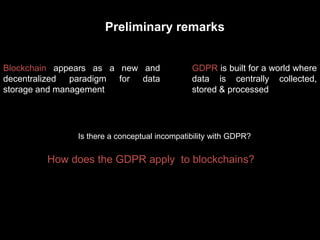
Blockchain appears as a new and
decentralized paradigm for data
storage and management
GDPR is built for a world where
data is centrally collected,
stored & processed
Preliminary remarks
Is there a conceptual incompatibility with GDPR?
How does the GDPR apply to blockchains?
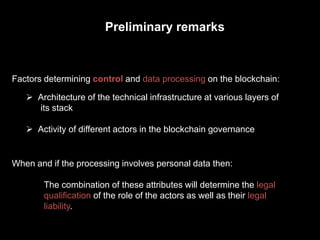
Preliminary remarks
Factors determining control and data processing on the blockchain:
 Architecture of the technical infrastructure at various layers of
its stack
 Activity of different actors in the blockchain governance
When and if the processing involves personal data then:
The combination of these attributes will determine the legal
qualification of the role of the actors as well as their legal
liability.
Which data do we store on the blockchain?
• Plain text data
• Transactional data
Which data do we store on the blockchain?
• Plain text data
Some plain text data is necessary BUT
in principle you probably don’t use it much
• Transactional data
Which data do we store on the blockchain?
• Plain text data
Some plain text data is necessary BUT
in principle you probably don’t use it much
• Transactional data
Metadata
Encrypted personal data
Hashed personal data
Anonymous data are not personal data according to the GDPR
What does the law say?
Anonymous data are not personal data according to the GDPR
BUT
Pseudonymous data are personal data subject to GDPR
What does the law say?
Definitions matter
What’s the difference?
Definitions matter
Anonymous data ≠ Pseudonymous data
What’s the difference?
Definitions matter
Anonymous data ≠ Pseudonymous data
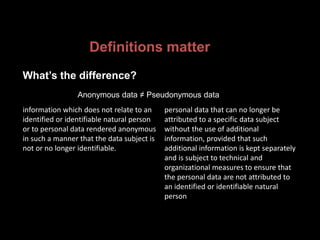
information which does not relate to an
identified or identifiable natural person
or to personal data rendered anonymous
in such a manner that the data subject is
not or no longer identifiable.
personal data that can no longer be
attributed to a specific data subject
without the use of additional
information, provided that such
additional information is kept separately
and is subject to technical and
organizational measures to ensure that
the personal data are not attributed to
an identified or identifiable natural
person
What does that mean for the blockchain data?
Article 29 WP on anonymisation :
processing personal data in order to irreversibly prevent
identification
• Hashing ?
• Asymmetric cryptography?
NO
What does that mean for the blockchain data?
Data qualified as personal data are essential to the functioning of the
blockchain
Identification of irreversibly anonymous data and the respective processes that
produce them in the blockchain environment
Solutions ?
Technical solutions
Legal solutions
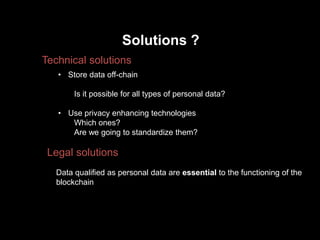
Solutions ?
Technical solutions
Legal solutions
• Store data off-chain
Is it possible for all types of personal data?
Solutions ?
Technical solutions
Legal solutions
• Store data off-chain
Is it possible for all types of personal data?
• Use privacy enhancing technologies
Which ones?
Are we going to standardize them?
Solutions ?
Technical solutions
Legal solutions
• Store data off-chain
Is it possible for all types of personal data?
• Use privacy enhancing technologies
Which ones?
Are we going to standardize them?
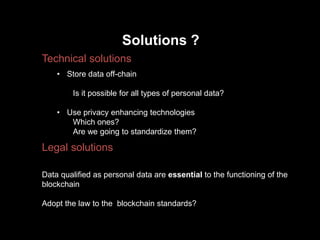
Data qualified as personal data are essential to the functioning of the
blockchain
Solutions ?
Technical solutions
Legal solutions
• Store data off-chain
Is it possible for all types of personal data?
• Use privacy enhancing technologies
Which ones?
Are we going to standardize them?
Data qualified as personal data are essential to the functioning of the
blockchain
Adopt the law to the blockchain standards?
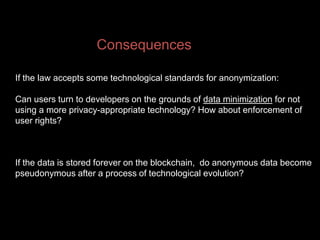
Consequences
If the law accepts some technological standards for anonymization:
Can users turn to developers on the grounds of data minimization for not
using a more privacy-appropriate technology? How about enforcement of
user rights?
If the data is stored forever on the blockchain, do anonymous data become
pseudonymous after a process of technological evolution?
Blockchain actors and
GDPR compliance
Subjects of GDPR obligations
(art. 4)
DATA CONTROLLER
“determines the purposes and means of the
processing of personal data”
DATA PROCESSOR
“processes personal data on behalf of the
controller”
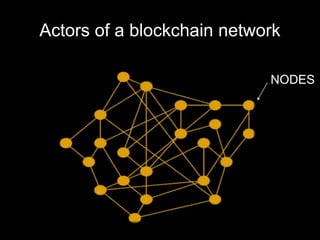
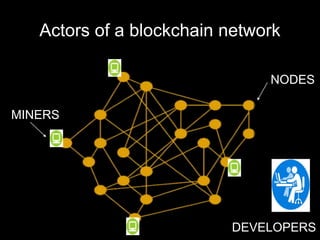
Actors of a blockchain network
NODES
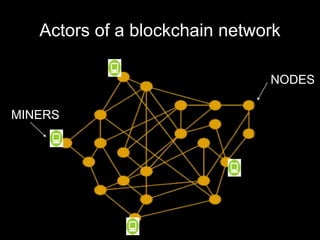
Actors of a blockchain network
NODES
MINERS
Actors of a blockchain network
NODES
MINERS
DEVELOPERS
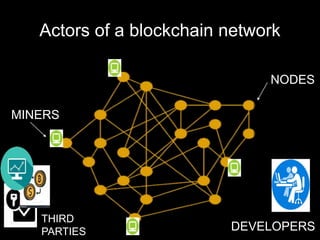
Actors of a blockchain network
NODES
MINERS
DEVELOPERS
THIRD
PARTIES
MINERS
VERIFY TRANSACTIONS AND ADD BLOCKS
MINERS
VERIFY TRANSACTIONS AND ADD BLOCKS
• CONTROLLERS?
MINERS
VERIFY TRANSACTIONS AND ADD BLOCKS
• CONTROLLERS?
They only validate submitted data, not determining means and
purposes of processing
MINERS
VERIFY TRANSACTIONS AND ADD BLOCKS
• CONTROLLERS?
They only validate submitted data, not determining means and
purposes of processing
• PROCESSORS?
MINERS
VERIFY TRANSACTIONS AND ADD BLOCKS
• CONTROLLERS?
They only validate submitted data, not determining means and
purposes of processing
• PROCESSORS?
May be! (this is the opinion of the CNIL)
DEVELOPERS
DEFINE HOW DATA IS PROCESSED BY
WAY OF THE PROTOCOL
DEVELOPERS
DEFINE HOW DATA IS PROCESSED BY
WAY OF THE PROTOCOL
• CONTROLLERS?
DEVELOPERS
DEFINE HOW DATA IS PROCESSED BY
WAY OF THE PROTOCOL
• CONTROLLERS?
They may considered to determine the means and
purposes of processing. But…
DEVELOPERS
DEFINE HOW DATA IS PROCESSED
BY WAY OF THE PROTOCOL
• CONTROLLERS?
They may considered to determine the means
and purposes of processing. But…
they are bound to the consensus and to
technological requirements: they don’t
determine the means and purpose of processing
autonomously
DEVELOPERS
DEFINE HOW DATA IS PROCESSED BY WAY
OF THE PROTOCOL
• CONTROLLERS?
They may considered to determine the means and
purposes of processing. But…
• they are bound to the consensus and to technological
requirements: they don’t determine the means and
purpose of processing autonomously
• …should, then, all open source software developers be
liable under the GDPR?
THIRD PARTIES
PROCESS AND ANALYZE BLOCKCHAIN
DATA FOR COMMERCIAL PURPOSES
THIRD PARTIES
PROCESS AND ANALYZE BLOCKCHAIN DATA
FOR COMMERCIAL PURPOSES
• May qualify as data controllers for the data they
request from users
THIRD PARTIES
PROCESS AND ANALYZE BLOCKCHAIN DATA FOR
COMMERCIAL PURPOSES
• May qualify as data controllers for the data they request
from users
• Most of the data they are responsible for will be off-chain
THIRD PARTIES
PROCESS AND ANALYZE BLOCKCHAIN DATA FOR
COMMERCIAL PURPOSES
• May qualify as data controllers for the data they request
from users
• Most of the data they are responsible for will be off-chain
• If responsible for on-chain data: who can they identify as
data processor?
(FULL) NODES
DOWNLOAD BLOCKS AND TRANSACTIONS
AND VERIFY THEM AGAINST CONSENSUS
RULES
(FULL) NODES
DOWNLOAD BLOCKS AND TRANSACTIONS
AND VERIFY THEM AGAINST CONSENSUS
RULES
• JOINT CONTROLLERS?
(FULL) NODES
DOWNLOAD BLOCKS AND TRANSACTIONS
AND VERIFY THEM AGAINST CONSENSUS
RULES
• JOINT CONTROLLERS?
No joint determination. The system is shaped by nodes’
individual behaviors (Fink, 2017).
(FULL) NODES
DOWNLOAD BLOCKS AND TRANSACTIONS
AND VERIFY THEM AGAINST CONSENSUS
RULES
• JOINT CONTROLLERS?
No joint determination. The system is shaped by nodes’
individual behaviors (Fink, 2017).
• EACH OF THEM INDIVIDUAL CONTROLLER?
(FULL) NODES
DOWNLOAD BLOCKS AND TRANSACTIONS
AND VERIFY THEM AGAINST CONSENSUS
RULES
• JOINT CONTROLLERS?
No joint determination. The system is shaped by nodes’
individual behaviors (Fink, 2017).
• EACH OF THEM INDIVIDUAL CONTROLLER?
They are subject to the system rules designed by developers
(FULL) NODES
DOWNLOAD BLOCKS AND TRANSACTIONS AND
VERIFY THEM AGAINST CONSENSUS RULES
• JOINT CONTROLLERS?
No joint determination. The system is shaped by nodes’
individual behaviors (Fink, 2017).
• EACH OF THEM INDIVIDUAL CONTROLLER?
They are subject to the system rules designed by developers
No individual ability to influence the consensus rules or modify
the ledger
USERS
BOTH DATA SUBJECTS AND CONTROLLERS?
USERS
BOTH DATA SUBJECTS AND CONTROLLERS?
– Data subjects have control over their data through their
private key
USERS
BOTH DATA SUBJECTS AND CONTROLLERS?
– Data subjects have control over their data through their
private key
– all users share the same information and are subject to
common, consensus-based, processing rules
USERS
BOTH DATA SUBJECTS AND CONTROLLERS?
– Data subjects have control over their data through their
private key
– all users share the same information and are subject to
common, consensus-based, processing rules
– everyone is entitled to become an active participant in the
storage and processing mechanism set out by the
blockchain protocol
Conclusions:
• Need to look at specific governance structure of a
given blockchain, and specific use cases
• The GDPR principle of controllership could be re-
thought in consideration of the greatest responsibility
which is granted to individuals users of BC
infrastructures, and of the decentralization of data
processing in BC networks
THANK YOU

Distributed data protection and liability on the blockchain

  • 1.
    Distributed Data Protectionand Liability on Blockchains Alexandra Giannopoulou and Valeria Ferrari Blockchain and Society Policy Lab Institute for Information Law (IViR) University of Amsterdam @alex_giann @ferrari_bv Blockchain for Science, Research and Knowledge creation Berlin, 5-6 November 2018
  • 2.
    Blockchain appears asa new and decentralized paradigm for data storage and management GDPR is built for a world where data is centrally collected, stored & processed Preliminary remarks Is there a conceptual incompatibility with GDPR? How does the GDPR apply to blockchains?
  • 3.
    Preliminary remarks Factors determiningcontrol and data processing on the blockchain:  Architecture of the technical infrastructure at various layers of its stack  Activity of different actors in the blockchain governance When and if the processing involves personal data then: The combination of these attributes will determine the legal qualification of the role of the actors as well as their legal liability.
  • 4.
    Which data dowe store on the blockchain? • Plain text data • Transactional data
  • 5.
    Which data dowe store on the blockchain? • Plain text data Some plain text data is necessary BUT in principle you probably don’t use it much • Transactional data
  • 6.
    Which data dowe store on the blockchain? • Plain text data Some plain text data is necessary BUT in principle you probably don’t use it much • Transactional data Metadata Encrypted personal data Hashed personal data
  • 7.
    Anonymous data arenot personal data according to the GDPR What does the law say?
  • 8.
    Anonymous data arenot personal data according to the GDPR BUT Pseudonymous data are personal data subject to GDPR What does the law say?
  • 9.
  • 10.
    What’s the difference? Definitionsmatter Anonymous data ≠ Pseudonymous data
  • 11.
    What’s the difference? Definitionsmatter Anonymous data ≠ Pseudonymous data information which does not relate to an identified or identifiable natural person or to personal data rendered anonymous in such a manner that the data subject is not or no longer identifiable. personal data that can no longer be attributed to a specific data subject without the use of additional information, provided that such additional information is kept separately and is subject to technical and organizational measures to ensure that the personal data are not attributed to an identified or identifiable natural person
  • 12.
    What does thatmean for the blockchain data?
  • 13.
    What does thatmean for the blockchain data? Article 29 WP on anonymisation : processing personal data in order to irreversibly prevent identification • Hashing ? • Asymmetric cryptography? NO
  • 14.
    What does thatmean for the blockchain data? Data qualified as personal data are essential to the functioning of the blockchain Identification of irreversibly anonymous data and the respective processes that produce them in the blockchain environment
  • 15.
  • 16.
    Solutions ? Technical solutions Legalsolutions • Store data off-chain Is it possible for all types of personal data?
  • 17.
    Solutions ? Technical solutions Legalsolutions • Store data off-chain Is it possible for all types of personal data? • Use privacy enhancing technologies Which ones? Are we going to standardize them?
  • 18.
    Solutions ? Technical solutions Legalsolutions • Store data off-chain Is it possible for all types of personal data? • Use privacy enhancing technologies Which ones? Are we going to standardize them? Data qualified as personal data are essential to the functioning of the blockchain
  • 19.
    Solutions ? Technical solutions Legalsolutions • Store data off-chain Is it possible for all types of personal data? • Use privacy enhancing technologies Which ones? Are we going to standardize them? Data qualified as personal data are essential to the functioning of the blockchain Adopt the law to the blockchain standards?
  • 20.
    Consequences If the lawaccepts some technological standards for anonymization: Can users turn to developers on the grounds of data minimization for not using a more privacy-appropriate technology? How about enforcement of user rights? If the data is stored forever on the blockchain, do anonymous data become pseudonymous after a process of technological evolution?
  • 21.
  • 22.
    Subjects of GDPRobligations (art. 4) DATA CONTROLLER “determines the purposes and means of the processing of personal data” DATA PROCESSOR “processes personal data on behalf of the controller”
  • 23.
    Actors of ablockchain network NODES
  • 24.
    Actors of ablockchain network NODES MINERS
  • 25.
    Actors of ablockchain network NODES MINERS DEVELOPERS
  • 26.
    Actors of ablockchain network NODES MINERS DEVELOPERS THIRD PARTIES
  • 27.
  • 28.
    MINERS VERIFY TRANSACTIONS ANDADD BLOCKS • CONTROLLERS?
  • 29.
    MINERS VERIFY TRANSACTIONS ANDADD BLOCKS • CONTROLLERS? They only validate submitted data, not determining means and purposes of processing
  • 30.
    MINERS VERIFY TRANSACTIONS ANDADD BLOCKS • CONTROLLERS? They only validate submitted data, not determining means and purposes of processing • PROCESSORS?
  • 31.
    MINERS VERIFY TRANSACTIONS ANDADD BLOCKS • CONTROLLERS? They only validate submitted data, not determining means and purposes of processing • PROCESSORS? May be! (this is the opinion of the CNIL)
  • 32.
    DEVELOPERS DEFINE HOW DATAIS PROCESSED BY WAY OF THE PROTOCOL
  • 33.
    DEVELOPERS DEFINE HOW DATAIS PROCESSED BY WAY OF THE PROTOCOL • CONTROLLERS?
  • 34.
    DEVELOPERS DEFINE HOW DATAIS PROCESSED BY WAY OF THE PROTOCOL • CONTROLLERS? They may considered to determine the means and purposes of processing. But…
  • 35.
    DEVELOPERS DEFINE HOW DATAIS PROCESSED BY WAY OF THE PROTOCOL • CONTROLLERS? They may considered to determine the means and purposes of processing. But… they are bound to the consensus and to technological requirements: they don’t determine the means and purpose of processing autonomously
  • 36.
    DEVELOPERS DEFINE HOW DATAIS PROCESSED BY WAY OF THE PROTOCOL • CONTROLLERS? They may considered to determine the means and purposes of processing. But… • they are bound to the consensus and to technological requirements: they don’t determine the means and purpose of processing autonomously • …should, then, all open source software developers be liable under the GDPR?
  • 37.
    THIRD PARTIES PROCESS ANDANALYZE BLOCKCHAIN DATA FOR COMMERCIAL PURPOSES
  • 38.
    THIRD PARTIES PROCESS ANDANALYZE BLOCKCHAIN DATA FOR COMMERCIAL PURPOSES • May qualify as data controllers for the data they request from users
  • 39.
    THIRD PARTIES PROCESS ANDANALYZE BLOCKCHAIN DATA FOR COMMERCIAL PURPOSES • May qualify as data controllers for the data they request from users • Most of the data they are responsible for will be off-chain
  • 40.
    THIRD PARTIES PROCESS ANDANALYZE BLOCKCHAIN DATA FOR COMMERCIAL PURPOSES • May qualify as data controllers for the data they request from users • Most of the data they are responsible for will be off-chain • If responsible for on-chain data: who can they identify as data processor?
  • 41.
    (FULL) NODES DOWNLOAD BLOCKSAND TRANSACTIONS AND VERIFY THEM AGAINST CONSENSUS RULES
  • 42.
    (FULL) NODES DOWNLOAD BLOCKSAND TRANSACTIONS AND VERIFY THEM AGAINST CONSENSUS RULES • JOINT CONTROLLERS?
  • 43.
    (FULL) NODES DOWNLOAD BLOCKSAND TRANSACTIONS AND VERIFY THEM AGAINST CONSENSUS RULES • JOINT CONTROLLERS? No joint determination. The system is shaped by nodes’ individual behaviors (Fink, 2017).
  • 44.
    (FULL) NODES DOWNLOAD BLOCKSAND TRANSACTIONS AND VERIFY THEM AGAINST CONSENSUS RULES • JOINT CONTROLLERS? No joint determination. The system is shaped by nodes’ individual behaviors (Fink, 2017). • EACH OF THEM INDIVIDUAL CONTROLLER?
  • 45.
    (FULL) NODES DOWNLOAD BLOCKSAND TRANSACTIONS AND VERIFY THEM AGAINST CONSENSUS RULES • JOINT CONTROLLERS? No joint determination. The system is shaped by nodes’ individual behaviors (Fink, 2017). • EACH OF THEM INDIVIDUAL CONTROLLER? They are subject to the system rules designed by developers
  • 46.
    (FULL) NODES DOWNLOAD BLOCKSAND TRANSACTIONS AND VERIFY THEM AGAINST CONSENSUS RULES • JOINT CONTROLLERS? No joint determination. The system is shaped by nodes’ individual behaviors (Fink, 2017). • EACH OF THEM INDIVIDUAL CONTROLLER? They are subject to the system rules designed by developers No individual ability to influence the consensus rules or modify the ledger
  • 47.
    USERS BOTH DATA SUBJECTSAND CONTROLLERS?
  • 48.
    USERS BOTH DATA SUBJECTSAND CONTROLLERS? – Data subjects have control over their data through their private key
  • 49.
    USERS BOTH DATA SUBJECTSAND CONTROLLERS? – Data subjects have control over their data through their private key – all users share the same information and are subject to common, consensus-based, processing rules
  • 50.
    USERS BOTH DATA SUBJECTSAND CONTROLLERS? – Data subjects have control over their data through their private key – all users share the same information and are subject to common, consensus-based, processing rules – everyone is entitled to become an active participant in the storage and processing mechanism set out by the blockchain protocol
  • 51.
    Conclusions: • Need tolook at specific governance structure of a given blockchain, and specific use cases • The GDPR principle of controllership could be re- thought in consideration of the greatest responsibility which is granted to individuals users of BC infrastructures, and of the decentralization of data processing in BC networks
  • 52.

Editor's Notes

  • #23 Essential for the enforcement of data subject rights (access, correct, erase) Roles must be clearly identified and defined by entering an agreement Subject to severe fines in case of violations
  • #24 DOWNLOAD BLOCKS AND TRANSACTIONS AND VERIFY THEM AGAINST CONSENSUS RULES
  • #25 VERIFY TRANSACTIONS AND ADD BLOCKS
  • #26 DEVELOPERS: do they identify with a legal entity, such as the Ethereum foundation? In that case, they may have responsibilities for determining the purposes and means of data processing?
  • #27 DEVELOPERS: do they identify with a legal entity, such as the Ethereum foundation? In that case, they may have responsibilities for determining the purposes and means of data processing?
  • #44 EITHER EACH OF THEM OR NONE OF THEM IS CONTROLLER Joint controllership: art 26: no nodes. They freely decide to enter the consensus group. THE SYSTE
  • #46 THEY ARE VERY PASSIVE ENTITIES They are decentralized actors to which application of GDRP is very hard
  • #47 THEY ARE VERY PASSIVE ENTITIES They are DECENTRALISED actors to which application of GDRP is very hard
  • #48 BUT: art 2: the GDRP does not apply in case of purely personal or household activity. Interpreted by the CNIL as: GDPR applies to users only in the exercise of professional or commercial activities
  • #49 BUT: art 2: the GDRP does not apply in case of purely personal or household activity. Interpreted by the CNIL as: GDPR applies to users only in the exercise of professional or commercial activities
  • #50 BUT: art 2: the GDRP does not apply in case of purely personal or household activity. Interpreted by the CNIL as: GDPR applies to users only in the exercise of professional or commercial activities
  • #51 BUT: art 2: the GDRP does not apply in case of purely personal or household activity. Interpreted by the CNIL as: GDPR applies to users only in the exercise of professional or commercial activities