Distributed Computing
Dr Ilaiah Kavati
Dept. of CSE, NIT Warangal
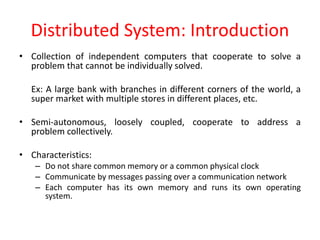
Distributed System: Introduction
• Collection of independent computers that cooperate to solve a
problem that cannot be individually solved.
Ex: A large bank with branches in different corners of the world, a
super market with multiple stores in different places, etc.
• Semi-autonomous, loosely coupled, cooperate to address a
problem collectively.
• Characteristics:
– Do not share common memory or a common physical clock
– Communicate by messages passing over a communication network
– Each computer has its own memory and runs its own operating
system.
Pre-requisites
• Computer Networking
• Operating Systems
• Basic Computer Programming
• Data Structures
• Algorithms
Course Modules
• Introduction to Distributed Computing
• IPC: Message Passing System
• Models of Distributed Computation
• Causality & Logical Time
• Global State and Snapshot Recording
• Group communication & message ordering
• Distributed Mutual Exclusion and Deadlocks
• Distributed Shared Memory
• Consensus and Agreement
• Check pointing & Rollback Recovery
Learning Outcomes
• Understand models of distributed computing
• Analyze algorithms for coordination, communication
and synchronization in distributed systems
• Analyze distributed shared memory models
• Design and Implement distributed file systems
• Design distributed algorithms for handling deadlocks
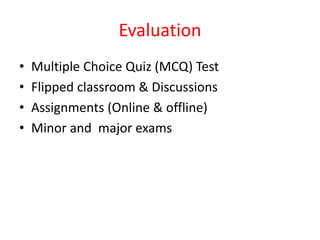
Evaluation
• Multiple Choice Quiz (MCQ) Test
• Flipped classroom & Discussions
• Assignments (Online & offline)
• Minor and major exams
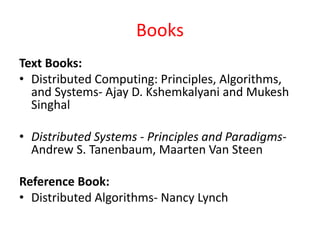
Books
Text Books:
• Distributed Computing: Principles, Algorithms,
and Systems- Ajay D. Kshemkalyani and Mukesh
Singhal
• Distributed Systems - Principles and Paradigms-
Andrew S. Tanenbaum, Maarten Van Steen
Reference Book:
• Distributed Algorithms- Nancy Lynch

Distributed Computing ppt

  • 1.
    Distributed Computing Dr IlaiahKavati Dept. of CSE, NIT Warangal
  • 2.
    Distributed System: Introduction •Collection of independent computers that cooperate to solve a problem that cannot be individually solved. Ex: A large bank with branches in different corners of the world, a super market with multiple stores in different places, etc. • Semi-autonomous, loosely coupled, cooperate to address a problem collectively. • Characteristics: – Do not share common memory or a common physical clock – Communicate by messages passing over a communication network – Each computer has its own memory and runs its own operating system.
  • 3.
    Pre-requisites • Computer Networking •Operating Systems • Basic Computer Programming • Data Structures • Algorithms
  • 4.
    Course Modules • Introductionto Distributed Computing • IPC: Message Passing System • Models of Distributed Computation • Causality & Logical Time • Global State and Snapshot Recording • Group communication & message ordering • Distributed Mutual Exclusion and Deadlocks • Distributed Shared Memory • Consensus and Agreement • Check pointing & Rollback Recovery
  • 5.
    Learning Outcomes • Understandmodels of distributed computing • Analyze algorithms for coordination, communication and synchronization in distributed systems • Analyze distributed shared memory models • Design and Implement distributed file systems • Design distributed algorithms for handling deadlocks
  • 6.
    Evaluation • Multiple ChoiceQuiz (MCQ) Test • Flipped classroom & Discussions • Assignments (Online & offline) • Minor and major exams
  • 7.
    Books Text Books: • DistributedComputing: Principles, Algorithms, and Systems- Ajay D. Kshemkalyani and Mukesh Singhal • Distributed Systems - Principles and Paradigms- Andrew S. Tanenbaum, Maarten Van Steen Reference Book: • Distributed Algorithms- Nancy Lynch