Dissertation
Why Do SME’s in Cameroon Remain Small?
A Case Study of Afritec Limited
Type of Documents : Dissertation
No of Words : 22,000
Disclaimer: This is a sample document prepared by DissertationFirst.co.uk and has been
submitted on turnitin. To order the similar paper please contact at:
Email : help@dissertationfirst.co.uk
Phone: (UK) +44 203 3555 345
Website: www.dissertationfirst.co.uk nd attitudeof British Customers
towardsthe hospitalitysector in London:a Case study
on MarriottHotelUK
Page - 2
Email : help@dissertationfirst.co.uk, Phone: (UK) +44 203 3555345
Website: www.dissertationfirst.co.uk
This is a sample document owned by Dissertation First
STATEMENT OF ORIGINALITY
In presentingthis dissertationfor assessment, Ideclare that it is a final copy including any last revisions. I also
declare that it is entirelythe result of myown work other than where sources are explicitlyacknowledgedand
referencedwithinthe body of the text. [or: in footnotes, endnotes, as appropriate]. This dissertationhas not
been previouslysubmittedfor any degree at this or any other institution.
[Name of student]
[Date]
Page - 3
Email : help@dissertationfirst.co.uk, Phone: (UK) +44 203 3555345
Website: www.dissertationfirst.co.uk
This is a sample document owned by Dissertation First
ACKNOWLEDGEMENT
I am thankful to my mentor for all the support and assistance that they provided me during the research
process andproviding me an opportunityto complete this project. Iwould also like to thank my team members
who were always present for providing the required support in order to conduct the survey in an orderly
manner.
Page - 4
Email : help@dissertationfirst.co.uk, Phone: (UK) +44 203 3555345
Website: www.dissertationfirst.co.uk
This is a sample document owned by Dissertation First
ABSTRACT
This research explores reasons pertaining to the backwardness of Small and Medium Enterprises in
developing nations like Cameroon by taking African Information and telecommunication as a case company.
The country is situated in central Africa. The mainstay of the nation is Agriculture and therefore, it is
predominantly known as the agrarian economy. The following research will help the upcoming companies
about the political system and other understanding in regards with the Cameroon. Most of the SME’s in these
nations remain small due to various challenges and obstacles. The main purpose of this research is to identify
different factors that hinder the growth and success of SME’s. In addition to this, the research will also
investigate the future of SME’s in general.
A well-defined researchmethodology is used to collect data for the research purpose. For the purpose
of evaluating the data in qualitative and quantitative manner, the data is accumulated by using both primary
and secondary research methods. This research approach is extremely helpful in identifying the factors that
lead Afritec limitedand impact on other SME’s to remain small, irrespective of having many growth prospects
and opportunities. The findings of the research confirm the previous researches and contribute additional
evidence that suggests that the presence of large number of small and medium enterprises is a great sign of
flourishment of a particular economy. The major obstacles for the development of these firms are mainly in
adequate availability of finance, corruption, taxation system and managerial problems.
Based on the study it can be concludedthat SME’s are well thought-out as the first resort of employment to
millions of people in the nation. In Cameroon, SME’s play a significant role in sustaining the economic
growth, generating employment, increasing trade and creating new private enterprise.
Page - 5
Email : help@dissertationfirst.co.uk, Phone: (UK) +44 203 3555345
Website: www.dissertationfirst.co.uk
This is a sample document owned by Dissertation First
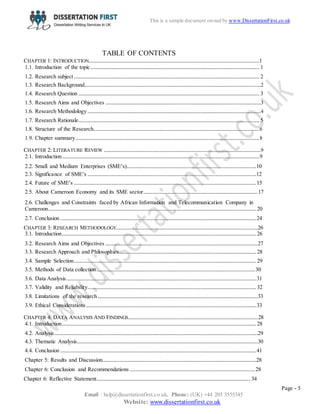
TABLE OF CONTENTS
CHAPTER 1: INTRODUCTION.................................................................................................................1
1.1. Introduction of the topic................................................................................................................ 1
1.2. Research subject........................................................................................................................... 2
1.3. Research Background.....................................................................................................................2
1.4. Research Question ........................................................................................................................ 3
1.5. Research Aims and Objectives .......................................................................................................3
1.6. Research Methodology...................................................................................................................4
1.7. Research Rationale........................................................................................................................ 5
1.8. Structure of the Research..............................................................................................................6
1.9. Chapter summary..........................................................................................................................8
CHAPTER 2: LITERATURE REVIEW ........................................................................................................9
2.1. Introduction...................................................................................................................................9
2.2. Small and Medium Enterprises (SME’s)......................................................................................10
2.3. Significance of SME’s ................................................................................................................12
2.4. Future of SME’s .........................................................................................................................15
2.5. About Cameroon Economy and its SME sector............................................................................17
2.6. Challenges and Constraints faced by African Information and Telecommunication Company in
Cameroon..........................................................................................................................................20
2.7. Conclusion ..................................................................................................................................24
CHAPTER 3: RESEARCH METHODOLOGY..............................................................................................26
3.1. Introduction.................................................................................................................................26
3.2. Research Aims and Objectives .....................................................................................................27
3.3. Research Approach and Philosophies...........................................................................................28
3.4. Sample Selection.........................................................................................................................29
3.5. Methods of Data collection.........................................................................................................30
3.6. Data Analysis..............................................................................................................................31
3.7. Validity and Reliability................................................................................................................32
3.8. Limitations of the research ..........................................................................................................33
3.9. Ethical Considerations.................................................................................................................33
CHAPTER 4: DATA ANALYSIS AND FINDINGS......................................................................................28
4.1. Introduction.................................................................................................................................28
4.2. Analysis.......................................................................................................................................29
4.3. Thematic Analysis........................................................................................................................30
4.4. Conclusion ..................................................................................................................................41
Chapter 5: Results and Discussion......................................................................................................28
Chapter 6: Conclusion and Recommendations ...................................................................................28
Chapter 6: Reflective Statement...................................................................................................... 34
Page - 6
Email : help@dissertationfirst.co.uk, Phone: (UK) +44 203 3555345
Website: www.dissertationfirst.co.uk
This is a sample document owned by Dissertation First
References........................................................................................................................................35
APPENDIX 1……………………………………………………………………………………….. 43
Page - 7
Email : help@dissertationfirst.co.uk, Phone: (UK) +44 203 3555345
Website: www.dissertationfirst.co.uk
This is a sample document owned by Dissertation First
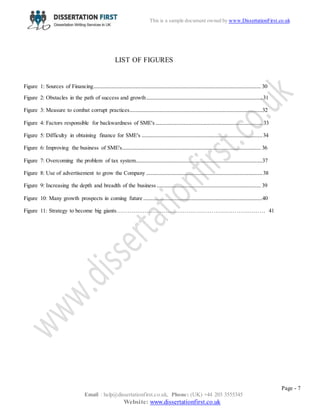
LIST OF FIGURES
Figure 1: Sources of Financing............................................................................................................... 30
Figure 2: Obstacles in the path of success and growth.............................................................................31
Figure 3: Measure to combat corrupt practices........................................................................................32
Figure 4: Factors responsible for backwardness of SME's....................................................................... 33
Figure 5: Difficulty in obtaining finance for SME's ................................................................................34
Figure 6: Improving the business of SME's............................................................................................ 36
Figure 7: Overcoming the problem of tax system....................................................................................37
Figure 8: Use of advertisement to grow the Company .............................................................................38
Figure 9: Increasing the depth and breadth of the business ..................................................................... 39
Figure 10: Many growth prospects in coming future ...............................................................................40
Figure 11: Strategy to become big giants…………………………………………………………………… 41
Page - 8
Email : help@dissertationfirst.co.uk, Phone: (UK) +44 203 3555345
Website: www.dissertationfirst.co.uk
This is a sample document owned by Dissertation First
CHAPTER 1: INTRODUCTION
1.1. Introduction of the topic
The main purpose behind this work is to investigate various factors that lead Afritec
limited to remainsmall, although it has many growth prospects. The researchquestionof this study is “Why do
Small and Medium Enterprises remain small in Cameroon”. The subsequent research is being undertaken to
gain an understanding in relationwith the SME’s in Cameroon. The researchwill also make an investigation to
indentify various challenges and constraints faced by SMEs in the proposed country (Chibba, 2011).
Cameroon is located at central part of Africa. The mainstay of the nation is agriculture and therefore, it is
predominantly known as the agrarian economy. The following research will help the upcoming companies to
have better understanding about environment and political system of Cameroon so that they can sustain their
business in the country. Many factors are responsible for SMEs in Cameroon to remain small and thus, here in
this report an investigation is being made to identify these important factors (Bhaird, 2010).
Small and Medium Enterprises (SMEs) have significantly played an important role in the economic
development of various countries all over the world. Over a period of time, it is being proved that SMEs are
innovative and dynamic (Ngehnevu and Nembo, 2010). They are also the first resort in providing employment
opportunities to millions of people in the country. Small and Medium enterprises are breeding ground for
entrepreneurship (Burgess, 2002). The SME sector has gained importance all across the world owing to its
considerable contribution in achieving various socio-economic objectives. These objectives are generating
employment opportunities, contributing in national output and exports, fostering new entrepreneurship and
finally it helps in providing an industrial foundation of the economy in depth (Hillary, 2000).
These enterprises are being considered as the backbone of all economies. They are the main source of
flexibility, dynamism and economic growth in advanced industrialized countries. Small businesses are
particularlyimportant for development of economy as they bring innovations in products and techniques in the
market (Chibba, 2011). There are many common characteristics of SMEs, which helps in making distinction
between large giants operating in the same market. Generally, these small enterprises are born out of one or
two entrepreneurs. They set their business primarily as a means to earn their livelihood. These encompass
many retails
Page - 9
Email : help@dissertationfirst.co.uk, Phone: (UK) +44 203 3555345
Website: www.dissertationfirst.co.uk
This is a sample document owned by Dissertation First
establishments and manufacturing services (Bhaird, 2010). The cost of production in this sector is also very
low. SMEs enjoys high propensity to adopt technology. They are the prime drivers of jobs and provide
employment opportunities to millions of people all over the world. Articulated from this fact this industry is
therefore being known as labor intensive industry. Cameroon is a developing country and thus the situation is
worse. If SMEs are maintained significantly than, economic situation of the nation as well as economy can be
improved (Chibba, 2011).
1.2. Research subject
This research focuses on SMEs in Cameroon. There are many factors which hinder the growth of
SME’s and remain them small in spite of having many growth opportunities (Smorfitt, 2012). The main
company selected for this research is African information and telecommunication company limited (Afritec
ltd). It is a private firm, which deals with maintenance and sales of computer system. Under this research study
various challenges and constraints being faced by SMEs would be explored. SMEs play a very important role
almost in each and every country (Ngehnevu and Nembo, 2010). They are key source of economic
development and innovation as they involve lower level of investment and cost of production. SMEs comprise
the largest number of enterprises existingall around the globe. Almost 90% of businesses worldwide consist of
SMEs (Bhaird, 2010). There are many forms of corruption that prevails within SMEs such as bribery, undue
advantage of public officers, misappropriationof funds and extortion. All these corrupt practices are imposing
negative impact on the development of small and medium sized firms (Small Business Development and
Corruption, 2006). With reference to the above fact this report will find out various ways of handling corrupt
practices and import export problems being faced by SMEs. Further, it will explore all in-depth aspects in
regards with the small and medium enterprise so as to have better understanding of operating business
(Smorfitt, 2012).
1.3. Research Background
The researchbackground selectedinthis dissertationis SMEs and various reasons that lead them to remain
small in Cameroon (Smorfitt, 2012). The study is being undertaken in African information and
Telecommunication Company. Having numerous growth prospects and opportunities, this company is still
small. This state of the firm is the result of various factors and problems. Some of them are the tax system of
the nation, import and export policies and
like what the activity of research is, how to move further, how progress can be measured and what constitutes
success (Taylor and et. al., 2006). In this research, secondary data collection method will be used and for this
various books, journals, magazines and articles will be used. The research is mainly focused on hospitality
Page - 10
Email : help@dissertationfirst.co.uk, Phone: (UK) +44 203 3555345
Website: www.dissertationfirst.co.uk
This is a sample document owned by Dissertation First
consumers with special focus on British customers and a particular study on Marriott Hotel, UK. Thus, the
problems, corrupt practices, problem in accessing finance etc (Direng, 2010). All these challenges and
problems hold back the success and growth of the company (Ngehnevu and Nembo, 2010). SMEs are being
considered as a seed-bed for indigenous entrepreneurship. They further provide a supporting hand in creation
of wealth for all the citizens. Small and Medium enterprises promote indigenous technical know-how. With
this sector, local development is made possible as they mainly use local resources (Ngehnevu and Nembo,
2010). SMEs in their operations solve various problems being faced by the nation and thus complement the
efforts of the government (Direng, 2010). Today, it is worthy of note that many large giants and big businesses
has started their operations as small business and now they are working tremendously on international and
local platforms. Some of these companies are Kingdom bookshop, Darko farms, UT bank etc (Bhaird, 2010).

Dissertation a Case Study of Afritec Limited Sample

  • 1.
    Dissertation Why Do SME’sin Cameroon Remain Small? A Case Study of Afritec Limited Type of Documents : Dissertation No of Words : 22,000 Disclaimer: This is a sample document prepared by DissertationFirst.co.uk and has been submitted on turnitin. To order the similar paper please contact at: Email : help@dissertationfirst.co.uk Phone: (UK) +44 203 3555 345 Website: www.dissertationfirst.co.uk nd attitudeof British Customers towardsthe hospitalitysector in London:a Case study on MarriottHotelUK
  • 2.
    Page - 2 Email: help@dissertationfirst.co.uk, Phone: (UK) +44 203 3555345 Website: www.dissertationfirst.co.uk This is a sample document owned by Dissertation First STATEMENT OF ORIGINALITY In presentingthis dissertationfor assessment, Ideclare that it is a final copy including any last revisions. I also declare that it is entirelythe result of myown work other than where sources are explicitlyacknowledgedand referencedwithinthe body of the text. [or: in footnotes, endnotes, as appropriate]. This dissertationhas not been previouslysubmittedfor any degree at this or any other institution. [Name of student] [Date]
  • 3.
    Page - 3 Email: help@dissertationfirst.co.uk, Phone: (UK) +44 203 3555345 Website: www.dissertationfirst.co.uk This is a sample document owned by Dissertation First ACKNOWLEDGEMENT I am thankful to my mentor for all the support and assistance that they provided me during the research process andproviding me an opportunityto complete this project. Iwould also like to thank my team members who were always present for providing the required support in order to conduct the survey in an orderly manner.
  • 4.
    Page - 4 Email: help@dissertationfirst.co.uk, Phone: (UK) +44 203 3555345 Website: www.dissertationfirst.co.uk This is a sample document owned by Dissertation First ABSTRACT This research explores reasons pertaining to the backwardness of Small and Medium Enterprises in developing nations like Cameroon by taking African Information and telecommunication as a case company. The country is situated in central Africa. The mainstay of the nation is Agriculture and therefore, it is predominantly known as the agrarian economy. The following research will help the upcoming companies about the political system and other understanding in regards with the Cameroon. Most of the SME’s in these nations remain small due to various challenges and obstacles. The main purpose of this research is to identify different factors that hinder the growth and success of SME’s. In addition to this, the research will also investigate the future of SME’s in general. A well-defined researchmethodology is used to collect data for the research purpose. For the purpose of evaluating the data in qualitative and quantitative manner, the data is accumulated by using both primary and secondary research methods. This research approach is extremely helpful in identifying the factors that lead Afritec limitedand impact on other SME’s to remain small, irrespective of having many growth prospects and opportunities. The findings of the research confirm the previous researches and contribute additional evidence that suggests that the presence of large number of small and medium enterprises is a great sign of flourishment of a particular economy. The major obstacles for the development of these firms are mainly in adequate availability of finance, corruption, taxation system and managerial problems. Based on the study it can be concludedthat SME’s are well thought-out as the first resort of employment to millions of people in the nation. In Cameroon, SME’s play a significant role in sustaining the economic growth, generating employment, increasing trade and creating new private enterprise.
  • 5.
    Page - 5 Email: help@dissertationfirst.co.uk, Phone: (UK) +44 203 3555345 Website: www.dissertationfirst.co.uk This is a sample document owned by Dissertation First TABLE OF CONTENTS CHAPTER 1: INTRODUCTION.................................................................................................................1 1.1. Introduction of the topic................................................................................................................ 1 1.2. Research subject........................................................................................................................... 2 1.3. Research Background.....................................................................................................................2 1.4. Research Question ........................................................................................................................ 3 1.5. Research Aims and Objectives .......................................................................................................3 1.6. Research Methodology...................................................................................................................4 1.7. Research Rationale........................................................................................................................ 5 1.8. Structure of the Research..............................................................................................................6 1.9. Chapter summary..........................................................................................................................8 CHAPTER 2: LITERATURE REVIEW ........................................................................................................9 2.1. Introduction...................................................................................................................................9 2.2. Small and Medium Enterprises (SME’s)......................................................................................10 2.3. Significance of SME’s ................................................................................................................12 2.4. Future of SME’s .........................................................................................................................15 2.5. About Cameroon Economy and its SME sector............................................................................17 2.6. Challenges and Constraints faced by African Information and Telecommunication Company in Cameroon..........................................................................................................................................20 2.7. Conclusion ..................................................................................................................................24 CHAPTER 3: RESEARCH METHODOLOGY..............................................................................................26 3.1. Introduction.................................................................................................................................26 3.2. Research Aims and Objectives .....................................................................................................27 3.3. Research Approach and Philosophies...........................................................................................28 3.4. Sample Selection.........................................................................................................................29 3.5. Methods of Data collection.........................................................................................................30 3.6. Data Analysis..............................................................................................................................31 3.7. Validity and Reliability................................................................................................................32 3.8. Limitations of the research ..........................................................................................................33 3.9. Ethical Considerations.................................................................................................................33 CHAPTER 4: DATA ANALYSIS AND FINDINGS......................................................................................28 4.1. Introduction.................................................................................................................................28 4.2. Analysis.......................................................................................................................................29 4.3. Thematic Analysis........................................................................................................................30 4.4. Conclusion ..................................................................................................................................41 Chapter 5: Results and Discussion......................................................................................................28 Chapter 6: Conclusion and Recommendations ...................................................................................28 Chapter 6: Reflective Statement...................................................................................................... 34
  • 6.
    Page - 6 Email: help@dissertationfirst.co.uk, Phone: (UK) +44 203 3555345 Website: www.dissertationfirst.co.uk This is a sample document owned by Dissertation First References........................................................................................................................................35 APPENDIX 1……………………………………………………………………………………….. 43
  • 7.
    Page - 7 Email: help@dissertationfirst.co.uk, Phone: (UK) +44 203 3555345 Website: www.dissertationfirst.co.uk This is a sample document owned by Dissertation First LIST OF FIGURES Figure 1: Sources of Financing............................................................................................................... 30 Figure 2: Obstacles in the path of success and growth.............................................................................31 Figure 3: Measure to combat corrupt practices........................................................................................32 Figure 4: Factors responsible for backwardness of SME's....................................................................... 33 Figure 5: Difficulty in obtaining finance for SME's ................................................................................34 Figure 6: Improving the business of SME's............................................................................................ 36 Figure 7: Overcoming the problem of tax system....................................................................................37 Figure 8: Use of advertisement to grow the Company .............................................................................38 Figure 9: Increasing the depth and breadth of the business ..................................................................... 39 Figure 10: Many growth prospects in coming future ...............................................................................40 Figure 11: Strategy to become big giants…………………………………………………………………… 41
  • 8.
    Page - 8 Email: help@dissertationfirst.co.uk, Phone: (UK) +44 203 3555345 Website: www.dissertationfirst.co.uk This is a sample document owned by Dissertation First CHAPTER 1: INTRODUCTION 1.1. Introduction of the topic The main purpose behind this work is to investigate various factors that lead Afritec limited to remainsmall, although it has many growth prospects. The researchquestionof this study is “Why do Small and Medium Enterprises remain small in Cameroon”. The subsequent research is being undertaken to gain an understanding in relationwith the SME’s in Cameroon. The researchwill also make an investigation to indentify various challenges and constraints faced by SMEs in the proposed country (Chibba, 2011). Cameroon is located at central part of Africa. The mainstay of the nation is agriculture and therefore, it is predominantly known as the agrarian economy. The following research will help the upcoming companies to have better understanding about environment and political system of Cameroon so that they can sustain their business in the country. Many factors are responsible for SMEs in Cameroon to remain small and thus, here in this report an investigation is being made to identify these important factors (Bhaird, 2010). Small and Medium Enterprises (SMEs) have significantly played an important role in the economic development of various countries all over the world. Over a period of time, it is being proved that SMEs are innovative and dynamic (Ngehnevu and Nembo, 2010). They are also the first resort in providing employment opportunities to millions of people in the country. Small and Medium enterprises are breeding ground for entrepreneurship (Burgess, 2002). The SME sector has gained importance all across the world owing to its considerable contribution in achieving various socio-economic objectives. These objectives are generating employment opportunities, contributing in national output and exports, fostering new entrepreneurship and finally it helps in providing an industrial foundation of the economy in depth (Hillary, 2000). These enterprises are being considered as the backbone of all economies. They are the main source of flexibility, dynamism and economic growth in advanced industrialized countries. Small businesses are particularlyimportant for development of economy as they bring innovations in products and techniques in the market (Chibba, 2011). There are many common characteristics of SMEs, which helps in making distinction between large giants operating in the same market. Generally, these small enterprises are born out of one or two entrepreneurs. They set their business primarily as a means to earn their livelihood. These encompass many retails
  • 9.
    Page - 9 Email: help@dissertationfirst.co.uk, Phone: (UK) +44 203 3555345 Website: www.dissertationfirst.co.uk This is a sample document owned by Dissertation First establishments and manufacturing services (Bhaird, 2010). The cost of production in this sector is also very low. SMEs enjoys high propensity to adopt technology. They are the prime drivers of jobs and provide employment opportunities to millions of people all over the world. Articulated from this fact this industry is therefore being known as labor intensive industry. Cameroon is a developing country and thus the situation is worse. If SMEs are maintained significantly than, economic situation of the nation as well as economy can be improved (Chibba, 2011). 1.2. Research subject This research focuses on SMEs in Cameroon. There are many factors which hinder the growth of SME’s and remain them small in spite of having many growth opportunities (Smorfitt, 2012). The main company selected for this research is African information and telecommunication company limited (Afritec ltd). It is a private firm, which deals with maintenance and sales of computer system. Under this research study various challenges and constraints being faced by SMEs would be explored. SMEs play a very important role almost in each and every country (Ngehnevu and Nembo, 2010). They are key source of economic development and innovation as they involve lower level of investment and cost of production. SMEs comprise the largest number of enterprises existingall around the globe. Almost 90% of businesses worldwide consist of SMEs (Bhaird, 2010). There are many forms of corruption that prevails within SMEs such as bribery, undue advantage of public officers, misappropriationof funds and extortion. All these corrupt practices are imposing negative impact on the development of small and medium sized firms (Small Business Development and Corruption, 2006). With reference to the above fact this report will find out various ways of handling corrupt practices and import export problems being faced by SMEs. Further, it will explore all in-depth aspects in regards with the small and medium enterprise so as to have better understanding of operating business (Smorfitt, 2012). 1.3. Research Background The researchbackground selectedinthis dissertationis SMEs and various reasons that lead them to remain small in Cameroon (Smorfitt, 2012). The study is being undertaken in African information and Telecommunication Company. Having numerous growth prospects and opportunities, this company is still small. This state of the firm is the result of various factors and problems. Some of them are the tax system of the nation, import and export policies and like what the activity of research is, how to move further, how progress can be measured and what constitutes success (Taylor and et. al., 2006). In this research, secondary data collection method will be used and for this various books, journals, magazines and articles will be used. The research is mainly focused on hospitality
  • 10.
    Page - 10 Email: help@dissertationfirst.co.uk, Phone: (UK) +44 203 3555345 Website: www.dissertationfirst.co.uk This is a sample document owned by Dissertation First consumers with special focus on British customers and a particular study on Marriott Hotel, UK. Thus, the problems, corrupt practices, problem in accessing finance etc (Direng, 2010). All these challenges and problems hold back the success and growth of the company (Ngehnevu and Nembo, 2010). SMEs are being considered as a seed-bed for indigenous entrepreneurship. They further provide a supporting hand in creation of wealth for all the citizens. Small and Medium enterprises promote indigenous technical know-how. With this sector, local development is made possible as they mainly use local resources (Ngehnevu and Nembo, 2010). SMEs in their operations solve various problems being faced by the nation and thus complement the efforts of the government (Direng, 2010). Today, it is worthy of note that many large giants and big businesses has started their operations as small business and now they are working tremendously on international and local platforms. Some of these companies are Kingdom bookshop, Darko farms, UT bank etc (Bhaird, 2010).