Argentinean Cultural influence on
Managerial Training Concepts and
Adaptations
MGT658-1502C-01
International Management and
Leadership
By Yulabelle Miller
Argentinean Cultural influence on Managerial Training
Concepts and Adaptations
• Autocratic vs. Participatory style
of leadership
• Delegation
• Acceptance gained as the leader,
• Motivation of employees,
• Employee rewards, and
• Role of the leader
Argentinean Cultural influence on Managerial Training
Concepts and Adaptations
Autocratic vs. Participatory style of
leadership.
• According to authors Kruglanski.,
Pierro, & Higgins (2007) autocratic
style of leadership is considered to be
forceful or stronge character type of
leadership. A leader that uses coercive
or directive pressure in order to get
complicance from subordinates to
influence others.
• It would appear though at certain
times autocratic leadership style
might be warranted, long term
success of a leader would be one that
had imput from others with making
important decisions that invovled
participation to carry out directives.
Participatory Style of Leadership
• While participatory style of
leadership desribed by authors
Frerichs & Kuriloff (2012) as a means
of gaining valuable research on the
acedemic culture of the school before
making administrative changes based
on the gathering techniques used by
faculty and student body. The creation
showed the value of participatory
style of leadership during the
investigation process on the schools
culture so decisions were based on the
findings which also made this an on-
going elevuation project into the
school culture.
Argentinean Cultural influence on Managerial Training
Concepts and Adaptations
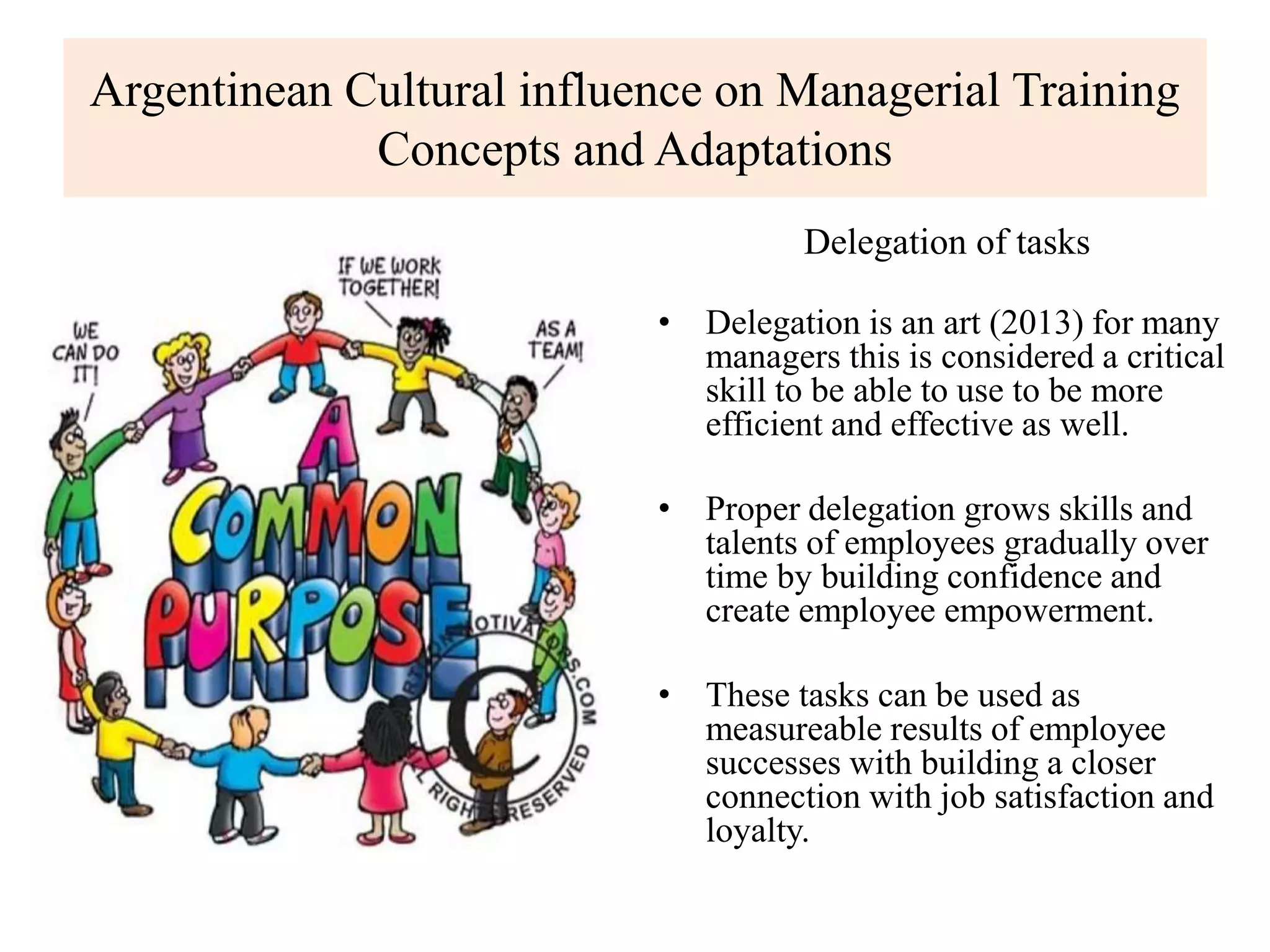
Delegation of tasks
• Delegation is an art (2013) for many
managers this is considered a critical
skill to be able to use to be more
efficient and effective as well.
• Proper delegation grows skills and
talents of employees gradually over
time by building confidence and
create employee empowerment.
• These tasks can be used as
measureable results of employee
successes with building a closer
connection with job satisfaction and
loyalty.
Argentinean Cultural influence on Managerial Training
Concepts and Adaptations
• Being accepted as the leader by others
• According to authors Stanoeva & Stoyanova (2012) there are two
prominent study models W. Fey's scales "Acceptance of others", and "How
do I feel accepted by others” and Crown and Marlowe Scale for Social
Desirability.
• As there are four groups representatives of helping, pedagogical,
administrative and economic occupations, as well as non-qualified workers
and gender expression does also play a role as well.
• There several psychological components of the self-esteem and esteem of
the other employees which is important to the groups represented.
• There’s significant differences in acceptance of others and feeling of being
accepted between the non-qualified workers and the four represented
groups as well.
Argentinean Cultural influence on Managerial
Training Concepts and Adaptations
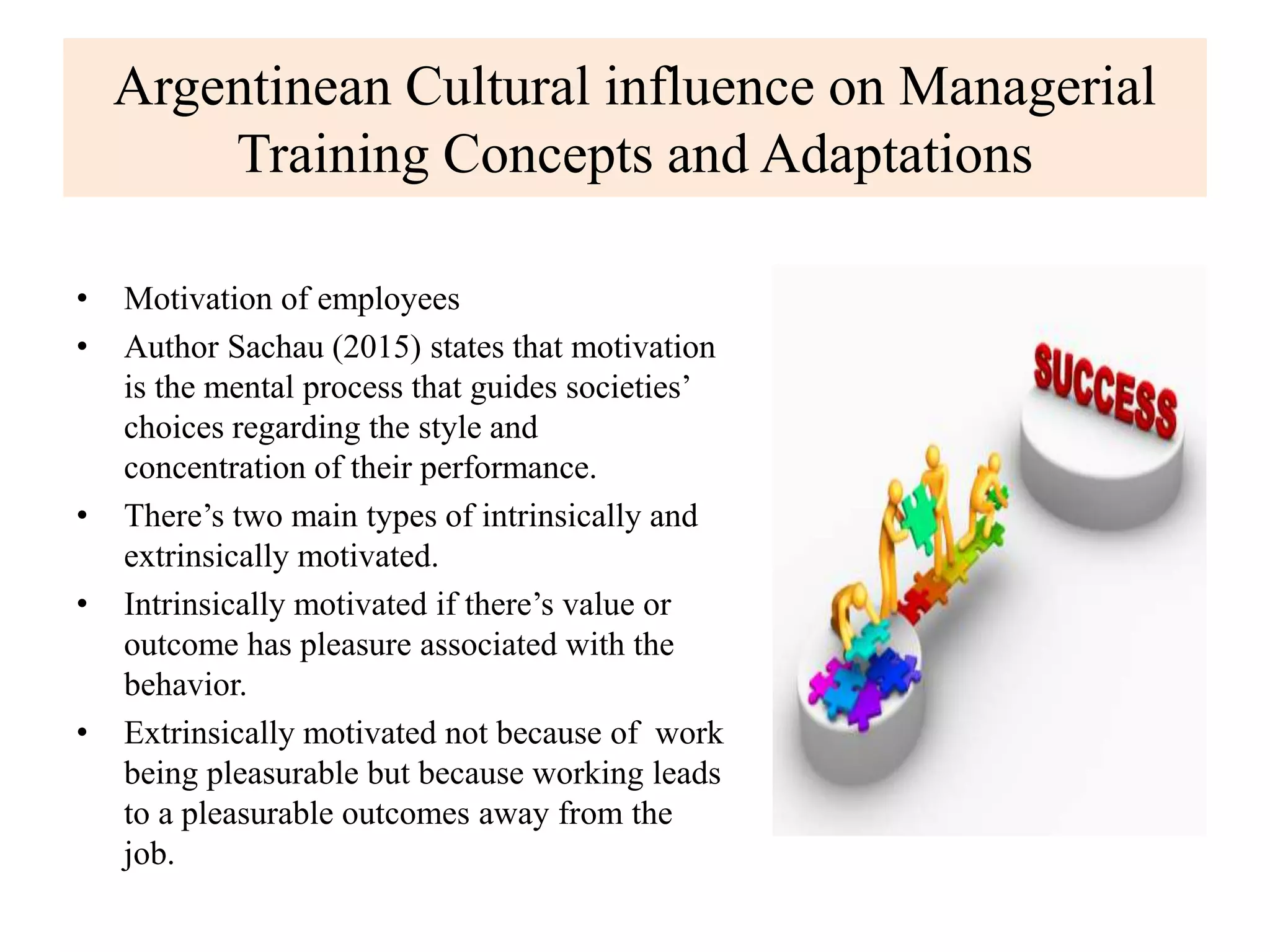
• Motivation of employees
• Author Sachau (2015) states that motivation
is the mental process that guides societies’
choices regarding the style and
concentration of their performance.
• There’s two main types of intrinsically and
extrinsically motivated.
• Intrinsically motivated if there’s value or
outcome has pleasure associated with the
behavior.
• Extrinsically motivated not because of work
being pleasurable but because working leads
to a pleasurable outcomes away from the
job.
Argentinean Cultural influence on Managerial
Training Concepts and Adaptations
• Employee rewards
• Author Redmond (2013) discusses
the use of a competency model as a
means to generate positive employee
outcomes by increasing the
transparency of company goals and
performance measures by means of
rewards.
• Author Redmond (2013) illustrates
that the HRM influences employee
behavior by signaling what is
expected, supported, and rewarded in
the organization.
• There by connecting company
expectations and employee
compliance to work in unison.
Argentinean Cultural influence on Managerial Training
Concepts and Adaptations
• Role of the leader
• Authors Jones, Mackey & Whetten (2014) explain how corporate social
responsibility and corporate social irresponsibility are influenced by
leaders.
• Authors Jones, Mackey & Whetten (2014) state there are three categories
that the role of the leader fall under. Theories about the individual as
leader, theories about the processes between leaders and followers, and
then theories about shared or distributed leadership.
• Authors Nishii & Mayer (2009) examine the leader- member exchange
(LMX) to moderate the relationships between demographic and tenure
diversity and group turnover. These findings are important because they
show the patterns of inclusion that leaders can create within the group.
• This could be extremely critical when dealing with employees from a
different country that might have different cultural values within the
workplace.
References
• FRERICHS, K., & KURILOFF, P. (2012). REINVENTING LEADERSHIP
TRAINING USING A PARTICIPATORY RESEARCH MODEL. Thymos: Journal Of
Boyhood Studies, 6(1/2), 203-212. Retrieved from
http://search.ebscohost.com.proxy.cecybrary.com/login.aspx?direct=true&db=sih&AN=
89472369&site=eds-live&scope=site
• JONES CHRISTENSEN, L., MACKEY, A., & WHETTEN, D. (2014). TAKING
RESPONSIBILITY FOR CORPORATE SOCIAL RESPONSIBILITY: THE ROLE OF
LEADERS IN CREATING, IMPLEMENTING, SUSTAINING, OR AVOIDING
SOCIALLY RESPONSIBLE FIRM BEHAVIORS. Academy Of Management
Perspectives, 28(2), 164-178. doi:10.5465/amp.2012.0047. Retrieved from
http://search.ebscohost.com.proxy.cecybrary.com/login.aspx?direct=true&db=bth&AN
=96303909&site=eds-live&scope=site
• Kruglanski, A. W., Pierro, A., & Higgins, E. T. (2007). Regulatory mode and preferred
leadership styles: How fit increases job satisfaction. Basic and Applied Social
Psychology, 29(2), 137-149. Retrieved from
http://www.researchgate.net/profile/Arie_Kruglanski/publication/233442923_Regulator
y_Mode_and_Preferred_Leadership_Styles_How_Fit_Increases_Job_Satisfaction/links/
549dda550cf2fedbc3119a24.pdf
• Nishii, L. H., & Mayer, D. M. (2009). Do inclusive leaders help to reduce turnover in
diverse groups? The moderating role of leader–member exchange in the diversity to
turnover relationship. Journal of Applied Psychology, 94(6), 1412. Retrieved from
http://psycnet.apa.org/psycinfo/2009-21033-004
References
• Q&A: The art of delegration. (2013). Managing People at Work, (380), 6. Retrieved
from
http://search.ebscohost.com.proxy.cecybrary.com/login.aspx?direct=true&db=bth&
AN=92546302&site=eds-live&scope=site
• Redmond, E. (2013). Competency Models at Work: The Value of Perceived
Relevance and Fair Rewards for Employee Outcomes. Human Resource
Management, 52(5), 771-792. doi:10.1002/hrm.21560. Retrieved from
http://search.ebscohost.com.proxy.cecybrary.com/login.aspx?direct=true&db=bth&
AN=90469055&site=eds-live&scope=site
• Sachau, D. (2015). Work motivation. Salem Press Encyclopedia Of Health,
Retrieved from
http://search.ebscohost.com.proxy.cecybrary.com/login.aspx?direct=true&db=ers&
AN=93872332&site=eds-live&scope=site
• Stanoeva, G., & Stoyanova, S. (2012). Acceptance of Others, Feeling of Being
Accepted and Striving for Being Accepted Among the Representatives of Different
Kinds of Occupations. (English). Psychological Thought, 5(1), 47-59.
doi:10.5964/psyct.v5i1.8. Retrieved from
http://search.ebscohost.com.proxy.cecybrary.com/login.aspx?direct=true&db=aph&
AN=79929212&site=eds-live&scope=site

presentation1

  • 1.
    Argentinean Cultural influenceon Managerial Training Concepts and Adaptations MGT658-1502C-01 International Management and Leadership By Yulabelle Miller
  • 2.
    Argentinean Cultural influenceon Managerial Training Concepts and Adaptations • Autocratic vs. Participatory style of leadership • Delegation • Acceptance gained as the leader, • Motivation of employees, • Employee rewards, and • Role of the leader
  • 3.
    Argentinean Cultural influenceon Managerial Training Concepts and Adaptations Autocratic vs. Participatory style of leadership. • According to authors Kruglanski., Pierro, & Higgins (2007) autocratic style of leadership is considered to be forceful or stronge character type of leadership. A leader that uses coercive or directive pressure in order to get complicance from subordinates to influence others. • It would appear though at certain times autocratic leadership style might be warranted, long term success of a leader would be one that had imput from others with making important decisions that invovled participation to carry out directives. Participatory Style of Leadership • While participatory style of leadership desribed by authors Frerichs & Kuriloff (2012) as a means of gaining valuable research on the acedemic culture of the school before making administrative changes based on the gathering techniques used by faculty and student body. The creation showed the value of participatory style of leadership during the investigation process on the schools culture so decisions were based on the findings which also made this an on- going elevuation project into the school culture.
  • 4.
    Argentinean Cultural influenceon Managerial Training Concepts and Adaptations Delegation of tasks • Delegation is an art (2013) for many managers this is considered a critical skill to be able to use to be more efficient and effective as well. • Proper delegation grows skills and talents of employees gradually over time by building confidence and create employee empowerment. • These tasks can be used as measureable results of employee successes with building a closer connection with job satisfaction and loyalty.
  • 5.
    Argentinean Cultural influenceon Managerial Training Concepts and Adaptations • Being accepted as the leader by others • According to authors Stanoeva & Stoyanova (2012) there are two prominent study models W. Fey's scales "Acceptance of others", and "How do I feel accepted by others” and Crown and Marlowe Scale for Social Desirability. • As there are four groups representatives of helping, pedagogical, administrative and economic occupations, as well as non-qualified workers and gender expression does also play a role as well. • There several psychological components of the self-esteem and esteem of the other employees which is important to the groups represented. • There’s significant differences in acceptance of others and feeling of being accepted between the non-qualified workers and the four represented groups as well.
  • 6.
    Argentinean Cultural influenceon Managerial Training Concepts and Adaptations • Motivation of employees • Author Sachau (2015) states that motivation is the mental process that guides societies’ choices regarding the style and concentration of their performance. • There’s two main types of intrinsically and extrinsically motivated. • Intrinsically motivated if there’s value or outcome has pleasure associated with the behavior. • Extrinsically motivated not because of work being pleasurable but because working leads to a pleasurable outcomes away from the job.
  • 7.
    Argentinean Cultural influenceon Managerial Training Concepts and Adaptations • Employee rewards • Author Redmond (2013) discusses the use of a competency model as a means to generate positive employee outcomes by increasing the transparency of company goals and performance measures by means of rewards. • Author Redmond (2013) illustrates that the HRM influences employee behavior by signaling what is expected, supported, and rewarded in the organization. • There by connecting company expectations and employee compliance to work in unison.
  • 8.
    Argentinean Cultural influenceon Managerial Training Concepts and Adaptations • Role of the leader • Authors Jones, Mackey & Whetten (2014) explain how corporate social responsibility and corporate social irresponsibility are influenced by leaders. • Authors Jones, Mackey & Whetten (2014) state there are three categories that the role of the leader fall under. Theories about the individual as leader, theories about the processes between leaders and followers, and then theories about shared or distributed leadership. • Authors Nishii & Mayer (2009) examine the leader- member exchange (LMX) to moderate the relationships between demographic and tenure diversity and group turnover. These findings are important because they show the patterns of inclusion that leaders can create within the group. • This could be extremely critical when dealing with employees from a different country that might have different cultural values within the workplace.
  • 9.
    References • FRERICHS, K.,& KURILOFF, P. (2012). REINVENTING LEADERSHIP TRAINING USING A PARTICIPATORY RESEARCH MODEL. Thymos: Journal Of Boyhood Studies, 6(1/2), 203-212. Retrieved from http://search.ebscohost.com.proxy.cecybrary.com/login.aspx?direct=true&db=sih&AN= 89472369&site=eds-live&scope=site • JONES CHRISTENSEN, L., MACKEY, A., & WHETTEN, D. (2014). TAKING RESPONSIBILITY FOR CORPORATE SOCIAL RESPONSIBILITY: THE ROLE OF LEADERS IN CREATING, IMPLEMENTING, SUSTAINING, OR AVOIDING SOCIALLY RESPONSIBLE FIRM BEHAVIORS. Academy Of Management Perspectives, 28(2), 164-178. doi:10.5465/amp.2012.0047. Retrieved from http://search.ebscohost.com.proxy.cecybrary.com/login.aspx?direct=true&db=bth&AN =96303909&site=eds-live&scope=site • Kruglanski, A. W., Pierro, A., & Higgins, E. T. (2007). Regulatory mode and preferred leadership styles: How fit increases job satisfaction. Basic and Applied Social Psychology, 29(2), 137-149. Retrieved from http://www.researchgate.net/profile/Arie_Kruglanski/publication/233442923_Regulator y_Mode_and_Preferred_Leadership_Styles_How_Fit_Increases_Job_Satisfaction/links/ 549dda550cf2fedbc3119a24.pdf • Nishii, L. H., & Mayer, D. M. (2009). Do inclusive leaders help to reduce turnover in diverse groups? The moderating role of leader–member exchange in the diversity to turnover relationship. Journal of Applied Psychology, 94(6), 1412. Retrieved from http://psycnet.apa.org/psycinfo/2009-21033-004
  • 10.
    References • Q&A: Theart of delegration. (2013). Managing People at Work, (380), 6. Retrieved from http://search.ebscohost.com.proxy.cecybrary.com/login.aspx?direct=true&db=bth& AN=92546302&site=eds-live&scope=site • Redmond, E. (2013). Competency Models at Work: The Value of Perceived Relevance and Fair Rewards for Employee Outcomes. Human Resource Management, 52(5), 771-792. doi:10.1002/hrm.21560. Retrieved from http://search.ebscohost.com.proxy.cecybrary.com/login.aspx?direct=true&db=bth& AN=90469055&site=eds-live&scope=site • Sachau, D. (2015). Work motivation. Salem Press Encyclopedia Of Health, Retrieved from http://search.ebscohost.com.proxy.cecybrary.com/login.aspx?direct=true&db=ers& AN=93872332&site=eds-live&scope=site • Stanoeva, G., & Stoyanova, S. (2012). Acceptance of Others, Feeling of Being Accepted and Striving for Being Accepted Among the Representatives of Different Kinds of Occupations. (English). Psychological Thought, 5(1), 47-59. doi:10.5964/psyct.v5i1.8. Retrieved from http://search.ebscohost.com.proxy.cecybrary.com/login.aspx?direct=true&db=aph& AN=79929212&site=eds-live&scope=site