FAMILY AND INDIVIDUAL
RESPONSE TO SPECIFIC
DISASTER
FAMILY/INDIVIDUAL RESPONSETO OTHER HAZARDS
WHAT TO DO DURING AND AFTER A
HYDROMETEOROLOGICAL HAZARD
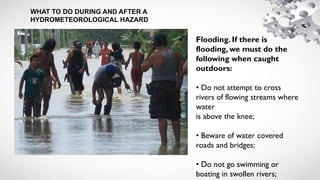
Flooding. If there is
flooding, we must do the
following when caught
outdoors:
• Do not attempt to cross
rivers of flowing streams where
water
is above the knee;
• Beware of water covered
roads and bridges;
• Do not go swimming or
boating in swollen rivers;
WHATTO DO DURING AND AFTER A
HYDROMETEOROLOGICAL HAZARD
Flooding. If there is
flooding, we must do the
following when caught
outdoors:
• Eat only well-cooked food,
protect leftovers against
contamination; and
• Drink clean or preferably
boiled water only.
(DOST, no date)
WHAT TO DO DURING AND AFTER A
HYDROMETEOROLOGICAL HAZARD
Flooding. Immediately after:
• Re-enter the dwellings with
caution using flashlight, lanterns
or torches. Flammables may be
inside;
• Be alert for fire hazards like
broken electric wires;
• Report broken utility lines
(electricity, water, gas,
telephone) to appropriate
agencies;
WHAT TO DO DURING AND AFTER A
HYDROMETEOROLOGICAL HAZARD
Flooding. Immediately after:
• Do not turn on main switch or use
appliances and other equipment until
they have been checked by a
competent electrician;
• Consult health authorities for
immunization requirements; and
• Do not go “sight-seeing” in disaster
areas.Your presence might hamper
rescue and other emergency
operations. (DOST, no date)
WHATTO DO DURING AND AFTER A
HYDROMETEOROLOGICAL HAZARD
Storm Surge.When living near the sea, individuals
and families must do the following when there is
such a warning:
• Stay away from within 500
meters from the coast when a
storm or typhoon is
approaching
• Evacuate to higher ground even
before the waves swell (ensure
that evacuation area will not be
reached by the surge);
WHATTO DO DURING AND AFTER A
HYDROMETEOROLOGICAL HAZARD
Storm Surge.When living near the sea, individuals and
families must do the following when there is such a
warning:
• If possible, move boats to
higher ground as
well.
• Wait until the local
authorities advise you
that it is safe to go back
to your houses.
WHATTO DO DURING AND AFTER A GEOLOGICAL HAZARD
Volcanic Eruption. In the event of volcanic eruption, what
should be the response of families?They should:
• Stay alert and awake. Follow the instructions that go with
the warning. If there is a directive to evacuate, do so
immediately;
• When safe to go outside then
scrape off ashes to prevent heavy
loading of the house roofs.
(Department of Education, 2008, p.
38)
WHATTO DO DURING AND AFTER A GEOLOGICAL HAZARD
Volcanic Eruption. In the event of volcanic eruption,
what should be the response of families?They
should:
Precautionary measures:
 Wear long-sleeved shirts and long pants;
 Wear goggles and eyeglasses to protect your eyes
from the volcanic ash.
 Avoid running car or truck engines.
 Avoid driving in heavy ash falls unless absolutely
required.
WHATTO DO DURING AND AFTER A GEOLOGICAL HAZARD
After an eruption, families
should:
• Clear the canals and pathways
of ash debris;
• Hose down the accumulated
ash on roofs;
• Listen to local radio or
television stations for the
latest emergency information;
WHATTO DO DURING AND AFTER A GEOLOGICAL HAZARD
After an eruption,families
should:
•Report broken utility lines and
suspected damaged buildings to
appropriate authorities; and,
•If you have a respiratory ailment,
avoid contact with ash.
WHATTO DO DURING AND AFTER A GEOLOGICAL HAZARD
• Volcanic ash is like a fine cement powder and will
block up drains and pipes. It will also harm your
lungs and irritate your eyes.
When ashfall occurs during a
volcanic eruption, make sure to do
the following:
• Stay calm. Cover your nose and mouth
with damp, clean cloth or gas mask;
• As soon as the ashfall tapers, make sure
you protect your eyes and mouth when
you scrape off the ash that has
accumulated on roof tops to prevent
collapse;
• Listen to the radio for updates/
developments regarding the volcanic
eruption;
WHATTO DO DURING AND AFTER A GEOLOGICAL HAZARD
When ashfall occurs during a
volcanic eruption, make sure to
do the following:
• Close all windows and doors of
the house and your car;
• Keep your pet/s in their shelter
or insider the house to help
them avoid inhaling ash;
• Wash thoroughly all fruits and
vegetables before eating;
WHATTO DO DURING AND AFTER A GEOLOGICAL HAZARD
When ashfall occurs during a
volcanic eruption, make sure to do
the following:
• Cover water containers and food to
avoid contamination with ash; and
• If you are driving a vehicle, pull to the
side of the road and stop if there is a
heavy ashfall.
• If you are outdoors, look for a shelter
and wear glasses to protect your eyes.
Avoid using contact lenses.”
(Department of Education, 2008, p. 38)
WHATTO DO DURING AND AFTER A GEOLOGICAL HAZARD
After an ashfall:
• Protect yourself when cleaning up
• Clean the roof and gutter with
water to prevent corrosion after
removing the ash;
• Shake loose ash from plants
before watering them;
• Use powder detergent in washing
clothes contaminated with ash;
WHATTO DO DURING AND AFTER A GEOLOGICAL HAZARD
After an ashfall:
• Use vacuum cleaner or shake loose the ash from
furniture before dusting them.
• Use water hose to remove ash from glass windows
and doors of the house and car before washing them
with soap and lukewarm water; and
• Collect the ashes and put them in an area far from
water drainage to avoid clogging. (Philippine Institute
forVolcanology and Seismology, 2002)
WHATTO DO DURING AND AFTER A GEOLOGICAL HAZARD
Earthquake. How should individuals and families respond
during an earthquake?
Remember to stay calm and do the following:
• When you’re inside a structurally
sound building or home, stay there!
“Drop, cover and hold.”
• Drop under a sturdy desk or table,
and hold on to it, or protect your
head with your arms.
WHATTO DO DURING AND AFTER A GEOLOGICAL
HAZARD
Earthquake. How should individuals and families
respond during an earthquake?
Remember to stay calm and do the following:
• If possible, quickly open
the door for exit.
• Stay away from glass
windows, shelves,
cabinets and other heavy
objects.
• Beware of falling objects.
Be alert and keep your
eyes open.
WHATTO DO DURING AND AFTER A GEOLOGICAL HAZARD
Earthquake. How should
individuals and families respond
during an earthquake?
Remember to stay calm and do
the following:
• If you’re outside, move to an open
area!
• Stay away from trees, power lines,
posts and concrete structures.
• Move away from steep slopes,
which may be affected by
landslides.
WHATTO DO DURING AND AFTER A GEOLOGICAL HAZARD
Earthquake. How should individuals and families
respond during an earthquake?
Remember to stay calm and do the following:
• If you’re near the shore and feel an
earthquake, especially if it’s too
strong, move quickly to higher
ground.
• If you’re in a moving vehicle, stop
and get out! Do not attempt to
cross bridges, overpasses, or
flyovers, which may be damaged.
WHATTO DO DURING AND AFTER A GEOLOGICAL HAZARD
After an earthquake:
• Be prepared for aftershocks. Once the shaking stops, take the
fastest and safest way out of the building.
• DON’T panic, DON’T use elevators, DON’T enter
damaged buildings, and DON’T use telephones unless
necessary.
• CHECK yourself and others for
injuries, water and electrical lines
for damages, for spills of chemical,
toxic and flammable materials
• Control fires which may spread
WHATTO DO DURING AND AFTER A GEOLOGICAL HAZARD
After an earthquake:
• If you need to evacuate your
residence, leave a message stating
where you are going and bring your
“Go Bag”.
• Keep updated on disaster prevention
instructions from battery-operated
radios. (Philippine Institute of
Volcanology and Seismology, 2009,
inside and back pages of pocket-sized
guideline)
OTHER HAZARDS
Landslide. Landslides may be triggered by
continuous
rains, earthquake, or human activities (e.g. mining).
In the event of a landslide
and family members are
indoors with no time to
evacuate, stay inside and
hide under a sturdy and
stable object like a table.
Landslide.When caught outdoors:
• Stay away from the path of the landslide;
• Go to the nearest higher ground away from the landslide;
• Run towards the direction of the
back of trees or buildings when
you see approaching rock and soil
debris;
• If it seems impossible to avoid the
landslide assume a fetal position
and cover your head.
Landslide.When caught outdoors:
Immediately after a landslide:
• Stay away from the landslide
area. Secondary landslides and
flooding can occur;
• Know if there are casualties or
people trapped near landslide
areas, and report to proper
authorities;
• Initiate resource operations if
capable;
OTHER HAZARDS
Immediately after a landslide:
• Listen to radio or television for the
latest bulletin about the landslide;
• Inspect power and water supply lines
for damages, and inform the proper
authorities;
• Inspect building foundations and
adjacent lots for damages, and do
remedial works; and
• Consult experts on landslides for
additional information and advice.
(Mines and Geosciences Bureau, 2007,
inside of primer)
OTHER HAZARDS
Fire. If the hazard is fire, what should families do?
These are the safety tips to guide the families
should a fire happens:
OTHER HAZARDS
• Have a Fire Escape Plan which includes at
least two escape routes for every room in
the home and a convenient meeting place
at a safe distance.
• Use a fire extinguisher to put out small
fires.You can also use water if the fire is
not electrical or chemical.
• Do NOT try to put out a fire that you
can’t control.
OTHER HAZARDS
Fire. If the hazard is fire, what should families do?
These are the safety tips to guide the families
should a fire happens:
• If there’s a fire that is too
big to put out, leave the
building immediately.
• If your clothes catch fire,
do NOT run.
OTHER HAZARDS
Fire. If the hazard is fire, what should families do?
These are the safety tips to guide the families
should a fire happens:
• If there is smoke in your house,
cover your nose and mouth with
a small cloth and stay low to the
ground as you’re leaving.
• Once outside, stay outside.
• Call the Fire Department from a
neighbor’s home.
OTHER HAZARDS
Fire. If the hazard is fire, what should families do?
These are the safety tips to guide the families
should a fire happens:
• If you see smoke or fire in your
first escape route, use your
second way out.
• If the door is warm, don’t open it
• If smoke, heat, or flames block
your exit routes, stay in the
room with the door closed
OTHER HAZARDS
Fire. If the hazard is fire, what should families do?
These are the safety tips to guide the families
should a fire happens:
• Signal for help using a brightly colored
cloth at the window.
• If there is a telephone in the room, call the
fire department and tell them where you are.
• Before fire goes out of control, try to put
out the fire by using fire extinguisher (or a
bucket full of sand). If the fire does not
immediately die down, drop the fire
extinguisher and go out.
OTHER HAZARDS
Tsunami. In the event of atsunami, families
should observe the following:
• If a strong earthquake is felt and
unusual sea conditions like rapid
lowering of sea level are observed, immediately
move towards high grounds;
• Never go down the beach to
watch for a tsunami.
• Stay out of danger areas until “all
clear” is issued by competent
local authority
OTHER HAZARDS

DISASTER RISK REDUCTION PRESENTATION PPT

  • 1.
    FAMILY AND INDIVIDUAL RESPONSETO SPECIFIC DISASTER
  • 3.
  • 4.
    WHAT TO DODURING AND AFTER A HYDROMETEOROLOGICAL HAZARD Flooding. If there is flooding, we must do the following when caught outdoors: • Do not attempt to cross rivers of flowing streams where water is above the knee; • Beware of water covered roads and bridges; • Do not go swimming or boating in swollen rivers;
  • 5.
    WHATTO DO DURINGAND AFTER A HYDROMETEOROLOGICAL HAZARD Flooding. If there is flooding, we must do the following when caught outdoors: • Eat only well-cooked food, protect leftovers against contamination; and • Drink clean or preferably boiled water only. (DOST, no date)
  • 6.
    WHAT TO DODURING AND AFTER A HYDROMETEOROLOGICAL HAZARD Flooding. Immediately after: • Re-enter the dwellings with caution using flashlight, lanterns or torches. Flammables may be inside; • Be alert for fire hazards like broken electric wires; • Report broken utility lines (electricity, water, gas, telephone) to appropriate agencies;
  • 7.
    WHAT TO DODURING AND AFTER A HYDROMETEOROLOGICAL HAZARD Flooding. Immediately after: • Do not turn on main switch or use appliances and other equipment until they have been checked by a competent electrician; • Consult health authorities for immunization requirements; and • Do not go “sight-seeing” in disaster areas.Your presence might hamper rescue and other emergency operations. (DOST, no date)
  • 8.
    WHATTO DO DURINGAND AFTER A HYDROMETEOROLOGICAL HAZARD Storm Surge.When living near the sea, individuals and families must do the following when there is such a warning: • Stay away from within 500 meters from the coast when a storm or typhoon is approaching • Evacuate to higher ground even before the waves swell (ensure that evacuation area will not be reached by the surge);
  • 9.
    WHATTO DO DURINGAND AFTER A HYDROMETEOROLOGICAL HAZARD Storm Surge.When living near the sea, individuals and families must do the following when there is such a warning: • If possible, move boats to higher ground as well. • Wait until the local authorities advise you that it is safe to go back to your houses.
  • 10.
    WHATTO DO DURINGAND AFTER A GEOLOGICAL HAZARD Volcanic Eruption. In the event of volcanic eruption, what should be the response of families?They should: • Stay alert and awake. Follow the instructions that go with the warning. If there is a directive to evacuate, do so immediately; • When safe to go outside then scrape off ashes to prevent heavy loading of the house roofs. (Department of Education, 2008, p. 38)
  • 11.
    WHATTO DO DURINGAND AFTER A GEOLOGICAL HAZARD Volcanic Eruption. In the event of volcanic eruption, what should be the response of families?They should: Precautionary measures:  Wear long-sleeved shirts and long pants;  Wear goggles and eyeglasses to protect your eyes from the volcanic ash.  Avoid running car or truck engines.  Avoid driving in heavy ash falls unless absolutely required.
  • 12.
    WHATTO DO DURINGAND AFTER A GEOLOGICAL HAZARD After an eruption, families should: • Clear the canals and pathways of ash debris; • Hose down the accumulated ash on roofs; • Listen to local radio or television stations for the latest emergency information;
  • 13.
    WHATTO DO DURINGAND AFTER A GEOLOGICAL HAZARD After an eruption,families should: •Report broken utility lines and suspected damaged buildings to appropriate authorities; and, •If you have a respiratory ailment, avoid contact with ash.
  • 14.
    WHATTO DO DURINGAND AFTER A GEOLOGICAL HAZARD • Volcanic ash is like a fine cement powder and will block up drains and pipes. It will also harm your lungs and irritate your eyes.
  • 15.
    When ashfall occursduring a volcanic eruption, make sure to do the following: • Stay calm. Cover your nose and mouth with damp, clean cloth or gas mask; • As soon as the ashfall tapers, make sure you protect your eyes and mouth when you scrape off the ash that has accumulated on roof tops to prevent collapse; • Listen to the radio for updates/ developments regarding the volcanic eruption; WHATTO DO DURING AND AFTER A GEOLOGICAL HAZARD
  • 16.
    WHATTO DO DURINGAND AFTER A GEOLOGICAL HAZARD When ashfall occurs during a volcanic eruption, make sure to do the following: • Close all windows and doors of the house and your car; • Keep your pet/s in their shelter or insider the house to help them avoid inhaling ash; • Wash thoroughly all fruits and vegetables before eating;
  • 17.
    WHATTO DO DURINGAND AFTER A GEOLOGICAL HAZARD When ashfall occurs during a volcanic eruption, make sure to do the following: • Cover water containers and food to avoid contamination with ash; and • If you are driving a vehicle, pull to the side of the road and stop if there is a heavy ashfall. • If you are outdoors, look for a shelter and wear glasses to protect your eyes. Avoid using contact lenses.” (Department of Education, 2008, p. 38)
  • 18.
    WHATTO DO DURINGAND AFTER A GEOLOGICAL HAZARD After an ashfall: • Protect yourself when cleaning up • Clean the roof and gutter with water to prevent corrosion after removing the ash; • Shake loose ash from plants before watering them; • Use powder detergent in washing clothes contaminated with ash;
  • 19.
    WHATTO DO DURINGAND AFTER A GEOLOGICAL HAZARD After an ashfall: • Use vacuum cleaner or shake loose the ash from furniture before dusting them. • Use water hose to remove ash from glass windows and doors of the house and car before washing them with soap and lukewarm water; and • Collect the ashes and put them in an area far from water drainage to avoid clogging. (Philippine Institute forVolcanology and Seismology, 2002)
  • 20.
    WHATTO DO DURINGAND AFTER A GEOLOGICAL HAZARD Earthquake. How should individuals and families respond during an earthquake? Remember to stay calm and do the following: • When you’re inside a structurally sound building or home, stay there! “Drop, cover and hold.” • Drop under a sturdy desk or table, and hold on to it, or protect your head with your arms.
  • 21.
    WHATTO DO DURINGAND AFTER A GEOLOGICAL HAZARD Earthquake. How should individuals and families respond during an earthquake? Remember to stay calm and do the following: • If possible, quickly open the door for exit. • Stay away from glass windows, shelves, cabinets and other heavy objects. • Beware of falling objects. Be alert and keep your eyes open.
  • 22.
    WHATTO DO DURINGAND AFTER A GEOLOGICAL HAZARD Earthquake. How should individuals and families respond during an earthquake? Remember to stay calm and do the following: • If you’re outside, move to an open area! • Stay away from trees, power lines, posts and concrete structures. • Move away from steep slopes, which may be affected by landslides.
  • 23.
    WHATTO DO DURINGAND AFTER A GEOLOGICAL HAZARD Earthquake. How should individuals and families respond during an earthquake? Remember to stay calm and do the following: • If you’re near the shore and feel an earthquake, especially if it’s too strong, move quickly to higher ground. • If you’re in a moving vehicle, stop and get out! Do not attempt to cross bridges, overpasses, or flyovers, which may be damaged.
  • 24.
    WHATTO DO DURINGAND AFTER A GEOLOGICAL HAZARD After an earthquake: • Be prepared for aftershocks. Once the shaking stops, take the fastest and safest way out of the building. • DON’T panic, DON’T use elevators, DON’T enter damaged buildings, and DON’T use telephones unless necessary. • CHECK yourself and others for injuries, water and electrical lines for damages, for spills of chemical, toxic and flammable materials • Control fires which may spread
  • 25.
    WHATTO DO DURINGAND AFTER A GEOLOGICAL HAZARD After an earthquake: • If you need to evacuate your residence, leave a message stating where you are going and bring your “Go Bag”. • Keep updated on disaster prevention instructions from battery-operated radios. (Philippine Institute of Volcanology and Seismology, 2009, inside and back pages of pocket-sized guideline)
  • 26.
    OTHER HAZARDS Landslide. Landslidesmay be triggered by continuous rains, earthquake, or human activities (e.g. mining). In the event of a landslide and family members are indoors with no time to evacuate, stay inside and hide under a sturdy and stable object like a table.
  • 27.
    Landslide.When caught outdoors: •Stay away from the path of the landslide; • Go to the nearest higher ground away from the landslide; • Run towards the direction of the back of trees or buildings when you see approaching rock and soil debris; • If it seems impossible to avoid the landslide assume a fetal position and cover your head. Landslide.When caught outdoors:
  • 28.
    Immediately after alandslide: • Stay away from the landslide area. Secondary landslides and flooding can occur; • Know if there are casualties or people trapped near landslide areas, and report to proper authorities; • Initiate resource operations if capable; OTHER HAZARDS
  • 29.
    Immediately after alandslide: • Listen to radio or television for the latest bulletin about the landslide; • Inspect power and water supply lines for damages, and inform the proper authorities; • Inspect building foundations and adjacent lots for damages, and do remedial works; and • Consult experts on landslides for additional information and advice. (Mines and Geosciences Bureau, 2007, inside of primer) OTHER HAZARDS
  • 30.
    Fire. If thehazard is fire, what should families do? These are the safety tips to guide the families should a fire happens: OTHER HAZARDS • Have a Fire Escape Plan which includes at least two escape routes for every room in the home and a convenient meeting place at a safe distance. • Use a fire extinguisher to put out small fires.You can also use water if the fire is not electrical or chemical. • Do NOT try to put out a fire that you can’t control. OTHER HAZARDS
  • 31.
    Fire. If thehazard is fire, what should families do? These are the safety tips to guide the families should a fire happens: • If there’s a fire that is too big to put out, leave the building immediately. • If your clothes catch fire, do NOT run. OTHER HAZARDS
  • 32.
    Fire. If thehazard is fire, what should families do? These are the safety tips to guide the families should a fire happens: • If there is smoke in your house, cover your nose and mouth with a small cloth and stay low to the ground as you’re leaving. • Once outside, stay outside. • Call the Fire Department from a neighbor’s home. OTHER HAZARDS
  • 33.
    Fire. If thehazard is fire, what should families do? These are the safety tips to guide the families should a fire happens: • If you see smoke or fire in your first escape route, use your second way out. • If the door is warm, don’t open it • If smoke, heat, or flames block your exit routes, stay in the room with the door closed OTHER HAZARDS
  • 34.
    Fire. If thehazard is fire, what should families do? These are the safety tips to guide the families should a fire happens: • Signal for help using a brightly colored cloth at the window. • If there is a telephone in the room, call the fire department and tell them where you are. • Before fire goes out of control, try to put out the fire by using fire extinguisher (or a bucket full of sand). If the fire does not immediately die down, drop the fire extinguisher and go out. OTHER HAZARDS
  • 35.
    Tsunami. In theevent of atsunami, families should observe the following: • If a strong earthquake is felt and unusual sea conditions like rapid lowering of sea level are observed, immediately move towards high grounds; • Never go down the beach to watch for a tsunami. • Stay out of danger areas until “all clear” is issued by competent local authority OTHER HAZARDS