Disaster Recovery 2nd Phillips Solution Manual
download
https://testbankmall.com/product/disaster-recovery-2nd-phillips-
solution-manual/
Find test banks or solution manuals at testbankmall.com today!
Here are some recommended products for you. Click the link to
download, or explore more at testbankmall.com
Test Bank for Strategic Staffing, 2nd Edition: Jean
Phillips
https://testbankmall.com/product/test-bank-for-strategic-staffing-2nd-
edition-jean-phillips/
Solution Manual for Fundamentals of Financial Accounting
5th Canadian by Phillips
https://testbankmall.com/product/solution-manual-for-fundamentals-of-
financial-accounting-5th-canadian-by-phillips/
Solution Manual for M: Information Systems, 4th Edition,
Paige Baltzan Amy Phillips
https://testbankmall.com/product/solution-manual-for-m-information-
systems-4th-edition-paige-baltzan-amy-phillips/
Business Driven Technology 6th Edition Baltzan Test Bank
https://testbankmall.com/product/business-driven-technology-6th-
edition-baltzan-test-bank/
Solution Manual for Strategic Management: Concepts, 13/E –
Fred R. David
https://testbankmall.com/product/solution-manual-for-strategic-
management-concepts-13-e-fred-r-david/
Solution Manual for McGraw-Hill Connect Resources for
Whittington, Principles of Auditing and Other Assurance
Services, 19e
https://testbankmall.com/product/solution-manual-for-mcgraw-hill-
connect-resources-for-whittington-principles-of-auditing-and-other-
assurance-services-19e/
Test Bank for Medical-Surgical Nursing, 8th Edition:
Sharon L. Lewis
https://testbankmall.com/product/test-bank-for-medical-surgical-
nursing-8th-edition-sharon-l-lewis/
Personality Psychology Canadian 1st Edition Larsen Test
Bank
https://testbankmall.com/product/personality-psychology-canadian-1st-
edition-larsen-test-bank/
Test Bank for Microbiology with Diseases: Body System, 3rd
Edition: Bauman
https://testbankmall.com/product/test-bank-for-microbiology-with-
diseases-body-system-3rd-edition-bauman/
Solution Manual for Chemistry 9th Edition by Zumdahl
https://testbankmall.com/product/solution-manual-for-chemistry-9th-
edition-by-zumdahl/
Learning Objectives
• Provide an overview of the major conceptual and theoretical
perspectives used in disaster recovery research.
• Apply concepts and theories to understand how disaster recovery
could be approached.
• Use concepts and theories to identify potential barriers to recovery.
• Demonstrate an understanding of key principles to promote a
sustainable recovery.
Key Terms
• Disaster Resilience
• Dominant Paradigm
• Economic Vitality
• Emergent Norm Theory
• Environmental Quality
• Equity
• Feminist Theory
• Holistic Recovery
• Mitigation
• Non-structural Mitigation
• Structural Mitigation
• Participatory Recovery
• Quality of life
• Resilience
• Socio-political Ecology Theory
• Sustainability
• Systems Theory
• Vulnerability Theory
Case Study: Haiti Earthquake, 2010
• 7.0 magnitude on the Richter scale
• Capitol city, Port-au-Prince, sustains major damage
• An estimated 316,000 deaths and 300,000 injuries (many severe)
• Loss of 100,000 homes
• 1.5 million people in 1,354 relief areas
• Disaster Recovery challenges
• Port and airport damage; hospitals destroyed; schools closed; elected
and appointed officials killed; community resources devastated; roads
inaccessible; violence against women and children; job losses; cholera
outbreak.
Causes of Haiti’s Earthquake Damage
• Not just the seismic shake
• Colonized by Spain and France with a history of slavery
• Instability in the country
• Natural resources undermined
• Poorly managed infrastructure and utilities
• Emergency response meager
• Minimal building codes, not enforced
• High mortality rates
• Repetitive disasters
Why Theory?
• To provide insights
• To increase explanation
• “multi- and interdisciplinary approaches are needed to understand
and effectively deal with the complex problems of our day” in
disasters and humanitarian crises (McEntire 2007, p. 3)
Physical
Environment
Human
Environment
Built
Environment
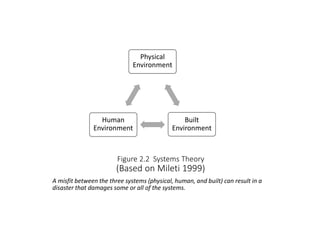
Figure 2.2 Systems Theory
(Based on Mileti 1999)
A misfit between the three systems (physical, human, and built) can result in a
disaster that damages some or all of the systems.
Systems Theory
• Physical systems – include the weather, such as when an ice storm
creates a state of emergency
• Built environment – includes ports, roads, bridges, which can be
affected by physical systems like a flood that covers a road
• Human systems – when physical systems affect people and the places
where they live
• A disaster occurs when there is a misfit between these systems such
as allowing people to build near a river that floods annually.
Vulnerability Theory (VT)
• In contrast to the dominant system where the physical system
“causes” the disaster and the cause is engineered, like a levee used to
prevent flooding.
• VT focuses on the human systems
• Disasters are not equal opportunity events, some people are affected
more than others like low income families or countries
• VT also says that we overlook the resources and resilience capacities of
those most at risk, and often fail to include them like not inviting people
with disabilities to the recovery planning table
Socio-political Ecology Theory
• Looks at interactions within human social systems
• People trying to re-establish normalcy after a disaster usually
compete for resources, often with disparate outcomes
• After an earthquake in Pakistan, men were more likely to obtain
resources than women
• Pre-disaster inequalities usually worsen the competition
• Winners and losers appear in the competitive process
• After a disaster, small businesses with fewer resources are more likely to
fail than larger businesses with more resources
Liberal Feminism and Disaster Recovery
• Identify the practical needs of women and children throughout the
disaster event and how institutional arrangements can adapt to their
needs: child care, domestic violence, employment, housing access.
• Recruit and retain women staff in disaster recovery organizations,
with particular attention paid to involving women from disaster-
vulnerable populations and locations.
• Train and educate disaster recovery staff and volunteers in working
with women of various educational, income, age and disability levels.
• Target women-owned businesses and female-dominated nonprofits in
business recovery and economic development programs.
Multiracial Feminist Theory and Disaster Recovery
• Involve organizations that empower women of color to participate in
the recovery planning and implementation processes and pay them
for their contributions.
• Build social networks between women’s groups involving women of
color in recovery activities including funding initiatives and programs
that pay for and/or reimburse staff and volunteer labor.
• Facilitate the active participation of women from underrepresented
groups in disaster recovery planning.
• Target women leaders from diverse cultural groups for leadership
positions in recovery staff and voluntary organizations.
Feminist Political Ecology and Disaster Recovery
• Involve women environmental leaders in planning mitigation activities
for the full range of recovery needs in housing, environment,
infrastructure, and businesses.
• Increase networking between disaster organizations and women
involved in environmental justice and sustainable development
organizations.
• Integrate women involved in local health and safety issues, including
technological disasters and hazardous materials, for long-term
research on the effects of these substances for women and children.
Feminist Development Theory
• Recovery projects may have gendered impacts and provide more
opportunities for men than for women.
• Traditional development programs, and those that influence recovery
times, may strengthen gender stratification.
• Woman-centric recovery schemes should be created, especially those
that tap into women’s economic talents.
• Within highly gender-segregated societies, woman-only recovery
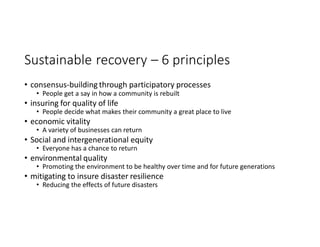
centers and workplaces may need to be created.
Emergent norm theory
• Because few places plan for recovery, it is often an ad hoc, emergent
process
• Emergence is newly appearing behavior or activities, like a recovery
group that advocates for children
• Disasters tend to disable bureaucratic structures
• Flexible, innovative approaches usually cover unmet needs or those
that are not met by existing structures
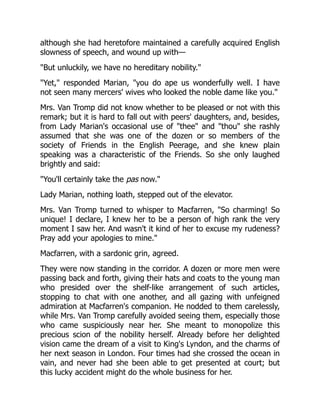
Sustainable recovery – 6 principles
• consensus-building through participatory processes
• People get a say in how a community is rebuilt
• insuring for quality of life
• People decide what makes their community a great place to live
• economic vitality
• A variety of businesses can return
• Social and intergenerational equity
• Everyone has a chance to return
• environmental quality
• Promoting the environment to be healthy over time and for future generations
• mitigating to insure disaster resilience
• Reducing the effects of future disasters
Random documents with unrelated
content Scribd suggests to you:
although she had heretofore maintained a carefully acquired English
slowness of speech, and wound up with—
"But unluckily, we have no hereditary nobility."
"Yet," responded Marian, "you do ape us wonderfully well. I have
not seen many mercers' wives who looked the noble dame like you."
Mrs. Van Tromp did not know whether to be pleased or not with this
remark; but it is hard to fall out with peers' daughters, and, besides,
from Lady Marian's occasional use of "thee" and "thou" she rashly
assumed that she was one of the dozen or so members of the
society of Friends in the English Peerage, and she knew plain
speaking was a characteristic of the Friends. So she only laughed
brightly and said:
"You'll certainly take the pas now."
Lady Marian, nothing loath, stepped out of the elevator.
Mrs. Van Tromp turned to whisper to Macfarren, "So charming! So
unique! I declare, I knew her to be a person of high rank the very
moment I saw her. And wasn't it kind of her to excuse my rudeness?
Pray add your apologies to mine."
Macfarren, with a sardonic grin, agreed.
They were now standing in the corridor. A dozen or more men were
passing back and forth, giving their hats and coats to the young man
who presided over the shelf-like arrangement of such articles,
stopping to chat with one another, and all gazing with unfeigned
admiration at Macfarren's companion. He nodded to them carelessly,
while Mrs. Van Tromp carefully avoided seeing them, especially those
who came suspiciously near her. She meant to monopolize this
precious scion of the nobility herself. Already before her delighted
vision came the dream of a visit to King's Lyndon, and the charms of
her next season in London. Four times had she crossed the ocean in
vain, and never had she been able to get presented at court; but
this lucky accident might do the whole business for her.
"My friend," said Marian, turning to Macfarren, "I would not thou
shouldst think me fearful,—my grandsire drew a mighty bow at
Bosworth Field, and none of my race have a drop of craven blood,—
but I feared me yon contrivance was something supernatural. Tell
me, was there anything of the black art in it? I made me the sign of
the cross, that doth keep devils at bay; but the thing I saw was
marvelous."
"It is perfectly right," said Macfarren, glad to relieve her. "It was all
done with a rope and pulley. But let us go in to dinner."
"Thou shalt walk by my side," said Marian to Mrs. Van Tromp. "Thou
seest I am not always the proud creature thou took'st me for."
The association with the great had its disadvantages, thought Mrs.
Van Tromp as she accepted this gracious condescension, but its
advantages were too obvious to be overlooked. So, with much
satisfaction, she supported Marian on the left, while Macfarren
walked by her on the right. Marian took an opportunity to whisper to
Macfarren, "I tolerate her only for your sake," in a tone which made
him thrill with delight.
At the doorway the head-waiter saluted them with a profound bow.
Marian stopped short, and, carefully disposing of her train, made in
return a courtesy so deep and so graceful that every eye was turned
on her. As they passed on, she said, "I know neither the name nor
the rank of the person I courtesied to, but I am sure he hath an air
of breeding."
When they entered the room everybody's attention was fixed upon
them. Marian bore the scrutiny with perfect composure. Like all truly
beautiful women, she seemed superbly unconscious of it, and, as
she swept with majestic grace toward the upper part of the room,
Macfarren glowed with pride at presenting so much dignity and
loveliness to an admiring world. When they reached Mrs. Van
Tromp's table, that lady gave unmistakable signs of a willingness to
leave her own table for the privilege of dining with Lady Marian and
Macfarren; but Macfarren, albeit the most courteous of men, had a
fund of polite resolution that had more than once brought Mrs. Van
Tromp and other grand dames to bay. He meant to have a tête-à-
tête with Marian: so, with consummate tact, he managed to leave
Mrs. Van Tromp in the lurch and to take his seat with Marian at a
table at the very top of the room. He had a design in this which
quickly bore fruit. Marian remarked with pleasure that the top of the
room was given her without dissent. There was no one at the table
except themselves.
When they were seated, and the waiter had handed them each a
menu card, Macfarren observed that Marian was deeply puzzled by
hers.
"What may this mean?" she asked. "It is not English, nor French, nor
Latin, although it doth somewhat resemble all three. Or is it," she
asked, archly, "a madrigal writ in my honor?"
"No," said Macfarren, smiling; "although, if one could write at all,
one might be inspired by such a theme."
It was an old, old compliment, but it was evidently new to Marian,
who smiled, and said, "Thou hast a dainty wit."
Macfarren concluded not to trouble her about the menu, as she
probably knew nothing about it: so he beckoned to the waiter, and
said, "Turtle-soup for both." The waiter vanished.
Marian had not ceased to gaze about her with an air of surprised
admiration.
"Never saw I so fine an hostelry before," said she. "Art thou not
deceiving me, and is not this the house of some feudal prince?"
"Indeed it is not," replied Macfarren, earnestly. "It is nothing but an
inn, I assure you."
"And all these gayly-costumed people—are they not persons of
consideration?"
"Some of them are," answered Macfarren, "but most of them are
merchants and traders."
Just then the waiter brought a tiny silver-plated tureen of soup and
set it down before them. At that moment Macfarren caught sight of
Mrs. Van Tromp at the next table but one, who smiled coquettishly
at him and held up a glass of red wine in expressive pantomime.
But, while he was watching her, he saw a sudden change come over
her face—a look of paralyzed astonishment: she sat, her hand
holding the wineglass suspended in the air, a silhouette, motionless
against the background, and rigid with amazement. Macfarren
turned to his companion, and saw at once. Marian had raised the
tureen to her dainty mouth, and was drinking the turtle-soup without
the formality of a soup-plate or a tablespoon.
Macfarren was of a nature too loyal to see anything to excite mirth
in this unexpected breach of custom in the woman he had loved for
fifteen years: he only felt a blind and furious anger against those
who might make her a subject of ridicule. Marian, however, had no
suspicion of what was passing in his mind, but, after draining the
tureen, set it down with a sigh of satisfaction, saying, "By my faith,
that was a royal dish of broth."
Mrs. Van Tromp's horrified amazement was bad enough, but when
Macfarren turned and saw James, his waiter for ten years,
heretofore a model of gravity and discreetness, with his mouth
stretched from ear to ear convulsed with silent laughter, he could
scarcely refrain from braining him with the water-decanter before
him. In an instant James saw the dangerous look in Macfarren's eye,
and, as if by magic, his countenance assumed its look of wonted
stolidity, but not until Macfarren had hissed at him, in an aside,
"Confound your infernal insolence, if you smile again I'll break every
bone in your rascally body." James was an arrant coward, and not a
tremor appeared upon the placid surface of his countenance during
the rest of the dinner—not even when he handed Macfarren a card
from Mrs. Van Tromp, on which was scrawled, "Quite
unconventional, but so high-bred."
Then came the ordering of the dinner. Macfarren, without consulting
his vis-à-vis, did it all. He did not bother with the entrées, but
required plain roast beef, potatoes, and plum-pudding.
Meanwhile Marian continued to gaze around with delight. Macfarren
felt at every moment the subtile charm of her exquisite womanhood.
Understanding as he did the reason of her peculiar ignorance of
every-day matters, nothing she did shocked him. Marian talked gayly
and unreservedly, and promised him a wild boar's head for his
Christmas dinner if he came to King's Lyndon. "And, though they
may want to place thee with the clerks and the chaplain," she said,
smiling, "I will have thee above the salt with me, for I see thou hast
the heart and soul as well as the manners of a gentleman."
In a few minutes the simple dinner ordered by Macfarren came.
Marian's eyes glistened as they rested on the roast beef. "That came
from a goodly baron of roast beef; but where is the ale wherewith to
wash it down?" she asked.
Macfarren, with a terrible recollection of Marian's performances in
the ale-drinking line, hastily took up the wine-list, marked off two
bottles of Bass's ale, and handed it to the obsequious James, who
disappeared and in a few moments returned with it. He fetched
glasses with a flourish, and, drawing the cork, the creamy flood
poured into the tumbler at Marian's plate. This, however, did not
seem to please Marian. Looking around, she saw near by a pitcher.
"Bring me yon tankard," she said to James. James, warned by the
light in Macfarren's eye, brought the pitcher. Marian, quietly pouring
all of the ale in her glass, and all left in the bottle, into the pitcher,
James in a twinkling opened the other bottle and poured it in also,
when, lifting the pitcher as she had done the tureen of soup to her
rosy lips, she drank the quart of ale in a single breath.
Macfarren's agony of pity was painful to him. The idea that she
would be laughed at inspired him with frenzy. Yet, having perfect
self-control, he gave no outward indication of the tumult within him,
and managed to say in quite his ordinary voice to Marian, "Won't
you let me give you some of this roast beef?"
"In faith I will," responded Marian, with alacrity, and, reaching over,
she picked up a large slice of rare beef in her fingers and began
munching it with much enjoyment. Macfarren was past being
flustered then.
"Won't you have some potatoes?" he asked, politely.
"Some—what didst thou say?"
"Potatoes. Just try some."
"What strange stuff is that? Will it not give me a palsy, or the falling
sickness? Methinks I have heard they were poisonous."
"They are excellent and very wholesome," said Macfarren, helping
her, and gently thrusting a fork into her hand. "Sir Walter Raleigh
brought them from—from—" he felt a strange hesitation at saying
the word "America."
"Then will I try them," said Marian, dropping the fork and taking a
spoon. "Dost thou know Sir Walter?" asked she, while busily
engaged in munching the beef and ladling up the potatoes.
"I know all about him," said Macfarren.
"And my Lord Cecil of Burleigh?"
"Oh, yes. A very great man. Sir Walter I take to be one of the
noblest characters of the reign of Queen Bess."
"Then," said Lady Marian, bridling, and laying down her spoon, "thou
must have strange notions of loyalty. Sir Walter is a dangerous man;
and if the queen should let him out from the Tower, where he now
languishes in just punishment for his crimes, the realm will rue it. He
hath dealings with the devil, hath Sir Walter."
A sudden idea came to Macfarren. "Have you ever heard," he asked,
eagerly, "of a maker of plays at the Globe Theatre, in Blackfriars—
one William Shakespeare?"
"I have heard of him," carelessly replied Marian—"an indifferent
good player. Our lady the queen hath taken some small notice of
him. For my part, I wonder she should trouble about a beggarly
strolling play-actor like this Jack Shakespeare. Now, Ben Jonson hath
writ good plays, and he is of better birth and breeding than Tom
Shakespeare—or Jack, or what you will."
The depth of Macfarren's infatuation may be judged when he let this
speech pass unchallenged.
Although Marian ate heartily, yet the dinner was comparatively short,
and Macfarren had no idea of ordering any dessert but the pudding.
Before he knew it, however, the table had been cleared, and James
had placed before them not only plum-pudding, but a strawberry ice
and a dish of nuts and raisins. Lady Marian attacked the nuts first,
cracking them between her small strong white teeth like a squirrel,
and then said to Macfarren, "Lend me thy dagger for the pudding."
Macfarren gazed at her stupidly. "Hast not thou a dagger?" she
asked, impatiently. "These pointless blades I see here can cut
nothing. Feel in thy belt."
Mechanically Macfarren put his hand in his pocket, and, drawing out
his penknife, opened the largest blade, and handed it to her. This
seemed to pacify Marian, who with the assistance of her fingers,
speedily disposed of the pudding.
Then came the strawberry ice. With a silent but dreadful
apprehension Macfarren watched her, and when something between
a shriek and a groan pierced the air, he was the only person in the
dining-room who was not surprised. Marian had gulped down half
the plateful at once. Clapping her hands to her face, she rocked back
and forth in her chair, evidently suffering agony. Several ladies half
rose from their chairs; the head-waiter rushed forward; but Mrs. Van
Tromp was already on the spot, holding Marian's hands.
"Dear Lady Marian, tell us what it is," she asked, in soothing tones.
"I know not," said Marian, faintly. "I think it must have been that evil
stuff called potatoes. As soon as I had swallowed it I felt a
giddiness, my head whirled, and I have heard it hath subtle and
dangerous qualities."
"It couldn't have been the potatoes, do you think?" said Mrs. Van
Tromp. "Perhaps it was the ale."
"Thou art a fool," responded Marian, tartly. "Dost thou think a
Howard de Winstanley so lily-livered that one poor beaker of ale—
and weak at that—could do this mischief?"
Mrs. Van Tromp was considerably nettled by this speech, but the
name Howard de Winstanley had not lost its magic.
"Let us get out of here," said Macfarren, hurriedly; and, Marian
rising, he offered her his arm, and, with Mrs. Van Tromp on the
other side, they went out of the dining-room as they had entered it,
and, as before, were the cynosure of all eyes.
When they reached the corridor, Macfarren realized that he must
have a little while to think before taking another step. What to do
with his fair protégée was troubling him excessively; and so, to gain
at least a few minutes' time, he proposed that they should enter a
little alcove at the end of the main hall, where a tiny fire crackled
cheerfully. So he led the way, and Marian sank on the luxurious sofa,
while Mrs. Van Tromp drew up a chair, and, spreading wide her
gorgeous fan of peacocks' feathers, settled herself to hear all about
King's Lyndon.
"Now do tell us about your lovely place in Suffolk. I am very fond of
those old English places. The last time we were in England we spent
a delightful week at Fairlight, Sir Herbert Cheevor's place in Suffolk.
It was charming—no Americans except ourselves."
This last was the most charming part of it to Mrs. Van Tromp.
"I know Fairlight well," replied Marian; "although it has been some
years since I was there. But the Cheevors—what Cheevors? It is the
manor house of the Shadwells."
"Yes, a good many years ago; but—"
Macfarren here, seeing trouble ahead, cut in dexterously by a sly jog
of Mrs. Van Tromp's elbow, by which she dropped her fan, and, with
a thousand apologies for his awkwardness, he picked it up. The ruse
succeeded, temporarily.
"I'm sure you'll like it here," continued Mrs. Van Tromp, "so many
English are here this winter. There's quite a little colony on Staten
Island. Of course you'll be invited to the F. C. D. C's and the
Patriarchs and Matriarchs?"
Marian, without answering, turned two wondering eyes on
Macfarren. Him at least she could understand.
"They are balls and banquets," he explained.
Marian turned to Mrs. Van Tromp. "I can not go except my father,
the Lord Howard de Winstanley, go with me, or else my lady
Stukely," she said.
"Oh, there won't be any trouble about that. I will see that your
father and Lady Stukely get cards," responded Mrs. Van Tromp,
eagerly.
Here was a go, indeed—taking Lord Howard de Winstanley and Lady
Marian de Winstanley and Lady Stukely all to the Matriarchs under
her wing! What a happy woman then was Mrs. Van Tromp!
But if the mention of these magic names filled the descendant of the
Knickerbockers with rapture, what were her blissful feelings when
Lady Marian said gravely:
"I am bed-chamber woman to the queen, and she hath got so
vexatious in her old age, that I know not if she will excuse either my
poor self or Lady Stukely from court, even for a day."
Mrs. Van Tromp, although a matron of the strictest propriety could at
that instant have embraced Macfarren for having introduced her to
Lady Marian. Macfarren, in spite of the strange and risqué position in
which he found himself and the woman he most honored in the
world, could scarcely keep his countenance. Mrs. Van Tromp's
expressive face, sparkling with pleasure, was in striking contrast to
Lady Marian's statuesque calm.
"Now, pray, tell us something about the queen," kept on Mrs. Van
Tromp. "We all take such an interest in everything relating to her—
such a model woman in every respect."
"Is she?" dryly remarked Marian. "I know she hath a heavy hand.
See you this ear of mine? Well, one day, as I was in her closet,
handing her her petticoat, I happened to glance sidewise out of the
window at my Lord Essex in the court-yard, and the queen fetched
me such a box on the ear, it stings me yet, and called me a lazy
vixen, with eyes for none but cavaliers, and if I did not behave
myself better she would pack me off home. And being vexed and
sore, I did complain to my Lord Bishop of London, who told me he
could do nothing to help me, for the queen had sworn at him like
any trooper as he stood in his bishop's robes, and had kicked and
cuffed him most cruelly."
Mrs. Van Tromp's countenance was a study during all this. She finally
murmured faintly:
"I'd no idea the queen was that sort of a person."
"And," continued Lady Marian, animated by the recital of her wrongs
at the queen's hands, "she doth wear apparel too young for her
years, and paints her face, albeit she be near seventy. And dances
—"
"Dances!" said Mrs. Van Tromp, almost breathless with surprise.
"Yes," promptly answered Lady Marian, getting up with alacrity, "not
a stately measure like this—"
And here, she walked with matchless grace, a few steps of a courtly
dance.
"But a hoydenish thing like this—"
Throwing her train over her arm, Lady Marian executed a pas de
seul that would have done credit to any ballet girl in the world. Her
heels flew up and her toes flew out, her skirts whirled wildly about,
and she was a perfect picture of grace and abandon.
To a man of Macfarren's nature, who had a tender respect for all
women, this exhibition, however graceful, could not but be painful.
But when the woman in the case was the one dearest to him in the
whole world, the pain became agony. But far was it from Mrs. Van
Tromp to be shocked at any performance of Lady Marian de
Winstanley, bed-chamber woman to the queen.
"Is that the queen's favorite dance?" she cried. "Then, dear Lady
Marian, may I ask you to teach me a few steps of it."
And the first thing Macfarren saw, Mrs. Van Tromp's train was over
her arm and she was capering about as furiously as Lady Marian.
Now, although Macfarren was suffering the tortures of the damned,
in addition to which he momentarily expected the angry interference
of the proprietor, and to have the misery of seeing Lady Marian
thrust disgracefully out of the hotel, the spectacle of Mrs. Van Tromp
as an elderly Bacchante was too much for him. He lay back in his
chair and laughed until he thought he should have died. A cow
trying to walk a tight rope would have been graceful compared to
Mrs. Van Tromp's elephantine attempts—but when with a final hop,
skip and a jump, she asked him what he thought of it, he lied
desperately.
"Beautiful—beautiful!" he cried, "you'll make a sensation, sure—and
Van Tromp will get a divorce," he added mentally.
Mrs. Van Tromp and Lady Marian, each exhausted by the exercise,
sat down panting—and Macfarren drew a long breath of relief when
the show was over.
Mrs. Van Tromp, after fanning herself for a moment turned to Lady
Marian and asked:
"Were you ill coming over in the steamer?"
"What?" inquired Marian.
Mrs. Van Tromp repeated her question, adding, "I always feel every
revolution of the screw myself."
"What means she?" asked Marian of Macfarren. "Steamer—screw—
what are they? I never saw them in Suffolk, or Norfolk either."
Macfarren felt perfectly helpless. How could he explain it to her? For
the first time he floundered.
"Steam, you know," he said, blunderingly,—"the steam that comes
out of a teakettle—"
"Yes," interrupted Mrs. Van Tromp, who had not exactly taken in
what Marian had said. "Doesn't it seem strange that it should propel
a ship three hundred miles a day across the ocean? Dear me!"
"The steam from a teakettle propel a ship three hundred miles a
day! Madam, either thou art grossly deceived, or else thou—"
"But perhaps you came over in a yacht," cried Mrs. Van Tromp,
thinking the lady Marian unused to the records of the Cunarders and
White Star ships, in which passengers are so profoundly interested.
"Of course on a yacht it is quite different, you know. There isn't any
object in covering so many miles a day. But I must say I like fast
traveling. The slowest time we ever made in crossing was two
hundred miles a day, and we were out nearly fourteen days."
"But the steam from the teakettle—and two hundred miles a day?
Did I hear aright?" asked Marian.
"You certainly did," said Mrs. Van Tromp, with a heightened color.
"Then, madam," said Lady Marian, rising majestically, "I can only say
that such crazy tales reflect neither grace nor credit on you, and if
you be not taken for one who loves marvels more than truth it will
much surprise me."
Mrs. Van Tromp rose too. She hated to give up taking Lady Marian
and her father and Lady Stukely to the Matriarchs, but there were
some things she could not stand.
"I am sure," she said, speaking in a tone of lofty dignity, but
fluttering her fan with some agitation, "that you do not mean to
imply that I say what is false; but your language is at least open to
that inference."
"Madam," replied Marian, with equal haughtiness, "my language and
your inference are one. And that thou thinkest me a poor credulous
fool adds not one whit to the good will I owe thee. This comes," she
continued, with severe displeasure, "of mercers' wives playing lady."
Macfarren's position during this colloquy was awkward in the
extreme. He had been blest in always seeing women in their
gracious and lovable aspect, and now with these two ladies, each a
queen in her own realm, facing each other, crimson and defiant,
himself responsible for their meeting, the situation was anything but
agreeable to his fastidious nature. But it need scarcely be said that
his sympathies were all with Marian. Unconsciously she had been the
aggressor; but how unjust to judge her by that stricter code of
manners that governed Mrs. Van Tromp! How proud the young girl
looked, serene in her consciousness of rank and position! How like
an angry fish-wife looked Mrs. Van Tromp! And what was he to say
or do? Obviously, nothing.
Mrs. Van Tromp made the next move. She was furiously vexed, but,
being at the core a very shrewd woman, she did not intend to close
every chink of reconciliation. The Lady Marian was certainly a very
queer person, and this might be only one of her numerous
peculiarities; but she was the daughter of Lord Howard de
Winstanley and chaperoned by Lady Stukely. So, making a low bow,
she said:
"I am sorry that this should have occurred. I feel myself blameless,
though; and when Lady Marian de Winstanley makes the apology
she owes me, and which she also owes herself, I shall be glad to
forget that it has ever happened."
But, before she could sail gracefully off, the Lady Marian had started
up, and, seizing Macfarren by the arm nervously, cried out, in a voice
full of distress:
"Let us return to your lodgings. I am better there than elsewhere in
this strange inn, and there I will remain alone with thee the seven
days thou sayest it will take for my father to reach me."
Poor Mrs. Van Tromp!
In moments of great excitement all kinds and classes of people are
apt to fall into the same homely idiomatic language. Therefore Mrs.
Van Tromp said, or rather shouted, at this terrible instant, "The
brazen hussy!" and with one fierce scowl that took in both Macfarren
and the Lady Marian, and with a wild rustle of draperies, she flew
down the corridor, the swish-swish of her trained dress sounding like
the flapping wings of a frightened domestic fowl.
"You've done it now," was Macfarren's involuntary exclamation; but
he was too loyal to his new-found love to let any other word escape
him. There was nothing for him but to take her back to his
apartments, call up the proprietor, and settle upon some temporary
plan for the protection of this solitary and beautiful young creature.
"Come," said he, leading the way.
"Perhaps," said Marian, as they walked rapidly down the long,
narrow, red-carpeted hall, "I was hasty with the mercer's wife; but
the low-bred creature did vex me with her lies. But I think she hath
not all her wits about her. Didst thou not observe the strange ways
of speech she had?" tapping her forehead significantly.
"Perhaps," said Macfarren; "but here is the door." He opened it, and
ushered her into his little drawing-room as if she had been a queen.
Marian turned and locked the door behind them. "To keep the mad
woman out," she explained.
Macfarren led her to a sofa. "Now," said he, "let us determine upon
your immediate future. Rest assured, all that reverence and the
tenderest respect can do for you shall be done."
"I believe thee," answered Marian, turning her large clear gaze upon
him. "I know not who nor what thou art, but this: thou art a
gentleman; and that is enough."
Macfarren bowed to the ground.
"But it seems plain to me," she continued. "London, thou sayest, is
but seven days from here by land."
"By land and water," corrected Macfarren.
"Well, it matters not," she said, impatiently, "so it be seven days. My
father is there, and will quickly send a trusty person after me. Now,
tell me, friend, who are the persons of chief consideration in this
town?"
Macfarren stopped to think a moment. He answered, not according
to his own conviction, but merely by the general estimate: "The—the
—Vanderbilts and the Astors, I presume."
"Who are they?" demanded Marian.
"Rich merchants," responded Macfarren.
"That will do then," said Marian, decisively. "This, then, is my plan. I
will go to the house of the first thou didst name. No doubt they will
be pleased to entertain a daughter of the house of Winstanley. I will
crave their hospitality until my father doth send or come; and in
leaving I will present them with this string of pearls, which will do
doubt delight their honest hearts, unused to the gold and glitter of
the great. Thou shalt take me; so get thy sword and mantle and
come."
She was evidently determined; but at that moment a tremendous
knocking came at the door. "Open! open!" he heard half a dozen
voices shout, and "Murder!" He recognized the voices. There was the
loud basso of the proprietor and the weak treble of the room-clerk,
and there was Marsden, his particular chum, and Smithers, the
greatest gossip of the hotel smoking-room, all bellowing in chorus,
and the door must yield soon. A cold horror seized him. Marian, the
woman he would have died to save—and then, strongly, strangely,
the coward's longing to escape from it all possessed him like a devil;
had he a pistol all would soon be over. In one moment was
concentrated the agony of a lifetime. He thought he was going mad.
He put his hands to his reeling head, and felt himself sinking by
inches into black forgetfulness.
"I say, old fellow, you had a close call!" was what he next heard, in
Marsden's voice. "Your clothes were smoking; the picture's burned to
a crisp; and next time you fall asleep with a lighted cigar in your
mouth just have the fire-brigade handy. This'll cost you in the
neighborhood of five hundred dollars' damage to furniture and books
alone."
"Thank God!" was all Macfarren answered.
LITTLE MISSY.
Do you know the feeling of living in a house pervaded by an unseen
presence—a person who has lived there once, and whose spirit
seems to dwell there forever afterward? That was what Mrs. Jack
Hereford felt when she and her husband took refuge from New York
and Newport and Tuxedo at Malvern, the old Virginia plantation, with
its tumbledown house, full of rickety furniture, and staring daubs of
family portraits in every room in it. The house and everything in it,
and six hundred acres of land grown up with pine saplings, had been
bought for a song from the heirs of the estate, who had never seen
it, and never wanted to see it.
Colonel Baskerville had been the last owner of the place, and he had
been dead ten years; also Mrs. Baskerville. And there had been
three children—two sons, one of whom was shot dead at
Gettysburg, and the other had died of wounds and exposure. The
daughter, Amy Baskerville, too, was no more. All this Mrs. Hereford
gathered from the one or two persons she had met, and the old
doctor who was her nearest and only neighbor.
It was this Amy Baskerville whose shadowy, girlish presence was all
over Malvern. She was only twenty when she died, as the plain
headstone in the old family burying-ground said. The brick walls of
the graveyard were crumbling, and the iron gate had given way.
Cattle and sheep browsed on the green mounds. Many of the tombs
of the dead-and-gone Baskervilles were marble slabs supported on
pillars, of which the solid brick and mortar had disappeared, leaving
them like gigantic tables. The later graves were sunken, especially
those of Colonel Baskerville and his wife, over which a simple
monument was raised, inscribed to the memory of Colonel
Marmaduke Baskerville and Nancy, his wife. Those over the two sons
were highly ornate, and bore long epitaphs: "Marmaduke, who was
killed while gallantly leading his regiment, after the fall of both his
colonel and lieutenant-colonel," followed by a long list of
Marmaduke's virtues; and "George, who died of wounds contracted
in the service of his country, at the early age of eighteen." The story
was plain. The poor old colonel and his wife had put up the showy
tombstones with Pity weeping over an urn, and their executors had
put up the plain stones over the father and mother and little Amy.
Hanging in the grim library, with its few old-fashioned books upon
the crazy shelves, were portraits of the colonel, a veritable Virginia
colonel, with a tremendous shirt ruffle rushing out of his generous
bosom, and his rosy face wearing a look of majestic solemnity
common in portraits, but which Colonel Baskerville never wore for
five consecutive minutes in his life. Then there were portraits of
George and Marmaduke, both handsome lads, both as alike as two
peas, and, besides, a portrait of little Amy. She was about sixteen
when it was painted. It was so sweet, so sad! There was not a trace
of weakness in the half-womanish, half-childish mouth and chin. In
the delicate, well-poised head one could see more will power, more
intellect, than in the portly colonel and both of the handsome, frank-
faced boys put together. This was not Amy's only picture. There was
an old daguerreotype on the drawing-room table which revealed her
in a white dress, and half a dozen faded photographs of her in her
riding-habit, in fancy dress, in numerous other costumes and
attitudes, sometimes with one, sometimes with another, of her
brothers; and a whole bookful of sketches, scribbled all over, "The
Book of Amy. Life and Adventures of Amy Baskerville. By G. B., Esq.,"
in which G. B., who had considerable skill, pictured Amy in
numberless grotesque and humiliating circumstances, and once or
twice as she must truly have been, graceful and picturesque.
Then there were piles of old-fashioned, desperately sentimental
songs on the broken-down old piano in the drawing-room, which
had once been sung by Amy's fresh young voice. One day Mrs.
Hereford came across a frayed little white satin slipper that had been
Amy's, and had evidently done good service. It was the saddest little
reminder in the world. It was like the ghost of youth and joy. And
there was a broken fan, laid away in tissue paper, and inscribed, "To
be mended." Mrs. Hereford locked these little girlish relics up
carefully in the drawer of the dressing-table in what had been Amy's
room. On the dressing-table was an old-fashioned swinging glass, in
which Amy had once been wont to look roguishly, admiring her own
fresh beauty. The glass remained, but Amy was dust and ashes.
One afternoon Mrs. Hereford, sitting on the porch, around which the
vines had grown in neglected luxuriance, saw an old negro woman
coming up the pathway toward the house. She was very infirm, and
leaned upon the shoulder of a little darky about ten years old, who
dutifully supported her. She stopped at the foot of the steps, and,
with an old-fashioned courtesy, said, "Good-evenin', my mistis."
"Good-evening, aunty," replied Mrs. Hereford, having learned that
much of Southern etiquette. "Won't you walk in and rest yourself?"
She crept painfully up the steps, and sat down in the rush-bottomed
chair offered her. The little darky squatted on the steps, and fixed a
pair of bright black beads on "de lady f'um de Norf," which he never
removed.
"You will 'scuse me, lady, fur troublin' you so much as ter come here.
But I hed to come—I hed to come. It seem like I couldn't die 'twell I
hed done seed de ole place," she said, presently.
"You are quite welcome," replied Mrs. Hereford.
"You see," she said, glancing deprecatingly at Mrs. Hereford, while
she smoothed down the clean but faded handkerchief on her breast,
"I was de head 'oman in dis here house. I was ole mistis' maid, an'
den I nuss dem two boys, an' Miss Amy, and arter dey was all gone I
went, too. But I done hed de ager so bad, an' I feel so po'ly I don't
never 'spect ter be able ter git here no mo'. So I come, jest ter tell
ole marse an' all un 'em how things is lookin'. Kase I 'spects ter fin'
'em all when I gits to glory, an' ole marse he sho to say, 'Keziah,
how's things gwine at Malvern?' Lord! when I got ter tell him de
Yankees done bought de place an' livin' here!"
"But, gra'mammy," said the little darky, who had been to school and
had imbibed some theology, "dey doan' keer nuttin' 'bout Norverners
an' Souverners in heaben—"
"You shet yo' mouf, boy! You didn' never know ole marse. Doan'
make no diff'unce whar he is, I lay he gwine cuss like a trooper
when I done tole him de Yankees is livin' at Malvern—an' he sho' to
arsk."
The youngster, more cowed by Aunt Keziah's energy than her
arguments, maintained a discreet silence after this. Mrs. Hereford,
who was a gentle and merciful woman, said to her:
"Wouldn't you like to go inside? It's very little changed since we
came."
"Thankee, lady," she said, rising and hobbling to the hall door. Her
uncertain step was heard going toward the library; then a long
pause, and a quicker return. "I c'yarn do it!—I c'yarn," she panted,
sitting down in her chair. "I thot I'd go ev'ywhar, all 'bout de house,
an' set down in ev'y room; but seems ter me I hear dem voices
callin'—ole marse bawlin' out 'Keziah!' an' little missy (she lisp when
she talk) she say 'Kethiah'—an' I couldn't stay no longer. I was sorry
I come."
"Was it very long ago that it all happened?"
"'Twarn't so long dat I kin forgit it. Fust time I ever feel like trouble
was comin' was one mornin' when little marse—dat was Marmaduke,
an' all de black folks call him young marse, 'cause he was tall like he
pa, an' was more'n twenty-one; but I had done rock him when he
was a baby, an' I never could call him nuttin' but little marse—he rid
away fur to whip de Yankees. He help ter raise a comp'ny, an' he
was 'lected cap'n, an' dat mornin,' right arter breakfast, he was
gwine away. All de black folks 'bout de house was out here on dis
here porch fur to tell him good-by, an' marse an' missis an' little
missy, an' Marse George an' me, an' all on 'em was smilin' an mighty
gay 'cept me an' Marse George. He was lookin' sorter black an' sulky
'cause he want ter go ter de war too; but he warn't but sixteen years
old, an' ole marse an' missis wouldn't let him. When little marse
come out, he look so fine in his bran'-new uniform, an' Jake—dat
was he body servant—was settin' on one o' ole marse's best horses,
holdin' little marse's horse by de bridle, an' jes' a grinnin', he was so
happy. Young marse had he sword in he hand, an' little missy—she
warn't but fifteen—tooken it from him an' snatch he cap off, an' strut
up an' down ter make ole marse laugh; an' den she buckle de sword
on agin, an' little marse he went up an' shook hands wid ole marse,
an' he say: 'Good-by, father. You'll see me back 'fore de leaves fall.
'Twon't take long to whip dem chicken-hearted Yankees.' An' missis
she hol' him in her arms, an' she kiss him, but she keep on smilin' an
never shed a tear.
"I cry so hard I had ter run upsty'ars, an' I went in little marse's
room, an' set down in de cheer, an' cried 'twell I couldn't cry no mo'.
I got up den, an' was gittin' out he nice white shirts an' he high
beaver hat fur to put 'em away 'ginst he come home, when little
missy she walk in. Her cheeks was white like chalk, an' her big black
eyes had a kinder skeert look in 'em, an' she steal up ter me, an'
say, 'Oh, mammy, do you think he'll ever come back?' an' fust thing I
know she was cryin' wusser'n me, an' I jes' took her in my lap like I
useter when she was a little gal, an' set down, an' say, 'H'ish! h'ish!
in course he gwine ter come back.' All dat day little missy she hang
on ter me. Old marse he stay down in de fiel' making 'tense he was
lookin' arter de han's, an' missis she shet herself up in de store-room
ter fix up de house-keepin' book, an' I didn't see neither one 'twell
dinner-time. Den dey talk mighty cheerful, an' little missy she plague
Welcome to our website – the perfect destination for book lovers and
knowledge seekers. We believe that every book holds a new world,
offering opportunities for learning, discovery, and personal growth.
That’s why we are dedicated to bringing you a diverse collection of
books, ranging from classic literature and specialized publications to
self-development guides and children's books.
More than just a book-buying platform, we strive to be a bridge
connecting you with timeless cultural and intellectual values. With an
elegant, user-friendly interface and a smart search system, you can
quickly find the books that best suit your interests. Additionally,
our special promotions and home delivery services help you save time
and fully enjoy the joy of reading.
Join us on a journey of knowledge exploration, passion nurturing, and
personal growth every day!
testbankmall.com


Disaster Recovery 2nd Phillips Solution Manual

  • 1.
    Disaster Recovery 2ndPhillips Solution Manual download https://testbankmall.com/product/disaster-recovery-2nd-phillips- solution-manual/ Find test banks or solution manuals at testbankmall.com today!
  • 2.
    Here are somerecommended products for you. Click the link to download, or explore more at testbankmall.com Test Bank for Strategic Staffing, 2nd Edition: Jean Phillips https://testbankmall.com/product/test-bank-for-strategic-staffing-2nd- edition-jean-phillips/ Solution Manual for Fundamentals of Financial Accounting 5th Canadian by Phillips https://testbankmall.com/product/solution-manual-for-fundamentals-of- financial-accounting-5th-canadian-by-phillips/ Solution Manual for M: Information Systems, 4th Edition, Paige Baltzan Amy Phillips https://testbankmall.com/product/solution-manual-for-m-information- systems-4th-edition-paige-baltzan-amy-phillips/ Business Driven Technology 6th Edition Baltzan Test Bank https://testbankmall.com/product/business-driven-technology-6th- edition-baltzan-test-bank/
  • 3.
    Solution Manual forStrategic Management: Concepts, 13/E – Fred R. David https://testbankmall.com/product/solution-manual-for-strategic- management-concepts-13-e-fred-r-david/ Solution Manual for McGraw-Hill Connect Resources for Whittington, Principles of Auditing and Other Assurance Services, 19e https://testbankmall.com/product/solution-manual-for-mcgraw-hill- connect-resources-for-whittington-principles-of-auditing-and-other- assurance-services-19e/ Test Bank for Medical-Surgical Nursing, 8th Edition: Sharon L. Lewis https://testbankmall.com/product/test-bank-for-medical-surgical- nursing-8th-edition-sharon-l-lewis/ Personality Psychology Canadian 1st Edition Larsen Test Bank https://testbankmall.com/product/personality-psychology-canadian-1st- edition-larsen-test-bank/ Test Bank for Microbiology with Diseases: Body System, 3rd Edition: Bauman https://testbankmall.com/product/test-bank-for-microbiology-with- diseases-body-system-3rd-edition-bauman/
  • 4.
    Solution Manual forChemistry 9th Edition by Zumdahl https://testbankmall.com/product/solution-manual-for-chemistry-9th- edition-by-zumdahl/
  • 5.
    Learning Objectives • Providean overview of the major conceptual and theoretical perspectives used in disaster recovery research. • Apply concepts and theories to understand how disaster recovery could be approached. • Use concepts and theories to identify potential barriers to recovery. • Demonstrate an understanding of key principles to promote a sustainable recovery.
  • 6.
    Key Terms • DisasterResilience • Dominant Paradigm • Economic Vitality • Emergent Norm Theory • Environmental Quality • Equity • Feminist Theory • Holistic Recovery • Mitigation • Non-structural Mitigation • Structural Mitigation • Participatory Recovery • Quality of life • Resilience • Socio-political Ecology Theory • Sustainability • Systems Theory • Vulnerability Theory
  • 7.
    Case Study: HaitiEarthquake, 2010 • 7.0 magnitude on the Richter scale • Capitol city, Port-au-Prince, sustains major damage • An estimated 316,000 deaths and 300,000 injuries (many severe) • Loss of 100,000 homes • 1.5 million people in 1,354 relief areas • Disaster Recovery challenges • Port and airport damage; hospitals destroyed; schools closed; elected and appointed officials killed; community resources devastated; roads inaccessible; violence against women and children; job losses; cholera outbreak.
  • 8.
    Causes of Haiti’sEarthquake Damage • Not just the seismic shake • Colonized by Spain and France with a history of slavery • Instability in the country • Natural resources undermined • Poorly managed infrastructure and utilities • Emergency response meager • Minimal building codes, not enforced • High mortality rates • Repetitive disasters
  • 9.
    Why Theory? • Toprovide insights • To increase explanation • “multi- and interdisciplinary approaches are needed to understand and effectively deal with the complex problems of our day” in disasters and humanitarian crises (McEntire 2007, p. 3)
  • 10.
    Physical Environment Human Environment Built Environment Figure 2.2 SystemsTheory (Based on Mileti 1999) A misfit between the three systems (physical, human, and built) can result in a disaster that damages some or all of the systems.
  • 11.
    Systems Theory • Physicalsystems – include the weather, such as when an ice storm creates a state of emergency • Built environment – includes ports, roads, bridges, which can be affected by physical systems like a flood that covers a road • Human systems – when physical systems affect people and the places where they live • A disaster occurs when there is a misfit between these systems such as allowing people to build near a river that floods annually.
  • 12.
    Vulnerability Theory (VT) •In contrast to the dominant system where the physical system “causes” the disaster and the cause is engineered, like a levee used to prevent flooding. • VT focuses on the human systems • Disasters are not equal opportunity events, some people are affected more than others like low income families or countries • VT also says that we overlook the resources and resilience capacities of those most at risk, and often fail to include them like not inviting people with disabilities to the recovery planning table
  • 13.
    Socio-political Ecology Theory •Looks at interactions within human social systems • People trying to re-establish normalcy after a disaster usually compete for resources, often with disparate outcomes • After an earthquake in Pakistan, men were more likely to obtain resources than women • Pre-disaster inequalities usually worsen the competition • Winners and losers appear in the competitive process • After a disaster, small businesses with fewer resources are more likely to fail than larger businesses with more resources
  • 14.
    Liberal Feminism andDisaster Recovery • Identify the practical needs of women and children throughout the disaster event and how institutional arrangements can adapt to their needs: child care, domestic violence, employment, housing access. • Recruit and retain women staff in disaster recovery organizations, with particular attention paid to involving women from disaster- vulnerable populations and locations. • Train and educate disaster recovery staff and volunteers in working with women of various educational, income, age and disability levels. • Target women-owned businesses and female-dominated nonprofits in business recovery and economic development programs.
  • 15.
    Multiracial Feminist Theoryand Disaster Recovery • Involve organizations that empower women of color to participate in the recovery planning and implementation processes and pay them for their contributions. • Build social networks between women’s groups involving women of color in recovery activities including funding initiatives and programs that pay for and/or reimburse staff and volunteer labor. • Facilitate the active participation of women from underrepresented groups in disaster recovery planning. • Target women leaders from diverse cultural groups for leadership positions in recovery staff and voluntary organizations.
  • 16.
    Feminist Political Ecologyand Disaster Recovery • Involve women environmental leaders in planning mitigation activities for the full range of recovery needs in housing, environment, infrastructure, and businesses. • Increase networking between disaster organizations and women involved in environmental justice and sustainable development organizations. • Integrate women involved in local health and safety issues, including technological disasters and hazardous materials, for long-term research on the effects of these substances for women and children.
  • 17.
    Feminist Development Theory •Recovery projects may have gendered impacts and provide more opportunities for men than for women. • Traditional development programs, and those that influence recovery times, may strengthen gender stratification. • Woman-centric recovery schemes should be created, especially those that tap into women’s economic talents. • Within highly gender-segregated societies, woman-only recovery centers and workplaces may need to be created.
  • 18.
    Emergent norm theory •Because few places plan for recovery, it is often an ad hoc, emergent process • Emergence is newly appearing behavior or activities, like a recovery group that advocates for children • Disasters tend to disable bureaucratic structures • Flexible, innovative approaches usually cover unmet needs or those that are not met by existing structures
  • 19.
    Sustainable recovery –6 principles • consensus-building through participatory processes • People get a say in how a community is rebuilt • insuring for quality of life • People decide what makes their community a great place to live • economic vitality • A variety of businesses can return • Social and intergenerational equity • Everyone has a chance to return • environmental quality • Promoting the environment to be healthy over time and for future generations • mitigating to insure disaster resilience • Reducing the effects of future disasters
  • 20.
    Random documents withunrelated content Scribd suggests to you:
  • 21.
    although she hadheretofore maintained a carefully acquired English slowness of speech, and wound up with— "But unluckily, we have no hereditary nobility." "Yet," responded Marian, "you do ape us wonderfully well. I have not seen many mercers' wives who looked the noble dame like you." Mrs. Van Tromp did not know whether to be pleased or not with this remark; but it is hard to fall out with peers' daughters, and, besides, from Lady Marian's occasional use of "thee" and "thou" she rashly assumed that she was one of the dozen or so members of the society of Friends in the English Peerage, and she knew plain speaking was a characteristic of the Friends. So she only laughed brightly and said: "You'll certainly take the pas now." Lady Marian, nothing loath, stepped out of the elevator. Mrs. Van Tromp turned to whisper to Macfarren, "So charming! So unique! I declare, I knew her to be a person of high rank the very moment I saw her. And wasn't it kind of her to excuse my rudeness? Pray add your apologies to mine." Macfarren, with a sardonic grin, agreed. They were now standing in the corridor. A dozen or more men were passing back and forth, giving their hats and coats to the young man who presided over the shelf-like arrangement of such articles, stopping to chat with one another, and all gazing with unfeigned admiration at Macfarren's companion. He nodded to them carelessly, while Mrs. Van Tromp carefully avoided seeing them, especially those who came suspiciously near her. She meant to monopolize this precious scion of the nobility herself. Already before her delighted vision came the dream of a visit to King's Lyndon, and the charms of her next season in London. Four times had she crossed the ocean in vain, and never had she been able to get presented at court; but this lucky accident might do the whole business for her.
  • 22.
    "My friend," saidMarian, turning to Macfarren, "I would not thou shouldst think me fearful,—my grandsire drew a mighty bow at Bosworth Field, and none of my race have a drop of craven blood,— but I feared me yon contrivance was something supernatural. Tell me, was there anything of the black art in it? I made me the sign of the cross, that doth keep devils at bay; but the thing I saw was marvelous." "It is perfectly right," said Macfarren, glad to relieve her. "It was all done with a rope and pulley. But let us go in to dinner." "Thou shalt walk by my side," said Marian to Mrs. Van Tromp. "Thou seest I am not always the proud creature thou took'st me for." The association with the great had its disadvantages, thought Mrs. Van Tromp as she accepted this gracious condescension, but its advantages were too obvious to be overlooked. So, with much satisfaction, she supported Marian on the left, while Macfarren walked by her on the right. Marian took an opportunity to whisper to Macfarren, "I tolerate her only for your sake," in a tone which made him thrill with delight. At the doorway the head-waiter saluted them with a profound bow. Marian stopped short, and, carefully disposing of her train, made in return a courtesy so deep and so graceful that every eye was turned on her. As they passed on, she said, "I know neither the name nor the rank of the person I courtesied to, but I am sure he hath an air of breeding." When they entered the room everybody's attention was fixed upon them. Marian bore the scrutiny with perfect composure. Like all truly beautiful women, she seemed superbly unconscious of it, and, as she swept with majestic grace toward the upper part of the room, Macfarren glowed with pride at presenting so much dignity and loveliness to an admiring world. When they reached Mrs. Van Tromp's table, that lady gave unmistakable signs of a willingness to leave her own table for the privilege of dining with Lady Marian and
  • 23.
    Macfarren; but Macfarren,albeit the most courteous of men, had a fund of polite resolution that had more than once brought Mrs. Van Tromp and other grand dames to bay. He meant to have a tête-à- tête with Marian: so, with consummate tact, he managed to leave Mrs. Van Tromp in the lurch and to take his seat with Marian at a table at the very top of the room. He had a design in this which quickly bore fruit. Marian remarked with pleasure that the top of the room was given her without dissent. There was no one at the table except themselves. When they were seated, and the waiter had handed them each a menu card, Macfarren observed that Marian was deeply puzzled by hers. "What may this mean?" she asked. "It is not English, nor French, nor Latin, although it doth somewhat resemble all three. Or is it," she asked, archly, "a madrigal writ in my honor?" "No," said Macfarren, smiling; "although, if one could write at all, one might be inspired by such a theme." It was an old, old compliment, but it was evidently new to Marian, who smiled, and said, "Thou hast a dainty wit." Macfarren concluded not to trouble her about the menu, as she probably knew nothing about it: so he beckoned to the waiter, and said, "Turtle-soup for both." The waiter vanished. Marian had not ceased to gaze about her with an air of surprised admiration. "Never saw I so fine an hostelry before," said she. "Art thou not deceiving me, and is not this the house of some feudal prince?" "Indeed it is not," replied Macfarren, earnestly. "It is nothing but an inn, I assure you." "And all these gayly-costumed people—are they not persons of consideration?"
  • 24.
    "Some of themare," answered Macfarren, "but most of them are merchants and traders." Just then the waiter brought a tiny silver-plated tureen of soup and set it down before them. At that moment Macfarren caught sight of Mrs. Van Tromp at the next table but one, who smiled coquettishly at him and held up a glass of red wine in expressive pantomime. But, while he was watching her, he saw a sudden change come over her face—a look of paralyzed astonishment: she sat, her hand holding the wineglass suspended in the air, a silhouette, motionless against the background, and rigid with amazement. Macfarren turned to his companion, and saw at once. Marian had raised the tureen to her dainty mouth, and was drinking the turtle-soup without the formality of a soup-plate or a tablespoon. Macfarren was of a nature too loyal to see anything to excite mirth in this unexpected breach of custom in the woman he had loved for fifteen years: he only felt a blind and furious anger against those who might make her a subject of ridicule. Marian, however, had no suspicion of what was passing in his mind, but, after draining the tureen, set it down with a sigh of satisfaction, saying, "By my faith, that was a royal dish of broth." Mrs. Van Tromp's horrified amazement was bad enough, but when Macfarren turned and saw James, his waiter for ten years, heretofore a model of gravity and discreetness, with his mouth stretched from ear to ear convulsed with silent laughter, he could scarcely refrain from braining him with the water-decanter before him. In an instant James saw the dangerous look in Macfarren's eye, and, as if by magic, his countenance assumed its look of wonted stolidity, but not until Macfarren had hissed at him, in an aside, "Confound your infernal insolence, if you smile again I'll break every bone in your rascally body." James was an arrant coward, and not a tremor appeared upon the placid surface of his countenance during the rest of the dinner—not even when he handed Macfarren a card from Mrs. Van Tromp, on which was scrawled, "Quite unconventional, but so high-bred."
  • 25.
    Then came theordering of the dinner. Macfarren, without consulting his vis-à-vis, did it all. He did not bother with the entrées, but required plain roast beef, potatoes, and plum-pudding. Meanwhile Marian continued to gaze around with delight. Macfarren felt at every moment the subtile charm of her exquisite womanhood. Understanding as he did the reason of her peculiar ignorance of every-day matters, nothing she did shocked him. Marian talked gayly and unreservedly, and promised him a wild boar's head for his Christmas dinner if he came to King's Lyndon. "And, though they may want to place thee with the clerks and the chaplain," she said, smiling, "I will have thee above the salt with me, for I see thou hast the heart and soul as well as the manners of a gentleman." In a few minutes the simple dinner ordered by Macfarren came. Marian's eyes glistened as they rested on the roast beef. "That came from a goodly baron of roast beef; but where is the ale wherewith to wash it down?" she asked. Macfarren, with a terrible recollection of Marian's performances in the ale-drinking line, hastily took up the wine-list, marked off two bottles of Bass's ale, and handed it to the obsequious James, who disappeared and in a few moments returned with it. He fetched glasses with a flourish, and, drawing the cork, the creamy flood poured into the tumbler at Marian's plate. This, however, did not seem to please Marian. Looking around, she saw near by a pitcher. "Bring me yon tankard," she said to James. James, warned by the light in Macfarren's eye, brought the pitcher. Marian, quietly pouring all of the ale in her glass, and all left in the bottle, into the pitcher, James in a twinkling opened the other bottle and poured it in also, when, lifting the pitcher as she had done the tureen of soup to her rosy lips, she drank the quart of ale in a single breath. Macfarren's agony of pity was painful to him. The idea that she would be laughed at inspired him with frenzy. Yet, having perfect self-control, he gave no outward indication of the tumult within him,
  • 26.
    and managed tosay in quite his ordinary voice to Marian, "Won't you let me give you some of this roast beef?" "In faith I will," responded Marian, with alacrity, and, reaching over, she picked up a large slice of rare beef in her fingers and began munching it with much enjoyment. Macfarren was past being flustered then. "Won't you have some potatoes?" he asked, politely. "Some—what didst thou say?" "Potatoes. Just try some." "What strange stuff is that? Will it not give me a palsy, or the falling sickness? Methinks I have heard they were poisonous." "They are excellent and very wholesome," said Macfarren, helping her, and gently thrusting a fork into her hand. "Sir Walter Raleigh brought them from—from—" he felt a strange hesitation at saying the word "America." "Then will I try them," said Marian, dropping the fork and taking a spoon. "Dost thou know Sir Walter?" asked she, while busily engaged in munching the beef and ladling up the potatoes. "I know all about him," said Macfarren. "And my Lord Cecil of Burleigh?" "Oh, yes. A very great man. Sir Walter I take to be one of the noblest characters of the reign of Queen Bess." "Then," said Lady Marian, bridling, and laying down her spoon, "thou must have strange notions of loyalty. Sir Walter is a dangerous man; and if the queen should let him out from the Tower, where he now languishes in just punishment for his crimes, the realm will rue it. He hath dealings with the devil, hath Sir Walter."
  • 27.
    A sudden ideacame to Macfarren. "Have you ever heard," he asked, eagerly, "of a maker of plays at the Globe Theatre, in Blackfriars— one William Shakespeare?" "I have heard of him," carelessly replied Marian—"an indifferent good player. Our lady the queen hath taken some small notice of him. For my part, I wonder she should trouble about a beggarly strolling play-actor like this Jack Shakespeare. Now, Ben Jonson hath writ good plays, and he is of better birth and breeding than Tom Shakespeare—or Jack, or what you will." The depth of Macfarren's infatuation may be judged when he let this speech pass unchallenged. Although Marian ate heartily, yet the dinner was comparatively short, and Macfarren had no idea of ordering any dessert but the pudding. Before he knew it, however, the table had been cleared, and James had placed before them not only plum-pudding, but a strawberry ice and a dish of nuts and raisins. Lady Marian attacked the nuts first, cracking them between her small strong white teeth like a squirrel, and then said to Macfarren, "Lend me thy dagger for the pudding." Macfarren gazed at her stupidly. "Hast not thou a dagger?" she asked, impatiently. "These pointless blades I see here can cut nothing. Feel in thy belt." Mechanically Macfarren put his hand in his pocket, and, drawing out his penknife, opened the largest blade, and handed it to her. This seemed to pacify Marian, who with the assistance of her fingers, speedily disposed of the pudding. Then came the strawberry ice. With a silent but dreadful apprehension Macfarren watched her, and when something between a shriek and a groan pierced the air, he was the only person in the dining-room who was not surprised. Marian had gulped down half the plateful at once. Clapping her hands to her face, she rocked back and forth in her chair, evidently suffering agony. Several ladies half
  • 28.
    rose from theirchairs; the head-waiter rushed forward; but Mrs. Van Tromp was already on the spot, holding Marian's hands. "Dear Lady Marian, tell us what it is," she asked, in soothing tones. "I know not," said Marian, faintly. "I think it must have been that evil stuff called potatoes. As soon as I had swallowed it I felt a giddiness, my head whirled, and I have heard it hath subtle and dangerous qualities." "It couldn't have been the potatoes, do you think?" said Mrs. Van Tromp. "Perhaps it was the ale." "Thou art a fool," responded Marian, tartly. "Dost thou think a Howard de Winstanley so lily-livered that one poor beaker of ale— and weak at that—could do this mischief?" Mrs. Van Tromp was considerably nettled by this speech, but the name Howard de Winstanley had not lost its magic. "Let us get out of here," said Macfarren, hurriedly; and, Marian rising, he offered her his arm, and, with Mrs. Van Tromp on the other side, they went out of the dining-room as they had entered it, and, as before, were the cynosure of all eyes. When they reached the corridor, Macfarren realized that he must have a little while to think before taking another step. What to do with his fair protégée was troubling him excessively; and so, to gain at least a few minutes' time, he proposed that they should enter a little alcove at the end of the main hall, where a tiny fire crackled cheerfully. So he led the way, and Marian sank on the luxurious sofa, while Mrs. Van Tromp drew up a chair, and, spreading wide her gorgeous fan of peacocks' feathers, settled herself to hear all about King's Lyndon. "Now do tell us about your lovely place in Suffolk. I am very fond of those old English places. The last time we were in England we spent a delightful week at Fairlight, Sir Herbert Cheevor's place in Suffolk. It was charming—no Americans except ourselves."
  • 29.
    This last wasthe most charming part of it to Mrs. Van Tromp. "I know Fairlight well," replied Marian; "although it has been some years since I was there. But the Cheevors—what Cheevors? It is the manor house of the Shadwells." "Yes, a good many years ago; but—" Macfarren here, seeing trouble ahead, cut in dexterously by a sly jog of Mrs. Van Tromp's elbow, by which she dropped her fan, and, with a thousand apologies for his awkwardness, he picked it up. The ruse succeeded, temporarily. "I'm sure you'll like it here," continued Mrs. Van Tromp, "so many English are here this winter. There's quite a little colony on Staten Island. Of course you'll be invited to the F. C. D. C's and the Patriarchs and Matriarchs?" Marian, without answering, turned two wondering eyes on Macfarren. Him at least she could understand. "They are balls and banquets," he explained. Marian turned to Mrs. Van Tromp. "I can not go except my father, the Lord Howard de Winstanley, go with me, or else my lady Stukely," she said. "Oh, there won't be any trouble about that. I will see that your father and Lady Stukely get cards," responded Mrs. Van Tromp, eagerly. Here was a go, indeed—taking Lord Howard de Winstanley and Lady Marian de Winstanley and Lady Stukely all to the Matriarchs under her wing! What a happy woman then was Mrs. Van Tromp! But if the mention of these magic names filled the descendant of the Knickerbockers with rapture, what were her blissful feelings when Lady Marian said gravely:
  • 30.
    "I am bed-chamberwoman to the queen, and she hath got so vexatious in her old age, that I know not if she will excuse either my poor self or Lady Stukely from court, even for a day." Mrs. Van Tromp, although a matron of the strictest propriety could at that instant have embraced Macfarren for having introduced her to Lady Marian. Macfarren, in spite of the strange and risqué position in which he found himself and the woman he most honored in the world, could scarcely keep his countenance. Mrs. Van Tromp's expressive face, sparkling with pleasure, was in striking contrast to Lady Marian's statuesque calm. "Now, pray, tell us something about the queen," kept on Mrs. Van Tromp. "We all take such an interest in everything relating to her— such a model woman in every respect." "Is she?" dryly remarked Marian. "I know she hath a heavy hand. See you this ear of mine? Well, one day, as I was in her closet, handing her her petticoat, I happened to glance sidewise out of the window at my Lord Essex in the court-yard, and the queen fetched me such a box on the ear, it stings me yet, and called me a lazy vixen, with eyes for none but cavaliers, and if I did not behave myself better she would pack me off home. And being vexed and sore, I did complain to my Lord Bishop of London, who told me he could do nothing to help me, for the queen had sworn at him like any trooper as he stood in his bishop's robes, and had kicked and cuffed him most cruelly." Mrs. Van Tromp's countenance was a study during all this. She finally murmured faintly: "I'd no idea the queen was that sort of a person." "And," continued Lady Marian, animated by the recital of her wrongs at the queen's hands, "she doth wear apparel too young for her years, and paints her face, albeit she be near seventy. And dances —"
  • 31.
    "Dances!" said Mrs.Van Tromp, almost breathless with surprise. "Yes," promptly answered Lady Marian, getting up with alacrity, "not a stately measure like this—" And here, she walked with matchless grace, a few steps of a courtly dance. "But a hoydenish thing like this—" Throwing her train over her arm, Lady Marian executed a pas de seul that would have done credit to any ballet girl in the world. Her heels flew up and her toes flew out, her skirts whirled wildly about, and she was a perfect picture of grace and abandon. To a man of Macfarren's nature, who had a tender respect for all women, this exhibition, however graceful, could not but be painful. But when the woman in the case was the one dearest to him in the whole world, the pain became agony. But far was it from Mrs. Van Tromp to be shocked at any performance of Lady Marian de Winstanley, bed-chamber woman to the queen. "Is that the queen's favorite dance?" she cried. "Then, dear Lady Marian, may I ask you to teach me a few steps of it." And the first thing Macfarren saw, Mrs. Van Tromp's train was over her arm and she was capering about as furiously as Lady Marian. Now, although Macfarren was suffering the tortures of the damned, in addition to which he momentarily expected the angry interference of the proprietor, and to have the misery of seeing Lady Marian thrust disgracefully out of the hotel, the spectacle of Mrs. Van Tromp as an elderly Bacchante was too much for him. He lay back in his chair and laughed until he thought he should have died. A cow trying to walk a tight rope would have been graceful compared to Mrs. Van Tromp's elephantine attempts—but when with a final hop, skip and a jump, she asked him what he thought of it, he lied desperately.
  • 32.
    "Beautiful—beautiful!" he cried,"you'll make a sensation, sure—and Van Tromp will get a divorce," he added mentally. Mrs. Van Tromp and Lady Marian, each exhausted by the exercise, sat down panting—and Macfarren drew a long breath of relief when the show was over. Mrs. Van Tromp, after fanning herself for a moment turned to Lady Marian and asked: "Were you ill coming over in the steamer?" "What?" inquired Marian. Mrs. Van Tromp repeated her question, adding, "I always feel every revolution of the screw myself." "What means she?" asked Marian of Macfarren. "Steamer—screw— what are they? I never saw them in Suffolk, or Norfolk either." Macfarren felt perfectly helpless. How could he explain it to her? For the first time he floundered. "Steam, you know," he said, blunderingly,—"the steam that comes out of a teakettle—" "Yes," interrupted Mrs. Van Tromp, who had not exactly taken in what Marian had said. "Doesn't it seem strange that it should propel a ship three hundred miles a day across the ocean? Dear me!" "The steam from a teakettle propel a ship three hundred miles a day! Madam, either thou art grossly deceived, or else thou—" "But perhaps you came over in a yacht," cried Mrs. Van Tromp, thinking the lady Marian unused to the records of the Cunarders and White Star ships, in which passengers are so profoundly interested. "Of course on a yacht it is quite different, you know. There isn't any object in covering so many miles a day. But I must say I like fast traveling. The slowest time we ever made in crossing was two hundred miles a day, and we were out nearly fourteen days."
  • 33.
    "But the steamfrom the teakettle—and two hundred miles a day? Did I hear aright?" asked Marian. "You certainly did," said Mrs. Van Tromp, with a heightened color. "Then, madam," said Lady Marian, rising majestically, "I can only say that such crazy tales reflect neither grace nor credit on you, and if you be not taken for one who loves marvels more than truth it will much surprise me." Mrs. Van Tromp rose too. She hated to give up taking Lady Marian and her father and Lady Stukely to the Matriarchs, but there were some things she could not stand. "I am sure," she said, speaking in a tone of lofty dignity, but fluttering her fan with some agitation, "that you do not mean to imply that I say what is false; but your language is at least open to that inference." "Madam," replied Marian, with equal haughtiness, "my language and your inference are one. And that thou thinkest me a poor credulous fool adds not one whit to the good will I owe thee. This comes," she continued, with severe displeasure, "of mercers' wives playing lady." Macfarren's position during this colloquy was awkward in the extreme. He had been blest in always seeing women in their gracious and lovable aspect, and now with these two ladies, each a queen in her own realm, facing each other, crimson and defiant, himself responsible for their meeting, the situation was anything but agreeable to his fastidious nature. But it need scarcely be said that his sympathies were all with Marian. Unconsciously she had been the aggressor; but how unjust to judge her by that stricter code of manners that governed Mrs. Van Tromp! How proud the young girl looked, serene in her consciousness of rank and position! How like an angry fish-wife looked Mrs. Van Tromp! And what was he to say or do? Obviously, nothing.
  • 34.
    Mrs. Van Trompmade the next move. She was furiously vexed, but, being at the core a very shrewd woman, she did not intend to close every chink of reconciliation. The Lady Marian was certainly a very queer person, and this might be only one of her numerous peculiarities; but she was the daughter of Lord Howard de Winstanley and chaperoned by Lady Stukely. So, making a low bow, she said: "I am sorry that this should have occurred. I feel myself blameless, though; and when Lady Marian de Winstanley makes the apology she owes me, and which she also owes herself, I shall be glad to forget that it has ever happened." But, before she could sail gracefully off, the Lady Marian had started up, and, seizing Macfarren by the arm nervously, cried out, in a voice full of distress: "Let us return to your lodgings. I am better there than elsewhere in this strange inn, and there I will remain alone with thee the seven days thou sayest it will take for my father to reach me." Poor Mrs. Van Tromp! In moments of great excitement all kinds and classes of people are apt to fall into the same homely idiomatic language. Therefore Mrs. Van Tromp said, or rather shouted, at this terrible instant, "The brazen hussy!" and with one fierce scowl that took in both Macfarren and the Lady Marian, and with a wild rustle of draperies, she flew down the corridor, the swish-swish of her trained dress sounding like the flapping wings of a frightened domestic fowl. "You've done it now," was Macfarren's involuntary exclamation; but he was too loyal to his new-found love to let any other word escape him. There was nothing for him but to take her back to his apartments, call up the proprietor, and settle upon some temporary plan for the protection of this solitary and beautiful young creature. "Come," said he, leading the way.
  • 35.
    "Perhaps," said Marian,as they walked rapidly down the long, narrow, red-carpeted hall, "I was hasty with the mercer's wife; but the low-bred creature did vex me with her lies. But I think she hath not all her wits about her. Didst thou not observe the strange ways of speech she had?" tapping her forehead significantly. "Perhaps," said Macfarren; "but here is the door." He opened it, and ushered her into his little drawing-room as if she had been a queen. Marian turned and locked the door behind them. "To keep the mad woman out," she explained. Macfarren led her to a sofa. "Now," said he, "let us determine upon your immediate future. Rest assured, all that reverence and the tenderest respect can do for you shall be done." "I believe thee," answered Marian, turning her large clear gaze upon him. "I know not who nor what thou art, but this: thou art a gentleman; and that is enough." Macfarren bowed to the ground. "But it seems plain to me," she continued. "London, thou sayest, is but seven days from here by land." "By land and water," corrected Macfarren. "Well, it matters not," she said, impatiently, "so it be seven days. My father is there, and will quickly send a trusty person after me. Now, tell me, friend, who are the persons of chief consideration in this town?" Macfarren stopped to think a moment. He answered, not according to his own conviction, but merely by the general estimate: "The—the —Vanderbilts and the Astors, I presume." "Who are they?" demanded Marian. "Rich merchants," responded Macfarren.
  • 36.
    "That will dothen," said Marian, decisively. "This, then, is my plan. I will go to the house of the first thou didst name. No doubt they will be pleased to entertain a daughter of the house of Winstanley. I will crave their hospitality until my father doth send or come; and in leaving I will present them with this string of pearls, which will do doubt delight their honest hearts, unused to the gold and glitter of the great. Thou shalt take me; so get thy sword and mantle and come." She was evidently determined; but at that moment a tremendous knocking came at the door. "Open! open!" he heard half a dozen voices shout, and "Murder!" He recognized the voices. There was the loud basso of the proprietor and the weak treble of the room-clerk, and there was Marsden, his particular chum, and Smithers, the greatest gossip of the hotel smoking-room, all bellowing in chorus, and the door must yield soon. A cold horror seized him. Marian, the woman he would have died to save—and then, strongly, strangely, the coward's longing to escape from it all possessed him like a devil; had he a pistol all would soon be over. In one moment was concentrated the agony of a lifetime. He thought he was going mad. He put his hands to his reeling head, and felt himself sinking by inches into black forgetfulness. "I say, old fellow, you had a close call!" was what he next heard, in Marsden's voice. "Your clothes were smoking; the picture's burned to a crisp; and next time you fall asleep with a lighted cigar in your mouth just have the fire-brigade handy. This'll cost you in the neighborhood of five hundred dollars' damage to furniture and books alone." "Thank God!" was all Macfarren answered.
  • 38.
    LITTLE MISSY. Do youknow the feeling of living in a house pervaded by an unseen presence—a person who has lived there once, and whose spirit seems to dwell there forever afterward? That was what Mrs. Jack Hereford felt when she and her husband took refuge from New York and Newport and Tuxedo at Malvern, the old Virginia plantation, with its tumbledown house, full of rickety furniture, and staring daubs of family portraits in every room in it. The house and everything in it, and six hundred acres of land grown up with pine saplings, had been bought for a song from the heirs of the estate, who had never seen it, and never wanted to see it. Colonel Baskerville had been the last owner of the place, and he had been dead ten years; also Mrs. Baskerville. And there had been three children—two sons, one of whom was shot dead at Gettysburg, and the other had died of wounds and exposure. The daughter, Amy Baskerville, too, was no more. All this Mrs. Hereford gathered from the one or two persons she had met, and the old doctor who was her nearest and only neighbor. It was this Amy Baskerville whose shadowy, girlish presence was all over Malvern. She was only twenty when she died, as the plain headstone in the old family burying-ground said. The brick walls of the graveyard were crumbling, and the iron gate had given way. Cattle and sheep browsed on the green mounds. Many of the tombs of the dead-and-gone Baskervilles were marble slabs supported on pillars, of which the solid brick and mortar had disappeared, leaving
  • 39.
    them like gigantictables. The later graves were sunken, especially those of Colonel Baskerville and his wife, over which a simple monument was raised, inscribed to the memory of Colonel Marmaduke Baskerville and Nancy, his wife. Those over the two sons were highly ornate, and bore long epitaphs: "Marmaduke, who was killed while gallantly leading his regiment, after the fall of both his colonel and lieutenant-colonel," followed by a long list of Marmaduke's virtues; and "George, who died of wounds contracted in the service of his country, at the early age of eighteen." The story was plain. The poor old colonel and his wife had put up the showy tombstones with Pity weeping over an urn, and their executors had put up the plain stones over the father and mother and little Amy. Hanging in the grim library, with its few old-fashioned books upon the crazy shelves, were portraits of the colonel, a veritable Virginia colonel, with a tremendous shirt ruffle rushing out of his generous bosom, and his rosy face wearing a look of majestic solemnity common in portraits, but which Colonel Baskerville never wore for five consecutive minutes in his life. Then there were portraits of George and Marmaduke, both handsome lads, both as alike as two peas, and, besides, a portrait of little Amy. She was about sixteen when it was painted. It was so sweet, so sad! There was not a trace of weakness in the half-womanish, half-childish mouth and chin. In the delicate, well-poised head one could see more will power, more intellect, than in the portly colonel and both of the handsome, frank- faced boys put together. This was not Amy's only picture. There was an old daguerreotype on the drawing-room table which revealed her in a white dress, and half a dozen faded photographs of her in her riding-habit, in fancy dress, in numerous other costumes and attitudes, sometimes with one, sometimes with another, of her brothers; and a whole bookful of sketches, scribbled all over, "The Book of Amy. Life and Adventures of Amy Baskerville. By G. B., Esq.," in which G. B., who had considerable skill, pictured Amy in numberless grotesque and humiliating circumstances, and once or twice as she must truly have been, graceful and picturesque.
  • 40.
    Then there werepiles of old-fashioned, desperately sentimental songs on the broken-down old piano in the drawing-room, which had once been sung by Amy's fresh young voice. One day Mrs. Hereford came across a frayed little white satin slipper that had been Amy's, and had evidently done good service. It was the saddest little reminder in the world. It was like the ghost of youth and joy. And there was a broken fan, laid away in tissue paper, and inscribed, "To be mended." Mrs. Hereford locked these little girlish relics up carefully in the drawer of the dressing-table in what had been Amy's room. On the dressing-table was an old-fashioned swinging glass, in which Amy had once been wont to look roguishly, admiring her own fresh beauty. The glass remained, but Amy was dust and ashes. One afternoon Mrs. Hereford, sitting on the porch, around which the vines had grown in neglected luxuriance, saw an old negro woman coming up the pathway toward the house. She was very infirm, and leaned upon the shoulder of a little darky about ten years old, who dutifully supported her. She stopped at the foot of the steps, and, with an old-fashioned courtesy, said, "Good-evenin', my mistis." "Good-evening, aunty," replied Mrs. Hereford, having learned that much of Southern etiquette. "Won't you walk in and rest yourself?" She crept painfully up the steps, and sat down in the rush-bottomed chair offered her. The little darky squatted on the steps, and fixed a pair of bright black beads on "de lady f'um de Norf," which he never removed. "You will 'scuse me, lady, fur troublin' you so much as ter come here. But I hed to come—I hed to come. It seem like I couldn't die 'twell I hed done seed de ole place," she said, presently. "You are quite welcome," replied Mrs. Hereford. "You see," she said, glancing deprecatingly at Mrs. Hereford, while she smoothed down the clean but faded handkerchief on her breast, "I was de head 'oman in dis here house. I was ole mistis' maid, an' den I nuss dem two boys, an' Miss Amy, and arter dey was all gone I
  • 41.
    went, too. ButI done hed de ager so bad, an' I feel so po'ly I don't never 'spect ter be able ter git here no mo'. So I come, jest ter tell ole marse an' all un 'em how things is lookin'. Kase I 'spects ter fin' 'em all when I gits to glory, an' ole marse he sho to say, 'Keziah, how's things gwine at Malvern?' Lord! when I got ter tell him de Yankees done bought de place an' livin' here!" "But, gra'mammy," said the little darky, who had been to school and had imbibed some theology, "dey doan' keer nuttin' 'bout Norverners an' Souverners in heaben—" "You shet yo' mouf, boy! You didn' never know ole marse. Doan' make no diff'unce whar he is, I lay he gwine cuss like a trooper when I done tole him de Yankees is livin' at Malvern—an' he sho' to arsk." The youngster, more cowed by Aunt Keziah's energy than her arguments, maintained a discreet silence after this. Mrs. Hereford, who was a gentle and merciful woman, said to her: "Wouldn't you like to go inside? It's very little changed since we came." "Thankee, lady," she said, rising and hobbling to the hall door. Her uncertain step was heard going toward the library; then a long pause, and a quicker return. "I c'yarn do it!—I c'yarn," she panted, sitting down in her chair. "I thot I'd go ev'ywhar, all 'bout de house, an' set down in ev'y room; but seems ter me I hear dem voices callin'—ole marse bawlin' out 'Keziah!' an' little missy (she lisp when she talk) she say 'Kethiah'—an' I couldn't stay no longer. I was sorry I come." "Was it very long ago that it all happened?" "'Twarn't so long dat I kin forgit it. Fust time I ever feel like trouble was comin' was one mornin' when little marse—dat was Marmaduke, an' all de black folks call him young marse, 'cause he was tall like he pa, an' was more'n twenty-one; but I had done rock him when he
  • 42.
    was a baby,an' I never could call him nuttin' but little marse—he rid away fur to whip de Yankees. He help ter raise a comp'ny, an' he was 'lected cap'n, an' dat mornin,' right arter breakfast, he was gwine away. All de black folks 'bout de house was out here on dis here porch fur to tell him good-by, an' marse an' missis an' little missy, an' Marse George an' me, an' all on 'em was smilin' an mighty gay 'cept me an' Marse George. He was lookin' sorter black an' sulky 'cause he want ter go ter de war too; but he warn't but sixteen years old, an' ole marse an' missis wouldn't let him. When little marse come out, he look so fine in his bran'-new uniform, an' Jake—dat was he body servant—was settin' on one o' ole marse's best horses, holdin' little marse's horse by de bridle, an' jes' a grinnin', he was so happy. Young marse had he sword in he hand, an' little missy—she warn't but fifteen—tooken it from him an' snatch he cap off, an' strut up an' down ter make ole marse laugh; an' den she buckle de sword on agin, an' little marse he went up an' shook hands wid ole marse, an' he say: 'Good-by, father. You'll see me back 'fore de leaves fall. 'Twon't take long to whip dem chicken-hearted Yankees.' An' missis she hol' him in her arms, an' she kiss him, but she keep on smilin' an never shed a tear. "I cry so hard I had ter run upsty'ars, an' I went in little marse's room, an' set down in de cheer, an' cried 'twell I couldn't cry no mo'. I got up den, an' was gittin' out he nice white shirts an' he high beaver hat fur to put 'em away 'ginst he come home, when little missy she walk in. Her cheeks was white like chalk, an' her big black eyes had a kinder skeert look in 'em, an' she steal up ter me, an' say, 'Oh, mammy, do you think he'll ever come back?' an' fust thing I know she was cryin' wusser'n me, an' I jes' took her in my lap like I useter when she was a little gal, an' set down, an' say, 'H'ish! h'ish! in course he gwine ter come back.' All dat day little missy she hang on ter me. Old marse he stay down in de fiel' making 'tense he was lookin' arter de han's, an' missis she shet herself up in de store-room ter fix up de house-keepin' book, an' I didn't see neither one 'twell dinner-time. Den dey talk mighty cheerful, an' little missy she plague
  • 43.
    Welcome to ourwebsite – the perfect destination for book lovers and knowledge seekers. We believe that every book holds a new world, offering opportunities for learning, discovery, and personal growth. That’s why we are dedicated to bringing you a diverse collection of books, ranging from classic literature and specialized publications to self-development guides and children's books. More than just a book-buying platform, we strive to be a bridge connecting you with timeless cultural and intellectual values. With an elegant, user-friendly interface and a smart search system, you can quickly find the books that best suit your interests. Additionally, our special promotions and home delivery services help you save time and fully enjoy the joy of reading. Join us on a journey of knowledge exploration, passion nurturing, and personal growth every day! testbankmall.com