TSUNAMI, 2004
BACKGROUND
1. The 2004 Indian Ocean tsunami was a devastating natural disaster that occurred
on December 26, 2004, affecting multiple countries in the region.
2. The disaster originated from a massive earthquake with a magnitude of 9.1-9.3,
located near the west coast of northern Sumatra, Indonesia.
3. The earthquake was caused by the movement of tectonic plates, specifically the
Indian Plate subducting beneath the Burma Plate and the Sunda Plate in the Indian
Ocean region.
4.The epicenter of the earthquake was approximately 30 kilometers (18 miles) below
the seafloor, along a fault line stretching nearly 1,300 kilometers (800 miles).
5. The release of energy during the earthquake was extraordinarily powerful,
estimated to be equivalent to about 23,000 atomic bombs like the one dropped on
Hiroshima in 1945.
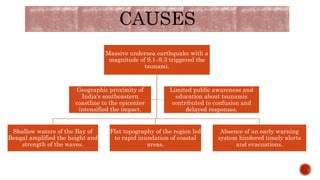
CAUSES
Massive undersea earthquake with a
magnitude of 9.1–9.3 triggered the
tsunami.
Shallow waters of the Bay of
Bengal amplified the height and
strength of the waves.
Flat topography of the region led
to rapid inundation of coastal
areas.
Absence of an early warning
system hindered timely alerts
and evacuations.
Geographic proximity of
India's southeastern
coastline to the epicenter
intensified the impact.
Limited public awareness and
education about tsunamis
contributed to confusion and
delayed responses.
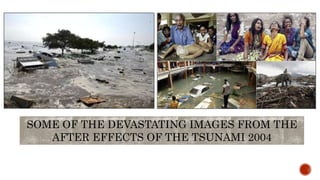
SOME OF THE DEVASTATING IMAGES FROM THE
AFTER EFFECTS OF THE TSUNAMI 2004
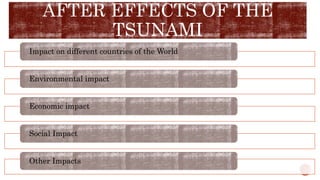
AFTER EFFECTS OF THE
TSUNAMI
Impact on different countries of the World
Environmental impact
Economic impact
Social Impact
Other Impacts
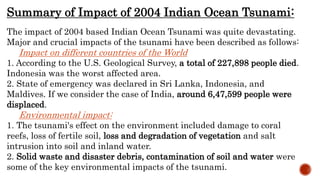
Summary of Impact of 2004 Indian Ocean Tsunami:
The impact of 2004 based Indian Ocean Tsunami was quite devastating.
Major and crucial impacts of the tsunami have been described as follows:
Impact on different countries of the World
1. According to the U.S. Geological Survey, a total of 227,898 people died.
Indonesia was the worst affected area.
2. State of emergency was declared in Sri Lanka, Indonesia, and
Maldives. If we consider the case of India, around 6,47,599 people were
displaced.
Environmental impact:
1. The tsunami's effect on the environment included damage to coral
reefs, loss of fertile soil, loss and degradation of vegetation and salt
intrusion into soil and inland water.
2. Solid waste and disaster debris, contamination of soil and water were
some of the key environmental impacts of the tsunami.
Economic impact :
1. The two main occupations affected by the tsunami were fishing and
tourism.
2. Preliminary estimates indicated that 66% of the fishing fleet and
industrial infrastructure in coastal regions were destroyed by the wave
surges.
Social Impact:
1. Many people lost their livelihood or houses after the tsunami. Many
people worldwide were either displaced or went missing or witnessed death
of their closed ones.
2. Survivors of tsunami faced many mental health effects due to loss of their
closed ones, property, livestock or crops.
Other Impacts:
1. The tsunami had a severe humanitarian and political impact in Sweden.
The tsunami made different countries of the world alert and in case of India,
the country took several precautions and measures after the tsunami.
RECOVERY
• Immediate relief efforts: Search and rescue operations, emergency medical
aid, and distribution of food, water, and shelter.
• Rebuilding infrastructure: Focus on rebuilding homes, schools, hospitals,
and transportation networks.
• Housing and livelihoods: Providing temporary and permanent housing,
supporting the revival of livelihoods, particularly in fishing and tourism
sectors.
• Psychological support: Establishing counselling services, support groups,
and community-based interventions to address mental health needs.
• Early warning systems: Enhancing coastal monitoring systems and
establishing regional and national tsunami warning networks.
• International assistance: Significant support from donor countries, NGOs,
and international organizations in terms of financial aid and resources.
MITIGATION
1. Establishment of the Indian Ocean Tsunami Warning System (IOTWS)
with seismographic and tidal sensors, buoys, and communication systems.
2. Public awareness campaigns and education initiatives to inform coastal
communities about tsunami signs, evacuation routes, and preparedness
measures.
3. Infrastructure development in tsunami-prone areas, including tsunami-
resistant buildings, seawalls, and evacuation shelters.
4. Regional collaboration among affected countries and international
organizations to enhance data sharing, expertise, and resources for disaster
management.
5. Community-based preparedness through training programs, mock drills,
and engagement initiatives to empower individuals with knowledge and
appropriate actions during a tsunami.
EARLY WARNING SYSTEMS
• The Indian Ocean Tsunami highlighted the need for early warning
systems to mitigate the impact of such disasters in the future.
• Absence of a comprehensive early warning system at the time of the
disaster.
• Establishment of IOTWS by UNESCO to provide timely and effective
tsunami warnings for the Indian Ocean Region.
• Setting of seismic monitoring stations to detect earthquakes in the
Indian Ocean.
• Deployment of DART buoys in the Indian Ocean to detect and measure
tsunamis.
• Steps taken to improve the communication systems between national
tsunami warning centers and relevant authorities to issue timely
warnings.
By- Kanishk, Vanshika, Parveen, Anas, Owais and Chirag
English Hons.

Disaster management PPT.pptx

  • 1.
  • 2.
    BACKGROUND 1. The 2004Indian Ocean tsunami was a devastating natural disaster that occurred on December 26, 2004, affecting multiple countries in the region. 2. The disaster originated from a massive earthquake with a magnitude of 9.1-9.3, located near the west coast of northern Sumatra, Indonesia. 3. The earthquake was caused by the movement of tectonic plates, specifically the Indian Plate subducting beneath the Burma Plate and the Sunda Plate in the Indian Ocean region. 4.The epicenter of the earthquake was approximately 30 kilometers (18 miles) below the seafloor, along a fault line stretching nearly 1,300 kilometers (800 miles). 5. The release of energy during the earthquake was extraordinarily powerful, estimated to be equivalent to about 23,000 atomic bombs like the one dropped on Hiroshima in 1945.
  • 3.
    CAUSES Massive undersea earthquakewith a magnitude of 9.1–9.3 triggered the tsunami. Shallow waters of the Bay of Bengal amplified the height and strength of the waves. Flat topography of the region led to rapid inundation of coastal areas. Absence of an early warning system hindered timely alerts and evacuations. Geographic proximity of India's southeastern coastline to the epicenter intensified the impact. Limited public awareness and education about tsunamis contributed to confusion and delayed responses.
  • 4.
    SOME OF THEDEVASTATING IMAGES FROM THE AFTER EFFECTS OF THE TSUNAMI 2004
  • 5.
    AFTER EFFECTS OFTHE TSUNAMI Impact on different countries of the World Environmental impact Economic impact Social Impact Other Impacts
  • 6.
    Summary of Impactof 2004 Indian Ocean Tsunami: The impact of 2004 based Indian Ocean Tsunami was quite devastating. Major and crucial impacts of the tsunami have been described as follows: Impact on different countries of the World 1. According to the U.S. Geological Survey, a total of 227,898 people died. Indonesia was the worst affected area. 2. State of emergency was declared in Sri Lanka, Indonesia, and Maldives. If we consider the case of India, around 6,47,599 people were displaced. Environmental impact: 1. The tsunami's effect on the environment included damage to coral reefs, loss of fertile soil, loss and degradation of vegetation and salt intrusion into soil and inland water. 2. Solid waste and disaster debris, contamination of soil and water were some of the key environmental impacts of the tsunami.
  • 7.
    Economic impact : 1.The two main occupations affected by the tsunami were fishing and tourism. 2. Preliminary estimates indicated that 66% of the fishing fleet and industrial infrastructure in coastal regions were destroyed by the wave surges. Social Impact: 1. Many people lost their livelihood or houses after the tsunami. Many people worldwide were either displaced or went missing or witnessed death of their closed ones. 2. Survivors of tsunami faced many mental health effects due to loss of their closed ones, property, livestock or crops. Other Impacts: 1. The tsunami had a severe humanitarian and political impact in Sweden. The tsunami made different countries of the world alert and in case of India, the country took several precautions and measures after the tsunami.
  • 8.
    RECOVERY • Immediate reliefefforts: Search and rescue operations, emergency medical aid, and distribution of food, water, and shelter. • Rebuilding infrastructure: Focus on rebuilding homes, schools, hospitals, and transportation networks. • Housing and livelihoods: Providing temporary and permanent housing, supporting the revival of livelihoods, particularly in fishing and tourism sectors. • Psychological support: Establishing counselling services, support groups, and community-based interventions to address mental health needs. • Early warning systems: Enhancing coastal monitoring systems and establishing regional and national tsunami warning networks. • International assistance: Significant support from donor countries, NGOs, and international organizations in terms of financial aid and resources.
  • 9.
    MITIGATION 1. Establishment ofthe Indian Ocean Tsunami Warning System (IOTWS) with seismographic and tidal sensors, buoys, and communication systems. 2. Public awareness campaigns and education initiatives to inform coastal communities about tsunami signs, evacuation routes, and preparedness measures. 3. Infrastructure development in tsunami-prone areas, including tsunami- resistant buildings, seawalls, and evacuation shelters. 4. Regional collaboration among affected countries and international organizations to enhance data sharing, expertise, and resources for disaster management. 5. Community-based preparedness through training programs, mock drills, and engagement initiatives to empower individuals with knowledge and appropriate actions during a tsunami.
  • 10.
    EARLY WARNING SYSTEMS •The Indian Ocean Tsunami highlighted the need for early warning systems to mitigate the impact of such disasters in the future. • Absence of a comprehensive early warning system at the time of the disaster. • Establishment of IOTWS by UNESCO to provide timely and effective tsunami warnings for the Indian Ocean Region. • Setting of seismic monitoring stations to detect earthquakes in the Indian Ocean. • Deployment of DART buoys in the Indian Ocean to detect and measure tsunamis. • Steps taken to improve the communication systems between national tsunami warning centers and relevant authorities to issue timely warnings.
  • 11.
    By- Kanishk, Vanshika,Parveen, Anas, Owais and Chirag English Hons.