MANAGEMENT
A disaster is a serious problem occurring over
a short or long period of time that causes
widespread human, material, economic or
environmental loss which exceeds the ability of
the affected community or society to cope
using its own resources. Disasters are routinely
divided into either "natural disasters" caused by
natural hazards and disasters" caused by
humanity . However, in modern times, the divide
between natural, human-made and human-
accelerated disasters is difficult to draw
DISASTER
NATURAL
human caused disaster
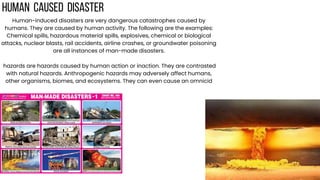
Human-induced disasters are very dangerous catastrophes caused by
humans. They are caused by human activity. The following are the examples:
Chemical spills, hazardous material spills, explosives, chemical or biological
attacks, nuclear blasts, rail accidents, airline crashes, or groundwater poisoning
are all instances of man-made disasters.
hazards are hazards caused by human action or inaction. They are contrasted
with natural hazards. Anthropogenic hazards may adversely affect humans,
other organisms, biomes, and ecosystems. They can even cause an omnicid
NATURAL
“A major event brought about by the
natural processes of the Earth that
causes widespread destruction to the
environment and loss of life.”
A natural hazard often precedes a natural
disaster. For instance, the Gujarat
Earthquake, which occurred on 26th
January 2001 is a natural disaster. The
natural hazard is living under the active
fault lines present under the state of
Gujarat
DISASTER
AN EARTHQUAKE IS THE SHAKING OF THE SURFACE OF THE EARTH DUE TO THE
SUDDEN RELEASE OF ENERGY IN THE EARTH'S CRUST. AS A RESULT, SEISMIC
WAVES (ALSO KNOWN AS S WAVES) ARE CREATED. THE SEISMIC ACTIVITIES
IN AN AREA DETERMINE THE TYPE AND INTENSITY OF THE EARTHQUAKE
GRAPH OF DEATH RATE
m o r e
earthquake
www.reallygreatsite.com
landslides, also known as landslips, are several
forms of mass wasting that may include a wide
range of ground movements, such as rockfalls,
deep-seated slope failures, mudflows, and debris
flows Landslides occur in a variety of environments,
characterized by either steep or gentle slope
gradients, from mountain ranges to coastal cliffs or
even underwater, in which case they are called
submarine landslides.
• ROCKSLIDE • MUDSLIDES
volcano is a rupture in the crust of a planetary-mass object, such as Earth, that allows hot lava, volcanic
ash, and gases to escape from a magma chamber below the surface.
On Earth, volcanoes are most often found where tectonic plates are diverging or converging, and most are
found underwater. For example, a mid-ocean ridge, such as the Mid-Atlantic Ridge, has volcanoes caused by
divergent tectonic plates whereas the Pacific Ring of Fire has volcanoes caused by convergent tectonic
plates. Volcanoes can also form where there is stretching and thinning of the crust's plates, such as in the
East African Rift and the Wells Gray-Clearwater volcanic field and Rio Grande rift in North America. Volcanism
away from plate boundaries has been postulated to arise from upwelling diapirs from the core–mantle
boundary, 3,000 kilometers (1,900 mi) deep in the Earth.
www.reallygreatsite.com
DISASTER
WHAT CAUSES
• GLOBAL WARMING
• TECTONIC MOVEMENT
• DEFORESTATION
• SOIL EROSION
• SEIMIC ACTIVITY
who is
responsible
• HUMAN FACTOR
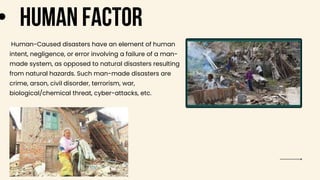
Human-Caused disasters have an element of human
intent, negligence, or error involving a failure of a man-
made system, as opposed to natural disasters resulting
from natural hazards. Such man-made disasters are
crime, arson, civil disorder, terrorism, war,
biological/chemical threat, cyber-attacks, etc.
• BIOLOGICAL FACTORS
Biological disasters arise due to sudden increase in population of certain kinds of
plants (weeds), animals or microbes.
i. Plant related disasters
a. Forest fires occur due to natural causes such as lightning, etc., that set the trees on
fire. Humans can also intentionally or unintentionally provide a source of fire to ignite
the forest.
b. Overgrowth of weeds like common grass, carrot grass and certain common weeds may
cause biological disasters.
ii. Animal-related disasters.
Biiological disasters may result from living organisms that may spread infectious
viruses or bacteria, that cause diseases/epidemics like cholera, malaria (spread by
infected mosquito), plague (spread by infected rodents) and hepatitis. Disasters may
also occur due to bites from poisonous animals or when there is uncontrolled breeding
of insects that spread disease, etc.
project 02
for disaster management
step taken by government
• Development of a Comprehensive Disaster Risk Reduction/Recovery plan
for each district.
• Awareness and publicity campaigns throughout the selected district.
• Preparation of training modules in community based disaster
management
lessons
LIFE
CHANG
E
• . SOMETIMES, THERE ARE NO REAL ANSWERS.
• EVEN STRANGERS CAN TEACH YOU KINDNESS.
• FAMILY IS EVERYTHING.
• YOUR MONEY WON’T MATTER IN THE END.
• . DEATH IS A REMINDER TO APPRECIATE LIFE.
• YOU HAVE TO HELP YOURSELF FIRST BEFORE YOU CAN HELP OTHERS..
• . EVERY DAY OF YOUR LIFE SHOULD BE SPENT LOVING AND LIVING.
• YOU SHOULDN’T BE A VICTIM FOREVER – BE A SURVIVOR.
• . IT WILL ALWAYS BE HUMANITY AGAINST THE WORLD IN THE END.
DO'S & DON'TS
• DO'
S
(In EARTHQUAKE )
• DROP to the ground; take COVER by getting under a sturdy table or other piece of
furniture.
• Protect yourself by staying under the lintel of an inner door, in the corner of a room,
under a table or even under a bed.
• Stay away from glass, windows, outside doors and walls, and anything that could fall,
(such as lighting fixtures or furniture).
• Stay in bed if you are there when the earthquake strikes. Hold on and protect your
head with a pillow, unless you are under a heavy light fixture that could fall. In that
case, move to the nearest safe place.
• Use a doorway for shelter only if it is in close proximity to you and if you know it is a
strongly supported, load bearing doorway.
• Stay inside.
• Drop under heavy furniture such as a table, desk, bed or any solid furniture.
• Cover your head and torso to prevent being hit by falling objects.
• Hold onto the object that you are under so that you remain covered.
• If you can't get under something strong, or if you are in a hallway, flatten yourself or
crouch against an interior wall.
• DON'TS
BIBLIOGRAPHY
• GOOGLE -WWW.GOOGLE.COM
• WIKIPEDIA-
WWW.WIKIPEDIA.ORG/

DISASTER (2).pptx

  • 1.
  • 2.
    A disaster isa serious problem occurring over a short or long period of time that causes widespread human, material, economic or environmental loss which exceeds the ability of the affected community or society to cope using its own resources. Disasters are routinely divided into either "natural disasters" caused by natural hazards and disasters" caused by humanity . However, in modern times, the divide between natural, human-made and human- accelerated disasters is difficult to draw
  • 3.
  • 4.
    human caused disaster Human-induceddisasters are very dangerous catastrophes caused by humans. They are caused by human activity. The following are the examples: Chemical spills, hazardous material spills, explosives, chemical or biological attacks, nuclear blasts, rail accidents, airline crashes, or groundwater poisoning are all instances of man-made disasters. hazards are hazards caused by human action or inaction. They are contrasted with natural hazards. Anthropogenic hazards may adversely affect humans, other organisms, biomes, and ecosystems. They can even cause an omnicid
  • 5.
    NATURAL “A major eventbrought about by the natural processes of the Earth that causes widespread destruction to the environment and loss of life.” A natural hazard often precedes a natural disaster. For instance, the Gujarat Earthquake, which occurred on 26th January 2001 is a natural disaster. The natural hazard is living under the active fault lines present under the state of Gujarat DISASTER
  • 6.
    AN EARTHQUAKE ISTHE SHAKING OF THE SURFACE OF THE EARTH DUE TO THE SUDDEN RELEASE OF ENERGY IN THE EARTH'S CRUST. AS A RESULT, SEISMIC WAVES (ALSO KNOWN AS S WAVES) ARE CREATED. THE SEISMIC ACTIVITIES IN AN AREA DETERMINE THE TYPE AND INTENSITY OF THE EARTHQUAKE
  • 7.
    GRAPH OF DEATHRATE m o r e earthquake
  • 8.
    www.reallygreatsite.com landslides, also knownas landslips, are several forms of mass wasting that may include a wide range of ground movements, such as rockfalls, deep-seated slope failures, mudflows, and debris flows Landslides occur in a variety of environments, characterized by either steep or gentle slope gradients, from mountain ranges to coastal cliffs or even underwater, in which case they are called submarine landslides. • ROCKSLIDE • MUDSLIDES
  • 9.
    volcano is arupture in the crust of a planetary-mass object, such as Earth, that allows hot lava, volcanic ash, and gases to escape from a magma chamber below the surface. On Earth, volcanoes are most often found where tectonic plates are diverging or converging, and most are found underwater. For example, a mid-ocean ridge, such as the Mid-Atlantic Ridge, has volcanoes caused by divergent tectonic plates whereas the Pacific Ring of Fire has volcanoes caused by convergent tectonic plates. Volcanoes can also form where there is stretching and thinning of the crust's plates, such as in the East African Rift and the Wells Gray-Clearwater volcanic field and Rio Grande rift in North America. Volcanism away from plate boundaries has been postulated to arise from upwelling diapirs from the core–mantle boundary, 3,000 kilometers (1,900 mi) deep in the Earth.
  • 10.
    www.reallygreatsite.com DISASTER WHAT CAUSES • GLOBALWARMING • TECTONIC MOVEMENT • DEFORESTATION • SOIL EROSION • SEIMIC ACTIVITY
  • 11.
  • 12.
    • HUMAN FACTOR Human-Causeddisasters have an element of human intent, negligence, or error involving a failure of a man- made system, as opposed to natural disasters resulting from natural hazards. Such man-made disasters are crime, arson, civil disorder, terrorism, war, biological/chemical threat, cyber-attacks, etc.
  • 13.
    • BIOLOGICAL FACTORS Biologicaldisasters arise due to sudden increase in population of certain kinds of plants (weeds), animals or microbes. i. Plant related disasters a. Forest fires occur due to natural causes such as lightning, etc., that set the trees on fire. Humans can also intentionally or unintentionally provide a source of fire to ignite the forest. b. Overgrowth of weeds like common grass, carrot grass and certain common weeds may cause biological disasters. ii. Animal-related disasters. Biiological disasters may result from living organisms that may spread infectious viruses or bacteria, that cause diseases/epidemics like cholera, malaria (spread by infected mosquito), plague (spread by infected rodents) and hepatitis. Disasters may also occur due to bites from poisonous animals or when there is uncontrolled breeding of insects that spread disease, etc.
  • 14.
    project 02 for disastermanagement step taken by government • Development of a Comprehensive Disaster Risk Reduction/Recovery plan for each district. • Awareness and publicity campaigns throughout the selected district. • Preparation of training modules in community based disaster management
  • 15.
    lessons LIFE CHANG E • . SOMETIMES,THERE ARE NO REAL ANSWERS. • EVEN STRANGERS CAN TEACH YOU KINDNESS. • FAMILY IS EVERYTHING. • YOUR MONEY WON’T MATTER IN THE END. • . DEATH IS A REMINDER TO APPRECIATE LIFE. • YOU HAVE TO HELP YOURSELF FIRST BEFORE YOU CAN HELP OTHERS.. • . EVERY DAY OF YOUR LIFE SHOULD BE SPENT LOVING AND LIVING. • YOU SHOULDN’T BE A VICTIM FOREVER – BE A SURVIVOR. • . IT WILL ALWAYS BE HUMANITY AGAINST THE WORLD IN THE END.
  • 16.
    DO'S & DON'TS •DO' S (In EARTHQUAKE ) • DROP to the ground; take COVER by getting under a sturdy table or other piece of furniture. • Protect yourself by staying under the lintel of an inner door, in the corner of a room, under a table or even under a bed. • Stay away from glass, windows, outside doors and walls, and anything that could fall, (such as lighting fixtures or furniture). • Stay in bed if you are there when the earthquake strikes. Hold on and protect your head with a pillow, unless you are under a heavy light fixture that could fall. In that case, move to the nearest safe place. • Use a doorway for shelter only if it is in close proximity to you and if you know it is a strongly supported, load bearing doorway.
  • 17.
    • Stay inside. •Drop under heavy furniture such as a table, desk, bed or any solid furniture. • Cover your head and torso to prevent being hit by falling objects. • Hold onto the object that you are under so that you remain covered. • If you can't get under something strong, or if you are in a hallway, flatten yourself or crouch against an interior wall. • DON'TS
  • 18.
    BIBLIOGRAPHY • GOOGLE -WWW.GOOGLE.COM •WIKIPEDIA- WWW.WIKIPEDIA.ORG/