~ Keshav Garg
 Winding up by the creditors or members without any intervention of
the Tribunal is termed as voluntary winding up.
 According to section 304, a company may be wound up voluntarily:
1. By passing an ordinary resolution in general meeting—
(a) When the period, for the duration of which the company was
constituted, has expired, or
(b) When the event on the happening of which depended the
termination of the existence of the company has happened.
2. By passing a special resolution to wind up voluntarily for any reason
whatsoever.
Within fourteen days of the passing of the
resolution, the company shall give notice of the
resolution by advertisement in the Official Gazette
Every officer responsible for default in publishing
the resolution shall be punishable with fine
extending up to Rs 5000 for every day of the
default. (Section 307)
Voluntary winding up of a company is of two kinds:
(a) Members’ voluntary winding up.
Members’ voluntary winding up requires the filing
of a statutory declaration of solvency by the
majority of the directors of the company with the
Registrar.
(b) Creditors’ voluntary winding up.
Where the company is not in a position to pay off
its liabilities in full, the voluntary winding up is
termed as the creditors’ voluntary winding up.
 In such a case declaration of solvency shall not be
made and filed with the Registrar
1. Declaration of solvency. (Section 305)
 The declaration of solvency made by directors
 It states that company has no debts or it will be
able to pay its debt
Legal provisions related to declaration of solvency
Sec305(1)
i. Declaration of solvency shall be made by
Directors at BOD meeting
ii. The director shall declare that they have
enquired about the affairs of company found that
it has no debt or payment of debt will made out of
sale proceeds of assets
iii. It contains a declaration that the company is not
being wound up to defraud any person(s).
iv. It is made within 5 weeks preceding the date of
passing resolution for the winding up of the
company and delivered to the Registrar before
that date.
v. It is accompanied by a copy of the report of the
auditors of the company on the profit and loss
account and balance sheet of the company
prepared up to the date of declaration
vi. It contains a statement of the company’s assets
and liabilities as at the latest practicable date
before the making of the declaration.
2. Meeting of creditors
Meeting of creditors is mandatory, in case of
voluntary winding up
It is to protect the interest of the creditors and to
make them aware of the affairs of the company
3. Publication of Resolution for voluntary winding
up (Sec 307)
The resolution passed by company shall be
published within 14 days of passing resolution in
official gazette
It should also be published in newspaper which is
in circulation in the district of register or any other
office
4. Commencement of winding up (Sec 308)
A voluntary winding up shall be deemed to
commence from the date of passing a resolution by
the company for its voluntary winding up
5. Effect of voluntary Winding up
On commencement of winding up company cease
to carry on the business
It may carry on its business where it is required
for the beneficial winding up of the business
Corporate status and powers of the company shall
continue until it is dissolve
6. Appointment of the liquidator (Sec- 310)
Legal provisions related to appointment of the
liquidator are:-
1. Appointment of Company liquidator
i) Appoint by company in general meeting [Sec 310
(1)]
 Company liquidator is appointed from panel of
professional prepared by the central government
 If creditors does not approve such appointment,
then they shall appoint another liquidator
ii) Appoint by the creditors [Sec 310(2)]
 The appointment of company liquidator shall be
effective only if it is approved by majority of
creditors
 If creditors does not approve such appointment,
then they shall appoint another liquidator
2. Declaration by the company liquidator [Sec
310(4)]
Liquidator shall file declaration with the company
and creditors within 7 days from the date of his
appointment
3. Notice for appointment to registrar
Notice of appointment of liquidator along with his
name and particulars shall be given by company
to registrar within 10 day of his appointment
7. Board power ceases on the appointment of
Company liquidator
Power of managing director, whole time director
and manager comes to end once liquidator is
appointed
8. Appointment of committees (Sec 315)
Appointment of committee shall be made by
company and creditors
It is done to supervise the liquidation process
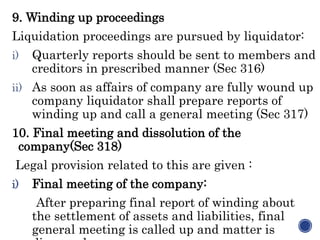
9. Winding up proceedings
Liquidation proceedings are pursued by liquidator:
i) Quarterly reports should be sent to members and
creditors in prescribed manner (Sec 316)
ii) As soon as affairs of company are fully wound up
company liquidator shall prepare reports of
winding up and call a general meeting (Sec 317)
10. Final meeting and dissolution of the
company(Sec 318)
Legal provision related to this are given :
i) Final meeting of the company:
After preparing final report of winding about
the settlement of assets and liabilities, final
general meeting is called up and matter is
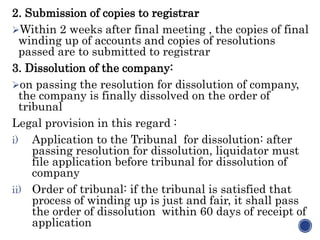
2. Submission of copies to registrar
Within 2 weeks after final meeting , the copies of final
winding up of accounts and copies of resolutions
passed are to submitted to registrar
3. Dissolution of the company:
on passing the resolution for dissolution of company,
the company is finally dissolved on the order of
tribunal
Legal provision in this regard :
i) Application to the Tribunal for dissolution: after
passing resolution for dissolution, liquidator must
file application before tribunal for dissolution of
company
ii) Order of tribunal: if the tribunal is satisfied that
process of winding up is just and fair, it shall pass
the order of dissolution within 60 days of receipt of
application
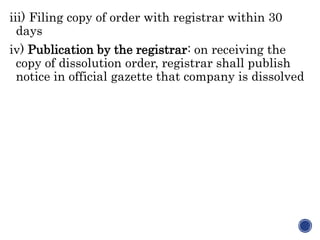
iii) Filing copy of order with registrar within 30
days
iv) Publication by the registrar: on receiving the
copy of dissolution order, registrar shall publish
notice in official gazette that company is dissolved

Voluntary winding up

  • 1.
  • 2.
     Winding upby the creditors or members without any intervention of the Tribunal is termed as voluntary winding up.  According to section 304, a company may be wound up voluntarily: 1. By passing an ordinary resolution in general meeting— (a) When the period, for the duration of which the company was constituted, has expired, or (b) When the event on the happening of which depended the termination of the existence of the company has happened. 2. By passing a special resolution to wind up voluntarily for any reason whatsoever.
  • 3.
    Within fourteen daysof the passing of the resolution, the company shall give notice of the resolution by advertisement in the Official Gazette Every officer responsible for default in publishing the resolution shall be punishable with fine extending up to Rs 5000 for every day of the default. (Section 307) Voluntary winding up of a company is of two kinds: (a) Members’ voluntary winding up. Members’ voluntary winding up requires the filing of a statutory declaration of solvency by the majority of the directors of the company with the Registrar.
  • 4.
    (b) Creditors’ voluntarywinding up. Where the company is not in a position to pay off its liabilities in full, the voluntary winding up is termed as the creditors’ voluntary winding up.  In such a case declaration of solvency shall not be made and filed with the Registrar
  • 5.
    1. Declaration ofsolvency. (Section 305)  The declaration of solvency made by directors  It states that company has no debts or it will be able to pay its debt Legal provisions related to declaration of solvency Sec305(1) i. Declaration of solvency shall be made by Directors at BOD meeting ii. The director shall declare that they have enquired about the affairs of company found that it has no debt or payment of debt will made out of sale proceeds of assets iii. It contains a declaration that the company is not being wound up to defraud any person(s).
  • 6.
    iv. It ismade within 5 weeks preceding the date of passing resolution for the winding up of the company and delivered to the Registrar before that date. v. It is accompanied by a copy of the report of the auditors of the company on the profit and loss account and balance sheet of the company prepared up to the date of declaration vi. It contains a statement of the company’s assets and liabilities as at the latest practicable date before the making of the declaration.
  • 7.
    2. Meeting ofcreditors Meeting of creditors is mandatory, in case of voluntary winding up It is to protect the interest of the creditors and to make them aware of the affairs of the company 3. Publication of Resolution for voluntary winding up (Sec 307) The resolution passed by company shall be published within 14 days of passing resolution in official gazette It should also be published in newspaper which is in circulation in the district of register or any other office
  • 8.
    4. Commencement ofwinding up (Sec 308) A voluntary winding up shall be deemed to commence from the date of passing a resolution by the company for its voluntary winding up 5. Effect of voluntary Winding up On commencement of winding up company cease to carry on the business It may carry on its business where it is required for the beneficial winding up of the business Corporate status and powers of the company shall continue until it is dissolve
  • 9.
    6. Appointment ofthe liquidator (Sec- 310) Legal provisions related to appointment of the liquidator are:- 1. Appointment of Company liquidator i) Appoint by company in general meeting [Sec 310 (1)]  Company liquidator is appointed from panel of professional prepared by the central government  If creditors does not approve such appointment, then they shall appoint another liquidator ii) Appoint by the creditors [Sec 310(2)]  The appointment of company liquidator shall be effective only if it is approved by majority of creditors  If creditors does not approve such appointment, then they shall appoint another liquidator
  • 10.
    2. Declaration bythe company liquidator [Sec 310(4)] Liquidator shall file declaration with the company and creditors within 7 days from the date of his appointment 3. Notice for appointment to registrar Notice of appointment of liquidator along with his name and particulars shall be given by company to registrar within 10 day of his appointment
  • 11.
    7. Board powerceases on the appointment of Company liquidator Power of managing director, whole time director and manager comes to end once liquidator is appointed 8. Appointment of committees (Sec 315) Appointment of committee shall be made by company and creditors It is done to supervise the liquidation process
  • 12.
    9. Winding upproceedings Liquidation proceedings are pursued by liquidator: i) Quarterly reports should be sent to members and creditors in prescribed manner (Sec 316) ii) As soon as affairs of company are fully wound up company liquidator shall prepare reports of winding up and call a general meeting (Sec 317) 10. Final meeting and dissolution of the company(Sec 318) Legal provision related to this are given : i) Final meeting of the company: After preparing final report of winding about the settlement of assets and liabilities, final general meeting is called up and matter is
  • 13.
    2. Submission ofcopies to registrar Within 2 weeks after final meeting , the copies of final winding up of accounts and copies of resolutions passed are to submitted to registrar 3. Dissolution of the company: on passing the resolution for dissolution of company, the company is finally dissolved on the order of tribunal Legal provision in this regard : i) Application to the Tribunal for dissolution: after passing resolution for dissolution, liquidator must file application before tribunal for dissolution of company ii) Order of tribunal: if the tribunal is satisfied that process of winding up is just and fair, it shall pass the order of dissolution within 60 days of receipt of application
  • 14.
    iii) Filing copyof order with registrar within 30 days iv) Publication by the registrar: on receiving the copy of dissolution order, registrar shall publish notice in official gazette that company is dissolved