
OTHER FEATURES INCLUDE:
	 GS Sustain on ‘Crossing the Rubicon’
	 The sustainability year – winners, losers and highlights
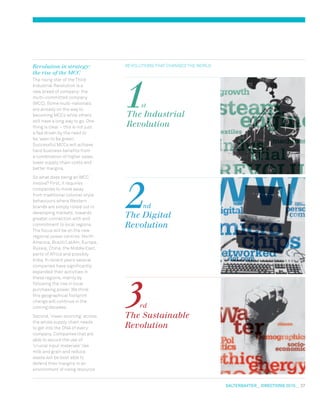
	 ING’s Third Industrial Revolution
	 Palm oil – myths, facts and some scary research
Directions 10
The Innovation Edition
INSIDE: Lord Nicholas Stern explains that
if we want to keep growing, we need to
keep innovating
CONTENTS
04
FEATUREINTERvIEw
Andrew Howard of GS SUSTAIN
on how companies are ‘Crossing
the Rubicon’
02
AYEARINREvIEw
From ‘Climategate’ to the BP disaster
we review the highlights of the year
16
CITIES
Arup showcase the latest
innovations shaping sustainable
cities of the future and Nathan
Schock from POET explains
how biotechnology is set to
revolutionise our society
24
COmPANIES
ING set the scene for the
Third Industrial Revolution and
salterbaxter search for the true
leaders in sustainability innovation
48
PRODUCTS
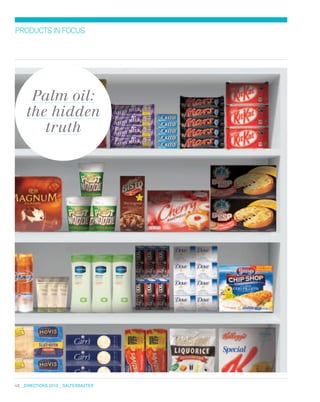
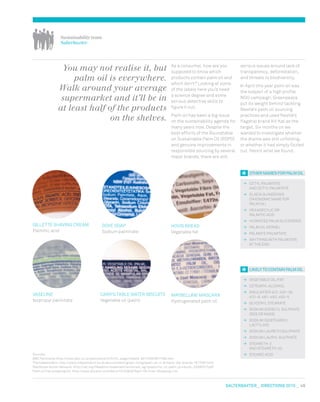
we explore the latest palm oil scandal
and its impact on global brands
36
PEOPLE
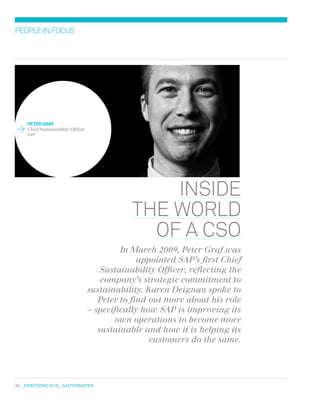
Peter Graf talks about his role as
SAP’s Chief Sustainability Officer
and our panel of international
practitioners tell us what’s on their
mind for 2011
10
COUNTRIES
Lord Nicholas Stern describes the
global challenge of delivering low
carbon growth
salterbaxter  DIRECTIONS 2010  1
editor’sletter
Directions 10
welcome
to the
tenth
edition of
directions
We’ve come a long way
from the early days of
analysing the trends in
what was then called CSR.
	 NIGELSALTER
	 Director, salterbaxter
	 KARENDeignan
	Sustainability
Consultant, salterbaxter
Our scope is now international and the sustainability
agenda is now arguably one of the key concerns of the
CEOs of the world’s biggest companies. It’s one of the
few agendas that cuts across entire organisations,
covering strategy, competitive positioning, investor
relations, product development, brand, reporting,
health and safety, employees, and impacting just about
every stakeholder group. No wonder this is now a
competitive battleground. And it’s a battleground
where innovation and sustainability are joined at the
hip and where clear leaders are starting to emerge.
This edition looks at innovation and leadership in all
its layers – countries, cities, corporations, finance,
infrastructure, people, products and communications.
Amongst other things we hear how GS Sustain believe
we have passed a tipping point and that the investment
community is now beginning to understand the scale
of the importance of sustainability. Lord Stern provides
an insight into the challenges of achieving low-carbon
growth. We also feature opinion and analysis on
sustainable cities, the ING Equity Research team’s
prediction of a ‘Third Industrial Revolution’, and
the view on the big issues from sustainability
practitioners around the world.
And then we have our own pieces of research in
which we expose some of the startling truths behind
the latest corporate palm oil scandal and reveal which
global companies are the true innovation leaders.
The tenth edition of Directions is harder-hitting,
bringing a broader perspective, and with more key
players’ views than ever before. It’s also online at
www.salterbaxter.com where you’ll find additional
features and interactive content.
We think it’s the best edition ever – we hope you agree.
Nigel and the Sustainability team
2  DIreCtIONs 2010  salterbaxter
© world Economic Forum
© US Geological Survey
AYEARINREvIEw
NOvember 2009
CLImATEGATE SCANDAL
Emails from climate
change scientists at the
University of East Anglia
(UEA) that questioned some
of the scientific claims
about man-made climate
change were leaked to the
press causing a media
storm. The UEA scientists
had been influential in driving
worldwide awareness of global
warming and were involved in
the UN’s Intergovernmental
Panel on Climate Change
(IPCC). The damaging emails
kick started what was to be a
difficult year for the reputation
of climate scientists and for
the IPCC.
OCtOber 2009
GEORGE SOROS PLEDGES $1BN
TO SEARCH FOR CLEAN ENERGY
The billionaire financier
announced that he would
invest $1bn in clean energy
technology to tackle climate
change. Soros will also spend
$10m annually funding a new
Climate Policy Initiative,
focused on the efficacy and
implementation of policy.
jaNuary 2010
BRIC NATIONS COmmIT TO
vOLUNTARY EmISSIONS CUTS
During talks in New Delhi, India,
China, Brazil, and South Africa
each agreed to formally submit
their own voluntary carbon
emission control plans to the
United Nations by January 31.
marCh 2010
OIL COmPANY FUNDS
CLImATE SCEPTICS
Greenpeace accused US
oil company Koch Industries
of donating $73m to fund
research by ‘climate sceptic’
groups, with the aim of
spreading ‘inaccurate and
misleading information’
about climate change.
DeCember 2009
COP 15 CLImATE CHANGE
CONFERENCE IN COPENHAGEN
Global leaders came together
to try to agree a global deal
on climate change that
would replace the Kyoto
protocol. The talks were
generally brandedafailure,
asagreement could not be
reached between participating
nations on appropriate binding
emissions targets.
DeCember 2009
GOOGLE UNvEILS
BREAKTHROUGH TECHNOLOGY
TO mONITOR DEFORESTATION
monitoring the destruction
of the world’s forests should
become easier with Google’s
new software which can
process satellite images and
extract scientific and tracking
information about how much
forests have changed over time.
february 2010
LABELLING FOR GREEN
POwER TARIFFS
Britain launched a scheme to
certify and label electricity
produced from renewable
sources to help consumers
choose tariffs that support
suppliers who are going beyond
legal obligations to cut carbon.
salterbaxter  DIreCtIONs 2010   3
aprIl 2010
BP DEEPwATER HORIzON
The explosion and fire on
the BP-licensed Transocean
drilling rig, Deepwater Horizon,
in the Gulf of mexico caused
the death of 11 people
and serious injuries to
another 17. Fishermen and
environmentalists looked on
in horror as millions of gallons
of crude oil poured into the
ocean, devastating marine life.
Two days later the rig sank
resulting in a five-mile-long oil
slick. As BP boss Tony Hayward
faced a media furore and a
tough Congress hearing over
the summer, President Obama
compared the catastrophe
to 9/11.
aprIl 2010
GREENPEACE LAUNCHES
vIRAL CAmPAIGN AGAINST
NESTLÉ BRAND
Based on a spoof Kit Kat advert,
the Greenpeace campaign
forced Nestlé to withdraw from
its contract with palm oil
supplier Sinar mas, who
Greenpeace accused of
unethicalpracticesaroundpalm
oil. In may, Nestlé announced
a partnership with The Forest
Trust to independently verify
their palm oil supply chain.
juNe 2010
BARCOO APP LAUNCHED
FOR ETHICAL SHOPPING
An app, launched in Germany,
is designed to help shoppers
access ethical information on
products while they are
shopping. Its take-up will be an
interesting indicator of how
engaged consumers are in this
area. It is due in the UK later
in 2010.
july 2010
FIRST SOLAR POwERED FLIGHT
The solar powered plane
‘Solar Impulse’ completed its
first overnight flight, flying a
total of 26 hours and 9 minutes.
It was the longest and highest
flight in the history of solar
aviation. The next milestone
will be crossing the Atlantic.
september 2010
BJØRN LOmBORG
CHANGES HIS mIND
The world’s most high-profile
climate change sceptic,
Bjørn Lomborg, declared that
global warming “is undoubtedly
one of the chief concerns
facing the world today”. In an
apparent U-turn he called for
tens of billions of dollars a year
to be invested in tackling
climate change.
may 2010
US CLImATE BILL UNvEILED
US Senators John Kerry and
Joe Lieberman unveiled a new
climate bill, which proposes a
‘cap and trade’ system for
reducing US carbon emissions.
The third author, Senator
Graham Lindsey, pulled out of
the launch ceremony at the last
minute, saying the BP oil spill
and plans for immigration
reform meant this was not the
time to be pushing forward a
climate bill. The bill stalled in
the Senate with commentators
proclaiming that ‘cap and trade’
legislation ‘appears to be dead
in this Congress’.
august 2010
CATASTROPHIC FLOODS
IN PAKISTAN
As with the heat wave in
Russia in July, the disastrous
floods in Pakistan, in which
1,500 died and 20 million
people were affected, were
deemed to be a direct result
of climate change.
© Nissan
august 2010
NISSAN UNvEILS ITS
NEw ELECTRIC CAR
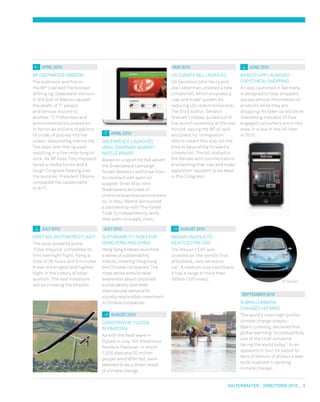
The Nissan LEAF was
unveiled as ‘the world’s first
affordable, zero-emission
car’. A medium-size hatchback,
it has a range of more than
160km (100 miles).
july 2010
SUSTAINABILITY INDEx FOR
HONG KONG AND CHINA
Hang Seng Indexes launched
a series of sustainability
indices, covering Hong Kong
and Chinese companies. The
index series aims to raise
awareness about corporate
sustainability and meet
international demand for
socially responsible investment
in Chinese companies.
4  DIRECTIONS 2010  salterbaxter
featureinterview
the
GS sustain
focus list is
shaking up
management
thinking on
sustainability
Nigel Salter talks to
Andrew Howard, head of the
GS SUSTAIN research team,
to find out more about the
methodology and how it is
linking sustainability
performance to company
performance and valuation.
You can view this interview in full online:
www.salterbaxter.com
Andrew, welcome to salterbaxter
and thank you very much for being
an interviewee for Directions 10. I’m
wondering if you could just tell us
a little bit about what you actually
do at Goldman Sachs.
Thanks,nicetobehere.IheadtheGSSUSTAIN research
team at Goldman Sachs. Our job, basically, is to take a
long-term view of industries, how they’re changing,
how companies will evolve within those industries
and, as a result, which companies investors should
focus on for generating long-term outperformance.
It’s very much about taking a long-term view of
industries and investment, which is something slightly
different from how a lot of other research has been
done in the past. I think it’s a little bit of an evolution
for us, and our industry as a whole.
One of your more recent research reports
is titled Crossing the Rubicon. Tell me
a bit about the background to that.
Crossing the Rubicon, the report we put out recently
within Goldman, is the culmination of the work that
we’ve been doing for the last four or five years within
Goldman Sachs, understanding how companies are
adapting to long-term pressures. The title itself is
designed really to indicate that we take the view we’re
shifting from the early recognition that environmental,
social and governance issues, long-term pressures,
are becoming more important, into an environment
where they’re having a very real, tangible impact on
the way that companies perform.
We’re past the point of theoretical interest. We’re into
the point of financial impact and, increasingly, we’re
going to find those financial impacts become bigger
and bigger on companies within different sectors.
salterbaxter  DIRECTIONS 2010  5
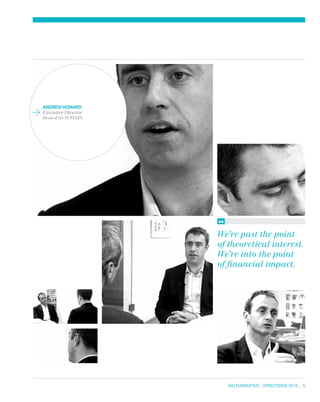
AndrewHoward
Executive Director
Head of GS SUSTAIN
We’re past the point
of theoretical interest.
We’re into the point
of financial impact.
6  DIRECTIONS 2010  salterbaxter
featureinterview
Continued
business on a fundamental basis. And what we’re
doing within GS SUSTAIN, really, is saying, rather than
focusing on the 20%, let’s focus on the 80%. Let’s
understand how a company will behave and perform
in the long run, which, ultimately, can be an awful lot
more successful.
It’s also, obviously, exactly what
sustainability is about, which is why it’s
such an important concept. But some of
your language in the reports that have
been published recently, some of the
research, is really quite dramatic. You talk
about dramatic structural shifts and global
crises. Tell me a little about what those are.
The trends that we’re talking about, to a large degree,
are relatively well-established trends. We’re talking
about population growth. We’re talking about a shift
in the structure of the global economy. We’re talking
about a rising new middle class of consumers in
emerging markets.
The important point is the scale, speed and impact
of those trends on companies in different industries.
Everything is happening at a faster pace, on a bigger
scale, and with a bigger impact on how companies
perform financially. To put some rough numbers to it,
if you look forward over the next 15 years, on the UN’s
forecast, there will be as many people added to the
world’s population as existed in the world prior to
World War I.
So it’s not particularly that we’re talking about new
trends. It’s the speed, scale and magnitude of those
trends that’s really the new factor.
And your own climate change report
also talks about the equity market just
beginning to factor in and understand the
scale of these changes. Have you got any
proof of that really being understood?
We’re beginning to see it happening and I’d say in
probably the most obvious industries, in many ways.
So, if you look at the utility sector, if you look at the
steel sector, you begin to see differences in valuations
And what’s the specific difference
in the approach that GS SUSTAIN
is adopting in its analysis?
I think that the really unique characteristic of
GS SUSTAIN is the perspective that we’re taking.
It’s very much about taking a long-term view of
companies and industries. If you look back through
the last few decades, really, investing has become
a shorter and shorter-term horizon.
What we’re doing within GS SUSTAIN is really trying
to say, how do we reverse that trend? How do we
understand how companies will behave in the
longer term?
You talk about exploiting the inefficiencies
between short- and long-term views. This
goes to the heart of why the financial
community has been criticised. Is it working?
It’s beginning, I think. And, you
know, I think it’s a valid point
that if you look at the last ten
years or so, certainly the focus
on short-term movements, the
focus on short-term news
flow, has only intensified.
When you boil it down,
however, the average
company, globally, in round
numbers, about 20% of the
value of that company lies in
the earnings that they’re going
to generate over the next three
years. The corollary of that is
that 80% of the value of the
company lies in the earnings
it generates after the next
three years.
And you’ve got this
disproportionate focus on the
news flow and the earnings
around a relatively small
proportion of the value of their
Over the next 15 years, on
the UN’s forecast, there will
be as many people added
to the world’s population
as existed in the world
prior to World War I.
salterbaxter  DIRECTIONS 2010  7
Speak to the company and they’ll tell you that it’s
largely about their employees. People that want to
work for Roche, by nature, are scientific and have
a social perspective that means they find it easier
to recruit, retain and incentivise the best employees
to work for Roche.
And that touches on an important
point, which is about management and
chief executives, in particular. Some
of the recent research suggests there is
a massive amount of understanding
at the chief executive level of the
importance of sustainability. But what’s
your view on that? Do they understand
and are they doing something, as well
as understanding?
It’s interesting. As you say, there’s an awful lot of
research that points to the same conclusion, that
chief executives of companies do recognise that
sustainability and environmental and social factors
are important to their business. If you look at the
responses of companies, actually there is something
of a gap between a recognition that it’s an issue and
the understanding of what to do about it.
And I think it’s fairly clear that the debate about whether
environmental issues and social issues are something
that companies need to worry about has changed
dramatically. It’s very rare today to find a CEO of a
large company who says anything other than, these
are issues that matter to my business and I recognise
their importance. However, there are relatively few
companies that have really developed a strategy
integrated with their overall business plan that
adapts to those.
What we’re talking about, with many of the issues
in this field, are outcomes that are very uncertain.
Planning becomes more of an options process rather
than a certain process. And that’s something that
I think that investors certainly are continuing to get
their heads around and still, frankly, in most cases,
haven’t quite managed and, similarly, that companies
themselves are struggling with.
of companies that are either more
or less efficient in terms of their
emissions of carbon dioxide or
other greenhouse gases.
To put some rough gauges to it,
if you go out to 2050, on the IPCC’s
own data, we would need to see a
roughly 60% reduction in annual
emissions of carbon dioxide.
Combine that with population
growth and you’re talking about
something of the order of a 75%
to 80% reduction in per capita
emissions globally.
And that’s over 40 years, which
sounds like an awfully long time,
but when you think about the sorts of changes that
are going to need to be made, the investments in new
infrastructure, power generation and our transport
infrastructure, it’s fairly clear that those changes have
to start happening now if they’re going to be met.
Do you have any examples of any
particularly innovative responses
to the climate change agenda or to
the population changes?
Well, there’s a few examples. I think to start with,
perhaps some of the more obvious industries, such
as UK power. It’s certainly interesting to me if I look
at the leaflets that come through my letter box, to find
that utilities companies are trying to explain to me
that I should be using less power.
That’s a fairly obvious example. I think some of the less
obvious examples are a couple of companies like BSkyB
and Roche. To take Roche as an example, which has a
monopolyoveritsproductsasapharmaceutical
company,which really doesn’t emit too much carbon
dioxide in the first place, and, yet, when you look at
their climate change strategy, when you look at the
targets that they’ve laid out, they are actually relatively
ambitious, well-thought-through and integrated across
the business.
80% of the value
of the company lies
in the earnings it
generates after the
next three years.
8  DIRECTIONS 2010  salterbaxter
Companies in emerging
markets where economies
are still relatively healthy
have an opportunity in
many industries to effectively
leapfrog a technology level
that we’ve seen already
developed in the West.
looking for companies whose
share price will outperform.
That, ultimately, is the goal of
what we’re trying to achieve
with all of this.
The first question, therefore,
is what aspect of financial
performance drives long-run
performance and we find
companies that can sustain
industry-leading returns on
capital consistently deliver
outperformance in the
equity market.
Because we’re taking a slightly
longer-term view – we’re not
simply looking at the next three
months – we’re trying to
understand who those
companies will be over the next
three to five years. You really
need to look at what are the
things that drive those returns
in the long run.
And there’s two factors that we
look at. A company’s strategic
or industrial positioning within its sector. Do you have
access to the low-cost assets? Do you have a strong
brand? Are you exposed to parts of the world where
demand is growing?
And then secondly, a company’s management of
environment, social and governance issues and how
effectively it’s adapting to the new pressures and the
new challenges that it faces.
So we end up, for every industry that we look
at, with three different rankings of companies:
one, their profitability or their return on capital;
two, their industry positioning; and three, their
management quality.
And what typifies the leaders for you?
Leaders, generally speaking, are those companies
with profitability today and a long-term view of how
they reinvest the money that they’re generating into
building a business for the future. Rather than
focusing as much on short-term results, they’re those
And we’ve then had the financial crisis,
which has really challenged a lot of
the business models around the world.
Has that really changed the relationship
between business and society? Or do you
see it changing?
I think it certainly has and I think we see it – we’re sort
of in the middle of it within Goldman Sachs and it’s
certainly something that’s not escaped our attention.
I think it’s become very clear that companies are an
integral part of society. They have an impact on it and,
essentially, trying to think of the two as separate
things has become a defunct idea.
The expectations, as a result, on companies to play a
more socially positive role have significantly increased
in every country that we look at and that will feed
through into how companies need to behave, engage
with their stakeholders and effectively develop
long-term business plans.
I’ve heard management talk about
using environmental, social and
governance aspects as almost a proxy
for the quality of their management.
Would you agree with that?
Well, we almost use the two phrases interchangeably.
So for us, when we look at management quality,
we’re looking at environment, social and governance
factors. We would, in that sense, almost define
management quality as a company’s ability to
manage those issues, to manage those pressures.
Let’s talk a little bit about the GS SUSTAIN
Focus List. It’s all about identifying
leaders around the world. Just tell me
very specifically about the methodology
and who are the leaders?
Well, we look through about 800 or so companies at
the moment, globally, and they’re predominantly large
capital companies. The first key point is that we’re
featureinterview
Continued
salterbaxter  DIRECTIONS 2010  9
Well, Andrew, thank you
very much for sharing
GS SUSTAIN’s opinions
with us.
The traction’s been tremendous. If I go back a few
years, the majority of people that we spoke to within
GS SUSTAIN were people who had a mandate
specifically to look at environmental, social and
governance issues.
We still speak to all of those people. They have
become a fairly clear minority of the people that have
an interest in the work that we’re doing. We’re finding
that an awful lot of general investors, who are simply
trying to make money, are finding that understanding
how companies are adapting to environmental, social
and governance issues – taking a long-term view of
industries and companies – are really growing in
importance. I think we are beginning to see more of a
shift amongst investors, for one, in understanding how
a company fits into the longer-term future world and
industries in which they operate.
And what companies are being given is, effectively,
a platform to describe what they’re doing. And I think
there’s been a very significant step change in the
transparency and disclosure by companies of the
efforts that they’re making and that’s got an awful lot
further to run but we’ve come a long way, as well, in
the last ten years or so.
And in the next five to ten
years, what are the key
headline issues that
businesses are going to
have to be responding to?
The next ten years are going
to see growth in demand for
everything. It’s going to see
increased competition from
everywhere and it’s going to see
increasing constraints on how
that demand can be met,
through resource tensions and
resource constraints really
beginning to introduce new
challenges to companies in
every industry.
companies that are building a business for the world
of five or ten years time and they’re taking a more
holistic view of the challenges they’re likely to face.
It’s about companies that are effectively
understanding where are the different possible
sources of pressure that I might face and what
do I need to do to adapt to those possible sources
of challenge.
And are there any regions which seem to be
better placed to respond to these pressures?
The areas certainly with the tailwinds are those parts
of the world where demand is growing most quickly.
That essentially means the emerging markets and the
BRIC economies in particular. Countries where you
have domestic demand growing particularly quickly
really gives companies there a tailwind. And those
companies outside of those regions that can
effectively tap into demand, in turn, have a chance to
effectively expose themselves to the same trends. But
companies that sit within developed markets without
taking a more outward view, without trying to think
about how do I adapt to the future world, will find it
increasingly hard.
You get a sense from some of those countries
that it’s less driven by regulation and more
about innovation and opportunity. Is that
really the case?
In many cases, yes. And I think, you know, if you look
at the way the world is changing, the world of ten
years’ time in almost every industry that we look at
will look dramatically different to the world of today.
Companies in emerging markets where economies
are still relatively healthy have an opportunity in many
industries to effectively leapfrog a technology level
that we’ve seen already developed in the West.
And then just finally, two questions really.
Do you feel that GS SUSTAIN is really
starting to gain traction at the senior
level in organisations and with investors?
And then where is it taking us?
10  DIreCtIONs 2010  salterbaxter
COUNTRIESINFOCUS
BillionsoftonnesofCO2E
2010 2020 2030
Year
2040 2050
0
5
10
15
20
25
30
35
40
45
50
*
The
challenge of
low-carbon
growth
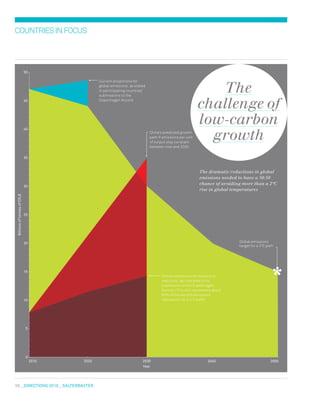
The dramatic reductions in global
emissions needed to have a 50:50
chance of avoiding more than a 2ºC
rise in global temperatures
Global emissions
target for a 2o
C path
China’s ambitions for emissions
reduction, as indicated in its
submission to the Copenhagen
Accord. (This still represents about
50% of the world’s emissions
‘allowance’ for a 2º
C path)
China’s predicted growth
path if emissions per unit
of output stay constant
between now and 2030
Current projections for
global emissions, as stated
in participating countries’
submissions to the
Copenhagen Accord
salterbaxter  DIRECTIONS 2010  11
LORDNICHOLAS sterN
Chairman
Grantham Research Institute on Climate Change and the Environment
Lord Nicholas Stern describes the
challenge of low-carbon growth and
explains that if we want to keep
growing, we need to keep innovating.
The 15th Session of the
Conference of the Parties
(COP15) to the United Nations
Framework Convention on
Climate Change (UNFCCC) in
Copenhagen in December 2009
made important steps towards
global agreement, but also
revealed and highlighted
serious problems and divisions.
Managing climate change is
a fundamental, indeed
defining, challenge of our
century and it requires global
agreement if it is to be
managed effectively. Global
agreement for action requires
a foundation of shared
understanding across three
basic issues as follows:
Understanding the risks
First, we must recognise that
unmanaged climate change
would put at risk the great
advances in development of the
last few decades, which have
seen hundreds of millions rise
out of income poverty, great
improvements in health and
life expectancy, and major
advances in education and
literacy. Such advances have
taken place throughout the
world but in terms of numbers
involved and scale of advance,
China has been at the forefront.
China, with its large fraction of
the population near the coast,
its pressures on water supply,
its dependence on the
Himalayan region as a water
source, and with many
populous countries on its
borders, is very vulnerable to
climate change. The risks
involve substantial
probabilities of temperatures
not seen on the planet for tens
of millions of years, way outside
the experience of homo
sapiens. And they involve the
possibility that local habitats
and climates would be so
disrupted that hundreds of
millions would have to move,
with the associated risks of
severe and extended conflict.
Any discussion of policy must
start from an understanding
of the potential scale of these
risks and the required
magnitude of global action.
The options for action
Second, the transition to
low-carbon growth in the
world economy over the next
two or three decades is likely
to be the most dynamic period
in economic history, full of
innovation, discovery and
change. And low-carbon
growth, when established,
will be more energy-secure,
cleaner, quieter, safer and
more biologically diverse than
high-carbon growth. Indeed,
high-carbon growth will kill
itself, first on hydrocarbon
prices and more fundamentally
on the very hostile physical
environment it will create;
it is not a serious medium-
term option.
It is a mistake to see the
transition to low-carbon growth
as a burden and a growth-
reducing diversion. That is to
apply the crude planning
models of the middle of the last
century. Modern growth theory
is about technical change and
learning. And it will also have to
embrace interactions with the
environment. Delayed action
will lock in high-carbon
technologies that will take
concentration levels of
greenhouse gases to still more
dangerous levels, and such
technologies will soon be
outmoded. Delay would also
force stronger and much more
disruptive and costly action
ten years from now. It is much
better to plan in a careful,
strong and measured way,
starting now, for the changes
in production and consumption
methods that will be inevitable.
Global co-operation
Third, we must understand how
to build on the platform created
at Copenhagen, and to do this
we must understand both the
substance of the Copenhagen
Accord and some of the
difficulties encountered on the
road to and at Copenhagen and
how they can be overcome. The
agreement in the Copenhagen
Accord on the importance of
holding temperature increases
to 2ºC (relative to mid-19th
century levels, the usual
benchmark) was a major
Global agreement for action
requires a foundation of
shared understanding
across three basic issues:
	 The magnitude
of the risks;
	 The options for action,
including policies and
technologies for
reducing emissions
and promoting the
transition to low-carbon
growth, together with
a recognition of the
attractiveness of
both the transition
to and low-carbon
growth itself;
	 How the different
nations of the world
might collaborate
and work together,
including the different
responsibilities of
each and support for
adaptation in the
poorest countries
and communities.
THREE BASICISSUES
12  DIRECTIONS 2010  salterbaxter
194
5050
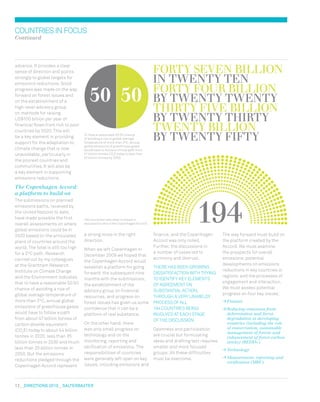
194 countries have been involved in
discussions about the Copenhagen Accord.
FORTY seven BILLION
in twenty ten
FORTY FOUR BILLION
by twenty twenty
THIRTY five BILLION
by TWENTY THIRTY
twenty BILLION
by TWENTY FIFTYTo have a reasonable 50:50 chance
of avoiding a rise in global average
temperature of more than 2ºC, annual
global emissions of greenhouse gases
would have to follow a critical path from
47 billion tonnes CO2
E today to less than
20 billion tonnes by 2050.
countriesinfocus
Continued
advance. It provides a clear
sense of direction and points
strongly to global targets for
emissions reductions. Good
progress was made on the way
forward on forest issues and
on the establishment of a
high-level advisory group
on methods for raising
US$100 billion per year of
financial flows from rich to poor
countries by 2020. This will
be a key element in providing
support for the adaptation to
climate change that is now
unavoidable, particularly in
the poorest countries and
communities. It will also be
a key element in supporting
emissions reductions.
The Copenhagen Accord:
a platform to build on
The submissions on planned
emissions paths, received by
the United Nations to date,
have made possible the first
overall assessments on where
global emissions could be in
2020 based on the articulated
plans of countries around the
world. The total is still too high
for a 2ºC path. Research
carried out by my colleagues
at the Grantham Research
Institute on Climate Change
and the Environment indicates
that to have a reasonable 50:50
chance of avoiding a rise of
global average temperature of
more than 2ºC, annual global
emissions of greenhouse gases
would have to follow a path
from about 47 billion tonnes of
carbon dioxide equivalent
(CO2
E) today to about 44 billion
tonnes in 2020, less than 35
billion tonnes in 2030 and much
less than 20 billion tonnes in
2050. But the emissions
reductions pledged through the
Copenhagen Accord represent
a strong move in the right
direction.
When we left Copenhagen in
December 2009 we hoped that
the Copenhagen Accord would
establish a platform for going
forward: the subsequent nine
months with the submissions,
the establishment of the
advisory group on financial
resources, and progress on
forest issues has given us some
confidence that it can be a
platform of real substance.
On the other hand, there
was only small progress on
technology and on the
monitoring, reporting and
verification of emissions. The
responsibilities of countries
were generally left open on key
issues, including emissions and
The way forward must build on
the platform created by the
Accord. We must examine:
the prospects for overall
emissions; potential
developments on emissions
reductions in key countries or
regions; and the processes of
engagement and interaction.
We must assess potential
progress on four key issues:
	Finance
	Reducing emissions from
deforestation and forest
degradation in developing
countries (including the role
of conservation, sustainable
management of forests and
enhancement of forest carbon
stocks) (REDD+)
	Technology
	Measurement, reporting and
verification (MRV).
finance, and the Copenhagen
Accord was only noted.
Further, the discussions in
a number of cases led to
acrimony and distrust.
THERE HAS BEEN GROWING
DISSATISFACTION WITH TRYING
TO IDENTIFY KEY ELEMENTS
OF AGREEMENT ON
SUBSTANTIAL ACTION,
THROUGH A VERY UNWIELDY
PROCESS OF ALL
194 COUNTRIES BEING
INVOLVED AT EACH STAGE
OF THE DISCUSSION.
Openness and participation
are crucial but formulating
ideas and drafting text requires
smaller and more focused
groups. All these difficulties
must be overcome.
salterbaxter  DIRECTIONS 2010  13
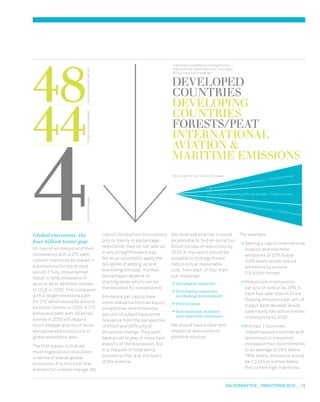
Cap on aviation and maritime emissions = 0.5 billion tonnes
Annex 1 countries cut emissions by extra 25% = 1.3 billion tonnes
China cuts emissions by 50% per decade = 2 billion tonnes
48
44
4
Developed
countries
Developing
countries
Forests/peat
International
aviation 
maritime emissions
It should be possible to find significant
reductions at reasonable cost, from each
of four main sub-headings:
Reducing the four billion tonne gap
billiontonnegapbilliontonnesneededbilliontonnesprojected
Global emissions: the
four billion tonne gap
On overall emissions and their
consistency with a 2ºC path,
current intentions as stated in
submissions for the Accord
would, if fully implemented,
result in total emissions of
around 48 or 49 billion tonnes
of CO2
E in 2020. This compares
with a target emissions path
for 2ºC which would be around
44 billion tonnes in 2020. A 2ºC
emissions path with 48 billion
tonnes in 2020 will require
much steeper and much more
disruptive and costly cuts in
global emissions later.
The first lesson is that we
must organise our discussion
in terms of overall global
emissions. It is this total that
matters for climate change. We
cannot conduct our discussions
only or mainly in percentage
reductions; they do not ‘add up’
in any straightforward way.
We must constantly apply the
discipline of adding up and
examining the total. Further,
percentages depend on
starting dates which can be
manipulated for convenience.
Emissions per capita have
some relevance from an equity
perspective. And emissions
per unit of output have some
relevance from the perspective
of effort and difficulty of
structural change. They both
have a role to play in important
aspects of the discussion. But
it is the path of total world
emissions that is at the heart
of the science.
We must ask whether it would
be possible to find an extra four
billion tonnes of reductions by
2020. In my view it should be
possible to find significant
reductions at reasonable
cost, from each of four main
sub-headings:
Developed countries
 Developing countries
(excluding forests/peat)
Forests/peat
 International aviation
and maritime emissions
We should have a clear and
analytical discussion on
possible sources.
For example:
	Setting a cap on international
aviation and maritime
emissions of 20% below
2005 levels would reduce
emissions by around
0.5 billion tonnes
	Reductions in emissions
per unit of output by 29% in
each five-year plan in China
(halving emissions per unit of
output each decade) would
save nearly two billion tonnes
of emissions by 2020
	If Annex 1 countries
(industrialised countries and
economies in transition)
increased their commitments
to an average of 25% below
1990 levels, emissions would
be 1.3 billion tonnes below
the current high intentions.
14  DIRECTIONS 2010  salterbaxter
It is time to recognise the
extraordinary potential
of technical advance to
low-carbon technologies
and realise that the
current rate of discovery
is encouraging.
countriesinfocus
Continued
China’s path to growth
The largest emitters are
associated with one or more of:
high income, large populations,
deforestation. Hence the five
largest emitters are China,
the US, the European Union,
Indonesia, and Brazil.
Let us examine some basic
arithmetic for China. If China’s
output were to grow at 7% per
year then China’s output would
roughly double each decade.
I am deliberately keeping
numbers simple here to keep
the arithmetic transparent and
to avoid formal modelling which
sometimes conceals the basic
logic of the argument. It is
possible that China will grow
more quickly between 2010 and
2020 and slow down a little
between 2020 and 2030. But
7% per year keeps things
simple as it gives a doubling in
a decade.
China’s emissions in 2010 are
probably eight or nine billion
tonnes of CO2
E. If emissions
per unit of output were to stay
constant, China’s emissions
would be 30–35 billion tonnes
in 2030. As discussed earlier,
the maximum for the world as a
whole, consistent with a 50:50
chance of 2ºC, is well below
35 billion tonnes, probably
around 30–32 billion tonnes.
Thus China would exhaust the
entire world’s budget for a 2ºC
path. If it managed to cut
emissions per unit of output
by 50% by 2030, then China’s
emissions would be 15–18
billion tonnes, more than half
the world’s budget in 2030.
Given that, for 2ºC, the world’s
average emissions per capita
have to be below four tonnes
of CO2
E by 2030, China’s
emissions per capita would
likely have to be well below its
current level of around six (or a
little above). That would mean
that China would have to get
back to something like eight
to nine billion tonnes of total
emissions by 2030. In other
words, if it is to grow at 7% per
year for the next two decades,
and we hope growth rates will
be at least that, it would have to
cut emissions per unit of output
by a factor of four over 20 years.
That means cutting emissions
per unit of output by 50% each
decade or 29% in each five-year
plan. A cut of 29% in emissions
per unit of output in a five year
period could be achieved, for
example, by a cut of 20% in
energy use per unit of output
and a cut of 11% in emissions
per unit of energy.
salterbaxter  DIRECTIONS 2010  15
My own interactions with
Chinese analysts and the
experience of the 11th five-year
plan suggests that this could
be possible but it would depend
on strong technical progress as
well as major investments. My
own assessment is that all too
often formal modelling tends
to underestimate technical
progress and be too focused
on current technologies and
input-output coefficients.
It is time to recognise the
extraordinary potential of
technical advance to low-
carbon technologies and
realise that the current rate
of discovery is encouraging.
China has indicated in its
submission to the UNFCCC for
the Copenhagen Accord that
it will endeavour to lower its
carbon dioxide emissions
per unit of GDP by 40–45%
between 2005 and 2020 and
has indicated targets for
non-fossil fuels and for
forestry. This points to total
emissions for 2020 (with an
8% assumption on growth
rates) of 11.4 billion tonnes
of CO2
E, compared with around
eight or nine billion tonnes now.
If there were a similar quantity
increase in total emissions in
the next decade (2020 to 2030),
then China’s emissions in 2030
would be 14 or 15 billion tonnes.
This would correspond to a
reduction in emissions per unit
of output of 30–35% in that
decade. Emissions per unit of
output would have been divided
by a factor of around 2.5
between 2010 and 2030
compared to the four which
seems necessary for a 2ºC
path. That total for China would
be close to half of the world’s
emissions in 2030, from a
country with a population of
around 17 or 18% of the world’s
total population in 2030.
Basic arithmetic:
emissions cuts for a
sustainable future
We must recognise that such
a path for China could not
possibly be consistent with the
2ºC path we have described.
This is not to allocate blame
or to make any demands, or to
identify required policies: this
is purely arithmetic. But we
must ask ourselves about the
implications of such arithmetic.
I must emphasise, however,
that I am not making
recommendations here. I am
simply following the scientific
implications of the 2ºC path
and combining this with the
assumption of 7% per year
growth in China to work out
implications for changes in
emissions per unit of output.
THIS IS BASICALLY ARITHMETIC.
WHETHER IT CAN BE ACHIEVED
IS A MATTER OF POLICY AND
TECHNOLOGY, AND IS UNDER
INTENSE DISCUSSION BY
CHINESE ANALYSTS.
These illustrative calculations
have been focused on China;
corresponding calculations for
other countries indicate that,
if the 2ºC path is to be realised,
rich countries, assuming a
2.5% annual growth rate, would
also have to cut emissions per
unit of output by around a
factor of four by 2030. China’s
emissions, on the above
assumptions, would be similar
in 2030 to now, implying a peak
around 2020 or somewhere in
the early 2020s.
If we both accept 2ºC, as we
surely should, and we look for
growth, which in my view is
vital to raise living standards
in developing countries, then
the above arithmetic is
inescapable. The world as a
whole, rich and poor, cannot
avoid this simple logic.
The discussion above has been
mainly arithmetic. It is hard to
describe the implied emissions
paths of different countries as
equitable. These calculations
take no account of relative
income or wealth, the challenge
of poverty reduction, of past
history of emissions, or of
the questions of whether
responsibility for emissions lies
with the producer or consumer
of a product. Both consumers
and producers benefit from and
determine the international
division of labour. Thus they
should both bear some
responsibility for emissions.
All of these are important
ethical issues. My own view is
that they have strong relevance
and there is a responsibility
and obligation arising from
past emissions by rich
countries, at least over the last
20 years when the dangers
have been clearly understood.
Further, we must recognise
that the two defining
challenges of our century are
managing climate change and
overcoming poverty. Ultimately
we will succeed or fail on the
two together.
Lord Nicholas Stern
is IG Patel Professor of
Economics and Government,
Director of the Asia Research
Centre, and Chair of the
Grantham Research Institute
on Climate Change and the
Environment at the London
School of Economics and
Political Science.
50
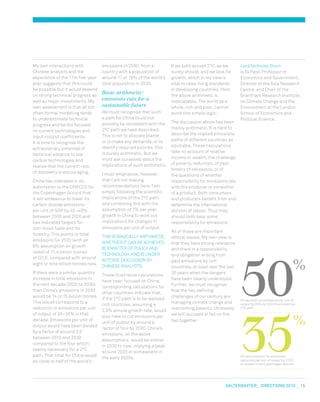
35
China must cut emissions per unit of
output by 50% by 2030 to achieve the
2°C path.
China’s intention for emissions
reduction per unit of output by 2030,
as stated in the Copenhagen Accord.
%
%
16  DIRECTIONS 2010  salterbaxter
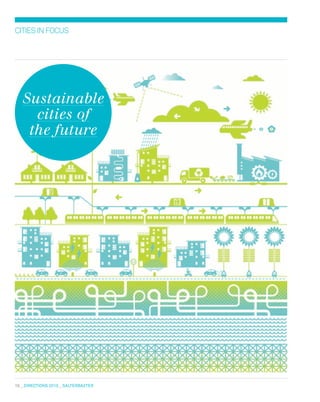
citiesinfocus
Sustainable
cities of
the future
salterbaxter  DIRECTIONS 2010  17
KEYCONTRIBUTORS
Building, Infrastructure and Planning Groups,
Advanced Technology and Research Team
ARUP
Sustainable cities
Over half of the world’s
population now live in urban
areas. By 2050 this will have
risen to 70%. In the
industrialised world, cities
are bursting at the seams,
struggling to meet the needs
of their citizens. Creaking,
outdated infrastructure, cars
clogging up the roads, and
buildings that are literally
leaking energy – not exactly
the picture of urban health.
Add to this inadequate public
transport, a shortage of
green spaces, landfill sites
overflowing and it’s enough
to make you run for the
(greener) hills. The situation
is even worse in parts of the
developing world, with the
poorest countries least
equipped to invest in the
basic urban infrastructure –
water, sanitation, housing –
that is needed to cope with
rapidly growing urban
populations.
Unfortunately there is no
simple formula for converting
a sprawling, polluted,
congested 20th century
metropolis into a clean, free‑
flowing, low-carbon urban
utopia. Most of the world’s
leading cities have evolved
over many decades – think
of London, New York, Paris,
Copenhagen. A few, like
São Paulo, have been created
in a concentrated burst of
growth. Almost none have
been ‘planned’. But planning,
together with innovation,
investment and cooperation
is exactly what is needed now.
So how can we achieve this?
And which cities are already
leading the way?
Reducing emissions
The much-used management
phrase – ‘you can only manage
what you can measure’ –
certainly holds true for
cities. Pioneers such as
San Francisco, Stockholm and
Copenhagen started mapping
Cities across the world are growing by over one
million people every week. Creating sustainable
urban landscapes for this growing population
while simultaneously cutting carbon emissions is
undoubtedly one of this century’s greatest
challenges. Here, Arup describe the scale of the
problem we face and how the latest innovations
are set to revolutionise urban life as we know it.
the profile of greenhouse gas
emissions and measuring
vulnerability to climate change
in the 1990s. Many others are
now following suit. But to truly
understand sustainability a city
needs to measure the wider
impact of consumption: from
food, to water, to transport
and beyond. The resulting
‘ecological footprint’ calculates
how many planets it would take
to sustain a place (or person) if
everyone adopted the same
consumption patterns. The
answer in a sustainable city is
one! The challenge of course,
is to achieve this while at the
same time improving quality
of life.
In the developed world, energy
used to heat and cool buildings
and power devices used within
them is the single biggest
contributor to cities’ carbon
emissions. With 50-70% of
existing buildings expected to
still be in use in 2050, reducing
energy demand by retrofitting
will be key.
Lighting alone accounts for
up to 10% of a city’s energy
demand. Technological
advances in things like
LED lighting will enable
huge reductions in energy
consumption.
Changing behaviours
Reducing demand for energy
will require significant mass
behaviour change. As the
former Mayor of London, Ken
Livingstone, put it, “We don’t
have to reduce our quality of
life to tackle climate change,
but we do all have to change
the way that we live”.
Technologies like smart meters
can make consumers much
more aware of the amount of
18  DIreCtIONs 2010  salterbaxter
CITIESINFOCUS
Continued
energy they are using and how
much that energy is costing.
New transport technologies
offer the prospect of low-
carbon travel, which, combined
with a shift away from cars
towards public transport,
walking and cycling bring not
only more environmentally
friendly cities, but also better
public spaces and improved
public health.
Improving efficiency
moving away from reliance on
a centralised grid and installing
decentralised heat and power
networks that use combined
cooling, heat and power (CCHP)
technology goes a long way in
minimising wasted energy.
‘Smart grids’ offer another
option, allowing energy
suppliers to smooth supply
over the day, for example by
automatically turning down
the temperature on washing
machines during peak demand,
via financial incentives to
consumers to allow these
minor, automated adjustments
to their energy use.
Renewable energy
Densely populated urban
areas are unlikely to be the
best sites for large-scale
renewable energy generation.
However, there are often
widespread opportunities for
solar thermal and photovoltaics
and many cities have developed
solar energy programmes in
recent years. There is also
considerable scope for
generating energy from the
one thing every city has too
much of – waste.
Integration and
co-operation
If it is easy to create a dream-
team of interventions to reduce
a city’s ecological footprint,
it is much harder to draw them
together into a comprehensive,
integrated plan that also meets
societal and economic goals of
delivering a better place to
work and live. As the challenge
of sustainable development
demands fundamental change
to cities’ infrastructure, there
will be many instances where
the cross-benefits of emissions
reduction policies are not
immediately obvious, or where
real conflicts emerge with
other policy aims. Sustainable
development policy-making
has, therefore, to be conducted
at the most holistic level
possible. In governmental
terms, this means that
responsibility has to sit
across all departments and
report directly to the city
administrator or mayor.
The scale of transformation
required to fashion revamped
cities capable of providing
high quality living without
destroying the planet for future
generations, in an incredibly
short timescale of just a few
decades, is beyond anything
humanity has had to cope with
previously. Yet low-carbon
cities are feasible, if we can
marry science, political will
and technological innovation.
Let’s now take a look at some of
the innovations that will shape
our cities in the future.
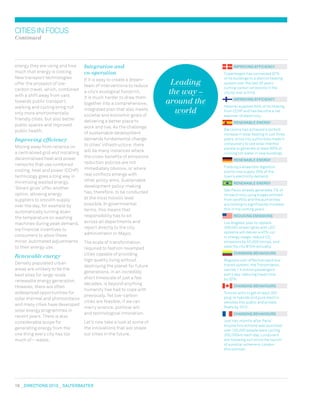
Leading
the way –
around the
world
ImprOvINg effICIeNCy
Copenhagen has connected 97%
of its buildings to a district heating
system over the last 30 years
cutting carbon emissions in the
city by over a third.
ImprOvINg effICIeNCy
Helsinki supplies 84% of its heating
from CCHP and has become a net
exporter of electricity.
reNewable eNergy
Barcelona has achieved a tenfold
increase in solar heating in just three
years, since city authorities made it
compulsory to use solar thermal
panels to generate at least 60% of
running hot water in new buildings.
reNewable eNergy
Freiburg’s anaerobic digestion
plants now supply 25% of the
town’s electricity demand.
reNewable eNergy
São Paulo already generates 7% of
its electricity using biogas emitted
from landfills and the authorities
are looking to significantly increase
this in the coming years.
reDuCINg emIssIONs
Los Angeles’ plan to replace
209,000 street lights with LED
systems will deliver a 40% cut
in energy usage, reduce CO2
emissions by 40,000 tonnes, and
save the city $10m annually.
ChaNgINg behavIOurs
Bogota’s cost-effective rapid bus
transit system, the Transmilenio,
carries 1.4 million passengers
every day, reducing travel time
by 32%.
ChaNgINg behavIOurs
Toronto aims to get at least 300
plug-in hybrids and pure electric
vehicles into public and private
fleets by 2012.
ChaNgINg behavIOurs
Just two months after Paris’
bicycle hire scheme was launched,
over 100,000 people were cycling
300,000km each day. Londoners
are following suit since the launch
of a similar scheme in London
this summer.
salterbaxter  DIreCtIONs 2010   19
Innovations
for sustainable
cities
vehicles (Evs) are set to
revolutionise sustainable
transport, leading to cleaner,
quieter cities. The first mass-
produced Evs will be available
next year, but expect to see
performance improve and
prices fall as more
manufacturers move to volume
production. Batteries are key to
increasing range, and vast
sums of money are being
poured into lithium-based
research, with nanotechnology
being introduced to improve
power output and charging
times. By interacting with the
smart grid, Evs will help
balance the system with users
programming their vehicles to
charge only when electricity is
abundant and costs are low.
SOLAR POwERED
vEHICLE CHARGING
Parking bays are being
developed which use solar
energy to charge electric
vehicle batteries. The 1.5kw
peak power generation
provides enough energy for
10-15km driving for every hour
a car is parked. when the bays
are empty, the energy is fed
back into the grid.
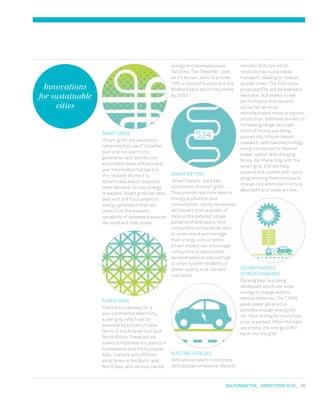
SmART GRIDS
‘Smart grids’ are electricity
networks that use IT to better
plan and run electricity
generation and distribution
and enable more efficient end
use. Information fed back to
the network allows it to
dynamically adjust supply to
meet demand, so less energy
is wasted. Smart grids can also
deal with the fluctuations in
energy generation that will
come from the inherent
variability of renewable sources
like wind and tidal power.
SUPER GRIDS
Plans are underway for a
pan-continental electricity
super grid, which will be
powered by a chain of solar
farms in the Arabian Gulf and
North Africa. These will be
linked to hydroelectric plants in
Scandinavia and the European
Alps, onshore and offshore
wind farms in the Baltic and
North Sea, and various marine
energy and biomass power
facilities. The ‘Desertec’ plan,
as it’s known, aims to provide
15% or more of Europe and the
middle East’s electricity needs
by 2050.
SmART mETERS
‘Smart meters’ are a key
component of smart grids.
They provide real time data on
energy production and
consumption. Utility companies
will benefit from a wealth of
data on the detailed usage
patterns of end users. And
consumers will be better able
to understand and manage
their energy consumption.
Smart meters can encourage
consumers to reduce their
demand when prices are high
or when system reliability or
power quality is at risk and
vice versa.
ELECTRIC vEHICLES
with almost silent motors and
zero tailpipe emissions, electric
20  DIreCtIONs 2010  salterbaxter
the nearest available parking
space, so time and fuel is not
wasted driving around. ITS also
provides information on the
public transport options
available if a user leaves their
car outside the city centre at a
‘park and ride’ type facility.
ACTIvE TRAFFIC mANAGEmENT
Active traffic management
systems, also known as
managed motorways, will
become more common on
inter-urban motorway routes.
They reduce congestion and
pollution by smoothing traffic
flows to prevent queues and
stop/start driving. Key
components are the use of
dynamic speed limits displayed
on electronic overhead signs,
which are modified based on
conditions monitored by traffic
detectors, and use of the hard
shoulder to maximise available
capacity at peak times.
CITIESINFOCUS
Continued
INTELLIGENT SPEED
ADAPTATION
Intelligent Speed Adaptation
(ISA) enables a vehicle to
become aware of the speed
limits or road conditions.
Satellite systems coupled
to a database of speed limits/
hazards send information to
the vehicle or alternatively,
the vehicle is equipped with
an image capturing device,
capable of reading roadside
signage. The resulting action
taken by the vehicle varies
from a simple warning to
overriding the driver and
reducing the speed of the
vehicle automatically.
PERSONAL RAPID
TRANSIT SYSTEmS
Personal rapid transit (PRT)
is a system of small, automated
vehicles on a network of
specially built electric
guideways that provide
on-demand transport for
individuals or groups.
wIRELESS CHARGING
‘Static induction’ or wireless
charging for electric vehicles
will do away with the need for
cables and charging posts in
the street, replacing them with
a pad, most often buried under
the road surface in a parking
place. To charge, the car just
needs to park over the pad and
the electricity for charging will
be transferred by induction.
The next evolution – ‘dynamic
induction’ – will see cars
charged on the move. This has
the potential to remove ‘range
anxiety’, which is currently a
major barrier to the uptake of
electric vehicles.
INTELLIGENT
TRANSPORTSYSTEmS
Intelligent Transport Systems
(ITS) provide information to
enable more efficient travel and
better choice of travel mode. For
example, in-vehicle information
provided via satellite and mobile
communication guides drivers to
salterbaxter  DIreCtIONs 2010   21
BIOFUEL PLANES
Aeroplanes emit around 600
million tonnes of CO2
every year.
This is almost equivalent to
Africa’s annual CO2
emissions.
The aviation industry is already
taking measures to reduce
emissions and dependency
on fossil fuel. Aero engines
will slowly migrate to higher
blends of biofuel over the
coming years and trials are
underway with fuel and engine
suppliers. The use of biofuel is
a step in the right direction to
achieve sustainable aviation.
However, rigorous testing,
fuel specifications and
standards will be required to
convince airline operators to
increase the blend or change
fuel type completely.
The remaining energy
consumption will be
offset by a combination
of onsite renewables (see
microgeneration) and a
contribution to community
energy funds, which will invest
in energy efficiency and
renewable technologies.
mICROGENERATION
microgeneration is the
generation of zero or low-
carbon electricity or heat by
individual households, small
businesses and communities.
It uses an array of technologies
such as small-scale wind
turbines, micro hydro,
photovoltaic solar panels,
ground source heat pumps and
micro Combined Heat and
Power (microCHP). Through
feed-in tariffs (currently being
introduced in several countries)
microgeneration can also
provide an additional income
stream whereby excess
electricity produced can
be sold back to the grid or
offset against energy bills.
Since microgeneration is,
by definition, decentralised,
energy is not wasted in
transmission/distribution.
GAS FROm wASTE
waste disposal plants that
convert waste into energy are
already a common sight in
Denmark and are set to become
popular around the world.
Through the natural process
of anaerobic digestion, organic
matter from household and
garden waste is stored in
containers with little or no
oxygen where it breaks down
and produces methane. This
gas can be further processed
and delivered into the gas
network or used as a fuel
for transportation.
zERO CARBON HOUSING
with UK building regulations
stipulating that all new homes
built from 2016 onwards must
be carbon neutral we will see a
major shift in construction
industry techniques in the next
five to ten years. Homes will
be fitted with much better
insulation, heat recovery systems
and energy efficient LED lighting.
Passengers go to the nearest
PRT station and purchase a
ticket or swipe their travel card.
A display screen indicates the
next available ‘berth’ and once
the vehicle arrives, passengers
select their destination using
a touch screen. The central
control system verifies the
details and provides journey
instructions to the vehicle,
which takes passengers
straight to their destination
by the best available route.
There is minimal waiting time,
no stops along the way, and
you only travel with people
you want to travel with!
HIGH-SPEED RAIL
High-speed rail (HSR) offers
a genuine alternative to short
haul flights, making future
low-carbon business and
personal travel much easier.
HSR services between station
hubs at least 100 miles apart
enable journey times to
compete with short haul air
travel and allow long high
speed trains to run efficiently,
without the need for frequent
time- and energy- consuming
stops. HSR can also benefit
from the use of innovations like
‘regenerative braking energy’
where kinetic energy is
generated during braking and
fed back to bolster the grid.
22  DIRECTIONS 2010  salterbaxter
citiesinfocus
Continued
to sustainability. As a recent
report from WWF Denmark
states:
‘If we do not radically alter
the system and construct
a 21st century green
economy we are likely to
reduce the problem but
not solve it entirely.’
So what is the solution? The
headline finding from the
WWF report entitled ‘Industrial
Biotechnology: More than
Green Fuel in a Dirty Economy?’
is that biotechnology is a big
part of the answer. It has the
potential to save the planet
up to 2.5 billion tonnes of CO2
emissions per year by 2030.
That’s more than Germany’s
total reported emissions
in 1990.
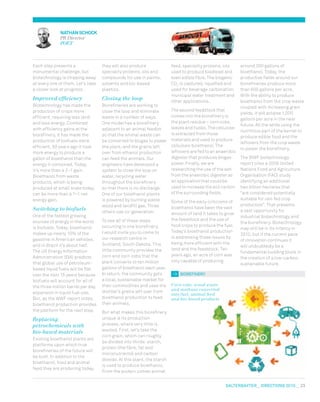
At the centre of the innovation
is the biorefinery. Like a new
type of industrial village, it will
Books have been written
about it. Movies made. We are
addicted to oil. But if we are to
create sustainable cities and
a sustainable society for the
future, we need to urgently
shift away from this oil-
dependent society towards
a ‘bio-based society’.
First we must acknowledge
the scale of the problem.
Petroleum is most visible in
the tanks of our vehicles, but
it is literally everywhere. There
aren’t many products you can
buy today that don’t have
petroleum in them or used
petroleum to make them. From
the computer I’m using to type
this to the paper you’re reading
it on, petroleum is everywhere.
Part of the answer in the short
term is simply to use less of it;
to be more efficient. But
efficiency alone won’t get us
take products such as corn
cobs, sugar, wood waste and
methane and convert them
into all kinds of useful
products, from ethanol (for
fuel), to proteins (for animal
feed), to consumable oils and
compounds (for use in paints,
solvents and bio-based
plastics). Many of the things
that are made from
hydrocarbons today will
essentially be made from
carbohydrates in the future.
The WWF report describes
four interlinked steps on
biotechnologies’ path to
a low-carbon, bio-based
economy:
1.	Improved efficiency
2.	Switching to biofuels
3.	Replacing
petrochemicals with
bio-based materials
4.	Closing the loop
Imagine a
world where
cars are fuelled
by sugar, homes
powered by
corn and cities
run on waste.
Welcome to the
bio-society.
Living
in a
bio-society
salterbaxter  DIRECTIONS 2010  23
Each step presents a
monumental challenge, but
biotechnology is chipping away
at every one of them. Let’s take
a closer look at progress.
Improved efficiency
Biotechnology has made the
production of crops more
efficient, requiring less land
and less energy. Combined
with efficiency gains at the
biorefinery, it has made the
production of biofuels more
efficient. 30 years ago it took
more energy to produce a
gallon of bioethanol than the
energy it contained. Today,
it’s more than a 2–1 gain.
Bioethanol from waste
products, which is being
produced at small scale today,
can be more than a 7–1 net
energy gain.
Switching to biofuels
One of the fastest growing
sources of energy in the world
is biofuels. Today, bioethanol
makes up nearly 10% of the
gasoline in American vehicles,
and in Brazil it’s about half.
The US Energy Information
Administration (EIA) predicts
that global use of petroleum-
based liquid fuels will be flat
over the next 15 years because
biofuels will account for all of
the three million barrel per day
expansion in liquid fuel use.
But, as the WWF report notes,
bioethanol production provides
the platform for the next step.
Replacing
petrochemicals with
bio-based materials
Existing bioethanol plants are
platforms upon which true
biorefineries of the future will
be built. In addition to the
bioethanol, food and animal
feed they are producing today,
they will also produce
speciality proteins, oils and
compounds for use in paints,
solvents and bio-based
plastics.
Closing the loop
Biorefineries are working to
close the loop and eliminate
waste in a number of ways.
One model has a biorefinery
adjacent to an animal feedlot
so that the animal waste can
be converted to biogas to power
the plant; and the grains left
over from ethanol production
can feed the animals. Our
engineers have developed a
system to close the loop on
water, recycling water
throughout the biorefinery
so that there is no discharge.
One of our bioethanol plants
is powered by burning waste
wood and landfill gas. Three
others use co-generation.
To see all of these steps
occurring in one biorefinery,
I would invite you to come to
our research centre in
Scotland, South Dakota. This
little community provides the
corn and corn cobs that the
plant converts to ten million
gallons of bioethanol each year.
In return, the community gets
a local, sustainable market for
their commodities and uses the
distiller’s grains left over from
bioethanol production to feed
their animals.
But what makes this biorefinery
unique is its production
process, where very little is
wasted. First, let’s take the
corn grain, which can roughly
be divided into thirds: starch,
protein (the fibre, fat and
micronutrients) and carbon
dioxide. At this plant, the starch
is used to produce bioethanol.
From the protein comes animal
feed, speciality proteins, oils
used to produce biodiesel and
even edible fibre. The biogenic
CO2
is captured, liquefied and
used for beverage carbonation,
municipal water treatment and
other applications.
The second feedstock that
comes into the biorefinery is
the plant residue – corn cobs,
leaves and husks. The cellulose
is extracted from those
materials and used to produce
cellulosic bioethanol. The
leftovers are fed to an anaerobic
digester that produces biogas
power. Finally, we are
researching the use of the ash
from the anaerobic digester as
an application that could be
used to increase the soil carbon
of the surrounding fields.
Some of the early criticisms of
bioethanol have been the vast
amount of land it takes to grow
the feedstock and the use of
food crops to produce the fuel.
Today’s bioethanol production
is addressing those issues by
being more efficient with the
land and the feedstock. Ten
years ago, an acre of corn was
only capable of producing
around 300 gallons of
bioethanol. Today, the
productive fields around our
biorefineries produce more
than 600 gallons per acre.
With the ability to produce
bioethanol from the crop waste
coupled with increasing grain
yields, it will eclipse 1,000
gallons per acre in the near
future. All the while using the
nutritious part of the kernel to
produce edible food and the
leftovers from the crop waste
to power the biorefinery.
The WWF biotechnology
report cites a 2008 United
Nations Food and Agriculture
Organisation (FAO) study
identifying an additional
two billion hectares that
“are considered potentially
suitable for rain fed crop
production”. That presents
a vast opportunity for
industrial biotechnology and
the biorefinery. Biotechnology
may still be in its infancy in
2010, but if the current pace
of innovation continues it
will undoubtedly be a
fundamental building block in
the creation of a low-carbon,
sustainable future.
biorefinery
Corn cobs, wood waste
and methane converted
into fuel, animal feed
and bio-based products
nathan schock
PR Director
POET
24  DIRECTIONS 2010  salterbaxter
Companiesinfocus
The Third
Industrial
Revolution
salterbaxter  DIRECTIONS 2010  25
Eight
crises, eight
opportunities
The Third Industrial Revolution
takes place against a backdrop
of eight interdependent, global
crises – demographic and
consumer explosion, ethical
and value change, financial and
economic ‘reset’, food scarcity,
climate change, water scarcity,
energy tension and political
power shifts. Each of these
represents both an enormous
challenge and an exciting
opportunity for business.
1 demographic and 
consumer explosion
With global population
predicted to reach nine to ten
billion by 2050 we forecast 40%
more consumers in the next 30
years. These new consumers
will consume more per capita
than ever before. Companies
will undoubtedly benefit from
this consumer explosion,
however the growth also leads
to competition for agricultural
land, energy and water.
Successful companies will
have to decouple consumption
growth from impacts on society
and the environment by using
scarce resources well.
2 ethical and value change
As human beings we have long
been conditioned to think that
‘growth is good’. However,
criticism of capitalism and
ever-rising consumption is
now widespread. We are seeing
Leading the revolution will be
consumer goods companies
who reposition themselves
as MCCs – multi-committed
companies. These businesses
will create opportunities from
the eight interdependent crises
the world is facing. They will
expand their presence in new
regional power centres such
as Brazil and China. They will
transform their business
models to cope with the reality
of resource scarcity. And
they will alter their marketing
strategies to respond to
consumers’ growing social
and environmental concerns.
In doing this they will reap
hard business benefits –
higher sales, lower supply
chain costs, and better
margins. The unexpected
heroes of the revolution,
they will, on the one hand,
save the planet and on the
other, accommodate the
impending explosion in
global consumerism.
several groups in the debate:
the ‘cultural creatives’ who
want to reshape the world in
a more sustainable way, the
‘populists’ who feel hurt by the
negative effects of capitalism
and want to defend their
personal wealth and the ‘mass
conservatists’ who simply want
to go on consuming as they’ve
always done. These groups all
disagree on how values and
ethics should be adjusted.
They present real challenges
for product development
and marketing.
3 financial and
economic ‘reset’
The resolution of the financial
crisis is likely to result in
lower economic growth in
the Western World and a
tempering of potential growth
in developing countries.
Consumers will reset their
consumption patterns,
leading to lower consumption
growth and more inflation
in debt-laden nations.
4 Food scarcity
The rising population and
growing consumption per
capita leads to increased
demand for food, especially
grain. In a best-case scenario,
food demand-supply tension
can be managed, but higher
prices will be needed in the
coming ten years. In a worst-
First came the steam engine,
then the computer. Now, we
believe the world is on the verge
of a Third Industrial Revolution.
GERARDRIJK
Food and beverages analyst
ING Commercial Banking, Equity Markets
26  DIRECTIONS 2010  salterbaxter
case scenario, which takes
account of the negative effects
of climate change and water
scarcity, tensions between
rich consumers and poor
consumers increase, with grain
use per capita in developing
markets falling by 42% from
an already low starting point.
In order to avoid this kind of
global food crisis we need more
efficient use of land, higher
yield and less food waste in
the Western World.
5 climate change
The debate on the validity of
climate change science that
we have seen over the last year
has dealt a blow to climate
scientists and pushed the
subject of climate change
somewhat to the background.
In addition, governments will
struggle to gain support for
investment in climate change
measures because of the
knock-on effect of higher
taxes/costs for consumers.
To keep climate change on
the agenda, companies
need to invest in research
that demonstrates the
catastrophic consequences if
ecosystems reach a climate
change tipping point from
which there is no going back.
6 Water scarcity
Global demand for fresh water
will increase due to rising
populations, increasing per
capita consumption and
urbanisation. We forecast a
bigger supply-demand gap in
the coming 20 years, which
means the price of water could
increase by 300% over this
period. Political struggles are
likely as particular regions face
shortages. Around 75% of fresh
water is used in the food chain
(from agriculture to consumer)
so companies will have to adapt
and find innovative solutions
for using water efficiently.
7 energy tension
Rising energy prices, driven by
a shortage of fossil fuels and
rising consumption, will lead
to higher costs for agricultural
raw materials, packaging
materials, production and
transport. Companies will need
to drive down their energy
consumption or use renewable
sources. They will need to
reduce the carbon footprint
of their products or even stop
production of very energy
intensive products. Areas with
large oil and gas reserves, like
the Middle East, Russia and
parts of Africa and Latin
America should benefit from
the energy crisis and
companies are likely to find
the most disposable income
growth in these areas.
8 political power shifts
Regional wealth changes will
lead to the creation of seven
or eight new power centres in
the world. This means a shift
from a unipolar world (with the
US dominating) to a multipolar
world. We expect the US/
Canada will remain strong;
Brazil will become stronger;
China will remain a stronghold
especially given its investments
in resources worldwide; and
Russia and parts of the
Middle East will also be strong.
The EU will have a relatively
small place based on its limited
resources in energy and soft
commodities. Sub-Saharan
Africa is an outsider. India will
be very strong in demographics
but its current investments in
infrastructure and its lack of
resources make it a
problematic area.
Evolution of the
phasing of crises
and opportunities
While climate change has been
the major focus over the last
five to ten years and the climate
crisis will continue for the next
40 years, we predict that the
climate discussion will move to
the background temporarily. In
2010–15 the focus will instead
be on demographic trends,
financial, social and economic
crises, food price risk and
energy tension. Then from
2015–20, it will shift to a focus
on the water crisis, changes
in consumer ethics, and the
global political change from
unipolar to multipolar.
The phasing of these crises
and trends is important for
companies and investors in
terms of understanding the
key driving factors in the
coming decade.
Companiesinfocus
Continued
2005	 2010	 2015	 2020
PHASING OF THE EIGHT CRISES/OPPORTUNITY EVENTS
Source: ING estimates
Climate change
Water scarcity
Ethical  value change
Political power shifts
Climate change
Demographic and consumer explosion
Financial and economic ‘reset’
Food scarcity
Energy tension
salterbaxter  DIRECTIONS 2010  27
Revolution in strategy:
the rise of the MCC
The rising star of the Third
Industrial Revolution is a
new breed of company: the
multi-committed company
(MCC). Some multi-nationals
are already on the way to
becoming MCCs while others
still have a long way to go. One
thing is clear – this is not just
a fad driven by the need to
be ‘seen to be green’.
Successful MCCs will achieve
hard business benefits from
a combination of higher sales,
lower supply chain costs and
better margins.
So what does being an MCC
involve? First, it requires
companies to move away
from traditional colonial-style
behaviours where Western
brands are simply rolled out in
developing markets, towards
greater connection with and
commitment to local regions.
The focus will be on the new
regional power centres: North
America, Brazil/LatAm, Europe,
Russia, China, the Middle East,
parts of Africa and possibly
India. In recent years several
companies have significantly
expanded their activities in
these regions, mainly by
following the rise in local
purchasing power. We think
this geographical footprint
change will continue in the
coming decades.
Second, ‘clean sourcing’ across
the whole supply chain needs
to get into the DNA of every
company. Companies that are
able to secure the use of
‘crucial input materials’ like
milk and grain and reduce
waste will be best able to
defend their margins in an
environment of rising resource
Revolutions that changed the world
1st
The Industrial
Revolution
2nd
The Digital
Revolution
3rd
The Sustainable
Revolution
28  DIRECTIONS 2010  salterbaxter
Companiesinfocus
Continued
scarcity. The focus needs
to be on enhancing supply
chain control and securing
sustainable sourcing.
Third, to cope with the complex
and contradictory consumer
trends emerging in the Third
Industrial Revolution,
companies and brands will
need to redefine their sales
and marketing strategies.
Given the attitude of the
majority of consumers, the
role of NGOs such as WWF
and Greenpeace will remain
important in changing hearts
and minds.
In product portfolios, we expect
to see the development of
innovative products that
better serve the world, like
low-energy cars, wind turbines,
organic food, and products
with a low energy and raw
material footprint.
The positive impact for
companies from the multi-
committed approach is better
international knowledge
transfer, the development of
local sourcing, and improved
roll out of corporate
governance. Local employees
will also benefit from things
like better healthcare support.
In our view, national
governments (particularly in
Western democracies) and
multilateral organisations are
unlikely to offer solutions to
the current global crises.
They have neither the power
nor sufficient legacy to make
decisive changes.
The proof: some
companies are changing,
others are lagging
In general, we believe big
companies are aware of the
multi-crisis and opportunity
environment and are taking
action in many areas including
climate change, energy and
water efficiency, securing
supplies and implementing
‘green’ strategies. Small
companies are, not surprisingly,
more conservative and
less active.
Unilever is an example of a
company that we think is taking
a broad, forward-looking
approach. It not only looks at its
own energy and CO2
efficiency,
but also at that of its suppliers
and customers. CEO Paul
Polman said recently that it
is essential for sustainability
to be part of the company
strategy and that this will be
rewarded in the future by
higher sales growth and
higher profits.
In Africa, SABMiller obtains
barley from 12,700 local
farmers in Uganda,
Mozambique, Malawi, Ghana,
Tanzania, Zimbabwe, and
Zambia. By 2012, it aims to
increase this to 45,000 farmers.
In an effort to reduce their
carbon footprints, Whole
Foods Market and Bed Bath
 Beyond have both taken
a decisive stance on the
Canadian oil sands issue and
are avoiding energy suppliers
that source from that area.
The future:
vive la révolution
Multi-committed companies
are in the sweet spot of a
number of emerging crises and
trends. We predict that those
companies that can anticipate
global GDP and middle class
growth trends in developing
markets and become known
for innovative sustainable
strategies will show above-
average sales growth and
create increased shareholder
value. Through establishing
sustainable sourcing policies,
and through development
of a local supplier base, their
margin growth will also be
above average.
Crucially, this commercial
success goes hand-in-hand
with creating a better world at
a time when governments and
the consumer base are not
capable of driving this change
themselves. The stage is set
for MCCs to create the Third
Industrial Revolution: real
responsible and sustainable
growth. The question is: can
they step up to the challenge?
salterbaxter  DIRECTIONS 2010  29
coupled with the potential for
huge opportunity should they
make the right, bold changes.
We looked at five DJSI
supersector leaders and
compared them against two
of their sector peers to find
out if they have the systems,
initiatives and programmes in
place to foster sustainability-
led innovation. We then
challenged whether the DJSI
supersector leaders really are
the best of the best.
where business and society
come together to solve complex
problems. McKinsey have
identified five global forces set
to make 21st century operating
environments the most
complex yet.* To address these
challenges as McKinsey sees
them, businesses must use
sustainability as a force for
innovation.
We set out to discover whether
sustainability-framed
innovation is at the centre
of the DJSI leaders’ thinking
across a selection of sectors.
These sectors all face the
challenge of adapting to an
altered external environment
The 2010 Dow Jones
Sustainability Index (DJSI)
supersector leaders and their
peers appear to be leading the
way in embedding sustainability
across their businesses. But
how well set up are they to make
the big leaps forward that a
shift to a sustainable global
economy needs?
The global landscape of the
future will need creativity and
adaptability – two qualities not
traditionally used to describe
large public companies.
Sustainability can be both
a lens to focus minds on
innovation challenges and
opportunities, and a place
How well
do the best
companies link
innovation to
sustainability
and are the
true leaders
slipping through
the net?
Innovation
and true
leadership
*	 The five global forces include growth and innovation in emerging markets, increased productivity in developed economies,
a connected but volatile global economy, ‘pricing the planet’ and the pressure on resources, and social stability.
	 https://www.mckinseyquarterly.com/Strategy/Globalization/Global_forces_An_introduction_2625?gp=1
Salterbaxter
Sustainability team
30  DIreCtIONs 2010  salterbaxter
Telecoms
CHALLENGES AROUND
THE SHIFT TO EmERGING
mARKETS
TURNING CLImATE CHANGE
AND ACCESS CHALLENGES
INTO NEw SOLUTIONS AND
SERvICE OPPORTUNITIES
BECOmING A PART OF
THE NEw GLOBAL ICT
INFRASTRUCTURE
COmPANIESINFOCUS
Continued
Our verDICt Our verDICt Our verDICt
Our winner
Telefónica narrowly beats
Vodafone to retain its
supersector leader position.
If it can maintain the
quality of its services while
developing fundamentally
new product lines (in areas
like health and finance), it
should deliver sustainable
change to its business model.
Vodafone has experienced the
sharp end of governance in
emerging markets. If it can
weather legislative and cost
pressures, its focus on a
sustainability-led product
pipeline should see it well
placed to take advantage
of changes to its operating
environment.
Does state interference make
a difference to China Mobile’s
sustainability innovation
performance? If the answer
is yes, there are implications
for the effectiveness of the
solutions it can provide. If no,
its potential to transform the
way society functions could
become a defining factor in
China’s future development.
Innovation driven by
sustainability has played
a big role in helping the
Telecoms sector reposition
itself to cope with demand
for new products and services
from emerging markets. As
these products and services
move into the mainstream
they should maintain the
Telecoms industry’s position
as a key player in addressing
sustainability challenges.
As the world’s largest mobile
phone operator with over
70% national market share
and 530 million subscribers,
China mobile is playing a
transformative role in the
new global economy. Through
collaboration with a range
of partners, it is addressing
barriers to technological and
business innovation. For
example, it is developing energy
efficiency monitoring solutions
for a range of industries, and
a microcredit information
platform for use in rural areas.
China mobile also created the
mobile labs sharing platform
as a creation space for the
communications and tech
industries to come together to
discuss and share challenges,
solutions and expertise.
For vodafone, sustainability is
a driver of innovation against
a backdrop of persistent cost
pressures and wide-ranging
issues sparked from operating
in emerging markets. Access
and low-cost solutions, climate
change mitigation, mobile
health and mobile payment
services are areas where
sustainability expertise is being
used to refine new products
and services. Climate change
is an issue across the
sustainability value chain and
so vodafone positions itself at
the forefront of research into
mobile telephony’s role in
tackling climate change.
Supersector leader
For Telefónica, the two areas
of access and inclusion
and Green Information and
Communication Technology
(ICT) are supported by
developments in e-health,
e-learning, and the provision
of financial services. Across
all these areas, there is a
recognition that huge new
business opportunities exist.
The recently established Global
e-health Unit in Granada,
Andalucia is recognition of this
shift. Telefónica partners with
the likes of Google and Intel,
collaborates with non-tech
companies on challenges
such as energy provision, and
commits to open innovation.
bIg INNOvatION Issues
salterbaxter  DIRECTIONS 2010  31
Healthcare
	 Changing global
demographics and
growing demand
	 Fixing the ‘access to
medicines’ problem
	 Finding cost effective
and sustainable
approaches to RD
OUR VERDICT OUR VERDICT OUR VERDICT
Whether Roche’s approach
to innovation will be enough
to see it through tough
regulatory licensing issues
and help it respond to a
shortage of skills amongst
potential employees will
determine how well it
rebalances itself in a
changing operating
environment.
Cross-sector collaboration
and sharing of expertise
should help Novartis
adapt to the changing
global context for the
healthcare sector and
remain competitive.
Our winner
AstraZeneca beats Roche
because its approach appears
to be more fast-paced and
nimble. This, together with
effective partnerships, should
enable it to anticipate new
challenges, feed that straight
back to RD, and innovate
at a rate that is in line with
future healthcare demands.
The healthcare industry’s
RD model is struggling
to adapt to a changing
economic climate. The
innovation and RD
pipelines are long, so looking
for ways to make this process
more effective is key. Beyond
this, meeting the demand
from emerging and
developing regions will
determine companies’ ability
to prosper. This will require
even greater focus on
transparency and access.
AstraZeneca has identified
the need to transform its
approach to RD as central to
helping it get fit for the future.
Creating value-enhancing
partnerships by going outside
the business to source
innovation is key to lowering
fixed costs and building
flexibility into its operating
structure. AstraZeneca is
collaborating to explore
personalised healthcare (PHC)
solutions which bring down
the costs of medicines in high
income countries. It is working
with international NGOs and
other organisations on
developing world health issues.
All of this allows AstraZeneca
to innovate and prepare for
future healthcare demands
and new markets.
Novartis’ business focus is on
innovation and diversification
to remain responsive to a
challenging external
environment and changing
global demographics. Novartis’
RD strategy targets neglected
diseases where market
potential is large. It also
recognises the importance of
collaborating with external
partners and across industries.
For example, in partnership
with not-for-profits, the
company has repurposed its
knowledge from research into
diseases in high income
countries to create solutions
to illnesses such as diarrhoea
in developing countries. In an
effort to improve efficiency, it
has also used techniques taken
from the FMCG sector to adapt
its approach to patient
education.
Supersector leader
Roche’s commitment to
innovation is backed up by its
mission to create medically
differentiated products and
services – i.e. ones that add
real health benefits to people’s
lives and the bottom line. It
aims to do this through an
innovation-driven culture.
For Roche, innovation is firmly
linked to human capital. This is
critical in not only maintaining
the highest levels of product
quality, but also in providing
it with the management
expertise and skills required
to adapt to the changing face
of the global healthcare and
pharmaceutical sector.
big innovation issues
32  DIRECTIONS 2010  salterbaxter
Companiesinfocus
Continued
Technology
For Nokia, the transformational
effect of its handsets can help
address issues around access
and environmental protection.
Tools such as education
delivery, data gathering, mobile
banking, and low cost mobile
internet access make Nokia
well placed to deal with
demand from emerging and
developing countries. Nokia
is transparent in setting out
supply chain challenges
recognising that securing a
social and environmentally
positive supply chain will give
it competitive advantage in
the future. It hosts innovation
discussions to bring together
ideas to enhance the
development of its products
and services and to encourage
wider participation around
sustainability challenges.
SAP recognises that through
improving the effectiveness
of its sustainability software,
combined with its role as
business partner to a customer
base worth $5 trillion, it can
have a big role in the shift
towards creating a sustainable
future. By collaborating
and co-innovating with its
‘ecosystem’ of customers,
partners and stakeholders,
SAP aims to expand the reach
and impact of its business
solutions. SAP’s Developer
Network (SDN), a community
of over two million members,
is a co-innovation space where
members can share, discuss
and learn about how to best
use the company’s services.
Supersector leader
As a chipmaker, Intel sits at
a unique point in the technology
sector. Its product range gives
it a key role in creating the
tools and mechanisms that
will help in the transition
to a sustainable future.
This fits its goals of playing
a transformative role in
education, quality and
access, and environmental
sustainability. Alongside the
citizenship aspect of this
approach, the strategy also
lays the foundation for building
new businesses by tackling big
problems. By pledging to train
ten million teachers by 2011
and investing in science and
maths education, Intel is
helping people engage with
digital technologies and
ensuring its workforce
requirements for the future
are catered for.
The technology industry
is set to play a central role
in enabling the transition
to a low-carbon future. There
are promising signs of
innovation, but the sector is
not quite there. More needs
to be done to create the tools
needed to respond to social
and environmental
challenges and to facilitate
companies coming together
to share knowledge and find
solutions.
OUR VERDICT OUR VERDICT OUR VERDICT
Intel’s approach, while not
explicitly about innovation, is
about transformative change.
Helping people learn through
its products and services –
at a time when access to
quality education is a major
challenge – means that the
company is facing up to
future challenges in critical
areas of its business footprint.
Our winner
SAP beats Intel, because
it demonstrates the best
‘horizon spotting’ potential
and the best approach to
co-innovating solutions.
It has the products to serve
a new generation of business
and if it can continue to
look ahead and move fast,
should stay ahead of
the competition.
Nokia faces serious supply
chain challenges in the near
future. While it is clearly
focused on tackling this
challenge, its overall
approach to innovation
is not as aggressive as we
would expect from such a
leader and potential enabler
of a low-carbon economy.
	 How to balance resource
constraints with growing
demand for products
and services
	 Creating more ways for
people across sectors
to collaborate and
share expertise
	 Aligning products and
services with
sustainability solutions
big innovation issues
salterbaxter  DIRECTIONS 2010  33
Automotive
VW has linked its sustainable
mobility strategy to increased
urbanisation and the diversity
of approaches that are needed
to adapt to a variety of local,
regional and national contexts.
The ‘18plus’ strategy provides
the framework for the company
to continue innovating to adapt
to serve new markets with
relevant vehicles. Networked
driving goes hand-in-hand with
environmental considerations
to ensure that driving fits into
smart transport systems of the
future. The group’s BlueMotion
technology provides a well
recognised engagement
channel with customers around
VW’s environmental efforts.
Fiat recognises that innovation
focused on sustainable
mobility, which creates
solutions people want to use,
will mean the group remains
competitive. The eco:Drive
partnership with Microsoft
allows drivers to create
personalised plans for reducing
emissions. The Open Innovation
Initiative is an example of
Fiat’s commitment to sharing
expertise. It aims to bring
together ideas from around
the world to speed up and
restructure traditional RD
platforms. The Fiat Mio
crowdsourcing project in Brazil,
which allowed individuals to
suggest their own innovations
for a perfect vehicle,
demonstrates an appetite for
experimenting with new forms
of customer engagement.
Supersector leader
For BMW, premium and
performance count. The
business recognises the
competitive edge for a
manufacturer offering the
most compelling vision for an
eco-friendly future and the
best environmental production
management. The cross-
company ‘project-i’ business
unit, which rolled out the
electric Mini customer test
scheme last year, leads on
exploring sustainable mobility.
Alongside this, the efficient
dynamics strategy is continuing
to push the potential of hybrid
technology, reducing the
carbon intensity of BMW’s
product line.
OUR VERDICT OUR VERDICT OUR VERDICT
BMW is working hard to
lower the carbon intensity
of its vehicle line-up in the
near-term and explore
mobility concepts for future
transport challenges. If it
can scale up innovation
fast enough it can retain
its position at the top end
of the market.
Our winner
Fiat beats BMW, because
of its open approach to
RD and its understanding
of what a car manufacturer
of the future needs to be
concerned about. Fiat is
just ahead of VW but it’s
a close race.
VW’s awareness of the
shifting global landscape
means that it is well
structured to adapt to new
markets with new products.
Ability to engage with
customers depends on
continued innovation
and the effectiveness of
the BlueMotion brand.
Can the automotive
sector make the right near-
term decisions, combined
with long-term vision,
and integrate itself
with other transport
infrastructure thinking?
Innovation around
sustainability will be harder
for some than for others but
obsolescence beckons for the
company that can’t see that
sustainability is its
biggest challenge.
	 Lowering the carbon
intensity of vehicles
	Integrating technology
into the approach to
sustainability
	Adapting to future
demographic and urban
challenges to transport
infrastructure
big innovation issues
34  DIRECTIONS 2010  salterbaxter
Companiesinfocus
Continued
Personal
and household
goods
With 54% of its current
workforce and a target of 45%
sales by 2012 (up from 38% in
2009) coming from emerging
markets, FMCG company
Henkel is adapting to global
shifts. It not only needs to make
products that meet a global
standard but that also meet the
specific needs of national and
regional markets. This global-
to-local context also applies
for production standards and
efficient resource use in
Henkel’s 57 producer countries.
New products must contribute
to at least one sustainable
development area, ensuring
that social and environmental
decisions go hand-in-hand with
the product innovation process.
Nike’s sustainable business
and innovation strategy is an
explicit approach to rewiring
the way it does business to
keep the brand on track in
light of upcoming resource
constraints, continuing supply
chain challenges and changing
consumer behaviour. In a sector
where the customer-brand
relationship is key, Nike has
taken to talking about this
journey via campaigns such as
Nike Grind – where rubber from
shoes is repurposed. Nike also
demonstrates willingness to
work beyond the traditional
corporate walls to seek out
changes to techniques and
consumer behaviour. The
GreenExchange – an almost
free to use open patent
exchange set up in
collaboration with Creative
Commons – is an example
of this.
Supersector leader
Philips is aware that the
healthcare challenges and
demand for other products
from emerging markets will
shift the balance of its
business East and South.
In these new markets, both
lower cost solutions that are
sympathetic to a variety of
conditions and high end
equipment that meets growing
needs are required. Philips
launched EcoVision5 – a set
of sustainability targets for
2015 – in response to the need
for flexibility in the face of this
new demand from multiple
new markets.
OUR VERDICT OUR VERDICT OUR VERDICT
Philips’ focus is on meeting
demands of new markets
while reducing its
environmental footprint.
But it will need to further
leverage the power of its
brand if it really wants to
drive sustainable innovation
across its business and its
customer base.
Our winner
Nike, with its potential to
harness the power of its
consumer base, is our winner.
Nike is using its considerable
expertise as a marketer to
communicate and engage
customers on sustainability
issues, in a language they
understand.
Henkel’s global footprint
has forced the company to
develop product and service
design skills that fit the new
global challenges. More effort
to use new forms of customer
engagement will help speed
up learning about new local
contexts.
Developing products
that have social and
environmental value
is a key challenge for
companies in this sector.
They must also take
advantage of their brand
leverage and marketing
expertise to influence
consumer behaviour around
sustainability challenges.
This means embracing open
innovation and ‘crowd
platforms’ to bring people
together and effect change
on a large scale. Companies
must do this without missing
a step on the road to
sustainable supply chain
management.
	 Securing a sustainable
supply chain
	 Creating products
and services that add
value to society and
the environment
	 Leveraging the power
of brands to engage
consumers
big innovation issues
salterbaxter  DIRECTIONS 2010  35
Conclusion
We took five DJSI supersectors that we felt were facing some
big issues and that have a big role to play in speeding up the
transition to a sustainable future.
We then took the DJSI supersector leaders and benchmarked
them against two of their supersector peers, looking at the
following criteria:
1	Commitments, strategies and systems for
sustainable innovation
2	Sustainable innovation initiatives and programmes
3	Evidence that customers and consumers are being
engaged around sustainable innovation
4	Evidence that they are going outside the boundaries
of their company to source innovation and are helping
others to connect, share and collaborate around
sustainable innovation.
We set this against what we see as the big challenges
for each sector and whether their company’s approach
to innovation and sustainability is sufficient for them
to rebalance their business to cope with the big shifts
taking place.
The risks and opportunities
in sustainability have become
better understood – though
the actions of companies to
address them can be less clear.
Our analysis shows that leading
the sustainability industry
rankings does not necessarily
mean leading in sustainability
innovation – and that is a
serious gap in a company’s
leadership qualities. If those
held up as leaders are not
taking the agenda forward to
meet global pressures and
unprecedented change to
the corporate operating
environment, where will
adaptation and new,
sustainable ways of doing
business come from?
The word ‘sustainability’ has
joined ‘innovation’ as one of
the most over-used words in
the corporate lexicon.
To achieve true leadership
companies need to
demonstrate robust
sustainability measurement
and performance with
forward thinking innovative
approaches to tackling global
environmental, social and
economic challenges. No easy
task, but the ability to link
innovation and sustainability
objectives gives a sense of
accountability in response
to the question: are you doing
all you can to be ready for
the risks, challenges and
opportunities ahead?
methodology
36  DIRECTIONS 2010  salterbaxter
peter graf
Chief Sustainability Officer
SAP
peopleinfocus
inside
the world
of A CSO
In March 2009, Peter Graf was
appointed SAP’s first Chief
Sustainability Officer, reflecting the
company’s strategic commitment to
sustainability. Karen Deignan spoke to
Peter to find out more about his role
– specifically how SAP is improving its
own operations to become more
sustainable and how it is helping its
customers do the same.
salterbaxter  DIRECTIONS 2010  37
Internally, our aim is to be an
exemplar for our customers so
we need to make sure we have
our own house in order. We
have a ten-year plan with very
ambitious targets. We’re
aiming to reduce our carbon
footprint to the level of 2000,
by the year 2020. This roughly
means cutting it in half from
our 2007 emissions peak. Per
employee this is equivalent to
a 64% reduction. It’s a tough
challenge, but I strongly
believe that if we’re to be
credible as a leader we have to
be a role model and show what
can be achieved.
How is SAP’s sustainability work
delivered across the organisation?
We have a matrix organisation structure at SAP.
People report into their lines of business – product
development, operations, marketing etc. – and also
into me, so we’re executing sustainability initiatives
across the whole company. Each area has its own
specific budget set aside for sustainability. We also
have a small core team which sits outside of the
business areas to drive and coordinate the overall
approach to sustainability. In total there are about
1,000 people focused on driving sustainability at SAP.
SAP clearly sees sustainability as part of its
core business. What was the business case
for making it such a strategic priority?
The business case is straightforward: Some of our
biggest clients demand that their suppliers have a
sustainability strategy. We believe their number will
increase significantly in the future. Also, we can save
costs through resource efficiency, as well as gaining
competitive edge in what is a fast growing market
for sustainability software. Finally, sustainability
energises our workforce behind a great purpose.
Why wouldn’t we go for it?
Peter, tell us about the role of a CSO
– what are the key areas of focus?
As CSO I’m responsible for ensuring that sustainability
is embedded across SAP and integrated into our core
business strategy. This typically means focusing on
two main areas:
Improving SAP’s own operations so we become
a more sustainable company;
Creating products that enable our customers
around the world to become more sustainable.
Look at carbon, for example, to put these two into
context: SAP’s own footprint is about 423,000 tonnes
per year, whereas the combined footprint of our
clients is 10,000 times bigger – about five gigatonnes.
So clearly, the area where we can have the biggest
impact is by enabling our customers to operate more
sustainably. However, we would not be credible if we
didn’t pursue the same practices that we enable
through our solutions.
So the role is quite external facing, as
opposed to the traditional CR Director
role, which in the past would have been
primarily internal facing?
I would say about 70% of my time is focused on
our customers’ sustainability, working with our
developers, partners and customers to bring new
products to market and to maintain SAP’s position
as a market leader in sustainable business solutions.
A lot of what I do is about helping customers to size
and explain the business case around energy and
carbon, product and people safety, environmental
compliance and successful overall sustainability
performance management.
I often see that establishing the baseline is a big
challenge, as there are so many things to measure
and so many assumptions to build in. However,
understanding your current sustainability
performance is a prerequisite to seeing where
opportunities for improvements lie. Look at carbon.
Your initial footprint will unveil many opportunities
to save energy and cost for example. So you have
to monitor, analyse, and optimise your operations
accordingly.
Internally, our aim is
to be an exemplar for
our customers so we
need to make sure we
have our own house
in order.
38  DIRECTIONS 2010  salterbaxter
Now, that’s the theory. In practice it means that we
are driving for a culture change within SAP, because
our employees make decisions every day that have a
strong impact on our sustainability as a company.
It is a long journey and we have just started.
Last but not least, what would you say
to other businesses looking to make
sustainability a strategic priority in the
way that SAP has done?
For SAP and for any business that wants to be
successful in shifting to a more sustainable future,
the key is to move from having a sustainability
strategy to having a corporate strategy that
is sustainable.
The bit that goes beyond the business case and that
requires longer-term thinking is about sustaining the
business model. In the same way that globalisation
and the internet have transformed business in the
past, sustainability has the power to do that now.
It will fundamentally change the way business
processes work. Companies will re-assess every part
of their value chain to build in sustainability. As the
power behind so many business processes in the
world, we have no choice but to embrace sustainability
to remain the world’s most successful provider of
enterprise software in the future.
The SAP Board was completely behind this strategic
focus from the outset. They understand that it’s not
about being ‘green’ or philanthropic; it’s about driving
business success by taking responsibility for
environmental and social issues, managing those
alongside the economic challenges, and creating
opportunities for growth and competitive advantage.
You mention the
importance of taking a
holistic, long-term view
of sustainability. What
implications does this
have for how SAP does
business?
It means that every business
decision needs to take
economic, environmental and
social risks and opportunities
into account. This is new,
because businesses
understand that they do not
operate in a vacuum. With
consumers being aware and
connected via the internet and
regulation proliferating on a
global basis it is clear that
environmental and social
implications can’t continue to
be ignored. If you do ignore
these implications, it will hit
your business results.
The key is to move
from having a
sustainability
strategy to having a
corporate strategy
that is sustainable.
You’ve summed it up perfectly Peter.
Thank you very much for taking the
time to talk to us and for giving us
an insight into sustainability at SAP.
KEY NUMBERS
30%of my time is focused on
managing SAP’s own
sustainability performance
70%of my time is externally
focused – driving SAP’s
continued leadership in
the market and helping
our clients find sustainable
business solutions
50%reduction in carbon
emissions by 2020, based on
2007 levels, is our target
peopleinfocus
Continued
salterbaxter  DIreCtIONs 2010   39
wHAT’S ON
THE mINDS OF
SUSTAINABILITY
PRACTITIONERS
ACROSS
THE wORLD?
It’s all very well assessing
sustainability trends and theories but
what are the practitioners on the
ground actually focusing on? We asked
our panel of ten experts from different
companies around the globe to tell us
about the five big issues they’ll be
focusing on next year.
40  DIRECTIONS 2010  salterbaxter
water
While managing carbon
emissions remains on
the agenda for most
companies, water stands
out as a big area of focus
for our panellists. This
is not surprising – water
scarcity is one of the
most immediate
climate related risks
businesses face.
As a consequence it is an
area that requires urgent
step-change innovation.
As our panellists are
finding, this means
‘upgrading’ water from
an operational to a
strategic issue and
engaging suppliers and
employees in finding
solutions.
peopleinfocus
Continued
Biodiversity
In a trend that is certain to increase in 2011,
people are getting back to assessing their overall
environmental footprint rather than just carbon.
For us, increasing attention will be paid to
designing energy systems that are in sync with
local ecosystems.
Water
Bioenergy stands at the intersection of agriculture
and energy – the two largest users of water – and
with clean energy, we can’t afford to trade one
challenge (carbon) for another (water). Although
primarily a local issue, we are addressing water
through an aggressive corporate-wide initiative,
which will be a big focus next year.
Government
Always the 800lb gorilla in the energy industry,
government will continue to play the leading role
in 2011. Will the US Congress pass a cap and trade?
If they don’t, will the Environmental Protection Agency
fill the void? Will there be legislation to promote clean
energy? Will infrastructure be expanded for biofuels?
Like this year, much of next year will be spent reacting
to the prevailing winds of Washington.
Public adoption
In the future, how can renewable energy become less
dependent on government? Go straight to the people.
Although expensive and challenging, the biofuels
industry knows that its long-term survival depends
on millions of individual choices at the pump rather
than millions of dollars in government support.
In 2011, we will spend more time taking our case
directly to consumers.
Mainstream media decline
In 2011, our company will break ground on the
first commercial-scale plant to make ethanol from
agricultural leftovers. It will likely be one of hundreds
of clean energy innovation stories next year and
the challenge of telling a story will get harder as
mainstream media continues to shed reporters and
institutional knowledge. The job of sustainability
communicators will be more important than ever.
nathan schock
PR Director
POET
salterbaxter  DIreCtIONs 2010   41
BEHAvIOURAL SAFETY
we constantly review leading practice on safety
from within and outside our industry and work with
leading academics to improve our understanding of
‘behavioural safety’. we are focusing on managing how
our people respond to perceived exceptions to safety
rules. Through openly discussing the circumstances
where it is considered acceptable to break a rule we
determine the best way to manage these situations.
COmmUNITY RESETTLEmENT
xstrata is currently developing a number of multi-billion
dollar greenfield projects. Community resettlement
can be one of the biggest challenges. At Las Bambas
in Peru, six years of extensive consultation recently
resulted in the community signing a resettlement
agreement. The resettlement will start in 2011 and
will follow leading practice International Finance
Corporation guidelines.
CLImATE CHANGE
we will continue our research into co-generation and
biofuel opportunities. One project in South Africa is
using CO2 from our furnaces to grow algae, which can
be used as a biofuel. we will also continue to invest in
research into low emissions technologies.
wATER
In some regions there is increased competition for
water. we will continue to develop opportunities to
reuse or recycle water, reduce our use of water and
improve our water accounting methodology. we will
look for innovative design improvements and use the
expertise within our technology businesses to ensure
new plant and equipment is as water and energy
efficient as possible.
HOLISTIC ImPACT ASSESSmENT
we take a holistic approach to assessing the risks
and impacts of mining on a given region or community.
Some areas are facing an ‘aggregation of impacts’
where activities such as mining, farming, and gas
exploration can put excessive pressure on resources
like water supply. Finding solutions to these issues
and facilitating dialogue with all stakeholders in these
regions will be even more of a focus for xstrata in 2011.
pAUL	JoNES
Group General Manager, Sustainable Development
Xstrata
wATER
As well as seeking water efficiencies within our
manufacturing and products we’ll be focusing a lot
on water in the supply chain – the impact of water
scarcity on crops and on water prices. In some
countries we have seen companies lose their licence
to operate because of bad water management –
it’s becoming a crucial issue for our industry.
CLImATE CHANGE
we’ll continue to seek ways to reduce emissions
from manufacturing. Beyond that we’ll be looking
at influencing the policy framework and making
capital investments to accelerate progress towards
our carbon targets. I’d like to see cheaper access
to capital for companies that are managing
environmental, social and governance risks well.
Investors need to pay more attention to these factors.
SUSTAINABLE AGRICULTURE AND FOOD SECURITY
Our business is dependent on an agricultural food
supply chain and the challenges, both environmental
and socio-economic, are growing. Engaging farming
communities is paramount. we need to invest more
in 2011 in long-term programmes of work with these
communities so that their livelihood, and therefore
our supply chain, is sustainable.
ECONOmICS OF BIODIvERSITY
we’re starting to understand the risks and
opportunities around biodiversity and in 2011
aim to develop a business case. we’re asking
ourselves things like: could the farming communities
we work with be paid for eco-system services?
Could they benefit from this?
SOFT COmmODITY SPECULATION
we need to look more closely at the impact of hedge
fund speculation on food commodity markets.
Is it driving prices up beyond what would otherwise
happen? Some are calling for the UK stock exchange
to investigate, others want tougher regulation. It’s
something we and our industry need to explore
and understand more in 2011 so we’ll be encouraging
government and other stakeholders to get involved
in dialogue.
DAvID	CRofT
Director of Conformance and Sustainability
Cadbury
42  DIreCtIONs 2010  salterbaxter
PEOPLEINFOCUS
Continued
SUSTAINABLE RAw mATERIALS AND TRACEABILITY
The search for alternative raw materials with limited
impact on the environment remains top of our
agenda. we hope to move closer to our goal of all
cotton coming from sustainable sources by 2020,
by introducing Better Cotton 2011. we will also
continue to invest in sourcing other sustainable
raw materials and increasing traceability.
REDUCED OvERTImE
Excessive and incorrectly compensated overtime
remains one of the most common compliance
problems in our industry. Our goal is that overtime at
our suppliers’ factories should be within legal limits
and correctly compensated. But this won’t happen
overnight. Lack of transparency is part of the problem
and we will continue to address this with our suppliers
in 2011.
wAGES IN BANGLADESH
As a big buyer of ready-made garments from
Bangladesh we have a responsibility to act on
the unstable situation in the country caused by
dissatisfaction with the wages in the textile industry.
we will be continuing our efforts to influence
government to introduce yearly revisions of the
legal minimum wage.
INCREASED SUPPLIER RESOURCE EFFICIENCY
In 2011, we’ll be expanding our efforts to increase
water and energy efficiency to our first tier suppliers
who account for about 7% of the CO2
emissions in our
value chain.
BROADENING OUR SCOPE
Our aim is to gradually broaden our scope to take into
account every part of our product’s life cycle. In 2011,
we’ll be engaging more with our customers to help
them understand how they can reduce the impact
of our products. we will also be continuing our ‘All for
Children’ initiative with UNICEF, which protects the
rights of children in cotton producing areas of
southern India.
BJöRN	MAGNUSSoN
Head of CSR
HM
COLLABORATION
In 2011 we will further leverage sustainability issues
within our industry by driving greater collaboration
and sharing practices. we will actively promote
this goal by using and extending supplier data
management systems like the Fair Factory Clearing
House that offers effective features for sharing
and collaboration.
SUPPLY CHAIN
Knowledge and expertise is fundamental for
sustainable change. By partnering up with other
players we aim to further strengthen tools and
platforms for capacity building in our global
supply chain that will support self-governance
and sustainability.
wATER
water shortages are a major challenge for the global
apparel industry. As one step to address this, we will
continue and extend our support of the Better Cotton
Initiative that aims to reduce water consumption in
global cotton farming.
RESOURCE EFFICIENCY
Next year we will expand and intensify our measures
to more systematically record the company’s
environmental footprint across our value chain. we
will do this by detailing our programmes targeted to
reduce resources, emissions and waste through more
efficient and intelligent design, and by developing
improved administration solutions.
EmPLOYEE ENGAGEmENT
Employee engagement is critical to drive awareness
and commitment for sustainability issues among
our workforce. we will continue to exploit the
assets and passion of our people in driving the
sustainability agenda in 2011, through our internal
communication systems.
fRANK	HENKE
Global Director, Social  Environmental Affairs
adidas AG
salterbaxter  DIRECTIONS 2010  43
SUPPLY CHAIN
Whether it’s HM
increasing suppliers’
resource efficiency,
adidas Group enabling
capacity building,
ArcelorMittal
encouraging knowledge
transfer, or Cadbury
working with local
farmers, supply chain is
a seriously hot topic for
2011. This is a real sign of
the times – as companies
increasingly get their own
house in order they can
move to engaging others
up and down the supply
chain in tackling big
sustainability issues.
This links to another
big trend highlighted
by our panel –
collaboration. Whether
it’s across the supply
chain, with NGOs or
through participating
in industry-wide
partnerships,
collaboration is key
to demonstrating
leadership and
unlocking innovation.
©adidasGroup
ArcelorMittal Orbit
The ArcelorMittal Orbit, which is being built for the
London 2012 Olympic and Paralympic Games will
showcase the central role of steel as a material for the
future. I’ll be working with the design team to ensure
the project meets strict sustainability criteria and
demonstrates our commitment to the Games and to
sustainable design and construction.
Employee engagement and capacity building
In 2011, we’re running a big programme of employee
engagement and training on sustainability. We want
to empower and incentivise employees to take clear
action in support of our goals. One specific focus area
will be incorporating human rights principles into how
we operate our business.
Promoting partnerships
This year we worked with global NGO Habitat for
Humanity to develop and build steel-framed
earthquake-proof housing for vulnerable regions. In
2011, we’ll be looking to establish more multi-sector
partnerships to contribute thinking and actions on
big issues like human rights and biodiversity. Many
of these issues are too big for a single company to
tackle on its own, so collaboration is vital.
Climate change and water
One of the strengths of ArcelorMittal is our ability to
share best practice across the organisation. In 2011,
we want to apply this approach to climate change and
water. It will involve finding the best practice case
studies and facilitating cross-country exchanges.
So a worker from Bosnia might go to see best practice
water management in the US, or vice-versa.
Strengthening local economies
Working through the supply chain, we aim to build the
skills and capacity of local economies. In Liberia, we
co-founded the Corporate Responsibility Forum in
2010, where multi-national companies mentor local
firms on health and safety, bribery and corruption,
and other issues. We’ll continue to do more in 2011
to encourage our major suppliers to transfer their
knowledge to local businesses.
Charlotte Wolff
Group Corporate Responsibility Manager
ArcelorMittal
44  DIRECTIONS 2010  salterbaxter
Sustainability standards
Ensure the establishment of certifiable standards for
sustainable salmon farming that are widely accepted
by industry, retailers and stakeholders. During 2010
we participated in the Salmon Aquaculture Dialogues
run by WWF, which made excellent progress towards
establishing one possible standard for salmon. In total
12 such standards are now under development for
different species.
Structured stakeholder dialogue
Move from ad hoc stakeholder involvement based
on reaction to specific events, to structured ongoing
dialogues on the big issues. Better dialogue with
NGOs and others will lead to more agreement on
the facts around salmon farming, which in turn will
lead to improvements in our industry and better
public communications based on truth rather than
hearsay and anecdote.
Competitive advantage
Maximise the competitive advantage from taking on
the role of industry leader on sustainability. We aim to
leverage our work on sustainability and our reputation
as a sustainability leader to achieve better customer
relations. We want key customers to feel that it is
simply too risky to choose one of our competitors.
Two-way dialogue
To achieve change, the whole organisation needs
to be involved, so we are looking at mechanisms
to involve more employees. Broadening the dialogue
exposes stakeholders to people other than ‘corporate
suits’ and improves the quality and credibility of
the conversation. It also gives stakeholders a better
understanding of our organisation.
Regulations and standards
Addressing the widening gap between public
regulations resulting from political processes,
with industry standards resulting from voluntary
dialogues between stakeholders and industry.
We’ll be encouraging government officials to play
a bigger part in voluntary dialogues in 2011 so that
over time voluntary standards and government
regulations will hopefully converge.
JØrgen Christiansen
Communications Director
Marine Harvest
peopleinfocus
Continued
Cross-company collaboration
In 2011 we’ll be fostering increased co-operation
between Millicom CSR managers in different markets,
so that we take ideas from one country and execute
them in others. We can make a greater impact by
focusing on fewer, more strategic projects. At the
same time we need to allow local managers to address
the sustainability challenges of their own markets.
Progress our vision for employee
engagement and volunteering
We operate in emerging markets, so our people are
acutely aware of the social imbalances in their local
communities. There is enormous pent-up energy and
a desire to help that we need to exploit more fully
through volunteering. Our markets don’t just face a
single ‘big sustainability issue’, but a range of issues.
So we will stand out not through what we do, but how
we do it – by tapping into the energy and enthusiasm
of our people.
Launch Tigo Hour
Tigo Hour is a platform for raising both funds and
awareness for local social programmes. During a
Tigo Hour, our employees hit the streets to promote
a cause with customers, while encouraging them
to buy our services. The value of the services sold
in that hour are donated to the cause in question.
In 2011 we will be launching Tigo Hour in the
majority of our markets.
Embed strategic sustainability thinking
As solar energy becomes cheaper and more effective,
and diesel costs are on the rise, we will be encouraging
a strategic re-appraisal of our network power sources
that takes into account both cost and carbon reduction.
Measurement
We plan to publish our first dedicated CSR report
in early 2011. In it we will set out ambitious targets
and KPIs to measure our performance in corporate
responsibility.
Peregrine Riviere
Head of External Communications
Millicom International Cellular S.A.
salterbaxter  DIreCtIONs 2010   45
wATER
SUPPLY CHAIN
SUSTAINABILITY
COLLABORATION
AND
PARTNERSHIPS
CLImATE CHANGE
AND RESOURCE
EFFICIENCY
EmPLOYEE
ENGAGEmENT
BIODIvERSITY
STAKEHOLDER
DIALOGUE
POLICY AND
REGULATION
PRODUCT
INNOvATION
EmPOwERING
LOCAL
COmmUNITIES
ACCELERATE PROGRESS TOwARDS mISSION zERO
Our mission is to eliminate all negative impacts by
2020. Over the next two years we need to generate
a sense of urgency if we’re to meet the tough targets
we’ve set. we’ll be doing lots of employee engagement
in 2011 to re-energise our workforce behind this
great mission.
GROw OUR NEw COmPANY zELFO TECHNOLOGY
zelfo converts cellulose waste into high end flat
panels and bioplastics. In 2011 we’ll be developing
the strategy and communications and sourcing
commercial partners.
GOvERNmENT LOBBYING
we recently launched a big campaign to ban flooring
waste going to landfill. The problem is that in some
European countries, sending waste to landfill is
extremely cheap so there is little incentive to avoid
it. In 2011 we’ll be promoting the campaign and
engaging stakeholders – other flooring companies,
NGOs and government regulators – in the debate.
INCREASE THE UPTAKE OF vERSAFLEx
This is our innovative flooring system for modular,
flexible hard floor installations. It’s based around
a ready-made grid that allows the flooring material
to be clipped into place without the need for any
mortar or water. It has great benefits for customers
– for example you can mix and match carpet and
ceramic tiles – but some people struggle to ‘get it’.
In 2011 I’ll be helping our sales teams develop
their marketing strategy aimed at changing
customers’ mindsets.
DEvELOP A PAN-EUROPEAN CLOSED LOOP PROCESS
In the US we already have a closed loop process
in place where each flooring component – yarn
and backing – is recycled and turned into new
products. In 2011 we aim to set up a similar process
in Europe. It will require looking at best practice and
organising pan-European systems and logistics
across our network.
RAMoN	ARRATIA
Sustainability Director EMEAI
InterfaceFLOR
tOp Issues
wATER
water is becoming a crucial issue for our industry.
Experts predict a 300% increase in water costs and
a major gap between future supply and demand.
In 2011 we’ll continue mapping our water ‘hotspots’
and develop a water strategy across our supply chain.
PACKAGING
we are constantly looking at ways to reduce the
impact of our packaging. we are looking into the
sustainability aspects of different packaging materials
(e.g. plastic versus glass) and are developing a tool
that allows local markets to assess the environmental
impact of different packaging options.
RESPONSIBLE DRINKING
we are moving towards a more proactive agenda
on responsible drinking and next year we’ll continue
to collaborate with the Brewers Associations and
NGOs. we’ll be promoting responsible drinking
through targeted campaigns in different regions.
CLImATE CHANGE AND ENERGY USE
Climate change remains high on our agenda.
we are working on a range of initiatives to reduce our
carbon footprint, from improving the environmental
performance of our fleet to finding innovative ways
to improve energy efficiency on site at our plants.
COLLABORATION
In 2011, global partnerships will become increasingly
important in helping us develop innovative solutions to
challenging issues like water management. we will be
looking to work with NGOs, academics as well as our
consumers to inform how we tackle these big issues.
woUTER	JooST	DE	GRooT
CSR Manager
Carlsberg
46  DIRECTIONS 2010  salterbaxter
PEOPLEINFOCUS
Continued
Spotlight
awards
Marc Gunther,
Journalist
Nominated by:
Nathan Schock,
POET
In an era where declining
revenues for mainstream
media has led to cutbacks in
the number of reporters who
cover the environment, Marc
Gunther has shown that the
internet provides the only
forum a good journalist needs
to succeed today. Trimmed
from the ranks of Fortune
Magazine’s full-time
employment he remains a
contributing editor but also
writes for several well known
green business blogs. He
tackles issues of sustainability
in a serious and thoughtful, yet
accessible way and shows that
we don’t necessarily have
to fear the loss of the
mainstream media watchdog.
www.marcgunther.com
Muhammad Yunus,
Economist
Nominated by:
Frank Henke,
adidas Group
In the late 1970s, Muhammad
Yunus pioneered the concept
of microfinancing and founded
the Grameen bank whose first
loan for US$27, which came
direct from Yunus’ pocket,
enabled 42 women in a village
in Bangladesh, to buy bamboo
for their furniture enterprise.
Since then the Grameen model
has inspired similar initiatives
around the world and helped
create truly grass roots
sustainable development. I
have had the honour of meeting
Muhammad in person and he
is an inspiring leader. He has
a very clear agenda and a
remarkable ability to convince
people to rethink mainstream
approaches to doing business.
We asked our panel to
nominate people who they
think deserve recognition for
leadership in sustainability –
inspirational individuals who
are really making things
happen. We’ve profiled six of
the best here and they are a
great mix of newcomers and
established leaders.
salterbaxter  DIRECTIONS 2010  47
Katherine Bostick,
WWF
Nominated by:
Jørgen Christiansen,
Marine Harvest
I would like to nominate WWF,
represented by Katherine
Bostick of WWF US, for their
vital and wide-reaching efforts
on sustainable seafood. Based
on the success of the Marine
Stewardship Council (MSC) in
securing a standard for
sustainable wild fish, the
Salmon Aquaculture Dialogues
are, in 2010, finally resulting in
certifiable, science-based,
multi-stakeholder standards
for sustainable salmon
aquaculture (farming). The MSC
and the upcoming Aquaculture
Stewardship Council (ASC) are
among the most powerful and
effective mechanisms ever
launched for promoting
sustainability in global food
production.
Georg Kell,
United Nations Global
Compact (UNGC)
Nominated by:
Charlotte Wolff, ArcelorMittal
The UNGC has come a long
way since its establishment
ten years ago. It may have its
critics but no one can deny
that it has been extremely
successful in engaging
businesses across the globe in
tackling sustainability issues.
It is now the largest corporate
citizenship and sustainability
initiative in the world, with over
8,000 corporate participants
from over 130 countries.
Executive Director Georg Kell,
who has been at the helm since
2000, has directed support
towards the companies and
regions that need it the most
and in doing so has ensured the
UNGC has become a genuinely
global initiative.
Hugo Spowers,
River Simple
Nominated by:
Ramon Arratia,
InterfaceFLOR
Hugo Spowers is developing
an approach to car design that
could revolutionise the auto
industry. Last year his company
River Simple launched its
prototype design – a
lightweight two-seater car,
which runs on a hydrogen fuel
cell and combines several high
efficiency innovations. River
Simple’s business model is to
make the design available
online to all potential
developers so that it can be
enhanced and the cars built
locally. Around 50 cars
will be in production by 2013.
These will be leased to local
customers, with a fuel and
repair cost included, at a cost
of around £200 a month. Gas
supply company BOC will install
hydrogen stations for the cars.
Mohamed Nasheed,
President of the Maldives
Nominated by:
salterbaxter
The Maldives cabinet members
attended a meeting with a
difference last October – they
were wearing scuba diving gear
and the meeting was held
underwater. This is just one of
the imaginative ways in which
President Nasheed has
highlighted the dangers that
rising sea levels pose for his
island nation. Since becoming
President he has shown
remarkable leadership,
pledging to make the Maldives
the first ever carbon-free
country, running entirely on
renewable energy sources
within ten years. He has also
brought attention to the plight
of the vulnerable and the poor
in the face of global warming
and shown that all nations,
regardless of size, can help
prevent climate change.
Karen Deignan, SALTERBAXTER
These nominations highlight that
the sustainability challenge
requires innovation and
leadership from many different
types of people and places.
48  DIRECTIONS 2010  salterbaxter
productsinfocus
Palm oil:
the hidden
truth
salterbaxter  DIRECTIONS 2010  49
You may not realise it, but
palm oil is everywhere.
Walk around your average
supermarket and it’ll be in
at least half of the products
on the shelves.
Sustainability team
Salterbaxter
Sources:
BBC Panorama: http://news.bbc.co.uk/panorama/hi/front_page/newsid_8517000/8517093.stm
The Independent: http://www.independent.co.uk/environment/green-living/palm-oil-in-britains-top-brands-1677467.html
Rainforest Action Network: http://ran.org/fileadmin/materials/rainforest_ag/tpwpo/list_of_palm_products_20090917.pdf
Palm oil free shopping list: http://www.docstoc.com/docs/15724828/Palm-Oil-Free-Shopping-List
As a consumer, how are you
supposed to know which
products contain palm oil and
which don’t? Looking at some
of the labels here you’d need
a science degree and some
serious detective skills to
figure it out.
Palm oil has been a big issue
on the sustainability agenda for
many years now. Despite the
best efforts of the Roundtable
on Sustainable Palm Oil (RSPO)
and genuine improvements in
responsible sourcing by several
major brands, there are still
serious issues around lack of
transparency, deforestation,
and threats to biodiversity.
In April this year palm oil was
the subject of a high profile
NGO campaign. Greenpeace
put its weight behind tackling
Nestlé’s palm oil sourcing
practices and used Nestlé’s
flagship brand Kit Kat as the
target. Six months on we
wanted to investigate whether
the drama was still unfolding,
or whether it had simply fizzled
out. Here’s what we found.
Maybelline mascara
Hydrogenated palm oil
Gillette Shaving Cream
Palmitic acid
Dove soap
Sodium palmitate
Hovis bread
Vegetable fat
Carr’s Table Water Biscuits
Vegetable oil (palm)
VASELINE
Isopropyl palmitate
	 Cetyl Palmitate
and Octyl Palmitate
	 Elaeis Guineensis
(Taxonomic name for
palm oil)
	 Hexadecylic or
Palmitic Acid
	 Hydrated Palm Glycerides
	 Palm Oil Kernel
	 Palmate/Palmitate
	 Anything with Palmitate
at the end
OTHER NAMES FOR PALM OIL
	 Vegetable Oil/fat
	 Cetearyl Alcohol
	 Emulsifier 422, 430–36,
470–8, 481–483, 493–5
	 Glyceryl Stearate
	 Sodium Dodecyl Sulphate
(SDS or NaDS)
	 Sodium Isostearoyl
Lactylaye
	 Sodium Laureth Sulphate
	 Sodium Lauryl Sulphate
	 Steareth-2
and Steareth-20
	 Stearic Acid
LIKELY TO contain PALM OIL
50  DIreCtIONs 2010  salterbaxter
s:tar
Salterbaxter has
developed a service to
track and analyse relevant
online conversations and
content over a range of
online media, blogs and
social media.
S:TAR (Sustainability:
Track, Analyse,
Respond) is powered by
semantic technology
software provided by
Open Amplify to track
online conversations
and exchanges across
thousands of online
international media
sources and social media
platforms. It follows how
a sustainability topic or
issue is being discussed,
who it involves, what is
being said and who the
main actors in the story
are. Salterbaxter then
use this information to
determine what that
means for the sustainability
issue in question and
the companies and
organisations involved.
We put S:TAR to work on
palm oil with the intention
of tracking big brands
and their manufacturers
who use palm oil in their
products. And we also
kept an eye on other
players in the palm oil
picture – like producers.
Over the time we were
tracking the issue (August 1
2010 to September 27 2010)
a storm blew up over Sinar
Mas, the major Indonesian
palm oil producer that
Greenpeace has been
targeting. The following
pages profile our findings.
We have gathered a wealth
of detail on palm oil and
the influential online
stakeholders, so if you
would like to discuss the
issue further, or have an
issue you would like
us to track for you, do
get in touch.
PRODUCTSINFOCUS
Continued
Greenpeace’s campaign
against Nestlé was rolled out
with a hard-hitting viral ad
campaign, social media
campaign and traditional
on-the-ground activism
targeting the company’s AGm
and offices in the UK and
Europe. Nestlé responded
with changes to policy and
with direct action, severing
contracts with Sinar mas, a
major palm oil producer and
supplier, heavily criticised by
Greenpeace for its
questionable practices.
Greenpeace celebrated a
successful outcome and moved
the focus to HSBC, who invest
in Sinar mas, by lampooning
the global bank’s advertising
messages. Again, the pressure
was successful, and HSBC
dropped their investment.
Greenpeace’s campaign
against Sinar mas continued
with a focus on other areas of
its business – the paper and
pulp industry. The combined
effects have caused other
multi-national companies to
protect their brands and
reputations by distancing
themselves from alleged
irresponsible behaviour in
the supply chain.
This campaign brought the
issue of palm oil back to the
top of the materiality list for
many companies. Palm oil is
an issue that plays out all the
interlocking complexities and
trade-offs that make
sustainability so challenging. It
is big business, a global supply
chain, and an ingredient in big
brand consumer products.
Irresponsible production
damages the environment,
influences climate change and
affects biodiversity – but local
communities and economies
depend on the trade. Plus it is
in the full glare of the NGO
spotlight and the media,
making the brands involved
decidedly uncomfortable.
we wanted to explore how this
recent rise in profile for palm oil
is affecting brands, companies
and the palm oil value chain
in general. we have honed in
on how stakeholders are
responding online – but wanted
to look beyond the standard
commentary from sustainability
specialists. So we have put
our tracking service S:TAR to
the test to see how a range
of online reporters and
commentators view the issue.
Palm oil
goes viral
salterbaxter  DIRECTIONS 2010  51
The big story: All roads
lead to Sinar Mas
As early as December 2009,
Sinar Mas was exposed by
Greenpeace and accused
of violating Indonesian law
and RSPO (Roundtable on
Sustainable Palm Oil) codes
of practice in its production
methods. In August 2010 the
situation snowballed into a
succession of claims and
counterclaims, played out
with official statements,
news releases and reports
commissioned to assess the
validity of each party’s claims.
Sinar Mas’s customers – big
consumer brand organisations
– began cutting ties and the
mud slinging continued.
A third party audit report
commissioned by Sinar Mas to
counter Greenpeace’s claims
was apparently ‘spun’ by
Sinar Mas with misleading
statements to the stock
market and the government,
necessitating public
clarifications by the auditors.
The situation escalated with
another report by ITS Global,
commissioned and released by
Sinar Mas, which Greenpeace
duly discredited. Knowing the
uncertainty around how these
reports have been presented to
the world, the coverage online
about this part of the Sinar Mas
saga has to be read with
circumspection. To all intents
and purposes the clash
became quite a dirty fight.
Sinar Mas’s operations, the
subsequent attempts to refute
Greenpeace’s accusations and
the volume of stakeholder
commentary clearly unsettled
big consumer brands. Many
severed relationships, feeling
themselves to be at serious
risk. Unilever, Burger King,
Carrefour, Kraft Foods and
General Mills all cancelled
contracts. Other brands
were mentioned in negative
coverage of the issue – such
as Pizza Hut, Dunkin Donuts
and KFC. Even the Norwegian
Government came under fire
for not divesting.
At the end of our monitoring
period the RSPO issued
statements threatening Sinar
Mas with exclusion from the
group – tough tactics from a
body that has never expelled a
member before. However even
this step was not without its
drama as the letters written
to Sinar Mas were mistakenly
uploaded to the RSPO’s site,
instead of the official
statement – giving us (and
Greenpeace) more insight
into events than was
originally intended!
Interestingly the two other
main stories that come through
during the monitoring period
(investment in the palm oil
industry and the importance
of palm oil to local Indonesian
communities – see ‘satellite
stories’ on p56), were also
inextricably linked to Sinar
Mas. It seems that, over this
time scale at least, all roads
lead to Sinar Mas.
So who were the stakeholders
involved in discussing
and influencing these
issues online?
As these events unfolded
S:TAR gave us insight into who
was discussing them, in what
terms. The voices online were
specialist media, as would be
expected, as well as
mainstream media such as
The Guardian and newswires
like Reuters. There was also a
large amount of commentary
on blogs and of course,
the NGOs were vocal and
influential. The combined
effect of all these voices on
Sinar Mas was a hit to the
bottom line with departing
customers, and a hit to
reputation. There was also a
dip in share price – though
not all financial analysts gave
the issue the same level of
importance. (Deutsche Bank:
“The comments by RSPO will
further complicate Golden Agri
and Sinar Mas’ efforts to regain
customer confidence”, versus
BNP Paribas: “The market is
unwilling to pay a premium for
the RSPO-certified CPO”.)
What follows is an
overview of the results
from S:TAR. We have
shown two ‘influence
maps’ and an overview
of the information
gathered by the tracking
software. Together these
give a broad view of
how the issue appeared
online. For more detail
and sources please
visit our website,
www.salterbaxter.com,
or give us a call.
52  DIRECTIONS 2010  salterbaxter
	 An influence map takes a snapshot of the online
conversations and influential sources revolving around
a specific issue or topic at a chosen moment in time.
	 It indicates which websites and articles are deemed
influential, how sites are referencing each other’s
content and which phrases, individuals and organisations
are most mentioned. We can use this information to take
a view on how stakeholders influence an issue online,
and that information can feed into a company’s decisions
about its sustainability strategy and stakeholder dialogue.
	 By running a number of maps at different times
we can see how an issue or story is evolving amongst
various online communities.
productsinfocus
Continued
Sinar Mas map
This map confirms that this is
a high profile story. The map is
dense, there are lots of phrases
referenced (green squares),
a range of sites of varying
influence (circles of differing
sizes) and a good level of
involvement from organisations
and brands (pentagons and
octagons). So what findings
can we extract from the detail?
The range of phrases, their
specialist nature and their
size indicate that the chatter
around Sinar Mas and palm oil
goes into the detail behind the
story and gives readers the
context about palm oil. That
confirms this is a complex
issue so stakeholders need a
constant flow of explanatory
information.
There are a significant
number of individuals involved,
and these individuals include
senior executives and leaders
in their fields, not to mention
the President of Indonesia. So
the palm oil agenda is placed
firmly in the boardroom. Sinar
Mas (and other organisations)
would need to engage
stakeholders at a very senior
level to be credible. Some
of those mentioned include:
	 Daud Dharsono,
CEO, Sinar Mas
	 Peter Brabeck-Letmathe,
CEO, Nestlé
	 Marc Engel,
CPO, Unilever
	 Susilo Bambang Yudhoyono,
President of Indonesia
	 Rolf Skar, Senior
Campaigner, Greenpeace
Key names
Sinar Mas’s corporate
websites (sinarmas.com and
smart-tbk.com) do not feature
highly. This suggests that,
apart from statements made
by the CEO and the corporate
affairs team, Sinar Mas was not
encouraging stakeholders to
visit its sites to gain influence in
the debate. It seems it relied
more on a PR and lobbying
approach to crisis
management. If its aim was to
reassure its key customers,
that tactic was not successful.
what isan influencemap?
Mentions of specific phrases
Websites
Mentions of brand names or company names
Mentions of organisations – governmental
or non-governmental
Named individuals
LONGER BUY PALM OIL
http://www.orangutanprotection.com
GANDI SULISTIYANT
NATURAL SERVICES
SOURCE GREENHOUSE GAS EMISSION
IAN DUFF
EKA TJIPTA WIDJAJ
http://www.thejakartaglobe.com
PALM OIL OPERATIONS
FOOD CHAIN
PAT VENDITTI
PALM OIL CONTRACTS
http://news.mongabay.com
BIOFUELS
INDONESIAN GOVERNMENT
OIL PRODUCER
PALM OIL PRODUCERS
http://www.watoday.com.au
http://members.greenpeace.org
DAUD DHARSONO
salterbaxter  DIRECTIONS 2010  53
	 Arrows indicate that a person/phrase/website
has been referenced by the icon that the arrow originates
from. The arrows shown on this and the following map are a
representative selection of the full data, giving the overall
sense of how the icons connect to each other. For the
complete map and more information please contact us.
	 The size of the icons relates to volume of mentions and/or
level of influence
howto read an influence map
PALM OIL PLANTATION
SOCIAL MEDIA SITES
ENERGY
OIL
http://www.alertnet.org
HTML
FINANCE
GREENHOUSE GAS EMISSIONS
http://www.terradaily.com
SINAR MAS
http://forests.org
EUROPEAN UNION
GAVIN NEATH
JOSE LOPE
MANUFACTURING
MARC ENGEL
OIL PRODUCERS
ANNETTE COTTER
JOHN SAUVEN
http://www.reuters.com HAMBURGER CHAINS
FAJAR REKSOPROD
IMAGE
PALM OIL GROWER
OIL PALM PLANTATIONS
GREENHOUSE GAS EMITTED
PALM OIL CROPS
http://www.smart−tbk.com
http://www.fastcompany.com
SUSTAINABLE
FOOD CONGLOMERAT
CRUDE PALM OIL
PAPER PRODUCT
PALM OIL GIANT
http://www.bakeryandsnacks.com
http://www.bloomberg.com
UNITED NATIONS
OIL GIANT
OIL PALM CULTIVATION
http://biz.thestar.com.my
http://www.nestle.com
PALM OIL PRODUCTION
http://www.huffingtonpost.com
BANK
PALM OIL BUYERS
http://www.guardian.co.uk
http://thestar.com.my
SUPPLY CHAIN
http://www.greenpeace.org.uk
PARENT
http://www.leaderpost.com
FOOD PRODUCTS
YUDHOYONO
PALM OIL EXPANSION
PUBLIC RELATIONS
ROLF SKAR
FOOD GIANT
PLANTED OIL PALM
http://www.treehugger.com
http://www.asiancorrespondent.com
AGRIBUSINESS GIANTS
KFC
PALM OIL SUPPLY
PALM OIL SUPPLY
OIL PALM
ENVIRONMENTAL
SUSTAINABLE PALM OIL PRODUCTION
AIDA GREENBURY
SELF−COMMISSIONED AUDIT
FOOD
LONGER SOURCE PALM OIL
NEWS MEDIA
USE PALM OIL
PALM OIL ARM
PALM OIL PRODUCTS
PAPER SUPPLIES
PALM OIL PRODUCER
VEGETABLE OIL
SUSILO BAMBANG
VALERIE LEE
RECENT INDEPENDENT AUDIT
PIZZA HUT
PALM OIL INDUSTRY
http://www.cosmeticsdesign−europe.com
LONGER PURCHASE PALM OIL
UNIDENTIFIED SUPPLIER
PALM OIL SECTOR
http://www.globalpost.com
http://www.examiner.com
http://www.greenbiz.com
DUNKIN
PALM OIL PLANTATIONS
OIL PALM TREES
http://bigpondnews.com
PALM OIL
PALM OIL EXPORTS
FOREST MANAGEMENT
PALM OIL FIRMS
http://uk.reuters.com
http://weblog.greenpeace.org
ROUNDTABLE ON SUSTAINABLE PALM OIL
GREENPEACE
http://www.orangutans−sos.org
FRIENDS OF THE EARTH
PALM OIL SUPPLIES
PETER BRABECK−LETMATHE
ED DAVIES
FOOD MAKER
http://www.abc.net.au
http://www.thejakartapost.com
SUSTAINABLE PALM OIL
INDONESIA
DIRECT PALM OIL CONTRACT
http://inform.com
54  DIRECTIONS 2010  salterbaxter
productsinfocus
Continued
	 Over 70% of the conversations we found about palm oil
happened on blogs
	 Less than 0.5% of mentions were on company websites
	 Approximately 3% of the mentions were from specialist
press sources
	 Greenpeace had less than 1% of mentions
	 Sustainable palm oil was mentioned in 3.5% of all the
conversations we found
	 30% of the coverage was negative in its sentiment
Brands and companies mentioned:
Tesco
Unilever
Kraft
Pizza Hut
KFC
Dunkin Donuts
Burger King
Nestlé
Cargill
A selection of the more vocal blogs:
http://globalnewsblog.com
http://greenpeace.org.uk/blog
http://asiancorrespondent.com
http://les4elements.typepad.fr
http://bullfax.com
http://solveclimate.com
Antara Indonesian News Agency
Biofuels Digest
Business Times
Earth Stream
Financial Times
Greenpeace
Guardian
Mongabay
Jakarta Globe
Jakarta Post
Malaysian News Agency
Reuters
Find more online at www.salterbaxter.com
Mainstream
media
(The Guardian)
Greenpeace
Specialist
sources
(Huffington Post,
Greenbiz,
Treehugger)
Regional
media
(The Jakarta Post,
The Jakarta
Globe)
Other companies are being
drawn into the conversation,
exposing them to reputational
risk by association: Pizza Hut,
KFC, Dunkin Donuts. However
none of these brands took
action against Sinar Mas.
The RSPO appears small,
indicating that at that time
it wasn’t vocal in the debate –
which it should have been as
the issue was, at this point, in
full flow. However it did later
take steps against Sinar Mas.
An economic angle appears,
with the word ‘finance’ and the
importance of bloomberg.com.
So online commentary does
position palm oil as affecting
the bottom line. If we were
advising a company involved
in this value chain, we would
recommend more analysis of
this point.
The paper industry is
referenced, which might point
to the initial Greenpeace report
on Sinar Mas, or might be an
indicator that other parts of
Sinar Mas’s business are
being affected by its adverse
reputation. If we were analysing
this information for Sinar Mas,
we would advise further
exploration of the effect of
stakeholder opinion in the
paper industry.
Some of the more influential sites
s:tar: OVERVIEW OF THE TRACKING SOFTWARE RESULTS 
FOR THE WHOLE palm oil story
Key commentators
on Sinar Mas
salterbaxter  DIRECTIONS 2010  55
Burger King map
Burger King took the decision
to sever relationships with
Sinar Mas and engaged
customers via Facebook
receiving good feedback on
their decision. This coincided
with the purchase of
Burger King by 3G Capital
for $3.26 billion. It could
be inferred that 3G Capital
appreciate the damage
this story could have on
Burger King’s brand – and
the subsequent devaluation
of the organisation. So what
does the influence map tell
us about what stakeholders
were saying?
The map is less dense
than the Sinar Mas map as
Burger King is not the main
protagonist in the overall story.
However there are plenty of
common elements, meaning
Burger King’s brand has been
clearly linked with the palm oil
issue in stakeholders’ minds.
The phrases ‘recent
independent audit’ and
‘self commissioned audit’
are reasonably large, so
Burger King is definitely
being linked with the scandal
surrounding Sinar Mas’s
claims and counterclaims
against Greenpeace.
Though small, the words
‘law-breaking’ and ‘activist’
also appear which link
Burger King with the very
negative sentiments of the
Sinar Mas story.
Greenpeace is influential as
an organisation and a website
source, as we would expect.
And Rolf Skar from Greenpeace
who appeared on Sinar Mas’s
map is also influential. Was
this just because of general
commentary on Burger King
or was there a risk that Burger
King might become a target
for Greenpeace (this map was
generated before Burger King
announced it was severing
relationships with Sinar Mas)?
Interestingly Burger King’s
own site features quite well and
is referred to by a specialist
source, greenbiz.com. This
indicates Burger King is being
proactive in engaging online
stakeholders, more so than
Sinar Mas.
A number of the influential
sources are specialist
sustainability sources.
The most influential source
(mongabay.com) is an
environmental news site.
Local websites also appear,
but few national sites do.
ENERGY
http://www.justmeans.com
ROLF SKAR
OIL
FOOD GIANT
http://www.thejakartaglobe.com
GREENHOUSE GAS EMISSIONS
KFC
PALM OIL SUPPLY
OIL PALM
ENVIRONMENTAL
http://forests.org
http://www.bk.com
http://www.wtopnews.com
SELF−COMMISSIONED AUDIT
FOOD
http://bnd.vrvm.com
FOOD CHAIN
PALM OIL PR
BOGOR AGRICULTURAL INSTITUTE
PALM OIL PRODUCER
MANUFACTURING
http://www.google.com/hostednews/afp/article
http://ofwnow.com
LAW−BREAKING
OIL SUPPLIER
HAMBURGER CHAIN
OIL PALM PLANTATIONS
PALM OIL CROPS
http://www.fastcompany.com
RECENT INDEPENDENT AUDIT
PIZZA HUT
PALM OIL INDUSTRY
http://news.mongabay.com
BIOFUELS
PALM OIL GIANT
http://www.greenbiz.com
DUNKIN
PALM OIL PLANTATIONS
PALM OIL
http://en.vivanews.com
http://www.khaleejtimes.com
FOREST MANAGEMENT
http://www.climateark.org
PALM OIL PRODUCTION
http://www.kval.com
WORLD BANK
GREENPEACE
SUPPLY CHAIN
http://www.greenpeace.org.uk
PALM OIL SUPPLIES
ACTIVIST
http://www.abc.net.au
DAUD DHARSONO
56  DIRECTIONS 2010  salterbaxter
Satellite stories
Two other stories came to
our attention during the
monitoring period. The first
was investment in the palm oil
industry, specifically in Liberia.
The main leader in this
investment push is Golden
Agri-resources, the parent
company of Sinar Mas. Was
the release of this information
timed to reassure the
investment community and
the palm oil commodity market
that the line of Sinar Mas
customers heading for the
door was not going to have any
long-term effect on the group’s
businesses? There certainly
wasn’t the same volume of
coverage on the investment
story as on Sinar Mas in
general, but the news of
increased investment was
generally well received.
The other angle covered was
the local and social impact of
the palm oil industry – the
positive side of a local industry
supporting jobs and community
infrastructure. It is a part of the
palm oil issue that should not
be ignored. But again, knowing
that Sinar Mas hired global PR
firm, Bell Pottinger, its
appearance in this monitoring
period may not be by chance.
Sinar Mas clearly used their
support of local communities in
official statements to defend
their behaviour and reputation.
No doubt a company should be
able to draw on the reserves of
a positive reputation in times
of crisis, but aggressive
promotion of ‘the good bits’ can
serve to reinforce suspicion of
the ‘bad’.
From tracking to response
The Sinar Mas story highlights
the scale and depth of the palm
oil issue, and the global interest
it can capture. We can
justifiably say that there is a
significant level of interest in
how companies behave here,
demonstrated by high profile
NGO activity, significant online
conversations, and decisive
action by big brand owners. So,
broadly, how have companies
continued to respond?
Prior to our monitoring period,
leaders were already making
clear statements around their
standards and goals for
working towards sustainable
palm oil. As the Sinar Mas crisis
hit, there were a range of
responses. Some companies
stepped up their efforts,
disassociated themselves
from Sinar Mas, and took crisis
management action. Some
brands seemed to keep their
heads down – KFC, Dunkin
Donuts, Pizza Hut. Cargill, no
strangers to NGO campaigns
itself, went for a policy of
continued engagement with
all parties, Sinar Mas included.
Most of the companies’
responses were conducted
via traditional corporate
statements, which were then
picked up by media sources
and commented on in blogs.
Some used specialist newswire
channels to reach more
specialist audiences but it
seems that only Burger King
took the initiative to engage
directly with consumers
via Facebook.
Unilever and General Mills have
recently released information
on the improvements they
have made around striving
for sustainable palm oil. The
Body Shop has announced it
is severing commercial ties
with a supplier in Colombia
who is forcing resettlements
of local communities.
These responses point to
a robust and considered
approach, based on having
longer-term experience of
the issue and its challenges.
The same can be said about
Nestlé and Burger King’s
communications. Though
originating in crisis, they came
across as measured, and
contained their exposure to
negative commentary.
That is all the opposite of how
Sinar Mas’s responses came
across. Steeped in claim and
counterclaim, their words fed
the fury of an already highly
charged NGO campaign.
The crisis communications
strategy seemed routed in
old-fashioned faceless PR
tactics and little importance
was placed in engaging online
stakeholders. This was
compounded by a distinct
impression that the satellite
stories about positive
investment in the palm oil
industry were seeded to
attempt to patch up the
damage to reputation.
The power of the web
What is all this information
telling us? The palm oil issue
has been getting a lot of
attention amongst online
stakeholders, and companies
and brands have been either
forced or strongly encouraged
to respond to that weight of
opinion. The web is a powerful
tool to track progression of an
issue and stakeholder mood.
It can be used to identify
where and when risks to brand,
reputations and company
operations are peaking. Clever
dovetailing of sustainability
strategy and communications
strategy can then be deployed
to address those risks and find
opportunities.
Top tips for engaging
stakeholders online:
	 Be aware: if you know
what online stakeholders
are saying about you, you
can respond
	 Be genuine: transparency
is all the more important
here as information
spreads fast and freely,
and it’s easy to be
caught out
	 Be collaborative:
working with others
helps, especially with
well-established
partnerships. Arguably
the RSPO should have
been more vocal in the
palm oil issue, but maybe
it needed encouragement
from the members
	 Be first: it’s better to be
up to speed on an issue
before a crisis hits, than
respond to the aftermath
TOP TIPS
productsinfocus
Continued
salterbaxter  DIreCtIONs 2010   57
pret a maNger paCKagINg
The best natural
stuff you’d want to
use at home
I don’t know about you but I
don’t choose chicken that’s
been mass-farmed in Brazil,
frozen, then flown all the way
to the UK.
pret a maNger paCKagINg
Traditional, well-
sourced, sustainable,
chemical-free
unadulterated
goodness. No air
miles, no shelf life,
no sell-by dates
So do the chickens walk from
Brazil then?
To be fair to Pret, we note that
they have now started using
‘British chicken’ in some of their
range. At least those chickens
don’t have too far to walk.
Communicating
sustainability
can be a slippery
slope towards
greenwash. Here we
look at a few classic
cases, from the
slightly vague to the
downright outrageous.
Sustainability team
Salterbaxter
Product label
The
greenwash
gallery
58  DIreCtIONs 2010  salterbaxter
PRODUCTSINFOCUS
Continued
fur COuNCIl Of CaNaDa: 
fur Is greeN CampaIgN
Fur is eco-logical
This one really doesn’t
need any commentary,
does it? It might not be as
black and white as the activists
claim but to go as far as
positioning fur as an ethical,
sustainable product?
CrÉDIt agrICOle: 
greeN baNKINg CampaIgN
For Crédit Agricole,
green is not just a
colour or a trend
Possibly one of the most
ridiculous campaigns of the
year. we’re sorry, but for
Crédit Agricole, green is just
a colour. And they’re trying
to claim a whole ethos and
philosophy that’s actually
got very little substance.
And why Sean Connery?
Website
salterbaxter  DIRECTIONS 2010  59
1
These three pieces of
information – species, source,
catch method – are what
Greenpeace and others have
called for the tuna industry to
disclose on every tin of tuna.
Princes don’t even disclose
one. “Fully committed”?
We don’t think so.
PRINCES CANNED TUNA
Princes is
fully committed
to fishing methods
which protect
the marine
environment
and marine life
Tell us which fishing method
you used to catch this tuna,
Princes, because some
methods (pole and line)
are a lot better than others
(fish-attracting devices that
kill turtles, sharks, rays and
juvenile tuna). And while
you’re at it, tell us which
type of tuna we’re eating
(endangered yellowfin or
sustainable skipjack) and
where it came from.
Product label
60  DIRECTIONS 2010  salterbaxter
We are creative communications
and strategy advisers to many of
Europe’s largest and most exciting
organisations. Our work covers
five areas: sustainability, digital
communications, branding, corporate
reporting and employee engagement.
The bit that makes us different is our strength in sustainability.
With a truly international perspective, we are increasingly seen
as Europe’s leading sustainability communications consultancy.
We offer a full range of corporate responsibility and sustainability
communications services – covering strategy development,
branding (consumer and corporate), transparency, disclosure,
stakeholder engagement and employee engagement. Our
multi-lingual team of sustainability consultants is basically
designed to be able to help major corporations tackle every
aspect of the sustainability agenda.
sustainability clients
Across Europe and Scandinavia we work with multinationals
such as adidas Group, Carlsberg Group, Coca-Cola, E.ON, Fortum,
LEGO, Marine Harvest, Nokia, and UPM. We also have indepth
experience of working in Africa and Latin America.
Contact us
Nigel Salter – nsalter@salterbaxter.com
Karen Deignan – kdeignan@salterbaxter.com
Sam Davies – sdavies@salterbaxter.com
Tel +44 (0)20 7229 5720
UK
Anglo American
ArcelorMittal
AXA UK
Bacardi
BAE Systems
Camelot
Coca-Cola GB  CCE
De Beers
E.ON UK
Hammerson
Morrisons
02 UK
Rolls-Royce
Tullow Oil
Vodafone
INTERNATIONAL
adidas Group
Carlsberg Group
E.ON Group
Fortum
HM
ING Group
Interfaceflor
Knauf
LEGO
Marine Harvest
Millicom International (Tigo)
Nokia
Orkla
Telefónica 02 Europe
UPM
ABOUTSalterbaxter
rObert hOrNe grOup lImIteD aND muNKeN
Robert Horne Group Limited in the UK supplies munken paper
and is one of the UK’s specialists on environmental papers.
Arctic Paper’s munken design range is manufactured at the
environmentally conscious munkedals mill, located in natural
surroundings adjacent to the nature reserve of the Gullmars Fjord
in Sweden. Arctic Paper has a long tradition of certified
environmental work at this sensitive natural site.
Today, Arctic Paper munkedals is one of the foremost mills in the
world with regard to low water usage and natural purification
processes: where other mills may use 10–16 litres per kilogram
of paper, the mill in munkedal uses between three to four litres
of water, setting a global standard. Today Arctic Paper munkedals
is contributing with its knowledge collected over the years to an
ISO standard for ‘water footprinting’.
The environment is an important issue at all levels to Arctic Paper.
Accordingly, suppliers are chosen who use the best possible raw
materials that include all environmental considerations. Using
clean transport to reduce emissions into the air is a high priority
and waste products are separated at source to enable the most
effective recycling.
The environmental engagement in Arctic Paper has been
focused increasingly in the last decade on the global effects of
paper making. Forest certification has the aim of ensuring that
forests are managed in a sustainable way and today the complete
standard range of munken paper grades are available as FSC and
PEFC certified.
In the UK, Robert Horne Group are the stockist merchants for
the design munken range. For samples or environmental advice
please call: 08457 443322.
2001 
trends in Csr  
reporting
2007  
Cutting through the 
noise of the climate 
change debate 
2003  
trends in Csr  
reporting 
2009  
mapping the  
landscape of  
european Cr
2006 
Is Cr in  
your blood?
Trends in CSR reporting 2003-2004
A joint report by salterbaxter and Context
04
social
environmenta
contex
Directions No
2004  
trends in Csr  
reporting
2005 
best in show of  
this year’s crop
2002 
trends in Csr  
reporting
2008  
sustainability  
gets tough
OTHER FEATURES INCLUDE:
GS SUSTAIN on ‘Crossing the Rubicon’
The sustainability year – winners, losers and highlights
ING’s Third Industrial Revolution
Palm oil – myths, facts and some scary research
Directions 10
The Innovation Edition
INSIDE Lord Nicholas Stern explains that
if we want to keep growing, we need to
keep innovating
2010  
the Innovation  
edition
abOut DIreCtIONs
Directions is in its tenth year. It is widely viewed
as the leading annual publication on trends in
sustainability and communications. Salterbaxter
also produces regular supplements on key
topics throughout the year.
teN years Of DIreCtIONs
Cert no. TT-COC-002226
Copyright © salterbaxter. Directions is a registered trademark of salterbaxter
salterbaxter 202 Kensington Church Street, London W8 4DP
Tel +44 (0)20 7229 5720
www.salterbaxter.com
With special thanks to:
FulmarColour, an ISO14001 certified printers, CarbonNeutral®
, Alcohol Free,
FSC and PEFC chain of custody certified, www.fulmarcolour.com
Robert Horne for supplying the paper, Munken Polar Rough which is
FSC/PEFC/ISO14001/EMAS certified and acid free, www.roberthorne.co.uk
John Edwards, product photography, john.photostudio@btinternet.com
Gary Neill, illustrations, pages 16–23, www.garyneill.com
Julian Hicks, imagery retouching, www.retouchthis.co.uk

Directions 10

  • 1.
    OTHER FEATURES INCLUDE: GS Sustain on ‘Crossing the Rubicon’ The sustainability year – winners, losers and highlights ING’s Third Industrial Revolution Palm oil – myths, facts and some scary research Directions 10 The Innovation Edition INSIDE: Lord Nicholas Stern explains that if we want to keep growing, we need to keep innovating
  • 2.
    CONTENTS 04 FEATUREINTERvIEw Andrew Howard ofGS SUSTAIN on how companies are ‘Crossing the Rubicon’ 02 AYEARINREvIEw From ‘Climategate’ to the BP disaster we review the highlights of the year 16 CITIES Arup showcase the latest innovations shaping sustainable cities of the future and Nathan Schock from POET explains how biotechnology is set to revolutionise our society 24 COmPANIES ING set the scene for the Third Industrial Revolution and salterbaxter search for the true leaders in sustainability innovation 48 PRODUCTS we explore the latest palm oil scandal and its impact on global brands 36 PEOPLE Peter Graf talks about his role as SAP’s Chief Sustainability Officer and our panel of international practitioners tell us what’s on their mind for 2011 10 COUNTRIES Lord Nicholas Stern describes the global challenge of delivering low carbon growth
  • 3.
    salterbaxter  DIRECTIONS 2010 1 editor’sletter Directions 10 welcome to the tenth edition of directions We’ve come a long way from the early days of analysing the trends in what was then called CSR. NIGELSALTER Director, salterbaxter KARENDeignan Sustainability Consultant, salterbaxter Our scope is now international and the sustainability agenda is now arguably one of the key concerns of the CEOs of the world’s biggest companies. It’s one of the few agendas that cuts across entire organisations, covering strategy, competitive positioning, investor relations, product development, brand, reporting, health and safety, employees, and impacting just about every stakeholder group. No wonder this is now a competitive battleground. And it’s a battleground where innovation and sustainability are joined at the hip and where clear leaders are starting to emerge. This edition looks at innovation and leadership in all its layers – countries, cities, corporations, finance, infrastructure, people, products and communications. Amongst other things we hear how GS Sustain believe we have passed a tipping point and that the investment community is now beginning to understand the scale of the importance of sustainability. Lord Stern provides an insight into the challenges of achieving low-carbon growth. We also feature opinion and analysis on sustainable cities, the ING Equity Research team’s prediction of a ‘Third Industrial Revolution’, and the view on the big issues from sustainability practitioners around the world. And then we have our own pieces of research in which we expose some of the startling truths behind the latest corporate palm oil scandal and reveal which global companies are the true innovation leaders. The tenth edition of Directions is harder-hitting, bringing a broader perspective, and with more key players’ views than ever before. It’s also online at www.salterbaxter.com where you’ll find additional features and interactive content. We think it’s the best edition ever – we hope you agree. Nigel and the Sustainability team
  • 4.
    2  DIreCtIONs 2010  salterbaxter ©world Economic Forum © US Geological Survey AYEARINREvIEw NOvember 2009 CLImATEGATE SCANDAL Emails from climate change scientists at the University of East Anglia (UEA) that questioned some of the scientific claims about man-made climate change were leaked to the press causing a media storm. The UEA scientists had been influential in driving worldwide awareness of global warming and were involved in the UN’s Intergovernmental Panel on Climate Change (IPCC). The damaging emails kick started what was to be a difficult year for the reputation of climate scientists and for the IPCC. OCtOber 2009 GEORGE SOROS PLEDGES $1BN TO SEARCH FOR CLEAN ENERGY The billionaire financier announced that he would invest $1bn in clean energy technology to tackle climate change. Soros will also spend $10m annually funding a new Climate Policy Initiative, focused on the efficacy and implementation of policy. jaNuary 2010 BRIC NATIONS COmmIT TO vOLUNTARY EmISSIONS CUTS During talks in New Delhi, India, China, Brazil, and South Africa each agreed to formally submit their own voluntary carbon emission control plans to the United Nations by January 31. marCh 2010 OIL COmPANY FUNDS CLImATE SCEPTICS Greenpeace accused US oil company Koch Industries of donating $73m to fund research by ‘climate sceptic’ groups, with the aim of spreading ‘inaccurate and misleading information’ about climate change. DeCember 2009 COP 15 CLImATE CHANGE CONFERENCE IN COPENHAGEN Global leaders came together to try to agree a global deal on climate change that would replace the Kyoto protocol. The talks were generally brandedafailure, asagreement could not be reached between participating nations on appropriate binding emissions targets. DeCember 2009 GOOGLE UNvEILS BREAKTHROUGH TECHNOLOGY TO mONITOR DEFORESTATION monitoring the destruction of the world’s forests should become easier with Google’s new software which can process satellite images and extract scientific and tracking information about how much forests have changed over time. february 2010 LABELLING FOR GREEN POwER TARIFFS Britain launched a scheme to certify and label electricity produced from renewable sources to help consumers choose tariffs that support suppliers who are going beyond legal obligations to cut carbon.
  • 5.
    salterbaxter  DIreCtIONs 2010   3 aprIl 2010 BPDEEPwATER HORIzON The explosion and fire on the BP-licensed Transocean drilling rig, Deepwater Horizon, in the Gulf of mexico caused the death of 11 people and serious injuries to another 17. Fishermen and environmentalists looked on in horror as millions of gallons of crude oil poured into the ocean, devastating marine life. Two days later the rig sank resulting in a five-mile-long oil slick. As BP boss Tony Hayward faced a media furore and a tough Congress hearing over the summer, President Obama compared the catastrophe to 9/11. aprIl 2010 GREENPEACE LAUNCHES vIRAL CAmPAIGN AGAINST NESTLÉ BRAND Based on a spoof Kit Kat advert, the Greenpeace campaign forced Nestlé to withdraw from its contract with palm oil supplier Sinar mas, who Greenpeace accused of unethicalpracticesaroundpalm oil. In may, Nestlé announced a partnership with The Forest Trust to independently verify their palm oil supply chain. juNe 2010 BARCOO APP LAUNCHED FOR ETHICAL SHOPPING An app, launched in Germany, is designed to help shoppers access ethical information on products while they are shopping. Its take-up will be an interesting indicator of how engaged consumers are in this area. It is due in the UK later in 2010. july 2010 FIRST SOLAR POwERED FLIGHT The solar powered plane ‘Solar Impulse’ completed its first overnight flight, flying a total of 26 hours and 9 minutes. It was the longest and highest flight in the history of solar aviation. The next milestone will be crossing the Atlantic. september 2010 BJØRN LOmBORG CHANGES HIS mIND The world’s most high-profile climate change sceptic, Bjørn Lomborg, declared that global warming “is undoubtedly one of the chief concerns facing the world today”. In an apparent U-turn he called for tens of billions of dollars a year to be invested in tackling climate change. may 2010 US CLImATE BILL UNvEILED US Senators John Kerry and Joe Lieberman unveiled a new climate bill, which proposes a ‘cap and trade’ system for reducing US carbon emissions. The third author, Senator Graham Lindsey, pulled out of the launch ceremony at the last minute, saying the BP oil spill and plans for immigration reform meant this was not the time to be pushing forward a climate bill. The bill stalled in the Senate with commentators proclaiming that ‘cap and trade’ legislation ‘appears to be dead in this Congress’. august 2010 CATASTROPHIC FLOODS IN PAKISTAN As with the heat wave in Russia in July, the disastrous floods in Pakistan, in which 1,500 died and 20 million people were affected, were deemed to be a direct result of climate change. © Nissan august 2010 NISSAN UNvEILS ITS NEw ELECTRIC CAR The Nissan LEAF was unveiled as ‘the world’s first affordable, zero-emission car’. A medium-size hatchback, it has a range of more than 160km (100 miles). july 2010 SUSTAINABILITY INDEx FOR HONG KONG AND CHINA Hang Seng Indexes launched a series of sustainability indices, covering Hong Kong and Chinese companies. The index series aims to raise awareness about corporate sustainability and meet international demand for socially responsible investment in Chinese companies.
  • 6.
    4  DIRECTIONS 2010 salterbaxter featureinterview the GS sustain focus list is shaking up management thinking on sustainability Nigel Salter talks to Andrew Howard, head of the GS SUSTAIN research team, to find out more about the methodology and how it is linking sustainability performance to company performance and valuation. You can view this interview in full online: www.salterbaxter.com Andrew, welcome to salterbaxter and thank you very much for being an interviewee for Directions 10. I’m wondering if you could just tell us a little bit about what you actually do at Goldman Sachs. Thanks,nicetobehere.IheadtheGSSUSTAIN research team at Goldman Sachs. Our job, basically, is to take a long-term view of industries, how they’re changing, how companies will evolve within those industries and, as a result, which companies investors should focus on for generating long-term outperformance. It’s very much about taking a long-term view of industries and investment, which is something slightly different from how a lot of other research has been done in the past. I think it’s a little bit of an evolution for us, and our industry as a whole. One of your more recent research reports is titled Crossing the Rubicon. Tell me a bit about the background to that. Crossing the Rubicon, the report we put out recently within Goldman, is the culmination of the work that we’ve been doing for the last four or five years within Goldman Sachs, understanding how companies are adapting to long-term pressures. The title itself is designed really to indicate that we take the view we’re shifting from the early recognition that environmental, social and governance issues, long-term pressures, are becoming more important, into an environment where they’re having a very real, tangible impact on the way that companies perform. We’re past the point of theoretical interest. We’re into the point of financial impact and, increasingly, we’re going to find those financial impacts become bigger and bigger on companies within different sectors.
  • 7.
    salterbaxter  DIRECTIONS 2010 5 AndrewHoward Executive Director Head of GS SUSTAIN We’re past the point of theoretical interest. We’re into the point of financial impact.
  • 8.
    6  DIRECTIONS 2010 salterbaxter featureinterview Continued business on a fundamental basis. And what we’re doing within GS SUSTAIN, really, is saying, rather than focusing on the 20%, let’s focus on the 80%. Let’s understand how a company will behave and perform in the long run, which, ultimately, can be an awful lot more successful. It’s also, obviously, exactly what sustainability is about, which is why it’s such an important concept. But some of your language in the reports that have been published recently, some of the research, is really quite dramatic. You talk about dramatic structural shifts and global crises. Tell me a little about what those are. The trends that we’re talking about, to a large degree, are relatively well-established trends. We’re talking about population growth. We’re talking about a shift in the structure of the global economy. We’re talking about a rising new middle class of consumers in emerging markets. The important point is the scale, speed and impact of those trends on companies in different industries. Everything is happening at a faster pace, on a bigger scale, and with a bigger impact on how companies perform financially. To put some rough numbers to it, if you look forward over the next 15 years, on the UN’s forecast, there will be as many people added to the world’s population as existed in the world prior to World War I. So it’s not particularly that we’re talking about new trends. It’s the speed, scale and magnitude of those trends that’s really the new factor. And your own climate change report also talks about the equity market just beginning to factor in and understand the scale of these changes. Have you got any proof of that really being understood? We’re beginning to see it happening and I’d say in probably the most obvious industries, in many ways. So, if you look at the utility sector, if you look at the steel sector, you begin to see differences in valuations And what’s the specific difference in the approach that GS SUSTAIN is adopting in its analysis? I think that the really unique characteristic of GS SUSTAIN is the perspective that we’re taking. It’s very much about taking a long-term view of companies and industries. If you look back through the last few decades, really, investing has become a shorter and shorter-term horizon. What we’re doing within GS SUSTAIN is really trying to say, how do we reverse that trend? How do we understand how companies will behave in the longer term? You talk about exploiting the inefficiencies between short- and long-term views. This goes to the heart of why the financial community has been criticised. Is it working? It’s beginning, I think. And, you know, I think it’s a valid point that if you look at the last ten years or so, certainly the focus on short-term movements, the focus on short-term news flow, has only intensified. When you boil it down, however, the average company, globally, in round numbers, about 20% of the value of that company lies in the earnings that they’re going to generate over the next three years. The corollary of that is that 80% of the value of the company lies in the earnings it generates after the next three years. And you’ve got this disproportionate focus on the news flow and the earnings around a relatively small proportion of the value of their Over the next 15 years, on the UN’s forecast, there will be as many people added to the world’s population as existed in the world prior to World War I.
  • 9.
    salterbaxter  DIRECTIONS 2010 7 Speak to the company and they’ll tell you that it’s largely about their employees. People that want to work for Roche, by nature, are scientific and have a social perspective that means they find it easier to recruit, retain and incentivise the best employees to work for Roche. And that touches on an important point, which is about management and chief executives, in particular. Some of the recent research suggests there is a massive amount of understanding at the chief executive level of the importance of sustainability. But what’s your view on that? Do they understand and are they doing something, as well as understanding? It’s interesting. As you say, there’s an awful lot of research that points to the same conclusion, that chief executives of companies do recognise that sustainability and environmental and social factors are important to their business. If you look at the responses of companies, actually there is something of a gap between a recognition that it’s an issue and the understanding of what to do about it. And I think it’s fairly clear that the debate about whether environmental issues and social issues are something that companies need to worry about has changed dramatically. It’s very rare today to find a CEO of a large company who says anything other than, these are issues that matter to my business and I recognise their importance. However, there are relatively few companies that have really developed a strategy integrated with their overall business plan that adapts to those. What we’re talking about, with many of the issues in this field, are outcomes that are very uncertain. Planning becomes more of an options process rather than a certain process. And that’s something that I think that investors certainly are continuing to get their heads around and still, frankly, in most cases, haven’t quite managed and, similarly, that companies themselves are struggling with. of companies that are either more or less efficient in terms of their emissions of carbon dioxide or other greenhouse gases. To put some rough gauges to it, if you go out to 2050, on the IPCC’s own data, we would need to see a roughly 60% reduction in annual emissions of carbon dioxide. Combine that with population growth and you’re talking about something of the order of a 75% to 80% reduction in per capita emissions globally. And that’s over 40 years, which sounds like an awfully long time, but when you think about the sorts of changes that are going to need to be made, the investments in new infrastructure, power generation and our transport infrastructure, it’s fairly clear that those changes have to start happening now if they’re going to be met. Do you have any examples of any particularly innovative responses to the climate change agenda or to the population changes? Well, there’s a few examples. I think to start with, perhaps some of the more obvious industries, such as UK power. It’s certainly interesting to me if I look at the leaflets that come through my letter box, to find that utilities companies are trying to explain to me that I should be using less power. That’s a fairly obvious example. I think some of the less obvious examples are a couple of companies like BSkyB and Roche. To take Roche as an example, which has a monopolyoveritsproductsasapharmaceutical company,which really doesn’t emit too much carbon dioxide in the first place, and, yet, when you look at their climate change strategy, when you look at the targets that they’ve laid out, they are actually relatively ambitious, well-thought-through and integrated across the business. 80% of the value of the company lies in the earnings it generates after the next three years.
  • 10.
    8  DIRECTIONS 2010 salterbaxter Companies in emerging markets where economies are still relatively healthy have an opportunity in many industries to effectively leapfrog a technology level that we’ve seen already developed in the West. looking for companies whose share price will outperform. That, ultimately, is the goal of what we’re trying to achieve with all of this. The first question, therefore, is what aspect of financial performance drives long-run performance and we find companies that can sustain industry-leading returns on capital consistently deliver outperformance in the equity market. Because we’re taking a slightly longer-term view – we’re not simply looking at the next three months – we’re trying to understand who those companies will be over the next three to five years. You really need to look at what are the things that drive those returns in the long run. And there’s two factors that we look at. A company’s strategic or industrial positioning within its sector. Do you have access to the low-cost assets? Do you have a strong brand? Are you exposed to parts of the world where demand is growing? And then secondly, a company’s management of environment, social and governance issues and how effectively it’s adapting to the new pressures and the new challenges that it faces. So we end up, for every industry that we look at, with three different rankings of companies: one, their profitability or their return on capital; two, their industry positioning; and three, their management quality. And what typifies the leaders for you? Leaders, generally speaking, are those companies with profitability today and a long-term view of how they reinvest the money that they’re generating into building a business for the future. Rather than focusing as much on short-term results, they’re those And we’ve then had the financial crisis, which has really challenged a lot of the business models around the world. Has that really changed the relationship between business and society? Or do you see it changing? I think it certainly has and I think we see it – we’re sort of in the middle of it within Goldman Sachs and it’s certainly something that’s not escaped our attention. I think it’s become very clear that companies are an integral part of society. They have an impact on it and, essentially, trying to think of the two as separate things has become a defunct idea. The expectations, as a result, on companies to play a more socially positive role have significantly increased in every country that we look at and that will feed through into how companies need to behave, engage with their stakeholders and effectively develop long-term business plans. I’ve heard management talk about using environmental, social and governance aspects as almost a proxy for the quality of their management. Would you agree with that? Well, we almost use the two phrases interchangeably. So for us, when we look at management quality, we’re looking at environment, social and governance factors. We would, in that sense, almost define management quality as a company’s ability to manage those issues, to manage those pressures. Let’s talk a little bit about the GS SUSTAIN Focus List. It’s all about identifying leaders around the world. Just tell me very specifically about the methodology and who are the leaders? Well, we look through about 800 or so companies at the moment, globally, and they’re predominantly large capital companies. The first key point is that we’re featureinterview Continued
  • 11.
    salterbaxter  DIRECTIONS 2010 9 Well, Andrew, thank you very much for sharing GS SUSTAIN’s opinions with us. The traction’s been tremendous. If I go back a few years, the majority of people that we spoke to within GS SUSTAIN were people who had a mandate specifically to look at environmental, social and governance issues. We still speak to all of those people. They have become a fairly clear minority of the people that have an interest in the work that we’re doing. We’re finding that an awful lot of general investors, who are simply trying to make money, are finding that understanding how companies are adapting to environmental, social and governance issues – taking a long-term view of industries and companies – are really growing in importance. I think we are beginning to see more of a shift amongst investors, for one, in understanding how a company fits into the longer-term future world and industries in which they operate. And what companies are being given is, effectively, a platform to describe what they’re doing. And I think there’s been a very significant step change in the transparency and disclosure by companies of the efforts that they’re making and that’s got an awful lot further to run but we’ve come a long way, as well, in the last ten years or so. And in the next five to ten years, what are the key headline issues that businesses are going to have to be responding to? The next ten years are going to see growth in demand for everything. It’s going to see increased competition from everywhere and it’s going to see increasing constraints on how that demand can be met, through resource tensions and resource constraints really beginning to introduce new challenges to companies in every industry. companies that are building a business for the world of five or ten years time and they’re taking a more holistic view of the challenges they’re likely to face. It’s about companies that are effectively understanding where are the different possible sources of pressure that I might face and what do I need to do to adapt to those possible sources of challenge. And are there any regions which seem to be better placed to respond to these pressures? The areas certainly with the tailwinds are those parts of the world where demand is growing most quickly. That essentially means the emerging markets and the BRIC economies in particular. Countries where you have domestic demand growing particularly quickly really gives companies there a tailwind. And those companies outside of those regions that can effectively tap into demand, in turn, have a chance to effectively expose themselves to the same trends. But companies that sit within developed markets without taking a more outward view, without trying to think about how do I adapt to the future world, will find it increasingly hard. You get a sense from some of those countries that it’s less driven by regulation and more about innovation and opportunity. Is that really the case? In many cases, yes. And I think, you know, if you look at the way the world is changing, the world of ten years’ time in almost every industry that we look at will look dramatically different to the world of today. Companies in emerging markets where economies are still relatively healthy have an opportunity in many industries to effectively leapfrog a technology level that we’ve seen already developed in the West. And then just finally, two questions really. Do you feel that GS SUSTAIN is really starting to gain traction at the senior level in organisations and with investors? And then where is it taking us?
  • 12.
    10  DIreCtIONs 2010  salterbaxter COUNTRIESINFOCUS BillionsoftonnesofCO2E 20102020 2030 Year 2040 2050 0 5 10 15 20 25 30 35 40 45 50 * The challenge of low-carbon growth The dramatic reductions in global emissions needed to have a 50:50 chance of avoiding more than a 2ºC rise in global temperatures Global emissions target for a 2o C path China’s ambitions for emissions reduction, as indicated in its submission to the Copenhagen Accord. (This still represents about 50% of the world’s emissions ‘allowance’ for a 2º C path) China’s predicted growth path if emissions per unit of output stay constant between now and 2030 Current projections for global emissions, as stated in participating countries’ submissions to the Copenhagen Accord
  • 13.
    salterbaxter  DIRECTIONS 2010 11 LORDNICHOLAS sterN Chairman Grantham Research Institute on Climate Change and the Environment Lord Nicholas Stern describes the challenge of low-carbon growth and explains that if we want to keep growing, we need to keep innovating. The 15th Session of the Conference of the Parties (COP15) to the United Nations Framework Convention on Climate Change (UNFCCC) in Copenhagen in December 2009 made important steps towards global agreement, but also revealed and highlighted serious problems and divisions. Managing climate change is a fundamental, indeed defining, challenge of our century and it requires global agreement if it is to be managed effectively. Global agreement for action requires a foundation of shared understanding across three basic issues as follows: Understanding the risks First, we must recognise that unmanaged climate change would put at risk the great advances in development of the last few decades, which have seen hundreds of millions rise out of income poverty, great improvements in health and life expectancy, and major advances in education and literacy. Such advances have taken place throughout the world but in terms of numbers involved and scale of advance, China has been at the forefront. China, with its large fraction of the population near the coast, its pressures on water supply, its dependence on the Himalayan region as a water source, and with many populous countries on its borders, is very vulnerable to climate change. The risks involve substantial probabilities of temperatures not seen on the planet for tens of millions of years, way outside the experience of homo sapiens. And they involve the possibility that local habitats and climates would be so disrupted that hundreds of millions would have to move, with the associated risks of severe and extended conflict. Any discussion of policy must start from an understanding of the potential scale of these risks and the required magnitude of global action. The options for action Second, the transition to low-carbon growth in the world economy over the next two or three decades is likely to be the most dynamic period in economic history, full of innovation, discovery and change. And low-carbon growth, when established, will be more energy-secure, cleaner, quieter, safer and more biologically diverse than high-carbon growth. Indeed, high-carbon growth will kill itself, first on hydrocarbon prices and more fundamentally on the very hostile physical environment it will create; it is not a serious medium- term option. It is a mistake to see the transition to low-carbon growth as a burden and a growth- reducing diversion. That is to apply the crude planning models of the middle of the last century. Modern growth theory is about technical change and learning. And it will also have to embrace interactions with the environment. Delayed action will lock in high-carbon technologies that will take concentration levels of greenhouse gases to still more dangerous levels, and such technologies will soon be outmoded. Delay would also force stronger and much more disruptive and costly action ten years from now. It is much better to plan in a careful, strong and measured way, starting now, for the changes in production and consumption methods that will be inevitable. Global co-operation Third, we must understand how to build on the platform created at Copenhagen, and to do this we must understand both the substance of the Copenhagen Accord and some of the difficulties encountered on the road to and at Copenhagen and how they can be overcome. The agreement in the Copenhagen Accord on the importance of holding temperature increases to 2ºC (relative to mid-19th century levels, the usual benchmark) was a major Global agreement for action requires a foundation of shared understanding across three basic issues: The magnitude of the risks; The options for action, including policies and technologies for reducing emissions and promoting the transition to low-carbon growth, together with a recognition of the attractiveness of both the transition to and low-carbon growth itself; How the different nations of the world might collaborate and work together, including the different responsibilities of each and support for adaptation in the poorest countries and communities. THREE BASICISSUES
  • 14.
    12  DIRECTIONS 2010 salterbaxter 194 5050 194 countries have been involved in discussions about the Copenhagen Accord. FORTY seven BILLION in twenty ten FORTY FOUR BILLION by twenty twenty THIRTY five BILLION by TWENTY THIRTY twenty BILLION by TWENTY FIFTYTo have a reasonable 50:50 chance of avoiding a rise in global average temperature of more than 2ºC, annual global emissions of greenhouse gases would have to follow a critical path from 47 billion tonnes CO2 E today to less than 20 billion tonnes by 2050. countriesinfocus Continued advance. It provides a clear sense of direction and points strongly to global targets for emissions reductions. Good progress was made on the way forward on forest issues and on the establishment of a high-level advisory group on methods for raising US$100 billion per year of financial flows from rich to poor countries by 2020. This will be a key element in providing support for the adaptation to climate change that is now unavoidable, particularly in the poorest countries and communities. It will also be a key element in supporting emissions reductions. The Copenhagen Accord: a platform to build on The submissions on planned emissions paths, received by the United Nations to date, have made possible the first overall assessments on where global emissions could be in 2020 based on the articulated plans of countries around the world. The total is still too high for a 2ºC path. Research carried out by my colleagues at the Grantham Research Institute on Climate Change and the Environment indicates that to have a reasonable 50:50 chance of avoiding a rise of global average temperature of more than 2ºC, annual global emissions of greenhouse gases would have to follow a path from about 47 billion tonnes of carbon dioxide equivalent (CO2 E) today to about 44 billion tonnes in 2020, less than 35 billion tonnes in 2030 and much less than 20 billion tonnes in 2050. But the emissions reductions pledged through the Copenhagen Accord represent a strong move in the right direction. When we left Copenhagen in December 2009 we hoped that the Copenhagen Accord would establish a platform for going forward: the subsequent nine months with the submissions, the establishment of the advisory group on financial resources, and progress on forest issues has given us some confidence that it can be a platform of real substance. On the other hand, there was only small progress on technology and on the monitoring, reporting and verification of emissions. The responsibilities of countries were generally left open on key issues, including emissions and The way forward must build on the platform created by the Accord. We must examine: the prospects for overall emissions; potential developments on emissions reductions in key countries or regions; and the processes of engagement and interaction. We must assess potential progress on four key issues: Finance Reducing emissions from deforestation and forest degradation in developing countries (including the role of conservation, sustainable management of forests and enhancement of forest carbon stocks) (REDD+) Technology Measurement, reporting and verification (MRV). finance, and the Copenhagen Accord was only noted. Further, the discussions in a number of cases led to acrimony and distrust. THERE HAS BEEN GROWING DISSATISFACTION WITH TRYING TO IDENTIFY KEY ELEMENTS OF AGREEMENT ON SUBSTANTIAL ACTION, THROUGH A VERY UNWIELDY PROCESS OF ALL 194 COUNTRIES BEING INVOLVED AT EACH STAGE OF THE DISCUSSION. Openness and participation are crucial but formulating ideas and drafting text requires smaller and more focused groups. All these difficulties must be overcome.
  • 15.
    salterbaxter  DIRECTIONS 2010 13 Cap on aviation and maritime emissions = 0.5 billion tonnes Annex 1 countries cut emissions by extra 25% = 1.3 billion tonnes China cuts emissions by 50% per decade = 2 billion tonnes 48 44 4 Developed countries Developing countries Forests/peat International aviation maritime emissions It should be possible to find significant reductions at reasonable cost, from each of four main sub-headings: Reducing the four billion tonne gap billiontonnegapbilliontonnesneededbilliontonnesprojected Global emissions: the four billion tonne gap On overall emissions and their consistency with a 2ºC path, current intentions as stated in submissions for the Accord would, if fully implemented, result in total emissions of around 48 or 49 billion tonnes of CO2 E in 2020. This compares with a target emissions path for 2ºC which would be around 44 billion tonnes in 2020. A 2ºC emissions path with 48 billion tonnes in 2020 will require much steeper and much more disruptive and costly cuts in global emissions later. The first lesson is that we must organise our discussion in terms of overall global emissions. It is this total that matters for climate change. We cannot conduct our discussions only or mainly in percentage reductions; they do not ‘add up’ in any straightforward way. We must constantly apply the discipline of adding up and examining the total. Further, percentages depend on starting dates which can be manipulated for convenience. Emissions per capita have some relevance from an equity perspective. And emissions per unit of output have some relevance from the perspective of effort and difficulty of structural change. They both have a role to play in important aspects of the discussion. But it is the path of total world emissions that is at the heart of the science. We must ask whether it would be possible to find an extra four billion tonnes of reductions by 2020. In my view it should be possible to find significant reductions at reasonable cost, from each of four main sub-headings: Developed countries Developing countries (excluding forests/peat) Forests/peat International aviation and maritime emissions We should have a clear and analytical discussion on possible sources. For example: Setting a cap on international aviation and maritime emissions of 20% below 2005 levels would reduce emissions by around 0.5 billion tonnes Reductions in emissions per unit of output by 29% in each five-year plan in China (halving emissions per unit of output each decade) would save nearly two billion tonnes of emissions by 2020 If Annex 1 countries (industrialised countries and economies in transition) increased their commitments to an average of 25% below 1990 levels, emissions would be 1.3 billion tonnes below the current high intentions.
  • 16.
    14  DIRECTIONS 2010 salterbaxter It is time to recognise the extraordinary potential of technical advance to low-carbon technologies and realise that the current rate of discovery is encouraging. countriesinfocus Continued China’s path to growth The largest emitters are associated with one or more of: high income, large populations, deforestation. Hence the five largest emitters are China, the US, the European Union, Indonesia, and Brazil. Let us examine some basic arithmetic for China. If China’s output were to grow at 7% per year then China’s output would roughly double each decade. I am deliberately keeping numbers simple here to keep the arithmetic transparent and to avoid formal modelling which sometimes conceals the basic logic of the argument. It is possible that China will grow more quickly between 2010 and 2020 and slow down a little between 2020 and 2030. But 7% per year keeps things simple as it gives a doubling in a decade. China’s emissions in 2010 are probably eight or nine billion tonnes of CO2 E. If emissions per unit of output were to stay constant, China’s emissions would be 30–35 billion tonnes in 2030. As discussed earlier, the maximum for the world as a whole, consistent with a 50:50 chance of 2ºC, is well below 35 billion tonnes, probably around 30–32 billion tonnes. Thus China would exhaust the entire world’s budget for a 2ºC path. If it managed to cut emissions per unit of output by 50% by 2030, then China’s emissions would be 15–18 billion tonnes, more than half the world’s budget in 2030. Given that, for 2ºC, the world’s average emissions per capita have to be below four tonnes of CO2 E by 2030, China’s emissions per capita would likely have to be well below its current level of around six (or a little above). That would mean that China would have to get back to something like eight to nine billion tonnes of total emissions by 2030. In other words, if it is to grow at 7% per year for the next two decades, and we hope growth rates will be at least that, it would have to cut emissions per unit of output by a factor of four over 20 years. That means cutting emissions per unit of output by 50% each decade or 29% in each five-year plan. A cut of 29% in emissions per unit of output in a five year period could be achieved, for example, by a cut of 20% in energy use per unit of output and a cut of 11% in emissions per unit of energy.
  • 17.
    salterbaxter  DIRECTIONS 2010 15 My own interactions with Chinese analysts and the experience of the 11th five-year plan suggests that this could be possible but it would depend on strong technical progress as well as major investments. My own assessment is that all too often formal modelling tends to underestimate technical progress and be too focused on current technologies and input-output coefficients. It is time to recognise the extraordinary potential of technical advance to low- carbon technologies and realise that the current rate of discovery is encouraging. China has indicated in its submission to the UNFCCC for the Copenhagen Accord that it will endeavour to lower its carbon dioxide emissions per unit of GDP by 40–45% between 2005 and 2020 and has indicated targets for non-fossil fuels and for forestry. This points to total emissions for 2020 (with an 8% assumption on growth rates) of 11.4 billion tonnes of CO2 E, compared with around eight or nine billion tonnes now. If there were a similar quantity increase in total emissions in the next decade (2020 to 2030), then China’s emissions in 2030 would be 14 or 15 billion tonnes. This would correspond to a reduction in emissions per unit of output of 30–35% in that decade. Emissions per unit of output would have been divided by a factor of around 2.5 between 2010 and 2030 compared to the four which seems necessary for a 2ºC path. That total for China would be close to half of the world’s emissions in 2030, from a country with a population of around 17 or 18% of the world’s total population in 2030. Basic arithmetic: emissions cuts for a sustainable future We must recognise that such a path for China could not possibly be consistent with the 2ºC path we have described. This is not to allocate blame or to make any demands, or to identify required policies: this is purely arithmetic. But we must ask ourselves about the implications of such arithmetic. I must emphasise, however, that I am not making recommendations here. I am simply following the scientific implications of the 2ºC path and combining this with the assumption of 7% per year growth in China to work out implications for changes in emissions per unit of output. THIS IS BASICALLY ARITHMETIC. WHETHER IT CAN BE ACHIEVED IS A MATTER OF POLICY AND TECHNOLOGY, AND IS UNDER INTENSE DISCUSSION BY CHINESE ANALYSTS. These illustrative calculations have been focused on China; corresponding calculations for other countries indicate that, if the 2ºC path is to be realised, rich countries, assuming a 2.5% annual growth rate, would also have to cut emissions per unit of output by around a factor of four by 2030. China’s emissions, on the above assumptions, would be similar in 2030 to now, implying a peak around 2020 or somewhere in the early 2020s. If we both accept 2ºC, as we surely should, and we look for growth, which in my view is vital to raise living standards in developing countries, then the above arithmetic is inescapable. The world as a whole, rich and poor, cannot avoid this simple logic. The discussion above has been mainly arithmetic. It is hard to describe the implied emissions paths of different countries as equitable. These calculations take no account of relative income or wealth, the challenge of poverty reduction, of past history of emissions, or of the questions of whether responsibility for emissions lies with the producer or consumer of a product. Both consumers and producers benefit from and determine the international division of labour. Thus they should both bear some responsibility for emissions. All of these are important ethical issues. My own view is that they have strong relevance and there is a responsibility and obligation arising from past emissions by rich countries, at least over the last 20 years when the dangers have been clearly understood. Further, we must recognise that the two defining challenges of our century are managing climate change and overcoming poverty. Ultimately we will succeed or fail on the two together. Lord Nicholas Stern is IG Patel Professor of Economics and Government, Director of the Asia Research Centre, and Chair of the Grantham Research Institute on Climate Change and the Environment at the London School of Economics and Political Science. 50 35 China must cut emissions per unit of output by 50% by 2030 to achieve the 2°C path. China’s intention for emissions reduction per unit of output by 2030, as stated in the Copenhagen Accord. % %
  • 18.
    16  DIRECTIONS 2010 salterbaxter citiesinfocus Sustainable cities of the future
  • 19.
    salterbaxter  DIRECTIONS 2010 17 KEYCONTRIBUTORS Building, Infrastructure and Planning Groups, Advanced Technology and Research Team ARUP Sustainable cities Over half of the world’s population now live in urban areas. By 2050 this will have risen to 70%. In the industrialised world, cities are bursting at the seams, struggling to meet the needs of their citizens. Creaking, outdated infrastructure, cars clogging up the roads, and buildings that are literally leaking energy – not exactly the picture of urban health. Add to this inadequate public transport, a shortage of green spaces, landfill sites overflowing and it’s enough to make you run for the (greener) hills. The situation is even worse in parts of the developing world, with the poorest countries least equipped to invest in the basic urban infrastructure – water, sanitation, housing – that is needed to cope with rapidly growing urban populations. Unfortunately there is no simple formula for converting a sprawling, polluted, congested 20th century metropolis into a clean, free‑ flowing, low-carbon urban utopia. Most of the world’s leading cities have evolved over many decades – think of London, New York, Paris, Copenhagen. A few, like São Paulo, have been created in a concentrated burst of growth. Almost none have been ‘planned’. But planning, together with innovation, investment and cooperation is exactly what is needed now. So how can we achieve this? And which cities are already leading the way? Reducing emissions The much-used management phrase – ‘you can only manage what you can measure’ – certainly holds true for cities. Pioneers such as San Francisco, Stockholm and Copenhagen started mapping Cities across the world are growing by over one million people every week. Creating sustainable urban landscapes for this growing population while simultaneously cutting carbon emissions is undoubtedly one of this century’s greatest challenges. Here, Arup describe the scale of the problem we face and how the latest innovations are set to revolutionise urban life as we know it. the profile of greenhouse gas emissions and measuring vulnerability to climate change in the 1990s. Many others are now following suit. But to truly understand sustainability a city needs to measure the wider impact of consumption: from food, to water, to transport and beyond. The resulting ‘ecological footprint’ calculates how many planets it would take to sustain a place (or person) if everyone adopted the same consumption patterns. The answer in a sustainable city is one! The challenge of course, is to achieve this while at the same time improving quality of life. In the developed world, energy used to heat and cool buildings and power devices used within them is the single biggest contributor to cities’ carbon emissions. With 50-70% of existing buildings expected to still be in use in 2050, reducing energy demand by retrofitting will be key. Lighting alone accounts for up to 10% of a city’s energy demand. Technological advances in things like LED lighting will enable huge reductions in energy consumption. Changing behaviours Reducing demand for energy will require significant mass behaviour change. As the former Mayor of London, Ken Livingstone, put it, “We don’t have to reduce our quality of life to tackle climate change, but we do all have to change the way that we live”. Technologies like smart meters can make consumers much more aware of the amount of
  • 20.
    18  DIreCtIONs 2010  salterbaxter CITIESINFOCUS Continued energythey are using and how much that energy is costing. New transport technologies offer the prospect of low- carbon travel, which, combined with a shift away from cars towards public transport, walking and cycling bring not only more environmentally friendly cities, but also better public spaces and improved public health. Improving efficiency moving away from reliance on a centralised grid and installing decentralised heat and power networks that use combined cooling, heat and power (CCHP) technology goes a long way in minimising wasted energy. ‘Smart grids’ offer another option, allowing energy suppliers to smooth supply over the day, for example by automatically turning down the temperature on washing machines during peak demand, via financial incentives to consumers to allow these minor, automated adjustments to their energy use. Renewable energy Densely populated urban areas are unlikely to be the best sites for large-scale renewable energy generation. However, there are often widespread opportunities for solar thermal and photovoltaics and many cities have developed solar energy programmes in recent years. There is also considerable scope for generating energy from the one thing every city has too much of – waste. Integration and co-operation If it is easy to create a dream- team of interventions to reduce a city’s ecological footprint, it is much harder to draw them together into a comprehensive, integrated plan that also meets societal and economic goals of delivering a better place to work and live. As the challenge of sustainable development demands fundamental change to cities’ infrastructure, there will be many instances where the cross-benefits of emissions reduction policies are not immediately obvious, or where real conflicts emerge with other policy aims. Sustainable development policy-making has, therefore, to be conducted at the most holistic level possible. In governmental terms, this means that responsibility has to sit across all departments and report directly to the city administrator or mayor. The scale of transformation required to fashion revamped cities capable of providing high quality living without destroying the planet for future generations, in an incredibly short timescale of just a few decades, is beyond anything humanity has had to cope with previously. Yet low-carbon cities are feasible, if we can marry science, political will and technological innovation. Let’s now take a look at some of the innovations that will shape our cities in the future. Leading the way – around the world ImprOvINg effICIeNCy Copenhagen has connected 97% of its buildings to a district heating system over the last 30 years cutting carbon emissions in the city by over a third. ImprOvINg effICIeNCy Helsinki supplies 84% of its heating from CCHP and has become a net exporter of electricity. reNewable eNergy Barcelona has achieved a tenfold increase in solar heating in just three years, since city authorities made it compulsory to use solar thermal panels to generate at least 60% of running hot water in new buildings. reNewable eNergy Freiburg’s anaerobic digestion plants now supply 25% of the town’s electricity demand. reNewable eNergy São Paulo already generates 7% of its electricity using biogas emitted from landfills and the authorities are looking to significantly increase this in the coming years. reDuCINg emIssIONs Los Angeles’ plan to replace 209,000 street lights with LED systems will deliver a 40% cut in energy usage, reduce CO2 emissions by 40,000 tonnes, and save the city $10m annually. ChaNgINg behavIOurs Bogota’s cost-effective rapid bus transit system, the Transmilenio, carries 1.4 million passengers every day, reducing travel time by 32%. ChaNgINg behavIOurs Toronto aims to get at least 300 plug-in hybrids and pure electric vehicles into public and private fleets by 2012. ChaNgINg behavIOurs Just two months after Paris’ bicycle hire scheme was launched, over 100,000 people were cycling 300,000km each day. Londoners are following suit since the launch of a similar scheme in London this summer.
  • 21.
    salterbaxter  DIreCtIONs 2010   19 Innovations forsustainable cities vehicles (Evs) are set to revolutionise sustainable transport, leading to cleaner, quieter cities. The first mass- produced Evs will be available next year, but expect to see performance improve and prices fall as more manufacturers move to volume production. Batteries are key to increasing range, and vast sums of money are being poured into lithium-based research, with nanotechnology being introduced to improve power output and charging times. By interacting with the smart grid, Evs will help balance the system with users programming their vehicles to charge only when electricity is abundant and costs are low. SOLAR POwERED vEHICLE CHARGING Parking bays are being developed which use solar energy to charge electric vehicle batteries. The 1.5kw peak power generation provides enough energy for 10-15km driving for every hour a car is parked. when the bays are empty, the energy is fed back into the grid. SmART GRIDS ‘Smart grids’ are electricity networks that use IT to better plan and run electricity generation and distribution and enable more efficient end use. Information fed back to the network allows it to dynamically adjust supply to meet demand, so less energy is wasted. Smart grids can also deal with the fluctuations in energy generation that will come from the inherent variability of renewable sources like wind and tidal power. SUPER GRIDS Plans are underway for a pan-continental electricity super grid, which will be powered by a chain of solar farms in the Arabian Gulf and North Africa. These will be linked to hydroelectric plants in Scandinavia and the European Alps, onshore and offshore wind farms in the Baltic and North Sea, and various marine energy and biomass power facilities. The ‘Desertec’ plan, as it’s known, aims to provide 15% or more of Europe and the middle East’s electricity needs by 2050. SmART mETERS ‘Smart meters’ are a key component of smart grids. They provide real time data on energy production and consumption. Utility companies will benefit from a wealth of data on the detailed usage patterns of end users. And consumers will be better able to understand and manage their energy consumption. Smart meters can encourage consumers to reduce their demand when prices are high or when system reliability or power quality is at risk and vice versa. ELECTRIC vEHICLES with almost silent motors and zero tailpipe emissions, electric
  • 22.
    20  DIreCtIONs 2010  salterbaxter thenearest available parking space, so time and fuel is not wasted driving around. ITS also provides information on the public transport options available if a user leaves their car outside the city centre at a ‘park and ride’ type facility. ACTIvE TRAFFIC mANAGEmENT Active traffic management systems, also known as managed motorways, will become more common on inter-urban motorway routes. They reduce congestion and pollution by smoothing traffic flows to prevent queues and stop/start driving. Key components are the use of dynamic speed limits displayed on electronic overhead signs, which are modified based on conditions monitored by traffic detectors, and use of the hard shoulder to maximise available capacity at peak times. CITIESINFOCUS Continued INTELLIGENT SPEED ADAPTATION Intelligent Speed Adaptation (ISA) enables a vehicle to become aware of the speed limits or road conditions. Satellite systems coupled to a database of speed limits/ hazards send information to the vehicle or alternatively, the vehicle is equipped with an image capturing device, capable of reading roadside signage. The resulting action taken by the vehicle varies from a simple warning to overriding the driver and reducing the speed of the vehicle automatically. PERSONAL RAPID TRANSIT SYSTEmS Personal rapid transit (PRT) is a system of small, automated vehicles on a network of specially built electric guideways that provide on-demand transport for individuals or groups. wIRELESS CHARGING ‘Static induction’ or wireless charging for electric vehicles will do away with the need for cables and charging posts in the street, replacing them with a pad, most often buried under the road surface in a parking place. To charge, the car just needs to park over the pad and the electricity for charging will be transferred by induction. The next evolution – ‘dynamic induction’ – will see cars charged on the move. This has the potential to remove ‘range anxiety’, which is currently a major barrier to the uptake of electric vehicles. INTELLIGENT TRANSPORTSYSTEmS Intelligent Transport Systems (ITS) provide information to enable more efficient travel and better choice of travel mode. For example, in-vehicle information provided via satellite and mobile communication guides drivers to
  • 23.
    salterbaxter  DIreCtIONs 2010   21 BIOFUELPLANES Aeroplanes emit around 600 million tonnes of CO2 every year. This is almost equivalent to Africa’s annual CO2 emissions. The aviation industry is already taking measures to reduce emissions and dependency on fossil fuel. Aero engines will slowly migrate to higher blends of biofuel over the coming years and trials are underway with fuel and engine suppliers. The use of biofuel is a step in the right direction to achieve sustainable aviation. However, rigorous testing, fuel specifications and standards will be required to convince airline operators to increase the blend or change fuel type completely. The remaining energy consumption will be offset by a combination of onsite renewables (see microgeneration) and a contribution to community energy funds, which will invest in energy efficiency and renewable technologies. mICROGENERATION microgeneration is the generation of zero or low- carbon electricity or heat by individual households, small businesses and communities. It uses an array of technologies such as small-scale wind turbines, micro hydro, photovoltaic solar panels, ground source heat pumps and micro Combined Heat and Power (microCHP). Through feed-in tariffs (currently being introduced in several countries) microgeneration can also provide an additional income stream whereby excess electricity produced can be sold back to the grid or offset against energy bills. Since microgeneration is, by definition, decentralised, energy is not wasted in transmission/distribution. GAS FROm wASTE waste disposal plants that convert waste into energy are already a common sight in Denmark and are set to become popular around the world. Through the natural process of anaerobic digestion, organic matter from household and garden waste is stored in containers with little or no oxygen where it breaks down and produces methane. This gas can be further processed and delivered into the gas network or used as a fuel for transportation. zERO CARBON HOUSING with UK building regulations stipulating that all new homes built from 2016 onwards must be carbon neutral we will see a major shift in construction industry techniques in the next five to ten years. Homes will be fitted with much better insulation, heat recovery systems and energy efficient LED lighting. Passengers go to the nearest PRT station and purchase a ticket or swipe their travel card. A display screen indicates the next available ‘berth’ and once the vehicle arrives, passengers select their destination using a touch screen. The central control system verifies the details and provides journey instructions to the vehicle, which takes passengers straight to their destination by the best available route. There is minimal waiting time, no stops along the way, and you only travel with people you want to travel with! HIGH-SPEED RAIL High-speed rail (HSR) offers a genuine alternative to short haul flights, making future low-carbon business and personal travel much easier. HSR services between station hubs at least 100 miles apart enable journey times to compete with short haul air travel and allow long high speed trains to run efficiently, without the need for frequent time- and energy- consuming stops. HSR can also benefit from the use of innovations like ‘regenerative braking energy’ where kinetic energy is generated during braking and fed back to bolster the grid.
  • 24.
    22  DIRECTIONS 2010 salterbaxter citiesinfocus Continued to sustainability. As a recent report from WWF Denmark states: ‘If we do not radically alter the system and construct a 21st century green economy we are likely to reduce the problem but not solve it entirely.’ So what is the solution? The headline finding from the WWF report entitled ‘Industrial Biotechnology: More than Green Fuel in a Dirty Economy?’ is that biotechnology is a big part of the answer. It has the potential to save the planet up to 2.5 billion tonnes of CO2 emissions per year by 2030. That’s more than Germany’s total reported emissions in 1990. At the centre of the innovation is the biorefinery. Like a new type of industrial village, it will Books have been written about it. Movies made. We are addicted to oil. But if we are to create sustainable cities and a sustainable society for the future, we need to urgently shift away from this oil- dependent society towards a ‘bio-based society’. First we must acknowledge the scale of the problem. Petroleum is most visible in the tanks of our vehicles, but it is literally everywhere. There aren’t many products you can buy today that don’t have petroleum in them or used petroleum to make them. From the computer I’m using to type this to the paper you’re reading it on, petroleum is everywhere. Part of the answer in the short term is simply to use less of it; to be more efficient. But efficiency alone won’t get us take products such as corn cobs, sugar, wood waste and methane and convert them into all kinds of useful products, from ethanol (for fuel), to proteins (for animal feed), to consumable oils and compounds (for use in paints, solvents and bio-based plastics). Many of the things that are made from hydrocarbons today will essentially be made from carbohydrates in the future. The WWF report describes four interlinked steps on biotechnologies’ path to a low-carbon, bio-based economy: 1. Improved efficiency 2. Switching to biofuels 3. Replacing petrochemicals with bio-based materials 4. Closing the loop Imagine a world where cars are fuelled by sugar, homes powered by corn and cities run on waste. Welcome to the bio-society. Living in a bio-society
  • 25.
    salterbaxter  DIRECTIONS 2010 23 Each step presents a monumental challenge, but biotechnology is chipping away at every one of them. Let’s take a closer look at progress. Improved efficiency Biotechnology has made the production of crops more efficient, requiring less land and less energy. Combined with efficiency gains at the biorefinery, it has made the production of biofuels more efficient. 30 years ago it took more energy to produce a gallon of bioethanol than the energy it contained. Today, it’s more than a 2–1 gain. Bioethanol from waste products, which is being produced at small scale today, can be more than a 7–1 net energy gain. Switching to biofuels One of the fastest growing sources of energy in the world is biofuels. Today, bioethanol makes up nearly 10% of the gasoline in American vehicles, and in Brazil it’s about half. The US Energy Information Administration (EIA) predicts that global use of petroleum- based liquid fuels will be flat over the next 15 years because biofuels will account for all of the three million barrel per day expansion in liquid fuel use. But, as the WWF report notes, bioethanol production provides the platform for the next step. Replacing petrochemicals with bio-based materials Existing bioethanol plants are platforms upon which true biorefineries of the future will be built. In addition to the bioethanol, food and animal feed they are producing today, they will also produce speciality proteins, oils and compounds for use in paints, solvents and bio-based plastics. Closing the loop Biorefineries are working to close the loop and eliminate waste in a number of ways. One model has a biorefinery adjacent to an animal feedlot so that the animal waste can be converted to biogas to power the plant; and the grains left over from ethanol production can feed the animals. Our engineers have developed a system to close the loop on water, recycling water throughout the biorefinery so that there is no discharge. One of our bioethanol plants is powered by burning waste wood and landfill gas. Three others use co-generation. To see all of these steps occurring in one biorefinery, I would invite you to come to our research centre in Scotland, South Dakota. This little community provides the corn and corn cobs that the plant converts to ten million gallons of bioethanol each year. In return, the community gets a local, sustainable market for their commodities and uses the distiller’s grains left over from bioethanol production to feed their animals. But what makes this biorefinery unique is its production process, where very little is wasted. First, let’s take the corn grain, which can roughly be divided into thirds: starch, protein (the fibre, fat and micronutrients) and carbon dioxide. At this plant, the starch is used to produce bioethanol. From the protein comes animal feed, speciality proteins, oils used to produce biodiesel and even edible fibre. The biogenic CO2 is captured, liquefied and used for beverage carbonation, municipal water treatment and other applications. The second feedstock that comes into the biorefinery is the plant residue – corn cobs, leaves and husks. The cellulose is extracted from those materials and used to produce cellulosic bioethanol. The leftovers are fed to an anaerobic digester that produces biogas power. Finally, we are researching the use of the ash from the anaerobic digester as an application that could be used to increase the soil carbon of the surrounding fields. Some of the early criticisms of bioethanol have been the vast amount of land it takes to grow the feedstock and the use of food crops to produce the fuel. Today’s bioethanol production is addressing those issues by being more efficient with the land and the feedstock. Ten years ago, an acre of corn was only capable of producing around 300 gallons of bioethanol. Today, the productive fields around our biorefineries produce more than 600 gallons per acre. With the ability to produce bioethanol from the crop waste coupled with increasing grain yields, it will eclipse 1,000 gallons per acre in the near future. All the while using the nutritious part of the kernel to produce edible food and the leftovers from the crop waste to power the biorefinery. The WWF biotechnology report cites a 2008 United Nations Food and Agriculture Organisation (FAO) study identifying an additional two billion hectares that “are considered potentially suitable for rain fed crop production”. That presents a vast opportunity for industrial biotechnology and the biorefinery. Biotechnology may still be in its infancy in 2010, but if the current pace of innovation continues it will undoubtedly be a fundamental building block in the creation of a low-carbon, sustainable future. biorefinery Corn cobs, wood waste and methane converted into fuel, animal feed and bio-based products nathan schock PR Director POET
  • 26.
    24  DIRECTIONS 2010 salterbaxter Companiesinfocus The Third Industrial Revolution
  • 27.
    salterbaxter  DIRECTIONS 2010 25 Eight crises, eight opportunities The Third Industrial Revolution takes place against a backdrop of eight interdependent, global crises – demographic and consumer explosion, ethical and value change, financial and economic ‘reset’, food scarcity, climate change, water scarcity, energy tension and political power shifts. Each of these represents both an enormous challenge and an exciting opportunity for business. 1 demographic and consumer explosion With global population predicted to reach nine to ten billion by 2050 we forecast 40% more consumers in the next 30 years. These new consumers will consume more per capita than ever before. Companies will undoubtedly benefit from this consumer explosion, however the growth also leads to competition for agricultural land, energy and water. Successful companies will have to decouple consumption growth from impacts on society and the environment by using scarce resources well. 2 ethical and value change As human beings we have long been conditioned to think that ‘growth is good’. However, criticism of capitalism and ever-rising consumption is now widespread. We are seeing Leading the revolution will be consumer goods companies who reposition themselves as MCCs – multi-committed companies. These businesses will create opportunities from the eight interdependent crises the world is facing. They will expand their presence in new regional power centres such as Brazil and China. They will transform their business models to cope with the reality of resource scarcity. And they will alter their marketing strategies to respond to consumers’ growing social and environmental concerns. In doing this they will reap hard business benefits – higher sales, lower supply chain costs, and better margins. The unexpected heroes of the revolution, they will, on the one hand, save the planet and on the other, accommodate the impending explosion in global consumerism. several groups in the debate: the ‘cultural creatives’ who want to reshape the world in a more sustainable way, the ‘populists’ who feel hurt by the negative effects of capitalism and want to defend their personal wealth and the ‘mass conservatists’ who simply want to go on consuming as they’ve always done. These groups all disagree on how values and ethics should be adjusted. They present real challenges for product development and marketing. 3 financial and economic ‘reset’ The resolution of the financial crisis is likely to result in lower economic growth in the Western World and a tempering of potential growth in developing countries. Consumers will reset their consumption patterns, leading to lower consumption growth and more inflation in debt-laden nations. 4 Food scarcity The rising population and growing consumption per capita leads to increased demand for food, especially grain. In a best-case scenario, food demand-supply tension can be managed, but higher prices will be needed in the coming ten years. In a worst- First came the steam engine, then the computer. Now, we believe the world is on the verge of a Third Industrial Revolution. GERARDRIJK Food and beverages analyst ING Commercial Banking, Equity Markets
  • 28.
    26  DIRECTIONS 2010 salterbaxter case scenario, which takes account of the negative effects of climate change and water scarcity, tensions between rich consumers and poor consumers increase, with grain use per capita in developing markets falling by 42% from an already low starting point. In order to avoid this kind of global food crisis we need more efficient use of land, higher yield and less food waste in the Western World. 5 climate change The debate on the validity of climate change science that we have seen over the last year has dealt a blow to climate scientists and pushed the subject of climate change somewhat to the background. In addition, governments will struggle to gain support for investment in climate change measures because of the knock-on effect of higher taxes/costs for consumers. To keep climate change on the agenda, companies need to invest in research that demonstrates the catastrophic consequences if ecosystems reach a climate change tipping point from which there is no going back. 6 Water scarcity Global demand for fresh water will increase due to rising populations, increasing per capita consumption and urbanisation. We forecast a bigger supply-demand gap in the coming 20 years, which means the price of water could increase by 300% over this period. Political struggles are likely as particular regions face shortages. Around 75% of fresh water is used in the food chain (from agriculture to consumer) so companies will have to adapt and find innovative solutions for using water efficiently. 7 energy tension Rising energy prices, driven by a shortage of fossil fuels and rising consumption, will lead to higher costs for agricultural raw materials, packaging materials, production and transport. Companies will need to drive down their energy consumption or use renewable sources. They will need to reduce the carbon footprint of their products or even stop production of very energy intensive products. Areas with large oil and gas reserves, like the Middle East, Russia and parts of Africa and Latin America should benefit from the energy crisis and companies are likely to find the most disposable income growth in these areas. 8 political power shifts Regional wealth changes will lead to the creation of seven or eight new power centres in the world. This means a shift from a unipolar world (with the US dominating) to a multipolar world. We expect the US/ Canada will remain strong; Brazil will become stronger; China will remain a stronghold especially given its investments in resources worldwide; and Russia and parts of the Middle East will also be strong. The EU will have a relatively small place based on its limited resources in energy and soft commodities. Sub-Saharan Africa is an outsider. India will be very strong in demographics but its current investments in infrastructure and its lack of resources make it a problematic area. Evolution of the phasing of crises and opportunities While climate change has been the major focus over the last five to ten years and the climate crisis will continue for the next 40 years, we predict that the climate discussion will move to the background temporarily. In 2010–15 the focus will instead be on demographic trends, financial, social and economic crises, food price risk and energy tension. Then from 2015–20, it will shift to a focus on the water crisis, changes in consumer ethics, and the global political change from unipolar to multipolar. The phasing of these crises and trends is important for companies and investors in terms of understanding the key driving factors in the coming decade. Companiesinfocus Continued 2005 2010 2015 2020 PHASING OF THE EIGHT CRISES/OPPORTUNITY EVENTS Source: ING estimates Climate change Water scarcity Ethical value change Political power shifts Climate change Demographic and consumer explosion Financial and economic ‘reset’ Food scarcity Energy tension
  • 29.
    salterbaxter  DIRECTIONS 2010 27 Revolution in strategy: the rise of the MCC The rising star of the Third Industrial Revolution is a new breed of company: the multi-committed company (MCC). Some multi-nationals are already on the way to becoming MCCs while others still have a long way to go. One thing is clear – this is not just a fad driven by the need to be ‘seen to be green’. Successful MCCs will achieve hard business benefits from a combination of higher sales, lower supply chain costs and better margins. So what does being an MCC involve? First, it requires companies to move away from traditional colonial-style behaviours where Western brands are simply rolled out in developing markets, towards greater connection with and commitment to local regions. The focus will be on the new regional power centres: North America, Brazil/LatAm, Europe, Russia, China, the Middle East, parts of Africa and possibly India. In recent years several companies have significantly expanded their activities in these regions, mainly by following the rise in local purchasing power. We think this geographical footprint change will continue in the coming decades. Second, ‘clean sourcing’ across the whole supply chain needs to get into the DNA of every company. Companies that are able to secure the use of ‘crucial input materials’ like milk and grain and reduce waste will be best able to defend their margins in an environment of rising resource Revolutions that changed the world 1st The Industrial Revolution 2nd The Digital Revolution 3rd The Sustainable Revolution
  • 30.
    28  DIRECTIONS 2010 salterbaxter Companiesinfocus Continued scarcity. The focus needs to be on enhancing supply chain control and securing sustainable sourcing. Third, to cope with the complex and contradictory consumer trends emerging in the Third Industrial Revolution, companies and brands will need to redefine their sales and marketing strategies. Given the attitude of the majority of consumers, the role of NGOs such as WWF and Greenpeace will remain important in changing hearts and minds. In product portfolios, we expect to see the development of innovative products that better serve the world, like low-energy cars, wind turbines, organic food, and products with a low energy and raw material footprint. The positive impact for companies from the multi- committed approach is better international knowledge transfer, the development of local sourcing, and improved roll out of corporate governance. Local employees will also benefit from things like better healthcare support. In our view, national governments (particularly in Western democracies) and multilateral organisations are unlikely to offer solutions to the current global crises. They have neither the power nor sufficient legacy to make decisive changes. The proof: some companies are changing, others are lagging In general, we believe big companies are aware of the multi-crisis and opportunity environment and are taking action in many areas including climate change, energy and water efficiency, securing supplies and implementing ‘green’ strategies. Small companies are, not surprisingly, more conservative and less active. Unilever is an example of a company that we think is taking a broad, forward-looking approach. It not only looks at its own energy and CO2 efficiency, but also at that of its suppliers and customers. CEO Paul Polman said recently that it is essential for sustainability to be part of the company strategy and that this will be rewarded in the future by higher sales growth and higher profits. In Africa, SABMiller obtains barley from 12,700 local farmers in Uganda, Mozambique, Malawi, Ghana, Tanzania, Zimbabwe, and Zambia. By 2012, it aims to increase this to 45,000 farmers. In an effort to reduce their carbon footprints, Whole Foods Market and Bed Bath Beyond have both taken a decisive stance on the Canadian oil sands issue and are avoiding energy suppliers that source from that area. The future: vive la révolution Multi-committed companies are in the sweet spot of a number of emerging crises and trends. We predict that those companies that can anticipate global GDP and middle class growth trends in developing markets and become known for innovative sustainable strategies will show above- average sales growth and create increased shareholder value. Through establishing sustainable sourcing policies, and through development of a local supplier base, their margin growth will also be above average. Crucially, this commercial success goes hand-in-hand with creating a better world at a time when governments and the consumer base are not capable of driving this change themselves. The stage is set for MCCs to create the Third Industrial Revolution: real responsible and sustainable growth. The question is: can they step up to the challenge?
  • 31.
    salterbaxter  DIRECTIONS 2010 29 coupled with the potential for huge opportunity should they make the right, bold changes. We looked at five DJSI supersector leaders and compared them against two of their sector peers to find out if they have the systems, initiatives and programmes in place to foster sustainability- led innovation. We then challenged whether the DJSI supersector leaders really are the best of the best. where business and society come together to solve complex problems. McKinsey have identified five global forces set to make 21st century operating environments the most complex yet.* To address these challenges as McKinsey sees them, businesses must use sustainability as a force for innovation. We set out to discover whether sustainability-framed innovation is at the centre of the DJSI leaders’ thinking across a selection of sectors. These sectors all face the challenge of adapting to an altered external environment The 2010 Dow Jones Sustainability Index (DJSI) supersector leaders and their peers appear to be leading the way in embedding sustainability across their businesses. But how well set up are they to make the big leaps forward that a shift to a sustainable global economy needs? The global landscape of the future will need creativity and adaptability – two qualities not traditionally used to describe large public companies. Sustainability can be both a lens to focus minds on innovation challenges and opportunities, and a place How well do the best companies link innovation to sustainability and are the true leaders slipping through the net? Innovation and true leadership * The five global forces include growth and innovation in emerging markets, increased productivity in developed economies, a connected but volatile global economy, ‘pricing the planet’ and the pressure on resources, and social stability. https://www.mckinseyquarterly.com/Strategy/Globalization/Global_forces_An_introduction_2625?gp=1 Salterbaxter Sustainability team
  • 32.
    30  DIreCtIONs 2010  salterbaxter Telecoms CHALLENGESAROUND THE SHIFT TO EmERGING mARKETS TURNING CLImATE CHANGE AND ACCESS CHALLENGES INTO NEw SOLUTIONS AND SERvICE OPPORTUNITIES BECOmING A PART OF THE NEw GLOBAL ICT INFRASTRUCTURE COmPANIESINFOCUS Continued Our verDICt Our verDICt Our verDICt Our winner Telefónica narrowly beats Vodafone to retain its supersector leader position. If it can maintain the quality of its services while developing fundamentally new product lines (in areas like health and finance), it should deliver sustainable change to its business model. Vodafone has experienced the sharp end of governance in emerging markets. If it can weather legislative and cost pressures, its focus on a sustainability-led product pipeline should see it well placed to take advantage of changes to its operating environment. Does state interference make a difference to China Mobile’s sustainability innovation performance? If the answer is yes, there are implications for the effectiveness of the solutions it can provide. If no, its potential to transform the way society functions could become a defining factor in China’s future development. Innovation driven by sustainability has played a big role in helping the Telecoms sector reposition itself to cope with demand for new products and services from emerging markets. As these products and services move into the mainstream they should maintain the Telecoms industry’s position as a key player in addressing sustainability challenges. As the world’s largest mobile phone operator with over 70% national market share and 530 million subscribers, China mobile is playing a transformative role in the new global economy. Through collaboration with a range of partners, it is addressing barriers to technological and business innovation. For example, it is developing energy efficiency monitoring solutions for a range of industries, and a microcredit information platform for use in rural areas. China mobile also created the mobile labs sharing platform as a creation space for the communications and tech industries to come together to discuss and share challenges, solutions and expertise. For vodafone, sustainability is a driver of innovation against a backdrop of persistent cost pressures and wide-ranging issues sparked from operating in emerging markets. Access and low-cost solutions, climate change mitigation, mobile health and mobile payment services are areas where sustainability expertise is being used to refine new products and services. Climate change is an issue across the sustainability value chain and so vodafone positions itself at the forefront of research into mobile telephony’s role in tackling climate change. Supersector leader For Telefónica, the two areas of access and inclusion and Green Information and Communication Technology (ICT) are supported by developments in e-health, e-learning, and the provision of financial services. Across all these areas, there is a recognition that huge new business opportunities exist. The recently established Global e-health Unit in Granada, Andalucia is recognition of this shift. Telefónica partners with the likes of Google and Intel, collaborates with non-tech companies on challenges such as energy provision, and commits to open innovation. bIg INNOvatION Issues
  • 33.
    salterbaxter  DIRECTIONS 2010 31 Healthcare Changing global demographics and growing demand Fixing the ‘access to medicines’ problem Finding cost effective and sustainable approaches to RD OUR VERDICT OUR VERDICT OUR VERDICT Whether Roche’s approach to innovation will be enough to see it through tough regulatory licensing issues and help it respond to a shortage of skills amongst potential employees will determine how well it rebalances itself in a changing operating environment. Cross-sector collaboration and sharing of expertise should help Novartis adapt to the changing global context for the healthcare sector and remain competitive. Our winner AstraZeneca beats Roche because its approach appears to be more fast-paced and nimble. This, together with effective partnerships, should enable it to anticipate new challenges, feed that straight back to RD, and innovate at a rate that is in line with future healthcare demands. The healthcare industry’s RD model is struggling to adapt to a changing economic climate. The innovation and RD pipelines are long, so looking for ways to make this process more effective is key. Beyond this, meeting the demand from emerging and developing regions will determine companies’ ability to prosper. This will require even greater focus on transparency and access. AstraZeneca has identified the need to transform its approach to RD as central to helping it get fit for the future. Creating value-enhancing partnerships by going outside the business to source innovation is key to lowering fixed costs and building flexibility into its operating structure. AstraZeneca is collaborating to explore personalised healthcare (PHC) solutions which bring down the costs of medicines in high income countries. It is working with international NGOs and other organisations on developing world health issues. All of this allows AstraZeneca to innovate and prepare for future healthcare demands and new markets. Novartis’ business focus is on innovation and diversification to remain responsive to a challenging external environment and changing global demographics. Novartis’ RD strategy targets neglected diseases where market potential is large. It also recognises the importance of collaborating with external partners and across industries. For example, in partnership with not-for-profits, the company has repurposed its knowledge from research into diseases in high income countries to create solutions to illnesses such as diarrhoea in developing countries. In an effort to improve efficiency, it has also used techniques taken from the FMCG sector to adapt its approach to patient education. Supersector leader Roche’s commitment to innovation is backed up by its mission to create medically differentiated products and services – i.e. ones that add real health benefits to people’s lives and the bottom line. It aims to do this through an innovation-driven culture. For Roche, innovation is firmly linked to human capital. This is critical in not only maintaining the highest levels of product quality, but also in providing it with the management expertise and skills required to adapt to the changing face of the global healthcare and pharmaceutical sector. big innovation issues
  • 34.
    32  DIRECTIONS 2010 salterbaxter Companiesinfocus Continued Technology For Nokia, the transformational effect of its handsets can help address issues around access and environmental protection. Tools such as education delivery, data gathering, mobile banking, and low cost mobile internet access make Nokia well placed to deal with demand from emerging and developing countries. Nokia is transparent in setting out supply chain challenges recognising that securing a social and environmentally positive supply chain will give it competitive advantage in the future. It hosts innovation discussions to bring together ideas to enhance the development of its products and services and to encourage wider participation around sustainability challenges. SAP recognises that through improving the effectiveness of its sustainability software, combined with its role as business partner to a customer base worth $5 trillion, it can have a big role in the shift towards creating a sustainable future. By collaborating and co-innovating with its ‘ecosystem’ of customers, partners and stakeholders, SAP aims to expand the reach and impact of its business solutions. SAP’s Developer Network (SDN), a community of over two million members, is a co-innovation space where members can share, discuss and learn about how to best use the company’s services. Supersector leader As a chipmaker, Intel sits at a unique point in the technology sector. Its product range gives it a key role in creating the tools and mechanisms that will help in the transition to a sustainable future. This fits its goals of playing a transformative role in education, quality and access, and environmental sustainability. Alongside the citizenship aspect of this approach, the strategy also lays the foundation for building new businesses by tackling big problems. By pledging to train ten million teachers by 2011 and investing in science and maths education, Intel is helping people engage with digital technologies and ensuring its workforce requirements for the future are catered for. The technology industry is set to play a central role in enabling the transition to a low-carbon future. There are promising signs of innovation, but the sector is not quite there. More needs to be done to create the tools needed to respond to social and environmental challenges and to facilitate companies coming together to share knowledge and find solutions. OUR VERDICT OUR VERDICT OUR VERDICT Intel’s approach, while not explicitly about innovation, is about transformative change. Helping people learn through its products and services – at a time when access to quality education is a major challenge – means that the company is facing up to future challenges in critical areas of its business footprint. Our winner SAP beats Intel, because it demonstrates the best ‘horizon spotting’ potential and the best approach to co-innovating solutions. It has the products to serve a new generation of business and if it can continue to look ahead and move fast, should stay ahead of the competition. Nokia faces serious supply chain challenges in the near future. While it is clearly focused on tackling this challenge, its overall approach to innovation is not as aggressive as we would expect from such a leader and potential enabler of a low-carbon economy. How to balance resource constraints with growing demand for products and services Creating more ways for people across sectors to collaborate and share expertise Aligning products and services with sustainability solutions big innovation issues
  • 35.
    salterbaxter  DIRECTIONS 2010 33 Automotive VW has linked its sustainable mobility strategy to increased urbanisation and the diversity of approaches that are needed to adapt to a variety of local, regional and national contexts. The ‘18plus’ strategy provides the framework for the company to continue innovating to adapt to serve new markets with relevant vehicles. Networked driving goes hand-in-hand with environmental considerations to ensure that driving fits into smart transport systems of the future. The group’s BlueMotion technology provides a well recognised engagement channel with customers around VW’s environmental efforts. Fiat recognises that innovation focused on sustainable mobility, which creates solutions people want to use, will mean the group remains competitive. The eco:Drive partnership with Microsoft allows drivers to create personalised plans for reducing emissions. The Open Innovation Initiative is an example of Fiat’s commitment to sharing expertise. It aims to bring together ideas from around the world to speed up and restructure traditional RD platforms. The Fiat Mio crowdsourcing project in Brazil, which allowed individuals to suggest their own innovations for a perfect vehicle, demonstrates an appetite for experimenting with new forms of customer engagement. Supersector leader For BMW, premium and performance count. The business recognises the competitive edge for a manufacturer offering the most compelling vision for an eco-friendly future and the best environmental production management. The cross- company ‘project-i’ business unit, which rolled out the electric Mini customer test scheme last year, leads on exploring sustainable mobility. Alongside this, the efficient dynamics strategy is continuing to push the potential of hybrid technology, reducing the carbon intensity of BMW’s product line. OUR VERDICT OUR VERDICT OUR VERDICT BMW is working hard to lower the carbon intensity of its vehicle line-up in the near-term and explore mobility concepts for future transport challenges. If it can scale up innovation fast enough it can retain its position at the top end of the market. Our winner Fiat beats BMW, because of its open approach to RD and its understanding of what a car manufacturer of the future needs to be concerned about. Fiat is just ahead of VW but it’s a close race. VW’s awareness of the shifting global landscape means that it is well structured to adapt to new markets with new products. Ability to engage with customers depends on continued innovation and the effectiveness of the BlueMotion brand. Can the automotive sector make the right near- term decisions, combined with long-term vision, and integrate itself with other transport infrastructure thinking? Innovation around sustainability will be harder for some than for others but obsolescence beckons for the company that can’t see that sustainability is its biggest challenge. Lowering the carbon intensity of vehicles Integrating technology into the approach to sustainability Adapting to future demographic and urban challenges to transport infrastructure big innovation issues
  • 36.
    34  DIRECTIONS 2010 salterbaxter Companiesinfocus Continued Personal and household goods With 54% of its current workforce and a target of 45% sales by 2012 (up from 38% in 2009) coming from emerging markets, FMCG company Henkel is adapting to global shifts. It not only needs to make products that meet a global standard but that also meet the specific needs of national and regional markets. This global- to-local context also applies for production standards and efficient resource use in Henkel’s 57 producer countries. New products must contribute to at least one sustainable development area, ensuring that social and environmental decisions go hand-in-hand with the product innovation process. Nike’s sustainable business and innovation strategy is an explicit approach to rewiring the way it does business to keep the brand on track in light of upcoming resource constraints, continuing supply chain challenges and changing consumer behaviour. In a sector where the customer-brand relationship is key, Nike has taken to talking about this journey via campaigns such as Nike Grind – where rubber from shoes is repurposed. Nike also demonstrates willingness to work beyond the traditional corporate walls to seek out changes to techniques and consumer behaviour. The GreenExchange – an almost free to use open patent exchange set up in collaboration with Creative Commons – is an example of this. Supersector leader Philips is aware that the healthcare challenges and demand for other products from emerging markets will shift the balance of its business East and South. In these new markets, both lower cost solutions that are sympathetic to a variety of conditions and high end equipment that meets growing needs are required. Philips launched EcoVision5 – a set of sustainability targets for 2015 – in response to the need for flexibility in the face of this new demand from multiple new markets. OUR VERDICT OUR VERDICT OUR VERDICT Philips’ focus is on meeting demands of new markets while reducing its environmental footprint. But it will need to further leverage the power of its brand if it really wants to drive sustainable innovation across its business and its customer base. Our winner Nike, with its potential to harness the power of its consumer base, is our winner. Nike is using its considerable expertise as a marketer to communicate and engage customers on sustainability issues, in a language they understand. Henkel’s global footprint has forced the company to develop product and service design skills that fit the new global challenges. More effort to use new forms of customer engagement will help speed up learning about new local contexts. Developing products that have social and environmental value is a key challenge for companies in this sector. They must also take advantage of their brand leverage and marketing expertise to influence consumer behaviour around sustainability challenges. This means embracing open innovation and ‘crowd platforms’ to bring people together and effect change on a large scale. Companies must do this without missing a step on the road to sustainable supply chain management. Securing a sustainable supply chain Creating products and services that add value to society and the environment Leveraging the power of brands to engage consumers big innovation issues
  • 37.
    salterbaxter  DIRECTIONS 2010 35 Conclusion We took five DJSI supersectors that we felt were facing some big issues and that have a big role to play in speeding up the transition to a sustainable future. We then took the DJSI supersector leaders and benchmarked them against two of their supersector peers, looking at the following criteria: 1 Commitments, strategies and systems for sustainable innovation 2 Sustainable innovation initiatives and programmes 3 Evidence that customers and consumers are being engaged around sustainable innovation 4 Evidence that they are going outside the boundaries of their company to source innovation and are helping others to connect, share and collaborate around sustainable innovation. We set this against what we see as the big challenges for each sector and whether their company’s approach to innovation and sustainability is sufficient for them to rebalance their business to cope with the big shifts taking place. The risks and opportunities in sustainability have become better understood – though the actions of companies to address them can be less clear. Our analysis shows that leading the sustainability industry rankings does not necessarily mean leading in sustainability innovation – and that is a serious gap in a company’s leadership qualities. If those held up as leaders are not taking the agenda forward to meet global pressures and unprecedented change to the corporate operating environment, where will adaptation and new, sustainable ways of doing business come from? The word ‘sustainability’ has joined ‘innovation’ as one of the most over-used words in the corporate lexicon. To achieve true leadership companies need to demonstrate robust sustainability measurement and performance with forward thinking innovative approaches to tackling global environmental, social and economic challenges. No easy task, but the ability to link innovation and sustainability objectives gives a sense of accountability in response to the question: are you doing all you can to be ready for the risks, challenges and opportunities ahead? methodology
  • 38.
    36  DIRECTIONS 2010 salterbaxter peter graf Chief Sustainability Officer SAP peopleinfocus inside the world of A CSO In March 2009, Peter Graf was appointed SAP’s first Chief Sustainability Officer, reflecting the company’s strategic commitment to sustainability. Karen Deignan spoke to Peter to find out more about his role – specifically how SAP is improving its own operations to become more sustainable and how it is helping its customers do the same.
  • 39.
    salterbaxter  DIRECTIONS 2010 37 Internally, our aim is to be an exemplar for our customers so we need to make sure we have our own house in order. We have a ten-year plan with very ambitious targets. We’re aiming to reduce our carbon footprint to the level of 2000, by the year 2020. This roughly means cutting it in half from our 2007 emissions peak. Per employee this is equivalent to a 64% reduction. It’s a tough challenge, but I strongly believe that if we’re to be credible as a leader we have to be a role model and show what can be achieved. How is SAP’s sustainability work delivered across the organisation? We have a matrix organisation structure at SAP. People report into their lines of business – product development, operations, marketing etc. – and also into me, so we’re executing sustainability initiatives across the whole company. Each area has its own specific budget set aside for sustainability. We also have a small core team which sits outside of the business areas to drive and coordinate the overall approach to sustainability. In total there are about 1,000 people focused on driving sustainability at SAP. SAP clearly sees sustainability as part of its core business. What was the business case for making it such a strategic priority? The business case is straightforward: Some of our biggest clients demand that their suppliers have a sustainability strategy. We believe their number will increase significantly in the future. Also, we can save costs through resource efficiency, as well as gaining competitive edge in what is a fast growing market for sustainability software. Finally, sustainability energises our workforce behind a great purpose. Why wouldn’t we go for it? Peter, tell us about the role of a CSO – what are the key areas of focus? As CSO I’m responsible for ensuring that sustainability is embedded across SAP and integrated into our core business strategy. This typically means focusing on two main areas: Improving SAP’s own operations so we become a more sustainable company; Creating products that enable our customers around the world to become more sustainable. Look at carbon, for example, to put these two into context: SAP’s own footprint is about 423,000 tonnes per year, whereas the combined footprint of our clients is 10,000 times bigger – about five gigatonnes. So clearly, the area where we can have the biggest impact is by enabling our customers to operate more sustainably. However, we would not be credible if we didn’t pursue the same practices that we enable through our solutions. So the role is quite external facing, as opposed to the traditional CR Director role, which in the past would have been primarily internal facing? I would say about 70% of my time is focused on our customers’ sustainability, working with our developers, partners and customers to bring new products to market and to maintain SAP’s position as a market leader in sustainable business solutions. A lot of what I do is about helping customers to size and explain the business case around energy and carbon, product and people safety, environmental compliance and successful overall sustainability performance management. I often see that establishing the baseline is a big challenge, as there are so many things to measure and so many assumptions to build in. However, understanding your current sustainability performance is a prerequisite to seeing where opportunities for improvements lie. Look at carbon. Your initial footprint will unveil many opportunities to save energy and cost for example. So you have to monitor, analyse, and optimise your operations accordingly. Internally, our aim is to be an exemplar for our customers so we need to make sure we have our own house in order.
  • 40.
    38  DIRECTIONS 2010 salterbaxter Now, that’s the theory. In practice it means that we are driving for a culture change within SAP, because our employees make decisions every day that have a strong impact on our sustainability as a company. It is a long journey and we have just started. Last but not least, what would you say to other businesses looking to make sustainability a strategic priority in the way that SAP has done? For SAP and for any business that wants to be successful in shifting to a more sustainable future, the key is to move from having a sustainability strategy to having a corporate strategy that is sustainable. The bit that goes beyond the business case and that requires longer-term thinking is about sustaining the business model. In the same way that globalisation and the internet have transformed business in the past, sustainability has the power to do that now. It will fundamentally change the way business processes work. Companies will re-assess every part of their value chain to build in sustainability. As the power behind so many business processes in the world, we have no choice but to embrace sustainability to remain the world’s most successful provider of enterprise software in the future. The SAP Board was completely behind this strategic focus from the outset. They understand that it’s not about being ‘green’ or philanthropic; it’s about driving business success by taking responsibility for environmental and social issues, managing those alongside the economic challenges, and creating opportunities for growth and competitive advantage. You mention the importance of taking a holistic, long-term view of sustainability. What implications does this have for how SAP does business? It means that every business decision needs to take economic, environmental and social risks and opportunities into account. This is new, because businesses understand that they do not operate in a vacuum. With consumers being aware and connected via the internet and regulation proliferating on a global basis it is clear that environmental and social implications can’t continue to be ignored. If you do ignore these implications, it will hit your business results. The key is to move from having a sustainability strategy to having a corporate strategy that is sustainable. You’ve summed it up perfectly Peter. Thank you very much for taking the time to talk to us and for giving us an insight into sustainability at SAP. KEY NUMBERS 30%of my time is focused on managing SAP’s own sustainability performance 70%of my time is externally focused – driving SAP’s continued leadership in the market and helping our clients find sustainable business solutions 50%reduction in carbon emissions by 2020, based on 2007 levels, is our target peopleinfocus Continued
  • 41.
    salterbaxter  DIreCtIONs 2010   39 wHAT’SON THE mINDS OF SUSTAINABILITY PRACTITIONERS ACROSS THE wORLD? It’s all very well assessing sustainability trends and theories but what are the practitioners on the ground actually focusing on? We asked our panel of ten experts from different companies around the globe to tell us about the five big issues they’ll be focusing on next year.
  • 42.
    40  DIRECTIONS 2010 salterbaxter water While managing carbon emissions remains on the agenda for most companies, water stands out as a big area of focus for our panellists. This is not surprising – water scarcity is one of the most immediate climate related risks businesses face. As a consequence it is an area that requires urgent step-change innovation. As our panellists are finding, this means ‘upgrading’ water from an operational to a strategic issue and engaging suppliers and employees in finding solutions. peopleinfocus Continued Biodiversity In a trend that is certain to increase in 2011, people are getting back to assessing their overall environmental footprint rather than just carbon. For us, increasing attention will be paid to designing energy systems that are in sync with local ecosystems. Water Bioenergy stands at the intersection of agriculture and energy – the two largest users of water – and with clean energy, we can’t afford to trade one challenge (carbon) for another (water). Although primarily a local issue, we are addressing water through an aggressive corporate-wide initiative, which will be a big focus next year. Government Always the 800lb gorilla in the energy industry, government will continue to play the leading role in 2011. Will the US Congress pass a cap and trade? If they don’t, will the Environmental Protection Agency fill the void? Will there be legislation to promote clean energy? Will infrastructure be expanded for biofuels? Like this year, much of next year will be spent reacting to the prevailing winds of Washington. Public adoption In the future, how can renewable energy become less dependent on government? Go straight to the people. Although expensive and challenging, the biofuels industry knows that its long-term survival depends on millions of individual choices at the pump rather than millions of dollars in government support. In 2011, we will spend more time taking our case directly to consumers. Mainstream media decline In 2011, our company will break ground on the first commercial-scale plant to make ethanol from agricultural leftovers. It will likely be one of hundreds of clean energy innovation stories next year and the challenge of telling a story will get harder as mainstream media continues to shed reporters and institutional knowledge. The job of sustainability communicators will be more important than ever. nathan schock PR Director POET
  • 43.
    salterbaxter  DIreCtIONs 2010   41 BEHAvIOURALSAFETY we constantly review leading practice on safety from within and outside our industry and work with leading academics to improve our understanding of ‘behavioural safety’. we are focusing on managing how our people respond to perceived exceptions to safety rules. Through openly discussing the circumstances where it is considered acceptable to break a rule we determine the best way to manage these situations. COmmUNITY RESETTLEmENT xstrata is currently developing a number of multi-billion dollar greenfield projects. Community resettlement can be one of the biggest challenges. At Las Bambas in Peru, six years of extensive consultation recently resulted in the community signing a resettlement agreement. The resettlement will start in 2011 and will follow leading practice International Finance Corporation guidelines. CLImATE CHANGE we will continue our research into co-generation and biofuel opportunities. One project in South Africa is using CO2 from our furnaces to grow algae, which can be used as a biofuel. we will also continue to invest in research into low emissions technologies. wATER In some regions there is increased competition for water. we will continue to develop opportunities to reuse or recycle water, reduce our use of water and improve our water accounting methodology. we will look for innovative design improvements and use the expertise within our technology businesses to ensure new plant and equipment is as water and energy efficient as possible. HOLISTIC ImPACT ASSESSmENT we take a holistic approach to assessing the risks and impacts of mining on a given region or community. Some areas are facing an ‘aggregation of impacts’ where activities such as mining, farming, and gas exploration can put excessive pressure on resources like water supply. Finding solutions to these issues and facilitating dialogue with all stakeholders in these regions will be even more of a focus for xstrata in 2011. pAUL JoNES Group General Manager, Sustainable Development Xstrata wATER As well as seeking water efficiencies within our manufacturing and products we’ll be focusing a lot on water in the supply chain – the impact of water scarcity on crops and on water prices. In some countries we have seen companies lose their licence to operate because of bad water management – it’s becoming a crucial issue for our industry. CLImATE CHANGE we’ll continue to seek ways to reduce emissions from manufacturing. Beyond that we’ll be looking at influencing the policy framework and making capital investments to accelerate progress towards our carbon targets. I’d like to see cheaper access to capital for companies that are managing environmental, social and governance risks well. Investors need to pay more attention to these factors. SUSTAINABLE AGRICULTURE AND FOOD SECURITY Our business is dependent on an agricultural food supply chain and the challenges, both environmental and socio-economic, are growing. Engaging farming communities is paramount. we need to invest more in 2011 in long-term programmes of work with these communities so that their livelihood, and therefore our supply chain, is sustainable. ECONOmICS OF BIODIvERSITY we’re starting to understand the risks and opportunities around biodiversity and in 2011 aim to develop a business case. we’re asking ourselves things like: could the farming communities we work with be paid for eco-system services? Could they benefit from this? SOFT COmmODITY SPECULATION we need to look more closely at the impact of hedge fund speculation on food commodity markets. Is it driving prices up beyond what would otherwise happen? Some are calling for the UK stock exchange to investigate, others want tougher regulation. It’s something we and our industry need to explore and understand more in 2011 so we’ll be encouraging government and other stakeholders to get involved in dialogue. DAvID CRofT Director of Conformance and Sustainability Cadbury
  • 44.
    42  DIreCtIONs 2010  salterbaxter PEOPLEINFOCUS Continued SUSTAINABLERAw mATERIALS AND TRACEABILITY The search for alternative raw materials with limited impact on the environment remains top of our agenda. we hope to move closer to our goal of all cotton coming from sustainable sources by 2020, by introducing Better Cotton 2011. we will also continue to invest in sourcing other sustainable raw materials and increasing traceability. REDUCED OvERTImE Excessive and incorrectly compensated overtime remains one of the most common compliance problems in our industry. Our goal is that overtime at our suppliers’ factories should be within legal limits and correctly compensated. But this won’t happen overnight. Lack of transparency is part of the problem and we will continue to address this with our suppliers in 2011. wAGES IN BANGLADESH As a big buyer of ready-made garments from Bangladesh we have a responsibility to act on the unstable situation in the country caused by dissatisfaction with the wages in the textile industry. we will be continuing our efforts to influence government to introduce yearly revisions of the legal minimum wage. INCREASED SUPPLIER RESOURCE EFFICIENCY In 2011, we’ll be expanding our efforts to increase water and energy efficiency to our first tier suppliers who account for about 7% of the CO2 emissions in our value chain. BROADENING OUR SCOPE Our aim is to gradually broaden our scope to take into account every part of our product’s life cycle. In 2011, we’ll be engaging more with our customers to help them understand how they can reduce the impact of our products. we will also be continuing our ‘All for Children’ initiative with UNICEF, which protects the rights of children in cotton producing areas of southern India. BJöRN MAGNUSSoN Head of CSR HM COLLABORATION In 2011 we will further leverage sustainability issues within our industry by driving greater collaboration and sharing practices. we will actively promote this goal by using and extending supplier data management systems like the Fair Factory Clearing House that offers effective features for sharing and collaboration. SUPPLY CHAIN Knowledge and expertise is fundamental for sustainable change. By partnering up with other players we aim to further strengthen tools and platforms for capacity building in our global supply chain that will support self-governance and sustainability. wATER water shortages are a major challenge for the global apparel industry. As one step to address this, we will continue and extend our support of the Better Cotton Initiative that aims to reduce water consumption in global cotton farming. RESOURCE EFFICIENCY Next year we will expand and intensify our measures to more systematically record the company’s environmental footprint across our value chain. we will do this by detailing our programmes targeted to reduce resources, emissions and waste through more efficient and intelligent design, and by developing improved administration solutions. EmPLOYEE ENGAGEmENT Employee engagement is critical to drive awareness and commitment for sustainability issues among our workforce. we will continue to exploit the assets and passion of our people in driving the sustainability agenda in 2011, through our internal communication systems. fRANK HENKE Global Director, Social Environmental Affairs adidas AG
  • 45.
    salterbaxter  DIRECTIONS 2010 43 SUPPLY CHAIN Whether it’s HM increasing suppliers’ resource efficiency, adidas Group enabling capacity building, ArcelorMittal encouraging knowledge transfer, or Cadbury working with local farmers, supply chain is a seriously hot topic for 2011. This is a real sign of the times – as companies increasingly get their own house in order they can move to engaging others up and down the supply chain in tackling big sustainability issues. This links to another big trend highlighted by our panel – collaboration. Whether it’s across the supply chain, with NGOs or through participating in industry-wide partnerships, collaboration is key to demonstrating leadership and unlocking innovation. ©adidasGroup ArcelorMittal Orbit The ArcelorMittal Orbit, which is being built for the London 2012 Olympic and Paralympic Games will showcase the central role of steel as a material for the future. I’ll be working with the design team to ensure the project meets strict sustainability criteria and demonstrates our commitment to the Games and to sustainable design and construction. Employee engagement and capacity building In 2011, we’re running a big programme of employee engagement and training on sustainability. We want to empower and incentivise employees to take clear action in support of our goals. One specific focus area will be incorporating human rights principles into how we operate our business. Promoting partnerships This year we worked with global NGO Habitat for Humanity to develop and build steel-framed earthquake-proof housing for vulnerable regions. In 2011, we’ll be looking to establish more multi-sector partnerships to contribute thinking and actions on big issues like human rights and biodiversity. Many of these issues are too big for a single company to tackle on its own, so collaboration is vital. Climate change and water One of the strengths of ArcelorMittal is our ability to share best practice across the organisation. In 2011, we want to apply this approach to climate change and water. It will involve finding the best practice case studies and facilitating cross-country exchanges. So a worker from Bosnia might go to see best practice water management in the US, or vice-versa. Strengthening local economies Working through the supply chain, we aim to build the skills and capacity of local economies. In Liberia, we co-founded the Corporate Responsibility Forum in 2010, where multi-national companies mentor local firms on health and safety, bribery and corruption, and other issues. We’ll continue to do more in 2011 to encourage our major suppliers to transfer their knowledge to local businesses. Charlotte Wolff Group Corporate Responsibility Manager ArcelorMittal
  • 46.
    44  DIRECTIONS 2010 salterbaxter Sustainability standards Ensure the establishment of certifiable standards for sustainable salmon farming that are widely accepted by industry, retailers and stakeholders. During 2010 we participated in the Salmon Aquaculture Dialogues run by WWF, which made excellent progress towards establishing one possible standard for salmon. In total 12 such standards are now under development for different species. Structured stakeholder dialogue Move from ad hoc stakeholder involvement based on reaction to specific events, to structured ongoing dialogues on the big issues. Better dialogue with NGOs and others will lead to more agreement on the facts around salmon farming, which in turn will lead to improvements in our industry and better public communications based on truth rather than hearsay and anecdote. Competitive advantage Maximise the competitive advantage from taking on the role of industry leader on sustainability. We aim to leverage our work on sustainability and our reputation as a sustainability leader to achieve better customer relations. We want key customers to feel that it is simply too risky to choose one of our competitors. Two-way dialogue To achieve change, the whole organisation needs to be involved, so we are looking at mechanisms to involve more employees. Broadening the dialogue exposes stakeholders to people other than ‘corporate suits’ and improves the quality and credibility of the conversation. It also gives stakeholders a better understanding of our organisation. Regulations and standards Addressing the widening gap between public regulations resulting from political processes, with industry standards resulting from voluntary dialogues between stakeholders and industry. We’ll be encouraging government officials to play a bigger part in voluntary dialogues in 2011 so that over time voluntary standards and government regulations will hopefully converge. JØrgen Christiansen Communications Director Marine Harvest peopleinfocus Continued Cross-company collaboration In 2011 we’ll be fostering increased co-operation between Millicom CSR managers in different markets, so that we take ideas from one country and execute them in others. We can make a greater impact by focusing on fewer, more strategic projects. At the same time we need to allow local managers to address the sustainability challenges of their own markets. Progress our vision for employee engagement and volunteering We operate in emerging markets, so our people are acutely aware of the social imbalances in their local communities. There is enormous pent-up energy and a desire to help that we need to exploit more fully through volunteering. Our markets don’t just face a single ‘big sustainability issue’, but a range of issues. So we will stand out not through what we do, but how we do it – by tapping into the energy and enthusiasm of our people. Launch Tigo Hour Tigo Hour is a platform for raising both funds and awareness for local social programmes. During a Tigo Hour, our employees hit the streets to promote a cause with customers, while encouraging them to buy our services. The value of the services sold in that hour are donated to the cause in question. In 2011 we will be launching Tigo Hour in the majority of our markets. Embed strategic sustainability thinking As solar energy becomes cheaper and more effective, and diesel costs are on the rise, we will be encouraging a strategic re-appraisal of our network power sources that takes into account both cost and carbon reduction. Measurement We plan to publish our first dedicated CSR report in early 2011. In it we will set out ambitious targets and KPIs to measure our performance in corporate responsibility. Peregrine Riviere Head of External Communications Millicom International Cellular S.A.
  • 47.
    salterbaxter  DIreCtIONs 2010   45 wATER SUPPLYCHAIN SUSTAINABILITY COLLABORATION AND PARTNERSHIPS CLImATE CHANGE AND RESOURCE EFFICIENCY EmPLOYEE ENGAGEmENT BIODIvERSITY STAKEHOLDER DIALOGUE POLICY AND REGULATION PRODUCT INNOvATION EmPOwERING LOCAL COmmUNITIES ACCELERATE PROGRESS TOwARDS mISSION zERO Our mission is to eliminate all negative impacts by 2020. Over the next two years we need to generate a sense of urgency if we’re to meet the tough targets we’ve set. we’ll be doing lots of employee engagement in 2011 to re-energise our workforce behind this great mission. GROw OUR NEw COmPANY zELFO TECHNOLOGY zelfo converts cellulose waste into high end flat panels and bioplastics. In 2011 we’ll be developing the strategy and communications and sourcing commercial partners. GOvERNmENT LOBBYING we recently launched a big campaign to ban flooring waste going to landfill. The problem is that in some European countries, sending waste to landfill is extremely cheap so there is little incentive to avoid it. In 2011 we’ll be promoting the campaign and engaging stakeholders – other flooring companies, NGOs and government regulators – in the debate. INCREASE THE UPTAKE OF vERSAFLEx This is our innovative flooring system for modular, flexible hard floor installations. It’s based around a ready-made grid that allows the flooring material to be clipped into place without the need for any mortar or water. It has great benefits for customers – for example you can mix and match carpet and ceramic tiles – but some people struggle to ‘get it’. In 2011 I’ll be helping our sales teams develop their marketing strategy aimed at changing customers’ mindsets. DEvELOP A PAN-EUROPEAN CLOSED LOOP PROCESS In the US we already have a closed loop process in place where each flooring component – yarn and backing – is recycled and turned into new products. In 2011 we aim to set up a similar process in Europe. It will require looking at best practice and organising pan-European systems and logistics across our network. RAMoN ARRATIA Sustainability Director EMEAI InterfaceFLOR tOp Issues wATER water is becoming a crucial issue for our industry. Experts predict a 300% increase in water costs and a major gap between future supply and demand. In 2011 we’ll continue mapping our water ‘hotspots’ and develop a water strategy across our supply chain. PACKAGING we are constantly looking at ways to reduce the impact of our packaging. we are looking into the sustainability aspects of different packaging materials (e.g. plastic versus glass) and are developing a tool that allows local markets to assess the environmental impact of different packaging options. RESPONSIBLE DRINKING we are moving towards a more proactive agenda on responsible drinking and next year we’ll continue to collaborate with the Brewers Associations and NGOs. we’ll be promoting responsible drinking through targeted campaigns in different regions. CLImATE CHANGE AND ENERGY USE Climate change remains high on our agenda. we are working on a range of initiatives to reduce our carbon footprint, from improving the environmental performance of our fleet to finding innovative ways to improve energy efficiency on site at our plants. COLLABORATION In 2011, global partnerships will become increasingly important in helping us develop innovative solutions to challenging issues like water management. we will be looking to work with NGOs, academics as well as our consumers to inform how we tackle these big issues. woUTER JooST DE GRooT CSR Manager Carlsberg
  • 48.
    46  DIRECTIONS 2010 salterbaxter PEOPLEINFOCUS Continued Spotlight awards Marc Gunther, Journalist Nominated by: Nathan Schock, POET In an era where declining revenues for mainstream media has led to cutbacks in the number of reporters who cover the environment, Marc Gunther has shown that the internet provides the only forum a good journalist needs to succeed today. Trimmed from the ranks of Fortune Magazine’s full-time employment he remains a contributing editor but also writes for several well known green business blogs. He tackles issues of sustainability in a serious and thoughtful, yet accessible way and shows that we don’t necessarily have to fear the loss of the mainstream media watchdog. www.marcgunther.com Muhammad Yunus, Economist Nominated by: Frank Henke, adidas Group In the late 1970s, Muhammad Yunus pioneered the concept of microfinancing and founded the Grameen bank whose first loan for US$27, which came direct from Yunus’ pocket, enabled 42 women in a village in Bangladesh, to buy bamboo for their furniture enterprise. Since then the Grameen model has inspired similar initiatives around the world and helped create truly grass roots sustainable development. I have had the honour of meeting Muhammad in person and he is an inspiring leader. He has a very clear agenda and a remarkable ability to convince people to rethink mainstream approaches to doing business. We asked our panel to nominate people who they think deserve recognition for leadership in sustainability – inspirational individuals who are really making things happen. We’ve profiled six of the best here and they are a great mix of newcomers and established leaders.
  • 49.
    salterbaxter  DIRECTIONS 2010 47 Katherine Bostick, WWF Nominated by: Jørgen Christiansen, Marine Harvest I would like to nominate WWF, represented by Katherine Bostick of WWF US, for their vital and wide-reaching efforts on sustainable seafood. Based on the success of the Marine Stewardship Council (MSC) in securing a standard for sustainable wild fish, the Salmon Aquaculture Dialogues are, in 2010, finally resulting in certifiable, science-based, multi-stakeholder standards for sustainable salmon aquaculture (farming). The MSC and the upcoming Aquaculture Stewardship Council (ASC) are among the most powerful and effective mechanisms ever launched for promoting sustainability in global food production. Georg Kell, United Nations Global Compact (UNGC) Nominated by: Charlotte Wolff, ArcelorMittal The UNGC has come a long way since its establishment ten years ago. It may have its critics but no one can deny that it has been extremely successful in engaging businesses across the globe in tackling sustainability issues. It is now the largest corporate citizenship and sustainability initiative in the world, with over 8,000 corporate participants from over 130 countries. Executive Director Georg Kell, who has been at the helm since 2000, has directed support towards the companies and regions that need it the most and in doing so has ensured the UNGC has become a genuinely global initiative. Hugo Spowers, River Simple Nominated by: Ramon Arratia, InterfaceFLOR Hugo Spowers is developing an approach to car design that could revolutionise the auto industry. Last year his company River Simple launched its prototype design – a lightweight two-seater car, which runs on a hydrogen fuel cell and combines several high efficiency innovations. River Simple’s business model is to make the design available online to all potential developers so that it can be enhanced and the cars built locally. Around 50 cars will be in production by 2013. These will be leased to local customers, with a fuel and repair cost included, at a cost of around £200 a month. Gas supply company BOC will install hydrogen stations for the cars. Mohamed Nasheed, President of the Maldives Nominated by: salterbaxter The Maldives cabinet members attended a meeting with a difference last October – they were wearing scuba diving gear and the meeting was held underwater. This is just one of the imaginative ways in which President Nasheed has highlighted the dangers that rising sea levels pose for his island nation. Since becoming President he has shown remarkable leadership, pledging to make the Maldives the first ever carbon-free country, running entirely on renewable energy sources within ten years. He has also brought attention to the plight of the vulnerable and the poor in the face of global warming and shown that all nations, regardless of size, can help prevent climate change. Karen Deignan, SALTERBAXTER These nominations highlight that the sustainability challenge requires innovation and leadership from many different types of people and places.
  • 50.
    48  DIRECTIONS 2010 salterbaxter productsinfocus Palm oil: the hidden truth
  • 51.
    salterbaxter  DIRECTIONS 2010 49 You may not realise it, but palm oil is everywhere. Walk around your average supermarket and it’ll be in at least half of the products on the shelves. Sustainability team Salterbaxter Sources: BBC Panorama: http://news.bbc.co.uk/panorama/hi/front_page/newsid_8517000/8517093.stm The Independent: http://www.independent.co.uk/environment/green-living/palm-oil-in-britains-top-brands-1677467.html Rainforest Action Network: http://ran.org/fileadmin/materials/rainforest_ag/tpwpo/list_of_palm_products_20090917.pdf Palm oil free shopping list: http://www.docstoc.com/docs/15724828/Palm-Oil-Free-Shopping-List As a consumer, how are you supposed to know which products contain palm oil and which don’t? Looking at some of the labels here you’d need a science degree and some serious detective skills to figure it out. Palm oil has been a big issue on the sustainability agenda for many years now. Despite the best efforts of the Roundtable on Sustainable Palm Oil (RSPO) and genuine improvements in responsible sourcing by several major brands, there are still serious issues around lack of transparency, deforestation, and threats to biodiversity. In April this year palm oil was the subject of a high profile NGO campaign. Greenpeace put its weight behind tackling Nestlé’s palm oil sourcing practices and used Nestlé’s flagship brand Kit Kat as the target. Six months on we wanted to investigate whether the drama was still unfolding, or whether it had simply fizzled out. Here’s what we found. Maybelline mascara Hydrogenated palm oil Gillette Shaving Cream Palmitic acid Dove soap Sodium palmitate Hovis bread Vegetable fat Carr’s Table Water Biscuits Vegetable oil (palm) VASELINE Isopropyl palmitate Cetyl Palmitate and Octyl Palmitate Elaeis Guineensis (Taxonomic name for palm oil) Hexadecylic or Palmitic Acid Hydrated Palm Glycerides Palm Oil Kernel Palmate/Palmitate Anything with Palmitate at the end OTHER NAMES FOR PALM OIL Vegetable Oil/fat Cetearyl Alcohol Emulsifier 422, 430–36, 470–8, 481–483, 493–5 Glyceryl Stearate Sodium Dodecyl Sulphate (SDS or NaDS) Sodium Isostearoyl Lactylaye Sodium Laureth Sulphate Sodium Lauryl Sulphate Steareth-2 and Steareth-20 Stearic Acid LIKELY TO contain PALM OIL
  • 52.
    50  DIreCtIONs 2010  salterbaxter s:tar Salterbaxterhas developed a service to track and analyse relevant online conversations and content over a range of online media, blogs and social media. S:TAR (Sustainability: Track, Analyse, Respond) is powered by semantic technology software provided by Open Amplify to track online conversations and exchanges across thousands of online international media sources and social media platforms. It follows how a sustainability topic or issue is being discussed, who it involves, what is being said and who the main actors in the story are. Salterbaxter then use this information to determine what that means for the sustainability issue in question and the companies and organisations involved. We put S:TAR to work on palm oil with the intention of tracking big brands and their manufacturers who use palm oil in their products. And we also kept an eye on other players in the palm oil picture – like producers. Over the time we were tracking the issue (August 1 2010 to September 27 2010) a storm blew up over Sinar Mas, the major Indonesian palm oil producer that Greenpeace has been targeting. The following pages profile our findings. We have gathered a wealth of detail on palm oil and the influential online stakeholders, so if you would like to discuss the issue further, or have an issue you would like us to track for you, do get in touch. PRODUCTSINFOCUS Continued Greenpeace’s campaign against Nestlé was rolled out with a hard-hitting viral ad campaign, social media campaign and traditional on-the-ground activism targeting the company’s AGm and offices in the UK and Europe. Nestlé responded with changes to policy and with direct action, severing contracts with Sinar mas, a major palm oil producer and supplier, heavily criticised by Greenpeace for its questionable practices. Greenpeace celebrated a successful outcome and moved the focus to HSBC, who invest in Sinar mas, by lampooning the global bank’s advertising messages. Again, the pressure was successful, and HSBC dropped their investment. Greenpeace’s campaign against Sinar mas continued with a focus on other areas of its business – the paper and pulp industry. The combined effects have caused other multi-national companies to protect their brands and reputations by distancing themselves from alleged irresponsible behaviour in the supply chain. This campaign brought the issue of palm oil back to the top of the materiality list for many companies. Palm oil is an issue that plays out all the interlocking complexities and trade-offs that make sustainability so challenging. It is big business, a global supply chain, and an ingredient in big brand consumer products. Irresponsible production damages the environment, influences climate change and affects biodiversity – but local communities and economies depend on the trade. Plus it is in the full glare of the NGO spotlight and the media, making the brands involved decidedly uncomfortable. we wanted to explore how this recent rise in profile for palm oil is affecting brands, companies and the palm oil value chain in general. we have honed in on how stakeholders are responding online – but wanted to look beyond the standard commentary from sustainability specialists. So we have put our tracking service S:TAR to the test to see how a range of online reporters and commentators view the issue. Palm oil goes viral
  • 53.
    salterbaxter  DIRECTIONS 2010 51 The big story: All roads lead to Sinar Mas As early as December 2009, Sinar Mas was exposed by Greenpeace and accused of violating Indonesian law and RSPO (Roundtable on Sustainable Palm Oil) codes of practice in its production methods. In August 2010 the situation snowballed into a succession of claims and counterclaims, played out with official statements, news releases and reports commissioned to assess the validity of each party’s claims. Sinar Mas’s customers – big consumer brand organisations – began cutting ties and the mud slinging continued. A third party audit report commissioned by Sinar Mas to counter Greenpeace’s claims was apparently ‘spun’ by Sinar Mas with misleading statements to the stock market and the government, necessitating public clarifications by the auditors. The situation escalated with another report by ITS Global, commissioned and released by Sinar Mas, which Greenpeace duly discredited. Knowing the uncertainty around how these reports have been presented to the world, the coverage online about this part of the Sinar Mas saga has to be read with circumspection. To all intents and purposes the clash became quite a dirty fight. Sinar Mas’s operations, the subsequent attempts to refute Greenpeace’s accusations and the volume of stakeholder commentary clearly unsettled big consumer brands. Many severed relationships, feeling themselves to be at serious risk. Unilever, Burger King, Carrefour, Kraft Foods and General Mills all cancelled contracts. Other brands were mentioned in negative coverage of the issue – such as Pizza Hut, Dunkin Donuts and KFC. Even the Norwegian Government came under fire for not divesting. At the end of our monitoring period the RSPO issued statements threatening Sinar Mas with exclusion from the group – tough tactics from a body that has never expelled a member before. However even this step was not without its drama as the letters written to Sinar Mas were mistakenly uploaded to the RSPO’s site, instead of the official statement – giving us (and Greenpeace) more insight into events than was originally intended! Interestingly the two other main stories that come through during the monitoring period (investment in the palm oil industry and the importance of palm oil to local Indonesian communities – see ‘satellite stories’ on p56), were also inextricably linked to Sinar Mas. It seems that, over this time scale at least, all roads lead to Sinar Mas. So who were the stakeholders involved in discussing and influencing these issues online? As these events unfolded S:TAR gave us insight into who was discussing them, in what terms. The voices online were specialist media, as would be expected, as well as mainstream media such as The Guardian and newswires like Reuters. There was also a large amount of commentary on blogs and of course, the NGOs were vocal and influential. The combined effect of all these voices on Sinar Mas was a hit to the bottom line with departing customers, and a hit to reputation. There was also a dip in share price – though not all financial analysts gave the issue the same level of importance. (Deutsche Bank: “The comments by RSPO will further complicate Golden Agri and Sinar Mas’ efforts to regain customer confidence”, versus BNP Paribas: “The market is unwilling to pay a premium for the RSPO-certified CPO”.) What follows is an overview of the results from S:TAR. We have shown two ‘influence maps’ and an overview of the information gathered by the tracking software. Together these give a broad view of how the issue appeared online. For more detail and sources please visit our website, www.salterbaxter.com, or give us a call.
  • 54.
    52  DIRECTIONS 2010 salterbaxter An influence map takes a snapshot of the online conversations and influential sources revolving around a specific issue or topic at a chosen moment in time. It indicates which websites and articles are deemed influential, how sites are referencing each other’s content and which phrases, individuals and organisations are most mentioned. We can use this information to take a view on how stakeholders influence an issue online, and that information can feed into a company’s decisions about its sustainability strategy and stakeholder dialogue. By running a number of maps at different times we can see how an issue or story is evolving amongst various online communities. productsinfocus Continued Sinar Mas map This map confirms that this is a high profile story. The map is dense, there are lots of phrases referenced (green squares), a range of sites of varying influence (circles of differing sizes) and a good level of involvement from organisations and brands (pentagons and octagons). So what findings can we extract from the detail? The range of phrases, their specialist nature and their size indicate that the chatter around Sinar Mas and palm oil goes into the detail behind the story and gives readers the context about palm oil. That confirms this is a complex issue so stakeholders need a constant flow of explanatory information. There are a significant number of individuals involved, and these individuals include senior executives and leaders in their fields, not to mention the President of Indonesia. So the palm oil agenda is placed firmly in the boardroom. Sinar Mas (and other organisations) would need to engage stakeholders at a very senior level to be credible. Some of those mentioned include: Daud Dharsono, CEO, Sinar Mas Peter Brabeck-Letmathe, CEO, Nestlé Marc Engel, CPO, Unilever Susilo Bambang Yudhoyono, President of Indonesia Rolf Skar, Senior Campaigner, Greenpeace Key names Sinar Mas’s corporate websites (sinarmas.com and smart-tbk.com) do not feature highly. This suggests that, apart from statements made by the CEO and the corporate affairs team, Sinar Mas was not encouraging stakeholders to visit its sites to gain influence in the debate. It seems it relied more on a PR and lobbying approach to crisis management. If its aim was to reassure its key customers, that tactic was not successful. what isan influencemap? Mentions of specific phrases Websites Mentions of brand names or company names Mentions of organisations – governmental or non-governmental Named individuals LONGER BUY PALM OIL http://www.orangutanprotection.com GANDI SULISTIYANT NATURAL SERVICES SOURCE GREENHOUSE GAS EMISSION IAN DUFF EKA TJIPTA WIDJAJ http://www.thejakartaglobe.com PALM OIL OPERATIONS FOOD CHAIN PAT VENDITTI PALM OIL CONTRACTS http://news.mongabay.com BIOFUELS INDONESIAN GOVERNMENT OIL PRODUCER PALM OIL PRODUCERS http://www.watoday.com.au http://members.greenpeace.org DAUD DHARSONO
  • 55.
    salterbaxter  DIRECTIONS 2010 53 Arrows indicate that a person/phrase/website has been referenced by the icon that the arrow originates from. The arrows shown on this and the following map are a representative selection of the full data, giving the overall sense of how the icons connect to each other. For the complete map and more information please contact us. The size of the icons relates to volume of mentions and/or level of influence howto read an influence map PALM OIL PLANTATION SOCIAL MEDIA SITES ENERGY OIL http://www.alertnet.org HTML FINANCE GREENHOUSE GAS EMISSIONS http://www.terradaily.com SINAR MAS http://forests.org EUROPEAN UNION GAVIN NEATH JOSE LOPE MANUFACTURING MARC ENGEL OIL PRODUCERS ANNETTE COTTER JOHN SAUVEN http://www.reuters.com HAMBURGER CHAINS FAJAR REKSOPROD IMAGE PALM OIL GROWER OIL PALM PLANTATIONS GREENHOUSE GAS EMITTED PALM OIL CROPS http://www.smart−tbk.com http://www.fastcompany.com SUSTAINABLE FOOD CONGLOMERAT CRUDE PALM OIL PAPER PRODUCT PALM OIL GIANT http://www.bakeryandsnacks.com http://www.bloomberg.com UNITED NATIONS OIL GIANT OIL PALM CULTIVATION http://biz.thestar.com.my http://www.nestle.com PALM OIL PRODUCTION http://www.huffingtonpost.com BANK PALM OIL BUYERS http://www.guardian.co.uk http://thestar.com.my SUPPLY CHAIN http://www.greenpeace.org.uk PARENT http://www.leaderpost.com FOOD PRODUCTS YUDHOYONO PALM OIL EXPANSION PUBLIC RELATIONS ROLF SKAR FOOD GIANT PLANTED OIL PALM http://www.treehugger.com http://www.asiancorrespondent.com AGRIBUSINESS GIANTS KFC PALM OIL SUPPLY PALM OIL SUPPLY OIL PALM ENVIRONMENTAL SUSTAINABLE PALM OIL PRODUCTION AIDA GREENBURY SELF−COMMISSIONED AUDIT FOOD LONGER SOURCE PALM OIL NEWS MEDIA USE PALM OIL PALM OIL ARM PALM OIL PRODUCTS PAPER SUPPLIES PALM OIL PRODUCER VEGETABLE OIL SUSILO BAMBANG VALERIE LEE RECENT INDEPENDENT AUDIT PIZZA HUT PALM OIL INDUSTRY http://www.cosmeticsdesign−europe.com LONGER PURCHASE PALM OIL UNIDENTIFIED SUPPLIER PALM OIL SECTOR http://www.globalpost.com http://www.examiner.com http://www.greenbiz.com DUNKIN PALM OIL PLANTATIONS OIL PALM TREES http://bigpondnews.com PALM OIL PALM OIL EXPORTS FOREST MANAGEMENT PALM OIL FIRMS http://uk.reuters.com http://weblog.greenpeace.org ROUNDTABLE ON SUSTAINABLE PALM OIL GREENPEACE http://www.orangutans−sos.org FRIENDS OF THE EARTH PALM OIL SUPPLIES PETER BRABECK−LETMATHE ED DAVIES FOOD MAKER http://www.abc.net.au http://www.thejakartapost.com SUSTAINABLE PALM OIL INDONESIA DIRECT PALM OIL CONTRACT http://inform.com
  • 56.
    54  DIRECTIONS 2010 salterbaxter productsinfocus Continued Over 70% of the conversations we found about palm oil happened on blogs Less than 0.5% of mentions were on company websites Approximately 3% of the mentions were from specialist press sources Greenpeace had less than 1% of mentions Sustainable palm oil was mentioned in 3.5% of all the conversations we found 30% of the coverage was negative in its sentiment Brands and companies mentioned: Tesco Unilever Kraft Pizza Hut KFC Dunkin Donuts Burger King Nestlé Cargill A selection of the more vocal blogs: http://globalnewsblog.com http://greenpeace.org.uk/blog http://asiancorrespondent.com http://les4elements.typepad.fr http://bullfax.com http://solveclimate.com Antara Indonesian News Agency Biofuels Digest Business Times Earth Stream Financial Times Greenpeace Guardian Mongabay Jakarta Globe Jakarta Post Malaysian News Agency Reuters Find more online at www.salterbaxter.com Mainstream media (The Guardian) Greenpeace Specialist sources (Huffington Post, Greenbiz, Treehugger) Regional media (The Jakarta Post, The Jakarta Globe) Other companies are being drawn into the conversation, exposing them to reputational risk by association: Pizza Hut, KFC, Dunkin Donuts. However none of these brands took action against Sinar Mas. The RSPO appears small, indicating that at that time it wasn’t vocal in the debate – which it should have been as the issue was, at this point, in full flow. However it did later take steps against Sinar Mas. An economic angle appears, with the word ‘finance’ and the importance of bloomberg.com. So online commentary does position palm oil as affecting the bottom line. If we were advising a company involved in this value chain, we would recommend more analysis of this point. The paper industry is referenced, which might point to the initial Greenpeace report on Sinar Mas, or might be an indicator that other parts of Sinar Mas’s business are being affected by its adverse reputation. If we were analysing this information for Sinar Mas, we would advise further exploration of the effect of stakeholder opinion in the paper industry. Some of the more influential sites s:tar: OVERVIEW OF THE TRACKING SOFTWARE RESULTS FOR THE WHOLE palm oil story Key commentators on Sinar Mas
  • 57.
    salterbaxter  DIRECTIONS 2010 55 Burger King map Burger King took the decision to sever relationships with Sinar Mas and engaged customers via Facebook receiving good feedback on their decision. This coincided with the purchase of Burger King by 3G Capital for $3.26 billion. It could be inferred that 3G Capital appreciate the damage this story could have on Burger King’s brand – and the subsequent devaluation of the organisation. So what does the influence map tell us about what stakeholders were saying? The map is less dense than the Sinar Mas map as Burger King is not the main protagonist in the overall story. However there are plenty of common elements, meaning Burger King’s brand has been clearly linked with the palm oil issue in stakeholders’ minds. The phrases ‘recent independent audit’ and ‘self commissioned audit’ are reasonably large, so Burger King is definitely being linked with the scandal surrounding Sinar Mas’s claims and counterclaims against Greenpeace. Though small, the words ‘law-breaking’ and ‘activist’ also appear which link Burger King with the very negative sentiments of the Sinar Mas story. Greenpeace is influential as an organisation and a website source, as we would expect. And Rolf Skar from Greenpeace who appeared on Sinar Mas’s map is also influential. Was this just because of general commentary on Burger King or was there a risk that Burger King might become a target for Greenpeace (this map was generated before Burger King announced it was severing relationships with Sinar Mas)? Interestingly Burger King’s own site features quite well and is referred to by a specialist source, greenbiz.com. This indicates Burger King is being proactive in engaging online stakeholders, more so than Sinar Mas. A number of the influential sources are specialist sustainability sources. The most influential source (mongabay.com) is an environmental news site. Local websites also appear, but few national sites do. ENERGY http://www.justmeans.com ROLF SKAR OIL FOOD GIANT http://www.thejakartaglobe.com GREENHOUSE GAS EMISSIONS KFC PALM OIL SUPPLY OIL PALM ENVIRONMENTAL http://forests.org http://www.bk.com http://www.wtopnews.com SELF−COMMISSIONED AUDIT FOOD http://bnd.vrvm.com FOOD CHAIN PALM OIL PR BOGOR AGRICULTURAL INSTITUTE PALM OIL PRODUCER MANUFACTURING http://www.google.com/hostednews/afp/article http://ofwnow.com LAW−BREAKING OIL SUPPLIER HAMBURGER CHAIN OIL PALM PLANTATIONS PALM OIL CROPS http://www.fastcompany.com RECENT INDEPENDENT AUDIT PIZZA HUT PALM OIL INDUSTRY http://news.mongabay.com BIOFUELS PALM OIL GIANT http://www.greenbiz.com DUNKIN PALM OIL PLANTATIONS PALM OIL http://en.vivanews.com http://www.khaleejtimes.com FOREST MANAGEMENT http://www.climateark.org PALM OIL PRODUCTION http://www.kval.com WORLD BANK GREENPEACE SUPPLY CHAIN http://www.greenpeace.org.uk PALM OIL SUPPLIES ACTIVIST http://www.abc.net.au DAUD DHARSONO
  • 58.
    56  DIRECTIONS 2010 salterbaxter Satellite stories Two other stories came to our attention during the monitoring period. The first was investment in the palm oil industry, specifically in Liberia. The main leader in this investment push is Golden Agri-resources, the parent company of Sinar Mas. Was the release of this information timed to reassure the investment community and the palm oil commodity market that the line of Sinar Mas customers heading for the door was not going to have any long-term effect on the group’s businesses? There certainly wasn’t the same volume of coverage on the investment story as on Sinar Mas in general, but the news of increased investment was generally well received. The other angle covered was the local and social impact of the palm oil industry – the positive side of a local industry supporting jobs and community infrastructure. It is a part of the palm oil issue that should not be ignored. But again, knowing that Sinar Mas hired global PR firm, Bell Pottinger, its appearance in this monitoring period may not be by chance. Sinar Mas clearly used their support of local communities in official statements to defend their behaviour and reputation. No doubt a company should be able to draw on the reserves of a positive reputation in times of crisis, but aggressive promotion of ‘the good bits’ can serve to reinforce suspicion of the ‘bad’. From tracking to response The Sinar Mas story highlights the scale and depth of the palm oil issue, and the global interest it can capture. We can justifiably say that there is a significant level of interest in how companies behave here, demonstrated by high profile NGO activity, significant online conversations, and decisive action by big brand owners. So, broadly, how have companies continued to respond? Prior to our monitoring period, leaders were already making clear statements around their standards and goals for working towards sustainable palm oil. As the Sinar Mas crisis hit, there were a range of responses. Some companies stepped up their efforts, disassociated themselves from Sinar Mas, and took crisis management action. Some brands seemed to keep their heads down – KFC, Dunkin Donuts, Pizza Hut. Cargill, no strangers to NGO campaigns itself, went for a policy of continued engagement with all parties, Sinar Mas included. Most of the companies’ responses were conducted via traditional corporate statements, which were then picked up by media sources and commented on in blogs. Some used specialist newswire channels to reach more specialist audiences but it seems that only Burger King took the initiative to engage directly with consumers via Facebook. Unilever and General Mills have recently released information on the improvements they have made around striving for sustainable palm oil. The Body Shop has announced it is severing commercial ties with a supplier in Colombia who is forcing resettlements of local communities. These responses point to a robust and considered approach, based on having longer-term experience of the issue and its challenges. The same can be said about Nestlé and Burger King’s communications. Though originating in crisis, they came across as measured, and contained their exposure to negative commentary. That is all the opposite of how Sinar Mas’s responses came across. Steeped in claim and counterclaim, their words fed the fury of an already highly charged NGO campaign. The crisis communications strategy seemed routed in old-fashioned faceless PR tactics and little importance was placed in engaging online stakeholders. This was compounded by a distinct impression that the satellite stories about positive investment in the palm oil industry were seeded to attempt to patch up the damage to reputation. The power of the web What is all this information telling us? The palm oil issue has been getting a lot of attention amongst online stakeholders, and companies and brands have been either forced or strongly encouraged to respond to that weight of opinion. The web is a powerful tool to track progression of an issue and stakeholder mood. It can be used to identify where and when risks to brand, reputations and company operations are peaking. Clever dovetailing of sustainability strategy and communications strategy can then be deployed to address those risks and find opportunities. Top tips for engaging stakeholders online: Be aware: if you know what online stakeholders are saying about you, you can respond Be genuine: transparency is all the more important here as information spreads fast and freely, and it’s easy to be caught out Be collaborative: working with others helps, especially with well-established partnerships. Arguably the RSPO should have been more vocal in the palm oil issue, but maybe it needed encouragement from the members Be first: it’s better to be up to speed on an issue before a crisis hits, than respond to the aftermath TOP TIPS productsinfocus Continued
  • 59.
    salterbaxter  DIreCtIONs 2010   57 pret a maNger paCKagINg Thebest natural stuff you’d want to use at home I don’t know about you but I don’t choose chicken that’s been mass-farmed in Brazil, frozen, then flown all the way to the UK. pret a maNger paCKagINg Traditional, well- sourced, sustainable, chemical-free unadulterated goodness. No air miles, no shelf life, no sell-by dates So do the chickens walk from Brazil then? To be fair to Pret, we note that they have now started using ‘British chicken’ in some of their range. At least those chickens don’t have too far to walk. Communicating sustainability can be a slippery slope towards greenwash. Here we look at a few classic cases, from the slightly vague to the downright outrageous. Sustainability team Salterbaxter Product label The greenwash gallery
  • 60.
    58  DIreCtIONs 2010  salterbaxter PRODUCTSINFOCUS Continued fur COuNCIl Of CaNaDa:  fur Is greeN CampaIgN Furis eco-logical This one really doesn’t need any commentary, does it? It might not be as black and white as the activists claim but to go as far as positioning fur as an ethical, sustainable product? CrÉDIt agrICOle:  greeN baNKINg CampaIgN For Crédit Agricole, green is not just a colour or a trend Possibly one of the most ridiculous campaigns of the year. we’re sorry, but for Crédit Agricole, green is just a colour. And they’re trying to claim a whole ethos and philosophy that’s actually got very little substance. And why Sean Connery? Website
  • 61.
    salterbaxter  DIRECTIONS 2010 59 1 These three pieces of information – species, source, catch method – are what Greenpeace and others have called for the tuna industry to disclose on every tin of tuna. Princes don’t even disclose one. “Fully committed”? We don’t think so. PRINCES CANNED TUNA Princes is fully committed to fishing methods which protect the marine environment and marine life Tell us which fishing method you used to catch this tuna, Princes, because some methods (pole and line) are a lot better than others (fish-attracting devices that kill turtles, sharks, rays and juvenile tuna). And while you’re at it, tell us which type of tuna we’re eating (endangered yellowfin or sustainable skipjack) and where it came from. Product label
  • 62.
    60  DIRECTIONS 2010 salterbaxter We are creative communications and strategy advisers to many of Europe’s largest and most exciting organisations. Our work covers five areas: sustainability, digital communications, branding, corporate reporting and employee engagement. The bit that makes us different is our strength in sustainability. With a truly international perspective, we are increasingly seen as Europe’s leading sustainability communications consultancy. We offer a full range of corporate responsibility and sustainability communications services – covering strategy development, branding (consumer and corporate), transparency, disclosure, stakeholder engagement and employee engagement. Our multi-lingual team of sustainability consultants is basically designed to be able to help major corporations tackle every aspect of the sustainability agenda. sustainability clients Across Europe and Scandinavia we work with multinationals such as adidas Group, Carlsberg Group, Coca-Cola, E.ON, Fortum, LEGO, Marine Harvest, Nokia, and UPM. We also have indepth experience of working in Africa and Latin America. Contact us Nigel Salter – nsalter@salterbaxter.com Karen Deignan – kdeignan@salterbaxter.com Sam Davies – sdavies@salterbaxter.com Tel +44 (0)20 7229 5720 UK Anglo American ArcelorMittal AXA UK Bacardi BAE Systems Camelot Coca-Cola GB CCE De Beers E.ON UK Hammerson Morrisons 02 UK Rolls-Royce Tullow Oil Vodafone INTERNATIONAL adidas Group Carlsberg Group E.ON Group Fortum HM ING Group Interfaceflor Knauf LEGO Marine Harvest Millicom International (Tigo) Nokia Orkla Telefónica 02 Europe UPM ABOUTSalterbaxter
  • 63.
    rObert hOrNe grOup lImIteD aND muNKeN Robert Horne GroupLimited in the UK supplies munken paper and is one of the UK’s specialists on environmental papers. Arctic Paper’s munken design range is manufactured at the environmentally conscious munkedals mill, located in natural surroundings adjacent to the nature reserve of the Gullmars Fjord in Sweden. Arctic Paper has a long tradition of certified environmental work at this sensitive natural site. Today, Arctic Paper munkedals is one of the foremost mills in the world with regard to low water usage and natural purification processes: where other mills may use 10–16 litres per kilogram of paper, the mill in munkedal uses between three to four litres of water, setting a global standard. Today Arctic Paper munkedals is contributing with its knowledge collected over the years to an ISO standard for ‘water footprinting’. The environment is an important issue at all levels to Arctic Paper. Accordingly, suppliers are chosen who use the best possible raw materials that include all environmental considerations. Using clean transport to reduce emissions into the air is a high priority and waste products are separated at source to enable the most effective recycling. The environmental engagement in Arctic Paper has been focused increasingly in the last decade on the global effects of paper making. Forest certification has the aim of ensuring that forests are managed in a sustainable way and today the complete standard range of munken paper grades are available as FSC and PEFC certified. In the UK, Robert Horne Group are the stockist merchants for the design munken range. For samples or environmental advice please call: 08457 443322. 2001  trends in Csr   reporting 2007   Cutting through the  noise of the climate  change debate  2003   trends in Csr   reporting  2009   mapping the   landscape of   european Cr 2006  Is Cr in   your blood? Trends in CSR reporting 2003-2004 A joint report by salterbaxter and Context 04 social environmenta contex Directions No 2004   trends in Csr   reporting 2005  best in show of   this year’s crop 2002  trends in Csr   reporting 2008   sustainability   gets tough OTHER FEATURES INCLUDE: GS SUSTAIN on ‘Crossing the Rubicon’ The sustainability year – winners, losers and highlights ING’s Third Industrial Revolution Palm oil – myths, facts and some scary research Directions 10 The Innovation Edition INSIDE Lord Nicholas Stern explains that if we want to keep growing, we need to keep innovating 2010   the Innovation   edition abOut DIreCtIONs Directions is in its tenth year. It is widely viewed as the leading annual publication on trends in sustainability and communications. Salterbaxter also produces regular supplements on key topics throughout the year. teN years Of DIreCtIONs Cert no. TT-COC-002226
  • 64.
    Copyright © salterbaxter.Directions is a registered trademark of salterbaxter salterbaxter 202 Kensington Church Street, London W8 4DP Tel +44 (0)20 7229 5720 www.salterbaxter.com With special thanks to: FulmarColour, an ISO14001 certified printers, CarbonNeutral® , Alcohol Free, FSC and PEFC chain of custody certified, www.fulmarcolour.com Robert Horne for supplying the paper, Munken Polar Rough which is FSC/PEFC/ISO14001/EMAS certified and acid free, www.roberthorne.co.uk John Edwards, product photography, john.photostudio@btinternet.com Gary Neill, illustrations, pages 16–23, www.garyneill.com Julian Hicks, imagery retouching, www.retouchthis.co.uk