Name ______________________________ Class___________________Date__________________
   Skills Worksheet

   Directed Reading
Section: Science as a Process
  1. How does science differ from other kinds of human endeavors such as art,
     architecture, and philosophy?
       _______________________________________________________________
     _______________________________________________________________
  2. What is the goal of science?
       _______________________________________________________________
     _______________________________________________________________
  3. What do scientists do?
       _______________________________________________________________
       _______________________________________________________________
       _______________________________________________________________

BEHAVIOR OF NATURAL SYSTEMS

_____ 4. Scientists begin with the assumption that nature
         a. is undeniable.
         b. is understandable.
         c. is nearly impossible to understand.
         d. cannot be understood.
_____ 5. What do scientists expect?
         a. Different forces in different situations will cause similar results.
         b. Different forces in similar situations will cause similar results.
         c. Similar forces in different situations will cause similar results.
         d. Similar forces in similar situations will cause similar results.
_____ 6. Scientists also expect that nature is
          a. predictable.
          b. practical.
          c. impractical.
          d. unpredictable.
 7. What does studying ice cores in Antarctica help scientists understand?
       _______________________________________________________________
       _______________________________________________________________

Original content Copyright © Holt McDougal. All rights reserved. Additions and changes to the original content are the responsibility of the instructor.

Holt McDougal Earth Science                                                   12                                   Introduction to Earth Science
Name ______________________________ Class___________________Date__________________

   Directed Reading continued

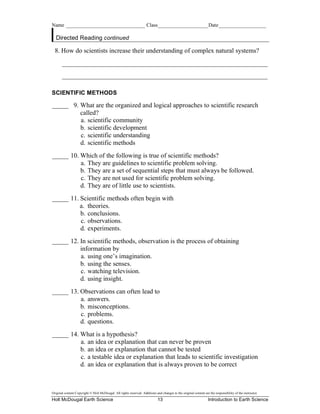
  8. How do scientists increase their understanding of complex natural systems?
       _______________________________________________________________
       _______________________________________________________________

SCIENTIFIC METHODS

_____ 9. What are the organized and logical approaches to scientific research
         called?
         a. scientific community
         b. scientific development
         c. scientific understanding
         d. scientific methods
_____ 10. Which of the following is true of scientific methods?
          a. They are guidelines to scientific problem solving.
          b. They are a set of sequential steps that must always be followed.
          c. They are not used for scientific problem solving.
          d. They are of little use to scientists.
_____ 11. Scientific methods often begin with
          a. theories.
          b. conclusions.
          c. observations.
          d. experiments.
_____ 12. In scientific methods, observation is the process of obtaining
          information by
          a. using one’s imagination.
          b. using the senses.
          c. watching television.
          d. using insight.
_____ 13. Observations can often lead to
          a. answers.
          b. misconceptions.
          c. problems.
          d. questions.
_____ 14. What is a hypothesis?
          a. an idea or explanation that can never be proven
          b. an idea or explanation that cannot be tested
          c. a testable idea or explanation that leads to scientific investigation
          d. an idea or explanation that is always proven to be correct


Original content Copyright © Holt McDougal. All rights reserved. Additions and changes to the original content are the responsibility of the instructor.

Holt McDougal Earth Science                                                   13                                   Introduction to Earth Science
Name ______________________________ Class___________________Date__________________

   Directed Reading continued

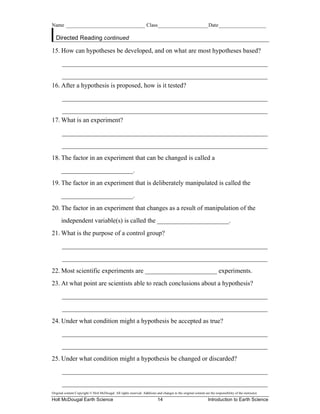
15. How can hypotheses be developed, and on what are most hypotheses based?
       _______________________________________________________________
    _______________________________________________________________
16. After a hypothesis is proposed, how is it tested?
       _______________________________________________________________
    _______________________________________________________________
17. What is an experiment?
       _______________________________________________________________
       _______________________________________________________________
18. The factor in an experiment that can be changed is called a
      ______________________.
19. The factor in an experiment that is deliberately manipulated is called the
      ______________________.
20. The factor in an experiment that changes as a result of manipulation of the
      independent variable(s) is called the ______________________.
21. What is the purpose of a control group?
       _______________________________________________________________
       _______________________________________________________________
22. Most scientific experiments are ______________________ experiments.
23. At what point are scientists able to reach conclusions about a hypothesis?
       _______________________________________________________________
       _______________________________________________________________
24. Under what condition might a hypothesis be accepted as true?
       _______________________________________________________________
       _______________________________________________________________
25. Under what condition might a hypothesis be changed or discarded?
       _______________________________________________________________
       _______________________________________________________________
Original content Copyright © Holt McDougal. All rights reserved. Additions and changes to the original content are the responsibility of the instructor.

Holt McDougal Earth Science                                                   14                                   Introduction to Earth Science
Name ______________________________ Class___________________Date__________________

   Directed Reading continued

26. What do expected and unexpected results lead to?
    _______________________________________________________________
27. What else might the results of scientific inquiry lead to?
       _______________________________________________________________

SCIENTIFIC MEASUREMENTS AND ANALYSIS

_____ 28. An important method of gathering information is
          a. analysis.
          b. measurement.
          c. prediction.
          d. testing.
_____ 29. Measurement is the comparison of
          a. a standard unit with other standard units.
          b. independent variables with dependent variables.
          c. some aspect of an object or event with a standard unit.
          d. some aspect of an object or event with another object of the same
             type.
_____ 30. What do scientists around the world use to compare and analyze each
          other’s measurements?
          a. the Internet
          b. books and periodicals
          c. the International System of Units
          d. the Standard Measurement System
_____ 31. The SI includes standard measurements for
          a. cups, pints, quarts, and gallons.
          b. length, mass, temperature, and volume.
          c. inches, pounds, degrees, and feet.
          d. circles, squares, rectangles, and triangles.
_____ 32. What are all SI units based on?
          a. intervals of 15
          b. intervals of 100
          c. intervals of 10
          d. intervals of 2
_____ 33. To what does the word “accuracy” refer?
          a. how close a measurement is to the true value of what is being
             measured
          b. how close a measurement is to an accepted standard
          c. how close a measurement is after making necessary adjustments
          d. the time of day a measurement is taken
Original content Copyright © Holt McDougal. All rights reserved. Additions and changes to the original content are the responsibility of the instructor.

Holt McDougal Earth Science                                                   15                                   Introduction to Earth Science
Name ______________________________ Class___________________Date__________________

   Directed Reading continued

_____ 34. What is precision?
          a. how long it takes to record a measurement
          b. how close a measurement is to the true value of what is being
             measured
          c. the exactness of a measurement
          d. the margin of error found in a measurement
_____ 35. Which of the following measurements is more precise?
          a. distance in centimeters rather than millimeters
          b. distance in millimeters rather than centimeters
          c. mass in kilograms rather than grams
          d. mass in grams rather than milligrams
_____ 36. An error is an expression of the amount of
          a. precision or variation in a set of measurements.
          b. accuracy or variation in a set of measurements.
          c. accuracy or variety in a set of measurements.
          d. imprecision or variation in a set of measurements.
_____ 37. Error is commonly expressed as
           a. percentage error or a                                                       c. margin of precision.
              confidence interval.                                                        d. margin of accuracy.
           b. correct or incorrect.
38. What is percentage error?
    _______________________________________________________________
39. What does a confidence interval describe?
    _______________________________________________________________
40. What do Earth scientists do when it is impossible to set up a controlled
    experiment to test a hypothesis?
       _______________________________________________________________
    _______________________________________________________________
41. What do Earth scientists use models for?
       _______________________________________________________________
    _______________________________________________________________
42. What is a model?
       _______________________________________________________________
       _______________________________________________________________
       _______________________________________________________________

Original content Copyright © Holt McDougal. All rights reserved. Additions and changes to the original content are the responsibility of the instructor.

Holt McDougal Earth Science                                                   16                                   Introduction to Earth Science
Name ______________________________ Class___________________Date__________________

   Directed Reading continued

43. What is a physical model?
       _______________________________________________________________
    _______________________________________________________________
44. What are two examples of graphical models?
       _______________________________________________________________
    _______________________________________________________________
45. What is a conceptual model?
       _______________________________________________________________
    _______________________________________________________________
46. What is a mathematical model?
       _______________________________________________________________
    _______________________________________________________________
47. What is a computer model?
       _______________________________________________________________
    _______________________________________________________________
48. What are scientists able to do with a good computer model?
       _______________________________________________________________
       _______________________________________________________________

ACCEPTANCE OF SCIENTIFIC IDEAS

_____ 49. Once scientists reach a conclusion,
          a. they keep their findings secret.
          b. they sell their findings to the highest bidder.
          c. they introduce their findings to the scientific community.
          d. they discard their findings and start over.
_____ 50. Before new ideas are accepted by the scientific community, the ideas
          a. must undergo review and testing by other scientists.
          b. are published in a scientific journal.
          c. do not have to undergo any further testing or review.
          d. must be proven to be true by at least 90% of all scientists in the
             world.


Original content Copyright © Holt McDougal. All rights reserved. Additions and changes to the original content are the responsibility of the instructor.

Holt McDougal Earth Science                                                   17                                   Introduction to Earth Science
Name ______________________________ Class___________________Date__________________

   Directed Reading continued

_____ 51. Which of the following is NOT a way that scientists present their
          results to the scientific community?
          a. at professional meetings
          b. in television infomercials
          c. in printed scientific journals
          d. in online scientific journals
_____ 52. Before new ideas are released to a wider audience, scientists submit
          their ideas to
          a. the National Science Foundation.
          b. the public for peer review.
          c. other scientists for peer review.
          d. newspaper reporters.
_____ 53. What is peer review?
          a. when experts on a given topic review another expert’s work before
             publication
          b. when experts introduce flaws into another expert’s work before
             publication
          c. when experts reject another expert’s work before publication
          d. when experts compliment another expert’s work before publication
_____ 54. What do the experts determine in a peer review?
          a. if the journal that publishes the results has a wide enough audience
          b. if the results and conclusions merit publication
          c. if enough reviewers have read the work
          d. if the scientist who presented the work should be promoted
_____ 55. Scientists follow an ethical code that says
          a. all experimental results should receive equal consideration.
          b. unless experimental results are peer reviewed, they cannot be true
             and valid.
          c. any experimental results deserve to be published.
          d. only valid experimental results should be published.
56. What happens after results are published?
       _______________________________________________________________
    _______________________________________________________________
57. Define theory.
       _______________________________________________________________
       _______________________________________________________________
       _______________________________________________________________


Original content Copyright © Holt McDougal. All rights reserved. Additions and changes to the original content are the responsibility of the instructor.

Holt McDougal Earth Science                                                   18                                   Introduction to Earth Science
Name ______________________________ Class___________________Date__________________

   Directed Reading continued

58. What is a scientific law?
       _______________________________________________________________
    _______________________________________________________________
59. What does the free exchange of ideas between scientific fields allow?
       _______________________________________________________________
    _______________________________________________________________
60. What sometimes results when new connections are found between more than
    one branch of science?
       _______________________________________________________________
       _______________________________________________________________

SCIENCE AND SOCIETY

_____ 61. The theories of plate tectonics, quantum mechanics, and evolution are
          examples of what?
          a. theories that have since been disproved
          b. theories that are too complicated to explain
          c. advances in science that have long-lasting and far-reaching effects
             on science and society
          d. advances in science that have had no real impact on science or
             society
62. Technology that was designed for space exploration has been used for what?
       _______________________________________________________________
    _______________________________________________________________
63. What should scientists consider when developing new technology?
       _______________________________________________________________
    _______________________________________________________________
64. What factors should be considered before decisions about technology are
    made?
       _______________________________________________________________


Original content Copyright © Holt McDougal. All rights reserved. Additions and changes to the original content are the responsibility of the instructor.

Holt McDougal Earth Science                                                   19                                   Introduction to Earth Science

Directed reading

  • 1.
    Name ______________________________ Class___________________Date__________________ Skills Worksheet Directed Reading Section: Science as a Process 1. How does science differ from other kinds of human endeavors such as art, architecture, and philosophy? _______________________________________________________________ _______________________________________________________________ 2. What is the goal of science? _______________________________________________________________ _______________________________________________________________ 3. What do scientists do? _______________________________________________________________ _______________________________________________________________ _______________________________________________________________ BEHAVIOR OF NATURAL SYSTEMS _____ 4. Scientists begin with the assumption that nature a. is undeniable. b. is understandable. c. is nearly impossible to understand. d. cannot be understood. _____ 5. What do scientists expect? a. Different forces in different situations will cause similar results. b. Different forces in similar situations will cause similar results. c. Similar forces in different situations will cause similar results. d. Similar forces in similar situations will cause similar results. _____ 6. Scientists also expect that nature is a. predictable. b. practical. c. impractical. d. unpredictable. 7. What does studying ice cores in Antarctica help scientists understand? _______________________________________________________________ _______________________________________________________________ Original content Copyright © Holt McDougal. All rights reserved. Additions and changes to the original content are the responsibility of the instructor. Holt McDougal Earth Science 12 Introduction to Earth Science
  • 2.
    Name ______________________________ Class___________________Date__________________ Directed Reading continued 8. How do scientists increase their understanding of complex natural systems? _______________________________________________________________ _______________________________________________________________ SCIENTIFIC METHODS _____ 9. What are the organized and logical approaches to scientific research called? a. scientific community b. scientific development c. scientific understanding d. scientific methods _____ 10. Which of the following is true of scientific methods? a. They are guidelines to scientific problem solving. b. They are a set of sequential steps that must always be followed. c. They are not used for scientific problem solving. d. They are of little use to scientists. _____ 11. Scientific methods often begin with a. theories. b. conclusions. c. observations. d. experiments. _____ 12. In scientific methods, observation is the process of obtaining information by a. using one’s imagination. b. using the senses. c. watching television. d. using insight. _____ 13. Observations can often lead to a. answers. b. misconceptions. c. problems. d. questions. _____ 14. What is a hypothesis? a. an idea or explanation that can never be proven b. an idea or explanation that cannot be tested c. a testable idea or explanation that leads to scientific investigation d. an idea or explanation that is always proven to be correct Original content Copyright © Holt McDougal. All rights reserved. Additions and changes to the original content are the responsibility of the instructor. Holt McDougal Earth Science 13 Introduction to Earth Science
  • 3.
    Name ______________________________ Class___________________Date__________________ Directed Reading continued 15. How can hypotheses be developed, and on what are most hypotheses based? _______________________________________________________________ _______________________________________________________________ 16. After a hypothesis is proposed, how is it tested? _______________________________________________________________ _______________________________________________________________ 17. What is an experiment? _______________________________________________________________ _______________________________________________________________ 18. The factor in an experiment that can be changed is called a ______________________. 19. The factor in an experiment that is deliberately manipulated is called the ______________________. 20. The factor in an experiment that changes as a result of manipulation of the independent variable(s) is called the ______________________. 21. What is the purpose of a control group? _______________________________________________________________ _______________________________________________________________ 22. Most scientific experiments are ______________________ experiments. 23. At what point are scientists able to reach conclusions about a hypothesis? _______________________________________________________________ _______________________________________________________________ 24. Under what condition might a hypothesis be accepted as true? _______________________________________________________________ _______________________________________________________________ 25. Under what condition might a hypothesis be changed or discarded? _______________________________________________________________ _______________________________________________________________ Original content Copyright © Holt McDougal. All rights reserved. Additions and changes to the original content are the responsibility of the instructor. Holt McDougal Earth Science 14 Introduction to Earth Science
  • 4.
    Name ______________________________ Class___________________Date__________________ Directed Reading continued 26. What do expected and unexpected results lead to? _______________________________________________________________ 27. What else might the results of scientific inquiry lead to? _______________________________________________________________ SCIENTIFIC MEASUREMENTS AND ANALYSIS _____ 28. An important method of gathering information is a. analysis. b. measurement. c. prediction. d. testing. _____ 29. Measurement is the comparison of a. a standard unit with other standard units. b. independent variables with dependent variables. c. some aspect of an object or event with a standard unit. d. some aspect of an object or event with another object of the same type. _____ 30. What do scientists around the world use to compare and analyze each other’s measurements? a. the Internet b. books and periodicals c. the International System of Units d. the Standard Measurement System _____ 31. The SI includes standard measurements for a. cups, pints, quarts, and gallons. b. length, mass, temperature, and volume. c. inches, pounds, degrees, and feet. d. circles, squares, rectangles, and triangles. _____ 32. What are all SI units based on? a. intervals of 15 b. intervals of 100 c. intervals of 10 d. intervals of 2 _____ 33. To what does the word “accuracy” refer? a. how close a measurement is to the true value of what is being measured b. how close a measurement is to an accepted standard c. how close a measurement is after making necessary adjustments d. the time of day a measurement is taken Original content Copyright © Holt McDougal. All rights reserved. Additions and changes to the original content are the responsibility of the instructor. Holt McDougal Earth Science 15 Introduction to Earth Science
  • 5.
    Name ______________________________ Class___________________Date__________________ Directed Reading continued _____ 34. What is precision? a. how long it takes to record a measurement b. how close a measurement is to the true value of what is being measured c. the exactness of a measurement d. the margin of error found in a measurement _____ 35. Which of the following measurements is more precise? a. distance in centimeters rather than millimeters b. distance in millimeters rather than centimeters c. mass in kilograms rather than grams d. mass in grams rather than milligrams _____ 36. An error is an expression of the amount of a. precision or variation in a set of measurements. b. accuracy or variation in a set of measurements. c. accuracy or variety in a set of measurements. d. imprecision or variation in a set of measurements. _____ 37. Error is commonly expressed as a. percentage error or a c. margin of precision. confidence interval. d. margin of accuracy. b. correct or incorrect. 38. What is percentage error? _______________________________________________________________ 39. What does a confidence interval describe? _______________________________________________________________ 40. What do Earth scientists do when it is impossible to set up a controlled experiment to test a hypothesis? _______________________________________________________________ _______________________________________________________________ 41. What do Earth scientists use models for? _______________________________________________________________ _______________________________________________________________ 42. What is a model? _______________________________________________________________ _______________________________________________________________ _______________________________________________________________ Original content Copyright © Holt McDougal. All rights reserved. Additions and changes to the original content are the responsibility of the instructor. Holt McDougal Earth Science 16 Introduction to Earth Science
  • 6.
    Name ______________________________ Class___________________Date__________________ Directed Reading continued 43. What is a physical model? _______________________________________________________________ _______________________________________________________________ 44. What are two examples of graphical models? _______________________________________________________________ _______________________________________________________________ 45. What is a conceptual model? _______________________________________________________________ _______________________________________________________________ 46. What is a mathematical model? _______________________________________________________________ _______________________________________________________________ 47. What is a computer model? _______________________________________________________________ _______________________________________________________________ 48. What are scientists able to do with a good computer model? _______________________________________________________________ _______________________________________________________________ ACCEPTANCE OF SCIENTIFIC IDEAS _____ 49. Once scientists reach a conclusion, a. they keep their findings secret. b. they sell their findings to the highest bidder. c. they introduce their findings to the scientific community. d. they discard their findings and start over. _____ 50. Before new ideas are accepted by the scientific community, the ideas a. must undergo review and testing by other scientists. b. are published in a scientific journal. c. do not have to undergo any further testing or review. d. must be proven to be true by at least 90% of all scientists in the world. Original content Copyright © Holt McDougal. All rights reserved. Additions and changes to the original content are the responsibility of the instructor. Holt McDougal Earth Science 17 Introduction to Earth Science
  • 7.
    Name ______________________________ Class___________________Date__________________ Directed Reading continued _____ 51. Which of the following is NOT a way that scientists present their results to the scientific community? a. at professional meetings b. in television infomercials c. in printed scientific journals d. in online scientific journals _____ 52. Before new ideas are released to a wider audience, scientists submit their ideas to a. the National Science Foundation. b. the public for peer review. c. other scientists for peer review. d. newspaper reporters. _____ 53. What is peer review? a. when experts on a given topic review another expert’s work before publication b. when experts introduce flaws into another expert’s work before publication c. when experts reject another expert’s work before publication d. when experts compliment another expert’s work before publication _____ 54. What do the experts determine in a peer review? a. if the journal that publishes the results has a wide enough audience b. if the results and conclusions merit publication c. if enough reviewers have read the work d. if the scientist who presented the work should be promoted _____ 55. Scientists follow an ethical code that says a. all experimental results should receive equal consideration. b. unless experimental results are peer reviewed, they cannot be true and valid. c. any experimental results deserve to be published. d. only valid experimental results should be published. 56. What happens after results are published? _______________________________________________________________ _______________________________________________________________ 57. Define theory. _______________________________________________________________ _______________________________________________________________ _______________________________________________________________ Original content Copyright © Holt McDougal. All rights reserved. Additions and changes to the original content are the responsibility of the instructor. Holt McDougal Earth Science 18 Introduction to Earth Science
  • 8.
    Name ______________________________ Class___________________Date__________________ Directed Reading continued 58. What is a scientific law? _______________________________________________________________ _______________________________________________________________ 59. What does the free exchange of ideas between scientific fields allow? _______________________________________________________________ _______________________________________________________________ 60. What sometimes results when new connections are found between more than one branch of science? _______________________________________________________________ _______________________________________________________________ SCIENCE AND SOCIETY _____ 61. The theories of plate tectonics, quantum mechanics, and evolution are examples of what? a. theories that have since been disproved b. theories that are too complicated to explain c. advances in science that have long-lasting and far-reaching effects on science and society d. advances in science that have had no real impact on science or society 62. Technology that was designed for space exploration has been used for what? _______________________________________________________________ _______________________________________________________________ 63. What should scientists consider when developing new technology? _______________________________________________________________ _______________________________________________________________ 64. What factors should be considered before decisions about technology are made? _______________________________________________________________ Original content Copyright © Holt McDougal. All rights reserved. Additions and changes to the original content are the responsibility of the instructor. Holt McDougal Earth Science 19 Introduction to Earth Science