Introduction of
Direct Memory Access (DMA)
Why is DMA?
• It is wasteful to feed data into a controller
register 1 bytes at a time. (PIO)
• The DMA unit is word.
• In the high loading environment, a system
with DMA has better improvement.
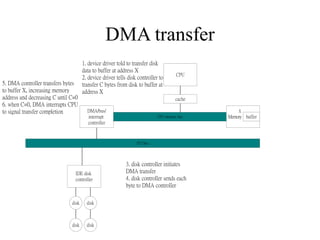
DMA transfer
5. DMA controller transfers bytes
to buffer X, increasing memory
address and decreasing C until C=0
6. when C=0, DMA interrupts CPU
to signal transfer completion
PCI bus
CPU memory bus Memory buffer
DMA/bus/
interrupt
controller
cache
CPU
1. device driver told to transfer disk
data to buffer at address X
2. device driver tells disk controller to
transfer C bytes from disk to buffer at
address X
3. disk controller initiates
DMA transfer
4. disk controller sends each
byte to DMA controller
IDE disk
controller
disk
disk
disk
disk
X
DMA Progress
• To initiate a DMA transfer, the host writes a
DMA command into memory:
– A pointer to the source of a transfer
– A count of the number of bytes to be transferred
– ……..
• The CPU writes the address of the DMA
command block to the DMA controller.
DMA Progress (cont.)
• The DMA controller proceeds to operate the
memory bus directly without CPU help.
• Handshaking exists between DMA
controller and device controller.
• When the entire transfer is finished, the
DMA controller will interrupts the CPU.
Handshaking
• DMA-request and DMA_acknowledge
– When a word of data is available, the device
controller places a signal on the DMA-request
wire.
– The signal causes the DMA controller to seize
the memory bus,
• To place the desired address on the memory-address
wire
• To place a signal on the DMA-acknowledge wire
Handshaking (cont.)
• When the device controller receives the
DMA-acknowledge signal,
– it transfer the word of data to memory
– and remove the DMA_request signal.

Direct Memory Access (DMA).ppt

  • 1.
  • 2.
    Why is DMA? •It is wasteful to feed data into a controller register 1 bytes at a time. (PIO) • The DMA unit is word. • In the high loading environment, a system with DMA has better improvement.
  • 3.
    DMA transfer 5. DMAcontroller transfers bytes to buffer X, increasing memory address and decreasing C until C=0 6. when C=0, DMA interrupts CPU to signal transfer completion PCI bus CPU memory bus Memory buffer DMA/bus/ interrupt controller cache CPU 1. device driver told to transfer disk data to buffer at address X 2. device driver tells disk controller to transfer C bytes from disk to buffer at address X 3. disk controller initiates DMA transfer 4. disk controller sends each byte to DMA controller IDE disk controller disk disk disk disk X
  • 4.
    DMA Progress • Toinitiate a DMA transfer, the host writes a DMA command into memory: – A pointer to the source of a transfer – A count of the number of bytes to be transferred – …….. • The CPU writes the address of the DMA command block to the DMA controller.
  • 5.
    DMA Progress (cont.) •The DMA controller proceeds to operate the memory bus directly without CPU help. • Handshaking exists between DMA controller and device controller. • When the entire transfer is finished, the DMA controller will interrupts the CPU.
  • 6.
    Handshaking • DMA-request andDMA_acknowledge – When a word of data is available, the device controller places a signal on the DMA-request wire. – The signal causes the DMA controller to seize the memory bus, • To place the desired address on the memory-address wire • To place a signal on the DMA-acknowledge wire
  • 7.
    Handshaking (cont.) • Whenthe device controller receives the DMA-acknowledge signal, – it transfer the word of data to memory – and remove the DMA_request signal.