Welcome to the inaugural conference!
PREMIER SPONSORS
SUPPORTING SPONSORS
Pat East
Executive Director,
Dimension Mill
John Hamilton
Mayor of Bloomington
John McDonald
CEO of ClearObject
John.McDonald@ClearObject.com
The New Crossroads
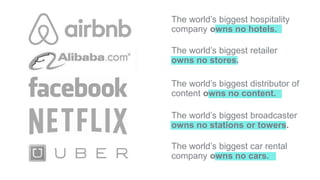
The world’s biggest hospitality
company owns no hotels.
The world’s biggest retailer
owns no stores.
The world’s biggest distributor of
content owns no content.
The world’s biggest broadcaster
owns no stations or towers.
The world’s biggest car rental
company owns no cars.
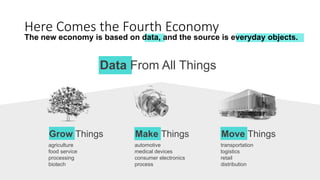
Here Comes the Fourth Economy
The new economy is based on data, and the source is everyday objects.
Make Things
automotive
medical devices
consumer electronics
process
Move Things
transportation
logistics
retail
distribution
Grow Things
agriculture
food service
processing
biotech
Data From All Things
33
Eyes off the road.
People all over the world:
Start a car train.
Everything.
All the time.
Everything.
All the time.
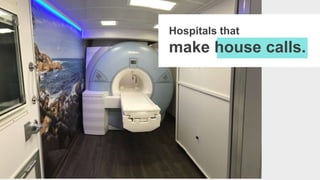
Hospitals that
make house calls.
Your room is ready.
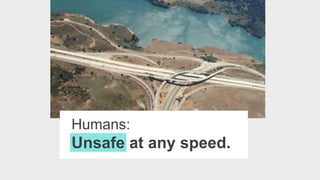
Humans:
Unsafe at any speed.
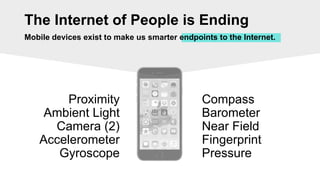
The Internet of People is Ending
Mobile devices exist to make us smarter endpoints to the Internet.
Proximity
Ambient Light
Camera (2)
Accelerometer
Gyroscope
Compass
Barometer
Near Field
Fingerprint
Pressure
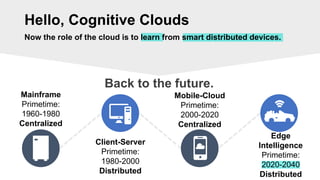
Hello, Cognitive Clouds
Back to the future.
Mainframe
Primetime:
1960-1980
Centralized
Client-Server
Primetime:
1980-2000
Distributed
Mobile-Cloud
Primetime:
2000-2020
Centralized
Edge
Intelligence
Primetime:
2020-2040
Distributed
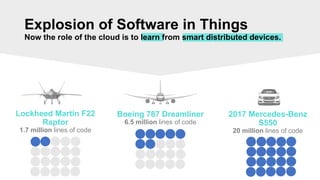
Now the role of the cloud is to learn from smart distributed devices.
Explosion of Software in Things
Boeing 787 Dreamliner
6.5 million lines of code
Lockheed Martin F22
Raptor
1.7 million lines of code
2017 Mercedes-Benz
S550
20 million lines of code
Now the role of the cloud is to learn from smart distributed devices.
Make
Power by the Hour • Wikipedia • bit.ly/2qMA1le
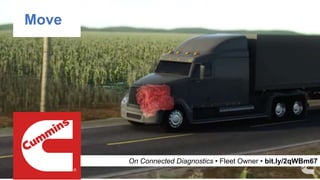
Move
On Connected Diagnostics • Fleet Owner • bit.ly/2qWBm67
Grow
Working the land and the Data • New York Times • nyti.ms/2pfS5Ep
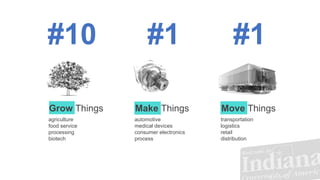
#1#1#10
Make Things
automotive
medical devices
consumer electronics
process
Move Things
transportation
logistics
retail
distribution
Grow Things
agriculture
food service
processing
biotech
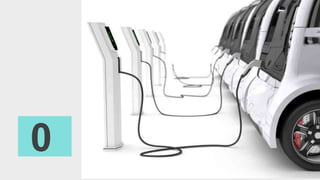
0
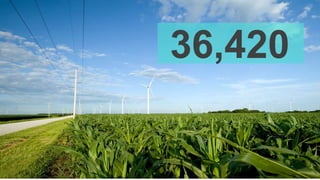
36,420
1000+
Thank You
Oscar Moralez
Founder of VisionTech
Supporting Startups in Indiana
Angel Investing
2017 Angel Investing Conference
Dimension Mill
November 30, 2017
2
Oscar Moralez
• BS, Medical Technology (Univ. of Texas Southwestern Med Center)
• MBA (Univ. of Colorado)
• Professional Experience (13 yrs)
• Boulder Community Hospital, Boulder
• Mayo Medical Laboratories, Rochester
• Covance Laboratories, Indianapolis
• Entrepreneur (>15 yrs)
• 2014 - Present: VisionTech Partners (Founder & Managing Director)
• 2008 – 2014: StepStone Business Partners (Founder & Managing Director)
• 2002 – 2007: BioStorage Technologies (Founder and COO)
• Raised ~$10 million in angel and venture capital
• Acquired Dec 2015 for $127 million by Brooks Automation (NASDQ: BRKS)
• Angel Investor (>10 yrs)
What is an Angel Investor
• A “qualified” individual who invests capital in early stage businesses to help
launch and support the company through its early development.
• Invests for ownership “equity” or ”debt” in a company
• Must meet Security Exchange Commissions (SEC) standards for “accredited
investors”
• earned income that exceeded $200,000 (or $300,000 together with a spouse) in each of the prior two
years, and reasonably expects the same for the current year, OR
• has a net worth over $1 million, either alone or together with a spouse (excluding the value of the
person’s primary residence).
• https://www.sec.gov/files/ib_accreditedinvestors.pdf
• Motivation for Investment
• Philanthropic
• Economic (Passive or Active)
3
4
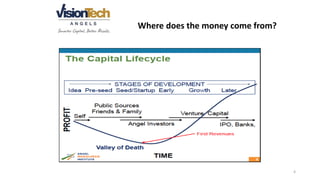
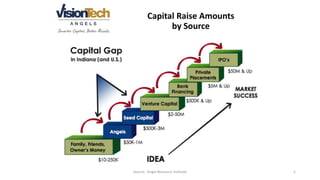
Where does the money come from?
Capital Raise Amounts
by Source
Source: Angel Resource Institute 5
6
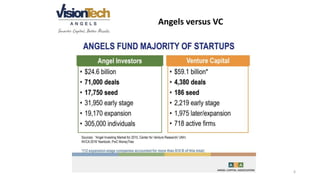
Angels versus VC
7
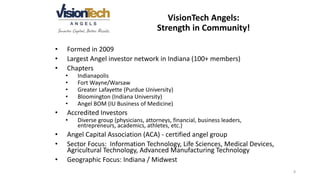
• Formed in 2009
• Largest Angel investor network in Indiana (100+ members)
• Chapters
• Indianapolis
• Fort Wayne/Warsaw
• Greater Lafayette (Purdue University)
• Bloomington (Indiana University)
• Angel BOM (IU Business of Medicine)
• Accredited Investors
• Diverse group (physicians, attorneys, financial, business leaders,
entrepreneurs, academics, athletes, etc.)
• Angel Capital Association (ACA) - certified angel group
• Sector Focus: Information Technology, Life Sciences, Medical Devices,
Agricultural Technology, Advanced Manufacturing Technology
• Geographic Focus: Indiana / Midwest
VisionTech Angels:
Strength in Community!
8
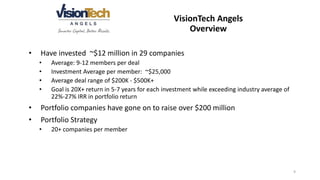
VisionTech Angels
Overview
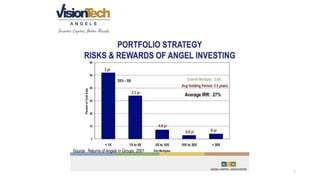
• Have invested ~$12 million in 29 companies
• Average: 9-12 members per deal
• Investment Average per member: ~$25,000
• Average deal range of $200K - $500K+
• Goal is 20X+ return in 5-7 years for each investment while exceeding industry average of
22%-27% IRR in portfolio return
• Portfolio companies have gone on to raise over $200 million
• Portfolio Strategy
• 20+ companies per member
9
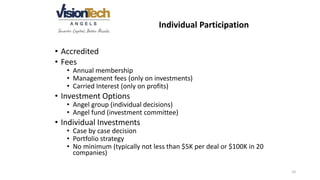
Individual Participation
10
• Accredited
• Fees
• Annual membership
• Management fees (only on investments)
• Carried Interest (only on profits)
• Investment Options
• Angel group (individual decisions)
• Angel fund (investment committee)
• Individual Investments
• Case by case decision
• Portfolio strategy
• No minimum (typically not less than $5K per deal or $100K in 20
companies)
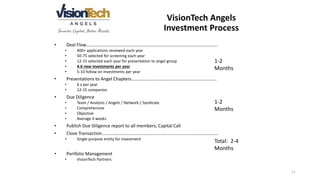
• Deal Flow…………………………………………………………………………………………….……..
• 400+ applications reviewed each year
• 50-75 selected for screening each year
• 12-15 selected each year for presentation to angel group
• 4-6 new investments per year
• 5-10 follow on investments per year
• Presentations to Angel Chapters………………………………………………………………..
• 6 x per year
• 12-15 companies
• Due Diligence
• Team / Analysts / Angels / Network / Syndicate
• Comprehensive
• Objective
• Average 4 weeks
• Publish Due Diligence report to all members; Capital Call
• Close Transaction…………………………………………………………………………………….….
• Single purpose entity for investment
• Portfolio Management
• VisionTech Partners
VisionTech Angels
Investment Process
11
1-2
Months
1-2
Months
Total: 2-4
Months
Investment Criteria
12
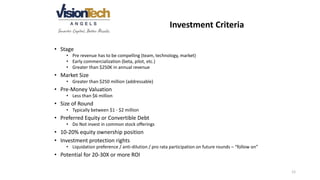
• Stage
• Pre revenue has to be compelling (team, technology, market)
• Early commercialization (beta, pilot, etc.)
• Greater than $250K in annual revenue
• Market Size
• Greater than $250 million (addressable)
• Pre-Money Valuation
• Less than $6 million
• Size of Round
• Typically between $1 - $2 million
• Preferred Equity or Convertible Debt
• Do Not invest in common stock offerings
• 10-20% equity ownership position
• Investment protection rights
• Liquidation preference / anti-dilution / pro rata participation on future rounds – “follow on”
• Potential for 20-30X or more ROI
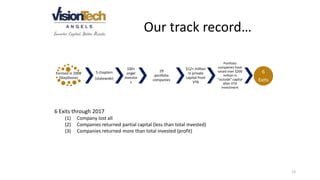
Our track record…
Formed in 2009
(StepStone)
5 chapters
(statewide)
100+
angel
investor
s
29
portfolio
companies
$12+ million
in private
capital from
VTA
Portfolio
companies have
raised over $200
million in
“outside” capital
after VTA
investment
6
Exits
6 Exits through 2017
(1) Company lost all
(2) Companies returned partial capital (less than total invested)
(3) Companies returned more than total invested (profit)
13
14
Contact:
Oscar Moralez, Managing Director
omoralez@visiontech-partners.com
Ben Pidgeon, Executive Director
bpidgeon@visiontech-partners.com
Kristin Cooper
CEO of The Startup
Ladies
Why do we need to GROW startup and
investor pipelines simultaneously? How
do we do it?
Chapters: Indianapolis/2014, Terre Haute/2016,
and Bloomington in 2018
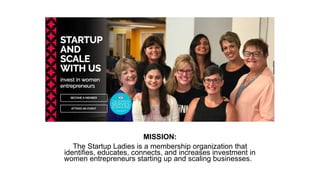
MISSION:
The Startup Ladies is a membership organization that
identifies, educates, connects, and increases investment in
women entrepreneurs starting up and scaling businesses.
How do The Startup Ladies increase the # of
scalable startups and 1st time investors?
•We create community through our Meetups which allow attendees to connect with
experienced executives and fellow budding entrepreneurs.
•We educate first-time founders through "Startup Study Halls" and first-time funders
through "Startup Investing 101" programming.
•We increase investment in women-owned companies by hosting pitch events, educating
new investors, and making connections between founders and angel investors.
•We believe that diversity is a competitive advantage. Anyone (men included) who has a
passion for startups and investing is invited to become a member and participate in our
programs and events.
After speaking with hundreds of
founders, this is what we know for sure:
• Many founders to do not have “friends or family” who
can afford to write checks for $5,000-$50,000.
• One their biggest obstacles to proving out their
concept is securing funding.
• The lack of prepared and trained “friends and family”
investors prevents viable products from going to
market.
As of the end of 2016:
• According to Spectrem Group's Market Insights Report 2017, there was a
record 10.8 million millionaires nationwide.
• That's more than ever before and marks a 400,000 person increase from
the previous year.
• 9.4 million individuals with net worth between $1M - $5M
• 1.3 million individuals had a net worth between $5M - $25M
• 156,000 households had more than $25M in net worth
*Spectrem Group is a consulting and market research firm in the wealth management
and retirement industries.
There are MILLIONS of prospective investors in the US
There is no shortage
of funding in the US.
There is an insufficient
number of properly
trained and connected
angel investors.
How do we grow the number of
“friends & family” investors?
• Monthly conversations about: how equity works, how to evaluate business plans and risk, what is
an exit strategy, how to support the founder, and the legal and tax responsibilities of an investor.
• Facilitated by: angel investors, attorneys, university professors, and accountants who are experts in
the field of investing in startups.
• Build relationships with founders through quarterly “Founders & Funders” events.
Why do we need to build a pipeline of startups
and angel investors simultaneously?
• Every day, new founders are identifying new problems
and offering new solutions. They need funding to scale.
• If trusting relationships are established between founders
and funders, it will be easier to raise money when
needed.
• Chaos in the marketplace creates opportunity. Founders
and funders need to be prepared and trained to take
advantage of time sensitive opportunities.
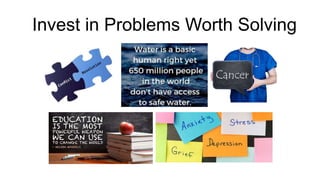
Invest in Problems Worth Solving
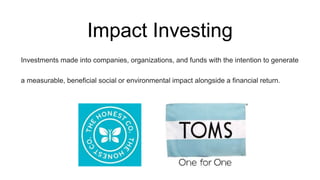
Impact Investing
Investments made into companies, organizations, and funds with the intention to generate
a measurable, beneficial social or environmental impact alongside a financial return.
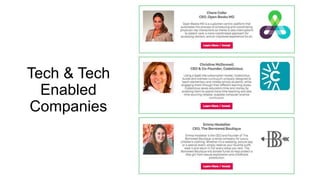
Tech & Tech
Enabled
Companies
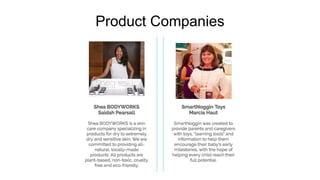
Product Companies
Think BIG
1. Why do you want to invest in a startup? Make $,
solve a problem, impact humanity, leave a legacy?
2. What industries interest you?
3. How much can you afford to invest?
4. Choose an organization to become an active
member.
5. Set a goal to make 1 investment by the end of 2018.
It’s your legacy.
What will you invest in now so that Earth is a
better place when you’re long gone?
Join the movement.
Become a member.
@KristenCooper23
@IamAStartupLady
TheStartupLadies
Kristin@TheStartupLadies.org
v
v
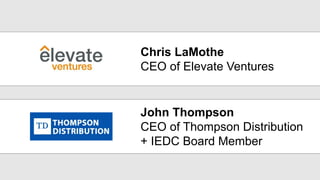
Chris LaMothe
CEO of Elevate Ventures
John Thompson
CEO of Thompson Distribution
+ IEDC Board Member
v
v
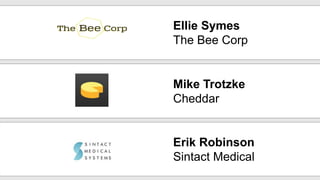
Ellie Symes
The Bee Corp
Mike Trotzke
Cheddar
v
Erik Robinson
Sintact Medical
Thank you for attending!

Dimension Mill Annual Presentation

  • 1.
    Welcome to theinaugural conference!
  • 2.
  • 3.
  • 4.
  • 5.
  • 6.
  • 7.
  • 8.
    The world’s biggesthospitality company owns no hotels. The world’s biggest retailer owns no stores. The world’s biggest distributor of content owns no content. The world’s biggest broadcaster owns no stations or towers. The world’s biggest car rental company owns no cars.
  • 9.
    Here Comes theFourth Economy The new economy is based on data, and the source is everyday objects. Make Things automotive medical devices consumer electronics process Move Things transportation logistics retail distribution Grow Things agriculture food service processing biotech Data From All Things
  • 10.
  • 11.
  • 12.
    People all overthe world: Start a car train.
  • 13.
  • 14.
  • 15.
  • 16.
  • 17.
  • 18.
    The Internet ofPeople is Ending Mobile devices exist to make us smarter endpoints to the Internet. Proximity Ambient Light Camera (2) Accelerometer Gyroscope Compass Barometer Near Field Fingerprint Pressure
  • 19.
    Hello, Cognitive Clouds Backto the future. Mainframe Primetime: 1960-1980 Centralized Client-Server Primetime: 1980-2000 Distributed Mobile-Cloud Primetime: 2000-2020 Centralized Edge Intelligence Primetime: 2020-2040 Distributed Now the role of the cloud is to learn from smart distributed devices.
  • 20.
    Explosion of Softwarein Things Boeing 787 Dreamliner 6.5 million lines of code Lockheed Martin F22 Raptor 1.7 million lines of code 2017 Mercedes-Benz S550 20 million lines of code Now the role of the cloud is to learn from smart distributed devices.
  • 21.
    Make Power by theHour • Wikipedia • bit.ly/2qMA1le
  • 22.
    Move On Connected Diagnostics• Fleet Owner • bit.ly/2qWBm67
  • 23.
    Grow Working the landand the Data • New York Times • nyti.ms/2pfS5Ep
  • 24.
    #1#1#10 Make Things automotive medical devices consumerelectronics process Move Things transportation logistics retail distribution Grow Things agriculture food service processing biotech
  • 25.
  • 26.
  • 27.
  • 30.
  • 31.
  • 32.
    Supporting Startups inIndiana Angel Investing 2017 Angel Investing Conference Dimension Mill November 30, 2017
  • 33.
    2 Oscar Moralez • BS,Medical Technology (Univ. of Texas Southwestern Med Center) • MBA (Univ. of Colorado) • Professional Experience (13 yrs) • Boulder Community Hospital, Boulder • Mayo Medical Laboratories, Rochester • Covance Laboratories, Indianapolis • Entrepreneur (>15 yrs) • 2014 - Present: VisionTech Partners (Founder & Managing Director) • 2008 – 2014: StepStone Business Partners (Founder & Managing Director) • 2002 – 2007: BioStorage Technologies (Founder and COO) • Raised ~$10 million in angel and venture capital • Acquired Dec 2015 for $127 million by Brooks Automation (NASDQ: BRKS) • Angel Investor (>10 yrs)
  • 34.
    What is anAngel Investor • A “qualified” individual who invests capital in early stage businesses to help launch and support the company through its early development. • Invests for ownership “equity” or ”debt” in a company • Must meet Security Exchange Commissions (SEC) standards for “accredited investors” • earned income that exceeded $200,000 (or $300,000 together with a spouse) in each of the prior two years, and reasonably expects the same for the current year, OR • has a net worth over $1 million, either alone or together with a spouse (excluding the value of the person’s primary residence). • https://www.sec.gov/files/ib_accreditedinvestors.pdf • Motivation for Investment • Philanthropic • Economic (Passive or Active) 3
  • 35.
    4 Where does themoney come from?
  • 36.
    Capital Raise Amounts bySource Source: Angel Resource Institute 5
  • 37.
  • 38.
  • 39.
    • Formed in2009 • Largest Angel investor network in Indiana (100+ members) • Chapters • Indianapolis • Fort Wayne/Warsaw • Greater Lafayette (Purdue University) • Bloomington (Indiana University) • Angel BOM (IU Business of Medicine) • Accredited Investors • Diverse group (physicians, attorneys, financial, business leaders, entrepreneurs, academics, athletes, etc.) • Angel Capital Association (ACA) - certified angel group • Sector Focus: Information Technology, Life Sciences, Medical Devices, Agricultural Technology, Advanced Manufacturing Technology • Geographic Focus: Indiana / Midwest VisionTech Angels: Strength in Community! 8
  • 40.
    VisionTech Angels Overview • Haveinvested ~$12 million in 29 companies • Average: 9-12 members per deal • Investment Average per member: ~$25,000 • Average deal range of $200K - $500K+ • Goal is 20X+ return in 5-7 years for each investment while exceeding industry average of 22%-27% IRR in portfolio return • Portfolio companies have gone on to raise over $200 million • Portfolio Strategy • 20+ companies per member 9
  • 41.
    Individual Participation 10 • Accredited •Fees • Annual membership • Management fees (only on investments) • Carried Interest (only on profits) • Investment Options • Angel group (individual decisions) • Angel fund (investment committee) • Individual Investments • Case by case decision • Portfolio strategy • No minimum (typically not less than $5K per deal or $100K in 20 companies)
  • 42.
    • Deal Flow…………………………………………………………………………………………….…….. •400+ applications reviewed each year • 50-75 selected for screening each year • 12-15 selected each year for presentation to angel group • 4-6 new investments per year • 5-10 follow on investments per year • Presentations to Angel Chapters……………………………………………………………….. • 6 x per year • 12-15 companies • Due Diligence • Team / Analysts / Angels / Network / Syndicate • Comprehensive • Objective • Average 4 weeks • Publish Due Diligence report to all members; Capital Call • Close Transaction…………………………………………………………………………………….…. • Single purpose entity for investment • Portfolio Management • VisionTech Partners VisionTech Angels Investment Process 11 1-2 Months 1-2 Months Total: 2-4 Months
  • 43.
    Investment Criteria 12 • Stage •Pre revenue has to be compelling (team, technology, market) • Early commercialization (beta, pilot, etc.) • Greater than $250K in annual revenue • Market Size • Greater than $250 million (addressable) • Pre-Money Valuation • Less than $6 million • Size of Round • Typically between $1 - $2 million • Preferred Equity or Convertible Debt • Do Not invest in common stock offerings • 10-20% equity ownership position • Investment protection rights • Liquidation preference / anti-dilution / pro rata participation on future rounds – “follow on” • Potential for 20-30X or more ROI
  • 44.
    Our track record… Formedin 2009 (StepStone) 5 chapters (statewide) 100+ angel investor s 29 portfolio companies $12+ million in private capital from VTA Portfolio companies have raised over $200 million in “outside” capital after VTA investment 6 Exits 6 Exits through 2017 (1) Company lost all (2) Companies returned partial capital (less than total invested) (3) Companies returned more than total invested (profit) 13
  • 45.
    14 Contact: Oscar Moralez, ManagingDirector omoralez@visiontech-partners.com Ben Pidgeon, Executive Director bpidgeon@visiontech-partners.com
  • 46.
    Kristin Cooper CEO ofThe Startup Ladies
  • 47.
    Why do weneed to GROW startup and investor pipelines simultaneously? How do we do it?
  • 48.
    Chapters: Indianapolis/2014, TerreHaute/2016, and Bloomington in 2018
  • 49.
    MISSION: The Startup Ladiesis a membership organization that identifies, educates, connects, and increases investment in women entrepreneurs starting up and scaling businesses.
  • 50.
    How do TheStartup Ladies increase the # of scalable startups and 1st time investors? •We create community through our Meetups which allow attendees to connect with experienced executives and fellow budding entrepreneurs. •We educate first-time founders through "Startup Study Halls" and first-time funders through "Startup Investing 101" programming. •We increase investment in women-owned companies by hosting pitch events, educating new investors, and making connections between founders and angel investors. •We believe that diversity is a competitive advantage. Anyone (men included) who has a passion for startups and investing is invited to become a member and participate in our programs and events.
  • 51.
    After speaking withhundreds of founders, this is what we know for sure: • Many founders to do not have “friends or family” who can afford to write checks for $5,000-$50,000. • One their biggest obstacles to proving out their concept is securing funding. • The lack of prepared and trained “friends and family” investors prevents viable products from going to market.
  • 52.
    As of theend of 2016: • According to Spectrem Group's Market Insights Report 2017, there was a record 10.8 million millionaires nationwide. • That's more than ever before and marks a 400,000 person increase from the previous year. • 9.4 million individuals with net worth between $1M - $5M • 1.3 million individuals had a net worth between $5M - $25M • 156,000 households had more than $25M in net worth *Spectrem Group is a consulting and market research firm in the wealth management and retirement industries. There are MILLIONS of prospective investors in the US
  • 53.
    There is noshortage of funding in the US. There is an insufficient number of properly trained and connected angel investors.
  • 54.
    How do wegrow the number of “friends & family” investors? • Monthly conversations about: how equity works, how to evaluate business plans and risk, what is an exit strategy, how to support the founder, and the legal and tax responsibilities of an investor. • Facilitated by: angel investors, attorneys, university professors, and accountants who are experts in the field of investing in startups. • Build relationships with founders through quarterly “Founders & Funders” events.
  • 55.
    Why do weneed to build a pipeline of startups and angel investors simultaneously? • Every day, new founders are identifying new problems and offering new solutions. They need funding to scale. • If trusting relationships are established between founders and funders, it will be easier to raise money when needed. • Chaos in the marketplace creates opportunity. Founders and funders need to be prepared and trained to take advantage of time sensitive opportunities.
  • 56.
    Invest in ProblemsWorth Solving
  • 57.
    Impact Investing Investments madeinto companies, organizations, and funds with the intention to generate a measurable, beneficial social or environmental impact alongside a financial return.
  • 58.
  • 59.
  • 60.
    Think BIG 1. Whydo you want to invest in a startup? Make $, solve a problem, impact humanity, leave a legacy? 2. What industries interest you? 3. How much can you afford to invest? 4. Choose an organization to become an active member. 5. Set a goal to make 1 investment by the end of 2018.
  • 61.
    It’s your legacy. Whatwill you invest in now so that Earth is a better place when you’re long gone?
  • 62.
  • 63.
  • 64.
    v v Chris LaMothe CEO ofElevate Ventures John Thompson CEO of Thompson Distribution + IEDC Board Member
  • 65.
    v v Ellie Symes The BeeCorp Mike Trotzke Cheddar v Erik Robinson Sintact Medical
  • 66.
    Thank you forattending!

Editor's Notes

  • #9 What do they own? Data. Uber knows very little about you – only that you want to go from point A to point B and what your credit card number is, but on that thinnest slice of data, they can build a multi-billion dollar business.
  • #45 Symbios CourseLoad Othopediatrics WebLink Sentio 3DR