Andreas Gunst, Burcu Zobu, Kenneth Wallace-Mueller
Florence, 20 June 2019
Digitalisation in the Energy Sector
www.dlapiper.com 2
Digital Transformation in Energy Industry
• Digitalisation is often used as a buzzword, however its meaning is unclear
• Key characteristics of digitalisation are:
• Increasing efficiency of processes and transactions
• Collection and analysis of digital data and generating forecasts
• Increasing communication, bringing together market players via
blockchain and smart contracts
• Automation of processes
• Digitalisation in the transport, construction and industrial sectors will have
the side effect of increasing global energy demand, further requiring the
deployment of digital technologies into energy infrastructure
• Areas in the energy sector which will be impacted include phase out of
highly polluting fuels, transmission and distribution grids, electricity
storage, intermittent renewable generation, electricity and renewables
trading, data gathering (e.g. smart meters), new products (e.g. electric
vehicles) and new market players (e.g. prosumers, battery storage
operators)
www.dlapiper.com 3
Impact on the Energy System
• Automation - Digitalisation impacts the automation of substations in the
transmission grid, generators at power stations and smaller-scale
decentralised generation assets (wind and solar plants) which may be
aggregated and controlled as virtual power plants
• Trading - Digitalisation facilitates a greater number of transactions, and
coupled with AI and algorithmic trading may lead to efficiencies in trading,
opening up the possibility of near real-time energy trading
• Increased competition between market participants, allowing
comparisons between participants and quick switching
• Consumer benefits - Roll-out of smart meters, new supply arrangements
with time-of-use and dynamic pricing
• Consumer participation - Decentralised energy trading systems which
enable small-scale trading, with local price formation and price visibility on
the regional or community energy trading platforms
• Possible change of roles and responsibilities - The roles of
established market participants such as TSOs, DSOs, suppliers, traders,
brokers and platform providers may be disrupted
www.dlapiper.com
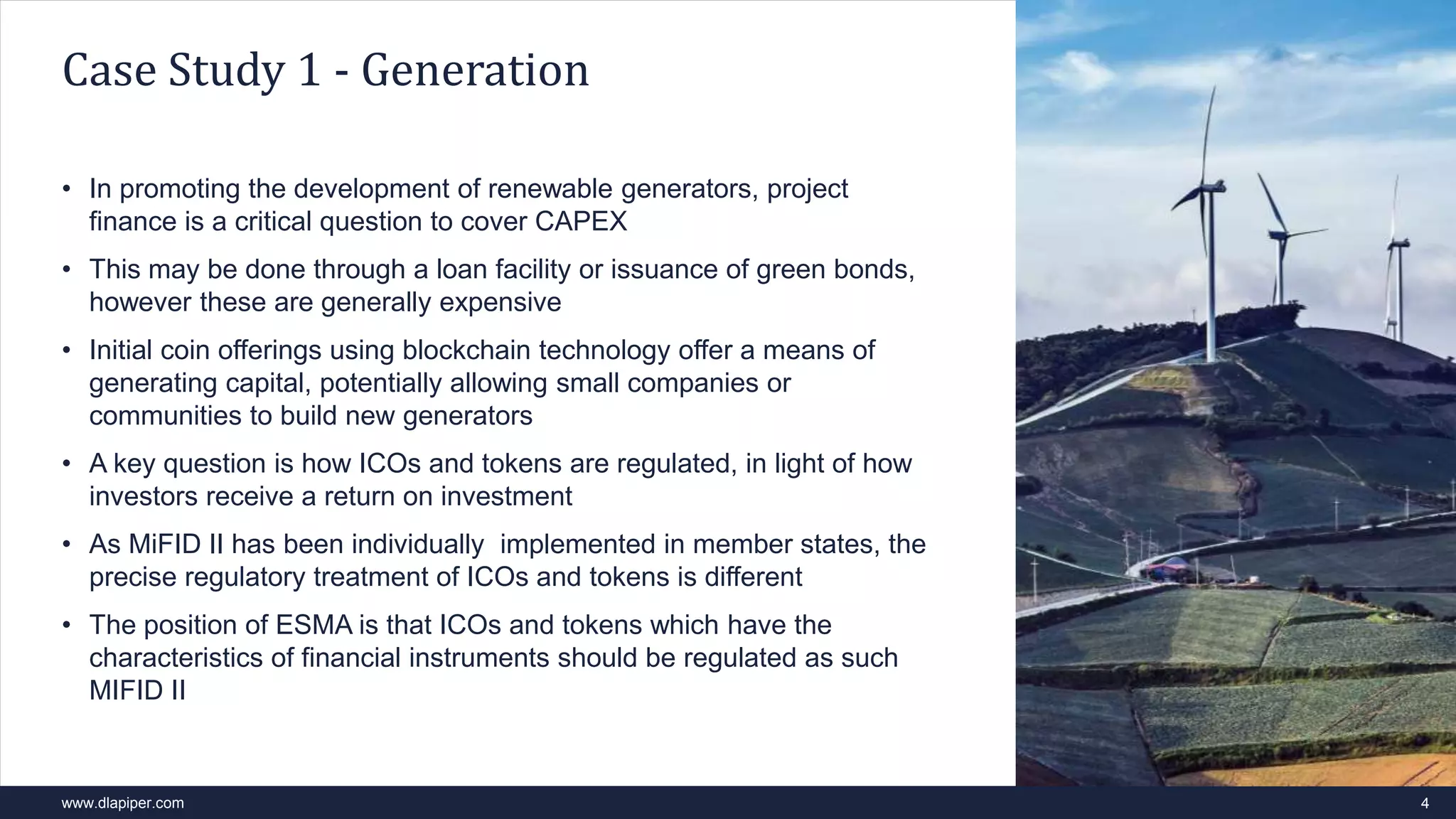
• In promoting the development of renewable generators, project
finance is a critical question to cover CAPEX
• This may be done through a loan facility or issuance of green bonds,
however these are generally expensive
• Initial coin offerings using blockchain technology offer a means of
generating capital, potentially allowing small companies or
communities to build new generators
• A key question is how ICOs and tokens are regulated, in light of how
investors receive a return on investment
• As MiFID II has been individually implemented in member states, the
precise regulatory treatment of ICOs and tokens is different
• The position of ESMA is that ICOs and tokens which have the
characteristics of financial instruments should be regulated as such
MIFID II
4
Case Study 1 - Generation
www.dlapiper.com
• Renewable share of generation in Europe is increasing in response to
the threat of climate change
• This is however intermittent, with power generated only when the wind
blows or the sun shines, however demand is cyclical, most typically on
a daily and annual basis
• Historically, the balance of supply and demand this has been managed
by a combination of baseload and peaker plants, the prioritisation of
renewable generation has disrupted this
• New technologies such as industrial scale batteries and demand side
response (DSR) will aid in system balancing, as well as the
coordinated grouping of these as virtual power plants
• In order to be efficient and reduce costs, such technologies will require
high speed telecommunications (e.g. 5G), historical data analysis and
supply/demand prediction for individual generators and balancing
zones, which will require sophisticated algorithms and/or AI)
5
Case Study 2 - Balancing
www.dlapiper.com
• Historically, electricity and gas trading was done through long-term
bilateral agreements, generally with the state acting through a central
buyer
• Due to electricity and gas market liberalisation and increasingly
dynamic market prices, there is an interest in trading in a variety of
timeframes including day-ahead and interday
• For OTC trades, this may be done through framework agreements
such as EFET GA Power or EFET Gas, with individual confirmations to
lock in specific transactions
• Exchanges have complex structures and regulation to ensure speed
and reliability of transactions, including KYC checks, central
counterparties, clearing and settlement
• Through blockchain, there is the potential to trade between user
accounts and to use smart contracts as a form of option agreement,
conditional on a number of external factors
• Applications for trading renewable energy through guarantees of origin
6
Case Study 3 - Trading
www.dlapiper.com
• Renewable technologies allow for increasingly decentralised power
generation, with communities or individuals able to generate and sell
power onto the grid. This extends to the use of small scale domestic
batteries, where users may be able to inject and withdraw power
• So-called "prosumers" change the concept of a consumer from being
a vulnerable individual protected by law into another actor actively
participating on the electricity markets
• This poses a challenge to the current licencing regime, with
generators which operate without a licence in some countries held to
be committing an offence
• One use case is the Brooklyn Microgrid project, where prosumers
inject excess electricity onto the grid but sell the rights to electricity via
a blockchain and through the use of smart contracts
• The licencing regime has been designed to create market stability and
competition, however prosumers and battery storage operators
occupy a grey area
7
Case Study 4 - Consumers
www.dlapiper.com
• Battery EVs are currently enjoying a surge in popularity, and are slowly
expanding beyond passenger vehicles to goods vehicles and ships
• Asides from environmental benefits, EVs will have a major impact on
the energy sector
• When plugged in, an EV could actively charge, purchasing electricity
at times where electricity prices are low (e.g. night-time), saving
money for the user
• Alternatively, a plugged-in EV is effectively a small scale battery, which
may be of benefit to aid in balancing the system
• These functions require more than simply plugging in, as vehicles may
actively trade electricity, involving energy management systems
(algorithms and/or AI) and telecommunications with a common
interface to align with other members of a balancing group
• Again, this occupies a grey area in national licencing regimes, coupled
with the ability of vehicle to move between geographical areas
8
Case Study 5 - Electric Vehicles
www.dlapiper.com 9
An adaptive legal framework
• The legal framework on the European and national level is being
amended to keep up with technological development. Many relevant
provisions are indeed technologically neutral, with concepts designed
to capture future developments
• The EU is promoting regulatory development through the Clean
Energy Package and Digital Single Market policies
• The Clean Energy Package has set an ambitious regulatory
framework which encourages the digital transition and places
consumers in the centre of the energy markets
• Digitalisation is however not only confined to energy legislation - data
protection and data privacy are two important considerations from a
broader regulatory perspective
• In short - there is no single legal instrument which addresses
digitalisation in the energy sector. Instead a more holistic and
coordinated approach is required, coupled with the political will to
regularly review and adapt laws and policies
www.dlapiper.com
• Digitalisation has captured the imagination of the energy markets
promising new products, services and busines models
• This has involved the development of many "use cases" to test
technologies and products, and investigate their suitability to replace
existing applications or to create new ones
• Generally there have been more failures than successes, however this
is important in understanding the technical capabilities and business
potential of digital technologies
• Nevertheless, whilst current approaches may seem inefficient and
outdated, these have been built up over decades and provide
guardrails, designed to create a stable energy market
• The introduction of new and inexperienced market participants raises
issues such as delivery default, long-term continued operation, and
creditworthiness, which risks instability of the energy market
• Care needs to be taken in adopting new solutions and ensuring that
there are appropriate safeguards to ensure security of supply
10
Key take-aways
www.dlapiper.com 11
Any questions?
Andreas Gunst
Partner
T: +44 780 271 9480
andreas.gunst@dlapiper.com
Kenneth Wallace-Mueller
Associate
T: +43 676 8888 1844
kenneth.wallace-mueller@dlapiper.com
Burcu Zobu
Associate
T: +43 676 8888 1129
burcu.zobu@dlapiper.com

Digitalisation in the Energy Sector

  • 1.
    Andreas Gunst, BurcuZobu, Kenneth Wallace-Mueller Florence, 20 June 2019 Digitalisation in the Energy Sector
  • 2.
    www.dlapiper.com 2 Digital Transformationin Energy Industry • Digitalisation is often used as a buzzword, however its meaning is unclear • Key characteristics of digitalisation are: • Increasing efficiency of processes and transactions • Collection and analysis of digital data and generating forecasts • Increasing communication, bringing together market players via blockchain and smart contracts • Automation of processes • Digitalisation in the transport, construction and industrial sectors will have the side effect of increasing global energy demand, further requiring the deployment of digital technologies into energy infrastructure • Areas in the energy sector which will be impacted include phase out of highly polluting fuels, transmission and distribution grids, electricity storage, intermittent renewable generation, electricity and renewables trading, data gathering (e.g. smart meters), new products (e.g. electric vehicles) and new market players (e.g. prosumers, battery storage operators)
  • 3.
    www.dlapiper.com 3 Impact onthe Energy System • Automation - Digitalisation impacts the automation of substations in the transmission grid, generators at power stations and smaller-scale decentralised generation assets (wind and solar plants) which may be aggregated and controlled as virtual power plants • Trading - Digitalisation facilitates a greater number of transactions, and coupled with AI and algorithmic trading may lead to efficiencies in trading, opening up the possibility of near real-time energy trading • Increased competition between market participants, allowing comparisons between participants and quick switching • Consumer benefits - Roll-out of smart meters, new supply arrangements with time-of-use and dynamic pricing • Consumer participation - Decentralised energy trading systems which enable small-scale trading, with local price formation and price visibility on the regional or community energy trading platforms • Possible change of roles and responsibilities - The roles of established market participants such as TSOs, DSOs, suppliers, traders, brokers and platform providers may be disrupted
  • 4.
    www.dlapiper.com • In promotingthe development of renewable generators, project finance is a critical question to cover CAPEX • This may be done through a loan facility or issuance of green bonds, however these are generally expensive • Initial coin offerings using blockchain technology offer a means of generating capital, potentially allowing small companies or communities to build new generators • A key question is how ICOs and tokens are regulated, in light of how investors receive a return on investment • As MiFID II has been individually implemented in member states, the precise regulatory treatment of ICOs and tokens is different • The position of ESMA is that ICOs and tokens which have the characteristics of financial instruments should be regulated as such MIFID II 4 Case Study 1 - Generation
  • 5.
    www.dlapiper.com • Renewable shareof generation in Europe is increasing in response to the threat of climate change • This is however intermittent, with power generated only when the wind blows or the sun shines, however demand is cyclical, most typically on a daily and annual basis • Historically, the balance of supply and demand this has been managed by a combination of baseload and peaker plants, the prioritisation of renewable generation has disrupted this • New technologies such as industrial scale batteries and demand side response (DSR) will aid in system balancing, as well as the coordinated grouping of these as virtual power plants • In order to be efficient and reduce costs, such technologies will require high speed telecommunications (e.g. 5G), historical data analysis and supply/demand prediction for individual generators and balancing zones, which will require sophisticated algorithms and/or AI) 5 Case Study 2 - Balancing
  • 6.
    www.dlapiper.com • Historically, electricityand gas trading was done through long-term bilateral agreements, generally with the state acting through a central buyer • Due to electricity and gas market liberalisation and increasingly dynamic market prices, there is an interest in trading in a variety of timeframes including day-ahead and interday • For OTC trades, this may be done through framework agreements such as EFET GA Power or EFET Gas, with individual confirmations to lock in specific transactions • Exchanges have complex structures and regulation to ensure speed and reliability of transactions, including KYC checks, central counterparties, clearing and settlement • Through blockchain, there is the potential to trade between user accounts and to use smart contracts as a form of option agreement, conditional on a number of external factors • Applications for trading renewable energy through guarantees of origin 6 Case Study 3 - Trading
  • 7.
    www.dlapiper.com • Renewable technologiesallow for increasingly decentralised power generation, with communities or individuals able to generate and sell power onto the grid. This extends to the use of small scale domestic batteries, where users may be able to inject and withdraw power • So-called "prosumers" change the concept of a consumer from being a vulnerable individual protected by law into another actor actively participating on the electricity markets • This poses a challenge to the current licencing regime, with generators which operate without a licence in some countries held to be committing an offence • One use case is the Brooklyn Microgrid project, where prosumers inject excess electricity onto the grid but sell the rights to electricity via a blockchain and through the use of smart contracts • The licencing regime has been designed to create market stability and competition, however prosumers and battery storage operators occupy a grey area 7 Case Study 4 - Consumers
  • 8.
    www.dlapiper.com • Battery EVsare currently enjoying a surge in popularity, and are slowly expanding beyond passenger vehicles to goods vehicles and ships • Asides from environmental benefits, EVs will have a major impact on the energy sector • When plugged in, an EV could actively charge, purchasing electricity at times where electricity prices are low (e.g. night-time), saving money for the user • Alternatively, a plugged-in EV is effectively a small scale battery, which may be of benefit to aid in balancing the system • These functions require more than simply plugging in, as vehicles may actively trade electricity, involving energy management systems (algorithms and/or AI) and telecommunications with a common interface to align with other members of a balancing group • Again, this occupies a grey area in national licencing regimes, coupled with the ability of vehicle to move between geographical areas 8 Case Study 5 - Electric Vehicles
  • 9.
    www.dlapiper.com 9 An adaptivelegal framework • The legal framework on the European and national level is being amended to keep up with technological development. Many relevant provisions are indeed technologically neutral, with concepts designed to capture future developments • The EU is promoting regulatory development through the Clean Energy Package and Digital Single Market policies • The Clean Energy Package has set an ambitious regulatory framework which encourages the digital transition and places consumers in the centre of the energy markets • Digitalisation is however not only confined to energy legislation - data protection and data privacy are two important considerations from a broader regulatory perspective • In short - there is no single legal instrument which addresses digitalisation in the energy sector. Instead a more holistic and coordinated approach is required, coupled with the political will to regularly review and adapt laws and policies
  • 10.
    www.dlapiper.com • Digitalisation hascaptured the imagination of the energy markets promising new products, services and busines models • This has involved the development of many "use cases" to test technologies and products, and investigate their suitability to replace existing applications or to create new ones • Generally there have been more failures than successes, however this is important in understanding the technical capabilities and business potential of digital technologies • Nevertheless, whilst current approaches may seem inefficient and outdated, these have been built up over decades and provide guardrails, designed to create a stable energy market • The introduction of new and inexperienced market participants raises issues such as delivery default, long-term continued operation, and creditworthiness, which risks instability of the energy market • Care needs to be taken in adopting new solutions and ensuring that there are appropriate safeguards to ensure security of supply 10 Key take-aways
  • 11.
    www.dlapiper.com 11 Any questions? AndreasGunst Partner T: +44 780 271 9480 andreas.gunst@dlapiper.com Kenneth Wallace-Mueller Associate T: +43 676 8888 1844 kenneth.wallace-mueller@dlapiper.com Burcu Zobu Associate T: +43 676 8888 1129 burcu.zobu@dlapiper.com