3D Digitizing a whole museum:
a metadata centered workflow
G. Guidi, L. L. Micoli, S. Gonizzi
Dept. of Mechanical Engineering
Politecnico di Milano
Milan, Italy
gabriele.guidi@polimi.it

P. Rodriguez Navarro

M. Russo

Dept. Architectural Graphic Expression
Universitat Politècnica de València
Valencia, Spain
rodriguez@upv.es

Dept. Design
Politecnico di Milano
Milan, Italy
michele.russo@polimi.it

physical copies for borrowing them to the public), etc. For this
reason in those years the only piece of information converted
(or created) in digital form was the description of the book,
consisting in data such as author, title, subject, publisher, date
and place of publication, etc. So, considering the book content
as “the data”, these additional pieces of information – even in
their paper card version - were the first examples of metadata
(i.e. data regarding other data).
Therefore, this first “digitization” action, that lasted years
in an environment culturally far from computers and for this
reason a bit suspicious of the sudden bursting onto the scene of
digital technologies, started from metadata, slowly coming to
digitization of content, as initially attempted in the Project
Gutemberg.
A pilot experiment ran from 1990 through 1994 at the
Library of Congress (Washington DC, US), planned to create a
repositories of digital contents linked to previously existing
records of searchable metadata, digitizing not only books, but
also some of the Library of Congress’s unparalleled collections
of historical documents, moving images, sound recordings, old
prints and photographic media: the so called “Nation’s
Memory”.
This approach become even more interesting with the
widespread diffusion of the Internet, that made remotely
accessible such valuable information. In addition to the US,
many countries around the world – particularly in Europe started to systematically digitize cultural contents getting to a
new evolution level of the digitization concept. In 2001 the
European Commission organized in Lund an expert meeting
about this topic with representatives from all Member States.
The recommendations stated in conclusion of this meeting are
known as the “Lund Principles”, and declare that: Europe's
cultural and scientific knowledge resources are a unique public
asset forming the collective and evolving memory of our
diverse societies and providing a solid basis for the
development of our digital content industries in a sustainable
knowledge society.
From that moment several European Project oriented to
libraries (MINERVA, MICHAEL) and Museums (ATHENA)
has been financed according to these principles aiming at: i)
digitizing different types of content; ii) supplying the metadata

Abstract— Massive 3D digitization has never been attempted
before as in the framework of the 3D-ICONS European project,
whose purpose is populating Europeana – an Internet portal for
accessing to millions of books, paintings, films and archival
records that have been digitized throughout Europe – with at
least 3000 3D models of important archaeological and artistic
objects. A correspondingly high number of metadata associated
to the 3D models has to be managed and supplied to Europeana
in order to make usable the whole set of 3D models generated
within the project. This paper presents a possible workflow that
allows to collect in advance all the metadata needed for the
following Europeana publication phase; assign coherent and
univocal IDs to the digitized objects; track the work progress
adding technical metadata to the descriptive ones at the
digitization stage.
Keywords— Museum digitization, Metadata, SFM, Laser
Scanning, 3D models, Digital library.

I. INTRODUCTION
The digitization of Cultural Heritage started in 1971, more
than 40 years ago in the world of libraries, with the Project
Gutemberg (PG), a volunteer effort for creating a collection of
e-books, that actually represents the first experiment of digital
library [1]. At that time digitizing Cultural Heritage was
intended as digitizing written pages, in order to access them in
electronic form with a computer, possibly connected to the
resource through a digital network. The digitization was not
necessarily associated with the numerical conversion of the
written pages through a grey level image, as in recent page
scanners. The first e-books where just plain ASCII files
containing the unformatted text of the “digitized” book.
From that early experience, initially accessible only to a
restrict elite of technology enthusiasts, a wide range of
initiatives started in US and Europe at the end of the ‘80s, once
the computers started to be diffused in libraries, oriented to a
more widespread audience.
However, it is important to note that the digital
infrastructure grown in the Libraries during the last two
decades of 1900 was mainly dedicated to their management,
which means book cataloguing (i.e. synthetically describing its
physical and logical content), circulation (i.e. management of
Research funded by 3D-ICONS (3D Digitisation of Icons of European
Architectural and Archaeological Heritage). ICT Policy Support Programme.
Pilot Type B - CIP-ICT-PSP-PB, CIP5 - Theme 2 DigiCont - Digital content.
Grant agreement 297194.

978-1-4799-3169-9/13/$31.00 ©2013 IEEE

307
associated to the actual content; iii) integrating the different
resources on a common platform.
Such efforts led to the establishment of Europeana, the
portal for accessing to the European cultural resources, that
represents a huge searchable repository of metadata belonging
to different cultural institutions, containing links to actual
digital contents, including written documents, images and
multimedia contents (music/videos), conserved by each
institution in his own repository.
The simultaneous support of the European Commission to
projects for developing technologies oriented to 3D digitization
of Cultural Heritage materials, such as museum objects,
sculptures, or even buildings (ViHAP3D, EPOCH,
3DCOFORM), led to a natural convergence of the two research
threads in 2010, with a 3 years project dedicated to study the
inclusion of 3D digital contents into Europeana (CARARE Connecting ARchaeology and ARchitecture in Europeana).
This project experimented for the first time the possibility to
link 3D contents from searchable records, with each threedimensional model stored in a dedicated digital repository and
coded as a 3Dpdf file. Although the format suffered of
significant limitations in terms of size of the coded model, its
widespread diffusion resulted a positive factor for its
accessibility. The CARARE project developed also a specific
set of metadata dedicated to 3D models representing museum
objects, demonstrating the practical feasibility of including 3D
contents in Europeana.
The next step in this long process toward the digitization of
cultural resources in Europe is represented by 3D-ICONS, a
three years EU project started in February 2012, aiming at
populating Europeana with 3D contents through the 3D
digitization of about 3000 architectural or archaeological
monuments and artifacts, identified by UNESCO for their
cultural importance. The project is composed of 16 partners
from across Europe (11 countries), most of them with relevant
expertise in 3D modeling and digitization.
The main goal of 3D-ICONS is therefore to make available
on Europeana a significant amount of accurate digital models
representing important Cultural Heritage artifacts. The action
will be pursued with a massive acquisition of 3D data (shapes
and colors of the selected artifacts) and the associated
descriptions (metadata), uploading the latters to the Europeana
portal. Once the operation will be completed, such data will
become searchable, presenting to the public descriptive records
with a link to (at least) a simplified version of the
corresponding 3D model, in order to make it viewable on lowend personal computers. Although 3D capture of real objects is
the core of this project, due to the Europeana rules each 3D
model is useless (i.e. not searchable) if not associated to the
related set of descriptive metadata.
In this project the unit at Politecnico di Milano (POLIMI),
formed by most of the authors of this paper, is involved as
Work Package leader in the coordination of the 3D digitization
phase (WP3), and as unit in the acquisition of 537 3D models
most of them (472), related to architectural structures or small
objects inside the Archeological Museum of Milan, Italy.

II. THE ARCHAEOLOGICAL MUSEUM AND ITS COLLECTION
Milan has been part of the Western Roman Empire from
286 to 402 AD, and capital of it for more than one century. The
archaeological museum is settled upon an important historical
stratification of ruins, going from the remains of a I century
A.D. Roman house still visible in the second cloister of the
Museum to the footprints of a IV century A.D. Roman Circus,
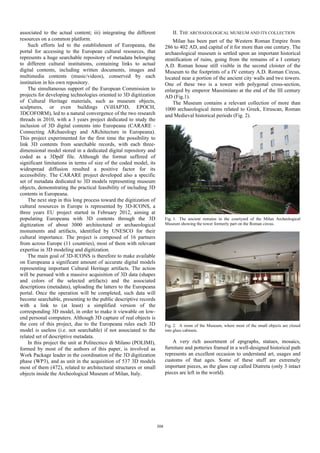
located near a portion of the ancient city walls and two towers.
One of these two is a tower with polygonal cross-section,
enlarged by emperor Massimiano at the end of the III century
AD (Fig.1).
The Museum contains a relevant collection of more than
1000 archaeological items related to Greek, Etruscan, Roman
and Medieval historical periods (Fig. 2).

Fig. 1. The ancient remains in the courtyard of the Milan Archeological
Museum showing the tower formerly part on the Roman circus.

Fig. 2. A room of the Museum, where most of the small objects are closed
into glass cabinets.

A very rich assortment of epigraphs, statues, mosaics,
furniture and potteries framed in a well-designed historical path
represents an excellent occasion to understand art, usages and
customs of that ages. Some of these stuff are extremely
important pieces, as the glass cup called Diatreta (only 3 intact
pieces are left in the world).

308
Fig. 3. Workflow implemented by the POLIMI unit within the 3D-ICONS project. The collection of metadata and the 3D feasibility check drives the actual 3D
digitization step. The 3D repository will be accessible on line and the metadata will contain a link to that on-line resource, in order to be reached from Europeana.

III. METHODOLOGY

This was possible because most of the Museum content
was previously catalogued according to a standard defined by
the Cultural Heritage Information System of the Lombardia
Region (SIRBeC). In the last few years the Museum personnel
provided to collect descriptive information like materials,
dates, place of discovery, place of conservation and so forth,
generating a data base compliant with the SIRBeC standard.
For a lucky combination if was discovered that such
preexisting data can be mapped with 1:1 correspondence to the
CARARE metadata schema, making much easier to collect
descriptive metadata suitable to be uploaded to Europeana
through a proper conversion.

The metadata collection and organization represent a
crucial aspect within the whole project since Europeana is able
to search and link digital contents only through them. This was
a potential issue in the project, specially for units as POLIMI,
for at least two good reasons: i) the group has a rather solid
expertise in 3D acquisition and modeling, but is much less used
to cataloguing Cultural Heritage objects, so that the metadata
collection could have been potentially too time consuming
respect to the project planning; ii) the number of items assigned
to the POLIMI unit for digitization (527) was definitely higher
of the average per unit (190), therefore adding even a little
delaying activity to each model would have easily increased
the needed time to unacceptable levels; iii) describing and
cataloguing hundreds of works of art involving dedicated
experts, that could have represented a project per se [1], being
a potentially very time consuming activity, able to blow any
planning.
For this reason the 3D acquisition process – as already seen
in huge digitization operations operated in past years in the
library field – was first based on the selection of clean preexisting metadata associated with all the museum items, easily
importable in the CARARE metadata schema (and in a
following step in a possible dedicated 3D-ICONS schema).

A. Metadata driven artifact selection
As shown in the block diagram of Fig. 3, starting from a
large set of SIRBeC records a first selection of artifacts suitable
to the 3D-ICONS project has been done considering their
historical and artistic value, and how much they are famous for
the common public. All qualities that can identify them as
“Icons”. This selection process was completed in cooperation
with the Museum Director, taking advantage of her great
competence in the field.
Only after this pre-selection step, the items has been further
selected, choosing each object on the basis of: i) its threedimensionality (objects developing mainly in 2D, for which it
makes little sense to make a digital model, were avoided); ii)

309
the optical cooperation of its surfaces (some very dark or very
shiny objects have been avoided); iii) its accessibility inside the
museum (sculpted artifacts not accessible because too close to
the walls where for example avoided).
At the end of this second selection process a final list of
archaeological items with the related data records, useful as
source of metadata, was created. Such list was used as
operating tool for monitoring the progress of the 3D
digitization activity.

digitization processes. A preliminary cataloguing of the items
is a key step that: i) allows to properly select and organize the
material to be digitized in a list referring to univocal IDs; ii) the
item list is a useful tool for monitoring the digitization
progress; iii) the data records associated to each item are a
fundamental source of descriptive metadata to be imported in
the standard data flow towards Europeana; iv) a pipeline like
this, associated with quick 3D acquisition and modeling
techniques like those based on SFM, can reduce the operating
time to a level compliant with massive 3D acquisitions, like
that planned in the 3D-ICONS project.

B. 3D digitization
For pursuing the 3D acquisition and modeling of the large
number of items planned in this project, the technology to be
used wasn’t so obvious and led to an articulate choice, as
shown in the right part of the block diagram in Fig. 3.
Of course one of the most stringent requirements was the
need to complete each model, including his texture mapping, in
the shortest possible time. This latter aspect oriented choice
towards the use of Structure From Motion (SFM) techniques
[4][5], that, involving highly automatized process for orienting
the images, generating the 3D color point cloud and producing
the final colored mesh, have been demonstrated to be
significantly faster of other methods based on active range
sensing devices [6][7]. However, a few points had to be
managed carefully. First of all image based models are not
automatically metric as those created for example with a laser
scanner [8]. Having metric models was not a requirement. Nor
the project or Europeana requested this. But being this
digitization a rare occasion of completing a large scale 3D
documentation on almost a whole museum content, we decided
to do it metrically, giving a great added value to the models
with a relatively small additional effort [9]. Second point, the
method can be nicely applied only to objects characterized by a
well recognizable texture. Most of the chosen object are like
this, but not all of them.
Although artifacts may occur on marble [10], for this latter
cases triangulation-based range sensing devices has been using
for objects not acquirable with SFM techniques. Systems based
on a sheet of laser light are used for medium-large size objects
(0.2 m to 2 m) while pattern projection are used for smaller
size artifacts. In this case the processing the texture – being not
so important - is neglected, limiting the acquisition to the
object shape using the well known 3D processing pipeline [11].
For larger objects and architectural structures, like the
tower of the roman walls included in the museum data set, it
was decided to use TOF-based laser scanners with no targets
on the scene, applying a well established ICP based processing
procedure for obtaining a colored cloud of 3D points that in
this case represents the final 3D output.
Such technological details are then added to the descriptive
metadata after the actual digitization is completed.

ACKNOWLEDGMENT
The authors want to thank the Director of the
Archaeological Museum of Milan Dr. Donatella Caporusso for
authorizing the surveys and supporting the 3D-ICONS
selection process, and Dr. Anna Provenzali for providing
access to the catalog descriptions of all the archaeological
artifacts chosen for 3D digitization.
REFERENCES
[1] Hane, Paula, Project Gutenberg Progresses. Information Today
21 (5), 2004.
[2] ftp://ftp.cordis.europa.eu/pub/ist/docs/digicult/lund_principlesen.pdf
[3] Jin Ma, Managing metadata for digital projects, Library
Collections, Acquisitions, and Technical Services, Volume 30,
Issues 1–2, March–June 2006, pp. 3-17, ISSN 1464-9055.
[4] M. Pollefeys, M. Vergauwen and L. Van Gool, “Automatic 3D
modeling from image sequences, invited presentation,” in
International Archive of Photogrammetry and Remote Sensing,
Vol. XXXIII, Part B5, 2000, pp. 619-626
[5] M. Doneus, G. Verhoeven, M. Fera, Ch. Briese, M. Kucera and
W. Neubauer, “From Deposit to Point Cloud – A Study Of LowCost Computer Vision approaches for the straightforward
documentation
of
Archaeological
Excavations,”
in
Geoinformatics CTU FCE, 2011, pp. 81-88.
[6] F. Fassi, L. Fregonese, S. Hackermann and V. De Troia,
“Comparison between laser scanning and automated 3D
modeling techniques to reconstruct complex and extensive
Cultural Heritage areas”, ISPRS 3DArch, Trento, Italy, Vol.
XL-5/W1, 2013, pp. 73-80.
[7] Gonizzi S., Micoli L., Guidi G., Quick textured mesh generation
for massive 3D digitization of museum artifacts, Proceedings of
Digital Heritage 2013, Marseille Oct. 28 - Nov. 1, 2013.
[8] G. Guidi, Metrological characterization of 3D imaging devices,
Proc. SPIE 8791, Videometrics, Range Imaging, and
Applications XII; and Automated Visual Inspection, 87910M
(May 23, 2013); doi:10.1117/12.2021037.
[9] Gonizzi S., Guidi G., 3D digitization of museum content within
the 3DIcons project, proceedings CIPA congress, Strasbourg 2/6
September 2013.
[10] Guidi, G., Remondino, F., Russo, M., Spinetti, A., 2009. Range
sensors on marble surfaces: quantitative evaluation of artifacts,
Proceedings of Videometrics, Range Imaging, and Applications
X, SPIE, vol. 7447.
[11] Bernardini, F., Rushmeier, H., The 3D Model Acquisition
Pipeline, Computer Graphics Forum, NCC Blackwell, Vol.
21(2), pp. 149-172, 2002.

IV. CONCLUSIONS
As a project for implementing Europeana with 3D models,
the 3D-ICONS project - although no special innovation is
introduced in the 3D capturing techniques - allowed to test an
innovative acquisition approach oriented to large scale

310

3D Digitizing a whole museum: a metadata centered workflow

  • 1.
    3D Digitizing awhole museum: a metadata centered workflow G. Guidi, L. L. Micoli, S. Gonizzi Dept. of Mechanical Engineering Politecnico di Milano Milan, Italy gabriele.guidi@polimi.it P. Rodriguez Navarro M. Russo Dept. Architectural Graphic Expression Universitat Politècnica de València Valencia, Spain rodriguez@upv.es Dept. Design Politecnico di Milano Milan, Italy michele.russo@polimi.it physical copies for borrowing them to the public), etc. For this reason in those years the only piece of information converted (or created) in digital form was the description of the book, consisting in data such as author, title, subject, publisher, date and place of publication, etc. So, considering the book content as “the data”, these additional pieces of information – even in their paper card version - were the first examples of metadata (i.e. data regarding other data). Therefore, this first “digitization” action, that lasted years in an environment culturally far from computers and for this reason a bit suspicious of the sudden bursting onto the scene of digital technologies, started from metadata, slowly coming to digitization of content, as initially attempted in the Project Gutemberg. A pilot experiment ran from 1990 through 1994 at the Library of Congress (Washington DC, US), planned to create a repositories of digital contents linked to previously existing records of searchable metadata, digitizing not only books, but also some of the Library of Congress’s unparalleled collections of historical documents, moving images, sound recordings, old prints and photographic media: the so called “Nation’s Memory”. This approach become even more interesting with the widespread diffusion of the Internet, that made remotely accessible such valuable information. In addition to the US, many countries around the world – particularly in Europe started to systematically digitize cultural contents getting to a new evolution level of the digitization concept. In 2001 the European Commission organized in Lund an expert meeting about this topic with representatives from all Member States. The recommendations stated in conclusion of this meeting are known as the “Lund Principles”, and declare that: Europe's cultural and scientific knowledge resources are a unique public asset forming the collective and evolving memory of our diverse societies and providing a solid basis for the development of our digital content industries in a sustainable knowledge society. From that moment several European Project oriented to libraries (MINERVA, MICHAEL) and Museums (ATHENA) has been financed according to these principles aiming at: i) digitizing different types of content; ii) supplying the metadata Abstract— Massive 3D digitization has never been attempted before as in the framework of the 3D-ICONS European project, whose purpose is populating Europeana – an Internet portal for accessing to millions of books, paintings, films and archival records that have been digitized throughout Europe – with at least 3000 3D models of important archaeological and artistic objects. A correspondingly high number of metadata associated to the 3D models has to be managed and supplied to Europeana in order to make usable the whole set of 3D models generated within the project. This paper presents a possible workflow that allows to collect in advance all the metadata needed for the following Europeana publication phase; assign coherent and univocal IDs to the digitized objects; track the work progress adding technical metadata to the descriptive ones at the digitization stage. Keywords— Museum digitization, Metadata, SFM, Laser Scanning, 3D models, Digital library. I. INTRODUCTION The digitization of Cultural Heritage started in 1971, more than 40 years ago in the world of libraries, with the Project Gutemberg (PG), a volunteer effort for creating a collection of e-books, that actually represents the first experiment of digital library [1]. At that time digitizing Cultural Heritage was intended as digitizing written pages, in order to access them in electronic form with a computer, possibly connected to the resource through a digital network. The digitization was not necessarily associated with the numerical conversion of the written pages through a grey level image, as in recent page scanners. The first e-books where just plain ASCII files containing the unformatted text of the “digitized” book. From that early experience, initially accessible only to a restrict elite of technology enthusiasts, a wide range of initiatives started in US and Europe at the end of the ‘80s, once the computers started to be diffused in libraries, oriented to a more widespread audience. However, it is important to note that the digital infrastructure grown in the Libraries during the last two decades of 1900 was mainly dedicated to their management, which means book cataloguing (i.e. synthetically describing its physical and logical content), circulation (i.e. management of Research funded by 3D-ICONS (3D Digitisation of Icons of European Architectural and Archaeological Heritage). ICT Policy Support Programme. Pilot Type B - CIP-ICT-PSP-PB, CIP5 - Theme 2 DigiCont - Digital content. Grant agreement 297194. 978-1-4799-3169-9/13/$31.00 ©2013 IEEE 307
  • 2.
    associated to theactual content; iii) integrating the different resources on a common platform. Such efforts led to the establishment of Europeana, the portal for accessing to the European cultural resources, that represents a huge searchable repository of metadata belonging to different cultural institutions, containing links to actual digital contents, including written documents, images and multimedia contents (music/videos), conserved by each institution in his own repository. The simultaneous support of the European Commission to projects for developing technologies oriented to 3D digitization of Cultural Heritage materials, such as museum objects, sculptures, or even buildings (ViHAP3D, EPOCH, 3DCOFORM), led to a natural convergence of the two research threads in 2010, with a 3 years project dedicated to study the inclusion of 3D digital contents into Europeana (CARARE Connecting ARchaeology and ARchitecture in Europeana). This project experimented for the first time the possibility to link 3D contents from searchable records, with each threedimensional model stored in a dedicated digital repository and coded as a 3Dpdf file. Although the format suffered of significant limitations in terms of size of the coded model, its widespread diffusion resulted a positive factor for its accessibility. The CARARE project developed also a specific set of metadata dedicated to 3D models representing museum objects, demonstrating the practical feasibility of including 3D contents in Europeana. The next step in this long process toward the digitization of cultural resources in Europe is represented by 3D-ICONS, a three years EU project started in February 2012, aiming at populating Europeana with 3D contents through the 3D digitization of about 3000 architectural or archaeological monuments and artifacts, identified by UNESCO for their cultural importance. The project is composed of 16 partners from across Europe (11 countries), most of them with relevant expertise in 3D modeling and digitization. The main goal of 3D-ICONS is therefore to make available on Europeana a significant amount of accurate digital models representing important Cultural Heritage artifacts. The action will be pursued with a massive acquisition of 3D data (shapes and colors of the selected artifacts) and the associated descriptions (metadata), uploading the latters to the Europeana portal. Once the operation will be completed, such data will become searchable, presenting to the public descriptive records with a link to (at least) a simplified version of the corresponding 3D model, in order to make it viewable on lowend personal computers. Although 3D capture of real objects is the core of this project, due to the Europeana rules each 3D model is useless (i.e. not searchable) if not associated to the related set of descriptive metadata. In this project the unit at Politecnico di Milano (POLIMI), formed by most of the authors of this paper, is involved as Work Package leader in the coordination of the 3D digitization phase (WP3), and as unit in the acquisition of 537 3D models most of them (472), related to architectural structures or small objects inside the Archeological Museum of Milan, Italy. II. THE ARCHAEOLOGICAL MUSEUM AND ITS COLLECTION Milan has been part of the Western Roman Empire from 286 to 402 AD, and capital of it for more than one century. The archaeological museum is settled upon an important historical stratification of ruins, going from the remains of a I century A.D. Roman house still visible in the second cloister of the Museum to the footprints of a IV century A.D. Roman Circus, located near a portion of the ancient city walls and two towers. One of these two is a tower with polygonal cross-section, enlarged by emperor Massimiano at the end of the III century AD (Fig.1). The Museum contains a relevant collection of more than 1000 archaeological items related to Greek, Etruscan, Roman and Medieval historical periods (Fig. 2). Fig. 1. The ancient remains in the courtyard of the Milan Archeological Museum showing the tower formerly part on the Roman circus. Fig. 2. A room of the Museum, where most of the small objects are closed into glass cabinets. A very rich assortment of epigraphs, statues, mosaics, furniture and potteries framed in a well-designed historical path represents an excellent occasion to understand art, usages and customs of that ages. Some of these stuff are extremely important pieces, as the glass cup called Diatreta (only 3 intact pieces are left in the world). 308
  • 3.
    Fig. 3. Workflowimplemented by the POLIMI unit within the 3D-ICONS project. The collection of metadata and the 3D feasibility check drives the actual 3D digitization step. The 3D repository will be accessible on line and the metadata will contain a link to that on-line resource, in order to be reached from Europeana. III. METHODOLOGY This was possible because most of the Museum content was previously catalogued according to a standard defined by the Cultural Heritage Information System of the Lombardia Region (SIRBeC). In the last few years the Museum personnel provided to collect descriptive information like materials, dates, place of discovery, place of conservation and so forth, generating a data base compliant with the SIRBeC standard. For a lucky combination if was discovered that such preexisting data can be mapped with 1:1 correspondence to the CARARE metadata schema, making much easier to collect descriptive metadata suitable to be uploaded to Europeana through a proper conversion. The metadata collection and organization represent a crucial aspect within the whole project since Europeana is able to search and link digital contents only through them. This was a potential issue in the project, specially for units as POLIMI, for at least two good reasons: i) the group has a rather solid expertise in 3D acquisition and modeling, but is much less used to cataloguing Cultural Heritage objects, so that the metadata collection could have been potentially too time consuming respect to the project planning; ii) the number of items assigned to the POLIMI unit for digitization (527) was definitely higher of the average per unit (190), therefore adding even a little delaying activity to each model would have easily increased the needed time to unacceptable levels; iii) describing and cataloguing hundreds of works of art involving dedicated experts, that could have represented a project per se [1], being a potentially very time consuming activity, able to blow any planning. For this reason the 3D acquisition process – as already seen in huge digitization operations operated in past years in the library field – was first based on the selection of clean preexisting metadata associated with all the museum items, easily importable in the CARARE metadata schema (and in a following step in a possible dedicated 3D-ICONS schema). A. Metadata driven artifact selection As shown in the block diagram of Fig. 3, starting from a large set of SIRBeC records a first selection of artifacts suitable to the 3D-ICONS project has been done considering their historical and artistic value, and how much they are famous for the common public. All qualities that can identify them as “Icons”. This selection process was completed in cooperation with the Museum Director, taking advantage of her great competence in the field. Only after this pre-selection step, the items has been further selected, choosing each object on the basis of: i) its threedimensionality (objects developing mainly in 2D, for which it makes little sense to make a digital model, were avoided); ii) 309
  • 4.
    the optical cooperationof its surfaces (some very dark or very shiny objects have been avoided); iii) its accessibility inside the museum (sculpted artifacts not accessible because too close to the walls where for example avoided). At the end of this second selection process a final list of archaeological items with the related data records, useful as source of metadata, was created. Such list was used as operating tool for monitoring the progress of the 3D digitization activity. digitization processes. A preliminary cataloguing of the items is a key step that: i) allows to properly select and organize the material to be digitized in a list referring to univocal IDs; ii) the item list is a useful tool for monitoring the digitization progress; iii) the data records associated to each item are a fundamental source of descriptive metadata to be imported in the standard data flow towards Europeana; iv) a pipeline like this, associated with quick 3D acquisition and modeling techniques like those based on SFM, can reduce the operating time to a level compliant with massive 3D acquisitions, like that planned in the 3D-ICONS project. B. 3D digitization For pursuing the 3D acquisition and modeling of the large number of items planned in this project, the technology to be used wasn’t so obvious and led to an articulate choice, as shown in the right part of the block diagram in Fig. 3. Of course one of the most stringent requirements was the need to complete each model, including his texture mapping, in the shortest possible time. This latter aspect oriented choice towards the use of Structure From Motion (SFM) techniques [4][5], that, involving highly automatized process for orienting the images, generating the 3D color point cloud and producing the final colored mesh, have been demonstrated to be significantly faster of other methods based on active range sensing devices [6][7]. However, a few points had to be managed carefully. First of all image based models are not automatically metric as those created for example with a laser scanner [8]. Having metric models was not a requirement. Nor the project or Europeana requested this. But being this digitization a rare occasion of completing a large scale 3D documentation on almost a whole museum content, we decided to do it metrically, giving a great added value to the models with a relatively small additional effort [9]. Second point, the method can be nicely applied only to objects characterized by a well recognizable texture. Most of the chosen object are like this, but not all of them. Although artifacts may occur on marble [10], for this latter cases triangulation-based range sensing devices has been using for objects not acquirable with SFM techniques. Systems based on a sheet of laser light are used for medium-large size objects (0.2 m to 2 m) while pattern projection are used for smaller size artifacts. In this case the processing the texture – being not so important - is neglected, limiting the acquisition to the object shape using the well known 3D processing pipeline [11]. For larger objects and architectural structures, like the tower of the roman walls included in the museum data set, it was decided to use TOF-based laser scanners with no targets on the scene, applying a well established ICP based processing procedure for obtaining a colored cloud of 3D points that in this case represents the final 3D output. Such technological details are then added to the descriptive metadata after the actual digitization is completed. ACKNOWLEDGMENT The authors want to thank the Director of the Archaeological Museum of Milan Dr. Donatella Caporusso for authorizing the surveys and supporting the 3D-ICONS selection process, and Dr. Anna Provenzali for providing access to the catalog descriptions of all the archaeological artifacts chosen for 3D digitization. REFERENCES [1] Hane, Paula, Project Gutenberg Progresses. Information Today 21 (5), 2004. [2] ftp://ftp.cordis.europa.eu/pub/ist/docs/digicult/lund_principlesen.pdf [3] Jin Ma, Managing metadata for digital projects, Library Collections, Acquisitions, and Technical Services, Volume 30, Issues 1–2, March–June 2006, pp. 3-17, ISSN 1464-9055. [4] M. Pollefeys, M. Vergauwen and L. Van Gool, “Automatic 3D modeling from image sequences, invited presentation,” in International Archive of Photogrammetry and Remote Sensing, Vol. XXXIII, Part B5, 2000, pp. 619-626 [5] M. Doneus, G. Verhoeven, M. Fera, Ch. Briese, M. Kucera and W. Neubauer, “From Deposit to Point Cloud – A Study Of LowCost Computer Vision approaches for the straightforward documentation of Archaeological Excavations,” in Geoinformatics CTU FCE, 2011, pp. 81-88. [6] F. Fassi, L. Fregonese, S. Hackermann and V. De Troia, “Comparison between laser scanning and automated 3D modeling techniques to reconstruct complex and extensive Cultural Heritage areas”, ISPRS 3DArch, Trento, Italy, Vol. XL-5/W1, 2013, pp. 73-80. [7] Gonizzi S., Micoli L., Guidi G., Quick textured mesh generation for massive 3D digitization of museum artifacts, Proceedings of Digital Heritage 2013, Marseille Oct. 28 - Nov. 1, 2013. [8] G. Guidi, Metrological characterization of 3D imaging devices, Proc. SPIE 8791, Videometrics, Range Imaging, and Applications XII; and Automated Visual Inspection, 87910M (May 23, 2013); doi:10.1117/12.2021037. [9] Gonizzi S., Guidi G., 3D digitization of museum content within the 3DIcons project, proceedings CIPA congress, Strasbourg 2/6 September 2013. [10] Guidi, G., Remondino, F., Russo, M., Spinetti, A., 2009. Range sensors on marble surfaces: quantitative evaluation of artifacts, Proceedings of Videometrics, Range Imaging, and Applications X, SPIE, vol. 7447. [11] Bernardini, F., Rushmeier, H., The 3D Model Acquisition Pipeline, Computer Graphics Forum, NCC Blackwell, Vol. 21(2), pp. 149-172, 2002. IV. CONCLUSIONS As a project for implementing Europeana with 3D models, the 3D-ICONS project - although no special innovation is introduced in the 3D capturing techniques - allowed to test an innovative acquisition approach oriented to large scale 310