Digital Transformation
of Development
NGOs
the Case of Transitioning
Northern-based
Development NGOs
ICTS22 9 February 2022 – Session S2, paper 817
Anand Sheombar* & Pascal Ravesteijn
* Presenter’s correspondence email: anand.sheombar@hu.nl
HU University of Applied Sciences Utrecht, The Netherlands
ICITS'22 - The 2022 (Online)
International Conference on
Information Technology &
Systems
Paper abstract –
outline presentation
This paper presents an exploration into how Northern-
based development NGOs might change into digital
social entrepreneurs while using the Internet or social
media for their ICT for Development (ICT4D) related
projects.
The research explores the role of the Internet and social
media in Northern-based development NGOs
transitioning toward digital social entrepreneurship.
This digital transformation observation is based on the
findings of a multiple case study analysis using data
from interviews, social media communications and reports
of Dutch development NGOs.
We observed a trend of service delivery by development
NGOs -some young and small NGOs- transitioning to
digital social enterprises, being less dependent on
government funding.
The implications are that Northern-based development
NGOs could be competing with local Southern NGOs
or other local actors working on development.
Furthermore, we suggest more research on the
organisational transformations ICT induces in the field
of development activities.
2
Digital Transformation of Development
NGOs
the Case of Transitioning Northern-based
Development NGOs
(Online) Session S2, paper 817
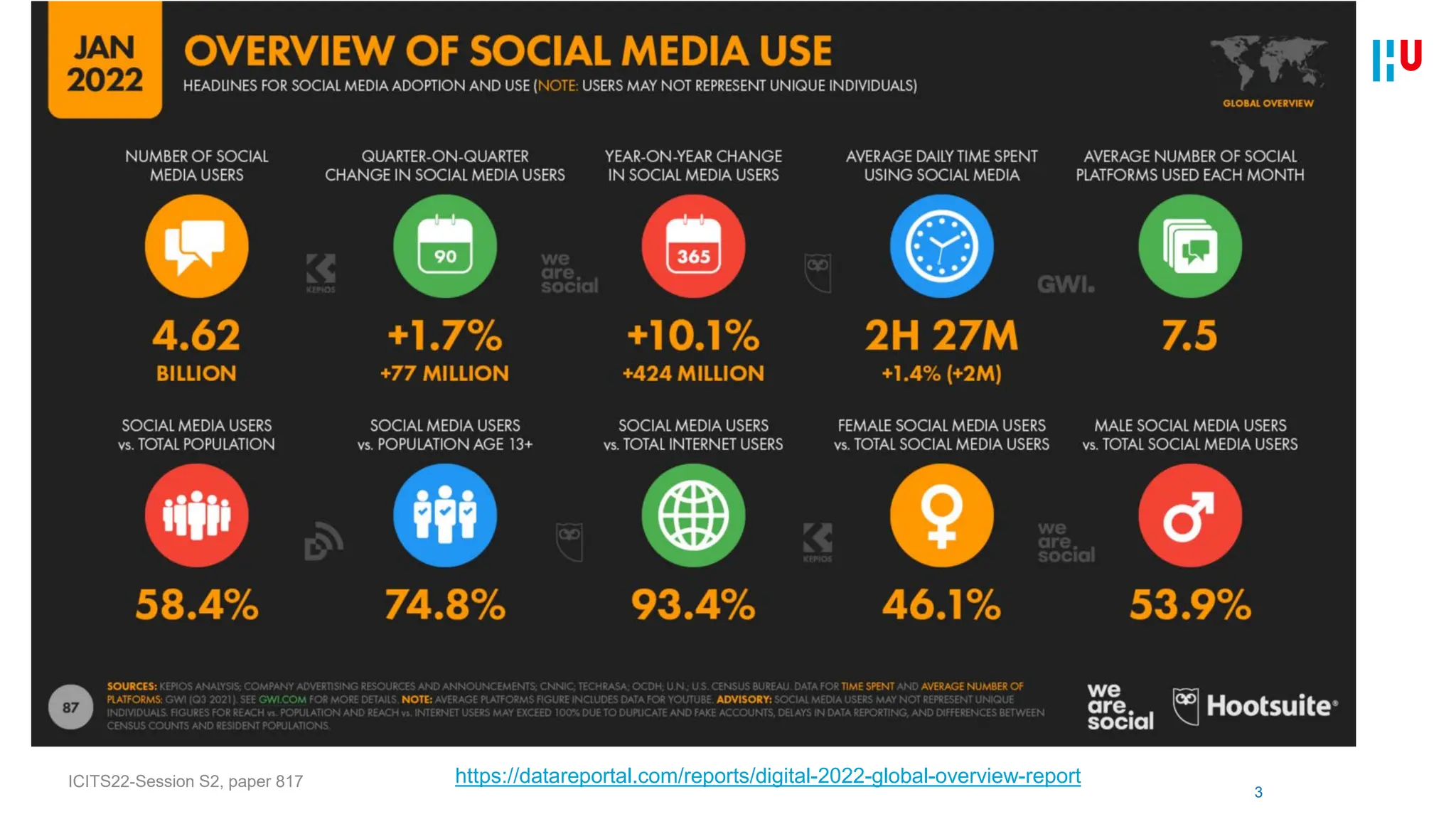
Global Social Media Use
https://datareportal.com/reports/digital-2022-global-overview-report
3
ICITS22-Session S2, paper 817
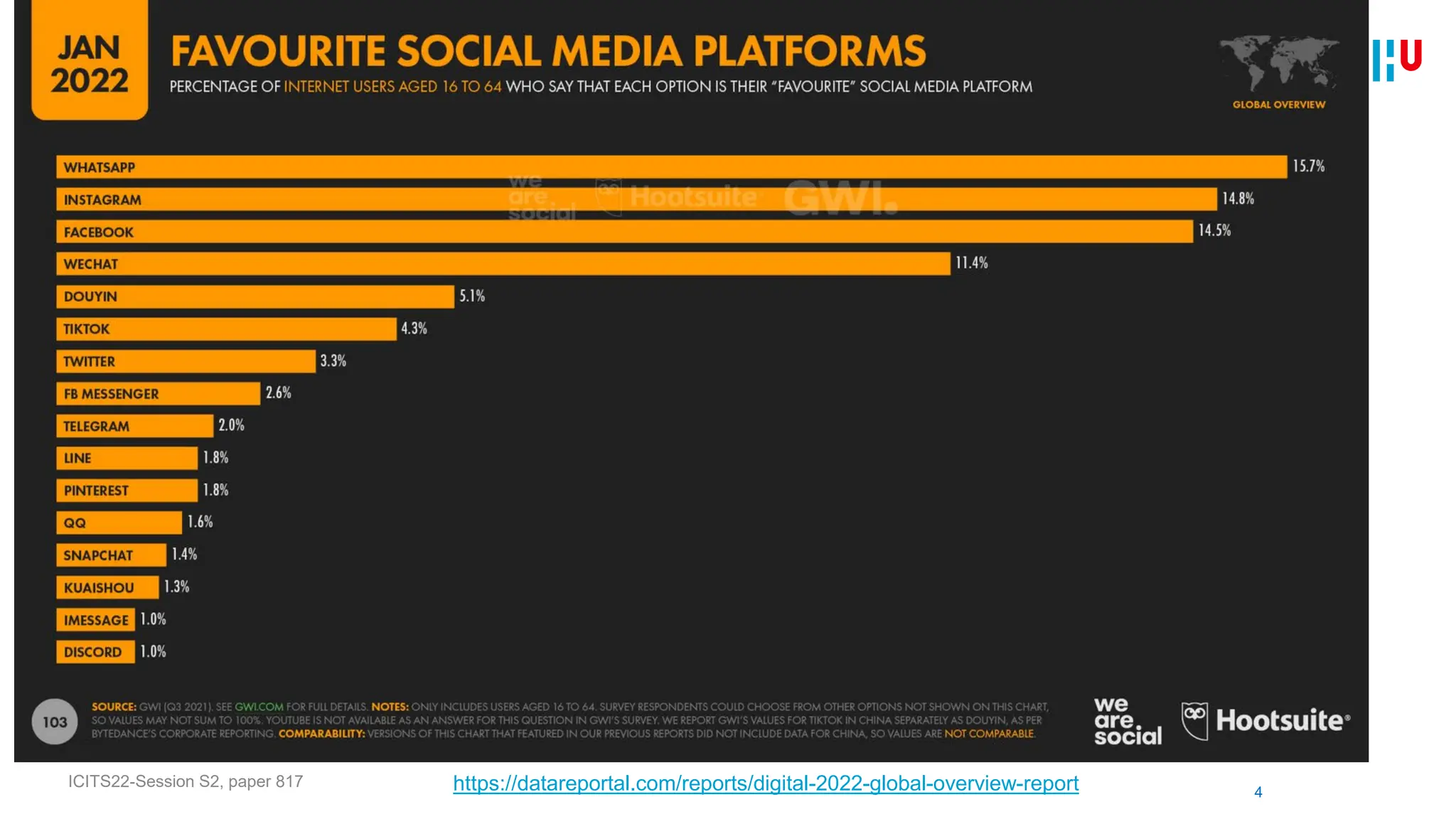
Most-Used Social Media
4
ICITS22-Session S2, paper 817 https://datareportal.com/reports/digital-2022-global-overview-report
Social Media & Development NGOs
• Development NGOs active players in international development.
• More and more development NGOs are harnessing the power of the
Internet/social media to affect change (cf. Ørecomm, 2012).
• How social media is used in development is key issue for development
NGOs (e.g. Carboni and Maxwell, 2015)
5
ICITS22-Session S2, paper 817
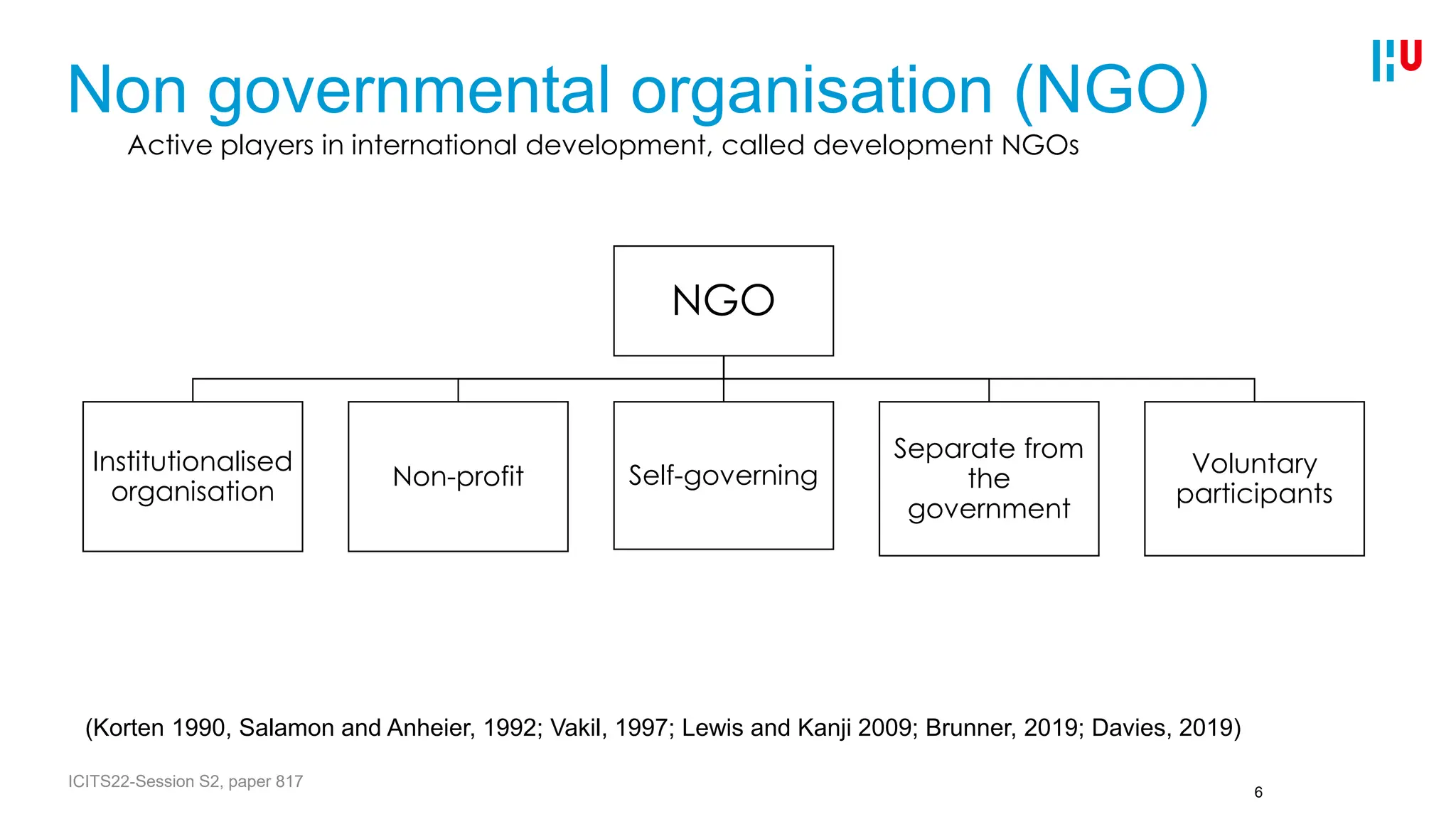
Non governmental organisation (NGO)
NGO
Institutionalised
organisation
Non-profit Self-governing
Separate from
the
government
Voluntary
participants
(Korten 1990, Salamon and Anheier, 1992; Vakil, 1997; Lewis and Kanji 2009; Brunner, 2019; Davies, 2019)
6
Active players in international development, called development NGOs
ICITS22-Session S2, paper 817
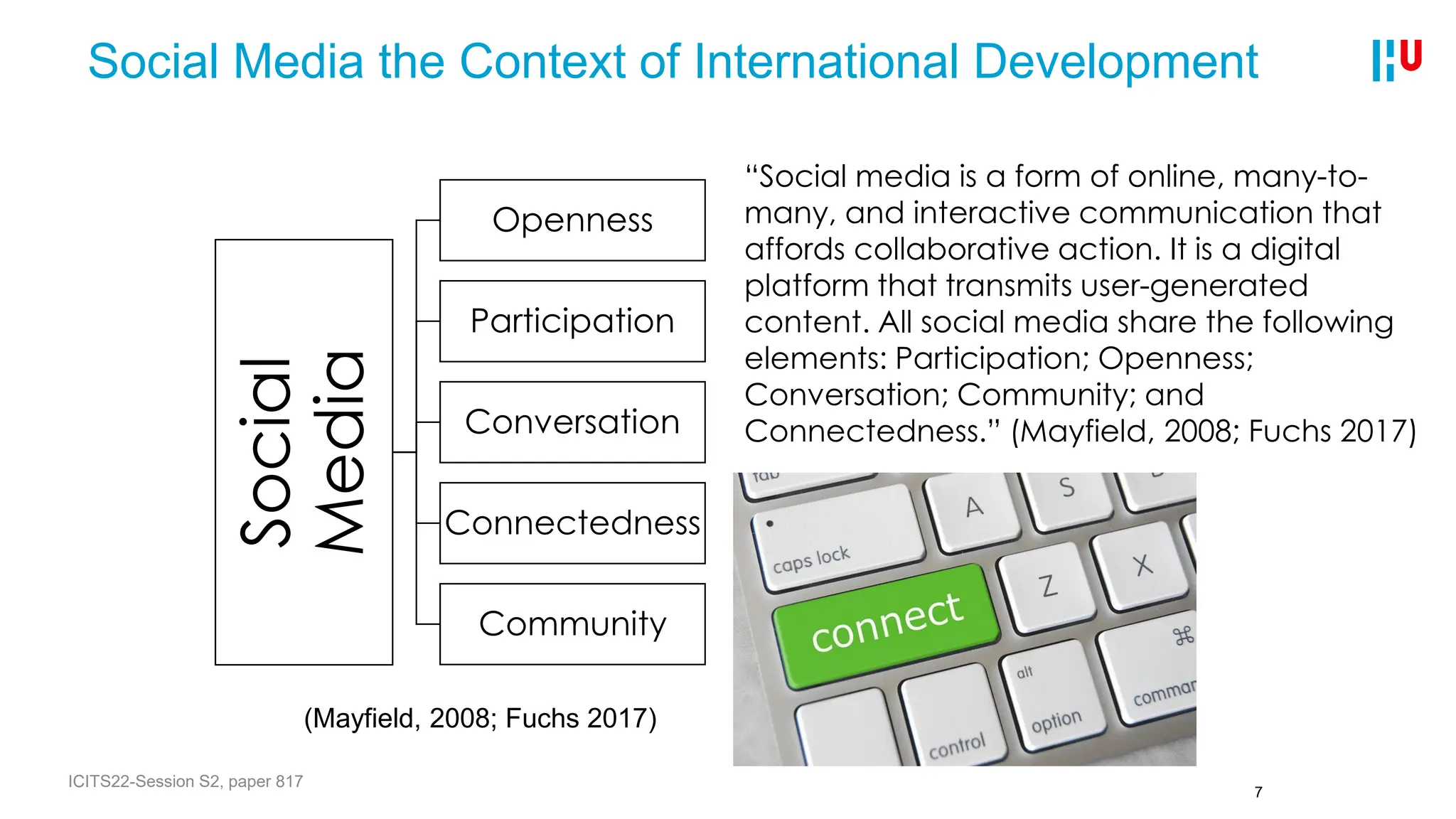
Social Media the Context of International Development
Social
Media
Openness
Participation
Conversation
Connectedness
Community
(Mayfield, 2008; Fuchs 2017)
7
ICITS22-Session S2, paper 817
“Social media is a form of online, many-to-
many, and interactive communication that
affords collaborative action. It is a digital
platform that transmits user-generated
content. All social media share the following
elements: Participation; Openness;
Conversation; Community; and
Connectedness.” (Mayfield, 2008; Fuchs 2017)
Research Approach
• Research question: What impact does the intensive use of
the Internet or social media for their development activities
have on Northern-based development NGOs?
• Exploratory nature of the study: qualitative research
• Multiple case study – analytical units: (digital) social
entrepreneurship and the provision of digital services.
• Case selection: Dutch development NGOs intensively using
social media and internet services for their development
activities.
• Main data sources: interviews, supported by various types
of secondary data.
ICITS22-Session S2, paper 817 8
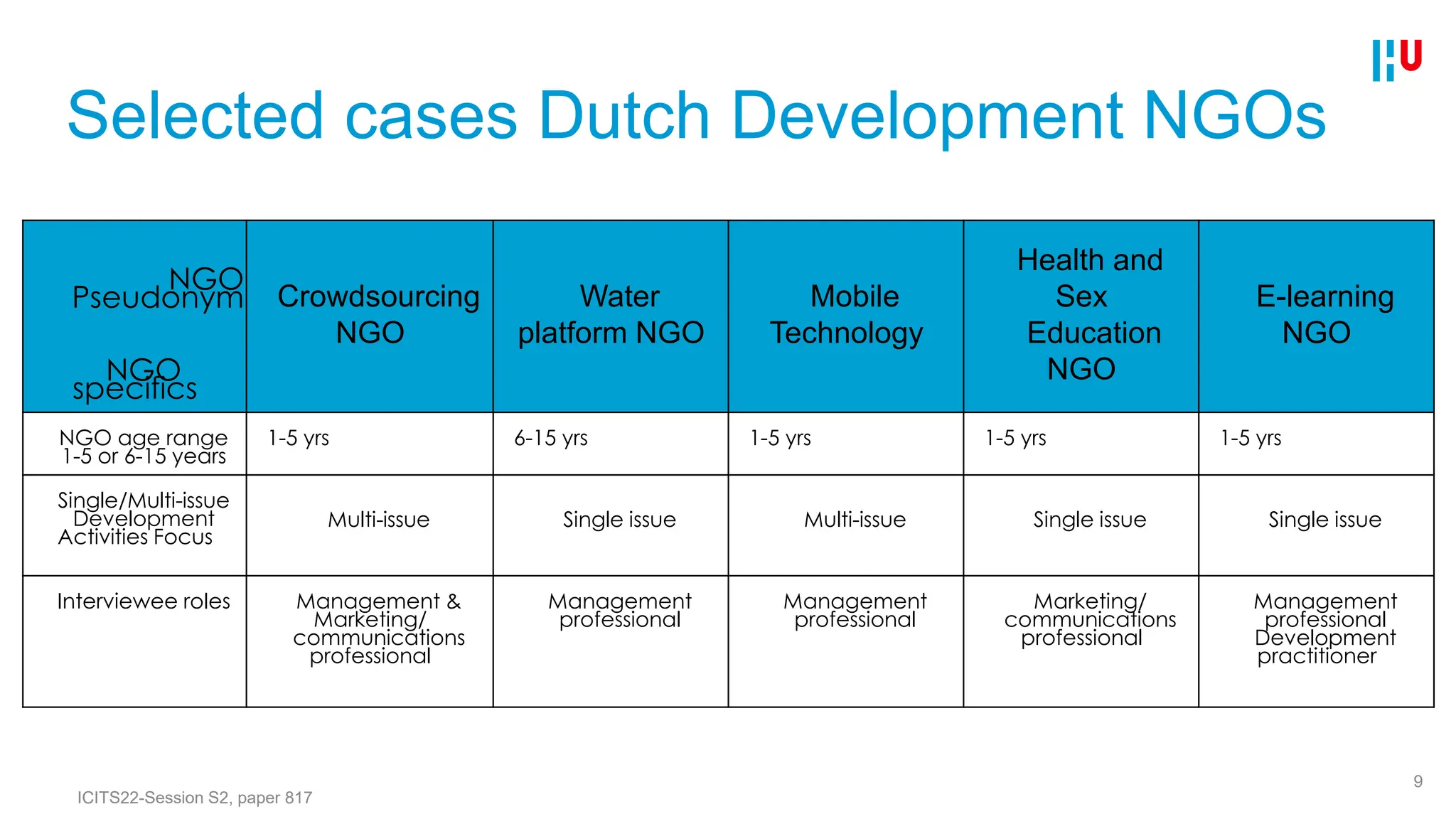
Selected cases Dutch Development NGOs
NGO
Pseudonym
NGO
specifics
Crowdsourcing
NGO
Water
platform NGO
Mobile
Technology
Health and
Sex
Education
NGO
E-learning
NGO
NGO age range
1-5 or 6-15 years
1-5 yrs 6-15 yrs 1-5 yrs 1-5 yrs 1-5 yrs
Single/Multi-issue
Development
Activities Focus
Multi-issue Single issue Multi-issue Single issue Single issue
Interviewee roles Management &
Marketing/
communications
professional
Management
professional
Management
professional
Marketing/
communications
professional
Management
professional
Development
practitioner
9
ICITS22-Session S2, paper 817
Findings business-like behaviour sampled Dutch development NGOs (1/2)
3.1 Hiring staff with non-traditional background for
development NGO
“The strength is in the inclusion of people from
outside your [ed. development] sector. (…) From
that perspective, we started to think, how can it be
improved? We said: let us forget everything that is
already being done. Let us assume we must start
all over again. How would you then organise?”
(management professional, Water Platform NGO)
3.2 Managerial Professionalisation.
At the Water Platform NGO and the Mobile
Technology NGO, staff with a business
management background were recruited (also at
the management level).
3.3 Establishing themselves as hybrid NGO
“The Mobile Technology NGO from the beginning
had a business model. We are being hired by
NGOs, businesses and governments to reach
specific target groups in developing countries.
The organisation is no partner in the MFS-subsidies
[ed. Dutch government’s international aid funding
scheme] but works as sub-contractor for one of the
alliances of development NGOs.” (management
professional, Mobile Technology NGO)
3.4 Service delivery to other NGOs
The Health and Sex Education for Youngsters NGO
combines offline entertainment/edutainment
events targeted at youth with social media
marketing and offers this as a social franchise
concept.
The Mobile Technology NGO has started offering
social marketing campaigns or data collection
services to other organisations, specifically
development NGOs in the Global South.
10
ICITS22-Session
S2,
paper
817
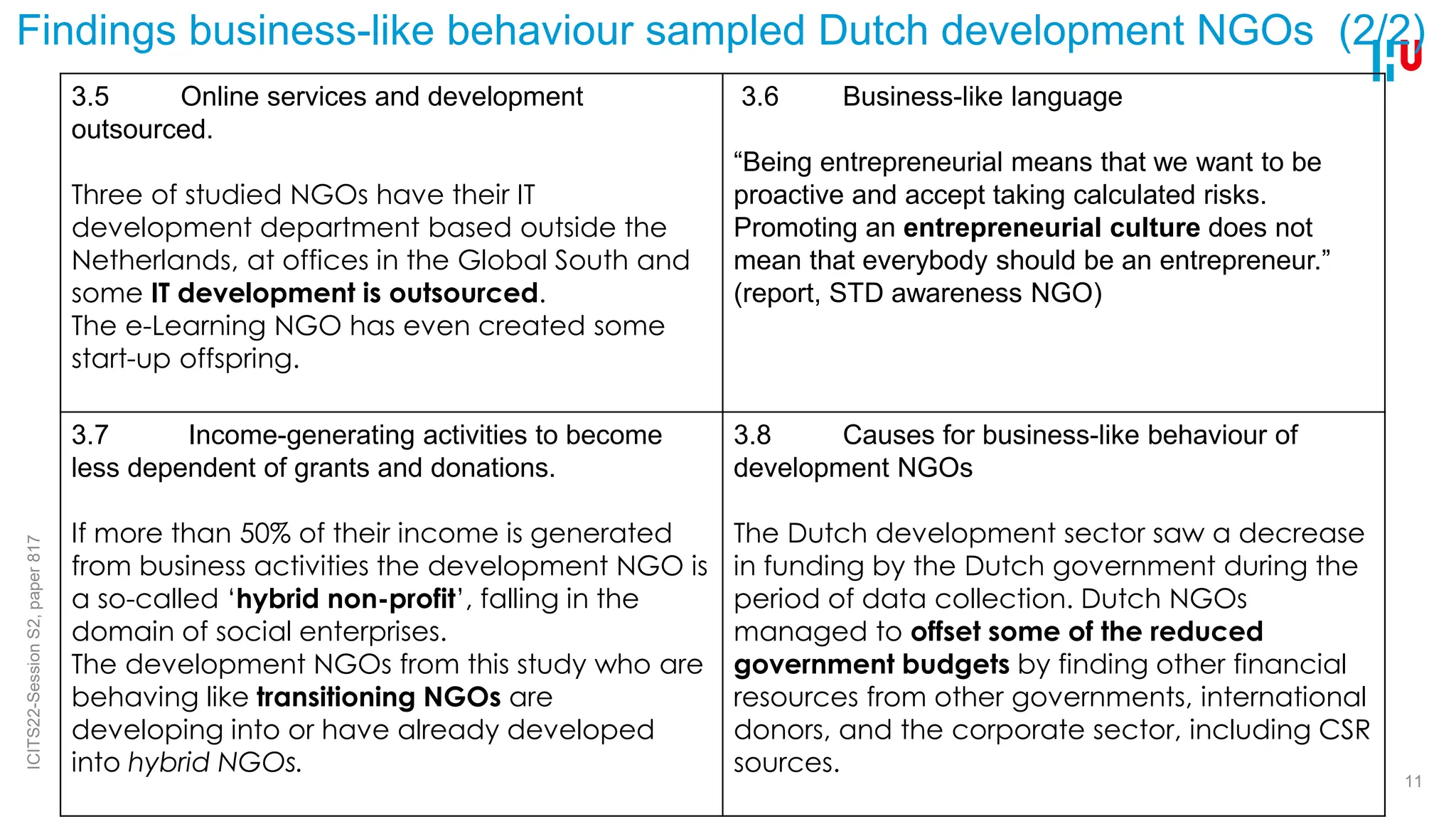
Findings business-like behaviour sampled Dutch development NGOs (2/2)
3.5 Online services and development
outsourced.
Three of studied NGOs have their IT
development department based outside the
Netherlands, at offices in the Global South and
some IT development is outsourced.
The e-Learning NGO has even created some
start-up offspring.
3.6 Business-like language
“Being entrepreneurial means that we want to be
proactive and accept taking calculated risks.
Promoting an entrepreneurial culture does not
mean that everybody should be an entrepreneur.”
(report, STD awareness NGO)
3.7 Income-generating activities to become
less dependent of grants and donations.
If more than 50% of their income is generated
from business activities the development NGO is
a so-called ‘hybrid non-profit’, falling in the
domain of social enterprises.
The development NGOs from this study who are
behaving like transitioning NGOs are
developing into or have already developed
into hybrid NGOs.
3.8 Causes for business-like behaviour of
development NGOs
The Dutch development sector saw a decrease
in funding by the Dutch government during the
period of data collection. Dutch NGOs
managed to offset some of the reduced
government budgets by finding other financial
resources from other governments, international
donors, and the corporate sector, including CSR
sources.
11
ICITS22-Session
S2,
paper
817
Findings & Discussion Summary
12
NGO Pseudonym
Observed specifics
Crowdsourcing
NGO
Water
platform
NGO
Mobile
Technology
Health
and
Sex
Education
NGO
E-learning
NGO
Related literature
NGO age range 1-5 or 6-15 years 1-5 6-15 1-5 1-5 1-5
Single/Multi-issue
activities M S M S S
Interviewee role:
a) Management
b) Marketing / Communications
c) Development practitioner
a,b a a b a,c
The integrated nature of ICT like in activities
/ services of the NGO     
Crowdsourcing NGO is channelling growth in philanthropy [5].
Digital technology embedded in offered services facilitates
entrepreneurial agency [48].
Organisational structure atypical for development NGO
 
Organisation structure; separating start-ups [35].
The use of new ICTs necessitated the influx
of skilled personnel.
    
Professionalism in substantive fields, where experts in the
subject matter are positioned [36]. Business-like rhetoric [49].
Management hired with non-humanitarian background
  
The transition toward a focus on service delivery
    
Marketisation of relationships [35, 50].
Establishing themselves as hybrid NGO [38, 51, 52];
Digital social enterprise [40].
Funding less dependent of grants and donations
    
Hybridising towards the market sphere [53].
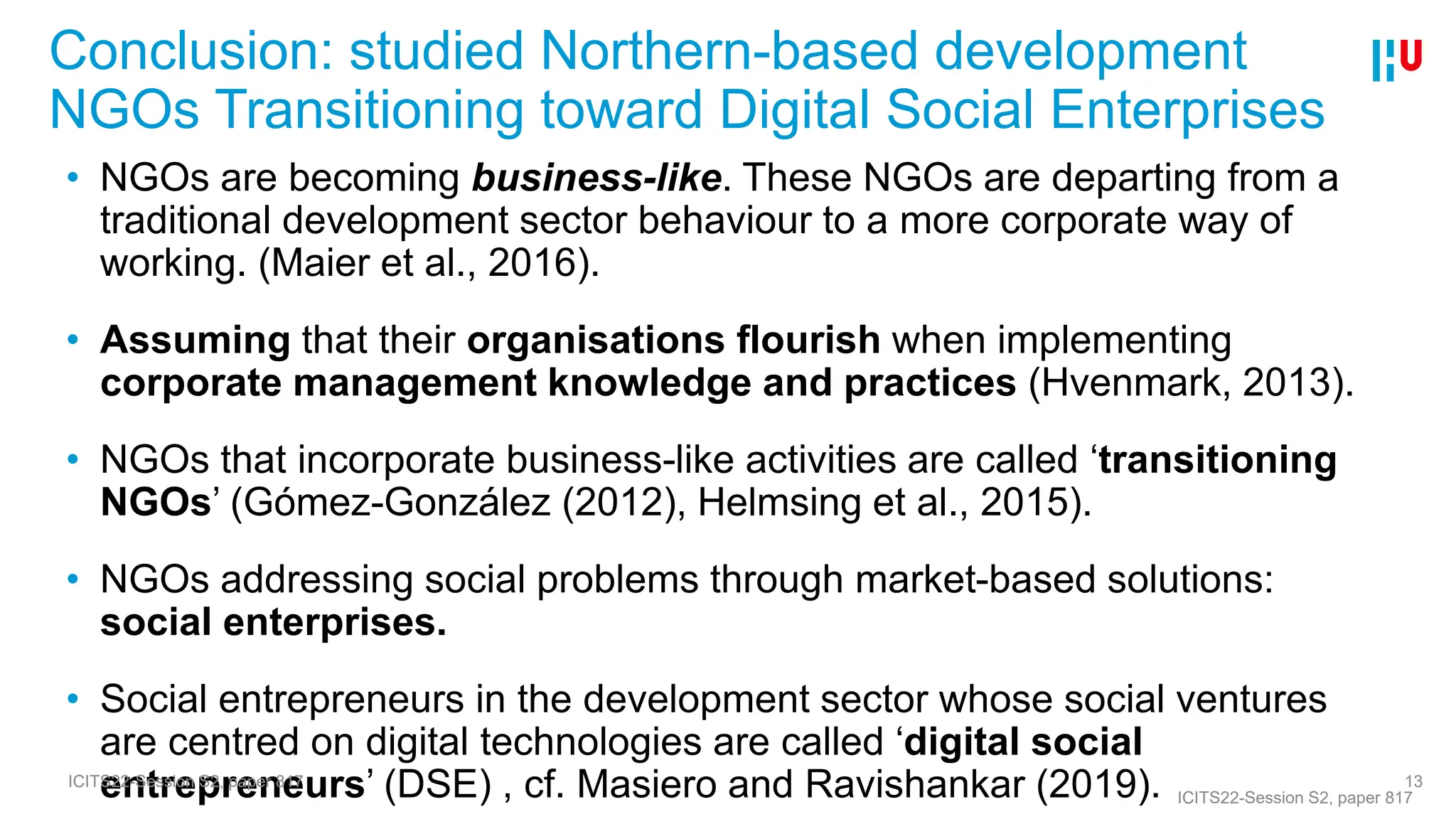
Conclusion: studied Northern-based development
NGOs Transitioning toward Digital Social Enterprises
13
• NGOs are becoming business-like. These NGOs are departing from a
traditional development sector behaviour to a more corporate way of
working. (Maier et al., 2016).
• Assuming that their organisations flourish when implementing
corporate management knowledge and practices (Hvenmark, 2013).
• NGOs that incorporate business-like activities are called ‘transitioning
NGOs’ (Gómez-González (2012), Helmsing et al., 2015).
• NGOs addressing social problems through market-based solutions:
social enterprises.
• Social entrepreneurs in the development sector whose social ventures
are centred on digital technologies are called ‘digital social
entrepreneurs’ (DSE) , cf. Masiero and Ravishankar (2019). ICITS22-Session S2, paper 817
ICITS22-Session S2, paper 817
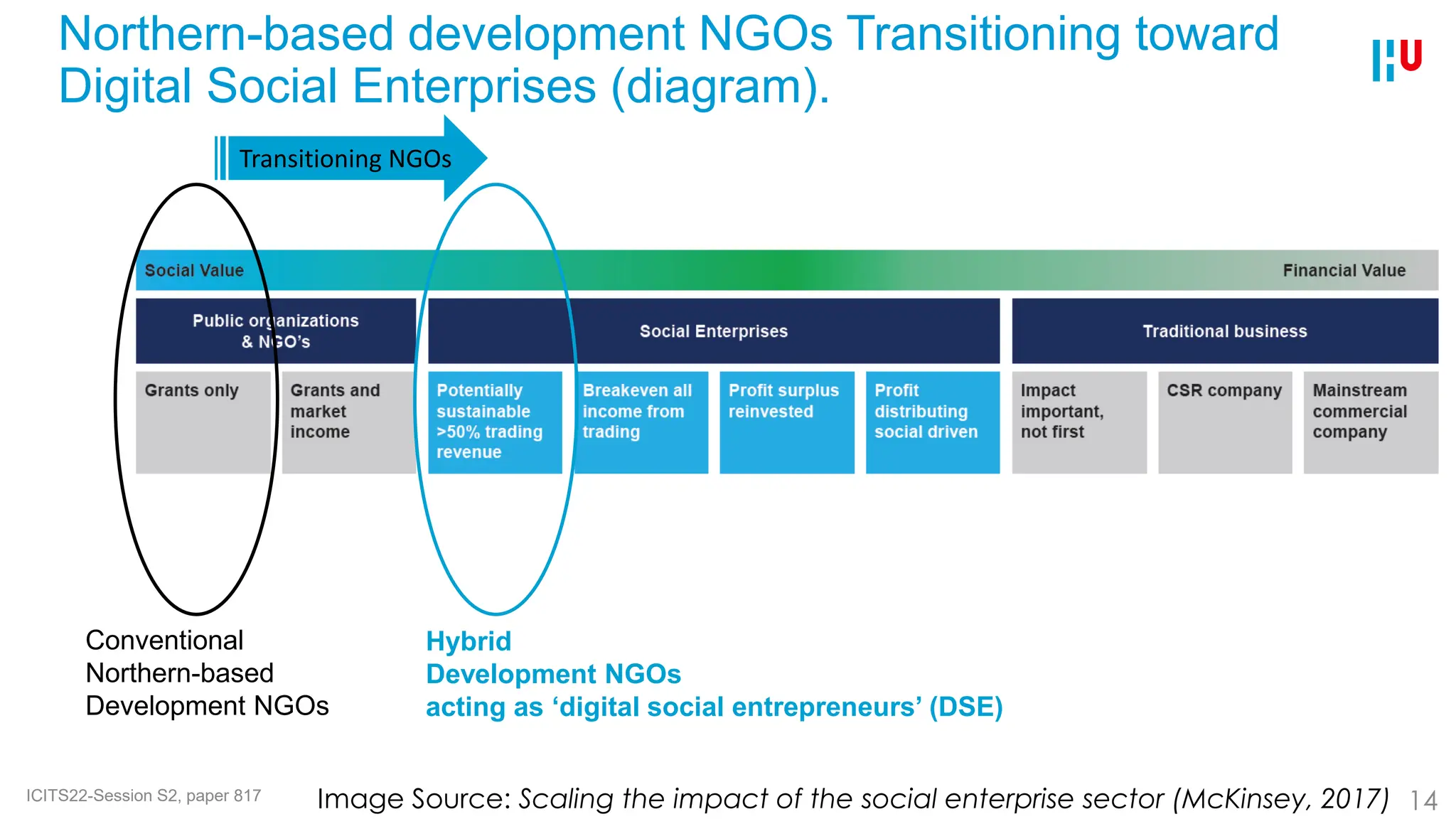
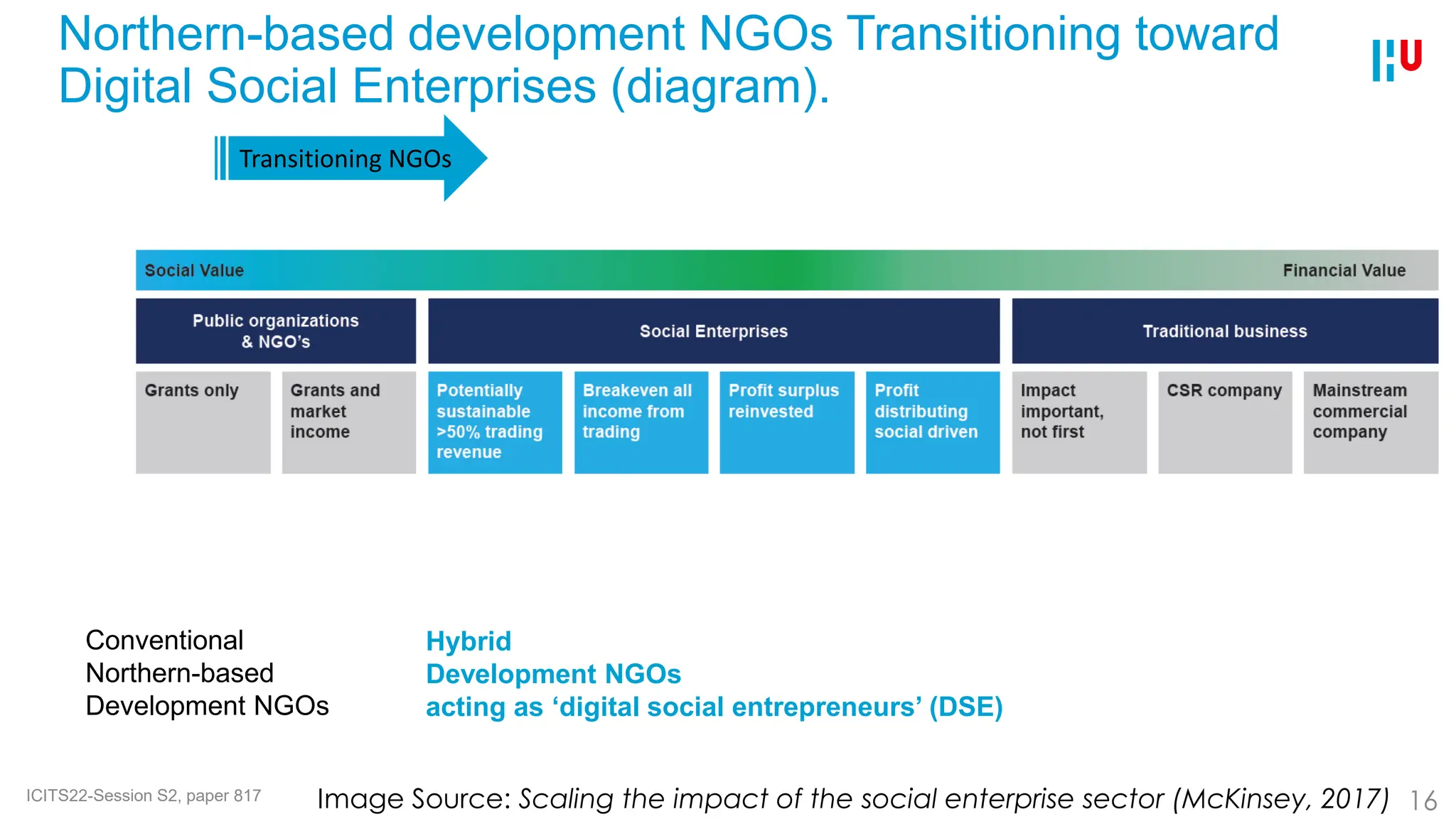
Northern-based development NGOs Transitioning toward
Digital Social Enterprises (diagram).
14
Image Source: Scaling the impact of the social enterprise sector (McKinsey, 2017)
Transitioning NGOs
Conventional
Northern-based
Development NGOs
Hybrid
Development NGOs
acting as ‘digital social entrepreneurs’ (DSE)
ICITS22-Session S2, paper 817
Q&A
15
ICITS22-Session S2, paper 817
Anand Sheombar* & Pascal Ravesteijn
* Presenter’s correspondence email: anand.sheombar@hu.nl
Northern-based development NGOs Transitioning toward
Digital Social Enterprises (diagram).
16
Image Source: Scaling the impact of the social enterprise sector (McKinsey, 2017)
Transitioning NGOs
Conventional
Northern-based
Development NGOs
Hybrid
Development NGOs
acting as ‘digital social entrepreneurs’ (DSE)
ICITS22-Session S2, paper 817

Digital Transformation of Development NGOs : the Case of Transitioning Northern-based Development NGOs

  • 1.
    Digital Transformation of Development NGOs theCase of Transitioning Northern-based Development NGOs ICTS22 9 February 2022 – Session S2, paper 817 Anand Sheombar* & Pascal Ravesteijn * Presenter’s correspondence email: anand.sheombar@hu.nl HU University of Applied Sciences Utrecht, The Netherlands ICITS'22 - The 2022 (Online) International Conference on Information Technology & Systems
  • 2.
    Paper abstract – outlinepresentation This paper presents an exploration into how Northern- based development NGOs might change into digital social entrepreneurs while using the Internet or social media for their ICT for Development (ICT4D) related projects. The research explores the role of the Internet and social media in Northern-based development NGOs transitioning toward digital social entrepreneurship. This digital transformation observation is based on the findings of a multiple case study analysis using data from interviews, social media communications and reports of Dutch development NGOs. We observed a trend of service delivery by development NGOs -some young and small NGOs- transitioning to digital social enterprises, being less dependent on government funding. The implications are that Northern-based development NGOs could be competing with local Southern NGOs or other local actors working on development. Furthermore, we suggest more research on the organisational transformations ICT induces in the field of development activities. 2 Digital Transformation of Development NGOs the Case of Transitioning Northern-based Development NGOs (Online) Session S2, paper 817
  • 3.
    Global Social MediaUse https://datareportal.com/reports/digital-2022-global-overview-report 3 ICITS22-Session S2, paper 817
  • 4.
    Most-Used Social Media 4 ICITS22-SessionS2, paper 817 https://datareportal.com/reports/digital-2022-global-overview-report
  • 5.
    Social Media &Development NGOs • Development NGOs active players in international development. • More and more development NGOs are harnessing the power of the Internet/social media to affect change (cf. Ørecomm, 2012). • How social media is used in development is key issue for development NGOs (e.g. Carboni and Maxwell, 2015) 5 ICITS22-Session S2, paper 817
  • 6.
    Non governmental organisation(NGO) NGO Institutionalised organisation Non-profit Self-governing Separate from the government Voluntary participants (Korten 1990, Salamon and Anheier, 1992; Vakil, 1997; Lewis and Kanji 2009; Brunner, 2019; Davies, 2019) 6 Active players in international development, called development NGOs ICITS22-Session S2, paper 817
  • 7.
    Social Media theContext of International Development Social Media Openness Participation Conversation Connectedness Community (Mayfield, 2008; Fuchs 2017) 7 ICITS22-Session S2, paper 817 “Social media is a form of online, many-to- many, and interactive communication that affords collaborative action. It is a digital platform that transmits user-generated content. All social media share the following elements: Participation; Openness; Conversation; Community; and Connectedness.” (Mayfield, 2008; Fuchs 2017)
  • 8.
    Research Approach • Researchquestion: What impact does the intensive use of the Internet or social media for their development activities have on Northern-based development NGOs? • Exploratory nature of the study: qualitative research • Multiple case study – analytical units: (digital) social entrepreneurship and the provision of digital services. • Case selection: Dutch development NGOs intensively using social media and internet services for their development activities. • Main data sources: interviews, supported by various types of secondary data. ICITS22-Session S2, paper 817 8
  • 9.
    Selected cases DutchDevelopment NGOs NGO Pseudonym NGO specifics Crowdsourcing NGO Water platform NGO Mobile Technology Health and Sex Education NGO E-learning NGO NGO age range 1-5 or 6-15 years 1-5 yrs 6-15 yrs 1-5 yrs 1-5 yrs 1-5 yrs Single/Multi-issue Development Activities Focus Multi-issue Single issue Multi-issue Single issue Single issue Interviewee roles Management & Marketing/ communications professional Management professional Management professional Marketing/ communications professional Management professional Development practitioner 9 ICITS22-Session S2, paper 817
  • 10.
    Findings business-like behavioursampled Dutch development NGOs (1/2) 3.1 Hiring staff with non-traditional background for development NGO “The strength is in the inclusion of people from outside your [ed. development] sector. (…) From that perspective, we started to think, how can it be improved? We said: let us forget everything that is already being done. Let us assume we must start all over again. How would you then organise?” (management professional, Water Platform NGO) 3.2 Managerial Professionalisation. At the Water Platform NGO and the Mobile Technology NGO, staff with a business management background were recruited (also at the management level). 3.3 Establishing themselves as hybrid NGO “The Mobile Technology NGO from the beginning had a business model. We are being hired by NGOs, businesses and governments to reach specific target groups in developing countries. The organisation is no partner in the MFS-subsidies [ed. Dutch government’s international aid funding scheme] but works as sub-contractor for one of the alliances of development NGOs.” (management professional, Mobile Technology NGO) 3.4 Service delivery to other NGOs The Health and Sex Education for Youngsters NGO combines offline entertainment/edutainment events targeted at youth with social media marketing and offers this as a social franchise concept. The Mobile Technology NGO has started offering social marketing campaigns or data collection services to other organisations, specifically development NGOs in the Global South. 10 ICITS22-Session S2, paper 817
  • 11.
    Findings business-like behavioursampled Dutch development NGOs (2/2) 3.5 Online services and development outsourced. Three of studied NGOs have their IT development department based outside the Netherlands, at offices in the Global South and some IT development is outsourced. The e-Learning NGO has even created some start-up offspring. 3.6 Business-like language “Being entrepreneurial means that we want to be proactive and accept taking calculated risks. Promoting an entrepreneurial culture does not mean that everybody should be an entrepreneur.” (report, STD awareness NGO) 3.7 Income-generating activities to become less dependent of grants and donations. If more than 50% of their income is generated from business activities the development NGO is a so-called ‘hybrid non-profit’, falling in the domain of social enterprises. The development NGOs from this study who are behaving like transitioning NGOs are developing into or have already developed into hybrid NGOs. 3.8 Causes for business-like behaviour of development NGOs The Dutch development sector saw a decrease in funding by the Dutch government during the period of data collection. Dutch NGOs managed to offset some of the reduced government budgets by finding other financial resources from other governments, international donors, and the corporate sector, including CSR sources. 11 ICITS22-Session S2, paper 817
  • 12.
    Findings & DiscussionSummary 12 NGO Pseudonym Observed specifics Crowdsourcing NGO Water platform NGO Mobile Technology Health and Sex Education NGO E-learning NGO Related literature NGO age range 1-5 or 6-15 years 1-5 6-15 1-5 1-5 1-5 Single/Multi-issue activities M S M S S Interviewee role: a) Management b) Marketing / Communications c) Development practitioner a,b a a b a,c The integrated nature of ICT like in activities / services of the NGO      Crowdsourcing NGO is channelling growth in philanthropy [5]. Digital technology embedded in offered services facilitates entrepreneurial agency [48]. Organisational structure atypical for development NGO   Organisation structure; separating start-ups [35]. The use of new ICTs necessitated the influx of skilled personnel.      Professionalism in substantive fields, where experts in the subject matter are positioned [36]. Business-like rhetoric [49]. Management hired with non-humanitarian background    The transition toward a focus on service delivery      Marketisation of relationships [35, 50]. Establishing themselves as hybrid NGO [38, 51, 52]; Digital social enterprise [40]. Funding less dependent of grants and donations      Hybridising towards the market sphere [53].
  • 13.
    Conclusion: studied Northern-baseddevelopment NGOs Transitioning toward Digital Social Enterprises 13 • NGOs are becoming business-like. These NGOs are departing from a traditional development sector behaviour to a more corporate way of working. (Maier et al., 2016). • Assuming that their organisations flourish when implementing corporate management knowledge and practices (Hvenmark, 2013). • NGOs that incorporate business-like activities are called ‘transitioning NGOs’ (Gómez-González (2012), Helmsing et al., 2015). • NGOs addressing social problems through market-based solutions: social enterprises. • Social entrepreneurs in the development sector whose social ventures are centred on digital technologies are called ‘digital social entrepreneurs’ (DSE) , cf. Masiero and Ravishankar (2019). ICITS22-Session S2, paper 817 ICITS22-Session S2, paper 817
  • 14.
    Northern-based development NGOsTransitioning toward Digital Social Enterprises (diagram). 14 Image Source: Scaling the impact of the social enterprise sector (McKinsey, 2017) Transitioning NGOs Conventional Northern-based Development NGOs Hybrid Development NGOs acting as ‘digital social entrepreneurs’ (DSE) ICITS22-Session S2, paper 817
  • 15.
    Q&A 15 ICITS22-Session S2, paper817 Anand Sheombar* & Pascal Ravesteijn * Presenter’s correspondence email: anand.sheombar@hu.nl
  • 16.
    Northern-based development NGOsTransitioning toward Digital Social Enterprises (diagram). 16 Image Source: Scaling the impact of the social enterprise sector (McKinsey, 2017) Transitioning NGOs Conventional Northern-based Development NGOs Hybrid Development NGOs acting as ‘digital social entrepreneurs’ (DSE) ICITS22-Session S2, paper 817