bristol.ac.uk
Digital technologies, public
procurement and sustainability
Some exploratory thoughts
Prof Albert Sanchez-Graells
Patrimonial Law Research Group Seminar
Universitat Pompeu Fabra
Barcelona, 7 November 2019
bristol.ac.uk
Agenda
To reflect on the way in which
digitalisation can foster more sustainable
procurement, in the EU context
To stress the sine qua non importance of
building an enabling data architecture
To point at areas for further research
bristol.ac.uk
Using procurement to…
This is a classical topic
There are important background issues of
regulatory transfer and substitution, as well
as some contradictions in the way market
mechanisms want to be exploited in areas of
market failure
But let’s not get hang up on that …
bristol.ac.uk
Procurement and sustainability
Area of increasing policy-making attention, although progress
is much slower than would be necessary
Facilitating the inclusion of sustainability-related criteria in
procurement was one of the drivers for the 2014 new EU rules
Most problems are linked to implementation, not regulatory
design. Cost, complexity and institutional inertia are the main
obstacles
bristol.ac.uk
Strategic procurement
European Commission, ‘Making Procurement
work in and for Europe’ COM(2017) 572 final
• Need to facilitate and to further uptake of
strategic procurement, including SPP
• Proposals mostly geared towards
guidance, standardized solutions &
sharing of best practices
bristol.ac.uk
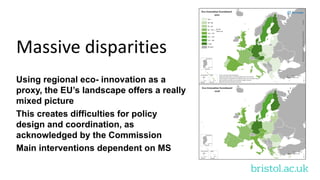
Massive disparities
Using regional eco- innovation as a
proxy, the EU’s landscape offers a really
mixed picture
This creates difficulties for policy
design and coordination, as
acknowledged by the Commission
Main interventions dependent on MS
bristol.ac.uk
Digital technologies
Big data/ML/AI, blockchain and IoT are the
new ‘El Dorado’
These are all immature technologies and the
hype and level of investment (diversion)
they are receiving seem disproportionate
A (more) critical look at their potential seems
necessary, in particular in relation to public
sector use cases - cfr OECD (2019a)
bristol.ac.uk
Procurement digitalisation
This is another strategic priority for the European Commission
Not only for procurement’s sake, but also in the context of the
wider strategy to create an AI-friendly regulatory environment and
to use procurement as a catalyst for innovations of broader
application – along lines of entrepreneurial State (Mazzucato, 2013)
bristol.ac.uk
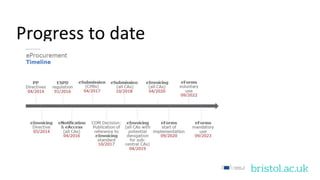
Progress to date
bristol.ac.uk
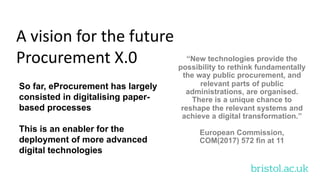
A vision for the future
Procurement X.0 “New technologies provide the
possibility to rethink fundamentally
the way public procurement, and
relevant parts of public
administrations, are organised.
There is a unique chance to
reshape the relevant systems and
achieve a digital transformation.”
European Commission,
COM(2017) 572 fin at 11
So far, eProcurement has largely
consisted in digitalising paper-
based processes
This is an enabler for the
deployment of more advanced
digital technologies
bristol.ac.uk
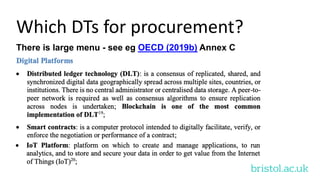
Which DTs for procurement?
There is large menu - see eg OECD (2019b) Annex C
bristol.ac.uk
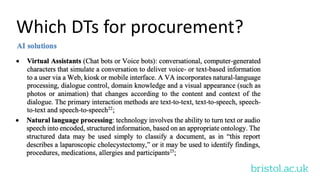
Which DTs for procurement?
bristol.ac.uk
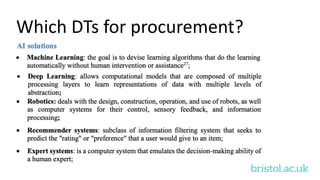
Which DTs for procurement?
bristol.ac.uk
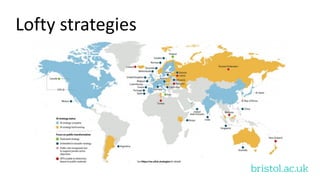
Lofty strategies
bristol.ac.uk
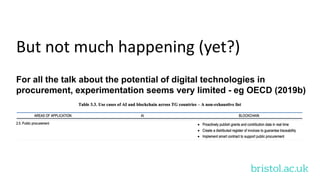
But not much happening (yet?)
For all the talk about the potential of digital technologies in
procurement, experimentation seems very limited - eg OECD (2019b)
bristol.ac.uk
Sustainable digital
procurement
The combined strategic goal / ideal would
be to harness the potential of digital
technologies to promote (more)
sustainable procurement
This is a difficult exercise, surrounded by
uncertainty, so the rest of this
presentation is all speculation
bristol.ac.uk
Short functional overview of DTs
AI is particularly apt for the massive processing of data (big data),
as well as for the implementation of data-based ML solutions and the
automation of some tasks (robotic process automation, RPA)
Blockchain is apt for the implementation of tamper-resistant/evident
decentralised data management
IoT is apt to automate the generation of some data and (could be?) apt
to breach the virtual/real frontier through oracle-enabled robotics
bristol.ac.uk
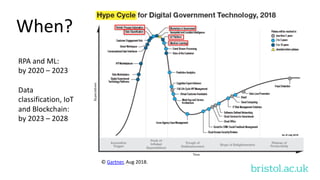
When?
© Gartner, Aug 2018.
RPA and ML:
by 2020 – 2023
Data
classification, IoT
and Blockchain:
by 2023 – 2028
bristol.ac.uk
Data as the priority
No data, no fun – as recognised by
Commission in its push for more, better data
Difficulties in the generation of data
Initiatives to correct it for the future (OCDS,
eForms, eGoverment APIs, Open Data
Directive, B2G data sharing)
More needs to be done to generate
backward-looking databases
bristol.ac.uk
What can AI do for SPP?
If/when data is available, there is scope for
• Sustainability-oriented (big) data analytics
• Development of sustainability screens/indexes
• ML-supported data analysis with sustainability goals
• Sustainability-oriented procurement planning
bristol.ac.uk
What can AI do for SPP?
Where clear rules/policies are specified, there is scope for
• Compliance automation
• Recommender/expert systems
• Chatbot-enabled guidance
Could AI ever generate new sustainability policies?
bristol.ac.uk
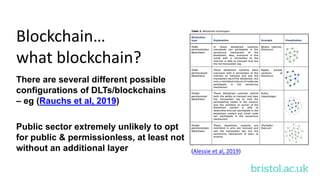
Blockchain…
what blockchain?
There are several different possible
configurations of DLTs/blockchains
– eg (Rauchs et al, 2019)
Public sector extremely unlikely to opt
for public & permissionless, at least not
without an additional layer (Alessie et al, 2019)
bristol.ac.uk
What about blockchain?
Sustainable blockchain solutions (ie private
& permissioned, PoS) likely to present very
limited advantages for procurement
Technical solution cannot fix complexity, eg
• Tenders on a blockchain
• Smart (public) contracts
• Blockchain as an information exchange
platform (Mélon, 2019)
bristol.ac.uk
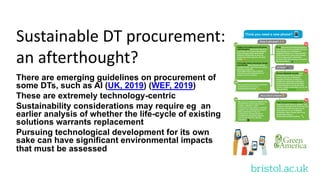
Sustainable DT procurement:
an afterthought?
There are emerging guidelines on procurement of
some DTs, such as AI (UK, 2019) (WEF, 2019)
These are extremely technology-centric
Sustainability considerations may require eg an
earlier analysis of whether the life-cycle of existing
solutions warrants replacement
Pursuing technological development for its own
sake can have significant environmental impacts
that must be assessed
bristol.ac.uk
Final thoughts
The main area of effort for policy-makers
should now be in creating an enabling data
architecture. Its regulation can focus
research in S/T
In the M/T research should be on the design
of DT-enabled solutions (for SPP) and their
regulation/ governance/ social impact
L/T there is too much uncertainty
bristol.ac.uk
Further reading
Sanchez-Graells, A, “Data-driven procurement governance: two well-known elephant tales”
(2019) 24(4) Communications Law 157-170. https://ssrn.com/abstract=3440552.
Sanchez-Graells, A, “Some public procurement challenges in supporting and delivering
smart urban mobility: procurement data, discretion and expertise”, in M Finck, M Lamping,
V Moscon & H Richter (eds), Smart Urban Mobility – Law, Regulation, and Policy, MPI
Studies on Intellectual Property and Competition Law (Springer 2020) forthcoming.
https://ssrn.com/abstract=3452045.
Sanchez-Graells, A, “EU Public Procurement Policy and the Fourth Industrial Revolution:
Pushing and Pulling as One?”, Working Paper for the YEL Annual Conference 2019 ‘EU
Law in the era of the Fourth Industrial Revolution’. https://ssrn.com/abstract=3440554.
bristol.ac.uk
Thank you for your
attention & stay in touch
a.sanchez-graells@bristol.ac.uk
@asanchezgraells

Digital technologies, public procurement and sustainability

  • 1.
    bristol.ac.uk Digital technologies, public procurementand sustainability Some exploratory thoughts Prof Albert Sanchez-Graells Patrimonial Law Research Group Seminar Universitat Pompeu Fabra Barcelona, 7 November 2019
  • 2.
    bristol.ac.uk Agenda To reflect onthe way in which digitalisation can foster more sustainable procurement, in the EU context To stress the sine qua non importance of building an enabling data architecture To point at areas for further research
  • 3.
    bristol.ac.uk Using procurement to… Thisis a classical topic There are important background issues of regulatory transfer and substitution, as well as some contradictions in the way market mechanisms want to be exploited in areas of market failure But let’s not get hang up on that …
  • 4.
    bristol.ac.uk Procurement and sustainability Areaof increasing policy-making attention, although progress is much slower than would be necessary Facilitating the inclusion of sustainability-related criteria in procurement was one of the drivers for the 2014 new EU rules Most problems are linked to implementation, not regulatory design. Cost, complexity and institutional inertia are the main obstacles
  • 5.
    bristol.ac.uk Strategic procurement European Commission,‘Making Procurement work in and for Europe’ COM(2017) 572 final • Need to facilitate and to further uptake of strategic procurement, including SPP • Proposals mostly geared towards guidance, standardized solutions & sharing of best practices
  • 6.
    bristol.ac.uk Massive disparities Using regionaleco- innovation as a proxy, the EU’s landscape offers a really mixed picture This creates difficulties for policy design and coordination, as acknowledged by the Commission Main interventions dependent on MS
  • 7.
    bristol.ac.uk Digital technologies Big data/ML/AI,blockchain and IoT are the new ‘El Dorado’ These are all immature technologies and the hype and level of investment (diversion) they are receiving seem disproportionate A (more) critical look at their potential seems necessary, in particular in relation to public sector use cases - cfr OECD (2019a)
  • 8.
    bristol.ac.uk Procurement digitalisation This isanother strategic priority for the European Commission Not only for procurement’s sake, but also in the context of the wider strategy to create an AI-friendly regulatory environment and to use procurement as a catalyst for innovations of broader application – along lines of entrepreneurial State (Mazzucato, 2013)
  • 9.
  • 10.
    bristol.ac.uk A vision forthe future Procurement X.0 “New technologies provide the possibility to rethink fundamentally the way public procurement, and relevant parts of public administrations, are organised. There is a unique chance to reshape the relevant systems and achieve a digital transformation.” European Commission, COM(2017) 572 fin at 11 So far, eProcurement has largely consisted in digitalising paper- based processes This is an enabler for the deployment of more advanced digital technologies
  • 11.
    bristol.ac.uk Which DTs forprocurement? There is large menu - see eg OECD (2019b) Annex C
  • 12.
  • 13.
  • 14.
  • 15.
    bristol.ac.uk But not muchhappening (yet?) For all the talk about the potential of digital technologies in procurement, experimentation seems very limited - eg OECD (2019b)
  • 16.
    bristol.ac.uk Sustainable digital procurement The combinedstrategic goal / ideal would be to harness the potential of digital technologies to promote (more) sustainable procurement This is a difficult exercise, surrounded by uncertainty, so the rest of this presentation is all speculation
  • 17.
    bristol.ac.uk Short functional overviewof DTs AI is particularly apt for the massive processing of data (big data), as well as for the implementation of data-based ML solutions and the automation of some tasks (robotic process automation, RPA) Blockchain is apt for the implementation of tamper-resistant/evident decentralised data management IoT is apt to automate the generation of some data and (could be?) apt to breach the virtual/real frontier through oracle-enabled robotics
  • 18.
    bristol.ac.uk When? © Gartner, Aug2018. RPA and ML: by 2020 – 2023 Data classification, IoT and Blockchain: by 2023 – 2028
  • 19.
    bristol.ac.uk Data as thepriority No data, no fun – as recognised by Commission in its push for more, better data Difficulties in the generation of data Initiatives to correct it for the future (OCDS, eForms, eGoverment APIs, Open Data Directive, B2G data sharing) More needs to be done to generate backward-looking databases
  • 20.
    bristol.ac.uk What can AIdo for SPP? If/when data is available, there is scope for • Sustainability-oriented (big) data analytics • Development of sustainability screens/indexes • ML-supported data analysis with sustainability goals • Sustainability-oriented procurement planning
  • 21.
    bristol.ac.uk What can AIdo for SPP? Where clear rules/policies are specified, there is scope for • Compliance automation • Recommender/expert systems • Chatbot-enabled guidance Could AI ever generate new sustainability policies?
  • 22.
    bristol.ac.uk Blockchain… what blockchain? There areseveral different possible configurations of DLTs/blockchains – eg (Rauchs et al, 2019) Public sector extremely unlikely to opt for public & permissionless, at least not without an additional layer (Alessie et al, 2019)
  • 23.
    bristol.ac.uk What about blockchain? Sustainableblockchain solutions (ie private & permissioned, PoS) likely to present very limited advantages for procurement Technical solution cannot fix complexity, eg • Tenders on a blockchain • Smart (public) contracts • Blockchain as an information exchange platform (Mélon, 2019)
  • 24.
    bristol.ac.uk Sustainable DT procurement: anafterthought? There are emerging guidelines on procurement of some DTs, such as AI (UK, 2019) (WEF, 2019) These are extremely technology-centric Sustainability considerations may require eg an earlier analysis of whether the life-cycle of existing solutions warrants replacement Pursuing technological development for its own sake can have significant environmental impacts that must be assessed
  • 25.
    bristol.ac.uk Final thoughts The mainarea of effort for policy-makers should now be in creating an enabling data architecture. Its regulation can focus research in S/T In the M/T research should be on the design of DT-enabled solutions (for SPP) and their regulation/ governance/ social impact L/T there is too much uncertainty
  • 26.
    bristol.ac.uk Further reading Sanchez-Graells, A,“Data-driven procurement governance: two well-known elephant tales” (2019) 24(4) Communications Law 157-170. https://ssrn.com/abstract=3440552. Sanchez-Graells, A, “Some public procurement challenges in supporting and delivering smart urban mobility: procurement data, discretion and expertise”, in M Finck, M Lamping, V Moscon & H Richter (eds), Smart Urban Mobility – Law, Regulation, and Policy, MPI Studies on Intellectual Property and Competition Law (Springer 2020) forthcoming. https://ssrn.com/abstract=3452045. Sanchez-Graells, A, “EU Public Procurement Policy and the Fourth Industrial Revolution: Pushing and Pulling as One?”, Working Paper for the YEL Annual Conference 2019 ‘EU Law in the era of the Fourth Industrial Revolution’. https://ssrn.com/abstract=3440554.
  • 27.
    bristol.ac.uk Thank you foryour attention & stay in touch a.sanchez-graells@bristol.ac.uk @asanchezgraells