Andreas Mitschele-Thiel
Dieter Wuttke
TECHNISCHE
UNIVERSITÄT
ILMENAU
Integrated
Hard-
and
Software
Systems
http://www.tu-ilmenau.de/ihs
Digital Systems Design
2
Part I
IQtroduction
Digital Systems Design
3
Motivation for the Course – Why is this important?
Any computer system consists of hardware and software!
But: HW is often hidden and not considered important by SW developers
Indicators that HW is important:
Systems where HW/SW relation is obvious:
 embedded systems
 real-time systems
 reliable systems
 safety-critical systems
 capacity
 responsiveness and delay
 predictability
 reliability
 safety
 power consumption
 cost
 ...
=> Knowledge of HW/SW interaction is required!
What are „Integrated HW/SW-Systems“?
Digital Systems Design
4
Motivation for the Course – Why is this important?
Embedded programming without knowledge of HW/SW integration
Image
“borrowed”
from
an
Iomega
advertisement
for
Y2K
software
and
disk
drives,
Scientific
American
,
September
1999.
Image
“borrowed”
from
an
Iomega
advertisement
for
Y2K
software
and
disk
drives,
Scientific
American
,
September
1999.
Digital Systems Design
5
Motivation for the Course – Why is this important?
According to the International Data Corporation
 1997: 96% of all Internet-access devices shipped in the United
States were PCs
 End of 2002: less than 50% of them were PCs
Instead, digital set-top boxes, cell phones, and personal digital
assistants are sold
 Today: the most selling Internet-access devices are mobile phones
Information Technology Scenario
Digital Systems Design
6
Objectives
Let’s assume you are employed as a system architect with some company and
faced with the following task:
Given is some problem to be solved by some kind of computer system, e.g. an
ABS system for a car, a fly-by-wire system for a new Airbus, the control of a
microwave oven, a mobile phone, a corporate IP router, or the control unit of
some medical x-ray equipment.
The different systems have very different requirements, including real-time
constraints, reliability, cost, etc.
Your task is to select the most appropriate system design including HW
and SW, as well as the selection of the most appropriate design method and
tools.
The goal of the course is to provide the knowledge to make these kind of
decisions.
Digital Systems Design
7
Content IHS 2
 Motivation and overview
 Development process and tasks
 System requirements
 Behavioral models overview
 FSM, NDFSM, FSM composition
 PN, DFG, CFG, CDFG
 Specification languages details
 Statecharts
 SDL
 VHDL
 SystemC
 Functional validation
 Performance/temporal validation
 Optimization
Digital Systems Design
10
Organisational Stuff
Course prerequisites:
 Basics of digital systems
 Basics of computer architecture and computer design
Slides and additional information will be provided at
http://www.tu-ilmenau.de/ics
Instructor contact:
Andreas Mitschele-Thiel Dr. Dieter Wuttke
Office: Zusebau, Room 1032 Office: Zusebau, Room 1067
Email: mitsch@tu-ilmenau.de Email: dieter.wuttke@tu-ilmenau.de
Phone: 03677-69-2819 Phone: 03677-69-2820
Dr. Karsten Henke
Office: Zusebau, Room 2078
Email: karsten.henke@tu-ilmenau.de
Phone: 03677-69-1443
Digital Systems Design
11
Introduction
 Integrated HW/SW systems by example
 Issues of HW/SW systems development
Digital Systems Design
12
Some Examples of Systems with Tight HW/SW Interaction
Communication systems
 GSM/UMTS network elements
 IP router (QoS support)
 ATM switch
 GSM/UMTS mobile
Safety-critical systems
 fly-by-wire system
 ABS, ASR, ESP, etc.
 train control
 control of physical and chemical processes
Embedded systems (not user-programable)
 every-day-appliances (microwave oven, vending machine, mobile phone, ...)
 ABS
 ticket machine
 ...
Digital Systems Design
13
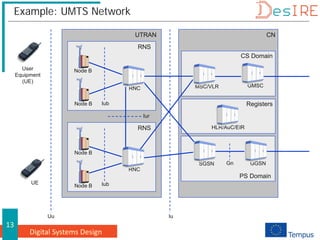
Example: UMTS Network
RNS
UTRAN CN
RNS
PS Domain
CS Domain
Registers
RNC
RNC
MSC/VLR GMSC
HLR/AuC/EIR
SGSN GGSN
Node B
Node B
Node B
Node B
UE
User
Equipment
(UE)
Iu
Uu
Iub
Iub
Iur
Gn
Digital Systems Design
14
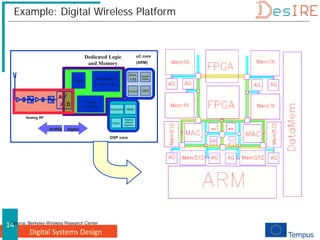
Example: Digital Wireless Platform
A
D
Analog RF
Timing
recovery
phone
book
Java
VM
ARQ
Keypad,
Display
Control
Filters
Adaptive
Antenna
Algorithm
Equalizers MUD
Accelerators
(bit level)
analog digital
DSP core
uC core
(ARM)
Logic
Dedicated Logic
and Memory
Source: Berkeley Wireless Research Center
Digital Systems Design
15
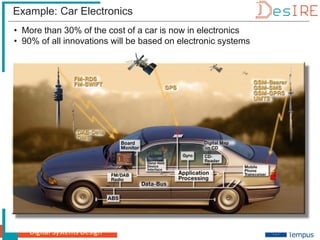
Example: Car Electronics
• More than 30% of the cost of a car is now in electronics
• 90% of all innovations will be based on electronic systems
Digital Systems Design
16
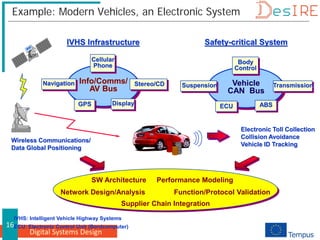
Example: Modern Vehicles, an Electronic System
Electronic Toll Collection
Collision Avoidance
Vehicle ID Tracking
Safety-critical System
Vehicle
CAN Bus
Body
Control
ECU ABS
Suspension Transmission
IVHS Infrastructure
Wireless Communications/
Data Global Positioning
Info/Comms/
AV Bus
Cellular
Phone
GPS Display
Navigation Stereo/CD
SW Architecture
Network Design/Analysis Function/Protocol Validation
Performance Modeling
Supplier Chain Integration
IVHS: Intelligent Vehicle Highway Systems
ECU: Electronic Control Unit (Bordcomputer)
Digital Systems Design
17
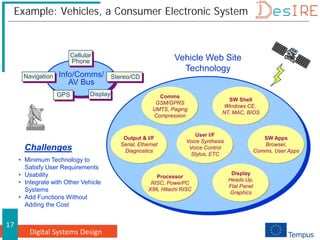
Example: Vehicles, a Consumer Electronic System
Comms
GSM/GPRS
UMTS, Paging
Compression
SW Shell
Windows CE,
NT, MAC, BIOS
SW Apps
Browser,
Comms, User Apps
Processor
RISC, PowerPC
X86, Hitachi RISC
Display
Heads Up,
Flat Panel
Graphics
User I/F
Voice Synthesis
Voice Control
Stylus, ETC
Output & I/F
Serial, Ethernet
Diagnostics
Info/Comms/
AV Bus
Cellular
Phone
GPS Display
Navigation Stereo/CD
• Minimum Technology to
Satisfy User Requirements
• Usability
• Integrate with Other Vehicle
Systems
• Add Functions Without
Adding the Cost
Challenges
Vehicle Web Site
Technology
Digital Systems Design
18
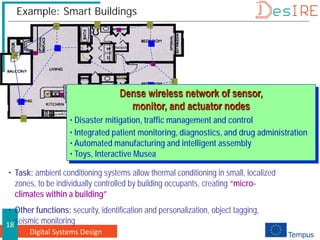
Example: Smart Buildings
• Task: ambient conditioning systems allow thermal conditioning in small, localized
zones, to be individually controlled by building occupants, creating “micro-
climates within a building”
• Other functions: security, identification and personalization, object tagging,
seismic monitoring
Dense wireless network of sensor,
monitor, and actuator nodes
• Disaster mitigation, traffic management and control
• Integrated patient monitoring, diagnostics, and drug administration
• Automated manufacturing and intelligent assembly
• Toys, Interactive Musea
Digital Systems Design
19
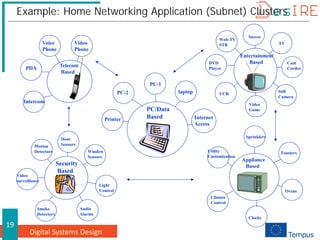
PC/Data
Based
PC-1
laptop
Internet
Access
PC-2
Printer
Telecom
Based
Video
Phone
Voice
Phone
PDA
Intercom
Appliance
Based
Sprinklers
Toasters
Ovens
Clocks
Climate
Control
Utility
Customization
Security
Based
Door
Sensors
Motion
Detectors Window
Sensors
Light
Control
Audio
Alarms
Video
surveillance
Smoke
Detectors
Entertainment
Based
Stereo
TV
Cam
Corder
Still
Camera
Video
Game
VCR
DVD
Player
Web-TV
STB
Example: Home Networking Application (Subnet) Clusters
Digital Systems Design
20
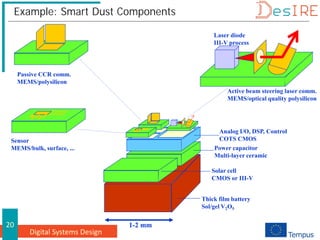
Example: Smart Dust Components
Laser diode
III-V process
Passive CCR comm.
MEMS/polysilicon
Active beam steering laser comm.
MEMS/optical quality polysilicon
Sensor
MEMS/bulk, surface, ...
Analog I/O, DSP, Control
COTS CMOS
Solar cell
CMOS or III-V
Thick film battery
Sol/gel V2O5
Power capacitor
Multi-layer ceramic
1-2 mm
Digital Systems Design
21
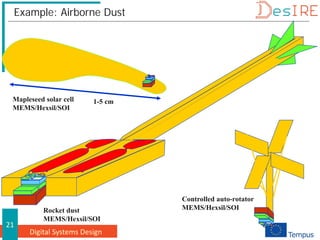
Example: Airborne Dust
Mapleseed solar cell
MEMS/Hexsil/SOI
1-5 cm
Controlled auto-rotator
MEMS/Hexsil/SOI
Rocket dust
MEMS/Hexsil/SOI
Digital Systems Design
22
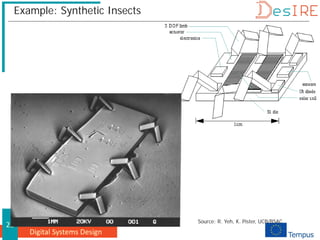
Example: Synthetic Insects
Source: R. Yeh, K. Pister, UCB/BSAC
Digital Systems Design
23
Definition of Embedded Systems
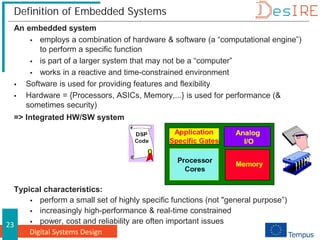
An embedded system
 employs a combination of hardware & software (a “computational engine”)
to perform a specific function
 is part of a larger system that may not be a “computer”
 works in a reactive and time-constrained environment
 Software is used for providing features and flexibility
 Hardware = {Processors, ASICs, Memory,...} is used for performance (&
sometimes security)
=> Integrated HW/SW system
Typical characteristics:
 perform a small set of highly specific functions (not "general purpose”)
 increasingly high-performance & real-time constrained
 power, cost and reliability are often important issues
Digital Systems Design
24
What is a System Anyway?
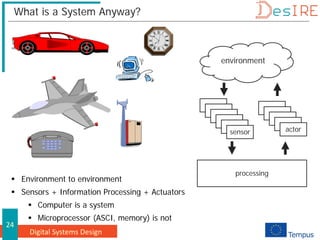
 Environment to environment
 Sensors + Information Processing + Actuators
 Computer is a system
 Microprocessor (ASCI, memory) is not
environment
sensor
sensor
sensor
sensor
sensor
processing
actor
Digital Systems Design
25
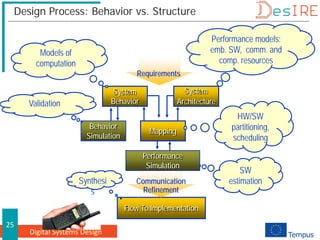
Design Process: Behavior vs. Structure
Mapping
Flow To Implementation
Communication
Refinement
Behavior
Simulation
Performance models:
emb. SW, comm. and
comp. resources
HW/SW
partitioning,
scheduling
Synthesi
s
SW
estimation
Requirements
System
Behavior
Models of
computation
System
Architecture
Performance
Simulation
Validation
Digital Systems Design
26
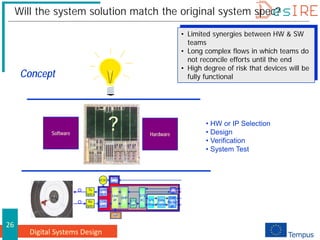
Will the system solution match the original system spec?
Concept
• Limited synergies between HW & SW
teams
• Long complex flows in which teams do
not reconcile efforts until the end
• High degree of risk that devices will be
fully functional
Software Hardware
? • HW or IP Selection
• Design
• Verification
• System Test
Tx
Optics
Synth/
MUX
CDR/
DeMUX
Rx
Optics
VCXO
mP
Clock
Select
Line
I/F
OHP
STS
PP
STS
XC SPE
Map
Data
Framer
Cell/
Packet
I/F
STM
I/F
Digital Systems Design
27
Important Lessons
 Embedded systems market has surpassed the PC market
 Communication is everywhere
 Systems differ in many aspects (functionality, time constraints,
reliability, safety, cost, power consumption, …)
 Design methodologies are important to handle complexity
(behavioural and structural descriptions and verification)
 Methods for HW design align with modern SW design
but: HW knowledge is essential to optimize solutions
(cost, capacity, response time, reliability, safety, power, ...)
Digital Systems Design
2
Part II
Development Process
Digital Systems Design
3
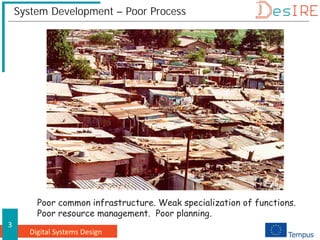
System Development – Poor Process
Poor common infrastructure. Weak specialization of functions.
Poor resource management. Poor planning.
Digital Systems Design
4
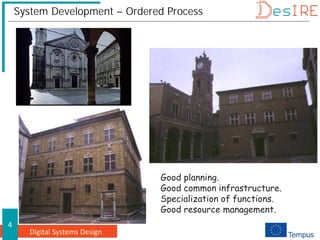
System Development – Ordered Process
Good planning.
Good common infrastructure.
Specialization of functions.
Good resource management.
Digital Systems Design
5
General Development Tasks
Analysis
 of the requirements of the environment to the system
Modelling
 the system to be designed and experimenting with algorithms involved
Refining (or partitioning)
 the function to be implemented into smaller, interacting pieces
HW/SW partitioning
 allocating elements in the refined model to either HW units or SW running on
custom hardware or general microprocessors
Scheduling
 the times at which the functions are executed (this is important when several
modules in the partition share a single hardware unit)
Digital Systems Design
6
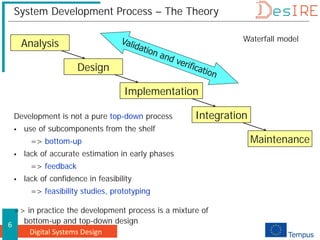
System Development Process – The Theory
Analysis
Design
Implementation
Integration
Maintenance
Development is not a pure top-down process
 use of subcomponents from the shelf
=> bottom-up
 lack of accurate estimation in early phases
=> feedback
 lack of confidence in feasibility
=> feasibility studies, prototyping
=> in practice the development process is a mixture of
bottom-up and top-down design
Waterfall model
Digital Systems Design
7
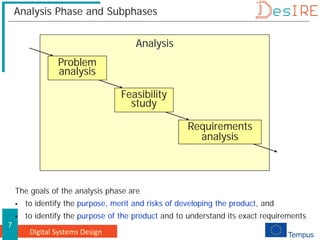
Analysis
Analysis Phase and Subphases
Problem
analysis
Feasibility
study
Requirements
analysis
The goals of the analysis phase are
 to identify the purpose, merit and risks of developing the product, and
 to identify the purpose of the product and to understand its exact requirements
Digital Systems Design
8
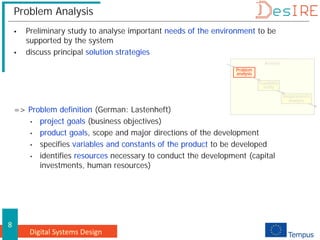
Problem Analysis
 Preliminary study to analyse important needs of the environment to be
supported by the system
 discuss principal solution strategies
=> Problem definition (German: Lastenheft)
• project goals (business objectives)
• product goals, scope and major directions of the development
• specifies variables and constants of the product to be developed
• identifies resources necessary to conduct the development (capital
investments, human resources)
Analysis
Problem
analysis
Feasibility
study
Requirements
analysis
Digital Systems Design
9
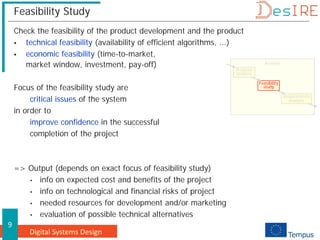
Feasibility Study
Check the feasibility of the product development and the product
 technical feasibility (availability of efficient algorithms, ...)
 economic feasibility (time-to-market,
market window, investment, pay-off)
Focus of the feasibility study are
critical issues of the system
in order to
improve confidence in the successful
completion of the project
=> Output (depends on exact focus of feasibility study)
• info on expected cost and benefits of the project
• info on technological and financial risks of project
• needed resources for development and/or marketing
• evaluation of possible technical alternatives
Analysis
Problem
analysis
Feasibility
study
Requirements
analysis
Digital Systems Design
10
Analysis
Problem
analysis
Feasibility
study
Requirements
analysis
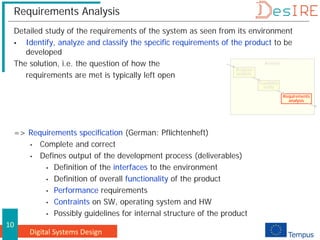
Requirements Analysis
Detailed study of the requirements of the system as seen from its environment
 Identify, analyze and classify the specific requirements of the product to be
developed
The solution, i.e. the question of how the
requirements are met is typically left open
=> Requirements specification (German: Pflichtenheft)
• Complete and correct
• Defines output of the development process (deliverables)
• Definition of the interfaces to the environment
• Definition of overall functionality of the product
• Performance requirements
• Contraints on SW, operating system and HW
• Possibly guidelines for internal structure of the product
Digital Systems Design
11
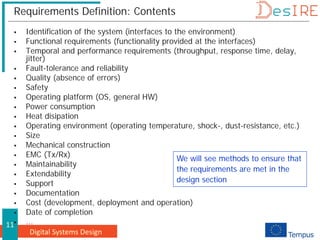
Requirements Definition: Contents
 Identification of the system (interfaces to the environment)
 Functional requirements (functionality provided at the interfaces)
 Temporal and performance requirements (throughput, response time, delay,
jitter)
 Fault-tolerance and reliability
 Quality (absence of errors)
 Safety
 Operating platform (OS, general HW)
 Power consumption
 Heat disipation
 Operating environment (operating temperature, shock-, dust-resistance, etc.)
 Size
 Mechanical construction
 EMC (Tx/Rx)
 Maintainability
 Extendability
 Support
 Documentation
 Cost (development, deployment and operation)
 Date of completion
 ...
We will see methods to ensure that
the requirements are met in the
design section
Digital Systems Design
12
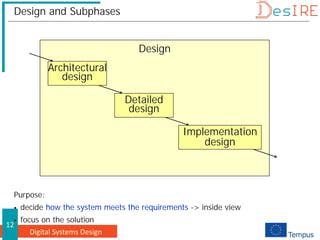
Design and Subphases
Design
Architectural
design
Detailed
design
Implementation
design
Purpose:
 decide how the system meets the requirements -> inside view
 focus on the solution
Digital Systems Design
13
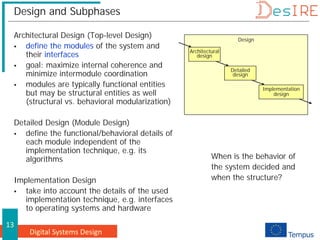
Design and Subphases
Architectural Design (Top-level Design)
 define the modules of the system and
their interfaces
 goal: maximize internal coherence and
minimize intermodule coordination
 modules are typically functional entities
but may be structural entities as well
(structural vs. behavioral modularization)
Detailed Design (Module Design)
 define the functional/behavioral details of
each module independent of the
implementation technique, e.g. its
algorithms
Implementation Design
 take into account the details of the used
implementation technique, e.g. interfaces
to operating systems and hardware
Design
Architectural
design
Detailed
design
Implementation
design
When is the behavior of
the system decided and
when the structure?
Digital Systems Design
14
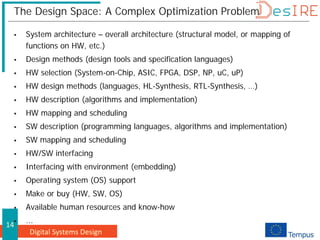
The Design Space: A Complex Optimization Problem
 System architecture – overall architecture (structural model, or mapping of
functions on HW, etc.)
 Design methods (design tools and specification languages)
 HW selection (System-on-Chip, ASIC, FPGA, DSP, NP, uC, uP)
 HW design methods (languages, HL-Synthesis, RTL-Synthesis, …)
 HW description (algorithms and implementation)
 HW mapping and scheduling
 SW description (programming languages, algorithms and implementation)
 SW mapping and scheduling
 HW/SW interfacing
 Interfacing with environment (embedding)
 Operating system (OS) support
 Make or buy (HW, SW, OS)
 Available human resources and know-how
 ...
Digital Systems Design
15
&
&
&
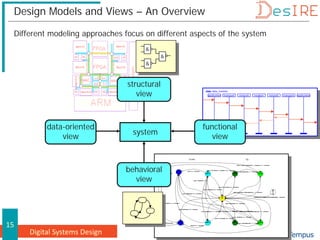
Design Models and Views – An Overview
Different modeling approaches focus on different aspects of the system
msc data_transfer
application transport network medium network transport application
system
data-oriented
view
functional
view
structural
view
behavioral
view
Digital Systems Design
16
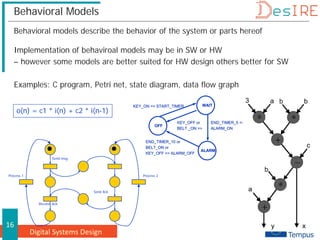
Behavioral Models
Behavioral models describe the behavior of the system or parts hereof
Implementation of behaviroal models may be in SW or HW
– however some models are better suited for HW design others better for SW
Examples: C program, Petri net, state diagram, data flow graph
Process 1
Send msg
Receive Ack
Send Ack
Process 2
KEY_ON => START_TIMER
END_TIMER_5 =>
ALARM_ON
KEY_OFF or
BELT _ON =>
END_TIMER_10 or
BELT_ON or
KEY_OFF => ALARM_OFF
WAIT
ALARM
OFF
o(n) = c1 * i(n) + c2 * i(n-1)
Digital Systems Design
17
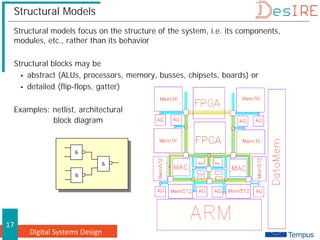
Structural Models
Structural models focus on the structure of the system, i.e. its components,
modules, etc., rather than its behavior
Structural blocks may be
 abstract (ALUs, processors, memory, busses, chipsets, boards) or
 detailed (flip-flops, gatter)
Examples: netlist, architectural
block diagram
&
&
&
Digital Systems Design
18
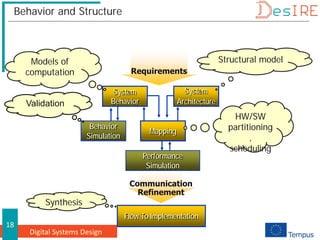
Behavior and Structure
System
Behavior
System
Architecture
Mapping
Flow To Implementation
Communication
Refinement
Behavior
Simulation
Performance
Simulation
Models of
computation
HW/SW
partitioning
,
scheduling
Synthesis
Requirements
Structural model
Validation
Digital Systems Design
19
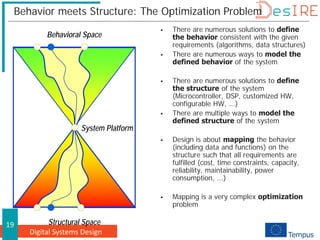
Behavior meets Structure: The Optimization Problem
 There are numerous solutions to define
the behavior consistent with the given
requirements (algorithms, data structures)
 There are numerous ways to model the
defined behavior of the system
 There are numerous solutions to define
the structure of the system
(Microcontroller, DSP, customized HW,
configurable HW, ...)
 There are multiple ways to model the
defined structure of the system
 Design is about mapping the behavior
(including data and functions) on the
structure such that all requirements are
fulfilled (cost, time constraints, capacity,
reliability, maintainability, power
consumption, ...)
 Mapping is a very complex optimization
problem
Structural Space
System Platform
Behavioral Space
Digital Systems Design
20
Design: Behavior vs. Structure
Behavioral specifications describe the functionality of the system using some
modeling or programming language
 behavior specifications may be
 abstract models (state charts, UML, SDL) or
 concrete programs (C, VHDL, SystemC)
 behavioral specifications may be
 executed/implemented on real HW (C program, assembler) or
 simulated on virtual HW (VHDL, SystemC, SDL)
Behavioral specifications ensure that
 the functional requirements are met
 however there is no confidence in non-functional aspects of the system, e.g.
performance, real-time, fault tolerance, cost, power consumption, ...
Structural specifications are needed to implement the system in HW
So, when is the best point in time to decide the structure?
Digital Systems Design
21
Implementation
Prerequisites:
 Functional details as algorithms, etc. are specified
 HW components are selected
 HW/SW partitioning may be decided
 ...
Tasks:
 coding of functions, algorithms, etc. in the selected implementation language
 test of the modules and components in isolation emulating the environment of
the modules/components
Notes:
 provided the design is complete and correct this is straight-forward
 the implementation phase represents a small part of the development process
(appr. 20% for pure SW projects)
Digital Systems Design
22
Validation Methods
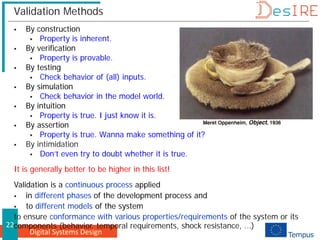
 By construction
 Property is inherent.
 By verification
 Property is provable.
 By testing
 Check behavior of (all) inputs.
 By simulation
 Check behavior in the model world.
 By intuition
 Property is true. I just know it is.
 By assertion
 Property is true. Wanna make something of it?
 By intimidation
 Don’t even try to doubt whether it is true.
It is generally better to be higher in this list!
Validation is a continuous process applied
 in different phases of the development process and
 to different models of the system
to ensure conformance with various properties/requirements of the system or its
components (behavior, temporal requirements, shock resistance, ...)
Digital Systems Design
23
Integration
Purpose:
 ensure compliance with system requirements
 complete the system for delivery
Tasks:
 System integration: subsequent addition of HW components and SW
modules to the system until the final system is established
 Integration testing: stepwise testing of system (requires knowledge of the
system as a whole)
 System testing: test after all parts have been integrated
Notes:
 Testing may be applied to almost all requirements or properties of systems,
system components or modules (functionality, performance, reliability, termal
resistance, shock resistance, ergonomics, man-machine interface,
documentation, ...)
 Testing is the most popular validation method in practice
Digital Systems Design
24
Maintenance
 involved during the whole lifetime of a system, from delivery till removal from
service
 deal with changes due to
 changing environments,
 changing functional or
 performance requirements
 removal of errors
Note: often the maintenance cost are much greater than the development cost
Digital Systems Design
25
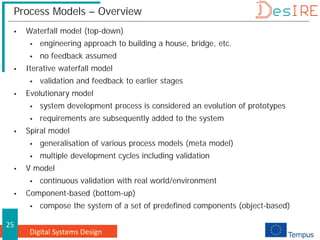
Process Models – Overview
 Waterfall model (top-down)
 engineering approach to building a house, bridge, etc.
 no feedback assumed
 Iterative waterfall model
 validation and feedback to earlier stages
 Evolutionary model
 system development process is considered an evolution of prototypes
 requirements are subsequently added to the system
 Spiral model
 generalisation of various process models (meta model)
 multiple development cycles including validation
 V model
 continuous validation with real world/environment
 Component-based (bottom-up)
 compose the system of a set of predefined components (object-based)
Digital Systems Design
26
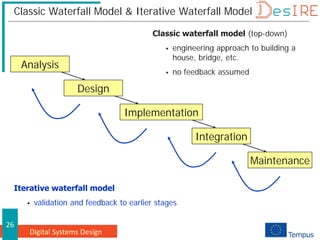
Classic Waterfall Model & Iterative Waterfall Model
Analysis
Design
Implementation
Integration
Maintenance
Classic waterfall model (top-down)
 engineering approach to building a
house, bridge, etc.
 no feedback assumed
Iterative waterfall model
 validation and feedback to earlier stages
Digital Systems Design
27
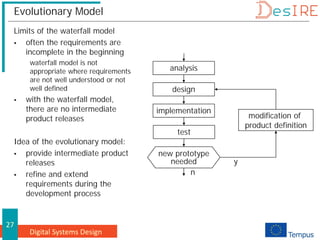
Evolutionary Model
Limits of the waterfall model
 often the requirements are
incomplete in the beginning
waterfall model is not
appropriate where requirements
are not well understood or not
well defined
 with the waterfall model,
there are no intermediate
product releases
Idea of the evolutionary model:
 provide intermediate product
releases
 refine and extend
requirements during the
development process
analysis
design
implementation
new prototype
needed
modification of
product definition
y
test
n
Digital Systems Design
28
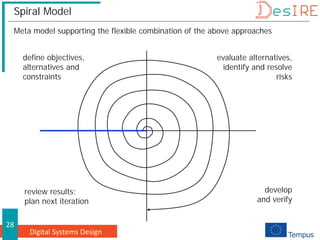
Spiral Model
Meta model supporting the flexible combination of the above approaches
review results;
plan next iteration
define objectives,
alternatives and
constraints
evaluate alternatives,
identify and resolve
risks
develop
and verify
Digital Systems Design
29
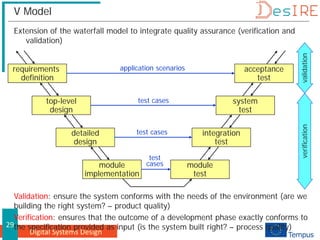
V Model
Extension of the waterfall model to integrate quality assurance (verification and
validation)
requirements
definition
top-level
design
detailed
design
module
implementation
module
test
integration
test
system
test
acceptance
test
application scenarios
test cases
test cases
test
cases
validation
verification
Validation: ensure the system conforms with the needs of the environment (are we
building the right system? – product quality)
Verification: ensures that the outcome of a development phase exactly conforms to
the specification provided as input (is the system built right? – process quality)
Digital Systems Design
30
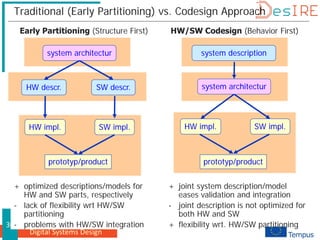
Traditional (Early Partitioning) vs. Codesign Approach
Early Partitioning (Structure First) HW/SW Codesign (Behavior First)
system architectur
HW descr. SW descr.
HW impl. SW impl.
prototyp/product
system description
HW impl. SW impl.
system architectur
prototyp/product
+ joint system description/model
eases validation and integration
- joint description is not optimized for
both HW and SW
+ flexibility wrt. HW/SW partitioning
+ optimized descriptions/models for
HW and SW parts, respectively
- lack of flexibility wrt HW/SW
partitioning
- problems with HW/SW integration
Digital Systems Design
31
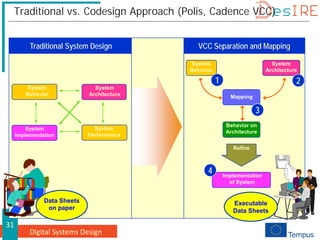
Traditional vs. Codesign Approach (Polis, Cadence VCC)
Traditional System Design VCC Separation and Mapping
System
Behavior
System
Architecture
System
Implementation
System
Performance
System
Behavior
System
Architecture
Mapping
Behavior on
Architecture
Refine
Implementation
of System
1 2
3
4
Data Sheets
on paper
Executable
Data Sheets
Digital Systems Design
32
References
System Focus
 D. Gajski, F. Vahid, S. Narayan, J. Gong: Specification and Design of
Embedded Systems. Prentice Hall, 1994.
 A. Mitschele-Thiel: Systems Engineering with SDL – Developing Performance-
Critical Communication Systems. Wiley, 2001. (section 2.1.2)
 J. Teich: Digitale Hardware/Software Systeme. Springer, 1997.
Software Focus
 H. Balzert: Lehrbuch der Software-Technik – Band 1: Softwareentwicklung.
Spektrum-Verlag, 2001.
 R. S. Pressman: Software Engineering – A Practicioner´s Approach. Fourth
Edition, McGraw Hill, 1997.
Digital Systems Design
2
Part III
Requirements
Digital Systems Design
3
Requirements
 Analysis process
 Functional requirements
 Performance requirements
 Real-time requirements
 Safety and reliability
 Principles and elements of requirements analysis
Digital Systems Design
4
The Importance of Requirements
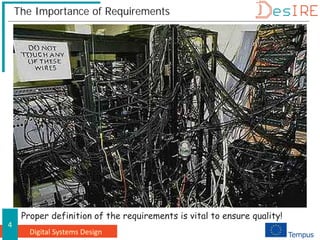
Proper definition of the requirements is vital to ensure quality!
Digital Systems Design
5
Review of the Development Process
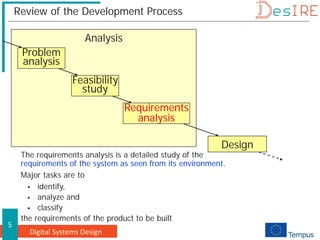
Design
Analysis
Problem
analysis
Feasibility
study
Requirements
analysis
The requirements analysis is a detailed study of the
requirements of the system as seen from its environment.
Major tasks are to
 identify,
 analyze and
 classify
the requirements of the product to be built
Digital Systems Design
6
Requirements Definition: Contents
 Identification of the system (interfaces to the environment)
 Functional requirements (functionality provided at the interfaces)
 Temporal and performance requirements (throughput, response time, delay,
jitter)
 Fault-tolerance and reliability
 Quality (absence of errors)
 Safety
 Operating platform (OS, general HW)
 Power consumption
 Heat disipation
 Operating environment (operating temperature, shock-, dust-resistance, etc.)
 Size
 Mechanical construction
 EMC (Tx/Rx)
 Maintainability
 Extendability
 Support
 Documentation
 Cost (development, deployment and operation)
 Date of completion
 ...
=> let‘s take a look at
some details
Digital Systems Design
7
Functional Requirements
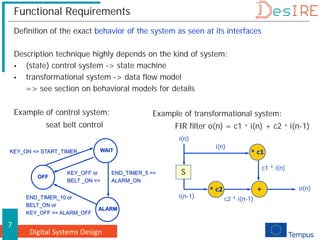
Definition of the exact behavior of the system as seen at its interfaces
Description technique highly depends on the kind of system:
 (state) control system -> state machine
 transformational system -> data flow model
=> see section on behavioral models for details
KEY_ON => START_TIMER
END_TIMER_5 =>
ALARM_ON
KEY_OFF or
BELT _ON =>
END_TIMER_10 or
BELT_ON or
KEY_OFF => ALARM_OFF
WAIT
ALARM
OFF
Example of control system:
seat belt control
Example of transformational system:
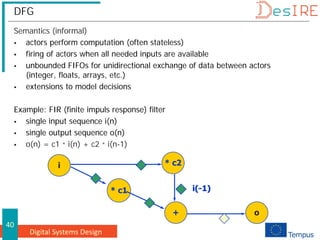
FIR filter o(n) = c1 * i(n) + c2 * i(n-1)
* c2
* c1
+
c2 * i(n-1)
c1 * i(n)
i(n)
i(n)
o(n)
S
i(n-1)
Digital Systems Design
8
Performance Requirements
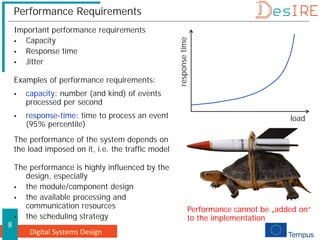
Important performance requirements
 Capacity
 Response time
 Jitter
Examples of performance requirements:
 capacity: number (and kind) of events
processed per second
 response-time: time to process an event
(95% percentile)
The performance of the system depends on
the load imposed on it, i.e. the traffic model
The performance is highly influenced by the
design, especially
 the module/component design
 the available processing and
communication resources
 the scheduling strategy
load
response
time
Performance cannot be „added on“
to the implementation
Digital Systems Design
9
Real-time (Temporal) Requirements
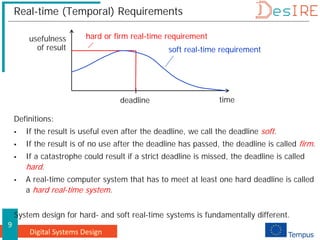
Definitions:
 If the result is useful even after the deadline, we call the deadline soft.
 If the result is of no use after the deadline has passed, the deadline is called firm.
 If a catastrophe could result if a strict deadline is missed, the deadline is called
hard.
 A real-time computer system that has to meet at least one hard deadline is called
a hard real-time system.
System design for hard- and soft real-time systems is fundamentally different.
deadline time
usefulness
of result
hard or firm real-time requirement
soft real-time requirement
Digital Systems Design
10
Real-time (Temporal) Requirements
Examples:
 soft deadlines
 public transportation system
 airport luggage transport system
 firm deadlines
 audio processing
 video processing
 hard deadlines
 control of nuclear or chemical processes (chain reaction)
 railway traffic control
 air traffic control
Digital Systems Design
11
Real-time Systems – Classification
 On the basis of the external requirements
 hard/firm real-time versus soft real-time
 fail safe vs. fail operational (e.g. train control system vs. fly-by-wire
system)
 On the basis of the design and implementation
 guaranteed timeliness vs. best effort
 resource adequacy vs. no resource adequacy (sufficient computational
resources to handle all specified peak loads and fault scenarios)
 event triggered vs. time triggered
Digital Systems Design
12
Time Triggered (TT) vs. Event Triggered (ET) Systems
A system is Time Triggered (TT) if the control signals, such as
 sending and receiving of messages
 recognition of an external state change
are derived solely from the progression of a (global) notion of time.
A system is Event Triggered (ET) if the control signals are derived solely from
the occurrence of events, e.g.,
 termination of a task
 reception of a message
 an external interrupt.
Note that the triggering method is often an attribute of the implementation and
not necessarily a requirement.
Digital Systems Design
13
Safety Requirements: Fail-Safe vs. Fail-Operational
Safety requirements define the action taken in the case of a failure.
A system is fail-safe if there is a safe state in the environment that can be
reached in case of a system failure, e.g. ABS, train signaling system.
In a fail-safe application the computer has to have a high error detection
coverage.
Fail safeness is a characteristic of the application, not the computer system.
A system is fail-operational, if no safe state can be reached in case of a system
failure, e.g. a flight control system aboard an airplane.
In fail-operational applications the computer system has to provide a minimum
level of service, even after the occurrence of a fault.
Digital Systems Design
14
Reliability Requirements
Reliability denotes the probability for a failure or absence from failure of a
system
Examples of reliability figures are
 MTTF (mean time to failure)
 MTBF (mean time between failures)
 probability for up-time (e.g. 99.995%)
The reliability of the system can be estimated/calculated (in theory) from the
reliability of its components
A system that ensures that it still functions correctly even in the case of failure of
some components is called a fault tolerant system (i.e. it is able to tolerate faults
of single components of the system)
Digital Systems Design
15
Predictability in Rare Event Situations
A rare event is an important event that occurs very infrequently during the
lifetime of a system, e.g. the rupture of a pipe in a nuclear reactor.
A rare event can give rise to many correlated service requests (e.g. an alarm
shower).
In a number of applications, the merit of a system depends on the predictable
performance in rare event scenarios, e.g. a flight control system.
In most cases, typical workload testing will not cover the rare event scenario.
Digital Systems Design
16
Principles and Elements of the Analysis Model
Guidelines for the analysis:
 understand the problem first! (before you begin to create the analysis model)
 record origin and reason for every requirement
 use multiple views of requirements (data model, functional model, behavioral
models)
 priorize requirements
 eliminate ambiquities
Elements of the analysis model:
 data dictionary
 process specification (data-flow diagram)
 control specification (state-transition diagram)
 data object description (entity-relationship diagram)
 functional specification (sequence diagram)
Specific methods and tools for various application areas have been proposed,
e.g. real-time systems, transformational systems, control systems,
communication systems, etc.
Digital Systems Design
17
References
 H. Balzert: Lehrbuch der Software-Technik – Band 1: Softwareentwicklung.
Spektrum-Verlag, 2001.
 R. S. Pressman: Software Engineering – A Practicioner´s Approach. Fourth
Edition, 1997. (Chapter 12: Analysis Modeling)
 A. Mitschele-Thiel: Systems Engineering with SDL – Developing Performance-
Critical Communication Systems. Wiley, 2001.
 B. Thomé (Editor): Systems Engineering – Principles and Practice of
Computer-based Systems Engineering, Wiley, 1993.
Digital Systems Design
1
Part IV
Behavioral Models and
Specification Languages
Digital Systems Design
3
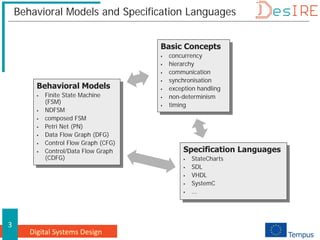
Behavioral Models and Specification Languages
Behavioral Models
 Finite State Machine
(FSM)
 NDFSM
 composed FSM
 Petri Net (PN)
 Data Flow Graph (DFG)
 Control Flow Graph (CFG)
 Control/Data Flow Graph
(CDFG)
Specification Languages
 StateCharts
 SDL
 VHDL
 SystemC
 ...
Basic Concepts
 concurrency
 hierarchy
 communication
 synchronisation
 exception handling
 non-determinism
 timing
Digital Systems Design
4
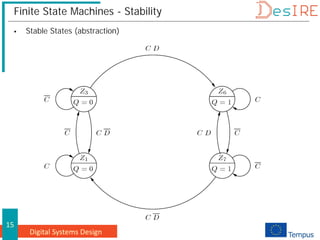
Finite State Machines (FSM)
Functional decomposition into states of operation
 finite states
 transitions between states
 event triggered transitions
 neither concurrency nor time (sequential FSMs)
Typical applications:
 reactive (control) systems
 protocols (telecom, computers, ...)
Digital Systems Design
5
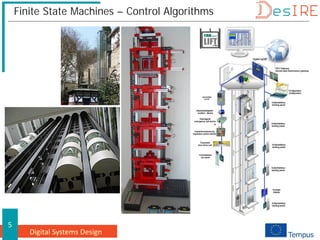
Finite State Machines – Control Algorithms
Digital Systems Design
6
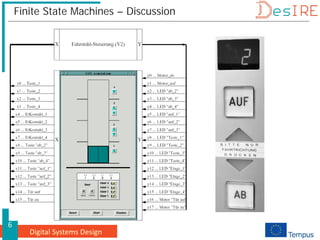
Finite State Machines – Discussion
Digital Systems Design
7
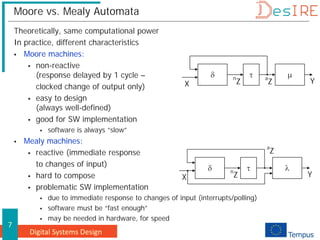
Moore vs. Mealy Automata
Theoretically, same computational power
In practice, different characteristics
 Moore machines:
 non-reactive
(response delayed by 1 cycle –
clocked change of output only)
 easy to design
(always well-defined)
 good for SW implementation
 software is always “slow”
 Mealy machines:
 reactive (immediate response
to changes of input)
 hard to compose
 problematic SW implementation
 due to immediate response to changes of input (interrupts/polling)
 software must be “fast enough”
 may be needed in hardware, for speed
δ τ µ
X
a
Z Y
n
Z
δ τ λ
X
a
Z
Y
n
Z
Digital Systems Design
8
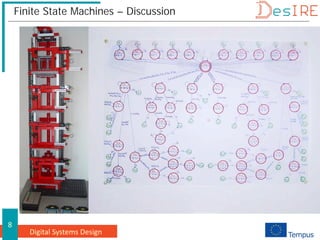
Finite State Machines – Discussion
Digital Systems Design
9
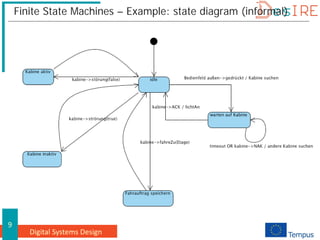
Finite State Machines – Example: state diagram (informal)
Digital Systems Design
10
Finite State Machines – Discussion
Advantages:
 Easy to use (graphical languages)
 Powerful algorithms for
 synthesis (SW and HW)
 verification
Disadvantages:
 Sometimes over-specify implementation
(sequencing is fully specified)
 Number of states can be unmanageable
 Numerical computations cannot be specified compactly
(need Extended FSMs)
Digital Systems Design
11
Finite State Machines - Extensions
Divide and conquer
⇒ Nondeterminism
⇒ Parallel automata
⇒ Processes
⇒ Communication
⇒ Hierarchy
⇒ Graphical support
⇒ Extended formal semantic
Digital Systems Design
12
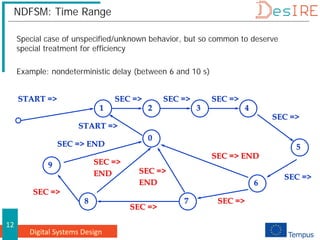
NDFSM: Time Range
Special case of unspecified/unknown behavior, but so common to deserve
special treatment for efficiency
Example: nondeterministic delay (between 6 and 10 s)
0
1 2 3 4
5
6
7
8
9
START => SEC =>
SEC => END
SEC => SEC =>
SEC =>
SEC =>
SEC =>
SEC =>
SEC =>
START =>
SEC =>
END
SEC => END
SEC =>
END
Digital Systems Design
13
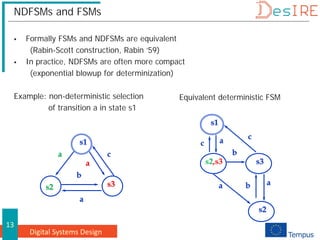
NDFSMs and FSMs
 Formally FSMs and NDFSMs are equivalent
(Rabin-Scott construction, Rabin ‘59)
 In practice, NDFSMs are often more compact
(exponential blowup for determinization)
Example: non-deterministic selection
of transition a in state s1
s1
s2 s3
a
a
b
a
c
s1
s2,s3
a
s3
b
a
s2
c
b
a
c
Equivalent deterministic FSM
Digital Systems Design
14
Modeling Concurrency – parallel automata
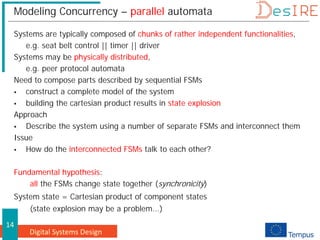
Systems are typically composed of chunks of rather independent functionalities,
e.g. seat belt control || timer || driver
Systems may be physically distributed,
e.g. peer protocol automata
Need to compose parts described by sequential FSMs
 construct a complete model of the system
 building the cartesian product results in state explosion
Approach
 Describe the system using a number of separate FSMs and interconnect them
Issue
 How do the interconnected FSMs talk to each other?
Fundamental hypothesis:
all the FSMs change state together (synchronicity)
System state = Cartesian product of component states
(state explosion may be a problem...)
Digital Systems Design
15
FSM Composition – Example
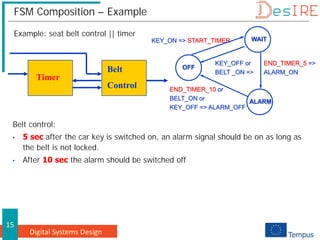
Example: seat belt control || timer
Belt
Control
Timer
Belt control:
• 5 sec after the car key is switched on, an alarm signal should be on as long as
the belt is not locked.
• After 10 sec the alarm should be switched off
KEY_ON => START_TIMER
END_TIMER_5 =>
ALARM_ON
KEY_OFF or
BELT _ON =>
END_TIMER_10 or
BELT_ON or
KEY_OFF => ALARM_OFF
WAIT
ALARM
OFF
Digital Systems Design
16
FSM Composition – Example
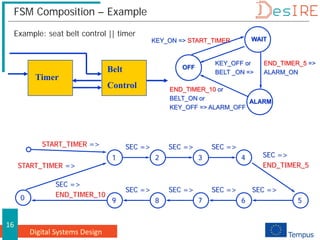
Example: seat belt control || timer
0
1 2 3 4
5
6
7
8
9
START_TIMER =>
START_TIMER =>
SEC =>
SEC =>
END_TIMER_10
SEC => SEC =>
SEC =>
END_TIMER_5
SEC =>
SEC =>
SEC =>
SEC =>
Belt
Control
Timer
KEY_ON => START_TIMER
END_TIMER_5 =>
ALARM_ON
KEY_OFF or
BELT _ON =>
END_TIMER_10 or
BELT_ON or
KEY_OFF => ALARM_OFF
WAIT
ALARM
OFF
Digital Systems Design
17
FSM Composition – Example
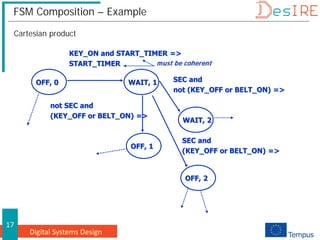
Cartesian product
OFF, 0 WAIT, 1
KEY_ON and START_TIMER =>
START_TIMER must be coherent
WAIT, 2
SEC and
not (KEY_OFF or BELT_ON) =>
OFF, 1
not SEC and
(KEY_OFF or BELT_ON) =>
OFF, 2
SEC and
(KEY_OFF or BELT_ON) =>
Digital Systems Design
18
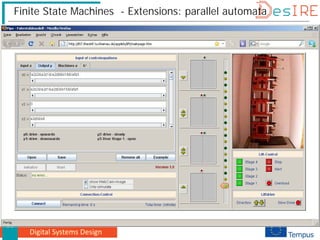
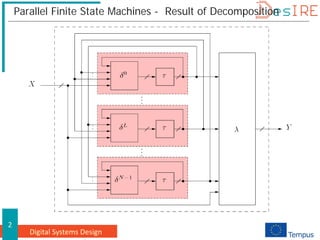
Finite State Machines - Extensions: parallel automata
Digital Systems Design
19
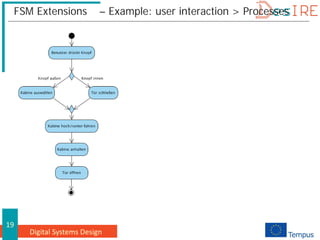
FSM Extensions – Example: user interaction > Processes
Digital Systems Design
20
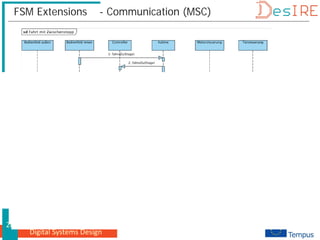
FSM Extensions - Communication (MSC)
Digital Systems Design
21
Hierarchical FSM models – StateCharts
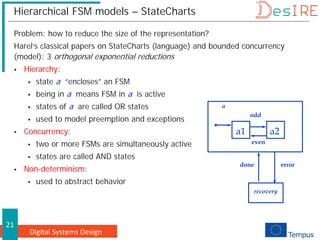
Problem: how to reduce the size of the representation?
Harel’s classical papers on StateCharts (language) and bounded concurrency
(model): 3 orthogonal exponential reductions
 Hierarchy:
 state a “encloses” an FSM
 being in a means FSM in a is active
 states of a are called OR states
 used to model preemption and exceptions
 Concurrency:
 two or more FSMs are simultaneously active
 states are called AND states
 Non-determinism:
 used to abstract behavior
error
a
recovery
odd
even
done
a1 a2
Digital Systems Design
22
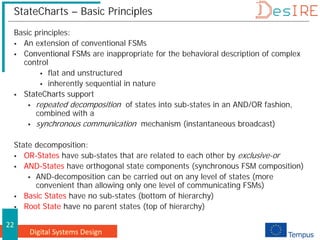
StateCharts – Basic Principles
Basic principles:
 An extension of conventional FSMs
 Conventional FSMs are inappropriate for the behavioral description of complex
control
 flat and unstructured
 inherently sequential in nature
 StateCharts support
 repeated decomposition of states into sub-states in an AND/OR fashion,
combined with a
 synchronous communication mechanism (instantaneous broadcast)
State decomposition:
 OR-States have sub-states that are related to each other by exclusive-or
 AND-States have orthogonal state components (synchronous FSM composition)
 AND-decomposition can be carried out on any level of states (more
convenient than allowing only one level of communicating FSMs)
 Basic States have no sub-states (bottom of hierarchy)
 Root State have no parent states (top of hierarchy)
Digital Systems Design
23
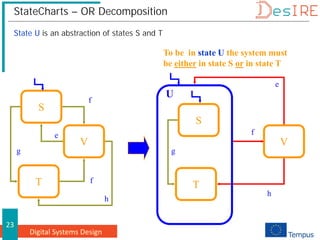
StateCharts – OR Decomposition
S
V
T
S
V
T
f
f
f
e
h
e
h
g g
To be in state U the system must
be either in state S or in state T
U
State U is an abstraction of states S and T
Digital Systems Design
1
Part V
High-level Synthesis
Digital Systems Design
3
High-level Synthesis
 Motivation for high-level synthesis
 Domains of the HW design
 Levels of abstractions
 Overview on synthesis methods
 High-level synthesis tasks and models
 ASAP and ALAP
 List scheduling
 Advanced Issues
Digital Systems Design
4
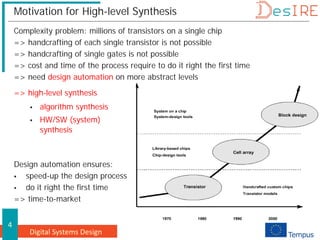
Motivation for High-level Synthesis
Complexity problem: millions of transistors on a single chip
=> handcrafting of each single transistor is not possible
=> handcrafting of single gates is not possible
=> cost and time of the process require to do it right the first time
=> need design automation on more abstract levels
=> high-level synthesis
 algorithm synthesis
 HW/SW (system)
synthesis
Design automation ensures:
 speed-up the design process
 do it right the first time
=> time-to-market
Digital Systems Design
5
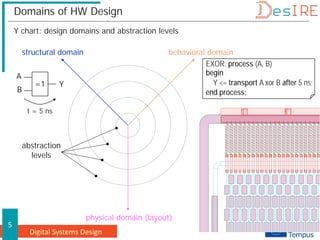
Domains of HW Design
Y chart: design domains and abstraction levels
structural domain behavioral domain
physical domain (layout)
=1
A
B
Y
t = 5 ns
layout
PowerPC
750
EXOR: process (A, B)
begin
Y <= transport A xor B after 5 ns;
end process;
abstraction
levels
Digital Systems Design
6
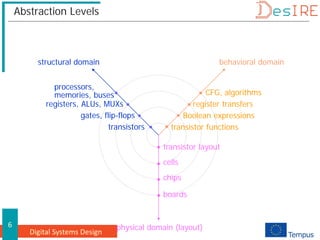
Abstraction Levels
structural domain behavioral domain
physical domain (layout)
transistor layout
cells
chips
boards
CFG, algorithms
register transfers
Boolean expressions
transistor functions
gates, flip-flops
transistors
registers, ALUs, MUXs
processors,
memories, buses
Digital Systems Design
7
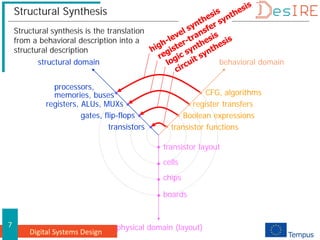
Structural Synthesis
Structural synthesis is the translation
from a behavioral description into a
structural description
structural domain behavioral domain
physical domain (layout)
transistor layout
cells
chips
boards
CFG, algorithms
register transfers
Boolean expressions
transistor functions
gates, flip-flops
transistors
registers, ALUs, MUXs
processors,
memories, buses
Digital Systems Design
8
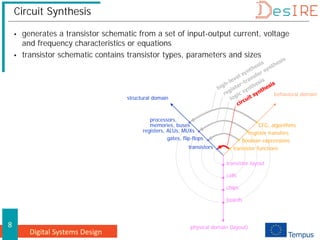
Circuit Synthesis
 generates a transistor schematic from a set of input-output current, voltage
and frequency characteristics or equations
 transistor schematic contains transistor types, parameters and sizes
structural domain
behavioral domain
physical domain (layout)
transistor layout
cells
chips
boards
CFG, algorithms
register transfers
Boolean expressions
transistor functions
transistors
registers, ALUs, MUXs
processors,
memories, buses
gates, flip-flops
Digital Systems Design
9
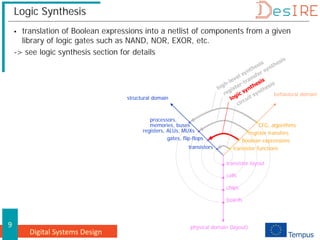
Logic Synthesis
 translation of Boolean expressions into a netlist of components from a given
library of logic gates such as NAND, NOR, EXOR, etc.
-> see logic synthesis section for details
structural domain
behavioral domain
physical domain (layout)
transistor layout
cells
chips
boards
CFG, algorithms
register transfers
Boolean expressions
transistor functions
transistors
registers, ALUs, MUXs
processors,
memories, buses
gates, flip-flops
Digital Systems Design
10
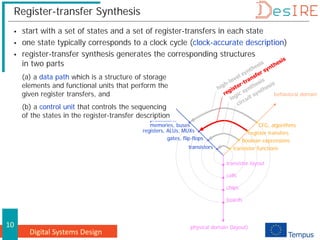
Register-transfer Synthesis
 start with a set of states and a set of register-transfers in each state
 one state typically corresponds to a clock cycle (clock-accurate description)
 register-transfer synthesis generates the corresponding structures
in two parts
structural domain
behavioral domain
physical domain (layout)
transistor layout
cells
chips
boards
CFG, algorithms
register transfers
Boolean expressions
transistor functions
transistors
gates, flip-flops
registers, ALUs, MUXs
processors,
memories, buses
(a) a data path which is a structure of storage
elements and functional units that perform the
given register transfers, and
(b) a control unit that controls the sequencing
of the states in the register-transfer description
Digital Systems Design
11
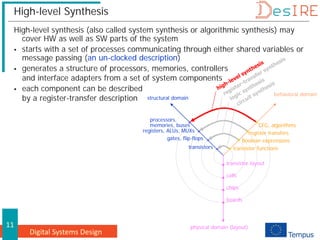
High-level Synthesis
High-level synthesis (also called system synthesis or algorithmic synthesis) may
cover HW as well as SW parts of the system
 starts with a set of processes communicating through either shared variables or
message passing (an un-clocked description)
 generates a structure of processors, memories, controllers
and interface adapters from a set of system components
 each component can be described
by a register-transfer description structural domain
behavioral domain
physical domain (layout)
transistor layout
cells
chips
boards
CFG, algorithms
register transfers
Boolean expressions
transistor functions
transistors
registers, ALUs, MUXs
processors,
memories, buses
gates, flip-flops
Digital Systems Design
12
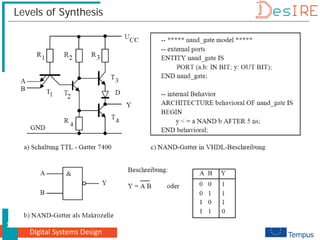
Levels of Synthesis
Digital Systems Design
13
High-level Synthesis – Central Tasks
High-level synthesis deals with
 the algorithmic level (behavioral viewpoint)
 the system level (structural viewpoint)
Tasks of high-level synthesis
 (system) partitioning
 partitioning of a behavioral description or design structure into
subdescriptions or substructures
 reduce the problem size
 satisfy external constraints as chip size, pins per package, power
dissipation or wire length
 allocation
 selection of the number and types of structural entities
 mapping (Gajski: allocation, Teich: Bindung)
 assignment of data to storage units (registers)
 assignment of operations to functional units (ALUs, etc.)
 assignment of communications to busses or links
 scheduling (Teich: Ablaufplanung)
 temporal assignment of data and operations
 derivation of controller (microprogram)
Digital Systems Design
14
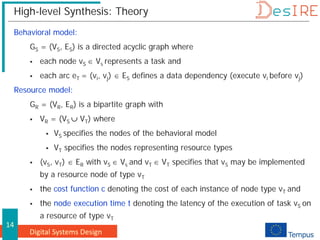
High-level Synthesis: Theory
Behavioral model:
GS = (VS, ES) is a directed acyclic graph where
 each node vS ∈ Vs represents a task and
 each arc eT = (vi, vj) ∈ ES defines a data dependency (execute vi before vj)
Resource model:
GR = (VR, ER) is a bipartite graph with
 VR = (VS ∪ VT) where
 VS specifies the nodes of the behavioral model
 VT specifies the nodes representing resource types
 (vS, vT) ∈ ER with vS ∈ Vs and vT ∈ VT specifies that vS may be implemented
by a resource node of type vT
 the cost function c denoting the cost of each instance of node type vT and
 the node execution time t denoting the latency of the execution of task vS on
a resource of type vT
Digital Systems Design
15
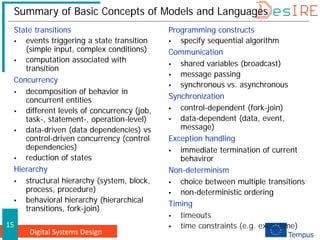
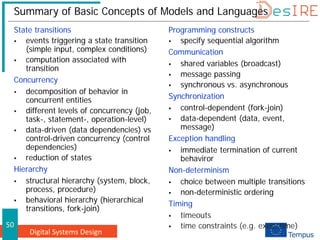
Summary of Basic Concepts of Models and Languages
State transitions
 events triggering a state transition
(simple input, complex conditions)
 computation associated with
transition
Concurrency
 decomposition of behavior in
concurrent entities
 different levels of concurrency (job,
task-, statement-, operation-level)
 data-driven (data dependencies) vs
control-driven concurrency (control
dependencies)
 reduction of states
Hierarchy
 structural hierarchy (system, block,
process, procedure)
 behavioral hierarchy (hierarchical
transitions, fork-join)
Programming constructs
 specify sequential algorithm
Communication
 shared variables (broadcast)
 message passing
 synchronous vs. asynchronous
Synchronization
 control-dependent (fork-join)
 data-dependent (data, event,
message)
Exception handling
 immediate termination of current
behaviror
Non-determinism
 choice between multiple transitions
 non-deterministic ordering
Timing
 timeouts
 time constraints (e.g. exec. time)
Digital Systems Design
16
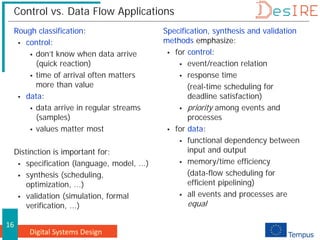
Control vs. Data Flow Applications
Rough classification:
 control:
 don’t know when data arrive
(quick reaction)
 time of arrival often matters
more than value
 data:
 data arrive in regular streams
(samples)
 values matter most
Distinction is important for:
 specification (language, model, ...)
 synthesis (scheduling,
optimization, ...)
 validation (simulation, formal
verification, ...)
Specification, synthesis and validation
methods emphasize:
 for control:
 event/reaction relation
 response time
(real-time scheduling for
deadline satisfaction)
 priority among events and
processes
 for data:
 functional dependency between
input and output
 memory/time efficiency
(data-flow scheduling for
efficient pipelining)
 all events and processes are
equal
Digital Systems Design
17
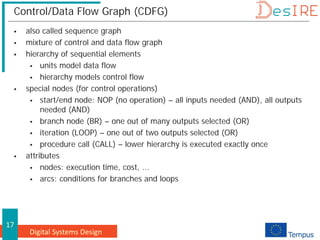
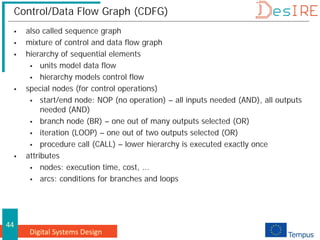
Control/Data Flow Graph (CDFG)
 also called sequence graph
 mixture of control and data flow graph
 hierarchy of sequential elements
 units model data flow
 hierarchy models control flow
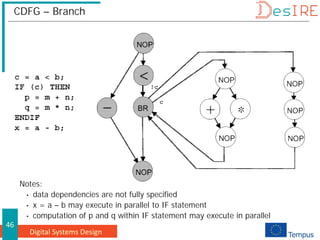
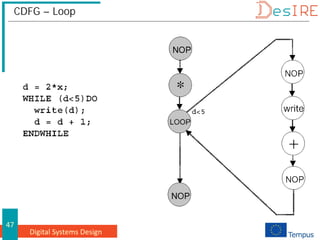
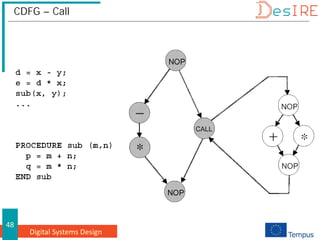
 special nodes (for control operations)
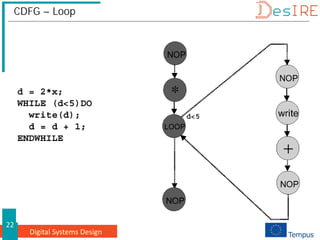
 start/end node: NOP (no operation) – all inputs needed (AND), all outputs
needed (AND)
 branch node (BR) – one out of many outputs selected (OR)
 iteration (LOOP) – one out of two outputs selected (OR)
 procedure call (CALL) – lower hierarchy is executed exactly once
 attributes
 nodes: execution time, cost, ...
 arcs: conditions for branches and loops
Digital Systems Design
21
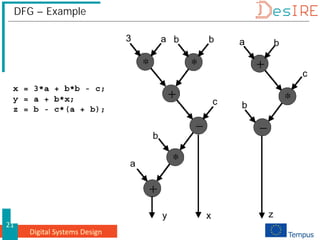
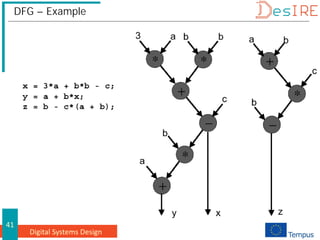
DFG – Example
Digital Systems Design
22
CDFG – Loop
Digital Systems Design
23
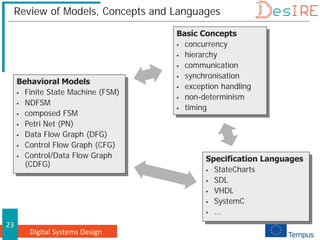
Review of Models, Concepts and Languages
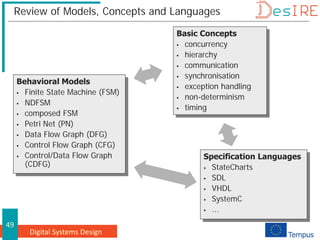
Behavioral Models
 Finite State Machine (FSM)
 NDFSM
 composed FSM
 Petri Net (PN)
 Data Flow Graph (DFG)
 Control Flow Graph (CFG)
 Control/Data Flow Graph
(CDFG)
Specification Languages
 StateCharts
 SDL
 VHDL
 SystemC
 ...
Basic Concepts
 concurrency
 hierarchy
 communication
 synchronisation
 exception handling
 non-determinism
 timing
Digital Systems Design
24
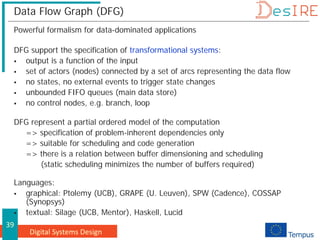
Data Flow Graph (DFG)
Powerful formalism for data-dominated applications
DFG support the specification of transformational systems:
 output is a function of the input
 set of actors (nodes) connected by a set of arcs representing the data flow
 no states, no external events to trigger state changes
 unbounded FIFO queues (main data store)
 no control nodes, e.g. branch, loop
DFG represent a partial ordered model of the computation
=> specification of problem-inherent dependencies only
=> suitable for scheduling and code generation
=> there is a relation between buffer dimensioning and scheduling
(static scheduling minimizes the number of buffers required)
Languages:
 graphical: Ptolemy (UCB), GRAPE (U. Leuven), SPW (Cadence), COSSAP
(Synopsys)
 textual: Silage (UCB, Mentor), Haskell, Lucid
Digital Systems Design
25
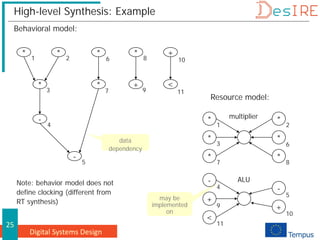
High-level Synthesis: Example
Behavioral model:
* *
*
*
+ <
*
-
-
* +
1 2 6 8 10
4
3 7 9 11
5
data
dependency
Resource model:
*
*
*
*
*
*
-
-
+
+
<
1
3
7
2
6
8
4
9
11
5
10
multiplier
ALU
may be
implemented
on
Note: behavior model does not
define clocking (different from
RT synthesis)
Digital Systems Design
26
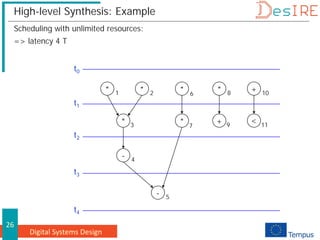
High-level Synthesis: Example
Scheduling with unlimited resources:
=> latency 4 T
* *
*
*
+ <
*
-
-
* +
1 2 6 8 10
4
3 7 9 11
5
t0
t1
t2
t3
t4
Digital Systems Design
27
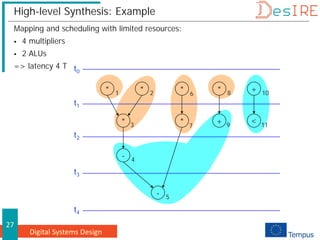
High-level Synthesis: Example
Mapping and scheduling with limited resources:
 4 multipliers
 2 ALUs
=> latency 4 T
* *
*
*
+ <
*
-
-
* +
1 2 6 8 10
4
3 7 9 11
5
t0
t1
t2
t3
t4
Digital Systems Design
28
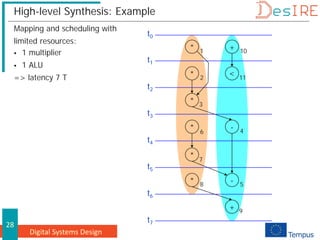
High-level Synthesis: Example
Mapping and scheduling with
limited resources:
 1 multiplier
 1 ALU
=> latency 7 T
* 1
* 2
* 6
* 8
+ 10
- 4
* 3
* 7
+ 9
< 11
- 5
t0
t1
t2
t3
t4
t5
t6
t7
Digital Systems Design
29
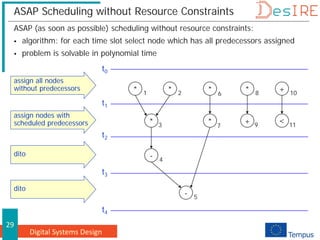
ASAP Scheduling without Resource Constraints
ASAP (as soon as possible) scheduling without resource constraints:
 algorithm: for each time slot select node which has all predecessors assigned
 problem is solvable in polynomial time
* * * * +
1 2 6 8 10
- 4
* + <
*
3 7 9 11
- 5
t0
t1
t2
t3
t4
assign all nodes
without predecessors
assign nodes with
scheduled predecessors
dito
dito
Digital Systems Design
30
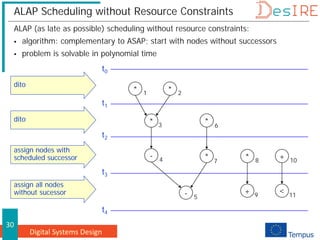
ALAP Scheduling without Resource Constraints
ALAP (as late as possible) scheduling without resource constraints:
 algorithm: complementary to ASAP; start with nodes without successors
 problem is solvable in polynomial time
* *
1 2
* 6
* 3
- * +
8 10
4 * 7
+ <
- 9 11
5
t0
t1
t2
t3
t4
dito
dito
assign nodes with
scheduled successor
assign all nodes
without sucessor
Digital Systems Design
31
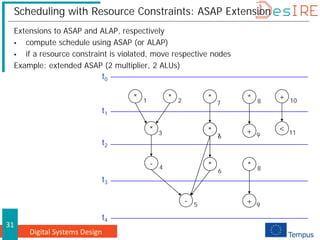
Scheduling with Resource Constraints: ASAP Extension
Extensions to ASAP and ALAP, respectively
 compute schedule using ASAP (or ALAP)
 if a resource constraint is violated, move respective nodes
Example: extended ASAP (2 multiplier, 2 ALUs)
* * +
1 2 10
- 4
* <
3 11
- 5
t0
t1
t2
t3
t4
* 8
+ 9
*
6
*
7
* 8
+ 9
*
6
*
7
Digital Systems Design
32
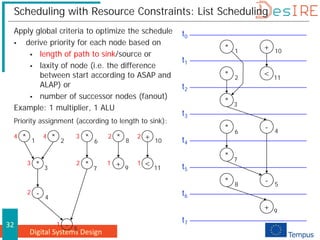
Scheduling with Resource Constraints: List Scheduling
Apply global criteria to optimize the schedule
 derive priority for each node based on
 length of path to sink/source or
 laxity of node (i.e. the difference
between start according to ASAP and
ALAP) or
 number of successor nodes (fanout)
Example: 1 multiplier, 1 ALU
Priority assignment (according to length to sink):
* 1
+ 10
* 6
- 4
* 7
+ 9
* 2
< 11
* 8
- 5
t0
t1
t2
t3
t4
t5
t6
t7
* 3
* *
*
*
+ <
*
-
-
* +
1 2 6 8 10
4
3 7 9 11
5
1
2
1 1
2
2
2
3
3
4
4
Digital Systems Design
33
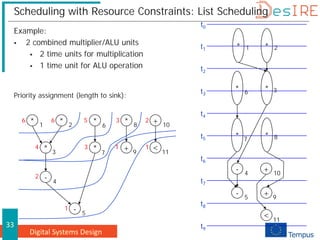
Scheduling with Resource Constraints: List Scheduling
Example:
 2 combined multiplier/ALU units
 2 time units for multiplication
 1 time unit for ALU operation
Priority assignment (length to sink):
* *
*
*
+ <
*
-
-
* +
1 2 6 8 10
4
3 7 9 11
5
1
2
1 1
2
3
3
4
5
6
6
* 1 * 2
* 6
* 8
+ 10
- 4
* 7
t0
t1
t2
t3
t4
t5
t6
t7
* 3
t8
t9
+ 9
<
11
- 5
Digital Systems Design
34
Advanced Topics of High-level Synthesis
Considered so far:
 mapping and scheduling without resources constraints
 mapping and scheduling with given number (and type) of resources
Advanced topics:
 mapping and scheduling with time constraints and open number of resources
 mapping and scheduling of periodic tasks
 mapping and scheduling in the presence of multiple resources with identical
functionality but different area-latency relations
 ...
The general mapping and scheduling problem is NP hard (optimal solution is not
computable in polynomial time)
Numerous heuristic optimization algorithms have been applied to the problem
Digital Systems Design
35
References
 D. Gajski, N. Dutt, A. Wu, S. Lin: High-level Synthesis – Introduction to Chip
and System Design. Kluwer Academic Publishers, 1992.
 Bleck, Goedecke, Huss, Waldschmidt: Praktikum des modernen VLSI-
Entwurfs. B.G. Teubner, 1996
 J. Teich: Digitale Hardware/Software Systeme. Springer, 1997.
Digital Systems Design
1
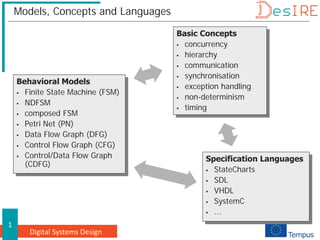
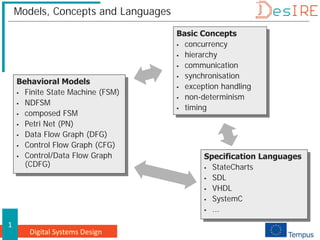
Models, Concepts and Languages
Behavioral Models
 Finite State Machine (FSM)
 NDFSM
 composed FSM
 Petri Net (PN)
 Data Flow Graph (DFG)
 Control Flow Graph (CFG)
 Control/Data Flow Graph
(CDFG)
Specification Languages
 StateCharts
 SDL
 VHDL
 SystemC
 ...
Basic Concepts
 concurrency
 hierarchy
 communication
 synchronisation
 exception handling
 non-determinism
 timing
Digital Systems Design
5
Synchronous vs. Asynchronous FSMs
Synchronous FSMs (e.g. StateCharts):
 communication by shared variables that are read and written in zero time
 communication and computation happens instantaneously at discrete time
instants
 all FSMs execute a transition simultaneously (lock-step)
 may be difficult to implement
 multi-rate specifications
 distributed/heterogeneous architectures
Asynchronous FSMs (e.g. SDL, CSP) :
 free to proceed independently
 do not execute a transition at the same time (except for CSP rendezvous)
 may need to share notion of time: synchronization
 easy to implement
Multitude of commercial and non-commercial graphical languages and tools:
 StateCharts, UML, SDL, StateFlow
 tool support for design, simulation, validation, code generation, HW
synthesis, …
Digital Systems Design
6
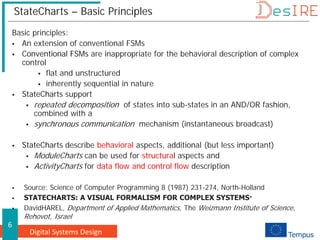
StateCharts – Basic Principles
Basic principles:
 An extension of conventional FSMs
 Conventional FSMs are inappropriate for the behavioral description of complex
control
 flat and unstructured
 inherently sequential in nature
 StateCharts support
 repeated decomposition of states into sub-states in an AND/OR fashion,
combined with a
 synchronous communication mechanism (instantaneous broadcast)
 StateCharts describe behavioral aspects, additional (but less important)
 ModuleCharts can be used for structural aspects and
 ActivityCharts for data flow and control flow description
 Source: Science of Computer Programming 8 (1987) 231-274, North-Holland
 STATECHARTS: A VISUAL FORMALISM FOR COMPLEX SYSTEMS·
 DavidHAREL, Department of Applied Mathematics, The Weizmann Institute of Science,
Rehovot, Israel
Digital Systems Design
7
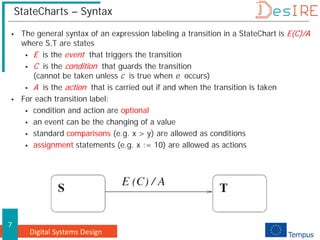
StateCharts – Syntax
 The general syntax of an expression labeling a transition in a StateChart is E(C)/A
where S,T are states
 E is the event that triggers the transition
 C is the condition that guards the transition
(cannot be taken unless c is true when e occurs)
 A is the action that is carried out if and when the transition is taken
 For each transition label:
 condition and action are optional
 an event can be the changing of a value
 standard comparisons (e.g. x > y) are allowed as conditions
 assignment statements (e.g. x := 10) are allowed as actions
Digital Systems Design
8
StateCharts – Actions and Events
 An action A on the edge leaving a state may also appear as an event triggering
a transition going into an orthogonal state:
 a state transition broadcasts an event visible immediately to all other FSMs,
that can make transitions immediately and so on
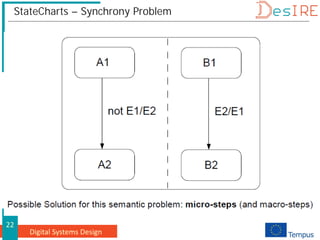
 executing the first transition will immediately cause the second transition to
be taken simultaneously (problem in reality!!!)
 Actions and events may be associated to the execution of orthogonal
components: start(A), stopped(B)
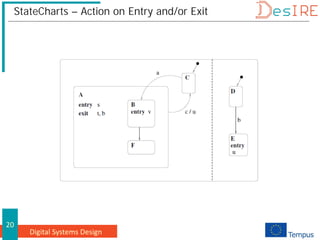
 Entry / Exit actions in states
Digital Systems Design
9
StateCharts – Hierarchy
State decomposition:
 OR-States have sub-states that are related to each other by exclusive-or
 AND-States have orthogonal state components (synchronous FSM composition)
 AND-decomposition can be carried out on any level of states (more
convenient than allowing only one level of communicating FSMs)
 Basic States have no sub-states (bottom of hierarchy)
 Root State have no parent states (top of hierarchy)
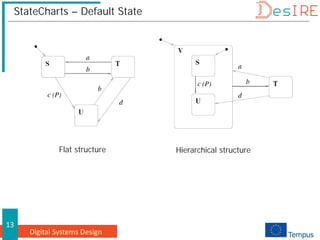
 Initialization:
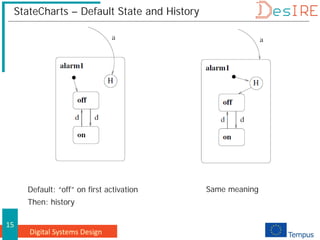
 Default (or initial states) can be marked in each hierarchy level
 History connector to remember states in sub-states
 Combination of default state on first start and history for further steps
Digital Systems Design
10
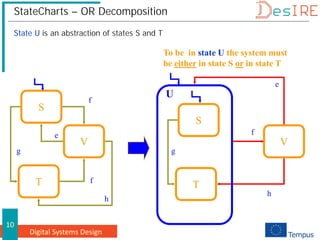
StateCharts – OR Decomposition
S
V
T
S
V
T
f
f
f
e
h
e
h
g g
To be in state U the system must
be either in state S or in state T
U
State U is an abstraction of states S and T
Digital Systems Design
11
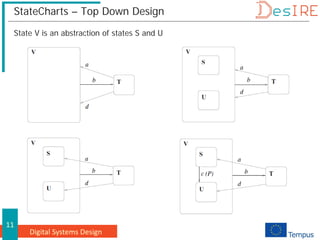
StateCharts – Top Down Design
State V is an abstraction of states S and U
Digital Systems Design
12
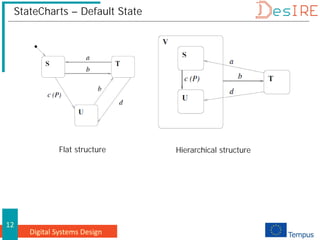
StateCharts – Default State
Flat structure Hierarchical structure
Digital Systems Design
13
StateCharts – Default State
Flat structure Hierarchical structure
Digital Systems Design
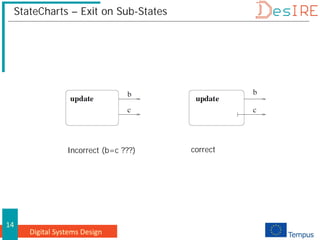
14
StateCharts – Exit on Sub-States
Incorrect (b=c ???) correct
Digital Systems Design
15
StateCharts – Default State and History
Default: “off” on first activation
Then: history
Same meaning
Digital Systems Design
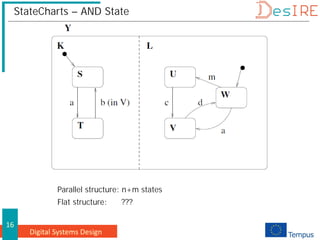
16
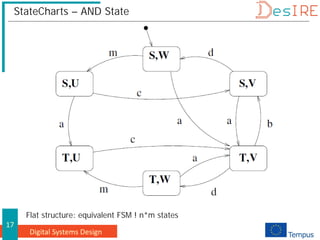
StateCharts – AND State
Parallel structure: n+m states
Flat structure: ???
Digital Systems Design
17
StateCharts – AND State
Flat structure: equivalent FSM ! n*m states
Digital Systems Design
18
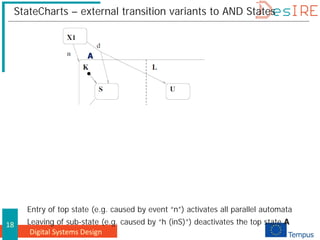
StateCharts – external transition variants to AND States
Entry of top state (e.g. caused by event “n”) activates all parallel automata
Leaving of sub-state (e.g. caused by “h (inS)”) deactivates the top state A
A
Digital Systems Design
19
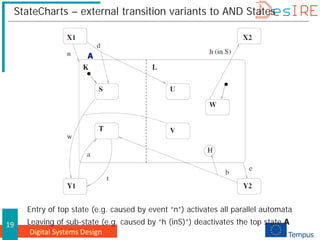
StateCharts – external transition variants to AND States
Entry of top state (e.g. caused by event “n”) activates all parallel automata
Leaving of sub-state (e.g. caused by “h (inS)”) deactivates the top state A
A
Digital Systems Design
20
StateCharts – Action on Entry and/or Exit
Digital Systems Design
21
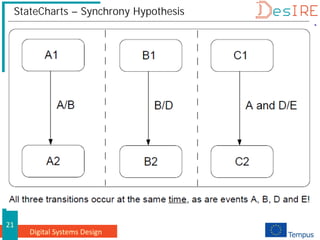
StateCharts – Synchrony Hypothesis
Digital Systems Design
22
StateCharts – Synchrony Problem
Digital Systems Design
23
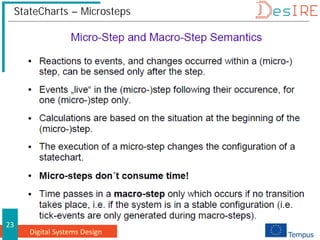
StateCharts – Microsteps
Digital Systems Design
24
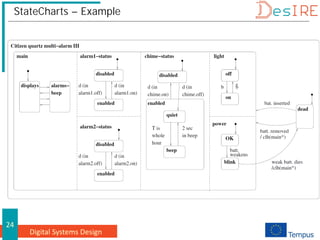
StateCharts – Example
Digital Systems Design
25
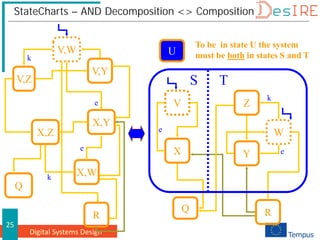
StateCharts – AND Decomposition <> Composition
V,W
V,Y
V,Z
V
W
X
X,Y
X,W
X,Z
R
Q
Z
Y
U
R
Q
S T
k
e
e
e
k
To be in state U the system
must be both in states S and T
k
e
Digital Systems Design
26
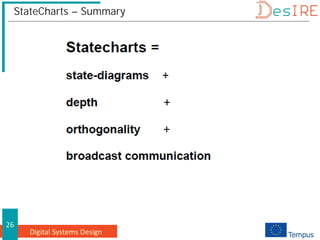
StateCharts – Summary
Digital Systems Design
27
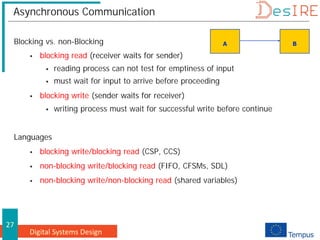
Asynchronous Communication
Blocking vs. non-Blocking
 blocking read (receiver waits for sender)
 reading process can not test for emptiness of input
 must wait for input to arrive before proceeding
 blocking write (sender waits for receiver)
 writing process must wait for successful write before continue
Languages
 blocking write/blocking read (CSP, CCS)
 non-blocking write/blocking read (FIFO, CFSMs, SDL)
 non-blocking write/non-blocking read (shared variables)
A B
Digital Systems Design
28
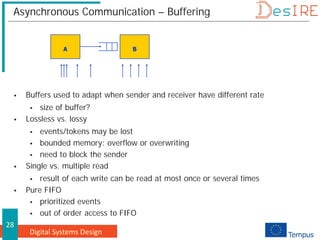
Asynchronous Communication – Buffering
 Buffers used to adapt when sender and receiver have different rate
 size of buffer?
 Lossless vs. lossy
 events/tokens may be lost
 bounded memory: overflow or overwriting
 need to block the sender
 Single vs. multiple read
 result of each write can be read at most once or several times
 Pure FIFO
 prioritized events
 out of order access to FIFO
A B
Digital Systems Design
29
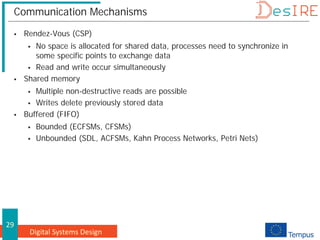
Communication Mechanisms
 Rendez-Vous (CSP)
 No space is allocated for shared data, processes need to synchronize in
some specific points to exchange data
 Read and write occur simultaneously
 Shared memory
 Multiple non-destructive reads are possible
 Writes delete previously stored data
 Buffered (FIFO)
 Bounded (ECFSMs, CFSMs)
 Unbounded (SDL, ACFSMs, Kahn Process Networks, Petri Nets)
Digital Systems Design
30
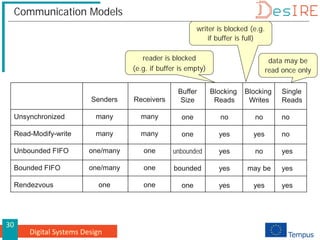
Communication Models
Unsynchronized
Read-Modify-write
Unbounded FIFO
Bounded FIFO
Rendezvous
Senders
many
many
one/many
one/many
one
Receivers
many
many
one
one
one
Buffer
Size
one
one
unbounded
bounded
one
Blocking
Reads
no
yes
yes
yes
yes
Blocking
Writes
no
yes
no
may be
yes
Single
Reads
no
no
yes
yes
yes
data may be
read once only
writer is blocked (e.g.
if buffer is full)
reader is blocked
(e.g. if buffer is empty)
Digital Systems Design
31
Petri Nets (PNs)
 Model introduced by C.A. Petri in 1962
 Ph.D. Thesis: “Communication with Automata”
 Applications: distributed computing, manufacturing, control, communication
networks, transportation, …
 PNs describe explicitly and graphically:
 sequencing/causality
 conflict/non-deterministic choice
 concurrency
 Asynchronous model (partial ordering)
 Main drawback: no hierarchy
Digital Systems Design
32
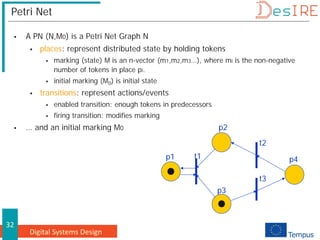
Petri Net
 A PN (N,M0) is a Petri Net Graph N
 places: represent distributed state by holding tokens
 marking (state) M is an n-vector (m1,m2,m3…), where mi is the non-negative
number of tokens in place pi.
 initial marking (M0) is initial state
 transitions: represent actions/events
 enabled transition: enough tokens in predecessors
 firing transition: modifies marking
 … and an initial marking M0
t1
p1
p2
t2
p4
t3
p3
Digital Systems Design
33
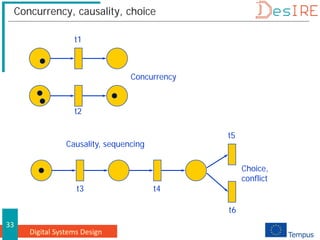
Concurrency, causality, choice
t1
t2
t3 t4
t5
t6
Concurrency
Causality, sequencing
Choice,
conflict
Digital Systems Design
34
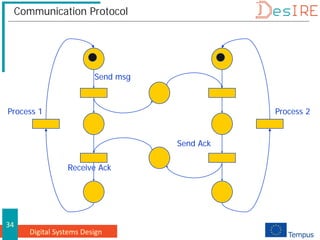
Communication Protocol
Process 1
Send msg
Receive Ack
Send Ack
Process 2
Digital Systems Design
35
Producer-Consumer Problem
Produce
Consume
Buffer
Digital Systems Design
37
Summary: Control Flow Description
Specification Language
⇒ NDFSM
⇒ State Charts, Petri Nets
⇒ SDL
⇒ MSC
⇒ State Charts
⇒ All
⇒ Different ;-(
Properties
⇒ Nondeterminism
⇒ Parallel automata
⇒ Processes
⇒ Communication
⇒ Hierarchy
⇒ Graphical support
⇒ Semantic
Digital Systems Design
38
Control vs. Data Flow Applications
Rough classification:
 control:
 don’t know when data arrive
(quick reaction)
 time of arrival often matters
more than value
 data:
 data arrive in regular streams
(samples)
 values matter most
Distinction is important for:
 specification (language, model, ...)
 synthesis (scheduling,
optimization, ...)
 validation (simulation, formal
verification, ...)
Specification, synthesis and validation
methods emphasize:
 for control:
 event/reaction relation
 response time
(real-time scheduling for
deadline satisfaction)
 priority among events and
processes
 for data:
 functional dependency between
input and output
 memory/time efficiency
(data-flow scheduling for
efficient pipelining)
 all events and processes are
equal
Digital Systems Design
39
Data Flow Graph (DFG)
Powerful formalism for data-dominated applications
DFG support the specification of transformational systems:
 output is a function of the input
 set of actors (nodes) connected by a set of arcs representing the data flow
 no states, no external events to trigger state changes
 unbounded FIFO queues (main data store)
 no control nodes, e.g. branch, loop
DFG represent a partial ordered model of the computation
=> specification of problem-inherent dependencies only
=> suitable for scheduling and code generation
=> there is a relation between buffer dimensioning and scheduling
(static scheduling minimizes the number of buffers required)
Languages:
 graphical: Ptolemy (UCB), GRAPE (U. Leuven), SPW (Cadence), COSSAP
(Synopsys)
 textual: Silage (UCB, Mentor), Haskell, Lucid
Digital Systems Design
40
DFG
Semantics (informal)
 actors perform computation (often stateless)
 firing of actors when all needed inputs are available
 unbounded FIFOs for unidirectional exchange of data between actors
(integer, floats, arrays, etc.)
 extensions to model decisions
Example: FIR (finite impuls response) filter
 single input sequence i(n)
 single output sequence o(n)
 o(n) = c1 * i(n) + c2 * i(n-1)
* c1
i * c2
+ o
i(-1)
i(-1)
i(-1)
Digital Systems Design
41
DFG – Example
Digital Systems Design
42
Control Flow Graph (CFG)
 also called flow chart (abstract description of program designs)
 focus on control aspect of a system
 set of nodes and arcs
 trigger of an activity (node) when a particular preceding activity is completed
 different triggers for transitions
 suitable for well defined tasks that do not depend on external events
 imposes a complete order on the execution of activities
=> close to implementation (on conventional computer architecture)
 various variants with various levels of details
 simple operator level (addition, multiplication, etc)
 abstract function/procedure level
Digital Systems Design
43
CFG – Example (detailed level)
Digital Systems Design
44
Control/Data Flow Graph (CDFG)
 also called sequence graph
 mixture of control and data flow graph
 hierarchy of sequential elements
 units model data flow
 hierarchy models control flow
 special nodes (for control operations)
 start/end node: NOP (no operation) – all inputs needed (AND), all outputs
needed (AND)
 branch node (BR) – one out of many outputs selected (OR)
 iteration (LOOP) – one out of two outputs selected (OR)
 procedure call (CALL) – lower hierarchy is executed exactly once
 attributes
 nodes: execution time, cost, ...
 arcs: conditions for branches and loops
Digital Systems Design
45
CDFG – Entity
Legend:
data dependencies
control dependencies
Notes: AND dependencies at NOPs (NO Operation), OR dependencies at
BRanches and LOOPs
Digital Systems Design
46
CDFG – Branch
Notes:
• data dependencies are not fully specified
• x = a – b may execute in parallel to IF statement
• computation of p and q within IF statement may execute in parallel
Digital Systems Design
47
CDFG – Loop
Digital Systems Design
48
CDFG – Call
Digital Systems Design
49
Review of Models, Concepts and Languages
Behavioral Models
 Finite State Machine (FSM)
 NDFSM
 composed FSM
 Petri Net (PN)
 Data Flow Graph (DFG)
 Control Flow Graph (CFG)
 Control/Data Flow Graph
(CDFG)
Specification Languages
 StateCharts
 SDL
 VHDL
 SystemC
 ...
Basic Concepts
 concurrency
 hierarchy
 communication
 synchronisation
 exception handling
 non-determinism
 timing
Digital Systems Design
50
Summary of Basic Concepts of Models and Languages
State transitions
 events triggering a state transition
(simple input, complex conditions)
 computation associated with
transition
Concurrency
 decomposition of behavior in
concurrent entities
 different levels of concurrency (job,
task-, statement-, operation-level)
 data-driven (data dependencies) vs
control-driven concurrency (control
dependencies)
 reduction of states
Hierarchy
 structural hierarchy (system, block,
process, procedure)
 behavioral hierarchy (hierarchical
transitions, fork-join)
Programming constructs
 specify sequential algorithm
Communication
 shared variables (broadcast)
 message passing
 synchronous vs. asynchronous
Synchronization
 control-dependent (fork-join)
 data-dependent (data, event,
message)
Exception handling
 immediate termination of current
behaviror
Non-determinism
 choice between multiple transitions
 non-deterministic ordering
Timing
 timeouts
 time constraints (e.g. exec. time)
Digital Systems Design
51
References
 D. Gajski, F. Vahid, S. Narayan, J. Gong: Specification and Design of
Embedded Systems. Prentice Hall, 1994. (chapters 2 and 3)
 J. Teich: Digitale Hardware/Software Systeme. Springer, 1997.
 http://www.sei.cmu.edu/publications/documents/02.reports/02tn001.html
Digital Systems Design
1
Models, Concepts and Languages
Behavioral Models
 Finite State Machine (FSM)
 NDFSM
 composed FSM
 Petri Net (PN)
 Data Flow Graph (DFG)
 Control Flow Graph (CFG)
 Control/Data Flow Graph
(CDFG)
Specification Languages
 StateCharts
 SDL
 VHDL
 SystemC
 ...
Basic Concepts
 concurrency
 hierarchy
 communication
 synchronisation
 exception handling
 non-determinism
 timing
Digital Systems Design
2
Parallel Finite State Machines - Result of Decomposition
Digital Systems Design
3
Parallel Finite State Machines Example
Digital Systems Design
4
Single FSM
Digital Systems Design
5
FSM- Decomposition / Composition
Digital Systems Design
6
Parallel Finite State Machines - Properties
 Concurrency
 Delay
 Synchronization
 Rendezvous
 Mutual exclusion
 Blocking
 Priorization
Digital Systems Design
7
Finite State Machines - Stability
 Stable {X2,X1,X0}
 {X0}
{X3}
 {X1}
 In = X1= Out
Digital Systems Design
8
Finite State Machines - Stability
 Instable {X2}
 {X0} {X1,X0}
 {X1} {X3}
 In = X1= Out
Digital Systems Design
9
Finite State Machines - Stability
 Conditionally stable
stable for X0
 In = X0 Out ={X0,X2,X3}
 In = X1 Out = X1
(instable for X1 )
Digital Systems Design
10
Finite State Machines - Stability
 Example
Digital Systems Design
11
Finite State Machines - Stability
 Example
Digital Systems Design
12
Finite State Machines - Stability
 Example
Digital Systems Design
13
Finite State Machines - Stability
 Example
Digital Systems Design
14
Finite State Machines - Stability
 Instable States
Digital Systems Design
15
Finite State Machines - Stability
 Stable States (abstraction)
Digital Systems Design
22
Petri Nets (PNs)
 Model introduced by C.A. Petri in 1962
 Ph.D. Thesis: “Communication with Automata”
 Applications: distributed computing, manufacturing, control, communication
networks, transportation, …
 PNs describe explicitly and graphically:
 sequencing/causality
 conflict/non-deterministic choice
 concurrency
 Asynchronous model (partial ordering)
 Main drawback: no hierarchy
Digital Systems Design
43
Summary of Basic Concepts of Models and Languages
State transitions
 events triggering a state transition
(simple input, complex conditions)
 computation associated with
transition
Concurrency
 decomposition of behavior in
concurrent entities
 different levels of concurrency (job,
task-, statement-, operation-level)
 data-driven (data dependencies) vs
control-driven concurrency (control
dependencies)
 reduction of states
Hierarchy
 structural hierarchy (system, block,
process, procedure)
 behavioral hierarchy (hierarchical
transitions, fork-join)
Programming constructs
 specify sequential algorithm
Communication
 shared variables (broadcast)
 message passing
 synchronous vs. asynchronous
Synchronization
 control-dependent (fork-join)
 data-dependent (data, event,
message)
Exception handling
 immediate termination of current
behavior
Non-determinism
 choice between multiple transitions
 non-deterministic ordering
Timing
 timeouts
 time constraints (e.g. exec. time)
Digital Systems Design
44
References
 D. Gajski, F. Vahid, S. Narayan, J. Gong: Specification and Design of
Embedded Systems. Prentice Hall, 1994. (chapters 2 and 3)
 J. Teich: Digitale Hardware/Software Systeme. Springer, 1997.
 http://www.sei.cmu.edu/publications/documents/02.reports/02tn001.html
Digital Systems Design
1
Part 9,
Time and Performance Evaluation
TECHNISCHE
UNIVERSITÄT
ILMENAU
Systems Design
Digital Systems Design
3
Evaluation of Temporal and Performance Aspects
 Problem Statement
 Performance Modeling
Integrated
Hard-
and
Software
Systems
http://www.tu-ilmenau.de/ihs
 Performance Evaluation
Digital Systems Design
4
Analysis
Design
Implementation
Integration
Example: IP Office Firewall
 identify
performance
requirements
 identify traffic
model
 identify costly or
contradicting
requirements
 replace costly
functions by
cheaper functions
 evaluate design
alternatives
 identify performance
critical components
 adapt design to meet
performance
requirements
 measurement-based
evaluation
Typical performance-related
questions in design phase:
 System architecture?
 HW architecture, need for
special HW?
 Which chip sets/processor?
 Which peripherals?
 Programming approach,
language?
 Which operating system?
 …?
Digital Systems Design
5
response time
perf. req.
3 cases:
Accuracy and Effort
 look at worst case (maximum load) or average (be aware of nonlinear
behavior)
 watch level of detail!
 different kinds of performance requirements
 throughput/utilization of resources -> cheap and accurate performance
evaluation
 response time -> less accurate and highly expensive evaluation
 optimistic/pessimistic evaluation (use of bounds)
note: estimation of bounds is much easier than exact values
optimistic
estimate
pessimistic
estimate
 right on track
optimistic
estimate
pessimistic
estimate
 details/special
care needed
optimistic
estimate
pessimistic
estimate
 there is a
problem!
Digital Systems Design
6
Tasks of Performance Evaluation - Summary
(1) Identify the goals of the performance evaluation
(2) Study the details of the object under investigation
(3) Decide on the modeling approach
(4) Build the performance model
(5) Derive quantitative data (as input) for the performance model
(6) Transform the performance model to an executable or assessable model
(7) Evaluate the performance model
(8) Verify the performance results against the performance requirements
Some advice:
 do simple things first!
 abstract, abstract, abstract!
(back-of-the-envelope analysis is preferable over complex behavioral model)
 don´t skip or defer performance evaluation!
Digital Systems Design
7
Tasks (1): Identify the Goals of the Performance Evaluation
 What is the purpose of the performance evaluation?
 evaluate possible solutions to a decision problem
 identify the parts of the system critical to performance
=> avoid spending time on evaluating things you already know
 What are the performance metrics to be estimated (response time or system
capacity)?
=> impact on modeling and evaluation methods
 What is the required accuracy of the evaluation?
=> impact on modeling and evaluation methods
 What kind of performance evaluation is performed?
=> best/worst case evaluation, average case evaluation
Digital Systems Design
8
Tasks (2-5): Performance Modelling
(2) Study the details of the object under investigation
Workload:
 identification of the service requests issued to the system
Available resources:
 analysis of the execution environment
System:
 analysis of the static structure as well as dynamic aspects of the system
Mapping:
 identification of the resources used by specific service requests
(3) Decide on the modeling approach
 select appropriate performance evaluation technique (CFG, DFG, FSM,
sequence diagrams, queuing model, ...)
(4) Build the performance model
 carefully select the level of abstraction
(5) Derive quantitative data for the performance model
 derive execution times, available resources, traffic model, ...
 measurement, emulation, code analysis, empirical estimation
Digital Systems Design
9
Tasks (6-8): Performance Evaluation
(6) Transform the performance model to an executable or assessable model
 take into account the limits of the selected performance evaluation
technique
(7) Evaluate the performance model
 tool support for simulation, queuing analysis, graph analysis, ...
 ensure the model is a valid model of the system
validation of results (confidence intervals, seeds for simulation, rare
event problems)
(8) Verify the performance results against the performance requirements
 check if real-time, response time, capacity requirements are met
Digital Systems Design
10
Performance Model – The Incredients
Application
 information about the application
 typically some behavioral model attributed with temporal information on
execution times
 e.g. PN, DFG, CFG, FSM
Resources
 typically some structural model attributed with capacity information of
resources (MIPS, FLOPS, ...)
Mapping (spatial assignment)
 information describing how the entities of the application are assigned to the
resources (which function is assigned to which processor or other HW entity)
Runtime system (temporal assignment)
 information on dynamic aspects, e.g. scheduling algorithms
System stimuli (traffic model)
 the characteristics of the input to the system that triggers an execution
 types and temporal characteristics of the input events
Digital Systems Design
11
Resources
P1
P2
Example
Application (DFG or CFG)
Mapping
(spatial assignment)
Stimuli:
number of arrivals (stimuli) for task 1 (source node) per second
(deterministic or probabilistic)
Schedule for processor P1:
 1, 2, 3, 4 (no impact with given mapping)
 schedule may be static or dynamic (priorities)
1
2
3
4 5
6
Digital Systems Design
12
Performance Evaluation – Summary of Methods
Methods
 process graph analysis (structural model)
 task graph analysis (behavioral model)
 schedulability analysis (real-time analysis)
 Markov chain analysis
 queuing network analysis
 operational analysis
 discrete-event simulation
In order to select the right method it is important to understand
the strengths and limits of each method!
Digital Systems Design
13
Process Graph Analysis
Process graph
 structural model of the application
 nodes represent functional entities (module, function, procedure, operation, etc)
 edges represent communication relations
 precedence relations are neglected
Process graph analysis
 limited to the analysis of the load imposed on the resources of the system
 assumption that contention on resources does not have a negative impact on the
load of the system
 resources may be physical (e.g. processor, HW entity, communication link) or
logical (e.g. critical sections)
Example of simple analysis:
load(r) = ∑ p∈Ar
load(p,r)
where
 p denotes some process
 Ar specifies the set of processes assigned to resource r and
 load(p,r) denotes the exact resource demand resulting from the assignment of process
p on resource r
Note: the formula may be equally applied to compute the load of a communication link
Digital Systems Design
14
HW
SW
Process Graph Analysis
Example: HW/SW partitioning
 assign the tasks to the SW and the HW entity
such that
 the maximum of the processing time of SW
and HW is a minimum and
 the communication cost are minimal
 20/2 denote the cost (load) of processing the
process in SW or HW, respectively
 9 denote the communication cost (load) if
communicating partners are assigned to different
entities, otherwise the cost are zero
1 4
5
2
6
3
5/3
15/9
10/1
8/2
20/2 20/3
1
10 8
6
9
3
Cost function (example):
cost (partitioning) = wp max∀ r ∈ R {∑p ∈ Ar
load(p,r)} + wc ∑c ∈ Ac
load(c)
where
 wp and wc denote the weight (importance) of the processing cost and the
communication cost, respectively
 R denotes the set of processing resources
 Ar specifies the set of processes p assigned to processing resource r
 Ac specifies the set of non-internal communications between two entities
Digital Systems Design
15
Process Graph Analysis
Typical questions to be answered:
 can the load be handled by the available resources (processors, links)?
 is the load balanced?
Method is often used in industry to estimate the load imposed on a system and
to estimate the system capacity
Application to communication systems design: estimate the communication
bandwidth of the system (e.g. of internal memory bus or system bus)
Tooling: excel sheet is sufficient
Discussion:
 simple, fast and efficient
 application to best-case analysis
=> load/capacity is a central constraint that has to be met by the system,
otherwise detailed studies are useless!
Digital Systems Design
16
Task Graph Analysis
Task graph
 simple behavior model of the application
 nodes represent functional entities (module, function, procedure, operation, etc)
 arcs represent precedence constraints
Task graph analysis
 analysis of the critical path from source to sink (graph theory)
 focus on response time of the system
 assumption that contention on resources does not have a negative impact on the
load of the system (e.g. no context-switch times - similar to process analysis)
 resources may be physical (e.g. processor, HW entity, communication link) or
logical (e.g. critical sections)
Discussion:
 simple and efficient for deterministic (constant) execution times
(complex for other distributions)
 application to best-case analysis
(neglect contention on resources – scheduling)
 wide application to optimization techniques
Digital Systems Design
17
Task Graph Analysis – Examples
Analysis:
 find the longest (critical) path and compute its length
(apply recursive scheme to compute subpaths)
Example 1: DFG (or CDF with
parallel entities)
1
2
3
4 5
6
2
4
3
1
4
1
Result: critical path T = 8 ms
(best case, i.e. no contention)
20 ms
33 ms
23 ms
Result: critical path T = 76 ms (best-case, i.e.
determ. times, no contention, no queuing)
medium
1 Mb
2 MI
2,8 MI
prot. stack
prot. stack
prozessor
120 MIps
prozessor
100 MIps
phy network
30 Mbps
Example 2: communication system
Digital Systems Design
18
Schedulability Analysis
Analysis techniques to check whether a system can meet its deadlines
Model:
 fixed set of processes
 single processor/resource
 all processes are periodic, with known periods
 processes are completely independent of each other
 process deadlines are equal to the process periods
 all system overheads are ignored
 all processes have a fixed worst-case execution time
 priority-based preemptive scheduling of processes (runable higher-priority
process immediately interrupts a low-priority process)
Schedulability analysis:
 check if the deadlines can be met under all circumstances
 different schemes available depending on the specific model
Digital Systems Design
19
Rate Monotonic Priority Assignment
Idea: assign priorities to processes according to their period T (and deadline D)
(process with shortest period is assigned the highest priority (5))
Rate monotonic (RM) scheduling is optimal in the sense that
 if a process set can be scheduled (using preemptive priority-based
scheduling) with a fixed priority assignment scheme,
 then the same process set can also be scheduled with an RM assignment
scheme
Example for RM scheduling:
process period T priority P
A 25 5
B 60 3
C 42 4
D 105 1
E 75 2
process period T priority P
A 25
B 60
C 42
D 105
E 75
Digital Systems Design
20
Schedulability Analysis – Utilization-based
Idea: derive sufficient condition for schedulability based on the analysis of the
resource utilization
Assumption: RM scheduling
Sufficient condition for schedulability (though not a necessary condition):
Utilization U = ∑i=1...N
(Ui
) = ∑i=1...N
(Ci
/Ti
) < N(21/N
– 1)
where
 i identifies the process,
 Ui
specifies the resource utilization due to process i
 Ci
specifies the computation time of process i
 Ti
specifies its period
 N defines the number of processes
Utilization bounds (U): N=1 => U=1; N=2 => U=0.828; N=10 => U=0.718;
for infinite number of N: U->0.69
Discussion:
 simple test for simple models (deadline Di
= Ti
, etc.)
Digital Systems Design
21
Schedulability Analysis – Example
RM scheduling => Utilization-based analysis:
1/3 + 1/4 + 2/6 = 11 /12
0.33 + 0.25 + 0.33 = 0.91 > 0.78
=> sufficient condition is not given
process period T comp. time C priority P
0 3 1 3
1 4 1 2
2 6 2 1
all times in ms

U = ∑i=1...N (Ui) = ∑i=1...N (Ci/Ti) < N(2
1/N
– 1)
Digital Systems Design
22
Schedulability Analysis – Response-time Analysis
Idea:
 predict the worst-case response time of each process and compare with the
deadline to determine the feasibility of the schedule
Assumption: any priority assignment (not only RM)
Outline of approach:
 response time Ri
of process i is Ri
= Ci
+ Ii
where Ii
is the maximum
interference of process i from higher-priority processes
 the interference depends on the number of releases of the interfering processes
and their computation time, i.e. the interference Ii,j
of the higher priority
process j on process i is
Ii,j
= Ri
/Tj
* Cj
 application of fixed-point iteration method to solve the equations
(start with Ri,0 = Ci; terminate when Ri,n+1 = Ri,n)
Ri,n+1 = Ci + ∑j<i Ri,n/Tj * Cj
For details and variants see Burns&Wellings or Krishna&Shin
Digital Systems Design
23
Schedulability Analysis – Example
Response-time analysis:
Response time R0
of Process P0
:
R0
= C0
+ I0
= C0
+ 0 = 1 ms
Response time R1
of process P1
(recursive):
R1
= C1
= 1 ms (without interrupt)
R1
= C1
+ I1
= C1
+ I1,0
= C1
+ R‘1
/T0
* C0
= 1 + 1/3 * 1 = 2 ms
R1
= C1
+ I1
= C1
+ I1,0
= C1
+ R‘1
/T0
* C0
= 1 + 2/3 * 1 = 2 ms
Response time R2
of process P2
(recursive):
R2
= C2
= 2 ms
R2
= C2
+ I2
= C2
+ I2,0
+ I2,1
= C2
+ R‘2
/T0
* C0
+ R‘2
/T1
* C1
= 2 + 2/3 * 1 + 2/4 * 1 = 4 ms
R2
= C2
+ I2
= C2
+ I2,0
+ I2,1
= C2
+ R‘2
/T0
* C0
+ R‘2
/T1
* C1
= 2 + 4/3 * 1 + 4/4 * 1 = 5 ms
R2
= C2
+ I2
= C2
+ I2,0
+ I2,1
= C2
+ R‘2
/T0
* C0
+ R‘2
/T1
* C1
= 2 + 5/3 * 1 + 5/4 * 1 = 6 ms
R2
= C2
+ I2
= C2
+ I2,0
+ I2,1
= C2
+ R‘2
/T0
* C0
+ R‘2
/T1
* C1
= 2 + 6/3 * 1 + 6/4 * 1 = 6 ms
process period T comp. time C priority P
0 3 1 3
1 4 1 2
2 6 2 1 all times in ms



Digital Systems Design
24
Markov Chain Analysis
Idea: model the states and the transitions of the system and assign rates to the
transitions (comparable to a FSM with timed transitions)
Example: single server with a queue holding up to 2 requests
3 2 1 0
µ
λ
µ µ
λ
λ
λ
λ denotes the arrival rate
µ denotes the service rate
Sketch of solution technique for steady-state analysis:
 mapping of Markov chain on a set of linear equations defining the state
probabilities
 normalization equation ∑i=0...n
pi = 1
 derivation of mean values and distribution functions from state probabilities
Transient analysis is based on set of differential equations
Discussion:
 rather low-level description of the states of the system
 restricted to exponentially distributed transition rates and independence of events
 state explosion problem for realistic systems (beyond millions of states)
Digital Systems Design
25
Markov Chain Analysis – Example
Example: single server with a queue holding up to 2 requests
3 2 1 0
µ
λ
µ µ
λ
λ
λ
λ denotes the arrival rate
µ denotes the service rate
Steady-state analysis:
 mapping of Markov chain on a set of linear equations
state 3: λp2 = µp3
state 2: λp1 + µp3 = λp2 + µp2
state 1: λp0 + µp2 = λp1 + µp1
state 0: µp1 = λp0
normalization equation: p0 + p1 + p2 + p3 = 1
 resolution of system of equations to derive state probabilities
p0 = 1 / (1 + λ/µ + (λ/µ)2 + (λ/µ)3 )
p1 = (λ/µ) / (1 + λ/µ + (λ/µ)2 + (λ/µ)3 ); p2 = ...
 derivation of mean values and distribution functions from state probabilities
utilization: U = 1 - p0; mean number of jobs in system: N = p1 + 2p2 + 3p3 ;
blocking probability B; distribution functions for waiting time, response time, etc.
steady state implies that
arrivals = completions
Digital Systems Design
26
Queuing Network Analysis
Idea: solve the system at the level of queuing stations directly as an alternative
to a mapping and solution of the Markov chains
Assumption:
 stations are separable (product-form queuing networks)
 each station can be analysed in separation (exponential input results in
exponential output)
Restrictions:
 limited distributions (exponential and derivatives)
 no synchronizations
 no blocking (infinite queues)
Results:
 mean values for delays, utilization, queue length and population
Discussion:
 efficient solution techniques available for a considerable set of queuing
networks
See R. Jain for details
Digital Systems Design
27
Queuing Network Analysis - Example
Example: communication system (unbounded queues)
prozessor
120 MIps
prozessor
100 MIps
phy network
30 Mbps
λ
µ = 100 MIps / 2 MI = 50 1/s
µ = 30 1/s
µ = 43 1/s
= 25 1/s
medium
1 Mb
2 MI
2,8 MI
arrival rate: 25 packets/s
prot. stack
prot. stack
Results (assuming exponential service times and arrivals):
 utilization = λ/µ (e.g. physical network util. = 83 %)
 population per station ni = (λ/µ) / (1− λ/µ)
 mean total population N = ∑
i
ni =7,39
 mean response time T = N/λ = 296 msec (Little’s law)
Digital Systems Design
28
Operational Analysis
Idea:
 model the system as a set of stations with queues
 use a small set of simple laws (job flow balance etc.)
 base analysis on operational data (i.e. measurable and testable)
Assumptions:
 job flow balance
 no assumptions on service and arrival time distributions
Analysis of arrival rates, throughput, utilization and mean service times of the
different stations in the system
Discussion:
 simple (unsuitable to parallel execution)
 fast
 answers „what if“ questions
 derivation of response time figures only if population is given (i.e. application of
Little´s law (answer response time questions only if the population of jobs in the
system is known ) – no assumptions about distributions)
See Lazowska et.al. or Denning & Buzen for details
Digital Systems Design
29
Discrete-event Simulation
Idea:
 model the relevant events of the system
 process the events according to their temporal order (similar to the real
execution with the exception that simple processing blocks are modeled only)
Example: Execution on a 2-processor system (non-preemptive)
P1
P2
1
2
5 3
4
6
0 2 4 6 8 10
Discussion
 no assumptions
 danger of including too many details
 evaluation is time consuming
 problems with rare events
 large set of tools and models available
Legend:
green: execution time
blue: process priority (1=low)
1
2
3
4 5
6
2
4
3
1
4
1
/1
/4
/3
/6
/5
/2
Digital Systems Design
30
Measurement-based Evaluation
Steps of measurement-based evaluation
 derive (behavioral) model of the system
 decide on instrumentation points
 instrumentation of the executables to generate traces (add time stamp)
 interfacing to track data (SW or HW monitoring) – minimize the intrusion to
system execution (and thus falsification of results)
 post-execution analysis of the traces
 special care needed in distributed systems -> common notion of time needed
Various measurement tools are available
Gain important insight in the system execution for performance debugging and
development of future systems
Digital Systems Design
31
Comparision of Methods
Analysis Analysis of
multiprocessor
systems
Verification
of Real
Time
requests
Modelling of
parallel
processing (prec.
constraints)
best
case
worst
case
average
Process graph   no 
Task graph  not really ? 
Schedulability
Utiliz.-based  no  no
Resp.-based  no  no
Markov chains   no 
Queuing
networks
  no no
Operational
analysis
  no no
Simulation   no 
Measurements  no 
Digital Systems Design
32
Problems and Limits of Performance Evaluations
 missing data
 uncertainty of available execution data
 data dependencies (if, case, while, ...)
 context dependencies: caching, scheduling, synchronization, blocking
=> worst case execution time (based on code rather than measurements)
 uncertainty of traffic model, i.e. the distributions of the stimuli of the system
Digital Systems Design
33
References
Overview and simple techniques:
 A. Mitschele-Thiel: Systems Engineering with SDL – Developing Performance-Critical
Communication Systems. Wiley, 2001. (section 2.3 & 2.4)
 H.U. Heiss: Prozessorzuteilung in Parallelrechnern. BI-Wissenschaftsverlag, Reihe
Informatik, Band 98, 1994.
 R. Jain: The Art of Computer Systems Performance Analysis – Techniques for
Experimental Design, Measurements, Simulation, and Modeling. Wiley, 1991.
Evaluation of real-time systems (deterministic assumptions):
 A. Burns, A. Wellings: Real-Time Systems and Programming Languages, 2nd edition,
Addison Wesley, 1996.
 G. Buttazzo: Hard Real-Time Computing Systems. Kluwer Academic Publishers. 1997.
 C.M. Krishna, K.G. Shin: Real-time Systems. McGraw-Hill, 1997.
 H. Kopetz: Real-time Systems. Kluwer Academic Publishers, 1997.
Evaluation of queuing systems (exponential and other distributions):
 J. Dennig, J. Buzen: The Operational Analysis of Queueing Network Models. Computing
Surveys, 10(3), Sept. 1978.
 E.D. Lazowska, J. Zahorjan, G.S. Graham, K. Sevcik: Quantitative System Performance:
Computer System Analysis Using Queueing Network Models. Prentice-Hall, 1984.
Digital Systems Design
1
Part 9,,
Optimization
TECHNISCHE
UNIVERSITÄT
ILMENAU
Digital Systems Design
10
Heuristic Search
Most heuristics are based on an iterative search comprising the following
elements:
 selection of an initial (intermediate) solution (e.g. a sequence)
 evaluation of the quality of the intermediate solution
 check of termination criteria
select initial solution
select next solution
(based on previous solution)
evaluate quality
acceptance criteria satisfied
accept solution as
„best solution so far“
termination criteria satisfied
y
y
n
search strategy
Digital Systems Design
11
Hill-Climbing – Discussion
 simple
 local optimizations only: algorithm is not able to pass a valley to finally reach
a higher peak
 idea is only applicable to small parts of optimization algorithms but needs to
be complemented with other strategies to overcome local optimas
Digital Systems Design
12
Random Search
also called Monte Carlo algorithm
Idea:
 random selection of the candidates for a change of intermediate solutions or
 random selection of the solutions (no use of neighborhood)
Discussion:
 simple (no neighborhood relation is needed)
 not time efficient, especially where the time to evaluate solutions is high
 sometimes used as a reference algorithm to evaluate and compare the
quality of heuristic optimization algorithms
 idea of randomization is applied to other techniques, e.g. genetic algorithms
and simulated annealing
Digital Systems Design
13
Simulated Annealing
Idea:
 simulate the annealing process of material: the slow cooling of material leads to
a state with minimal energy, i.e. the global optimum
Classification:
 Search strategy
 random local search
 Acceptance criteria
 unconditional acceptance of the selected solution if it represents an
improvement over previous solutions
 otherwise probabilistic acceptance
 Termination criteria
 static bound on the number of iterations (cooling process)
Digital Systems Design
14
Simulated Annealing – Discussion and Variants
Discussion:
 parameter settings for cooling process is essential (but complicated)
 slow decrease results in long run times
 fast decrease results in poor solutions
 discussion whether temperature decrease should be linear or logarithmic
 straightforward to implement
Variants:
 deterministic acceptance
 nonlinear cooling (slow cooling in the middle of the process)
 adaptive cooling based on accepted solutions at a temperature
 reheating
Digital Systems Design
15
Genetic Algorithms – Basic Operations
crossover
1 1 0 0 1 0 1 0 1 1 0 1 0 1 0 0 1 0 0 1
1 1 0 0 0 0 1 0 0 1
1 1 0 0 0 1 1 0 0 1
mutation
Digital Systems Design
16
Genetic Algorithms – Basic Algorithm
General parameters:
 size of population
 mutation probability
 candidate selection strategy (mapping quality on probability)
 replacement strategy (replace own parents, replace weakest, influence of
probability)
Application-specific parameters:
 mapping of problem on appropriate coding
 handling of invalid solutions in codings
crossover
replacement
mutation
selection
population
Replacement and selection rely
on some cost function defining
the quality of each solution
Different replacement
strategies, e.g. “survival of the
fittest”
Crossover selection is typically
random
Digital Systems Design
17
Genetische Algorithmen – Minimum Spanning Tree
 small population results in inbreeding
 larger population works well with small mutation rate  tradeoff between size of population and number of iterations
Digital Systems Design
18
Genetic Algorithms –Basic Operations
 Mutation
 => crating a new member of the population by changing one member
Digital Systems Design
19
Genetic Algorithms –Basic Operations
 Crossover
 => crating a new member of the population from two members
Digital Systems Design
20
Genetische Algorithmen – Traveling Salesman Problem
 minimal impact of mutation rate with small population
 negativ impact of high mutation rate with larger population (increased randomness) – impact not quite clear
Digital Systems Design
21
Genetic Algorithms – Discussion
 finding an appropriate coding for the binary vectors for the specific
application at hand is not intuitive
problems are
 redundant codings,
 codings that do not represent a valid solution, e.g. coding for a
sequencing problem
 tuning of genetic algorithms may be time consuming
 parameter settings highly depend on problem specifics
 suited for parallelization of optimization
Digital Systems Design
22
Tabu Search
Idea:
 extension of hill-climbing to avoid being trapped in local optima
 allow intermediate solutions with lower quality
 maintain history to avoid running in cycles
Classification:
 Search strategy
 deterministic local search
 Acceptance criteria
 acceptance of best solution in neighborhood which is not tabu
 Termination criteria
 static bound on number of iterations or
 dynamic, e.g. based on quality improvements of solutions
Digital Systems Design
23
Tabu Search – Algorithm
The brain of the algorithm is the
tabu list that stores and maintains
information about the history of the
search.
In the most simple case a number of
previous solutions are stored in the
tabu list.
More advanced techniques maintain
attributes of the solutions rather than
the solutions itself
select initial solution
select neighborhood set
(based on current solution)
remove tabu solutions
from set
set is empty
increase neigborhood
termination criteria satisfied
y
y
n
n
evaluate quality and
select best solution from set
update tabu list
Digital Systems Design
24
Tabu Search – Organisation of the History
The history is maintained by the tabu list
Attributes of solutions are a very flexible mean to control the search
Example of attributes of a HW/SW partitioning problem with 8 tasks assigned to 1 of 4
different HW entities:
(A1) change of the value of a task assignment variable
(A2) move to HW
(A3) move to SW
(A4) combined change of some attributes
(A5) improvement of the quality of two subsequent solutions over or below
a threshold value
Aspiration criteria: Under certain conditions tabus may be ignored, e.g. if
 a tabu solution is the best solution found so far
 all solutions in a neighborhood are tabu
 a tabu solution is better than the solution that triggered the respective tabu conditions
Intensification checks whether good solutions share some common properties
Diversification searches for solution that do not share common properties
Update of history information may be recency-based or frequency-based (i.e. depending on
the frequency that the attribute has been activated)
1
2
3
4 5
6
2
4
3
1
4
1
/1
/4
/3
/6
/5
/2
Digital Systems Design
25
Tabu Search – Discussion
 easy to implement (at least the neighborhood search as such)
 non-trival tuning of parameters
 tuning is crucial to avoid cyclic search
 advantage of use of knowledge, i.e. feedback from the search (evaluation of
solutions) to control the search (e.g. for the controlled removal of
bottlenecks)
Digital Systems Design
26
Heuristic Search Methods – Classification
Search strategy
 search area
 global search (potentially all solutions considered)
 local search (direct neighbors only – stepwise optimization)
 selection strategy
 deterministic selection, i.e. according to some deterministic rules
 random selection from the set of possible solutions
 probabilistic selection, i.e. based on some probabilistic function
 history dependence, i.e. the degree to which the selection of the new
candidate solution depends on the history of the search
 no dependence
 one-step dependence
 multi-step dependence
Acceptance criteria
 deterministic acceptance, i.e. based on some deterministic function
 probabilistic acceptance, i.e. influenced by some random factor
Termination criteria
 static, i.e. independent of the actual solutions visited during the search
 dynamic, i.e. dependent on the search history
Digital Systems Design
27
Heuristic Search Methods – Classification
Heuristic Search strategy Acceptance
criterion
Termination
criterion
Search area Selection strategy History dependence
local global det. prob. random none one-
step
multi-
step
det. prob. stat. dyn.
hill-
climbing
x x x x x
tabu
search
x x x x x x
simulated
annealing
x x x x x
genetic
algorithms
x x x x x x x
random
search
x x x x x
Digital Systems Design
28
Single Pass Approaches
The techniques covered so far search through a high number of solutions.
Idea underlying single pass approaches:
 intelligent construction of a single solution (instead of updating and
modification of a number of solutions)
 the solution is constructed by subsequently solving a number of subproblems
Discussion:
 single-pass algorithms are very quick
 quality of solutions is often small
 not applicable where lots of constraints are present (which require some kind
of backtracking)
Important applications of the idea:
 list scheduling: subsequent selection of a task to be scheduled until the
complete schedule has been computed
 clustering: subsequent merger of nodes/modules until a small number of
cluster remains such that each cluster can be assigned a single HW unit
Digital Systems Design
29
Single Pass Approaches – Framework
The guidelines are crucial
and represent the
intelligence of the algorithm
derive guidelines for
solution construction
select subproblem
decide subproblem
based on guidelines
possibly recompute or
adapt guidelines
final solution constructed
y
n
Digital Systems Design
31
List Scheduling – Example (1)
Problem:
 2 processors
 6 tasks with precedence constraints
 find schedule with minimal execution time
HLFET (highest level first with estimated times)
 length of the longest (critical) path to the sink
node (node 6)
Assignment strategy
 first fit
Resulting schedule:
Legend:
green: estimated times
red: levels (priorities)
1
2
3
4 5
6
2
4
3
1
4
1
/8
/5
/4
/1
/5
/6
P1
P2
1 2
5
3
4
6
0 2 4 6 8 10
Digital Systems Design
32
List Scheduling – Example (2)
Problem (unchanged):
 2 processors
 6 tasks with precedence constraints
 find schedule with minimal execution time
SCFET (smallest co-level first with estimated
times)
 length of the longest (critical) path to the
source node (node 1)
Assignment strategy
 first fit
Resulting schedule:
Legend:
green: estimated times
blue: co-levels (priorities)
1
2
3
4 5
6
2
4
3
1
4
1
/2
/6
/5
/8
/7
/3
P1
P2
1 2 5
3
4
6
0 2 4 6 8 10
Digital Systems Design
34
Clustering - Basics
Partitioning of a set of nodes in a given number of subsets
compute the „distance“
between any pair of clusters
select the pair of clusters
with the highest affinity
merge the clusters
termination criteria holds
y
n
assign each node to a
different cluster
Application:
 processor assignment (load
balancing – minimize interprocess
communication)
 scheduling (minimize critical
path)
 HW/SW partitioning
Clustering may be employed as part
of the optimization process, i.e.
combined with other techniques
Digital Systems Design
35
Clustering
probabilistic deterministic
hierarchical partitioning
A node belongs to exactly one
cluster or not
Each node belongs with certain
probabilities to different clusters
Starts with given number of K
clusters (independent from nodes)
Starts with a distance matrix of
each pair of nodes
Termination after a given
number of iterations
Termination after all nodes
belong to one cluster
Results depend on the chosen
initial set of clusters
Exact method: always the
same result
Digital Systems Design
12
Hierarchical Clustering
Replace the selected pair
in distance matrix by a
cluster representative
Recompute distance matrix
All nodes in one cluster
y
n
Determine the distance
between each pair of
nodes
Select the smallest distance
Example data in a matrix
Stepwise reduction of the number of clusters
Algorithm is kind of subsequent merger of
nearest neighbors (nodes/clusters)
Digital Systems Design
13
Hierarchical Clustering
Dendrogram
Algorithm is kind of subsequent merger of
nearest neighbors (nodes/clusters)
Digital Systems Design
14
Partitioning Clustering (k-means)
Recompute positions of the
cluster representative
Based on the positions of
the nodes in each cluster
Number of iterations reached
y
n
Choose positions of k initial
cluster representative
assign each node to the
nearest cluster
representative
Digital Systems Design
15
Clustering – Application to Load Balancing
compute the sum of the
communication cost
between any pair of clusters
select the pair of clusters
with the highest comm.
cost that does not violate
the capacity constraints
merge the clusters
reduction of comm. cost
without violation of constraints
possible
n
y
assign each node to a
different cluster
Optimization goal:
 minimize inter-process (inter-
cluster) communication
 limit maximum load per processor
(cluster) to 20
Digital Systems Design
16
Clustering – Application to Load Balancing (2 processors)
7 5
7
6
9
2
10
1
8
4
3
5
4
7
6
9
2
1
8
4
3
5
4
12
6
2
1
4
3
5
4
16
12
6
2
1
4
3
5
4
16
12
2
1
3
8
16
18
9
16
20
7
6
9
2
1
8
4
3
5
4
12
2
1
3
8
16
18
Digital Systems Design
17
Clustering – Hierarchical Algorithms
Single linkage
Centroid-based
Complete Linkage
Algorithms implement
different methods to
compute the distance
between two clusters
Digital Systems Design
18
Clustering – Single Linkage
0
1
2
3
4
5
6
7
8
9
10
0 2 4 6 8 10
P1
P2
P3
P4
P5
P6
P7 Distance between groups is estimated as
the smallest distance between entities
Example:
[ ] 1
.
4
,
min 45
45
25
5
)
4
,
2
( =
=
= d
d
d
d
Cluster # P1 P2 P3 P4 P5 P6 P7
P1 0 7.2 5 7.1 6.1 9.2 7
P2 - 0 3 1.4 5.4 3 6.7
P3 - - 0 2.2 2.8 4.3 4.3
P4 - - - 0 4.1 2.2 5.4
P5 - - - - 0 5.1 1.4
P6 - - - - - 0 6
P7 - - - - - - 0
Digital Systems Design
19
Clustering – Single Linkage
Cluster # P1 P2 P3 P4 P5 P6 P7
P1 0 7.2 5 7.1 6.1 9.2 7
P2 - 0 3 1.4 5.4 3 6.7
P3 - - 0 2.2 2.8 4.3 4.3
P4 - - - 0 4.1 2.2 5.4
P5 - - - - 0 5.1 1.4
P6 - - - - - 0 6
P7 - - - - - - 0
Cluster # P1 C24 P3 C57 P6
P1 0 7.1 5 6.1 9.2
C24 - 0 2.2 4.1 2.2
P3 - - 0 2.8 4.3
C57 - - - 0 5.1
P6 - - - - 0
Cluster # P1 C243 C57 P6
P1 0 5 6.1 9.2
C243 - 0 2.8 2.2
C57 - - 0 5.1
P6 - - - 0
0
1
2
3
4
5
6
7
8
9
10
0 2 4 6 8 10
P1
P2
P3
P4
P5
P6
P7
Digital Systems Design
20
Clustering – Group Average
Cluster # P1 P2 P3 P4 P5 P6 P7
P1 0 7.2 5 7.1 6.1 9.2 7
P2 - 0 3 1.4 5.4 3 6.7
P3 - - 0 2.2 2.8 4.3 4.3
P4 - - - 0 4.1 2.2 5.4
P5 - - - - 0 5.1 1.4
P6 - - - - - 0 6
P7 - - - - - - 0
0
1
2
3
4
5
6
7
8
9
10
0 2 4 6 8 10
P1
P2
P3
P4
P5
P6
P7
Distance between groups is defined
as the average distance between
all pairs of entities
Example:
( ) 8
.
4
2
1
45
25
5
)
4
,
2
( =
+
= d
d
d
Digital Systems Design
21
Clustering – Group Average
Cluster # P1 P2 P3 P4 P5 P6 P7
P1 0 7.2 5 7.1 6.1 9.2 7
P2 - 0 3 1.4 5.4 3 6.7
P3 - - 0 2.2 2.8 4.3 4.3
P4 - - - 0 4.1 2.2 5.4
P5 - - - - 0 5.1 1.4
P6 - - - - - 0 6
P7 - - - - - - 0
Cluster # P1 C24 P3 C57 P6
P1 0 7.2 5 6.6 9.2
C24 - 0 2.6 4.5 2.6
P3 - - 0 3.6 4.3
C57 - - - 0 5.6
P6 - - - - 0
Cluster # P1 C243 C57 P6
P1 0 6.4 6.1 9.2
C243 - 0 4.8 2.5
C57 - - 0 5.1
P6 - - - 0
0
1
2
3
4
5
6
7
8
9
10
0 2 4 6 8 10
P1
P2
P3
P4
P5
P6
P7
Digital Systems Design
22
Clustering – Centroid-based
Cluster # P1 P2 P3 P4 P5 P6 P7
P1 0 7.2 5 7.1 6.1 9.2 7
P2 - 0 3 1.4 5.4 3 6.7
P3 - - 0 2.2 2.8 4.3 4.3
P4 - - - 0 4.1 2.2 5.4
P5 - - - - 0 5.1 1.4
P6 - - - - - 0 6
P7 - - - - - - 0
0
1
2
3
4
5
6
7
8
9
10
0 2 4 6 8 10
P1
P2
P3
P4
P5
P6
P7
Determine distances between centroids (k,l)
Merge centroids with the least distance
( ) ( )
( )
2
2
)
,
( l
k
l
k y
y
x
x C
C
C
C
l
k
d −
+
−
=
x
x
x
x
Digital Systems Design
23
Clustering – Centroid-based
Cluster # P1 P2 P3 P4 P5 P6 P7
P1 0 7.2 5 7.1 6.1 9.2 7
P2 - 0 3 1.4 5.4 3 6.7
P3 - - 0 2.2 2.8 4.3 4.3
P4 - - - 0 4.1 2.2 5.4
P5 - - - - 0 5.1 1.4
P6 - - - - - 0 6
P7 - - - - - - 0
Cluster # C1 C24 C3 C57 C6
C1 0 7.1 5 6.5 9.2
C24 - 0 2.5 5.4 2.5
C3 - - 0 3.5 4.3
C57 - - - 0 5.5
C6 - - - - 0
0
1
2
3
4
5
6
7
8
9
10
0 2 4 6 8 10
P1
P2
P3
P4
P5
P6
P7
x
x
x
x
Digital Systems Design
24
Differences between Clustering Algorithms
-3 -2 -1 0 1 2 3
x 10
4
-2.5
-2
-1.5
-1
-0.5
0
0.5
1
1.5
2
2.5
x 10
4
X (m)
Y
(m)
Single Linkage
-3 -2 -1 0 1 2 3
x 10
4
-2.5
-2
-1.5
-1
-0.5
0
0.5
1
1.5
2
2.5
x 10
4
X (m)
Y
(m)
Complete Linkage
-3 -2 -1 0 1 2 3
x 10
4
-2.5
-2
-1.5
-1
-0.5
0
0.5
1
1.5
2
2.5
x 10
4
X (m)
Y
(m)
Centroid Linkage
-3 -2 -1 0 1 2 3
x 10
4
-2.5
-2
-1.5
-1
-0.5
0
0.5
1
1.5
2
2.5
x 10
4
X (m)
Y
(m)
K-means
-3 -2 -1 0 1 2 3
x 10
4
-2.5
-2
-1.5
-1
-0.5
0
0.5
1
1.5
2
2.5
x 10
4
X (m)
Y
(m)
Ward
-3 -2 -1 0 1 2 3
x 10
4
-2.5
-2
-1.5
-1
-0.5
0
0.5
1
1.5
2
2.5
x 10
4
X (m)
Y
(m)
Single Linkage
-3 -2 -1 0 1 2 3
x 10
4
-2.5
-2
-1.5
-1
-0.5
0
0.5
1
1.5
2
2.5
x 10
4
X (m)
Y
(m)
Complete Linkage
-3 -2 -1 0 1 2 3
x 10
4
-2.5
-2
-1.5
-1
-0.5
0
0.5
1
1.5
2
2.5
x 10
4
X (m)
Y
(m)
Centroid Linkage
-3 -2 -1 0 1 2 3
x 10
4
-2.5
-2
-1.5
-1
-0.5
0
0.5
1
1.5
2
2.5
x 10
4
X (m)
Y
(m)
K-means
-3 -2 -1 0 1 2 3
x 10
4
-2.5
-2
-1.5
-1
-0.5
0
0.5
1
1.5
2
2.5
x 10
4
X (m)
Y
(m)
Ward
Digital Systems Design
25
Clustering – Variants
Clustering methods
Partitioning methods Hierarchical methods
k-means
Fuzzy-c-means
SOM
Clique
One Pass
Gustafson-Kessel algorithm
Agglomeration
(bottom up)
Division
(top down)
Single linkage
Complete linkage
Average group
Centroid
MST
ROCK
Wards
Tree Structural Vector
Quantification
Macnaughton-Smith
algorithm
Distance Metrics
 Euclidean
 Manhattan
 Minkowsky
 Mahalanobis
 Jaccard
 Camberra
 Chebychev
 Correlation
 Chi-square
 Kendalls‘s Rank
Correlation
Digital Systems Design
26
Clustering – Discussion
 Results
 Exact results (single linkage)
 Not-exact results  often several iterations are necessary (K-means)
 Metrics
 Strong impact to clustering results
 Not each metric is suitable for each clustering algorithm
 Decision for one- or multi-criteria metrics (separated or joint clustering)
 Selection of Algorithm
 Depends strongly on the structure of the data set and the expected results
 Some algorithms tend to separate outlayers in own clusters  some large
clusters and a lot of very small clusters (complete linkage)
 Only few algorithms are able to detect also branched, curved or cyclic clusters
(single linkage)
 Some algorithms tend to return clusters with nearly equal size (K-means,
Ward)
 Quality of clustering results
 The mean variance of the elements in each cluster (affinity parameter) is often
used
 In general the homogeneity within clusters and the heterogeneity between clusters
can be measured
 However, the quality prediction can be only as good as the quality of the used
metric!
Digital Systems Design
27
Branch and Bound with Underestimates
Application of the A* algorithm to the scheduling problem
Example: scheduling on a 2-processor system (processor A and B)
Process graph communication || processing (assumption)
Legend:
green: processing times
blue: communication times
1
2 3
4
5
9
8
3
2 5
6 1
f(x) = g(x) + h(x)
g(x) exact value of partial schedule
h(x) underestimate for remainder (rem)
=(min (altern.rem.proc, rem.comm. + rem.proc.)
x= start, than x=best of X, where X=growing set of
known solutions (min of comm+proc.)
Scheduled to: A B
Search is terminated when min {f(x)} is
a terminal node (in the search tree)
f(1) = 5 + min((9 + 3), (2+8+3)) = 5+12 = 17
Digital Systems Design
28
Branch and Bound with Underestimates
Example: computation of f(3)
1
2 3
4
5
9
8
3
2 5
6 1
1 -> A
f(1)=17
1 1 -> B
f(2)=17
2
2 -> A
f(3)=22
3
4
4
case 1: A= path 1-2-4
g(3) = 5 + 8 = 13
h(3) = min(3, (5+9+3))
f(3) = 16
A
B
1 2
0 4 8 12 16 20 24
2->4
1->3
3
3 4
4
A
B
1 2
0 4 8 12 16 20 24
case 2: A= path 1-3-4
g(3) = 5
h(3) = 5 + 9 + 3
f(3) = 22
f(x) = g(x) + h(x)
g(x) exact value of partial
schedule
h(x) underestimate for
remainder
Digital Systems Design
29
Berechnung
 Annahme: Kommunikation auf gleichem Processor läuft parallel zur CPU
 f(1) = 5 + 9 + 3 = 17 f(2) Gleiches Ergebnis,
da egal, ob Prozess 1 auf A oder B läuft
 f(3) = 5+8 + min (5+9+3, 6+3) = 22
Schedule: Prozesse 1 und 2 auf Prozessor A
 f(4) = 5+2+8+ min (3; 9+1+3) = 18
Prozess 1 auf A, 2 auf B
(daher +2 Kommunikation und proc 8+5)
 f(5) = 5+9+ min (1+3; 2+8+3) = 18
Schedule: Prozesse 1 und 3 auf Prozessor A
 f(6) = f(3)
 f(7) = weitere Fallunterscheidungen mit Rest
1
2 3
4
5
9
8
3
2 5
6 1
Digital Systems Design
30
Branch and Bound with Underestimates
Application of the A* algorithm to the scheduling problem
Example: scheduling on a 2-processor system (processor A and B)
Process graph Search Tree
Legend:
green: processing times
blue: comm. times
1
2 3
4
5
9
8
3
2 5
6 1
2 -> A
f(3)=22
3 2 -> B
f(4)=18
4 3 -> B
f(6)=22
6
3 -> A
f(5)=18
5
2 -> A
f(7)=25
7 2 -> B
f(8)=18
8
4 -> A
f(9)=24
9 4 -> B
f(10)=18
10
1 -> A
f(1)=17
1 2 1 -> B
f(2)=17
f(x) = g(x) + h(x)
g(x) exact
h(x) underestimate rest
Search is terminated when min {f(x)} is a terminal node (in the search tree)
12 4
A
B
1
0 4 8 12 16 20 24
3
2
Digital Systems Design
31
References
 A. Mitschele-Thiel: Systems Engineering with SDL – Developing Performance-
Critical Communication Systems. Wiley, 2001. (section 2.5)
 C.R. Reeves (ed.): Modern Heuristic Techniques for Combinatorial Problems.
Blackwell Scientific Publications, 1993.
 H.U. Heiss: Prozessorzuteilung in Parallelrechnern. BI-Wissenschaftsverlag,
Reihe Informatik, Band 98, 1994.
 M. Garey, D. Johnson: Computer and Intractability. W.H. Freeman, New
York, 1979.

Digital Systems Design description and implementation.pdf

  • 1.
  • 2.
    Digital Systems Design 2 PartI IQtroduction Digital Systems Design
  • 3.
    Digital Systems Design 3 Motivationfor the Course – Why is this important? Any computer system consists of hardware and software! But: HW is often hidden and not considered important by SW developers Indicators that HW is important: Systems where HW/SW relation is obvious:  embedded systems  real-time systems  reliable systems  safety-critical systems  capacity  responsiveness and delay  predictability  reliability  safety  power consumption  cost  ... => Knowledge of HW/SW interaction is required! What are „Integrated HW/SW-Systems“?
  • 4.
    Digital Systems Design 4 Motivationfor the Course – Why is this important? Embedded programming without knowledge of HW/SW integration Image “borrowed” from an Iomega advertisement for Y2K software and disk drives, Scientific American , September 1999. Image “borrowed” from an Iomega advertisement for Y2K software and disk drives, Scientific American , September 1999.
  • 5.
    Digital Systems Design 5 Motivationfor the Course – Why is this important? According to the International Data Corporation  1997: 96% of all Internet-access devices shipped in the United States were PCs  End of 2002: less than 50% of them were PCs Instead, digital set-top boxes, cell phones, and personal digital assistants are sold  Today: the most selling Internet-access devices are mobile phones Information Technology Scenario
  • 6.
    Digital Systems Design 6 Objectives Let’sassume you are employed as a system architect with some company and faced with the following task: Given is some problem to be solved by some kind of computer system, e.g. an ABS system for a car, a fly-by-wire system for a new Airbus, the control of a microwave oven, a mobile phone, a corporate IP router, or the control unit of some medical x-ray equipment. The different systems have very different requirements, including real-time constraints, reliability, cost, etc. Your task is to select the most appropriate system design including HW and SW, as well as the selection of the most appropriate design method and tools. The goal of the course is to provide the knowledge to make these kind of decisions.
  • 7.
    Digital Systems Design 7 ContentIHS 2  Motivation and overview  Development process and tasks  System requirements  Behavioral models overview  FSM, NDFSM, FSM composition  PN, DFG, CFG, CDFG  Specification languages details  Statecharts  SDL  VHDL  SystemC  Functional validation  Performance/temporal validation  Optimization
  • 8.
    Digital Systems Design 10 OrganisationalStuff Course prerequisites:  Basics of digital systems  Basics of computer architecture and computer design Slides and additional information will be provided at http://www.tu-ilmenau.de/ics Instructor contact: Andreas Mitschele-Thiel Dr. Dieter Wuttke Office: Zusebau, Room 1032 Office: Zusebau, Room 1067 Email: mitsch@tu-ilmenau.de Email: dieter.wuttke@tu-ilmenau.de Phone: 03677-69-2819 Phone: 03677-69-2820 Dr. Karsten Henke Office: Zusebau, Room 2078 Email: karsten.henke@tu-ilmenau.de Phone: 03677-69-1443
  • 9.
    Digital Systems Design 11 Introduction Integrated HW/SW systems by example  Issues of HW/SW systems development
  • 10.
    Digital Systems Design 12 SomeExamples of Systems with Tight HW/SW Interaction Communication systems  GSM/UMTS network elements  IP router (QoS support)  ATM switch  GSM/UMTS mobile Safety-critical systems  fly-by-wire system  ABS, ASR, ESP, etc.  train control  control of physical and chemical processes Embedded systems (not user-programable)  every-day-appliances (microwave oven, vending machine, mobile phone, ...)  ABS  ticket machine  ...
  • 11.
    Digital Systems Design 13 Example:UMTS Network RNS UTRAN CN RNS PS Domain CS Domain Registers RNC RNC MSC/VLR GMSC HLR/AuC/EIR SGSN GGSN Node B Node B Node B Node B UE User Equipment (UE) Iu Uu Iub Iub Iur Gn
  • 12.
    Digital Systems Design 14 Example:Digital Wireless Platform A D Analog RF Timing recovery phone book Java VM ARQ Keypad, Display Control Filters Adaptive Antenna Algorithm Equalizers MUD Accelerators (bit level) analog digital DSP core uC core (ARM) Logic Dedicated Logic and Memory Source: Berkeley Wireless Research Center
  • 13.
    Digital Systems Design 15 Example:Car Electronics • More than 30% of the cost of a car is now in electronics • 90% of all innovations will be based on electronic systems
  • 14.
    Digital Systems Design 16 Example:Modern Vehicles, an Electronic System Electronic Toll Collection Collision Avoidance Vehicle ID Tracking Safety-critical System Vehicle CAN Bus Body Control ECU ABS Suspension Transmission IVHS Infrastructure Wireless Communications/ Data Global Positioning Info/Comms/ AV Bus Cellular Phone GPS Display Navigation Stereo/CD SW Architecture Network Design/Analysis Function/Protocol Validation Performance Modeling Supplier Chain Integration IVHS: Intelligent Vehicle Highway Systems ECU: Electronic Control Unit (Bordcomputer)
  • 15.
    Digital Systems Design 17 Example:Vehicles, a Consumer Electronic System Comms GSM/GPRS UMTS, Paging Compression SW Shell Windows CE, NT, MAC, BIOS SW Apps Browser, Comms, User Apps Processor RISC, PowerPC X86, Hitachi RISC Display Heads Up, Flat Panel Graphics User I/F Voice Synthesis Voice Control Stylus, ETC Output & I/F Serial, Ethernet Diagnostics Info/Comms/ AV Bus Cellular Phone GPS Display Navigation Stereo/CD • Minimum Technology to Satisfy User Requirements • Usability • Integrate with Other Vehicle Systems • Add Functions Without Adding the Cost Challenges Vehicle Web Site Technology
  • 16.
    Digital Systems Design 18 Example:Smart Buildings • Task: ambient conditioning systems allow thermal conditioning in small, localized zones, to be individually controlled by building occupants, creating “micro- climates within a building” • Other functions: security, identification and personalization, object tagging, seismic monitoring Dense wireless network of sensor, monitor, and actuator nodes • Disaster mitigation, traffic management and control • Integrated patient monitoring, diagnostics, and drug administration • Automated manufacturing and intelligent assembly • Toys, Interactive Musea
  • 17.
    Digital Systems Design 19 PC/Data Based PC-1 laptop Internet Access PC-2 Printer Telecom Based Video Phone Voice Phone PDA Intercom Appliance Based Sprinklers Toasters Ovens Clocks Climate Control Utility Customization Security Based Door Sensors Motion DetectorsWindow Sensors Light Control Audio Alarms Video surveillance Smoke Detectors Entertainment Based Stereo TV Cam Corder Still Camera Video Game VCR DVD Player Web-TV STB Example: Home Networking Application (Subnet) Clusters
  • 18.
    Digital Systems Design 20 Example:Smart Dust Components Laser diode III-V process Passive CCR comm. MEMS/polysilicon Active beam steering laser comm. MEMS/optical quality polysilicon Sensor MEMS/bulk, surface, ... Analog I/O, DSP, Control COTS CMOS Solar cell CMOS or III-V Thick film battery Sol/gel V2O5 Power capacitor Multi-layer ceramic 1-2 mm
  • 19.
    Digital Systems Design 21 Example:Airborne Dust Mapleseed solar cell MEMS/Hexsil/SOI 1-5 cm Controlled auto-rotator MEMS/Hexsil/SOI Rocket dust MEMS/Hexsil/SOI
  • 20.
    Digital Systems Design 22 Example:Synthetic Insects Source: R. Yeh, K. Pister, UCB/BSAC
  • 21.
    Digital Systems Design 23 Definitionof Embedded Systems An embedded system  employs a combination of hardware & software (a “computational engine”) to perform a specific function  is part of a larger system that may not be a “computer”  works in a reactive and time-constrained environment  Software is used for providing features and flexibility  Hardware = {Processors, ASICs, Memory,...} is used for performance (& sometimes security) => Integrated HW/SW system Typical characteristics:  perform a small set of highly specific functions (not "general purpose”)  increasingly high-performance & real-time constrained  power, cost and reliability are often important issues
  • 22.
    Digital Systems Design 24 Whatis a System Anyway?  Environment to environment  Sensors + Information Processing + Actuators  Computer is a system  Microprocessor (ASCI, memory) is not environment sensor sensor sensor sensor sensor processing actor
  • 23.
    Digital Systems Design 25 DesignProcess: Behavior vs. Structure Mapping Flow To Implementation Communication Refinement Behavior Simulation Performance models: emb. SW, comm. and comp. resources HW/SW partitioning, scheduling Synthesi s SW estimation Requirements System Behavior Models of computation System Architecture Performance Simulation Validation
  • 24.
    Digital Systems Design 26 Willthe system solution match the original system spec? Concept • Limited synergies between HW & SW teams • Long complex flows in which teams do not reconcile efforts until the end • High degree of risk that devices will be fully functional Software Hardware ? • HW or IP Selection • Design • Verification • System Test Tx Optics Synth/ MUX CDR/ DeMUX Rx Optics VCXO mP Clock Select Line I/F OHP STS PP STS XC SPE Map Data Framer Cell/ Packet I/F STM I/F
  • 25.
    Digital Systems Design 27 ImportantLessons  Embedded systems market has surpassed the PC market  Communication is everywhere  Systems differ in many aspects (functionality, time constraints, reliability, safety, cost, power consumption, …)  Design methodologies are important to handle complexity (behavioural and structural descriptions and verification)  Methods for HW design align with modern SW design but: HW knowledge is essential to optimize solutions (cost, capacity, response time, reliability, safety, power, ...)
  • 26.
    Digital Systems Design 2 PartII Development Process Digital Systems Design
  • 27.
    Digital Systems Design 3 SystemDevelopment – Poor Process Poor common infrastructure. Weak specialization of functions. Poor resource management. Poor planning.
  • 28.
    Digital Systems Design 4 SystemDevelopment – Ordered Process Good planning. Good common infrastructure. Specialization of functions. Good resource management.
  • 29.
    Digital Systems Design 5 GeneralDevelopment Tasks Analysis  of the requirements of the environment to the system Modelling  the system to be designed and experimenting with algorithms involved Refining (or partitioning)  the function to be implemented into smaller, interacting pieces HW/SW partitioning  allocating elements in the refined model to either HW units or SW running on custom hardware or general microprocessors Scheduling  the times at which the functions are executed (this is important when several modules in the partition share a single hardware unit)
  • 30.
    Digital Systems Design 6 SystemDevelopment Process – The Theory Analysis Design Implementation Integration Maintenance Development is not a pure top-down process  use of subcomponents from the shelf => bottom-up  lack of accurate estimation in early phases => feedback  lack of confidence in feasibility => feasibility studies, prototyping => in practice the development process is a mixture of bottom-up and top-down design Waterfall model
  • 31.
    Digital Systems Design 7 Analysis AnalysisPhase and Subphases Problem analysis Feasibility study Requirements analysis The goals of the analysis phase are  to identify the purpose, merit and risks of developing the product, and  to identify the purpose of the product and to understand its exact requirements
  • 32.
    Digital Systems Design 8 ProblemAnalysis  Preliminary study to analyse important needs of the environment to be supported by the system  discuss principal solution strategies => Problem definition (German: Lastenheft) • project goals (business objectives) • product goals, scope and major directions of the development • specifies variables and constants of the product to be developed • identifies resources necessary to conduct the development (capital investments, human resources) Analysis Problem analysis Feasibility study Requirements analysis
  • 33.
    Digital Systems Design 9 FeasibilityStudy Check the feasibility of the product development and the product  technical feasibility (availability of efficient algorithms, ...)  economic feasibility (time-to-market, market window, investment, pay-off) Focus of the feasibility study are critical issues of the system in order to improve confidence in the successful completion of the project => Output (depends on exact focus of feasibility study) • info on expected cost and benefits of the project • info on technological and financial risks of project • needed resources for development and/or marketing • evaluation of possible technical alternatives Analysis Problem analysis Feasibility study Requirements analysis
  • 34.
    Digital Systems Design 10 Analysis Problem analysis Feasibility study Requirements analysis RequirementsAnalysis Detailed study of the requirements of the system as seen from its environment  Identify, analyze and classify the specific requirements of the product to be developed The solution, i.e. the question of how the requirements are met is typically left open => Requirements specification (German: Pflichtenheft) • Complete and correct • Defines output of the development process (deliverables) • Definition of the interfaces to the environment • Definition of overall functionality of the product • Performance requirements • Contraints on SW, operating system and HW • Possibly guidelines for internal structure of the product
  • 35.
    Digital Systems Design 11 RequirementsDefinition: Contents  Identification of the system (interfaces to the environment)  Functional requirements (functionality provided at the interfaces)  Temporal and performance requirements (throughput, response time, delay, jitter)  Fault-tolerance and reliability  Quality (absence of errors)  Safety  Operating platform (OS, general HW)  Power consumption  Heat disipation  Operating environment (operating temperature, shock-, dust-resistance, etc.)  Size  Mechanical construction  EMC (Tx/Rx)  Maintainability  Extendability  Support  Documentation  Cost (development, deployment and operation)  Date of completion  ... We will see methods to ensure that the requirements are met in the design section
  • 36.
    Digital Systems Design 12 Designand Subphases Design Architectural design Detailed design Implementation design Purpose:  decide how the system meets the requirements -> inside view  focus on the solution
  • 37.
    Digital Systems Design 13 Designand Subphases Architectural Design (Top-level Design)  define the modules of the system and their interfaces  goal: maximize internal coherence and minimize intermodule coordination  modules are typically functional entities but may be structural entities as well (structural vs. behavioral modularization) Detailed Design (Module Design)  define the functional/behavioral details of each module independent of the implementation technique, e.g. its algorithms Implementation Design  take into account the details of the used implementation technique, e.g. interfaces to operating systems and hardware Design Architectural design Detailed design Implementation design When is the behavior of the system decided and when the structure?
  • 38.
    Digital Systems Design 14 TheDesign Space: A Complex Optimization Problem  System architecture – overall architecture (structural model, or mapping of functions on HW, etc.)  Design methods (design tools and specification languages)  HW selection (System-on-Chip, ASIC, FPGA, DSP, NP, uC, uP)  HW design methods (languages, HL-Synthesis, RTL-Synthesis, …)  HW description (algorithms and implementation)  HW mapping and scheduling  SW description (programming languages, algorithms and implementation)  SW mapping and scheduling  HW/SW interfacing  Interfacing with environment (embedding)  Operating system (OS) support  Make or buy (HW, SW, OS)  Available human resources and know-how  ...
  • 39.
    Digital Systems Design 15 & & & DesignModels and Views – An Overview Different modeling approaches focus on different aspects of the system msc data_transfer application transport network medium network transport application system data-oriented view functional view structural view behavioral view
  • 40.
    Digital Systems Design 16 BehavioralModels Behavioral models describe the behavior of the system or parts hereof Implementation of behaviroal models may be in SW or HW – however some models are better suited for HW design others better for SW Examples: C program, Petri net, state diagram, data flow graph Process 1 Send msg Receive Ack Send Ack Process 2 KEY_ON => START_TIMER END_TIMER_5 => ALARM_ON KEY_OFF or BELT _ON => END_TIMER_10 or BELT_ON or KEY_OFF => ALARM_OFF WAIT ALARM OFF o(n) = c1 * i(n) + c2 * i(n-1)
  • 41.
    Digital Systems Design 17 StructuralModels Structural models focus on the structure of the system, i.e. its components, modules, etc., rather than its behavior Structural blocks may be  abstract (ALUs, processors, memory, busses, chipsets, boards) or  detailed (flip-flops, gatter) Examples: netlist, architectural block diagram & & &
  • 42.
    Digital Systems Design 18 Behaviorand Structure System Behavior System Architecture Mapping Flow To Implementation Communication Refinement Behavior Simulation Performance Simulation Models of computation HW/SW partitioning , scheduling Synthesis Requirements Structural model Validation
  • 43.
    Digital Systems Design 19 Behaviormeets Structure: The Optimization Problem  There are numerous solutions to define the behavior consistent with the given requirements (algorithms, data structures)  There are numerous ways to model the defined behavior of the system  There are numerous solutions to define the structure of the system (Microcontroller, DSP, customized HW, configurable HW, ...)  There are multiple ways to model the defined structure of the system  Design is about mapping the behavior (including data and functions) on the structure such that all requirements are fulfilled (cost, time constraints, capacity, reliability, maintainability, power consumption, ...)  Mapping is a very complex optimization problem Structural Space System Platform Behavioral Space
  • 44.
    Digital Systems Design 20 Design:Behavior vs. Structure Behavioral specifications describe the functionality of the system using some modeling or programming language  behavior specifications may be  abstract models (state charts, UML, SDL) or  concrete programs (C, VHDL, SystemC)  behavioral specifications may be  executed/implemented on real HW (C program, assembler) or  simulated on virtual HW (VHDL, SystemC, SDL) Behavioral specifications ensure that  the functional requirements are met  however there is no confidence in non-functional aspects of the system, e.g. performance, real-time, fault tolerance, cost, power consumption, ... Structural specifications are needed to implement the system in HW So, when is the best point in time to decide the structure?
  • 45.
    Digital Systems Design 21 Implementation Prerequisites: Functional details as algorithms, etc. are specified  HW components are selected  HW/SW partitioning may be decided  ... Tasks:  coding of functions, algorithms, etc. in the selected implementation language  test of the modules and components in isolation emulating the environment of the modules/components Notes:  provided the design is complete and correct this is straight-forward  the implementation phase represents a small part of the development process (appr. 20% for pure SW projects)
  • 46.
    Digital Systems Design 22 ValidationMethods  By construction  Property is inherent.  By verification  Property is provable.  By testing  Check behavior of (all) inputs.  By simulation  Check behavior in the model world.  By intuition  Property is true. I just know it is.  By assertion  Property is true. Wanna make something of it?  By intimidation  Don’t even try to doubt whether it is true. It is generally better to be higher in this list! Validation is a continuous process applied  in different phases of the development process and  to different models of the system to ensure conformance with various properties/requirements of the system or its components (behavior, temporal requirements, shock resistance, ...)
  • 47.
    Digital Systems Design 23 Integration Purpose: ensure compliance with system requirements  complete the system for delivery Tasks:  System integration: subsequent addition of HW components and SW modules to the system until the final system is established  Integration testing: stepwise testing of system (requires knowledge of the system as a whole)  System testing: test after all parts have been integrated Notes:  Testing may be applied to almost all requirements or properties of systems, system components or modules (functionality, performance, reliability, termal resistance, shock resistance, ergonomics, man-machine interface, documentation, ...)  Testing is the most popular validation method in practice
  • 48.
    Digital Systems Design 24 Maintenance involved during the whole lifetime of a system, from delivery till removal from service  deal with changes due to  changing environments,  changing functional or  performance requirements  removal of errors Note: often the maintenance cost are much greater than the development cost
  • 49.
    Digital Systems Design 25 ProcessModels – Overview  Waterfall model (top-down)  engineering approach to building a house, bridge, etc.  no feedback assumed  Iterative waterfall model  validation and feedback to earlier stages  Evolutionary model  system development process is considered an evolution of prototypes  requirements are subsequently added to the system  Spiral model  generalisation of various process models (meta model)  multiple development cycles including validation  V model  continuous validation with real world/environment  Component-based (bottom-up)  compose the system of a set of predefined components (object-based)
  • 50.
    Digital Systems Design 26 ClassicWaterfall Model & Iterative Waterfall Model Analysis Design Implementation Integration Maintenance Classic waterfall model (top-down)  engineering approach to building a house, bridge, etc.  no feedback assumed Iterative waterfall model  validation and feedback to earlier stages
  • 51.
    Digital Systems Design 27 EvolutionaryModel Limits of the waterfall model  often the requirements are incomplete in the beginning waterfall model is not appropriate where requirements are not well understood or not well defined  with the waterfall model, there are no intermediate product releases Idea of the evolutionary model:  provide intermediate product releases  refine and extend requirements during the development process analysis design implementation new prototype needed modification of product definition y test n
  • 52.
    Digital Systems Design 28 SpiralModel Meta model supporting the flexible combination of the above approaches review results; plan next iteration define objectives, alternatives and constraints evaluate alternatives, identify and resolve risks develop and verify
  • 53.
    Digital Systems Design 29 VModel Extension of the waterfall model to integrate quality assurance (verification and validation) requirements definition top-level design detailed design module implementation module test integration test system test acceptance test application scenarios test cases test cases test cases validation verification Validation: ensure the system conforms with the needs of the environment (are we building the right system? – product quality) Verification: ensures that the outcome of a development phase exactly conforms to the specification provided as input (is the system built right? – process quality)
  • 54.
    Digital Systems Design 30 Traditional(Early Partitioning) vs. Codesign Approach Early Partitioning (Structure First) HW/SW Codesign (Behavior First) system architectur HW descr. SW descr. HW impl. SW impl. prototyp/product system description HW impl. SW impl. system architectur prototyp/product + joint system description/model eases validation and integration - joint description is not optimized for both HW and SW + flexibility wrt. HW/SW partitioning + optimized descriptions/models for HW and SW parts, respectively - lack of flexibility wrt HW/SW partitioning - problems with HW/SW integration
  • 55.
    Digital Systems Design 31 Traditionalvs. Codesign Approach (Polis, Cadence VCC) Traditional System Design VCC Separation and Mapping System Behavior System Architecture System Implementation System Performance System Behavior System Architecture Mapping Behavior on Architecture Refine Implementation of System 1 2 3 4 Data Sheets on paper Executable Data Sheets
  • 56.
    Digital Systems Design 32 References SystemFocus  D. Gajski, F. Vahid, S. Narayan, J. Gong: Specification and Design of Embedded Systems. Prentice Hall, 1994.  A. Mitschele-Thiel: Systems Engineering with SDL – Developing Performance- Critical Communication Systems. Wiley, 2001. (section 2.1.2)  J. Teich: Digitale Hardware/Software Systeme. Springer, 1997. Software Focus  H. Balzert: Lehrbuch der Software-Technik – Band 1: Softwareentwicklung. Spektrum-Verlag, 2001.  R. S. Pressman: Software Engineering – A Practicioner´s Approach. Fourth Edition, McGraw Hill, 1997.
  • 57.
    Digital Systems Design 2 PartIII Requirements Digital Systems Design
  • 58.
    Digital Systems Design 3 Requirements Analysis process  Functional requirements  Performance requirements  Real-time requirements  Safety and reliability  Principles and elements of requirements analysis
  • 59.
    Digital Systems Design 4 TheImportance of Requirements Proper definition of the requirements is vital to ensure quality!
  • 60.
    Digital Systems Design 5 Reviewof the Development Process Design Analysis Problem analysis Feasibility study Requirements analysis The requirements analysis is a detailed study of the requirements of the system as seen from its environment. Major tasks are to  identify,  analyze and  classify the requirements of the product to be built
  • 61.
    Digital Systems Design 6 RequirementsDefinition: Contents  Identification of the system (interfaces to the environment)  Functional requirements (functionality provided at the interfaces)  Temporal and performance requirements (throughput, response time, delay, jitter)  Fault-tolerance and reliability  Quality (absence of errors)  Safety  Operating platform (OS, general HW)  Power consumption  Heat disipation  Operating environment (operating temperature, shock-, dust-resistance, etc.)  Size  Mechanical construction  EMC (Tx/Rx)  Maintainability  Extendability  Support  Documentation  Cost (development, deployment and operation)  Date of completion  ... => let‘s take a look at some details
  • 62.
    Digital Systems Design 7 FunctionalRequirements Definition of the exact behavior of the system as seen at its interfaces Description technique highly depends on the kind of system:  (state) control system -> state machine  transformational system -> data flow model => see section on behavioral models for details KEY_ON => START_TIMER END_TIMER_5 => ALARM_ON KEY_OFF or BELT _ON => END_TIMER_10 or BELT_ON or KEY_OFF => ALARM_OFF WAIT ALARM OFF Example of control system: seat belt control Example of transformational system: FIR filter o(n) = c1 * i(n) + c2 * i(n-1) * c2 * c1 + c2 * i(n-1) c1 * i(n) i(n) i(n) o(n) S i(n-1)
  • 63.
    Digital Systems Design 8 PerformanceRequirements Important performance requirements  Capacity  Response time  Jitter Examples of performance requirements:  capacity: number (and kind) of events processed per second  response-time: time to process an event (95% percentile) The performance of the system depends on the load imposed on it, i.e. the traffic model The performance is highly influenced by the design, especially  the module/component design  the available processing and communication resources  the scheduling strategy load response time Performance cannot be „added on“ to the implementation
  • 64.
    Digital Systems Design 9 Real-time(Temporal) Requirements Definitions:  If the result is useful even after the deadline, we call the deadline soft.  If the result is of no use after the deadline has passed, the deadline is called firm.  If a catastrophe could result if a strict deadline is missed, the deadline is called hard.  A real-time computer system that has to meet at least one hard deadline is called a hard real-time system. System design for hard- and soft real-time systems is fundamentally different. deadline time usefulness of result hard or firm real-time requirement soft real-time requirement
  • 65.
    Digital Systems Design 10 Real-time(Temporal) Requirements Examples:  soft deadlines  public transportation system  airport luggage transport system  firm deadlines  audio processing  video processing  hard deadlines  control of nuclear or chemical processes (chain reaction)  railway traffic control  air traffic control
  • 66.
    Digital Systems Design 11 Real-timeSystems – Classification  On the basis of the external requirements  hard/firm real-time versus soft real-time  fail safe vs. fail operational (e.g. train control system vs. fly-by-wire system)  On the basis of the design and implementation  guaranteed timeliness vs. best effort  resource adequacy vs. no resource adequacy (sufficient computational resources to handle all specified peak loads and fault scenarios)  event triggered vs. time triggered
  • 67.
    Digital Systems Design 12 TimeTriggered (TT) vs. Event Triggered (ET) Systems A system is Time Triggered (TT) if the control signals, such as  sending and receiving of messages  recognition of an external state change are derived solely from the progression of a (global) notion of time. A system is Event Triggered (ET) if the control signals are derived solely from the occurrence of events, e.g.,  termination of a task  reception of a message  an external interrupt. Note that the triggering method is often an attribute of the implementation and not necessarily a requirement.
  • 68.
    Digital Systems Design 13 SafetyRequirements: Fail-Safe vs. Fail-Operational Safety requirements define the action taken in the case of a failure. A system is fail-safe if there is a safe state in the environment that can be reached in case of a system failure, e.g. ABS, train signaling system. In a fail-safe application the computer has to have a high error detection coverage. Fail safeness is a characteristic of the application, not the computer system. A system is fail-operational, if no safe state can be reached in case of a system failure, e.g. a flight control system aboard an airplane. In fail-operational applications the computer system has to provide a minimum level of service, even after the occurrence of a fault.
  • 69.
    Digital Systems Design 14 ReliabilityRequirements Reliability denotes the probability for a failure or absence from failure of a system Examples of reliability figures are  MTTF (mean time to failure)  MTBF (mean time between failures)  probability for up-time (e.g. 99.995%) The reliability of the system can be estimated/calculated (in theory) from the reliability of its components A system that ensures that it still functions correctly even in the case of failure of some components is called a fault tolerant system (i.e. it is able to tolerate faults of single components of the system)
  • 70.
    Digital Systems Design 15 Predictabilityin Rare Event Situations A rare event is an important event that occurs very infrequently during the lifetime of a system, e.g. the rupture of a pipe in a nuclear reactor. A rare event can give rise to many correlated service requests (e.g. an alarm shower). In a number of applications, the merit of a system depends on the predictable performance in rare event scenarios, e.g. a flight control system. In most cases, typical workload testing will not cover the rare event scenario.
  • 71.
    Digital Systems Design 16 Principlesand Elements of the Analysis Model Guidelines for the analysis:  understand the problem first! (before you begin to create the analysis model)  record origin and reason for every requirement  use multiple views of requirements (data model, functional model, behavioral models)  priorize requirements  eliminate ambiquities Elements of the analysis model:  data dictionary  process specification (data-flow diagram)  control specification (state-transition diagram)  data object description (entity-relationship diagram)  functional specification (sequence diagram) Specific methods and tools for various application areas have been proposed, e.g. real-time systems, transformational systems, control systems, communication systems, etc.
  • 72.
    Digital Systems Design 17 References H. Balzert: Lehrbuch der Software-Technik – Band 1: Softwareentwicklung. Spektrum-Verlag, 2001.  R. S. Pressman: Software Engineering – A Practicioner´s Approach. Fourth Edition, 1997. (Chapter 12: Analysis Modeling)  A. Mitschele-Thiel: Systems Engineering with SDL – Developing Performance- Critical Communication Systems. Wiley, 2001.  B. Thomé (Editor): Systems Engineering – Principles and Practice of Computer-based Systems Engineering, Wiley, 1993.
  • 73.
    Digital Systems Design 1 PartIV Behavioral Models and Specification Languages Digital Systems Design
  • 74.
    Digital Systems Design 3 BehavioralModels and Specification Languages Behavioral Models  Finite State Machine (FSM)  NDFSM  composed FSM  Petri Net (PN)  Data Flow Graph (DFG)  Control Flow Graph (CFG)  Control/Data Flow Graph (CDFG) Specification Languages  StateCharts  SDL  VHDL  SystemC  ... Basic Concepts  concurrency  hierarchy  communication  synchronisation  exception handling  non-determinism  timing
  • 75.
    Digital Systems Design 4 FiniteState Machines (FSM) Functional decomposition into states of operation  finite states  transitions between states  event triggered transitions  neither concurrency nor time (sequential FSMs) Typical applications:  reactive (control) systems  protocols (telecom, computers, ...)
  • 76.
    Digital Systems Design 5 FiniteState Machines – Control Algorithms
  • 77.
    Digital Systems Design 6 FiniteState Machines – Discussion
  • 78.
    Digital Systems Design 7 Moorevs. Mealy Automata Theoretically, same computational power In practice, different characteristics  Moore machines:  non-reactive (response delayed by 1 cycle – clocked change of output only)  easy to design (always well-defined)  good for SW implementation  software is always “slow”  Mealy machines:  reactive (immediate response to changes of input)  hard to compose  problematic SW implementation  due to immediate response to changes of input (interrupts/polling)  software must be “fast enough”  may be needed in hardware, for speed δ τ µ X a Z Y n Z δ τ λ X a Z Y n Z
  • 79.
    Digital Systems Design 8 FiniteState Machines – Discussion
  • 80.
    Digital Systems Design 9 FiniteState Machines – Example: state diagram (informal)
  • 81.
    Digital Systems Design 10 FiniteState Machines – Discussion Advantages:  Easy to use (graphical languages)  Powerful algorithms for  synthesis (SW and HW)  verification Disadvantages:  Sometimes over-specify implementation (sequencing is fully specified)  Number of states can be unmanageable  Numerical computations cannot be specified compactly (need Extended FSMs)
  • 82.
    Digital Systems Design 11 FiniteState Machines - Extensions Divide and conquer ⇒ Nondeterminism ⇒ Parallel automata ⇒ Processes ⇒ Communication ⇒ Hierarchy ⇒ Graphical support ⇒ Extended formal semantic
  • 83.
    Digital Systems Design 12 NDFSM:Time Range Special case of unspecified/unknown behavior, but so common to deserve special treatment for efficiency Example: nondeterministic delay (between 6 and 10 s) 0 1 2 3 4 5 6 7 8 9 START => SEC => SEC => END SEC => SEC => SEC => SEC => SEC => SEC => SEC => START => SEC => END SEC => END SEC => END
  • 84.
    Digital Systems Design 13 NDFSMsand FSMs  Formally FSMs and NDFSMs are equivalent (Rabin-Scott construction, Rabin ‘59)  In practice, NDFSMs are often more compact (exponential blowup for determinization) Example: non-deterministic selection of transition a in state s1 s1 s2 s3 a a b a c s1 s2,s3 a s3 b a s2 c b a c Equivalent deterministic FSM
  • 85.
    Digital Systems Design 14 ModelingConcurrency – parallel automata Systems are typically composed of chunks of rather independent functionalities, e.g. seat belt control || timer || driver Systems may be physically distributed, e.g. peer protocol automata Need to compose parts described by sequential FSMs  construct a complete model of the system  building the cartesian product results in state explosion Approach  Describe the system using a number of separate FSMs and interconnect them Issue  How do the interconnected FSMs talk to each other? Fundamental hypothesis: all the FSMs change state together (synchronicity) System state = Cartesian product of component states (state explosion may be a problem...)
  • 86.
    Digital Systems Design 15 FSMComposition – Example Example: seat belt control || timer Belt Control Timer Belt control: • 5 sec after the car key is switched on, an alarm signal should be on as long as the belt is not locked. • After 10 sec the alarm should be switched off KEY_ON => START_TIMER END_TIMER_5 => ALARM_ON KEY_OFF or BELT _ON => END_TIMER_10 or BELT_ON or KEY_OFF => ALARM_OFF WAIT ALARM OFF
  • 87.
    Digital Systems Design 16 FSMComposition – Example Example: seat belt control || timer 0 1 2 3 4 5 6 7 8 9 START_TIMER => START_TIMER => SEC => SEC => END_TIMER_10 SEC => SEC => SEC => END_TIMER_5 SEC => SEC => SEC => SEC => Belt Control Timer KEY_ON => START_TIMER END_TIMER_5 => ALARM_ON KEY_OFF or BELT _ON => END_TIMER_10 or BELT_ON or KEY_OFF => ALARM_OFF WAIT ALARM OFF
  • 88.
    Digital Systems Design 17 FSMComposition – Example Cartesian product OFF, 0 WAIT, 1 KEY_ON and START_TIMER => START_TIMER must be coherent WAIT, 2 SEC and not (KEY_OFF or BELT_ON) => OFF, 1 not SEC and (KEY_OFF or BELT_ON) => OFF, 2 SEC and (KEY_OFF or BELT_ON) =>
  • 89.
    Digital Systems Design 18 FiniteState Machines - Extensions: parallel automata
  • 90.
    Digital Systems Design 19 FSMExtensions – Example: user interaction > Processes
  • 91.
    Digital Systems Design 20 FSMExtensions - Communication (MSC)
  • 92.
    Digital Systems Design 21 HierarchicalFSM models – StateCharts Problem: how to reduce the size of the representation? Harel’s classical papers on StateCharts (language) and bounded concurrency (model): 3 orthogonal exponential reductions  Hierarchy:  state a “encloses” an FSM  being in a means FSM in a is active  states of a are called OR states  used to model preemption and exceptions  Concurrency:  two or more FSMs are simultaneously active  states are called AND states  Non-determinism:  used to abstract behavior error a recovery odd even done a1 a2
  • 93.
    Digital Systems Design 22 StateCharts– Basic Principles Basic principles:  An extension of conventional FSMs  Conventional FSMs are inappropriate for the behavioral description of complex control  flat and unstructured  inherently sequential in nature  StateCharts support  repeated decomposition of states into sub-states in an AND/OR fashion, combined with a  synchronous communication mechanism (instantaneous broadcast) State decomposition:  OR-States have sub-states that are related to each other by exclusive-or  AND-States have orthogonal state components (synchronous FSM composition)  AND-decomposition can be carried out on any level of states (more convenient than allowing only one level of communicating FSMs)  Basic States have no sub-states (bottom of hierarchy)  Root State have no parent states (top of hierarchy)
  • 94.
    Digital Systems Design 23 StateCharts– OR Decomposition S V T S V T f f f e h e h g g To be in state U the system must be either in state S or in state T U State U is an abstraction of states S and T
  • 95.
    Digital Systems Design 1 PartV High-level Synthesis Digital Systems Design
  • 96.
    Digital Systems Design 3 High-levelSynthesis  Motivation for high-level synthesis  Domains of the HW design  Levels of abstractions  Overview on synthesis methods  High-level synthesis tasks and models  ASAP and ALAP  List scheduling  Advanced Issues
  • 97.
    Digital Systems Design 4 Motivationfor High-level Synthesis Complexity problem: millions of transistors on a single chip => handcrafting of each single transistor is not possible => handcrafting of single gates is not possible => cost and time of the process require to do it right the first time => need design automation on more abstract levels => high-level synthesis  algorithm synthesis  HW/SW (system) synthesis Design automation ensures:  speed-up the design process  do it right the first time => time-to-market
  • 98.
    Digital Systems Design 5 Domainsof HW Design Y chart: design domains and abstraction levels structural domain behavioral domain physical domain (layout) =1 A B Y t = 5 ns layout PowerPC 750 EXOR: process (A, B) begin Y <= transport A xor B after 5 ns; end process; abstraction levels
  • 99.
    Digital Systems Design 6 AbstractionLevels structural domain behavioral domain physical domain (layout) transistor layout cells chips boards CFG, algorithms register transfers Boolean expressions transistor functions gates, flip-flops transistors registers, ALUs, MUXs processors, memories, buses
  • 100.
    Digital Systems Design 7 StructuralSynthesis Structural synthesis is the translation from a behavioral description into a structural description structural domain behavioral domain physical domain (layout) transistor layout cells chips boards CFG, algorithms register transfers Boolean expressions transistor functions gates, flip-flops transistors registers, ALUs, MUXs processors, memories, buses
  • 101.
    Digital Systems Design 8 CircuitSynthesis  generates a transistor schematic from a set of input-output current, voltage and frequency characteristics or equations  transistor schematic contains transistor types, parameters and sizes structural domain behavioral domain physical domain (layout) transistor layout cells chips boards CFG, algorithms register transfers Boolean expressions transistor functions transistors registers, ALUs, MUXs processors, memories, buses gates, flip-flops
  • 102.
    Digital Systems Design 9 LogicSynthesis  translation of Boolean expressions into a netlist of components from a given library of logic gates such as NAND, NOR, EXOR, etc. -> see logic synthesis section for details structural domain behavioral domain physical domain (layout) transistor layout cells chips boards CFG, algorithms register transfers Boolean expressions transistor functions transistors registers, ALUs, MUXs processors, memories, buses gates, flip-flops
  • 103.
    Digital Systems Design 10 Register-transferSynthesis  start with a set of states and a set of register-transfers in each state  one state typically corresponds to a clock cycle (clock-accurate description)  register-transfer synthesis generates the corresponding structures in two parts structural domain behavioral domain physical domain (layout) transistor layout cells chips boards CFG, algorithms register transfers Boolean expressions transistor functions transistors gates, flip-flops registers, ALUs, MUXs processors, memories, buses (a) a data path which is a structure of storage elements and functional units that perform the given register transfers, and (b) a control unit that controls the sequencing of the states in the register-transfer description
  • 104.
    Digital Systems Design 11 High-levelSynthesis High-level synthesis (also called system synthesis or algorithmic synthesis) may cover HW as well as SW parts of the system  starts with a set of processes communicating through either shared variables or message passing (an un-clocked description)  generates a structure of processors, memories, controllers and interface adapters from a set of system components  each component can be described by a register-transfer description structural domain behavioral domain physical domain (layout) transistor layout cells chips boards CFG, algorithms register transfers Boolean expressions transistor functions transistors registers, ALUs, MUXs processors, memories, buses gates, flip-flops
  • 105.
  • 106.
    Digital Systems Design 13 High-levelSynthesis – Central Tasks High-level synthesis deals with  the algorithmic level (behavioral viewpoint)  the system level (structural viewpoint) Tasks of high-level synthesis  (system) partitioning  partitioning of a behavioral description or design structure into subdescriptions or substructures  reduce the problem size  satisfy external constraints as chip size, pins per package, power dissipation or wire length  allocation  selection of the number and types of structural entities  mapping (Gajski: allocation, Teich: Bindung)  assignment of data to storage units (registers)  assignment of operations to functional units (ALUs, etc.)  assignment of communications to busses or links  scheduling (Teich: Ablaufplanung)  temporal assignment of data and operations  derivation of controller (microprogram)
  • 107.
    Digital Systems Design 14 High-levelSynthesis: Theory Behavioral model: GS = (VS, ES) is a directed acyclic graph where  each node vS ∈ Vs represents a task and  each arc eT = (vi, vj) ∈ ES defines a data dependency (execute vi before vj) Resource model: GR = (VR, ER) is a bipartite graph with  VR = (VS ∪ VT) where  VS specifies the nodes of the behavioral model  VT specifies the nodes representing resource types  (vS, vT) ∈ ER with vS ∈ Vs and vT ∈ VT specifies that vS may be implemented by a resource node of type vT  the cost function c denoting the cost of each instance of node type vT and  the node execution time t denoting the latency of the execution of task vS on a resource of type vT
  • 108.
    Digital Systems Design 15 Summaryof Basic Concepts of Models and Languages State transitions  events triggering a state transition (simple input, complex conditions)  computation associated with transition Concurrency  decomposition of behavior in concurrent entities  different levels of concurrency (job, task-, statement-, operation-level)  data-driven (data dependencies) vs control-driven concurrency (control dependencies)  reduction of states Hierarchy  structural hierarchy (system, block, process, procedure)  behavioral hierarchy (hierarchical transitions, fork-join) Programming constructs  specify sequential algorithm Communication  shared variables (broadcast)  message passing  synchronous vs. asynchronous Synchronization  control-dependent (fork-join)  data-dependent (data, event, message) Exception handling  immediate termination of current behaviror Non-determinism  choice between multiple transitions  non-deterministic ordering Timing  timeouts  time constraints (e.g. exec. time)
  • 109.
    Digital Systems Design 16 Controlvs. Data Flow Applications Rough classification:  control:  don’t know when data arrive (quick reaction)  time of arrival often matters more than value  data:  data arrive in regular streams (samples)  values matter most Distinction is important for:  specification (language, model, ...)  synthesis (scheduling, optimization, ...)  validation (simulation, formal verification, ...) Specification, synthesis and validation methods emphasize:  for control:  event/reaction relation  response time (real-time scheduling for deadline satisfaction)  priority among events and processes  for data:  functional dependency between input and output  memory/time efficiency (data-flow scheduling for efficient pipelining)  all events and processes are equal
  • 110.
    Digital Systems Design 17 Control/DataFlow Graph (CDFG)  also called sequence graph  mixture of control and data flow graph  hierarchy of sequential elements  units model data flow  hierarchy models control flow  special nodes (for control operations)  start/end node: NOP (no operation) – all inputs needed (AND), all outputs needed (AND)  branch node (BR) – one out of many outputs selected (OR)  iteration (LOOP) – one out of two outputs selected (OR)  procedure call (CALL) – lower hierarchy is executed exactly once  attributes  nodes: execution time, cost, ...  arcs: conditions for branches and loops
  • 111.
  • 112.
  • 113.
    Digital Systems Design 23 Reviewof Models, Concepts and Languages Behavioral Models  Finite State Machine (FSM)  NDFSM  composed FSM  Petri Net (PN)  Data Flow Graph (DFG)  Control Flow Graph (CFG)  Control/Data Flow Graph (CDFG) Specification Languages  StateCharts  SDL  VHDL  SystemC  ... Basic Concepts  concurrency  hierarchy  communication  synchronisation  exception handling  non-determinism  timing
  • 114.
    Digital Systems Design 24 DataFlow Graph (DFG) Powerful formalism for data-dominated applications DFG support the specification of transformational systems:  output is a function of the input  set of actors (nodes) connected by a set of arcs representing the data flow  no states, no external events to trigger state changes  unbounded FIFO queues (main data store)  no control nodes, e.g. branch, loop DFG represent a partial ordered model of the computation => specification of problem-inherent dependencies only => suitable for scheduling and code generation => there is a relation between buffer dimensioning and scheduling (static scheduling minimizes the number of buffers required) Languages:  graphical: Ptolemy (UCB), GRAPE (U. Leuven), SPW (Cadence), COSSAP (Synopsys)  textual: Silage (UCB, Mentor), Haskell, Lucid
  • 115.
    Digital Systems Design 25 High-levelSynthesis: Example Behavioral model: * * * * + < * - - * + 1 2 6 8 10 4 3 7 9 11 5 data dependency Resource model: * * * * * * - - + + < 1 3 7 2 6 8 4 9 11 5 10 multiplier ALU may be implemented on Note: behavior model does not define clocking (different from RT synthesis)
  • 116.
    Digital Systems Design 26 High-levelSynthesis: Example Scheduling with unlimited resources: => latency 4 T * * * * + < * - - * + 1 2 6 8 10 4 3 7 9 11 5 t0 t1 t2 t3 t4
  • 117.
    Digital Systems Design 27 High-levelSynthesis: Example Mapping and scheduling with limited resources:  4 multipliers  2 ALUs => latency 4 T * * * * + < * - - * + 1 2 6 8 10 4 3 7 9 11 5 t0 t1 t2 t3 t4
  • 118.
    Digital Systems Design 28 High-levelSynthesis: Example Mapping and scheduling with limited resources:  1 multiplier  1 ALU => latency 7 T * 1 * 2 * 6 * 8 + 10 - 4 * 3 * 7 + 9 < 11 - 5 t0 t1 t2 t3 t4 t5 t6 t7
  • 119.
    Digital Systems Design 29 ASAPScheduling without Resource Constraints ASAP (as soon as possible) scheduling without resource constraints:  algorithm: for each time slot select node which has all predecessors assigned  problem is solvable in polynomial time * * * * + 1 2 6 8 10 - 4 * + < * 3 7 9 11 - 5 t0 t1 t2 t3 t4 assign all nodes without predecessors assign nodes with scheduled predecessors dito dito
  • 120.
    Digital Systems Design 30 ALAPScheduling without Resource Constraints ALAP (as late as possible) scheduling without resource constraints:  algorithm: complementary to ASAP; start with nodes without successors  problem is solvable in polynomial time * * 1 2 * 6 * 3 - * + 8 10 4 * 7 + < - 9 11 5 t0 t1 t2 t3 t4 dito dito assign nodes with scheduled successor assign all nodes without sucessor
  • 121.
    Digital Systems Design 31 Schedulingwith Resource Constraints: ASAP Extension Extensions to ASAP and ALAP, respectively  compute schedule using ASAP (or ALAP)  if a resource constraint is violated, move respective nodes Example: extended ASAP (2 multiplier, 2 ALUs) * * + 1 2 10 - 4 * < 3 11 - 5 t0 t1 t2 t3 t4 * 8 + 9 * 6 * 7 * 8 + 9 * 6 * 7
  • 122.
    Digital Systems Design 32 Schedulingwith Resource Constraints: List Scheduling Apply global criteria to optimize the schedule  derive priority for each node based on  length of path to sink/source or  laxity of node (i.e. the difference between start according to ASAP and ALAP) or  number of successor nodes (fanout) Example: 1 multiplier, 1 ALU Priority assignment (according to length to sink): * 1 + 10 * 6 - 4 * 7 + 9 * 2 < 11 * 8 - 5 t0 t1 t2 t3 t4 t5 t6 t7 * 3 * * * * + < * - - * + 1 2 6 8 10 4 3 7 9 11 5 1 2 1 1 2 2 2 3 3 4 4
  • 123.
    Digital Systems Design 33 Schedulingwith Resource Constraints: List Scheduling Example:  2 combined multiplier/ALU units  2 time units for multiplication  1 time unit for ALU operation Priority assignment (length to sink): * * * * + < * - - * + 1 2 6 8 10 4 3 7 9 11 5 1 2 1 1 2 3 3 4 5 6 6 * 1 * 2 * 6 * 8 + 10 - 4 * 7 t0 t1 t2 t3 t4 t5 t6 t7 * 3 t8 t9 + 9 < 11 - 5
  • 124.
    Digital Systems Design 34 AdvancedTopics of High-level Synthesis Considered so far:  mapping and scheduling without resources constraints  mapping and scheduling with given number (and type) of resources Advanced topics:  mapping and scheduling with time constraints and open number of resources  mapping and scheduling of periodic tasks  mapping and scheduling in the presence of multiple resources with identical functionality but different area-latency relations  ... The general mapping and scheduling problem is NP hard (optimal solution is not computable in polynomial time) Numerous heuristic optimization algorithms have been applied to the problem
  • 125.
    Digital Systems Design 35 References D. Gajski, N. Dutt, A. Wu, S. Lin: High-level Synthesis – Introduction to Chip and System Design. Kluwer Academic Publishers, 1992.  Bleck, Goedecke, Huss, Waldschmidt: Praktikum des modernen VLSI- Entwurfs. B.G. Teubner, 1996  J. Teich: Digitale Hardware/Software Systeme. Springer, 1997.
  • 126.
    Digital Systems Design 1 Models,Concepts and Languages Behavioral Models  Finite State Machine (FSM)  NDFSM  composed FSM  Petri Net (PN)  Data Flow Graph (DFG)  Control Flow Graph (CFG)  Control/Data Flow Graph (CDFG) Specification Languages  StateCharts  SDL  VHDL  SystemC  ... Basic Concepts  concurrency  hierarchy  communication  synchronisation  exception handling  non-determinism  timing
  • 127.
    Digital Systems Design 5 Synchronousvs. Asynchronous FSMs Synchronous FSMs (e.g. StateCharts):  communication by shared variables that are read and written in zero time  communication and computation happens instantaneously at discrete time instants  all FSMs execute a transition simultaneously (lock-step)  may be difficult to implement  multi-rate specifications  distributed/heterogeneous architectures Asynchronous FSMs (e.g. SDL, CSP) :  free to proceed independently  do not execute a transition at the same time (except for CSP rendezvous)  may need to share notion of time: synchronization  easy to implement Multitude of commercial and non-commercial graphical languages and tools:  StateCharts, UML, SDL, StateFlow  tool support for design, simulation, validation, code generation, HW synthesis, …
  • 128.
    Digital Systems Design 6 StateCharts– Basic Principles Basic principles:  An extension of conventional FSMs  Conventional FSMs are inappropriate for the behavioral description of complex control  flat and unstructured  inherently sequential in nature  StateCharts support  repeated decomposition of states into sub-states in an AND/OR fashion, combined with a  synchronous communication mechanism (instantaneous broadcast)  StateCharts describe behavioral aspects, additional (but less important)  ModuleCharts can be used for structural aspects and  ActivityCharts for data flow and control flow description  Source: Science of Computer Programming 8 (1987) 231-274, North-Holland  STATECHARTS: A VISUAL FORMALISM FOR COMPLEX SYSTEMS·  DavidHAREL, Department of Applied Mathematics, The Weizmann Institute of Science, Rehovot, Israel
  • 129.
    Digital Systems Design 7 StateCharts– Syntax  The general syntax of an expression labeling a transition in a StateChart is E(C)/A where S,T are states  E is the event that triggers the transition  C is the condition that guards the transition (cannot be taken unless c is true when e occurs)  A is the action that is carried out if and when the transition is taken  For each transition label:  condition and action are optional  an event can be the changing of a value  standard comparisons (e.g. x > y) are allowed as conditions  assignment statements (e.g. x := 10) are allowed as actions
  • 130.
    Digital Systems Design 8 StateCharts– Actions and Events  An action A on the edge leaving a state may also appear as an event triggering a transition going into an orthogonal state:  a state transition broadcasts an event visible immediately to all other FSMs, that can make transitions immediately and so on  executing the first transition will immediately cause the second transition to be taken simultaneously (problem in reality!!!)  Actions and events may be associated to the execution of orthogonal components: start(A), stopped(B)  Entry / Exit actions in states
  • 131.
    Digital Systems Design 9 StateCharts– Hierarchy State decomposition:  OR-States have sub-states that are related to each other by exclusive-or  AND-States have orthogonal state components (synchronous FSM composition)  AND-decomposition can be carried out on any level of states (more convenient than allowing only one level of communicating FSMs)  Basic States have no sub-states (bottom of hierarchy)  Root State have no parent states (top of hierarchy)  Initialization:  Default (or initial states) can be marked in each hierarchy level  History connector to remember states in sub-states  Combination of default state on first start and history for further steps
  • 132.
    Digital Systems Design 10 StateCharts– OR Decomposition S V T S V T f f f e h e h g g To be in state U the system must be either in state S or in state T U State U is an abstraction of states S and T
  • 133.
    Digital Systems Design 11 StateCharts– Top Down Design State V is an abstraction of states S and U
  • 134.
    Digital Systems Design 12 StateCharts– Default State Flat structure Hierarchical structure
  • 135.
    Digital Systems Design 13 StateCharts– Default State Flat structure Hierarchical structure
  • 136.
    Digital Systems Design 14 StateCharts– Exit on Sub-States Incorrect (b=c ???) correct
  • 137.
    Digital Systems Design 15 StateCharts– Default State and History Default: “off” on first activation Then: history Same meaning
  • 138.
    Digital Systems Design 16 StateCharts– AND State Parallel structure: n+m states Flat structure: ???
  • 139.
    Digital Systems Design 17 StateCharts– AND State Flat structure: equivalent FSM ! n*m states
  • 140.
    Digital Systems Design 18 StateCharts– external transition variants to AND States Entry of top state (e.g. caused by event “n”) activates all parallel automata Leaving of sub-state (e.g. caused by “h (inS)”) deactivates the top state A A
  • 141.
    Digital Systems Design 19 StateCharts– external transition variants to AND States Entry of top state (e.g. caused by event “n”) activates all parallel automata Leaving of sub-state (e.g. caused by “h (inS)”) deactivates the top state A A
  • 142.
    Digital Systems Design 20 StateCharts– Action on Entry and/or Exit
  • 143.
    Digital Systems Design 21 StateCharts– Synchrony Hypothesis
  • 144.
  • 145.
  • 146.
  • 147.
    Digital Systems Design 25 StateCharts– AND Decomposition <> Composition V,W V,Y V,Z V W X X,Y X,W X,Z R Q Z Y U R Q S T k e e e k To be in state U the system must be both in states S and T k e
  • 148.
  • 149.
    Digital Systems Design 27 AsynchronousCommunication Blocking vs. non-Blocking  blocking read (receiver waits for sender)  reading process can not test for emptiness of input  must wait for input to arrive before proceeding  blocking write (sender waits for receiver)  writing process must wait for successful write before continue Languages  blocking write/blocking read (CSP, CCS)  non-blocking write/blocking read (FIFO, CFSMs, SDL)  non-blocking write/non-blocking read (shared variables) A B
  • 150.
    Digital Systems Design 28 AsynchronousCommunication – Buffering  Buffers used to adapt when sender and receiver have different rate  size of buffer?  Lossless vs. lossy  events/tokens may be lost  bounded memory: overflow or overwriting  need to block the sender  Single vs. multiple read  result of each write can be read at most once or several times  Pure FIFO  prioritized events  out of order access to FIFO A B
  • 151.
    Digital Systems Design 29 CommunicationMechanisms  Rendez-Vous (CSP)  No space is allocated for shared data, processes need to synchronize in some specific points to exchange data  Read and write occur simultaneously  Shared memory  Multiple non-destructive reads are possible  Writes delete previously stored data  Buffered (FIFO)  Bounded (ECFSMs, CFSMs)  Unbounded (SDL, ACFSMs, Kahn Process Networks, Petri Nets)
  • 152.
    Digital Systems Design 30 CommunicationModels Unsynchronized Read-Modify-write Unbounded FIFO Bounded FIFO Rendezvous Senders many many one/many one/many one Receivers many many one one one Buffer Size one one unbounded bounded one Blocking Reads no yes yes yes yes Blocking Writes no yes no may be yes Single Reads no no yes yes yes data may be read once only writer is blocked (e.g. if buffer is full) reader is blocked (e.g. if buffer is empty)
  • 153.
    Digital Systems Design 31 PetriNets (PNs)  Model introduced by C.A. Petri in 1962  Ph.D. Thesis: “Communication with Automata”  Applications: distributed computing, manufacturing, control, communication networks, transportation, …  PNs describe explicitly and graphically:  sequencing/causality  conflict/non-deterministic choice  concurrency  Asynchronous model (partial ordering)  Main drawback: no hierarchy
  • 154.
    Digital Systems Design 32 PetriNet  A PN (N,M0) is a Petri Net Graph N  places: represent distributed state by holding tokens  marking (state) M is an n-vector (m1,m2,m3…), where mi is the non-negative number of tokens in place pi.  initial marking (M0) is initial state  transitions: represent actions/events  enabled transition: enough tokens in predecessors  firing transition: modifies marking  … and an initial marking M0 t1 p1 p2 t2 p4 t3 p3
  • 155.
    Digital Systems Design 33 Concurrency,causality, choice t1 t2 t3 t4 t5 t6 Concurrency Causality, sequencing Choice, conflict
  • 156.
    Digital Systems Design 34 CommunicationProtocol Process 1 Send msg Receive Ack Send Ack Process 2
  • 157.
    Digital Systems Design 35 Producer-ConsumerProblem Produce Consume Buffer
  • 158.
    Digital Systems Design 37 Summary:Control Flow Description Specification Language ⇒ NDFSM ⇒ State Charts, Petri Nets ⇒ SDL ⇒ MSC ⇒ State Charts ⇒ All ⇒ Different ;-( Properties ⇒ Nondeterminism ⇒ Parallel automata ⇒ Processes ⇒ Communication ⇒ Hierarchy ⇒ Graphical support ⇒ Semantic
  • 159.
    Digital Systems Design 38 Controlvs. Data Flow Applications Rough classification:  control:  don’t know when data arrive (quick reaction)  time of arrival often matters more than value  data:  data arrive in regular streams (samples)  values matter most Distinction is important for:  specification (language, model, ...)  synthesis (scheduling, optimization, ...)  validation (simulation, formal verification, ...) Specification, synthesis and validation methods emphasize:  for control:  event/reaction relation  response time (real-time scheduling for deadline satisfaction)  priority among events and processes  for data:  functional dependency between input and output  memory/time efficiency (data-flow scheduling for efficient pipelining)  all events and processes are equal
  • 160.
    Digital Systems Design 39 DataFlow Graph (DFG) Powerful formalism for data-dominated applications DFG support the specification of transformational systems:  output is a function of the input  set of actors (nodes) connected by a set of arcs representing the data flow  no states, no external events to trigger state changes  unbounded FIFO queues (main data store)  no control nodes, e.g. branch, loop DFG represent a partial ordered model of the computation => specification of problem-inherent dependencies only => suitable for scheduling and code generation => there is a relation between buffer dimensioning and scheduling (static scheduling minimizes the number of buffers required) Languages:  graphical: Ptolemy (UCB), GRAPE (U. Leuven), SPW (Cadence), COSSAP (Synopsys)  textual: Silage (UCB, Mentor), Haskell, Lucid
  • 161.
    Digital Systems Design 40 DFG Semantics(informal)  actors perform computation (often stateless)  firing of actors when all needed inputs are available  unbounded FIFOs for unidirectional exchange of data between actors (integer, floats, arrays, etc.)  extensions to model decisions Example: FIR (finite impuls response) filter  single input sequence i(n)  single output sequence o(n)  o(n) = c1 * i(n) + c2 * i(n-1) * c1 i * c2 + o i(-1) i(-1) i(-1)
  • 162.
  • 163.
    Digital Systems Design 42 ControlFlow Graph (CFG)  also called flow chart (abstract description of program designs)  focus on control aspect of a system  set of nodes and arcs  trigger of an activity (node) when a particular preceding activity is completed  different triggers for transitions  suitable for well defined tasks that do not depend on external events  imposes a complete order on the execution of activities => close to implementation (on conventional computer architecture)  various variants with various levels of details  simple operator level (addition, multiplication, etc)  abstract function/procedure level
  • 164.
    Digital Systems Design 43 CFG– Example (detailed level)
  • 165.
    Digital Systems Design 44 Control/DataFlow Graph (CDFG)  also called sequence graph  mixture of control and data flow graph  hierarchy of sequential elements  units model data flow  hierarchy models control flow  special nodes (for control operations)  start/end node: NOP (no operation) – all inputs needed (AND), all outputs needed (AND)  branch node (BR) – one out of many outputs selected (OR)  iteration (LOOP) – one out of two outputs selected (OR)  procedure call (CALL) – lower hierarchy is executed exactly once  attributes  nodes: execution time, cost, ...  arcs: conditions for branches and loops
  • 166.
    Digital Systems Design 45 CDFG– Entity Legend: data dependencies control dependencies Notes: AND dependencies at NOPs (NO Operation), OR dependencies at BRanches and LOOPs
  • 167.
    Digital Systems Design 46 CDFG– Branch Notes: • data dependencies are not fully specified • x = a – b may execute in parallel to IF statement • computation of p and q within IF statement may execute in parallel
  • 168.
  • 169.
  • 170.
    Digital Systems Design 49 Reviewof Models, Concepts and Languages Behavioral Models  Finite State Machine (FSM)  NDFSM  composed FSM  Petri Net (PN)  Data Flow Graph (DFG)  Control Flow Graph (CFG)  Control/Data Flow Graph (CDFG) Specification Languages  StateCharts  SDL  VHDL  SystemC  ... Basic Concepts  concurrency  hierarchy  communication  synchronisation  exception handling  non-determinism  timing
  • 171.
    Digital Systems Design 50 Summaryof Basic Concepts of Models and Languages State transitions  events triggering a state transition (simple input, complex conditions)  computation associated with transition Concurrency  decomposition of behavior in concurrent entities  different levels of concurrency (job, task-, statement-, operation-level)  data-driven (data dependencies) vs control-driven concurrency (control dependencies)  reduction of states Hierarchy  structural hierarchy (system, block, process, procedure)  behavioral hierarchy (hierarchical transitions, fork-join) Programming constructs  specify sequential algorithm Communication  shared variables (broadcast)  message passing  synchronous vs. asynchronous Synchronization  control-dependent (fork-join)  data-dependent (data, event, message) Exception handling  immediate termination of current behaviror Non-determinism  choice between multiple transitions  non-deterministic ordering Timing  timeouts  time constraints (e.g. exec. time)
  • 172.
    Digital Systems Design 51 References D. Gajski, F. Vahid, S. Narayan, J. Gong: Specification and Design of Embedded Systems. Prentice Hall, 1994. (chapters 2 and 3)  J. Teich: Digitale Hardware/Software Systeme. Springer, 1997.  http://www.sei.cmu.edu/publications/documents/02.reports/02tn001.html
  • 173.
    Digital Systems Design 1 Models,Concepts and Languages Behavioral Models  Finite State Machine (FSM)  NDFSM  composed FSM  Petri Net (PN)  Data Flow Graph (DFG)  Control Flow Graph (CFG)  Control/Data Flow Graph (CDFG) Specification Languages  StateCharts  SDL  VHDL  SystemC  ... Basic Concepts  concurrency  hierarchy  communication  synchronisation  exception handling  non-determinism  timing
  • 174.
    Digital Systems Design 2 ParallelFinite State Machines - Result of Decomposition
  • 175.
    Digital Systems Design 3 ParallelFinite State Machines Example
  • 176.
  • 177.
    Digital Systems Design 5 FSM-Decomposition / Composition
  • 178.
    Digital Systems Design 6 ParallelFinite State Machines - Properties  Concurrency  Delay  Synchronization  Rendezvous  Mutual exclusion  Blocking  Priorization
  • 179.
    Digital Systems Design 7 FiniteState Machines - Stability  Stable {X2,X1,X0}  {X0} {X3}  {X1}  In = X1= Out
  • 180.
    Digital Systems Design 8 FiniteState Machines - Stability  Instable {X2}  {X0} {X1,X0}  {X1} {X3}  In = X1= Out
  • 181.
    Digital Systems Design 9 FiniteState Machines - Stability  Conditionally stable stable for X0  In = X0 Out ={X0,X2,X3}  In = X1 Out = X1 (instable for X1 )
  • 182.
    Digital Systems Design 10 FiniteState Machines - Stability  Example
  • 183.
    Digital Systems Design 11 FiniteState Machines - Stability  Example
  • 184.
    Digital Systems Design 12 FiniteState Machines - Stability  Example
  • 185.
    Digital Systems Design 13 FiniteState Machines - Stability  Example
  • 186.
    Digital Systems Design 14 FiniteState Machines - Stability  Instable States
  • 187.
    Digital Systems Design 15 FiniteState Machines - Stability  Stable States (abstraction)
  • 188.
    Digital Systems Design 22 PetriNets (PNs)  Model introduced by C.A. Petri in 1962  Ph.D. Thesis: “Communication with Automata”  Applications: distributed computing, manufacturing, control, communication networks, transportation, …  PNs describe explicitly and graphically:  sequencing/causality  conflict/non-deterministic choice  concurrency  Asynchronous model (partial ordering)  Main drawback: no hierarchy
  • 189.
    Digital Systems Design 43 Summaryof Basic Concepts of Models and Languages State transitions  events triggering a state transition (simple input, complex conditions)  computation associated with transition Concurrency  decomposition of behavior in concurrent entities  different levels of concurrency (job, task-, statement-, operation-level)  data-driven (data dependencies) vs control-driven concurrency (control dependencies)  reduction of states Hierarchy  structural hierarchy (system, block, process, procedure)  behavioral hierarchy (hierarchical transitions, fork-join) Programming constructs  specify sequential algorithm Communication  shared variables (broadcast)  message passing  synchronous vs. asynchronous Synchronization  control-dependent (fork-join)  data-dependent (data, event, message) Exception handling  immediate termination of current behavior Non-determinism  choice between multiple transitions  non-deterministic ordering Timing  timeouts  time constraints (e.g. exec. time)
  • 190.
    Digital Systems Design 44 References D. Gajski, F. Vahid, S. Narayan, J. Gong: Specification and Design of Embedded Systems. Prentice Hall, 1994. (chapters 2 and 3)  J. Teich: Digitale Hardware/Software Systeme. Springer, 1997.  http://www.sei.cmu.edu/publications/documents/02.reports/02tn001.html
  • 191.
    Digital Systems Design 1 Part9, Time and Performance Evaluation TECHNISCHE UNIVERSITÄT ILMENAU Systems Design
  • 192.
    Digital Systems Design 3 Evaluationof Temporal and Performance Aspects  Problem Statement  Performance Modeling Integrated Hard- and Software Systems http://www.tu-ilmenau.de/ihs  Performance Evaluation
  • 193.
    Digital Systems Design 4 Analysis Design Implementation Integration Example:IP Office Firewall  identify performance requirements  identify traffic model  identify costly or contradicting requirements  replace costly functions by cheaper functions  evaluate design alternatives  identify performance critical components  adapt design to meet performance requirements  measurement-based evaluation Typical performance-related questions in design phase:  System architecture?  HW architecture, need for special HW?  Which chip sets/processor?  Which peripherals?  Programming approach, language?  Which operating system?  …?
  • 194.
    Digital Systems Design 5 responsetime perf. req. 3 cases: Accuracy and Effort  look at worst case (maximum load) or average (be aware of nonlinear behavior)  watch level of detail!  different kinds of performance requirements  throughput/utilization of resources -> cheap and accurate performance evaluation  response time -> less accurate and highly expensive evaluation  optimistic/pessimistic evaluation (use of bounds) note: estimation of bounds is much easier than exact values optimistic estimate pessimistic estimate  right on track optimistic estimate pessimistic estimate  details/special care needed optimistic estimate pessimistic estimate  there is a problem!
  • 195.
    Digital Systems Design 6 Tasksof Performance Evaluation - Summary (1) Identify the goals of the performance evaluation (2) Study the details of the object under investigation (3) Decide on the modeling approach (4) Build the performance model (5) Derive quantitative data (as input) for the performance model (6) Transform the performance model to an executable or assessable model (7) Evaluate the performance model (8) Verify the performance results against the performance requirements Some advice:  do simple things first!  abstract, abstract, abstract! (back-of-the-envelope analysis is preferable over complex behavioral model)  don´t skip or defer performance evaluation!
  • 196.
    Digital Systems Design 7 Tasks(1): Identify the Goals of the Performance Evaluation  What is the purpose of the performance evaluation?  evaluate possible solutions to a decision problem  identify the parts of the system critical to performance => avoid spending time on evaluating things you already know  What are the performance metrics to be estimated (response time or system capacity)? => impact on modeling and evaluation methods  What is the required accuracy of the evaluation? => impact on modeling and evaluation methods  What kind of performance evaluation is performed? => best/worst case evaluation, average case evaluation
  • 197.
    Digital Systems Design 8 Tasks(2-5): Performance Modelling (2) Study the details of the object under investigation Workload:  identification of the service requests issued to the system Available resources:  analysis of the execution environment System:  analysis of the static structure as well as dynamic aspects of the system Mapping:  identification of the resources used by specific service requests (3) Decide on the modeling approach  select appropriate performance evaluation technique (CFG, DFG, FSM, sequence diagrams, queuing model, ...) (4) Build the performance model  carefully select the level of abstraction (5) Derive quantitative data for the performance model  derive execution times, available resources, traffic model, ...  measurement, emulation, code analysis, empirical estimation
  • 198.
    Digital Systems Design 9 Tasks(6-8): Performance Evaluation (6) Transform the performance model to an executable or assessable model  take into account the limits of the selected performance evaluation technique (7) Evaluate the performance model  tool support for simulation, queuing analysis, graph analysis, ...  ensure the model is a valid model of the system validation of results (confidence intervals, seeds for simulation, rare event problems) (8) Verify the performance results against the performance requirements  check if real-time, response time, capacity requirements are met
  • 199.
    Digital Systems Design 10 PerformanceModel – The Incredients Application  information about the application  typically some behavioral model attributed with temporal information on execution times  e.g. PN, DFG, CFG, FSM Resources  typically some structural model attributed with capacity information of resources (MIPS, FLOPS, ...) Mapping (spatial assignment)  information describing how the entities of the application are assigned to the resources (which function is assigned to which processor or other HW entity) Runtime system (temporal assignment)  information on dynamic aspects, e.g. scheduling algorithms System stimuli (traffic model)  the characteristics of the input to the system that triggers an execution  types and temporal characteristics of the input events
  • 200.
    Digital Systems Design 11 Resources P1 P2 Example Application(DFG or CFG) Mapping (spatial assignment) Stimuli: number of arrivals (stimuli) for task 1 (source node) per second (deterministic or probabilistic) Schedule for processor P1:  1, 2, 3, 4 (no impact with given mapping)  schedule may be static or dynamic (priorities) 1 2 3 4 5 6
  • 201.
    Digital Systems Design 12 PerformanceEvaluation – Summary of Methods Methods  process graph analysis (structural model)  task graph analysis (behavioral model)  schedulability analysis (real-time analysis)  Markov chain analysis  queuing network analysis  operational analysis  discrete-event simulation In order to select the right method it is important to understand the strengths and limits of each method!
  • 202.
    Digital Systems Design 13 ProcessGraph Analysis Process graph  structural model of the application  nodes represent functional entities (module, function, procedure, operation, etc)  edges represent communication relations  precedence relations are neglected Process graph analysis  limited to the analysis of the load imposed on the resources of the system  assumption that contention on resources does not have a negative impact on the load of the system  resources may be physical (e.g. processor, HW entity, communication link) or logical (e.g. critical sections) Example of simple analysis: load(r) = ∑ p∈Ar load(p,r) where  p denotes some process  Ar specifies the set of processes assigned to resource r and  load(p,r) denotes the exact resource demand resulting from the assignment of process p on resource r Note: the formula may be equally applied to compute the load of a communication link
  • 203.
    Digital Systems Design 14 HW SW ProcessGraph Analysis Example: HW/SW partitioning  assign the tasks to the SW and the HW entity such that  the maximum of the processing time of SW and HW is a minimum and  the communication cost are minimal  20/2 denote the cost (load) of processing the process in SW or HW, respectively  9 denote the communication cost (load) if communicating partners are assigned to different entities, otherwise the cost are zero 1 4 5 2 6 3 5/3 15/9 10/1 8/2 20/2 20/3 1 10 8 6 9 3 Cost function (example): cost (partitioning) = wp max∀ r ∈ R {∑p ∈ Ar load(p,r)} + wc ∑c ∈ Ac load(c) where  wp and wc denote the weight (importance) of the processing cost and the communication cost, respectively  R denotes the set of processing resources  Ar specifies the set of processes p assigned to processing resource r  Ac specifies the set of non-internal communications between two entities
  • 204.
    Digital Systems Design 15 ProcessGraph Analysis Typical questions to be answered:  can the load be handled by the available resources (processors, links)?  is the load balanced? Method is often used in industry to estimate the load imposed on a system and to estimate the system capacity Application to communication systems design: estimate the communication bandwidth of the system (e.g. of internal memory bus or system bus) Tooling: excel sheet is sufficient Discussion:  simple, fast and efficient  application to best-case analysis => load/capacity is a central constraint that has to be met by the system, otherwise detailed studies are useless!
  • 205.
    Digital Systems Design 16 TaskGraph Analysis Task graph  simple behavior model of the application  nodes represent functional entities (module, function, procedure, operation, etc)  arcs represent precedence constraints Task graph analysis  analysis of the critical path from source to sink (graph theory)  focus on response time of the system  assumption that contention on resources does not have a negative impact on the load of the system (e.g. no context-switch times - similar to process analysis)  resources may be physical (e.g. processor, HW entity, communication link) or logical (e.g. critical sections) Discussion:  simple and efficient for deterministic (constant) execution times (complex for other distributions)  application to best-case analysis (neglect contention on resources – scheduling)  wide application to optimization techniques
  • 206.
    Digital Systems Design 17 TaskGraph Analysis – Examples Analysis:  find the longest (critical) path and compute its length (apply recursive scheme to compute subpaths) Example 1: DFG (or CDF with parallel entities) 1 2 3 4 5 6 2 4 3 1 4 1 Result: critical path T = 8 ms (best case, i.e. no contention) 20 ms 33 ms 23 ms Result: critical path T = 76 ms (best-case, i.e. determ. times, no contention, no queuing) medium 1 Mb 2 MI 2,8 MI prot. stack prot. stack prozessor 120 MIps prozessor 100 MIps phy network 30 Mbps Example 2: communication system
  • 207.
    Digital Systems Design 18 SchedulabilityAnalysis Analysis techniques to check whether a system can meet its deadlines Model:  fixed set of processes  single processor/resource  all processes are periodic, with known periods  processes are completely independent of each other  process deadlines are equal to the process periods  all system overheads are ignored  all processes have a fixed worst-case execution time  priority-based preemptive scheduling of processes (runable higher-priority process immediately interrupts a low-priority process) Schedulability analysis:  check if the deadlines can be met under all circumstances  different schemes available depending on the specific model
  • 208.
    Digital Systems Design 19 RateMonotonic Priority Assignment Idea: assign priorities to processes according to their period T (and deadline D) (process with shortest period is assigned the highest priority (5)) Rate monotonic (RM) scheduling is optimal in the sense that  if a process set can be scheduled (using preemptive priority-based scheduling) with a fixed priority assignment scheme,  then the same process set can also be scheduled with an RM assignment scheme Example for RM scheduling: process period T priority P A 25 5 B 60 3 C 42 4 D 105 1 E 75 2 process period T priority P A 25 B 60 C 42 D 105 E 75
  • 209.
    Digital Systems Design 20 SchedulabilityAnalysis – Utilization-based Idea: derive sufficient condition for schedulability based on the analysis of the resource utilization Assumption: RM scheduling Sufficient condition for schedulability (though not a necessary condition): Utilization U = ∑i=1...N (Ui ) = ∑i=1...N (Ci /Ti ) < N(21/N – 1) where  i identifies the process,  Ui specifies the resource utilization due to process i  Ci specifies the computation time of process i  Ti specifies its period  N defines the number of processes Utilization bounds (U): N=1 => U=1; N=2 => U=0.828; N=10 => U=0.718; for infinite number of N: U->0.69 Discussion:  simple test for simple models (deadline Di = Ti , etc.)
  • 210.
    Digital Systems Design 21 SchedulabilityAnalysis – Example RM scheduling => Utilization-based analysis: 1/3 + 1/4 + 2/6 = 11 /12 0.33 + 0.25 + 0.33 = 0.91 > 0.78 => sufficient condition is not given process period T comp. time C priority P 0 3 1 3 1 4 1 2 2 6 2 1 all times in ms  U = ∑i=1...N (Ui) = ∑i=1...N (Ci/Ti) < N(2 1/N – 1)
  • 211.
    Digital Systems Design 22 SchedulabilityAnalysis – Response-time Analysis Idea:  predict the worst-case response time of each process and compare with the deadline to determine the feasibility of the schedule Assumption: any priority assignment (not only RM) Outline of approach:  response time Ri of process i is Ri = Ci + Ii where Ii is the maximum interference of process i from higher-priority processes  the interference depends on the number of releases of the interfering processes and their computation time, i.e. the interference Ii,j of the higher priority process j on process i is Ii,j = Ri /Tj * Cj  application of fixed-point iteration method to solve the equations (start with Ri,0 = Ci; terminate when Ri,n+1 = Ri,n) Ri,n+1 = Ci + ∑j<i Ri,n/Tj * Cj For details and variants see Burns&Wellings or Krishna&Shin
  • 212.
    Digital Systems Design 23 SchedulabilityAnalysis – Example Response-time analysis: Response time R0 of Process P0 : R0 = C0 + I0 = C0 + 0 = 1 ms Response time R1 of process P1 (recursive): R1 = C1 = 1 ms (without interrupt) R1 = C1 + I1 = C1 + I1,0 = C1 + R‘1 /T0 * C0 = 1 + 1/3 * 1 = 2 ms R1 = C1 + I1 = C1 + I1,0 = C1 + R‘1 /T0 * C0 = 1 + 2/3 * 1 = 2 ms Response time R2 of process P2 (recursive): R2 = C2 = 2 ms R2 = C2 + I2 = C2 + I2,0 + I2,1 = C2 + R‘2 /T0 * C0 + R‘2 /T1 * C1 = 2 + 2/3 * 1 + 2/4 * 1 = 4 ms R2 = C2 + I2 = C2 + I2,0 + I2,1 = C2 + R‘2 /T0 * C0 + R‘2 /T1 * C1 = 2 + 4/3 * 1 + 4/4 * 1 = 5 ms R2 = C2 + I2 = C2 + I2,0 + I2,1 = C2 + R‘2 /T0 * C0 + R‘2 /T1 * C1 = 2 + 5/3 * 1 + 5/4 * 1 = 6 ms R2 = C2 + I2 = C2 + I2,0 + I2,1 = C2 + R‘2 /T0 * C0 + R‘2 /T1 * C1 = 2 + 6/3 * 1 + 6/4 * 1 = 6 ms process period T comp. time C priority P 0 3 1 3 1 4 1 2 2 6 2 1 all times in ms   
  • 213.
    Digital Systems Design 24 MarkovChain Analysis Idea: model the states and the transitions of the system and assign rates to the transitions (comparable to a FSM with timed transitions) Example: single server with a queue holding up to 2 requests 3 2 1 0 µ λ µ µ λ λ λ λ denotes the arrival rate µ denotes the service rate Sketch of solution technique for steady-state analysis:  mapping of Markov chain on a set of linear equations defining the state probabilities  normalization equation ∑i=0...n pi = 1  derivation of mean values and distribution functions from state probabilities Transient analysis is based on set of differential equations Discussion:  rather low-level description of the states of the system  restricted to exponentially distributed transition rates and independence of events  state explosion problem for realistic systems (beyond millions of states)
  • 214.
    Digital Systems Design 25 MarkovChain Analysis – Example Example: single server with a queue holding up to 2 requests 3 2 1 0 µ λ µ µ λ λ λ λ denotes the arrival rate µ denotes the service rate Steady-state analysis:  mapping of Markov chain on a set of linear equations state 3: λp2 = µp3 state 2: λp1 + µp3 = λp2 + µp2 state 1: λp0 + µp2 = λp1 + µp1 state 0: µp1 = λp0 normalization equation: p0 + p1 + p2 + p3 = 1  resolution of system of equations to derive state probabilities p0 = 1 / (1 + λ/µ + (λ/µ)2 + (λ/µ)3 ) p1 = (λ/µ) / (1 + λ/µ + (λ/µ)2 + (λ/µ)3 ); p2 = ...  derivation of mean values and distribution functions from state probabilities utilization: U = 1 - p0; mean number of jobs in system: N = p1 + 2p2 + 3p3 ; blocking probability B; distribution functions for waiting time, response time, etc. steady state implies that arrivals = completions
  • 215.
    Digital Systems Design 26 QueuingNetwork Analysis Idea: solve the system at the level of queuing stations directly as an alternative to a mapping and solution of the Markov chains Assumption:  stations are separable (product-form queuing networks)  each station can be analysed in separation (exponential input results in exponential output) Restrictions:  limited distributions (exponential and derivatives)  no synchronizations  no blocking (infinite queues) Results:  mean values for delays, utilization, queue length and population Discussion:  efficient solution techniques available for a considerable set of queuing networks See R. Jain for details
  • 216.
    Digital Systems Design 27 QueuingNetwork Analysis - Example Example: communication system (unbounded queues) prozessor 120 MIps prozessor 100 MIps phy network 30 Mbps λ µ = 100 MIps / 2 MI = 50 1/s µ = 30 1/s µ = 43 1/s = 25 1/s medium 1 Mb 2 MI 2,8 MI arrival rate: 25 packets/s prot. stack prot. stack Results (assuming exponential service times and arrivals):  utilization = λ/µ (e.g. physical network util. = 83 %)  population per station ni = (λ/µ) / (1− λ/µ)  mean total population N = ∑ i ni =7,39  mean response time T = N/λ = 296 msec (Little’s law)
  • 217.
    Digital Systems Design 28 OperationalAnalysis Idea:  model the system as a set of stations with queues  use a small set of simple laws (job flow balance etc.)  base analysis on operational data (i.e. measurable and testable) Assumptions:  job flow balance  no assumptions on service and arrival time distributions Analysis of arrival rates, throughput, utilization and mean service times of the different stations in the system Discussion:  simple (unsuitable to parallel execution)  fast  answers „what if“ questions  derivation of response time figures only if population is given (i.e. application of Little´s law (answer response time questions only if the population of jobs in the system is known ) – no assumptions about distributions) See Lazowska et.al. or Denning & Buzen for details
  • 218.
    Digital Systems Design 29 Discrete-eventSimulation Idea:  model the relevant events of the system  process the events according to their temporal order (similar to the real execution with the exception that simple processing blocks are modeled only) Example: Execution on a 2-processor system (non-preemptive) P1 P2 1 2 5 3 4 6 0 2 4 6 8 10 Discussion  no assumptions  danger of including too many details  evaluation is time consuming  problems with rare events  large set of tools and models available Legend: green: execution time blue: process priority (1=low) 1 2 3 4 5 6 2 4 3 1 4 1 /1 /4 /3 /6 /5 /2
  • 219.
    Digital Systems Design 30 Measurement-basedEvaluation Steps of measurement-based evaluation  derive (behavioral) model of the system  decide on instrumentation points  instrumentation of the executables to generate traces (add time stamp)  interfacing to track data (SW or HW monitoring) – minimize the intrusion to system execution (and thus falsification of results)  post-execution analysis of the traces  special care needed in distributed systems -> common notion of time needed Various measurement tools are available Gain important insight in the system execution for performance debugging and development of future systems
  • 220.
    Digital Systems Design 31 Comparisionof Methods Analysis Analysis of multiprocessor systems Verification of Real Time requests Modelling of parallel processing (prec. constraints) best case worst case average Process graph   no  Task graph  not really ?  Schedulability Utiliz.-based  no  no Resp.-based  no  no Markov chains   no  Queuing networks   no no Operational analysis   no no Simulation   no  Measurements  no 
  • 221.
    Digital Systems Design 32 Problemsand Limits of Performance Evaluations  missing data  uncertainty of available execution data  data dependencies (if, case, while, ...)  context dependencies: caching, scheduling, synchronization, blocking => worst case execution time (based on code rather than measurements)  uncertainty of traffic model, i.e. the distributions of the stimuli of the system
  • 222.
    Digital Systems Design 33 References Overviewand simple techniques:  A. Mitschele-Thiel: Systems Engineering with SDL – Developing Performance-Critical Communication Systems. Wiley, 2001. (section 2.3 & 2.4)  H.U. Heiss: Prozessorzuteilung in Parallelrechnern. BI-Wissenschaftsverlag, Reihe Informatik, Band 98, 1994.  R. Jain: The Art of Computer Systems Performance Analysis – Techniques for Experimental Design, Measurements, Simulation, and Modeling. Wiley, 1991. Evaluation of real-time systems (deterministic assumptions):  A. Burns, A. Wellings: Real-Time Systems and Programming Languages, 2nd edition, Addison Wesley, 1996.  G. Buttazzo: Hard Real-Time Computing Systems. Kluwer Academic Publishers. 1997.  C.M. Krishna, K.G. Shin: Real-time Systems. McGraw-Hill, 1997.  H. Kopetz: Real-time Systems. Kluwer Academic Publishers, 1997. Evaluation of queuing systems (exponential and other distributions):  J. Dennig, J. Buzen: The Operational Analysis of Queueing Network Models. Computing Surveys, 10(3), Sept. 1978.  E.D. Lazowska, J. Zahorjan, G.S. Graham, K. Sevcik: Quantitative System Performance: Computer System Analysis Using Queueing Network Models. Prentice-Hall, 1984.
  • 223.
    Digital Systems Design 1 Part9,, Optimization TECHNISCHE UNIVERSITÄT ILMENAU Digital Systems Design
  • 224.
    Digital Systems Design 10 HeuristicSearch Most heuristics are based on an iterative search comprising the following elements:  selection of an initial (intermediate) solution (e.g. a sequence)  evaluation of the quality of the intermediate solution  check of termination criteria select initial solution select next solution (based on previous solution) evaluate quality acceptance criteria satisfied accept solution as „best solution so far“ termination criteria satisfied y y n search strategy
  • 225.
    Digital Systems Design 11 Hill-Climbing– Discussion  simple  local optimizations only: algorithm is not able to pass a valley to finally reach a higher peak  idea is only applicable to small parts of optimization algorithms but needs to be complemented with other strategies to overcome local optimas
  • 226.
    Digital Systems Design 12 RandomSearch also called Monte Carlo algorithm Idea:  random selection of the candidates for a change of intermediate solutions or  random selection of the solutions (no use of neighborhood) Discussion:  simple (no neighborhood relation is needed)  not time efficient, especially where the time to evaluate solutions is high  sometimes used as a reference algorithm to evaluate and compare the quality of heuristic optimization algorithms  idea of randomization is applied to other techniques, e.g. genetic algorithms and simulated annealing
  • 227.
    Digital Systems Design 13 SimulatedAnnealing Idea:  simulate the annealing process of material: the slow cooling of material leads to a state with minimal energy, i.e. the global optimum Classification:  Search strategy  random local search  Acceptance criteria  unconditional acceptance of the selected solution if it represents an improvement over previous solutions  otherwise probabilistic acceptance  Termination criteria  static bound on the number of iterations (cooling process)
  • 228.
    Digital Systems Design 14 SimulatedAnnealing – Discussion and Variants Discussion:  parameter settings for cooling process is essential (but complicated)  slow decrease results in long run times  fast decrease results in poor solutions  discussion whether temperature decrease should be linear or logarithmic  straightforward to implement Variants:  deterministic acceptance  nonlinear cooling (slow cooling in the middle of the process)  adaptive cooling based on accepted solutions at a temperature  reheating
  • 229.
    Digital Systems Design 15 GeneticAlgorithms – Basic Operations crossover 1 1 0 0 1 0 1 0 1 1 0 1 0 1 0 0 1 0 0 1 1 1 0 0 0 0 1 0 0 1 1 1 0 0 0 1 1 0 0 1 mutation
  • 230.
    Digital Systems Design 16 GeneticAlgorithms – Basic Algorithm General parameters:  size of population  mutation probability  candidate selection strategy (mapping quality on probability)  replacement strategy (replace own parents, replace weakest, influence of probability) Application-specific parameters:  mapping of problem on appropriate coding  handling of invalid solutions in codings crossover replacement mutation selection population Replacement and selection rely on some cost function defining the quality of each solution Different replacement strategies, e.g. “survival of the fittest” Crossover selection is typically random
  • 231.
    Digital Systems Design 17 GenetischeAlgorithmen – Minimum Spanning Tree  small population results in inbreeding  larger population works well with small mutation rate  tradeoff between size of population and number of iterations
  • 232.
    Digital Systems Design 18 GeneticAlgorithms –Basic Operations  Mutation  => crating a new member of the population by changing one member
  • 233.
    Digital Systems Design 19 GeneticAlgorithms –Basic Operations  Crossover  => crating a new member of the population from two members
  • 234.
    Digital Systems Design 20 GenetischeAlgorithmen – Traveling Salesman Problem  minimal impact of mutation rate with small population  negativ impact of high mutation rate with larger population (increased randomness) – impact not quite clear
  • 235.
    Digital Systems Design 21 GeneticAlgorithms – Discussion  finding an appropriate coding for the binary vectors for the specific application at hand is not intuitive problems are  redundant codings,  codings that do not represent a valid solution, e.g. coding for a sequencing problem  tuning of genetic algorithms may be time consuming  parameter settings highly depend on problem specifics  suited for parallelization of optimization
  • 236.
    Digital Systems Design 22 TabuSearch Idea:  extension of hill-climbing to avoid being trapped in local optima  allow intermediate solutions with lower quality  maintain history to avoid running in cycles Classification:  Search strategy  deterministic local search  Acceptance criteria  acceptance of best solution in neighborhood which is not tabu  Termination criteria  static bound on number of iterations or  dynamic, e.g. based on quality improvements of solutions
  • 237.
    Digital Systems Design 23 TabuSearch – Algorithm The brain of the algorithm is the tabu list that stores and maintains information about the history of the search. In the most simple case a number of previous solutions are stored in the tabu list. More advanced techniques maintain attributes of the solutions rather than the solutions itself select initial solution select neighborhood set (based on current solution) remove tabu solutions from set set is empty increase neigborhood termination criteria satisfied y y n n evaluate quality and select best solution from set update tabu list
  • 238.
    Digital Systems Design 24 TabuSearch – Organisation of the History The history is maintained by the tabu list Attributes of solutions are a very flexible mean to control the search Example of attributes of a HW/SW partitioning problem with 8 tasks assigned to 1 of 4 different HW entities: (A1) change of the value of a task assignment variable (A2) move to HW (A3) move to SW (A4) combined change of some attributes (A5) improvement of the quality of two subsequent solutions over or below a threshold value Aspiration criteria: Under certain conditions tabus may be ignored, e.g. if  a tabu solution is the best solution found so far  all solutions in a neighborhood are tabu  a tabu solution is better than the solution that triggered the respective tabu conditions Intensification checks whether good solutions share some common properties Diversification searches for solution that do not share common properties Update of history information may be recency-based or frequency-based (i.e. depending on the frequency that the attribute has been activated) 1 2 3 4 5 6 2 4 3 1 4 1 /1 /4 /3 /6 /5 /2
  • 239.
    Digital Systems Design 25 TabuSearch – Discussion  easy to implement (at least the neighborhood search as such)  non-trival tuning of parameters  tuning is crucial to avoid cyclic search  advantage of use of knowledge, i.e. feedback from the search (evaluation of solutions) to control the search (e.g. for the controlled removal of bottlenecks)
  • 240.
    Digital Systems Design 26 HeuristicSearch Methods – Classification Search strategy  search area  global search (potentially all solutions considered)  local search (direct neighbors only – stepwise optimization)  selection strategy  deterministic selection, i.e. according to some deterministic rules  random selection from the set of possible solutions  probabilistic selection, i.e. based on some probabilistic function  history dependence, i.e. the degree to which the selection of the new candidate solution depends on the history of the search  no dependence  one-step dependence  multi-step dependence Acceptance criteria  deterministic acceptance, i.e. based on some deterministic function  probabilistic acceptance, i.e. influenced by some random factor Termination criteria  static, i.e. independent of the actual solutions visited during the search  dynamic, i.e. dependent on the search history
  • 241.
    Digital Systems Design 27 HeuristicSearch Methods – Classification Heuristic Search strategy Acceptance criterion Termination criterion Search area Selection strategy History dependence local global det. prob. random none one- step multi- step det. prob. stat. dyn. hill- climbing x x x x x tabu search x x x x x x simulated annealing x x x x x genetic algorithms x x x x x x x random search x x x x x
  • 242.
    Digital Systems Design 28 SinglePass Approaches The techniques covered so far search through a high number of solutions. Idea underlying single pass approaches:  intelligent construction of a single solution (instead of updating and modification of a number of solutions)  the solution is constructed by subsequently solving a number of subproblems Discussion:  single-pass algorithms are very quick  quality of solutions is often small  not applicable where lots of constraints are present (which require some kind of backtracking) Important applications of the idea:  list scheduling: subsequent selection of a task to be scheduled until the complete schedule has been computed  clustering: subsequent merger of nodes/modules until a small number of cluster remains such that each cluster can be assigned a single HW unit
  • 243.
    Digital Systems Design 29 SinglePass Approaches – Framework The guidelines are crucial and represent the intelligence of the algorithm derive guidelines for solution construction select subproblem decide subproblem based on guidelines possibly recompute or adapt guidelines final solution constructed y n
  • 244.
    Digital Systems Design 31 ListScheduling – Example (1) Problem:  2 processors  6 tasks with precedence constraints  find schedule with minimal execution time HLFET (highest level first with estimated times)  length of the longest (critical) path to the sink node (node 6) Assignment strategy  first fit Resulting schedule: Legend: green: estimated times red: levels (priorities) 1 2 3 4 5 6 2 4 3 1 4 1 /8 /5 /4 /1 /5 /6 P1 P2 1 2 5 3 4 6 0 2 4 6 8 10
  • 245.
    Digital Systems Design 32 ListScheduling – Example (2) Problem (unchanged):  2 processors  6 tasks with precedence constraints  find schedule with minimal execution time SCFET (smallest co-level first with estimated times)  length of the longest (critical) path to the source node (node 1) Assignment strategy  first fit Resulting schedule: Legend: green: estimated times blue: co-levels (priorities) 1 2 3 4 5 6 2 4 3 1 4 1 /2 /6 /5 /8 /7 /3 P1 P2 1 2 5 3 4 6 0 2 4 6 8 10
  • 246.
    Digital Systems Design 34 Clustering- Basics Partitioning of a set of nodes in a given number of subsets compute the „distance“ between any pair of clusters select the pair of clusters with the highest affinity merge the clusters termination criteria holds y n assign each node to a different cluster Application:  processor assignment (load balancing – minimize interprocess communication)  scheduling (minimize critical path)  HW/SW partitioning Clustering may be employed as part of the optimization process, i.e. combined with other techniques
  • 247.
    Digital Systems Design 35 Clustering probabilisticdeterministic hierarchical partitioning A node belongs to exactly one cluster or not Each node belongs with certain probabilities to different clusters Starts with given number of K clusters (independent from nodes) Starts with a distance matrix of each pair of nodes Termination after a given number of iterations Termination after all nodes belong to one cluster Results depend on the chosen initial set of clusters Exact method: always the same result
  • 248.
    Digital Systems Design 12 HierarchicalClustering Replace the selected pair in distance matrix by a cluster representative Recompute distance matrix All nodes in one cluster y n Determine the distance between each pair of nodes Select the smallest distance Example data in a matrix Stepwise reduction of the number of clusters Algorithm is kind of subsequent merger of nearest neighbors (nodes/clusters)
  • 249.
    Digital Systems Design 13 HierarchicalClustering Dendrogram Algorithm is kind of subsequent merger of nearest neighbors (nodes/clusters)
  • 250.
    Digital Systems Design 14 PartitioningClustering (k-means) Recompute positions of the cluster representative Based on the positions of the nodes in each cluster Number of iterations reached y n Choose positions of k initial cluster representative assign each node to the nearest cluster representative
  • 251.
    Digital Systems Design 15 Clustering– Application to Load Balancing compute the sum of the communication cost between any pair of clusters select the pair of clusters with the highest comm. cost that does not violate the capacity constraints merge the clusters reduction of comm. cost without violation of constraints possible n y assign each node to a different cluster Optimization goal:  minimize inter-process (inter- cluster) communication  limit maximum load per processor (cluster) to 20
  • 252.
    Digital Systems Design 16 Clustering– Application to Load Balancing (2 processors) 7 5 7 6 9 2 10 1 8 4 3 5 4 7 6 9 2 1 8 4 3 5 4 12 6 2 1 4 3 5 4 16 12 6 2 1 4 3 5 4 16 12 2 1 3 8 16 18 9 16 20 7 6 9 2 1 8 4 3 5 4 12 2 1 3 8 16 18
  • 253.
    Digital Systems Design 17 Clustering– Hierarchical Algorithms Single linkage Centroid-based Complete Linkage Algorithms implement different methods to compute the distance between two clusters
  • 254.
    Digital Systems Design 18 Clustering– Single Linkage 0 1 2 3 4 5 6 7 8 9 10 0 2 4 6 8 10 P1 P2 P3 P4 P5 P6 P7 Distance between groups is estimated as the smallest distance between entities Example: [ ] 1 . 4 , min 45 45 25 5 ) 4 , 2 ( = = = d d d d Cluster # P1 P2 P3 P4 P5 P6 P7 P1 0 7.2 5 7.1 6.1 9.2 7 P2 - 0 3 1.4 5.4 3 6.7 P3 - - 0 2.2 2.8 4.3 4.3 P4 - - - 0 4.1 2.2 5.4 P5 - - - - 0 5.1 1.4 P6 - - - - - 0 6 P7 - - - - - - 0
  • 255.
    Digital Systems Design 19 Clustering– Single Linkage Cluster # P1 P2 P3 P4 P5 P6 P7 P1 0 7.2 5 7.1 6.1 9.2 7 P2 - 0 3 1.4 5.4 3 6.7 P3 - - 0 2.2 2.8 4.3 4.3 P4 - - - 0 4.1 2.2 5.4 P5 - - - - 0 5.1 1.4 P6 - - - - - 0 6 P7 - - - - - - 0 Cluster # P1 C24 P3 C57 P6 P1 0 7.1 5 6.1 9.2 C24 - 0 2.2 4.1 2.2 P3 - - 0 2.8 4.3 C57 - - - 0 5.1 P6 - - - - 0 Cluster # P1 C243 C57 P6 P1 0 5 6.1 9.2 C243 - 0 2.8 2.2 C57 - - 0 5.1 P6 - - - 0 0 1 2 3 4 5 6 7 8 9 10 0 2 4 6 8 10 P1 P2 P3 P4 P5 P6 P7
  • 256.
    Digital Systems Design 20 Clustering– Group Average Cluster # P1 P2 P3 P4 P5 P6 P7 P1 0 7.2 5 7.1 6.1 9.2 7 P2 - 0 3 1.4 5.4 3 6.7 P3 - - 0 2.2 2.8 4.3 4.3 P4 - - - 0 4.1 2.2 5.4 P5 - - - - 0 5.1 1.4 P6 - - - - - 0 6 P7 - - - - - - 0 0 1 2 3 4 5 6 7 8 9 10 0 2 4 6 8 10 P1 P2 P3 P4 P5 P6 P7 Distance between groups is defined as the average distance between all pairs of entities Example: ( ) 8 . 4 2 1 45 25 5 ) 4 , 2 ( = + = d d d
  • 257.
    Digital Systems Design 21 Clustering– Group Average Cluster # P1 P2 P3 P4 P5 P6 P7 P1 0 7.2 5 7.1 6.1 9.2 7 P2 - 0 3 1.4 5.4 3 6.7 P3 - - 0 2.2 2.8 4.3 4.3 P4 - - - 0 4.1 2.2 5.4 P5 - - - - 0 5.1 1.4 P6 - - - - - 0 6 P7 - - - - - - 0 Cluster # P1 C24 P3 C57 P6 P1 0 7.2 5 6.6 9.2 C24 - 0 2.6 4.5 2.6 P3 - - 0 3.6 4.3 C57 - - - 0 5.6 P6 - - - - 0 Cluster # P1 C243 C57 P6 P1 0 6.4 6.1 9.2 C243 - 0 4.8 2.5 C57 - - 0 5.1 P6 - - - 0 0 1 2 3 4 5 6 7 8 9 10 0 2 4 6 8 10 P1 P2 P3 P4 P5 P6 P7
  • 258.
    Digital Systems Design 22 Clustering– Centroid-based Cluster # P1 P2 P3 P4 P5 P6 P7 P1 0 7.2 5 7.1 6.1 9.2 7 P2 - 0 3 1.4 5.4 3 6.7 P3 - - 0 2.2 2.8 4.3 4.3 P4 - - - 0 4.1 2.2 5.4 P5 - - - - 0 5.1 1.4 P6 - - - - - 0 6 P7 - - - - - - 0 0 1 2 3 4 5 6 7 8 9 10 0 2 4 6 8 10 P1 P2 P3 P4 P5 P6 P7 Determine distances between centroids (k,l) Merge centroids with the least distance ( ) ( ) ( ) 2 2 ) , ( l k l k y y x x C C C C l k d − + − = x x x x
  • 259.
    Digital Systems Design 23 Clustering– Centroid-based Cluster # P1 P2 P3 P4 P5 P6 P7 P1 0 7.2 5 7.1 6.1 9.2 7 P2 - 0 3 1.4 5.4 3 6.7 P3 - - 0 2.2 2.8 4.3 4.3 P4 - - - 0 4.1 2.2 5.4 P5 - - - - 0 5.1 1.4 P6 - - - - - 0 6 P7 - - - - - - 0 Cluster # C1 C24 C3 C57 C6 C1 0 7.1 5 6.5 9.2 C24 - 0 2.5 5.4 2.5 C3 - - 0 3.5 4.3 C57 - - - 0 5.5 C6 - - - - 0 0 1 2 3 4 5 6 7 8 9 10 0 2 4 6 8 10 P1 P2 P3 P4 P5 P6 P7 x x x x
  • 260.
    Digital Systems Design 24 Differencesbetween Clustering Algorithms -3 -2 -1 0 1 2 3 x 10 4 -2.5 -2 -1.5 -1 -0.5 0 0.5 1 1.5 2 2.5 x 10 4 X (m) Y (m) Single Linkage -3 -2 -1 0 1 2 3 x 10 4 -2.5 -2 -1.5 -1 -0.5 0 0.5 1 1.5 2 2.5 x 10 4 X (m) Y (m) Complete Linkage -3 -2 -1 0 1 2 3 x 10 4 -2.5 -2 -1.5 -1 -0.5 0 0.5 1 1.5 2 2.5 x 10 4 X (m) Y (m) Centroid Linkage -3 -2 -1 0 1 2 3 x 10 4 -2.5 -2 -1.5 -1 -0.5 0 0.5 1 1.5 2 2.5 x 10 4 X (m) Y (m) K-means -3 -2 -1 0 1 2 3 x 10 4 -2.5 -2 -1.5 -1 -0.5 0 0.5 1 1.5 2 2.5 x 10 4 X (m) Y (m) Ward -3 -2 -1 0 1 2 3 x 10 4 -2.5 -2 -1.5 -1 -0.5 0 0.5 1 1.5 2 2.5 x 10 4 X (m) Y (m) Single Linkage -3 -2 -1 0 1 2 3 x 10 4 -2.5 -2 -1.5 -1 -0.5 0 0.5 1 1.5 2 2.5 x 10 4 X (m) Y (m) Complete Linkage -3 -2 -1 0 1 2 3 x 10 4 -2.5 -2 -1.5 -1 -0.5 0 0.5 1 1.5 2 2.5 x 10 4 X (m) Y (m) Centroid Linkage -3 -2 -1 0 1 2 3 x 10 4 -2.5 -2 -1.5 -1 -0.5 0 0.5 1 1.5 2 2.5 x 10 4 X (m) Y (m) K-means -3 -2 -1 0 1 2 3 x 10 4 -2.5 -2 -1.5 -1 -0.5 0 0.5 1 1.5 2 2.5 x 10 4 X (m) Y (m) Ward
  • 261.
    Digital Systems Design 25 Clustering– Variants Clustering methods Partitioning methods Hierarchical methods k-means Fuzzy-c-means SOM Clique One Pass Gustafson-Kessel algorithm Agglomeration (bottom up) Division (top down) Single linkage Complete linkage Average group Centroid MST ROCK Wards Tree Structural Vector Quantification Macnaughton-Smith algorithm Distance Metrics  Euclidean  Manhattan  Minkowsky  Mahalanobis  Jaccard  Camberra  Chebychev  Correlation  Chi-square  Kendalls‘s Rank Correlation
  • 262.
    Digital Systems Design 26 Clustering– Discussion  Results  Exact results (single linkage)  Not-exact results  often several iterations are necessary (K-means)  Metrics  Strong impact to clustering results  Not each metric is suitable for each clustering algorithm  Decision for one- or multi-criteria metrics (separated or joint clustering)  Selection of Algorithm  Depends strongly on the structure of the data set and the expected results  Some algorithms tend to separate outlayers in own clusters  some large clusters and a lot of very small clusters (complete linkage)  Only few algorithms are able to detect also branched, curved or cyclic clusters (single linkage)  Some algorithms tend to return clusters with nearly equal size (K-means, Ward)  Quality of clustering results  The mean variance of the elements in each cluster (affinity parameter) is often used  In general the homogeneity within clusters and the heterogeneity between clusters can be measured  However, the quality prediction can be only as good as the quality of the used metric!
  • 263.
    Digital Systems Design 27 Branchand Bound with Underestimates Application of the A* algorithm to the scheduling problem Example: scheduling on a 2-processor system (processor A and B) Process graph communication || processing (assumption) Legend: green: processing times blue: communication times 1 2 3 4 5 9 8 3 2 5 6 1 f(x) = g(x) + h(x) g(x) exact value of partial schedule h(x) underestimate for remainder (rem) =(min (altern.rem.proc, rem.comm. + rem.proc.) x= start, than x=best of X, where X=growing set of known solutions (min of comm+proc.) Scheduled to: A B Search is terminated when min {f(x)} is a terminal node (in the search tree) f(1) = 5 + min((9 + 3), (2+8+3)) = 5+12 = 17
  • 264.
    Digital Systems Design 28 Branchand Bound with Underestimates Example: computation of f(3) 1 2 3 4 5 9 8 3 2 5 6 1 1 -> A f(1)=17 1 1 -> B f(2)=17 2 2 -> A f(3)=22 3 4 4 case 1: A= path 1-2-4 g(3) = 5 + 8 = 13 h(3) = min(3, (5+9+3)) f(3) = 16 A B 1 2 0 4 8 12 16 20 24 2->4 1->3 3 3 4 4 A B 1 2 0 4 8 12 16 20 24 case 2: A= path 1-3-4 g(3) = 5 h(3) = 5 + 9 + 3 f(3) = 22 f(x) = g(x) + h(x) g(x) exact value of partial schedule h(x) underestimate for remainder
  • 265.
    Digital Systems Design 29 Berechnung Annahme: Kommunikation auf gleichem Processor läuft parallel zur CPU  f(1) = 5 + 9 + 3 = 17 f(2) Gleiches Ergebnis, da egal, ob Prozess 1 auf A oder B läuft  f(3) = 5+8 + min (5+9+3, 6+3) = 22 Schedule: Prozesse 1 und 2 auf Prozessor A  f(4) = 5+2+8+ min (3; 9+1+3) = 18 Prozess 1 auf A, 2 auf B (daher +2 Kommunikation und proc 8+5)  f(5) = 5+9+ min (1+3; 2+8+3) = 18 Schedule: Prozesse 1 und 3 auf Prozessor A  f(6) = f(3)  f(7) = weitere Fallunterscheidungen mit Rest 1 2 3 4 5 9 8 3 2 5 6 1
  • 266.
    Digital Systems Design 30 Branchand Bound with Underestimates Application of the A* algorithm to the scheduling problem Example: scheduling on a 2-processor system (processor A and B) Process graph Search Tree Legend: green: processing times blue: comm. times 1 2 3 4 5 9 8 3 2 5 6 1 2 -> A f(3)=22 3 2 -> B f(4)=18 4 3 -> B f(6)=22 6 3 -> A f(5)=18 5 2 -> A f(7)=25 7 2 -> B f(8)=18 8 4 -> A f(9)=24 9 4 -> B f(10)=18 10 1 -> A f(1)=17 1 2 1 -> B f(2)=17 f(x) = g(x) + h(x) g(x) exact h(x) underestimate rest Search is terminated when min {f(x)} is a terminal node (in the search tree) 12 4 A B 1 0 4 8 12 16 20 24 3 2
  • 267.
    Digital Systems Design 31 References A. Mitschele-Thiel: Systems Engineering with SDL – Developing Performance- Critical Communication Systems. Wiley, 2001. (section 2.5)  C.R. Reeves (ed.): Modern Heuristic Techniques for Combinatorial Problems. Blackwell Scientific Publications, 1993.  H.U. Heiss: Prozessorzuteilung in Parallelrechnern. BI-Wissenschaftsverlag, Reihe Informatik, Band 98, 1994.  M. Garey, D. Johnson: Computer and Intractability. W.H. Freeman, New York, 1979.