Digitalizing the patient journey
By
Dr hatem el bitar
01005684344
Assignment questions
How can you digitalize a patient journey at your facility?
Illustrate or explain the patient journey across the different
steps
define the stakeholders of the journey?
what are the main components of a digitalized patient
medical file
Discuss the actions would take to ensure readiness of the
organization in terms of training
technology tools process and data?
What are the coding systems to use?
and why?
__________________________________________________________________
___________
Introduction
Patient journey mapping in the healthcare industry is a data-
driven, patient-centric approach to planning marketing
activity, communications, and (to some degree) even
delivering care. It’s a way to gather the facts, discover the
expectations of your patient, and marry that info in order to
deliver an exemplary healthcare experience.
Outpatient and Clinic Services are an important part of the
health system. When managed effectively, they can reduce
demand across the system and streamline access to acute
care for the community, supporting patients to access
healthcare as they need it.
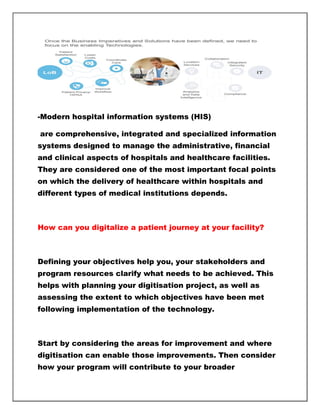
-Modern hospital information systems (HIS)
are comprehensive, integrated and specialized information
systems designed to manage the administrative, financial
and clinical aspects of hospitals and healthcare facilities.
They are considered one of the most important focal points
on which the delivery of healthcare within hospitals and
different types of medical institutions depends.
How can you digitalize a patient journey at your facility?
Defining your objectives help you, your stakeholders and
program resources clarify what needs to be achieved. This
helps with planning your digitisation project, as well as
assessing the extent to which objectives have been met
following implementation of the technology.
Start by considering the areas for improvement and where
digitisation can enable those improvements. Then consider
how your program will contribute to your broader
organisational strategy, and the patient journey, to
determine the priority areas.
Digitisation is not an end in itself – meeting patient needs,
and expectations should be the focus, both in terms of
improving patient experience and outcomes, and delivering
patient-centric care.
Engage with patients during the design process
to understand their needs. You could do this through focus
groups, design workshops, patient interviews or patient ‘tag
alongs’. Once the solution has been implemented,
support patient engagement components with an
effective marketing campaign to increase adoption;
and consider further engagement to understand the impact
on the patient experience and the extent to which
improvements have been achieved.
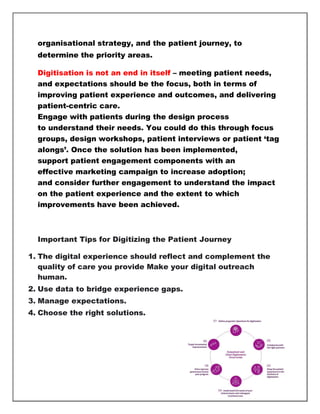
Important Tips for Digitizing the Patient Journey
1. The digital experience should reflect and complement the
quality of care you provide Make your digital outreach
human.
2. Use data to bridge experience gaps.
3. Manage expectations.
4. Choose the right solutions.
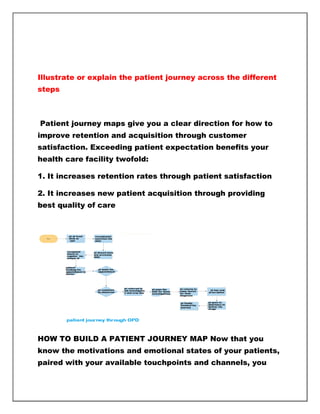
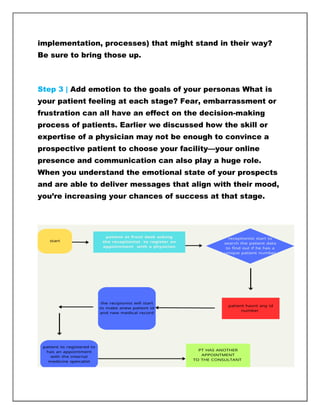
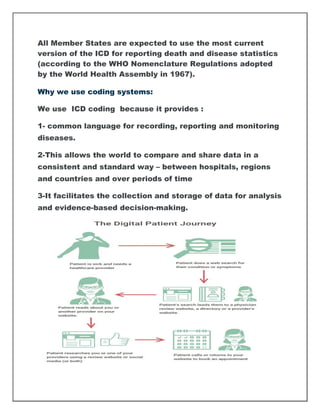
Illustrate or explain the patient journey across the different
steps
Patient journey maps give you a clear direction for how to
improve retention and acquisition through customer
satisfaction. Exceeding patient expectation benefits your
health care facility twofold:
1. It increases retention rates through patient satisfaction
2. It increases new patient acquisition through providing
best quality of care
HOW TO BUILD A PATIENT JOURNEY MAP Now that you
know the motivations and emotional states of your patients,
paired with your available touchpoints and channels, you
can build out their entire journey. At this point it’s extremely
important to note that patient journey maps are all about the
patient—do not map out your internal processes or how a
patient should go through your system. Create the journey
100% from their point of view. If there are any disconnects
between their journey and what you can offer in regard to
communication, you can fix that with additional marketing
pieces.
Step 1 | Define and list the different stages of the patient’s
journey Break down the patient journey into specific,
actionable stages. For example, most patients will browse
online to research their condition long before they look for a
phone number for a healthcare facility. Another example of a
stage is booking an appointment. Map out the entire process
for each persona in a linear manner, one stage after the
next. How granular your stages get or how high level you
keep them is up to you and varies based on your needs.
Step 2 | Determine patient goals Now that you know every
available stage of the individual’s patient journey, layer on
their goals to each stage. Note how different the goals are
for each stage: The goal for scheduling an appointment
might be something like convenience and the ability to book
online 24 hours/ day, while the goal for a consultation might
be finding a physician they trust. In fact, the goals for each
stage will likely be different from each other if you’ve
mapped your stages correctly. Are there any barriers (cost,
implementation, processes) that might stand in their way?
Be sure to bring those up.
Step 3 | Add emotion to the goals of your personas What is
your patient feeling at each stage? Fear, embarrassment or
frustration can all have an effect on the decision-making
process of patients. Earlier we discussed how the skill or
expertise of a physician may not be enough to convince a
prospective patient to choose your facility—your online
presence and communication can also play a huge role.
When you understand the emotional state of your prospects
and are able to deliver messages that align with their mood,
you’re increasing your chances of success at that stage.
define the stakeholders of the PATIENT journey?
Stakeholders in healthcare can include ALL caregivers,
doctors, nurses, unions, employees, employers, government,
insurance companies, communities and pharmaceutical
firms
WE CAN ALSO MAKE A SMALL CLASSIFICATION FOR THEM
primary and secondary stakeholders.
The primary stakeholders in a hospital would be the doctors
and the secondary stakeholders may be the pharmaceutical
companies.
A secondary stakeholder is a stakeholder who may disrupt
or affect the relationships with the primary stakeholders.
What are the main components of a digitalized patient
medical file
Electronic Health Records
components:
Administrative and billing data.
Patient demographics.
Progress notes.
Vital signs.
Medical histories.
Diagnoses.
Medications.
Immunization dates
Allergies
Radiology images
Lab and test results
Discuss the actions would take to ensure readiness of the
organization in terms of training
technology tools process and data?
-Digital readiness is defined by the level of readiness of an
organization's workforce to transition into digitized
workflows that are enabled by software and technology.
Undergoing a technology transformation does not just
denote an organization’s investment in IT assets - it consists
of three components: culture, process and technology.
-Technological training is an instructional method that
employs technology to deliver content and facilitate
learning.
Many people regularly use technology to make their lives
easier, solve queries or learn something new. Learning has
now become much easier and more convenient with
technology. If you are a professional currently staying in a
remote location or simply want to learn from home, you can
still learn new skills through tech-based training
It includes: Webinars, e-learning courses and virtual
simulations are examples of technological training.
Technological training can be effective for reaching learners
in different geographical areas who have limited time for
traditional classroom training. When designing a TBT
method, it is essential to consider the learner's
requirements and specific learning objectives. Designing
technological training to maximize learning and facilitate
the successful application of knowledge is also important.
difference between computer-based training (CBT) and web-
based training (WBT)
web-based training (WBT), or e-learning, uses the internet to
deliver the course content.
computer-based training (CBT), or courseware, uses
computers to provide training resources. You can access
CBT only on a computer with pre-installed training courses,
whereas you can access WBT anywhere and at any time.
What are the coding systems to use? And why?
ICD codes are alphanumeric designations given to every
diagnosis, description of symptoms and cause of death
attributed to human beings. These classifications are
developed, monitored, and copyrighted by the World Health
Organization (WHO). In the U.S., the NCHS (National Center
for Health Statistics), part of CMS (Centers for Medicare &
Medicaid Services) oversees all changes and modifications
to the ICD codes, in cooperation with WHO.
Users include physicians, nurses, other providers,
researchers, health information managers and coders,
health information technology workers, policy-makers,
insurers and patient organizations.ICD has been translated
into 43 languages and it is being used by all member States.
Most countries (117) use the system to report mortality
data, a primary indicator of health status.
All Member States are expected to use the most current
version of the ICD for reporting death and disease statistics
(according to the WHO Nomenclature Regulations adopted
by the World Health Assembly in 1967).
Why we use coding systems:
We use ICD coding because it provides :
1- common language for recording, reporting and monitoring
diseases.
2-This allows the world to compare and share data in a
consistent and standard way – between hospitals, regions
and countries and over periods of time
3-It facilitates the collection and storage of data for analysis
and evidence-based decision-making.

digital records د حاتم البيطار.pdf

  • 1.
    Digitalizing the patientjourney By Dr hatem el bitar 01005684344 Assignment questions How can you digitalize a patient journey at your facility? Illustrate or explain the patient journey across the different steps define the stakeholders of the journey? what are the main components of a digitalized patient medical file
  • 2.
    Discuss the actionswould take to ensure readiness of the organization in terms of training technology tools process and data? What are the coding systems to use? and why? __________________________________________________________________ ___________ Introduction Patient journey mapping in the healthcare industry is a data- driven, patient-centric approach to planning marketing activity, communications, and (to some degree) even delivering care. It’s a way to gather the facts, discover the expectations of your patient, and marry that info in order to deliver an exemplary healthcare experience. Outpatient and Clinic Services are an important part of the health system. When managed effectively, they can reduce demand across the system and streamline access to acute care for the community, supporting patients to access healthcare as they need it.
  • 3.
    -Modern hospital informationsystems (HIS) are comprehensive, integrated and specialized information systems designed to manage the administrative, financial and clinical aspects of hospitals and healthcare facilities. They are considered one of the most important focal points on which the delivery of healthcare within hospitals and different types of medical institutions depends. How can you digitalize a patient journey at your facility? Defining your objectives help you, your stakeholders and program resources clarify what needs to be achieved. This helps with planning your digitisation project, as well as assessing the extent to which objectives have been met following implementation of the technology. Start by considering the areas for improvement and where digitisation can enable those improvements. Then consider how your program will contribute to your broader
  • 4.
    organisational strategy, andthe patient journey, to determine the priority areas. Digitisation is not an end in itself – meeting patient needs, and expectations should be the focus, both in terms of improving patient experience and outcomes, and delivering patient-centric care. Engage with patients during the design process to understand their needs. You could do this through focus groups, design workshops, patient interviews or patient ‘tag alongs’. Once the solution has been implemented, support patient engagement components with an effective marketing campaign to increase adoption; and consider further engagement to understand the impact on the patient experience and the extent to which improvements have been achieved. Important Tips for Digitizing the Patient Journey 1. The digital experience should reflect and complement the quality of care you provide Make your digital outreach human. 2. Use data to bridge experience gaps. 3. Manage expectations. 4. Choose the right solutions.
  • 5.
    Illustrate or explainthe patient journey across the different steps Patient journey maps give you a clear direction for how to improve retention and acquisition through customer satisfaction. Exceeding patient expectation benefits your health care facility twofold: 1. It increases retention rates through patient satisfaction 2. It increases new patient acquisition through providing best quality of care HOW TO BUILD A PATIENT JOURNEY MAP Now that you know the motivations and emotional states of your patients, paired with your available touchpoints and channels, you
  • 6.
    can build outtheir entire journey. At this point it’s extremely important to note that patient journey maps are all about the patient—do not map out your internal processes or how a patient should go through your system. Create the journey 100% from their point of view. If there are any disconnects between their journey and what you can offer in regard to communication, you can fix that with additional marketing pieces. Step 1 | Define and list the different stages of the patient’s journey Break down the patient journey into specific, actionable stages. For example, most patients will browse online to research their condition long before they look for a phone number for a healthcare facility. Another example of a stage is booking an appointment. Map out the entire process for each persona in a linear manner, one stage after the next. How granular your stages get or how high level you keep them is up to you and varies based on your needs. Step 2 | Determine patient goals Now that you know every available stage of the individual’s patient journey, layer on their goals to each stage. Note how different the goals are for each stage: The goal for scheduling an appointment might be something like convenience and the ability to book online 24 hours/ day, while the goal for a consultation might be finding a physician they trust. In fact, the goals for each stage will likely be different from each other if you’ve mapped your stages correctly. Are there any barriers (cost,
  • 7.
    implementation, processes) thatmight stand in their way? Be sure to bring those up. Step 3 | Add emotion to the goals of your personas What is your patient feeling at each stage? Fear, embarrassment or frustration can all have an effect on the decision-making process of patients. Earlier we discussed how the skill or expertise of a physician may not be enough to convince a prospective patient to choose your facility—your online presence and communication can also play a huge role. When you understand the emotional state of your prospects and are able to deliver messages that align with their mood, you’re increasing your chances of success at that stage.
  • 8.
    define the stakeholdersof the PATIENT journey? Stakeholders in healthcare can include ALL caregivers, doctors, nurses, unions, employees, employers, government, insurance companies, communities and pharmaceutical firms WE CAN ALSO MAKE A SMALL CLASSIFICATION FOR THEM primary and secondary stakeholders. The primary stakeholders in a hospital would be the doctors and the secondary stakeholders may be the pharmaceutical companies. A secondary stakeholder is a stakeholder who may disrupt or affect the relationships with the primary stakeholders. What are the main components of a digitalized patient medical file
  • 9.
    Electronic Health Records components: Administrativeand billing data. Patient demographics. Progress notes. Vital signs. Medical histories. Diagnoses. Medications. Immunization dates Allergies Radiology images Lab and test results Discuss the actions would take to ensure readiness of the organization in terms of training technology tools process and data?
  • 10.
    -Digital readiness isdefined by the level of readiness of an organization's workforce to transition into digitized workflows that are enabled by software and technology. Undergoing a technology transformation does not just denote an organization’s investment in IT assets - it consists of three components: culture, process and technology. -Technological training is an instructional method that employs technology to deliver content and facilitate learning. Many people regularly use technology to make their lives easier, solve queries or learn something new. Learning has now become much easier and more convenient with technology. If you are a professional currently staying in a remote location or simply want to learn from home, you can still learn new skills through tech-based training It includes: Webinars, e-learning courses and virtual simulations are examples of technological training. Technological training can be effective for reaching learners in different geographical areas who have limited time for traditional classroom training. When designing a TBT method, it is essential to consider the learner's requirements and specific learning objectives. Designing technological training to maximize learning and facilitate the successful application of knowledge is also important.
  • 11.
    difference between computer-basedtraining (CBT) and web- based training (WBT) web-based training (WBT), or e-learning, uses the internet to deliver the course content. computer-based training (CBT), or courseware, uses computers to provide training resources. You can access CBT only on a computer with pre-installed training courses, whereas you can access WBT anywhere and at any time. What are the coding systems to use? And why? ICD codes are alphanumeric designations given to every diagnosis, description of symptoms and cause of death attributed to human beings. These classifications are developed, monitored, and copyrighted by the World Health Organization (WHO). In the U.S., the NCHS (National Center for Health Statistics), part of CMS (Centers for Medicare & Medicaid Services) oversees all changes and modifications to the ICD codes, in cooperation with WHO. Users include physicians, nurses, other providers, researchers, health information managers and coders, health information technology workers, policy-makers, insurers and patient organizations.ICD has been translated into 43 languages and it is being used by all member States. Most countries (117) use the system to report mortality data, a primary indicator of health status.
  • 12.
    All Member Statesare expected to use the most current version of the ICD for reporting death and disease statistics (according to the WHO Nomenclature Regulations adopted by the World Health Assembly in 1967). Why we use coding systems: We use ICD coding because it provides : 1- common language for recording, reporting and monitoring diseases. 2-This allows the world to compare and share data in a consistent and standard way – between hospitals, regions and countries and over periods of time 3-It facilitates the collection and storage of data for analysis and evidence-based decision-making.