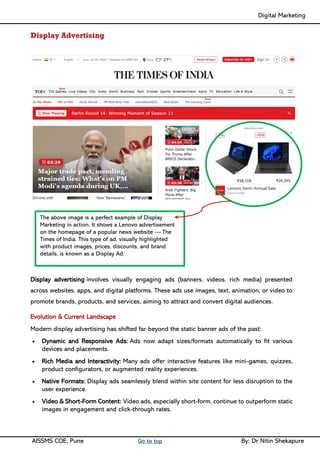
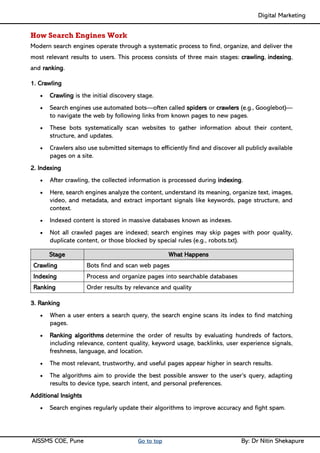
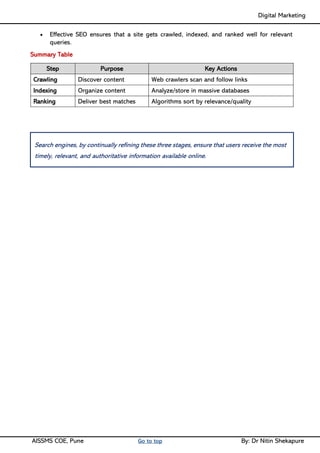
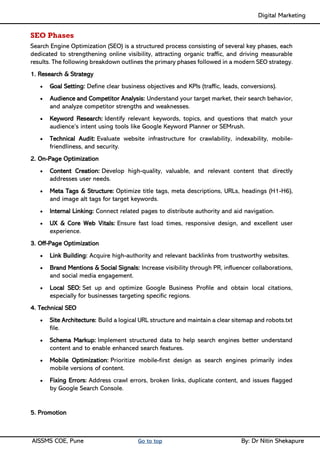
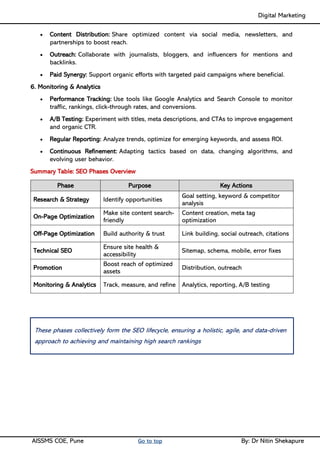
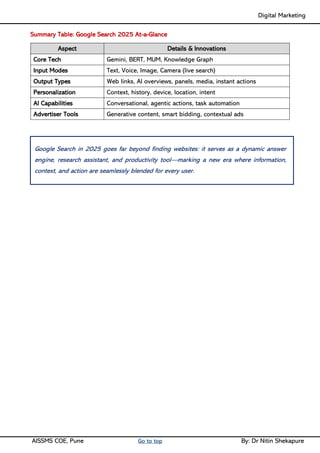
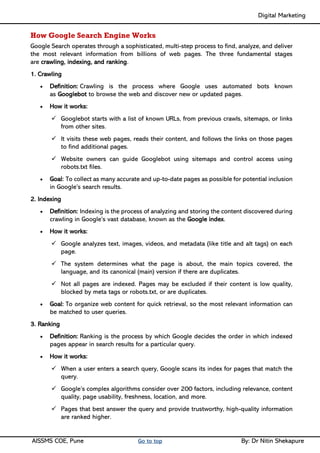
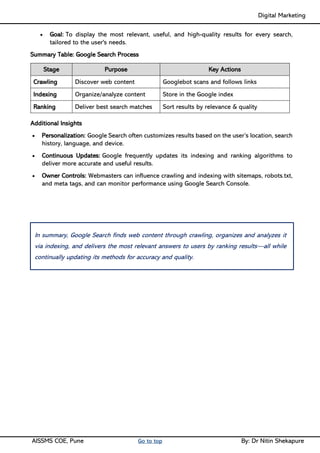
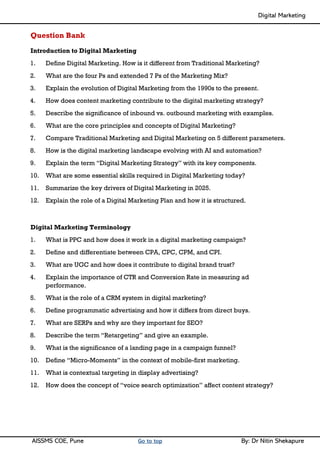
Digital Marketing ____
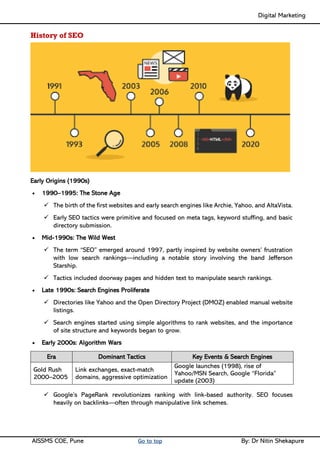
Digital
Marketing By: Dr Nitin Shekapure
Digital Marketing ____
AISSMS COE, Pune Go to top By: Dr Nitin Shekapure
Contents
Introduction to Digital Marketing
→ What is Marketing
→ What is Digital Marketing
→ Evolution of Digital Marketing
→ Core Principles and Concepts of Digital Marketing
→ Significance of Digital Marketing
→ Traditional Marketing vs Digital Marketing
→ The Digital Marketing Landscape
→ Digital Marketing Key Drivers
→ The Digital Users in India (2025)
→ What is a Digital Marketing Strategy?
→ Consumer Decision Journey & Digital Advertising Market in India
→ Essential Skills in Digital Marketing
→ Digital Marketing Plan
Digital Marketing Terminology
→ Terminology used in Digital Marketing
→ PPC and Online Marketing Through Social Media
→ Social Media Marketing
→ Steps to Build an Effective Social Media Marketing Strategy
→ Google Webmaster (Search Console)
→ Google Analytics
→ Email Marketing
→ Mobile Marketing
→ Display Advertising
→ Display Advertising Terminology
→ Types of Display Ads
→ Buying Models in Digital Marketing
→ Different Types of Advertising Tools in Digital Marketing
→ Different Ad Formats in Digital Marketing
Digital Marketing ____
AISSMS COE, Pune Go to top By: Dr Nitin Shekapure
Social Media Marketing
→ Fundamentals of Social Media Marketing & Its Significance
→ Necessity of Social Media Marketing
→ Facebook for Business
→ Facebook Insights
→ Types of Facebook Ad Formats
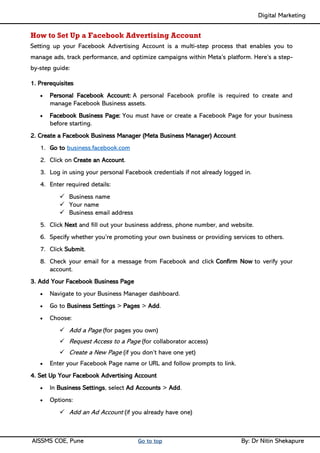
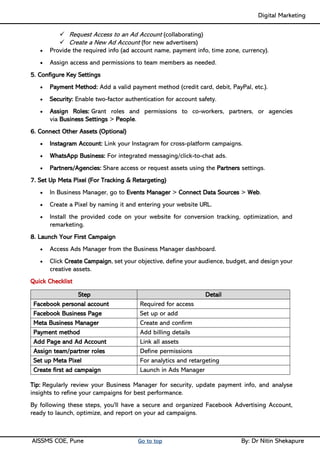
→ How to Set Up a Facebook Advertising Account
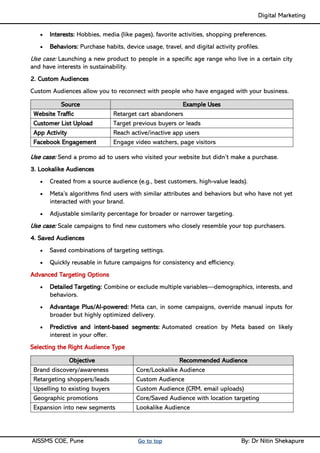
→ Facebook Audiences & Types
→ Designing Facebook Advertising Campaigns
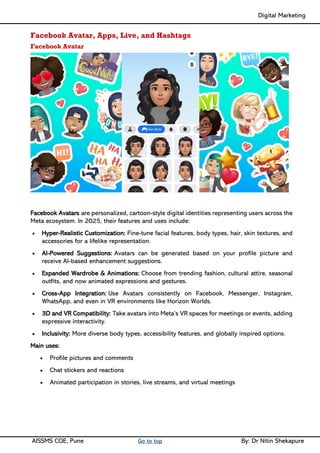
→ Facebook Avatar
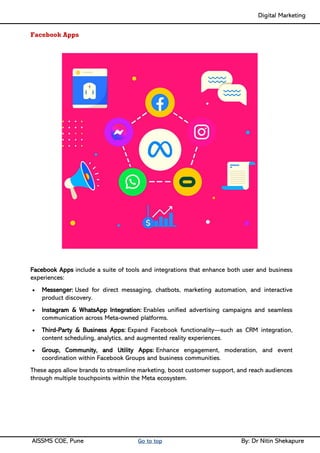
→ Facebook Apps
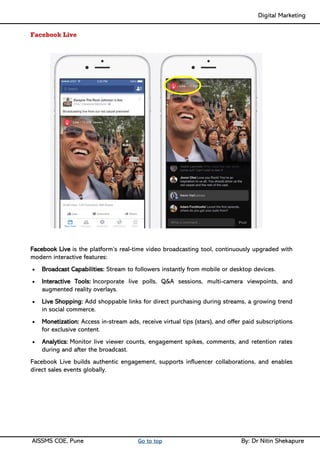
→ Facebook Live
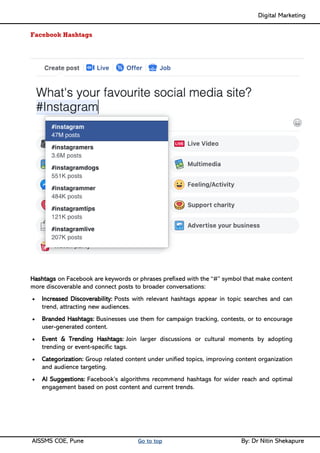
→ Facebook Hashtags
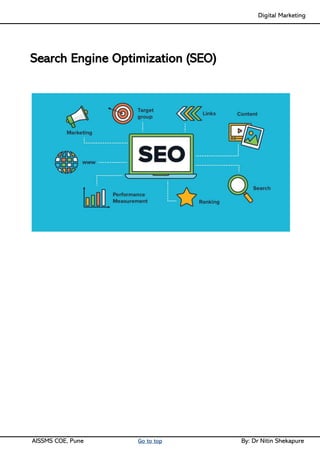
Search Engine Optimization (SEO)
→ Introduction to Search Engine Optimization (SEO)
→ How Search Engines Work
→ SEO Phases
→ History of SEO
→ How SEO Works
→ Googlebot (Google Crawler)
→ Types of SEO Techniques
→ Specialized and Advanced SEO Techniques
→ Keyword Planner Tools
→ Social Media Reach: Video Creation & Submission
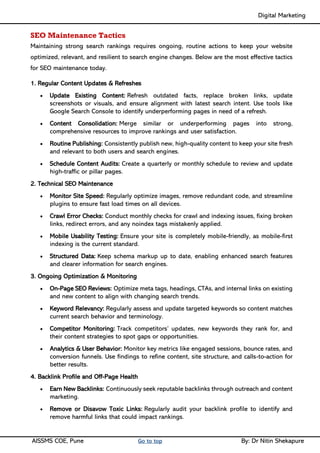
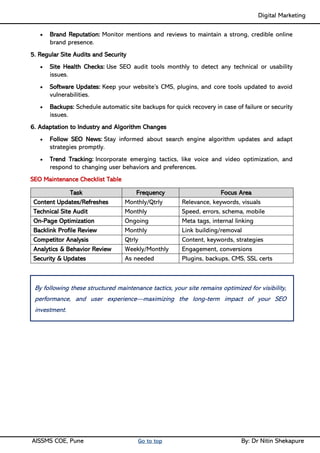
→ SEO Maintenance Tactics
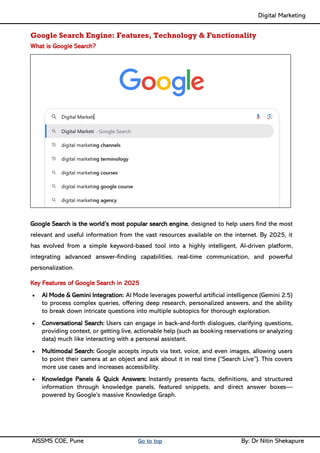
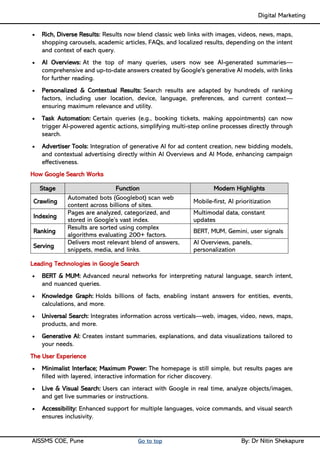
→ Google Search Engine: Features, Technology & Functionality
→ How Google Search Engine Works
→ Question Bank
Digital Marketing ____
AISSMS COE, Pune Go to top By: Dr Nitin Shekapure
Introduction to Digital Marketing
Digital Marketing ____
AISSMS COE, Pune Go to top By: Dr Nitin Shekapure
What is Marketing?
Marketing is a form of communication between a business house and its customers with the
goal of selling its products or services to them. Goods are not complete products until they are
in the hands of customers. Marketing is that management process through which goods and
services move from concept to the customer. Marketing has less to do with getting customers
to pay for a product as it does with developing a demand for that product and fulfilling the
customer’s needs.
According to the American Marketing Association (AMA) Board of Directors, Marketing is the
activity, set of institutions, and processes for creating, communicating, delivering, and
exchanging offerings that have value for customers, clients, partners, and society at large.
Dr. Philip Kotler defines marketing as the science and art of exploring, creating and delivering
value to satisfy the needs of a target market at a profit. Marketing identifies unfulfilled needs
and desires. It defines, measures and quantifies the size of the identified market and the profit
potential. It pinpoints which segments the company is capable of serving best and it designs
and promotes the appropriate products and services.”
Thus, marketing refers to all the activities involved in the creation of place, time, possession
and awareness utilities and beyond.
Selling vs. Marketing
Selling and marketing are often used interchangeably but represent distinct concepts in
business. Selling is primarily focused on the short-term objective of persuading potential
customers to purchase products or services, with the goal of closing deals and generating
immediate revenue. The process is mostly transactional, involving direct communication
between the seller and the buyer, and is centered on the features and benefits of the product.
Marketing, on the other hand, is a broader, long-term strategy centered on identifying,
understanding, and fulfilling customer needs. Marketing begins well before the product exists
and involves activities such as market research, product development, pricing, promotions,
distribution, and customer engagement. The main goal of marketing is to create awareness,
generate sustained interest, and build lasting relationships with customers, ensuring customer
satisfaction and loyalty over time.
Digital Marketing ____
AISSMS COE, Pune Go to top By: Dr Nitin Shekapure
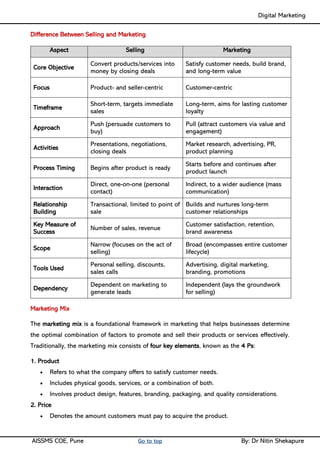
Difference Between Selling and Marketing
Aspect Selling Marketing
Core Objective
Convert products/services into
money by closing deals
Satisfy customer needs, build brand,
and long-term value
Focus Product- and seller-centric Customer-centric
Timeframe
Short-term, targets immediate
sales
Long-term, aims for lasting customer
loyalty
Approach
Push (persuade customers to
buy)
Pull (attract customers via value and
engagement)
Activities
Presentations, negotiations,
closing deals
Market research, advertising, PR,
product planning
Process Timing Begins after product is ready
Starts before and continues after
product launch
Interaction
Direct, one-on-one (personal
contact)
Indirect, to a wider audience (mass
communication)
Relationship
Building
Transactional, limited to point of
sale
Builds and nurtures long-term
customer relationships
Key Measure of
Success
Number of sales, revenue
Customer satisfaction, retention,
brand awareness
Scope
Narrow (focuses on the act of
selling)
Broad (encompasses entire customer
lifecycle)
Tools Used
Personal selling, discounts,
sales calls
Advertising, digital marketing,
branding, promotions
Dependency
Dependent on marketing to
generate leads
Independent (lays the groundwork
for selling)
Marketing Mix
The marketing mix is a foundational framework in marketing that helps businesses determine
the optimal combination of factors to promote and sell their products or services effectively.
Traditionally, the marketing mix consists of four key elements, known as the 4 Ps:
1. Product
• Refers to what the company offers to satisfy customer needs.
• Includes physical goods, services, or a combination of both.
• Involves product design, features, branding, packaging, and quality considerations.
2. Price
• Denotes the amount customers must pay to acquire the product.
Digital Marketing ____
AISSMS COE, Pune Go to top By: Dr Nitin Shekapure
• Pricing strategies can vary (e.g., competitive pricing, discount pricing, premium pricing).
• Factors affecting price include production costs, perceived value, competition, and
market demand.
3. Place
• Concerns how the product is distributed and made accessible to customers.
• Involves decisions about locations, distribution channels, logistics, inventory, and
coverage.
• The goal is to deliver the product to the right place at the right time.
4. Promotion
• Refers to the activities used to communicate with customers and persuade them to
purchase.
• Encompasses advertising, sales promotions, public relations, social media, and personal
selling.
• Seeks to create awareness, generate demand, and build brand loyalty.
Extended Marketing Mix (7 Ps)
In addition to the original 4 Ps, the marketing mix can be expanded—especially for service
industries—to include:
• People: Employees and customer service impact customer experiences.
• Process: The procedures and systems for delivering the product or service.
• Physical Evidence: Tangible cues that support the service (e.g., physical environment,
receipts).
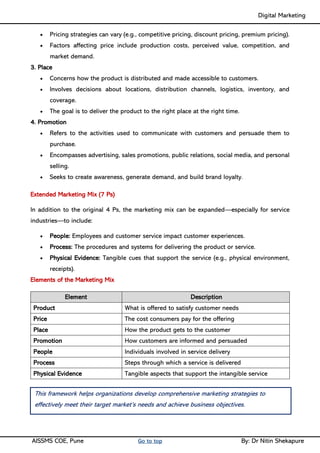
Elements of the Marketing Mix
Element Description
Product What is offered to satisfy customer needs
Price The cost consumers pay for the offering
Place How the product gets to the customer
Promotion How customers are informed and persuaded
People Individuals involved in service delivery
Process Steps through which a service is delivered
Physical Evidence Tangible aspects that support the intangible service
This framework helps organizations develop comprehensive marketing strategies to
effectively meet their target market’s needs and achieve business objectives.
Digital Marketing ____
AISSMS COE, Pune Go to top By: Dr Nitin Shekapure
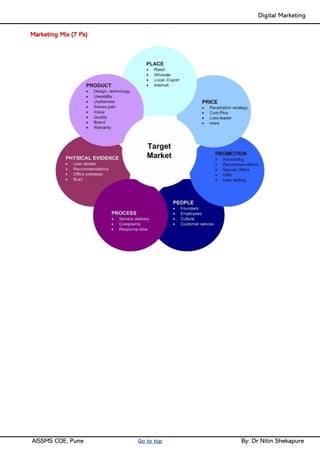
Marketing Mix (7 Ps)
Digital Marketing ____
AISSMS COE, Pune Go to top By: Dr Nitin Shekapure
What is Digital Marketing?
Digital marketing refers to the use of digital channels, such as websites, social media, email,
mobile apps, and search engines, to promote products, services, or brands to a targeted
audience. Unlike traditional marketing—which relies on print, broadcast, or outdoor media—
digital marketing leverages the internet and digital technologies to reach potential customers in
interactive and measurable ways.
Imagine you own a bakery. Instead of waiting for people to walk by your shop, you post mouth-
watering cake photos on Instagram, run Google ads to show up when someone searches “best
cupcakes near me,” and send emails to loyal customers about special offers.
That’s Digital Marketing — using online tools like social media, search engines, email, and
websites to promote your business, reach your audience, and turn interest into sales, all in the
digital world.
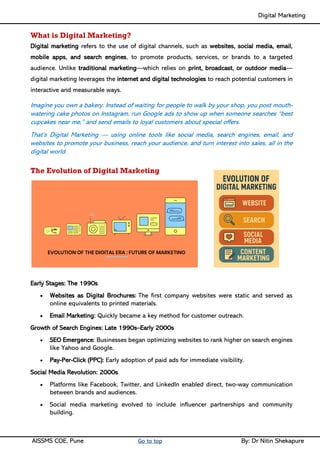
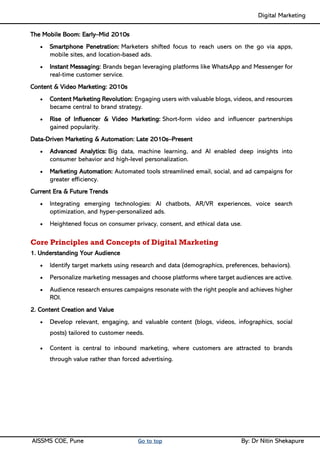
The Evolution of Digital Marketing
Early Stages: The 1990s
• Websites as Digital Brochures: The first company websites were static and served as
online equivalents to printed materials.
• Email Marketing: Quickly became a key method for customer outreach.
Growth of Search Engines: Late 1990s–Early 2000s
• SEO Emergence: Businesses began optimizing websites to rank higher on search engines
like Yahoo and Google.
• Pay-Per-Click (PPC): Early adoption of paid ads for immediate visibility.
Social Media Revolution: 2000s
• Platforms like Facebook, Twitter, and LinkedIn enabled direct, two-way communication
between brands and audiences.
• Social media marketing evolved to include influencer partnerships and community
building.
Digital Marketing ____
AISSMS COE, Pune Go to top By: Dr Nitin Shekapure
The Mobile Boom: Early–Mid 2010s
• Smartphone Penetration: Marketers shifted focus to reach users on the go via apps,
mobile sites, and location-based ads.
• Instant Messaging: Brands began leveraging platforms like WhatsApp and Messenger for
real-time customer service.
Content & Video Marketing: 2010s
• Content Marketing Revolution: Engaging users with valuable blogs, videos, and resources
became central to brand strategy.
• Rise of Influencer & Video Marketing: Short-form video and influencer partnerships
gained popularity.
Data-Driven Marketing & Automation: Late 2010s–Present
• Advanced Analytics: Big data, machine learning, and AI enabled deep insights into
consumer behavior and high-level personalization.
• Marketing Automation: Automated tools streamlined email, social, and ad campaigns for
greater efficiency.
Current Era & Future Trends
• Integrating emerging technologies: AI chatbots, AR/VR experiences, voice search
optimization, and hyper-personalized ads.
• Heightened focus on consumer privacy, consent, and ethical data use.
Core Principles and Concepts of Digital Marketing
1. Understanding Your Audience
• Identify target markets using research and data (demographics, preferences, behaviors).
• Personalize marketing messages and choose platforms where target audiences are active.
• Audience research ensures campaigns resonate with the right people and achieves higher
ROI.
2. Content Creation and Value
• Develop relevant, engaging, and valuable content (blogs, videos, infographics, social
posts) tailored to customer needs.
• Content is central to inbound marketing, where customers are attracted to brands
through value rather than forced advertising.
Digital Marketing ____
AISSMS COE, Pune Go to top By: Dr Nitin Shekapure
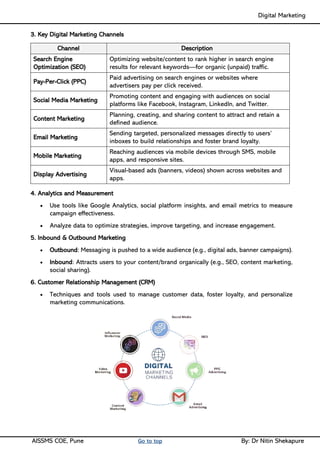
3. Key Digital Marketing Channels
Channel Description
Search Engine
Optimization (SEO)
Optimizing website/content to rank higher in search engine
results for relevant keywords—for organic (unpaid) traffic.
Pay-Per-Click (PPC)
Paid advertising on search engines or websites where
advertisers pay per click received.
Social Media Marketing
Promoting content and engaging with audiences on social
platforms like Facebook, Instagram, LinkedIn, and Twitter.
Content Marketing
Planning, creating, and sharing content to attract and retain a
defined audience.
Email Marketing
Sending targeted, personalized messages directly to users’
inboxes to build relationships and foster brand loyalty.
Mobile Marketing
Reaching audiences via mobile devices through SMS, mobile
apps, and responsive sites.
Display Advertising
Visual-based ads (banners, videos) shown across websites and
apps.
4. Analytics and Measurement
• Use tools like Google Analytics, social platform insights, and email metrics to measure
campaign effectiveness.
• Analyze data to optimize strategies, improve targeting, and increase engagement.
5. Inbound & Outbound Marketing
• Outbound: Messaging is pushed to a wide audience (e.g., digital ads, banner campaigns).
• Inbound: Attracts users to your content/brand organically (e.g., SEO, content marketing,
social sharing).
6. Customer Relationship Management (CRM)
• Techniques and tools used to manage customer data, foster loyalty, and personalize
marketing communications.
Digital Marketing ____
AISSMS COE, Pune Go to top By: Dr Nitin Shekapure
Significance of Digital Marketing
Competitive Advantages
• Cost-Effective: Digital strategies are generally less expensive and more scalable than
traditional marketing, making them suitable for both small and large businesses.
• Wider and Global Reach: Instantly access audiences worldwide without geographic
limitations, opening markets beyond locality.
• Measurable Results: Track and assess campaign impact in real-time to optimize spending
and messaging.
• Targeted Marketing: Highly specific audience segments can be targeted based on
preferences, behavior, and demographics.
• Interactivity & Engagement: Interactive content (polls, comments, likes) and direct
feedback strengthen brand-customer bonds.
• Brand Building and Loyalty: Consistent digital presence and tailored messages help build
stronger brand identities and lasting relationships.
Modern Business Necessity
• As consumer behavior shifts online, digital marketing has become foundational to
business growth and sustainability.
• Most prospective customers begin their research and engagement journey via digital
channels, making digital presence crucial.
• The use and mastery of digital marketing tools and strategies is a key driver for career
growth and organizational success in today’s economy
Digital Marketing ____
AISSMS COE, Pune Go to top By: Dr Nitin Shekapure
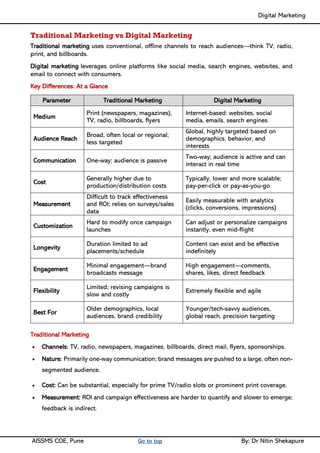
Traditional Marketing vs Digital Marketing
Traditional marketing uses conventional, offline channels to reach audiences—think TV, radio,
print, and billboards.
Digital marketing leverages online platforms like social media, search engines, websites, and
email to connect with consumers.
Key Differences: At a Glance
Parameter Traditional Marketing Digital Marketing
Medium
Print (newspapers, magazines),
TV, radio, billboards, flyers
Internet-based: websites, social
media, emails, search engines
Audience Reach
Broad, often local or regional;
less targeted
Global, highly targeted based on
demographics, behavior, and
interests
Communication One-way; audience is passive
Two-way; audience is active and can
interact in real time
Cost
Generally higher due to
production/distribution costs
Typically, lower and more scalable;
pay-per-click or pay-as-you-go
Measurement
Difficult to track effectiveness
and ROI; relies on surveys/sales
data
Easily measurable with analytics
(clicks, conversions, impressions)
Customization
Hard to modify once campaign
launches
Can adjust or personalize campaigns
instantly, even mid-flight
Longevity
Duration limited to ad
placements/schedule
Content can exist and be effective
indefinitely
Engagement
Minimal engagement—brand
broadcasts message
High engagement—comments,
shares, likes, direct feedback
Flexibility
Limited; revising campaigns is
slow and costly
Extremely flexible and agile
Best For
Older demographics, local
audiences, brand credibility
Younger/tech-savvy audiences,
global reach, precision targeting
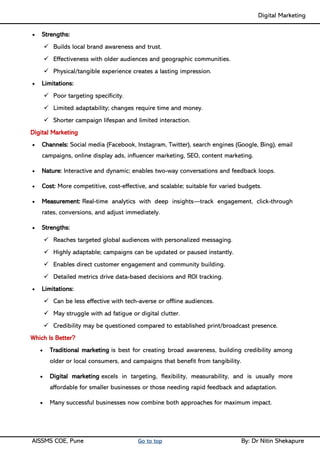
Traditional Marketing
• Channels: TV, radio, newspapers, magazines, billboards, direct mail, flyers, sponsorships.
• Nature: Primarily one-way communication; brand messages are pushed to a large, often non-
segmented audience.
• Cost: Can be substantial, especially for prime TV/radio slots or prominent print coverage.
• Measurement: ROI and campaign effectiveness are harder to quantify and slower to emerge;
feedback is indirect.
Digital Marketing ____
AISSMS COE, Pune Go to top By: Dr Nitin Shekapure
• Strengths:
✓ Builds local brand awareness and trust.
✓ Effectiveness with older audiences and geographic communities.
✓ Physical/tangible experience creates a lasting impression.
• Limitations:
✓ Poor targeting specificity.
✓ Limited adaptability; changes require time and money.
✓ Shorter campaign lifespan and limited interaction.
Digital Marketing
• Channels: Social media (Facebook, Instagram, Twitter), search engines (Google, Bing), email
campaigns, online display ads, influencer marketing, SEO, content marketing.
• Nature: Interactive and dynamic; enables two-way conversations and feedback loops.
• Cost: More competitive, cost-effective, and scalable; suitable for varied budgets.
• Measurement: Real-time analytics with deep insights—track engagement, click-through
rates, conversions, and adjust immediately.
• Strengths:
✓ Reaches targeted global audiences with personalized messaging.
✓ Highly adaptable; campaigns can be updated or paused instantly.
✓ Enables direct customer engagement and community building.
✓ Detailed metrics drive data-based decisions and ROI tracking.
• Limitations:
✓ Can be less effective with tech-averse or offline audiences.
✓ May struggle with ad fatigue or digital clutter.
✓ Credibility may be questioned compared to established print/broadcast presence.
Which Is Better?
• Traditional marketing is best for creating broad awareness, building credibility among
older or local consumers, and campaigns that benefit from tangibility.
• Digital marketing excels in targeting, flexibility, measurability, and is usually more
affordable for smaller businesses or those needing rapid feedback and adaptation.
• Many successful businesses now combine both approaches for maximum impact.
Digital Marketing ____
AISSMS COE, Pune Go to top By: Dr Nitin Shekapure
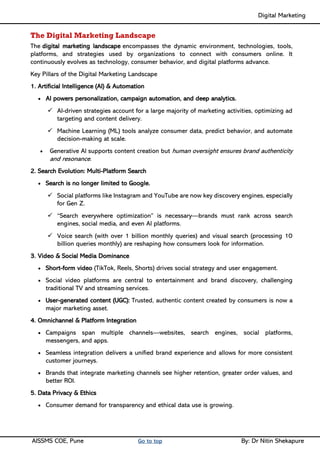
The Digital Marketing Landscape
The digital marketing landscape encompasses the dynamic environment, technologies, tools,
platforms, and strategies used by organizations to connect with consumers online. It
continuously evolves as technology, consumer behavior, and digital platforms advance.
Key Pillars of the Digital Marketing Landscape
1. Artificial Intelligence (AI) & Automation
• AI powers personalization, campaign automation, and deep analytics.
✓ AI-driven strategies account for a large majority of marketing activities, optimizing ad
targeting and content delivery.
✓ Machine Learning (ML) tools analyze consumer data, predict behavior, and automate
decision-making at scale.
• Generative AI supports content creation but human oversight ensures brand authenticity
and resonance.
2. Search Evolution: Multi-Platform Search
• Search is no longer limited to Google.
✓ Social platforms like Instagram and YouTube are now key discovery engines, especially
for Gen Z.
✓ “Search everywhere optimization” is necessary—brands must rank across search
engines, social media, and even AI platforms.
✓ Voice search (with over 1 billion monthly queries) and visual search (processing 10
billion queries monthly) are reshaping how consumers look for information.
3. Video & Social Media Dominance
• Short-form video (TikTok, Reels, Shorts) drives social strategy and user engagement.
• Social video platforms are central to entertainment and brand discovery, challenging
traditional TV and streaming services.
• User-generated content (UGC): Trusted, authentic content created by consumers is now a
major marketing asset.
4. Omnichannel & Platform Integration
• Campaigns span multiple channels—websites, search engines, social platforms,
messengers, and apps.
• Seamless integration delivers a unified brand experience and allows for more consistent
customer journeys.
• Brands that integrate marketing channels see higher retention, greater order values, and
better ROI.
5. Data Privacy & Ethics
• Consumer demand for transparency and ethical data use is growing.
Digital Marketing ____
AISSMS COE, Pune Go to top By: Dr Nitin Shekapure
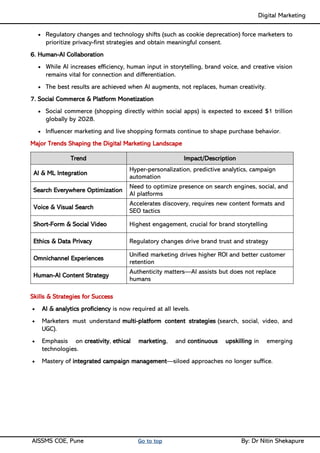
• Regulatory changes and technology shifts (such as cookie deprecation) force marketers to
prioritize privacy-first strategies and obtain meaningful consent.
6. Human-AI Collaboration
• While AI increases efficiency, human input in storytelling, brand voice, and creative vision
remains vital for connection and differentiation.
• The best results are achieved when AI augments, not replaces, human creativity.
7. Social Commerce & Platform Monetization
• Social commerce (shopping directly within social apps) is expected to exceed $1 trillion
globally by 2028.
• Influencer marketing and live shopping formats continue to shape purchase behavior.
Major Trends Shaping the Digital Marketing Landscape
Trend Impact/Description
AI & ML Integration
Hyper-personalization, predictive analytics, campaign
automation
Search Everywhere Optimization
Need to optimize presence on search engines, social, and
AI platforms
Voice & Visual Search
Accelerates discovery, requires new content formats and
SEO tactics
Short-Form & Social Video Highest engagement, crucial for brand storytelling
Ethics & Data Privacy Regulatory changes drive brand trust and strategy
Omnichannel Experiences
Unified marketing drives higher ROI and better customer
retention
Human-AI Content Strategy
Authenticity matters—AI assists but does not replace
humans
Skills & Strategies for Success
• AI & analytics proficiency is now required at all levels.
• Marketers must understand multi-platform content strategies (search, social, video, and
UGC).
• Emphasis on creativity, ethical marketing, and continuous upskilling in emerging
technologies.
• Mastery of integrated campaign management—siloed approaches no longer suffice.
Digital Marketing ____
AISSMS COE, Pune Go to top By: Dr Nitin Shekapure
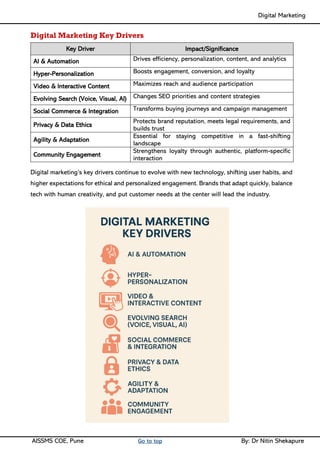
Digital Marketing Key Drivers
Key Driver Impact/Significance
AI & Automation Drives efficiency, personalization, content, and analytics
Hyper-Personalization Boosts engagement, conversion, and loyalty
Video & Interactive Content Maximizes reach and audience participation
Evolving Search (Voice, Visual, AI) Changes SEO priorities and content strategies
Social Commerce & Integration Transforms buying journeys and campaign management
Privacy & Data Ethics
Protects brand reputation, meets legal requirements, and
builds trust
Agility & Adaptation
Essential for staying competitive in a fast-shifting
landscape
Community Engagement
Strengthens loyalty through authentic, platform-specific
interaction
Digital marketing’s key drivers continue to evolve with new technology, shifting user habits, and
higher expectations for ethical and personalized engagement. Brands that adapt quickly, balance
tech with human creativity, and put customer needs at the center will lead the industry.
Digital Marketing ____
AISSMS COE, Pune Go to top By: Dr Nitin Shekapure
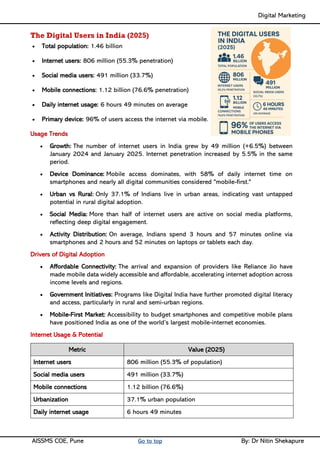
The Digital Users in India (2025)
• Total population: 1.46 billion
• Internet users: 806 million (55.3% penetration)
• Social media users: 491 million (33.7%)
• Mobile connections: 1.12 billion (76.6% penetration)
• Daily internet usage: 6 hours 49 minutes on average
• Primary device: 96% of users access the internet via mobile.
Usage Trends
• Growth: The number of internet users in India grew by 49 million (+6.5%) between
January 2024 and January 2025. Internet penetration increased by 5.5% in the same
period.
• Device Dominance: Mobile access dominates, with 58% of daily internet time on
smartphones and nearly all digital communities considered "mobile-first."
• Urban vs Rural: Only 37.1% of Indians live in urban areas, indicating vast untapped
potential in rural digital adoption.
• Social Media: More than half of internet users are active on social media platforms,
reflecting deep digital engagement.
• Activity Distribution: On average, Indians spend 3 hours and 57 minutes online via
smartphones and 2 hours and 52 minutes on laptops or tablets each day.
Drivers of Digital Adoption
• Affordable Connectivity: The arrival and expansion of providers like Reliance Jio have
made mobile data widely accessible and affordable, accelerating internet adoption across
income levels and regions.
• Government Initiatives: Programs like Digital India have further promoted digital literacy
and access, particularly in rural and semi-urban regions.
• Mobile-First Market: Accessibility to budget smartphones and competitive mobile plans
have positioned India as one of the world’s largest mobile-internet economies.
Internet Usage & Potential
Metric Value (2025)
Internet users 806 million (55.3% of population)
Social media users 491 million (33.7%)
Mobile connections 1.12 billion (76.6%)
Urbanization 37.1% urban population
Daily internet usage 6 hours 49 minutes
Digital Marketing ____
AISSMS COE, Pune Go to top By: Dr Nitin Shekapure
Noteworthy Observations
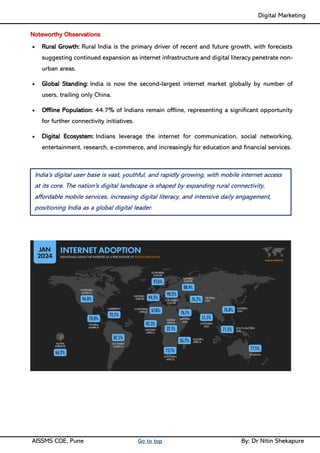
• Rural Growth: Rural India is the primary driver of recent and future growth, with forecasts
suggesting continued expansion as internet infrastructure and digital literacy penetrate non-
urban areas.
• Global Standing: India is now the second-largest internet market globally by number of
users, trailing only China.
• Offline Population: 44.7% of Indians remain offline, representing a significant opportunity
for further connectivity initiatives.
• Digital Ecosystem: Indians leverage the internet for communication, social networking,
entertainment, research, e-commerce, and increasingly for education and financial services.
India's digital user base is vast, youthful, and rapidly growing, with mobile internet access
at its core. The nation's digital landscape is shaped by expanding rural connectivity,
affordable mobile services, increasing digital literacy, and intensive daily engagement,
positioning India as a global digital leader.
Digital Marketing ____
AISSMS COE, Pune Go to top By: Dr Nitin Shekapure
What is a Digital Marketing Strategy?
A digital marketing strategy is a comprehensive plan that leverages digital channels, platforms,
and tools to achieve clearly defined marketing objectives such as brand awareness, lead
generation, sales, or customer loyalty. It outlines the direction, investments, tactics, and ongoing
measurements needed to boost the business’s digital presence and ROI, ensuring efforts are
focused, scalable, and adaptable to changing trends.
Key Components of a Successful Digital Marketing Strategy
1. Audience & Market Understanding
• Define your target audience: Use data (demographics, behaviors, pain points) to create
precise customer personas.
• Understand the buyer journey: Map how your users move from awareness to
consideration and then to decision, tailoring campaigns for each step.
2. Clear, Measurable Objectives
• Set SMART goals (Specific, Measurable, Achievable, Relevant, Time-bound) for every
digital activity.
• Typical objectives: Increase website traffic, improve conversions, build engagement, or
grow social followers.
3. Channel Selection & Integration
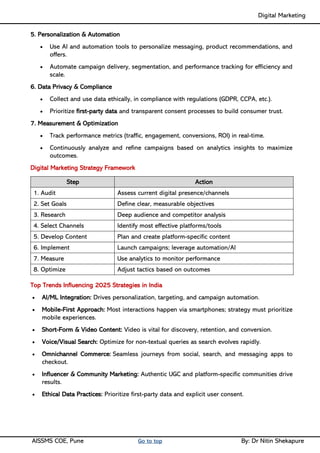
Use a multi-channel approach to maximize reach and impact. Core channels in 2025 include:
Channel Purpose & Benefits Examples
SEO Drive long-term traffic, build trust Blog, product pages
PPC / Display Ads Instant traffic for offers, launches Google Ads, Meta Ads
Social Media Brand visibility, community engagement Instagram, LinkedIn
Content Marketing Nurture leads, educate, boost SEO Blogs, infographics
Email Marketing
Direct, personalized communication and
offers
Campaigns, newsletters
Video Marketing
Build credibility, boost conversions, engage
audiences
YouTube, Reels, Shorts
Influencer/UGC
Leverage authentic, community-driven
messages
Influencer collaborations
Mobile Marketing
Tap in-app/ad experiences, location-based
targeting
Notifications, SMS
Combine these channels for a unified, omnichannel experience.
4. Content Strategy
• Prioritize engaging, useful, shareable content—video and short-form content drive the
highest engagement and conversions.
• Adapt content for each channel and device, focusing on storytelling and authenticity.
• Incorporate SEO best practices, voice, and visual search optimization.
Digital Marketing ____
AISSMS COE, Pune Go to top By: Dr Nitin Shekapure
5. Personalization & Automation
• Use AI and automation tools to personalize messaging, product recommendations, and
offers.
• Automate campaign delivery, segmentation, and performance tracking for efficiency and
scale.
6. Data Privacy & Compliance
• Collect and use data ethically, in compliance with regulations (GDPR, CCPA, etc.).
• Prioritize first-party data and transparent consent processes to build consumer trust.
7. Measurement & Optimization
• Track performance metrics (traffic, engagement, conversions, ROI) in real-time.
• Continuously analyze and refine campaigns based on analytics insights to maximize
outcomes.
Digital Marketing Strategy Framework
Step Action
1. Audit Assess current digital presence/channels
2. Set Goals Define clear, measurable objectives
3. Research Deep audience and competitor analysis
4. Select Channels Identify most effective platforms/tools
5. Develop Content Plan and create platform-specific content
6. Implement Launch campaigns; leverage automation/AI
7. Measure Use analytics to monitor performance
8. Optimize Adjust tactics based on outcomes
Top Trends Influencing 2025 Strategies in India
• AI/ML Integration: Drives personalization, targeting, and campaign automation.
• Mobile-First Approach: Most interactions happen via smartphones; strategy must prioritize
mobile experiences.
• Short-Form & Video Content: Video is vital for discovery, retention, and conversion.
• Voice/Visual Search: Optimize for non-textual queries as search evolves rapidly.
• Omnichannel Commerce: Seamless journeys from social, search, and messaging apps to
checkout.
• Influencer & Community Marketing: Authentic UGC and platform-specific communities drive
results.
• Ethical Data Practices: Prioritize first-party data and explicit user consent.
Digital Marketing ____
AISSMS COE, Pune Go to top By: Dr Nitin Shekapure
Consumer Decision Journey & Digital Advertising Market in India
The consumer decision journey refers to the stages a customer passes through before, during,
and after making a purchase. Effective digital advertising in India is structured to influence
consumer behavior at each touchpoint along this journey.
Key Stages of the Consumer Journey
• Awareness: Consumers become aware of a need or problem. Digital ads on search engines,
social platforms, and video channels introduce brands/products.
• Consideration: Potential buyers research solutions. Brands deliver targeted content,
influencer reviews, and comparative ads to shape preferences.
• Decision: Consumers compare options and finalize choices. Retargeting, personalized offers,
and testimonials are key at this point.
• Action: The actual purchase is made, often guided by seamless checkout experiences and
digital payment options.
• Post-Purchase & Advocacy: Brands engage with consumers post-sale via remarketing,
exclusive communities, and loyalty programs, encouraging advocacy and repeat purchases.
Digital advertising campaigns in India are increasingly data-driven, leveraging analytics to
identify where each consumer is in their journey and delivering tailored content accordingly.
The Digital Advertising Market in India
Market Size and Growth
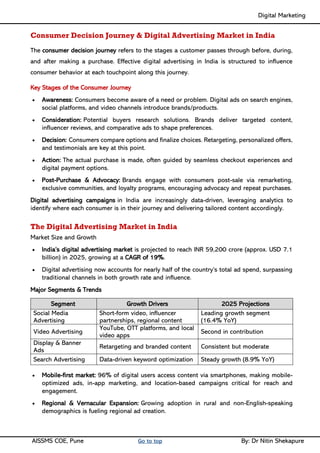
• India’s digital advertising market is projected to reach INR 59,200 crore (approx. USD 7.1
billion) in 2025, growing at a CAGR of 19%.
• Digital advertising now accounts for nearly half of the country’s total ad spend, surpassing
traditional channels in both growth rate and influence.
Major Segments & Trends
Segment Growth Drivers 2025 Projections
Social Media
Advertising
Short-form video, influencer
partnerships, regional content
Leading growth segment
(16.4% YoY)
Video Advertising
YouTube, OTT platforms, and local
video apps
Second in contribution
Display & Banner
Ads
Retargeting and branded content Consistent but moderate
Search Advertising Data-driven keyword optimization Steady growth (8.9% YoY)
• Mobile-first market: 96% of digital users access content via smartphones, making mobile-
optimized ads, in-app marketing, and location-based campaigns critical for reach and
engagement.
• Regional & Vernacular Expansion: Growing adoption in rural and non-English-speaking
demographics is fueling regional ad creation.
Digital Marketing ____
AISSMS COE, Pune Go to top By: Dr Nitin Shekapure
How Digital Advertising Influences the Consumer Journey in India
• Hyper-Targeted Reach: Advanced analytics and machine learning enable brands to target
consumers based on location, language, device, browsing habits, and purchase history.
• Personalization: Brands can tailor ad content and offers for individual users, boosting
relevance and conversion rates.
• Omnichannel Presence: Integrated ad strategies ensure consumers encounter consistent
brand messaging across search, social, OTT, and mobile platforms.
• Real-Time Optimization: Marketers can track user interactions and tweak campaigns live,
responding instantly to what drives conversions.
Unique Features of India’s Digital Advertising Ecosystem
• Scale & Diversity: Over 800 million internet users, with a striking digital divide between
urban and rural areas, offer a vast yet nuanced landscape for marketers.
• Social Influence: Peer reviews, influencers, and digital communities significantly shape
decision-making, especially for Gen Z and rural consumers.
• Mobile Wallets & Payment Ecosystem: A frictionless digital payment infrastructure
accelerates the ‘action’ phase, especially for e-commerce and app-based offerings.
Challenges & Considerations
• Ad Saturation: As digital adoption grows, users face ad fatigue, demanding greater creativity
and authentic messaging.
• Privacy & Data Regulation: Compliance with new and evolving data laws is critical to
sustaining brand trust and campaign efficiency.
• Localization: Success relies on adapting campaigns to local languages, cultures, and
consumption patterns.
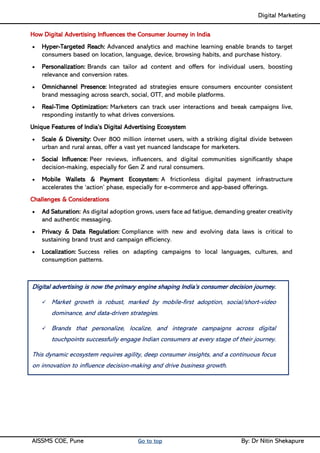
Digital advertising is now the primary engine shaping India’s consumer decision journey.
✓ Market growth is robust, marked by mobile-first adoption, social/short-video
dominance, and data-driven strategies.
✓ Brands that personalize, localize, and integrate campaigns across digital
touchpoints successfully engage Indian consumers at every stage of their journey.
This dynamic ecosystem requires agility, deep consumer insights, and a continuous focus
on innovation to influence decision-making and drive business growth.
Digital Marketing ____
AISSMS COE, Pune Go to top By: Dr Nitin Shekapure
Essential Skills in Digital Marketing
Digital marketing requires a blend of technical, analytical, and creative abilities to design, launch,
and optimize campaigns in today’s fast-evolving landscape. Mastering these skills boosts your
effectiveness as a marketer and increases your value to employers.
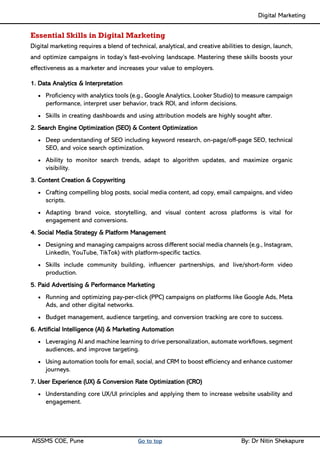
1. Data Analytics & Interpretation
• Proficiency with analytics tools (e.g., Google Analytics, Looker Studio) to measure campaign
performance, interpret user behavior, track ROI, and inform decisions.
• Skills in creating dashboards and using attribution models are highly sought after.
2. Search Engine Optimization (SEO) & Content Optimization
• Deep understanding of SEO including keyword research, on-page/off-page SEO, technical
SEO, and voice search optimization.
• Ability to monitor search trends, adapt to algorithm updates, and maximize organic
visibility.
3. Content Creation & Copywriting
• Crafting compelling blog posts, social media content, ad copy, email campaigns, and video
scripts.
• Adapting brand voice, storytelling, and visual content across platforms is vital for
engagement and conversions.
4. Social Media Strategy & Platform Management
• Designing and managing campaigns across different social media channels (e.g., Instagram,
LinkedIn, YouTube, TikTok) with platform-specific tactics.
• Skills include community building, influencer partnerships, and live/short-form video
production.
5. Paid Advertising & Performance Marketing
• Running and optimizing pay-per-click (PPC) campaigns on platforms like Google Ads, Meta
Ads, and other digital networks.
• Budget management, audience targeting, and conversion tracking are core to success.
6. Artificial Intelligence (AI) & Marketing Automation
• Leveraging AI and machine learning to drive personalization, automate workflows, segment
audiences, and improve targeting.
• Using automation tools for email, social, and CRM to boost efficiency and enhance customer
journeys.
7. User Experience (UX) & Conversion Rate Optimization (CRO)
• Understanding core UX/UI principles and applying them to increase website usability and
engagement.
Digital Marketing ____
AISSMS COE, Pune Go to top By: Dr Nitin Shekapure
• Conducting A/B testing, optimizing landing pages, and using data to improve conversion
rates.
8. Video Marketing
• Skills in video production, editing, and storytelling for formats such as YouTube, Instagram
Reels, and TikTok.
• Video remains the most engaging content type, crucial for both brand awareness and
conversions.
9. Email Marketing
• Creating engaging, personalized, and automated campaigns including segmentation, list
management, and performance analysis.
• Email continues to drive high ROI and remains essential for nurturing leads.
10. Ethical Marketing & Data Privacy
• Ensuring all campaigns comply with data privacy laws (GDPR, CCPA, etc.), respecting user
consent and practicing transparency.
• Building brand trust by adhering to ethical marketing standards is more important than
ever.
Summary Table: Top Digital Marketing Skills
Skill Area Description
Data Analytics & Interpretation Measurement, dashboards, ROI, insights
SEO & Content Optimization Organic growth, algorithms, technical SEO
Content Creation & Copywriting Blogs, ads, social copy, brand voice
Social Media Strategy & Management Platform tactics, community, influencers
Paid Advertising PPC, targeting, conversion optimization
AI & Marketing Automation Personalization, workflow automation
UX/UI & CRO User-centric design, A/B testing, CRO
Video Marketing Production, editing, short/long-form video
Email Marketing Personalized automation, segmentation
Data Ethics & Privacy Compliance Adhering to laws, building trust
Excelling in digital marketing today is about continuously learning and refining these
core skills. Success comes from combining technical proficiency with creativity, strategic
thinking, and a strong commitment to ethical standards in a data-driven world.
Digital Marketing ____
AISSMS COE, Pune Go to top By: Dr Nitin Shekapure
Digital Marketing Plan
A digital marketing plan is a structured roadmap of strategies, channels, and actions designed
to achieve specific marketing objectives in the digital space. An effective plan leverages data,
technology, and creativity to boost engagement, traffic, conversions, and brand loyalty.
Key Components of a Modern Digital Marketing Plan
1. Situation Analysis
• Review past performance: Assess current digital activities, campaign results, website
analytics, and competitor benchmarks to determine strengths, weaknesses, and
opportunities.
• SWOT analysis: Identify internal strengths and weaknesses, plus external opportunities
and threats relevant to your market and competitors.
2. Define Goals and Objectives
• Set SMART goals: Objectives should be Specific, Measurable, Achievable, Relevant, and
Time-bound (e.g., “increase qualified leads by 25% in Q3”).
• KPIs: Determine key performance indicators to monitor progress (e.g., website visits,
conversion rates, ROI).
3. Audience and Market Research
• Create buyer personas: Develop detailed profiles for your ideal customers, outlining
demographics, behaviors, needs, and digital habits.
• Map the customer journey: Understand how audiences move from awareness to purchase
and advocacy.
4. Unique Value Proposition
• Clarify your message: Define what sets your product or service apart and ensure this
value proposition is central in all communications.
5. Channel and Tactic Selection
Utilize a multichannel approach for greater reach and synergy. Key channels include:
Channel Purpose
SEO Organic search visibility
Paid Search Immediate traffic through PPC
Social Media Community engagement and awareness
Content Value delivery, thought leadership
Video Engagement, education, brand building
Email Nurturing, offers, retention
Influencer/UGC Authentic, peer-driven credibility
Mobile Ubiquitous, location-based targeting
6. Content Strategy
• Develop a content calendar: Plan SEO-optimized blogs, videos, social posts, and email
campaigns tailored to each segment.
Digital Marketing ____
AISSMS COE, Pune Go to top By: Dr Nitin Shekapure
• Focus on value and storytelling: Make content relevant, solutions-oriented, and
interactive where possible.
7. Budget Planning
• Allocate resources: Set budget per channel based on expected ROI, past performance,
and business priorities.
• Factor in technology: Invest in essential tools (e.g., marketing automation, analytics, CRM
systems).
8. Implementation Plan
• Execution schedule: Define timelines, responsibilities, workflow, and campaign rollout.
• Leverage automation: Streamline repetitive tasks and optimize campaign delivery using
AI tools.
9. Measurement and Optimization
• Track KPIs in real time: Use analytics dashboards to measure performance, spot trends,
and identify issues.
• Continuous improvement: Regularly review results, run A/B tests, and adjust tactics to
boost effectiveness.
Example: Step-by-Step Digital Marketing Plan Framework
Step Action
1. Audit Analyze past campaigns, website analytics, competition
2. Goals Set clear, SMART objectives with defined KPIs
3. Research Map personas, customer journeys, and market trends
4. Strategy Select channels, content themes, value messaging
5. Content Develop and schedule high-value, multimedia content
6. Budget Allocate spend and resources
7. Execute Launch and manage campaigns across selected platforms
8. Measure Monitor performance, optimize based on insights
Tips for a Successful Plan
• Personalize every touchpoint: Use data and automation for tailored messaging and
product recommendations.
• Ensure mobile-first design: Most users engage via smartphones—optimize all
experiences for mobile.
• Prioritize privacy and compliance: Collect and use data ethically, respect consent, and
stay up to date with regulations.
• Stay agile: Be ready to pivot tactics quickly in response to analytics or changes in
consumer behavior.
• Integrate technology: Employ AI for improved targeting, performance optimization, and
creative production.
An effective digital marketing plan is ongoing—review and refine it regularly as technology,
platforms, and consumer habits evolve. This structured approach ensures that every action
is intentional, measurable, and aligned with your overall business goals.
Digital Marketing ____
AISSMS COE, Pune Go to top By: Dr Nitin Shekapure
Digital Marketing Terminology
Digital Marketing ____
AISSMS COE, Pune Go to top By: Dr Nitin Shekapure
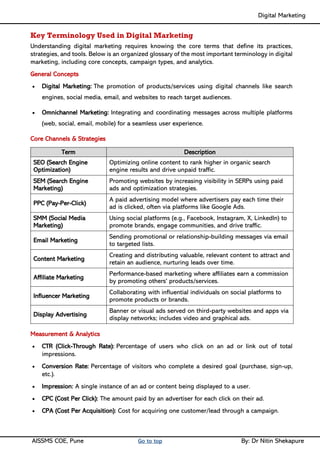
Key Terminology Used in Digital Marketing
Understanding digital marketing requires knowing the core terms that define its practices,
strategies, and tools. Below is an organized glossary of the most important terminology in digital
marketing, including core concepts, campaign types, and analytics.
General Concepts
• Digital Marketing: The promotion of products/services using digital channels like search
engines, social media, email, and websites to reach target audiences.
• Omnichannel Marketing: Integrating and coordinating messages across multiple platforms
(web, social, email, mobile) for a seamless user experience.
Core Channels & Strategies
Term Description
SEO (Search Engine
Optimization)
Optimizing online content to rank higher in organic search
engine results and drive unpaid traffic.
SEM (Search Engine
Marketing)
Promoting websites by increasing visibility in SERPs using paid
ads and optimization strategies.
PPC (Pay-Per-Click)
A paid advertising model where advertisers pay each time their
ad is clicked, often via platforms like Google Ads.
SMM (Social Media
Marketing)
Using social platforms (e.g., Facebook, Instagram, X, LinkedIn) to
promote brands, engage communities, and drive traffic.
Email Marketing
Sending promotional or relationship-building messages via email
to targeted lists.
Content Marketing
Creating and distributing valuable, relevant content to attract and
retain an audience, nurturing leads over time.
Affiliate Marketing
Performance-based marketing where affiliates earn a commission
by promoting others' products/services.
Influencer Marketing
Collaborating with influential individuals on social platforms to
promote products or brands.
Display Advertising
Banner or visual ads served on third-party websites and apps via
display networks; includes video and graphical ads.
Measurement & Analytics
• CTR (Click-Through Rate): Percentage of users who click on an ad or link out of total
impressions.
• Conversion Rate: Percentage of visitors who complete a desired goal (purchase, sign-up,
etc.).
• Impression: A single instance of an ad or content being displayed to a user.
• CPC (Cost Per Click): The amount paid by an advertiser for each click on their ad.
• CPA (Cost Per Acquisition): Cost for acquiring one customer/lead through a campaign.
Digital Marketing ____
AISSMS COE, Pune Go to top By: Dr Nitin Shekapure
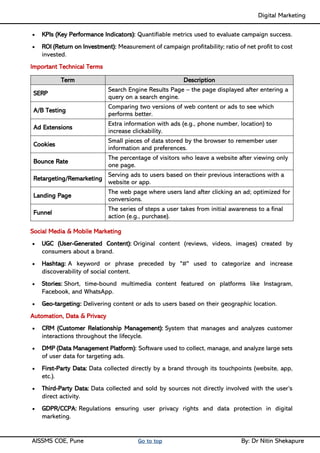
• KPIs (Key Performance Indicators): Quantifiable metrics used to evaluate campaign success.
• ROI (Return on Investment): Measurement of campaign profitability; ratio of net profit to cost
invested.
Important Technical Terms
Term Description
SERP
Search Engine Results Page – the page displayed after entering a
query on a search engine.
A/B Testing
Comparing two versions of web content or ads to see which
performs better.
Ad Extensions
Extra information with ads (e.g., phone number, location) to
increase clickability.
Cookies
Small pieces of data stored by the browser to remember user
information and preferences.
Bounce Rate
The percentage of visitors who leave a website after viewing only
one page.
Retargeting/Remarketing
Serving ads to users based on their previous interactions with a
website or app.
Landing Page
The web page where users land after clicking an ad; optimized for
conversions.
Funnel
The series of steps a user takes from initial awareness to a final
action (e.g., purchase).
Social Media & Mobile Marketing
• UGC (User-Generated Content): Original content (reviews, videos, images) created by
consumers about a brand.
• Hashtag: A keyword or phrase preceded by "#" used to categorize and increase
discoverability of social content.
• Stories: Short, time-bound multimedia content featured on platforms like Instagram,
Facebook, and WhatsApp.
• Geo-targeting: Delivering content or ads to users based on their geographic location.
Automation, Data & Privacy
• CRM (Customer Relationship Management): System that manages and analyzes customer
interactions throughout the lifecycle.
• DMP (Data Management Platform): Software used to collect, manage, and analyze large sets
of user data for targeting ads.
• First-Party Data: Data collected directly by a brand through its touchpoints (website, app,
etc.).
• Third-Party Data: Data collected and sold by sources not directly involved with the user’s
direct activity.
• GDPR/CCPA: Regulations ensuring user privacy rights and data protection in digital
marketing.
Digital Marketing ____
AISSMS COE, Pune Go to top By: Dr Nitin Shekapure
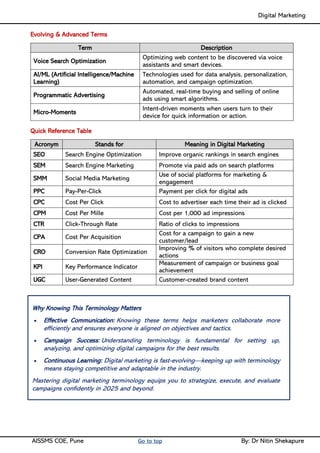
Evolving & Advanced Terms
Term Description
Voice Search Optimization
Optimizing web content to be discovered via voice
assistants and smart devices.
AI/ML (Artificial Intelligence/Machine
Learning)
Technologies used for data analysis, personalization,
automation, and campaign optimization.
Programmatic Advertising
Automated, real-time buying and selling of online
ads using smart algorithms.
Micro-Moments
Intent-driven moments when users turn to their
device for quick information or action.
Quick Reference Table
Acronym Stands for Meaning in Digital Marketing
SEO Search Engine Optimization Improve organic rankings in search engines
SEM Search Engine Marketing Promote via paid ads on search platforms
SMM Social Media Marketing
Use of social platforms for marketing &
engagement
PPC Pay-Per-Click Payment per click for digital ads
CPC Cost Per Click Cost to advertiser each time their ad is clicked
CPM Cost Per Mille Cost per 1,000 ad impressions
CTR Click-Through Rate Ratio of clicks to impressions
CPA Cost Per Acquisition
Cost for a campaign to gain a new
customer/lead
CRO Conversion Rate Optimization
Improving % of visitors who complete desired
actions
KPI Key Performance Indicator
Measurement of campaign or business goal
achievement
UGC User-Generated Content Customer-created brand content
Why Knowing This Terminology Matters
• Effective Communication: Knowing these terms helps marketers collaborate more
efficiently and ensures everyone is aligned on objectives and tactics.
• Campaign Success: Understanding terminology is fundamental for setting up,
analyzing, and optimizing digital campaigns for the best results.
• Continuous Learning: Digital marketing is fast-evolving—keeping up with terminology
means staying competitive and adaptable in the industry.
Mastering digital marketing terminology equips you to strategize, execute, and evaluate
campaigns confidently in 2025 and beyond.
Digital Marketing ____
AISSMS COE, Pune Go to top By: Dr Nitin Shekapure
PPC and Online Marketing Through Social Media
What is PPC on Social Media?
Pay-Per-Click (PPC) on social media refers to paid advertising campaigns where advertisers pay
each time a user clicks on their ad. Social media platforms offer PPC options that allow brands
to target specific audiences based on demographics, interests, behavior, and more, maximizing
reach and efficiency.
Major Social Media PPC Platforms
Platform Key Features
Audience
Reach
Ad Formats
Facebook &
Instagram (Meta)
Unified platform, AI-driven
targeting, wide
demographics
Billions
globally
Image, video, carousel,
story ads
YouTube
Video-dominant, detailed
targeting, skippable/non-
skippable ads
2+ billion
users
In-stream, discovery,
bumper ads
TikTok
Highly engaged Gen
Z/Millennial audience,
innovative formats
1+ billion
users
In-feed, branded hashtag,
TopView
LinkedIn
Professional/B2B
audience, granular
industry/job targeting
1+ billion
professionals
Sponsored content,
message ads
Twitter (X)
Real-time engagement,
trending topic ads
300+ million
users
Promoted tweets, video,
trends
Reddit
Niche community
targeting, low CPC
350+ million
users
Promoted posts, display,
carousel
How PPC Works on Social Media
• Ad Creation: Choose your objective (traffic, engagement, conversions), design creative
assets, and write compelling copy.
• Audience Targeting: Select detailed targeting options such as age, location, interests, job
title, device type, or even language.
• Bidding & Budgets: Set daily or lifetime budgets; platforms use auctions to display your ads
based on bid and relevance.
• Performance Tracking: Platforms offer robust analytics (clicks, impressions, conversions, etc.)
for real-time optimization.
Digital Marketing ____
AISSMS COE, Pune Go to top By: Dr Nitin Shekapure
Benefits of Social Media PPC
• Massive Reach: Access to billions of users across different platforms—Meta Ads alone reach
vast, diverse audiences.
• Precise Targeting: Advanced algorithms allow targeting by very specific attributes,
improving ROI and minimizing wasted spend.
• Flexible Ad Formats: Multiple creative options—video, image, carousel, story, and interactive
content—let you tailor messages to each stage of the consumer journey.
• Cost Control: Advertisers can start with modest budgets and scale up based on performance,
with average costs per click (CPC) ranging from $0.50 to $2.00 for Meta platforms (industry-
dependent).
• Real-Time Optimization: Instant feedback and analytics enable rapid adjustment of creatives,
bids, and targeting for better results.
• Remarketing: Reach users who have previously interacted with your site or content, keeping
your brand top-of-mind and supporting conversions.
Trends and Strategies for 2025
• Platform Mix: Most businesses use multiple platforms for PPC—76% leverage Facebook,
70% Instagram, and growing numbers are investing in TikTok, LinkedIn, and X (formerly
Twitter).
• Creative Refresh: Social media algorithms reward fresh ads; updating creatives weekly is
recommended to avoid audience fatigue and keep CPMs (cost-per-thousand impressions)
low.
• Channel Roles: Instagram excels at product discovery, TikTok at reach and engagement,
while LinkedIn dominates B2B nurture and lead generation—each platform fits into a
different part of the funnel.
• Automation & AI: Platforms like Meta and LinkedIn use AI for smarter, automated targeting
and bidding, boosting campaign effectiveness with less manual effort.
• Mobile-First Approach: With most users accessing social platforms on mobile devices,
optimizing all creative and landing pages for mobile is essential.
• Vernacular, Video, and Regional Focus (India): The fastest growth comes from regional
content, short-form video, and campaigns tailored to specific languages and communities.
Best Practices for Effective PPC Campaigns on Social Media
• Set Clear Goals: Define conversion, traffic, or brand KPIs for each campaign.
• Audience Testing: Use A/B testing to find high-performing segments and creative
combinations.
• Monitor & Optimize: Track key metrics and adjust bids, budgets, and creatives in real time.
• Leverage Retargeting: Remarket to users who’ve engaged with your brand for higher
conversion rates.
• Stay Updated: Algorithms, formats, and privacy rules change frequently—continuous
learning is critical.
Digital Marketing ____
AISSMS COE, Pune Go to top By: Dr Nitin Shekapure
PPC through social media is a cornerstone of modern digital marketing, offering
businesses scalable, data-driven, and highly targeted advertising capabilities. By
strategically choosing platforms and creative tactics, marketers can achieve maximum
engagement and ROI in India and globally.
The image visually explains PPC – Pay Per Click.
A user clicks on an online ad (shown by the big cursor and the laptop screen), which results
in spending money (coins, dollar bills) for each click but also brings growth and profits
(represented by upward graph and stacked coins). It’s a balance between ad investment
and business returns.
Digital Marketing ____
AISSMS COE, Pune Go to top By: Dr Nitin Shekapure
Social Media Marketing
What Is Social Media Marketing?
Social media marketing is the practice of using platforms like Instagram, Facebook, TikTok,
LinkedIn, X (formerly Twitter), Pinterest, and YouTube to connect with audiences, promote
products or services, and build brand recognition. The approach in 2025 is dynamic, highly
data-driven, and integral to every business’s digital strategy.
It involves:
• Creating authentic, brand-aligned content (videos, stories, posts)
• Engaging and nurturing communities through conversations and user-generated content
• Running targeted paid ad campaigns
• Tracking performance metrics to refine strategy and maximize ROI
Why Is Social Media Marketing Important?
• Unmatched Reach: Billions actively use social media globally, with platforms accessible to
nearly every demographic.
• Direct Engagement: Enables two-way communication, building trust and facilitating rapid
customer service.
• Brand Storytelling: Lets brands share values, behind-the-scenes views, and real-time
updates in creative ways.
• Targeted Advertising: Powerful tools allow pinpoint targeting based on user data, increasing
relevance and conversions.
• Influence on Purchasing: Many buying decisions now start or finish on social media, with
influencer recommendations and peer reviews shaping choices.
Digital Marketing ____
AISSMS COE, Pune Go to top By: Dr Nitin Shekapure
Fundamentals & Processes
Key Elements
Component Role in Social Media Marketing
Content Creation Develop engaging posts, videos, stories, and carousels
Community Building Foster relationships via comments, DMs, live events
Paid Campaigns Reach wider, specific audiences using targeted ads
Analytics Monitor reach, engagement, and conversions to optimize
Essential Activities
• Respond to comments and DMs promptly
• Encourage and showcase user-generated content (UGC)
• Collaborate with creators and influencers for credibility and reach
• Regularly update content style and format to match evolving trends
Major Trends in 2025
1. Short-Form Video Dominance
✓ Reels, Shorts, and TikToks achieve the highest reach and engagement.
✓ Focus on compelling hooks, storytelling, and visually striking concepts.
2. Authenticity & Community
✓ Unfiltered, relatable content outperforms overly polished posts.
✓ Brands build emotional connections with audiences by showing personality and behind-
the-scenes moments.
3. AI Integration
✓ AI assists in idea generation, caption writing, trend tracking, and analytics, though
human creativity remains essential.
4. Social Commerce
✓ Social platforms double as shopping hubs; users discover, research, and purchase
products without leaving the app.
5. Personalization at Scale
✓ Content and ads are increasingly tailored to individual preferences, locations, and
behaviors through data-driven tools.
6. Social SEO
✓ Brands now optimize captions, bios, and hashtags so content is easily discovered via
platform search—an emerging form of SEO.
7. UGC & Employee-Generated Content
✓ Content from customers and employees bolsters trust and extends reach.
Digital Marketing ____
AISSMS COE, Pune Go to top By: Dr Nitin Shekapure
Steps to Build an Effective Social Media Marketing Strategy
1. Set Clear Goals & KPIs
• Define your objectives (brand awareness, engagement, sales, etc.).
• Choose key metrics like engagement rate, CTR, follower growth, and conversions.
2. Know Your Audience
• Use both demographic and psychographic data to create in-depth audience profiles.
• Analyze audience behaviors and preferences using platform analytics tools.
3. Select the Right Platforms
• Choose platforms where your target audience is most active and where your brand type
fits organically.
4. Create a Content Plan
• Mix formats (videos, stories, images, text) and themes (educational, entertaining,
inspirational) for variety.
• Capitalize on trends while maintaining brand authenticity.
5. Leverage Paid Campaigns
• Use platform-specific tools for targeting, remarketing, and bid optimization.
• Set and monitor budgets for best ROI.
6. Engage and Build Community
• Encourage interaction via polls, live streams, Q&As, and user features.
• Respond quickly and authentically to audience engagement.
7. Measure and Optimize
• Track campaign performance in real time.
• Use data to adjust creative content, targeting parameters, and posting frequency for
continuous improvement.
Social Media Platforms at a Glance
Platform Best For Top Content Types
Instagram Visual branding, product discovery Stories, Reels, carousels
TikTok Virality, Gen Z engagement Short-form vertical videos
Facebook Wide reach, community groups Videos, groups, events
YouTube Education, long/short video, discovery Tutorials, Shorts, livestreams
LinkedIn B2B networking, thought leadership Articles, videos, infographics
X (Twitter) Real-time updates, brand voice Threads, memes, text, video
Digital Marketing ____
AISSMS COE, Pune Go to top By: Dr Nitin Shekapure
Best Practices for Success
• Focus on quality over quantity—share valuable, on-brand content more intentionally.
• Engage in active listening—use social monitoring tools to follow conversations and spot
emerging topics.
• Regularly test and experiment—adapt to new features, content formats, and distribution
algorithms.
• Prioritize mobile-first design—the majority of users interact via smartphones.
• Adhere to data privacy best practices—build trust by being transparent about data use and
protecting audience information.
Social media marketing in 2025 is about meaningful engagement, smart automation, and
clear objectives. Brands succeed by fostering real connections, leveraging data-driven
insights, adapting quickly to new features and trends, and maintaining an authentic,
human-centered online presence.
Digital Marketing ____
AISSMS COE, Pune Go to top By: Dr Nitin Shekapure
Google Webmaster (Search Console) and Analytics Overview
Google Webmaster Tools (Google Search Console)
Google Webmaster Tools, now known as Google Search Console (GSC), is a free platform by
Google that enables website owners, digital marketers, and SEO professionals to monitor,
maintain, and troubleshoot their site’s presence in Google Search results. It is an essential
resource for understanding site performance, diagnosing issues, and optimizing visibility.
Key Features and Tools
• Performance Report
✓ Shows total clicks, impressions, average CTR (click-through rate), and average position
for your site’s keywords.
✓ Tracks which queries bring users to your site and how different pages perform in search.
• Index Coverage
✓ Reports how many of your site’s pages are indexed by Google and identifies errors
preventing indexing.
✓ Flags problems like pages with crawling issues, exclusions, and duplicate content.
• URL Inspection Tool
Digital Marketing ____
AISSMS COE, Pune Go to top By: Dr Nitin Shekapure
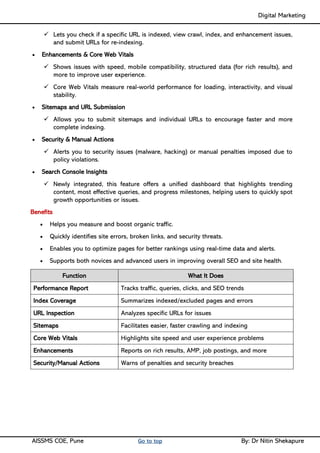
✓ Lets you check if a specific URL is indexed, view crawl, index, and enhancement issues,
and submit URLs for re-indexing.
• Enhancements & Core Web Vitals
✓ Shows issues with speed, mobile compatibility, structured data (for rich results), and
more to improve user experience.
✓ Core Web Vitals measure real-world performance for loading, interactivity, and visual
stability.
• Sitemaps and URL Submission
✓ Allows you to submit sitemaps and individual URLs to encourage faster and more
complete indexing.
• Security & Manual Actions
✓ Alerts you to security issues (malware, hacking) or manual penalties imposed due to
policy violations.
• Search Console Insights
✓ Newly integrated, this feature offers a unified dashboard that highlights trending
content, most effective queries, and progress milestones, helping users to quickly spot
growth opportunities or issues.
Benefits
• Helps you measure and boost organic traffic.
• Quickly identifies site errors, broken links, and security threats.
• Enables you to optimize pages for better rankings using real-time data and alerts.
• Supports both novices and advanced users in improving overall SEO and site health.
Function What It Does
Performance Report Tracks traffic, queries, clicks, and SEO trends
Index Coverage Summarizes indexed/excluded pages and errors
URL Inspection Analyzes specific URLs for issues
Sitemaps Facilitates easier, faster crawling and indexing
Core Web Vitals Highlights site speed and user experience problems
Enhancements Reports on rich results, AMP, job postings, and more
Security/Manual Actions Warns of penalties and security breaches
Digital Marketing ____
AISSMS COE, Pune Go to top By: Dr Nitin Shekapure
Google Analytics
Google Analytics is a comprehensive web analytics tool that enables you to track and analyze
user behavior across your website. It focuses on metrics and data-driven insights to help you
make strategic marketing and design decisions.
Key Functions
• Real-Time Analytics
✓ Monitor live user activity and traffic sources.
• Audience Reports
✓ Understand who visits your site—demographics, location, device, and behavior patterns.
• Acquisition Reports
✓ Analyze how visitors arrive (organic search, social media, paid ads, referrals, direct, etc.).
• Behavior Reports
✓ Explore what users do: which pages they visit, how long they stay, and how they
navigate the site.
• Conversion Tracking
✓ Set up goals (form fills, sign-ups, purchases) & measure completion rates to assess ROI.
• Event Tracking
✓ Track specific actions such as downloads, video plays, clicks on certain buttons, or
external links.
Area What You Learn
Audience Who your visitors are
Acquisition How people are finding your website
Behavior What they do once they arrive
Conversions Whether they’re completing your key actions
Integration
• Integrates seamlessly with Google Search Console for unified SEO and user analytics.
• Enables combining search performance with user behavior for holistic insights and better
decision-making.
Practical Uses and Importance
• SEO Optimization: GSC pinpoints technical issues and tracks keyword rankings; Analytics
clarifies how those rankings drive engagement and conversions.
• Content Strategy: Identify “trending up/down” pages, top-performing content, and effective
queries.
• Technical Health: Spot and swiftly address site speed, mobile, and security issues.
• Performance Measurement: Both tools track the entire funnel from search appearance
through to user action, enabling continuous improvement.
Digital Marketing ____
AISSMS COE, Pune Go to top By: Dr Nitin Shekapure
Summary Table
Tool Main Purpose Key Features
Search Console
(GSC)
SEO/site health & indexing
optimization
Performance, coverage, sitemaps, Core
Vitals
Google Analytics
Website & user behavior
analytics
Audience, acquisition, behavior,
conversions
Both tools are foundational for modern digital marketing, equipping you to grow search visibility,
improve user experience, and maximize digital campaign results.
🛍️ Real-Life Example: Local Bakery Going Digital
Business: SweetBite Bakery in Pune wants to grow its online presence and increase cake
orders through its website.
✅ Step 1: Use of Google Search Console (GSC)
Goal: Ensure the website is visible and healthy in Google Search results.
• The owner uses GSC to check:
✓ Whether the site is indexed properly on Google.
✓ If there are errors in the sitemap (some pages were not showing up).
✓ What keywords people are using to find the site (e.g., "best chocolate cake in
Pune").
✓ How fast the site loads (Core Web Vitals), which was poor on mobile, so they
improved loading speed.
🔍 Result: The bakery improves its visibility on Google and appears in search results
when people type "birthday cake near me."
✅ Step 2: Use of Google Analytics
Goal: Understand how visitors interact with the website.
• The owner uses Google Analytics to track:
✓ How many people visit the website daily.
✓ Which pages are most visited (e.g., "custom cakes" and "contact us").
✓ Where users are coming from (Instagram, Google Search, WhatsApp).
✓ How many users complete an order or just browse and leave.
📊 Result:
• They learn most traffic comes from mobile users on Instagram.
• So they optimize their site for mobile and run a cake discount campaign on
Instagram.
🌟 Outcome:
By using GSC + Google Analytics, SweetBite Bakery:
✓ Improves website visibility in search engines.
✓ Identifies top-performing products.
✓ Boosts online cake orders by 40% within 2 months.
Digital Marketing ____
AISSMS COE, Pune Go to top By: Dr Nitin Shekapure
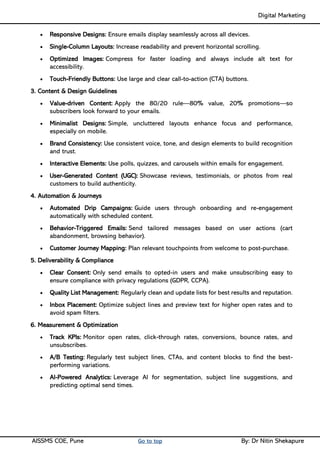
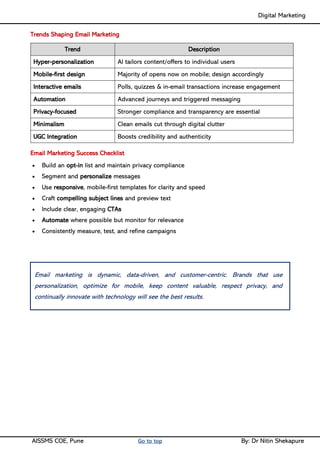
Email Marketing
Email marketing is a digital marketing strategy that uses targeted email messages to build
relationships, share updates, and promote products or services to a subscribed audience. It
remains one of the highest ROI channels in the digital landscape due to its direct, personal, and
measurable approach.
Core Components of Email Marketing
• Newsletters: Regular updates, insights, or educational content sent to subscribers.
• Promotional Emails: Time-bound offers, product launches, and exclusive sales.
• Transactional Emails: Automated messages tied to user actions, such as order confirmations
or password resets.
• Re-engagement Emails: Campaigns designed to win back inactive subscribers.
Key Strategies & Best Practices
1. Personalization & Segmentation
• Hyper-personalization: Go beyond addressing by name—use AI and data to deliver
content tailored to interests, behaviors, and stage in the customer journey.
• Segment lists: Categorize by demographics, purchase history, engagement, or location
for higher relevance and open rates.
• Dynamic Content: Adjust text, images, or offers within each email based on recipient data.
2. Mobile Optimization
Digital Marketing ____
AISSMS COE, Pune Go to top By: Dr Nitin Shekapure
• Responsive Designs: Ensure emails display seamlessly across all devices.
• Single-Column Layouts: Increase readability and prevent horizontal scrolling.
• Optimized Images: Compress for faster loading and always include alt text for
accessibility.
• Touch-Friendly Buttons: Use large and clear call-to-action (CTA) buttons.
3. Content & Design Guidelines
• Value-driven Content: Apply the 80/20 rule—80% value, 20% promotions—so
subscribers look forward to your emails.
• Minimalist Designs: Simple, uncluttered layouts enhance focus and performance,
especially on mobile.
• Brand Consistency: Use consistent voice, tone, and design elements to build recognition
and trust.
• Interactive Elements: Use polls, quizzes, and carousels within emails for engagement.
• User-Generated Content (UGC): Showcase reviews, testimonials, or photos from real
customers to build authenticity.
4. Automation & Journeys
• Automated Drip Campaigns: Guide users through onboarding and re-engagement
automatically with scheduled content.
• Behavior-Triggered Emails: Send tailored messages based on user actions (cart
abandonment, browsing behavior).
• Customer Journey Mapping: Plan relevant touchpoints from welcome to post-purchase.
5. Deliverability & Compliance
• Clear Consent: Only send emails to opted-in users and make unsubscribing easy to
ensure compliance with privacy regulations (GDPR, CCPA).
• Quality List Management: Regularly clean and update lists for best results and reputation.
• Inbox Placement: Optimize subject lines and preview text for higher open rates and to
avoid spam filters.
6. Measurement & Optimization
• Track KPIs: Monitor open rates, click-through rates, conversions, bounce rates, and
unsubscribes.
• A/B Testing: Regularly test subject lines, CTAs, and content blocks to find the best-
performing variations.
• AI-Powered Analytics: Leverage AI for segmentation, subject line suggestions, and
predicting optimal send times.
Digital Marketing ____
AISSMS COE, Pune Go to top By: Dr Nitin Shekapure
Trends Shaping Email Marketing
Trend Description
Hyper-personalization AI tailors content/offers to individual users
Mobile-first design Majority of opens now on mobile; design accordingly
Interactive emails Polls, quizzes & in-email transactions increase engagement
Automation Advanced journeys and triggered messaging
Privacy-focused Stronger compliance and transparency are essential
Minimalism Clean emails cut through digital clutter
UGC Integration Boosts credibility and authenticity
Email Marketing Success Checklist
• Build an opt-in list and maintain privacy compliance
• Segment and personalize messages
• Use responsive, mobile-first templates for clarity and speed
• Craft compelling subject lines and preview text
• Include clear, engaging CTAs
• Automate where possible but monitor for relevance
• Consistently measure, test, and refine campaigns
Email marketing is dynamic, data-driven, and customer-centric. Brands that use
personalization, optimize for mobile, keep content valuable, respect privacy, and
continually innovate with technology will see the best results.
Digital Marketing ____
AISSMS COE, Pune Go to top By: Dr Nitin Shekapure
Mobile Marketing
Mobile marketing is the practice of reaching and engaging consumers through their
smartphones, tablets, and wearable devices using targeted advertising, content, and interactive
experiences. It encompasses a wide range of strategies such as SMS campaigns, in-app
advertising, push notifications, proximity marketing, and social media engagement—all delivered
through mobile-specific channels.
Why Mobile Marketing Is Essential
• Mobile-First World: Over 70% of global internet traffic now comes from mobile devices; in
markets like India, 96% of internet users access the web via their smartphones.
• Consumer Behavior: Smartphones dominate product discovery, research, and shopping, with
m-commerce continuing to grow rapidly.
• Always-On Engagement: Mobile devices ensure brands can reach customers anywhere,
anytime, increasing the frequency and relevance of touchpoints.
Key Trends and Strategies for 2025
1. AI-Driven Personalization & Automation
• Hyper-personalized ads use AI to analyze location, behavior, and preferences in real time,
delivering content uniquely tailored to each user.
Digital Marketing ____
AISSMS COE, Pune Go to top By: Dr Nitin Shekapure
• AI-powered chatbots and customer engagement tools provide instant support and
streamline experiences in apps and messaging platforms.
2. Video, Short-Form & Interactive Content
• Short-form video and interactive ads on platforms like TikTok, Instagram Reels, and
YouTube Shorts now drive the highest engagement on mobile devices.
• In-app ephemeral content, polls, games, and contests invite rapid participation and viral
sharing.
3. App and In-App Marketing
• In-app advertising: Banners, native ads, videos, and interstitials appear within games,
news, and utility apps, leveraging users’ in-app journeys for higher conversions.
• Personalization inside apps is deepening, with content feeds, push notifications, and
offers dynamically tailored to user activity.
4. Location-Based and Proximity Marketing
• Geo-targeted campaigns send offers or notifications based on a user’s physical location.
• Proximity marketing (beacon/Bluetooth tech) delivers hyper-local experiences, driving
foot traffic to stores and events.
5. Messaging: SMS, WhatsApp & RCS
• SMS marketing remains highly effective, with open rates over 90% and rapid
engagement, especially for time-sensitive promotions.
• Growth in WhatsApp and other messaging app campaigns enables rich, conversational
marketing at scale.
6. Privacy, Consent & Data Ethics
• Heightened privacy regulations (by Apple, Google, and governments) restrict invasive
tracking and mandate transparent, permission-based marketing.
• Success depends on building trust, leveraging first-party data, and ensuring consent at
every touchpoint.
7. Mobile SEO and Performance
• Mobile-first indexing means Google and other search engines now rank the mobile
version of your site first.
• Fast-loading, responsive mobile sites are essential to reduce bounce and boost
conversion rates.
Digital Marketing ____
AISSMS COE, Pune Go to top By: Dr Nitin Shekapure
Major Mobile Marketing Channels
Channel Strategy Strengths
SMS & Messaging Time-sensitive offers, alerts High open rates, personal touch
In-App Advertising
Banners, native, video,
interstitial
High engagement, contextual
Social Media Marketing Organic and paid content
Viral short-form video,
community
Push Notifications Updates, reminders, offers Timely, direct, customizable
Location/Proximity Geo-fenced promotions
Drives store visits, highly
targeted
Mobile SEO
Mobile-optimized sites, fast
speeds
Better discovery, higher Google
ranking
Best Practices for Success
• Prioritize the mobile user experience: Ensure all digital content, websites, and campaigns
are visually appealing, fast, and intuitive on smaller screens.
• Leverage AI and automation: Use smart CRM and analytics tools to drive segmentation,
predict user needs, and optimize campaign timing.
• Integrate video and UGC: Encourage authentic, user-generated content and interactive video
to build trust and engagement.
• Respect privacy: Collect and use customer data ethically, always obtaining clear consent
before sending messages or location-based offers.
• Test and iterate: Regularly run A/B tests on creatives, segmentation, and delivery times to
maximize campaign effectiveness.
Emerging Opportunities
• 5G-powered AR and VR ads: Rich, immersive experiences that blend digital with real-
world activities are gaining traction.
• Voice Search Optimization: With more consumers using voice assistants, optimizing
mobile content for conversational queries is vital.
• Regional and Vernacular Marketing: Personalized content in local languages accelerates
adoption in diverse, mobile-first markets.
Mobile marketing is driven by data, creativity, and user-centricity. Brands that prioritize
authentic engagement, technological innovation, privacy compliance, and responsiveness
will capture and retain the always-on mobile consumer.
Digital Marketing ____
AISSMS COE, Pune Go to top By: Dr Nitin Shekapure
Display Advertising
Display advertising involves visually engaging ads (banners, videos, rich media) presented
across websites, apps, and digital platforms. These ads use images, text, animation, or video to
promote brands, products, and services, aiming to attract and convert digital audiences.
Evolution & Current Landscape
Modern display advertising has shifted far beyond the static banner ads of the past:
• Dynamic and Responsive Ads: Ads now adapt sizes/formats automatically to fit various
devices and placements.
• Rich Media and Interactivity: Many ads offer interactive features like mini-games, quizzes,
product configurators, or augmented reality experiences.
• Native Formats: Display ads seamlessly blend within site content for less disruption to the
user experience.
• Video & Short-Form Content: Video ads, especially short-form, continue to outperform static
images in engagement and click-through rates.
The above image is a perfect example of Display
Marketing in action. It shows a Lenovo advertisement
on the homepage of a popular news website — The
Times of India. This type of ad, visually highlighted
with product images, prices, discounts, and brand
details, is known as a Display Ad.
Digital Marketing ____
AISSMS COE, Pune Go to top By: Dr Nitin Shekapure
• Immersive Technologies: Augmented Reality (AR) and Virtual Reality (VR) ads are gaining
traction, facilitating more immersive brand experiences.
Key Benefits of Display Advertising
• Enhanced Visual Impact: Striking visuals increase attention and recall in crowded digital
spaces.
• Precision Targeting: Advanced data analytics and AI empower advertisers to reach hyper-
specific audience segments based on location, behavior, or interests.
• Measurable Outcomes: Real-time analytics tools provide clear insights into impressions,
clicks, conversions, and more.
• Flexibility: Campaigns can be updated, optimized, and retargeted at any time.
• Multi-Channel Reach: Ads appear across a vast network of sites and apps for broad,
consistent messaging.
Types of Display Ads
Type Description & Examples
Responsive Display Ads Auto-adjust size/format for different placements and devices
Rich Media/Interactive Ads
Incorporate dynamic elements like video, games, quizzes,
clickable sections
Video Display Ads
Short-form, autoplay, or native video content within web/app
environments
Native Display Ads Ads that blend seamlessly into the website/app content
AR/VR Display Ads
Allow users to interact with digital elements in real-world or
virtual environments
Contextual
Display Ads
AI places ads based on relevance of the surrounding
page content
Emerging Trends & Best Practices
• AI & Automation: Campaign management, ad variation, and targeting are increasingly
powered by machine learning for higher relevance and efficiency.
• Shorter Video Ads: Consumers respond best to videos under 30 seconds, driving higher
engagement and lower skip rates.
• Emotional Targeting: AI is being used to test and optimize ads based on the viewer’s
predicted mood and response, boosting effectiveness.
• Privacy-First Solutions: As privacy laws tighten, display ad strategies increasingly
emphasize first-party data and contextual targeting over behavioral tracking.
• Channel Diversification: Brands mix display ads with native, social, and content
recommendations to reduce costs and combat ad fatigue.
• Interactive and Story-Driven Content: Visual storytelling captures attention and builds
memorable brand impressions.
Digital Marketing ____
AISSMS COE, Pune Go to top By: Dr Nitin Shekapure
Performance & Effectiveness
• Global Reach: Modern display ad networks deliver over 90% reach among internet users
with campaign retargeting increasing conversions by up to 70%.
• Engagement: Video ads achieve up to 4x greater engagement than static banners.
• Conversion: Rich media and AR ads have demonstrated up to 267% and 94% higher
conversion rates than standard banners, respectively.
Challenges
• Ad Saturation: Overload can hurt effectiveness, making creativity and authentic
messaging crucial.
• Privacy & Compliance: Adapting to cookieless tracking and new regulations is essential.
• Ad Fraud: Persistent risk, pushing greater adoption of technologies like blockchain for
validation.
Summary Table: Display Advertising at a Glance
Aspect Details/Trends
Top-performing Format Short-form video, rich media, AR ads
Targeting AI-driven audience segmentation & contextual relevance
Key Challenge Privacy compliance, ad fatigue, fraud
Ad Spend (Global, 2025) $215.8 billion, +68% in five years
Platforms Websites, mobile apps, streaming services, social, native
Display advertising is powerful, data-driven, and more visually dynamic than ever. Brands
succeed by blending interactive, emotionally resonant creative with smart, privacy-
conscious targeting—supported by AI and a diverse mix of ad formats.
Digital Marketing ____
AISSMS COE, Pune Go to top By: Dr Nitin Shekapure
Display Advertising Terminology
Display advertising uses a set of specialized terms and acronyms crucial for understanding,
creating, managing, and optimizing campaigns. Below is a comprehensive glossary of the most
important terminology in display advertising today.
Core Concepts
• Display Advertising: Visual ads—banners, images, animations, or videos—placed on
websites, social media networks, or apps to promote products, services, or brands.
• Display Network: A collection of websites and apps where display ads can appear, such as
the Google Display Network, which reaches about 90% of internet users.
• Ad Creative: The visual and/or text components users see, including banners, videos, and
rich media.
• Ad Impression: A single load or display of an ad on a webpage or app.
• Click-Through Rate (CTR): Percentage of ad impressions that result in a click.
• Conversion: When a user takes a desired action (e.g., signs up, makes a purchase) after
engaging with an ad.
Formats & Types of Ads
Term Definition
Banner Ads
Static or animated image ads placed in dedicated sections of a webpage
or app.
Rich Media Ads
Interactive elements (e.g., video, animations, games) embedded within
an ad creative.
Native Ads
Ads that blend in with the surrounding content and mimic the look and
feel of the site or app.
Video Ads
Short-form video content shown before, during, or after website or app
content.
Responsive Ads
Automatically adjust in size, appearance, and format to fit available ad
spaces.
Interstitial Ads
Full-screen ads that cover the interface of their host app or site, shown
at transition points.
Key Technical and Buying Terms
• CPM (Cost Per Mille/Thousand Impressions): The price paid per 1,000 ad impressions, a
common pricing model for brand awareness campaigns.
• CPC (Cost Per Click): Payment is made when a user clicks on the ad.
• CPA (Cost Per Acquisition/Action): Advertisers pay only when a user completes a desired
action (e.g., purchase, sign-up).
Digital Marketing ____
AISSMS COE, Pune Go to top By: Dr Nitin Shekapure
• Retargeting (Remarketing): Serving ads to users who have previously visited your website
or interacted with your content to encourage conversion.
• Programmatic Advertising: Automated, technology-driven buying and placement of ads,
often using real-time bidding (RTB).
• Ad Exchange: A platform for buying and selling ad inventory through programmatic
auctions.
• Ad Server: Technology that manages the distribution, tracking, and reporting of online
ads.
• Ad Tag: A snippet of code placed on a webpage to display the served ad creative.
Measurement & Optimization
Metric Meaning
Impressions Total times an ad is displayed to users
CTR (Clicks ÷ Impressions) × 100 — measures ad engagement effectiveness
Conversion Rate
(Conversions ÷ Clicks) × 100 — shows how well ad traffic achieves
desired outcomes
Viewability
Measures whether an ad was actually seen by a human user while on a
page
Frequency Average number of times each user sees an ad in a campaign
Attribution
Process of identifying which ads or touchpoints led to a conversion or
sale
Placements & Audience
• Above the Fold: Area of a webpage visible to the user on load, before scrolling.
• Ad Space: Specific areas on a webpage or app designated for paid ads.
• Targeting: Mechanisms for refining which audience segments see your ads, including by
demographics, interests, location, or behavior.
• Lookalike Audience: Audiences resembling an existing customer list used to expand reach
with similar users.
Modern Trends (2025)
• Personalized Ads: Use of data and AI to serve custom visuals and messages.
• Cross-Device Targeting: Reaches users consistently across desktop, mobile, and tablet.
• Contextual Targeting: Placing ads based on relevant content of the hosting website or app.
• First-Party Data: User data collected directly by brands, increasingly important due to
privacy regulations.
Mastering display advertising terminology is fundamental for effective communication,
analysis, and innovation in digital marketing campaigns.
Digital Marketing ____
AISSMS COE, Pune Go to top By: Dr Nitin Shekapure
Types of Display Ads
Display advertising now uses a diverse set of formats and interactive styles, ranging from simple
banners to immersive and shoppable ads. Understanding these types helps marketers select the
best fit for their campaign objectives.
Main Types of Display Ads
Type Description Typical Use Case
Banner Ads
Static or animated images in standard sizes
(leaderboard, skyscraper, rectangle, square)
Brand awareness,
retargeting
Native Ads
Ads designed to match the look and feel of
website/app content, appearing less intrusive
Sponsored articles, in-
feed
Video Ads
Ads in video format, displayed on websites,
social feeds, or video platforms
Storytelling, high recall
Rich Media Ads
Interactive elements such as animations, mini-
games, or expandable sections
Product demos, deep
engagement
Responsive Ads
Automatically adjust size, appearance, and
format to fit any device or placement
Efficient scaling, broad
reach
Interactive Ads
Require user participation (quizzes, sliders,
games) to unlock additional content
Gamified campaigns,
lead gen
Expandable Ads
Expand to a larger size on user action
(click/hover), revealing more content
Product previews,
deeper info
Interstitial Ads
Full-screen ads shown at natural transition
points in apps or content
App/game transitions,
high impact
Pop-Up/Pop-
Under Ads
Appear in separate browser windows
overlaying or under the main content
Attention-grabbing,
offers
Shoppable Ads
Allow users to make purchases directly within
the ad unit
E-commerce, social
commerce
Animated Ads
Feature moving graphics or multiple frames
for increased attention
Explaining products
visually
Rewarded Ads
Offer incentives (discount, in-app reward) in
exchange for watching or interacting with ads
Games, apps with
reward systems
Additional Modern Formats
• AR/VR Display Ads: Integrate augmented or virtual reality for highly immersive experiences.
• Contextual Display Ads: Ads targeted based on the content of the webpage, not user
tracking.
• Retargeting Ads: Specifically reach users who have already visited your site or shown intent.
Key Features and Trends
• Responsive & Cross-Device: Most modern ads are designed to work seamlessly on different
screen sizes and devices.
• Personalization: Leveraging data to customize creatives for different audience segments.
Digital Marketing ____
AISSMS COE, Pune Go to top By: Dr Nitin Shekapure
• Interactivity: Higher engagement from formats that go beyond passive viewing (like quizzes,
games or expandables).
• Shoppable Content: Direct product purchasing is rapidly growing, shrinking the gap
between awareness and conversion.
Display Ad Types at a Glance
Format Visual Example Primary Benefit
Banner Ad Static/Animated Simplicity, broad distribution
Video Ad Motion/Audio High retention, brand storytelling
Native Ad In-feed/article Higher engagement, less intrusive
Rich Media Interactive/animated Experiential, deep engagement
Responsive Auto-size/fit Maximized reach and device support
Shoppable E-commerce/reward Drives instant action & purchases
Display advertising is highly diverse, offering multiple creative options for every business
objective from awareness to direct sales—and new formats continue to emerge as
technology evolves.
Digital Marketing ____
AISSMS COE, Pune Go to top By: Dr Nitin Shekapure
Buying Models in Digital Marketing
Buying models in digital marketing refer to the various ways advertisers purchase media space
or digital ad inventory to reach their target audience. Each model balances risk, cost, and
outcome, with the choice dependent on campaign goals, budget, target audience, and industry.
Common Digital Media Buying Models
Model Description Best For
CPM: Cost Per Mille
(Thousand
Impressions)
Advertisers pay for every 1,000 times their
ad is displayed (impressions), regardless of
clicks or actions.
Brand awareness, large
reach campaigns.
CPC: Cost Per Click
Pay only when a user clicks on your ad.
Optimizes for engagement and site traffic.
Driving traffic to websites,
lead generation.
CPA: Cost Per
Acquisition
Payment happens only when a specific
action—such as a sale, sign-up, or
download—is completed.
E-commerce, app installs,
high-conversion needs.
CPL: Cost Per Lead
Payment is based on the acquisition of a
lead (e.g., form fill or registration).
B2B lead generation,
educational platforms.
CPS: Cost Per Sale
Advertisers pay only when a sale is
generated. Shared risk with the media
provider.
E-commerce, affiliate
marketing.
CPI: Cost Per Install
Charges apply only when a user installs a
mobile app post-ad click.
App marketers, gaming
sectors.
Digital Marketing ____
AISSMS COE, Pune Go to top By: Dr Nitin Shekapure
Modern and Advanced Buying Approaches
• Programmatic Buying:
✓ Uses automated, AI-driven platforms for real-time bidding (RTB) on ad inventory.
✓ Enables efficient, data-driven targeting across multiple channels and devices.
✓ Accounts for over 80% of digital ad spend, praised for scalability, automation, and
precision.
• Direct Buys:
✓ Agreements directly with platforms for reserved placements at negotiated rates.
✓ Ensures premium placement and brand safety; more predictable but less flexible than
programmatic.
• Private Marketplaces (PMP):
✓ Invitation-only auctions with premium publishers.
✓ Offers more control, transparency, and quality inventory compared to open exchanges.
AI and Automated Buying
• AI-powered Buying:
✓ Automates integration, analysis, and optimization.
✓ Quickly identifies high-performing channels, predicts inventory availability, and refines
campaign allocation in real-time.
• Scenario Modeling & Forecasting:
✓ AI tools run simulations to recommend optimal media spend and creative direction
before launch.
Choosing the Right Model
• Decision Factors:
✓ Campaign Objectives: Awareness (CPM), Traffic (CPC), Performance/ROI (CPA/CPL/CPS).
✓ Budget: Some models minimize upfront risk (CPA/CPL), others maximize exposure
(CPM).
✓ Industry & Platform: App-based businesses may prefer CPI, while B2B may favor CPL.
✓ Media Partner Policy: Not every publisher supports all models—many reserve cost-per-
sale/acquisition for select campaigns.
Trends for 2025
✓ Emphasis on programmatic and AI-driven buying for greater efficiency, transparency,
and dynamic optimization.
✓ Curation and private marketplace deals grow in importance—advertisers seek high-
quality, brand-safe environments over simple reach.
✓ Rapid scenario-testing and cross-channel planning driven by advanced data integration.
Digital Marketing ____
AISSMS COE, Pune Go to top By: Dr Nitin Shekapure
Summary Table: Key Buying Models
Model Payment Triggers Risk
Who Bears
More Risk?
Example Use Cases
CPM Impressions shown Medium Advertiser
Billboards,
Awareness
CPC Ad clicks Low Publisher SEM, Retargeting
CPA Completed desired action Low Publisher Sales, App Installs
CPL Qualified leads generated Low Publisher Lead Gen, B2B
CPS Sales made Lowest Publisher Affiliate Programs
Programmatic
Real-time bidding on
inventory
Balanced
Depends on
setup
Cross-device
Digital media buying is a blend of traditional pricing models and automated, AI-powered
approaches. The best buying model is aligned with your business objectives, risk appetite,
and target outcomes, with increasing preference for models that deliver transparency,
efficiency, and measurable ROI.
Digital Marketing ____
AISSMS COE, Pune Go to top By: Dr Nitin Shekapure
Different Types of Advertising Tools in Digital Marketing
Digital advertising tools are essential for creating, managing, optimizing, and analyzing
campaigns across various online platforms. Below is a categorization and overview of major
types of ad tools used by marketers.
1. Ad Creation & Creative Tools
• Admaker by Picsart: AI-driven platform for generating visual ads, banners, and creatives
for social media. Enables rapid testing of different formats and variations.
• Canva: User-friendly design tool to create professional banners, social ads, and video
creatives with customizable templates.
2. Ad Management Platforms
Tool Major Feature Typical Use Case
Google Ads
Search, display, video, and
shopping campaigns
Cross-channel ad placements
(Google ecosystem)
Meta Ads Manager
Launches ads on Facebook,
Instagram, WhatsApp
Social media ad management and
targeting
LinkedIn Campaign
Manager
B2B-focused ad creation and
analytics
Professional and account-based
marketing
TikTok Ads Manager
In-feed and video ad
formats; viral-focused
Short-form video and Gen Z
campaigns
3. Programmatic & AI Advertising Tools
Digital Marketing ____
AISSMS COE, Pune Go to top By: Dr Nitin Shekapure
• Google Ads AI / Adzooma: Automate bid management, optimize budgets, and provide AI-
powered targeting recommendations.
• Albert.ai: Fully autonomous digital advertising platform for cross-channel optimization
using machine learning.
• Programmatic DSPs (Demand-Side Platforms): Automate real-time bidding and inventory
selection for diverse ad networks (e.g., The Trade Desk, MediaMath).
4. Social Media Ad Tools
• Hootsuite / Sprout Social / Buffer: Offer unified dashboards for scheduling posts,
launching ads, and analyzing results across multiple social platforms.
• Influencity / Brand24: Platforms for influencer marketing campaigns and social media
monitoring.
5. Native & Display Ad Platforms
Tool What It Does Application
Google Display
Network
Places banners, video, and
interactive ads on millions of sites
Remarketing and broad
awareness campaigns
Taboola / Outbrain
Distributes native ads within
content feeds on publisher
networks
Content amplification, native
discovery
6. Analytics & Optimization Tools
• Google Analytics 4 (GA4): Tracks conversions, audience behavior, and campaign ROI.
• AgencyAnalytics, Semrush, Ahrefs: Deep reporting, attribution, and keyword tracking for
holistic ad performance evaluation.
• A/B Testing Solutions: Optimize creatives and landing pages (e.g., Google Optimize,
VWO).
7. Specialized Ad Tools
• AI Content Generators: Jasper AI, Brandwell—produce ad copy and creative variations
quickly.
• Chatbots (e.g., Chatfuel): Automate initial brand interactions and qualify leads through
conversational ads.
• Landing Page Builders: Carrd, Unbounce—create campaign-specific landing pages with
integrated lead capture.
8. Automation, Retargeting & Integration
• Zapier / Make: Automate actions between ad platforms, email marketing, and CRM tools
for seamless workflows.
• CRM Integration: HubSpot, ActiveCampaign—manage and nurture ad-generated leads
with advanced segmentation and follow-up.
Digital Marketing ____
AISSMS COE, Pune Go to top By: Dr Nitin Shekapure
Summary Table: Categories & Examples of Ad Tools
Category Example Tools Primary Purpose
Creative Tools Admaker by Picsart, Canva Ad visual and video creation
Platform Ads
Google Ads, Meta Ads Manager,
LinkedIn Campaign
Launch/track ads on major
platforms
Programmatic
Google Ads AI, Adzooma, Albert.ai,
DSPs
Automated and AI-optimized
buying
Social Media Hootsuite, Sprout Social, Influencity
Scheduling, management,
influencer ads
Display/Native
Google Display Network, Taboola,
Outbrain
Banner, video, and content
discovery
Analytics
Google Analytics, AgencyAnalytics,
Semrush
Performance measurement and
reporting
Optimization
Google Optimize, VWO, A/B Testing
tools
Improve conversion and creative
effectiveness
Automation/CRM Zapier, HubSpot, ActiveCampaign
Workflow automation, lead
nurturing
Key Takeaways
• Most ad tools today use artificial intelligence to optimize targeting, budget, and creative
performance automatically.
• The best tool depends on campaign objectives: awareness, traffic, leads, or sales.
• Integration of creation, management, and analytics tools is vital for maximizing ROI and
efficiency.
Digital advertising tools are constantly evolving, making it crucial to stay updated on the
latest platforms and select those most aligned with your business goals.
Digital Marketing ____
AISSMS COE, Pune Go to top By: Dr Nitin Shekapure
Different Ad Formats in Digital Marketing
Digital marketing offers a wide variety of ad formats tailored for brand awareness, engagement,
conversions, and retargeting. Choosing the right format is crucial for campaign success, as each
serves distinct objectives and fits specific channels and audiences.
Key Digital Ad Formats
Format Type Description Best Use Cases
Display Ads
Banner, square, rectangle, and leaderboard
ads—static or animated—placed on
websites.
Brand awareness,
retargeting
Search Ads
Text-based ads appearing on search engine
results pages (Google, Bing).
Demand capture, direct
response
Social Media Ads
Image, video, carousel, story, and in-feed
posts on platforms like Facebook,
Instagram, LinkedIn, TikTok.
Visibility, engagement,
lead gen
Video Ads
Short or long-form videos on social media,
YouTube, CTV/OTT, and in-app placements.
Storytelling, product
demos
Native Ads
Ads matching the look and feel of editorial
content on sites or apps.
Higher engagement,
non-disruptive
Retargeting Ads
Ads served to users who previously
interacted with your website/content.
Cart recovery, response
lift
Shopping/Product
Listing Ads (PLA)
Image-rich listings on Google Shopping or
e-commerce marketplaces.
E-commerce, product
discovery
Carousel Ads
Multi-image or multi-video swipeable ads,
each with its own link.
Showcasing
products/features
Slideshow Ads
Lightweight, video-like ads made from
images/text/audio for fast loading.
Wide reach, low-
bandwidth users
Stories Ads
Full-screen, vertical video/image ads on
Instagram, Facebook, WhatsApp, and TikTok.
Immersive mobile
engagement
Shopping/
Shoppable Ads
Interactive ad units allowing direct purchase
without leaving the platform.
E-commerce, impulse
buys
Rich Media Ads
Ads with interactive elements—games,
quizzes, expand/collapse, or dynamic
content.
Deep engagement,
product demos
Pop-up/ Pop-under
Ads
Ads that appear over or under a webpage
after a trigger event.
Attention-grabbing,
offers
Push Notification
Ads
Short alerts delivered to users’ browsers,
apps, or devices.
Timely updates, re-
engagement
Rewarded Ads
Ads offering users incentives (discounts, in-
app rewards) for views/interactions.
App monetization,
games
AR/VR Ads
Augmented or virtual reality experiences on
web or mobile devices.
Immersive branding,
cutting-edge
Highlights of Platform-Specific Formats
• Facebook/Instagram Ads: Single image, video, carousel, collection, slideshow, stories,
messenger, dynamic, lead ads, and AR ads.
• YouTube/Video Ads: In-stream (skippable/non-skippable), outstream, bumper, discovery,
and shoppable video.
Digital Marketing ____
AISSMS COE, Pune Go to top By: Dr Nitin Shekapure
• LinkedIn Ads: Single image, video, carousel, message, lead gen, and event ads.
• TikTok Ads: In-feed video, TopView, branded hashtag challenges, branded effects.
Major Emerging Trends
• Interactive and shoppable video formats are gaining ground for direct product purchase and
high engagement.
• Vertical and mobile-first formats (Stories, Reels, TikTok) are now central for user attention
and conversion.
• Native ads and contextual targeting help brands blend with content, improving CTRs and
reducing ad fatigue.
• Rich media and AR/VR boost immersion and drive memorable brand experiences.
Summary Table: Ad Formats At-a-Glance
Category Examples Platform Highlights
Static Visual Banner, image, display Websites, social feeds
Dynamic/Interactive Carousel, quiz, slideshow, AR Facebook, Instagram, TikTok
Video In-stream, bumper, stories
YouTube, Instagram, TikTok,
CTV/OTT
Search/Text Google Ads, Bing Ads Search engines
Native Sponsored content, in-feed News sites, content platforms
Shopping Product listing, shoppable Google Shopping, Instagram Shop
Rewarded/Push
In-app reward, push
notifications
Mobile apps, browsers
Digital advertising is highly adaptable, blending static, dynamic, and interactive elements
across devices and platforms to match audience preferences and campaign goals.
Digital Marketing ____
AISSMS COE, Pune Go to top By: Dr Nitin Shekapure
Social Media Marketing
The image above is a real-world
example of Social Media
Marketing in action, featured on
Instagram.
It promotes Riverside NA Plots
near Pune, with a catchy headline:
"Plots from ₹25L — Just 40
Minutes from Pune!"
This ad appears on the Instagram
feed, a place where users spend
hours scrolling — making it a
high-engagement spot for
marketers.
Digital Marketing ____
AISSMS COE, Pune Go to top By: Dr Nitin Shekapure
Fundamentals of Social Media Marketing & Its Significance
What is Social Media Marketing?
Social media marketing is the strategic use of social platforms such as Instagram, Facebook,
TikTok, LinkedIn, Twitter (X), Pinterest, and YouTube to connect with audiences, promote
products or services, and enhance brand recognition. It involves not just posting content but
creating authentic interactions, nurturing communities, running paid advertising campaigns, and
continuously analyzing results to optimize impact.
Fundamentals of Social Media Marketing
1. Clear Goal Setting
• Define specific objectives such as increasing brand awareness, driving traffic, generating
leads, or boosting sales.
• Common KPIs include engagement rate, click-through rate (CTR), impressions, follower
growth, and conversion rate.
2. Audience Understanding
• Build detailed audience profiles using demographic and psychographic data.
• Understand interests, behaviors, challenges, and platform preferences to tailor
messaging effectively.
3. Platform Selection
• Choose platforms based on where your target audience spends time and the nature of
your brand.
• Customize content type and tone per platform (e.g., professional content on LinkedIn,
short videos on TikTok).
4. Content Creation & Storytelling
• Produce authentic, engaging, and value-driven content that reflects your brand’s
personality.
• Popular formats include short-form videos (Reels, TikToks), stories, carousels, live
streams, polls, quizzes, and user-generated content.
• Focus on educating, entertaining, or inspiring your audience rather than just
promotional materials.
5. Community Building and Engagement
• Foster genuine conversations through comments, direct messages, live interactions, and
featuring user-generated content.
• Treat followers as people, not numbers, to build loyalty and advocacy.
6. Paid Social Campaigns
• Leverage paid advertising to extend reach, retarget warm leads, promote products, and
achieve precise targeting using advanced algorithms.
Digital Marketing ____
AISSMS COE, Pune Go to top By: Dr Nitin Shekapure
• Continuously optimize ads through A/B testing and real-time analytics.
7. Performance Measurement and Analysis
• Track and analyze metrics like reach, engagement, conversions, and ROI.
• Use insights gained to refine strategy, adjust content, and improve targeting for better
results.
Significance of Social Media Marketing
• Unmatched Reach and Access
✓ Billions of users globally are active on social media, offering expansive audiences
segmented by diverse demographics and interests.
• Direct Two-Way Communication
✓ Social media enables brands to engage in real-time conversations, enhancing trust,
customer service, and brand loyalty.
• Marketplace and Discovery Channel
✓ Platforms increasingly act as discovery hubs and sales channels through social
commerce features, live shopping, and shoppable posts.
• Influence on Purchase Decisions
✓ Peer reviews, influencer endorsements, and authentic content heavily sway consumers’
buying behavior.
• Cost-Effectiveness and Flexibility
✓ Social media marketing can be tailored to fit various budgets and objectives with
options for organic growth and paid amplification.
• Data-Driven Personalization
✓ Advanced targeting and AI tools allow for hyper-personalized messages and offers,
boosting relevance and conversion rates.
• Brand Storytelling and Authenticity
✓ Social media platforms enable brands to share their values, culture, and behind-the-
scenes content, fostering emotional connections.
• Adaptability and Continuous Innovation
✓ The rapidly evolving social algorithms and user preferences demand agile strategies and
a willingness to experiment with new formats and features.
Digital Marketing ____
AISSMS COE, Pune Go to top By: Dr Nitin Shekapure
Summary Table: Key Elements vs Significance
Element Description Business Impact
Goal Setting Specific, measurable objectives
Clear focus and measurable
success
Audience
Understanding
Detailed profiling using
demographics and behavior
Tailored messaging and higher
engagement
Platform Selection Choosing relevant platforms Maximizes reach and relevance
Content Creation
Authentic, valuable, and
platform-optimized content
Builds brand affinity and
audience retention
Community Building
Nurturing interactions and
engagement
Increases loyalty and advocacy
Paid Campaigns Targeted ads with optimization
Scales reach and drives
conversions
Measurement &
Optimization
Data-driven refinement
Continuous improvement and ROI
maximization
Social media marketing is a delicate, data-driven discipline focused on building genuine
relationships, personalized experiences, and authentic brand stories across multiple
platforms. Its significance lies in delivering unparalleled reach, real-time engagement, and
measurable business impact, making it a cornerstone of modern digital marketing
strategies.
By mastering the fundamentals—goal clarity, audience insight, creative content, active
community management, and ongoing optimization—brands can effectively harness social
media’s power to grow and sustain their market presence in a competitive digital
landscape.
Digital Marketing ____
AISSMS COE, Pune Go to top By: Dr Nitin Shekapure
Necessity of Social Media Marketing
Social media marketing has evolved from an optional tactic into a core, essential strategy for
organizations of all sizes. Its necessity is driven by changes in consumer behavior, the digital
landscape, and heightened competition for attention and engagement.
Why Social Media Marketing Is Essential
1. Unmatched Brand Reach and Audience Targeting
• Over five billion people use social platforms globally, giving businesses direct, efficient
access to vast audiences.
• Advanced targeting tools enable precise segmentation—by interest, behavior,
geography, or demographics—helping brands reach the right people at the right time.
2. Cost-Effective Growth and Visibility
• Organic posting and paid social ads provide global exposure without the massive
investment required by traditional media.
• Even small businesses can achieve viral reach and compete with larger players thanks to
shareable formats, hashtags, and influencer collaborations.
3. Direct & Real-Time Customer Engagement
• Social media enables instant, two-way conversations.
• Brands use DMs, comments, and community groups to resolve issues, answer questions,
and build trust, leading to stronger relationships and higher loyalty.
4. Data-Driven Insights and Feedback
• Every interaction—likes, comments, shares—serves as a clue about customer sentiment,
preferences, and emerging trends.
• Social analytics help brands quickly spot what works (and what doesn’t), enabling agile
optimization of campaigns and products.
5. Drives Conversions Across the Funnel
• Social media supports every stage: from awareness through shoppable posts, influencer
partnerships, video demos, to retargeting ads that drive conversions and repeat sales.
6. Crisis Management and Brand Resilience
• A visible, active social presence is critical during crises, allowing brands to respond
transparently, address misinformation, and maintain customer trust in real time.
7. Building Brand Authority & Trust
• Consistent, authentic, and creative content establishes expertise and fosters an emotional
connection with followers.
• User-generated content and customer advocacy further amplify credibility.
Digital Marketing ____
AISSMS COE, Pune Go to top By: Dr Nitin Shekapure
Key Benefits Table
Benefit Why It Matters in 2025
Global Reach Expand beyond borders; reach millions affordably
Precise Targeting Deliver messages to ideal customers, boosting ROI
Real-Time Interaction Build loyalty, trust, and rapid customer support
Cost Effectiveness Outperforms most traditional channels for spend vs. reach
Fast Feedback & Optimization Adjust strategy with real-time data and analytics
Stronger Brand Authority Thought leadership, community, and influence
Crisis Response Ability Manage reputation, respond instantly, and mitigate risks
Social media marketing is not just beneficial—it’s essential to survival and growth. It enables
brands to connect, communicate, and convert at scale, all while building lasting relationships
and adapting quickly to market changes. Whether the goal is awareness, engagement, or
sales, businesses that invest in social media gain a crucial edge in today’s competitive digital
environment.
Digital Marketing ____
AISSMS COE, Pune Go to top By: Dr Nitin Shekapure
Facebook for Business
This image is a perfect example of Facebook Social
Media Marketing, where IIM Calcutta promotes its
LEAD: Senior Leadership Programme for CXOs
through a sponsored Facebook ad.
With a clear headline, strong CTA ("Apply now"),
and tailored messaging for C-level executives, this
ad effectively targets a niche audience directly on
their social media feed — combining brand
visibility with lead generation.
Digital Marketing ____
AISSMS COE, Pune Go to top By: Dr Nitin Shekapure
Facebook for Business empowers organizations to establish credible online identities through
Facebook Pages, enabling brands to connect with billions of users globally. Businesses can
showcase products/services, share updates, interact with followers, access powerful analytics,
and run targeted ad campaigns—all in one place. Modern updates have made Facebook
Business Pages more interactive, featuring e-commerce integration (Facebook Shops), robust
video content, AI-powered audience recommendations, and seamless links to Messenger and
Instagram.
Key features:
• Product catalog integration
• Event and appointment scheduling
• Customer reviews/testimonials
• Messenger and automated chatbot support for real-time responses
• Hyper-local community building
• Facebook Shops and AR try-ons (virtual product demos)
Facebook Insights
Facebook Insights is the platform’s analytics dashboard, available directly from your business
page. It provides valuable metrics for optimizing your social media strategy:
• Audience demographics and growth
• Post reach, engagement, and reactions (likes, shares, comments)
• Video performance (views, retention, peak engagement)
• Best performing content types and post times
• Follower location, interests, and device usage
• Page views and actions taken on your profile
Recent innovations include AI-powered reporting, deeper insights into customer journeys, and
predictive analytics to shape content and ad plans.
Types of Facebook Ad Formats
Ad Format Description Best Use Case
Image Ads
Single photo with caption/call-to-
action
Awareness, promos
Video Ads
Short or long-form videos, Reels, and
Stories
Storytelling, product
demos
Carousel Ads
Multiple images/videos with
individual links
Product collections,
features
Digital Marketing ____
AISSMS COE, Pune Go to top By: Dr Nitin Shekapure
Collection Ads
Grid of items users can browse from
within the ad
E-commerce, retail,
discovery
Slideshow Ads Lightweight, looping video from stills
Low-bandwidth regions,
global
Instant Experience
(Canvas)
Full-screen, interactive mobile
experience
Immersive product
experiences
Stories Ads
Vertical, full-screen, short
video/photo
Mobile engagement, time-
limited
Lead Ads
Pre-filled forms to capture contact
info
Lead generation,
newsletter signup
Messenger Ads
Ads shown in/linked to Messenger
conversations
Direct engagement, chat
funnels
Poll, AR, and Playable
Ads
Interactive formats; quizzes, games,
AR try-ons
Engagement, data capture,
virality
Ad formats are continually updated for creativity, mobile optimization, and direct
conversion—incorporating AI suggestions and shoppable features
Digital Marketing ____
AISSMS COE, Pune Go to top By: Dr Nitin Shekapure
How to Set Up a Facebook Advertising Account
Setting up your Facebook Advertising Account is a multi-step process that enables you to
manage ads, track performance, and optimize campaigns within Meta’s platform. Here’s a step-
by-step guide:
1. Prerequisites
• Personal Facebook Account: A personal Facebook profile is required to create and
manage Facebook Business assets.
• Facebook Business Page: You must have or create a Facebook Page for your business
before starting.
2. Create a Facebook Business Manager (Meta Business Manager) Account
1. Go to business.facebook.com
2. Click on Create an Account.
3. Log in using your personal Facebook credentials if not already logged in.
4. Enter required details:
✓ Business name
✓ Your name
✓ Business email address
5. Click Next and fill out your business address, phone number, and website.
6. Specify whether you’re promoting your own business or providing services to others.
7. Click Submit.
8. Check your email for a message from Facebook and click Confirm Now to verify your
account.
3. Add Your Facebook Business Page
• Navigate to your Business Manager dashboard.
• Go to Business Settings > Pages > Add.
• Choose:
✓ Add a Page (for pages you own)
✓ Request Access to a Page (for collaborator access)
✓ Create a New Page (if you don’t have one yet)
• Enter your Facebook Page name or URL and follow prompts to link.
4. Set Up Your Facebook Advertising Account
• In Business Settings, select Ad Accounts > Add.
• Options:
✓ Add an Ad Account (if you already have one)
Digital Marketing ____
AISSMS COE, Pune Go to top By: Dr Nitin Shekapure
✓ Request Access to an Ad Account (collaborating)
✓ Create a New Ad Account (for new advertisers)
• Provide the required info (ad account name, payment info, time zone, currency).
• Assign access and permissions to team members as needed.
5. Configure Key Settings
• Payment Method: Add a valid payment method (credit card, debit, PayPal, etc.).
• Security: Enable two-factor authentication for account safety.
• Assign Roles: Grant roles and permissions to co-workers, partners, or agencies
via Business Settings > People.
6. Connect Other Assets (Optional)
• Instagram Account: Link your Instagram for cross-platform campaigns.
• WhatsApp Business: For integrated messaging/click-to-chat ads.
• Partners/Agencies: Share access or request assets using the Partners settings.
7. Set Up Meta Pixel (For Tracking & Retargeting)
• In Business Manager, go to Events Manager > Connect Data Sources > Web.
• Create a Pixel by naming it and entering your website URL.
• Install the provided code on your website for conversion tracking, optimization, and
remarketing.
8. Launch Your First Campaign
• Access Ads Manager from the Business Manager dashboard.
• Click Create Campaign, set your objective, define your audience, budget, and design your
creative assets.
Quick Checklist
Step Detail
Facebook personal account Required for access
Facebook Business Page Set up or add
Meta Business Manager Create and confirm
Payment method Add billing details
Add Page and Ad Account Link all assets
Assign team/partner roles Define permissions
Set up Meta Pixel For analytics and retargeting
Create first ad campaign Launch in Ads Manager
Tip: Regularly review your Business Manager for security, update payment info, and analyse
insights to refine your campaigns for best performance.
By following these steps, you'll have a secure and organized Facebook Advertising Account,
ready to launch, optimize, and report on your ad campaigns.
Digital Marketing ____
AISSMS COE, Pune Go to top By: Dr Nitin Shekapure
Facebook Audiences & Types
Reaching the right people is central to effective Facebook advertising. Facebook (Meta) offers
powerful audience-targeting types, leveraging a global user base and advanced AI to segment
and engage customers with remarkable precision.
Main Types of Facebook Audiences
Audience Type Description Typical Use Case
Core Audience
Target based on demographics (age, gender,
education), geography, interests, behaviors
Broad targeting,
awareness
Custom
Audience
Reach people who have already interacted with
your brand (website visitors, app users, CRM lists,
social engagers)
Retargeting, loyalty
Lookalike
Audience
Target new users who share characteristics with
your existing customers, using Meta's AI modeling
Expansion, customer
acquisition
Saved
Audience
Pre-set combinations of demographics and
interests for reuse across campaigns
Consistency, frequent
segments
Detailed Breakdown
1. Core Audiences
• Demographics: Age, gender, education, job titles, relationship status, parental status, life
events.
• Location: Country, state, city, radius, or even specific pin-drop locations.
Digital Marketing ____
AISSMS COE, Pune Go to top By: Dr Nitin Shekapure
• Interests: Hobbies, media (like pages), favorite activities, shopping preferences.
• Behaviors: Purchase habits, device usage, travel, and digital activity profiles.
Use case: Launching a new product to people in a specific age range who live in a certain city
and have interests in sustainability.
2. Custom Audiences
Custom Audiences allow you to reconnect with people who have engaged with your business.
Source Example Uses
Website Traffic Retarget cart abandoners
Customer List Upload Target previous buyers or leads
App Activity Reach active/inactive app users
Facebook Engagement Engage video watchers, page visitors
Use case: Send a promo ad to users who visited your website but didn’t make a purchase.
3. Lookalike Audiences
• Created from a source audience (e.g., best customers, high-value leads).
• Meta’s algorithms find users with similar attributes and behaviors but who have not yet
interacted with your brand.
• Adjustable similarity percentage for broader or narrower targeting.
Use case: Scale campaigns to find new customers who closely resemble your top purchasers.
4. Saved Audiences
• Saved combinations of targeting settings.
• Quickly reusable in future campaigns for consistency and efficiency.
Advanced Targeting Options
• Detailed Targeting: Combine or exclude multiple variables—demographics, interests, and
behaviors.
• Advantage Plus/AI-powered: Meta can, in some campaigns, override manual inputs for
broader but highly optimized delivery.
• Predictive and intent-based segments: Automated creation by Meta based on likely
interest in your offer.
Selecting the Right Audience Type
Objective Recommended Audience
Brand discovery/awareness Core/Lookalike Audience
Retargeting shoppers/leads Custom Audience
Upselling to existing buyers Custom Audience (CRM, email uploads)
Geographic promotions Core/Saved Audience with location targeting
Expansion into new segments Lookalike Audience
Digital Marketing ____
AISSMS COE, Pune Go to top By: Dr Nitin Shekapure
Key Takeaways
• Core Audiences are for cold outreach and precise, interest-based targeting.
• Custom Audiences excel at nurturing, retargeting, and re-engagement.
• Lookalike Audiences efficiently scale campaigns to high-probability prospects.
• Saved Audiences speed up workflow for recurring targeting needs.
Facebook’s audience types, enhanced by AI and continuous data integration, enable
unprecedented personalization and reach—driving campaign efficiency at every stage of the
customer journey.
Digital Marketing ____
AISSMS COE, Pune Go to top By: Dr Nitin Shekapure
Designing Facebook Advertising Campaigns
Creating high-performing Facebook advertising campaigns requires a strategic approach that
leverages Meta’s advanced targeting, dynamic ad formats, and real-time analytics. Here’s a step-
by-step guide and key considerations for designing impactful campaigns this year.
1. Set Clear Objectives
Choose a marketing goal aligned with your business needs:
• Awareness: Increase brand visibility.
• Consideration: Drive engagement, website visits, or lead collection.
• Conversion: Generate sales, signups, or app installs.
2. Research and Define Your Audience
• Use Facebook’s Core, Custom, and Lookalike Audience tools to segment based on:
✓ Demographics (age, gender, location)
✓ Interests and behaviors
✓ Past website/app engagement (via Meta Pixel)
• For broader or new market reach, test Lookalike Audiences.
• Use advanced AI-powered targeting for intent or predictive segments.
3. Craft Your Campaign Structure
Digital Marketing ____
AISSMS COE, Pune Go to top By: Dr Nitin Shekapure
Organize your campaign within Facebook Ads Manager:
• Campaign Level: Set the broad objective and budget (daily/lifetime).
• Ad Set Level: Define targeting, placements, schedule, and bidding method.
• Ad Level: Develop your creative (images, videos, copy, CTAs).
4. Select the Best Ad Formats
Mix and match formats for different goals:
Ad Format Advantages Best For
Image & Video Ads Visual impact, storytelling Awareness, demo
Carousel & Collection Ads Showcase multiple products/features E-commerce
Stories & Reels Ads Vertical, immersive, mobile-first Engagement
Instant Experience Full-screen, interactive mobile ads Deep engagement
Lead Ads Built-in form, quick data capture Lead generation
Messenger/WhatsApp Ads Direct conversation, real-time support Customer service
5. Design Compelling Creative
• Use high-quality visuals and concise, clear copy.
• Align visuals with your audience’s preferences and platform culture.
• Include a prominent, relevant call-to-action (CTA).
• Personalize content: Use Dynamic Creative and A/B testing features.
• Keep video ads short (~15 seconds for Stories/Reels) and engaging.
6. Budget & Bidding Strategy
• Allocate budgets based on campaign priority and predicted ROI.
• Select bidding methods suited to your goal (e.g., lowest cost, cost cap).
• Let Meta recommend placements (Advantage+ Placements) for maximum efficiency.
7. Launch & Monitor Your Campaign
• Double-check settings: audience, placements, creative, budget.
• Launch your campaign via Facebook Ads Manager.
• Monitor key metrics: reach, impressions, CTR, CPM, conversions.
8. Optimize Continuously
• Use data from Facebook Insights and Ads Manager to:
✓ Identify high/low-performing creatives and audiences.
✓ Adjust budget allocation and targeting settings.
✓ Refresh creative assets frequently to avoid ad fatigue.
✓ Retarget interested users via Custom Audiences for higher ROI.
Digital Marketing ____
AISSMS COE, Pune Go to top By: Dr Nitin Shekapure
9. Leverage Advanced Features
• Install and use Meta Pixel/Conversions API for deeper conversion tracking and
retargeting.
• Try Advantage+ (AI-powered automation) for budget optimization, targeting, and creative
selection.
• Integrate Facebook with Instagram and WhatsApp for multi-platform reach.
10. Test and Iterate
• Regularly run A/B (split) tests on creatives, placements, audiences, and formats.
• Pivot quickly based on real-time data and feedback.
Quick Campaign Checklist
Step Action Item
Goal Setting Choose objective (awareness, lead, sales)
Audience Definition Target with advanced segmentation tools
Ad Format Selection Match creative types to goals and audience
Creative Design Focused assets, clear CTA, brand alignment
Budgeting Set daily/lifetime and bidding preferences
Comprehensive Tracking Install Pixel and monitor with Insights
Optimization & Retargeting A/B testing, frequency, and dynamic retarget
By applying this structured approach to designing Facebook advertising campaigns, you can
effectively reach your target audience, maximize your ad spend, and drive stronger business
results.
Digital Marketing ____
AISSMS COE, Pune Go to top By: Dr Nitin Shekapure
Facebook Avatar, Apps, Live, and Hashtags
Facebook Avatar
Facebook Avatars are personalized, cartoon-style digital identities representing users across the
Meta ecosystem. In 2025, their features and uses include:
• Hyper-Realistic Customization: Fine-tune facial features, body types, hair, skin textures, and
accessories for a lifelike representation.
• AI-Powered Suggestions: Avatars can be generated based on your profile picture and
receive AI-based enhancement suggestions.
• Expanded Wardrobe & Animations: Choose from trending fashion, cultural attire, seasonal
outfits, and now animated expressions and gestures.
• Cross-App Integration: Use Avatars consistently on Facebook, Messenger, Instagram,
WhatsApp, and even in VR environments like Horizon Worlds.
• 3D and VR Compatibility: Take avatars into Meta’s VR spaces for meetings or events, adding
expressive interactivity.
• Inclusivity: More diverse body types, accessibility features, and globally inspired options.
Main uses:
• Profile pictures and comments
• Chat stickers and reactions
• Animated participation in stories, live streams, and virtual meetings
Digital Marketing ____
AISSMS COE, Pune Go to top By: Dr Nitin Shekapure
Facebook Apps
Facebook Apps include a suite of tools and integrations that enhance both user and business
experiences:
• Messenger: Used for direct messaging, chatbots, marketing automation, and interactive
product discovery.
• Instagram & WhatsApp Integration: Enables unified advertising campaigns and seamless
communication across Meta-owned platforms.
• Third-Party & Business Apps: Expand Facebook functionality—such as CRM integration,
content scheduling, analytics, and augmented reality experiences.
• Group, Community, and Utility Apps: Enhance engagement, moderation, and event
coordination within Facebook Groups and business communities.
These apps allow brands to streamline marketing, boost customer support, and reach audiences
through multiple touchpoints within the Meta ecosystem.
Digital Marketing ____
AISSMS COE, Pune Go to top By: Dr Nitin Shekapure
Facebook Live
Facebook Live is the platform’s real-time video broadcasting tool, continuously upgraded with
modern interactive features:
• Broadcast Capabilities: Stream to followers instantly from mobile or desktop devices.
• Interactive Tools: Incorporate live polls, Q&A sessions, multi-camera viewpoints, and
augmented reality overlays.
• Live Shopping: Add shoppable links for direct purchasing during streams, a growing trend
in social commerce.
• Monetization: Access in-stream ads, receive virtual tips (stars), and offer paid subscriptions
for exclusive content.
• Analytics: Monitor live viewer counts, engagement spikes, comments, and retention rates
during and after the broadcast.
Facebook Live builds authentic engagement, supports influencer collaborations, and enables
direct sales events globally.
Digital Marketing ____
AISSMS COE, Pune Go to top By: Dr Nitin Shekapure
Facebook Hashtags
Hashtags on Facebook are keywords or phrases prefixed with the “#” symbol that make content
more discoverable and connect posts to broader conversations:
• Increased Discoverability: Posts with relevant hashtags appear in topic searches and can
trend, attracting new audiences.
• Branded Hashtags: Businesses use them for campaign tracking, contests, or to encourage
user-generated content.
• Event & Trending Hashtags: Join larger discussions or cultural moments by adopting
trending or event-specific tags.
• Categorization: Group related content under unified topics, improving content organization
and audience targeting.
• AI Suggestions: Facebook’s algorithms recommend hashtags for wider reach and optimal
engagement based on post content and current trends.
Digital Marketing ____
AISSMS COE, Pune Go to top By: Dr Nitin Shekapure
Best practices:
• Use a mix of branded and trending hashtags.
• Limit to a few highly relevant tags per post for clarity and focus.
• Regularly monitor hashtag performance through Facebook Insights.
These features—Avatar, Apps, Live, and Hashtags—are critical elements of Facebook’s 2025
ecosystem, empowering both individuals and brands to engage, express, communicate, and
analyze like never before.
Digital Marketing ____
AISSMS COE, Pune Go to top By: Dr Nitin Shekapure
Search Engine Optimization (SEO)
Digital Marketing ____
AISSMS COE, Pune Go to top By: Dr Nitin Shekapure
Introduction to SEO (Search Engine Optimization)
SEO (Search Engine Optimization) is the practice of enhancing your online content and website
to improve its visibility and ranking in search engine results pages (SERPs), such as Google or
Bing. The ultimate goal is to attract more unpaid (organic) traffic by making your site more
relevant and trustworthy for target keywords and user queries.
Why is SEO Important?
• Increased Visibility: Higher rankings mean more visibility, traffic, and opportunities for
engagement and conversions.
• Credibility & Trust: Users tend to trust websites that appear near the top of search results.
• Cost Effectiveness: Compared to paid ads, organic visibility through SEO is sustainable and
can deliver ongoing results with less ongoing cost.
• Competitive Advantage: Effective SEO helps businesses outperform competitors in their
niche or industry.
Search Engines Working
Search engines use automated software (crawlers or spiders like Googlebot) to:
1. Crawl: Discover pages across the internet.
2. Index: Store and organize the content found for quick retrieval.
3. Rank: List results based on complex algorithms assessing relevance to the search query,
quality, user experience, and authority.
Core Phases of SEO
Phase Purpose Key Activities
Keyword Research
Find terms your audience is
searching for
Use tools like Keyword Planner
On-Page SEO
Optimize on-site content and
structure
Title tags, meta descriptions, headers,
internal linking
Off-Page SEO
Build site authority and
relevance externally
Link building, social sharing
Technical SEO
Ensure site health and
crawlability
Site speed, mobile-friendliness,
structured data
Content
Optimization
Create and refine valuable,
relevant content
Blogs, videos, infographics
Analytics & Review
Measure results and adjust
strategies
Google Analytics, Search Console
Types of SEO Techniques
• White Hat SEO: Ethical practices that obey search engine guidelines (quality content, proper
tagging).
• Black Hat SEO: Manipulative tactics (keyword stuffing, link farming) that violate guidelines—
risky and not recommended.
Digital Marketing ____
AISSMS COE, Pune Go to top By: Dr Nitin Shekapure
• Gray Hat SEO: Borderline tactics that aren’t clearly defined as ethical or unethical.
Key SEO Elements
• Keywords: Phrases and terms people search for—used strategically in content.
• Content Quality: Original, relevant, and useful information for users.
• Site Structure & UX: Easy navigation, clear sitemaps, and fast, mobile-friendly design.
• Backlinks: Links from credible external sites that signal authority.
• Meta Data: Titles and descriptions that help search engines (and users) understand page
context.
Evolving Trends in SEO
• AI and Machine Learning: Search algorithms use artificial intelligence to interpret intent and
quality.
• Voice Search & Semantics: Optimization now includes natural language queries.
• Video SEO: Growing importance of video content and its discoverability.
• Mobile-First Indexing: Google ranks the mobile version of websites first.
• User Experience (UX): Core Web Vitals and engagement metrics (clicks, dwell time)
increasingly influence rankings.
Basic SEO Tools
• Google Search Console: Monitors indexing status, errors, and keyword performance.
• Google Analytics: Tracks visitor behavior and conversions.
• Keyword Planner: Finds and analyzes popular search queries.
• SEO Audit Tools: SEMrush, Ahrefs, Moz for in-depth technical and backlink analysis.
SEO is fundamental to digital marketing. It encompasses a blend of technical, creative, and
analytical techniques focused on improving both user experience and search engine
rankings. Mastering SEO leads to greater visibility, authority, and long-term business growth
in the digital landscape.
Digital Marketing ____
AISSMS COE, Pune Go to top By: Dr Nitin Shekapure
How Search Engines Work
Modern search engines operate through a systematic process to find, organize, and deliver the
most relevant results to users. This process consists of three main stages: crawling, indexing,
and ranking.
1. Crawling
• Crawling is the initial discovery stage.
• Search engines use automated bots—often called spiders or crawlers (e.g., Googlebot)—
to navigate the web by following links from known pages to new pages.
• These bots systematically scan websites to gather information about their content,
structure, and updates.
• Crawlers also use submitted sitemaps to efficiently find and discover all publicly available
pages on a site.
2. Indexing
• After crawling, the collected information is processed during indexing.
• Here, search engines analyze the content, understand its meaning, organize text, images,
video, and metadata, and extract important signals like keywords, page structure, and
context.
• Indexed content is stored in massive databases known as indexes.
• Not all crawled pages are indexed; search engines may skip pages with poor quality,
duplicate content, or those blocked by special rules (e.g., robots.txt).
Stage What Happens
Crawling Bots find and scan web pages
Indexing Process and organize pages into searchable databases
Ranking Order results by relevance and quality
3. Ranking
• When a user enters a search query, the search engine scans its index to find matching
pages.
• Ranking algorithms determine the order of results by evaluating hundreds of factors,
including relevance, content quality, keyword usage, backlinks, user experience signals,
freshness, language, and location.
• The most relevant, trustworthy, and useful pages appear higher in search results.
• The algorithms aim to provide the best possible answer to the user’s query, adapting
results to device type, search intent, and personal preferences.
Additional Insights
• Search engines regularly update their algorithms to improve accuracy and fight spam.
Digital Marketing ____
AISSMS COE, Pune Go to top By: Dr Nitin Shekapure
• Effective SEO ensures that a site gets crawled, indexed, and ranked well for relevant
queries.
Summary Table
Step Purpose Key Actions
Crawling Discover content Web crawlers scan and follow links
Indexing Organize content Analyze/store in massive databases
Ranking Deliver best matches Algorithms sort by relevance/quality
Search engines, by continually refining these three stages, ensure that users receive the most
timely, relevant, and authoritative information available online.
Digital Marketing ____
AISSMS COE, Pune Go to top By: Dr Nitin Shekapure
SEO Phases
Search Engine Optimization (SEO) is a structured process consisting of several key phases, each
dedicated to strengthening online visibility, attracting organic traffic, and driving measurable
results. The following breakdown outlines the primary phases followed in a modern SEO strategy.
1. Research & Strategy
• Goal Setting: Define clear business objectives and KPIs (traffic, leads, conversions).
• Audience and Competitor Analysis: Understand your target market, their search behavior,
and analyze competitor strengths and weaknesses.
• Keyword Research: Identify relevant keywords, topics, and questions that match your
audience’s intent using tools like Google Keyword Planner or SEMrush.
• Technical Audit: Evaluate website infrastructure for crawlability, indexability, mobile-
friendliness, and security.
2. On-Page Optimization
• Content Creation: Develop high-quality, valuable, and relevant content that directly
addresses user needs.
• Meta Tags & Structure: Optimize title tags, meta descriptions, URLs, headings (H1-H6),
and image alt tags for target keywords.
• Internal Linking: Connect related pages to distribute authority and aid navigation.
• UX & Core Web Vitals: Ensure fast load times, responsive design, and excellent user
experience.
3. Off-Page Optimization
• Link Building: Acquire high-authority and relevant backlinks from trustworthy websites.
• Brand Mentions & Social Signals: Increase visibility through PR, influencer collaborations,
and social media engagement.
• Local SEO: Set up and optimize Google Business Profile and obtain local citations,
especially for businesses targeting specific regions.
4. Technical SEO
• Site Architecture: Build a logical URL structure and maintain a clear sitemap and robots.txt
file.
• Schema Markup: Implement structured data to help search engines better understand
content and to enable enhanced search features.
• Mobile Optimization: Prioritize mobile-first design as search engines primarily index
mobile versions of content.
• Fixing Errors: Address crawl errors, broken links, duplicate content, and issues flagged
by Google Search Console.
5. Promotion
Digital Marketing ____
AISSMS COE, Pune Go to top By: Dr Nitin Shekapure
• Content Distribution: Share optimized content via social media, newsletters, and
partnerships to boost reach.
• Outreach: Collaborate with journalists, bloggers, and influencers for mentions and
backlinks.
• Paid Synergy: Support organic efforts with targeted paid campaigns where beneficial.
6. Monitoring & Analytics
• Performance Tracking: Use tools like Google Analytics and Search Console to monitor
traffic, rankings, click-through rates, and conversions.
• A/B Testing: Experiment with titles, meta descriptions, and CTAs to improve engagement
and organic CTR.
• Regular Reporting: Analyze trends, optimize for emerging keywords, and assess ROI.
• Continuous Refinement: Adapting tactics based on data, changing algorithms, and
evolving user behavior.
Summary Table: SEO Phases Overview
Phase Purpose Key Actions
Research & Strategy Identify opportunities
Goal setting, keyword & competitor
analysis
On-Page Optimization
Make site content search-
friendly
Content creation, meta tag
optimization
Off-Page Optimization Build authority & trust Link building, social outreach, citations
Technical SEO
Ensure site health &
accessibility
Sitemap, schema, mobile, error fixes
Promotion
Boost reach of optimized
assets
Distribution, outreach
Monitoring & Analytics Track, measure, and refine Analytics, reporting, A/B testing
These phases collectively form the SEO lifecycle, ensuring a holistic, agile, and data-driven
approach to achieving and maintaining high search rankings
Digital Marketing ____
AISSMS COE, Pune Go to top By: Dr Nitin Shekapure
History of SEO
Early Origins (1990s)
• 1990–1995: The Stone Age
✓ The birth of the first websites and early search engines like Archie, Yahoo, and AltaVista.
✓ Early SEO tactics were primitive and focused on meta tags, keyword stuffing, and basic
directory submission.
• Mid-1990s: The Wild West
✓ The term “SEO” emerged around 1997, partly inspired by website owners’ frustration
with low search rankings—including a notable story involving the band Jefferson
Starship.
✓ Tactics included doorway pages and hidden text to manipulate search rankings.
• Late 1990s: Search Engines Proliferate
✓ Directories like Yahoo and the Open Directory Project (DMOZ) enabled manual website
listings.
✓ Search engines started using simple algorithms to rank websites, and the importance
of site structure and keywords began to grow.
• Early 2000s: Algorithm Wars
Era Dominant Tactics Key Events & Search Engines
Gold Rush
2000–2005
Link exchanges, exact-match
domains, aggressive optimization
Google launches (1998), rise of
Yahoo/MSN Search, Google “Florida”
update (2003)
✓ Google’s PageRank revolutionizes ranking with link-based authority. SEO focuses
heavily on backlinks—often through manipulative link schemes.
Digital Marketing ____
AISSMS COE, Pune Go to top By: Dr Nitin Shekapure
✓ Google’s Florida Update (2003) cracks down on some “spammy” tactics, marking the
start of a cat-and-mouse game between SEOs and search engines.
• 2005–2010: Professionalization & Quality
▪ Rise of Tools and Data:
✓ Google launches Analytics and Webmaster Tools (now Search Console) in 2006, giving
site owners unprecedented insights.
✓ Universal Search (2007) blends images, news, and videos into search results, fueling
content diversity.
✓ Google acquires YouTube in 2006, elevating video SEO.
▪ Algorithmic Shifts:
✓ Updates like Vince (2008) prioritize trust and brand authority.
✓ Caffeine (2009/2010) improves speed and freshness of search results.
• 2011–2015: The Age of Penalties
• Major Algorithm Updates:
✓ Panda (2011): Targets thin and low-quality content; sites are penalized for duplicate
and poor-quality pages.
✓ Penguin (2012): Penalizes manipulative link schemes and over-optimization.
✓ Hummingbird (2013): Moves search towards understanding intent and natural
language, not just keywords.
• SEO shifts to focus on quality content, natural links, and strong user experience.
• 2015–2020: Modernization and AI
• Artificial Intelligence:
✓ RankBrain (2015): An AI system helps Google interpret search queries.
✓ BERT (2019): Leverages natural language processing for better query understanding.
• Mobile & Speed:
✓ “Mobilegeddon” (2015) makes mobile optimization essential.
✓ Site speed becomes a ranking factor (2010 for desktop, 2017 for mobile).
• Content & User Experience:
✓ Focus increases on E-A-T: Expertise, Authority, Trustworthiness.
✓ Rich results, schema markup, and Core Web Vitals (2021) emphasize performance and
user satisfaction.
• 2020s: Experience, Privacy, and Integration
✓ User Experience & Core Web Vitals: Google’s Core Web Vitals (2021) measure speed,
interactivity, and stability for ranking.
Digital Marketing ____
AISSMS COE, Pune Go to top By: Dr Nitin Shekapure
✓ Privacy & First-Party Data: New privacy regulations and the deprecation of third-party
cookies shift the focus to first-party data.
✓ AI & Automation: Search algorithms employ advanced AI and automation, with
continuous updates to surface the most relevant, high-quality results.
Timeline Table: Key Milestones in SEO Evolution
Year Event/Update Impact
~1997 SEO term coined Rise of optimization as a practice
2003 Florida update End of basic spam, birth of modern SEO
2006 Analytics/YouTube launch Data-driven SEO; video rises
2011/12/13 Panda, Penguin, Hummingbird Penalty era; focus on quality, intent
2015+ Mobile, RankBrain, BERT Mobile-first, AI powers search
2021 Core Web Vitals Experience factors fully integrated
SEO has evolved from basic keyword and directory tricks to a sophisticated, user-focused
discipline rooted in quality, AI, and technical best practices. Its history reflects the ongoing
tug-of-war between those who seek to game search algorithms and those who strive to
deliver genuine value to search users
Digital Marketing ____
AISSMS COE, Pune Go to top By: Dr Nitin Shekapure
How SEO Works
SEO (Search Engine Optimization) is a structured process designed to increase a website’s
visibility on search engines like Google or Bing. It involves a blend of strategies and techniques
spanning technical setup, content development, user experience, and continuous optimization.
Here’s how SEO fundamentally works in 2025:
1. Understanding Search Engines
• Crawling: Search engines use bots (crawlers) to systematically browse the web, discovering
and scanning web pages through links and sitemaps.
• Indexing: After crawling, search engines analyze and categorize content, storing relevant
pages in vast databases (indexes).
• Ranking: When a user enters a query, search engines use algorithms to rank indexed pages
by relevance and quality, displaying the best results at the top.
2. Core SEO Process
Phase Purpose Example Activities
Research &
Strategy
Define objectives, understand
audience & competition
Keyword research, competitor analysis,
SEO goals
On-Page
Optimization
Make content and pages
optimized for search
Title/meta tags, keyword use,
headings, internal links
Off-Page
Optimization
Build credibility and authority
outside the site
Link building, social mentions,
influencer partnerships
Technical SEO
Ensure site health and
accessibility
Mobile optimization, speed, structured
data, handling errors
Content
Optimization
Create engaging, quality, and
relevant information
Blogs, guides, videos optimized for
keywords
Monitoring &
Analytics
Measure performance and refine
strategies
Google Analytics, Search Console, A/B
testing
3. Key Elements That Drive SEO
• Keyword & Search Intent: Research terms your audience uses and create content that
fulfills their needs.
• Content Quality & Structure: Craft valuable, well-organized, and original content
demonstrating expertise and trustworthiness (E-E-A-T).
• User Experience (UX): Ensure your site loads quickly, works on mobile, and provides
intuitive navigation.
• Technical Health: Address errors, optimize site speed, use secure connections (HTTPS),
and implement schema markup for better search understanding.
• Link Signals: Earn backlinks from reputable sites to signal authority and relevance.
• Continuous Optimization: Regularly measure, analyze, and adjust strategies based on
data and changing search engine algorithms.
Digital Marketing ____
AISSMS COE, Pune Go to top By: Dr Nitin Shekapure
4. How Modern SEO Works in 2025
• AI & Machine Learning: Search engines now use AI to better understand query context
and content quality, requiring content to be more natural and conversational.
• User Engagement Metrics: Search engines evaluate behavioral metrics like click-through
rates, dwell time, and bounce rates to gauge page value.
• Holistic Strategies: Success demands unified technical, content, user, and off-page
tactics—no one area alone wins top rankings.
5. Step-By-Step SEO Action Flow
1. Set clear SEO objectives aligned with business goals.
2. Research your target audience and their search habits.
3. Conduct keyword and competitor analysis.
4. Optimize your website’s content and structure for users and search engines.
5. Build quality backlinks to establish authority.
6. Ensure technical health and usability across devices.
7. Monitor results using analytics tools.
8. Iterate and refine based on data and updated best practices.
Summary Table: SEO At a Glance
Stage Primary Focus Modern Emphasis
Research Keyword & intent analysis Audience understanding, E-E-A-T
On-Page Content & meta optimization Clear, structured, user-focused pages
Off-Page Backlinks, authority building Quality over quantity, brand mentions
Technical Site performance, mobile, security Core Web Vitals, schema, accessibility
Content Value, freshness, engagement Completeness, original insights
Monitoring Analytics, reporting, improvements Real-time dashboards, agile changes
In essence: SEO is an adaptive, user-centered, and data-driven discipline. It integrates
understanding how search engines work, mastering content and site quality, leveraging AI
trends, and continuously optimizing to ensure strong, sustainable online visibility.
Digital Marketing ____
AISSMS COE, Pune Go to top By: Dr Nitin Shekapure
Googlebot (Google Crawler)
What is Googlebot?
Googlebot is Google’s automated web crawler (also known as a spider or robot) used to
discover, scan, and index web pages for Google Search. Googlebot is the critical link between
what exists on the internet and what is available in Google’s search results. There are two
primary types of Googlebot:
• Googlebot Smartphone: Crawls the web as a mobile device user.
• Googlebot Desktop: Crawls as a desktop user.
The majority of website crawling is currently performed by Googlebot Smartphone, reflecting
Google’s mobile-first indexing.
How Does Googlebot Work?
1. Crawling
• Googlebot begins by accessing a list of known URLs (from previous crawls, sitemaps, or
external links).
• It discovers new pages and content by following links on those pages.
• Googlebot adapts its crawling rate to avoid overwhelming any single website and
operates as a distributed system across thousands of machines for scale and efficiency.
2. Indexing
• After crawling, Googlebot analyzes the content and structure of each web page, including
images, video, and metadata.
• It processes and converts collected data into a format suitable for Google’s search
index—essentially building a giant, searchable library of the web.
Digital Marketing ____
AISSMS COE, Pune Go to top By: Dr Nitin Shekapure
• The first 15MB of a file is indexed per resource; anything after is ignored for ranking
purposes.
3. Ranking & Updates
• Googlebot frequently revisits pages to check for updates, ensuring Google’s index is
current.
• It prioritizes crawling based on page importance, freshness, and link structure.
• Pages discovered with new or updated content are re-indexed for accuracy in search
results.
Why is Googlebot Important?
• Ensures Website Visibility: Sites crawled and indexed by Googlebot appear in Google
Search, driving organic traffic.
• Freshness: Regular crawling means Google Search reflects the latest changes to your site.
• SEO Impact: Googlebot’s ability to access and index content directly affects a site’s search
ranking and online discoverability.
• User Experience Evaluation: Googlebot assesses website speed, mobile performance, and
technical health as part of its ranking signals.
Optimizing for Googlebot
• Clear internal linking and a logical site structure help Googlebot efficiently discover all
content.
• Ensure robots.txt and meta tags correctly control what Googlebot can or cannot index.
• Mobile-friendly design is essential, as Googlebot Smartphone drives most indexing.
• Use sitemaps to inform Googlebot of important pages.
• Regularly check for crawl errors and broken links, which can impede indexing.
• Keep important content within the first 15MB of a page resource for full consideration.
Summary Table: Googlebot Key Facts
Aspect Description
Purpose Discover, crawl, and index web content for Google Search
Types Smartphone crawler (primary), Desktop crawler
Crawling Process
Follows links, sitemaps, adapts speed, distributed across many
machines
Indexing Limit First 15MB of file per resource, per crawl
SEO Relevance Foundation of search indexing and ranking
Optimization Tips Site structure, mobile-friendliness, sitemaps, proper robots/meta tags
Digital Marketing ____
AISSMS COE, Pune Go to top By: Dr Nitin Shekapure
Googlebot is the invisible but essential engine powering Google Search, ensuring that
websites are discoverable and that users get relevant, fresh information. Optimizing for
Googlebot is fundamental to achieving and sustaining strong search visibility
Daily Life Example: Why It Matters
Imagine you just launched a blog post about “Best Summer Recipes.” When you publish it:
1. Discovery – Googlebot visits your site, fetches the page, reads your recipes, and sees
internal and external links Google for DevelopersVizion Interactive.
2. Indexing – It adds the content into Google’s massive index, organizing information
for quick retrieval.
3. Serving Results – Later, when someone searches “easy summer recipes,” Googlebot’s
indexed content helps your article appear in search results.
Without Googlebot finding and indexing your blog, it would remain invisible on Google, no
matter how great your recipe is.
Digital Marketing ____
AISSMS COE, Pune Go to top By: Dr Nitin Shekapure
Types of SEO Techniques
SEO (Search Engine Optimization) techniques are diverse, addressing all aspects of a website’s
optimization and promotion. Understanding the main types helps ensure well-rounded, effective
strategies for maximizing visibility, traffic, and authority.
Main Types of SEO Techniques
SEO Type Focus Area Brief Description
On-Page SEO
Content & Site
Elements
Optimizing website content, meta tags, headings,
URL structure, internal links, and images for
target keywords.
Off-Page SEO
External Signals &
Authority
Building backlinks, guest blogging, PR, and social
media promotion to increase authority and
reputation.
Technical SEO
Website
Infrastructure &
Performance
Improving site speed, crawlability, indexation,
mobile-friendliness, and implementing structured
data/schema.
Content SEO
Substance and
Value
Creating high-quality, relevant, and engaging
content for both users and search engines.
Local SEO
Geographic
Targeting
Optimizing to appear in local searches, including
Google Business Profile, local citations, and
reviews.
Specialized and Advanced SEO Techniques
• White-Hat SEO: Uses ethical tactics aligned with search engine guidelines (quality content,
proper keyword use, natural link-building). Yields sustainable, long-term results.
• Black-Hat SEO: Uses manipulative, guideline-violating tactics (keyword stuffing, cloaking,
link farms). Delivers short-term gains but risks penalties and lasting damage.
• Gray-Hat SEO: Employs strategies in the ethical "gray area"; not outright banned but
potentially risky or borderline manipulative.
• Mobile SEO: Focuses on optimizing user experience, site design, and load speeds for mobile
devices.
• Voice Search SEO: Adapts content and keywords for natural language queries from voice-
activated devices.
• E-Commerce SEO: Tailors product, category, and filtering pages for better shop visibility and
conversions.
• Video & Image SEO: Enhances multimedia assets for search engines with proper tags,
descriptions, transcripts, and structured data.
• International SEO: Optimizes language, hreflang tags, and localized content for international
markets.
Digital Marketing ____
AISSMS COE, Pune Go to top By: Dr Nitin Shekapure
Key Techniques Within Each Type
On-Page SEO
• Keyword research & placement
• Optimizing title tags, meta descriptions, headers
• URL structuring and image alt text
• Internal linking and mobile responsiveness
Off-Page SEO
• High-quality backlink acquisition (guest posts, PR, directory listings)
• Brand mentions and social signals
• Influencer and partnership collaborations
Technical SEO
• Improving site speed and security (HTTPS)
• Creating XML sitemaps and robots.txt
• Fixing crawl, indexation, and duplicate content issues
• Implementing schema markup and structured data
Content SEO
• Content creation based on user intent and keyword strategy
• Regularly updating and expanding site content
• Using multimedia: videos, infographics, podcasts
Local SEO
• Google Business Profile optimization
• Localized keywords in content and meta data
• Earning & managing local reviews, and local link building
Ethical Categories for Sustainable SEO
Category Description
White-Hat SEO Fully compliant, user-friendly, recommended
Black-Hat SEO Non-compliant, risky, not recommended
Gray-Hat SEO In-between, can be risky if misapplied
Modern SEO success depends on integrating these varied techniques for a holistic, effective
approach to ranking, engagement, and online authority.
Digital Marketing ____
AISSMS COE, Pune Go to top By: Dr Nitin Shekapure
Keyword Planner Tools
Keyword Planner tools are essential for digital marketers and SEO professionals to research,
analyze, and select effective keywords for both paid advertising and organic search optimization.
The most widely used tool in this category is Google Keyword Planner, but several powerful
alternatives are also available. Below is an overview of key Keyword Planner tools, their features,
and practical tips for using them.
1. Google Keyword Planner
Google Keyword Planner is the flagship free tool provided within Google Ads. It serves dual
purposes—for planning PPC campaigns and for SEO keyword research. Here’s an overview of
its main features and how to use it:
Core Functions
• Discover New Keywords: Find keyword ideas by entering seed words, phrases, or URLs. You
can search by location and language to narrow results.
• Get Search Volume and Forecasts: See average monthly search volume, competition level,
and estimated bid ranges for keywords.
• Refine and Filter: Use options to filter results by location, language, search network, brand
vs. non-brand, and more.
• Competitiveness & Cost Data: Analyze how competitive keywords are, plus estimated cost
per click (CPC) for paid ads.
• Export Data: Download keyword lists and data in CSV/Google Sheets for further analysis or
import to other tools.
Workflow Steps
✓ Access via Google Ads: Requires a Google Ads account; no payment or campaign is
needed.
✓ Choose a Tool Option: Pick “Discover new keywords” for ideas, or “Get search volume
and forecasts” for metrics on chosen terms.
✓ Input Keywords or URL: Enter seed keywords or your/competitor’s website for idea
generation.
✓ Apply Filters: Refine by region, language, and keyword attributes.
✓ Analyze Results: Review search volumes, trends, competitiveness, and suggested bids.
✓ Export & Plan: Download your keyword data for strategic campaign building.
Digital Marketing ____
AISSMS COE, Pune Go to top By: Dr Nitin Shekapure
2. Other Popular Keyword Planner Tools
Tool Name Key Features Suitable For
Ubersuggest
Keyword suggestions, competition data,
SERP analysis
Bloggers, small businesses
SEMrush Keyword
Magic Tool
In-depth keyword research, competitive
insights, topic clusters
Advanced marketers,
agencies
Ahrefs Keywords
Explorer
Click data, traffic potential, trend graphs SEO specialists
Moz Keyword
Explorer
SERP analysis, keyword suggestions,
organic CTR estimates
Content creators &
marketers
Answer The Public
Visualizes user questions and related
topics
Content strategy, ideation
Keyword Tool.io
Generates keywords from Google,
YouTube, Amazon, more
E-commerce, multi-channel
3. Typical Use Cases
• SEO Content Planning: Uncover high-volume, low-competition keywords for blog posts
and landing pages.
• Ad Campaigns: Select keywords that maximize ROI for Google Ads or other PPC
campaigns.
• Competitor Benchmarking: Analyze what terms competitors rank or bid on to find gaps
and opportunities.
• Trend Analysis: Track keyword popularity over time to identify rising topics.
• Localization: Target keywords relevant to specific geographic regions or languages.
4. Key Features Comparison Table
Feature
Google Keyword
Planner
SEMrush Ahrefs Moz Ubersuggest
Free/Tiered Access Free with account Paid Paid Freemium Freemium
Keyword Ideas Yes Yes Yes Yes Yes
Search Volume Yes Yes Yes Yes Yes
CPC & Competition Yes Yes Yes Yes Yes
SERP/SEO Difficulty Limited Yes Yes Yes Yes
Export Capability CSV/Sheets CSV/Excel CSV/Excel CSV/Excel CSV/Excel
Trend Reports Yes Yes Yes Yes Yes
Integration with Ads Direct Indirect Indirect Indirect Indirect
5. Best Practices for Using Keyword Planner Tools
• Start with broad keywords, then use filters to refine by intent, location, or niche.
• Evaluate not just search volumes, but also competitiveness and relevance to your goals.
• Combine multiple tools for a comprehensive keyword strategy.
• Continuously update your keyword research to stay aligned with changing trends and
competitor actions.
Digital Marketing ____
AISSMS COE, Pune Go to top By: Dr Nitin Shekapure
Ubersuggest Example:
1. "running shoes"
A broad, high-volume keyword with a wide audience. People searching this term could be looking for anything
— product options, reviews, stores, or general information.
Marketing Interpretation on Ubersuggest:
• Search Volume: Very high
• SEO Difficulty: Very high (very competitive)
• Intent: Informational or transactional — users may not be ready to buy yet.
• Ideal for: Big brands with strong SEO, general content strategies, or awareness campaigns.
2. "running shoes for men"
A more specific keyword targeting a particular demographic — men. The intent is clearer: the user is looking
to buy or compare running shoes made for men.
Marketing Interpretation on Ubersuggest:
• Search Volume: High to medium
• SEO Difficulty: High (less than the broad term but still competitive)
• Intent: Transactional — users are more likely ready to purchase or compare options.
• Ideal for: E-commerce sites, blogs with buying guides, affiliate marketers.
3. "red running shoes for men"
A long-tail keyword with very specific intent — users are likely close to a buying decision and know exactly
what they want (color + gender-specific + product type).
Marketing Interpretation on Ubersuggest:
• Search Volume: Low to medium
• SEO Difficulty: Low to moderate (less competition)
• Intent: Highly transactional — very focused purchase intent.
• Ideal for: Niche product pages, targeted ad campaigns, long-tail content marketing.
In summary:
• "running shoes" = Reach more people, but with vague intent and heavy competition.
• "running shoes for men" = Balanced volume and competition with clear buyer intent.
• "red running shoes for men" = Lower traffic but highly qualified leads, perfect for conversions.
Keyword Planner tools—especially Google Keyword Planner—are foundational in digital
marketing for identifying effective search terms, planning ad campaigns, and developing
content strategies that capture relevant audiences and maximize ROI
Digital Marketing ____
AISSMS COE, Pune Go to top By: Dr Nitin Shekapure
Social Media Reach: Video Creation & Submission
Ankur Warikoo’s Reels Strategy
(Video Marketing)
1. Short & Valuable: Delivers 60-sec
tips on finance, growth, and
productivity.
2. Relatable Stories: Uses real-life
examples with a casual, honest
tone.
3. Strong Hook: Begins with bold lines
to grab instant attention.
4. Captions & Overlays: Key points
shown on screen for clarity, even
without sound.
5. Consistent Style: Calm, direct
delivery builds brand trust.
6. Smart CTAs: Encourages follows,
course visits, and book views.
7. Trending Tools: Uses popular
audio/hashtags to boost reach.
Results of His Video Marketing
Strategy
• Over 3.7 million followers on
Instagram.
• Reels consistently cross hundreds of
thousands to millions of views.
• Drives direct traffic to his courses,
books, and newsletters —
converting engagement into
business.
Conclusion: Ankur Warikoo is a prime
example of how educational + emotional
storytelling through Reels can fuel
personal branding and business success.
His strategy is a masterclass in trust-
driven video marketing.
Digital Marketing ____
AISSMS COE, Pune Go to top By: Dr Nitin Shekapure
Effectively reaching broad audiences on social media in 2025 centers on strategic video
creation and targeted video submission. Video content remains the most engaging format,
driving higher reach, visibility, and interaction across platforms.
Importance of Video for Social Media Reach
• Dominates Engagement: Video content consistently outperforms static posts for
impressions, shares, and comments on social platforms.
• Algorithm Friendly: Platforms like Instagram, TikTok, Facebook, and YouTube prioritize
video in their feed algorithms, accelerating both organic and paid reach.
• User Preference: Short, visually engaging, and mobile-optimized videos capture
diminishing attention spans and facilitate rapid brand recall.
Video Creation Best Practices
• Platform Optimization: Create vertical (9:16) videos for TikTok, Instagram Reels, and
Snapchat; use captions for Facebook and LinkedIn since many users watch without sound;
produce longer, SEO-focused videos for YouTube.
• Strong Visual Hooks: Capture attention within the first 3–5 seconds with bold visuals,
movement, or thought-provoking questions.
• Keep It Concise: For most platforms, aim for 15–60 seconds; focus on single messages
and clear storytelling.
• Use Subtitles & Captions: Increase accessibility and engagement, especially as most users
watch with sound off.
• On-Trend Content: Incorporate trending challenges, sounds, and hashtags to boost
discoverability – especially key for TikTok and Instagram Reels.
• Add Branding Elements: Use subtle logos, colors, or watermarks to reinforce your brand
identity.
• High Production Quality: Good lighting, crisp audio, and high-resolution images increase
perceived value and shareability.
• Clear Calls-to-Action: Encourage likes, shares, comments, or clicks with direct prompts.
Top Social Media Platforms for Video Submission
Platform Video Format Primary Audience Best For
YouTube
Short/long-form,
horizontal/vertical, Stories
All demographics
Evergreen, search-
driven reach
TikTok
Short-form, vertical (15s–3m),
loops
Teens/young adults,
global
Virality, trending
content
Instagram
Reels, Stories, regular feed,
Lives, Carousels
18–40, lifestyle/visual
brands
Visual storytelling,
influencers
Facebook
Video posts, Stories, Live,
Reels
Broad, skewing older
Community, viral
sharing
LinkedIn
Short-form, explainer, native
video
Professionals, B2B
Brand thought
leadership
Snapchat Stories, Spotlight, AR-lenses
Gen Z, creative
brands
Youth engagement,
UGC
Digital Marketing ____
AISSMS COE, Pune Go to top By: Dr Nitin Shekapure
Twitch Live streaming, clips
Gamers, live content
fans
Livestream events,
real-time
Vimeo
High-quality, presentation,
long-form, 4K
Creatives, brands,
portfolios
Premium branding,
portfolios
Video Submission Strategy Checklist
• Select the Right Platforms: Know where your audience spends the most time; TikTok for Gen
Z, YouTube for diverse demographics, Instagram for visual content, LinkedIn for B2B.
• Optimize Metadata: Use keyword-rich titles, descriptions, and tags to maximize
discoverability on each platform.
• Engage Communities: Respond to comments, encourage shares, and incorporate “duets,”
challenges, or collaborations to widen reach.
• Consistent Scheduling: Publish regularly, using analytics to determine optimal posting times
for your target audience.
• Cross-Platform Alignment: Maintain consistent branding and messaging across all submitted
videos for maximum cumulative reach.
• Monitor Analytics: Use built-in analytics to track view counts, watch time, and engagement—
refining tactics based on what performs best.
Leading Free Video Submission Sites
Site Focus Area Type
YouTube Universal video Free
TikTok Short-form/mobile Free
Instagram Visual/lifestyle Free
Facebook Social community Free
Vimeo Creative/high-quality Free/Paid
Dailymotion International/entertainment Free
Snapchat Ephemeral, youth-oriented Free
LinkedIn Professional/B2B Free
Also consider smaller or niche sites for additional traffic—these can help build backlinks and
expand reach.
Maximizing Reach with Video
• Create tailored videos optimized for each platform and audience.
• Submit to a wide mix of high-traffic and niche video sites.
• Analyze which formats, topics, and submission timing generate the best reach.
• Reinforce calls-to-action in every video to encourage further interaction and sharing.
Digital Marketing ____
AISSMS COE, Pune Go to top By: Dr Nitin Shekapure
Video End-Screen Marketing Strategy
Creators like Ishan Sharma use the end screen of their YouTube videos
to promote other related videos or playlists. This smart use of video
marketing:
• Keeps viewers on their channel longer (increases watch time).
• Drives traffic to older content automatically.
• Boosts engagement and subscriber retention.
• Encourages binge-watching, turning casual viewers into loyal
followers.
In short:
End-screen promotion = Free internal marketing to boost reach, views,
and conversions — all within YouTube’s ecosystem.
By integrating effective video creation and submission strategies, brands can dramatically
expand their social media reach, build deeper audience relationships, and achieve
measurable growth in visibility, engagement, and influence.
Digital Marketing ____
AISSMS COE, Pune Go to top By: Dr Nitin Shekapure
SEO Maintenance Tactics
Maintaining strong search rankings requires ongoing, routine actions to keep your website
optimized, relevant, and resilient to search engine changes. Below are the most effective tactics
for SEO maintenance today.
1. Regular Content Updates & Refreshes
• Update Existing Content: Refresh outdated facts, replace broken links, update
screenshots or visuals, and ensure alignment with latest search intent. Use tools like
Google Search Console to identify underperforming pages in need of a refresh.
• Content Consolidation: Merge similar or underperforming pages into strong,
comprehensive resources to improve rankings and user satisfaction.
• Routine Publishing: Consistently publish new, high-quality content to keep your site fresh
and relevant to both users and search engines.
• Schedule Content Audits: Create a quarterly or monthly schedule to review and update
high-traffic or pillar pages.
2. Technical SEO Maintenance
• Monitor Site Speed: Regularly optimize images, remove redundant code, and streamline
plugins to ensure fast load times on all devices.
• Crawl Error Checks: Conduct monthly checks for crawl and indexing issues, fixing broken
links, redirect errors, and any noindex tags mistakenly applied.
• Mobile Usability Testing: Ensure your site is completely mobile-friendly, as mobile-first
indexing is the current standard.
• Structured Data: Keep schema markup up to date, enabling enhanced search features
and clearer information for search engines.
3. Ongoing Optimization & Monitoring
• On-Page SEO Reviews: Optimize meta tags, headings, CTAs, and internal links on existing
and new content to align with changing search trends.
• Keyword Relevancy: Regularly assess and update targeted keywords so content matches
current search behavior and terminology.
• Competitor Monitoring: Track competitors’ updates, new keywords they rank for, and
their content strategies to spot gaps or opportunities.
• Analytics & User Behavior: Monitor key metrics like engaged sessions, bounce rates, and
conversion funnels. Use findings to refine content, site structure, and calls-to-action for
better results.
4. Backlink Profile and Off-Page Health
• Earn New Backlinks: Continuously seek reputable backlinks through outreach and content
marketing.
• Remove or Disavow Toxic Links: Regularly audit your backlink profile to identify and
remove harmful links that could impact rankings.
Digital Marketing ____
AISSMS COE, Pune Go to top By: Dr Nitin Shekapure
• Brand Reputation: Monitor mentions and reviews to maintain a strong, credible online
brand presence.
5. Regular Site Audits and Security
• Site Health Checks: Use SEO audit tools monthly to detect any technical or usability
issues.
• Software Updates: Keep your website’s CMS, plugins, and core tools updated to avoid
vulnerabilities.
• Backups: Schedule automatic site backups for quick recovery in case of failure or security
issues.
6. Adaptation to Industry and Algorithm Changes
• Follow SEO News: Stay informed about search engine algorithm updates and adapt
strategies promptly.
• Trend Tracking: Incorporate emerging tactics, like voice and video optimization, and
respond to changing user behaviors and preferences.
SEO Maintenance Checklist Table
Task Frequency Focus Area
Content Updates/Refreshes Monthly/Qtrly Relevance, keywords, visuals
Technical Site Audit Monthly Speed, errors, schema, mobile
On-Page Optimization Ongoing Meta tags, internal linking
Backlink Profile Review Monthly Link building/removal
Competitor Analysis Qtrly Content, keywords, strategies
Analytics & Behavior Review Weekly/Monthly Engagement, conversions
Security & Updates As needed Plugins, backups, CMS, SSL certs
By following these structured maintenance tactics, your site remains optimized for visibility,
performance, and user experience—maximizing the long-term impact of your SEO
investment.
Digital Marketing ____
AISSMS COE, Pune Go to top By: Dr Nitin Shekapure
Google Search Engine: Features, Technology & Functionality
What is Google Search?
Google Search is the world’s most popular search engine, designed to help users find the most
relevant and useful information from the vast resources available on the internet. By 2025, it
has evolved from a simple keyword-based tool into a highly intelligent, AI-driven platform,
integrating advanced answer-finding capabilities, real-time communication, and powerful
personalization.
Key Features of Google Search in 2025
• AI Mode & Gemini Integration: AI Mode leverages powerful artificial intelligence (Gemini 2.5)
to process complex queries, offering deep research, personalized answers, and the ability
to break down intricate questions into multiple subtopics for thorough exploration.
• Conversational Search: Users can engage in back-and-forth dialogues, clarifying questions,
providing context, or getting live, actionable help (such as booking reservations or analyzing
data) much like interacting with a personal assistant.
• Multimodal Search: Google accepts inputs via text, voice, and even images, allowing users
to point their camera at an object and ask about it in real time (“Search Live”). This covers
more use cases and increases accessibility.
• Knowledge Panels & Quick Answers: Instantly presents facts, definitions, and structured
information through knowledge panels, featured snippets, and direct answer boxes—
powered by Google’s massive Knowledge Graph.
Digital Marketing ____
AISSMS COE, Pune Go to top By: Dr Nitin Shekapure
• Rich, Diverse Results: Results now blend classic web links with images, videos, news, maps,
shopping carousels, academic articles, FAQs, and localized results, depending on the intent
and context of each query.
• AI Overviews: At the top of many queries, users now see AI-generated summaries—
comprehensive and up-to-date answers created by Google's generative AI models, with links
for further reading.
• Personalized & Contextual Results: Search results are adapted by hundreds of ranking
factors, including user location, device, language, preferences, and current context—
ensuring maximum relevance and utility.
• Task Automation: Certain queries (e.g., booking tickets, making appointments) can now
trigger AI-powered agentic actions, simplifying multi-step online processes directly through
search.
• Advertiser Tools: Integration of generative AI for ad content creation, new bidding models,
and contextual advertising directly within AI Overviews and AI Mode, enhancing campaign
effectiveness.
How Google Search Works
Stage Function Modern Highlights
Crawling
Automated bots (Googlebot) scan web
content across billions of sites.
Mobile-first, AI prioritization
Indexing
Pages are analyzed, categorized, and
stored in Google’s vast index.
Multimodal data, constant
updates
Ranking
Results are sorted using complex
algorithms evaluating 200+ factors.
BERT, MUM, Gemini, user signals
Serving
Delivers most relevant blend of answers,
snippets, media, and links.
AI Overviews, panels,
personalization
Leading Technologies in Google Search
• BERT & MUM: Advanced neural networks for interpreting natural language, search intent,
and nuanced queries.
• Knowledge Graph: Holds billions of facts, enabling instant answers for entities, events,
calculations, and more.
• Universal Search: Integrates information across verticals—web, images, video, news, maps,
products, and more.
• Generative AI: Creates instant summaries, explanations, and data visualizations tailored to
your needs.
The User Experience
• Minimalist Interface; Maximum Power: The homepage is still simple, but results pages are
filled with layered, interactive information for richer discovery.
• Live & Visual Search: Users can interact with Google in real time, analyze objects/images,
and get live summaries or instructions.
• Accessibility: Enhanced support for multiple languages, voice commands, and visual search
ensures inclusivity.
Digital Marketing ____
AISSMS COE, Pune Go to top By: Dr Nitin Shekapure
Summary Table: Google Search 2025 At-a-Glance
Aspect Details & Innovations
Core Tech Gemini, BERT, MUM, Knowledge Graph
Input Modes Text, Voice, Image, Camera (live search)
Output Types Web links, AI overviews, panels, media, instant actions
Personalization Context, history, device, location, intent
AI Capabilities Conversational, agentic actions, task automation
Advertiser Tools Generative content, smart bidding, contextual ads
Google Search in 2025 goes far beyond finding websites: it serves as a dynamic answer
engine, research assistant, and productivity tool—marking a new era where information,
context, and action are seamlessly blended for every user.
Digital Marketing ____
AISSMS COE, Pune Go to top By: Dr Nitin Shekapure
How Google Search Engine Works
Google Search operates through a sophisticated, multi-step process to find, analyze, and deliver
the most relevant information from billions of web pages. The three fundamental stages
are crawling, indexing, and ranking.
1. Crawling
• Definition: Crawling is the process where Google uses automated bots known
as Googlebot to browse the web and discover new or updated pages.
• How it works:
✓ Googlebot starts with a list of known URLs, from previous crawls, sitemaps, or links
from other sites.
✓ It visits these web pages, reads their content, and follows the links on those pages
to find additional pages.
✓ Website owners can guide Googlebot using sitemaps and control access using
robots.txt files.
• Goal: To collect as many accurate and up-to-date pages as possible for potential inclusion
in Google’s search results.
2. Indexing
• Definition: Indexing is the process of analyzing and storing the content discovered during
crawling in Google’s vast database, known as the Google index.
• How it works:
✓ Google analyzes text, images, videos, and metadata (like title and alt tags) on each
page.
✓ The system determines what the page is about, the main topics covered, the
language, and its canonical (main) version if there are duplicates.
✓ Not all pages are indexed. Pages may be excluded if their content is low quality,
blocked by meta tags or robots.txt, or are duplicates.
• Goal: To organize web content for quick retrieval, so the most relevant information can
be matched to user queries.
3. Ranking
• Definition: Ranking is the process by which Google decides the order in which indexed
pages appear in search results for a particular query.
• How it works:
✓ When a user enters a search query, Google scans its index for pages that match the
query.
✓ Google’s complex algorithms consider over 200 factors, including relevance, content
quality, page usability, freshness, location, and more.
✓ Pages that best answer the query and provide trustworthy, high-quality information
are ranked higher.
Digital Marketing ____
AISSMS COE, Pune Go to top By: Dr Nitin Shekapure
• Goal: To display the most relevant, useful, and high-quality results for every search,
tailored to the user's needs.
Summary Table: Google Search Process
Stage Purpose Key Actions
Crawling Discover web content Googlebot scans and follows links
Indexing Organize/analyze content Store in the Google index
Ranking Deliver best search matches Sort results by relevance & quality
Additional Insights
• Personalization: Google Search often customizes results based on the user’s location, search
history, language, and device.
• Continuous Updates: Google frequently updates its indexing and ranking algorithms to
deliver more accurate and useful results.
• Owner Controls: Webmasters can influence crawling and indexing with sitemaps, robots.txt,
and meta tags, and can monitor performance using Google Search Console.
In summary, Google Search finds web content through crawling, organizes and analyzes it
via indexing, and delivers the most relevant answers to users by ranking results—all while
continually updating its methods for accuracy and quality.
Digital Marketing ____
AISSMS COE, Pune Go to top By: Dr Nitin Shekapure
Question Bank
Introduction to Digital Marketing
1. Define Digital Marketing. How is it different from Traditional Marketing?
2. What are the four Ps and extended 7 Ps of the Marketing Mix?
3. Explain the evolution of Digital Marketing from the 1990s to the present.
4. How does content marketing contribute to the digital marketing strategy?
5. Describe the significance of inbound vs. outbound marketing with examples.
6. What are the core principles and concepts of Digital Marketing?
7. Compare Traditional Marketing and Digital Marketing on 5 different parameters.
8. How is the digital marketing landscape evolving with AI and automation?
9. Explain the term “Digital Marketing Strategy” with its key components.
10. What are some essential skills required in Digital Marketing today?
11. Summarize the key drivers of Digital Marketing in 2025.
12. Explain the role of a Digital Marketing Plan and how it is structured.
Digital Marketing Terminology
1. What is PPC and how does it work in a digital marketing campaign?
2. Define and differentiate between CPA, CPC, CPM, and CPI.
3. What are UGC and how does it contribute to digital brand trust?
4. Explain the importance of CTR and Conversion Rate in measuring ad
performance.
5. What is the role of a CRM system in digital marketing?
6. Define programmatic advertising and how it differs from direct buys.
7. What are SERPs and why are they important for SEO?
8. Describe the term “Retargeting” and give an example.
9. What is the significance of a landing page in a campaign funnel?
10. Define “Micro-Moments” in the context of mobile-first marketing.
11. What is contextual targeting in display advertising?
12. How does the concept of “voice search optimization” affect content strategy?
Digital Marketing ____
AISSMS COE, Pune Go to top By: Dr Nitin Shekapure
Social Media Marketing
1. What is Social Media Marketing and why is it crucial for businesses in 2025?
2. Describe the steps to build an effective social media marketing strategy.
3. How do platforms like Facebook, Instagram, and TikTok differ in their ad formats?
4. What are Core, Custom, and Lookalike Audiences in Facebook Ads?
5. How does short-form video impact engagement on social media platforms?
6. What role do influencers and UGC play in social media campaigns?
7. Describe how Facebook Live and Hashtags enhance engagement.
8. What are the fundamentals of community building on social media?
9. List best practices for mobile-first content design on Instagram or TikTok.
10. Explain how Facebook Ads Manager is used to set up ad campaigns.
11. What are Facebook Insights and how do marketers benefit from it?
12. How does social commerce influence user purchase behavior?
Search Engine Optimization (SEO)
1. Define SEO and explain its importance in digital marketing.
2. What are the phases of SEO? Briefly describe each.
3. Differentiate between White-Hat, Black-Hat, and Gray-Hat SEO techniques.
4. What are the differences between On-page, Off-page, and Technical SEO?
5. How do Googlebot and Crawling contribute to search engine indexing?
6. What is the role of keyword research in SEO strategy?
7. Explain the concept of Mobile-First Indexing.
8. What is schema markup and how does it help in SEO?
9. What is the significance of Core Web Vitals in SEO ranking?
10. List any 3 popular Keyword Planner tools and their main features.
11. How can Google Search Console and Google Analytics be integrated for SEO
success?
12. Describe the SEO maintenance tactics used to retain website ranking.

Digital Marketing Notes SE Open Elective SPPU Pune

  • 1.
  • 2.
    Digital Marketing ____ AISSMSCOE, Pune Go to top By: Dr Nitin Shekapure Contents Introduction to Digital Marketing → What is Marketing → What is Digital Marketing → Evolution of Digital Marketing → Core Principles and Concepts of Digital Marketing → Significance of Digital Marketing → Traditional Marketing vs Digital Marketing → The Digital Marketing Landscape → Digital Marketing Key Drivers → The Digital Users in India (2025) → What is a Digital Marketing Strategy? → Consumer Decision Journey & Digital Advertising Market in India → Essential Skills in Digital Marketing → Digital Marketing Plan Digital Marketing Terminology → Terminology used in Digital Marketing → PPC and Online Marketing Through Social Media → Social Media Marketing → Steps to Build an Effective Social Media Marketing Strategy → Google Webmaster (Search Console) → Google Analytics → Email Marketing → Mobile Marketing → Display Advertising → Display Advertising Terminology → Types of Display Ads → Buying Models in Digital Marketing → Different Types of Advertising Tools in Digital Marketing → Different Ad Formats in Digital Marketing
  • 3.
    Digital Marketing ____ AISSMSCOE, Pune Go to top By: Dr Nitin Shekapure Social Media Marketing → Fundamentals of Social Media Marketing & Its Significance → Necessity of Social Media Marketing → Facebook for Business → Facebook Insights → Types of Facebook Ad Formats → How to Set Up a Facebook Advertising Account → Facebook Audiences & Types → Designing Facebook Advertising Campaigns → Facebook Avatar → Facebook Apps → Facebook Live → Facebook Hashtags Search Engine Optimization (SEO) → Introduction to Search Engine Optimization (SEO) → How Search Engines Work → SEO Phases → History of SEO → How SEO Works → Googlebot (Google Crawler) → Types of SEO Techniques → Specialized and Advanced SEO Techniques → Keyword Planner Tools → Social Media Reach: Video Creation & Submission → SEO Maintenance Tactics → Google Search Engine: Features, Technology & Functionality → How Google Search Engine Works → Question Bank
  • 4.
    Digital Marketing ____ AISSMSCOE, Pune Go to top By: Dr Nitin Shekapure Introduction to Digital Marketing
  • 5.
    Digital Marketing ____ AISSMSCOE, Pune Go to top By: Dr Nitin Shekapure What is Marketing? Marketing is a form of communication between a business house and its customers with the goal of selling its products or services to them. Goods are not complete products until they are in the hands of customers. Marketing is that management process through which goods and services move from concept to the customer. Marketing has less to do with getting customers to pay for a product as it does with developing a demand for that product and fulfilling the customer’s needs. According to the American Marketing Association (AMA) Board of Directors, Marketing is the activity, set of institutions, and processes for creating, communicating, delivering, and exchanging offerings that have value for customers, clients, partners, and society at large. Dr. Philip Kotler defines marketing as the science and art of exploring, creating and delivering value to satisfy the needs of a target market at a profit. Marketing identifies unfulfilled needs and desires. It defines, measures and quantifies the size of the identified market and the profit potential. It pinpoints which segments the company is capable of serving best and it designs and promotes the appropriate products and services.” Thus, marketing refers to all the activities involved in the creation of place, time, possession and awareness utilities and beyond. Selling vs. Marketing Selling and marketing are often used interchangeably but represent distinct concepts in business. Selling is primarily focused on the short-term objective of persuading potential customers to purchase products or services, with the goal of closing deals and generating immediate revenue. The process is mostly transactional, involving direct communication between the seller and the buyer, and is centered on the features and benefits of the product. Marketing, on the other hand, is a broader, long-term strategy centered on identifying, understanding, and fulfilling customer needs. Marketing begins well before the product exists and involves activities such as market research, product development, pricing, promotions, distribution, and customer engagement. The main goal of marketing is to create awareness, generate sustained interest, and build lasting relationships with customers, ensuring customer satisfaction and loyalty over time.
  • 6.
    Digital Marketing ____ AISSMSCOE, Pune Go to top By: Dr Nitin Shekapure Difference Between Selling and Marketing Aspect Selling Marketing Core Objective Convert products/services into money by closing deals Satisfy customer needs, build brand, and long-term value Focus Product- and seller-centric Customer-centric Timeframe Short-term, targets immediate sales Long-term, aims for lasting customer loyalty Approach Push (persuade customers to buy) Pull (attract customers via value and engagement) Activities Presentations, negotiations, closing deals Market research, advertising, PR, product planning Process Timing Begins after product is ready Starts before and continues after product launch Interaction Direct, one-on-one (personal contact) Indirect, to a wider audience (mass communication) Relationship Building Transactional, limited to point of sale Builds and nurtures long-term customer relationships Key Measure of Success Number of sales, revenue Customer satisfaction, retention, brand awareness Scope Narrow (focuses on the act of selling) Broad (encompasses entire customer lifecycle) Tools Used Personal selling, discounts, sales calls Advertising, digital marketing, branding, promotions Dependency Dependent on marketing to generate leads Independent (lays the groundwork for selling) Marketing Mix The marketing mix is a foundational framework in marketing that helps businesses determine the optimal combination of factors to promote and sell their products or services effectively. Traditionally, the marketing mix consists of four key elements, known as the 4 Ps: 1. Product • Refers to what the company offers to satisfy customer needs. • Includes physical goods, services, or a combination of both. • Involves product design, features, branding, packaging, and quality considerations. 2. Price • Denotes the amount customers must pay to acquire the product.
  • 7.
    Digital Marketing ____ AISSMSCOE, Pune Go to top By: Dr Nitin Shekapure • Pricing strategies can vary (e.g., competitive pricing, discount pricing, premium pricing). • Factors affecting price include production costs, perceived value, competition, and market demand. 3. Place • Concerns how the product is distributed and made accessible to customers. • Involves decisions about locations, distribution channels, logistics, inventory, and coverage. • The goal is to deliver the product to the right place at the right time. 4. Promotion • Refers to the activities used to communicate with customers and persuade them to purchase. • Encompasses advertising, sales promotions, public relations, social media, and personal selling. • Seeks to create awareness, generate demand, and build brand loyalty. Extended Marketing Mix (7 Ps) In addition to the original 4 Ps, the marketing mix can be expanded—especially for service industries—to include: • People: Employees and customer service impact customer experiences. • Process: The procedures and systems for delivering the product or service. • Physical Evidence: Tangible cues that support the service (e.g., physical environment, receipts). Elements of the Marketing Mix Element Description Product What is offered to satisfy customer needs Price The cost consumers pay for the offering Place How the product gets to the customer Promotion How customers are informed and persuaded People Individuals involved in service delivery Process Steps through which a service is delivered Physical Evidence Tangible aspects that support the intangible service This framework helps organizations develop comprehensive marketing strategies to effectively meet their target market’s needs and achieve business objectives.
  • 8.
    Digital Marketing ____ AISSMSCOE, Pune Go to top By: Dr Nitin Shekapure Marketing Mix (7 Ps)
  • 9.
    Digital Marketing ____ AISSMSCOE, Pune Go to top By: Dr Nitin Shekapure What is Digital Marketing? Digital marketing refers to the use of digital channels, such as websites, social media, email, mobile apps, and search engines, to promote products, services, or brands to a targeted audience. Unlike traditional marketing—which relies on print, broadcast, or outdoor media— digital marketing leverages the internet and digital technologies to reach potential customers in interactive and measurable ways. Imagine you own a bakery. Instead of waiting for people to walk by your shop, you post mouth- watering cake photos on Instagram, run Google ads to show up when someone searches “best cupcakes near me,” and send emails to loyal customers about special offers. That’s Digital Marketing — using online tools like social media, search engines, email, and websites to promote your business, reach your audience, and turn interest into sales, all in the digital world. The Evolution of Digital Marketing Early Stages: The 1990s • Websites as Digital Brochures: The first company websites were static and served as online equivalents to printed materials. • Email Marketing: Quickly became a key method for customer outreach. Growth of Search Engines: Late 1990s–Early 2000s • SEO Emergence: Businesses began optimizing websites to rank higher on search engines like Yahoo and Google. • Pay-Per-Click (PPC): Early adoption of paid ads for immediate visibility. Social Media Revolution: 2000s • Platforms like Facebook, Twitter, and LinkedIn enabled direct, two-way communication between brands and audiences. • Social media marketing evolved to include influencer partnerships and community building.
  • 10.
    Digital Marketing ____ AISSMSCOE, Pune Go to top By: Dr Nitin Shekapure The Mobile Boom: Early–Mid 2010s • Smartphone Penetration: Marketers shifted focus to reach users on the go via apps, mobile sites, and location-based ads. • Instant Messaging: Brands began leveraging platforms like WhatsApp and Messenger for real-time customer service. Content & Video Marketing: 2010s • Content Marketing Revolution: Engaging users with valuable blogs, videos, and resources became central to brand strategy. • Rise of Influencer & Video Marketing: Short-form video and influencer partnerships gained popularity. Data-Driven Marketing & Automation: Late 2010s–Present • Advanced Analytics: Big data, machine learning, and AI enabled deep insights into consumer behavior and high-level personalization. • Marketing Automation: Automated tools streamlined email, social, and ad campaigns for greater efficiency. Current Era & Future Trends • Integrating emerging technologies: AI chatbots, AR/VR experiences, voice search optimization, and hyper-personalized ads. • Heightened focus on consumer privacy, consent, and ethical data use. Core Principles and Concepts of Digital Marketing 1. Understanding Your Audience • Identify target markets using research and data (demographics, preferences, behaviors). • Personalize marketing messages and choose platforms where target audiences are active. • Audience research ensures campaigns resonate with the right people and achieves higher ROI. 2. Content Creation and Value • Develop relevant, engaging, and valuable content (blogs, videos, infographics, social posts) tailored to customer needs. • Content is central to inbound marketing, where customers are attracted to brands through value rather than forced advertising.
  • 11.
    Digital Marketing ____ AISSMSCOE, Pune Go to top By: Dr Nitin Shekapure 3. Key Digital Marketing Channels Channel Description Search Engine Optimization (SEO) Optimizing website/content to rank higher in search engine results for relevant keywords—for organic (unpaid) traffic. Pay-Per-Click (PPC) Paid advertising on search engines or websites where advertisers pay per click received. Social Media Marketing Promoting content and engaging with audiences on social platforms like Facebook, Instagram, LinkedIn, and Twitter. Content Marketing Planning, creating, and sharing content to attract and retain a defined audience. Email Marketing Sending targeted, personalized messages directly to users’ inboxes to build relationships and foster brand loyalty. Mobile Marketing Reaching audiences via mobile devices through SMS, mobile apps, and responsive sites. Display Advertising Visual-based ads (banners, videos) shown across websites and apps. 4. Analytics and Measurement • Use tools like Google Analytics, social platform insights, and email metrics to measure campaign effectiveness. • Analyze data to optimize strategies, improve targeting, and increase engagement. 5. Inbound & Outbound Marketing • Outbound: Messaging is pushed to a wide audience (e.g., digital ads, banner campaigns). • Inbound: Attracts users to your content/brand organically (e.g., SEO, content marketing, social sharing). 6. Customer Relationship Management (CRM) • Techniques and tools used to manage customer data, foster loyalty, and personalize marketing communications.
  • 12.
    Digital Marketing ____ AISSMSCOE, Pune Go to top By: Dr Nitin Shekapure Significance of Digital Marketing Competitive Advantages • Cost-Effective: Digital strategies are generally less expensive and more scalable than traditional marketing, making them suitable for both small and large businesses. • Wider and Global Reach: Instantly access audiences worldwide without geographic limitations, opening markets beyond locality. • Measurable Results: Track and assess campaign impact in real-time to optimize spending and messaging. • Targeted Marketing: Highly specific audience segments can be targeted based on preferences, behavior, and demographics. • Interactivity & Engagement: Interactive content (polls, comments, likes) and direct feedback strengthen brand-customer bonds. • Brand Building and Loyalty: Consistent digital presence and tailored messages help build stronger brand identities and lasting relationships. Modern Business Necessity • As consumer behavior shifts online, digital marketing has become foundational to business growth and sustainability. • Most prospective customers begin their research and engagement journey via digital channels, making digital presence crucial. • The use and mastery of digital marketing tools and strategies is a key driver for career growth and organizational success in today’s economy
  • 13.
    Digital Marketing ____ AISSMSCOE, Pune Go to top By: Dr Nitin Shekapure Traditional Marketing vs Digital Marketing Traditional marketing uses conventional, offline channels to reach audiences—think TV, radio, print, and billboards. Digital marketing leverages online platforms like social media, search engines, websites, and email to connect with consumers. Key Differences: At a Glance Parameter Traditional Marketing Digital Marketing Medium Print (newspapers, magazines), TV, radio, billboards, flyers Internet-based: websites, social media, emails, search engines Audience Reach Broad, often local or regional; less targeted Global, highly targeted based on demographics, behavior, and interests Communication One-way; audience is passive Two-way; audience is active and can interact in real time Cost Generally higher due to production/distribution costs Typically, lower and more scalable; pay-per-click or pay-as-you-go Measurement Difficult to track effectiveness and ROI; relies on surveys/sales data Easily measurable with analytics (clicks, conversions, impressions) Customization Hard to modify once campaign launches Can adjust or personalize campaigns instantly, even mid-flight Longevity Duration limited to ad placements/schedule Content can exist and be effective indefinitely Engagement Minimal engagement—brand broadcasts message High engagement—comments, shares, likes, direct feedback Flexibility Limited; revising campaigns is slow and costly Extremely flexible and agile Best For Older demographics, local audiences, brand credibility Younger/tech-savvy audiences, global reach, precision targeting Traditional Marketing • Channels: TV, radio, newspapers, magazines, billboards, direct mail, flyers, sponsorships. • Nature: Primarily one-way communication; brand messages are pushed to a large, often non- segmented audience. • Cost: Can be substantial, especially for prime TV/radio slots or prominent print coverage. • Measurement: ROI and campaign effectiveness are harder to quantify and slower to emerge; feedback is indirect.
  • 14.
    Digital Marketing ____ AISSMSCOE, Pune Go to top By: Dr Nitin Shekapure • Strengths: ✓ Builds local brand awareness and trust. ✓ Effectiveness with older audiences and geographic communities. ✓ Physical/tangible experience creates a lasting impression. • Limitations: ✓ Poor targeting specificity. ✓ Limited adaptability; changes require time and money. ✓ Shorter campaign lifespan and limited interaction. Digital Marketing • Channels: Social media (Facebook, Instagram, Twitter), search engines (Google, Bing), email campaigns, online display ads, influencer marketing, SEO, content marketing. • Nature: Interactive and dynamic; enables two-way conversations and feedback loops. • Cost: More competitive, cost-effective, and scalable; suitable for varied budgets. • Measurement: Real-time analytics with deep insights—track engagement, click-through rates, conversions, and adjust immediately. • Strengths: ✓ Reaches targeted global audiences with personalized messaging. ✓ Highly adaptable; campaigns can be updated or paused instantly. ✓ Enables direct customer engagement and community building. ✓ Detailed metrics drive data-based decisions and ROI tracking. • Limitations: ✓ Can be less effective with tech-averse or offline audiences. ✓ May struggle with ad fatigue or digital clutter. ✓ Credibility may be questioned compared to established print/broadcast presence. Which Is Better? • Traditional marketing is best for creating broad awareness, building credibility among older or local consumers, and campaigns that benefit from tangibility. • Digital marketing excels in targeting, flexibility, measurability, and is usually more affordable for smaller businesses or those needing rapid feedback and adaptation. • Many successful businesses now combine both approaches for maximum impact.
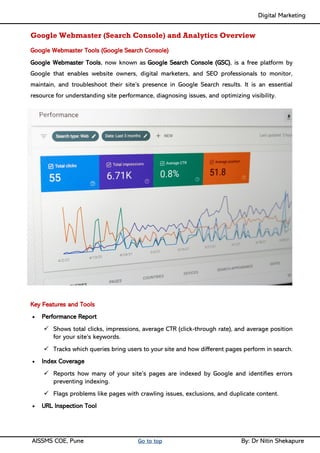
  • 15.
    Digital Marketing ____ AISSMSCOE, Pune Go to top By: Dr Nitin Shekapure The Digital Marketing Landscape The digital marketing landscape encompasses the dynamic environment, technologies, tools, platforms, and strategies used by organizations to connect with consumers online. It continuously evolves as technology, consumer behavior, and digital platforms advance. Key Pillars of the Digital Marketing Landscape 1. Artificial Intelligence (AI) & Automation • AI powers personalization, campaign automation, and deep analytics. ✓ AI-driven strategies account for a large majority of marketing activities, optimizing ad targeting and content delivery. ✓ Machine Learning (ML) tools analyze consumer data, predict behavior, and automate decision-making at scale. • Generative AI supports content creation but human oversight ensures brand authenticity and resonance. 2. Search Evolution: Multi-Platform Search • Search is no longer limited to Google. ✓ Social platforms like Instagram and YouTube are now key discovery engines, especially for Gen Z. ✓ “Search everywhere optimization” is necessary—brands must rank across search engines, social media, and even AI platforms. ✓ Voice search (with over 1 billion monthly queries) and visual search (processing 10 billion queries monthly) are reshaping how consumers look for information. 3. Video & Social Media Dominance • Short-form video (TikTok, Reels, Shorts) drives social strategy and user engagement. • Social video platforms are central to entertainment and brand discovery, challenging traditional TV and streaming services. • User-generated content (UGC): Trusted, authentic content created by consumers is now a major marketing asset. 4. Omnichannel & Platform Integration • Campaigns span multiple channels—websites, search engines, social platforms, messengers, and apps. • Seamless integration delivers a unified brand experience and allows for more consistent customer journeys. • Brands that integrate marketing channels see higher retention, greater order values, and better ROI. 5. Data Privacy & Ethics • Consumer demand for transparency and ethical data use is growing.
  • 16.
    Digital Marketing ____ AISSMSCOE, Pune Go to top By: Dr Nitin Shekapure • Regulatory changes and technology shifts (such as cookie deprecation) force marketers to prioritize privacy-first strategies and obtain meaningful consent. 6. Human-AI Collaboration • While AI increases efficiency, human input in storytelling, brand voice, and creative vision remains vital for connection and differentiation. • The best results are achieved when AI augments, not replaces, human creativity. 7. Social Commerce & Platform Monetization • Social commerce (shopping directly within social apps) is expected to exceed $1 trillion globally by 2028. • Influencer marketing and live shopping formats continue to shape purchase behavior. Major Trends Shaping the Digital Marketing Landscape Trend Impact/Description AI & ML Integration Hyper-personalization, predictive analytics, campaign automation Search Everywhere Optimization Need to optimize presence on search engines, social, and AI platforms Voice & Visual Search Accelerates discovery, requires new content formats and SEO tactics Short-Form & Social Video Highest engagement, crucial for brand storytelling Ethics & Data Privacy Regulatory changes drive brand trust and strategy Omnichannel Experiences Unified marketing drives higher ROI and better customer retention Human-AI Content Strategy Authenticity matters—AI assists but does not replace humans Skills & Strategies for Success • AI & analytics proficiency is now required at all levels. • Marketers must understand multi-platform content strategies (search, social, video, and UGC). • Emphasis on creativity, ethical marketing, and continuous upskilling in emerging technologies. • Mastery of integrated campaign management—siloed approaches no longer suffice.
  • 17.
    Digital Marketing ____ AISSMSCOE, Pune Go to top By: Dr Nitin Shekapure Digital Marketing Key Drivers Key Driver Impact/Significance AI & Automation Drives efficiency, personalization, content, and analytics Hyper-Personalization Boosts engagement, conversion, and loyalty Video & Interactive Content Maximizes reach and audience participation Evolving Search (Voice, Visual, AI) Changes SEO priorities and content strategies Social Commerce & Integration Transforms buying journeys and campaign management Privacy & Data Ethics Protects brand reputation, meets legal requirements, and builds trust Agility & Adaptation Essential for staying competitive in a fast-shifting landscape Community Engagement Strengthens loyalty through authentic, platform-specific interaction Digital marketing’s key drivers continue to evolve with new technology, shifting user habits, and higher expectations for ethical and personalized engagement. Brands that adapt quickly, balance tech with human creativity, and put customer needs at the center will lead the industry.
  • 18.
    Digital Marketing ____ AISSMSCOE, Pune Go to top By: Dr Nitin Shekapure The Digital Users in India (2025) • Total population: 1.46 billion • Internet users: 806 million (55.3% penetration) • Social media users: 491 million (33.7%) • Mobile connections: 1.12 billion (76.6% penetration) • Daily internet usage: 6 hours 49 minutes on average • Primary device: 96% of users access the internet via mobile. Usage Trends • Growth: The number of internet users in India grew by 49 million (+6.5%) between January 2024 and January 2025. Internet penetration increased by 5.5% in the same period. • Device Dominance: Mobile access dominates, with 58% of daily internet time on smartphones and nearly all digital communities considered "mobile-first." • Urban vs Rural: Only 37.1% of Indians live in urban areas, indicating vast untapped potential in rural digital adoption. • Social Media: More than half of internet users are active on social media platforms, reflecting deep digital engagement. • Activity Distribution: On average, Indians spend 3 hours and 57 minutes online via smartphones and 2 hours and 52 minutes on laptops or tablets each day. Drivers of Digital Adoption • Affordable Connectivity: The arrival and expansion of providers like Reliance Jio have made mobile data widely accessible and affordable, accelerating internet adoption across income levels and regions. • Government Initiatives: Programs like Digital India have further promoted digital literacy and access, particularly in rural and semi-urban regions. • Mobile-First Market: Accessibility to budget smartphones and competitive mobile plans have positioned India as one of the world’s largest mobile-internet economies. Internet Usage & Potential Metric Value (2025) Internet users 806 million (55.3% of population) Social media users 491 million (33.7%) Mobile connections 1.12 billion (76.6%) Urbanization 37.1% urban population Daily internet usage 6 hours 49 minutes
  • 19.
    Digital Marketing ____ AISSMSCOE, Pune Go to top By: Dr Nitin Shekapure Noteworthy Observations • Rural Growth: Rural India is the primary driver of recent and future growth, with forecasts suggesting continued expansion as internet infrastructure and digital literacy penetrate non- urban areas. • Global Standing: India is now the second-largest internet market globally by number of users, trailing only China. • Offline Population: 44.7% of Indians remain offline, representing a significant opportunity for further connectivity initiatives. • Digital Ecosystem: Indians leverage the internet for communication, social networking, entertainment, research, e-commerce, and increasingly for education and financial services. India's digital user base is vast, youthful, and rapidly growing, with mobile internet access at its core. The nation's digital landscape is shaped by expanding rural connectivity, affordable mobile services, increasing digital literacy, and intensive daily engagement, positioning India as a global digital leader.
  • 20.
    Digital Marketing ____ AISSMSCOE, Pune Go to top By: Dr Nitin Shekapure What is a Digital Marketing Strategy? A digital marketing strategy is a comprehensive plan that leverages digital channels, platforms, and tools to achieve clearly defined marketing objectives such as brand awareness, lead generation, sales, or customer loyalty. It outlines the direction, investments, tactics, and ongoing measurements needed to boost the business’s digital presence and ROI, ensuring efforts are focused, scalable, and adaptable to changing trends. Key Components of a Successful Digital Marketing Strategy 1. Audience & Market Understanding • Define your target audience: Use data (demographics, behaviors, pain points) to create precise customer personas. • Understand the buyer journey: Map how your users move from awareness to consideration and then to decision, tailoring campaigns for each step. 2. Clear, Measurable Objectives • Set SMART goals (Specific, Measurable, Achievable, Relevant, Time-bound) for every digital activity. • Typical objectives: Increase website traffic, improve conversions, build engagement, or grow social followers. 3. Channel Selection & Integration Use a multi-channel approach to maximize reach and impact. Core channels in 2025 include: Channel Purpose & Benefits Examples SEO Drive long-term traffic, build trust Blog, product pages PPC / Display Ads Instant traffic for offers, launches Google Ads, Meta Ads Social Media Brand visibility, community engagement Instagram, LinkedIn Content Marketing Nurture leads, educate, boost SEO Blogs, infographics Email Marketing Direct, personalized communication and offers Campaigns, newsletters Video Marketing Build credibility, boost conversions, engage audiences YouTube, Reels, Shorts Influencer/UGC Leverage authentic, community-driven messages Influencer collaborations Mobile Marketing Tap in-app/ad experiences, location-based targeting Notifications, SMS Combine these channels for a unified, omnichannel experience. 4. Content Strategy • Prioritize engaging, useful, shareable content—video and short-form content drive the highest engagement and conversions. • Adapt content for each channel and device, focusing on storytelling and authenticity. • Incorporate SEO best practices, voice, and visual search optimization.
  • 21.
    Digital Marketing ____ AISSMSCOE, Pune Go to top By: Dr Nitin Shekapure 5. Personalization & Automation • Use AI and automation tools to personalize messaging, product recommendations, and offers. • Automate campaign delivery, segmentation, and performance tracking for efficiency and scale. 6. Data Privacy & Compliance • Collect and use data ethically, in compliance with regulations (GDPR, CCPA, etc.). • Prioritize first-party data and transparent consent processes to build consumer trust. 7. Measurement & Optimization • Track performance metrics (traffic, engagement, conversions, ROI) in real-time. • Continuously analyze and refine campaigns based on analytics insights to maximize outcomes. Digital Marketing Strategy Framework Step Action 1. Audit Assess current digital presence/channels 2. Set Goals Define clear, measurable objectives 3. Research Deep audience and competitor analysis 4. Select Channels Identify most effective platforms/tools 5. Develop Content Plan and create platform-specific content 6. Implement Launch campaigns; leverage automation/AI 7. Measure Use analytics to monitor performance 8. Optimize Adjust tactics based on outcomes Top Trends Influencing 2025 Strategies in India • AI/ML Integration: Drives personalization, targeting, and campaign automation. • Mobile-First Approach: Most interactions happen via smartphones; strategy must prioritize mobile experiences. • Short-Form & Video Content: Video is vital for discovery, retention, and conversion. • Voice/Visual Search: Optimize for non-textual queries as search evolves rapidly. • Omnichannel Commerce: Seamless journeys from social, search, and messaging apps to checkout. • Influencer & Community Marketing: Authentic UGC and platform-specific communities drive results. • Ethical Data Practices: Prioritize first-party data and explicit user consent.
  • 22.
    Digital Marketing ____ AISSMSCOE, Pune Go to top By: Dr Nitin Shekapure Consumer Decision Journey & Digital Advertising Market in India The consumer decision journey refers to the stages a customer passes through before, during, and after making a purchase. Effective digital advertising in India is structured to influence consumer behavior at each touchpoint along this journey. Key Stages of the Consumer Journey • Awareness: Consumers become aware of a need or problem. Digital ads on search engines, social platforms, and video channels introduce brands/products. • Consideration: Potential buyers research solutions. Brands deliver targeted content, influencer reviews, and comparative ads to shape preferences. • Decision: Consumers compare options and finalize choices. Retargeting, personalized offers, and testimonials are key at this point. • Action: The actual purchase is made, often guided by seamless checkout experiences and digital payment options. • Post-Purchase & Advocacy: Brands engage with consumers post-sale via remarketing, exclusive communities, and loyalty programs, encouraging advocacy and repeat purchases. Digital advertising campaigns in India are increasingly data-driven, leveraging analytics to identify where each consumer is in their journey and delivering tailored content accordingly. The Digital Advertising Market in India Market Size and Growth • India’s digital advertising market is projected to reach INR 59,200 crore (approx. USD 7.1 billion) in 2025, growing at a CAGR of 19%. • Digital advertising now accounts for nearly half of the country’s total ad spend, surpassing traditional channels in both growth rate and influence. Major Segments & Trends Segment Growth Drivers 2025 Projections Social Media Advertising Short-form video, influencer partnerships, regional content Leading growth segment (16.4% YoY) Video Advertising YouTube, OTT platforms, and local video apps Second in contribution Display & Banner Ads Retargeting and branded content Consistent but moderate Search Advertising Data-driven keyword optimization Steady growth (8.9% YoY) • Mobile-first market: 96% of digital users access content via smartphones, making mobile- optimized ads, in-app marketing, and location-based campaigns critical for reach and engagement. • Regional & Vernacular Expansion: Growing adoption in rural and non-English-speaking demographics is fueling regional ad creation.
  • 23.
    Digital Marketing ____ AISSMSCOE, Pune Go to top By: Dr Nitin Shekapure How Digital Advertising Influences the Consumer Journey in India • Hyper-Targeted Reach: Advanced analytics and machine learning enable brands to target consumers based on location, language, device, browsing habits, and purchase history. • Personalization: Brands can tailor ad content and offers for individual users, boosting relevance and conversion rates. • Omnichannel Presence: Integrated ad strategies ensure consumers encounter consistent brand messaging across search, social, OTT, and mobile platforms. • Real-Time Optimization: Marketers can track user interactions and tweak campaigns live, responding instantly to what drives conversions. Unique Features of India’s Digital Advertising Ecosystem • Scale & Diversity: Over 800 million internet users, with a striking digital divide between urban and rural areas, offer a vast yet nuanced landscape for marketers. • Social Influence: Peer reviews, influencers, and digital communities significantly shape decision-making, especially for Gen Z and rural consumers. • Mobile Wallets & Payment Ecosystem: A frictionless digital payment infrastructure accelerates the ‘action’ phase, especially for e-commerce and app-based offerings. Challenges & Considerations • Ad Saturation: As digital adoption grows, users face ad fatigue, demanding greater creativity and authentic messaging. • Privacy & Data Regulation: Compliance with new and evolving data laws is critical to sustaining brand trust and campaign efficiency. • Localization: Success relies on adapting campaigns to local languages, cultures, and consumption patterns. Digital advertising is now the primary engine shaping India’s consumer decision journey. ✓ Market growth is robust, marked by mobile-first adoption, social/short-video dominance, and data-driven strategies. ✓ Brands that personalize, localize, and integrate campaigns across digital touchpoints successfully engage Indian consumers at every stage of their journey. This dynamic ecosystem requires agility, deep consumer insights, and a continuous focus on innovation to influence decision-making and drive business growth.
  • 24.
    Digital Marketing ____ AISSMSCOE, Pune Go to top By: Dr Nitin Shekapure Essential Skills in Digital Marketing Digital marketing requires a blend of technical, analytical, and creative abilities to design, launch, and optimize campaigns in today’s fast-evolving landscape. Mastering these skills boosts your effectiveness as a marketer and increases your value to employers. 1. Data Analytics & Interpretation • Proficiency with analytics tools (e.g., Google Analytics, Looker Studio) to measure campaign performance, interpret user behavior, track ROI, and inform decisions. • Skills in creating dashboards and using attribution models are highly sought after. 2. Search Engine Optimization (SEO) & Content Optimization • Deep understanding of SEO including keyword research, on-page/off-page SEO, technical SEO, and voice search optimization. • Ability to monitor search trends, adapt to algorithm updates, and maximize organic visibility. 3. Content Creation & Copywriting • Crafting compelling blog posts, social media content, ad copy, email campaigns, and video scripts. • Adapting brand voice, storytelling, and visual content across platforms is vital for engagement and conversions. 4. Social Media Strategy & Platform Management • Designing and managing campaigns across different social media channels (e.g., Instagram, LinkedIn, YouTube, TikTok) with platform-specific tactics. • Skills include community building, influencer partnerships, and live/short-form video production. 5. Paid Advertising & Performance Marketing • Running and optimizing pay-per-click (PPC) campaigns on platforms like Google Ads, Meta Ads, and other digital networks. • Budget management, audience targeting, and conversion tracking are core to success. 6. Artificial Intelligence (AI) & Marketing Automation • Leveraging AI and machine learning to drive personalization, automate workflows, segment audiences, and improve targeting. • Using automation tools for email, social, and CRM to boost efficiency and enhance customer journeys. 7. User Experience (UX) & Conversion Rate Optimization (CRO) • Understanding core UX/UI principles and applying them to increase website usability and engagement.
  • 25.
    Digital Marketing ____ AISSMSCOE, Pune Go to top By: Dr Nitin Shekapure • Conducting A/B testing, optimizing landing pages, and using data to improve conversion rates. 8. Video Marketing • Skills in video production, editing, and storytelling for formats such as YouTube, Instagram Reels, and TikTok. • Video remains the most engaging content type, crucial for both brand awareness and conversions. 9. Email Marketing • Creating engaging, personalized, and automated campaigns including segmentation, list management, and performance analysis. • Email continues to drive high ROI and remains essential for nurturing leads. 10. Ethical Marketing & Data Privacy • Ensuring all campaigns comply with data privacy laws (GDPR, CCPA, etc.), respecting user consent and practicing transparency. • Building brand trust by adhering to ethical marketing standards is more important than ever. Summary Table: Top Digital Marketing Skills Skill Area Description Data Analytics & Interpretation Measurement, dashboards, ROI, insights SEO & Content Optimization Organic growth, algorithms, technical SEO Content Creation & Copywriting Blogs, ads, social copy, brand voice Social Media Strategy & Management Platform tactics, community, influencers Paid Advertising PPC, targeting, conversion optimization AI & Marketing Automation Personalization, workflow automation UX/UI & CRO User-centric design, A/B testing, CRO Video Marketing Production, editing, short/long-form video Email Marketing Personalized automation, segmentation Data Ethics & Privacy Compliance Adhering to laws, building trust Excelling in digital marketing today is about continuously learning and refining these core skills. Success comes from combining technical proficiency with creativity, strategic thinking, and a strong commitment to ethical standards in a data-driven world.
  • 26.
    Digital Marketing ____ AISSMSCOE, Pune Go to top By: Dr Nitin Shekapure Digital Marketing Plan A digital marketing plan is a structured roadmap of strategies, channels, and actions designed to achieve specific marketing objectives in the digital space. An effective plan leverages data, technology, and creativity to boost engagement, traffic, conversions, and brand loyalty. Key Components of a Modern Digital Marketing Plan 1. Situation Analysis • Review past performance: Assess current digital activities, campaign results, website analytics, and competitor benchmarks to determine strengths, weaknesses, and opportunities. • SWOT analysis: Identify internal strengths and weaknesses, plus external opportunities and threats relevant to your market and competitors. 2. Define Goals and Objectives • Set SMART goals: Objectives should be Specific, Measurable, Achievable, Relevant, and Time-bound (e.g., “increase qualified leads by 25% in Q3”). • KPIs: Determine key performance indicators to monitor progress (e.g., website visits, conversion rates, ROI). 3. Audience and Market Research • Create buyer personas: Develop detailed profiles for your ideal customers, outlining demographics, behaviors, needs, and digital habits. • Map the customer journey: Understand how audiences move from awareness to purchase and advocacy. 4. Unique Value Proposition • Clarify your message: Define what sets your product or service apart and ensure this value proposition is central in all communications. 5. Channel and Tactic Selection Utilize a multichannel approach for greater reach and synergy. Key channels include: Channel Purpose SEO Organic search visibility Paid Search Immediate traffic through PPC Social Media Community engagement and awareness Content Value delivery, thought leadership Video Engagement, education, brand building Email Nurturing, offers, retention Influencer/UGC Authentic, peer-driven credibility Mobile Ubiquitous, location-based targeting 6. Content Strategy • Develop a content calendar: Plan SEO-optimized blogs, videos, social posts, and email campaigns tailored to each segment.
  • 27.
    Digital Marketing ____ AISSMSCOE, Pune Go to top By: Dr Nitin Shekapure • Focus on value and storytelling: Make content relevant, solutions-oriented, and interactive where possible. 7. Budget Planning • Allocate resources: Set budget per channel based on expected ROI, past performance, and business priorities. • Factor in technology: Invest in essential tools (e.g., marketing automation, analytics, CRM systems). 8. Implementation Plan • Execution schedule: Define timelines, responsibilities, workflow, and campaign rollout. • Leverage automation: Streamline repetitive tasks and optimize campaign delivery using AI tools. 9. Measurement and Optimization • Track KPIs in real time: Use analytics dashboards to measure performance, spot trends, and identify issues. • Continuous improvement: Regularly review results, run A/B tests, and adjust tactics to boost effectiveness. Example: Step-by-Step Digital Marketing Plan Framework Step Action 1. Audit Analyze past campaigns, website analytics, competition 2. Goals Set clear, SMART objectives with defined KPIs 3. Research Map personas, customer journeys, and market trends 4. Strategy Select channels, content themes, value messaging 5. Content Develop and schedule high-value, multimedia content 6. Budget Allocate spend and resources 7. Execute Launch and manage campaigns across selected platforms 8. Measure Monitor performance, optimize based on insights Tips for a Successful Plan • Personalize every touchpoint: Use data and automation for tailored messaging and product recommendations. • Ensure mobile-first design: Most users engage via smartphones—optimize all experiences for mobile. • Prioritize privacy and compliance: Collect and use data ethically, respect consent, and stay up to date with regulations. • Stay agile: Be ready to pivot tactics quickly in response to analytics or changes in consumer behavior. • Integrate technology: Employ AI for improved targeting, performance optimization, and creative production. An effective digital marketing plan is ongoing—review and refine it regularly as technology, platforms, and consumer habits evolve. This structured approach ensures that every action is intentional, measurable, and aligned with your overall business goals.
  • 28.
    Digital Marketing ____ AISSMSCOE, Pune Go to top By: Dr Nitin Shekapure Digital Marketing Terminology
  • 29.
    Digital Marketing ____ AISSMSCOE, Pune Go to top By: Dr Nitin Shekapure Key Terminology Used in Digital Marketing Understanding digital marketing requires knowing the core terms that define its practices, strategies, and tools. Below is an organized glossary of the most important terminology in digital marketing, including core concepts, campaign types, and analytics. General Concepts • Digital Marketing: The promotion of products/services using digital channels like search engines, social media, email, and websites to reach target audiences. • Omnichannel Marketing: Integrating and coordinating messages across multiple platforms (web, social, email, mobile) for a seamless user experience. Core Channels & Strategies Term Description SEO (Search Engine Optimization) Optimizing online content to rank higher in organic search engine results and drive unpaid traffic. SEM (Search Engine Marketing) Promoting websites by increasing visibility in SERPs using paid ads and optimization strategies. PPC (Pay-Per-Click) A paid advertising model where advertisers pay each time their ad is clicked, often via platforms like Google Ads. SMM (Social Media Marketing) Using social platforms (e.g., Facebook, Instagram, X, LinkedIn) to promote brands, engage communities, and drive traffic. Email Marketing Sending promotional or relationship-building messages via email to targeted lists. Content Marketing Creating and distributing valuable, relevant content to attract and retain an audience, nurturing leads over time. Affiliate Marketing Performance-based marketing where affiliates earn a commission by promoting others' products/services. Influencer Marketing Collaborating with influential individuals on social platforms to promote products or brands. Display Advertising Banner or visual ads served on third-party websites and apps via display networks; includes video and graphical ads. Measurement & Analytics • CTR (Click-Through Rate): Percentage of users who click on an ad or link out of total impressions. • Conversion Rate: Percentage of visitors who complete a desired goal (purchase, sign-up, etc.). • Impression: A single instance of an ad or content being displayed to a user. • CPC (Cost Per Click): The amount paid by an advertiser for each click on their ad. • CPA (Cost Per Acquisition): Cost for acquiring one customer/lead through a campaign.
  • 30.
    Digital Marketing ____ AISSMSCOE, Pune Go to top By: Dr Nitin Shekapure • KPIs (Key Performance Indicators): Quantifiable metrics used to evaluate campaign success. • ROI (Return on Investment): Measurement of campaign profitability; ratio of net profit to cost invested. Important Technical Terms Term Description SERP Search Engine Results Page – the page displayed after entering a query on a search engine. A/B Testing Comparing two versions of web content or ads to see which performs better. Ad Extensions Extra information with ads (e.g., phone number, location) to increase clickability. Cookies Small pieces of data stored by the browser to remember user information and preferences. Bounce Rate The percentage of visitors who leave a website after viewing only one page. Retargeting/Remarketing Serving ads to users based on their previous interactions with a website or app. Landing Page The web page where users land after clicking an ad; optimized for conversions. Funnel The series of steps a user takes from initial awareness to a final action (e.g., purchase). Social Media & Mobile Marketing • UGC (User-Generated Content): Original content (reviews, videos, images) created by consumers about a brand. • Hashtag: A keyword or phrase preceded by "#" used to categorize and increase discoverability of social content. • Stories: Short, time-bound multimedia content featured on platforms like Instagram, Facebook, and WhatsApp. • Geo-targeting: Delivering content or ads to users based on their geographic location. Automation, Data & Privacy • CRM (Customer Relationship Management): System that manages and analyzes customer interactions throughout the lifecycle. • DMP (Data Management Platform): Software used to collect, manage, and analyze large sets of user data for targeting ads. • First-Party Data: Data collected directly by a brand through its touchpoints (website, app, etc.). • Third-Party Data: Data collected and sold by sources not directly involved with the user’s direct activity. • GDPR/CCPA: Regulations ensuring user privacy rights and data protection in digital marketing.
  • 31.
    Digital Marketing ____ AISSMSCOE, Pune Go to top By: Dr Nitin Shekapure Evolving & Advanced Terms Term Description Voice Search Optimization Optimizing web content to be discovered via voice assistants and smart devices. AI/ML (Artificial Intelligence/Machine Learning) Technologies used for data analysis, personalization, automation, and campaign optimization. Programmatic Advertising Automated, real-time buying and selling of online ads using smart algorithms. Micro-Moments Intent-driven moments when users turn to their device for quick information or action. Quick Reference Table Acronym Stands for Meaning in Digital Marketing SEO Search Engine Optimization Improve organic rankings in search engines SEM Search Engine Marketing Promote via paid ads on search platforms SMM Social Media Marketing Use of social platforms for marketing & engagement PPC Pay-Per-Click Payment per click for digital ads CPC Cost Per Click Cost to advertiser each time their ad is clicked CPM Cost Per Mille Cost per 1,000 ad impressions CTR Click-Through Rate Ratio of clicks to impressions CPA Cost Per Acquisition Cost for a campaign to gain a new customer/lead CRO Conversion Rate Optimization Improving % of visitors who complete desired actions KPI Key Performance Indicator Measurement of campaign or business goal achievement UGC User-Generated Content Customer-created brand content Why Knowing This Terminology Matters • Effective Communication: Knowing these terms helps marketers collaborate more efficiently and ensures everyone is aligned on objectives and tactics. • Campaign Success: Understanding terminology is fundamental for setting up, analyzing, and optimizing digital campaigns for the best results. • Continuous Learning: Digital marketing is fast-evolving—keeping up with terminology means staying competitive and adaptable in the industry. Mastering digital marketing terminology equips you to strategize, execute, and evaluate campaigns confidently in 2025 and beyond.
  • 32.
    Digital Marketing ____ AISSMSCOE, Pune Go to top By: Dr Nitin Shekapure PPC and Online Marketing Through Social Media What is PPC on Social Media? Pay-Per-Click (PPC) on social media refers to paid advertising campaigns where advertisers pay each time a user clicks on their ad. Social media platforms offer PPC options that allow brands to target specific audiences based on demographics, interests, behavior, and more, maximizing reach and efficiency. Major Social Media PPC Platforms Platform Key Features Audience Reach Ad Formats Facebook & Instagram (Meta) Unified platform, AI-driven targeting, wide demographics Billions globally Image, video, carousel, story ads YouTube Video-dominant, detailed targeting, skippable/non- skippable ads 2+ billion users In-stream, discovery, bumper ads TikTok Highly engaged Gen Z/Millennial audience, innovative formats 1+ billion users In-feed, branded hashtag, TopView LinkedIn Professional/B2B audience, granular industry/job targeting 1+ billion professionals Sponsored content, message ads Twitter (X) Real-time engagement, trending topic ads 300+ million users Promoted tweets, video, trends Reddit Niche community targeting, low CPC 350+ million users Promoted posts, display, carousel How PPC Works on Social Media • Ad Creation: Choose your objective (traffic, engagement, conversions), design creative assets, and write compelling copy. • Audience Targeting: Select detailed targeting options such as age, location, interests, job title, device type, or even language. • Bidding & Budgets: Set daily or lifetime budgets; platforms use auctions to display your ads based on bid and relevance. • Performance Tracking: Platforms offer robust analytics (clicks, impressions, conversions, etc.) for real-time optimization.
  • 33.
    Digital Marketing ____ AISSMSCOE, Pune Go to top By: Dr Nitin Shekapure Benefits of Social Media PPC • Massive Reach: Access to billions of users across different platforms—Meta Ads alone reach vast, diverse audiences. • Precise Targeting: Advanced algorithms allow targeting by very specific attributes, improving ROI and minimizing wasted spend. • Flexible Ad Formats: Multiple creative options—video, image, carousel, story, and interactive content—let you tailor messages to each stage of the consumer journey. • Cost Control: Advertisers can start with modest budgets and scale up based on performance, with average costs per click (CPC) ranging from $0.50 to $2.00 for Meta platforms (industry- dependent). • Real-Time Optimization: Instant feedback and analytics enable rapid adjustment of creatives, bids, and targeting for better results. • Remarketing: Reach users who have previously interacted with your site or content, keeping your brand top-of-mind and supporting conversions. Trends and Strategies for 2025 • Platform Mix: Most businesses use multiple platforms for PPC—76% leverage Facebook, 70% Instagram, and growing numbers are investing in TikTok, LinkedIn, and X (formerly Twitter). • Creative Refresh: Social media algorithms reward fresh ads; updating creatives weekly is recommended to avoid audience fatigue and keep CPMs (cost-per-thousand impressions) low. • Channel Roles: Instagram excels at product discovery, TikTok at reach and engagement, while LinkedIn dominates B2B nurture and lead generation—each platform fits into a different part of the funnel. • Automation & AI: Platforms like Meta and LinkedIn use AI for smarter, automated targeting and bidding, boosting campaign effectiveness with less manual effort. • Mobile-First Approach: With most users accessing social platforms on mobile devices, optimizing all creative and landing pages for mobile is essential. • Vernacular, Video, and Regional Focus (India): The fastest growth comes from regional content, short-form video, and campaigns tailored to specific languages and communities. Best Practices for Effective PPC Campaigns on Social Media • Set Clear Goals: Define conversion, traffic, or brand KPIs for each campaign. • Audience Testing: Use A/B testing to find high-performing segments and creative combinations. • Monitor & Optimize: Track key metrics and adjust bids, budgets, and creatives in real time. • Leverage Retargeting: Remarket to users who’ve engaged with your brand for higher conversion rates. • Stay Updated: Algorithms, formats, and privacy rules change frequently—continuous learning is critical.
  • 34.
    Digital Marketing ____ AISSMSCOE, Pune Go to top By: Dr Nitin Shekapure PPC through social media is a cornerstone of modern digital marketing, offering businesses scalable, data-driven, and highly targeted advertising capabilities. By strategically choosing platforms and creative tactics, marketers can achieve maximum engagement and ROI in India and globally. The image visually explains PPC – Pay Per Click. A user clicks on an online ad (shown by the big cursor and the laptop screen), which results in spending money (coins, dollar bills) for each click but also brings growth and profits (represented by upward graph and stacked coins). It’s a balance between ad investment and business returns.
  • 35.
    Digital Marketing ____ AISSMSCOE, Pune Go to top By: Dr Nitin Shekapure Social Media Marketing What Is Social Media Marketing? Social media marketing is the practice of using platforms like Instagram, Facebook, TikTok, LinkedIn, X (formerly Twitter), Pinterest, and YouTube to connect with audiences, promote products or services, and build brand recognition. The approach in 2025 is dynamic, highly data-driven, and integral to every business’s digital strategy. It involves: • Creating authentic, brand-aligned content (videos, stories, posts) • Engaging and nurturing communities through conversations and user-generated content • Running targeted paid ad campaigns • Tracking performance metrics to refine strategy and maximize ROI Why Is Social Media Marketing Important? • Unmatched Reach: Billions actively use social media globally, with platforms accessible to nearly every demographic. • Direct Engagement: Enables two-way communication, building trust and facilitating rapid customer service. • Brand Storytelling: Lets brands share values, behind-the-scenes views, and real-time updates in creative ways. • Targeted Advertising: Powerful tools allow pinpoint targeting based on user data, increasing relevance and conversions. • Influence on Purchasing: Many buying decisions now start or finish on social media, with influencer recommendations and peer reviews shaping choices.
  • 36.
    Digital Marketing ____ AISSMSCOE, Pune Go to top By: Dr Nitin Shekapure Fundamentals & Processes Key Elements Component Role in Social Media Marketing Content Creation Develop engaging posts, videos, stories, and carousels Community Building Foster relationships via comments, DMs, live events Paid Campaigns Reach wider, specific audiences using targeted ads Analytics Monitor reach, engagement, and conversions to optimize Essential Activities • Respond to comments and DMs promptly • Encourage and showcase user-generated content (UGC) • Collaborate with creators and influencers for credibility and reach • Regularly update content style and format to match evolving trends Major Trends in 2025 1. Short-Form Video Dominance ✓ Reels, Shorts, and TikToks achieve the highest reach and engagement. ✓ Focus on compelling hooks, storytelling, and visually striking concepts. 2. Authenticity & Community ✓ Unfiltered, relatable content outperforms overly polished posts. ✓ Brands build emotional connections with audiences by showing personality and behind- the-scenes moments. 3. AI Integration ✓ AI assists in idea generation, caption writing, trend tracking, and analytics, though human creativity remains essential. 4. Social Commerce ✓ Social platforms double as shopping hubs; users discover, research, and purchase products without leaving the app. 5. Personalization at Scale ✓ Content and ads are increasingly tailored to individual preferences, locations, and behaviors through data-driven tools. 6. Social SEO ✓ Brands now optimize captions, bios, and hashtags so content is easily discovered via platform search—an emerging form of SEO. 7. UGC & Employee-Generated Content ✓ Content from customers and employees bolsters trust and extends reach.
  • 37.
    Digital Marketing ____ AISSMSCOE, Pune Go to top By: Dr Nitin Shekapure Steps to Build an Effective Social Media Marketing Strategy 1. Set Clear Goals & KPIs • Define your objectives (brand awareness, engagement, sales, etc.). • Choose key metrics like engagement rate, CTR, follower growth, and conversions. 2. Know Your Audience • Use both demographic and psychographic data to create in-depth audience profiles. • Analyze audience behaviors and preferences using platform analytics tools. 3. Select the Right Platforms • Choose platforms where your target audience is most active and where your brand type fits organically. 4. Create a Content Plan • Mix formats (videos, stories, images, text) and themes (educational, entertaining, inspirational) for variety. • Capitalize on trends while maintaining brand authenticity. 5. Leverage Paid Campaigns • Use platform-specific tools for targeting, remarketing, and bid optimization. • Set and monitor budgets for best ROI. 6. Engage and Build Community • Encourage interaction via polls, live streams, Q&As, and user features. • Respond quickly and authentically to audience engagement. 7. Measure and Optimize • Track campaign performance in real time. • Use data to adjust creative content, targeting parameters, and posting frequency for continuous improvement. Social Media Platforms at a Glance Platform Best For Top Content Types Instagram Visual branding, product discovery Stories, Reels, carousels TikTok Virality, Gen Z engagement Short-form vertical videos Facebook Wide reach, community groups Videos, groups, events YouTube Education, long/short video, discovery Tutorials, Shorts, livestreams LinkedIn B2B networking, thought leadership Articles, videos, infographics X (Twitter) Real-time updates, brand voice Threads, memes, text, video
  • 38.
    Digital Marketing ____ AISSMSCOE, Pune Go to top By: Dr Nitin Shekapure Best Practices for Success • Focus on quality over quantity—share valuable, on-brand content more intentionally. • Engage in active listening—use social monitoring tools to follow conversations and spot emerging topics. • Regularly test and experiment—adapt to new features, content formats, and distribution algorithms. • Prioritize mobile-first design—the majority of users interact via smartphones. • Adhere to data privacy best practices—build trust by being transparent about data use and protecting audience information. Social media marketing in 2025 is about meaningful engagement, smart automation, and clear objectives. Brands succeed by fostering real connections, leveraging data-driven insights, adapting quickly to new features and trends, and maintaining an authentic, human-centered online presence.
  • 39.
    Digital Marketing ____ AISSMSCOE, Pune Go to top By: Dr Nitin Shekapure Google Webmaster (Search Console) and Analytics Overview Google Webmaster Tools (Google Search Console) Google Webmaster Tools, now known as Google Search Console (GSC), is a free platform by Google that enables website owners, digital marketers, and SEO professionals to monitor, maintain, and troubleshoot their site’s presence in Google Search results. It is an essential resource for understanding site performance, diagnosing issues, and optimizing visibility. Key Features and Tools • Performance Report ✓ Shows total clicks, impressions, average CTR (click-through rate), and average position for your site’s keywords. ✓ Tracks which queries bring users to your site and how different pages perform in search. • Index Coverage ✓ Reports how many of your site’s pages are indexed by Google and identifies errors preventing indexing. ✓ Flags problems like pages with crawling issues, exclusions, and duplicate content. • URL Inspection Tool
  • 40.
    Digital Marketing ____ AISSMSCOE, Pune Go to top By: Dr Nitin Shekapure ✓ Lets you check if a specific URL is indexed, view crawl, index, and enhancement issues, and submit URLs for re-indexing. • Enhancements & Core Web Vitals ✓ Shows issues with speed, mobile compatibility, structured data (for rich results), and more to improve user experience. ✓ Core Web Vitals measure real-world performance for loading, interactivity, and visual stability. • Sitemaps and URL Submission ✓ Allows you to submit sitemaps and individual URLs to encourage faster and more complete indexing. • Security & Manual Actions ✓ Alerts you to security issues (malware, hacking) or manual penalties imposed due to policy violations. • Search Console Insights ✓ Newly integrated, this feature offers a unified dashboard that highlights trending content, most effective queries, and progress milestones, helping users to quickly spot growth opportunities or issues. Benefits • Helps you measure and boost organic traffic. • Quickly identifies site errors, broken links, and security threats. • Enables you to optimize pages for better rankings using real-time data and alerts. • Supports both novices and advanced users in improving overall SEO and site health. Function What It Does Performance Report Tracks traffic, queries, clicks, and SEO trends Index Coverage Summarizes indexed/excluded pages and errors URL Inspection Analyzes specific URLs for issues Sitemaps Facilitates easier, faster crawling and indexing Core Web Vitals Highlights site speed and user experience problems Enhancements Reports on rich results, AMP, job postings, and more Security/Manual Actions Warns of penalties and security breaches
  • 41.
    Digital Marketing ____ AISSMSCOE, Pune Go to top By: Dr Nitin Shekapure Google Analytics Google Analytics is a comprehensive web analytics tool that enables you to track and analyze user behavior across your website. It focuses on metrics and data-driven insights to help you make strategic marketing and design decisions. Key Functions • Real-Time Analytics ✓ Monitor live user activity and traffic sources. • Audience Reports ✓ Understand who visits your site—demographics, location, device, and behavior patterns. • Acquisition Reports ✓ Analyze how visitors arrive (organic search, social media, paid ads, referrals, direct, etc.). • Behavior Reports ✓ Explore what users do: which pages they visit, how long they stay, and how they navigate the site. • Conversion Tracking ✓ Set up goals (form fills, sign-ups, purchases) & measure completion rates to assess ROI. • Event Tracking ✓ Track specific actions such as downloads, video plays, clicks on certain buttons, or external links. Area What You Learn Audience Who your visitors are Acquisition How people are finding your website Behavior What they do once they arrive Conversions Whether they’re completing your key actions Integration • Integrates seamlessly with Google Search Console for unified SEO and user analytics. • Enables combining search performance with user behavior for holistic insights and better decision-making. Practical Uses and Importance • SEO Optimization: GSC pinpoints technical issues and tracks keyword rankings; Analytics clarifies how those rankings drive engagement and conversions. • Content Strategy: Identify “trending up/down” pages, top-performing content, and effective queries. • Technical Health: Spot and swiftly address site speed, mobile, and security issues. • Performance Measurement: Both tools track the entire funnel from search appearance through to user action, enabling continuous improvement.
  • 42.
    Digital Marketing ____ AISSMSCOE, Pune Go to top By: Dr Nitin Shekapure Summary Table Tool Main Purpose Key Features Search Console (GSC) SEO/site health & indexing optimization Performance, coverage, sitemaps, Core Vitals Google Analytics Website & user behavior analytics Audience, acquisition, behavior, conversions Both tools are foundational for modern digital marketing, equipping you to grow search visibility, improve user experience, and maximize digital campaign results. 🛍️ Real-Life Example: Local Bakery Going Digital Business: SweetBite Bakery in Pune wants to grow its online presence and increase cake orders through its website. ✅ Step 1: Use of Google Search Console (GSC) Goal: Ensure the website is visible and healthy in Google Search results. • The owner uses GSC to check: ✓ Whether the site is indexed properly on Google. ✓ If there are errors in the sitemap (some pages were not showing up). ✓ What keywords people are using to find the site (e.g., "best chocolate cake in Pune"). ✓ How fast the site loads (Core Web Vitals), which was poor on mobile, so they improved loading speed. 🔍 Result: The bakery improves its visibility on Google and appears in search results when people type "birthday cake near me." ✅ Step 2: Use of Google Analytics Goal: Understand how visitors interact with the website. • The owner uses Google Analytics to track: ✓ How many people visit the website daily. ✓ Which pages are most visited (e.g., "custom cakes" and "contact us"). ✓ Where users are coming from (Instagram, Google Search, WhatsApp). ✓ How many users complete an order or just browse and leave. 📊 Result: • They learn most traffic comes from mobile users on Instagram. • So they optimize their site for mobile and run a cake discount campaign on Instagram. 🌟 Outcome: By using GSC + Google Analytics, SweetBite Bakery: ✓ Improves website visibility in search engines. ✓ Identifies top-performing products. ✓ Boosts online cake orders by 40% within 2 months.
  • 43.
    Digital Marketing ____ AISSMSCOE, Pune Go to top By: Dr Nitin Shekapure Email Marketing Email marketing is a digital marketing strategy that uses targeted email messages to build relationships, share updates, and promote products or services to a subscribed audience. It remains one of the highest ROI channels in the digital landscape due to its direct, personal, and measurable approach. Core Components of Email Marketing • Newsletters: Regular updates, insights, or educational content sent to subscribers. • Promotional Emails: Time-bound offers, product launches, and exclusive sales. • Transactional Emails: Automated messages tied to user actions, such as order confirmations or password resets. • Re-engagement Emails: Campaigns designed to win back inactive subscribers. Key Strategies & Best Practices 1. Personalization & Segmentation • Hyper-personalization: Go beyond addressing by name—use AI and data to deliver content tailored to interests, behaviors, and stage in the customer journey. • Segment lists: Categorize by demographics, purchase history, engagement, or location for higher relevance and open rates. • Dynamic Content: Adjust text, images, or offers within each email based on recipient data. 2. Mobile Optimization
  • 44.
    Digital Marketing ____ AISSMSCOE, Pune Go to top By: Dr Nitin Shekapure • Responsive Designs: Ensure emails display seamlessly across all devices. • Single-Column Layouts: Increase readability and prevent horizontal scrolling. • Optimized Images: Compress for faster loading and always include alt text for accessibility. • Touch-Friendly Buttons: Use large and clear call-to-action (CTA) buttons. 3. Content & Design Guidelines • Value-driven Content: Apply the 80/20 rule—80% value, 20% promotions—so subscribers look forward to your emails. • Minimalist Designs: Simple, uncluttered layouts enhance focus and performance, especially on mobile. • Brand Consistency: Use consistent voice, tone, and design elements to build recognition and trust. • Interactive Elements: Use polls, quizzes, and carousels within emails for engagement. • User-Generated Content (UGC): Showcase reviews, testimonials, or photos from real customers to build authenticity. 4. Automation & Journeys • Automated Drip Campaigns: Guide users through onboarding and re-engagement automatically with scheduled content. • Behavior-Triggered Emails: Send tailored messages based on user actions (cart abandonment, browsing behavior). • Customer Journey Mapping: Plan relevant touchpoints from welcome to post-purchase. 5. Deliverability & Compliance • Clear Consent: Only send emails to opted-in users and make unsubscribing easy to ensure compliance with privacy regulations (GDPR, CCPA). • Quality List Management: Regularly clean and update lists for best results and reputation. • Inbox Placement: Optimize subject lines and preview text for higher open rates and to avoid spam filters. 6. Measurement & Optimization • Track KPIs: Monitor open rates, click-through rates, conversions, bounce rates, and unsubscribes. • A/B Testing: Regularly test subject lines, CTAs, and content blocks to find the best- performing variations. • AI-Powered Analytics: Leverage AI for segmentation, subject line suggestions, and predicting optimal send times.
  • 45.
    Digital Marketing ____ AISSMSCOE, Pune Go to top By: Dr Nitin Shekapure Trends Shaping Email Marketing Trend Description Hyper-personalization AI tailors content/offers to individual users Mobile-first design Majority of opens now on mobile; design accordingly Interactive emails Polls, quizzes & in-email transactions increase engagement Automation Advanced journeys and triggered messaging Privacy-focused Stronger compliance and transparency are essential Minimalism Clean emails cut through digital clutter UGC Integration Boosts credibility and authenticity Email Marketing Success Checklist • Build an opt-in list and maintain privacy compliance • Segment and personalize messages • Use responsive, mobile-first templates for clarity and speed • Craft compelling subject lines and preview text • Include clear, engaging CTAs • Automate where possible but monitor for relevance • Consistently measure, test, and refine campaigns Email marketing is dynamic, data-driven, and customer-centric. Brands that use personalization, optimize for mobile, keep content valuable, respect privacy, and continually innovate with technology will see the best results.
  • 46.
    Digital Marketing ____ AISSMSCOE, Pune Go to top By: Dr Nitin Shekapure Mobile Marketing Mobile marketing is the practice of reaching and engaging consumers through their smartphones, tablets, and wearable devices using targeted advertising, content, and interactive experiences. It encompasses a wide range of strategies such as SMS campaigns, in-app advertising, push notifications, proximity marketing, and social media engagement—all delivered through mobile-specific channels. Why Mobile Marketing Is Essential • Mobile-First World: Over 70% of global internet traffic now comes from mobile devices; in markets like India, 96% of internet users access the web via their smartphones. • Consumer Behavior: Smartphones dominate product discovery, research, and shopping, with m-commerce continuing to grow rapidly. • Always-On Engagement: Mobile devices ensure brands can reach customers anywhere, anytime, increasing the frequency and relevance of touchpoints. Key Trends and Strategies for 2025 1. AI-Driven Personalization & Automation • Hyper-personalized ads use AI to analyze location, behavior, and preferences in real time, delivering content uniquely tailored to each user.
  • 47.
    Digital Marketing ____ AISSMSCOE, Pune Go to top By: Dr Nitin Shekapure • AI-powered chatbots and customer engagement tools provide instant support and streamline experiences in apps and messaging platforms. 2. Video, Short-Form & Interactive Content • Short-form video and interactive ads on platforms like TikTok, Instagram Reels, and YouTube Shorts now drive the highest engagement on mobile devices. • In-app ephemeral content, polls, games, and contests invite rapid participation and viral sharing. 3. App and In-App Marketing • In-app advertising: Banners, native ads, videos, and interstitials appear within games, news, and utility apps, leveraging users’ in-app journeys for higher conversions. • Personalization inside apps is deepening, with content feeds, push notifications, and offers dynamically tailored to user activity. 4. Location-Based and Proximity Marketing • Geo-targeted campaigns send offers or notifications based on a user’s physical location. • Proximity marketing (beacon/Bluetooth tech) delivers hyper-local experiences, driving foot traffic to stores and events. 5. Messaging: SMS, WhatsApp & RCS • SMS marketing remains highly effective, with open rates over 90% and rapid engagement, especially for time-sensitive promotions. • Growth in WhatsApp and other messaging app campaigns enables rich, conversational marketing at scale. 6. Privacy, Consent & Data Ethics • Heightened privacy regulations (by Apple, Google, and governments) restrict invasive tracking and mandate transparent, permission-based marketing. • Success depends on building trust, leveraging first-party data, and ensuring consent at every touchpoint. 7. Mobile SEO and Performance • Mobile-first indexing means Google and other search engines now rank the mobile version of your site first. • Fast-loading, responsive mobile sites are essential to reduce bounce and boost conversion rates.
  • 48.
    Digital Marketing ____ AISSMSCOE, Pune Go to top By: Dr Nitin Shekapure Major Mobile Marketing Channels Channel Strategy Strengths SMS & Messaging Time-sensitive offers, alerts High open rates, personal touch In-App Advertising Banners, native, video, interstitial High engagement, contextual Social Media Marketing Organic and paid content Viral short-form video, community Push Notifications Updates, reminders, offers Timely, direct, customizable Location/Proximity Geo-fenced promotions Drives store visits, highly targeted Mobile SEO Mobile-optimized sites, fast speeds Better discovery, higher Google ranking Best Practices for Success • Prioritize the mobile user experience: Ensure all digital content, websites, and campaigns are visually appealing, fast, and intuitive on smaller screens. • Leverage AI and automation: Use smart CRM and analytics tools to drive segmentation, predict user needs, and optimize campaign timing. • Integrate video and UGC: Encourage authentic, user-generated content and interactive video to build trust and engagement. • Respect privacy: Collect and use customer data ethically, always obtaining clear consent before sending messages or location-based offers. • Test and iterate: Regularly run A/B tests on creatives, segmentation, and delivery times to maximize campaign effectiveness. Emerging Opportunities • 5G-powered AR and VR ads: Rich, immersive experiences that blend digital with real- world activities are gaining traction. • Voice Search Optimization: With more consumers using voice assistants, optimizing mobile content for conversational queries is vital. • Regional and Vernacular Marketing: Personalized content in local languages accelerates adoption in diverse, mobile-first markets. Mobile marketing is driven by data, creativity, and user-centricity. Brands that prioritize authentic engagement, technological innovation, privacy compliance, and responsiveness will capture and retain the always-on mobile consumer.
  • 49.
    Digital Marketing ____ AISSMSCOE, Pune Go to top By: Dr Nitin Shekapure Display Advertising Display advertising involves visually engaging ads (banners, videos, rich media) presented across websites, apps, and digital platforms. These ads use images, text, animation, or video to promote brands, products, and services, aiming to attract and convert digital audiences. Evolution & Current Landscape Modern display advertising has shifted far beyond the static banner ads of the past: • Dynamic and Responsive Ads: Ads now adapt sizes/formats automatically to fit various devices and placements. • Rich Media and Interactivity: Many ads offer interactive features like mini-games, quizzes, product configurators, or augmented reality experiences. • Native Formats: Display ads seamlessly blend within site content for less disruption to the user experience. • Video & Short-Form Content: Video ads, especially short-form, continue to outperform static images in engagement and click-through rates. The above image is a perfect example of Display Marketing in action. It shows a Lenovo advertisement on the homepage of a popular news website — The Times of India. This type of ad, visually highlighted with product images, prices, discounts, and brand details, is known as a Display Ad.
  • 50.
    Digital Marketing ____ AISSMSCOE, Pune Go to top By: Dr Nitin Shekapure • Immersive Technologies: Augmented Reality (AR) and Virtual Reality (VR) ads are gaining traction, facilitating more immersive brand experiences. Key Benefits of Display Advertising • Enhanced Visual Impact: Striking visuals increase attention and recall in crowded digital spaces. • Precision Targeting: Advanced data analytics and AI empower advertisers to reach hyper- specific audience segments based on location, behavior, or interests. • Measurable Outcomes: Real-time analytics tools provide clear insights into impressions, clicks, conversions, and more. • Flexibility: Campaigns can be updated, optimized, and retargeted at any time. • Multi-Channel Reach: Ads appear across a vast network of sites and apps for broad, consistent messaging. Types of Display Ads Type Description & Examples Responsive Display Ads Auto-adjust size/format for different placements and devices Rich Media/Interactive Ads Incorporate dynamic elements like video, games, quizzes, clickable sections Video Display Ads Short-form, autoplay, or native video content within web/app environments Native Display Ads Ads that blend seamlessly into the website/app content AR/VR Display Ads Allow users to interact with digital elements in real-world or virtual environments Contextual Display Ads AI places ads based on relevance of the surrounding page content Emerging Trends & Best Practices • AI & Automation: Campaign management, ad variation, and targeting are increasingly powered by machine learning for higher relevance and efficiency. • Shorter Video Ads: Consumers respond best to videos under 30 seconds, driving higher engagement and lower skip rates. • Emotional Targeting: AI is being used to test and optimize ads based on the viewer’s predicted mood and response, boosting effectiveness. • Privacy-First Solutions: As privacy laws tighten, display ad strategies increasingly emphasize first-party data and contextual targeting over behavioral tracking. • Channel Diversification: Brands mix display ads with native, social, and content recommendations to reduce costs and combat ad fatigue. • Interactive and Story-Driven Content: Visual storytelling captures attention and builds memorable brand impressions.
  • 51.
    Digital Marketing ____ AISSMSCOE, Pune Go to top By: Dr Nitin Shekapure Performance & Effectiveness • Global Reach: Modern display ad networks deliver over 90% reach among internet users with campaign retargeting increasing conversions by up to 70%. • Engagement: Video ads achieve up to 4x greater engagement than static banners. • Conversion: Rich media and AR ads have demonstrated up to 267% and 94% higher conversion rates than standard banners, respectively. Challenges • Ad Saturation: Overload can hurt effectiveness, making creativity and authentic messaging crucial. • Privacy & Compliance: Adapting to cookieless tracking and new regulations is essential. • Ad Fraud: Persistent risk, pushing greater adoption of technologies like blockchain for validation. Summary Table: Display Advertising at a Glance Aspect Details/Trends Top-performing Format Short-form video, rich media, AR ads Targeting AI-driven audience segmentation & contextual relevance Key Challenge Privacy compliance, ad fatigue, fraud Ad Spend (Global, 2025) $215.8 billion, +68% in five years Platforms Websites, mobile apps, streaming services, social, native Display advertising is powerful, data-driven, and more visually dynamic than ever. Brands succeed by blending interactive, emotionally resonant creative with smart, privacy- conscious targeting—supported by AI and a diverse mix of ad formats.
  • 52.
    Digital Marketing ____ AISSMSCOE, Pune Go to top By: Dr Nitin Shekapure Display Advertising Terminology Display advertising uses a set of specialized terms and acronyms crucial for understanding, creating, managing, and optimizing campaigns. Below is a comprehensive glossary of the most important terminology in display advertising today. Core Concepts • Display Advertising: Visual ads—banners, images, animations, or videos—placed on websites, social media networks, or apps to promote products, services, or brands. • Display Network: A collection of websites and apps where display ads can appear, such as the Google Display Network, which reaches about 90% of internet users. • Ad Creative: The visual and/or text components users see, including banners, videos, and rich media. • Ad Impression: A single load or display of an ad on a webpage or app. • Click-Through Rate (CTR): Percentage of ad impressions that result in a click. • Conversion: When a user takes a desired action (e.g., signs up, makes a purchase) after engaging with an ad. Formats & Types of Ads Term Definition Banner Ads Static or animated image ads placed in dedicated sections of a webpage or app. Rich Media Ads Interactive elements (e.g., video, animations, games) embedded within an ad creative. Native Ads Ads that blend in with the surrounding content and mimic the look and feel of the site or app. Video Ads Short-form video content shown before, during, or after website or app content. Responsive Ads Automatically adjust in size, appearance, and format to fit available ad spaces. Interstitial Ads Full-screen ads that cover the interface of their host app or site, shown at transition points. Key Technical and Buying Terms • CPM (Cost Per Mille/Thousand Impressions): The price paid per 1,000 ad impressions, a common pricing model for brand awareness campaigns. • CPC (Cost Per Click): Payment is made when a user clicks on the ad. • CPA (Cost Per Acquisition/Action): Advertisers pay only when a user completes a desired action (e.g., purchase, sign-up).
  • 53.
    Digital Marketing ____ AISSMSCOE, Pune Go to top By: Dr Nitin Shekapure • Retargeting (Remarketing): Serving ads to users who have previously visited your website or interacted with your content to encourage conversion. • Programmatic Advertising: Automated, technology-driven buying and placement of ads, often using real-time bidding (RTB). • Ad Exchange: A platform for buying and selling ad inventory through programmatic auctions. • Ad Server: Technology that manages the distribution, tracking, and reporting of online ads. • Ad Tag: A snippet of code placed on a webpage to display the served ad creative. Measurement & Optimization Metric Meaning Impressions Total times an ad is displayed to users CTR (Clicks ÷ Impressions) × 100 — measures ad engagement effectiveness Conversion Rate (Conversions ÷ Clicks) × 100 — shows how well ad traffic achieves desired outcomes Viewability Measures whether an ad was actually seen by a human user while on a page Frequency Average number of times each user sees an ad in a campaign Attribution Process of identifying which ads or touchpoints led to a conversion or sale Placements & Audience • Above the Fold: Area of a webpage visible to the user on load, before scrolling. • Ad Space: Specific areas on a webpage or app designated for paid ads. • Targeting: Mechanisms for refining which audience segments see your ads, including by demographics, interests, location, or behavior. • Lookalike Audience: Audiences resembling an existing customer list used to expand reach with similar users. Modern Trends (2025) • Personalized Ads: Use of data and AI to serve custom visuals and messages. • Cross-Device Targeting: Reaches users consistently across desktop, mobile, and tablet. • Contextual Targeting: Placing ads based on relevant content of the hosting website or app. • First-Party Data: User data collected directly by brands, increasingly important due to privacy regulations. Mastering display advertising terminology is fundamental for effective communication, analysis, and innovation in digital marketing campaigns.
  • 54.
    Digital Marketing ____ AISSMSCOE, Pune Go to top By: Dr Nitin Shekapure Types of Display Ads Display advertising now uses a diverse set of formats and interactive styles, ranging from simple banners to immersive and shoppable ads. Understanding these types helps marketers select the best fit for their campaign objectives. Main Types of Display Ads Type Description Typical Use Case Banner Ads Static or animated images in standard sizes (leaderboard, skyscraper, rectangle, square) Brand awareness, retargeting Native Ads Ads designed to match the look and feel of website/app content, appearing less intrusive Sponsored articles, in- feed Video Ads Ads in video format, displayed on websites, social feeds, or video platforms Storytelling, high recall Rich Media Ads Interactive elements such as animations, mini- games, or expandable sections Product demos, deep engagement Responsive Ads Automatically adjust size, appearance, and format to fit any device or placement Efficient scaling, broad reach Interactive Ads Require user participation (quizzes, sliders, games) to unlock additional content Gamified campaigns, lead gen Expandable Ads Expand to a larger size on user action (click/hover), revealing more content Product previews, deeper info Interstitial Ads Full-screen ads shown at natural transition points in apps or content App/game transitions, high impact Pop-Up/Pop- Under Ads Appear in separate browser windows overlaying or under the main content Attention-grabbing, offers Shoppable Ads Allow users to make purchases directly within the ad unit E-commerce, social commerce Animated Ads Feature moving graphics or multiple frames for increased attention Explaining products visually Rewarded Ads Offer incentives (discount, in-app reward) in exchange for watching or interacting with ads Games, apps with reward systems Additional Modern Formats • AR/VR Display Ads: Integrate augmented or virtual reality for highly immersive experiences. • Contextual Display Ads: Ads targeted based on the content of the webpage, not user tracking. • Retargeting Ads: Specifically reach users who have already visited your site or shown intent. Key Features and Trends • Responsive & Cross-Device: Most modern ads are designed to work seamlessly on different screen sizes and devices. • Personalization: Leveraging data to customize creatives for different audience segments.
  • 55.
    Digital Marketing ____ AISSMSCOE, Pune Go to top By: Dr Nitin Shekapure • Interactivity: Higher engagement from formats that go beyond passive viewing (like quizzes, games or expandables). • Shoppable Content: Direct product purchasing is rapidly growing, shrinking the gap between awareness and conversion. Display Ad Types at a Glance Format Visual Example Primary Benefit Banner Ad Static/Animated Simplicity, broad distribution Video Ad Motion/Audio High retention, brand storytelling Native Ad In-feed/article Higher engagement, less intrusive Rich Media Interactive/animated Experiential, deep engagement Responsive Auto-size/fit Maximized reach and device support Shoppable E-commerce/reward Drives instant action & purchases Display advertising is highly diverse, offering multiple creative options for every business objective from awareness to direct sales—and new formats continue to emerge as technology evolves.
  • 56.
    Digital Marketing ____ AISSMSCOE, Pune Go to top By: Dr Nitin Shekapure Buying Models in Digital Marketing Buying models in digital marketing refer to the various ways advertisers purchase media space or digital ad inventory to reach their target audience. Each model balances risk, cost, and outcome, with the choice dependent on campaign goals, budget, target audience, and industry. Common Digital Media Buying Models Model Description Best For CPM: Cost Per Mille (Thousand Impressions) Advertisers pay for every 1,000 times their ad is displayed (impressions), regardless of clicks or actions. Brand awareness, large reach campaigns. CPC: Cost Per Click Pay only when a user clicks on your ad. Optimizes for engagement and site traffic. Driving traffic to websites, lead generation. CPA: Cost Per Acquisition Payment happens only when a specific action—such as a sale, sign-up, or download—is completed. E-commerce, app installs, high-conversion needs. CPL: Cost Per Lead Payment is based on the acquisition of a lead (e.g., form fill or registration). B2B lead generation, educational platforms. CPS: Cost Per Sale Advertisers pay only when a sale is generated. Shared risk with the media provider. E-commerce, affiliate marketing. CPI: Cost Per Install Charges apply only when a user installs a mobile app post-ad click. App marketers, gaming sectors.
  • 57.
    Digital Marketing ____ AISSMSCOE, Pune Go to top By: Dr Nitin Shekapure Modern and Advanced Buying Approaches • Programmatic Buying: ✓ Uses automated, AI-driven platforms for real-time bidding (RTB) on ad inventory. ✓ Enables efficient, data-driven targeting across multiple channels and devices. ✓ Accounts for over 80% of digital ad spend, praised for scalability, automation, and precision. • Direct Buys: ✓ Agreements directly with platforms for reserved placements at negotiated rates. ✓ Ensures premium placement and brand safety; more predictable but less flexible than programmatic. • Private Marketplaces (PMP): ✓ Invitation-only auctions with premium publishers. ✓ Offers more control, transparency, and quality inventory compared to open exchanges. AI and Automated Buying • AI-powered Buying: ✓ Automates integration, analysis, and optimization. ✓ Quickly identifies high-performing channels, predicts inventory availability, and refines campaign allocation in real-time. • Scenario Modeling & Forecasting: ✓ AI tools run simulations to recommend optimal media spend and creative direction before launch. Choosing the Right Model • Decision Factors: ✓ Campaign Objectives: Awareness (CPM), Traffic (CPC), Performance/ROI (CPA/CPL/CPS). ✓ Budget: Some models minimize upfront risk (CPA/CPL), others maximize exposure (CPM). ✓ Industry & Platform: App-based businesses may prefer CPI, while B2B may favor CPL. ✓ Media Partner Policy: Not every publisher supports all models—many reserve cost-per- sale/acquisition for select campaigns. Trends for 2025 ✓ Emphasis on programmatic and AI-driven buying for greater efficiency, transparency, and dynamic optimization. ✓ Curation and private marketplace deals grow in importance—advertisers seek high- quality, brand-safe environments over simple reach. ✓ Rapid scenario-testing and cross-channel planning driven by advanced data integration.
  • 58.
    Digital Marketing ____ AISSMSCOE, Pune Go to top By: Dr Nitin Shekapure Summary Table: Key Buying Models Model Payment Triggers Risk Who Bears More Risk? Example Use Cases CPM Impressions shown Medium Advertiser Billboards, Awareness CPC Ad clicks Low Publisher SEM, Retargeting CPA Completed desired action Low Publisher Sales, App Installs CPL Qualified leads generated Low Publisher Lead Gen, B2B CPS Sales made Lowest Publisher Affiliate Programs Programmatic Real-time bidding on inventory Balanced Depends on setup Cross-device Digital media buying is a blend of traditional pricing models and automated, AI-powered approaches. The best buying model is aligned with your business objectives, risk appetite, and target outcomes, with increasing preference for models that deliver transparency, efficiency, and measurable ROI.
  • 59.
    Digital Marketing ____ AISSMSCOE, Pune Go to top By: Dr Nitin Shekapure Different Types of Advertising Tools in Digital Marketing Digital advertising tools are essential for creating, managing, optimizing, and analyzing campaigns across various online platforms. Below is a categorization and overview of major types of ad tools used by marketers. 1. Ad Creation & Creative Tools • Admaker by Picsart: AI-driven platform for generating visual ads, banners, and creatives for social media. Enables rapid testing of different formats and variations. • Canva: User-friendly design tool to create professional banners, social ads, and video creatives with customizable templates. 2. Ad Management Platforms Tool Major Feature Typical Use Case Google Ads Search, display, video, and shopping campaigns Cross-channel ad placements (Google ecosystem) Meta Ads Manager Launches ads on Facebook, Instagram, WhatsApp Social media ad management and targeting LinkedIn Campaign Manager B2B-focused ad creation and analytics Professional and account-based marketing TikTok Ads Manager In-feed and video ad formats; viral-focused Short-form video and Gen Z campaigns 3. Programmatic & AI Advertising Tools
  • 60.
    Digital Marketing ____ AISSMSCOE, Pune Go to top By: Dr Nitin Shekapure • Google Ads AI / Adzooma: Automate bid management, optimize budgets, and provide AI- powered targeting recommendations. • Albert.ai: Fully autonomous digital advertising platform for cross-channel optimization using machine learning. • Programmatic DSPs (Demand-Side Platforms): Automate real-time bidding and inventory selection for diverse ad networks (e.g., The Trade Desk, MediaMath). 4. Social Media Ad Tools • Hootsuite / Sprout Social / Buffer: Offer unified dashboards for scheduling posts, launching ads, and analyzing results across multiple social platforms. • Influencity / Brand24: Platforms for influencer marketing campaigns and social media monitoring. 5. Native & Display Ad Platforms Tool What It Does Application Google Display Network Places banners, video, and interactive ads on millions of sites Remarketing and broad awareness campaigns Taboola / Outbrain Distributes native ads within content feeds on publisher networks Content amplification, native discovery 6. Analytics & Optimization Tools • Google Analytics 4 (GA4): Tracks conversions, audience behavior, and campaign ROI. • AgencyAnalytics, Semrush, Ahrefs: Deep reporting, attribution, and keyword tracking for holistic ad performance evaluation. • A/B Testing Solutions: Optimize creatives and landing pages (e.g., Google Optimize, VWO). 7. Specialized Ad Tools • AI Content Generators: Jasper AI, Brandwell—produce ad copy and creative variations quickly. • Chatbots (e.g., Chatfuel): Automate initial brand interactions and qualify leads through conversational ads. • Landing Page Builders: Carrd, Unbounce—create campaign-specific landing pages with integrated lead capture. 8. Automation, Retargeting & Integration • Zapier / Make: Automate actions between ad platforms, email marketing, and CRM tools for seamless workflows. • CRM Integration: HubSpot, ActiveCampaign—manage and nurture ad-generated leads with advanced segmentation and follow-up.
  • 61.
    Digital Marketing ____ AISSMSCOE, Pune Go to top By: Dr Nitin Shekapure Summary Table: Categories & Examples of Ad Tools Category Example Tools Primary Purpose Creative Tools Admaker by Picsart, Canva Ad visual and video creation Platform Ads Google Ads, Meta Ads Manager, LinkedIn Campaign Launch/track ads on major platforms Programmatic Google Ads AI, Adzooma, Albert.ai, DSPs Automated and AI-optimized buying Social Media Hootsuite, Sprout Social, Influencity Scheduling, management, influencer ads Display/Native Google Display Network, Taboola, Outbrain Banner, video, and content discovery Analytics Google Analytics, AgencyAnalytics, Semrush Performance measurement and reporting Optimization Google Optimize, VWO, A/B Testing tools Improve conversion and creative effectiveness Automation/CRM Zapier, HubSpot, ActiveCampaign Workflow automation, lead nurturing Key Takeaways • Most ad tools today use artificial intelligence to optimize targeting, budget, and creative performance automatically. • The best tool depends on campaign objectives: awareness, traffic, leads, or sales. • Integration of creation, management, and analytics tools is vital for maximizing ROI and efficiency. Digital advertising tools are constantly evolving, making it crucial to stay updated on the latest platforms and select those most aligned with your business goals.
  • 62.
    Digital Marketing ____ AISSMSCOE, Pune Go to top By: Dr Nitin Shekapure Different Ad Formats in Digital Marketing Digital marketing offers a wide variety of ad formats tailored for brand awareness, engagement, conversions, and retargeting. Choosing the right format is crucial for campaign success, as each serves distinct objectives and fits specific channels and audiences. Key Digital Ad Formats Format Type Description Best Use Cases Display Ads Banner, square, rectangle, and leaderboard ads—static or animated—placed on websites. Brand awareness, retargeting Search Ads Text-based ads appearing on search engine results pages (Google, Bing). Demand capture, direct response Social Media Ads Image, video, carousel, story, and in-feed posts on platforms like Facebook, Instagram, LinkedIn, TikTok. Visibility, engagement, lead gen Video Ads Short or long-form videos on social media, YouTube, CTV/OTT, and in-app placements. Storytelling, product demos Native Ads Ads matching the look and feel of editorial content on sites or apps. Higher engagement, non-disruptive Retargeting Ads Ads served to users who previously interacted with your website/content. Cart recovery, response lift Shopping/Product Listing Ads (PLA) Image-rich listings on Google Shopping or e-commerce marketplaces. E-commerce, product discovery Carousel Ads Multi-image or multi-video swipeable ads, each with its own link. Showcasing products/features Slideshow Ads Lightweight, video-like ads made from images/text/audio for fast loading. Wide reach, low- bandwidth users Stories Ads Full-screen, vertical video/image ads on Instagram, Facebook, WhatsApp, and TikTok. Immersive mobile engagement Shopping/ Shoppable Ads Interactive ad units allowing direct purchase without leaving the platform. E-commerce, impulse buys Rich Media Ads Ads with interactive elements—games, quizzes, expand/collapse, or dynamic content. Deep engagement, product demos Pop-up/ Pop-under Ads Ads that appear over or under a webpage after a trigger event. Attention-grabbing, offers Push Notification Ads Short alerts delivered to users’ browsers, apps, or devices. Timely updates, re- engagement Rewarded Ads Ads offering users incentives (discounts, in- app rewards) for views/interactions. App monetization, games AR/VR Ads Augmented or virtual reality experiences on web or mobile devices. Immersive branding, cutting-edge Highlights of Platform-Specific Formats • Facebook/Instagram Ads: Single image, video, carousel, collection, slideshow, stories, messenger, dynamic, lead ads, and AR ads. • YouTube/Video Ads: In-stream (skippable/non-skippable), outstream, bumper, discovery, and shoppable video.
  • 63.
    Digital Marketing ____ AISSMSCOE, Pune Go to top By: Dr Nitin Shekapure • LinkedIn Ads: Single image, video, carousel, message, lead gen, and event ads. • TikTok Ads: In-feed video, TopView, branded hashtag challenges, branded effects. Major Emerging Trends • Interactive and shoppable video formats are gaining ground for direct product purchase and high engagement. • Vertical and mobile-first formats (Stories, Reels, TikTok) are now central for user attention and conversion. • Native ads and contextual targeting help brands blend with content, improving CTRs and reducing ad fatigue. • Rich media and AR/VR boost immersion and drive memorable brand experiences. Summary Table: Ad Formats At-a-Glance Category Examples Platform Highlights Static Visual Banner, image, display Websites, social feeds Dynamic/Interactive Carousel, quiz, slideshow, AR Facebook, Instagram, TikTok Video In-stream, bumper, stories YouTube, Instagram, TikTok, CTV/OTT Search/Text Google Ads, Bing Ads Search engines Native Sponsored content, in-feed News sites, content platforms Shopping Product listing, shoppable Google Shopping, Instagram Shop Rewarded/Push In-app reward, push notifications Mobile apps, browsers Digital advertising is highly adaptable, blending static, dynamic, and interactive elements across devices and platforms to match audience preferences and campaign goals.
  • 64.
    Digital Marketing ____ AISSMSCOE, Pune Go to top By: Dr Nitin Shekapure Social Media Marketing The image above is a real-world example of Social Media Marketing in action, featured on Instagram. It promotes Riverside NA Plots near Pune, with a catchy headline: "Plots from ₹25L — Just 40 Minutes from Pune!" This ad appears on the Instagram feed, a place where users spend hours scrolling — making it a high-engagement spot for marketers.
  • 65.
    Digital Marketing ____ AISSMSCOE, Pune Go to top By: Dr Nitin Shekapure Fundamentals of Social Media Marketing & Its Significance What is Social Media Marketing? Social media marketing is the strategic use of social platforms such as Instagram, Facebook, TikTok, LinkedIn, Twitter (X), Pinterest, and YouTube to connect with audiences, promote products or services, and enhance brand recognition. It involves not just posting content but creating authentic interactions, nurturing communities, running paid advertising campaigns, and continuously analyzing results to optimize impact. Fundamentals of Social Media Marketing 1. Clear Goal Setting • Define specific objectives such as increasing brand awareness, driving traffic, generating leads, or boosting sales. • Common KPIs include engagement rate, click-through rate (CTR), impressions, follower growth, and conversion rate. 2. Audience Understanding • Build detailed audience profiles using demographic and psychographic data. • Understand interests, behaviors, challenges, and platform preferences to tailor messaging effectively. 3. Platform Selection • Choose platforms based on where your target audience spends time and the nature of your brand. • Customize content type and tone per platform (e.g., professional content on LinkedIn, short videos on TikTok). 4. Content Creation & Storytelling • Produce authentic, engaging, and value-driven content that reflects your brand’s personality. • Popular formats include short-form videos (Reels, TikToks), stories, carousels, live streams, polls, quizzes, and user-generated content. • Focus on educating, entertaining, or inspiring your audience rather than just promotional materials. 5. Community Building and Engagement • Foster genuine conversations through comments, direct messages, live interactions, and featuring user-generated content. • Treat followers as people, not numbers, to build loyalty and advocacy. 6. Paid Social Campaigns • Leverage paid advertising to extend reach, retarget warm leads, promote products, and achieve precise targeting using advanced algorithms.
  • 66.
    Digital Marketing ____ AISSMSCOE, Pune Go to top By: Dr Nitin Shekapure • Continuously optimize ads through A/B testing and real-time analytics. 7. Performance Measurement and Analysis • Track and analyze metrics like reach, engagement, conversions, and ROI. • Use insights gained to refine strategy, adjust content, and improve targeting for better results. Significance of Social Media Marketing • Unmatched Reach and Access ✓ Billions of users globally are active on social media, offering expansive audiences segmented by diverse demographics and interests. • Direct Two-Way Communication ✓ Social media enables brands to engage in real-time conversations, enhancing trust, customer service, and brand loyalty. • Marketplace and Discovery Channel ✓ Platforms increasingly act as discovery hubs and sales channels through social commerce features, live shopping, and shoppable posts. • Influence on Purchase Decisions ✓ Peer reviews, influencer endorsements, and authentic content heavily sway consumers’ buying behavior. • Cost-Effectiveness and Flexibility ✓ Social media marketing can be tailored to fit various budgets and objectives with options for organic growth and paid amplification. • Data-Driven Personalization ✓ Advanced targeting and AI tools allow for hyper-personalized messages and offers, boosting relevance and conversion rates. • Brand Storytelling and Authenticity ✓ Social media platforms enable brands to share their values, culture, and behind-the- scenes content, fostering emotional connections. • Adaptability and Continuous Innovation ✓ The rapidly evolving social algorithms and user preferences demand agile strategies and a willingness to experiment with new formats and features.
  • 67.
    Digital Marketing ____ AISSMSCOE, Pune Go to top By: Dr Nitin Shekapure Summary Table: Key Elements vs Significance Element Description Business Impact Goal Setting Specific, measurable objectives Clear focus and measurable success Audience Understanding Detailed profiling using demographics and behavior Tailored messaging and higher engagement Platform Selection Choosing relevant platforms Maximizes reach and relevance Content Creation Authentic, valuable, and platform-optimized content Builds brand affinity and audience retention Community Building Nurturing interactions and engagement Increases loyalty and advocacy Paid Campaigns Targeted ads with optimization Scales reach and drives conversions Measurement & Optimization Data-driven refinement Continuous improvement and ROI maximization Social media marketing is a delicate, data-driven discipline focused on building genuine relationships, personalized experiences, and authentic brand stories across multiple platforms. Its significance lies in delivering unparalleled reach, real-time engagement, and measurable business impact, making it a cornerstone of modern digital marketing strategies. By mastering the fundamentals—goal clarity, audience insight, creative content, active community management, and ongoing optimization—brands can effectively harness social media’s power to grow and sustain their market presence in a competitive digital landscape.
  • 68.
    Digital Marketing ____ AISSMSCOE, Pune Go to top By: Dr Nitin Shekapure Necessity of Social Media Marketing Social media marketing has evolved from an optional tactic into a core, essential strategy for organizations of all sizes. Its necessity is driven by changes in consumer behavior, the digital landscape, and heightened competition for attention and engagement. Why Social Media Marketing Is Essential 1. Unmatched Brand Reach and Audience Targeting • Over five billion people use social platforms globally, giving businesses direct, efficient access to vast audiences. • Advanced targeting tools enable precise segmentation—by interest, behavior, geography, or demographics—helping brands reach the right people at the right time. 2. Cost-Effective Growth and Visibility • Organic posting and paid social ads provide global exposure without the massive investment required by traditional media. • Even small businesses can achieve viral reach and compete with larger players thanks to shareable formats, hashtags, and influencer collaborations. 3. Direct & Real-Time Customer Engagement • Social media enables instant, two-way conversations. • Brands use DMs, comments, and community groups to resolve issues, answer questions, and build trust, leading to stronger relationships and higher loyalty. 4. Data-Driven Insights and Feedback • Every interaction—likes, comments, shares—serves as a clue about customer sentiment, preferences, and emerging trends. • Social analytics help brands quickly spot what works (and what doesn’t), enabling agile optimization of campaigns and products. 5. Drives Conversions Across the Funnel • Social media supports every stage: from awareness through shoppable posts, influencer partnerships, video demos, to retargeting ads that drive conversions and repeat sales. 6. Crisis Management and Brand Resilience • A visible, active social presence is critical during crises, allowing brands to respond transparently, address misinformation, and maintain customer trust in real time. 7. Building Brand Authority & Trust • Consistent, authentic, and creative content establishes expertise and fosters an emotional connection with followers. • User-generated content and customer advocacy further amplify credibility.
  • 69.
    Digital Marketing ____ AISSMSCOE, Pune Go to top By: Dr Nitin Shekapure Key Benefits Table Benefit Why It Matters in 2025 Global Reach Expand beyond borders; reach millions affordably Precise Targeting Deliver messages to ideal customers, boosting ROI Real-Time Interaction Build loyalty, trust, and rapid customer support Cost Effectiveness Outperforms most traditional channels for spend vs. reach Fast Feedback & Optimization Adjust strategy with real-time data and analytics Stronger Brand Authority Thought leadership, community, and influence Crisis Response Ability Manage reputation, respond instantly, and mitigate risks Social media marketing is not just beneficial—it’s essential to survival and growth. It enables brands to connect, communicate, and convert at scale, all while building lasting relationships and adapting quickly to market changes. Whether the goal is awareness, engagement, or sales, businesses that invest in social media gain a crucial edge in today’s competitive digital environment.
  • 70.
    Digital Marketing ____ AISSMSCOE, Pune Go to top By: Dr Nitin Shekapure Facebook for Business This image is a perfect example of Facebook Social Media Marketing, where IIM Calcutta promotes its LEAD: Senior Leadership Programme for CXOs through a sponsored Facebook ad. With a clear headline, strong CTA ("Apply now"), and tailored messaging for C-level executives, this ad effectively targets a niche audience directly on their social media feed — combining brand visibility with lead generation.
  • 71.
    Digital Marketing ____ AISSMSCOE, Pune Go to top By: Dr Nitin Shekapure Facebook for Business empowers organizations to establish credible online identities through Facebook Pages, enabling brands to connect with billions of users globally. Businesses can showcase products/services, share updates, interact with followers, access powerful analytics, and run targeted ad campaigns—all in one place. Modern updates have made Facebook Business Pages more interactive, featuring e-commerce integration (Facebook Shops), robust video content, AI-powered audience recommendations, and seamless links to Messenger and Instagram. Key features: • Product catalog integration • Event and appointment scheduling • Customer reviews/testimonials • Messenger and automated chatbot support for real-time responses • Hyper-local community building • Facebook Shops and AR try-ons (virtual product demos) Facebook Insights Facebook Insights is the platform’s analytics dashboard, available directly from your business page. It provides valuable metrics for optimizing your social media strategy: • Audience demographics and growth • Post reach, engagement, and reactions (likes, shares, comments) • Video performance (views, retention, peak engagement) • Best performing content types and post times • Follower location, interests, and device usage • Page views and actions taken on your profile Recent innovations include AI-powered reporting, deeper insights into customer journeys, and predictive analytics to shape content and ad plans. Types of Facebook Ad Formats Ad Format Description Best Use Case Image Ads Single photo with caption/call-to- action Awareness, promos Video Ads Short or long-form videos, Reels, and Stories Storytelling, product demos Carousel Ads Multiple images/videos with individual links Product collections, features
  • 72.
    Digital Marketing ____ AISSMSCOE, Pune Go to top By: Dr Nitin Shekapure Collection Ads Grid of items users can browse from within the ad E-commerce, retail, discovery Slideshow Ads Lightweight, looping video from stills Low-bandwidth regions, global Instant Experience (Canvas) Full-screen, interactive mobile experience Immersive product experiences Stories Ads Vertical, full-screen, short video/photo Mobile engagement, time- limited Lead Ads Pre-filled forms to capture contact info Lead generation, newsletter signup Messenger Ads Ads shown in/linked to Messenger conversations Direct engagement, chat funnels Poll, AR, and Playable Ads Interactive formats; quizzes, games, AR try-ons Engagement, data capture, virality Ad formats are continually updated for creativity, mobile optimization, and direct conversion—incorporating AI suggestions and shoppable features
  • 73.
    Digital Marketing ____ AISSMSCOE, Pune Go to top By: Dr Nitin Shekapure How to Set Up a Facebook Advertising Account Setting up your Facebook Advertising Account is a multi-step process that enables you to manage ads, track performance, and optimize campaigns within Meta’s platform. Here’s a step- by-step guide: 1. Prerequisites • Personal Facebook Account: A personal Facebook profile is required to create and manage Facebook Business assets. • Facebook Business Page: You must have or create a Facebook Page for your business before starting. 2. Create a Facebook Business Manager (Meta Business Manager) Account 1. Go to business.facebook.com 2. Click on Create an Account. 3. Log in using your personal Facebook credentials if not already logged in. 4. Enter required details: ✓ Business name ✓ Your name ✓ Business email address 5. Click Next and fill out your business address, phone number, and website. 6. Specify whether you’re promoting your own business or providing services to others. 7. Click Submit. 8. Check your email for a message from Facebook and click Confirm Now to verify your account. 3. Add Your Facebook Business Page • Navigate to your Business Manager dashboard. • Go to Business Settings > Pages > Add. • Choose: ✓ Add a Page (for pages you own) ✓ Request Access to a Page (for collaborator access) ✓ Create a New Page (if you don’t have one yet) • Enter your Facebook Page name or URL and follow prompts to link. 4. Set Up Your Facebook Advertising Account • In Business Settings, select Ad Accounts > Add. • Options: ✓ Add an Ad Account (if you already have one)
  • 74.
    Digital Marketing ____ AISSMSCOE, Pune Go to top By: Dr Nitin Shekapure ✓ Request Access to an Ad Account (collaborating) ✓ Create a New Ad Account (for new advertisers) • Provide the required info (ad account name, payment info, time zone, currency). • Assign access and permissions to team members as needed. 5. Configure Key Settings • Payment Method: Add a valid payment method (credit card, debit, PayPal, etc.). • Security: Enable two-factor authentication for account safety. • Assign Roles: Grant roles and permissions to co-workers, partners, or agencies via Business Settings > People. 6. Connect Other Assets (Optional) • Instagram Account: Link your Instagram for cross-platform campaigns. • WhatsApp Business: For integrated messaging/click-to-chat ads. • Partners/Agencies: Share access or request assets using the Partners settings. 7. Set Up Meta Pixel (For Tracking & Retargeting) • In Business Manager, go to Events Manager > Connect Data Sources > Web. • Create a Pixel by naming it and entering your website URL. • Install the provided code on your website for conversion tracking, optimization, and remarketing. 8. Launch Your First Campaign • Access Ads Manager from the Business Manager dashboard. • Click Create Campaign, set your objective, define your audience, budget, and design your creative assets. Quick Checklist Step Detail Facebook personal account Required for access Facebook Business Page Set up or add Meta Business Manager Create and confirm Payment method Add billing details Add Page and Ad Account Link all assets Assign team/partner roles Define permissions Set up Meta Pixel For analytics and retargeting Create first ad campaign Launch in Ads Manager Tip: Regularly review your Business Manager for security, update payment info, and analyse insights to refine your campaigns for best performance. By following these steps, you'll have a secure and organized Facebook Advertising Account, ready to launch, optimize, and report on your ad campaigns.
  • 75.
    Digital Marketing ____ AISSMSCOE, Pune Go to top By: Dr Nitin Shekapure Facebook Audiences & Types Reaching the right people is central to effective Facebook advertising. Facebook (Meta) offers powerful audience-targeting types, leveraging a global user base and advanced AI to segment and engage customers with remarkable precision. Main Types of Facebook Audiences Audience Type Description Typical Use Case Core Audience Target based on demographics (age, gender, education), geography, interests, behaviors Broad targeting, awareness Custom Audience Reach people who have already interacted with your brand (website visitors, app users, CRM lists, social engagers) Retargeting, loyalty Lookalike Audience Target new users who share characteristics with your existing customers, using Meta's AI modeling Expansion, customer acquisition Saved Audience Pre-set combinations of demographics and interests for reuse across campaigns Consistency, frequent segments Detailed Breakdown 1. Core Audiences • Demographics: Age, gender, education, job titles, relationship status, parental status, life events. • Location: Country, state, city, radius, or even specific pin-drop locations.
  • 76.
    Digital Marketing ____ AISSMSCOE, Pune Go to top By: Dr Nitin Shekapure • Interests: Hobbies, media (like pages), favorite activities, shopping preferences. • Behaviors: Purchase habits, device usage, travel, and digital activity profiles. Use case: Launching a new product to people in a specific age range who live in a certain city and have interests in sustainability. 2. Custom Audiences Custom Audiences allow you to reconnect with people who have engaged with your business. Source Example Uses Website Traffic Retarget cart abandoners Customer List Upload Target previous buyers or leads App Activity Reach active/inactive app users Facebook Engagement Engage video watchers, page visitors Use case: Send a promo ad to users who visited your website but didn’t make a purchase. 3. Lookalike Audiences • Created from a source audience (e.g., best customers, high-value leads). • Meta’s algorithms find users with similar attributes and behaviors but who have not yet interacted with your brand. • Adjustable similarity percentage for broader or narrower targeting. Use case: Scale campaigns to find new customers who closely resemble your top purchasers. 4. Saved Audiences • Saved combinations of targeting settings. • Quickly reusable in future campaigns for consistency and efficiency. Advanced Targeting Options • Detailed Targeting: Combine or exclude multiple variables—demographics, interests, and behaviors. • Advantage Plus/AI-powered: Meta can, in some campaigns, override manual inputs for broader but highly optimized delivery. • Predictive and intent-based segments: Automated creation by Meta based on likely interest in your offer. Selecting the Right Audience Type Objective Recommended Audience Brand discovery/awareness Core/Lookalike Audience Retargeting shoppers/leads Custom Audience Upselling to existing buyers Custom Audience (CRM, email uploads) Geographic promotions Core/Saved Audience with location targeting Expansion into new segments Lookalike Audience
  • 77.
    Digital Marketing ____ AISSMSCOE, Pune Go to top By: Dr Nitin Shekapure Key Takeaways • Core Audiences are for cold outreach and precise, interest-based targeting. • Custom Audiences excel at nurturing, retargeting, and re-engagement. • Lookalike Audiences efficiently scale campaigns to high-probability prospects. • Saved Audiences speed up workflow for recurring targeting needs. Facebook’s audience types, enhanced by AI and continuous data integration, enable unprecedented personalization and reach—driving campaign efficiency at every stage of the customer journey.
  • 78.
    Digital Marketing ____ AISSMSCOE, Pune Go to top By: Dr Nitin Shekapure Designing Facebook Advertising Campaigns Creating high-performing Facebook advertising campaigns requires a strategic approach that leverages Meta’s advanced targeting, dynamic ad formats, and real-time analytics. Here’s a step- by-step guide and key considerations for designing impactful campaigns this year. 1. Set Clear Objectives Choose a marketing goal aligned with your business needs: • Awareness: Increase brand visibility. • Consideration: Drive engagement, website visits, or lead collection. • Conversion: Generate sales, signups, or app installs. 2. Research and Define Your Audience • Use Facebook’s Core, Custom, and Lookalike Audience tools to segment based on: ✓ Demographics (age, gender, location) ✓ Interests and behaviors ✓ Past website/app engagement (via Meta Pixel) • For broader or new market reach, test Lookalike Audiences. • Use advanced AI-powered targeting for intent or predictive segments. 3. Craft Your Campaign Structure
  • 79.
    Digital Marketing ____ AISSMSCOE, Pune Go to top By: Dr Nitin Shekapure Organize your campaign within Facebook Ads Manager: • Campaign Level: Set the broad objective and budget (daily/lifetime). • Ad Set Level: Define targeting, placements, schedule, and bidding method. • Ad Level: Develop your creative (images, videos, copy, CTAs). 4. Select the Best Ad Formats Mix and match formats for different goals: Ad Format Advantages Best For Image & Video Ads Visual impact, storytelling Awareness, demo Carousel & Collection Ads Showcase multiple products/features E-commerce Stories & Reels Ads Vertical, immersive, mobile-first Engagement Instant Experience Full-screen, interactive mobile ads Deep engagement Lead Ads Built-in form, quick data capture Lead generation Messenger/WhatsApp Ads Direct conversation, real-time support Customer service 5. Design Compelling Creative • Use high-quality visuals and concise, clear copy. • Align visuals with your audience’s preferences and platform culture. • Include a prominent, relevant call-to-action (CTA). • Personalize content: Use Dynamic Creative and A/B testing features. • Keep video ads short (~15 seconds for Stories/Reels) and engaging. 6. Budget & Bidding Strategy • Allocate budgets based on campaign priority and predicted ROI. • Select bidding methods suited to your goal (e.g., lowest cost, cost cap). • Let Meta recommend placements (Advantage+ Placements) for maximum efficiency. 7. Launch & Monitor Your Campaign • Double-check settings: audience, placements, creative, budget. • Launch your campaign via Facebook Ads Manager. • Monitor key metrics: reach, impressions, CTR, CPM, conversions. 8. Optimize Continuously • Use data from Facebook Insights and Ads Manager to: ✓ Identify high/low-performing creatives and audiences. ✓ Adjust budget allocation and targeting settings. ✓ Refresh creative assets frequently to avoid ad fatigue. ✓ Retarget interested users via Custom Audiences for higher ROI.
  • 80.
    Digital Marketing ____ AISSMSCOE, Pune Go to top By: Dr Nitin Shekapure 9. Leverage Advanced Features • Install and use Meta Pixel/Conversions API for deeper conversion tracking and retargeting. • Try Advantage+ (AI-powered automation) for budget optimization, targeting, and creative selection. • Integrate Facebook with Instagram and WhatsApp for multi-platform reach. 10. Test and Iterate • Regularly run A/B (split) tests on creatives, placements, audiences, and formats. • Pivot quickly based on real-time data and feedback. Quick Campaign Checklist Step Action Item Goal Setting Choose objective (awareness, lead, sales) Audience Definition Target with advanced segmentation tools Ad Format Selection Match creative types to goals and audience Creative Design Focused assets, clear CTA, brand alignment Budgeting Set daily/lifetime and bidding preferences Comprehensive Tracking Install Pixel and monitor with Insights Optimization & Retargeting A/B testing, frequency, and dynamic retarget By applying this structured approach to designing Facebook advertising campaigns, you can effectively reach your target audience, maximize your ad spend, and drive stronger business results.
  • 81.
    Digital Marketing ____ AISSMSCOE, Pune Go to top By: Dr Nitin Shekapure Facebook Avatar, Apps, Live, and Hashtags Facebook Avatar Facebook Avatars are personalized, cartoon-style digital identities representing users across the Meta ecosystem. In 2025, their features and uses include: • Hyper-Realistic Customization: Fine-tune facial features, body types, hair, skin textures, and accessories for a lifelike representation. • AI-Powered Suggestions: Avatars can be generated based on your profile picture and receive AI-based enhancement suggestions. • Expanded Wardrobe & Animations: Choose from trending fashion, cultural attire, seasonal outfits, and now animated expressions and gestures. • Cross-App Integration: Use Avatars consistently on Facebook, Messenger, Instagram, WhatsApp, and even in VR environments like Horizon Worlds. • 3D and VR Compatibility: Take avatars into Meta’s VR spaces for meetings or events, adding expressive interactivity. • Inclusivity: More diverse body types, accessibility features, and globally inspired options. Main uses: • Profile pictures and comments • Chat stickers and reactions • Animated participation in stories, live streams, and virtual meetings
  • 82.
    Digital Marketing ____ AISSMSCOE, Pune Go to top By: Dr Nitin Shekapure Facebook Apps Facebook Apps include a suite of tools and integrations that enhance both user and business experiences: • Messenger: Used for direct messaging, chatbots, marketing automation, and interactive product discovery. • Instagram & WhatsApp Integration: Enables unified advertising campaigns and seamless communication across Meta-owned platforms. • Third-Party & Business Apps: Expand Facebook functionality—such as CRM integration, content scheduling, analytics, and augmented reality experiences. • Group, Community, and Utility Apps: Enhance engagement, moderation, and event coordination within Facebook Groups and business communities. These apps allow brands to streamline marketing, boost customer support, and reach audiences through multiple touchpoints within the Meta ecosystem.
  • 83.
    Digital Marketing ____ AISSMSCOE, Pune Go to top By: Dr Nitin Shekapure Facebook Live Facebook Live is the platform’s real-time video broadcasting tool, continuously upgraded with modern interactive features: • Broadcast Capabilities: Stream to followers instantly from mobile or desktop devices. • Interactive Tools: Incorporate live polls, Q&A sessions, multi-camera viewpoints, and augmented reality overlays. • Live Shopping: Add shoppable links for direct purchasing during streams, a growing trend in social commerce. • Monetization: Access in-stream ads, receive virtual tips (stars), and offer paid subscriptions for exclusive content. • Analytics: Monitor live viewer counts, engagement spikes, comments, and retention rates during and after the broadcast. Facebook Live builds authentic engagement, supports influencer collaborations, and enables direct sales events globally.
  • 84.
    Digital Marketing ____ AISSMSCOE, Pune Go to top By: Dr Nitin Shekapure Facebook Hashtags Hashtags on Facebook are keywords or phrases prefixed with the “#” symbol that make content more discoverable and connect posts to broader conversations: • Increased Discoverability: Posts with relevant hashtags appear in topic searches and can trend, attracting new audiences. • Branded Hashtags: Businesses use them for campaign tracking, contests, or to encourage user-generated content. • Event & Trending Hashtags: Join larger discussions or cultural moments by adopting trending or event-specific tags. • Categorization: Group related content under unified topics, improving content organization and audience targeting. • AI Suggestions: Facebook’s algorithms recommend hashtags for wider reach and optimal engagement based on post content and current trends.
  • 85.
    Digital Marketing ____ AISSMSCOE, Pune Go to top By: Dr Nitin Shekapure Best practices: • Use a mix of branded and trending hashtags. • Limit to a few highly relevant tags per post for clarity and focus. • Regularly monitor hashtag performance through Facebook Insights. These features—Avatar, Apps, Live, and Hashtags—are critical elements of Facebook’s 2025 ecosystem, empowering both individuals and brands to engage, express, communicate, and analyze like never before.
  • 86.
    Digital Marketing ____ AISSMSCOE, Pune Go to top By: Dr Nitin Shekapure Search Engine Optimization (SEO)
  • 87.
    Digital Marketing ____ AISSMSCOE, Pune Go to top By: Dr Nitin Shekapure Introduction to SEO (Search Engine Optimization) SEO (Search Engine Optimization) is the practice of enhancing your online content and website to improve its visibility and ranking in search engine results pages (SERPs), such as Google or Bing. The ultimate goal is to attract more unpaid (organic) traffic by making your site more relevant and trustworthy for target keywords and user queries. Why is SEO Important? • Increased Visibility: Higher rankings mean more visibility, traffic, and opportunities for engagement and conversions. • Credibility & Trust: Users tend to trust websites that appear near the top of search results. • Cost Effectiveness: Compared to paid ads, organic visibility through SEO is sustainable and can deliver ongoing results with less ongoing cost. • Competitive Advantage: Effective SEO helps businesses outperform competitors in their niche or industry. Search Engines Working Search engines use automated software (crawlers or spiders like Googlebot) to: 1. Crawl: Discover pages across the internet. 2. Index: Store and organize the content found for quick retrieval. 3. Rank: List results based on complex algorithms assessing relevance to the search query, quality, user experience, and authority. Core Phases of SEO Phase Purpose Key Activities Keyword Research Find terms your audience is searching for Use tools like Keyword Planner On-Page SEO Optimize on-site content and structure Title tags, meta descriptions, headers, internal linking Off-Page SEO Build site authority and relevance externally Link building, social sharing Technical SEO Ensure site health and crawlability Site speed, mobile-friendliness, structured data Content Optimization Create and refine valuable, relevant content Blogs, videos, infographics Analytics & Review Measure results and adjust strategies Google Analytics, Search Console Types of SEO Techniques • White Hat SEO: Ethical practices that obey search engine guidelines (quality content, proper tagging). • Black Hat SEO: Manipulative tactics (keyword stuffing, link farming) that violate guidelines— risky and not recommended.
  • 88.
    Digital Marketing ____ AISSMSCOE, Pune Go to top By: Dr Nitin Shekapure • Gray Hat SEO: Borderline tactics that aren’t clearly defined as ethical or unethical. Key SEO Elements • Keywords: Phrases and terms people search for—used strategically in content. • Content Quality: Original, relevant, and useful information for users. • Site Structure & UX: Easy navigation, clear sitemaps, and fast, mobile-friendly design. • Backlinks: Links from credible external sites that signal authority. • Meta Data: Titles and descriptions that help search engines (and users) understand page context. Evolving Trends in SEO • AI and Machine Learning: Search algorithms use artificial intelligence to interpret intent and quality. • Voice Search & Semantics: Optimization now includes natural language queries. • Video SEO: Growing importance of video content and its discoverability. • Mobile-First Indexing: Google ranks the mobile version of websites first. • User Experience (UX): Core Web Vitals and engagement metrics (clicks, dwell time) increasingly influence rankings. Basic SEO Tools • Google Search Console: Monitors indexing status, errors, and keyword performance. • Google Analytics: Tracks visitor behavior and conversions. • Keyword Planner: Finds and analyzes popular search queries. • SEO Audit Tools: SEMrush, Ahrefs, Moz for in-depth technical and backlink analysis. SEO is fundamental to digital marketing. It encompasses a blend of technical, creative, and analytical techniques focused on improving both user experience and search engine rankings. Mastering SEO leads to greater visibility, authority, and long-term business growth in the digital landscape.
  • 89.
    Digital Marketing ____ AISSMSCOE, Pune Go to top By: Dr Nitin Shekapure How Search Engines Work Modern search engines operate through a systematic process to find, organize, and deliver the most relevant results to users. This process consists of three main stages: crawling, indexing, and ranking. 1. Crawling • Crawling is the initial discovery stage. • Search engines use automated bots—often called spiders or crawlers (e.g., Googlebot)— to navigate the web by following links from known pages to new pages. • These bots systematically scan websites to gather information about their content, structure, and updates. • Crawlers also use submitted sitemaps to efficiently find and discover all publicly available pages on a site. 2. Indexing • After crawling, the collected information is processed during indexing. • Here, search engines analyze the content, understand its meaning, organize text, images, video, and metadata, and extract important signals like keywords, page structure, and context. • Indexed content is stored in massive databases known as indexes. • Not all crawled pages are indexed; search engines may skip pages with poor quality, duplicate content, or those blocked by special rules (e.g., robots.txt). Stage What Happens Crawling Bots find and scan web pages Indexing Process and organize pages into searchable databases Ranking Order results by relevance and quality 3. Ranking • When a user enters a search query, the search engine scans its index to find matching pages. • Ranking algorithms determine the order of results by evaluating hundreds of factors, including relevance, content quality, keyword usage, backlinks, user experience signals, freshness, language, and location. • The most relevant, trustworthy, and useful pages appear higher in search results. • The algorithms aim to provide the best possible answer to the user’s query, adapting results to device type, search intent, and personal preferences. Additional Insights • Search engines regularly update their algorithms to improve accuracy and fight spam.
  • 90.
    Digital Marketing ____ AISSMSCOE, Pune Go to top By: Dr Nitin Shekapure • Effective SEO ensures that a site gets crawled, indexed, and ranked well for relevant queries. Summary Table Step Purpose Key Actions Crawling Discover content Web crawlers scan and follow links Indexing Organize content Analyze/store in massive databases Ranking Deliver best matches Algorithms sort by relevance/quality Search engines, by continually refining these three stages, ensure that users receive the most timely, relevant, and authoritative information available online.
  • 91.
    Digital Marketing ____ AISSMSCOE, Pune Go to top By: Dr Nitin Shekapure SEO Phases Search Engine Optimization (SEO) is a structured process consisting of several key phases, each dedicated to strengthening online visibility, attracting organic traffic, and driving measurable results. The following breakdown outlines the primary phases followed in a modern SEO strategy. 1. Research & Strategy • Goal Setting: Define clear business objectives and KPIs (traffic, leads, conversions). • Audience and Competitor Analysis: Understand your target market, their search behavior, and analyze competitor strengths and weaknesses. • Keyword Research: Identify relevant keywords, topics, and questions that match your audience’s intent using tools like Google Keyword Planner or SEMrush. • Technical Audit: Evaluate website infrastructure for crawlability, indexability, mobile- friendliness, and security. 2. On-Page Optimization • Content Creation: Develop high-quality, valuable, and relevant content that directly addresses user needs. • Meta Tags & Structure: Optimize title tags, meta descriptions, URLs, headings (H1-H6), and image alt tags for target keywords. • Internal Linking: Connect related pages to distribute authority and aid navigation. • UX & Core Web Vitals: Ensure fast load times, responsive design, and excellent user experience. 3. Off-Page Optimization • Link Building: Acquire high-authority and relevant backlinks from trustworthy websites. • Brand Mentions & Social Signals: Increase visibility through PR, influencer collaborations, and social media engagement. • Local SEO: Set up and optimize Google Business Profile and obtain local citations, especially for businesses targeting specific regions. 4. Technical SEO • Site Architecture: Build a logical URL structure and maintain a clear sitemap and robots.txt file. • Schema Markup: Implement structured data to help search engines better understand content and to enable enhanced search features. • Mobile Optimization: Prioritize mobile-first design as search engines primarily index mobile versions of content. • Fixing Errors: Address crawl errors, broken links, duplicate content, and issues flagged by Google Search Console. 5. Promotion
  • 92.
    Digital Marketing ____ AISSMSCOE, Pune Go to top By: Dr Nitin Shekapure • Content Distribution: Share optimized content via social media, newsletters, and partnerships to boost reach. • Outreach: Collaborate with journalists, bloggers, and influencers for mentions and backlinks. • Paid Synergy: Support organic efforts with targeted paid campaigns where beneficial. 6. Monitoring & Analytics • Performance Tracking: Use tools like Google Analytics and Search Console to monitor traffic, rankings, click-through rates, and conversions. • A/B Testing: Experiment with titles, meta descriptions, and CTAs to improve engagement and organic CTR. • Regular Reporting: Analyze trends, optimize for emerging keywords, and assess ROI. • Continuous Refinement: Adapting tactics based on data, changing algorithms, and evolving user behavior. Summary Table: SEO Phases Overview Phase Purpose Key Actions Research & Strategy Identify opportunities Goal setting, keyword & competitor analysis On-Page Optimization Make site content search- friendly Content creation, meta tag optimization Off-Page Optimization Build authority & trust Link building, social outreach, citations Technical SEO Ensure site health & accessibility Sitemap, schema, mobile, error fixes Promotion Boost reach of optimized assets Distribution, outreach Monitoring & Analytics Track, measure, and refine Analytics, reporting, A/B testing These phases collectively form the SEO lifecycle, ensuring a holistic, agile, and data-driven approach to achieving and maintaining high search rankings
  • 93.
    Digital Marketing ____ AISSMSCOE, Pune Go to top By: Dr Nitin Shekapure History of SEO Early Origins (1990s) • 1990–1995: The Stone Age ✓ The birth of the first websites and early search engines like Archie, Yahoo, and AltaVista. ✓ Early SEO tactics were primitive and focused on meta tags, keyword stuffing, and basic directory submission. • Mid-1990s: The Wild West ✓ The term “SEO” emerged around 1997, partly inspired by website owners’ frustration with low search rankings—including a notable story involving the band Jefferson Starship. ✓ Tactics included doorway pages and hidden text to manipulate search rankings. • Late 1990s: Search Engines Proliferate ✓ Directories like Yahoo and the Open Directory Project (DMOZ) enabled manual website listings. ✓ Search engines started using simple algorithms to rank websites, and the importance of site structure and keywords began to grow. • Early 2000s: Algorithm Wars Era Dominant Tactics Key Events & Search Engines Gold Rush 2000–2005 Link exchanges, exact-match domains, aggressive optimization Google launches (1998), rise of Yahoo/MSN Search, Google “Florida” update (2003) ✓ Google’s PageRank revolutionizes ranking with link-based authority. SEO focuses heavily on backlinks—often through manipulative link schemes.
  • 94.
    Digital Marketing ____ AISSMSCOE, Pune Go to top By: Dr Nitin Shekapure ✓ Google’s Florida Update (2003) cracks down on some “spammy” tactics, marking the start of a cat-and-mouse game between SEOs and search engines. • 2005–2010: Professionalization & Quality ▪ Rise of Tools and Data: ✓ Google launches Analytics and Webmaster Tools (now Search Console) in 2006, giving site owners unprecedented insights. ✓ Universal Search (2007) blends images, news, and videos into search results, fueling content diversity. ✓ Google acquires YouTube in 2006, elevating video SEO. ▪ Algorithmic Shifts: ✓ Updates like Vince (2008) prioritize trust and brand authority. ✓ Caffeine (2009/2010) improves speed and freshness of search results. • 2011–2015: The Age of Penalties • Major Algorithm Updates: ✓ Panda (2011): Targets thin and low-quality content; sites are penalized for duplicate and poor-quality pages. ✓ Penguin (2012): Penalizes manipulative link schemes and over-optimization. ✓ Hummingbird (2013): Moves search towards understanding intent and natural language, not just keywords. • SEO shifts to focus on quality content, natural links, and strong user experience. • 2015–2020: Modernization and AI • Artificial Intelligence: ✓ RankBrain (2015): An AI system helps Google interpret search queries. ✓ BERT (2019): Leverages natural language processing for better query understanding. • Mobile & Speed: ✓ “Mobilegeddon” (2015) makes mobile optimization essential. ✓ Site speed becomes a ranking factor (2010 for desktop, 2017 for mobile). • Content & User Experience: ✓ Focus increases on E-A-T: Expertise, Authority, Trustworthiness. ✓ Rich results, schema markup, and Core Web Vitals (2021) emphasize performance and user satisfaction. • 2020s: Experience, Privacy, and Integration ✓ User Experience & Core Web Vitals: Google’s Core Web Vitals (2021) measure speed, interactivity, and stability for ranking.
  • 95.
    Digital Marketing ____ AISSMSCOE, Pune Go to top By: Dr Nitin Shekapure ✓ Privacy & First-Party Data: New privacy regulations and the deprecation of third-party cookies shift the focus to first-party data. ✓ AI & Automation: Search algorithms employ advanced AI and automation, with continuous updates to surface the most relevant, high-quality results. Timeline Table: Key Milestones in SEO Evolution Year Event/Update Impact ~1997 SEO term coined Rise of optimization as a practice 2003 Florida update End of basic spam, birth of modern SEO 2006 Analytics/YouTube launch Data-driven SEO; video rises 2011/12/13 Panda, Penguin, Hummingbird Penalty era; focus on quality, intent 2015+ Mobile, RankBrain, BERT Mobile-first, AI powers search 2021 Core Web Vitals Experience factors fully integrated SEO has evolved from basic keyword and directory tricks to a sophisticated, user-focused discipline rooted in quality, AI, and technical best practices. Its history reflects the ongoing tug-of-war between those who seek to game search algorithms and those who strive to deliver genuine value to search users
  • 96.
    Digital Marketing ____ AISSMSCOE, Pune Go to top By: Dr Nitin Shekapure How SEO Works SEO (Search Engine Optimization) is a structured process designed to increase a website’s visibility on search engines like Google or Bing. It involves a blend of strategies and techniques spanning technical setup, content development, user experience, and continuous optimization. Here’s how SEO fundamentally works in 2025: 1. Understanding Search Engines • Crawling: Search engines use bots (crawlers) to systematically browse the web, discovering and scanning web pages through links and sitemaps. • Indexing: After crawling, search engines analyze and categorize content, storing relevant pages in vast databases (indexes). • Ranking: When a user enters a query, search engines use algorithms to rank indexed pages by relevance and quality, displaying the best results at the top. 2. Core SEO Process Phase Purpose Example Activities Research & Strategy Define objectives, understand audience & competition Keyword research, competitor analysis, SEO goals On-Page Optimization Make content and pages optimized for search Title/meta tags, keyword use, headings, internal links Off-Page Optimization Build credibility and authority outside the site Link building, social mentions, influencer partnerships Technical SEO Ensure site health and accessibility Mobile optimization, speed, structured data, handling errors Content Optimization Create engaging, quality, and relevant information Blogs, guides, videos optimized for keywords Monitoring & Analytics Measure performance and refine strategies Google Analytics, Search Console, A/B testing 3. Key Elements That Drive SEO • Keyword & Search Intent: Research terms your audience uses and create content that fulfills their needs. • Content Quality & Structure: Craft valuable, well-organized, and original content demonstrating expertise and trustworthiness (E-E-A-T). • User Experience (UX): Ensure your site loads quickly, works on mobile, and provides intuitive navigation. • Technical Health: Address errors, optimize site speed, use secure connections (HTTPS), and implement schema markup for better search understanding. • Link Signals: Earn backlinks from reputable sites to signal authority and relevance. • Continuous Optimization: Regularly measure, analyze, and adjust strategies based on data and changing search engine algorithms.
  • 97.
    Digital Marketing ____ AISSMSCOE, Pune Go to top By: Dr Nitin Shekapure 4. How Modern SEO Works in 2025 • AI & Machine Learning: Search engines now use AI to better understand query context and content quality, requiring content to be more natural and conversational. • User Engagement Metrics: Search engines evaluate behavioral metrics like click-through rates, dwell time, and bounce rates to gauge page value. • Holistic Strategies: Success demands unified technical, content, user, and off-page tactics—no one area alone wins top rankings. 5. Step-By-Step SEO Action Flow 1. Set clear SEO objectives aligned with business goals. 2. Research your target audience and their search habits. 3. Conduct keyword and competitor analysis. 4. Optimize your website’s content and structure for users and search engines. 5. Build quality backlinks to establish authority. 6. Ensure technical health and usability across devices. 7. Monitor results using analytics tools. 8. Iterate and refine based on data and updated best practices. Summary Table: SEO At a Glance Stage Primary Focus Modern Emphasis Research Keyword & intent analysis Audience understanding, E-E-A-T On-Page Content & meta optimization Clear, structured, user-focused pages Off-Page Backlinks, authority building Quality over quantity, brand mentions Technical Site performance, mobile, security Core Web Vitals, schema, accessibility Content Value, freshness, engagement Completeness, original insights Monitoring Analytics, reporting, improvements Real-time dashboards, agile changes In essence: SEO is an adaptive, user-centered, and data-driven discipline. It integrates understanding how search engines work, mastering content and site quality, leveraging AI trends, and continuously optimizing to ensure strong, sustainable online visibility.
  • 98.
    Digital Marketing ____ AISSMSCOE, Pune Go to top By: Dr Nitin Shekapure Googlebot (Google Crawler) What is Googlebot? Googlebot is Google’s automated web crawler (also known as a spider or robot) used to discover, scan, and index web pages for Google Search. Googlebot is the critical link between what exists on the internet and what is available in Google’s search results. There are two primary types of Googlebot: • Googlebot Smartphone: Crawls the web as a mobile device user. • Googlebot Desktop: Crawls as a desktop user. The majority of website crawling is currently performed by Googlebot Smartphone, reflecting Google’s mobile-first indexing. How Does Googlebot Work? 1. Crawling • Googlebot begins by accessing a list of known URLs (from previous crawls, sitemaps, or external links). • It discovers new pages and content by following links on those pages. • Googlebot adapts its crawling rate to avoid overwhelming any single website and operates as a distributed system across thousands of machines for scale and efficiency. 2. Indexing • After crawling, Googlebot analyzes the content and structure of each web page, including images, video, and metadata. • It processes and converts collected data into a format suitable for Google’s search index—essentially building a giant, searchable library of the web.
  • 99.
    Digital Marketing ____ AISSMSCOE, Pune Go to top By: Dr Nitin Shekapure • The first 15MB of a file is indexed per resource; anything after is ignored for ranking purposes. 3. Ranking & Updates • Googlebot frequently revisits pages to check for updates, ensuring Google’s index is current. • It prioritizes crawling based on page importance, freshness, and link structure. • Pages discovered with new or updated content are re-indexed for accuracy in search results. Why is Googlebot Important? • Ensures Website Visibility: Sites crawled and indexed by Googlebot appear in Google Search, driving organic traffic. • Freshness: Regular crawling means Google Search reflects the latest changes to your site. • SEO Impact: Googlebot’s ability to access and index content directly affects a site’s search ranking and online discoverability. • User Experience Evaluation: Googlebot assesses website speed, mobile performance, and technical health as part of its ranking signals. Optimizing for Googlebot • Clear internal linking and a logical site structure help Googlebot efficiently discover all content. • Ensure robots.txt and meta tags correctly control what Googlebot can or cannot index. • Mobile-friendly design is essential, as Googlebot Smartphone drives most indexing. • Use sitemaps to inform Googlebot of important pages. • Regularly check for crawl errors and broken links, which can impede indexing. • Keep important content within the first 15MB of a page resource for full consideration. Summary Table: Googlebot Key Facts Aspect Description Purpose Discover, crawl, and index web content for Google Search Types Smartphone crawler (primary), Desktop crawler Crawling Process Follows links, sitemaps, adapts speed, distributed across many machines Indexing Limit First 15MB of file per resource, per crawl SEO Relevance Foundation of search indexing and ranking Optimization Tips Site structure, mobile-friendliness, sitemaps, proper robots/meta tags
  • 100.
    Digital Marketing ____ AISSMSCOE, Pune Go to top By: Dr Nitin Shekapure Googlebot is the invisible but essential engine powering Google Search, ensuring that websites are discoverable and that users get relevant, fresh information. Optimizing for Googlebot is fundamental to achieving and sustaining strong search visibility Daily Life Example: Why It Matters Imagine you just launched a blog post about “Best Summer Recipes.” When you publish it: 1. Discovery – Googlebot visits your site, fetches the page, reads your recipes, and sees internal and external links Google for DevelopersVizion Interactive. 2. Indexing – It adds the content into Google’s massive index, organizing information for quick retrieval. 3. Serving Results – Later, when someone searches “easy summer recipes,” Googlebot’s indexed content helps your article appear in search results. Without Googlebot finding and indexing your blog, it would remain invisible on Google, no matter how great your recipe is.
  • 101.
    Digital Marketing ____ AISSMSCOE, Pune Go to top By: Dr Nitin Shekapure Types of SEO Techniques SEO (Search Engine Optimization) techniques are diverse, addressing all aspects of a website’s optimization and promotion. Understanding the main types helps ensure well-rounded, effective strategies for maximizing visibility, traffic, and authority. Main Types of SEO Techniques SEO Type Focus Area Brief Description On-Page SEO Content & Site Elements Optimizing website content, meta tags, headings, URL structure, internal links, and images for target keywords. Off-Page SEO External Signals & Authority Building backlinks, guest blogging, PR, and social media promotion to increase authority and reputation. Technical SEO Website Infrastructure & Performance Improving site speed, crawlability, indexation, mobile-friendliness, and implementing structured data/schema. Content SEO Substance and Value Creating high-quality, relevant, and engaging content for both users and search engines. Local SEO Geographic Targeting Optimizing to appear in local searches, including Google Business Profile, local citations, and reviews. Specialized and Advanced SEO Techniques • White-Hat SEO: Uses ethical tactics aligned with search engine guidelines (quality content, proper keyword use, natural link-building). Yields sustainable, long-term results. • Black-Hat SEO: Uses manipulative, guideline-violating tactics (keyword stuffing, cloaking, link farms). Delivers short-term gains but risks penalties and lasting damage. • Gray-Hat SEO: Employs strategies in the ethical "gray area"; not outright banned but potentially risky or borderline manipulative. • Mobile SEO: Focuses on optimizing user experience, site design, and load speeds for mobile devices. • Voice Search SEO: Adapts content and keywords for natural language queries from voice- activated devices. • E-Commerce SEO: Tailors product, category, and filtering pages for better shop visibility and conversions. • Video & Image SEO: Enhances multimedia assets for search engines with proper tags, descriptions, transcripts, and structured data. • International SEO: Optimizes language, hreflang tags, and localized content for international markets.
  • 102.
    Digital Marketing ____ AISSMSCOE, Pune Go to top By: Dr Nitin Shekapure Key Techniques Within Each Type On-Page SEO • Keyword research & placement • Optimizing title tags, meta descriptions, headers • URL structuring and image alt text • Internal linking and mobile responsiveness Off-Page SEO • High-quality backlink acquisition (guest posts, PR, directory listings) • Brand mentions and social signals • Influencer and partnership collaborations Technical SEO • Improving site speed and security (HTTPS) • Creating XML sitemaps and robots.txt • Fixing crawl, indexation, and duplicate content issues • Implementing schema markup and structured data Content SEO • Content creation based on user intent and keyword strategy • Regularly updating and expanding site content • Using multimedia: videos, infographics, podcasts Local SEO • Google Business Profile optimization • Localized keywords in content and meta data • Earning & managing local reviews, and local link building Ethical Categories for Sustainable SEO Category Description White-Hat SEO Fully compliant, user-friendly, recommended Black-Hat SEO Non-compliant, risky, not recommended Gray-Hat SEO In-between, can be risky if misapplied Modern SEO success depends on integrating these varied techniques for a holistic, effective approach to ranking, engagement, and online authority.
  • 103.
    Digital Marketing ____ AISSMSCOE, Pune Go to top By: Dr Nitin Shekapure Keyword Planner Tools Keyword Planner tools are essential for digital marketers and SEO professionals to research, analyze, and select effective keywords for both paid advertising and organic search optimization. The most widely used tool in this category is Google Keyword Planner, but several powerful alternatives are also available. Below is an overview of key Keyword Planner tools, their features, and practical tips for using them. 1. Google Keyword Planner Google Keyword Planner is the flagship free tool provided within Google Ads. It serves dual purposes—for planning PPC campaigns and for SEO keyword research. Here’s an overview of its main features and how to use it: Core Functions • Discover New Keywords: Find keyword ideas by entering seed words, phrases, or URLs. You can search by location and language to narrow results. • Get Search Volume and Forecasts: See average monthly search volume, competition level, and estimated bid ranges for keywords. • Refine and Filter: Use options to filter results by location, language, search network, brand vs. non-brand, and more. • Competitiveness & Cost Data: Analyze how competitive keywords are, plus estimated cost per click (CPC) for paid ads. • Export Data: Download keyword lists and data in CSV/Google Sheets for further analysis or import to other tools. Workflow Steps ✓ Access via Google Ads: Requires a Google Ads account; no payment or campaign is needed. ✓ Choose a Tool Option: Pick “Discover new keywords” for ideas, or “Get search volume and forecasts” for metrics on chosen terms. ✓ Input Keywords or URL: Enter seed keywords or your/competitor’s website for idea generation. ✓ Apply Filters: Refine by region, language, and keyword attributes. ✓ Analyze Results: Review search volumes, trends, competitiveness, and suggested bids. ✓ Export & Plan: Download your keyword data for strategic campaign building.
  • 104.
    Digital Marketing ____ AISSMSCOE, Pune Go to top By: Dr Nitin Shekapure 2. Other Popular Keyword Planner Tools Tool Name Key Features Suitable For Ubersuggest Keyword suggestions, competition data, SERP analysis Bloggers, small businesses SEMrush Keyword Magic Tool In-depth keyword research, competitive insights, topic clusters Advanced marketers, agencies Ahrefs Keywords Explorer Click data, traffic potential, trend graphs SEO specialists Moz Keyword Explorer SERP analysis, keyword suggestions, organic CTR estimates Content creators & marketers Answer The Public Visualizes user questions and related topics Content strategy, ideation Keyword Tool.io Generates keywords from Google, YouTube, Amazon, more E-commerce, multi-channel 3. Typical Use Cases • SEO Content Planning: Uncover high-volume, low-competition keywords for blog posts and landing pages. • Ad Campaigns: Select keywords that maximize ROI for Google Ads or other PPC campaigns. • Competitor Benchmarking: Analyze what terms competitors rank or bid on to find gaps and opportunities. • Trend Analysis: Track keyword popularity over time to identify rising topics. • Localization: Target keywords relevant to specific geographic regions or languages. 4. Key Features Comparison Table Feature Google Keyword Planner SEMrush Ahrefs Moz Ubersuggest Free/Tiered Access Free with account Paid Paid Freemium Freemium Keyword Ideas Yes Yes Yes Yes Yes Search Volume Yes Yes Yes Yes Yes CPC & Competition Yes Yes Yes Yes Yes SERP/SEO Difficulty Limited Yes Yes Yes Yes Export Capability CSV/Sheets CSV/Excel CSV/Excel CSV/Excel CSV/Excel Trend Reports Yes Yes Yes Yes Yes Integration with Ads Direct Indirect Indirect Indirect Indirect 5. Best Practices for Using Keyword Planner Tools • Start with broad keywords, then use filters to refine by intent, location, or niche. • Evaluate not just search volumes, but also competitiveness and relevance to your goals. • Combine multiple tools for a comprehensive keyword strategy. • Continuously update your keyword research to stay aligned with changing trends and competitor actions.
  • 105.
    Digital Marketing ____ AISSMSCOE, Pune Go to top By: Dr Nitin Shekapure Ubersuggest Example: 1. "running shoes" A broad, high-volume keyword with a wide audience. People searching this term could be looking for anything — product options, reviews, stores, or general information. Marketing Interpretation on Ubersuggest: • Search Volume: Very high • SEO Difficulty: Very high (very competitive) • Intent: Informational or transactional — users may not be ready to buy yet. • Ideal for: Big brands with strong SEO, general content strategies, or awareness campaigns. 2. "running shoes for men" A more specific keyword targeting a particular demographic — men. The intent is clearer: the user is looking to buy or compare running shoes made for men. Marketing Interpretation on Ubersuggest: • Search Volume: High to medium • SEO Difficulty: High (less than the broad term but still competitive) • Intent: Transactional — users are more likely ready to purchase or compare options. • Ideal for: E-commerce sites, blogs with buying guides, affiliate marketers. 3. "red running shoes for men" A long-tail keyword with very specific intent — users are likely close to a buying decision and know exactly what they want (color + gender-specific + product type). Marketing Interpretation on Ubersuggest: • Search Volume: Low to medium • SEO Difficulty: Low to moderate (less competition) • Intent: Highly transactional — very focused purchase intent. • Ideal for: Niche product pages, targeted ad campaigns, long-tail content marketing. In summary: • "running shoes" = Reach more people, but with vague intent and heavy competition. • "running shoes for men" = Balanced volume and competition with clear buyer intent. • "red running shoes for men" = Lower traffic but highly qualified leads, perfect for conversions. Keyword Planner tools—especially Google Keyword Planner—are foundational in digital marketing for identifying effective search terms, planning ad campaigns, and developing content strategies that capture relevant audiences and maximize ROI
  • 106.
    Digital Marketing ____ AISSMSCOE, Pune Go to top By: Dr Nitin Shekapure Social Media Reach: Video Creation & Submission Ankur Warikoo’s Reels Strategy (Video Marketing) 1. Short & Valuable: Delivers 60-sec tips on finance, growth, and productivity. 2. Relatable Stories: Uses real-life examples with a casual, honest tone. 3. Strong Hook: Begins with bold lines to grab instant attention. 4. Captions & Overlays: Key points shown on screen for clarity, even without sound. 5. Consistent Style: Calm, direct delivery builds brand trust. 6. Smart CTAs: Encourages follows, course visits, and book views. 7. Trending Tools: Uses popular audio/hashtags to boost reach. Results of His Video Marketing Strategy • Over 3.7 million followers on Instagram. • Reels consistently cross hundreds of thousands to millions of views. • Drives direct traffic to his courses, books, and newsletters — converting engagement into business. Conclusion: Ankur Warikoo is a prime example of how educational + emotional storytelling through Reels can fuel personal branding and business success. His strategy is a masterclass in trust- driven video marketing.
  • 107.
    Digital Marketing ____ AISSMSCOE, Pune Go to top By: Dr Nitin Shekapure Effectively reaching broad audiences on social media in 2025 centers on strategic video creation and targeted video submission. Video content remains the most engaging format, driving higher reach, visibility, and interaction across platforms. Importance of Video for Social Media Reach • Dominates Engagement: Video content consistently outperforms static posts for impressions, shares, and comments on social platforms. • Algorithm Friendly: Platforms like Instagram, TikTok, Facebook, and YouTube prioritize video in their feed algorithms, accelerating both organic and paid reach. • User Preference: Short, visually engaging, and mobile-optimized videos capture diminishing attention spans and facilitate rapid brand recall. Video Creation Best Practices • Platform Optimization: Create vertical (9:16) videos for TikTok, Instagram Reels, and Snapchat; use captions for Facebook and LinkedIn since many users watch without sound; produce longer, SEO-focused videos for YouTube. • Strong Visual Hooks: Capture attention within the first 3–5 seconds with bold visuals, movement, or thought-provoking questions. • Keep It Concise: For most platforms, aim for 15–60 seconds; focus on single messages and clear storytelling. • Use Subtitles & Captions: Increase accessibility and engagement, especially as most users watch with sound off. • On-Trend Content: Incorporate trending challenges, sounds, and hashtags to boost discoverability – especially key for TikTok and Instagram Reels. • Add Branding Elements: Use subtle logos, colors, or watermarks to reinforce your brand identity. • High Production Quality: Good lighting, crisp audio, and high-resolution images increase perceived value and shareability. • Clear Calls-to-Action: Encourage likes, shares, comments, or clicks with direct prompts. Top Social Media Platforms for Video Submission Platform Video Format Primary Audience Best For YouTube Short/long-form, horizontal/vertical, Stories All demographics Evergreen, search- driven reach TikTok Short-form, vertical (15s–3m), loops Teens/young adults, global Virality, trending content Instagram Reels, Stories, regular feed, Lives, Carousels 18–40, lifestyle/visual brands Visual storytelling, influencers Facebook Video posts, Stories, Live, Reels Broad, skewing older Community, viral sharing LinkedIn Short-form, explainer, native video Professionals, B2B Brand thought leadership Snapchat Stories, Spotlight, AR-lenses Gen Z, creative brands Youth engagement, UGC
  • 108.
    Digital Marketing ____ AISSMSCOE, Pune Go to top By: Dr Nitin Shekapure Twitch Live streaming, clips Gamers, live content fans Livestream events, real-time Vimeo High-quality, presentation, long-form, 4K Creatives, brands, portfolios Premium branding, portfolios Video Submission Strategy Checklist • Select the Right Platforms: Know where your audience spends the most time; TikTok for Gen Z, YouTube for diverse demographics, Instagram for visual content, LinkedIn for B2B. • Optimize Metadata: Use keyword-rich titles, descriptions, and tags to maximize discoverability on each platform. • Engage Communities: Respond to comments, encourage shares, and incorporate “duets,” challenges, or collaborations to widen reach. • Consistent Scheduling: Publish regularly, using analytics to determine optimal posting times for your target audience. • Cross-Platform Alignment: Maintain consistent branding and messaging across all submitted videos for maximum cumulative reach. • Monitor Analytics: Use built-in analytics to track view counts, watch time, and engagement— refining tactics based on what performs best. Leading Free Video Submission Sites Site Focus Area Type YouTube Universal video Free TikTok Short-form/mobile Free Instagram Visual/lifestyle Free Facebook Social community Free Vimeo Creative/high-quality Free/Paid Dailymotion International/entertainment Free Snapchat Ephemeral, youth-oriented Free LinkedIn Professional/B2B Free Also consider smaller or niche sites for additional traffic—these can help build backlinks and expand reach. Maximizing Reach with Video • Create tailored videos optimized for each platform and audience. • Submit to a wide mix of high-traffic and niche video sites. • Analyze which formats, topics, and submission timing generate the best reach. • Reinforce calls-to-action in every video to encourage further interaction and sharing.
  • 109.
    Digital Marketing ____ AISSMSCOE, Pune Go to top By: Dr Nitin Shekapure Video End-Screen Marketing Strategy Creators like Ishan Sharma use the end screen of their YouTube videos to promote other related videos or playlists. This smart use of video marketing: • Keeps viewers on their channel longer (increases watch time). • Drives traffic to older content automatically. • Boosts engagement and subscriber retention. • Encourages binge-watching, turning casual viewers into loyal followers. In short: End-screen promotion = Free internal marketing to boost reach, views, and conversions — all within YouTube’s ecosystem. By integrating effective video creation and submission strategies, brands can dramatically expand their social media reach, build deeper audience relationships, and achieve measurable growth in visibility, engagement, and influence.
  • 110.
    Digital Marketing ____ AISSMSCOE, Pune Go to top By: Dr Nitin Shekapure SEO Maintenance Tactics Maintaining strong search rankings requires ongoing, routine actions to keep your website optimized, relevant, and resilient to search engine changes. Below are the most effective tactics for SEO maintenance today. 1. Regular Content Updates & Refreshes • Update Existing Content: Refresh outdated facts, replace broken links, update screenshots or visuals, and ensure alignment with latest search intent. Use tools like Google Search Console to identify underperforming pages in need of a refresh. • Content Consolidation: Merge similar or underperforming pages into strong, comprehensive resources to improve rankings and user satisfaction. • Routine Publishing: Consistently publish new, high-quality content to keep your site fresh and relevant to both users and search engines. • Schedule Content Audits: Create a quarterly or monthly schedule to review and update high-traffic or pillar pages. 2. Technical SEO Maintenance • Monitor Site Speed: Regularly optimize images, remove redundant code, and streamline plugins to ensure fast load times on all devices. • Crawl Error Checks: Conduct monthly checks for crawl and indexing issues, fixing broken links, redirect errors, and any noindex tags mistakenly applied. • Mobile Usability Testing: Ensure your site is completely mobile-friendly, as mobile-first indexing is the current standard. • Structured Data: Keep schema markup up to date, enabling enhanced search features and clearer information for search engines. 3. Ongoing Optimization & Monitoring • On-Page SEO Reviews: Optimize meta tags, headings, CTAs, and internal links on existing and new content to align with changing search trends. • Keyword Relevancy: Regularly assess and update targeted keywords so content matches current search behavior and terminology. • Competitor Monitoring: Track competitors’ updates, new keywords they rank for, and their content strategies to spot gaps or opportunities. • Analytics & User Behavior: Monitor key metrics like engaged sessions, bounce rates, and conversion funnels. Use findings to refine content, site structure, and calls-to-action for better results. 4. Backlink Profile and Off-Page Health • Earn New Backlinks: Continuously seek reputable backlinks through outreach and content marketing. • Remove or Disavow Toxic Links: Regularly audit your backlink profile to identify and remove harmful links that could impact rankings.
  • 111.
    Digital Marketing ____ AISSMSCOE, Pune Go to top By: Dr Nitin Shekapure • Brand Reputation: Monitor mentions and reviews to maintain a strong, credible online brand presence. 5. Regular Site Audits and Security • Site Health Checks: Use SEO audit tools monthly to detect any technical or usability issues. • Software Updates: Keep your website’s CMS, plugins, and core tools updated to avoid vulnerabilities. • Backups: Schedule automatic site backups for quick recovery in case of failure or security issues. 6. Adaptation to Industry and Algorithm Changes • Follow SEO News: Stay informed about search engine algorithm updates and adapt strategies promptly. • Trend Tracking: Incorporate emerging tactics, like voice and video optimization, and respond to changing user behaviors and preferences. SEO Maintenance Checklist Table Task Frequency Focus Area Content Updates/Refreshes Monthly/Qtrly Relevance, keywords, visuals Technical Site Audit Monthly Speed, errors, schema, mobile On-Page Optimization Ongoing Meta tags, internal linking Backlink Profile Review Monthly Link building/removal Competitor Analysis Qtrly Content, keywords, strategies Analytics & Behavior Review Weekly/Monthly Engagement, conversions Security & Updates As needed Plugins, backups, CMS, SSL certs By following these structured maintenance tactics, your site remains optimized for visibility, performance, and user experience—maximizing the long-term impact of your SEO investment.
  • 112.
    Digital Marketing ____ AISSMSCOE, Pune Go to top By: Dr Nitin Shekapure Google Search Engine: Features, Technology & Functionality What is Google Search? Google Search is the world’s most popular search engine, designed to help users find the most relevant and useful information from the vast resources available on the internet. By 2025, it has evolved from a simple keyword-based tool into a highly intelligent, AI-driven platform, integrating advanced answer-finding capabilities, real-time communication, and powerful personalization. Key Features of Google Search in 2025 • AI Mode & Gemini Integration: AI Mode leverages powerful artificial intelligence (Gemini 2.5) to process complex queries, offering deep research, personalized answers, and the ability to break down intricate questions into multiple subtopics for thorough exploration. • Conversational Search: Users can engage in back-and-forth dialogues, clarifying questions, providing context, or getting live, actionable help (such as booking reservations or analyzing data) much like interacting with a personal assistant. • Multimodal Search: Google accepts inputs via text, voice, and even images, allowing users to point their camera at an object and ask about it in real time (“Search Live”). This covers more use cases and increases accessibility. • Knowledge Panels & Quick Answers: Instantly presents facts, definitions, and structured information through knowledge panels, featured snippets, and direct answer boxes— powered by Google’s massive Knowledge Graph.
  • 113.
    Digital Marketing ____ AISSMSCOE, Pune Go to top By: Dr Nitin Shekapure • Rich, Diverse Results: Results now blend classic web links with images, videos, news, maps, shopping carousels, academic articles, FAQs, and localized results, depending on the intent and context of each query. • AI Overviews: At the top of many queries, users now see AI-generated summaries— comprehensive and up-to-date answers created by Google's generative AI models, with links for further reading. • Personalized & Contextual Results: Search results are adapted by hundreds of ranking factors, including user location, device, language, preferences, and current context— ensuring maximum relevance and utility. • Task Automation: Certain queries (e.g., booking tickets, making appointments) can now trigger AI-powered agentic actions, simplifying multi-step online processes directly through search. • Advertiser Tools: Integration of generative AI for ad content creation, new bidding models, and contextual advertising directly within AI Overviews and AI Mode, enhancing campaign effectiveness. How Google Search Works Stage Function Modern Highlights Crawling Automated bots (Googlebot) scan web content across billions of sites. Mobile-first, AI prioritization Indexing Pages are analyzed, categorized, and stored in Google’s vast index. Multimodal data, constant updates Ranking Results are sorted using complex algorithms evaluating 200+ factors. BERT, MUM, Gemini, user signals Serving Delivers most relevant blend of answers, snippets, media, and links. AI Overviews, panels, personalization Leading Technologies in Google Search • BERT & MUM: Advanced neural networks for interpreting natural language, search intent, and nuanced queries. • Knowledge Graph: Holds billions of facts, enabling instant answers for entities, events, calculations, and more. • Universal Search: Integrates information across verticals—web, images, video, news, maps, products, and more. • Generative AI: Creates instant summaries, explanations, and data visualizations tailored to your needs. The User Experience • Minimalist Interface; Maximum Power: The homepage is still simple, but results pages are filled with layered, interactive information for richer discovery. • Live & Visual Search: Users can interact with Google in real time, analyze objects/images, and get live summaries or instructions. • Accessibility: Enhanced support for multiple languages, voice commands, and visual search ensures inclusivity.
  • 114.
    Digital Marketing ____ AISSMSCOE, Pune Go to top By: Dr Nitin Shekapure Summary Table: Google Search 2025 At-a-Glance Aspect Details & Innovations Core Tech Gemini, BERT, MUM, Knowledge Graph Input Modes Text, Voice, Image, Camera (live search) Output Types Web links, AI overviews, panels, media, instant actions Personalization Context, history, device, location, intent AI Capabilities Conversational, agentic actions, task automation Advertiser Tools Generative content, smart bidding, contextual ads Google Search in 2025 goes far beyond finding websites: it serves as a dynamic answer engine, research assistant, and productivity tool—marking a new era where information, context, and action are seamlessly blended for every user.
  • 115.
    Digital Marketing ____ AISSMSCOE, Pune Go to top By: Dr Nitin Shekapure How Google Search Engine Works Google Search operates through a sophisticated, multi-step process to find, analyze, and deliver the most relevant information from billions of web pages. The three fundamental stages are crawling, indexing, and ranking. 1. Crawling • Definition: Crawling is the process where Google uses automated bots known as Googlebot to browse the web and discover new or updated pages. • How it works: ✓ Googlebot starts with a list of known URLs, from previous crawls, sitemaps, or links from other sites. ✓ It visits these web pages, reads their content, and follows the links on those pages to find additional pages. ✓ Website owners can guide Googlebot using sitemaps and control access using robots.txt files. • Goal: To collect as many accurate and up-to-date pages as possible for potential inclusion in Google’s search results. 2. Indexing • Definition: Indexing is the process of analyzing and storing the content discovered during crawling in Google’s vast database, known as the Google index. • How it works: ✓ Google analyzes text, images, videos, and metadata (like title and alt tags) on each page. ✓ The system determines what the page is about, the main topics covered, the language, and its canonical (main) version if there are duplicates. ✓ Not all pages are indexed. Pages may be excluded if their content is low quality, blocked by meta tags or robots.txt, or are duplicates. • Goal: To organize web content for quick retrieval, so the most relevant information can be matched to user queries. 3. Ranking • Definition: Ranking is the process by which Google decides the order in which indexed pages appear in search results for a particular query. • How it works: ✓ When a user enters a search query, Google scans its index for pages that match the query. ✓ Google’s complex algorithms consider over 200 factors, including relevance, content quality, page usability, freshness, location, and more. ✓ Pages that best answer the query and provide trustworthy, high-quality information are ranked higher.
  • 116.
    Digital Marketing ____ AISSMSCOE, Pune Go to top By: Dr Nitin Shekapure • Goal: To display the most relevant, useful, and high-quality results for every search, tailored to the user's needs. Summary Table: Google Search Process Stage Purpose Key Actions Crawling Discover web content Googlebot scans and follows links Indexing Organize/analyze content Store in the Google index Ranking Deliver best search matches Sort results by relevance & quality Additional Insights • Personalization: Google Search often customizes results based on the user’s location, search history, language, and device. • Continuous Updates: Google frequently updates its indexing and ranking algorithms to deliver more accurate and useful results. • Owner Controls: Webmasters can influence crawling and indexing with sitemaps, robots.txt, and meta tags, and can monitor performance using Google Search Console. In summary, Google Search finds web content through crawling, organizes and analyzes it via indexing, and delivers the most relevant answers to users by ranking results—all while continually updating its methods for accuracy and quality.
  • 117.
    Digital Marketing ____ AISSMSCOE, Pune Go to top By: Dr Nitin Shekapure Question Bank Introduction to Digital Marketing 1. Define Digital Marketing. How is it different from Traditional Marketing? 2. What are the four Ps and extended 7 Ps of the Marketing Mix? 3. Explain the evolution of Digital Marketing from the 1990s to the present. 4. How does content marketing contribute to the digital marketing strategy? 5. Describe the significance of inbound vs. outbound marketing with examples. 6. What are the core principles and concepts of Digital Marketing? 7. Compare Traditional Marketing and Digital Marketing on 5 different parameters. 8. How is the digital marketing landscape evolving with AI and automation? 9. Explain the term “Digital Marketing Strategy” with its key components. 10. What are some essential skills required in Digital Marketing today? 11. Summarize the key drivers of Digital Marketing in 2025. 12. Explain the role of a Digital Marketing Plan and how it is structured. Digital Marketing Terminology 1. What is PPC and how does it work in a digital marketing campaign? 2. Define and differentiate between CPA, CPC, CPM, and CPI. 3. What are UGC and how does it contribute to digital brand trust? 4. Explain the importance of CTR and Conversion Rate in measuring ad performance. 5. What is the role of a CRM system in digital marketing? 6. Define programmatic advertising and how it differs from direct buys. 7. What are SERPs and why are they important for SEO? 8. Describe the term “Retargeting” and give an example. 9. What is the significance of a landing page in a campaign funnel? 10. Define “Micro-Moments” in the context of mobile-first marketing. 11. What is contextual targeting in display advertising? 12. How does the concept of “voice search optimization” affect content strategy?
  • 118.
    Digital Marketing ____ AISSMSCOE, Pune Go to top By: Dr Nitin Shekapure Social Media Marketing 1. What is Social Media Marketing and why is it crucial for businesses in 2025? 2. Describe the steps to build an effective social media marketing strategy. 3. How do platforms like Facebook, Instagram, and TikTok differ in their ad formats? 4. What are Core, Custom, and Lookalike Audiences in Facebook Ads? 5. How does short-form video impact engagement on social media platforms? 6. What role do influencers and UGC play in social media campaigns? 7. Describe how Facebook Live and Hashtags enhance engagement. 8. What are the fundamentals of community building on social media? 9. List best practices for mobile-first content design on Instagram or TikTok. 10. Explain how Facebook Ads Manager is used to set up ad campaigns. 11. What are Facebook Insights and how do marketers benefit from it? 12. How does social commerce influence user purchase behavior? Search Engine Optimization (SEO) 1. Define SEO and explain its importance in digital marketing. 2. What are the phases of SEO? Briefly describe each. 3. Differentiate between White-Hat, Black-Hat, and Gray-Hat SEO techniques. 4. What are the differences between On-page, Off-page, and Technical SEO? 5. How do Googlebot and Crawling contribute to search engine indexing? 6. What is the role of keyword research in SEO strategy? 7. Explain the concept of Mobile-First Indexing. 8. What is schema markup and how does it help in SEO? 9. What is the significance of Core Web Vitals in SEO ranking? 10. List any 3 popular Keyword Planner tools and their main features. 11. How can Google Search Console and Google Analytics be integrated for SEO success? 12. Describe the SEO maintenance tactics used to retain website ranking.