The Immersive Imperative: A
Case Study on AR & VR in
Digital Marketing
How Leading Brands Are Reshaping Customer Engagement
and Driving ROI
Prepared for: Prof. (Dr.) Nitin Kulkarni
Prepared by: Soumya Guhathakurta (Marketing, PRN - 24020141268)
Date: September 25, 2025
The Agenda
01
The New Dimensions of Marketing:
Defining AR vs. VR
02
Case Study Deep Dive:
Real-world examples and results across
key sectors.
Augmented Reality (AR): Fashion,
Retail, and FMCG
Virtual Reality (VR): Automotive &
High-Value Goods
03
Measuring the Experience:
Quantifying the ROI of Immersive
Campaigns
04
Challenges & The Road Ahead:
Navigating Hurdles and Looking to the Metaverse
05
Key Takeaways & Q&A
A Tale of Two Realities: AR vs. VR
While often grouped together, Augmented Reality and Virtual Reality serve distinct strategic purposes in marketing.
Augmented Reality (AR)
Function: Overlays digital content onto the
real world.
Hardware: Smartphone or tablet.
Accessibility: High (billions of users).
Strategic Goal: Utility & Conversion. Enhances the
customer's current reality to solve a problem (e.g.,
"Will this fit?").
Best For: Virtual try-ons, product visualization,
interactive packaging.
Virtual Reality (VR)
Function: Replaces the real world with a fully
digital one.
Hardware: VR headset.
Accessibility: Moderate (specialized hardware).
Strategic Goal: Immersion & Emotion.
Transports the customer to a new reality to
tell a story.
Best For: Virtual showrooms, brand
storytelling, product simulations.
Case Study 1: AR in Fashion & Cosmetics
The Challenge: The primary barrier to online sales in fashion and beauty is the inability
to "try before you buy," leading to purchase hesitation and high return rates.
The Solution: AR-Powered Virtual Try-On Brands like Sephora, L'Oréal, and Gucci use smartphone
cameras to allow customers to virtually apply makeup or try on sneakers in real-time.
The Results:
94% higher conversion rates for products viewed with AR.
Sephora (Turkey) saw a 35% increase in online sales after launching its AR feature.
L'Oréal reports 3x higher conversion rates with virtual try-ons.
AR can reduce product returns by 22% to 40%.
The Virtual Mirror
Case Study 2: AR in Retail
The Challenge: For high-consideration items like furniture, customers
struggle to visualize how products will fit and look within their personal
space.
The Solution: AR for In-Home Product Placement IKEA's "Place" app
allows users to place true-to-scale 3D models of furniture directly into
their homes, using their phone's camera.
The Results:
98% size accuracy removes guesswork and builds trust.
40% boost in purchase confidence among users.
Reported decline of over 20% in returns related to sizing issues.
Users engage twice as long compared to traditional e-commerce
sessions.
The In-Home Showroom
Case Study 3: AR in FMCG
The Challenge: In a crowded market of low-cost, high-volume goods,
brands need to create memorable, shareable experiences to drive brand
recall and differentiation.
The Solution: Interactive Packaging & Advertising Brands use AR to
turn static objects like pizza boxes, wine labels, and bus shelters into
interactive brand experiences.
The Results:
Pizza Hut's AR PAC-MAN box generated 741 million impressions
and sold 10.6 million units.
19 Crimes Wine brought its labels to life, contributing to a 40%
growth in sales in two years.
Pepsi's "Unbelievable Bus Shelter" went viral, accumulating millions of
views and becoming a landmark experiential campaign.
The Living Product
Case Study 4: VR in Automotive
The Challenge: Physical dealerships are limited by space, inventory, and
geography. Customers want to explore and customize vehicles in detail
before making a high-value purchase.
The Solution: VR-Powered Virtual Showrooms & Test Drives
Automakers like Audi, Ford, and GM use VR to let customers explore,
customize, and "test drive" any vehicle in their lineup in a photorealistic,
1:1 scale virtual environment.
The Results:
18% boost in purchase intent after a virtual test drive.
30% increase in overall customer engagement.
20% reduction in sales cycle time.
Internal ROI: VR prototyping cuts development costs by up to 15% and
accelerates design by 25%.
The Immersive Showroom
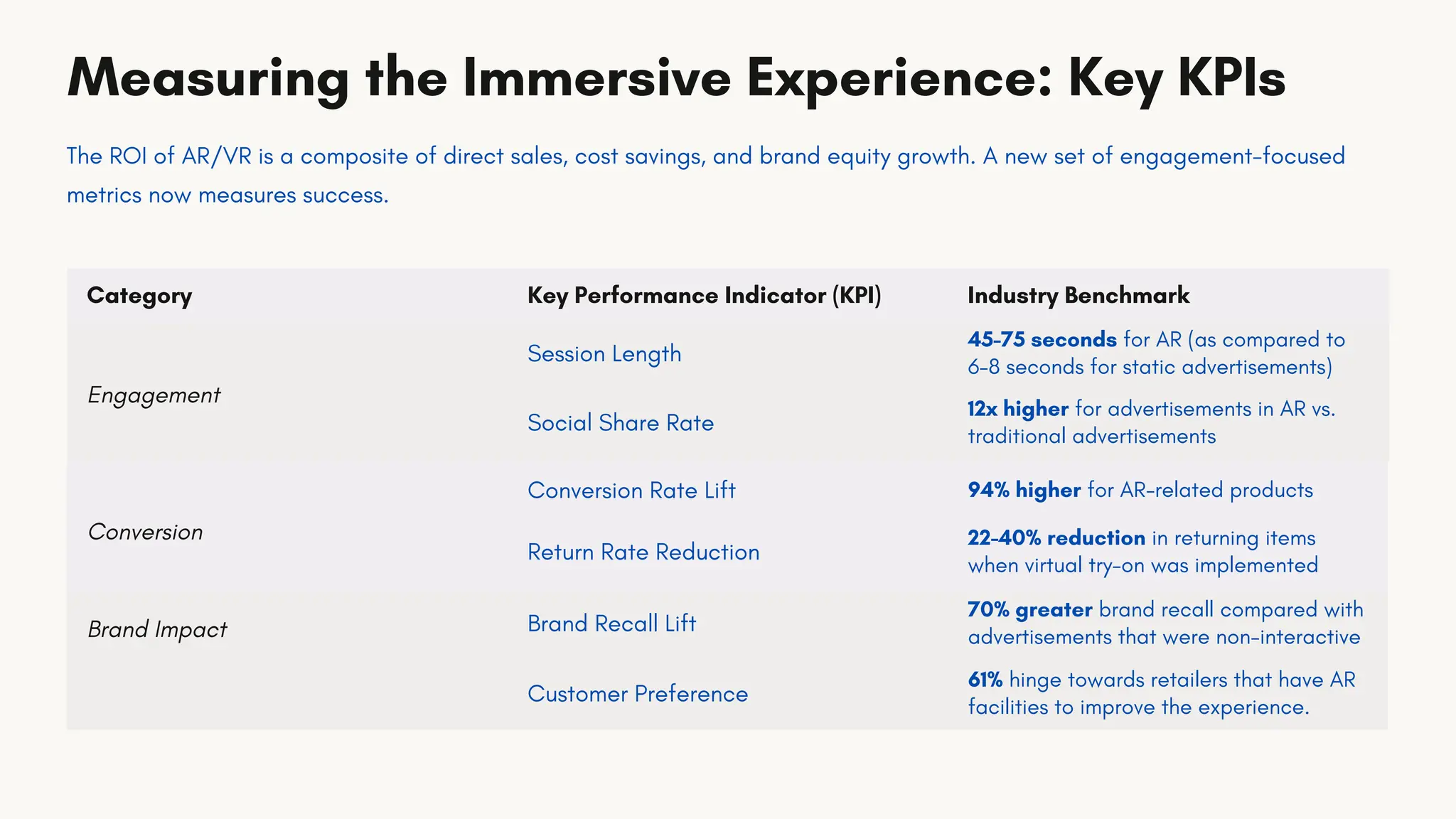
Measuring the Immersive Experience: Key KPIs
The ROI of AR/VR is a composite of direct sales, cost savings, and brand equity growth. A new set of engagement-focused
metrics now measures success.
Category Key Performance Indicator (KPI) Industry Benchmark
Engagement
Session Length
45-75 seconds for AR (as compared to
6-8 seconds for static advertisements)
Social Share Rate
12x higher for advertisements in AR vs.
traditional advertisements
Conversion
Conversion Rate Lift 94% higher for AR-related products
Return Rate Reduction
22-40% reduction in returning items
when virtual try-on was implemented
Brand Impact Brand Recall Lift
70% greater brand recall compared with
advertisements that were non-interactive
Customer Preference
61% hinge towards retailers that have AR
facilities to improve the experience.
Navigating the Headwinds: Challenges & Ethics
Implementation Hurdles:
High Cost of Development: High-fidelity 3D content
demands specialized talent and significant
investment
Hardware Limitations: VR headsets are expensive,
limiting scalability; AR performance can vary greatly
from smartphone to smartphone, which can produce
a poor experience for the user
User Experience: In VR, a lower frame rate can
cause motion sickness. In AR, the experience must be
intuitive, valuable, not just novel
Ethical Imperatives:
Data Privacy is Critical: AR/VR can
accumulate unprecedented amounts of
sensitive biometric (ie: eye-tracking,
facial expressions) and environmental
data (i.e.: scans of the user's home)
Building Trust: Brands must disclose what
data is being collected, and where/why it is
being used, to avoid significant backlash
from consumers that could destroy the
ecosystem entirely
There are significant challenges in the path to immersive marketing and they require strategic planning to overcome them.
The Next Frontier: The Metaverse
Currently, the AR/VR campaigns undertaken can serve as trial runs for the next phase of digital interaction: the metaverse.
From Campaigns
to Competencies
Brands must think beyond a set of
AR/VR projects to expanding a
core competency in creating and
managing persistent immersive
experiences.
The Future
is Spatial:
Brands will have a permanent virtual
home in a 3D internet that is "always
on," with virtual stores to purchase
goods, new products, and a website
that houses branded places where
they can host exclusive events and sell
digital goods directly to avatars
Invest Now,
Lead Tomorrow:
The brands today that invest in
developing the skills, 3D asset
library, and ethical framework will
have the best chances to lead the
metaverse of tomorrow!
Key Takeaways
AR and VR are Not Interchangeable: AR is a utility with high accessibility which adds to the quality of the real
world to generate conversion. VR is a destination with high immersion which replaces the real world to generate
emotional connection
The Business Case is Proven: The immersive technologies deliver measurable ROI with increased sales,
reduced operational costs (returns, prototype), significantly higher lifts in brand engagement and brand recall
Strategy Must Precede Technology: The best campaigns have clear objectives, deep understanding of their
target consumer, and provide value to the consumer
Ethics are Non-Negotiable: The future of immersive marketing hinges upon the leveraging and building of trust
with consumers through transparent and credible data practices
The Future is Immersive: The AR/VR projects of today will serve as today's training ground for the metaverse.
It is paramount that we build this "immersive muscle" as an investment towards the future
The Immersive Imperative: A Case Study on AR & VR in Digital Marketing

The Immersive Imperative: A Case Study on AR & VR in Digital Marketing

  • 1.
    The Immersive Imperative:A Case Study on AR & VR in Digital Marketing How Leading Brands Are Reshaping Customer Engagement and Driving ROI Prepared for: Prof. (Dr.) Nitin Kulkarni Prepared by: Soumya Guhathakurta (Marketing, PRN - 24020141268) Date: September 25, 2025
  • 2.
    The Agenda 01 The NewDimensions of Marketing: Defining AR vs. VR 02 Case Study Deep Dive: Real-world examples and results across key sectors. Augmented Reality (AR): Fashion, Retail, and FMCG Virtual Reality (VR): Automotive & High-Value Goods 03 Measuring the Experience: Quantifying the ROI of Immersive Campaigns 04 Challenges & The Road Ahead: Navigating Hurdles and Looking to the Metaverse 05 Key Takeaways & Q&A
  • 3.
    A Tale ofTwo Realities: AR vs. VR While often grouped together, Augmented Reality and Virtual Reality serve distinct strategic purposes in marketing. Augmented Reality (AR) Function: Overlays digital content onto the real world. Hardware: Smartphone or tablet. Accessibility: High (billions of users). Strategic Goal: Utility & Conversion. Enhances the customer's current reality to solve a problem (e.g., "Will this fit?"). Best For: Virtual try-ons, product visualization, interactive packaging. Virtual Reality (VR) Function: Replaces the real world with a fully digital one. Hardware: VR headset. Accessibility: Moderate (specialized hardware). Strategic Goal: Immersion & Emotion. Transports the customer to a new reality to tell a story. Best For: Virtual showrooms, brand storytelling, product simulations.
  • 4.
    Case Study 1:AR in Fashion & Cosmetics The Challenge: The primary barrier to online sales in fashion and beauty is the inability to "try before you buy," leading to purchase hesitation and high return rates. The Solution: AR-Powered Virtual Try-On Brands like Sephora, L'Oréal, and Gucci use smartphone cameras to allow customers to virtually apply makeup or try on sneakers in real-time. The Results: 94% higher conversion rates for products viewed with AR. Sephora (Turkey) saw a 35% increase in online sales after launching its AR feature. L'Oréal reports 3x higher conversion rates with virtual try-ons. AR can reduce product returns by 22% to 40%. The Virtual Mirror
  • 5.
    Case Study 2:AR in Retail The Challenge: For high-consideration items like furniture, customers struggle to visualize how products will fit and look within their personal space. The Solution: AR for In-Home Product Placement IKEA's "Place" app allows users to place true-to-scale 3D models of furniture directly into their homes, using their phone's camera. The Results: 98% size accuracy removes guesswork and builds trust. 40% boost in purchase confidence among users. Reported decline of over 20% in returns related to sizing issues. Users engage twice as long compared to traditional e-commerce sessions. The In-Home Showroom
  • 6.
    Case Study 3:AR in FMCG The Challenge: In a crowded market of low-cost, high-volume goods, brands need to create memorable, shareable experiences to drive brand recall and differentiation. The Solution: Interactive Packaging & Advertising Brands use AR to turn static objects like pizza boxes, wine labels, and bus shelters into interactive brand experiences. The Results: Pizza Hut's AR PAC-MAN box generated 741 million impressions and sold 10.6 million units. 19 Crimes Wine brought its labels to life, contributing to a 40% growth in sales in two years. Pepsi's "Unbelievable Bus Shelter" went viral, accumulating millions of views and becoming a landmark experiential campaign. The Living Product
  • 7.
    Case Study 4:VR in Automotive The Challenge: Physical dealerships are limited by space, inventory, and geography. Customers want to explore and customize vehicles in detail before making a high-value purchase. The Solution: VR-Powered Virtual Showrooms & Test Drives Automakers like Audi, Ford, and GM use VR to let customers explore, customize, and "test drive" any vehicle in their lineup in a photorealistic, 1:1 scale virtual environment. The Results: 18% boost in purchase intent after a virtual test drive. 30% increase in overall customer engagement. 20% reduction in sales cycle time. Internal ROI: VR prototyping cuts development costs by up to 15% and accelerates design by 25%. The Immersive Showroom
  • 8.
    Measuring the ImmersiveExperience: Key KPIs The ROI of AR/VR is a composite of direct sales, cost savings, and brand equity growth. A new set of engagement-focused metrics now measures success. Category Key Performance Indicator (KPI) Industry Benchmark Engagement Session Length 45-75 seconds for AR (as compared to 6-8 seconds for static advertisements) Social Share Rate 12x higher for advertisements in AR vs. traditional advertisements Conversion Conversion Rate Lift 94% higher for AR-related products Return Rate Reduction 22-40% reduction in returning items when virtual try-on was implemented Brand Impact Brand Recall Lift 70% greater brand recall compared with advertisements that were non-interactive Customer Preference 61% hinge towards retailers that have AR facilities to improve the experience.
  • 9.
    Navigating the Headwinds:Challenges & Ethics Implementation Hurdles: High Cost of Development: High-fidelity 3D content demands specialized talent and significant investment Hardware Limitations: VR headsets are expensive, limiting scalability; AR performance can vary greatly from smartphone to smartphone, which can produce a poor experience for the user User Experience: In VR, a lower frame rate can cause motion sickness. In AR, the experience must be intuitive, valuable, not just novel Ethical Imperatives: Data Privacy is Critical: AR/VR can accumulate unprecedented amounts of sensitive biometric (ie: eye-tracking, facial expressions) and environmental data (i.e.: scans of the user's home) Building Trust: Brands must disclose what data is being collected, and where/why it is being used, to avoid significant backlash from consumers that could destroy the ecosystem entirely There are significant challenges in the path to immersive marketing and they require strategic planning to overcome them.
  • 10.
    The Next Frontier:The Metaverse Currently, the AR/VR campaigns undertaken can serve as trial runs for the next phase of digital interaction: the metaverse. From Campaigns to Competencies Brands must think beyond a set of AR/VR projects to expanding a core competency in creating and managing persistent immersive experiences. The Future is Spatial: Brands will have a permanent virtual home in a 3D internet that is "always on," with virtual stores to purchase goods, new products, and a website that houses branded places where they can host exclusive events and sell digital goods directly to avatars Invest Now, Lead Tomorrow: The brands today that invest in developing the skills, 3D asset library, and ethical framework will have the best chances to lead the metaverse of tomorrow!
  • 11.
    Key Takeaways AR andVR are Not Interchangeable: AR is a utility with high accessibility which adds to the quality of the real world to generate conversion. VR is a destination with high immersion which replaces the real world to generate emotional connection The Business Case is Proven: The immersive technologies deliver measurable ROI with increased sales, reduced operational costs (returns, prototype), significantly higher lifts in brand engagement and brand recall Strategy Must Precede Technology: The best campaigns have clear objectives, deep understanding of their target consumer, and provide value to the consumer Ethics are Non-Negotiable: The future of immersive marketing hinges upon the leveraging and building of trust with consumers through transparent and credible data practices The Future is Immersive: The AR/VR projects of today will serve as today's training ground for the metaverse. It is paramount that we build this "immersive muscle" as an investment towards the future