Module 1:
Introduction To Digital Marketing
Lecture time: 90 minutes
Introduction andmethodology
Marketing mix (channels)
Every marketer needs to understand how to build
and manage a healthy brand in the digital space.
Thismeans designing an accessible, usable and value-adding website and
leveraging various inter-related digital marketingtools, techniques
and platforms to drive traffic, conversionand engagement.
This Digital Marketing course covers
the fundamentals and provides you
with a practical framework to get
better in understanding key digital
marketing tools and techniques.
Module 1:
Introduction To Digital Marketing
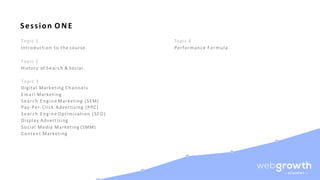
Session ONE
Topic 1
Introduction to the course.
Topic 2
History of Search & Social.
Topic 3
Digital Marketing Channels
Email Marketing
Search Engine Marketing (SEM)
Pay-Per-Click Advertising (PPC)
Search Engine Optimisation (SEO)
Display Advertising
Social Media Marketing (SMM)
Content Marketing
Topic 4
Performance Formula
Module 1:
Introduction To Digital Marketing
Session ONE
Module 1:
Introduction To Digital Marketing
Topic1:
Introduction
to the course.
What Is Digital
Marketing?
Session ONE // Topic 1: Introduction to the course.
Module 1:
Introduction To Digital Marketing
What Is Digital
Marketing?
It differs to traditional marketing in that involves various channels and
methods to enable an organisation to analyse what is and
is not working in real time.
Session ONE //
Module 1:
Introduction To Digital Marketing
Topic 1: Introduction to the course.
Why Is Digital
Marketing Important?
Session ONE //
Module 1:
Introduction To Digital Marketing
Topic 1: Introduction to the course.
Why Is Digital
Marketing Important?
People want brands they can trust; it’s that simple.
The ease of access to information has placed everyone under a
microscope and has not only exposed consumers to what your
company says, but also to what the media and other consumers have
to say.
Session ONE //
Module 1:
Introduction To Digital Marketing
Topic 1: Introduction to the course.
This course will identify key areas of a
digital marketing campaign, including:
Session ONE // Topic 1: Introduction to the course.
Introduction to Digital Marketing
Understanding Business Objectives
Competitor Research
Keyword Research
Content Optimisation –Google
Content Optimisation –Facebook
Content Promotion
Reporting
Module 1:
Introduction To Digital Marketing
Topic2:
Module 1:
Introduction To Digital Marketing
History of
Search & Social
Session ONE
Session ONE // Topic 2: History of Search & Social
The term digital marketing
was first used in the 1990s.
Module 1:
Introduction To Digital Marketing
The coming of the Internet and the
development of the Web 1.0 platform,
allowed users to find the information they
wanted, but it could not beshared.
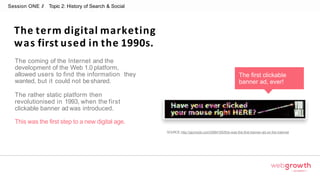
The rather static platform then
revolutionised in 1993, when the first
clickable banner ad was introduced.
This was the first step to a new digital age.
Session ONE // Topic 2: History of Search & Social
The term digital marketing
was first used in the 1990s.
The coming of the Internet and the
development of the Web 1.0 platform,
allowed users to find the information they
wanted, but it could not beshared.
The rather static platform then
revolutionised in 1993, when the first
clickable banner ad was introduced.
This was the first step to a new digital age.
SOURCE:http://gizmodo.com/5984165/this-was-the-first-banner-ad-on-the-internet
The first clickable
banner ad, ever!
Module 1:
Introduction To Digital Marketing
Session ONE // Topic 2: History of Search & Social
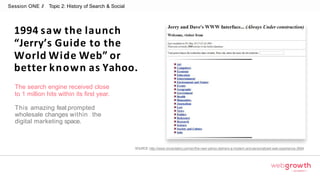
1994 saw the launch
“Jerry’s Guide to the
World Wide Web” or
better known as Yahoo.
The search engine received close
to 1 million hits within its first year.
This amazing feat prompted
wholesale changes within the
digital marketing space.
SOURCE: http://www.vincentabry.com/en/the-new-yahoo-delivers-a-modern-and-personalized-web-experience-3694
Module 1:
Introduction To Digital Marketing
Session ONE // Topic 2: History of Search & Social
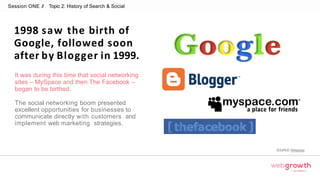
1998 saw the birth of
Google, followed soon
after by Blogger in 1999.
It was during this time that social networking
sites – MySpace and then The Facebook –
began to be birthed.
The social networking boom presented
excellent opportunities for businesses to
communicate directly with customers and
implement web marketing strategies.
SOURCE:Wikipedia
Module 1:
Introduction To Digital Marketing
Session ONE // Topic 2: History of Search & Social
Google then started to expand and
improve their Internet search
engine algorithms, and it wasn’t
long after that Google figured out
how to analyse content to target
users with ads that are relevant to
their interests.
Google also added options likeAdWords,Analytics
andAdSense to improve marketing potential.
Module 1:
Introduction To Digital Marketing
Session ONE // Topic 2: History of Search & Social
Enter The
‘Cookie’.
Module 1:
Introduction To Digital Marketing
Session ONE // Topic 2: History of Search & Social
Enter The
Module 1:
Introduction To Digital Marketing
‘Cookie’.
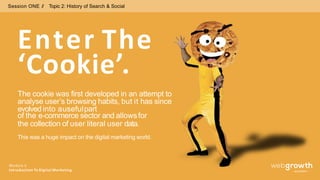
The cookie was first developed in an attempt to
analyse user’s browsing habits, but it has since
evolved into ausefulpart
of the e-commerce sector and allowsfor
the collection of user literal user data.
This was a huge impact on the digital marketing world.
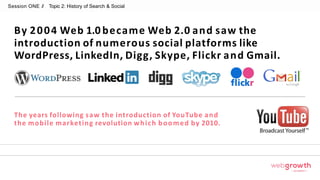
By 2004 Web 1.0 became Web 2.0 and saw the
introduction of numerous social platforms like
WordPress, LinkedIn, Digg, Skype, Flickr and Gmail.
The years following saw the introduction of YouTube and
the mobile marketing revolution which boomed by 2010.
Session ONE // Topic 2: History of Search & Social
Module 1:
Introduction To Digital Marketing
Topic3:
Module 1:
Introduction To Digital Marketing
Digital
Marketing
Channels
Session ONE
Before you startplanning an effective
digital marketing strategy, it is
important to perform various tests to
determine which channels will work
best for yourbusiness.
Session ONE // Topic 3: Digital Marketing Channels
Module 1:
Introduction To Digital Marketing
Email Marketing
Session ONE // Topic 3: Digital Marketing Channels
Email marketing remains to be one of the most effective
digital marketing channels that guarantee ROI.
The benefits of email marketing include: low costing, audience
segmenting, immediate, contain calls to action, customisable, and
easy to share and track.
Module 1:
Introduction To Digital Marketing
Search Engine Marketing (SEM)
Session ONE // Topic 3: Digital Marketing Channels
Search Engine Marketing (SEM)
refers to the process of gaining
website traffic by purchasing ads
on search engines.
The strategy that encompasses
both PPC and SEO is one of the
most effective ways to growyour
business in an increasingly
competitive marketplace.
Search Engine Marketing’s greatest
strength is that it offers advertisers
the opportunity to put their ads in
front of customers whoare ready to
purchase at that very moment in time.
SOURCE:https://www.youtube.com/watch?v=BNHR6IQJGZs
Module 1:
Introduction To Digital Marketing
Pay-Per-Click Advertising (PPC)
Session ONE // Topic 3: Digital Marketing Channels
The effectiveness ofPPC
advertising is measuredby
the allocated budgetand
how well keywordsfor
targeting potential customers
are optimised.
SOURCE:https://www.youtube.com/watch?v=Hj-k9wzExMA
Module 1:
Introduction To Digital Marketing
$
Search Engine Optimisation(SEO)
Session ONE // Topic 3: Digital Marketing Channels
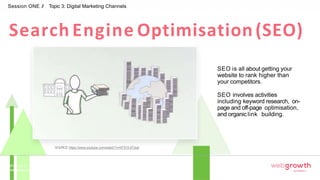
SEO is all about getting your
website to rank higher than
your competitors.
SEO involves activities
including keyword research, on-
page and off-page optimisation,
and organiclink building.
SOURCE:https://www.youtube.com/watch?v=hF515-0Tduk
Module 1:
Introduction To Digital Marketing
DisplayAdvertising
Session ONE // Topic 3: Digital Marketing Channels
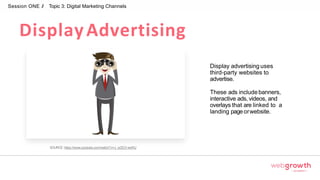
Display advertising uses
third-party websites to
advertise.
These ads includebanners,
interactive ads, videos, and
overlays that are linked to a
landing pageorwebsite.
SOURCE: https://www.youtube.com/watch?v=J_wZEO-wsRU
Module 1:
Introduction To Digital Marketing
Social MediaMarketing(SMM)
Session ONE // Topic 3: Digital Marketing Channels
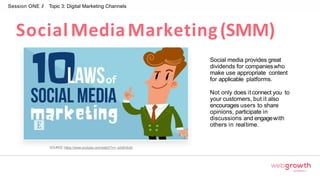
Social media provides great
dividends for companieswho
make use appropriate content
for applicable platforms.
Not only does it connect you to
your customers, but it also
encourages users to share
opinions, participate in
discussions and engagewith
others in realtime.
SOURCE: https://www.youtube.com/watch?v=--s2sfm9JkI
Module 1:
Introduction To Digital Marketing
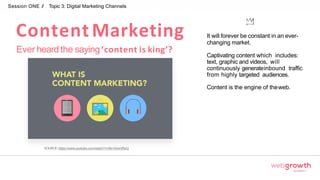
It will forever be constant in an ever-
changing market.
Captivating content which includes:
text, graphic and videos, will
continuously generateinbound traffic
from highly targeted audiences.
Content is the engine of theweb.
Session ONE // Topic 3: Digital Marketing Channels
SOURCE:https://www.youtube.com/watch?v=6b14Axh8fwQ
ContentMarketing
Ever heard the saying‘content is king’?
Module 1:
Introduction To Digital Marketing
Topic4:
Module 1:
Introduction To Digital Marketing
Performance
Formula
Session ONE
Session ONE // Topic 4: Performance Formula
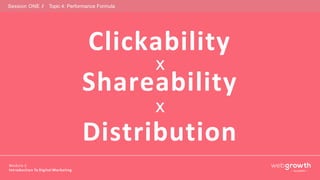
The Performance Formula
consists of three concepts:
Each tasked with specific elements that are
dependent on one another tocreate asuccessful
digital marketing campaign.
Module 1:
Introduction To Digital Marketing
Session ONE // Topic 4: Performance Formula
Clickability
Module 1:
Introduction To Digital Marketing
x
Shareability
x
Distribution
Session ONE // Topic 4: Performance Formula
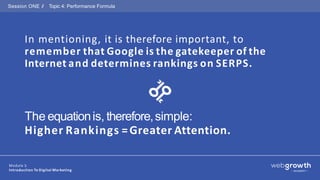
In mentioning, it is therefore important, to
remember that Google is the gatekeeper of the
Internet and determines rankings on SERPS.
The equationis, therefore,simple:
Higher Rankings =Greater Attention.
Module 1:
Introduction To Digital Marketing
Session ONE // Topic 4: Performance Formula
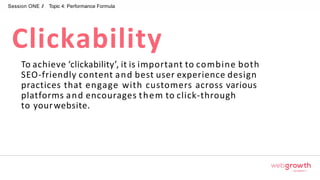
To achieve ‘clickability’, it is important to combine both
SEO-friendly content and best user experience design
practices that engage with customers across various
platforms and encourages them to click-through
to yourwebsite.
Clickability
Module 1:
Introduction To Digital Marketing
Session ONE // Topic 4: Performance Formula
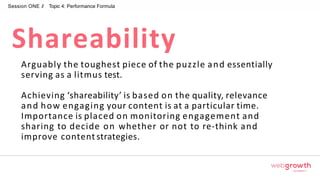
Arguably the toughest piece of the puzzle and essentially
serving as a litmus test.
Achieving ‘shareability’ is based on the quality, relevance
and how engaging your content is at a particular time.
Importance is placed on monitoring engagement and
sharing to decide on whether or not to re-think and
improve contentstrategies.
Shareability
Module 1:
Introduction To Digital Marketing
Session ONE // Topic 4: Performance Formula
In order to increase distribution, it is important to become
visible. Improving visibility means engaging with your
audience and providing them with simple solutions to
engage with your brand. This can be done through various
channels including social media, email marketing and the
website itself.
Distribution
Module 1:
Introduction To Digital Marketing
Session ONE // Topic 4: Performance Formula
The three elements
although dependent
on another, each play
a particular role in the
process, and only once
all three are mastered does
content become viral.
The formula then repeats
itself in what is called
the ‘donut process’,
whereby content is
continually reviewed
to be improved upon.
SOURCE: https://www.webgrowth.co.za/blog/clickability-x-shareability-x-distribution
Clickability xShareability x Distribution
Module 1:
Introduction To Digital Marketing

digital marketing

  • 1.
    Module 1: Introduction ToDigital Marketing Lecture time: 90 minutes Introduction andmethodology Marketing mix (channels) Every marketer needs to understand how to build and manage a healthy brand in the digital space. Thismeans designing an accessible, usable and value-adding website and leveraging various inter-related digital marketingtools, techniques and platforms to drive traffic, conversionand engagement.
  • 2.
    This Digital Marketingcourse covers the fundamentals and provides you with a practical framework to get better in understanding key digital marketing tools and techniques. Module 1: Introduction To Digital Marketing
  • 3.
    Session ONE Topic 1 Introductionto the course. Topic 2 History of Search & Social. Topic 3 Digital Marketing Channels Email Marketing Search Engine Marketing (SEM) Pay-Per-Click Advertising (PPC) Search Engine Optimisation (SEO) Display Advertising Social Media Marketing (SMM) Content Marketing Topic 4 Performance Formula Module 1: Introduction To Digital Marketing
  • 4.
    Session ONE Module 1: IntroductionTo Digital Marketing Topic1: Introduction to the course.
  • 5.
    What Is Digital Marketing? SessionONE // Topic 1: Introduction to the course. Module 1: Introduction To Digital Marketing
  • 6.
    What Is Digital Marketing? Itdiffers to traditional marketing in that involves various channels and methods to enable an organisation to analyse what is and is not working in real time. Session ONE // Module 1: Introduction To Digital Marketing Topic 1: Introduction to the course.
  • 7.
    Why Is Digital MarketingImportant? Session ONE // Module 1: Introduction To Digital Marketing Topic 1: Introduction to the course.
  • 8.
    Why Is Digital MarketingImportant? People want brands they can trust; it’s that simple. The ease of access to information has placed everyone under a microscope and has not only exposed consumers to what your company says, but also to what the media and other consumers have to say. Session ONE // Module 1: Introduction To Digital Marketing Topic 1: Introduction to the course.
  • 9.
    This course willidentify key areas of a digital marketing campaign, including: Session ONE // Topic 1: Introduction to the course. Introduction to Digital Marketing Understanding Business Objectives Competitor Research Keyword Research Content Optimisation –Google Content Optimisation –Facebook Content Promotion Reporting Module 1: Introduction To Digital Marketing
  • 10.
    Topic2: Module 1: Introduction ToDigital Marketing History of Search & Social Session ONE
  • 11.
    Session ONE //Topic 2: History of Search & Social The term digital marketing was first used in the 1990s. Module 1: Introduction To Digital Marketing The coming of the Internet and the development of the Web 1.0 platform, allowed users to find the information they wanted, but it could not beshared. The rather static platform then revolutionised in 1993, when the first clickable banner ad was introduced. This was the first step to a new digital age.
  • 12.
    Session ONE //Topic 2: History of Search & Social The term digital marketing was first used in the 1990s. The coming of the Internet and the development of the Web 1.0 platform, allowed users to find the information they wanted, but it could not beshared. The rather static platform then revolutionised in 1993, when the first clickable banner ad was introduced. This was the first step to a new digital age. SOURCE:http://gizmodo.com/5984165/this-was-the-first-banner-ad-on-the-internet The first clickable banner ad, ever! Module 1: Introduction To Digital Marketing
  • 13.
    Session ONE //Topic 2: History of Search & Social 1994 saw the launch “Jerry’s Guide to the World Wide Web” or better known as Yahoo. The search engine received close to 1 million hits within its first year. This amazing feat prompted wholesale changes within the digital marketing space. SOURCE: http://www.vincentabry.com/en/the-new-yahoo-delivers-a-modern-and-personalized-web-experience-3694 Module 1: Introduction To Digital Marketing
  • 14.
    Session ONE //Topic 2: History of Search & Social 1998 saw the birth of Google, followed soon after by Blogger in 1999. It was during this time that social networking sites – MySpace and then The Facebook – began to be birthed. The social networking boom presented excellent opportunities for businesses to communicate directly with customers and implement web marketing strategies. SOURCE:Wikipedia Module 1: Introduction To Digital Marketing
  • 15.
    Session ONE //Topic 2: History of Search & Social Google then started to expand and improve their Internet search engine algorithms, and it wasn’t long after that Google figured out how to analyse content to target users with ads that are relevant to their interests. Google also added options likeAdWords,Analytics andAdSense to improve marketing potential. Module 1: Introduction To Digital Marketing
  • 16.
    Session ONE //Topic 2: History of Search & Social Enter The ‘Cookie’. Module 1: Introduction To Digital Marketing
  • 17.
    Session ONE //Topic 2: History of Search & Social Enter The Module 1: Introduction To Digital Marketing ‘Cookie’. The cookie was first developed in an attempt to analyse user’s browsing habits, but it has since evolved into ausefulpart of the e-commerce sector and allowsfor the collection of user literal user data. This was a huge impact on the digital marketing world.
  • 18.
    By 2004 Web1.0 became Web 2.0 and saw the introduction of numerous social platforms like WordPress, LinkedIn, Digg, Skype, Flickr and Gmail. The years following saw the introduction of YouTube and the mobile marketing revolution which boomed by 2010. Session ONE // Topic 2: History of Search & Social Module 1: Introduction To Digital Marketing
  • 19.
    Topic3: Module 1: Introduction ToDigital Marketing Digital Marketing Channels Session ONE
  • 20.
    Before you startplanningan effective digital marketing strategy, it is important to perform various tests to determine which channels will work best for yourbusiness. Session ONE // Topic 3: Digital Marketing Channels Module 1: Introduction To Digital Marketing
  • 21.
    Email Marketing Session ONE// Topic 3: Digital Marketing Channels Email marketing remains to be one of the most effective digital marketing channels that guarantee ROI. The benefits of email marketing include: low costing, audience segmenting, immediate, contain calls to action, customisable, and easy to share and track. Module 1: Introduction To Digital Marketing
  • 22.
    Search Engine Marketing(SEM) Session ONE // Topic 3: Digital Marketing Channels Search Engine Marketing (SEM) refers to the process of gaining website traffic by purchasing ads on search engines. The strategy that encompasses both PPC and SEO is one of the most effective ways to growyour business in an increasingly competitive marketplace. Search Engine Marketing’s greatest strength is that it offers advertisers the opportunity to put their ads in front of customers whoare ready to purchase at that very moment in time. SOURCE:https://www.youtube.com/watch?v=BNHR6IQJGZs Module 1: Introduction To Digital Marketing
  • 23.
    Pay-Per-Click Advertising (PPC) SessionONE // Topic 3: Digital Marketing Channels The effectiveness ofPPC advertising is measuredby the allocated budgetand how well keywordsfor targeting potential customers are optimised. SOURCE:https://www.youtube.com/watch?v=Hj-k9wzExMA Module 1: Introduction To Digital Marketing $
  • 24.
    Search Engine Optimisation(SEO) SessionONE // Topic 3: Digital Marketing Channels SEO is all about getting your website to rank higher than your competitors. SEO involves activities including keyword research, on- page and off-page optimisation, and organiclink building. SOURCE:https://www.youtube.com/watch?v=hF515-0Tduk Module 1: Introduction To Digital Marketing
  • 25.
    DisplayAdvertising Session ONE //Topic 3: Digital Marketing Channels Display advertising uses third-party websites to advertise. These ads includebanners, interactive ads, videos, and overlays that are linked to a landing pageorwebsite. SOURCE: https://www.youtube.com/watch?v=J_wZEO-wsRU Module 1: Introduction To Digital Marketing
  • 26.
    Social MediaMarketing(SMM) Session ONE// Topic 3: Digital Marketing Channels Social media provides great dividends for companieswho make use appropriate content for applicable platforms. Not only does it connect you to your customers, but it also encourages users to share opinions, participate in discussions and engagewith others in realtime. SOURCE: https://www.youtube.com/watch?v=--s2sfm9JkI Module 1: Introduction To Digital Marketing
  • 27.
    It will foreverbe constant in an ever- changing market. Captivating content which includes: text, graphic and videos, will continuously generateinbound traffic from highly targeted audiences. Content is the engine of theweb. Session ONE // Topic 3: Digital Marketing Channels SOURCE:https://www.youtube.com/watch?v=6b14Axh8fwQ ContentMarketing Ever heard the saying‘content is king’? Module 1: Introduction To Digital Marketing
  • 28.
    Topic4: Module 1: Introduction ToDigital Marketing Performance Formula Session ONE
  • 29.
    Session ONE //Topic 4: Performance Formula The Performance Formula consists of three concepts: Each tasked with specific elements that are dependent on one another tocreate asuccessful digital marketing campaign. Module 1: Introduction To Digital Marketing
  • 30.
    Session ONE //Topic 4: Performance Formula Clickability Module 1: Introduction To Digital Marketing x Shareability x Distribution
  • 31.
    Session ONE //Topic 4: Performance Formula In mentioning, it is therefore important, to remember that Google is the gatekeeper of the Internet and determines rankings on SERPS. The equationis, therefore,simple: Higher Rankings =Greater Attention. Module 1: Introduction To Digital Marketing
  • 32.
    Session ONE //Topic 4: Performance Formula To achieve ‘clickability’, it is important to combine both SEO-friendly content and best user experience design practices that engage with customers across various platforms and encourages them to click-through to yourwebsite. Clickability Module 1: Introduction To Digital Marketing
  • 33.
    Session ONE //Topic 4: Performance Formula Arguably the toughest piece of the puzzle and essentially serving as a litmus test. Achieving ‘shareability’ is based on the quality, relevance and how engaging your content is at a particular time. Importance is placed on monitoring engagement and sharing to decide on whether or not to re-think and improve contentstrategies. Shareability Module 1: Introduction To Digital Marketing
  • 34.
    Session ONE //Topic 4: Performance Formula In order to increase distribution, it is important to become visible. Improving visibility means engaging with your audience and providing them with simple solutions to engage with your brand. This can be done through various channels including social media, email marketing and the website itself. Distribution Module 1: Introduction To Digital Marketing
  • 35.
    Session ONE //Topic 4: Performance Formula The three elements although dependent on another, each play a particular role in the process, and only once all three are mastered does content become viral. The formula then repeats itself in what is called the ‘donut process’, whereby content is continually reviewed to be improved upon. SOURCE: https://www.webgrowth.co.za/blog/clickability-x-shareability-x-distribution Clickability xShareability x Distribution Module 1: Introduction To Digital Marketing