Digital Literacy &
Online Safety
Hannah Strevig
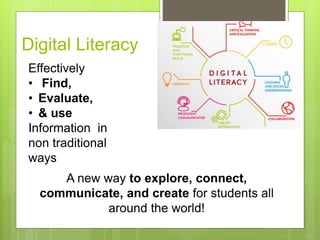
Digital Literacy
Effectively
• Find,
• Evaluate,
• & use
Information in
non traditional
ways
A new way to explore, connect,
communicate, and create for students all
around the world!
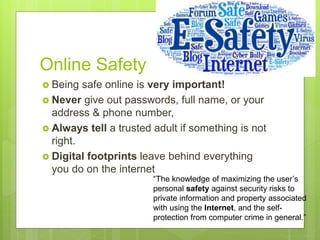
Online Safety
 Being safe online is very important!
 Never give out passwords, full name, or your
address & phone number,
 Always tell a trusted adult if something is not
right.
 Digital footprints leave behind everything
you do on the internet
“The knowledge of maximizing the user’s
personal safety against security risks to
private information and property associated
with using the Internet, and the self-
protection from computer crime in general.”
Games
https://www.consumer.ftc.gov/media/game-
0012-spam-scam-slam
http://mediasmarts.ca/sites/default/files/ga
mes/coco/flash/start.html
http://www.netsmartzkids.org/AdventureGa
mes/TheInternetSafetyGame
Videos
https://www.netsmartz.org/NetSmartzKids/
NetSmartzGeneration
https://www.netsmartz.org/NetSmartzKids/I
tsOkToTell
https://www.youtube.com/watch?v=p2k3C-
iB88w
https://www.youtube.com/watch?v=X5ySoc
UyI7I
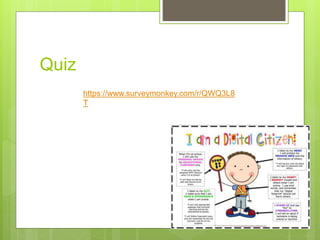
Quiz
https://www.surveymonkey.com/r/QWQ3L8
T
References
Murray, J. (2018). Technology in the Classroom: What is Digital
Literacy? TeachHub.com
Scheff, S. (2017, December 07). Online Safety: What Does It Mean To
You? Huffpost.

Digital literacy & online safety