N
ADAR
SARASW
ATHI
CO
LLEGE
O
F
ARTS
AN
D
SCIEN
CE
DIGITAL IM
AGE
PROCESSING
A.UTHRA
DEVI
II M
.Sc (CS)
COMPRESSION
 compression is a process that makes image files smaller.
Image compression most often works either by removing
bytes of information from the image, or by using an
image compression algorithm to rewrite the image file in
a way that takes up less storage space.
 In the processes of compression, the mathematical
transforms play a vital role. A flow chart of the process
of the compression of the image can be represented as:
IMAGE COMPRESSION
 In the field of Image processing, the compression of
images is an important step before we start the
processing of larger images or videos. The compression
of images is carried out by an encoder and output a
compressed form of an image. In the processes of
compression, the mathematical transforms play a vital
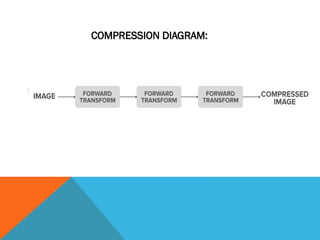
role. A flow chart of the process of the compression of
the image can be represented as:
COMPRESSION DIAGRAM:
ERROR FREE COMPRESSIONS
 Error free compression is the only acceptable means of
data reduction.
 One such application is the archival of medical or
business documents.
 Need for error free compression is motivated by the
intended use or nature of the images under
consideration.
 It also known as lossless ccompression
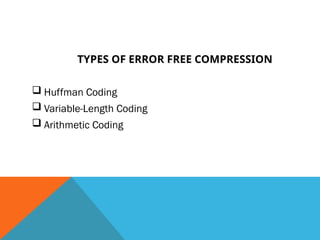
TYPES OF ERROR FREE COMPRESSION
 Huffman Coding
 Variable-Length Coding
 Arithmetic Coding
APPLICATIONS:
 Archive of medical or business documents
 Satellite imaging
 Digital radiography
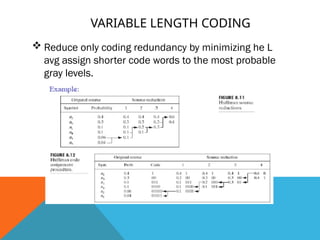
VARIABLE LENGTH CODING
 Reduce only coding redundancy by minimizing he L
avg assign shorter code words to the most probable
gray levels.
HUFFMAN CODE
 The Huffman code results in an unambiguous code,
i.e. no code can be created by combining other codes.
 The code is reversible without loss.
 table for he translation of the code has to be stored
together with the coded image
THANK YOU

digital image processing in computer science

  • 1.
  • 2.
    COMPRESSION  compression isa process that makes image files smaller. Image compression most often works either by removing bytes of information from the image, or by using an image compression algorithm to rewrite the image file in a way that takes up less storage space.  In the processes of compression, the mathematical transforms play a vital role. A flow chart of the process of the compression of the image can be represented as:
  • 3.
    IMAGE COMPRESSION  Inthe field of Image processing, the compression of images is an important step before we start the processing of larger images or videos. The compression of images is carried out by an encoder and output a compressed form of an image. In the processes of compression, the mathematical transforms play a vital role. A flow chart of the process of the compression of the image can be represented as:
  • 4.
  • 5.
    ERROR FREE COMPRESSIONS Error free compression is the only acceptable means of data reduction.  One such application is the archival of medical or business documents.  Need for error free compression is motivated by the intended use or nature of the images under consideration.  It also known as lossless ccompression
  • 6.
    TYPES OF ERRORFREE COMPRESSION  Huffman Coding  Variable-Length Coding  Arithmetic Coding
  • 7.
    APPLICATIONS:  Archive ofmedical or business documents  Satellite imaging  Digital radiography
  • 8.
    VARIABLE LENGTH CODING Reduce only coding redundancy by minimizing he L avg assign shorter code words to the most probable gray levels.
  • 9.
    HUFFMAN CODE  TheHuffman code results in an unambiguous code, i.e. no code can be created by combining other codes.  The code is reversible without loss.  table for he translation of the code has to be stored together with the coded image
  • 10.