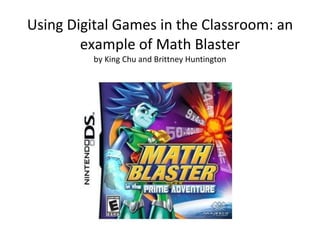
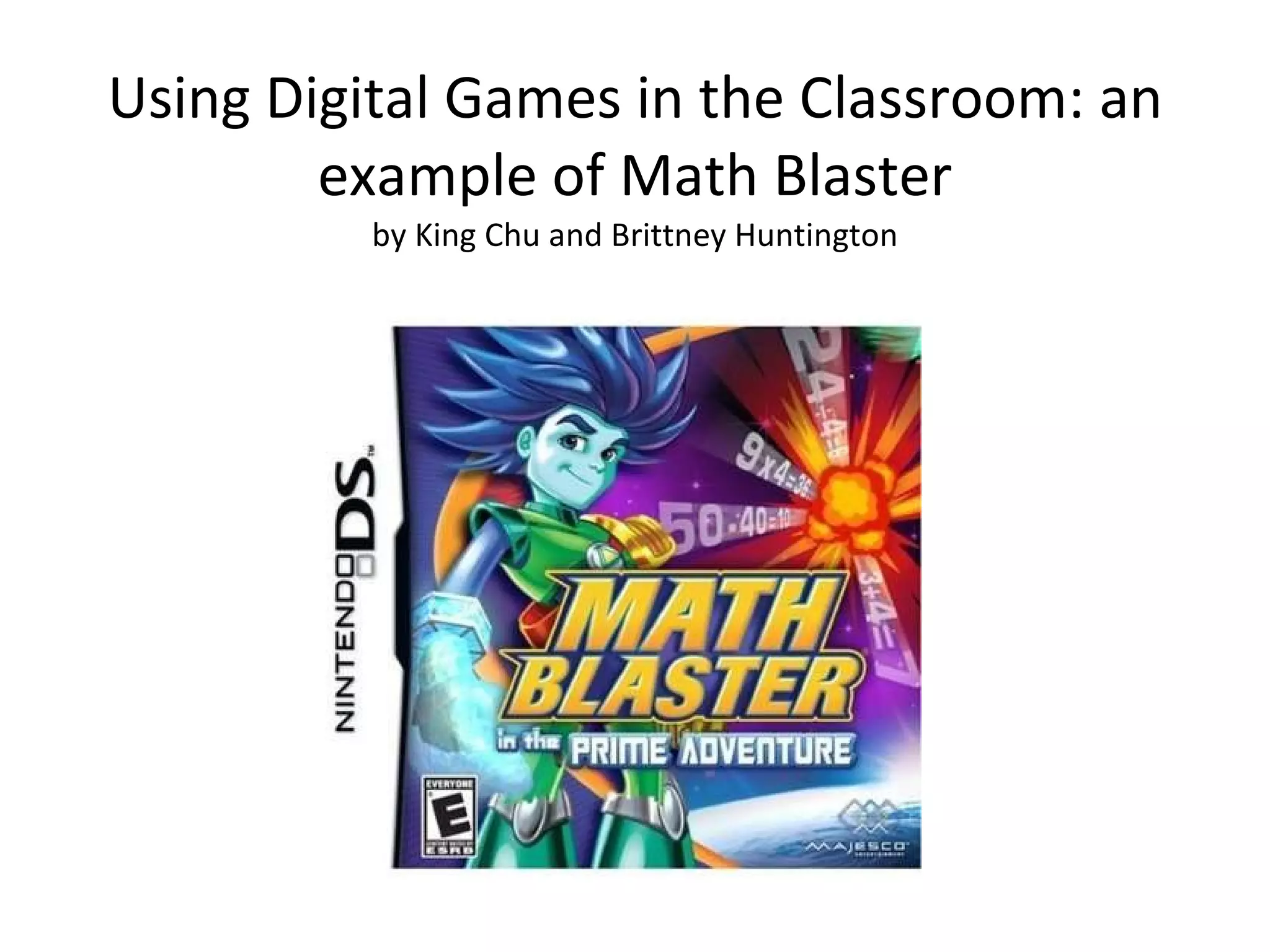
Using Digital Games in the Classroom: an example of Math Blaster by King Chu and Brittney Huntington
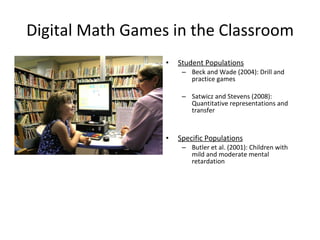
Digital Math Games in the Classroom Student Populations Beck and Wade (2004): Drill and practice games Satwicz and Stevens (2008): Quantitative representations and transfer Specific Populations Butler et al. (2001): Children with mild and moderate mental retardation
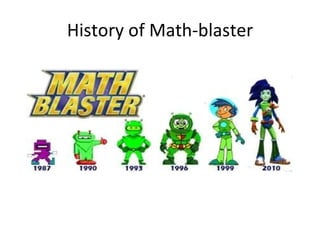
History of Math-blaster
Literature on the use of Math-blaster in classrooms Commercially available Criticized in previous video game research Squire (2006): Math-Blaster an Exogenous game Knowledge: discrete facts Learning: memorizing Instruction: drill and practice BUT:  Satwicz and Stevens (2008) findings on drill and practice training found in Math-blaster.
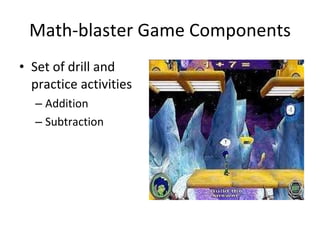
Math-blaster Game Components Set of drill and practice activities Addition Subtraction
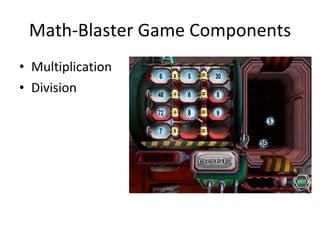
Math-Blaster Game Components Multiplication Division
Math-Blaster Components 1.  Look and Learn :   Mayer’s pre-training and modality principle
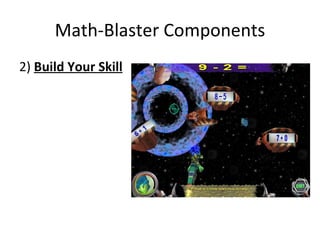
Math-Blaster Components 2)  Build Your Skill
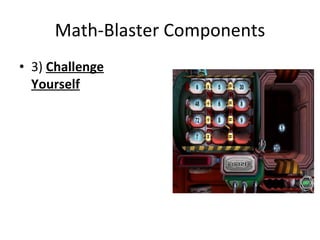
Math-Blaster Components 3)  Challenge Yourself
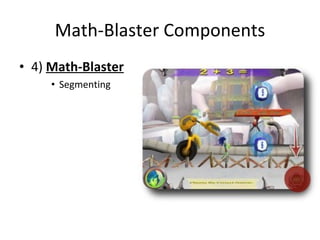
Math-Blaster Components 4)  Math-Blaster Segmenting
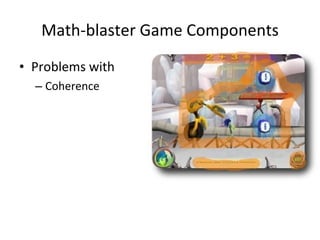
Math-blaster Game Components Problems with Coherence
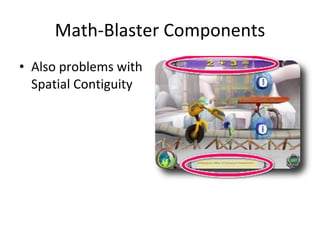
Math-Blaster Components Also problems with Spatial Contiguity
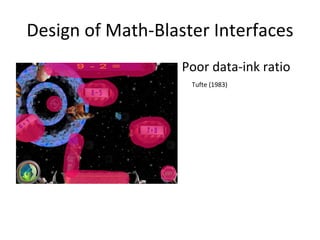
Design of Math-Blaster Interfaces Poor data-ink ratio Tufte (1983)
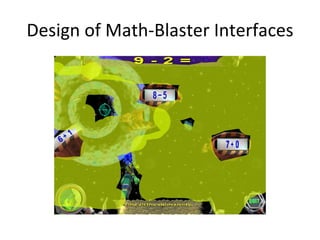
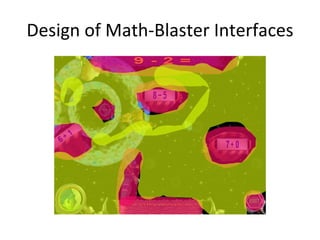
Design of Math-Blaster Interfaces
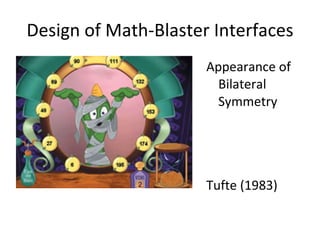
Design of Math-Blaster Interfaces Appearance of Bilateral Symmetry Tufte (1983)
Design of Math-Blaster Interfaces “ Friendly Graphics” Text Color-blindness Elliot and Norris (1998) Tufte (1983)
Math-blaster Design Affordances Controls Individual differences in presence of instructions  Rocket Function
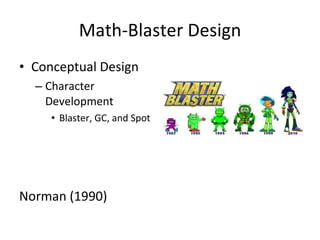
Math-Blaster Design Conceptual Design Character Development  Blaster, GC, and Spot Norman (1990)
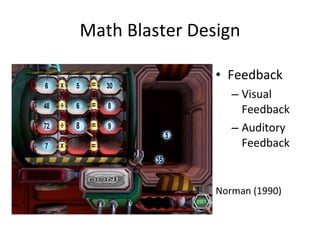
Math Blaster Design Feedback Visual Feedback Auditory Feedback Norman (1990)
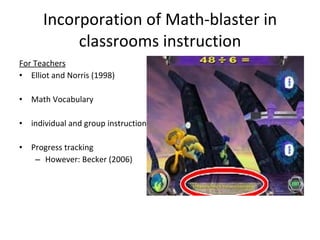
Incorporation of Math-blaster in classrooms instruction For Teachers Elliot and Norris (1998) Math Vocabulary  individual and group instruction Progress tracking However: Becker (2006)
Incorporation of Math-blaster in Classroom Instruction For Students Engaging graphics (Elliot and Norris, 1998) Exposure? Feedback Tracking Progress Socialization
References Becker, K. (2006). Classifying learning objectives in commercial games.  Authors and Canadian Games Study Association .  Butler, F., Miller, S., Lee, K., Pierce, T. (2001). Teaching mathematics to students with mild-to-moderate mental retardation: A review of the literature.  Mental Retardation , 39 (1), 20-31.  Hummel, J. (1985). Math-Blaster courseware review.  Journal of Learning Disabilities, 18,  241-242.  Mayer, R. (2005). The Cambridge Handbook of Multimedia Learning. Cambridge University Press.  New York Times:  http://video.nytimes.com/video/2010/09/15/magazine/1248069030957/games-theory.html.   Retrieved 12/14/2010 by Brittney Huntington
References Norman, D. (1990). The Design of Everyday Things. Doubleday Business.  Satwicz, T., and Stevens, R. (2008). Playing with representations: How do kids make use of quantitative representations in video games?  International Journal of Computers for Mathematical Learning , 13, 179-206.  Squire, K. (2006). From content to context: Videogames as designed experience.  Educational Researcher , 35 (8), 19-29.  Soloway, E., Norris, C. (1998). Using technology to address old problems in new ways.  Communications of the AMC , 41, 11-18.  Tufte, E. R. (1983). The Visual Display of Quantitative Information. Graphics Press.

Digital Games in Classrooms: An Example of Math-Blaster

  • 1.
    Using Digital Gamesin the Classroom: an example of Math Blaster by King Chu and Brittney Huntington
  • 2.
    Digital Math Gamesin the Classroom Student Populations Beck and Wade (2004): Drill and practice games Satwicz and Stevens (2008): Quantitative representations and transfer Specific Populations Butler et al. (2001): Children with mild and moderate mental retardation
  • 3.
  • 4.
    Literature on theuse of Math-blaster in classrooms Commercially available Criticized in previous video game research Squire (2006): Math-Blaster an Exogenous game Knowledge: discrete facts Learning: memorizing Instruction: drill and practice BUT: Satwicz and Stevens (2008) findings on drill and practice training found in Math-blaster.
  • 5.
    Math-blaster Game ComponentsSet of drill and practice activities Addition Subtraction
  • 6.
    Math-Blaster Game ComponentsMultiplication Division
  • 7.
    Math-Blaster Components 1. Look and Learn : Mayer’s pre-training and modality principle
  • 8.
    Math-Blaster Components 2) Build Your Skill
  • 9.
    Math-Blaster Components 3) Challenge Yourself
  • 10.
    Math-Blaster Components 4) Math-Blaster Segmenting
  • 11.
    Math-blaster Game ComponentsProblems with Coherence
  • 12.
    Math-Blaster Components Alsoproblems with Spatial Contiguity
  • 13.
    Design of Math-BlasterInterfaces Poor data-ink ratio Tufte (1983)
  • 14.
  • 15.
  • 16.
    Design of Math-BlasterInterfaces Appearance of Bilateral Symmetry Tufte (1983)
  • 17.
    Design of Math-BlasterInterfaces “ Friendly Graphics” Text Color-blindness Elliot and Norris (1998) Tufte (1983)
  • 18.
    Math-blaster Design AffordancesControls Individual differences in presence of instructions Rocket Function
  • 19.
    Math-Blaster Design ConceptualDesign Character Development Blaster, GC, and Spot Norman (1990)
  • 20.
    Math Blaster DesignFeedback Visual Feedback Auditory Feedback Norman (1990)
  • 21.
    Incorporation of Math-blasterin classrooms instruction For Teachers Elliot and Norris (1998) Math Vocabulary individual and group instruction Progress tracking However: Becker (2006)
  • 22.
    Incorporation of Math-blasterin Classroom Instruction For Students Engaging graphics (Elliot and Norris, 1998) Exposure? Feedback Tracking Progress Socialization
  • 23.
    References Becker, K.(2006). Classifying learning objectives in commercial games. Authors and Canadian Games Study Association . Butler, F., Miller, S., Lee, K., Pierce, T. (2001). Teaching mathematics to students with mild-to-moderate mental retardation: A review of the literature. Mental Retardation , 39 (1), 20-31. Hummel, J. (1985). Math-Blaster courseware review. Journal of Learning Disabilities, 18, 241-242. Mayer, R. (2005). The Cambridge Handbook of Multimedia Learning. Cambridge University Press. New York Times: http://video.nytimes.com/video/2010/09/15/magazine/1248069030957/games-theory.html. Retrieved 12/14/2010 by Brittney Huntington
  • 24.
    References Norman, D.(1990). The Design of Everyday Things. Doubleday Business. Satwicz, T., and Stevens, R. (2008). Playing with representations: How do kids make use of quantitative representations in video games? International Journal of Computers for Mathematical Learning , 13, 179-206. Squire, K. (2006). From content to context: Videogames as designed experience. Educational Researcher , 35 (8), 19-29. Soloway, E., Norris, C. (1998). Using technology to address old problems in new ways. Communications of the AMC , 41, 11-18. Tufte, E. R. (1983). The Visual Display of Quantitative Information. Graphics Press.