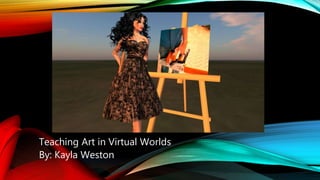
Teaching Art in Virtual Worlds
By: Kayla Weston
Ethnography
• Ethnography is defined as: the scientific
description of the customs of individual
peoples and cultures. Dr. Mary
Stokrocki states that traditional
ethnographers immerse themselves
into cultures in order to understand
ways of living. (Stokrocki, 1997)
Ethnographers then observe and
investigate the group that they have
immersed themselves in and collect
data.
Digital Ethnography
• Digital Ethnography describes the process
and methodology of
doing ethnographic research in a
digital space. The digital field site is
sometimes comprised of text, video or
images, and may contain social relations
and behavior patterns strewn across many
nations, cities or intellectual geographies.
(referenced from
http://cyborganthropology.com/Digital_Eth
nography)
STAGES
1. Data Collection: Data collection is the term used for
all of the information you gathered during your time
using ethnography. For example, in Second Life we
gathered photos and saved them to Flickr with
comments about our experience. Or at the beginning
and end of ARE 494 we did a questionnaire. This allows
us to have information to look back on and helps give
us support for what we learned.
2. Content Analysis: Dr. Mary Stokrocki defines
Content Analysis as: “basically the
categorization (borrowed and/or emerging) and
refinement of collected data into patterns or
themes.” This is when we would look at the
data we collected and try to make connections
and find the deeper meaning between these
connections.
3. Comparative Analysis: This is when you
compare two or more things. Such as data,
groups, processes, etc.
RESEARCH QUESTIONS
• How is Second Life used to teach art?
• How does their art help students learn?
• How has technology enhanced how
they teach?
CONTENT AND PARTICIPANTS
• Place: Hue Are You?
• This world was created by avatar Zinnia
Zauber. She is a teacher at Peninsula College.
She uses Second Life to teach her students
about color and hue. This is why her world is
covered in color from one end to another.
You can see crayon sculptures in every color
throughout her land. There are light
sculptures that float around and also light up
the night. You can observe her lessons as you
wander and read her slides and learn about
color expression. The land is surrounded by
water but also has many buildings. You can
see in the upper right of the picture there are
giant rainbow colored books that are also
used as a lesson to teach about superheroes.
COMMUNITY
• This destination is a place for learning and
teaching in the art world. With educational
dialect almost everywhere you go it attracts
other students and teachers to this place.
There are interactive crayons that let you
know what emotion is connected to that
color, there are walls to read almost
everywhere you go and there are
classrooms as well. I ran into a few students
exploring this realm while I was there. She
really has created a positive and fun
learning environment.
ARTIST
• The artist I chose was Rene Emiko who
is also known as Zinnia Zauber in
Second Life. I found her with help from
Dr. Stokrocki and by seeing one of her
multi-colored sculpture. Her avatar
looks very much like her in real life (as
you can see in the picture to the left.)
She creates and sells clothing in Second
Life so her wardrobe is very bright and
always changing. She uses Second Life
to teach and is a teacher at Peninsula
College in Washington.
DATA COLLECTION
• [19:40] Zinnia Zauber: Because I have online and on campus students that I blend
together, I use Second Life as a place for them to meet and learn.
• [19:40] Zinnia Zauber: So, all of them have a chance to use Second Life.
• [19:40] Zinnia Zauber: My three digital storytelling students do spend a lot more
time inworld because they have a virtual project.
• [19:41] kaydubs: great, thank you. Is teaching what got you involved in second life
or were you aware of it before these classes?
• [19:42] Zinnia Zauber: It is a great classroom setting because we can visit other
sims and build our own work.
• [19:42] Zinnia Zauber: I have been teaching college students since 1997.
• [19:42] Zinnia Zauber: And, because I have always taught art and tech, it was a
perfect fit.
• [19:42] Zinnia Zauber: I had to wait until I had fast enough cable internet though.
• [19:43] kaydubs: haha yes, it does take up quite a bit of battery life as well as need
good internet service!
• [19:44] Zinnia Zauber: lol yes
• [19:44] Zinnia Zauber: and we have discovered how the firewall can mess with the
textures.
• [19:44] kaydubs: But it is nice to see the ways this can be incorporated with
teaching. I would have never thought about Second Life or virtual worlds before
this class
• [19:44] Zinnia Zauber: ah that is good.
• [19:44] Zinnia Zauber: I have found that for my shy students, it helps.
• [19:45] Zinnia Zauber: And, because all of my students can bring their work
inworld, they are happy I give them galleries.
• [19:45] Zinnia Zauber: They feel empowered to have wall space so to speak.
• [20:57] Zinnia Zauber: It is a small collection of some of my work.
• [20:57] Zinnia Zauber: I should bring more in.
• [20:57] kaydubs: it's crazy how much detail goes into this world
• [20:57] Zinnia Zauber: Yes, you can find that everywhere.
• [20:58] Zinnia Zauber: some people focus on rust and muck
• [20:58] Zinnia Zauber: I like to work with pearls and bright colors.
• [20:58] kaydubs: I love the colors!
• [20:58] Zinnia Zauber: Thank you!
• [20:58] imanontherun: awesome
• [20:58] Zinnia Zauber: Some of these pieces are very old.
• [20:58] Zinnia Zauber: like 1996.
• [20:59] Zinnia Zauber: and older
• [20:59] kaydubs: oh really? is that your oldest one?
• [20:59] Zinnia Zauber: hmm
• [20:59] Zinnia Zauber: The one with the match sticks
• [20:59] kaydubs: ahh yes
• [20:59] Zinnia Zauber: I did that in 1992
• [21:00] Zinnia Zauber: It is about eros and psyche
• [21:00] kaydubs: what are these made of in real life?
• [21:00] imanontherun: the luminous silver dance is my favorite and i really like the
puzzle piece backgrounds..
• [21:00] Zinnia Zauber: they are layered pieces that contact some actual objects and
often my hand weaving.
• [21:01] Zinnia Zauber: Thank you, those are part of the phosphene puzzle series.
CONTENT ANALYSIS
• Who is she? Rene Emiko a teacher at
Peninsula college in Washington who has
been teaching college students since 1997.
• What classes does she teach? Multimedia
Web, Digital Storytelling, Video, Social
Media, Color Theory, and virtual world use.
• How does she use Second Life in
teaching? Because she has online and on
campus students that she blends together,
She uses Second Life as a place for them to
meet and learn.
• What kind of art does she create? She
does several things, she creates fiber art
and multimedia sculpture.
CONTENT ANALYSIS
• What is her artwork about? Her art is
about empowering people through color
and identity.
• How long has she been designing
clothes? she has been designing her own
clothes since she was three and been
producing a long standing fiber arts festival
in her town of Sequim.
• How does the art she creates help her
teach? She builds interactive sculptures
that you can click on and learn about color.
Such as the crayons you can click on, that
tell you the emotion/ meaning behind the
color you choose. I clicked on the yellow
crayon and found that: Yellow is cheerful
and amiable.
CONTENT ANALYSIS• How does she create these sculptures and then
incorporate them into her lessons? For example,
she has a lesson on superheroes and her sculptures
were a part of them. She made giant books that
you could walk up and learn as you went up to the
top. She said for this lesson, the pages of the book
happened first. She makes them from presentations
that she made from conferences. Then she built this
as part of the Virtual Worlds Best Practices in
Education. She then says the scale of the books was
important because it helps express the importance
of the story. (You can see the giant books in the
upper right hand corner of the picture.)
• What kind of clothes does she design? She
designs a little bit of everything. She sells clothing,
men and women’s, skirts, shirts, blouses and even
pirate outfits- which she was kind enough to sell
me one and even teach me how to change
clothing.
CONTENT ANALYSIS
• What kind of artwork is in her gallery? A
little bit of everything. As soon as you walk
in you see a couch and her pillows are hand
dyed textures that she created. Then you
look at her collection on the walls and her
artwork is very bright and colorful.
• What is her oldest piece about? Her
oldest piece is one with match sticks. She
did that in 1992 and it is about eros and
psyche. (the matchsticks artwork is is the
second from the left column at the very top
of the photo)
• What are these made out of? They are
layered pieces that contact some actual
objects and often my hand weaving.
COMPARATIVE ANALYSIS &
CONCLUSIONS
• The methods used by this artist include
making clothing both in real life and
Second Life, fibers, designs, building
sculptures for lesson plans, and hand-
weaving.
• Her artwork is very colorful and bright
which gives it a positive meaning and
makes you feel happy and invited. The
use of colors in her world makes you
want to stay and learn. Everything she
had created here creates a positive
learning environment.
COMPARATIVE ANALYSIS &
CONCLUSIONS
• The artists preferences, the artist is
currently a professor at the peninsula
College in Washington. She also
designs and sells digital clothing and
skins in her store in Second Life. She
creates a lot of work through hand-
weaving and creates work with fibers.
She is very into fashion both in real and
Second Life. She enjoys being able to
connect to people internationally
through Second Life.
CONCLUSIONS
• Second Life is a great tool that can be used to
teach in Art Education. By seeing the worlds
that Dr. Stokrocki and Rene have created
dedicated to art education it really allows us
to see the benefits teaching virtually has. You
are able to create interactive sculptures and
you are also able to use real life artwork/data
to teach. By using Second Life you are able to
reach a broader audience. Avatars from all
over the world can see your work as
compared to in real life only select groups
can. It was also nice to see that you can create
a whole world and use your design skills to do
that but also upload your real world art into it
as well. So comparatively Second Life has
more opportunities than real life when
showing art work and teaching art.
CONCLUSIONS
• As Sanchez states in his writing Second life
can be very time consuming and
overwhelming to a beginner group. I found
this to be true throughout the semester.
Since the beginning the class had frustrated
me but working through this and being
taught by Mary and Rene has allowed me
to understand the benefits that using a
virtual world to teach and learn. I can now
see how artists use Second Life to display
and sell their art. Just like Rene did. Not
only does she create an entire world for
learning but she has a gallery for her
artwork and a shop for her clothing. She is
a great example of the multiple ways you
can benefit from using Second Life.
REFERENCES
• Sanchez, J. (2007). Second Life: An Interactive Qualitative Analysis. In C. Crawford et
al. (Eds.), Proceedings of Society for Information Technology and Teacher Education
International Conference (pp. 1240-1243). Chesapeake, VA: AACE.
• Stokrocki, Mary. "Art Education Qualitative Research in Cyberspace ." Miraga, C., &
Smilan, C. (In Press)., n.d. Web.
• https://community.secondlife.com/blogs/entry/192-lea-full-sim-art-series/
• http://uniqueasyou.com/

ARE 494 Digital Ethnography Kayla Weston

  • 1.
    Teaching Art inVirtual Worlds By: Kayla Weston
  • 2.
    Ethnography • Ethnography isdefined as: the scientific description of the customs of individual peoples and cultures. Dr. Mary Stokrocki states that traditional ethnographers immerse themselves into cultures in order to understand ways of living. (Stokrocki, 1997) Ethnographers then observe and investigate the group that they have immersed themselves in and collect data. Digital Ethnography • Digital Ethnography describes the process and methodology of doing ethnographic research in a digital space. The digital field site is sometimes comprised of text, video or images, and may contain social relations and behavior patterns strewn across many nations, cities or intellectual geographies. (referenced from http://cyborganthropology.com/Digital_Eth nography)
  • 3.
    STAGES 1. Data Collection:Data collection is the term used for all of the information you gathered during your time using ethnography. For example, in Second Life we gathered photos and saved them to Flickr with comments about our experience. Or at the beginning and end of ARE 494 we did a questionnaire. This allows us to have information to look back on and helps give us support for what we learned. 2. Content Analysis: Dr. Mary Stokrocki defines Content Analysis as: “basically the categorization (borrowed and/or emerging) and refinement of collected data into patterns or themes.” This is when we would look at the data we collected and try to make connections and find the deeper meaning between these connections. 3. Comparative Analysis: This is when you compare two or more things. Such as data, groups, processes, etc.
  • 4.
    RESEARCH QUESTIONS • Howis Second Life used to teach art? • How does their art help students learn? • How has technology enhanced how they teach?
  • 5.
    CONTENT AND PARTICIPANTS •Place: Hue Are You? • This world was created by avatar Zinnia Zauber. She is a teacher at Peninsula College. She uses Second Life to teach her students about color and hue. This is why her world is covered in color from one end to another. You can see crayon sculptures in every color throughout her land. There are light sculptures that float around and also light up the night. You can observe her lessons as you wander and read her slides and learn about color expression. The land is surrounded by water but also has many buildings. You can see in the upper right of the picture there are giant rainbow colored books that are also used as a lesson to teach about superheroes.
  • 6.
    COMMUNITY • This destinationis a place for learning and teaching in the art world. With educational dialect almost everywhere you go it attracts other students and teachers to this place. There are interactive crayons that let you know what emotion is connected to that color, there are walls to read almost everywhere you go and there are classrooms as well. I ran into a few students exploring this realm while I was there. She really has created a positive and fun learning environment.
  • 7.
    ARTIST • The artistI chose was Rene Emiko who is also known as Zinnia Zauber in Second Life. I found her with help from Dr. Stokrocki and by seeing one of her multi-colored sculpture. Her avatar looks very much like her in real life (as you can see in the picture to the left.) She creates and sells clothing in Second Life so her wardrobe is very bright and always changing. She uses Second Life to teach and is a teacher at Peninsula College in Washington.
  • 8.
    DATA COLLECTION • [19:40]Zinnia Zauber: Because I have online and on campus students that I blend together, I use Second Life as a place for them to meet and learn. • [19:40] Zinnia Zauber: So, all of them have a chance to use Second Life. • [19:40] Zinnia Zauber: My three digital storytelling students do spend a lot more time inworld because they have a virtual project. • [19:41] kaydubs: great, thank you. Is teaching what got you involved in second life or were you aware of it before these classes? • [19:42] Zinnia Zauber: It is a great classroom setting because we can visit other sims and build our own work. • [19:42] Zinnia Zauber: I have been teaching college students since 1997. • [19:42] Zinnia Zauber: And, because I have always taught art and tech, it was a perfect fit. • [19:42] Zinnia Zauber: I had to wait until I had fast enough cable internet though. • [19:43] kaydubs: haha yes, it does take up quite a bit of battery life as well as need good internet service! • [19:44] Zinnia Zauber: lol yes • [19:44] Zinnia Zauber: and we have discovered how the firewall can mess with the textures. • [19:44] kaydubs: But it is nice to see the ways this can be incorporated with teaching. I would have never thought about Second Life or virtual worlds before this class • [19:44] Zinnia Zauber: ah that is good. • [19:44] Zinnia Zauber: I have found that for my shy students, it helps. • [19:45] Zinnia Zauber: And, because all of my students can bring their work inworld, they are happy I give them galleries. • [19:45] Zinnia Zauber: They feel empowered to have wall space so to speak. • [20:57] Zinnia Zauber: It is a small collection of some of my work. • [20:57] Zinnia Zauber: I should bring more in. • [20:57] kaydubs: it's crazy how much detail goes into this world • [20:57] Zinnia Zauber: Yes, you can find that everywhere. • [20:58] Zinnia Zauber: some people focus on rust and muck • [20:58] Zinnia Zauber: I like to work with pearls and bright colors. • [20:58] kaydubs: I love the colors! • [20:58] Zinnia Zauber: Thank you! • [20:58] imanontherun: awesome • [20:58] Zinnia Zauber: Some of these pieces are very old. • [20:58] Zinnia Zauber: like 1996. • [20:59] Zinnia Zauber: and older • [20:59] kaydubs: oh really? is that your oldest one? • [20:59] Zinnia Zauber: hmm • [20:59] Zinnia Zauber: The one with the match sticks • [20:59] kaydubs: ahh yes • [20:59] Zinnia Zauber: I did that in 1992 • [21:00] Zinnia Zauber: It is about eros and psyche • [21:00] kaydubs: what are these made of in real life? • [21:00] imanontherun: the luminous silver dance is my favorite and i really like the puzzle piece backgrounds.. • [21:00] Zinnia Zauber: they are layered pieces that contact some actual objects and often my hand weaving. • [21:01] Zinnia Zauber: Thank you, those are part of the phosphene puzzle series.
  • 9.
    CONTENT ANALYSIS • Whois she? Rene Emiko a teacher at Peninsula college in Washington who has been teaching college students since 1997. • What classes does she teach? Multimedia Web, Digital Storytelling, Video, Social Media, Color Theory, and virtual world use. • How does she use Second Life in teaching? Because she has online and on campus students that she blends together, She uses Second Life as a place for them to meet and learn. • What kind of art does she create? She does several things, she creates fiber art and multimedia sculpture.
  • 10.
    CONTENT ANALYSIS • Whatis her artwork about? Her art is about empowering people through color and identity. • How long has she been designing clothes? she has been designing her own clothes since she was three and been producing a long standing fiber arts festival in her town of Sequim. • How does the art she creates help her teach? She builds interactive sculptures that you can click on and learn about color. Such as the crayons you can click on, that tell you the emotion/ meaning behind the color you choose. I clicked on the yellow crayon and found that: Yellow is cheerful and amiable.
  • 11.
    CONTENT ANALYSIS• Howdoes she create these sculptures and then incorporate them into her lessons? For example, she has a lesson on superheroes and her sculptures were a part of them. She made giant books that you could walk up and learn as you went up to the top. She said for this lesson, the pages of the book happened first. She makes them from presentations that she made from conferences. Then she built this as part of the Virtual Worlds Best Practices in Education. She then says the scale of the books was important because it helps express the importance of the story. (You can see the giant books in the upper right hand corner of the picture.) • What kind of clothes does she design? She designs a little bit of everything. She sells clothing, men and women’s, skirts, shirts, blouses and even pirate outfits- which she was kind enough to sell me one and even teach me how to change clothing.
  • 12.
    CONTENT ANALYSIS • Whatkind of artwork is in her gallery? A little bit of everything. As soon as you walk in you see a couch and her pillows are hand dyed textures that she created. Then you look at her collection on the walls and her artwork is very bright and colorful. • What is her oldest piece about? Her oldest piece is one with match sticks. She did that in 1992 and it is about eros and psyche. (the matchsticks artwork is is the second from the left column at the very top of the photo) • What are these made out of? They are layered pieces that contact some actual objects and often my hand weaving.
  • 13.
    COMPARATIVE ANALYSIS & CONCLUSIONS •The methods used by this artist include making clothing both in real life and Second Life, fibers, designs, building sculptures for lesson plans, and hand- weaving. • Her artwork is very colorful and bright which gives it a positive meaning and makes you feel happy and invited. The use of colors in her world makes you want to stay and learn. Everything she had created here creates a positive learning environment.
  • 14.
    COMPARATIVE ANALYSIS & CONCLUSIONS •The artists preferences, the artist is currently a professor at the peninsula College in Washington. She also designs and sells digital clothing and skins in her store in Second Life. She creates a lot of work through hand- weaving and creates work with fibers. She is very into fashion both in real and Second Life. She enjoys being able to connect to people internationally through Second Life.
  • 15.
    CONCLUSIONS • Second Lifeis a great tool that can be used to teach in Art Education. By seeing the worlds that Dr. Stokrocki and Rene have created dedicated to art education it really allows us to see the benefits teaching virtually has. You are able to create interactive sculptures and you are also able to use real life artwork/data to teach. By using Second Life you are able to reach a broader audience. Avatars from all over the world can see your work as compared to in real life only select groups can. It was also nice to see that you can create a whole world and use your design skills to do that but also upload your real world art into it as well. So comparatively Second Life has more opportunities than real life when showing art work and teaching art.
  • 16.
    CONCLUSIONS • As Sanchezstates in his writing Second life can be very time consuming and overwhelming to a beginner group. I found this to be true throughout the semester. Since the beginning the class had frustrated me but working through this and being taught by Mary and Rene has allowed me to understand the benefits that using a virtual world to teach and learn. I can now see how artists use Second Life to display and sell their art. Just like Rene did. Not only does she create an entire world for learning but she has a gallery for her artwork and a shop for her clothing. She is a great example of the multiple ways you can benefit from using Second Life.
  • 17.
    REFERENCES • Sanchez, J.(2007). Second Life: An Interactive Qualitative Analysis. In C. Crawford et al. (Eds.), Proceedings of Society for Information Technology and Teacher Education International Conference (pp. 1240-1243). Chesapeake, VA: AACE. • Stokrocki, Mary. "Art Education Qualitative Research in Cyberspace ." Miraga, C., & Smilan, C. (In Press)., n.d. Web. • https://community.secondlife.com/blogs/entry/192-lea-full-sim-art-series/ • http://uniqueasyou.com/