1
Copyright 2013, Newhouse School at Syracuse University
Chair of Journalism
                Innovation
     My job description:
           “To chart, not fear, the future.”

       Teach students to think entrepreneurially, whether
        or not they want to launch or join a startup.
       Teach the business model, both the past (successes
        and failures) and future opportunities.
       Train “intrapreneurs” to be agile and nimble within
        rapidly changing legacy industries.


2
,o
                                   hot
                                     ,p
                             ign dia
                   er


                                                            ion
          st


                                              ne
                          des ltime
                 pap


                                                                       io
           a


                                                                                 Film
                                                i
        adc


                                                               s
                                             gaz


                                                                     Rad
                                                            evi
                 ws


                           Mu
      Bro


                                           Ma


                                                        Tel
               Ne


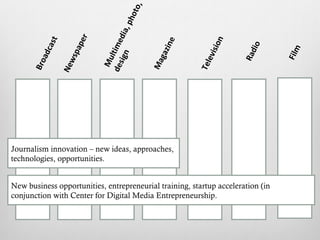
Journalism innovation – new ideas, approaches,
technologies, opportunities.


New business opportunities, entrepreneurial training, startup acceleration (in
conjunction with Center for Digital Media Entrepreneurship.
My Background
   Denver Post: Reporter.
   Washingtonpost.com: Launch team (1994-97).
   AOL.com: Principal product mgr, community products.
   Consultant: Rocky Mt News (YourHub), Denver Post.
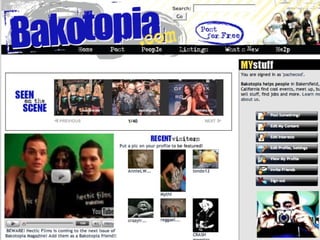
   Bakersfield Californian: Social media
    in 2004 (pre-Facebook).
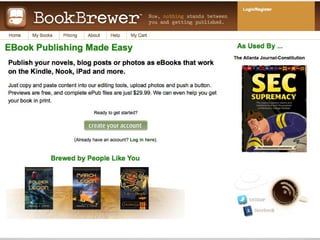
   Startups: Printcasting, BookBrewer.
The new normal
True or false?
  The launch of the consumer
Internet in 1994 is what caused
   the newspaper industry’s
            decline.
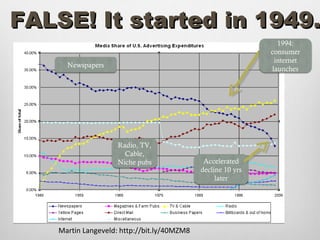
FALSE! It started in 1949.
                                                                1994:
                                                              consumer
                                                               internet
      Newspapers
                                                              launches


                     Radio, TV,
                       Cable,
                     Niche pubs               Accelerated
                                             decline 10 yrs
                                                  later


    Martin Langeveld: http://bit.ly/40MZM8
A tale of two cities.
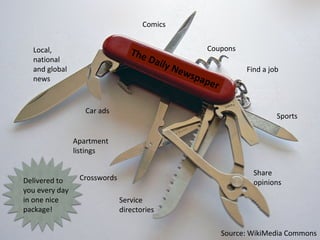
Comics


  Local,                         The                       Coupons
  national                           D   a ily
  and global                                     N ew                  Find a job
                                                     spa
  news                                                     per

                   Car ads
                                                                                Sports


                Apartment
                listings

                                                                         Share
Delivered to     Crosswords
                                                                         opinions
you every day
in one nice                   Service
package!                      directories

                                                                 Source: WikiMedia Commons
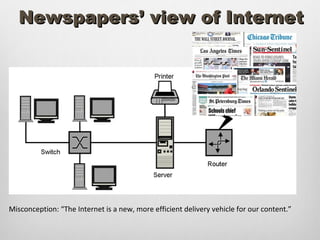
Newspapers’ view of Internet


Misconception: “The Internet is a new, more efficient delivery vehicle for our content.”
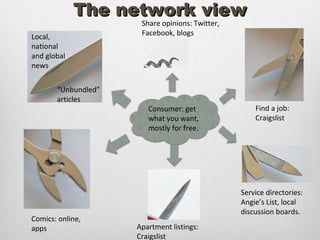
The network view
                      Share opinions: Twitter,
Local,                Facebook, blogs
national
and global
news


       “Unbundled”
       articles
                        Consumer: get                Find a job:
                        what you want,               Craigslist
                        mostly for free.


                                                 Service directories:
                                                 Angie’s List, local
                                                 discussion boards.
Comics: online,
apps                 Apartment listings:
                     Craigslist
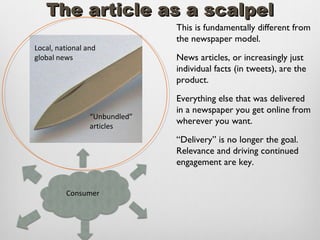
The article as a scalpel
                               This is fundamentally different from
                               the newspaper model.
Local, national and
global news                    News articles, or increasingly just
                               individual facts (in tweets), are the
                               product.

                               Everything else that was delivered
                               in a newspaper you get online from
                 “Unbundled”
                               wherever you want.
                 articles
                               “Delivery” is no longer the goal.
                               Relevance and driving continued
                               engagement are key.


         Consumer
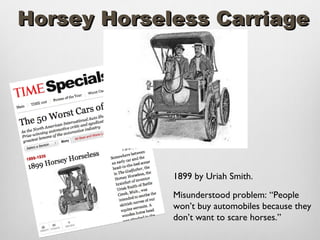
Horsey Horseless Carriage


             1899 by Uriah Smith.

             Misunderstood problem: “People
             won’t buy automobiles because they
             don’t want to scare horses.”
Horsey Horseless Carriage
                1899 by Uriah Smith.

                Misunderstood problem:
                “People won’t buy
                automobiles because they
                don’t want to scare
                horses.”
What drives change?

   It’s not just about one media form (digital) replacing
    another (analog).
   It’s about consumers evolving, aided by technology.
   Fundamental forces have always eroded away at
    incumbents’ advantage while encouraging more nimble
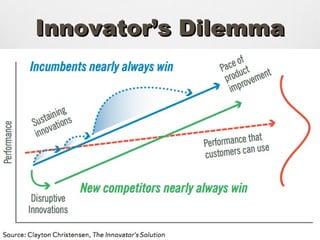
    competition. Digital just speeds that up.
Innovator’s Dilemma
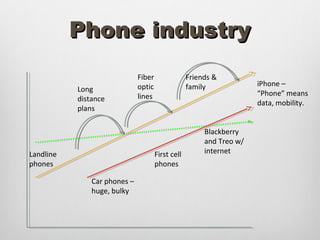
Phone industry
                              Fiber                Friends &
                              optic                family             iPhone –
           Long
                              lines                                   “Phone” means
           distance
                                                                      data, mobility.
           plans

                                                        Blackberry
                                                        and Treo w/
Landline                              First cell        internet
phones                                phones

               Car phones –
               huge, bulky
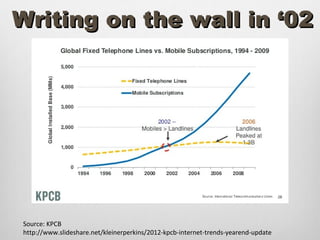
Writing on the wall in ‘02


Source: KPCB
http://www.slideshare.net/kleinerperkins/2012-kpcb-internet-trends-yearend-update
Everything, and I mean
everything, is changing. And
the change is only happening
more quickly!
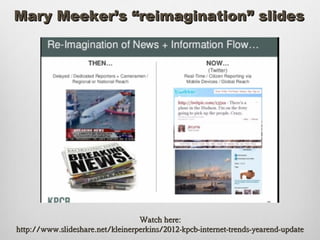
Mary Meeker’s “reimagination” slides


                                  Watch here:
http://www.slideshare.net/kleinerperkins/2012-kpcb-internet-trends-yearend-update
So how do you prepare
yourself for a career in a
world of constant change?
Get basic digital skills
These skills are all important, but to get or keep a
job, you’re expected to have them. (If you don’t, start
learning now!)
•Basic web publishing, including HTML.
•Basic mobile sites & informational apps.
•Multimedia storytelling.
•Using social media for audience engagement.
•Basic business understanding, and entrepreneurial
thinking.
Think like an entrepreneur
 Important whether or not you’re in business yourself.
 Get comfortable with “The B Word.” Business means:
   Making money, but also …
   Sustaining operations for your dream.
   Paying for great journalism and civic information
    that will improve the world.
   Controlling your own destiny.
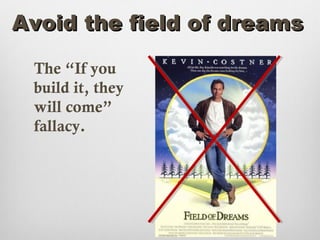
Avoid the field of dreams

 The “If you
 build it, they
 will come”
 fallacy.
Just a few
     questions
      Who are “they?”
      Do they want it?
How will they know it exists?
How will you convince them to
           come?
Start with a problem
 What’s the pain, and what’s your
  painkiller?
 What’s broken for someone, and how
  do you fix it?
 What personally drives you crazy, and
  how do you solve your own problem?
Talk to real people
 Don’t assume you just know their
  interests, concerns, desires, etc. Ask!
 Share your idea, request frank feedback.
 Listen carefully.
Once you have a target …
  Get some real data to determine how large
   the target market is.
  Government data
    Census.gov, data.gov,
     opendata.socrata.com
  Wikipedia (but check primary sources)
  Analyst reports
    Forrester, Gartner, Nielsen
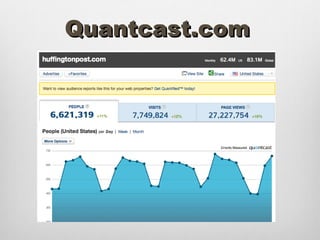
Quantcast.com
Keywordspy
Shows which keywords your competitors buy.
Cheap online tests
 Set up a “coming soon” page with a video
  demo and beta signup form.
 Create a one-page site around an idea.
  Pay for one Google ad w/ specific
  keywords to see if there’s interest.
 Make a prototype using free tools
  (Cacoo.com), post online, tweet it and ask
  for feedback.
Types of biz models

 Subscription model – not realistic for most
  topics. Currently the fad in newspaper
  companies, but out of whack with how
  people use the Internet.

 “Freemium” model. Most free, but the best
  requires small payment or subscription.
Revenue sources

 Advertising – Put Google Adsense ads on your
  site (why not?) but don’t expect huge payments
  without millions of pageviews.
 Syndication – other, more established sites pay
  you for your content.
Revenue sources

 Premium reports – If you’re an expert in
  something, create a report and sell it for $300
  to businesses.
 Events – Once you have an audience, create a
  conference and invite experts to speak. Sell
  tickets to your audience.
Revenue sources

 Services – Freelance the skills you use daily for
  your business (writing, editing, page design,
  social media marketing, etc.)
 Solicit donations – Tip jar. Put a PayPal button
  on your site encouraging people to contribute if
  they like what you’re doing.
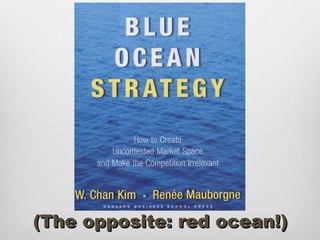
(The opposite: red ocean!)
e.g. Cirque du Soleil

Cirque “… did not win by taking customers
from the already shrinking circus industry
… it created uncontested new market space
that made the competition irrelevant.”


                   - Blue Ocean, Chapter 1
How to find blue ocean?
Live on the digital edge. What I’m currently watching:

1.Live content curation.

2.Interactive data visualization.

3.Made-for-mobile content (phone, tablet).

4.Immersive experiences.

5.Robots (both physical and software) and automation.
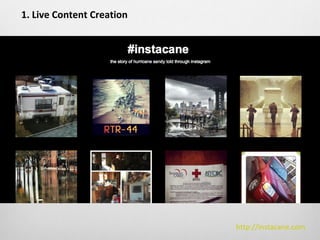
1. Live Content Creation


                           http://instacane.com
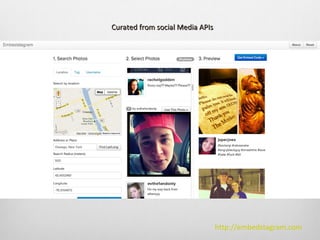
Curated from social Media APIs


                                 http://embedstagram.com
2. Data visualization
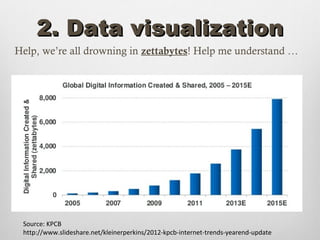
Help, we’re all drowning in zettabytes! Help me understand …


 Source: KPCB
 http://www.slideshare.net/kleinerperkins/2012-kpcb-internet-trends-yearend-update
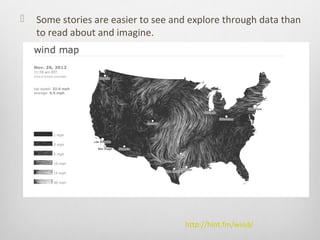
   Some stories are easier to see and explore through data than
    to read about and imagine.


                                     http://hint.fm/wind/
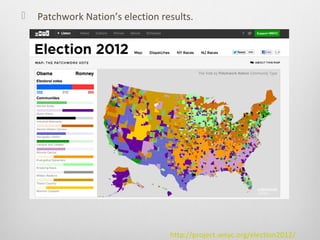
   Patchwork Nation’s election results.


                                  http://project.wnyc.org/election2012/
3. Mobile
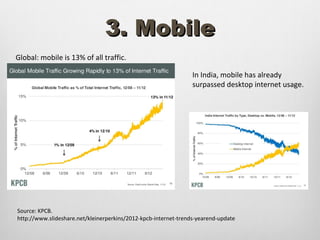
Global: mobile is 13% of all traffic.

                                                                 In India, mobile has already
                                                                 surpassed desktop internet usage.


Source: KPCB.
http://www.slideshare.net/kleinerperkins/2012-kpcb-internet-trends-yearend-update
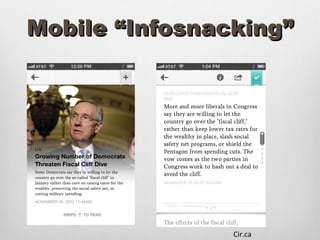
Mobile “Infosnacking”


                Cir.ca
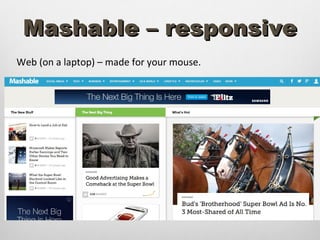
Mashable – responsive
Web (on a laptop) – made for your mouse.
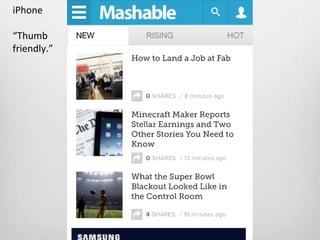
iPhone

“Thumb
friendly.”
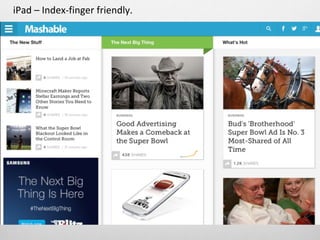
iPad – Index-finger friendly.
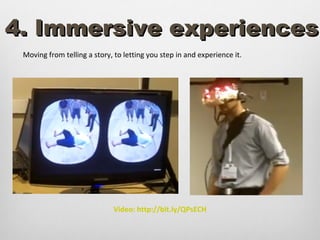
4. Immersive experiences
 Moving from telling a story, to letting you step in and experience it.


                             Video: http://bit.ly/QPsECH
Until now …
1. Get personal computer.

2. Connect to internet.

3. Computer  pocket (smartphone).
      Rise of the tablet.


   Transition is over, right?
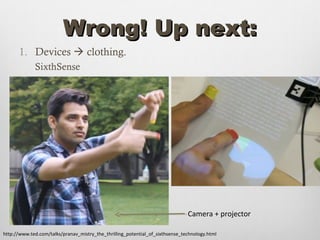
Wrong! Up next:
      1. Devices  clothing.
             SixthSense


                                                                               Camera + projector

http://www.ted.com/talks/pranav_mistry_the_thrilling_potential_of_sixthsense_technology.html
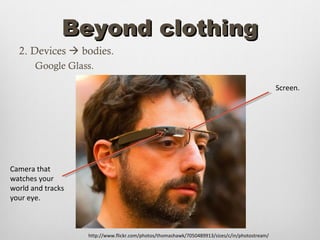
Beyond clothing
  2. Devices  bodies.
       Google Glass.

                                                                                                Screen.


Camera that
watches your
world and tracks
your eye.


                   http://www.flickr.com/photos/thomashawk/7050489913/sizes/c/in/photostream/
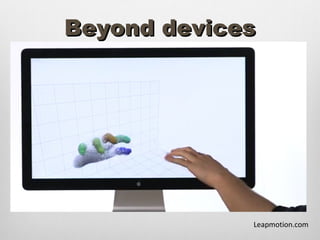
Beyond devices


             Leapmotion.com
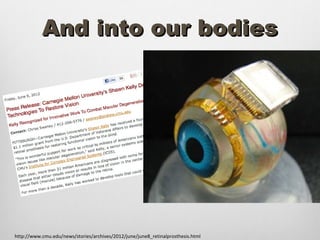
And into our bodies


http://www.cmu.edu/news/stories/archives/2012/june/june8_retinalprosthesis.html
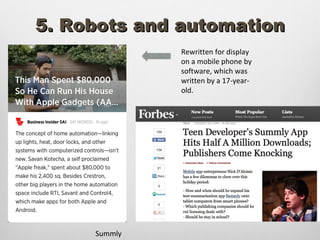
5. Robots and automation
              Rewritten for display
              on a mobile phone by
              software, which was
              written by a 17-year-
              old.


     Summly
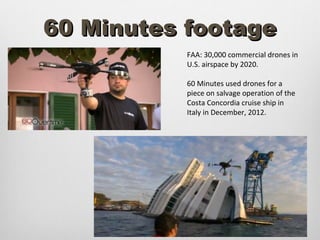
Get ready for flying cameras


    FAA Modernization and Reform Act of 2012 – “The Drone law”
     – makes it legal to fly in federal air space for commercial
     reasons by Sept. 30, 2015.
    FAA projects that 30,000 drones could be in the nation’s skies
     by 2020.
    FAA working on rules and licensing procedures.
60 Minutes footage
           FAA: 30,000 commercial drones in
           U.S. airspace by 2020.

           60 Minutes used drones for a
           piece on salvage operation of the
           Costa Concordia cruise ship in
           Italy in December, 2012.
What are your
predictions for
  the future?
Dan Pacheco
Chair of Journalism and
       Innovation
   S.I. Newhouse School
   Syracuse University


       @pachecod
     @journovationSU
    drpachec@syr.edu

Digital Edge Journalism

  • 1.
    1 Copyright 2013, NewhouseSchool at Syracuse University
  • 2.
    Chair of Journalism Innovation  My job description:  “To chart, not fear, the future.”  Teach students to think entrepreneurially, whether or not they want to launch or join a startup.  Teach the business model, both the past (successes and failures) and future opportunities.  Train “intrapreneurs” to be agile and nimble within rapidly changing legacy industries. 2
  • 3.
    ,o hot ,p ign dia er ion st ne des ltime pap io a Film i adc s gaz Rad evi ws Mu Bro Ma Tel Ne Journalism innovation – new ideas, approaches, technologies, opportunities. New business opportunities, entrepreneurial training, startup acceleration (in conjunction with Center for Digital Media Entrepreneurship.
  • 4.
    My Background  Denver Post: Reporter.  Washingtonpost.com: Launch team (1994-97).  AOL.com: Principal product mgr, community products.  Consultant: Rocky Mt News (YourHub), Denver Post.  Bakersfield Californian: Social media in 2004 (pre-Facebook).  Startups: Printcasting, BookBrewer.
  • 7.
  • 8.
    True or false? The launch of the consumer Internet in 1994 is what caused the newspaper industry’s decline.
  • 9.
    FALSE! It startedin 1949. 1994: consumer internet Newspapers launches Radio, TV, Cable, Niche pubs Accelerated decline 10 yrs later Martin Langeveld: http://bit.ly/40MZM8
  • 10.
    A tale oftwo cities.
  • 11.
    Comics Local, The Coupons national D a ily and global N ew Find a job spa news per Car ads Sports Apartment listings Share Delivered to Crosswords opinions you every day in one nice Service package! directories Source: WikiMedia Commons
  • 12.
    Newspapers’ view ofInternet Misconception: “The Internet is a new, more efficient delivery vehicle for our content.”
  • 14.
    The network view Share opinions: Twitter, Local, Facebook, blogs national and global news “Unbundled” articles Consumer: get Find a job: what you want, Craigslist mostly for free. Service directories: Angie’s List, local discussion boards. Comics: online, apps Apartment listings: Craigslist
  • 15.
    The article asa scalpel This is fundamentally different from the newspaper model. Local, national and global news News articles, or increasingly just individual facts (in tweets), are the product. Everything else that was delivered in a newspaper you get online from “Unbundled” wherever you want. articles “Delivery” is no longer the goal. Relevance and driving continued engagement are key. Consumer
  • 16.
    Horsey Horseless Carriage 1899 by Uriah Smith. Misunderstood problem: “People won’t buy automobiles because they don’t want to scare horses.”
  • 17.
    Horsey Horseless Carriage 1899 by Uriah Smith. Misunderstood problem: “People won’t buy automobiles because they don’t want to scare horses.”
  • 18.
    What drives change?  It’s not just about one media form (digital) replacing another (analog).  It’s about consumers evolving, aided by technology.  Fundamental forces have always eroded away at incumbents’ advantage while encouraging more nimble competition. Digital just speeds that up.
  • 19.
  • 20.
    Phone industry Fiber Friends & optic family iPhone – Long lines “Phone” means distance data, mobility. plans Blackberry and Treo w/ Landline First cell internet phones phones Car phones – huge, bulky
  • 21.
    Writing on thewall in ‘02 Source: KPCB http://www.slideshare.net/kleinerperkins/2012-kpcb-internet-trends-yearend-update
  • 22.
    Everything, and Imean everything, is changing. And the change is only happening more quickly!
  • 23.
    Mary Meeker’s “reimagination”slides Watch here: http://www.slideshare.net/kleinerperkins/2012-kpcb-internet-trends-yearend-update
  • 24.
    So how doyou prepare yourself for a career in a world of constant change?
  • 25.
    Get basic digitalskills These skills are all important, but to get or keep a job, you’re expected to have them. (If you don’t, start learning now!) •Basic web publishing, including HTML. •Basic mobile sites & informational apps. •Multimedia storytelling. •Using social media for audience engagement. •Basic business understanding, and entrepreneurial thinking.
  • 26.
    Think like anentrepreneur  Important whether or not you’re in business yourself.  Get comfortable with “The B Word.” Business means:  Making money, but also …  Sustaining operations for your dream.  Paying for great journalism and civic information that will improve the world.  Controlling your own destiny.
  • 27.
    Avoid the fieldof dreams The “If you build it, they will come” fallacy.
  • 28.
    Just a few questions Who are “they?” Do they want it? How will they know it exists? How will you convince them to come?
  • 29.
    Start with aproblem  What’s the pain, and what’s your painkiller?  What’s broken for someone, and how do you fix it?  What personally drives you crazy, and how do you solve your own problem?
  • 30.
    Talk to realpeople  Don’t assume you just know their interests, concerns, desires, etc. Ask!  Share your idea, request frank feedback.  Listen carefully.
  • 31.
    Once you havea target …  Get some real data to determine how large the target market is.  Government data  Census.gov, data.gov, opendata.socrata.com  Wikipedia (but check primary sources)  Analyst reports  Forrester, Gartner, Nielsen
  • 32.
  • 33.
    Keywordspy Shows which keywordsyour competitors buy.
  • 34.
    Cheap online tests Set up a “coming soon” page with a video demo and beta signup form.  Create a one-page site around an idea. Pay for one Google ad w/ specific keywords to see if there’s interest.  Make a prototype using free tools (Cacoo.com), post online, tweet it and ask for feedback.
  • 35.
    Types of bizmodels  Subscription model – not realistic for most topics. Currently the fad in newspaper companies, but out of whack with how people use the Internet.  “Freemium” model. Most free, but the best requires small payment or subscription.
  • 36.
    Revenue sources  Advertising– Put Google Adsense ads on your site (why not?) but don’t expect huge payments without millions of pageviews.  Syndication – other, more established sites pay you for your content.
  • 37.
    Revenue sources  Premiumreports – If you’re an expert in something, create a report and sell it for $300 to businesses.  Events – Once you have an audience, create a conference and invite experts to speak. Sell tickets to your audience.
  • 38.
    Revenue sources  Services– Freelance the skills you use daily for your business (writing, editing, page design, social media marketing, etc.)  Solicit donations – Tip jar. Put a PayPal button on your site encouraging people to contribute if they like what you’re doing.
  • 39.
  • 40.
    e.g. Cirque duSoleil Cirque “… did not win by taking customers from the already shrinking circus industry … it created uncontested new market space that made the competition irrelevant.” - Blue Ocean, Chapter 1
  • 41.
    How to findblue ocean? Live on the digital edge. What I’m currently watching: 1.Live content curation. 2.Interactive data visualization. 3.Made-for-mobile content (phone, tablet). 4.Immersive experiences. 5.Robots (both physical and software) and automation.
  • 42.
    1. Live ContentCreation http://instacane.com
  • 43.
    Curated from socialMedia APIs http://embedstagram.com
  • 44.
    2. Data visualization Help,we’re all drowning in zettabytes! Help me understand … Source: KPCB http://www.slideshare.net/kleinerperkins/2012-kpcb-internet-trends-yearend-update
  • 45.
    Some stories are easier to see and explore through data than to read about and imagine. http://hint.fm/wind/
  • 46.
    Patchwork Nation’s election results. http://project.wnyc.org/election2012/
  • 47.
    3. Mobile Global: mobileis 13% of all traffic. In India, mobile has already surpassed desktop internet usage. Source: KPCB. http://www.slideshare.net/kleinerperkins/2012-kpcb-internet-trends-yearend-update
  • 48.
  • 49.
    Mashable – responsive Web(on a laptop) – made for your mouse.
  • 50.
  • 51.
  • 52.
    4. Immersive experiences Moving from telling a story, to letting you step in and experience it. Video: http://bit.ly/QPsECH
  • 53.
    Until now … 1.Get personal computer. 2. Connect to internet. 3. Computer  pocket (smartphone). Rise of the tablet. Transition is over, right?
  • 54.
    Wrong! Up next: 1. Devices  clothing. SixthSense Camera + projector http://www.ted.com/talks/pranav_mistry_the_thrilling_potential_of_sixthsense_technology.html
  • 55.
    Beyond clothing 2. Devices  bodies. Google Glass. Screen. Camera that watches your world and tracks your eye. http://www.flickr.com/photos/thomashawk/7050489913/sizes/c/in/photostream/
  • 56.
    Beyond devices Leapmotion.com
  • 57.
    And into ourbodies http://www.cmu.edu/news/stories/archives/2012/june/june8_retinalprosthesis.html
  • 58.
    5. Robots andautomation Rewritten for display on a mobile phone by software, which was written by a 17-year- old. Summly
  • 59.
    Get ready forflying cameras  FAA Modernization and Reform Act of 2012 – “The Drone law” – makes it legal to fly in federal air space for commercial reasons by Sept. 30, 2015.  FAA projects that 30,000 drones could be in the nation’s skies by 2020.  FAA working on rules and licensing procedures.
  • 60.
    60 Minutes footage FAA: 30,000 commercial drones in U.S. airspace by 2020. 60 Minutes used drones for a piece on salvage operation of the Costa Concordia cruise ship in Italy in December, 2012.
  • 61.
  • 62.
    Dan Pacheco Chair ofJournalism and Innovation S.I. Newhouse School Syracuse University @pachecod @journovationSU drpachec@syr.edu