M. Junaid Mughal 2006
Wireless Communications
Principles and Practice
2nd Edition
T.S. Rappaport
Chapter 4: Mobile Radio
Propagation: Large-Scale Path Loss
UMAIR HASHMI Spring 2011
M. Junaid Mughal 2006
Reflection from Conductors
A perfect conductor reflects back all the incident wave back.
Ei = Er
Өi = Өr ( E in plane of incidence)
Ei = - Er
Өi = Өr ( E normal to plane of incidence)
UMAIR HASHMI Spring 2011
M. Junaid Mughal 2006
Ground Reflection (Two-Ray) Model
UMAIR HASHMI Spring 2011
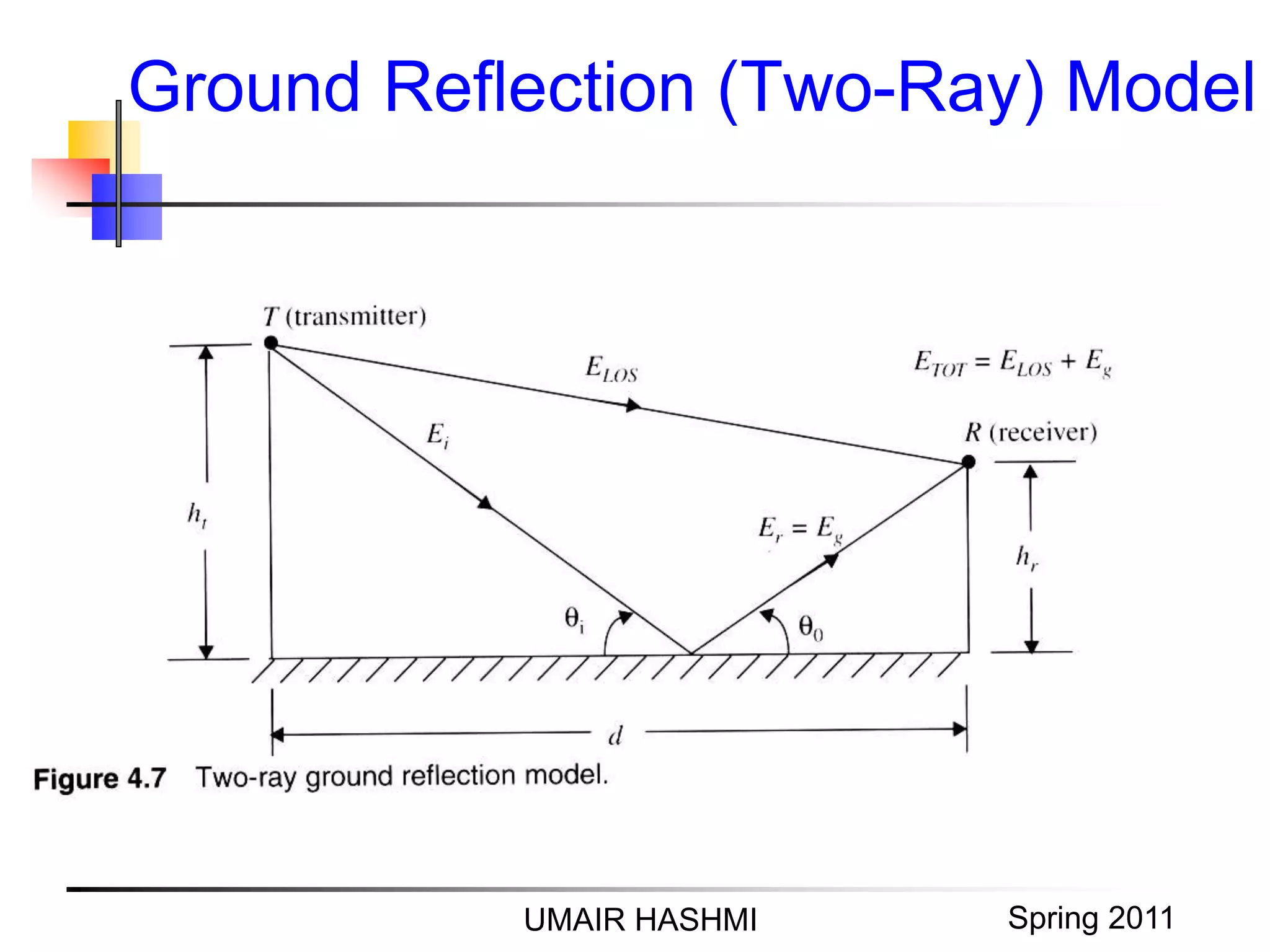
• Propagation Model that considers both the direct (LOS) path
and a ground reflected path between transmitter and the
receiver.
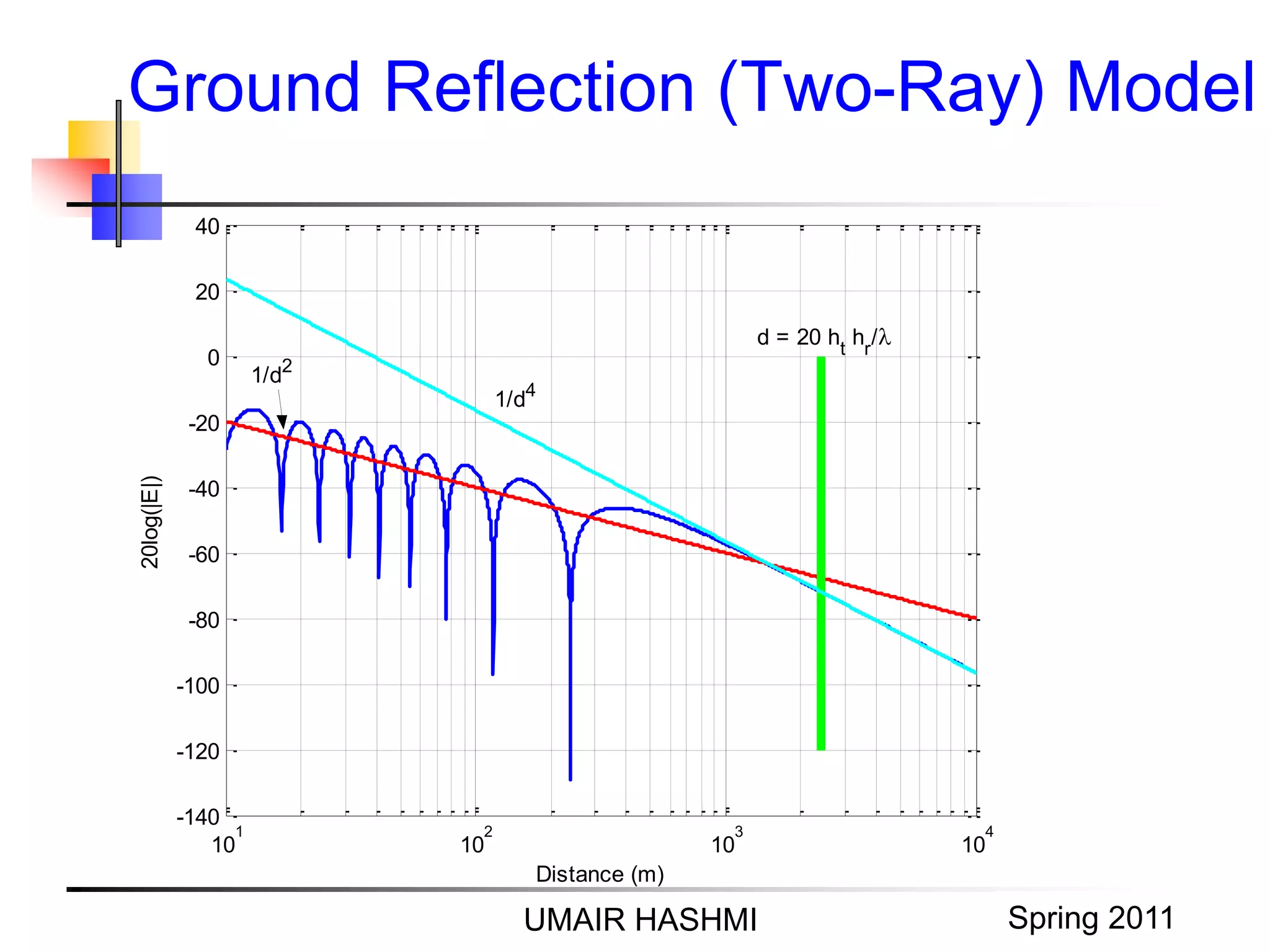
• Reasonably accurate model for predicting large scale signal
strength over distance of several kilometres.
• The E-field due to Line-Of-Sight is given by ELOS
• The E-field for the ground reflected wave is given by Eg
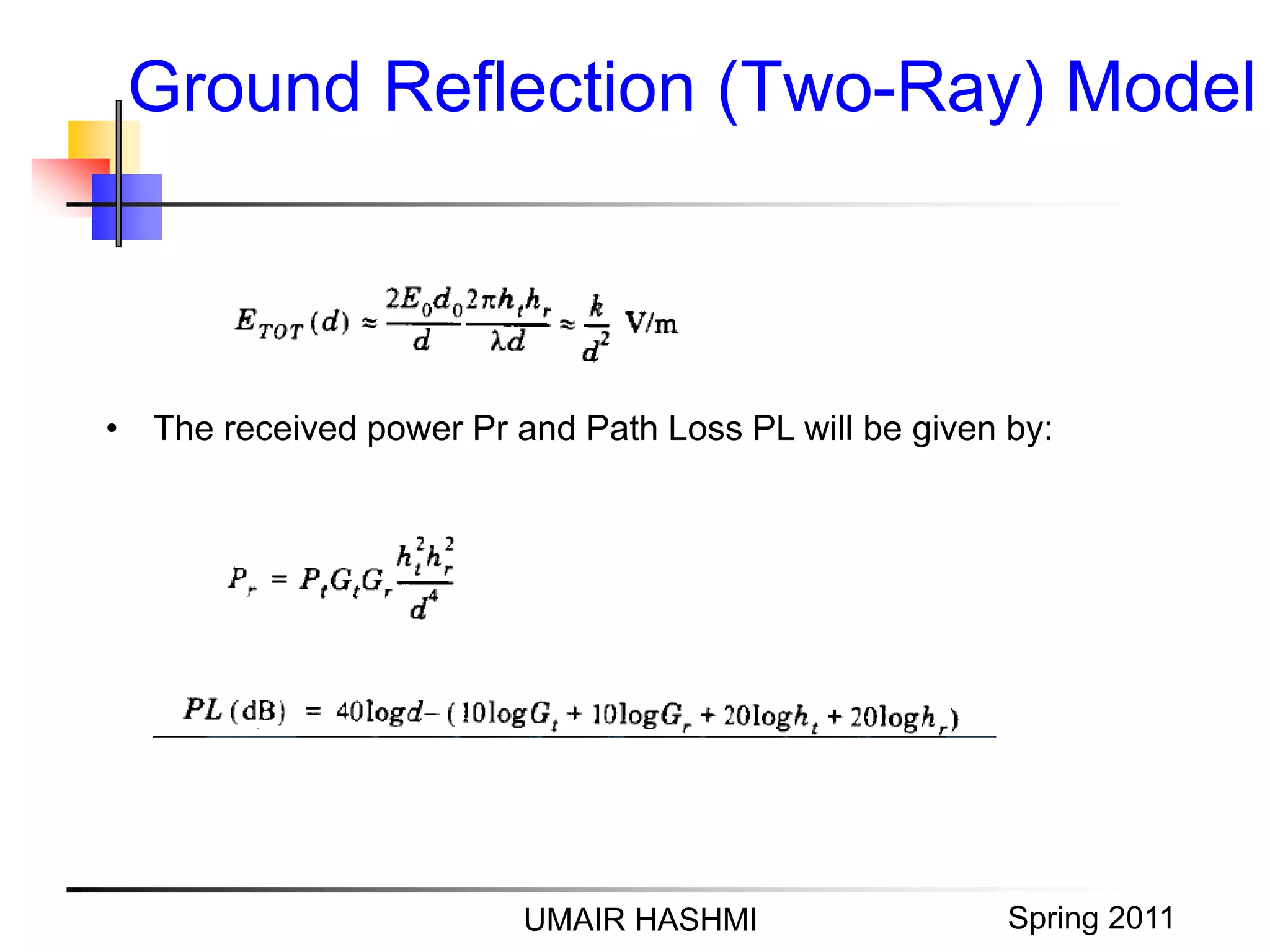
• The Total E-field is a sum of LOS and Reflected components,
M. Junaid Mughal 2006
Ground Reflection (Two-Ray) Model
UMAIR HASHMI Spring 2011
M. Junaid Mughal 2006
Ground Reflection (Two-Ray) Model
UMAIR HASHMI Spring 2011
M. Junaid Mughal 2006
Ground Reflection (Two-Ray) Model
UMAIR HASHMI Spring 2011
M. Junaid Mughal 2006
Ground Reflection (Two-Ray) Model
UMAIR HASHMI Spring 2011
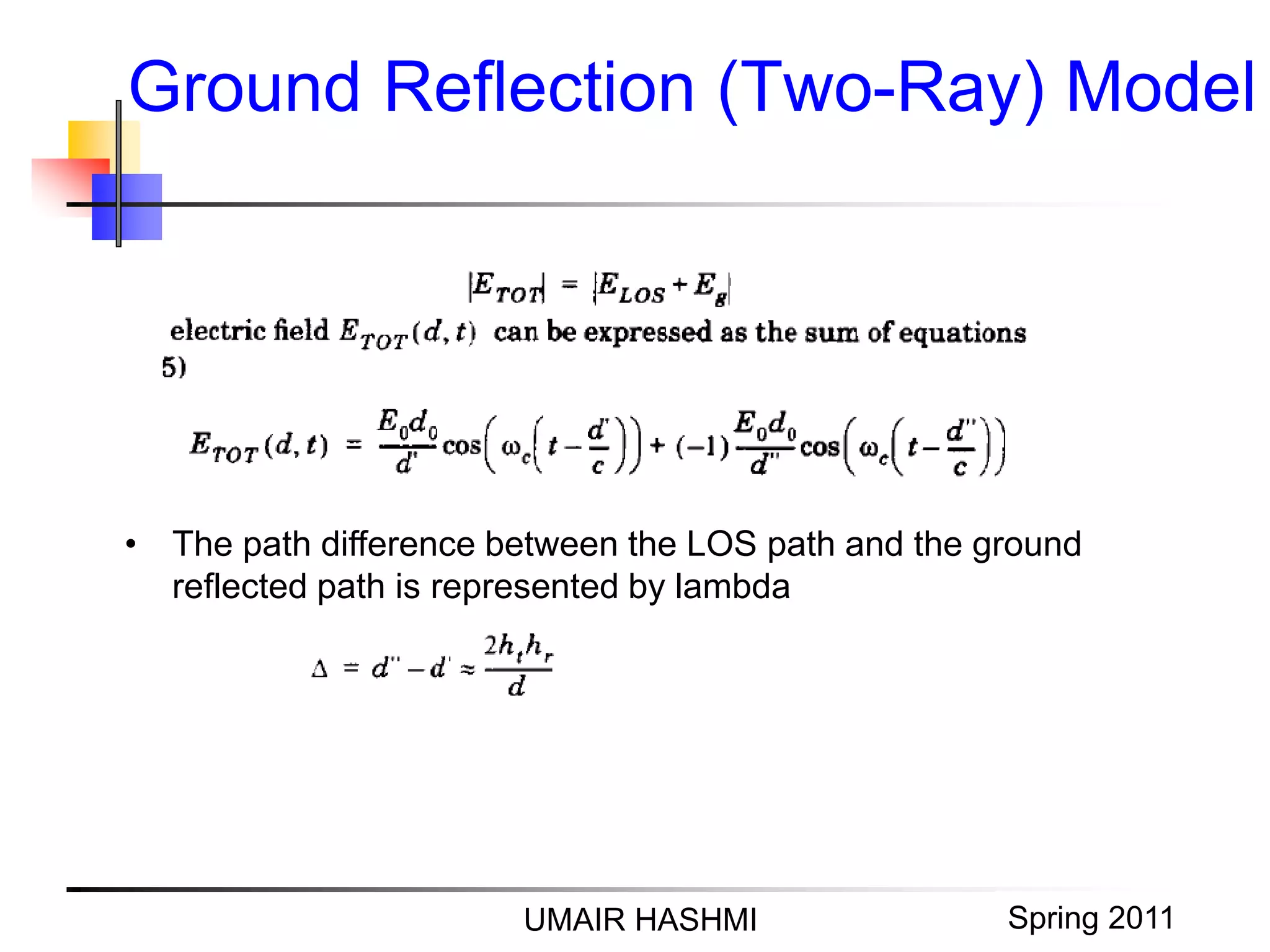
• The path difference between the LOS path and the ground
reflected path is represented by lambda
M. Junaid Mughal 2006
Ground Reflection (Two-Ray) Model
UMAIR HASHMI Spring 2011
• The phase difference and the time arrival delay between the
two E-components is given by:
• When d becomes large, difference between d’ and d’’ becomes
negligible and ELOS and Eg could be considered equal in
magnitude
M. Junaid Mughal 2006
Ground Reflection (Two-Ray) Model
UMAIR HASHMI Spring 2011
M. Junaid Mughal 2006
Ground Reflection (Two-Ray) Model
UMAIR HASHMI Spring 2011
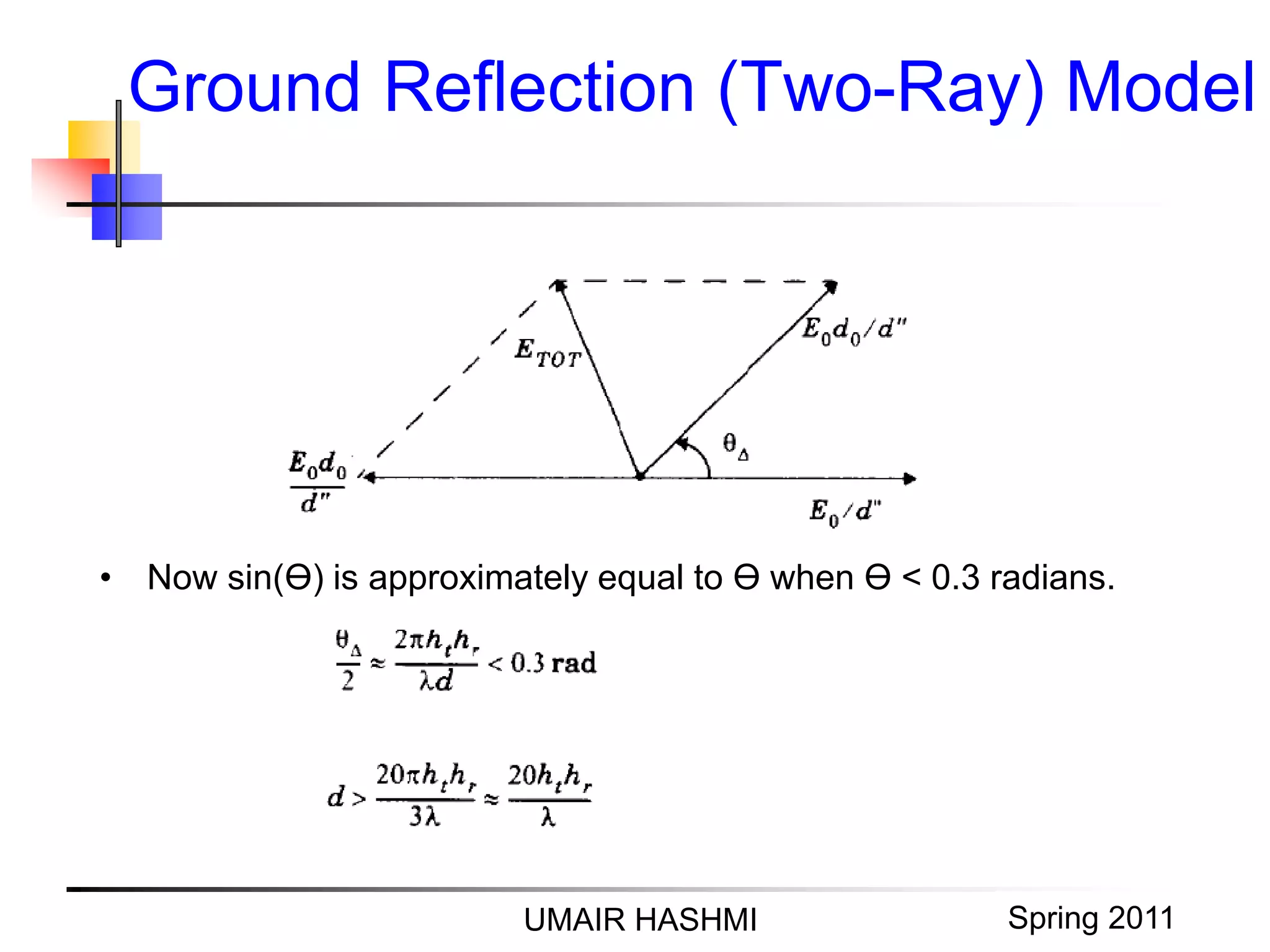
• Now sin(Ө) is approximately equal to Ө when Ө < 0.3 radians.
M. Junaid Mughal 2006
Ground Reflection (Two-Ray) Model
UMAIR HASHMI Spring 2011
• The received power Pr and Path Loss PL will be given by:
M. Junaid Mughal 2006
Ground Reflection (Two-Ray) Model
UMAIR HASHMI Spring 2011
10
1
10
2
10
3
10
4
-140
-120
-100
-80
-60
-40
-20
0
20
40
Distance (m)
20log(|E|)
d = 20 ht
hr
/
1/d4
1/d2
M. Junaid Mughal 2006
Ground Reflection (Two-Ray) Model
UMAIR HASHMI Spring 2011
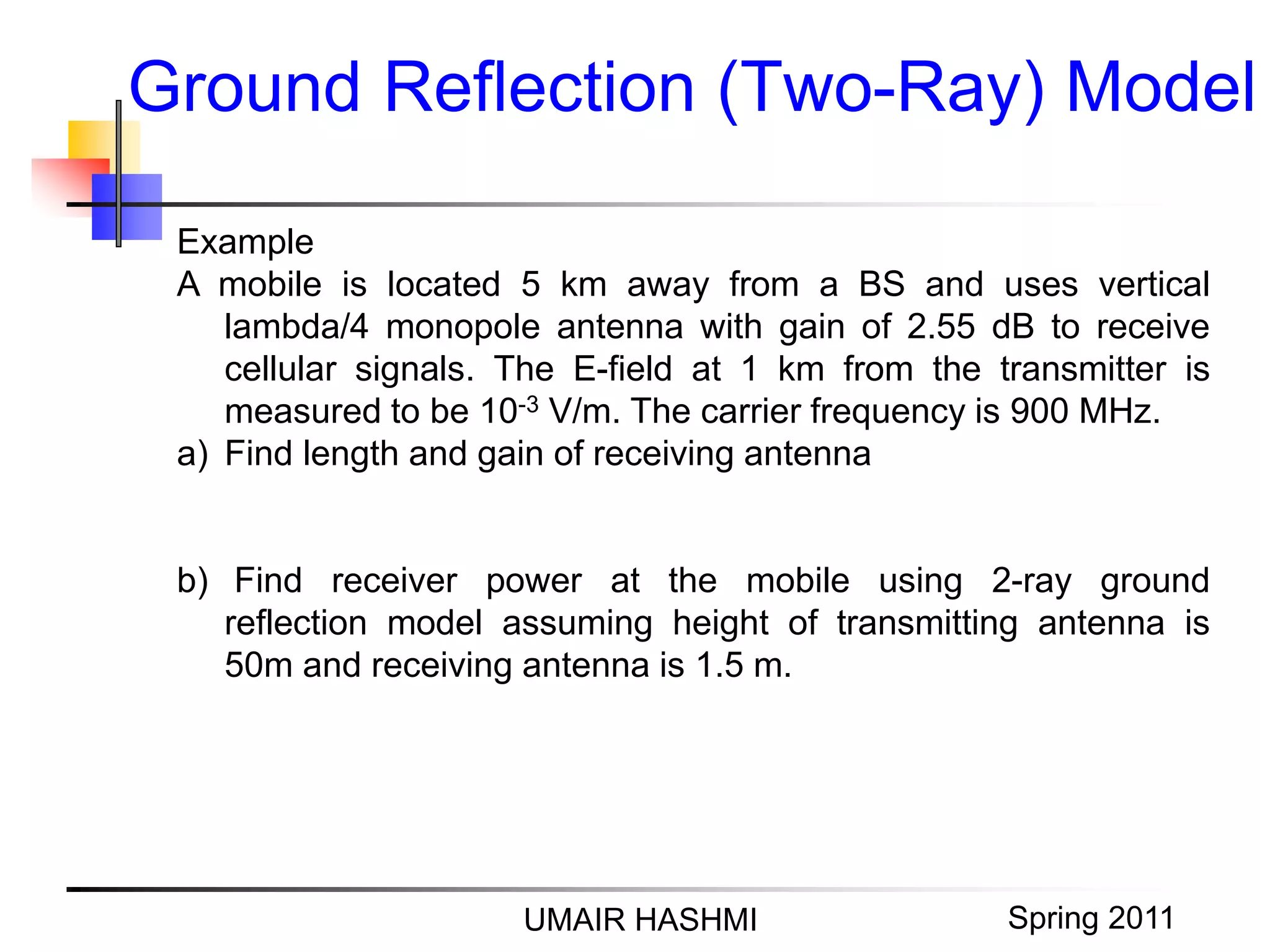
Example
A mobile is located 5 km away from a BS and uses vertical
lambda/4 monopole antenna with gain of 2.55 dB to receive
cellular signals. The E-field at 1 km from the transmitter is
measured to be 10-3 V/m. The carrier frequency is 900 MHz.
a) Find length and gain of receiving antenna
b) Find receiver power at the mobile using 2-ray ground
reflection model assuming height of transmitting antenna is
50m and receiving antenna is 1.5 m.
M. Junaid Mughal 2006
Diffraction
UMAIR HASHMI Spring 2011
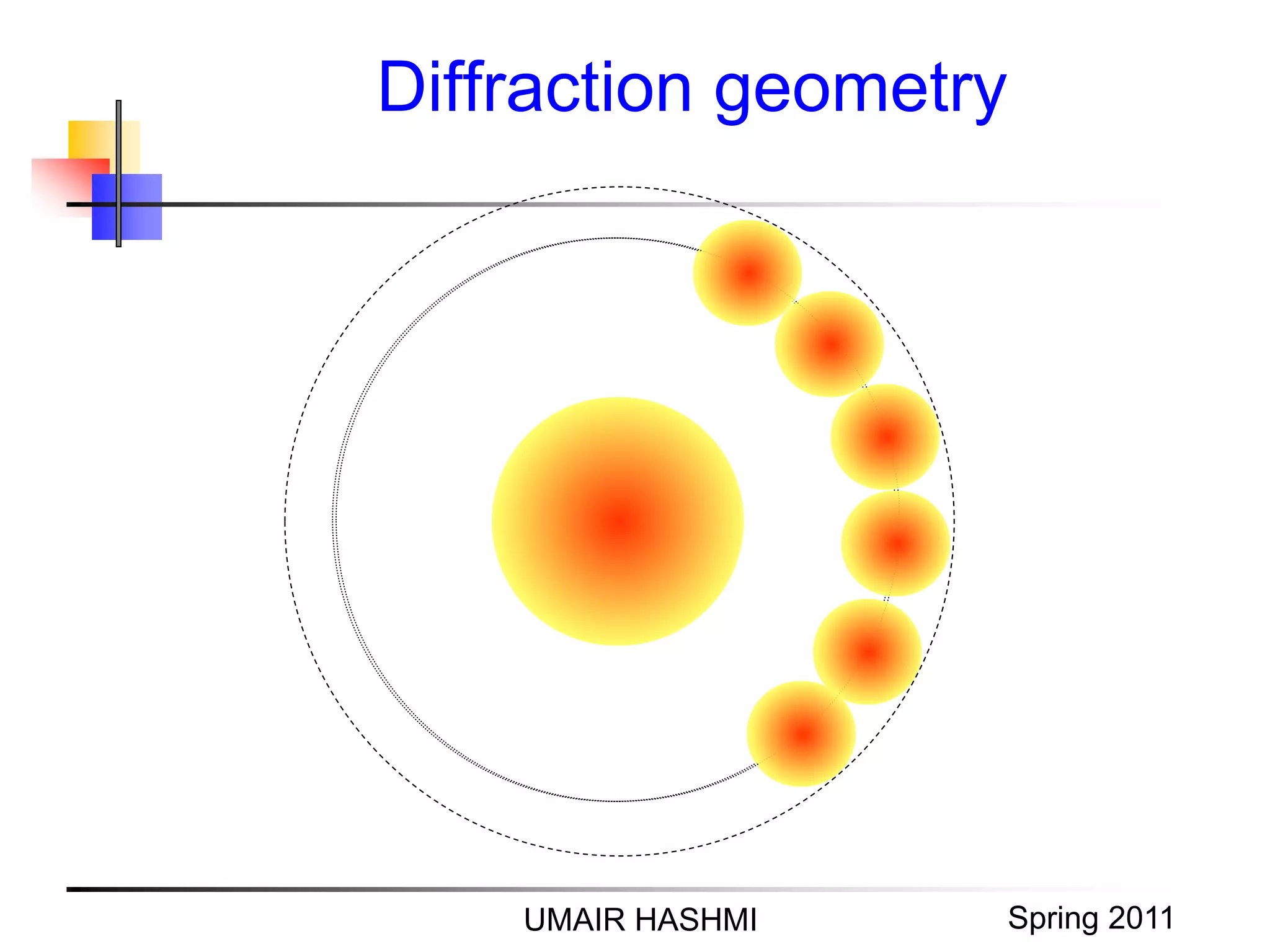
• Diffraction is a process that allows radio signals to propagate
around curved surfaces and objects and to propagate behind
obstructions.
Visible Region
Shadow Region
Obstruction
M. Junaid Mughal 2006
Diffraction geometry
UMAIR HASHMI Spring 2011
M. Junaid Mughal 2006
Diffraction geometry
UMAIR HASHMI Spring 2011
Visible Region
Shadow Region
Obstruction
M. Junaid Mughal 2006
Contribution of Huygen’s Secondary
Sources at the Receiver
UMAIR HASHMI Spring 2011
Obstruction
Tx
Rx
M. Junaid Mughal 2006
Fresnel Zone Geometry
UMAIR HASHMI Spring 2011
• A transmitter and receiver separated in free space.
• An obstructing screen of height h is placed at a distance d1
from the transmitter and d2 from the receiver.
• The difference between the direct path and the diffracted path
is called the excess path length Δ. Assuming h << d1,d2 and
h>>λ
M. Junaid Mughal 2006
Fresnel Zone Geometry
UMAIR HASHMI Spring 2011
M. Junaid Mughal 2006
Fresnel Zone Geometry
UMAIR HASHMI Spring 2011
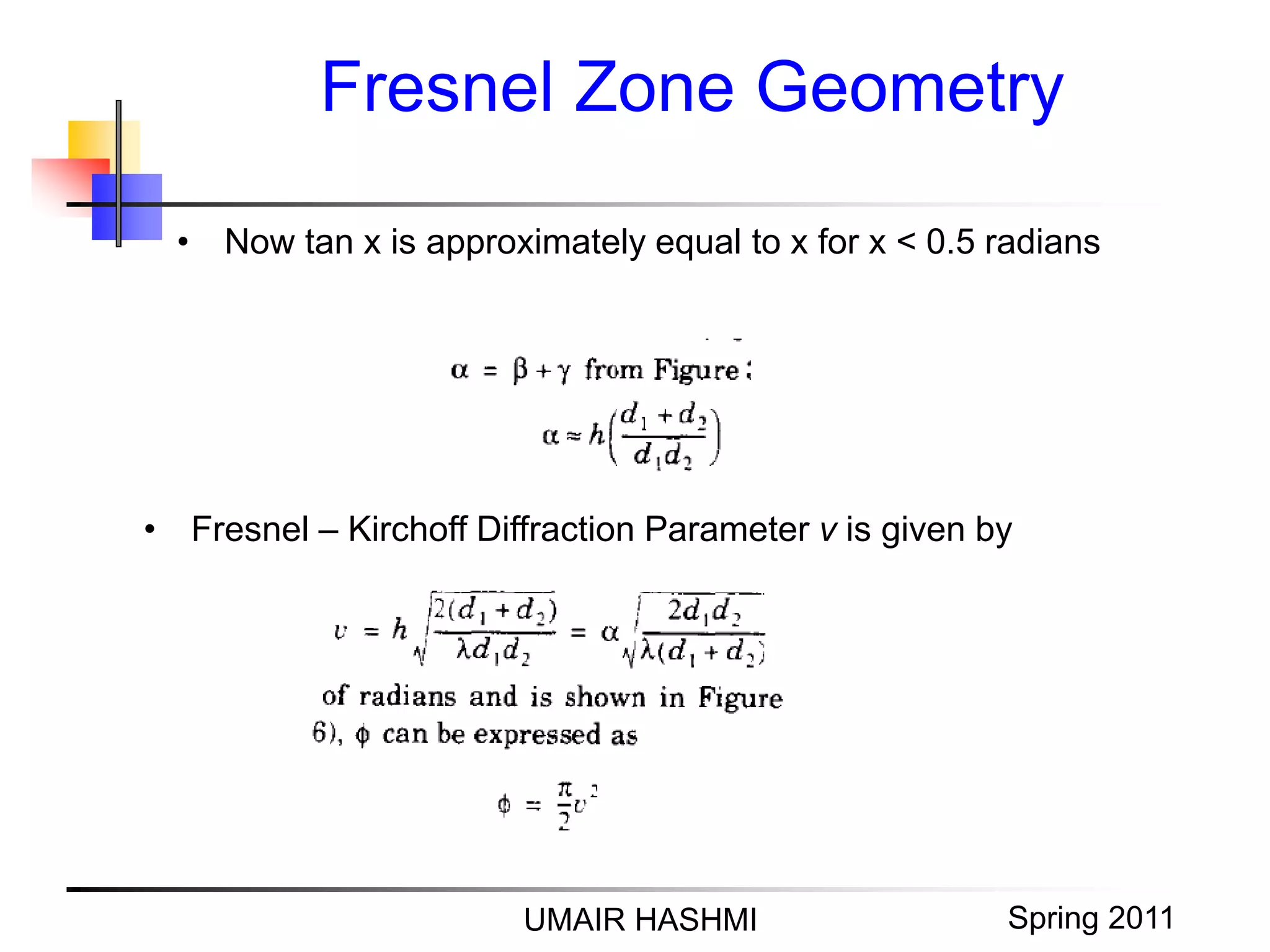
• Now tan x is approximately equal to x for x < 0.5 radians
• Fresnel – Kirchoff Diffraction Parameter v is given by
M. Junaid Mughal 2006
Fresnel Zone Geometry
UMAIR HASHMI Spring 2011
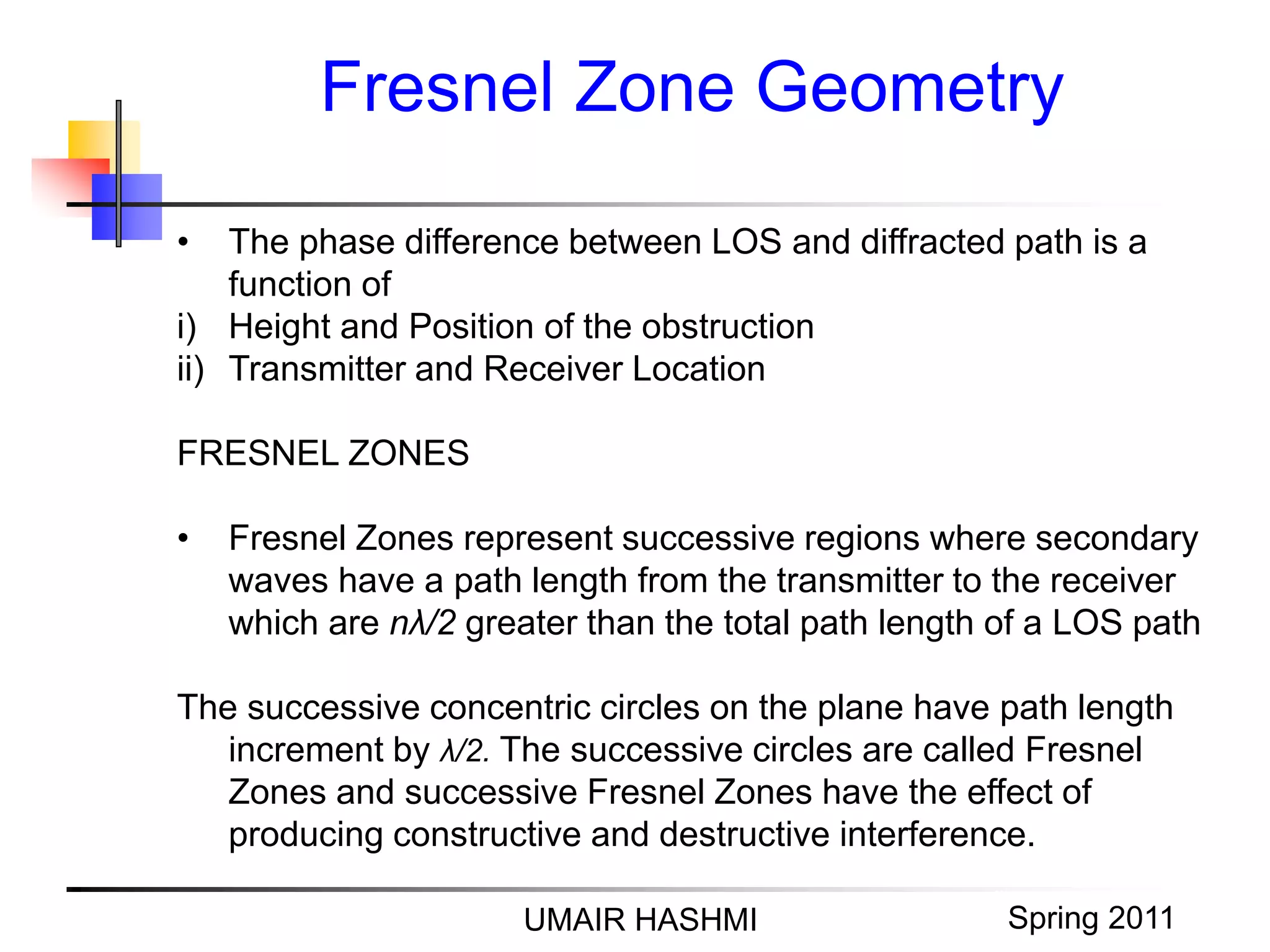
• The phase difference between LOS and diffracted path is a
function of
i) Height and Position of the obstruction
ii) Transmitter and Receiver Location
FRESNEL ZONES
• Fresnel Zones represent successive regions where secondary
waves have a path length from the transmitter to the receiver
which are nλ/2 greater than the total path length of a LOS path
The successive concentric circles on the plane have path length
increment by λ/2. The successive circles are called Fresnel
Zones and successive Fresnel Zones have the effect of
producing constructive and destructive interference.
M. Junaid Mughal 2006
Fresnel Zone Geometry
UMAIR HASHMI Spring 2011
• The radius of the nth Fresnel Zone is given by
M. Junaid Mughal 2006
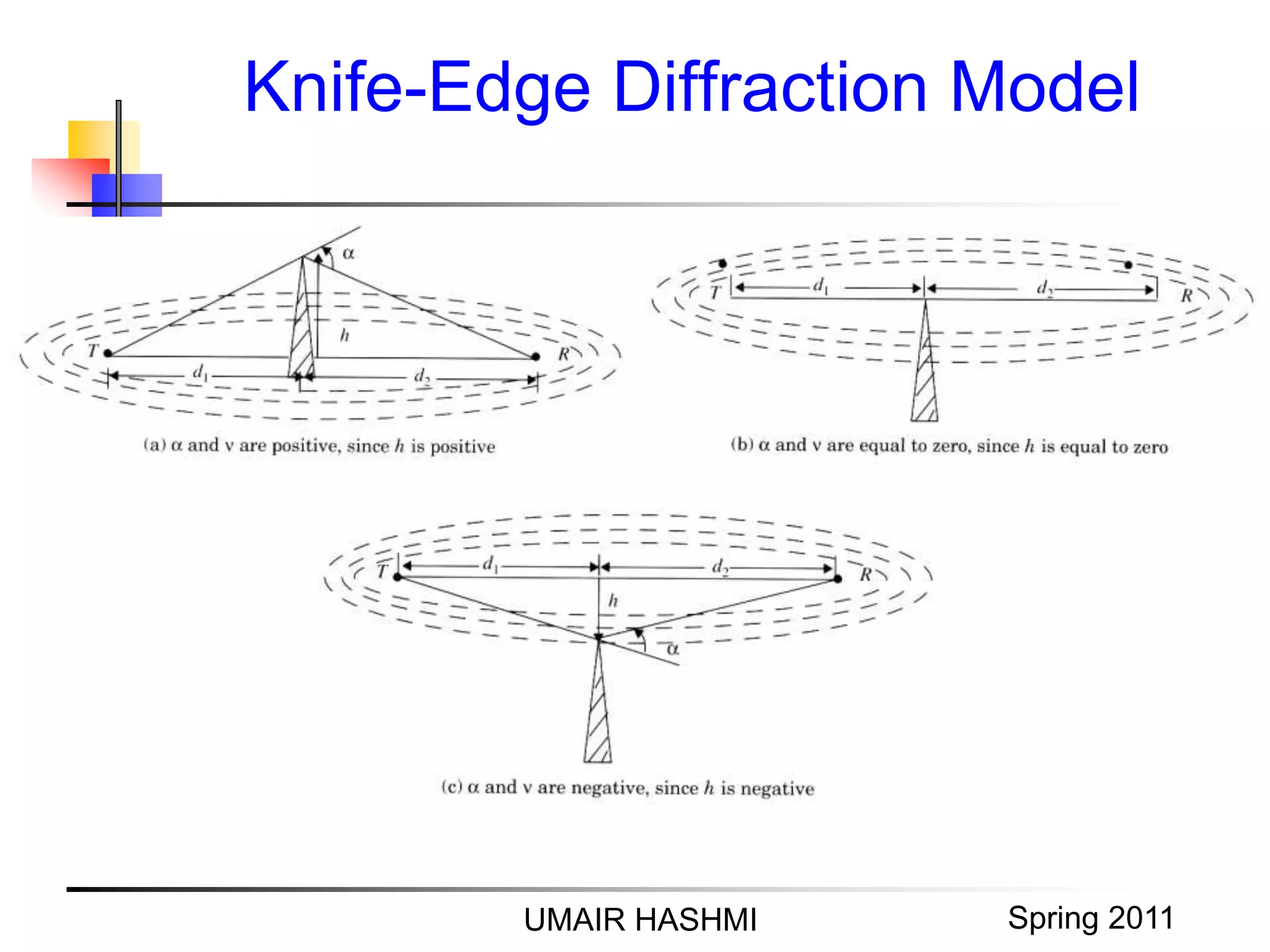
Knife-Edge Diffraction Model
UMAIR HASHMI Spring 2011
M. Junaid Mughal 2006
Knife-Edge Diffraction Model
UMAIR HASHMI Spring 2011
• The receiver is at point R which is located in the shadowed
region (called Diffraction Zone). The field strength at R is a
vector sum of the fields due to all of the secondary Huygen;s
sources in the plane.
• The Electric Field of a knife edge diffracted wave is
• The Diffraction Gain due to the presence of a knife edge is
given by
M. Junaid Mughal 2006
Knife-Edge Diffraction Model
UMAIR HASHMI Spring 2011
M. Junaid Mughal 2006
Fresnel Zone Geometry
UMAIR HASHMI Spring 2011
• The Diffraction Gain for different values of v is:
M. Junaid Mughal 2006
Knife-edge diffraction loss
(Summing Secondary Sources)
UMAIR HASHMI Spring 2011
-3 -2 -1 0 1 2 3 4 5
-30
-25
-20
-15
-10
-5
0
Fresnel Diffraction Parameter v
KnifeEdgeDiffractionGain(dB)
M. Junaid Mughal 2006
Fresnel Zone Geometry
UMAIR HASHMI Spring 2011
EXAMPLE
Compute the diffraction loss for the three cases in fig. when
λ=1/3m, d1=1km, d2=1km and (a) h=25m, (b) h=0 (c) h= -25m.
Compare the answers with the values obtained from the graph.
M. Junaid Mughal 2006
Fresnel Zone Geometry
UMAIR HASHMI Spring 2011
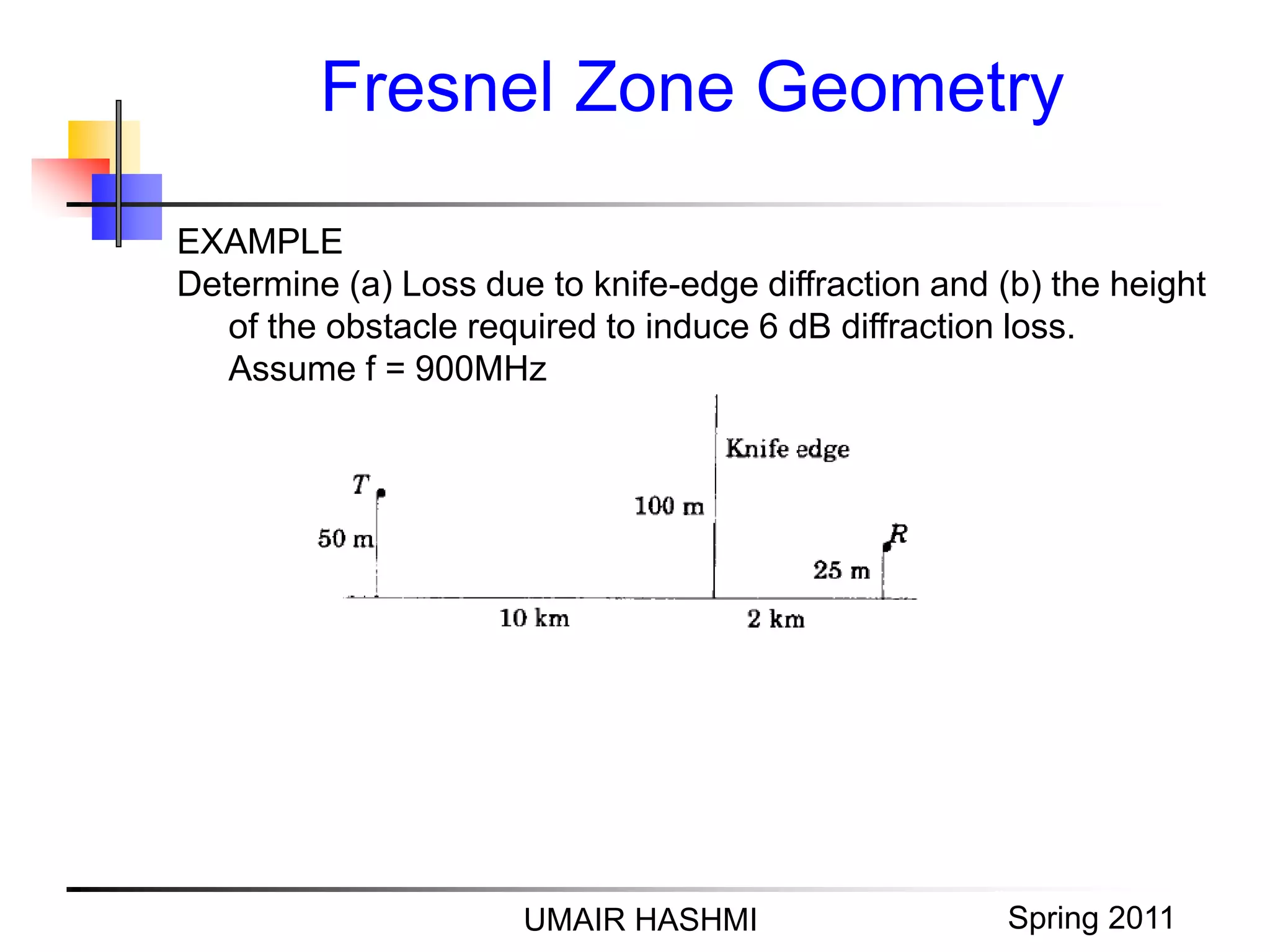
EXAMPLE
Determine (a) Loss due to knife-edge diffraction and (b) the height
of the obstacle required to induce 6 dB diffraction loss.
Assume f = 900MHz
M. Junaid Mughal 2006
Scattering
UMAIR HASHMI Spring 2011
• When a wave impinges on a rough surface, the reflected wave
is spread out (diffused) in all directions due to scattering.
• The dimensions of the objects inducing Scattering are
comparable to λ
• To judge if a surface is smooth or rough (if we will have
reflection or scattering) when a wave impinges upon that
surface, the Critical Height hc is given by
hc = λ / ( 8 sin Өi)
• If maximum protuberance hmax < hc : Smooth Surface
hmax > hc : Rough Surface
• The reflected E-Fields for h > hc is given by :
M. Junaid Mughal 2006
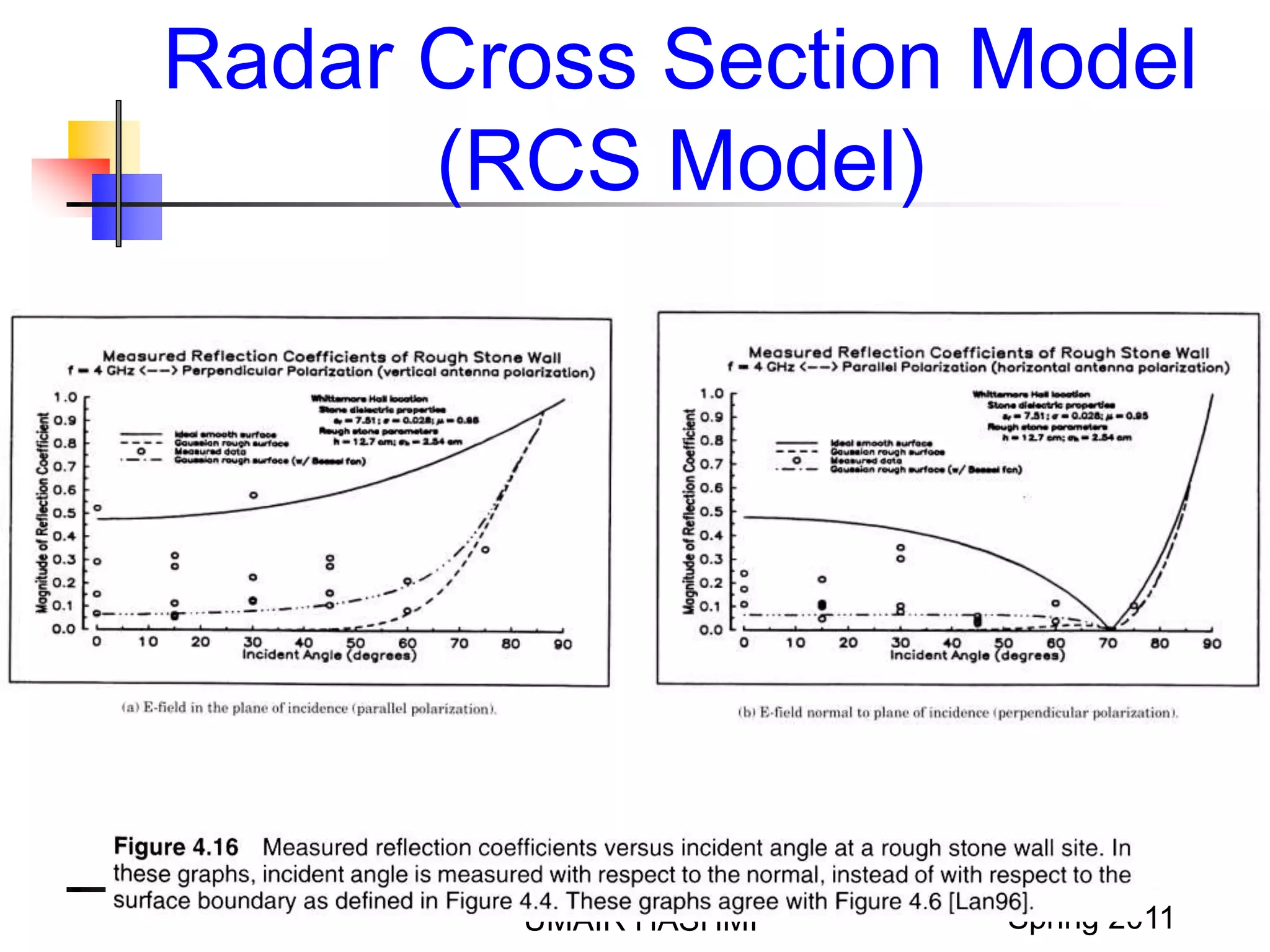
Radar Cross Section Model
(RCS Model)
UMAIR HASHMI Spring 2011
• The Radar Cross Section (RCS) of a scattering object is
defined as the ratio of the power density of the signal scattered
in the direction of the receiver to the power density of the radio
wave incident upon the scattering object.
• The bistatic radar equation is used to compute the
propagation of a wave travelling in free space that impinges on
a distant scattering object and then reradiated in the direction
of the receiver. The objects are assumed to be in the Far-Field
region (Fraunhofer region)
PR (dBm) = PT (dBm) + GT (dBi) + 20 log λ + RCS [dB m2 ] – 30
log (4 pi) – 20 log dT – 20 log dR
M. Junaid Mughal 2006
Radar Cross Section Model
(RCS Model)
UMAIR HASHMI Spring 2011
M. Junaid Mughal 2006
SUMMARY
UMAIR HASHMI Spring 2011
• What is Large Scale Path Loss?
• Free space Propagation Model
• Friis Free space propagation model
• Relating power to Electric field
• The three Basic Propagation mechanisms
• Reflection
•Reflection coefficients
•Polarization rotation
•Brewster angle
•Reflection from perfect conductors
• Ground Reflection (Two Ray Model)
M. Junaid Mughal 2006
SUMMARY
UMAIR HASHMI Spring 2011
• Diffraction
• Fresnel Zone Geometry
• Knife Edge Diffraction
• Multiple Knife edge Diffraction
• Scattering
• Rough Surface Scattering
• Radar Cross section
Now we know all the propagation mechanisms and can use
them to predict path loss in any environment
M. Junaid Mughal 2006
Log-Distance Path Loss
Model
UMAIR HASHMI Spring 2011
• Radio Propagation Models
• Log-distance Path Loss Model
• Received Power decreases logarithmically with distance,
whether in outdoor or indoor radio channels
• Reference distance should be in the far field region of the
antenna
M. Junaid Mughal 2006
Log-Distance Path Loss
Model
UMAIR HASHMI Spring 2011
M. Junaid Mughal 2006
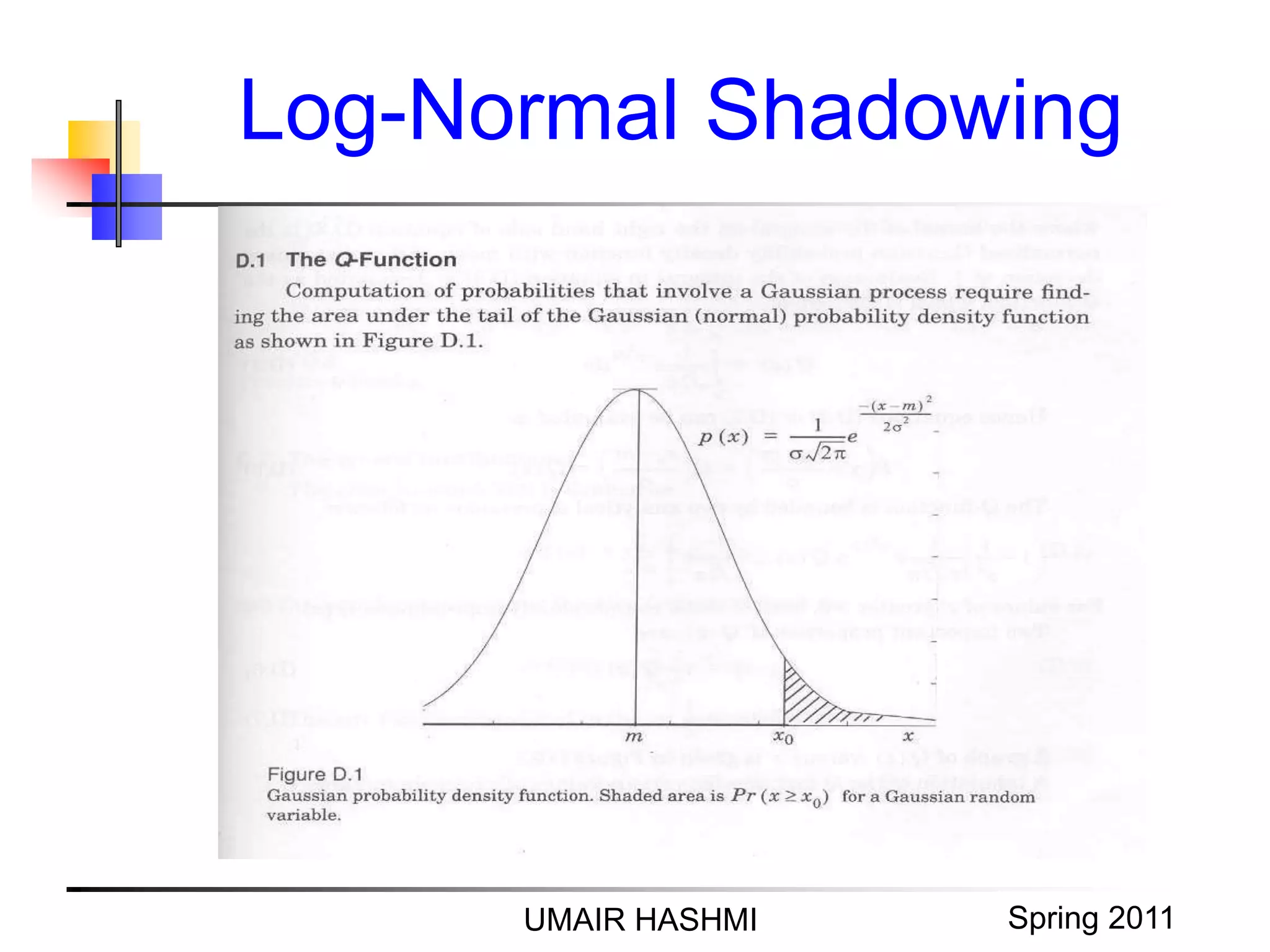
Log-Normal Shadowing
UMAIR HASHMI Spring 2011
• Surrounding environment clutter not considered in previous
model.
• Received power can vary at quite a significant value at 2
points having same T-R separation distances.
• Path Loss (PL) is random and distributed log-normally about
the mean distance-dependent value.
M. Junaid Mughal 2006
Log-Normal Shadowing
UMAIR HASHMI Spring 2011
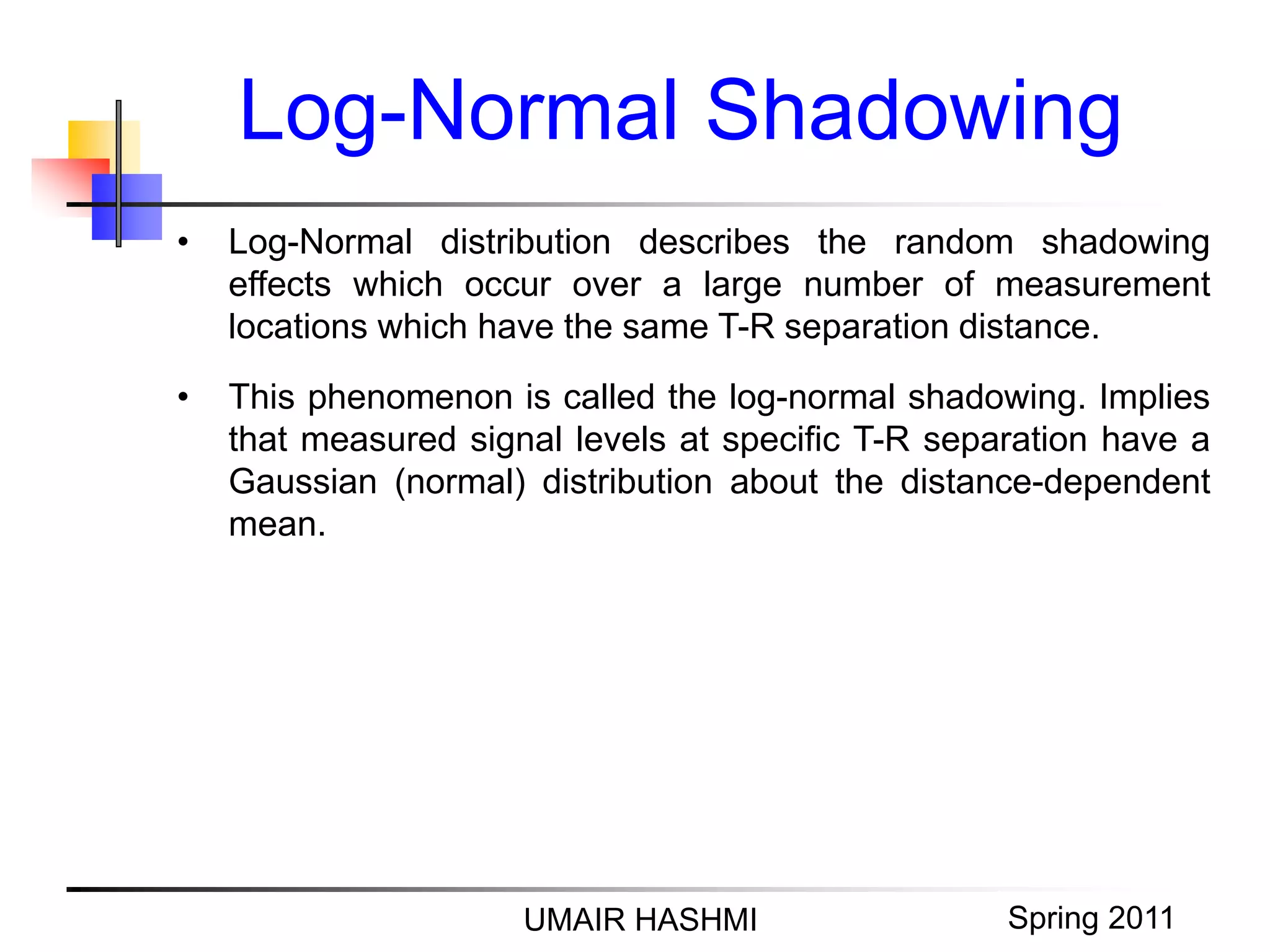
• Log-Normal distribution describes the random shadowing
effects which occur over a large number of measurement
locations which have the same T-R separation distance.
• This phenomenon is called the log-normal shadowing. Implies
that measured signal levels at specific T-R separation have a
Gaussian (normal) distribution about the distance-dependent
mean.
M. Junaid Mughal 2006
Log-Normal Shadowing
UMAIR HASHMI Spring 2011
M. Junaid Mughal 2006
Log-Normal Shadowing
UMAIR HASHMI Spring 2011
M. Junaid Mughal 2006
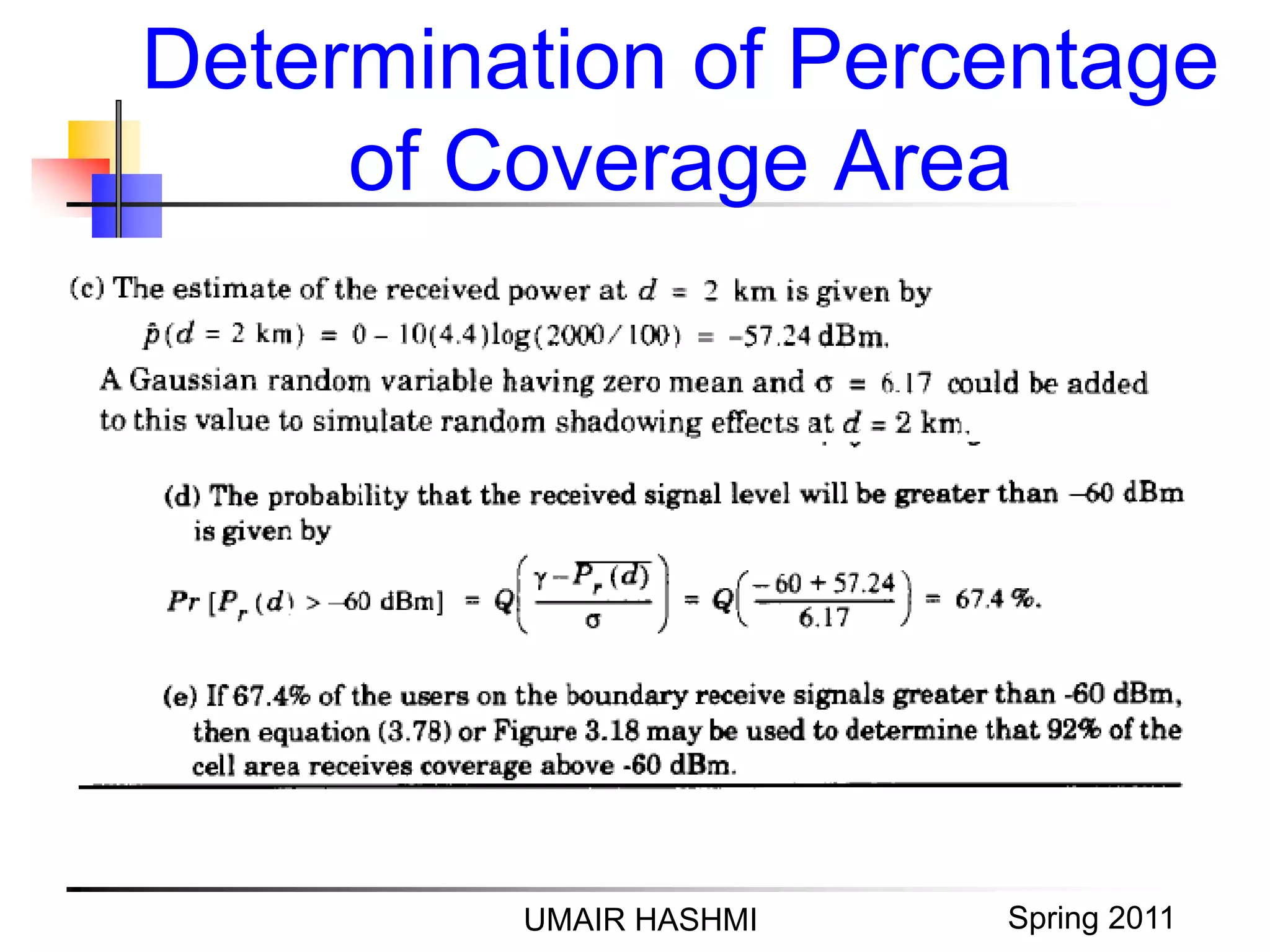
Determination of Percentage
of Coverage Area
UMAIR HASHMI Spring 2011
• The percentage of useful service area i.e. the percentage of
area with a received signal level that is greater or equal to a
threshold value.
M. Junaid Mughal 2006
Determination of Percentage
of Coverage Area
UMAIR HASHMI Spring 2011
M. Junaid Mughal 2006
Determination of Percentage
of Coverage Area
UMAIR HASHMI Spring 2011
M. Junaid Mughal 2006
Determination of Percentage
of Coverage Area
UMAIR HASHMI Spring 2011
M. Junaid Mughal 2006
Determination of Percentage
of Coverage Area
UMAIR HASHMI Spring 2011
M. Junaid Mughal 2006
Determination of Percentage
of Coverage Area
UMAIR HASHMI Spring 2011
M. Junaid Mughal 2006
Determination of Percentage
of Coverage Area
UMAIR HASHMI Spring 2011
M. Junaid Mughal 2006
Outdoor Propagation Models
Longley Rice Model
UMAIR HASHMI Spring 2011
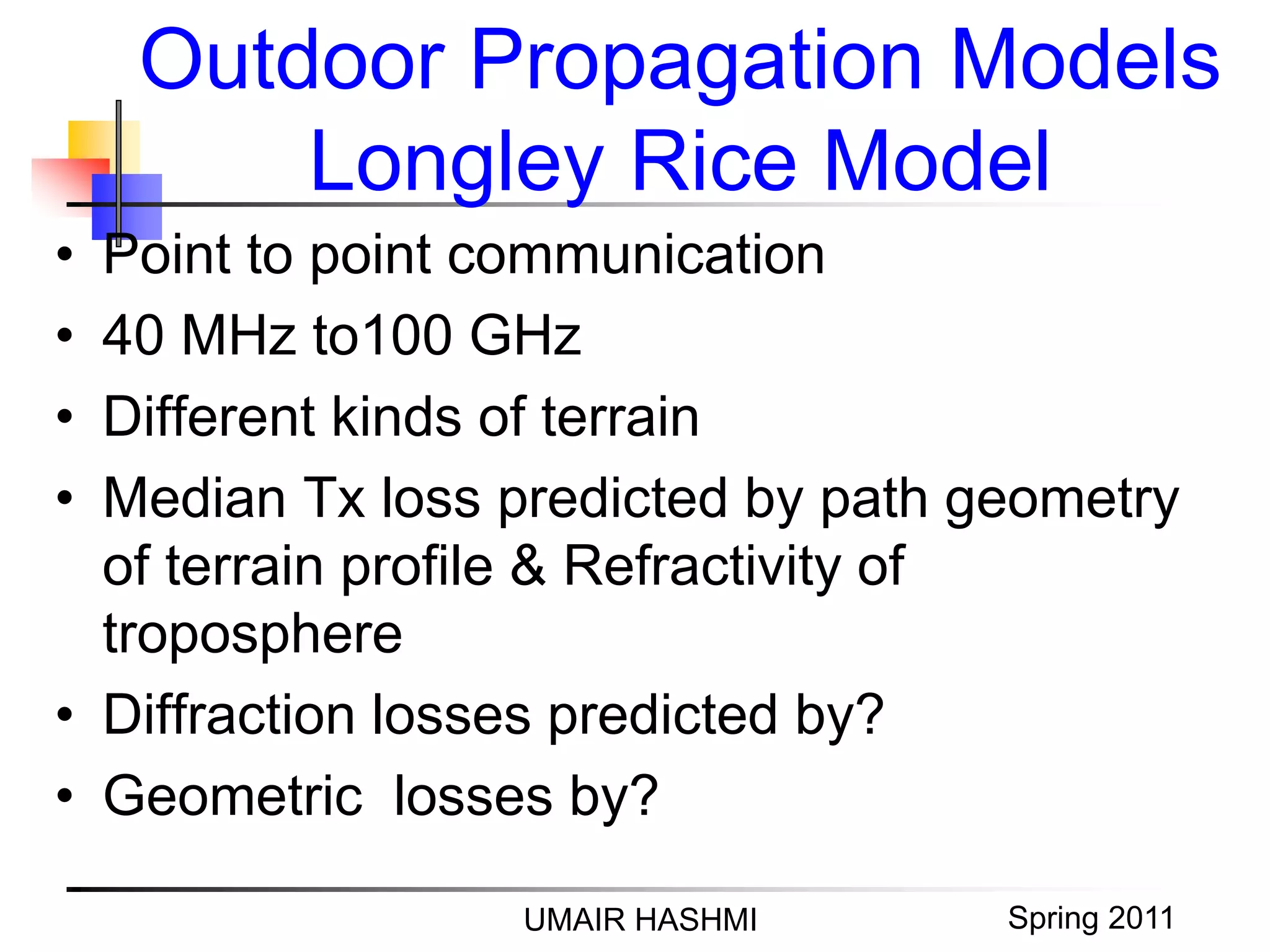
• Point to point communication
• 40 MHz to100 GHz
• Different kinds of terrain
• Median Tx loss predicted by path geometry
of terrain profile & Refractivity of
troposphere
• Diffraction losses predicted by?
• Geometric losses by?
M. Junaid Mughal 2006
Outdoor Propagation Models
Longley Rice Model
UMAIR HASHMI Spring 2011
• Operates in 2 modes
• Point-to-point mode
• Area mode prediction
• Modification
• Clutter near receiver
• Doesn’t determine corrections due to
environmental factors
M. Junaid Mughal 2006
Outdoor Propagation Models
Durkin’s Model
UMAIR HASHMI Spring 2011
• Computer simulator described for field strength contours of
irregular terrain
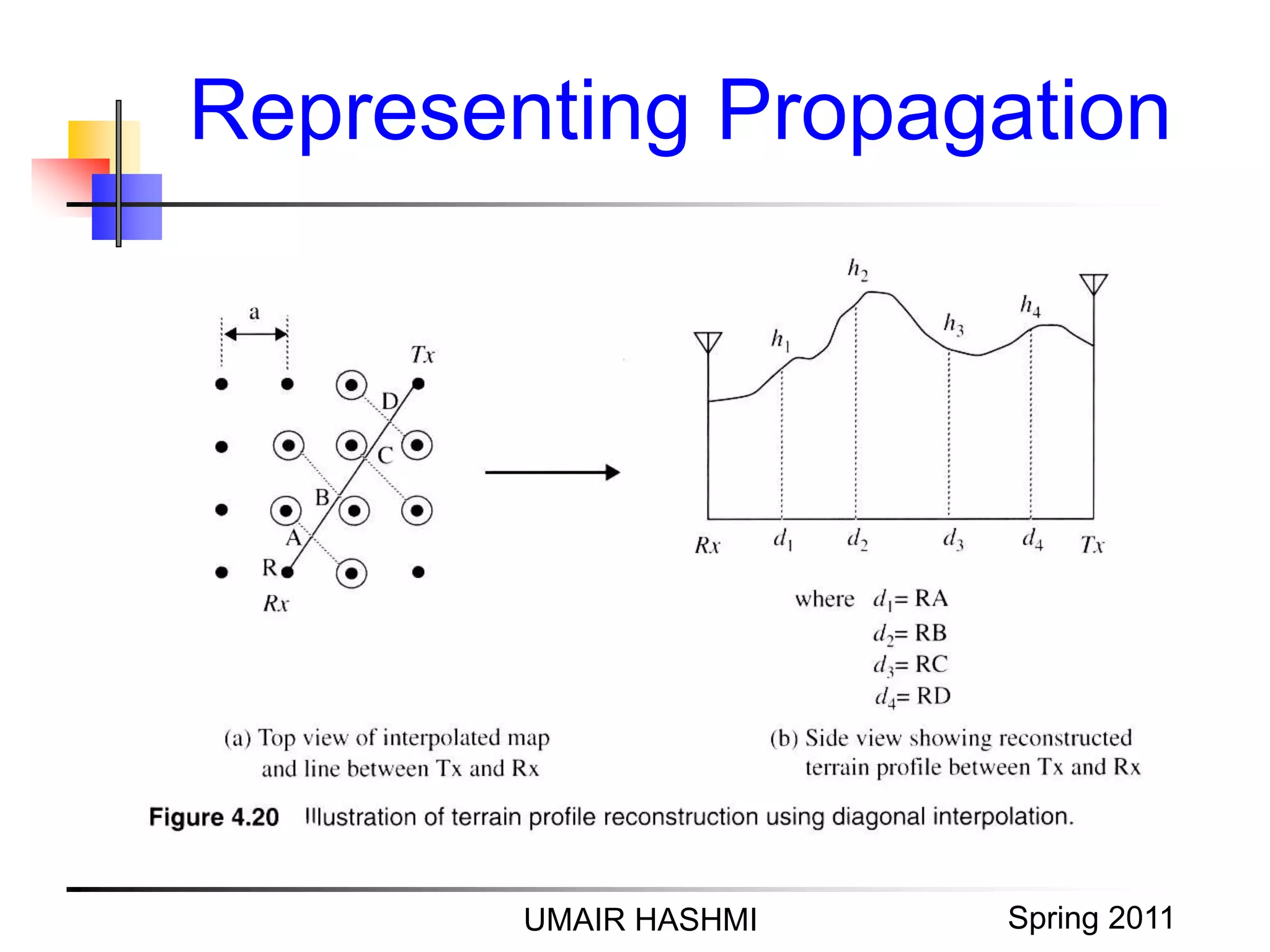
• Split into 2 parts, first reconstructs radial path profile &
second calculates path loss
• Rx can move iteratively to establish contour
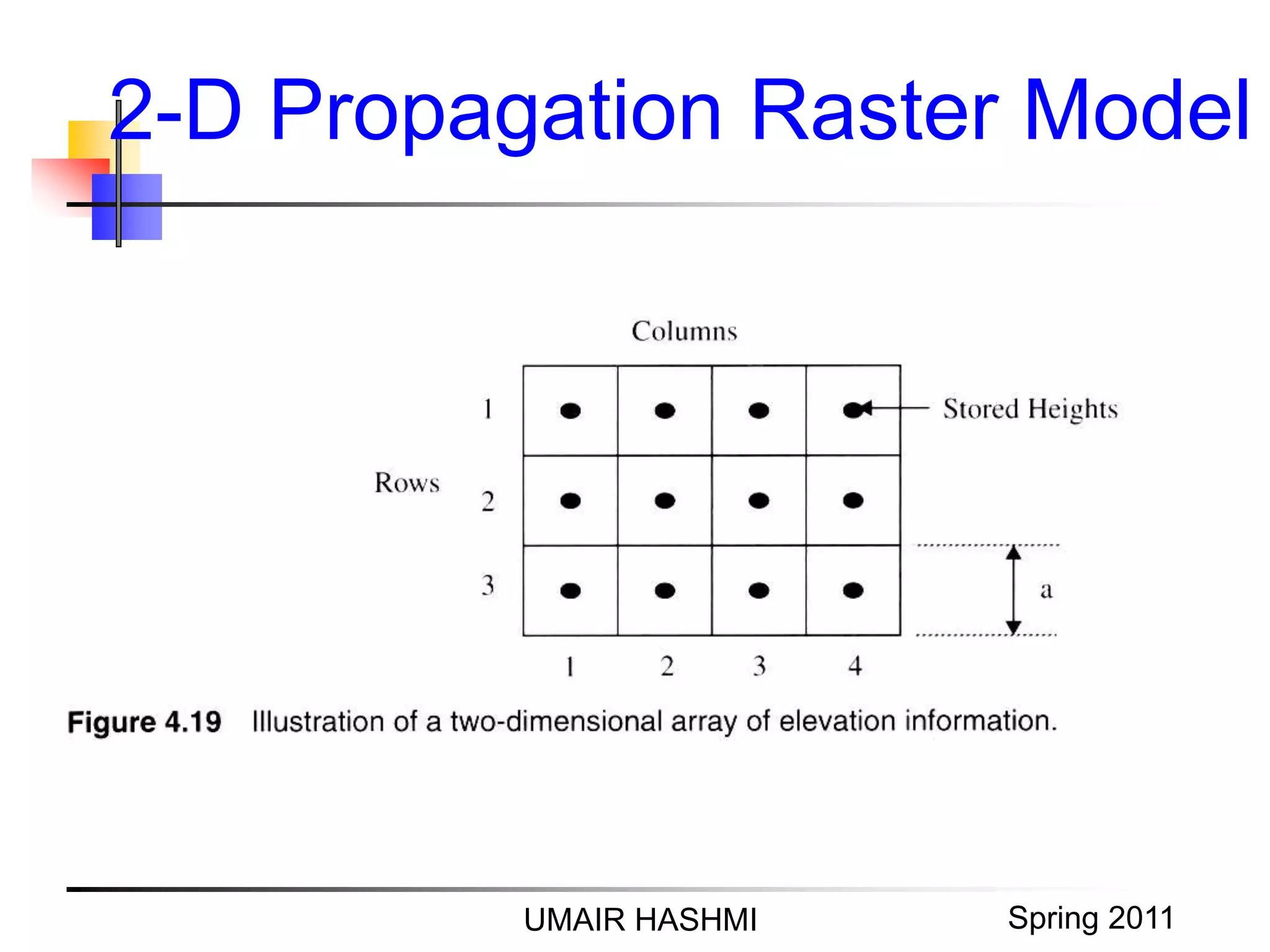
• Topographical database can be thought of as 2-
dimensional array
• Each array element corresponds to a point on map &
elevation
• Radial path may not correspond to discrete data points
thus interpolation
M. Junaid Mughal 2006
2-D Propagation Raster Model
UMAIR HASHMI Spring 2011
M. Junaid Mughal 2006
Representing Propagation
UMAIR HASHMI Spring 2011
M. Junaid Mughal 2006UMAIR HASHMI Spring 2011
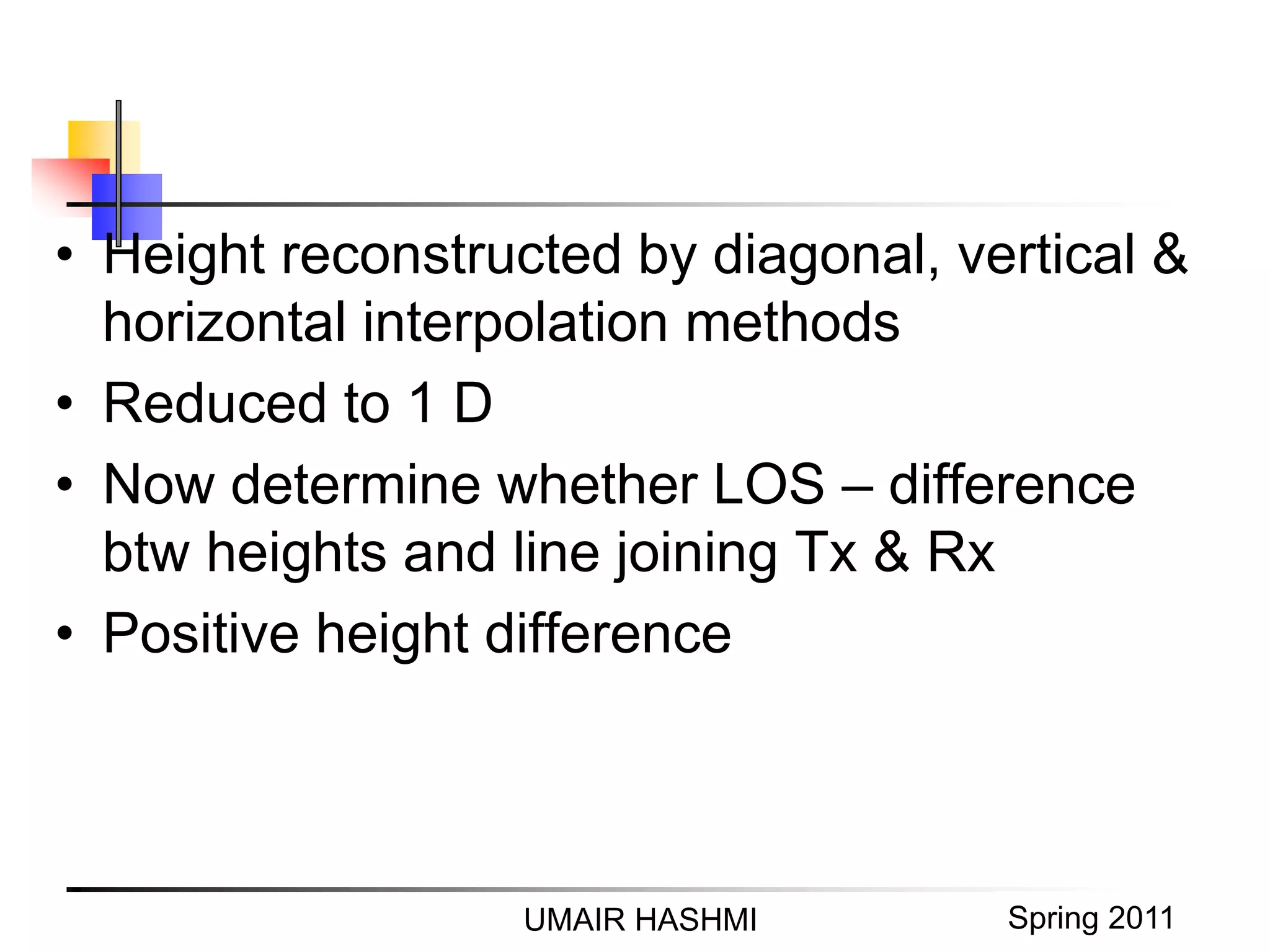
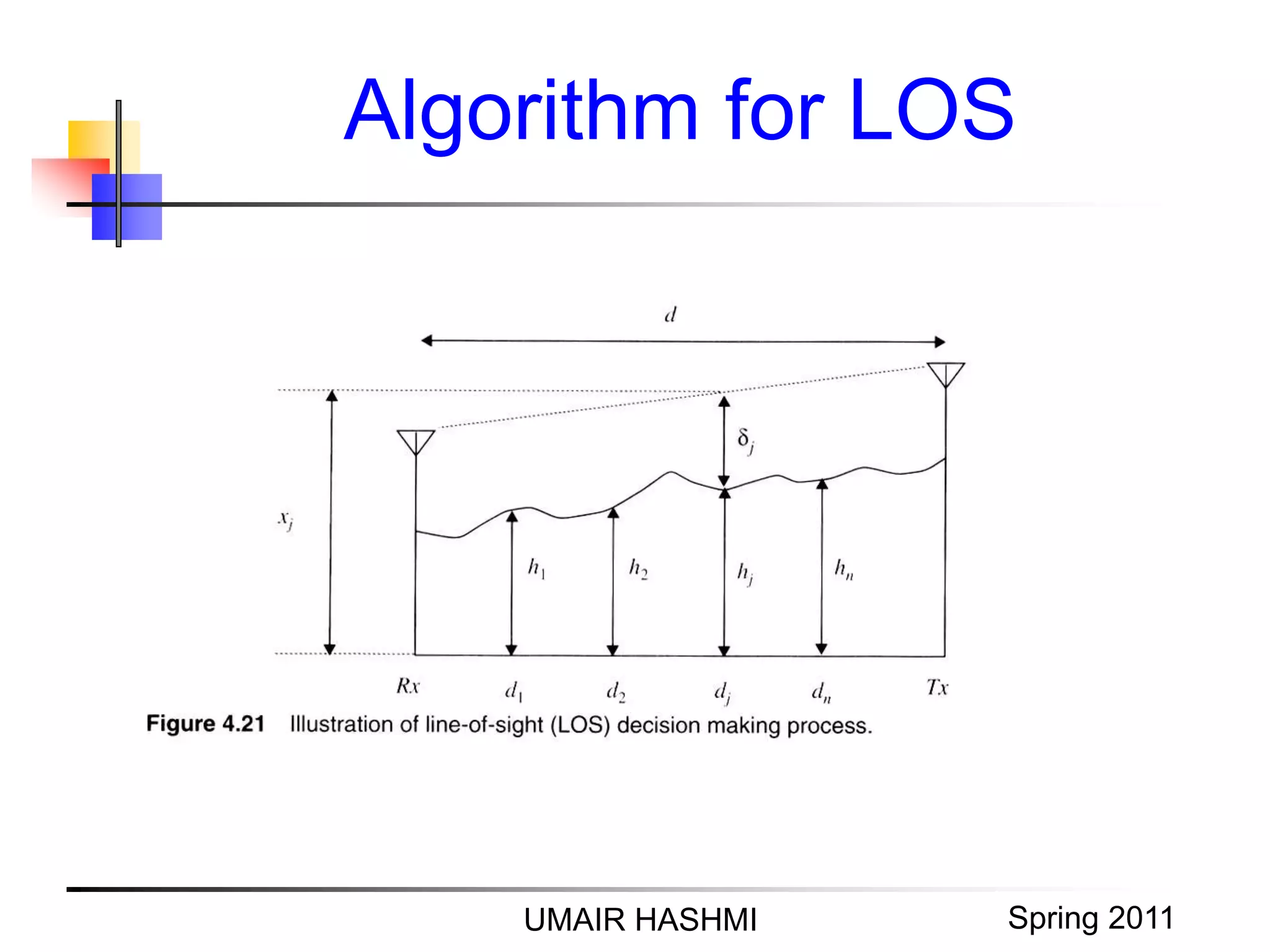
• Height reconstructed by diagonal, vertical &
horizontal interpolation methods
• Reduced to 1 D
• Now determine whether LOS – difference
btw heights and line joining Tx & Rx
• Positive height difference
M. Junaid Mughal 2006
Algorithm for LOS
UMAIR HASHMI Spring 2011
M. Junaid Mughal 2006UMAIR HASHMI Spring 2011
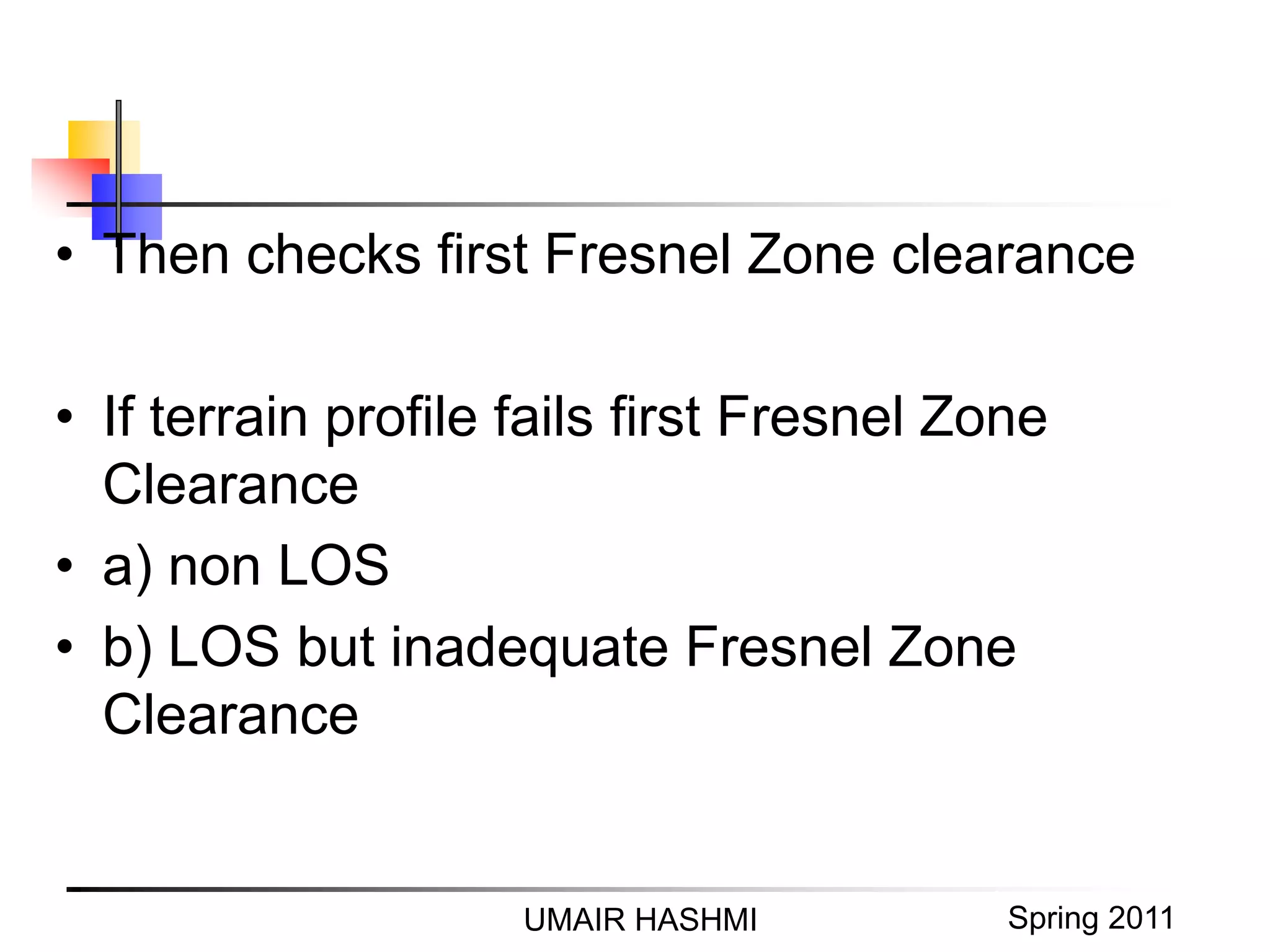
• Then checks first Fresnel Zone clearance
• If terrain profile fails first Fresnel Zone
Clearance
• a) non LOS
• b) LOS but inadequate Fresnel Zone
Clearance
M. Junaid Mughal 2006
Non-LOS Cases
UMAIR HASHMI Spring 2011
• a) Single Diffraction Edge
• b) Two Diffraction Edges
• a) Three Diffraction Edges
• a) More than three Diffraction Edges
• Method sequentially tests for each
• Angles btw pine joining Tx & Rx and each point on
reconstructed profile. Max angle (di,hi)
• Angles between line joining Tx & Rx and Tx Antenna to every
point on reconstructed profile
• For single diffraction di=dj
M. Junaid Mughal 2006
Multiple Diffraction
Computation
UMAIR HASHMI Spring 2011
M. Junaid Mughal 2006
Okumura’s and Hata’s Model
UMAIR HASHMI Spring 2011
M. Junaid Mughal 2006
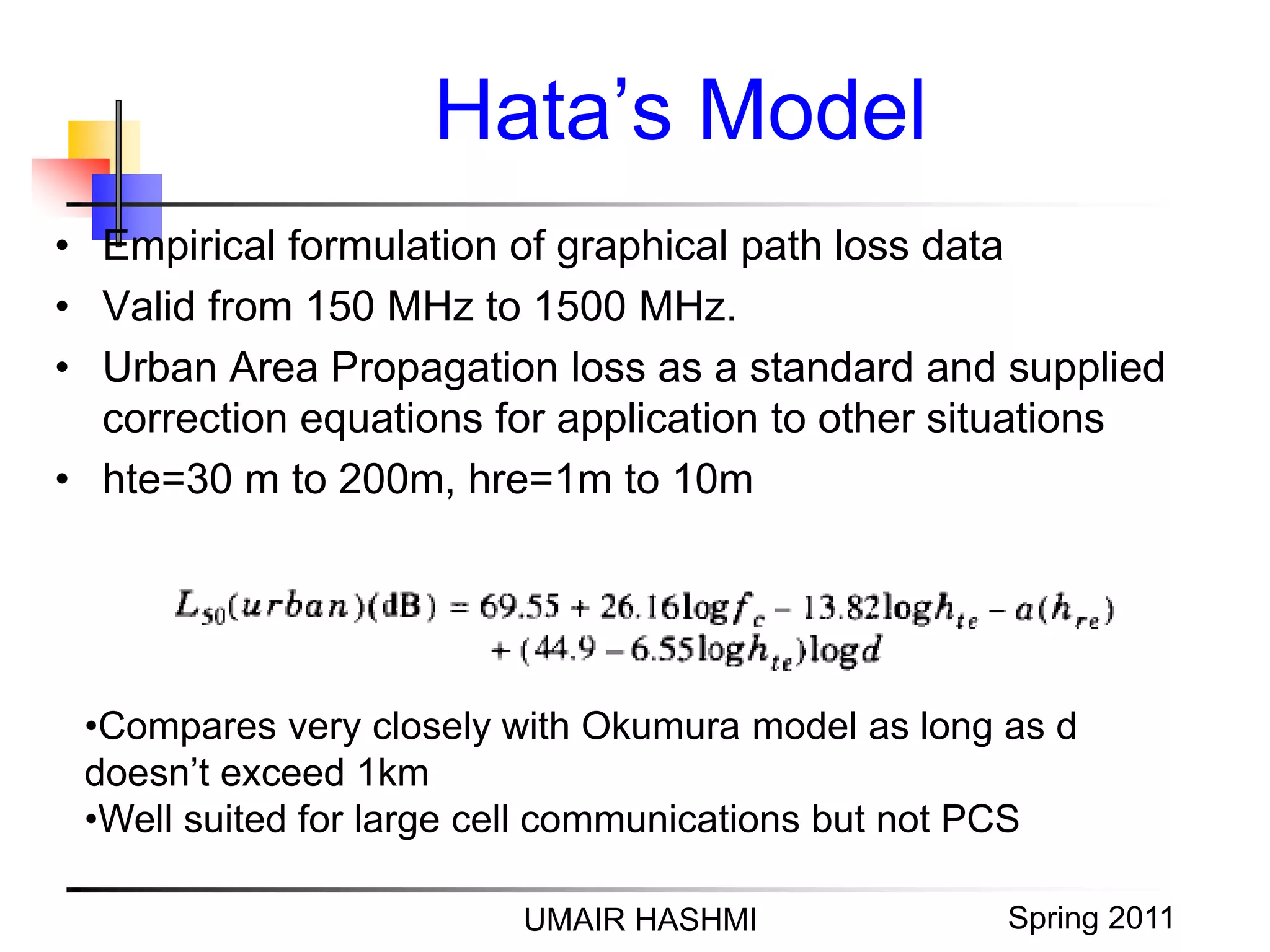
Hata’s Model
UMAIR HASHMI Spring 2011
• Empirical formulation of graphical path loss data
• Valid from 150 MHz to 1500 MHz.
• Urban Area Propagation loss as a standard and supplied
correction equations for application to other situations
• hte=30 m to 200m, hre=1m to 10m
•Compares very closely with Okumura model as long as d
doesn’t exceed 1km
•Well suited for large cell communications but not PCS
M. Junaid Mughal 2006
PCS Extension to Hata Model
UMAIR HASHMI Spring 2011
• Hata’s model to 2GHz
M. Junaid Mughal 2006
ASSIGNMENT
UMAIR HASHMI Spring 2011
Review the Outdoor Propagation Models
presented in the slides showing their salient
features and how they differentiate from
each other.

Digital class

  • 1.
    M. Junaid Mughal2006 Wireless Communications Principles and Practice 2nd Edition T.S. Rappaport Chapter 4: Mobile Radio Propagation: Large-Scale Path Loss UMAIR HASHMI Spring 2011
  • 2.
    M. Junaid Mughal2006 Reflection from Conductors A perfect conductor reflects back all the incident wave back. Ei = Er Өi = Өr ( E in plane of incidence) Ei = - Er Өi = Өr ( E normal to plane of incidence) UMAIR HASHMI Spring 2011
  • 3.
    M. Junaid Mughal2006 Ground Reflection (Two-Ray) Model UMAIR HASHMI Spring 2011 • Propagation Model that considers both the direct (LOS) path and a ground reflected path between transmitter and the receiver. • Reasonably accurate model for predicting large scale signal strength over distance of several kilometres. • The E-field due to Line-Of-Sight is given by ELOS • The E-field for the ground reflected wave is given by Eg • The Total E-field is a sum of LOS and Reflected components,
  • 4.
    M. Junaid Mughal2006 Ground Reflection (Two-Ray) Model UMAIR HASHMI Spring 2011
  • 5.
    M. Junaid Mughal2006 Ground Reflection (Two-Ray) Model UMAIR HASHMI Spring 2011
  • 6.
    M. Junaid Mughal2006 Ground Reflection (Two-Ray) Model UMAIR HASHMI Spring 2011
  • 7.
    M. Junaid Mughal2006 Ground Reflection (Two-Ray) Model UMAIR HASHMI Spring 2011 • The path difference between the LOS path and the ground reflected path is represented by lambda
  • 8.
    M. Junaid Mughal2006 Ground Reflection (Two-Ray) Model UMAIR HASHMI Spring 2011 • The phase difference and the time arrival delay between the two E-components is given by: • When d becomes large, difference between d’ and d’’ becomes negligible and ELOS and Eg could be considered equal in magnitude
  • 9.
    M. Junaid Mughal2006 Ground Reflection (Two-Ray) Model UMAIR HASHMI Spring 2011
  • 10.
    M. Junaid Mughal2006 Ground Reflection (Two-Ray) Model UMAIR HASHMI Spring 2011 • Now sin(Ө) is approximately equal to Ө when Ө < 0.3 radians.
  • 11.
    M. Junaid Mughal2006 Ground Reflection (Two-Ray) Model UMAIR HASHMI Spring 2011 • The received power Pr and Path Loss PL will be given by:
  • 12.
    M. Junaid Mughal2006 Ground Reflection (Two-Ray) Model UMAIR HASHMI Spring 2011 10 1 10 2 10 3 10 4 -140 -120 -100 -80 -60 -40 -20 0 20 40 Distance (m) 20log(|E|) d = 20 ht hr / 1/d4 1/d2
  • 13.
    M. Junaid Mughal2006 Ground Reflection (Two-Ray) Model UMAIR HASHMI Spring 2011 Example A mobile is located 5 km away from a BS and uses vertical lambda/4 monopole antenna with gain of 2.55 dB to receive cellular signals. The E-field at 1 km from the transmitter is measured to be 10-3 V/m. The carrier frequency is 900 MHz. a) Find length and gain of receiving antenna b) Find receiver power at the mobile using 2-ray ground reflection model assuming height of transmitting antenna is 50m and receiving antenna is 1.5 m.
  • 14.
    M. Junaid Mughal2006 Diffraction UMAIR HASHMI Spring 2011 • Diffraction is a process that allows radio signals to propagate around curved surfaces and objects and to propagate behind obstructions. Visible Region Shadow Region Obstruction
  • 15.
    M. Junaid Mughal2006 Diffraction geometry UMAIR HASHMI Spring 2011
  • 16.
    M. Junaid Mughal2006 Diffraction geometry UMAIR HASHMI Spring 2011 Visible Region Shadow Region Obstruction
  • 17.
    M. Junaid Mughal2006 Contribution of Huygen’s Secondary Sources at the Receiver UMAIR HASHMI Spring 2011 Obstruction Tx Rx
  • 18.
    M. Junaid Mughal2006 Fresnel Zone Geometry UMAIR HASHMI Spring 2011 • A transmitter and receiver separated in free space. • An obstructing screen of height h is placed at a distance d1 from the transmitter and d2 from the receiver. • The difference between the direct path and the diffracted path is called the excess path length Δ. Assuming h << d1,d2 and h>>λ
  • 19.
    M. Junaid Mughal2006 Fresnel Zone Geometry UMAIR HASHMI Spring 2011
  • 20.
    M. Junaid Mughal2006 Fresnel Zone Geometry UMAIR HASHMI Spring 2011 • Now tan x is approximately equal to x for x < 0.5 radians • Fresnel – Kirchoff Diffraction Parameter v is given by
  • 21.
    M. Junaid Mughal2006 Fresnel Zone Geometry UMAIR HASHMI Spring 2011 • The phase difference between LOS and diffracted path is a function of i) Height and Position of the obstruction ii) Transmitter and Receiver Location FRESNEL ZONES • Fresnel Zones represent successive regions where secondary waves have a path length from the transmitter to the receiver which are nλ/2 greater than the total path length of a LOS path The successive concentric circles on the plane have path length increment by λ/2. The successive circles are called Fresnel Zones and successive Fresnel Zones have the effect of producing constructive and destructive interference.
  • 22.
    M. Junaid Mughal2006 Fresnel Zone Geometry UMAIR HASHMI Spring 2011 • The radius of the nth Fresnel Zone is given by
  • 23.
    M. Junaid Mughal2006 Knife-Edge Diffraction Model UMAIR HASHMI Spring 2011
  • 24.
    M. Junaid Mughal2006 Knife-Edge Diffraction Model UMAIR HASHMI Spring 2011 • The receiver is at point R which is located in the shadowed region (called Diffraction Zone). The field strength at R is a vector sum of the fields due to all of the secondary Huygen;s sources in the plane. • The Electric Field of a knife edge diffracted wave is • The Diffraction Gain due to the presence of a knife edge is given by
  • 25.
    M. Junaid Mughal2006 Knife-Edge Diffraction Model UMAIR HASHMI Spring 2011
  • 26.
    M. Junaid Mughal2006 Fresnel Zone Geometry UMAIR HASHMI Spring 2011 • The Diffraction Gain for different values of v is:
  • 27.
    M. Junaid Mughal2006 Knife-edge diffraction loss (Summing Secondary Sources) UMAIR HASHMI Spring 2011 -3 -2 -1 0 1 2 3 4 5 -30 -25 -20 -15 -10 -5 0 Fresnel Diffraction Parameter v KnifeEdgeDiffractionGain(dB)
  • 28.
    M. Junaid Mughal2006 Fresnel Zone Geometry UMAIR HASHMI Spring 2011 EXAMPLE Compute the diffraction loss for the three cases in fig. when λ=1/3m, d1=1km, d2=1km and (a) h=25m, (b) h=0 (c) h= -25m. Compare the answers with the values obtained from the graph.
  • 29.
    M. Junaid Mughal2006 Fresnel Zone Geometry UMAIR HASHMI Spring 2011 EXAMPLE Determine (a) Loss due to knife-edge diffraction and (b) the height of the obstacle required to induce 6 dB diffraction loss. Assume f = 900MHz
  • 30.
    M. Junaid Mughal2006 Scattering UMAIR HASHMI Spring 2011 • When a wave impinges on a rough surface, the reflected wave is spread out (diffused) in all directions due to scattering. • The dimensions of the objects inducing Scattering are comparable to λ • To judge if a surface is smooth or rough (if we will have reflection or scattering) when a wave impinges upon that surface, the Critical Height hc is given by hc = λ / ( 8 sin Өi) • If maximum protuberance hmax < hc : Smooth Surface hmax > hc : Rough Surface • The reflected E-Fields for h > hc is given by :
  • 31.
    M. Junaid Mughal2006 Radar Cross Section Model (RCS Model) UMAIR HASHMI Spring 2011 • The Radar Cross Section (RCS) of a scattering object is defined as the ratio of the power density of the signal scattered in the direction of the receiver to the power density of the radio wave incident upon the scattering object. • The bistatic radar equation is used to compute the propagation of a wave travelling in free space that impinges on a distant scattering object and then reradiated in the direction of the receiver. The objects are assumed to be in the Far-Field region (Fraunhofer region) PR (dBm) = PT (dBm) + GT (dBi) + 20 log λ + RCS [dB m2 ] – 30 log (4 pi) – 20 log dT – 20 log dR
  • 32.
    M. Junaid Mughal2006 Radar Cross Section Model (RCS Model) UMAIR HASHMI Spring 2011
  • 33.
    M. Junaid Mughal2006 SUMMARY UMAIR HASHMI Spring 2011 • What is Large Scale Path Loss? • Free space Propagation Model • Friis Free space propagation model • Relating power to Electric field • The three Basic Propagation mechanisms • Reflection •Reflection coefficients •Polarization rotation •Brewster angle •Reflection from perfect conductors • Ground Reflection (Two Ray Model)
  • 34.
    M. Junaid Mughal2006 SUMMARY UMAIR HASHMI Spring 2011 • Diffraction • Fresnel Zone Geometry • Knife Edge Diffraction • Multiple Knife edge Diffraction • Scattering • Rough Surface Scattering • Radar Cross section Now we know all the propagation mechanisms and can use them to predict path loss in any environment
  • 35.
    M. Junaid Mughal2006 Log-Distance Path Loss Model UMAIR HASHMI Spring 2011 • Radio Propagation Models • Log-distance Path Loss Model • Received Power decreases logarithmically with distance, whether in outdoor or indoor radio channels • Reference distance should be in the far field region of the antenna
  • 36.
    M. Junaid Mughal2006 Log-Distance Path Loss Model UMAIR HASHMI Spring 2011
  • 37.
    M. Junaid Mughal2006 Log-Normal Shadowing UMAIR HASHMI Spring 2011 • Surrounding environment clutter not considered in previous model. • Received power can vary at quite a significant value at 2 points having same T-R separation distances. • Path Loss (PL) is random and distributed log-normally about the mean distance-dependent value.
  • 38.
    M. Junaid Mughal2006 Log-Normal Shadowing UMAIR HASHMI Spring 2011 • Log-Normal distribution describes the random shadowing effects which occur over a large number of measurement locations which have the same T-R separation distance. • This phenomenon is called the log-normal shadowing. Implies that measured signal levels at specific T-R separation have a Gaussian (normal) distribution about the distance-dependent mean.
  • 39.
    M. Junaid Mughal2006 Log-Normal Shadowing UMAIR HASHMI Spring 2011
  • 40.
    M. Junaid Mughal2006 Log-Normal Shadowing UMAIR HASHMI Spring 2011
  • 41.
    M. Junaid Mughal2006 Determination of Percentage of Coverage Area UMAIR HASHMI Spring 2011 • The percentage of useful service area i.e. the percentage of area with a received signal level that is greater or equal to a threshold value.
  • 42.
    M. Junaid Mughal2006 Determination of Percentage of Coverage Area UMAIR HASHMI Spring 2011
  • 43.
    M. Junaid Mughal2006 Determination of Percentage of Coverage Area UMAIR HASHMI Spring 2011
  • 44.
    M. Junaid Mughal2006 Determination of Percentage of Coverage Area UMAIR HASHMI Spring 2011
  • 45.
    M. Junaid Mughal2006 Determination of Percentage of Coverage Area UMAIR HASHMI Spring 2011
  • 46.
    M. Junaid Mughal2006 Determination of Percentage of Coverage Area UMAIR HASHMI Spring 2011
  • 47.
    M. Junaid Mughal2006 Determination of Percentage of Coverage Area UMAIR HASHMI Spring 2011
  • 48.
    M. Junaid Mughal2006 Outdoor Propagation Models Longley Rice Model UMAIR HASHMI Spring 2011 • Point to point communication • 40 MHz to100 GHz • Different kinds of terrain • Median Tx loss predicted by path geometry of terrain profile & Refractivity of troposphere • Diffraction losses predicted by? • Geometric losses by?
  • 49.
    M. Junaid Mughal2006 Outdoor Propagation Models Longley Rice Model UMAIR HASHMI Spring 2011 • Operates in 2 modes • Point-to-point mode • Area mode prediction • Modification • Clutter near receiver • Doesn’t determine corrections due to environmental factors
  • 50.
    M. Junaid Mughal2006 Outdoor Propagation Models Durkin’s Model UMAIR HASHMI Spring 2011 • Computer simulator described for field strength contours of irregular terrain • Split into 2 parts, first reconstructs radial path profile & second calculates path loss • Rx can move iteratively to establish contour • Topographical database can be thought of as 2- dimensional array • Each array element corresponds to a point on map & elevation • Radial path may not correspond to discrete data points thus interpolation
  • 51.
    M. Junaid Mughal2006 2-D Propagation Raster Model UMAIR HASHMI Spring 2011
  • 52.
    M. Junaid Mughal2006 Representing Propagation UMAIR HASHMI Spring 2011
  • 53.
    M. Junaid Mughal2006UMAIR HASHMI Spring 2011 • Height reconstructed by diagonal, vertical & horizontal interpolation methods • Reduced to 1 D • Now determine whether LOS – difference btw heights and line joining Tx & Rx • Positive height difference
  • 54.
    M. Junaid Mughal2006 Algorithm for LOS UMAIR HASHMI Spring 2011
  • 55.
    M. Junaid Mughal2006UMAIR HASHMI Spring 2011 • Then checks first Fresnel Zone clearance • If terrain profile fails first Fresnel Zone Clearance • a) non LOS • b) LOS but inadequate Fresnel Zone Clearance
  • 56.
    M. Junaid Mughal2006 Non-LOS Cases UMAIR HASHMI Spring 2011 • a) Single Diffraction Edge • b) Two Diffraction Edges • a) Three Diffraction Edges • a) More than three Diffraction Edges • Method sequentially tests for each • Angles btw pine joining Tx & Rx and each point on reconstructed profile. Max angle (di,hi) • Angles between line joining Tx & Rx and Tx Antenna to every point on reconstructed profile • For single diffraction di=dj
  • 57.
    M. Junaid Mughal2006 Multiple Diffraction Computation UMAIR HASHMI Spring 2011
  • 58.
    M. Junaid Mughal2006 Okumura’s and Hata’s Model UMAIR HASHMI Spring 2011
  • 59.
    M. Junaid Mughal2006 Hata’s Model UMAIR HASHMI Spring 2011 • Empirical formulation of graphical path loss data • Valid from 150 MHz to 1500 MHz. • Urban Area Propagation loss as a standard and supplied correction equations for application to other situations • hte=30 m to 200m, hre=1m to 10m •Compares very closely with Okumura model as long as d doesn’t exceed 1km •Well suited for large cell communications but not PCS
  • 60.
    M. Junaid Mughal2006 PCS Extension to Hata Model UMAIR HASHMI Spring 2011 • Hata’s model to 2GHz
  • 61.
    M. Junaid Mughal2006 ASSIGNMENT UMAIR HASHMI Spring 2011 Review the Outdoor Propagation Models presented in the slides showing their salient features and how they differentiate from each other.