1
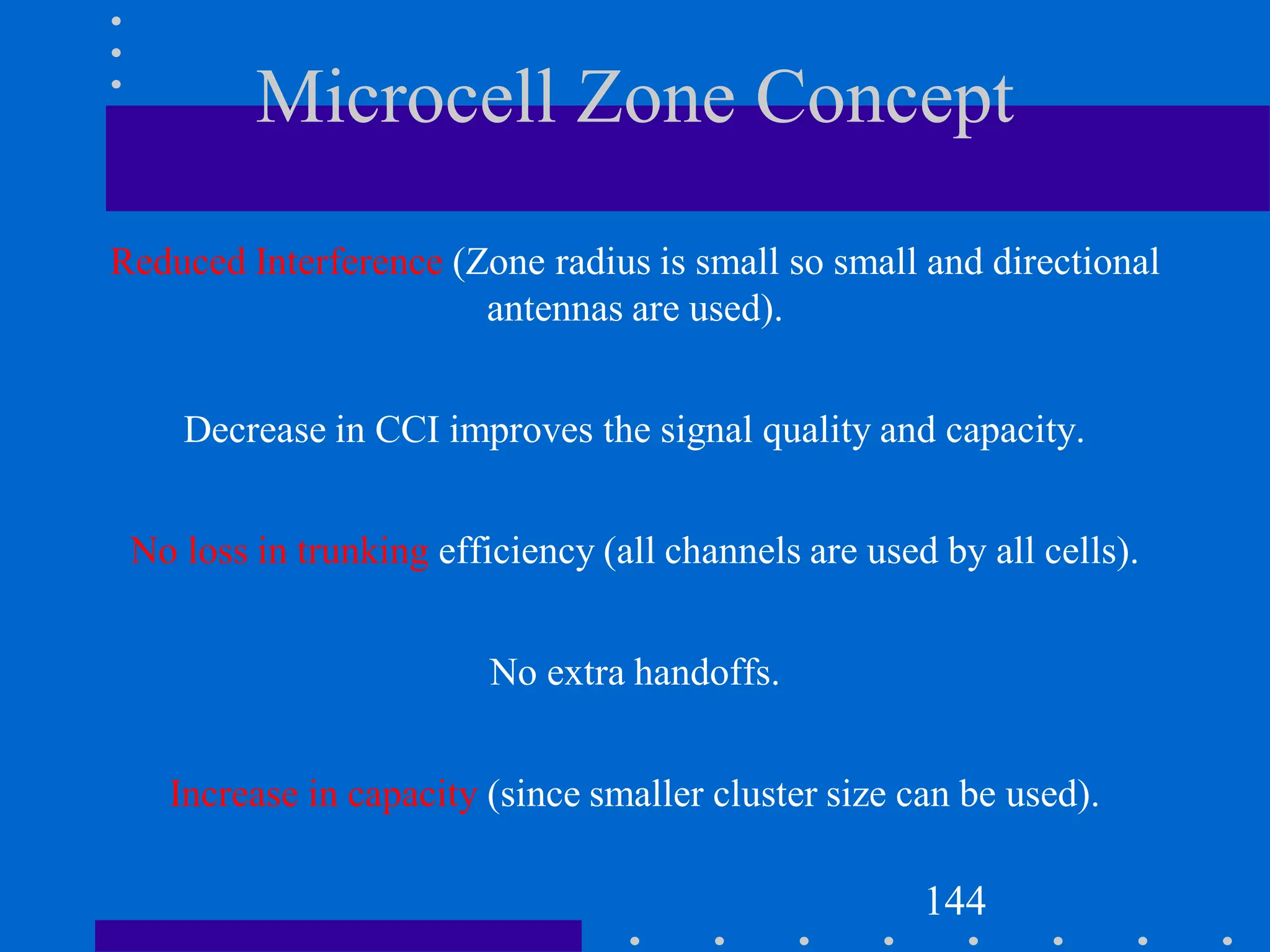
Mobile Radio Propagation
Large-scale Path loss
Wireless Communication
Introduction
 The mobile radio channel places fundamental limitations on
the performance of a wireless communication system
 The wireless transmission path may be
 Line of Sight (LOS)
 Non line of Sight (NLOS)
 Radio channels are random and time varying
 Modeling radio channels have been one of the difficult parts of
mobile radio design and is done in statistical manner
 When electrons move, they create EM waves that can
propagate through space.
 By using antennas we can transmit and receive these EM
wave
 Microwave ,Infrared visible light and radio waves can be used.
2
Properties of Radio Waves
 Are easy to generate
 Can travel long distances
 Can penetrate buildings
 May be used for both indoor and outdoor coverage
 Are omni-directional-can travel in all directions
 Can be narrowly focused at high frequencies(>100MHz) using
parabolic antenna
3
Properties of Radio Waves
 Frequency dependence
 Behave more like light at high frequencies
 Difficulty in passing obstacle
 Follow direct paths
 Absorbed by rain
 Behave more like radio at lower frequencies
 Can pass obstacles
 Power falls off sharply with distance from source
 Subject to interference from other radio waves
4
Propagation Models
 The statistical modeling is usually done based on data
measurements made specifically for
the intended communication system
the intended spectrum
 They are tools used for:
Predicting the average signal strength at a given
distance from the transmitter
Estimating the variability of the signal strength in close
spatial proximity to a particular locations
5
Propagation Models
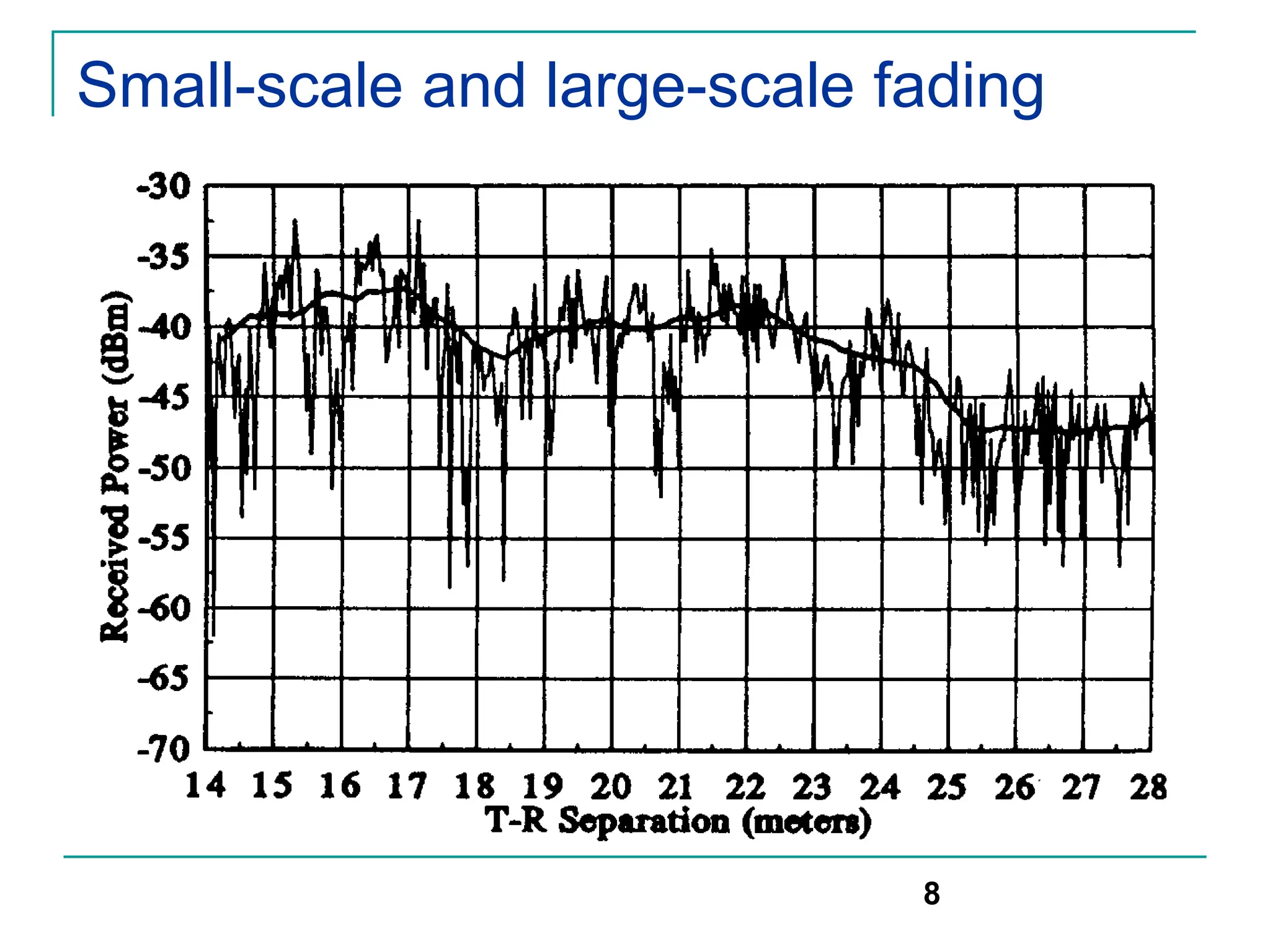
 Large Scale Propagation Model:
 Predict the mean signal strength for an arbitrary
transmitter-receiver(T-R) separation
 Estimate radio coverage of a transmitter
 Characterize signal strength over large T-R
separation distances(several 100’s to 1000’s
meters)
6
Propagation Models
 Small Scale or Fading Models:
 Characterize rapid fluctuations of received signal
strength over
 Very short travel distances( a few wavelengths)
 Short time durations(on the order of seconds)
7
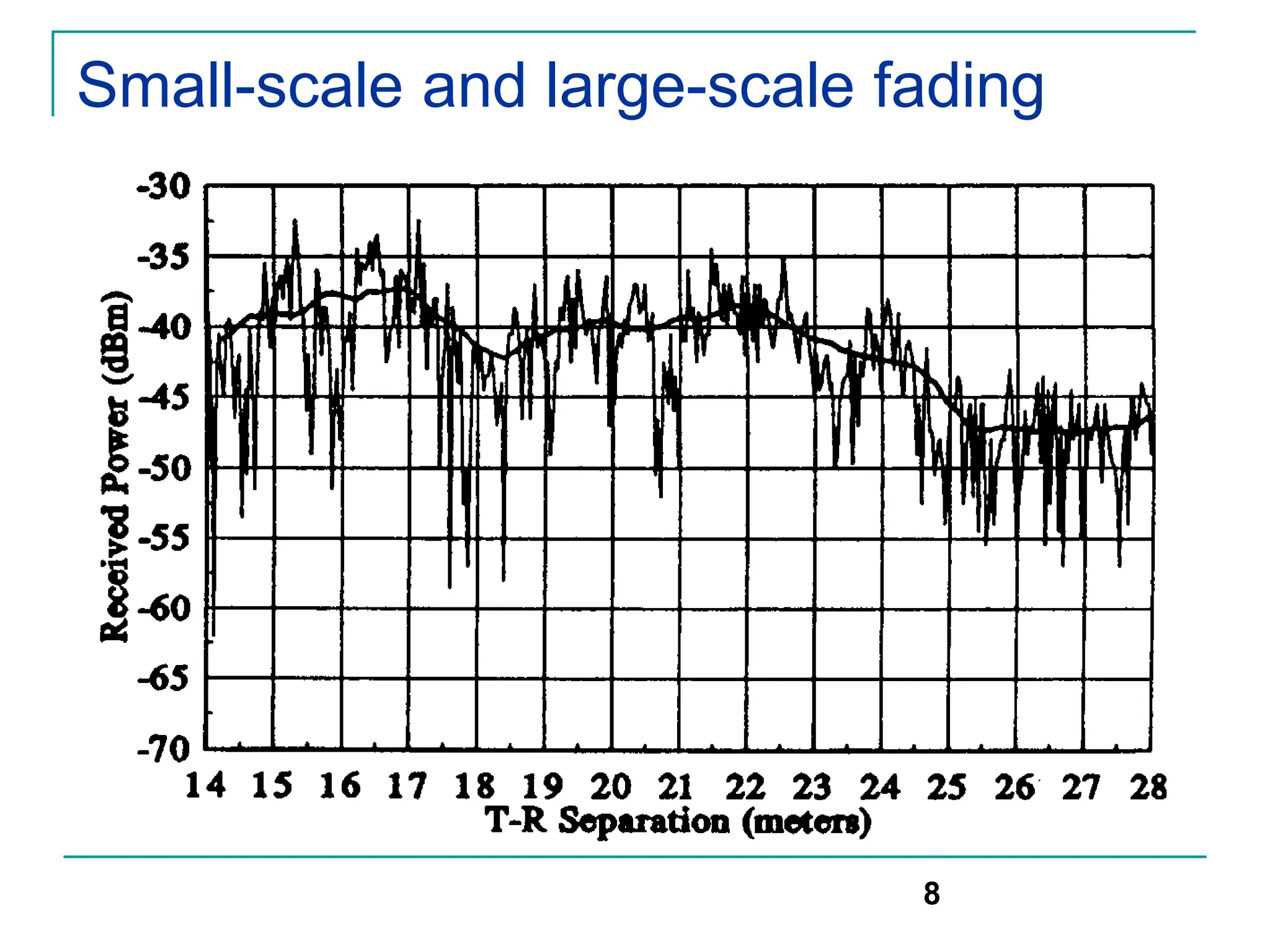
Small-scale and large-scale fading
8
Free Space Propagation Model
 For clear LOS between T-R
 Ex: satellite & microwave communications
 Assumes that received power decays as a function of T-R distance
separation raised to some power.
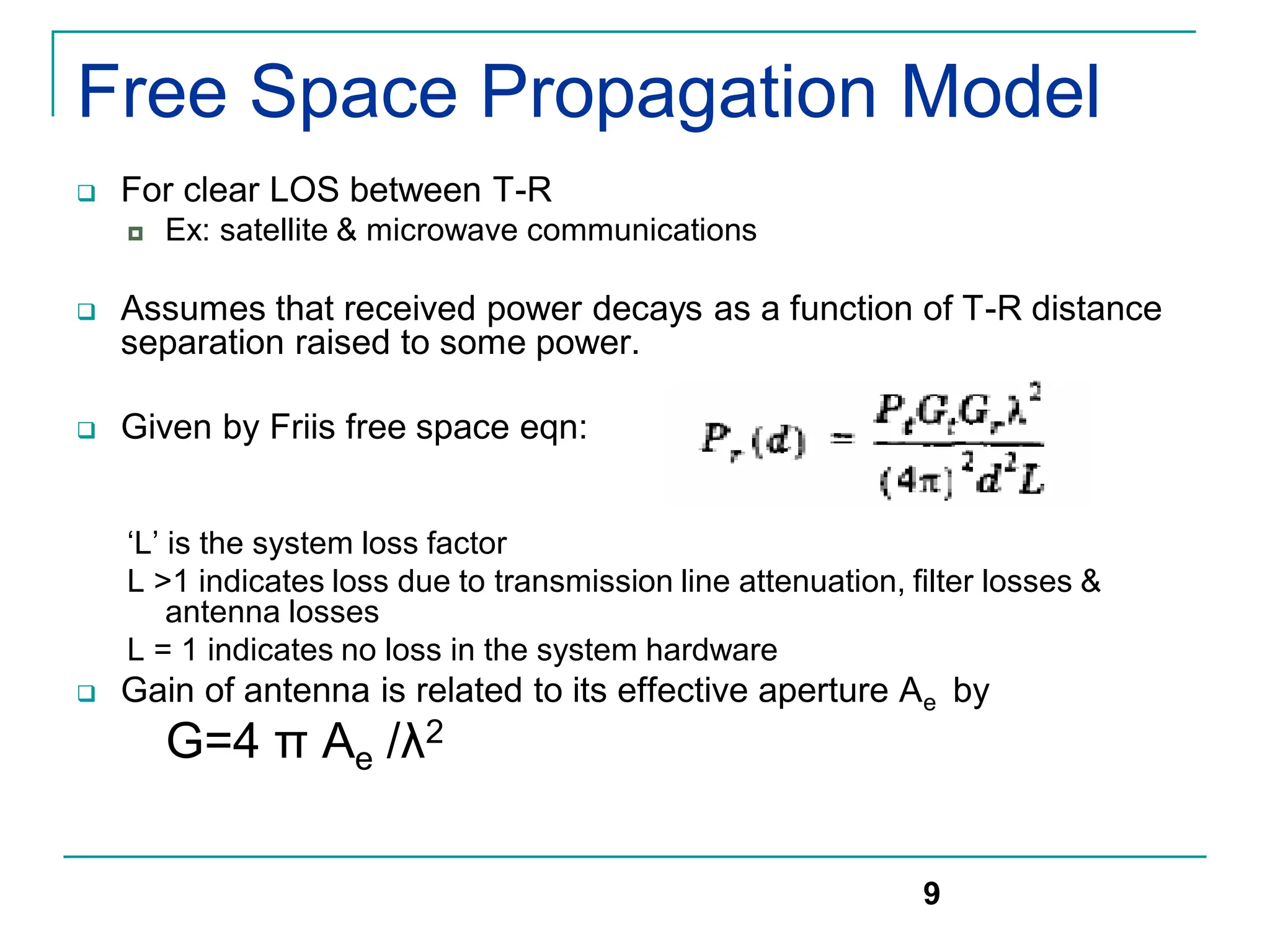
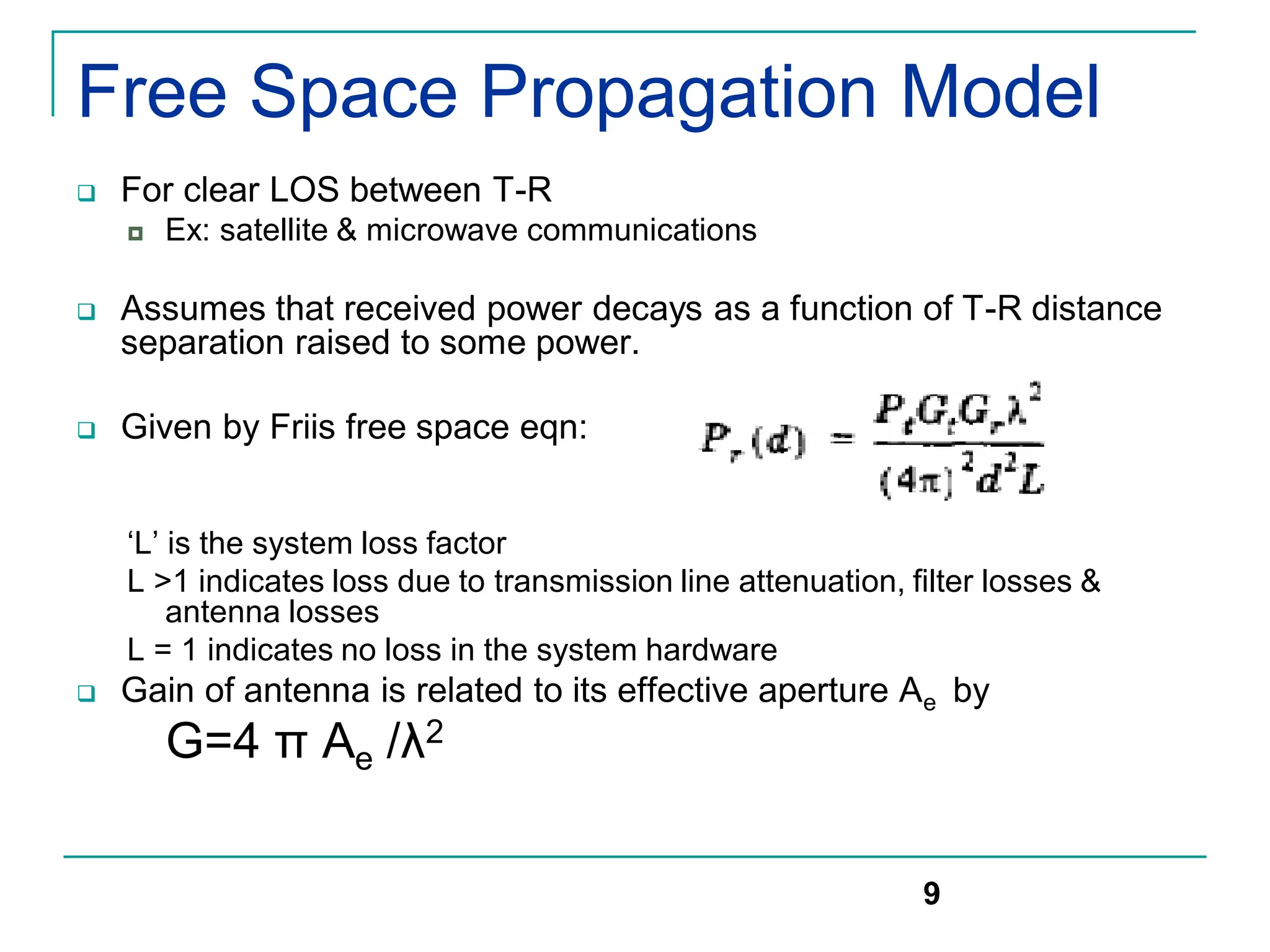
 Given by Friis free space eqn:
‘L’ is the system loss factor
L >1 indicates loss due to transmission line attenuation, filter losses &
antenna losses
L = 1 indicates no loss in the system hardware
 Gain of antenna is related to its effective aperture Ae by
G=4 π Ae /λ2
9
Free Space Propagation Model
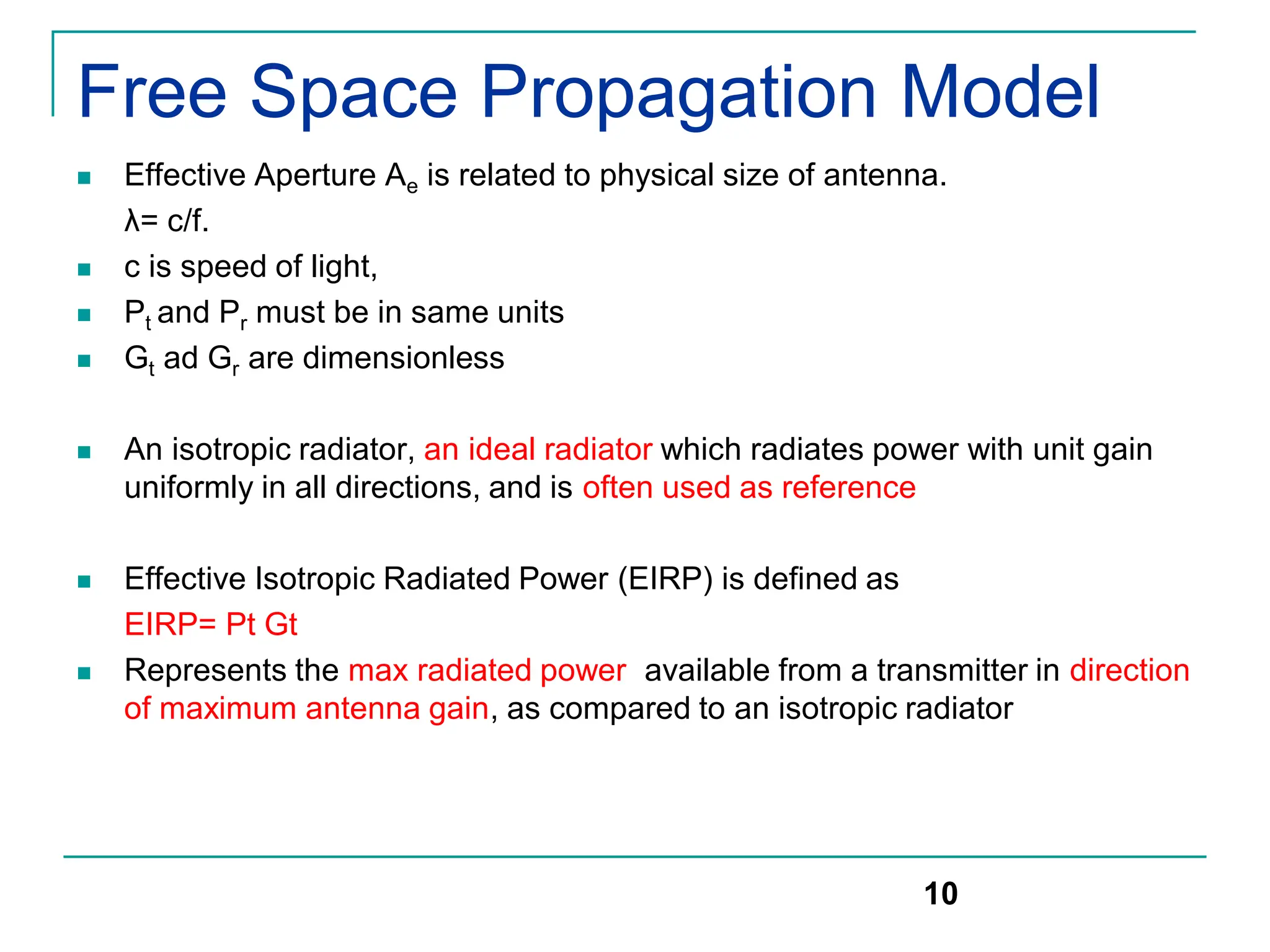
 Effective Aperture Ae is related to physical size of antenna.
λ= c/f.
 c is speed of light,
 Pt and Pr must be in same units
 Gt ad Gr are dimensionless
 An isotropic radiator, an ideal radiator which radiates power with unit gain
uniformly in all directions, and is often used as reference
 Effective Isotropic Radiated Power (EIRP) is defined as
EIRP= Pt Gt
 Represents the max radiated power available from a transmitter in direction
of maximum antenna gain, as compared to an isotropic radiator
10
Free Space Propagation Model
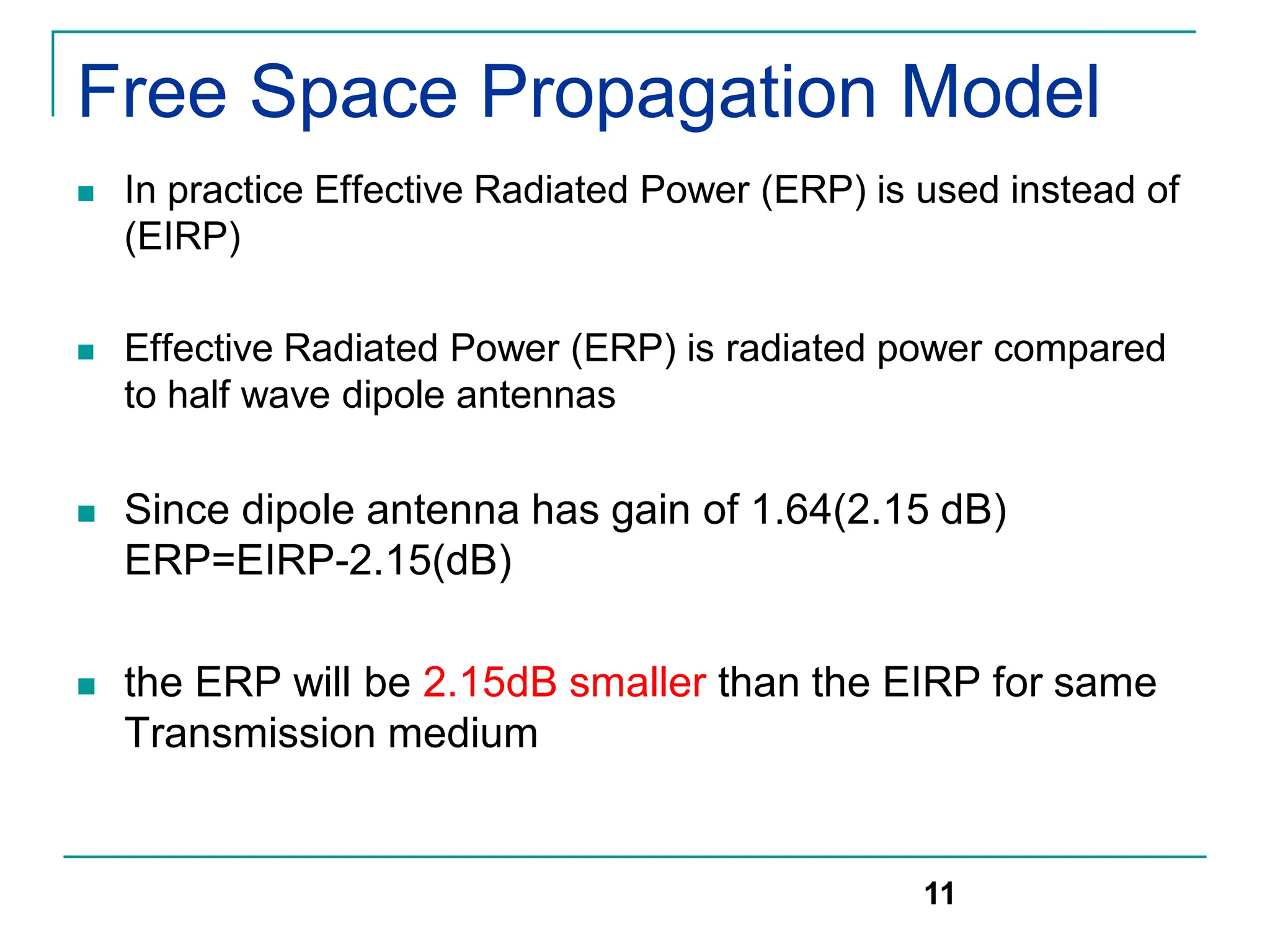
 In practice Effective Radiated Power (ERP) is used instead of
(EIRP)
 Effective Radiated Power (ERP) is radiated power compared
to half wave dipole antennas
 Since dipole antenna has gain of 1.64(2.15 dB)
ERP=EIRP-2.15(dB)
 the ERP will be 2.15dB smaller than the EIRP for same
Transmission medium
11
Free Space Propagation Model
 Path Loss (PL) represents signal attenuation and is defined
as difference between the effective transmitted power and
received power
Path loss PL(dB) = 10 log [Pt/Pr]
= -10 log {GtGr λ^2/(4π)^2d^2}
 Without antenna gains (with unit antenna gains)
PL = - 10 log { λ^2/(4π)^2d^2}
 Friis free space model is valid predictor for Pr for values of d
which are in the far-field of transmitting antenna
12
Free Space Propagation Model
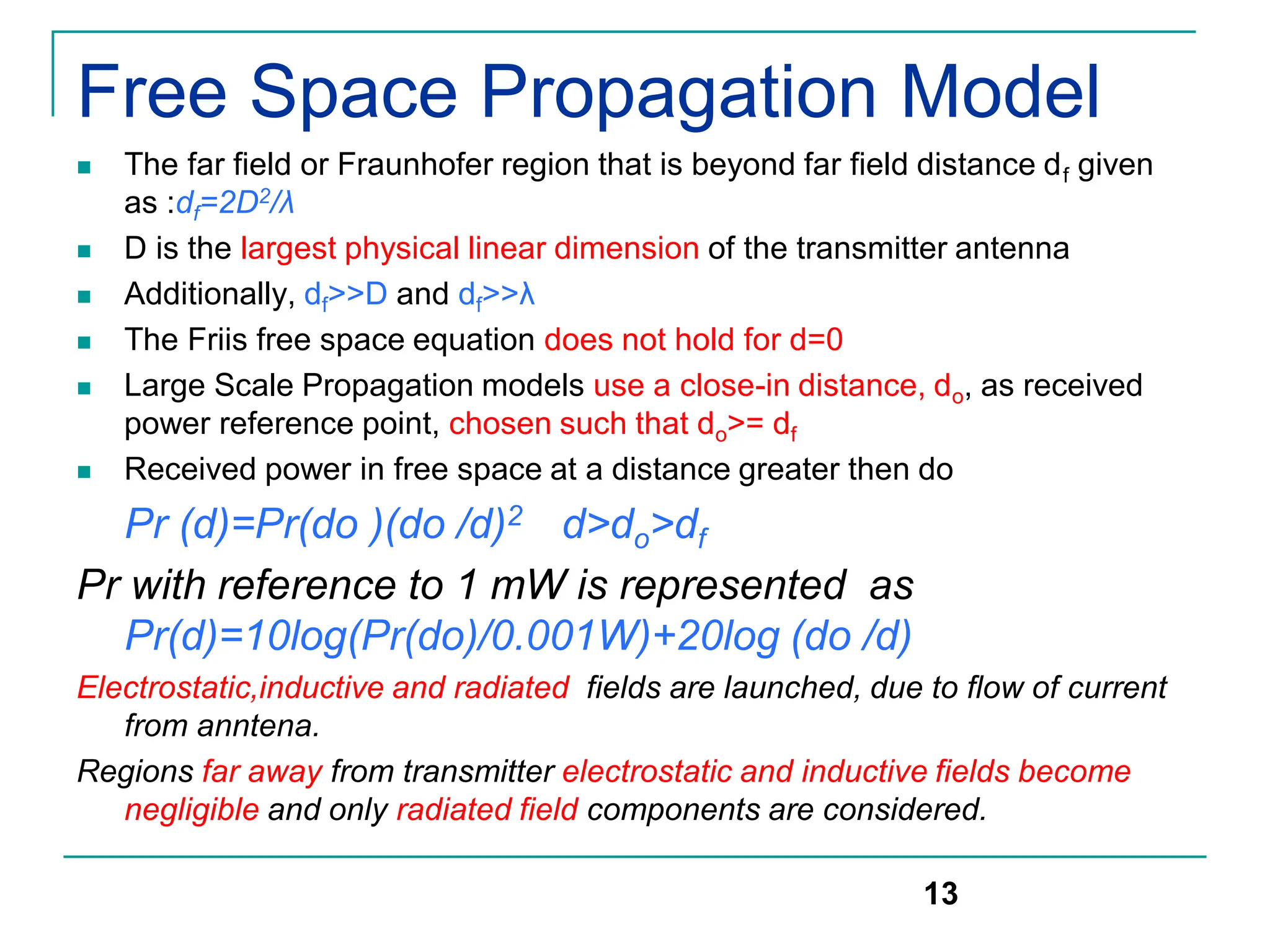
 The far field or Fraunhofer region that is beyond far field distance df given
as :df=2D2/λ
 D is the largest physical linear dimension of the transmitter antenna
 Additionally, df>>D and df>>λ
 The Friis free space equation does not hold for d=0
 Large Scale Propagation models use a close-in distance, do, as received
power reference point, chosen such that do>= df
 Received power in free space at a distance greater then do
Pr (d)=Pr(do )(do /d)2 d>do>df
Pr with reference to 1 mW is represented as
Pr(d)=10log(Pr(do)/0.001W)+20log (do /d)
Electrostatic,inductive and radiated fields are launched, due to flow of current
from anntena.
Regions far away from transmitter electrostatic and inductive fields become
negligible and only radiated field components are considered.
13
Example
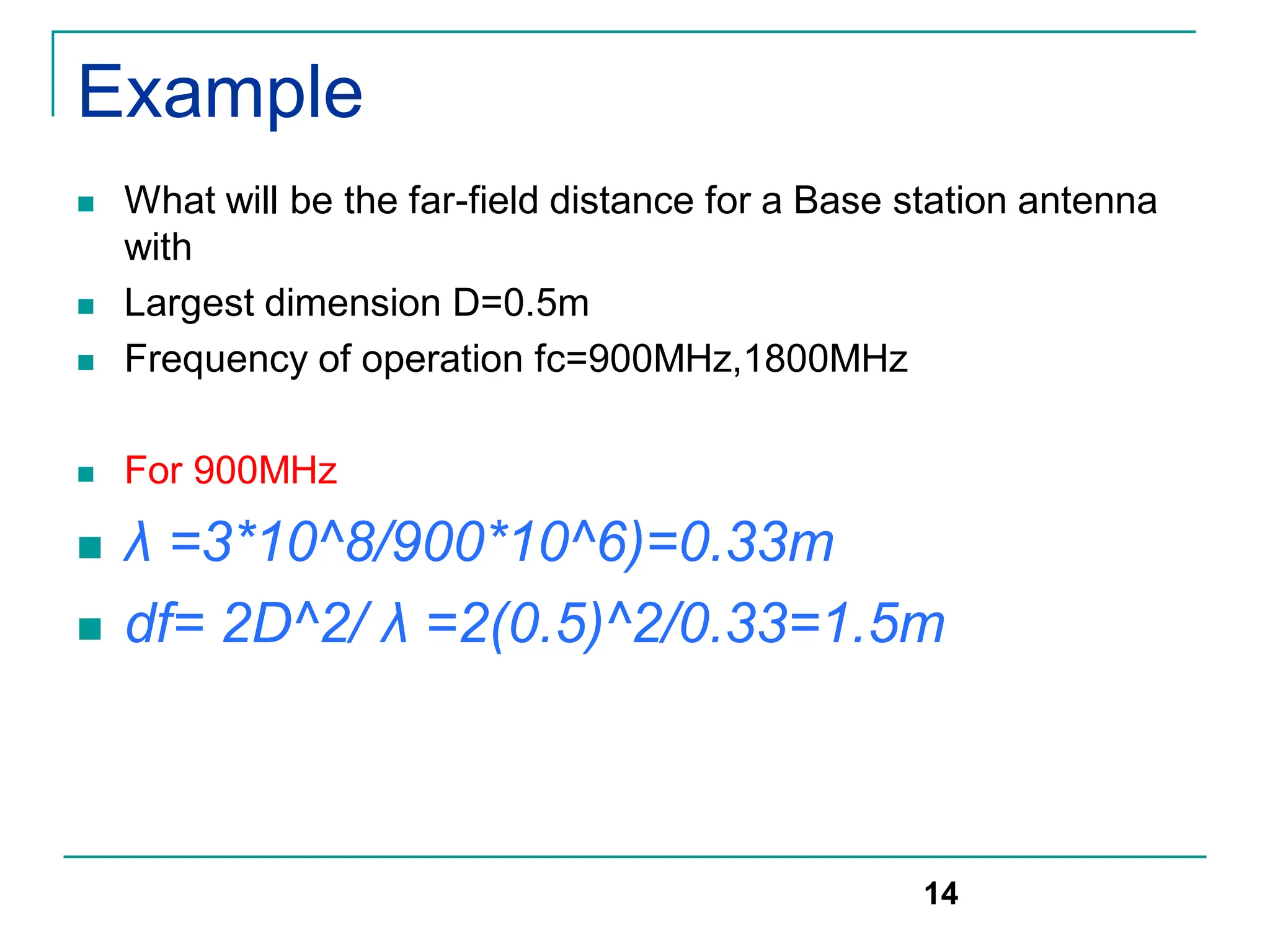
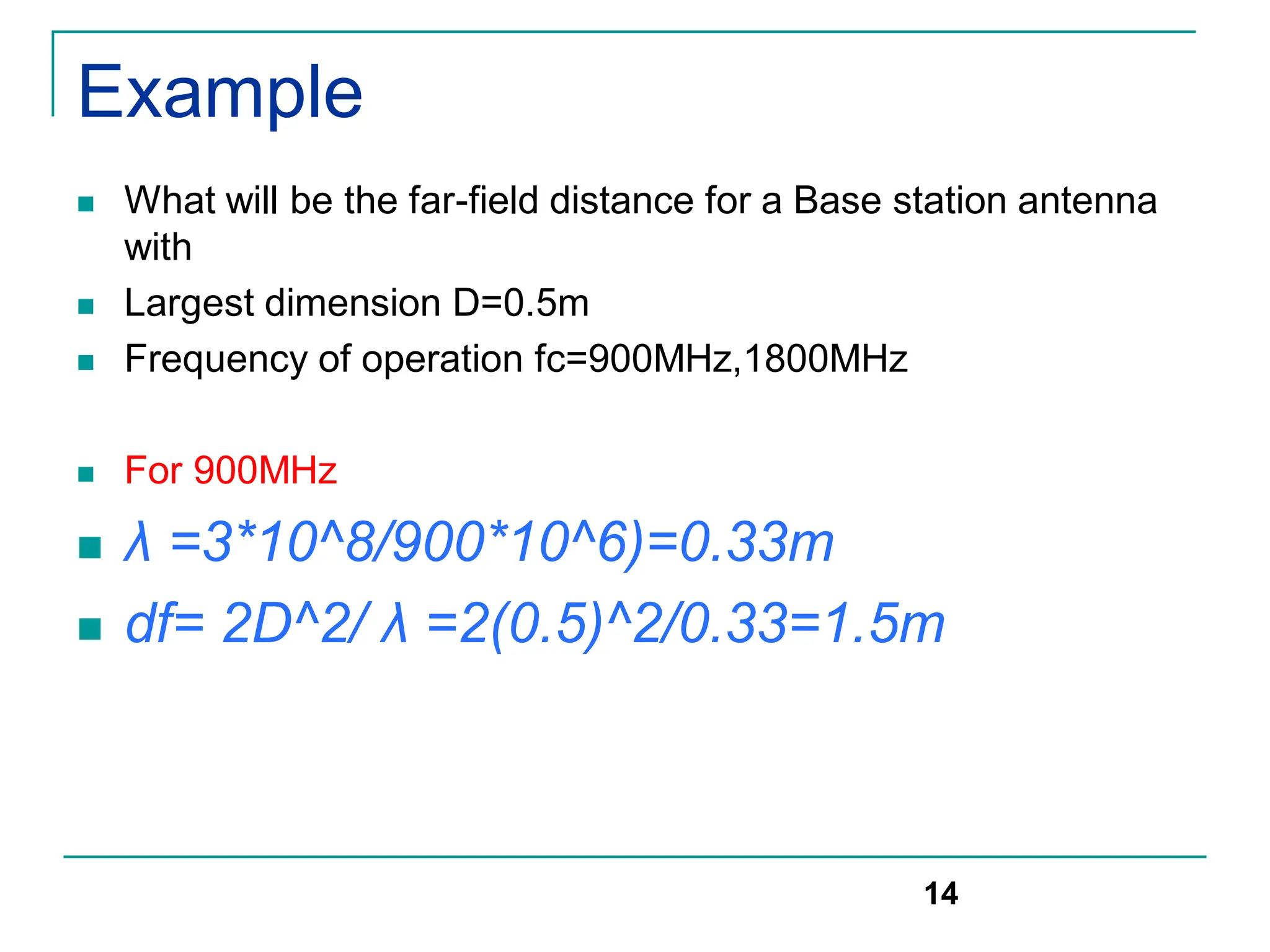
 What will be the far-field distance for a Base station antenna
with
 Largest dimension D=0.5m
 Frequency of operation fc=900MHz,1800MHz
 For 900MHz
 λ =3*10^8/900*10^6)=0.33m
 df= 2D^2/ λ =2(0.5)^2/0.33=1.5m
14
Example
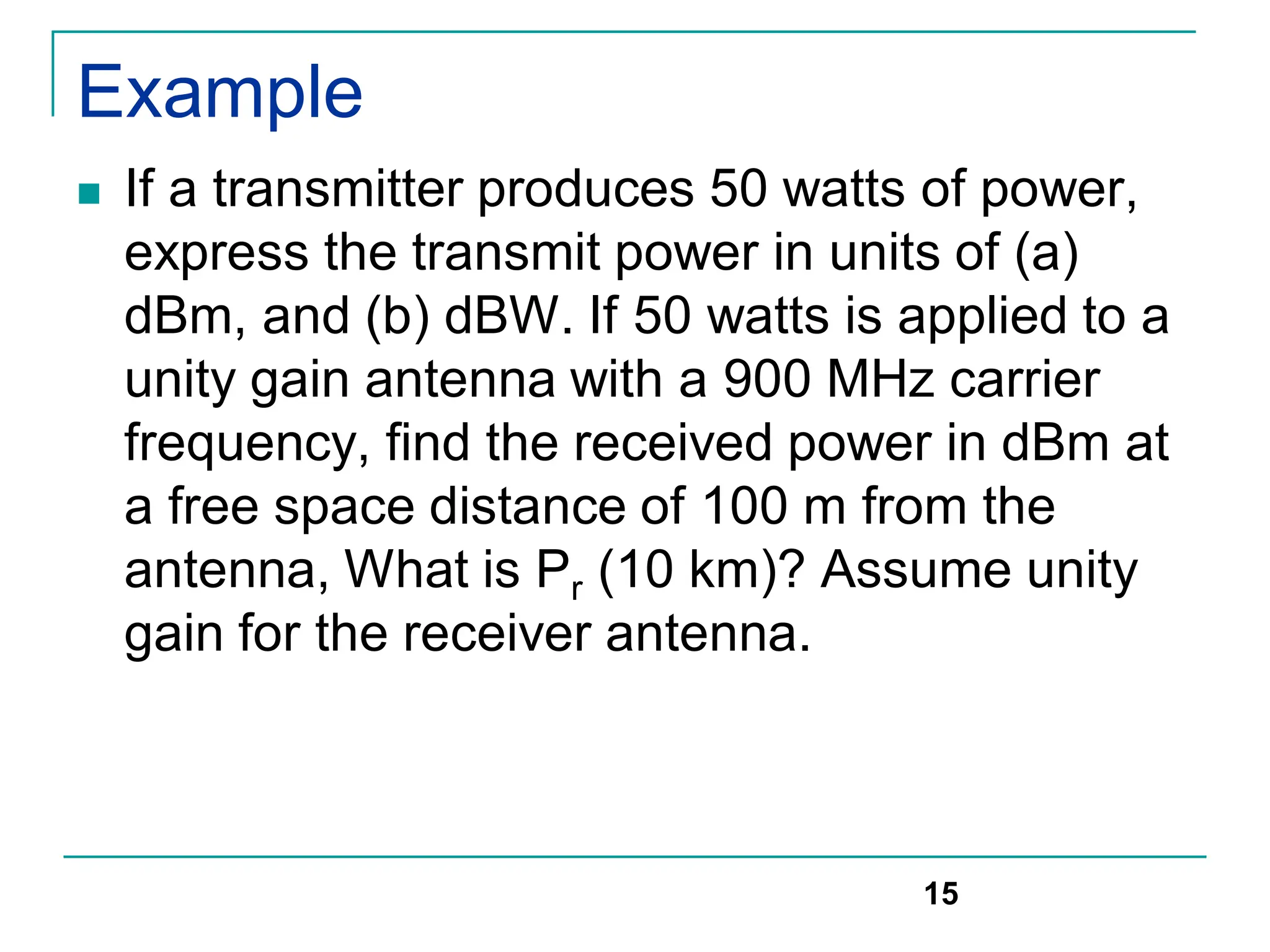
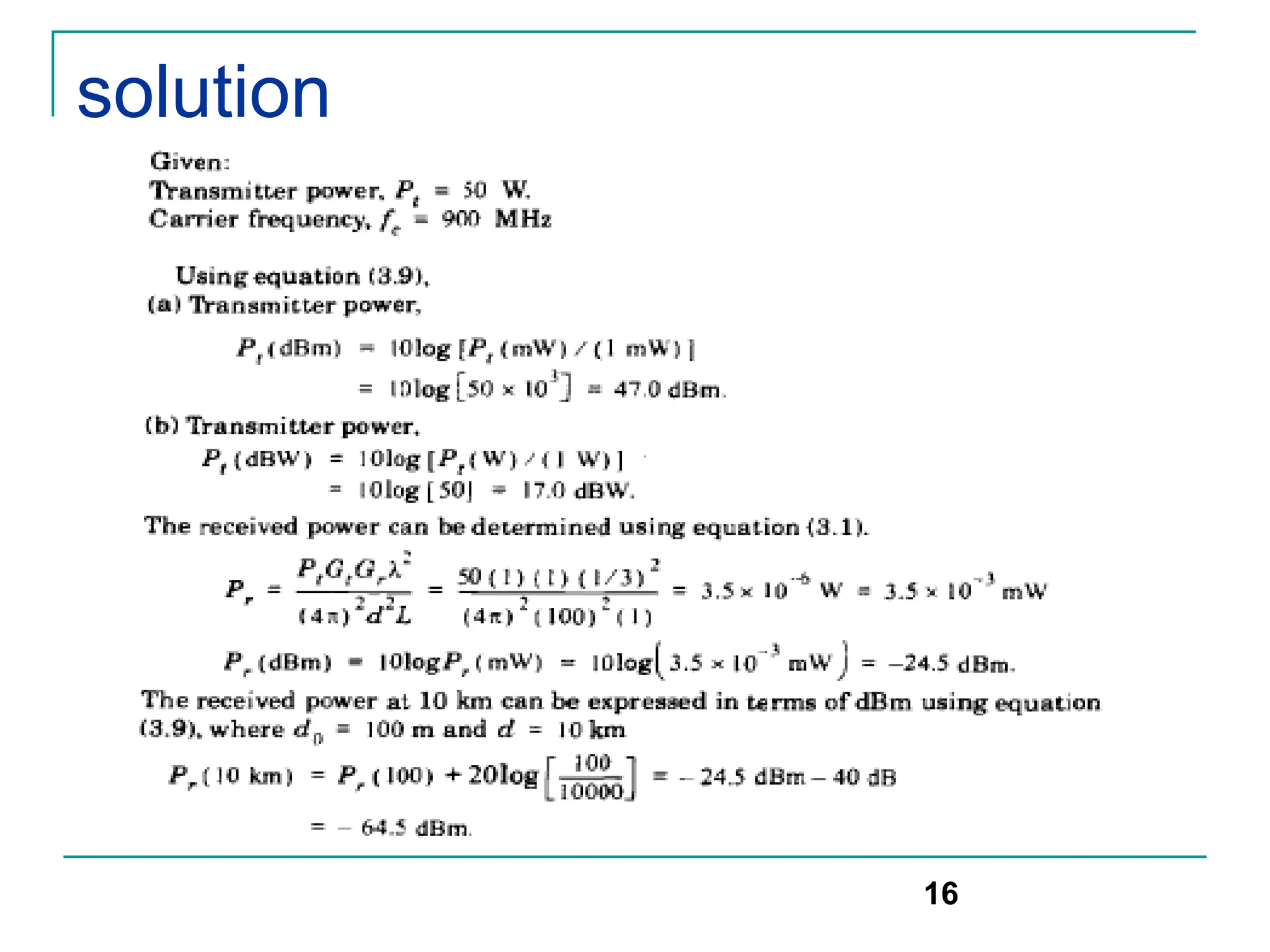
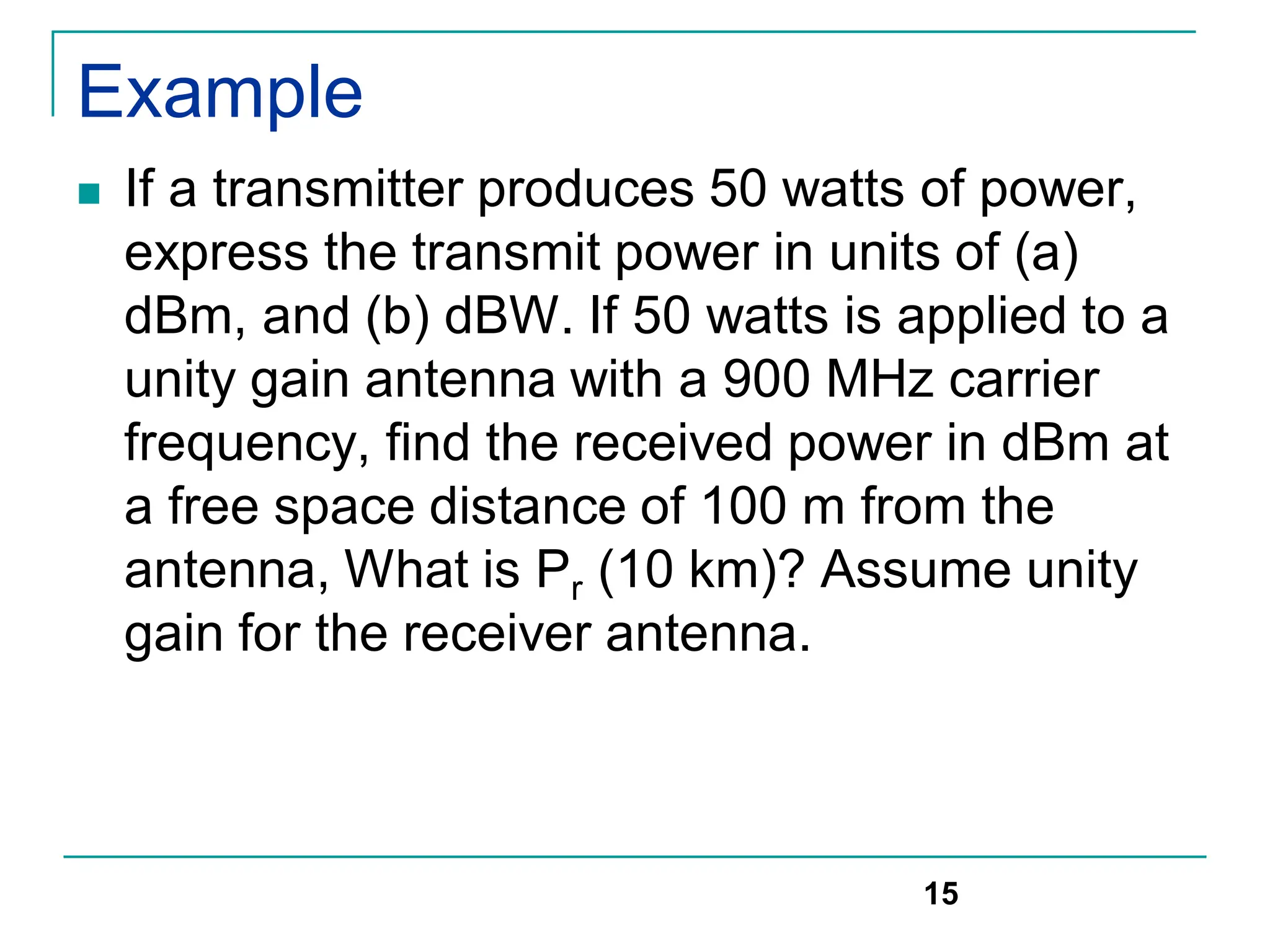
 If a transmitter produces 50 watts of power,
express the transmit power in units of (a)
dBm, and (b) dBW. If 50 watts is applied to a
unity gain antenna with a 900 MHz carrier
frequency, find the received power in dBm at
a free space distance of 100 m from the
antenna, What is Pr (10 km)? Assume unity
gain for the receiver antenna.
15
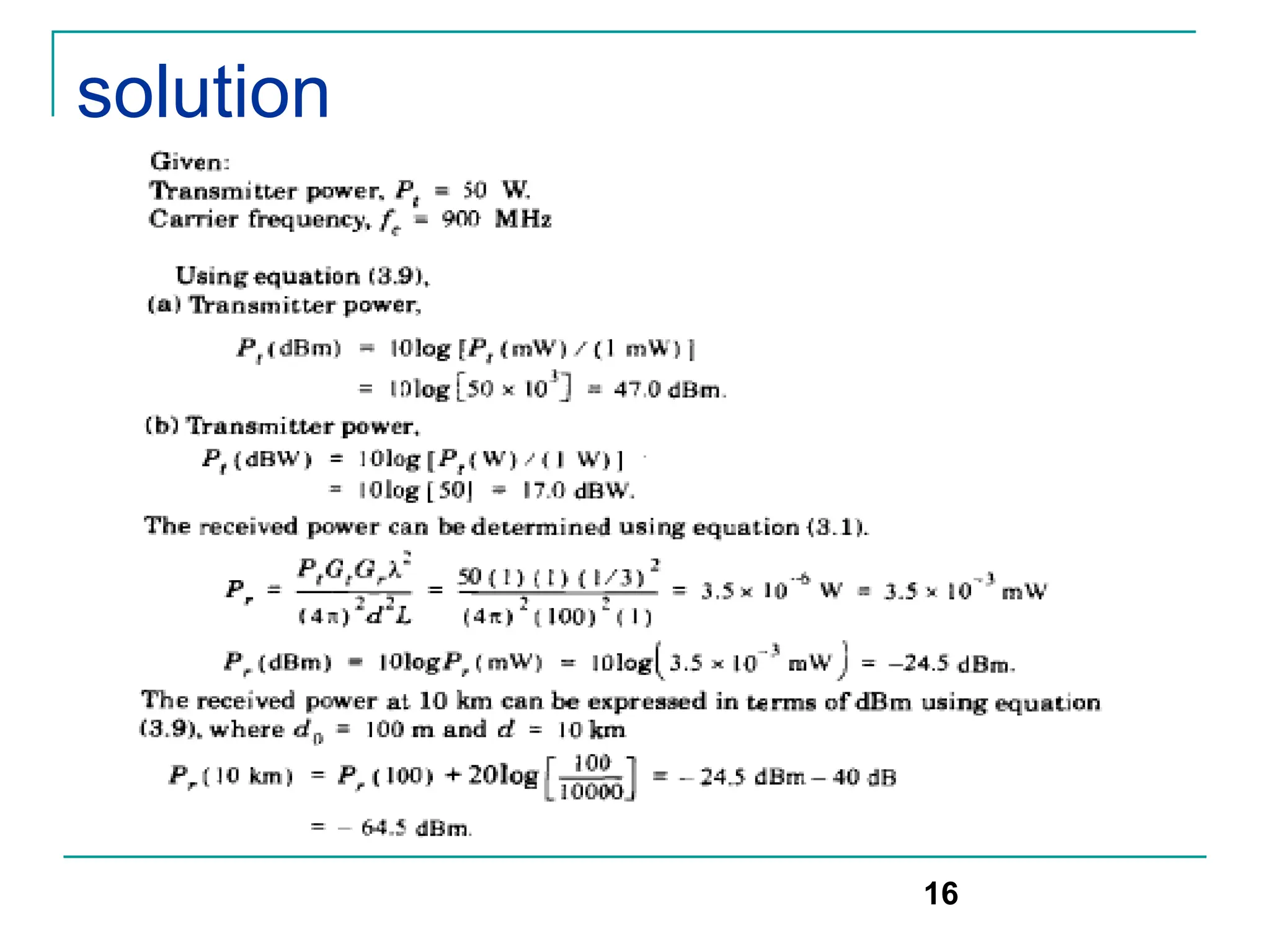
solution
16
Propagation Mechanisms
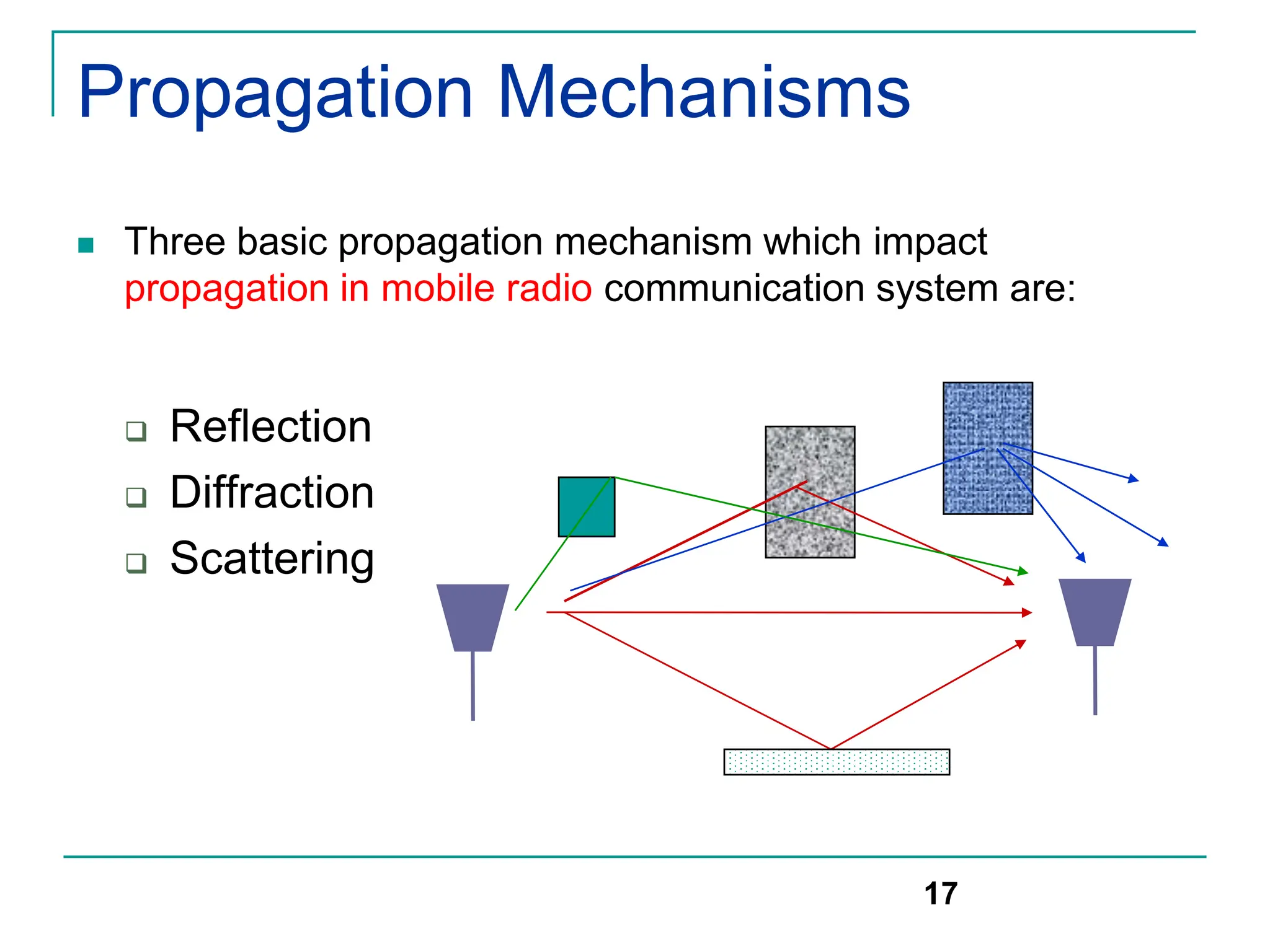
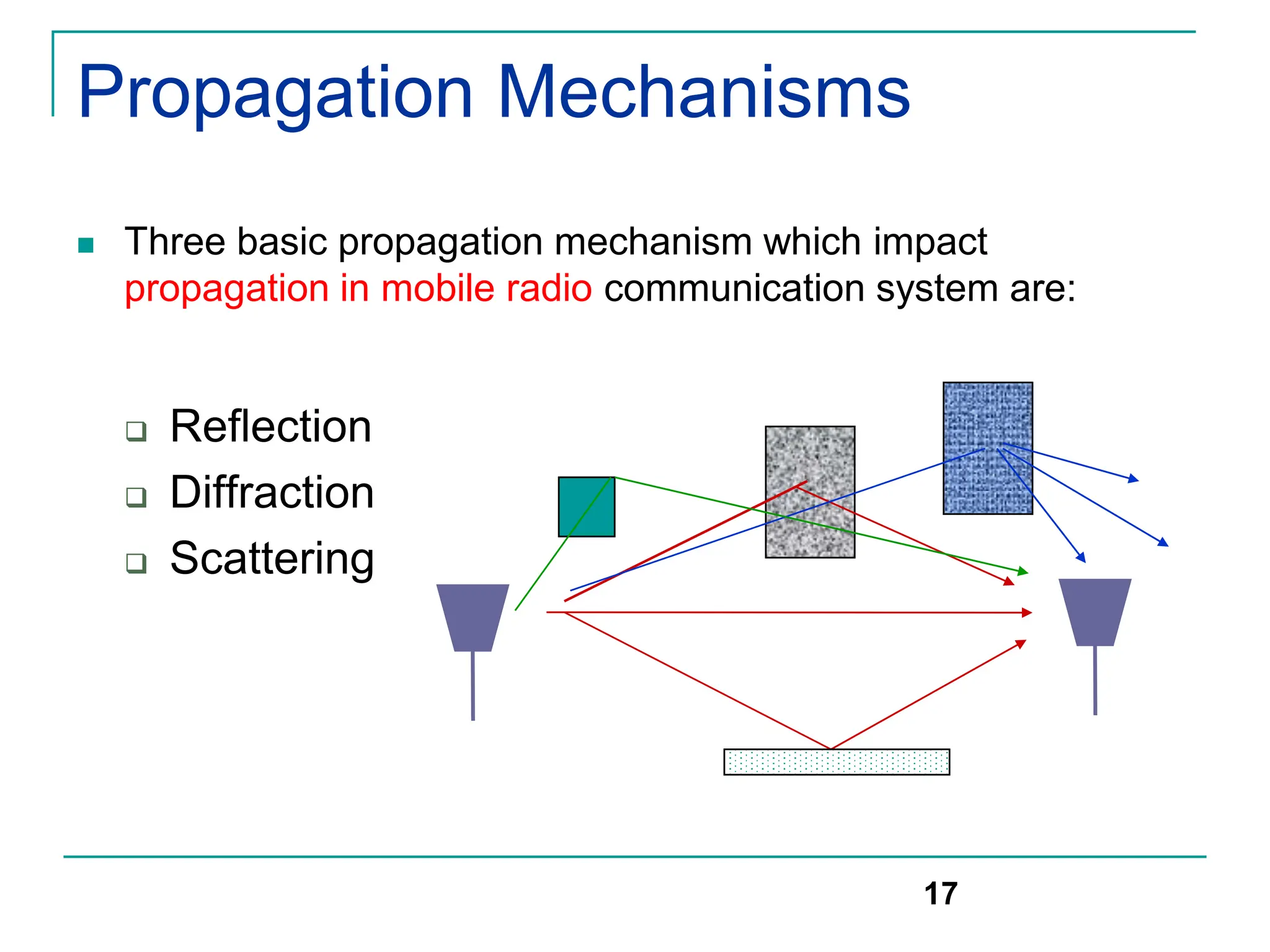
 Three basic propagation mechanism which impact
propagation in mobile radio communication system are:
 Reflection
 Diffraction
 Scattering
17
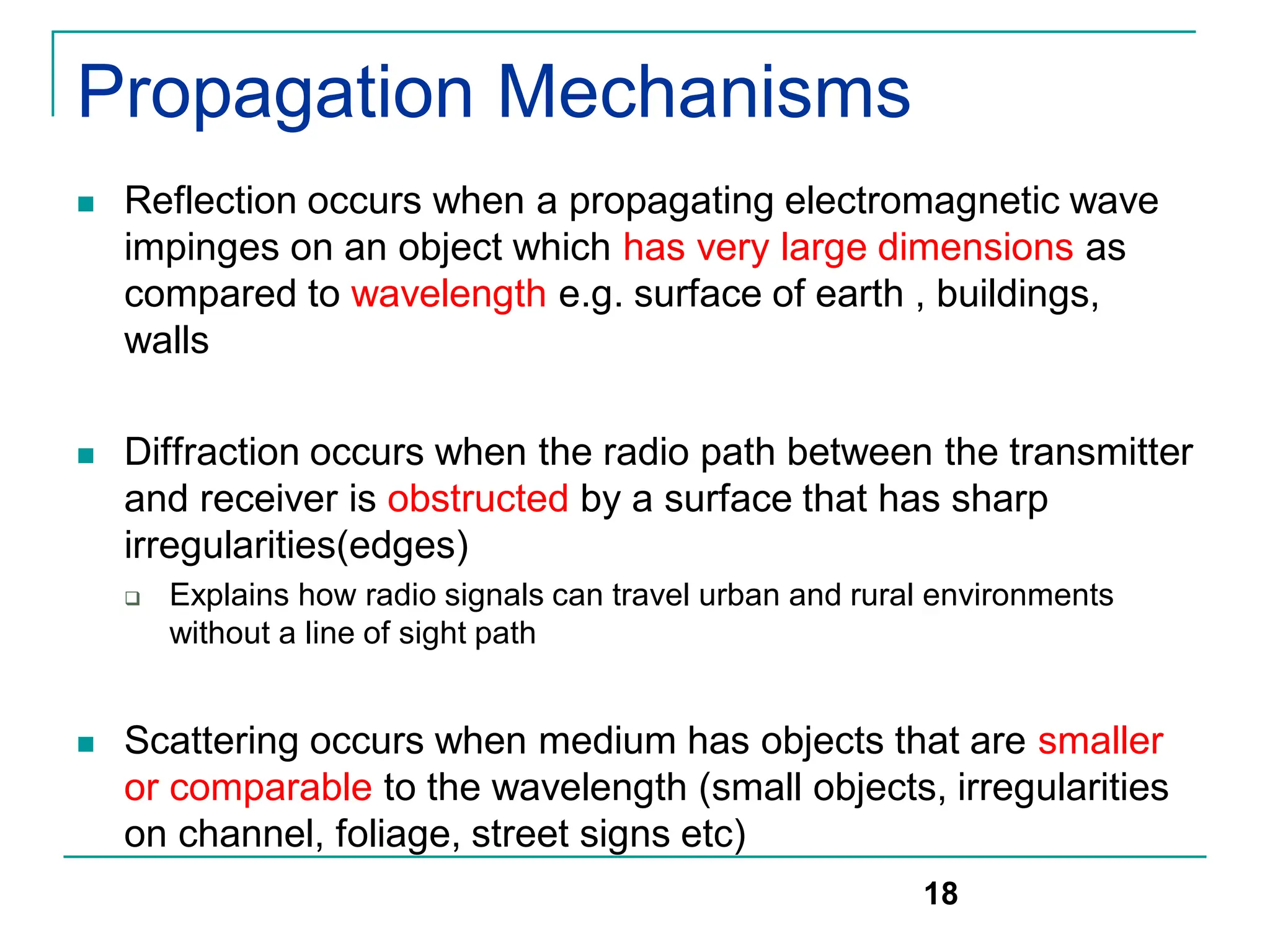
Propagation Mechanisms
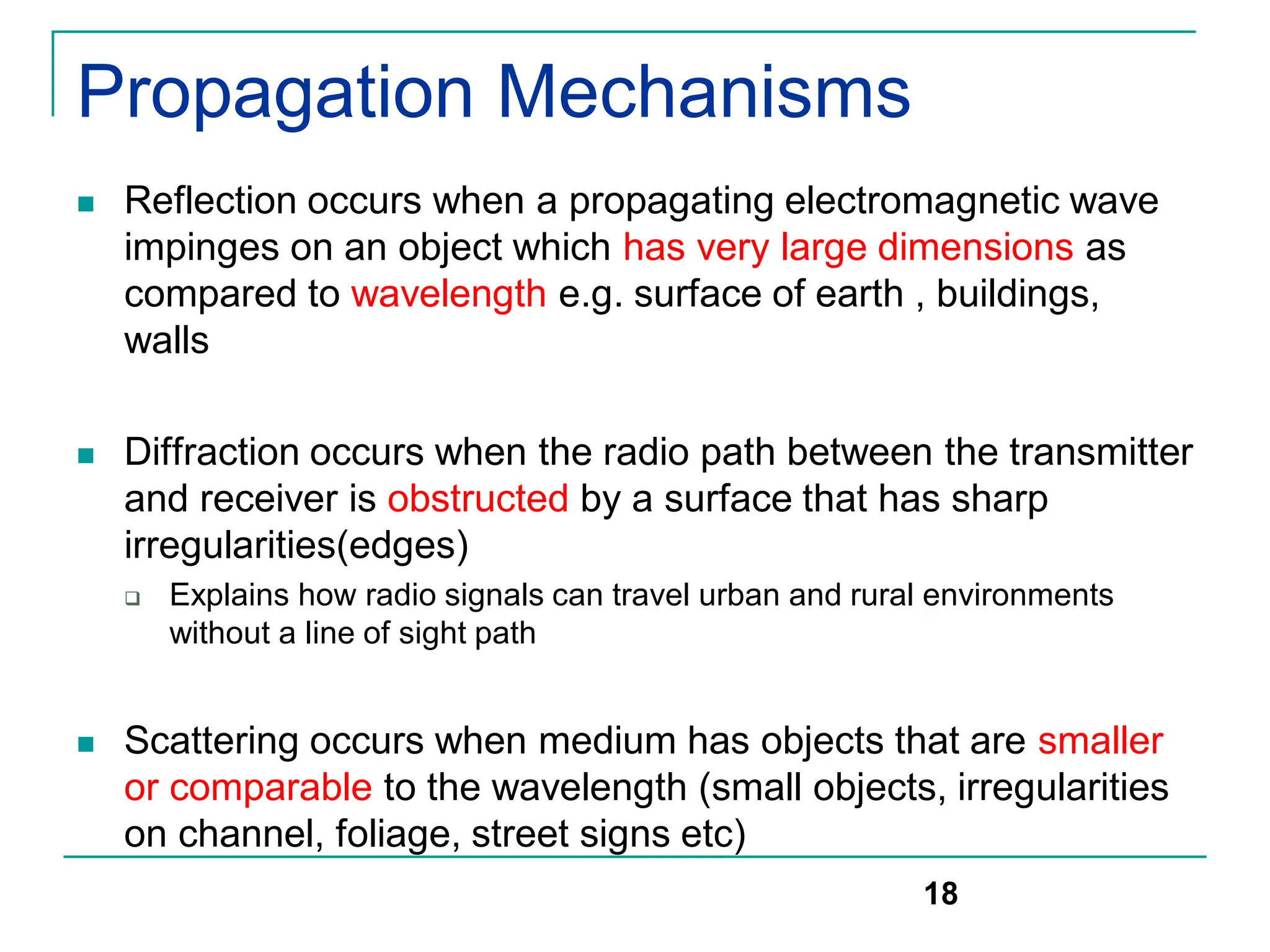
 Reflection occurs when a propagating electromagnetic wave
impinges on an object which has very large dimensions as
compared to wavelength e.g. surface of earth , buildings,
walls
 Diffraction occurs when the radio path between the transmitter
and receiver is obstructed by a surface that has sharp
irregularities(edges)
 Explains how radio signals can travel urban and rural environments
without a line of sight path
 Scattering occurs when medium has objects that are smaller
or comparable to the wavelength (small objects, irregularities
on channel, foliage, street signs etc)
18
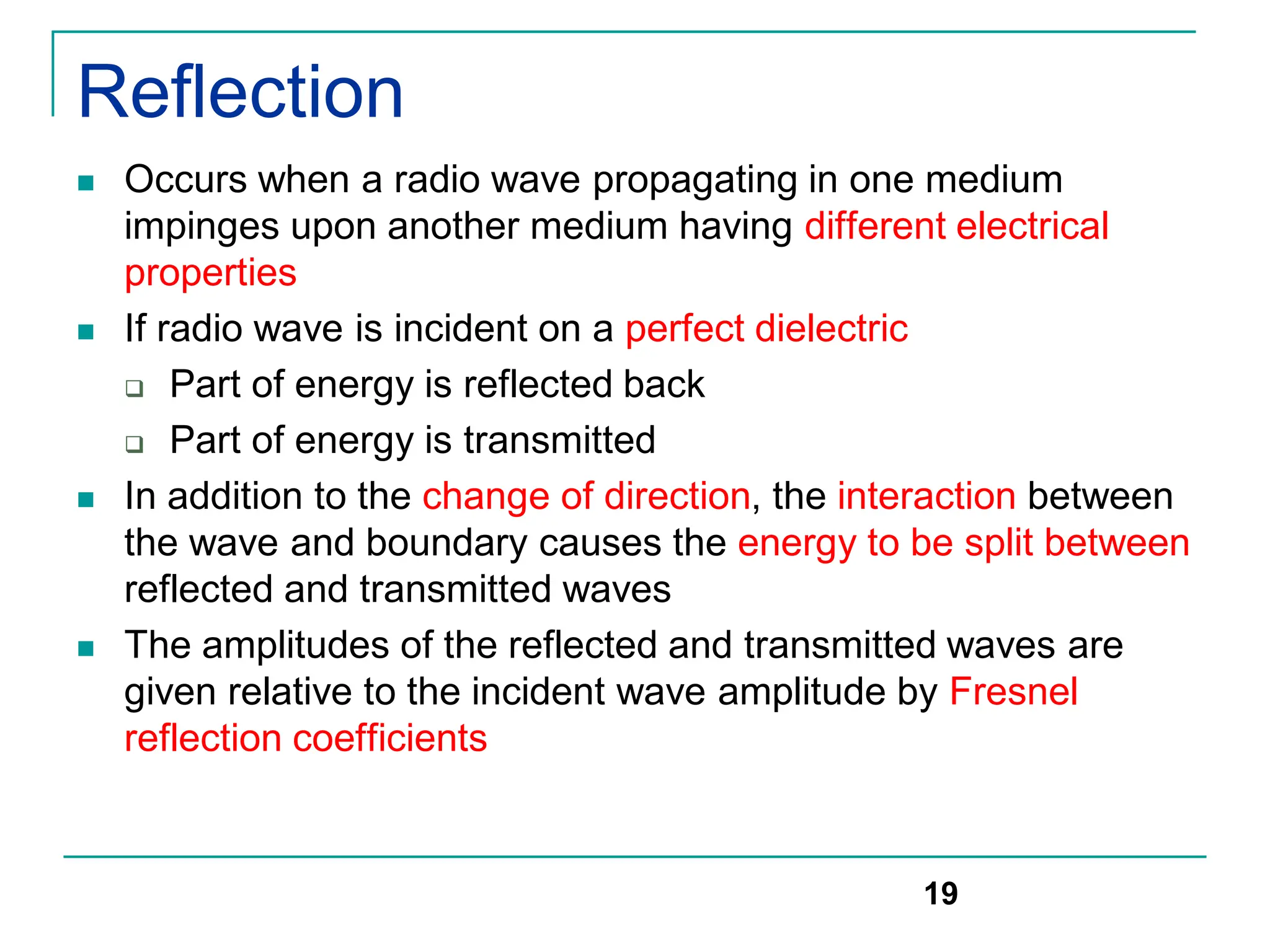
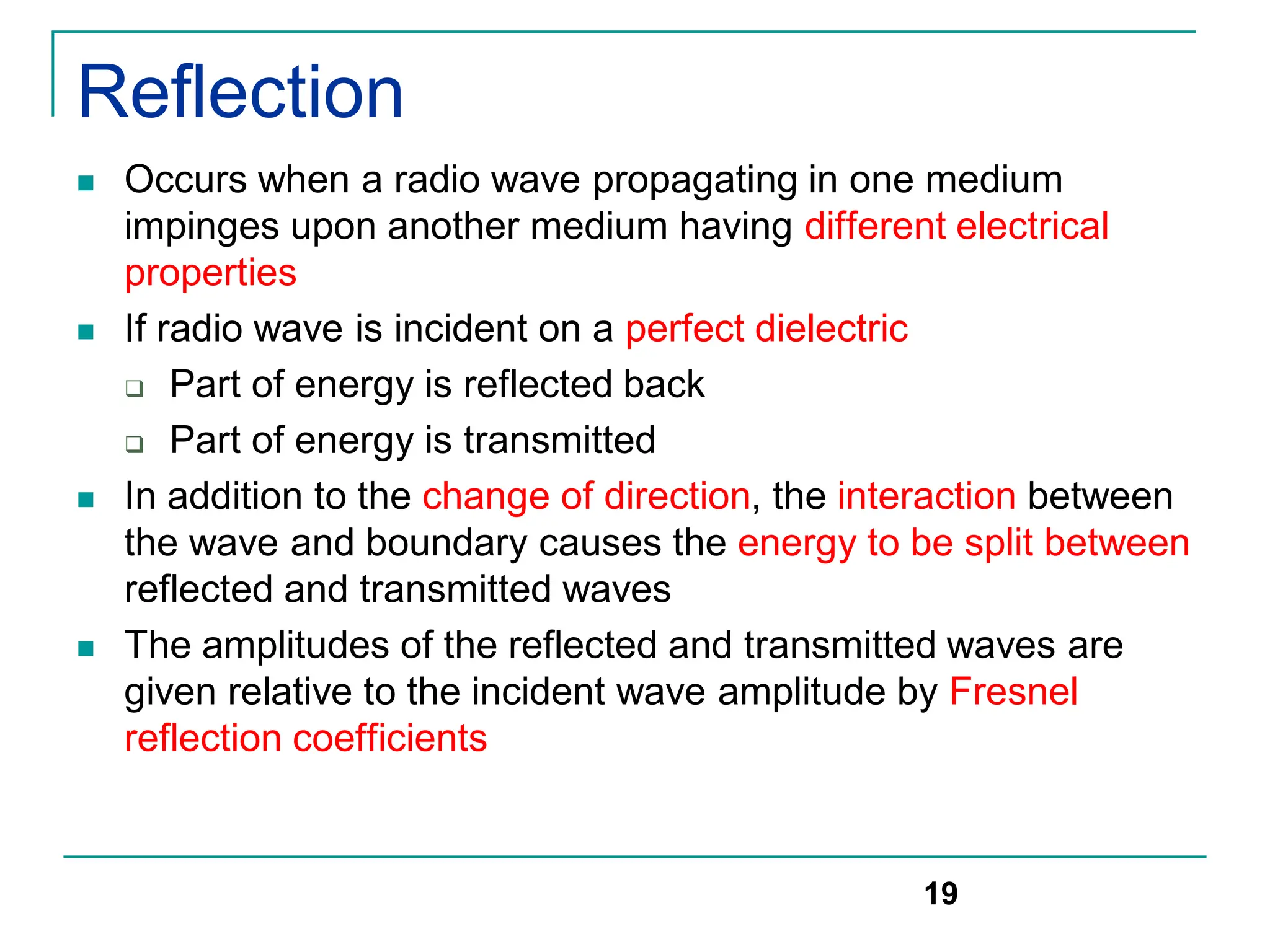
Reflection
 Occurs when a radio wave propagating in one medium
impinges upon another medium having different electrical
properties
 If radio wave is incident on a perfect dielectric
 Part of energy is reflected back
 Part of energy is transmitted
 In addition to the change of direction, the interaction between
the wave and boundary causes the energy to be split between
reflected and transmitted waves
 The amplitudes of the reflected and transmitted waves are
given relative to the incident wave amplitude by Fresnel
reflection coefficients
19
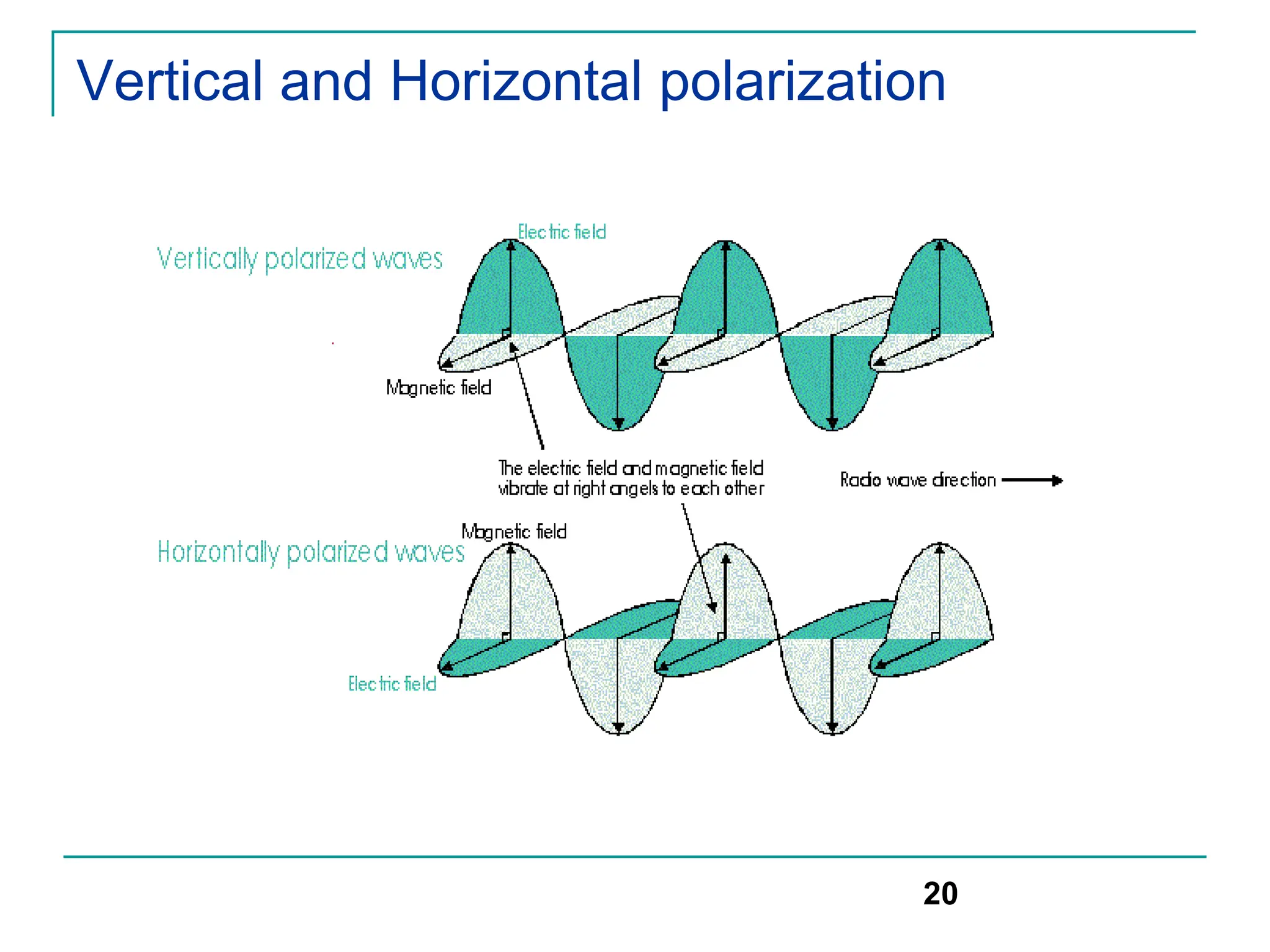
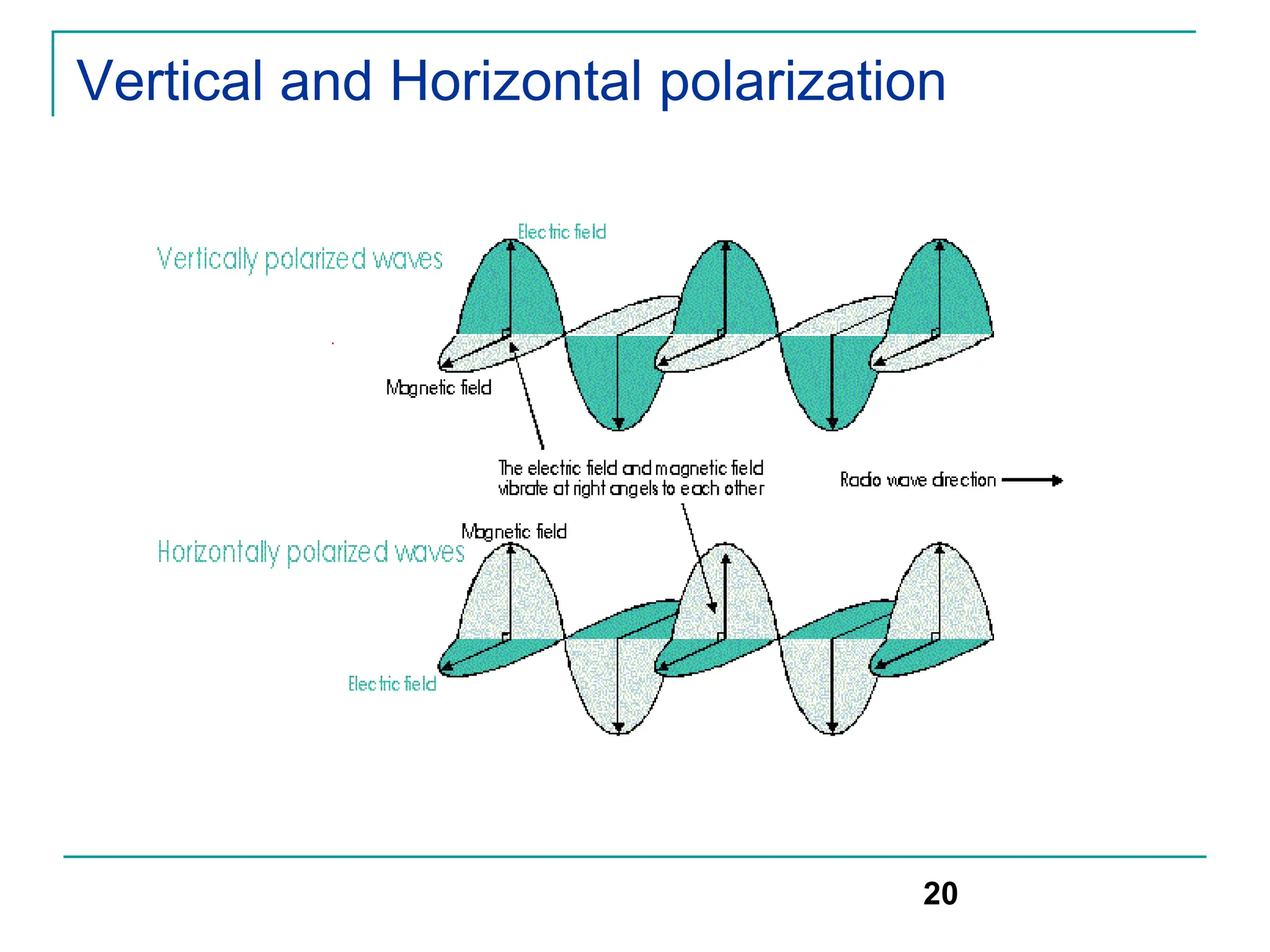
Vertical and Horizontal polarization
20
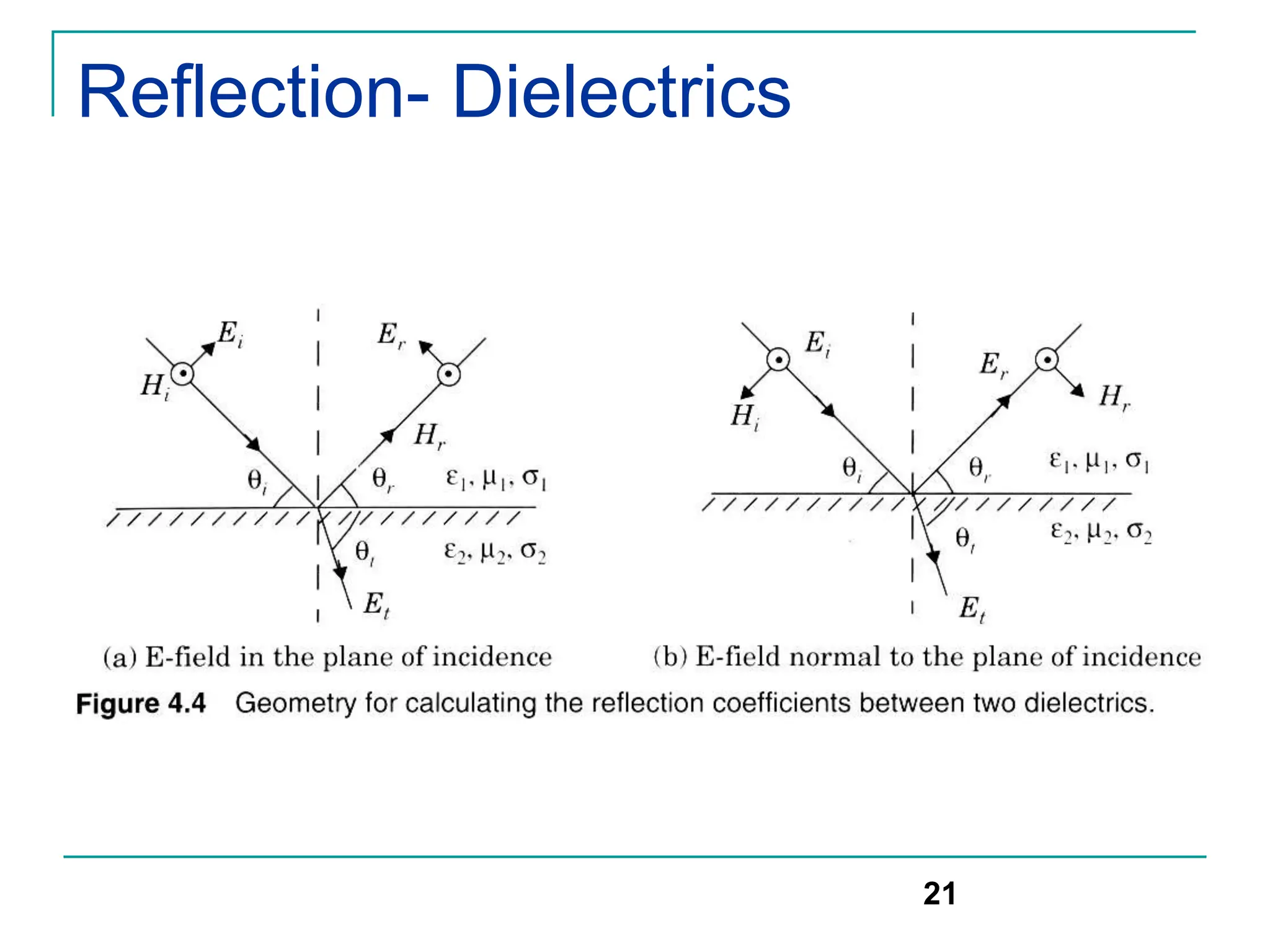
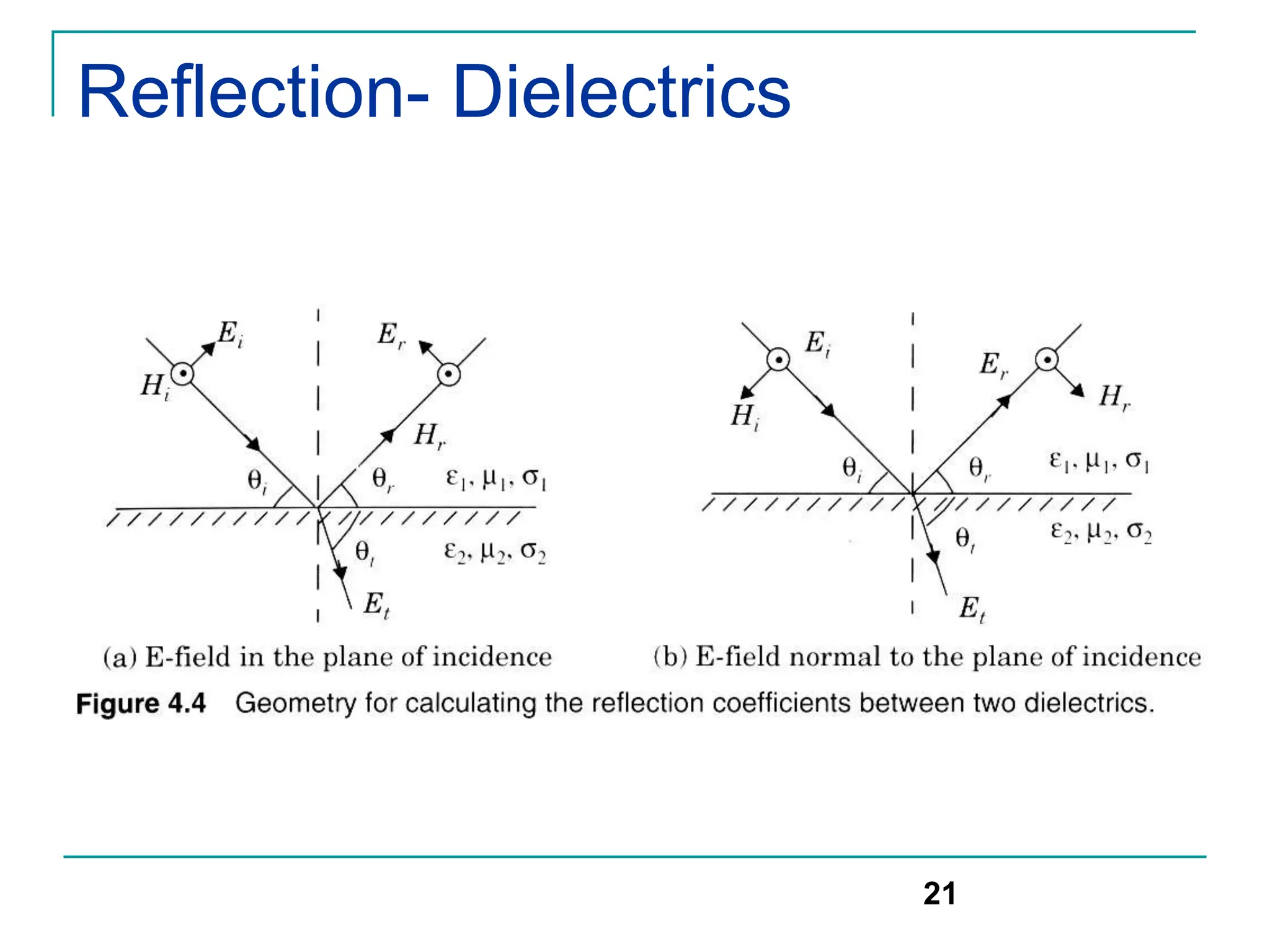
Reflection- Dielectrics
21
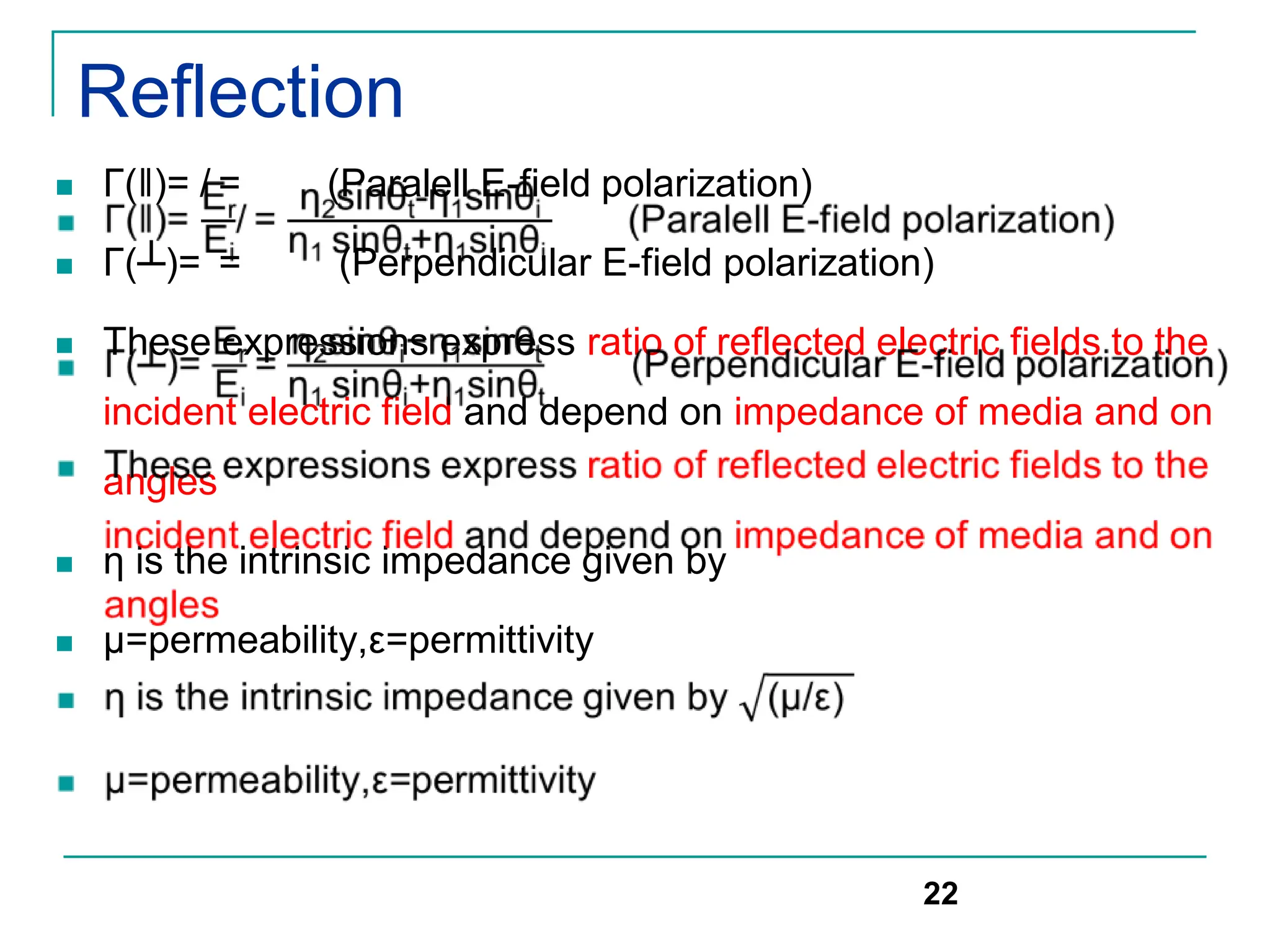
Reflection
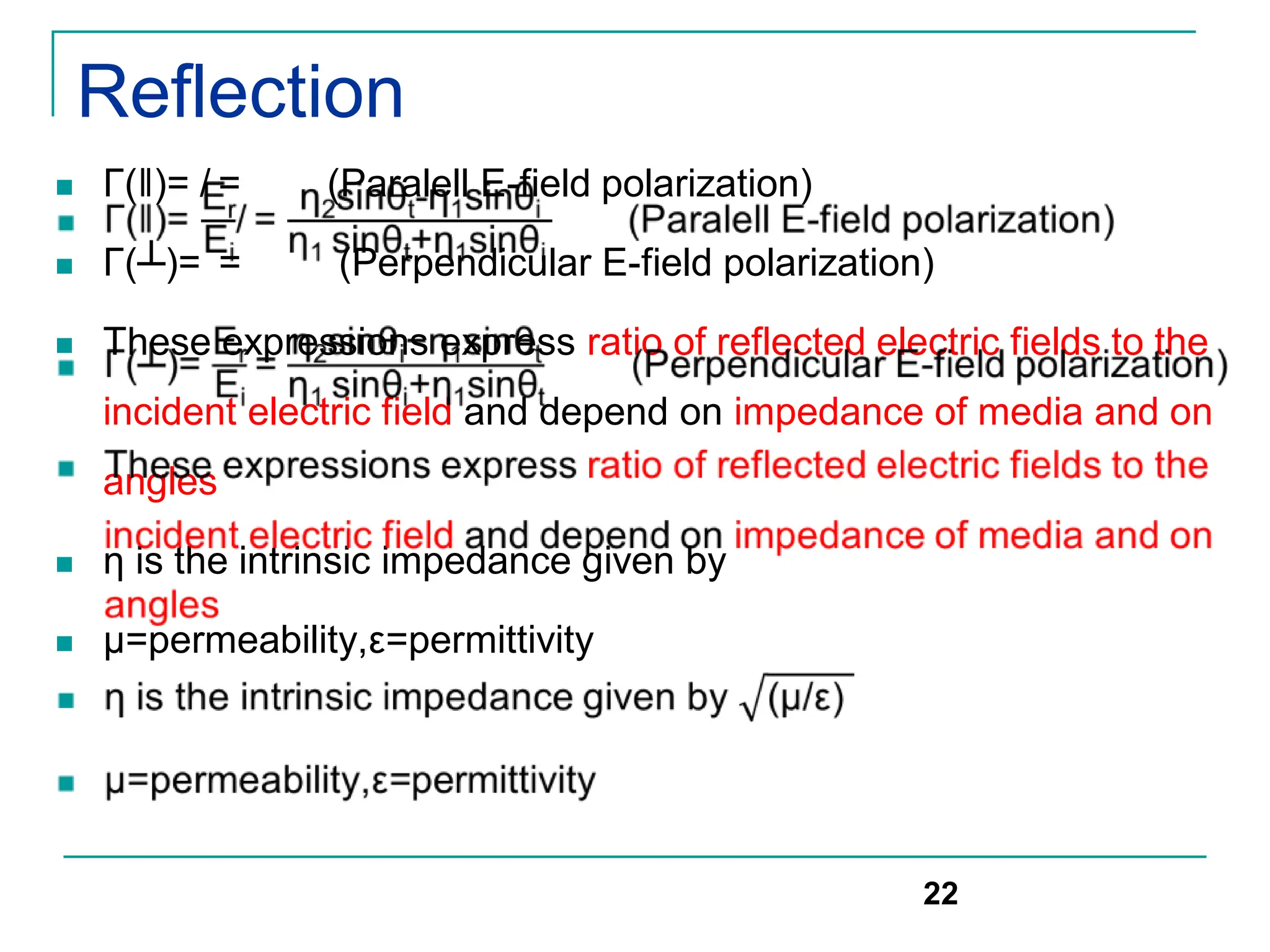
 Γ(ǁ)= / = (Paralell E-field polarization)
 Γ(┴)= = (Perpendicular E-field polarization)
 These expressions express ratio of reflected electric fields to the
incident electric field and depend on impedance of media and on
angles
 η is the intrinsic impedance given by
 μ=permeability,ε=permittivity
22
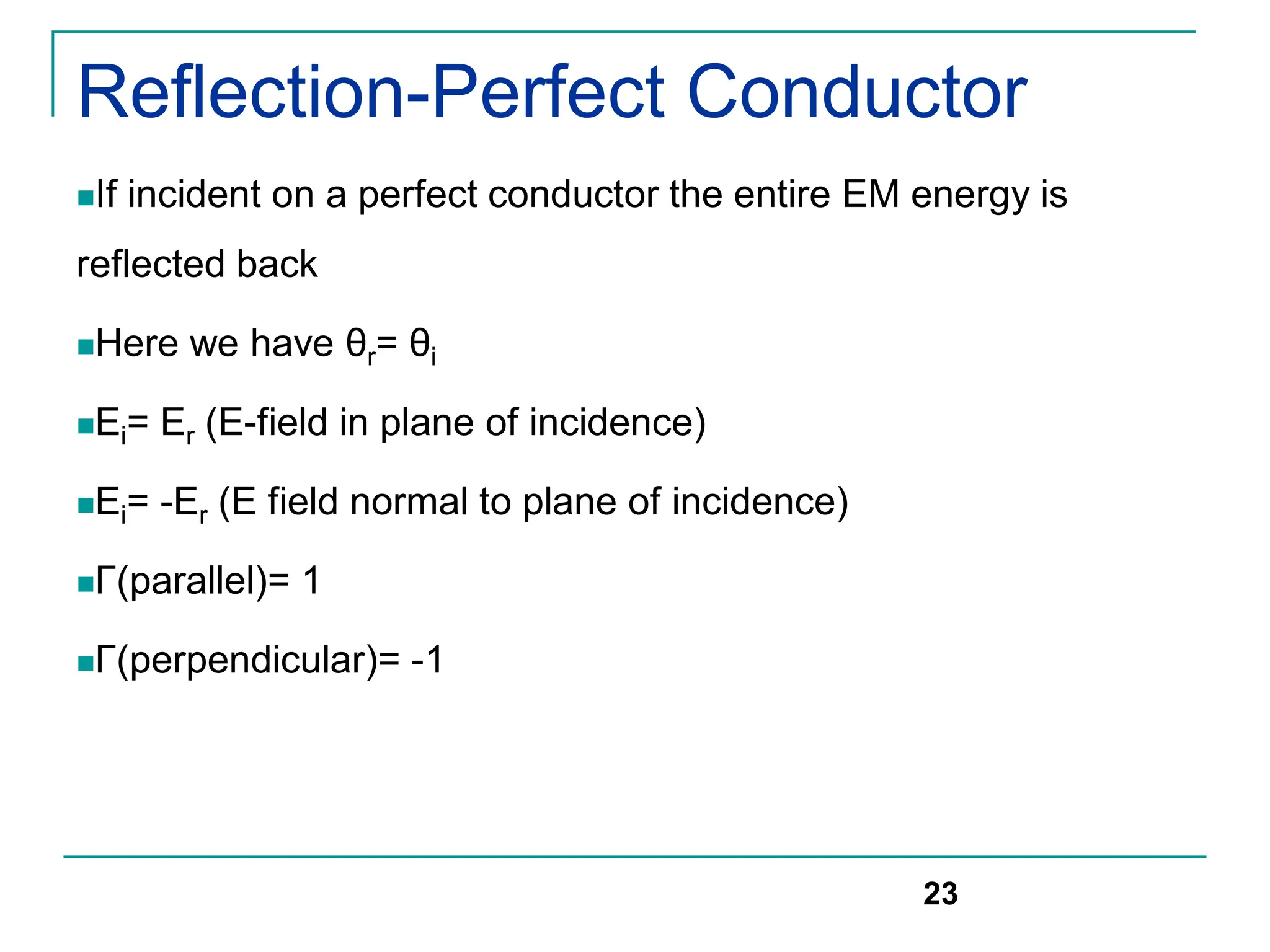
Reflection-Perfect Conductor
If incident on a perfect conductor the entire EM energy is
reflected back
Here we have θr= θi
Ei= Er (E-field in plane of incidence)
Ei= -Er (E field normal to plane of incidence)
Γ(parallel)= 1
Γ(perpendicular)= -1
23
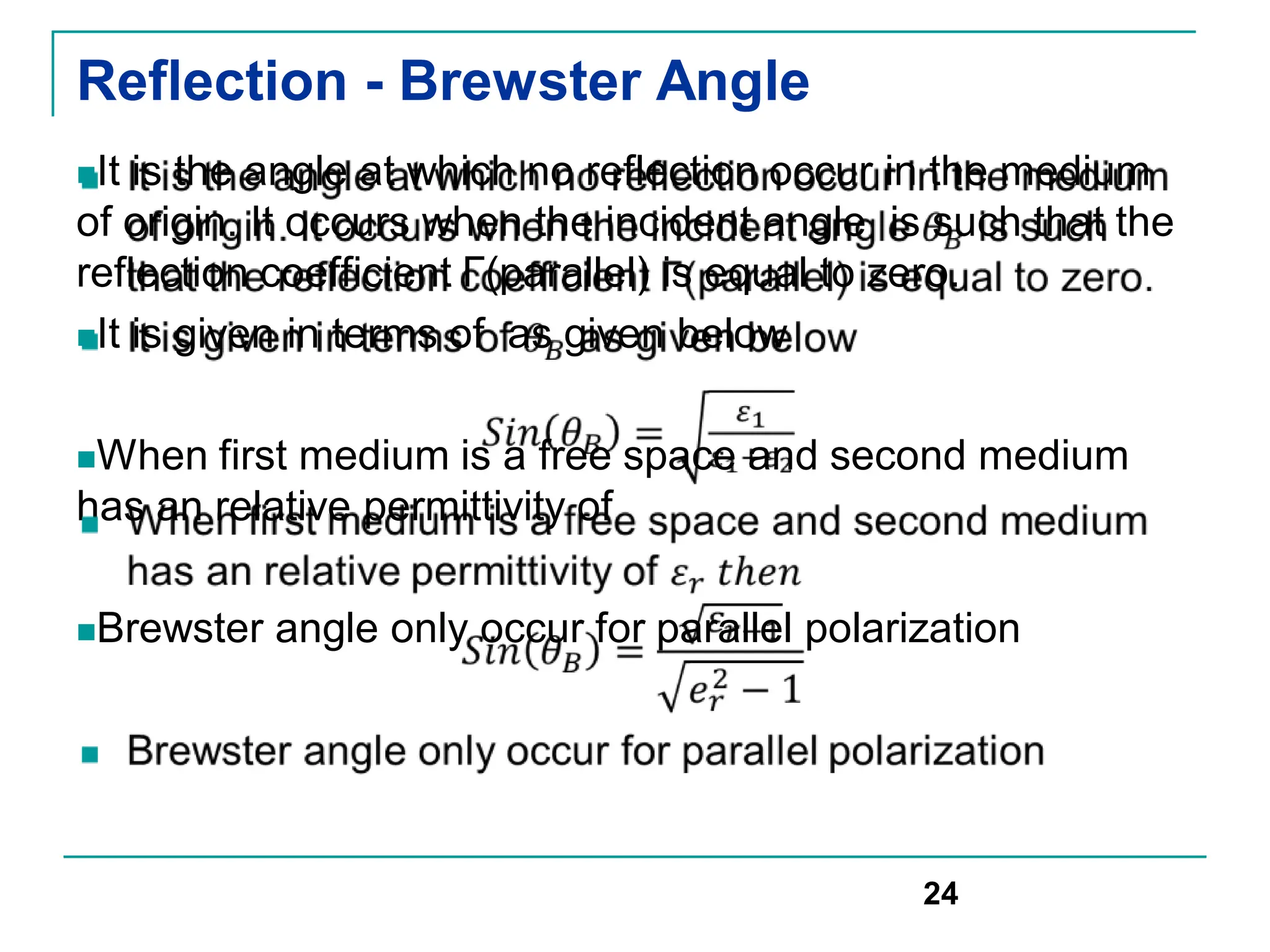
Reflection - Brewster Angle
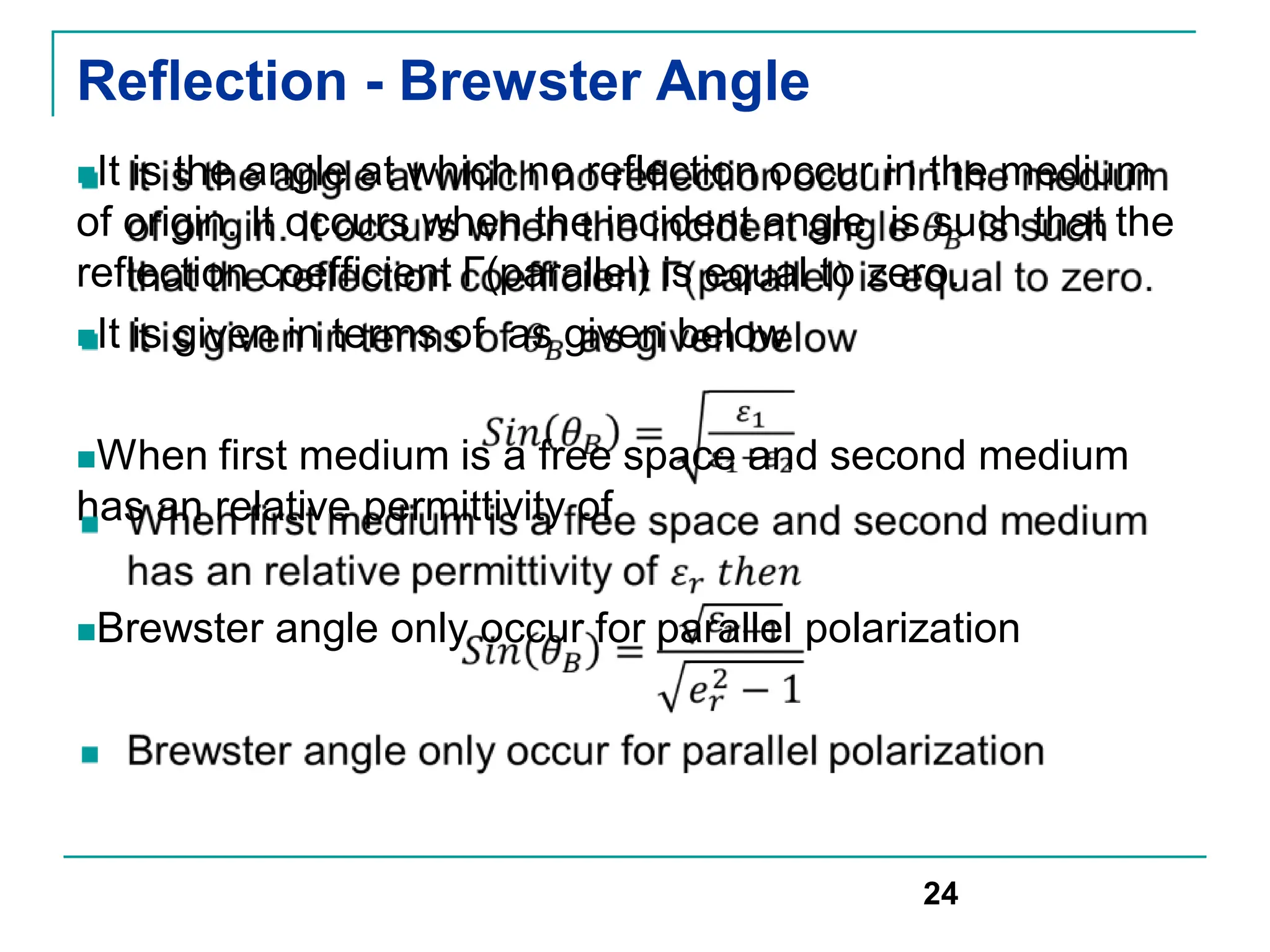
It is the angle at which no reflection occur in the medium
of origin. It occurs when the incident angle is such that the
reflection coefficient Γ(parallel) is equal to zero.
It is given in terms of as given below
When first medium is a free space and second medium
has an relative permittivity of
Brewster angle only occur for parallel polarization
24
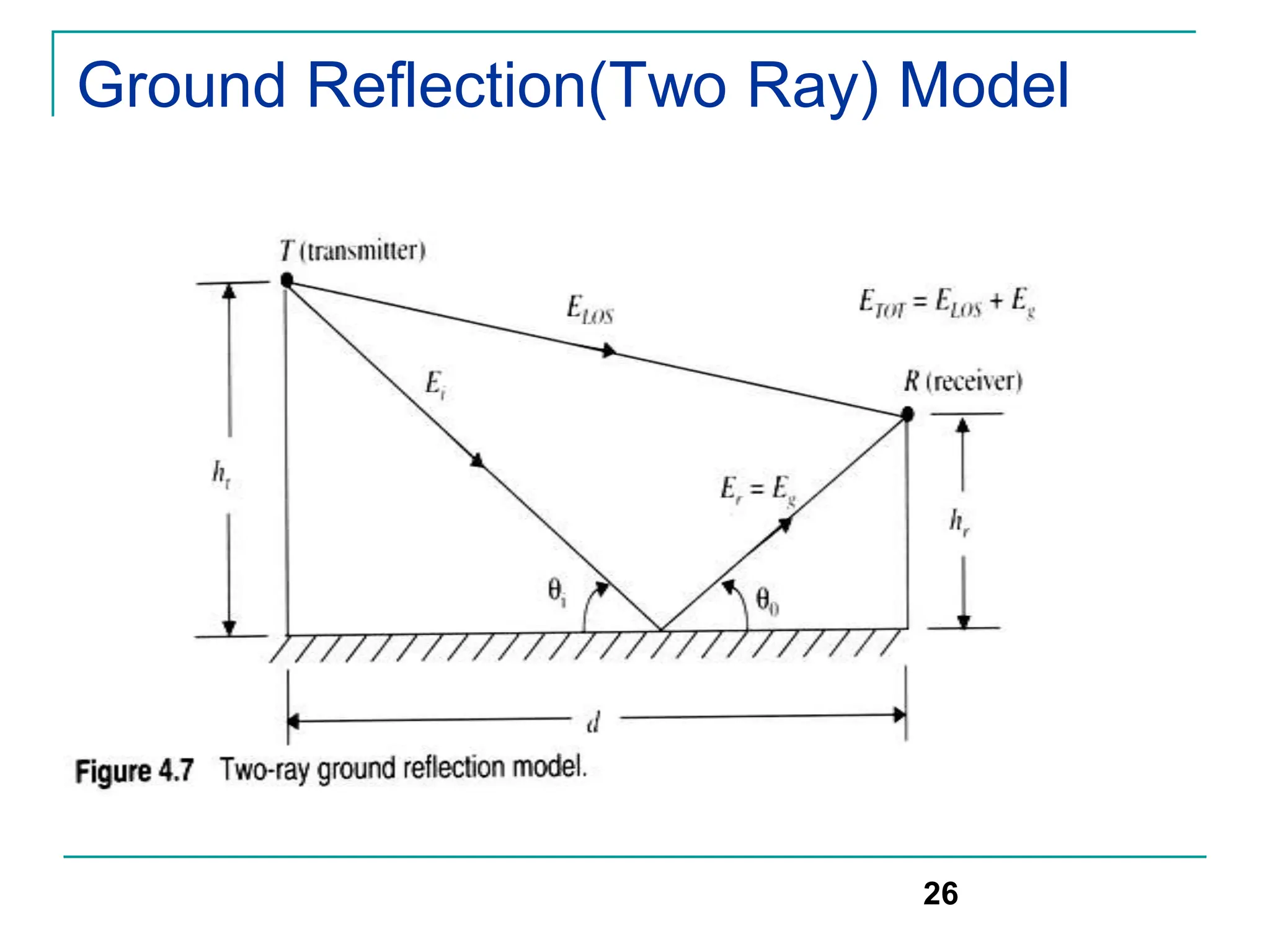
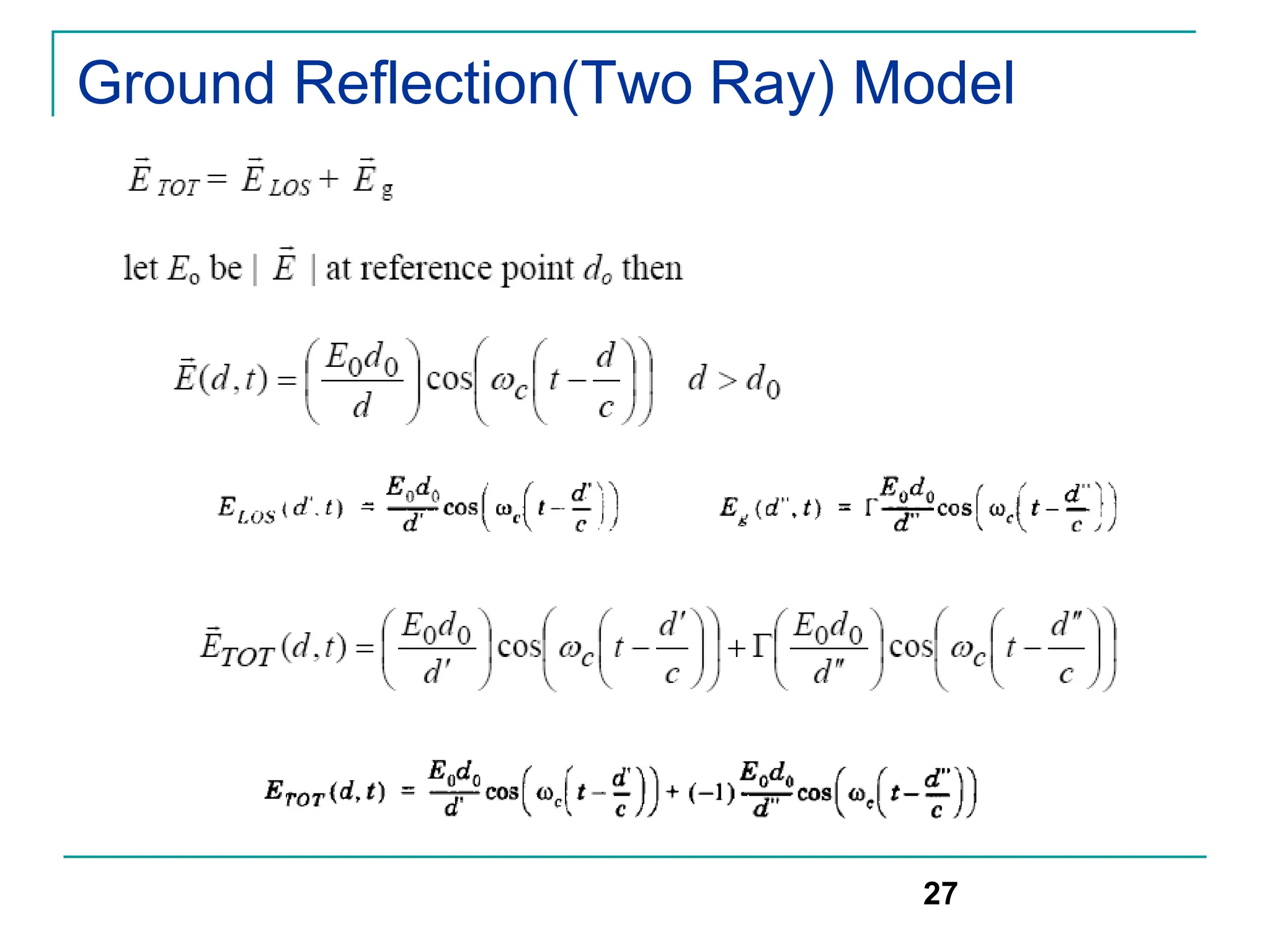
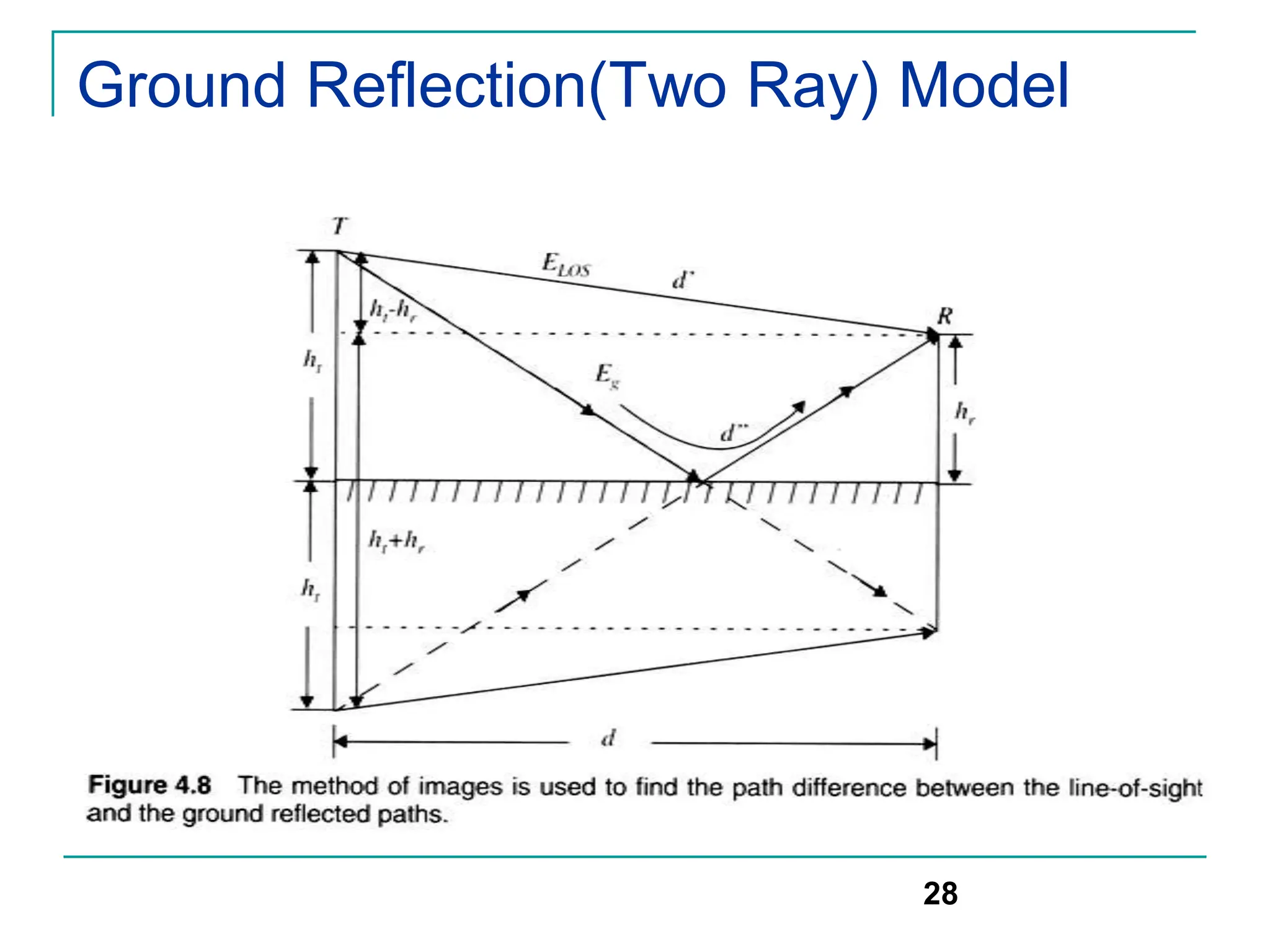
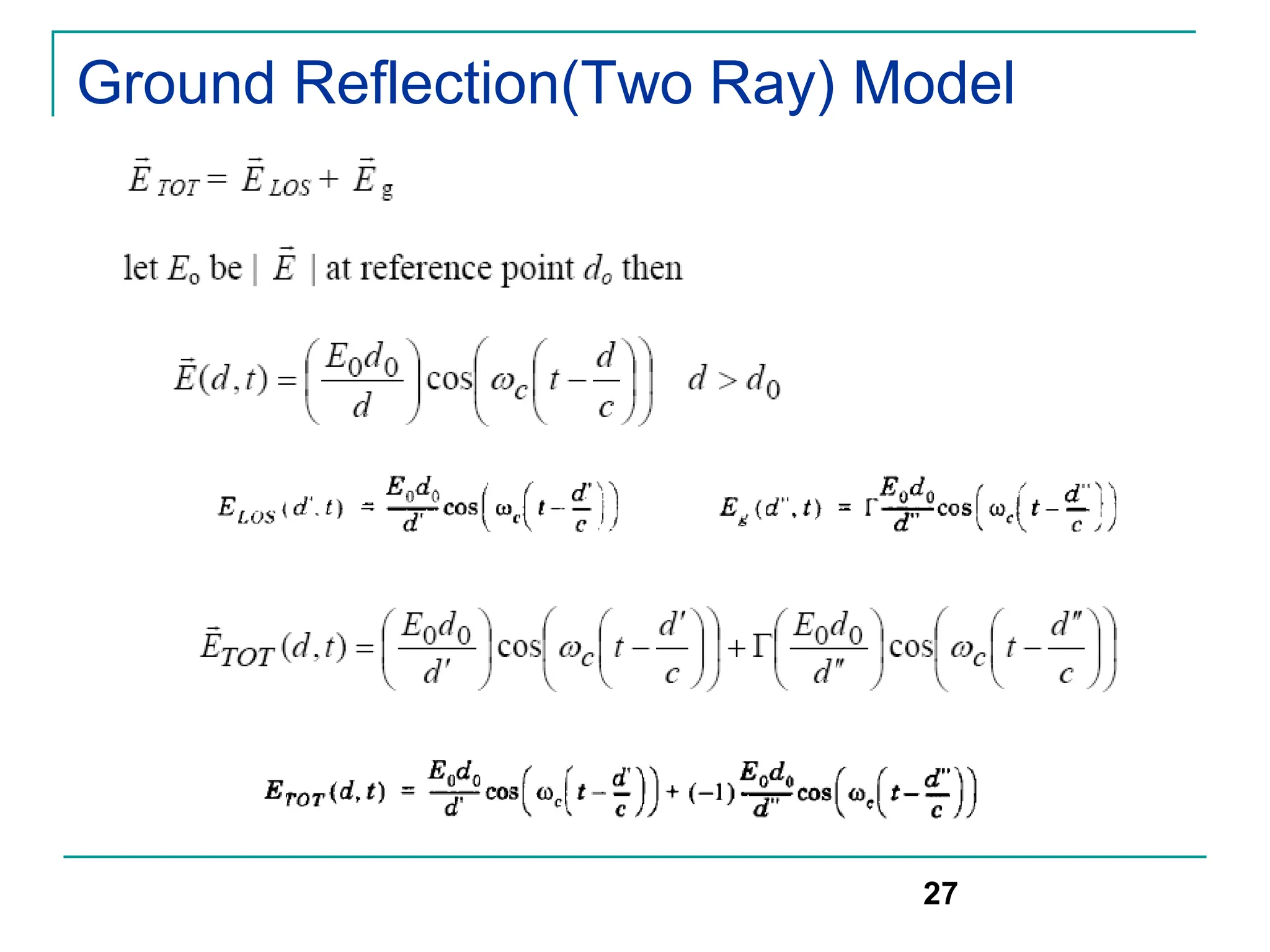
Ground Reflection(Two Ray) Model
In mobile radio channel, single direct path between base station
and mobile and is seldom only physical means for propagation
Free space model as a stand alone is inaccurate
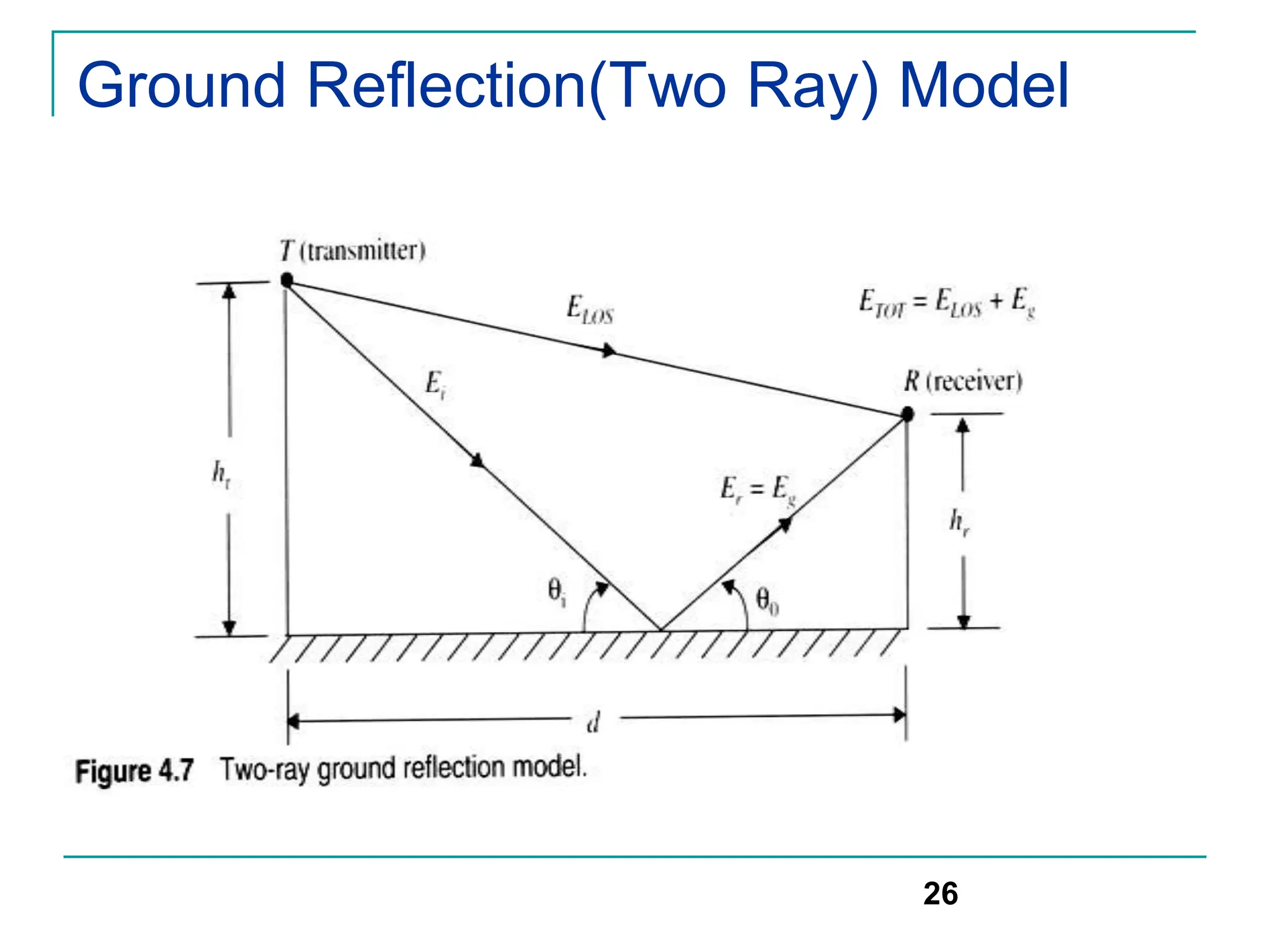
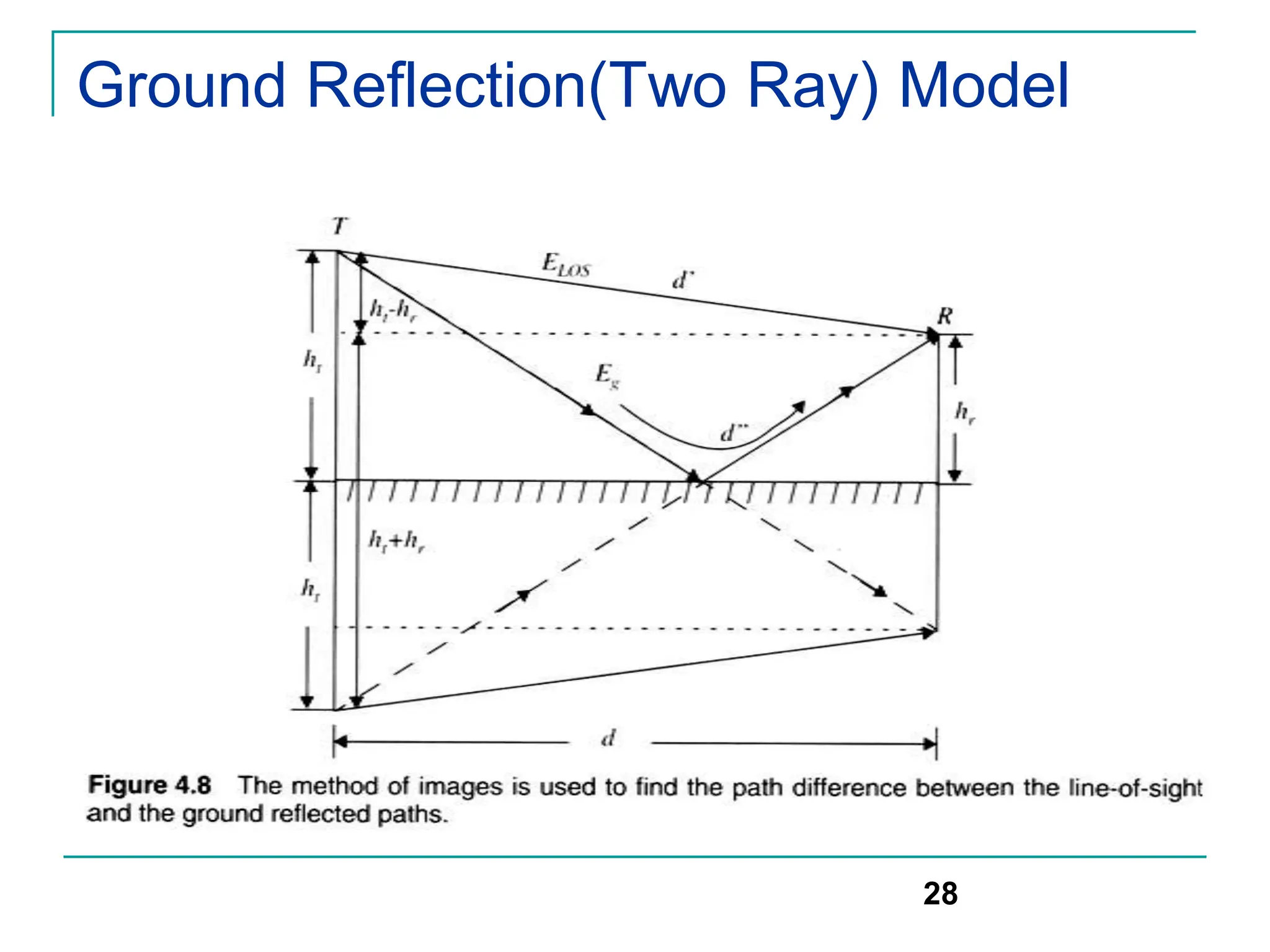
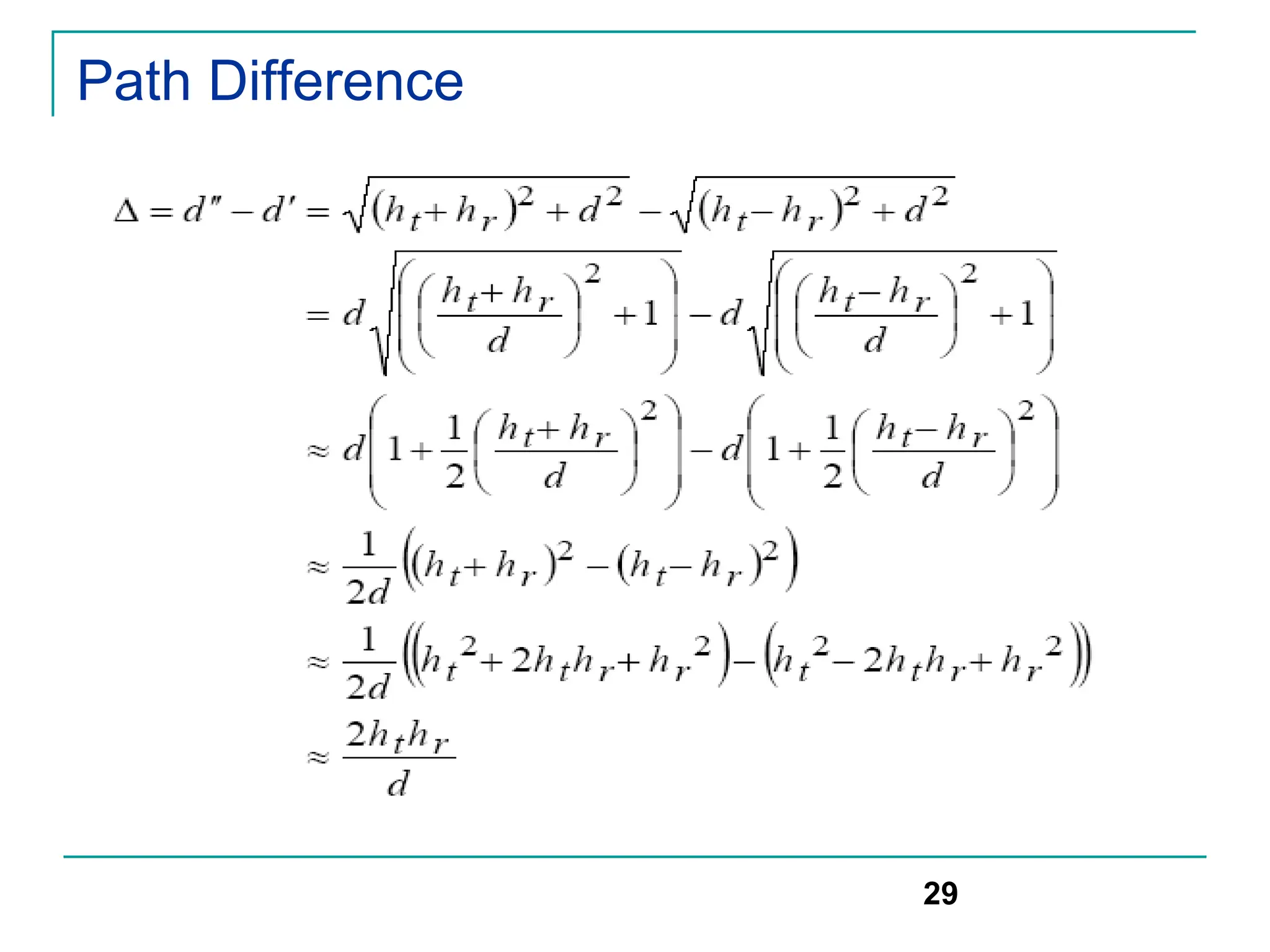
Two ray ground reflection model is useful
 Based on geometric optics
 Considers both direct and ground reflected path
Reasonably accurate for predicting large scale signal strength
over several kms that use tall tower height
Assumption: The height of Transmitter >50 meters
25
Ground Reflection(Two Ray) Model
26
Ground Reflection(Two Ray) Model
27
Ground Reflection(Two Ray) Model
28
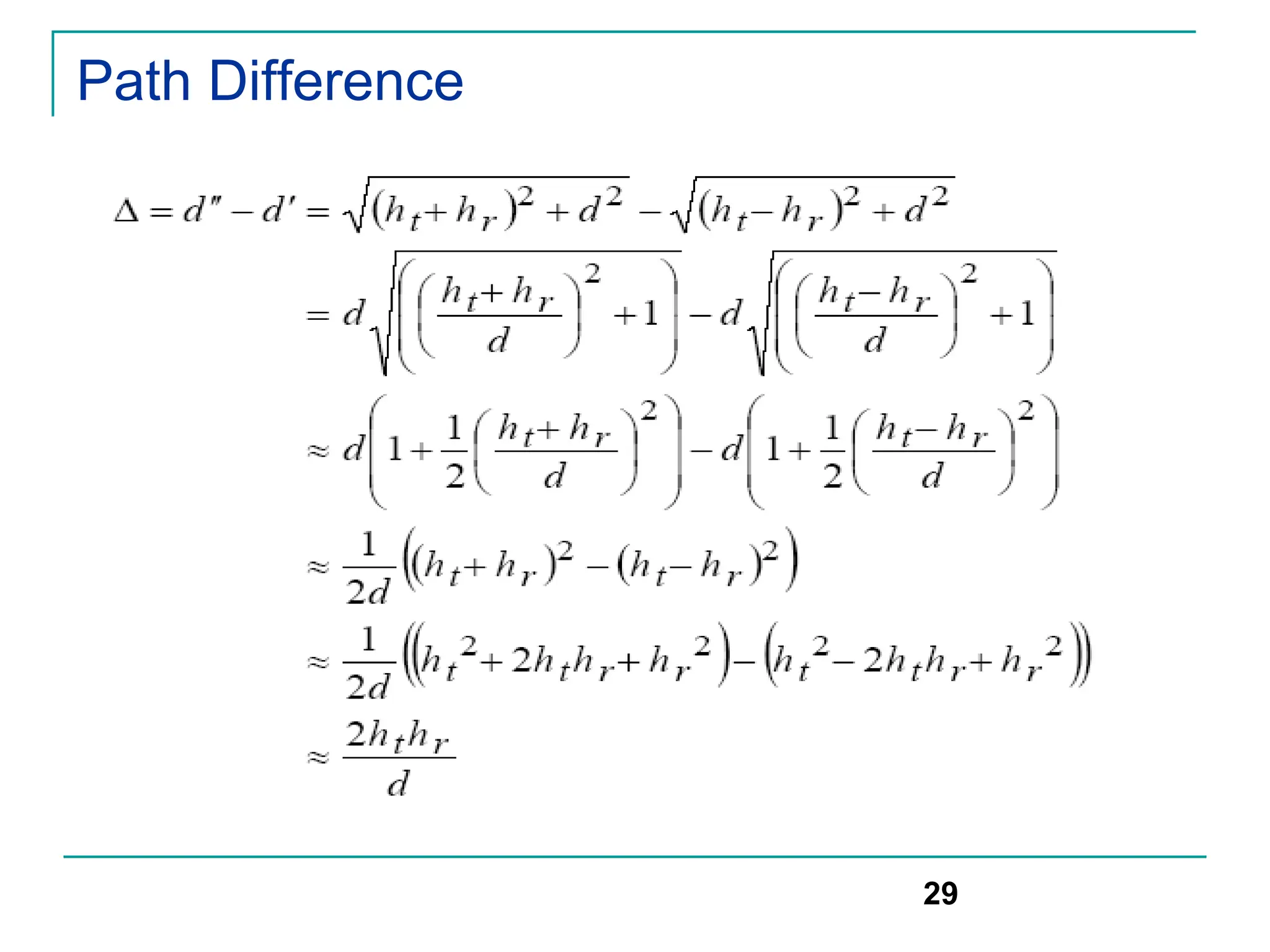
Path Difference
29
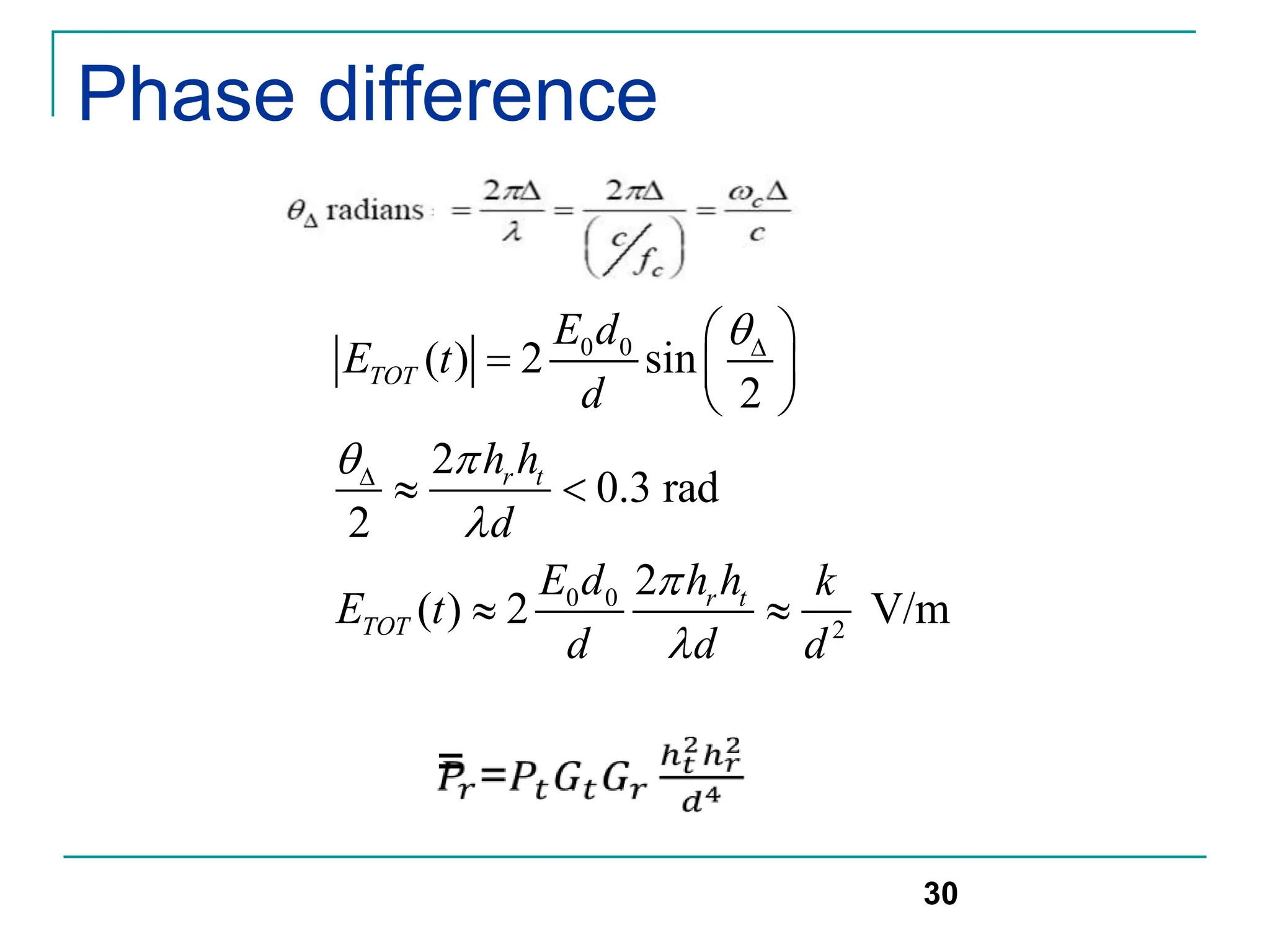
Phase difference
30
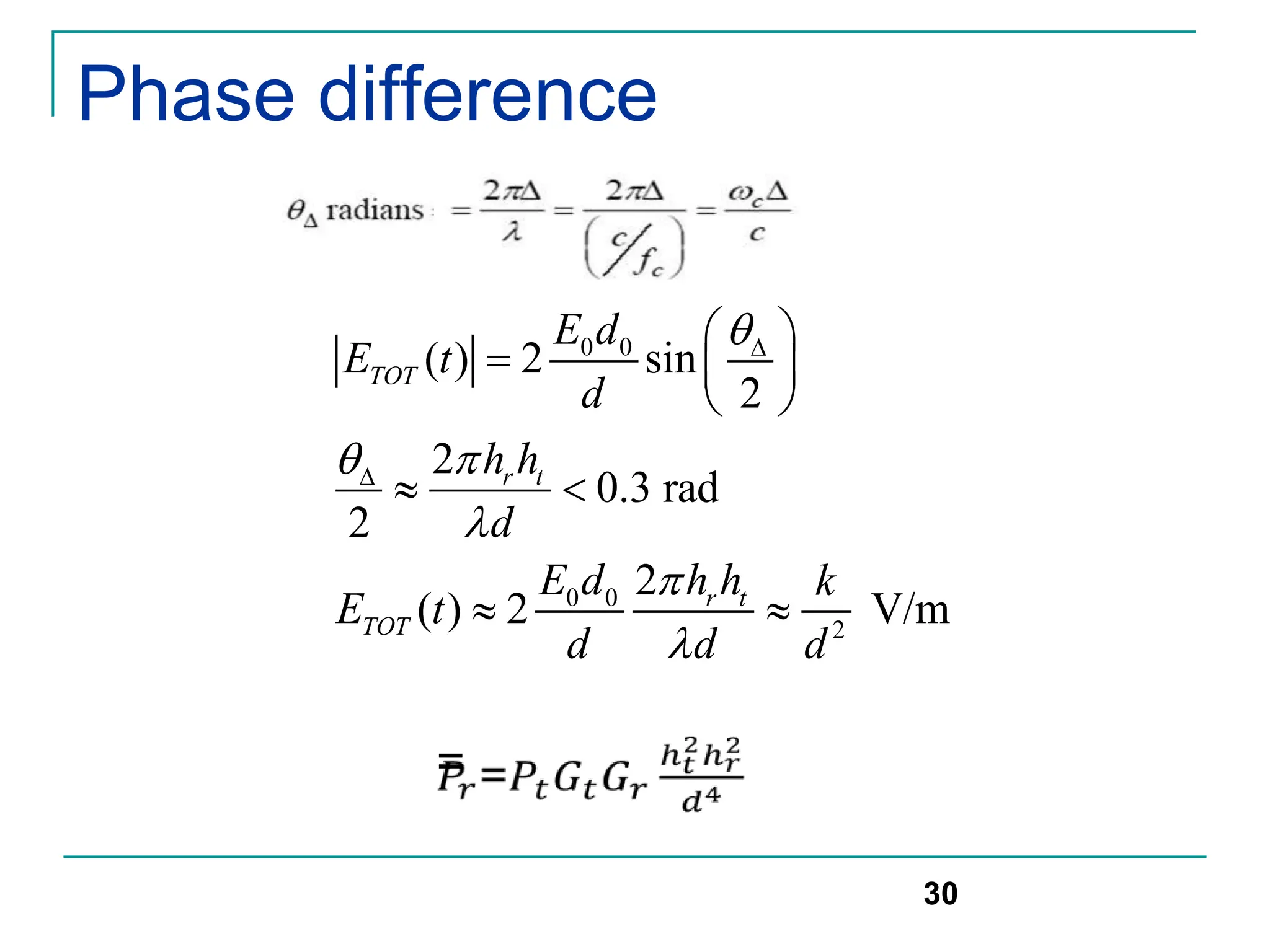
=
0 0
0 0
2
( ) 2 sin
2
2
0.3 rad
2
2
( ) 2 V/m
TOT
r t
r t
TOT
E d
E t
d
h h
d
E d h h k
E t
d d d








 
  
 
 
 
Diffraction
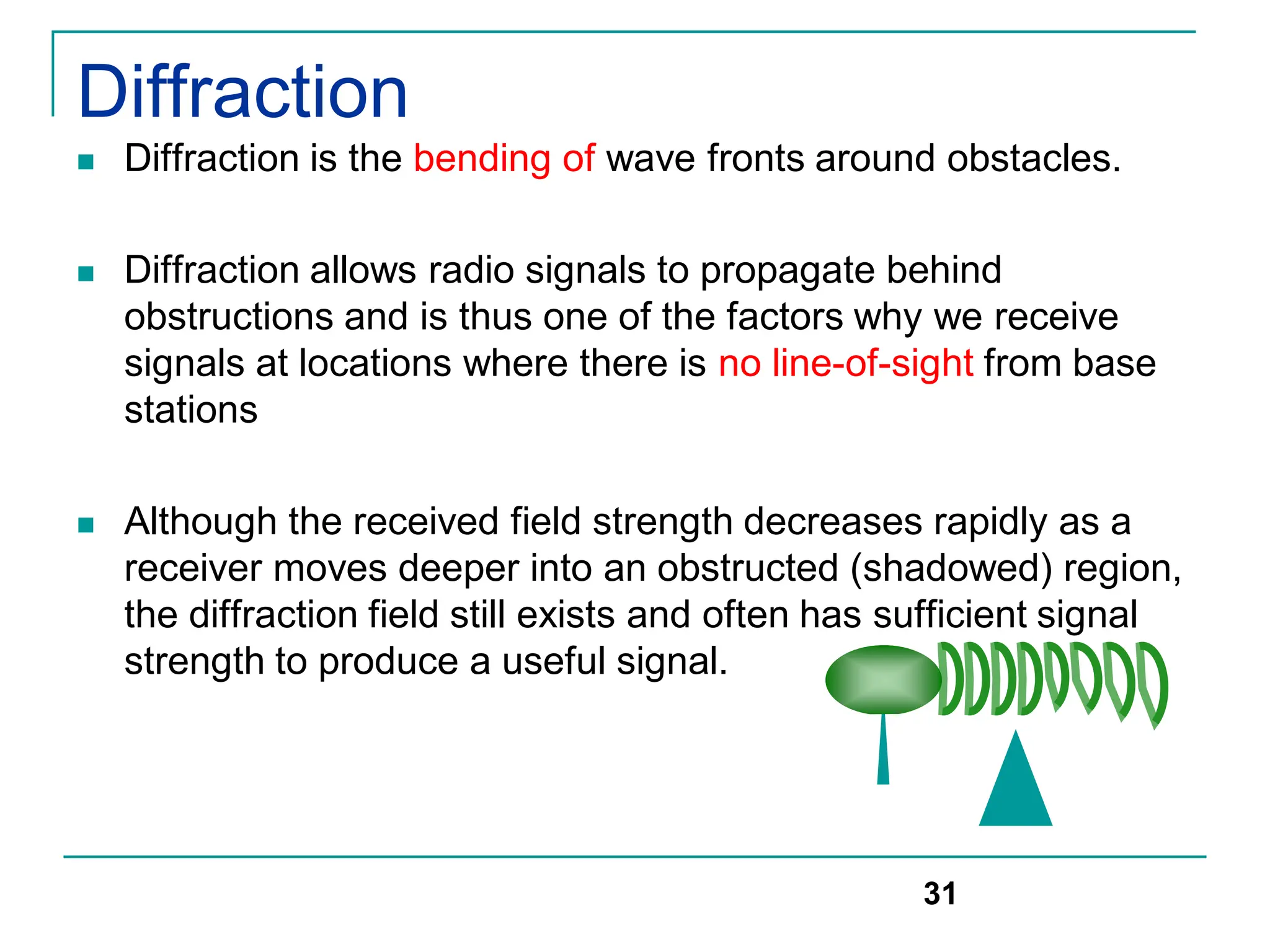
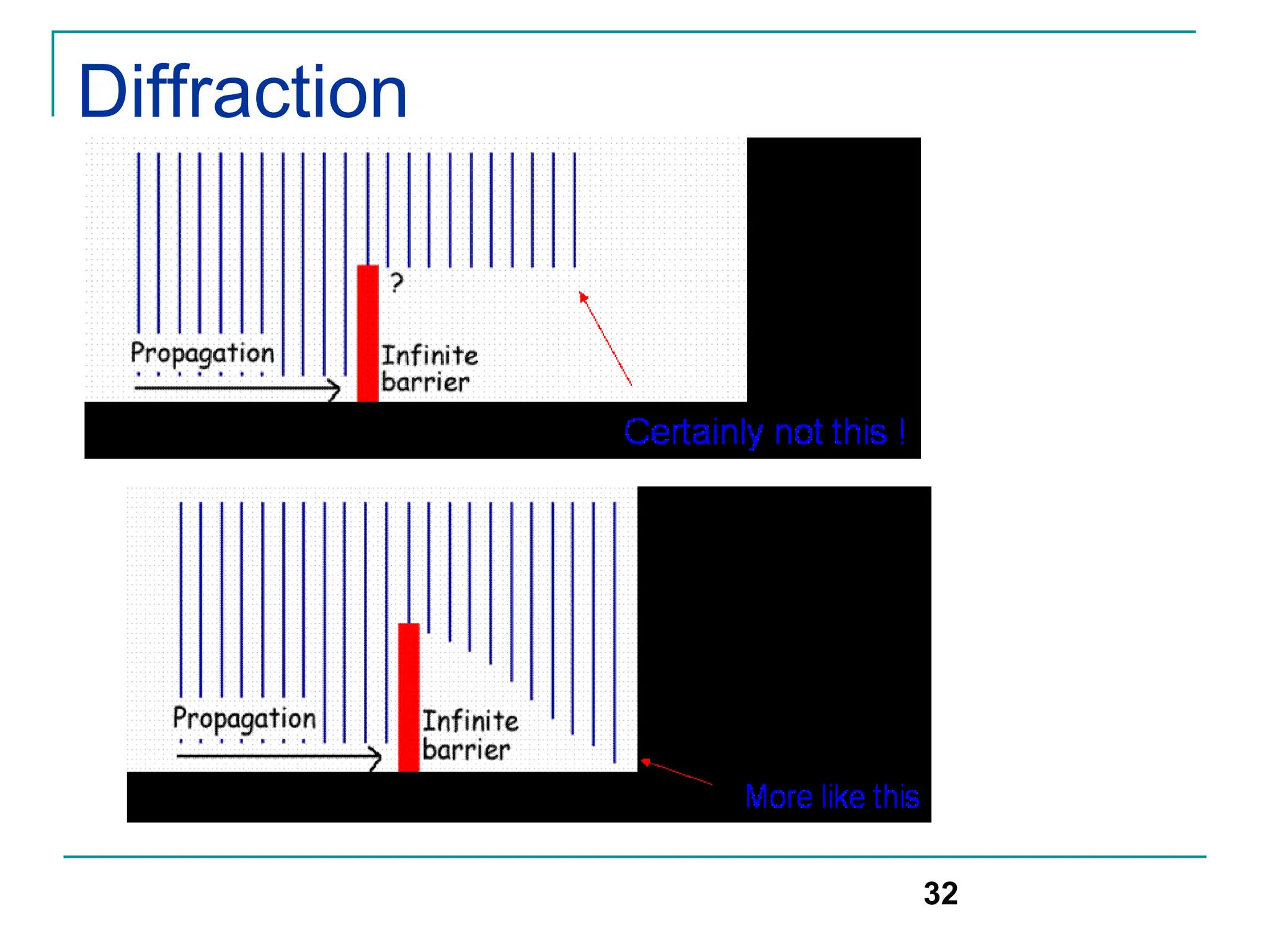
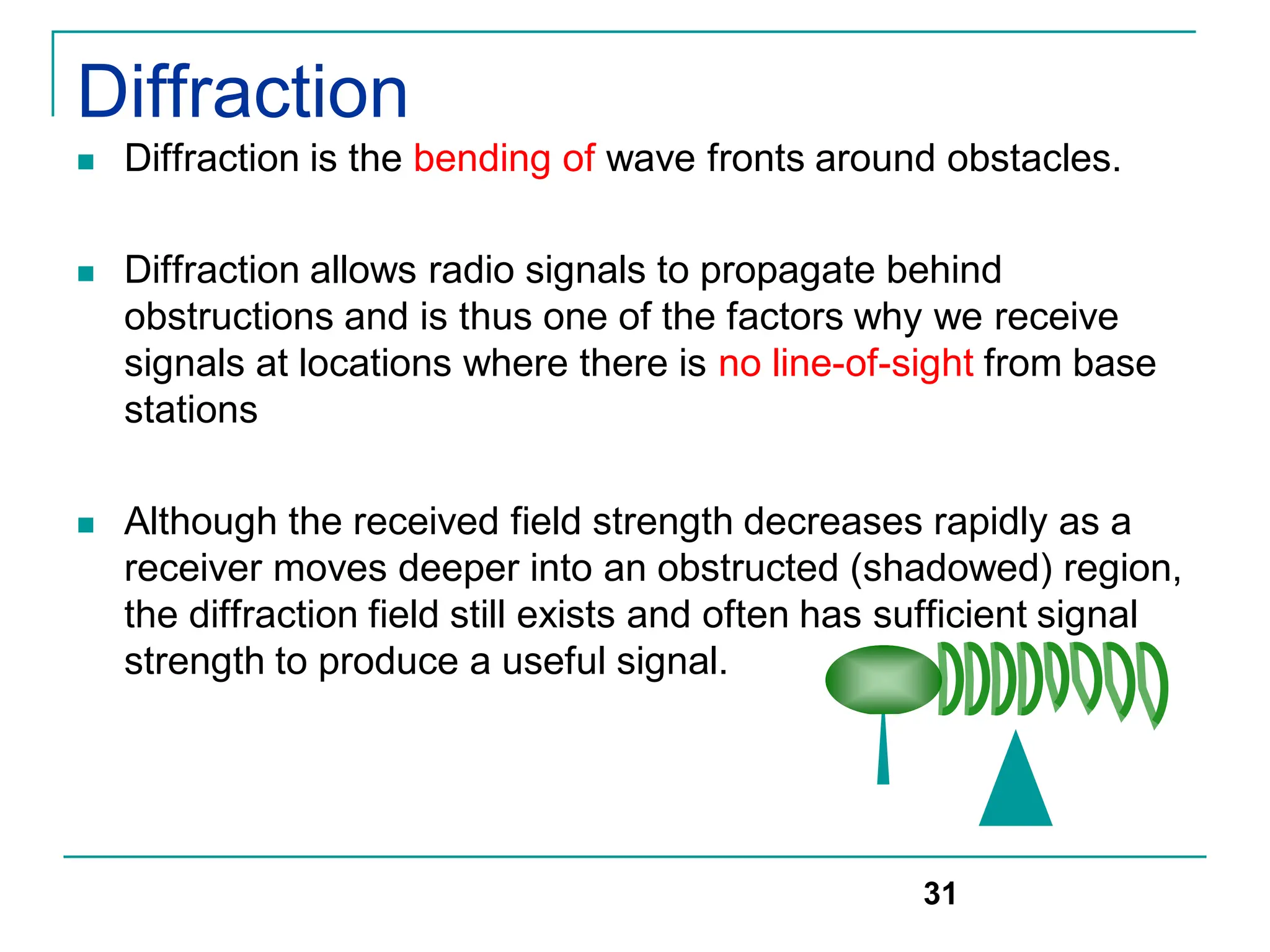
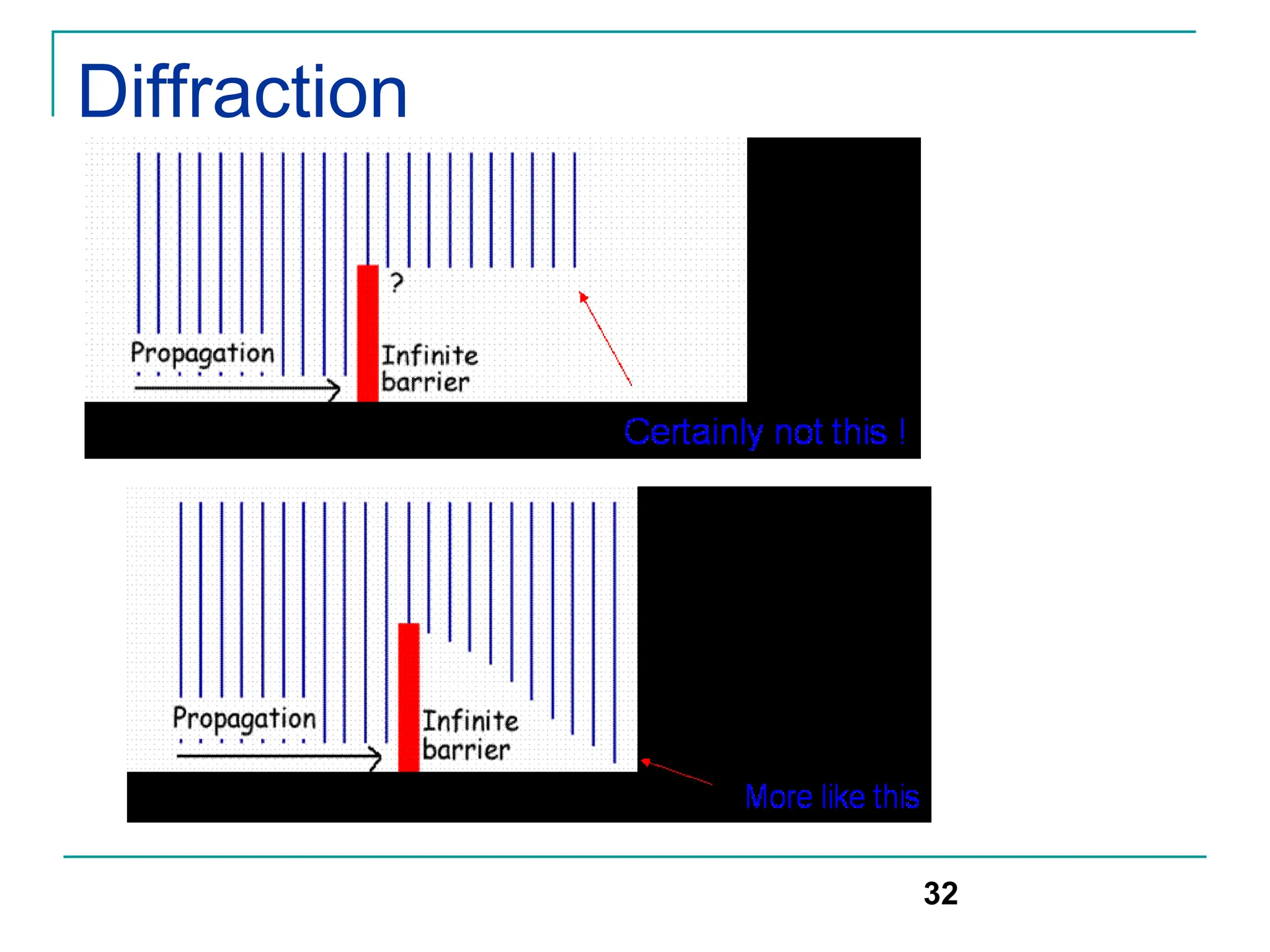
 Diffraction is the bending of wave fronts around obstacles.
 Diffraction allows radio signals to propagate behind
obstructions and is thus one of the factors why we receive
signals at locations where there is no line-of-sight from base
stations
 Although the received field strength decreases rapidly as a
receiver moves deeper into an obstructed (shadowed) region,
the diffraction field still exists and often has sufficient signal
strength to produce a useful signal.
31
Diffraction
32
Knife-edge Diffraction Model
 Estimating the signal attenuation caused by diffraction of radio
waves over hills and buildings is essential in predicting the field
strength in a given service area.
 As a starting point, the limiting case of propagation over a knife edge
gives good in sight into the order of magnitude diffraction loss.
 When shadowing is caused by a single object such as a building,
the attenuation caused by diffraction can be estimated by treating
the obstruction as a diffracting knife edge
33
Knife-edge Diffraction Model
34
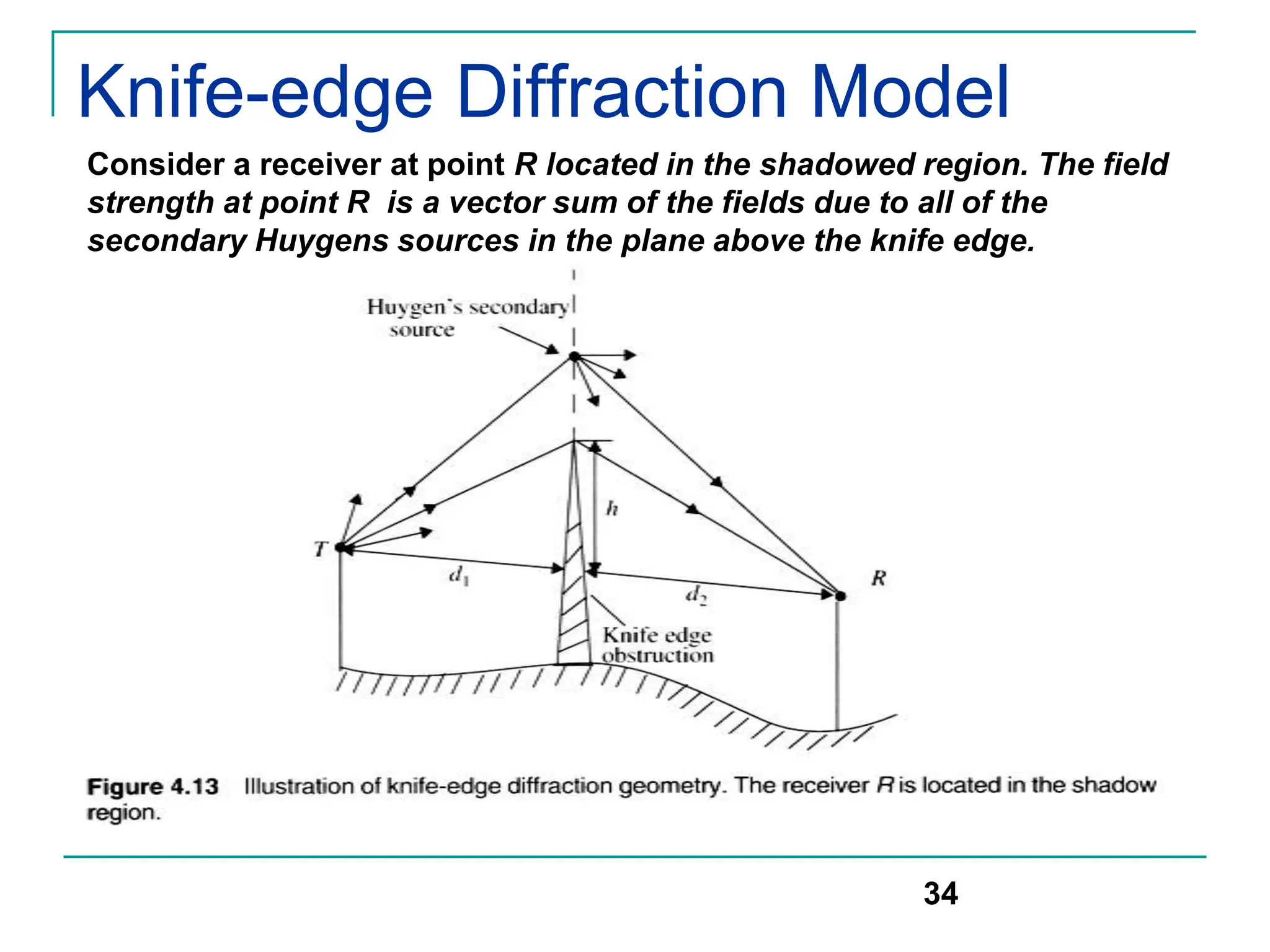
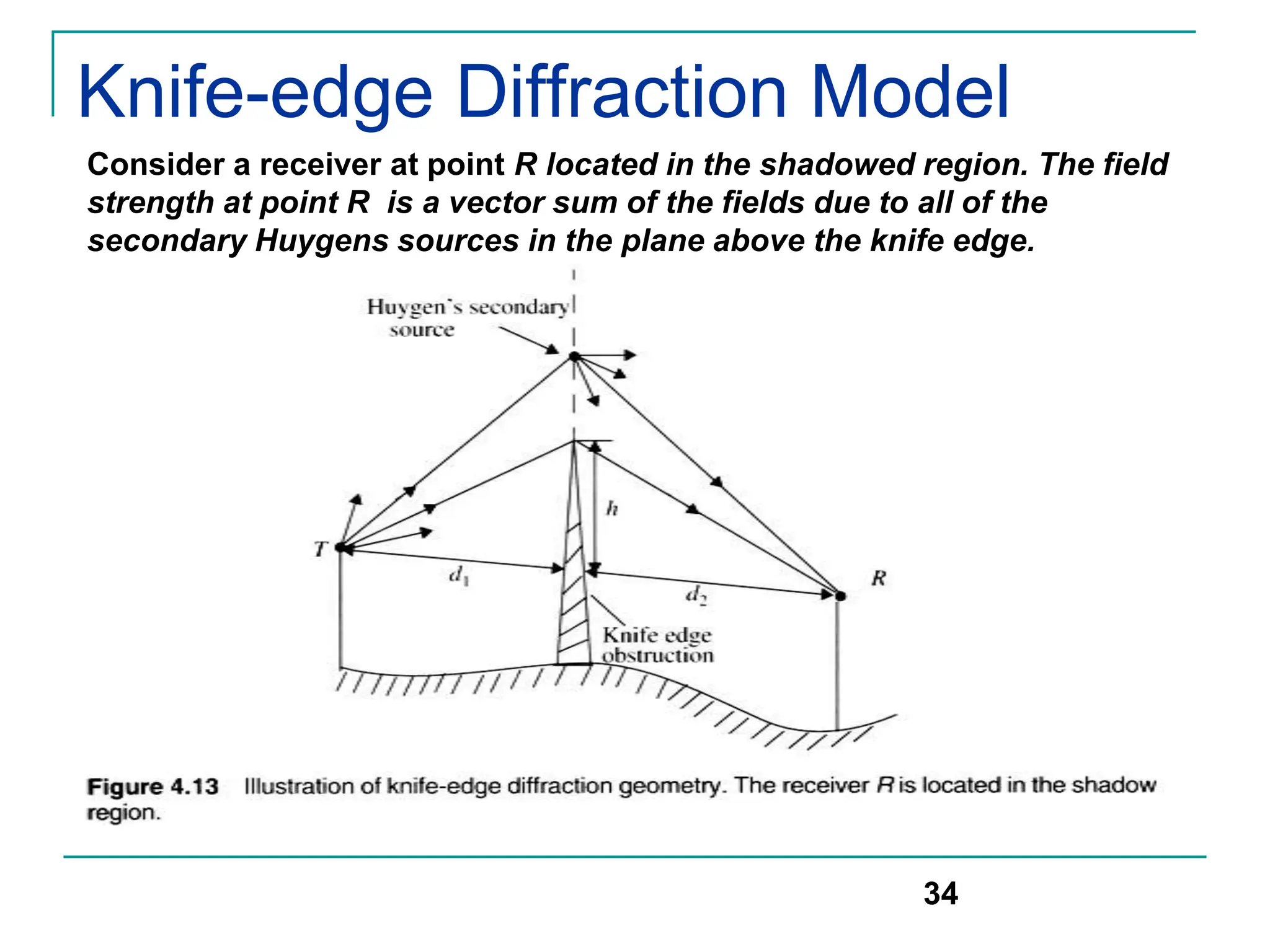
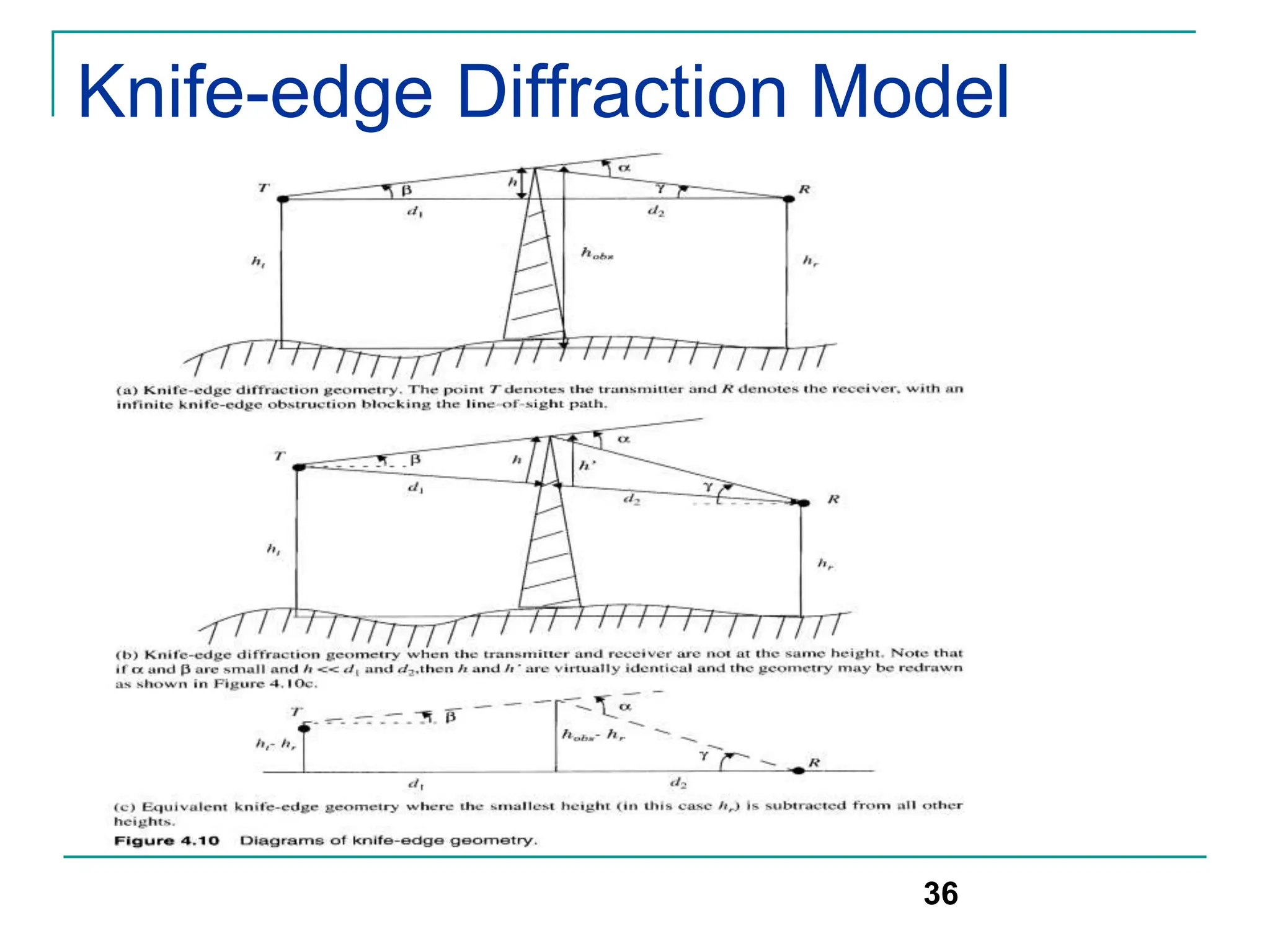
Consider a receiver at point R located in the shadowed region. The field
strength at point R is a vector sum of the fields due to all of the
secondary Huygens sources in the plane above the knife edge.
Knife-edge Diffraction Model
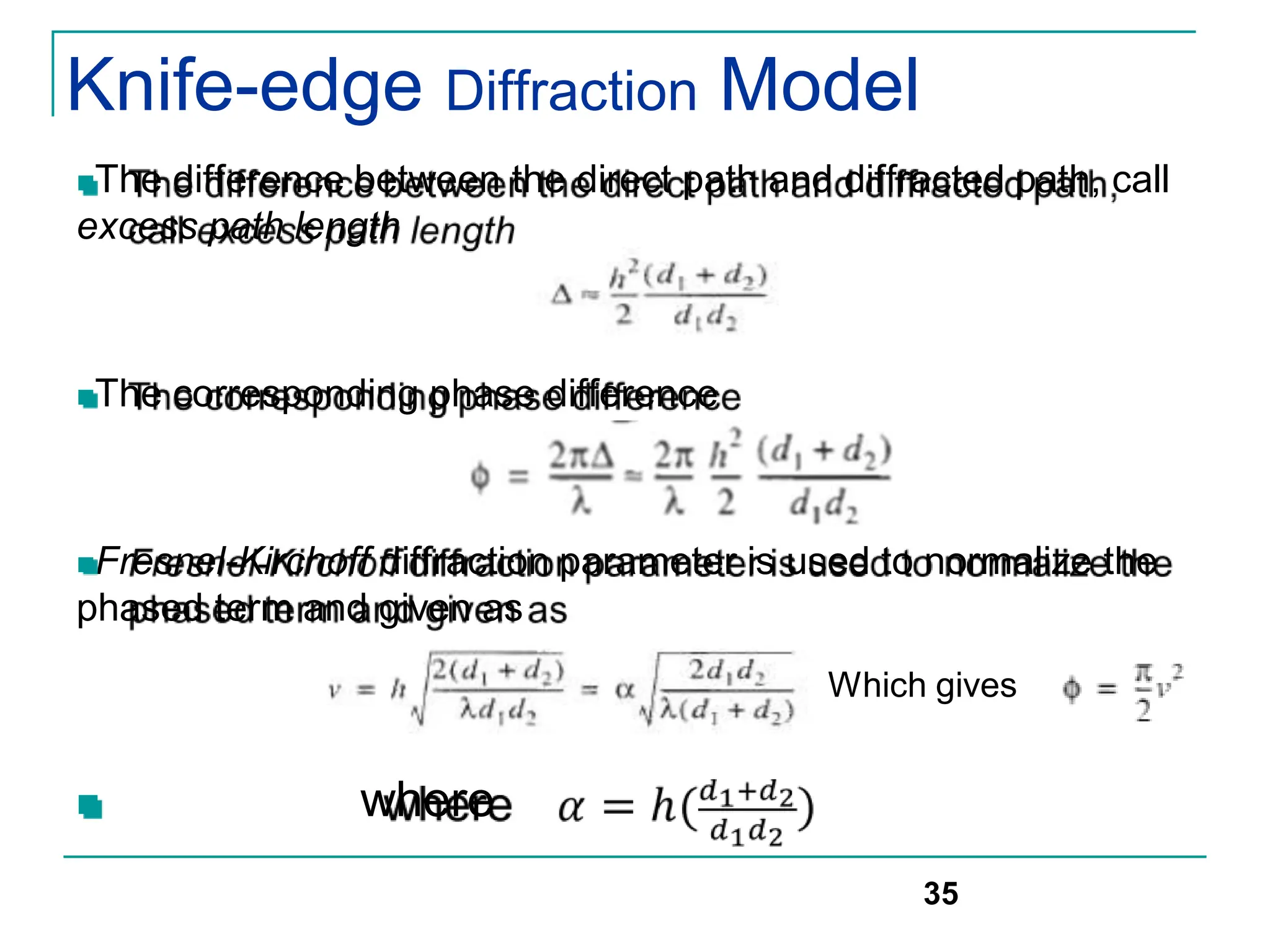
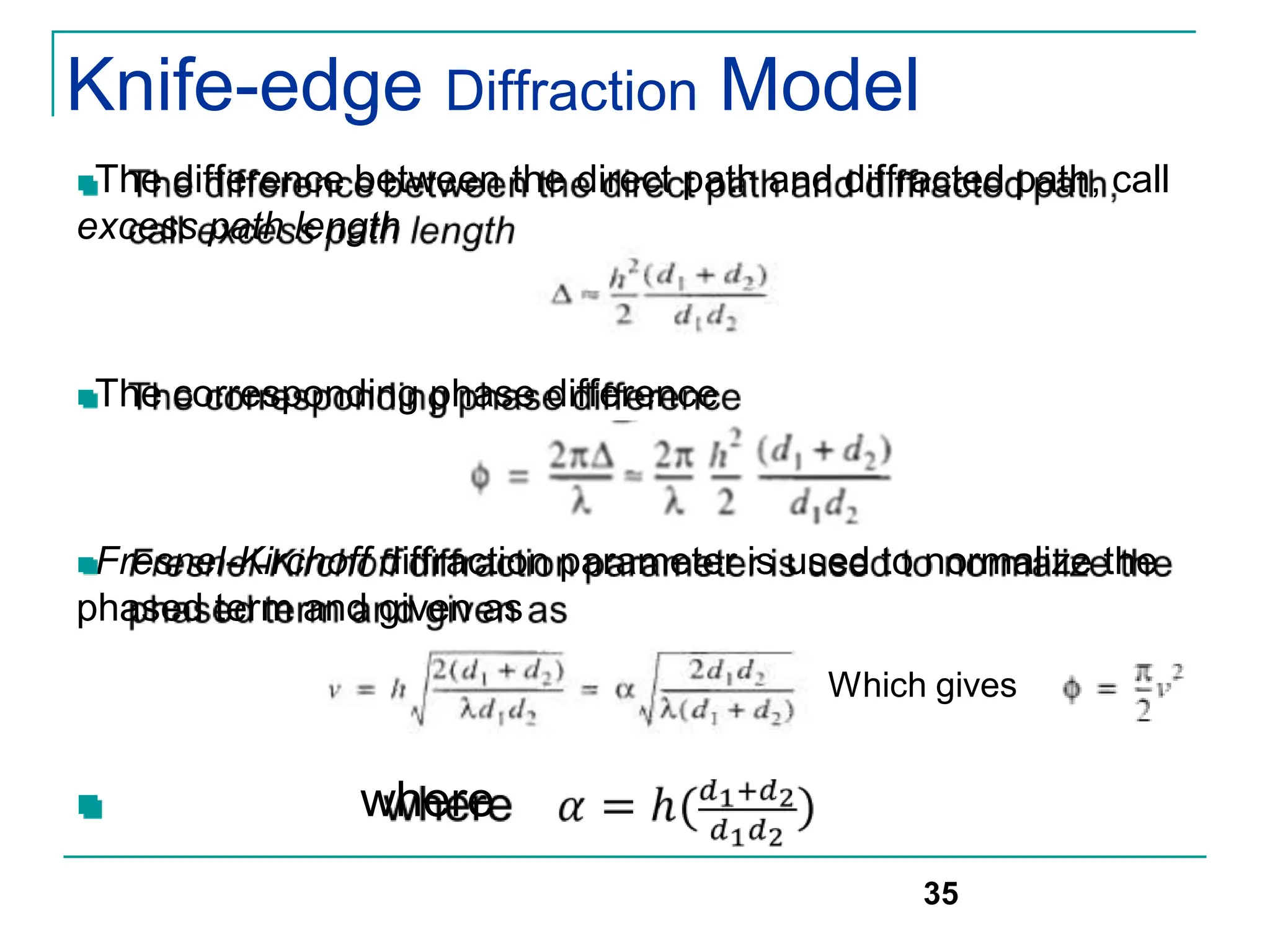
The difference between the direct path and diffracted path, call
excess path length
The corresponding phase difference
Fresnel-Kirchoff diffraction parameter is used to normalize the
phased term and given as
 where
35
Which gives
Knife-edge Diffraction Model
36
Fresnel zones
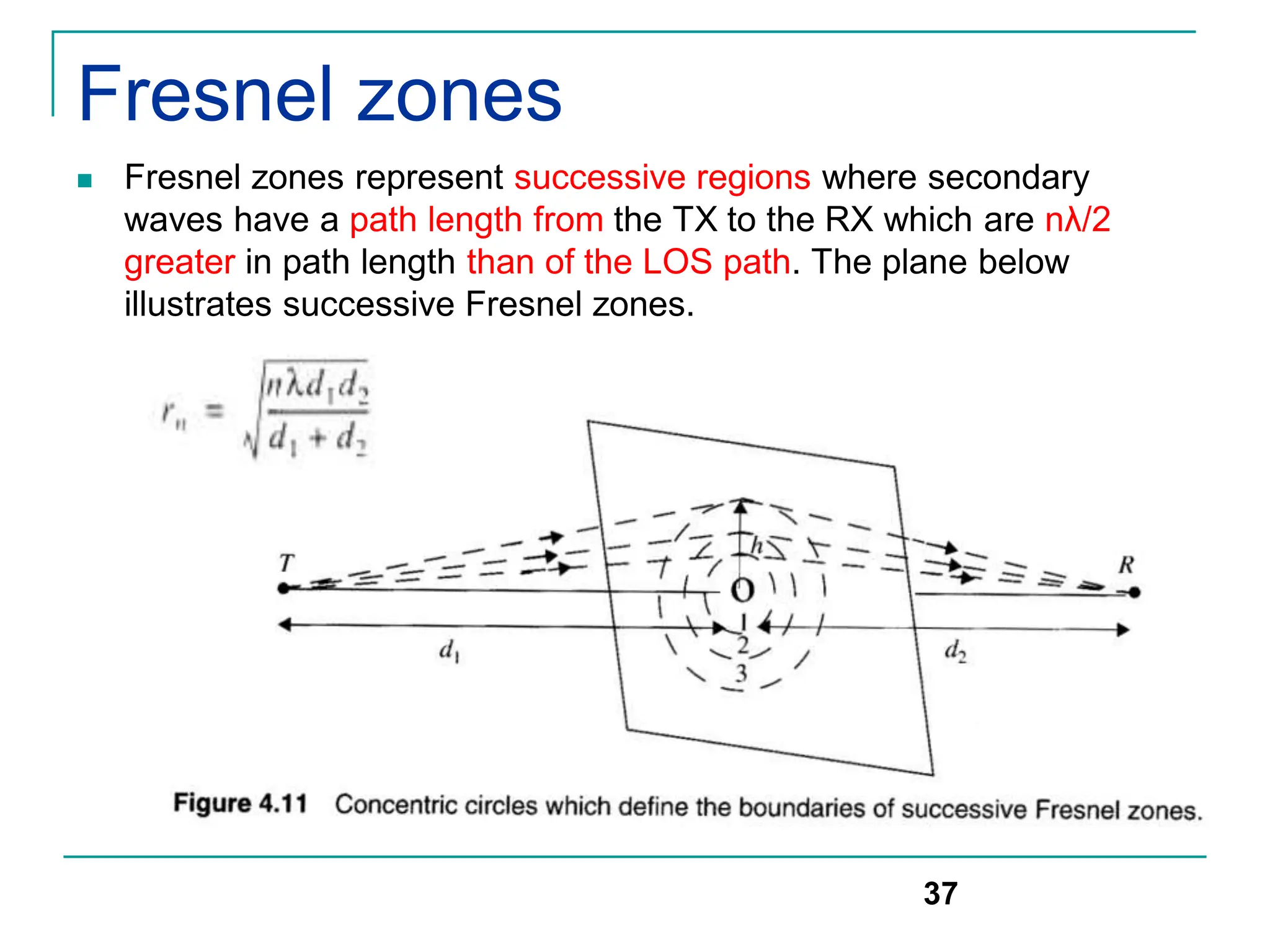
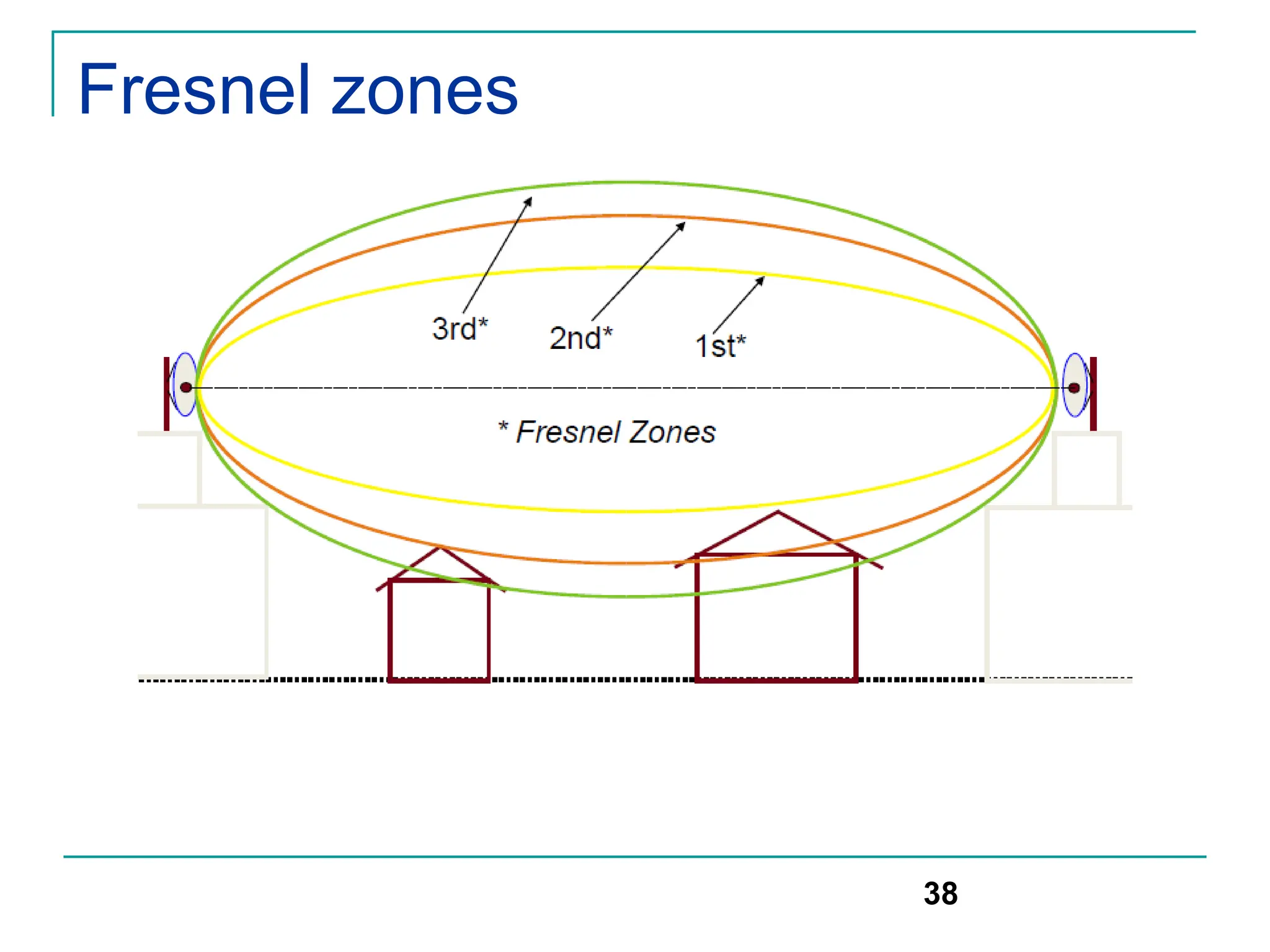
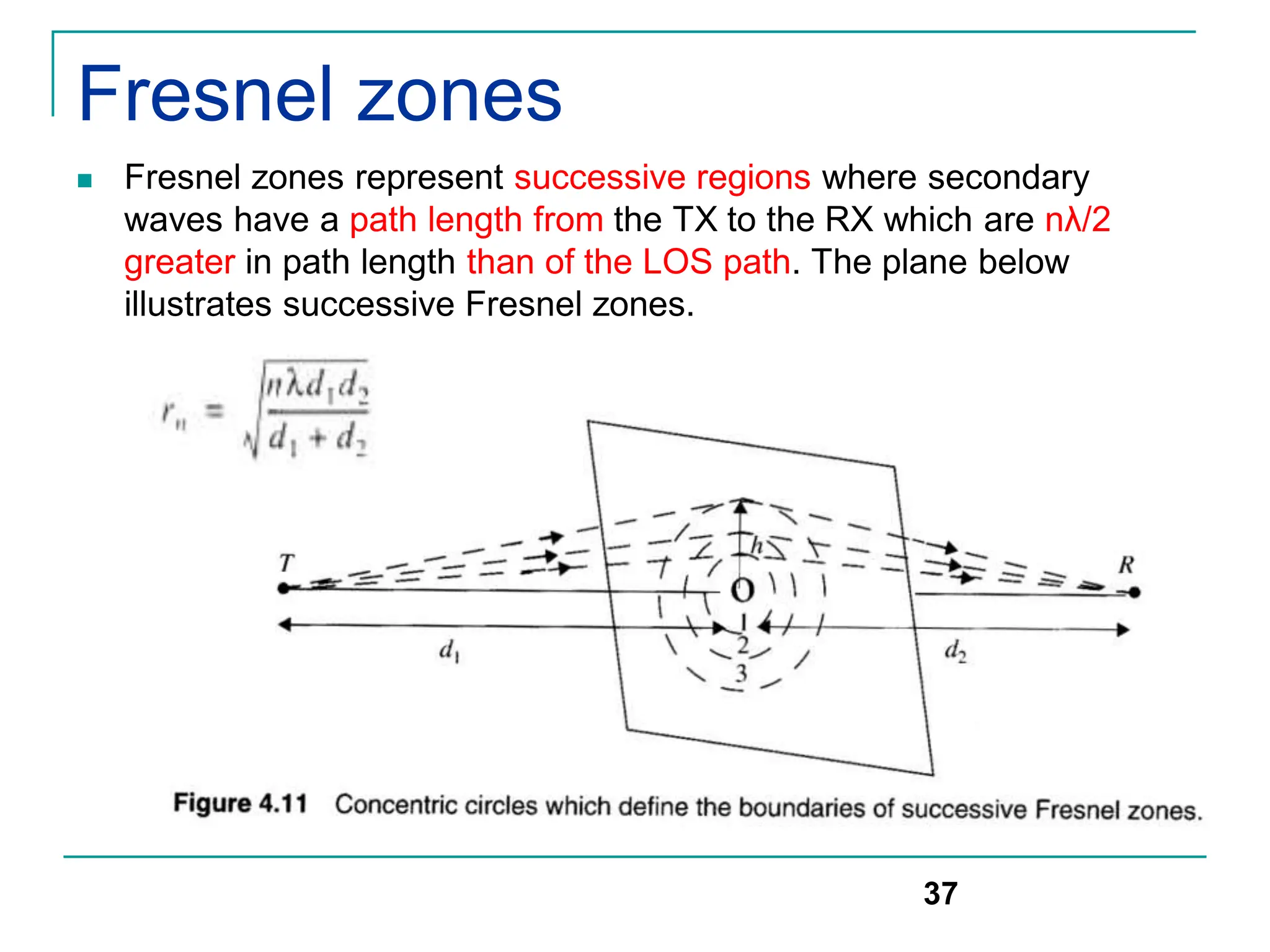
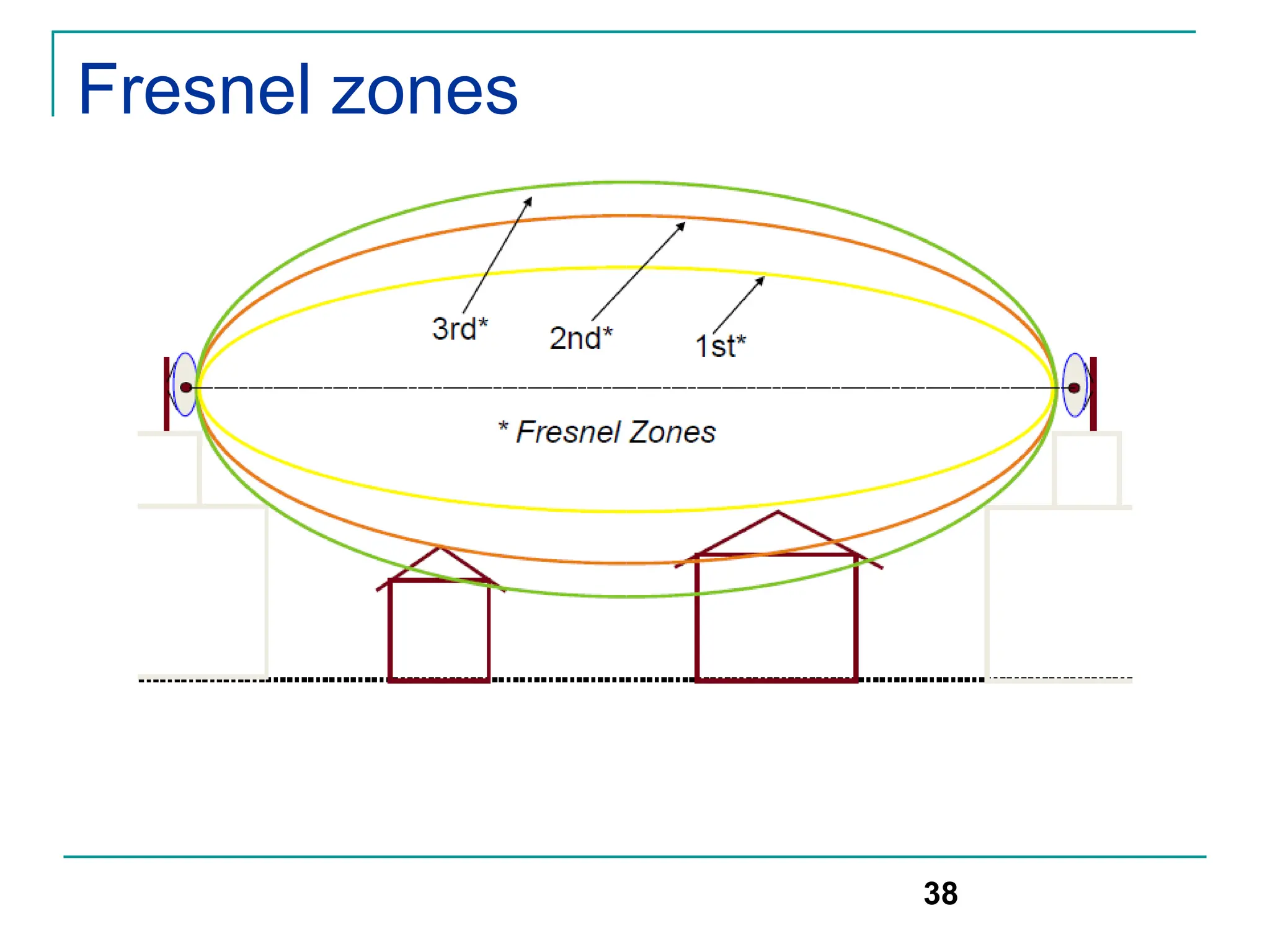
 Fresnel zones represent successive regions where secondary
waves have a path length from the TX to the RX which are nλ/2
greater in path length than of the LOS path. The plane below
illustrates successive Fresnel zones.
37
Fresnel zones
38
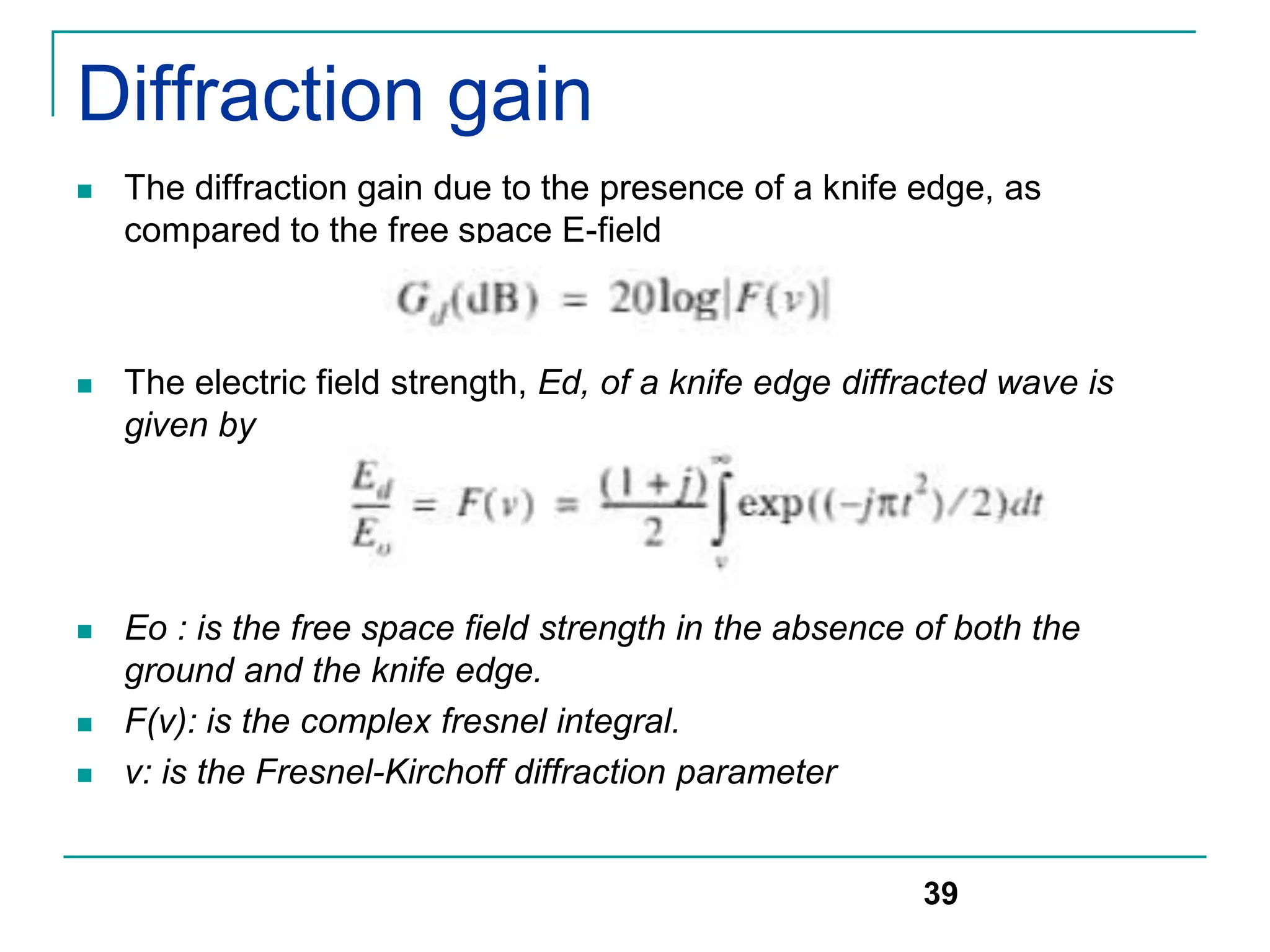
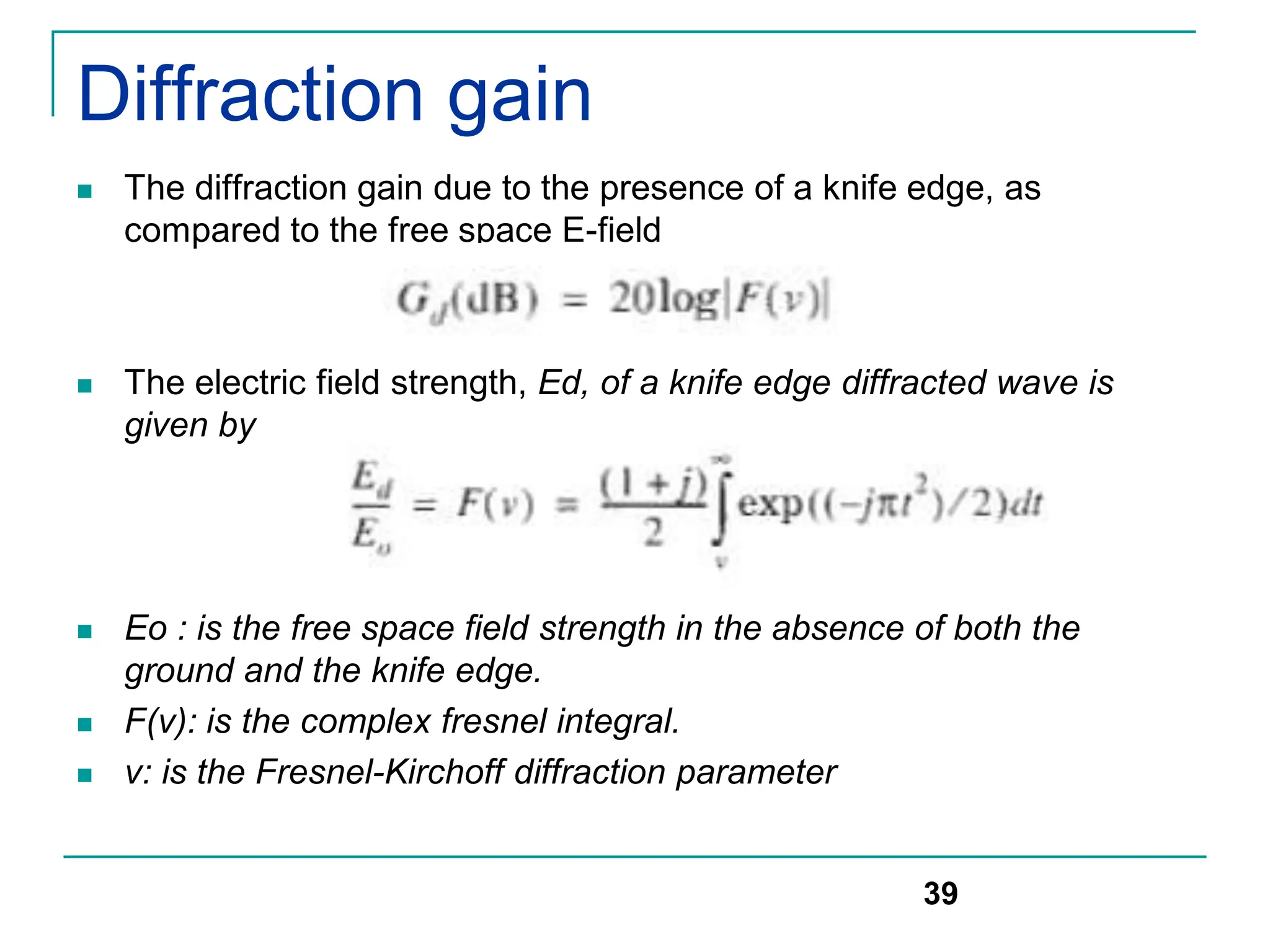
Diffraction gain
 The diffraction gain due to the presence of a knife edge, as
compared to the free space E-field
 The electric field strength, Ed, of a knife edge diffracted wave is
given by
 Eo : is the free space field strength in the absence of both the
ground and the knife edge.
 F(v): is the complex fresnel integral.
 v: is the Fresnel-Kirchoff diffraction parameter
39
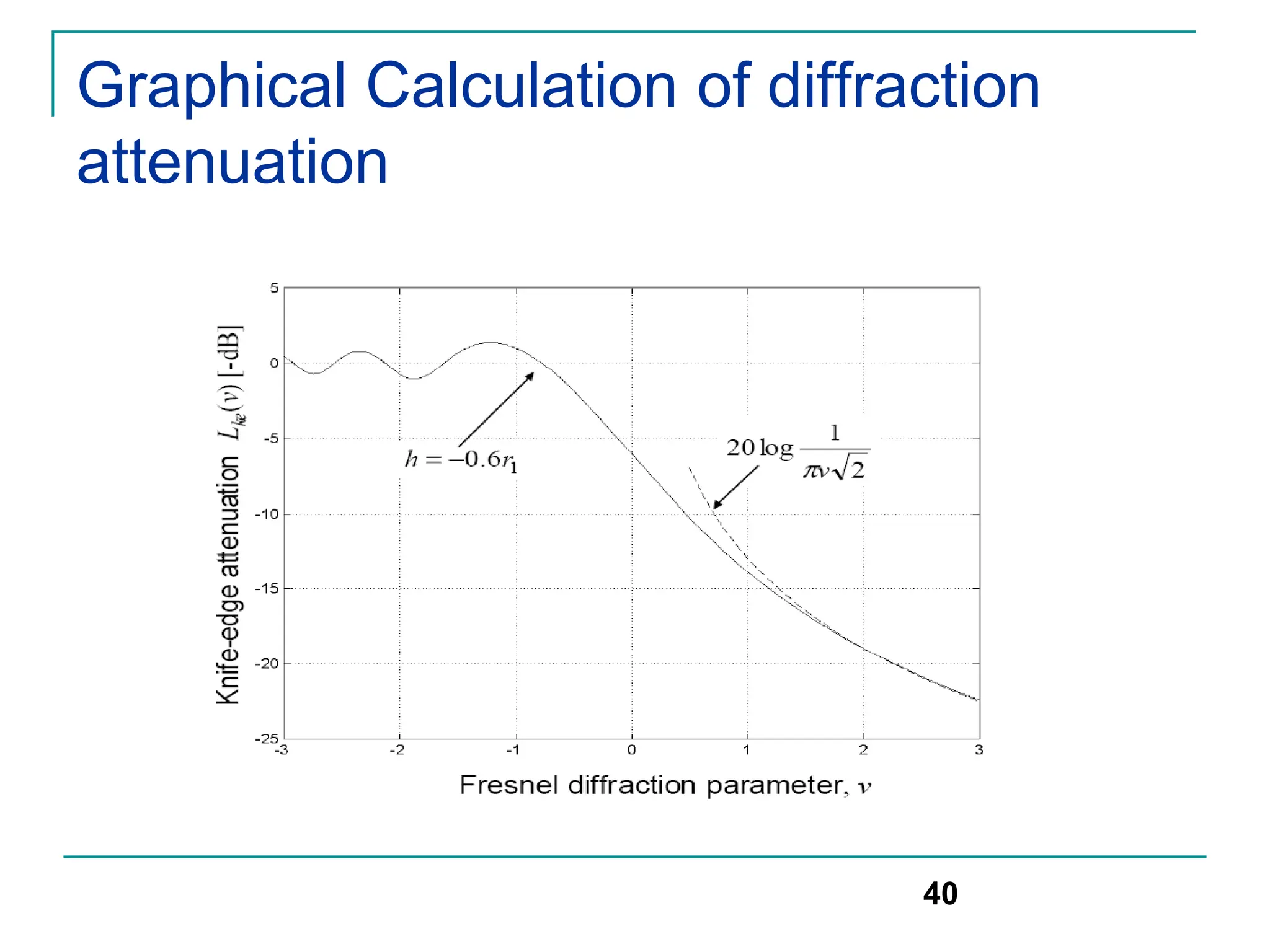
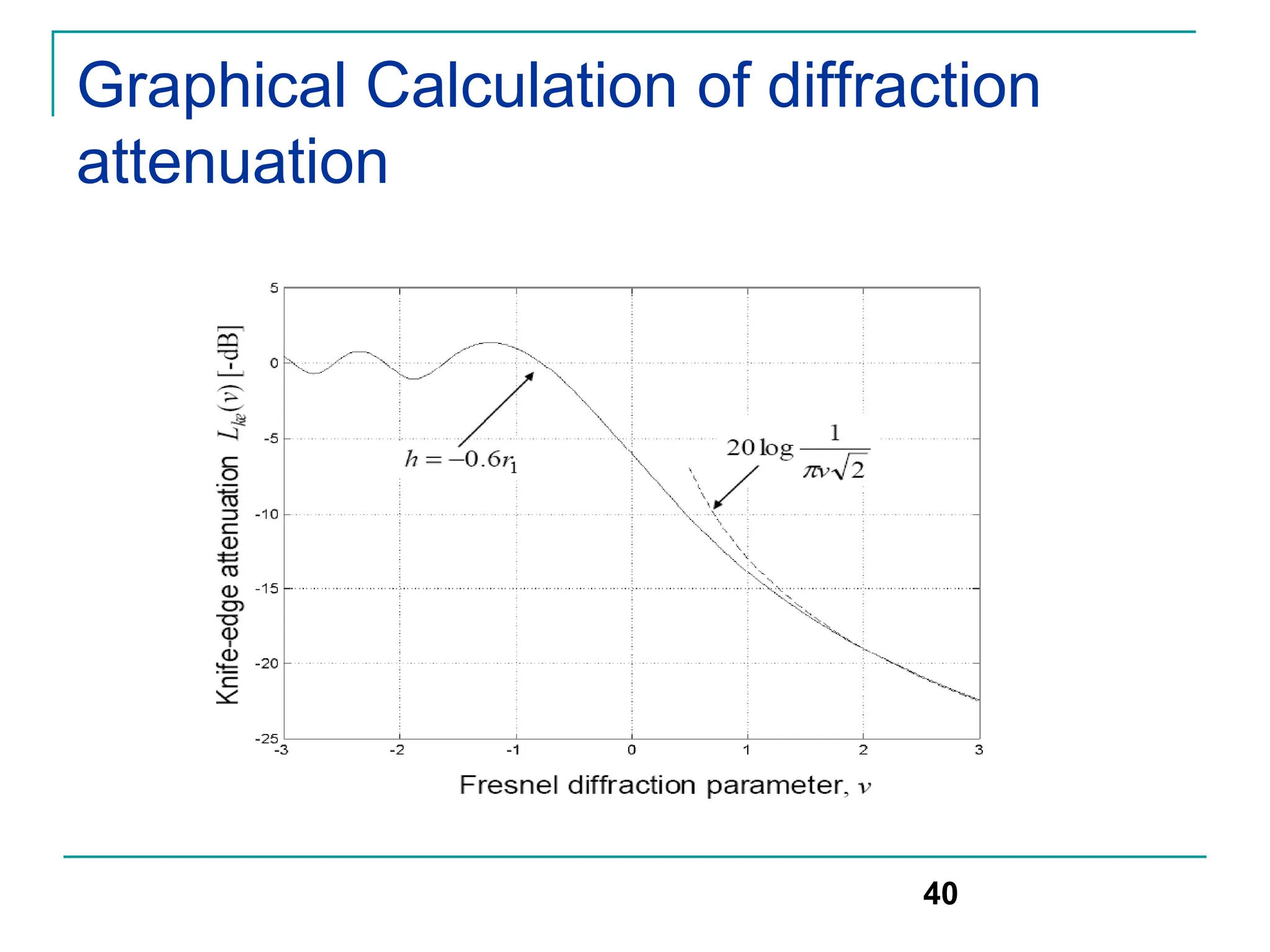
Graphical Calculation of diffraction
attenuation
40
Numerical solution
 An approximate numerical solution for
equation
 Can be found using set of equations given
below for different values of v
41
[0,1]
20 log(0.5 e- 0.95v)
[-1,0]
20 log(0.5-0.62v)
> 2.4
20 log(0.225/v)
[1, 2.4]
20 log(0.4-(0.1184-(0.38-0.1v)2)1/2)
 -1
0
v
Gd(dB)
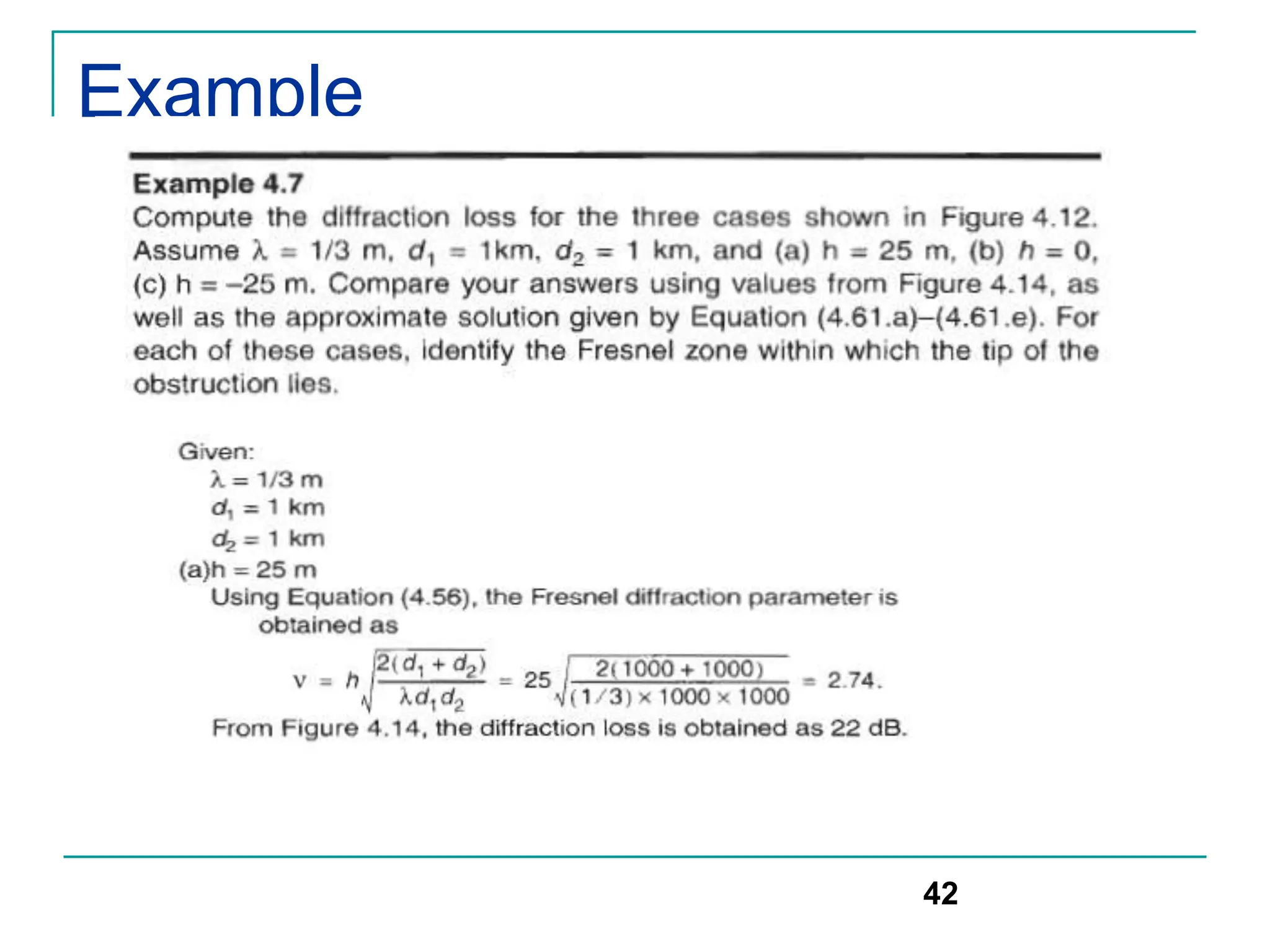
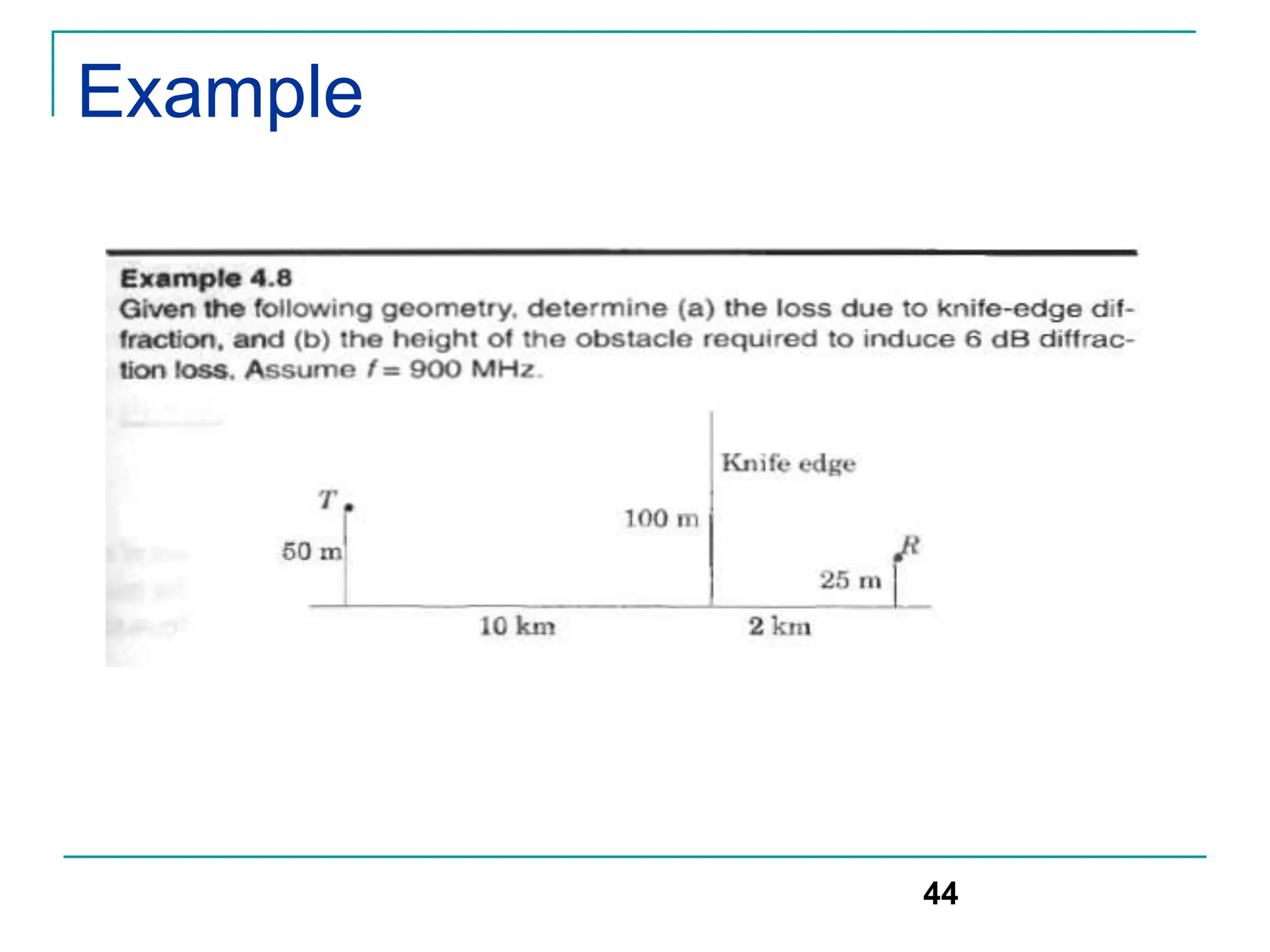
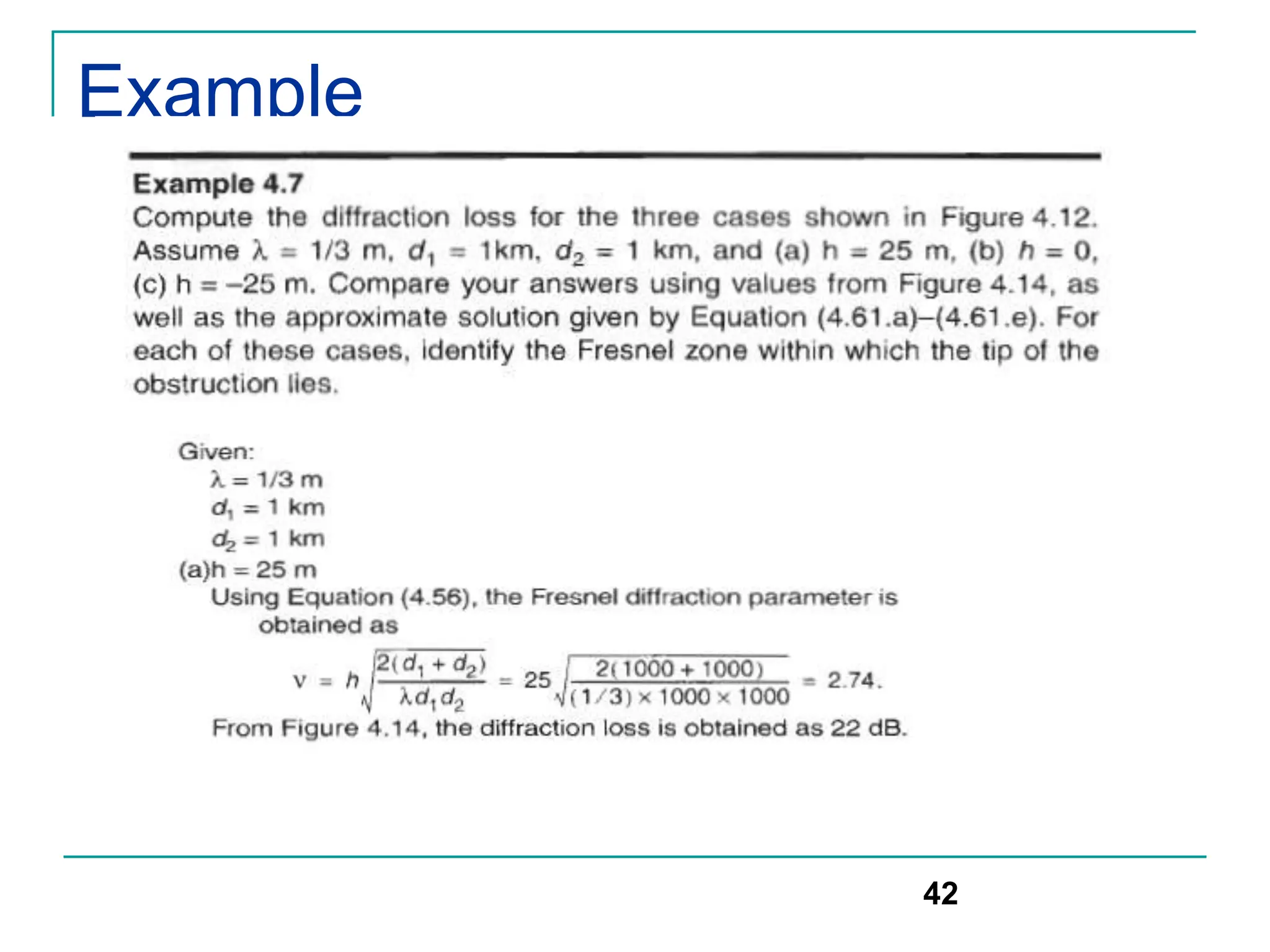
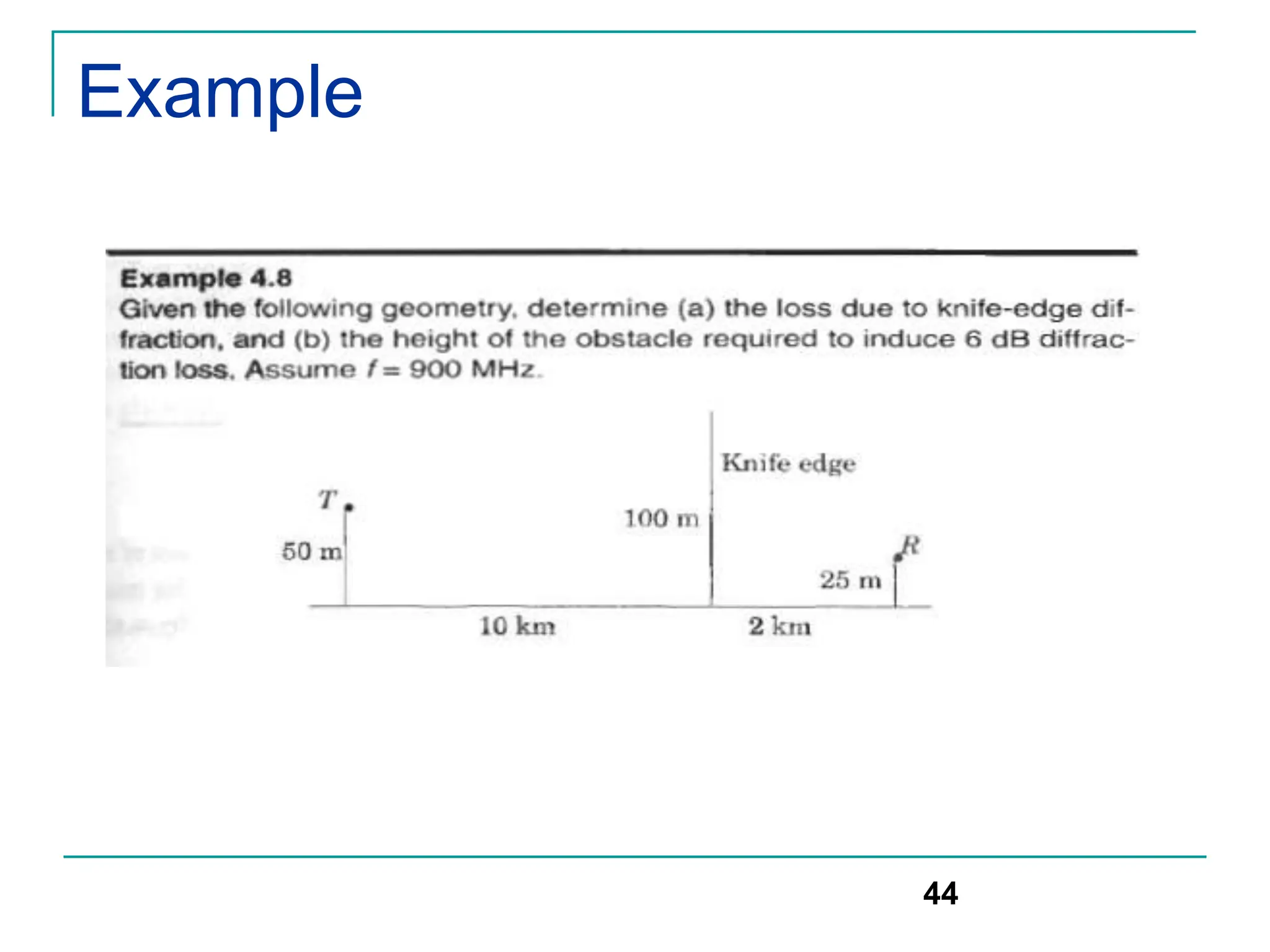
Example
42
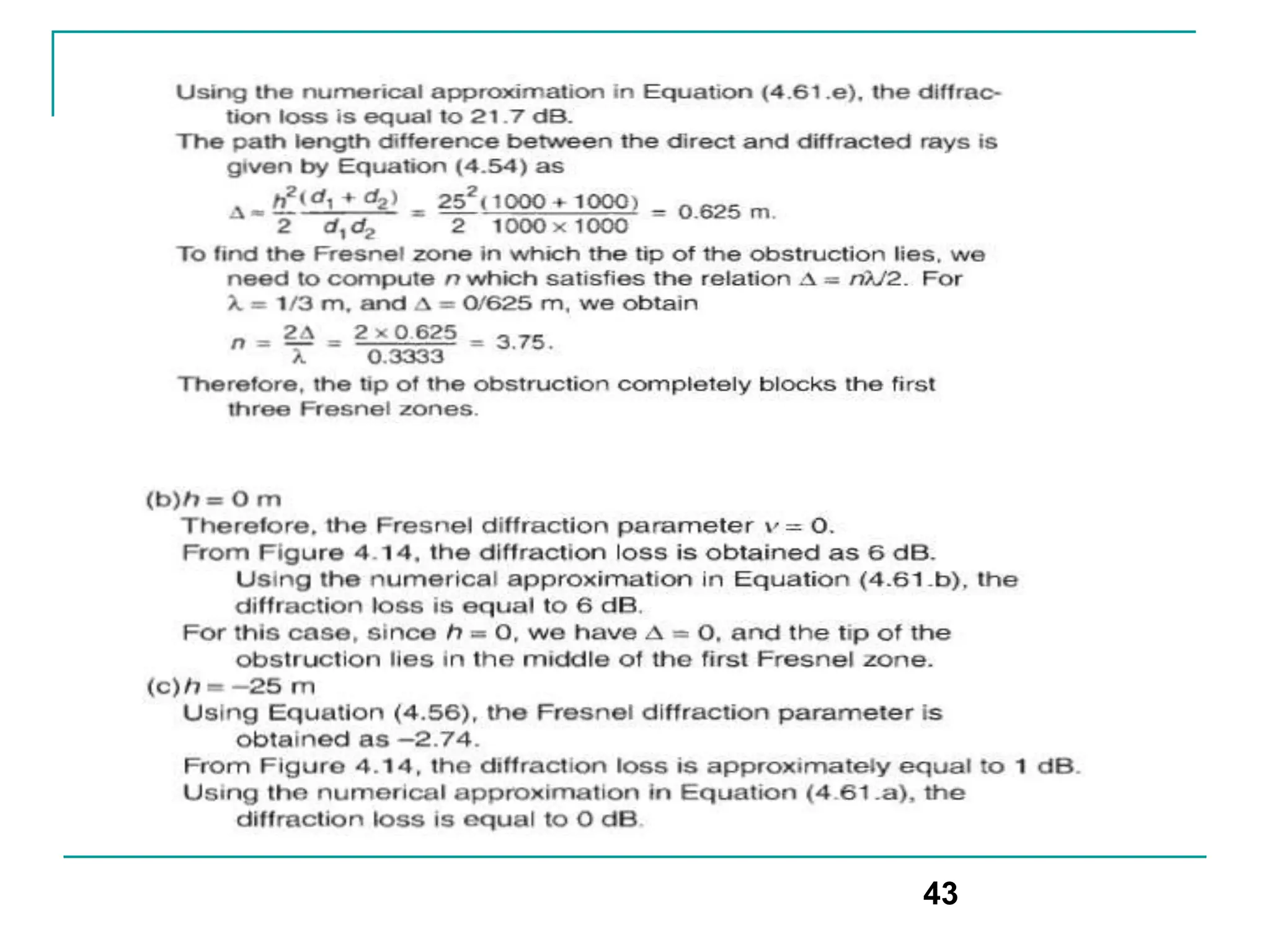
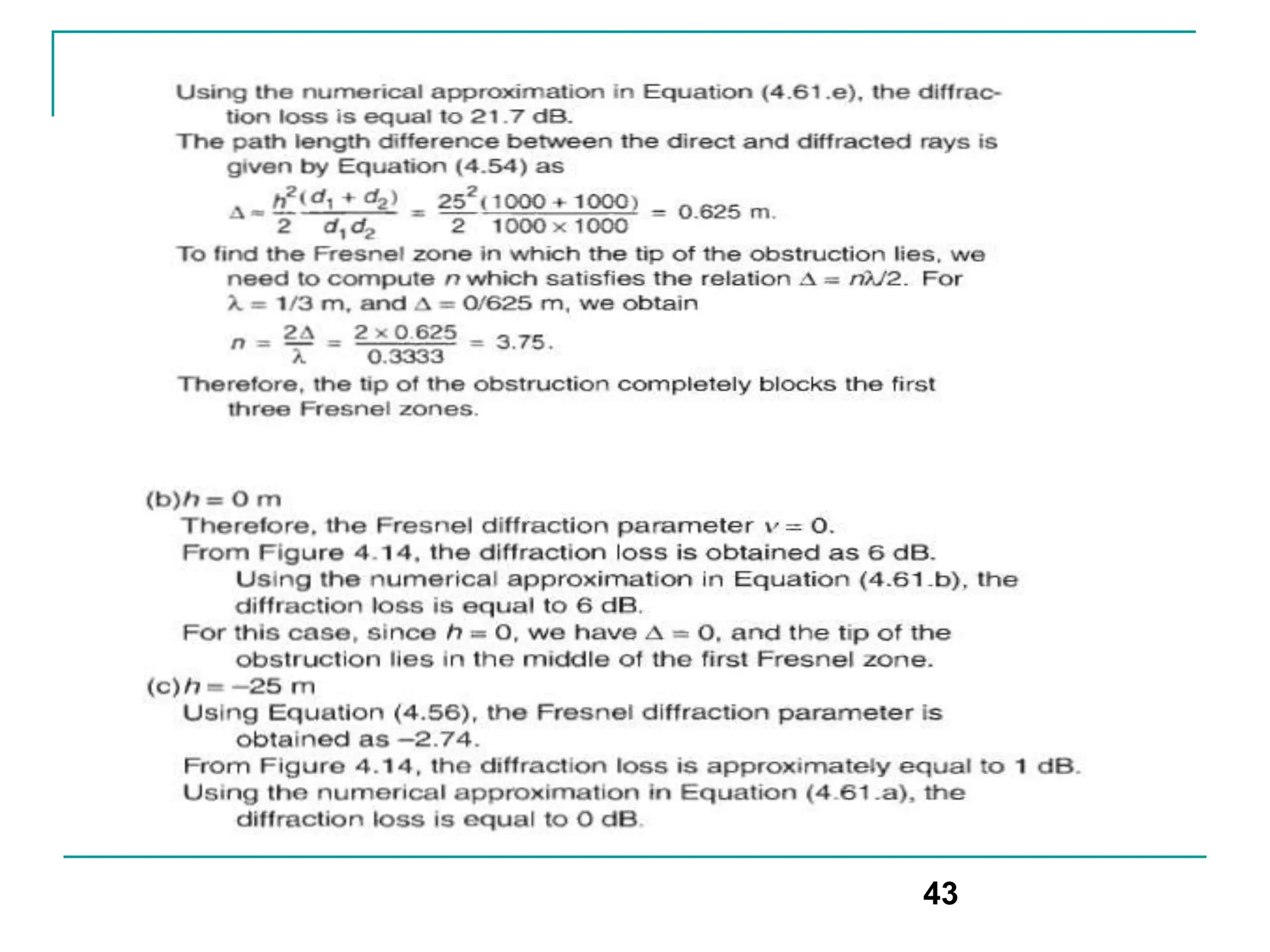
43
Example
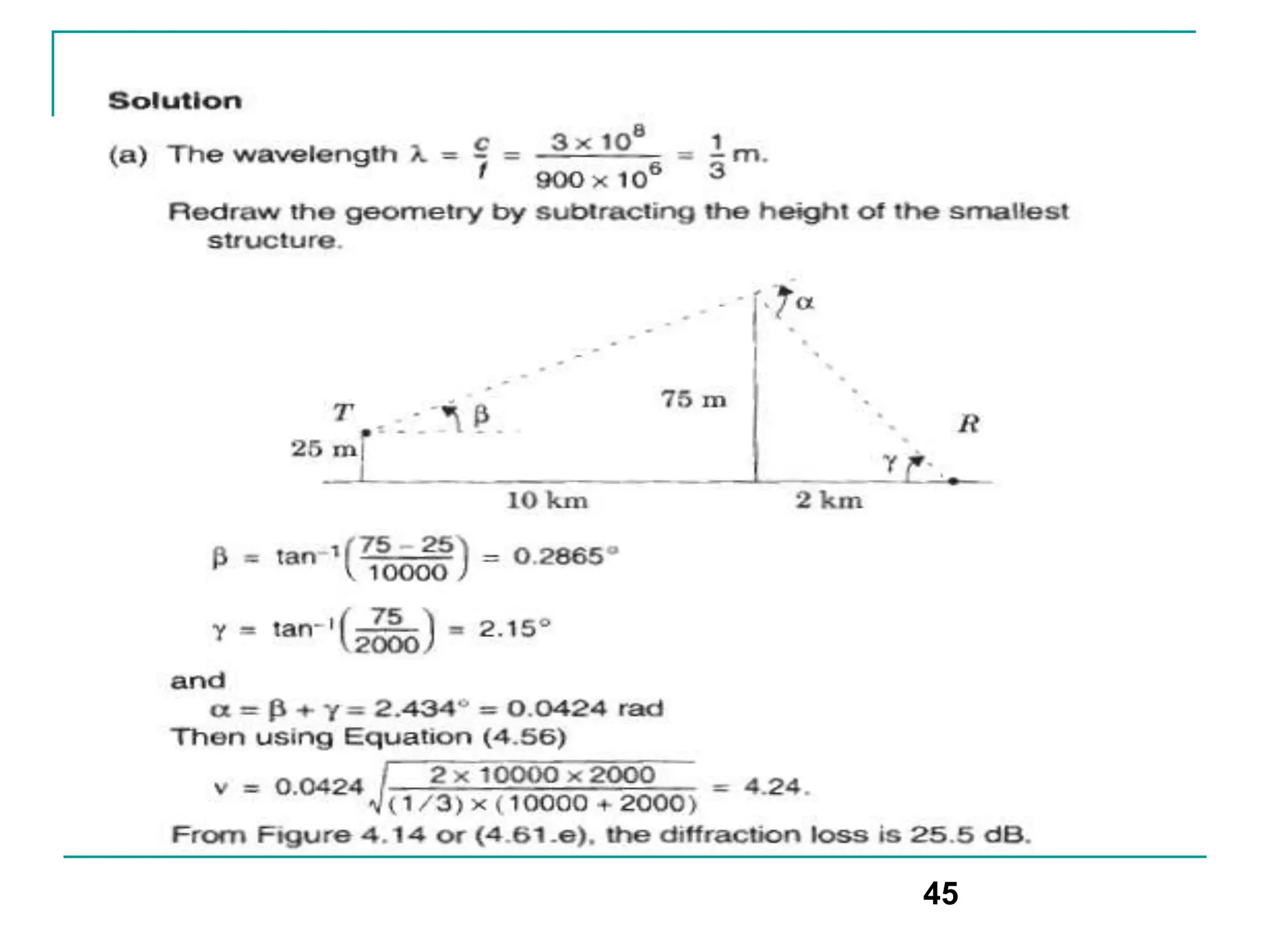
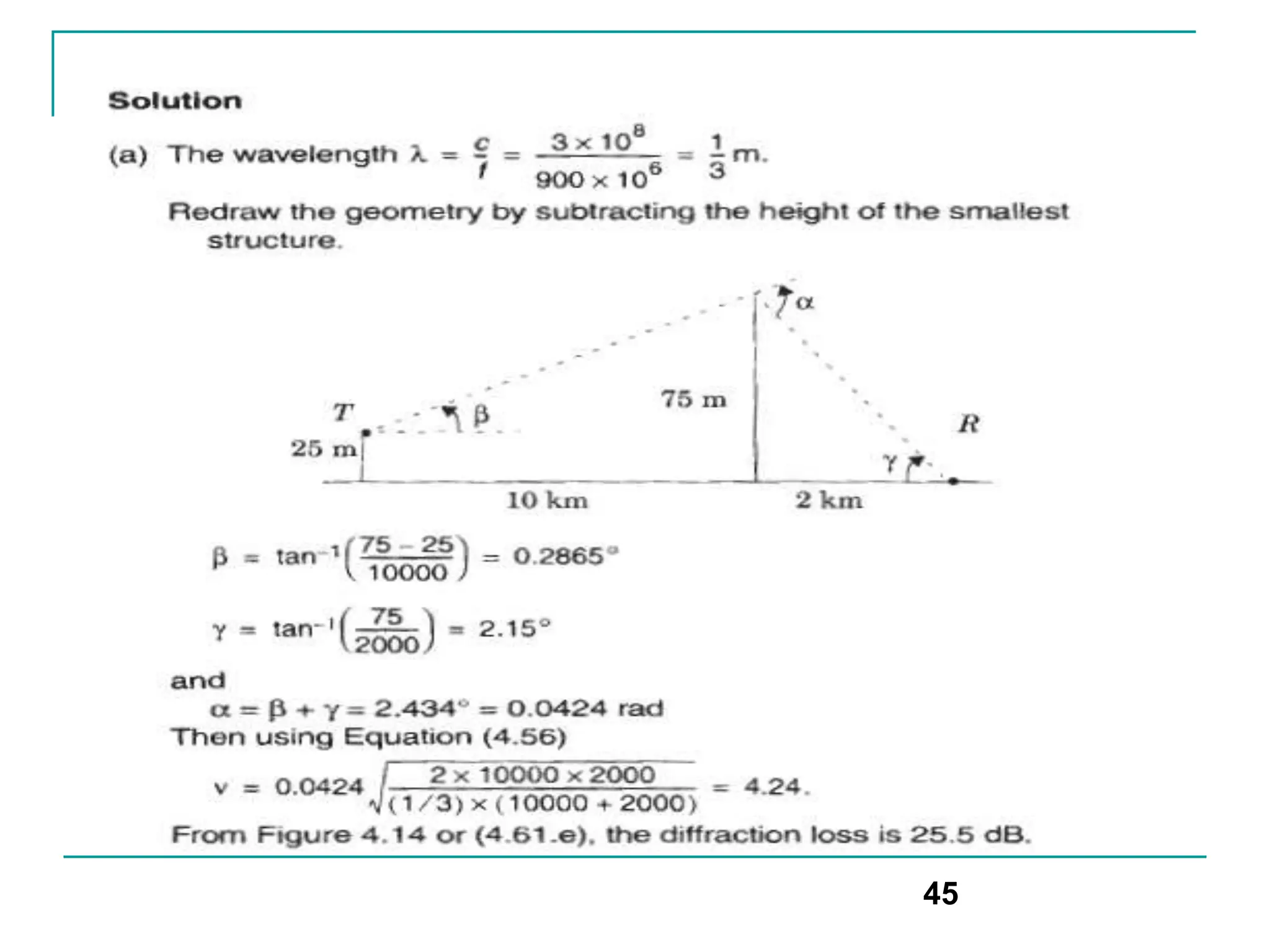
44
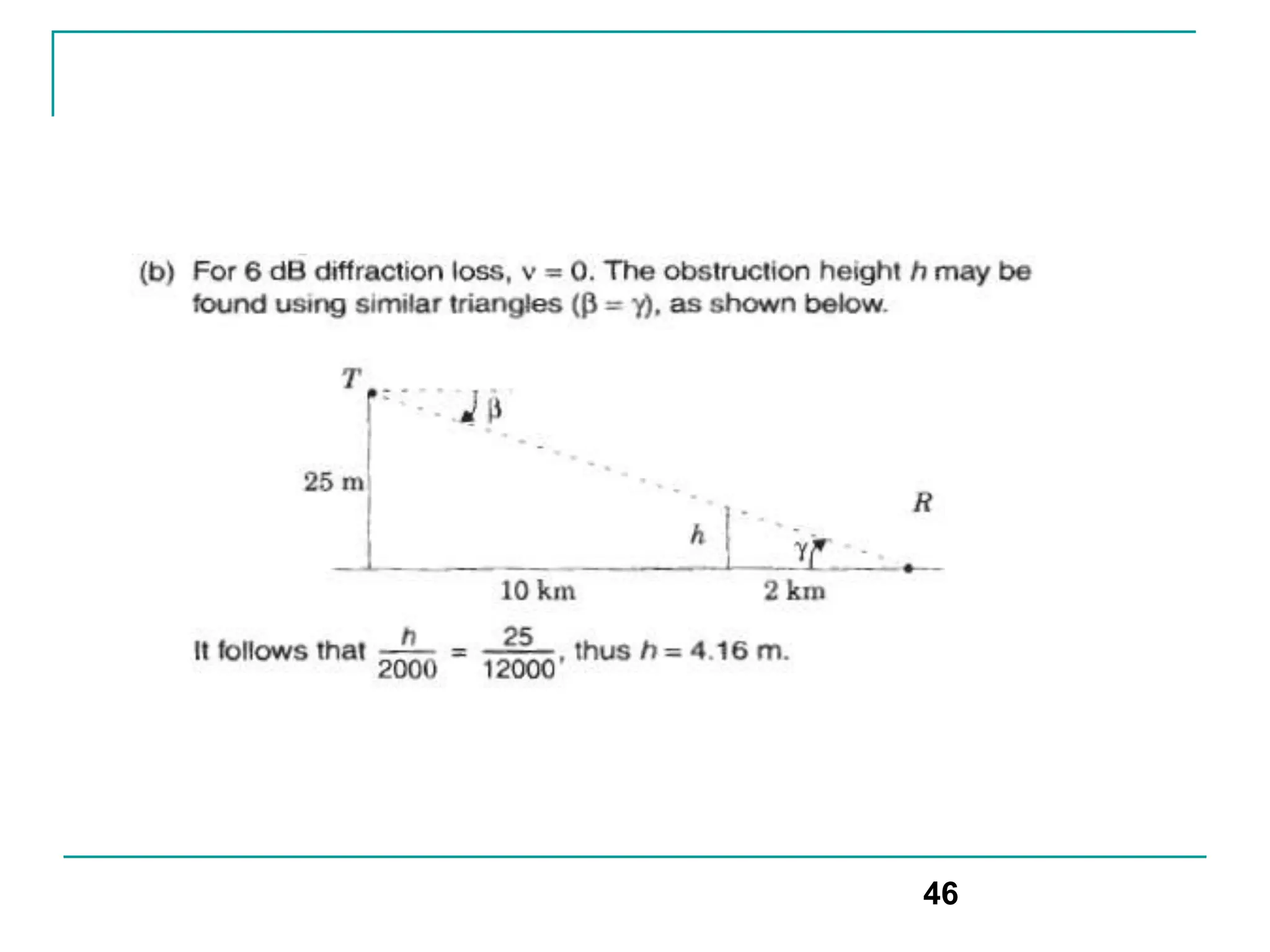
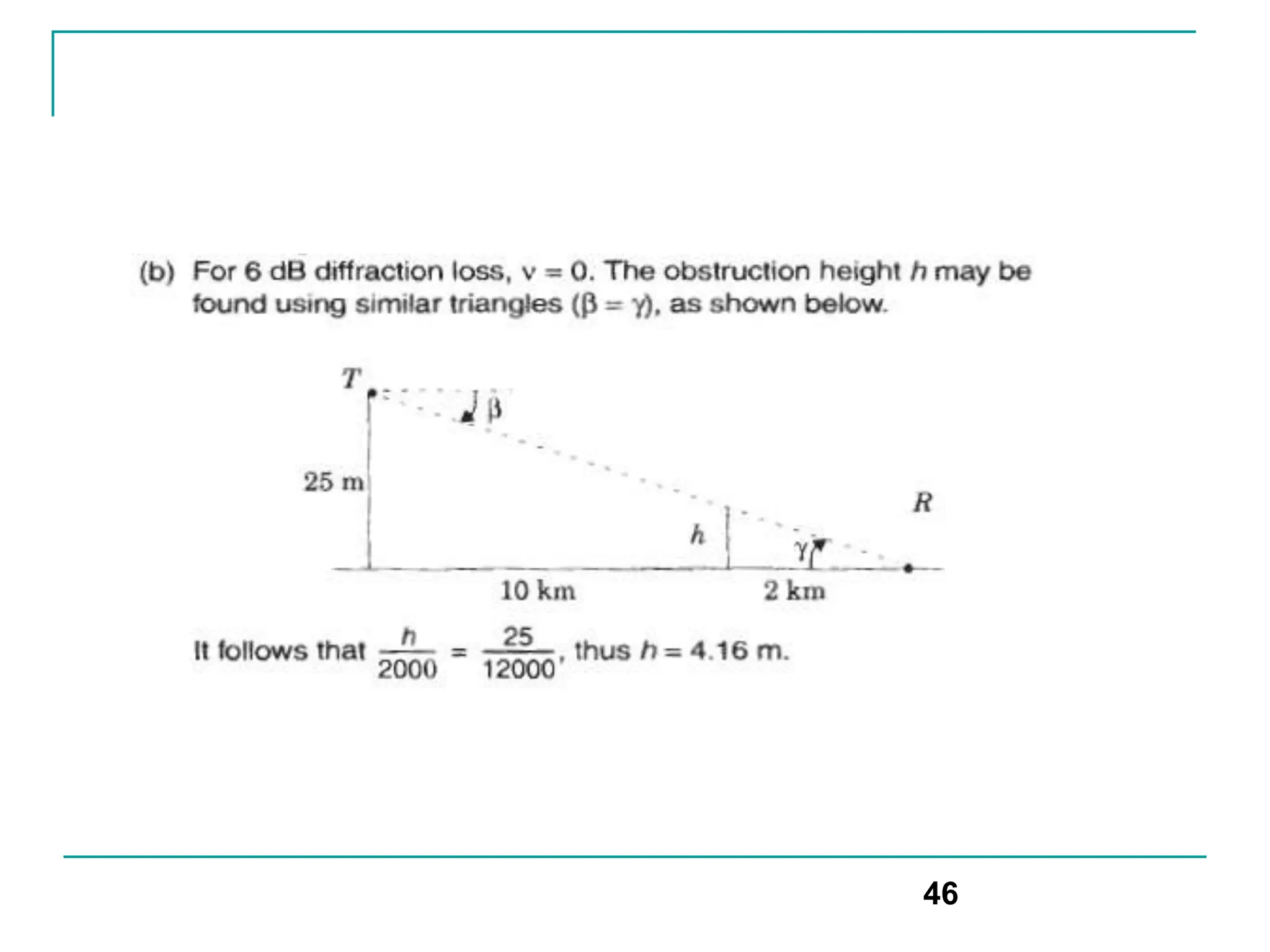
45
46
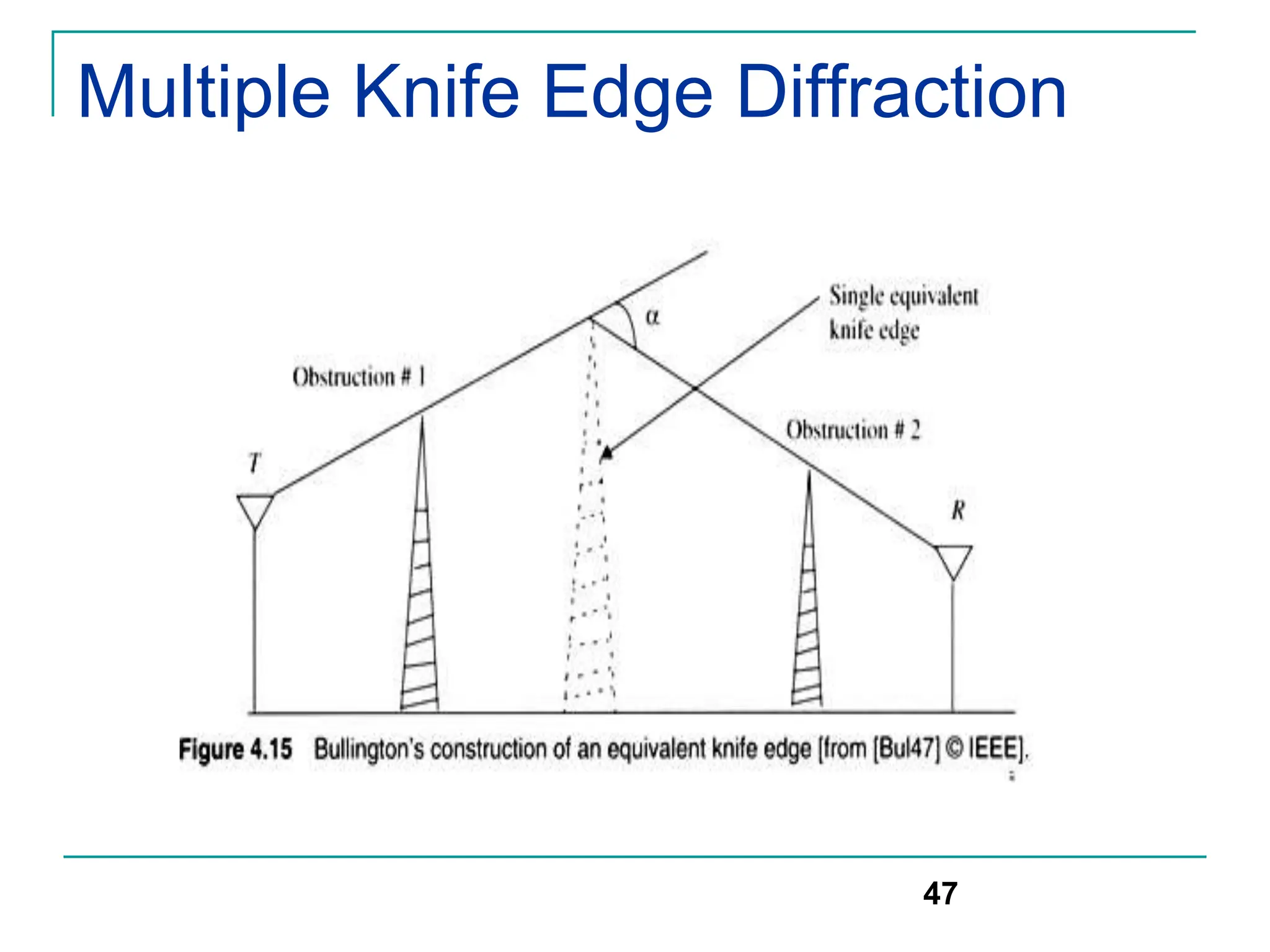
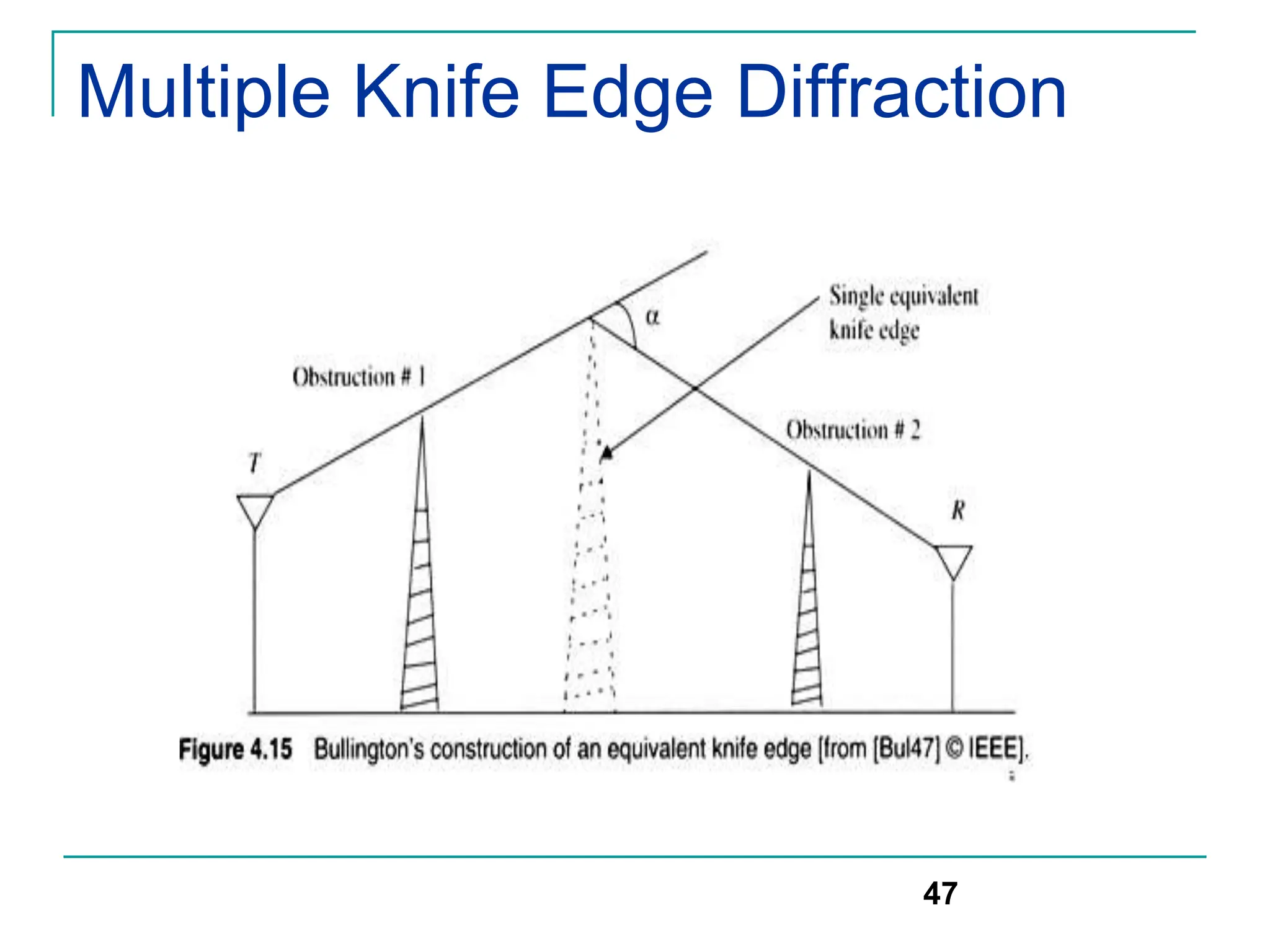
Multiple Knife Edge Diffraction
47
Scattering
 Scattering occurs when the medium through which the wave
travels consists of objects with dimensions that are small
compared to the wavelength, and where the number of
obstacles per unit volume is large.
 Scattered waves are produced by
 rough surfaces,
 small objects,
 or by other irregularities in the channel.
 Scattering is caused by trees, lamp posts, towers, etc.
48
Scattering
 Received signal strength is often stronger than that predicted
by reflection/diffraction models alone
 The EM wave incident upon a rough or complex surface is
scattered in many directions and provides more energy at a
receiver
 energy that would have been absorbed is instead reflected
to the Rx.
 flat surface → EM reflection (one direction)
 rough surface → EM scattering (many directions)
49
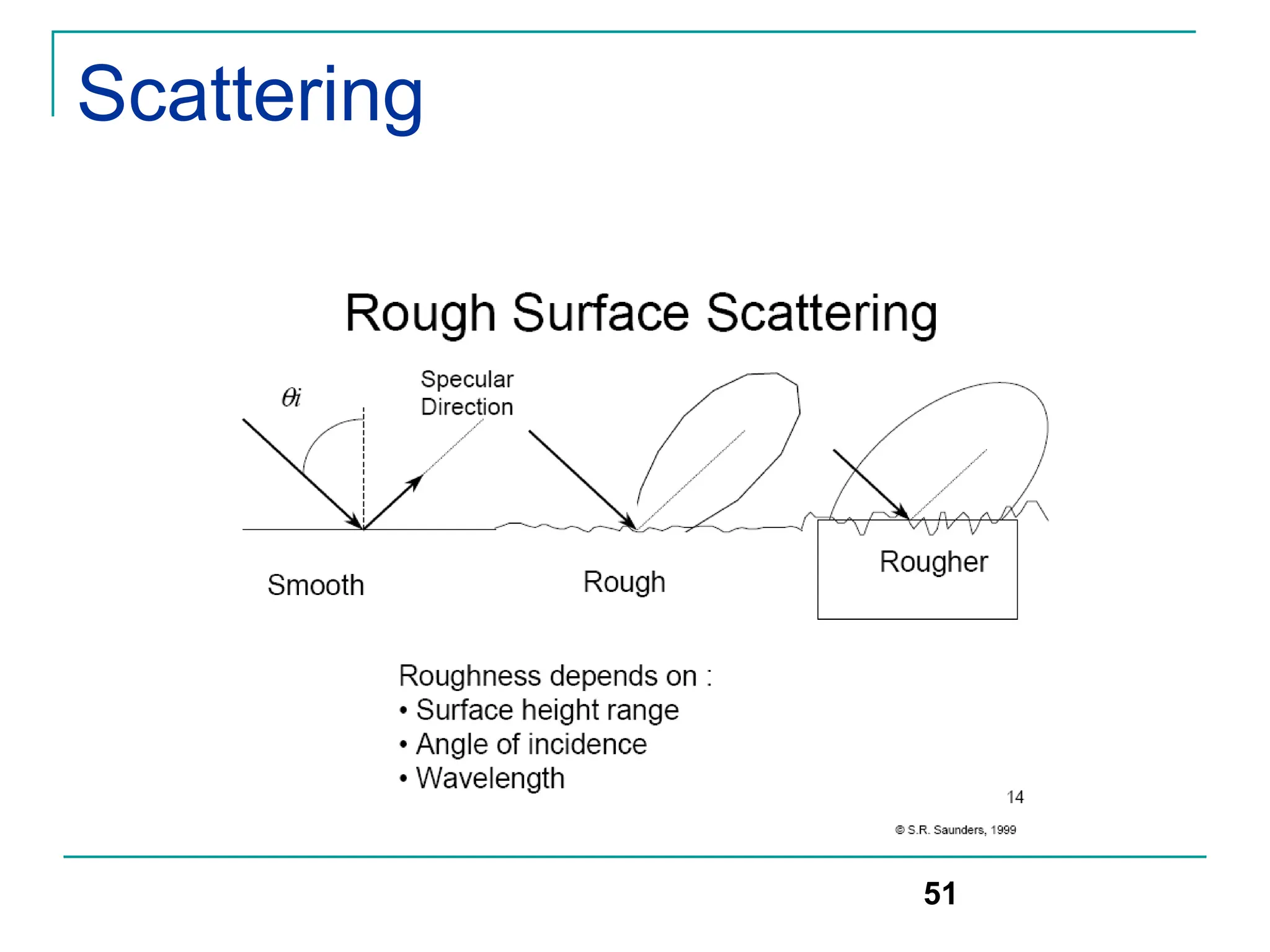
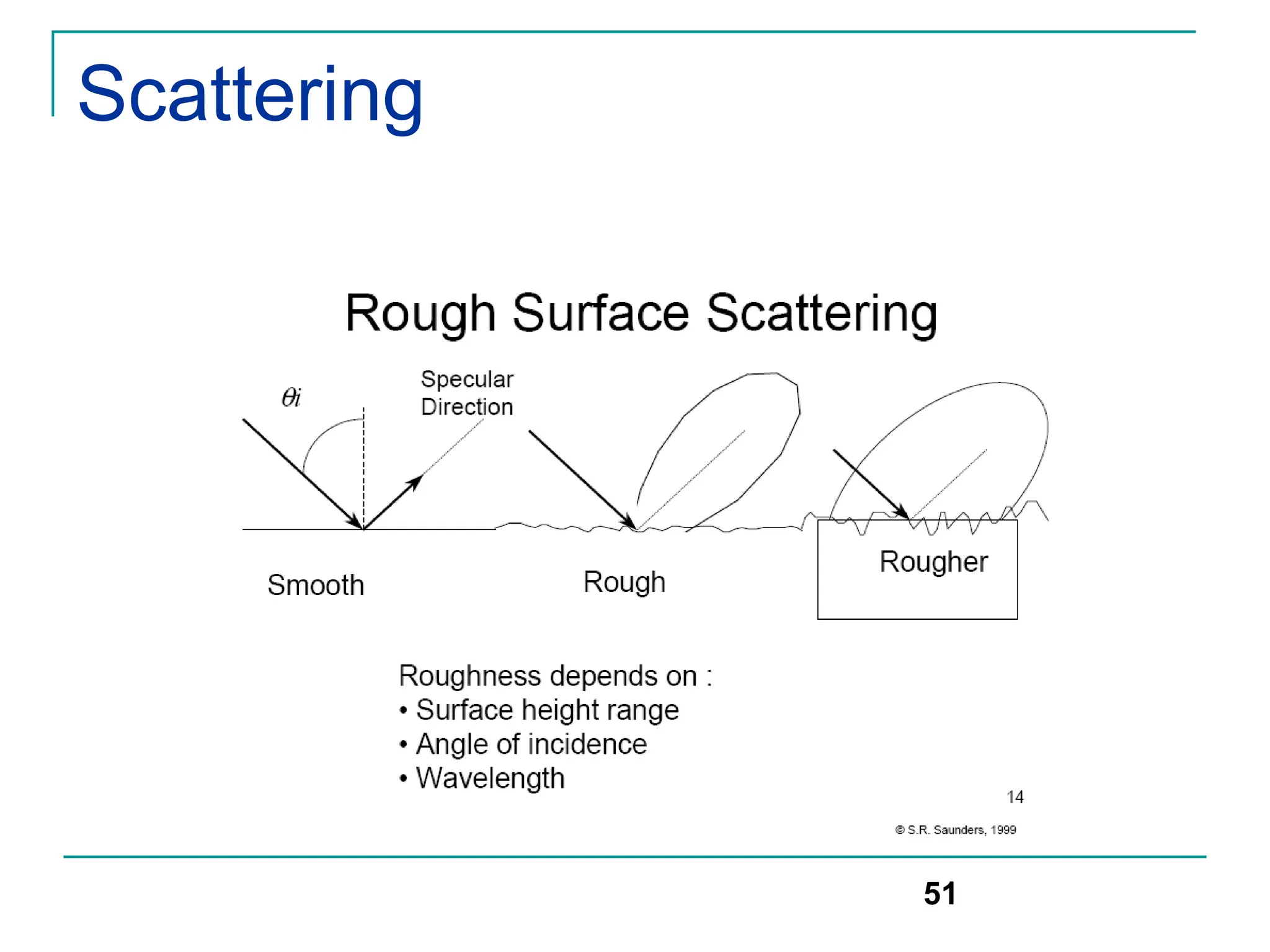
Scattering
Rayleigh criterion: used for testing surface roughness
A surface is considered smooth if its min to max protuberance (bumps)
h is less than critical height hc
hc = λ/8 sinΘi
Scattering path loss factor ρs is given by
ρs =exp[-8[(π*σh *sinΘi)/ λ] 2]
Where h is surface height and σh is standard deviation of surface
height about mean surface height.
For rough surface, the flat surface reflection coefficient is multiplied by
scattering loss factor ρs to account for diminished electric field
Reflected E-fields for h> hc for rough surface can be calculated as
Гrough= ρsГ
50
Scattering
51
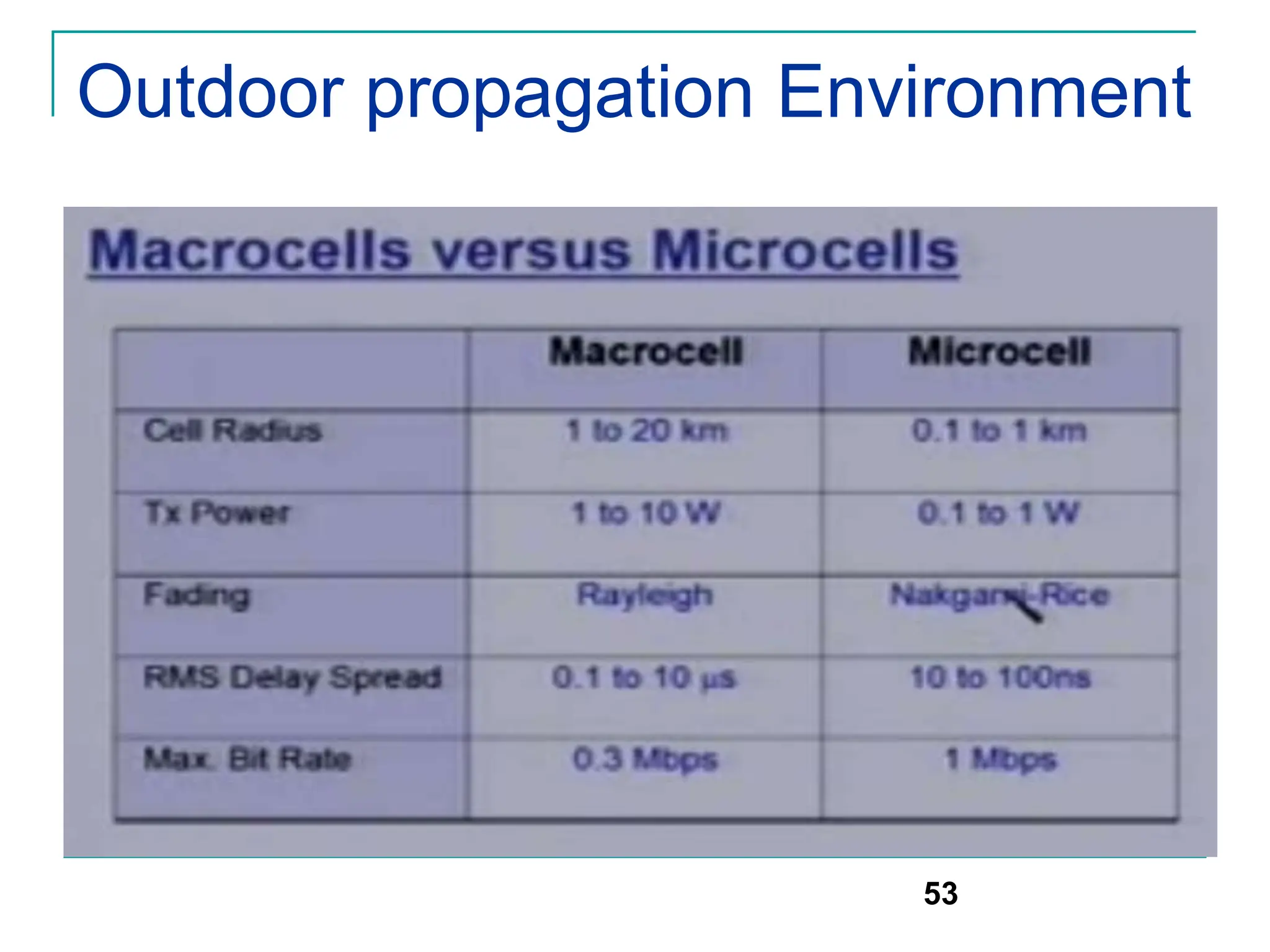
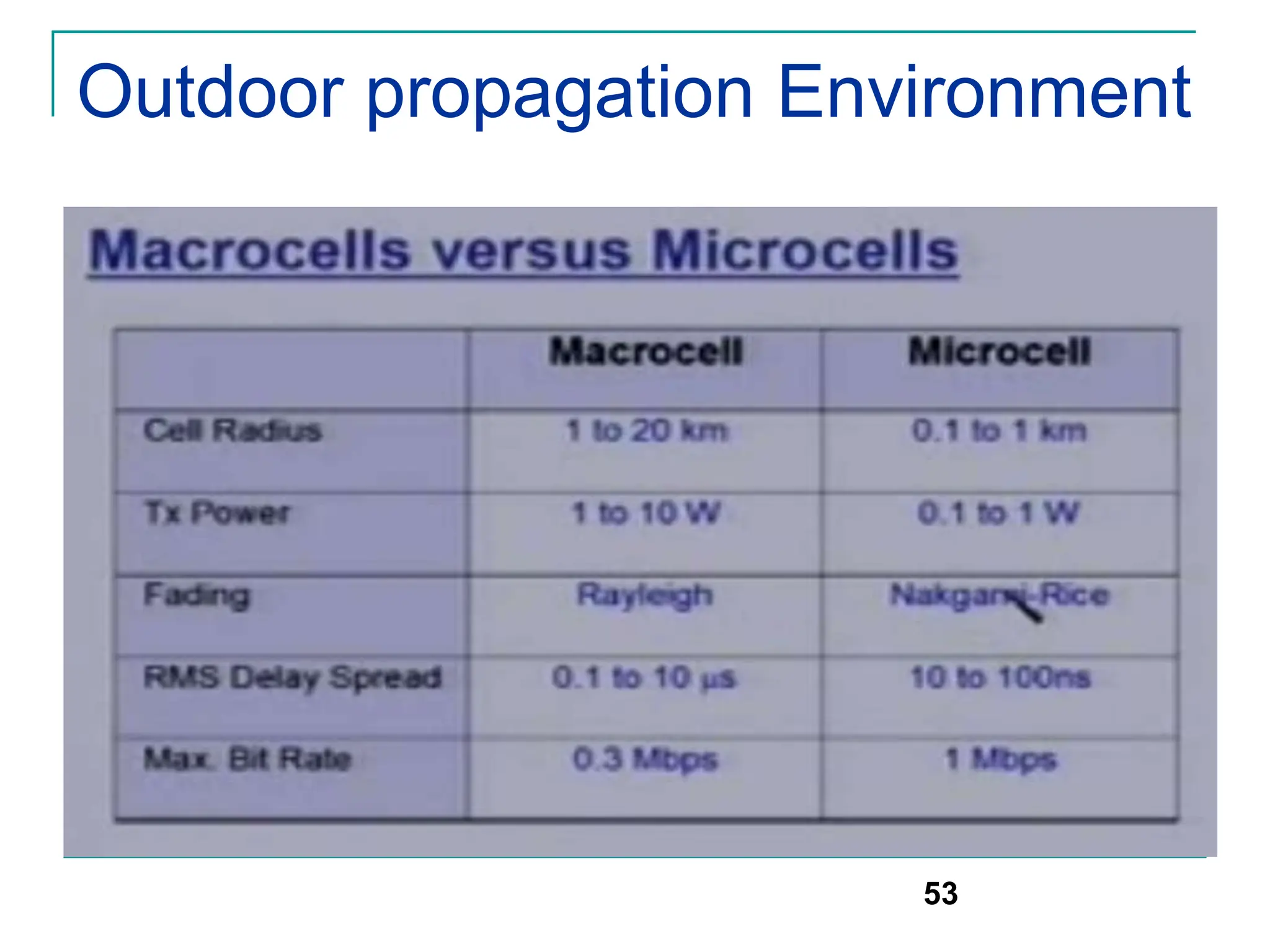
Outdoor propagation Environment
Based on the coverage area, the Outdoor
propagation environment may be divided into
three categories
1. Propagation in Macro cells
2. Propagation in Micro cells
3. Propagation in street Micro cells
52
Outdoor propagation Environment
53
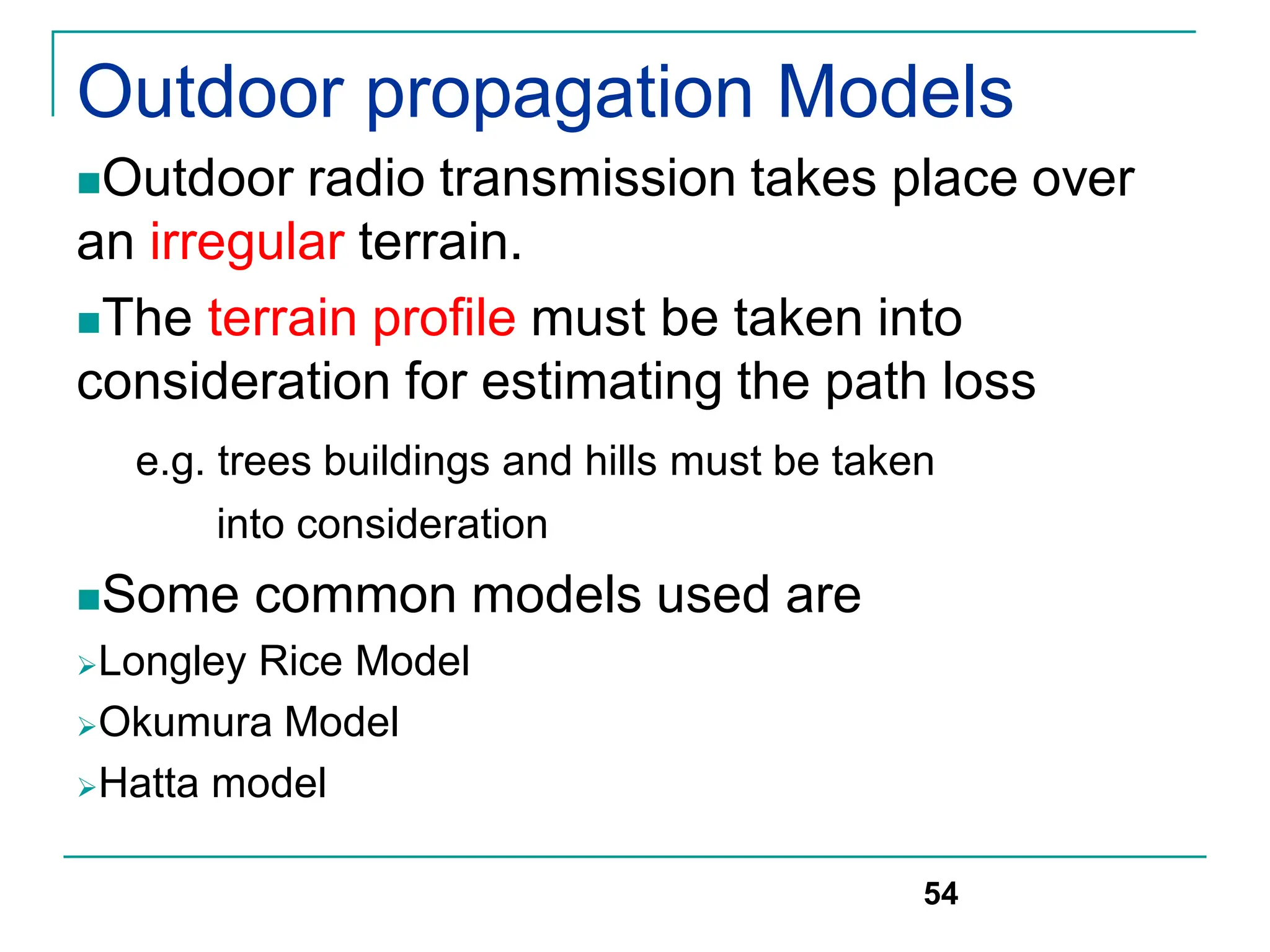
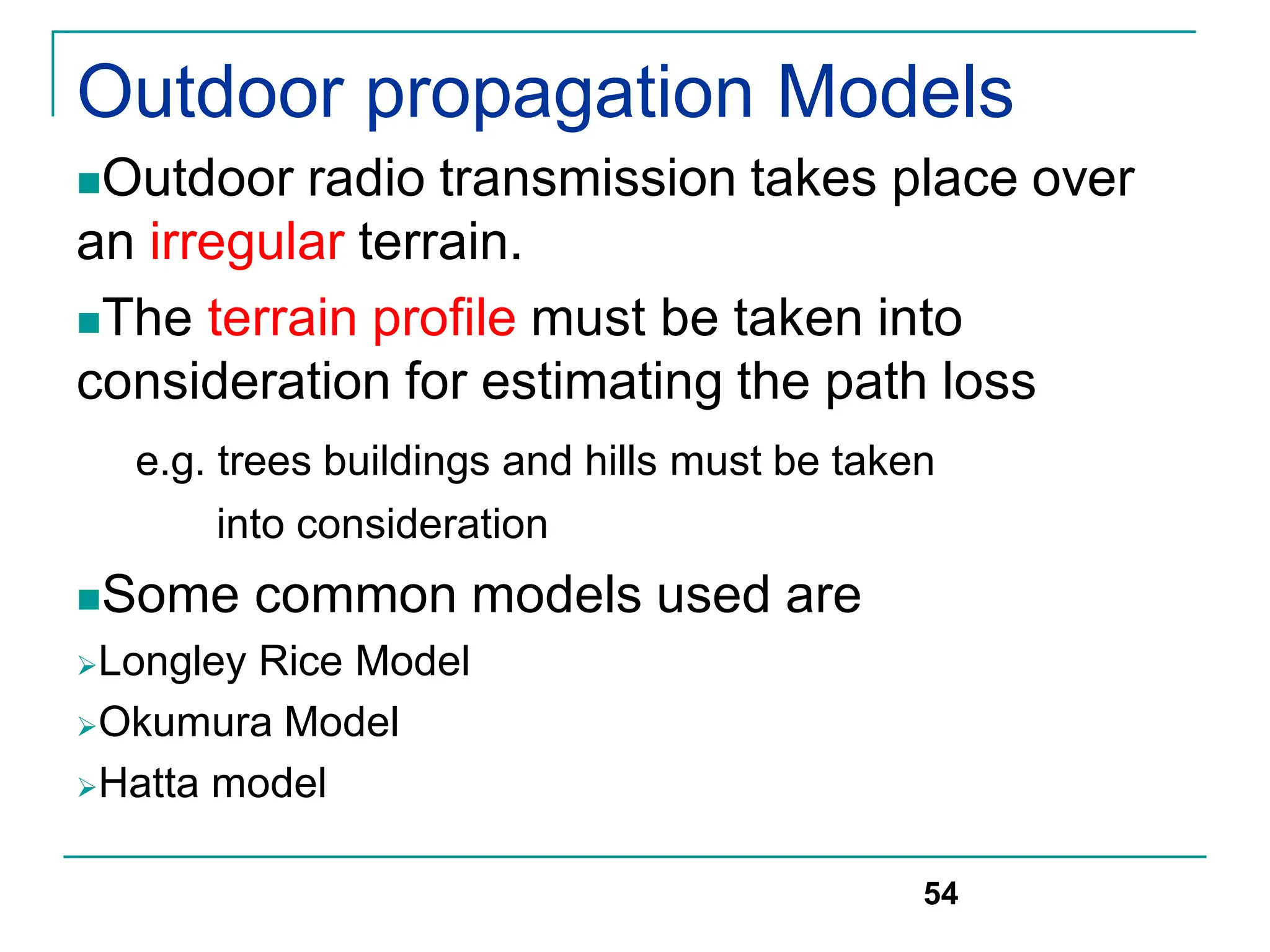
Outdoor propagation Models
Outdoor radio transmission takes place over
an irregular terrain.
The terrain profile must be taken into
consideration for estimating the path loss
e.g. trees buildings and hills must be taken
into consideration
Some common models used are
Longley Rice Model
Okumura Model
Hatta model
54
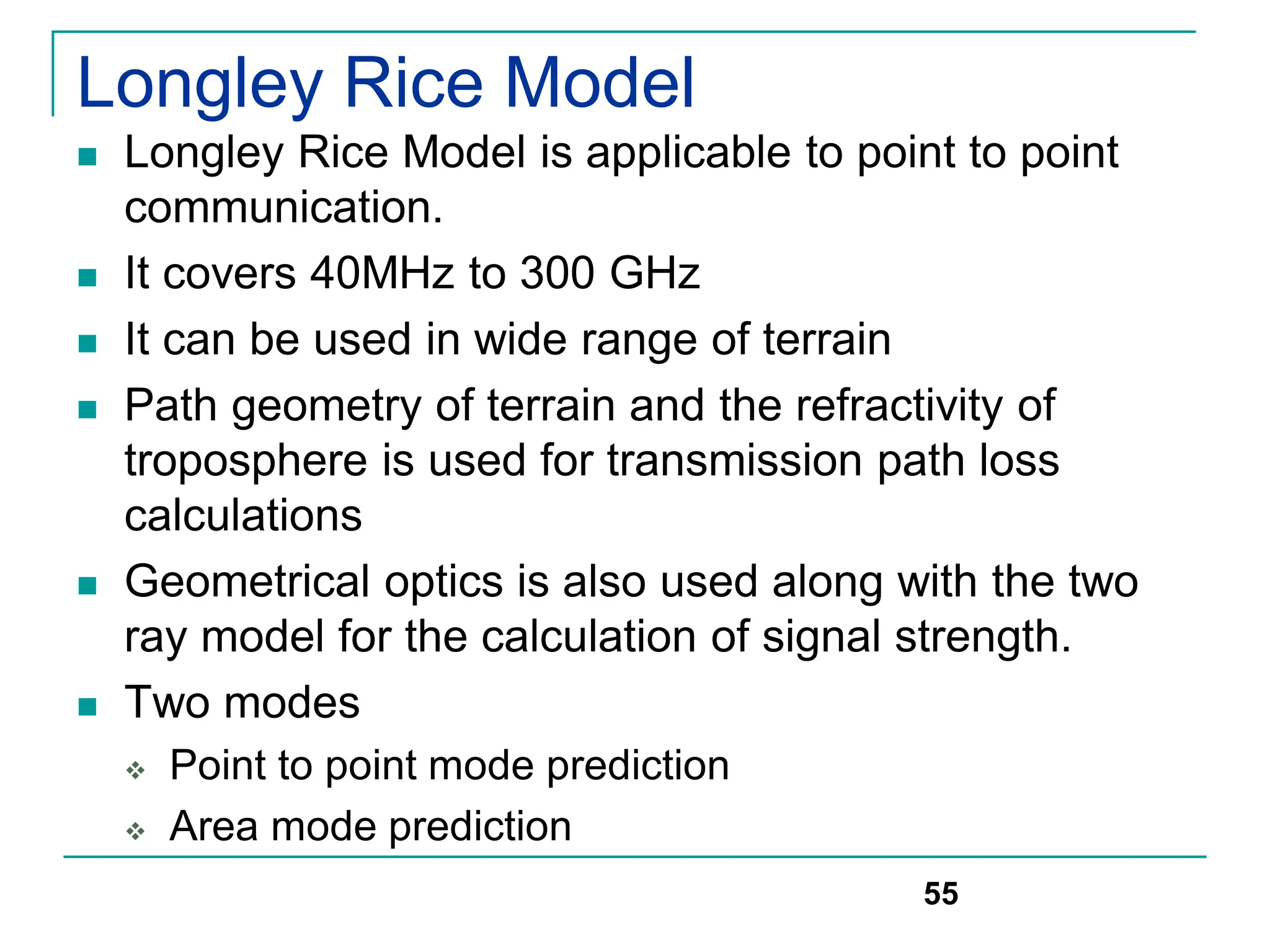
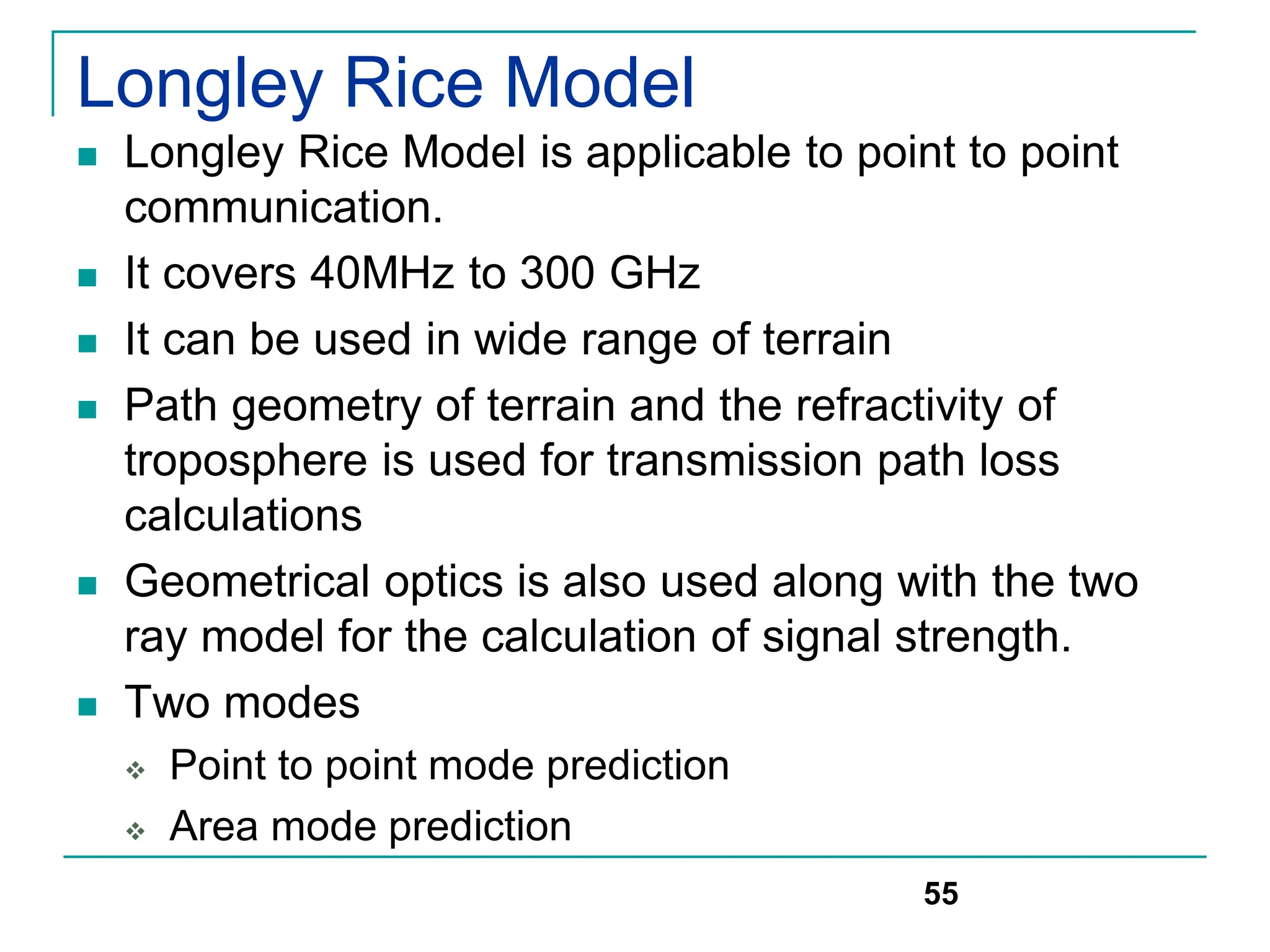
Longley Rice Model
 Longley Rice Model is applicable to point to point
communication.
 It covers 40MHz to 300 GHz
 It can be used in wide range of terrain
 Path geometry of terrain and the refractivity of
troposphere is used for transmission path loss
calculations
 Geometrical optics is also used along with the two
ray model for the calculation of signal strength.
 Two modes
 Point to point mode prediction
 Area mode prediction
55
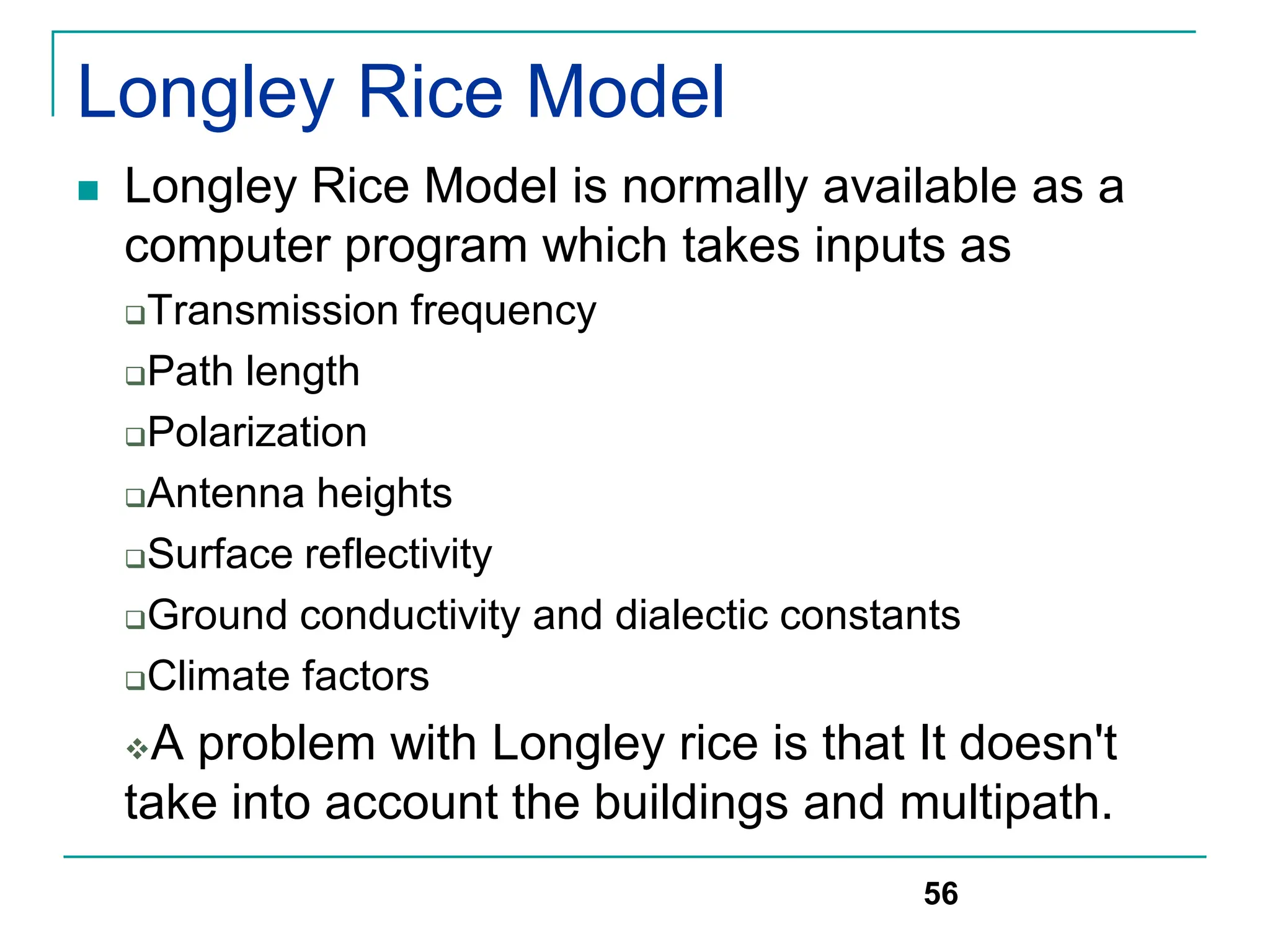
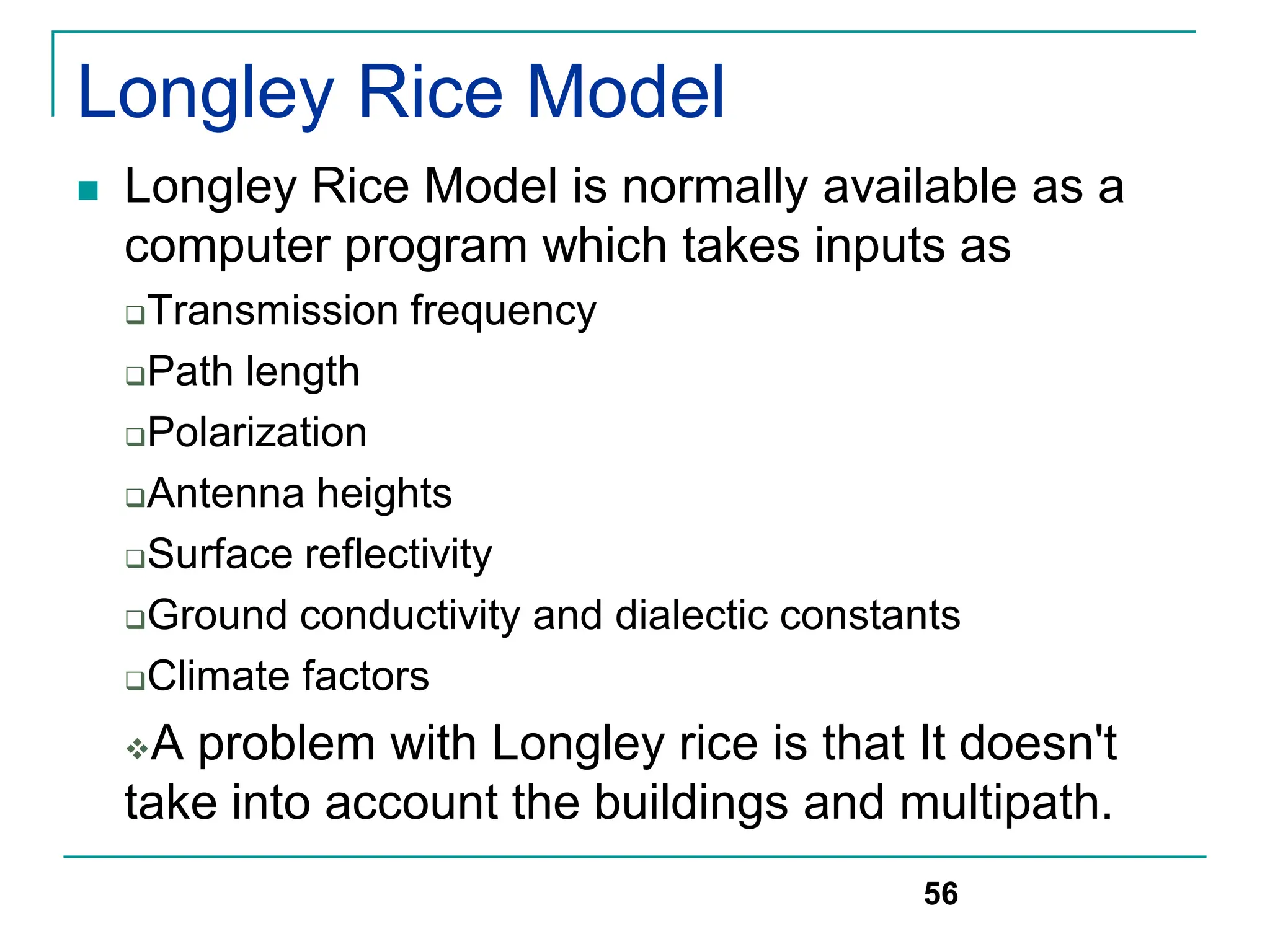
Longley Rice Model
 Longley Rice Model is normally available as a
computer program which takes inputs as
Transmission frequency
Path length
Polarization
Antenna heights
Surface reflectivity
Ground conductivity and dialectic constants
Climate factors
A problem with Longley rice is that It doesn't
take into account the buildings and multipath.
56
Okumura Model
 In 1968 Okumura did a lot of measurements and
produce a new model.
 The new model was used for signal prediction in Urban
areas.
 Okumura introduced a graphical method to predict the
median attenuation relative to free-space for a quasi-
smooth terrain
 The model consists of a set of curves developed from
measurements and is valid for a particular set of system
parameters in terms of carrier frequency, antenna height,
etc.
57
Okumura Model
 First of all the model determined the free space path loss
of link.
 After the free-space path loss has been computed, the
median attenuation, as given by Okumura’s curves has
to be taken to account
 The model was designed for use in the frequency range
200 up to 1920 MHz and mostly in an urban propagation
environment.
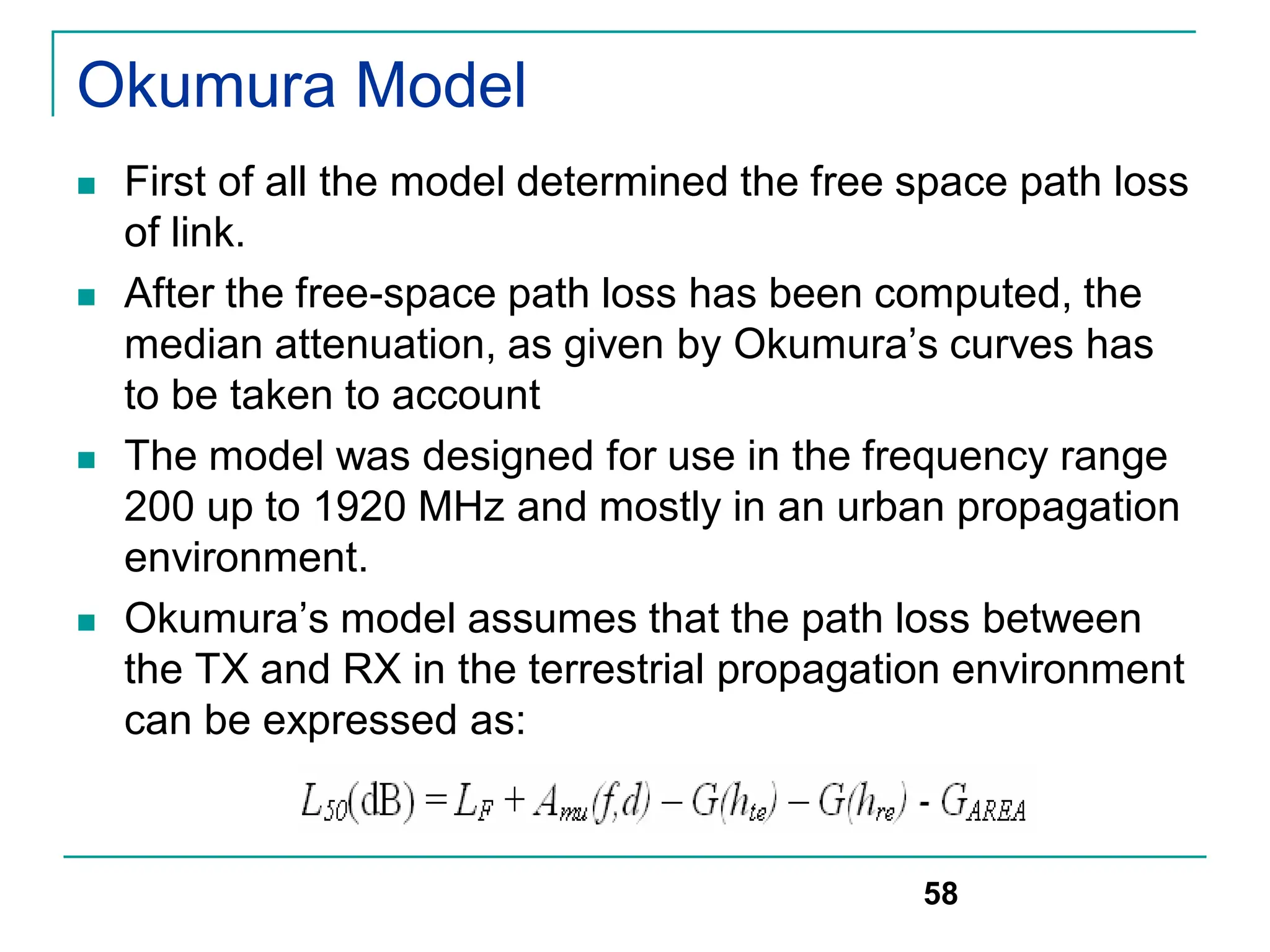
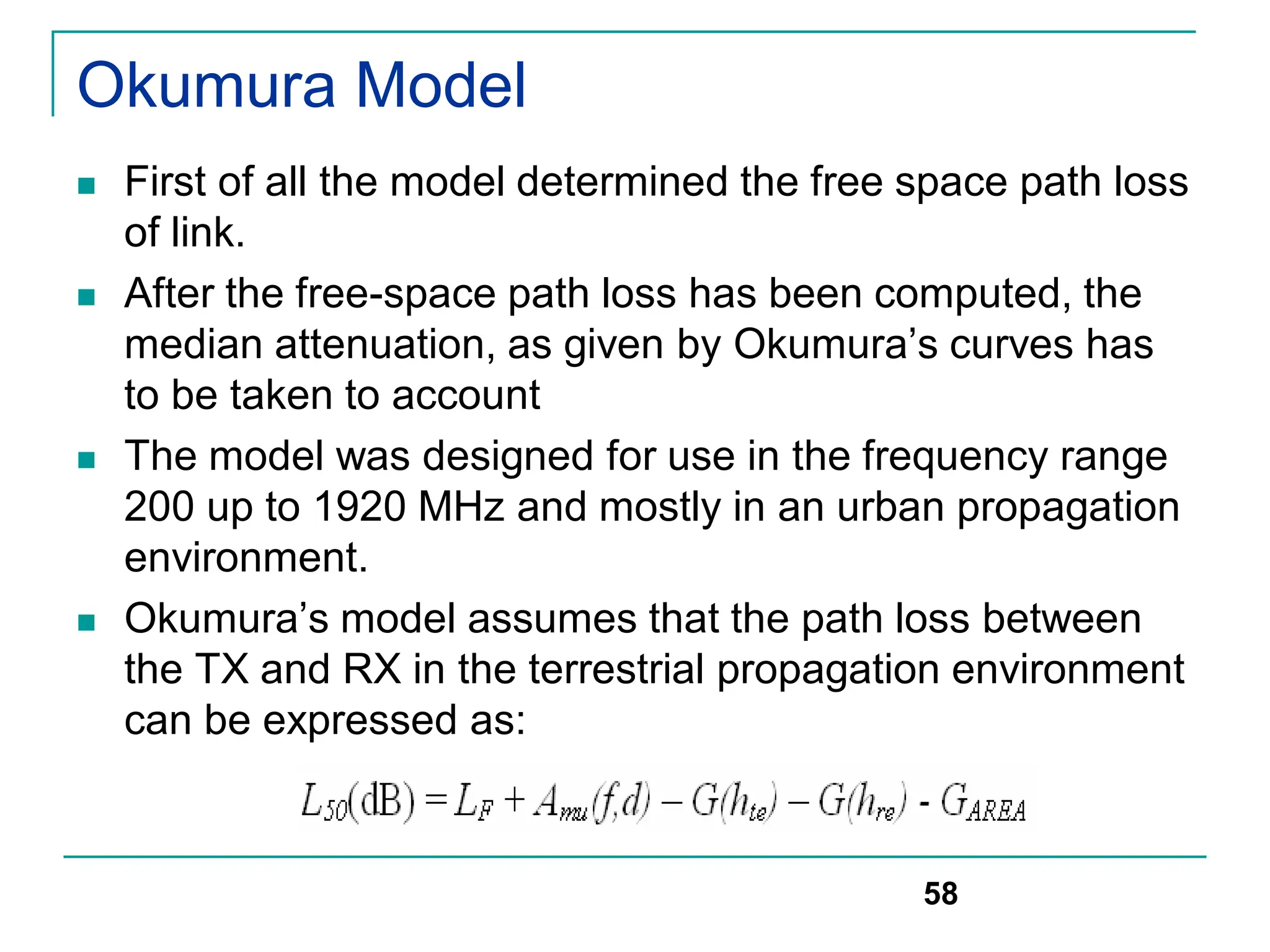
 Okumura’s model assumes that the path loss between
the TX and RX in the terrestrial propagation environment
can be expressed as:
58
59
59
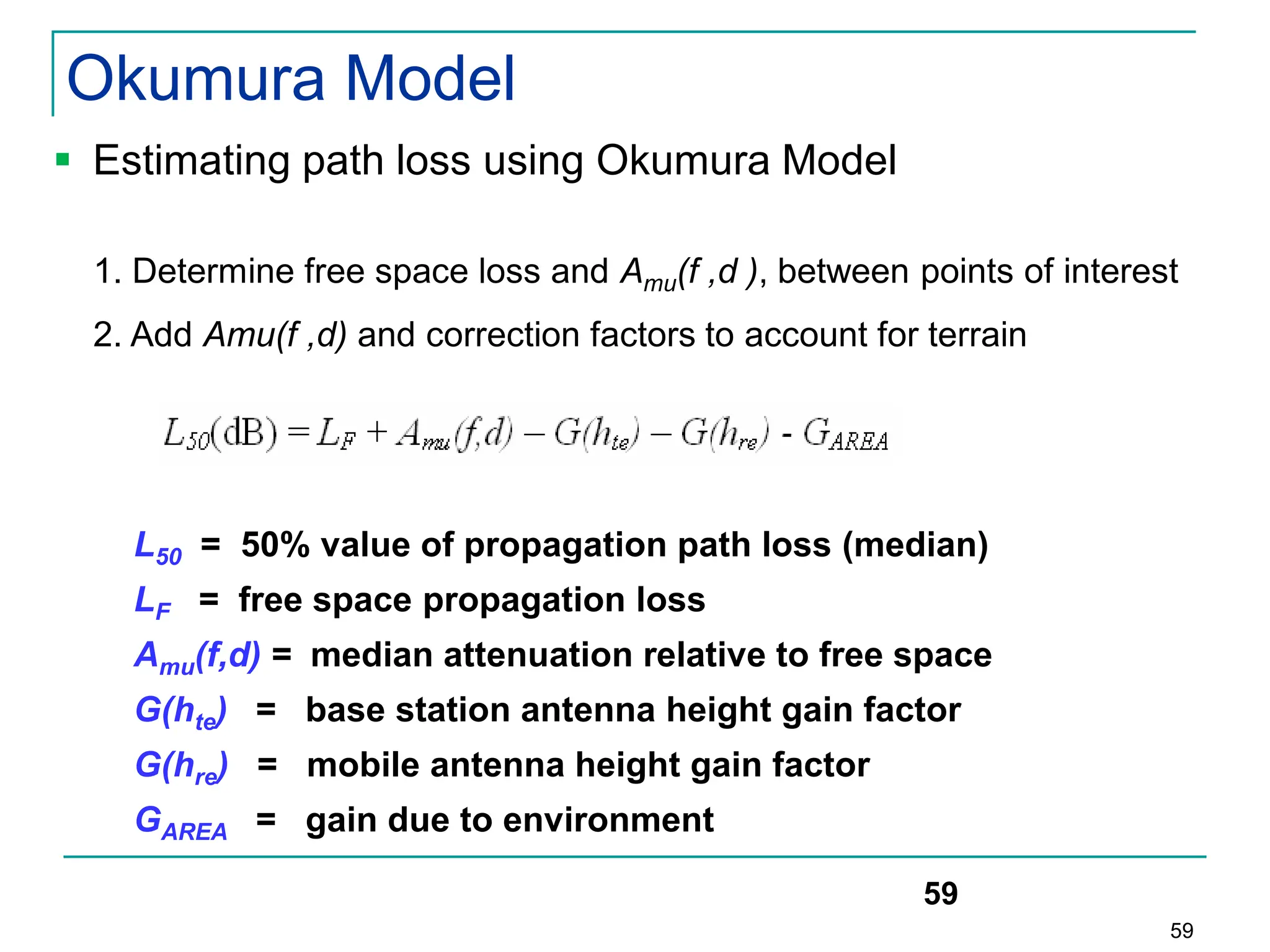
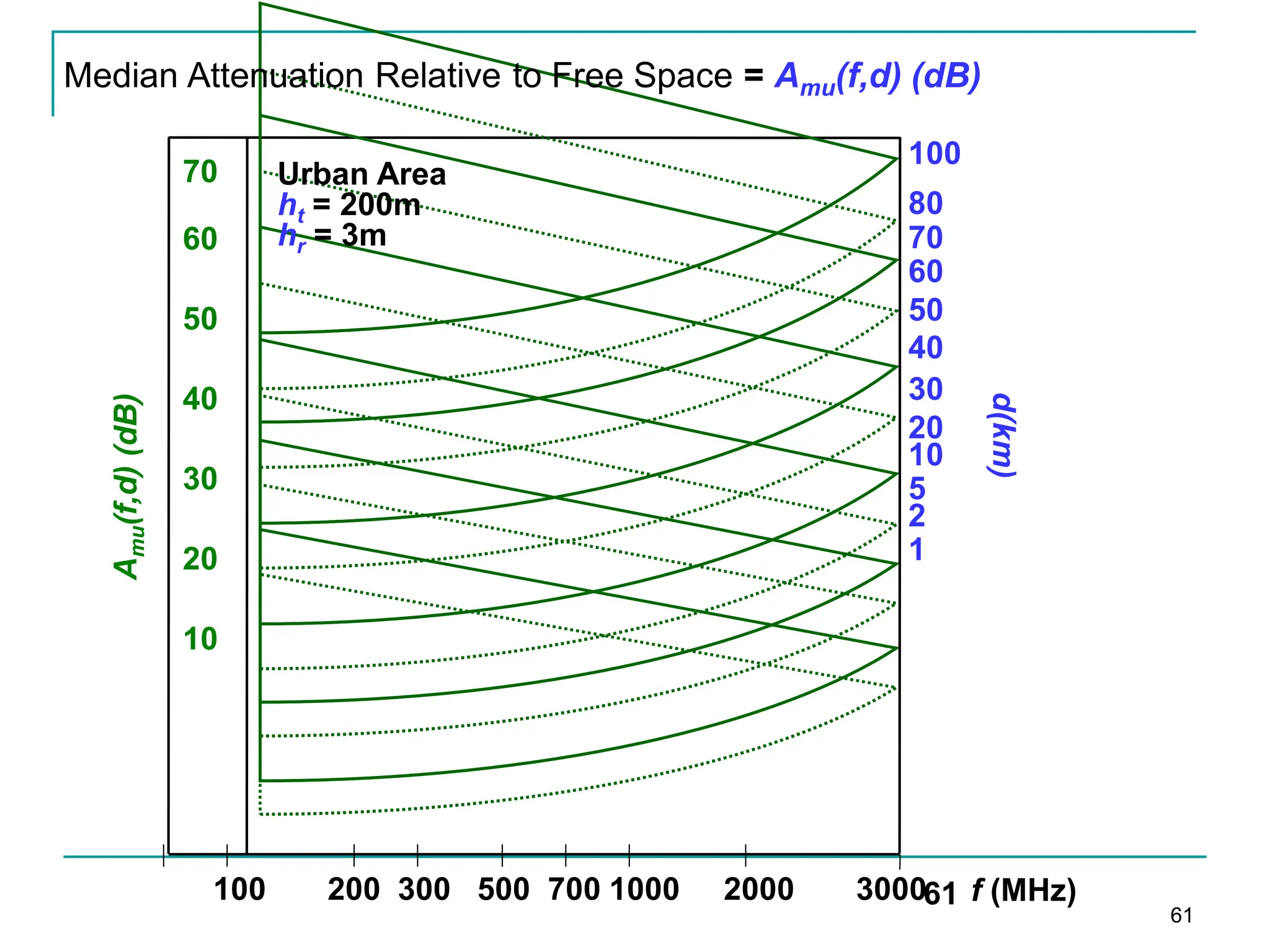
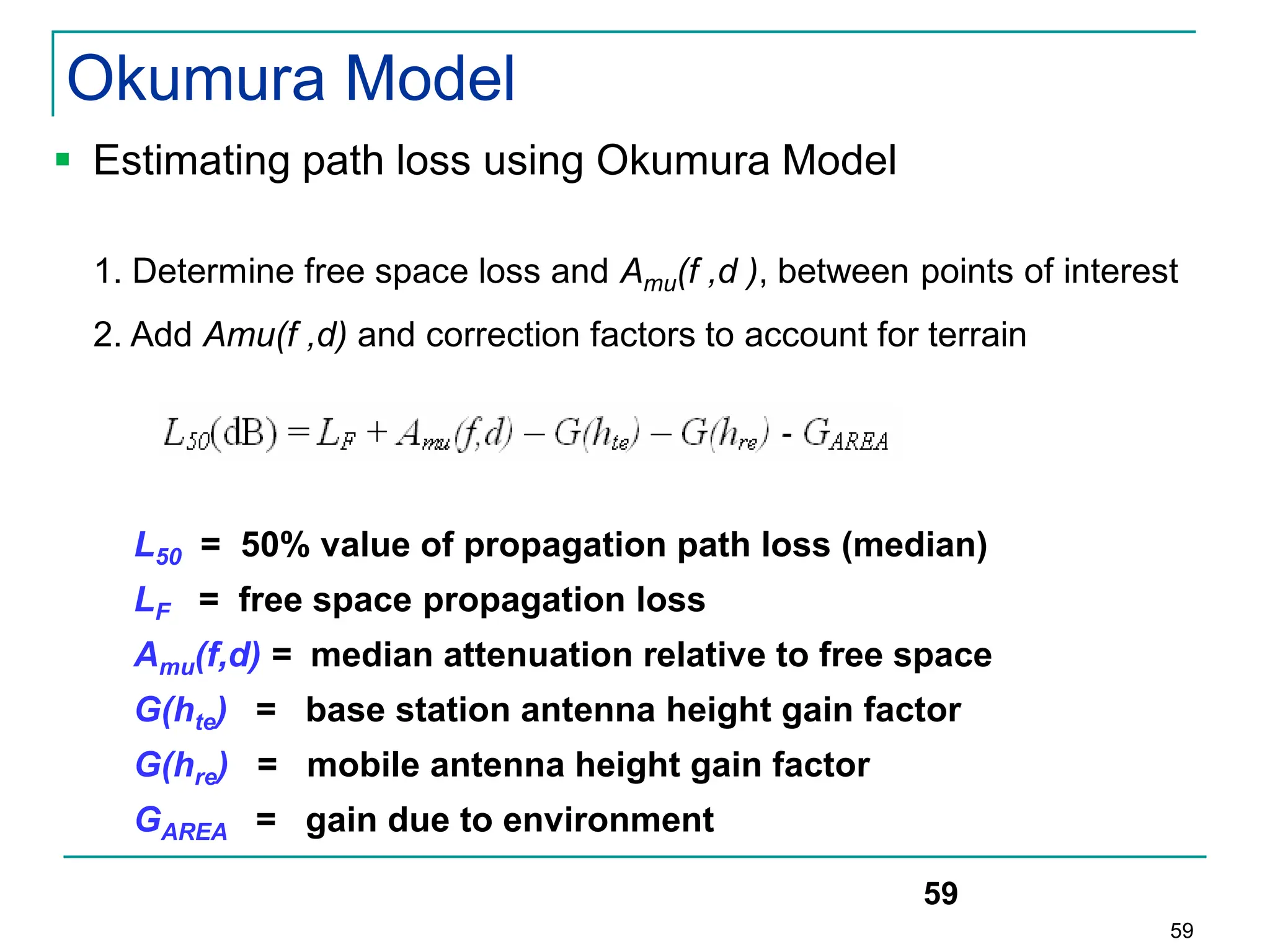
 Estimating path loss using Okumura Model
1. Determine free space loss and Amu(f ,d ), between points of interest
2. Add Amu(f ,d) and correction factors to account for terrain
L50 = 50% value of propagation path loss (median)
LF = free space propagation loss
Amu(f,d) = median attenuation relative to free space
G(hte) = base station antenna height gain factor
G(hre) = mobile antenna height gain factor
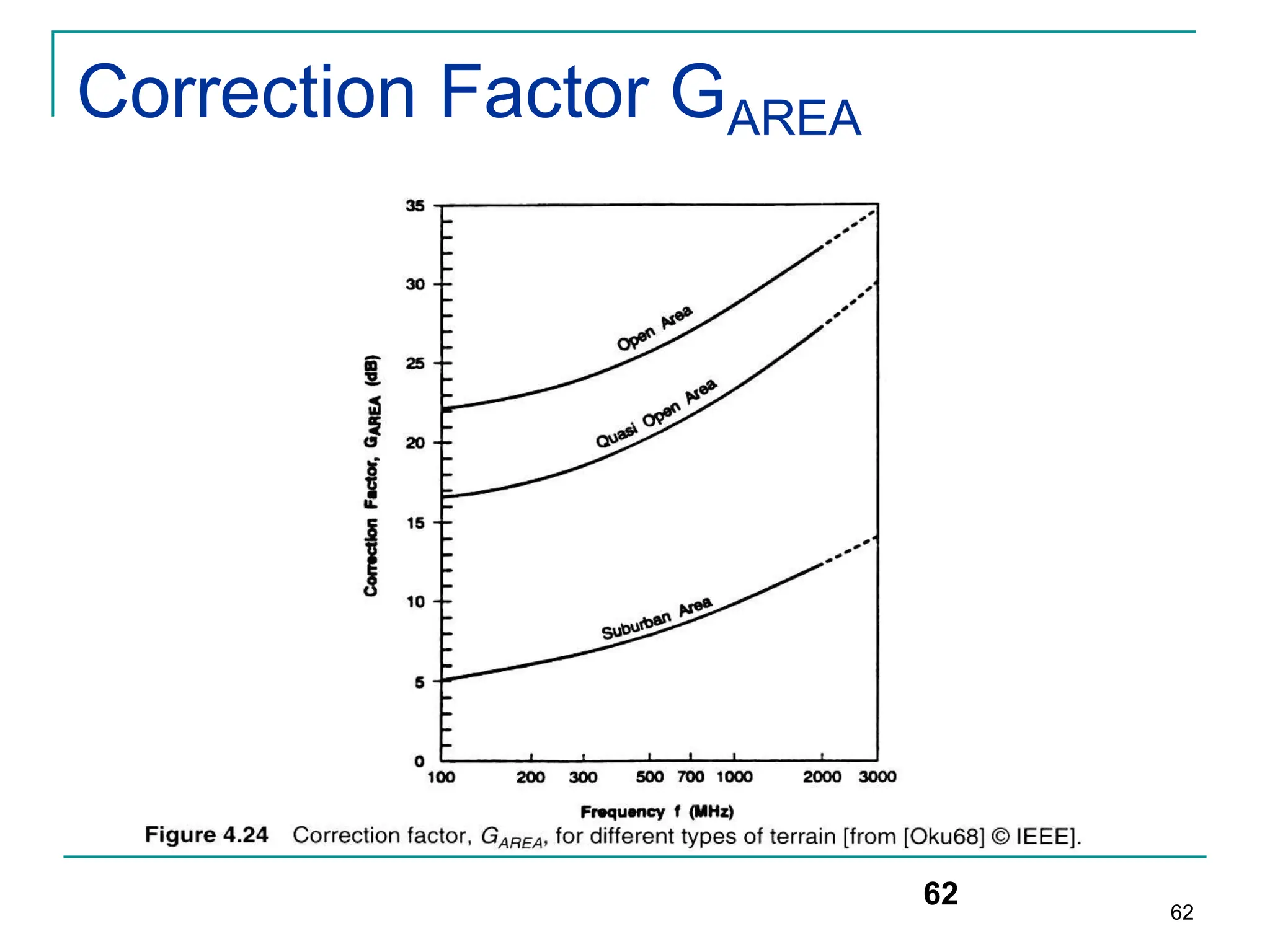
GAREA = gain due to environment
Okumura Model
Okumura Model
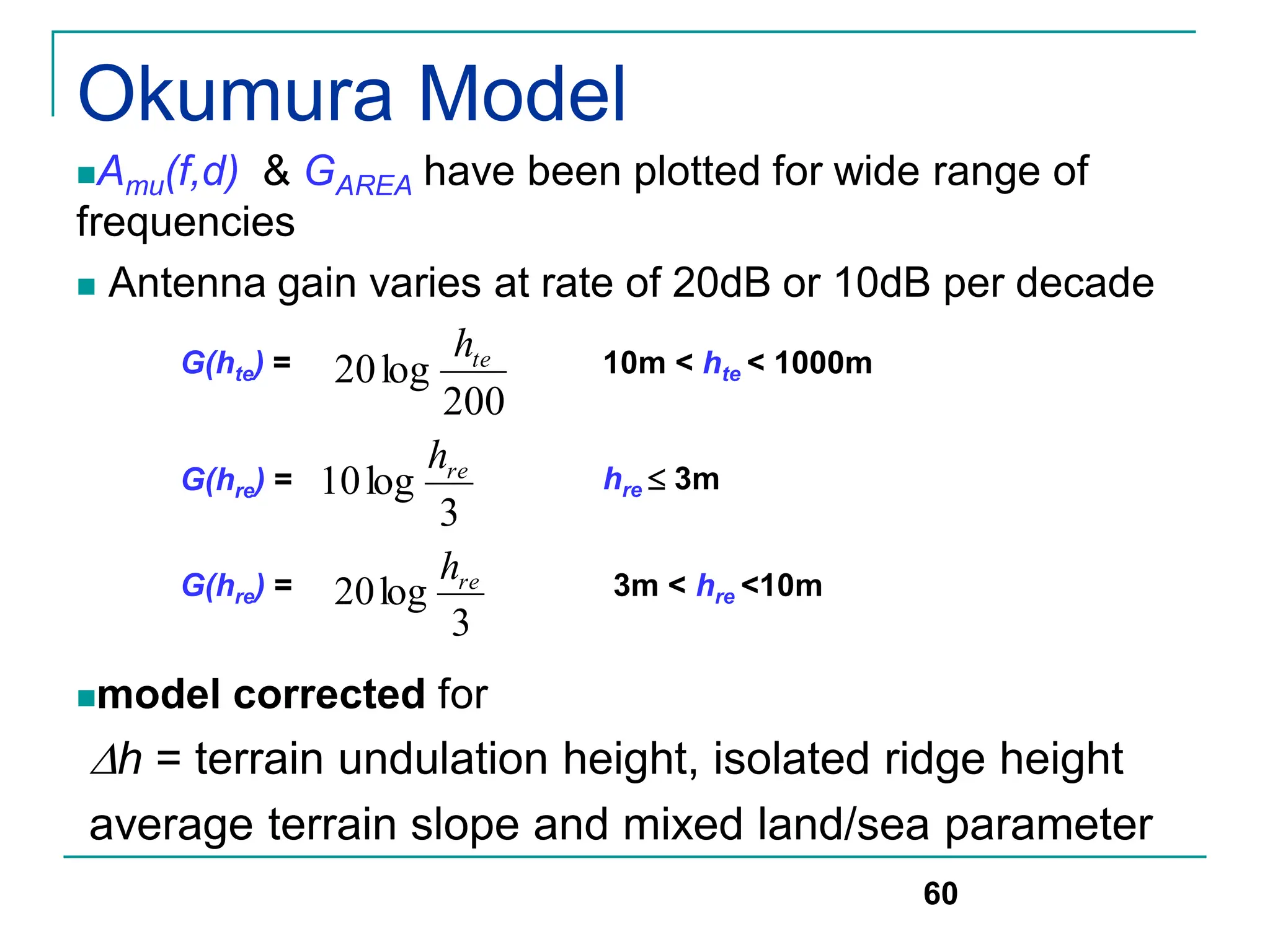
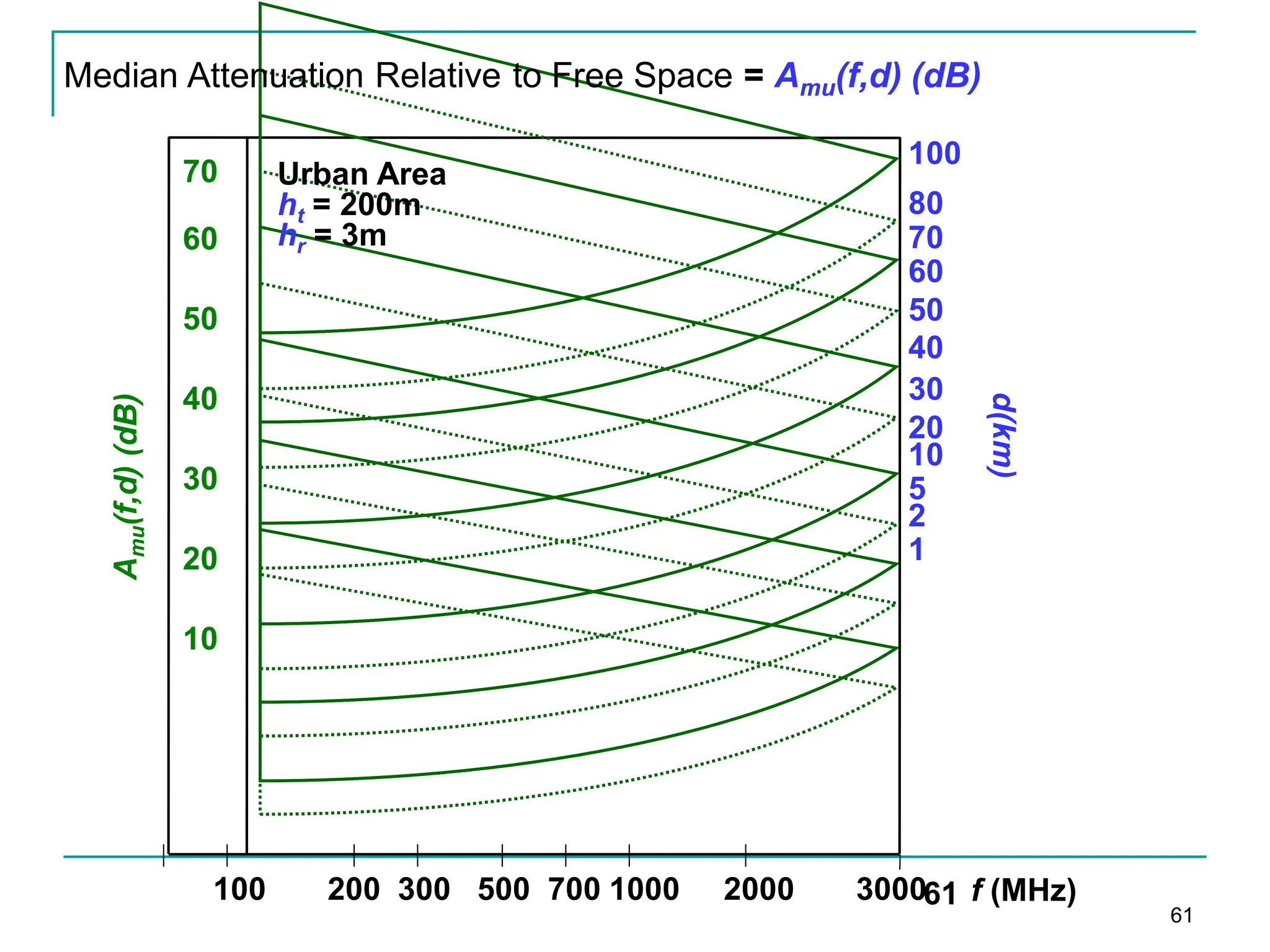
Amu(f,d) & GAREA have been plotted for wide range of
frequencies
 Antenna gain varies at rate of 20dB or 10dB per decade
model corrected for
h = terrain undulation height, isolated ridge height
average terrain slope and mixed land/sea parameter
60
G(hte) =
200
log
20 te
h 10m < hte < 1000m
G(hre) =
3
log
10 re
h
hre  3m
G(hre) =
3
log
20 re
h 3m < hre <10m
61
61
70
60
50
40
30
20
10
A
mu
(f,d)
(dB)
100 200 300 500 700 1000 2000 3000 f (MHz)
100
80
70
60
50
40
30
20
10
5
2
1
d(km)
Urban Area
ht = 200m
hr = 3m
Median Attenuation Relative to Free Space = Amu(f,d) (dB)
62
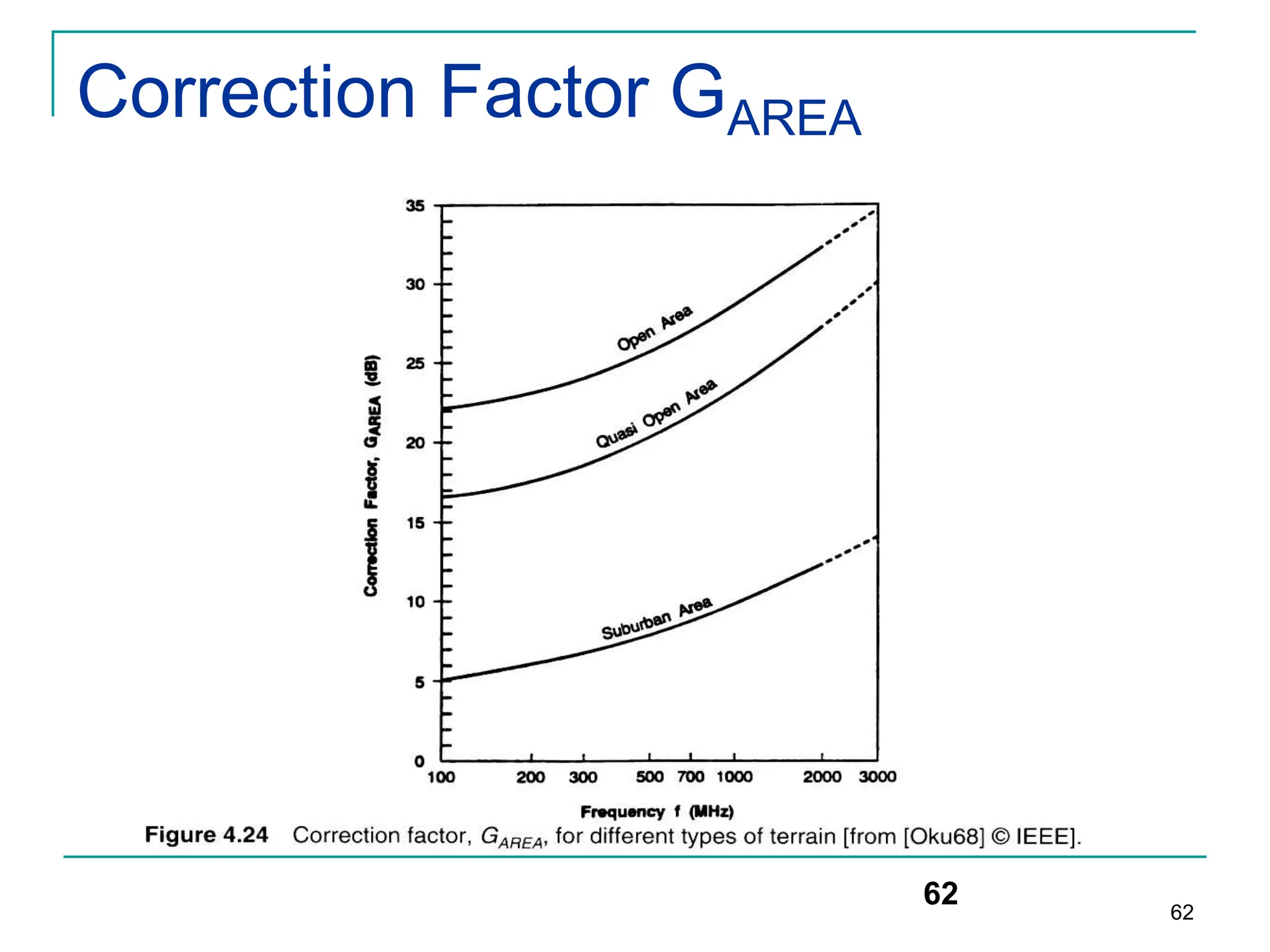
Correction Factor GAREA
62
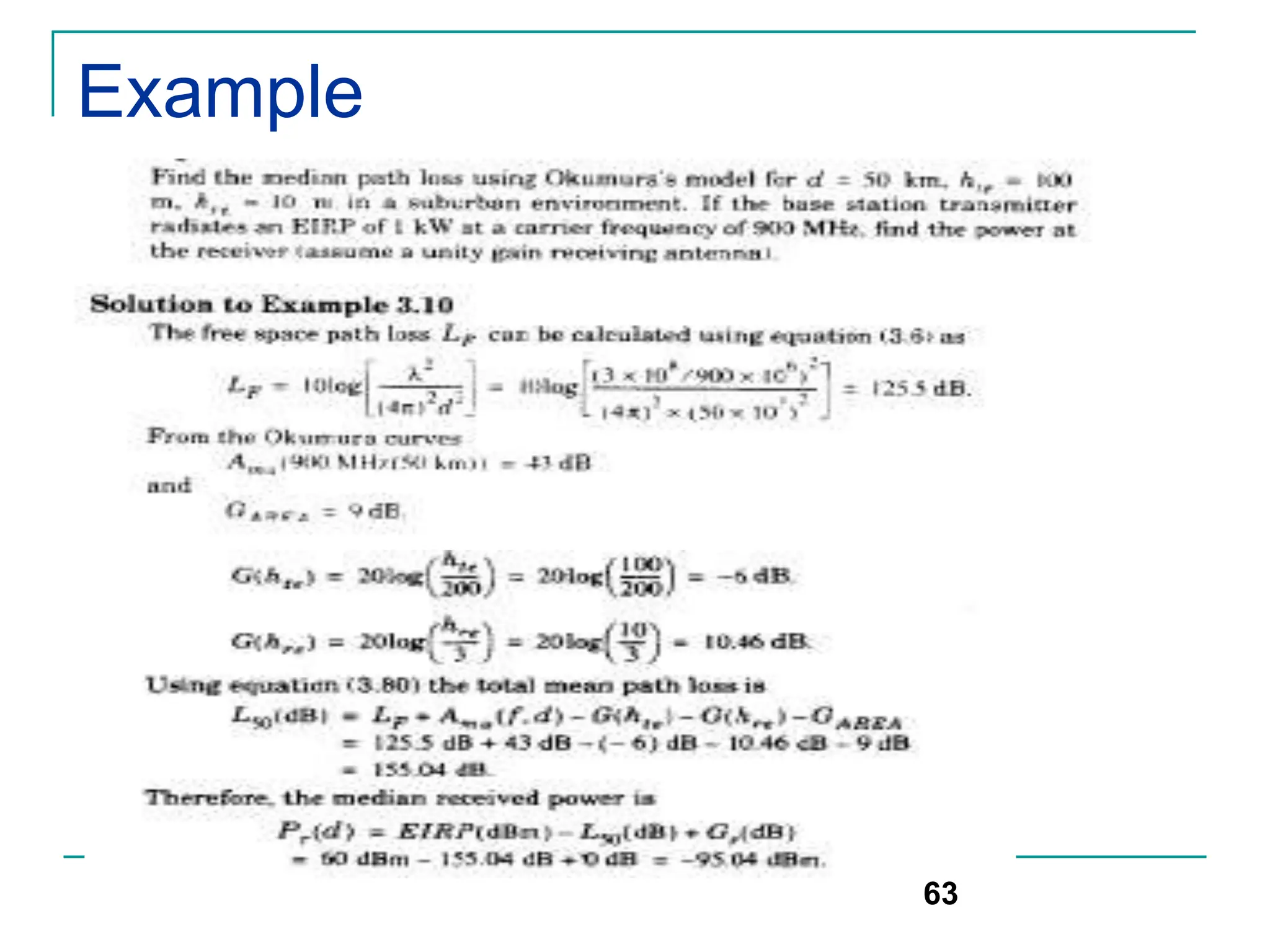
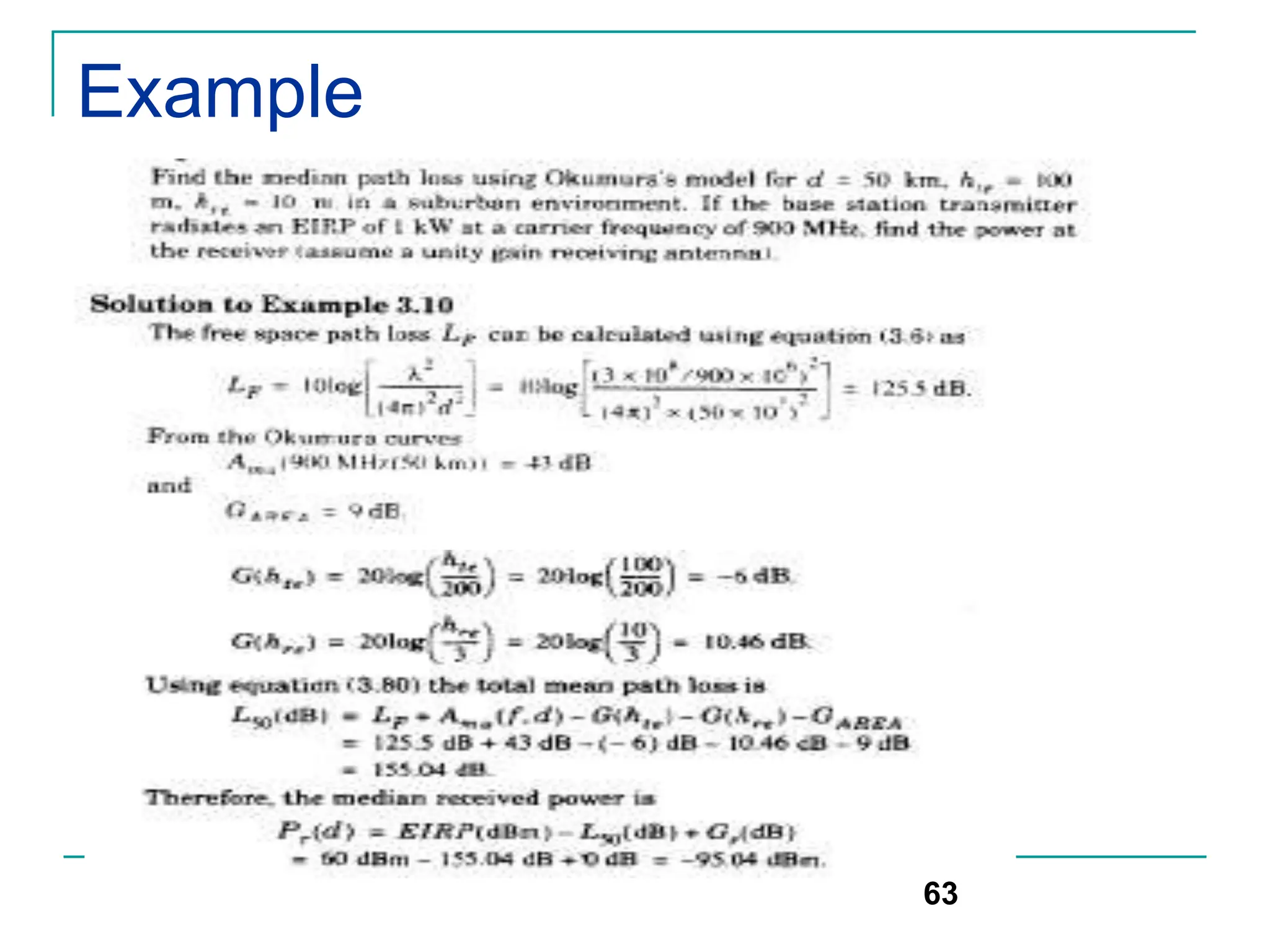
Example
63
Hata Model
 Most widely used model in Radio frequency.
 Predicting the behavior of cellular communication in built
up areas.
 Applicable to the transmission inside cities.
 Suited for point to point and broadcast transmission.
 150 MHz to 1.5 GHz, Transmission height up to 200m
and link distance less than 20 Km.
64
Hata Model
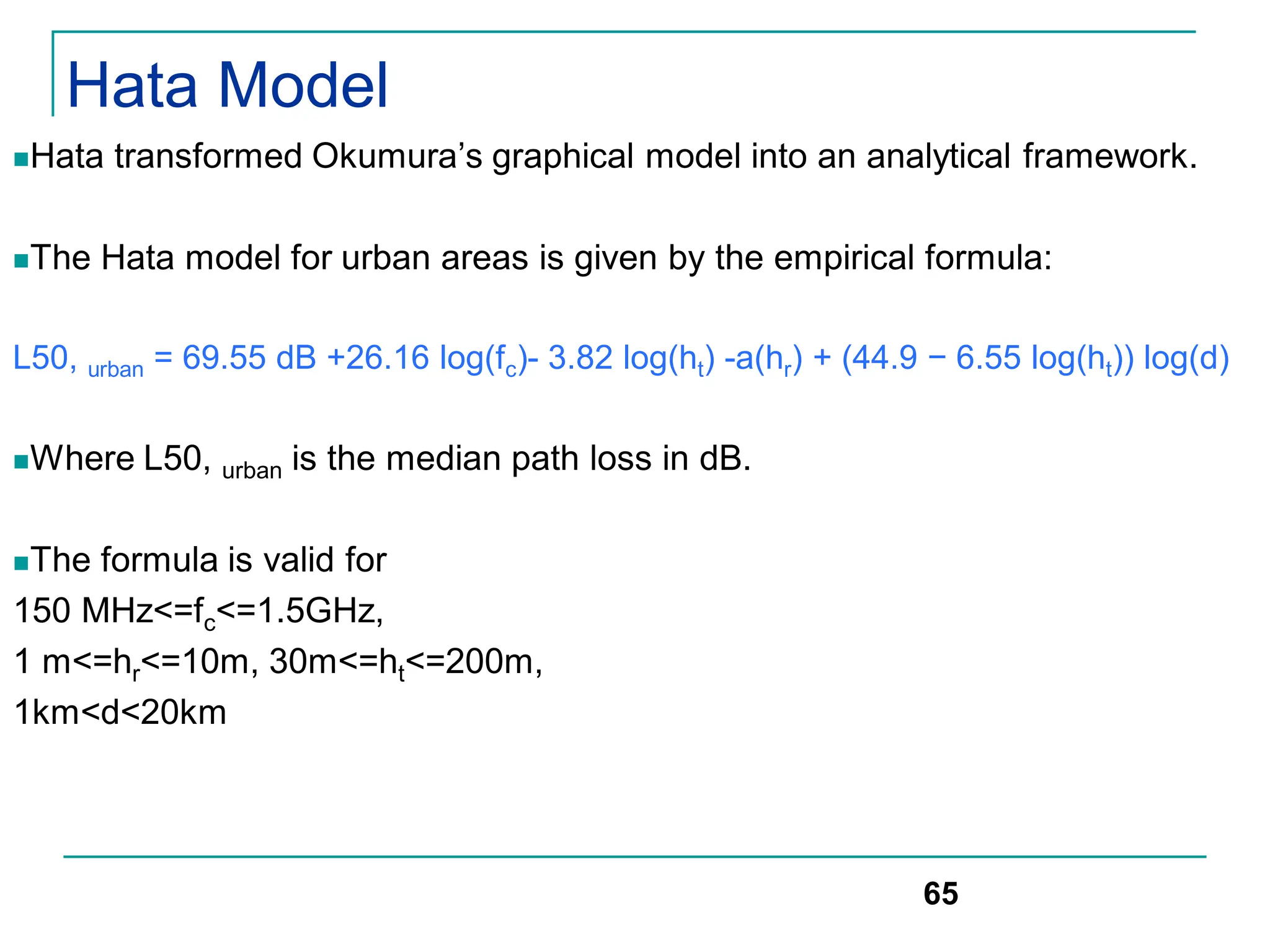
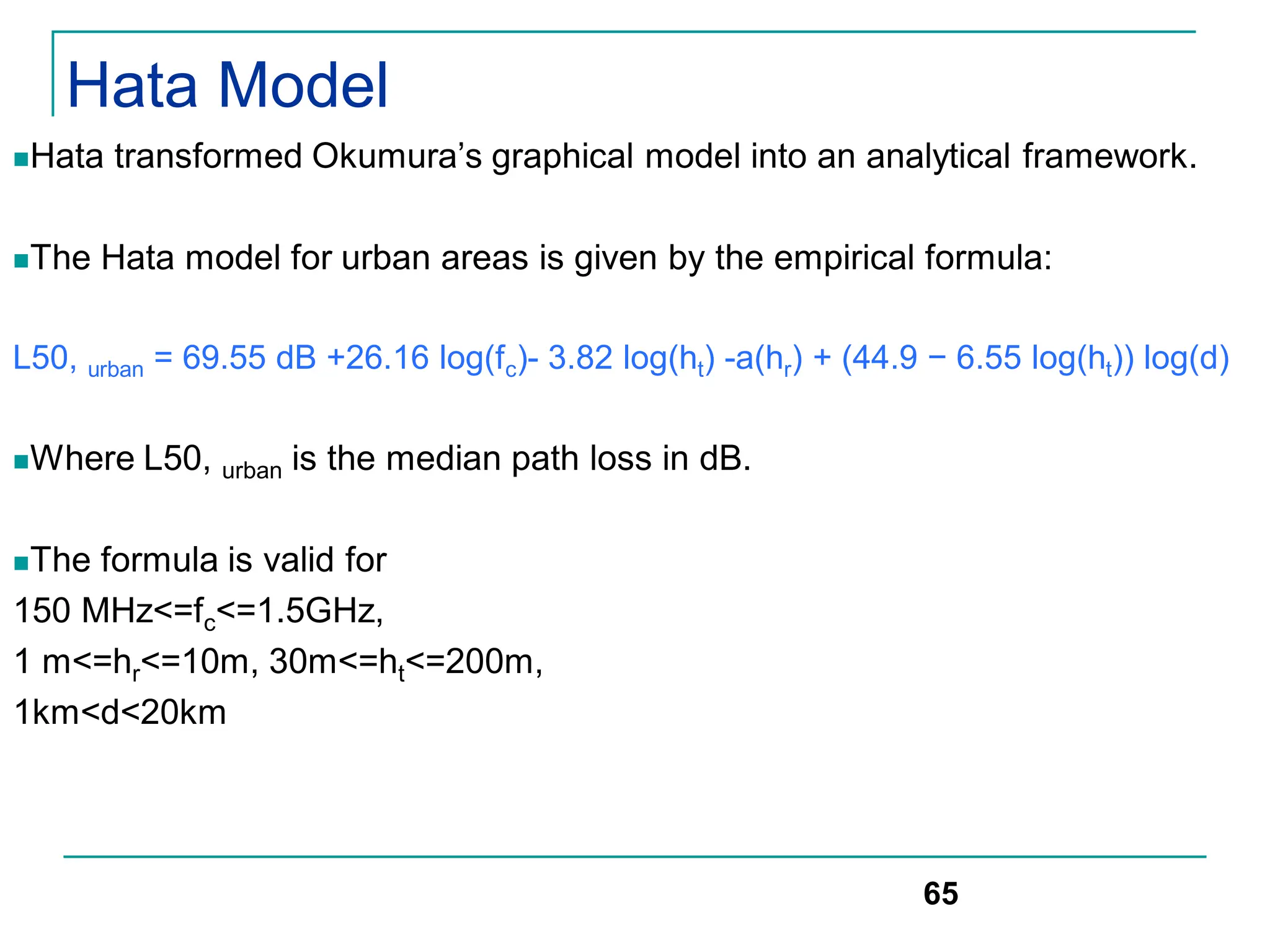
Hata transformed Okumura’s graphical model into an analytical framework.
The Hata model for urban areas is given by the empirical formula:
L50, urban = 69.55 dB +26.16 log(fc)- 3.82 log(ht) -a(hr) + (44.9 − 6.55 log(ht)) log(d)
Where L50, urban is the median path loss in dB.
The formula is valid for
150 MHz<=fc<=1.5GHz,
1 m<=hr<=10m, 30m<=ht<=200m,
1km<d<20km
65
Hata Model
The correction factor a(hr) for mobile antenna height hr for a small or
medium-sized city is given by:
a(hr) = (1.1 logfc − 0.7)hr − (1.56 log(fc) − 0.8) dB
For a large city it is given by
a(hr) = 8.29[log(1.54hr)]2 − 1.10 dB for fc <=300 MHz
3.20[log (11.75hr)]2 − 4.97 dB for fc >= 300 MHz
To obtain path loss for suburban area the standard Hata model is
modified as
L50 =L50(urban)-2[log(fc/28)]2-5.4
For rural areas
L50 =L50(urban)-4.78log(fc)2-18.33logfc -40.98
66
Indoor Models
Indoor Channels are different from traditional
channels in two ways
1.The distances covered are much smaller
2.The variability of environment is much greater for a
much small range of Tx and Rx separation.
Propagation inside a building is influenced by:
- Layout of the building
- Construction materials
- Building Type: office , Home or factory
67
Indoor Models
Indoor models are dominated by the same
mechanism as out door models:
- Reflection, Diffraction and scattering
Conditions are much more variable
- Doors/Windows open or not
- Antenna mounting : desk ceiling etc
- The levels of floor
Indoor models are classifies as
- Line of sight (LOS)
- Obstructed (OBS) with varying degree of clutter
68
Indoor Models
Portable receiver usually experience
- Rayleigh fading for OBS propagation paths
- Ricean fading for LOS propagation path
Indoors models are effected by type of
building e.g. Residential buildings, offices,
stores and sports area etc.
Multipath delay spread
- Building with small amount of metal and hard partition
have small delay spread 30 to 60ns
- Building with large amount of metal and open isles
have delay spread up to 300ns
69
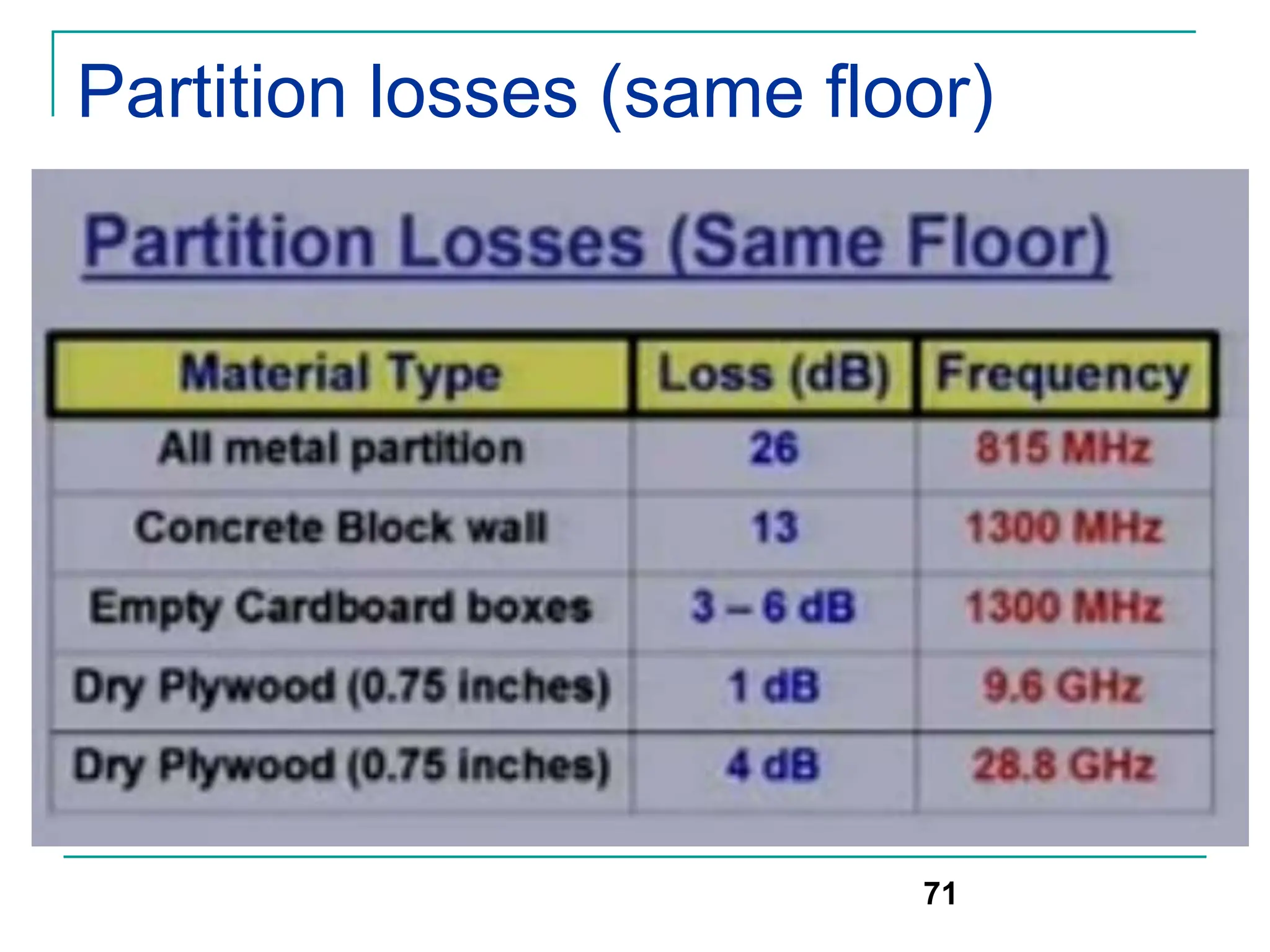
Partition losses (same floor)
Two types of partitions
1. hard partitions: Walls of room
2. Soft partitions : Moveable partitions that
donot span to ceiling
Partitions vary widely in their Physical and
electrical properties.
Path loss depend upon the types of partitions
70
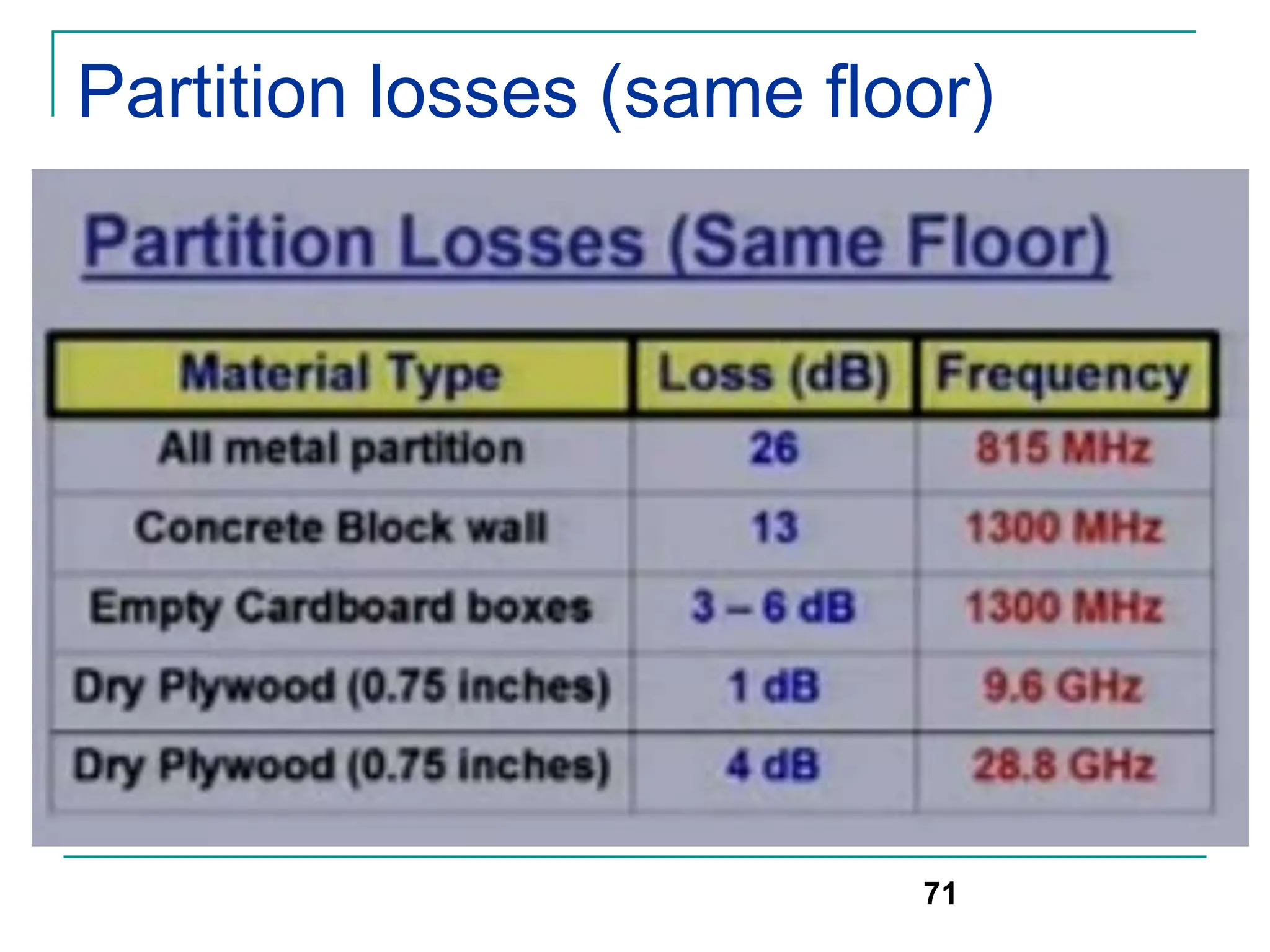
Partition losses (same floor)
71
72
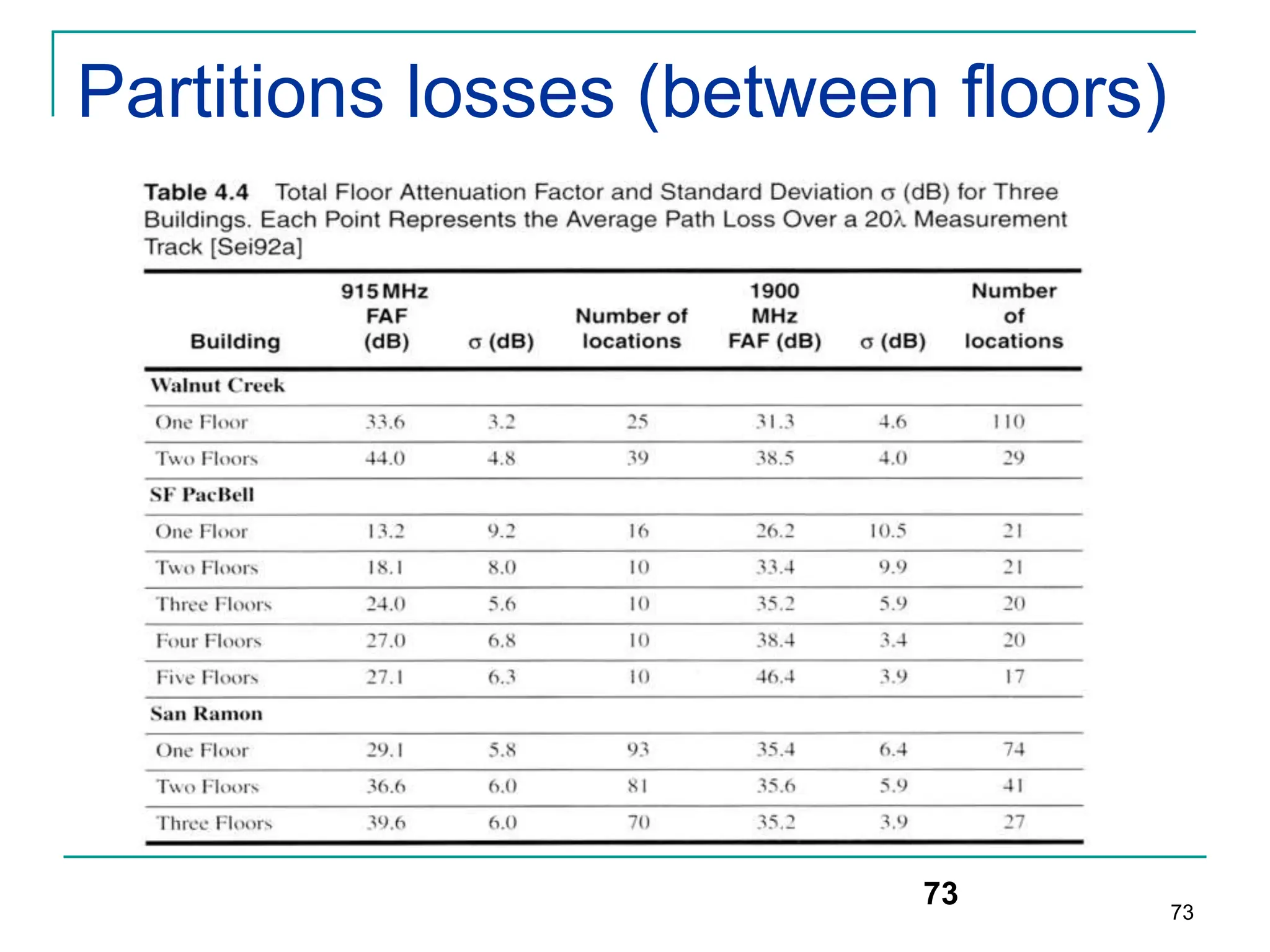
Partitions losses (between floors)
 Partition losses between the two floors
depend on
1. External dimension and material used for buildings
2. Types of construction used to create floors
3. External surroundings
4. No of windows used
5. Tinting on the windows
 Floor Attenuation Factor (FAF) increases as we
increase the no of floors
72
73
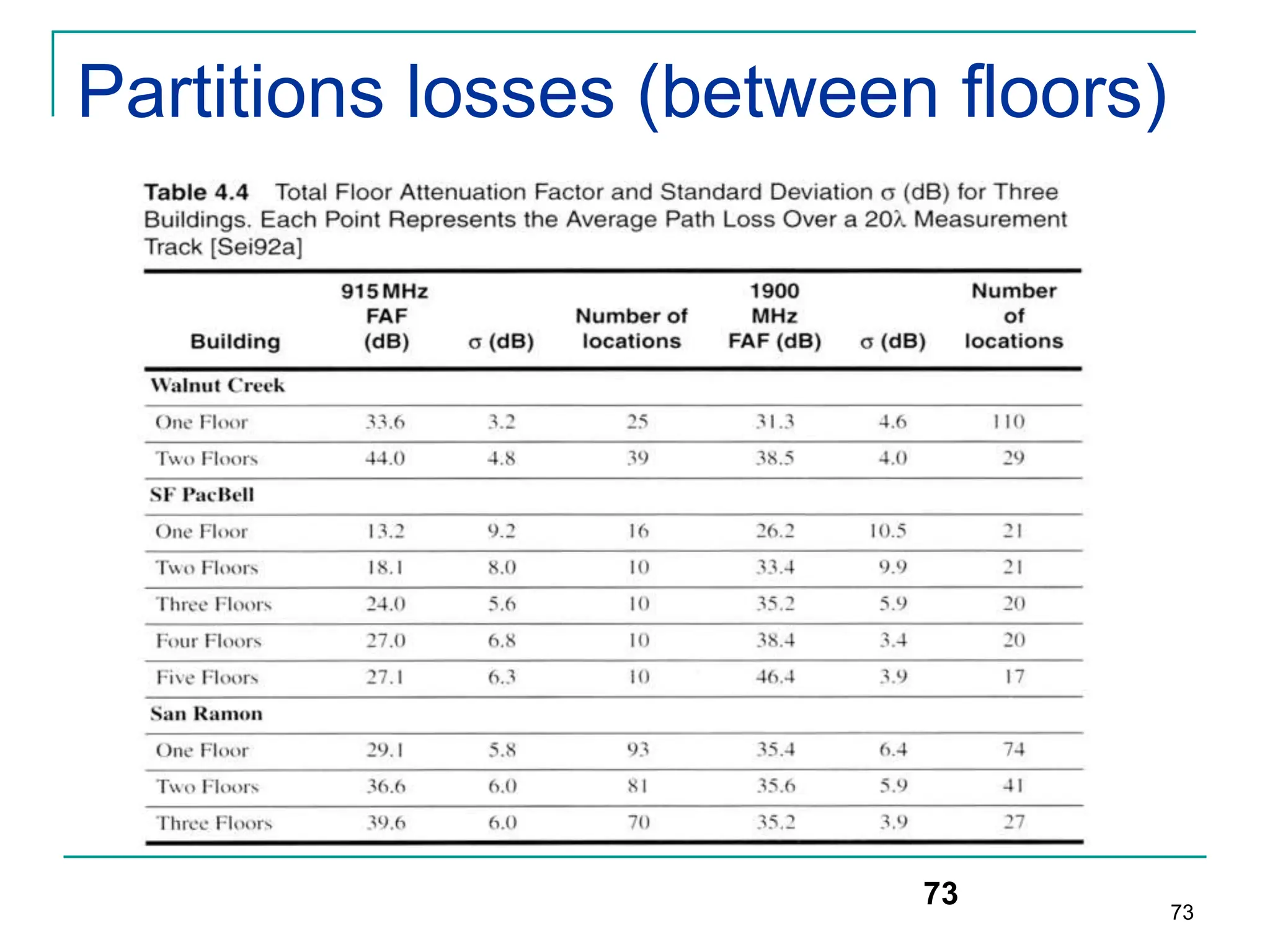
Partitions losses (between floors)
73
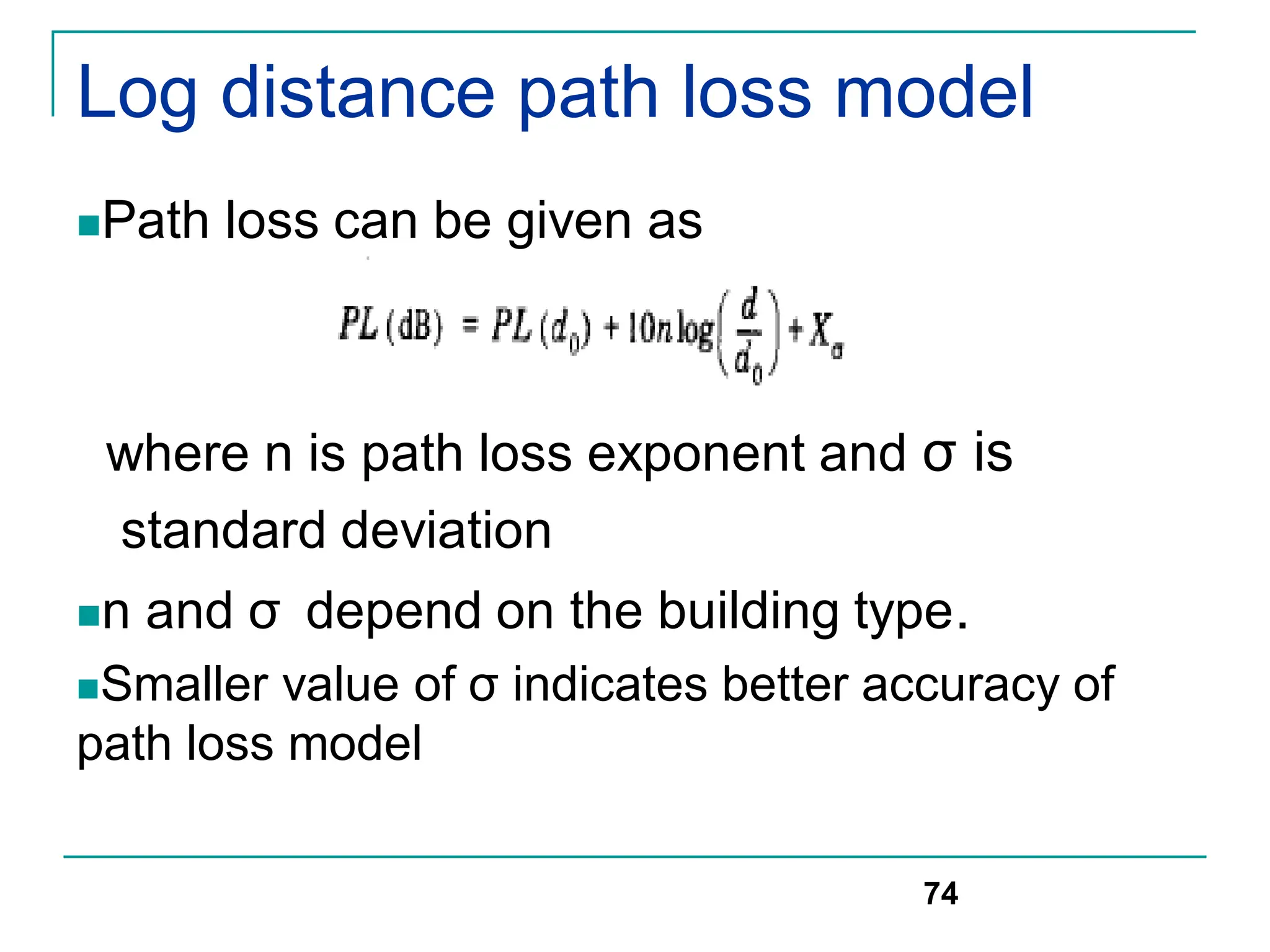
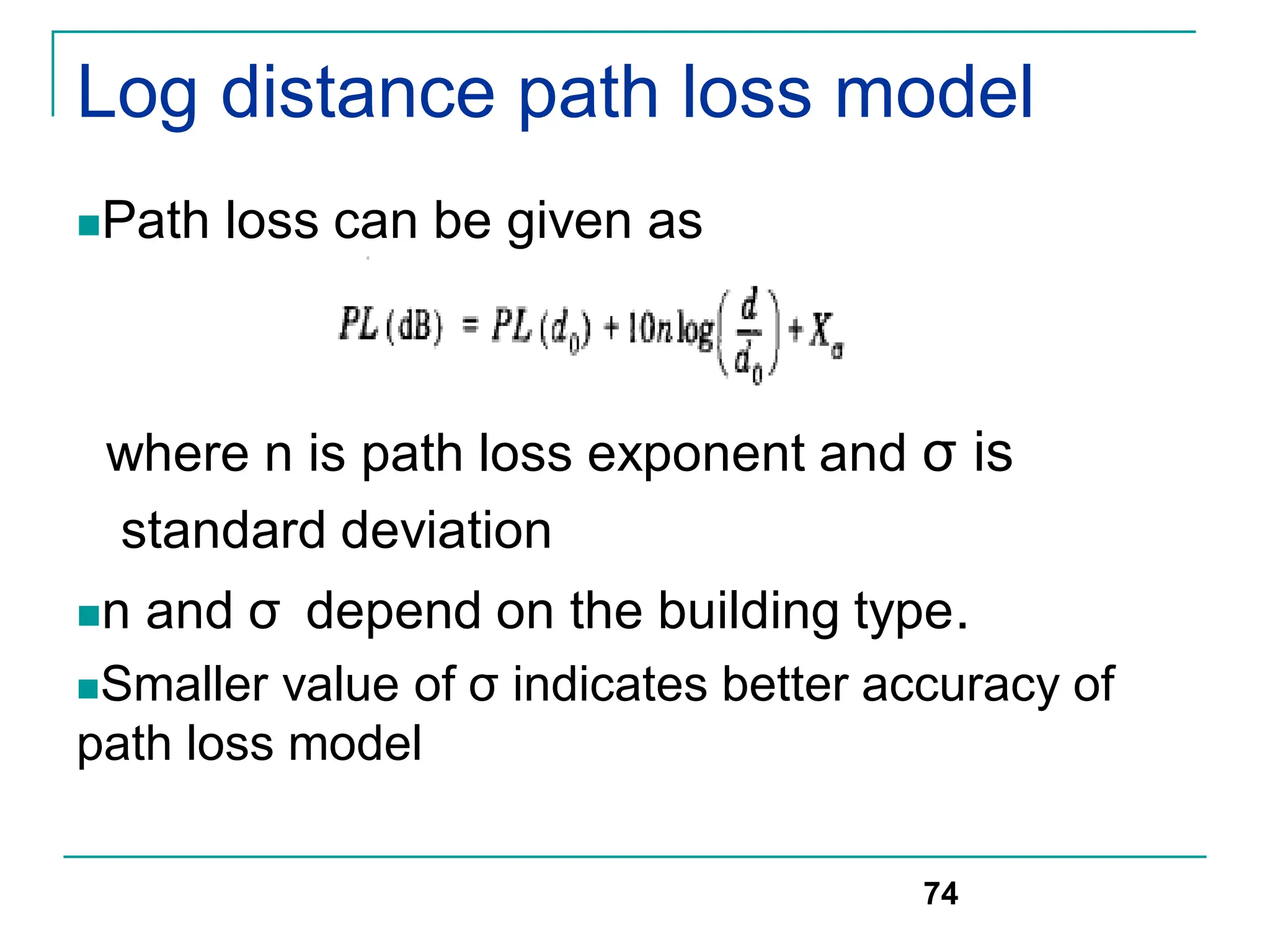
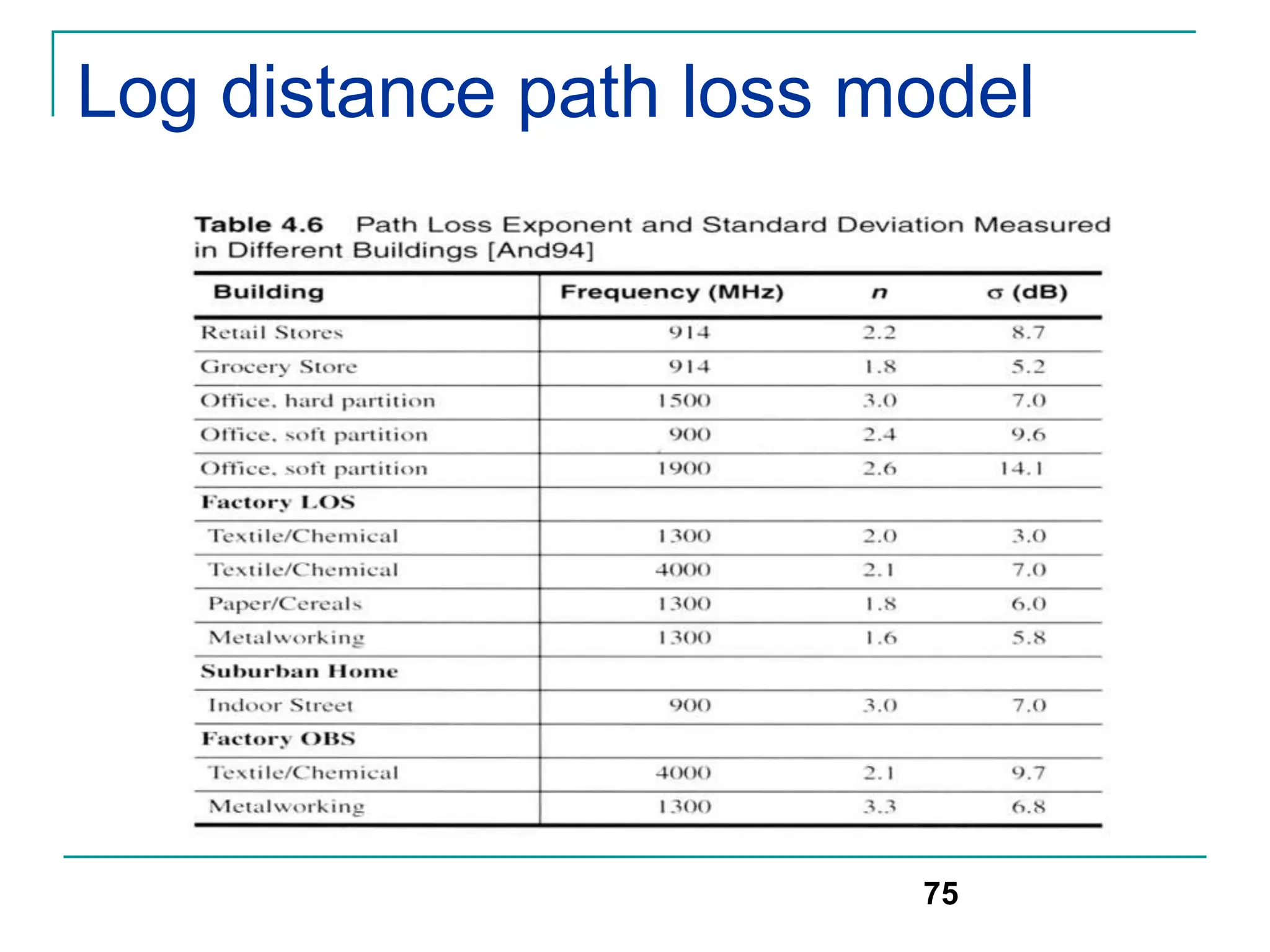
Log distance path loss model
Path loss can be given as
where n is path loss exponent and σ is
standard deviation
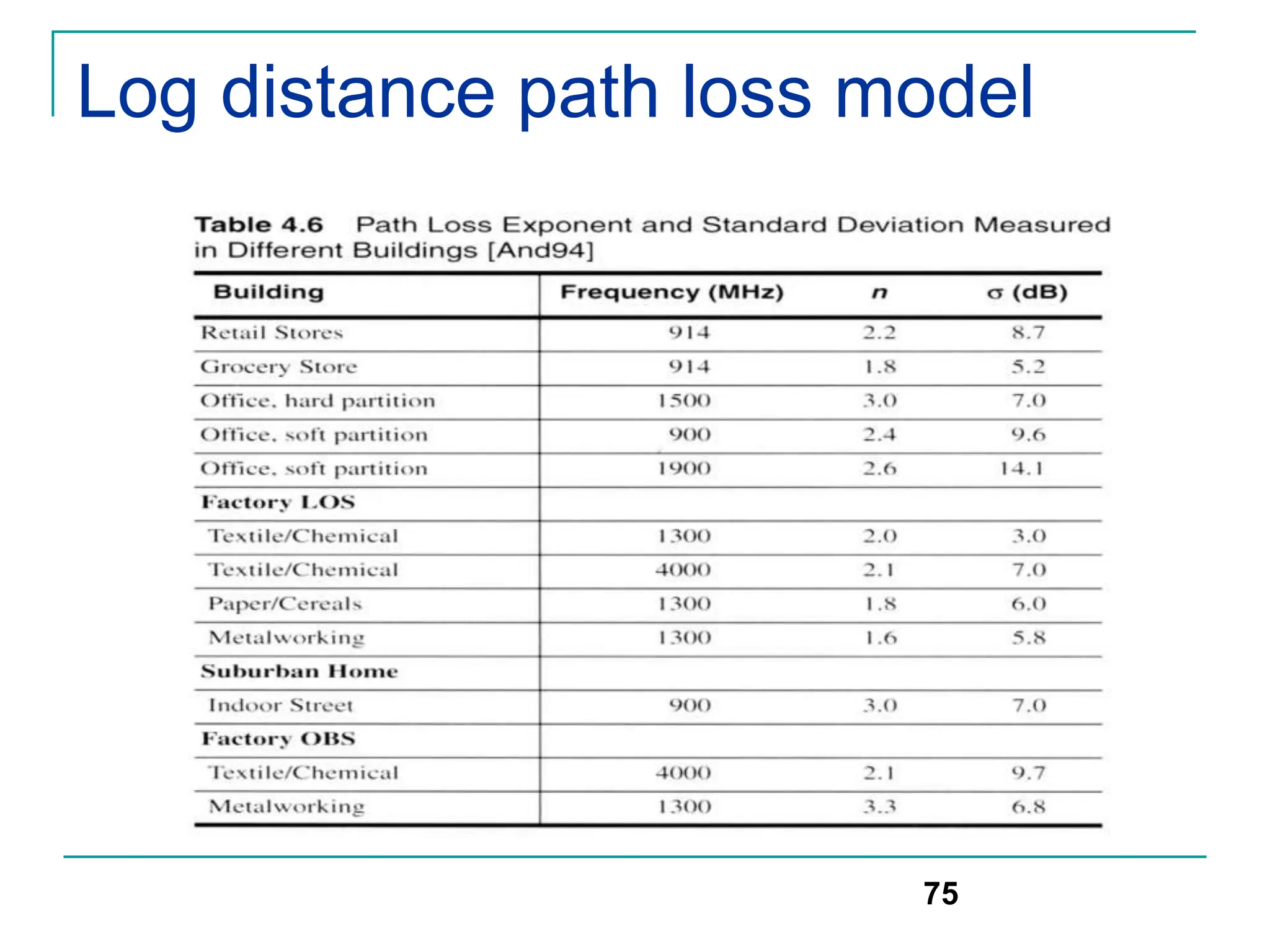
n and σ depend on the building type.
Smaller value of σ indicates better accuracy of
path loss model
74
Log distance path loss model
75
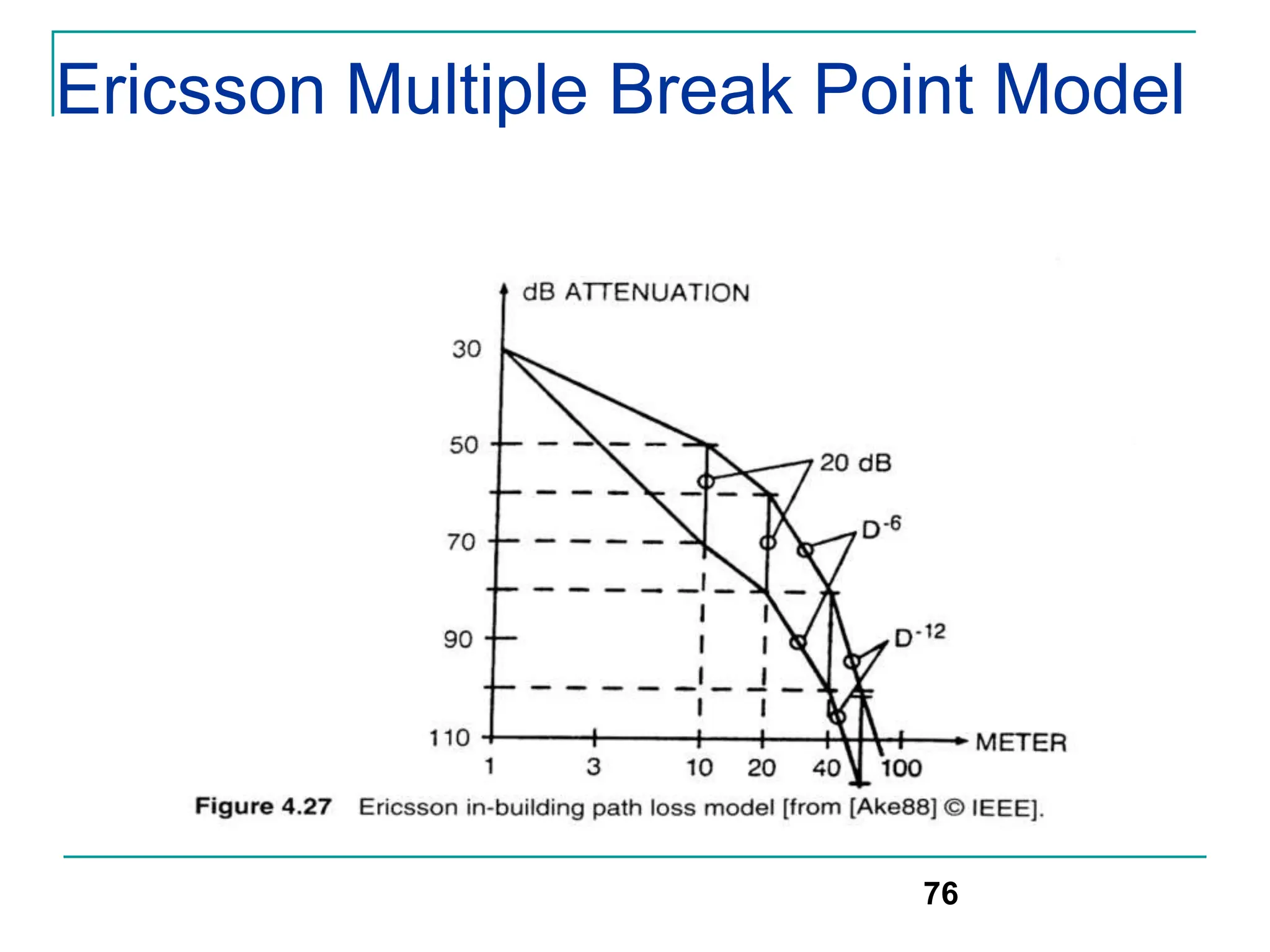
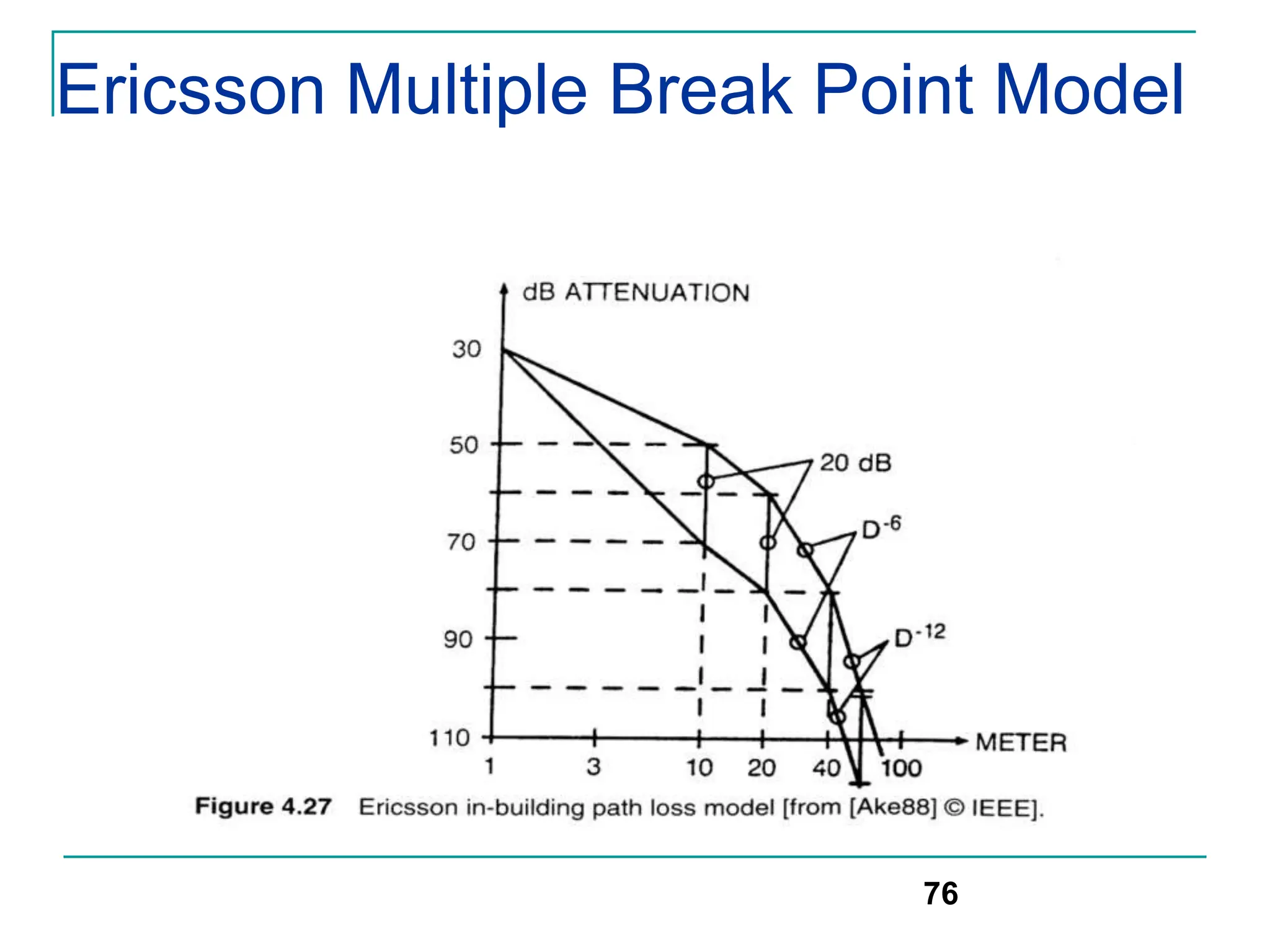
Ericsson Multiple Break Point Model
76
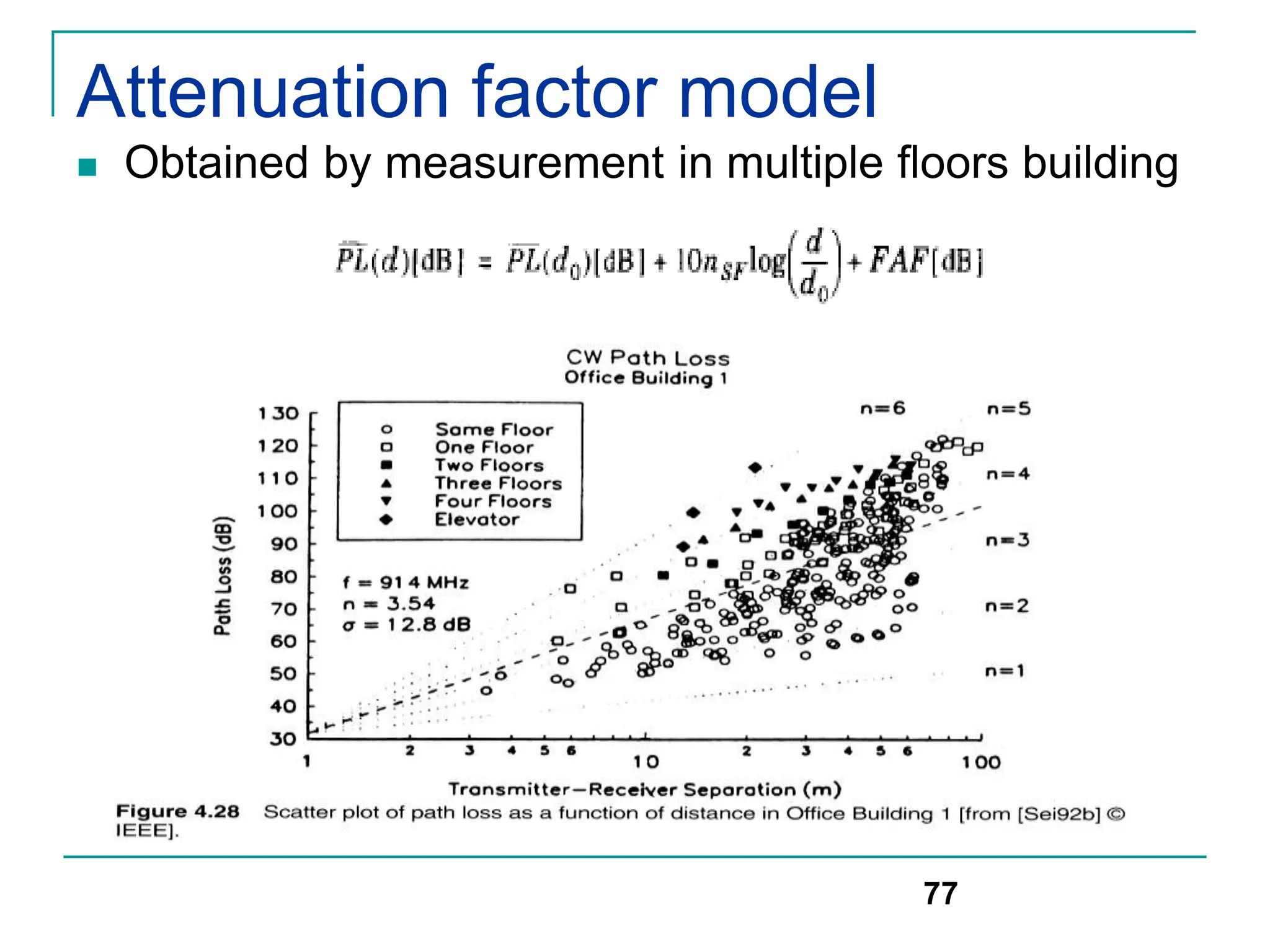
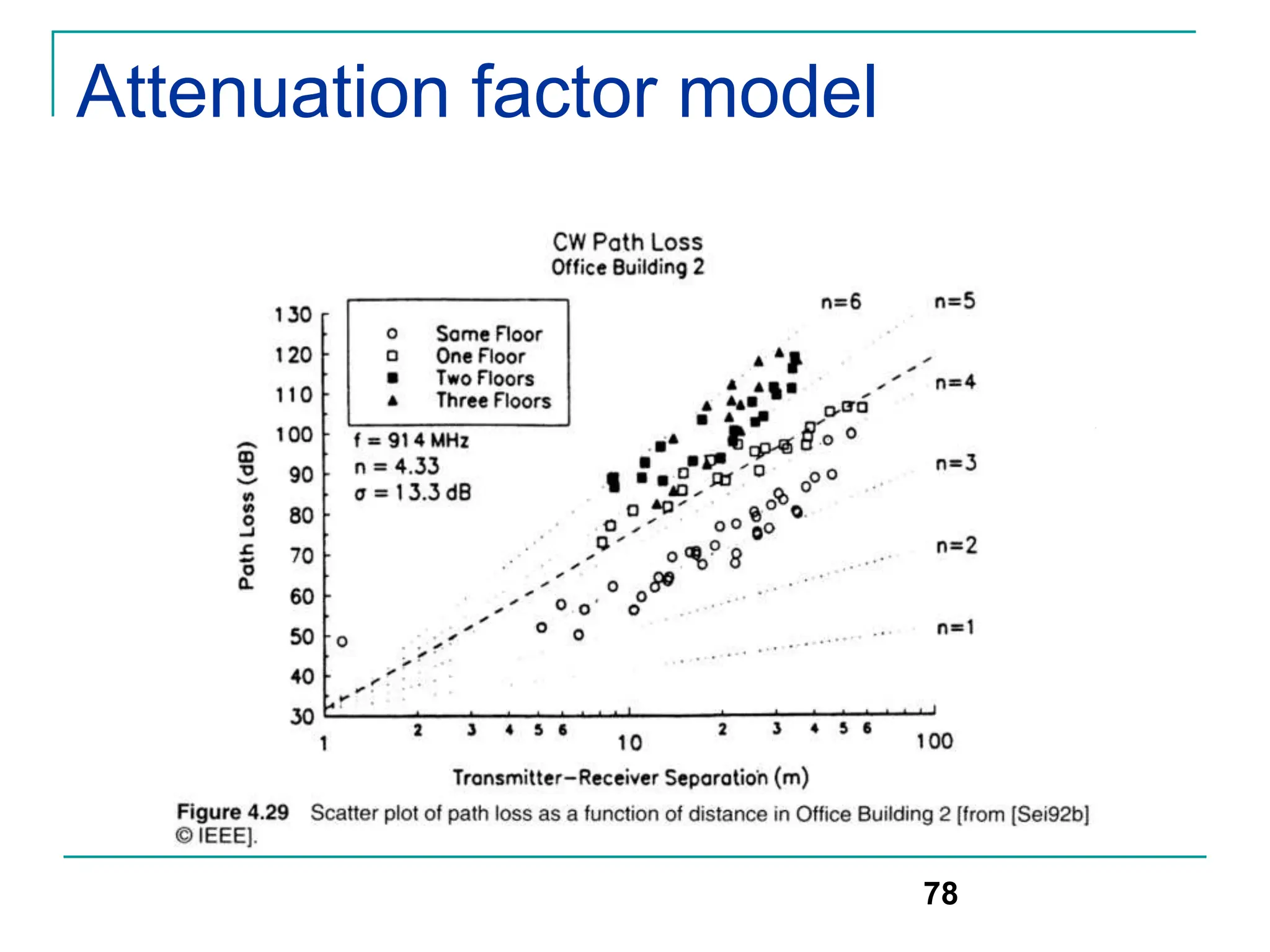
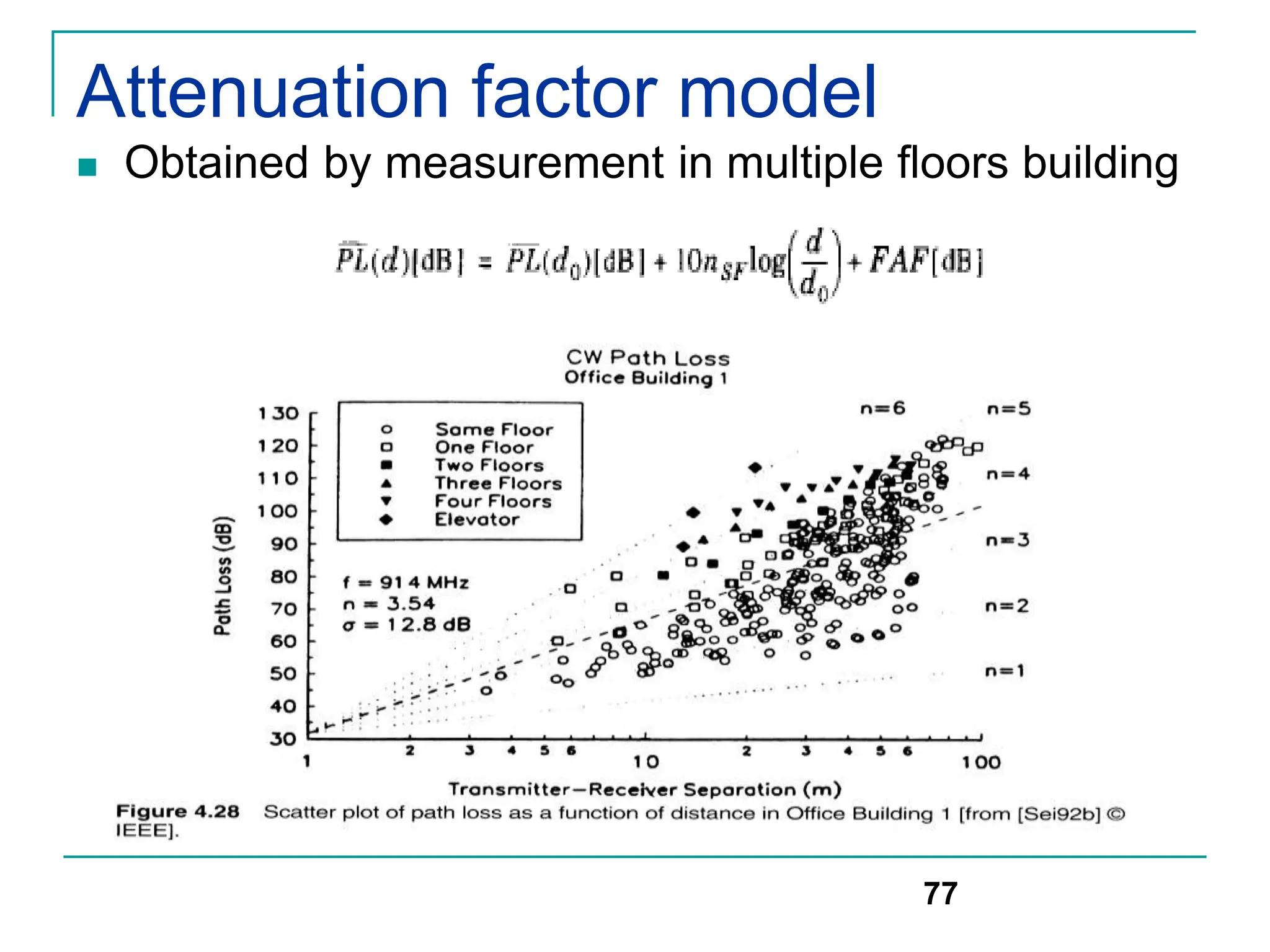
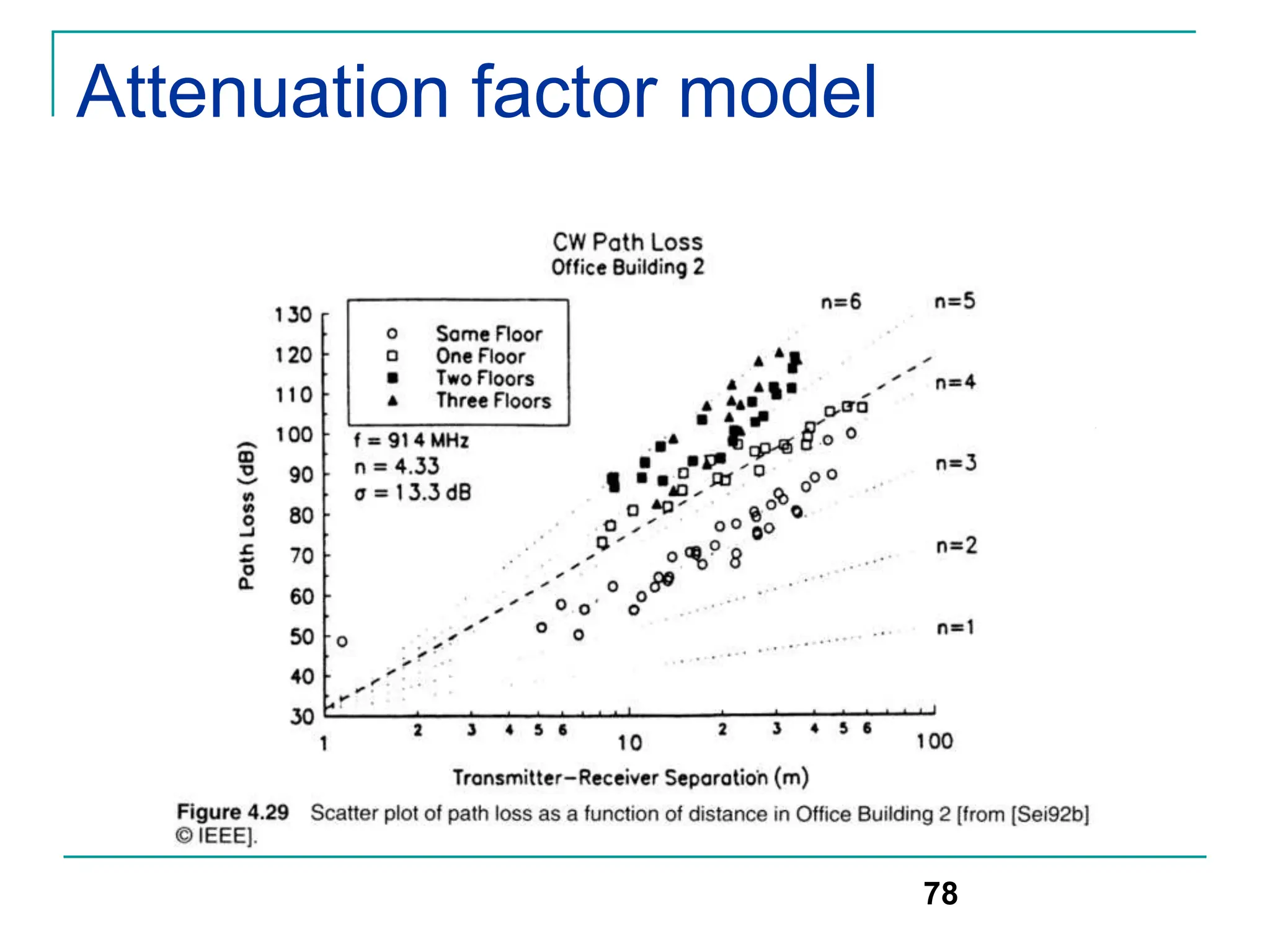
Attenuation factor model
 Obtained by measurement in multiple floors building
77
Attenuation factor model
78
Signal penetration into building
Effect of frequency
- Penetration loss decreases with increasing frequency
Effect of Height
Penetration loss decreases with the height of building
up to some certain height.
- At lower heights the Urban clutter induces greater attenuation
- Up to some height attenuation decreases but then again
increase after a few floors
- Increase in attenuation at higher floors is due to the
Shadowing effects of adjacent buildings
79
CS 515 Ibrahim Korpeoglu
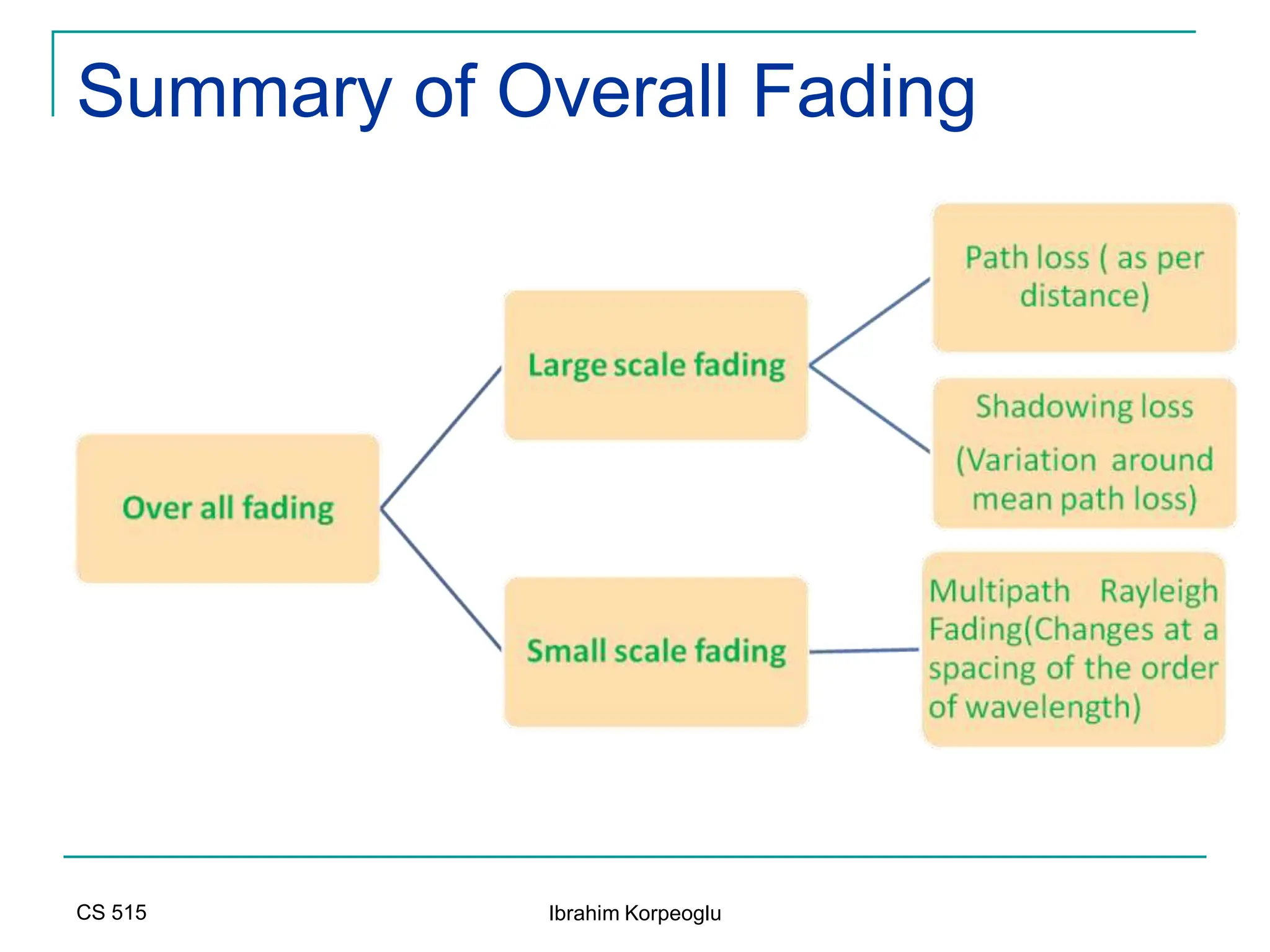
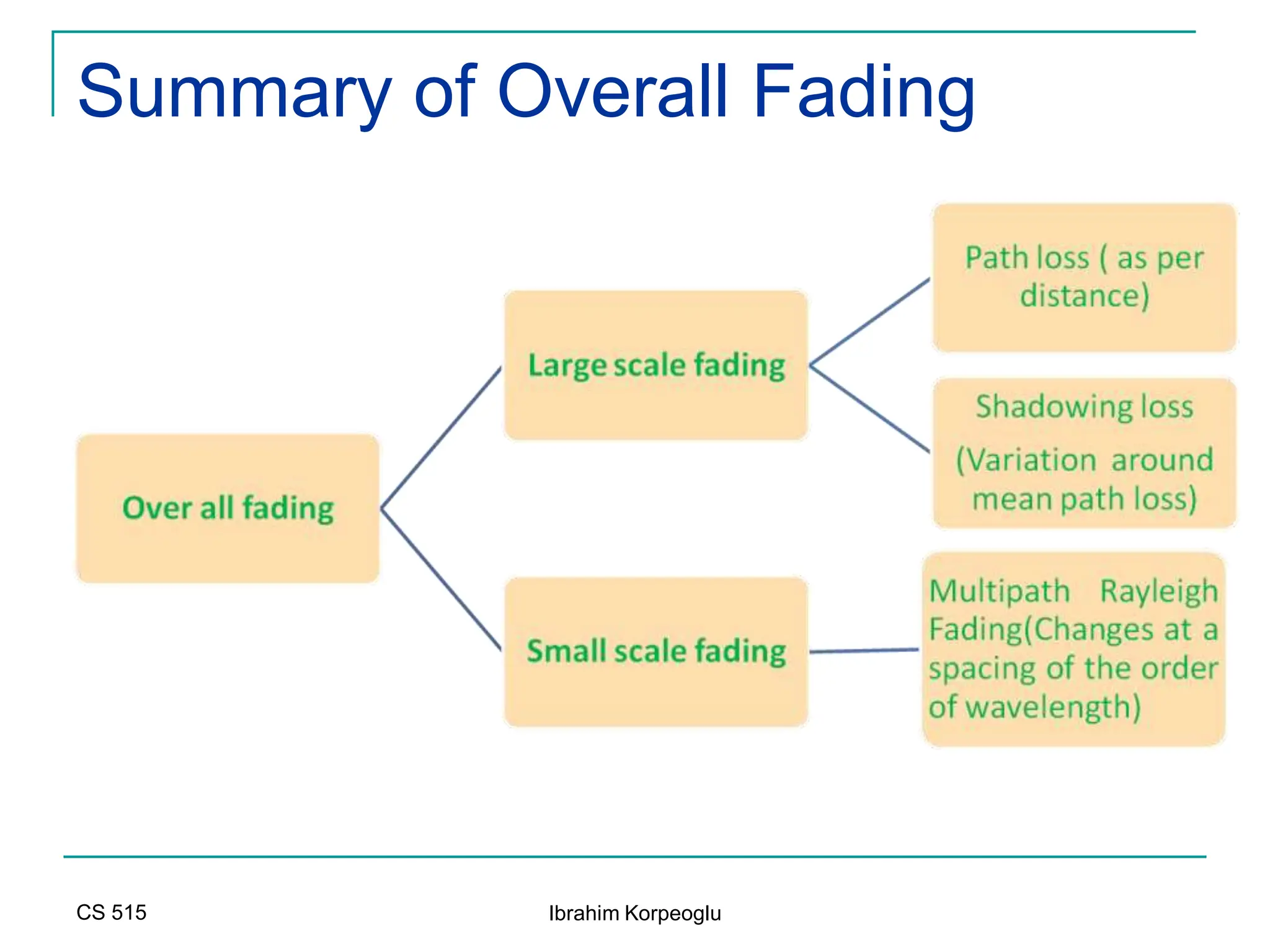
Large, medium and small scale
fading
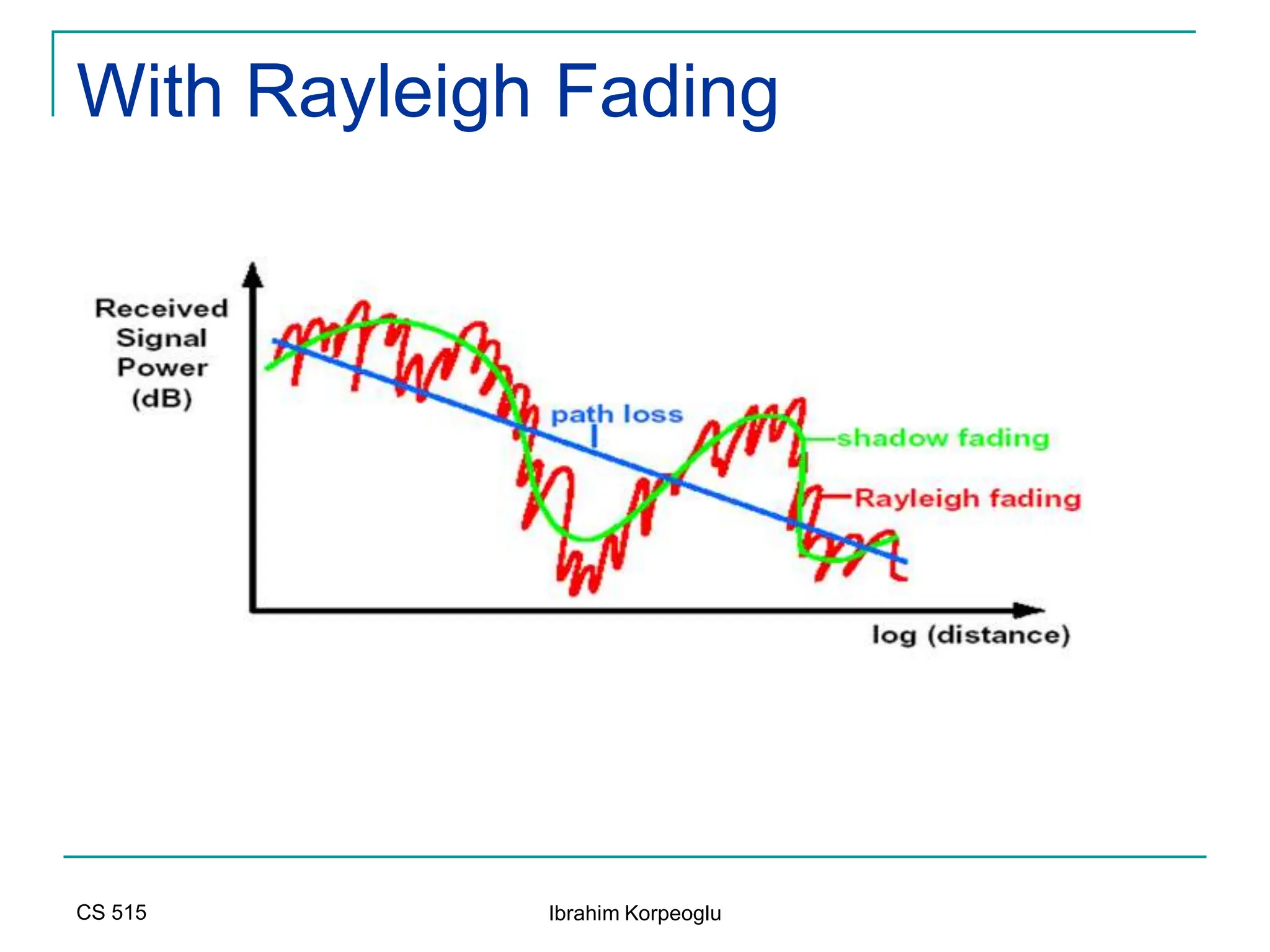
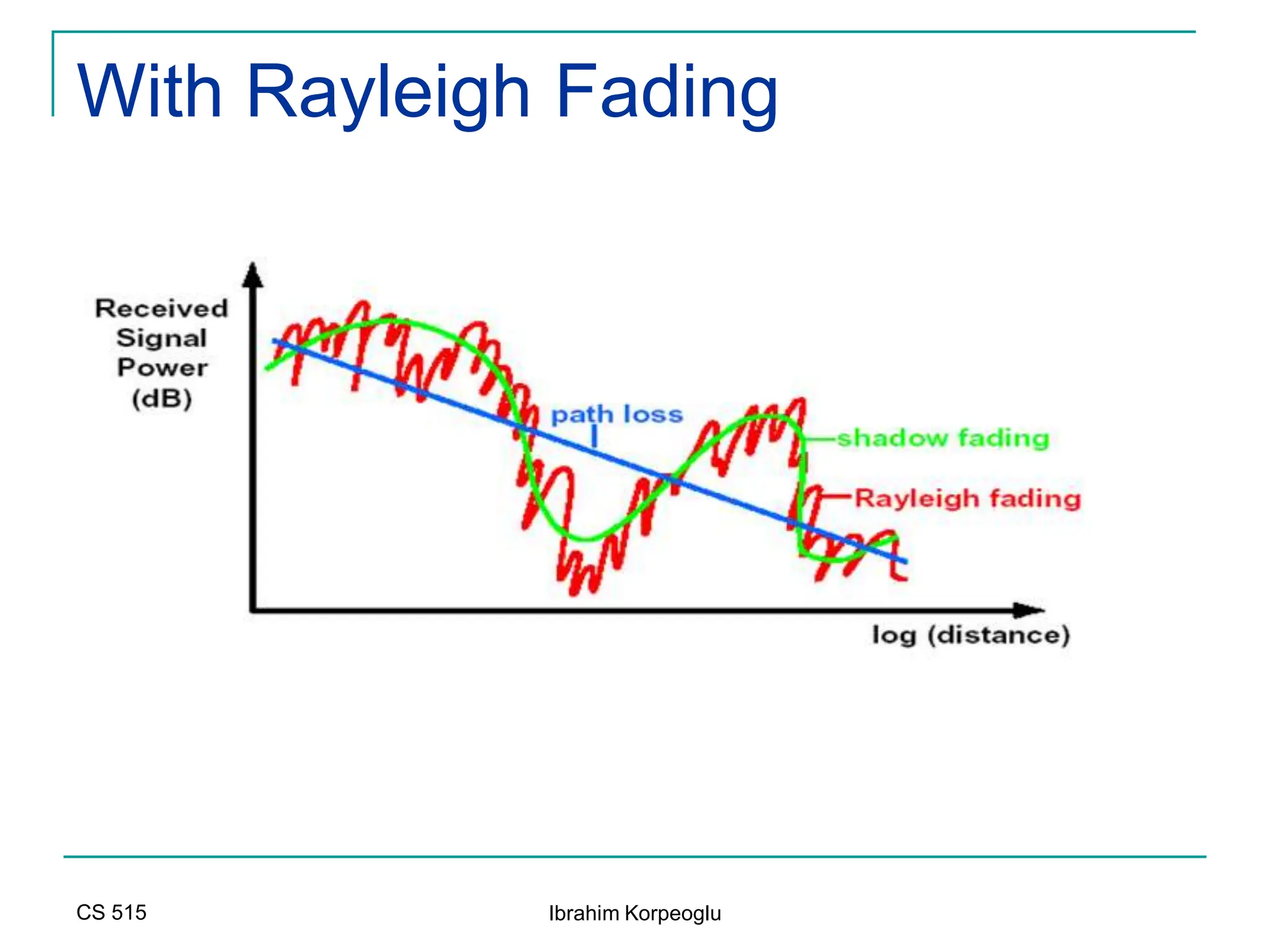
 Large Scale Fading: Average signal power
attenuation/path loss due to motion over large areas.
 Medium scale fading: Local variation in the average
signal power around mean average power due to
shadowing by local obstructions
 Small scale fading: large variation in the signal power
due to small changes in the distance between
transmitter and receiver (Also called Rayleigh fading
when no LOS available). It is called Rayleigh fading
due to the fact that various multipaths at the receiver
with random amplitude & delay add up together to
render rayleigh PDF for total signal.
CS 515 Ibrahim Korpeoglu
Cause of Multipath Fading
 Fading : Fluctuation in the received signal
power due to
 Variations in the received singal amplitude
(Different objects present on radio signal path
produce attenuation of it’s power as they can
scatter or absorb part of the signal power, thus
producing a variation of the amplitude
 Variations in the signal phase
 Variations in the received signal angle of
arrival (different paths travelling different
distances may have different phases & angle
of arrival)
CS 515 Ibrahim Korpeoglu
Causes of Multipath fading Cont..
 Reflections and diffraction from object create
many different EM waves which are received in
mobile antenna. These waves usually come
from many different directions and delay varies.
 In the receiver, the waves are added either
constructively or destructively and create a Rx
signal which may very rapidly in phase and
amplitude depending on the local objects and
how mobile moves
CS 515 Ibrahim Korpeoglu
Practical examples of small scale
multipath fading
 Common examples of multipath fading are
 temporary failure of communication due to a
severe drop in the channel signal to noise ratio
(You may have also experienced this. And you
moved a steps away & noted that reception is
better. It is due to small scale fading effects. )
 FM radio transmission experiencing intermittent
loss of broadcast when away from station.
CS 515 Ibrahim Korpeoglu
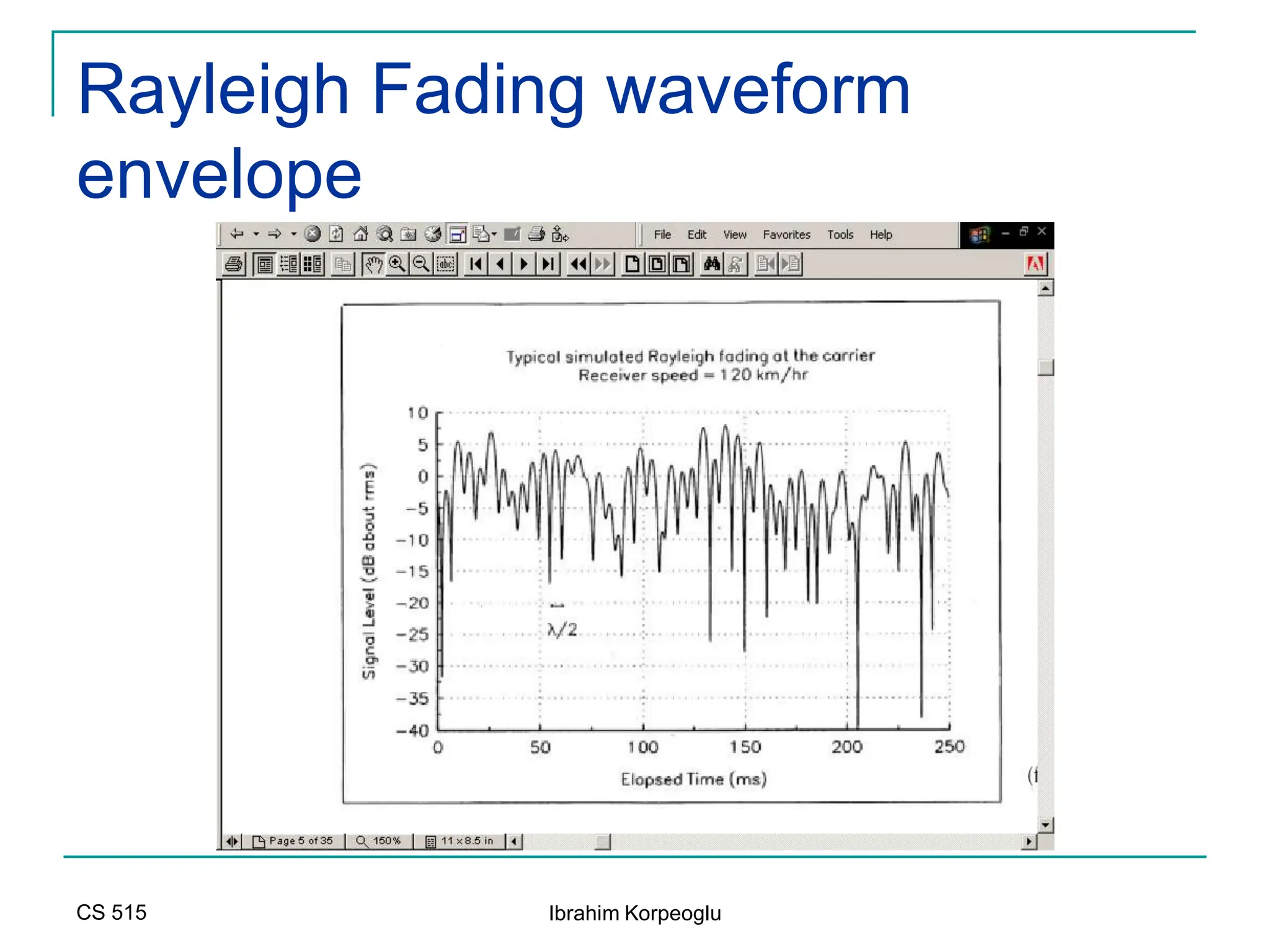
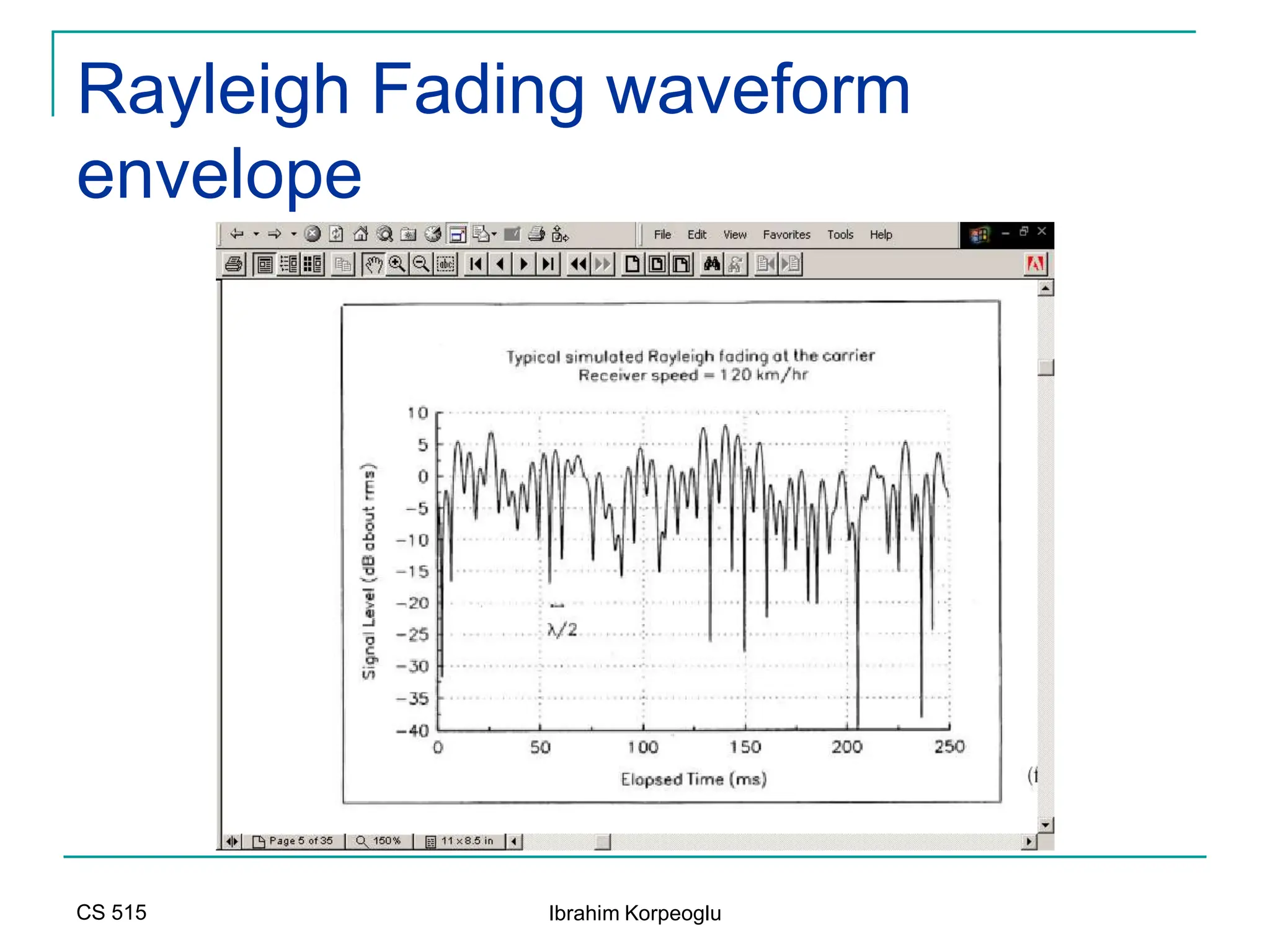
Multipath Fading- Most difficult
 Fades of 40 dB or more below local average
level are frequent, with successive nulls
occurring every half wavelength or so
 Referred to as Rayleigh Fading
CS 515 Ibrahim Korpeoglu
Rayleigh Fading Mechanism
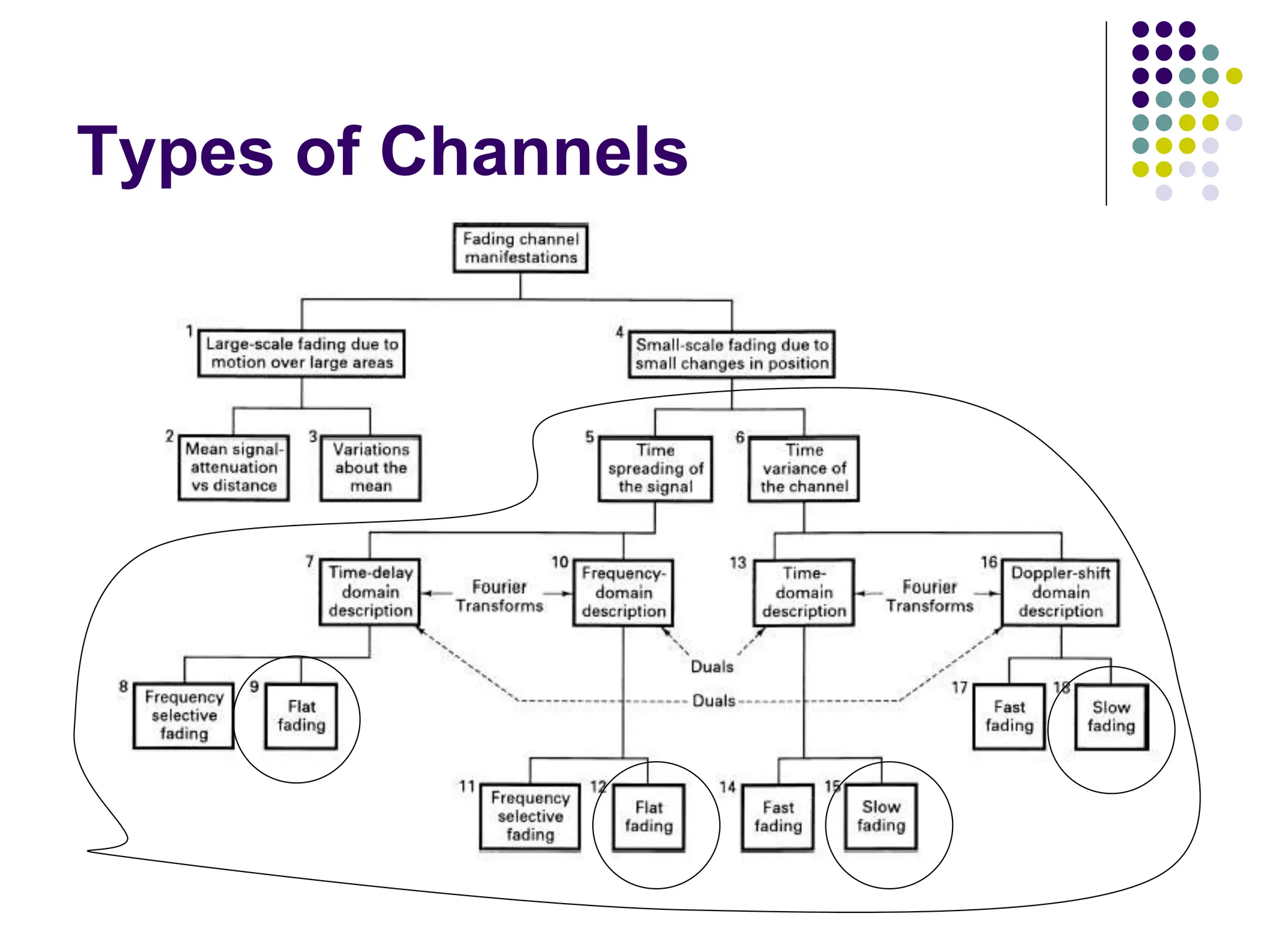
 Rayleigh fading manifests in two
mechanism
 Time spreading due to multipath (time
dispersion)
 Time variant behaviour of the channel due
to the motion and subsequent changes in
propagation paths
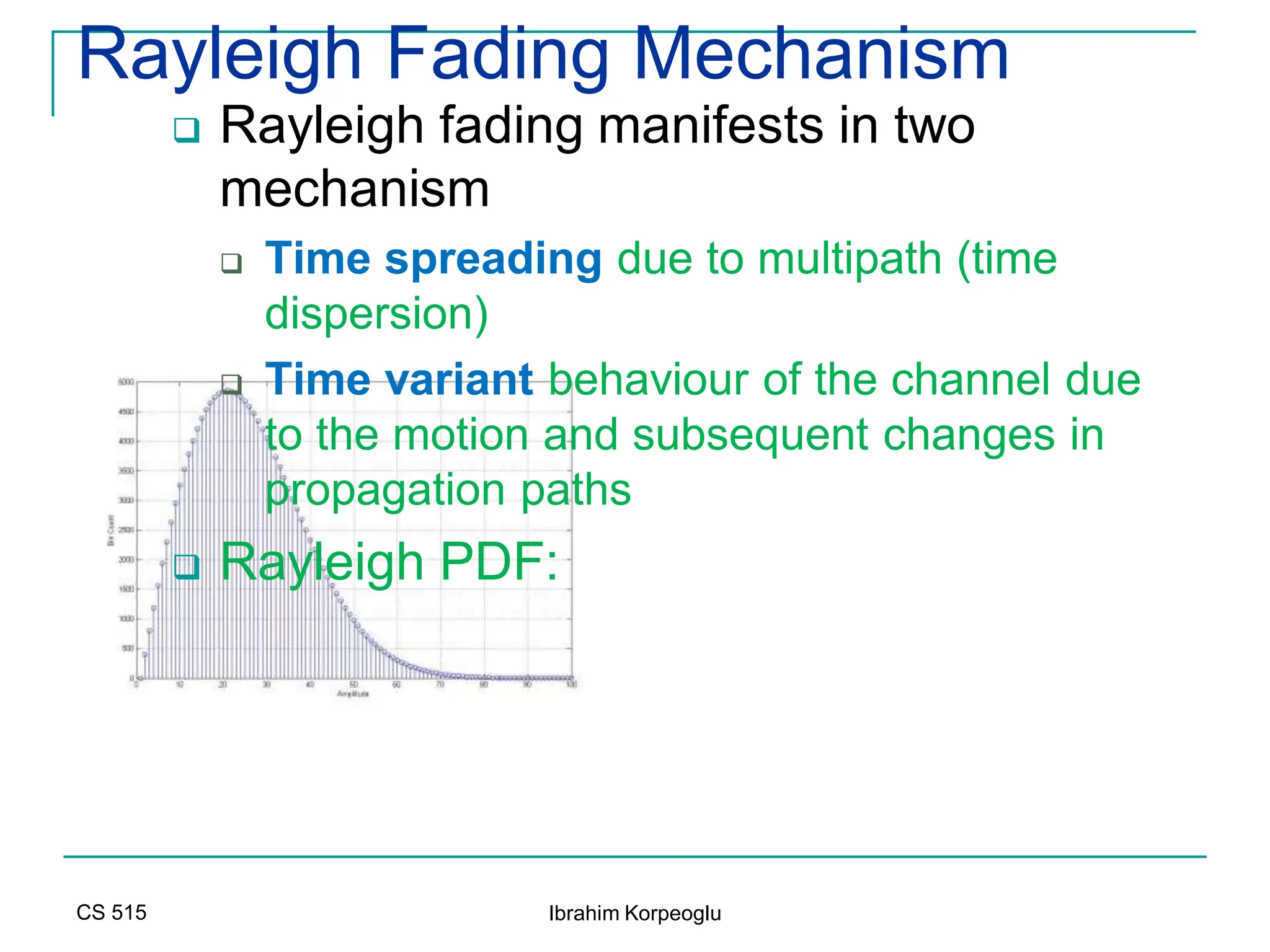
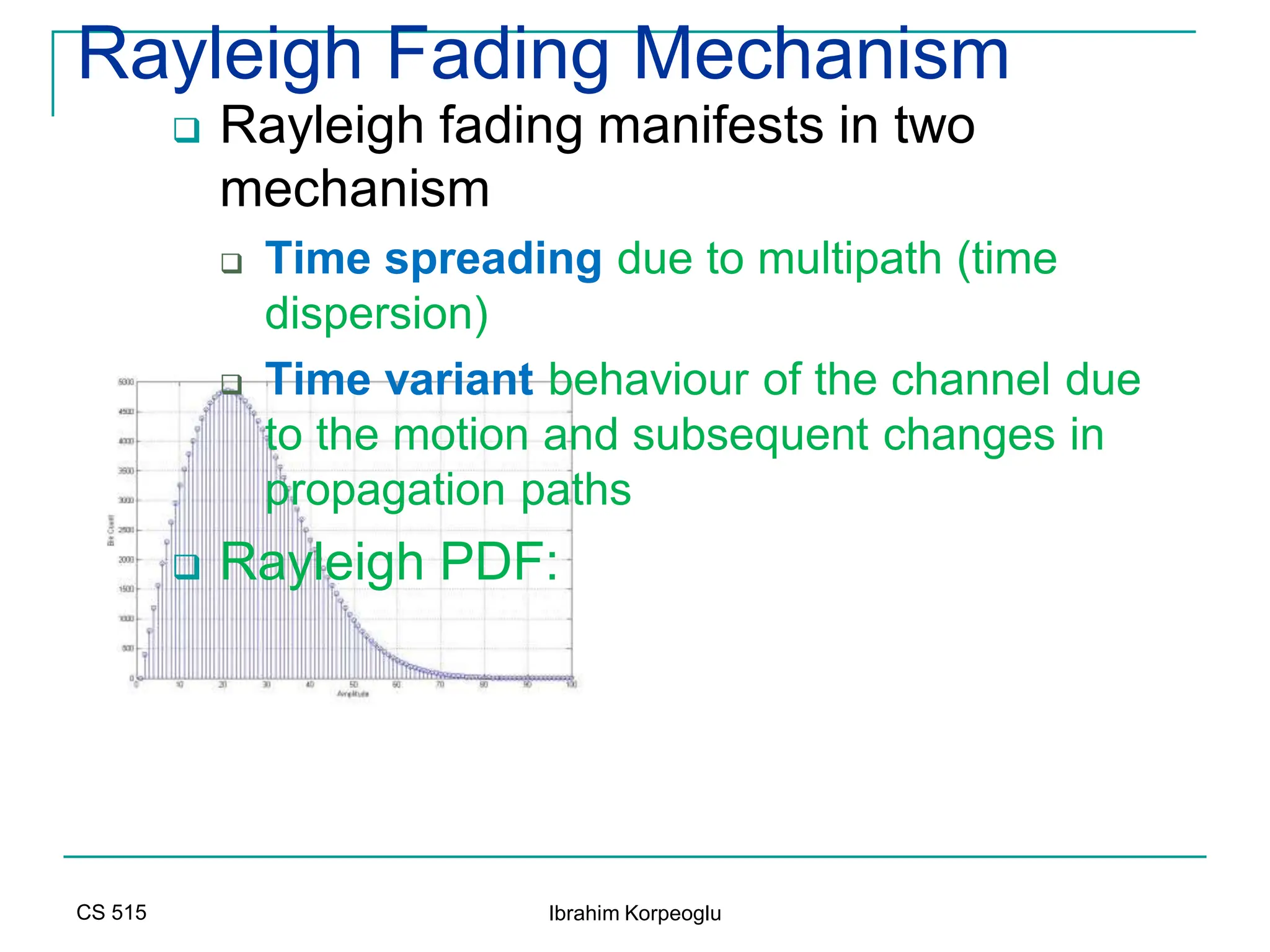
 Rayleigh PDF:
CS 515 Ibrahim Korpeoglu
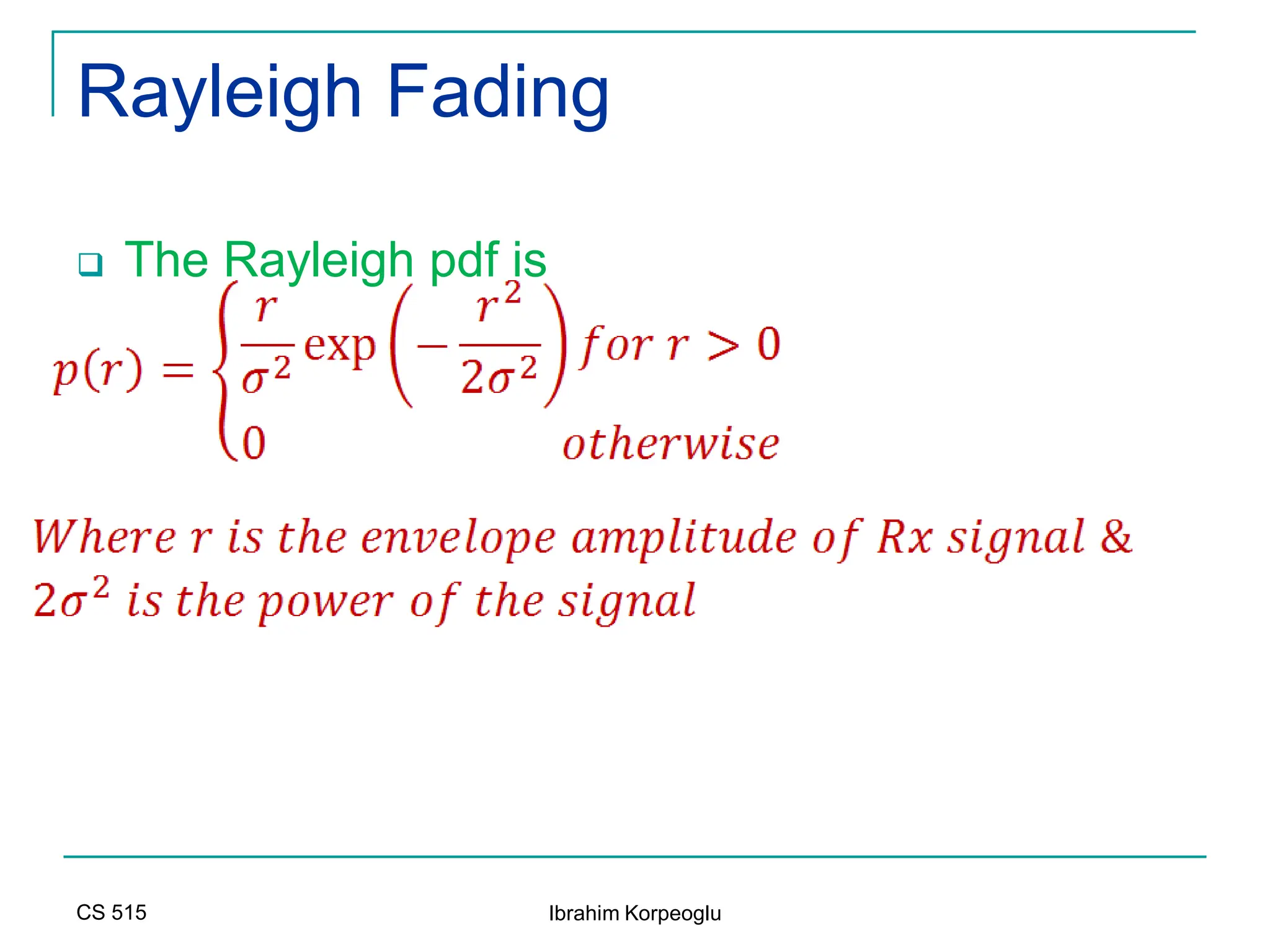
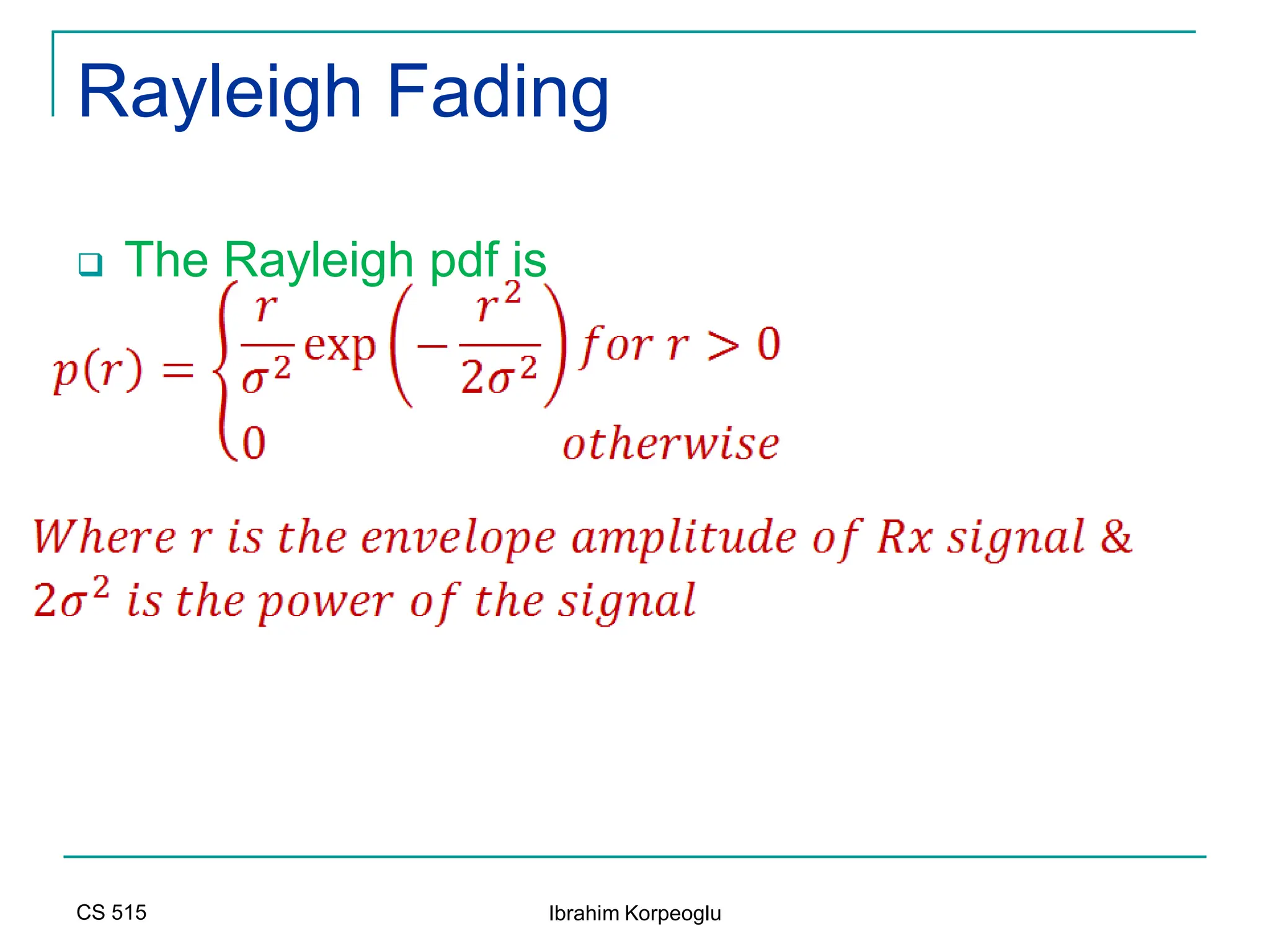
Rayleigh Fading
 The Rayleigh pdf is
CS 515 Ibrahim Korpeoglu
With Rayleigh Fading
CS 515 Ibrahim Korpeoglu
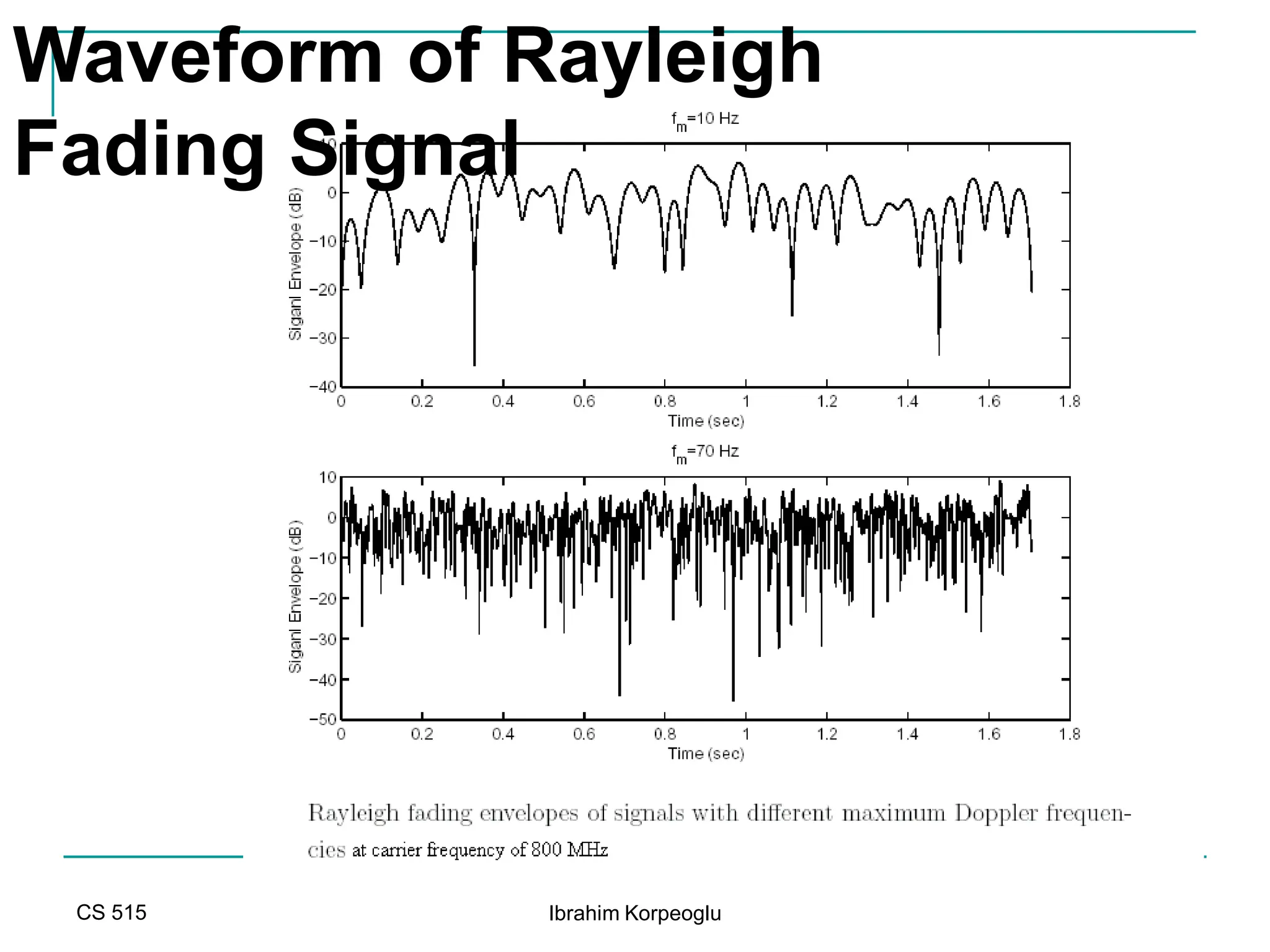
Rayleigh Fading waveform
envelope
CS 515 Ibrahim Korpeoglu
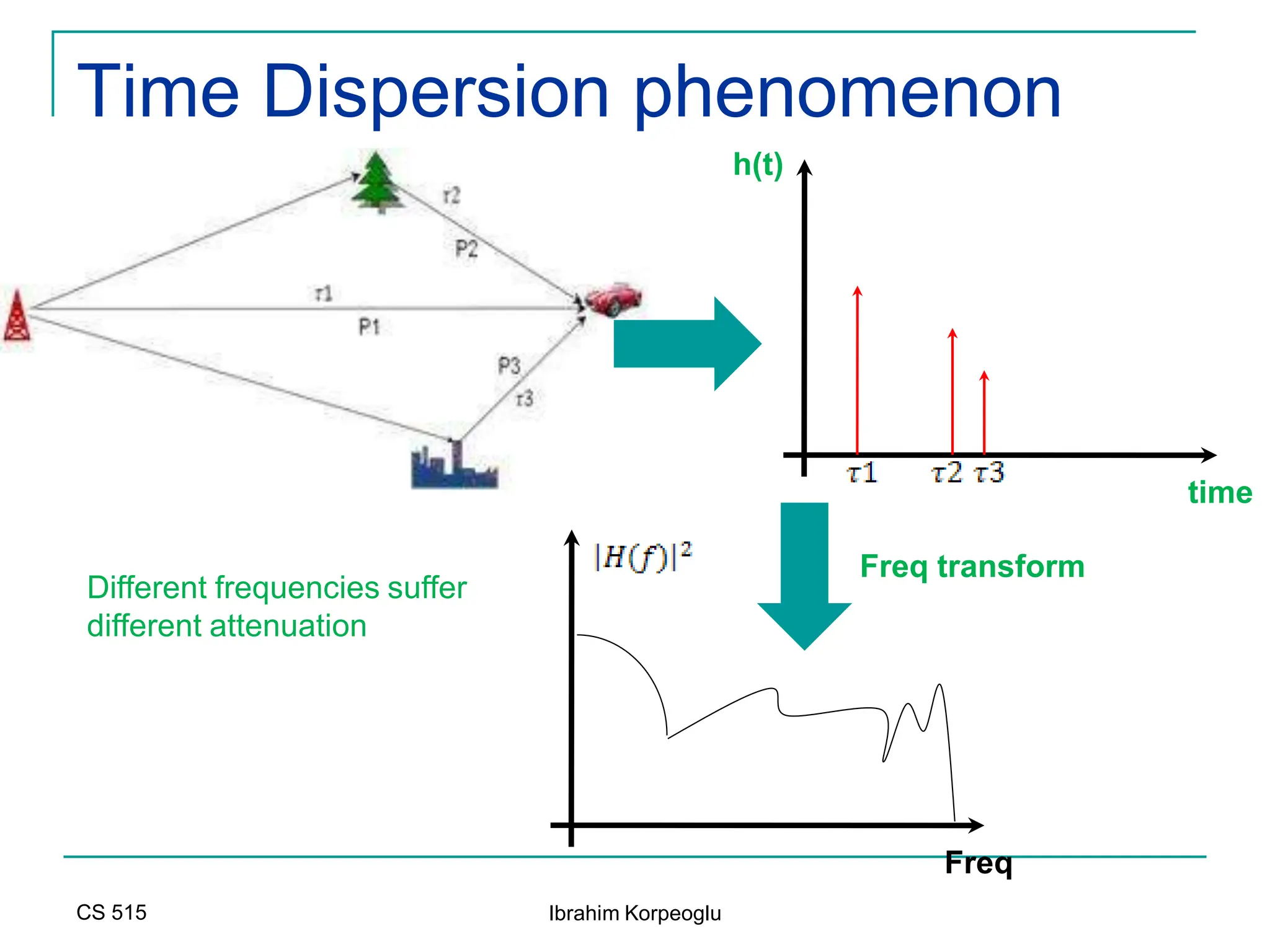
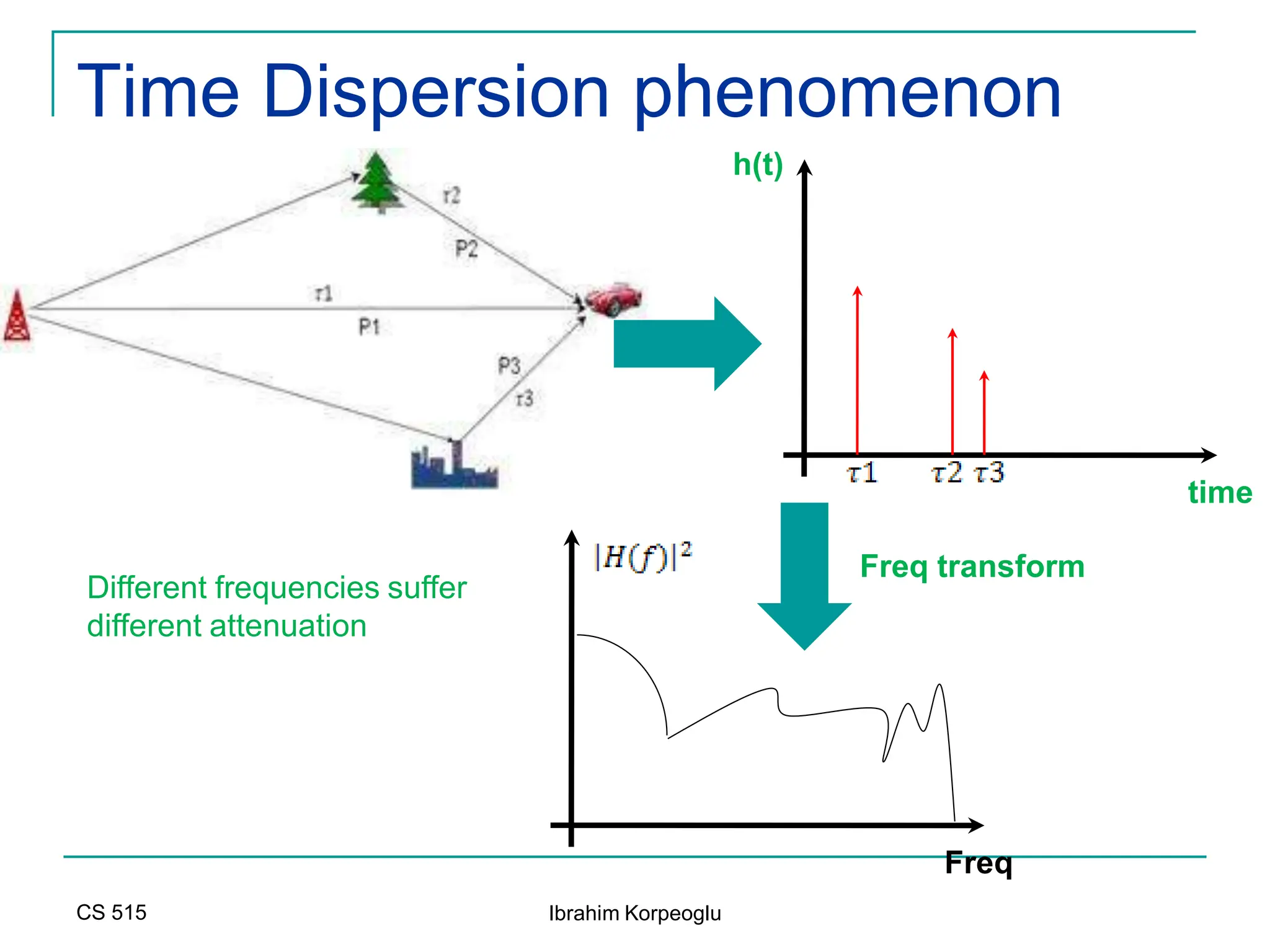
Time Dispersion phenomenon
time
h(t)
Freq
Freq transform
Different frequencies suffer
different attenuation
CS 515 Ibrahim Korpeoglu
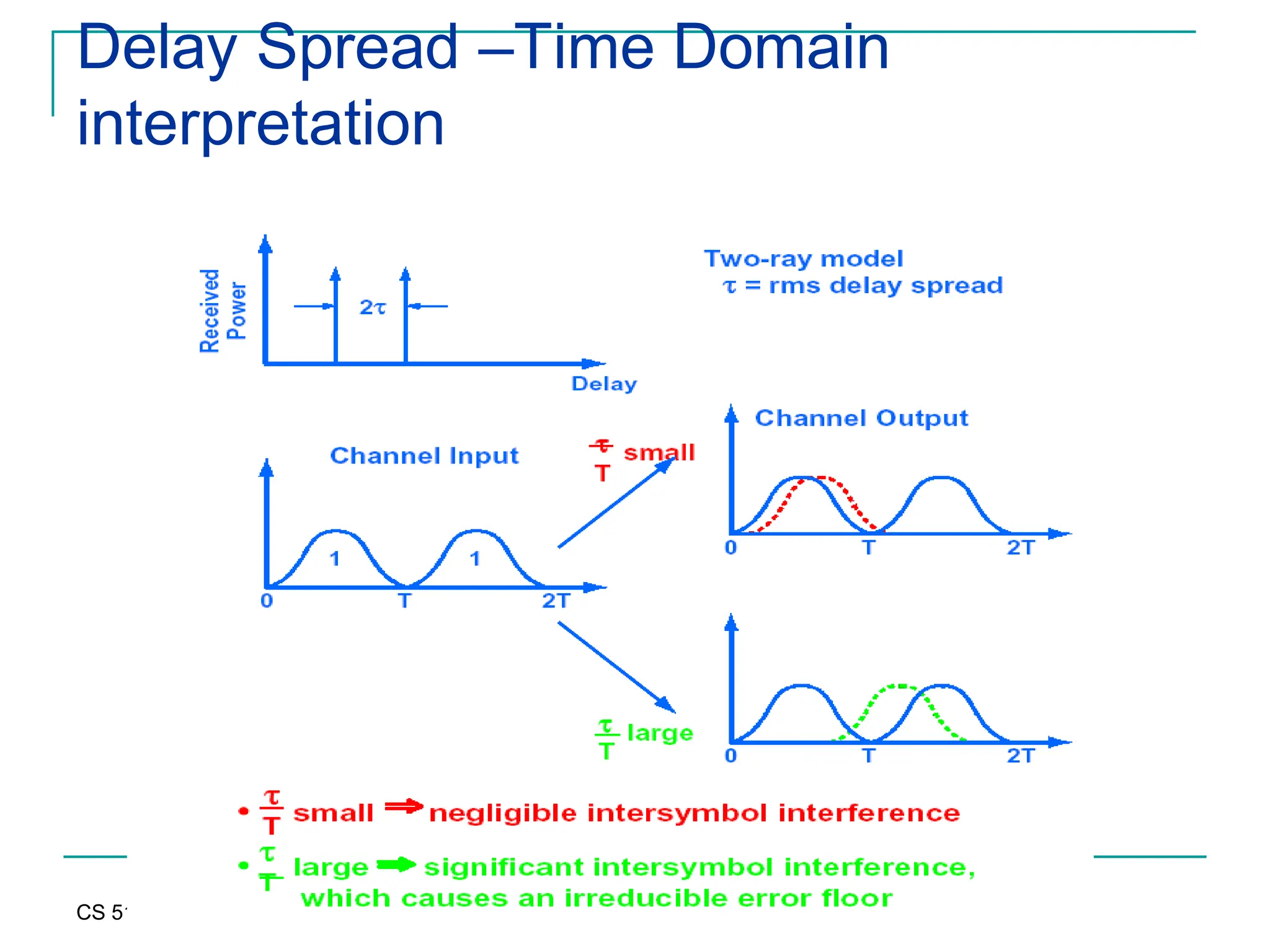
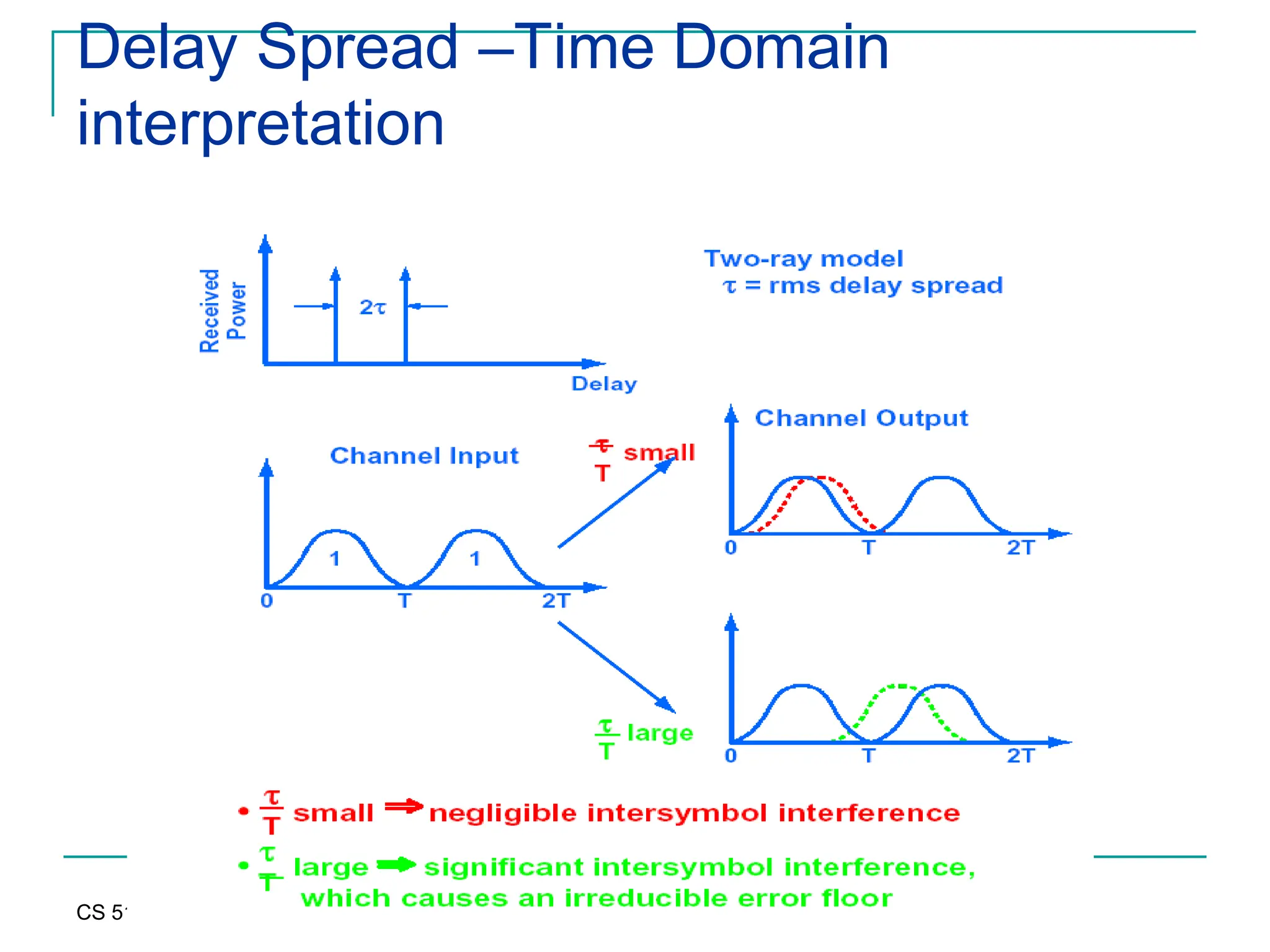
Delay Spread –Time Domain
interpretation
CS 515 Ibrahim Korpeoglu
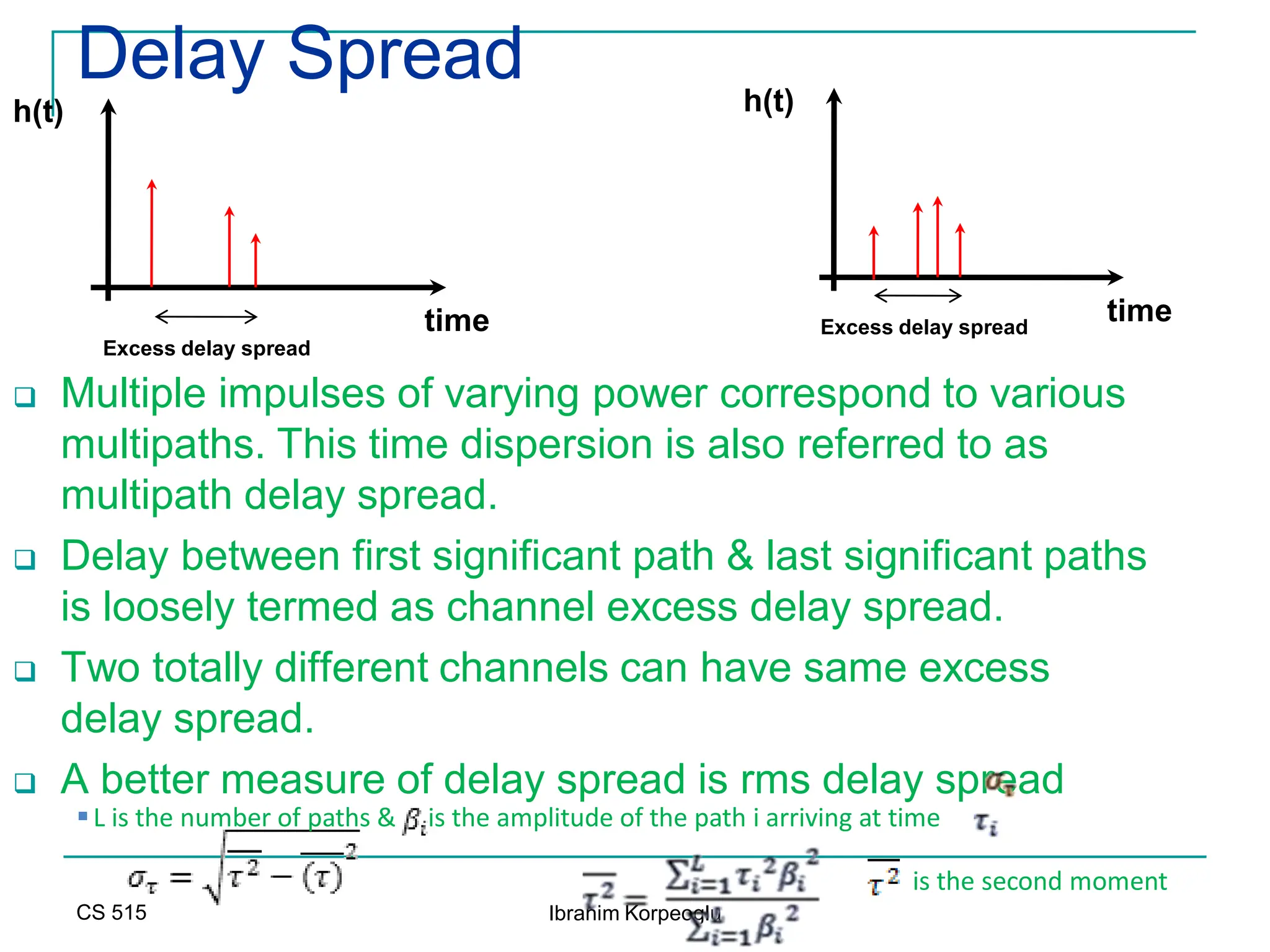
Delay Spread
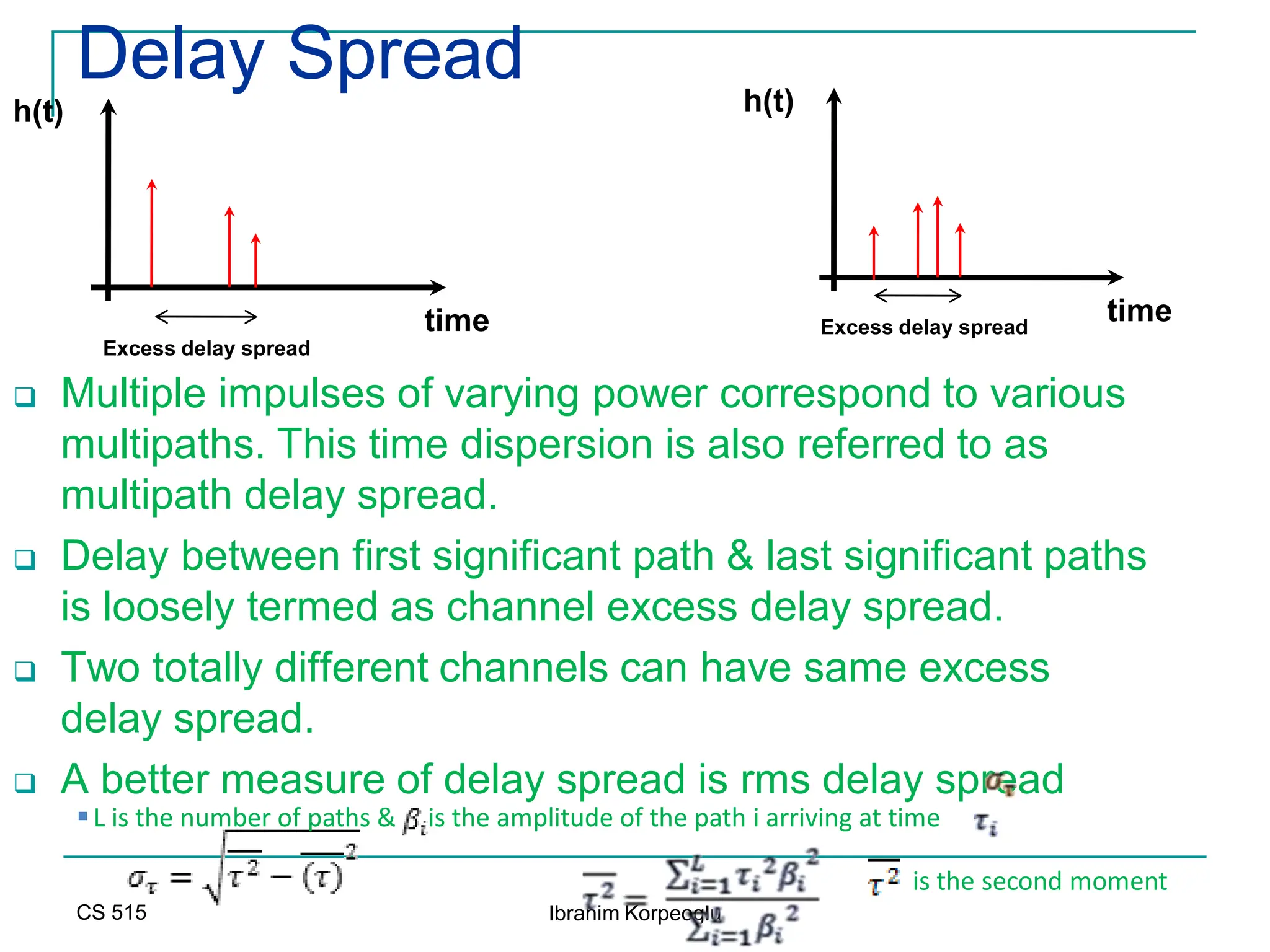
 Multiple impulses of varying power correspond to various
multipaths. This time dispersion is also referred to as
multipath delay spread.
 Delay between first significant path & last significant paths
is loosely termed as channel excess delay spread.
 Two totally different channels can have same excess
delay spread.
 A better measure of delay spread is rms delay spread
time
h(t)
Excess delay spread
time
h(t)
Excess delay spread
is the second moment
L is the number of paths & is the amplitude of the path i arriving at time
CS 515 Ibrahim Korpeoglu
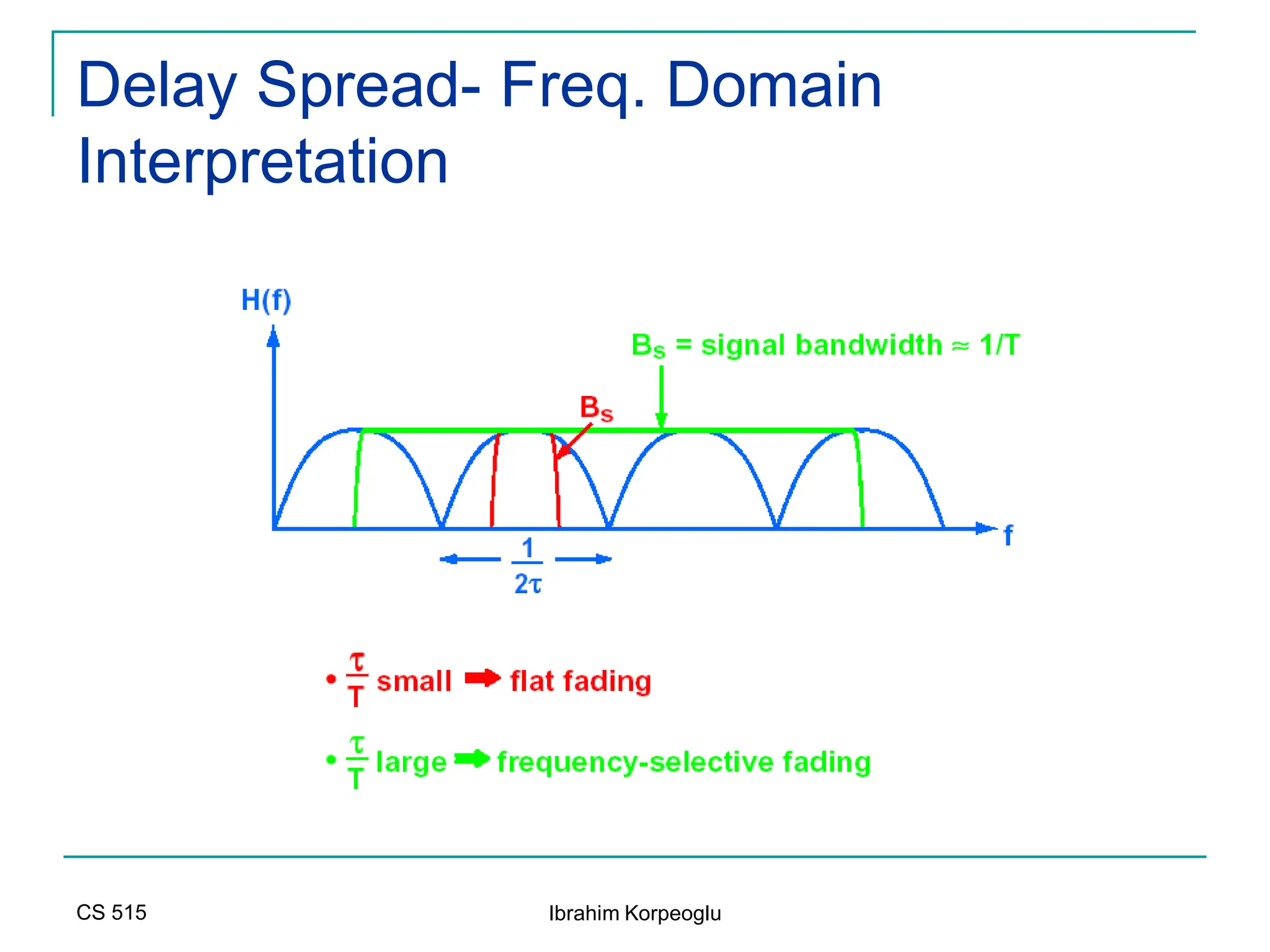
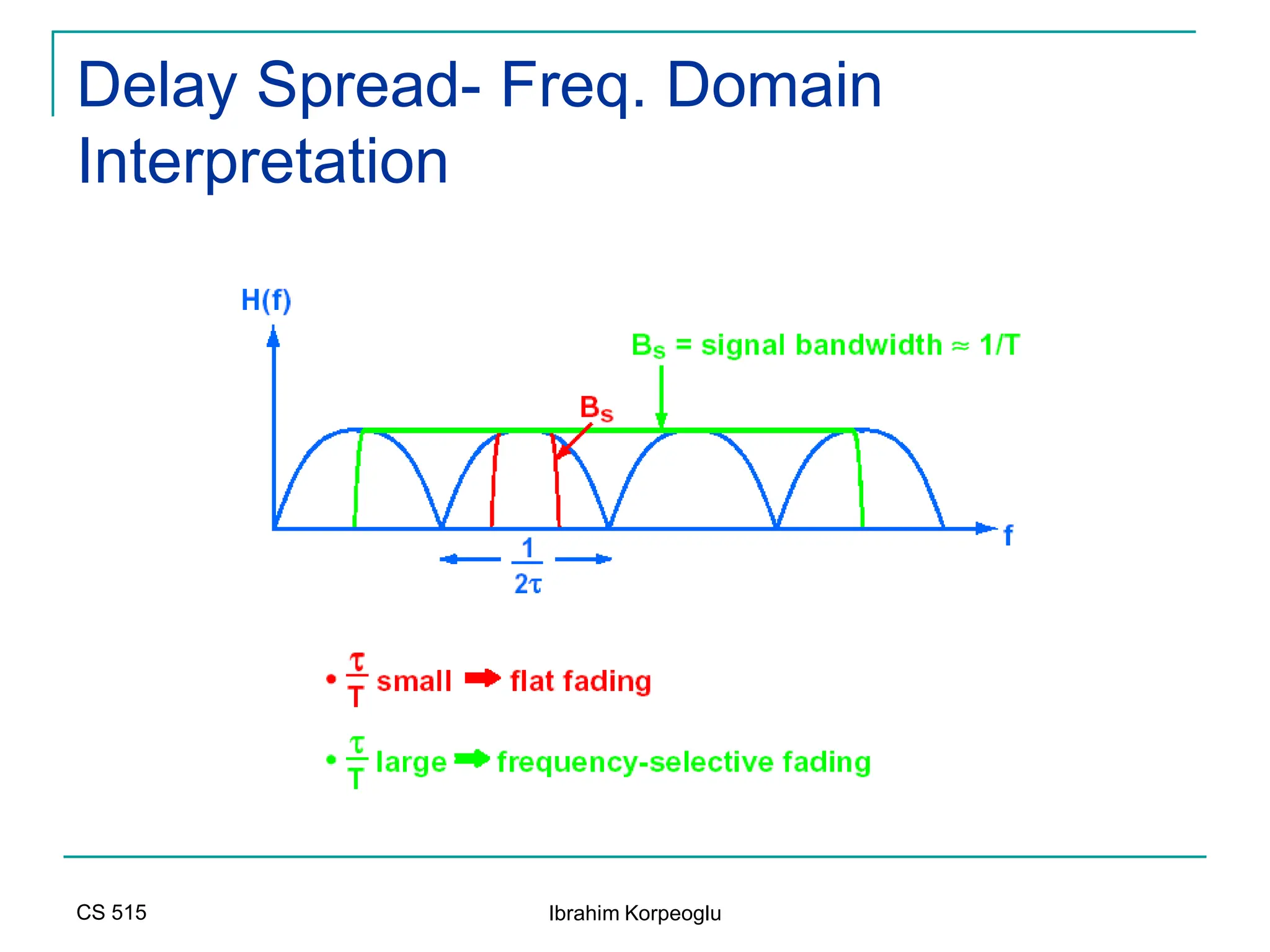
Delay Spread- Freq. Domain
Interpretation
CS 515 Ibrahim Korpeoglu
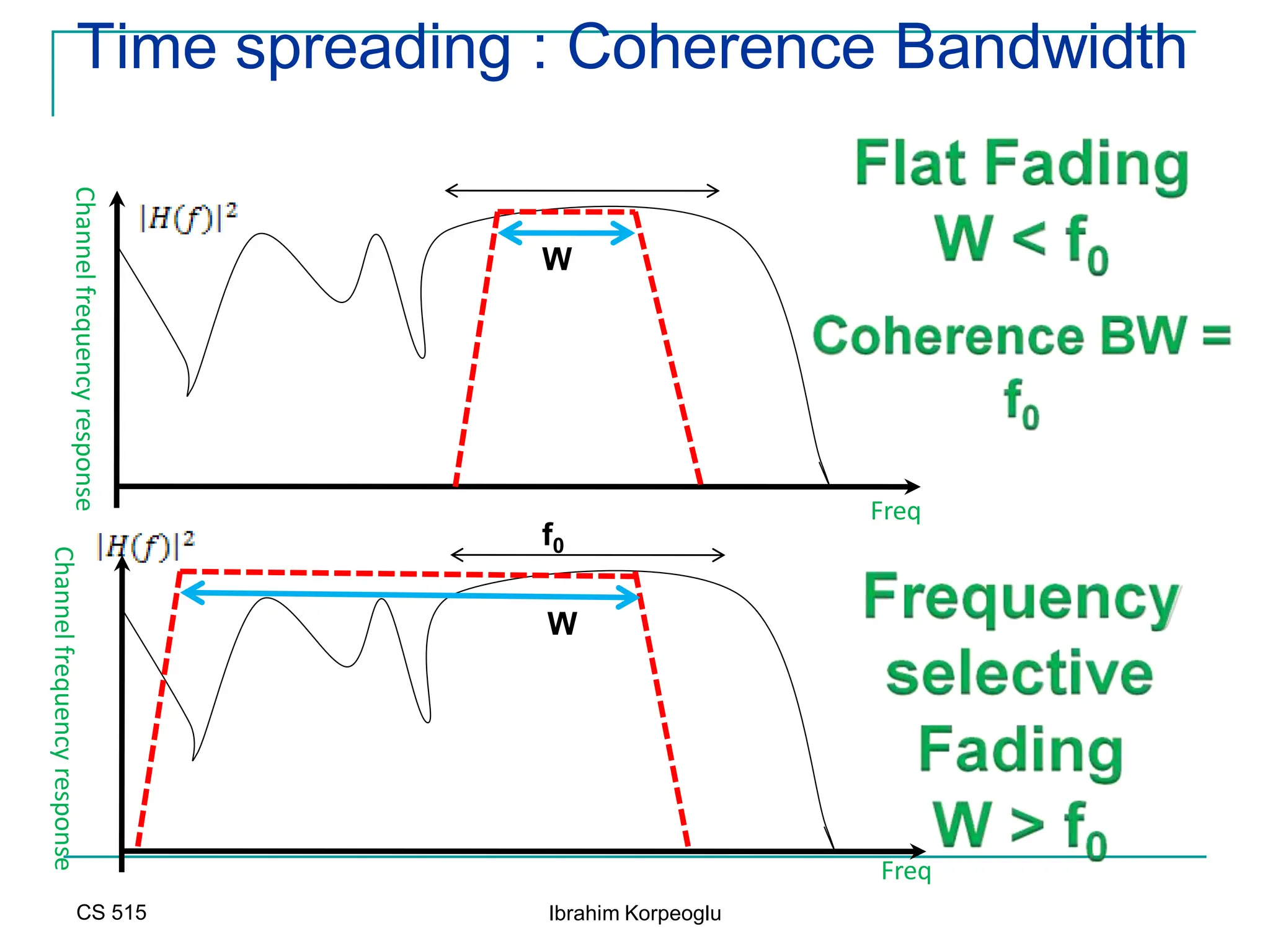
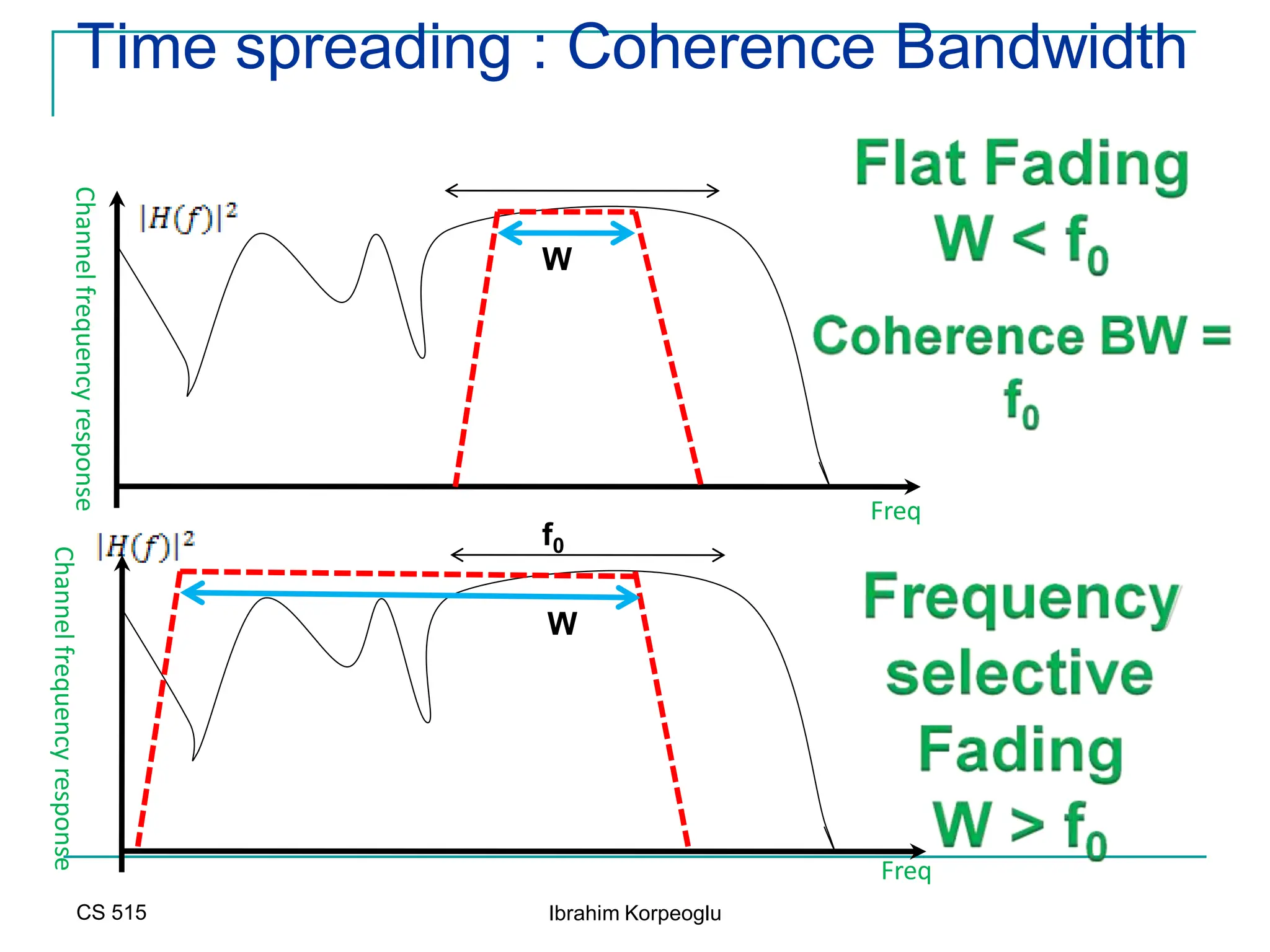
Time spreading : Coherence Bandwidth
Freq
Channel
frequency
response
W
Freq
W
Channel
frequency
response
f0
CS 515 Ibrahim Korpeoglu
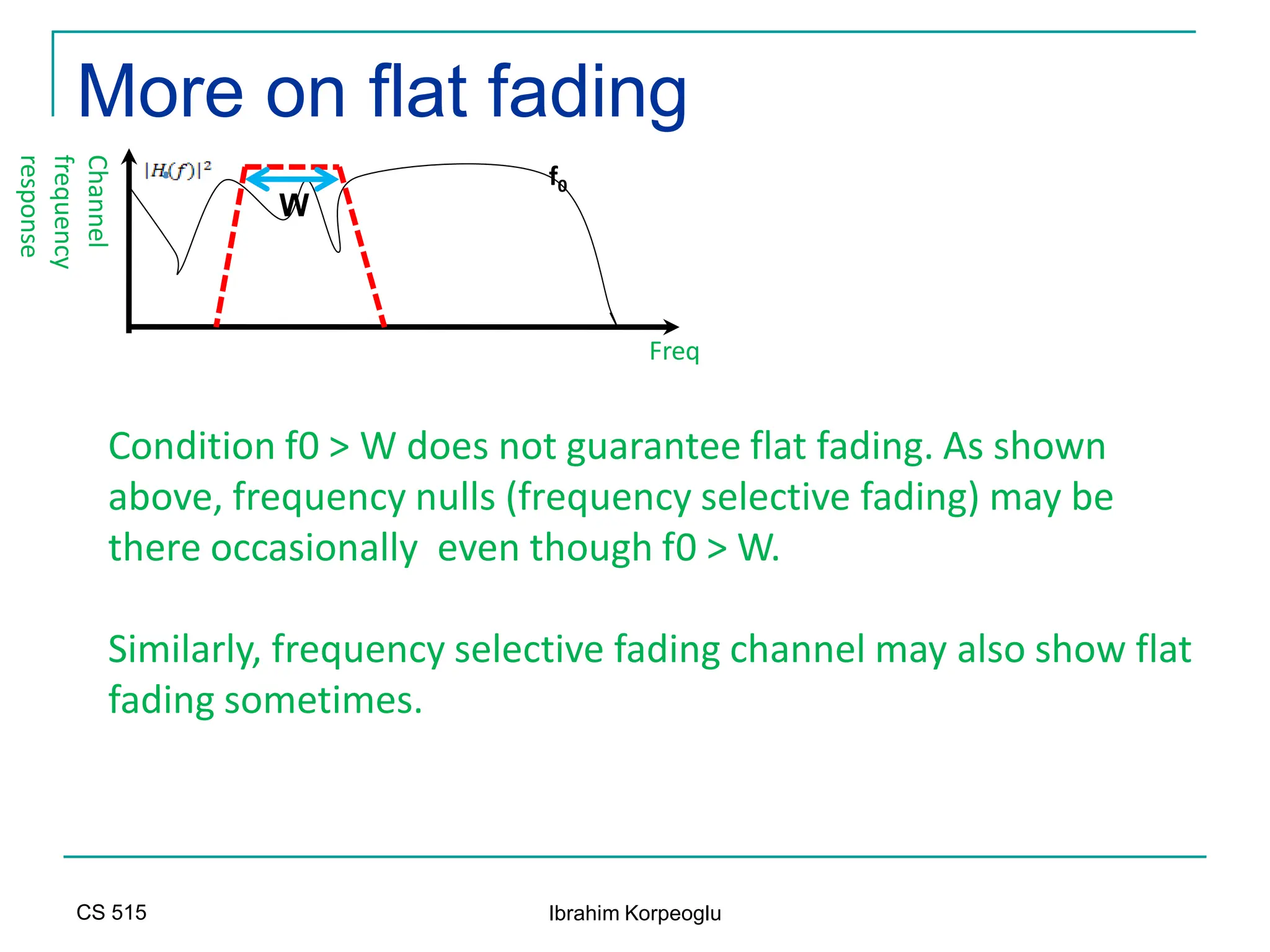
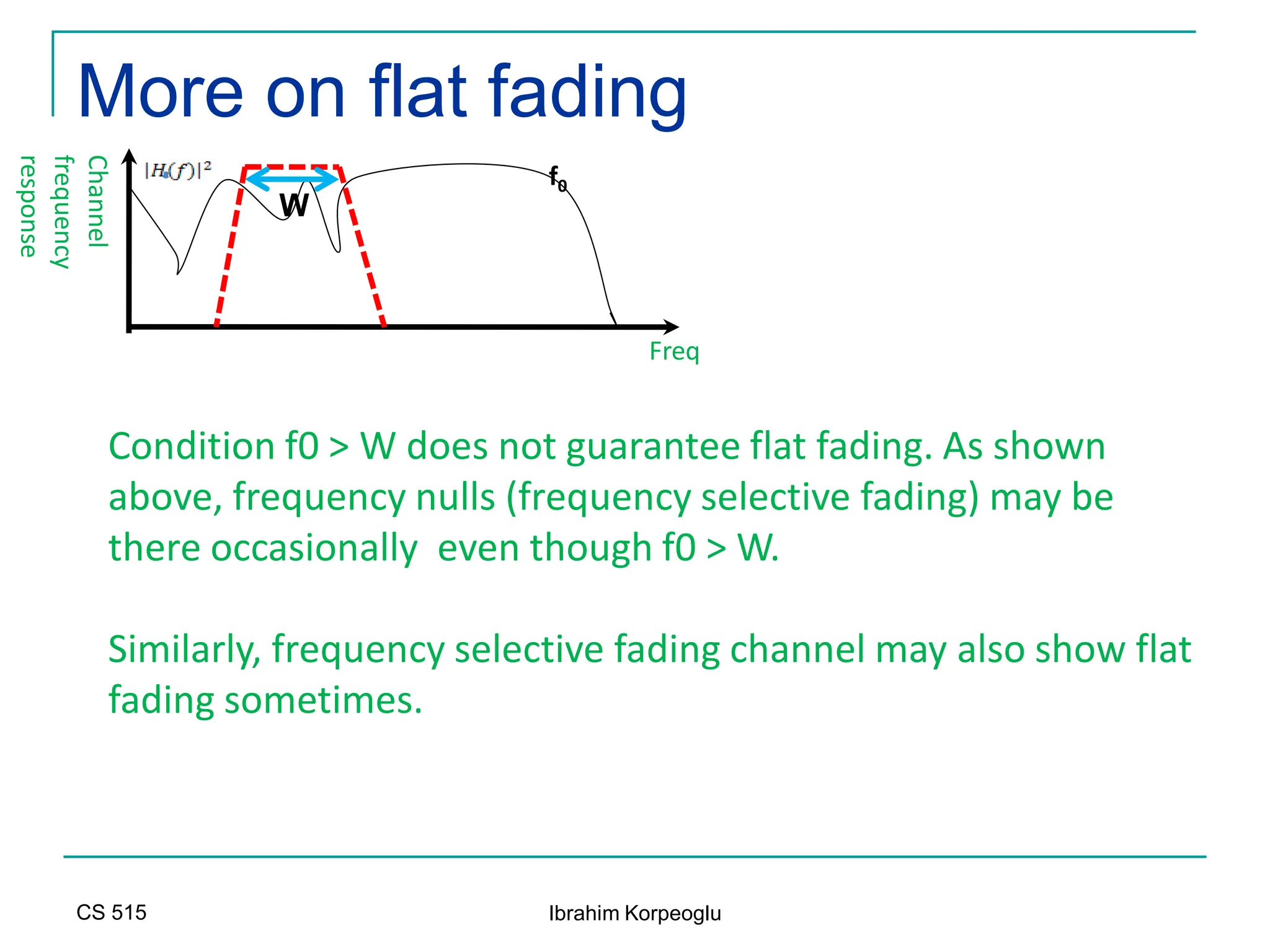
More on flat fading
• f0
Freq
Channel
frequency
response
W
Condition f0 > W does not guarantee flat fading. As shown
above, frequency nulls (frequency selective fading) may be
there occasionally even though f0 > W.
Similarly, frequency selective fading channel may also show flat
fading sometimes.
CS 515 Ibrahim Korpeoglu
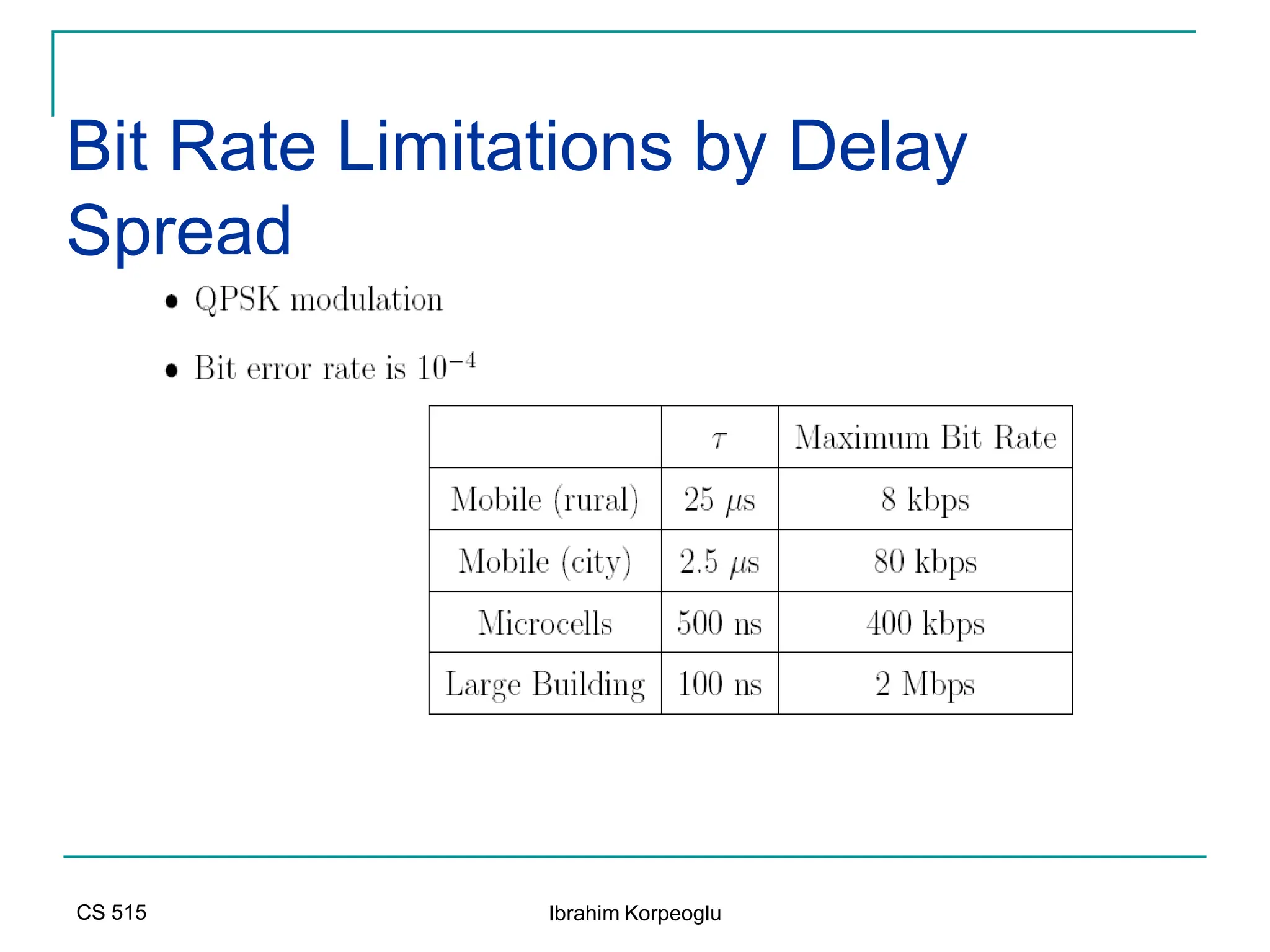
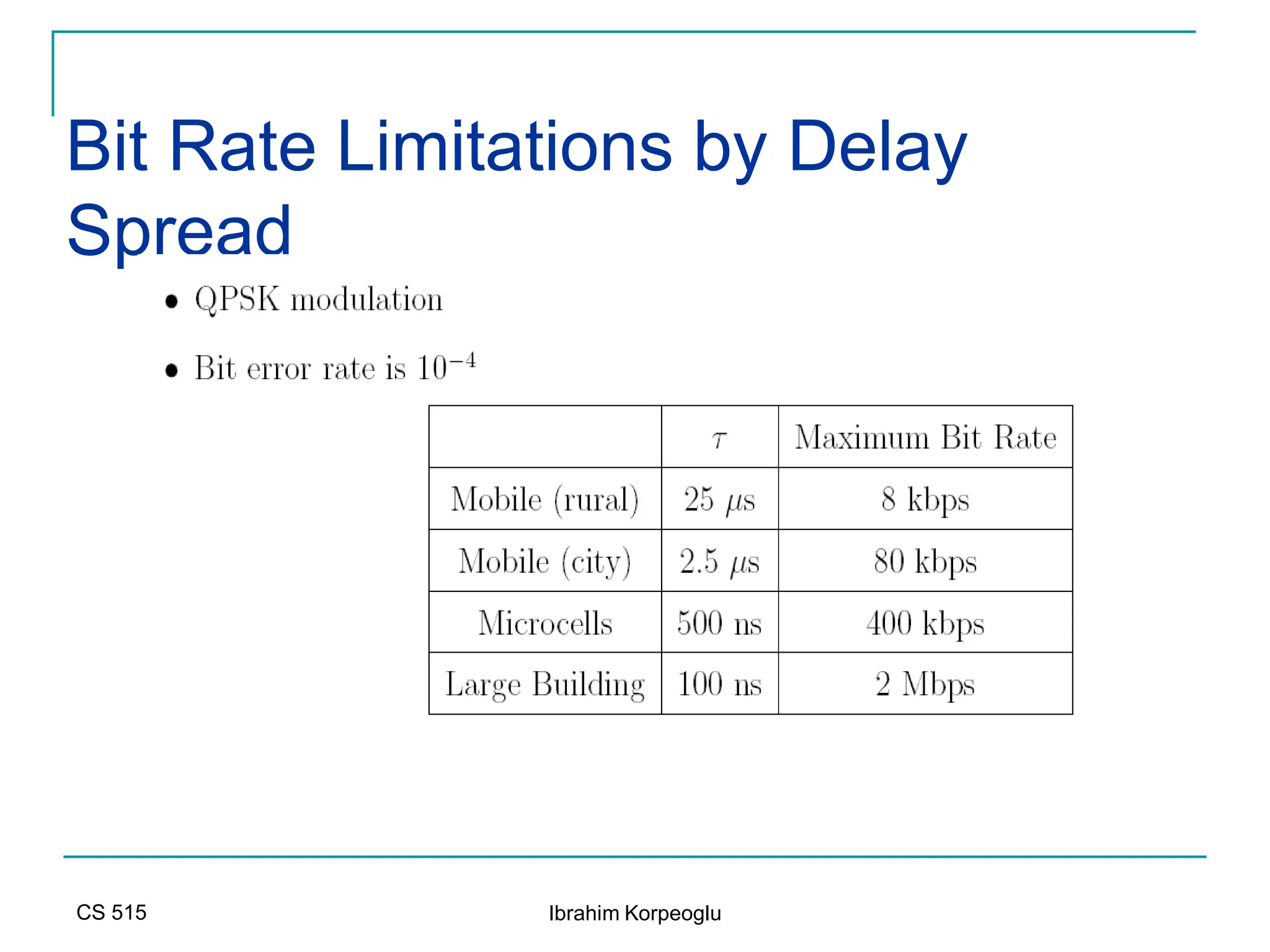
Bit Rate Limitations by Delay
Spread
CS 515 Ibrahim Korpeoglu
Coherence Bandwidth and delay
spread
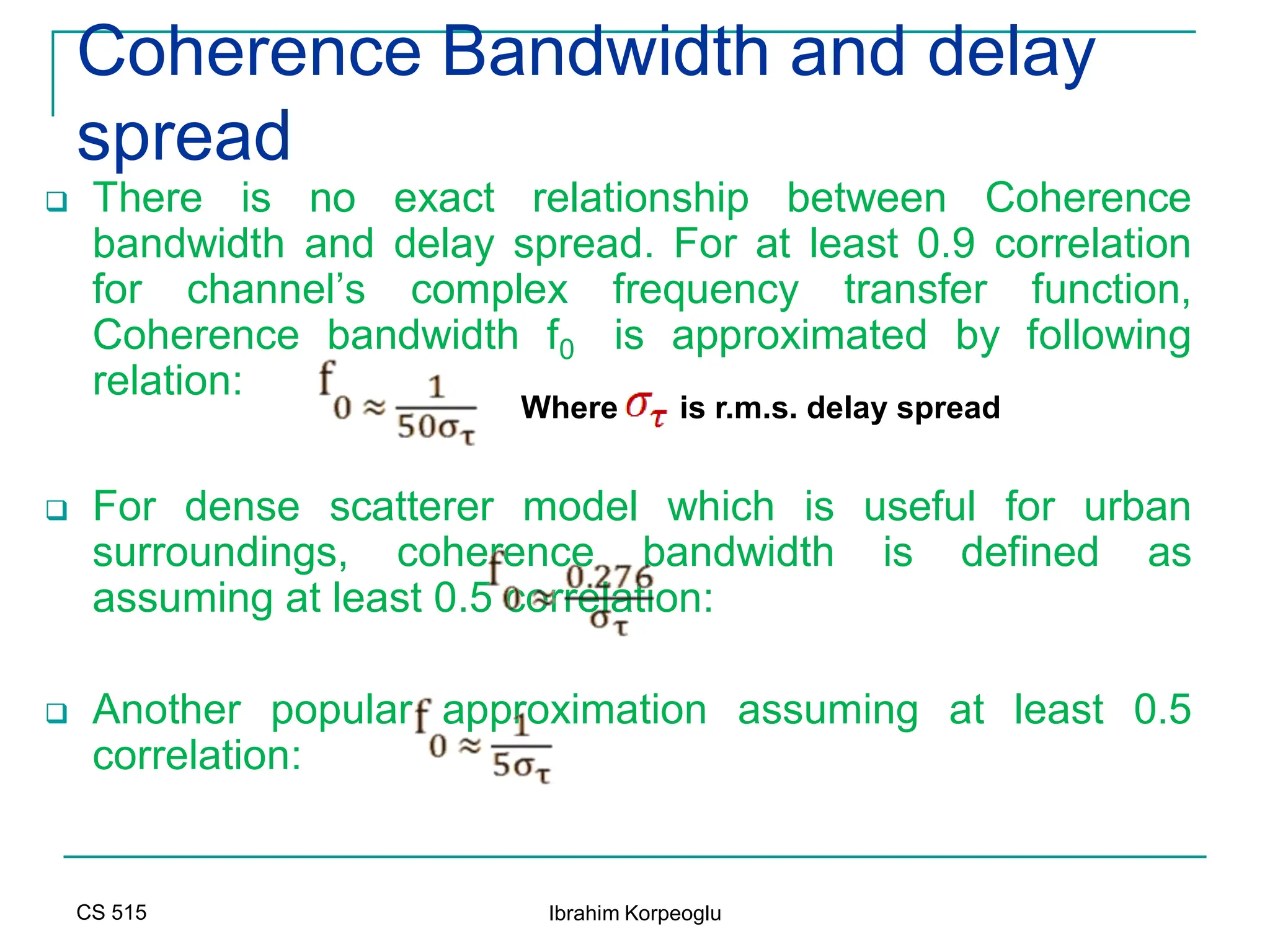
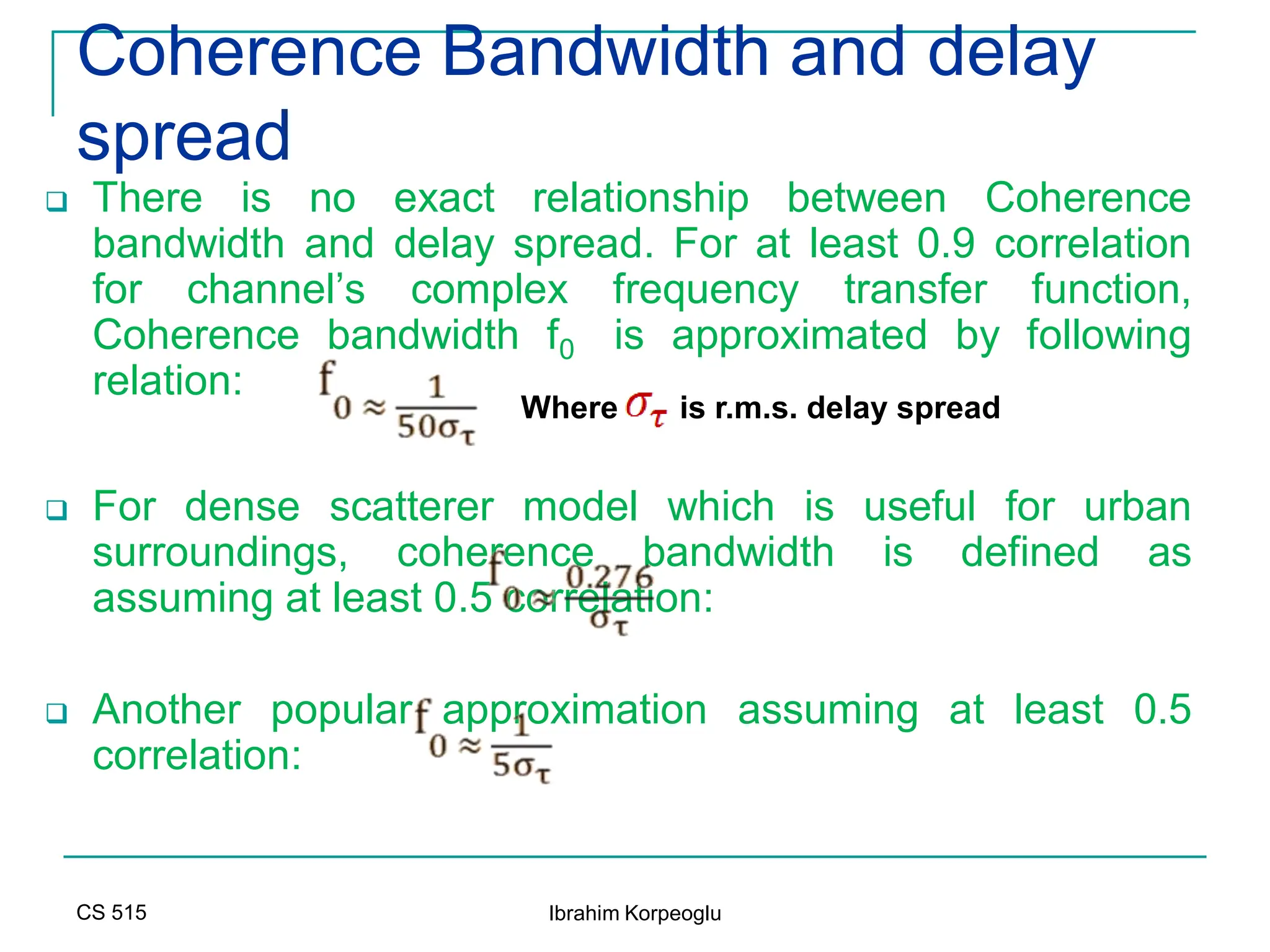
 There is no exact relationship between Coherence
bandwidth and delay spread. For at least 0.9 correlation
for channel’s complex frequency transfer function,
Coherence bandwidth f0 is approximated by following
relation:
 For dense scatterer model which is useful for urban
surroundings, coherence bandwidth is defined as
assuming at least 0.5 correlation:
 Another popular approximation assuming at least 0.5
correlation:
Where is r.m.s. delay spread
CS 515 Ibrahim Korpeoglu
Effects of Flat & frequency
selective fading
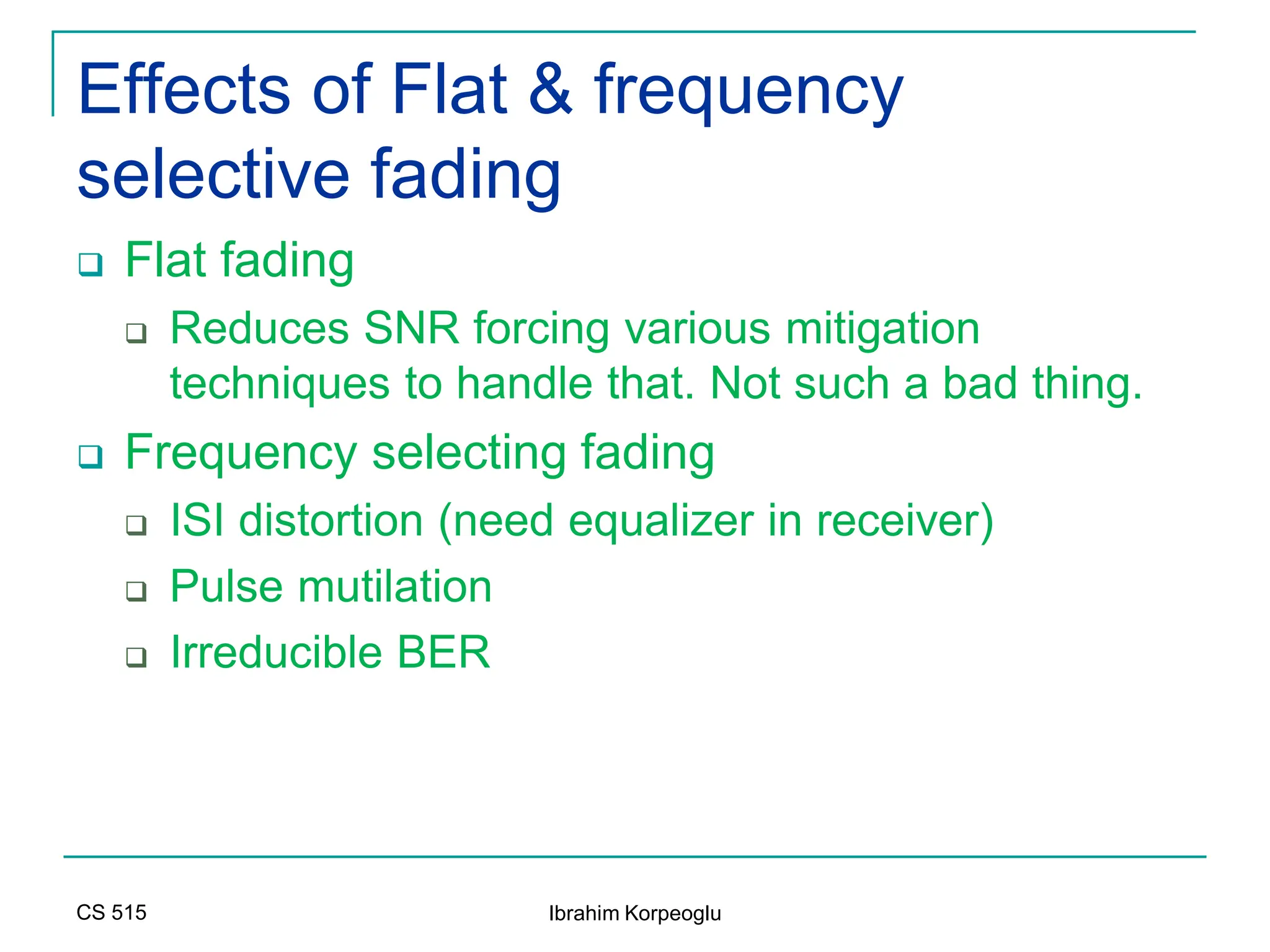
 Flat fading
 Reduces SNR forcing various mitigation
techniques to handle that. Not such a bad thing.
 Frequency selecting fading
 ISI distortion (need equalizer in receiver)
 Pulse mutilation
 Irreducible BER
CS 515 Ibrahim Korpeoglu
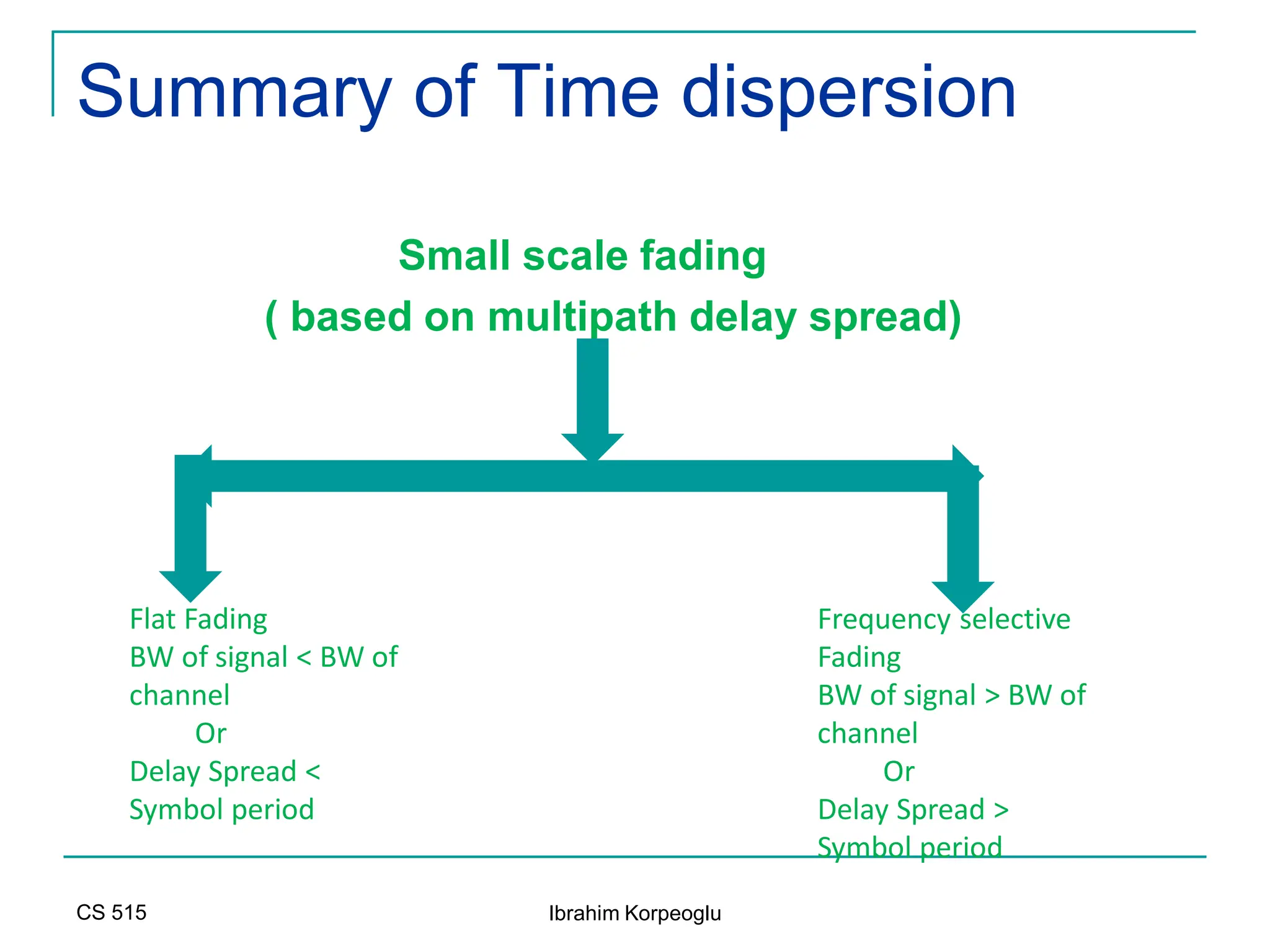
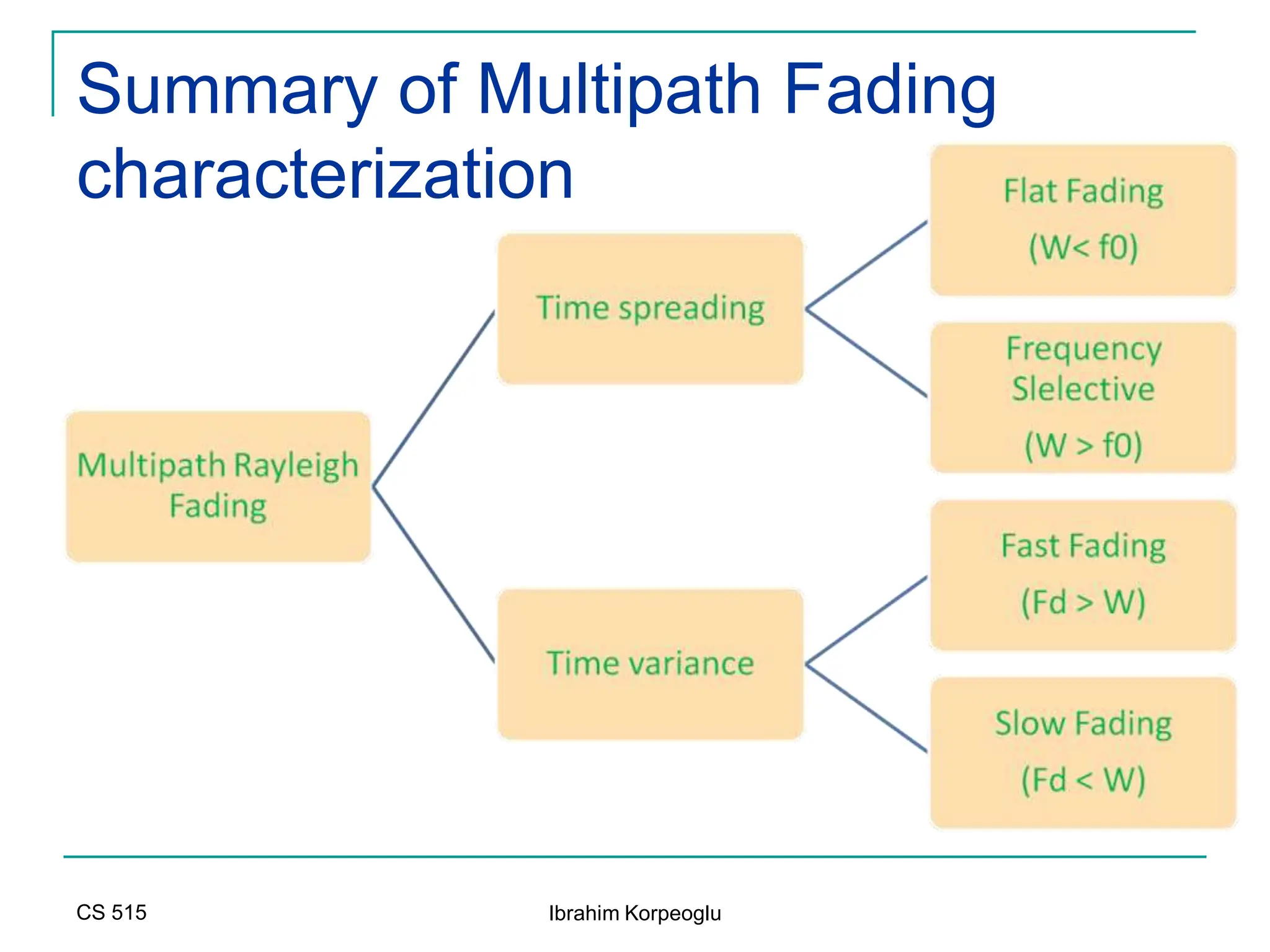
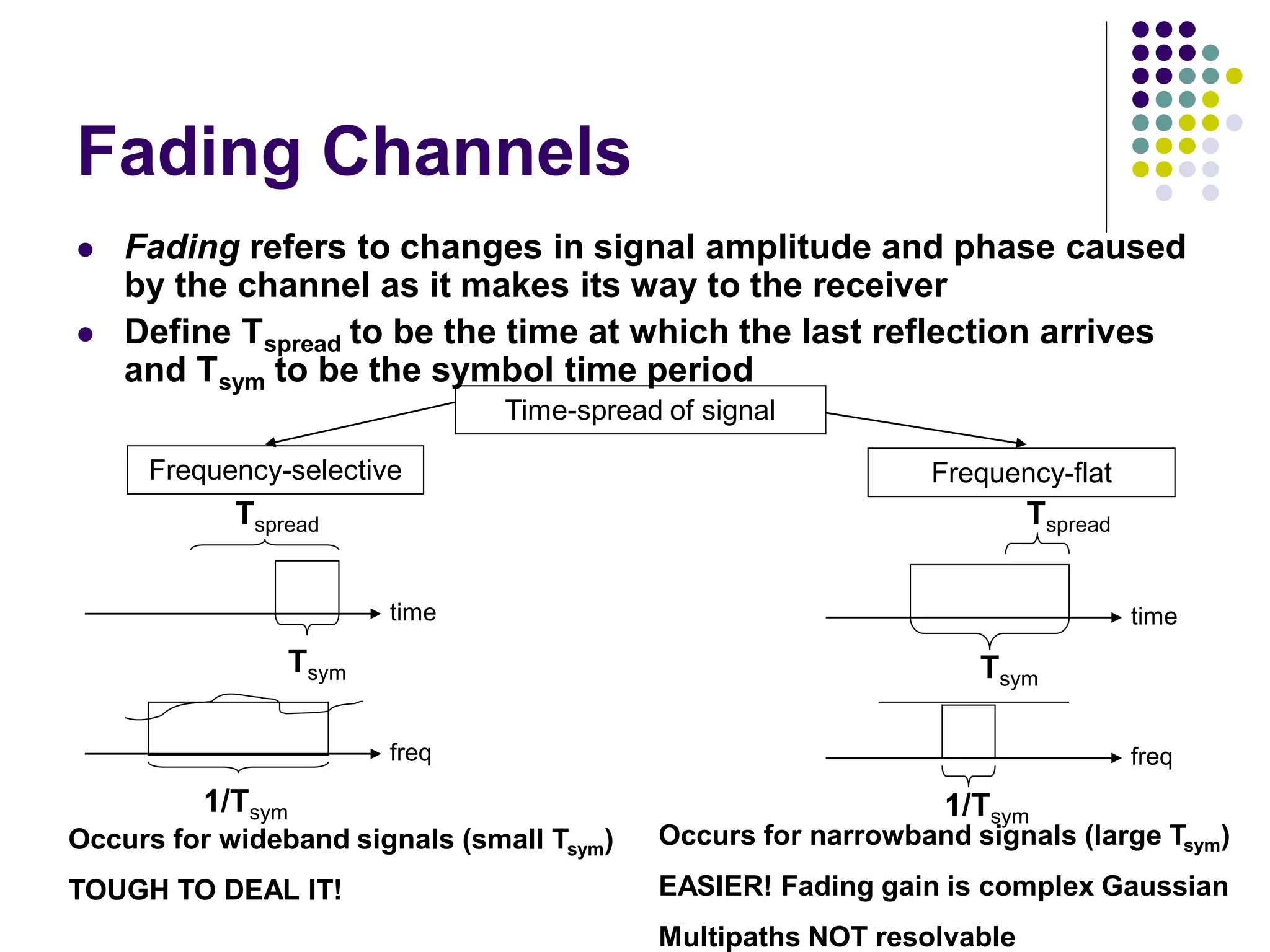
Summary of Time dispersion
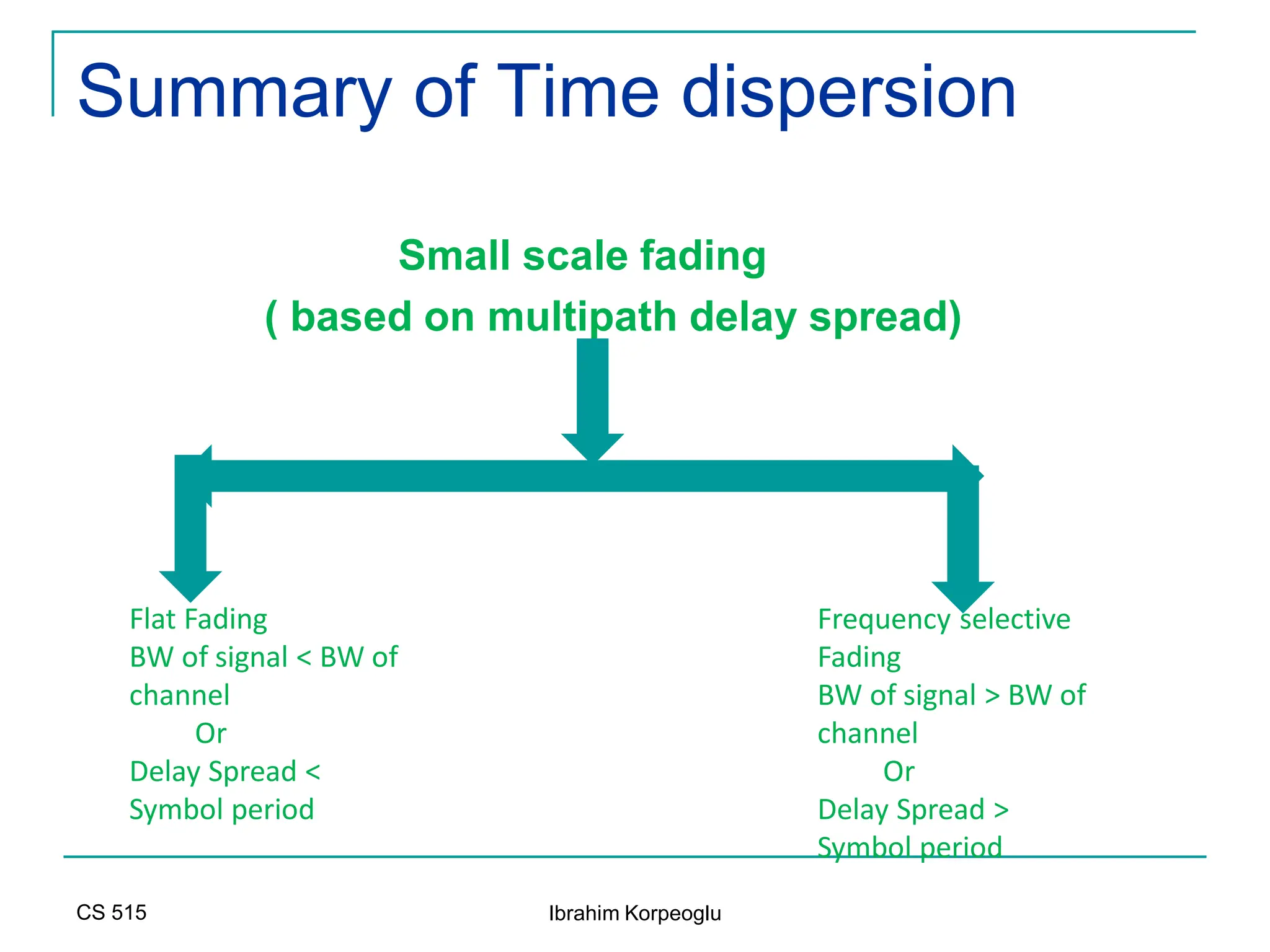
Small scale fading
( based on multipath delay spread)
Flat Fading
BW of signal < BW of
channel
Or
Delay Spread <
Symbol period
Frequency selective
Fading
BW of signal > BW of
channel
Or
Delay Spread >
Symbol period
CS 515 Ibrahim Korpeoglu
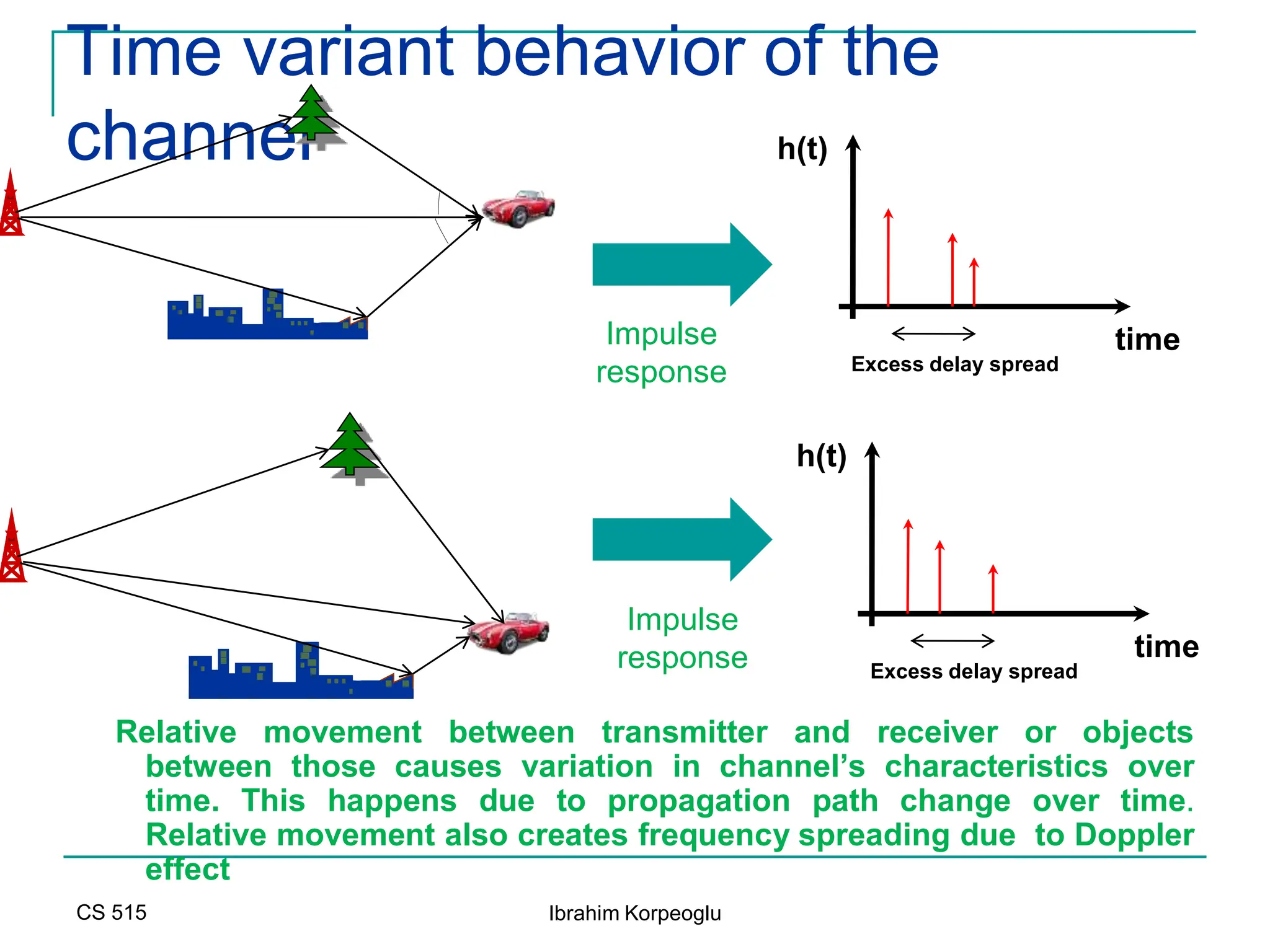
Time variant behavior of the
channel
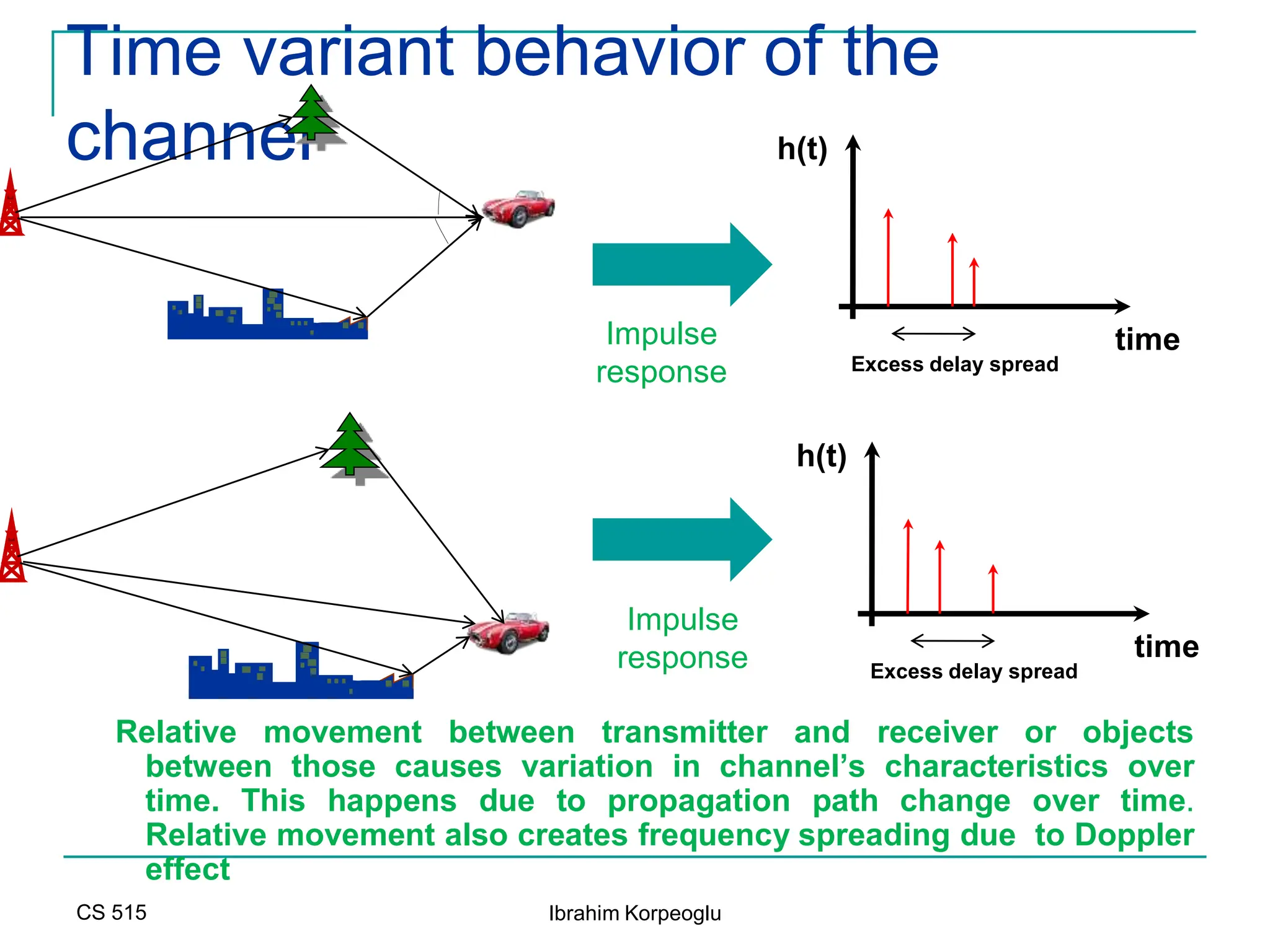
Relative movement between transmitter and receiver or objects
between those causes variation in channel’s characteristics over
time. This happens due to propagation path change over time.
Relative movement also creates frequency spreading due to Doppler
effect
time
h(t)
Excess delay spread
time
h(t)
Excess delay spread
Impulse
response
Impulse
response
CS 515 Ibrahim Korpeoglu
Time Variance
 Variance in channel conditions over time is an
important factor when designing a mobile
communication system.
 If fast variations happen, it can lead to severe
pulse distortion and loss of SNR subsequently
causing irreducible BER.
CS 515 Ibrahim Korpeoglu
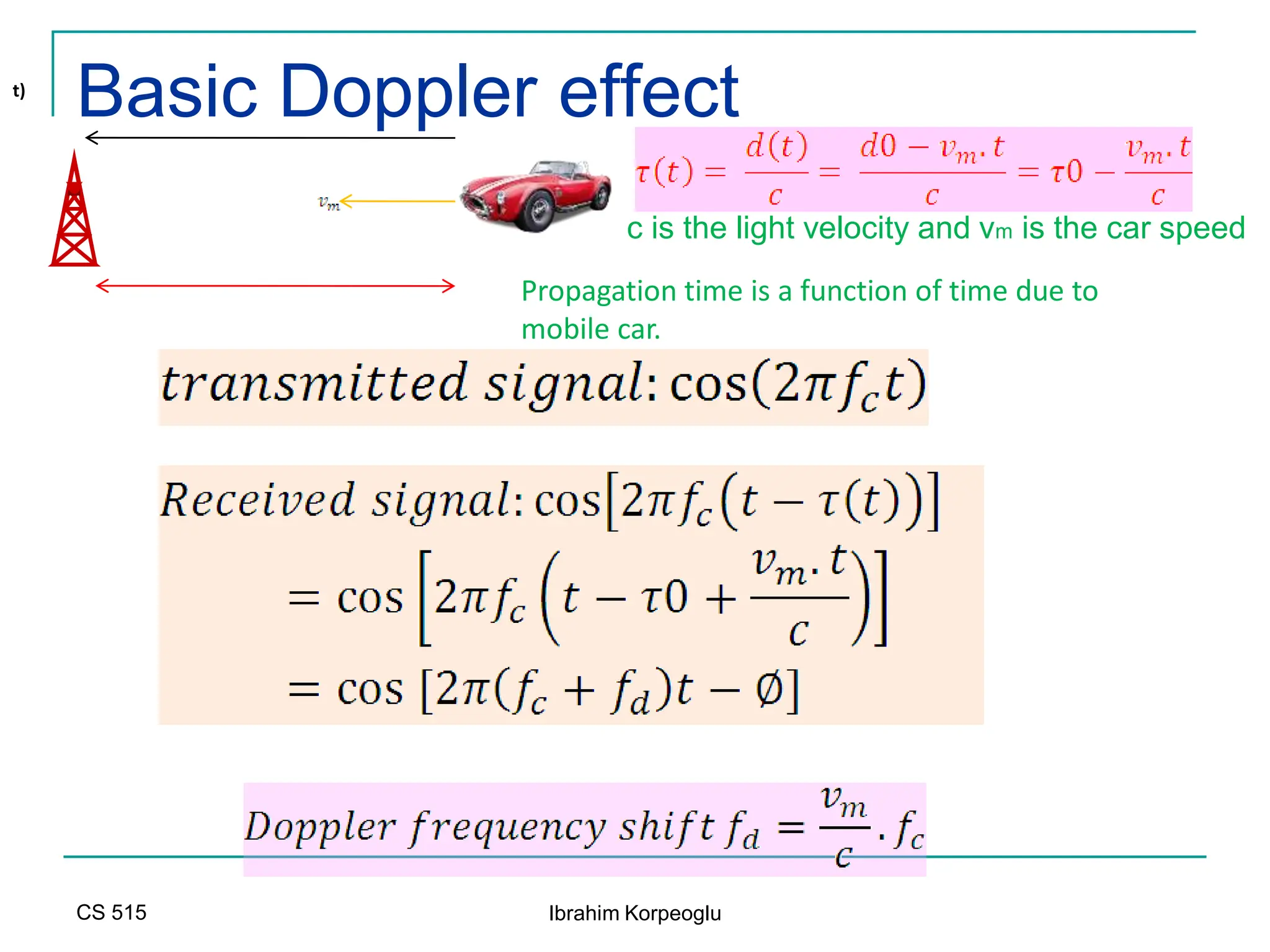
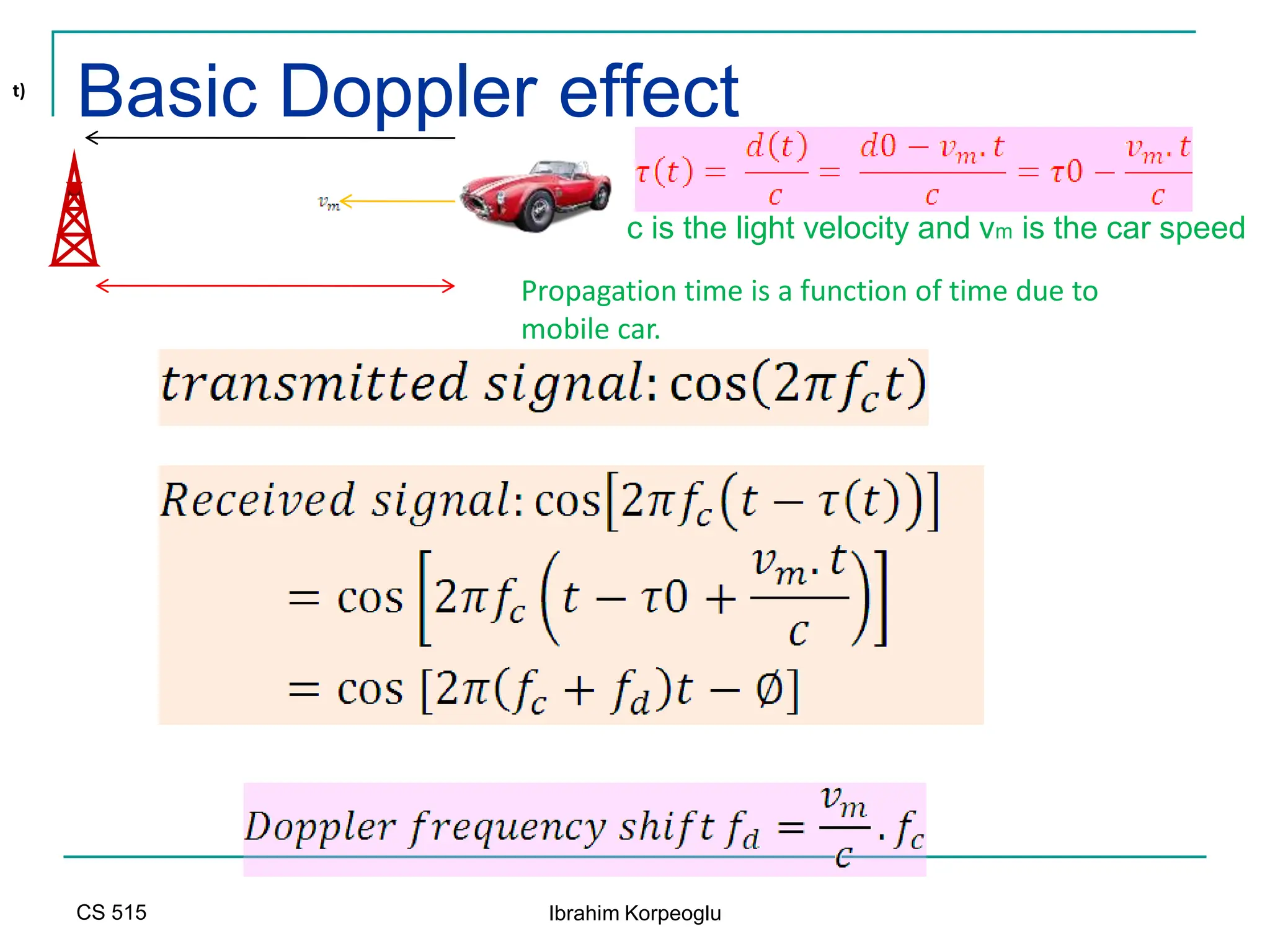
Basic Doppler effect
t)
Propagation time is a function of time due to
mobile car.
c is the light velocity and vm is the car speed
CS 515 Ibrahim Korpeoglu
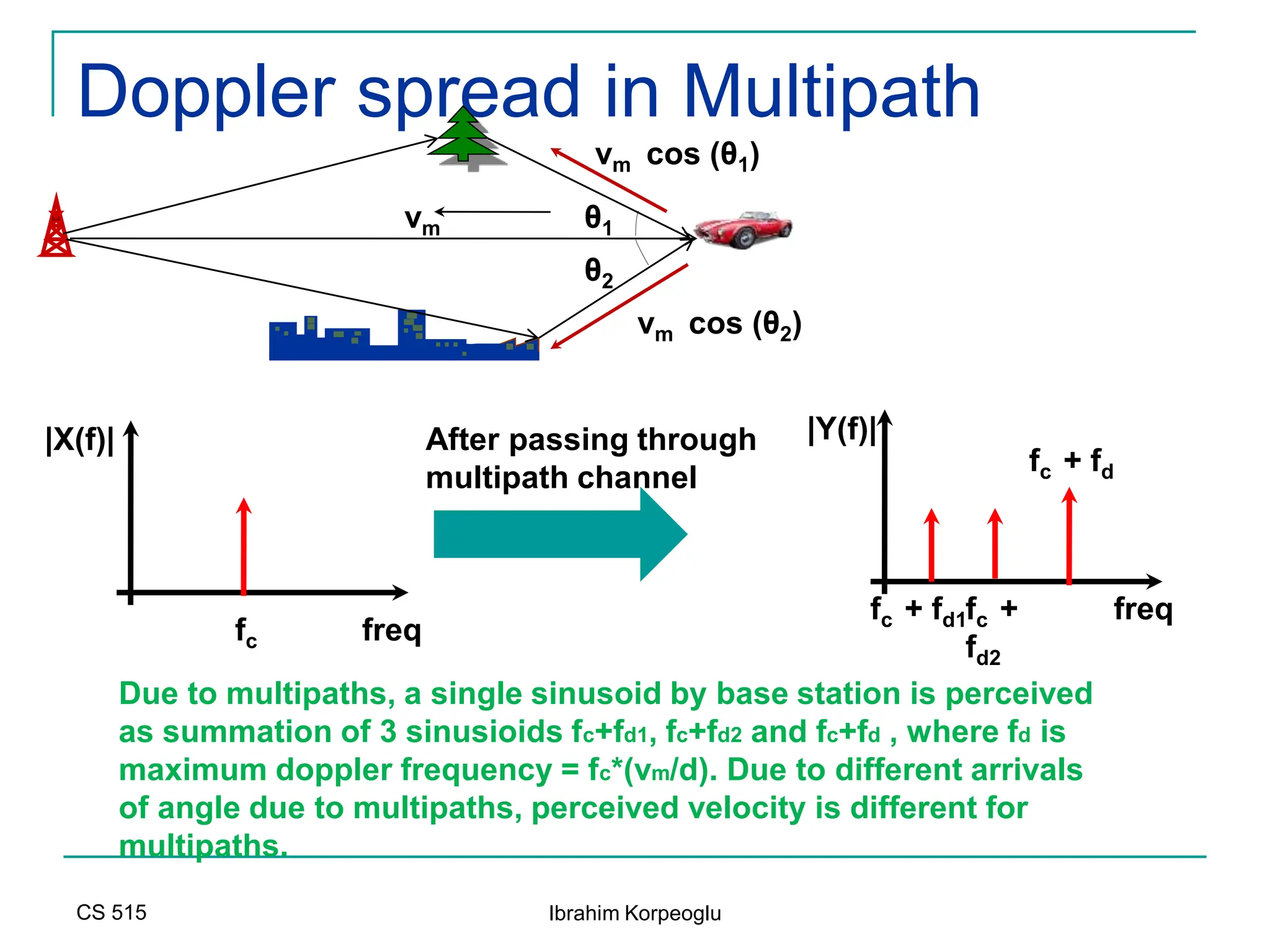
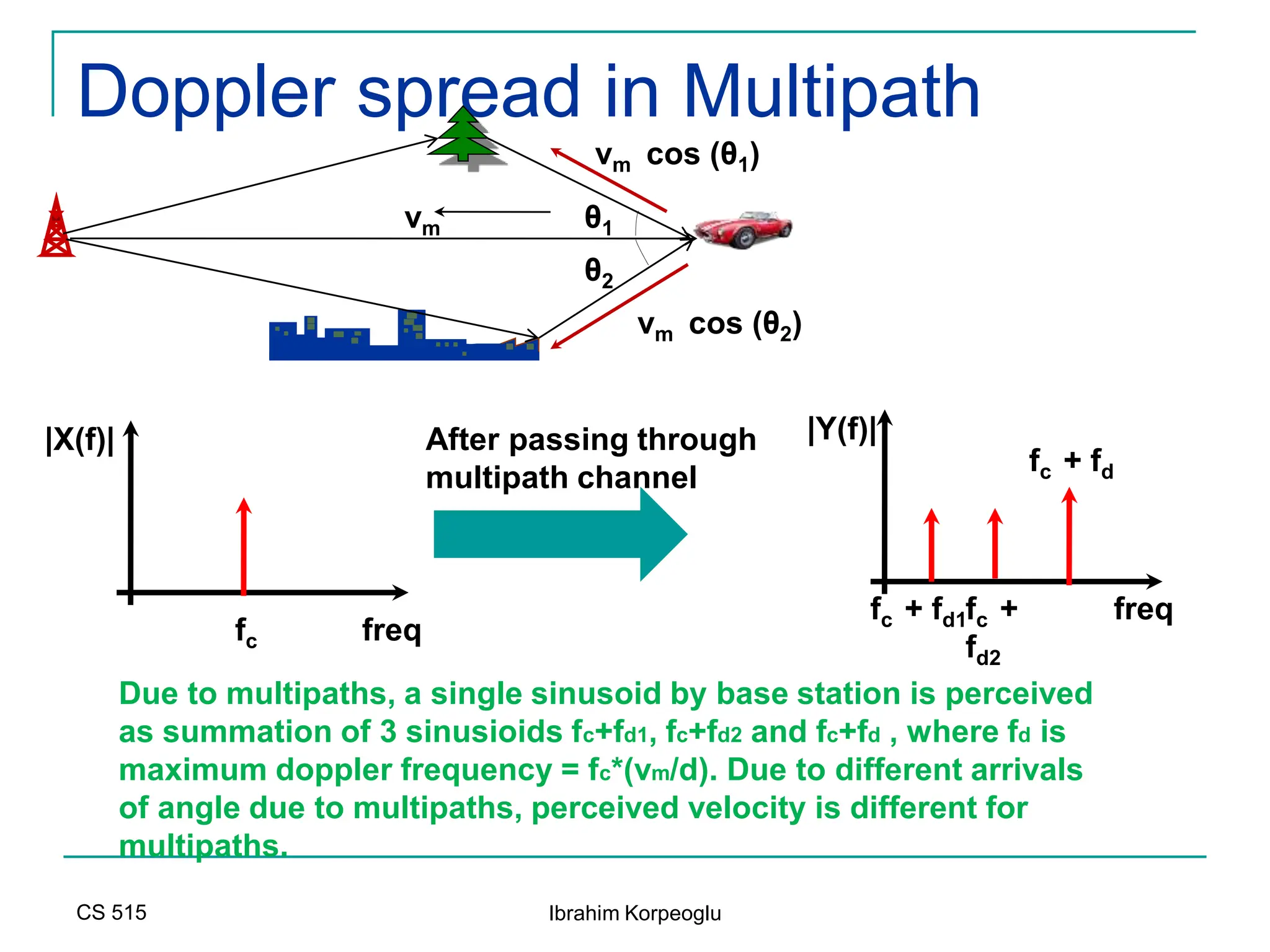
Doppler spread in Multipath
vm
vm cos (θ1)
vm cos (θ2)
θ1
θ2
freq
|X(f)|
fc
fc + fd1fc +
fd2
fc + fd
|Y(f)|
freq
Due to multipaths, a single sinusoid by base station is perceived
as summation of 3 sinusioids fc+fd1, fc+fd2 and fc+fd , where fd is
maximum doppler frequency = fc*(vm/d). Due to different arrivals
of angle due to multipaths, perceived velocity is different for
multipaths.
After passing through
multipath channel
CS 515 Ibrahim Korpeoglu
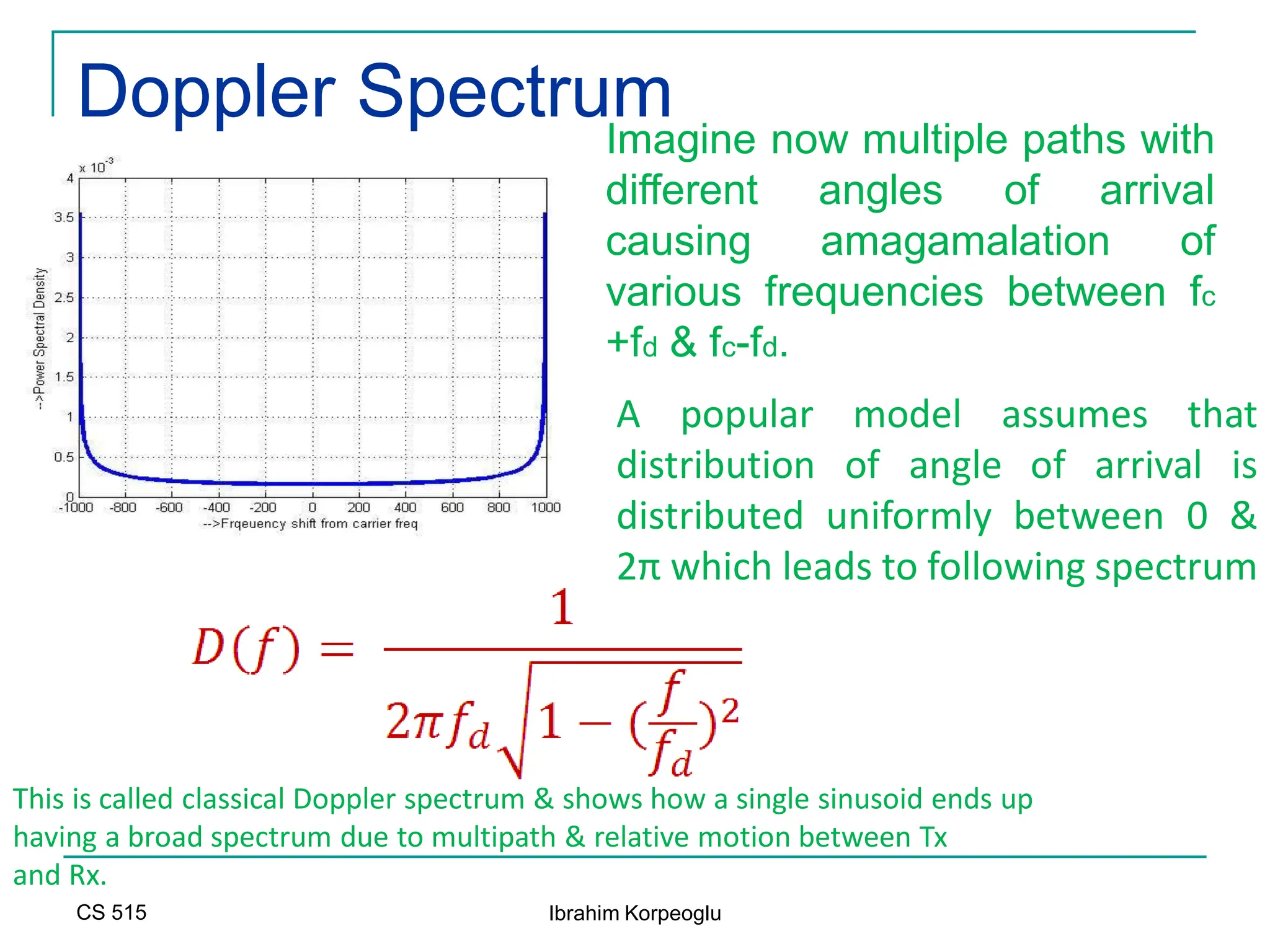
Doppler Spectrum
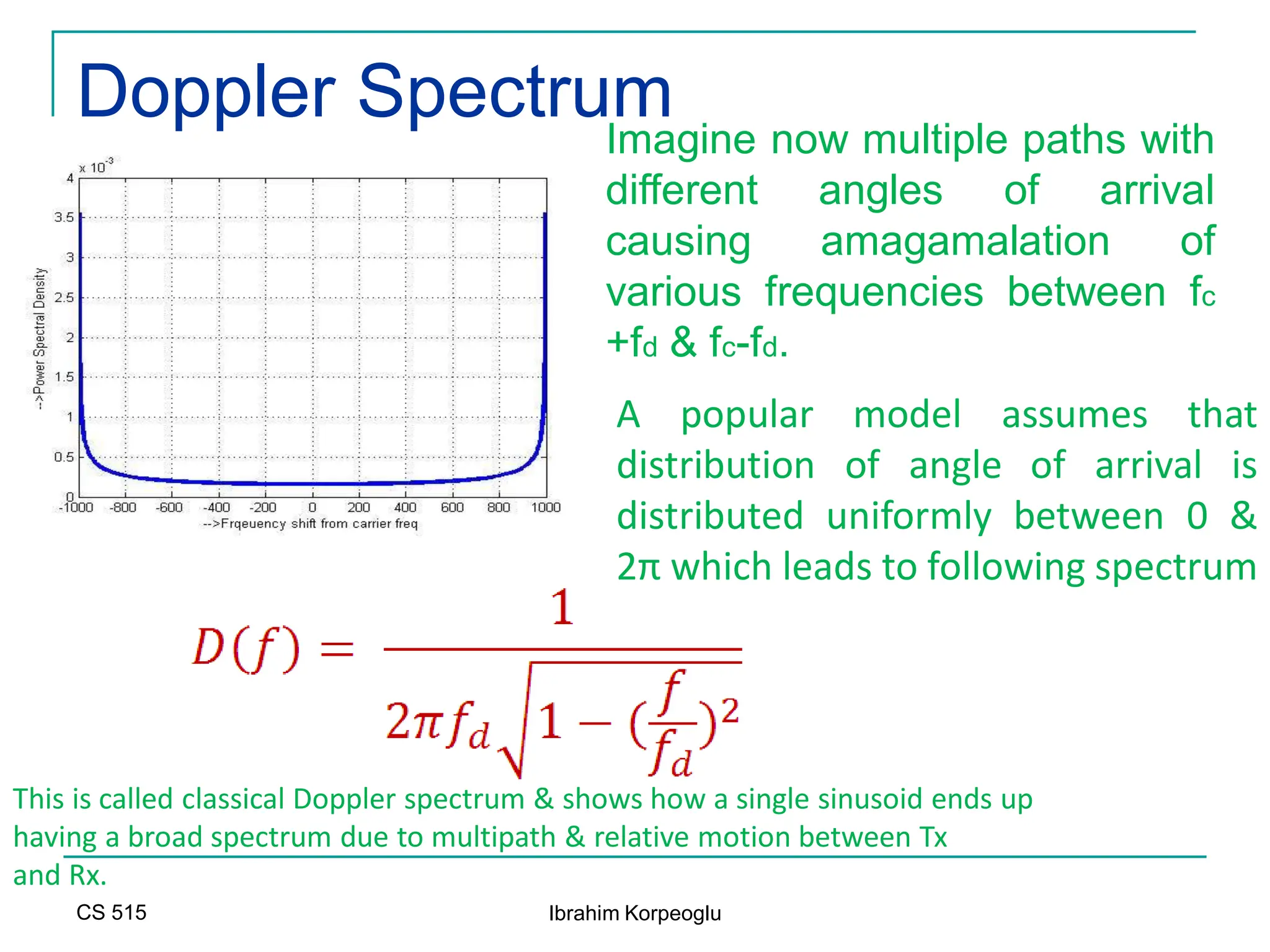
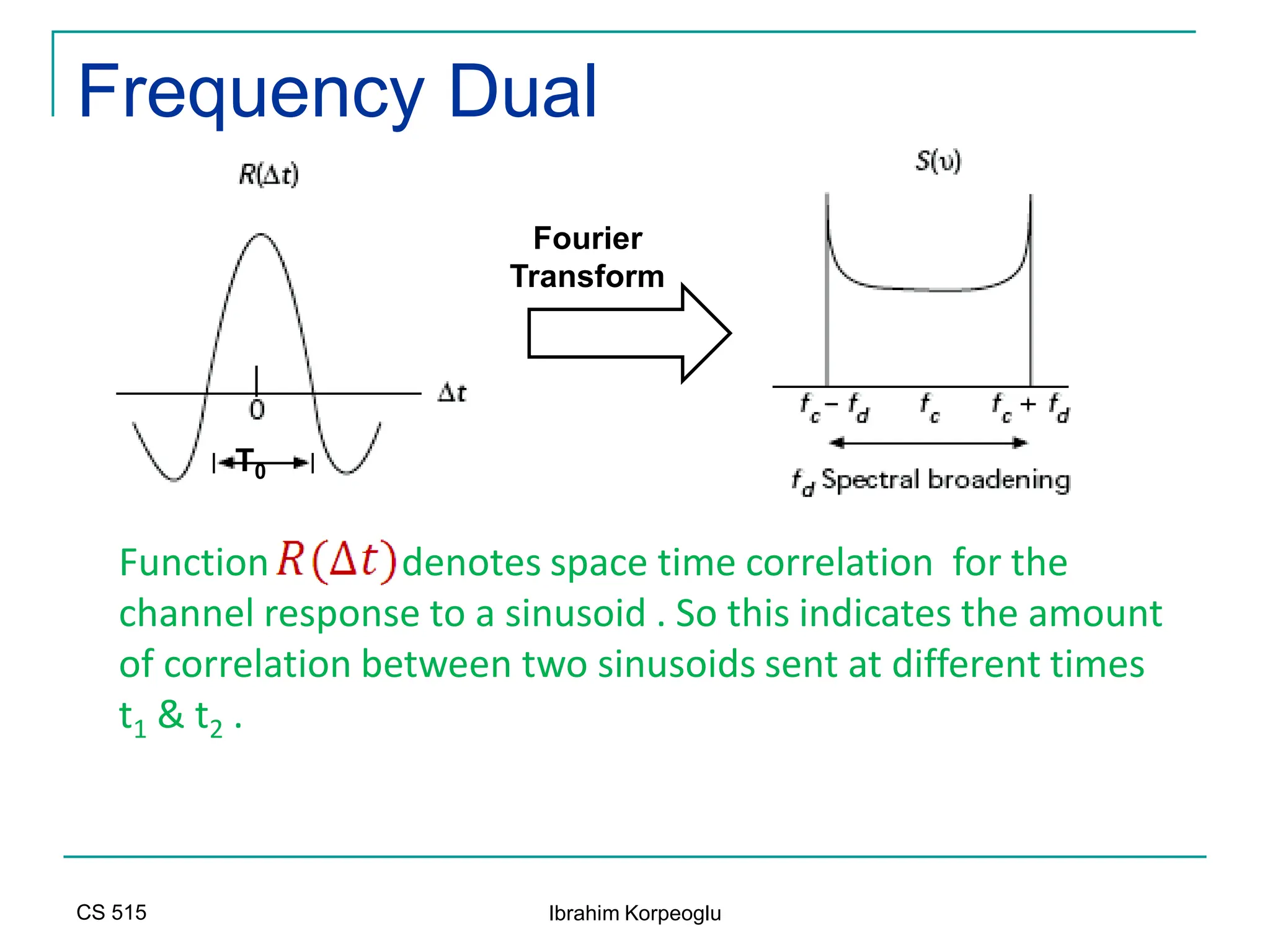
This is called classical Doppler spectrum & shows how a single sinusoid ends up
having a broad spectrum due to multipath & relative motion between Tx
and Rx.
A popular model assumes that
distribution of angle of arrival is
distributed uniformly between 0 &
2π which leads to following spectrum
Imagine now multiple paths with
different angles of arrival
causing amagamalation of
various frequencies between fc
+fd & fc-fd.
CS 515 Ibrahim Korpeoglu
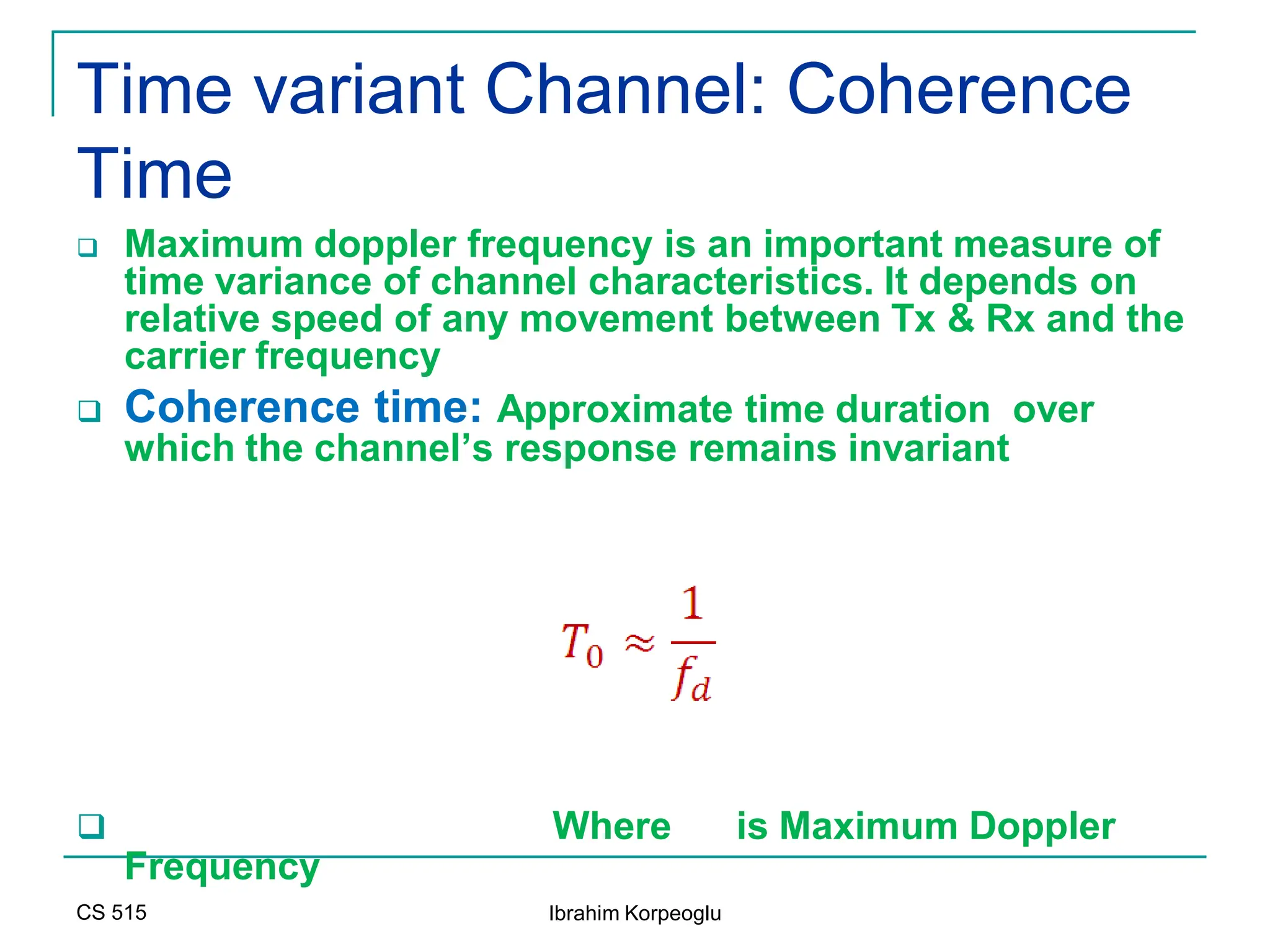
Time variant Channel: Coherence
Time
 Maximum doppler frequency is an important measure of
time variance of channel characteristics. It depends on
relative speed of any movement between Tx & Rx and the
carrier frequency
 Coherence time: Approximate time duration over
which the channel’s response remains invariant
 Where is Maximum Doppler
Frequency
CS 515 Ibrahim Korpeoglu
Frequency Dual
Fourier
Transform
T0
Function denotes space time correlation for the
channel response to a sinusoid . So this indicates the amount
of correlation between two sinusoids sent at different times
t1 & t2 .
CS 515 Ibrahim Korpeoglu
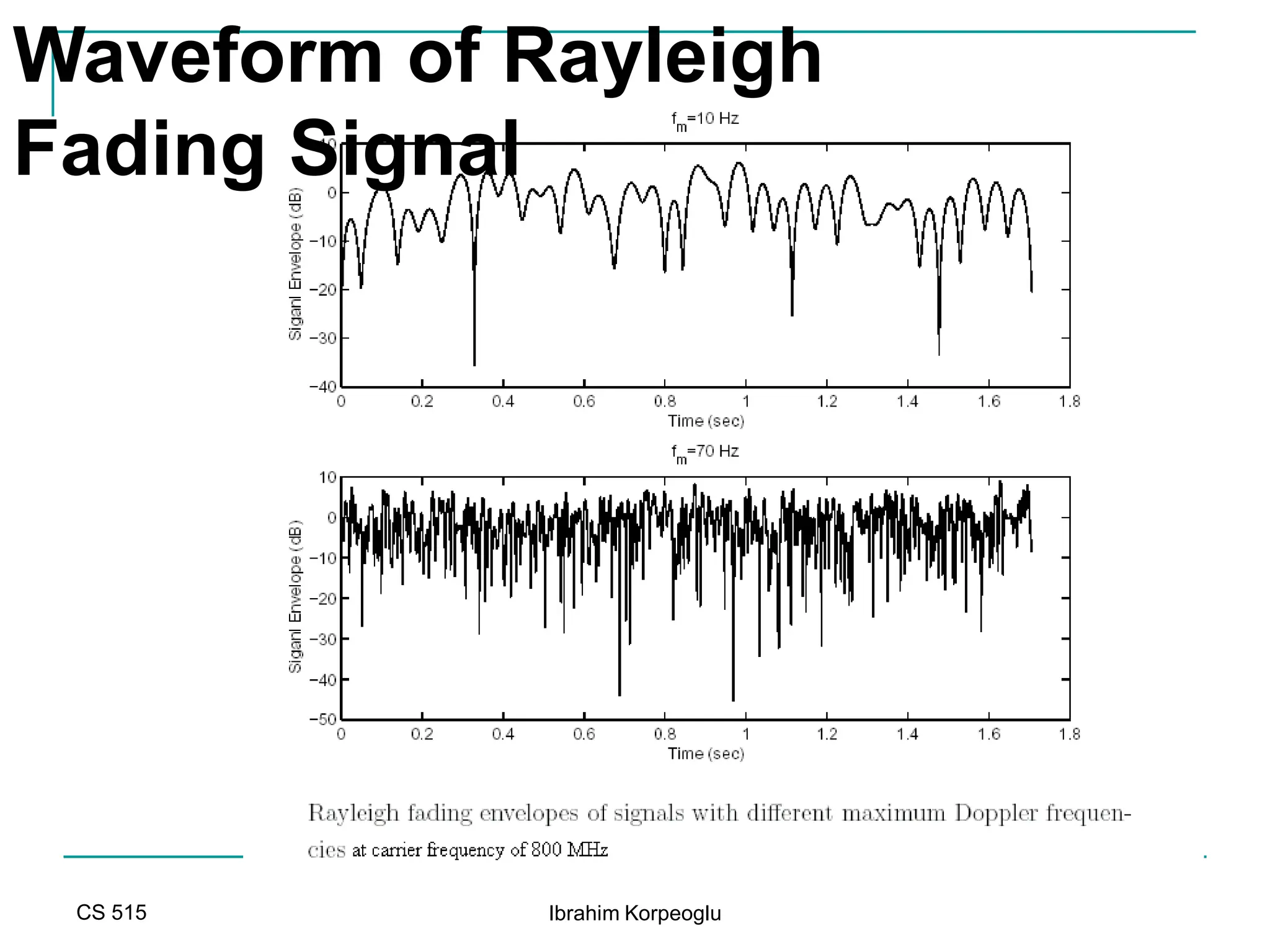
Waveform of Rayleigh
Fading Signal
CS 515 Ibrahim Korpeoglu
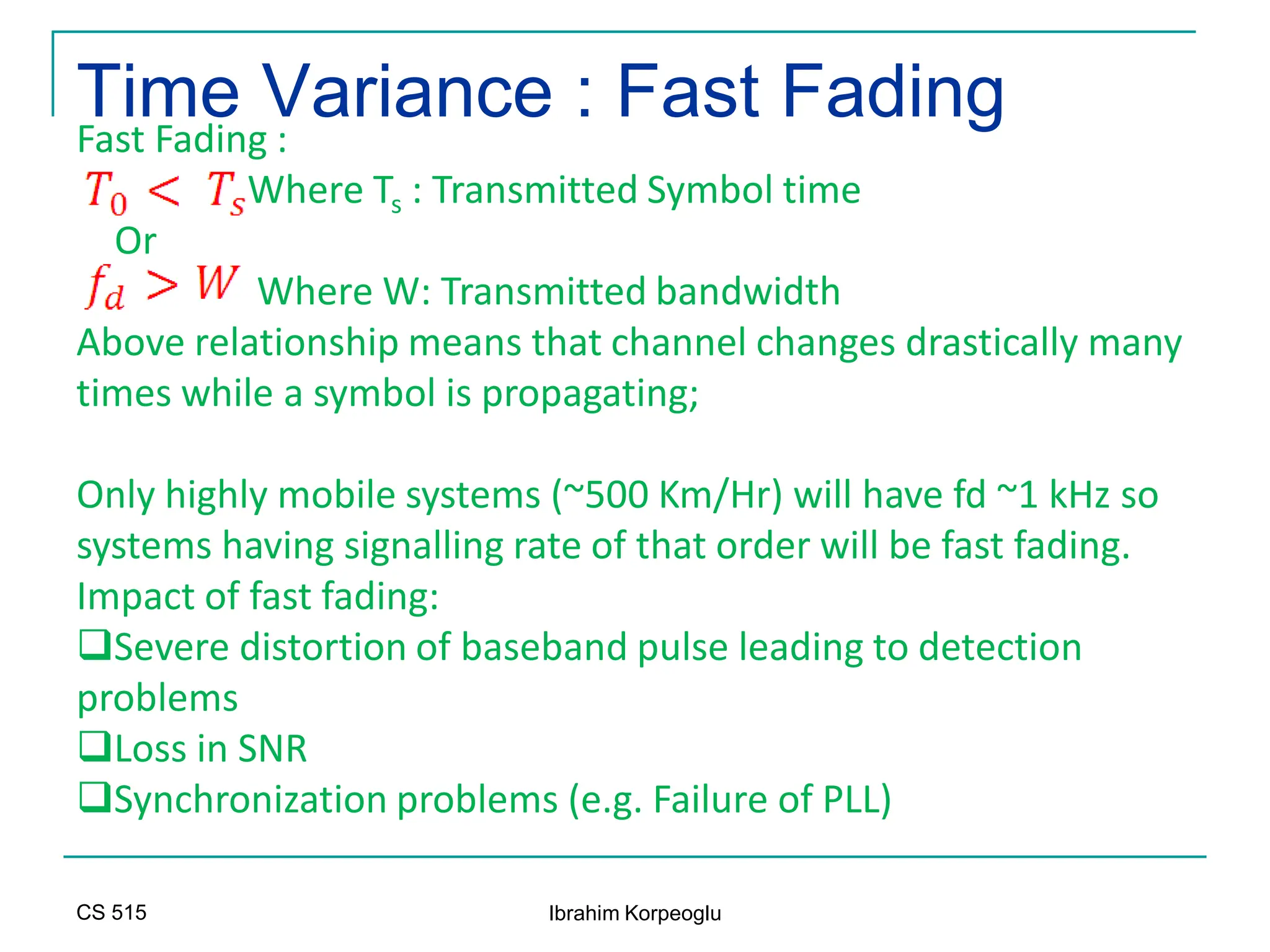
Time Variance : Fast Fading
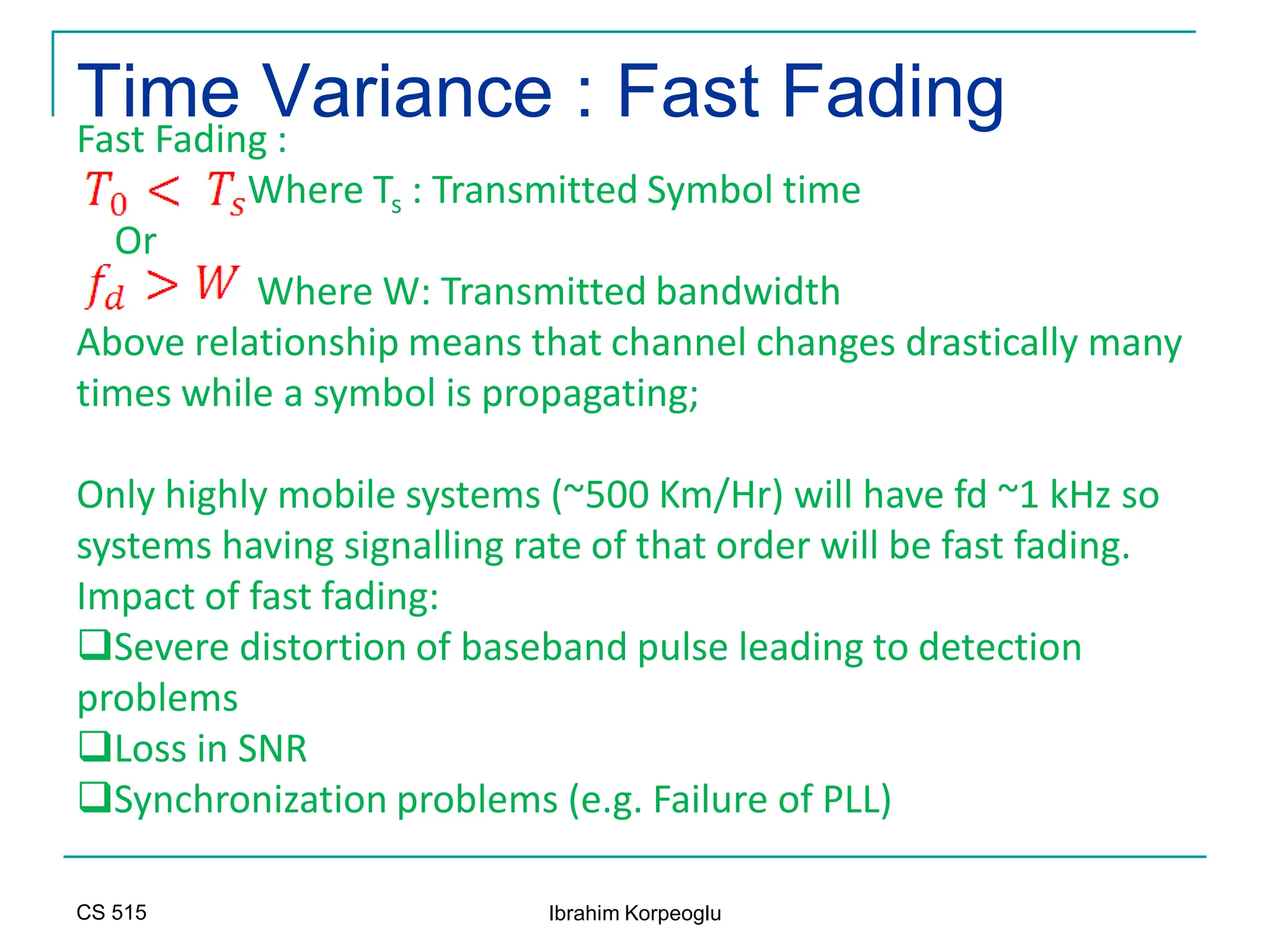
Fast Fading :
Where Ts : Transmitted Symbol time
Or
Where W: Transmitted bandwidth
Above relationship means that channel changes drastically many
times while a symbol is propagating;
Only highly mobile systems (~500 Km/Hr) will have fd ~1 kHz so
systems having signalling rate of that order will be fast fading.
Impact of fast fading:
Severe distortion of baseband pulse leading to detection
problems
Loss in SNR
Synchronization problems (e.g. Failure of PLL)
CS 515 Ibrahim Korpeoglu
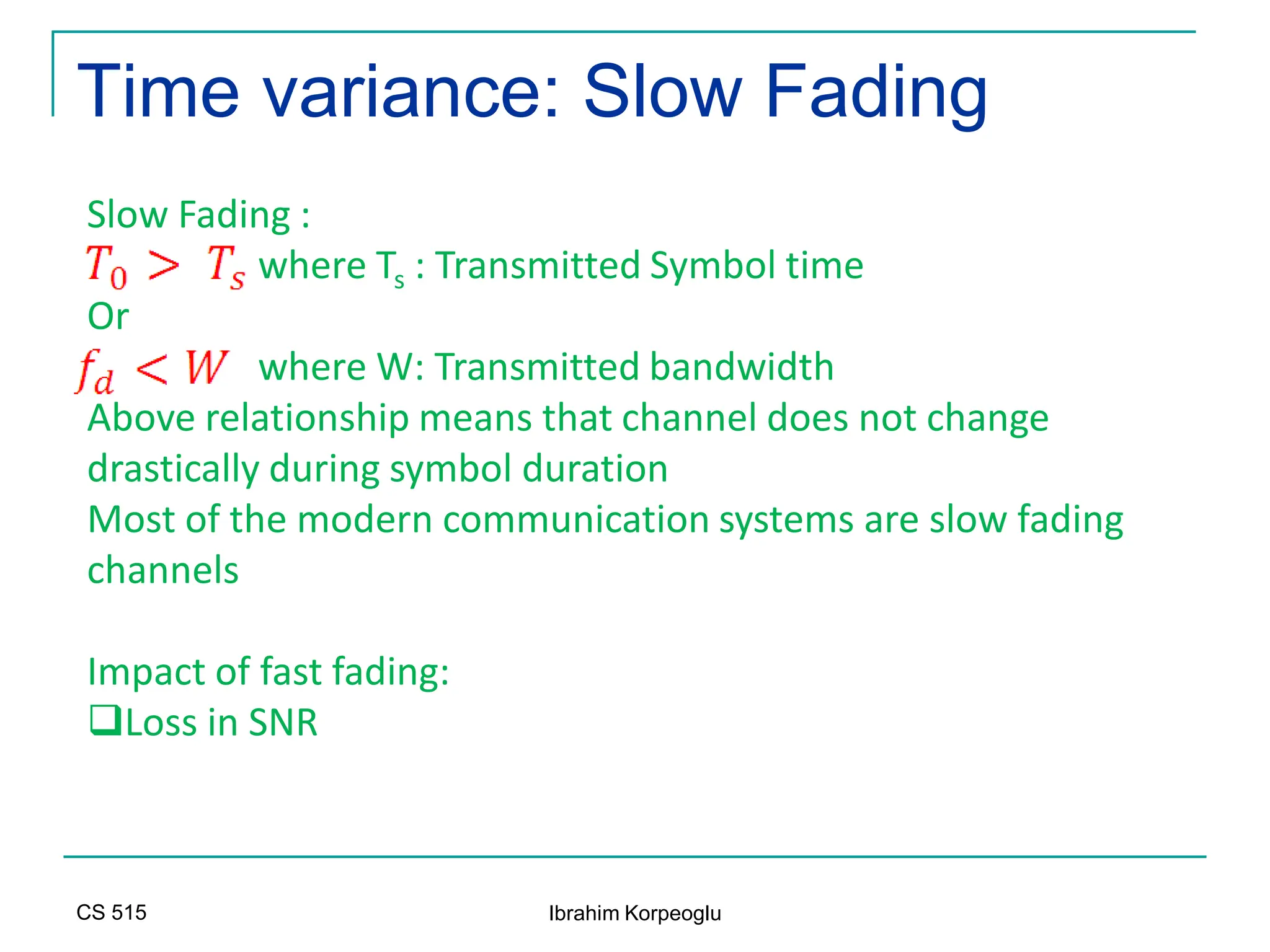
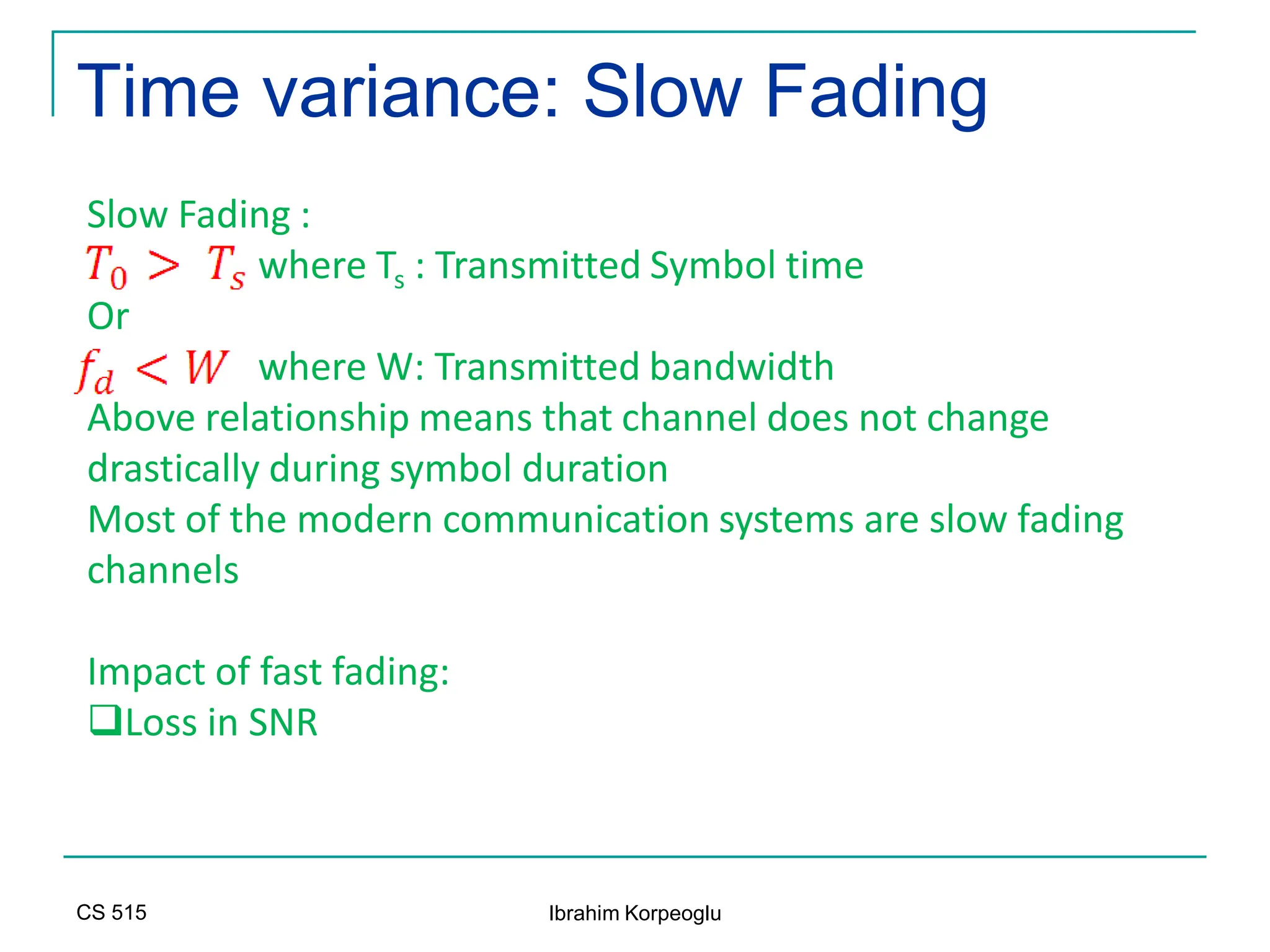
Time variance: Slow Fading
Slow Fading :
where Ts : Transmitted Symbol time
Or
where W: Transmitted bandwidth
Above relationship means that channel does not change
drastically during symbol duration
Most of the modern communication systems are slow fading
channels
Impact of fast fading:
Loss in SNR
CS 515 Ibrahim Korpeoglu
Summary of Overall Fading
CS 515 Ibrahim Korpeoglu
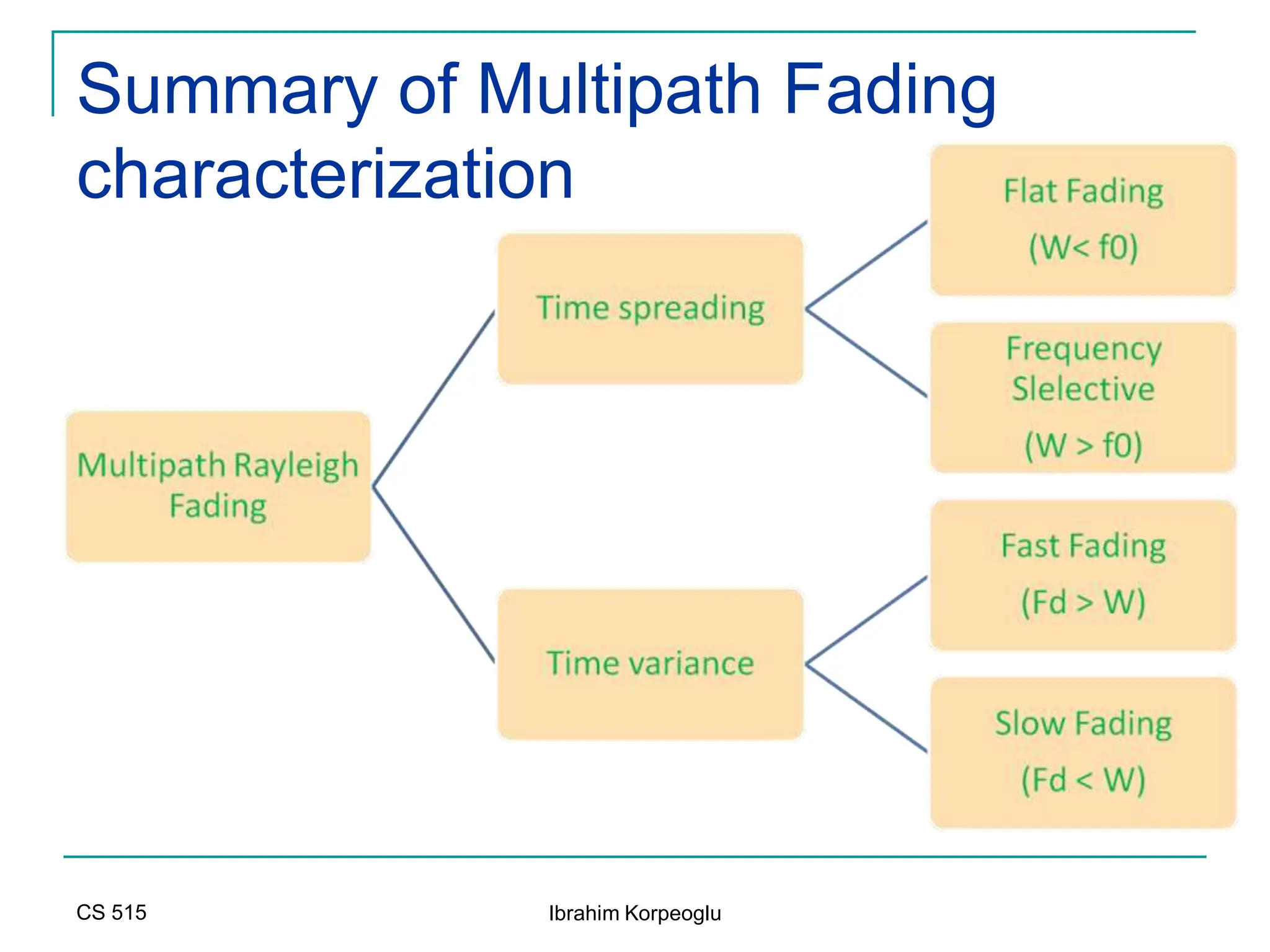
Summary of Multipath Fading
characterization
Click to add text
Multiple Access Techniques for
Wireless Communication
FDMA
TDMA
SDMA
PDMA
Introduction
• many users at same time
• share a finite amount of radio spectrum
• high performance
• duplexing generally required
• frequency domain
• time domain
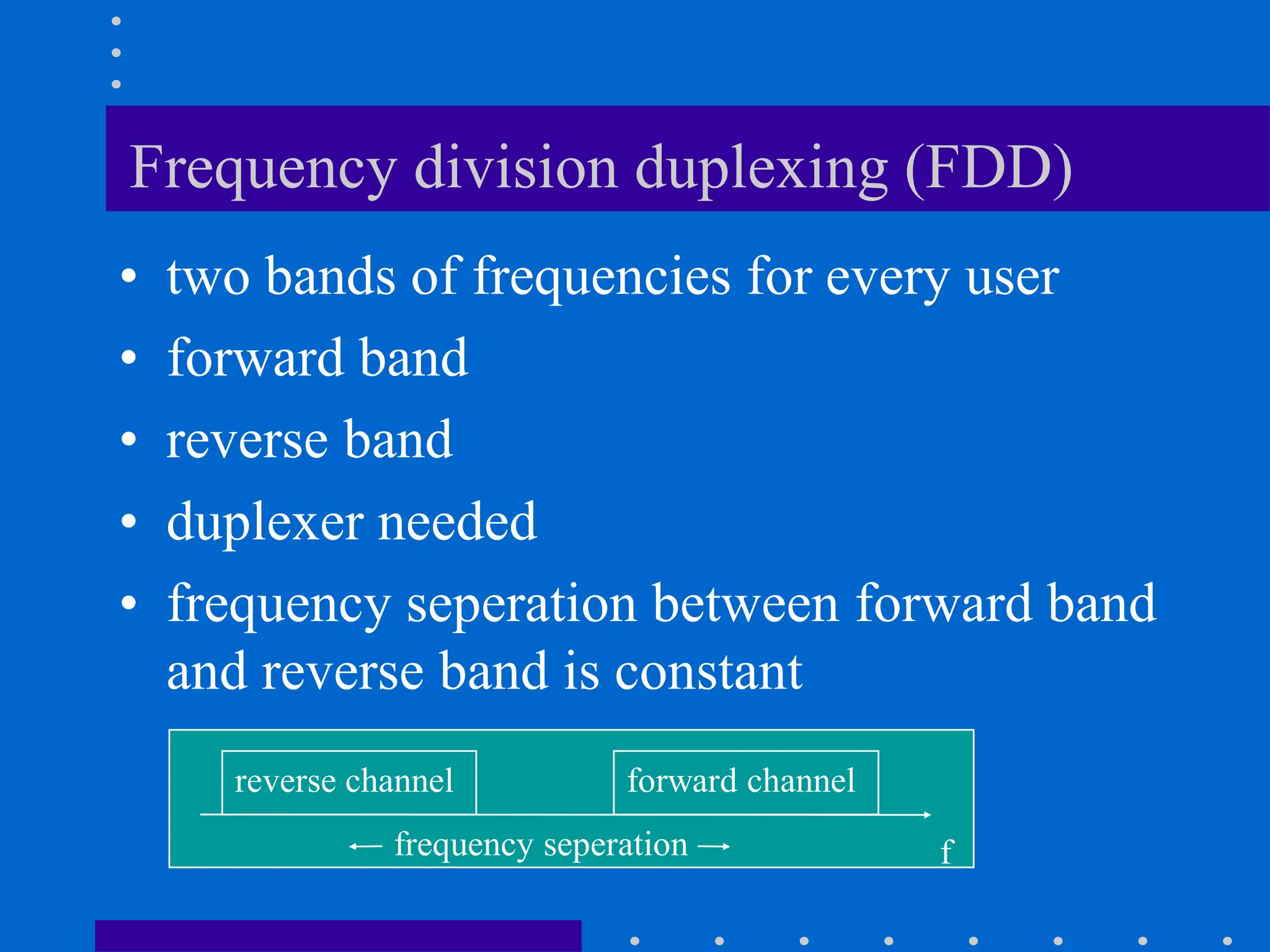
Frequency division duplexing (FDD)
• two bands of frequencies for every user
• forward band
• reverse band
• duplexer needed
• frequency seperation between forward band
and reverse band is constant
frequency seperation
reverse channel forward channel
f
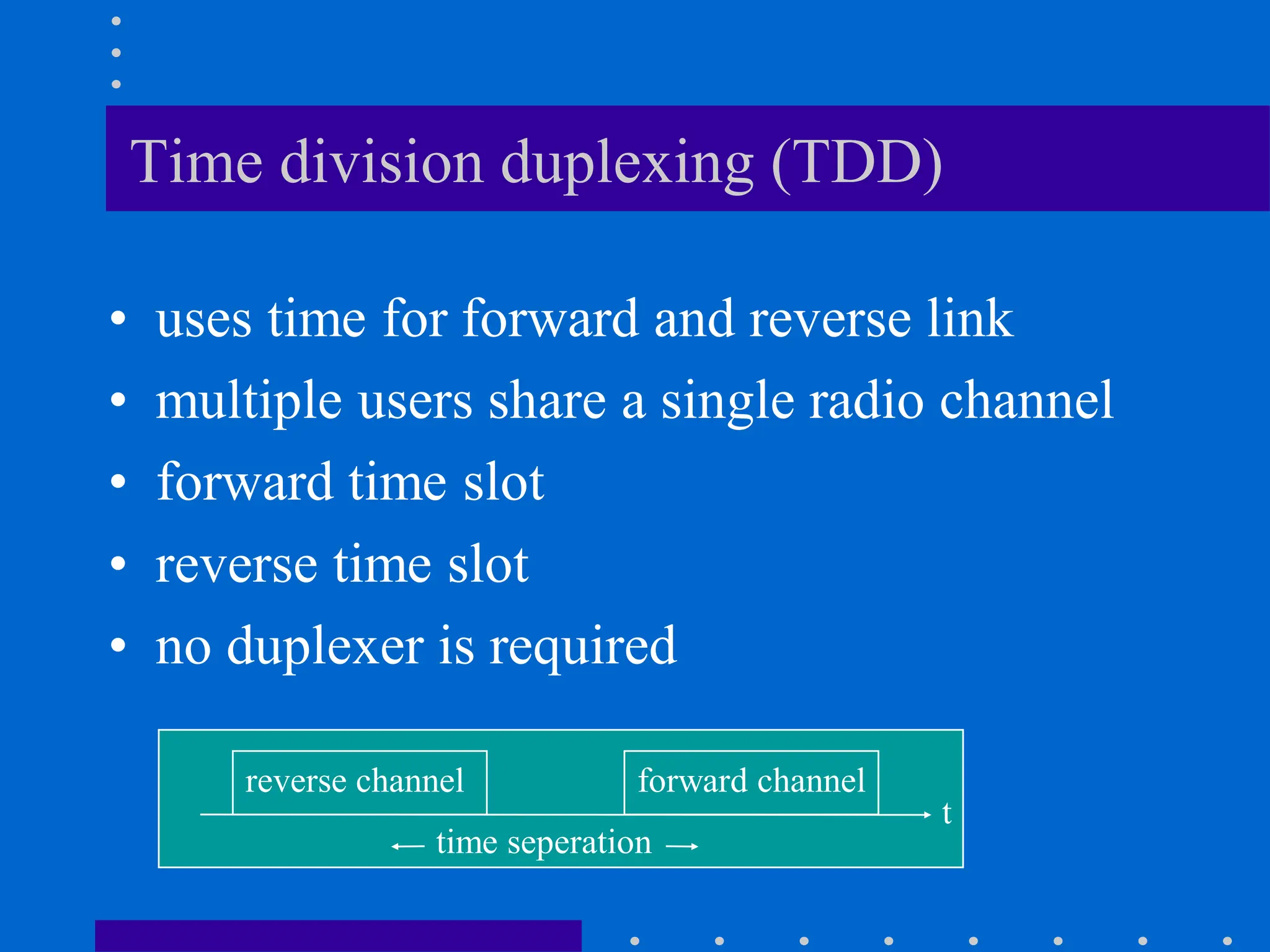
Time division duplexing (TDD)
• uses time for forward and reverse link
• multiple users share a single radio channel
• forward time slot
• reverse time slot
• no duplexer is required
time seperation
t
forward channel
reverse channel
Multiple Access Techniques
• Frequency division multiple access (FDMA)
• Time division multiple access (TDMA)
• Code division multiple access (CDMA)
• Space division multiple access (SDMA)
• grouped as:
• narrowband systems
• wideband systems
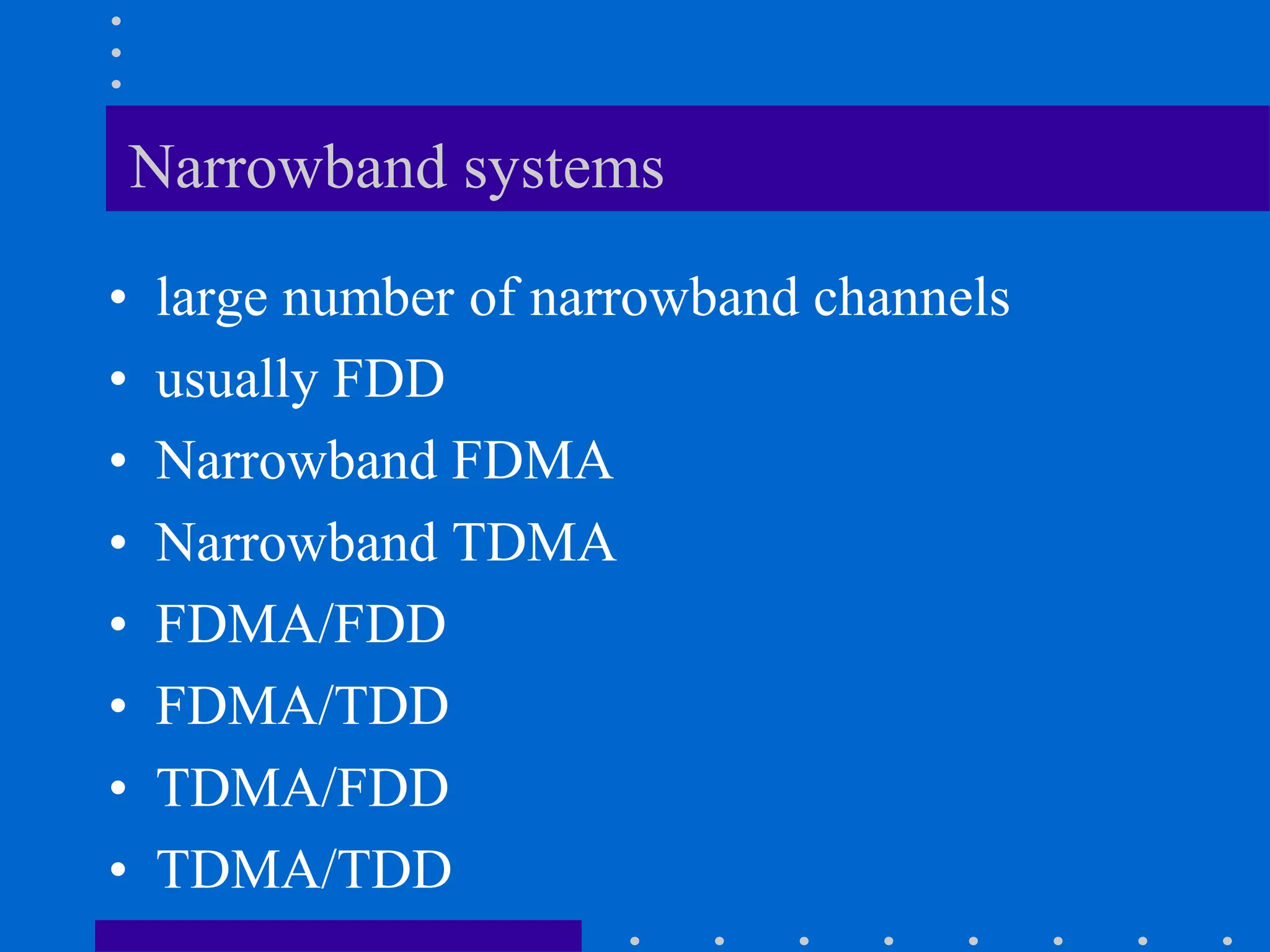
Narrowband systems
• large number of narrowband channels
• usually FDD
• Narrowband FDMA
• Narrowband TDMA
• FDMA/FDD
• FDMA/TDD
• TDMA/FDD
• TDMA/TDD
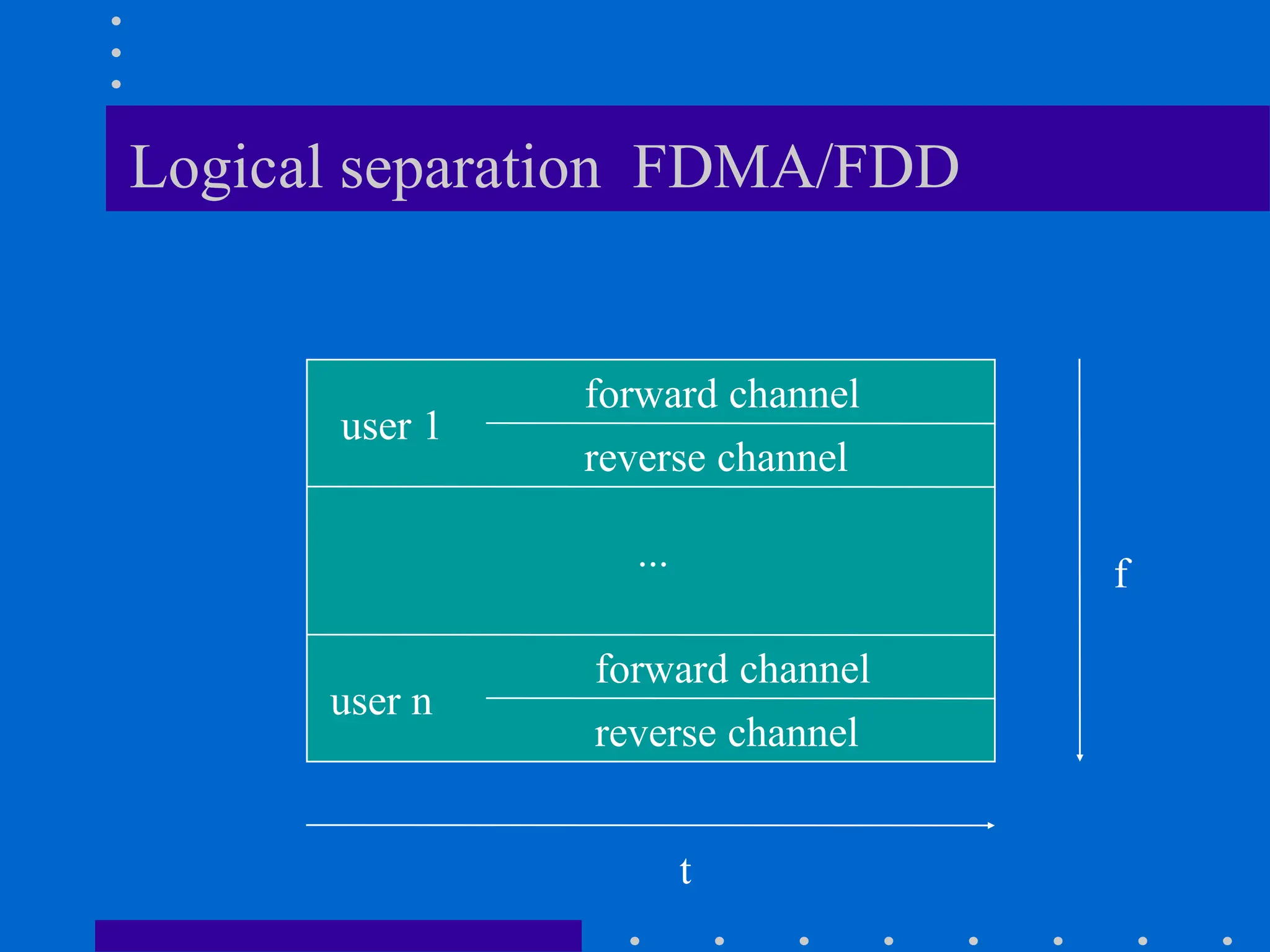
Logical separation FDMA/FDD
f
t
user 1
user n
forward channel
reverse channel
forward channel
reverse channel
...
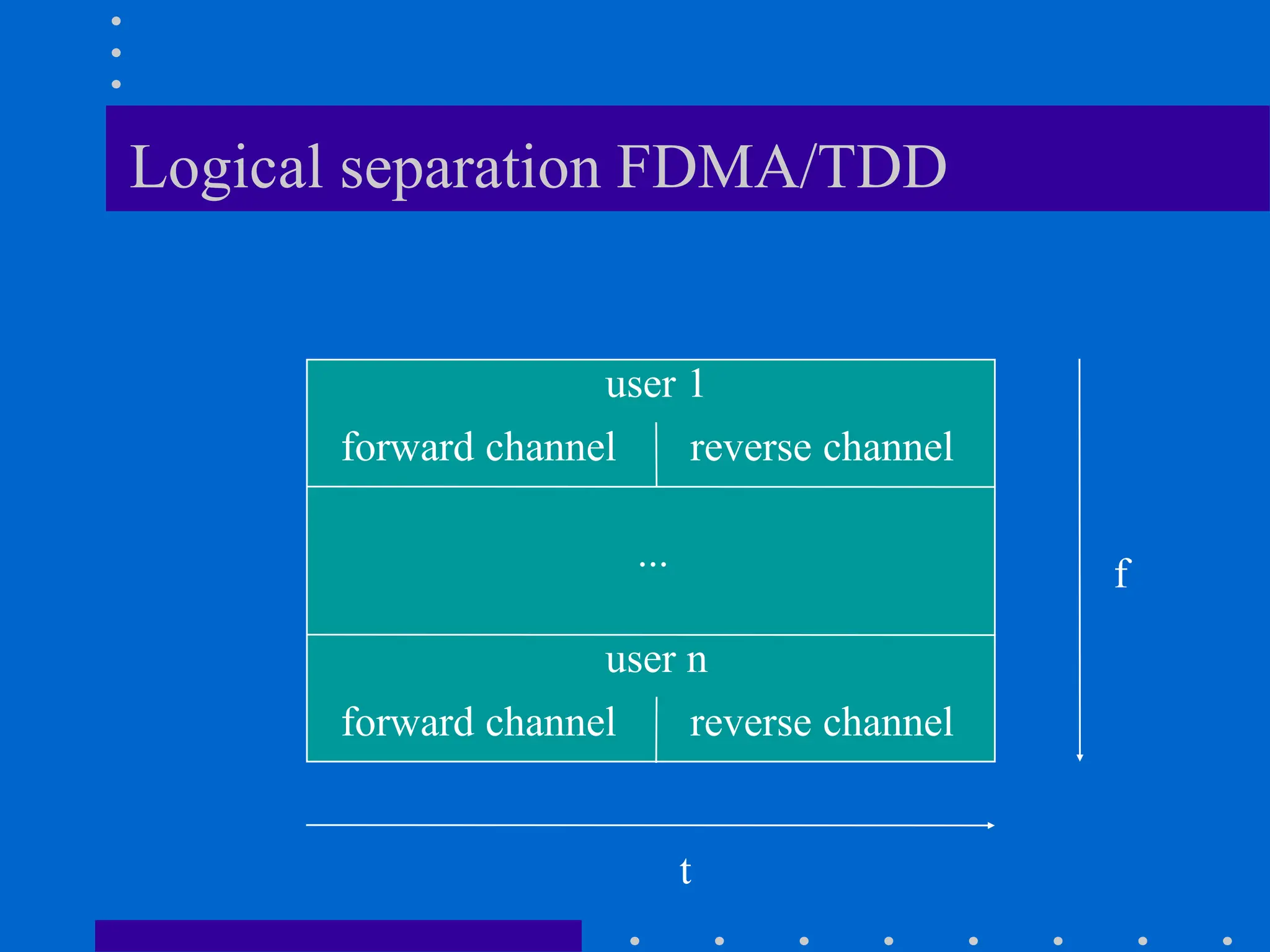
Logical separation FDMA/TDD
f
t
user 1
user n
forward channel reverse channel
...
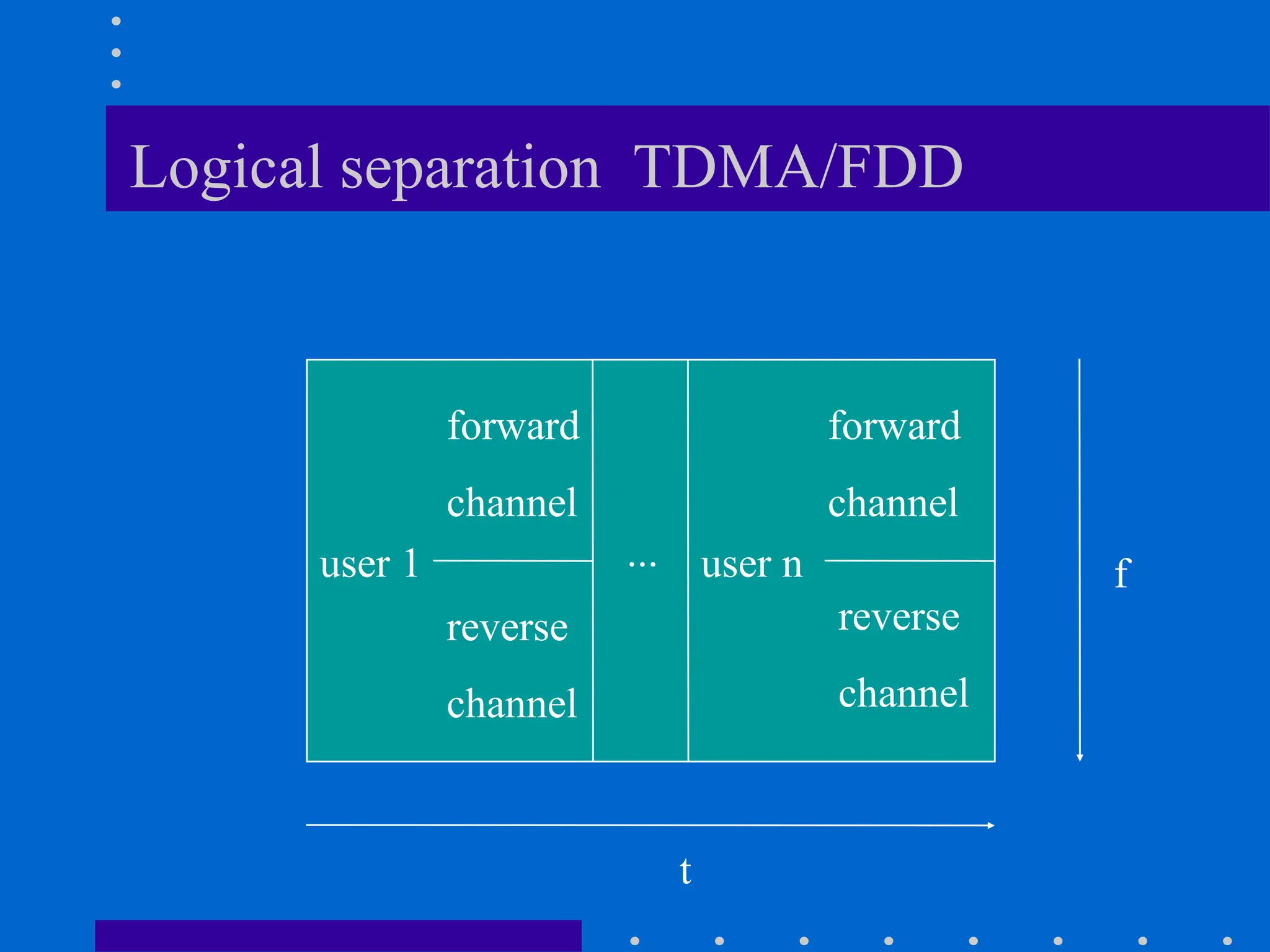
Logical separation TDMA/FDD
f
t
user 1 user n
forward
channel
reverse
channel
forward
channel
reverse
channel
...
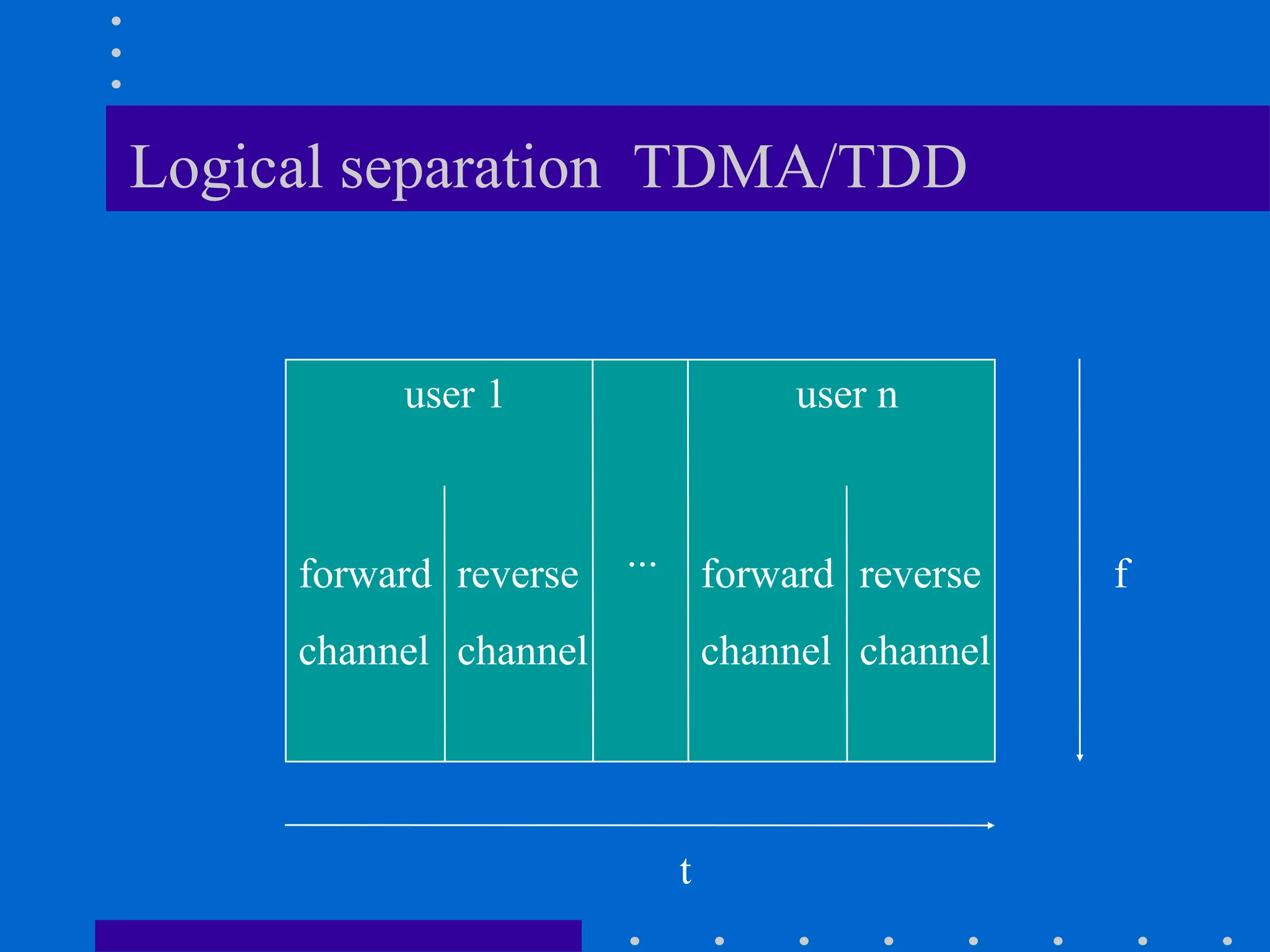
Logical separation TDMA/TDD
f
t
user 1 user n
forward
channel
reverse
channel
forward
channel
reverse
channel
...
Wideband systems
• large number of transmitters on one channel
• TDMA techniques
• CDMA techniques
• FDD or TDD multiplexing techniques
• TDMA/FDD
• TDMA/TDD
• CDMA/FDD
• CDMA/TDD
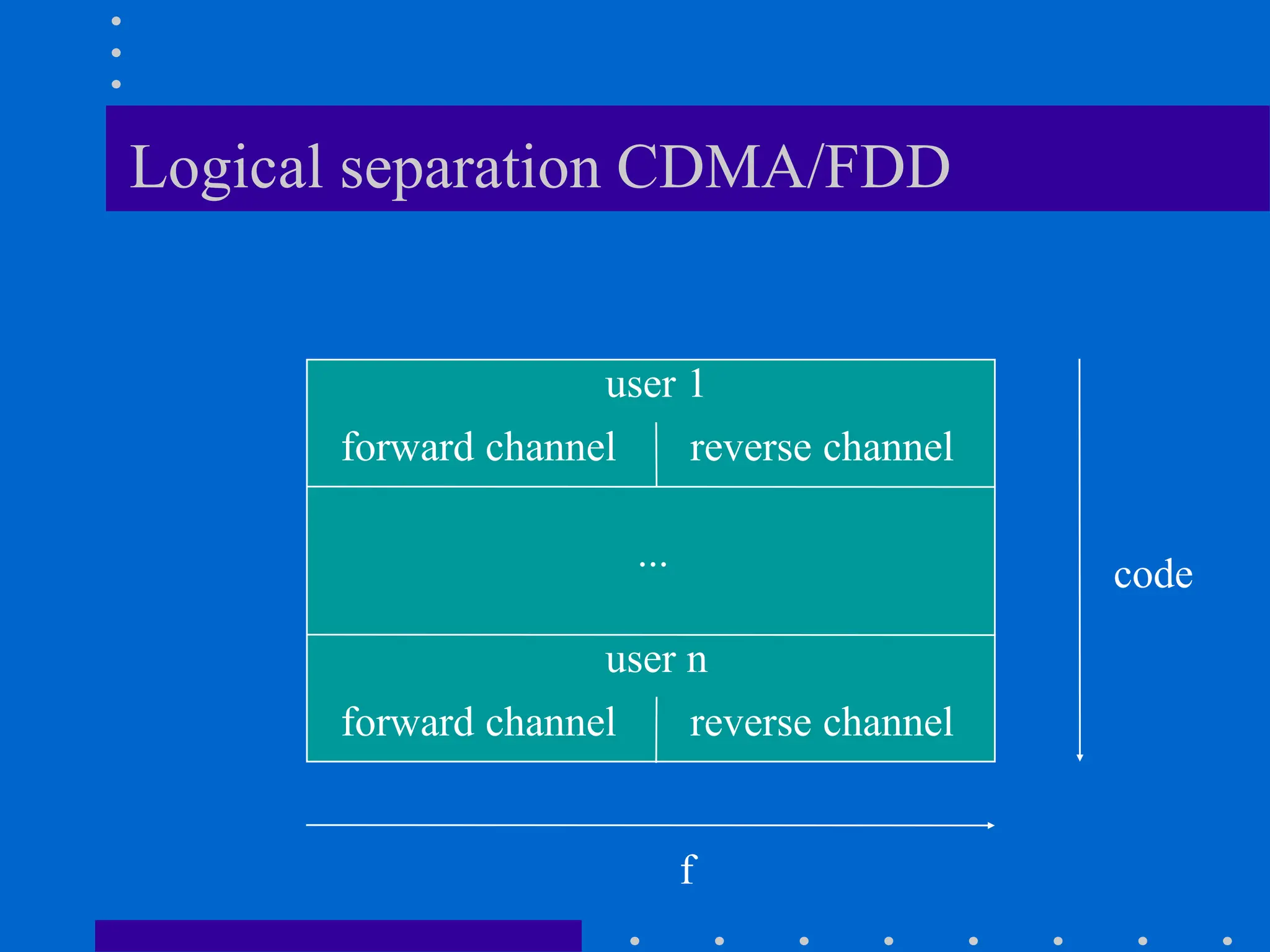
Logical separation CDMA/FDD
code
f
user 1
user n
forward channel reverse channel
...
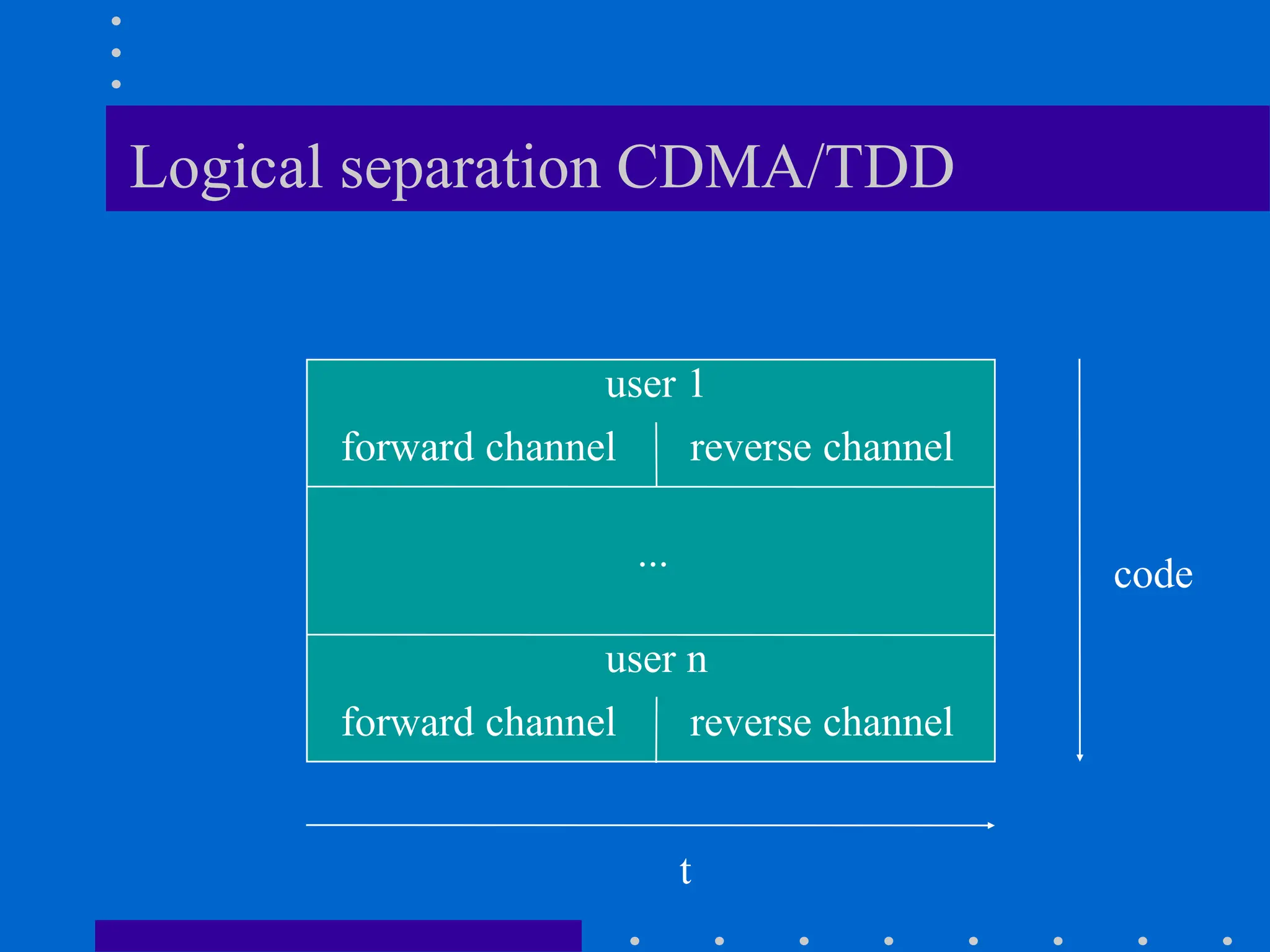
Logical separation CDMA/TDD
code
t
user 1
user n
forward channel reverse channel
...
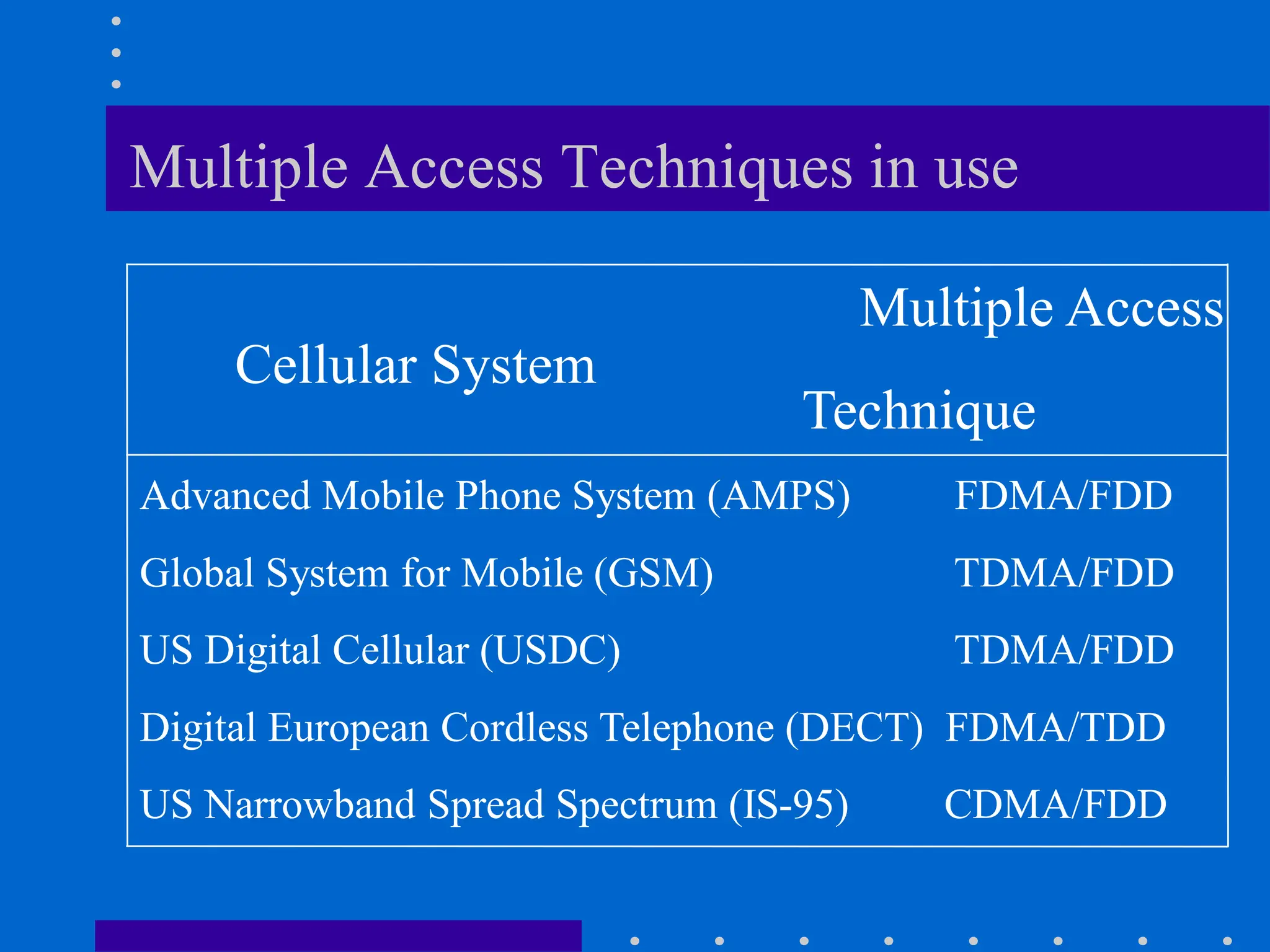
Multiple Access Techniques in use
Multiple Access
Technique
Advanced Mobile Phone System (AMPS) FDMA/FDD
Global System for Mobile (GSM) TDMA/FDD
US Digital Cellular (USDC) TDMA/FDD
Digital European Cordless Telephone (DECT) FDMA/TDD
US Narrowband Spread Spectrum (IS-95) CDMA/FDD
Cellular System
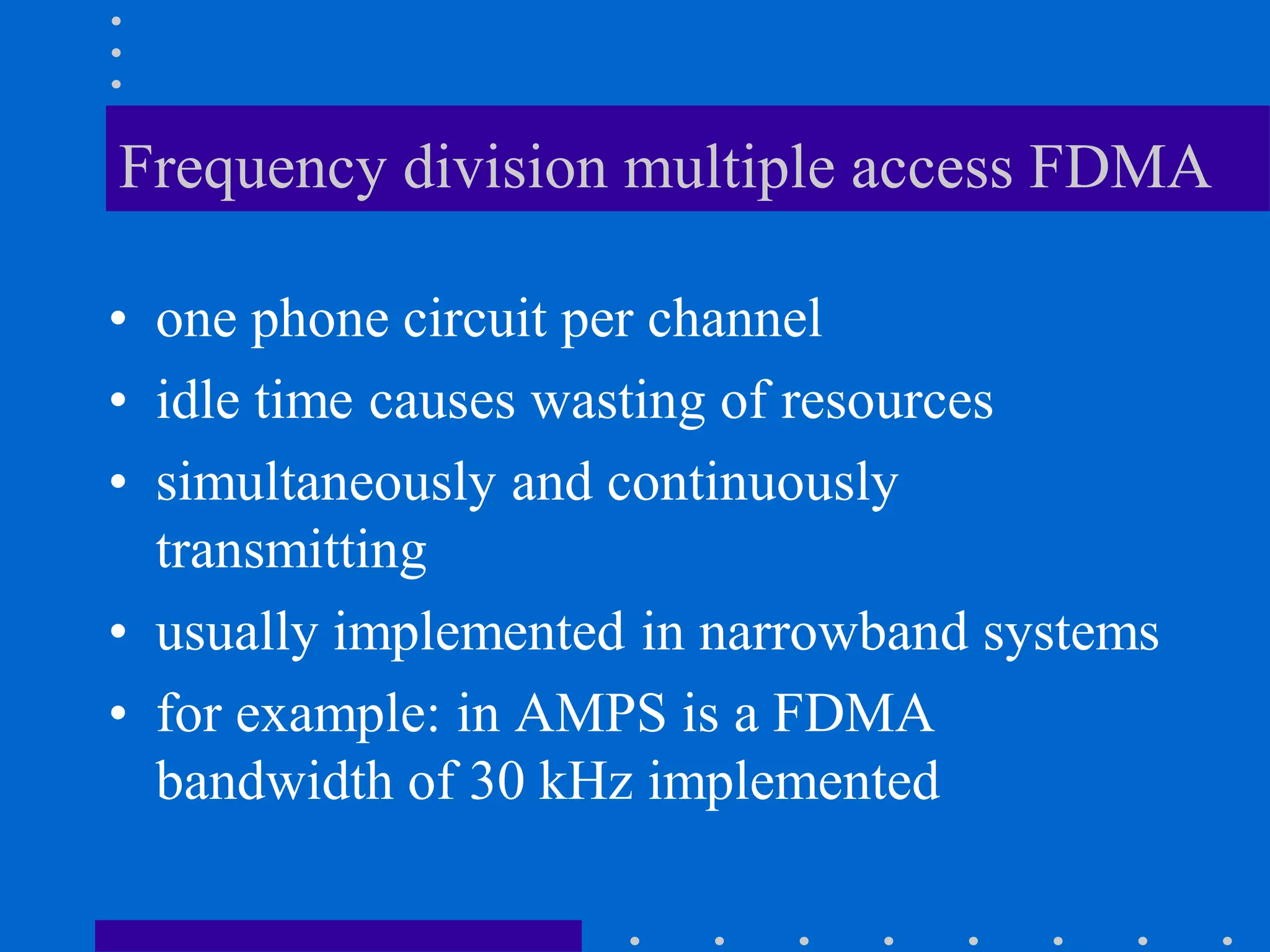
Frequency division multiple access FDMA
• one phone circuit per channel
• idle time causes wasting of resources
• simultaneously and continuously
transmitting
• usually implemented in narrowband systems
• for example: in AMPS is a FDMA
bandwidth of 30 kHz implemented
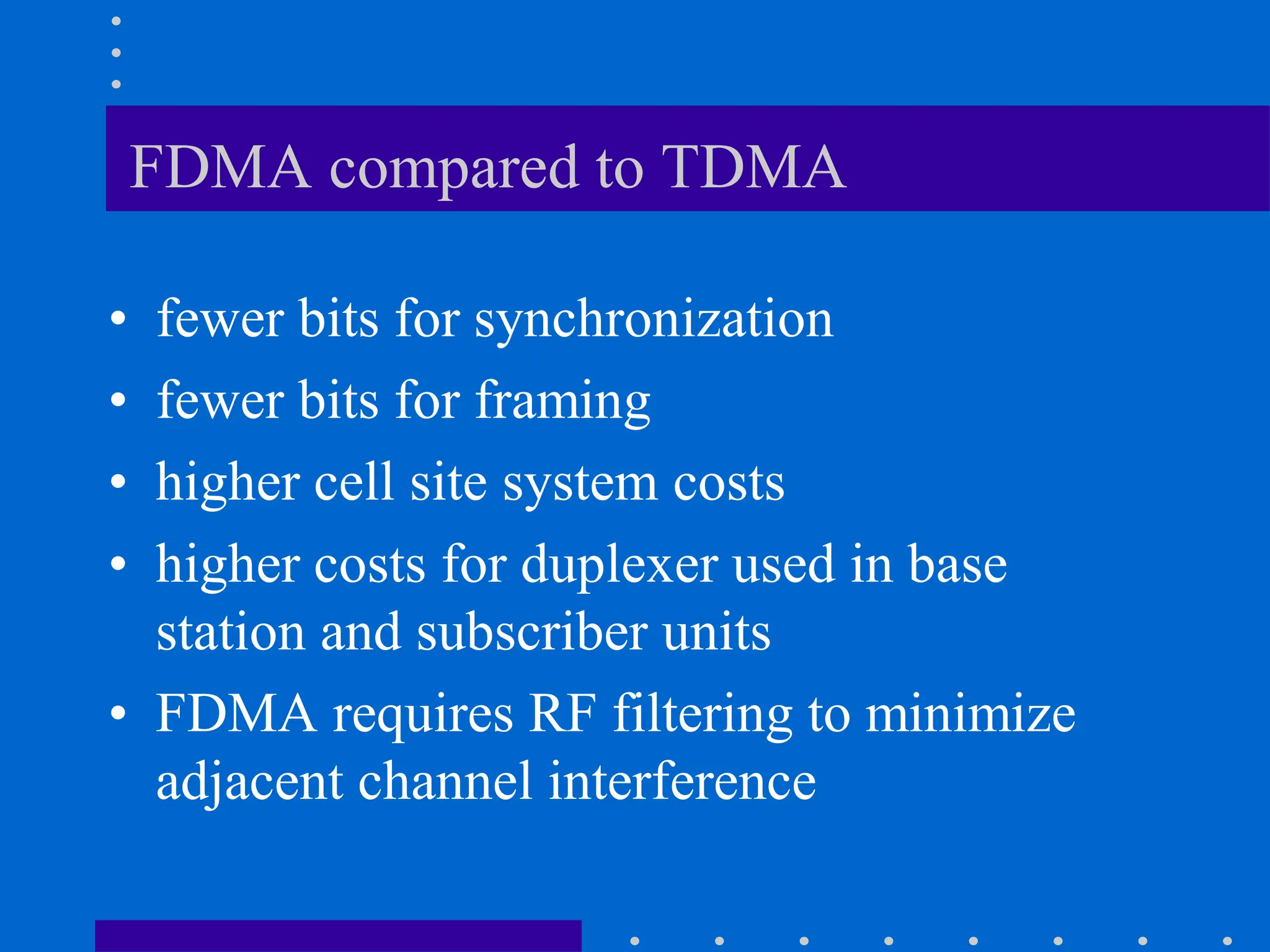
FDMA compared to TDMA
• fewer bits for synchronization
• fewer bits for framing
• higher cell site system costs
• higher costs for duplexer used in base
station and subscriber units
• FDMA requires RF filtering to minimize
adjacent channel interference
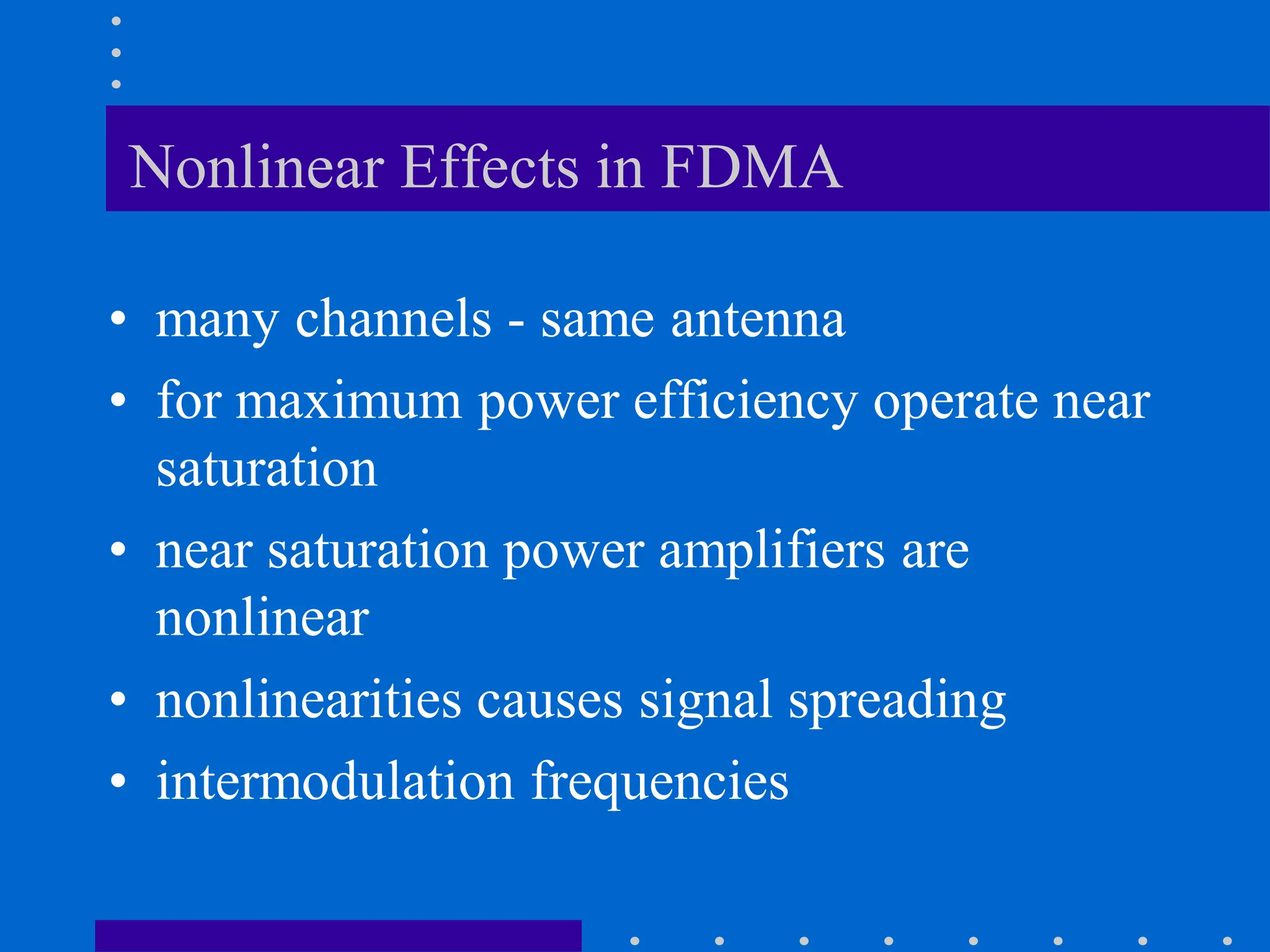
Nonlinear Effects in FDMA
• many channels - same antenna
• for maximum power efficiency operate near
saturation
• near saturation power amplifiers are
nonlinear
• nonlinearities causes signal spreading
• intermodulation frequencies
Nonlinear Effects in FDMA
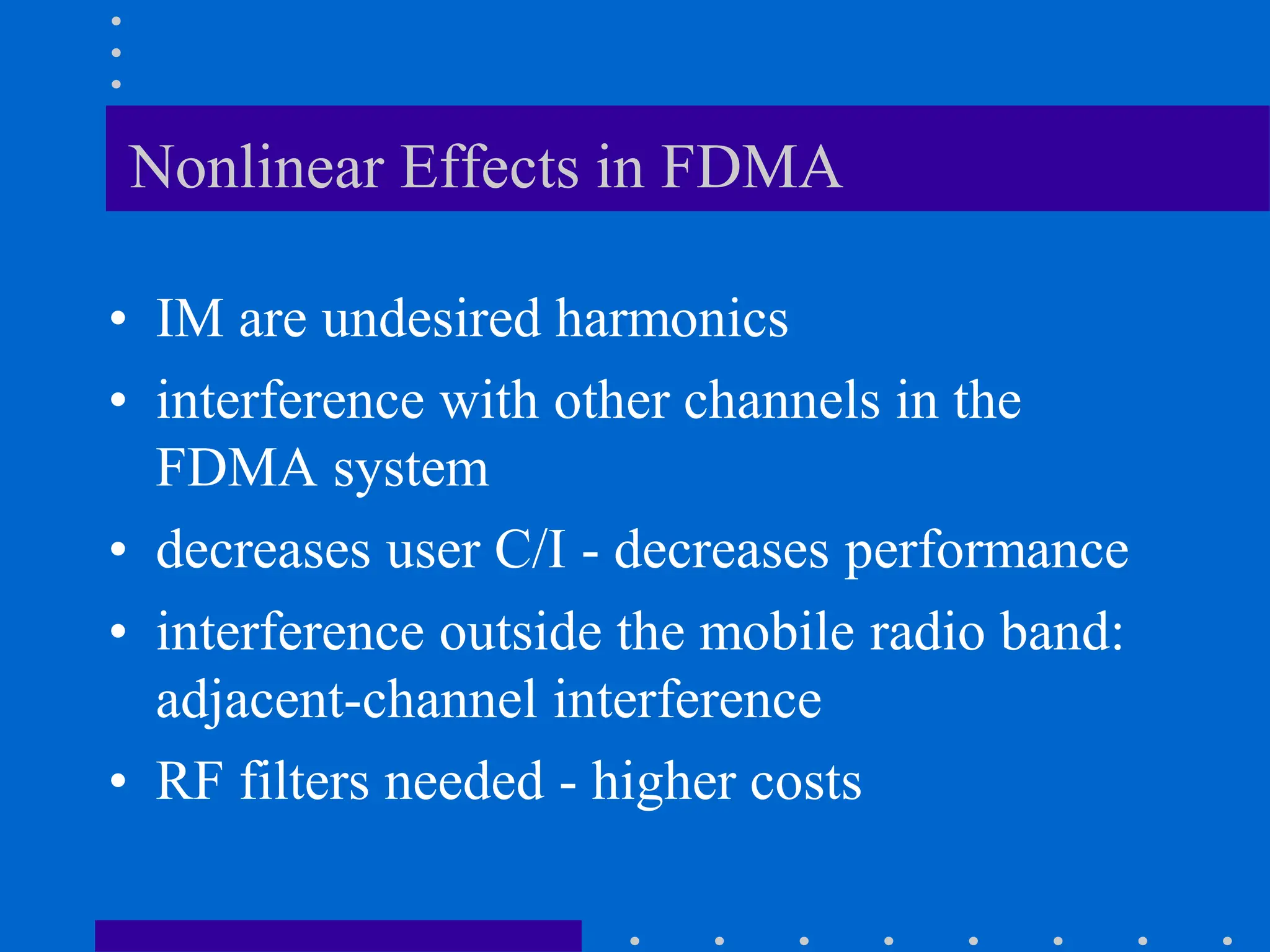
• IM are undesired harmonics
• interference with other channels in the
FDMA system
• decreases user C/I - decreases performance
• interference outside the mobile radio band:
adjacent-channel interference
• RF filters needed - higher costs
Number of channels in a FDMA system
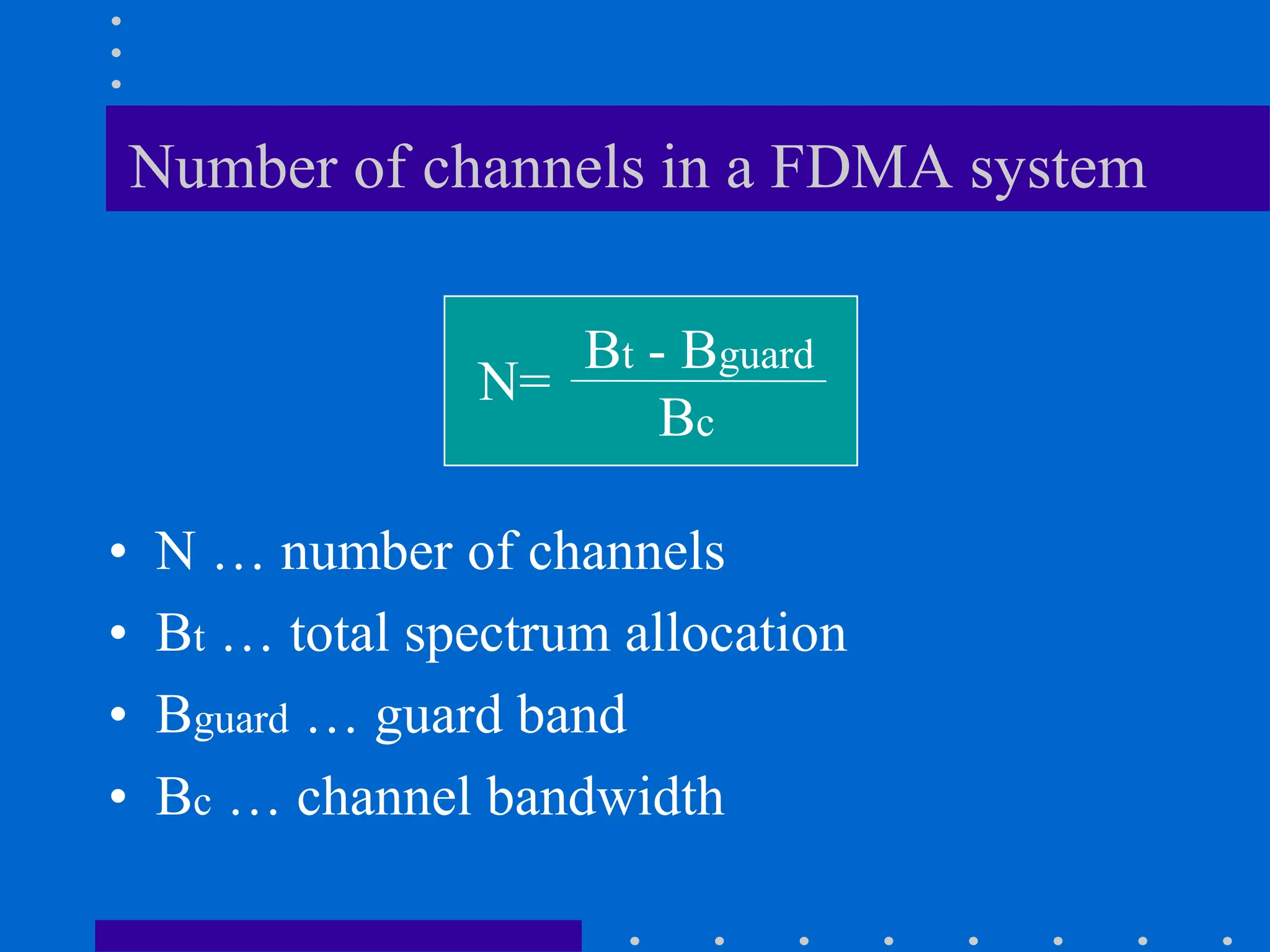
• N … number of channels
• Bt … total spectrum allocation
• Bguard … guard band
• Bc … channel bandwidth
N=
Bt - Bguard
Bc
Example: Advanced Mobile Phone System
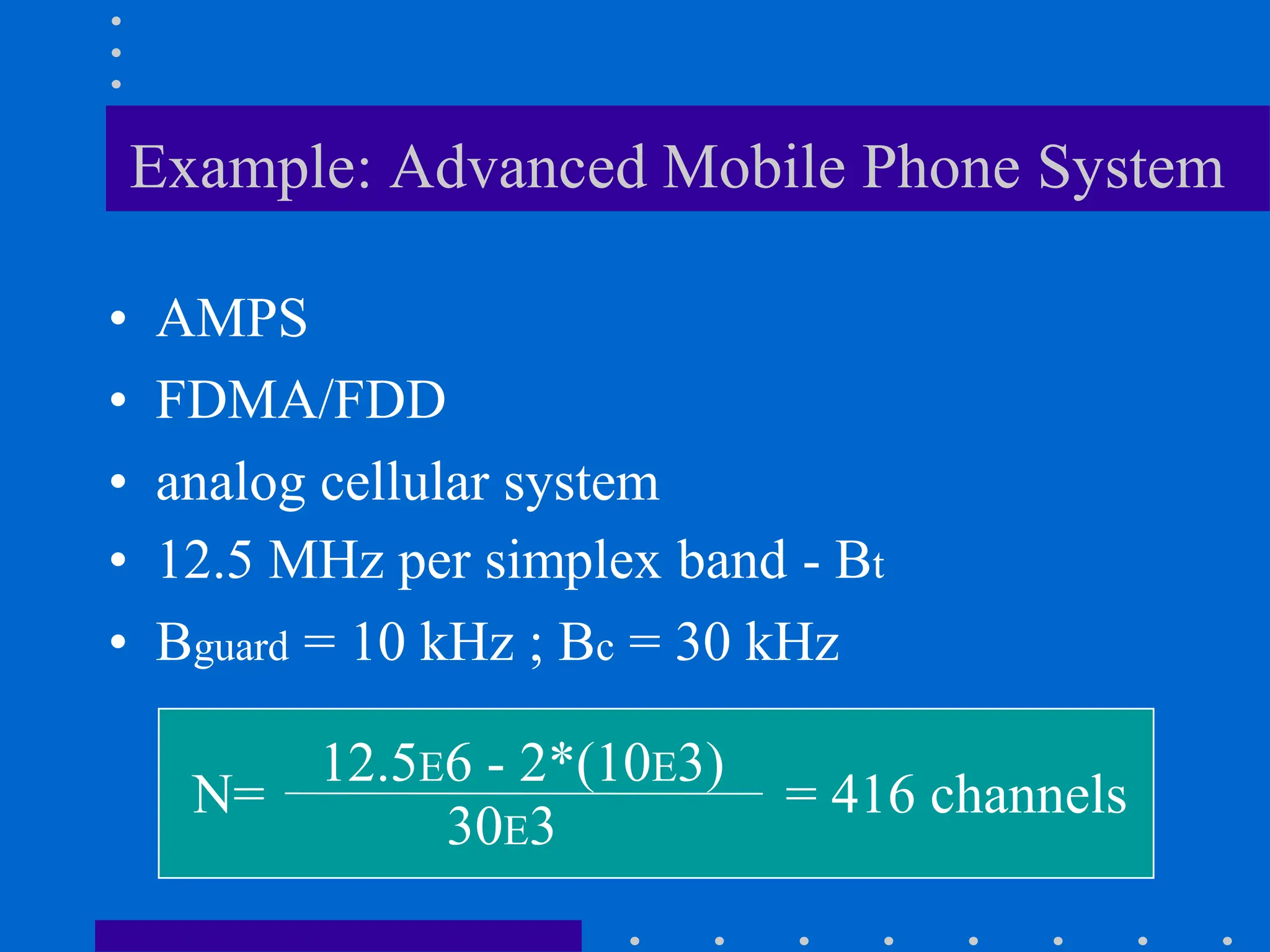
• AMPS
• FDMA/FDD
• analog cellular system
• 12.5 MHz per simplex band - Bt
• Bguard = 10 kHz ; Bc = 30 kHz
N=
12.5E6 - 2*(10E3)
30E3
= 416 channels
Time Division Multiple Access
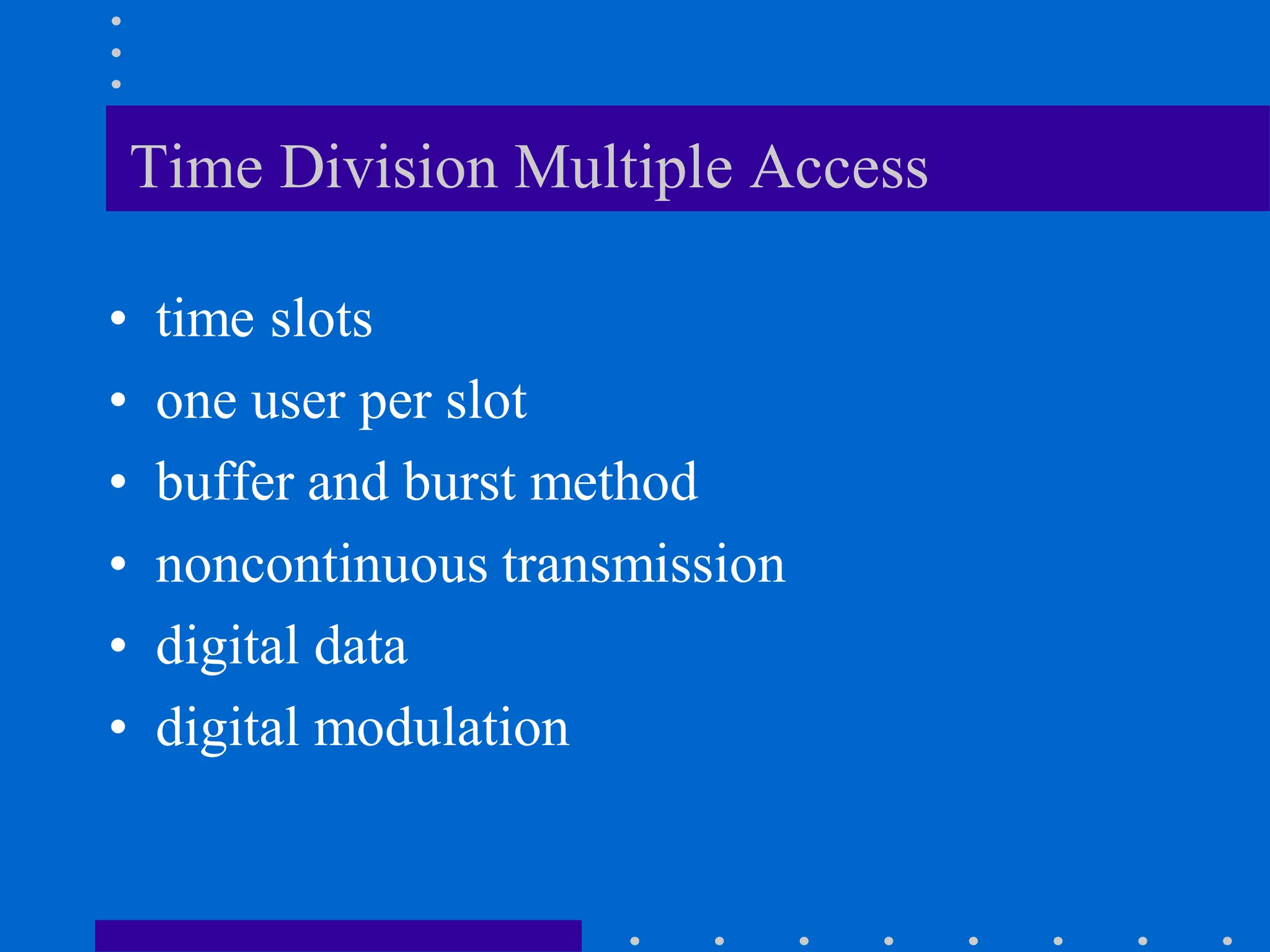
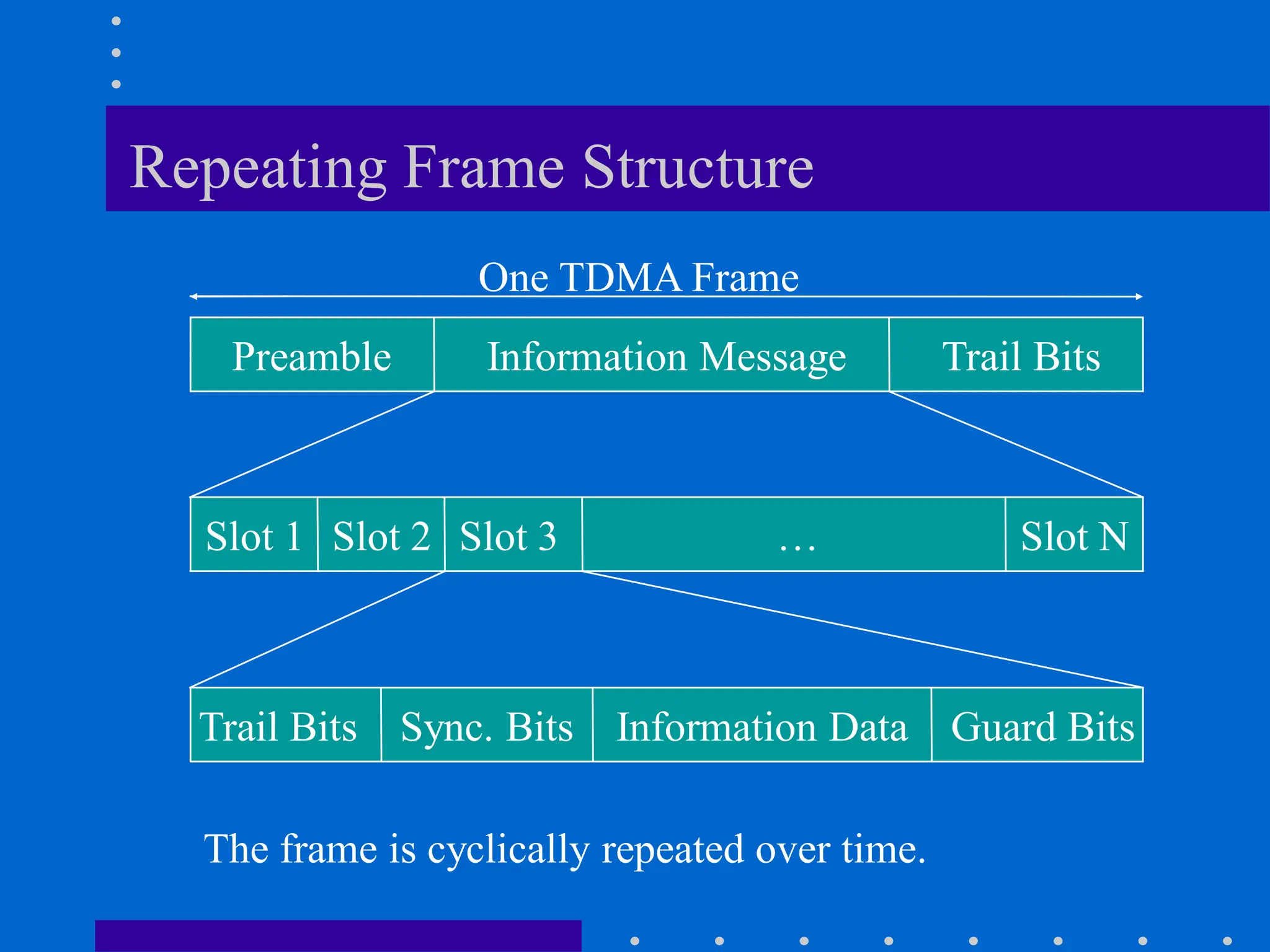
• time slots
• one user per slot
• buffer and burst method
• noncontinuous transmission
• digital data
• digital modulation
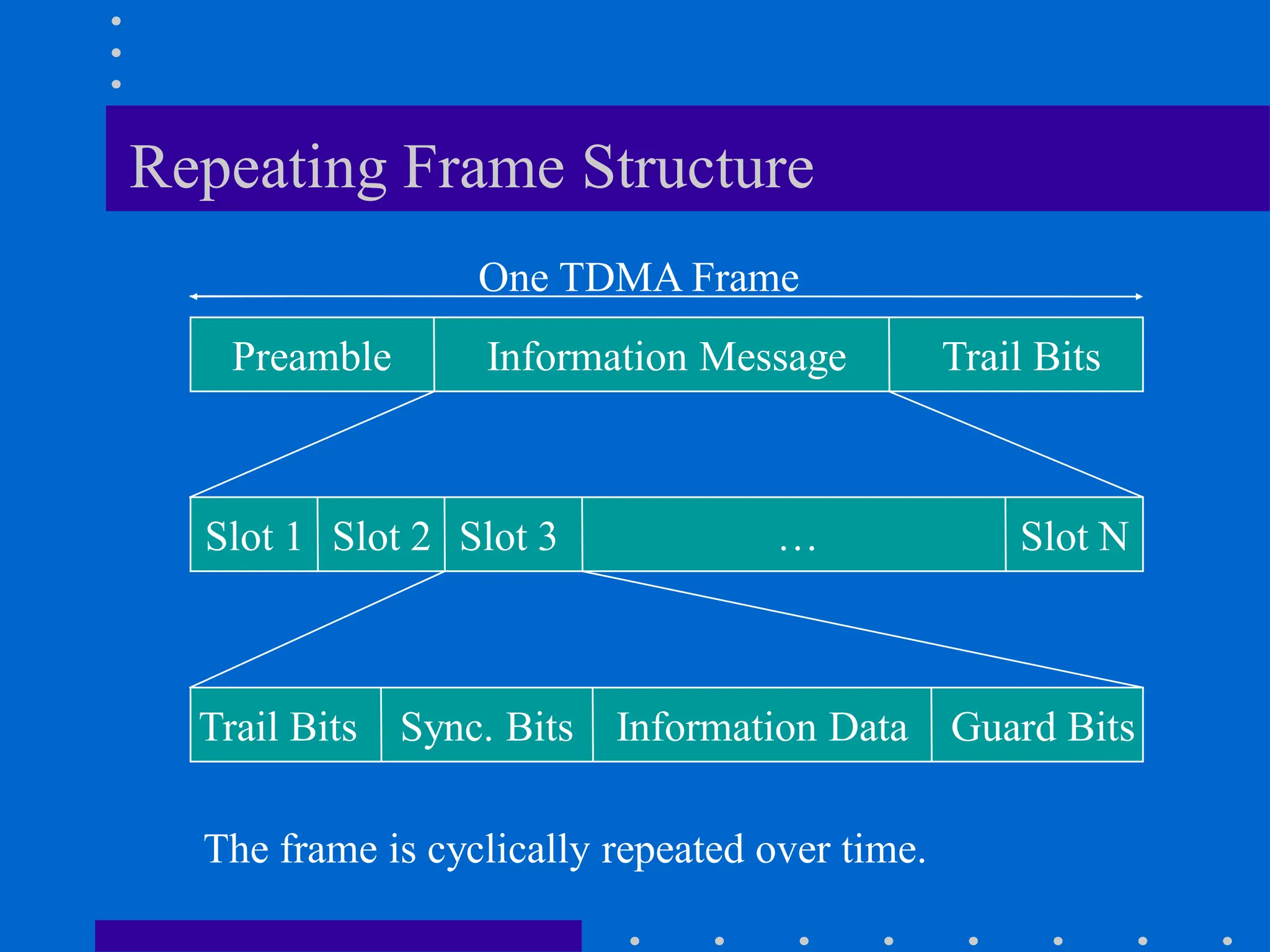
Slot 1 Slot 2 Slot 3 … Slot N
Repeating Frame Structure
Preamble Information Message Trail Bits
One TDMA Frame
Trail Bits Sync. Bits Information Data Guard Bits
The frame is cyclically repeated over time.
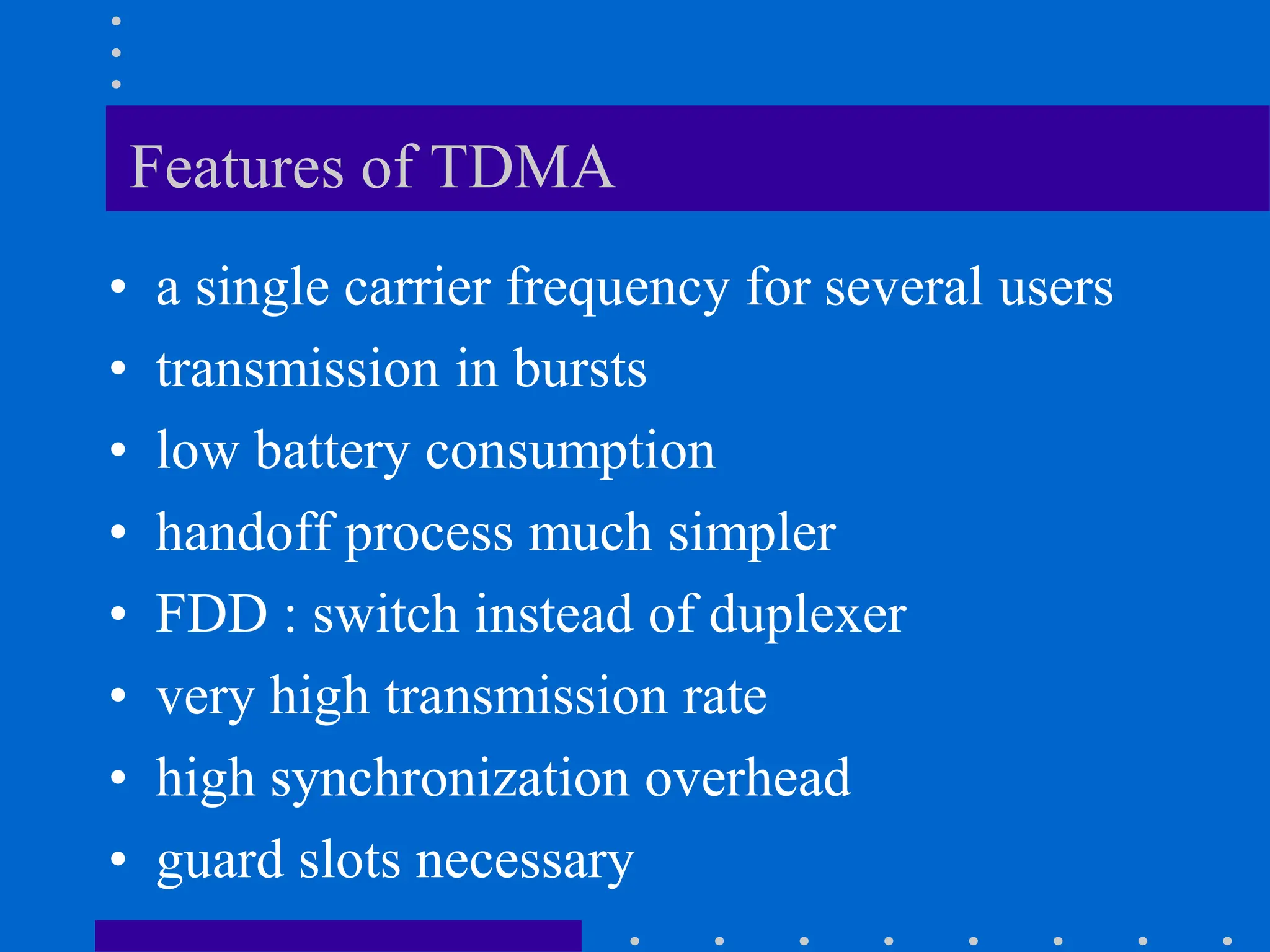
Features of TDMA
• a single carrier frequency for several users
• transmission in bursts
• low battery consumption
• handoff process much simpler
• FDD : switch instead of duplexer
• very high transmission rate
• high synchronization overhead
• guard slots necessary
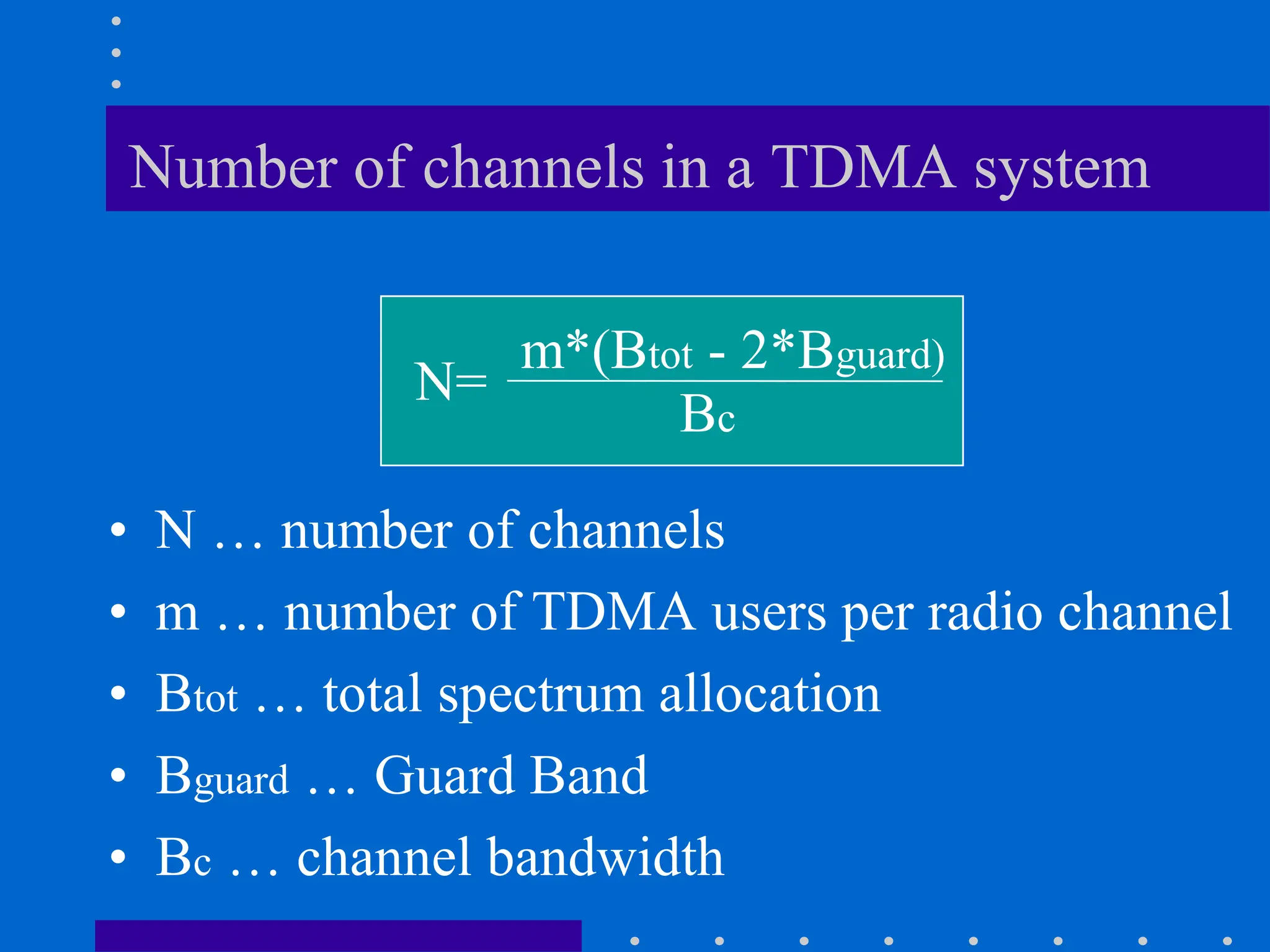
Number of channels in a TDMA system
• N … number of channels
• m … number of TDMA users per radio channel
• Btot … total spectrum allocation
• Bguard … Guard Band
• Bc … channel bandwidth
N=
m*(Btot - 2*Bguard)
Bc
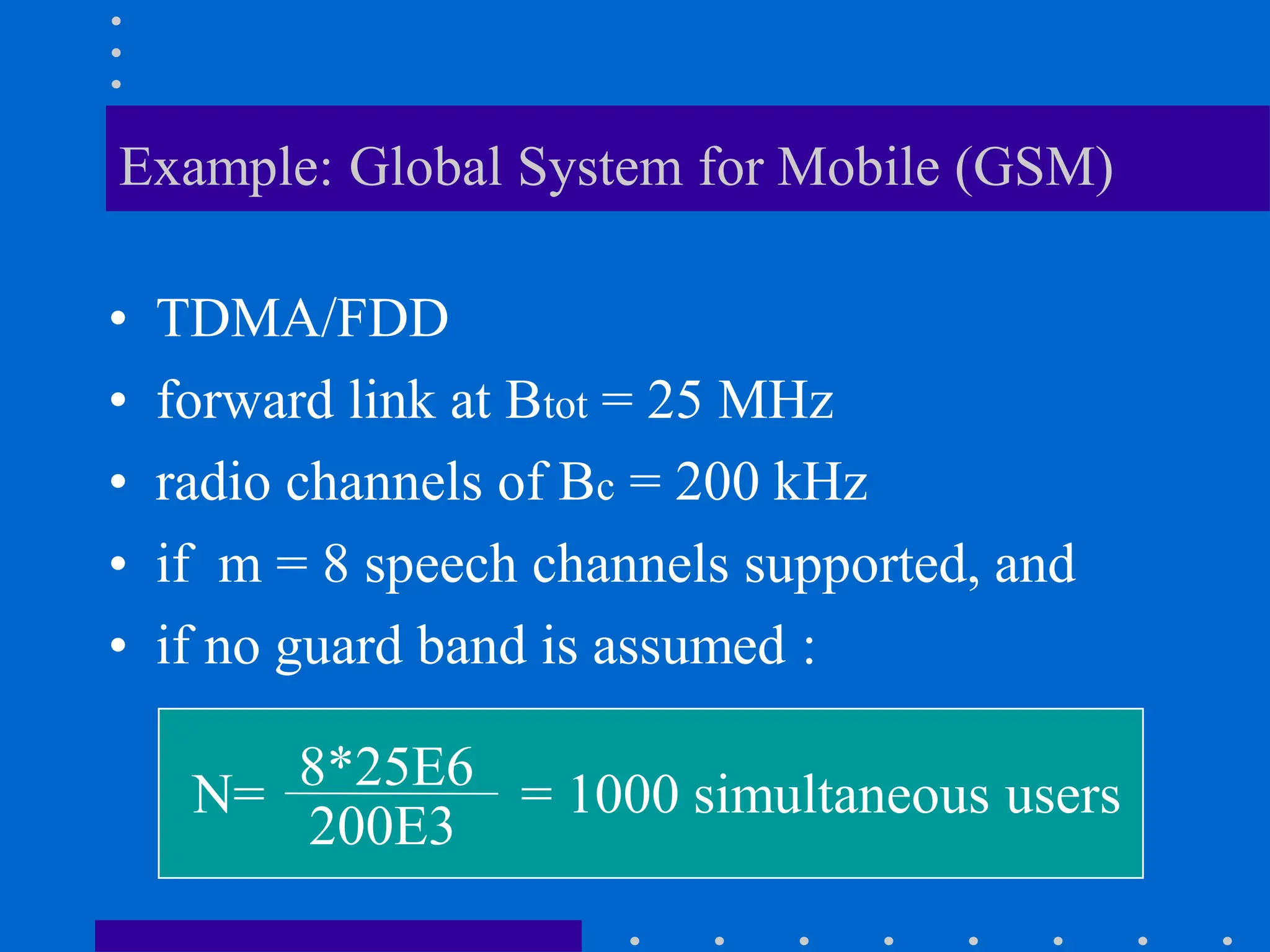
Example: Global System for Mobile (GSM)
• TDMA/FDD
• forward link at Btot = 25 MHz
• radio channels of Bc = 200 kHz
• if m = 8 speech channels supported, and
• if no guard band is assumed :
N= 8*25E6
200E3
= 1000 simultaneous users
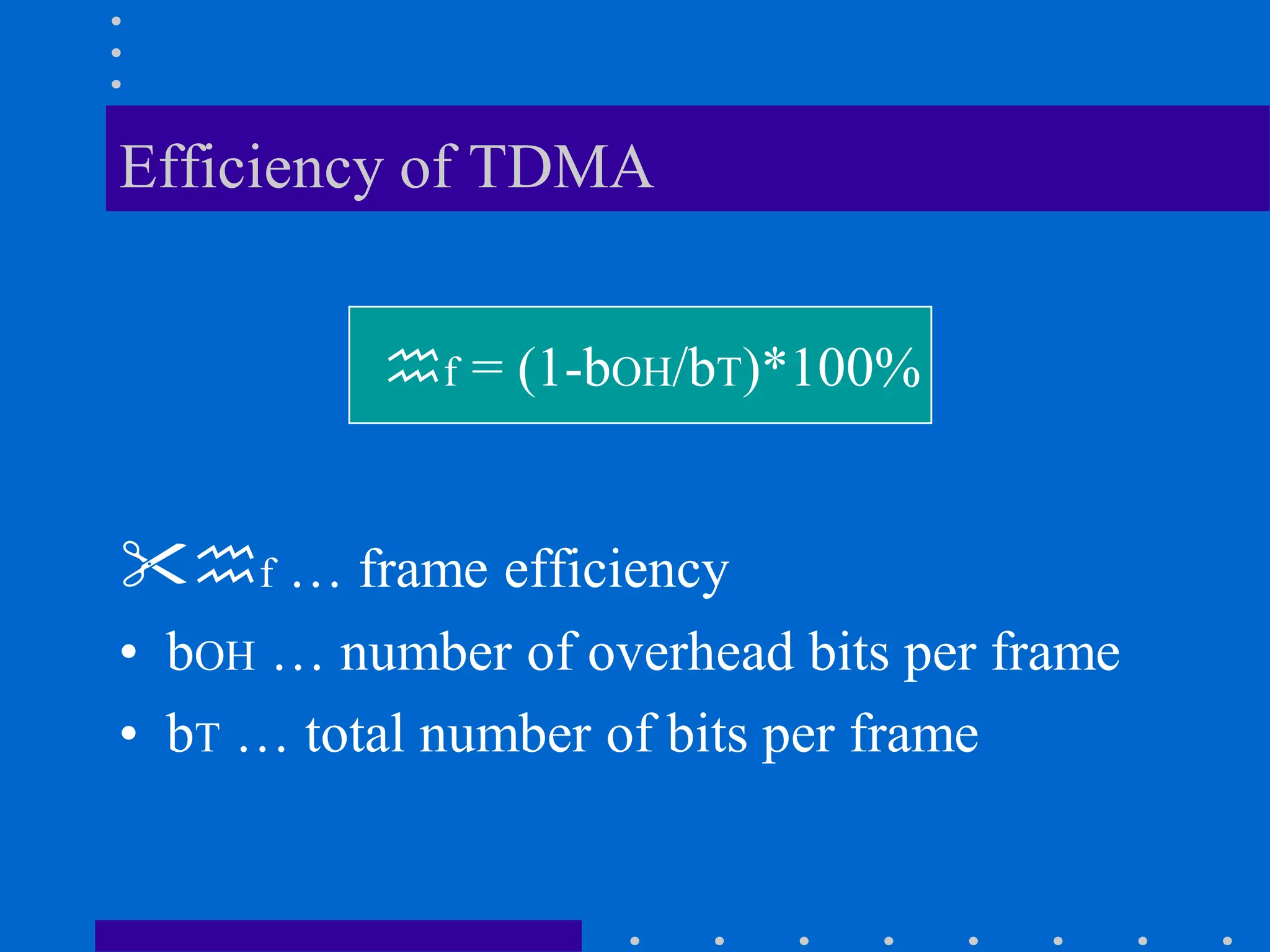
Efficiency of TDMA
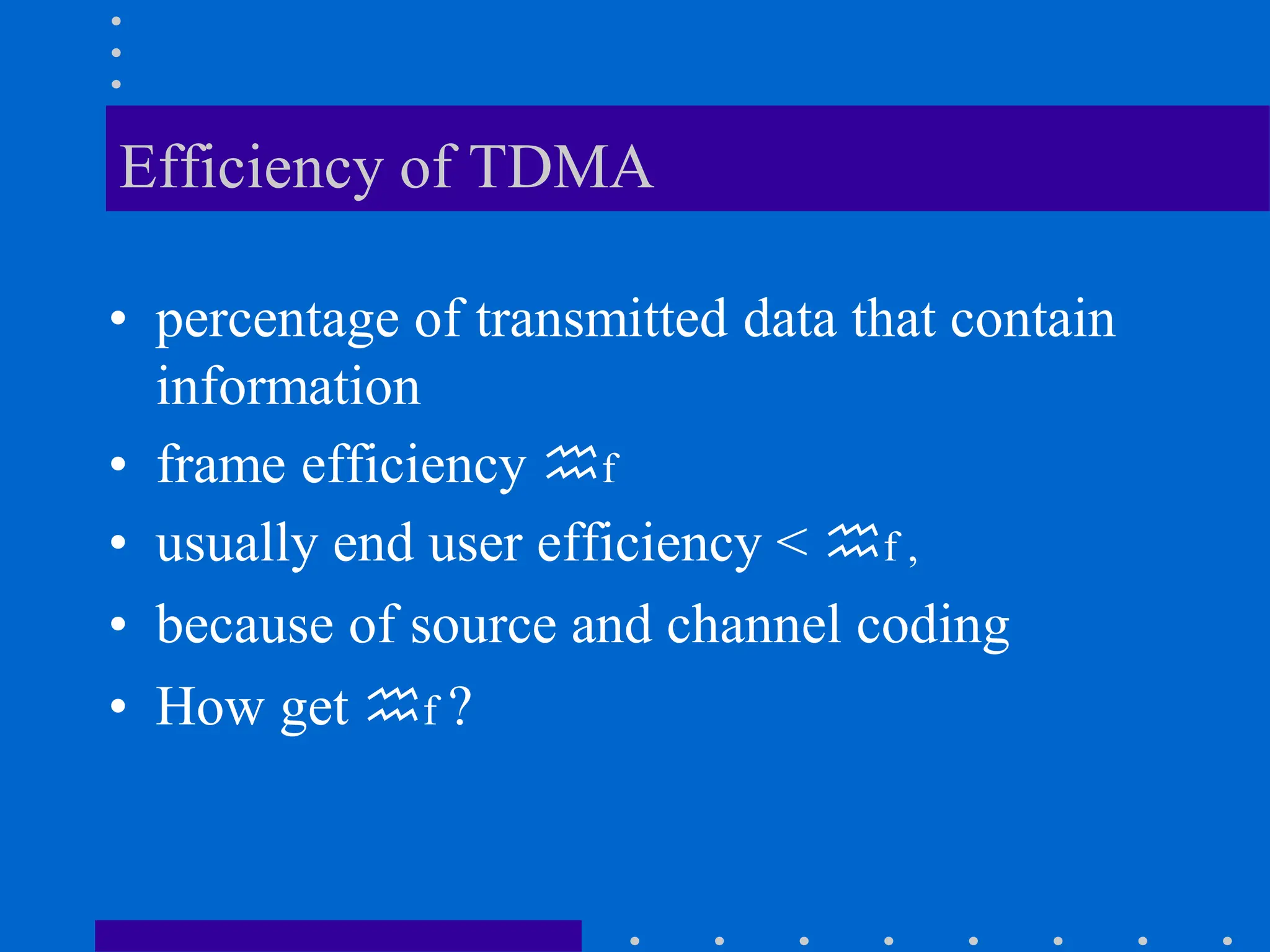
• percentage of transmitted data that contain
information
• frame efficiency f
• usually end user efficiency < f ,
• because of source and channel coding
• How get f ?
Slot 1 Slot 2 Slot 3 … Slot N
Repeating Frame Structure
Preamble Information Message Trail Bits
One TDMA Frame
Trail Bits Sync. Bits Information Data Guard Bits
The frame is cyclically repeated over time.
Efficiency of TDMA
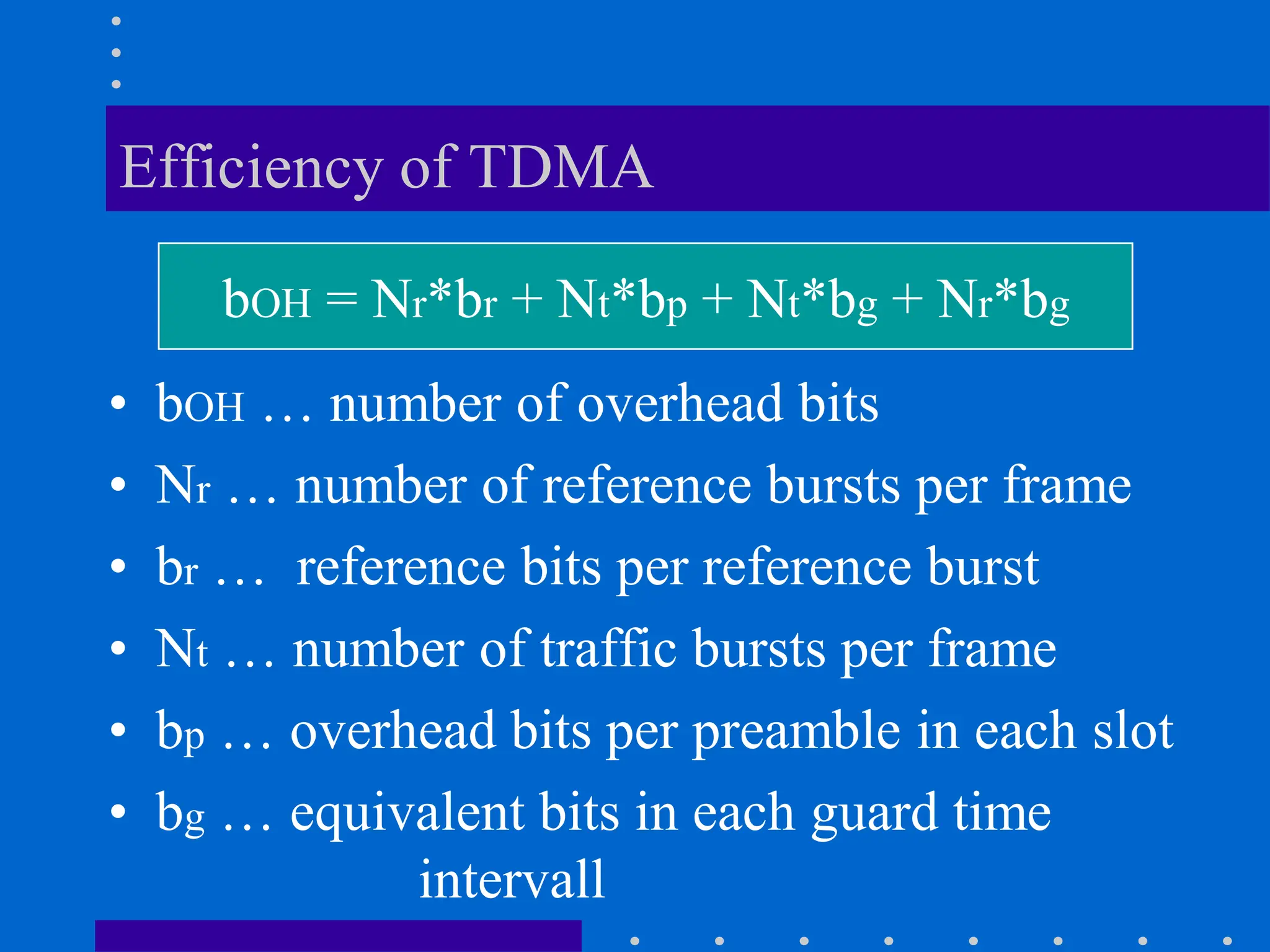
• bOH … number of overhead bits
• Nr … number of reference bursts per frame
• br … reference bits per reference burst
• Nt … number of traffic bursts per frame
• bp … overhead bits per preamble in each slot
• bg … equivalent bits in each guard time
intervall
bOH = Nr*br + Nt*bp + Nt*bg + Nr*bg
Efficiency of TDMA
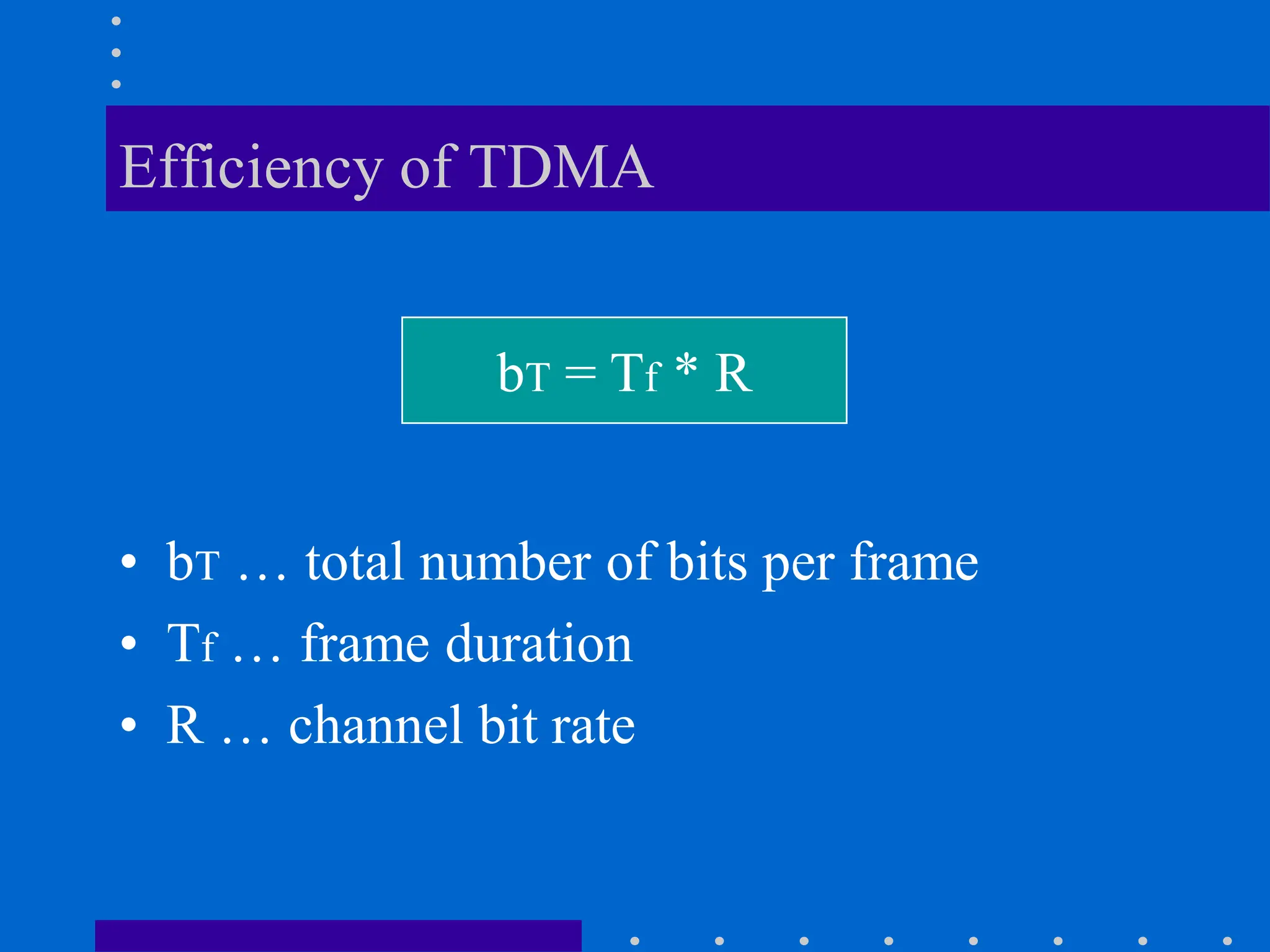
bT = Tf * R
• bT … total number of bits per frame
• Tf … frame duration
• R … channel bit rate
Efficiency of TDMA
f … frame efficiency
• bOH … number of overhead bits per frame
• bT … total number of bits per frame
f = (1-bOH/bT)*100%
Space Division Multiple Access
• Controls radiated energy for each user in space
• using spot beam antennas
• base station tracks user when moving
• cover areas with same frequency:
• TDMA or CDMA systems
• cover areas with same frequency:
• FDMA systems
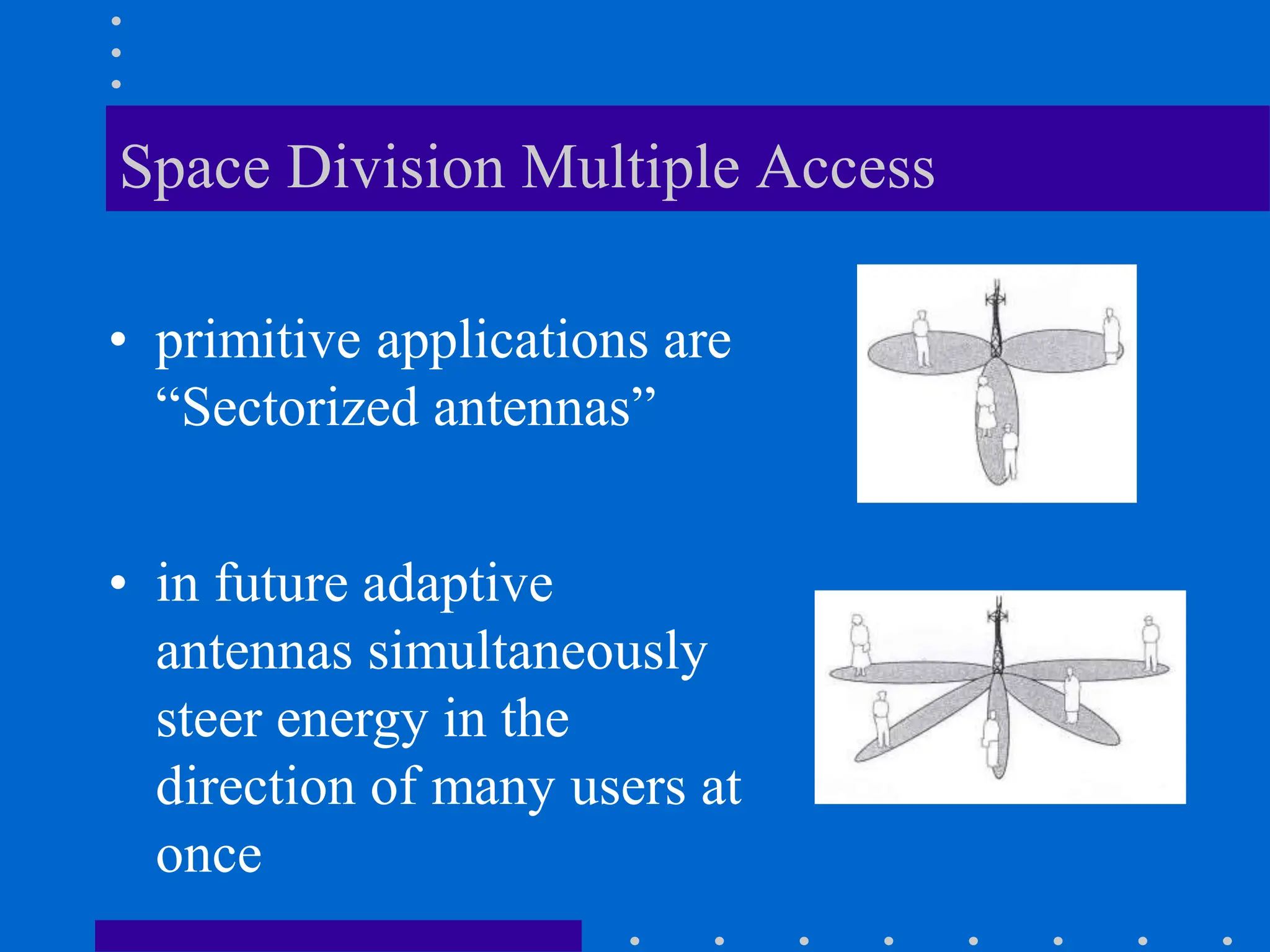
Space Division Multiple Access
• primitive applications are
“Sectorized antennas”
• in future adaptive
antennas simultaneously
steer energy in the
direction of many users at
once
Reverse link problems
• general problem
• different propagation path from user to base
• dynamic control of transmitting power from
each user to the base station required
• limits by battery consumption of subscriber
units
• possible solution is a filter for each user
Solution by SDMA systems
• adaptive antennas promise to mitigate
reverse link problems
• limiting case of infinitesimal beamwidth
• limiting case of infinitely fast track ability
• thereby unique channel that is free from
interference
• all user communicate at same time using the
same channel
Disadvantage of SDMA
• perfect adaptive antenna system:
infinitely large antenna needed
• compromise needed
SDMA and PDMA in satellites
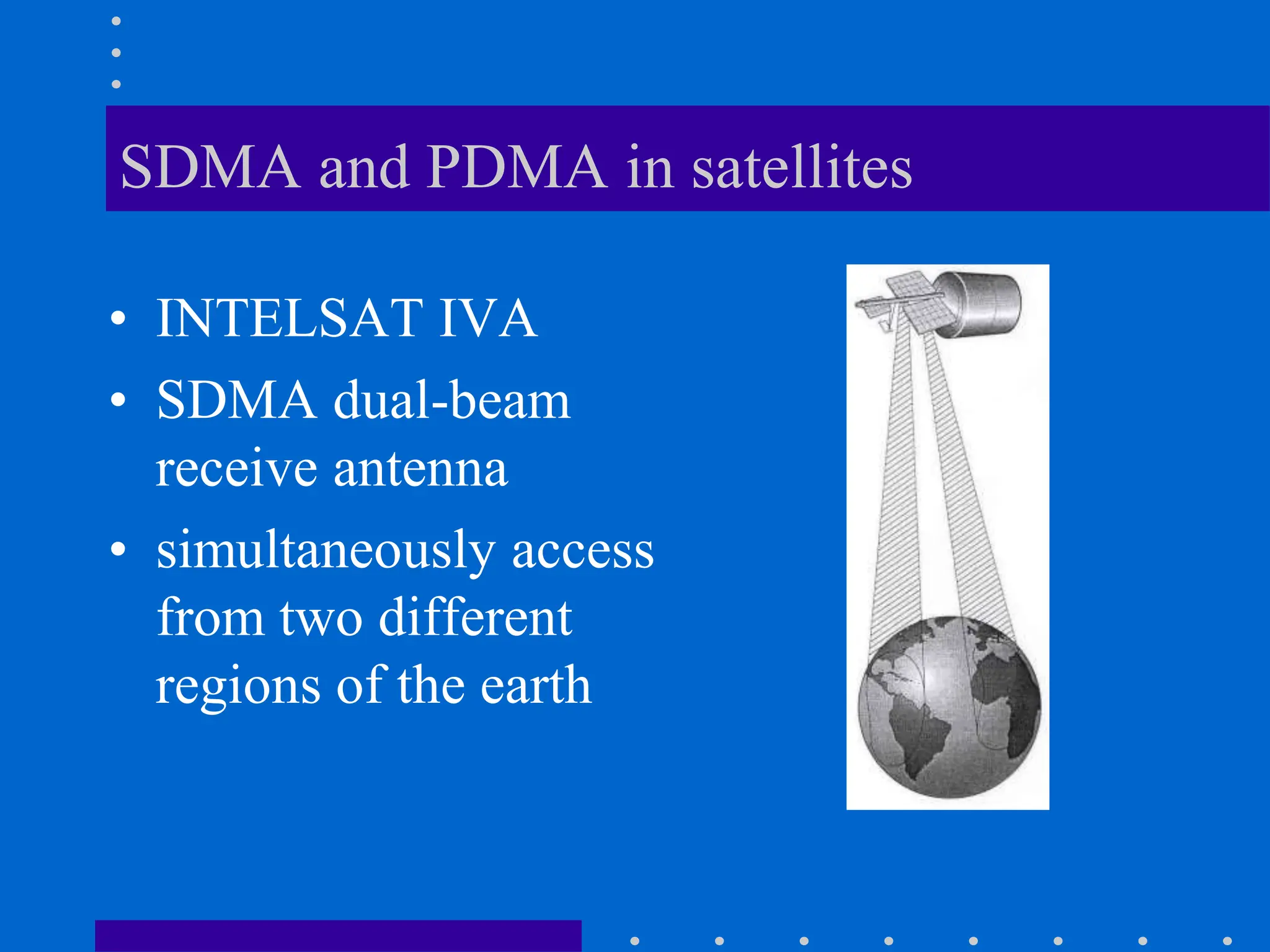
• INTELSAT IVA
• SDMA dual-beam
receive antenna
• simultaneously access
from two different
regions of the earth
SDMA and PDMA in satellites
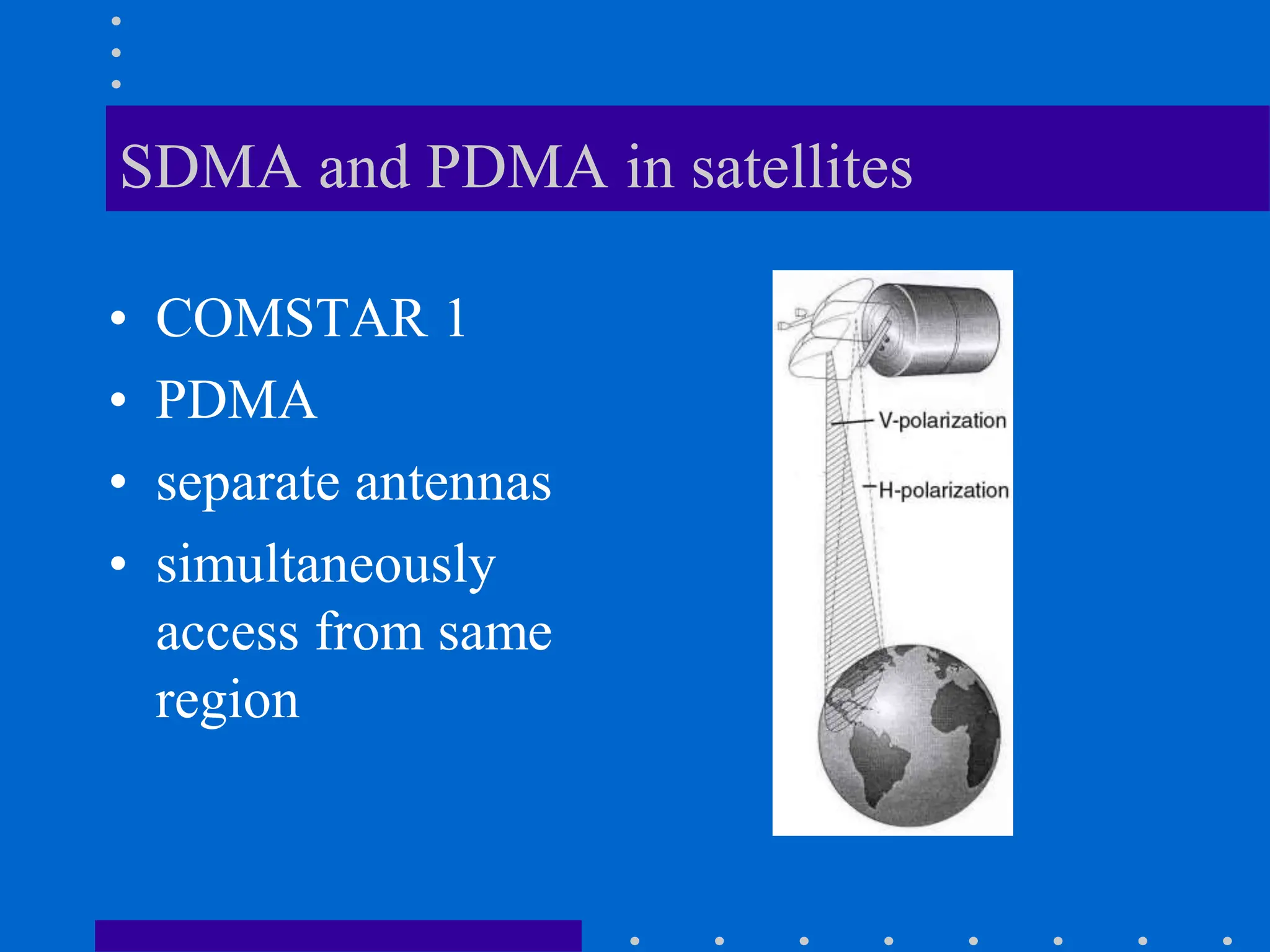
• COMSTAR 1
• PDMA
• separate antennas
• simultaneously
access from same
region
SDMA and PDMA in satellites
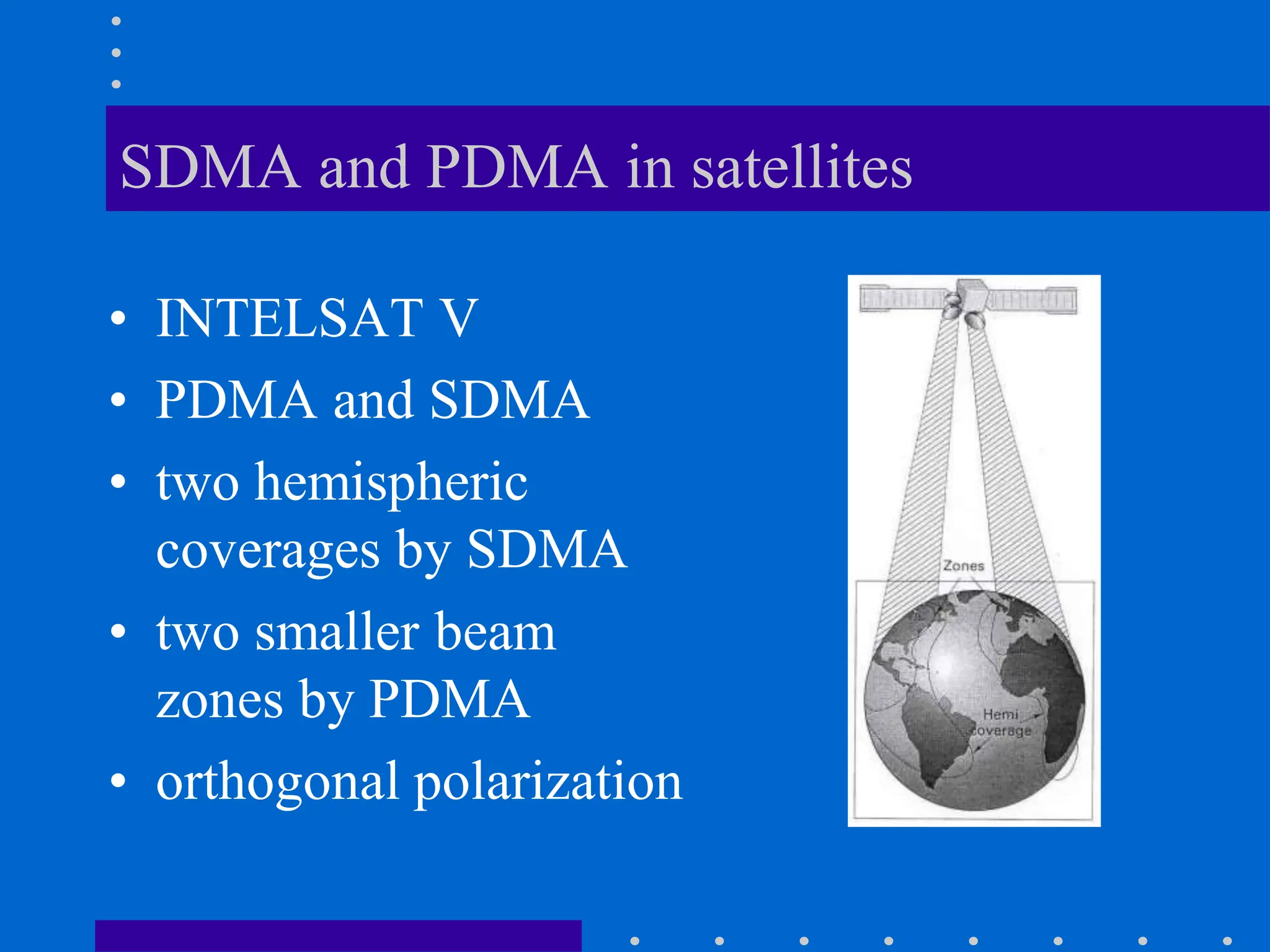
• INTELSAT V
• PDMA and SDMA
• two hemispheric
coverages by SDMA
• two smaller beam
zones by PDMA
• orthogonal polarization
Capacity of Cellular Systems
• channel capacity: maximum number of users
in a fixed frequency band
• radio capacity : value for spectrum efficiency
• reverse channel interference
• forward channel interference
• How determine the radio capacity?
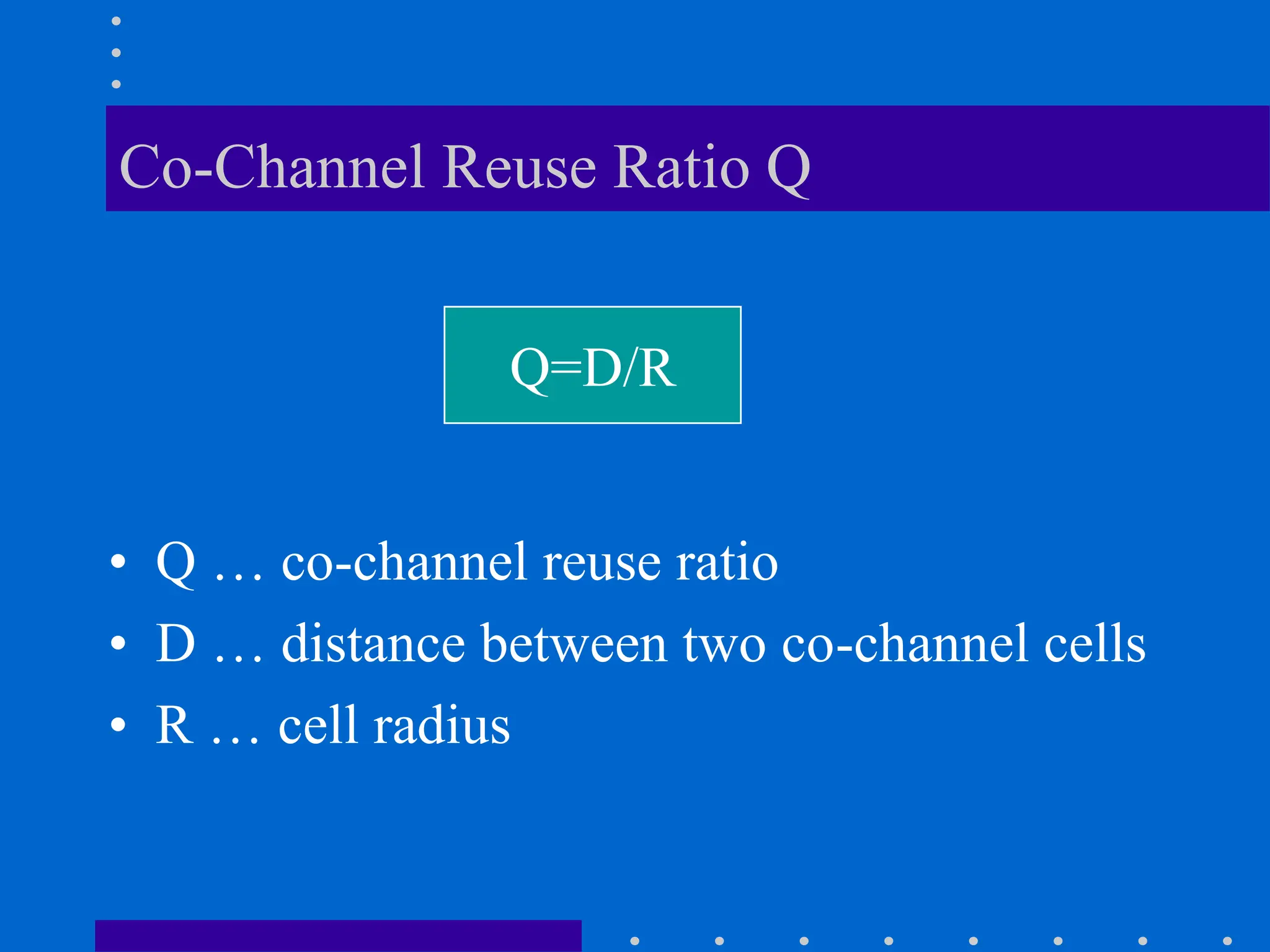
Co-Channel Reuse Ratio Q
• Q … co-channel reuse ratio
• D … distance between two co-channel cells
• R … cell radius
Q=D/R
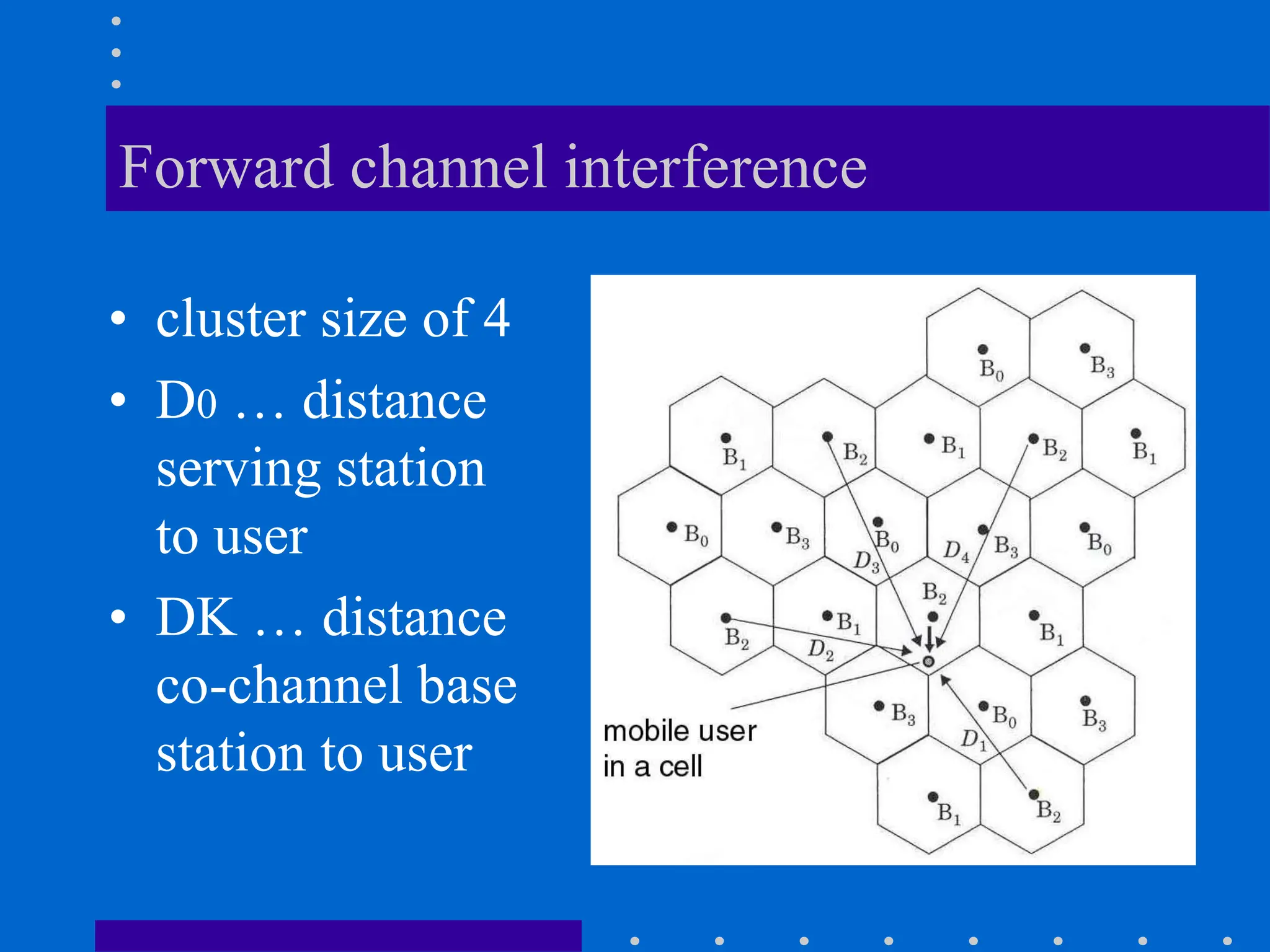
Forward channel interference
• cluster size of 4
• D0 … distance
serving station
to user
• DK … distance
co-channel base
station to user
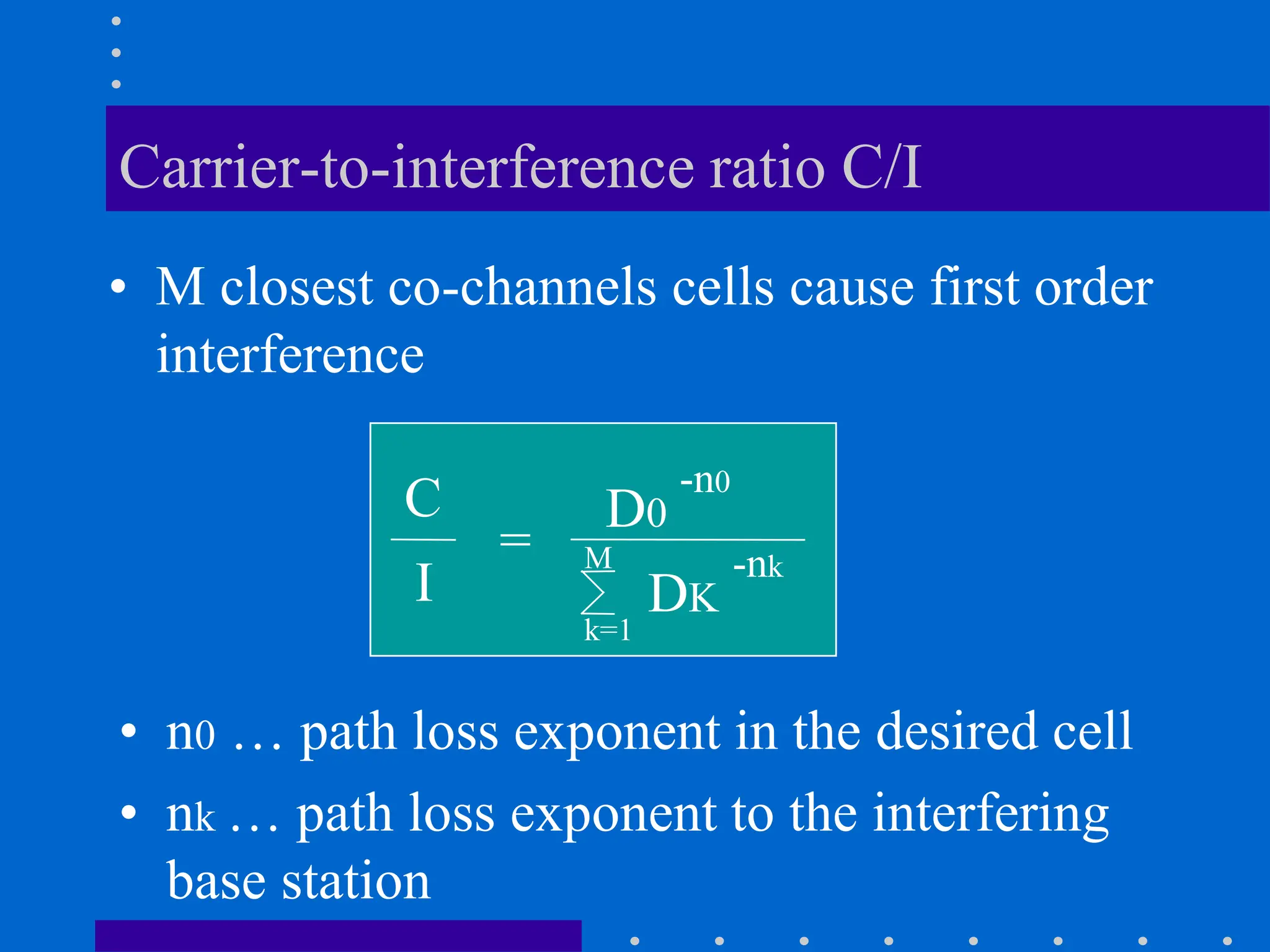
Carrier-to-interference ratio C/I
• M closest co-channels cells cause first order
interference
C
=
I
D0
-n0
M
k=1
DK
-nk
• n0 … path loss exponent in the desired cell
• nk … path loss exponent to the interfering
base station
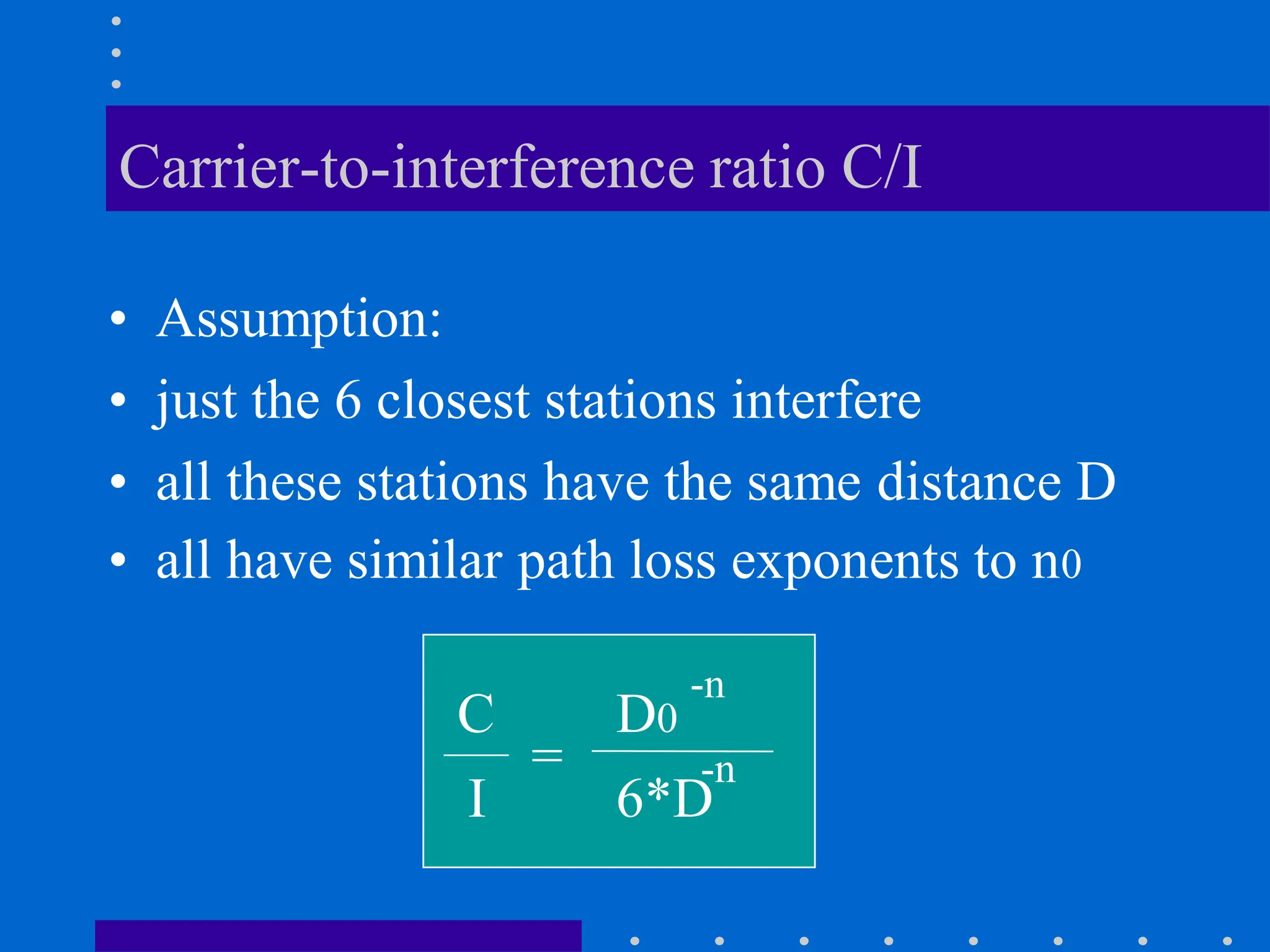
Carrier-to-interference ratio C/I
• Assumption:
• just the 6 closest stations interfere
• all these stations have the same distance D
• all have similar path loss exponents to n0
C
I
=
D0
-n
6*D
-n
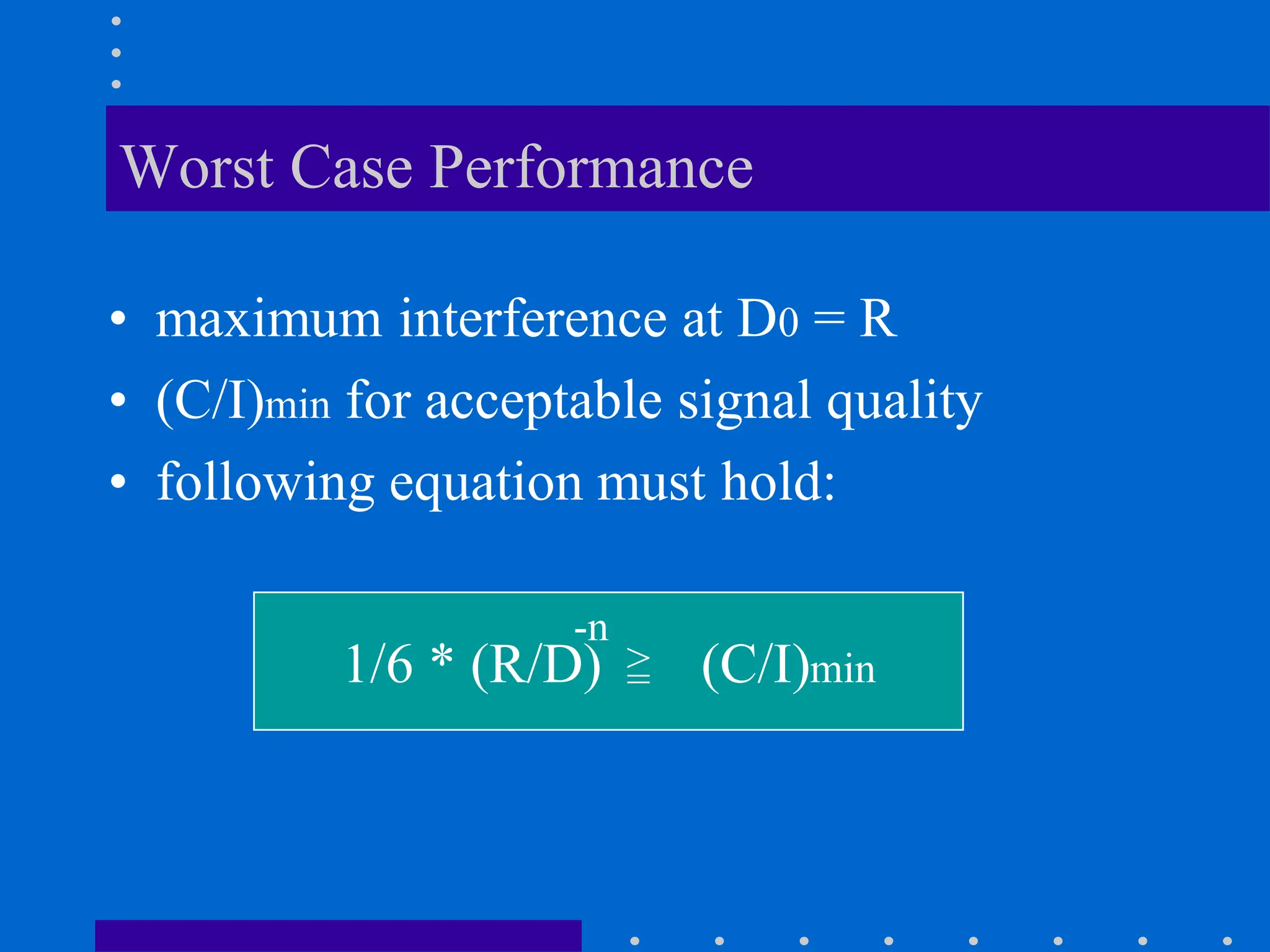
Worst Case Performance
• maximum interference at D0 = R
• (C/I)min for acceptable signal quality
• following equation must hold:
1/6 * (R/D) (C/I)min
=
>
-n
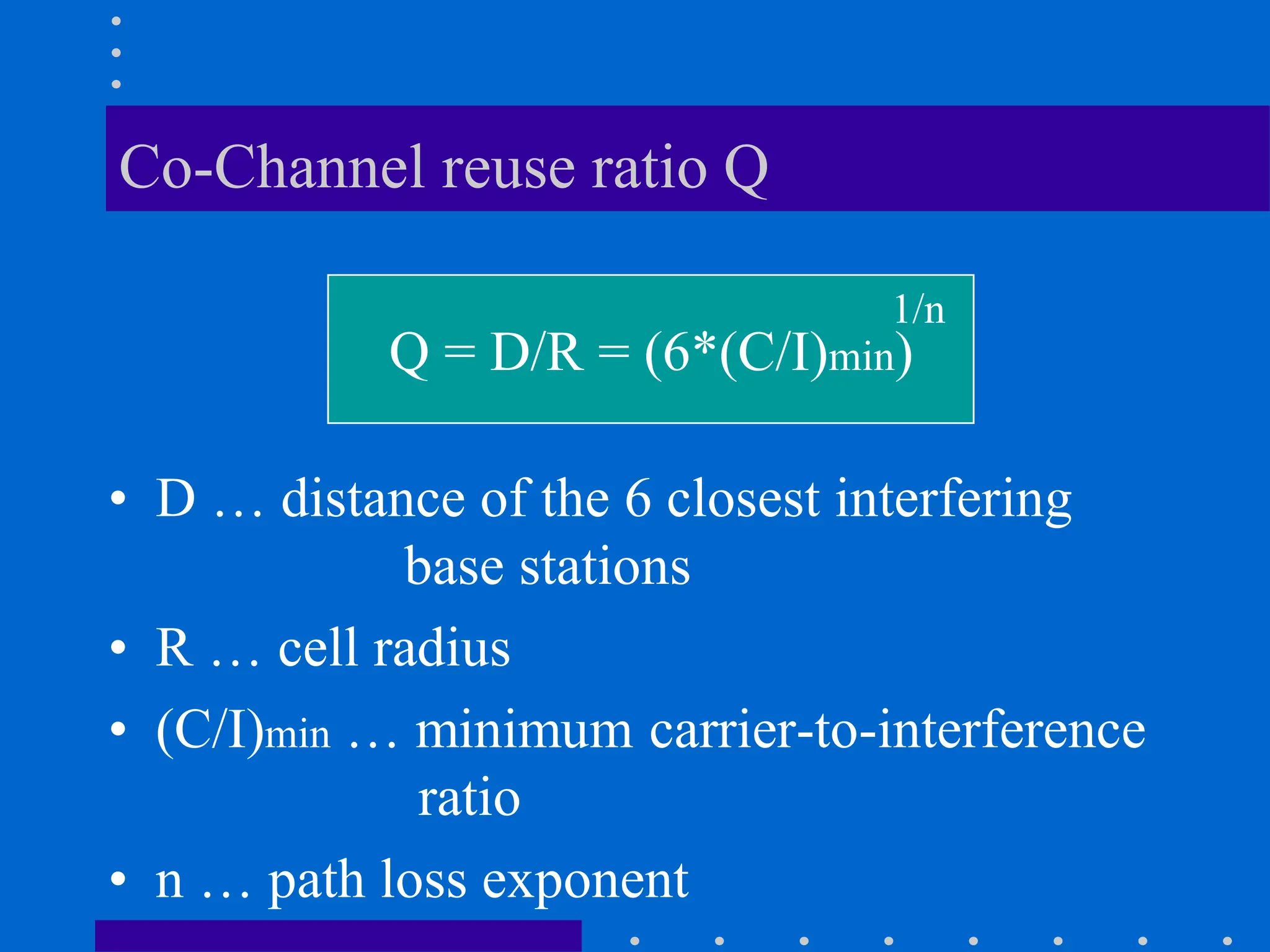
Co-Channel reuse ratio Q
• D … distance of the 6 closest interfering
base stations
• R … cell radius
• (C/I)min … minimum carrier-to-interference
ratio
• n … path loss exponent
Q = D/R = (6*(C/I)min)
1/n
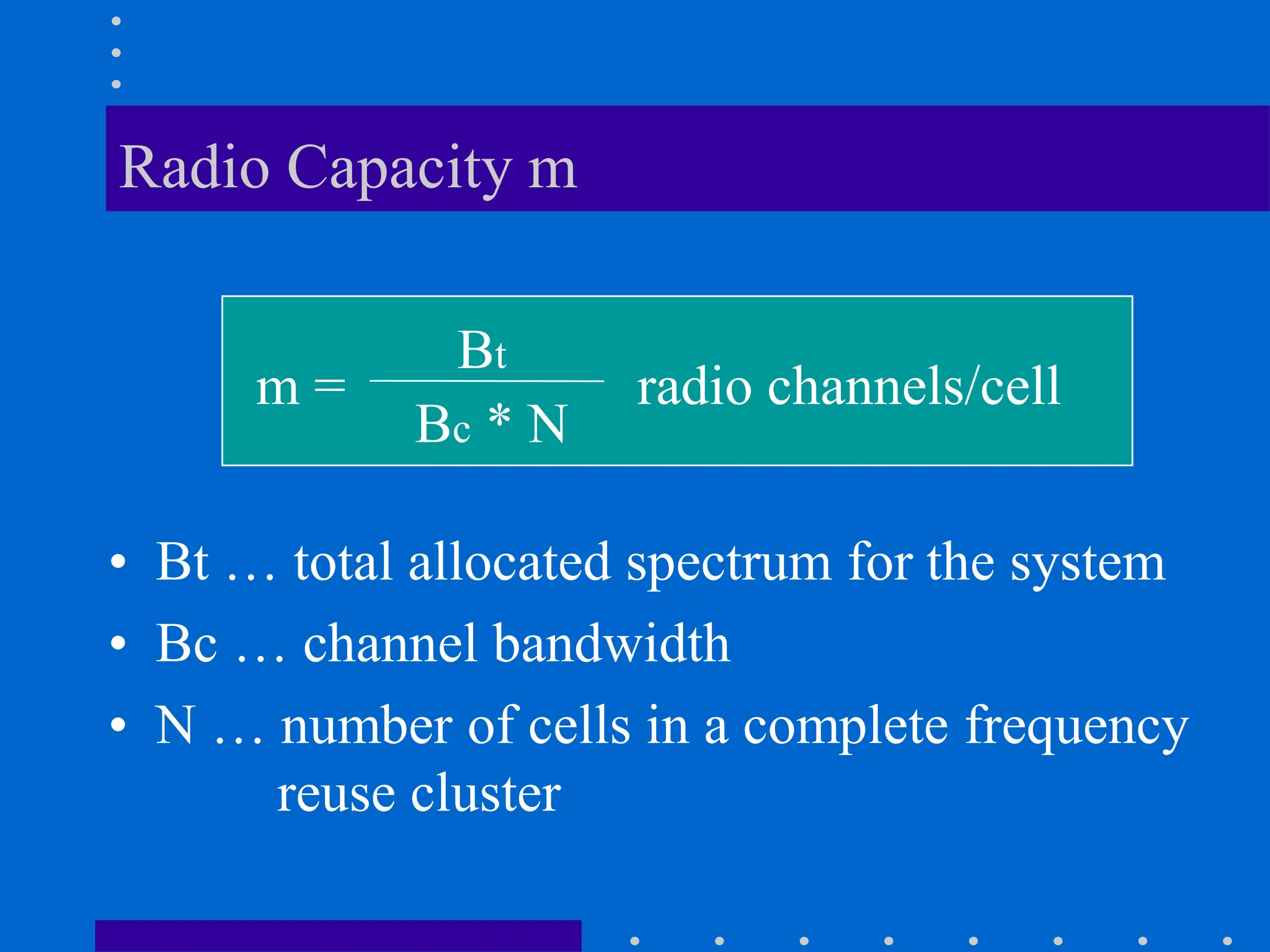
Radio Capacity m
• Bt … total allocated spectrum for the system
• Bc … channel bandwidth
• N … number of cells in a complete frequency
reuse cluster
m =
Bt
Bc * N
radio channels/cell
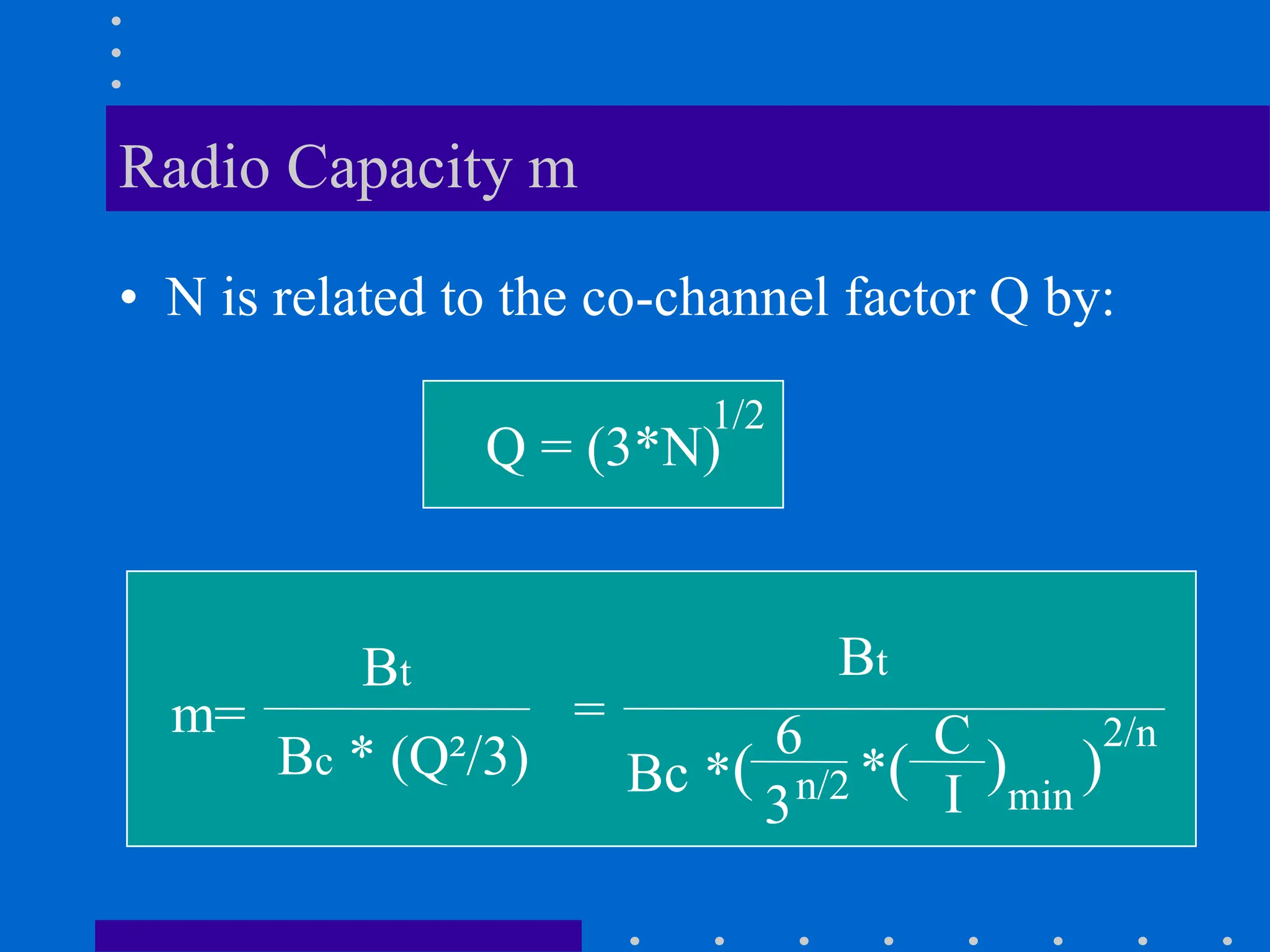
Radio Capacity m
• N is related to the co-channel factor Q by:
Q = (3*N)
1/2
m=
Bt
Bc * (Q²/3)
=
Bt
Bc *
6 C
I
3n/2
( *( )min
)
2/n
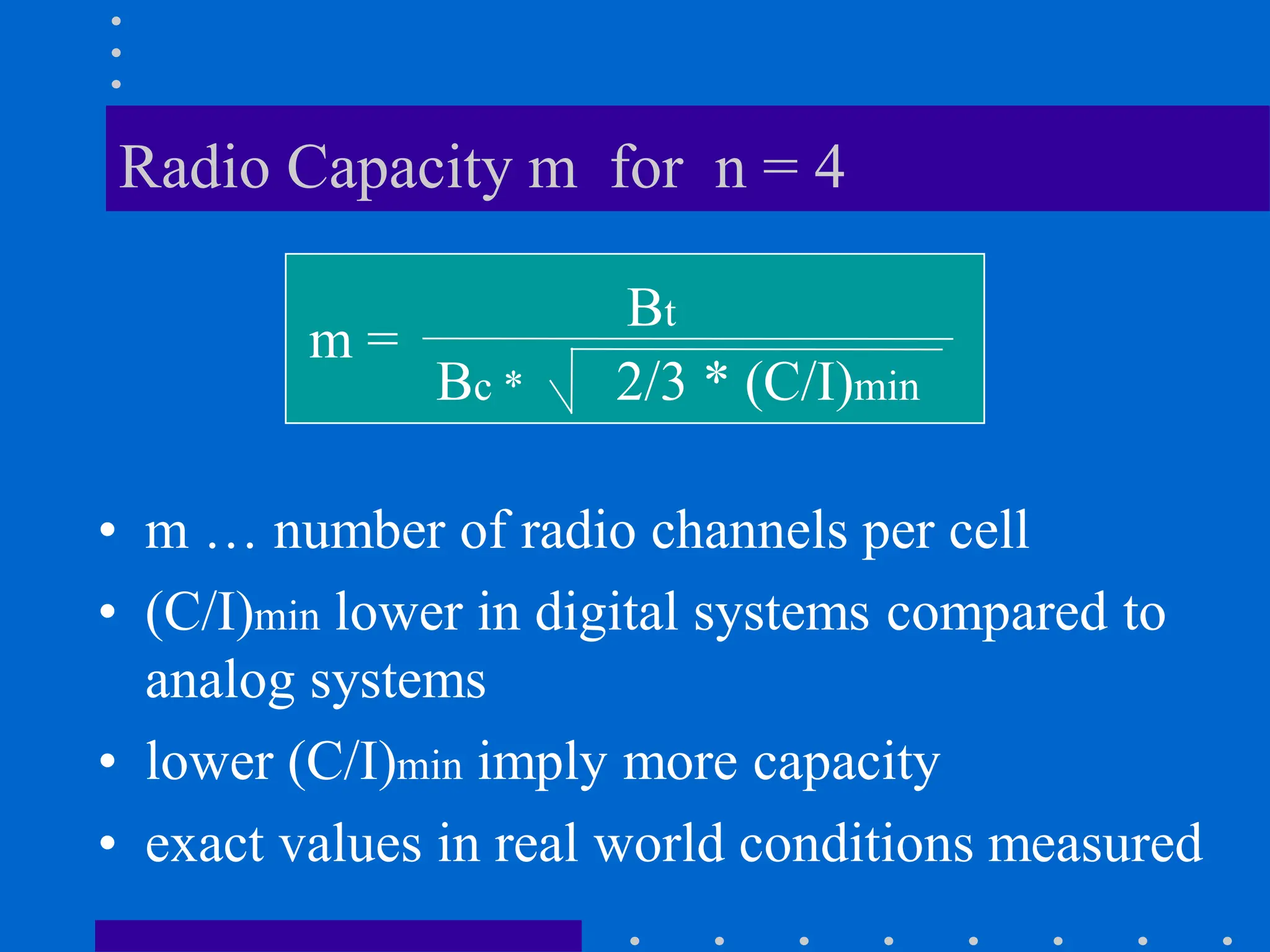
Radio Capacity m for n = 4
• m … number of radio channels per cell
• (C/I)min lower in digital systems compared to
analog systems
• lower (C/I)min imply more capacity
• exact values in real world conditions measured
m =
Bt
Bc * 2/3 * (C/I)min
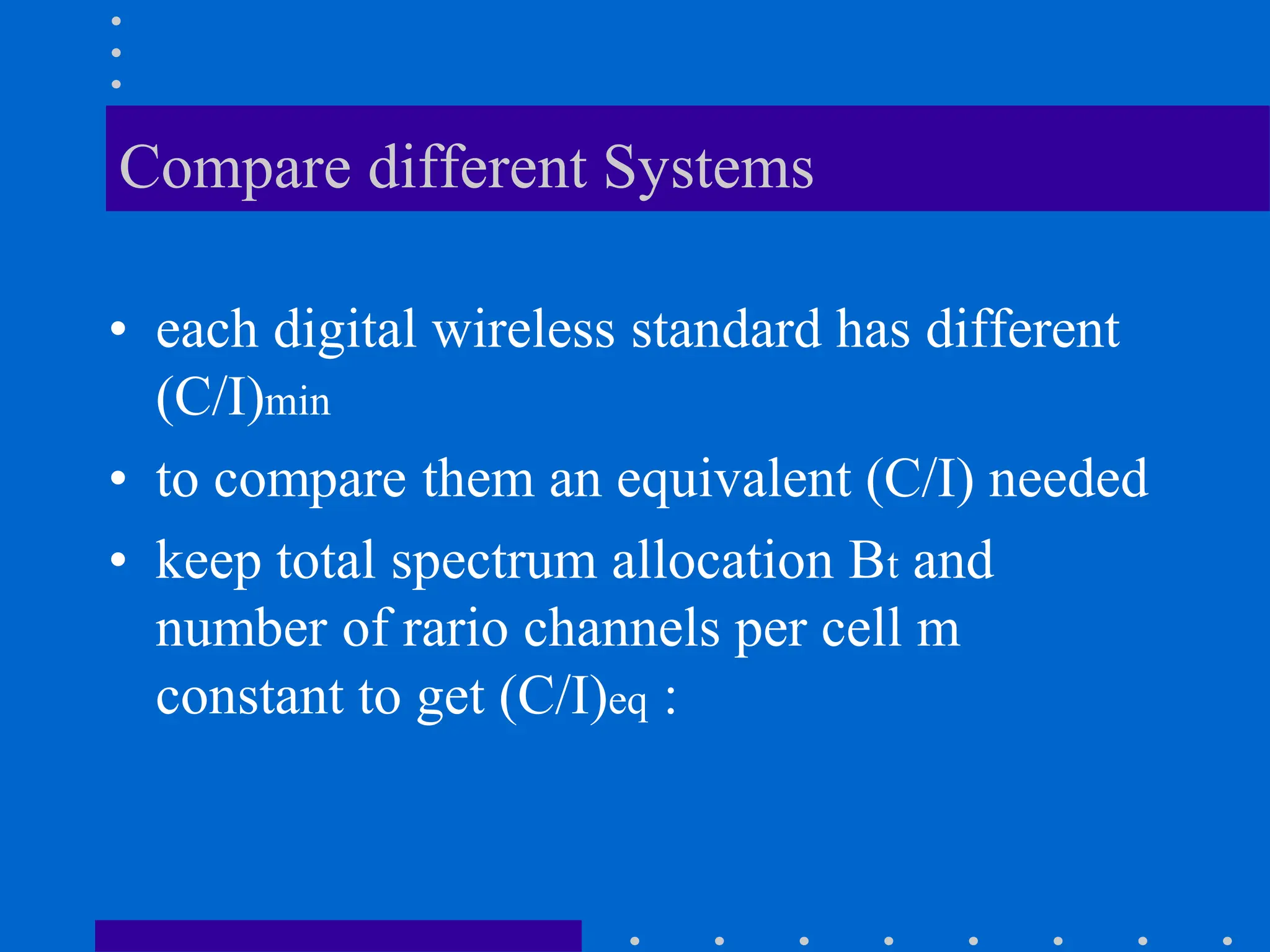
Compare different Systems
• each digital wireless standard has different
(C/I)min
• to compare them an equivalent (C/I) needed
• keep total spectrum allocation Bt and
number of rario channels per cell m
constant to get (C/I)eq :
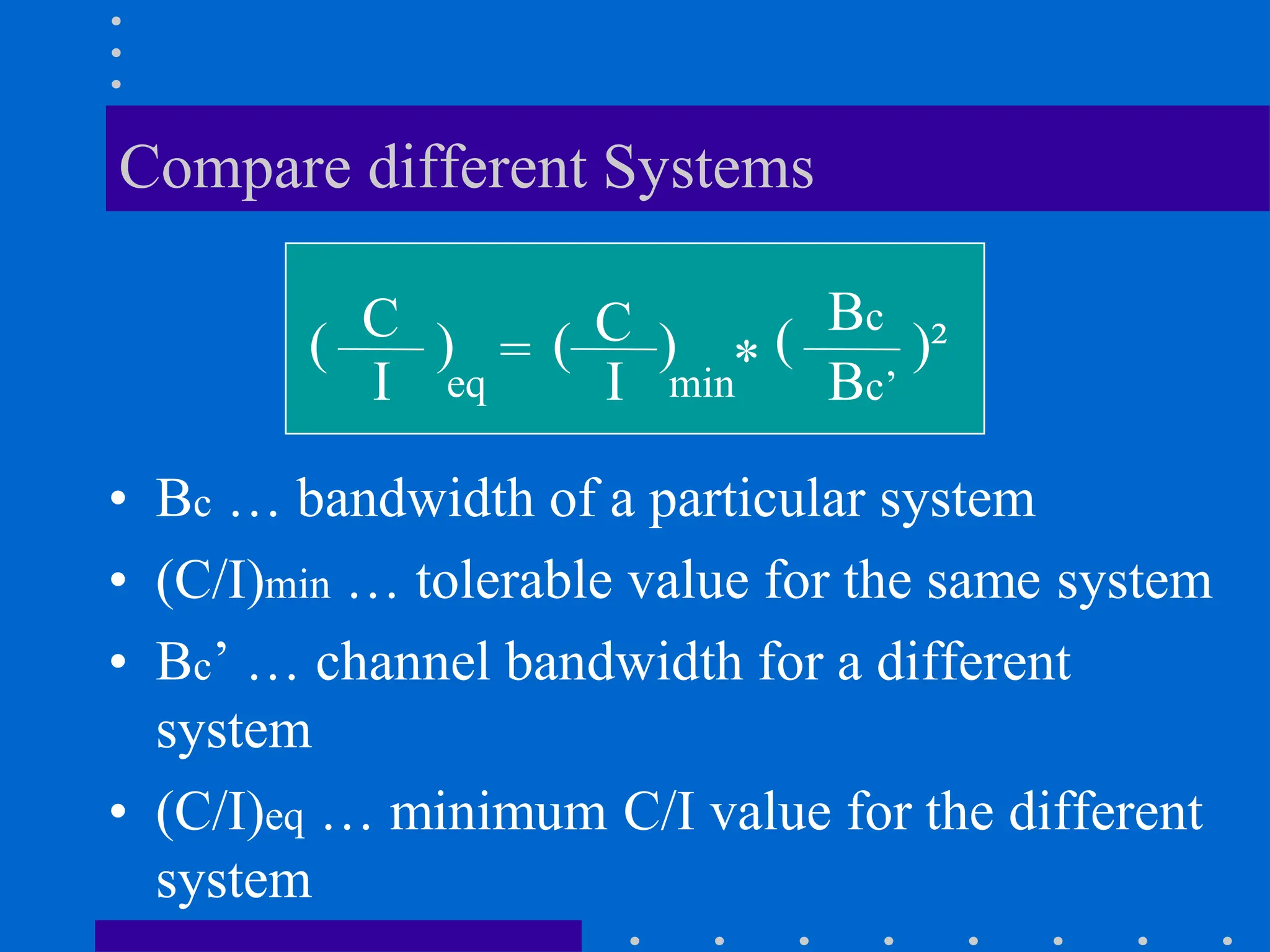
Compare different Systems
• Bc … bandwidth of a particular system
• (C/I)min … tolerable value for the same system
• Bc’ … channel bandwidth for a different
system
• (C/I)eq … minimum C/I value for the different
system
C
I
= C
I
Bc
Bc’
( ) ( )
min
)²
eq * (
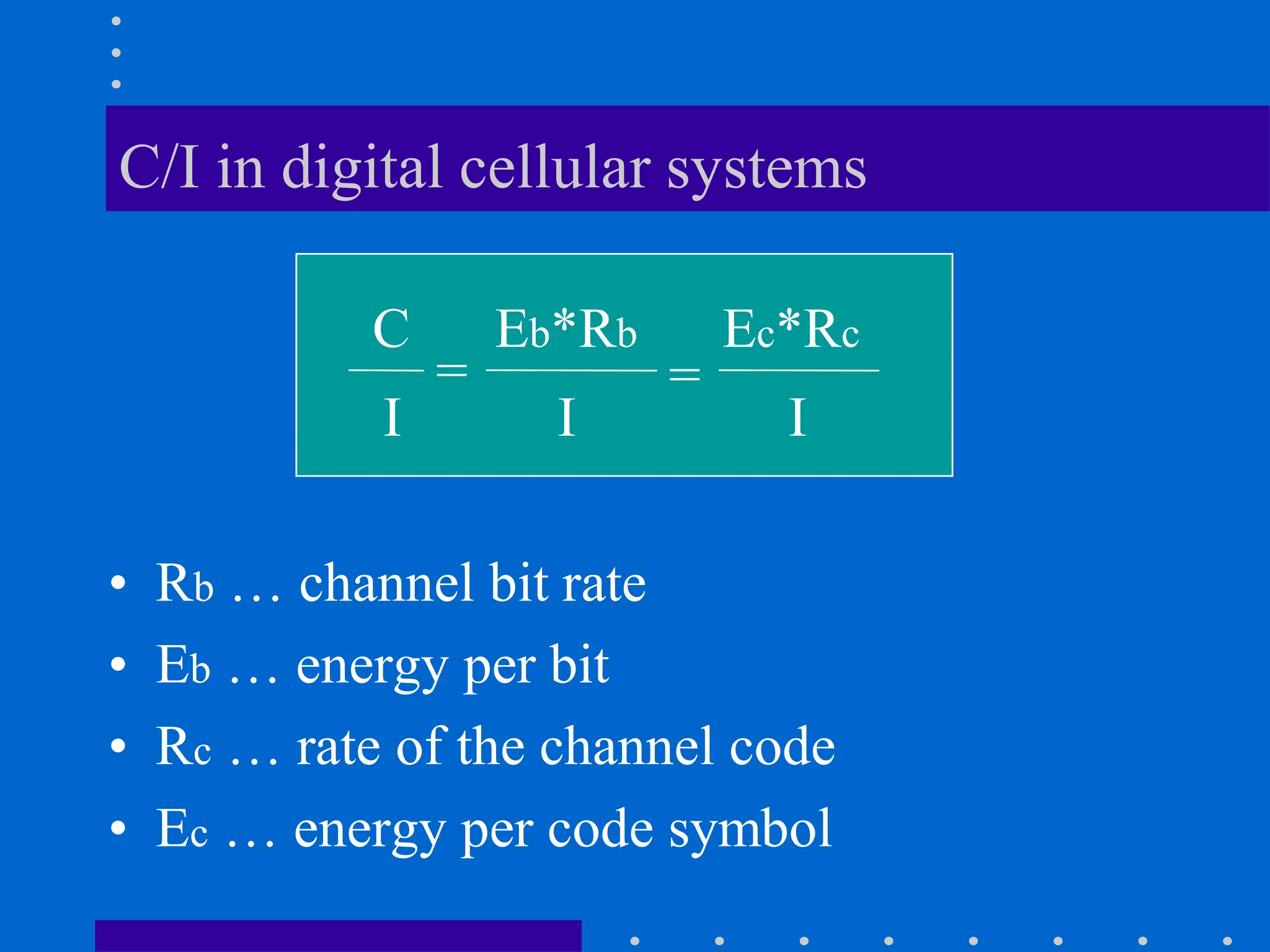
C/I in digital cellular systems
• Rb … channel bit rate
• Eb … energy per bit
• Rc … rate of the channel code
• Ec … energy per code symbol
C Eb*Rb Ec*Rc
I I I
= =
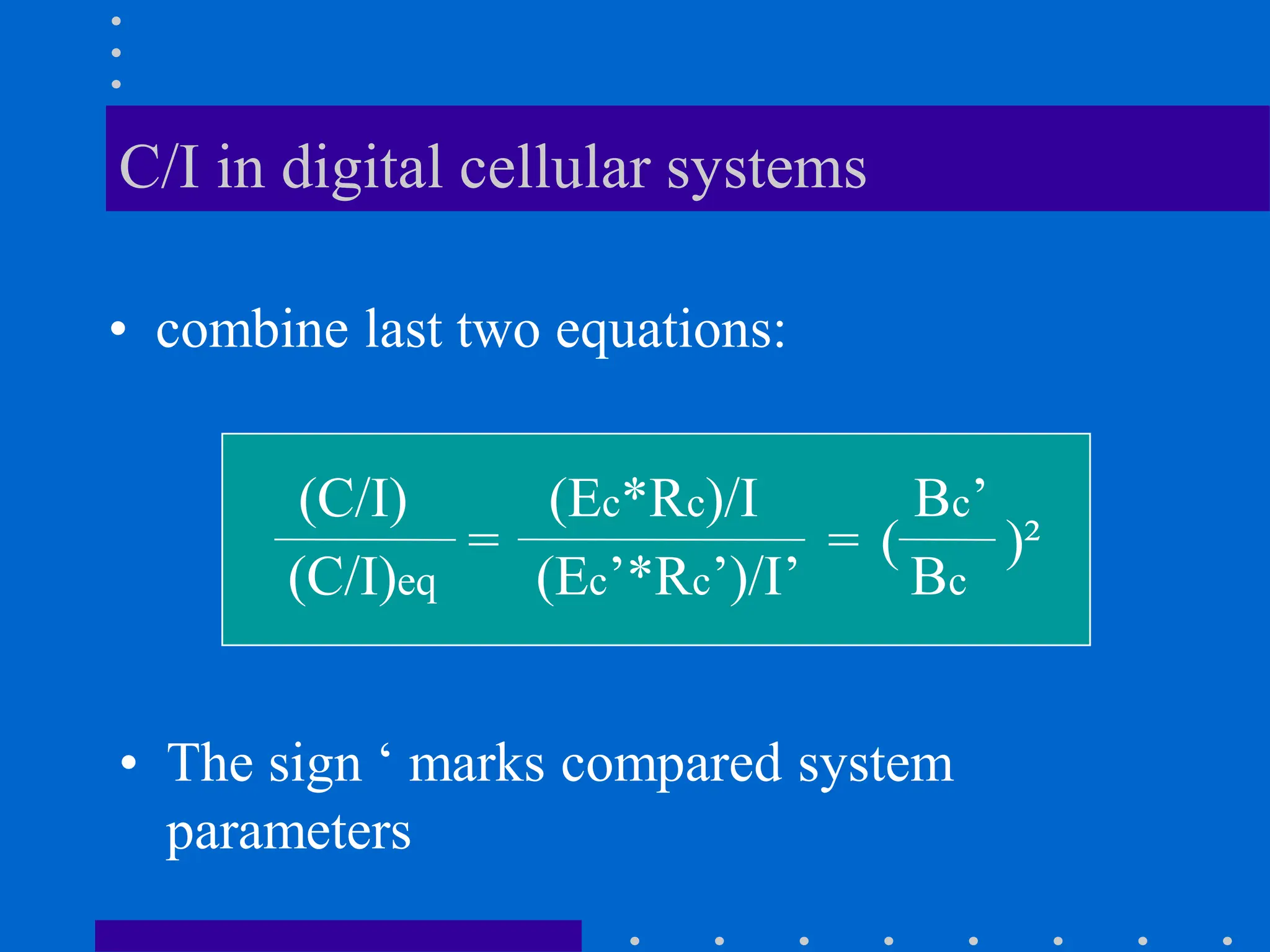
C/I in digital cellular systems
• combine last two equations:
(C/I) (Ec*Rc)/I Bc’
(C/I)eq (Ec’*Rc’)/I’ Bc
= = ( )²
• The sign ‘ marks compared system
parameters
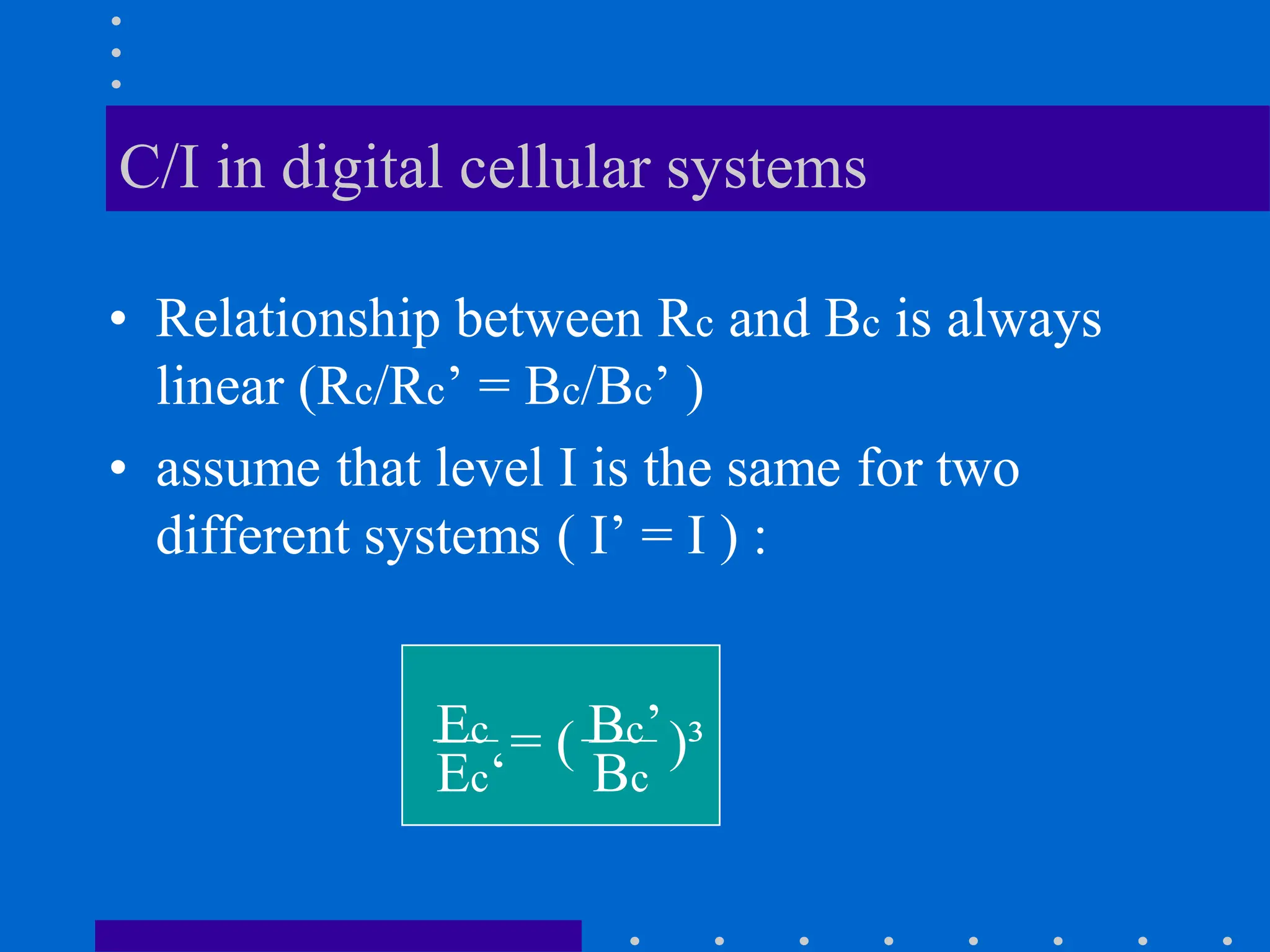
C/I in digital cellular systems
• Relationship between Rc and Bc is always
linear (Rc/Rc’ = Bc/Bc’ )
• assume that level I is the same for two
different systems ( I’ = I ) :
Ec Bc’
Ec‘ Bc
= ( )³
Compare C/I between FDMA and TDMA
• Assume that multichannel FDMA system
occupies same spectrum as a TDMA system
• FDMA : C = Eb * Rb ; I = I0 * Bc
• TDMA : C’ = Eb * Rb’ ; I’ = I0 * Bc’
• Eb … Energy per bit
• I0 … interference power per Hertz
• Rb … channel bit rate
• Bc … channel bandwidth
Example
• A FDMA system has 3 channels , each with
a bandwidth of 10kHz and a transmission
rate of 10 kbps.
• A TDMA system has 3 time slots, a channel
bandwidth of 30kHz and a transmission rate
of 30 kbps.
• What’s the received carrier-to-interference
ratio for a user ?
Example
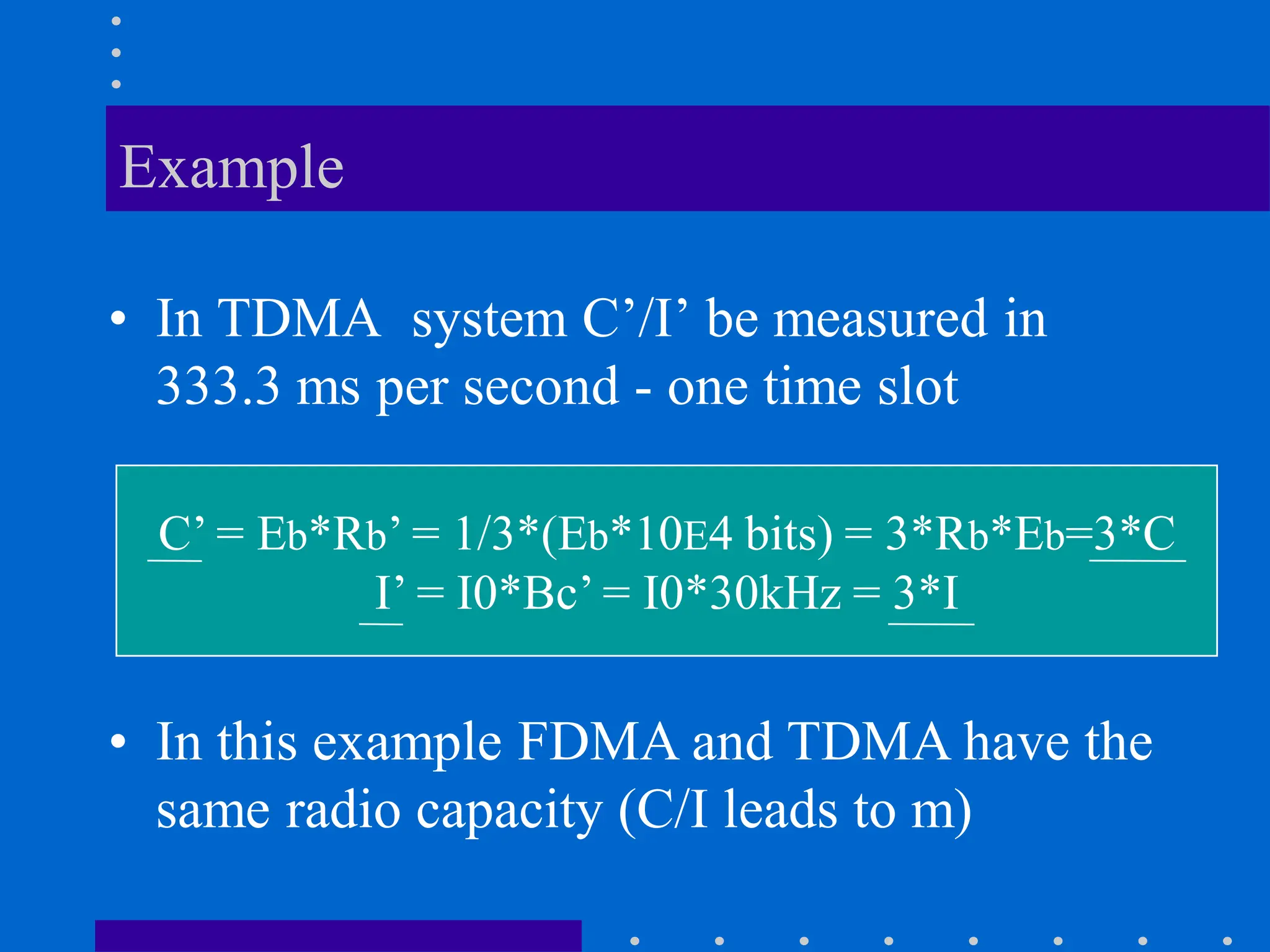
• In TDMA system C’/I’ be measured in
333.3 ms per second - one time slot
C’ = Eb*Rb’ = 1/3*(Eb*10E4 bits) = 3*Rb*Eb=3*C
I’ = I0*Bc’ = I0*30kHz = 3*I
• In this example FDMA and TDMA have the
same radio capacity (C/I leads to m)
Example
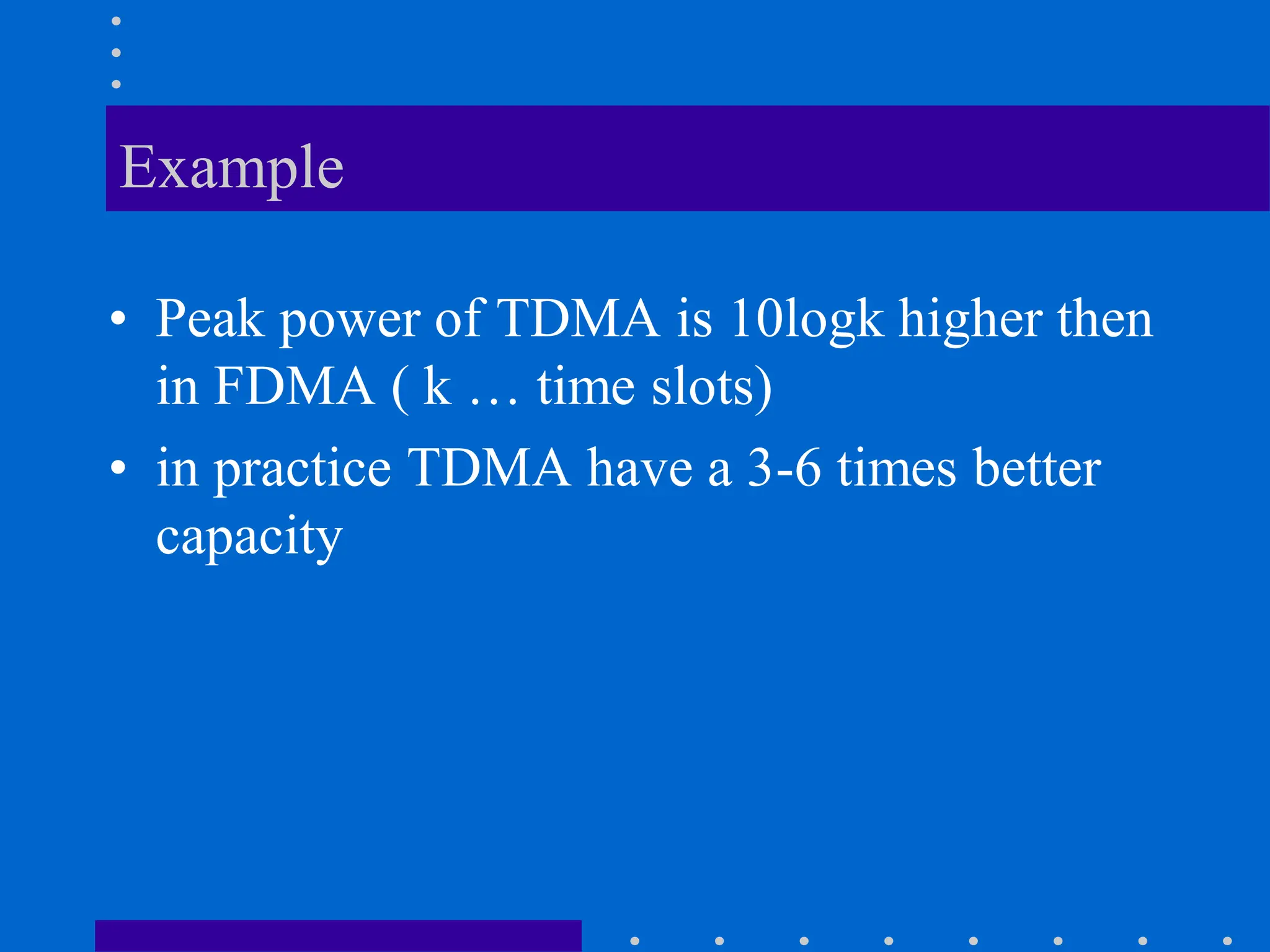
• Peak power of TDMA is 10logk higher then
in FDMA ( k … time slots)
• in practice TDMA have a 3-6 times better
capacity
Capacity of SDMA systems
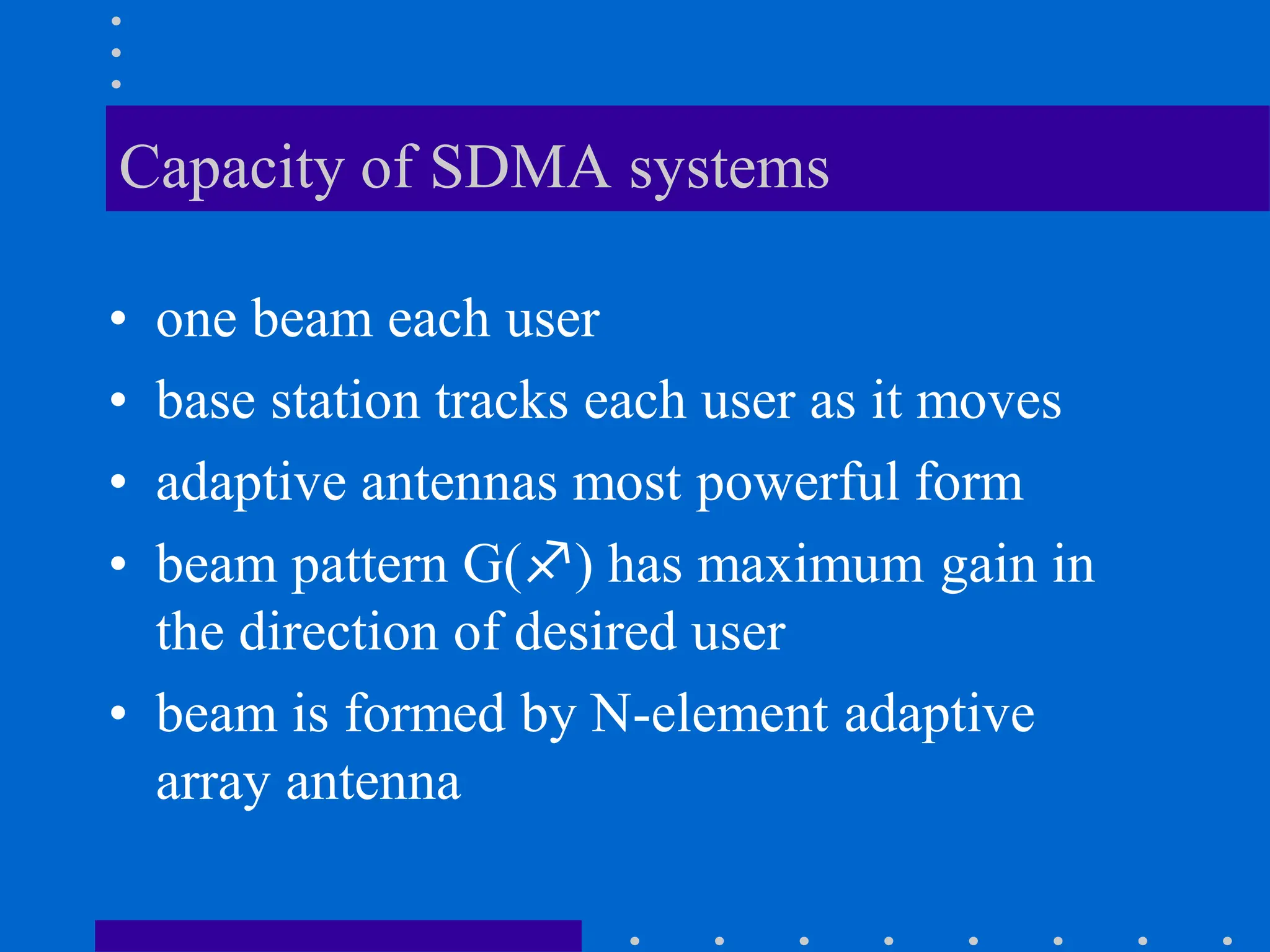
• one beam each user
• base station tracks each user as it moves
• adaptive antennas most powerful form
• beam pattern G() has maximum gain in
the direction of desired user
• beam is formed by N-element adaptive
array antenna
Capacity of SDMA systems
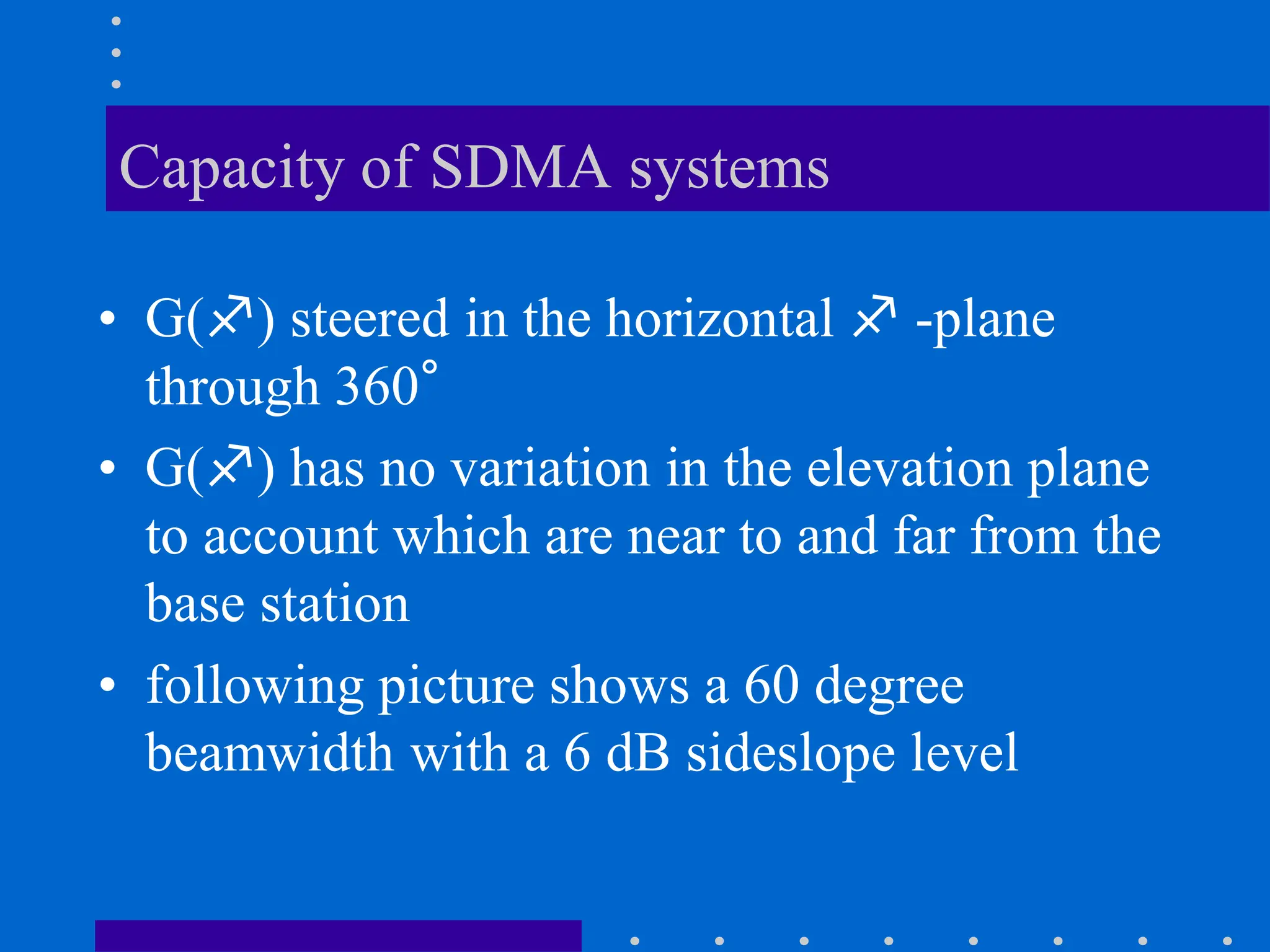
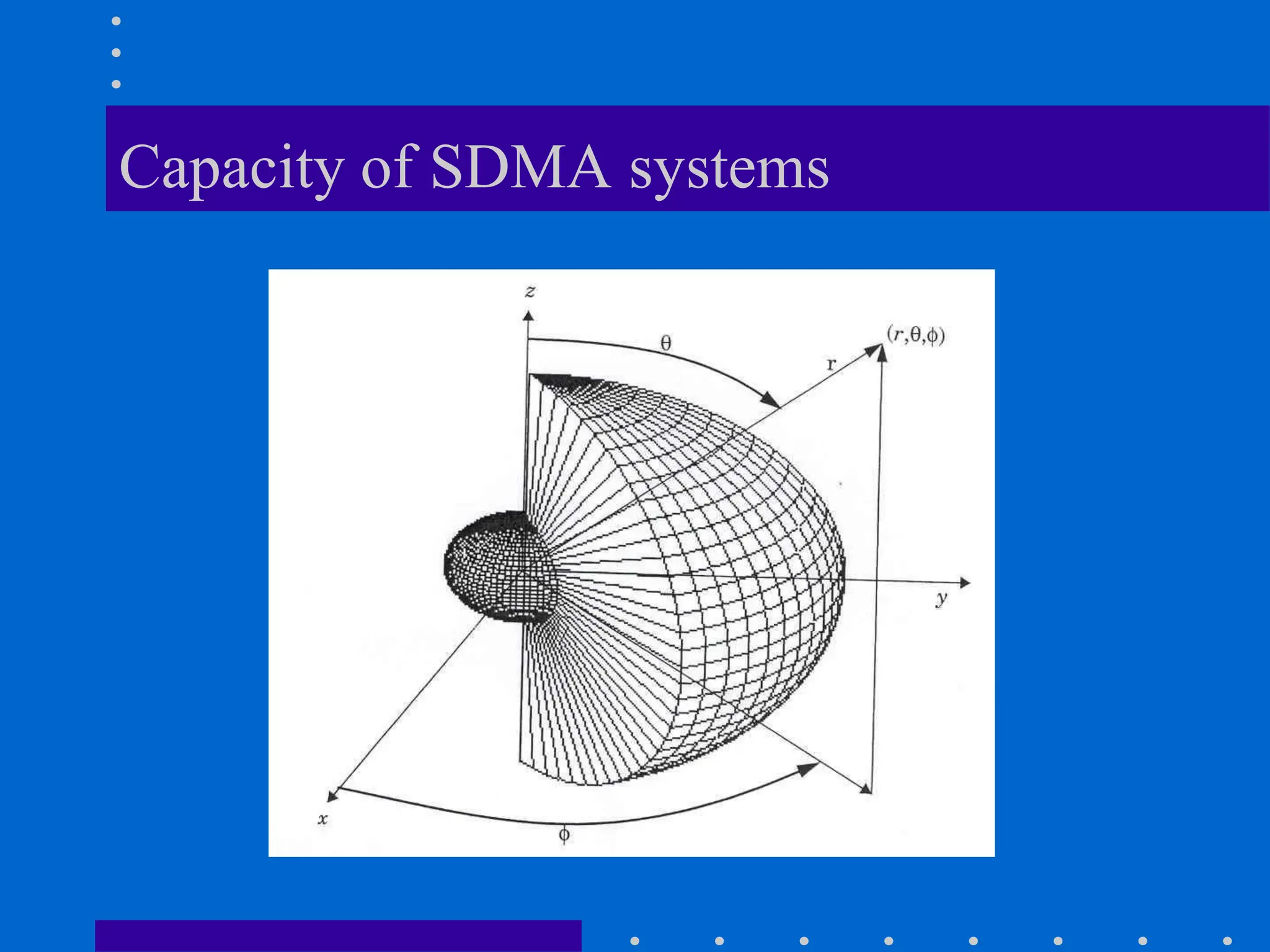
• G() steered in the horizontal  -plane
through 360°
• G() has no variation in the elevation plane
to account which are near to and far from the
base station
• following picture shows a 60 degree
beamwidth with a 6 dB sideslope level
Capacity of SDMA systems
• reverse link received signal power, from
desired mobiles, is Pr;0
• interfering users i = 1,…,k-1 have received
power Pr;I
• average total interference power I seen by a
single desired user:
Capacity of SDMA
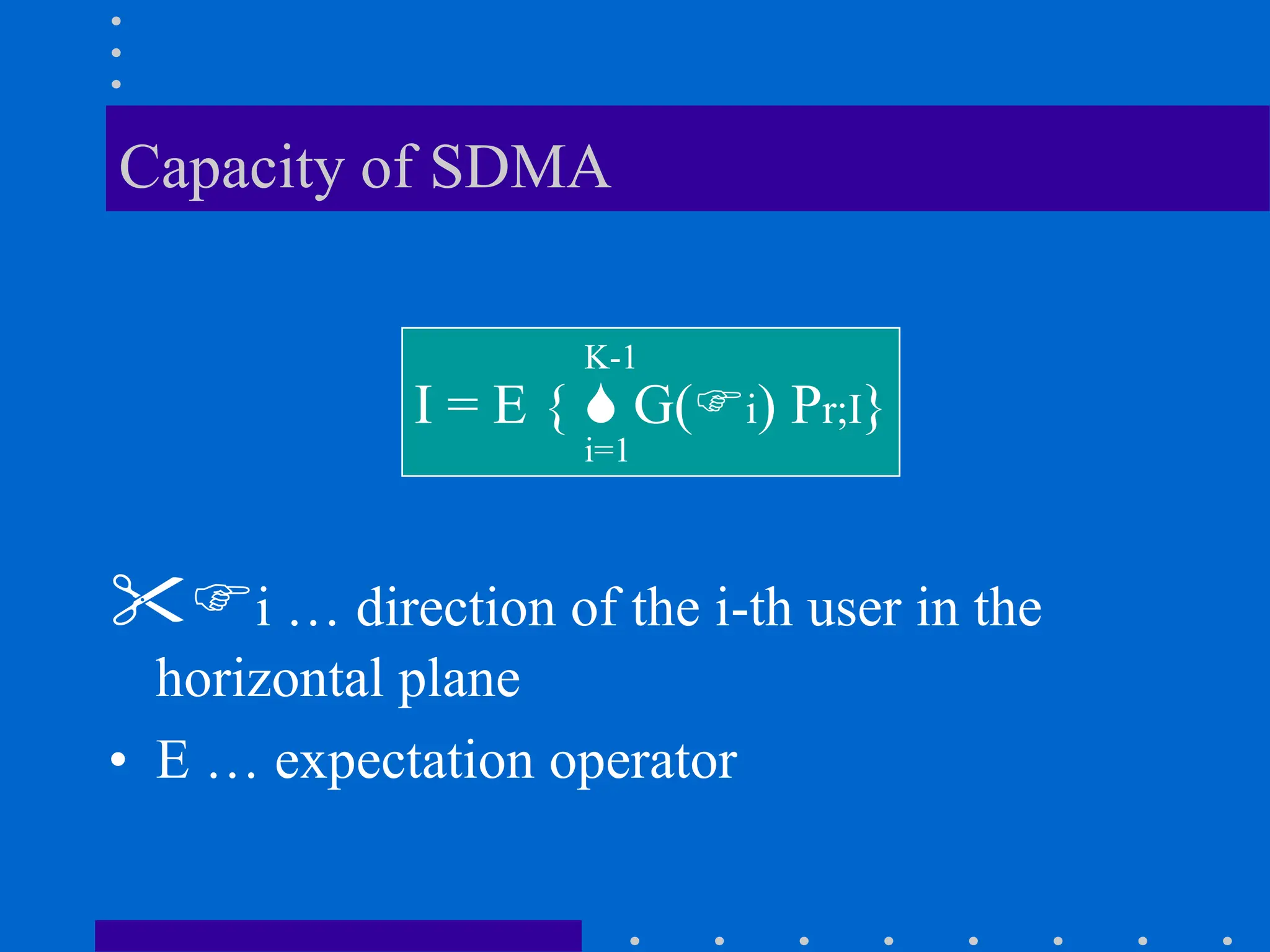
i … direction of the i-th user in the
horizontal plane
• E … expectation operator
I = E {  G(i) Pr;I}
K-1
i=1
Capacity of SDMA systems
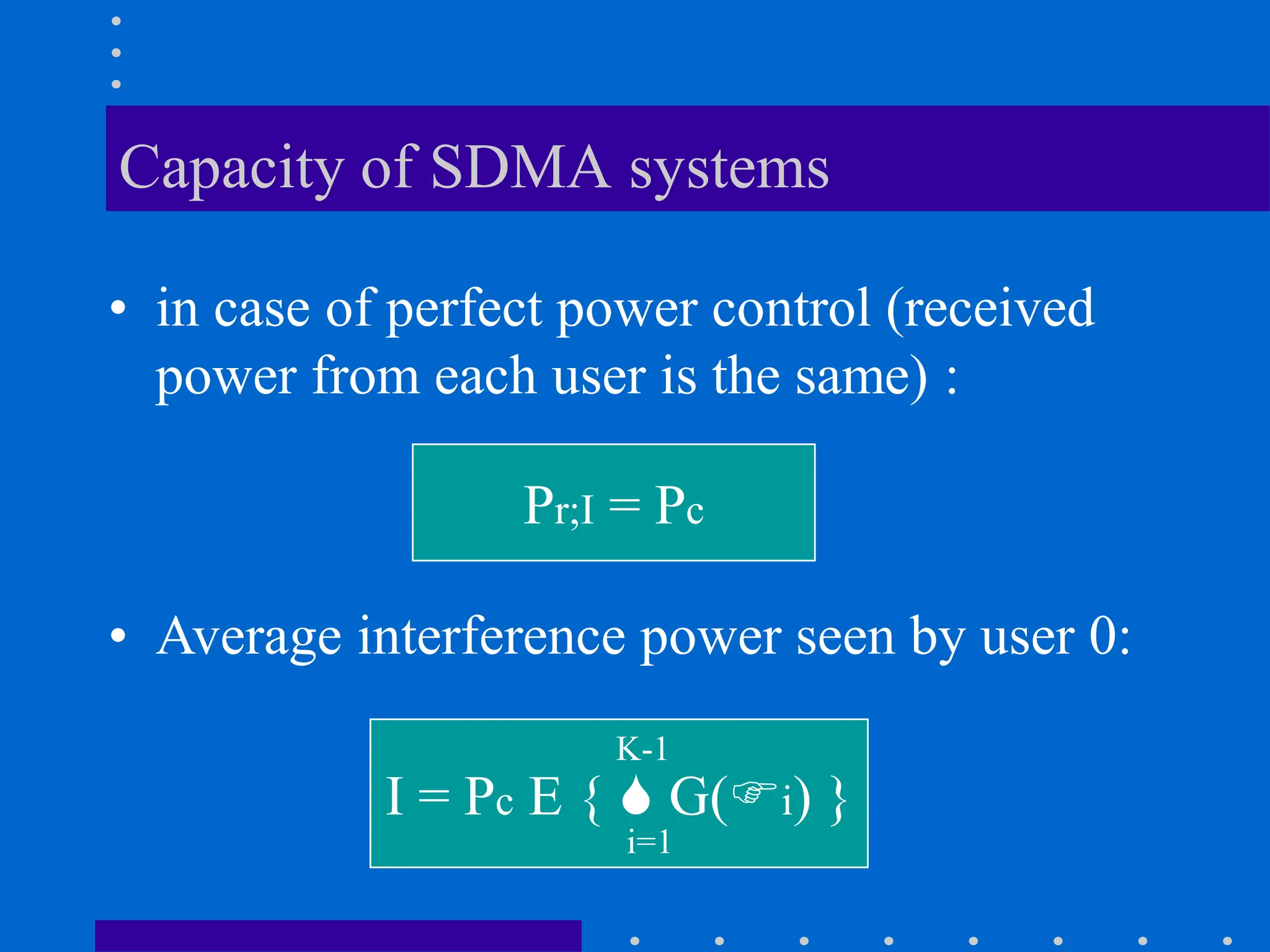
• in case of perfect power control (received
power from each user is the same) :
Pr;I = Pc
• Average interference power seen by user 0:
I = Pc E {  G(i) }
K-1
i=1
Capacity of SDMA systems
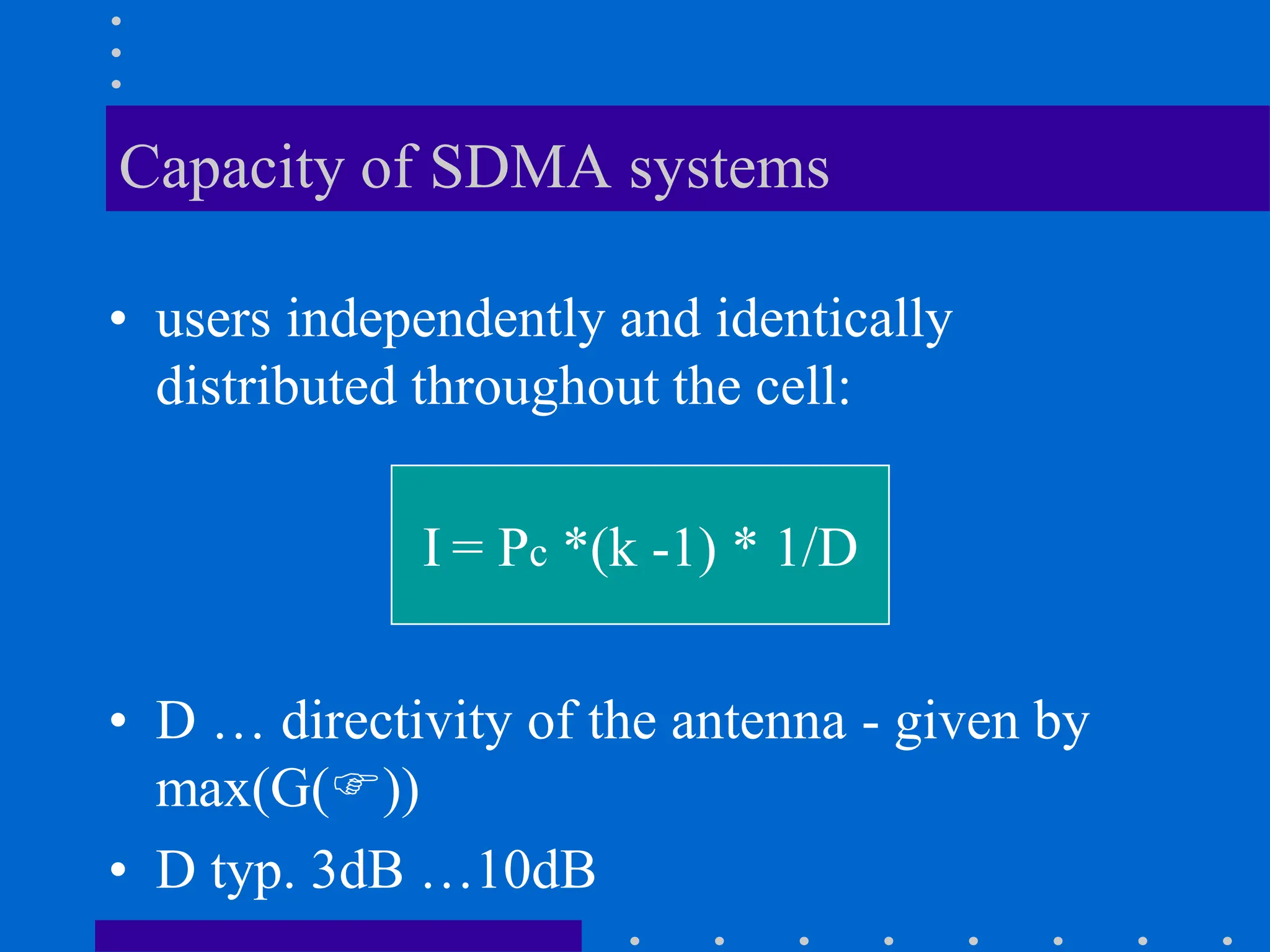
• users independently and identically
distributed throughout the cell:
I = Pc *(k -1) * 1/D
• D … directivity of the antenna - given by
max(G())
• D typ. 3dB …10dB
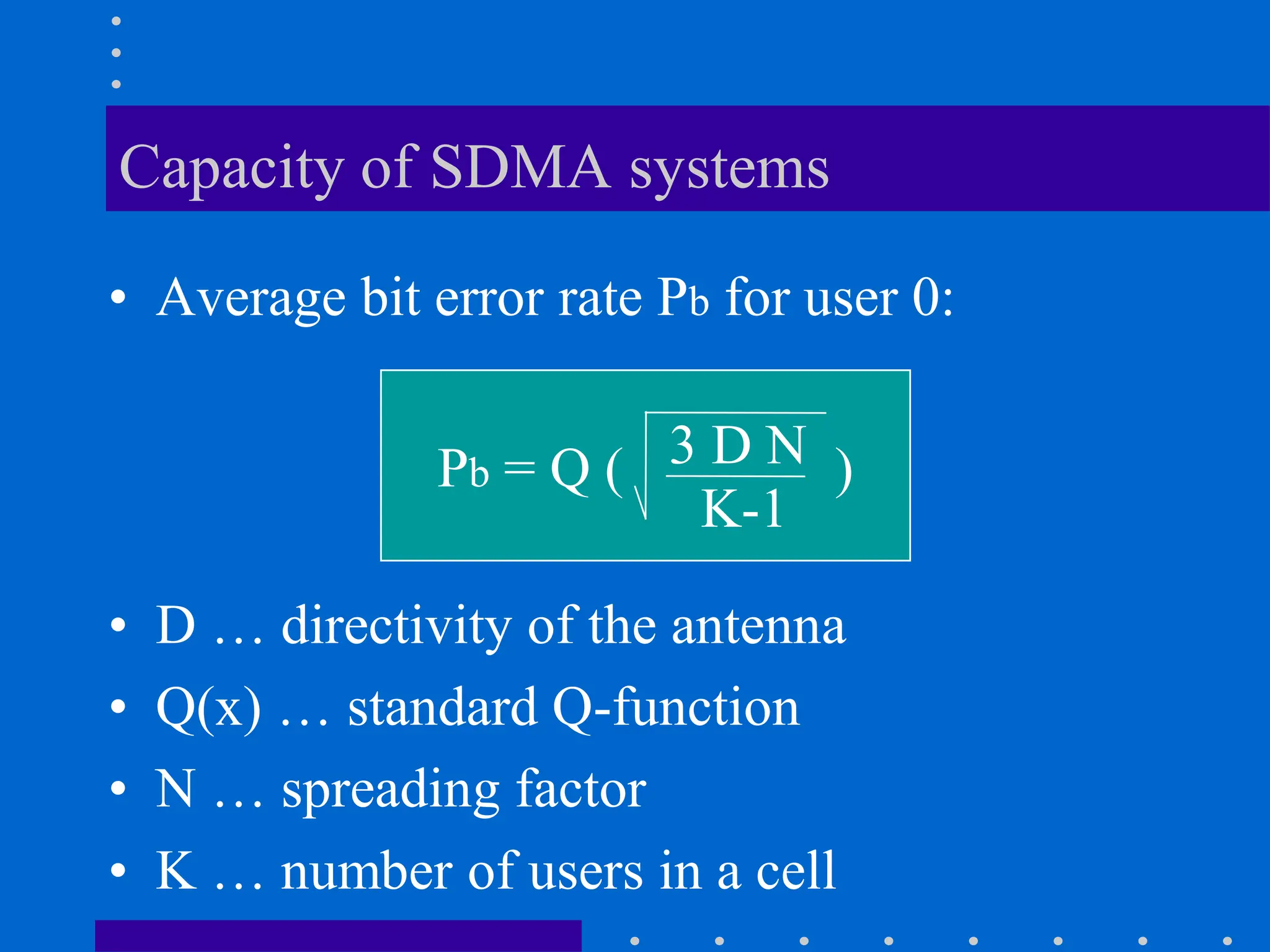
Pb = Q ( )
Capacity of SDMA systems
• Average bit error rate Pb for user 0:
3 D N
K-1
• D … directivity of the antenna
• Q(x) … standard Q-function
• N … spreading factor
• K … number of users in a cell
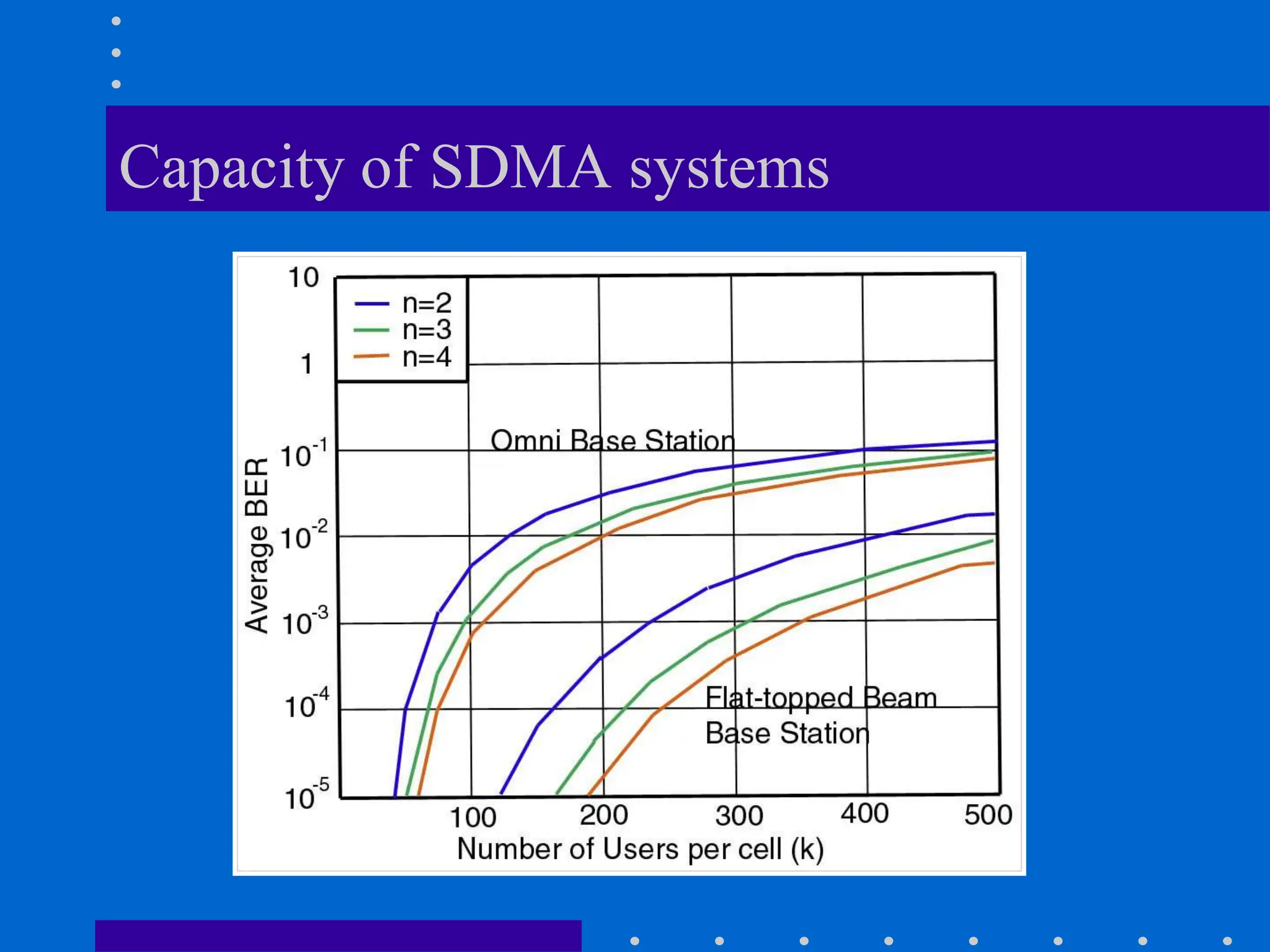
Capacity of SDMA systems
67
The Cellular Concept
3rd Chapter
Wireless Communication
By Theodore S. Rappaport
2nd Edition
Cellular Systems-Basic Concepts
Cellular system solves the problem of spectral congestion.
Offers high capacity in limited spectrum.
High capacity is achieved by limiting the coverage area of each
BS to a small geographical area called cell.
Replaces high powered transmitter with several low power
transmitters.
Each BS is allocated a portion of total channels and nearby cells
are allocated completely different channels.
All available channels are allocated to small no of neighboring
BS.
Interference between neighboring BSs is minimized by allocating
different channels.
68
Cellular Systems-Basic Concepts
Same frequencies are reused by spatially
separated BSs.
Interference between co-channels stations is kept
below acceptable level.
Additional radio capacity is achieved.
Frequency Reuse-Fix no of channels serve an
arbitrarily large no of subscribers
69
Frequency Reuse
used by service providers to improve the efficiency of a cellular
network and to serve millions of subscribers using a limited
radio spectrum
After covering a certain distance a radio wave gets attenuated
and the signal falls below a point where it can no longer be used
or cause any interference
A transmitter transmitting in a specific frequency range will have
only a limited coverage area
Beyond this coverage area, that frequency can be reused by
another transmitter.
The entire network coverage area is divided into cells based on the principle of
frequency reuse
70
Frequency Reuse
A cell = basic geographical unit of a cellular network; is the area
around an antenna where a specific frequency range is used.
when a subscriber moves to another cell, the antenna of the new
cell takes over the signal transmission
a cluster is a group of adjacent cells, usually 7 cells; no
frequency reuse is done within a cluster
the frequency spectrum is divided into sub-bands and each sub-
band is used within one cell of the cluster
in heavy traffic zones cells are smaller, while in isolated zones
cells are larger
71
Frequency Reuse
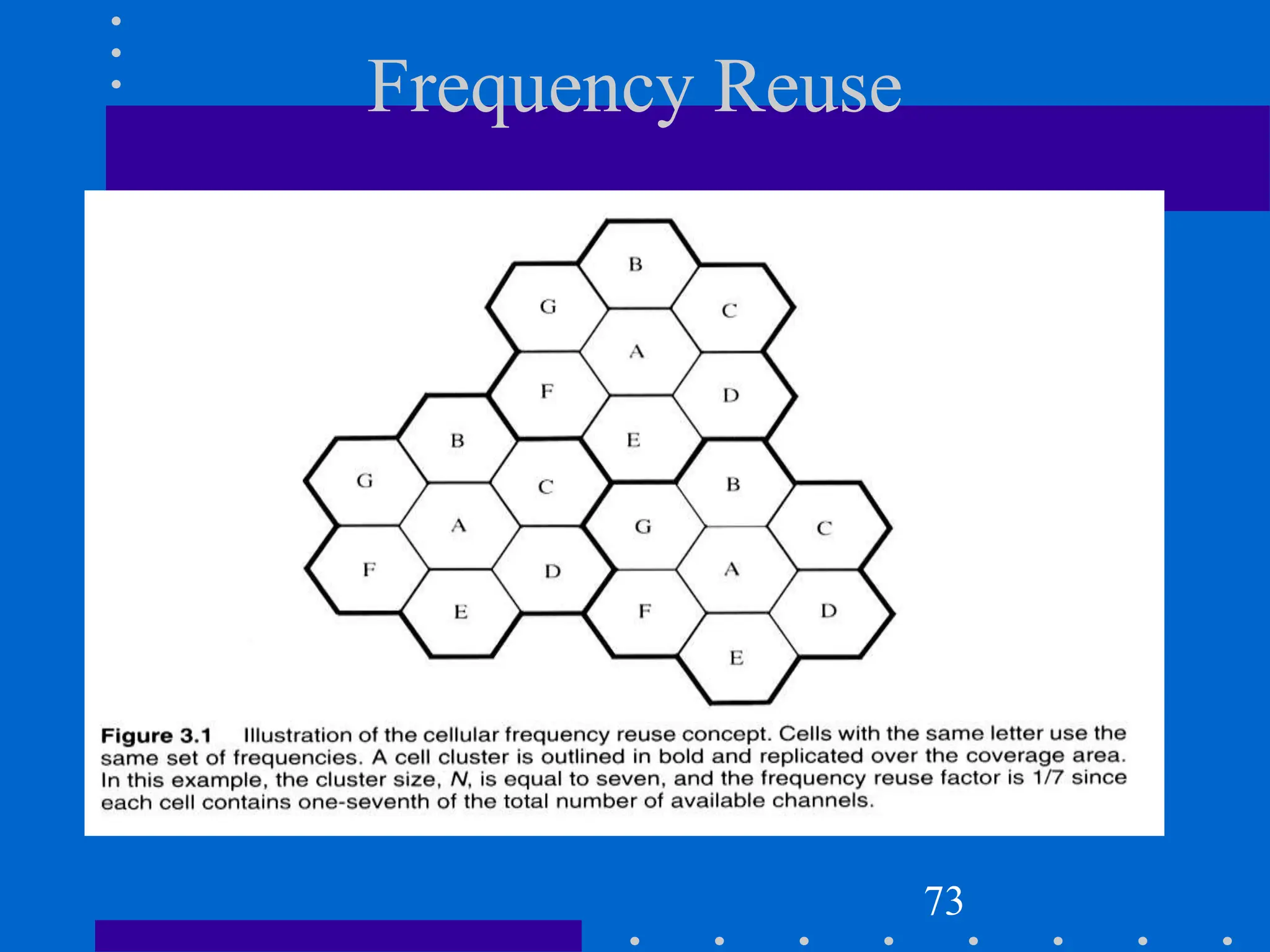
The design process of selecting and allocating
channel groups for all of the cellular base
stations within a system is called frequency reuse
or frequency planning.
Cell labeled with same letter use the same set of
frequencies.
Cell Shapes:
Circle, Square, Triangle and Hexagon.
Hexagonal cell shape is conceptual , in reality it
is irregular in shape
72
Frequency Reuse
73
Frequency Reuse
In hexagonal cell model, BS transmitter can be
in centre of cell or on its 3 vertices.
Centered excited cells use omni directional
whereas edge excited cells use directional
antennas.
A cellular system having ‘S’ duplex channels,
each cell is allocated ‘k’ channels(k<S).
If S channels are allocated to N cells into unique
and disjoint channels, the total no of available
channel is S=kN.
74
Frequency Reuse
N cells collectively using all the channels is called a cluster, is a
group of adjacent cells.
If cluster if repeated M times, the capacity C of system is given
as
C=MkN=MS
Capacity of system is directly proportional to the no of times
cluster is repeated.
Reducing the cluster size N while keeping the cell size constant,
more clusters are required to cover the given area and hence
more capacity.
Co-channel interference is dependent on cluster size, large
cluster size less interference and vice versa.
75
Frequency Reuse
The Frequency Reuse factor is given as 1/N, each cell is
assigned 1/N of total channels.
Lines joining a cell and each of its neighbor are separated by
multiple of 600,certain cluster sizes and cell layout possible
Geometery of hexagon is such that no of cells per cluster i.e N, can
only have values which satisfy the equation
N=i2+ij+j2
N, the cluster size is typically 4, 7 or 12.
In GSM normally N =7 is used.
i and j are integers, for i=3 and j=2 N=19.
Example from Book
76
Locating co-channel Cell
77
Channel Assignment Strategies
A scheme for increasing capacity and minimizing interference is
required.
CAS can be classified as either fixed or dynamic
Choice of CAS impacts the performance of system.
In Fixed CA each cell is assigned a predetermined set of voice channels
Any call attempt within the cell can only be served by the unused
channel in that particular cell
If all the channels in the cell are occupied, the call is blocked. The user
does not get service.
In variation of FCA, a cell can borrow channels from its neighboring
cell if its own channels are full.
78
Dynamic Channel Assignment
Voice channels are not allocated to different cells permanently.
Each time a call request is made, the BS request a channel from
the MSC.
MSC allocates a channel to the requesting cell using an
algorithm that takes into account
likelihood of future blocking
The reuse distance of the channel ( should not cause interference)
Other parameters like cost
To ensure min QoS, MSC only allocates a given frequency if that
frequency is not currently in use in the cell or any other cell which falls
within the limiting reuse distance.
DCA reduce the likelihood of blocking and increases capacity
Requires the MSC to collect realtime data on channel occupancy and
traffic distribution on continous basis.
79
Hand-off
Mobile moves into a different cell during a conversation, MSC
transfers the call to new channel belonging to new BS
Handoff operation involves identifying the new BS and allocation
of voice and control signal to channels associated with new BS
Must be performed successfully, infrequently and impercitble to user
To meet these requirements an optimum signal level must be
defined to initiate a handoff.
Min usuable signal for acceptable voice qualtiy -90 to -100 dBm
A slight higher value is used as threshold
80
Handoff
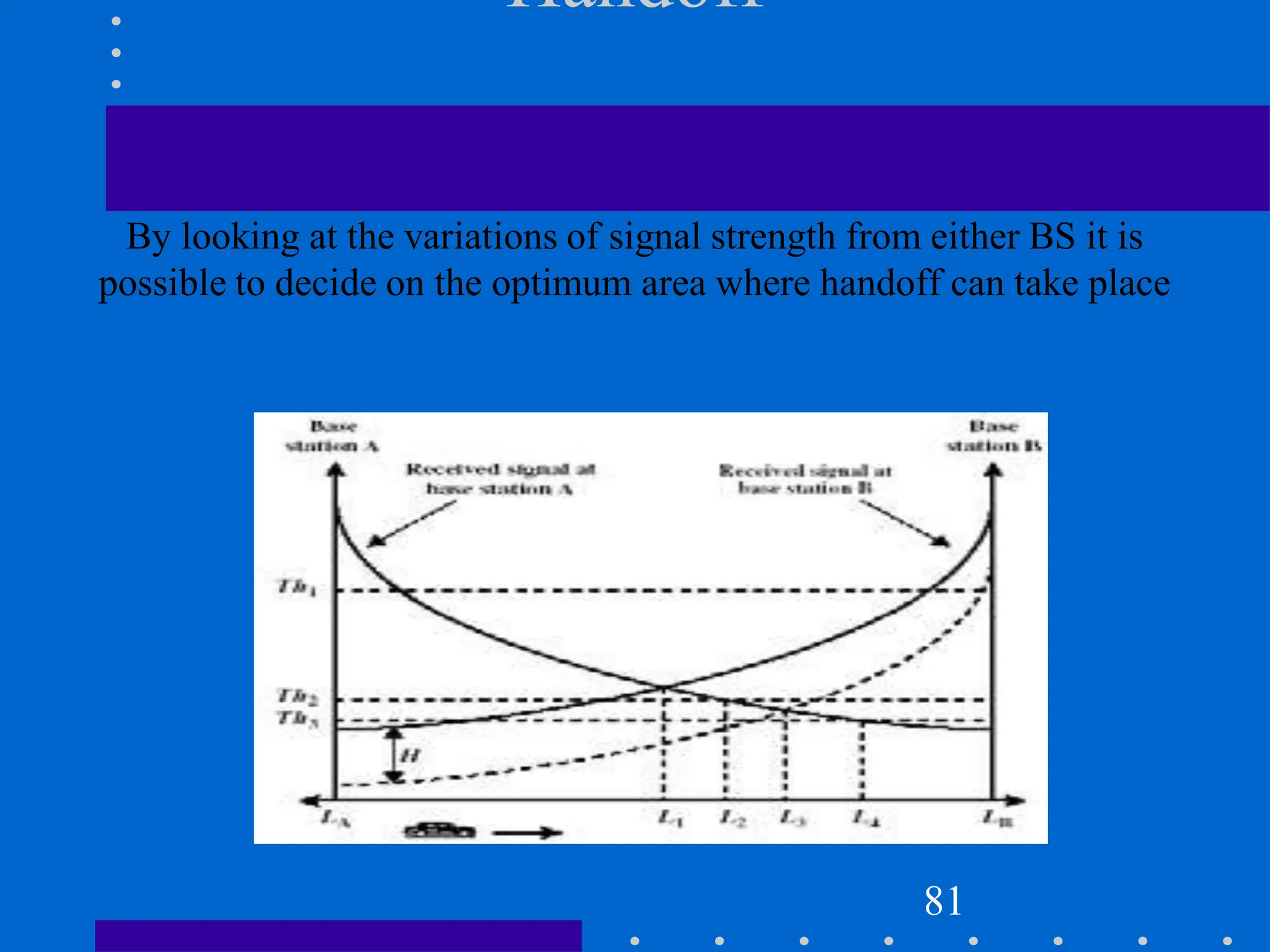
By looking at the variations of signal strength from either BS it is
possible to decide on the optimum area where handoff can take place
81
82
Hand-off strategies
Handoff is made when received signal at the BS falls below a
certain threshold
During handoff: to avoid call termination, safety margin should
exist and should not be too large or small
=Power_handoff – Power_min usable
Large  results in unecesarry handoff and for small  unsufficient time
to complete handoff, so carefully chosen to meet the requirements.
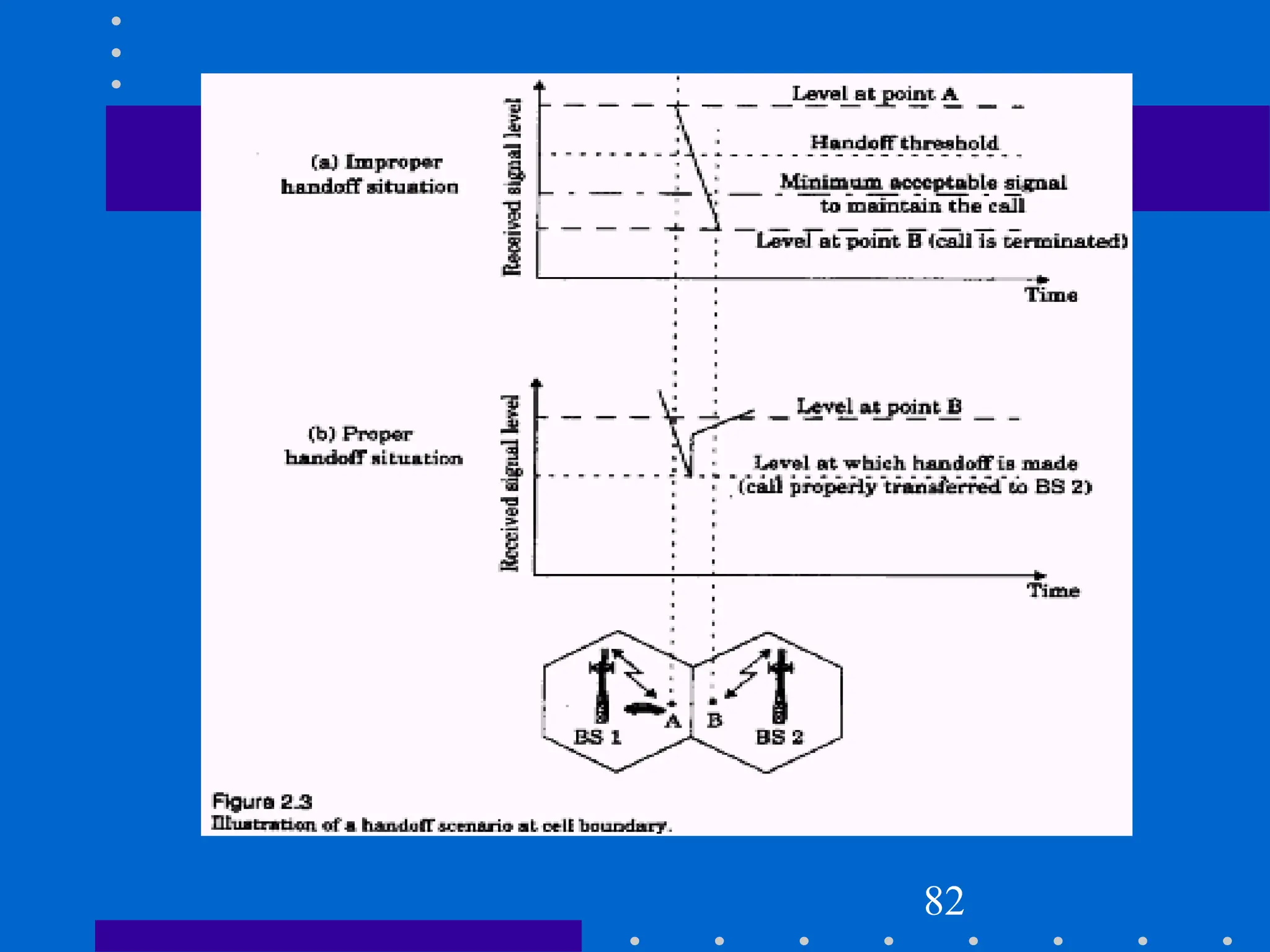
Fig a, handoff not made and signal falls below min acceptable
level to keep the channel active.
Can happen due to excessive delay by MSC in assigning
handoff, or when threshold  is set to small.
Excessive delay may occur during high traffic conditions due to computional
loading or non avialablilty of channels in nearby cells
83
Hand-off
In deciding when to handoff , it is important to ensure that the drop in
signal level is not due to momentary fading.
In order to ensure this the BS monitors the signal for a certain period of
time before initiating a handoff
The length of time needed to decide if handoff is necessary depends on
the speed at which the mobile is moving
84
Hand-off strategies
In 1st generation analog cellular systems, the signal strength
measurements are made by the BS and are supervised by the MSC.
A spare Rx in base station (locator Rx) monitors RSS of RVC's in
neighboring cells
Tells Mobile Switching Center about these
mobiles and their channels
Locator Rx can see if signal to this base
station is significantly better than to the
host base station
MSC monitors RSS from all base stations & decides on handoff
85
86
Hand-off strategies
In 2nd generation systems Mobile Assisted Handoffs (MAHO)are used
In MAHO, every MS measures the received power from the
surrounding BS and continually reports these values to the
corresponding BS.
Handoff is initiated if the signal strength of a neighboring BS exceeds
that of current BS
MSC no longer monitors RSS of all channels
reduces computational load considerably
enables much more rapid and efficient handoffs
imperceptible to user
86
Soft Handoff
CDMA spread spectrum cellular systems provides a unique handoff
capability
Unlike channelized wireless systems that assigns different radio
channel during handoff (called hard handoff), the spread spectrum MS
share the same channel in every cell
The term handoff here implies that a different BS handles the radio
communication task
The ability to select between the instantaneous received signals from
different BSs is called soft handoff
87
Inter system Handoff
If a mobile moves from one cellular system to a different system
controlled by a different MSC, an inter-system handoff is necessary
MSC engages in intersystem handoff when signal becomes weak in a
given cell and MSC cannot find another cell within its system to
transfer the on-going call
Many issues must be resolved
Local call may become long distance call
Compatibility between the two MSCs
88
Prioritizing Handoffs
Issue: Perceived Grade of Service (GOS) – service quality as
viewed by users
“quality” in terms of dropped or blocked calls (not voice quality)
assign higher priority to handoff vs. new call request
a dropped call is more aggravating than an occasional blocked call
Guard Channels
% of total available cell channels exclusively set aside for handoff
requests
makes fewer channels available for new call requests
a good strategy is dynamic channel allocation (not fixed)
adjust number of guard channels as needed by demand
so channels are not wasted in cells with low traffic
89
Prioritizing Handoffs
Queuing of Handoff Requests
use time delay between handoff threshold and minimum useable signal
level to place a blocked handoff request in queue
a handoff request can "keep trying" during that time period, instead of
having a single block/no block decision
prioritize requests (based on mobile speed) and handoff as needed
calls will still be dropped if time period expires
90
Practical Handoff Considerations
Problems occur because of a large range of mobile velocities
pedestrian vs. vehicle user
Small cell sizes and/or micro-cells → larger # handoffs
MSC load is heavy when high speed users are passed between very
small cells
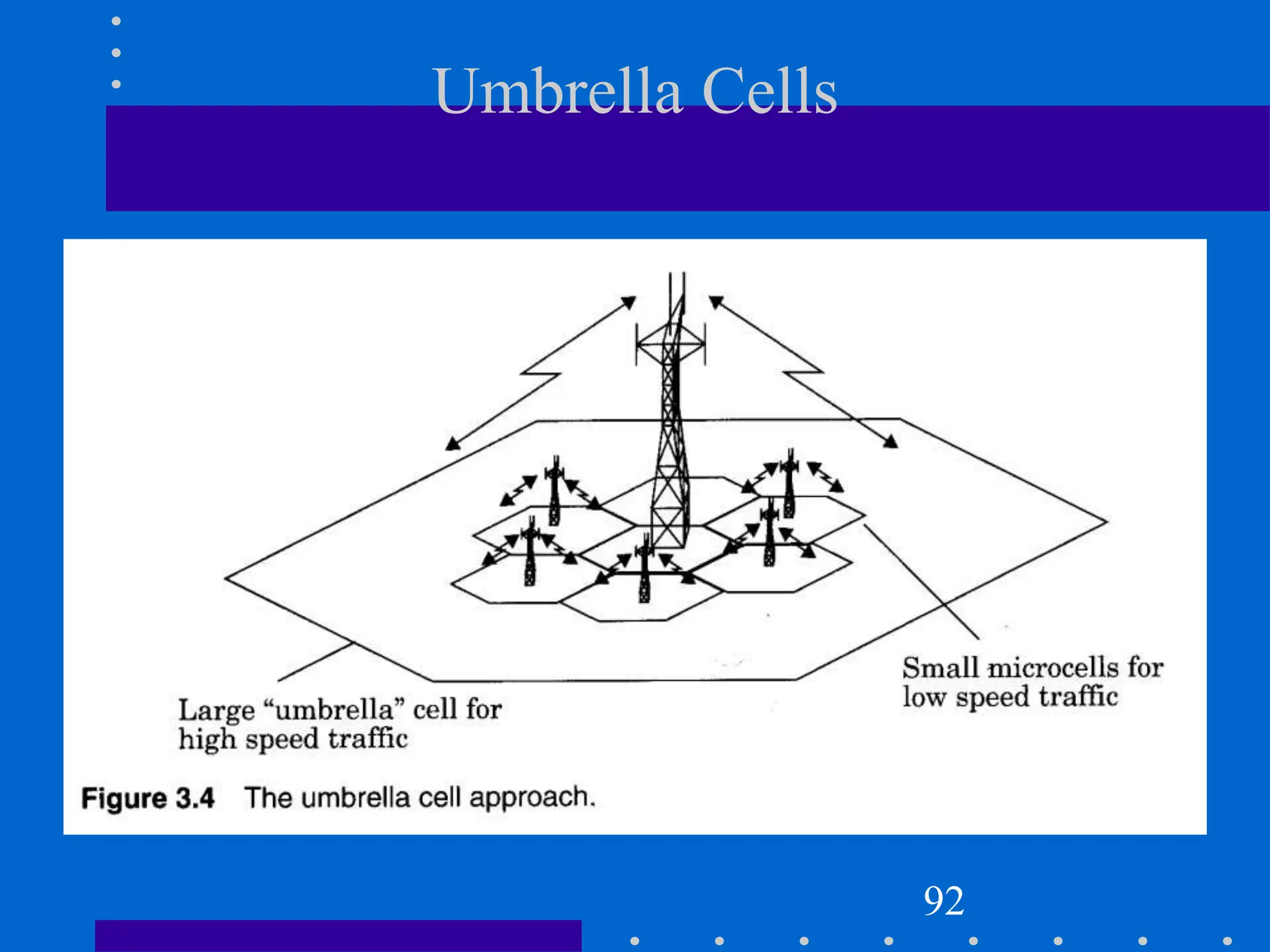
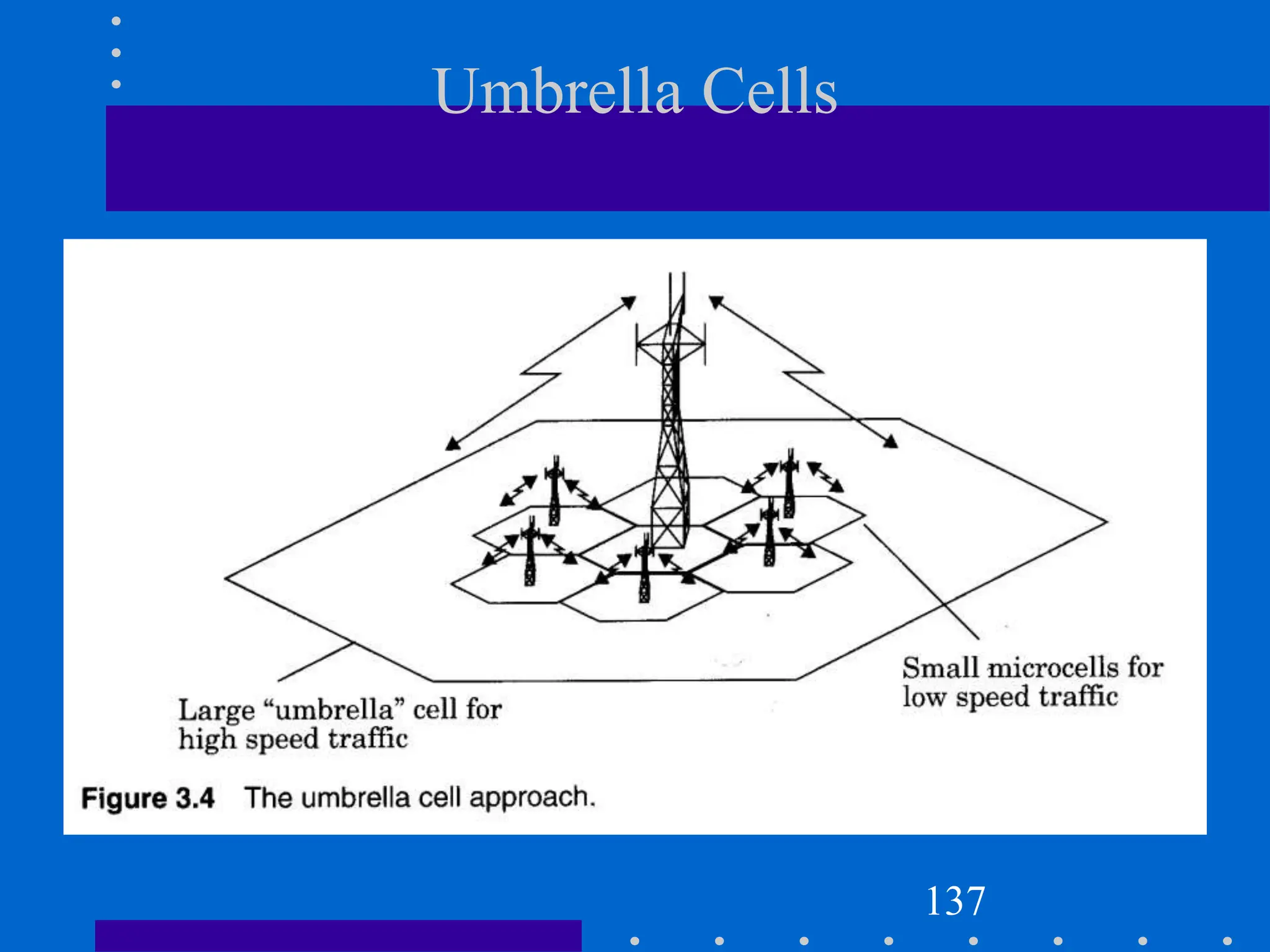
Umbrella Cells
use different antenna heights and Tx power levels to provide large and
small cell coverage
multiple antennas & Tx can be co-located at single location if necessary
(saves on obtaining new tower licenses)
large cell → high speed traffic → fewer handoffs
small cell → low speed traffic
example areas: interstate highway passing through urban center, office
park, or nearby shopping mall
91
Umbrella Cells
92
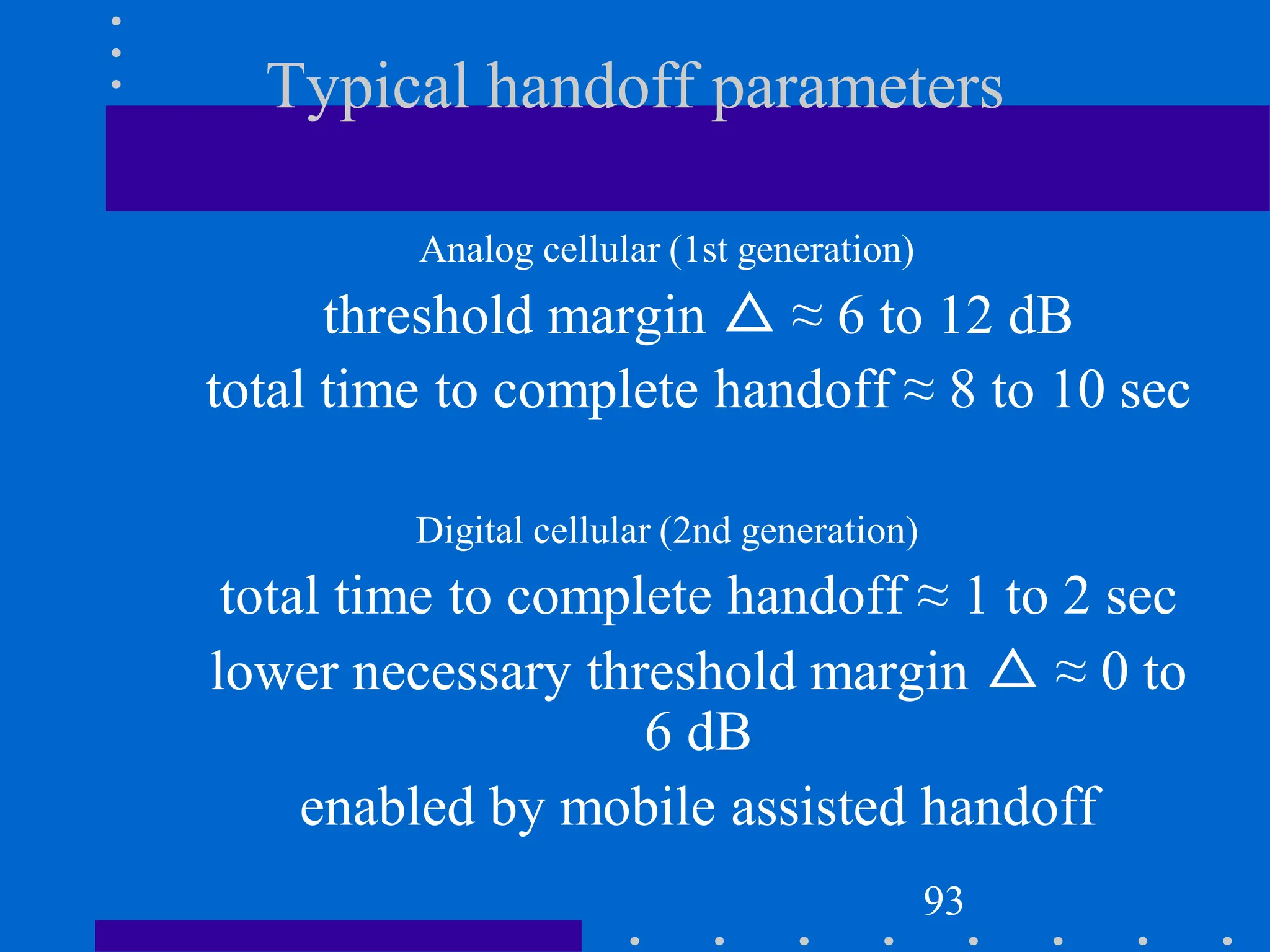
Typical handoff parameters
Analog cellular (1st generation)
threshold margin △ ≈ 6 to 12 dB
total time to complete handoff ≈ 8 to 10 sec
Digital cellular (2nd generation)
total time to complete handoff ≈ 1 to 2 sec
lower necessary threshold margin △ ≈ 0 to
6 dB
enabled by mobile assisted handoff
93
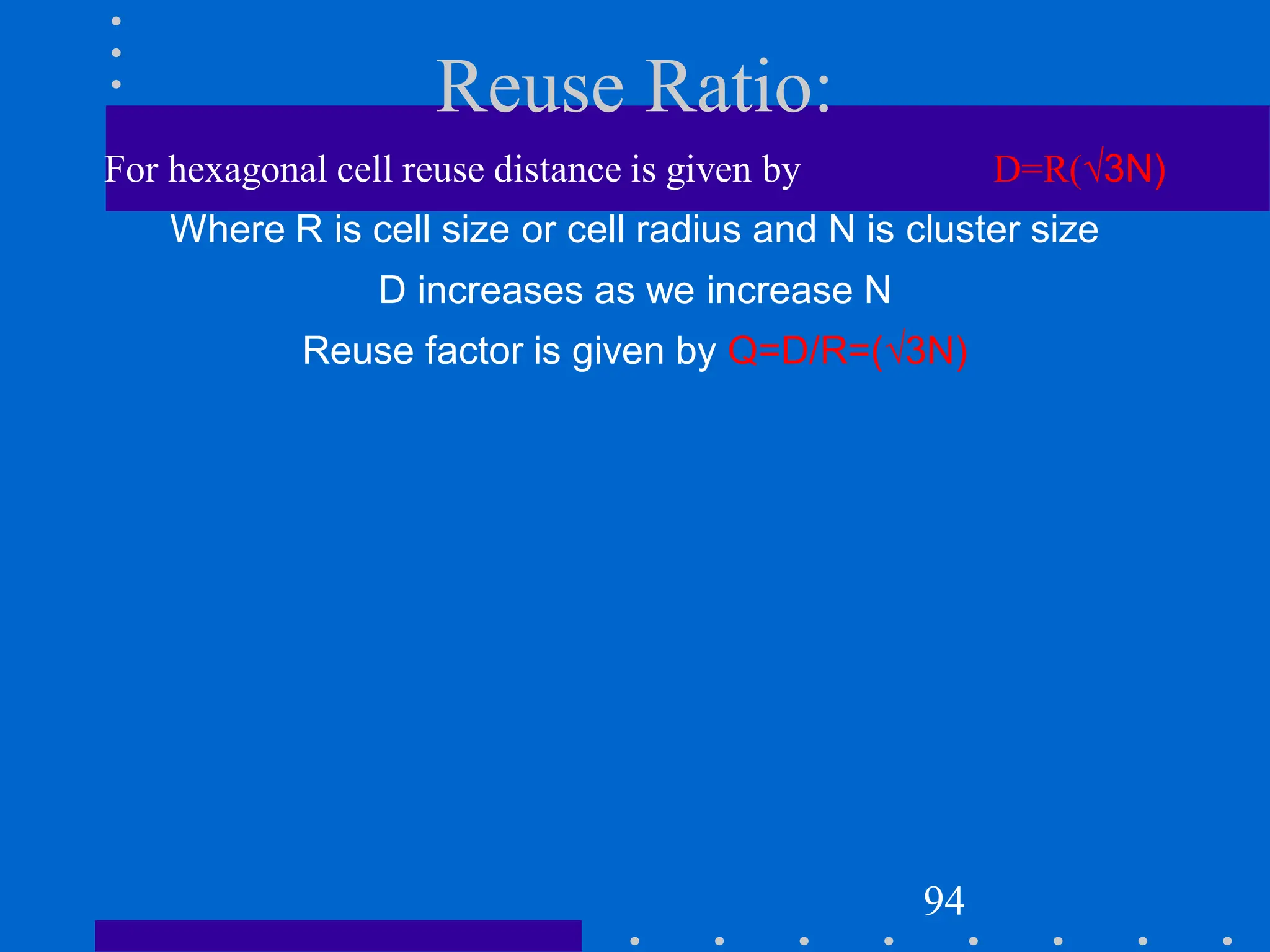
Reuse Ratio:
For hexagonal cell reuse distance is given by D=R(√3N)
Where R is cell size or cell radius and N is cluster size
D increases as we increase N
Reuse factor is given by Q=D/R=(√3N)
94
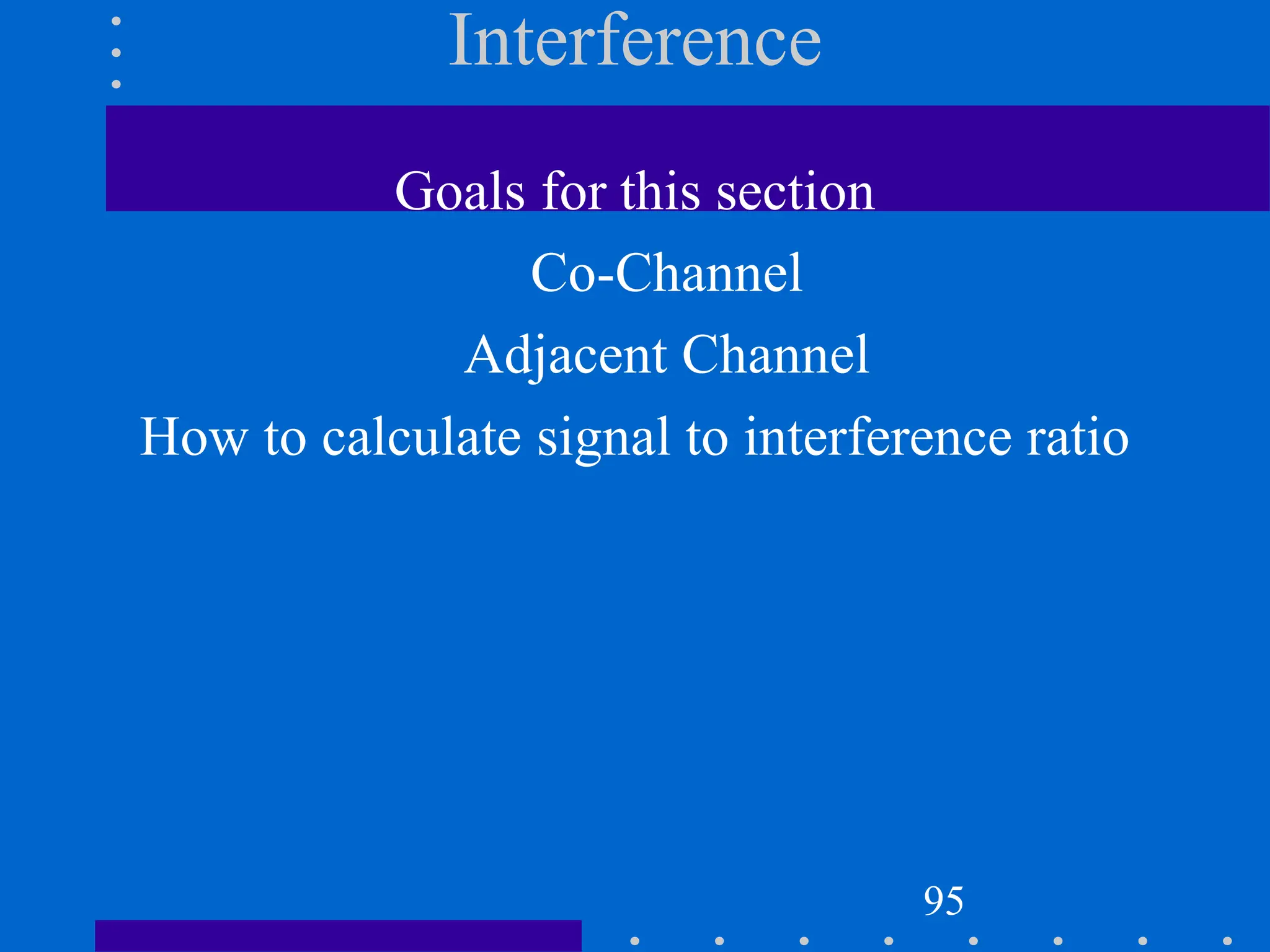
Interference
Goals for this section
Co-Channel
Adjacent Channel
How to calculate signal to interference ratio
95
Interference
Interference is major limiting factor in the
performance of cellular radio. It limits the
capacity and increases the no of dropped calls.
Sources of interference include
Another mobile in same cell
A call in progress in a neighboring cell
Other BSs operating in the same frequency
band
96
Effects of Interference
Interference in voice channels causes
Crosstalk
Noise in background
Interference in control channels causes
Error in digital signaling, which causes
Missed calls
Blocked calls
Dropped calls
97
Interference
Two major types of Interferences
Co-channel Interference (CCI)
Adjacent channel Interference (ACI)
CCI is caused due to the cells that reuse the same frequency set. These
cells using the same frequency set are called Co-channel cells
ACI is caused due to the signals that are adjacent in frequency
98
Co-channel Interference
Increase base station Tx power to improve radio signal reception?
will also increase interference into other co-channel cells by the same
amount
no net improvement
Separate co-channel cells by some minimum distance to provide
sufficient isolation from propagation of radio signals?
if all cell sizes, transmit powers, and
coverage patterns ≈ same → co-channel
interference is independent of Tx power
99
Co-channel Interference
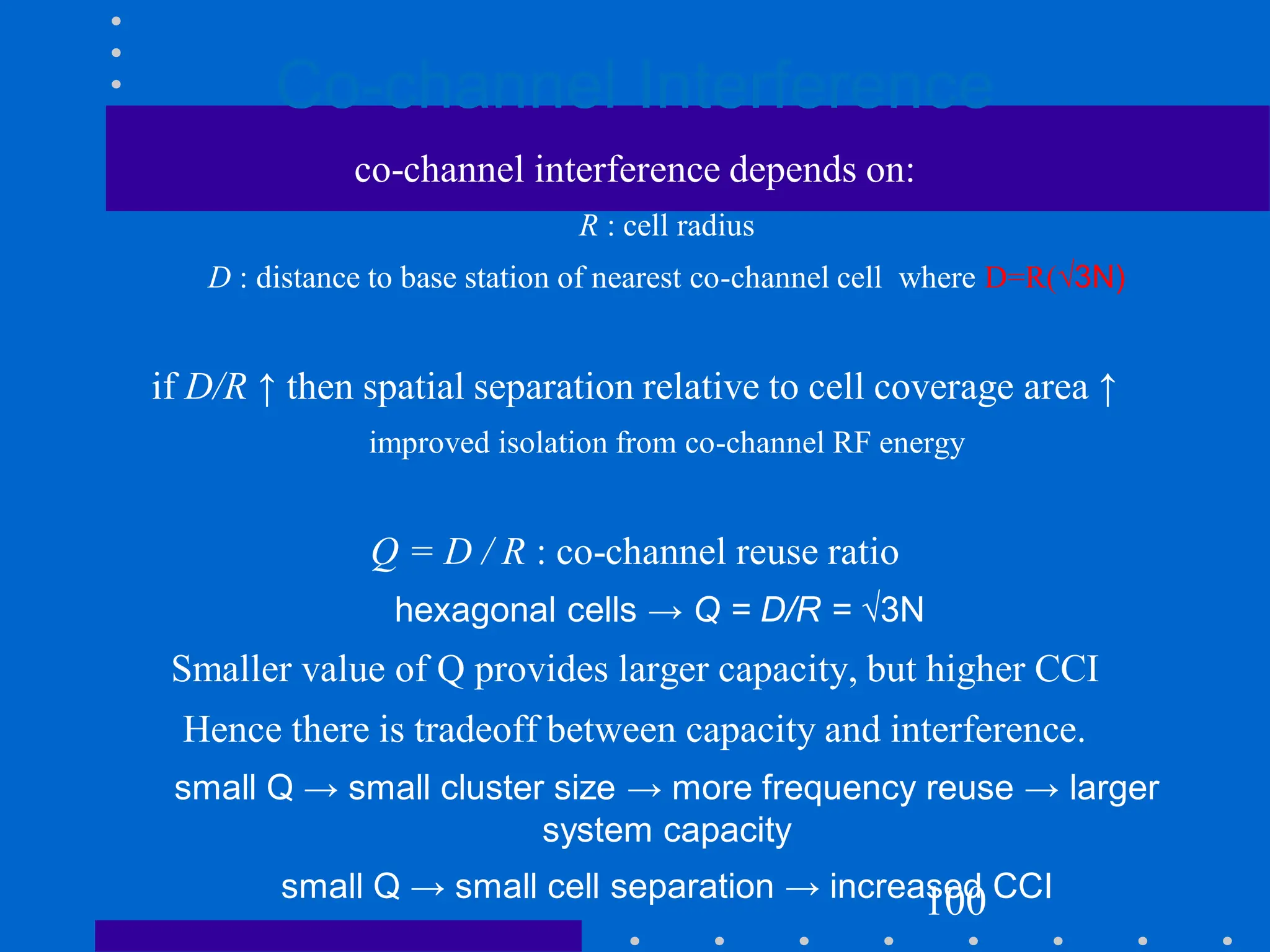
co-channel interference depends on:
R : cell radius
D : distance to base station of nearest co-channel cell where D=R(√3N)
if D/R ↑ then spatial separation relative to cell coverage area ↑
improved isolation from co-channel RF energy
Q = D / R : co-channel reuse ratio
hexagonal cells → Q = D/R = √3N
Smaller value of Q provides larger capacity, but higher CCI
Hence there is tradeoff between capacity and interference.
small Q → small cluster size → more frequency reuse → larger
system capacity
small Q → small cell separation → increased CCI
100
Signal to Interference ratio S/I
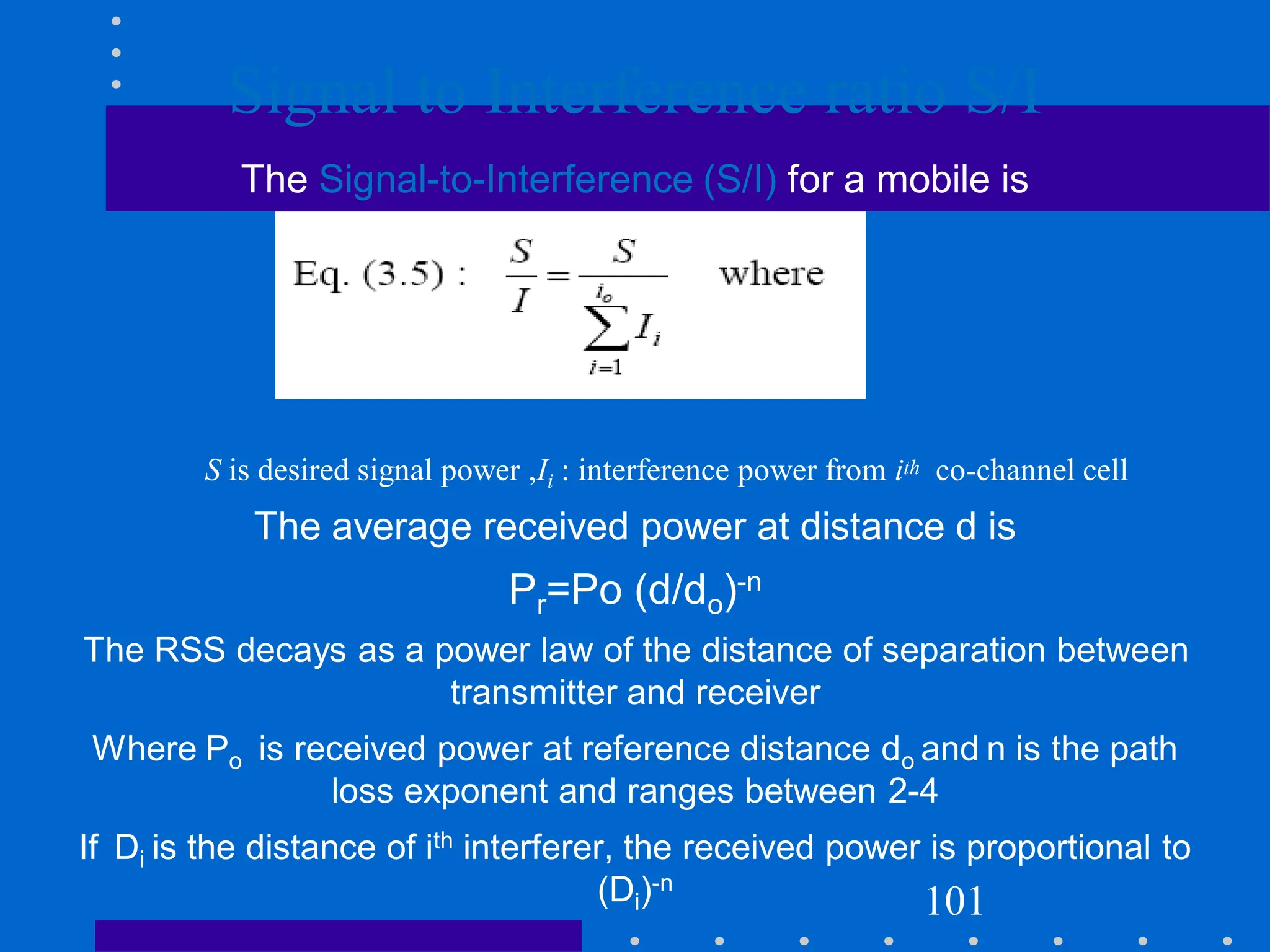
The Signal-to-Interference (S/I) for a mobile is
S is desired signal power ,Ii : interference power from ith co-channel cell
The average received power at distance d is
Pr=Po (d/do)-n
The RSS decays as a power law of the distance of separation between
transmitter and receiver
Where Po is received power at reference distance do and n is the path
loss exponent and ranges between 2-4
If Di is the distance of ith interferer, the received power is proportional to
(Di)-n
101
Signal to Interference ratio S/I
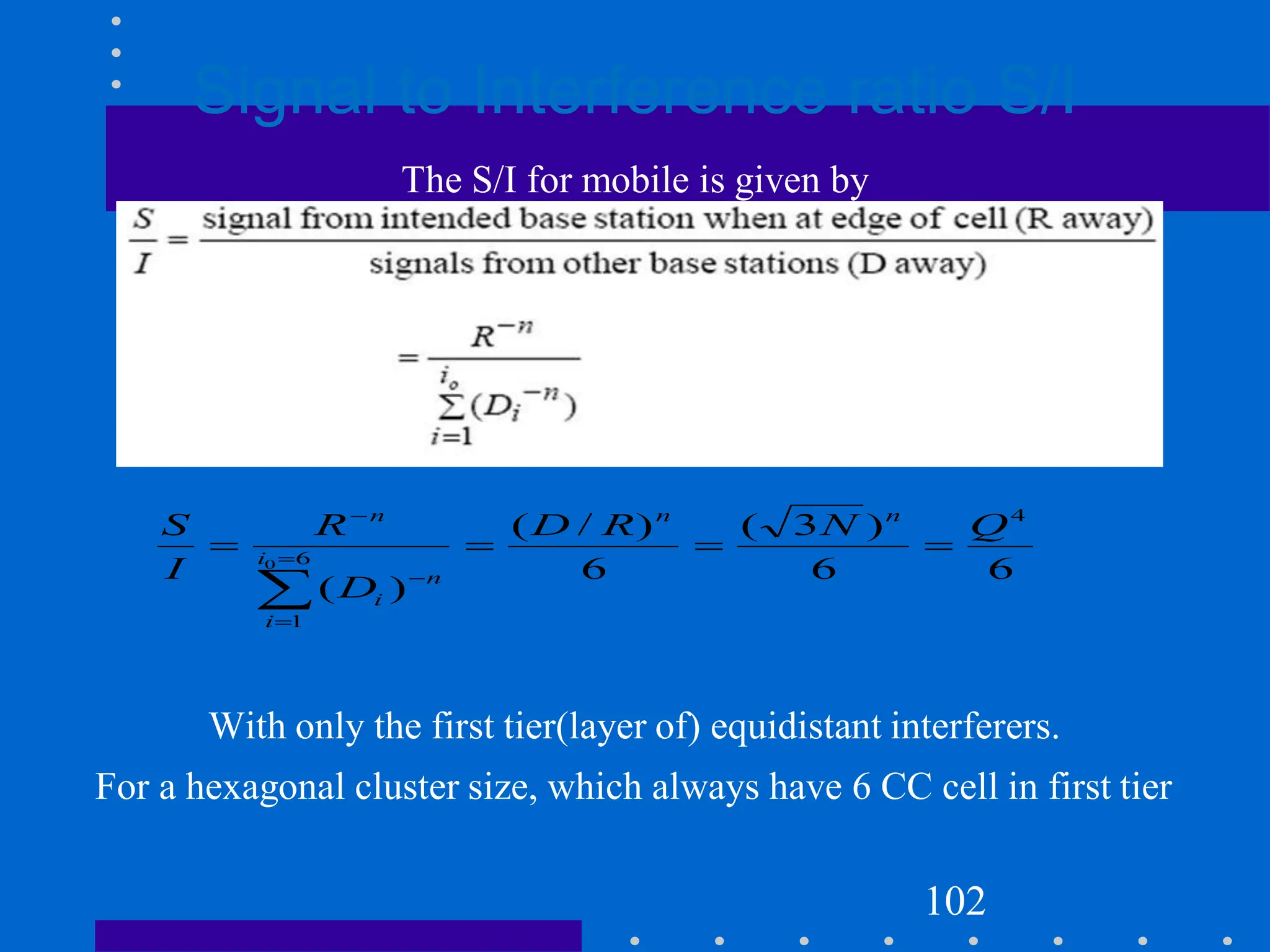
The S/I for mobile is given by
With only the first tier(layer of) equidistant interferers.
For a hexagonal cluster size, which always have 6 CC cell in first tier
102
6
6
)
3
(
6
)
/
(
)
(
4
6
1
0
Q
N
R
D
D
R
I
S n
n
i
i
n
i
n









Signal to Interference ratio S/I
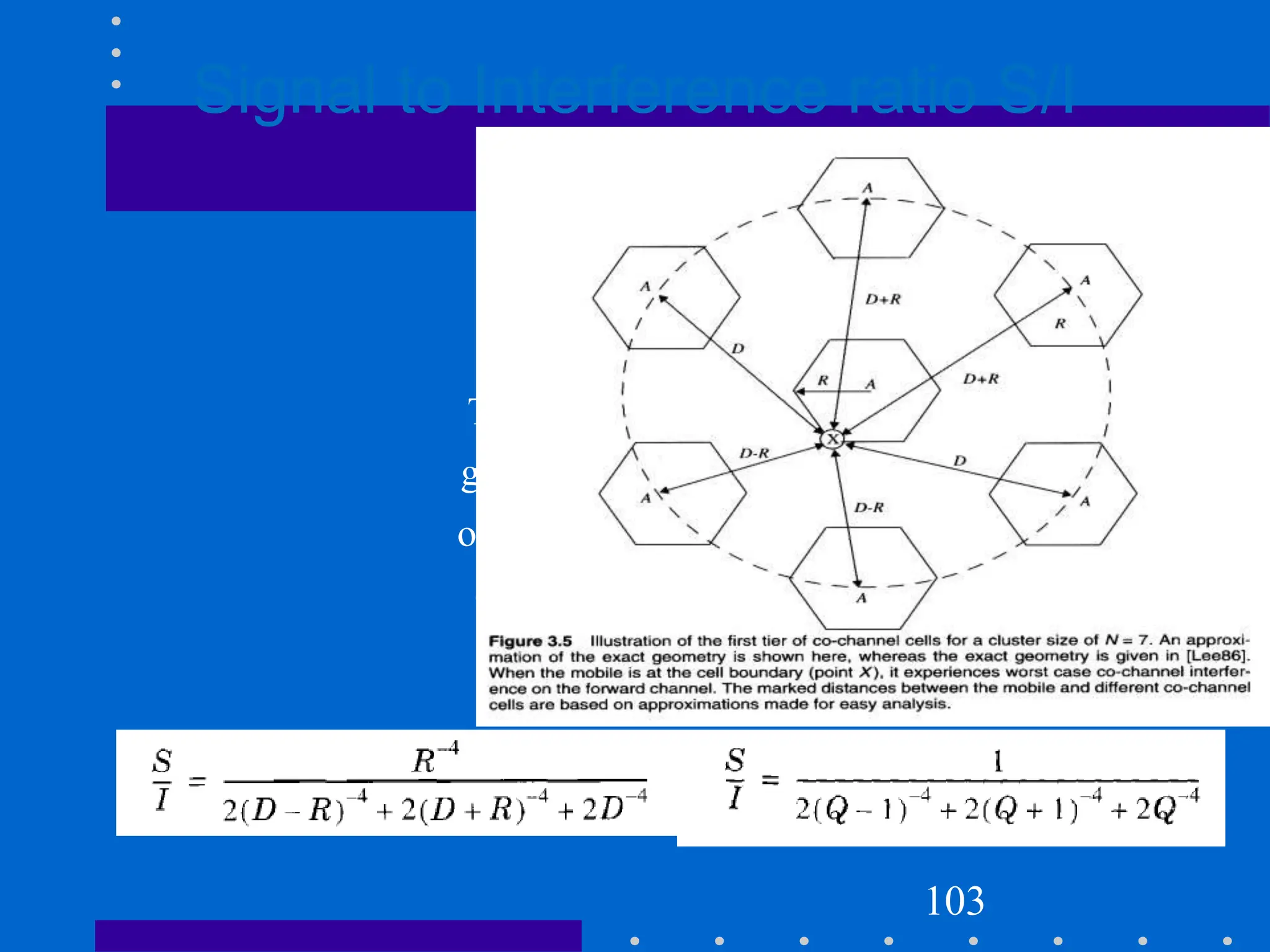
The MS is at cell
boundary
The aproximate S/I is
given by, both in terms
of R and D, along with
channel reuse ratio Q
103
Example S/I
104
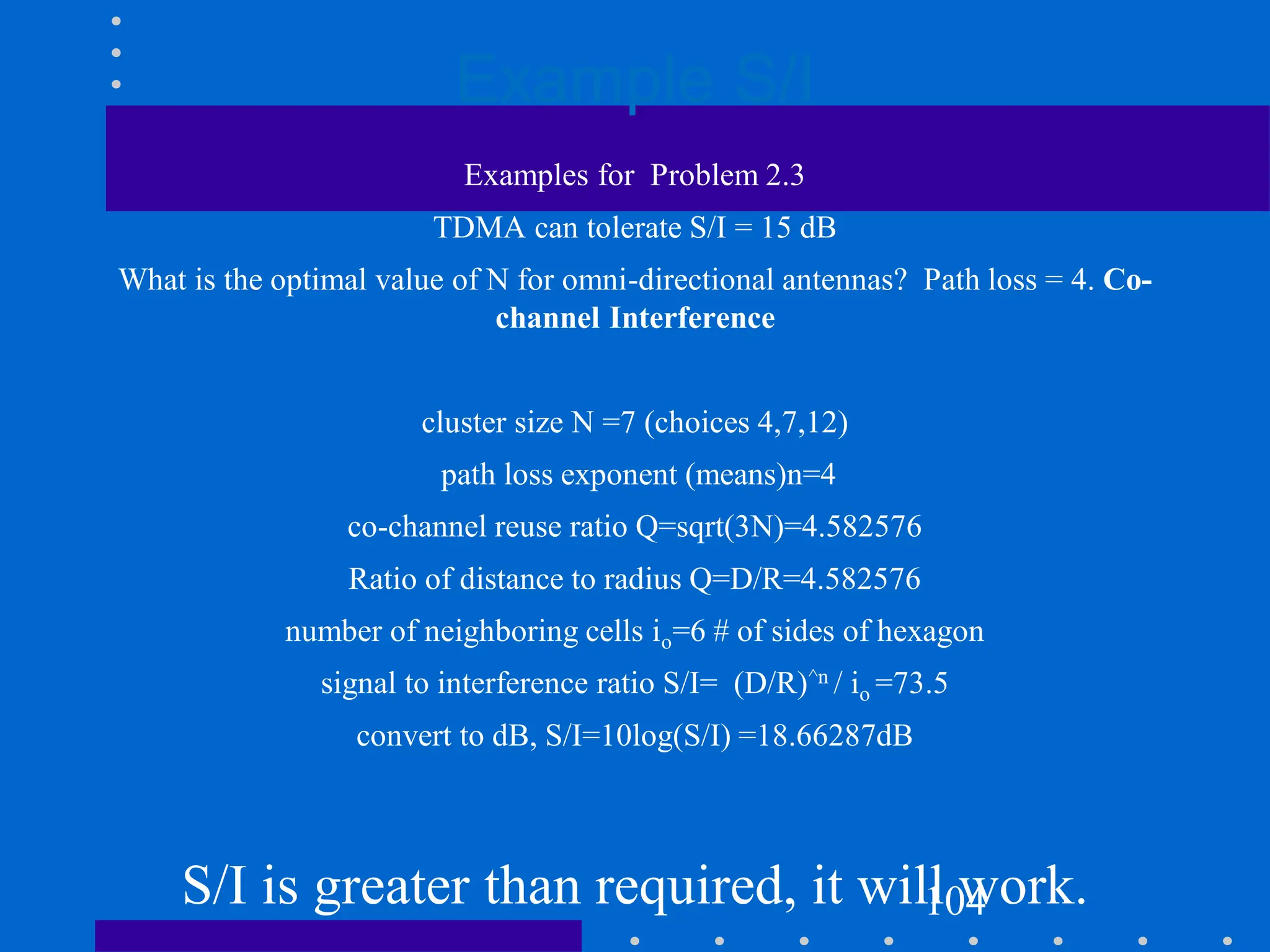
Examples for Problem 2.3
TDMA can tolerate S/I = 15 dB
What is the optimal value of N for omni-directional antennas? Path loss = 4. Co-
channel Interference
cluster size N =7 (choices 4,7,12)
path loss exponent (means)n=4
co-channel reuse ratio Q=sqrt(3N)=4.582576
Ratio of distance to radius Q=D/R=4.582576
number of neighboring cells io=6 # of sides of hexagon
signal to interference ratio S/I= (D/R)^n / io =73.5
convert to dB, S/I=10log(S/I) =18.66287dB
S/I is greater than required, it will work.
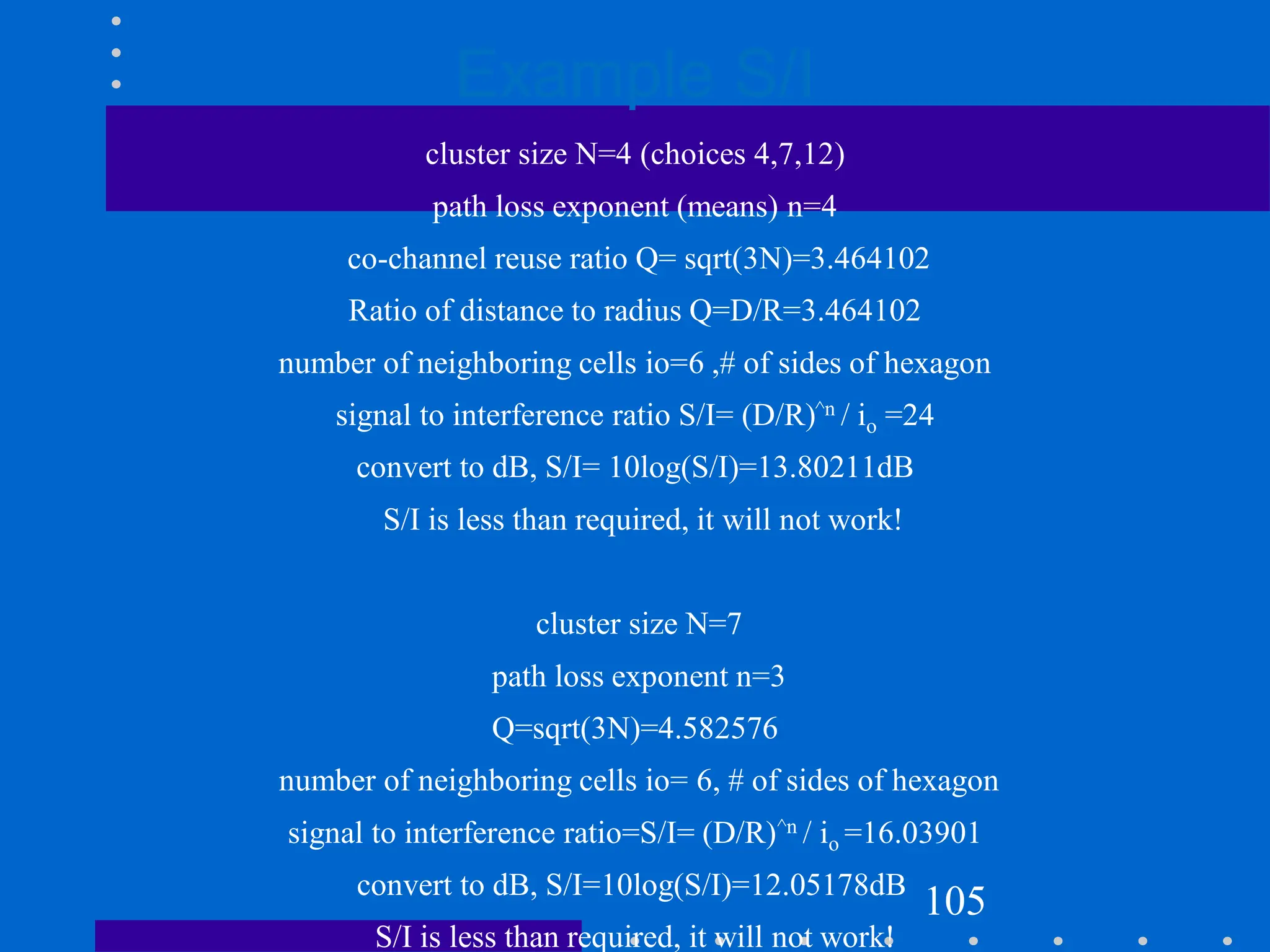
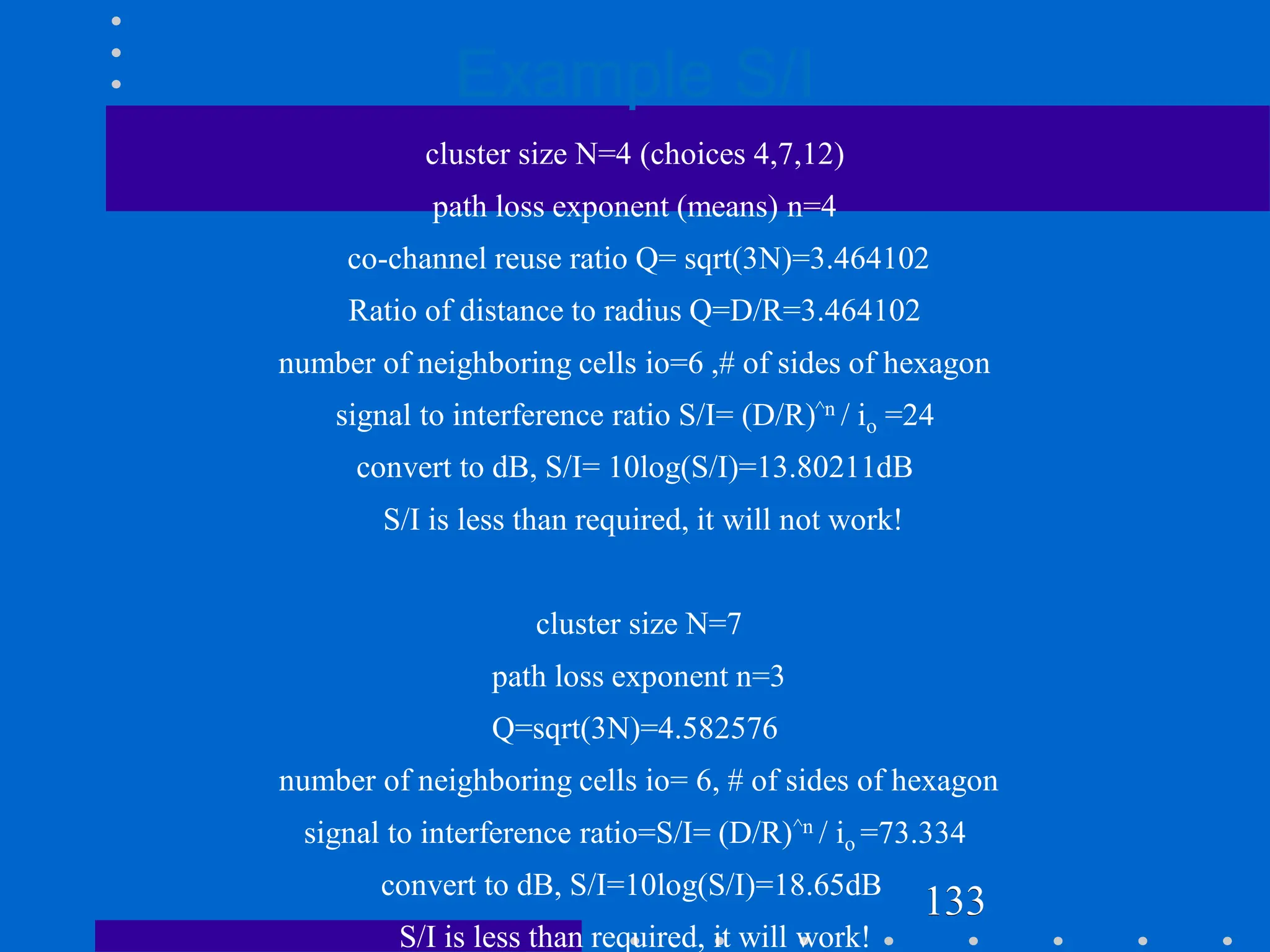
Example S/I
cluster size N=4 (choices 4,7,12)
path loss exponent (means) n=4
co-channel reuse ratio Q= sqrt(3N)=3.464102
Ratio of distance to radius Q=D/R=3.464102
number of neighboring cells io=6 ,# of sides of hexagon
signal to interference ratio S/I= (D/R)^n / io =24
convert to dB, S/I= 10log(S/I)=13.80211dB
S/I is less than required, it will not work!
cluster size N=7
path loss exponent n=3
Q=sqrt(3N)=4.582576
number of neighboring cells io= 6, # of sides of hexagon
signal to interference ratio=S/I= (D/R)^n / io =16.03901
convert to dB, S/I=10log(S/I)=12.05178dB
S/I is less than required, it will not work!
105
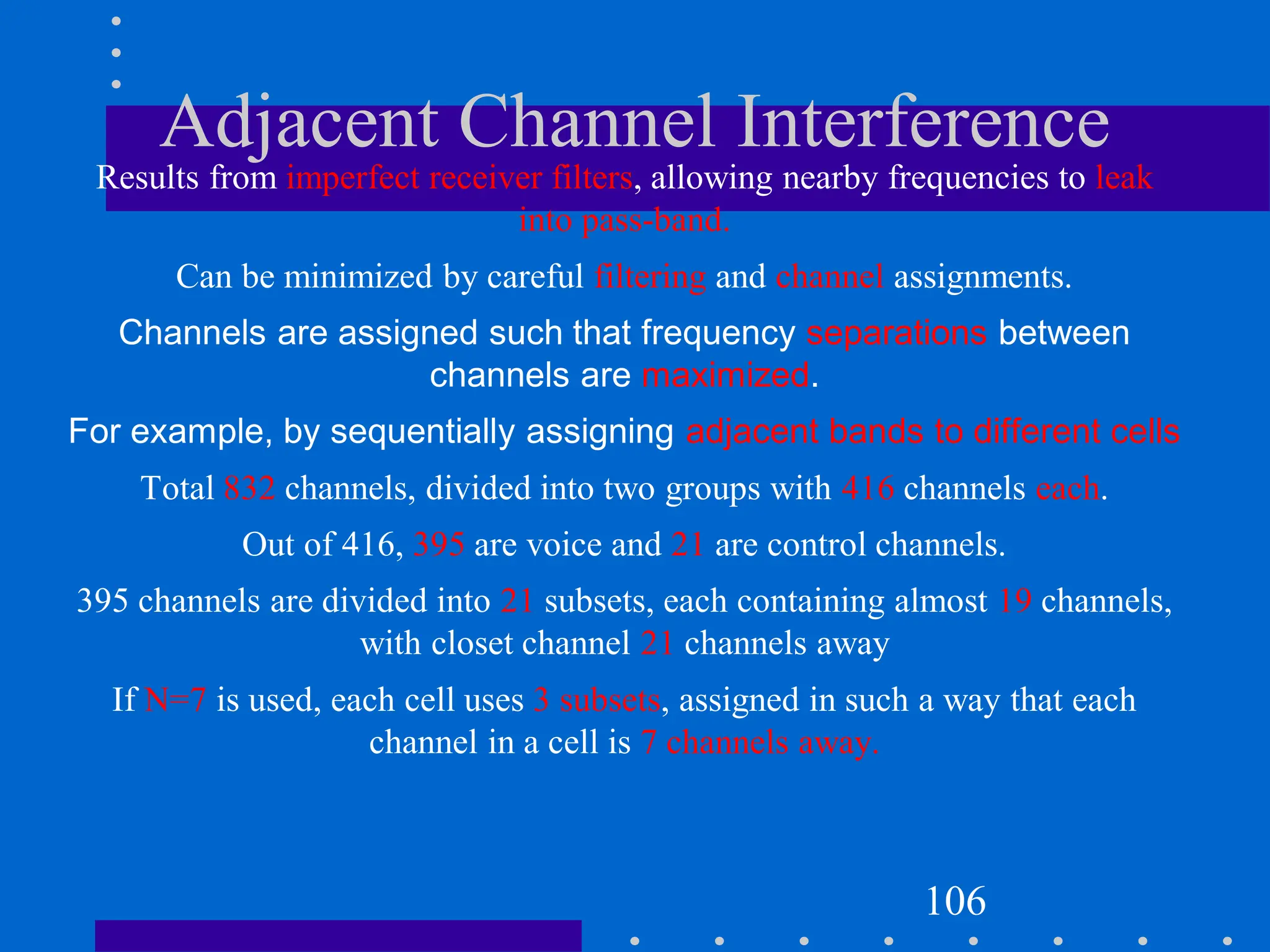
Adjacent Channel Interference
Results from imperfect receiver filters, allowing nearby frequencies to leak
into pass-band.
Can be minimized by careful filtering and channel assignments.
Channels are assigned such that frequency separations between
channels are maximized.
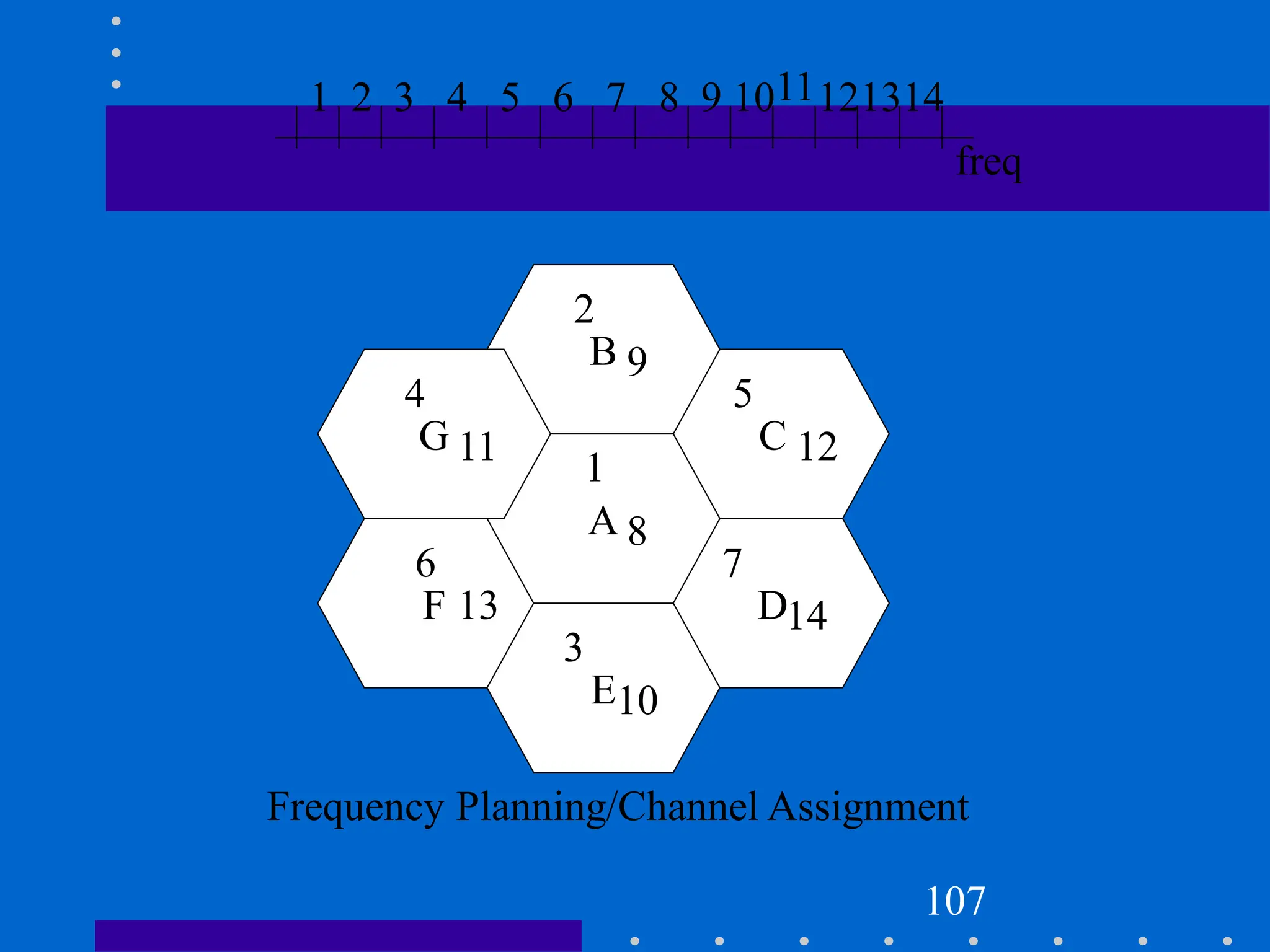
For example, by sequentially assigning adjacent bands to different cells
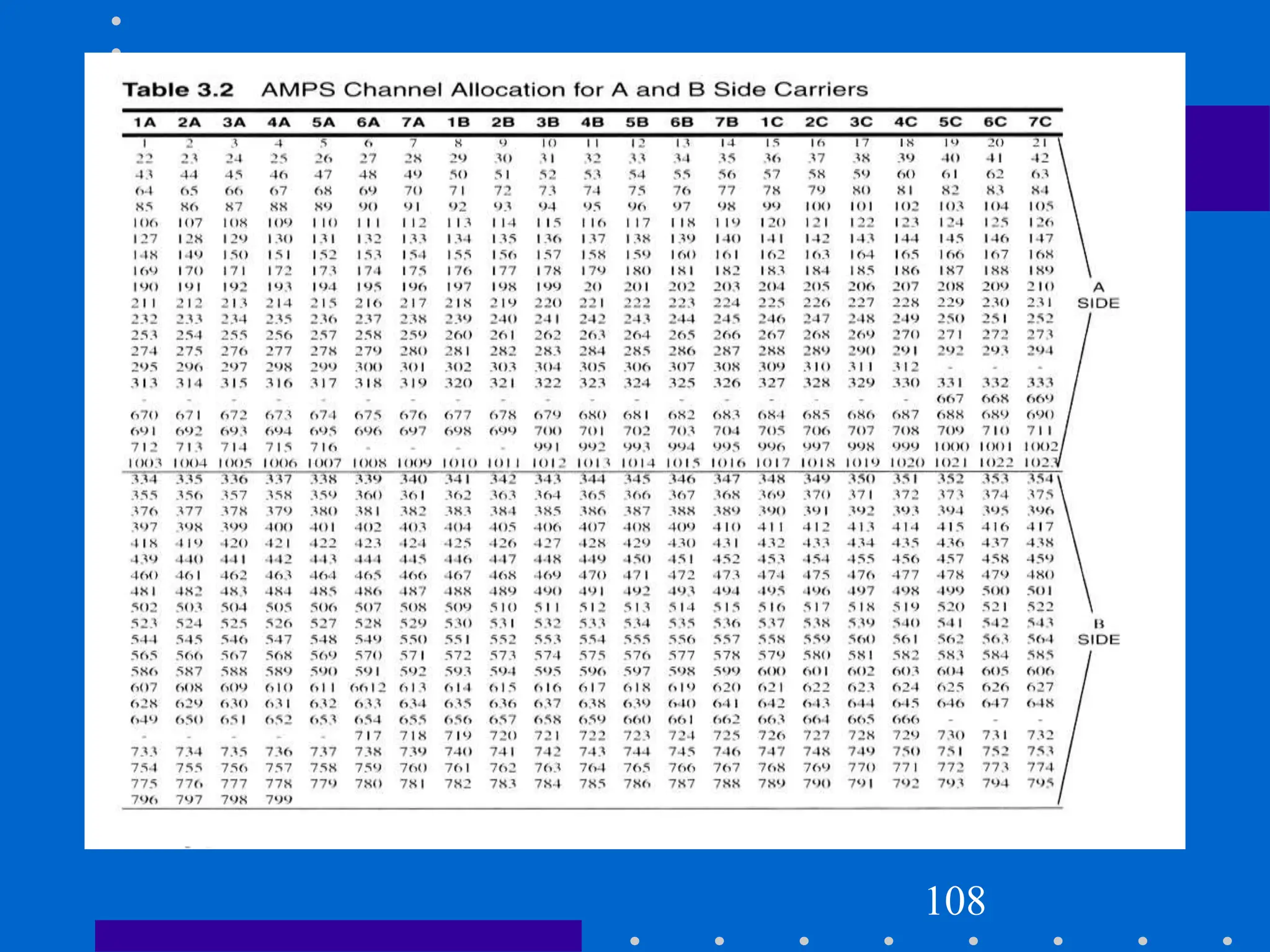
Total 832 channels, divided into two groups with 416 channels each.
Out of 416, 395 are voice and 21 are control channels.
395 channels are divided into 21 subsets, each containing almost 19 channels,
with closet channel 21 channels away
If N=7 is used, each cell uses 3 subsets, assigned in such a way that each
channel in a cell is 7 channels away.
106
107
F
C
B
D
E
A
G
freq
1 2 3 4 5 6 7 8 9 101112
1
2
3
4 5
6 7
8
9
10
11 12
1314
13 14
Frequency Planning/Channel Assignment
108
Learning Objectives
Concept of Trunking
Key definitions in Trunking /Traffic Theory
Erlang-(unit of traffic)
Grade of Service
Two Types of Trunked Systems
Trunking Efficiency
109
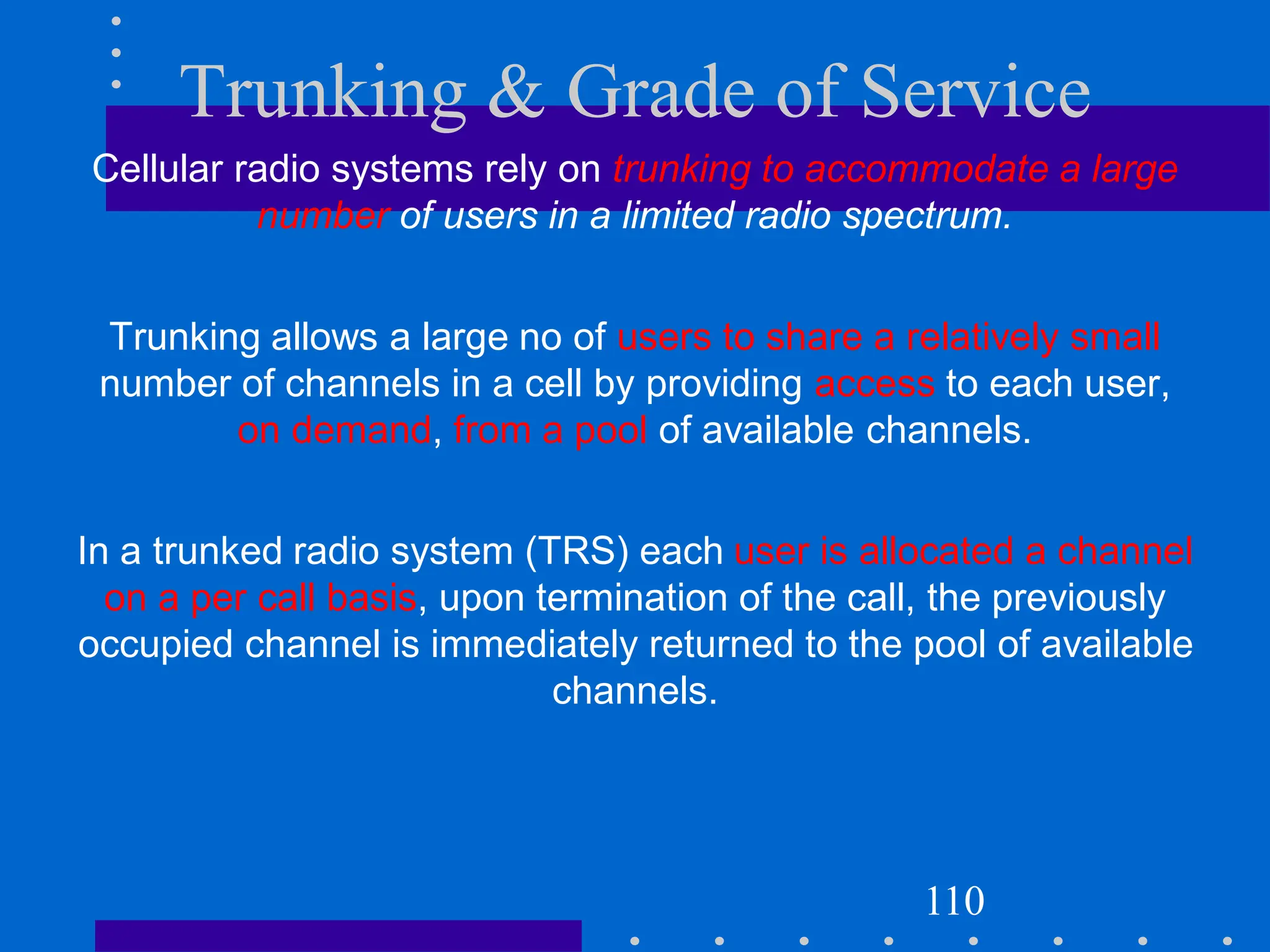
Trunking & Grade of Service
Cellular radio systems rely on trunking to accommodate a large
number of users in a limited radio spectrum.
Trunking allows a large no of users to share a relatively small
number of channels in a cell by providing access to each user,
on demand, from a pool of available channels.
In a trunked radio system (TRS) each user is allocated a channel
on a per call basis, upon termination of the call, the previously
occupied channel is immediately returned to the pool of available
channels.
110
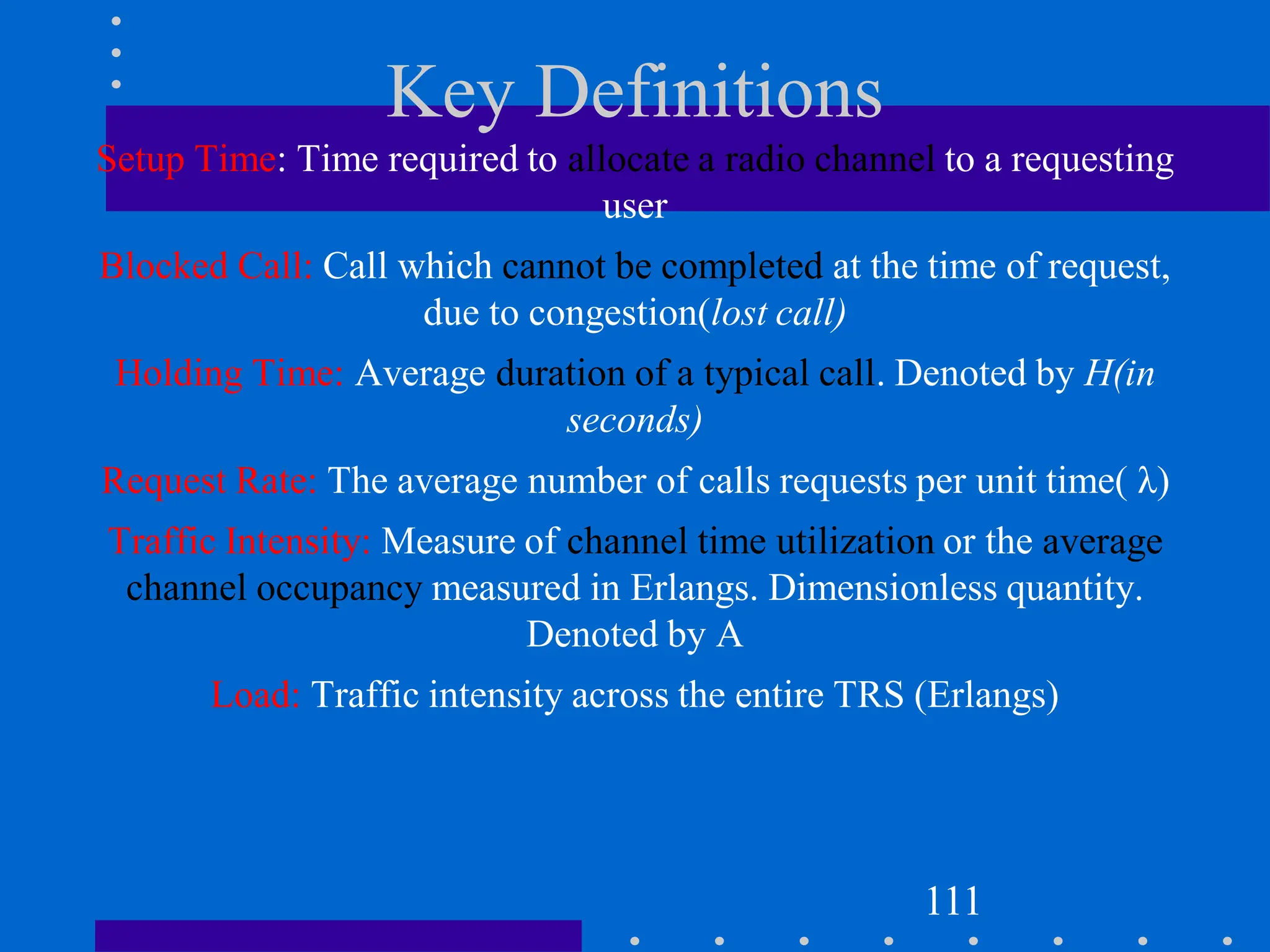
Key Definitions
Setup Time: Time required to allocate a radio channel to a requesting
user
Blocked Call: Call which cannot be completed at the time of request,
due to congestion(lost call)
Holding Time: Average duration of a typical call. Denoted by H(in
seconds)
Request Rate: The average number of calls requests per unit time( λ)
Traffic Intensity: Measure of channel time utilization or the average
channel occupancy measured in Erlangs. Dimensionless quantity.
Denoted by A
Load: Traffic intensity across the entire TRS (Erlangs)
111
Erlang-a unit of traffic
The fundamentals of trunking theory were developed by Erlang,
a Danish mathematician, the unit bears his name.
An Erlang is a unit of telecommunications traffic measurement.
Erlang represents the continuous use of one voice path.
It is used to describe the total traffic volume of one hour
A channel kept busy for one hour is defined as having a load of
one Erlang
For example, a radio channel that is occupied for thirty minutes
during an hour carries 0.5 Erlangs of traffic
For 1 channel
Min load=0 Erlang (0% time utilization)
Max load=1 Erlang (100% time utilization)
112
Erlang-a unit of traffic
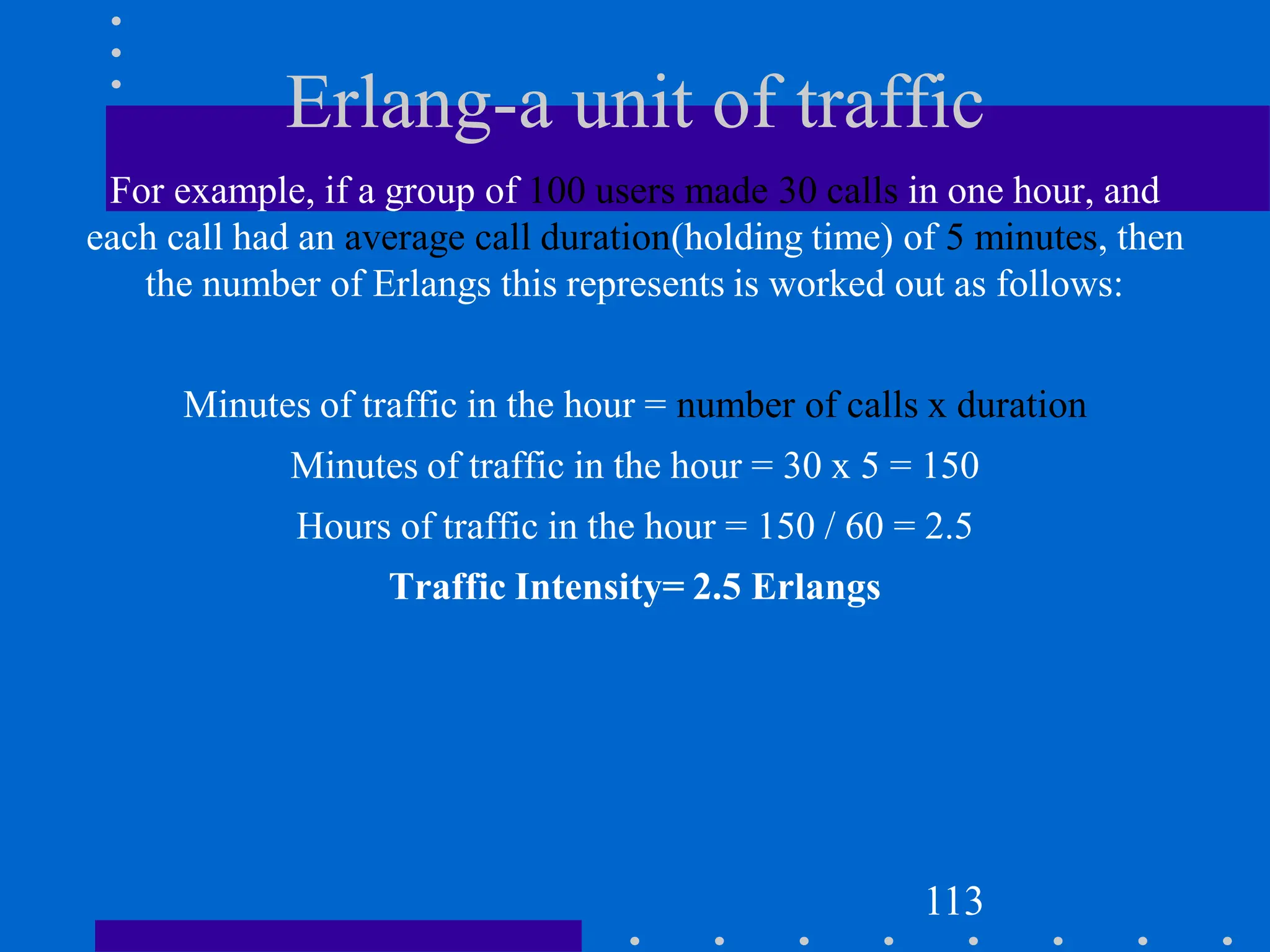
For example, if a group of 100 users made 30 calls in one hour, and
each call had an average call duration(holding time) of 5 minutes, then
the number of Erlangs this represents is worked out as follows:
Minutes of traffic in the hour = number of calls x duration
Minutes of traffic in the hour = 30 x 5 = 150
Hours of traffic in the hour = 150 / 60 = 2.5
Traffic Intensity= 2.5 Erlangs
113
Traffic Concepts
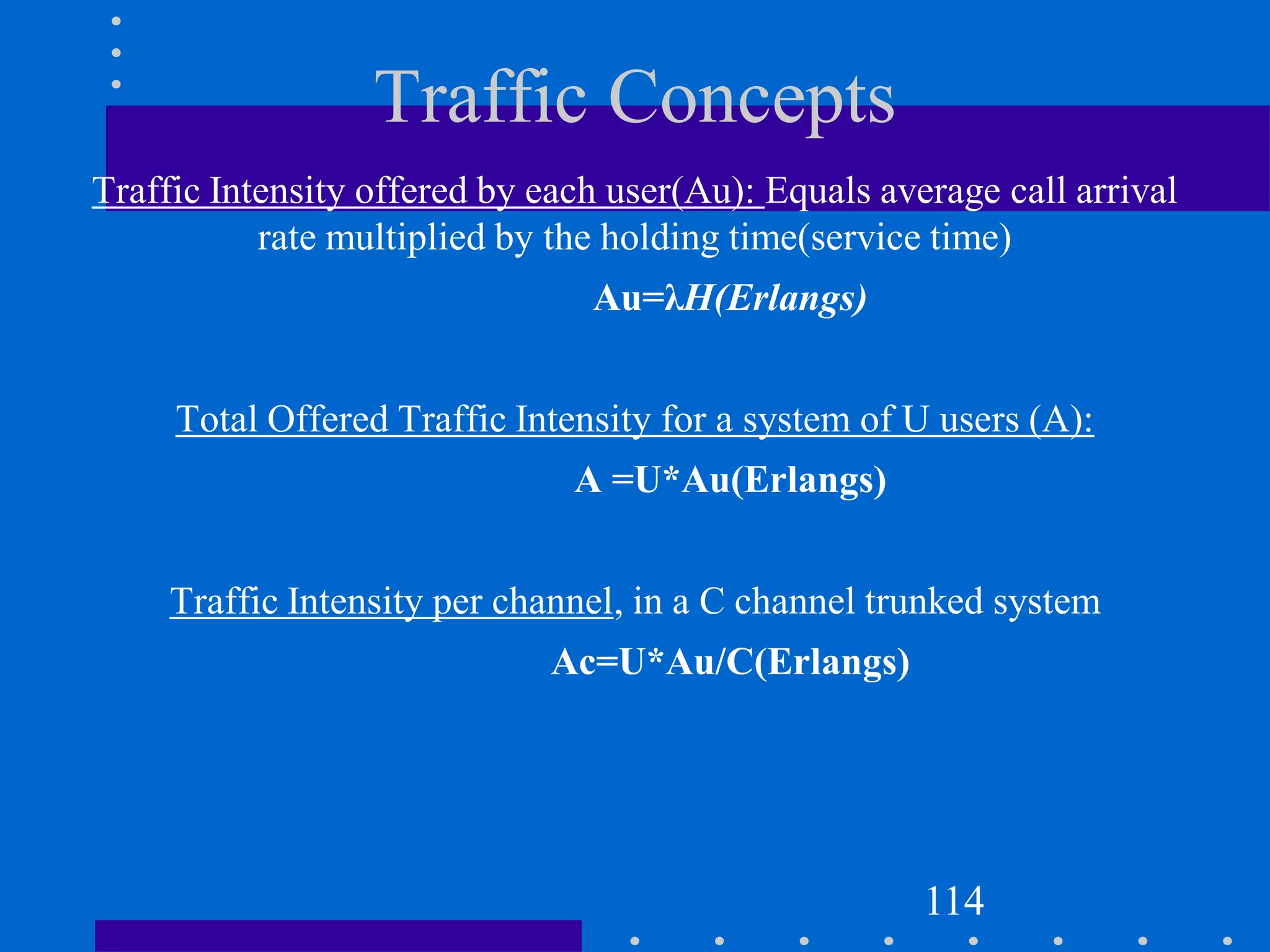
Traffic Intensity offered by each user(Au): Equals average call arrival
rate multiplied by the holding time(service time)
Au=λH(Erlangs)
Total Offered Traffic Intensity for a system of U users (A):
A =U*Au(Erlangs)
Traffic Intensity per channel, in a C channel trunked system
Ac=U*Au/C(Erlangs)
114
Trunking & Grade of Service
In a TRS, when a particular user requests service and all the available
radio channels are already in use , the user is blocked or denied access
to the system. In some systems a queue may be used to hold the
requesting users until a channel becomes available.
Trunking systems must be designed carefully in order to ensure that
there is a low likelihood that a user will be blocked or denied access.
The likelihood that a call is blocked, or the likelihood that a call
experiences a delay greater than a certain queuing time is called
“Grade of Service” (GOS)’’.
115
Trunking & Grade of Service
Grade of Service (GOS): Measure of ability of a user to access a
trunked system during the busiest hour. Measure of the congestion
which is specified as a probability.
The probability of a call being blocked
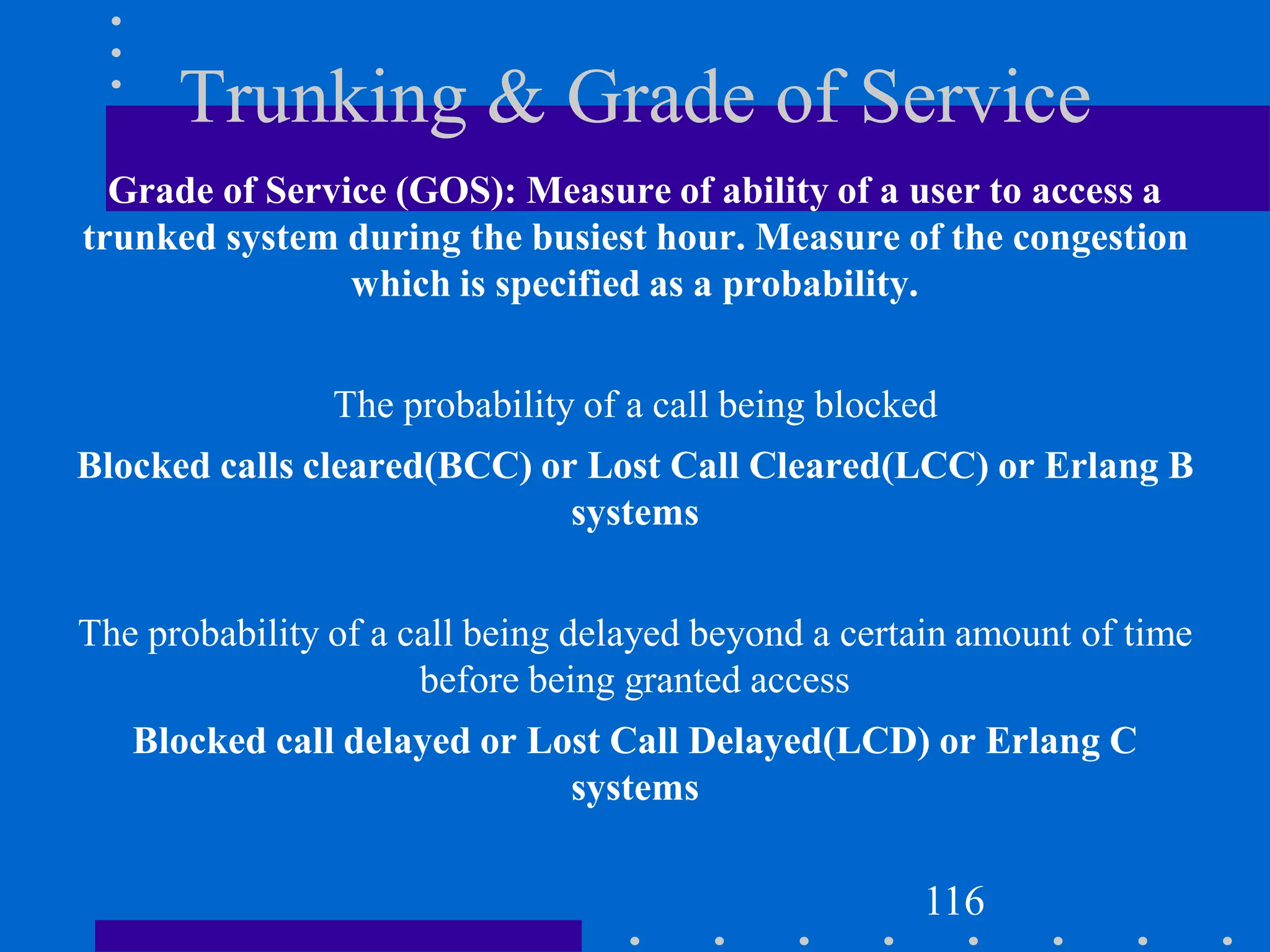
Blocked calls cleared(BCC) or Lost Call Cleared(LCC) or Erlang B
systems
The probability of a call being delayed beyond a certain amount of time
before being granted access
Blocked call delayed or Lost Call Delayed(LCD) or Erlang C
systems
116
Blocked Call Cleared Systems
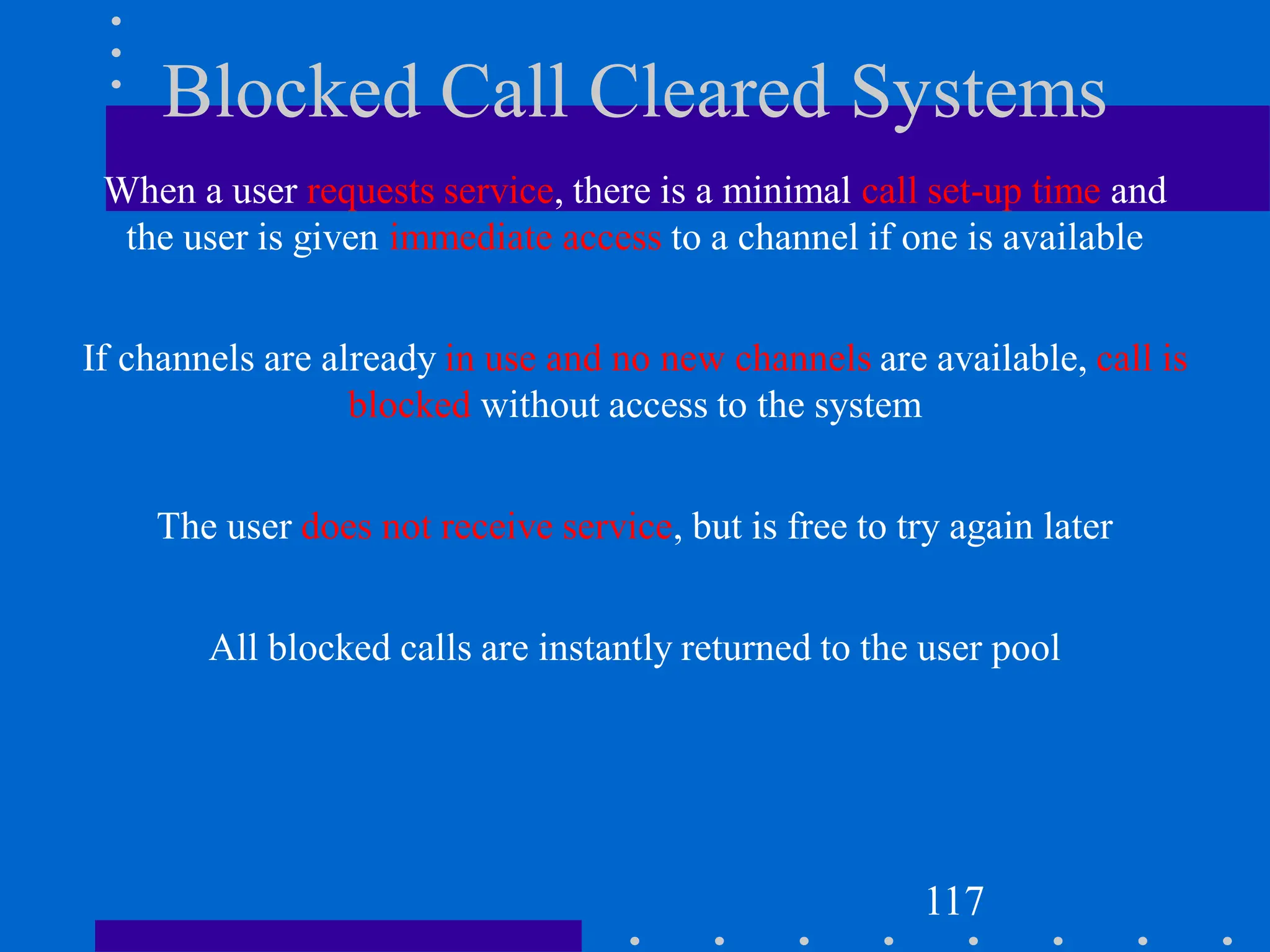
When a user requests service, there is a minimal call set-up time and
the user is given immediate access to a channel if one is available
If channels are already in use and no new channels are available, call is
blocked without access to the system
The user does not receive service, but is free to try again later
All blocked calls are instantly returned to the user pool
117
Modeling of BCC Systems
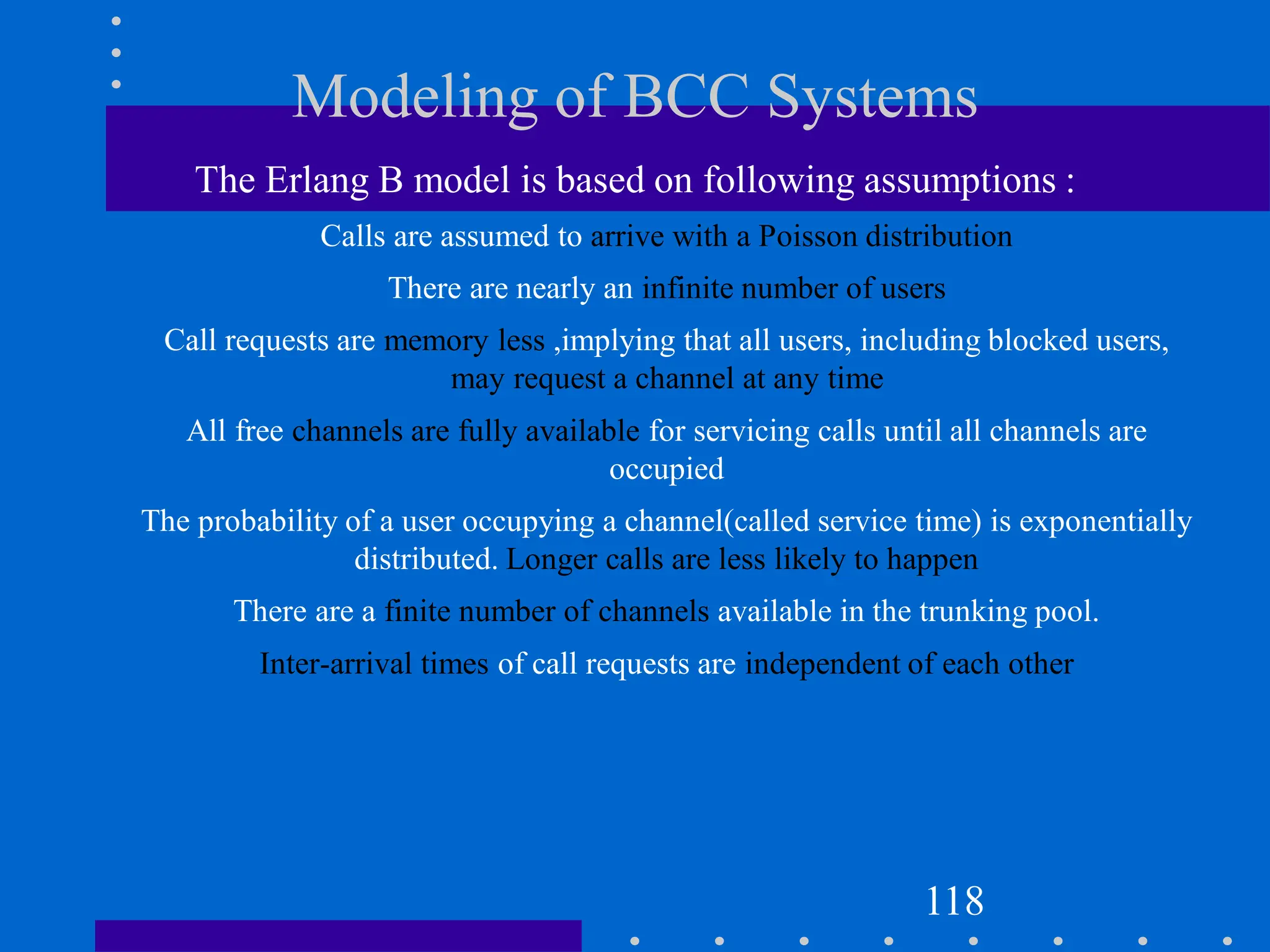
The Erlang B model is based on following assumptions :
Calls are assumed to arrive with a Poisson distribution
There are nearly an infinite number of users
Call requests are memory less ,implying that all users, including blocked users,
may request a channel at any time
All free channels are fully available for servicing calls until all channels are
occupied
The probability of a user occupying a channel(called service time) is exponentially
distributed. Longer calls are less likely to happen
There are a finite number of channels available in the trunking pool.
Inter-arrival times of call requests are independent of each other
118
Modeling of BCC Systems
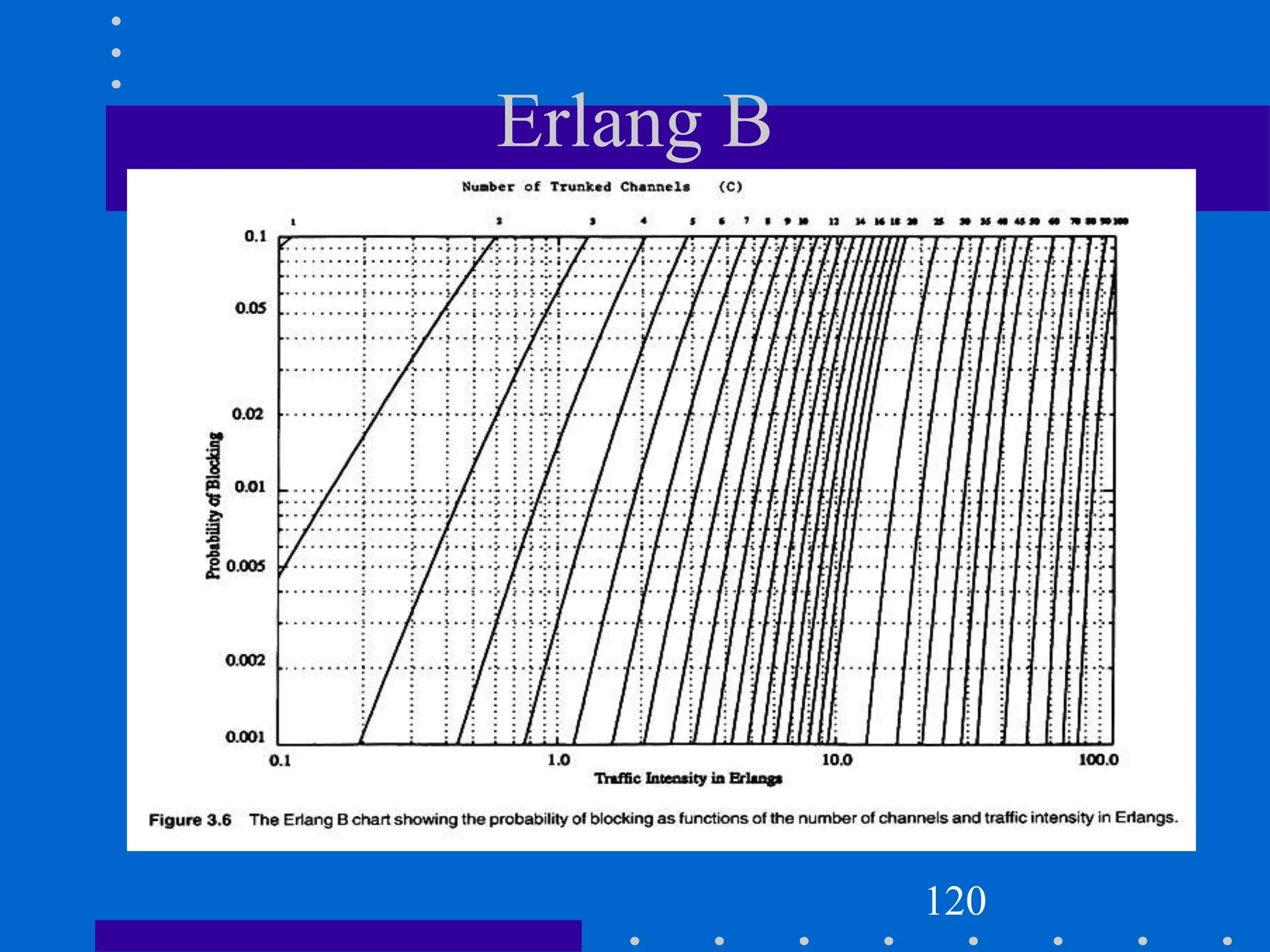
Erlang B formula is given by
where C is the number of trunked channels offered by a trunked radio
system and A is the total offered traffic.
119
Pr[blocking]=
(AC/C ! )
Erlang B
120
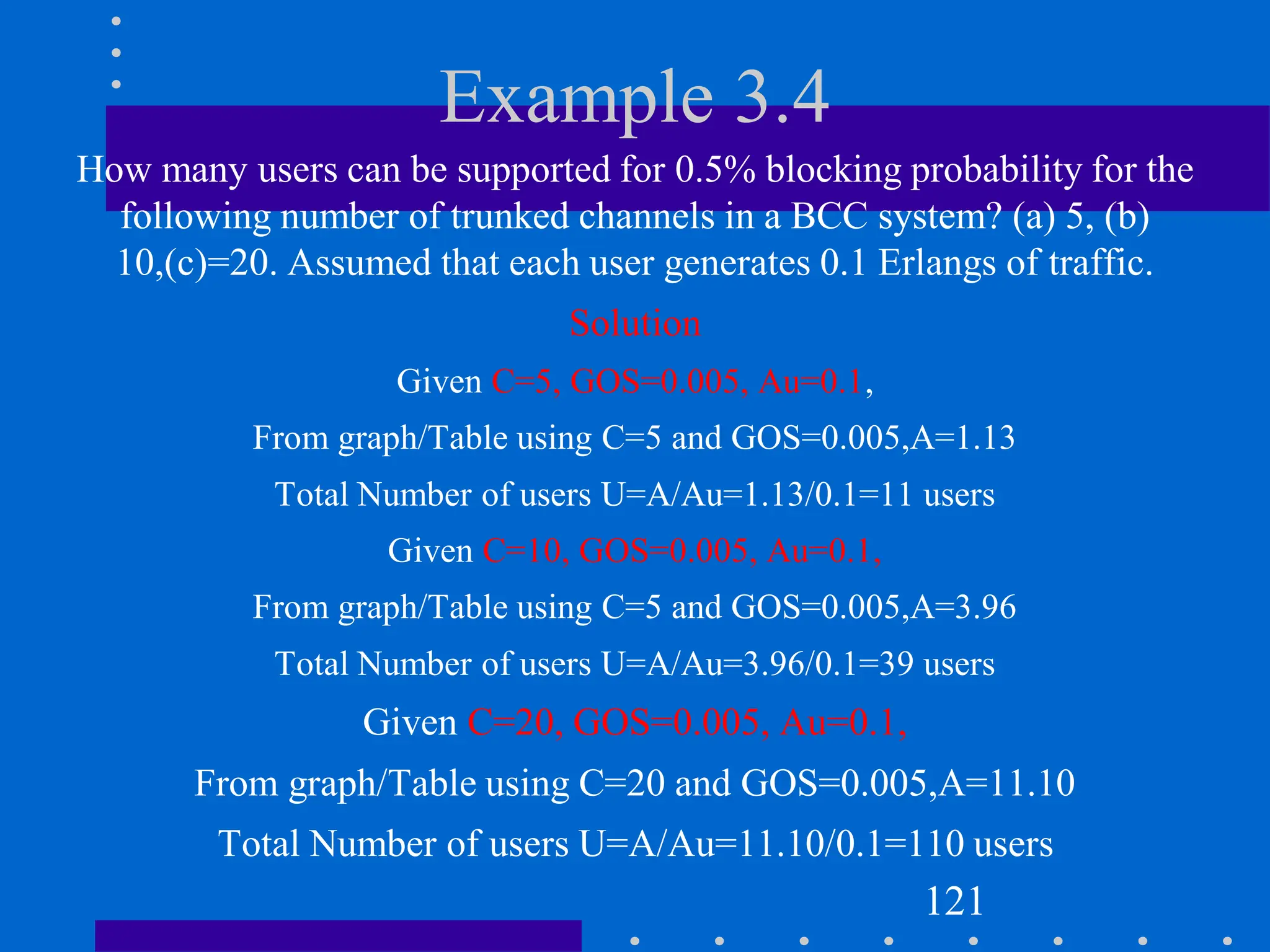
Example 3.4
How many users can be supported for 0.5% blocking probability for the
following number of trunked channels in a BCC system? (a) 5, (b)
10,(c)=20. Assumed that each user generates 0.1 Erlangs of traffic.
Solution
Given C=5, GOS=0.005, Au=0.1,
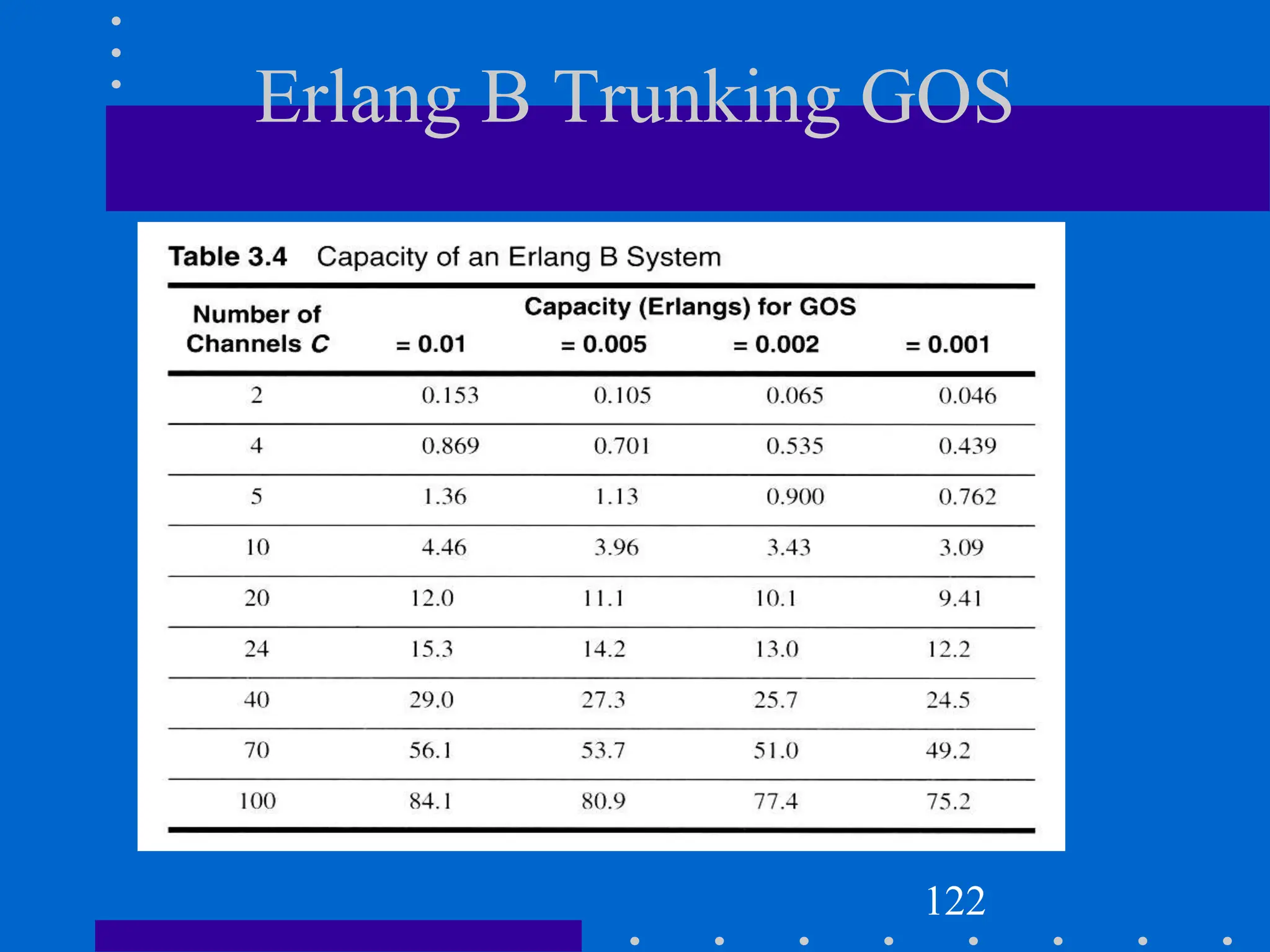
From graph/Table using C=5 and GOS=0.005,A=1.13
Total Number of users U=A/Au=1.13/0.1=11 users
Given C=10, GOS=0.005, Au=0.1,
From graph/Table using C=5 and GOS=0.005,A=3.96
Total Number of users U=A/Au=3.96/0.1=39 users
Given C=20, GOS=0.005, Au=0.1,
From graph/Table using C=20 and GOS=0.005,A=11.10
Total Number of users U=A/Au=11.10/0.1=110 users
121
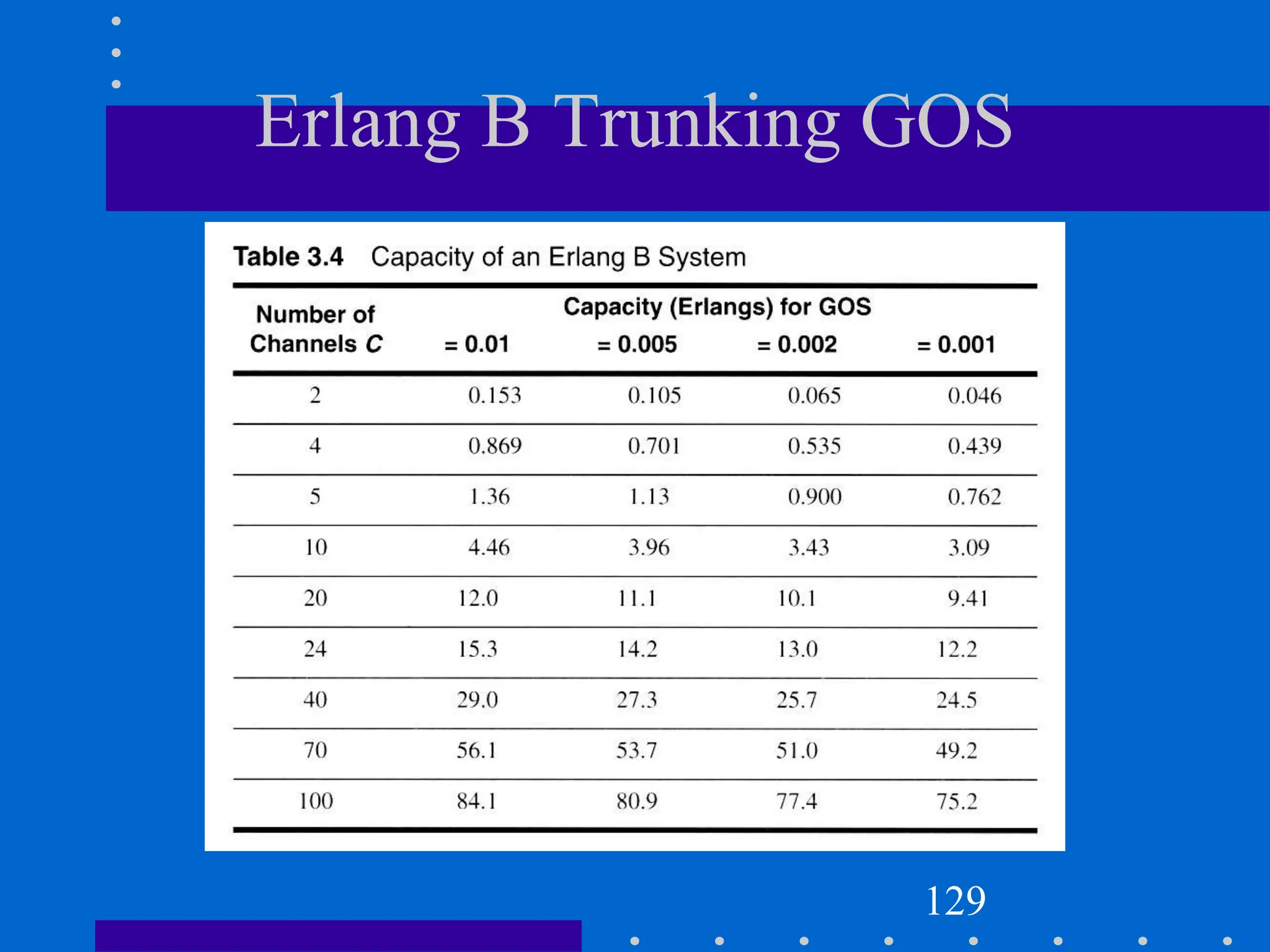
Erlang B Trunking GOS
122
BCC System Example
Assuming that each user in a system generates a traffic intensity of 0.2
Erlangs, how many users can be supported for 0.1% probability of
blocking in an Erlang B system for a number of trunked channels equal
to 60.
Solution 1:
System is an Erlang B
Au = 0.2 Erlangs
Pr [Blocking] = 0.001
C = 60 Channels
From the Erlang B figure, we see that
A ≈ 40 Erlangs
Therefore U=A/Au=40/0.02=2000users.
123
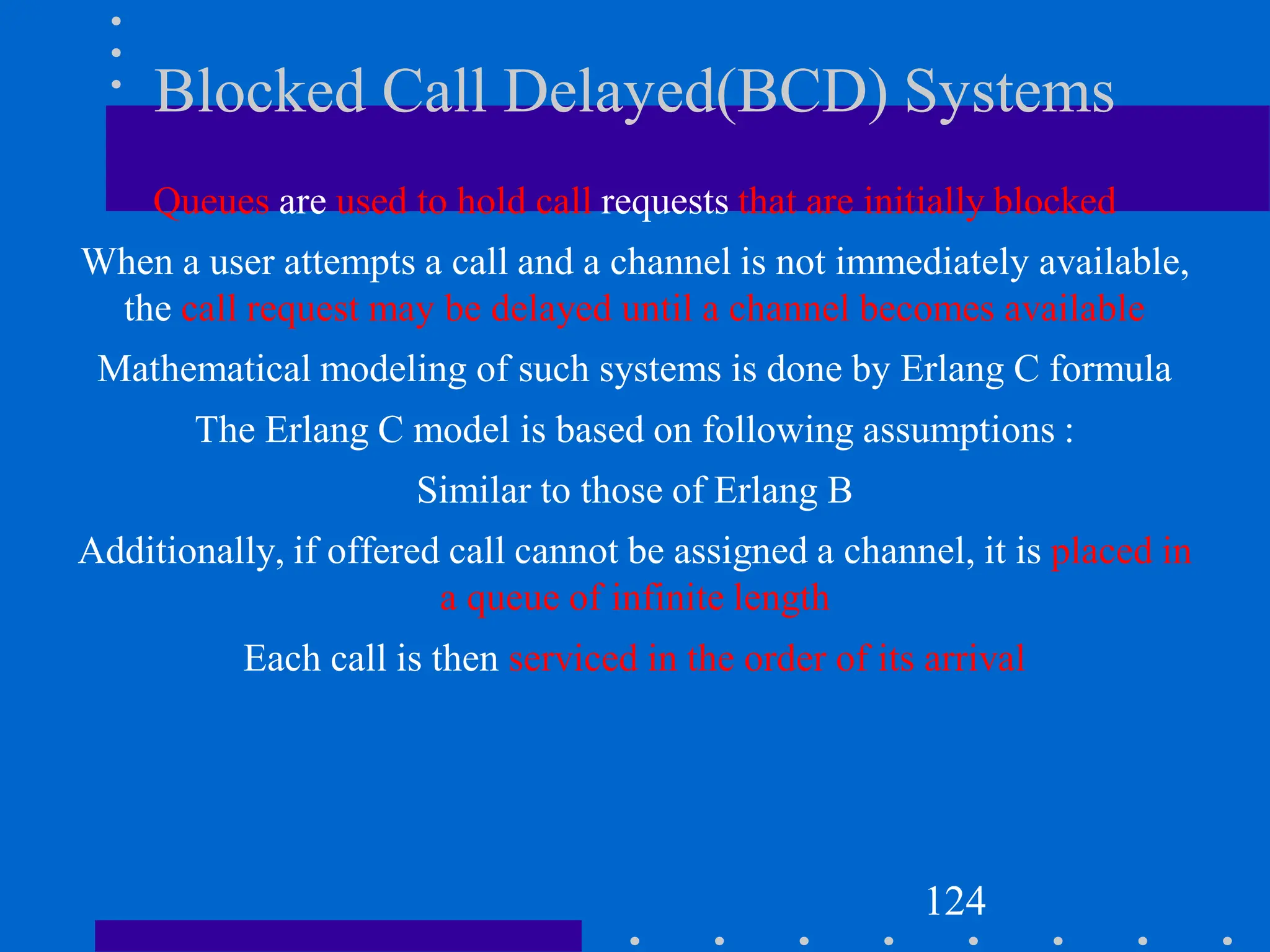
Blocked Call Delayed(BCD) Systems
Queues are used to hold call requests that are initially blocked
When a user attempts a call and a channel is not immediately available,
the call request may be delayed until a channel becomes available
Mathematical modeling of such systems is done by Erlang C formula
The Erlang C model is based on following assumptions :
Similar to those of Erlang B
Additionally, if offered call cannot be assigned a channel, it is placed in
a queue of infinite length
Each call is then serviced in the order of its arrival
124
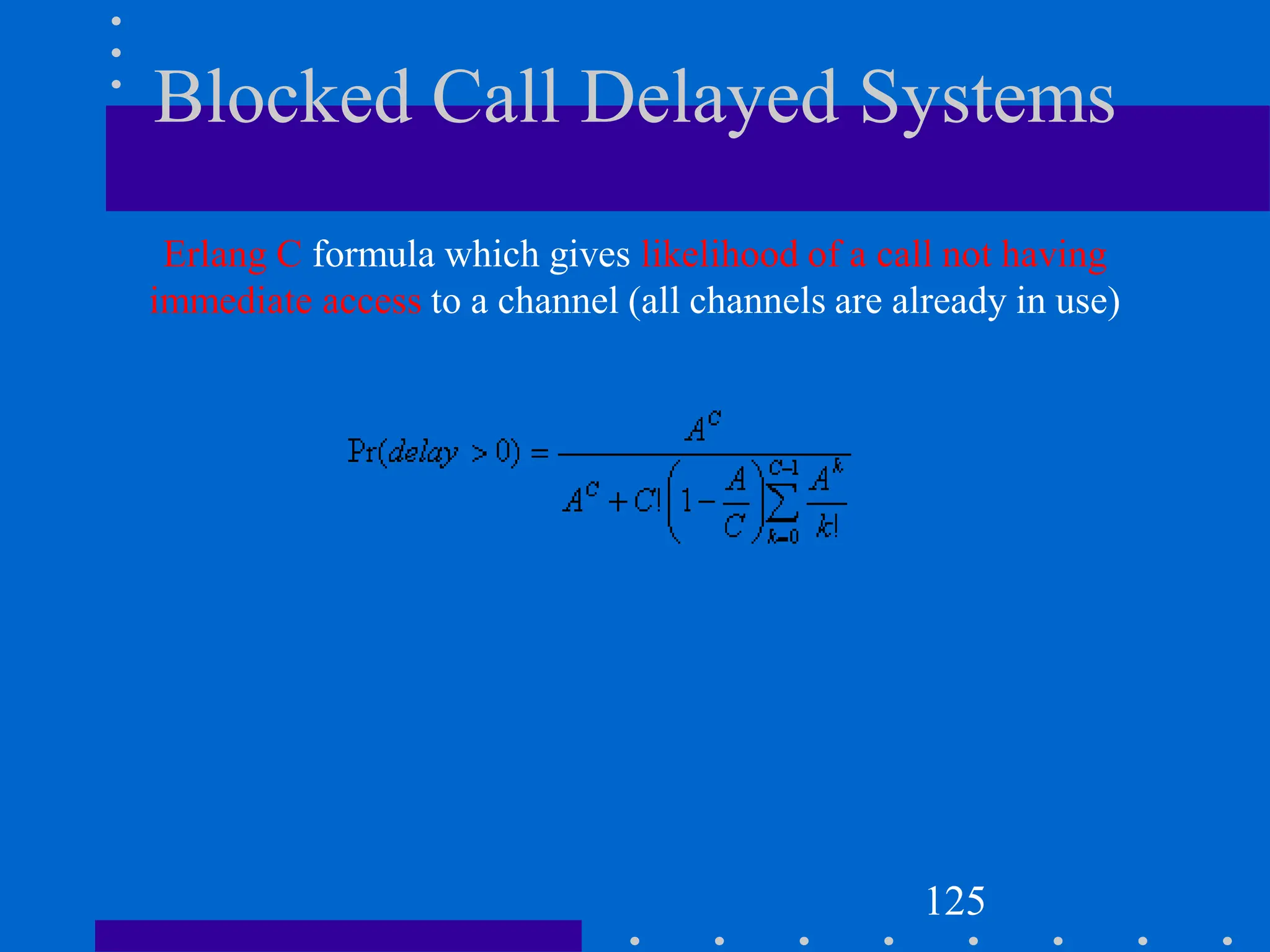
Blocked Call Delayed Systems
125
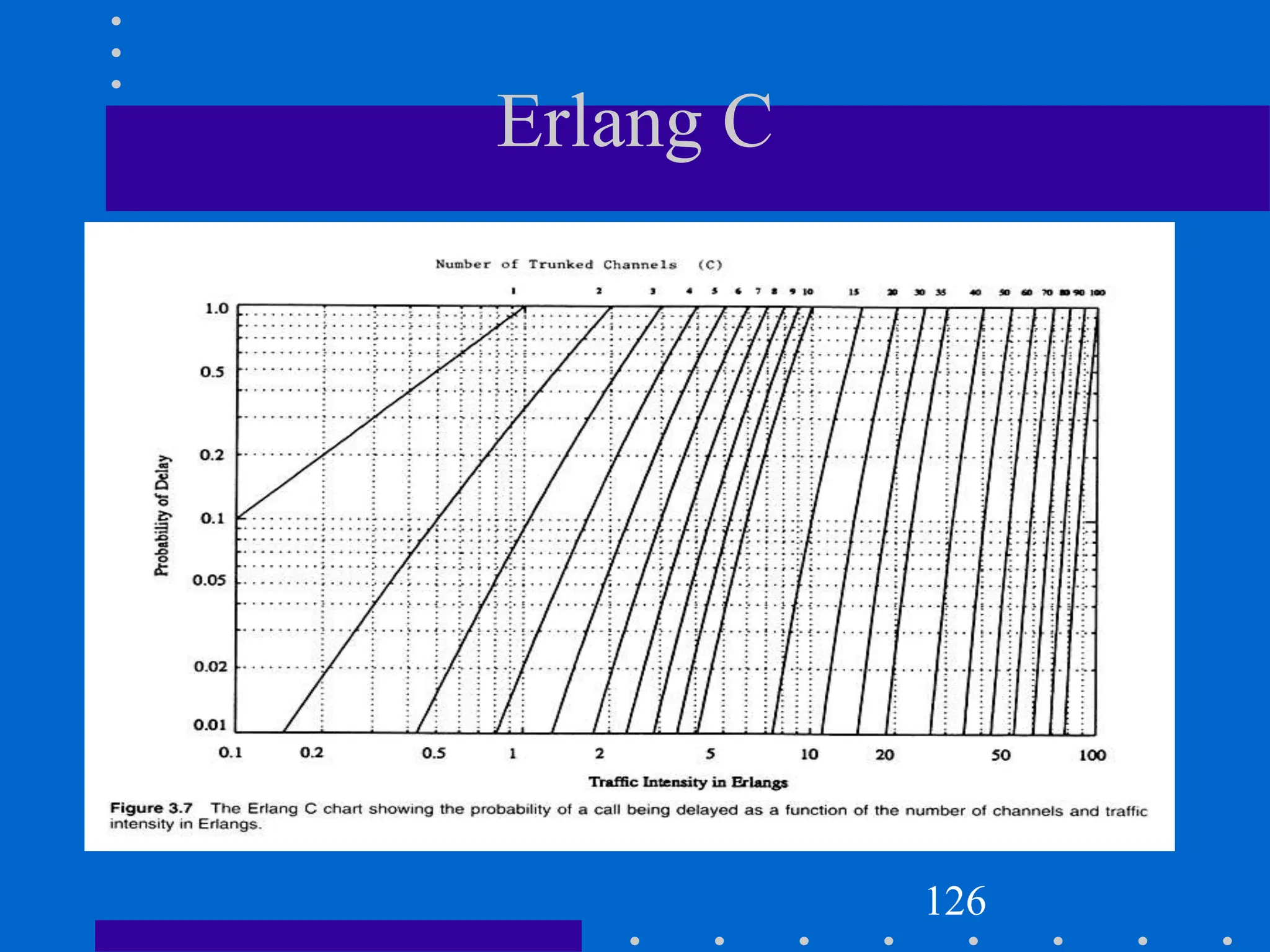
Erlang C formula which gives likelihood of a call not having
immediate access to a channel (all channels are already in use)
Erlang C
126
=
Modeling of BCD Systems
Probability that any caller is delayed in queue for a wait time greater
than t seconds is given as GOS of a BCD System
The probability of a call getting delayed for any period of time greater
than zero is
P[delayed call is forced to wait > t sec]=P[delayed] x Conditional P[delay
is >t sec]
Mathematically;
Pr[delay>t] = Pr [delay>0] Pr [delay>t| delay>0]
Where P[delay>t| delay>0]= e(-(C-A)t/H)
Pr[delay>t] = Pr [delay>0] e(-(C-A)t/H)
where C = total number of channels, t =delay time of interest, H=average
duration of call
127
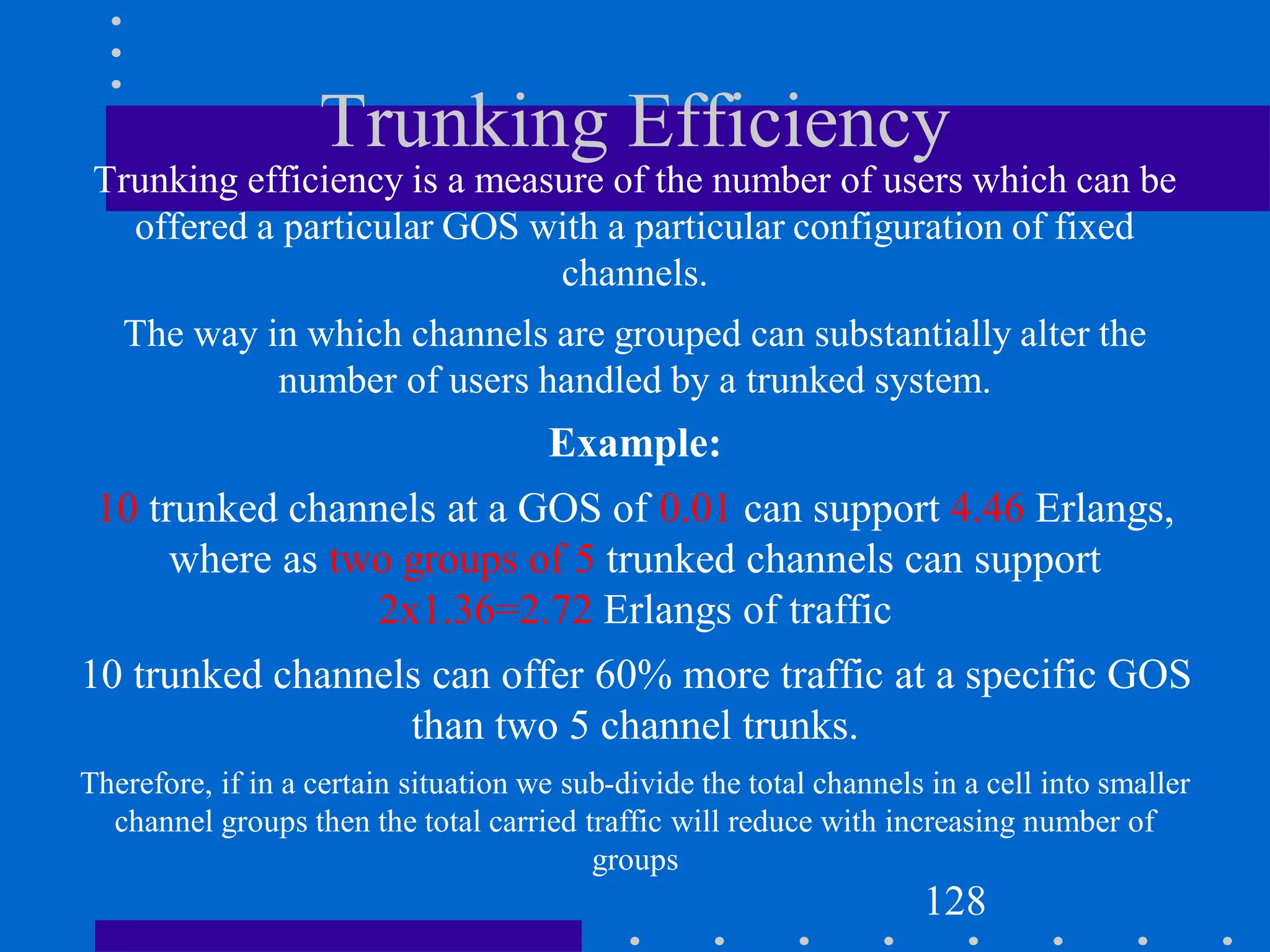
Trunking Efficiency
Trunking efficiency is a measure of the number of users which can be
offered a particular GOS with a particular configuration of fixed
channels.
The way in which channels are grouped can substantially alter the
number of users handled by a trunked system.
Example:
10 trunked channels at a GOS of 0.01 can support 4.46 Erlangs,
where as two groups of 5 trunked channels can support
2x1.36=2.72 Erlangs of traffic
10 trunked channels can offer 60% more traffic at a specific GOS
than two 5 channel trunks.
Therefore, if in a certain situation we sub-divide the total channels in a cell into smaller
channel groups then the total carried traffic will reduce with increasing number of
groups
128
Erlang B Trunking GOS
129
Improving Capacity
As demand for service increases, system designers have to provide more
channel per unit coverage area
Common Techniques are: Cell Splitting, Sectoring and Microcell Zoning
Cell Splitting increases the number of BS deployed and allows an orderly
growth of the cellular system
Sectoring uses directional antennas to further control interference
Micro cell Zoning distributes the coverage of cell and extends the cell
boundary to hard-to-reach areas
130
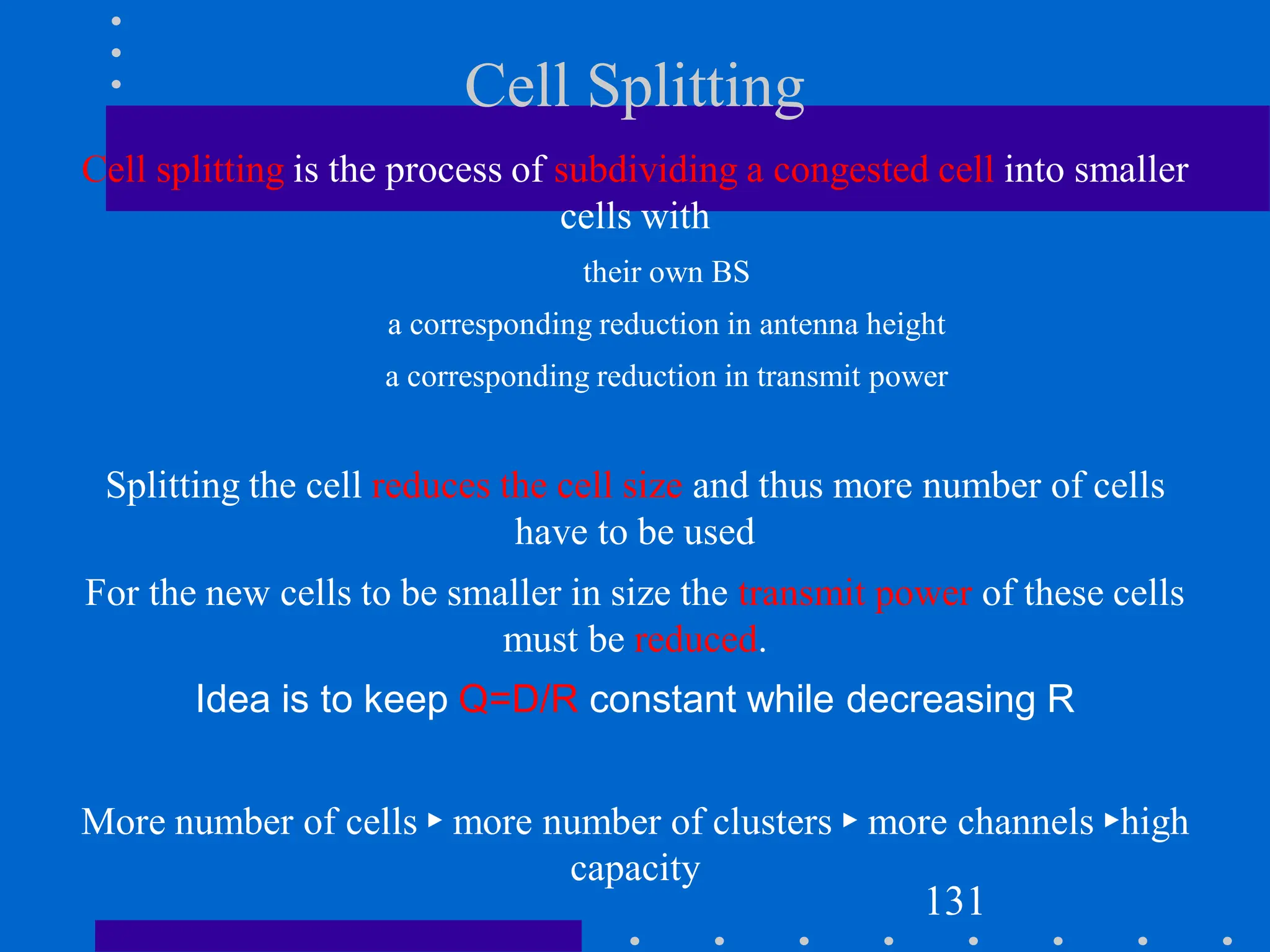
Cell Splitting
Cell splitting is the process of subdividing a congested cell into smaller
cells with
their own BS
a corresponding reduction in antenna height
a corresponding reduction in transmit power
Splitting the cell reduces the cell size and thus more number of cells
have to be used
For the new cells to be smaller in size the transmit power of these cells
must be reduced.
Idea is to keep Q=D/R constant while decreasing R
More number of cells ► more number of clusters ► more channels ►high
capacity
131
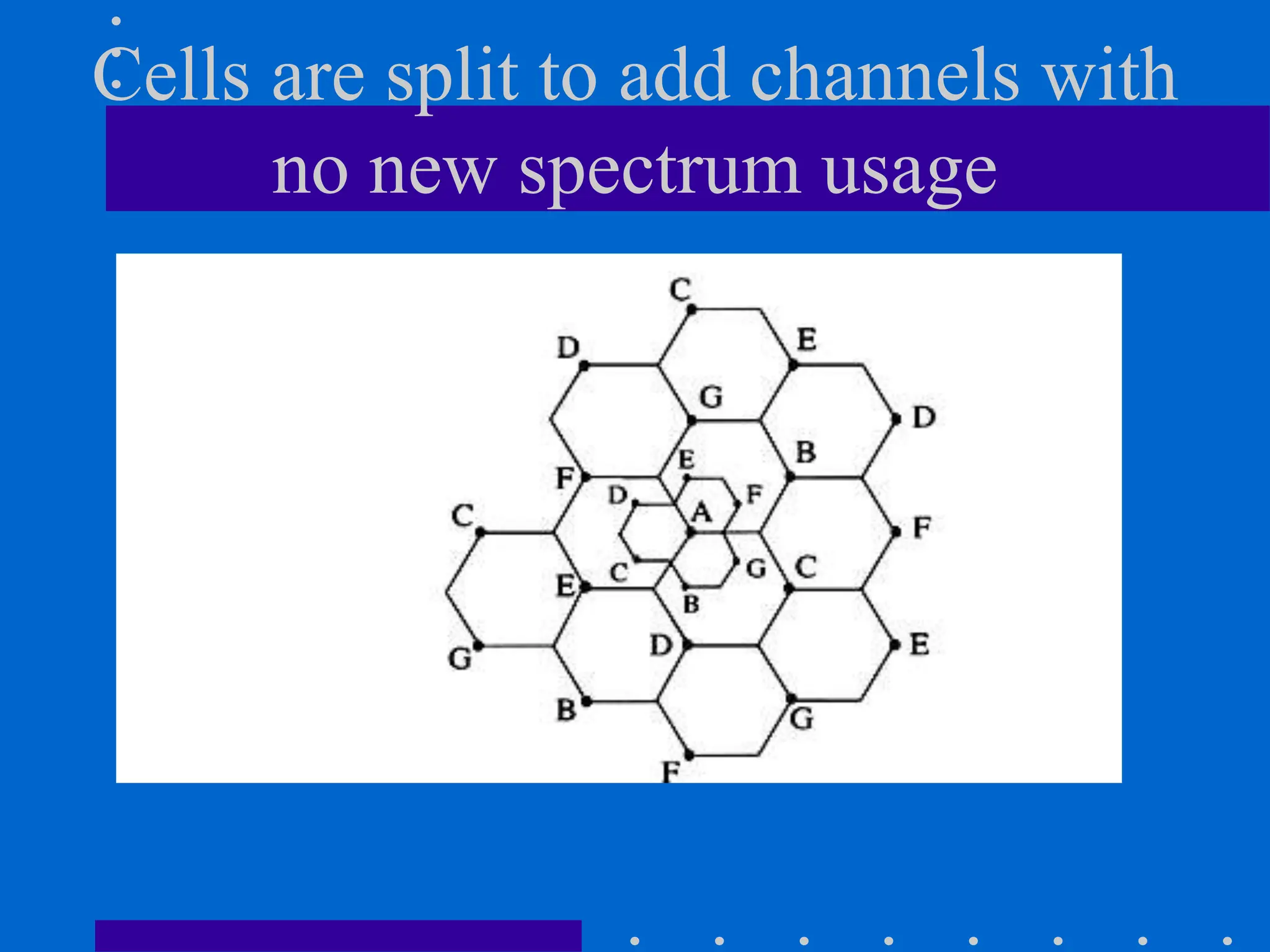
Cells are split to add channels with
no new spectrum usage
133
Example S/I
cluster size N=4 (choices 4,7,12)
path loss exponent (means) n=4
co-channel reuse ratio Q= sqrt(3N)=3.464102
Ratio of distance to radius Q=D/R=3.464102
number of neighboring cells io=6 ,# of sides of hexagon
signal to interference ratio S/I= (D/R)^n / io =24
convert to dB, S/I= 10log(S/I)=13.80211dB
S/I is less than required, it will not work!
cluster size N=7
path loss exponent n=3
Q=sqrt(3N)=4.582576
number of neighboring cells io= 6, # of sides of hexagon
signal to interference ratio=S/I= (D/R)^n / io =73.334
convert to dB, S/I=10log(S/I)=18.65dB
S/I is less than required, it will work!
133
Cell Splitting-Power Issues
Suppose the cell radius of new cells is reduced by half
What is the required transmit power for these new cells??
Pr[at old cell boundary]=Pt1R-n
Pr[at new cell boundary]= Pt2(R/2) –n
where Pt1and Pt2are the transmit powers of the larger and smaller cell
base stations respectively, and n is the path loss exponent.
So, Pt2= Pt1/2n
If we take n=3 and the received powers equal to each other, then
Pt2=Pt1/8
In other words, the transmit power must be reduced by 9dB in order to fill in
the original coverage area while maintaining the S/I requirement
134
Illustration of cell splitting in 3x3 square
centered around base station A
135
Cell Splitting
136
In practice not all the cells are split at the same time hence different size cells
will exist simultaneously.
In such situations, special care needs to be taken to keep the distance between
co-channel cells at the required minimum, and hence channel assignments
become more complicated.
To overcome handoff problem:
Channels in the old cell must be broken down into two channel groups, one for smaller cell
and other for larger cell
The larger cell is usually dedicated to high speed traffic so that handoffs occur less
frequently
At start small power group has less channels and large power group has large no of channels,
at maturity of the system large power group does not have any channel
Umbrella Cells
137
138
Sectoring
In this approach
first SIR is improved using directional antennas,
capacity improvement is achieved by reducing the number of cells in
a cluster thus increasing frequency reuse
The CCI decreased by replacing the single omni-directional antenna by several
directional antennas, each radiating within a specified sector
139
Sectoring
140
A directional antenna transmits to and receives from
only a fraction of total of the co-channel cells. Thus
CCI is reduced
Problems with Sectoring
Increases the number of antennas at each BS
Decrease in trunking efficiency due to sectoring(dividing the bigger
pool of channels into smaller groups)
Increase number of handoffs(sector-to sector)
Good news:Many modern BS support sectoring and related handoff
without help of MSC
141
Microcell Zone Concept
The Problems of sectoring can be addressed by Microcell Zone
Concept
A cell is conceptually divided into microcells or zones
Each microcell(zone) is connected to the same base
station(fiber/microwave link)
Doing something in middle of cell splitting and sectoring by extracting
good points of both
Each zone uses a directional antenna
Each zone radiates power into the cell.
MS is served by strongest zone
As mobile travels from one zone to another, it retains the same channel,
i.e. no hand off
The BS simply switches the channel to the next zone site
142
Micro Zone Cell Concept
143
Microcell Zone Concept
Reduced Interference (Zone radius is small so small and directional
antennas are used).
Decrease in CCI improves the signal quality and capacity.
No loss in trunking efficiency (all channels are used by all cells).
No extra handoffs.
Increase in capacity (since smaller cluster size can be used).
144
Repeaters for Range Extension
Useful for hard to reach areas
Buildings
Tunnels
Valleys
Radio transmitters called Repeaters can be used to provide coverage in
these area
Repeaters are bi-directional
Rx signals from BS
Amplify the signals
Re-radiate the signals
Received noise and interference is also re-radiated
145
UNIT - III WIRELESS TRANSCEIVERS
• Unit Syllabus
– Structure of a Wireless Communication Link
– Modulation
• QPSK
• π/4 - DQPSK
• OQPSK
• BFSK
• MSK
• GMSK
– Demodulation
• Error Probability in AWGN
• Error Probability in Flat - Fading Channels
• Error Probability in Delay and Frequency Dispersive Fading Channels
Structure of a wireless communications link
Block diagram
Speech
A/D
Data
Speech
D/A
Data
Speech
encoder
Speech
decoder
Encrypt.
Key
Decrypt.
Chann.
encoding
Chann.
decoding
Modulation Ampl.
Demod. Ampl.
Block diagram transmitter
Block diagram receiver
B C
RX Down Baseband RX
filter Converter filter A
D
Local
oscillator
D
Baseband
Demodulator
fLOE fs
Carrier Timing
Recovery Recovery
D E
De/MUX Channel
Decoder
Signalling
F G
Source
Decoder
D Information
sink
A (analogue)
Modulation
RADIO SIGNALS AND
COMPLEX NOTATION
Simple model of a radio signal
• A transmitted radio signal can be written
s (t)= Acos (2πft +φ)
Amplitude Frequency Phase
• By letting the transmitted information change the
amplitude, the frequency, or the phase, we get the tree
basic types of digital modulation techniques
- ASK (Amplitude Shift Keying)
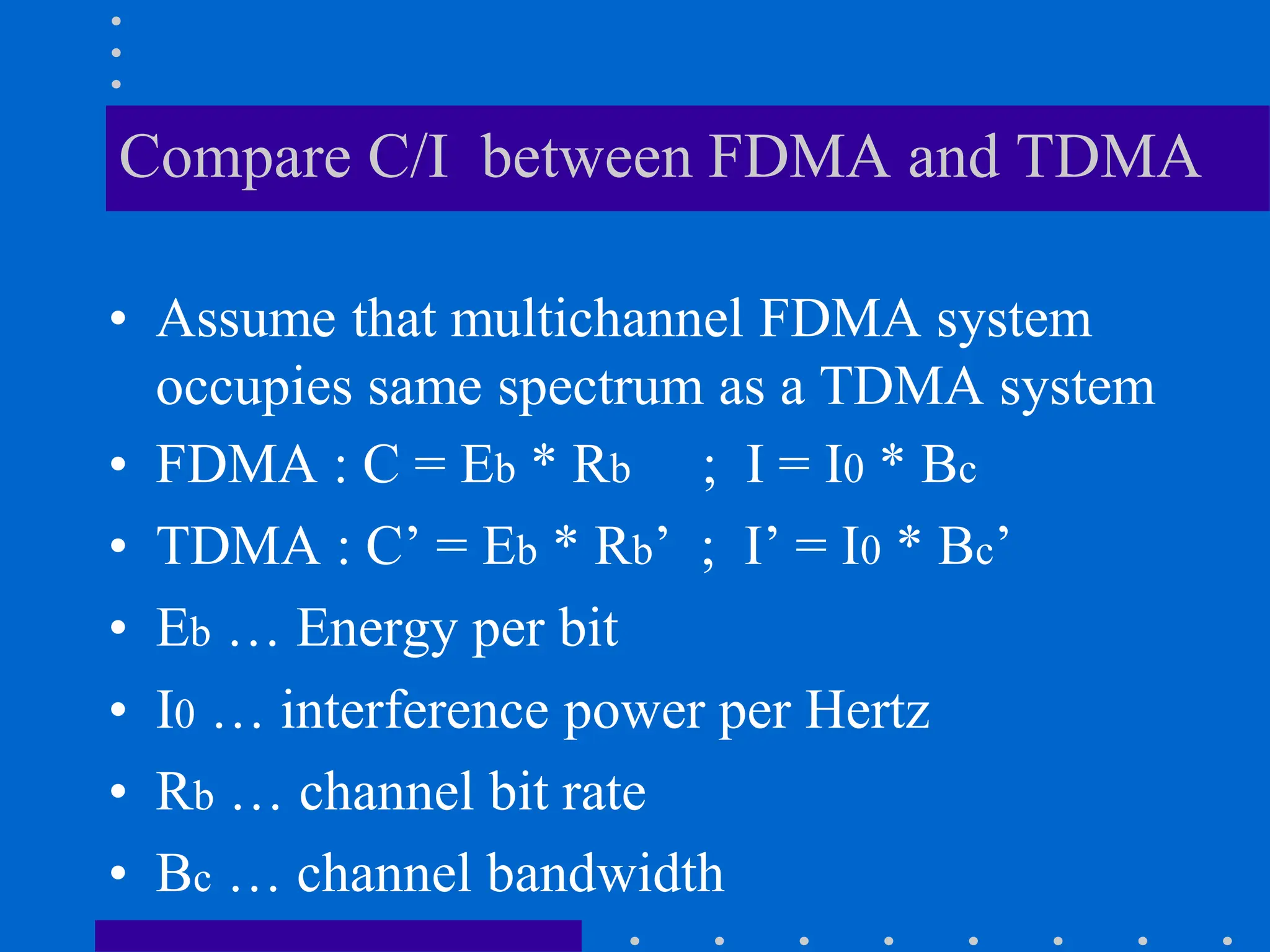
- FSK (Frequency Shift Keying)
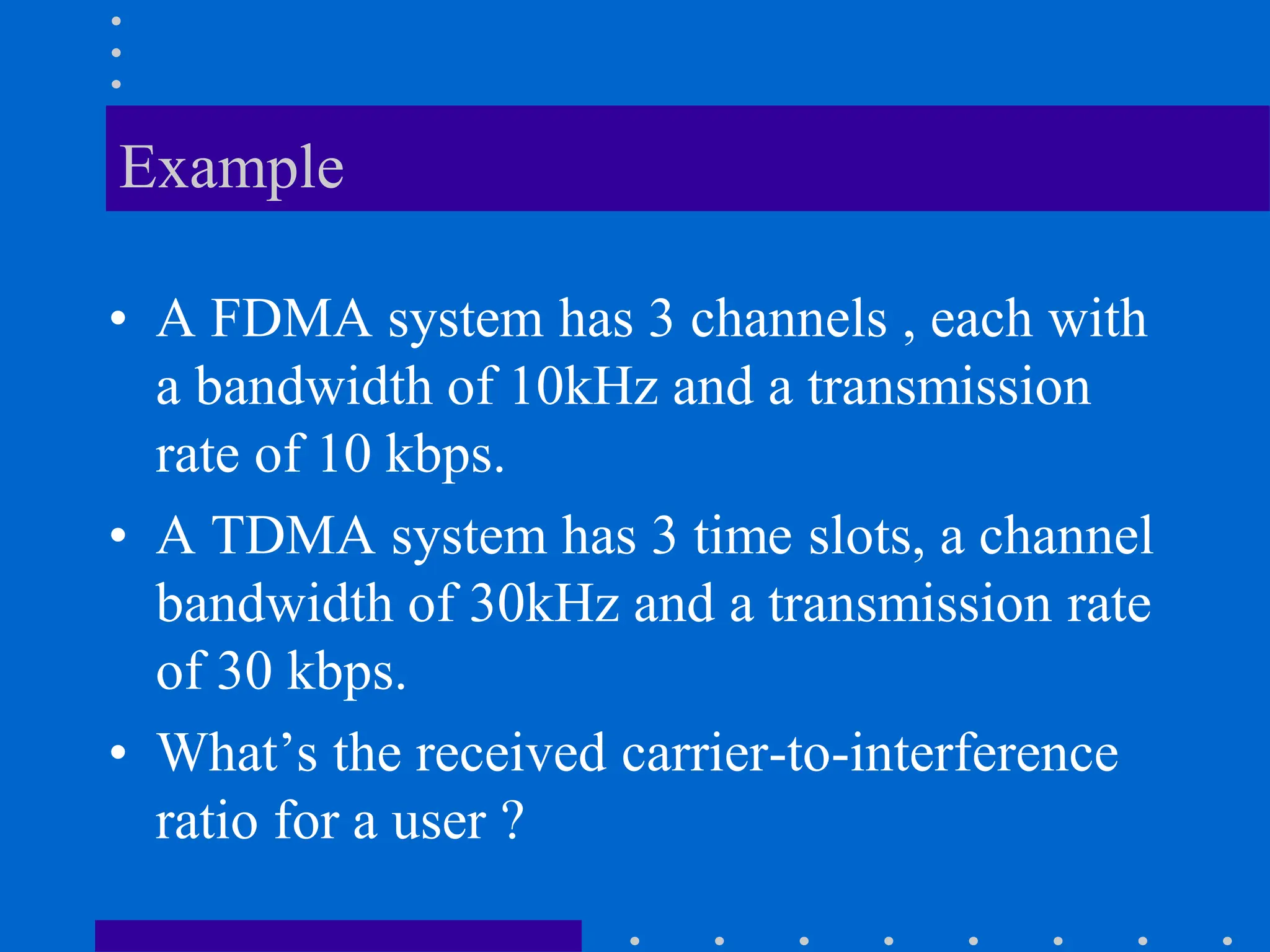
- PSK (Phase Shift Keying) Constant amplitude
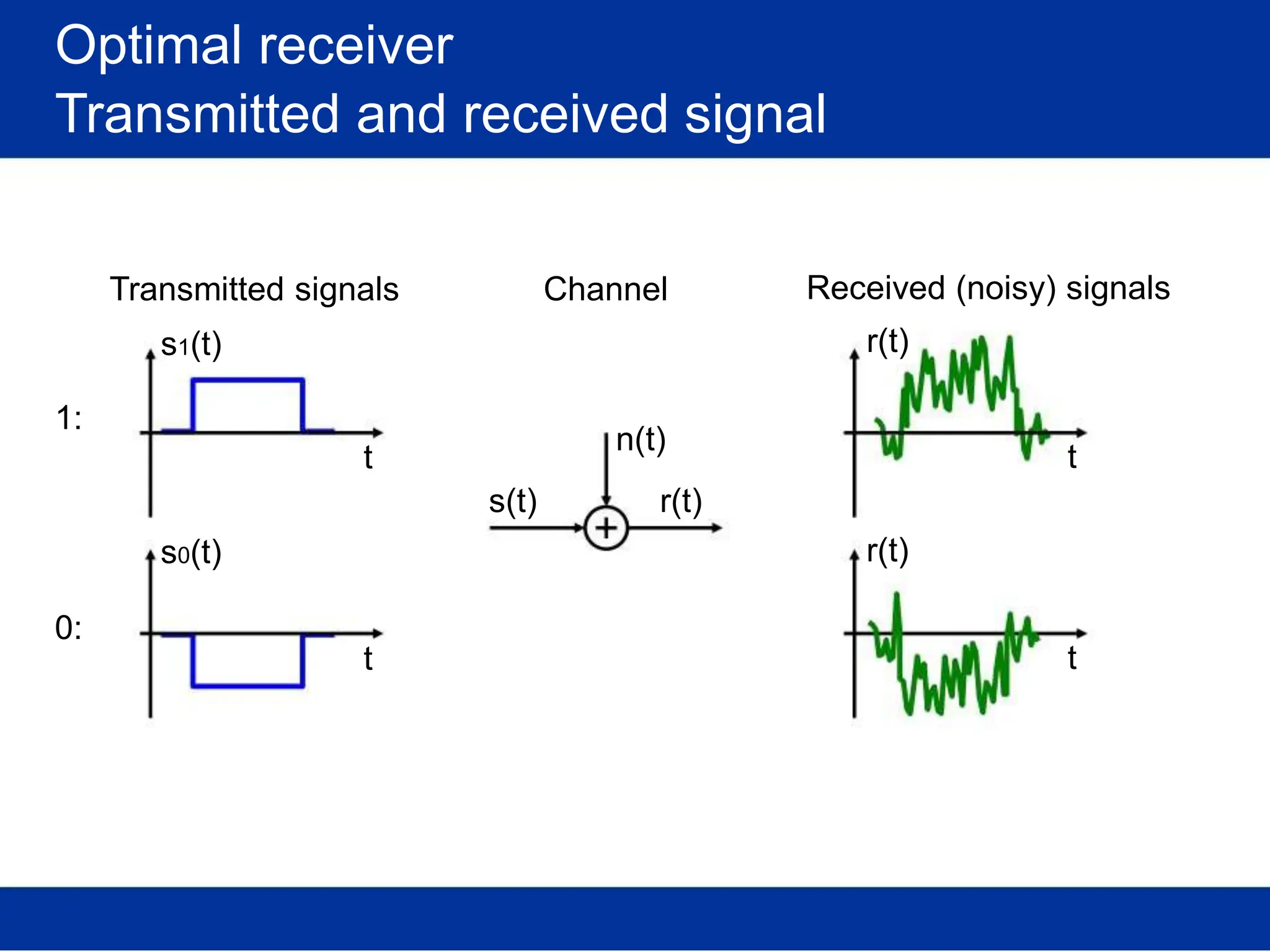
Example: Amplitude, phase and
frequency modulation
s (t)=A (t)cos(2π f
A t) φ(t)
c )t+φ t)
Comment:
00 01 11 00 10
- Amplitude carries information
4ASK - Phase constant (arbitrary)
00 01 11 00 10
4PSK - Amplitude constant (arbitrary)
- Phase carries information
00 01 11 00 10
- Amplitude constant (arbitrary)
4FSK - Phase slope (frequency)
carries information
Pulse amplitude modulation (PAM)
Basis pulses and spectrum
Assuming that the complex numbers cm representing the data
are independent, then the power spectral density of the
base band PAM signal becomes:
SLP (f)
∞
∫g t)e
−j2πft
2
dt
−∞
which translates into a radio signal (band pass) with
SBP
1
(f)=
2
(SLP (f− f c )+S LP (−f − fc ))
Pulse amplitude modulation (PAM)
Basis pulses and spectrum
Illustration of power spectral density of the (complex) base-band
signal, SLP(f), and the (real) radio signal, SBP(f).
SBP (f)
f −f
S
c
BP (f)
fc f
Can be asymmetric,
since it is a complex Symmetry (real radio signal)
signal.
What we need are basis pulses g(t) with nice properties like:
- Narrow spectrum (low side-lobes)
- Relatively short in time (low delay)
Pulse amplitude modulation (PAM)
Basis pulses
TIME DOMAIN
Normalized time t
FREQ. DOMAIN
Rectangular [in time]
/T Normalized freq. f/T
s s
(Root-) Raised-cosine [in freq.]
Normalized time t /T Normalized freq. f/T
s s
Pulse amplitude modulation (PAM)
Interpretation as IQ-modulator
For real valued basis functions g(t) we can view PAM as:
s (t)=
I
Re(c )
Re(s t))
LP
m
g (t)
b c
cos(2π f
Pulse fc
ct)
Radio
signal
m m
Mapping shaping
filters
g (t)
Im(c )
-90o
−sin(2π fct)
m
s (t)=
Q
Im(s t))
LP
(Both the rectangular and the (root-) raised-cosine pulses are real valued.)
Continuous-phase FSK (CPFSK)
The modulation process
Bits
b c
Complex domain
Radio
s (t)
m m
Mapping
LP
CPFSK Re{ }
exp(j2π ft)
signal
c
CPFSK: s (t)=Aexp
LP (jΦCPFSK (t))
where the amplitude A is constant and the phase is
Φ (t)
∞
=2πh
t
c g(u−mT)du
CPFSK mod ∑
m=−∞
m ∫
−∞
Phase basis
where hmod is the modulation index.
pulse
Continuous-phase FSK (CPFSK)
The Gaussian phase basis pulse
BTs=0.5
Normalized time t/T s
SIGNAL SPACE DIAGRAM
IMPORTANT MODULATION
FORMATS
Binary phase-shift keying (BPSK)
Rectangular pulses
Base-band
Radio
signal
Binary phase-shift keying (BPSK)
Rectangular pulses
Complex representation Signal space diagram
Binary phase-shift keying (BPSK)
Rectangular pulses
Power spectral
density for BPSK
Normalized freq. fiT b
Binary amplitude modulation (BAM)
Raised-cosine pulses (roll-off 0.5)
Base-band
Radio
signal
Binary amplitude modulation (BAM)
Raised-cosine pulses (roll-off 0.5)
Complex representation Signal space diagram
Binary amplitude modulation (BAM)
Raised-cosine pulses (roll-off 0.5)
Power spectral
density for BAM
Normalized freq. fiT b
Quaternary PSK (QPSK or 4-PSK)
Rectangular pulses
Complex representation
Radio
signal
Quaternary PSK (QPSK or 4-PSK)
Rectangular pulses
Power spectral
density for QPSK
Quadrature ampl.-modulation (QAM)
Root raised-cos pulses (roll-off 0.5)
Complex representation
Amplitude variations
The problem
Signals with high amplitude variations leads to less efficient amplifiers.
Complex representation of QPSK
Amplitude variations
A solution
π/4
i
etc.
Amplitude variations
A solution
Looking at the complex representation ...
QPSK without rotation QPSK with rotation
Offset QPSK (OQPSK)
Rectangular pulses
In-phase
signal
Quadrature
signal
Offset QPSK
Rectangular pulses
Complex representation
Offset QAM (OQAM)
Raised-cosine pulses
Complex representation
Higher-order modulation
16-QAM signal space diagram
Binary frequency-shift keying (BFSK)
Rectangular pulses
Base-band
Radio
signal
Binary frequency-shift keying (BFSK)
Rectangular pulses
Complex representation Signal space diagram
Binary frequency-shift keying (BFSK)
Rectangular pulses
Continuous-phase modulation
MSK/FFSK
Á
Basic idea:
- Keep amplitude constant
- Change phase continuously
2¼
3
2¼
¼
1
2¼
1
1 0 1
0 1 0
0
−1
2¼
−¼
−3
2¼
−2¼
Tb 0 1 t
Minimum shift keying (MSK)
Simple MSK implementation
01001
0 1 0 0
Rectangular
pulse
filter
1
Voltage MSK signal
controlled
oscillator
(VCO)
Minimum shift keying (MSK)
Power spectral
density of MSK
Gaussian filtered MSK (GMSK)
Further improvement of the phase: Remove ’corners’
(Simplified figure)
2¼
3
Á Á
2¼
3
2¼
¼
1
1 0 1
1 2¼
¼
1
1
1 0 1
2¼
1 0 1 0 1
2¼
1 0 1 0 1
−1
Ts t
−1
Ts t
2¼
−¼
−3
2¼
−¼
−3
2¼ 2¼
−2¼ −2¼
MSK Gaussian filtered MSK - GMSK
(Rectangular pulse filter) (Gaussian pulse filter)
Gaussian filtered MSK (GMSK)
Simple GMSK implementation
01001
0 1 0 0
Gaussian
pulse
filter
1
Voltage GMSK signal
controlled
oscillator
(VCO)
GSFK is used in e.g. Bluetooth.
Gaussian filtered MSK (GMSK)
Digital GMSK implementation
D/A
Digital
Data baseband
GMSK
modulator
cos(2π f
fc
-90o
ct)
−sin(2π f
D/A
Digital Analog
c t)
Gaussian filtered MSK (GMSK)
BT = 0.5 here
(0.3 in GSM)
Power spectral
density of GMSK.
How do we use all these spectral
efficiencies?
Example: Assume that we want to use MSK to transmit 50 kbit/sec,
and want to know the required transmission bandwidth.
Take a look at the spectral efficiency table:
The 90% and 99% bandwidths become:
B = 50000 /1.29 = 38.8 kHz
90%
B = 50000 / 0.85 = 58.8 kHz
99%
Summary
Demodulation and BER computation
OPTIMAL RECEIVER
AND
BIT ERROR PROBABILITY
IN AWGN CHANNELS
Optimal receiver
Transmitted and received signal
Transmitted signals
s1(t)
1:
t
s0(t)
0:
t
Channel
n(t)
s(t) r(t)
Received (noisy) signals
r(t)
t
r(t)
t
Optimal receiver
A first “intuitive” approach
Assume that the following
signal is received:
r(t)
Comparing it to the two possible
noise free received signals:
r(t), s1(t)
1: This seems to
t
0:
t
r(t), s0(t)
t
be the best “fit”.
We assume that
“0” was the
transmitted bit.
Optimal receiver
Let’s make it more measurable
To be able to better measure the “fit” we look at the energy of the
residual (difference) between received and the possible noise free signals:
s1(t) - r(t)
r(t), s1(t)
1:
r(t), s0(t)
t
s0(t)-r(t)
∫
t
s (t)
1
−r (t) 2 d t
2
0:
t ∫
t
s (t)
0 −r (t) dt
This residual energy is much
smaller. We assume that “0”
was transmitted.
Optimal receiver
The AWGN channel
The additive white Gaussian noise (AWGN) channel
n (t)
s (t) r (t)=αs (t)
α
s (t) - transmitted signal
α - channel attenuation
n (t)- white Gaussian noise
r (t)- received signal
+n (t)
In our digital transmission
system, the transmitted
signal s(t) would be one of,
let’s say M, different alternatives
s0(t), s1(t), ... , sM-1(t).
Optimal receiver
The AWGN channel, cont.
The central part of the comparison of different signal alternatives
is a correlation, that can be implemented as a correlator:
r t)
or a matched filter
r t)
∫
Ts
s t) α
i
s (T−t)
*
The real part of
the output from
either of these
is sampled at t = Ts
i s
α
where Ts is the symbol time (duration).
*
Optimal receiver
Antipodal signals
In antipodal signaling, the alternatives (for “0” and “1”) are
s (t)=
0 ϕ(t)
s (t)=−ϕ(t)
1
This means that we only need ONE correlation in the receiver
for simplicity:
If the real part
r (t)
∫T
at T=Ts is
>0 decide “0”
s
ϕ*
(t) α
* <0 decide “1”
Optimal receiver
Orthogonal signals
In binary orthogonal signaling, with equal energy alternatives s0(t) and s1(t)
(for “0” and “1”) we require the property:
s (t)
0 ,s (t) =∫ s (t)
1 0
∫T
*
s (t)dt = 0
1
Compare real
s
s (t) α
part at t=Ts
r (t) 0
∫
Ts
s (t)
α
and decide in
favor of the
larger.
*
1
Optimal receiver
Interpretation in signal space
Antipodal signals
“1” “0”
Decision
boundaries
ϕ(t)
Orthogonal signals
s1(t)
“1”
“0”
s 0 (t)
Optimal receiver
The noise contribution
Assume a 2-dimensional signal space, here viewed as the complex plane
Im
s i
Es
sj
Re
Es
Fundamental question: What is the probability
that we end up on the wrong side of the decision
boundary?
Noise-free
positions
Noise pdf.
This normalization of
axes implies that the
noise centered around
each alternative is
complex Gaussian
2 2
N(0,σ )+ jN(0,σ )
with variance σ2 = N0/2
in each direction.
Optimal receiver
The union bound
Calculation of symbol error probability is simple for two signals!
When we have many signal alternatives, it may be impossible to
calculate an exact symbol error rate.
s1
s6
s5
s7
s2
s0
s4
When s0 is the transmitted
signal, an error occurs when
the received signal is outside
this polygon.
s3
Optimal receiver
Bit-error rates (BER)
EXAMPLES:
Bits/symbol
Symbol energy
2PAM 4QAM
1 2
Eb 2Eb
2E 2E
8PSK
3
3Eb
2
16QAM
4
4Eb
E 3 E
BER Q b
N
Q
b
N
≈
b
Q 0.87
3 N
≈
b,max
Q
2 2.25N
0 0 0 0
Gray coding is used when calculating these BER.
Optimal receiver
Bit-error rates (BER), cont.
100
2PAM/4QAM
10-1
10-2
10-3
10-4
10-5
10-6
0 2 4 6
8PSK
16QAM
8 10 12 14 16 18 20
E /N [dB]
b 0
Optimal receiver
Where do we get Eb and N0?
Where do those magic numbers Eb and N0 come from?
The noise power spectral density N0 is calculated according to
N0 = kTF ⇔N
0 0 0|dB =−204+F 0|dB
where F0 is the noise factor of the “equivalent” receiver noise source.
The bit energy Eb can be calculated from the received
power C (at the same reference point as N0). Given a certain
data-rate db [bits per second], we have the relation
Eb
=C/ d b ⇔E =C −d
b|dB |dB b|dB
THESE ARE THE EQUATIONS THAT RELATE DETECTOR
PERFORMANCE ANALYSIS TO LINK BUDGET CALCULATIONS!
Noncoherent detection (1)
BER IN FADING CHANNELS
AND DISPERSION-INDUCED
ERRORS
BER in fading channels (2)
THIS IS A SERIOUS PROBLEM!
Bit error rate (4QAM)
100
10 dB Rayleigh fading
10-1
10 x
10-2
10-3
10-4
10-5 No fading
10-6
0 2 4 6 8 10 12 14 16 18 20
Eb/N0 [dB]
Errors induced by delay dispersion (2)
Copyright: Prentice-Hall
Impact of filtering
Copyright: IEEE
1
MULTI PATH
MITIGATION
TECHNIQUES
Wireless Communication
Introduction
 The mobile radio channel places fundamental limitations on
the performance of a wireless communication system
 The wireless transmission path may be
 Line of Sight (LOS)
 Non line of Sight (NLOS)
 Radio channels are random and time varying
 Modeling radio channels have been one of the difficult parts of
mobile radio design and is done in statistical manner
 When electrons move, they create EM waves that can
propagate through space.
 By using antennas we can transmit and receive these EM
wave
 Microwave ,Infrared visible light and radio waves can be used.
2
Properties of Radio Waves
 Are easy to generate
 Can travel long distances
 Can penetrate buildings
 May be used for both indoor and outdoor coverage
 Are omni-directional-can travel in all directions
 Can be narrowly focused at high frequencies(>100MHz) using
parabolic antenna
3
Properties of Radio Waves
 Frequency dependence
 Behave more like light at high frequencies
 Difficulty in passing obstacle
 Follow direct paths
 Absorbed by rain
 Behave more like radio at lower frequencies
 Can pass obstacles
 Power falls off sharply with distance from source
 Subject to interference from other radio waves
4
Propagation Models
 The statistical modeling is usually done based on data
measurements made specifically for
the intended communication system
the intended spectrum
 They are tools used for:
Predicting the average signal strength at a given
distance from the transmitter
Estimating the variability of the signal strength in close
spatial proximity to a particular locations
5
Propagation Models
 Large Scale Propagation Model:
 Predict the mean signal strength for an arbitrary
transmitter-receiver(T-R) separation
 Estimate radio coverage of a transmitter
 Characterize signal strength over large T-R
separation distances(several 100’s to 1000’s
meters)
6
Propagation Models
 Small Scale or Fading Models:
 Characterize rapid fluctuations of received signal
strength over
 Very short travel distances( a few wavelengths)
 Short time durations(on the order of seconds)
7
Small-scale and large-scale fading
8
Free Space Propagation Model
 For clear LOS between T-R
 Ex: satellite & microwave communications
 Assumes that received power decays as a function of T-R distance
separation raised to some power.
 Given by Friis free space eqn:
‘L’ is the system loss factor
L >1 indicates loss due to transmission line attenuation, filter losses &
antenna losses
L = 1 indicates no loss in the system hardware
 Gain of antenna is related to its effective aperture Ae by
G=4 π Ae /λ2
9
Free Space Propagation Model
 Effective Aperture Ae is related to physical size of antenna.
λ= c/f.
 c is speed of light,
 Pt and Pr must be in same units
 Gt ad Gr are dimensionless
 An isotropic radiator, an ideal radiator which radiates power with unit gain
uniformly in all directions, and is often used as reference
 Effective Isotropic Radiated Power (EIRP) is defined as
EIRP= Pt Gt
 Represents the max radiated power available from a transmitter in direction
of maximum antenna gain, as compared to an isotropic radiator
10
Free Space Propagation Model
 In practice Effective Radiated Power (ERP) is used instead of
(EIRP)
 Effective Radiated Power (ERP) is radiated power compared
to half wave dipole antennas
 Since dipole antenna has gain of 1.64(2.15 dB)
ERP=EIRP-2.15(dB)
 the ERP will be 2.15dB smaller than the EIRP for same
Transmission medium
11
Free Space Propagation Model
 Path Loss (PL) represents signal attenuation and is defined
as difference between the effective transmitted power and
received power
Path loss PL(dB) = 10 log [Pt/Pr]
= -10 log {GtGr λ^2/(4π)^2d^2}
 Without antenna gains (with unit antenna gains)
PL = - 10 log { λ^2/(4π)^2d^2}
 Friis free space model is valid predictor for Pr for values of d
which are in the far-field of transmitting antenna
12
Free Space Propagation Model
 The far field or Fraunhofer region that is beyond far field distance df given
as :df=2D2/λ
 D is the largest physical linear dimension of the transmitter antenna
 Additionally, df>>D and df>>λ
 The Friis free space equation does not hold for d=0
 Large Scale Propagation models use a close-in distance, do, as received
power reference point, chosen such that do>= df
 Received power in free space at a distance greater then do
Pr (d)=Pr(do )(do /d)2 d>do>df
Pr with reference to 1 mW is represented as
Pr(d)=10log(Pr(do)/0.001W)+20log (do /d)
Electrostatic,inductive and radiated fields are launched, due to flow of current
from anntena.
Regions far away from transmitter electrostatic and inductive fields become
negligible and only radiated field components are considered.
13
Example
 What will be the far-field distance for a Base station antenna
with
 Largest dimension D=0.5m
 Frequency of operation fc=900MHz,1800MHz
 For 900MHz
 λ =3*10^8/900*10^6)=0.33m
 df= 2D^2/ λ =2(0.5)^2/0.33=1.5m
14
Example
 If a transmitter produces 50 watts of power,
express the transmit power in units of (a)
dBm, and (b) dBW. If 50 watts is applied to a
unity gain antenna with a 900 MHz carrier
frequency, find the received power in dBm at
a free space distance of 100 m from the
antenna, What is Pr (10 km)? Assume unity
gain for the receiver antenna.
15
solution
16
Propagation Mechanisms
 Three basic propagation mechanism which impact
propagation in mobile radio communication system are:
 Reflection
 Diffraction
 Scattering
17
Propagation Mechanisms
 Reflection occurs when a propagating electromagnetic wave
impinges on an object which has very large dimensions as
compared to wavelength e.g. surface of earth , buildings,
walls
 Diffraction occurs when the radio path between the transmitter
and receiver is obstructed by a surface that has sharp
irregularities(edges)
 Explains how radio signals can travel urban and rural environments
without a line of sight path
 Scattering occurs when medium has objects that are smaller
or comparable to the wavelength (small objects, irregularities
on channel, foliage, street signs etc)
18
Reflection
 Occurs when a radio wave propagating in one medium
impinges upon another medium having different electrical
properties
 If radio wave is incident on a perfect dielectric
 Part of energy is reflected back
 Part of energy is transmitted
 In addition to the change of direction, the interaction between
the wave and boundary causes the energy to be split between
reflected and transmitted waves
 The amplitudes of the reflected and transmitted waves are
given relative to the incident wave amplitude by Fresnel
reflection coefficients
19
Vertical and Horizontal polarization
20
Reflection- Dielectrics
21
Reflection
 Γ(ǁ)= / = (Paralell E-field polarization)
 Γ(┴)= = (Perpendicular E-field polarization)
 These expressions express ratio of reflected electric fields to the
incident electric field and depend on impedance of media and on
angles
 η is the intrinsic impedance given by
 μ=permeability,ε=permittivity
22
Reflection-Perfect Conductor
If incident on a perfect conductor the entire EM energy is
reflected back
Here we have θr= θi
Ei= Er (E-field in plane of incidence)
Ei= -Er (E field normal to plane of incidence)
Γ(parallel)= 1
Γ(perpendicular)= -1
23
Reflection - Brewster Angle
It is the angle at which no reflection occur in the medium
of origin. It occurs when the incident angle is such that the
reflection coefficient Γ(parallel) is equal to zero.
It is given in terms of as given below
When first medium is a free space and second medium
has an relative permittivity of
Brewster angle only occur for parallel polarization
24
Ground Reflection(Two Ray) Model
In mobile radio channel, single direct path between base station
and mobile and is seldom only physical means for propagation
Free space model as a stand alone is inaccurate
Two ray ground reflection model is useful
 Based on geometric optics
 Considers both direct and ground reflected path
Reasonably accurate for predicting large scale signal strength
over several kms that use tall tower height
Assumption: The height of Transmitter >50 meters
25
Ground Reflection(Two Ray) Model
26
Ground Reflection(Two Ray) Model
27
Ground Reflection(Two Ray) Model
28
Path Difference
29
Phase difference
30
=
0 0
0 0
2
( ) 2 sin
2
2
0.3 rad
2
2
( ) 2 V/m
TOT
r t
r t
TOT
E d
E t
d
h h
d
E d h h k
E t
d d d








 
  
 
 
 
Diffraction
 Diffraction is the bending of wave fronts around obstacles.
 Diffraction allows radio signals to propagate behind
obstructions and is thus one of the factors why we receive
signals at locations where there is no line-of-sight from base
stations
 Although the received field strength decreases rapidly as a
receiver moves deeper into an obstructed (shadowed) region,
the diffraction field still exists and often has sufficient signal
strength to produce a useful signal.
31
Diffraction
32
Knife-edge Diffraction Model
 Estimating the signal attenuation caused by diffraction of radio
waves over hills and buildings is essential in predicting the field
strength in a given service area.
 As a starting point, the limiting case of propagation over a knife edge
gives good in sight into the order of magnitude diffraction loss.
 When shadowing is caused by a single object such as a building,
the attenuation caused by diffraction can be estimated by treating
the obstruction as a diffracting knife edge
33
Knife-edge Diffraction Model
34
Consider a receiver at point R located in the shadowed region. The field
strength at point R is a vector sum of the fields due to all of the
secondary Huygens sources in the plane above the knife edge.
Knife-edge Diffraction Model
The difference between the direct path and diffracted path, call
excess path length
The corresponding phase difference
Fresnel-Kirchoff diffraction parameter is used to normalize the
phased term and given as
 where
35
Which gives
Knife-edge Diffraction Model
36
Fresnel zones
 Fresnel zones represent successive regions where secondary
waves have a path length from the TX to the RX which are nλ/2
greater in path length than of the LOS path. The plane below
illustrates successive Fresnel zones.
37
Fresnel zones
38
Diffraction gain
 The diffraction gain due to the presence of a knife edge, as
compared to the free space E-field
 The electric field strength, Ed, of a knife edge diffracted wave is
given by
 Eo : is the free space field strength in the absence of both the
ground and the knife edge.
 F(v): is the complex fresnel integral.
 v: is the Fresnel-Kirchoff diffraction parameter
39
Graphical Calculation of diffraction
attenuation
40
Numerical solution
 An approximate numerical solution for
equation
 Can be found using set of equations given
below for different values of v
41
[0,1]
20 log(0.5 e- 0.95v)
[-1,0]
20 log(0.5-0.62v)
> 2.4
20 log(0.225/v)
[1, 2.4]
20 log(0.4-(0.1184-(0.38-0.1v)2)1/2)
 -1
0
v
Gd(dB)
Example
42
43
Example
44
45
46
Multiple Knife Edge Diffraction
47
Scattering
 Scattering occurs when the medium through which the wave
travels consists of objects with dimensions that are small
compared to the wavelength, and where the number of
obstacles per unit volume is large.
 Scattered waves are produced by
 rough surfaces,
 small objects,
 or by other irregularities in the channel.
 Scattering is caused by trees, lamp posts, towers, etc.
48
Scattering
 Received signal strength is often stronger than that predicted
by reflection/diffraction models alone
 The EM wave incident upon a rough or complex surface is
scattered in many directions and provides more energy at a
receiver
 energy that would have been absorbed is instead reflected
to the Rx.
 flat surface → EM reflection (one direction)
 rough surface → EM scattering (many directions)
49
Scattering
Rayleigh criterion: used for testing surface roughness
A surface is considered smooth if its min to max protuberance (bumps)
h is less than critical height hc
hc = λ/8 sinΘi
Scattering path loss factor ρs is given by
ρs =exp[-8[(π*σh *sinΘi)/ λ] 2]
Where h is surface height and σh is standard deviation of surface
height about mean surface height.
For rough surface, the flat surface reflection coefficient is multiplied by
scattering loss factor ρs to account for diminished electric field
Reflected E-fields for h> hc for rough surface can be calculated as
Гrough= ρsГ
50
Scattering
51
Outdoor propagation Environment
Based on the coverage area, the Outdoor
propagation environment may be divided into
three categories
1. Propagation in Macro cells
2. Propagation in Micro cells
3. Propagation in street Micro cells
52
Outdoor propagation Environment
53
Outdoor propagation Models
Outdoor radio transmission takes place over
an irregular terrain.
The terrain profile must be taken into
consideration for estimating the path loss
e.g. trees buildings and hills must be taken
into consideration
Some common models used are
Longley Rice Model
Okumura Model
Hatta model
54
Longley Rice Model
 Longley Rice Model is applicable to point to point
communication.
 It covers 40MHz to 300 GHz
 It can be used in wide range of terrain
 Path geometry of terrain and the refractivity of
troposphere is used for transmission path loss
calculations
 Geometrical optics is also used along with the two
ray model for the calculation of signal strength.
 Two modes
 Point to point mode prediction
 Area mode prediction
55
Longley Rice Model
 Longley Rice Model is normally available as a
computer program which takes inputs as
Transmission frequency
Path length
Polarization
Antenna heights
Surface reflectivity
Ground conductivity and dialectic constants
Climate factors
A problem with Longley rice is that It doesn't
take into account the buildings and multipath.
56
Okumura Model
 In 1968 Okumura did a lot of measurements and
produce a new model.
 The new model was used for signal prediction in Urban
areas.
 Okumura introduced a graphical method to predict the
median attenuation relative to free-space for a quasi-
smooth terrain
 The model consists of a set of curves developed from
measurements and is valid for a particular set of system
parameters in terms of carrier frequency, antenna height,
etc.
57
Okumura Model
 First of all the model determined the free space path loss
of link.
 After the free-space path loss has been computed, the
median attenuation, as given by Okumura’s curves has
to be taken to account
 The model was designed for use in the frequency range
200 up to 1920 MHz and mostly in an urban propagation
environment.
 Okumura’s model assumes that the path loss between
the TX and RX in the terrestrial propagation environment
can be expressed as:
58
59
59
 Estimating path loss using Okumura Model
1. Determine free space loss and Amu(f ,d ), between points of interest
2. Add Amu(f ,d) and correction factors to account for terrain
L50 = 50% value of propagation path loss (median)
LF = free space propagation loss
Amu(f,d) = median attenuation relative to free space
G(hte) = base station antenna height gain factor
G(hre) = mobile antenna height gain factor
GAREA = gain due to environment
Okumura Model
Okumura Model
Amu(f,d) & GAREA have been plotted for wide range of
frequencies
 Antenna gain varies at rate of 20dB or 10dB per decade
model corrected for
h = terrain undulation height, isolated ridge height
average terrain slope and mixed land/sea parameter
60
G(hte) =
200
log
20 te
h 10m < hte < 1000m
G(hre) =
3
log
10 re
h
hre  3m
G(hre) =
3
log
20 re
h 3m < hre <10m
61
61
70
60
50
40
30
20
10
A
mu
(f,d)
(dB)
100 200 300 500 700 1000 2000 3000 f (MHz)
100
80
70
60
50
40
30
20
10
5
2
1
d(km)
Urban Area
ht = 200m
hr = 3m
Median Attenuation Relative to Free Space = Amu(f,d) (dB)
62
Correction Factor GAREA
62
Example
63
Hata Model
 Most widely used model in Radio frequency.
 Predicting the behavior of cellular communication in built
up areas.
 Applicable to the transmission inside cities.
 Suited for point to point and broadcast transmission.
 150 MHz to 1.5 GHz, Transmission height up to 200m
and link distance less than 20 Km.
64
Hata Model
Hata transformed Okumura’s graphical model into an analytical framework.
The Hata model for urban areas is given by the empirical formula:
L50, urban = 69.55 dB +26.16 log(fc)- 3.82 log(ht) -a(hr) + (44.9 − 6.55 log(ht)) log(d)
Where L50, urban is the median path loss in dB.
The formula is valid for
150 MHz<=fc<=1.5GHz,
1 m<=hr<=10m, 30m<=ht<=200m,
1km<d<20km
65
Hata Model
The correction factor a(hr) for mobile antenna height hr for a small or
medium-sized city is given by:
a(hr) = (1.1 logfc − 0.7)hr − (1.56 log(fc) − 0.8) dB
For a large city it is given by
a(hr) = 8.29[log(1.54hr)]2 − 1.10 dB for fc <=300 MHz
3.20[log (11.75hr)]2 − 4.97 dB for fc >= 300 MHz
To obtain path loss for suburban area the standard Hata model is
modified as
L50 =L50(urban)-2[log(fc/28)]2-5.4
For rural areas
L50 =L50(urban)-4.78log(fc)2-18.33logfc -40.98
66
Indoor Models
Indoor Channels are different from traditional
channels in two ways
1.The distances covered are much smaller
2.The variability of environment is much greater for a
much small range of Tx and Rx separation.
Propagation inside a building is influenced by:
- Layout of the building
- Construction materials
- Building Type: office , Home or factory
67
Indoor Models
Indoor models are dominated by the same
mechanism as out door models:
- Reflection, Diffraction and scattering
Conditions are much more variable
- Doors/Windows open or not
- Antenna mounting : desk ceiling etc
- The levels of floor
Indoor models are classifies as
- Line of sight (LOS)
- Obstructed (OBS) with varying degree of clutter
68
Indoor Models
Portable receiver usually experience
- Rayleigh fading for OBS propagation paths
- Ricean fading for LOS propagation path
Indoors models are effected by type of
building e.g. Residential buildings, offices,
stores and sports area etc.
Multipath delay spread
- Building with small amount of metal and hard partition
have small delay spread 30 to 60ns
- Building with large amount of metal and open isles
have delay spread up to 300ns
69
Partition losses (same floor)
Two types of partitions
1. hard partitions: Walls of room
2. Soft partitions : Moveable partitions that
donot span to ceiling
Partitions vary widely in their Physical and
electrical properties.
Path loss depend upon the types of partitions
70
Partition losses (same floor)
71
72
Partitions losses (between floors)
 Partition losses between the two floors
depend on
1. External dimension and material used for buildings
2. Types of construction used to create floors
3. External surroundings
4. No of windows used
5. Tinting on the windows
 Floor Attenuation Factor (FAF) increases as we
increase the no of floors
72
73
Partitions losses (between floors)
73
Log distance path loss model
Path loss can be given as
where n is path loss exponent and σ is
standard deviation
n and σ depend on the building type.
Smaller value of σ indicates better accuracy of
path loss model
74
Log distance path loss model
75
Ericsson Multiple Break Point Model
76
Attenuation factor model
 Obtained by measurement in multiple floors building
77
Attenuation factor model
78
Signal penetration into building
Effect of frequency
- Penetration loss decreases with increasing frequency
Effect of Height
Penetration loss decreases with the height of building
up to some certain height.
- At lower heights the Urban clutter induces greater attenuation
- Up to some height attenuation decreases but then again
increase after a few floors
- Increase in attenuation at higher floors is due to the
Shadowing effects of adjacent buildings
79
CS 515 Ibrahim Korpeoglu
Large, medium and small scale
fading
 Large Scale Fading: Average signal power
attenuation/path loss due to motion over large areas.
 Medium scale fading: Local variation in the average
signal power around mean average power due to
shadowing by local obstructions
 Small scale fading: large variation in the signal power
due to small changes in the distance between
transmitter and receiver (Also called Rayleigh fading
when no LOS available). It is called Rayleigh fading
due to the fact that various multipaths at the receiver
with random amplitude & delay add up together to
render rayleigh PDF for total signal.
CS 515 Ibrahim Korpeoglu
Cause of Multipath Fading
 Fading : Fluctuation in the received signal
power due to
 Variations in the received singal amplitude
(Different objects present on radio signal path
produce attenuation of it’s power as they can
scatter or absorb part of the signal power, thus
producing a variation of the amplitude
 Variations in the signal phase
 Variations in the received signal angle of
arrival (different paths travelling different
distances may have different phases & angle
of arrival)
CS 515 Ibrahim Korpeoglu
Causes of Multipath fading Cont..
 Reflections and diffraction from object create
many different EM waves which are received in
mobile antenna. These waves usually come
from many different directions and delay varies.
 In the receiver, the waves are added either
constructively or destructively and create a Rx
signal which may very rapidly in phase and
amplitude depending on the local objects and
how mobile moves
CS 515 Ibrahim Korpeoglu
Practical examples of small scale
multipath fading
 Common examples of multipath fading are
 temporary failure of communication due to a
severe drop in the channel signal to noise ratio
(You may have also experienced this. And you
moved a steps away & noted that reception is
better. It is due to small scale fading effects. )
 FM radio transmission experiencing intermittent
loss of broadcast when away from station.
CS 515 Ibrahim Korpeoglu
Multipath Fading- Most difficult
 Fades of 40 dB or more below local average
level are frequent, with successive nulls
occurring every half wavelength or so
 Referred to as Rayleigh Fading
CS 515 Ibrahim Korpeoglu
Rayleigh Fading Mechanism
 Rayleigh fading manifests in two
mechanism
 Time spreading due to multipath (time
dispersion)
 Time variant behaviour of the channel due
to the motion and subsequent changes in
propagation paths
 Rayleigh PDF:
CS 515 Ibrahim Korpeoglu
Rayleigh Fading
 The Rayleigh pdf is
CS 515 Ibrahim Korpeoglu
With Rayleigh Fading
CS 515 Ibrahim Korpeoglu
Rayleigh Fading waveform
envelope
CS 515 Ibrahim Korpeoglu
Time Dispersion phenomenon
time
h(t)
Freq
Freq transform
Different frequencies suffer
different attenuation
CS 515 Ibrahim Korpeoglu
Delay Spread –Time Domain
interpretation
CS 515 Ibrahim Korpeoglu
Delay Spread
 Multiple impulses of varying power correspond to various
multipaths. This time dispersion is also referred to as
multipath delay spread.
 Delay between first significant path & last significant paths
is loosely termed as channel excess delay spread.
 Two totally different channels can have same excess
delay spread.
 A better measure of delay spread is rms delay spread
time
h(t)
Excess delay spread
time
h(t)
Excess delay spread
is the second moment
L is the number of paths & is the amplitude of the path i arriving at time
CS 515 Ibrahim Korpeoglu
Delay Spread- Freq. Domain
Interpretation
CS 515 Ibrahim Korpeoglu
Time spreading : Coherence Bandwidth
Freq
Channel
frequency
response
W
Freq
W
Channel
frequency
response
f0
CS 515 Ibrahim Korpeoglu
More on flat fading
• f0
Freq
Channel
frequency
response
W
Condition f0 > W does not guarantee flat fading. As shown
above, frequency nulls (frequency selective fading) may be
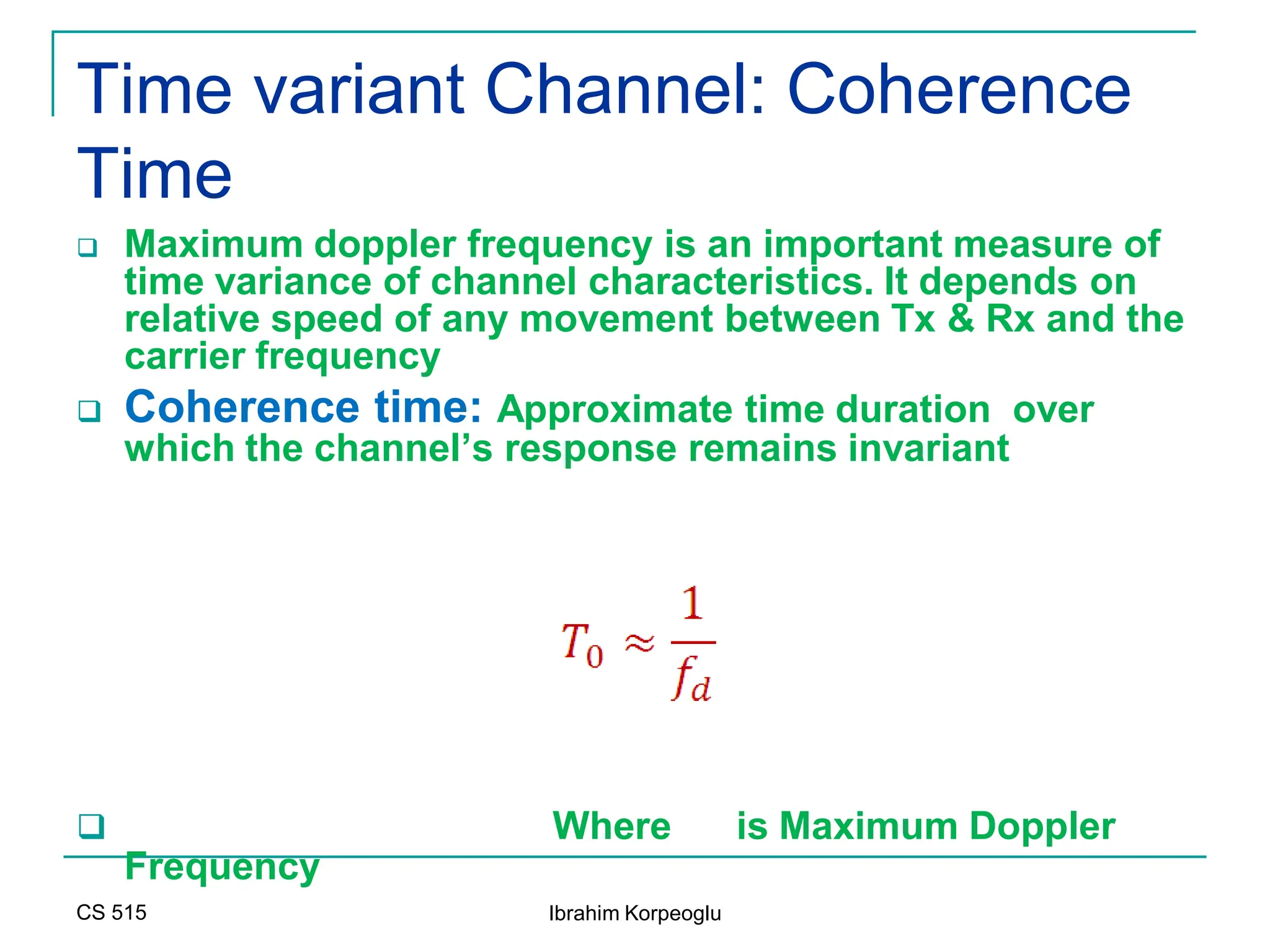
there occasionally even though f0 > W.
Similarly, frequency selective fading channel may also show flat
fading sometimes.
CS 515 Ibrahim Korpeoglu
Bit Rate Limitations by Delay
Spread
CS 515 Ibrahim Korpeoglu
Coherence Bandwidth and delay
spread
 There is no exact relationship between Coherence
bandwidth and delay spread. For at least 0.9 correlation
for channel’s complex frequency transfer function,
Coherence bandwidth f0 is approximated by following
relation:
 For dense scatterer model which is useful for urban
surroundings, coherence bandwidth is defined as
assuming at least 0.5 correlation:
 Another popular approximation assuming at least 0.5
correlation:
Where is r.m.s. delay spread
CS 515 Ibrahim Korpeoglu
Effects of Flat & frequency
selective fading
 Flat fading
 Reduces SNR forcing various mitigation
techniques to handle that. Not such a bad thing.
 Frequency selecting fading
 ISI distortion (need equalizer in receiver)
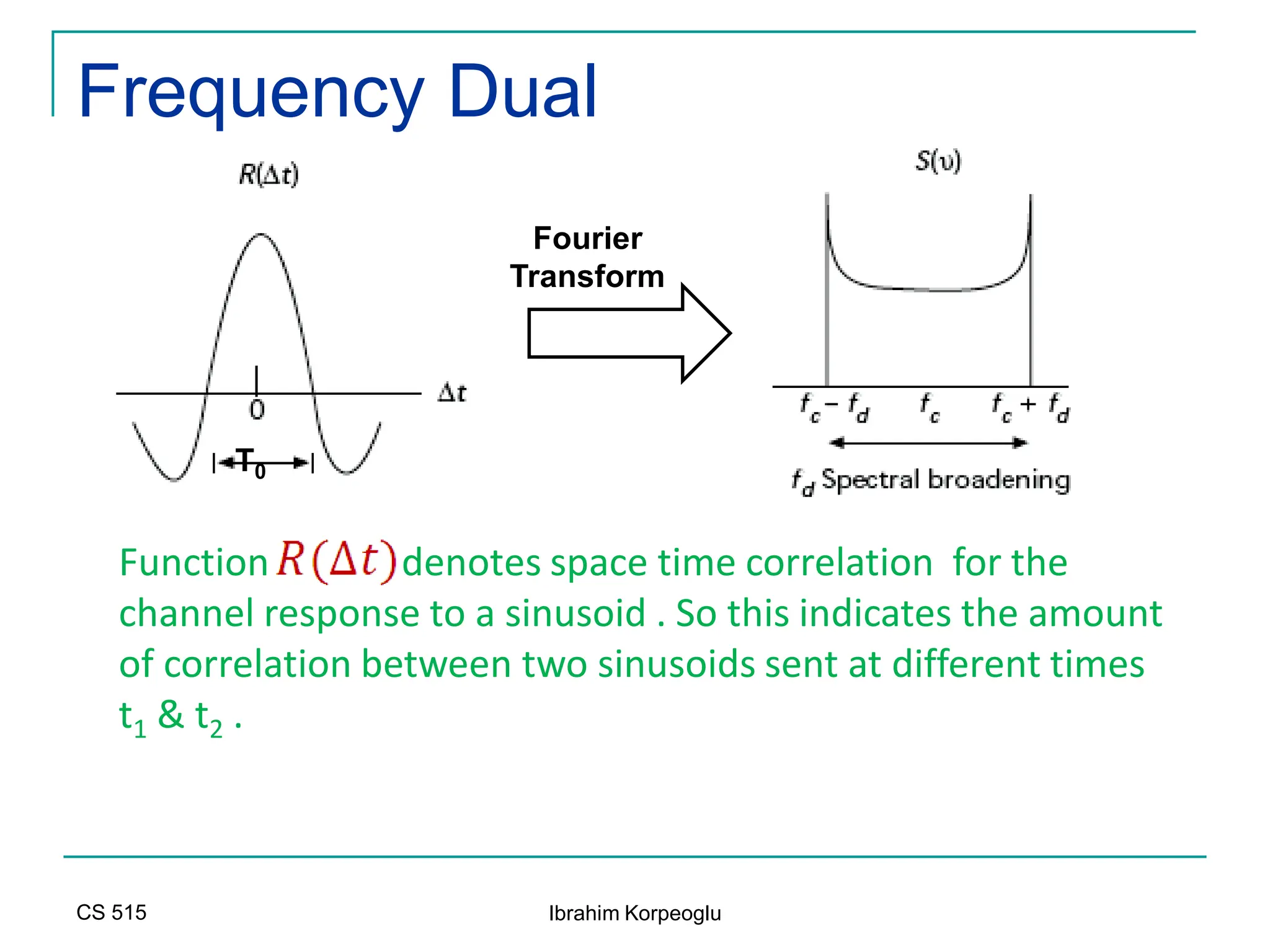
 Pulse mutilation
 Irreducible BER
CS 515 Ibrahim Korpeoglu
Summary of Time dispersion
Small scale fading
( based on multipath delay spread)
Flat Fading
BW of signal < BW of
channel
Or
Delay Spread <
Symbol period
Frequency selective
Fading
BW of signal > BW of
channel
Or
Delay Spread >
Symbol period
CS 515 Ibrahim Korpeoglu
Time variant behavior of the
channel
Relative movement between transmitter and receiver or objects
between those causes variation in channel’s characteristics over
time. This happens due to propagation path change over time.
Relative movement also creates frequency spreading due to Doppler
effect
time
h(t)
Excess delay spread
time
h(t)
Excess delay spread
Impulse
response
Impulse
response
CS 515 Ibrahim Korpeoglu
Time Variance
 Variance in channel conditions over time is an
important factor when designing a mobile
communication system.
 If fast variations happen, it can lead to severe
pulse distortion and loss of SNR subsequently
causing irreducible BER.
CS 515 Ibrahim Korpeoglu
Basic Doppler effect
t)
Propagation time is a function of time due to
mobile car.
c is the light velocity and vm is the car speed
CS 515 Ibrahim Korpeoglu
Doppler spread in Multipath
vm
vm cos (θ1)
vm cos (θ2)
θ1
θ2
freq
|X(f)|
fc
fc + fd1fc +
fd2
fc + fd
|Y(f)|
freq
Due to multipaths, a single sinusoid by base station is perceived
as summation of 3 sinusioids fc+fd1, fc+fd2 and fc+fd , where fd is
maximum doppler frequency = fc*(vm/d). Due to different arrivals
of angle due to multipaths, perceived velocity is different for
multipaths.
After passing through
multipath channel
CS 515 Ibrahim Korpeoglu
Doppler Spectrum
This is called classical Doppler spectrum & shows how a single sinusoid ends up
having a broad spectrum due to multipath & relative motion between Tx
and Rx.
A popular model assumes that
distribution of angle of arrival is
distributed uniformly between 0 &
2π which leads to following spectrum
Imagine now multiple paths with
different angles of arrival
causing amagamalation of
various frequencies between fc
+fd & fc-fd.
CS 515 Ibrahim Korpeoglu
Time variant Channel: Coherence
Time
 Maximum doppler frequency is an important measure of
time variance of channel characteristics. It depends on
relative speed of any movement between Tx & Rx and the
carrier frequency
 Coherence time: Approximate time duration over
which the channel’s response remains invariant
 Where is Maximum Doppler
Frequency
CS 515 Ibrahim Korpeoglu
Frequency Dual
Fourier
Transform
T0
Function denotes space time correlation for the
channel response to a sinusoid . So this indicates the amount
of correlation between two sinusoids sent at different times
t1 & t2 .
CS 515 Ibrahim Korpeoglu
Waveform of Rayleigh
Fading Signal
CS 515 Ibrahim Korpeoglu
Time Variance : Fast Fading
Fast Fading :
Where Ts : Transmitted Symbol time
Or
Where W: Transmitted bandwidth
Above relationship means that channel changes drastically many
times while a symbol is propagating;
Only highly mobile systems (~500 Km/Hr) will have fd ~1 kHz so
systems having signalling rate of that order will be fast fading.
Impact of fast fading:
Severe distortion of baseband pulse leading to detection
problems
Loss in SNR
Synchronization problems (e.g. Failure of PLL)
CS 515 Ibrahim Korpeoglu
Time variance: Slow Fading
Slow Fading :
where Ts : Transmitted Symbol time
Or
where W: Transmitted bandwidth
Above relationship means that channel does not change
drastically during symbol duration
Most of the modern communication systems are slow fading
channels
Impact of fast fading:
Loss in SNR
CS 515 Ibrahim Korpeoglu
Summary of Overall Fading
CS 515 Ibrahim Korpeoglu
Summary of Multipath Fading
characterization
UNIT V
Multiple Antenna Techniques
Antenna Configurations
 Single-Input-Single-Output (SISO) antenna system
 Theoretically, the 1Gbps barrier can be achieved using this
configuration if you are allowed to use much power and as
much BW as you so please!
 Extensive research has been done on SISO under power and
BW constraints. A combination a smart modulation, coding
and multiplexing techniques have yielded good results but far
from the 1Gbps barrier
channel
User data stream
User data stream
MIMO Antenna Configuration
User data stream
User data stream
.
.
1
2
MT
.
.
.
1
2
MR
.
.
.
.
.
channel
 Use multiple transmit and multiple receive antennas for a
single user
 Now this system promises enormous data rates!
Data Units
Will use the following terms loosely and
interchangeably,
 Bits (lowest level): +1 and -1
 Symbols (intermediate): A group of bits
 Packets (highest level): Lots and lots of
symbols
Shannon’s Capacity (C)
 Given a unit of BW (Hz), the max error-free transmission rate is
C = log2(1+SNR) bits/s/Hz
 Define
R: data rate (bits/symbol)
RS: symbol rate (symbols/second)
w: allotted BW (Hz)
 Spectral Efficiency is defined as the number of bits transmitted per
second per Hz
R x RS bits/s/Hz
W
As a result of filtering/signal reconstruction requirements, RS ≤ W.
Hence Spectral Efficiency = R if RS = W
 If I transmit data at a rate of R ≤ C, I can achieve an arbitrarily low Pe
Spectral Efficiency
 Spectral efficiencies of some
widely used modulation
schemes
 The Whole point: Given an acceptable Pe , realistic power and BW
limits, MIMO Systems using smart modulation schemes provide
much higher spectral efficiencies than traditional SISO
Scheme b/s/Hz
BPSK 1
QPSK 2
16-QAM 4
64-QAM 6
MIMO System Model
y = Hs + n
User data stream
.
.
User data stream
.
.
.
.
Channel
Matrix H
s1
s2
sM
s
y1
y2
yM
y
Transmitted vector Received vector
.
.
h11
h12
Where H =
h11 h21 …….. hM1
h12 h22 …….. hM2
h1M h2M …….. hMM
. . …….. .
MT
MR
hij is a Complex Gaussian
random variable that models
fading gain between the ith
transmit and jth receive
antenna
Types of Channels
Fading Channels
 Fading refers to changes in signal amplitude and phase caused
by the channel as it makes its way to the receiver
 Define Tspread to be the time at which the last reflection arrives
and Tsym to be the symbol time period
Time-spread of signal
Frequency-selective Frequency-flat
Tsym
Tspread
time
freq
1/Tsym
Occurs for wideband signals (small Tsym)
TOUGH TO DEAL IT!
Tsym
Tspread
time
freq
1/Tsym
Occurs for narrowband signals (large Tsym)
EASIER! Fading gain is complex Gaussian
Multipaths NOT resolvable
Channel Matrix H
 In addition, assume slow fading
 MIMO Channel Response
 Taking into account slow fading, the MIMO channel impulse response is constructed as,
Time-spread
Channel Time-variance
 Because of flat fading, it becomes,
a and b are transmit and
receive array factor vectors
respectively. S is the
complex gain that is
dependant on direction and
delay. g(t) is the transmit
and receive pulse shaping
impulse response
 With suitable choices of array geometry and antenna element patterns,
H( ) = H which is an MR x MT matrix with complex Gaussian i. i. d random variables
 Accurate for NLOS rich-scattering environments, with sufficient antenna spacing at
transmitter and receiver with all elements identically polarized
Capacity of MIMO Channels
y = Hs + n
 Let the transmitted vector s be a random vector to be very general and n is normalized
noise. Let the total transmitted power available per symbol period be P. Then,
C = log 2 (IM + HQHH) b/s/Hz
where Q = E{ssH} and trace(Q) < P according to our power constraint
 Consider specific case when we have users transmitting at equal power over the channel
and the users are uncorrelated (no feedback available). Then,
CEP = log 2 [IM + (P/MT)HHH] b/s/Hz
Telatar showed that this is the optimal choice for blind transmission
 Foschini and Telatar both demonstrated that as MT and MR grow,
CEP = min (MT,MR) log 2 (P/MT) + constant b/s/Hz
Note: When feedback is available, the Waterfilling solution is yields maximum capacity but converges to equal power capacity at
high SNRs
Capacity (contd)
 The capacity expression presented was over one realization of the channel.
Capacity is a random variable and has to be averaged over infinite realizations
to obtain the true ergodic capacity. Outage capacity is another metric that is
used to capture this
 So MIMO promises enormous rates theoretically! Can we exploit this
practically?
MIMO Design Criterion
 MIMO Systems can provide two types of gain
Spatial Multiplexing Gain Diversity Gain
• Maximize transmission rate
(optimistic approach)
• Use rich scattering/fading to
your advantage
• Minimize Pe (conservative
approach)
• Go for Reliability / QoS etc
• Combat fading
 System designs are based on trying to achieve either goal or a
little of both
 If only I could have both! As expected, there is a tradeoff
Diversity
 Each pair of transmit-receive antennas provides a signal path
from transmitter to receiver. By sending the SAME information
through different paths, multiple independently-faded replicas
of the data symbol can be obtained at the receiver end. Hence,
more reliable reception is achieved
 A diversity gain d implies that in the high SNR region, my Pe
decays at a rate of 1/SNRd as opposed to 1/SNR for a SISO
system
 The maximal diversity gain dmax is the total number of
independent signal paths that exist between the transmitter and
receiver
 For an (MR,MT) system, the total number of signal paths is MRMT
1 ≤ d ≤ dmax= MRMT
 The higher my diversity gain, the lower my Pe
Spatial Multiplexing
y = Hs + n  y’ = Ds’ + n’ (through SVD on H)
where D is a diagonal matrix that contains the eigenvalues of HHH
 Viewing the MIMO received vector in a different but equivalent
way,
CEP = log 2 [IM + (P/MT)DDH] = log 2 [1 + (P/MT)‫ג‬i] b/s/Hz
 Equivalent form tells us that an (MT,MR) MIMO channel opens up
m = min (MT,MR) independent SISO channels between the
transmitter and the receiver
 So, intuitively, I can send a maximum of m different information
symbols over the channel at any given time


m
i 1
Practical System
Redundancy in time
Coding rate = rc Space- time redundancy over T
symbol periods
Spatial multiplexing gain = rs
1
2
MT
Channel
coding
Symbol
mapping
Space-
Time
Coding
.
.
R bits/symbol
rs : number of different
symbols N transmitted
in T symbol periods
rs = N/T
Spectral efficiency = (R*rc info bits/symbol)(rs)(Rs symbols/sec)
w
= Rrcrs bits/s/Hz assuming Rs = w
rs is the parameter that we are concerned about: 0 ≤ rs ≤ MT
** If rs = MT, we are in spatial multiplexing mode (max
transmission rate)
**If rs ≤ 1, we are in diversity mode
Non-redundant
portion of symbols
V-BLAST – Spatial Multiplexing
(Vertical Bell Labs Layered Space-Time Architecture)
 This is the only architecture that goes all out for maximum rate. Hope the
channel helps me out by ‘splitting’ my info streams!
.
.
s1
s2
sM
s
User data
stream .
.
User data
stream
.
.
y1
y2
yM
y
.
.
H
V-BLAST
Processing
 Split data into MT streams  maps to symbols  send
 Assume receiver knows H
 Uses old technique of ordered successive cancellation to
recover signals
 Sensitive to estimation errors in H
 rs = MT because in one symbol period, you are sending MT
different symbols
MT ≤ MR
V-BLAST
(Experimental Results)
 The prototype in an indoor environment was operated at a carrier frequency of
1.9 GHz, and a symbol rate of 24.3 ksymbols/sec, in a bandwidth of 30 kHz with
MT = 8 and MR = 12
 Results shown on Block-Error-Rate Vs average SNR (at one received antenna
element); Block = 100 symbols ; 20 symbols for training
• Each of the eight substreams utilized uncoded
16-QAM, i.e. 4 b/symb/trans
• Spec eff = (8 xmtr) ( 4 b/sym/xmtr )(24.3 ksym/s)
30 kHz
= 25. 9 bps/Hz
 In 30 kHz of bandwidth, I can push across 621Kbps of data!! Wireless
spectral efficiencies of this magnitude are unprecedented, and are
furthermore unattainable using traditional techniques
Alternate Receivers
 Can replace OSUC by other front-ends; MMSE, SUC,
ML for instance
OSUC
ML
D-BLAST – a little of both
(Diagonal Bell Labs Layered Space-Time Architecture)
 In D-BLAST, the input data stream is divided into sub streams which
are coded, each of which is transmitted on different antennas time
slots in a diagonal fashion
 For example, in a (2,2) system
• receiver first estimates x2
(1) and then
estimates x1
(1) by treating x2
(1) as
interference and nulling it out
• The estimates of x2
(1) and x1
(1) are fed to a
joint decoder to decode the first substream
• After decoding the first substream, the receiver cancels
the contribution of this substream from the received signals
and starts to decode the next substream, etc.
• Here, an overhead is required to start the detection process;
corresponding to the 0 symbol in the above example
• Receiver complexity high
MT ≤ MR
Alamouti’s Scheme - Diversity
 Transmission/reception scheme easy to implement
 Space diversity because of antenna transmission. Time diversity
because of transmission over 2 symbol periods
 Consider (2, MR) system
 Receiver uses combining and ML detection
 rs = 1
V-BLAST SUC
Alamouti
• If you are working with a (2,2)
system, stick with Alamouti!
• Widely used scheme: CDMA
2000, WCDMA and IEEE 802.16-
2004 OFDM-256
Comparisons
Scheme Spectral
Efficiency
Pe Implementation
Complexity
V-BLAST HIGH HIGH LOW
D-BLAST MODERATE MODERATE HIGH
ALAMOUTI LOW LOW LOW
Orthogonal Frequency
Division Multiplexing (OFDM)
 As the data rate increases in a multipath
environment, the interference goes from flat fading
to frequency selective (last reflected component
arrives after symbol period). This results in heavy
degradation
 Most popular solution to compensate for ISI:
equalizers
 As we move to higher data rates (i.e.> 1 Mbps),
equalizer complexity grows to level of complexity
where the channel changes before you can
compensate for it!
 Alternate solution: Multi-carrier Modulation (MCM)
where channel is broken up into subbands such that
the fading over each subchannel becomes flat thus
eliminating the problem of ISI
Multi-carrier Modulation
FDMA OFDM
OFDM Spectral Efficiency
Rs symbols/s
Rs/ 3 symbols/s
• The spectral efficiency of an OFDM-
(PSK/ASK) system is same as compared
to using the (PSK/ASK) system alone
• Spec eff = log 2 M bits/s/Hz
• However, you have successfully
converted an ugly channel into a channel
that you can use
• easy to implement
• Used in IEEE 802.11A, .11G,
HiperLAN, IEEE 802.16
MIMO-OFDM
 OFDM extends directly to MIMO channels with the IFFT/FFT and CP operations
being performed at each of the transmit and receive antennas. MIMO-OFDM
decouples the frequency-selective MIMO channel into a set of parallel MIMO
channels with the input–output relation for the ith (i = 0, 2,…,L-1) tone,
yi = Hisi + ni i = 0, 2,…, L-1
IEEE 802.11 MAC (DCF Mode)
 As a result of the CSMA/CA with RTS/CTS MAC protocol, two issues
arise
-the unfairness problem
-extreme throughput degradation (ETD)
Throughtput T23 > Throughtput T01
Unfairness
Both throughtput T23 and throughtput T01
are equally affected
ETD
Capacity of Fading Channels with channel side
information
Obtain the Shannon capacity of a single user fading channel with an average
power constraint under different channel side information conditions:
 Fading channel with channel side information at the transmitter and the
receiver.
 Fading channel with channel side information at the receiver alone.
System Model
 •Fading Channel
 •Block Encoder
 •Power Control
 •Possible Feedback Channel
System Model
 The system model in figure 1 is a discrete-time channel with Stationary ergodic time-varying gain=
 AWGN = n[i]
 Channel power gain = g[i] is independent of the channel input and has an expected value of unity.
 Average transmit signal power =S
 Noise density = №
 Received signal bandwidth =B
 The instantaneous received signal-to-noise ratio (SNR),
 S=(№B).
 The system model, which sends an input message w from the
transmitter to the receiver.
 The message is encoded into the codeword x, which is transmitted over the time-varying channel
as x[i] at time i.
 The channel gain g[i] changes over the transmission of the codeword.
 We assume perfect instantaneous channel estimation so that the channel power gain g[i] is known
to the receiver at time i.
 We also consider the case when g[i] is known to both the receiver and transmitter at time i, as
might be obtained through an error-free delayless feedback path.
 This allows the transmitter to adapt x[i] to the channel gain at time i, and is a reasonable model
for a slowly varying channel with channel estimation and transmitter feedback.
Capacity Analysis
Side Information at the Transmitter and
Receiver Capacity
Capacity
•Channel capacity varies with the channel state (SNR).
•The capacity of the fading channel is the sum of the
capacities in each fading state weighted by the probability
of that state.
•The log function is concave (down), so Jensen’s inequality
tells us that the expected capacity of the fading channel is
less than or equal to the capacity of an AWGN channel
with the same average SNR.
CODING
CODING
•The optimal encoder adjusts its rate according to the
channel state: better rates for better channels.
•The rate adjustment is made in discrete steps by specifying
a codebook of a particular size for quantized SNR
intervals.
•Coding works in conjunction with optimal power control.
Optimal Adaptive Technique
 The fading-channel capacity with channel side information at the
receiver and transmitter is achieved when the transmitter adapt its
power, data rate, and coding scheme to the channel variation.
 The optimal power allocation is a “water-pouring”.
 They required a feedback path between the transmitter and receiver
and some complexity in the transmitter.
 It uses variable-rate and power transmission, and the complexity of its
decoding technique is comparable to the complexity of decoding a
sequence of additive white Gaussian noise( AWGN) channels in
parallel.
 The optimal adaptive technique has the highest capacity.
Nonadaptive Technique
 If g[i] is known at the decoder then by scaling, the fading
channel with power gain g[i] is equivalent to an AWGN
channel with noise power N0B/g[i].
 If the transmit power is fixed at S and g[i] is i.i.d. then the
input distribution at time i which achieves capacity is an
i.i.d. Gaussian distribution with average power S.
 The channel capacity with i.i.d. fading and receiver side
information only is given by:
Suboptimal adaptive techniques
1. Channel inversion.
2. Truncated channel inversion.
For the suboptimal techniques :
 They adapt the transmit power and keep the transmission
rate constant.
 They have very simple encoder and decoder designs , but
they exhibit a capacity penalty in sever fading.
 The suboptimal power control schemes selected for
comparison are not really comparable. They’re designed
for completely different purposes.
Channel Inversion (SubOptimal)
 We now consider a suboptimal transmitter adaptation scheme where
the transmitter uses the channel side information to maintain a
constant received power, i.e., it inverts the channel fading.
 The channel then appears to the encoder and decoder as a time-
invariant AWGN channel.
 Channel inversion is common in spread-spectrum systems with near–
far interference imbalances.
 It is also very simple to implement, since the encoder and decoder are
designed for an AWGN channel, independent of the fading statistics.
 It can exhibit a large capacity penalty in extreme fading environments.
Truncated channel inversion.
 A truncated inversion policy can only compensates for
fading above a certain cutoff fade depth of SNR:
Nonsmart-antennas system
Traditional omni-directional antennas, as shown in Figure A above act as transducers (that is,
they convert electromagnetic energy into electrical energy) and are not an effective way to combat
inter-cell and intra-cell interferences.
One cost-effective solution to this interference challenge is to split up the wireless cell into
multiple sectors using sectorized antennas. As Figure B illustrates, sectorized antennas transmit and
receive in a limited portion of the cell, typically one-third of the circular area, thereby reducing the
overall interference in the system.
Efficiency can increase still further by using either spatial diversity or by focusing a narrow
beam on a single user. The second approach is known as beam forming, and it requires an array of
antennas that together perform "smart" transmission and reception of signals, via the
implementation of advanced signal processing algorithms.
Combination of FPGAs, digital signal processing IP, and embedded processors that implement
beam-forming applications.
The methods used to implement such applications and the benefits of improved processing speed,
system flexibility, and reduced risk that this approach can deliver.
Smart antennas
Compared with traditional omni-directional and sectorized antennas, smart-antenna
systems can provide:
 Greater coverage area for each cell site
 Better rejection of co-channel interference
 Reduced multipath interference via increased directionality
 Reduced delay spread as fewer scatterers are allowed into the beam
 Increased frequency reuse with fewer base stations
 Higher range in rural areas
 Improved building penetration
 Location information for emergency situations
 Increased data rates and overall system capacity
 Reduction in dropped calls
 A linearly arranged and equally spaced array of antennas forms the basic structure of
a beam former.
 In order to form a beam, each user's information signal is multiplied by a set of
complex weights (where the number of weights equals the number of antennas) and
then transmitted from the array.
 The important point in this transmission is that the signals emitted from different
antennas in the array differ in phase (which is determined by the distance between
antenna elements) as well as amplitude (determined by the weight associated with
that antenna).
 Changing the direction of the beam, therefore, involves changing the weight set as
the spacing between the antenna elements is fixed.
 The rest of this Presentation describes two such schemes known as switched and
adaptive beam forming.
How is it done?
 If the complex weights used are selected from a
library of weights that form beams in specific,
predetermined directions, the process is called
switched beam forming.
 In this process, a hand-off between beams is
required as users move tangentially to the antenna
array.
 If the weights are computed and adaptively
updated in real time, the process is known as
adaptive beam forming.
 The adaptive process permits narrower beams
and reduced output in other directions,
significantly improving the signal-to-
interference-plus-noise ratio (SINR).
 With this technology, each user's signal is
transmitted and received by the base station only
in the direction of that particular user. This
drastically reduces the overall interference in the
system.
 A smart-antenna system, as shown in Figure,
includes an array of antennas that together direct
different transmission/reception beams toward
each cellular user in the system.
Switched and adaptive beam
Implementing adaptive beam
Adaptive beam forming can be combined with the well
known Rake receiver architectures that are widely used in
CDMA-based 3G systems, to provide processing gains in
both the temporal and spatial domains.
This section describes the implementation of a Rake
beam-former structure, also known as a two-dimensional
Rake, which performs joint space-time processing. As
illustrated in Figure 3, the signal from each receiving
antenna is first down-converted to baseband, processed by
the matched filter-multipath estimator, and accordingly
assigned to different Rake fingers.
The beam-forming unit on each Rake finger then calculates the corresponding beam-former
weights and channel estimate using the pilot symbols that have been transmitted through the
dedicated physical control channel (DPCCH).
The QR-decomposition-(QRD)-based recursive least squares (RLS) algorithm is usually used as
the weight-update algorithm for its fast convergence and good numerical properties.
The updated beam-former weights are then used for multiplication with the data that has been
transmitted through the dedicated physical data channel (DPDCH).
 Maximal ratio combining (MRC) of the signals from all fingers is then performed to yield the
final soft estimate of the DPDCH data.
Implementing adaptive beam
Applying complex weights to the signals from different antennas involves
complex multiplications that map well onto the embedded DSP blocks available
for many FPGAs. The example in Figure 4 shows DSP blocks with a number of
multipliers, followed by adder/subtractor/accumulators, with registers for
pipelining. Such a structure lends itself to complex multiplication and routing
required in beam-forming designs.
Adaptive algorithms
Adaptive signal processing algorithms such as least mean squares (LMS),
normalized LMS (NLMS), and recursive least squares (RLS) have historically been
used in a number of wireless applications such as equalization, beam forming and
adaptive filtering. These all involve solving for an over-specified set of equations, as
shown below, where m > N:
Among the different algorithms, the recursive least squares algorithm is generally
preferred for its fast convergence. The least squares approach attempts to find the set
of coefficients that minimizes the sum of squares of the errors, in other words:
Xc = y + e ..(1)
Representing the above set of equations in the matrix form, we have:
where X is a matrix (mxN, with m>N) of noisy observations, y is a known
training sequence, and c is the coefficient vector to be computed such that the
error vector e is minimized
Direct computation of the coefficient vector c involves matrix inversion, which is generally
undesirable for hardware implementation due to numerical instability issues.
Matrix decomposition based on least squares schemes, such as Cholesky, LU, SVD, and QR-
decompositions, avoid explicit matrix inversions and are hence more robust and well suited for
hardware implementation.
Such schemes are being increasingly considered for high-sample-rate applications such as
digital predistortion, beam forming, and MIMO signal processing. FPGAs are the preferred
hardware for such applications because of their ability to deliver enormous signal-processing
bandwidth.
FPGAs provide the right implementation platform for such computationally demanding
applications with their inherent parallel-processing benefits (as opposed to serial processing in
DSPs) along with the presence of embedded multipliers that provide throughputs that are an
order of magnitude greater than the current generation of DSPs.
The presence of embedded soft processor cores within FPGAs gives designers the flexibility
and portability of high-level software design while maintaining the performance benefits of
parallel hardware operations in FPGAs.
Adaptive algorithms
Xc = y + e …(1)
QRD-RLS algorithm
The least squares algorithm attempts to solve for the coefficient vector c from X
and y. To realize this, the QR-decomposition algorithm is first used to transform
the matrix X into an upper triangular matrix R (N x N matrix) and the vector y into
another vector u such that Rc=u. The coefficients vector c is then computed
using a procedure called back substitution, which involves solving these
equations:
Xc = y + e …(1)
The QR-decomposition of the input matrix X can be
performed, as illustrated in Figure 6, using the well-
known systolic array architecture.
The rows of matrix X are fed as inputs to the array
from the top along with the corresponding element of
the vector y. The R and u values held in each of the
cells once all the inputs have been passed through the
matrix are the outputs from QR-decomposition. These
values are subsequently used to derive the coefficients
using back substitution technique.
QRD-RLS algorithm
Each of the cells in the array can be implemented as a coordinate rotation digital computer
(CORDIC) block. CORDIC describes a method of performing a number of functions, including
trigonometric, hyperbolic, and logarithmic functions.2 The algorithm is iterative and uses only add,
subtract, and shift operations, making it attractive for hardware implementations.
The number of iterations depends on the input and output precision, with more iterations being
needed for more bits.
For complex inputs, only one CORDIC block is required per cell. Many applications involve
complex inputs and outputs to the algorithm, for which three CORDIC blocks are required per cell. In
such cases, a single CORDIC block can be efficiently timeshared to perform the complex operations
Weights and measures
The beam-former weights vector c is related to the R and u outputs of the
triangular array as Rc=u. R being an upper triangular matrix, c can be solved
using a procedure called back substitution.
As outlined in Haykin and Zhong Mingqian et al., the back-substitution procedure
operates on the outputs of the QR-decomposition and involves mostly multiply and
divide operations that can be efficiently executed in FPGAs with embedded soft
processors.
Some FPGA-resident processors can be configured with a 16x16 -> 32-bit
integer hardware multipliers.
The software can then complete the multiply operation in a single clock cycle.
Since hardware dividers generally are not available, the divide operation can be
implemented as custom logic block that may or may not become part of the
FPGA-resident microprocessor. Between the multiply and divide accelerators,
back-substitution becomes easy and efficient.
THANK YOU

wireless communication important topics

  • 1.
    1 Mobile Radio Propagation Large-scalePath loss Wireless Communication
  • 2.
    Introduction  The mobileradio channel places fundamental limitations on the performance of a wireless communication system  The wireless transmission path may be  Line of Sight (LOS)  Non line of Sight (NLOS)  Radio channels are random and time varying  Modeling radio channels have been one of the difficult parts of mobile radio design and is done in statistical manner  When electrons move, they create EM waves that can propagate through space.  By using antennas we can transmit and receive these EM wave  Microwave ,Infrared visible light and radio waves can be used. 2
  • 3.
    Properties of RadioWaves  Are easy to generate  Can travel long distances  Can penetrate buildings  May be used for both indoor and outdoor coverage  Are omni-directional-can travel in all directions  Can be narrowly focused at high frequencies(>100MHz) using parabolic antenna 3
  • 4.
    Properties of RadioWaves  Frequency dependence  Behave more like light at high frequencies  Difficulty in passing obstacle  Follow direct paths  Absorbed by rain  Behave more like radio at lower frequencies  Can pass obstacles  Power falls off sharply with distance from source  Subject to interference from other radio waves 4
  • 5.
    Propagation Models  Thestatistical modeling is usually done based on data measurements made specifically for the intended communication system the intended spectrum  They are tools used for: Predicting the average signal strength at a given distance from the transmitter Estimating the variability of the signal strength in close spatial proximity to a particular locations 5
  • 6.
    Propagation Models  LargeScale Propagation Model:  Predict the mean signal strength for an arbitrary transmitter-receiver(T-R) separation  Estimate radio coverage of a transmitter  Characterize signal strength over large T-R separation distances(several 100’s to 1000’s meters) 6
  • 7.
    Propagation Models  SmallScale or Fading Models:  Characterize rapid fluctuations of received signal strength over  Very short travel distances( a few wavelengths)  Short time durations(on the order of seconds) 7
  • 8.
  • 9.
    Free Space PropagationModel  For clear LOS between T-R  Ex: satellite & microwave communications  Assumes that received power decays as a function of T-R distance separation raised to some power.  Given by Friis free space eqn: ‘L’ is the system loss factor L >1 indicates loss due to transmission line attenuation, filter losses & antenna losses L = 1 indicates no loss in the system hardware  Gain of antenna is related to its effective aperture Ae by G=4 π Ae /λ2 9
  • 10.
    Free Space PropagationModel  Effective Aperture Ae is related to physical size of antenna. λ= c/f.  c is speed of light,  Pt and Pr must be in same units  Gt ad Gr are dimensionless  An isotropic radiator, an ideal radiator which radiates power with unit gain uniformly in all directions, and is often used as reference  Effective Isotropic Radiated Power (EIRP) is defined as EIRP= Pt Gt  Represents the max radiated power available from a transmitter in direction of maximum antenna gain, as compared to an isotropic radiator 10
  • 11.
    Free Space PropagationModel  In practice Effective Radiated Power (ERP) is used instead of (EIRP)  Effective Radiated Power (ERP) is radiated power compared to half wave dipole antennas  Since dipole antenna has gain of 1.64(2.15 dB) ERP=EIRP-2.15(dB)  the ERP will be 2.15dB smaller than the EIRP for same Transmission medium 11
  • 12.
    Free Space PropagationModel  Path Loss (PL) represents signal attenuation and is defined as difference between the effective transmitted power and received power Path loss PL(dB) = 10 log [Pt/Pr] = -10 log {GtGr λ^2/(4π)^2d^2}  Without antenna gains (with unit antenna gains) PL = - 10 log { λ^2/(4π)^2d^2}  Friis free space model is valid predictor for Pr for values of d which are in the far-field of transmitting antenna 12
  • 13.
    Free Space PropagationModel  The far field or Fraunhofer region that is beyond far field distance df given as :df=2D2/λ  D is the largest physical linear dimension of the transmitter antenna  Additionally, df>>D and df>>λ  The Friis free space equation does not hold for d=0  Large Scale Propagation models use a close-in distance, do, as received power reference point, chosen such that do>= df  Received power in free space at a distance greater then do Pr (d)=Pr(do )(do /d)2 d>do>df Pr with reference to 1 mW is represented as Pr(d)=10log(Pr(do)/0.001W)+20log (do /d) Electrostatic,inductive and radiated fields are launched, due to flow of current from anntena. Regions far away from transmitter electrostatic and inductive fields become negligible and only radiated field components are considered. 13
  • 14.
    Example  What willbe the far-field distance for a Base station antenna with  Largest dimension D=0.5m  Frequency of operation fc=900MHz,1800MHz  For 900MHz  λ =3*10^8/900*10^6)=0.33m  df= 2D^2/ λ =2(0.5)^2/0.33=1.5m 14
  • 15.
    Example  If atransmitter produces 50 watts of power, express the transmit power in units of (a) dBm, and (b) dBW. If 50 watts is applied to a unity gain antenna with a 900 MHz carrier frequency, find the received power in dBm at a free space distance of 100 m from the antenna, What is Pr (10 km)? Assume unity gain for the receiver antenna. 15
  • 16.
  • 17.
    Propagation Mechanisms  Threebasic propagation mechanism which impact propagation in mobile radio communication system are:  Reflection  Diffraction  Scattering 17
  • 18.
    Propagation Mechanisms  Reflectionoccurs when a propagating electromagnetic wave impinges on an object which has very large dimensions as compared to wavelength e.g. surface of earth , buildings, walls  Diffraction occurs when the radio path between the transmitter and receiver is obstructed by a surface that has sharp irregularities(edges)  Explains how radio signals can travel urban and rural environments without a line of sight path  Scattering occurs when medium has objects that are smaller or comparable to the wavelength (small objects, irregularities on channel, foliage, street signs etc) 18
  • 19.
    Reflection  Occurs whena radio wave propagating in one medium impinges upon another medium having different electrical properties  If radio wave is incident on a perfect dielectric  Part of energy is reflected back  Part of energy is transmitted  In addition to the change of direction, the interaction between the wave and boundary causes the energy to be split between reflected and transmitted waves  The amplitudes of the reflected and transmitted waves are given relative to the incident wave amplitude by Fresnel reflection coefficients 19
  • 20.
    Vertical and Horizontalpolarization 20
  • 21.
  • 22.
    Reflection  Γ(ǁ)= /= (Paralell E-field polarization)  Γ(┴)= = (Perpendicular E-field polarization)  These expressions express ratio of reflected electric fields to the incident electric field and depend on impedance of media and on angles  η is the intrinsic impedance given by  μ=permeability,ε=permittivity 22
  • 23.
    Reflection-Perfect Conductor If incidenton a perfect conductor the entire EM energy is reflected back Here we have θr= θi Ei= Er (E-field in plane of incidence) Ei= -Er (E field normal to plane of incidence) Γ(parallel)= 1 Γ(perpendicular)= -1 23
  • 24.
    Reflection - BrewsterAngle It is the angle at which no reflection occur in the medium of origin. It occurs when the incident angle is such that the reflection coefficient Γ(parallel) is equal to zero. It is given in terms of as given below When first medium is a free space and second medium has an relative permittivity of Brewster angle only occur for parallel polarization 24
  • 25.
    Ground Reflection(Two Ray)Model In mobile radio channel, single direct path between base station and mobile and is seldom only physical means for propagation Free space model as a stand alone is inaccurate Two ray ground reflection model is useful  Based on geometric optics  Considers both direct and ground reflected path Reasonably accurate for predicting large scale signal strength over several kms that use tall tower height Assumption: The height of Transmitter >50 meters 25
  • 26.
  • 27.
  • 28.
  • 29.
  • 30.
    Phase difference 30 = 0 0 00 2 ( ) 2 sin 2 2 0.3 rad 2 2 ( ) 2 V/m TOT r t r t TOT E d E t d h h d E d h h k E t d d d                   
  • 31.
    Diffraction  Diffraction isthe bending of wave fronts around obstacles.  Diffraction allows radio signals to propagate behind obstructions and is thus one of the factors why we receive signals at locations where there is no line-of-sight from base stations  Although the received field strength decreases rapidly as a receiver moves deeper into an obstructed (shadowed) region, the diffraction field still exists and often has sufficient signal strength to produce a useful signal. 31
  • 32.
  • 33.
    Knife-edge Diffraction Model Estimating the signal attenuation caused by diffraction of radio waves over hills and buildings is essential in predicting the field strength in a given service area.  As a starting point, the limiting case of propagation over a knife edge gives good in sight into the order of magnitude diffraction loss.  When shadowing is caused by a single object such as a building, the attenuation caused by diffraction can be estimated by treating the obstruction as a diffracting knife edge 33
  • 34.
    Knife-edge Diffraction Model 34 Considera receiver at point R located in the shadowed region. The field strength at point R is a vector sum of the fields due to all of the secondary Huygens sources in the plane above the knife edge.
  • 35.
    Knife-edge Diffraction Model Thedifference between the direct path and diffracted path, call excess path length The corresponding phase difference Fresnel-Kirchoff diffraction parameter is used to normalize the phased term and given as  where 35 Which gives
  • 36.
  • 37.
    Fresnel zones  Fresnelzones represent successive regions where secondary waves have a path length from the TX to the RX which are nλ/2 greater in path length than of the LOS path. The plane below illustrates successive Fresnel zones. 37
  • 38.
  • 39.
    Diffraction gain  Thediffraction gain due to the presence of a knife edge, as compared to the free space E-field  The electric field strength, Ed, of a knife edge diffracted wave is given by  Eo : is the free space field strength in the absence of both the ground and the knife edge.  F(v): is the complex fresnel integral.  v: is the Fresnel-Kirchoff diffraction parameter 39
  • 40.
    Graphical Calculation ofdiffraction attenuation 40
  • 41.
    Numerical solution  Anapproximate numerical solution for equation  Can be found using set of equations given below for different values of v 41 [0,1] 20 log(0.5 e- 0.95v) [-1,0] 20 log(0.5-0.62v) > 2.4 20 log(0.225/v) [1, 2.4] 20 log(0.4-(0.1184-(0.38-0.1v)2)1/2)  -1 0 v Gd(dB)
  • 42.
  • 43.
  • 44.
  • 45.
  • 46.
  • 47.
    Multiple Knife EdgeDiffraction 47
  • 48.
    Scattering  Scattering occurswhen the medium through which the wave travels consists of objects with dimensions that are small compared to the wavelength, and where the number of obstacles per unit volume is large.  Scattered waves are produced by  rough surfaces,  small objects,  or by other irregularities in the channel.  Scattering is caused by trees, lamp posts, towers, etc. 48
  • 49.
    Scattering  Received signalstrength is often stronger than that predicted by reflection/diffraction models alone  The EM wave incident upon a rough or complex surface is scattered in many directions and provides more energy at a receiver  energy that would have been absorbed is instead reflected to the Rx.  flat surface → EM reflection (one direction)  rough surface → EM scattering (many directions) 49
  • 50.
    Scattering Rayleigh criterion: usedfor testing surface roughness A surface is considered smooth if its min to max protuberance (bumps) h is less than critical height hc hc = λ/8 sinΘi Scattering path loss factor ρs is given by ρs =exp[-8[(π*σh *sinΘi)/ λ] 2] Where h is surface height and σh is standard deviation of surface height about mean surface height. For rough surface, the flat surface reflection coefficient is multiplied by scattering loss factor ρs to account for diminished electric field Reflected E-fields for h> hc for rough surface can be calculated as Гrough= ρsГ 50
  • 51.
  • 52.
    Outdoor propagation Environment Basedon the coverage area, the Outdoor propagation environment may be divided into three categories 1. Propagation in Macro cells 2. Propagation in Micro cells 3. Propagation in street Micro cells 52
  • 53.
  • 54.
    Outdoor propagation Models Outdoorradio transmission takes place over an irregular terrain. The terrain profile must be taken into consideration for estimating the path loss e.g. trees buildings and hills must be taken into consideration Some common models used are Longley Rice Model Okumura Model Hatta model 54
  • 55.
    Longley Rice Model Longley Rice Model is applicable to point to point communication.  It covers 40MHz to 300 GHz  It can be used in wide range of terrain  Path geometry of terrain and the refractivity of troposphere is used for transmission path loss calculations  Geometrical optics is also used along with the two ray model for the calculation of signal strength.  Two modes  Point to point mode prediction  Area mode prediction 55
  • 56.
    Longley Rice Model Longley Rice Model is normally available as a computer program which takes inputs as Transmission frequency Path length Polarization Antenna heights Surface reflectivity Ground conductivity and dialectic constants Climate factors A problem with Longley rice is that It doesn't take into account the buildings and multipath. 56
  • 57.
    Okumura Model  In1968 Okumura did a lot of measurements and produce a new model.  The new model was used for signal prediction in Urban areas.  Okumura introduced a graphical method to predict the median attenuation relative to free-space for a quasi- smooth terrain  The model consists of a set of curves developed from measurements and is valid for a particular set of system parameters in terms of carrier frequency, antenna height, etc. 57
  • 58.
    Okumura Model  Firstof all the model determined the free space path loss of link.  After the free-space path loss has been computed, the median attenuation, as given by Okumura’s curves has to be taken to account  The model was designed for use in the frequency range 200 up to 1920 MHz and mostly in an urban propagation environment.  Okumura’s model assumes that the path loss between the TX and RX in the terrestrial propagation environment can be expressed as: 58
  • 59.
    59 59  Estimating pathloss using Okumura Model 1. Determine free space loss and Amu(f ,d ), between points of interest 2. Add Amu(f ,d) and correction factors to account for terrain L50 = 50% value of propagation path loss (median) LF = free space propagation loss Amu(f,d) = median attenuation relative to free space G(hte) = base station antenna height gain factor G(hre) = mobile antenna height gain factor GAREA = gain due to environment Okumura Model
  • 60.
    Okumura Model Amu(f,d) &GAREA have been plotted for wide range of frequencies  Antenna gain varies at rate of 20dB or 10dB per decade model corrected for h = terrain undulation height, isolated ridge height average terrain slope and mixed land/sea parameter 60 G(hte) = 200 log 20 te h 10m < hte < 1000m G(hre) = 3 log 10 re h hre  3m G(hre) = 3 log 20 re h 3m < hre <10m
  • 61.
    61 61 70 60 50 40 30 20 10 A mu (f,d) (dB) 100 200 300500 700 1000 2000 3000 f (MHz) 100 80 70 60 50 40 30 20 10 5 2 1 d(km) Urban Area ht = 200m hr = 3m Median Attenuation Relative to Free Space = Amu(f,d) (dB)
  • 62.
  • 63.
  • 64.
    Hata Model  Mostwidely used model in Radio frequency.  Predicting the behavior of cellular communication in built up areas.  Applicable to the transmission inside cities.  Suited for point to point and broadcast transmission.  150 MHz to 1.5 GHz, Transmission height up to 200m and link distance less than 20 Km. 64
  • 65.
    Hata Model Hata transformedOkumura’s graphical model into an analytical framework. The Hata model for urban areas is given by the empirical formula: L50, urban = 69.55 dB +26.16 log(fc)- 3.82 log(ht) -a(hr) + (44.9 − 6.55 log(ht)) log(d) Where L50, urban is the median path loss in dB. The formula is valid for 150 MHz<=fc<=1.5GHz, 1 m<=hr<=10m, 30m<=ht<=200m, 1km<d<20km 65
  • 66.
    Hata Model The correctionfactor a(hr) for mobile antenna height hr for a small or medium-sized city is given by: a(hr) = (1.1 logfc − 0.7)hr − (1.56 log(fc) − 0.8) dB For a large city it is given by a(hr) = 8.29[log(1.54hr)]2 − 1.10 dB for fc <=300 MHz 3.20[log (11.75hr)]2 − 4.97 dB for fc >= 300 MHz To obtain path loss for suburban area the standard Hata model is modified as L50 =L50(urban)-2[log(fc/28)]2-5.4 For rural areas L50 =L50(urban)-4.78log(fc)2-18.33logfc -40.98 66
  • 67.
    Indoor Models Indoor Channelsare different from traditional channels in two ways 1.The distances covered are much smaller 2.The variability of environment is much greater for a much small range of Tx and Rx separation. Propagation inside a building is influenced by: - Layout of the building - Construction materials - Building Type: office , Home or factory 67
  • 68.
    Indoor Models Indoor modelsare dominated by the same mechanism as out door models: - Reflection, Diffraction and scattering Conditions are much more variable - Doors/Windows open or not - Antenna mounting : desk ceiling etc - The levels of floor Indoor models are classifies as - Line of sight (LOS) - Obstructed (OBS) with varying degree of clutter 68
  • 69.
    Indoor Models Portable receiverusually experience - Rayleigh fading for OBS propagation paths - Ricean fading for LOS propagation path Indoors models are effected by type of building e.g. Residential buildings, offices, stores and sports area etc. Multipath delay spread - Building with small amount of metal and hard partition have small delay spread 30 to 60ns - Building with large amount of metal and open isles have delay spread up to 300ns 69
  • 70.
    Partition losses (samefloor) Two types of partitions 1. hard partitions: Walls of room 2. Soft partitions : Moveable partitions that donot span to ceiling Partitions vary widely in their Physical and electrical properties. Path loss depend upon the types of partitions 70
  • 71.
  • 72.
    72 Partitions losses (betweenfloors)  Partition losses between the two floors depend on 1. External dimension and material used for buildings 2. Types of construction used to create floors 3. External surroundings 4. No of windows used 5. Tinting on the windows  Floor Attenuation Factor (FAF) increases as we increase the no of floors 72
  • 73.
  • 74.
    Log distance pathloss model Path loss can be given as where n is path loss exponent and σ is standard deviation n and σ depend on the building type. Smaller value of σ indicates better accuracy of path loss model 74
  • 75.
    Log distance pathloss model 75
  • 76.
  • 77.
    Attenuation factor model Obtained by measurement in multiple floors building 77
  • 78.
  • 79.
    Signal penetration intobuilding Effect of frequency - Penetration loss decreases with increasing frequency Effect of Height Penetration loss decreases with the height of building up to some certain height. - At lower heights the Urban clutter induces greater attenuation - Up to some height attenuation decreases but then again increase after a few floors - Increase in attenuation at higher floors is due to the Shadowing effects of adjacent buildings 79
  • 80.
    CS 515 IbrahimKorpeoglu Large, medium and small scale fading  Large Scale Fading: Average signal power attenuation/path loss due to motion over large areas.  Medium scale fading: Local variation in the average signal power around mean average power due to shadowing by local obstructions  Small scale fading: large variation in the signal power due to small changes in the distance between transmitter and receiver (Also called Rayleigh fading when no LOS available). It is called Rayleigh fading due to the fact that various multipaths at the receiver with random amplitude & delay add up together to render rayleigh PDF for total signal.
  • 81.
    CS 515 IbrahimKorpeoglu Cause of Multipath Fading  Fading : Fluctuation in the received signal power due to  Variations in the received singal amplitude (Different objects present on radio signal path produce attenuation of it’s power as they can scatter or absorb part of the signal power, thus producing a variation of the amplitude  Variations in the signal phase  Variations in the received signal angle of arrival (different paths travelling different distances may have different phases & angle of arrival)
  • 82.
    CS 515 IbrahimKorpeoglu Causes of Multipath fading Cont..  Reflections and diffraction from object create many different EM waves which are received in mobile antenna. These waves usually come from many different directions and delay varies.  In the receiver, the waves are added either constructively or destructively and create a Rx signal which may very rapidly in phase and amplitude depending on the local objects and how mobile moves
  • 83.
    CS 515 IbrahimKorpeoglu Practical examples of small scale multipath fading  Common examples of multipath fading are  temporary failure of communication due to a severe drop in the channel signal to noise ratio (You may have also experienced this. And you moved a steps away & noted that reception is better. It is due to small scale fading effects. )  FM radio transmission experiencing intermittent loss of broadcast when away from station.
  • 84.
    CS 515 IbrahimKorpeoglu Multipath Fading- Most difficult  Fades of 40 dB or more below local average level are frequent, with successive nulls occurring every half wavelength or so  Referred to as Rayleigh Fading
  • 85.
    CS 515 IbrahimKorpeoglu Rayleigh Fading Mechanism  Rayleigh fading manifests in two mechanism  Time spreading due to multipath (time dispersion)  Time variant behaviour of the channel due to the motion and subsequent changes in propagation paths  Rayleigh PDF:
  • 86.
    CS 515 IbrahimKorpeoglu Rayleigh Fading  The Rayleigh pdf is
  • 87.
    CS 515 IbrahimKorpeoglu With Rayleigh Fading
  • 88.
    CS 515 IbrahimKorpeoglu Rayleigh Fading waveform envelope
  • 89.
    CS 515 IbrahimKorpeoglu Time Dispersion phenomenon time h(t) Freq Freq transform Different frequencies suffer different attenuation
  • 90.
    CS 515 IbrahimKorpeoglu Delay Spread –Time Domain interpretation
  • 91.
    CS 515 IbrahimKorpeoglu Delay Spread  Multiple impulses of varying power correspond to various multipaths. This time dispersion is also referred to as multipath delay spread.  Delay between first significant path & last significant paths is loosely termed as channel excess delay spread.  Two totally different channels can have same excess delay spread.  A better measure of delay spread is rms delay spread time h(t) Excess delay spread time h(t) Excess delay spread is the second moment L is the number of paths & is the amplitude of the path i arriving at time
  • 92.
    CS 515 IbrahimKorpeoglu Delay Spread- Freq. Domain Interpretation
  • 93.
    CS 515 IbrahimKorpeoglu Time spreading : Coherence Bandwidth Freq Channel frequency response W Freq W Channel frequency response f0
  • 94.
    CS 515 IbrahimKorpeoglu More on flat fading • f0 Freq Channel frequency response W Condition f0 > W does not guarantee flat fading. As shown above, frequency nulls (frequency selective fading) may be there occasionally even though f0 > W. Similarly, frequency selective fading channel may also show flat fading sometimes.
  • 95.
    CS 515 IbrahimKorpeoglu Bit Rate Limitations by Delay Spread
  • 96.
    CS 515 IbrahimKorpeoglu Coherence Bandwidth and delay spread  There is no exact relationship between Coherence bandwidth and delay spread. For at least 0.9 correlation for channel’s complex frequency transfer function, Coherence bandwidth f0 is approximated by following relation:  For dense scatterer model which is useful for urban surroundings, coherence bandwidth is defined as assuming at least 0.5 correlation:  Another popular approximation assuming at least 0.5 correlation: Where is r.m.s. delay spread
  • 97.
    CS 515 IbrahimKorpeoglu Effects of Flat & frequency selective fading  Flat fading  Reduces SNR forcing various mitigation techniques to handle that. Not such a bad thing.  Frequency selecting fading  ISI distortion (need equalizer in receiver)  Pulse mutilation  Irreducible BER
  • 98.
    CS 515 IbrahimKorpeoglu Summary of Time dispersion Small scale fading ( based on multipath delay spread) Flat Fading BW of signal < BW of channel Or Delay Spread < Symbol period Frequency selective Fading BW of signal > BW of channel Or Delay Spread > Symbol period
  • 99.
    CS 515 IbrahimKorpeoglu Time variant behavior of the channel Relative movement between transmitter and receiver or objects between those causes variation in channel’s characteristics over time. This happens due to propagation path change over time. Relative movement also creates frequency spreading due to Doppler effect time h(t) Excess delay spread time h(t) Excess delay spread Impulse response Impulse response
  • 100.
    CS 515 IbrahimKorpeoglu Time Variance  Variance in channel conditions over time is an important factor when designing a mobile communication system.  If fast variations happen, it can lead to severe pulse distortion and loss of SNR subsequently causing irreducible BER.
  • 101.
    CS 515 IbrahimKorpeoglu Basic Doppler effect t) Propagation time is a function of time due to mobile car. c is the light velocity and vm is the car speed
  • 102.
    CS 515 IbrahimKorpeoglu Doppler spread in Multipath vm vm cos (θ1) vm cos (θ2) θ1 θ2 freq |X(f)| fc fc + fd1fc + fd2 fc + fd |Y(f)| freq Due to multipaths, a single sinusoid by base station is perceived as summation of 3 sinusioids fc+fd1, fc+fd2 and fc+fd , where fd is maximum doppler frequency = fc*(vm/d). Due to different arrivals of angle due to multipaths, perceived velocity is different for multipaths. After passing through multipath channel
  • 103.
    CS 515 IbrahimKorpeoglu Doppler Spectrum This is called classical Doppler spectrum & shows how a single sinusoid ends up having a broad spectrum due to multipath & relative motion between Tx and Rx. A popular model assumes that distribution of angle of arrival is distributed uniformly between 0 & 2π which leads to following spectrum Imagine now multiple paths with different angles of arrival causing amagamalation of various frequencies between fc +fd & fc-fd.
  • 104.
    CS 515 IbrahimKorpeoglu Time variant Channel: Coherence Time  Maximum doppler frequency is an important measure of time variance of channel characteristics. It depends on relative speed of any movement between Tx & Rx and the carrier frequency  Coherence time: Approximate time duration over which the channel’s response remains invariant  Where is Maximum Doppler Frequency
  • 105.
    CS 515 IbrahimKorpeoglu Frequency Dual Fourier Transform T0 Function denotes space time correlation for the channel response to a sinusoid . So this indicates the amount of correlation between two sinusoids sent at different times t1 & t2 .
  • 106.
    CS 515 IbrahimKorpeoglu Waveform of Rayleigh Fading Signal
  • 107.
    CS 515 IbrahimKorpeoglu Time Variance : Fast Fading Fast Fading : Where Ts : Transmitted Symbol time Or Where W: Transmitted bandwidth Above relationship means that channel changes drastically many times while a symbol is propagating; Only highly mobile systems (~500 Km/Hr) will have fd ~1 kHz so systems having signalling rate of that order will be fast fading. Impact of fast fading: Severe distortion of baseband pulse leading to detection problems Loss in SNR Synchronization problems (e.g. Failure of PLL)
  • 108.
    CS 515 IbrahimKorpeoglu Time variance: Slow Fading Slow Fading : where Ts : Transmitted Symbol time Or where W: Transmitted bandwidth Above relationship means that channel does not change drastically during symbol duration Most of the modern communication systems are slow fading channels Impact of fast fading: Loss in SNR
  • 109.
    CS 515 IbrahimKorpeoglu Summary of Overall Fading
  • 110.
    CS 515 IbrahimKorpeoglu Summary of Multipath Fading characterization
  • 111.
    Click to addtext Multiple Access Techniques for Wireless Communication FDMA TDMA SDMA PDMA
  • 112.
    Introduction • many usersat same time • share a finite amount of radio spectrum • high performance • duplexing generally required • frequency domain • time domain
  • 113.
    Frequency division duplexing(FDD) • two bands of frequencies for every user • forward band • reverse band • duplexer needed • frequency seperation between forward band and reverse band is constant frequency seperation reverse channel forward channel f
  • 114.
    Time division duplexing(TDD) • uses time for forward and reverse link • multiple users share a single radio channel • forward time slot • reverse time slot • no duplexer is required time seperation t forward channel reverse channel
  • 115.
    Multiple Access Techniques •Frequency division multiple access (FDMA) • Time division multiple access (TDMA) • Code division multiple access (CDMA) • Space division multiple access (SDMA) • grouped as: • narrowband systems • wideband systems
  • 116.
    Narrowband systems • largenumber of narrowband channels • usually FDD • Narrowband FDMA • Narrowband TDMA • FDMA/FDD • FDMA/TDD • TDMA/FDD • TDMA/TDD
  • 117.
    Logical separation FDMA/FDD f t user1 user n forward channel reverse channel forward channel reverse channel ...
  • 118.
    Logical separation FDMA/TDD f t user1 user n forward channel reverse channel forward channel reverse channel ...
  • 119.
    Logical separation TDMA/FDD f t user1 user n forward channel reverse channel forward channel reverse channel ...
  • 120.
    Logical separation TDMA/TDD f t user1 user n forward channel reverse channel forward channel reverse channel ...
  • 121.
    Wideband systems • largenumber of transmitters on one channel • TDMA techniques • CDMA techniques • FDD or TDD multiplexing techniques • TDMA/FDD • TDMA/TDD • CDMA/FDD • CDMA/TDD
  • 122.
    Logical separation CDMA/FDD code f user1 user n forward channel reverse channel forward channel reverse channel ...
  • 123.
    Logical separation CDMA/TDD code t user1 user n forward channel reverse channel forward channel reverse channel ...
  • 124.
    Multiple Access Techniquesin use Multiple Access Technique Advanced Mobile Phone System (AMPS) FDMA/FDD Global System for Mobile (GSM) TDMA/FDD US Digital Cellular (USDC) TDMA/FDD Digital European Cordless Telephone (DECT) FDMA/TDD US Narrowband Spread Spectrum (IS-95) CDMA/FDD Cellular System
  • 125.
    Frequency division multipleaccess FDMA • one phone circuit per channel • idle time causes wasting of resources • simultaneously and continuously transmitting • usually implemented in narrowband systems • for example: in AMPS is a FDMA bandwidth of 30 kHz implemented
  • 126.
    FDMA compared toTDMA • fewer bits for synchronization • fewer bits for framing • higher cell site system costs • higher costs for duplexer used in base station and subscriber units • FDMA requires RF filtering to minimize adjacent channel interference
  • 127.
    Nonlinear Effects inFDMA • many channels - same antenna • for maximum power efficiency operate near saturation • near saturation power amplifiers are nonlinear • nonlinearities causes signal spreading • intermodulation frequencies
  • 128.
    Nonlinear Effects inFDMA • IM are undesired harmonics • interference with other channels in the FDMA system • decreases user C/I - decreases performance • interference outside the mobile radio band: adjacent-channel interference • RF filters needed - higher costs
  • 129.
    Number of channelsin a FDMA system • N … number of channels • Bt … total spectrum allocation • Bguard … guard band • Bc … channel bandwidth N= Bt - Bguard Bc
  • 130.
    Example: Advanced MobilePhone System • AMPS • FDMA/FDD • analog cellular system • 12.5 MHz per simplex band - Bt • Bguard = 10 kHz ; Bc = 30 kHz N= 12.5E6 - 2*(10E3) 30E3 = 416 channels
  • 131.
    Time Division MultipleAccess • time slots • one user per slot • buffer and burst method • noncontinuous transmission • digital data • digital modulation
  • 132.
    Slot 1 Slot2 Slot 3 … Slot N Repeating Frame Structure Preamble Information Message Trail Bits One TDMA Frame Trail Bits Sync. Bits Information Data Guard Bits The frame is cyclically repeated over time.
  • 133.
    Features of TDMA •a single carrier frequency for several users • transmission in bursts • low battery consumption • handoff process much simpler • FDD : switch instead of duplexer • very high transmission rate • high synchronization overhead • guard slots necessary
  • 134.
    Number of channelsin a TDMA system • N … number of channels • m … number of TDMA users per radio channel • Btot … total spectrum allocation • Bguard … Guard Band • Bc … channel bandwidth N= m*(Btot - 2*Bguard) Bc
  • 135.
    Example: Global Systemfor Mobile (GSM) • TDMA/FDD • forward link at Btot = 25 MHz • radio channels of Bc = 200 kHz • if m = 8 speech channels supported, and • if no guard band is assumed : N= 8*25E6 200E3 = 1000 simultaneous users
  • 136.
    Efficiency of TDMA •percentage of transmitted data that contain information • frame efficiency f • usually end user efficiency < f , • because of source and channel coding • How get f ?
  • 137.
    Slot 1 Slot2 Slot 3 … Slot N Repeating Frame Structure Preamble Information Message Trail Bits One TDMA Frame Trail Bits Sync. Bits Information Data Guard Bits The frame is cyclically repeated over time.
  • 138.
    Efficiency of TDMA •bOH … number of overhead bits • Nr … number of reference bursts per frame • br … reference bits per reference burst • Nt … number of traffic bursts per frame • bp … overhead bits per preamble in each slot • bg … equivalent bits in each guard time intervall bOH = Nr*br + Nt*bp + Nt*bg + Nr*bg
  • 139.
    Efficiency of TDMA bT= Tf * R • bT … total number of bits per frame • Tf … frame duration • R … channel bit rate
  • 140.
    Efficiency of TDMA f… frame efficiency • bOH … number of overhead bits per frame • bT … total number of bits per frame f = (1-bOH/bT)*100%
  • 141.
    Space Division MultipleAccess • Controls radiated energy for each user in space • using spot beam antennas • base station tracks user when moving • cover areas with same frequency: • TDMA or CDMA systems • cover areas with same frequency: • FDMA systems
  • 142.
    Space Division MultipleAccess • primitive applications are “Sectorized antennas” • in future adaptive antennas simultaneously steer energy in the direction of many users at once
  • 143.
    Reverse link problems •general problem • different propagation path from user to base • dynamic control of transmitting power from each user to the base station required • limits by battery consumption of subscriber units • possible solution is a filter for each user
  • 144.
    Solution by SDMAsystems • adaptive antennas promise to mitigate reverse link problems • limiting case of infinitesimal beamwidth • limiting case of infinitely fast track ability • thereby unique channel that is free from interference • all user communicate at same time using the same channel
  • 145.
    Disadvantage of SDMA •perfect adaptive antenna system: infinitely large antenna needed • compromise needed
  • 146.
    SDMA and PDMAin satellites • INTELSAT IVA • SDMA dual-beam receive antenna • simultaneously access from two different regions of the earth
  • 147.
    SDMA and PDMAin satellites • COMSTAR 1 • PDMA • separate antennas • simultaneously access from same region
  • 148.
    SDMA and PDMAin satellites • INTELSAT V • PDMA and SDMA • two hemispheric coverages by SDMA • two smaller beam zones by PDMA • orthogonal polarization
  • 149.
    Capacity of CellularSystems • channel capacity: maximum number of users in a fixed frequency band • radio capacity : value for spectrum efficiency • reverse channel interference • forward channel interference • How determine the radio capacity?
  • 150.
    Co-Channel Reuse RatioQ • Q … co-channel reuse ratio • D … distance between two co-channel cells • R … cell radius Q=D/R
  • 151.
    Forward channel interference •cluster size of 4 • D0 … distance serving station to user • DK … distance co-channel base station to user
  • 152.
    Carrier-to-interference ratio C/I •M closest co-channels cells cause first order interference C = I D0 -n0 M k=1 DK -nk • n0 … path loss exponent in the desired cell • nk … path loss exponent to the interfering base station
  • 153.
    Carrier-to-interference ratio C/I •Assumption: • just the 6 closest stations interfere • all these stations have the same distance D • all have similar path loss exponents to n0 C I = D0 -n 6*D -n
  • 154.
    Worst Case Performance •maximum interference at D0 = R • (C/I)min for acceptable signal quality • following equation must hold: 1/6 * (R/D) (C/I)min = > -n
  • 155.
    Co-Channel reuse ratioQ • D … distance of the 6 closest interfering base stations • R … cell radius • (C/I)min … minimum carrier-to-interference ratio • n … path loss exponent Q = D/R = (6*(C/I)min) 1/n
  • 156.
    Radio Capacity m •Bt … total allocated spectrum for the system • Bc … channel bandwidth • N … number of cells in a complete frequency reuse cluster m = Bt Bc * N radio channels/cell
  • 157.
    Radio Capacity m •N is related to the co-channel factor Q by: Q = (3*N) 1/2 m= Bt Bc * (Q²/3) = Bt Bc * 6 C I 3n/2 ( *( )min ) 2/n
  • 158.
    Radio Capacity mfor n = 4 • m … number of radio channels per cell • (C/I)min lower in digital systems compared to analog systems • lower (C/I)min imply more capacity • exact values in real world conditions measured m = Bt Bc * 2/3 * (C/I)min
  • 159.
    Compare different Systems •each digital wireless standard has different (C/I)min • to compare them an equivalent (C/I) needed • keep total spectrum allocation Bt and number of rario channels per cell m constant to get (C/I)eq :
  • 160.
    Compare different Systems •Bc … bandwidth of a particular system • (C/I)min … tolerable value for the same system • Bc’ … channel bandwidth for a different system • (C/I)eq … minimum C/I value for the different system C I = C I Bc Bc’ ( ) ( ) min )² eq * (
  • 161.
    C/I in digitalcellular systems • Rb … channel bit rate • Eb … energy per bit • Rc … rate of the channel code • Ec … energy per code symbol C Eb*Rb Ec*Rc I I I = =
  • 162.
    C/I in digitalcellular systems • combine last two equations: (C/I) (Ec*Rc)/I Bc’ (C/I)eq (Ec’*Rc’)/I’ Bc = = ( )² • The sign ‘ marks compared system parameters
  • 163.
    C/I in digitalcellular systems • Relationship between Rc and Bc is always linear (Rc/Rc’ = Bc/Bc’ ) • assume that level I is the same for two different systems ( I’ = I ) : Ec Bc’ Ec‘ Bc = ( )³
  • 164.
    Compare C/I betweenFDMA and TDMA • Assume that multichannel FDMA system occupies same spectrum as a TDMA system • FDMA : C = Eb * Rb ; I = I0 * Bc • TDMA : C’ = Eb * Rb’ ; I’ = I0 * Bc’ • Eb … Energy per bit • I0 … interference power per Hertz • Rb … channel bit rate • Bc … channel bandwidth
  • 165.
    Example • A FDMAsystem has 3 channels , each with a bandwidth of 10kHz and a transmission rate of 10 kbps. • A TDMA system has 3 time slots, a channel bandwidth of 30kHz and a transmission rate of 30 kbps. • What’s the received carrier-to-interference ratio for a user ?
  • 166.
    Example • In TDMAsystem C’/I’ be measured in 333.3 ms per second - one time slot C’ = Eb*Rb’ = 1/3*(Eb*10E4 bits) = 3*Rb*Eb=3*C I’ = I0*Bc’ = I0*30kHz = 3*I • In this example FDMA and TDMA have the same radio capacity (C/I leads to m)
  • 167.
    Example • Peak powerof TDMA is 10logk higher then in FDMA ( k … time slots) • in practice TDMA have a 3-6 times better capacity
  • 168.
    Capacity of SDMAsystems • one beam each user • base station tracks each user as it moves • adaptive antennas most powerful form • beam pattern G() has maximum gain in the direction of desired user • beam is formed by N-element adaptive array antenna
  • 169.
    Capacity of SDMAsystems • G() steered in the horizontal  -plane through 360° • G() has no variation in the elevation plane to account which are near to and far from the base station • following picture shows a 60 degree beamwidth with a 6 dB sideslope level
  • 170.
  • 171.
    Capacity of SDMAsystems • reverse link received signal power, from desired mobiles, is Pr;0 • interfering users i = 1,…,k-1 have received power Pr;I • average total interference power I seen by a single desired user:
  • 172.
    Capacity of SDMA i… direction of the i-th user in the horizontal plane • E … expectation operator I = E {  G(i) Pr;I} K-1 i=1
  • 173.
    Capacity of SDMAsystems • in case of perfect power control (received power from each user is the same) : Pr;I = Pc • Average interference power seen by user 0: I = Pc E {  G(i) } K-1 i=1
  • 174.
    Capacity of SDMAsystems • users independently and identically distributed throughout the cell: I = Pc *(k -1) * 1/D • D … directivity of the antenna - given by max(G()) • D typ. 3dB …10dB
  • 175.
    Pb = Q( ) Capacity of SDMA systems • Average bit error rate Pb for user 0: 3 D N K-1 • D … directivity of the antenna • Q(x) … standard Q-function • N … spreading factor • K … number of users in a cell
  • 176.
  • 177.
    67 The Cellular Concept 3rdChapter Wireless Communication By Theodore S. Rappaport 2nd Edition
  • 178.
    Cellular Systems-Basic Concepts Cellularsystem solves the problem of spectral congestion. Offers high capacity in limited spectrum. High capacity is achieved by limiting the coverage area of each BS to a small geographical area called cell. Replaces high powered transmitter with several low power transmitters. Each BS is allocated a portion of total channels and nearby cells are allocated completely different channels. All available channels are allocated to small no of neighboring BS. Interference between neighboring BSs is minimized by allocating different channels. 68
  • 179.
    Cellular Systems-Basic Concepts Samefrequencies are reused by spatially separated BSs. Interference between co-channels stations is kept below acceptable level. Additional radio capacity is achieved. Frequency Reuse-Fix no of channels serve an arbitrarily large no of subscribers 69
  • 180.
    Frequency Reuse used byservice providers to improve the efficiency of a cellular network and to serve millions of subscribers using a limited radio spectrum After covering a certain distance a radio wave gets attenuated and the signal falls below a point where it can no longer be used or cause any interference A transmitter transmitting in a specific frequency range will have only a limited coverage area Beyond this coverage area, that frequency can be reused by another transmitter. The entire network coverage area is divided into cells based on the principle of frequency reuse 70
  • 181.
    Frequency Reuse A cell= basic geographical unit of a cellular network; is the area around an antenna where a specific frequency range is used. when a subscriber moves to another cell, the antenna of the new cell takes over the signal transmission a cluster is a group of adjacent cells, usually 7 cells; no frequency reuse is done within a cluster the frequency spectrum is divided into sub-bands and each sub- band is used within one cell of the cluster in heavy traffic zones cells are smaller, while in isolated zones cells are larger 71
  • 182.
    Frequency Reuse The designprocess of selecting and allocating channel groups for all of the cellular base stations within a system is called frequency reuse or frequency planning. Cell labeled with same letter use the same set of frequencies. Cell Shapes: Circle, Square, Triangle and Hexagon. Hexagonal cell shape is conceptual , in reality it is irregular in shape 72
  • 183.
  • 184.
    Frequency Reuse In hexagonalcell model, BS transmitter can be in centre of cell or on its 3 vertices. Centered excited cells use omni directional whereas edge excited cells use directional antennas. A cellular system having ‘S’ duplex channels, each cell is allocated ‘k’ channels(k<S). If S channels are allocated to N cells into unique and disjoint channels, the total no of available channel is S=kN. 74
  • 185.
    Frequency Reuse N cellscollectively using all the channels is called a cluster, is a group of adjacent cells. If cluster if repeated M times, the capacity C of system is given as C=MkN=MS Capacity of system is directly proportional to the no of times cluster is repeated. Reducing the cluster size N while keeping the cell size constant, more clusters are required to cover the given area and hence more capacity. Co-channel interference is dependent on cluster size, large cluster size less interference and vice versa. 75
  • 186.
    Frequency Reuse The FrequencyReuse factor is given as 1/N, each cell is assigned 1/N of total channels. Lines joining a cell and each of its neighbor are separated by multiple of 600,certain cluster sizes and cell layout possible Geometery of hexagon is such that no of cells per cluster i.e N, can only have values which satisfy the equation N=i2+ij+j2 N, the cluster size is typically 4, 7 or 12. In GSM normally N =7 is used. i and j are integers, for i=3 and j=2 N=19. Example from Book 76
  • 187.
  • 188.
    Channel Assignment Strategies Ascheme for increasing capacity and minimizing interference is required. CAS can be classified as either fixed or dynamic Choice of CAS impacts the performance of system. In Fixed CA each cell is assigned a predetermined set of voice channels Any call attempt within the cell can only be served by the unused channel in that particular cell If all the channels in the cell are occupied, the call is blocked. The user does not get service. In variation of FCA, a cell can borrow channels from its neighboring cell if its own channels are full. 78
  • 189.
    Dynamic Channel Assignment Voicechannels are not allocated to different cells permanently. Each time a call request is made, the BS request a channel from the MSC. MSC allocates a channel to the requesting cell using an algorithm that takes into account likelihood of future blocking The reuse distance of the channel ( should not cause interference) Other parameters like cost To ensure min QoS, MSC only allocates a given frequency if that frequency is not currently in use in the cell or any other cell which falls within the limiting reuse distance. DCA reduce the likelihood of blocking and increases capacity Requires the MSC to collect realtime data on channel occupancy and traffic distribution on continous basis. 79
  • 190.
    Hand-off Mobile moves intoa different cell during a conversation, MSC transfers the call to new channel belonging to new BS Handoff operation involves identifying the new BS and allocation of voice and control signal to channels associated with new BS Must be performed successfully, infrequently and impercitble to user To meet these requirements an optimum signal level must be defined to initiate a handoff. Min usuable signal for acceptable voice qualtiy -90 to -100 dBm A slight higher value is used as threshold 80
  • 191.
    Handoff By looking atthe variations of signal strength from either BS it is possible to decide on the optimum area where handoff can take place 81
  • 192.
  • 193.
    Hand-off strategies Handoff ismade when received signal at the BS falls below a certain threshold During handoff: to avoid call termination, safety margin should exist and should not be too large or small =Power_handoff – Power_min usable Large  results in unecesarry handoff and for small  unsufficient time to complete handoff, so carefully chosen to meet the requirements. Fig a, handoff not made and signal falls below min acceptable level to keep the channel active. Can happen due to excessive delay by MSC in assigning handoff, or when threshold  is set to small. Excessive delay may occur during high traffic conditions due to computional loading or non avialablilty of channels in nearby cells 83
  • 194.
    Hand-off In deciding whento handoff , it is important to ensure that the drop in signal level is not due to momentary fading. In order to ensure this the BS monitors the signal for a certain period of time before initiating a handoff The length of time needed to decide if handoff is necessary depends on the speed at which the mobile is moving 84
  • 195.
    Hand-off strategies In 1stgeneration analog cellular systems, the signal strength measurements are made by the BS and are supervised by the MSC. A spare Rx in base station (locator Rx) monitors RSS of RVC's in neighboring cells Tells Mobile Switching Center about these mobiles and their channels Locator Rx can see if signal to this base station is significantly better than to the host base station MSC monitors RSS from all base stations & decides on handoff 85
  • 196.
    86 Hand-off strategies In 2ndgeneration systems Mobile Assisted Handoffs (MAHO)are used In MAHO, every MS measures the received power from the surrounding BS and continually reports these values to the corresponding BS. Handoff is initiated if the signal strength of a neighboring BS exceeds that of current BS MSC no longer monitors RSS of all channels reduces computational load considerably enables much more rapid and efficient handoffs imperceptible to user 86
  • 197.
    Soft Handoff CDMA spreadspectrum cellular systems provides a unique handoff capability Unlike channelized wireless systems that assigns different radio channel during handoff (called hard handoff), the spread spectrum MS share the same channel in every cell The term handoff here implies that a different BS handles the radio communication task The ability to select between the instantaneous received signals from different BSs is called soft handoff 87
  • 198.
    Inter system Handoff Ifa mobile moves from one cellular system to a different system controlled by a different MSC, an inter-system handoff is necessary MSC engages in intersystem handoff when signal becomes weak in a given cell and MSC cannot find another cell within its system to transfer the on-going call Many issues must be resolved Local call may become long distance call Compatibility between the two MSCs 88
  • 199.
    Prioritizing Handoffs Issue: PerceivedGrade of Service (GOS) – service quality as viewed by users “quality” in terms of dropped or blocked calls (not voice quality) assign higher priority to handoff vs. new call request a dropped call is more aggravating than an occasional blocked call Guard Channels % of total available cell channels exclusively set aside for handoff requests makes fewer channels available for new call requests a good strategy is dynamic channel allocation (not fixed) adjust number of guard channels as needed by demand so channels are not wasted in cells with low traffic 89
  • 200.
    Prioritizing Handoffs Queuing ofHandoff Requests use time delay between handoff threshold and minimum useable signal level to place a blocked handoff request in queue a handoff request can "keep trying" during that time period, instead of having a single block/no block decision prioritize requests (based on mobile speed) and handoff as needed calls will still be dropped if time period expires 90
  • 201.
    Practical Handoff Considerations Problemsoccur because of a large range of mobile velocities pedestrian vs. vehicle user Small cell sizes and/or micro-cells → larger # handoffs MSC load is heavy when high speed users are passed between very small cells Umbrella Cells use different antenna heights and Tx power levels to provide large and small cell coverage multiple antennas & Tx can be co-located at single location if necessary (saves on obtaining new tower licenses) large cell → high speed traffic → fewer handoffs small cell → low speed traffic example areas: interstate highway passing through urban center, office park, or nearby shopping mall 91
  • 202.
  • 203.
    Typical handoff parameters Analogcellular (1st generation) threshold margin △ ≈ 6 to 12 dB total time to complete handoff ≈ 8 to 10 sec Digital cellular (2nd generation) total time to complete handoff ≈ 1 to 2 sec lower necessary threshold margin △ ≈ 0 to 6 dB enabled by mobile assisted handoff 93
  • 204.
    Reuse Ratio: For hexagonalcell reuse distance is given by D=R(√3N) Where R is cell size or cell radius and N is cluster size D increases as we increase N Reuse factor is given by Q=D/R=(√3N) 94
  • 205.
    Interference Goals for thissection Co-Channel Adjacent Channel How to calculate signal to interference ratio 95
  • 206.
    Interference Interference is majorlimiting factor in the performance of cellular radio. It limits the capacity and increases the no of dropped calls. Sources of interference include Another mobile in same cell A call in progress in a neighboring cell Other BSs operating in the same frequency band 96
  • 207.
    Effects of Interference Interferencein voice channels causes Crosstalk Noise in background Interference in control channels causes Error in digital signaling, which causes Missed calls Blocked calls Dropped calls 97
  • 208.
    Interference Two major typesof Interferences Co-channel Interference (CCI) Adjacent channel Interference (ACI) CCI is caused due to the cells that reuse the same frequency set. These cells using the same frequency set are called Co-channel cells ACI is caused due to the signals that are adjacent in frequency 98
  • 209.
    Co-channel Interference Increase basestation Tx power to improve radio signal reception? will also increase interference into other co-channel cells by the same amount no net improvement Separate co-channel cells by some minimum distance to provide sufficient isolation from propagation of radio signals? if all cell sizes, transmit powers, and coverage patterns ≈ same → co-channel interference is independent of Tx power 99
  • 210.
    Co-channel Interference co-channel interferencedepends on: R : cell radius D : distance to base station of nearest co-channel cell where D=R(√3N) if D/R ↑ then spatial separation relative to cell coverage area ↑ improved isolation from co-channel RF energy Q = D / R : co-channel reuse ratio hexagonal cells → Q = D/R = √3N Smaller value of Q provides larger capacity, but higher CCI Hence there is tradeoff between capacity and interference. small Q → small cluster size → more frequency reuse → larger system capacity small Q → small cell separation → increased CCI 100
  • 211.
    Signal to Interferenceratio S/I The Signal-to-Interference (S/I) for a mobile is S is desired signal power ,Ii : interference power from ith co-channel cell The average received power at distance d is Pr=Po (d/do)-n The RSS decays as a power law of the distance of separation between transmitter and receiver Where Po is received power at reference distance do and n is the path loss exponent and ranges between 2-4 If Di is the distance of ith interferer, the received power is proportional to (Di)-n 101
  • 212.
    Signal to Interferenceratio S/I The S/I for mobile is given by With only the first tier(layer of) equidistant interferers. For a hexagonal cluster size, which always have 6 CC cell in first tier 102 6 6 ) 3 ( 6 ) / ( ) ( 4 6 1 0 Q N R D D R I S n n i i n i n         
  • 213.
    Signal to Interferenceratio S/I The MS is at cell boundary The aproximate S/I is given by, both in terms of R and D, along with channel reuse ratio Q 103
  • 214.
    Example S/I 104 Examples forProblem 2.3 TDMA can tolerate S/I = 15 dB What is the optimal value of N for omni-directional antennas? Path loss = 4. Co- channel Interference cluster size N =7 (choices 4,7,12) path loss exponent (means)n=4 co-channel reuse ratio Q=sqrt(3N)=4.582576 Ratio of distance to radius Q=D/R=4.582576 number of neighboring cells io=6 # of sides of hexagon signal to interference ratio S/I= (D/R)^n / io =73.5 convert to dB, S/I=10log(S/I) =18.66287dB S/I is greater than required, it will work.
  • 215.
    Example S/I cluster sizeN=4 (choices 4,7,12) path loss exponent (means) n=4 co-channel reuse ratio Q= sqrt(3N)=3.464102 Ratio of distance to radius Q=D/R=3.464102 number of neighboring cells io=6 ,# of sides of hexagon signal to interference ratio S/I= (D/R)^n / io =24 convert to dB, S/I= 10log(S/I)=13.80211dB S/I is less than required, it will not work! cluster size N=7 path loss exponent n=3 Q=sqrt(3N)=4.582576 number of neighboring cells io= 6, # of sides of hexagon signal to interference ratio=S/I= (D/R)^n / io =16.03901 convert to dB, S/I=10log(S/I)=12.05178dB S/I is less than required, it will not work! 105
  • 216.
    Adjacent Channel Interference Resultsfrom imperfect receiver filters, allowing nearby frequencies to leak into pass-band. Can be minimized by careful filtering and channel assignments. Channels are assigned such that frequency separations between channels are maximized. For example, by sequentially assigning adjacent bands to different cells Total 832 channels, divided into two groups with 416 channels each. Out of 416, 395 are voice and 21 are control channels. 395 channels are divided into 21 subsets, each containing almost 19 channels, with closet channel 21 channels away If N=7 is used, each cell uses 3 subsets, assigned in such a way that each channel in a cell is 7 channels away. 106
  • 217.
    107 F C B D E A G freq 1 2 34 5 6 7 8 9 101112 1 2 3 4 5 6 7 8 9 10 11 12 1314 13 14 Frequency Planning/Channel Assignment
  • 218.
  • 219.
    Learning Objectives Concept ofTrunking Key definitions in Trunking /Traffic Theory Erlang-(unit of traffic) Grade of Service Two Types of Trunked Systems Trunking Efficiency 109
  • 220.
    Trunking & Gradeof Service Cellular radio systems rely on trunking to accommodate a large number of users in a limited radio spectrum. Trunking allows a large no of users to share a relatively small number of channels in a cell by providing access to each user, on demand, from a pool of available channels. In a trunked radio system (TRS) each user is allocated a channel on a per call basis, upon termination of the call, the previously occupied channel is immediately returned to the pool of available channels. 110
  • 221.
    Key Definitions Setup Time:Time required to allocate a radio channel to a requesting user Blocked Call: Call which cannot be completed at the time of request, due to congestion(lost call) Holding Time: Average duration of a typical call. Denoted by H(in seconds) Request Rate: The average number of calls requests per unit time( λ) Traffic Intensity: Measure of channel time utilization or the average channel occupancy measured in Erlangs. Dimensionless quantity. Denoted by A Load: Traffic intensity across the entire TRS (Erlangs) 111
  • 222.
    Erlang-a unit oftraffic The fundamentals of trunking theory were developed by Erlang, a Danish mathematician, the unit bears his name. An Erlang is a unit of telecommunications traffic measurement. Erlang represents the continuous use of one voice path. It is used to describe the total traffic volume of one hour A channel kept busy for one hour is defined as having a load of one Erlang For example, a radio channel that is occupied for thirty minutes during an hour carries 0.5 Erlangs of traffic For 1 channel Min load=0 Erlang (0% time utilization) Max load=1 Erlang (100% time utilization) 112
  • 223.
    Erlang-a unit oftraffic For example, if a group of 100 users made 30 calls in one hour, and each call had an average call duration(holding time) of 5 minutes, then the number of Erlangs this represents is worked out as follows: Minutes of traffic in the hour = number of calls x duration Minutes of traffic in the hour = 30 x 5 = 150 Hours of traffic in the hour = 150 / 60 = 2.5 Traffic Intensity= 2.5 Erlangs 113
  • 224.
    Traffic Concepts Traffic Intensityoffered by each user(Au): Equals average call arrival rate multiplied by the holding time(service time) Au=λH(Erlangs) Total Offered Traffic Intensity for a system of U users (A): A =U*Au(Erlangs) Traffic Intensity per channel, in a C channel trunked system Ac=U*Au/C(Erlangs) 114
  • 225.
    Trunking & Gradeof Service In a TRS, when a particular user requests service and all the available radio channels are already in use , the user is blocked or denied access to the system. In some systems a queue may be used to hold the requesting users until a channel becomes available. Trunking systems must be designed carefully in order to ensure that there is a low likelihood that a user will be blocked or denied access. The likelihood that a call is blocked, or the likelihood that a call experiences a delay greater than a certain queuing time is called “Grade of Service” (GOS)’’. 115
  • 226.
    Trunking & Gradeof Service Grade of Service (GOS): Measure of ability of a user to access a trunked system during the busiest hour. Measure of the congestion which is specified as a probability. The probability of a call being blocked Blocked calls cleared(BCC) or Lost Call Cleared(LCC) or Erlang B systems The probability of a call being delayed beyond a certain amount of time before being granted access Blocked call delayed or Lost Call Delayed(LCD) or Erlang C systems 116
  • 227.
    Blocked Call ClearedSystems When a user requests service, there is a minimal call set-up time and the user is given immediate access to a channel if one is available If channels are already in use and no new channels are available, call is blocked without access to the system The user does not receive service, but is free to try again later All blocked calls are instantly returned to the user pool 117
  • 228.
    Modeling of BCCSystems The Erlang B model is based on following assumptions : Calls are assumed to arrive with a Poisson distribution There are nearly an infinite number of users Call requests are memory less ,implying that all users, including blocked users, may request a channel at any time All free channels are fully available for servicing calls until all channels are occupied The probability of a user occupying a channel(called service time) is exponentially distributed. Longer calls are less likely to happen There are a finite number of channels available in the trunking pool. Inter-arrival times of call requests are independent of each other 118
  • 229.
    Modeling of BCCSystems Erlang B formula is given by where C is the number of trunked channels offered by a trunked radio system and A is the total offered traffic. 119 Pr[blocking]= (AC/C ! )
  • 230.
  • 231.
    Example 3.4 How manyusers can be supported for 0.5% blocking probability for the following number of trunked channels in a BCC system? (a) 5, (b) 10,(c)=20. Assumed that each user generates 0.1 Erlangs of traffic. Solution Given C=5, GOS=0.005, Au=0.1, From graph/Table using C=5 and GOS=0.005,A=1.13 Total Number of users U=A/Au=1.13/0.1=11 users Given C=10, GOS=0.005, Au=0.1, From graph/Table using C=5 and GOS=0.005,A=3.96 Total Number of users U=A/Au=3.96/0.1=39 users Given C=20, GOS=0.005, Au=0.1, From graph/Table using C=20 and GOS=0.005,A=11.10 Total Number of users U=A/Au=11.10/0.1=110 users 121
  • 232.
  • 233.
    BCC System Example Assumingthat each user in a system generates a traffic intensity of 0.2 Erlangs, how many users can be supported for 0.1% probability of blocking in an Erlang B system for a number of trunked channels equal to 60. Solution 1: System is an Erlang B Au = 0.2 Erlangs Pr [Blocking] = 0.001 C = 60 Channels From the Erlang B figure, we see that A ≈ 40 Erlangs Therefore U=A/Au=40/0.02=2000users. 123
  • 234.
    Blocked Call Delayed(BCD)Systems Queues are used to hold call requests that are initially blocked When a user attempts a call and a channel is not immediately available, the call request may be delayed until a channel becomes available Mathematical modeling of such systems is done by Erlang C formula The Erlang C model is based on following assumptions : Similar to those of Erlang B Additionally, if offered call cannot be assigned a channel, it is placed in a queue of infinite length Each call is then serviced in the order of its arrival 124
  • 235.
    Blocked Call DelayedSystems 125 Erlang C formula which gives likelihood of a call not having immediate access to a channel (all channels are already in use)
  • 236.
  • 237.
    Modeling of BCDSystems Probability that any caller is delayed in queue for a wait time greater than t seconds is given as GOS of a BCD System The probability of a call getting delayed for any period of time greater than zero is P[delayed call is forced to wait > t sec]=P[delayed] x Conditional P[delay is >t sec] Mathematically; Pr[delay>t] = Pr [delay>0] Pr [delay>t| delay>0] Where P[delay>t| delay>0]= e(-(C-A)t/H) Pr[delay>t] = Pr [delay>0] e(-(C-A)t/H) where C = total number of channels, t =delay time of interest, H=average duration of call 127
  • 238.
    Trunking Efficiency Trunking efficiencyis a measure of the number of users which can be offered a particular GOS with a particular configuration of fixed channels. The way in which channels are grouped can substantially alter the number of users handled by a trunked system. Example: 10 trunked channels at a GOS of 0.01 can support 4.46 Erlangs, where as two groups of 5 trunked channels can support 2x1.36=2.72 Erlangs of traffic 10 trunked channels can offer 60% more traffic at a specific GOS than two 5 channel trunks. Therefore, if in a certain situation we sub-divide the total channels in a cell into smaller channel groups then the total carried traffic will reduce with increasing number of groups 128
  • 239.
  • 240.
    Improving Capacity As demandfor service increases, system designers have to provide more channel per unit coverage area Common Techniques are: Cell Splitting, Sectoring and Microcell Zoning Cell Splitting increases the number of BS deployed and allows an orderly growth of the cellular system Sectoring uses directional antennas to further control interference Micro cell Zoning distributes the coverage of cell and extends the cell boundary to hard-to-reach areas 130
  • 241.
    Cell Splitting Cell splittingis the process of subdividing a congested cell into smaller cells with their own BS a corresponding reduction in antenna height a corresponding reduction in transmit power Splitting the cell reduces the cell size and thus more number of cells have to be used For the new cells to be smaller in size the transmit power of these cells must be reduced. Idea is to keep Q=D/R constant while decreasing R More number of cells ► more number of clusters ► more channels ►high capacity 131
  • 242.
    Cells are splitto add channels with no new spectrum usage
  • 243.
    133 Example S/I cluster sizeN=4 (choices 4,7,12) path loss exponent (means) n=4 co-channel reuse ratio Q= sqrt(3N)=3.464102 Ratio of distance to radius Q=D/R=3.464102 number of neighboring cells io=6 ,# of sides of hexagon signal to interference ratio S/I= (D/R)^n / io =24 convert to dB, S/I= 10log(S/I)=13.80211dB S/I is less than required, it will not work! cluster size N=7 path loss exponent n=3 Q=sqrt(3N)=4.582576 number of neighboring cells io= 6, # of sides of hexagon signal to interference ratio=S/I= (D/R)^n / io =73.334 convert to dB, S/I=10log(S/I)=18.65dB S/I is less than required, it will work! 133
  • 244.
    Cell Splitting-Power Issues Supposethe cell radius of new cells is reduced by half What is the required transmit power for these new cells?? Pr[at old cell boundary]=Pt1R-n Pr[at new cell boundary]= Pt2(R/2) –n where Pt1and Pt2are the transmit powers of the larger and smaller cell base stations respectively, and n is the path loss exponent. So, Pt2= Pt1/2n If we take n=3 and the received powers equal to each other, then Pt2=Pt1/8 In other words, the transmit power must be reduced by 9dB in order to fill in the original coverage area while maintaining the S/I requirement 134
  • 245.
    Illustration of cellsplitting in 3x3 square centered around base station A 135
  • 246.
    Cell Splitting 136 In practicenot all the cells are split at the same time hence different size cells will exist simultaneously. In such situations, special care needs to be taken to keep the distance between co-channel cells at the required minimum, and hence channel assignments become more complicated. To overcome handoff problem: Channels in the old cell must be broken down into two channel groups, one for smaller cell and other for larger cell The larger cell is usually dedicated to high speed traffic so that handoffs occur less frequently At start small power group has less channels and large power group has large no of channels, at maturity of the system large power group does not have any channel
  • 247.
  • 248.
  • 249.
    Sectoring In this approach firstSIR is improved using directional antennas, capacity improvement is achieved by reducing the number of cells in a cluster thus increasing frequency reuse The CCI decreased by replacing the single omni-directional antenna by several directional antennas, each radiating within a specified sector 139
  • 250.
    Sectoring 140 A directional antennatransmits to and receives from only a fraction of total of the co-channel cells. Thus CCI is reduced
  • 251.
    Problems with Sectoring Increasesthe number of antennas at each BS Decrease in trunking efficiency due to sectoring(dividing the bigger pool of channels into smaller groups) Increase number of handoffs(sector-to sector) Good news:Many modern BS support sectoring and related handoff without help of MSC 141
  • 252.
    Microcell Zone Concept TheProblems of sectoring can be addressed by Microcell Zone Concept A cell is conceptually divided into microcells or zones Each microcell(zone) is connected to the same base station(fiber/microwave link) Doing something in middle of cell splitting and sectoring by extracting good points of both Each zone uses a directional antenna Each zone radiates power into the cell. MS is served by strongest zone As mobile travels from one zone to another, it retains the same channel, i.e. no hand off The BS simply switches the channel to the next zone site 142
  • 253.
    Micro Zone CellConcept 143
  • 254.
    Microcell Zone Concept ReducedInterference (Zone radius is small so small and directional antennas are used). Decrease in CCI improves the signal quality and capacity. No loss in trunking efficiency (all channels are used by all cells). No extra handoffs. Increase in capacity (since smaller cluster size can be used). 144
  • 255.
    Repeaters for RangeExtension Useful for hard to reach areas Buildings Tunnels Valleys Radio transmitters called Repeaters can be used to provide coverage in these area Repeaters are bi-directional Rx signals from BS Amplify the signals Re-radiate the signals Received noise and interference is also re-radiated 145
  • 256.
    UNIT - IIIWIRELESS TRANSCEIVERS • Unit Syllabus – Structure of a Wireless Communication Link – Modulation • QPSK • π/4 - DQPSK • OQPSK • BFSK • MSK • GMSK – Demodulation • Error Probability in AWGN • Error Probability in Flat - Fading Channels • Error Probability in Delay and Frequency Dispersive Fading Channels
  • 257.
    Structure of awireless communications link
  • 258.
  • 259.
  • 260.
    Block diagram receiver BC RX Down Baseband RX filter Converter filter A D Local oscillator D Baseband Demodulator fLOE fs Carrier Timing Recovery Recovery D E De/MUX Channel Decoder Signalling F G Source Decoder D Information sink A (analogue)
  • 261.
  • 262.
  • 263.
    Simple model ofa radio signal • A transmitted radio signal can be written s (t)= Acos (2πft +φ) Amplitude Frequency Phase • By letting the transmitted information change the amplitude, the frequency, or the phase, we get the tree basic types of digital modulation techniques - ASK (Amplitude Shift Keying) - FSK (Frequency Shift Keying) - PSK (Phase Shift Keying) Constant amplitude
  • 266.
    Example: Amplitude, phaseand frequency modulation s (t)=A (t)cos(2π f A t) φ(t) c )t+φ t) Comment: 00 01 11 00 10 - Amplitude carries information 4ASK - Phase constant (arbitrary) 00 01 11 00 10 4PSK - Amplitude constant (arbitrary) - Phase carries information 00 01 11 00 10 - Amplitude constant (arbitrary) 4FSK - Phase slope (frequency) carries information
  • 268.
    Pulse amplitude modulation(PAM) Basis pulses and spectrum Assuming that the complex numbers cm representing the data are independent, then the power spectral density of the base band PAM signal becomes: SLP (f) ∞ ∫g t)e −j2πft 2 dt −∞ which translates into a radio signal (band pass) with SBP 1 (f)= 2 (SLP (f− f c )+S LP (−f − fc ))
  • 269.
    Pulse amplitude modulation(PAM) Basis pulses and spectrum Illustration of power spectral density of the (complex) base-band signal, SLP(f), and the (real) radio signal, SBP(f). SBP (f) f −f S c BP (f) fc f Can be asymmetric, since it is a complex Symmetry (real radio signal) signal. What we need are basis pulses g(t) with nice properties like: - Narrow spectrum (low side-lobes) - Relatively short in time (low delay)
  • 270.
    Pulse amplitude modulation(PAM) Basis pulses TIME DOMAIN Normalized time t FREQ. DOMAIN Rectangular [in time] /T Normalized freq. f/T s s (Root-) Raised-cosine [in freq.] Normalized time t /T Normalized freq. f/T s s
  • 271.
    Pulse amplitude modulation(PAM) Interpretation as IQ-modulator For real valued basis functions g(t) we can view PAM as: s (t)= I Re(c ) Re(s t)) LP m g (t) b c cos(2π f Pulse fc ct) Radio signal m m Mapping shaping filters g (t) Im(c ) -90o −sin(2π fct) m s (t)= Q Im(s t)) LP (Both the rectangular and the (root-) raised-cosine pulses are real valued.)
  • 272.
    Continuous-phase FSK (CPFSK) Themodulation process Bits b c Complex domain Radio s (t) m m Mapping LP CPFSK Re{ } exp(j2π ft) signal c CPFSK: s (t)=Aexp LP (jΦCPFSK (t)) where the amplitude A is constant and the phase is Φ (t) ∞ =2πh t c g(u−mT)du CPFSK mod ∑ m=−∞ m ∫ −∞ Phase basis where hmod is the modulation index. pulse
  • 273.
    Continuous-phase FSK (CPFSK) TheGaussian phase basis pulse BTs=0.5 Normalized time t/T s
  • 274.
  • 277.
  • 278.
    Binary phase-shift keying(BPSK) Rectangular pulses Base-band Radio signal
  • 279.
    Binary phase-shift keying(BPSK) Rectangular pulses Complex representation Signal space diagram
  • 280.
    Binary phase-shift keying(BPSK) Rectangular pulses Power spectral density for BPSK Normalized freq. fiT b
  • 281.
    Binary amplitude modulation(BAM) Raised-cosine pulses (roll-off 0.5) Base-band Radio signal
  • 282.
    Binary amplitude modulation(BAM) Raised-cosine pulses (roll-off 0.5) Complex representation Signal space diagram
  • 283.
    Binary amplitude modulation(BAM) Raised-cosine pulses (roll-off 0.5) Power spectral density for BAM Normalized freq. fiT b
  • 284.
    Quaternary PSK (QPSKor 4-PSK) Rectangular pulses Complex representation Radio signal
  • 285.
    Quaternary PSK (QPSKor 4-PSK) Rectangular pulses Power spectral density for QPSK
  • 286.
    Quadrature ampl.-modulation (QAM) Rootraised-cos pulses (roll-off 0.5) Complex representation
  • 287.
    Amplitude variations The problem Signalswith high amplitude variations leads to less efficient amplifiers. Complex representation of QPSK
  • 288.
  • 289.
    Amplitude variations A solution Lookingat the complex representation ... QPSK without rotation QPSK with rotation
  • 290.
    Offset QPSK (OQPSK) Rectangularpulses In-phase signal Quadrature signal
  • 291.
  • 292.
    Offset QAM (OQAM) Raised-cosinepulses Complex representation
  • 293.
  • 294.
    Binary frequency-shift keying(BFSK) Rectangular pulses Base-band Radio signal
  • 295.
    Binary frequency-shift keying(BFSK) Rectangular pulses Complex representation Signal space diagram
  • 296.
    Binary frequency-shift keying(BFSK) Rectangular pulses
  • 297.
    Continuous-phase modulation MSK/FFSK Á Basic idea: -Keep amplitude constant - Change phase continuously 2¼ 3 2¼ ¼ 1 2¼ 1 1 0 1 0 1 0 0 −1 2¼ −¼ −3 2¼ −2¼ Tb 0 1 t
  • 298.
    Minimum shift keying(MSK) Simple MSK implementation 01001 0 1 0 0 Rectangular pulse filter 1 Voltage MSK signal controlled oscillator (VCO)
  • 299.
    Minimum shift keying(MSK) Power spectral density of MSK
  • 300.
    Gaussian filtered MSK(GMSK) Further improvement of the phase: Remove ’corners’ (Simplified figure) 2¼ 3 Á Á 2¼ 3 2¼ ¼ 1 1 0 1 1 2¼ ¼ 1 1 1 0 1 2¼ 1 0 1 0 1 2¼ 1 0 1 0 1 −1 Ts t −1 Ts t 2¼ −¼ −3 2¼ −¼ −3 2¼ 2¼ −2¼ −2¼ MSK Gaussian filtered MSK - GMSK (Rectangular pulse filter) (Gaussian pulse filter)
  • 301.
    Gaussian filtered MSK(GMSK) Simple GMSK implementation 01001 0 1 0 0 Gaussian pulse filter 1 Voltage GMSK signal controlled oscillator (VCO) GSFK is used in e.g. Bluetooth.
  • 302.
    Gaussian filtered MSK(GMSK) Digital GMSK implementation D/A Digital Data baseband GMSK modulator cos(2π f fc -90o ct) −sin(2π f D/A Digital Analog c t)
  • 303.
    Gaussian filtered MSK(GMSK) BT = 0.5 here (0.3 in GSM) Power spectral density of GMSK.
  • 304.
    How do weuse all these spectral efficiencies? Example: Assume that we want to use MSK to transmit 50 kbit/sec, and want to know the required transmission bandwidth. Take a look at the spectral efficiency table: The 90% and 99% bandwidths become: B = 50000 /1.29 = 38.8 kHz 90% B = 50000 / 0.85 = 58.8 kHz 99%
  • 305.
  • 306.
  • 307.
    OPTIMAL RECEIVER AND BIT ERRORPROBABILITY IN AWGN CHANNELS
  • 308.
    Optimal receiver Transmitted andreceived signal Transmitted signals s1(t) 1: t s0(t) 0: t Channel n(t) s(t) r(t) Received (noisy) signals r(t) t r(t) t
  • 309.
    Optimal receiver A first“intuitive” approach Assume that the following signal is received: r(t) Comparing it to the two possible noise free received signals: r(t), s1(t) 1: This seems to t 0: t r(t), s0(t) t be the best “fit”. We assume that “0” was the transmitted bit.
  • 310.
    Optimal receiver Let’s makeit more measurable To be able to better measure the “fit” we look at the energy of the residual (difference) between received and the possible noise free signals: s1(t) - r(t) r(t), s1(t) 1: r(t), s0(t) t s0(t)-r(t) ∫ t s (t) 1 −r (t) 2 d t 2 0: t ∫ t s (t) 0 −r (t) dt This residual energy is much smaller. We assume that “0” was transmitted.
  • 311.
    Optimal receiver The AWGNchannel The additive white Gaussian noise (AWGN) channel n (t) s (t) r (t)=αs (t) α s (t) - transmitted signal α - channel attenuation n (t)- white Gaussian noise r (t)- received signal +n (t) In our digital transmission system, the transmitted signal s(t) would be one of, let’s say M, different alternatives s0(t), s1(t), ... , sM-1(t).
  • 313.
    Optimal receiver The AWGNchannel, cont. The central part of the comparison of different signal alternatives is a correlation, that can be implemented as a correlator: r t) or a matched filter r t) ∫ Ts s t) α i s (T−t) * The real part of the output from either of these is sampled at t = Ts i s α where Ts is the symbol time (duration). *
  • 314.
    Optimal receiver Antipodal signals Inantipodal signaling, the alternatives (for “0” and “1”) are s (t)= 0 ϕ(t) s (t)=−ϕ(t) 1 This means that we only need ONE correlation in the receiver for simplicity: If the real part r (t) ∫T at T=Ts is >0 decide “0” s ϕ* (t) α * <0 decide “1”
  • 315.
    Optimal receiver Orthogonal signals Inbinary orthogonal signaling, with equal energy alternatives s0(t) and s1(t) (for “0” and “1”) we require the property: s (t) 0 ,s (t) =∫ s (t) 1 0 ∫T * s (t)dt = 0 1 Compare real s s (t) α part at t=Ts r (t) 0 ∫ Ts s (t) α and decide in favor of the larger. * 1
  • 316.
    Optimal receiver Interpretation insignal space Antipodal signals “1” “0” Decision boundaries ϕ(t) Orthogonal signals s1(t) “1” “0” s 0 (t)
  • 317.
    Optimal receiver The noisecontribution Assume a 2-dimensional signal space, here viewed as the complex plane Im s i Es sj Re Es Fundamental question: What is the probability that we end up on the wrong side of the decision boundary? Noise-free positions Noise pdf. This normalization of axes implies that the noise centered around each alternative is complex Gaussian 2 2 N(0,σ )+ jN(0,σ ) with variance σ2 = N0/2 in each direction.
  • 319.
    Optimal receiver The unionbound Calculation of symbol error probability is simple for two signals! When we have many signal alternatives, it may be impossible to calculate an exact symbol error rate. s1 s6 s5 s7 s2 s0 s4 When s0 is the transmitted signal, an error occurs when the received signal is outside this polygon. s3
  • 320.
    Optimal receiver Bit-error rates(BER) EXAMPLES: Bits/symbol Symbol energy 2PAM 4QAM 1 2 Eb 2Eb 2E 2E 8PSK 3 3Eb 2 16QAM 4 4Eb E 3 E BER Q b N Q b N ≈ b Q 0.87 3 N ≈ b,max Q 2 2.25N 0 0 0 0 Gray coding is used when calculating these BER.
  • 321.
    Optimal receiver Bit-error rates(BER), cont. 100 2PAM/4QAM 10-1 10-2 10-3 10-4 10-5 10-6 0 2 4 6 8PSK 16QAM 8 10 12 14 16 18 20 E /N [dB] b 0
  • 323.
    Optimal receiver Where dowe get Eb and N0? Where do those magic numbers Eb and N0 come from? The noise power spectral density N0 is calculated according to N0 = kTF ⇔N 0 0 0|dB =−204+F 0|dB where F0 is the noise factor of the “equivalent” receiver noise source. The bit energy Eb can be calculated from the received power C (at the same reference point as N0). Given a certain data-rate db [bits per second], we have the relation Eb =C/ d b ⇔E =C −d b|dB |dB b|dB THESE ARE THE EQUATIONS THAT RELATE DETECTOR PERFORMANCE ANALYSIS TO LINK BUDGET CALCULATIONS!
  • 324.
  • 327.
    BER IN FADINGCHANNELS AND DISPERSION-INDUCED ERRORS
  • 329.
    BER in fadingchannels (2) THIS IS A SERIOUS PROBLEM! Bit error rate (4QAM) 100 10 dB Rayleigh fading 10-1 10 x 10-2 10-3 10-4 10-5 No fading 10-6 0 2 4 6 8 10 12 14 16 18 20 Eb/N0 [dB]
  • 334.
    Errors induced bydelay dispersion (2) Copyright: Prentice-Hall
  • 335.
  • 339.
  • 340.
    Introduction  The mobileradio channel places fundamental limitations on the performance of a wireless communication system  The wireless transmission path may be  Line of Sight (LOS)  Non line of Sight (NLOS)  Radio channels are random and time varying  Modeling radio channels have been one of the difficult parts of mobile radio design and is done in statistical manner  When electrons move, they create EM waves that can propagate through space.  By using antennas we can transmit and receive these EM wave  Microwave ,Infrared visible light and radio waves can be used. 2
  • 341.
    Properties of RadioWaves  Are easy to generate  Can travel long distances  Can penetrate buildings  May be used for both indoor and outdoor coverage  Are omni-directional-can travel in all directions  Can be narrowly focused at high frequencies(>100MHz) using parabolic antenna 3
  • 342.
    Properties of RadioWaves  Frequency dependence  Behave more like light at high frequencies  Difficulty in passing obstacle  Follow direct paths  Absorbed by rain  Behave more like radio at lower frequencies  Can pass obstacles  Power falls off sharply with distance from source  Subject to interference from other radio waves 4
  • 343.
    Propagation Models  Thestatistical modeling is usually done based on data measurements made specifically for the intended communication system the intended spectrum  They are tools used for: Predicting the average signal strength at a given distance from the transmitter Estimating the variability of the signal strength in close spatial proximity to a particular locations 5
  • 344.
    Propagation Models  LargeScale Propagation Model:  Predict the mean signal strength for an arbitrary transmitter-receiver(T-R) separation  Estimate radio coverage of a transmitter  Characterize signal strength over large T-R separation distances(several 100’s to 1000’s meters) 6
  • 345.
    Propagation Models  SmallScale or Fading Models:  Characterize rapid fluctuations of received signal strength over  Very short travel distances( a few wavelengths)  Short time durations(on the order of seconds) 7
  • 346.
  • 347.
    Free Space PropagationModel  For clear LOS between T-R  Ex: satellite & microwave communications  Assumes that received power decays as a function of T-R distance separation raised to some power.  Given by Friis free space eqn: ‘L’ is the system loss factor L >1 indicates loss due to transmission line attenuation, filter losses & antenna losses L = 1 indicates no loss in the system hardware  Gain of antenna is related to its effective aperture Ae by G=4 π Ae /λ2 9
  • 348.
    Free Space PropagationModel  Effective Aperture Ae is related to physical size of antenna. λ= c/f.  c is speed of light,  Pt and Pr must be in same units  Gt ad Gr are dimensionless  An isotropic radiator, an ideal radiator which radiates power with unit gain uniformly in all directions, and is often used as reference  Effective Isotropic Radiated Power (EIRP) is defined as EIRP= Pt Gt  Represents the max radiated power available from a transmitter in direction of maximum antenna gain, as compared to an isotropic radiator 10
  • 349.
    Free Space PropagationModel  In practice Effective Radiated Power (ERP) is used instead of (EIRP)  Effective Radiated Power (ERP) is radiated power compared to half wave dipole antennas  Since dipole antenna has gain of 1.64(2.15 dB) ERP=EIRP-2.15(dB)  the ERP will be 2.15dB smaller than the EIRP for same Transmission medium 11
  • 350.
    Free Space PropagationModel  Path Loss (PL) represents signal attenuation and is defined as difference between the effective transmitted power and received power Path loss PL(dB) = 10 log [Pt/Pr] = -10 log {GtGr λ^2/(4π)^2d^2}  Without antenna gains (with unit antenna gains) PL = - 10 log { λ^2/(4π)^2d^2}  Friis free space model is valid predictor for Pr for values of d which are in the far-field of transmitting antenna 12
  • 351.
    Free Space PropagationModel  The far field or Fraunhofer region that is beyond far field distance df given as :df=2D2/λ  D is the largest physical linear dimension of the transmitter antenna  Additionally, df>>D and df>>λ  The Friis free space equation does not hold for d=0  Large Scale Propagation models use a close-in distance, do, as received power reference point, chosen such that do>= df  Received power in free space at a distance greater then do Pr (d)=Pr(do )(do /d)2 d>do>df Pr with reference to 1 mW is represented as Pr(d)=10log(Pr(do)/0.001W)+20log (do /d) Electrostatic,inductive and radiated fields are launched, due to flow of current from anntena. Regions far away from transmitter electrostatic and inductive fields become negligible and only radiated field components are considered. 13
  • 352.
    Example  What willbe the far-field distance for a Base station antenna with  Largest dimension D=0.5m  Frequency of operation fc=900MHz,1800MHz  For 900MHz  λ =3*10^8/900*10^6)=0.33m  df= 2D^2/ λ =2(0.5)^2/0.33=1.5m 14
  • 353.
    Example  If atransmitter produces 50 watts of power, express the transmit power in units of (a) dBm, and (b) dBW. If 50 watts is applied to a unity gain antenna with a 900 MHz carrier frequency, find the received power in dBm at a free space distance of 100 m from the antenna, What is Pr (10 km)? Assume unity gain for the receiver antenna. 15
  • 354.
  • 355.
    Propagation Mechanisms  Threebasic propagation mechanism which impact propagation in mobile radio communication system are:  Reflection  Diffraction  Scattering 17
  • 356.
    Propagation Mechanisms  Reflectionoccurs when a propagating electromagnetic wave impinges on an object which has very large dimensions as compared to wavelength e.g. surface of earth , buildings, walls  Diffraction occurs when the radio path between the transmitter and receiver is obstructed by a surface that has sharp irregularities(edges)  Explains how radio signals can travel urban and rural environments without a line of sight path  Scattering occurs when medium has objects that are smaller or comparable to the wavelength (small objects, irregularities on channel, foliage, street signs etc) 18
  • 357.
    Reflection  Occurs whena radio wave propagating in one medium impinges upon another medium having different electrical properties  If radio wave is incident on a perfect dielectric  Part of energy is reflected back  Part of energy is transmitted  In addition to the change of direction, the interaction between the wave and boundary causes the energy to be split between reflected and transmitted waves  The amplitudes of the reflected and transmitted waves are given relative to the incident wave amplitude by Fresnel reflection coefficients 19
  • 358.
    Vertical and Horizontalpolarization 20
  • 359.
  • 360.
    Reflection  Γ(ǁ)= /= (Paralell E-field polarization)  Γ(┴)= = (Perpendicular E-field polarization)  These expressions express ratio of reflected electric fields to the incident electric field and depend on impedance of media and on angles  η is the intrinsic impedance given by  μ=permeability,ε=permittivity 22
  • 361.
    Reflection-Perfect Conductor If incidenton a perfect conductor the entire EM energy is reflected back Here we have θr= θi Ei= Er (E-field in plane of incidence) Ei= -Er (E field normal to plane of incidence) Γ(parallel)= 1 Γ(perpendicular)= -1 23
  • 362.
    Reflection - BrewsterAngle It is the angle at which no reflection occur in the medium of origin. It occurs when the incident angle is such that the reflection coefficient Γ(parallel) is equal to zero. It is given in terms of as given below When first medium is a free space and second medium has an relative permittivity of Brewster angle only occur for parallel polarization 24
  • 363.
    Ground Reflection(Two Ray)Model In mobile radio channel, single direct path between base station and mobile and is seldom only physical means for propagation Free space model as a stand alone is inaccurate Two ray ground reflection model is useful  Based on geometric optics  Considers both direct and ground reflected path Reasonably accurate for predicting large scale signal strength over several kms that use tall tower height Assumption: The height of Transmitter >50 meters 25
  • 364.
  • 365.
  • 366.
  • 367.
  • 368.
    Phase difference 30 = 0 0 00 2 ( ) 2 sin 2 2 0.3 rad 2 2 ( ) 2 V/m TOT r t r t TOT E d E t d h h d E d h h k E t d d d                   
  • 369.
    Diffraction  Diffraction isthe bending of wave fronts around obstacles.  Diffraction allows radio signals to propagate behind obstructions and is thus one of the factors why we receive signals at locations where there is no line-of-sight from base stations  Although the received field strength decreases rapidly as a receiver moves deeper into an obstructed (shadowed) region, the diffraction field still exists and often has sufficient signal strength to produce a useful signal. 31
  • 370.
  • 371.
    Knife-edge Diffraction Model Estimating the signal attenuation caused by diffraction of radio waves over hills and buildings is essential in predicting the field strength in a given service area.  As a starting point, the limiting case of propagation over a knife edge gives good in sight into the order of magnitude diffraction loss.  When shadowing is caused by a single object such as a building, the attenuation caused by diffraction can be estimated by treating the obstruction as a diffracting knife edge 33
  • 372.
    Knife-edge Diffraction Model 34 Considera receiver at point R located in the shadowed region. The field strength at point R is a vector sum of the fields due to all of the secondary Huygens sources in the plane above the knife edge.
  • 373.
    Knife-edge Diffraction Model Thedifference between the direct path and diffracted path, call excess path length The corresponding phase difference Fresnel-Kirchoff diffraction parameter is used to normalize the phased term and given as  where 35 Which gives
  • 374.
  • 375.
    Fresnel zones  Fresnelzones represent successive regions where secondary waves have a path length from the TX to the RX which are nλ/2 greater in path length than of the LOS path. The plane below illustrates successive Fresnel zones. 37
  • 376.
  • 377.
    Diffraction gain  Thediffraction gain due to the presence of a knife edge, as compared to the free space E-field  The electric field strength, Ed, of a knife edge diffracted wave is given by  Eo : is the free space field strength in the absence of both the ground and the knife edge.  F(v): is the complex fresnel integral.  v: is the Fresnel-Kirchoff diffraction parameter 39
  • 378.
    Graphical Calculation ofdiffraction attenuation 40
  • 379.
    Numerical solution  Anapproximate numerical solution for equation  Can be found using set of equations given below for different values of v 41 [0,1] 20 log(0.5 e- 0.95v) [-1,0] 20 log(0.5-0.62v) > 2.4 20 log(0.225/v) [1, 2.4] 20 log(0.4-(0.1184-(0.38-0.1v)2)1/2)  -1 0 v Gd(dB)
  • 380.
  • 381.
  • 382.
  • 383.
  • 384.
  • 385.
    Multiple Knife EdgeDiffraction 47
  • 386.
    Scattering  Scattering occurswhen the medium through which the wave travels consists of objects with dimensions that are small compared to the wavelength, and where the number of obstacles per unit volume is large.  Scattered waves are produced by  rough surfaces,  small objects,  or by other irregularities in the channel.  Scattering is caused by trees, lamp posts, towers, etc. 48
  • 387.
    Scattering  Received signalstrength is often stronger than that predicted by reflection/diffraction models alone  The EM wave incident upon a rough or complex surface is scattered in many directions and provides more energy at a receiver  energy that would have been absorbed is instead reflected to the Rx.  flat surface → EM reflection (one direction)  rough surface → EM scattering (many directions) 49
  • 388.
    Scattering Rayleigh criterion: usedfor testing surface roughness A surface is considered smooth if its min to max protuberance (bumps) h is less than critical height hc hc = λ/8 sinΘi Scattering path loss factor ρs is given by ρs =exp[-8[(π*σh *sinΘi)/ λ] 2] Where h is surface height and σh is standard deviation of surface height about mean surface height. For rough surface, the flat surface reflection coefficient is multiplied by scattering loss factor ρs to account for diminished electric field Reflected E-fields for h> hc for rough surface can be calculated as Гrough= ρsГ 50
  • 389.
  • 390.
    Outdoor propagation Environment Basedon the coverage area, the Outdoor propagation environment may be divided into three categories 1. Propagation in Macro cells 2. Propagation in Micro cells 3. Propagation in street Micro cells 52
  • 391.
  • 392.
    Outdoor propagation Models Outdoorradio transmission takes place over an irregular terrain. The terrain profile must be taken into consideration for estimating the path loss e.g. trees buildings and hills must be taken into consideration Some common models used are Longley Rice Model Okumura Model Hatta model 54
  • 393.
    Longley Rice Model Longley Rice Model is applicable to point to point communication.  It covers 40MHz to 300 GHz  It can be used in wide range of terrain  Path geometry of terrain and the refractivity of troposphere is used for transmission path loss calculations  Geometrical optics is also used along with the two ray model for the calculation of signal strength.  Two modes  Point to point mode prediction  Area mode prediction 55
  • 394.
    Longley Rice Model Longley Rice Model is normally available as a computer program which takes inputs as Transmission frequency Path length Polarization Antenna heights Surface reflectivity Ground conductivity and dialectic constants Climate factors A problem with Longley rice is that It doesn't take into account the buildings and multipath. 56
  • 395.
    Okumura Model  In1968 Okumura did a lot of measurements and produce a new model.  The new model was used for signal prediction in Urban areas.  Okumura introduced a graphical method to predict the median attenuation relative to free-space for a quasi- smooth terrain  The model consists of a set of curves developed from measurements and is valid for a particular set of system parameters in terms of carrier frequency, antenna height, etc. 57
  • 396.
    Okumura Model  Firstof all the model determined the free space path loss of link.  After the free-space path loss has been computed, the median attenuation, as given by Okumura’s curves has to be taken to account  The model was designed for use in the frequency range 200 up to 1920 MHz and mostly in an urban propagation environment.  Okumura’s model assumes that the path loss between the TX and RX in the terrestrial propagation environment can be expressed as: 58
  • 397.
    59 59  Estimating pathloss using Okumura Model 1. Determine free space loss and Amu(f ,d ), between points of interest 2. Add Amu(f ,d) and correction factors to account for terrain L50 = 50% value of propagation path loss (median) LF = free space propagation loss Amu(f,d) = median attenuation relative to free space G(hte) = base station antenna height gain factor G(hre) = mobile antenna height gain factor GAREA = gain due to environment Okumura Model
  • 398.
    Okumura Model Amu(f,d) &GAREA have been plotted for wide range of frequencies  Antenna gain varies at rate of 20dB or 10dB per decade model corrected for h = terrain undulation height, isolated ridge height average terrain slope and mixed land/sea parameter 60 G(hte) = 200 log 20 te h 10m < hte < 1000m G(hre) = 3 log 10 re h hre  3m G(hre) = 3 log 20 re h 3m < hre <10m
  • 399.
    61 61 70 60 50 40 30 20 10 A mu (f,d) (dB) 100 200 300500 700 1000 2000 3000 f (MHz) 100 80 70 60 50 40 30 20 10 5 2 1 d(km) Urban Area ht = 200m hr = 3m Median Attenuation Relative to Free Space = Amu(f,d) (dB)
  • 400.
  • 401.
  • 402.
    Hata Model  Mostwidely used model in Radio frequency.  Predicting the behavior of cellular communication in built up areas.  Applicable to the transmission inside cities.  Suited for point to point and broadcast transmission.  150 MHz to 1.5 GHz, Transmission height up to 200m and link distance less than 20 Km. 64
  • 403.
    Hata Model Hata transformedOkumura’s graphical model into an analytical framework. The Hata model for urban areas is given by the empirical formula: L50, urban = 69.55 dB +26.16 log(fc)- 3.82 log(ht) -a(hr) + (44.9 − 6.55 log(ht)) log(d) Where L50, urban is the median path loss in dB. The formula is valid for 150 MHz<=fc<=1.5GHz, 1 m<=hr<=10m, 30m<=ht<=200m, 1km<d<20km 65
  • 404.
    Hata Model The correctionfactor a(hr) for mobile antenna height hr for a small or medium-sized city is given by: a(hr) = (1.1 logfc − 0.7)hr − (1.56 log(fc) − 0.8) dB For a large city it is given by a(hr) = 8.29[log(1.54hr)]2 − 1.10 dB for fc <=300 MHz 3.20[log (11.75hr)]2 − 4.97 dB for fc >= 300 MHz To obtain path loss for suburban area the standard Hata model is modified as L50 =L50(urban)-2[log(fc/28)]2-5.4 For rural areas L50 =L50(urban)-4.78log(fc)2-18.33logfc -40.98 66
  • 405.
    Indoor Models Indoor Channelsare different from traditional channels in two ways 1.The distances covered are much smaller 2.The variability of environment is much greater for a much small range of Tx and Rx separation. Propagation inside a building is influenced by: - Layout of the building - Construction materials - Building Type: office , Home or factory 67
  • 406.
    Indoor Models Indoor modelsare dominated by the same mechanism as out door models: - Reflection, Diffraction and scattering Conditions are much more variable - Doors/Windows open or not - Antenna mounting : desk ceiling etc - The levels of floor Indoor models are classifies as - Line of sight (LOS) - Obstructed (OBS) with varying degree of clutter 68
  • 407.
    Indoor Models Portable receiverusually experience - Rayleigh fading for OBS propagation paths - Ricean fading for LOS propagation path Indoors models are effected by type of building e.g. Residential buildings, offices, stores and sports area etc. Multipath delay spread - Building with small amount of metal and hard partition have small delay spread 30 to 60ns - Building with large amount of metal and open isles have delay spread up to 300ns 69
  • 408.
    Partition losses (samefloor) Two types of partitions 1. hard partitions: Walls of room 2. Soft partitions : Moveable partitions that donot span to ceiling Partitions vary widely in their Physical and electrical properties. Path loss depend upon the types of partitions 70
  • 409.
  • 410.
    72 Partitions losses (betweenfloors)  Partition losses between the two floors depend on 1. External dimension and material used for buildings 2. Types of construction used to create floors 3. External surroundings 4. No of windows used 5. Tinting on the windows  Floor Attenuation Factor (FAF) increases as we increase the no of floors 72
  • 411.
  • 412.
    Log distance pathloss model Path loss can be given as where n is path loss exponent and σ is standard deviation n and σ depend on the building type. Smaller value of σ indicates better accuracy of path loss model 74
  • 413.
    Log distance pathloss model 75
  • 414.
  • 415.
    Attenuation factor model Obtained by measurement in multiple floors building 77
  • 416.
  • 417.
    Signal penetration intobuilding Effect of frequency - Penetration loss decreases with increasing frequency Effect of Height Penetration loss decreases with the height of building up to some certain height. - At lower heights the Urban clutter induces greater attenuation - Up to some height attenuation decreases but then again increase after a few floors - Increase in attenuation at higher floors is due to the Shadowing effects of adjacent buildings 79
  • 418.
    CS 515 IbrahimKorpeoglu Large, medium and small scale fading  Large Scale Fading: Average signal power attenuation/path loss due to motion over large areas.  Medium scale fading: Local variation in the average signal power around mean average power due to shadowing by local obstructions  Small scale fading: large variation in the signal power due to small changes in the distance between transmitter and receiver (Also called Rayleigh fading when no LOS available). It is called Rayleigh fading due to the fact that various multipaths at the receiver with random amplitude & delay add up together to render rayleigh PDF for total signal.
  • 419.
    CS 515 IbrahimKorpeoglu Cause of Multipath Fading  Fading : Fluctuation in the received signal power due to  Variations in the received singal amplitude (Different objects present on radio signal path produce attenuation of it’s power as they can scatter or absorb part of the signal power, thus producing a variation of the amplitude  Variations in the signal phase  Variations in the received signal angle of arrival (different paths travelling different distances may have different phases & angle of arrival)
  • 420.
    CS 515 IbrahimKorpeoglu Causes of Multipath fading Cont..  Reflections and diffraction from object create many different EM waves which are received in mobile antenna. These waves usually come from many different directions and delay varies.  In the receiver, the waves are added either constructively or destructively and create a Rx signal which may very rapidly in phase and amplitude depending on the local objects and how mobile moves
  • 421.
    CS 515 IbrahimKorpeoglu Practical examples of small scale multipath fading  Common examples of multipath fading are  temporary failure of communication due to a severe drop in the channel signal to noise ratio (You may have also experienced this. And you moved a steps away & noted that reception is better. It is due to small scale fading effects. )  FM radio transmission experiencing intermittent loss of broadcast when away from station.
  • 422.
    CS 515 IbrahimKorpeoglu Multipath Fading- Most difficult  Fades of 40 dB or more below local average level are frequent, with successive nulls occurring every half wavelength or so  Referred to as Rayleigh Fading
  • 423.
    CS 515 IbrahimKorpeoglu Rayleigh Fading Mechanism  Rayleigh fading manifests in two mechanism  Time spreading due to multipath (time dispersion)  Time variant behaviour of the channel due to the motion and subsequent changes in propagation paths  Rayleigh PDF:
  • 424.
    CS 515 IbrahimKorpeoglu Rayleigh Fading  The Rayleigh pdf is
  • 425.
    CS 515 IbrahimKorpeoglu With Rayleigh Fading
  • 426.
    CS 515 IbrahimKorpeoglu Rayleigh Fading waveform envelope
  • 427.
    CS 515 IbrahimKorpeoglu Time Dispersion phenomenon time h(t) Freq Freq transform Different frequencies suffer different attenuation
  • 428.
    CS 515 IbrahimKorpeoglu Delay Spread –Time Domain interpretation
  • 429.
    CS 515 IbrahimKorpeoglu Delay Spread  Multiple impulses of varying power correspond to various multipaths. This time dispersion is also referred to as multipath delay spread.  Delay between first significant path & last significant paths is loosely termed as channel excess delay spread.  Two totally different channels can have same excess delay spread.  A better measure of delay spread is rms delay spread time h(t) Excess delay spread time h(t) Excess delay spread is the second moment L is the number of paths & is the amplitude of the path i arriving at time
  • 430.
    CS 515 IbrahimKorpeoglu Delay Spread- Freq. Domain Interpretation
  • 431.
    CS 515 IbrahimKorpeoglu Time spreading : Coherence Bandwidth Freq Channel frequency response W Freq W Channel frequency response f0
  • 432.
    CS 515 IbrahimKorpeoglu More on flat fading • f0 Freq Channel frequency response W Condition f0 > W does not guarantee flat fading. As shown above, frequency nulls (frequency selective fading) may be there occasionally even though f0 > W. Similarly, frequency selective fading channel may also show flat fading sometimes.
  • 433.
    CS 515 IbrahimKorpeoglu Bit Rate Limitations by Delay Spread
  • 434.
    CS 515 IbrahimKorpeoglu Coherence Bandwidth and delay spread  There is no exact relationship between Coherence bandwidth and delay spread. For at least 0.9 correlation for channel’s complex frequency transfer function, Coherence bandwidth f0 is approximated by following relation:  For dense scatterer model which is useful for urban surroundings, coherence bandwidth is defined as assuming at least 0.5 correlation:  Another popular approximation assuming at least 0.5 correlation: Where is r.m.s. delay spread
  • 435.
    CS 515 IbrahimKorpeoglu Effects of Flat & frequency selective fading  Flat fading  Reduces SNR forcing various mitigation techniques to handle that. Not such a bad thing.  Frequency selecting fading  ISI distortion (need equalizer in receiver)  Pulse mutilation  Irreducible BER
  • 436.
    CS 515 IbrahimKorpeoglu Summary of Time dispersion Small scale fading ( based on multipath delay spread) Flat Fading BW of signal < BW of channel Or Delay Spread < Symbol period Frequency selective Fading BW of signal > BW of channel Or Delay Spread > Symbol period
  • 437.
    CS 515 IbrahimKorpeoglu Time variant behavior of the channel Relative movement between transmitter and receiver or objects between those causes variation in channel’s characteristics over time. This happens due to propagation path change over time. Relative movement also creates frequency spreading due to Doppler effect time h(t) Excess delay spread time h(t) Excess delay spread Impulse response Impulse response
  • 438.
    CS 515 IbrahimKorpeoglu Time Variance  Variance in channel conditions over time is an important factor when designing a mobile communication system.  If fast variations happen, it can lead to severe pulse distortion and loss of SNR subsequently causing irreducible BER.
  • 439.
    CS 515 IbrahimKorpeoglu Basic Doppler effect t) Propagation time is a function of time due to mobile car. c is the light velocity and vm is the car speed
  • 440.
    CS 515 IbrahimKorpeoglu Doppler spread in Multipath vm vm cos (θ1) vm cos (θ2) θ1 θ2 freq |X(f)| fc fc + fd1fc + fd2 fc + fd |Y(f)| freq Due to multipaths, a single sinusoid by base station is perceived as summation of 3 sinusioids fc+fd1, fc+fd2 and fc+fd , where fd is maximum doppler frequency = fc*(vm/d). Due to different arrivals of angle due to multipaths, perceived velocity is different for multipaths. After passing through multipath channel
  • 441.
    CS 515 IbrahimKorpeoglu Doppler Spectrum This is called classical Doppler spectrum & shows how a single sinusoid ends up having a broad spectrum due to multipath & relative motion between Tx and Rx. A popular model assumes that distribution of angle of arrival is distributed uniformly between 0 & 2π which leads to following spectrum Imagine now multiple paths with different angles of arrival causing amagamalation of various frequencies between fc +fd & fc-fd.
  • 442.
    CS 515 IbrahimKorpeoglu Time variant Channel: Coherence Time  Maximum doppler frequency is an important measure of time variance of channel characteristics. It depends on relative speed of any movement between Tx & Rx and the carrier frequency  Coherence time: Approximate time duration over which the channel’s response remains invariant  Where is Maximum Doppler Frequency
  • 443.
    CS 515 IbrahimKorpeoglu Frequency Dual Fourier Transform T0 Function denotes space time correlation for the channel response to a sinusoid . So this indicates the amount of correlation between two sinusoids sent at different times t1 & t2 .
  • 444.
    CS 515 IbrahimKorpeoglu Waveform of Rayleigh Fading Signal
  • 445.
    CS 515 IbrahimKorpeoglu Time Variance : Fast Fading Fast Fading : Where Ts : Transmitted Symbol time Or Where W: Transmitted bandwidth Above relationship means that channel changes drastically many times while a symbol is propagating; Only highly mobile systems (~500 Km/Hr) will have fd ~1 kHz so systems having signalling rate of that order will be fast fading. Impact of fast fading: Severe distortion of baseband pulse leading to detection problems Loss in SNR Synchronization problems (e.g. Failure of PLL)
  • 446.
    CS 515 IbrahimKorpeoglu Time variance: Slow Fading Slow Fading : where Ts : Transmitted Symbol time Or where W: Transmitted bandwidth Above relationship means that channel does not change drastically during symbol duration Most of the modern communication systems are slow fading channels Impact of fast fading: Loss in SNR
  • 447.
    CS 515 IbrahimKorpeoglu Summary of Overall Fading
  • 448.
    CS 515 IbrahimKorpeoglu Summary of Multipath Fading characterization
  • 449.
  • 450.
    Antenna Configurations  Single-Input-Single-Output(SISO) antenna system  Theoretically, the 1Gbps barrier can be achieved using this configuration if you are allowed to use much power and as much BW as you so please!  Extensive research has been done on SISO under power and BW constraints. A combination a smart modulation, coding and multiplexing techniques have yielded good results but far from the 1Gbps barrier channel User data stream User data stream
  • 451.
    MIMO Antenna Configuration Userdata stream User data stream . . 1 2 MT . . . 1 2 MR . . . . . channel  Use multiple transmit and multiple receive antennas for a single user  Now this system promises enormous data rates!
  • 452.
    Data Units Will usethe following terms loosely and interchangeably,  Bits (lowest level): +1 and -1  Symbols (intermediate): A group of bits  Packets (highest level): Lots and lots of symbols
  • 453.
    Shannon’s Capacity (C) Given a unit of BW (Hz), the max error-free transmission rate is C = log2(1+SNR) bits/s/Hz  Define R: data rate (bits/symbol) RS: symbol rate (symbols/second) w: allotted BW (Hz)  Spectral Efficiency is defined as the number of bits transmitted per second per Hz R x RS bits/s/Hz W As a result of filtering/signal reconstruction requirements, RS ≤ W. Hence Spectral Efficiency = R if RS = W  If I transmit data at a rate of R ≤ C, I can achieve an arbitrarily low Pe
  • 454.
    Spectral Efficiency  Spectralefficiencies of some widely used modulation schemes  The Whole point: Given an acceptable Pe , realistic power and BW limits, MIMO Systems using smart modulation schemes provide much higher spectral efficiencies than traditional SISO Scheme b/s/Hz BPSK 1 QPSK 2 16-QAM 4 64-QAM 6
  • 455.
    MIMO System Model y= Hs + n User data stream . . User data stream . . . . Channel Matrix H s1 s2 sM s y1 y2 yM y Transmitted vector Received vector . . h11 h12 Where H = h11 h21 …….. hM1 h12 h22 …….. hM2 h1M h2M …….. hMM . . …….. . MT MR hij is a Complex Gaussian random variable that models fading gain between the ith transmit and jth receive antenna
  • 456.
  • 457.
    Fading Channels  Fadingrefers to changes in signal amplitude and phase caused by the channel as it makes its way to the receiver  Define Tspread to be the time at which the last reflection arrives and Tsym to be the symbol time period Time-spread of signal Frequency-selective Frequency-flat Tsym Tspread time freq 1/Tsym Occurs for wideband signals (small Tsym) TOUGH TO DEAL IT! Tsym Tspread time freq 1/Tsym Occurs for narrowband signals (large Tsym) EASIER! Fading gain is complex Gaussian Multipaths NOT resolvable
  • 458.
    Channel Matrix H In addition, assume slow fading  MIMO Channel Response  Taking into account slow fading, the MIMO channel impulse response is constructed as, Time-spread Channel Time-variance  Because of flat fading, it becomes, a and b are transmit and receive array factor vectors respectively. S is the complex gain that is dependant on direction and delay. g(t) is the transmit and receive pulse shaping impulse response  With suitable choices of array geometry and antenna element patterns, H( ) = H which is an MR x MT matrix with complex Gaussian i. i. d random variables  Accurate for NLOS rich-scattering environments, with sufficient antenna spacing at transmitter and receiver with all elements identically polarized
  • 459.
    Capacity of MIMOChannels y = Hs + n  Let the transmitted vector s be a random vector to be very general and n is normalized noise. Let the total transmitted power available per symbol period be P. Then, C = log 2 (IM + HQHH) b/s/Hz where Q = E{ssH} and trace(Q) < P according to our power constraint  Consider specific case when we have users transmitting at equal power over the channel and the users are uncorrelated (no feedback available). Then, CEP = log 2 [IM + (P/MT)HHH] b/s/Hz Telatar showed that this is the optimal choice for blind transmission  Foschini and Telatar both demonstrated that as MT and MR grow, CEP = min (MT,MR) log 2 (P/MT) + constant b/s/Hz Note: When feedback is available, the Waterfilling solution is yields maximum capacity but converges to equal power capacity at high SNRs
  • 460.
    Capacity (contd)  Thecapacity expression presented was over one realization of the channel. Capacity is a random variable and has to be averaged over infinite realizations to obtain the true ergodic capacity. Outage capacity is another metric that is used to capture this  So MIMO promises enormous rates theoretically! Can we exploit this practically?
  • 461.
    MIMO Design Criterion MIMO Systems can provide two types of gain Spatial Multiplexing Gain Diversity Gain • Maximize transmission rate (optimistic approach) • Use rich scattering/fading to your advantage • Minimize Pe (conservative approach) • Go for Reliability / QoS etc • Combat fading  System designs are based on trying to achieve either goal or a little of both  If only I could have both! As expected, there is a tradeoff
  • 462.
    Diversity  Each pairof transmit-receive antennas provides a signal path from transmitter to receiver. By sending the SAME information through different paths, multiple independently-faded replicas of the data symbol can be obtained at the receiver end. Hence, more reliable reception is achieved  A diversity gain d implies that in the high SNR region, my Pe decays at a rate of 1/SNRd as opposed to 1/SNR for a SISO system  The maximal diversity gain dmax is the total number of independent signal paths that exist between the transmitter and receiver  For an (MR,MT) system, the total number of signal paths is MRMT 1 ≤ d ≤ dmax= MRMT  The higher my diversity gain, the lower my Pe
  • 463.
    Spatial Multiplexing y =Hs + n  y’ = Ds’ + n’ (through SVD on H) where D is a diagonal matrix that contains the eigenvalues of HHH  Viewing the MIMO received vector in a different but equivalent way, CEP = log 2 [IM + (P/MT)DDH] = log 2 [1 + (P/MT)‫ג‬i] b/s/Hz  Equivalent form tells us that an (MT,MR) MIMO channel opens up m = min (MT,MR) independent SISO channels between the transmitter and the receiver  So, intuitively, I can send a maximum of m different information symbols over the channel at any given time   m i 1
  • 464.
    Practical System Redundancy intime Coding rate = rc Space- time redundancy over T symbol periods Spatial multiplexing gain = rs 1 2 MT Channel coding Symbol mapping Space- Time Coding . . R bits/symbol rs : number of different symbols N transmitted in T symbol periods rs = N/T Spectral efficiency = (R*rc info bits/symbol)(rs)(Rs symbols/sec) w = Rrcrs bits/s/Hz assuming Rs = w rs is the parameter that we are concerned about: 0 ≤ rs ≤ MT ** If rs = MT, we are in spatial multiplexing mode (max transmission rate) **If rs ≤ 1, we are in diversity mode Non-redundant portion of symbols
  • 465.
    V-BLAST – SpatialMultiplexing (Vertical Bell Labs Layered Space-Time Architecture)  This is the only architecture that goes all out for maximum rate. Hope the channel helps me out by ‘splitting’ my info streams! . . s1 s2 sM s User data stream . . User data stream . . y1 y2 yM y . . H V-BLAST Processing  Split data into MT streams  maps to symbols  send  Assume receiver knows H  Uses old technique of ordered successive cancellation to recover signals  Sensitive to estimation errors in H  rs = MT because in one symbol period, you are sending MT different symbols MT ≤ MR
  • 466.
    V-BLAST (Experimental Results)  Theprototype in an indoor environment was operated at a carrier frequency of 1.9 GHz, and a symbol rate of 24.3 ksymbols/sec, in a bandwidth of 30 kHz with MT = 8 and MR = 12  Results shown on Block-Error-Rate Vs average SNR (at one received antenna element); Block = 100 symbols ; 20 symbols for training • Each of the eight substreams utilized uncoded 16-QAM, i.e. 4 b/symb/trans • Spec eff = (8 xmtr) ( 4 b/sym/xmtr )(24.3 ksym/s) 30 kHz = 25. 9 bps/Hz  In 30 kHz of bandwidth, I can push across 621Kbps of data!! Wireless spectral efficiencies of this magnitude are unprecedented, and are furthermore unattainable using traditional techniques
  • 467.
    Alternate Receivers  Canreplace OSUC by other front-ends; MMSE, SUC, ML for instance OSUC ML
  • 468.
    D-BLAST – alittle of both (Diagonal Bell Labs Layered Space-Time Architecture)  In D-BLAST, the input data stream is divided into sub streams which are coded, each of which is transmitted on different antennas time slots in a diagonal fashion  For example, in a (2,2) system • receiver first estimates x2 (1) and then estimates x1 (1) by treating x2 (1) as interference and nulling it out • The estimates of x2 (1) and x1 (1) are fed to a joint decoder to decode the first substream • After decoding the first substream, the receiver cancels the contribution of this substream from the received signals and starts to decode the next substream, etc. • Here, an overhead is required to start the detection process; corresponding to the 0 symbol in the above example • Receiver complexity high MT ≤ MR
  • 469.
    Alamouti’s Scheme -Diversity  Transmission/reception scheme easy to implement  Space diversity because of antenna transmission. Time diversity because of transmission over 2 symbol periods  Consider (2, MR) system  Receiver uses combining and ML detection  rs = 1 V-BLAST SUC Alamouti • If you are working with a (2,2) system, stick with Alamouti! • Widely used scheme: CDMA 2000, WCDMA and IEEE 802.16- 2004 OFDM-256
  • 470.
    Comparisons Scheme Spectral Efficiency Pe Implementation Complexity V-BLASTHIGH HIGH LOW D-BLAST MODERATE MODERATE HIGH ALAMOUTI LOW LOW LOW
  • 471.
    Orthogonal Frequency Division Multiplexing(OFDM)  As the data rate increases in a multipath environment, the interference goes from flat fading to frequency selective (last reflected component arrives after symbol period). This results in heavy degradation  Most popular solution to compensate for ISI: equalizers  As we move to higher data rates (i.e.> 1 Mbps), equalizer complexity grows to level of complexity where the channel changes before you can compensate for it!  Alternate solution: Multi-carrier Modulation (MCM) where channel is broken up into subbands such that the fading over each subchannel becomes flat thus eliminating the problem of ISI Multi-carrier Modulation FDMA OFDM
  • 472.
    OFDM Spectral Efficiency Rssymbols/s Rs/ 3 symbols/s • The spectral efficiency of an OFDM- (PSK/ASK) system is same as compared to using the (PSK/ASK) system alone • Spec eff = log 2 M bits/s/Hz • However, you have successfully converted an ugly channel into a channel that you can use • easy to implement • Used in IEEE 802.11A, .11G, HiperLAN, IEEE 802.16
  • 473.
    MIMO-OFDM  OFDM extendsdirectly to MIMO channels with the IFFT/FFT and CP operations being performed at each of the transmit and receive antennas. MIMO-OFDM decouples the frequency-selective MIMO channel into a set of parallel MIMO channels with the input–output relation for the ith (i = 0, 2,…,L-1) tone, yi = Hisi + ni i = 0, 2,…, L-1
  • 474.
    IEEE 802.11 MAC(DCF Mode)  As a result of the CSMA/CA with RTS/CTS MAC protocol, two issues arise -the unfairness problem -extreme throughput degradation (ETD) Throughtput T23 > Throughtput T01 Unfairness Both throughtput T23 and throughtput T01 are equally affected ETD
  • 475.
    Capacity of FadingChannels with channel side information Obtain the Shannon capacity of a single user fading channel with an average power constraint under different channel side information conditions:  Fading channel with channel side information at the transmitter and the receiver.  Fading channel with channel side information at the receiver alone.
  • 476.
    System Model  •FadingChannel  •Block Encoder  •Power Control  •Possible Feedback Channel
  • 477.
    System Model  Thesystem model in figure 1 is a discrete-time channel with Stationary ergodic time-varying gain=  AWGN = n[i]  Channel power gain = g[i] is independent of the channel input and has an expected value of unity.  Average transmit signal power =S  Noise density = №  Received signal bandwidth =B  The instantaneous received signal-to-noise ratio (SNR),  S=(№B).  The system model, which sends an input message w from the transmitter to the receiver.  The message is encoded into the codeword x, which is transmitted over the time-varying channel as x[i] at time i.  The channel gain g[i] changes over the transmission of the codeword.  We assume perfect instantaneous channel estimation so that the channel power gain g[i] is known to the receiver at time i.  We also consider the case when g[i] is known to both the receiver and transmitter at time i, as might be obtained through an error-free delayless feedback path.  This allows the transmitter to adapt x[i] to the channel gain at time i, and is a reasonable model for a slowly varying channel with channel estimation and transmitter feedback.
  • 478.
    Capacity Analysis Side Informationat the Transmitter and Receiver Capacity
  • 479.
    Capacity •Channel capacity varieswith the channel state (SNR). •The capacity of the fading channel is the sum of the capacities in each fading state weighted by the probability of that state. •The log function is concave (down), so Jensen’s inequality tells us that the expected capacity of the fading channel is less than or equal to the capacity of an AWGN channel with the same average SNR.
  • 480.
  • 481.
    CODING •The optimal encoderadjusts its rate according to the channel state: better rates for better channels. •The rate adjustment is made in discrete steps by specifying a codebook of a particular size for quantized SNR intervals. •Coding works in conjunction with optimal power control.
  • 482.
    Optimal Adaptive Technique The fading-channel capacity with channel side information at the receiver and transmitter is achieved when the transmitter adapt its power, data rate, and coding scheme to the channel variation.  The optimal power allocation is a “water-pouring”.  They required a feedback path between the transmitter and receiver and some complexity in the transmitter.  It uses variable-rate and power transmission, and the complexity of its decoding technique is comparable to the complexity of decoding a sequence of additive white Gaussian noise( AWGN) channels in parallel.  The optimal adaptive technique has the highest capacity.
  • 483.
    Nonadaptive Technique  Ifg[i] is known at the decoder then by scaling, the fading channel with power gain g[i] is equivalent to an AWGN channel with noise power N0B/g[i].  If the transmit power is fixed at S and g[i] is i.i.d. then the input distribution at time i which achieves capacity is an i.i.d. Gaussian distribution with average power S.  The channel capacity with i.i.d. fading and receiver side information only is given by:
  • 484.
    Suboptimal adaptive techniques 1.Channel inversion. 2. Truncated channel inversion. For the suboptimal techniques :  They adapt the transmit power and keep the transmission rate constant.  They have very simple encoder and decoder designs , but they exhibit a capacity penalty in sever fading.  The suboptimal power control schemes selected for comparison are not really comparable. They’re designed for completely different purposes.
  • 485.
    Channel Inversion (SubOptimal) We now consider a suboptimal transmitter adaptation scheme where the transmitter uses the channel side information to maintain a constant received power, i.e., it inverts the channel fading.  The channel then appears to the encoder and decoder as a time- invariant AWGN channel.  Channel inversion is common in spread-spectrum systems with near– far interference imbalances.  It is also very simple to implement, since the encoder and decoder are designed for an AWGN channel, independent of the fading statistics.  It can exhibit a large capacity penalty in extreme fading environments.
  • 486.
    Truncated channel inversion. A truncated inversion policy can only compensates for fading above a certain cutoff fade depth of SNR:
  • 487.
    Nonsmart-antennas system Traditional omni-directionalantennas, as shown in Figure A above act as transducers (that is, they convert electromagnetic energy into electrical energy) and are not an effective way to combat inter-cell and intra-cell interferences. One cost-effective solution to this interference challenge is to split up the wireless cell into multiple sectors using sectorized antennas. As Figure B illustrates, sectorized antennas transmit and receive in a limited portion of the cell, typically one-third of the circular area, thereby reducing the overall interference in the system. Efficiency can increase still further by using either spatial diversity or by focusing a narrow beam on a single user. The second approach is known as beam forming, and it requires an array of antennas that together perform "smart" transmission and reception of signals, via the implementation of advanced signal processing algorithms. Combination of FPGAs, digital signal processing IP, and embedded processors that implement beam-forming applications. The methods used to implement such applications and the benefits of improved processing speed, system flexibility, and reduced risk that this approach can deliver.
  • 488.
    Smart antennas Compared withtraditional omni-directional and sectorized antennas, smart-antenna systems can provide:  Greater coverage area for each cell site  Better rejection of co-channel interference  Reduced multipath interference via increased directionality  Reduced delay spread as fewer scatterers are allowed into the beam  Increased frequency reuse with fewer base stations  Higher range in rural areas  Improved building penetration  Location information for emergency situations  Increased data rates and overall system capacity  Reduction in dropped calls
  • 489.
     A linearlyarranged and equally spaced array of antennas forms the basic structure of a beam former.  In order to form a beam, each user's information signal is multiplied by a set of complex weights (where the number of weights equals the number of antennas) and then transmitted from the array.  The important point in this transmission is that the signals emitted from different antennas in the array differ in phase (which is determined by the distance between antenna elements) as well as amplitude (determined by the weight associated with that antenna).  Changing the direction of the beam, therefore, involves changing the weight set as the spacing between the antenna elements is fixed.  The rest of this Presentation describes two such schemes known as switched and adaptive beam forming. How is it done?
  • 490.
     If thecomplex weights used are selected from a library of weights that form beams in specific, predetermined directions, the process is called switched beam forming.  In this process, a hand-off between beams is required as users move tangentially to the antenna array.  If the weights are computed and adaptively updated in real time, the process is known as adaptive beam forming.  The adaptive process permits narrower beams and reduced output in other directions, significantly improving the signal-to- interference-plus-noise ratio (SINR).  With this technology, each user's signal is transmitted and received by the base station only in the direction of that particular user. This drastically reduces the overall interference in the system.  A smart-antenna system, as shown in Figure, includes an array of antennas that together direct different transmission/reception beams toward each cellular user in the system. Switched and adaptive beam
  • 491.
    Implementing adaptive beam Adaptivebeam forming can be combined with the well known Rake receiver architectures that are widely used in CDMA-based 3G systems, to provide processing gains in both the temporal and spatial domains. This section describes the implementation of a Rake beam-former structure, also known as a two-dimensional Rake, which performs joint space-time processing. As illustrated in Figure 3, the signal from each receiving antenna is first down-converted to baseband, processed by the matched filter-multipath estimator, and accordingly assigned to different Rake fingers. The beam-forming unit on each Rake finger then calculates the corresponding beam-former weights and channel estimate using the pilot symbols that have been transmitted through the dedicated physical control channel (DPCCH). The QR-decomposition-(QRD)-based recursive least squares (RLS) algorithm is usually used as the weight-update algorithm for its fast convergence and good numerical properties. The updated beam-former weights are then used for multiplication with the data that has been transmitted through the dedicated physical data channel (DPDCH).  Maximal ratio combining (MRC) of the signals from all fingers is then performed to yield the final soft estimate of the DPDCH data.
  • 492.
    Implementing adaptive beam Applyingcomplex weights to the signals from different antennas involves complex multiplications that map well onto the embedded DSP blocks available for many FPGAs. The example in Figure 4 shows DSP blocks with a number of multipliers, followed by adder/subtractor/accumulators, with registers for pipelining. Such a structure lends itself to complex multiplication and routing required in beam-forming designs.
  • 493.
    Adaptive algorithms Adaptive signalprocessing algorithms such as least mean squares (LMS), normalized LMS (NLMS), and recursive least squares (RLS) have historically been used in a number of wireless applications such as equalization, beam forming and adaptive filtering. These all involve solving for an over-specified set of equations, as shown below, where m > N: Among the different algorithms, the recursive least squares algorithm is generally preferred for its fast convergence. The least squares approach attempts to find the set of coefficients that minimizes the sum of squares of the errors, in other words: Xc = y + e ..(1) Representing the above set of equations in the matrix form, we have: where X is a matrix (mxN, with m>N) of noisy observations, y is a known training sequence, and c is the coefficient vector to be computed such that the error vector e is minimized
  • 494.
    Direct computation ofthe coefficient vector c involves matrix inversion, which is generally undesirable for hardware implementation due to numerical instability issues. Matrix decomposition based on least squares schemes, such as Cholesky, LU, SVD, and QR- decompositions, avoid explicit matrix inversions and are hence more robust and well suited for hardware implementation. Such schemes are being increasingly considered for high-sample-rate applications such as digital predistortion, beam forming, and MIMO signal processing. FPGAs are the preferred hardware for such applications because of their ability to deliver enormous signal-processing bandwidth. FPGAs provide the right implementation platform for such computationally demanding applications with their inherent parallel-processing benefits (as opposed to serial processing in DSPs) along with the presence of embedded multipliers that provide throughputs that are an order of magnitude greater than the current generation of DSPs. The presence of embedded soft processor cores within FPGAs gives designers the flexibility and portability of high-level software design while maintaining the performance benefits of parallel hardware operations in FPGAs. Adaptive algorithms Xc = y + e …(1)
  • 495.
    QRD-RLS algorithm The leastsquares algorithm attempts to solve for the coefficient vector c from X and y. To realize this, the QR-decomposition algorithm is first used to transform the matrix X into an upper triangular matrix R (N x N matrix) and the vector y into another vector u such that Rc=u. The coefficients vector c is then computed using a procedure called back substitution, which involves solving these equations: Xc = y + e …(1)
  • 496.
    The QR-decomposition ofthe input matrix X can be performed, as illustrated in Figure 6, using the well- known systolic array architecture. The rows of matrix X are fed as inputs to the array from the top along with the corresponding element of the vector y. The R and u values held in each of the cells once all the inputs have been passed through the matrix are the outputs from QR-decomposition. These values are subsequently used to derive the coefficients using back substitution technique. QRD-RLS algorithm Each of the cells in the array can be implemented as a coordinate rotation digital computer (CORDIC) block. CORDIC describes a method of performing a number of functions, including trigonometric, hyperbolic, and logarithmic functions.2 The algorithm is iterative and uses only add, subtract, and shift operations, making it attractive for hardware implementations. The number of iterations depends on the input and output precision, with more iterations being needed for more bits. For complex inputs, only one CORDIC block is required per cell. Many applications involve complex inputs and outputs to the algorithm, for which three CORDIC blocks are required per cell. In such cases, a single CORDIC block can be efficiently timeshared to perform the complex operations
  • 497.
    Weights and measures Thebeam-former weights vector c is related to the R and u outputs of the triangular array as Rc=u. R being an upper triangular matrix, c can be solved using a procedure called back substitution. As outlined in Haykin and Zhong Mingqian et al., the back-substitution procedure operates on the outputs of the QR-decomposition and involves mostly multiply and divide operations that can be efficiently executed in FPGAs with embedded soft processors. Some FPGA-resident processors can be configured with a 16x16 -> 32-bit integer hardware multipliers. The software can then complete the multiply operation in a single clock cycle. Since hardware dividers generally are not available, the divide operation can be implemented as custom logic block that may or may not become part of the FPGA-resident microprocessor. Between the multiply and divide accelerators, back-substitution becomes easy and efficient.
  • 498.