_______________________________________________________R15
Page 10
JAWAHARLAL NEHRU TECHNOLOGICAL UNIVERSITY ANANTAPUR
B. Tech III-ISem. (ECE)
L T P C
3 1 0 3
15A04502 DIGITAL COMMUNICATION SYSTEMS
Course Objectives:
 The students to be able to understand, analyze, and design fundamental
digital communication systems.
 The course focuses on developing a thorough understanding of digital
communication systems by using a series of specific examples and problems.
Course Outcomes:
After the completion of the course, student will be able to:
 Understand the elements of DCS & the fundamentals concepts of sampling
theorem along with different coding and modulation techniques
 Understand the basic principles of baseband and passband digital modulation
schemes
 Analyze probability of error performance of digital systems and are able to
design digital communication systems
UNIT – I
Source Coding Systems: Introduction, sampling process, quantization, quantization
noise, conditions for optimality of quantizer, encoding, Pulse-Code Modulation (PCM),
Line codes, Differential encoding, Regeneration, Decoding & Filtering, Noise
considerations in PCM systems, Time-Division Multiplexing (TDM), Synchronization,
Delta modulation (DM), Differential PCM (DPCM), Processing gain, Adaptive DPCM (
ADPCM), Comparison of the above systems.
UNIT – II
Baseband Pulse Transmission: Introduction, Matched filter, Properties of Matched filter,
Matched filter for rectangular pulse, Error rate due to noise, Inter-symbol Interference
(ISI), Nyquist‟s criterion for distortion less baseband binary transmission, ideal Nyquist
channel, Raised cosine filter & its spectrum, Correlative coding – Duo binary & Modified
duo binary signaling schemes, Partial response signaling, Baseband M-array PAM
transmission, Eye diagrams.
A
llJN
TU
W
orld
_______________________________________________________R15
Page 11
UNIT – III
Signal Space Analysis: Introduction, Geometric representation of signals, Gram-
Schmidt orthogonalization procedure, Conversion of the Continuous AWGN channel
into a vector channel, Coherent detection of signals in noise, Correlation receiver,
Equivalence of correlation and Matched filter receivers, Probability of error, Signal
constellation diagram.
UNIT - IV
Passband Data Transmission: Introduction, Passband transmission model, Coherent
phase-shift keying – binary phase shift keying (BPSK), Quadrature shift keying (QPSK),
Binary Frequency shift keying (BFSK), Error probabilities of BPSK, QPSK, BFSK,
Generation and detection of Coherent BPSK, QPSK, & BFSK, Power spectra of above
mentioned modulated signals,M-array PSK, M-array quadrature amplitude modulation
(M-array QAM), Non-coherent orthogonal modulation schemes -Differential PSK, Binary
FSK, Generation and detection of non-coherent BFSK, DPSK, Comparison of power
bandwidth requirements for all the above schemes.
UNIT – V
Channel Coding: Error Detection & Correction - Repetition & Parity Check Codes,
Interleaving, Code Vectors and Hamming Distance, Forward Error Correction (FEC)
Systems, Automatic Retransmission Query (ARQ) Systems, Linear Block Codes –
Matrix Representation of Block Codes, Convolutional Codes – Convolutional Encoding,
Decoding Methods.
TEXT BOOKS:
1. Simon Hakin, “Communication Systems,” Wiley India Edition, 4th Edition, 2011.
2. B.P. Lathi, &Zhi Ding, “Modern Digital & Analog Communication Systems”,
Oxford University Press, International 4th edition, 2010.
REFERENCES:
1. Sam Shanmugam, “Digital and Analog Communication Systems”, John Wiley,
2005.
2. A. Bruce Carlson, & Paul B. Crilly, “Communication Systems – An
Introduction to Signals & Noise in Electrical Communication”, McGraw-Hill
International Edition, 5th Edition, 2010
3. Bernard Sklar, “Digital Communications”, Prentice-Hall PTR, 2nd edition,
2001.
4. Herbert Taub& Donald L Schilling, “Principles of Communication Systems”,
Tata McGraw-Hill, 3rd Edition, 2009.
5. J. G. Proakis, M Salehi, Gerhard Bauch, “Modern Communication Systems
Using MATLAB,” CENGAGE, 3rd Edition, 2013.
A
llJN
TU
W
orld

Jntua ece 3rd & 4th year (r15) syllabus (1) split-merge-1-4-1-2

  • 1.
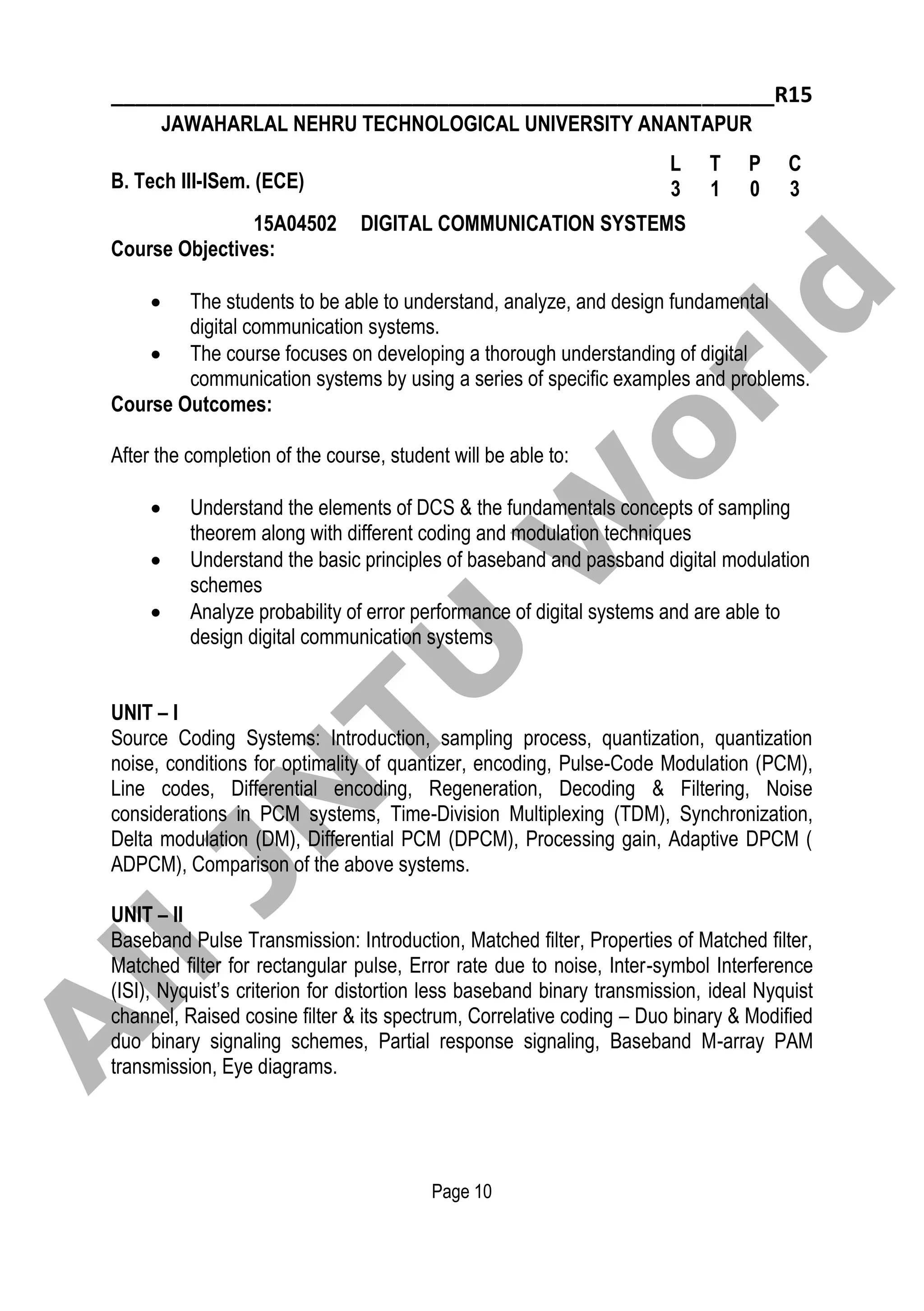
    _______________________________________________________R15 Page 10 JAWAHARLAL NEHRUTECHNOLOGICAL UNIVERSITY ANANTAPUR B. Tech III-ISem. (ECE) L T P C 3 1 0 3 15A04502 DIGITAL COMMUNICATION SYSTEMS Course Objectives:  The students to be able to understand, analyze, and design fundamental digital communication systems.  The course focuses on developing a thorough understanding of digital communication systems by using a series of specific examples and problems. Course Outcomes: After the completion of the course, student will be able to:  Understand the elements of DCS & the fundamentals concepts of sampling theorem along with different coding and modulation techniques  Understand the basic principles of baseband and passband digital modulation schemes  Analyze probability of error performance of digital systems and are able to design digital communication systems UNIT – I Source Coding Systems: Introduction, sampling process, quantization, quantization noise, conditions for optimality of quantizer, encoding, Pulse-Code Modulation (PCM), Line codes, Differential encoding, Regeneration, Decoding & Filtering, Noise considerations in PCM systems, Time-Division Multiplexing (TDM), Synchronization, Delta modulation (DM), Differential PCM (DPCM), Processing gain, Adaptive DPCM ( ADPCM), Comparison of the above systems. UNIT – II Baseband Pulse Transmission: Introduction, Matched filter, Properties of Matched filter, Matched filter for rectangular pulse, Error rate due to noise, Inter-symbol Interference (ISI), Nyquist‟s criterion for distortion less baseband binary transmission, ideal Nyquist channel, Raised cosine filter & its spectrum, Correlative coding – Duo binary & Modified duo binary signaling schemes, Partial response signaling, Baseband M-array PAM transmission, Eye diagrams. A llJN TU W orld
  • 2.
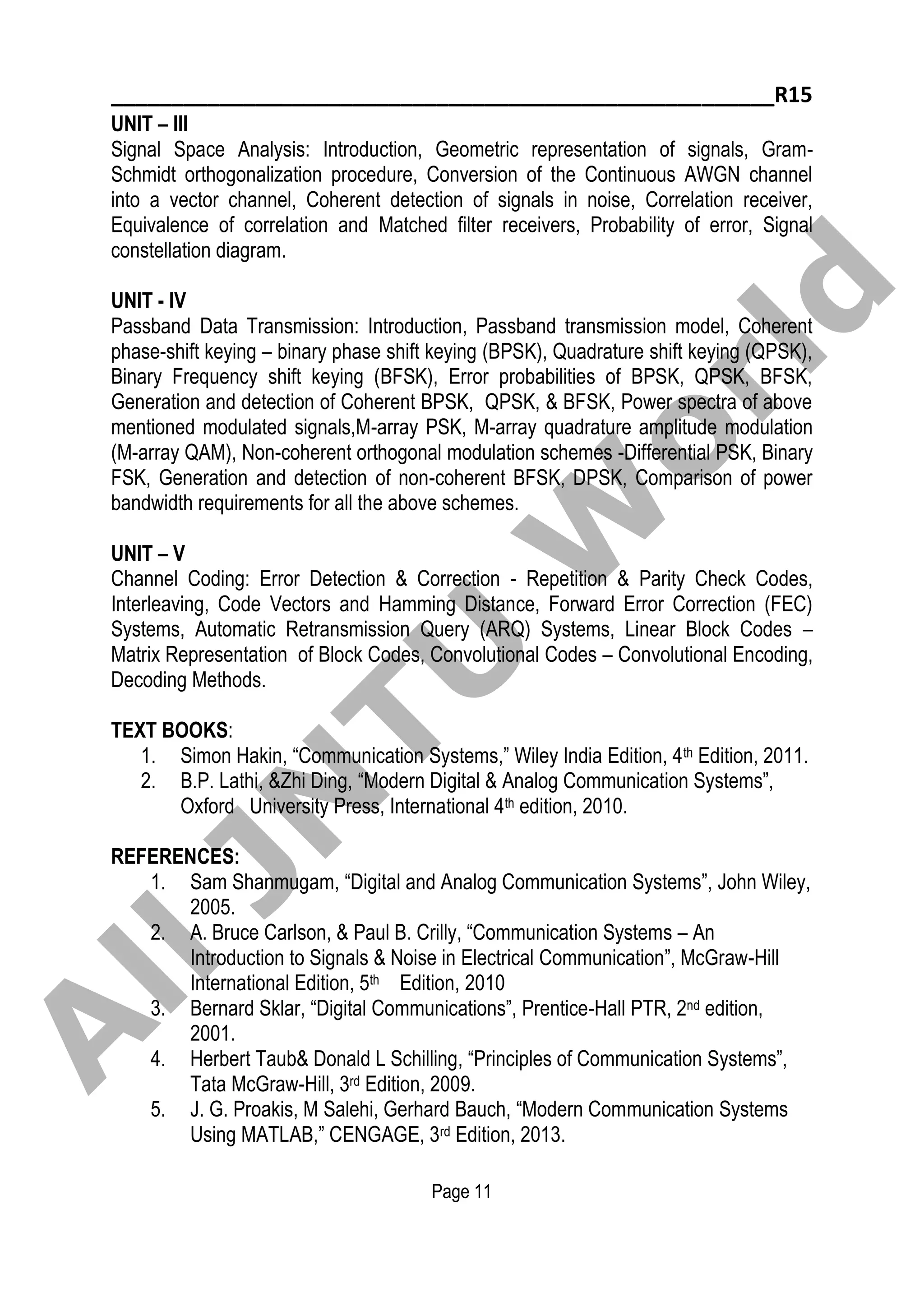
    _______________________________________________________R15 Page 11 UNIT –III Signal Space Analysis: Introduction, Geometric representation of signals, Gram- Schmidt orthogonalization procedure, Conversion of the Continuous AWGN channel into a vector channel, Coherent detection of signals in noise, Correlation receiver, Equivalence of correlation and Matched filter receivers, Probability of error, Signal constellation diagram. UNIT - IV Passband Data Transmission: Introduction, Passband transmission model, Coherent phase-shift keying – binary phase shift keying (BPSK), Quadrature shift keying (QPSK), Binary Frequency shift keying (BFSK), Error probabilities of BPSK, QPSK, BFSK, Generation and detection of Coherent BPSK, QPSK, & BFSK, Power spectra of above mentioned modulated signals,M-array PSK, M-array quadrature amplitude modulation (M-array QAM), Non-coherent orthogonal modulation schemes -Differential PSK, Binary FSK, Generation and detection of non-coherent BFSK, DPSK, Comparison of power bandwidth requirements for all the above schemes. UNIT – V Channel Coding: Error Detection & Correction - Repetition & Parity Check Codes, Interleaving, Code Vectors and Hamming Distance, Forward Error Correction (FEC) Systems, Automatic Retransmission Query (ARQ) Systems, Linear Block Codes – Matrix Representation of Block Codes, Convolutional Codes – Convolutional Encoding, Decoding Methods. TEXT BOOKS: 1. Simon Hakin, “Communication Systems,” Wiley India Edition, 4th Edition, 2011. 2. B.P. Lathi, &Zhi Ding, “Modern Digital & Analog Communication Systems”, Oxford University Press, International 4th edition, 2010. REFERENCES: 1. Sam Shanmugam, “Digital and Analog Communication Systems”, John Wiley, 2005. 2. A. Bruce Carlson, & Paul B. Crilly, “Communication Systems – An Introduction to Signals & Noise in Electrical Communication”, McGraw-Hill International Edition, 5th Edition, 2010 3. Bernard Sklar, “Digital Communications”, Prentice-Hall PTR, 2nd edition, 2001. 4. Herbert Taub& Donald L Schilling, “Principles of Communication Systems”, Tata McGraw-Hill, 3rd Edition, 2009. 5. J. G. Proakis, M Salehi, Gerhard Bauch, “Modern Communication Systems Using MATLAB,” CENGAGE, 3rd Edition, 2013. A llJN TU W orld