Visit ebookfinal.com to download the full version and
explore more ebooks or textbooks
Digital archaeology bridging method and theory 1st
Edition Thomas L. Evans
_____ Click the link below to download _____
https://ebookfinal.com/download/digital-archaeology-
bridging-method-and-theory-1st-edition-thomas-l-evans/
Explore and download more ebooks or textbook at ebookfinal.com
Here are some recommended products that we believe you will be
interested in. You can click the link to download.
Digital fundamentals 9th Edition Thomas L. Floyd
https://ebookfinal.com/download/digital-fundamentals-9th-edition-
thomas-l-floyd/
Archaeology and Modernity Julian Thomas
https://ebookfinal.com/download/archaeology-and-modernity-julian-
thomas/
Intelligent Technologies for Bridging the Grey Digital
Divide 1st Edition Jeffrey Soar
https://ebookfinal.com/download/intelligent-technologies-for-bridging-
the-grey-digital-divide-1st-edition-jeffrey-soar/
Ancient Mexico Central America Archaeology and Culture
History Second Edition Susan Toby Evans
https://ebookfinal.com/download/ancient-mexico-central-america-
archaeology-and-culture-history-second-edition-susan-toby-evans/
Corpus Linguistics Method Theory and Practice 1st Edition
Tony Mcenery
https://ebookfinal.com/download/corpus-linguistics-method-theory-and-
practice-1st-edition-tony-mcenery/
Scientific Method of Auditing Lawrence L. Vance
https://ebookfinal.com/download/scientific-method-of-auditing-
lawrence-l-vance/
Digital Performer Power 1st Edition Steve Thomas
https://ebookfinal.com/download/digital-performer-power-1st-edition-
steve-thomas/
Intelligence and Personality Bridging the Gap in Theory
and Measurement 1st Edition Janet M. Collis
https://ebookfinal.com/download/intelligence-and-personality-bridging-
the-gap-in-theory-and-measurement-1st-edition-janet-m-collis/
Environmental biotechnology theory and application 2nd ed
Edition Gareth Evans
https://ebookfinal.com/download/environmental-biotechnology-theory-
and-application-2nd-ed-edition-gareth-evans/
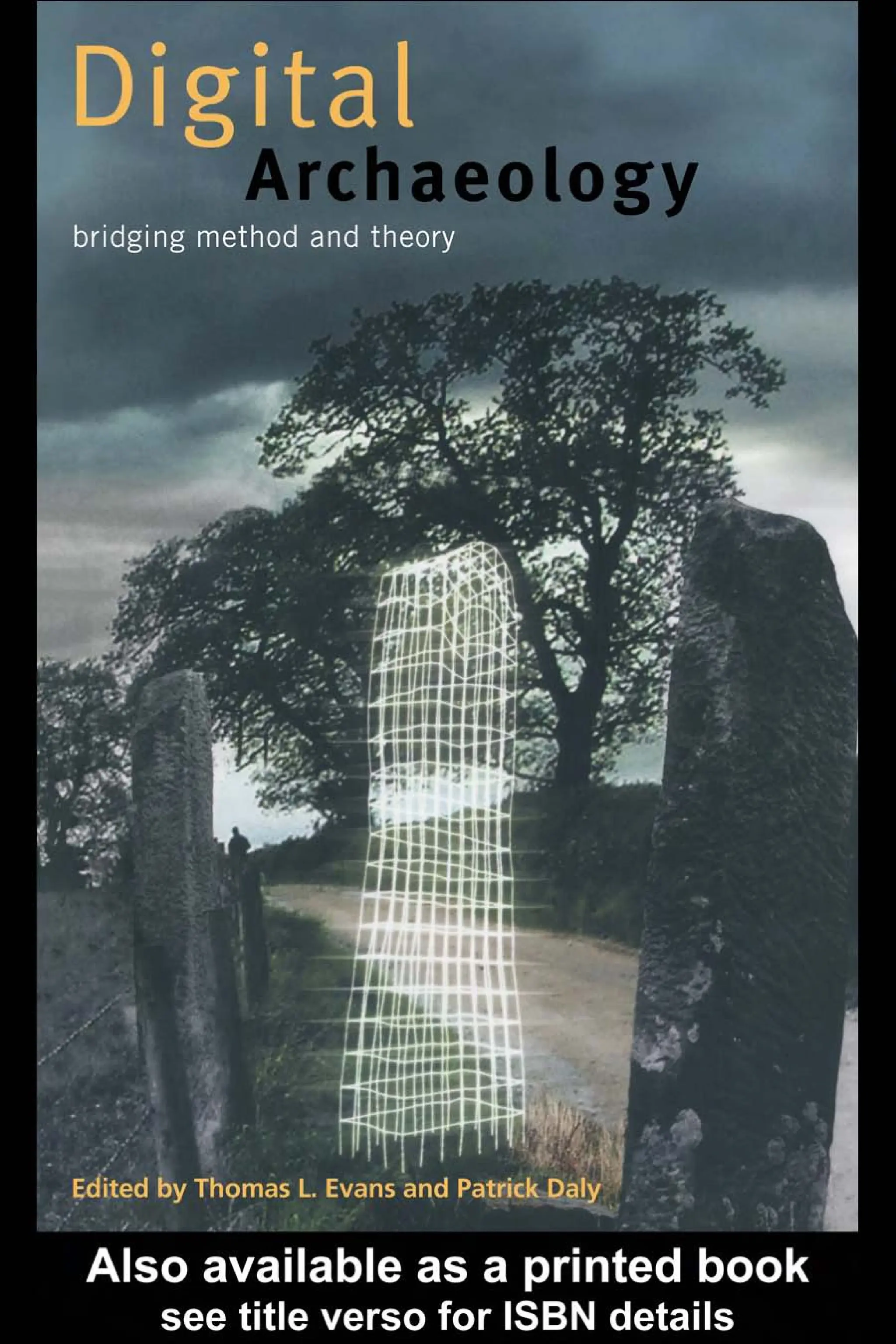
Digital archaeology bridging method and theory 1st
Edition Thomas L. Evans Digital Instant Download
Author(s): Thomas L. Evans, Patrick Daly (editors)
ISBN(s): 9780415310505, 0415310504
Edition: 1
File Details: PDF, 4.44 MB
Year: 2005
Language: english
DIGITAL ARCHAEOLOGY
Digital Archaeology is a unique edited work addressing the changing and growing role of
digital technologies in all aspects of archaeology and heritage management. Exploring the
wide potential of IT across the discipline, this book goes beyond the prevailing notion
that computers are merely a methodological tool, and considers their influence on the
very nature of archaeological study.
Blending rigorous archaeological theory with the extensive practical knowledge of
professionals in the field, Digital Archaeology is a highly accessible text that shows and
discusses the ways in which computing can be holistically incorporated into archaeology.
The book discusses elements of archaeological theory and reveals how computers can be
used to reintegrate theoretical questions into the application of field work and analysis.
Beginning with a history of the growth of computing within the field, the book goes
on to look at examples of how and why different technologies have been implemented
into archaeological theory and method. It includes GIS, virtual reality modelling, internet
publishing and archiving, and on-site digital recording using such examples as the
integrated digital recording of the Ferrybridge Chariot and other case studies from around
the world. This volume also discusses ways in which technology can now be used in
normal excavations and how this affects the study of archaeology as a whole, from
planning to publication.
Thomas L.Evans is Head of Geomatics for Oxford Archaeology and a Research
Associate at the University of Oxford’s Institute of Archaeology.
Patrick Daly is currently a British Academy Reckitt Travelling Fellow in
Archaeology based at the McDonald Institute of Archaeological Research, University of
Cambridge.
DIGITAL ARCHAEOLOGY
Bridging method and theory
Edited by
Thomas L.Evans and Patrick Daly
Routledge
Taylor & Francis Group
LONDON AND NEW YORK
First published 2006 by Routledge 2 Park Square, Milton Park, Abingdon, Oxon OX14 4RN
Simultaneously published in the USA and Canada by Routledge 270 Madison Ave, New York,
NY 10016
Routledge is an imprint of the Taylor & brands Group
This edition published in the Taylor & Francis e-Library, 2005.
To purchase your own copy of this or any of Taylor & Francis or Routledge’s collection of
thousands of eBooks please go to http://www.ebookstore.tandf.co.uk/.
© 2006 Thomas L.Evans and Patrick Daly
All rights reserved. No part of this book may be reprinted or reproduced or utilized in any form or
by any electronic, mechanical, or other means, now known or hereafter invented, including
photocopying and recording, or in any information storage or retrieval system, without permission
in writing from the publishers.
The publisher makes no representation, express or implied, with regard to the accuracy of the
information contained in this book and cannot accept any legal responsibility or liability for any
errors or omissions that may be made.
British Library Cataloguing in Publication Data A catalogue record for this book is available from
the British Library
Library of Congress Cataloging in Publication Data Evans, Thomas L. (Thomas Laurence)
Digital archaeology: bridging method and theory/Thomas L.Evans & Patrick Daly. p. cm.
Includes bibliographical references and index. 1. Archaeology—Methodology. 2. Digital
electronics. 3. Electronic digital computers. 4. Archaeology— Philosophy. 5. Antiques—Collection
and preservation. 6. Cultural property—Protection. I. Daly, Patrick T, 1975– II. Title. CC75.7.E93
2005 930.1′028—dc22 2004028972
ISBN 0-203-00526-0 Master e-book ISBN
ISBN 0-415-31048-2 (hbk)
ISBN 0-415-31050-4 (pbk)
TLE
TO DR CARMEN ELISA OQUENDO CIFUENTES
My wife, my love, my best friend. Without her support and affection, this would never
have been completed.
PD
TO EZRA, MIKE, AND PHIL
For the push down the road to where I am now—the blame or credit lies at least partially
with you all.
CONTENTS
List of figures and tables viii
Notes on contributors xiii
Acknowledgements xvi
PART I Where we’ve been and where we are going
1
Introduction: archaeological theory and digital pasts
PATRICK DALY AND THOMAS L.EVANS
2
1 Digital archaeology: a historical context
EZRA B.W.ZUBROW
8
PART II Data collection
28
2 Archaeological survey in a digital world
MATT BRADLEY
29
3 Drowning in data? Digital data in a British contracting unit
PAUL BACKHOUSE
43
PART III Quantification made easy
50
4 You, me and IT: the application of simple quantitative techniques in the
examination of gender, identity and social reproduction in the Early to
Middle Iron Age of northeastern France
THOMAS L.EVANS
51
PART IV Modelling the past
82
5 Jouma’s tent: Bedouin and digital archaeology
CAROL PALMER AND PATRICK DALY
83
6 Digital archaeology and the scalar structure of pastoral landscapes:
modeling mobile societies of prehistoric Central Asia
MICHAEL FRACHETTI
113
7 What you see is what you get? Visualscapes, visual genesis and hierarchy
MARCOS LLOBERA
132
PART V Virtual worlds
153
8 ‘Digital gardening’: an approach to simulating elements of
palaeovegetation and some implications for the interpretation of
prehistoric sites and landscapes
BENJAMIN R.GEAREY AND HENRY P.CHAPMAN
154
9 At the edges of the lens: photography, graphical constructions and
cinematography
GRAEME P.EARL
173
PART VI Disseminating the data
190
10 Electronic publication in archaeology
JULIAN D.RICHARDS
191
11 Computers, learning and teaching in archaeology: life past and present
on the screen
GARY LOCK
202
12 What’s another word for thesaurus? Data standards and classifying the
past
ANDREW BAINES AND KENNETH BROPHY
210
PART VII Conclusion
222
Afterword
PATRICK DALY AND THOMAS L.EVANS
223
Index 227
FIGURES AND TABLES
Figures
1.1 Intellectual dialectic 10
1.2 List of spatial physical realities 17
2.1 Internal north elevation nave, Dorchester Abbey 33
2.2 Internal north elevation quire, Dorchester Abbey 34
2.3 Internal east elevation People’s Chapel, Dorchester Abbey 35
2.4 Simplified version of real-time CAD based line drawing of
Ferrybridge Chariot
39
2.5 GIS contour model of Ferrybridge Chariot, during excavation 39
2.6 Photorectified CAD model of Ferrybridge Chariot, used during
excavation
40
2.7 Simple photorectified GIS contour model of Ferrybridge
Chariot used for initial post-excavation phase
42
4.1 Geographic situation of sites 53
4.2 Cemetery population and number of cemeteries by phase 59
4.3 Comparison of USB populations by gender category 60
4.4 Gender artefact mean frequencies by phase 62
4.5 Non-engendered artefact frequency 63
4.6 Comparison of USB frequencies of warrior to torc bearing
assemblage
66
4.7 Ceramics in all categories 67
4.8 Ceramics: masculine to feminine only 68
4.9 Personal ornamentation, excluding torcs 68
4.10 Fibula 69
4.11 Bracelets 70
4.12 Total artefact frequency and population 72
5.1 The Wadi Faynan study area 86
5.2 Map of study area showing sites included in the Bedouin
Camp Survey in 1999, coded by tribal affiliation
89
5.3 A black tent, bayt al-sha’r, in the Wadi Faynan 91
5.4 Distribution of all finds for sites (a) WF92, (b) WF869 and (c)
WF982
94
5.5 View of WF942 looking south-east 97
5.6 Distribution of all finds at WF942 98
5.7 Discarded articulated left hind limb from primary butchery at
WF942
100
5.8 Distribution of all finds at WF869 101
5.9 A sardine tin modified into a toy and a plastic piping
shepherd’s flute and broken music cassette
104
5.10 Distribution of all finds at WF982 105
5.11 WF909 showing platforms and hearths from an encampment 106
5.12 WF909 after clearing loose soil. There is a hardened surface
around the hearth
107
6.1 Study zone and surrounding region context 115
6.2 Detailed view of study zone 122
6.3 Course of Koksu River 123
6.4 Distance to settlements set against productivity of the pasture 124
6.5 Network of potential pathways between settlements and the
richest pastures
125
6.6 Flow accumulation map for travel to rich pasture resources
noting additional pathways over lowland areas
126
6.7a Pathways tracing routes between pastures and rock-art 127
6.7b Pathways tracing routes between settlements and rock-art 128
7.1 Yorkshire Wolds archaeology 135
7.2 Cumulative viewshed for the BA round and IA square barrows
respectively
136
7.3 Visual genesis flowchart 137
7.4 Visual genesis for BA round barrows 138
7.5 Visual genesis for IA square barrows 139
7.6 A comparison of the visual variability for round and square
barrows
140
7.7 Visual variability at each location for round and square
barrows
141
7.8 Visual structure generated by round barrows after their visual
variability has been accounted for
141
7.9 Visual change 142
7.10 Histogram showing the distribution of locations according to
the visual intensity generated by round and square barrows
144
7.11 Visual weight for round barrows in decreasing order 145
7.12 Visual weight for square barrows in decreasing order 146
7.13 Visual clustering of round barrows 147
7.14 Visual clustering of square barrows 148
7.15 Visual patterns associated with each cluster 149
8.1 Location map showing the principal archaeological features
and the route through the site
159
8.2 Reconstructed areas of standing water on the site in relation to
the two enclosures
161
8.3 Areas of modelled alder vegetation and areas of deep water
added to the reconstructed archaeological landscape
163
8.4 Reconstructed landscape with archaeological features cleared
of alder vegetation
164
8.5a–
d
Changes in visibility patterns when moving through the
‘minimum’ landscape
165
8.6a–
d
Changes in visibility patterns when moving through the
‘maximum’ landscape
166
Tables
1.1 History of computing and archaeological theory 14
4.1 List of examined sites in the Upper Seine Basin 74
5.1 Density of items recovered from campsites 96
NOTES ON CONTRIBUTORS
Paul Backhouse is currently Manager of Graphics and Digital Media at Oxford
Archaeology. He deals extensively with the preparation of both academic and popular
publications and reports, and is responsible for all WWW, interactive media and
presentations done by OA. He helped to develop the data and metadata standards and
dissemination formats used by Oxford Archaeology. Furthermore, he is a specialist in
archaeological web development, and interactive educational media.
Matt Bradley is the Geomatics Officer and GIS Co-ordinator for Oxford Archaeology.
He has 15 years experience working as a professional archaeologist and archaeological
surveyor on sites in Britain, Germany, Holland and the Middle East. He has worked
for Oxford Archaeology since 1997. His current work includes building, earthwork,
topographical and landscape survey as well as the design and implementation of GIS,
survey and CAD strategies and spatial decision support.
Kenneth Brophy is currently a lecturer in archaeology at the Department of
Archaeology, Glasgow University, and has previously worked as an aerial
photographic liaison officer with Royal Commission on the Ancient and Historical
Monuments of Scotland. His current research projects include excavations at multiple
stone rows in Caithness and Neolithic cropmark enclosures in lowland Scotland, and
landscape study around Cairnpapple Hill, a henge in West Lothian. Furthermore, he is
working on a book on cursus monuments in Scotland.
Henry P.Chapman is a Research Fellow and part-time lecturer at the Wetland
Archaeology and Environments Research Centre at the University of Hull. Employed
previously as a landscape investigator with the Royal Commission on the Historical
Monuments of England, and as a researcher with the English Heritage Humber
Wetlands Project, he specializes in later prehistoric landscape archaeology and the
applications of GIS and technical survey for the interpretation and management of
archaeological landscapes. He currently works on projects focusing on environmental
change and the impacts on human perception of the landscape.
Patrick Daly is currently a British Academy Reckitt Travelling Fellow in Archaeology
based at the McDonald Institute of Archaeological Research, University of
Cambridge. He has worked as a Visiting Academic at the Institute of Archaeology,
University of Oxford, and an Assistant Professor in the Faculty of Arts at An-Najah
National University, Nablus, Palestine. He has conducted field work in Britain, the
Middle East and Malaysian Borneo, focusing on periods of social transformation
brought about through foreign intervention and occupation. He has been involved in
the use of GIS in archaeology for about ten years, and has published a number of
articles and chapters related to digital methodology.
Graeme P.Earl is a Research Fellow in the Department of Archaeology, University of
Southampton, specializing in computer techniques for the analysis and presentation of
archaeological data. He is particularly concerned with the development and
implementation of multimedia resources for archaeology, including the uses of virtual
reality and other techniques for the interpretation of archaeological sites and for
providing access to online archives. Previously his work focused on multimedia
methods for presenting data and the use of computer aided design and modelling
packages for the representation of archaeological remains at the site of Quseir al-
Qadim, Egypt. He has recently begun working on a three-year AHRB research
fellowship using network analyses in the study of Roman towns in southern Spain.
Thomas L.Evans is currently the Head of Geomatics for Oxford Archaeology and a
Research Associate at the Institute of Archaeology, at the University of Oxford. He
has worked extensively in both academic and commercial research in Britain, across
Europe and in North America. His research interests focus upon the nature of identity
and its interrelationship with landscapes as reflected through spatial analysis. He is
currently working upon the development of the practical uses of technology in
archaeology, the investigation of social reproduction through ‘Landscape of the Dead’
and the examination of Iron Age ‘Communication and Combat’ as represented by two-
wheeled vehicles and their relationship to the landscape. He is a specialist in the
integration of geomatic approaches such as geodesy, GIS, quantitative methods and
technological recording methods into archaeological practice and the development of
theory.
Michael Frachetti is a Research Associate of the University of Pennsylvania Museum of
Archaeology and Anthropology. His primary research focus is on the prehistoric
development and organization of Bronze Age pastoral societies of the steppes and
deserts of Central Asia and Eurasia, and their interactions with contemporary
civilizations of the region. His recent field research has been based in Kazakhstan,
though he has also conducted fieldwork among pastoralists of Finland, Tunisia and
Morocco. He has applied GIS and Remote Sensing techniques to the study of social
and environmental landscapes for the past ten years.
Benjamin Gearey is a Research Fellow and part-time lecturer at the Wetland
Archaeology and Environments Research Centre at the University of Hull. Following
his PhD at the University of Plymouth, he worked at the University of Exeter before
taking up a position with the Humber Wetlands Project. His research interests include
Holocene humanlandscape interactions and the archaeological record, and the
archaeoenvironmental record of mire systems.
Marcos Llobera is currently a Leverhulme Research Fellow at the University of
Southampton, UK. His major interests are landscape research in archaeology,
mathematical and computational modelling (especially GIS methods) and
archaeological theory. Much of his research concentrates on the design and
development of new methodology aimed at addressing in a more formal manner the
complexities inherent in the reconstruction of past landscapes, in particular their social
and experiential aspects. Currently he is also the co-director of two landscape projects:
LA BALAGNE (north-western Corsica) and ALCOI (eastern Spain) Landscape
Projects. He has now taken up a position in the Department of Anthropology at
University of Washington (Seattle), USA.
Gary Lock is a University Lecturer in Archaeology at the University of Oxford based in
both the Institute of Archaeology and the Department for Continuing Education. He
has a long-standing interest in the use of computers in archaeology, especially the
application of GIS to landscape studies based on his fieldwork projects in England,
Spain and Italy. He is an editor of the Archaeological Computing Newsletter, and has
published many papers and books on computer applications in archaeology, including
Virtual Pasts: Using Computers in Archaeology, Archaeology and Geographic
Information Systems: a European Perspective (with Zoran Stančič), Beyond the Map:
Archaeology and Spatial Technologies, and On the Theory and Practice of
Archaeological Computing (with Kayt Brown).
Carol Palmer is a Post-doctoral Research Associate at the University of Sheffield. She is
presently working on a NERC-funded project investigating the modern ecology of
weeds found on archaeological sites in Europe and the Near East. Her research
interests are in the ethnography of farmers and pastoralists in the Middle East,
archaeobotany, plant ecology, and statistical approaches to data analysis. She recently
held the Council for British Research in the Levant Post-doctoral Fellowship at the
University of Leicester and is a member of the Wadi Faynan Landscape Archaeology
Survey.
Julian D.Richards is Reader in Archaeology at the University of York. His research
interests focus on early medieval archaeology of England and on computer
applications in archaeology. He has directed excavations of the Viking cemetery and
Heath Wood, Ingleby, and is currently examining Anglo-Scandinavian settlement
patterns in the Yorkshire Wolds. Since 1996 he has been Director of the Archaeology
Data Service and the e-journal Internet Archaeology. He has published numerous
books and articles on computer applications.
Ezra B.W.Zubrow is currently Professor of Anthropology at the University at Buffalo,
Senior Research Scientist of the National Center of Geographic Information Analysis,
Honorary Fellow of the Department of Archaeology at University of Cambridge, and a
member of the Graduate Faculty of the Department of Anthropology of the University
of Toronto. He is one of the founders of the use of GIS in archaeology. His primary
research interests are in theory, methodology and field areas concerned with spatial
phenomena. His methodological interests are geographic information systems and
sciences, quantitative and statistical analysis applied to spatial and demographic
topics, and archaeometry. His area interests focus on environmental extremes and
wetlands and he has done fieldwork in the colder extremes of Northern Europe,
Scandinavian and Finnish Arctic, the drier extremes of the Southwestern, Mexican and
Middle Eastern deserts, as well as the more humid extremes of the tropical wetlands of
the United States, Philippines, and India. He also is one of the inventors of a solar
powered parallel processing computer and he plays the banjo and cello.
ACKNOWLEDGEMENTS
As with most collaborative projects, there are many individuals and groups whose
assistance has proven crucial to the production of this volume. The original concept for a
session at the Theoretical Archaeology Group’s TAG 2000 session was the brainchild of
André Tschan, and though his own illness prevented him from attending the session or
contributing to this volume, his initial contribution to this project was invaluable.
Similarly, Vuk Trifkovic helped organize and contribute to that session, and his
involvement in the early stages of turning that idea into a published volume was essential.
Other contributors to the Archaeological Theory for a Digital Past TAG 2000 session
also proved essential in both bringing about that endeavour, and invigorating the debates
and ideas that eventually led to the production of this work. We would particularly like to
thank Chris Gosden, Ian Hodder and David Wheatley for their contributions to that
session, which were inspirational.
Also of great importance to the completion of this book was the support and assistance
given to us by Oxford Archaeology which gave us both time and use of their facilities
and personnel in the development of this book. Similarly, the University of Oxford
provided encouragement, facilities and a forum for discussion and inspiration. Last but
not least, we would like to thank Celia Tedd and Matthew Gibbons who nursed this book
over many of the hurdles and whose help and patience allowed us to develop the book
into its final form.
Part I
WHERE WE’VE BEEN AND
WHERE WE ARE GOING
INTRODUCTION
Archaeological theory and digital pasts
Patrick Daly and Thomas L.Evans
We live in a digital age; a world where computers are omni-present, but in which we are
only just beginning to understand how to productively apply them to our lives. In a very
short period computers have come from being great number crunching machines to being
‘neat’ and ‘nifty’ gadgets, from being almost inaccessible to being everyday devices that
we have come to rely upon—perhaps too much. Yet, despite the presence of computers in
our offices, homes, cars, planes and, in fact almost every device in the modern world, we
do not always know how to utilize them to their best advantage. This is certainly the case
in the study of archaeology. To this end one can say that digital archaeology is not so
much a specialism, nor a theoretical school, but an approach—a way of better utilizing
computers based on an understanding of the strengths and limits of computers and
information technology as a whole. This volume presents an overview of some of the
more useful and innovative applications of computers to our understanding of the
archaeological past. It shows good examples of how technology is being integrated into
our approaches to theory, practice and indeed demonstrates how they are assisting in the
marriage between the two.
Digital Archaeology explores the basic relationships that archaeologists have with
Information and Communication Technology (ICT) and digital technology to assess the
impact that such innovations have had on the very basic ways that archaeology is
performed and considered. To this end this volume is intended not just for IT or ICT
specialists in archaeology, nor for adherents to any one specific theoretical school, but for
all those who are interested in and concerned with better understanding how digital
approaches have impacted archaeology. It examines the ways that technologies can and
do bridge the gap between what have become discrete branches of the same discipline.
All of the contributors to this volume are interested in better ways of utilizing computers
and computer based technologies in the pursuit of an archaeological past. Towards this
end, all of the papers in this volume discuss the formation, current state, and the potential
use of ICT in different aspects of archaeology, and/or demonstrate different specific
applications which holistically integrate the substance and theory of archaeology with
digital approaches. In all the contributions, the explicit aim has been to focus upon how
ICT and other digital techniques are integrated into archaeological theory and practice in
ways that expand the limits of what is possible within archaeology.
The idea of this book began in the spring of 2000, when André Tschan gathered Vuk
Trifkovic and ourselves to discuss the idea of holding a session at the Theoretical
Archaeology Group held in Oxford that year (TAG-2000). Its title was Archaeological
Theory for a Digital Past, and it consisted of an all-day session that delivered a full range
of interesting and stimulating papers, all ultimately concerned with how ICT has been
Discovering Diverse Content Through
Random Scribd Documents
already been convicted of poison—!”
“Stop!” Mr. Parsons rose. “Christopher was innocent of that old
charge and he was equally innocent of the crimes which have been
committed this past week! He was mistaken in his sense of duty, but
not a murderer!”
M
CHAPTER XVIII
CHECKMATE!
CCARTY left the Parsons house a few minutes later, his mind a
chaos of conflicting impressions. With the sonorous, dignified
tones still ringing upon his ear and the deeply concerned gaze yet
seemingly bent upon him Benjamin Parsons appeared the epitome of
rectitude and righteousness, but had he been as certain of Porter’s
innocence as he claimed, and was he as ignorant of where he had
gone?
He crossed the street to Orbit’s house and glanced again into the
court between that and Goddard’s. Max was still there, but he had
lain down as though exhausted and his ribs, glistening with the rain,
showed pitifully gaunt. Why didn’t they take the poor fellow in?
McCarty stopped and spoke coaxingly to him. The dog slowly rolled
his lack-luster eyes upon him but made no other response.
For a long minute McCarty stood thoughtfully regarding the dog.
When, at last, he continued on his way there was a curiously absent
look upon his face.
Ching Lee admitted him and took him to the library where he had
first been received. A small fire of some strange, peat-like fuel was
burning on the hearth, sending out iridescent flames and a faint
pervasive odor as of sandalwood, and before it Orbit was seated,
with a stout, florid man in tweeds.
“Good-morning, McCarty. I rather thought that you or the
inspector would look in on me this morning.” Orbit turned to his
guest. “Sir Philip, this is Deputy McCarty, the official who is working
with Inspector Druet on the investigation into this hideous mystery.”
Sir Philip Devereux nodded to the ex-roundsman cordially.
“Shocking affair, this! Shocking!” he commented. “Here for a little
private chat with Mr. Orbit, what? I’ll leave you—”
“No, don’t go, Sir Philip!” Orbit demurred smilingly. “You know all
the circumstances and McCarty and I haven’t anything private to
discuss. I hope he’s brought me some news!—You heard about what
happened to me the other night?”
“I did that,” McCarty nodded. “What do you think ’twas done for, if
nothing was taken?”
“Haven’t the remotest idea.—Sit down here by the fire, man,
you’re soaked through!” Orbit added hospitably. “I’ll have Ching Lee
bring you a touch of something from my private stock—?”
“No, thank you, Mr. Orbit; I’ve a twinge of the gout now and then,
though you mightn’t think it,” McCarty explained speciously. “I just
dropped by to see if you’d thought of anything to add to what you
told the inspector about the chloroforming?”
“Nothing. The whole thing happened so quickly and the
impressions left on my mind were so vague, that I am afraid I can
be of little use to you. One thing seems certain; the fellow didn’t
intend me to die from the effect of it, since he stopped to open the
windows and throw away the cloth he had used to anæsthetize me!”
Orbit shrugged. “The incident is absolutely inexplicable except on
the supposition that his only intention was to terrorize me, and that
is really too absurd to consider.”
“It was an outrage!” declared Sir Philip suddenly. “Damme, it
passes belief! The chap must be a fiend—or mad! What object could
he have in doing Hughes in? I say, there was a valet for you!—Then
the girl, too! That poison gas theory seems to be rot to me, too
utterly impossible with you there in the room, but the girl is dead,
isn’t she? There you are!”
He leaned back in his chair and puffed thoughtfully at his cigar. His
host turned to McCarty with a faint hint of amusement in his eyes
but it was quickly overshadowed by sadness again.
“The girl is dead, poor creature, and I cannot help feeling that the
blame in some way rests at my door, for I invited her in. However
her death was brought about the child escaped, though; we have
that to be thankful for! We are none of us safe here on the Mall
while the murderer is free to come and go in our houses at will,
killing with impunity whenever the horrible impulse comes to him! I
was reluctant to offer my hospitality to Sir Philip under these
harrowing circumstances but he expressed himself as willing to
abide by the consequences.”
“Ripping experience!” the baronet nodded again. “Sorry I’m sailing
to-morrow! Like nothing better than to stop and see it through!—Old
chap over the way was robbed the same night, I hear; any clues left
there, McCarty?”
There was no hint of sarcasm in his tone but McCarty flushed
darkly, then he darted a quick glance at the questioner and a slow
smile dawned. The Britisher was trying to get his goat!
“Yes, sir, the same as here,” he replied. “Mr. Orbit, you’ve that
chloroform bottle? The inspector says ’twas found on a stand beside
your bed.”
“Ching Lee has it, I believe; would you like to see it?” He rang the
bell without waiting for a reply. “The cloth used was a towel from my
own bathroom; it’s evident that the fellow was familiar with the
house and knew his way about; but how he got in that side door
leading from the card-room, if Ching Lee really bolted it as usual the
night before—? Oh, Ching Lee?”
The butler had appeared silently in the doorway and now Orbit
addressed him in a rapid patter of Chinese. Ching Lee, as impassive
and wooden of countenance now as before the tragedy, bowed and
departed, and McCarty turned once more to Orbit.
“What time was it, as near as you can figure, that you were
doped?”
“I should say, around two o’clock in the morning, perhaps a trifle
before. Sir Philip and I sat up till after midnight playing chess, and
when I retired I tried for more than an hour to sleep before I took a
bromide. Things grew hazy after that and I don’t know how long I
dozed before I was conscious of some one in the room.”
“You got no whiff of anything else before the chloroform hit you?”
McCarty asked. “No smell of a pipe or cigar if the guy was a smoker,
maybe?”
“I smoke so constantly myself that I would scarcely have noticed it
even if there had been time and I were fully awake.” Orbit raised his
brows. “You smoke yourself, McCarty; could you have detected it?”
“Sure,” McCarty stated the fact modestly. “I’ve not the nose Denny
has, but ’tis easy to tell the smell of a cigar from a pipe, even if it’s
only hanging about the clothes of a person; a rich, full-flavored cigar
with a body to it leaves a scent that a man will travel with, whether
he gets it himself or not.”
“‘Denny?’” Orbit repeated. “Oh, you mean your associate,
Riordan? Yes, I remember he detected the odor of that small blaze
here a week ago, when the monkey upset the cigar lighter in my
room. Odd faculty, that, eh, Sir Philip?”
“Jolly, I fancy. I only wish I had it!” Sir Philip chuckled. “My man
makes away with my cigars at a shockin’ rate but I never can catch
him at it. I say, no one’s disturbed our board, have they?”
“Indeed, no,” Orbit replied. “I gave strict orders and we can finish
the set to-night.—Sir Philip held the amateur chess championship for
Great Britain for five years.”
He added this to McCarty and then turned as Ching Lee appeared
again and spoke to him once more in his native tongue. The butler
advanced and placed in McCarty’s hands the bottle he had seen in
Orbit’s room two nights before.
“Has it been uncorked, do you know, since ’twas found beside
you?” McCarty regarded the contents critically, removed the cork
himself for a cautious whiff. Hurriedly replacing it, he handed the
bottle back to Ching Lee and rose.
“I don’t think so,” Orbit whipped out his handkerchief and pressed
it to his nose. “I am susceptible to that odor, at any rate, since
Wednesday night!—Sorry not to be of any greater help to you. I
shall depend on you and the inspector to keep me informed of any
developments that may arise.”
As McCarty trudged through the driving rain toward the east gate
once more, he shook his head. Come night, it would be a week since
Hughes had been done to death, and the end was not yet clear!
He made his way to the lunchroom on Third Avenue which he and
Dennis had previously visited and in deference to the day ordered
fried oysters. They were long in coming and he rested his elbows
wearily on the table. Was he getting too old for the game, after all?
In days gone by, when he was in harness, he’d have got to the truth
long since. It had been a dog’s life in more ways than one, yet he
regretted more than ever that he had left it and grown rusty....
All at once he straightened in his chair and sat staring at the
cynical warning to “watch your hat and coat” on the wall before him
as if the legend were wholly unfamiliar to him. The belated
appearance of the waitress with the oysters roused him from his
stupor and he rose hurriedly.
“Don’t want ’em!” he muttered thickly. “Gimme the check; I got to
beat it!”
Spilling a dime onto the table he took the slip of pasteboard, paid
for his untouched food at the cashier’s desk and went out as one in
a dream. Once around the corner he seemed galvanized into life and
set off briskly enough for the subway.
Twenty minutes later he presented himself at headquarters and
after being closeted with the chief of the detective bureau for some
little time he departed, armed with certain credentials for the main
office of the telephone company.
There he spent a long and seemingly unproductive hour going
over the calls from the Gotham exchange, which included the New
Queen’s Mall, for the previous Tuesday.
Over Goddard’s private wire had gone numerous messages before
Trafford had called Blaisdell’s studio; and in the late afternoon, when
Horace’s continued absence had caused alarm, there were fully a
score of numbers registered before Goddard himself had summoned
McCarty.
Orbit’s telephone, too, had been busy, with the caterer, decorator,
florist and a musical agency, in connection with the function of the
afternoon. Three messages to the coal dealer and innumerable
others followed, presumably sent by guests until the evening was far
advanced.
Only four calls had been sent from the Bellamy house and they
appeared to have been made by the lady herself, for they were to
modiste, hairdresser, perfumer and a prominent department store.
Parsons’ telephone had been connected with a foreign consulate,
several charitable societies and a banking house, while the Sloane
household had communicated with Doctor Allonby, a drug store, an
agency for male nurses, the office number of a noted financier, and
several residence numbers of equally well-known persons.
McCarty copied one or two numbers from each list and sallied
forth to verify them, but, although the afternoon was long, twilight
had not yet come when he returned to his rooms and entered
cautiously.
They had not been intruded upon on this occasion, but he
remained only long enough to secure the page torn from the
encyclopædia and then slipped out again through the teeming rain
to the fire house which domiciled engine company 023.
Dennis was matching nickels with Mike in the dormitory and
reaping a rich harvest, but he hastily promised the loser his revenge
later and slid down the pole to join McCarty.
“I’ve looked for you all afternoon!” he declared reproachfully,
adding: “You’ve news! I can see it in the eye of you and I might
have known something would start whilst I was out of it!”
“There’s nothing new,” McCarty responded quietly. “I’ve a queer
notion in my head, but it’s too sickening to spring even after all we
know has happened, till I get hold of something to back it up.
Parsons ’phoned for me this morning—the old gentleman himself—
and told me the truth about what was missing since Wednesday
night, which was no news. He said it was clever, the way you’d
disconnected the inside alarm arrangement—”
“Me!” Dennis’ leathery countenance blanched. “’Tis what I get for
letting you lead me into breaking the law! Now I’ll get thrown out of
the department and pinched, and Molly will change the baby’s name
—!”
“Oh, Parsons did not know ’twas you, Denny, he just said it had
been cleverly done,” McCarty hastened to explain. “I sprung it on
him about Porter and Radley and asked him what would he do if a
fellow escaped that he thought was innocent and came to him and
he spoke up quick that he’d turn him over to the authorities anyway;
’twould be his higher duty to our social fabric, whatever that is.”
“It would, would it!” Dennis ejaculated in fine scorn. “The social
fabric could go to blazes for all of me, but I’d stick to a pal, innocent
or no! Howsomever, I’ve not the grand, cold-blooded principles of
him!—You know the poor devil’s been caught, crazier than a loon?”
McCarty nodded.
“Porter knows it, too; he’s beaten it for fear he’ll be sent up for
hiding him.” He finished his account of the morning’s interview and
then drew the torn page from his pocket. “There’s more to this thing
about the Calabar bean that I didn’t read you, Denny, so I brought it
around and maybe ’twill give us an idea.—Listen: ‘Calabar Bean.
Ordeal Nut. The seed of Physostigma ven-en-osum, a twining, half
shrubby plant, native of Africa.’”
“What of it?” Dennis was frankly bored. “How is that going to
help?”
“Wait a bit.—‘The kernel is hard and white, and yields its virtue to
alcohol and less perfectly to water.—’”
“I’ll bet it does, or they’d never have got it down Hughes, if what
we’ve heard of his habits is straight!” interrupted Dennis, his interest
once more aroused. “There you’ve got it, Mac! Find the last one he
took a drink with and you’ll have the guy that croaked him!”
“That’s not all,” McCarty began again. “‘The beans are reddish,
gray, or’—um—‘Kidney-shaped, and about the size’—never mind
that!—‘Care should be taken to avoid spontaneous—’”
“Did you trail around here in all the rain to give me a botany
lesson?” Dennis demanded indignantly. “’Tis not from any book you’ll
be learning the truth! I was that upset last night, what with the
revolver shot and all, that I never thought to ask you, but what did
the old guy you know uptown say about that bu’sted blue balloon?
Could he make out from the way it was rotting before our eyes the
kind of gas there was in it?”
McCarty hesitated and then said slowly:
“Denny, you’ll mind the other night after we had examined it I put
it in a cracker box while we went for a bite to eat and when we
came home you saw me hunting around for something?”
“You were trying to whistle, too!” Dennis nodded. “That always
means you think you’re putting something over! What was it?”
“I was hunting for that cracker box. I knew the minute we came
back into the room somebody’d been there, for there was the stale
smell of a heavy cigar on the air, not as if he’d been smoking right
then, but the scent of it was strong on him as he passed through the
place; when I found the box missing I knew what he’d come for.”
“Think of that now! Do you know what it means, Mac? The
murderer knew you and not the medical examiner’s assistant had
taken it from the conservatory! I wonder if he followed us from then
on? The sight of us parading through the streets with all them
balloons would have told him we were on, if he wasn’t blind!” Dennis
grinned. “Leave the medical examiner find out what kind of gas was
it; we know how ’twas give to her, though not what busted the
balloon right in her face nor how the gas got in it! The notion come
to me that ’twas not meant to kill Lucette, anyway.”
“Not kill her!” exclaimed McCarty. “The first whiff of it must have
knocked her cold!”
“But what if it was intended for the baby and not for her?” Dennis
lowered his voice. “What if the murderer has a craze for killing
children? I’ve heard tell of such things and so have you! Suppose
Hughes was poisoned by mistake in the first place for Ching Lee, so
that little Fu Moy wouldn’t be protected. Then Horace was taken
away and maybe killed and the Bellamy baby was next on the list—!”
“Denny, you’re running wild!” McCarty interrupted in his turn. “The
murderer’s brain has got a twist to it, but he’s not as crazy as all
that. Baby-killers are just stupid, low brutes without the shrewdness
or knowledge to plan such crimes as we’re up against now. We’re
fighting a mind, not a fist with a knife or a club in it!”
“So you’ve been saying!” Dennis retorted disgustedly. “That comes
of those books you’ve been reading! Whilst you’ve been figuring out
his ancestors and the blood that’s in him to decide is he in the ‘Born’
or ‘Habit’ class, like that Diagnostic book of yours has it, he’s been
having an Old Home Week in the Mall, kidnapping and killing right
and left! ’Twill be a week to-night—!”
McCarty beat a hasty retreat and took his solitary way to the
restaurant, where he ate a hearty dinner to make up for the
deferred lunch. Then he returned to the Mall, to prowl about like an
unquiet if somewhat too material ghost. The rain had stopped at last
and although the sky was still partially overcast the glimmer of a few
stars gave promise of a clear dawn. Lights were brilliant in the
Sloane, Parsons and Orbit residences, but low in Goddard’s and Mrs.
Bellamy’s, where the lady had been in a hysterical state since the
murder of her baby’s nurse.
Yost had been relieved from his post at the mortuary to take the
place of the night watchman, and McCarty walked up and down with
him for more than an hour, discussing the strange chain of tragedies.
All at once, as they passed the court next to the Goddard house, he
heard a low, coaxing masculine voice and came upon Trafford
bending over something which lay in the shadows.
“Come on, old fellow!” the tutor was saying. “Come along in the
house like a good boy! Horace isn’t here, Max, it’s no good waiting
—!”
“’Tis a strange acting dog and no mistake, Trafford,” McCarty
remarked.
The tutor looked up.
“He’s grieving himself to death,” he said. “He hasn’t touched a
morsel of food since Tuesday, though we’ve tempted him with
everything, and he is so weak he can scarcely stand, but he waits
about out here all the time for Horace to come home. I’ve got to get
him in now if I have to carry him!”
At this juncture, however, Max rose languidly to his feet and began
sniffing at McCarty’s boots, whining softly.
“’Tis like he was trying to talk!” the latter exclaimed.
“I wish he could, if he knows anything!” Trafford replied sadly. “If
Horace isn’t found soon his mother will lose her mind! McCarty, can’t
you people do anything? Even to know the—the worst would be
better than this horrible uncertainty and suspense!”
“The lad’s disappearance is not the half of what we’re up against,
Trafford,” McCarty reminded him. “We’re doing everything mortal to
find him and soon, maybe to-morrow, we’re going to take a big
chance.”
He watched while the tutor led the dog into the house and then
shaking his head he proceeded to Orbit’s and rang the bell. It was
little Fu Moy, resplendent in his embroidered serving jacket, who
opened the door and without announcing him, beckoned and
preceded him to the library, where the last interview had taken
place.
The room was in deep shadow save for the glow from the hearth
and a single broad beam from a bridge lamp which played down
upon a chessboard laid out on a small table. At opposite sides of it
two silent, intent figures sat as immovably as graven images. If they
were aware of McCarty’s appearance they made no sign.
Were they hypnotized, or something? The two of them couldn’t be
asleep, sitting bolt upright like that! McCarty waited a good five
minutes and then advanced slowly into the room but still they
appeared oblivious.
Orbit was sitting forward, his eyes glued on the board, his hands
clasped and elbows resting on the arms of the chair but the florid-
faced Englishman appeared to be gazing off into space with the
intent yet absent look of one absorbed in profound concentration.
Then slowly Orbit’s right hand disengaged itself from the other
and he moved a figure upon the board, his hand almost
mechanically seeking its former position.
A little smile twitched at the corners of Sir Philip’s mouth and with
a swift intake of his breath he moved, sweeping from the board the
figure of shining white with which Orbit had just played. The latter
instantly lifted his head and raised his eyes to the high, beamed
ceiling. With the slight gesture the first sound broke the stillness, as
a muffled, barely audible exclamation came from Sir Philip’s throat.
Orbit made one more move and then glanced in amused
commiseration at his friend.
“Checkmate, Sir Philip! I shall give you your revenge in London
next season!”
“I say! That was damned clever! Led me right into ambush, what?
I wish some of the masters could have seen it!—Oh, there you are,
McCarty! Are you a chess player, by any chance?”
“No, sir.” McCarty advanced a step farther. “Mr. Orbit, Fu Moy
showed me straight in and I waited so as not to disturb you.”
“That’s all right!” Orbit nodded pleasantly. “Our game is over.—You
have news for me?”
“Of a sort. You recall saying on Wednesday that you thanked
heaven the Bellamy baby was old enough to talk?”
“Yes!” Orbit responded eagerly. “I have tried several times to see
Mrs. Bellamy and little Maude, but the mother is still almost
overcome by the narrow escape of her child and will not permit her
out of her sight for a moment, while she herself is too prostrated to
see any one.”
“The little one talked to me the other day,” McCarty vouchsafed.
“She did? Why didn’t you tell me?” Orbit pushed back his chair
and rose. “Did she see any one, hear anything? Tell me, for God’s
sake! This may be most important!”
His fine eyes had lighted and the latent excitement seemed to
have communicated itself to his guest for Sir Philip also rose.
“No, sir. She knew no more than you or I, but she kept asking for
her balloon. It seems Lucette had bought it for her off a wop by the
gate just before you invited them in; ’twas a blue one, the baby said,
and she was persistent about it, but I recall seeing no toy balloon in
that conservatory.—Did you?”
“No.” Orbit shook his head. “I really don’t know, though; I didn’t
notice particularly. Surely it couldn’t have had anything to do with
the case, though!—What is it, Fu Moy?”
The little coffee boy spoke rapidly in Chinese and after a moment
Orbit turned with a gesture which included Sir Philip and McCarty.
“I am wanted on the telephone. You will excuse me?”
When he had left the room the Englishman glanced again at the
chessboard with the self-centered absorption of the enthusiast.
“Too bad you didn’t understand that play! Dash it all! Very clever!
On the twenty-first move, his Knight captured my pawn. Check. I
moved the King to the Queen’s square. By Jove, he moved the
Queen to Bishop’s sixth. Check. I captured his Queen with my Knight
and then Orbit moved his Bishop to King’s seventh. Checkmate!
Devilish trick, I should say. Really, McCarty, he had served me with
what is known in chess parlance as ‘The Immortal Partie!’”
“‘Checkmate,’” repeated McCarty slowly. “That means calling the
turn, then, blocking every play; not winning anything yourself but
keeping the other fellow from moving! ’Tis a poor sort of victory, to
my mind, but better than getting wiped off the board, and the secret
of it is—looking ahead!”
O
CHAPTER XIX
DENNIS SUPPLIES A SIMILE
N Saturday morning, as McCarty opened his door to proceed to
breakfast he caromed violently with Dennis at the head of the
stairs.
“It’s a wonder you wouldn’t look where you’re going!” the latter
observed. “I’ve come straight off duty without a bite or a shave to
find out what’s new, but not to be thrown downstairs!”
“Come on, let’s eat, then,” invited McCarty. “You can get a shave
after and join me back here, for I’ve had a ’phone from the inspector
and he’ll be around soon; he’s got something to tell us.”
Their meal concluded, Dennis betook himself to his favorite barber
and McCarty returned to his rooms with the usual collection of
newspapers under his arm. Before the half-open door of the antique
shop he paused. From an inner room at the rear came the deep
strains of a ’cello in a simple, oddly insistent little tune, unsuited to
the strains of a stringed instrument, until they swelled into a
sweeping arpeggio accompaniment. Girard must have finished
setting his stock in order, to be idling away the early morning hour
with his everlasting fiddle!
Nevertheless McCarty listened for a moment longer and then,
pushing open the door, he went in. The ’cello was silenced and the
little old Frenchman’s withered face peered out inquiringly from
between the curtains.
“Ah, it is you, my friend!” He came forward in welcome. “You have
heard the ’cello? She is in a bad humor because I play upon her
German music once more, but it is of a quaintness and charm, that
witch’s song from ‘Hansel und Gretel’; I go every year to hear it.”
“Is that what you were playing?” McCarty asked politely. “Would it
be opera, now? I’m not up in them, at all.”
“It is from a fairy story for the children,” Monsieur Girard
explained. “The witch builds a castle of gingerbread in the woods to
attract the little ones and when they touch it they are destroyed.—
But tell me! You are again of the police, is it not so? You have found
the murderer of my countrywoman?”
“Not yet, Girard. I just stopped by to pass the time of day, and ask
you if you should see that red-headed limb of Satan, Jimmie Ballard,
hanging around, tell him I’ve left town; he’s too free with his pen
entirely!” McCarty returned with some heat. Then his manner
changed. “You didn’t happen to notice a man who came to see me
night before last, just around dark? I missed him by only a few
minutes.”
“But no, my friend.” Girard shook his head. “It rains with such fury
that one cannot see before the door and I close the shop while yet it
is light.—You do not come in a long time to spend an evening with
the old man!”
His tone was wistful and McCarty responded heartily:
“Sure I’ll come, just as soon as this case is over! Don’t forget
about Jimmie!”
Leaving the shop he mounted the stairs to his apartment above,
and settled himself to read the papers; but they held little of
interest, and, as the inspector still delayed in coming, he got out his
books once more and was deeply engrossed when Dennis
reappeared, freshly shaven and well-brushed, with a new collar an
inch too small embracing his gaunt neck.
“What are you dolled up for?” his host demanded. “That collar’s so
tight the eyes are bulging out of your head!”
“Leave be!” retorted Dennis with dignity. “A man has a right to
spruce up of a Saturday! So you’re at them books again! Where’s the
inspector?”
“That’s his ring now.” McCarty rose. “Denny, mind you listen to
what I tell him about Parsons, but don’t add anything to it. What he
don’t know will save a waste of time.”
“What are you—?” Dennis began, but there was no opportunity for
him to finish his query; the inspector had taken the stairs two steps
at a time and entered without ceremony.
“Sorry I’m late, Mac.—Hello, Riordan, on the job with us again?
The medical examiner has had news from Washington.”
“Washington?—Sit down, sir!—About that poison gas, you mean?”
McCarty pushed forward the big armchair. “Did they find out what
it’s made of?”
“As much as will ever be known.” The inspector’s face was very
grave. “I don’t know whether you recall reading about it or not after
all this time, but during the last months of the war a report went out
from the Capital that a new poison gas had been invented, deadlier
than anything yet tried. The formula was a secret one, the property
of the government. The papers were full of it and preparations were
being made to supply our troops with it when the armistice came.
Nobody except the officials in charge of that department have
thought much about it since until our inquiries of the last day or two.
Last night Hinton Sherard, the man responsible for the safety of that
folio of secret documents, blew his brains out; the formula for the
poison gas had disappeared.”
“And ’tis that the murderer used?” Dennis stared. “Did he steal it
from the department?”
“Theft would have been impossible, except for some one on the
inside but the despatches in code from Washington indicate that
Sherard has been deeply involved in some foreign financial scandal.
He managed to extricate himself about two months ago by the
payment of a large sum; the affair only reached the ears of the
departmental heads when he killed himself publicly in the main
dining-room of the Weyland Hotel and as he never had as much
money as he is reputed to have paid out there’s only one
construction to be put on it. He must have sold the formula for that
gas.”
“It must have taken a mint of money to buy it,” McCarty observed
thoughtfully. “Any of them that live on the Mall could have afforded
it, I suppose, providing they wanted it bad enough but—two months
ago! The murderer sure planned a good ways ahead! Are you certain
there’s no mistake about it? If nobody knows the formula—?”
“The chemist who invented it is still living and three other men in
official Washington are familiar with its component parts. They all
agree that the effect of the gas inhaled by Lucette, as shown by the
autopsy, was identical with what would have been produced by the
action of this unnamed gas, and nothing else known to chemistry
would have had just that result.—Try one of these instead, Mac; old
Mr. Parsons gave them to me and though he doesn’t smoke himself
they ought to be good.” He had drawn a handful of fragrant cigars
from his pocket as McCarty proffered the box from the mantel. “The
important thing to us about this affair is that Washington is all
excited and determined to get our man and the formula before it
passes out of his hands, perhaps into those of some foreign power,
do you see?”
“In case there’s another war?”
“Exactly. They’re sending on some picked men from the Secret
Service to investigate and you know what that will mean; the case
will be practically taken out of our hands.”
“To the everlasting shame of the Force, and through us!” McCarty
sprang to his feet and paced rapidly back and forth. “It’s hell, ain’t it,
inspector? We’ve done all that mortal could and been blocked at
every turn, like Sir Philip in the chess game with Orbit last night;
’twould be the devil and all if we fall down on it now!”
“You’ll not!” Dennis sat up suddenly, the ashes from his pipe falling
upon the book laid open across his knee. “Don’t mind him, sir! He’s
got something up his sleeve, he as good as told me so yesterday
afternoon!”
“Denny!” McCarty paused, grimacing horribly at the base informer.
“Don’t you listen to him, inspector! I had just a notion with nothing
to back it up, and if I sprung it now and it turned out to be wide of
the mark there’s no corner of this earth could hide us from what
would come!”
“What is it?” the inspector demanded. “For God’s sake, Mac, don’t
hold out anything now! It’s more than your record or my career that
is at stake; the pride of the whole department is in our hands! What
is this notion, as you call it?”
McCarty shook his head.
“It’s no use, sir! If I had one hint of even circumstantial evidence
to support it, I wouldn’t be loafing here this minute, but I’ll tell you
what I will do. Come noon, I’m thinking I’ll know whether there’s
anything in it or no and if there is I’ll be ’phoning to headquarters,
with a request that’ll maybe surprise you. Whatever it is you’ll let me
have it, for well you know I’d make no move unless I was sure.”
There was an unmistakable note of finality in his tone and
Inspector Druet acknowledged it with a shrug. In his troubled eyes a
renewed glow of hope had come.
“By noon?” he repeated. “I’ll be there waiting for your message,
Mac.”
“Meanwhile,” McCarty carefully avoided Dennis’ gaze, “I’ve a bit of
news for you, sir. Denny and me have managed to lay our hands on
the papers that have been missing from Parsons’ house.”
“I thought you would!” The shadow of a smile passed across the
inspector’s face. “The department doesn’t countenance burglary, of
course, but when two such deputies as you take matters into your
own hands I wash mine of the responsibility. What did you find out?”
Dennis was endeavoring to hide behind his book but his agonized
contortions bore mute testimony to his guilt. McCarty gazed at his
old superior with a world of reproach.
“’Tis not what I expected from you, sir, after all these years, but
we’ll try to bear up under the injustice of it! The papers came to us
in a confidential way and since all Parsons wants is to get them back
again there’s no harm done.”
“Look here!” The amusement had faded from the inspector’s
countenance. “Orbit’s house was broken into that same night and he
was chloroformed—!”
“May my right arm drop off this minute if we had anything to do
with that!” McCarty’s solemn tones held the ring of truth. “I won’t
say that I’ve not my own suspicions about it, but they come to me
since and they’re all part and parcel of that notion I’ve got
concerning the whole case. However, getting back to Parsons,
maybe you’d like to look over what was stolen from his filing case in
that outrageous robbery. You’ll know then why the housemaid and
the page boy looked familiar to you.”
He handed the records of Parsons’ domestic staff to the inspector
and watched with a twinkle as the other ran quickly through them.
When his astonished comments had ceased, he produced the
manuscript notes but drew no attention to the reference to fluorine
gas, nor did he mention the leaf he had torn from the encyclopædia
as he briefly recounted the interview with the eccentric
philanthropist on the previous day.
“I left asking myself was he a crook or a crank or a saint on
earth?” he concluded. “What’s your opinion of him?”
“He may be a dreamer, with a lot of ideas for bettering the world,
that will never work out while we’re full of original sin, but I think
he’s a wonderful old character and worthy of his family,” the
inspector replied reflectively. “I was talking to one of these psycho-
analysts who is going to lecture to us in the commissioner’s new
school the other day and he knew all about them; it seems they’re
celebrated among students of heredity as a shining example of what
good blood means. There are thousands of ‘Parsons,’ I suppose, but
I’m talking about the descendants of the first David Parsons and the
old gentleman we know is the last in the direct male line.”
“I know,” McCarty remarked. “Five governors they’ve given to the
New England states, eight clergymen in America, fourteen foreign
missionaries, eleven college professors and two of them became
college presidents, and I can’t recall how many army and navy
officers and other big men. I’ve been looking them up a little,
myself.”
“The devil you have!” The inspector stared. “Keeping up with the
commissioner’s latest innovations, eh? Did you know that the
Parsons have been contrasted by these same students of heredity
with another family that’s supposed to be the worst on record?”
“I’ve no way of getting at things like those psycho-analysts,”
McCarty responded apologetically. “What about this other family?”
“I’ve forgotten the name but they died out long ago, the male
members, anyway. Every kind of crime and general crookedness was
represented among them.—But we’re wasting time. I suppose you
want me to return these papers to Parsons with the best excuse I
can think of?”
“No. We’ve an hour to spare before we can do anything, and
Denny and me thought we’d take them to him ourselves.” McCarty
gazed ceilingward through the wreaths of smoke. “Denny wants a
little talk with him.”
“Every day,” Dennis laid down his book at last. “Every day, in every
way, my friend Timothy McCarty is getting to be a better and better
liar—”
“Denny, what have you got hold of now!” McCarty flushed hotly.
“One of your new lesson books,” the other replied with immense
satisfaction. “’Tis by a foreign gentleman with a name like an
Australian bushranger’s call—”
“I bought it by mistake, thinking it was about this psycho-stuff
too, because I couldn’t understand it!” McCarty slammed the desk
drawer upon the embarrassing volume and turned to the inspector,
who had risen. “You’re going, sir? It may be a little past noon when I
call you up, but you’ll hear from me one way or the other.”
Mutual recriminations of a more or less acrimonious nature took
place after the inspector’s departure but they merely cleared the air.
Finally McCarty remarked:
“I gave myself away as well as you about breaking into the
Parsons house, but that was only after you’d told the inspector I was
holding out on him, which I wasn’t, having nothing to hold. As to
getting at criminals by way of science I’m not laughing at it, Denny,
just because I’m not on to it yet.”
“Nor me!” Dennis agreed. “Only to my mind, science is a lot like
spontaneous combustion; if you don’t handle it careful it’ll work up
its own heat and break out in a blaze.”
“Like what?” McCarty paused with his hat halfway to his head.
“Spontaneous combustion.” Dennis repeated. “When anything that
generates its own heat, like hay in a stable, is shut up too long
without air getting to it, it’s liable to take fire by itself. That’s one of
the first things ever I learned when I joined the department.”
McCarty chuckled.
“And that’s your idea of science, is it? Maybe ’tis as good as any
other!—Now let’s go and ease the old gentleman’s mind about his
stolen property.”
But they were destined to meet with still another delay, for on
entering the west gate of the Mall they encountered Mr. Gardner
Sloane. The supercilious manner had fallen from him and he greeted
them with marked cordiality.
“Horrible week we’ve been through, gentlemen!” he declaimed.
“Leaving the death of Orbit’s valet out of it, a murder, a kidnapping
and two robberies make a frightful record to contemplate. I trust you
are taking every measure to protect us here? By gad, there’s no
telling where this thing will strike next!”
“Did you ever find your key to the gates?” McCarty asked
suddenly.
“Confound it, no; had to have another one made!” Sloane fumed.
“Let me see, it was a week ago that I missed it. I’d used it Saturday
morning to enter the east gate, I remember it distinctly, and I must
have dropped it near the Parsons house.—But I hope you’ll tell your
inspector that I depend on him to have a special watch kept over
our home; my father had a very bad turn on Tuesday and if any
excitement like a burglary were to take place it might prove fatal.”
“Did you get a good nurse for him?” McCarty asked solicitously.
“The last one you had beat it, didn’t he?”
“Otto? Oh, he’s back; came Tuesday afternoon, fortunately. Stupid
ass but a splendid attendant and my father’s used to him.—You
won’t forget to have us properly guarded?”
McCarty reassured him heartily and as they watched him swing off
toward the Avenue with a jaunty air Dennis remarked:
“So Lindholm showed up again, and we never even thought of it!
On Tuesday, too! Do you suppose—?”
“I’m through supposing!” McCarty interrupted. “We’ll stop by and
find out!”
The Sloane house, in spite of its almost oppressive luxury,
unmistakably betrayed the fact that a feminine hand had been for
long absent from its care and arrangement. There was a cold,
detached air about as though those beneath its roof were transients
with no foothold and little interest of a personal nature. Dennis
voiced his impression when the ancient butler had hobbled away to
summon the nurse.
“’Tis like a hotel!” he whispered. “Grander than most, but public
like. If ’twas the old days I’d have been minded to ask the old guy
where the café was!”
“You’re not used to the high society we’ve been moving in lately,
Denny,” McCarty replied, adding, as soft but heavy feet padded
down the wide center staircase of the reception hall: “Wisht! Here
comes the squarehead!”
The man who entered almost before the words had left his lips
was a blond, massively built giant with an up-standing brush of hair
so light as to be almost colorless, and sleepy blue eyes in a round
face ruddy with health.
“Ay Otto Lindholm.” He bent a mildly inquiring gaze upon them.
“You bane same mans dat go to my missus?”
“Sure we are!” McCarty beamed in a friendly fashion. “What the
devil did you run away for? You’d nothing to fear because of a row
with Hughes!”
“My woman!” Otto shrugged as if that settled the matter. “Ay tal
her we better stay but she has a scare on. You bane married, you
know.”
“Neither of us, thank God!” McCarty replied devoutly. “You
quarreled with Hughes on Thursday night a week ago, didn’t you?”
“Ay tal him he keep ’way from my woman or Ay bane goin’ to fix
him.” He spoke with stolid satisfaction. “Next time he write latter to
her Ay bane kick him ’roun’ de street like yaller dog. Dat’s all.”
His clear, placid eyes regarded them still in good-humored inquiry
and McCarty asked:
“When did you see him again?”
“De next night. Friday.”
“What-t!” The quiet answer had been all but overwhelming, but
Otto seemed unconscious of its portent.
“De next night,” he repeated patiently. “It bane yust start to rain
an’ he var sitting on stoop of house t’ree street down, holting on wit’
bote han’s to stomach. He var ver’ sick mans. Ay tal him Ay take him
home but he tal me go to hell. He look w’ite lak sheet, Ay t’ank he
bane soffer mooch but he say he bane goin’ walk it off. Dat’s last Ay
see of him.”
“You went on and left him sitting there? That would be about
eight o’clock?”
“Yes, ’bout eight. Ay stay to see can Ay halp him but he get oop
an’ walk ’way. Ay t’ank to mysalf den he look lak deat’ but Ay did not
guess it var poison. He tal me he bane get sick at dinner an’ Ay t’ank
he yust eat too mooch.” Otto shook his head. “Hughes var bad mans
but murder is not so good! Dat Calabar bean he bane get here in de
Mall, sure!”
“I
CHAPTER XX
MAX
S that the poor beast you told me about?” It was an hour later,
and McCarty and Dennis were coming down the steps of the
Parsons residence. The latter pointed across the street to where Max
was prowling up and down the court.
“Yes. He’ll go on like that till he drops in his tracks.” A certain note
of grimness had crept into McCarty’s tone. “I wonder if Orbit went
down to the boat to see his friend off? I’d like a word with him if Sir
Philip has gone.”
“We’ve had words, in a manner of speaking, with more than one
this morning!” Dennis remarked. “We know as much now as we did
before but we’ve not gone a step forward and ’tis near noon.... Look
at Little Fu Moy!”
The Chinese boy, looking, in his drab, everyday attire, like some
dun-colored moth, had emerged from the side door of the house
where he was employed and approached the dog, holding a bit of
cake out in one brown little hand, but Max’s somber eyes showed no
glint of recognition and he swung out of the child’s way, staggering
in sheer weakness until he regained his poise.
Fu Moy stood still, his hand dropped to his side, and the piece of
cake falling to the pavement of the court.
“You go ring the bell, Denny, and ask for Mr. Orbit,” McCarty
directed. “I’ll be with you in a minute. If Ching Lee takes you to him
say you’ll wait for me, that I’ve something more to ask him.”
Dennis obeyed but when Ching Lee appeared and he voiced his
query the Oriental shook his head.
“Mr. Orbit is not at home. He has gone down to the wharf with Sir
Philip, whose ship sails at noon.”
“Then I’ll wait for him.” Dennis announced firmly. “My friend
McCarty will be along in a little while. When Mr. Orbit gets back, tell
him the two of us are here.”
Ching Lee showed him to the library and with a bow left him, and
Dennis seated himself, feeling regretfully of the pipe in his pocket.
What McCarty had in mind he could not conjecture and there was no
telling when Orbit might return to find him waiting there without an
idea in his head and afraid to open his mouth for fear of balling up
the game.
Had Mac just been kidding when he told the inspector he’d know
by noon whether his notion was fact or not? He’d learned nothing
since but a lot of corroborative detail about things that didn’t matter,
anyway. Why on earth was he hanging around outside, fooling with
the dog?
Time crawled. Twenty minutes had passed by the great old
grandfather’s clock in the corner and still McCarty did not put in an
appearance. Dennis rose at last and tiptoed out across the hall and
down to the card-room, where he cautiously opened the side door
leading to the court. There stood McCarty, chinning and laughing
with the little Chink as if he’d not a care in the world!
Dennis took a tentative step forward, but at that moment McCarty
turned with a pat on the shoulder to Fu Moy and started for the rear
of the house. Dennis was forced to beat a hasty retreat lest the boy
find him spying.
What could Mac have found to talk about to the lad? Dennis knew
him too well to be taken in by that idly jocular air, and he’d not be
wasting a minute at this stage of the game. Could it be from
somebody in Orbit’s household, after all, that Hughes had got his
death-dose and poor Lucette that puff of poisoned air? Could the
boy Horace be even now hidden in some secret corner of Chinatown
or the French quarter?
He had little opportunity to speculate further, for the front door
opened and after a moment Orbit’s tones came to him raised in
singsong Chinese. Little Fu Moy replied and then the master of the
house entered.
“Good morning, Riordan. Where is McCarty? Fu Moy says you both
wished to see me. What can I do for you?”
For a horrible moment Dennis’ tongue clove to the roof of his
mouth and then an inspiration came.
“Mac has something to ask you, Mr. Orbit, but he was stopped
outside. He’ll be in right away. ’Twas about that chloroforming the
other night that I wanted to see you. You woke up sick and found
nothing had been touched, but there was the bottle and the towel,
and the side door open downstairs. Did you happen to notice
anything else?”
“Only proof that there were two of them,” Orbit responded
thoughtfully. “I forgot to mention that to the inspector. One had big
hands, fat, and a trifle soft, but the other’s were thin and strong with
a wiry grip and a broken finger on the left one.”
“You don’t tell me!” Dennis ejaculated and his own left hand
promptly fumbled with his coat pocket as though seeking cover
there. Then in confusion it dropped to his side again. “And how
might you be knowing that? Sure, the inspector said you’d no time
to move, before the towel was clapped down over your face!”
“They had left their marks behind them.” Orbit laughed. “Fat
Hands had raised my windows higher and he must have been the
one who actually drugged me, for Broken Finger was nervous and
during that operation he gripped the post at the foot of my bed so
tightly that the impression was plainly left in the satiny finish of the
wood. The prints could have been made by none of the household
when they came in response to my ring, for Ching Lee’s hands are
very long and slender, Jean’s as thin as claws and André’s fat but
small. Fu Moy did not wake up and I would not permit Sir Philip or
his man to be disturbed.”
“Maybe there was more than two of them,” Dennis suggested
hopefully. “Was there nothing else but just them finger marks? The
bureau don’t take so much stock in that kind of evidence any more,
what with the new science and such.”
“New science?” Orbit raised his brows. “Do you mean the crime-
detecting machines imported from some of the European capitals?
But that was some years ago.”
“No, sir.” Dennis’ thoughts went swiftly back to more than one
experience he had had with automatic informers in company with
McCarty during earlier days. “This is no test of your breathing, nor
pulse, nor sweat-glands, nor yet how quick you can think when a lie
comes in handy. ’Tis the crime itself that tells nowadays what
manner of man committed it and what kind of people he sprung
from; I’ve no doubt but that soon they’ll have it down so pat they
can tell a guy’s color and religion and politics by the turn of a knife
or the course of a bullet! It’s a wonder anybody got hung at all in
the old days!”
“Mr. Orbit?” McCarty unannounced appeared at last in the
doorway. “Sorry if I’ve kept you waiting. Has Sir Philip Devereux
gone?”
“He sailed less than an hour ago.” Orbit eyed him inquiringly.
“Your associate tells me you have something to ask me.”
“About Hughes, it was. He’d not been looking so well lately. Do
you know had he been taking any medicine?”
“Really, I couldn’t say.” He shrugged. “It didn’t occur to me to ask
him!”
“That’s that, then!” McCarty seemed lost in thought for a minute.
“Who is it drinks milk in the household?”
“Milk?” Orbit smiled. “Fu Moy, perhaps, but you will have to ask
him. The only one I know to be fond of it is Vite, the monkey; it is
one of his main articles of diet.”
As though the mention of his name had summoned him, a little
brownish-gray shape sidled in over the doorsill, paused for a
moment and then sprang through the air to land lightly on Orbit’s
shoulder and sit chattering impertinently at the intruders.
“Silence, Vite! Where are your manners?” His owner stroked him
gently. “Why do you ask about the milk, McCarty?”
“It isn’t of any matter, sir. The medical examiner was saying that
’twas only in medicine or milk the Calabar bean powder could be
dissolved.”
Orbit moved with a slight trace of impatience.
“Surely such minor details are unimportant just at this time,
anxious as I am to have the mystery concerning Hughes’ death
cleared up! Nothing can restore him or that poor girl who died so
strangely in my house, but there is Horace Goddard! This is the
fourth day since his inexplicable disappearance and his father tells
me that no effort has been made to approach him for ransom. If the
boy has not been killed in some accident he may be in horrible
danger! He is delicate, he could not long endure hardships,
privation.” Orbit hesitated and then went on: “I don’t know whether
the suggestion may be worth anything or not, but has his own home
been searched thoroughly? It is an enormous, rambling old house
with innumerable storerooms and closets upstairs—I have
remembered them since I was a mere lad. Horace is a solitary,
meditative little chap, fond of getting away by himself. Isn’t it
possible that he may have gone up to some portion of the attic and
either fastened himself in or been locked away there by some one
who didn’t know he was around? Finding he couldn’t get out he may
have been frightened, fainted,—the possibilities are too awful to be
imagined!”
“No, there’s no chance of that, for every inch of the house has
been gone over a dozen times, but it may be, of course, that he met
with an accident somewhere and the body hasn’t come to light yet;
the inspector was saying something like that awhile ago. The lad
Welcome to our website – the ideal destination for book lovers and
knowledge seekers. With a mission to inspire endlessly, we offer a
vast collection of books, ranging from classic literary works to
specialized publications, self-development books, and children's
literature. Each book is a new journey of discovery, expanding
knowledge and enriching the soul of the reade
Our website is not just a platform for buying books, but a bridge
connecting readers to the timeless values of culture and wisdom. With
an elegant, user-friendly interface and an intelligent search system,
we are committed to providing a quick and convenient shopping
experience. Additionally, our special promotions and home delivery
services ensure that you save time and fully enjoy the joy of reading.
Let us accompany you on the journey of exploring knowledge and
personal growth!
ebookfinal.com


Digital archaeology bridging method and theory 1st Edition Thomas L. Evans

  • 1.
    Visit ebookfinal.com todownload the full version and explore more ebooks or textbooks Digital archaeology bridging method and theory 1st Edition Thomas L. Evans _____ Click the link below to download _____ https://ebookfinal.com/download/digital-archaeology- bridging-method-and-theory-1st-edition-thomas-l-evans/ Explore and download more ebooks or textbook at ebookfinal.com
  • 2.
    Here are somerecommended products that we believe you will be interested in. You can click the link to download. Digital fundamentals 9th Edition Thomas L. Floyd https://ebookfinal.com/download/digital-fundamentals-9th-edition- thomas-l-floyd/ Archaeology and Modernity Julian Thomas https://ebookfinal.com/download/archaeology-and-modernity-julian- thomas/ Intelligent Technologies for Bridging the Grey Digital Divide 1st Edition Jeffrey Soar https://ebookfinal.com/download/intelligent-technologies-for-bridging- the-grey-digital-divide-1st-edition-jeffrey-soar/ Ancient Mexico Central America Archaeology and Culture History Second Edition Susan Toby Evans https://ebookfinal.com/download/ancient-mexico-central-america- archaeology-and-culture-history-second-edition-susan-toby-evans/
  • 3.
    Corpus Linguistics MethodTheory and Practice 1st Edition Tony Mcenery https://ebookfinal.com/download/corpus-linguistics-method-theory-and- practice-1st-edition-tony-mcenery/ Scientific Method of Auditing Lawrence L. Vance https://ebookfinal.com/download/scientific-method-of-auditing- lawrence-l-vance/ Digital Performer Power 1st Edition Steve Thomas https://ebookfinal.com/download/digital-performer-power-1st-edition- steve-thomas/ Intelligence and Personality Bridging the Gap in Theory and Measurement 1st Edition Janet M. Collis https://ebookfinal.com/download/intelligence-and-personality-bridging- the-gap-in-theory-and-measurement-1st-edition-janet-m-collis/ Environmental biotechnology theory and application 2nd ed Edition Gareth Evans https://ebookfinal.com/download/environmental-biotechnology-theory- and-application-2nd-ed-edition-gareth-evans/
  • 5.
    Digital archaeology bridgingmethod and theory 1st Edition Thomas L. Evans Digital Instant Download Author(s): Thomas L. Evans, Patrick Daly (editors) ISBN(s): 9780415310505, 0415310504 Edition: 1 File Details: PDF, 4.44 MB Year: 2005 Language: english
  • 7.
    DIGITAL ARCHAEOLOGY Digital Archaeologyis a unique edited work addressing the changing and growing role of digital technologies in all aspects of archaeology and heritage management. Exploring the wide potential of IT across the discipline, this book goes beyond the prevailing notion that computers are merely a methodological tool, and considers their influence on the very nature of archaeological study. Blending rigorous archaeological theory with the extensive practical knowledge of professionals in the field, Digital Archaeology is a highly accessible text that shows and discusses the ways in which computing can be holistically incorporated into archaeology. The book discusses elements of archaeological theory and reveals how computers can be used to reintegrate theoretical questions into the application of field work and analysis. Beginning with a history of the growth of computing within the field, the book goes on to look at examples of how and why different technologies have been implemented into archaeological theory and method. It includes GIS, virtual reality modelling, internet publishing and archiving, and on-site digital recording using such examples as the integrated digital recording of the Ferrybridge Chariot and other case studies from around the world. This volume also discusses ways in which technology can now be used in normal excavations and how this affects the study of archaeology as a whole, from planning to publication. Thomas L.Evans is Head of Geomatics for Oxford Archaeology and a Research Associate at the University of Oxford’s Institute of Archaeology. Patrick Daly is currently a British Academy Reckitt Travelling Fellow in Archaeology based at the McDonald Institute of Archaeological Research, University of Cambridge.
  • 9.
    DIGITAL ARCHAEOLOGY Bridging methodand theory Edited by Thomas L.Evans and Patrick Daly Routledge Taylor & Francis Group LONDON AND NEW YORK
  • 10.
    First published 2006by Routledge 2 Park Square, Milton Park, Abingdon, Oxon OX14 4RN Simultaneously published in the USA and Canada by Routledge 270 Madison Ave, New York, NY 10016 Routledge is an imprint of the Taylor & brands Group This edition published in the Taylor & Francis e-Library, 2005. To purchase your own copy of this or any of Taylor & Francis or Routledge’s collection of thousands of eBooks please go to http://www.ebookstore.tandf.co.uk/. © 2006 Thomas L.Evans and Patrick Daly All rights reserved. No part of this book may be reprinted or reproduced or utilized in any form or by any electronic, mechanical, or other means, now known or hereafter invented, including photocopying and recording, or in any information storage or retrieval system, without permission in writing from the publishers. The publisher makes no representation, express or implied, with regard to the accuracy of the information contained in this book and cannot accept any legal responsibility or liability for any errors or omissions that may be made. British Library Cataloguing in Publication Data A catalogue record for this book is available from the British Library Library of Congress Cataloging in Publication Data Evans, Thomas L. (Thomas Laurence) Digital archaeology: bridging method and theory/Thomas L.Evans & Patrick Daly. p. cm. Includes bibliographical references and index. 1. Archaeology—Methodology. 2. Digital electronics. 3. Electronic digital computers. 4. Archaeology— Philosophy. 5. Antiques—Collection and preservation. 6. Cultural property—Protection. I. Daly, Patrick T, 1975– II. Title. CC75.7.E93 2005 930.1′028—dc22 2004028972 ISBN 0-203-00526-0 Master e-book ISBN ISBN 0-415-31048-2 (hbk) ISBN 0-415-31050-4 (pbk)
  • 11.
    TLE TO DR CARMENELISA OQUENDO CIFUENTES My wife, my love, my best friend. Without her support and affection, this would never have been completed. PD TO EZRA, MIKE, AND PHIL For the push down the road to where I am now—the blame or credit lies at least partially with you all.
  • 12.
    CONTENTS List of figuresand tables viii Notes on contributors xiii Acknowledgements xvi PART I Where we’ve been and where we are going 1 Introduction: archaeological theory and digital pasts PATRICK DALY AND THOMAS L.EVANS 2 1 Digital archaeology: a historical context EZRA B.W.ZUBROW 8 PART II Data collection 28 2 Archaeological survey in a digital world MATT BRADLEY 29 3 Drowning in data? Digital data in a British contracting unit PAUL BACKHOUSE 43 PART III Quantification made easy 50 4 You, me and IT: the application of simple quantitative techniques in the examination of gender, identity and social reproduction in the Early to Middle Iron Age of northeastern France THOMAS L.EVANS 51 PART IV Modelling the past 82 5 Jouma’s tent: Bedouin and digital archaeology CAROL PALMER AND PATRICK DALY 83
  • 13.
    6 Digital archaeologyand the scalar structure of pastoral landscapes: modeling mobile societies of prehistoric Central Asia MICHAEL FRACHETTI 113 7 What you see is what you get? Visualscapes, visual genesis and hierarchy MARCOS LLOBERA 132 PART V Virtual worlds 153 8 ‘Digital gardening’: an approach to simulating elements of palaeovegetation and some implications for the interpretation of prehistoric sites and landscapes BENJAMIN R.GEAREY AND HENRY P.CHAPMAN 154 9 At the edges of the lens: photography, graphical constructions and cinematography GRAEME P.EARL 173 PART VI Disseminating the data 190 10 Electronic publication in archaeology JULIAN D.RICHARDS 191 11 Computers, learning and teaching in archaeology: life past and present on the screen GARY LOCK 202 12 What’s another word for thesaurus? Data standards and classifying the past ANDREW BAINES AND KENNETH BROPHY 210 PART VII Conclusion 222 Afterword PATRICK DALY AND THOMAS L.EVANS 223 Index 227
  • 14.
    FIGURES AND TABLES Figures 1.1Intellectual dialectic 10 1.2 List of spatial physical realities 17 2.1 Internal north elevation nave, Dorchester Abbey 33 2.2 Internal north elevation quire, Dorchester Abbey 34 2.3 Internal east elevation People’s Chapel, Dorchester Abbey 35 2.4 Simplified version of real-time CAD based line drawing of Ferrybridge Chariot 39 2.5 GIS contour model of Ferrybridge Chariot, during excavation 39 2.6 Photorectified CAD model of Ferrybridge Chariot, used during excavation 40 2.7 Simple photorectified GIS contour model of Ferrybridge Chariot used for initial post-excavation phase 42 4.1 Geographic situation of sites 53 4.2 Cemetery population and number of cemeteries by phase 59 4.3 Comparison of USB populations by gender category 60 4.4 Gender artefact mean frequencies by phase 62 4.5 Non-engendered artefact frequency 63
  • 15.
    4.6 Comparison ofUSB frequencies of warrior to torc bearing assemblage 66 4.7 Ceramics in all categories 67 4.8 Ceramics: masculine to feminine only 68 4.9 Personal ornamentation, excluding torcs 68 4.10 Fibula 69 4.11 Bracelets 70 4.12 Total artefact frequency and population 72 5.1 The Wadi Faynan study area 86 5.2 Map of study area showing sites included in the Bedouin Camp Survey in 1999, coded by tribal affiliation 89 5.3 A black tent, bayt al-sha’r, in the Wadi Faynan 91 5.4 Distribution of all finds for sites (a) WF92, (b) WF869 and (c) WF982 94 5.5 View of WF942 looking south-east 97 5.6 Distribution of all finds at WF942 98 5.7 Discarded articulated left hind limb from primary butchery at WF942 100 5.8 Distribution of all finds at WF869 101 5.9 A sardine tin modified into a toy and a plastic piping shepherd’s flute and broken music cassette 104 5.10 Distribution of all finds at WF982 105 5.11 WF909 showing platforms and hearths from an encampment 106
  • 16.
    5.12 WF909 afterclearing loose soil. There is a hardened surface around the hearth 107 6.1 Study zone and surrounding region context 115 6.2 Detailed view of study zone 122 6.3 Course of Koksu River 123 6.4 Distance to settlements set against productivity of the pasture 124 6.5 Network of potential pathways between settlements and the richest pastures 125 6.6 Flow accumulation map for travel to rich pasture resources noting additional pathways over lowland areas 126 6.7a Pathways tracing routes between pastures and rock-art 127 6.7b Pathways tracing routes between settlements and rock-art 128 7.1 Yorkshire Wolds archaeology 135 7.2 Cumulative viewshed for the BA round and IA square barrows respectively 136 7.3 Visual genesis flowchart 137 7.4 Visual genesis for BA round barrows 138 7.5 Visual genesis for IA square barrows 139 7.6 A comparison of the visual variability for round and square barrows 140 7.7 Visual variability at each location for round and square barrows 141 7.8 Visual structure generated by round barrows after their visual variability has been accounted for 141
  • 17.
    7.9 Visual change142 7.10 Histogram showing the distribution of locations according to the visual intensity generated by round and square barrows 144 7.11 Visual weight for round barrows in decreasing order 145 7.12 Visual weight for square barrows in decreasing order 146 7.13 Visual clustering of round barrows 147 7.14 Visual clustering of square barrows 148 7.15 Visual patterns associated with each cluster 149 8.1 Location map showing the principal archaeological features and the route through the site 159 8.2 Reconstructed areas of standing water on the site in relation to the two enclosures 161 8.3 Areas of modelled alder vegetation and areas of deep water added to the reconstructed archaeological landscape 163 8.4 Reconstructed landscape with archaeological features cleared of alder vegetation 164 8.5a– d Changes in visibility patterns when moving through the ‘minimum’ landscape 165 8.6a– d Changes in visibility patterns when moving through the ‘maximum’ landscape 166
  • 18.
    Tables 1.1 History ofcomputing and archaeological theory 14 4.1 List of examined sites in the Upper Seine Basin 74 5.1 Density of items recovered from campsites 96
  • 19.
    NOTES ON CONTRIBUTORS PaulBackhouse is currently Manager of Graphics and Digital Media at Oxford Archaeology. He deals extensively with the preparation of both academic and popular publications and reports, and is responsible for all WWW, interactive media and presentations done by OA. He helped to develop the data and metadata standards and dissemination formats used by Oxford Archaeology. Furthermore, he is a specialist in archaeological web development, and interactive educational media. Matt Bradley is the Geomatics Officer and GIS Co-ordinator for Oxford Archaeology. He has 15 years experience working as a professional archaeologist and archaeological surveyor on sites in Britain, Germany, Holland and the Middle East. He has worked for Oxford Archaeology since 1997. His current work includes building, earthwork, topographical and landscape survey as well as the design and implementation of GIS, survey and CAD strategies and spatial decision support. Kenneth Brophy is currently a lecturer in archaeology at the Department of Archaeology, Glasgow University, and has previously worked as an aerial photographic liaison officer with Royal Commission on the Ancient and Historical Monuments of Scotland. His current research projects include excavations at multiple stone rows in Caithness and Neolithic cropmark enclosures in lowland Scotland, and landscape study around Cairnpapple Hill, a henge in West Lothian. Furthermore, he is working on a book on cursus monuments in Scotland. Henry P.Chapman is a Research Fellow and part-time lecturer at the Wetland Archaeology and Environments Research Centre at the University of Hull. Employed previously as a landscape investigator with the Royal Commission on the Historical Monuments of England, and as a researcher with the English Heritage Humber Wetlands Project, he specializes in later prehistoric landscape archaeology and the applications of GIS and technical survey for the interpretation and management of archaeological landscapes. He currently works on projects focusing on environmental change and the impacts on human perception of the landscape. Patrick Daly is currently a British Academy Reckitt Travelling Fellow in Archaeology based at the McDonald Institute of Archaeological Research, University of Cambridge. He has worked as a Visiting Academic at the Institute of Archaeology, University of Oxford, and an Assistant Professor in the Faculty of Arts at An-Najah National University, Nablus, Palestine. He has conducted field work in Britain, the Middle East and Malaysian Borneo, focusing on periods of social transformation brought about through foreign intervention and occupation. He has been involved in the use of GIS in archaeology for about ten years, and has published a number of articles and chapters related to digital methodology. Graeme P.Earl is a Research Fellow in the Department of Archaeology, University of Southampton, specializing in computer techniques for the analysis and presentation of archaeological data. He is particularly concerned with the development and
  • 20.
    implementation of multimediaresources for archaeology, including the uses of virtual reality and other techniques for the interpretation of archaeological sites and for providing access to online archives. Previously his work focused on multimedia methods for presenting data and the use of computer aided design and modelling packages for the representation of archaeological remains at the site of Quseir al- Qadim, Egypt. He has recently begun working on a three-year AHRB research fellowship using network analyses in the study of Roman towns in southern Spain. Thomas L.Evans is currently the Head of Geomatics for Oxford Archaeology and a Research Associate at the Institute of Archaeology, at the University of Oxford. He has worked extensively in both academic and commercial research in Britain, across Europe and in North America. His research interests focus upon the nature of identity and its interrelationship with landscapes as reflected through spatial analysis. He is currently working upon the development of the practical uses of technology in archaeology, the investigation of social reproduction through ‘Landscape of the Dead’ and the examination of Iron Age ‘Communication and Combat’ as represented by two- wheeled vehicles and their relationship to the landscape. He is a specialist in the integration of geomatic approaches such as geodesy, GIS, quantitative methods and technological recording methods into archaeological practice and the development of theory. Michael Frachetti is a Research Associate of the University of Pennsylvania Museum of Archaeology and Anthropology. His primary research focus is on the prehistoric development and organization of Bronze Age pastoral societies of the steppes and deserts of Central Asia and Eurasia, and their interactions with contemporary civilizations of the region. His recent field research has been based in Kazakhstan, though he has also conducted fieldwork among pastoralists of Finland, Tunisia and Morocco. He has applied GIS and Remote Sensing techniques to the study of social and environmental landscapes for the past ten years. Benjamin Gearey is a Research Fellow and part-time lecturer at the Wetland Archaeology and Environments Research Centre at the University of Hull. Following his PhD at the University of Plymouth, he worked at the University of Exeter before taking up a position with the Humber Wetlands Project. His research interests include Holocene humanlandscape interactions and the archaeological record, and the archaeoenvironmental record of mire systems. Marcos Llobera is currently a Leverhulme Research Fellow at the University of Southampton, UK. His major interests are landscape research in archaeology, mathematical and computational modelling (especially GIS methods) and archaeological theory. Much of his research concentrates on the design and development of new methodology aimed at addressing in a more formal manner the complexities inherent in the reconstruction of past landscapes, in particular their social and experiential aspects. Currently he is also the co-director of two landscape projects: LA BALAGNE (north-western Corsica) and ALCOI (eastern Spain) Landscape Projects. He has now taken up a position in the Department of Anthropology at University of Washington (Seattle), USA. Gary Lock is a University Lecturer in Archaeology at the University of Oxford based in both the Institute of Archaeology and the Department for Continuing Education. He has a long-standing interest in the use of computers in archaeology, especially the
  • 21.
    application of GISto landscape studies based on his fieldwork projects in England, Spain and Italy. He is an editor of the Archaeological Computing Newsletter, and has published many papers and books on computer applications in archaeology, including Virtual Pasts: Using Computers in Archaeology, Archaeology and Geographic Information Systems: a European Perspective (with Zoran Stančič), Beyond the Map: Archaeology and Spatial Technologies, and On the Theory and Practice of Archaeological Computing (with Kayt Brown). Carol Palmer is a Post-doctoral Research Associate at the University of Sheffield. She is presently working on a NERC-funded project investigating the modern ecology of weeds found on archaeological sites in Europe and the Near East. Her research interests are in the ethnography of farmers and pastoralists in the Middle East, archaeobotany, plant ecology, and statistical approaches to data analysis. She recently held the Council for British Research in the Levant Post-doctoral Fellowship at the University of Leicester and is a member of the Wadi Faynan Landscape Archaeology Survey. Julian D.Richards is Reader in Archaeology at the University of York. His research interests focus on early medieval archaeology of England and on computer applications in archaeology. He has directed excavations of the Viking cemetery and Heath Wood, Ingleby, and is currently examining Anglo-Scandinavian settlement patterns in the Yorkshire Wolds. Since 1996 he has been Director of the Archaeology Data Service and the e-journal Internet Archaeology. He has published numerous books and articles on computer applications. Ezra B.W.Zubrow is currently Professor of Anthropology at the University at Buffalo, Senior Research Scientist of the National Center of Geographic Information Analysis, Honorary Fellow of the Department of Archaeology at University of Cambridge, and a member of the Graduate Faculty of the Department of Anthropology of the University of Toronto. He is one of the founders of the use of GIS in archaeology. His primary research interests are in theory, methodology and field areas concerned with spatial phenomena. His methodological interests are geographic information systems and sciences, quantitative and statistical analysis applied to spatial and demographic topics, and archaeometry. His area interests focus on environmental extremes and wetlands and he has done fieldwork in the colder extremes of Northern Europe, Scandinavian and Finnish Arctic, the drier extremes of the Southwestern, Mexican and Middle Eastern deserts, as well as the more humid extremes of the tropical wetlands of the United States, Philippines, and India. He also is one of the inventors of a solar powered parallel processing computer and he plays the banjo and cello.
  • 22.
    ACKNOWLEDGEMENTS As with mostcollaborative projects, there are many individuals and groups whose assistance has proven crucial to the production of this volume. The original concept for a session at the Theoretical Archaeology Group’s TAG 2000 session was the brainchild of André Tschan, and though his own illness prevented him from attending the session or contributing to this volume, his initial contribution to this project was invaluable. Similarly, Vuk Trifkovic helped organize and contribute to that session, and his involvement in the early stages of turning that idea into a published volume was essential. Other contributors to the Archaeological Theory for a Digital Past TAG 2000 session also proved essential in both bringing about that endeavour, and invigorating the debates and ideas that eventually led to the production of this work. We would particularly like to thank Chris Gosden, Ian Hodder and David Wheatley for their contributions to that session, which were inspirational. Also of great importance to the completion of this book was the support and assistance given to us by Oxford Archaeology which gave us both time and use of their facilities and personnel in the development of this book. Similarly, the University of Oxford provided encouragement, facilities and a forum for discussion and inspiration. Last but not least, we would like to thank Celia Tedd and Matthew Gibbons who nursed this book over many of the hurdles and whose help and patience allowed us to develop the book into its final form.
  • 24.
    Part I WHERE WE’VEBEEN AND WHERE WE ARE GOING
  • 25.
    INTRODUCTION Archaeological theory anddigital pasts Patrick Daly and Thomas L.Evans We live in a digital age; a world where computers are omni-present, but in which we are only just beginning to understand how to productively apply them to our lives. In a very short period computers have come from being great number crunching machines to being ‘neat’ and ‘nifty’ gadgets, from being almost inaccessible to being everyday devices that we have come to rely upon—perhaps too much. Yet, despite the presence of computers in our offices, homes, cars, planes and, in fact almost every device in the modern world, we do not always know how to utilize them to their best advantage. This is certainly the case in the study of archaeology. To this end one can say that digital archaeology is not so much a specialism, nor a theoretical school, but an approach—a way of better utilizing computers based on an understanding of the strengths and limits of computers and information technology as a whole. This volume presents an overview of some of the more useful and innovative applications of computers to our understanding of the archaeological past. It shows good examples of how technology is being integrated into our approaches to theory, practice and indeed demonstrates how they are assisting in the marriage between the two. Digital Archaeology explores the basic relationships that archaeologists have with Information and Communication Technology (ICT) and digital technology to assess the impact that such innovations have had on the very basic ways that archaeology is performed and considered. To this end this volume is intended not just for IT or ICT specialists in archaeology, nor for adherents to any one specific theoretical school, but for all those who are interested in and concerned with better understanding how digital approaches have impacted archaeology. It examines the ways that technologies can and do bridge the gap between what have become discrete branches of the same discipline. All of the contributors to this volume are interested in better ways of utilizing computers and computer based technologies in the pursuit of an archaeological past. Towards this end, all of the papers in this volume discuss the formation, current state, and the potential use of ICT in different aspects of archaeology, and/or demonstrate different specific applications which holistically integrate the substance and theory of archaeology with digital approaches. In all the contributions, the explicit aim has been to focus upon how ICT and other digital techniques are integrated into archaeological theory and practice in ways that expand the limits of what is possible within archaeology. The idea of this book began in the spring of 2000, when André Tschan gathered Vuk Trifkovic and ourselves to discuss the idea of holding a session at the Theoretical Archaeology Group held in Oxford that year (TAG-2000). Its title was Archaeological Theory for a Digital Past, and it consisted of an all-day session that delivered a full range of interesting and stimulating papers, all ultimately concerned with how ICT has been
  • 26.
    Discovering Diverse ContentThrough Random Scribd Documents
  • 27.
    already been convictedof poison—!” “Stop!” Mr. Parsons rose. “Christopher was innocent of that old charge and he was equally innocent of the crimes which have been committed this past week! He was mistaken in his sense of duty, but not a murderer!”
  • 28.
    M CHAPTER XVIII CHECKMATE! CCARTY leftthe Parsons house a few minutes later, his mind a chaos of conflicting impressions. With the sonorous, dignified tones still ringing upon his ear and the deeply concerned gaze yet seemingly bent upon him Benjamin Parsons appeared the epitome of rectitude and righteousness, but had he been as certain of Porter’s innocence as he claimed, and was he as ignorant of where he had gone? He crossed the street to Orbit’s house and glanced again into the court between that and Goddard’s. Max was still there, but he had lain down as though exhausted and his ribs, glistening with the rain, showed pitifully gaunt. Why didn’t they take the poor fellow in? McCarty stopped and spoke coaxingly to him. The dog slowly rolled his lack-luster eyes upon him but made no other response. For a long minute McCarty stood thoughtfully regarding the dog. When, at last, he continued on his way there was a curiously absent look upon his face. Ching Lee admitted him and took him to the library where he had first been received. A small fire of some strange, peat-like fuel was burning on the hearth, sending out iridescent flames and a faint pervasive odor as of sandalwood, and before it Orbit was seated, with a stout, florid man in tweeds. “Good-morning, McCarty. I rather thought that you or the inspector would look in on me this morning.” Orbit turned to his guest. “Sir Philip, this is Deputy McCarty, the official who is working with Inspector Druet on the investigation into this hideous mystery.” Sir Philip Devereux nodded to the ex-roundsman cordially.
  • 29.
    “Shocking affair, this!Shocking!” he commented. “Here for a little private chat with Mr. Orbit, what? I’ll leave you—” “No, don’t go, Sir Philip!” Orbit demurred smilingly. “You know all the circumstances and McCarty and I haven’t anything private to discuss. I hope he’s brought me some news!—You heard about what happened to me the other night?” “I did that,” McCarty nodded. “What do you think ’twas done for, if nothing was taken?” “Haven’t the remotest idea.—Sit down here by the fire, man, you’re soaked through!” Orbit added hospitably. “I’ll have Ching Lee bring you a touch of something from my private stock—?” “No, thank you, Mr. Orbit; I’ve a twinge of the gout now and then, though you mightn’t think it,” McCarty explained speciously. “I just dropped by to see if you’d thought of anything to add to what you told the inspector about the chloroforming?” “Nothing. The whole thing happened so quickly and the impressions left on my mind were so vague, that I am afraid I can be of little use to you. One thing seems certain; the fellow didn’t intend me to die from the effect of it, since he stopped to open the windows and throw away the cloth he had used to anæsthetize me!” Orbit shrugged. “The incident is absolutely inexplicable except on the supposition that his only intention was to terrorize me, and that is really too absurd to consider.” “It was an outrage!” declared Sir Philip suddenly. “Damme, it passes belief! The chap must be a fiend—or mad! What object could he have in doing Hughes in? I say, there was a valet for you!—Then the girl, too! That poison gas theory seems to be rot to me, too utterly impossible with you there in the room, but the girl is dead, isn’t she? There you are!” He leaned back in his chair and puffed thoughtfully at his cigar. His host turned to McCarty with a faint hint of amusement in his eyes but it was quickly overshadowed by sadness again.
  • 30.
    “The girl isdead, poor creature, and I cannot help feeling that the blame in some way rests at my door, for I invited her in. However her death was brought about the child escaped, though; we have that to be thankful for! We are none of us safe here on the Mall while the murderer is free to come and go in our houses at will, killing with impunity whenever the horrible impulse comes to him! I was reluctant to offer my hospitality to Sir Philip under these harrowing circumstances but he expressed himself as willing to abide by the consequences.” “Ripping experience!” the baronet nodded again. “Sorry I’m sailing to-morrow! Like nothing better than to stop and see it through!—Old chap over the way was robbed the same night, I hear; any clues left there, McCarty?” There was no hint of sarcasm in his tone but McCarty flushed darkly, then he darted a quick glance at the questioner and a slow smile dawned. The Britisher was trying to get his goat! “Yes, sir, the same as here,” he replied. “Mr. Orbit, you’ve that chloroform bottle? The inspector says ’twas found on a stand beside your bed.” “Ching Lee has it, I believe; would you like to see it?” He rang the bell without waiting for a reply. “The cloth used was a towel from my own bathroom; it’s evident that the fellow was familiar with the house and knew his way about; but how he got in that side door leading from the card-room, if Ching Lee really bolted it as usual the night before—? Oh, Ching Lee?” The butler had appeared silently in the doorway and now Orbit addressed him in a rapid patter of Chinese. Ching Lee, as impassive and wooden of countenance now as before the tragedy, bowed and departed, and McCarty turned once more to Orbit. “What time was it, as near as you can figure, that you were doped?” “I should say, around two o’clock in the morning, perhaps a trifle before. Sir Philip and I sat up till after midnight playing chess, and
  • 31.
    when I retiredI tried for more than an hour to sleep before I took a bromide. Things grew hazy after that and I don’t know how long I dozed before I was conscious of some one in the room.” “You got no whiff of anything else before the chloroform hit you?” McCarty asked. “No smell of a pipe or cigar if the guy was a smoker, maybe?” “I smoke so constantly myself that I would scarcely have noticed it even if there had been time and I were fully awake.” Orbit raised his brows. “You smoke yourself, McCarty; could you have detected it?” “Sure,” McCarty stated the fact modestly. “I’ve not the nose Denny has, but ’tis easy to tell the smell of a cigar from a pipe, even if it’s only hanging about the clothes of a person; a rich, full-flavored cigar with a body to it leaves a scent that a man will travel with, whether he gets it himself or not.” “‘Denny?’” Orbit repeated. “Oh, you mean your associate, Riordan? Yes, I remember he detected the odor of that small blaze here a week ago, when the monkey upset the cigar lighter in my room. Odd faculty, that, eh, Sir Philip?” “Jolly, I fancy. I only wish I had it!” Sir Philip chuckled. “My man makes away with my cigars at a shockin’ rate but I never can catch him at it. I say, no one’s disturbed our board, have they?” “Indeed, no,” Orbit replied. “I gave strict orders and we can finish the set to-night.—Sir Philip held the amateur chess championship for Great Britain for five years.” He added this to McCarty and then turned as Ching Lee appeared again and spoke to him once more in his native tongue. The butler advanced and placed in McCarty’s hands the bottle he had seen in Orbit’s room two nights before. “Has it been uncorked, do you know, since ’twas found beside you?” McCarty regarded the contents critically, removed the cork himself for a cautious whiff. Hurriedly replacing it, he handed the bottle back to Ching Lee and rose.
  • 32.
    “I don’t thinkso,” Orbit whipped out his handkerchief and pressed it to his nose. “I am susceptible to that odor, at any rate, since Wednesday night!—Sorry not to be of any greater help to you. I shall depend on you and the inspector to keep me informed of any developments that may arise.” As McCarty trudged through the driving rain toward the east gate once more, he shook his head. Come night, it would be a week since Hughes had been done to death, and the end was not yet clear! He made his way to the lunchroom on Third Avenue which he and Dennis had previously visited and in deference to the day ordered fried oysters. They were long in coming and he rested his elbows wearily on the table. Was he getting too old for the game, after all? In days gone by, when he was in harness, he’d have got to the truth long since. It had been a dog’s life in more ways than one, yet he regretted more than ever that he had left it and grown rusty.... All at once he straightened in his chair and sat staring at the cynical warning to “watch your hat and coat” on the wall before him as if the legend were wholly unfamiliar to him. The belated appearance of the waitress with the oysters roused him from his stupor and he rose hurriedly. “Don’t want ’em!” he muttered thickly. “Gimme the check; I got to beat it!” Spilling a dime onto the table he took the slip of pasteboard, paid for his untouched food at the cashier’s desk and went out as one in a dream. Once around the corner he seemed galvanized into life and set off briskly enough for the subway. Twenty minutes later he presented himself at headquarters and after being closeted with the chief of the detective bureau for some little time he departed, armed with certain credentials for the main office of the telephone company. There he spent a long and seemingly unproductive hour going over the calls from the Gotham exchange, which included the New Queen’s Mall, for the previous Tuesday.
  • 33.
    Over Goddard’s privatewire had gone numerous messages before Trafford had called Blaisdell’s studio; and in the late afternoon, when Horace’s continued absence had caused alarm, there were fully a score of numbers registered before Goddard himself had summoned McCarty. Orbit’s telephone, too, had been busy, with the caterer, decorator, florist and a musical agency, in connection with the function of the afternoon. Three messages to the coal dealer and innumerable others followed, presumably sent by guests until the evening was far advanced. Only four calls had been sent from the Bellamy house and they appeared to have been made by the lady herself, for they were to modiste, hairdresser, perfumer and a prominent department store. Parsons’ telephone had been connected with a foreign consulate, several charitable societies and a banking house, while the Sloane household had communicated with Doctor Allonby, a drug store, an agency for male nurses, the office number of a noted financier, and several residence numbers of equally well-known persons. McCarty copied one or two numbers from each list and sallied forth to verify them, but, although the afternoon was long, twilight had not yet come when he returned to his rooms and entered cautiously. They had not been intruded upon on this occasion, but he remained only long enough to secure the page torn from the encyclopædia and then slipped out again through the teeming rain to the fire house which domiciled engine company 023. Dennis was matching nickels with Mike in the dormitory and reaping a rich harvest, but he hastily promised the loser his revenge later and slid down the pole to join McCarty. “I’ve looked for you all afternoon!” he declared reproachfully, adding: “You’ve news! I can see it in the eye of you and I might have known something would start whilst I was out of it!”
  • 34.
    “There’s nothing new,”McCarty responded quietly. “I’ve a queer notion in my head, but it’s too sickening to spring even after all we know has happened, till I get hold of something to back it up. Parsons ’phoned for me this morning—the old gentleman himself— and told me the truth about what was missing since Wednesday night, which was no news. He said it was clever, the way you’d disconnected the inside alarm arrangement—” “Me!” Dennis’ leathery countenance blanched. “’Tis what I get for letting you lead me into breaking the law! Now I’ll get thrown out of the department and pinched, and Molly will change the baby’s name —!” “Oh, Parsons did not know ’twas you, Denny, he just said it had been cleverly done,” McCarty hastened to explain. “I sprung it on him about Porter and Radley and asked him what would he do if a fellow escaped that he thought was innocent and came to him and he spoke up quick that he’d turn him over to the authorities anyway; ’twould be his higher duty to our social fabric, whatever that is.” “It would, would it!” Dennis ejaculated in fine scorn. “The social fabric could go to blazes for all of me, but I’d stick to a pal, innocent or no! Howsomever, I’ve not the grand, cold-blooded principles of him!—You know the poor devil’s been caught, crazier than a loon?” McCarty nodded. “Porter knows it, too; he’s beaten it for fear he’ll be sent up for hiding him.” He finished his account of the morning’s interview and then drew the torn page from his pocket. “There’s more to this thing about the Calabar bean that I didn’t read you, Denny, so I brought it around and maybe ’twill give us an idea.—Listen: ‘Calabar Bean. Ordeal Nut. The seed of Physostigma ven-en-osum, a twining, half shrubby plant, native of Africa.’” “What of it?” Dennis was frankly bored. “How is that going to help?” “Wait a bit.—‘The kernel is hard and white, and yields its virtue to alcohol and less perfectly to water.—’”
  • 35.
    “I’ll bet itdoes, or they’d never have got it down Hughes, if what we’ve heard of his habits is straight!” interrupted Dennis, his interest once more aroused. “There you’ve got it, Mac! Find the last one he took a drink with and you’ll have the guy that croaked him!” “That’s not all,” McCarty began again. “‘The beans are reddish, gray, or’—um—‘Kidney-shaped, and about the size’—never mind that!—‘Care should be taken to avoid spontaneous—’” “Did you trail around here in all the rain to give me a botany lesson?” Dennis demanded indignantly. “’Tis not from any book you’ll be learning the truth! I was that upset last night, what with the revolver shot and all, that I never thought to ask you, but what did the old guy you know uptown say about that bu’sted blue balloon? Could he make out from the way it was rotting before our eyes the kind of gas there was in it?” McCarty hesitated and then said slowly: “Denny, you’ll mind the other night after we had examined it I put it in a cracker box while we went for a bite to eat and when we came home you saw me hunting around for something?” “You were trying to whistle, too!” Dennis nodded. “That always means you think you’re putting something over! What was it?” “I was hunting for that cracker box. I knew the minute we came back into the room somebody’d been there, for there was the stale smell of a heavy cigar on the air, not as if he’d been smoking right then, but the scent of it was strong on him as he passed through the place; when I found the box missing I knew what he’d come for.” “Think of that now! Do you know what it means, Mac? The murderer knew you and not the medical examiner’s assistant had taken it from the conservatory! I wonder if he followed us from then on? The sight of us parading through the streets with all them balloons would have told him we were on, if he wasn’t blind!” Dennis grinned. “Leave the medical examiner find out what kind of gas was it; we know how ’twas give to her, though not what busted the
  • 36.
    balloon right inher face nor how the gas got in it! The notion come to me that ’twas not meant to kill Lucette, anyway.” “Not kill her!” exclaimed McCarty. “The first whiff of it must have knocked her cold!” “But what if it was intended for the baby and not for her?” Dennis lowered his voice. “What if the murderer has a craze for killing children? I’ve heard tell of such things and so have you! Suppose Hughes was poisoned by mistake in the first place for Ching Lee, so that little Fu Moy wouldn’t be protected. Then Horace was taken away and maybe killed and the Bellamy baby was next on the list—!” “Denny, you’re running wild!” McCarty interrupted in his turn. “The murderer’s brain has got a twist to it, but he’s not as crazy as all that. Baby-killers are just stupid, low brutes without the shrewdness or knowledge to plan such crimes as we’re up against now. We’re fighting a mind, not a fist with a knife or a club in it!” “So you’ve been saying!” Dennis retorted disgustedly. “That comes of those books you’ve been reading! Whilst you’ve been figuring out his ancestors and the blood that’s in him to decide is he in the ‘Born’ or ‘Habit’ class, like that Diagnostic book of yours has it, he’s been having an Old Home Week in the Mall, kidnapping and killing right and left! ’Twill be a week to-night—!” McCarty beat a hasty retreat and took his solitary way to the restaurant, where he ate a hearty dinner to make up for the deferred lunch. Then he returned to the Mall, to prowl about like an unquiet if somewhat too material ghost. The rain had stopped at last and although the sky was still partially overcast the glimmer of a few stars gave promise of a clear dawn. Lights were brilliant in the Sloane, Parsons and Orbit residences, but low in Goddard’s and Mrs. Bellamy’s, where the lady had been in a hysterical state since the murder of her baby’s nurse. Yost had been relieved from his post at the mortuary to take the place of the night watchman, and McCarty walked up and down with him for more than an hour, discussing the strange chain of tragedies.
  • 37.
    All at once,as they passed the court next to the Goddard house, he heard a low, coaxing masculine voice and came upon Trafford bending over something which lay in the shadows. “Come on, old fellow!” the tutor was saying. “Come along in the house like a good boy! Horace isn’t here, Max, it’s no good waiting —!” “’Tis a strange acting dog and no mistake, Trafford,” McCarty remarked. The tutor looked up. “He’s grieving himself to death,” he said. “He hasn’t touched a morsel of food since Tuesday, though we’ve tempted him with everything, and he is so weak he can scarcely stand, but he waits about out here all the time for Horace to come home. I’ve got to get him in now if I have to carry him!” At this juncture, however, Max rose languidly to his feet and began sniffing at McCarty’s boots, whining softly. “’Tis like he was trying to talk!” the latter exclaimed. “I wish he could, if he knows anything!” Trafford replied sadly. “If Horace isn’t found soon his mother will lose her mind! McCarty, can’t you people do anything? Even to know the—the worst would be better than this horrible uncertainty and suspense!” “The lad’s disappearance is not the half of what we’re up against, Trafford,” McCarty reminded him. “We’re doing everything mortal to find him and soon, maybe to-morrow, we’re going to take a big chance.” He watched while the tutor led the dog into the house and then shaking his head he proceeded to Orbit’s and rang the bell. It was little Fu Moy, resplendent in his embroidered serving jacket, who opened the door and without announcing him, beckoned and preceded him to the library, where the last interview had taken place.
  • 38.
    The room wasin deep shadow save for the glow from the hearth and a single broad beam from a bridge lamp which played down upon a chessboard laid out on a small table. At opposite sides of it two silent, intent figures sat as immovably as graven images. If they were aware of McCarty’s appearance they made no sign. Were they hypnotized, or something? The two of them couldn’t be asleep, sitting bolt upright like that! McCarty waited a good five minutes and then advanced slowly into the room but still they appeared oblivious. Orbit was sitting forward, his eyes glued on the board, his hands clasped and elbows resting on the arms of the chair but the florid- faced Englishman appeared to be gazing off into space with the intent yet absent look of one absorbed in profound concentration. Then slowly Orbit’s right hand disengaged itself from the other and he moved a figure upon the board, his hand almost mechanically seeking its former position. A little smile twitched at the corners of Sir Philip’s mouth and with a swift intake of his breath he moved, sweeping from the board the figure of shining white with which Orbit had just played. The latter instantly lifted his head and raised his eyes to the high, beamed ceiling. With the slight gesture the first sound broke the stillness, as a muffled, barely audible exclamation came from Sir Philip’s throat. Orbit made one more move and then glanced in amused commiseration at his friend. “Checkmate, Sir Philip! I shall give you your revenge in London next season!” “I say! That was damned clever! Led me right into ambush, what? I wish some of the masters could have seen it!—Oh, there you are, McCarty! Are you a chess player, by any chance?” “No, sir.” McCarty advanced a step farther. “Mr. Orbit, Fu Moy showed me straight in and I waited so as not to disturb you.”
  • 39.
    “That’s all right!”Orbit nodded pleasantly. “Our game is over.—You have news for me?” “Of a sort. You recall saying on Wednesday that you thanked heaven the Bellamy baby was old enough to talk?” “Yes!” Orbit responded eagerly. “I have tried several times to see Mrs. Bellamy and little Maude, but the mother is still almost overcome by the narrow escape of her child and will not permit her out of her sight for a moment, while she herself is too prostrated to see any one.” “The little one talked to me the other day,” McCarty vouchsafed. “She did? Why didn’t you tell me?” Orbit pushed back his chair and rose. “Did she see any one, hear anything? Tell me, for God’s sake! This may be most important!” His fine eyes had lighted and the latent excitement seemed to have communicated itself to his guest for Sir Philip also rose. “No, sir. She knew no more than you or I, but she kept asking for her balloon. It seems Lucette had bought it for her off a wop by the gate just before you invited them in; ’twas a blue one, the baby said, and she was persistent about it, but I recall seeing no toy balloon in that conservatory.—Did you?” “No.” Orbit shook his head. “I really don’t know, though; I didn’t notice particularly. Surely it couldn’t have had anything to do with the case, though!—What is it, Fu Moy?” The little coffee boy spoke rapidly in Chinese and after a moment Orbit turned with a gesture which included Sir Philip and McCarty. “I am wanted on the telephone. You will excuse me?” When he had left the room the Englishman glanced again at the chessboard with the self-centered absorption of the enthusiast. “Too bad you didn’t understand that play! Dash it all! Very clever! On the twenty-first move, his Knight captured my pawn. Check. I moved the King to the Queen’s square. By Jove, he moved the
  • 40.
    Queen to Bishop’ssixth. Check. I captured his Queen with my Knight and then Orbit moved his Bishop to King’s seventh. Checkmate! Devilish trick, I should say. Really, McCarty, he had served me with what is known in chess parlance as ‘The Immortal Partie!’” “‘Checkmate,’” repeated McCarty slowly. “That means calling the turn, then, blocking every play; not winning anything yourself but keeping the other fellow from moving! ’Tis a poor sort of victory, to my mind, but better than getting wiped off the board, and the secret of it is—looking ahead!”
  • 41.
    O CHAPTER XIX DENNIS SUPPLIESA SIMILE N Saturday morning, as McCarty opened his door to proceed to breakfast he caromed violently with Dennis at the head of the stairs. “It’s a wonder you wouldn’t look where you’re going!” the latter observed. “I’ve come straight off duty without a bite or a shave to find out what’s new, but not to be thrown downstairs!” “Come on, let’s eat, then,” invited McCarty. “You can get a shave after and join me back here, for I’ve had a ’phone from the inspector and he’ll be around soon; he’s got something to tell us.” Their meal concluded, Dennis betook himself to his favorite barber and McCarty returned to his rooms with the usual collection of newspapers under his arm. Before the half-open door of the antique shop he paused. From an inner room at the rear came the deep strains of a ’cello in a simple, oddly insistent little tune, unsuited to the strains of a stringed instrument, until they swelled into a sweeping arpeggio accompaniment. Girard must have finished setting his stock in order, to be idling away the early morning hour with his everlasting fiddle! Nevertheless McCarty listened for a moment longer and then, pushing open the door, he went in. The ’cello was silenced and the little old Frenchman’s withered face peered out inquiringly from between the curtains. “Ah, it is you, my friend!” He came forward in welcome. “You have heard the ’cello? She is in a bad humor because I play upon her German music once more, but it is of a quaintness and charm, that witch’s song from ‘Hansel und Gretel’; I go every year to hear it.”
  • 42.
    “Is that whatyou were playing?” McCarty asked politely. “Would it be opera, now? I’m not up in them, at all.” “It is from a fairy story for the children,” Monsieur Girard explained. “The witch builds a castle of gingerbread in the woods to attract the little ones and when they touch it they are destroyed.— But tell me! You are again of the police, is it not so? You have found the murderer of my countrywoman?” “Not yet, Girard. I just stopped by to pass the time of day, and ask you if you should see that red-headed limb of Satan, Jimmie Ballard, hanging around, tell him I’ve left town; he’s too free with his pen entirely!” McCarty returned with some heat. Then his manner changed. “You didn’t happen to notice a man who came to see me night before last, just around dark? I missed him by only a few minutes.” “But no, my friend.” Girard shook his head. “It rains with such fury that one cannot see before the door and I close the shop while yet it is light.—You do not come in a long time to spend an evening with the old man!” His tone was wistful and McCarty responded heartily: “Sure I’ll come, just as soon as this case is over! Don’t forget about Jimmie!” Leaving the shop he mounted the stairs to his apartment above, and settled himself to read the papers; but they held little of interest, and, as the inspector still delayed in coming, he got out his books once more and was deeply engrossed when Dennis reappeared, freshly shaven and well-brushed, with a new collar an inch too small embracing his gaunt neck. “What are you dolled up for?” his host demanded. “That collar’s so tight the eyes are bulging out of your head!” “Leave be!” retorted Dennis with dignity. “A man has a right to spruce up of a Saturday! So you’re at them books again! Where’s the inspector?”
  • 43.
    “That’s his ringnow.” McCarty rose. “Denny, mind you listen to what I tell him about Parsons, but don’t add anything to it. What he don’t know will save a waste of time.” “What are you—?” Dennis began, but there was no opportunity for him to finish his query; the inspector had taken the stairs two steps at a time and entered without ceremony. “Sorry I’m late, Mac.—Hello, Riordan, on the job with us again? The medical examiner has had news from Washington.” “Washington?—Sit down, sir!—About that poison gas, you mean?” McCarty pushed forward the big armchair. “Did they find out what it’s made of?” “As much as will ever be known.” The inspector’s face was very grave. “I don’t know whether you recall reading about it or not after all this time, but during the last months of the war a report went out from the Capital that a new poison gas had been invented, deadlier than anything yet tried. The formula was a secret one, the property of the government. The papers were full of it and preparations were being made to supply our troops with it when the armistice came. Nobody except the officials in charge of that department have thought much about it since until our inquiries of the last day or two. Last night Hinton Sherard, the man responsible for the safety of that folio of secret documents, blew his brains out; the formula for the poison gas had disappeared.” “And ’tis that the murderer used?” Dennis stared. “Did he steal it from the department?” “Theft would have been impossible, except for some one on the inside but the despatches in code from Washington indicate that Sherard has been deeply involved in some foreign financial scandal. He managed to extricate himself about two months ago by the payment of a large sum; the affair only reached the ears of the departmental heads when he killed himself publicly in the main dining-room of the Weyland Hotel and as he never had as much money as he is reputed to have paid out there’s only one
  • 44.
    construction to beput on it. He must have sold the formula for that gas.” “It must have taken a mint of money to buy it,” McCarty observed thoughtfully. “Any of them that live on the Mall could have afforded it, I suppose, providing they wanted it bad enough but—two months ago! The murderer sure planned a good ways ahead! Are you certain there’s no mistake about it? If nobody knows the formula—?” “The chemist who invented it is still living and three other men in official Washington are familiar with its component parts. They all agree that the effect of the gas inhaled by Lucette, as shown by the autopsy, was identical with what would have been produced by the action of this unnamed gas, and nothing else known to chemistry would have had just that result.—Try one of these instead, Mac; old Mr. Parsons gave them to me and though he doesn’t smoke himself they ought to be good.” He had drawn a handful of fragrant cigars from his pocket as McCarty proffered the box from the mantel. “The important thing to us about this affair is that Washington is all excited and determined to get our man and the formula before it passes out of his hands, perhaps into those of some foreign power, do you see?” “In case there’s another war?” “Exactly. They’re sending on some picked men from the Secret Service to investigate and you know what that will mean; the case will be practically taken out of our hands.” “To the everlasting shame of the Force, and through us!” McCarty sprang to his feet and paced rapidly back and forth. “It’s hell, ain’t it, inspector? We’ve done all that mortal could and been blocked at every turn, like Sir Philip in the chess game with Orbit last night; ’twould be the devil and all if we fall down on it now!” “You’ll not!” Dennis sat up suddenly, the ashes from his pipe falling upon the book laid open across his knee. “Don’t mind him, sir! He’s got something up his sleeve, he as good as told me so yesterday afternoon!”
  • 45.
    “Denny!” McCarty paused,grimacing horribly at the base informer. “Don’t you listen to him, inspector! I had just a notion with nothing to back it up, and if I sprung it now and it turned out to be wide of the mark there’s no corner of this earth could hide us from what would come!” “What is it?” the inspector demanded. “For God’s sake, Mac, don’t hold out anything now! It’s more than your record or my career that is at stake; the pride of the whole department is in our hands! What is this notion, as you call it?” McCarty shook his head. “It’s no use, sir! If I had one hint of even circumstantial evidence to support it, I wouldn’t be loafing here this minute, but I’ll tell you what I will do. Come noon, I’m thinking I’ll know whether there’s anything in it or no and if there is I’ll be ’phoning to headquarters, with a request that’ll maybe surprise you. Whatever it is you’ll let me have it, for well you know I’d make no move unless I was sure.” There was an unmistakable note of finality in his tone and Inspector Druet acknowledged it with a shrug. In his troubled eyes a renewed glow of hope had come. “By noon?” he repeated. “I’ll be there waiting for your message, Mac.” “Meanwhile,” McCarty carefully avoided Dennis’ gaze, “I’ve a bit of news for you, sir. Denny and me have managed to lay our hands on the papers that have been missing from Parsons’ house.” “I thought you would!” The shadow of a smile passed across the inspector’s face. “The department doesn’t countenance burglary, of course, but when two such deputies as you take matters into your own hands I wash mine of the responsibility. What did you find out?” Dennis was endeavoring to hide behind his book but his agonized contortions bore mute testimony to his guilt. McCarty gazed at his old superior with a world of reproach.
  • 46.
    “’Tis not whatI expected from you, sir, after all these years, but we’ll try to bear up under the injustice of it! The papers came to us in a confidential way and since all Parsons wants is to get them back again there’s no harm done.” “Look here!” The amusement had faded from the inspector’s countenance. “Orbit’s house was broken into that same night and he was chloroformed—!” “May my right arm drop off this minute if we had anything to do with that!” McCarty’s solemn tones held the ring of truth. “I won’t say that I’ve not my own suspicions about it, but they come to me since and they’re all part and parcel of that notion I’ve got concerning the whole case. However, getting back to Parsons, maybe you’d like to look over what was stolen from his filing case in that outrageous robbery. You’ll know then why the housemaid and the page boy looked familiar to you.” He handed the records of Parsons’ domestic staff to the inspector and watched with a twinkle as the other ran quickly through them. When his astonished comments had ceased, he produced the manuscript notes but drew no attention to the reference to fluorine gas, nor did he mention the leaf he had torn from the encyclopædia as he briefly recounted the interview with the eccentric philanthropist on the previous day. “I left asking myself was he a crook or a crank or a saint on earth?” he concluded. “What’s your opinion of him?” “He may be a dreamer, with a lot of ideas for bettering the world, that will never work out while we’re full of original sin, but I think he’s a wonderful old character and worthy of his family,” the inspector replied reflectively. “I was talking to one of these psycho- analysts who is going to lecture to us in the commissioner’s new school the other day and he knew all about them; it seems they’re celebrated among students of heredity as a shining example of what good blood means. There are thousands of ‘Parsons,’ I suppose, but
  • 47.
    I’m talking aboutthe descendants of the first David Parsons and the old gentleman we know is the last in the direct male line.” “I know,” McCarty remarked. “Five governors they’ve given to the New England states, eight clergymen in America, fourteen foreign missionaries, eleven college professors and two of them became college presidents, and I can’t recall how many army and navy officers and other big men. I’ve been looking them up a little, myself.” “The devil you have!” The inspector stared. “Keeping up with the commissioner’s latest innovations, eh? Did you know that the Parsons have been contrasted by these same students of heredity with another family that’s supposed to be the worst on record?” “I’ve no way of getting at things like those psycho-analysts,” McCarty responded apologetically. “What about this other family?” “I’ve forgotten the name but they died out long ago, the male members, anyway. Every kind of crime and general crookedness was represented among them.—But we’re wasting time. I suppose you want me to return these papers to Parsons with the best excuse I can think of?” “No. We’ve an hour to spare before we can do anything, and Denny and me thought we’d take them to him ourselves.” McCarty gazed ceilingward through the wreaths of smoke. “Denny wants a little talk with him.” “Every day,” Dennis laid down his book at last. “Every day, in every way, my friend Timothy McCarty is getting to be a better and better liar—” “Denny, what have you got hold of now!” McCarty flushed hotly. “One of your new lesson books,” the other replied with immense satisfaction. “’Tis by a foreign gentleman with a name like an Australian bushranger’s call—” “I bought it by mistake, thinking it was about this psycho-stuff too, because I couldn’t understand it!” McCarty slammed the desk
  • 48.
    drawer upon theembarrassing volume and turned to the inspector, who had risen. “You’re going, sir? It may be a little past noon when I call you up, but you’ll hear from me one way or the other.” Mutual recriminations of a more or less acrimonious nature took place after the inspector’s departure but they merely cleared the air. Finally McCarty remarked: “I gave myself away as well as you about breaking into the Parsons house, but that was only after you’d told the inspector I was holding out on him, which I wasn’t, having nothing to hold. As to getting at criminals by way of science I’m not laughing at it, Denny, just because I’m not on to it yet.” “Nor me!” Dennis agreed. “Only to my mind, science is a lot like spontaneous combustion; if you don’t handle it careful it’ll work up its own heat and break out in a blaze.” “Like what?” McCarty paused with his hat halfway to his head. “Spontaneous combustion.” Dennis repeated. “When anything that generates its own heat, like hay in a stable, is shut up too long without air getting to it, it’s liable to take fire by itself. That’s one of the first things ever I learned when I joined the department.” McCarty chuckled. “And that’s your idea of science, is it? Maybe ’tis as good as any other!—Now let’s go and ease the old gentleman’s mind about his stolen property.” But they were destined to meet with still another delay, for on entering the west gate of the Mall they encountered Mr. Gardner Sloane. The supercilious manner had fallen from him and he greeted them with marked cordiality. “Horrible week we’ve been through, gentlemen!” he declaimed. “Leaving the death of Orbit’s valet out of it, a murder, a kidnapping and two robberies make a frightful record to contemplate. I trust you are taking every measure to protect us here? By gad, there’s no telling where this thing will strike next!”
  • 49.
    “Did you everfind your key to the gates?” McCarty asked suddenly. “Confound it, no; had to have another one made!” Sloane fumed. “Let me see, it was a week ago that I missed it. I’d used it Saturday morning to enter the east gate, I remember it distinctly, and I must have dropped it near the Parsons house.—But I hope you’ll tell your inspector that I depend on him to have a special watch kept over our home; my father had a very bad turn on Tuesday and if any excitement like a burglary were to take place it might prove fatal.” “Did you get a good nurse for him?” McCarty asked solicitously. “The last one you had beat it, didn’t he?” “Otto? Oh, he’s back; came Tuesday afternoon, fortunately. Stupid ass but a splendid attendant and my father’s used to him.—You won’t forget to have us properly guarded?” McCarty reassured him heartily and as they watched him swing off toward the Avenue with a jaunty air Dennis remarked: “So Lindholm showed up again, and we never even thought of it! On Tuesday, too! Do you suppose—?” “I’m through supposing!” McCarty interrupted. “We’ll stop by and find out!” The Sloane house, in spite of its almost oppressive luxury, unmistakably betrayed the fact that a feminine hand had been for long absent from its care and arrangement. There was a cold, detached air about as though those beneath its roof were transients with no foothold and little interest of a personal nature. Dennis voiced his impression when the ancient butler had hobbled away to summon the nurse. “’Tis like a hotel!” he whispered. “Grander than most, but public like. If ’twas the old days I’d have been minded to ask the old guy where the café was!” “You’re not used to the high society we’ve been moving in lately, Denny,” McCarty replied, adding, as soft but heavy feet padded
  • 50.
    down the widecenter staircase of the reception hall: “Wisht! Here comes the squarehead!” The man who entered almost before the words had left his lips was a blond, massively built giant with an up-standing brush of hair so light as to be almost colorless, and sleepy blue eyes in a round face ruddy with health. “Ay Otto Lindholm.” He bent a mildly inquiring gaze upon them. “You bane same mans dat go to my missus?” “Sure we are!” McCarty beamed in a friendly fashion. “What the devil did you run away for? You’d nothing to fear because of a row with Hughes!” “My woman!” Otto shrugged as if that settled the matter. “Ay tal her we better stay but she has a scare on. You bane married, you know.” “Neither of us, thank God!” McCarty replied devoutly. “You quarreled with Hughes on Thursday night a week ago, didn’t you?” “Ay tal him he keep ’way from my woman or Ay bane goin’ to fix him.” He spoke with stolid satisfaction. “Next time he write latter to her Ay bane kick him ’roun’ de street like yaller dog. Dat’s all.” His clear, placid eyes regarded them still in good-humored inquiry and McCarty asked: “When did you see him again?” “De next night. Friday.” “What-t!” The quiet answer had been all but overwhelming, but Otto seemed unconscious of its portent. “De next night,” he repeated patiently. “It bane yust start to rain an’ he var sitting on stoop of house t’ree street down, holting on wit’ bote han’s to stomach. He var ver’ sick mans. Ay tal him Ay take him home but he tal me go to hell. He look w’ite lak sheet, Ay t’ank he bane soffer mooch but he say he bane goin’ walk it off. Dat’s last Ay see of him.”
  • 51.
    “You went onand left him sitting there? That would be about eight o’clock?” “Yes, ’bout eight. Ay stay to see can Ay halp him but he get oop an’ walk ’way. Ay t’ank to mysalf den he look lak deat’ but Ay did not guess it var poison. He tal me he bane get sick at dinner an’ Ay t’ank he yust eat too mooch.” Otto shook his head. “Hughes var bad mans but murder is not so good! Dat Calabar bean he bane get here in de Mall, sure!”
  • 52.
    “I CHAPTER XX MAX S thatthe poor beast you told me about?” It was an hour later, and McCarty and Dennis were coming down the steps of the Parsons residence. The latter pointed across the street to where Max was prowling up and down the court. “Yes. He’ll go on like that till he drops in his tracks.” A certain note of grimness had crept into McCarty’s tone. “I wonder if Orbit went down to the boat to see his friend off? I’d like a word with him if Sir Philip has gone.” “We’ve had words, in a manner of speaking, with more than one this morning!” Dennis remarked. “We know as much now as we did before but we’ve not gone a step forward and ’tis near noon.... Look at Little Fu Moy!” The Chinese boy, looking, in his drab, everyday attire, like some dun-colored moth, had emerged from the side door of the house where he was employed and approached the dog, holding a bit of cake out in one brown little hand, but Max’s somber eyes showed no glint of recognition and he swung out of the child’s way, staggering in sheer weakness until he regained his poise. Fu Moy stood still, his hand dropped to his side, and the piece of cake falling to the pavement of the court. “You go ring the bell, Denny, and ask for Mr. Orbit,” McCarty directed. “I’ll be with you in a minute. If Ching Lee takes you to him say you’ll wait for me, that I’ve something more to ask him.” Dennis obeyed but when Ching Lee appeared and he voiced his query the Oriental shook his head.
  • 53.
    “Mr. Orbit isnot at home. He has gone down to the wharf with Sir Philip, whose ship sails at noon.” “Then I’ll wait for him.” Dennis announced firmly. “My friend McCarty will be along in a little while. When Mr. Orbit gets back, tell him the two of us are here.” Ching Lee showed him to the library and with a bow left him, and Dennis seated himself, feeling regretfully of the pipe in his pocket. What McCarty had in mind he could not conjecture and there was no telling when Orbit might return to find him waiting there without an idea in his head and afraid to open his mouth for fear of balling up the game. Had Mac just been kidding when he told the inspector he’d know by noon whether his notion was fact or not? He’d learned nothing since but a lot of corroborative detail about things that didn’t matter, anyway. Why on earth was he hanging around outside, fooling with the dog? Time crawled. Twenty minutes had passed by the great old grandfather’s clock in the corner and still McCarty did not put in an appearance. Dennis rose at last and tiptoed out across the hall and down to the card-room, where he cautiously opened the side door leading to the court. There stood McCarty, chinning and laughing with the little Chink as if he’d not a care in the world! Dennis took a tentative step forward, but at that moment McCarty turned with a pat on the shoulder to Fu Moy and started for the rear of the house. Dennis was forced to beat a hasty retreat lest the boy find him spying. What could Mac have found to talk about to the lad? Dennis knew him too well to be taken in by that idly jocular air, and he’d not be wasting a minute at this stage of the game. Could it be from somebody in Orbit’s household, after all, that Hughes had got his death-dose and poor Lucette that puff of poisoned air? Could the boy Horace be even now hidden in some secret corner of Chinatown or the French quarter?
  • 54.
    He had littleopportunity to speculate further, for the front door opened and after a moment Orbit’s tones came to him raised in singsong Chinese. Little Fu Moy replied and then the master of the house entered. “Good morning, Riordan. Where is McCarty? Fu Moy says you both wished to see me. What can I do for you?” For a horrible moment Dennis’ tongue clove to the roof of his mouth and then an inspiration came. “Mac has something to ask you, Mr. Orbit, but he was stopped outside. He’ll be in right away. ’Twas about that chloroforming the other night that I wanted to see you. You woke up sick and found nothing had been touched, but there was the bottle and the towel, and the side door open downstairs. Did you happen to notice anything else?” “Only proof that there were two of them,” Orbit responded thoughtfully. “I forgot to mention that to the inspector. One had big hands, fat, and a trifle soft, but the other’s were thin and strong with a wiry grip and a broken finger on the left one.” “You don’t tell me!” Dennis ejaculated and his own left hand promptly fumbled with his coat pocket as though seeking cover there. Then in confusion it dropped to his side again. “And how might you be knowing that? Sure, the inspector said you’d no time to move, before the towel was clapped down over your face!” “They had left their marks behind them.” Orbit laughed. “Fat Hands had raised my windows higher and he must have been the one who actually drugged me, for Broken Finger was nervous and during that operation he gripped the post at the foot of my bed so tightly that the impression was plainly left in the satiny finish of the wood. The prints could have been made by none of the household when they came in response to my ring, for Ching Lee’s hands are very long and slender, Jean’s as thin as claws and André’s fat but small. Fu Moy did not wake up and I would not permit Sir Philip or his man to be disturbed.”
  • 55.
    “Maybe there wasmore than two of them,” Dennis suggested hopefully. “Was there nothing else but just them finger marks? The bureau don’t take so much stock in that kind of evidence any more, what with the new science and such.” “New science?” Orbit raised his brows. “Do you mean the crime- detecting machines imported from some of the European capitals? But that was some years ago.” “No, sir.” Dennis’ thoughts went swiftly back to more than one experience he had had with automatic informers in company with McCarty during earlier days. “This is no test of your breathing, nor pulse, nor sweat-glands, nor yet how quick you can think when a lie comes in handy. ’Tis the crime itself that tells nowadays what manner of man committed it and what kind of people he sprung from; I’ve no doubt but that soon they’ll have it down so pat they can tell a guy’s color and religion and politics by the turn of a knife or the course of a bullet! It’s a wonder anybody got hung at all in the old days!” “Mr. Orbit?” McCarty unannounced appeared at last in the doorway. “Sorry if I’ve kept you waiting. Has Sir Philip Devereux gone?” “He sailed less than an hour ago.” Orbit eyed him inquiringly. “Your associate tells me you have something to ask me.” “About Hughes, it was. He’d not been looking so well lately. Do you know had he been taking any medicine?” “Really, I couldn’t say.” He shrugged. “It didn’t occur to me to ask him!” “That’s that, then!” McCarty seemed lost in thought for a minute. “Who is it drinks milk in the household?” “Milk?” Orbit smiled. “Fu Moy, perhaps, but you will have to ask him. The only one I know to be fond of it is Vite, the monkey; it is one of his main articles of diet.”
  • 56.
    As though themention of his name had summoned him, a little brownish-gray shape sidled in over the doorsill, paused for a moment and then sprang through the air to land lightly on Orbit’s shoulder and sit chattering impertinently at the intruders. “Silence, Vite! Where are your manners?” His owner stroked him gently. “Why do you ask about the milk, McCarty?” “It isn’t of any matter, sir. The medical examiner was saying that ’twas only in medicine or milk the Calabar bean powder could be dissolved.” Orbit moved with a slight trace of impatience. “Surely such minor details are unimportant just at this time, anxious as I am to have the mystery concerning Hughes’ death cleared up! Nothing can restore him or that poor girl who died so strangely in my house, but there is Horace Goddard! This is the fourth day since his inexplicable disappearance and his father tells me that no effort has been made to approach him for ransom. If the boy has not been killed in some accident he may be in horrible danger! He is delicate, he could not long endure hardships, privation.” Orbit hesitated and then went on: “I don’t know whether the suggestion may be worth anything or not, but has his own home been searched thoroughly? It is an enormous, rambling old house with innumerable storerooms and closets upstairs—I have remembered them since I was a mere lad. Horace is a solitary, meditative little chap, fond of getting away by himself. Isn’t it possible that he may have gone up to some portion of the attic and either fastened himself in or been locked away there by some one who didn’t know he was around? Finding he couldn’t get out he may have been frightened, fainted,—the possibilities are too awful to be imagined!” “No, there’s no chance of that, for every inch of the house has been gone over a dozen times, but it may be, of course, that he met with an accident somewhere and the body hasn’t come to light yet; the inspector was saying something like that awhile ago. The lad
  • 57.
    Welcome to ourwebsite – the ideal destination for book lovers and knowledge seekers. With a mission to inspire endlessly, we offer a vast collection of books, ranging from classic literary works to specialized publications, self-development books, and children's literature. Each book is a new journey of discovery, expanding knowledge and enriching the soul of the reade Our website is not just a platform for buying books, but a bridge connecting readers to the timeless values of culture and wisdom. With an elegant, user-friendly interface and an intelligent search system, we are committed to providing a quick and convenient shopping experience. Additionally, our special promotions and home delivery services ensure that you save time and fully enjoy the joy of reading. Let us accompany you on the journey of exploring knowledge and personal growth! ebookfinal.com