PHYSICS FORM 4 KSSM DUAL LANGUAGE PROGRAMME | CHAPTER 5 WAVES| 5.4 REFRACTION OF WAVES
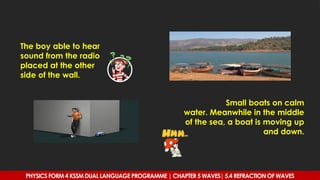
The boy able to hear
sound from the radio
placed at the other
side of the wall.
Small boats on calm
water. Meanwhile in the middle
of the sea, a boat is moving up
and down.
PHYSICS FORM 4 KSSM DUAL LANGUAGE PROGRAMME | CHAPTER 5 WAVES| 5.4 REFRACTION OF WAVES
Source: Image ©2019 TerraMetrics
Image ©2019 Maxar
Technologies
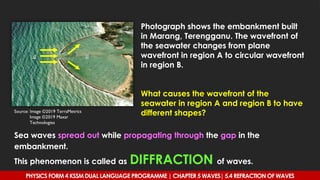
Photograph shows the embankment built
in Marang, Terengganu. The wavefront of
the seawater changes from plane
wavefront in region A to circular wavefront
in region B.
What causes the wavefront of the
seawater in region A and region B to have
different shapes?
Sea waves spread out while propagating through the gap in the
embankment.
This phenomenon is called as DIFFRACTION of waves.
PHYSICS FORM 4 KSSM DUAL LANGUAGE PROGRAMME | CHAPTER 5 WAVES| 5.4 REFRACTION OF WAVES
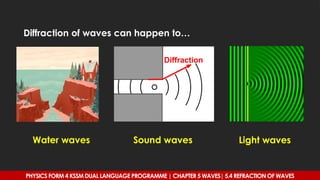
Diffraction of waves can happen to…
Water waves Light waves
Sound waves
PHYSICS FORM 4 KSSM DUAL LANGUAGE PROGRAMME | CHAPTER 5 WAVES| 5.4 REFRACTION OF WAVES
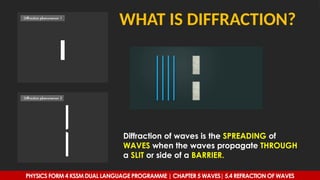
Diffraction of waves is the SPREADING of
WAVES when the waves propagate THROUGH
a SLIT or side of a BARRIER.
PHYSICS FORM 4 KSSM DUAL LANGUAGE PROGRAMME | CHAPTER 5 WAVES| 5.4 REFRACTION OF WAVES
WHAT IS DIFFRACTION?
PHYSICS FORM 4 KSSM DUAL LANGUAGE PROGRAMME | CHAPTER 5 WAVES| 5.4 REFRACTION OF WAVES
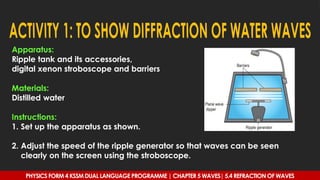
Apparatus:
Ripple tank and its accessories,
digital xenon stroboscope and barriers
Materials:
Distilled water
Instructions:
1. Set up the apparatus as shown.
2. Adjust the speed of the ripple generator so that waves can be seen
clearly on the screen using the stroboscope.
PHYSICS FORM 4 KSSM DUAL LANGUAGE PROGRAMME | CHAPTER 5 WAVES| 5.4 REFRACTION OF WAVES
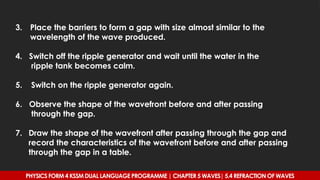
3. Place the barriers to form a gap with size almost similar to the
wavelength of the wave produced.
4. Switch off the ripple generator and wait until the water in the
ripple tank becomes calm.
5. Switch on the ripple generator again.
6. Observe the shape of the wavefront before and after passing
through the gap.
7. Draw the shape of the wavefront after passing through the gap and
record the characteristics of the wavefront before and after passing
through the gap in a table.
PHYSICS FORM 4 KSSM DUAL LANGUAGE PROGRAMME | CHAPTER 5 WAVES| 5.4 REFRACTION OF WAVES
Observation:
PHYSICS FORM 4 KSSM DUAL LANGUAGE PROGRAMME | CHAPTER 5 WAVES| 5.4 REFRACTION OF WAVES
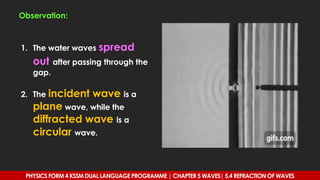
1. The water waves spread
out after passing through the
gap.
2. The incident wave is a
plane wave, while the
diffracted wave is a
circular wave.
Results:
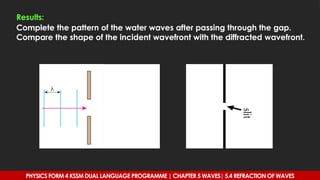
Complete the pattern of the water waves after passing through the gap.
Compare the shape of the incident wavefront with the diffracted wavefront.
PHYSICS FORM 4 KSSM DUAL LANGUAGE PROGRAMME | CHAPTER 5 WAVES| 5.4 REFRACTION OF WAVES
Discussion:
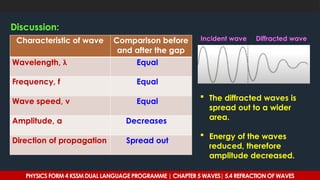
 The diffracted waves is
spread out to a wider
area.
 Energy of the waves
reduced, therefore
amplitude decreased.
Incident wave Diffracted wave
Characteristic of wave Comparison before
and after the gap
Wavelength, λ Equal
Frequency, f Equal
Wave speed, v Equal
Amplitude, a Decreases
Direction of propagation Spread out
PHYSICS FORM 4 KSSM DUAL LANGUAGE PROGRAMME | CHAPTER 5 WAVES| 5.4 REFRACTION OF WAVES
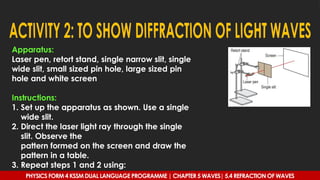
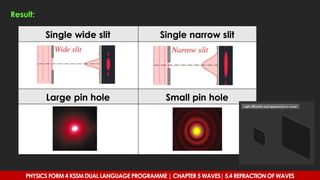
Apparatus:
Laser pen, retort stand, single narrow slit, single
wide slit, small sized pin hole, large sized pin
hole and white screen
Instructions:
1. Set up the apparatus as shown. Use a single
wide slit.
2. Direct the laser light ray through the single
slit. Observe the
pattern formed on the screen and draw the
pattern in a table.
3. Repeat steps 1 and 2 using:
(a) a single narrow slit (b) a large pin hole
PHYSICS FORM 4 KSSM DUAL LANGUAGE PROGRAMME | CHAPTER 5 WAVES| 5.4 REFRACTION OF WAVES
Result:
Single wide slit Single narrow slit
Large pin hole Small pin hole
PHYSICS FORM 4 KSSM DUAL LANGUAGE PROGRAMME | CHAPTER 5 WAVES| 5.4 REFRACTION OF WAVES
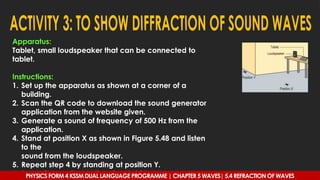
Apparatus:
Tablet, small loudspeaker that can be connected to
tablet.
Instructions:
1. Set up the apparatus as shown at a corner of a
building.
2. Scan the QR code to download the sound generator
application from the website given.
3. Generate a sound of frequency of 500 Hz from the
application.
4. Stand at position X as shown in Figure 5.48 and listen
to the
sound from the loudspeaker.
5. Repeat step 4 by standing at position Y.
6. Record your observations in a table.
PHYSICS FORM 4 KSSM DUAL LANGUAGE PROGRAMME | CHAPTER 5 WAVES| 5.4 REFRACTION OF WAVES
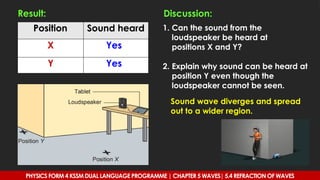
Result: Discussion:
1. Can the sound from the
loudspeaker be heard at
positions X and Y?
2. Explain why sound can be heard at
position Y even though the
loudspeaker cannot be seen.
Position Sound heard
X Yes
Y Yes
PHYSICS FORM 4 KSSM DUAL LANGUAGE PROGRAMME | CHAPTER 5 WAVES| 5.4 REFRACTION OF WAVES
Sound wave diverges and spread
out to a wider region.
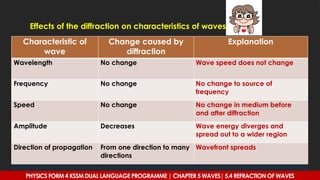
Effects of the diffraction on characteristics of waves
Characteristic of
wave
Change caused by
diffraction
Explanation
Wavelength No change Wave speed does not change
Frequency No change No change to source of
frequency
Speed No change No change in medium before
and after diffraction
Amplitude Decreases Wave energy diverges and
spread out to a wider region
Direction of propagation From one direction to many
directions
Wavefront spreads
PHYSICS FORM 4 KSSM DUAL LANGUAGE PROGRAMME | CHAPTER 5 WAVES| 5.4 REFRACTION OF WAVES
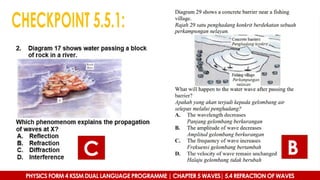
C
PHYSICS FORM 4 KSSM DUAL LANGUAGE PROGRAMME | CHAPTER 5 WAVES| 5.4 REFRACTION OF WAVES
B
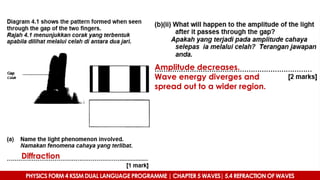
Diffraction
Amplitude decreases.
Wave energy diverges and
spread out to a wider region.
PHYSICS FORM 4 KSSM DUAL LANGUAGE PROGRAMME | CHAPTER 5 WAVES| 5.4 REFRACTION OF WAVES
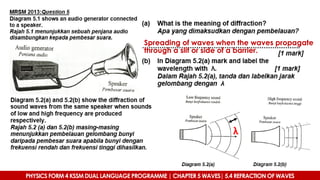
λ
Spreading of waves when the waves propagate
through a slit or side of a barrier.
PHYSICS FORM 4 KSSM DUAL LANGUAGE PROGRAMME | CHAPTER 5 WAVES| 5.4 REFRACTION OF WAVES
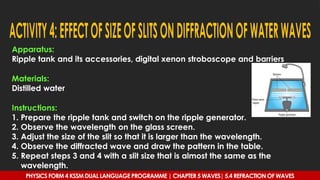
Apparatus:
Ripple tank and its accessories, digital xenon stroboscope and barriers
Materials:
Distilled water
Instructions:
1. Prepare the ripple tank and switch on the ripple generator.
2. Observe the wavelength on the glass screen.
3. Adjust the size of the slit so that it is larger than the wavelength.
4. Observe the diffracted wave and draw the pattern in the table.
5. Repeat steps 3 and 4 with a slit size that is almost the same as the
wavelength.
PHYSICS FORM 4 KSSM DUAL LANGUAGE PROGRAMME | CHAPTER 5 WAVES| 5.4 REFRACTION OF WAVES
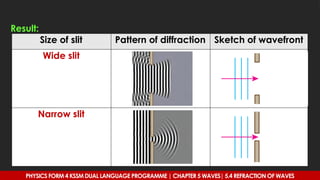
Size of slit Pattern of diffraction Sketch of wavefront
Wide slit
Narrow slit
Result:
PHYSICS FORM 4 KSSM DUAL LANGUAGE PROGRAMME | CHAPTER 5 WAVES| 5.4 REFRACTION OF WAVES
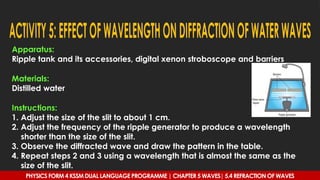
Apparatus:
Ripple tank and its accessories, digital xenon stroboscope and barriers
Materials:
Distilled water
Instructions:
1. Adjust the size of the slit to about 1 cm.
2. Adjust the frequency of the ripple generator to produce a wavelength
shorter than the size of the slit.
3. Observe the diffracted wave and draw the pattern in the table.
4. Repeat steps 2 and 3 using a wavelength that is almost the same as the
size of the slit.
PHYSICS FORM 4 KSSM DUAL LANGUAGE PROGRAMME | CHAPTER 5 WAVES| 5.4 REFRACTION OF WAVES
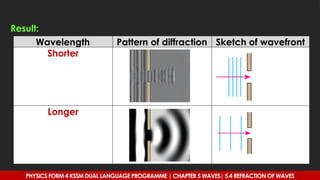
Result:
Wavelength Pattern of diffraction Sketch of wavefront
Shorter
Longer
PHYSICS FORM 4 KSSM DUAL LANGUAGE PROGRAMME | CHAPTER 5 WAVES| 5.4 REFRACTION OF WAVES
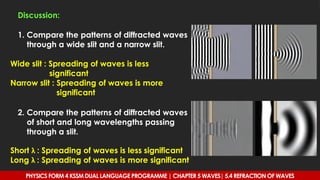
Discussion:
1. Compare the patterns of diffracted waves
through a wide slit and a narrow slit.
Wide slit : Spreading of waves is less
significant
Narrow slit : Spreading of waves is more
significant
2. Compare the patterns of diffracted waves
of short and long wavelengths passing
through a slit.
Short λ : Spreading of waves is less significant
Long λ : Spreading of waves is more significant
PHYSICS FORM 4 KSSM DUAL LANGUAGE PROGRAMME | CHAPTER 5 WAVES| 5.4 REFRACTION OF WAVES
C
PHYSICS FORM 4 KSSM DUAL LANGUAGE PROGRAMME | CHAPTER 5 WAVES| 5.4 REFRACTION OF WAVES
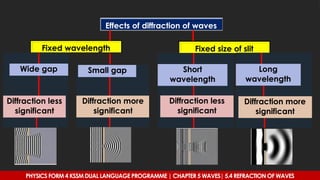
Effects of diffraction of waves
Fixed wavelength Fixed size of slit
Wide gap
Diffraction less
significant
Small gap
Diffraction more
significant
Short
wavelength
Diffraction less
significant
Long
wavelength
Diffraction more
significant
PHYSICS FORM 4 KSSM DUAL LANGUAGE PROGRAMME | CHAPTER 5 WAVES| 5.4 REFRACTION OF WAVES
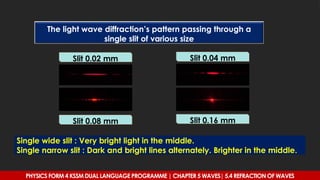
Slit 0.02 mm Slit 0.04 mm
Single wide slit : Very bright light in the middle.
Single narrow slit : Dark and bright lines alternately. Brighter in the middle.
Slit 0.08 mm Slit 0.16 mm
The light wave diffraction’s pattern passing through a
single slit of various size
PHYSICS FORM 4 KSSM DUAL LANGUAGE PROGRAMME | CHAPTER 5 WAVES| 5.4 REFRACTION OF WAVES
 Before the gaps, the wavefronts are
straight/plane for both diagrams.
 After pass through the gaps, the
wavefronts is more circular for
narrow gap and less circular for
wide gap.
 The wavelength equal before and
after passing through the gaps for
both diagrams.
 The smaller the gap, the more
circular the wave pattern.
 Physics concept is diffraction.
PHYSICS FORM 4 KSSM DUAL LANGUAGE PROGRAMME | CHAPTER 5 WAVES| 5.4 REFRACTION OF WAVES
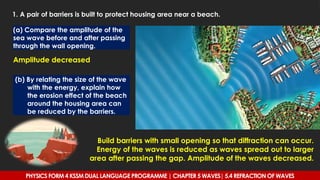
1. A pair of barriers is built to protect housing area near a beach.
(a) Compare the amplitude of the
sea wave before and after passing
through the wall opening.
Amplitude decreased
(b) By relating the size of the wave
with the energy, explain how
the erosion effect of the beach
around the housing area can
be reduced by the barriers.
Build barriers with small opening so that diffraction can occur.
Energy of the waves is reduced as waves spread out to larger
area after passing the gap. Amplitude of the waves decreased.
PHYSICS FORM 4 KSSM DUAL LANGUAGE PROGRAMME | CHAPTER 5 WAVES| 5.4 REFRACTION OF WAVES
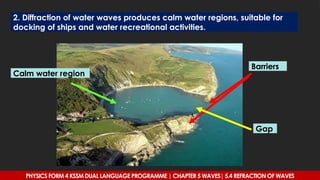
2. Diffraction of water waves produces calm water regions, suitable for
docking of ships and water recreational activities.
Barriers
Gap
Calm water region
PHYSICS FORM 4 KSSM DUAL LANGUAGE PROGRAMME | CHAPTER 5 WAVES| 5.4 REFRACTION OF WAVES
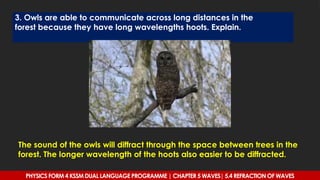
3. Owls are able to communicate across long distances in the
forest because they have long wavelengths hoots. Explain.
The sound of the owls will diffract through the space between trees in the
forest. The longer wavelength of the hoots also easier to be diffracted.
PHYSICS FORM 4 KSSM DUAL LANGUAGE PROGRAMME | CHAPTER 5 WAVES| 5.4 REFRACTION OF WAVES
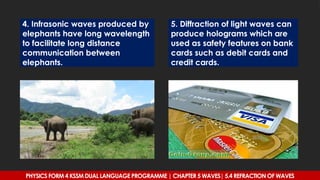
4. Infrasonic waves produced by
elephants have long wavelength
to facilitate long distance
communication between
elephants.
5. Diffraction of light waves can
produce holograms which are
used as safety features on bank
cards such as debit cards and
credit cards.
PHYSICS FORM 4 KSSM DUAL LANGUAGE PROGRAMME | CHAPTER 5 WAVES| 5.4 REFRACTION OF WAVES
11. Diagram 11.1 and Diagram 11.2 show a wave phenomenon after water waves
passing through gaps of different sizes and the amplitude a, of the waves.
(a) Name the wave phenomenon in
Diagram 11.1 and Diagram 11.2.
Diffraction
[1m]
(b) Using Diagram 11.1 and Diagram 11.2,
(i) compare the size of the gap, the angle
of waves' spreading and the amplitude of
the wave after passing through the gaps.
[3m]
PAPER 2-SECTION C [20m]
Size of the gap in Diagram 11.1 > Diagram 11.2.
Angle of waves' spreading in Diagram 11.1 < Diagram 11.2.
Amplitude of the wave after passing through the gaps in Diagram 11.1 > Diagram 11.2.
Diagram 11.1 Diagram 11.2
PHYSICS FORM 4 KSSM DUAL LANGUAGE PROGRAMME | CHAPTER 5 WAVES| 5.4 REFRACTION OF WAVES
(ii) relate the size of the gaps with the angle of waves' spreading and the angle of
the waves' spreading with the amplitude of the waves. [2m]
Size of the gaps decreases, the angle of waves' spreading increases.
Angle of the waves' spreading increases, the amplitude of the waves decreases.
(c) Diagram 11.3 shows an incident water waves passing through the ends of a
floating wood. Copy Diagram 11.3 and draw the water waves after passing through
the ends of the floating wood. Mark with (X) the region where the water is calm. [4m]
X
Diagram 11.3
PHYSICS FORM 4 KSSM DUAL LANGUAGE PROGRAMME | CHAPTER 5 WAVES| 5.4 REFRACTION OF WAVES
(d) Diagram 11.4 shows a communication system involved in
the transmission of radio broadcasts through hilly terrain. Wave
is transmitted from the transmitter and received by the houses
behind the hills. However, the signal received is not clear.
You are required to give some suggestions to
design a communication system which can
improve the quality of signal transmission.
Using the knowledge on waves, explain your
suggestions based on the following aspects;
type of wave transmitted, frequency of the wave,
wavelength of the wave transmitted, location of
the transmitter and the method involved which
enable the wave to propagate in a longer
distance. [10m]
Diagram 11.4
PHYSICS FORM 4 KSSM DUAL LANGUAGE PROGRAMME | CHAPTER 5 WAVES| 5.4 REFRACTION OF WAVES
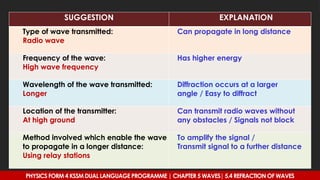
SUGGESTION EXPLANATION
Type of wave transmitted:
Radio wave
Can propagate in long distance
Frequency of the wave:
High wave frequency
Has higher energy
Wavelength of the wave transmitted:
Longer
Diffraction occurs at a larger
angle / Easy to diffract
Location of the transmitter:
At high ground
Can transmit radio waves without
any obstacles / Signals not block
Method involved which enable the wave
to propagate in a longer distance:
Using relay stations
To amplify the signal /
Transmit signal to a further distance
PHYSICS FORM 4 KSSM DUAL LANGUAGE PROGRAMME | CHAPTER 5 WAVES| 5.4 REFRACTION OF WAVES

Diffraction of Waves in English Learning

  • 1.
    PHYSICS FORM 4KSSM DUAL LANGUAGE PROGRAMME | CHAPTER 5 WAVES| 5.4 REFRACTION OF WAVES
  • 2.
    The boy ableto hear sound from the radio placed at the other side of the wall. Small boats on calm water. Meanwhile in the middle of the sea, a boat is moving up and down. PHYSICS FORM 4 KSSM DUAL LANGUAGE PROGRAMME | CHAPTER 5 WAVES| 5.4 REFRACTION OF WAVES
  • 3.
    Source: Image ©2019TerraMetrics Image ©2019 Maxar Technologies Photograph shows the embankment built in Marang, Terengganu. The wavefront of the seawater changes from plane wavefront in region A to circular wavefront in region B. What causes the wavefront of the seawater in region A and region B to have different shapes? Sea waves spread out while propagating through the gap in the embankment. This phenomenon is called as DIFFRACTION of waves. PHYSICS FORM 4 KSSM DUAL LANGUAGE PROGRAMME | CHAPTER 5 WAVES| 5.4 REFRACTION OF WAVES
  • 4.
    Diffraction of wavescan happen to… Water waves Light waves Sound waves PHYSICS FORM 4 KSSM DUAL LANGUAGE PROGRAMME | CHAPTER 5 WAVES| 5.4 REFRACTION OF WAVES
  • 5.
    Diffraction of wavesis the SPREADING of WAVES when the waves propagate THROUGH a SLIT or side of a BARRIER. PHYSICS FORM 4 KSSM DUAL LANGUAGE PROGRAMME | CHAPTER 5 WAVES| 5.4 REFRACTION OF WAVES WHAT IS DIFFRACTION?
  • 6.
    PHYSICS FORM 4KSSM DUAL LANGUAGE PROGRAMME | CHAPTER 5 WAVES| 5.4 REFRACTION OF WAVES
  • 7.
    Apparatus: Ripple tank andits accessories, digital xenon stroboscope and barriers Materials: Distilled water Instructions: 1. Set up the apparatus as shown. 2. Adjust the speed of the ripple generator so that waves can be seen clearly on the screen using the stroboscope. PHYSICS FORM 4 KSSM DUAL LANGUAGE PROGRAMME | CHAPTER 5 WAVES| 5.4 REFRACTION OF WAVES
  • 8.
    3. Place thebarriers to form a gap with size almost similar to the wavelength of the wave produced. 4. Switch off the ripple generator and wait until the water in the ripple tank becomes calm. 5. Switch on the ripple generator again. 6. Observe the shape of the wavefront before and after passing through the gap. 7. Draw the shape of the wavefront after passing through the gap and record the characteristics of the wavefront before and after passing through the gap in a table. PHYSICS FORM 4 KSSM DUAL LANGUAGE PROGRAMME | CHAPTER 5 WAVES| 5.4 REFRACTION OF WAVES
  • 9.
    Observation: PHYSICS FORM 4KSSM DUAL LANGUAGE PROGRAMME | CHAPTER 5 WAVES| 5.4 REFRACTION OF WAVES 1. The water waves spread out after passing through the gap. 2. The incident wave is a plane wave, while the diffracted wave is a circular wave.
  • 10.
    Results: Complete the patternof the water waves after passing through the gap. Compare the shape of the incident wavefront with the diffracted wavefront. PHYSICS FORM 4 KSSM DUAL LANGUAGE PROGRAMME | CHAPTER 5 WAVES| 5.4 REFRACTION OF WAVES
  • 11.
    Discussion:  The diffractedwaves is spread out to a wider area.  Energy of the waves reduced, therefore amplitude decreased. Incident wave Diffracted wave Characteristic of wave Comparison before and after the gap Wavelength, λ Equal Frequency, f Equal Wave speed, v Equal Amplitude, a Decreases Direction of propagation Spread out PHYSICS FORM 4 KSSM DUAL LANGUAGE PROGRAMME | CHAPTER 5 WAVES| 5.4 REFRACTION OF WAVES
  • 12.
    Apparatus: Laser pen, retortstand, single narrow slit, single wide slit, small sized pin hole, large sized pin hole and white screen Instructions: 1. Set up the apparatus as shown. Use a single wide slit. 2. Direct the laser light ray through the single slit. Observe the pattern formed on the screen and draw the pattern in a table. 3. Repeat steps 1 and 2 using: (a) a single narrow slit (b) a large pin hole PHYSICS FORM 4 KSSM DUAL LANGUAGE PROGRAMME | CHAPTER 5 WAVES| 5.4 REFRACTION OF WAVES
  • 13.
    Result: Single wide slitSingle narrow slit Large pin hole Small pin hole PHYSICS FORM 4 KSSM DUAL LANGUAGE PROGRAMME | CHAPTER 5 WAVES| 5.4 REFRACTION OF WAVES
  • 14.
    Apparatus: Tablet, small loudspeakerthat can be connected to tablet. Instructions: 1. Set up the apparatus as shown at a corner of a building. 2. Scan the QR code to download the sound generator application from the website given. 3. Generate a sound of frequency of 500 Hz from the application. 4. Stand at position X as shown in Figure 5.48 and listen to the sound from the loudspeaker. 5. Repeat step 4 by standing at position Y. 6. Record your observations in a table. PHYSICS FORM 4 KSSM DUAL LANGUAGE PROGRAMME | CHAPTER 5 WAVES| 5.4 REFRACTION OF WAVES
  • 15.
    Result: Discussion: 1. Canthe sound from the loudspeaker be heard at positions X and Y? 2. Explain why sound can be heard at position Y even though the loudspeaker cannot be seen. Position Sound heard X Yes Y Yes PHYSICS FORM 4 KSSM DUAL LANGUAGE PROGRAMME | CHAPTER 5 WAVES| 5.4 REFRACTION OF WAVES Sound wave diverges and spread out to a wider region.
  • 16.
    Effects of thediffraction on characteristics of waves Characteristic of wave Change caused by diffraction Explanation Wavelength No change Wave speed does not change Frequency No change No change to source of frequency Speed No change No change in medium before and after diffraction Amplitude Decreases Wave energy diverges and spread out to a wider region Direction of propagation From one direction to many directions Wavefront spreads PHYSICS FORM 4 KSSM DUAL LANGUAGE PROGRAMME | CHAPTER 5 WAVES| 5.4 REFRACTION OF WAVES
  • 17.
    C PHYSICS FORM 4KSSM DUAL LANGUAGE PROGRAMME | CHAPTER 5 WAVES| 5.4 REFRACTION OF WAVES B
  • 18.
    Diffraction Amplitude decreases. Wave energydiverges and spread out to a wider region. PHYSICS FORM 4 KSSM DUAL LANGUAGE PROGRAMME | CHAPTER 5 WAVES| 5.4 REFRACTION OF WAVES
  • 19.
    λ Spreading of waveswhen the waves propagate through a slit or side of a barrier. PHYSICS FORM 4 KSSM DUAL LANGUAGE PROGRAMME | CHAPTER 5 WAVES| 5.4 REFRACTION OF WAVES
  • 20.
    PHYSICS FORM 4KSSM DUAL LANGUAGE PROGRAMME | CHAPTER 5 WAVES| 5.4 REFRACTION OF WAVES
  • 21.
    Apparatus: Ripple tank andits accessories, digital xenon stroboscope and barriers Materials: Distilled water Instructions: 1. Prepare the ripple tank and switch on the ripple generator. 2. Observe the wavelength on the glass screen. 3. Adjust the size of the slit so that it is larger than the wavelength. 4. Observe the diffracted wave and draw the pattern in the table. 5. Repeat steps 3 and 4 with a slit size that is almost the same as the wavelength. PHYSICS FORM 4 KSSM DUAL LANGUAGE PROGRAMME | CHAPTER 5 WAVES| 5.4 REFRACTION OF WAVES
  • 22.
    Size of slitPattern of diffraction Sketch of wavefront Wide slit Narrow slit Result: PHYSICS FORM 4 KSSM DUAL LANGUAGE PROGRAMME | CHAPTER 5 WAVES| 5.4 REFRACTION OF WAVES
  • 23.
    Apparatus: Ripple tank andits accessories, digital xenon stroboscope and barriers Materials: Distilled water Instructions: 1. Adjust the size of the slit to about 1 cm. 2. Adjust the frequency of the ripple generator to produce a wavelength shorter than the size of the slit. 3. Observe the diffracted wave and draw the pattern in the table. 4. Repeat steps 2 and 3 using a wavelength that is almost the same as the size of the slit. PHYSICS FORM 4 KSSM DUAL LANGUAGE PROGRAMME | CHAPTER 5 WAVES| 5.4 REFRACTION OF WAVES
  • 24.
    Result: Wavelength Pattern ofdiffraction Sketch of wavefront Shorter Longer PHYSICS FORM 4 KSSM DUAL LANGUAGE PROGRAMME | CHAPTER 5 WAVES| 5.4 REFRACTION OF WAVES
  • 25.
    Discussion: 1. Compare thepatterns of diffracted waves through a wide slit and a narrow slit. Wide slit : Spreading of waves is less significant Narrow slit : Spreading of waves is more significant 2. Compare the patterns of diffracted waves of short and long wavelengths passing through a slit. Short λ : Spreading of waves is less significant Long λ : Spreading of waves is more significant PHYSICS FORM 4 KSSM DUAL LANGUAGE PROGRAMME | CHAPTER 5 WAVES| 5.4 REFRACTION OF WAVES
  • 26.
    C PHYSICS FORM 4KSSM DUAL LANGUAGE PROGRAMME | CHAPTER 5 WAVES| 5.4 REFRACTION OF WAVES
  • 27.
    PHYSICS FORM 4KSSM DUAL LANGUAGE PROGRAMME | CHAPTER 5 WAVES| 5.4 REFRACTION OF WAVES
  • 28.
    Effects of diffractionof waves Fixed wavelength Fixed size of slit Wide gap Diffraction less significant Small gap Diffraction more significant Short wavelength Diffraction less significant Long wavelength Diffraction more significant PHYSICS FORM 4 KSSM DUAL LANGUAGE PROGRAMME | CHAPTER 5 WAVES| 5.4 REFRACTION OF WAVES
  • 29.
    Slit 0.02 mmSlit 0.04 mm Single wide slit : Very bright light in the middle. Single narrow slit : Dark and bright lines alternately. Brighter in the middle. Slit 0.08 mm Slit 0.16 mm The light wave diffraction’s pattern passing through a single slit of various size PHYSICS FORM 4 KSSM DUAL LANGUAGE PROGRAMME | CHAPTER 5 WAVES| 5.4 REFRACTION OF WAVES
  • 30.
     Before thegaps, the wavefronts are straight/plane for both diagrams.  After pass through the gaps, the wavefronts is more circular for narrow gap and less circular for wide gap.  The wavelength equal before and after passing through the gaps for both diagrams.  The smaller the gap, the more circular the wave pattern.  Physics concept is diffraction. PHYSICS FORM 4 KSSM DUAL LANGUAGE PROGRAMME | CHAPTER 5 WAVES| 5.4 REFRACTION OF WAVES
  • 31.
    PHYSICS FORM 4KSSM DUAL LANGUAGE PROGRAMME | CHAPTER 5 WAVES| 5.4 REFRACTION OF WAVES
  • 32.
    1. A pairof barriers is built to protect housing area near a beach. (a) Compare the amplitude of the sea wave before and after passing through the wall opening. Amplitude decreased (b) By relating the size of the wave with the energy, explain how the erosion effect of the beach around the housing area can be reduced by the barriers. Build barriers with small opening so that diffraction can occur. Energy of the waves is reduced as waves spread out to larger area after passing the gap. Amplitude of the waves decreased. PHYSICS FORM 4 KSSM DUAL LANGUAGE PROGRAMME | CHAPTER 5 WAVES| 5.4 REFRACTION OF WAVES
  • 33.
    2. Diffraction ofwater waves produces calm water regions, suitable for docking of ships and water recreational activities. Barriers Gap Calm water region PHYSICS FORM 4 KSSM DUAL LANGUAGE PROGRAMME | CHAPTER 5 WAVES| 5.4 REFRACTION OF WAVES
  • 34.
    3. Owls areable to communicate across long distances in the forest because they have long wavelengths hoots. Explain. The sound of the owls will diffract through the space between trees in the forest. The longer wavelength of the hoots also easier to be diffracted. PHYSICS FORM 4 KSSM DUAL LANGUAGE PROGRAMME | CHAPTER 5 WAVES| 5.4 REFRACTION OF WAVES
  • 35.
    4. Infrasonic wavesproduced by elephants have long wavelength to facilitate long distance communication between elephants. 5. Diffraction of light waves can produce holograms which are used as safety features on bank cards such as debit cards and credit cards. PHYSICS FORM 4 KSSM DUAL LANGUAGE PROGRAMME | CHAPTER 5 WAVES| 5.4 REFRACTION OF WAVES
  • 36.
    PHYSICS FORM 4KSSM DUAL LANGUAGE PROGRAMME | CHAPTER 5 WAVES| 5.4 REFRACTION OF WAVES
  • 37.
    11. Diagram 11.1and Diagram 11.2 show a wave phenomenon after water waves passing through gaps of different sizes and the amplitude a, of the waves. (a) Name the wave phenomenon in Diagram 11.1 and Diagram 11.2. Diffraction [1m] (b) Using Diagram 11.1 and Diagram 11.2, (i) compare the size of the gap, the angle of waves' spreading and the amplitude of the wave after passing through the gaps. [3m] PAPER 2-SECTION C [20m] Size of the gap in Diagram 11.1 > Diagram 11.2. Angle of waves' spreading in Diagram 11.1 < Diagram 11.2. Amplitude of the wave after passing through the gaps in Diagram 11.1 > Diagram 11.2. Diagram 11.1 Diagram 11.2 PHYSICS FORM 4 KSSM DUAL LANGUAGE PROGRAMME | CHAPTER 5 WAVES| 5.4 REFRACTION OF WAVES
  • 38.
    (ii) relate thesize of the gaps with the angle of waves' spreading and the angle of the waves' spreading with the amplitude of the waves. [2m] Size of the gaps decreases, the angle of waves' spreading increases. Angle of the waves' spreading increases, the amplitude of the waves decreases. (c) Diagram 11.3 shows an incident water waves passing through the ends of a floating wood. Copy Diagram 11.3 and draw the water waves after passing through the ends of the floating wood. Mark with (X) the region where the water is calm. [4m] X Diagram 11.3 PHYSICS FORM 4 KSSM DUAL LANGUAGE PROGRAMME | CHAPTER 5 WAVES| 5.4 REFRACTION OF WAVES
  • 39.
    (d) Diagram 11.4shows a communication system involved in the transmission of radio broadcasts through hilly terrain. Wave is transmitted from the transmitter and received by the houses behind the hills. However, the signal received is not clear. You are required to give some suggestions to design a communication system which can improve the quality of signal transmission. Using the knowledge on waves, explain your suggestions based on the following aspects; type of wave transmitted, frequency of the wave, wavelength of the wave transmitted, location of the transmitter and the method involved which enable the wave to propagate in a longer distance. [10m] Diagram 11.4 PHYSICS FORM 4 KSSM DUAL LANGUAGE PROGRAMME | CHAPTER 5 WAVES| 5.4 REFRACTION OF WAVES
  • 40.
    SUGGESTION EXPLANATION Type ofwave transmitted: Radio wave Can propagate in long distance Frequency of the wave: High wave frequency Has higher energy Wavelength of the wave transmitted: Longer Diffraction occurs at a larger angle / Easy to diffract Location of the transmitter: At high ground Can transmit radio waves without any obstacles / Signals not block Method involved which enable the wave to propagate in a longer distance: Using relay stations To amplify the signal / Transmit signal to a further distance PHYSICS FORM 4 KSSM DUAL LANGUAGE PROGRAMME | CHAPTER 5 WAVES| 5.4 REFRACTION OF WAVES
  • 41.
    PHYSICS FORM 4KSSM DUAL LANGUAGE PROGRAMME | CHAPTER 5 WAVES| 5.4 REFRACTION OF WAVES