Different Applications
of Stack Data Structure
Data Structures and Algorithms
PCC-CS301
BY AINDRILA HALDAR
DEPARTMENT OF COMPUTER SCIENCE
AND ENGINEERING
MAULANA ABUL KALAM AZAD
UNIVERSITY OF TECHNOLOGY,
WEST BENGAL
Introduction
AINDRILA HALDAR 2
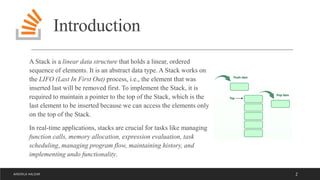
A Stack is a linear data structure that holds a linear, ordered
sequence of elements. It is an abstract data type. A Stack works on
the LIFO (Last In First Out) process, i.e., the element that was
inserted last will be removed first. To implement the Stack, it is
required to maintain a pointer to the top of the Stack, which is the
last element to be inserted because we can access the elements only
on the top of the Stack.
In real-time applications, stacks are crucial for tasks like managing
function calls, memory allocation, expression evaluation, task
scheduling, managing program flow, maintaining history, and
implementing undo functionality.
Applications-I
AINDRILA HALDAR 3
▪ Function Call Management:
Compilers and interpreters use a call stack to manage function calls during
program execution. Each time a function is called, its state (local variables,
return address) is pushed onto the stack. When the function completes, its
state is popped, and execution returns to the caller. This is fundamental for
handling nested function calls and recursion.
Applications-II
AINDRILA HALDAR 4
▪ Expression Evaluation and Conversion:
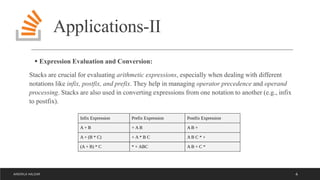
Stacks are crucial for evaluating arithmetic expressions, especially when dealing with different
notations like infix, postfix, and prefix. They help in managing operator precedence and operand
processing. Stacks are also used in converting expressions from one notation to another (e.g., infix
to postfix).
Applications-III
AINDRILA HALDAR 5
▪ Undo/Redo Functionality:
Many applications, such as text editors and graphic design software, implement undo/redo
features using stacks. Each action performed is pushed onto an "undo" stack. To undo, the last
action is popped and reversed. A "redo" stack can store undone actions to allow re-applying them.
Applications-IV
AINDRILA HALDAR 6
▪ Browser History Navigation:
Web browsers utilize a stack to manage the history of visited URLs. When a new page is visited, its
URL is pushed onto the stack. The "Back" button functionality is implemented by popping the
current URL and navigating to the previously visited URL at the top of the stack.
▪ Backtracking Algorithms:
Algorithms that explore multiple paths to find a solution, like Depth-First Search (DFS) in graphs
or maze-solving algorithms, often employ stacks to keep track of the current path and backtrack
when a dead end is reached. The current state is pushed onto the stack, and if a path proves
unfruitful, states are popped to explore alternative routes.
Applications-V
AINDRILA HALDAR 7
▪ Delimiter Checking:
Stacks are used to validate the proper nesting and balancing of delimiters (parentheses, braces,
brackets) in programming languages or mathematical expressions. Opening delimiters are pushed
onto the stack, and when a closing delimiter is encountered, the corresponding opening delimiter is
popped. If the stack is empty at the end, and all delimiters are matched, the expression is balanced.
▪ Reversing Data:
Due to its LIFO nature, a stack can be effectively used to reverse the order of elements in a list,
string, or other data structures. Elements are pushed onto the stack, and then popped to retrieve
them in reverse order.
Conclusion
AINDRILA HALDAR 8
In conclusion, the stack's LIFO nature proves invaluable in scenarios where elements need to be
processed in a specific, controlled order. Its widespread use across diverse domains, from
compilers and interpreters to user-facing applications, highlights its importance in building
efficient, reliable, and scalable software systems. Mastering the stack and understanding its
applications is crucial for effective problem-solving in computer science
AINDRILA HALDAR 9

Different Applications of Stack Data Structure

  • 1.
    Different Applications of StackData Structure Data Structures and Algorithms PCC-CS301 BY AINDRILA HALDAR DEPARTMENT OF COMPUTER SCIENCE AND ENGINEERING MAULANA ABUL KALAM AZAD UNIVERSITY OF TECHNOLOGY, WEST BENGAL
  • 2.
    Introduction AINDRILA HALDAR 2 AStack is a linear data structure that holds a linear, ordered sequence of elements. It is an abstract data type. A Stack works on the LIFO (Last In First Out) process, i.e., the element that was inserted last will be removed first. To implement the Stack, it is required to maintain a pointer to the top of the Stack, which is the last element to be inserted because we can access the elements only on the top of the Stack. In real-time applications, stacks are crucial for tasks like managing function calls, memory allocation, expression evaluation, task scheduling, managing program flow, maintaining history, and implementing undo functionality.
  • 3.
    Applications-I AINDRILA HALDAR 3 ▪Function Call Management: Compilers and interpreters use a call stack to manage function calls during program execution. Each time a function is called, its state (local variables, return address) is pushed onto the stack. When the function completes, its state is popped, and execution returns to the caller. This is fundamental for handling nested function calls and recursion.
  • 4.
    Applications-II AINDRILA HALDAR 4 ▪Expression Evaluation and Conversion: Stacks are crucial for evaluating arithmetic expressions, especially when dealing with different notations like infix, postfix, and prefix. They help in managing operator precedence and operand processing. Stacks are also used in converting expressions from one notation to another (e.g., infix to postfix).
  • 5.
    Applications-III AINDRILA HALDAR 5 ▪Undo/Redo Functionality: Many applications, such as text editors and graphic design software, implement undo/redo features using stacks. Each action performed is pushed onto an "undo" stack. To undo, the last action is popped and reversed. A "redo" stack can store undone actions to allow re-applying them.
  • 6.
    Applications-IV AINDRILA HALDAR 6 ▪Browser History Navigation: Web browsers utilize a stack to manage the history of visited URLs. When a new page is visited, its URL is pushed onto the stack. The "Back" button functionality is implemented by popping the current URL and navigating to the previously visited URL at the top of the stack. ▪ Backtracking Algorithms: Algorithms that explore multiple paths to find a solution, like Depth-First Search (DFS) in graphs or maze-solving algorithms, often employ stacks to keep track of the current path and backtrack when a dead end is reached. The current state is pushed onto the stack, and if a path proves unfruitful, states are popped to explore alternative routes.
  • 7.
    Applications-V AINDRILA HALDAR 7 ▪Delimiter Checking: Stacks are used to validate the proper nesting and balancing of delimiters (parentheses, braces, brackets) in programming languages or mathematical expressions. Opening delimiters are pushed onto the stack, and when a closing delimiter is encountered, the corresponding opening delimiter is popped. If the stack is empty at the end, and all delimiters are matched, the expression is balanced. ▪ Reversing Data: Due to its LIFO nature, a stack can be effectively used to reverse the order of elements in a list, string, or other data structures. Elements are pushed onto the stack, and then popped to retrieve them in reverse order.
  • 8.
    Conclusion AINDRILA HALDAR 8 Inconclusion, the stack's LIFO nature proves invaluable in scenarios where elements need to be processed in a specific, controlled order. Its widespread use across diverse domains, from compilers and interpreters to user-facing applications, highlights its importance in building efficient, reliable, and scalable software systems. Mastering the stack and understanding its applications is crucial for effective problem-solving in computer science
  • 9.