STACKS & QUEUES
UNIT 4
INTRODUCTION
• A Stack is a linear data structure that follows the LIFO (Last-In-First-
Out) principle. Stack has one end, whereas the Queue has two ends (front
and rear). It contains only one pointer top pointer pointing to the topmost
element of the stack. Whenever an element is added in the stack, it is added
on the top of the stack, and the element can be deleted only from the stack.
In other words, a stack can be defined as a container in which insertion and
deletion can be done from the one end known as the top of the stack.
WORKING OF STACK
WORKING OF STACK
• Stack works on the LIFO pattern. As we can observe in the below figure there
are five memory blocks in the stack; therefore, the size of the stack is 5.
• Suppose we want to store the elements in a stack and let's assume that stack
is empty. We have taken the stack of size 5 as shown below in which we are
pushing the elements one by one until the stack becomes full.
• Since our stack is full as the size of the stack is 5. In the above cases, we can
observe that it goes from the top to the bottom when we were entering the
new element in the stack. The stack gets filled up from the bottom to the top.
MEMORY REPRESENTATION OF STACK
• Array Representation of Stacks: First we have to allocate a memory block of sufficient
size to accommodate the full capacity of the stack.Then, starting from the first location
of the memory block, the items of the stack can be stored in a sequential fashion. In
Figure, Itemi denotes the ith item in the stack; l and u denote the index range of the
array in use; usually the values of these indices are 1 and SIZE respectively.TOP is a
pointer to point the position of the array up to which it is filled with the items of the
stack.With this representation, the following two ways can be stated:
MEMORY REPRESENTATION OF STACK
• Linked List Representation of Stacks:Although array representation of stacks is very easy
and convenient but it allows the representation of only fixed sized stacks. In several
applications, the size of the stack may vary during program execution.An obvious
solution to this problem is to represent a stack using a linked list.A single linked list
structure is sufficient to represent any stack. Here, the DATA field is for the ITEM, and
the LINK field is, as usual, to point to the next' item.Above Figure b depicts such a stack
using a single linked list
MEMORY REPRESENTATION OF STACK
DELETION OF ELEMENT
• When we perform the delete operation on the stack, there is only one way
for entry and exit as the other end is closed. It follows the LIFO pattern,
which means that the value entered first will be removed last. In the above
case, the value 5 is entered first, so it will be removed only after the deletion
of all the other elements.
PUSH OPERATION
• Before inserting an element in a stack, we check whether the stack is full.
• If we try to insert the element in a stack, and the stack is full, then
the overflow condition occurs.
• When we initialize a stack, we set the value of top as -1 to check that the stack is empty.
• When the new element is pushed in a stack, first, the value of the top gets incremented,
i.e., top=top+1, and the element will be placed at the new position of the top.
• The elements will be inserted until we reach the max size of the stack.
PUSH OPERATION
ALGORITHM
• begin
• if stack is full
• return
• endif
• else
• increment top
• stack[top] assign value
• end else
• end procedure
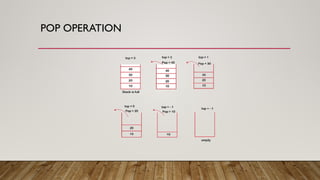
POP OPERATION
• Before deleting the element from the stack, we check whether the stack is
empty.
• If we try to delete the element from the empty stack, then
the underflow condition occurs.
• If the stack is not empty, we first access the element which is pointed by
the top
• Once the pop operation is performed, the top is decremented by 1,
i.e., top=top-1.
POP OPERATION
ALGORITHM
• begin
• if stack is empty
• return
• endif
• else
• store value of stack[top]
• decrement top
• return value
• end else
• end procedure
APPLICATIONS OF STACK
• The following are the applications of the stack:
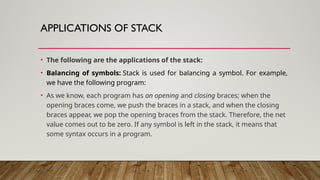
• Balancing of symbols: Stack is used for balancing a symbol. For example,
we have the following program:
• As we know, each program has an opening and closing braces; when the
opening braces come, we push the braces in a stack, and when the closing
braces appear, we pop the opening braces from the stack. Therefore, the net
value comes out to be zero. If any symbol is left in the stack, it means that
some syntax occurs in a program.
APPLICATIONS OF STACK
• String reversal: Stack is also used for reversing a string. For example, we want to reverse a
"javaProgram" string, so we can achieve this with the help of a stack.
First, we push all the characters of the string in a stack until we reach the null character.
After pushing all the characters, we start taking out the character one by one until we reach the
bottom of the stack.
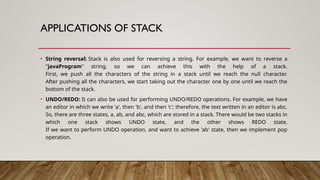
• UNDO/REDO: It can also be used for performing UNDO/REDO operations. For example, we have
an editor in which we write 'a', then 'b', and then 'c'; therefore, the text written in an editor is abc.
So, there are three states, a, ab, and abc, which are stored in a stack. There would be two stacks in
which one stack shows UNDO state, and the other shows REDO state.
If we want to perform UNDO operation, and want to achieve 'ab' state, then we implement pop
operation.
APPLICATIONS OF STACK
• Recursion: The recursion means that the function is calling itself again. To
maintain the previous states, the compiler creates a system stack in which all the
previous records of the function are maintained.
• DFS(Depth First Search): This search is implemented on a Graph, and Graph uses
the stack data structure.
• Backtracking: Suppose we have to create a path to solve a maze problem. If we
are moving in a particular path, and we realize that we come on the wrong way.
In order to come at the beginning of the path to create a new path, we have to
use the stack data structure.
APPLICATIONS OF STACK
• Expression conversion: Stack can also be used for expression conversion.This is one of the most important applications of
stack.The list of the expression conversion is given below:
• Infix to prefix
• Infix to postfix
• Prefix to infix
• Prefix to postfix
• Postfix to infix
• Memory management: The stack manages the memory. The memory is assigned in the contiguous
memory blocks. The memory is known as stack memory as all the variables are assigned in a function call
stack memory. The memory size assigned to the program is known to the compiler. When the function is
created, all its variables are assigned in the stack memory. When the function completed its execution, all
the variables assigned in the stack are released.
QUEUES
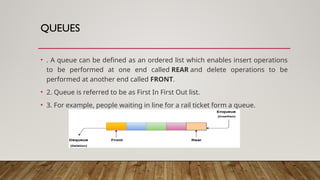
• . A queue can be defined as an ordered list which enables insert operations
to be performed at one end called REAR and delete operations to be
performed at another end called FRONT.
• 2. Queue is referred to be as First In First Out list.
• 3. For example, people waiting in line for a rail ticket form a queue.
APPLICATIONS OF QUEUE
1.Queues are widely used as waiting lists for a single shared resource like printer,
disk, CPU.
2.Queues are used in asynchronous transfer of data (where data is not being
transferred at the same rate between two processes) for eg. pipes, file IO,
sockets.
3.Queues are used as buffers in most of the applications like MP3 media player, CD
player, etc.
4.Queue are used to maintain the play list in media players in order to add and
remove the songs from the play-list.
5.Queues are used in operating systems for handling interrupts.
TYPES OF QUEUE
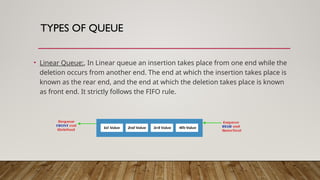
• Linear Queue:, In Linear queue an insertion takes place from one end while the
deletion occurs from another end. The end at which the insertion takes place is
known as the rear end, and the end at which the deletion takes place is known
as front end. It strictly follows the FIFO rule.
CIRCULAR QUEUE
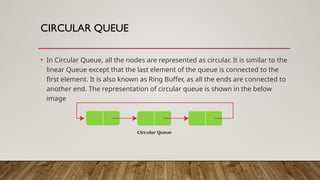
• In Circular Queue, all the nodes are represented as circular. It is similar to the
linear Queue except that the last element of the queue is connected to the
first element. It is also known as Ring Buffer, as all the ends are connected to
another end. The representation of circular queue is shown in the below
image
DEQUE (OR, DOUBLE ENDED QUEUE)
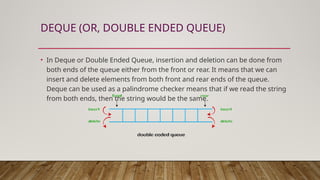
• In Deque or Double Ended Queue, insertion and deletion can be done from
both ends of the queue either from the front or rear. It means that we can
insert and delete elements from both front and rear ends of the queue.
Deque can be used as a palindrome checker means that if we read the string
from both ends, then the string would be the same.
TWO TYPES OF DEQUE
• Input restricted deque - As the name implies, in input restricted queue,
insertion operation can be performed at only one end, while deletion can be
performed from both ends.
• Output restricted deque - As the name implies, in output restricted queue,
deletion operation can be performed at only one end, while insertion can be
performed from both ends.
PRIORITY QUEUE
• It is a special type of queue in which the elements are arranged based on the
priority. It is a special type of queue data structure in which every element
has a priority associated with it. Suppose some elements occur with the
same priority, they will be arranged according to the FIFO principle. The
representation of priority queue is shown in the below image
TWO TYPES OF PRIORITY QUEUE
• Ascending priority queue - In ascending priority queue, elements can be
inserted in arbitrary order, but only smallest can be deleted first. Suppose an
array with elements 7, 5, and 3 in the same order, so, insertion can be done
with the same sequence, but the order of deleting the elements is 3, 5, 7.
• Descending priority queue - In descending priority queue, elements can be
inserted in arbitrary order, but only the largest element can be deleted first.
Suppose an array with elements 7, 3, and 5 in the same order, so, insertion
can be done with the same sequence, but the order of deleting the elements
is 7, 5, 3.
OPERATIONS PERFORMED ON QUEUE
• Enqueue: The Enqueue operation is used to insert the element at the rear end of the
queue. It returns void.
• Dequeue: It performs the deletion from the front-end of the queue. It also returns
the element which has been removed from the front-end. It returns an integer value.
• Peek: This is the third operation that returns the element, which is pointed by the
front pointer in the queue but does not delete it.
• Queue overflow (isfull): It shows the overflow condition when the queue is
completely full.
• Queue underflow (isempty): It shows the underflow condition when the Queue is
empty, i.e., no elements are in the Queue.

Stacks.pptx in software engineering in simple understanding

  • 1.
  • 2.
    INTRODUCTION • A Stackis a linear data structure that follows the LIFO (Last-In-First- Out) principle. Stack has one end, whereas the Queue has two ends (front and rear). It contains only one pointer top pointer pointing to the topmost element of the stack. Whenever an element is added in the stack, it is added on the top of the stack, and the element can be deleted only from the stack. In other words, a stack can be defined as a container in which insertion and deletion can be done from the one end known as the top of the stack.
  • 3.
  • 4.
    WORKING OF STACK •Stack works on the LIFO pattern. As we can observe in the below figure there are five memory blocks in the stack; therefore, the size of the stack is 5. • Suppose we want to store the elements in a stack and let's assume that stack is empty. We have taken the stack of size 5 as shown below in which we are pushing the elements one by one until the stack becomes full. • Since our stack is full as the size of the stack is 5. In the above cases, we can observe that it goes from the top to the bottom when we were entering the new element in the stack. The stack gets filled up from the bottom to the top.
  • 5.
    MEMORY REPRESENTATION OFSTACK • Array Representation of Stacks: First we have to allocate a memory block of sufficient size to accommodate the full capacity of the stack.Then, starting from the first location of the memory block, the items of the stack can be stored in a sequential fashion. In Figure, Itemi denotes the ith item in the stack; l and u denote the index range of the array in use; usually the values of these indices are 1 and SIZE respectively.TOP is a pointer to point the position of the array up to which it is filled with the items of the stack.With this representation, the following two ways can be stated:
  • 6.
    MEMORY REPRESENTATION OFSTACK • Linked List Representation of Stacks:Although array representation of stacks is very easy and convenient but it allows the representation of only fixed sized stacks. In several applications, the size of the stack may vary during program execution.An obvious solution to this problem is to represent a stack using a linked list.A single linked list structure is sufficient to represent any stack. Here, the DATA field is for the ITEM, and the LINK field is, as usual, to point to the next' item.Above Figure b depicts such a stack using a single linked list
  • 7.
  • 8.
    DELETION OF ELEMENT •When we perform the delete operation on the stack, there is only one way for entry and exit as the other end is closed. It follows the LIFO pattern, which means that the value entered first will be removed last. In the above case, the value 5 is entered first, so it will be removed only after the deletion of all the other elements.
  • 9.
    PUSH OPERATION • Beforeinserting an element in a stack, we check whether the stack is full. • If we try to insert the element in a stack, and the stack is full, then the overflow condition occurs. • When we initialize a stack, we set the value of top as -1 to check that the stack is empty. • When the new element is pushed in a stack, first, the value of the top gets incremented, i.e., top=top+1, and the element will be placed at the new position of the top. • The elements will be inserted until we reach the max size of the stack.
  • 10.
  • 11.
    ALGORITHM • begin • ifstack is full • return • endif • else • increment top • stack[top] assign value • end else • end procedure
  • 12.
    POP OPERATION • Beforedeleting the element from the stack, we check whether the stack is empty. • If we try to delete the element from the empty stack, then the underflow condition occurs. • If the stack is not empty, we first access the element which is pointed by the top • Once the pop operation is performed, the top is decremented by 1, i.e., top=top-1.
  • 13.
  • 14.
    ALGORITHM • begin • ifstack is empty • return • endif • else • store value of stack[top] • decrement top • return value • end else • end procedure
  • 15.
    APPLICATIONS OF STACK •The following are the applications of the stack: • Balancing of symbols: Stack is used for balancing a symbol. For example, we have the following program: • As we know, each program has an opening and closing braces; when the opening braces come, we push the braces in a stack, and when the closing braces appear, we pop the opening braces from the stack. Therefore, the net value comes out to be zero. If any symbol is left in the stack, it means that some syntax occurs in a program.
  • 16.
    APPLICATIONS OF STACK •String reversal: Stack is also used for reversing a string. For example, we want to reverse a "javaProgram" string, so we can achieve this with the help of a stack. First, we push all the characters of the string in a stack until we reach the null character. After pushing all the characters, we start taking out the character one by one until we reach the bottom of the stack. • UNDO/REDO: It can also be used for performing UNDO/REDO operations. For example, we have an editor in which we write 'a', then 'b', and then 'c'; therefore, the text written in an editor is abc. So, there are three states, a, ab, and abc, which are stored in a stack. There would be two stacks in which one stack shows UNDO state, and the other shows REDO state. If we want to perform UNDO operation, and want to achieve 'ab' state, then we implement pop operation.
  • 17.
    APPLICATIONS OF STACK •Recursion: The recursion means that the function is calling itself again. To maintain the previous states, the compiler creates a system stack in which all the previous records of the function are maintained. • DFS(Depth First Search): This search is implemented on a Graph, and Graph uses the stack data structure. • Backtracking: Suppose we have to create a path to solve a maze problem. If we are moving in a particular path, and we realize that we come on the wrong way. In order to come at the beginning of the path to create a new path, we have to use the stack data structure.
  • 18.
    APPLICATIONS OF STACK •Expression conversion: Stack can also be used for expression conversion.This is one of the most important applications of stack.The list of the expression conversion is given below: • Infix to prefix • Infix to postfix • Prefix to infix • Prefix to postfix • Postfix to infix • Memory management: The stack manages the memory. The memory is assigned in the contiguous memory blocks. The memory is known as stack memory as all the variables are assigned in a function call stack memory. The memory size assigned to the program is known to the compiler. When the function is created, all its variables are assigned in the stack memory. When the function completed its execution, all the variables assigned in the stack are released.
  • 19.
    QUEUES • . Aqueue can be defined as an ordered list which enables insert operations to be performed at one end called REAR and delete operations to be performed at another end called FRONT. • 2. Queue is referred to be as First In First Out list. • 3. For example, people waiting in line for a rail ticket form a queue.
  • 20.
    APPLICATIONS OF QUEUE 1.Queuesare widely used as waiting lists for a single shared resource like printer, disk, CPU. 2.Queues are used in asynchronous transfer of data (where data is not being transferred at the same rate between two processes) for eg. pipes, file IO, sockets. 3.Queues are used as buffers in most of the applications like MP3 media player, CD player, etc. 4.Queue are used to maintain the play list in media players in order to add and remove the songs from the play-list. 5.Queues are used in operating systems for handling interrupts.
  • 21.
    TYPES OF QUEUE •Linear Queue:, In Linear queue an insertion takes place from one end while the deletion occurs from another end. The end at which the insertion takes place is known as the rear end, and the end at which the deletion takes place is known as front end. It strictly follows the FIFO rule.
  • 22.
    CIRCULAR QUEUE • InCircular Queue, all the nodes are represented as circular. It is similar to the linear Queue except that the last element of the queue is connected to the first element. It is also known as Ring Buffer, as all the ends are connected to another end. The representation of circular queue is shown in the below image
  • 23.
    DEQUE (OR, DOUBLEENDED QUEUE) • In Deque or Double Ended Queue, insertion and deletion can be done from both ends of the queue either from the front or rear. It means that we can insert and delete elements from both front and rear ends of the queue. Deque can be used as a palindrome checker means that if we read the string from both ends, then the string would be the same.
  • 24.
    TWO TYPES OFDEQUE • Input restricted deque - As the name implies, in input restricted queue, insertion operation can be performed at only one end, while deletion can be performed from both ends. • Output restricted deque - As the name implies, in output restricted queue, deletion operation can be performed at only one end, while insertion can be performed from both ends.
  • 25.
    PRIORITY QUEUE • Itis a special type of queue in which the elements are arranged based on the priority. It is a special type of queue data structure in which every element has a priority associated with it. Suppose some elements occur with the same priority, they will be arranged according to the FIFO principle. The representation of priority queue is shown in the below image
  • 26.
    TWO TYPES OFPRIORITY QUEUE • Ascending priority queue - In ascending priority queue, elements can be inserted in arbitrary order, but only smallest can be deleted first. Suppose an array with elements 7, 5, and 3 in the same order, so, insertion can be done with the same sequence, but the order of deleting the elements is 3, 5, 7. • Descending priority queue - In descending priority queue, elements can be inserted in arbitrary order, but only the largest element can be deleted first. Suppose an array with elements 7, 3, and 5 in the same order, so, insertion can be done with the same sequence, but the order of deleting the elements is 7, 5, 3.
  • 27.
    OPERATIONS PERFORMED ONQUEUE • Enqueue: The Enqueue operation is used to insert the element at the rear end of the queue. It returns void. • Dequeue: It performs the deletion from the front-end of the queue. It also returns the element which has been removed from the front-end. It returns an integer value. • Peek: This is the third operation that returns the element, which is pointed by the front pointer in the queue but does not delete it. • Queue overflow (isfull): It shows the overflow condition when the queue is completely full. • Queue underflow (isempty): It shows the underflow condition when the Queue is empty, i.e., no elements are in the Queue.