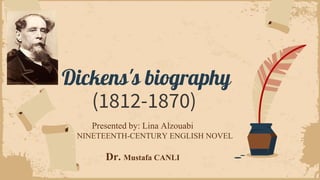
Dickens's biography
(1812-1870)
Presented by: Lina Alzouabi
ELI NINETEENTH-CENTURY ENGLISH NOVEL
Dr. Mustafa CANLI
 Charles Dickens was a British novelist, journalist, editor, illustrator and
social commentator who wrote such beloved classic novels as Oliver
Twist, A Christmas Carol, Nicholas Nickleby, David Copperfield, A Tale
of Two Cities and Great Expectations.
 Dickens is remembered as one of the most important and influential
writers of the 19th century. Among his accomplishments, he has been
praised for providing a stark portrait of the Victorian-era underclass,
helping to bring about social change
Who Was Charles Dickens?
CHILDHOOD
2
1
He spent the first ten years of his life in
Kent
Charles was the second of eight
children
3
Dickens was born on 7th February 1812
in Portsmouth.
• His mother, Elizabeth Barrow, had been in
service to Lord Crewe although she aspired to
be a teacher and school director
• His father, the inspiration for the character of
Mr. Micawber in 'David Copperfield', worked as
a clerk for the Naval Pay office.
HIS PARENTS
• In 1822, the Dickens family moved to
Camden Town.
• John Dickens was imprisoned for debt in
1824, when Charles was just twelve years
old.
• Dickens’s mother moved into the prison
with seven of her children.
• Only Charles lived outside the prison in order to earn
money for the struggling family.
• He worked with other children pasting labels on bottles in a
blacking warehouse where he endured appalling conditions
as well as loneliness and despair.
• Dickens was permitted to go back to school when his father
received a family inheritance and used it to pay off his debts, but
the experience was never forgotten and became fictionalized in
two of his better-known novels 'David Copperfield' and 'Great
Expectations'.
• As a young boy, Charles Dickens was exposed to many artistic
and literary works that allowed his imagination to grow and
develop considerably.
• He was greatly influenced by the stories his nursemaid used
to tell him and by his many visits to the theater.
ADOLESCENCE
● Although he had little formal schooling, Dickens was able to teach himself
shorthand and launch a career as a journalist.
● At the age of sixteen, Dickens got himself a job as a court reporter, his own
father became a reporter, and shortly thereafter he joined the staff of A
Mirror of Parliament, a newspaper that reported on the decisions of
Parliament.
● During this time Charles continued to read voraciously at the British Library,
and he experimented with acting and stage-managing amateur theatricals.
● Fast becoming disillusioned with politics, Dickens developed an interest in
social reform and began contributing to the True Sun, a radical newspaper.
YOUTH
• Then in 1833, he became a parliamentary journalist for The
Morning Chronicle.
• With new contacts in the press, he was able to publish a
series of sketches under the pseudonym 'Boz’.
• In 1836 Dickens also married Catherine Hogarth, the
daughter of a fellow co-worker at his newspaper. The
couple had ten children before their separation in 1858.
• His travels abroad in the 1840s, first to America and then
through Europe, marked the beginning of a new stage in
Dickens’ life.
LATER YEARS
• His writings became
longer and more serious.
• As well as a huge list of
novels he published an
autobiography, edited
weekly periodicals including
'Household Words' and 'All
Year Round', wrote travel
books, and administered
charitable organizations.
• He was also a theatre enthusiast, wrote plays,
and performed before Queen Victoria in 1851.
• His energy was inexhaustible and he spent
much time abroad.
• He was estranged from his wife in 1858 after
the birth of their ten children but maintained
relations with his mistress, the actress Ellen
Ternan.
• Dickens’ health began to deteriorate in the 1860s.
• In 1858, in response to his increasing fame, he
had begun public readings of his works.
• These caused him to suffer greatly physically.
• An immensely profitable but physically shattering
series of readings in America in 1867-68 sped his
decline.
• He died of a stroke in 1870. He is buried at
Westminster Abbey.
http://victorian-studies.net/CD-Biblio.html

Dickens' Biography.pptx

  • 1.
    Dickens's biography (1812-1870) Presented by:Lina Alzouabi ELI NINETEENTH-CENTURY ENGLISH NOVEL Dr. Mustafa CANLI
  • 3.
     Charles Dickenswas a British novelist, journalist, editor, illustrator and social commentator who wrote such beloved classic novels as Oliver Twist, A Christmas Carol, Nicholas Nickleby, David Copperfield, A Tale of Two Cities and Great Expectations.  Dickens is remembered as one of the most important and influential writers of the 19th century. Among his accomplishments, he has been praised for providing a stark portrait of the Victorian-era underclass, helping to bring about social change Who Was Charles Dickens?
  • 4.
    CHILDHOOD 2 1 He spent thefirst ten years of his life in Kent Charles was the second of eight children 3 Dickens was born on 7th February 1812 in Portsmouth.
  • 5.
    • His mother,Elizabeth Barrow, had been in service to Lord Crewe although she aspired to be a teacher and school director • His father, the inspiration for the character of Mr. Micawber in 'David Copperfield', worked as a clerk for the Naval Pay office. HIS PARENTS
  • 6.
    • In 1822,the Dickens family moved to Camden Town. • John Dickens was imprisoned for debt in 1824, when Charles was just twelve years old. • Dickens’s mother moved into the prison with seven of her children.
  • 7.
    • Only Charleslived outside the prison in order to earn money for the struggling family. • He worked with other children pasting labels on bottles in a blacking warehouse where he endured appalling conditions as well as loneliness and despair. • Dickens was permitted to go back to school when his father received a family inheritance and used it to pay off his debts, but the experience was never forgotten and became fictionalized in two of his better-known novels 'David Copperfield' and 'Great Expectations'.
  • 8.
    • As ayoung boy, Charles Dickens was exposed to many artistic and literary works that allowed his imagination to grow and develop considerably. • He was greatly influenced by the stories his nursemaid used to tell him and by his many visits to the theater.
  • 9.
    ADOLESCENCE ● Although hehad little formal schooling, Dickens was able to teach himself shorthand and launch a career as a journalist. ● At the age of sixteen, Dickens got himself a job as a court reporter, his own father became a reporter, and shortly thereafter he joined the staff of A Mirror of Parliament, a newspaper that reported on the decisions of Parliament. ● During this time Charles continued to read voraciously at the British Library, and he experimented with acting and stage-managing amateur theatricals. ● Fast becoming disillusioned with politics, Dickens developed an interest in social reform and began contributing to the True Sun, a radical newspaper.
  • 10.
    YOUTH • Then in1833, he became a parliamentary journalist for The Morning Chronicle. • With new contacts in the press, he was able to publish a series of sketches under the pseudonym 'Boz’. • In 1836 Dickens also married Catherine Hogarth, the daughter of a fellow co-worker at his newspaper. The couple had ten children before their separation in 1858. • His travels abroad in the 1840s, first to America and then through Europe, marked the beginning of a new stage in Dickens’ life.
  • 11.
    LATER YEARS • Hiswritings became longer and more serious. • As well as a huge list of novels he published an autobiography, edited weekly periodicals including 'Household Words' and 'All Year Round', wrote travel books, and administered charitable organizations.
  • 12.
    • He wasalso a theatre enthusiast, wrote plays, and performed before Queen Victoria in 1851. • His energy was inexhaustible and he spent much time abroad. • He was estranged from his wife in 1858 after the birth of their ten children but maintained relations with his mistress, the actress Ellen Ternan.
  • 13.
    • Dickens’ healthbegan to deteriorate in the 1860s. • In 1858, in response to his increasing fame, he had begun public readings of his works. • These caused him to suffer greatly physically. • An immensely profitable but physically shattering series of readings in America in 1867-68 sped his decline. • He died of a stroke in 1870. He is buried at Westminster Abbey.
  • 15.