Everyday
Conversations
Dialogue 1-5: What Time Is It?
Create and reenact
the following
situations;
1. Introduce
yourself.
2. Introduce other
people.
2 Presentation title 20XX
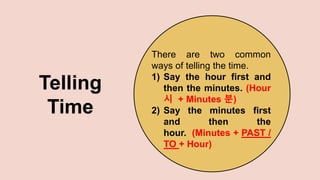
Telling
Time
There are two common
ways of telling the time.
1) Say the hour first and
then the minutes. (Hour
시 + Minutes 분)
2) Say the minutes first
and then the
hour. (Minutes + PAST /
TO + Hour)
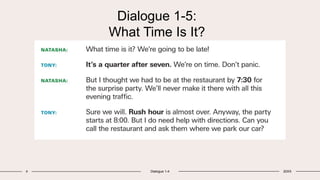
Dialogue 1-5:
What Time Is It?
4 Dialogue 1-4 20XX
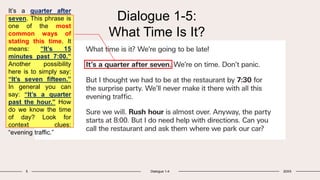
Dialogue 1-5:
What Time Is It?
5 Dialogue 1-4 20XX
It’s a quarter after
seven. This phrase is
one of the most
common ways of
stating this time. It
means: “It’s 15
minutes past 7:00.”
Another possibility
here is to simply say:
“It’s seven fifteen.”
In general you can
say: “It’s a quarter
past the hour.” How
do we know the time
of day? Look for
context clues:
“evening traffic.”
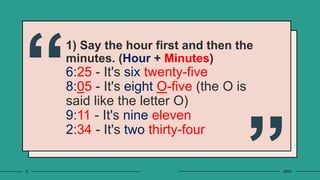
1) Say the hour first and then the
minutes. (Hour + Minutes)
6:25 - It's six twenty-five
8:05 - It's eight O-five (the O is
said like the letter O)
9:11 - It's nine eleven
2:34 - It's two thirty-four
6 20XX
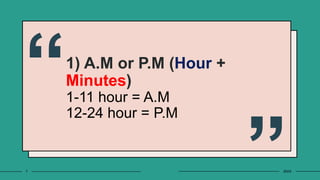
1) A.M or P.M (Hour +
Minutes)
1-11 hour = A.M
12-24 hour = P.M
7 20XX
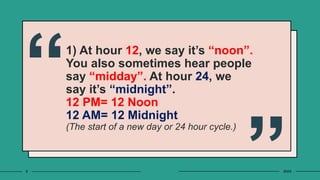
1) At hour 12, we say it’s “noon”.
You also sometimes hear people
say “midday”. At hour 24, we
say it’s “midnight”.
12 PM= 12 Noon
12 AM= 12 Midnight
(The start of a new day or 24 hour cycle.)
8 20XX
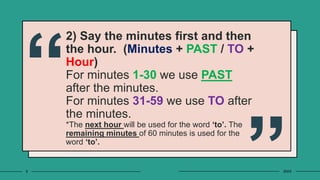
2) Say the minutes first and then
the hour. (Minutes + PAST / TO +
Hour)
For minutes 1-30 we use PAST
after the minutes.
For minutes 31-59 we use TO after
the minutes.
*The next hour will be used for the word ‘to’. The
remaining minutes of 60 minutes is used for the
word ‘to’.
9 20XX
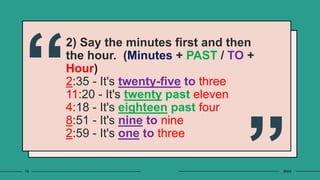
2) Say the minutes first and then
the hour. (Minutes + PAST / TO +
Hour)
2:35 - It's twenty-five to three
11:20 - It's twenty past eleven
4:18 - It's eighteen past four
8:51 - It's nine to nine
2:59 - It's one to three
10 20XX
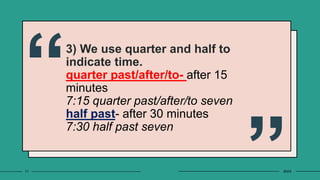
3) We use quarter and half to
indicate time.
quarter past/after/to- after 15
minutes
7:15 quarter past/after/to seven
half past- after 30 minutes
7:30 half past seven
11 20XX
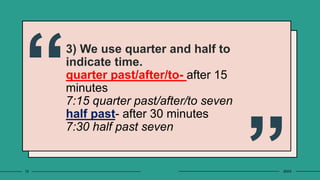
3) We use quarter and half to
indicate time.
quarter past/after/to- after 15
minutes
7:15 quarter past/after/to seven
half past- after 30 minutes
7:30 half past seven
12 20XX
Dialogue 1-5:
What Time Is It?
13 Dialogue 1-4 20XX
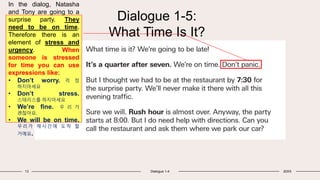
In the dialog, Natasha
and Tony are going to a
surprise party. They
need to be on time.
Therefore there is an
element of stress and
urgency. When
someone is stressed
for time you can use
expressions like:
• Don’t worry. 걱 정
하지마세요
• Don’t stress.
스테리스를 하지마세요
• We’re fine. 우 리 가
괜찮아요.
• We will be on time.
우리가 제시간에 도착 할
거예요.
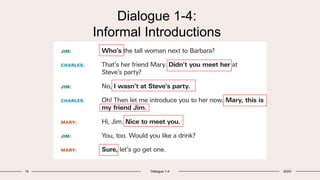
Dialogue 1-4:
Informal Introductions
14 Dialogue 1-4 20XX
Learning how to introduce yourself is an
essential part of learning how to converse
in English. Introductions are also an
important part of making small talk at
parties or other social events. Introductory
phrases are different than the ones we use
to greet friends, but they're often used
together as parts of the broader
conversation, as you'll see.
16 20XX
17 Dialogue 1-4: 20XX
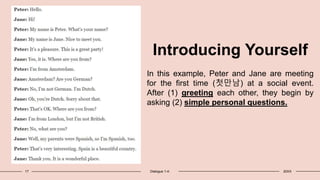
Introducing Yourself
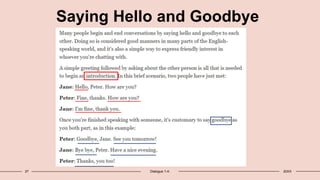
In this example, Peter and Jane are meeting
for the first time (첫만남) at a social event.
After (1) greeting each other, they begin by
asking (2) simple personal questions.
18 Dialogue 1-4: 20XX
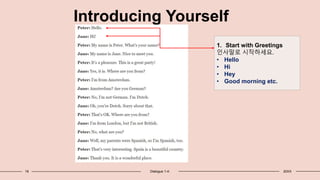
Introducing Yourself
1. Start with Greetings
인사말로 시작하세요.
• Hello
• Hi
• Hey
• Good morning etc.
19 Dialogue 1-4: 20XX
Introducing Yourself
2. State your name, or ask
someone’s name. 이 름 을
말하거나 물어보세요.
• What is your name? 이름이
뭐야?
• My name is [이름]. 제 이름은
[이름].
20 Dialogue 1-4: 20XX
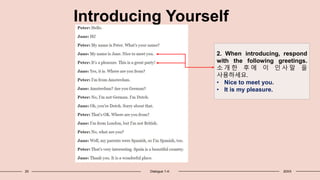
Introducing Yourself
2. When introducing, respond
with the following greetings.
소 개 한 후 에 이 인 사 말 을
사용하세요.
• Nice to meet you.
• It is my pleasure.
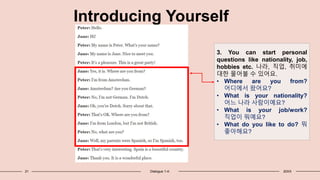
21 Dialogue 1-4: 20XX
Introducing Yourself
3. You can start personal
questions like nationality, job,
hobbies etc. 나라, 직업, 취미에
대한 물어불 수 있어요.
• Where are you from?
어디에서 왔어요?
• What is your nationality?
어느 나라 사람이예요?
• What is your job/work?
직업이 뭐예요?
• What do you like to do? 뭐
좋아해요?
22 Dialogue 1-4: 20XX
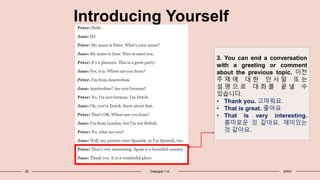
Introducing Yourself
3. You can end a conversation
with a greeting or comment
about the previous topic. 이전
주 제 에 대 한 인 사 말 또 는
설 명 으 로 대 화 를 끝 낼 수
있습니다.
• Thank you. 고마워요.
• That is great. 좋아요
• That is very interesting.
흥미로운 것 같아요. 재미있는
것 같아요.
23 Dialogue 1-4: 20XX
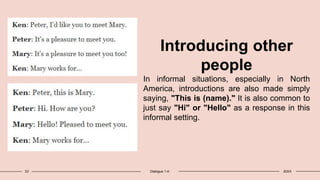
Introducing other
people
In informal situations, especially in North
America, introductions are also made simply
saying, "This is (name)." It is also common to
just say "Hi" or "Hello" as a response in this
informal setting.
24 Dialogue 1-4: 20XX
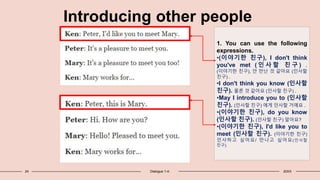
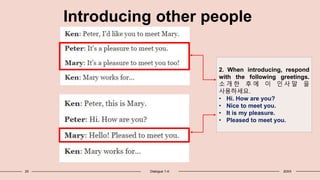
Introducing other people
1. You can use the following
expressions.
•(이야기한 친구), I don't think
you've met ( 인 사 할 친 구 ) .
(이야기한 친구), 안 만난 것 같아요 (인사할
친구) .
•I don't think you know (인사할
친구). 몰른 것 같아요 (인사할 친구) .
•May I introduce you to (인사할
친구). (인사할 친구) 에게 인사할 거예요 .
•(이야기한 친구), do you know
(인사할 친구). (인사할 친구) 알아요?
•(이야기한 친구), I'd like you to
meet (인사할 친구). (이야기한 친구)
인사하고 싶어요/ 만나고 싶어요(인사할
친구).
25 Dialogue 1-4: 20XX
Introducing other people
2. When introducing, respond
with the following greetings.
소 개 한 후 에 이 인 사 말 을
사용하세요.
• Hi. How are you?
• Nice to meet you.
• It is my pleasure.
• Pleased to meet you.
26 Dialogue 1-4: 20XX
Introducing other people
3. You can introduce other
people’s nationality, job,
hobbies etc. 다른 사람의 나라,
직업, 취미에 대한 말할 수 있어요.
• [이름] is from [나라]. [이름]
[나라]에서 왔어요.
• [이름] is a [나라]. [이름] [나라]
사람이에요.
• [이름] is a [직업]. [이름] [직업]
예요/이에요.
• [이름] works at [회사]. [이름]
[회사]에서 일 해어요.
• [이름] likes to [좋아하는 것].
[이름] [좋아하는 것] 좋라해요.
27 Dialogue 1-4: 20XX
Saying Hello and Goodbye
28 Dialogue 1-4: 20XX
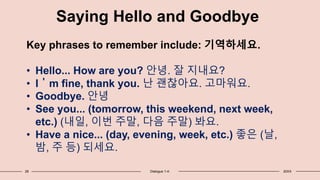
Saying Hello and Goodbye
Key phrases to remember include: 기역하세요.
• Hello... How are you? 안녕. 잘 지내요?
• I'm fine, thank you. 난 괜찮아요. 고마워요.
• Goodbye. 안녕
• See you... (tomorrow, this weekend, next week,
etc.) (내일, 이번 주말, 다음 주말) 봐요.
• Have a nice... (day, evening, week, etc.) 좋은 (날,
밤, 주 등) 되세요.
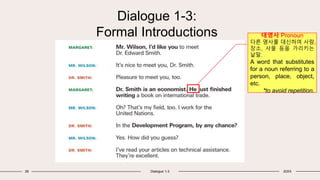
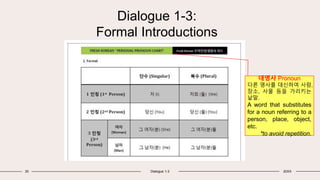
Dialogue 1-3:
Formal Introductions
29 Dialogue 1-3 20XX
대명사 Pronoun
다른 명사를 대신하여 사람,
장소, 사물 등을 가리키는
낱말.
A word that substitutes
for a noun referring to a
person, place, object,
etc.
*to avoid repetition.
Dialogue 1-3:
Formal Introductions
30 Dialogue 1-3 20XX
대명사 Pronoun
다른 명사를 대신하여 사람,
장소, 사물 등을 가리키는
낱말.
A word that substitutes
for a noun referring to a
person, place, object,
etc.
*to avoid repetition.
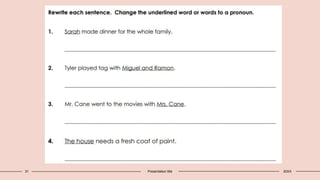
31 Presentation title 20XX
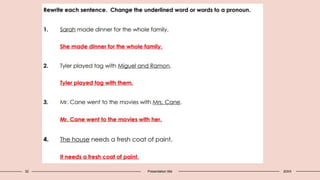
32 Presentation title 20XX

Dialogue 1-4 Informal Introductions.pptx

  • 1.
  • 2.
    Create and reenact thefollowing situations; 1. Introduce yourself. 2. Introduce other people. 2 Presentation title 20XX
  • 3.
    Telling Time There are twocommon ways of telling the time. 1) Say the hour first and then the minutes. (Hour 시 + Minutes 분) 2) Say the minutes first and then the hour. (Minutes + PAST / TO + Hour)
  • 4.
    Dialogue 1-5: What TimeIs It? 4 Dialogue 1-4 20XX
  • 5.
    Dialogue 1-5: What TimeIs It? 5 Dialogue 1-4 20XX It’s a quarter after seven. This phrase is one of the most common ways of stating this time. It means: “It’s 15 minutes past 7:00.” Another possibility here is to simply say: “It’s seven fifteen.” In general you can say: “It’s a quarter past the hour.” How do we know the time of day? Look for context clues: “evening traffic.”
  • 6.
    1) Say thehour first and then the minutes. (Hour + Minutes) 6:25 - It's six twenty-five 8:05 - It's eight O-five (the O is said like the letter O) 9:11 - It's nine eleven 2:34 - It's two thirty-four 6 20XX
  • 7.
    1) A.M orP.M (Hour + Minutes) 1-11 hour = A.M 12-24 hour = P.M 7 20XX
  • 8.
    1) At hour12, we say it’s “noon”. You also sometimes hear people say “midday”. At hour 24, we say it’s “midnight”. 12 PM= 12 Noon 12 AM= 12 Midnight (The start of a new day or 24 hour cycle.) 8 20XX
  • 9.
    2) Say theminutes first and then the hour. (Minutes + PAST / TO + Hour) For minutes 1-30 we use PAST after the minutes. For minutes 31-59 we use TO after the minutes. *The next hour will be used for the word ‘to’. The remaining minutes of 60 minutes is used for the word ‘to’. 9 20XX
  • 10.
    2) Say theminutes first and then the hour. (Minutes + PAST / TO + Hour) 2:35 - It's twenty-five to three 11:20 - It's twenty past eleven 4:18 - It's eighteen past four 8:51 - It's nine to nine 2:59 - It's one to three 10 20XX
  • 11.
    3) We usequarter and half to indicate time. quarter past/after/to- after 15 minutes 7:15 quarter past/after/to seven half past- after 30 minutes 7:30 half past seven 11 20XX
  • 12.
    3) We usequarter and half to indicate time. quarter past/after/to- after 15 minutes 7:15 quarter past/after/to seven half past- after 30 minutes 7:30 half past seven 12 20XX
  • 13.
    Dialogue 1-5: What TimeIs It? 13 Dialogue 1-4 20XX In the dialog, Natasha and Tony are going to a surprise party. They need to be on time. Therefore there is an element of stress and urgency. When someone is stressed for time you can use expressions like: • Don’t worry. 걱 정 하지마세요 • Don’t stress. 스테리스를 하지마세요 • We’re fine. 우 리 가 괜찮아요. • We will be on time. 우리가 제시간에 도착 할 거예요.
  • 14.
  • 16.
    Learning how tointroduce yourself is an essential part of learning how to converse in English. Introductions are also an important part of making small talk at parties or other social events. Introductory phrases are different than the ones we use to greet friends, but they're often used together as parts of the broader conversation, as you'll see. 16 20XX
  • 17.
    17 Dialogue 1-4:20XX Introducing Yourself In this example, Peter and Jane are meeting for the first time (첫만남) at a social event. After (1) greeting each other, they begin by asking (2) simple personal questions.
  • 18.
    18 Dialogue 1-4:20XX Introducing Yourself 1. Start with Greetings 인사말로 시작하세요. • Hello • Hi • Hey • Good morning etc.
  • 19.
    19 Dialogue 1-4:20XX Introducing Yourself 2. State your name, or ask someone’s name. 이 름 을 말하거나 물어보세요. • What is your name? 이름이 뭐야? • My name is [이름]. 제 이름은 [이름].
  • 20.
    20 Dialogue 1-4:20XX Introducing Yourself 2. When introducing, respond with the following greetings. 소 개 한 후 에 이 인 사 말 을 사용하세요. • Nice to meet you. • It is my pleasure.
  • 21.
    21 Dialogue 1-4:20XX Introducing Yourself 3. You can start personal questions like nationality, job, hobbies etc. 나라, 직업, 취미에 대한 물어불 수 있어요. • Where are you from? 어디에서 왔어요? • What is your nationality? 어느 나라 사람이예요? • What is your job/work? 직업이 뭐예요? • What do you like to do? 뭐 좋아해요?
  • 22.
    22 Dialogue 1-4:20XX Introducing Yourself 3. You can end a conversation with a greeting or comment about the previous topic. 이전 주 제 에 대 한 인 사 말 또 는 설 명 으 로 대 화 를 끝 낼 수 있습니다. • Thank you. 고마워요. • That is great. 좋아요 • That is very interesting. 흥미로운 것 같아요. 재미있는 것 같아요.
  • 23.
    23 Dialogue 1-4:20XX Introducing other people In informal situations, especially in North America, introductions are also made simply saying, "This is (name)." It is also common to just say "Hi" or "Hello" as a response in this informal setting.
  • 24.
    24 Dialogue 1-4:20XX Introducing other people 1. You can use the following expressions. •(이야기한 친구), I don't think you've met ( 인 사 할 친 구 ) . (이야기한 친구), 안 만난 것 같아요 (인사할 친구) . •I don't think you know (인사할 친구). 몰른 것 같아요 (인사할 친구) . •May I introduce you to (인사할 친구). (인사할 친구) 에게 인사할 거예요 . •(이야기한 친구), do you know (인사할 친구). (인사할 친구) 알아요? •(이야기한 친구), I'd like you to meet (인사할 친구). (이야기한 친구) 인사하고 싶어요/ 만나고 싶어요(인사할 친구).
  • 25.
    25 Dialogue 1-4:20XX Introducing other people 2. When introducing, respond with the following greetings. 소 개 한 후 에 이 인 사 말 을 사용하세요. • Hi. How are you? • Nice to meet you. • It is my pleasure. • Pleased to meet you.
  • 26.
    26 Dialogue 1-4:20XX Introducing other people 3. You can introduce other people’s nationality, job, hobbies etc. 다른 사람의 나라, 직업, 취미에 대한 말할 수 있어요. • [이름] is from [나라]. [이름] [나라]에서 왔어요. • [이름] is a [나라]. [이름] [나라] 사람이에요. • [이름] is a [직업]. [이름] [직업] 예요/이에요. • [이름] works at [회사]. [이름] [회사]에서 일 해어요. • [이름] likes to [좋아하는 것]. [이름] [좋아하는 것] 좋라해요.
  • 27.
    27 Dialogue 1-4:20XX Saying Hello and Goodbye
  • 28.
    28 Dialogue 1-4:20XX Saying Hello and Goodbye Key phrases to remember include: 기역하세요. • Hello... How are you? 안녕. 잘 지내요? • I'm fine, thank you. 난 괜찮아요. 고마워요. • Goodbye. 안녕 • See you... (tomorrow, this weekend, next week, etc.) (내일, 이번 주말, 다음 주말) 봐요. • Have a nice... (day, evening, week, etc.) 좋은 (날, 밤, 주 등) 되세요.
  • 29.
    Dialogue 1-3: Formal Introductions 29Dialogue 1-3 20XX 대명사 Pronoun 다른 명사를 대신하여 사람, 장소, 사물 등을 가리키는 낱말. A word that substitutes for a noun referring to a person, place, object, etc. *to avoid repetition.
  • 30.
    Dialogue 1-3: Formal Introductions 30Dialogue 1-3 20XX 대명사 Pronoun 다른 명사를 대신하여 사람, 장소, 사물 등을 가리키는 낱말. A word that substitutes for a noun referring to a person, place, object, etc. *to avoid repetition.
  • 31.
  • 32.