Good morning Good morning
Good afternoon Good afternoon
Good evening Good evening
How are you? Fine , thanks
How’s everything with you? Very well , thank you.
How do you do? Not bad , thanks.
A:Good morning Honey. How’re you?
B:Good morning ,am fine thanks.
--------------------------------------
A:Hello,good afternoon . How are you this afternoon?
B:Good afternoon . I’m very well thank you.
And how about you?
A:Not bad , thanks.
Way to say thanks
Thanks
Thank you
Thank you so much
Thanks a million
Thanks a lot
Thanks for your help
I really appreciate it
I’m really grateful
How kind of you
I can’t thank you enough
I owe you one
Response for thanking
You’re welcome
No problem
Not at all
It’s my pleasure
Never mind
Don’t be mention it
Any time
Glad to help
Thank you
Conversations:
A:Thank you .
B: It’s my pleasure.
----------------
A: Thanks for your help?
B:You’re welcome.
----------------
A: How kind of you?
B:Don’t be mention it .
-----------------
A:Thank you so much .
B:Not at all.
Slang Goodbye
Catch you later
I’m out!
Smell you later
I have to go now , see you later.
It’s been nice talking to you , see yah.
Ok , I’m going good bye.
Have a nice day.
Hope to see you again.
Nice to see you.
Good night ! Have a sound sleep.
Good night ! Have a sweet dream.
Good night ! Sleep tight!
Saying Goodbye
A:Well,it’s been nice talking to you.
I must go now ,see you later.
B:Alright,see you.
----------------
A:Ok then , I have to go now . See you soon.
B:Ok see you.
-----------------
A:Goodbye Lisa , see you on Monday.
B:Goodbye ,have a nice day dear.
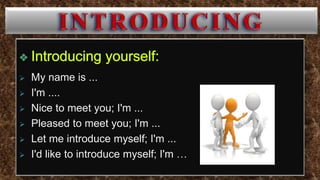
 My name is ...
 I'm ....
 Nice to meet you; I'm ...
 Pleased to meet you; I'm ...
 Let me introduce myself; I'm ...
 I'd like to introduce myself; I'm …
 Jack, have you met Nicolas?
 I'd like you to meet Liza.
 I'd like to introduce you to Betty.
 Leila, this is Barbara. Barbara this is Leila.
 I don’t think you’ve met my…,have you?
 Do you know ….?
 Nice to meet you.
 Pleased to meet you.
 Glad to meet you.
 How do you do?
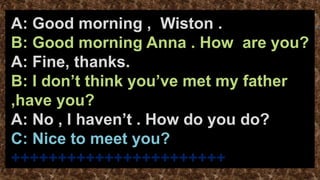
A: Good morning , Wiston .
B: Good morning Anna . How are you?
A: Fine, thanks.
B: I don’t think you’ve met my father
,have you?
A: No , I haven’t . How do you do?
C: Nice to meet you?
+++++++++++++++++++++++
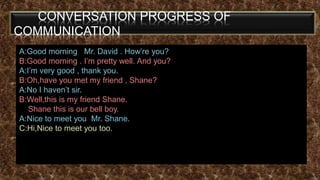
CONVERSATION PROGRESS OF
COMMUNICATION
A:Good morning Mr. David . How’re you?
B:Good morning . I’m pretty well. And you?
A:I’m very good , thank you.
B:Oh,have you met my friend , Shane?
A:No I haven’t sir.
B:Well,this is my friend Shane.
Shane this is our bell boy.
A:Nice to meet you Mr. Shane.
C:Hi,Nice to meet you too.
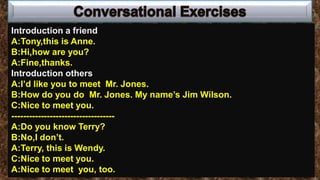
Introduction a friend
A:Tony,this is Anne.
B:Hi,how are you?
A:Fine,thanks.
Introduction others
A:I’d like you to meet Mr. Jones.
B:How do you do Mr. Jones. My name’s Jim Wilson.
C:Nice to meet you.
-----------------------------------
A:Do you know Terry?
B:No,I don’t.
A:Terry, this is Wendy.
C:Nice to meet you.
A:Nice to meet you, too.
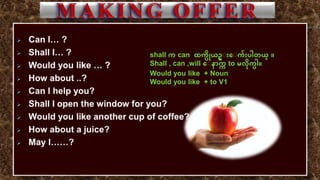
shall က can ထက္ပိုယဥ္း်းေးက်းပါတယ္ ။
Shall , can ,will ေးနာကက to မလပိုက္ါ။
Would you like + Noun
Would you like + to V1
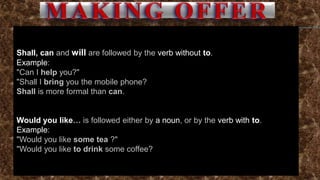
Shall, can and will are followed by the verb without to.
Example:
"Can I help you?"
"Shall I bring you the mobile phone?
Shall is more formal than can.
Would you like… is followed either by a noun, or by the verb with to.
Example:
"Would you like some tea ?"
"Would you like to drink some coffee?
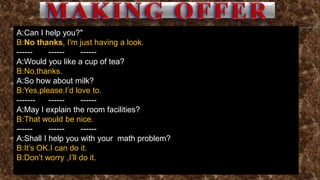
A:Can I help you?"
B:No thanks, I'm just having a look.
------ ------ ------
A:Would you like a cup of tea?
B:No,thanks.
A:So how about milk?
B:Yes,please.I’d love to.
------- ------ ------
A:May I explain the room facilities?
B:That would be nice.
------ ------ ------
A:Shall I help you with your math problem?
B:It’s OK.I can do it.
B:Don’t worry ,I’ll do it.
Transferring a call
Could you hold on a moment please’
Just a moment please’
Hold the line please’
I’ll just put you through’
I’ll just transfer you now’
One moment please
Giving Negative Information
‘I’m afraid the line is busy at the moment’
‘That line is engaged at the moment, could you call back later please?’
‘I’m afraid ___’s busy at the moment, can I take a message?’
‘I’m sorry, he’s out of the office today’
‘You may have dialed the wrong number’
‘I’m afraid there’s no one here by that name’
Telephone Problems
I’m afraid I can’t hear you very well’
‘Would you mind speaking up a bit please?’
 I’m afraid my English isn’t very good, could you speak slowly please?
’ ‘Could you repeat that please?’
‘I can’t hear you very well’
 ‘Sorry, this line is quite bad’
‘Sorry, I didn’t catch that’
‘I’ll let ___ know that you rang
Could you say it again , please?
What did you say your name was?
Common Phrasal Verbs
1. hold on
means wait
‘Could you hold on a moment please?’
2. hang on
also means wait! (informal)
‘Could you hang on a moment please?’
3. put (a call) through
means to connect one caller to another
‘I’m just going to put you through now.’
4. get through
to be connected to someone on the phone
‘I can’t get through to his line at the moment, could you call back later
please?’
Common Phrasal Verbs
5. hang up
means to put the receiver down
‘I think the operator hung up on me, the line just went dead!’
6. call up
is to make a telephone call (mainly used in American English or slang)
‘I’ll call up the theatre, and find out about tickets.’
7. call back
is to return someone’s call
‘I’ll ask him to call you back, when he gets home.’
8. pick up
means to answer a call / lift the receiver to take a call
‘No one is picking up, maybe they’re not at home.’
Common Phrasal Verbs
9. get off (the phone)
means to stop talking on the phone
‘When he gets off the other phone, I’ll pass on your message.’
10. get back to (someone)
means to return someone’s call
‘When do you think she’ll be able to get back to me?’
11. cut off
to be disconnected abruptly during a telephone conversation
‘I think we got cut off, I can’t hear her anymore.’
12. switch off/turn off
is to deactivate (a cell phone/mobile phone)
‘Sorry you couldn’t get through to me. My phone was switched off, because the battery had
died.’
13. speak up
means to talk louder
‘I’m afraid I can’t hear you very well, could you speak up a little please?’
Conversation Practice
Hello , Is that Asia Industry?
Yes.
May I speak to Mr. David , please.
Yes , who’s speaking , please?
Pat Bradford.
One moment , please Mr. Bradford.
+++++++++++++++++
Is Miss Lisa there , please?
Yes , may I know who’s speaking, please?
It’s Nay Min speaking.
Could you hold on a moment, please?
Conversation Practice
Is that 45519?
Yes.
I’d like to speak to Mr. Hey, please.
Yes , who’s shall I say is calling?
Pat Bradford.
I’m sorry . He’s not here at the moment.
Would you like to leave a message?
I’ll call back later , thanks.
 Transferring a call
May I speak to Miss Creamer please?
Could you please hold on a second.
I’ll put you through to her office.
Transfer
extension
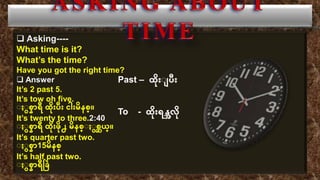
 Asking----
What time is it?
What’s the time?
Have you got the right time?
 Answer
It’s 2 past 5.
It’s tow oh five.
း းစ္နာရီ ထပို်းပီ်း ငါ်းမပနစ္္။
It’s twenty to three.2:40
း းစ္နာရီ ထပို်းဖပို႕ မပနစ္္း းစ္ဆယ္။
It’s quarter past two.
း းစ္နာ15မပနစ္္
It’s half past two.
း းစ္နာရီခ ြဲ
Past – ထပို်းး ပီ်း
To - ထပို်းရန္အလပို
Where are you from?
Where do you come from?
I’m from……
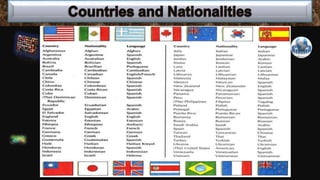
What’s your nationality?
I’m Burmese……
What do you do?
What’s your occupation?
Where ‘s he from?
Where was he born?
May I know your name, please?
Could you tell me your name, please?
Is that your last name?
How do you spell your name?
Asking about families?
How many brothers and sisters do you have?
How many brothers and sisters have you got?
Do you come from a large family?
How many………………?
Do you have…………..?
My family is …………
I’ve got …………………
Asking about Job
What do you do?
What ‘s your occupation?
Where do you work for?
Who do you work for?
Answering about Job
I work for a bank.
I am working at National Museum.
I work at ……….
Asking about the families.
A:How many brothers and sister do you have?
B:Well,I’ve got one sister and tow brothers.
And how about your family.
A:Actually,I’ve one little brother.
B:It’s nice a small family , doesn’t it?
A:Ofcourse.
---------------- ----------------------------------
A:Could you tell me about your family?
B:Uhmm,there are four of us altogether . My sister and I with parents.
A:Ah hah , sounds good.
For me, I am only child.
Asking about the families.
A:Do you have a large family?
B:No my family is small . I have only one sister.
And you?
A:My family is a little big . There are seven of us altogether.
-----------------------------------------------------------------
Talking about the job
A: What does you father do?
B:He is a journalist. He works at Myanmar Times News.
A:That’s sound interesting.
B:Thank you.
----------------------------------------------------------------------
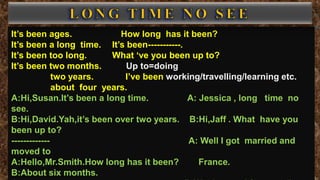
It’s been ages. How long has it been?
It’s been a long time. It’s been-----------.
It’s been too long. What ‘ve you been up to?
It’s been two months. Up to=doing
two years. I’ve been working/travelling/learning etc.
about four years.
A:Hi,Susan.It’s been a long time. A: Jessica , long time no
see.
B:Hi,David.Yah,it’s been over two years. B:Hi,Jaff . What have you
been up to?
------------- A: Well I got married and
moved to
A:Hello,Mr.Smith.How long has it been? France.
B:About six months.
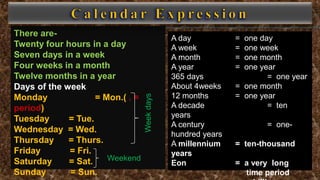
There are-
Twenty four hours in a day
Seven days in a week
Four weeks in a month
Twelve months in a year
Days of the week
Monday = Mon.( . =
period)
Tuesday = Tue.
Wednesday = Wed.
Thursday = Thurs.
Friday = Fri.
Saturday = Sat.
Sunday = Sun.
A day = one day
A week = one week
A month = one month
A year = one year
365 days = one year
About 4weeks = one month
12 months = one year
A decade = ten
years
A century = one-
hundred years
A millennium = ten-thousand
years
Eon = a very long
time period
Weekdays
Weekend
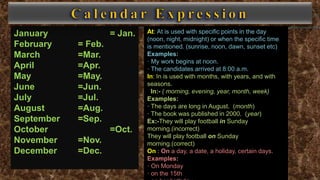
January = Jan.
February = Feb.
March =Mar.
April =Apr.
May =May.
June =Jun.
July =Jul.
August =Aug.
September =Sep.
October =Oct.
November =Nov.
December =Dec.
At: At is used with specific points in the day
(noon, night, midnight) or when the specific time
is mentioned. (sunrise, noon, dawn, sunset etc)
Examples:
· My work begins at noon.
· The candidates arrived at 8:00 a.m.
In: In is used with months, with years, and with
seasons.
In:- ( morning, evening, year, month, week)
Examples:
· The days are long in August. (month)
· The book was published in 2000. (year)
Ex:-They will play football in Sunday
morning.(incorrect)
They will play football on Sunday
morning.(correct)
On : On a day, a date, a holiday, certain days.
Examples:
· On Monday
· on the 15th
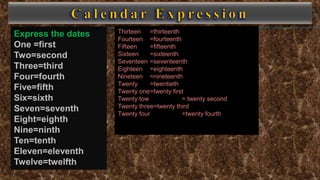
Express the dates
One =first
Two=second
Three=third
Four=fourth
Five=fifth
Six=sixth
Seven=seventh
Eight=eighth
Nine=ninth
Ten=tenth
Eleven=eleventh
Twelve=twelfth
Thirteen =thirteenth
Fourteen =fourteenth
Fifteen =fifteenth
Sixteen =sixteenth
Seventeen =seventeenth
Eighteen =eighteenth
Nineteen =nineteenth
Twenty =twentieth
Twenty one=twenty first
Twenty tow = twenty second
Twenty three=twenty third
Twenty four =twenty fourth
Things to do on the weekend
Here are some of the activities that people like to do on the weekend:
go out to eat
go out (to a bar or club)
see a movie
do some housework
spend time with your family
take a road trip
go to church
get together with friends
have a house party
have a dinner party
have a big family meal
go shopping
Latin original terms of AM and PM
Ante meridiem: Before noon AM=after midnight
Between midnight (0:00) & noon (12:00) PM=After noon
Post meridiem: After noon Midnight=12 at night
Between noon (12:00) & midnight (0:00) Noon=12 in the afternoon
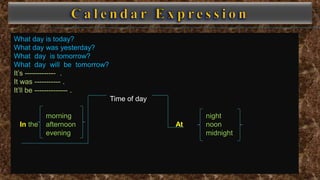
What day is today?
What day was yesterday?
What day is tomorrow?
What day will be tomorrow?
It’s ------------- .
It was ----------- .
It’ll be -------------- .
Time of day
morning night
In the afternoon At noon
evening midnight
Questions.
How was your weekend?
Where did you go in your weekend?
How about your weekend?
What do you usually do in your weekend?
What are you doing this weekend?
Do you have anything going on this weekend?
Do you have any big plans for the weekend?
Do you have anything planned for this weekend?
Did you do anything fun over the weekend?
Did you have a good weekend?
Answers.
Well, I went out for dinner with my friends.
It was great/wonderful/terrible/boring/nothing/awesome /fun/fantastic etc.
Alright , I was just staying in bed and watching movies.
I didn’t too much.
Depends on the situation, express your feelings like these-
That’s sounds good/nice/great.
That’s sounds terrible.
Oh , I’m sorry to hear that.
Wow ! Lucky you!
Conversation : Asking about weekend
A:What do you do in the weekends?
B:I went to a concert with my friends.
A:That’s sound nice.
B:Thanks and what about you?=What about your weekends?
A:Oh,not much really, I just stayed at home and watched TV.
I also walked around the house for some time.
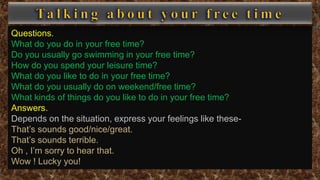
Questions.
What do you do in your free time?
Do you usually go swimming in your free time?
How do you spend your leisure time?
What do you like to do in your free time?
What do you usually do on weekend/free time?
What kinds of things do you like to do in your free time?
Answers.
Depends on the situation, express your feelings like these-
That’s sounds good/nice/great.
That’s sounds terrible.
Oh , I’m sorry to hear that.
Wow ! Lucky you!
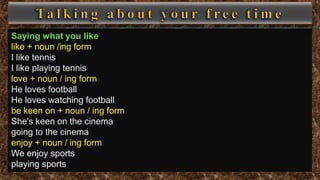
Saying what you like
like + noun /ing form
I like tennis
I like playing tennis
love + noun / ing form
He loves football
He loves watching football
be keen on + noun / ing form
She's keen on the cinema
going to the cinema
enjoy + noun / ing form
We enjoy sports
playing sports
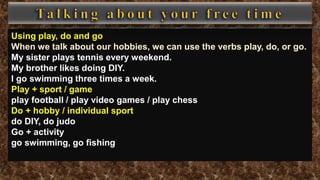
Using play, do and go
When we talk about our hobbies, we can use the verbs play, do, or go.
My sister plays tennis every weekend.
My brother likes doing DIY.
I go swimming three times a week.
Play + sport / game
play football / play video games / play chess
Do + hobby / individual sport
do DIY, do judo
Go + activity
go swimming, go fishing
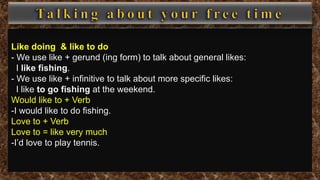
Like doing & like to do
- We use like + gerund (ing form) to talk about general likes:
I like fishing.
- We use like + infinitive to talk about more specific likes:
I like to go fishing at the weekend.
Would like to + Verb
-I would like to do fishing.
Love to + Verb
Love to = like very much
-I’d love to play tennis.
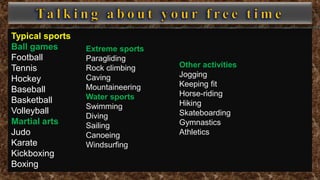
Typical sports
Ball games
Football
Tennis
Hockey
Baseball
Basketball
Volleyball
Martial arts
Judo
Karate
Kickboxing
Boxing
Extreme sports
Paragliding
Rock climbing
Caving
Mountaineering
Water sports
Swimming
Diving
Sailing
Canoeing
Windsurfing
Other activities
Jogging
Keeping fit
Horse-riding
Hiking
Skateboarding
Gymnastics
Athletics
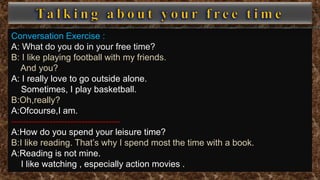
Conversation Exercise :
A: What do you do in your free time?
B: I like playing football with my friends.
And you?
A: I really love to go outside alone.
Sometimes, I play basketball.
B:Oh,really?
A:Ofcourse,I am.
-------------------------------------
A:How do you spend your leisure time?
B:I like reading. That’s why I spend most the time with a book.
A:Reading is not mine.
I like watching , especially action movies .

Basic Coomunication English for Myanmar Citizen

  • 2.
    Good morning Goodmorning Good afternoon Good afternoon Good evening Good evening How are you? Fine , thanks How’s everything with you? Very well , thank you. How do you do? Not bad , thanks.
  • 3.
    A:Good morning Honey.How’re you? B:Good morning ,am fine thanks. -------------------------------------- A:Hello,good afternoon . How are you this afternoon? B:Good afternoon . I’m very well thank you. And how about you? A:Not bad , thanks.
  • 4.
    Way to saythanks Thanks Thank you Thank you so much Thanks a million Thanks a lot Thanks for your help I really appreciate it I’m really grateful How kind of you I can’t thank you enough I owe you one
  • 5.
    Response for thanking You’rewelcome No problem Not at all It’s my pleasure Never mind Don’t be mention it Any time Glad to help Thank you
  • 6.
    Conversations: A:Thank you . B:It’s my pleasure. ---------------- A: Thanks for your help? B:You’re welcome. ---------------- A: How kind of you? B:Don’t be mention it . ----------------- A:Thank you so much . B:Not at all.
  • 7.
    Slang Goodbye Catch youlater I’m out! Smell you later I have to go now , see you later. It’s been nice talking to you , see yah. Ok , I’m going good bye. Have a nice day. Hope to see you again. Nice to see you. Good night ! Have a sound sleep. Good night ! Have a sweet dream. Good night ! Sleep tight!
  • 8.
    Saying Goodbye A:Well,it’s beennice talking to you. I must go now ,see you later. B:Alright,see you. ---------------- A:Ok then , I have to go now . See you soon. B:Ok see you. ----------------- A:Goodbye Lisa , see you on Monday. B:Goodbye ,have a nice day dear.
  • 9.
     My nameis ...  I'm ....  Nice to meet you; I'm ...  Pleased to meet you; I'm ...  Let me introduce myself; I'm ...  I'd like to introduce myself; I'm …
  • 10.
     Jack, haveyou met Nicolas?  I'd like you to meet Liza.  I'd like to introduce you to Betty.  Leila, this is Barbara. Barbara this is Leila.  I don’t think you’ve met my…,have you?  Do you know ….?
  • 11.
     Nice tomeet you.  Pleased to meet you.  Glad to meet you.  How do you do?
  • 13.
    A: Good morning, Wiston . B: Good morning Anna . How are you? A: Fine, thanks. B: I don’t think you’ve met my father ,have you? A: No , I haven’t . How do you do? C: Nice to meet you? +++++++++++++++++++++++
  • 14.
    CONVERSATION PROGRESS OF COMMUNICATION A:Goodmorning Mr. David . How’re you? B:Good morning . I’m pretty well. And you? A:I’m very good , thank you. B:Oh,have you met my friend , Shane? A:No I haven’t sir. B:Well,this is my friend Shane. Shane this is our bell boy. A:Nice to meet you Mr. Shane. C:Hi,Nice to meet you too.
  • 15.
    Introduction a friend A:Tony,thisis Anne. B:Hi,how are you? A:Fine,thanks. Introduction others A:I’d like you to meet Mr. Jones. B:How do you do Mr. Jones. My name’s Jim Wilson. C:Nice to meet you. ----------------------------------- A:Do you know Terry? B:No,I don’t. A:Terry, this is Wendy. C:Nice to meet you. A:Nice to meet you, too.
  • 16.
    shall က canထက္ပိုယဥ္း်းေးက်းပါတယ္ ။ Shall , can ,will ေးနာကက to မလပိုက္ါ။ Would you like + Noun Would you like + to V1
  • 18.
    Shall, can andwill are followed by the verb without to. Example: "Can I help you?" "Shall I bring you the mobile phone? Shall is more formal than can. Would you like… is followed either by a noun, or by the verb with to. Example: "Would you like some tea ?" "Would you like to drink some coffee?
  • 19.
    A:Can I helpyou?" B:No thanks, I'm just having a look. ------ ------ ------ A:Would you like a cup of tea? B:No,thanks. A:So how about milk? B:Yes,please.I’d love to. ------- ------ ------ A:May I explain the room facilities? B:That would be nice. ------ ------ ------ A:Shall I help you with your math problem? B:It’s OK.I can do it. B:Don’t worry ,I’ll do it.
  • 21.
    Transferring a call Couldyou hold on a moment please’ Just a moment please’ Hold the line please’ I’ll just put you through’ I’ll just transfer you now’ One moment please Giving Negative Information ‘I’m afraid the line is busy at the moment’ ‘That line is engaged at the moment, could you call back later please?’ ‘I’m afraid ___’s busy at the moment, can I take a message?’ ‘I’m sorry, he’s out of the office today’ ‘You may have dialed the wrong number’ ‘I’m afraid there’s no one here by that name’
  • 22.
    Telephone Problems I’m afraidI can’t hear you very well’ ‘Would you mind speaking up a bit please?’  I’m afraid my English isn’t very good, could you speak slowly please? ’ ‘Could you repeat that please?’ ‘I can’t hear you very well’  ‘Sorry, this line is quite bad’ ‘Sorry, I didn’t catch that’ ‘I’ll let ___ know that you rang Could you say it again , please? What did you say your name was?
  • 23.
    Common Phrasal Verbs 1.hold on means wait ‘Could you hold on a moment please?’ 2. hang on also means wait! (informal) ‘Could you hang on a moment please?’ 3. put (a call) through means to connect one caller to another ‘I’m just going to put you through now.’ 4. get through to be connected to someone on the phone ‘I can’t get through to his line at the moment, could you call back later please?’
  • 24.
    Common Phrasal Verbs 5.hang up means to put the receiver down ‘I think the operator hung up on me, the line just went dead!’ 6. call up is to make a telephone call (mainly used in American English or slang) ‘I’ll call up the theatre, and find out about tickets.’ 7. call back is to return someone’s call ‘I’ll ask him to call you back, when he gets home.’ 8. pick up means to answer a call / lift the receiver to take a call ‘No one is picking up, maybe they’re not at home.’
  • 25.
    Common Phrasal Verbs 9.get off (the phone) means to stop talking on the phone ‘When he gets off the other phone, I’ll pass on your message.’ 10. get back to (someone) means to return someone’s call ‘When do you think she’ll be able to get back to me?’ 11. cut off to be disconnected abruptly during a telephone conversation ‘I think we got cut off, I can’t hear her anymore.’ 12. switch off/turn off is to deactivate (a cell phone/mobile phone) ‘Sorry you couldn’t get through to me. My phone was switched off, because the battery had died.’ 13. speak up means to talk louder ‘I’m afraid I can’t hear you very well, could you speak up a little please?’
  • 26.
    Conversation Practice Hello ,Is that Asia Industry? Yes. May I speak to Mr. David , please. Yes , who’s speaking , please? Pat Bradford. One moment , please Mr. Bradford. +++++++++++++++++ Is Miss Lisa there , please? Yes , may I know who’s speaking, please? It’s Nay Min speaking. Could you hold on a moment, please?
  • 27.
    Conversation Practice Is that45519? Yes. I’d like to speak to Mr. Hey, please. Yes , who’s shall I say is calling? Pat Bradford. I’m sorry . He’s not here at the moment. Would you like to leave a message? I’ll call back later , thanks.
  • 28.
     Transferring acall May I speak to Miss Creamer please? Could you please hold on a second. I’ll put you through to her office. Transfer extension
  • 29.
     Asking---- What timeis it? What’s the time? Have you got the right time?  Answer It’s 2 past 5. It’s tow oh five. း းစ္နာရီ ထပို်းပီ်း ငါ်းမပနစ္္။ It’s twenty to three.2:40 း းစ္နာရီ ထပို်းဖပို႕ မပနစ္္း းစ္ဆယ္။ It’s quarter past two. း းစ္နာ15မပနစ္္ It’s half past two. း းစ္နာရီခ ြဲ Past – ထပို်းး ပီ်း To - ထပို်းရန္အလပို
  • 30.
    Where are youfrom? Where do you come from? I’m from…… What’s your nationality? I’m Burmese…… What do you do? What’s your occupation? Where ‘s he from? Where was he born? May I know your name, please? Could you tell me your name, please? Is that your last name? How do you spell your name?
  • 32.
    Asking about families? Howmany brothers and sisters do you have? How many brothers and sisters have you got? Do you come from a large family? How many………………? Do you have…………..? My family is ………… I’ve got ………………… Asking about Job What do you do? What ‘s your occupation? Where do you work for? Who do you work for?
  • 33.
    Answering about Job Iwork for a bank. I am working at National Museum. I work at ……….
  • 34.
    Asking about thefamilies. A:How many brothers and sister do you have? B:Well,I’ve got one sister and tow brothers. And how about your family. A:Actually,I’ve one little brother. B:It’s nice a small family , doesn’t it? A:Ofcourse. ---------------- ---------------------------------- A:Could you tell me about your family? B:Uhmm,there are four of us altogether . My sister and I with parents. A:Ah hah , sounds good. For me, I am only child.
  • 35.
    Asking about thefamilies. A:Do you have a large family? B:No my family is small . I have only one sister. And you? A:My family is a little big . There are seven of us altogether. ----------------------------------------------------------------- Talking about the job A: What does you father do? B:He is a journalist. He works at Myanmar Times News. A:That’s sound interesting. B:Thank you. ----------------------------------------------------------------------
  • 36.
    It’s been ages.How long has it been? It’s been a long time. It’s been-----------. It’s been too long. What ‘ve you been up to? It’s been two months. Up to=doing two years. I’ve been working/travelling/learning etc. about four years. A:Hi,Susan.It’s been a long time. A: Jessica , long time no see. B:Hi,David.Yah,it’s been over two years. B:Hi,Jaff . What have you been up to? ------------- A: Well I got married and moved to A:Hello,Mr.Smith.How long has it been? France. B:About six months.
  • 37.
    There are- Twenty fourhours in a day Seven days in a week Four weeks in a month Twelve months in a year Days of the week Monday = Mon.( . = period) Tuesday = Tue. Wednesday = Wed. Thursday = Thurs. Friday = Fri. Saturday = Sat. Sunday = Sun. A day = one day A week = one week A month = one month A year = one year 365 days = one year About 4weeks = one month 12 months = one year A decade = ten years A century = one- hundred years A millennium = ten-thousand years Eon = a very long time period Weekdays Weekend
  • 38.
    January = Jan. February= Feb. March =Mar. April =Apr. May =May. June =Jun. July =Jul. August =Aug. September =Sep. October =Oct. November =Nov. December =Dec. At: At is used with specific points in the day (noon, night, midnight) or when the specific time is mentioned. (sunrise, noon, dawn, sunset etc) Examples: · My work begins at noon. · The candidates arrived at 8:00 a.m. In: In is used with months, with years, and with seasons. In:- ( morning, evening, year, month, week) Examples: · The days are long in August. (month) · The book was published in 2000. (year) Ex:-They will play football in Sunday morning.(incorrect) They will play football on Sunday morning.(correct) On : On a day, a date, a holiday, certain days. Examples: · On Monday · on the 15th
  • 39.
    Express the dates One=first Two=second Three=third Four=fourth Five=fifth Six=sixth Seven=seventh Eight=eighth Nine=ninth Ten=tenth Eleven=eleventh Twelve=twelfth Thirteen =thirteenth Fourteen =fourteenth Fifteen =fifteenth Sixteen =sixteenth Seventeen =seventeenth Eighteen =eighteenth Nineteen =nineteenth Twenty =twentieth Twenty one=twenty first Twenty tow = twenty second Twenty three=twenty third Twenty four =twenty fourth
  • 40.
    Things to doon the weekend Here are some of the activities that people like to do on the weekend: go out to eat go out (to a bar or club) see a movie do some housework spend time with your family take a road trip go to church get together with friends have a house party have a dinner party have a big family meal go shopping Latin original terms of AM and PM Ante meridiem: Before noon AM=after midnight Between midnight (0:00) & noon (12:00) PM=After noon Post meridiem: After noon Midnight=12 at night Between noon (12:00) & midnight (0:00) Noon=12 in the afternoon
  • 41.
    What day istoday? What day was yesterday? What day is tomorrow? What day will be tomorrow? It’s ------------- . It was ----------- . It’ll be -------------- . Time of day morning night In the afternoon At noon evening midnight
  • 42.
    Questions. How was yourweekend? Where did you go in your weekend? How about your weekend? What do you usually do in your weekend? What are you doing this weekend? Do you have anything going on this weekend? Do you have any big plans for the weekend? Do you have anything planned for this weekend? Did you do anything fun over the weekend? Did you have a good weekend?
  • 43.
    Answers. Well, I wentout for dinner with my friends. It was great/wonderful/terrible/boring/nothing/awesome /fun/fantastic etc. Alright , I was just staying in bed and watching movies. I didn’t too much. Depends on the situation, express your feelings like these- That’s sounds good/nice/great. That’s sounds terrible. Oh , I’m sorry to hear that. Wow ! Lucky you!
  • 44.
    Conversation : Askingabout weekend A:What do you do in the weekends? B:I went to a concert with my friends. A:That’s sound nice. B:Thanks and what about you?=What about your weekends? A:Oh,not much really, I just stayed at home and watched TV. I also walked around the house for some time.
  • 45.
    Questions. What do youdo in your free time? Do you usually go swimming in your free time? How do you spend your leisure time? What do you like to do in your free time? What do you usually do on weekend/free time? What kinds of things do you like to do in your free time? Answers. Depends on the situation, express your feelings like these- That’s sounds good/nice/great. That’s sounds terrible. Oh , I’m sorry to hear that. Wow ! Lucky you!
  • 46.
    Saying what youlike like + noun /ing form I like tennis I like playing tennis love + noun / ing form He loves football He loves watching football be keen on + noun / ing form She's keen on the cinema going to the cinema enjoy + noun / ing form We enjoy sports playing sports
  • 47.
    Using play, doand go When we talk about our hobbies, we can use the verbs play, do, or go. My sister plays tennis every weekend. My brother likes doing DIY. I go swimming three times a week. Play + sport / game play football / play video games / play chess Do + hobby / individual sport do DIY, do judo Go + activity go swimming, go fishing
  • 48.
    Like doing &like to do - We use like + gerund (ing form) to talk about general likes: I like fishing. - We use like + infinitive to talk about more specific likes: I like to go fishing at the weekend. Would like to + Verb -I would like to do fishing. Love to + Verb Love to = like very much -I’d love to play tennis.
  • 49.
    Typical sports Ball games Football Tennis Hockey Baseball Basketball Volleyball Martialarts Judo Karate Kickboxing Boxing Extreme sports Paragliding Rock climbing Caving Mountaineering Water sports Swimming Diving Sailing Canoeing Windsurfing Other activities Jogging Keeping fit Horse-riding Hiking Skateboarding Gymnastics Athletics
  • 50.
    Conversation Exercise : A:What do you do in your free time? B: I like playing football with my friends. And you? A: I really love to go outside alone. Sometimes, I play basketball. B:Oh,really? A:Ofcourse,I am. ------------------------------------- A:How do you spend your leisure time? B:I like reading. That’s why I spend most the time with a book. A:Reading is not mine. I like watching , especially action movies .