Shear Bond Strength 1 
Shear Bond Strength of Orthodontic Brackets 
Name 
Date 
Course
Shear Bond Strength 2 
Table of Contents 
Introduction .......................................................................................................................................3 
Types of Orthodontic brackets .........................................................................................................3 
Orthodontic bracket failure .............................................................................................................3 
Factors determining the effectiveness of orthodontic brackets..........................................................4 
Vector Forces Acting on orthodontic bracket ....................................................................................4 
Literature Review ...............................................................................................................................6 
Method............................................................................................................................................ 12 
Bibliography ..................................................................................................................................... 14
Shear Bond Strength 3 
Introduction 
The procedure of direct bonding of orthodontic brackets to the enamel of the teeth has become a 
routine clinical procedure in dental settings (Brantley & Eliades, 2011). The direct bonding of 
brackets has provided an esthetic alternate to the former orthodontic bonding. The relatively 
modern procedure of binding brackets to the surface of the teeth enamels requires considerable 
expertise as there are various factors that need to be considered prior to the procedure. These 
factors include enamel conditioning agents, base design, cement luting agents and bracket 
material. The most important factor to consider is that the shear bond strength of these 
orthodontic brackets need not only have sufficient strength to resist fracture overtime, but to 
have enough strength to evade bond failure (Moin & Dogon, 1978). Orthodontic brackets that 
break easily may cause damage to the enamels of the teeth and leading to inconvenience to the 
orthodontist and the patient, as well as increased financial cost to the orthodontist, and ultimately 
to the patient (Jassem, et al., 1981). While incidences of bond fracture, failure or debonding are 
not uncommon during the course of the treatment, most orthodontists and patients see this as an 
undesired happening in the sequences of events. Therefore, it can be established that it is 
necessary to understand the device of orthodontic brackets, as well as to understand the internal 
mechanics and the role of a variety of products and material available to be used in the procedure 
in order to understand, and ultimately avoid the failure of the orthodontic bond and ensure the 
success of this clinical endure. 
Types of Orthodontic brackets 
The orthodontic brackets that are currently at the orthodontist’s disposal are extensive and varied 
(Brantley & Eliades, 2011). The brackets may be made of ceramic, metal, plastic or a 
combination of these materials. An orthodontist may use 2 categories of cement to attach bracket 
to his patient’s enamel, the enamel may be conditioned or non-conditioned. The 2 categories are; 
resin composite or resin reinforced glass ionomers. Resin composites require conditioning of the 
enamel surface; this cement requires dry bonding enviir0mment, whereas resin reinforced glass 
ionomers can bond in non-conditioned or wet environments (Jr, 1983). 
Orthodontic bracket failure 
The debonding of the orthodontic brackets from the surface of the enamel may he labelled as 
bond failure (Titley, et al., 2003). Bond failure may result in iatrogenic damage to the surface of
Shear Bond Strength 4 
the enamel or traumatic injury to the surrounding structures. Broadly speaking, the sites of bond 
failure can be divided into three anatomical sites, which are; within bracket, between cement and 
enamel surface and between cement and bracket (Jassem, et al., 1981) (H, et al., 1998). The 
fracture of a bonded orthodontic bracket is not an uncommon occurrence. An orthodontic bracket 
must resist a force of 6-8 MPa in order to avoid breaking and maintaining clinical success. 
However, a displacement force of over 10 MPa can lead to bond failure (Brantley & Eliades, 
2011). 
An Index has been developed to quantify the amount of cement that remains on the enamel 
surface after a bond failure (Brantley & Eliades, 2011). The ARI or adhesive remnant index is 
dependent on the type of bracket material and type of cement used; however, there is no 
evidence of a co-relationship between the two variables (Alexandre, et al., 1981) (Jassem, et al., 
1981). 
Factors determining the effectiveness of orthodontic brackets 
The effectiveness of orthodontic brackets are determined by two important factors, which are; 
the durability of the attachment of the bracket to the surface enamel and the proper determination 
of the corrective force vectors. The latter factor, which is the force vector is generated by the 
elastic component of the corrective device and should be treated as the resultant of tension, shear 
and torsional forces, which, depending on the location of the bracket may have different values. 
The former factor, which is durability of the bracket-cement-enamel interface is calculated in 
torque and is not a homogenous parameter (Johnson, et al., 1976) (Jassem, et al., 1981). 
When assessing the cause of bond failure directional characteristics are taken into account by a 
semi-quantitative assessment using ARI or the adhesive remnant index (Siomka & Powers, 
1985). 
Vector Forces Acting on orthodontic bracket 
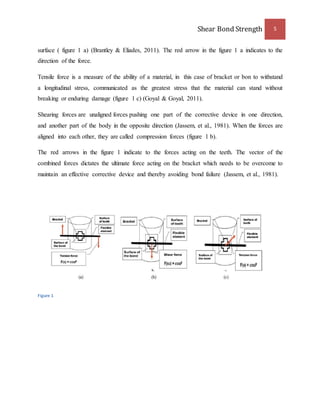
In solid mechanics as in orthodontic brackets, torsion is the twisting of an object due to an 
applied torque, this torque is one of the forces acting on the bracket-cement-enamel interface. It 
is expressed in newton metres (N·m) or foot-pound force (ft·lbf). In units perpendicular to the 
torque axis, the resultant shear stress in this unit is perpendicular to the radius of the contact
Shear Bond Strength 5 
surface ( figure 1 a) (Brantley & Eliades, 2011). The red arrow in the figure 1 a indicates to the 
direction of the force. 
Tensile force is a measure of the ability of a material, in this case of bracket or bon to withstand 
a longitudinal stress, communicated as the greatest stress that the material can stand without 
breaking or enduring damage (figure 1 c) (Goyal & Goyal, 2011). 
Shearing forces are unaligned forces pushing one part of the corrective device in one direction, 
and another part of the body in the opposite direction (Jassem, et al., 1981). When the forces are 
aligned into each other, they are called compression forces (figure 1 b). 
The red arrows in the figure 1 indicate to the forces acting on the teeth. The vector of the 
combined forces dictates the ultimate force acting on the bracket which needs to be overcome to 
maintain an effective corrective device and thereby avoiding bond failure (Jassem, et al., 1981). 
Figure 1
Shear Bond Strength 6 
Literature Review 
Obtaining adequate force during orthodontic treatment will certainly result in an optimal tissue 
response and satisfactory tooth movement (Brantley & Eliades, 2011). 
The types of dental brackets available to the orthodontists are extensive and varied; however, the 
two basic types are metal or ceramic (H, et al., 1998) (Ødegaard & Segner, 1988). The choice of 
material of the bracket is dependent on a variety of factors, such as; severity of presented 
pathology, the aim of the procedure, the extent of the treatment, preference of the orthodontist, 
patient’s financial obligations or choices and various others. Ultimately, both materials have its 
advantages and disadvantages (John Gwinnett, 1988). 
One of the most common reasons for popularity of ceramic braces is their aesthetic appeal, in 
comparison to the metal counterpart. The shear bond strength of ceramic bracket is superior to 
that of metal brackets in a variety of adhesives used. However, it has been established that the 
ceramic bracket occurred predominantly in the enamel-adhesive interface, while the site for bond 
failure for the metal bracket was found to be mainly in the bracket-adhesive interface. It has been 
determined that the shear bond strength between ceramic bracket and adhesive is stronger than 
that of the shear bond strength between the enamel surface and the adhesive. It has been 
suggested that ceramic brackets offer an effective alternative to their metal counterpart. It can be 
determined that ceramic brackets combine esthetics with bond strength that is analogous to and 
as dependable as their metal counterparts (John Gwinnett, 1988) (Jassem, et al., 1981). 
In order to achieve optimal treatment, clinically adequate bond strengths to enamel for metal 
orthodontic brackets should be sufficient to withstand normal orthodontic forces and masticatory 
loads, in addition to being aesthetic and easily removed at the end of treatment, without 
damaging the enamel surface (Brantley & Eliades, 2011). The underlying cause of bond failure is 
calculated by semi-qualitative analysis by using the adhesive remnant index or ARI. 
Several factors influence the bond strength of brackets (Maijer & Smith, 1981)including a wide 
range of the available etching agents’ and adhesives, the size and design of the bracket base, 
masticatory forces and temperature, among others (Maijer & Smith, 1981).
Shear Bond Strength 7 
The most commonly used etching agent is phosphoric acid. Researcher (Retief, 1975) suggests 
the use of 50% phosphoric acid solution as a conditioning agent, but the optimal phosphoric acid 
concentration should be determined for each adhesive system. 
Other factor that deeply influences sheer bond strength is the bracket/adhesive system (Brantley 
& Eliades, 2011)an adhesive must be able to deal with numerous deleterious conditions in the 
oral cavity, such as constant moisture and the considerable masticatory stress as well as applied 
orthodontic stress. 
In a study titled, ‘Shear Bond Strengths of orthodontic brackets cemented to bovine enamel with 
composite and resin modified glass ionomer cements’ authors (Titley, et al., 2003) studied the 
effects of short and long term storage of the shear bond strength of metal, ceramic and 
polycarbonate orthodontic brackets bases using resin-modified glass ionomer cements and resin 
composite. The authors of the study concluded that the bracket base and cement combination 
produced sustainable combination in all cases and that devices are durable overtime, however, 
the authors warn that the selection of cement is very important in patients who are at high risk for 
caries (Titley, et al., 2003). 
Authors’ (Rastelli, et al., 2010) conducted a highly regulated study to evaluate the shear bond 
strength of stainless steel bracket with fluoride releasing composite resins compared to other 
adhesive mediums. The authors concluded that while all materials tested in this investigation 
have adequate SBS to meet clinical and/or corrective needs, Concise showed greater resistance 
than Rely-a-Bond and Ultra bond. The authors also found that the adhesive remnant index was 
similar between all groups and although bon failure did occur, there was no damage to the 
enamel surface, except in case of Concise, which exhibited enamel fractures. 
The size and design of a bracket base can also affect bond strength (H, et al., 1998). Brackets 
with a circular concave base design produced greater bond strength than the brackets with mesh 
bases. It has been determined that the larger the mesh spacing, the greater the bond strength of 
the corrective device ( (Wang, et al., 2004). 
Due to the higher masticatory forces generated in the posterior regions of the mouth or by the 
differences in enamel micro morphology (Knoll, et al., 1986), there is a clinically higher failure
Shear Bond Strength 8 
rate among bonded brackets on posterior teeth than on anterior teeth (Garlic 1977, Zachrisson 
1977). Authors (Knoll, et al., 1986) also suggests that the no uniformity of the resin thickness 
between the enamel and bracket base for posterior teeth may account for the observed 
differences. 
Temperature fluctuations in the oral environment is an important factor that needs to be 
considered. Because of the temperature fluctuations that occur in the oral environment, the 
effects of temperature cycling on the bond strengths of bonding resins to etched enamel have 
been evaluated (Maijer & Smith, 1981). Temperature cycling did not have a significant effect; 
however, on shear bond and rebond strengths when compared to the shear bond and rebond 
strengths of uncycled specimens of a low-viscosity bonding resin to etched enamel (Jassem, et 
al., 1981). 
The reuse of orthodontic brackets and the consequent rebonding procedures are becoming 
increasingly popular because they minimize waste and cost to the orthodontist and ultimately to 
the patient. Bond strength after one reconditioning cycle ranged from 45% to 75% of initial bond 
strength for different types of adhesives (Wright & Powers, 1985). This finding supports another 
study where the bond shear strength values after reconditioning were from 65% to 84% of initial 
shear strength values, depending on the bracket brand (Mascia & Chen, 1982). 
Since there are varieties of bracket bases that are available to the orthodontists for corrective 
procedure under discussion, there have been various studies evaluating the success and 
advantage of one bracket base to another. Authors in a study evaluated bracket bases from 7 
different manufactures using a SEM or scanning electron microscope (Maijer & Smith, 1981). 
The bracket bases were bonded to human premolars with Dynabond and stored in water for 
twenty four hours before being tested for shear failure. The study concluded that the best resin 
penetration and bond strength were obtained with a fine mesh bracket base of the woven mesh 
type. It also determined that the bracket bases should be designed to prevent air entrapment 
under the base, which may precipitate bond failure. The authors concluded that the weld spots on 
attachment bases should be avoided to prevent poor seal and cause complications, since weld 
spots reduce retentive area the weld spurs could be responsible for lower bond strengths in some 
samples of mesh and foil (Maijer & Smith, 1981).
Shear Bond Strength 9 
Another factor that determines the strength and thereby the durability of orthodontic brackets is 
the storage medium that may be used to store these brackets. There are a variety of mediums that 
can be used in order to prolong the life of the brackets and avoid microbial infestation (Brantley 
& Eliades, 2011). A variety of in vitro studies have been conducted to evaluation the effects of 
storage media on the SBS or shear bond strength of orthodontic brackets. Storing teeth in media 
other than water may decrease fungal, bacterial and viral growth, which in turn may prevent 
increased financial cost and inconvenience (Sachdeva, et al., 2012). The storing may also prevent 
enamel desiccation prior to the testing or any other purpose the teeth are being stored for. A 
comparison of six storage medium, which are; distilled water, 10% formalin, saline solution of 
0.9% sodium chloride, 70% ethanol, 3% hydrogen peroxide and artificial saliva. It was 
determined that the formalin had the highest mean shear bond strength, while ethanol had the 
lowest mean shear bond strength. The shear bond strength of isotonic saline solution and distilled 
water were about 7.59 and 6.15 MPa respectively, which was comparable to the clinically 
acceptable shear bond strength of 6-8 MPa. The study recommended saline solution and distilled 
water as the most effective storage media for the orthodontic bracket storage (Sachdeva, et al., 
2012). 
The ultimate shear bond strength of an orthodontic bracket is determined by the interplay of 
various factors, amongst which, one is the media used to prepare the enamel for bonding to the 
brackets i.e. surface preparation of the enamel. A comparison of enamel prepared by YAG laser 
with two different powers to the conventional acid etching was carried out using 1 W and 1,5 W 
of YAG laser power and 37% phosphoric acid (Hosseini, et al., 2012) . The study subjected all 
the test subjects to thermo cycling process and used the adhesive remnant index to evaluate the 
different etching types. The study concluded that the using YAG laser was a favorable alternate 
to using conventional acid etching for surface conditioning. The authors of the study determined 
that while the shear bond strength obtained at both powers of the YAG laser is similar to that of 
conventional etching with 37% phosphoric acid, the high variability of values in bond strength of 
YAG surface conditioning should make it a favorable alternate (Hosseini, et al., 2012). 
With the aim of achieving a strong and reliable bonding between the bracket and the tooth, share, 
tensile and torsion tests have been widely performed (Brantley & Eliades, 2011). Using of shear
Shear Bond Strength 10 
loading has been very popular due to the relative simplicity of the experimental configuration 
and the presumably increased reliability of similarity to debonding that occurs during treatment. 
By evaluating different adhesives in metal and ceramic brackets it has been shown that the shear 
bond strength of ceramic brackets is superior to that of metal brackets (Reddy et al. 2003). 
The tensile test is less commonly performed. Al-Munajed et al. (2000) have evaluated the 
performance of a cyanoacrylate orthodontic adhesive with regard to tensile bond strength in 
comparison with a conventional no-mix orthodontic composite adhesive using stainless steel and 
ceramic brackets, suggesting that cyanoacrylate orthodontic adhesive is unsuitable as a bonding 
agent in either case (H, et al., 1998). 
Merrill et al. (1994) have evaluated the torsional forces that were best suited for debonding 
ceramic brackets. It was found that the torsional bond strength of chemically retained brackets 
was significantly higher than mechanically retained brackets. Using different adhesives, Kao et 
al. (1995) have investigated the torsional bond strength of ceramic brackets bonded to human 
enamel. They concluded that dedonding or bond failure of ceramic brackets under a steady 
torsional load caused no substrate surface alterations regardless of the adhesive used, which 
means that there is minimal to no damage to the enamel surface, making it one of the better 
choice of bracket base material. 
Recently, many clinicians have shifted to one-step self-etch adhesive systems, also referred to as 
all-in-one adhesives, in which manufacturers have incorporated all of the primary components of 
adhesive systems (etchant, primer, and bonding resin) into a single solution (Catalbas, et al., 
2011). All-in-one adhesives are user friendly, because fewer steps are required for bonding 
(Hegde and Manjunath 2011) (J & Bergland, 1984). 
A study conducted by authors (Pawlus, et al., 2013) evaluated the durability of the bond between 
orthodontic and enamel via tensomeric and planimetric evaluation. The objective of this study 
was to evaluate the real strength of adhesives used in the corrective procedure and to introduce a 
copyrighted device, generating multiple vectors of strength between dental brackets and the 
surface enamel. The study aimed to evaluate the three basic forces acting against the orthodontic 
bracket, which are; torsional force, tensile force and shearing force. The study found that the
Shear Bond Strength 11 
resistance was highest for torsional stress, weaker for shear stress and weakest for tension stress 
(Pawlus, et al., 2013). The authors concluded that effective strength to oppose the three forces is 
necessary in order to ensure the clinical success of the corrective device. 
One of such adhesives is the XP BOND dental adhesive system. It has been shown that he 
bonding potential of XP BOND used with the activator or light cured in combination with self-or 
dual-curing mode outperformed that of a control adhesive-cement system (Raffaelli et al. 
2007). In addition, when comparing four commercially available adhesive systems (two total-etch 
and two all-in-one), it was shown that the XP BOND showed the highest bond strength for 
both the moist and dry dentin conditions (Hedge and Manjunath 2011). Similarly, when 
comparing the micro tensile bond strength of three different totals etch adhesives; XP Bond 
showed the greatest values of micro tensile bond strength under both conditions. Moist substrate 
increases the values of micro tensile bond strength for the adhesives tested. It can be determined 
that XP BOND is a superior adhesive system as compared to other three systems that were the 
object of this study (Orellana et al. 2009). 
As adhesive systems improve, the bases became smaller and smaller other variables have 
become more important to the over-all bond strength of bracket bases (SK, 1999). A balance 
between normal dental forces and overall bracket bond strength must be achieved to improve 
patient’s treatment. Failure to do so can result in bond failure and fracture, which in turn can lead 
to iatrogenic damage to the enamel of the teeth. While, bond failure is not an uncommon 
occurrence during the course of the corrective procedure, it has been determined that such 
mishap can lead to increased cost, longer duration of treatment and psychological distress to the 
patient.
Shear Bond Strength 12 
Method 
The study consisted of 180 human teeth. The author of study ensured that the teeth was devoid of 
any defects, such as; infection, caries, breaks or decay. The experiment consisted of 60 incisors, 
60 premolars and 60 molars. The teeth were stored in normal saline (0.9% NaCl) in a closed 
plastic box. Teeth were divided into 6 group each one (10 incisors, 10 premolars and 10 molars) . 
A pilot study done on typodont jaws, as shown in figure 2, with acrylic teeth were used with 
APC bracket and UR2 and LR1 displaced 2mm. A 014 Nickel titanium wire was used for the 
purpose of this study. The electronic calibration is used to deflect the wire to the slot of bracket 
of displaced tooth and the force recorded. The test is repeated done when the above teeth 
displaced 4mm with same wire. In similar way the test done using 016 nickel titanium wire and 
the force required registered to estimate the starting point of the horizontal force used in the 
experimental. 
Figure 2 Figure 3 
Each group was tested at a separate time. On the day of the test, teeth were placed into acrylic 
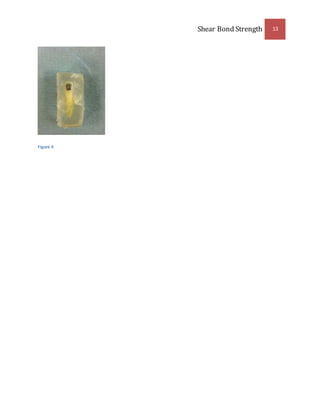
block (figure 4) dimensional approximately height 30 mm , width 15mm and depth 15 mm with 
facial surface of the teeth expose and parallel to the chisel of the introns machine (Figure 3) . 
Following the acrylic sit, the surface of teeth etched with phosphoric acid 37% for 10 – 15 sec. 
The teeth are subsequently washed and dried. Then, the XB bond resin is applied followed by 
light curing for 10- 20 sec, each tooth bond with corresponding bracket APC (MBT prescription) 
which has preload composite.
Shear Bond Strength 13 
Figure 4
Shear Bond Strength 14 
Bibliography 
Alexandre, P., Young, J., Sandril, J. L. & Bowman, D., 1981. Bond strength of three orthodontic adhesives. 
American Journal of Orthodontics, 79(6), pp. 553-661. 
Brantley, W. A. & Eliades, T., 2011. Orthodontic Materials: Scientific and Clinical Aspects. 1 ed. New York: 
Thieme. 
Catalbas, B. et al., 2011. Does chllorhexidine affect the shear bond strength of orthodontic brackets?. 
Journal of Dental Sciences , Volume 6, pp. 76-82. 
Goyal, A. & Goyal, G., 2011. Self-etching Primers and Shear Bond Strength of Orthodontic Brackets: An 
In-vitro Study Discussing the Effect of Ph.. 1 ed. London: Lamber Academic Publishing. 
H, U., Rossouw, P., Titely, K. & Yamin, C., 1998. Combinations of etchants, composite res ins, and bracket 
systems: An important choice in orthodontic bonding procedure.. Angle Orthod, Volume 69, pp. 267- 
275. 
J.A.Salzamann, n.d. Department of reviews and abstracts. American Journal of Orthodontics, 74(6), pp. 
682-684. 
J, A. & Bergland, S., 1984. Clinical trials with crystal growth conditioning as an alternative to acid-etch 
treatment. American Journal of Orthodontics, 85(1), pp. 333-340. 
Jassem, H. A., Retief, H. D. & Jamison, H. C., 1981. Tensile and shear strengths of bonded and rebonded 
orthodontic attachments. American Journal of Orthodontics, 79(6), pp. 661-669. 
John Gwinnett, A., 1988. A comparison of shear bond strengths of metal and ceramic brackets.. 
American Journal of Orthodontics and Dentofacial Orthopedics, 93(4), pp. 346-348. 
Johnson, W. T., Hembree, J. H. & Weber, J. N., 1976. Shear strength of orthodontic direct bonding 
adhesvies. American Journal of Orthodontics, 70(5), pp. 559-567. 
Jr, P. O. A., 1983. Interrelationship of resin viscosity and strain rate with bond strength in orthodontic 
bonding techniques. American Journal of Orthodontics, -(-), pp. 50-62. 
Knoll, M., Gwinnett, A. J. & Wolff, M. S., 1986. Shear strength of brackets bonded to anterior and 
posterior teeth. American Journal of Orthodontics, 89(6), pp. 476-280. 
Maijer, R. & Smith, C. D., 1981. Variables influencing the bond strength of metal orthodontic bracket 
bases. American Jouranl of Orthodontics, 79(1), pp. 20-35.
Shear Bond Strength 15 
Mascia, V. E. & Chen, S.-R., 1982. Shearing strengths of recycleed direct-bonding brackets. American 
Jouranl of Orthodontics, 82(3), pp. 211-217. 
Moin, K. & Dogon, L., 1978. An evaluation of shear strength measurements of unfilled and filled resin 
combinations. American Journal of Orthodontics, 74(5), pp. 531-537. 
Ødegaard, J. & Segner, D., 1988. Shear bond strength of metal brackets compared with a new ceramic 
bracket. American Journal of Orthodontics and Dentofacial Orthopedics, 94(3), pp. 201-206. 
Pawlus, B., Dyszkiewicz, A. & Spidlen, M., 2013. A tensomeric and planimetric evaluation of the 
durability of the bond between an orthodontic bracket and enamel. Acta of Bioengineering and 
Biomechanics, 15(4), pp. 33-43. 
Rastelli, M. C., Coelho, U. & Orellana, E. E. O., 2010. Evaluation of shear bond strength of brackets 
bonded with orthodontic fluoride-releasing composite resins. Dental Press J ortho, 15(3), pp. 106-114. 
Retief, D., 1975. The use of 50 percent of phosphoric acid as an etching agent in orthodontics: A rational 
approach. American Journal of Orthodontics, 68(2), pp. 165-179. 
Siomka, L. V. & Powers, J. M., 1985. In vitro bond strength of treated direct-bonding metal bases. 
American Journal of orthodontics, 88(2), pp. 133-137. 
SK, S. S., 1999. The influence of bracket base designs on shear bond strength of brackets bonded to 
bovine enamel, Toronto: University of Toronto. 
Titley, K. C., Mahal, R.-D., Rossouw, E. P. & Kulkarni, G. V., 2003. Shear Bond Strengths of orthodontic 
brackets cemented to bovine enamel with composite and resin modified glass inonomer cements. 
Pediatric Dentistry, 25(3), pp. 263-270. 
Wang, W. N. et al., 2004. Bond strength of various bracket base designs. American Journal of 
Orthodontics and Dentofacial Orthopedics, 125(1), pp. 66-72. 
Wright, W. L. & Powers, J. M., 1985. In vitro tensile strength of reconditioned brackets. American Journal 
of Orthodontics, 87(3), pp. 247-253.

Shear Bond Strength of Orthodontic Brackets

  • 1.
    Shear Bond Strength1 Shear Bond Strength of Orthodontic Brackets Name Date Course
  • 2.
    Shear Bond Strength2 Table of Contents Introduction .......................................................................................................................................3 Types of Orthodontic brackets .........................................................................................................3 Orthodontic bracket failure .............................................................................................................3 Factors determining the effectiveness of orthodontic brackets..........................................................4 Vector Forces Acting on orthodontic bracket ....................................................................................4 Literature Review ...............................................................................................................................6 Method............................................................................................................................................ 12 Bibliography ..................................................................................................................................... 14
  • 3.
    Shear Bond Strength3 Introduction The procedure of direct bonding of orthodontic brackets to the enamel of the teeth has become a routine clinical procedure in dental settings (Brantley & Eliades, 2011). The direct bonding of brackets has provided an esthetic alternate to the former orthodontic bonding. The relatively modern procedure of binding brackets to the surface of the teeth enamels requires considerable expertise as there are various factors that need to be considered prior to the procedure. These factors include enamel conditioning agents, base design, cement luting agents and bracket material. The most important factor to consider is that the shear bond strength of these orthodontic brackets need not only have sufficient strength to resist fracture overtime, but to have enough strength to evade bond failure (Moin & Dogon, 1978). Orthodontic brackets that break easily may cause damage to the enamels of the teeth and leading to inconvenience to the orthodontist and the patient, as well as increased financial cost to the orthodontist, and ultimately to the patient (Jassem, et al., 1981). While incidences of bond fracture, failure or debonding are not uncommon during the course of the treatment, most orthodontists and patients see this as an undesired happening in the sequences of events. Therefore, it can be established that it is necessary to understand the device of orthodontic brackets, as well as to understand the internal mechanics and the role of a variety of products and material available to be used in the procedure in order to understand, and ultimately avoid the failure of the orthodontic bond and ensure the success of this clinical endure. Types of Orthodontic brackets The orthodontic brackets that are currently at the orthodontist’s disposal are extensive and varied (Brantley & Eliades, 2011). The brackets may be made of ceramic, metal, plastic or a combination of these materials. An orthodontist may use 2 categories of cement to attach bracket to his patient’s enamel, the enamel may be conditioned or non-conditioned. The 2 categories are; resin composite or resin reinforced glass ionomers. Resin composites require conditioning of the enamel surface; this cement requires dry bonding enviir0mment, whereas resin reinforced glass ionomers can bond in non-conditioned or wet environments (Jr, 1983). Orthodontic bracket failure The debonding of the orthodontic brackets from the surface of the enamel may he labelled as bond failure (Titley, et al., 2003). Bond failure may result in iatrogenic damage to the surface of
  • 4.
    Shear Bond Strength4 the enamel or traumatic injury to the surrounding structures. Broadly speaking, the sites of bond failure can be divided into three anatomical sites, which are; within bracket, between cement and enamel surface and between cement and bracket (Jassem, et al., 1981) (H, et al., 1998). The fracture of a bonded orthodontic bracket is not an uncommon occurrence. An orthodontic bracket must resist a force of 6-8 MPa in order to avoid breaking and maintaining clinical success. However, a displacement force of over 10 MPa can lead to bond failure (Brantley & Eliades, 2011). An Index has been developed to quantify the amount of cement that remains on the enamel surface after a bond failure (Brantley & Eliades, 2011). The ARI or adhesive remnant index is dependent on the type of bracket material and type of cement used; however, there is no evidence of a co-relationship between the two variables (Alexandre, et al., 1981) (Jassem, et al., 1981). Factors determining the effectiveness of orthodontic brackets The effectiveness of orthodontic brackets are determined by two important factors, which are; the durability of the attachment of the bracket to the surface enamel and the proper determination of the corrective force vectors. The latter factor, which is the force vector is generated by the elastic component of the corrective device and should be treated as the resultant of tension, shear and torsional forces, which, depending on the location of the bracket may have different values. The former factor, which is durability of the bracket-cement-enamel interface is calculated in torque and is not a homogenous parameter (Johnson, et al., 1976) (Jassem, et al., 1981). When assessing the cause of bond failure directional characteristics are taken into account by a semi-quantitative assessment using ARI or the adhesive remnant index (Siomka & Powers, 1985). Vector Forces Acting on orthodontic bracket In solid mechanics as in orthodontic brackets, torsion is the twisting of an object due to an applied torque, this torque is one of the forces acting on the bracket-cement-enamel interface. It is expressed in newton metres (N·m) or foot-pound force (ft·lbf). In units perpendicular to the torque axis, the resultant shear stress in this unit is perpendicular to the radius of the contact
  • 5.
    Shear Bond Strength5 surface ( figure 1 a) (Brantley & Eliades, 2011). The red arrow in the figure 1 a indicates to the direction of the force. Tensile force is a measure of the ability of a material, in this case of bracket or bon to withstand a longitudinal stress, communicated as the greatest stress that the material can stand without breaking or enduring damage (figure 1 c) (Goyal & Goyal, 2011). Shearing forces are unaligned forces pushing one part of the corrective device in one direction, and another part of the body in the opposite direction (Jassem, et al., 1981). When the forces are aligned into each other, they are called compression forces (figure 1 b). The red arrows in the figure 1 indicate to the forces acting on the teeth. The vector of the combined forces dictates the ultimate force acting on the bracket which needs to be overcome to maintain an effective corrective device and thereby avoiding bond failure (Jassem, et al., 1981). Figure 1
  • 6.
    Shear Bond Strength6 Literature Review Obtaining adequate force during orthodontic treatment will certainly result in an optimal tissue response and satisfactory tooth movement (Brantley & Eliades, 2011). The types of dental brackets available to the orthodontists are extensive and varied; however, the two basic types are metal or ceramic (H, et al., 1998) (Ødegaard & Segner, 1988). The choice of material of the bracket is dependent on a variety of factors, such as; severity of presented pathology, the aim of the procedure, the extent of the treatment, preference of the orthodontist, patient’s financial obligations or choices and various others. Ultimately, both materials have its advantages and disadvantages (John Gwinnett, 1988). One of the most common reasons for popularity of ceramic braces is their aesthetic appeal, in comparison to the metal counterpart. The shear bond strength of ceramic bracket is superior to that of metal brackets in a variety of adhesives used. However, it has been established that the ceramic bracket occurred predominantly in the enamel-adhesive interface, while the site for bond failure for the metal bracket was found to be mainly in the bracket-adhesive interface. It has been determined that the shear bond strength between ceramic bracket and adhesive is stronger than that of the shear bond strength between the enamel surface and the adhesive. It has been suggested that ceramic brackets offer an effective alternative to their metal counterpart. It can be determined that ceramic brackets combine esthetics with bond strength that is analogous to and as dependable as their metal counterparts (John Gwinnett, 1988) (Jassem, et al., 1981). In order to achieve optimal treatment, clinically adequate bond strengths to enamel for metal orthodontic brackets should be sufficient to withstand normal orthodontic forces and masticatory loads, in addition to being aesthetic and easily removed at the end of treatment, without damaging the enamel surface (Brantley & Eliades, 2011). The underlying cause of bond failure is calculated by semi-qualitative analysis by using the adhesive remnant index or ARI. Several factors influence the bond strength of brackets (Maijer & Smith, 1981)including a wide range of the available etching agents’ and adhesives, the size and design of the bracket base, masticatory forces and temperature, among others (Maijer & Smith, 1981).
  • 7.
    Shear Bond Strength7 The most commonly used etching agent is phosphoric acid. Researcher (Retief, 1975) suggests the use of 50% phosphoric acid solution as a conditioning agent, but the optimal phosphoric acid concentration should be determined for each adhesive system. Other factor that deeply influences sheer bond strength is the bracket/adhesive system (Brantley & Eliades, 2011)an adhesive must be able to deal with numerous deleterious conditions in the oral cavity, such as constant moisture and the considerable masticatory stress as well as applied orthodontic stress. In a study titled, ‘Shear Bond Strengths of orthodontic brackets cemented to bovine enamel with composite and resin modified glass ionomer cements’ authors (Titley, et al., 2003) studied the effects of short and long term storage of the shear bond strength of metal, ceramic and polycarbonate orthodontic brackets bases using resin-modified glass ionomer cements and resin composite. The authors of the study concluded that the bracket base and cement combination produced sustainable combination in all cases and that devices are durable overtime, however, the authors warn that the selection of cement is very important in patients who are at high risk for caries (Titley, et al., 2003). Authors’ (Rastelli, et al., 2010) conducted a highly regulated study to evaluate the shear bond strength of stainless steel bracket with fluoride releasing composite resins compared to other adhesive mediums. The authors concluded that while all materials tested in this investigation have adequate SBS to meet clinical and/or corrective needs, Concise showed greater resistance than Rely-a-Bond and Ultra bond. The authors also found that the adhesive remnant index was similar between all groups and although bon failure did occur, there was no damage to the enamel surface, except in case of Concise, which exhibited enamel fractures. The size and design of a bracket base can also affect bond strength (H, et al., 1998). Brackets with a circular concave base design produced greater bond strength than the brackets with mesh bases. It has been determined that the larger the mesh spacing, the greater the bond strength of the corrective device ( (Wang, et al., 2004). Due to the higher masticatory forces generated in the posterior regions of the mouth or by the differences in enamel micro morphology (Knoll, et al., 1986), there is a clinically higher failure
  • 8.
    Shear Bond Strength8 rate among bonded brackets on posterior teeth than on anterior teeth (Garlic 1977, Zachrisson 1977). Authors (Knoll, et al., 1986) also suggests that the no uniformity of the resin thickness between the enamel and bracket base for posterior teeth may account for the observed differences. Temperature fluctuations in the oral environment is an important factor that needs to be considered. Because of the temperature fluctuations that occur in the oral environment, the effects of temperature cycling on the bond strengths of bonding resins to etched enamel have been evaluated (Maijer & Smith, 1981). Temperature cycling did not have a significant effect; however, on shear bond and rebond strengths when compared to the shear bond and rebond strengths of uncycled specimens of a low-viscosity bonding resin to etched enamel (Jassem, et al., 1981). The reuse of orthodontic brackets and the consequent rebonding procedures are becoming increasingly popular because they minimize waste and cost to the orthodontist and ultimately to the patient. Bond strength after one reconditioning cycle ranged from 45% to 75% of initial bond strength for different types of adhesives (Wright & Powers, 1985). This finding supports another study where the bond shear strength values after reconditioning were from 65% to 84% of initial shear strength values, depending on the bracket brand (Mascia & Chen, 1982). Since there are varieties of bracket bases that are available to the orthodontists for corrective procedure under discussion, there have been various studies evaluating the success and advantage of one bracket base to another. Authors in a study evaluated bracket bases from 7 different manufactures using a SEM or scanning electron microscope (Maijer & Smith, 1981). The bracket bases were bonded to human premolars with Dynabond and stored in water for twenty four hours before being tested for shear failure. The study concluded that the best resin penetration and bond strength were obtained with a fine mesh bracket base of the woven mesh type. It also determined that the bracket bases should be designed to prevent air entrapment under the base, which may precipitate bond failure. The authors concluded that the weld spots on attachment bases should be avoided to prevent poor seal and cause complications, since weld spots reduce retentive area the weld spurs could be responsible for lower bond strengths in some samples of mesh and foil (Maijer & Smith, 1981).
  • 9.
    Shear Bond Strength9 Another factor that determines the strength and thereby the durability of orthodontic brackets is the storage medium that may be used to store these brackets. There are a variety of mediums that can be used in order to prolong the life of the brackets and avoid microbial infestation (Brantley & Eliades, 2011). A variety of in vitro studies have been conducted to evaluation the effects of storage media on the SBS or shear bond strength of orthodontic brackets. Storing teeth in media other than water may decrease fungal, bacterial and viral growth, which in turn may prevent increased financial cost and inconvenience (Sachdeva, et al., 2012). The storing may also prevent enamel desiccation prior to the testing or any other purpose the teeth are being stored for. A comparison of six storage medium, which are; distilled water, 10% formalin, saline solution of 0.9% sodium chloride, 70% ethanol, 3% hydrogen peroxide and artificial saliva. It was determined that the formalin had the highest mean shear bond strength, while ethanol had the lowest mean shear bond strength. The shear bond strength of isotonic saline solution and distilled water were about 7.59 and 6.15 MPa respectively, which was comparable to the clinically acceptable shear bond strength of 6-8 MPa. The study recommended saline solution and distilled water as the most effective storage media for the orthodontic bracket storage (Sachdeva, et al., 2012). The ultimate shear bond strength of an orthodontic bracket is determined by the interplay of various factors, amongst which, one is the media used to prepare the enamel for bonding to the brackets i.e. surface preparation of the enamel. A comparison of enamel prepared by YAG laser with two different powers to the conventional acid etching was carried out using 1 W and 1,5 W of YAG laser power and 37% phosphoric acid (Hosseini, et al., 2012) . The study subjected all the test subjects to thermo cycling process and used the adhesive remnant index to evaluate the different etching types. The study concluded that the using YAG laser was a favorable alternate to using conventional acid etching for surface conditioning. The authors of the study determined that while the shear bond strength obtained at both powers of the YAG laser is similar to that of conventional etching with 37% phosphoric acid, the high variability of values in bond strength of YAG surface conditioning should make it a favorable alternate (Hosseini, et al., 2012). With the aim of achieving a strong and reliable bonding between the bracket and the tooth, share, tensile and torsion tests have been widely performed (Brantley & Eliades, 2011). Using of shear
  • 10.
    Shear Bond Strength10 loading has been very popular due to the relative simplicity of the experimental configuration and the presumably increased reliability of similarity to debonding that occurs during treatment. By evaluating different adhesives in metal and ceramic brackets it has been shown that the shear bond strength of ceramic brackets is superior to that of metal brackets (Reddy et al. 2003). The tensile test is less commonly performed. Al-Munajed et al. (2000) have evaluated the performance of a cyanoacrylate orthodontic adhesive with regard to tensile bond strength in comparison with a conventional no-mix orthodontic composite adhesive using stainless steel and ceramic brackets, suggesting that cyanoacrylate orthodontic adhesive is unsuitable as a bonding agent in either case (H, et al., 1998). Merrill et al. (1994) have evaluated the torsional forces that were best suited for debonding ceramic brackets. It was found that the torsional bond strength of chemically retained brackets was significantly higher than mechanically retained brackets. Using different adhesives, Kao et al. (1995) have investigated the torsional bond strength of ceramic brackets bonded to human enamel. They concluded that dedonding or bond failure of ceramic brackets under a steady torsional load caused no substrate surface alterations regardless of the adhesive used, which means that there is minimal to no damage to the enamel surface, making it one of the better choice of bracket base material. Recently, many clinicians have shifted to one-step self-etch adhesive systems, also referred to as all-in-one adhesives, in which manufacturers have incorporated all of the primary components of adhesive systems (etchant, primer, and bonding resin) into a single solution (Catalbas, et al., 2011). All-in-one adhesives are user friendly, because fewer steps are required for bonding (Hegde and Manjunath 2011) (J & Bergland, 1984). A study conducted by authors (Pawlus, et al., 2013) evaluated the durability of the bond between orthodontic and enamel via tensomeric and planimetric evaluation. The objective of this study was to evaluate the real strength of adhesives used in the corrective procedure and to introduce a copyrighted device, generating multiple vectors of strength between dental brackets and the surface enamel. The study aimed to evaluate the three basic forces acting against the orthodontic bracket, which are; torsional force, tensile force and shearing force. The study found that the
  • 11.
    Shear Bond Strength11 resistance was highest for torsional stress, weaker for shear stress and weakest for tension stress (Pawlus, et al., 2013). The authors concluded that effective strength to oppose the three forces is necessary in order to ensure the clinical success of the corrective device. One of such adhesives is the XP BOND dental adhesive system. It has been shown that he bonding potential of XP BOND used with the activator or light cured in combination with self-or dual-curing mode outperformed that of a control adhesive-cement system (Raffaelli et al. 2007). In addition, when comparing four commercially available adhesive systems (two total-etch and two all-in-one), it was shown that the XP BOND showed the highest bond strength for both the moist and dry dentin conditions (Hedge and Manjunath 2011). Similarly, when comparing the micro tensile bond strength of three different totals etch adhesives; XP Bond showed the greatest values of micro tensile bond strength under both conditions. Moist substrate increases the values of micro tensile bond strength for the adhesives tested. It can be determined that XP BOND is a superior adhesive system as compared to other three systems that were the object of this study (Orellana et al. 2009). As adhesive systems improve, the bases became smaller and smaller other variables have become more important to the over-all bond strength of bracket bases (SK, 1999). A balance between normal dental forces and overall bracket bond strength must be achieved to improve patient’s treatment. Failure to do so can result in bond failure and fracture, which in turn can lead to iatrogenic damage to the enamel of the teeth. While, bond failure is not an uncommon occurrence during the course of the corrective procedure, it has been determined that such mishap can lead to increased cost, longer duration of treatment and psychological distress to the patient.
  • 12.
    Shear Bond Strength12 Method The study consisted of 180 human teeth. The author of study ensured that the teeth was devoid of any defects, such as; infection, caries, breaks or decay. The experiment consisted of 60 incisors, 60 premolars and 60 molars. The teeth were stored in normal saline (0.9% NaCl) in a closed plastic box. Teeth were divided into 6 group each one (10 incisors, 10 premolars and 10 molars) . A pilot study done on typodont jaws, as shown in figure 2, with acrylic teeth were used with APC bracket and UR2 and LR1 displaced 2mm. A 014 Nickel titanium wire was used for the purpose of this study. The electronic calibration is used to deflect the wire to the slot of bracket of displaced tooth and the force recorded. The test is repeated done when the above teeth displaced 4mm with same wire. In similar way the test done using 016 nickel titanium wire and the force required registered to estimate the starting point of the horizontal force used in the experimental. Figure 2 Figure 3 Each group was tested at a separate time. On the day of the test, teeth were placed into acrylic block (figure 4) dimensional approximately height 30 mm , width 15mm and depth 15 mm with facial surface of the teeth expose and parallel to the chisel of the introns machine (Figure 3) . Following the acrylic sit, the surface of teeth etched with phosphoric acid 37% for 10 – 15 sec. The teeth are subsequently washed and dried. Then, the XB bond resin is applied followed by light curing for 10- 20 sec, each tooth bond with corresponding bracket APC (MBT prescription) which has preload composite.
  • 13.
  • 14.
    Shear Bond Strength14 Bibliography Alexandre, P., Young, J., Sandril, J. L. & Bowman, D., 1981. Bond strength of three orthodontic adhesives. American Journal of Orthodontics, 79(6), pp. 553-661. Brantley, W. A. & Eliades, T., 2011. Orthodontic Materials: Scientific and Clinical Aspects. 1 ed. New York: Thieme. Catalbas, B. et al., 2011. Does chllorhexidine affect the shear bond strength of orthodontic brackets?. Journal of Dental Sciences , Volume 6, pp. 76-82. Goyal, A. & Goyal, G., 2011. Self-etching Primers and Shear Bond Strength of Orthodontic Brackets: An In-vitro Study Discussing the Effect of Ph.. 1 ed. London: Lamber Academic Publishing. H, U., Rossouw, P., Titely, K. & Yamin, C., 1998. Combinations of etchants, composite res ins, and bracket systems: An important choice in orthodontic bonding procedure.. Angle Orthod, Volume 69, pp. 267- 275. J.A.Salzamann, n.d. Department of reviews and abstracts. American Journal of Orthodontics, 74(6), pp. 682-684. J, A. & Bergland, S., 1984. Clinical trials with crystal growth conditioning as an alternative to acid-etch treatment. American Journal of Orthodontics, 85(1), pp. 333-340. Jassem, H. A., Retief, H. D. & Jamison, H. C., 1981. Tensile and shear strengths of bonded and rebonded orthodontic attachments. American Journal of Orthodontics, 79(6), pp. 661-669. John Gwinnett, A., 1988. A comparison of shear bond strengths of metal and ceramic brackets.. American Journal of Orthodontics and Dentofacial Orthopedics, 93(4), pp. 346-348. Johnson, W. T., Hembree, J. H. & Weber, J. N., 1976. Shear strength of orthodontic direct bonding adhesvies. American Journal of Orthodontics, 70(5), pp. 559-567. Jr, P. O. A., 1983. Interrelationship of resin viscosity and strain rate with bond strength in orthodontic bonding techniques. American Journal of Orthodontics, -(-), pp. 50-62. Knoll, M., Gwinnett, A. J. & Wolff, M. S., 1986. Shear strength of brackets bonded to anterior and posterior teeth. American Journal of Orthodontics, 89(6), pp. 476-280. Maijer, R. & Smith, C. D., 1981. Variables influencing the bond strength of metal orthodontic bracket bases. American Jouranl of Orthodontics, 79(1), pp. 20-35.
  • 15.
    Shear Bond Strength15 Mascia, V. E. & Chen, S.-R., 1982. Shearing strengths of recycleed direct-bonding brackets. American Jouranl of Orthodontics, 82(3), pp. 211-217. Moin, K. & Dogon, L., 1978. An evaluation of shear strength measurements of unfilled and filled resin combinations. American Journal of Orthodontics, 74(5), pp. 531-537. Ødegaard, J. & Segner, D., 1988. Shear bond strength of metal brackets compared with a new ceramic bracket. American Journal of Orthodontics and Dentofacial Orthopedics, 94(3), pp. 201-206. Pawlus, B., Dyszkiewicz, A. & Spidlen, M., 2013. A tensomeric and planimetric evaluation of the durability of the bond between an orthodontic bracket and enamel. Acta of Bioengineering and Biomechanics, 15(4), pp. 33-43. Rastelli, M. C., Coelho, U. & Orellana, E. E. O., 2010. Evaluation of shear bond strength of brackets bonded with orthodontic fluoride-releasing composite resins. Dental Press J ortho, 15(3), pp. 106-114. Retief, D., 1975. The use of 50 percent of phosphoric acid as an etching agent in orthodontics: A rational approach. American Journal of Orthodontics, 68(2), pp. 165-179. Siomka, L. V. & Powers, J. M., 1985. In vitro bond strength of treated direct-bonding metal bases. American Journal of orthodontics, 88(2), pp. 133-137. SK, S. S., 1999. The influence of bracket base designs on shear bond strength of brackets bonded to bovine enamel, Toronto: University of Toronto. Titley, K. C., Mahal, R.-D., Rossouw, E. P. & Kulkarni, G. V., 2003. Shear Bond Strengths of orthodontic brackets cemented to bovine enamel with composite and resin modified glass inonomer cements. Pediatric Dentistry, 25(3), pp. 263-270. Wang, W. N. et al., 2004. Bond strength of various bracket base designs. American Journal of Orthodontics and Dentofacial Orthopedics, 125(1), pp. 66-72. Wright, W. L. & Powers, J. M., 1985. In vitro tensile strength of reconditioned brackets. American Journal of Orthodontics, 87(3), pp. 247-253.