DFEEST Annual Report 2005 - Section A


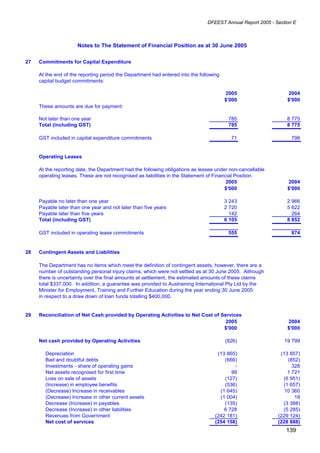
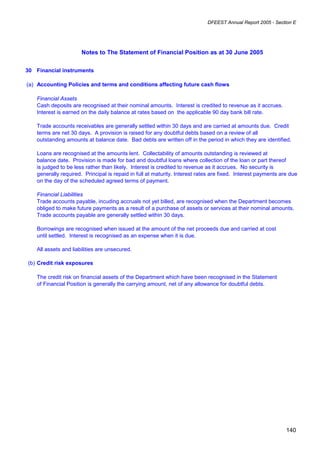
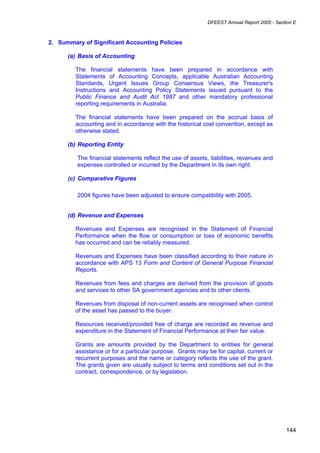
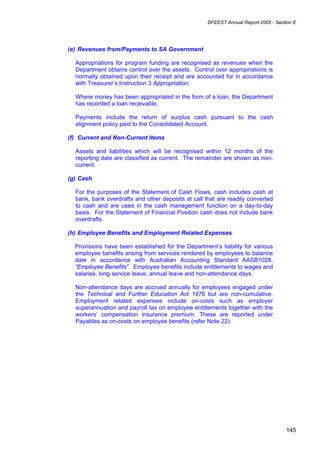
Hon Paul Caica MP
Minister for Employment, Training and Further Education                                 GPO Box 320
Level 11, Zurich House                                                               Adelaide SA 5001
50 Grenfell Street
                                                                                       T 08 8226 3821
ADELAIDE SA 5000
                                                                                       F 08 8226 9533


Hon Karlene Maywald MP
Minister for Science and Information Economy
Level 12
211 Victoria Square
ADELAIDE SA 5000


31 March 2006


Dear Ministers

I am pleased to present to you the 2005 Annual Report for the Department of Further
Education, Employment, Science and Technology.

The report has been prepared in accordance with the requirements of the Technical
and Further Education Act 1975 and the Public Sector Management Act 1995.

This annual report presents the department’s financial statement for the financial
year 2004–05 and an overview of the activities and achievements for the 2005
calendar year reporting on progress made towards achieving the objectives in South
Australia’s Strategic Plan.

Yours sincerely


Brian Cunningham
CHIEF EXECUTIVE
DFEEST Annual Report 2005 - Section A


For further copies and enquiries please contact:

Department of Further Education, Employment, Science and Technology (DFEEST)
Office of the Chief Executive
GPO BOX 320
ADELAIDE SA 5001

Telephone: (08) 8226 3821
Facsimile: (08) 8226 9533

The 2005 Annual Report is available on the DFEEST website at
www.dfeest.sa.gov.au.

ISSN 1449-6437


                                                                                            2
DFEEST Annual Report 2005 - Section A


CONTENTS


SECTION A
   HIGHLIGHTS 2005                                                  5
   CHIEF EXECUTIVE’S REPORT                                         7
   MINISTERIAL LEGISLATIVE RESPONSIBILITIES                         9
       EMPLOYMENT, TRAINING AND FURTHER EDUCATION                   9
       SCIENCE AND INFORMATION ECONOMY                            11
   DEPARTMENTAL RESPONSIBILITIES                                  13
   ORGANISATION CHART                                             14
   STRATEGIC FRAMEWORK                                            16
   CORPORATE GOVERNANCE                                           17
   FINANCIAL OVERVIEW                                             18
SECTION B
   WORKFORCE PROFILE                                              21
       EXECUTIVE PROFILE                                          22
       WORKFORCE DIVERSITY                                        23
       LEAVE MANAGEMENT                                           24
       PERFORMANCE MANAGEMENT                                     25
       TRAINING AND DEVELOPMENT                                   25
       EMPLOYEE ASSISTANCE PROGRAM                                27
       EQUAL OPPORTUNITY EMPLOYMENT PROGRAMS                      28
   OCCUPATIONAL HEALTH, SAFETY AND INJURY MANAGEMENT              29
SECTION C
   2005 PERFORMANCE REPORTS                                       31
      STATE WORKFORCE DEVELOPMENT                                 31
      QUALITY AND REGULATORY SERVICES                             36
      TRAINEESHIPS AND APPRENTICESHIPS                            40
      EMPLOYMENT DEVELOPMENT PROGRAMS                             45
      ADULT COMMUNITY EDUCATION                                   49
      TAFE SA                                                     51
      INDIGENOUS TRAINING AND EMPLOYMENT                          71
      HIGHER EDUCATION                                            82
      SCIENCE, TECHNOLOGY AND INNOVATION                          89


                                                                                 3
DFEEST Annual Report 2005 - Section A


CONTENTS


SECTION D
   FEATURES
      DISABILITY ACTION PLAN                                    100
      CONTRACTS                                                 104
      EXTERNAL CONSULTANCIES                                    107
      ACCOUNT PAYMENT PERFORMANCE                               108
      RECONCILIATION                                            108
      ENERGY EFFICIENCY ACTION PLAN                             110
      ASBESTOS MANAGEMENT                                       111
      URBAN DESIGN CHARTER                                      113
      OVERSEAS TRAVEL                                           114
      FRAUD                                                     116
      FREEDOM OF INFORMATION                                    116
SECTION E
   FINANCIAL INFORMATION                                        118
   STATISTICAL APPENDICES                                       152
      APPENDIX 1: VOCATIONAL EDUCATION AND TRAINING             152
      APPENDIX 2: VET RECOGNITION DATA FOR 2004 AND 2005        163
      APPENDIX 3: TAFE SA DATA                                  165
      APPENDIX 4: GLOSSARY OF TERMS                             168


                                                                                4
DFEEST Annual Report 2005 - Section A


HIGHLIGHTS 2005


Employment Training and Further Education
• Finalised and launched the State’s Workforce Development Strategy, Better Skills
  Better Work Better State: A Strategy for the Development of South Australia’s
  Workforce to 2010, the South Australian Skills Action Plan and the Workforce
  Development Action Plan.
• Detailed workforce planning undertaken to map labour requirements and
  strategies for the Air Warfare Destroyer Project and expansion of Roxby Downs in
  conjunction with DTED, PIRSA and local industry.
• Consumer Protection Strategy established to strengthen the protection of clients
  of registered training organisations. Developed a supporting brochure to advise
  on the rights of training clients and the information they should seek from RTOs.
• Signed a new triennial Commonwealth / State Training Funding Agreement.
• Established seventeen Employment and Skill Formation Networks across the
  State with representation from local, State and Commonwealth Governments,
  regional economic bodies, TAFE and other key employment and skill formation
  stakeholders. The networks are responsible for coordinating local employment
  and skill formation planning, including gathering and sharing information, as well
  as communicating and consulting with the local community.
• Educating Cities Executive meeting explored options for Adelaide’s future which
  were further developed with the International Education Forum.
• Customised assistance provided to over 2000 workers displaced from
  employment through industry closure or downsizing, particularly in the automotive
  and manufacturing industries.
• Piloted program to prepare people for an apprenticeship with a particular focus on
  trades experiencing skills shortage.
• Held highly successful Ministers TAFE SA Forum in November.
• Established Carnegie Mellon University under South Australian legislation.
• Established three TAFE SA Institutes to strengthen the operation of TAFE SA in
  South Australia.
• Drafted and approved legislation by Parliament to give South Australian
  universities greater autonomy and access to growth funding from the
  Commonwealth Government.
• Employed a record number of apprentices and trainees in training in South
  Australia (33, 800; an increase of 1800 or 5.6 per cent, on the June 2004 figure
  against a decline nationally).
• TAFE SA performed better than other TAFE systems in Australia during 2005,
  with 91 per cent of graduates going on to employment or further study within three
  months of completing their studies.
• Employed record number of people (742,700 people as at December 2005,
  compared to 655,000 a decade ago).
• Increased by 60 per cent the number of international students studying in
  Adelaide, with more than 17,900 international students choosing Adelaide as their
  study destination in the first 11 months of 2005.

                                                                                              5
DFEEST Annual Report 2005 - Section A


Science, Technology and Innovation
• Committed $2.5 million in funding to the establishment of the new multi-million
  dollar Australian Minerals Science Research Institute (AMSRI) and its
  headquarters at Mawson Lakes. This seed funding has helped secure a further
  $28 million in Commonwealth and industry funds.
• Invested a total of $5.2 million in state funds from the Premier’s Science &
  Research fund in 2004-05 to support projects worth $20.1 million.
• Inaugurated the David Unaipon Innovation Award, a DFEEST reconciliation
  project to highlight and encourage the participation of Aboriginal young people in
  the fields of science and technology.
• Formed the new Premier’s Science and Research Council and appointed
  Emeritus Professor Max Brennan AO as the state’s Chief Scientist.
• South Australia invested $4.2 million which assisted in winning eight of the 16
  successful bids funded from the Commonwealth’s CRC program. Flow-on
  investment of Commonwealth funds into the state is estimated to be more than
  $60 million over seven years.
• Finalised the Information Economy Agenda for South Australia for launch in
  February 2006.
• Supported Yorke Peninsula broadband services through the Broadband
  Development Fund launched mid-2005 and a further five regional projects funded
  in the Coorong District Council, Kangaroo Island, Port Lincoln, Eyre Peninsula and
  the Barossa and Light Districts.
• SABRENet Limited executed an agreement with Amcom Telecommunications Pty
  Ltd to build, maintain and operate the SABRENet infrastructure. Under the terms
  of the agreement, Amcom will construct the network over 12 months from contract
  signing and will receive access to a limited number of fibres on the network for the
  provision of its own commercial broadband services.
• Implemented Outback Connect, providing IT training and technical support for
  pastoral, Aboriginal and remote communities.
• Bio Innovation SA continued development of the $9.5 million Thebarton
  Bioscience Precinct and bioscience incubator.
• Playford Capital continued to attract follow-on investment from the private sector
  through early stage ICT start up companies. Playford’s investment portfolio
  companies have now raised more than $35 million in co-investment since 2001.

Human Resources and People
• Consolidated the Marketing and International team under the office of the CE,
  broadening the skill base of the team and enabling the development of strategic
  marketing plans for the agency.
• Finalised the DFEEST Workforce Development Platform for building the
  department’s workforce into the future.
• Finalised the DFEEST Aboriginal Employment Strategy, which aims for 2.1 per
  cent of the department’s workforce to comprise Aboriginal people by 2010.
• Launched and rolled out Progressive FEEST, building stronger linkages across
  the department and a common sense of direction.
• Introduced new Child Protection procedures throughout the TAFE system to
  ensure all reasonable steps are taken to protect students and children under 18.
• DFEEST “Lettuce be Healthy” Health Fair promoted healthy living options to staff.
• Held mock OH&S trial in conjunction with PIRSA to raise awareness of OH&S
  issues across the department, particularly with senior management.

                                                                                                6
DFEEST Annual Report 2005 - Section A


CHIEF EXECUTIVE’S REPORT


I am pleased to be able to present the 2005 Annual Report of the Department of
Further Education, Employment, Science and Technology. The year has offered
many challenges, yet brought significant rewards, particularly in delivering outcomes
for South Australia. This report demonstrates the valuable work the department has
undertaken over 2005.

The department has made significant strides forward in further aligning its activities to
ensure that we are focussed on our major targets in South Australia’s Strategic Plan.
To this end we have had excellent engagement with the Executive Committee of
Cabinet and with other key agencies, with whom we are working closely to advance
significant outcomes for the state. We hope to build on these strong working
relationships to deliver a more seamless level of service over the coming 12 months.

The state continues to contribute to improved results on the training and employment
front, with a record number of people now in work (742,700 people in December
2005 compared to 655 000 a decade ago) and undertaking an apprenticeship or
traineeship (now 33 800, a rise of 5.6 per cent from a year earlier). We are working
to place South Australia in a strong position over the coming years by ensuring that
we have an internationally competitive workforce, able to support strategic industry
growth.

There are major challenges facing the state to develop a skilled worker base to
support the significant expansion of our mining and defence industries planned for
the coming years. The state’s demographic profile will add to this challenge.

The government released the State’s Workforce Development Strategy and Action
Plan, Better Skills. Better Work. Better State, in August. The strategy sets the first
state framework for government and industry to work collaboratively to deliver
initiatives targeting workforce needs and addressing recruitment, retention and the
use of labour. The Training and Skills Commission was the driving force behind this
strategy and I would like to thank them for their hard work and valuable input in
delivering this key document.

I am also pleased with the progress made with the reformation of TAFE SA,
beginning with the establishment of three new institutes in early 2005 and the
appointment of three experienced executive directors for each institute. The TAFE
SA institutes have performed remarkably well in a difficult year and the system
continues to perform as the strongest in the nation. The most recent student
outcomes survey indicates that 91 per cent of graduates go on to employment or
further training within three months of completing their studies.

The strength of our training system can be seen from the ongoing success that the
state is having in attracting international students. The number of overseas students
has increased by 60 per cent over the last three years, with more than 17 900
international students choosing Adelaide as their study destination in the first 11
months of 2005.

It is examples such as these that I am promoting to South Australian businesses to
demonstrate the competitiveness of our system and to encourage them to build their
workforces through training.
                                                                                                  7
DFEEST Annual Report 2005 - Section A


On the science, technology and innovation front, we have progressed with the
planning for the development of five innovation precincts under Constellation SA,
further implementing the initiatives set out in the state’s 10-year plan for Science
technology and innovation – STI10.

Once established, these will place the state in a stronger position to build its
reputation for internationally competitive scientific research and maximise the level of
Commonwealth Government and industry investment in research and development.
It is essential that this connect business, education/training and government in order
that research is applied to benefit both the community and industry.

Significant progress has been realised in delivering the state’s Broadband Strategy,
with a number of important regional telecommunication projects funded through the
Broadband Development Fund over 2005 and the ongoing roll-out of the South
Australian Broadband Research and Education Network across Adelaide.

Internally, a new departmental structure was implemented in mid-2005, with two
Deputy Chief Executives now supporting me in my management responsibilities.
The new structure provides a more effective means through which the department
can work across its various functional areas, establishing a foundation for greater
customer service to students, trainees/apprentices and industry and community
organisations. The work of the Training Advocate, including new capability to assist
international students, is a unique part of the state’s training system in helping people
to navigate a complex training environment.

The department also welcomed Tom Phillips, the former CEO of Mitsubishi Australia,
who was appointed Chair of the Training and Skills Commission on 1 October 2005.

The management team is working hard to build DFEEST as a high performing
organisation, through a focus on our people as our most significant asset. An
internal workforce development platform has been developed and endorsed, and the
department’s Aboriginal Employment Strategy, finalised in late 2005, will ensure that
we can provide opportunities to Aboriginal people, who have traditionally been
disadvantaged in the labour market.

I would particularly like to take the opportunity to thank all staff from across DFEEST
for their excellent level of support and commitment. I look forward to continuing to
work with my department to strengthen our role in employment, training, further
education, science, technology and innovation over coming years.


Brian Cunningham
CHIEF EXECUTIVE


                                                                                                  8
DFEEST Annual Report 2005 - Section A


MINISTERIAL LEGISLATIVE RESPONSIBILITIES


Portfolio governance for further education, employment, science and technology is
managed through a number of councils, boards and committees that work in
conjunction with the department to provide the Minister for Employment, Training and
Further Education and the Minister for Science and Information Economy with advice
in key strategic areas.


MINISTERIAL LEGISLATIVE RESPONSIBILITIES
Employment, Training and Further Education


Hon Stephanie Key MP took responsibility for this portfolio on 5 March 2004.

Agency
The Department of Further Education, Employment, Science and Technology.

Acts Administered
Construction Industry Training Fund Act 1993
Technical and Further Education Act 1975
Flinders University of South Australia Act 1966
University of Adelaide Act 1971
University of South Australia Act 1990
Training and Skills Development Act 2003

Statutory Authorities and Boards
Construction Industry Training Board
Education Adelaide
Training and Skills Commission
Grievances and Disputes Mediation Committee

Regulations
Construction Industry Training Fund Regulations 1993
Public Corporations (Education Adelaide) Regulations 1998
Technical and Further Education Regulations 1999
Technical and Further Education (Vehicles) Regulations 1998
Training and Skills Development Regulations 2003

Boards, Committees and Authorities within the Minister’s portfolio
Training and Skills Commission
The Training and Skills Commission was established under the Training and Skills
Development Act 2003. The Act gives authority to the industry-led commission in
regulating vocational education and training and non-university higher education in
the state and in planning and policy advice on employment, vocational and adult
community education. The commission reports to the government through the
Minister for Employment, Training and Further Education.

                                                                                               9
DFEEST Annual Report 2005 - Section A


The commission is formally advised by three reference groups in the areas of quality,
adult community education and overseas qualifications recognition. The Act also sets
up a Grievances and Disputes Mediation Committee to resolve formal disputes
between apprentices/trainees and their employers under contracts of training.
These groups are all convened by commission members, but draw on the wider
resources of industry and the community for specialist advice through their
membership and consultation strategies. The Training and Skills Commission reports
annually to Parliament on its operations and those of its committees and reference
groups.

Higher Education Council
The Higher Education Council was established in 2002 to foster collaborative
arrangements between industry and higher education institutions in South Australia.
Areas of activity for the council include:
• developing skills and knowledge for South Australian students and researchers
• supporting cultural, environmental and professional exchanges
• improving entrepreneurial skills for both industry and universities
• attracting businesses for South Australia to engage the expertise of the state’s
   universities.

Austraining International
Austraining International Pty Ltd is an international consulting and project
management company of the South Australian Government. Its head office is in
Adelaide and the company has a regional presence in Asia through its subsidiary
company PT Austraining Nusantatra, which was established in 1993 in Jakarta,
Indonesia. It has a registered company in Papua New Guinea, which maintains an
office in Port Morseby. Austraining has a network of 18 agents in the Middle East,
Asia and the Pacific and has ISO 9001 accreditation for the development and
management of international education and training projects.

Education Adelaide
Education Adelaide is a subsidiary of the Minister for Employment, Training and
Further Education established by regulation under the Public Corporations Act 1993
in 1998. It operates as a partnership between the City of Adelaide, the state’s
universities, the State Government and numerous private colleges and schools. Its
strategic direction is to accelerate the growth of South Australia’s education export
industry to benefit the state’s education providers, the local economy and community
and the City of Adelaide. Education Adelaide works closely with DFEEST to achieve
targets in South Australia’s Strategic Plan.


                                                                                              10
DFEEST Annual Report 2005 - Section A


MINISTERIAL LEGISLATIVE RESPONSIBILITIES
Science and Information Economy

The Hon Karlene Maywald MP took over responsibility for this portfolio on 23 March
2005.

Agency
The Department of Further Education, Employment, Science and Technology.

Regulations
Public Corporations (Bio Innovation SA) Regulations 2001
Public Corporations (Playford Centre) Regulations 1996

Statutory Authorities
Bio Innovation SA
Information Industries Development Centre (Playford Centre)

Boards, Committees and Authorities within the Minister’s portfolio

The Premier’s Science and Research Council
The Premier’s Science and Research Council was established in June 2002 to
advise the government on strategies for boosting local science and research
capabilities and improving levels of innovation. The council is co-chaired by the
Premier and the state’s chief scientist Dr Max Brennan AO and supported by the
Department of Further Education, Employment, Science and Technology.

The Premier's Science and Research Council was responsible for establishing the
Premier’s Science and Research Fund in 2003, to facilitate strategic investment in
science and research in South Australia and transfer of research outcomes to end
users, as a foundation for South Australia’s economic, social and environmental
future. Since then, the Premier's Science and Research Fund, through a competitive
process, has committed a total of over $8 million for collaborative science and
research projects in South Australia.

Information Economy Advisory Board
The Information Economy Advisory Board provides advice to the Minister for Science
and Information Economy on the potential benefits of the information economy for all
South Australians and on how to maximise these benefits. The board’s membership
brings together prominent individuals from the community, academia and, in
particular, industry. It is supported by, and works closely with, the Department of
Further Education, Employment, Science and Technology to provide advice on the
state’s current capacity to benefit from the information economy.

Bio Innovation SA
Bio Innovation SA is a public corporation subsidiary of the Minister for Science and
Information Economy.

Funded by the State Government, Bio Innovation SA provides grants to companies
and public research organisations to promote company development and enable
commercialisation of technologies.
                                                                                               11
DFEEST Annual Report 2005 - Section A


The organisation also provides mentoring, advice on business and product
development, financial and marketing advice, as well as infrastructure development
support for the local bioscience industry. Over the past five years, Bio Innovation SA
has established itself as the focal point for the local bioscience community and
industry development in South Australia.

Adelaide has one of the fastest-growing biotechnology industry clusters in Australia –
and its global position is growing by the day. The South Australian biotechnology
sector contributes 14 per cent of the State’s total business research and
development expenditure. The number of biotech companies has doubled since 2001
with now more than 70 biotechnology companies in South Australia, employing about
1000 people and generating more than $175 million in revenue.

Investigator Science and Technology Centre
The Investigator Science and Technology Centre is an incorporated non-profit
association that works closely with the state’s three universities, research
organisations and industry to promote the importance of science and technology to
the community at large and targeted to children of schooling age.

Playford Centre
Playford Centre was established by regulation under the Public Corporations (Playford
Centre) Regulations 1996 as a subsidiary of the Minister for Science and Information
Economy, to contribute to South Australia’s economic growth, exports, commercialisation
of research and entrepreneurial activity, by facilitating the formation and development of
innovative technology ventures.

Playford Capital
In 2001, Playford Centre formed a subsidiary Playford Capital Pty Ltd. Playford
Capital uses funding provided by the Commonwealth's Building on IT Strengths and
ICT Incubators Programs to invest in South Australian ICT firms which have the
potential and commitment to become high growth companies exporting interstate and
overseas. This has stimulated the inflow of private equity into South Australia and
supported ICT company growth.

SABRENet Ltd

SABRENet Ltd is a not-for-profit tax-exempt public company limited by guarantee.
Once constructed, SABRENet will own the multicore optical fibre network connecting
major research and education sites in Adelaide.


                                                                                                  12
DFEEST Annual Report 2005 - Section A


DEPARTMENTAL RESPONSIBILITIES


The Department of Further Education, Employment Science and Technology plays a
key role in creating an environment in which all South Australians prosper as a result
of having an opportunity to share in learning and to seek better jobs. The department
has lead responsibility for developing the scientific, research and innovative capacity
of the state and developing the state such that it is widely recognised for its highly
skilled, educated and high performing workforce.

The department undertakes the following range of functions to meet its objectives:
• providing strategic policy advice for developing the state’s workforce
• ensuring high-quality vocational education and training delivered by TAFE SA
  institutes, other registered training organisations and adult community education
  providers
• providing a regulatory service for registered training organisations and higher
  education providers, including the regulation of apprenticeships and traineeships
• managing state-funded employment and community development programs
• facilitating the state’s interactions with the university sector
• providing strategic policy advice for science, technology, information economy and
  innovation policy development that links government, business, industry and the
  state’s education sectors.


                                                                                                   13
DFEEST Annual Report 2005 - Section A


  ORGANISATIONAL CHARTS


                                                                                                                    As of 1 August 2005


                                                    DFEEST SENIOR MANAGEMENT STRUCTURE
                                                        AND REPORTING ARRANGEMENTS
                                                                            OVERVIEW


                  MINISTER FOR SCIENCE AND                                                                   MINISTER FOR EMPLOYMENT
                   INFORMATION ECONOMY                                                                         TRAINING AND FURTHER
                                                                                                                     EDUCATION


                   OFFICE OF THE                                                                                          INTERNAL
                       CHIEF                                                CHIEF                                           AUDIT
                    EXECUTIVE                                             EXECUTIVE
                                           EXECUTIVE
                                            ADVISER


                       DEPUTY CHIEF                                                                                  DEPUTY CHIEF
                        EXECUTIVE                                                                                     EXECUTIVE

                   PLANNING POLICY &                                                                                 EMPLOYMENT &
                      INNOVATION                                           EXECUTIVE                               TRAINING SERVICES
                                                                           DIRECTOR,
                                                                        SHARED BUSINESS
                                                                           SERVICES


                DFEEST also has many important relationships with other organisations such as the Office
                of the Training Advocate, Education Adelaide, Playford Capital and Bio Innovation SA.
                These relationships are not shown here.


                                                  DFEEST SENIOR MANAGEMENT STRUCTURE
                                                      AND REPORTING ARRANGEMENTS
                                                   PLANNING, POLICY AND INNOVATION


               MINISTER FOR SCIENCE AND                                                                    MINISTER FOR EMPLOYMENT
                INFORMATION ECONOMY                                                                          TRAINING AND FURTHER
                                                                                                                   EDUCATION


                                                                        CHIEF
                                                                      EXECUTIVE


                                                                      DEPUTY CHIEF
                                                                       EXECUTIVE
                                                                   PLANNING POLICY &
                                                                      INNOVATION


                                             EXECUTIVE DIRECTOR                      EXECUTIVE DIRECTOR
                                            SCIENCE TECHNOLOGY &                   ABORIGINAL EDUCATION &
TRAINING AND       DIRECTOR,                                                                                         DIRECTOR,         DIRECTOR,
                                                 INNOVATION                        EMPLOYMENT STRATEGIES
    SKILLS         STRATEGY                                                                                           QUALITY           HIGHER
 COMMISSION                                                                                                                            EDUCATION
  EXECUTIVE


                                                                                                                                                    14
DFEEST Annual Report 2005 - Section A


                                    DFEEST SENIOR MANAGEMENT STRUCTURE AND
                                            REPORTING ARRANGEMENTS
                                      EMPLOYMENT AND TRAINING SERVICES


                 MINISTER FOR SCIENCE AND                           MINISTER FOR EMPLOYMENT
                  INFORMATION ECONOMY                                 TRAINING AND FURTHER
                                                                            EDUCATION


                                                   CHIEF
                                                 EXECUTIVE


                                                 DEPUTY CHIEF
                                                  EXECUTIVE
                                                 EMPLOYMENT &
                                               TRAINING SERVICES


                                                  TAFE SA
   DIRECTOR,        DIRECTOR,                                                  DIRECTOR,        DIRECTOR,
 TRAINEESHIP &     EMPLOYMENT                 EXECUTIVE DIRECTOR               EDUCATION        MARKETING
APPRENTICESHIP      PROGRAMS                   TAFE SA REGIONAL               SERVICES AND         AND
   SERVICES                                                                    PROGRAMS       INTERNATIONAL
                                              EXECUTIVE DIRECTOR
                                               TAFE SA ADELAIDE
                                                    SOUTH
                                              EXECUTIVE DIRECTOR
                                               TAFE SA ADELAIDE
                                                    NORTH


                                                                                                               15
DFEEST Annual Report 2005 - Section A


         STRATEGIC FRAMEWORK


          The framework below illustrates the links between DFEEST’s strategic objectives, South
          Australia’s Strategic Plan targets and the status of implementations/actions taken.


  Building a High Performance                       SASP Targets                                  Status
          Organisation                      T1.18   Cost effectiveness of                   DFEEST Workforce
                                                    services                                Development Platform
 DFEEST will become a skilled, high
 performance organisation in order          T1.19   Quick decision making                   EDRMS implemented
to ensure that we have the capacity to      T3.2a   Reducing energy                         Energy use down by
    deliver our strategic objectives.               consumption                             5.44%


     Skilling South Australia
                                                                                                  Status
 DFEEST will lead the way in skilling               SASP Targets
                                                                                             Consumer protection
   South Australia by working with          T6.15   Non-school                               strategy
industry and businesses to implement                qualifications                           Three TAFE SA
      workforce planning and skill                                                           institutes established
                                            T6.16   University participation
  development programs, building a                                                           State Commonwealth
quality and competitive training market     T6.17   VET participation
                                                                                             training agreement
 and strengthening the publicly owned       T1.14   Overseas students
                                                                                             Overseas student
           TAFE SA system.                                                                   numbers up by 60%


  Employment and Workforce
                                                                                                  Status
        Development
                                                    SASP Targets                             Workforce
      DFEEST will lead the way in                                                            Development Strategy
       supporting individuals and           T1.1    Jobs                                     Regional SA Works
communities to make the right choices       T1.2    Unemployment                             contracts
 in relation to careers and learning by     T1.3    Youth unemployment
  providing high quality employment                                                          Workforce
     and workforce development                                                               Development Fund
  services and community education.


                                                    SASP Targets
   An Innovative Community
                                            T1.14   Overseas students
     DFEEST is committed to the             T4.2    Commercialisation of                          Status
strategies endorsed by the Premier’s                research
                                                                                             Constellation SA
   Science and Research Council             T4.6    Investment in research
                10                                                                           commenced
 detailed in STI in conjunction with        T4.7    Internet usage                           BDF projects
   the implementation of the State          T4.8    CRCs and research                        Information Economy
 Broadband Strategy and the state’s                 centres                                  Agenda
current Information Economy Agenda          T6.15   Non-school
  both endorsed by the Information                  qualifications
      Economy Advisory Board.
                                            T6.16   University participation


                                                                                                                      16
DFEEST Annual Report 2005 - Section A


CORPORATE GOVERNANCE


The department’s principal corporate governance obligations are prescribed in the Public
Sector Management Act 1995 and the Technical and Further Education Act 1975. These
Acts establish general management aims, personnel management and employee conduct
standards. The Chief Executive is responsible for observance of these aims and standards
within the department.

The department operates within a framework that integrates strategic management and
leadership, accountability, robust standards and processes, and the effective and efficient
management of people, resources and risk. A corporate executive leadership team has
responsibility for maintaining the effectiveness of these corporate governance mechanisms.

The department is committed to developing a culture that delivers best-practice services and
encourages the involvement of all employees in a process of continuous improvement that
recognises and values their contribution to departmental objectives.

The allocation of funds across the department and TAFE institutes is based on the principle of
delivering value for money and educational and training services linked to whole-of-
government objectives. The corporate executive team oversees high-level corporate strategy
and determines major internal resource allocation.

Reports are provided monthly to the corporate executive team and the executive forum
(senior management group) to enable monitoring and evaluation of performance. This
includes reporting in the areas of financial results, occupational health, safety and welfare
statistics, workforce details, project status, and results against other key performance
indicators, including the targets contained in South Australia’s Strategic Plan.

The Executive Budget Committee conducts an independent review of departmental
processes and controls. It provides governance and risk management advice and additional
services to assist management with the achievement and maintenance of the management
aims and standards in line with the department’s objectives and priorities. In line with this
advice, the department has initiated a comprehensive review and revision of its financial
governance practices.

The department’s personnel management practices ensure the fair and consistent treatment
of employees. It has established policies and procedures that reflect its commitment to the
public service code of conduct.


                                                                                                    17
DFEEST Annual Report 2005 - Section A


  FINANCIAL OVERVIEW


  In 2004-05 the department’s financial resources amounted to $439.9 million
  comprising appropriations from the South Australian Government for recurrent and
  capital purposes together with student fees, Commonwealth grants and other
  revenues from external sources.

  Budget Allocation by Program 2004-05


                                                                          Education & Skills
                                                                          Form ation - Vocational
                                                                          Education & Training $388m

                                                                          Education & Training -
                                                                          Higher Education $0.6m


                                                                          Education & Training -
                                                                          Regulatory Services $4.3m


                                                                          Em ploym ent & Skills
                                                                          Form ation - Em ploym ent
                                                                          Developm ent $24.1m

                                                                          Science, Technology &
                                                                          Innovation $22.9m


   Overview of Revenue Sources 2004-05
  The resources available to the department have been allocated to the following
  programs in accordance with approved strategic priorities:
• Education & Skills Formation – Vocational Education & Training. Provision of                 $388 million
  vocational education and training by TAFE institutes and other providers outside the
  school sector (including publicly funded Adult Community Education), including
  contestable and non-contestable sources of funding; policy advice and support for
  post-secondary education. Includes recurrent $376.2 million, investing $11.8 million
• Employment & Skills Formation – Employment Development. Addressing                          $24.1 million
  disadvantage by providing opportunities to participate in employment, training, skills
  development, adult community education and assisting industry to meet current and
  future skills needs. Includes funding for SA Works.
• Science, Technology & Innovation. Provides the government’s principal strategic             $22.9 million
  focus for science, technology, information economy and innovation policy
  development and program delivery in South Australia that links the government,
  business, industry and education sectors. Includes funding for Bio Innovation SA,
  Premier’s Science and Research Fund, Broadband Development Program and
  Playford Capital.
• Education & Training Formation – Regulatory Services. Provision of registration,             $4.3 million
  accreditation and approval services for registered training organisations, and the
  regulation, administration and funding of apprenticeships and traineeships.
• Education and Training Formation – Higher Education. Provision of advice to                  $0.6 million
  the Minister on higher education policy and planning.
                                                                                  Total $439.9million
                                                                                                         18
DFEEST Annual Report 2005 - Section A


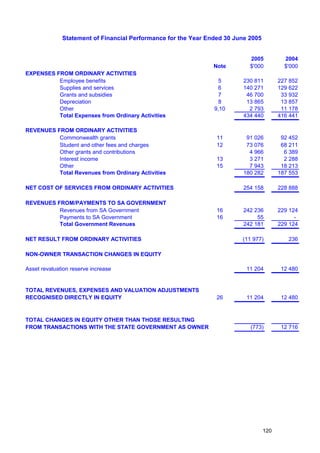
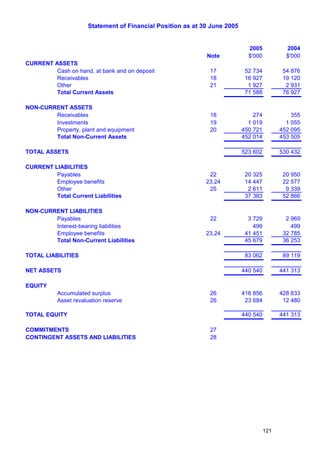
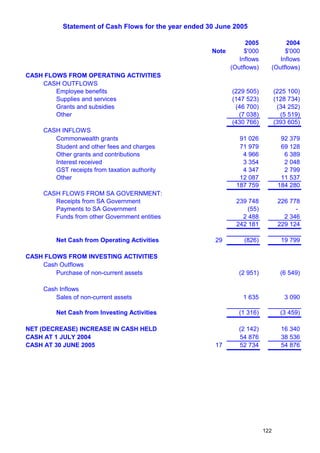
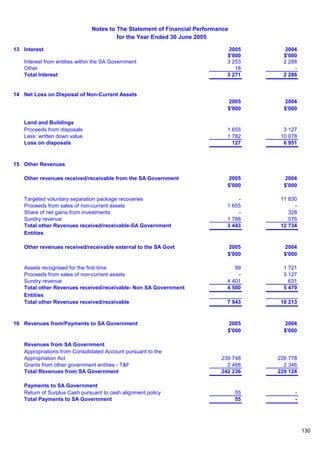
The following table provides a summary of the actual results for the 2004-05 financial
year compared to the original budget. The detailed financial statements reflecting
these results for 2004-05 are presented under Financial Information (please refer to
Section E of this report).

Summary of Financial Information

                                             Actual          Budget                 Actual
                                            2003-04          2004-05               2004-05
                                              $’000            $’000                 $’000
Financial Performance:
Operating Expenses                          416,441          428,068               434,440
Operating Revenues                          187,553          178,274               180,282
Net cost of services                        228,888          249,749               254,158
Revenues from State Government              229,124          239,415               242,181
Surplus (Deficit) for the year before           236          (10,379)              (11,977)
restructuring
Net revenues from restructuring                    -                -
Surplus (Deficit) for the year                   236         (10,379)              (11,977)
after restructuring
Total valuation adjustments                  12,480                   -              11,204
recognised directly in equity
Total changes in equity other than           12,716          (10,379)                 (773)
those resulting from transactions
with the State Government as
owner


Operating Revenues
Actual operating revenues for 2004-05 were $422.5 million. The principal source of
funding for the department is State Government appropriation which totalled $242.2
million. Other operating revenues included Commonwealth grants of $91 million and
$73.1 million from student and other fees and charges.

                                                             State Government Funds
                                                             $242.2m
                                                             Commonwealth Grants $91m


                                                             Sales/Fee For Service
                                                             Revenue $37.8m
                                                             Student Enrolment Fees and
                                                             Charges $32.5m
                                                             Other User Fees and Charges
                                                             $2.8m
                                                             Other Grant and
                                                             Contributions $5.0m
                                                             Interest Income $3.3m


                                                             Other $7.9m


                                                                                               19
DFEEST Annual Report 2005 - Section A


Operating Expenses
Actual employee benefits of $230.8 million for 2004-05 constituted 53 percent of the
total operating expenses of $434.4 million. Other major expenses included $18.9
million for funding to non-TAFE providers for Vocational Education and Training,
$24.8 million for information technology infrastructure and communication and $12.6
million and $15.9 million for employment programs and science and technology
programs respectively.

Operating Result
The actual deficit for 2004-05 was $12 million compared to the approved budget
deficit of $10.4 million. Factors contributing to the change in operating result from a
surplus of $236 000 in 2003-04 to a deficit of $12 million in 2004-05 were:
• an increase in employee benefits of $14.8 million (after allowing for TVSPs of
    $11.8 million in 2003-04)
• an increase in expenditure of $9.2 million on minor works, maintenance and
    equipment
• the payment of $6.1 million for tertiary student transport concessions which were
    previously paid by another government agency.

The additional expenditure was partly offset by increases in:
• student and other fees and charges of $4.9 million
• revenues from South Australian Government of $13.1 million.

                                              Actual          Budget            Actual
                                             2003-04          2004-05          2004-05
                                               $’000            $’000            $’000
Financial Position:
Total Assets                                 530 432          512 660           523 602
Total Liabilities                             89 119           81 726            83 062
Net Assets                                   441 313          430 934           440 540

The department’s net assets in 2004-05 decreased by $0.8 million. This was
primarily due to a decrease in cash, current receivables and in the amount of land
and improvements partly offset by lower liabilities relating to deposits held and
unearned revenue.

                                              Actual          Budget            Actual
                                             2003-04          2004-05          2004-05
                                               $’000            $’000            $’000
Capital Investing Activities:
Investing Payments                             6 549           11 833             2 951
Investing Receipts                             3 090            1 635             1 635
Net Investing Payments                         3 459           10 198             1 316

The actual investing payments for 2004-05 were $3 million compared to the
approved budget of $11.8 million. The under expenditure reflects timing variations
applicable to a budgeted loan advance of $7 million to Le Cordon Bleu and other
capital projects carried forward for completion in 2005-06.


                                                                                                20
DFEEST Annual Report 2005 - Section B


WORKFORCE PROFILE


During 2005 the department has made significant progress in meeting the objectives
of its Strategic Plan, which aims to build a sustainable workforce and demonstrate
leadership in workforce development. This is vital given the role DFEEST has
provided in industry, community and government policy as the agency responsible
for the state’s Workforce Development Strategy.

Building on the initiatives implemented during 2005, the department will continue to
strive to become a high-performance, learning organisation which attracts, develops
and retains the most talented workforce available and enhances this agency’s
workforce profile.

Workforce Data
The following data are based on records from the Human Resource information
system Empower for persons identified as being employed on 30 June 2005. Data
may vary from the 2004 report as the 2004 information was provided from another
source no longer regarded as reliable for management reporting purposes.

Hourly Paid Instructors (HPIs) are excluded from the data tables. HPIs are
covered separately as they are employed under totally different conditions and
reported accordingly. To combine HPI data with regular staff information would
result in data distortion.

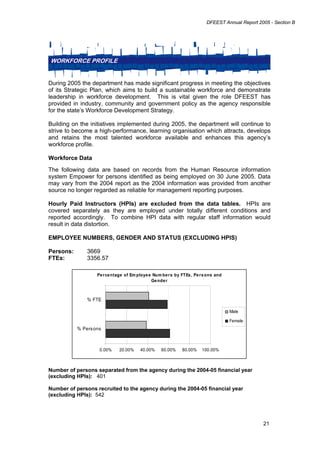
EMPLOYEE NUMBERS, GENDER AND STATUS (EXCLUDING HPIS)

Persons:       3669
FTEs:          3356.57

                   Pe rce ntage of Em ploye e Num be rs by FTEs , Pe rs ons and
                                             Ge nde r


               % FTE

                                                                                  Male

                                                                                  Female
           % Pers ons


                    0.00%    20.00%    40.00%    60.00%     80.00%   100.00%


Number of persons separated from the agency during the 2004-05 financial year
(excluding HPIs): 401

Number of persons recruited to the agency during the 2004-05 financial year
(excluding HPIs): 542


                                                                                              21
DFEEST Annual Report 2005 - Section B


Number of persons employed (excluding HPIs)
Act                                         Permanent                             Temporary                             Total
PSM Act                                          1321                                   427                             1748
TAFE Act                                         1063                                   639                             1702
Weekly Paid                                       118                                    62                              180
Workers Comp                                       33                                    16                               49
Total                                            2535                                 1144                             *3679
*Some staff have been coded against more than one category and therefore counted once for each category, thus
the discrepancy in total numbers as compared to the previous heading.

Hourly Paid Instructors
DFEEST augments its teaching force by employing casual hourly paid instructors
(HPIs) to provide specialist and back up support. HPIs may be employed for as little
as one lecture per annum or may provide teaching services on a regular basis.
Once an HPI’s annual hours reach a certain level they are offered ongoing
employment as a lecturer. In 2004-05, 2617 individual HPIs provided 284,763 hours
teaching at a cost of $13,185,429. The hours equated to 296.63 full-time equivalent
lecturers.

Number of employees by salary bracket (excluding HPIs)

                                     Num be r of Em ploye e s by Salar y Br ack e t (Excluding HPIs )


                   1400

                   1200

                   1000
   Staff Numbers


                    800                                                                                                         Male

                    600                                                                                                         Female
                    400
                                                                                                                                Total
                    200

                      0
                          0-38 000   38 001 - 49 000        49 001 – 64 000          64 001 - 83 000     83 001 plus
                                                            Salar y Br ack e ts


Employment Status – Persons and FTEs (excluding HPIs)
                                                 Persons                          FTEs
 Ongoing                                                2 527               2 354.42
 Temporary                                              1 142               1 002.15
 Total                                                  3 669               3 356.57

EXECUTIVE PROFILE
Number of executives by status in current position, gender and classification
                                                           Contract                       Contract
                                                            Tenured                      Untenured                  Total
 Classification               Male   Female            Male    Female                 Male   Female            Male    Female
 CD-3                                1                                                                                 1
 EMC                          8      9                                                                         8       9
 EXECLA                                                5           7                  4            1           9       8
 EXECLB                                                3           1                                           3       1
 EXECLC                                                            1                  2           3            2       4
 EXECLD                                                1                                                       1       0
 EXECLE                                                                               1                        1       0
 MINAPP                                                2           1                                           2       1

                                                                                                                         22
DFEEST Annual Report 2005 - Section B


WORKFORCE DIVERSITY
The department recognises the value of workforce diversity and the benefits inherent
from a workforce that is representative of the broader community. The following
section outlines the department’s current profile.

Age Profile
Number of employees by age bracket by gender (excluding HPIs)

Age Bracket              Female              Male          Total        % of Total           *SA Workforce (%)
15-19                           22              5             27                 0.74                               7.1
20-29                          329            143            472                12.86                              21.5
30-39                          448            194            642                17.49                              21.4
40-59                         1349            966           2315                63.09                              44.6
60 plus                        102            111            213                 5.81                                5.4
Total                         2250           1419           3669                  100                               100
*Australian Bureau of Statistics, Labour Force, Australia, Detailed - Electronic Delivery, Monthly – Supertable LM8 -
Labour Force Status by Sex, State, Age, Catalogue Number 6291.0.55.001 (as at June 2005).

As at September 2005, the median age of the department’s workforce is 47 years,
which is higher by two years than that of the public sector workforce in South
Australia (45 years) 1 and significantly above the average for the total South
Australian workforce (39.5 years).

Addressing the ageing of the department’s workforce is a pressing and significant
challenge. The department is identifying and creating opportunities to recruit young
South Australians into skilled jobs, create employment pathways for groups
traditionally disadvantaged in the labour market and explore how older workers can
be retained and recruited.

In 2005 DFEEST’s Workforce Development Platform to 2010 was developed and
approved by the Executive for release in March 2006.

Aboriginal Employment Strategy
Providing sustainable and effective employment outcomes for Aboriginal people
through the recruitment, retention and development of Aboriginal employees is a
high priority for the department.

In September 2005, the department launched and commenced implementation of
DFEEST’s Aboriginal Employment Strategy to 2010: Walking Together Towards
Prosperity.

As at the end of December 2005 the department employed 65 staff of Aboriginal or
Torres Strait Islander descent, representing 1.8 per cent of the workforce.
Compared to December 2004 this represents an increase of 0.4 per cent. By 2010,
the department aims to have 2.1 per cent of its workforce comprised of Aboriginal
people, with the Aboriginal workforce having:

•    a higher level of sustainable employment
•    a higher level of non-school qualifications
•    a higher level of representation in decision-making positions as compared to
     2005.

1
 “Benchmark Data Drawn from the Public Sector both Internationally and Australia and New Zealand”, research by
Corporate Leadership Council (CLC) commissioned by DTEI, November 2005.
                                                                                                                 23
DFEEST Annual Report 2005 - Section B


Initiatives designed to further these ends included the following:
• approval was given for release of staff to attend the NAIDOC week march
• increased employment opportunities were created in a number of ‘mainstream’
     business areas
• places were sponsored for female Aboriginal staff to attend the ‘Women at the
     Board Table’ governance training provided by Office for Women
• the new Enterprise Bargaining Agreement for TAFE Act staff includes provision
     for special leave up to 15 days for cultural leave.

Among many new initiatives in 2006, a cultural respect program for all staff and
scholarships for Aboriginal students undertaking degrees in skill shortage areas are
being introduced.

Cultural and Linguistic Diversity
The current HR information system does not have the capacity to report
comprehensively on the number of employees born overseas and/or who speak
language(s) other than English at home. Work is currently underway to improve this
aspect of the HR data collection.

Voluntary Flexible Working Arrangements
As part of the department’s commitment to attracting and retaining the best possible
staff and to assist employees to balance work and family life a number of voluntary
flexible working arrangements (VFWA) are available to its employees, in particular to
PSM Act staff.

Current VFWA arrangements include:

•     flexitime
•     purchased leave
•     compressed weeks
•     part-time and job-share
•     working from home
•     provision for special leave up to 15 days for cultural leave.

LEAVE MANAGEMENT

Number of persons on Leave without Pay as at 30 June 2005 (excluding HPIs):
131

Total days leave taken – average days per FTE (excluding HPIs)

    Leave Type                                                          2004-05
    Sick Leave Taken                                                       7.99
    Family Carer’s Leave Taken                                                *
    Special Leave with Pay                                                 0.86
*Note: Family Carer’s Leave may be taken as part of an employee’s entitlement to Sick Leave or Special Leave with
Pay. Thus it cannot currently be reported upon as a separate leave type.


                                                                                                              24
DFEEST Annual Report 2005 - Section B


PERFORMANCE MANAGEMENT
Performance management and development processes continued to be rolled out
across the department. In the last year there has been an emphasis on enhancing
the performance development culture within the organisation. The department is also
investigating models for automating the system through adaptation of our ‘Empower’
human resource management system and linking it to learning and development
systems to promote up to date information on progress with performance
development.

TRAINING AND DEVELOPMENT

Individual Staff Development
In the 2004-05 year, $1.72 million, or one per cent of total staff costs were recorded
as being spent on staff development activities identified within individuals’ personal
development plans 2 .

Organisational Learning and Development
Progressive FEEST offered a program of events to all staff and is designed to:
• enable them to have a better grasp of the directions and work of the department
• develop a greater sense of who we are and want to become as a department
• harness and develop the professionalism, energy and commitment of staff.
Approximately 30 per cent of staff participated in 2005.
Progressive FEEST had six main programs:
     Crunch Time: Video-conference ‘live across the state’ address by the Chief
     Executive on building a culture of performance excellence in which he painted
     his future vision for DFEEST.
     Conversation Café: Executive Support Officers went on a half-day guided
     conversation and tour with key stakeholders on ‘Getting the bigger picture’ with
     regard to the machinery of government.
     Learning for Lunch: A couple of lunchtime events occurred to promote learning
     in the workplace: ‘Simply the best’: a conversation between the Chief Executive
     and Professor Daryll Hull on becoming a high performance workplace, with a
     staff question and answer session; and ‘Recognising your worth: RPL/RCC
     process’: a panel session on the RPL/RCC experience on ‘Learn @ Work day’ as
     part of Adult Learners Week.
     Let’s get Serial: Staff attended workshops on innovation styles, with participants
     then participating in follow-up action learning teams centred around mechanisms
     to systemise innovation.
     Beyond the Square Bistro: ‘Me and My Shadow’ taught both management and
     staff to experience different roles in the organisation, learn about what skills or
     knowledge is required to perform a job well through negotiated packages of ‘job
     shadowing’ within the department. This provided staff with ideas for possible
     career development and helped managers better understand the development
     requirements of their staff and business. ‘Lateral Thinking Tool Set’ workshops
     were held to introduce and equip staff with a range of lateral and creative
     thinking tools.
     Celebration Cocktails: ‘Open House!’ gave staff a chance to showcase their
     workplaces and connect with one another.
2
  Limitations within the tracking system mean that associated costs are not included in this figure; it should therefore be read as
a minimum.
                                                                                                                                25
DFEEST Annual Report 2005 - Section B


Leadership development
Research was undertaken into the potential features and components of a
leadership development system within DFEEST, with the production of a
comprehensive research report that recommended a range of key features and
principles for such a system. This system is due to be implemented in 2006.

Building capabilities of HR staff
Late in 2005, a learning and development model called ‘HR SMART’ (Sustainable,
Monitored, Accredited, Recognised and Training) was developed with TAFE SA to
increase the HR capability of our HR teams, particularly our strategic capability,
whilst recognising and acknowledging staff competence and professionalism.

Centred on the draft Office of Public Employment HR Capability competency
framework, it will include creative and SMART use of RPL with a focus on mapping
work/life performance and assessment of development against the draft HR
competencies. This program will be delivered in the first half of 2006.

Staff Survey
DFEEST piloted its first ‘whole of department’ staff survey during the two-week
period from Monday 7 November to Friday 18 November 2005.

The purpose of the survey was to shed light on the extent to which staff perceive that
the department is:
    becoming a family friendly workplace through the promotion and support of a
    balance between life and work
    providing healthy and safe workplaces and
    becoming an excellent place to work for and in.

In addition the survey will provide important data to inform workforce planning
activities such as on aspects of workforce profile, mobility and commitment.

The findings will inform a future work/life balance strategy, organisational
improvement and development initiatives as well as a benchmark with which to
compare future performance.

Work/Life Balance
DFEEST is the lead agency for the development and strategic leadership of the
state’s Workforce Development Strategy which will include a focus on flexible
workplaces that help individuals balance life and work.
During 2004-05 a Ministerial Committee on Work/Life Balance was formed to
undertake a project to improve access to flexible working arrangements and create
cultural change around this issue within DFEEST, with representation from the Office
for Women, DTED, OPE, Minister’s Office and appropriate unions.
The project’s aim is to obtain and analyse detailed qualitative and quantitative data
and recommend potential strategies, programs and/or materials to improve access
to flexible working arrangements and create cultural change around this issue.
The research component of the project was completed in 2005, involving an
investigation and examination of best practice models/ initiatives and relevant
surveys, a literature review and a staff survey. A conceptual model has also been
established.

                                                                                    26
DFEEST Annual Report 2005 - Section B


Given the congruence in timing of the staff survey and the work/life balance
research, the work/life balance survey is included as part of the staff survey. The
survey results will inform the development of a Work/Life Balance Strategy in 2006
as part of the department’s Workforce Development Platform.

DFEEST Workforce Development Platform 2010
Principally aimed at addressing the challenges presented by an ageing workforce
and the projected labour supply shortage, an extensive process was undertaken to
develop the DFEEST Workforce Development Platform to 2010, which was
approved by the Executive at the end of 2005 and is due for release in March 2006.

The platform is derived from staff consultation, empirical analysis of workforce
profile, analysis of contemporary research and literature on both high
performance/learning organisations and workforce planning as well as assessment
of the environmental demands on our business and their likely impact on what we
the department’s customers need now and into the future.

A new suite of performance indicators was established to evaluate the progress and
success of the platform and were incorporated into the Quarterly Corporate
Reporting Template.

Whole-of-Government Initiatives
State Demographic Strategy – the department is involved in the development and
implementation of this strategy with representation on the Senior Management
Council’s Sub-Committee, the Strategy’s Think Tank and five of the project working
parties, namely:
•     irresistible offer – employment branding the state public sector
•     retaining staff – obtaining good data
•     flexible workplaces – work/life balance
•     build flexible retirement
•     youth group.
Public Sector Workforce Development Plan – the department has been actively
involved in processes associated with the development of this plan.
Retirement Intentions Survey – working in partnership with OPE, the department
was successful in securing in-principle funding from the Government Agencies
Statistical Committee to design and conduct a Retirement Intentions Survey across
the state public sector in 2006.

EMPLOYEE ASSISTANCE PROGRAM
As part of its ongoing care for the wellbeing of employees and their families
DFEEST established a single Employee Assistance Program program during 2005
which offers confidential, impartial and culturally sensitive counselling support to
employees and their families 24 hours a day, seven days a week.

In addition, the department established the EAP Manager Assistance Program, a
free service offered to DFEEST management to deal with specific people
management issues.


                                                                                  27
DFEEST Annual Report 2005 - Section B


EQUAL OPPORTUNITY EMPLOYMENT PROGRAMS
During 2004-2005 the department employed seven graduates from the Office of the
Commissioner for Public Employment graduate scheme and 44 trainees through the
State Government Youth Traineeship Program.

Child Protection
Throughout 2005 DFEEST implemented child protection initiatives in line with
meeting the recommendations put forward by the external child protection expert
engaged in 2004 to identify and assess child protection risks. The recommendations
are aimed at minimising risks for children and young people using DFEEST services
and are also aimed at addressing the requirements outlined in the Children’s
Protection (Miscellaneous) Amendment Bill 2005, previously called ‘Keeping Them
Safe’.

The following initiatives were implemented in 2005:
•   development and promulgation of the DFEEST Child Protection Policy
•   implementation of compulsory Mandated Notification Training (MNT). 1450
    DFEEST employees received MNT by the close of 2005. A total of 52
    departmental staff have been trained as accredited Children, Youth & Family
    Services (CYFS) trainers
•   development of the DFEEST Guidelines and Procedures for the Assessment of
    Consented Police Checks (Child Related Offences) for Existing Employees
•   implementation of voluntary police checks for existing DFEEST employees.

A four hour training package was designed and implemented in partnership with the
Child Youth & Family Services (CYFS) for TAFE SA and DFEEST employees.


                                                                                 28
DFEEST Annual Report 2005 - Section B


WORKFORCE PROFILE
Occupational Health, Safety and Injury Management


Significant work in the area of Occupational Health Safety & Injury Management has
been undertaken in 2005 due to executive commitment to industry best practice.

During 2005, 22 new procedures which manage identified high-risk and costly areas
of OHS&W were implemented, and another six will be implemented by March 2006.
The continued implementation of DFEEST’s OHS&IM strategic plan (Project Plan)
has continued to highlight the importance of OHS&IM. Reports are provided to the
Minister for Employment, Training and Further Education, the CE, Executive, Health
and Safety Committees and unions. This has ensured that the department retains
ownership of OHS&IM outcomes and improvement strategies. As a result there was
a considerable reduction in new workplace injuries in 2005: 108 compared to 139 in
2004.

Executive level commitment to OHS&W was further strengthened through the
holding of a mock prosecution trial in collaboration with Primary Industries and
Resources SA, which practically demonstrated what is required under legislation of
the department in this area. All Executive Forum members participated in this
exercise and it will provide a catalyst for ongoing implementation of the department’s
OHS&W procedures over 2006.

The year 2005 saw a change to the senior OHS&IM Committee (Central
Consultative Committee). This resulted from a realignment of the business and the
committee now aligns perfectly with the new accountability framework. The
committee consists of 12 employee representatives representing each of the areas
of DFEEST and eight management representatives, including the CE and officer
responsible for OHS&IM. Together with local committees, the Central Consultative
Committee continues to drive OHS&IM. They are supported by the new OHS&IM
Network, which comprises OHS&IM professionals and key departmental contacts.

Employee welfare remains a priority of DFEEST and the implementation of systems
that address psychological wellbeing, bullying and harassment and violence and
security in the workplace were introduced in 2005. This has received positive
feedback from staff and managers. The department’s Employee Assistance
Program continued to contribute to positive outcomes through the seven-day-a-
week, 52 weeks-a-year assistance that is available to staff and their immediate
families no matter where they are in Australia.

TAFE SA OHS&IM practitioners led improvement strategies in 2005, contributing to
the long-term improvement in OHS&W and Injury Management in the TAFE area.

Long term injured employees were actively engaged during 2005. DFEEST’s injury
management service provider continues to receive high praise from both injured
employees and managers.


                                                                                    29
DFEEST Annual Report 2005 - Section B


Occupational Health, Safety and Injury Management Data 2005

                                                                                     2005          2004
  1     OHS Legislative Requirements (includes incidents with students
        not included in 2004 figures)
        Number of notifiable occurrences pursuant to OHS&W Regulations                 4             2
        Division 6.6
        Number of notifiable injuries pursuant to OHS&W Regulations                    6             1
        Division 6.6
        Number of notices served pursuant to OHS&W Act s35, s39 and s40                3             3
  2     Injury Management Legislative Requirements
        Total number of new claimants who participated in the rehabilitation          35            52
        program
        Total number of employees rehabilitated and reassigned to                      7             2
        alternative duties
        Total number of employees rehabilitated back to their original work           32            43
  3     WorkCover Action Limits
        Number of open claims as at 31 December 2005                                  209           205
        *Percentage of workers’ compensation expenditure over gross                 0.016%        0.017%
        annual remuneration
  4     Number of Injuries
        Number of new workers’ compensation claims in the calendar year             108 (4          139
                                                                                  withdrawn)
        Number of fatalities, lost time injuries, medical treatment only
        (F)                                                                            0             0
        (LTI)                                                                        58 (3          87
                                                                                  withdrawn)
                                                                                     50 (1
        (MTO)                                                                     withdrawn)        52

        Total number of whole working days lost                                     10,126        15,550
  5     Cost of Workers’ Compensation
        Cost of new claims for calendar year                                        $234 808      $570 655
        Cost of all claims excluding lump sum payments                            $2 526 077     $2 476 378
        Amount paid for lump sum payments (s42, s43, s44)                           $747 874      $458 683
        Total claims expenditure                                                  $3,273,951     $2,935,061
        Total amount recovered from external sources (s54)                           $20,004        $3,112
        **Budget allocation for workers compensation                              $3,300,000     $3,000,000
  6     Trends
        ***Injury frequency rate for new lost-time injury/disease for each           10.28         16.04
        million hours worked
        Most frequent cause (mechanism) of injury                                 Falls, Trips     Body
                                                                                   and Slips     Stressing
        Most expensive cause (mechanism) of injury                                Falls, Trips    Mental
                                                                                   and Slips      Stress
* Calendar year costs divided by 04/05 fiscal year.
** 04/05 fiscal year.
*** Based on Lost Time Flag (i.e. ≥ 1day or shift)
    Improved process for recording hours worked


                                                                                                     30
2005 PERFORMANCE REPORTS


This section contains performance information for the 2005 calendar year relating to the
following reporting categories:
• workforce development
• quality and regulatory services
• trainees and apprentices
• employment development programs
• adult community education
• TAFE SA
• indigenous training and employment
• higher education
• science technology and innovation.


2005 PERFORMANCE REPORTS
State Workforce Development


During 2005 the Department commenced implementation of major strategies for workforce
development across South Australia.

Better Skills Better Work Better State: A Strategy for the Development of South Australia’s
Workforce to 2010 was developed under the leadership of the Training and Skills
Commission and approved by Cabinet.

The South Australian Skills Action Plan and the Workforce Development Action Plan were
developed during 2005 to underpin the implementation of Better Skills Better Work Better
State. Both identify the workforce development initiatives by government, industry, regions
and the education and training systems in order to address immediate and longer-term skill
shortages.

The Workforce Information Service, incorporating the Regional Information Exchange,
became operational in August 2005. The service provides high level, high quality information
and advice about the labour market, economic and demographic trends, regional and
industry workforce analysis, supply and demand information to support policy makers and
practitioners in better workforce planning and policy development. Further information can
be found at the website: workforceinfoservice@saugov.sa.gov.au

Nine new industry skills boards were established. Their objectives are to develop industry
specific workforce development action plans, identify workforce trends and emerging skill
needs and to consider issues relating to career advice and the attraction and retention of a
skilled workforce.

A new triennial Commonwealth-State Training Funding Agreement was negotiated.


                                                                                         31
Better Skills Better Work Better State and Workforce Development Action Plan

The South Australian Government recently endorsed Better Skills, Better Work, Better State
– A Strategy for the Development of South Australia’s Workforce to 2010. This plan
recognises that workforce development requires a cross-government agency approach and
is the shared responsibility of government, industry, the education sectors and the
community. Better Skills Better Work Better State takes workforce development beyond
training and skills to incorporate work organisation, job design, industrial relations, human
resource management practices and employment conditions.

The Workforce Development Strategy has three priority areas:
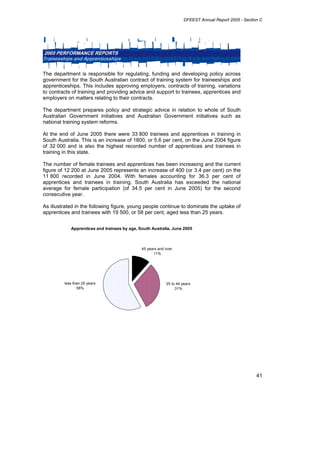
• the creation of a high skill economy
• access to quality employment
• shaping our future through better workforce planning.

Better Skills Better Work Better State is supported by the Workforce Development Action
Plan which showcases a wide variety of initiatives (past, present and planned) supporting
workforce development and planning across the state. This Action Plan outlines a range of
past, present and planned initiatives which contribute to workforce development across the
State and it highlights initiatives under 14 industry sectors.

Some workforce development activities that have occurred in 2005 are discussed below.

A HIGH SKILL ECONOMY

Industry Skills Boards

With the support of DFEEST and government funding, South Australian industry leaders
formed and established nine Industry Skills Boards to develop industry specific workforce
development action plans, identify workforce trends and emerging skill needs and to consider
issues relating to career advice and the attraction and retention of a skilled workforce.

Overseas Qualifications
A new policy was developed by the Overseas Qualifications Reference Group of the Training
and Skills Commission to overcome barriers to the assessment and recognition of overseas
qualifications in South Australia. Industry and community groups were fully involved in the
formulation of new practices which will better meet the needs of newly arrived migrants and
meet skills shortages.

Consequently DFEEST has established a new Trades Recognition Unit to facilitate the
efficient assessment of people with trade skills and experience gained in Australia or
overseas. The unit will assist skilled migrants make a smooth and quick transition into the
local workforce and community.

Commonwealth Funding

In 2005, the department actively engaged to develop new national VET funding and
accountability arrangements, which attracts approximately $90 million of Commonwealth
funding annually to the State. The Commonwealth Department of Education, Science and
Training assumed responsibilities which were previously the domain of the Australian
National Training Authority.
DFEEST also facilitated the development of four successful funding submissions for national
projects in South Australia which included:


                                                                                          32
1. A skill eco system supply chain demonstration project, Logistics and Export Assured
      Delivery (2005), which focused on maintaining a high, consistent standard through
      the supply and export of horticultural products to Asian markets.
   2. Creating a Career Development Culture in VET which aimed to contribute to resolving
      the national issue of employment and skill shortages by increasing the capacity of the
      VET sector through a trial implementation of the Australian Blueprint for Career
      Development (ABCD).
   3. Valuing Older Workers which aimed to inform employers and Registered Training
      Organisations (RTOs) about the impending demographic issues affecting the
      Australian workforce over the next 20 years and the strategies for addressing the
      issues identified in the products developed through a previous national project.
   4. Reframing the Future which was a major initiative of the former Australian National
      Training Authority (ANTA). Reframing the Future’s mission is to assist VET
      practitioners to become highly skilled and VET organisations to perform better in
      order to enable Australian industry to thrive in the local and global economy.
During 2005 the construction of 11 skill centres in South Australia was approved under the
Commonwealth Infrastructure Program. These comprised four industry skill centres, three
school-based skill centres and four Indigenous skill centres.

QUALITY EMPLOYMENT

Community Learning
A draft Community Learning Statement that includes 12 action areas from Better Skills Better
Work Better State was released for consultation in the final quarter of 2005 on behalf of the
Adult Community Education Reference Group of the Training and Skills Commission.
Consultation forums held in metropolitan and regional areas were attended by
representatives from the business, community and government sectors. Input on effective
methods of implementing the strategies in the draft Community Learning Statement in order
to ensure that relevant targets in South Australia’s Strategic Plan are achieved was received
through forums, submissions and questionnaires representing a wide cross-section of the
state.

QUALITY EMPLOYMENT

Research and Analysis of the Workforce Issues of Equity Groups
The Department has conducted significant data analysis and research into the workforce
issues for people experiencing barriers to their participation in learning and work, with a
particular focus on Indigenous people, older workers and people living with a disability. This
research will inform and guide new and existing DFEEST activity and programs that are
aimed at removing barriers for marginalised and disengaged to participate in learning and
work.

Discussion Paper on Older Workers
The Department led an inter-agency working group to prepare a discussion paper Opening
the Window on Existing Opportunities – Identifying Barriers to the Workforce Participation of
People Over 45 Years on the range of complex and multi-disciplinary issues faced by older
workers in participating in learning and work.

Client and Student Voice Action Group
The Client and Student Voice Action Group is a national group chaired by the Chief
Executive of DFEEST and charged with developing recommendations on new advisory
mechanisms for people experiencing barriers to their participation in the vocational education
and training system – specifically Indigenous people, people living with a disability, and a
mechanism to provide advice on equity issues generally.


                                                                                           33
Commitment to Young People
The department implemented strategies aimed at ensuring that all young South Australians
develop the skills and knowledge required to participate in productive work.
Three principal areas were addressed by DFEEST.
1. Enhanced Career Services for South Australians
DFEEST worked with the three school sectors and the Australian Government Department of
Employment and Workplace Relations to improve careers information and advice for
secondary school students by:
•   developing twice-yearly labour market information fact sheets for use by students and
    their advisors
•   sponsoring professional development for advisors
•   trialling the Australian Blueprint for Career Development in schools
•   establishing a web-based resource for career advisors
•   assisting Industry Skill Boards to develop strategies for informing young people about
    career and work opportunities in their respective industries.
DFEEST also led a national project to promote a career development focus in the vocational
education and training sector.

2. South Australian Youth Engagement Strategy
DFEEST played a key role in developing the South Australian Youth Engagement Strategy
which aims to ensure that all 15-19 year olds are “learning or earning”, that is, are in full-time
schooling or further education and training, full-time employment, or an equivalent
combination of part-time study and part-time work.
The ultimate aim of the strategy is to provide every young person with the opportunity and
support to complete 12 years of schooling or an equivalent vocational qualification and gain
meaningful employment.

The strategy will address the issue of youth engagement on several fronts. It will put in place
processes to help all secondary students think about their futures and make plans to achieve
their goals, and it will provide new learning and work opportunities to help young people
achieve their goals.
The strategy will also look at better ways of supporting young people as they negotiate the
space between compulsory schooling and further education and training and work.

3. Youth Commitment
While the South Australian Youth Engagement Strategy (SAYES) focuses on the needs of
young people, the youth commitment targets young people to 24 years. A youth commitment
builds on learning from South Australia Works and SAYES. Its aim is to create a seamless
transition system, at the statewide and local level to support all young people to achieve
success in education, training and employment. In preparation for trials in 2006, DFEEST
developed the approach with a renewed focus on integrated policies, planning and programs
(centrally and in the regions) to ensure young people are supported to effectively participate
in work and learning.


                                                                                               34
BETTER WORKFORCE PLANNING
Workforce Information and Planning
Detailed workforce planning in conjunction with industry and government agencies has
identified the potential demand for workforce skills to meet forecast growth related to the
current positive economic climate. DFEEST, DTED and PIRSA worked collaboratively on
the workforce planning for the growth in the mineral resources sector and defence industries,
as a result of the air warfare destroyer contract.

The launch of the Workforce Information Service and Regional Information Exchange in
December 2005 supports the implementation of the South Australian Government's Better
Skills Better Work Better State and its workforce planning priorities through provision of
useful tools to assist policy makers and practitioners to assist in better workforce planning.

The Workforce Information Service, WIS Online, consists of two web sites. The first focuses
on workforce information and provides a primary access point for the service, whilst the
second, a regional information exchange, operates as a companion page to provide
information with a regional focus. A range of products including DFEEST Regional Profiles,
DFEEST Industry Profiles, Feature Article series, e-Alert, South Australia: People, Jobs and
Skills and Labour Force Brief form the basis of advice and information to government,
industry and the community.

Strong relationships with other state, Commonwealth and local government agencies bring
together expertise on joint projects, particularly in food, wine, mining and defence sectors,
while research excellence, labour market and demographic analysis is supported by links to
workforce development research being undertaken by South Australia’s universities through
the Workforce Development Research Consortium.

Key labour force trends for 2005 included the following highlights:

•   total employment rose during 2005 on a trend basis and at December 2005 stood at a
    new record level of 742 700 persons
•   full-time employment rose during 2005 by 1.6 per cent to 512 100
•   the number of unemployed persons fell during 2005 by 2300 and the unemployment rate
    fell by 0.4 per cent to 5.0 per cent
•   the youth full-time unemployment rate fell during 2005 from 26.3 per cent in January
    2005 to 21.2 per cent in December 2005.
DFEEST is engaged in a range of current and proposed activities in the area of workforce
development research and practice and is committed to working collaboratively with other
organisations in this field.


                                                                                           35
2005 PERFORMANCE REPORTS
Quality and Regulatory Services


Public and private training providers of vocational education, non-university higher education
and education services to overseas students are regulated under the Training and Skills
Development Act 2003. The legislation provides the basis for ensuring that providers and
courses meet quality and consumer protection requirements for nationally recognised
training.

Consumer Protection Strategy
A Consumer Protection Strategy developed by the department to strengthen the protection of
clients of registered training organisations was implemented.

The strategy included the development of the Guidelines for RTOs registered in South
Australia under the Training and Skills Development Act 2003. The guidelines strengthen
aspects of the Australian Quality Training Framework Standards for Registered Training
Organisations (RTOs), particularly in regard to:

•   provider policies on fee refunds and information to clients about these
•   protection of student fees paid in advance
•   transfer of records to the department including qualifications issued to students.

Another significant strategy was the development of a brochure to inform consumers about
nationally recognised training and their rights and responsibilities. The brochure is targeted
towards potential consumers of training in the VET sector and was widely distributed to year
11 and year 12 students.

Registered Training Organisations
Public and private training providers of vocational education to domestic and overseas
students are regulated under the South Australian Training and Skills Development Act 2003.
The legislation provides the basis for ensuring that providers and courses meet the quality
and consumer protection requirements for nationally recognised training.

At 31 December 2005 there were a total of 256 registered training organisations, including
TAFE SA, based in South Australia delivering vocational education and training qualifications
(a net increase of 11 from 31 December 2004). A further 717 registered training
organisations from other states and territories (a net increase of 87 from 31 December 2004)
were also listed on the national register as offering vocational education and training in this
state. Twenty three new registered training organisations were approved in 2005 and 10
registered training organisations left the system.

A total of 31 providers were registered to deliver education services to overseas students
studying in South Australia. Twelve providers delivered in the vocational education sector,
eight in the higher education sector and 11 providers delivered in both VET and higher
education. A full list of recognition data for 2005 is provided in the Statistical Appendices.

Training packages for the VET sector are developed and endorsed as the national
qualifications for each industry sector. In 2005 the State Training Authority implemented 28
training packages and supported the endorsement of a further 15.


                                                                                            36
Qualifications in national training packages have replaced many of the state-accredited
courses. However, a small number of courses continue to be accredited to meet niche
markets, with the majority containing units of competency from training packages, enabling
graduates to gain national recognition for much of their study. In 2005, 29 vocational
education courses were approved for initial accreditation or renewal of accreditation.

Quality Audits

The registration of training providers and accreditation of courses are managed by the
department in accordance with national and state standards. An independent audit of
departmental approval processes and decisions in the vocational education and training
sector is conducted each year and on each occasion has confirmed that these meet and
exceed national standards.

Training providers and courses must demonstrate that they meet the relevant national
standards through audit. The conduct of audits is managed by the department and involves
departmental staff and contracted external auditors or competent assessors. In addition to
audits for initial approval, the department also scheduled compliance and strategic audits
based on a risk assessment. In 2005, 108 audits of training providers were conducted to
assess compliance with state and national standards.

In addition to approving providers and courses under the South Australian Training and Skills
Development Act 2003, the department is building the capacity of each of these sectors and
promoting quality outcomes for their clients by:

•   informing students and consumers of their choices, rights and responsibilities
•   informing and advising training providers about the relevant national and state standards
    and legislation with which they must comply
•   contributing to the design, development and implementation of national qualifications
•   ensuring standards are met and encouraging continuous improvement through audits of
    training providers
•   convening professional development workshops and forums on teaching and learning
    strategies and education management issues
•   working in collaboration with relevant national and interstate bodies to maintain and
    improve the national training system.

Annual Training Sector Forum
‘Enhancing Capacity to Respond, Deliver and Succeed’ was the theme of the annual
Training Sector Forum held in June 2005. A total of 200 practitioners including trainers,
teachers and assessors from TAFE SA, private RTOs and schools attended, participating in
the seminars and workshops over the two-day event. The forum is the major professional
development event offered by the department for training providers.


                                                                                            37
PARTICIPATION IN NATIONAL DEVELOPMENTS

National Strategic Hospitality Industry Audit
All states are participating in this audit, which commenced in September 2005 and will be
completed with the publication of a national report in March 2006.

The purpose of the strategic audit is to:

•   determine the level of compliance with the Australian Quality Training Framework
    Standards for Registering Training Organisations
•   identify key issues impacting on training outcomes and good practice in the hospitality
    industry and recommend strategies to strengthen the quality of training and assessment
    within the hospitality industry across Australia.

The audit focus has been at the lower qualification level (Certificates II and III) and several
opportunities for improvement which apply nationally have been identified. The results,
outcomes and recommendations of the audit will be communicated to all participants,
industry bodies and other stakeholders via the publication of national and state reports as
well as workshops held at state level.

National AQTF Moderation Strategy
DFEEST is managing the National AQTF Moderation Strategy project, led by a national
steering committee comprising officers from each State and Territory Registering and Course
Accreditation Body (RCAB). The project is due to be completed by 31 May 2006.

The project objectives are to:

•   develop national AQTF moderation guidelines
•   further develop the shared understanding of the range and nature of evidence that is
    acceptable for demonstrating compliance with AQTF standards
•   develop tools and processes to moderate AQTF outcomes between RCABs and auditors
•   develop and promote an online facility to encourage collaboration and communication
    between auditors across each State and Territory.

Valuing Older Workers Project
DFEEST is managing this national project, due for completion by 31 March 2006.

Significant resources have been developed including a range of teaching resources,
brochures and a DVD to provide support materials for the delivery of workshops for RTOs
and employers across metropolitan and regional venues in each State and Territory.

Workshops have commenced across all jurisdictions and will be completed in early 2006.
The workshops focus on the need for RTOs, their trainers and assessors to:

•   understand the implications of an ageing workforce for employers and RTOs
•   work closely with employers and industry to assist them in the skill development of their
    workforce
•   integrate industry or enterprise-specific learning with lifelong learning and personal
    development for employees
•   recognise prior skills and knowledge.


                                                                                            38
Workshops for employers are also being conducted, and are designed to raise the level of
awareness amongst industry and employers about the implications of an ageing workforce,
the predicted impact of these changes, and how they can work with RTOs to attract and
retain employees.

Educational Services to Overseas Students
The national regulatory framework for the provision of Educational Services to Overseas
Students (ESOS) is currently undergoing revision. ESOS has become of fundamental
significance to the national economy and The Australian Education Systems Officials’
Committee (AESOC) has appointed the National Code Action Group (NCAG) to undertake
work on the National Code of Practice for Registration Authorities and Providers of Education
and Training to Overseas Students (the National Code), the principal instrument for the
quality assurance of ESOS. The work includes devising an auditable set of quality
standards. The Quality Branch DFEEST represents South Australia on the NCAG. The
department is also leading the national project on quality standards for English Language
Intensive Courses for Overseas Students (ELICOS) and represents the State on the national
Steering Committee for establishing quality standards for Foundations Programs for
Overseas Students.


                                                                                          39
DFEEST Annual Report 2005 - Section C


                                  40
DFEEST Annual Report 2005 - Section C


2005 PERFORMANCE REPORTS
Traineeships and Apprenticeships

The department is responsible for regulating, funding and developing policy across
government for the South Australian contract of training system for traineeships and
apprenticeships. This includes approving employers, contracts of training, variations
to contracts of training and providing advice and support to trainees, apprentices and
employers on matters relating to their contracts.

The department prepares policy and strategic advice in relation to whole of South
Australian Government initiatives and Australian Government initiatives such as
national training system reforms.

At the end of June 2005 there were 33 800 trainees and apprentices in training in
South Australia. This is an increase of 1800, or 5.6 per cent, on the June 2004 figure
of 32 000 and is also the highest recorded number of apprentices and trainees in
training in this state.

The number of female trainees and apprentices has been increasing and the current
figure of 12 200 at June 2005 represents an increase of 400 (or 3.4 per cent) on the
11 800 recorded in June 2004. With females accounting for 36.3 per cent of
apprentices and trainees in training, South Australia has exceeded the national
average for female participation (of 34.5 per cent in June 2005) for the second
consecutive year.

As illustrated in the following figure, young people continue to dominate the uptake of
apprentices and trainees with 19 500, or 58 per cent, aged less than 25 years.


            Apprentices and trainees by age, South Australia, June 2005


                                              45 years and over
                                                    11%


         less than 25 years                                25 to 44 years
                58%                                             31%


                                                                                                       41
DFEEST Annual Report 2005 - Section C


Traineeship and Apprenticeship Commencements
In the year to 30 June 2005, the department approved 22 700 contracts of training for
trainees and apprentices. This is 2000 more than the number approved in the year
ending 30 June 2004. Traditional apprenticeship † commencements also increased by
400 from 3800 to 4200 during the same period. Traditional apprenticeships include,
for example, the electrical and plumbing trades, butchering, motor mechanics and
hairdressing.

Traineeship and Apprenticeship Completions
The department issued Certificates of Competency to 9200 trainees and apprentices
who completed their contracts of training in the year ending 30 June 2005, compared
with 9500 for the 12 months ending 30 June 2004. Although there were fewer
completions in 2005 the number of apprentices and trainees in-training continued to
increase from 32 000 at the end of June 2004 to 33 800 at 30 June 2005.

Training subsidies
The department provides support to traineeships and apprenticeships through the
provision of training subsidies (known as User Choice training subsidies) to
registered training organisations. In 2005, 199 funding agreements were signed with
TAFE SA and private registered training organisations for the delivery of off and on-
the-job training. A total of $36.4 million was provided by the State Government
during the 2004-05 financial year to support the delivery of some 1300 nationally
recognised qualifications.     Training subsidies supported approximately 30 000
trainees and apprentices during this time.

Administrative improvements for trainees and apprentices
The time the department takes to assess and approve contracts of training improved
significantly in 2005. In the last half of 2005, 73 per cent of training contracts were
approved within 10 working days, up from 50 per cent in the corresponding period in
2004. The department also implemented phase II of an electronic interface between
the South Australian and Commonwealth Government’s information management
systems for traineeships and apprenticeships resulting in improved communication
and data quality.

During 2005, the Training and Skills Commission approved new guidelines for the
withdrawal of employer approval to train trainees and apprentices and amended
guidelines for the approval of an employer to train an apprentice/trainee under a
contract of training.

The department also extended its AS/NZS ISO 9001:2000 certification to all units in
Traineeship and Apprenticeship Services except Group Training, which transferred to
Traineeship and Apprenticeship Services in late 2005.

Marketing
An Information Service was established in December 2004 to provide information to
the public on all aspects of traineeships and apprenticeships, as well as a more
streamlined service to employers, trainees and apprentices on matters relating to
their contract of training.


†
  Traditional apprenticeships as defined by National Centre for Vocational Education and Research are
trades apprenticeships and traineeships at AQF III qualification or above with more than two years
expected duration for full-time contracts and more than eight years expected duration for part-time and
school-based contracts.
                                                                                                            42
DFEEST Annual Report 2005 - Section C


In 2005, the Information Service received 14 511 calls; an average of 279 per week.
Of the calls received, 6320 (or 44 per cent) were dealt with by the information
service, a further 6038 (or 42 per cent) were referred within the department and the
remaining 2153 (or 14 per cent) were referred to other agencies or government
departments.

The Information Service also promoted the benefits of traineeships and
apprenticeships to the wider public at the Career Expo, Small Business Week and
the Royal Adelaide Show.

In addition, a campaign encouraging school leavers to consider an apprenticeship as
an alternative option to tertiary education coincided with the release of the final South
Australian Tertiary Admission Centre (SATAC) offers in February.

Group Training
In 2005 a total of 3471 apprentices and trainees were employed by 13 group training
organisations funded under the Joint Group Training Program.

During 2005 group training organisations that had met the national standards for
group training were invited to tender for funding under the Joint Group Training
Program for 2005-06. Thirteen group training organisations received funding under
the $2.25 million State/Commonwealth program.

The department participated in the national reviews of the National Standards for
Group Training and the Joint Group Training Program.

Skills shortage initiative
During 2005, the department undertook a variety of projects aimed at increasing the
number of trainees and apprentices in areas experiencing or forecast to experience
skills shortage.

Pre-Apprenticeship Pilot Program
The department funded eight pre-apprenticeship courses in the trade related
occupations of plumbing and engineering (mechanical and fabrication) through a pilot
in early 2005. The pilot aimed to prepare participants for an apprenticeship in
plumbing or engineering by providing training in specific technical skills and
organising work experience with employers. Of the 114 participants that commenced
training, 96 (or 84 per cent) completed, and 54 (or 56 per cent) of completing
participants obtained some form of employment. Thirty nine of these were
apprenticeships under a contract of training.

Child care
The department is collaborating with the State Government Department of Education
and Children’s Services, the Australian Government Department for Employment and
Workplace Relations and child care employers to address the shortage of Diploma
qualified workers in child care. Twenty one job seekers graduated from a pre-
employment program in child care, funded by Job Network, as part of a pilot
recruitment program for the child care sector. The department is providing training
subsidies to these job seekers, if they enter into traineeships in the Certificate 3 and
the Diploma of Children’s Services, and to 70 childcare workers who are undertaking
traineeships in the Diploma of Children’s Services as part of a pilot upskilling
program.


                                                                                                 43
DFEEST Annual Report 2005 - Section C


Broadening of User Choice funding to existing workers
From 1 January 2005 User Choice policy was broadened to include existing workers
undertaking apprenticeships under a pilot program. This allowed employers with
existing employees working in traditional trade areas the opportunity to convert
existing skills to a formal qualification in their chosen trade. In 2005 User Choice
provided training subsidies to support training for 491 existing worker apprentices.

Trades recognition
The department has approved the creation of a Trades Recognition Unit in
accordance with the release of the Training and Skills Commission guidelines for
assessing the competency of persons who have acquired trade skills or qualifications
other than under the Australian Qualifications Framework. The unit will work with
Industry Skills Boards to coordinate the assessment of trade skills gained through
formal training or on-the-job experience in Australia or overseas and ensure that
pathways for recognition are identified for individuals who are unable to demonstrate
competencies in all areas of a trade.

A series of assessment panels are currently being formed by industry to assess
people’s skills and to make recommendations on the issuing of Certificates of
Recognition. These panels will streamline recognition processes and ensure that
South Australia maintains standards and protects consumers while still facilitating
clear pathways to recognition and employment.

Grievances and Disputes
Formal mechanisms are in place to address grievances and disputes that may arise
in the traineeship and apprenticeship system. In 2005, 77 complaints about contract
of training matters by employers, apprentices and trainees were resolved through
formal mediation while 66 disputes were referred to the Grievance and Disputes
Mediation Committee of the Training and Skills Commission for determination.

Special projects

ATIS
The department is developing an on-line system that will streamline, improve and
provide consistent data for analysis and reporting for its clients and the department in
the areas of Contract of Training data, User Choice funding agreements and User
Choice payments.

This on-line system, known as the Apprenticeship Traineeship Information System
(ATIS) was first released to registered training organisations in May 2005. There are
currently 91 organisations with 262 user accounts using ATIS to access information
about their South Australia Registered Contracts of Training. It is anticipated that all
User Choice registered training organisations and New Apprenticeships Centres
(NACs) will be using ATIS by the end of May 2006.

When fully functional, ATIS will allow registered training organisations and New
Apprenticeships Centres to:
• view data on line for South Australian Contracts of Training
• lodge User Choice claims electronically
• validate and report in ‘real time’
• apply for and acquit User Choice funding agreements on line
• extract statistical reports.

                                                                                                44
DFEEST Annual Report 2005 - Section C


Workplace Bullying Guidelines
The department participated in the Interagency Roundtable on Workplace Bullying,
which was created to draw on the experience of non-government and government
agencies and organisations that are involved in providing advocacy, information and
advice, or investigation of workplace bullying. The roundtable culminated in the
release of two sets of Guidelines, Preventing Workplace Bullying: A Practical Guide
for Employers, and Dealing with Workplace Bullying: A Practical Guide for
Employees, a Stop Bullying in SA website and a brochure listing agencies which can
provide information, resources and assistance. The brochure is being distributed to
all new apprentices and trainees, and their employers.

ABS survey of School-Based New Apprentices
The three schooling sectors, the ABS and department collaborated to send over
3000 surveys to School-Based New Apprentices, with currently approved training
contracts. The responses are being analysed with a view to understanding the
motives of those entering into School-Based New Apprenticeships and improving the
management of these training contracts

Traineeship and Apprenticeship Futures Project
The report on the Traineeship and Apprenticeships Futures project was
commissioned to examine and recommend future directions for traineeships and
apprenticeships in South Australia. The project report has been forwarded to the
Training and Skills Commission, and the Minister for Employment, Training and
Further Education. The Commission has appointed a steering committee to draft
advice on priorities for action.

Recognition of Prior Learning
In 2005 the department led a Reframing the Future Project that established a
community of practice comprising registered training organisations, employers and
critical friends aimed at addressing the low level of recognition of prior learning (RPL)
provided to apprentices in the traditional trades. The community of practice has
developed an agreed set of strategies which have the capacity to reduce the duration
of training for a small but significant number of apprenticeships and increase the
speed with which industry is able to reshape the skills profile of the workforce.


                                                                                                 45
DFEEST Annual Report 2005 - Section C


2005 PERFORMANCE REPORTS
Employment Development Programs

The South Australia Works initiative plays a key role in achieving DFEEST Strategic
Plan 2004-07 objectives and the following South Australian Strategic Plan strategic
directions and targets:

•   bettering the Australian average employment growth rate within 10 years
•   equalling or bettering the Australian unemployment average within five years
•   equalling or bettering the Australian youth unemployment average within five
    years
•   reducing regional unemployment rates
•   reducing the gap between the outcomes for South Australia’s Aboriginal
    population and those of the rest of South Australia’s population
•   increasing the proportion of the South Australian labour force with non-school
    qualifications from 50.7 per cent in 2002 to 55 per cent within 10 years.

Key labour force trends for 2005 included the following highlights:

•   total employment rose during 2005 on a trend basis and currently (as at
    December 2005) stands at a new record level of 742 700 persons.
•   full-time employment rose during 2005 by 1.6 per cent to 512 100
•   the number of unemployed persons fell during 2005 by 2300 and the
    unemployment rate fell by 0.4 per cent to 5.0 per cent
•   the youth full-time unemployment rate rose during 2005 from 20.7 per cent in
    December 2004 to 21.2 per cent in December 2005.

In 2005-06, over 19 000 South Australians will participate in learning, skill
development, and training and employment opportunities gaining over 6800 work
opportunities.

South Australia Works in the regions by helping regional organisations and
Networks to identify their region’s training and employment needs, and to address
them in ways appropriate to each region. The Networks developed innovative ways
of marketing and linking jobseekers with industries and held successful jobs forums
and expos in a number of regions.
DFEEST worked in partnership with the Recovery Committee, the Eyre Network and
the Eyre Regional Development Board to provide skills to jobseekers needed for
recovery projects to assist local businesses and industry.
Nine South Australia Works Coordinators based across the state assisted regional
networks to train people for employment. Coordinators were supported by the
placement of Executive Officers in 13 Regional Development Boards, local councils,
the Office of the North and the Office of the North West.


                                                                                                46
DFEEST Annual Report 2005 - Section C


The investment of $7.6 million across South Australia enabled regions to attract an
estimated $5.5 million of leveraged funds through partnering arrangements with all
levels of government, industry and local business to support initiatives. This includes
assistance provided to the communities affected by the Eyre Peninsula bushfires.
Learning and work projects will attract up to 9500 participants with up to 2630
employment outcomes. Highlights include a Youth to Work project with 28 young
people from the Yorke region. The project provided a wide range of case
management support resulting in all participants gaining employment. The project
was also delivered in the Mid North region, with 28 young people participating and 16
finding employment.

South Australia Works for young people by giving them skills and opportunities to
move successfully from school, further education and training or unemployment, into
stable, rewarding work.

Commitment to Young People

Youth initiatives supported 4453 young people with 1965 young people gaining
employment.
A highlight was the Learn to Earn Program which provided pre-vocational training
through innovative project based approaches to young people aged 16-24 years.
Seven projects across South Australia were funded with 105 disadvantaged young
participants. 30 achieved employment, 12 achieved Certificate 1 in Vocational
Education and Training and 16 achieved Certificate 2. This included the Sprint Car
project which was showcased at the Royal Adelaide Show, which provided skills in a
range of vocations for young participants from the Northern Adelaide and Barossa
Light regions.
The Alternative Learning Options Program kept young people connected to learning
opportunities and increased school retention rates in the State. Ten projects were
delivered across the State, with 550 young participants at risk of becoming
disengaged from school participating in the program. Outcomes included 410
returning to school or a learning environment.
The Youth Conservation Corps Program encouraged young people to commit to their
environment while helping them to gain skills and practical work experience.
Fourteen conservation projects such as the One Million Trees, New Springs
Landcare, and restoration projects with the Adelaide City Council, Goldfield, SA
Water and Echunga goldfields provided 323 young people with work-ready skills and
experience. Ninety participants gained either full-time or part-time employment and
36 went onto further education.
ACE Youth Works is a social inclusion initiative which supported five Adult
Community Education (ACE) providers to work with disengaged young people and
re-connect them with education and training pathways. An ACE Youth Works
Network provided additional opportunities for providers to develop their skills in youth
work and develop appropriate programs for this group of young people.
SAYES (the South Australian Youth Entrepreneur Scheme) was broadened for the
2005-07 financial years to target a diverse range of young people, including
Indigenous and regional young people.


                                                                                                47
DFEEST Annual Report 2005 - Section C


South Australia Works for mature aged people recognises the often difficult
conditions which mature aged jobseekers face and plays a significant role in
assisting this growing group overcome barriers to employment.

Over 5400 mature aged people participated in learning and work programs with 1578
people gaining employment.
Employment 40 Plus Program promoted the recognition of older workers’ experience
and provided 412 mature aged jobseekers with opportunities to participate in a series
of forums and specialised workshops which increased jobseekers’ understanding of
current work environments as well as one-on-one advice and support.
The Employment Assistance Program supported mature-aged people through a
range of assistance, including career counselling, job search training, individual case
management, employment brokerage, mentoring, work experience opportunities and
post placement support.
The Employment 40 Plus Info-line provided over 1140 mature aged jobseekers with
information and referral services to South Australian agencies which provide
employment and training services.

South Australia Works in communities by creating opportunities for learning for
individuals and their communities. It enables people to participate in affordable
learning programs targeted to the needs of those who may have experienced
disadvantage or barriers to learning or participation in the workforce.

In 2004-05 a budget of $1.117 million was allocated to support programs in 65
community-based organisations, for professional development of adult community
education providers, and to fund ACE projects such as Adult Learners’ Week and
TAFE concession fees.
Highlights include the South Australia Works Adult Community Education Grant
Program, which focuses on non-formal, non-accredited learning for people that
experience difficulty in accessing formal education, training and employment.
The Parents Return to Work Program, a direct initiative of the State Government’s
Population Policy – Prosperity Through People provided 2969 people with assistance
to increase work-related skills, improve future job prospects and improve their
transition into the workforce.

South Australia Works with industry to identify new employment and training
possibilities. It helps people to develop the skills required by a changing and
dynamic economy and so meet emerging workforce needs.

The Workforce Development Fund supported industries such as horticulture, tourism
and hospitality, agriculture, fitness, recreation and community services, and
manufacturing and transport to design and implement best practice strategies to
address existing workforce issues which restricted their economic performance.
Highlights include an innovative logistics, transport and supply chain management
project by the Transport and Distribution Industry Skills Board to overcome skill and
labour shortages in logistics and supply chain management occupations.
The Labour Market Adjustment Program provided training and support services to
171 workers made redundant by GM Holden Ltd. Services were also extended to
workers who were displaced in supplier companies as a result of the Holden third
shift closure.


                                                                                               48
DFEEST Annual Report 2005 - Section C


An additional 1841 retrenched workers from Mitsubishi, Levis, Fletcher Jones (Mount
Gambier) and Motorola were assisted to find alternative work with 912 job
placements resulting. Personalised and tailored support for workers ensured that a
majority were able to use their existing skills and develop new capabilities to assist
them into new employment.
The Commonwealth/State Joint Group Training Program funded 13 Group Training
Organisations, which supported 3471 apprentices and trainees and 1600 new
apprentice/trainee commencements.
Following a review of the Ticket to Train Program in early 2005, as of 1 July 2005,
300 tickets were distributed to small businesses providing 162 employees with
training related to their work.
The Australian Fisheries Academy was funded to provide 65 000 hours of training,
with an additional 17 750 hours of self-funded training provided by the Academy.

South Australia Works for Indigenous people by providing support, job training,
work placements, recruitment, leadership training, career enhancement and
traineeships and apprenticeships.

•   Over the past 12 months 1190 Aboriginal people participated in learning and
    work programs with 362 people gaining employment.
•   The Aboriginal Apprenticeship Program placed and supported 47 apprentices. A
    graduation ceremony was held to celebrate the 18 apprentices completing their
    three- or four-year contract of training.
•   A highlight was 18 Aboriginal people that commenced a Diploma in Enrolled
    Nursing through the Cadetship Program in the Flinders region.
•   Refer to Indigenous Training and Employment for further information regarding
    South Australia Works for Indigenous people, including the State Public Sector
    Aboriginal Recruitment and Career Development Strategy, Private Sector
    Employment Pathways, the Scholarship Program, regional initiatives and Tauondi
    Aboriginal College.

South Australia Works in the public sector by providing opportunities to train and
work in the public sector, especially for people who are disadvantaged in the job
market.

•   The Government Youth Traineeship program, the Government Apprenticeship
    Scheme and the Public Sector Cadetship program placed 501 trainees, 27
    apprentices and 32 cadets into employment. These programs also provided
    specific opportunities for young people who have a disability, are of Indigenous
    descent, have been under the Guardianship of the Minister for Child and Youth
    Services, and/or are long term unemployed.
•   An additional 94 graduating trainees were assisted through the Trainee
    Employment Register (TER) with 73 employment outcomes. The TER guidelines
    were revised to provide graduating trainees with three years’ access to State
    Public Sector Notice of Vacancies and 12 months intensive case management
    support.
•   Traineeships in the Community, a new program implemented in 2005, supported
    the employment of trainees, apprentices and cadets in the community based not-
    for-profit sector, with a particular focus on creating opportunities in regional areas.
    Five pilot initiatives were implemented in the Barossa Light, Port Augusta, Far
    West Coast and Northern Adelaide regions.
                                                                                                  49
DFEEST Annual Report 2005 - Section C


2005 PERFORMANCE REPORTS
Adult Community Education

Adult Community Education Grant Program
The Adult Community Education (ACE) Grant Program supports community-based
adult education in South Australia through the provision of general adult education,
language, literacy and numeracy programs, employment skills development, social
and personal development. It also builds local networks and partnerships to promote
the development of learning communities. The grant program supports local
responses to community need for adults who are educationally, socially and
economically disadvantaged.

In 2004-05 a budget of $1.117 million was allocated to support programs in 65
community-based organisations, for professional development of adult community
education providers, and to fund ACE projects such as Adult Learners’ Week and
TAFE concession fees.

Adult Community Education Professional Development Program
The ACE Professional Development Program serves to enhance the quality of ACE
provision through developing the skills and knowledge of ACE staff, including
volunteers. In 2005 the program featured a state ACE Conference: ‘Adult Education
in the Community: Building Community Capacity’. The ACE Conference brought
together providers from around the state and delivered 18 workshops and three
keynote presentations to 200 participants over two days. It also provided the
opportunity for providers to showcase key programs and initiatives to colleagues in
the ACE and VET sectors.

Learning Communities Networks
The ACE Learning Communities Network involves up to 30 participants from 11 ACE
providers in receipt of funds for major programs to build their understanding and
support for the role they play in the growth of learning communities.

ACE-TAFE Partnerships
The promotion of partnerships and pathways between ACE providers and TAFE
Institutes was continued in 2005.
The promotion of partnerships and pathways between ACE providers and TAFE
Institutes continues to be a priority. Seven partnerships developed in 2004 continued
into 2005 and an ACE-TAFE Partnership Forum was held in August to bring ACE
providers in the southern suburbs together with TAFE SA Adelaide city campus
program managers to discuss ideas for collaboration for program development in
2005-06.


                                                                                              50
DFEEST Annual Report 2005 - Section C


Adult Learners’ Week
Adult Learners’ Week is an annual celebration of adult learning and is supported by
funding from the ANTA held on 1-8 September. South Australian activities included
the distribution of funding for local events, State Adult Learners’ Week Awards and
an official launch event with an international guest speaker. In 2005, the national
Adult Learners’ Week website listed 116 events occurring in South Australia, more
than double the number in 2003. Forty nominations were received for the Adult
Learners’ Week Awards which were presented at an awards function attended by
210 people.
•   The ALW national website Calendar of Events listed 116 events occurring in
    South Australia, an increase of 14 per cent on 2004
•   The State Launch and Awards Presentation attracted 210 guests, an increase of
    40 per cent on 2004
•   Thirty three ACE organisations received funding under the ALW Grants
•   Forty ACE organisations registered applications for ALW Awards
•   Approximately 1000 organisations received a direct mail-out of promotional
    material for ALW 2005 initiatives
•   Increased usage of web-based information via the DFEEST website and
    Training and Skills Commission
•   Advertising was placed in approximately 250 000 papers in Adelaide
    metropolitan area and approximately 50 000 in rural and regional areas
•   An increase in Learn @ Work Day media exposure on PBA 5M promoted the
    Learn @ Work CD
•   Learn @ Work CD was distributed to 150 key stakeholders
•   ALW 2005 Photographic CD was distributed to 150 key stakeholders.

Learning to Work – Literacy and Numeracy Program
The Learning to Work Literacy and Numeracy Program provided funding to eight
training providers around the state to deliver accredited training in literacy and
numeracy for 406 adults needing to improve their skills in preparation for returning to
the workforce or study. The program targets people in rural and isolated areas in
addition to other disadvantaged groups.


                                                                                               51
DFEEST Annual Report 2005 - Section C


2005 PERFORMANCE REPORTS
TAFE SA

TAFE SA is the public provider of vocational education and training in South
Australia. It plays a critical role in delivering the government’s objectives to improve
economic and social development, the skill base and employment opportunities for
all South Australians.

From 1 January 2005 TAFE SA commenced operation with a revitalised, streamlined
structure of three Institutes of TAFE SA and the appointment of a fresh leadership
team, restoring its position as South Australia’s public vocational education and
training provider with emphasis on the individual, the rural and remote regions,
business, community and industry.

TAFE SA Executive
TAFE SA Executive is now established within the DFEEST governance framework as
the pivotal mechanism for strategic coordination and decision-making for TAFE SA.
It met monthly throughout 2005.

The TAFE SA Executive comprises the Chief Executive, Deputy Chief Executive
Employment & Training Services (Chair), the senior executives from the three
Institutes of TAFE SA (TAFE SA Adelaide North, TAFE SA Adelaide South, TAFE SA
Regional), and the senior directors from Education Services and Programs and
Shared Business Services. It is responsible for developing and implementing the
TAFE SA Business Strategy and identifying TAFE SA policy and strategic issues for
collective consideration.

Additionally, the establishment of a number of strategic reference groups, the
development and endorsement of consistent policies, and the finalisation of issues
from the Positioning TAFE project facilitated a responsive and coherent TAFE
system.

Program Leadership and Review
TAFE SA’s appointment of nine state-wide Program Leaders during 2005 provided a
mechanism for achieving strategic educational outcomes for industry sectors while
providing a prominent and visible contact point for industry clients and community
stakeholders.

Each Program Leader has a state-wide portfolio and works with staff across the three
TAFE SA Institutes to meet the needs of employers, the community and the state, as
well as to identify opportunities for new and/or improved service, product delivery and
partnerships.

In 2004 TAFE SA committed to a cycle of high level reviews of TAFE SA services to
industry sectors in South Australia.    The first of the planned program reviews
commenced in November 2004 with the final report of the Review of TAFE SA
Services to the Manufacturing and Allied Industries completed and endorsed by the
Minister in September 2005.

The Program Leader for Manufacturing, Engineering and Transport is working with
TAFE SA staff within the program to respond to the recommendations within the
report.
                                                                                                52
DFEEST Annual Report 2005 - Section C


Key recommendations include:

•   Consideration and identification of national and global trends related to
    Manufacturing and Allied Industries and the capacity of the Manufacturing and
    Allied Industries Program to contribute to state and national initiatives and
    directions.
•   Identification of the capacity of the Manufacturing and Allied Industries Program
    to meet the needs of local industries.
•   Identification of the capacity of the Manufacturing and Allied Industries Program
    to enhance community capacity and sustainability to meet the needs of local
    communities.
•   Consideration of the provision of pathways for students, including opportunities
    for collaboration with other education sectors.
•   Identification of opportunities for new ventures and partnerships to achieve
    growth and innovation for TAFE SA.
•   Consideration of the satisfaction with services and products provided by TAFE
    SA.
•   Identification of opportunities for improvement in TAFE SA products and
    services, including structure and range, to better meet the needs of
    stakeholders.

A report on progress against these recommendations will be placed on the TAFE SA
website in 2006.

Quality education and training delivery
Educational programs in TAFE SA are delivered through nationally endorsed training
packages and accredited curricula which meet protocols within the Australian
Qualifications Framework. Training packages are developed at a national level in
collaboration with industry and community groups and are regularly reviewed and
updated.

TAFE SA offers 1140 qualifications from 98 training packages and 211 curriculum
courses in 53 campuses across the state.

In 2005, 64 out-of-date qualifications were de-activated to ensure currency and
responsiveness to industry needs. 105 new training package qualifications were
implemented, and 13 new courses were accredited in TAFE SA.

The extent of this training activity requires a coordinated, systematic approach to
quality assurance and compliance with national quality vocational education and
training (VET) standards. The repositioning of TAFE SA as one Registered Training
Organisation (RTO) in 2005 has required a review of its comprehensive quality
systems to ensure high quality standards and integrity of teaching and consistency
across all programs and campuses in South Australia.

A state-wide quality network works to ensure that mechanisms are in place to
regulate and support the maintenance of TAFE SA’s status to self-accredit courses.


                                                                                              53
DFEEST Annual Report 2005 - Section C


Responsive State-wide Programs
Development of TAFE SA training programs and training package implementation
priorities are targeted to address areas of skill shortages and the needs of emerging
industries within South Australia. The diversity of courses being offered by TAFE SA
continues to grow and close links and partnerships with industry help broaden the
State’s skills base.

The following are program outcomes based on State training priorities, needs and
identified skills shortages.

Aboriginal Education
TAFE SA works closely with the Aboriginal Education and Employment Unit and
regions through SA Works and other programs to ensure people are trained in the
necessary skills to benefit local industries and provide sustainable jobs and
apprenticeships for local communities.

Further information on the programs delivered and outcomes achieved by the
Aboriginal Education and Employment Unit is contained within the Indigenous
Training and Employment section of this report.

Building, Construction and Furnishing
The high level review of TAFE SA services to the building, construction and
furnishing industry commenced in the latter half of 2005. A discussion paper
summarising key findings was prepared by the Review Committee and released for
public comment in November 2005. A final report is expected in March 2006.

Thirteen proposals for a range of pre-employment training programs targeting areas
of skill shortages were submitted to the Construction Industry Training Board and
DFEEST. The programs were supported by industry placements and included
painting, glazing, carpentry, furnishing, bricklaying, plumbing, roof plumbing and wall
and ceiling fixing.
Investigation and implementation of flexible learning methodologies to better meet
the training needs of industry in rural areas was a priority in 2005 and underpinned a
proposal to the Construction Industry Training Board for an innovative pre-
employment training program in plumbing for the South East region of South
Australia. This proposal involved partnership arrangements between TAFE SA, local
group training companies, industry and community.
The Water Innovation Network (WIN) Stage 2 built on and consolidated the outcomes
of WIN Stage 1. WIN Stage 2 has continued to engage with water industry related
networks and employed a state-wide approach involving Program Leaders,
Educational Managers, and Project Managers from DFEEST. This group is now
referred to as ‘Waterways’ and has:
•   identified competencies that are currently available from across TAFE SA
    programs
•   identified water related competencies required by industry and that need to be
    included on TAFE SA scope of registration
•   determined skill sets and sample qualification plans based on industry feedback
•   developed a capability statement for TAFE SA use with state, national and
    international industries.


                                                                                               54
DFEEST Annual Report 2005 - Section C


Business, Finance, Retail and Property Services
Business Services is the largest delivery program in TAFE SA, completing over three
million State Government-subsidised training hours across the state during 2005,
delivering at all sites, with an increase of approximately two per cent expected for
2006.

Added to this is the increased demand for fee-for-service delivery and user choice
that will continue to develop in 2006 as industry continues to recognise TAFE SA’s
level of expertise and flexibility.

The innovative training methods employed by TAFE SA’s business and retail courses
were highlighted during 2005, with several successes being recorded.

The State Trade Fair of Practice Firms saw hundreds of students from around South
Australia and Victoria attended a “trading” day at TAFE SA Adelaide City campus
and showcased the practice firms they had created. Practice firms have been widely
recognised as a beneficial learning tool, with students gaining experience in all
aspects of running a retail business or office. The State Trade Fair also involved
TAFE SA event management students, who oversaw the running of the day. Twenty
new ‘businesses’ trading in Adelaide during 2005 were run by hundreds of high
school and TAFE students from around the State.
Students from TAFE SA Noarlunga campus celebrated the first birthday of their Raw
Trade retail outlet which is run by retail and business administration students and
sells various items made by TAFE SA students in other courses. Raw Trade has
been highly successful in giving students first hand retail and business operation
experience. Its yearly profit exceeded $10 000, which will be used to further develop
the business in 2006 with additional equipment and expanded opportunities for
students.
TAFE SA Mt Gambier campus developed an initiative designed to boost retail job
prospects. The new simulated retail shop named “Reality” provides real life work
experience for students from opening the shop, window dressing, merchandising,
presentation and gift wrapping to balancing the till at the end of the day as well as the
all important skill of customer service.
TAFE SA Adelaide campus legal studies teaching staff negotiated several overseas
training opportunities throughout the year, including Fiji, Samoa and the Philippines.
Projects included the Fiji Law and Justice Sector Program, the Philippines Courts
Project and the Solomons Law & Justice Sector Project, further enhancing TAFE
SA’s reputation as a quality training provider of international standard.
TAFE SA had a significant number of students studying business and financial
services through external studies in 2005, with 750 students enrolled through Tea
Tree Gully campus. The regular development of new on-line resources enables
flexible delivery of courses like the new Certificate IV in Training and Assessment.
TAFE SA Regency campus launched an on-line communication hub for ANZ Bank
trainees. This hub will allow both regional and metropolitan trainees to discuss their
course online and the facilitator to post resources online.


                                                                                                 55
DFEEST Annual Report 2005 - Section C


Community Services and Health
The Community Services and Health sectors have identified significant skill
shortages currently and in the imminent future. Joint partnerships were developed
through project-based activities in the community and volunteer sectors. Staff
worked with a skilled community entrepreneur to focus on promoting ‘Community
Capacity Building’ and enhance the delivery of pre-employment courses. VET in
Schools and traineeships have been identified as a means of attracting young people
to the industry.

Skill shortages in the Children’s Services area have necessitated a number of
initiatives aimed at attracting and retaining workers including entry level workers,
managers, indigenous and migrant groups. Traineeships are being strongly
promoted as an effective recruitment strategy. The State Government increased
funding to provide 50 additional places in TAFE SA child care courses in 2006. Many
existing workers’ skills will be upgraded under the new training initiatives.

Nursing education in the south has been boosted by the construction of a $60 000
state-of-the-art nursing skills laboratory at the TAFE SA Noarlunga campus. The new
facility increases the standard of training in TAFE SA’s highly sought-after nursing
courses, where direct pathways to university exist.

On 25 November 2005, 14 Riverland students graduated with a Diploma of Nursing
(Pre-enrolment) after studying full time for 18 months. 13 of these students are now
fully employed with some working in the Aged Care sector, some working across
Acute and Aged Care facilities, two working in theatres and one gaining employment
in a local pathology laboratory.

Fourteen students graduated with a Diploma of Nursing (Post-enrolment) after
studying part time over nine months whilst continuing to work full time. The diploma
gives students 12 months credit in the Bachelor of Nursing at UniSA and Flinders
University.

In the aged care sector, TAFE SA staff trained existing workers in medication
management and care practices. This training was funded through the Department
of Health and Ageing and has enabled greater access to training for existing workers
in an area of high demand and growth. Requirements for workers in the disability
sector to have a Certificate III qualification by 2008 have seen an increase in demand
for customised training and skills recognition with industry working closely with staff.

TAFE SA provided $50 000 towards the cost of the new Learning Centre for Medical
Technicians which is based at the Women’s and Childrens Hospital. This learning
centre will benefit all SA pathology providers by providing first class training facilities
in pathology techniques and real-life work experience for students. This partnership
has been developed in direct response to the implementation of the National
Laboratory Operations Training Package and the specialised needs of the industry.

Mandated Notification Training was implemented over an 18-month period to ensure
that TAFE SA meets departmental requirements to ensure a safe learning
environment for young clients. Flexible delivery options and development of
resources is being explored in 2006 to ensure ongoing training and effective
induction for new staff.


                                                                                                  56
DFEEST Annual Report 2005 - Section C


Design, Arts, Information Technology and Related Industries
TAFE SA is now a proactive member of relevant external working groups,
committees and associations: Australian Interactive Media Industry Association, IT
Council, Solution City, ICT Council Skills development working group, Australian
Network for Art and Technology, Art Thinkers Gym, Game Developers Association of
Australia, Australian Information and Communications Technology in Education
Committee, and C31 Community TV.

TAFE SA was successful in securing $71 800 over two years under the ‘Outback
Connect’ program to deliver IT training to clients in remote locations.
Microbric™ is an electronic construction set based upon the construction
style/concept of both Lego® and Meccano®, invented and developed by a graduate
of TAFE SA’s electro-technology program based at Regency campus. The success
of this product and the Electronics & Computer Systems program provided a co-
promotional opportunity between TAFE SA, the Advertiser and Sunday Mail
newspapers. The major benefits included targeting the appropriate demographics for
the program, enhancing the TAFE SA brand, and raising public awareness about
rising skills and training needs in this area.
The Adelaide Centre for the Arts further enhanced its reputation among the arts
community in 2005. Screen production students produced six one-hour magazine-
style television programs which aired on Channel 9. The student-driven program was
a collaboration across a range of courses, including hair and beauty, dancing, acting
and professional writing.
Eight TAFE SA dance students received international recognition, winning three
awards at the Barcelona International Dance Competition in Spain.
TAFE SA’s strong links with industry were highlighted at the 2005 Fashion Parade,
which was attended by about 1000 people, including some of the state’s top
designers. In one of the most significant events on the TAFE SA calendar, about 45
fashion and millinery students displayed more than 170 creations. Several students
also scooped the pool at the national Textile Institute Student Design Competition.
TAFE SA has strengthened its relationship with Carnegie Mellon University and the
two institutes will work collaboratively in 2006 in the Adelaide Centre for the Arts to
offer a Masters of Entertainment Technology. TAFE SA’s collaboration with this “Top
100” university will enhance employment opportunities for South Australians.

Manufacturing, Engineering and Transport

The Manufacturing, Engineering and Transport program embarked on a number of
initiatives in 2005, including successful projects to maintain apprenticeship and
traineeship growth.     The High Level Review of TAFE SA Services to the
manufacturing and allied industries was completed with strong support and input
from all areas of the SA manufacturing industry.    Priority actions for 2006 include
developing on-job assessments and developing e-learning strategies in consultation
with industry.

Close working relationships were established with the Manufacturing Collaborative
Partners Workforce Development program to develop enterprise workforces and
drive the pilot program of Competitive Manufacturing Initiative.


                                                                                               57
DFEEST Annual Report 2005 - Section C


Co-operative activities were carried out between the Engineering Employers’
Association Group Training Scheme and TAFE SA. This was formalised through the
signing of an exchange of letters and has resulted in planning joint training for 2006.
TAFE SA’s Advanced Diploma of Engineering course at the Noarlunga campus
successfully pioneered a new learning strategy which saw students form a not-for-
profit organisation. The “learn and serve” strategy enables students to be engaged in
the educational process and to apply their learning immediately into real life projects
that benefit disadvantaged groups of our community. In 2005, students involved in
Engineering for Humanity designed a mechanical car seat to assist the elderly and
disabled. Students engaged the community throughout their studies and found the
course not only provided them with technical knowledge, but also a sense of
goodwill.
A very successful automotive project to build a sprint car (through the Learn to Earn
project) was delivered at Elizabeth campus, with industry sponsorship and
employment outcomes for the students involved.
TAFE SA’s engineering and metal fabrication students and staff participated in the
Australian International Pedal Prix held in Murray Bridge late September 2005,
repairing over 50 vehicles in a field of 204 during the 24-hour race.
A collaborative industry and TAFE SA partnership, led by the Transport Operators
Group enabled the return of a heavy vehicle training program offered through the
TAFE SA Mt Gambier campus in response to skills shortages within the industry. The
training program is one of the various SA Works programs offered on the Limestone
Coast.
TAFE SA successfully negotiated to become the SA and NT leader in exhaust
emissions testing. In partnership with Transport SA, a state-of-the-art testing facility
is to be built at TAFE SA O’Halloran Hill campus. The facility will enable TAFE SA to
provide quality training in exhaust emissions testing to staff in the public and private
sectors in line with the State Government’s plan to improve environmental
sustainability.
Staff and students from Croydon, Gilles Plains, Port Adelaide and Regency
campuses participated in the 8th World Solar Car Challenge held in September 2005,
successfully travelling the 3000 kilometres and finishing 12th overall out of 21. The
competitors travelled from Darwin to Adelaide using only solar energy.

Primary and Allied Industries

Mining is one of the state’s fastest growing industry sectors and students in TAFE
SA’s Geosciences courses have an almost 100 per cent employment rate.
In September 2005 TAFE SA hosted a forum between senior industry personnel,
Regional Development Boards and State Government representatives to discuss a
strategy to provide the training needs of the industry in light of the BHP Billiton
Olympic Dam expansion, the Oxiana Prominent Hill mine completion and the Whyalla
Steelwork’s Project Magnet.
TAFE SA continues to work on training strategies with employers and other training
providers in the region to prepare for the expansion of training required in the mineral
resources sector.


                                                                                                58
DFEEST Annual Report 2005 - Section C


TAFE SA Agriculture trainees from across South Australia recently travelled to New
Zealand on a study tour of farms, agribusiness and related industries. This study tour
gave students the opportunity to see the practices of other successful enterprises
overseas and apply some of their strategies to their own agribusiness.
In August 2005 TAFE SA facilitated gene technology workshops for primary
producers, bringing CSIRO scientists to South Australia to enable farmers to gain
hands-on experience in gene technology processes and information from world best-
practice scientists. These workshops assisted producers interested in genetic
modification to make better informed decisions.
Job losses in the forestry industry and the announcement of the Penola Blue Gum
Pulp Mill underlined the need for a significant stock take of industry workforce needs
and planning for the future. TAFE SA Regional partnered with the Forest Industry
Training Network (FITNET), the South Australian Government through South
Australia Works Program, the Limestone Coast Area Consultative Committee,
Auspine, Logging Investigations Training Association, and Green Triangle Regional
Plantation Committee, committing over $8,000 to an industry profiling and training
needs project due for completion in March 2006.
Aquaculture students celebrated their graduation after two years of study at TAFE SA
Port Lincoln campus and the Lincoln Marine Science Centre. The students
completed their Diploma of the Seafood Industry (Aquaculture) and six of the eight
students are planning to continue their studies at Flinders University, taking
advantage of the credit transfers between TAFE SA and Flinders University for
Aquaculture Diploma students.

Tourism, Hospitality, Hair and Beauty, Recreation and Fitness
During 2005 the program focussed on developing a range of initiatives and building
strong relationships with the Food, Tourism and Hospitality Industry Skills Advisory
Council and Services Skills Industry Alliance (Industry Skills Boards).
Key education and training outcomes related to the Adelaide Airport and Western
Region skills project where approximately 350 people were trained in hospitality,
retail and tourism skills specifically for the airport context in an intense two-week
program. The training programs were completed over eight weeks in multiple
campuses.
Another Adelaide Airport initiative was the training of 40 South Australian migrants,
who between them spoke over 25 languages, to provide retail services and tourism
information to ensure that international visitors were greeted appropriately on
immediate arrival to the state.
TAFE SA tourism staff also delivered a Certificate II in Tourism Operations to about
85 Adelaide Airport Limited staff in a major workforce development project.
TAFE SA’s Regency International Centre is currently involved in training
approximately 120 Food & Beverage staff for the airport as well as for surrounding
businesses.
On 13 December 2005, 11 students studying at the Whyalla campus graduated with
the Certificate IV in Hospitality Supervision. This is the first group outside of the
Adelaide metropolitan area to graduate with this qualification and all have secured
positions in the hospitality industry.


                                                                                               59
DFEEST Annual Report 2005 - Section C


The meat processing industry in South Australia has been growing significantly and
has major challenges in attracting and retaining staff. A workforce development
program commenced in the South East that engaged industry, schools, job networks,
local councils and TAFE SA in a locally based project that offers a sustainable model
of training and career development for new and existing workers. It is anticipated
that the model be transferred to the Mid North where there is high projected growth in
the pork and poultry sector.
TAFE SA’s Coffee Academy at Regency campus increased its reputation on the
coffee scene by training staff and franchisees of establishments such as Cibo, Rio,
Illy and Gloria Jeans.

Vocational Preparation and Equity
TAFE SA Vocational Preparation and Equity program is well recognised by key
stakeholders for designing and facilitating learning programs that provide positive
personal, vocational and employment pathway outcomes for students.

A significant event for the Vocational Preparation and Equity program in 2005 was
Adult Learners’ Week (1-8 September 2005), an annual international celebration of
adult learning.
The program continued to contribute to state, DFEEST and TAFE SA social inclusion
and economic development through:
•   developing Literacy and Numeracy Cross- Sectoral Strategies
•   developing a state-wide response to Community Learning Statement
•   building links with the community
•   building links to Adult Community Education providers through professional
    development, enhancing the interface between non-accredited to accredited
    programs.
Workplace Education Services (WES) generated more than $1 million throughout
2005, providing fee-for-service training to several industry and community sectors,
state and commonwealth government agencies and RTOs. Partnerships were
formed with organisations as diverse as OneSteel and the University of South
Australia. WES also enjoyed great success in tenders for Commonwealth Workplace
English Language Literacy funds.
The Language, Literacy and Numeracy Program (LLNP) achieved 100 per cent
employment and further education outcomes for migrant students. This is the first
time this has been achieved in national Department of Education, Science and
Training LLNP provision.
A CD for family day care workers (‘Family Day Care at Zeena’s Home’) was
developed as a collaborative initiative between TAFE SA Workplace Education
Service, TAFE SA English Language Services and the Organisation and Professional
Development Services of the Department of Education and Children’s Services,
funded by the Commonwealth Department of Education, Science and Training. The
training resource won recognition for its outstanding achievement in enhancing the
provision of quality childcare providers from culturally and linguistically diverse
backgrounds.
The first-ever VET LLN qualification, the Advanced Diploma of Language, Literacy
and Numeracy (LLN) Practice in Vocational Education Training, was accredited in
South Australia in August 2005 and is now a national qualification that provides
academic pathways for LLN educators in VET.

                                                                                               60
DFEEST Annual Report 2005 - Section C


Two students in the English as a Second Language (ESL) program, with high level
qualifications from their native countries of Ukraine and Russia, were successful in
winning recognition for their ESL achievements through, respectively:
•   scholarship to the University of Adelaide into a Ph.D in Chemistry program
•   employment with Australian Water Quality Centre laboratories as a chemistry
    technician

The evening computing course offered through Women’s Education program of
TAFE SA Elizabeth campus in Term 3 of 2005 opened up training opportunities for
women who have been restricted from attending daytime classes due to employment
or lack of access to childcare. Of the 13 students who completed Certificate 3 in
Women’s Education with focus on Information Technology electives:
•    seven applied for university and all received offers
•    six have enrolled in VET courses

Shipbuilding / Defence training programs

In 2005 South Australia secured more than half of the work on the Navy’s $6 billion
Air Warfare Destroyer (AWD) program, creating an estimated 3 000 new jobs. This
initiative significantly increased the wide range of jobs to skill for in key shipbuilding
trades (welding, fabrication, pipefitting and mechanical engineering, electrical) and
key professional areas (project management, 3D CAD, advanced electronics,
planning, scheduling, engineers and systems integration).

As a leader in CAD training, TAFE SA offers courses at a number of campuses
including Regency, Panorama and Elizabeth. Both CAD and the pre-apprenticeship
programs are major aspects of SA’s commitment to the AWD program bid.

TAFE SA is working with industry to design flexible, innovative and relevant training
programs to meet the needs of apprentices, new and existing workers. Appropriate
pre-apprenticeship programs are being planned to be conducted in a number of
TAFE SA campuses around the state, commencing in 2006 and using existing TAFE
SA venues, resources and staff.
Negotiations are underway with TAFE SA Port Adelaide campus to use workshop,
childcare centre and lecture theatre space.

Learn to Earn pre-employment program
In its second year of operation in 2005, Learn to Earn is a $1.1 million, 12-month pre-
employment program to assist disengaged youth aged 16-24 years to make the
transition to training or employment.

The program incorporates multiple strategies required to address the needs of
participants, such as the facilitation of ‘hands on’ project-based learning, the creation
of ‘youth friendly’ learning environments, the use of individual case management
techniques and the construction of durable partnerships with committed local
businesses and community groups.

TAFE facilitators involved in the program have specialist experience in youth
mentoring and case management, including strong links with the youth support
agencies in their local areas, council youth workers, student counsellors in local
schools, youth employment development officers with DFEEST, and job network
agencies.


                                                                                                  61
DFEEST Annual Report 2005 - Section C


The program has been well received and supported by local communities and
industry and has resulted in positive outcomes for participants with a high majority
(approximately 70 per cent) gaining either employment or enrolling in some form of
further education.

The seven Learn to Earn projects delivered in 2005 were:

Elizabeth – Sprint Car
This project focused on welding/fabrication and automotive programs by building a
sprint car. Students from the Northern Adelaide region and Barossa Light region
gained skills in a range of vocations that have been identified as experiencing skill
shortages for the region.

Port Adelaide – State Pedal Prix
The Port Adelaide project presented students with the opportunity to be part of a
team entering the Adelaide Pedal Prix and included activities such as designing and
building the bike, health and fitness activities, event management and sponsorship
management activities and work placements.

Mount Gambier – Conservation and Land Management
The Mount Gambier project centered on integrating employability and environmental
skills so that participants become work-ready and work experienced in the areas of
conservation and environment. There was a particular focus on the timber industry
with Timbercorp Australia as the project partner.

Tea Tree Gully – Multimedia and 3D Animation
The Tea Tree Gully project provided project work in the electronics, multimedia and
information technology industries. The projects included building and installing
computer controlled entertainment systems (such as disco music systems) for not-
for-profit and charitable organisations, providing computer network cabling on site for
not-for-profit and charitable organisations; refurbishing computers for not-for-profit
and charitable organisations and developing small web sites and multimedia projects.

O’Halloran Hill – Youth Supporting Communities
The focus of the O’Halloran Hill project was Community Capacity Building with
students working with community organisations to complete negotiated projects. The
Hallett Cove Baptist Community Centre and the Guide Dogs for the Blind Association
were identified as ‘primary partners’ as both had ongoing projects providing students
with appropriate opportunities to develop vocational skills and knowledge in areas
which relate to skill shortages in the Southern region.

Gawler – Showcasing Young Workers in regional South Australia
This program focused on work placements in the students’ field of interest with a
focus on building ‘job ready’ skills in conjunction with vocational skills. Industry
mentors were trained by TAFE SA staff to support students to develop their self
esteem and confidence while introducing them to the industry and providing them
with the employment experience.

Whyalla – Aluminium Boat Project
The Whyalla Learn to Earn program focused on small projects for local not-for-profit
organisations and assisted in building better communities. Skills developed during
small project work were then further enhanced by the fabrication and welding of an
aluminium boat linking the students to the emerging aquaculture industry in the Eyre
Peninsula region.
                                                                                               62
DFEEST Annual Report 2005 - Section C


Innovations in Teaching and Learning
Innovative teaching practice involves fresh thinking, finding new and creative ways to
deliver the same content or new content to respond to varying student needs and
learning styles that are not currently met by more conventional methods.

A budget of $250 000 was allocated to the following TAFE SA innovations projects in
2005:

Digital Story Telling (DST) – Making use of software that comes with the Microsoft
XP operating system that allow for the building of digital stories. These stories
include a range of digital media such as photos, movies, narration and music that are
incorporated together. TAFE SA practitioners can use this method to develop
inexpensive instructional videos, and to have students produce assignments
presentations, e-portfolios, research and present ideas using new digital
methodology.

Regional Lifelong Partnership – A TAFE, university, community and council
partnership project to explore opportunities for the provision of further education in
the South East, and to explore alternative models for the provision of learning.

Animal Studies – Specifically designed to re-engage young people in learning. An
interactive CD ROM was developed that can stand alone or be set up on a network
system which allows learners to progress through and complete the requirements of
the Certificate 1 in Animal Studies.

Individualised Learning Solutions (ILS) for Apprentices – This project has
developed a framework, models and resources to support case managers to provide
individualised learning solutions for apprentices who would normally be engaged in
block release training.

Eco Footprint 1.8 – This project scoped the feasibility of embedding the topic of
environmental sustainability into all units of the mechanical and civil engineering
teaching program.

VITALS - This project focused on employability skills and looked into how to inspire
students to look beyond one option as an outcome of VET, and instil in students (and
staff) a sense of entrepreneurship to maximise the outcomes achieved through VET
as well as their own potential.

More details of these projects including partners and TAFE SA staff details are
available on www.innovations.brightcookie.com

Online Education Services
A significant upsurge in e-learning and flexible delivery was evident during 2005.

Since 2004, with the introduction of Janison as the TAFE SA supported e-learning
platform, the level of interest and involvement in e-learning has continued to grow
each year as staff become more aware of the benefits of using the available
communication tools and the computerised marking of tests.

Numerous workshops were conducted to showcase the integration and
implementation of toolboxes into classes as well as an online resource. These
sessions generated widespread interest and culminated in over 400 toolboxes being
distributed to TAFE SA staff throughout the year.

                                                                                                63
DFEEST Annual Report 2005 - Section C


Student Services
Student Services across TAFE SA provide a client focused service that facilitates fair
and equitable access by all individuals to TAFE SA Institutes and study options. In
addition to this, the network along with QAGs and course coordinators work across
the State to ensure the accurate production of TAFE SA course publications, both
print and web-based information.
In 2005, the network of Student Services Officers along with other relevant
stakeholders developed and/or assisted in the review of the following
policies/initiatives:
•   Student Alcohol and Other Drugs Policy
•   Admissions Policy
•   minimum entry requirements for courses
•   mental health issues and anti-social behaviour training
•   TAFE SA Equity Assistance Grants for disadvantaged students
•   TAFE SA Child Care Subsidy
•   TAFE SA Student Association – survey of interest.

Social Inclusion
In September 2005 the State Government directed all service providers to give
priority access to children and young people who are or have been under the
guardianship of the Minister of Families and Communities. These are children and
young people who have been removed from their biological families for their own
safety and/or welfare.

TAFE SA has looked at how it might best cater for the special needs of this group,
and has made a range of services available from 2006 for guardianship students up
to the age of 25 years.

These include:
•   automatic entry to literacy, numeracy as well as vocational education programs
•   the waiving of all fees so that students from this group can access training at no
    cost to themselves, except normal living expenses
•   access to career counselling to enable training plans to be put in place for each
    student from a guardianship to assist them to achieve their career ambitions.

The program of special services will be evaluated during 2006.

Implementation of TAFE SA’s Disability Risk Assessment Treatment Plan will begin
in 2006 which will enable TAFE SA to mitigate risks relating to the requirements of
the Disability Discrimination Act. The project will include prioritising strategies for the
identified risks, confirming accountability and responsibility for each strategy, and
demonstrating how the strategies can be incorporated into existing processes.


                                                                                                  64
DFEEST Annual Report 2005 - Section C


Child Protection
With more students under the age of 18 enrolling in TAFE SA, new child protection
procedures have been introduced throughout the system to ensure all reasonable
steps are taken to protect students and children under 18. TAFE SA staff trained in
2005 totalled 1387. Training was carried out at as many campuses as was
reasonably possible across TAFE SA, with several campuses holding a number
of sessions over 2005. Planning for 2006 will include training of a further 1300 staff
which will be conducted across various TAFE SA sites.

More information regarding this can be found in the Workforce Profile section of this
report.

TAFE Admissions, Offers and Enrolments

The year 2004-05 was the second cycle of full implementation of a centralised TAFE
SA admissions process. Applications for new enrolments in TAFE SA mainstream
award courses were handled through the South Australian Tertiary Admissions
Centre (SATAC) system for both semesters in 2005 and for those courses that
accept applications on a continuous basis, resulting in 22 203 applicants and 17 944
offers in 2005.

High demand courses included:
• Diploma of Dental Hygiene
• Certificate I in Vocational Education (Plumbing)
• Diploma of Nursing (pre-enrolment)
• Diploma of Event Management
• Certificate III in Children’s Services
• Diploma of Fitness
• Diploma of Beauty Therapy
• Advanced Diploma of Tourism Management
• Advanced Diploma of Hospitality Management.

Enrolment categories exempt from the SATAC application process are re-
enrolments, apprentices and trainees, vocational preparation and women’s
education, fee-for-service courses and leisure interest courses.

In consequence, approximately 65, 000 students enrolled directly with Institutes in
2005.

A working party was established in 2004 to review the minimum entry requirements
for all TAFE SA award courses to ensure their validity and reliability. This work was
completed as a priority in 2005 for implementation in 2006. The result was the
introduction of generic minimum entry requirements for all courses. This is a pilot
project with a review planned for 2006.

A career component was added to the web information on TAFE SA courses to
increase the usefulness of the information and to provide interested applicants with
SA labour market information.


                                                                                               65
DFEEST Annual Report 2005 - Section C


Learning Works
TAFE SA applicants who did not receive an offer in the major intake rounds in
January 2005 and July 2005 were contacted by specially trained brokers who offered
one-to-one assistance with finding an alternative entry point or place for them within
the TAFE system.

Strategies provided to these applicants included transferring preferences to another
campus or being offered an alternative TAFE SA course in a similar field.

From the Semester One course offer round, 3 485 individuals were contacted with
705 (20 per cent) assisted through the Learning Works program. From the Semester
Two offer round, 609 individuals were contacted with 98 assisted through the
Learning Works program (16 per cent).

Learning brokers worked with individuals to provide case management and
counselling on career paths, study options or how to improve their chances of being
offered a place in the next round by enrolling in individual modules that count towards
points in the selection process.

Learning Works aimed to increase the number of South Australians in the workforce
who have non-school qualifications and to reduce regional unemployment rates in
line with South Australia’s Strategic Plan.

Schools-TAFE-University Transitions, Pathways and Partnerships
TAFE SA expands opportunities for young people and adult learners by negotiating
and developing study pathways through credit transfer and articulation arrangements
between TAFE SA courses, SSABSA courses and the three South Australian
universities.

The VET in Schools program has been successfully operating within TAFE SA for
many years, with most public and private schools now participating in formal VET in
Schools Agreements (VISA) across a range of programs.

In 2005, there were over 400 VISA schedules with TAFE Institutes. On successful
completion of their VET in Schools study, students receive status within a nationally
accredited VET qualification.

Additionally, there were a number of other relationships between schools and TAFE
Institutes including school-based traineeships and a special arrangement in which
school students are able to participate in regular TAFE classes under certain
conditions.

TAFE SA and the three South Australian universities operate under Memorandums
of Understanding (MOU) that facilitate credit transfer arrangements for students who
have completed TAFE qualifications and who have been accepted into university
study.

MOUs between TAFE SA and each of the universities also specify the use of shared
facilities and provide a framework for collaborative projects.

   In addition, TAFE SA delivers several higher education programs on behalf of
   universities within South Australia and interstate.


                                                                                               66
DFEEST Annual Report 2005 - Section C


Research and an analysis of TAFE SA’s expansion of its provision of higher
education was undertaken. This study included an examination of options and the
development of some clear recommendations. It is anticipated that TAFE SA’s
position and future in relation to delivery of higher education will emerge in 2006.

TAFE SA Libraries and Learning Resources

The network of TAFE libraries assists students in accessing resources and network
communications across South Australia, as well as generating demand for TAFESA
library materials nationwide.

The development of a TAFE SA Training Products Register in 2005 fulfils the SA
Government’s requirement for DFEEST to report annually on all intellectual property
created.

The register has been designed and developed to incorporate a Learning Objects
Repository (LOR) which includes previews of all TAFE SA developed products, and
incorporates secure e-business transactions enabling on-demand ordering via the
TAFE SA website.

This has been particularly successful for the on-demand ordering, printing and
distribution of learning guides supporting qualifications within the Community
Services Training Package. This project is a very successful cooperative approach
between South Australia and Western Australia which has netted an annual profit of
approximately $400 000 from sales of these learning materials.

Another high profile national training resource developed by TAFE SA to ensure the
safe use of chemicals in the workplace is SafeTChem, a set of DVDs which provide
instruction on the safe handling, storage, transport and use of chemicals and will
prove an invaluable training resource to many industries that are affected by injuries
caused through mishandling of chemicals.

It is envisaged that the Training Products Register in 2006 will include a full suite of
training products from all nine TAFE SA program areas and an expanded repository.

All learning materials developed by TAFE SA are also added to AEShareNet, a
collaborative national system for the licensing of intellectual property developed
within the Australian vocational training and education sector. Accessible to the
general public via the Internet, this system provides two-fold benefits to TAFE SA,
including cost savings through accessing existing learning materials as well as the
raising of revenue from licensing of TAFE SA learning resources.

Opportunities for TAFE SA to promote and sell its learning resources were increased
on 29 September 2005 due to the launch and opening of the DFEEST Training
Resource Centre.

Systems for the identification, management and, where needed, protection of
intellectual property within TAFE SA, have been the subject of a specific project
during 2005. Intellectual property asset registers and intellectual property policy
have been given greater profiling across institutes.

This centre is testament to a successful partnership that the department has
established with Australian Training Products Limited which has enabled a full
display of all training packages and support material. The centre incorporates onsite
viewing facilities for all multimedia resources and internet access and has proved
popular with VET providers, TAFE SA staff and the general public.
                                                                                                67
DFEEST Annual Report 2005 - Section C


LEARNING AND PROMOTIONAL MATERIALS DEVELOPMENT
The main materials development units within DFEEST are the ESP Production
House, SmartMedia and Regency Publishing.

Product Highlights

A number of major interactive CDROM products were produced including Family Day
Care at Zeena’s Home (TAFESA/DECS), Working Together (Access & Equity Unit),
Engaging Industry (Flexible Learning Framework).

The Minister for Further Education, Employment and Training launched the
SafeTChem video series and the Family Day Care at Zeena’s Home CDROM.

Over 63 new course booklets have been developed for Hospitality Studies. These
have covered many areas in the Advanced Diploma in Hospitality Management.
Eighteen new units have also been developed for the Diploma of Nursing. Two
major assessment products have also been developed and published for the Diploma
in Children’s Services.

In 2005 the following products were produced by these units.

Product Type                                       Number Produced in 2005
Report, brochure or pamphlet                                   211
Powerpoint presentation                                         20
Video/DVD                                                       35
Logo, Illustration, cover designs or other special             163
graphic design - includes large scale banners
High End 3D Modelling with Animation                             4
Printed course booklets or study guides                        261
Updates to printed course booklets or study guides             118
Online courses                                                   2
Websites                                                         7
Single web pages                                               126
Major CDROM resources – includes sound,                          5
animations and/or video
Minor CDROM resources                                           40
Databases                                                        3
Advertisements                                                 100
Photo-shoots (each 1-50 photos taken)                           30
Scanning jobs                                                  100


                                                                                             68
DFEEST Annual Report 2005 - Section C


International Delegations
For the last two years, South Australia has been performing above the national
average in attracting international students, with a 15 per cent rise last year,
compared with a national rise of six per cent. One in four of those students are from
China.

The following partnerships/arrangements have contributed to increasing South
Australia’s international student numbers:
TAFE SA has intensified its efforts to attract more students from Asia, being one of
only six bodies chosen nationally to participate in a pilot mentoring program aimed at
enhancing cooperation and build partnerships between Australia and China in the
VET sector. As part of the program, two agreements were signed with Chinese
institutes. Several recruitment opportunities were identified, with a significant number
of Chinese students expressing interest in furthering their education through TAFE in
South Australia, particularly in the areas of international business, hotel management
and banking and finance. Asia continues to be the main regional source for overseas
students, with most coming from China, India, South Korea, Hong Kong, Malaysia,
Japan and Singapore. This project was carried out in accordance with South
Australia’s Strategic Plan, which aims to boost the number of international students
studying in Adelaide.
Following the signing of a bilateral agreement by TAFE SA with Zhejian Technology
Institute, the People’s Republic of China took a close look at South Australia’s public
vocational educational system, with several delegations visiting TAFE SA in
September 2005. The delegations aim to promote Adelaide as a Study Destination
to school students across China. China Education Television, the second largest
government channel in China with an audience of 200 million, interviewed the
Minister for Employment, Training and Further Education as part of a week-long tour
and filming of Adelaide’s universities and TAFE SA.
TAFE SA Primary Industries managers and lecturers in the Wine and Viticulture
program also hosted a number of international delegations in 2005. International
delegates from Thailand and other parts of Asia participated in tours of wine regions
in South Australia which included TAFE SA facilities.

TAFE SA CAPITAL WORKS
DFEEST has a number of strategic Capital Projects in regard to TAFE.

Gilles Plains TAFE Campus (VASC Redevelopment)
More appropriate and new accommodation for the Veterinary and Applied Science
Centre (VASC) at the Gilles Plains TAFE campus will replace the existing facilities.
The existing VASC facilities, which were planned 26 years ago and have been in use
for 24 years, are overcrowded, antiquated and quite unsuited to the delivery and
development of expanded and innovative VASC education and training programs.

The project, estimated to cost $15 million at completion in December 2006, includes
the refurbishment of an existing under-utilised building, the construction of new
building extensions, new equipment and some infrastructure upgrades.

The existing facilities were originally designed for 90 full-time students and generated
20 000 training hours in 1980. In 2002 the existing facilities were required to
accommodate more than 600 full-time and flexible delivery students generating over
150 000 training hours.


                                                                                                69
DFEEST Annual Report 2005 - Section C


The new VASC redevelopment will increase the overall size of facilities from
approximately 1,500m2 (existing) to approximately 4,800m2 (new).

Barossa TAFE Campus (Building Extension 2A)

Construction of urgently needed additional teaching, student and staff facilities at the
campus will be undertaken to address serious accommodation pressures due to
population growth in the region and increased demand for training.
The Stage 2A building project, estimated to cost $1.716 million at completion,
includes a new building extension of approximately 600m2 and the refurbishment of
some existing accommodation that requires upgrading.

The Barossa campus has unmet demand for training in Hospitality, Commercial
Cookery, Wine Studies, Viticulture and general studies programs. There is also
critical shortage of staff accommodation at the campus. Some staff are currently
housed in classrooms, store rooms and workshop areas. Additionally, student
amenities are in urgent need of upgrading.

Tenders for construction have been called and a successful contract was signed in
December 2005. A construction start is expected in January 2006 with completion
expected by August 2006.

Marleston TAFE Campus (Stage 1)
Construction of new accommodation for the Building Studies (Carpentry / Joinery,
Furnishing, Building Construction, Glazing, Civil Engineering) and Fashion / Textiles
programs will take place to replace the current facilities housed in a 40 year old
building that is inadequate in scope, layout and has serious OH&S problems. It will
also include parking for more than 300 cars.

The aim is to create a state-wide focus for the programs and a “Centre of Excellence”
for training for the building and design industries. Future stages would be considered
as part of a master plan for the campus and may include the wet trades, plumbing,
painting and sign writing, decorating, a special design centre and a printing/
publishing centre.

It is proposed to construct the Stage 1 project on an existing vacant TAFE site and
recently acquired land adjacent to the campus. The Stage 1 construction would
therefore have no effect on the existing campus operations. An Initial Project Brief
and Business Case has been completed and, on 8 March 2005, the Project Steering
Committee gave approval for the project to proceed.

Professional Service Contractors have been appointed to develop master and
concept plans for the campus. An indicative cost estimate of Stage 1 is $22 million.
A cost at completion will be provided at the concept planning stage. The current
program proposes construction to start in February 2007 and completion by the end
of May 2008.

Victor Harbor TAFE Campus (Redevelopment)
Redevelopment of the TAFE campus at Victor Harbor will replace the existing
temporary, transportable type accommodation that has been operating from the
McCracken Road site since 1990.


                                                                                                70
DFEEST Annual Report 2005 - Section C


The current campus facilities at McCracken Road occupy approximately one hectare
of land, with approximately 5.3 hectares being vacant land. The McCracken TAFE
SA site is in a prominent location and is considered one of the most sought after
parcels of land for development in the immediate Victor Harbor area. A number of
external parties have expressed interest in purchasing the TAFE land over the past
few years. The current valuation of the TAFE land is $4.725 million.
A Business Case for the proposed new TAFE SA Victor Harbor campus
redevelopment has been prepared and a concept plan has been costed at $5.5
million (June 2005 estimates).

Loxton TAFE Campus

Part of TAFE SA Loxton campus was leased to the SA Murray Darling Basin
Resource Info Centre (SAMRIC). SAMRIC is a Resource Information Centre which
is primarily involved in joint venture arrangements between SA Government
agencies, industries and local government, providing global information systems,
natural resource management information, natural resource management planning
and mapping capabilities and services. Other SAMRIC clients include community
groups with interest in sustainable development and natural resource management of
the environment (viticulture and citrus industries). SAMRIC approached TAFE SA
Loxton Campus to negotiate the use of the campus to accommodate approximately
four staff members. TAFE SA Loxton campus was considered the best facility by a
panel from SAMRIC who chose the facility over four other options in Loxton and
surrounding areas.

Mount Gambier TAFE Campus

TAFE SA’s Mount Gambier Campus has developed into a multi-use site for TAFE SA
and the University of South Australia. This will be expanded in 2006 with Southern
Cross University also providing forestry degrees on site. Significant redevelopment
work has been undertaken at the campus to allow for this expansion of educational
delivery. The Federal Government announced further funding to enable the
development of further infrastructure to create a community learning precinct. The
provision of further and higher education on the same site has major advantages for
the Mount Gambier and wider South East community.


                                                                                             71
DFEEST Annual Report 2005 - Section C


 2005 PERFORMANCE REPORTS
Indigenous Training and Employment

The vocational education and training sector is increasingly the sector of choice for
Aboriginal people and the growth potential within this sector is extremely high. The
department recognises that the acquisition of skills and access to training and
meaningful employment are key factors affecting the social wellbeing and economic
position of Aboriginal people in this state. It is committed to providing services and
programs that will materially improve the opportunities for Aboriginal people and
contribute to the long-term sustainability of their communities.

Strategic policy and advice
The department has a dedicated unit (Aboriginal Education and Employment
Services, AEES) responsible for providing strategic leadership and policy advice to
the Chief Executive and the broader department to improve the educational, training
and employment opportunities for Aboriginal South Australians. Key areas of activity
for the unit during 2005 included:
•       promoting the department as an employer of choice for Aboriginal South
        Australians through the Aboriginal Employment Strategy ‘Walking Together
        Towards Prosperity 2005-2010’ launched by the Minister for Employment,
        Training and Further Education in September 2005
•       developing strategies to improve the quality of Aboriginal vocational education
        and training and student transition pathways into the labour market
•       compiling the South Australian Government’s submission to the Senate inquiry
        into Aboriginal training and employment outcomes
•       establishing the Aboriginal TAFE SA program leadership model and associated
        activities for a state-wide program for all TAFE SA institutes
•       negotiating the quadrennial funding agreement (2005–08) with the
        Commonwealth Government to secure supplementary support for Aboriginal
        TAFE SA programs.

Employment Development – South Australia Works for Indigenous People
Improving learning and employment outcomes for Aboriginal people is a priority area
of South Australia Works. This is demonstrated through a commitment to:

    •     build on the success of existing Aboriginal employment programs focusing on
          pre-employment and skills development programs, apprenticeships in the
          private sector, scholarships and career development opportunities
    •     generate pathways into the mainstream labour market thereby expanding the
          range of opportunities available to Aboriginal people
    •     significantly improve outcomes by establishing closer links between training,
          industry and employment
    •     support initiatives in urban and remote Aboriginal communities to build
          economic independence.

During 2005, 1190 Aboriginal people participated in learning and work programs
through South Australia Works, with 362 people gaining employment.

                                                                                                 72
DFEEST Annual Report 2005 - Section C


Highlights from some of the South Australia Works programs delivered during 2005
follow.

State Public Sector Aboriginal Recruitment and Career Development Strategy

Ninety one clients attended a variety of pre-employment and skills development
programs aimed at gaining employment in the public sector.
A total of 101 clients were assisted into employment in placements ranging from
ASO1 to ASO7, including 13 long term unemployed clients. The major departments
who utilised and supported the register included DFEEST, DFCs, DEH, and the
Attorney General’s Department.
A total of 168 existing state public sector employees undertook a variety of career
enhancement training programs and 15 successfully applied for and won career
advancement positions through the program.

Private Sector Employment Pathways

A total of 169 clients undertook pre-employment and skills development programs, in
a range of industry areas including: transport, hair and beauty, hospitality, business
administration, the arts, information technology, child care, health and community
services, tourism and retail.
Fifty five clients secured employment as a result of attending training, with the
remaining clients being case managed to assist them in achieving their career goals.
The majority of employment outcomes were achieved in the following industries
finance and administration, health and community services, transport and
distribution, emergency services, retail, building and construction and hospitality.

Scholarship Program
In 2005 the Scholarship Program focussed on management qualifications as well as
two identified skills shortage areas – child care and health services. Fifteen
scholarship recipients are undertaking studies including a Diploma in Children’s
Services and Associate Degrees in Management Nursing, Public Policy, Human
Resources, Community Welfare, Indigenous Mental Health Studies and Social Work.

Focus on Regional Areas

Pt Lincoln
Driver Education & Licensing: Forty six Aboriginal residents undertook and passed
a driver education program. They all gained their learner’s permit and several are
now undertaking driving lessons to gain their probationary licence.
Forklift Licensing: Ten clients received forklift training with all successfully gaining
their licences. Six immediately secured employment as bush fire relief worker
trainees. Due to the success of this program a second program was run and another
seven clients achieved their forklift licence.
Pre-Employment Training: Seven clients undertook pre-employment training in the
hospitality industry and 12 passed their senior first aid certificate.
Work Placements: Six clients were assisted to gain employment in the private
sector/community sector.


                                                                                                73
DFEEST Annual Report 2005 - Section C


Ceduna
Driver Education: A very successful driver education program was run with
participants from both the immediate area as well as surrounding areas such as
Koonibba, Yalata, Tia Tuckia and Scotdesco.
Employment Support: The program funded the purchase of materials and uniforms
for five Environment Health Workers for the region.
Work Placements: Seven clients were assisted into employment in the private
sector/community sector.

Riverland
As a result of close collaboration with Indigenous communities 10 people undertook a
variety of pre-employment training with 5 securing employment to date.

APY Lands
Drivers Education: Fifty four people participated in a driver education program with
51 gaining their learner’s permit and two gaining their probationary licence.
First Aid: Three people completed their Senior First Aid Certificate and 27 others
achieved their Emergency First Aid training.

APY TAFE program

After a period of rebuilding the TAFE program on the Anangu Pitjantjatjara
Yankunyatjatjara (APY) Lands in 2005, the department began to made progress
toward re-establishing a training culture on the Lands.

Key areas of employment opportunity on the Lands include retail, office
administration, community services (including health, family support, child care, youth
work and aged care), arts and crafts, land management/horticulture, tourism and
trades associated with community construction and maintenance programs.

The small size of communities means that opportunities for full-time employment in
specific vocations are limited, leading to an emphasis on multi-skilling. An emerging
area requiring skills development is in IT support in response to the establishment of
Rural Transaction Centres and growing reliance on information technologies in many
services on the Lands. Skills in community governance are also required in order to
enable community members to play an effective role in the management and
leadership positions. The TAFE program will have a key role in these two areas.

Programs offered on the APY Lands in 2005 included multi-trade training, regular
skills programs, a plant operator course, arts training, tourism training and community
education. Additional funds were secured for store worker training, a Water
Awareness Training Program, aged care traineeships, family support training and
wage subsidies and project management for a regional traineeship initiative for 50
trainees.


                                                                                               74
DFEEST Annual Report 2005 - Section C


Specific APY TAFE Initiatives in 2005

Environmental Health Workers
Four communities nominated to be involved in the Indigenous Environmental Health
Worker program and received funding to employ people from within the Communities
and purchase equipment. Training commenced in April 2005, comprising one week
‘face to face’ training each month for 12 months, using a collaborative initiative
between Batchelor Institute of Indigenous Tertiary Education, Ceduna Campus of
TAFE and AEES.
Mobile Skills Centre
Two lecturers (one based at Amata and the other at Pipalyatjara) began conducting
training with the Mobile Skills Centre on a rotational basis at the western
communities of Kalka, Watarru, Pipalyatjara and associated homelands.
Visual Arts program
A very successful visual arts program was conducted at Indulkana involving both
school and community participants.
Plant and machinery training
A lecturer from Adelaide successfully conducted training and assessment with Civil
Construction trainees in Cert II and Cert III. Additional training and assessment was
completed on various items of plant with CEDEP workers resulting in 14 operator
tickets being distributed. AFTC also conducted Civil Construction Plant training in the
West resulting in several people gaining tickets.
Water awareness
A water awareness project was delivered in collaboration with schools throughout the
Lands. A Civil Engineer with considerable experience on the Lands was contracted
by TAFE to run the project. A video is being made with clips from each site being
featured. Projects included water quality testing, rain water collection, monitoring
water use, irrigation from evaporative air conditioners and traditional water
management practices.
Horticulture training
Bush food plots at Mimili and Amata were established as economic development
projects. More are planned for other communities, in conjunction with training
programs developed and delivered by TAFE. Participants will be enrolled in relevant
horticultural modules which will be delivered by visiting lecturers and TAFE staff on
the Lands.
Construction skills training
TAFE staff are working with a range of agencies (including the Departments of
Education and Children's Services, and Administrative and Information Services) to
develop training opportunities from construction and infrastructure projects on the
Lands. This program will enable participants to gain employment in community
maintenance projects and general construction, both on and off the Lands. An
Adelaide based co-ordinator will be appointed early in 2006.


                                                                                               75
DFEEST Annual Report 2005 - Section C


Tauondi Aboriginal College
Tauondi, located at Port Adelaide, is a registered training organisation, which is
controlled and managed by Aboriginal people. The college receives funding for the
provision of vocational education and training to Indigenous South Australians from
both the state and commonwealth governments.

As a part of this, under a partnership agreement with the Department of Education
and Childrens Services, VET training was delivered to 100 Indigenous school
students.

Tauondi also offered a range of national training package qualifications and
accredited courses as well as adult community education activities. Courses include
information technology, business administration, hospitality and tourism. Programs
are designed to provide pathways to further studies and also to employment.

Tauondi delivered an estimated 180 000 training hours to 1165 students undertaking
accredited certificates. A further 437 students undertook 9540 hours of training in
cultural classes (both accredited and unaccredited).

An important result of the work undertaken by the college is the significant
contribution which the teaching and learning program makes to Aboriginal students in
their personal development and to the development of their communities.

South Australia Works in the Regions
South Australia Works in the regions by helping regional organisations and networks
to identify their region’s training and employment needs, and to address them in
ways appropriate to each region. Indigenous people were actively targeted for
employment and skill formation activities in all regions during 2005.

Highlights include:

•   Murraylands: eight women graduated from an Indigenous Business Enterprise
    Project in November.
•   Fleurieu: Twenty people were supported to gain their Boat Handling Certificate
    and are now being provided with further support to establish an Indigenous
    tourism venture.
•   Port Augusta: Twelve people completed station hand training with 10 gaining
    employment. This project was conducted in partnership with TAFE SA and
    Kidman’s Pastoral Group
•   Port Pirie: Fourteen young people were placed into traineeships following
    participation in a pre-employment training program with Bungala CDEP.


Initiatives in the Yalata and Ceduna Region
The department’s interaction with the Ceduna/Yalata and surrounding communities is
conducted primarily through TAFE SA Ceduna campus and the training offered in
these communities is demand driven and dependent upon community engagement
and need.


                                                                                             76
DFEEST Annual Report 2005 - Section C


Ceduna
•   West Coast Building Initiative: All six apprentices successfully completed four
    years of training to gain the Certificate 3 in General Construction-Carpentry.
•   Emu Farm Training Centre: Participants undertook and completed Certificates
    I, II & III in Conservation and Land Management. Ceduna Area School
    participants undertook and completed Certificates I & II.
•   Technology/Woodwork: Crossways Lutheran School delivering a preparation
    program for VET in Schools Program / School Based New Apprenticeships
•   Alternative Learning Options Program: Participants reengaged in education
    through project based learning in Certificate I: Learning Pathways
•   Driver Education
•   Study Centre Program
•   Numeracy and Literacy for community and transitional Yalata participants
•   Environmental Health Worker Training
•   Certificate III Aged Care / transition to nursing program

Koonibba

•   New Study Centre facility and program opened
•   Conservation and Land Management
•   Basic introduction to Construction Training
•   Driver Education

Scotdesco

•   Study Centre Program
•   Certificate I, II & III in IVEC
•   Community Lunch Program / Intro to Hospitality
•   Driver Education

In April 2005, 11 Aboriginal people from the Ceduna, Yalata, Scotdesco and Oak
Valley communities commenced training in Certificate II in Health and Environmental
Health. This was an initiative between TAFE SA Ceduna campus, Batchelor Institute
of Indigenous Education and AEES. Five of these students are currently employed in
this area.

Aboriginal Apprenticeship Program
The Aboriginal Apprenticeship Program assists Indigenous people into trade-based
apprenticeships in the private sector. Apprentices and their employers are provided
with ongoing support during the apprenticeship and graduates are provided with
post-placement support.

At the end of December 2005, 110 Indigenous apprentices were being supported by
the program.

Highlights for the program during 2005 are detailed below.

Forty seven apprentices were employed in the private sector in various vocations,
with 25 of these working in regional areas.

                                                                                                  77
DFEEST Annual Report 2005 - Section C


The Post Placement Support Program was successfully introduced. This program
provides additional support to apprentices during the last six months of their
apprenticeship, with a focus on transitioning graduating apprentices into ongoing
employment following the completion of their contract of training.         Additional
assistance is also provided to those apprentices interested in establishing their own
business.
Umoona Aged Care Corporation, Coober Pedy, which has employed four Aboriginal
apprentices through the program, won the Commonwealth Minister’s Award for
Excellence for Employer of New Apprentices in the SA Country Region. Umoona
has employed four apprentices through the program.
A ceremony was held to celebrate the second group of apprentices to graduate since
the program commenced in 2000. This year 18 apprentices completed their trade-
based contract of training.

South Australian Indigenous VET Steering Committee

In 2005 the Steering Committee developed a draft plan in response to Partners in a
Learning Culture. The year 2005 saw the abolishment of ANTA, which impacted on
the work of the Steering Committee. All ANTA responsibilities were transferred to
DEST. Links through the Australian Indigenous Training Advisory Council (AITAC)
were put on hold whilst new arrangements for Indigenous advice to DEST were being
considered at the national level.

In late 2005 the Ministerial Council, through the National Senior Officials Committee,
agreed to the establishment of a National Client and Student Voice Action Group
charged with the responsibilities of developing models for future advisory
mechanisms for all equity target groups; in particular, Indigenous peoples and people
with a disability. This work is due to be completed by 30 June 2006.

TAFE SA Aboriginal Education Program

TAFE SA offers a range of accredited training programs designed to meet the needs
of students of Aboriginal or Torres Strait Islander descent.

During 2005, TAFE SA Aboriginal Education continued its partnerships with local
high schools, industry, CDEPs, Aboriginal community organisations and other
relevant key stakeholders to deliver VET courses to Aboriginal people. A range of
accredited courses and short courses were offered to provide students with
academic skills necessary to engage in further education and/or to successfully gain
employment, access traineeships or apprenticeships. Aboriginal students studying in
TAFE were able to access accredited courses from industry groups including
Building and Construction, Business, Community Services and Horticulture.

Participation in TAFE SA programs by Aboriginal and Torres Strait Islander people
has significantly increased with TAFE SA Regional recording 1.5 times above the
target training hours for 2005 (that is, target training hours were 191 400 but as at 16
December 2005, the total training hours were 297 439).

An 18-month unique training program developed by TAFE SA, Pika Wiya Centre of
Unique Learning, and the Department of Health has resulted in eight Aboriginal
nurses gaining registration with the Nurses Board of SA and subsequent
employment. The development of this program was in response to the need to
increase the number of Aboriginal nurses in South Australia’s health system.
Because of its success, a further 18 students have enrolled.


                                                                                                78
DFEEST Annual Report 2005 - Section C


After four years of training, six Aboriginal apprentices celebrated their successful
completion of the Certificate III in General Construction and were well on their way to
becoming accredited carpenters thanks to a joint local initiative, the ‘West Coast
Building’ initiative, between the Aboriginal Housing Authority, TWT CDEP, Career
Employment Group and TAFE SA which enabled carpentry training to be delivered in
Ceduna.

Traineeships on the APY Lands are managed by TAFE SA through its APY TAFE
work group. The Department of Employment and Workplace Relations (DEWR)
provided funding for project management, mentoring and wage subsidies for 50
Anangu trainees as part of a two-year Structured Training and Employment Project
(STEP). Training delivered under traineeships on the Lands is funded through APY
TAFE and the Traineeship and Apprenticeship Services Branch of DFEEST.

In April 2005, 47 Aboriginal students gained their Learner’s Permit by attending a four
day Driver Education Program at TAFE SA Port Lincoln Campus. In June 2005, 10
Aboriginal students successfully completed a three day accredited forklift course at
TAFE SA.

TAFE SA, through its Ceduna campus, piloted a training initiative for Aboriginal
people in the region where participants will receive training in the Certificate II in
Environmental Health.      Once qualified, this will enable them to work as
Environmental Health Workers to educate their communities in safe waste removal,
sanitation, recycling, reducing mosquito breeding, storing pesticides and other
community health issues.

Adelaide North TAFE SA, Salisbury campus - Aboriginal Certificate II in
Horticulture Amenity Program
From the beginning of 2005, Aboriginal Education Salisbury campus has collaborated
with the City of Salisbury and Roseworthy TAFE SA to present a Certificate II course
in Horticulture Amenity to Indigenous students ranging from youth to mature-aged
Aborigines.


                                                                                               79
DFEEST Annual Report 2005 - Section C


Aboriginal Education Salisbury campus has provided facilities, equipment and
lecturers to instruct students in subjects such as;

•     machine operation and maintenance
•     tree planting and maintenance
•     plant propagation
•     plant identification
•     plant pests and weed control
•     working within the horticulture industry.

The program focused on training students to take command of their own future, to
build confidence and self esteem along with setting an example for other Aborigines
to follow in the quest for self determination and recognition.

TAFE SA Roseworthy Campus
Aboriginal students joined with Roseworthy students to study plant propagation and
machine operation and maintenance.
Student numbers in 2005 increased to a total of 19 participants with three students
successfully completing the required 17 subjects and graduating at the end of the
2005 academic year.

It is a goal of this campus to build on the success of the program in 2006.

Student Statistical Profile
Aboriginal students comprise 3.8 per cent of the total TAFE SA student population.

TAFE SA students identified as Aboriginal or Torres Straight Islander 2004 and
2005

    2004
                                   Indigenous students     Total students
    Individual students            2833                    77 895
    Curriculum hours               692 055                 17 293 630
    Successful completions         78%                     86%

    2005
                                   Indigenous students     Total students
    Individual students            2988                    79 477
    Curriculum hours               657 246                 17 462 816
    Successful completions         80%                     86%


                                                                                                80
DFEEST Annual Report 2005 - Section C


Aboriginal Study Centre Program
The Aboriginal Study Centre program is a supported open learning program for
students in rural and remote locations. Twenty six study centres throughout the state
enable Aboriginal students to study in a supportive learning environment close to
their home.

Students work from printed materials and support workers provide administrative and
study skills support. Lecturers provide subject expertise through daily telephone links
with students. Lecturers also visit students and link them up via video conferencing
where possible.

Courses offered through the Aboriginal Study Centre Program range from
Certificates I and II in Introductory Vocational Education and certificate to diploma
level vocational courses.

It is envisaged that the Aboriginal Study Centre Program will be one of the
beneficiaries of the roll out of new computers in the Aboriginal Education state-wide
program.

Sale of 221 Wakefield Street, Adelaide
The re-investment from the sale proceeds was used to upgrade program
infrastructure and develop new initiatives, including the Aboriginal e-Learning
Network Program.

Aboriginal e-Learning Network Program
To support increased Aboriginal employment levels and economic sustainability there
is a need to support initiatives in rural and remote Aboriginal communities to build
economic independence and for the South Australian Government to meet its
commitment to employment and economic self-determination for Aboriginal people.

The Aboriginal e-Network project, which will substantially improve the provision of
equitable vocational education and training, directly targets an estimated client base
of between 130 and 200 individuals within South Australia’s Aboriginal community.

The required specifications for an e-Learning package were:

•   provision of web-conferencing
•   application sharing
•   interaction of class participants via voice and video
•   one to one and one to many remote class delivery
•   whiteboarding
•   repository of educational content
•   the ability to incorporate various forms of electronic documents to comprise a
    teaching session
•   the ability to view each participant
•   the ability for a student to join and interact within a session using the lowest
    network connection: 28.8Kb modem.
The necessary infrastructure, licenses and maintenance together with the required
computing equipment to the state’s sites for the Aboriginal Education programs has
been purchased and disseminated across the state.

                                                                                                81
DFEEST Annual Report 2005 - Section C


Prisoner education
Prisoner education was delivered in all prisons throughout South Australia and
juvenile detention centres located at Magill and Cavan. Accredited courses were
offered in a range of entry-level training programs covering literacy and numeracy,
computing, communications, leather work and art.

Marketing and Promotion
During 2005, seven Croc Festivals were staged around the nation and one was in
South Australia. The Croc Festival is a national event that provides opportunities for
students in rural and remote areas to come together and meet students from other
remote areas. The Croc Festival plays an important role in building community
ownership of youth issues through student involvement in festival planning,
participation and delivery of the events.

Although the festival is an Indigenous event, non-Indigenous students from remote
schools participate along with their Indigenous classmates. Participating students
range in age from eight to 18 years of age, with the majority being ten to 14 years.

The Croc Festival relies on partnerships between government, commercial sponsors
and local communities. In 2005, the department supported the Croc Festival in Port
Augusta with TAFE Aboriginal Education programs across the state providing
workshops, displays and promoting all TAFE programs.


                                                                                               82
DFEEST Annual Report 2005 - Section C


    2005 PERFORMANCE REPORTS
    Higher Education


The higher education sector in South Australia comprises three universities and 31
non-university higher education providers with over 65 000 students both on and
offshore. From 2006 the American University Carnegie Mellon will operate in South
Australia contributing to the state’s increasing reputation as a centre for education
excellence and preferred student destination.

South Australia’s three universities play a crucial role in supporting and promoting the
state’s economic and cultural prosperity. The sector has been distinguished in the
past year by continued growth in the international student market and an increased
demand for courses contrary to a national downward trend. The sector continues to
operate in an increasingly deregulated and globalised market with local, national and
international competition for students, staff and resources. Significantly, university
legislation in South Australia has been amended to comply with Commonwealth
reforms aimed at creating national consistency in the higher education sector.

In addition the following interstate universities and non-self accrediting higher
education providers are approved to operate in SA.
• Edith Cowan University – Western Australia
• University of Ballarat – Victoria
• Institute of Chartered Accountants – NSW
• Invisage – QLD
• Spherion Education – Victoria
• The College of Law – NSW.

Achievements for 2005 included:

•     devising strategies to meet South Australia’s Strategic Plan targets for higher
      education
•     responding to initiatives under the Commonwealth Higher Education Review,
      including reforming all three South Australian University Acts to comply with
      national governance protocols required by Section 33-15 of the Commonwealth
      Higher Education Support Act 2003
•     amending university legislation to give universities in SA greater autonomy
•     continuing work with the Department of Health to increase student participation
      in South Australian medical schools
•     reviewing the Higher Education Council.

Higher Education Council (HEC)
The Higher Education Council, created in 2002, is chaired by the Minister for
Employment, Training and Further Education. Its membership comprises the three
university Vice Chancellors, the Chief Executives of the Department of Further
Education, Employment, Science and Technology (DFEEST) and the Department
of Trade and Economic Development, two business and one community leader.
The Council met four times in 2005.


                                                                                                83
DFEEST Annual Report 2005 - Section C


In 2005 the Higher Education Council:
•   developed strategies to assist the state to meet South Australia’s Strategic Plan
    targets for university participation and increasing the number of overseas
    students
•   released the Review of the Systems Model for South Australian Universities
    report, prepared by Phillips KPA in response to recommendation 40 of the
    Economic Development Board’s Framework for Economic Development in SA.
    The review recommended strengthening the tri-partite relationships between
    universities, government and industry
•   provided advice on amendments to university legislation
•   provided advice on responses to the Commonwealth reform agenda
•   approved a review of the Council as required by recommendation 41 of the
    Economic Development Board’s Framework for Economic Development in SA
•   developed further opportunities for collaboration between the universities and
    TAFE SA.

Carnegie Mellon University
A major DFEEST achievement was the establishment under South Australian
legislation of Carnegie Mellon University (CMU).

The Premier initiated moves to establish a branch of CMU in South Australia. CMU
is a world class higher education institution and will add to the reputation of South
Australia as a centre of educational excellence.

The establishment of CMU in Adelaide involved ensuring that the quality of local
delivery is appropriate and meets the requirements of both South Australia and the
national higher education quality framework; this was undertaken by the Quality
Branch DFEEST.

CMU is the first overseas university authorised to operate in Australia. The
department has set the precedent in establishing overseas universities operating in
Australia. Already other states have sought advice in processing applications for the
establishment of overseas universities in their jurisdictions.

DFEEST, and in particular TAFE, will have ongoing involvement with CMU.


                                                                                                84
DFEEST Annual Report 2005 - Section C


Higher Education Recognition
Providers of non-university higher education and education services to overseas
students are regulated under the South Australian Training and Skills Development
Act 2003. The legislation provides the basis for ensuring that providers and courses
meet the quality and consumer protection requirements for nationally recognised
training.

Draft Guidelines for Higher Education Accreditation and Registration (Recognition)
will be considered by the Commission’s Higher Education Advisory Group in
February 2006. The draft guidelines will be submitted to the Commission for approval
once the Advisory Group’s work is complete.

There were 28 non-university higher education providers registered in South
Australia to deliver over 220 higher education qualifications. Five new higher
education providers and 47 higher education courses were approved in the period.

A total of 31 providers are registered to deliver education services to overseas
students studying in South Australia. Twelve providers deliver in the vocational
education sector, eight in the higher education sector and 11 providers deliver in both
VET and higher education. A full list of recognition data for 2005 is provided in the
Statistical Appendices.


NATIONAL CONSULTATION

The National Protocols for Higher Education Approval Processes

The protocols were agreed by Ministers at the Ministerial Council on Education,
Employment, Training and Youth Affairs (MCEETYA) in 2000 to provide consistency
in the regulation of the higher education sector. The Higher Education Unit has been
working with other jurisdictions nationally on an extensive review of the protocols.
This has included chairing a national forum with key stakeholders from the higher
education sector and organising a number of national working parties to provide
advice to Ministers in 2006. The revised protocols will help shape the future of higher
education in Australia.

Joint Committee on Higher Education (JCHE)

SA currently chairs the Joint Committee on Higher Education (JCHE) a national
officers group which reports to the Ministerial Council on Education, Employment,
Training and Youth Affairs (MCEETYA). In 2005 the JCHE provided advice on:
• the review of the National Protocols for Higher Education Approval Processes
• Commonwealth/State responsibilities for higher education
• best practice principles for credit transfer and articulation between the vocational
     education and training and the higher education sectors
• Commonwealth reforms.

Capital Development Pool Funding
The Commonwealth provides annual competitive grants to universities for capital
works. The Higher Education Unit supports the three universities in their annual
bidding for CDP funding from the Commonwealth. Funds won in 2003 for acquittal in
2005 amounted $2 789 000 and funds won in 2005 for use in 2007 amounted to
$6 189 000 (the latter amounting to 13.8 per cent of national funding; well above SA’s
population share).
                                                                                               85
DFEEST Annual Report 2005 - Section C


CDP funding won in 2005 for acquittal in 2007

University of South Australia Building 3A, City West                             2 500 000
Flinders University          Science Innovation Learning Centre                  2 096 000
University of South Australia Access to Regional Education, Mt Gambier Campus 1 593 000
Total                                                                            6 189 000

Commonwealth Legislative Impact – Reviewed University Legislation
Section 33-15 of the Commonwealth Higher Education Support Act 2003 made it
compulsory for higher education providers to meet the requirements of the National
Governance Protocols in order to qualify for increased Commonwealth funding.
Legislative change was required to make the three SA University Acts compliant with
the Protocols. Parliament met the deadline of 31 August 2005 for making universities
compliant thus avoiding penalties of about $20 million.

Other changes to the university acts made at the same time included broadening the
universities power to dispose of land (other than land held in trust), power to confirm
awards jointly with other universities or registered training organisations, inclusion of
provisions to protect university logos, insignia and official titles and increased
autonomy including the ability to operate within Australia and overseas.

STATE CONSULTATION
TAFE SA Higher Education Reference Group
Higher Education officers participated in the TAFE SA Higher Education Reference
Group proving advice on partnerships and collaborative models between universities
and TAFE SA, the implications of introducing FEE-HELP for TAFE students,
articulation and associate degrees.

The Reference Group prepared a higher education policy for TAFE SA for
consideration by TAFE SA Executive.

Memorandum of Understanding (DFEEST – University Collaboration)
DFEEST has in place Memorandums of Understanding with each of the State’s three
universities. The Memorandums are supported by steering groups that work on
projects to improve cooperation and collaboration between each of the universities
and TAFE SA.

In 2005 the steering groups focused on improving articulation pathways between
TAFE and the universities, domestic and international marketing and exploring
opportunities for joint delivery of courses.

SA Regional Engagement Forum
The Higher Education Unit provided support to the State Government-sponsored
Business Higher Education Round Table (BHERT) forum held in Whyalla on 7 June
2005. The forum was attended by the Minister along with senior representatives from
development agencies and local government and community leaders, and cross-
sector education representatives highlighted collaboration between education,
business and industry.

Ventures such as aquaculture, renewable energy, rural health management and
niche manufacturing were promoted.

                                                                                                    86
DFEEST Annual Report 2005 - Section C


'Working Together to Create Learning Cities of the Future’ July 2005
conference
The Higher Education Unit participated in the ‘Working Together to Create Learning
Cities of the Future’ conference hosted by the State Government, Education
Adelaide, the City of Adelaide, the three South Australian Universities and TAFE SA.
The two-day conference contributed to SA's leadership role in regional international
higher education through collaboration with 70 participants of whom 27 were from 17
countries outside Australia (including South Africa, Korea, India, Finland, Spain,
China, Brunei, Philippines and NZ).

Key issues on international education had been presented to the International
Association for Educating Cities (IAEC) Executive meeting in Lyon, France in
October 2005 in which options were explored for Adelaide's exposure and
promotions at the IAEC Congress in Lyon in September 2006. These matters were
further developed with local stakeholders the International Education Forum in which
potential local benefits from the proposed Sustainable Learning Cities Conference to
be held in Adelaide in November 2006 were identified.

Higher Education – Department of Health Collaboration
The Department developed, in collaboration with the Department of Health, options
for health workforce planning in particular medicine and nursing. Work continued on
identifying strategies for increasing South Australian student enrolment in the health
professions and retaining graduates to work in SA.

Both Flinders University and the University of Adelaide medical schools increased
their enrolment of South Australian students in 2005.

Towards 2006
In 2006 higher education will continue to work to achieve relevant targets under
South Australia’s Strategic Plan – in particular, increasing university participation
rates. This will involve strategies to:
•   increase university student enrolments in South Australia
•   increase recruitment and retention of overseas students in SA universities
•   improve university retention
•   improve university access.

The Higher Education Council will take a more strategic role in assisting universities
to respond to Commonwealth reforms including opportunities for increased funding
for specific collaborative programs, new university places and research grants.

The state will help shape the national higher education agenda through the
development of revised National Protocols for Higher Education Approval Processes
and through working with the Commonwealth and other jurisdictions on a range of
policy matters.
ERFORMANCE REPORTS
Statistics

The Higher Education Unit (HEU) has continued to monitor statistics such as student
numbers and participation rates for universities in South Australia and other
Australian universities during 2005.

The following tables are the most up-to-date available at the time of publication.

                                                                                                87
DFEEST Annual Report 2005 - Section C


The number of students commencing a course continued to increase between 2002
and 2004.


                                      Commencing Students enrolled in South Australian universities, 2002–2004*
                             30,000

                             25,000
    Number of students**


                             20,000

                             15,000

                             10,000

                              5,000

                                 0
                                             Domestic Students         International Students***                    Total

                               2002               17,183                        5,832                               23,015

                               2003               17,001                        5,999                               23,000

                               2004               17,024                        6,828                               23,852

*  Full-year data. Includes students who are enrolled at the beginning of each year and those students who are counted as
enrolled mid-year.
** Tabor College included in 2003 and 2004 data but not in 2002 data.
*** The number of international students includes students who are onshore and also offshore students enrolled in overseas
programs certified by each of the South Australian universities.
Source: DEST 2002, 2003 and 2004 Higher Education Student Statistics Collection.


The total number of students enrolled in South Australian universities also continued
to increase between 2002 and 2004.


                                          All Students enrolled in South Australian universities, 2002–2004*
                             70,000

                             60,000
      Number of students**


                             50,000

                             40,000

                             30,000

                             20,000

                             10,000

                                  0
                                              Domestic Students         International Students***                    Total

                                2002               47,451                       13,008                              60,459

                                2003               48,298                       14,737                              63,035

                                2004               49,133                       16,369                              65,502

* Full-year data. Includes students who are enrolled at the beginning of each year and those students who are counted as
enrolled mid-year.
** Tabor College included in 2003 and 2004 data but not in 2002 data.
*** The number of international students includes students who are onshore and also offshore students enrolled in overseas
programs certified by each of the South Australian universities.
Source: DEST 2002, 2003 and 2004 Higher Education Student Statistics Collection.


                                                                                                                                      88
DFEEST Annual Report 2005 - Section C


The number of students who are exempt from the Higher Education Contribution
Scheme (HECS) continued to increase between 2002 and 2004 while those who
were liable for a HECS debt increased only slightly. Exempt students include
postgraduate coursework and research students, non-award enrolments, full-fee-
paying domestic and overseas students.

                                        All Students enrolled in South Australian universities, by Liability Status,
                                                                       2002–2004*
                                           45,000
                                           40,000
                                           35,000
   Number of students**


                                           30,000
                                           25,000
                                           20,000
                                           15,000
                                           10,000
                                               5,000
                                                  0
                                                           2002                      2003                      2004

                                    HECS Liable           41,370                    41,339                    41,560

                                    HECS Ex empt          20,665                    23,467                    25,707

* Full-year data.
** Total number of students is less than the sum of all categories because some students appear in more than one category.
Source: DEST 2002, 2003 and 2004 Higher Education Student Statistics Collection.

The higher education participation rate continued to increase for South Australia and
Australia between 2002 and 2004 with the gap between South Australia and
Australia continuing to narrow. This is in line with the university participation target
(T6.16) of South Australia’s Strategic Plan.

                                         Participation Rates, All Students as a % of the 15–64 Estimated Resident
                                               Population (ERP), South Australia and Australia, 2002–2004*
                                               7.20

                                               7.00

                                               6.80

                                               6.60
                   Proportion(%)


                                               6.40

                                               6.20

                                               6.00

                                               5.80

                                               5.60

                                               5.40
                                                          2002                       2003                      2004

                                   South Australia        6.02                       6.23                      6.44

                                   Australia              6.81                       6.97                      6.99

* Full-year data.
** These proportions are calculated using all students regardless of whether they are domestic students or international
students (includes onshore as well as offshore) as a proportion of the Estimates Resident Population (ERP) aged 15–64. The
ERP only includes those people in Australia for 12 months or more. International students who have student visas to undertake
full-time studies in a course longer than 12 months are also counted as a resident.
Source: DEST 2002, 2003 and 2004 Higher Education Student Statistics Collection.
                                                                                                                               89
DFEEST Annual Report 2005 - Section C


    2005 PERFORMANCE REPORTS
    Science Technology and Innovation

The South Australian Government has identified science, technology and innovation
as key drivers of economic growth and future prosperity. The department has
responsibility for leading an across-government approach to the development and
implementation of strategic policy advice in the areas of science, technology,
innovation, information economy and information and communication technologies
(ICT)†.

The Science, Technology and Innovation (STI) directorate works closely with a wide
variety of stakeholders including the skills and training functions of the department,
other State, Commonwealth and local government agencies and organisations, Bio
Innovation SA, Playford Capital, the state’s universities, Commonwealth Scientific
and Industrial Research Organisation (CSIRO) and the Australian Government’s
Defence, Science and Technology Organisation (DSTO).

The three business units that form the focus for STI are:
•     Science and Innovation which focuses on maximising economic, environmental
      and social benefits from the state’s scientific research and innovation
•     ICT which focuses on increasing industry and business use of ICT, specifically
      facilitating state-wide broadband infrastructure, e-business capability and ICT
      industry support
•     Legal Services and Social Policy which provides specialist guidance and
      advice for legal, regulatory and probity best practice to support STI policies and
      programs as well as developing policies and programs that address online
      literacy among target communities at risk of being marginalised by advanced
      technologies.

In addition to this STI provides executive support to the:
•     Premier’s Science and Research Council
•     Information Economy Advisory Board
•     South     Australian  Consortium      for   Information     Technology    and
      Telecommunications (SACITT), which is a consortium of the state’s universities
      to promote ICT as a career of choice and the creation of a strong ICT research
      and development sector in the state.

Premier’s Science and Research Council
The Premier’s Science and Research Council was established in 2002 to advise the
Government on strategies for boosting local science and research capabilities and
improving levels of innovation. At the end of the members’ initial two-year
appointments, membership of the Council was reviewed by the Minister for Science
and Information Economy, resulting in a smaller council. In June 2004, on the
appointment of Emeritus Professor Max Brennan AO as the State’s Chief Scientist,
Professor Brennan joined the Premier as Co-Chair of the Council.


† Excluding matters regarding South Australian Government procurement and management of its own
ICT service which is the responsibility of Department of Administrative and Information Services.

                                                                                                                90
DFEEST Annual Report 2005 - Section C


Specific areas of advice include:
•  science, mathematics and engineering education
•  Commonwealth funding and infrastructure
•  commercialisation of South Australia’s intellectual property
•  transfer of research outcomes to the state’s science-based industries
•  strategic priorities for state government investment.

The council is supported by the Science, Technology and Innovation Directorate of
DFEEST. The directorate took steps to improve the operations of the council in
2005, to increase efficiency and responsiveness to council needs.

The Premier’s Science and Research Council was responsible for establishing the
Premier’s Science and Research Fund in 2003. Its purpose was to facilitate strategic
investment in science and research in South Australia and transfer of research
outcomes to end users, to contribute to the foundation of South Australia’s economic,
social and environmental future. Since then, through competitive processes, the
Government has committed a total of over $11 million for collaborative science and
research projects in South Australia through the Premier’s Science and Research
Fund and the new strategic projects initiative.

10-Year Vision for Science, Technology and Innovation
During 2004 the Premier’s Science and Research Council finalised the development
of a 10-year vision for Science, Technology and Innovation in South Australia (STI10).

Launched by the Premier in April 2004, this vision provides a strategic framework for
building and marketing (nationally and internationally) the state’s capabilities in
scientific endeavour, technological development and assists in the creation of new,
innovative industries and businesses. The vision is strongly integrated with South
Australia’s Strategic Plan.

During 2005, the focus was on implementation of STI10 and this resulted in
refinement of the Innovation Constellation concept to its final form – Constellation SA
(see below). To support this initiative, the guidelines for the Premier’s Science and
Research Fund were modified to ensure approved investments helped the progress
of Constellation SA. In addition, a new strategic projects initiative was developed
and implemented, resulting in approximately $3 million being provided by the
Government for five innovative science and research projects (total cost of which was
estimated at $16 million) of significant commercial impact for South Australia.

Linkages between the various precincts within Constellation SA via broadband
connections will be facilitated by the recent formation of a company for the South
Australian Broadband Research and Education Network (SABRENet) (see below).


                                                                                               91
DFEEST Annual Report 2005 - Section C


Premier’s Science and Research Fund
The Premier’s Science and Research Fund was established in 2003 to facilitate
strategic investment in science and research in South Australia. An initial allocation
of $1 million per annum was provided by the government for this initiative in 2003,
increasing to $3 million per annum in 2004.

Two initiatives were funded in the first round, which was completed in 2004. A
further eight projects received $5.2 million in State Government support through the
fund in the 2004–05 round to support projects with an estimated total value of $20.1
million. This means that each PSRF dollar invested in the 2004-05 round attracted
approximately three dollars from other non-State Government sources. These
results were announced in March 2005.

The 2005-06 round of the fund was also completed and successful projects
announced within the 2005 calendar year, due to operational efficiencies in the
announcement and processing of applications. In this round the State Government
offered support totalling $1.9 million for five projects, the value of which totalled $8.8
million.

Strong interest has been demonstrated in the Premier’s Science and Research Fund.
In total, more than 125 applications have been received over the three rounds of the
Fund. These included some excellent applications of strategic significance to the
state, including applications for support from the Australian Research Council’s
Centres of Excellence and Federation Fellowships programs, and a number of
projects with strong industry participation.

Constellation SA
The concept of the Adelaide Innovation Constellation has grown from the original
STI10 vision. STI10 describes five precincts linked across the constellation by
SABRENet (see below) to provide greater focus to regional economic development
and strengthen linkages between business and educators (including
universities/TAFE) to support distinctive industry capabilities. These precincts are
the heart of research and development activity in SA and will each house the
headquarters of a range of innovation alliances based on industry sectors to form
Constellation SA. During 2005, broad-based support for Constellation SA was
secured across government and the research and development sector; planning for
implementation is underway in most alliances and precincts. Initial input from
industry was also sought, with liaison to continue in 2006.

Cooperative Research Centres (CRCs)
In the ninth selection round of the Commonwealth’s CRC program a total of $407
million over seven years from July 2005 was allocated to 16 successful bids. South
Australia has a stake in eight of these bids with the State Government contributing
$4.2 million to assist these CRCs. Two of these CRCs, Contamination Assessment
and Remediation of the Environment and Internationally Competitive Pork Industry
have their headquarters in Adelaide and will increase the number of CRCs that
undertake South Australian research activity from 44 per cent to 51 per cent.

The STI Directorate co-ordinated the State Government’s involvement in these CRC
bids by adopting a whole-of-government approach and bringing together the relevant
government agencies. In addition to this operating funding committed by the State
Government, various government agencies including DWLBC, EPA, SA Water and
SARDI have contributed cash and in-kind to various CRCs.

                                                                                                  92
DFEEST Annual Report 2005 - Section C


The 10th selection round of the CRC program commenced in late 2005 and continues
into 2006. The STI Directorate is already working with government agencies,
universities and industry to increase South Australia’s share of the CRC funds
allocated to our state.

Australian Synchrotron Project
The Australian Synchrotron in Melbourne is a nationally significant facility and a
major addition to Australia’s science infrastructure. DFEEST is the lead South
Australian Government agency working with industry and research institutions to
assist local involvement in the synchrotron. During 2005, the South Australian
synchrotron was successful in attracting a strategic project grant from the
department. The STI Directorate also negotiated an in-principle agreement with the
Victorian Government, securing access rights for SA researchers to use the
synchrotron for a total state input of $2.5 million rather than the $5 million initially
sought.

Australian Minerals Science Research Institute
The State Government announced a grant of $2.5 million to the University of South
Australia for the establishment of the new multi-million dollar Australian Minerals
Science Research Institute (AMSRI) and its headquarters at Mawson Lakes. Led by
the Ian Wark Research Institute in collaboration with a number of interstate university
and industry partners, AMSRI will strengthen Australian technological and scientific
leadership in particle science and engineering. ASMRI research will support the
kinds of innovations that improve energy efficiency, enhance frugal water use and
waste management, devise improved minerals processing, and develop new and
better materials. AMSRI was also successful in leveraging additional funds of some
$28 million, including an $8.6 million ARC linkage grant, the largest grant of its type
ever made in Australia.

Improving linkages with the Commonwealth and Related Agencies
In 2005 the department was involved in the following national science, technology
and innovation forums in the following ways:
   •   lead role in ensuring South Australian industry, education and research
       organisations maximise their participation in the Commonwealth’s Backing
       Australia’s Ability – Building our Future package including the $542 million
       National Collaborative Research Infrastructure Strategy (NCRIS)
   •   representation on the Commonwealth State and Territory Advisory Council on
       Innovation which is the key national consultative forum on science,
       technology and innovation matters
   •   representation on the National Broadband Strategy Implementation Group
       and its Working Groups and the Online and Communications (Ministerial)
       Council Officials Committee.


                                                                                                93
DFEEST Annual Report 2005 - Section C


Innovation Awareness Activities
A key strategy of STI10 is the innov8 program which aims to improve community
awareness of science and technology and encourage South Australians to pursue
careers in science and technology. The department supported a number of key
initiatives under the innov8 program during 2005, including:
•   Australian Innovation Festival
•   Adelaide Festival of Ideas
•   National Science Week
•   Premier’s Science Excellence Awards
•   Tall Poppy Campaign
•   Thinkers in Residence
•   IEEE International Symposium on Information Theory
•   Premier’s Industry Awards for Science and Mathematics Teachers
•   Australian Science and Mathematics School Scholarships.
These initiatives simultaneously help to create an increased awareness of the
importance of science, technology and innovation in the community and
acknowledge the outstanding contributions of leaders in various aspects of science,
research and innovation.

Information Economy Advisory Board
The Information Economy Advisory Board (IEAB) was established by the Minister for
Science and Information Economy in February 2003. Its role is to provide advice to
the Minister for Science and Information Economy on the potential benefits of the
information economy to the State and on how to maximise the benefits.
Membership of the IEAB brings together prominent individuals from community,
industry, research and government sectors. The IEAB is supported by, and works
closely with, the Science Technology and Innovation Directorate, ensuring that the
advice provided to the Minister from both entities is considered and consistent.

The IEAB met approximately every two months in 2005 and its key achievement, in
conjunction with the Directorate, was the preparation of the Information Economy
Agenda for South Australia.

In mid-2005, the IEAB was significantly restructured, making its membership smaller
and more industry-focused and to make its activities more task-focused and dynamic.

The IEAB’s activities in late 2005 were focused on the preparation of an Information
& Communications Technology (ICT) Industry Development Strategy. This strategy
is expected to be completed in 2006.

Information Economy Agenda for South Australia
The Information Economy Agenda for South Australia is a report to the Minister for
Science and Information Economy that develops a basis for responding to the
profound change inherent in the information economy and presents a framework to
recognise and pursue topics that demand priority attention and position the State to
achieve present and future benefits.

The full version was noted by Cabinet in August 2005 and an abridged version for
public release was prepared in late 2005, for official launch in early 2006.


                                                                                             94
DFEEST Annual Report 2005 - Section C


Broadband SA
Broadband SA is a key element of South Australia’s Broadband Strategy, which
seeks to extend affordable broadband services to all South Australians by 2008. It
includes the Broadband Development Fund (BDF) comprising $7 million (2003-08)
for projects to enhance and extend the state’s broadband environment.

Previously approved projects
Services for the District Council of Yorke Peninsula were launched mid-2005. A
project for the City of Salisbury is complete and was formally launched on 7 February
2006.

During 2005, funding from the BDF was approved for additional projects:

•   Coorong District Council: The BDF provided $414,000 towards the $1.048 million
    project to provide wireless broadband coverage over the large and sparsely
    populated area of the Council region.
•   Kangaroo Island Development Board: BDF funding of $442,300 was approved
    towards a total project of $2.783 million to established ADSL broadband in all 11
    exchanges on Kangaroo Island.
•   Port Lincoln: construction of optical fibre connections within the town centre,
    wireless broadband to outlying areas and a high speed link to Adelaide. The
    project, managed by DAIS, is funded through SA Government agency funds
    ($1.14 million), the carrier partner ($1.37 million), the Australian Government’s
    Coordinated Communications Infrastructure Fund ($2 million) and BDF ($140
    000).
•   “Broadband 4 Eyre”: BDF funding of $993 000 approved towards a $2.55 million
    project sponsored by the Eyre Regional Development Board to provide
    broadband services to 11 Eyre Peninsula towns. The Eyre Region project
    leverages the Port Lincoln project to provide connectivity back to Adelaide.
•   Barossa and Light Regional Development Board: BDF funding of $596 500 was
    approved towards a $1.354 million project to provide broadband services across
    the Barossa and Light council areas using ADSL2+ and wireless technology.

Coverage maps for ADSL broadband in the state have been developed in
conjunction with Planning SA and assistance with mapping has been provided to
broadband demand aggregation projects.

Through 2005 a State Demand Aggregation Broker, jointly funded by DFEEST and
the Australian Government, has worked with regional organisations to raise
awareness, stimulate and capture demand, and initiate broadband infrastructure
projects. A small portion of the BDF was allocated towards to these demand
aggregation activities. In 2005 small grants between $20 000 - $40 000 each were
approved for the demand aggregation projects for the Murray and Mallee, Fleurieu,
Adelaide Hills, South East and Central Local Government regions. Most regional
areas of the state have now been covered by demand aggregation activities.


                                                                                              95
DFEEST Annual Report 2005 - Section C


The Broadband SA team and the South Australian Telecommunications Strategy
Implementation Group have been involved in a significant consultation process with
the Department of Communications, Information Technology and the Arts (DCITA),
regarding the Australian Government’s new Connect Australia program. South
Australian input to the consultation process has enabled DCITA to better understand
the needs of South Australian communities, with the aim of ensuring that the
guidelines will adequately reflect those needs.

South Australian Broadband for Research and Education Network (SABRENet)
SABRENet is a joint initiative of the South Australian Government, the three South
Australian Universities and DSTO. Its objective is to create a 92 kilometre dark fibre
optical network connecting research and education sites in the Adelaide metropolitan
region. When completed in late 2006, SABRENet will form part of the Australian
Research and Education Network (AREN). The SABRENet construction project is
funded by the Australian Government ($6.5 million) with the remaining funds
provided by the SABRENet project partners to a total of $8 million.

During 2005, considerable in-kind support was provided to the project by the STI
Directorate. In April 2005 the SABRENet project partners released a Request for
Tender to construct the SABRENet infrastructure. In September 2005 a non-profit
company, SABRENet Limited, was formed to build, own and manage the network.

In November 2005 SABRENet Limited executed an agreement with Amcom
Telecommunications Pty Ltd to build, maintain and operate the SABRENet
infrastructure.

SABRENet will comprise multi-core optical fibre cables installed in underground
conduit. The network will comprise five ‘backbones’ emanating from the Adelaide
CBD, each of which will comprise between 72 and 324 optical fibres. SABRENet
users will be allocated ‘dark’ fibres over which they will provide their own ‘active’
broadband services.

SABRENet will also commission the Australian Academic Network (AARNet) to
provide a dedicated 10GB/sec backhaul link to Melbourne for advanced e-research
applications. The link is funded by a $1m grant from the South Australian
Government.

E-Business Program
The ebizSA program was launched in November 2004 with the objective of
increasing the effective use of online technologies by South Australian small to
medium sized (SME) businesses. The program provided funding support on a dollar-
for-dollar basis to help ensure that South Australian small businesses remained
competitive within an increasingly global economy.
Projects included:

•   A number of e-business related seminars and workshops throughout
    metropolitan and regional South Australia.
•   “E-Business for Exporters Program”. A dollar-for-dollar funding program to
    improve online presence and transactional capabilities of emerging and existing
    exporters.


                                                                                               96
DFEEST Annual Report 2005 - Section C


•   “E-Business Collaboration Fund”. A matching funding program aimed at targeted
    industry sectors. Projects within this program included :
                                                                                                Formatted: Bullets and
    −   Training for tourism operators in the use of the State Government’s new                 Numbering
        central reservation system – ConnectSA.
    −   Development of an online learning program for the effective management of
        infection control within the aged care sector.
    −   Development of a centralised customer relationship management system to
        be used by Regional Development Boards and Business Enterprise
        Centres. The Adelaide Hills Regional Development Board will be the first to
        trial the system.
    −   An ICT student placement program in conjunction with Salisbury BEC and
        the University of South Australia.
•   ICT Research Projects which included:-
                                                                                                Formatted: Bullets and
    −    How to increase the use of ICT by small businesses in South Australia.                 Numbering
    −    The economic impact of broadband on the South Australian economy.
    −    Student use of wireless technologies in the Adelaide CBD.

ICT Industry Strategy
In 2005 the department under the leadership of the IEAB undertook a number of
phases of consultation with the ICT industry on development of an ICT Industry
strategy. It is expected that the strategy will be finalised by mid 2006.

South Australian Consortium for IT and Telecommunications
The South Australian Consortium for IT and Telecommunications (SACITT) is the key
body for collaboration between industry, universities and government. It also plays a
crucial role in coordinating the resources for the construction of SABRENet. The
department supports SACITT through the provision of secretariat services to the
Consortium’s Industry Advisory Board. During 2005, SACITT played an instrumental
role in the pre-incorporation phase of SABRENet, acting as the overseeing body for
the project until the formation of the company.

In November SACITT with the assistance of DFEEST, held a research industry
collaboration forum. Over 90 people attended the forum which was opened by the
Minister for Science and Information Economy. The forum emphasised the
opportunities for using ICT in each of bioscience, manufacturing, health, ICT and
defence as well as encouraging research/ industry collaboration. A follow-up forum is
planned for 2006.

SACITT was also funded in 2005 by DFEEST to develop a Population Health
Informatics program.

Digital Bridge Unit
The continued development of Digital Bridge programs acknowledges the growth of
digital technology and its significance to our society. The use of digital technology is
impacting on all aspects of life. It is imperative to ensure that individuals and
communities have the opportunity to benefit from the use of on line resources and
services. The effective use of ICT to enhance everyday life is one factor to be
considered in achieving social inclusion across South Australian society. To do this, it
is necessary to address inequities in:


                                                                                                97
DFEEST Annual Report 2005 - Section C


•   Connectivity: access to affordable and effective digital technology for all people
•   Capacity: the development of relevant skills and interest in using ICTs
•   Content: ensuring that the specific needs of community sectors and individuals
    are met by available on-line information and services.

The Digital Bridge Unit (DBU) has implemented various programs to address these
requirements, including the following.
•   The development of a Web Accessibility Community of Practice, a collaborative
    program to ensure that government and other websites meet guidelines to
    enable universal access to the information on that website. Two intensive
    workshops were facilitated by the DBU and subsidies provided for community
    organisations to attend. These workshops enabled web masters and project
    managers to analyse the accessibility of existing websites and to gain the skills
    needed to ensure that future web page development would meet access
    requirements.
•   A successful application for Commonwealth ANTA funding through Employment
    and Training Services to research “Barriers to e-Learning”, particularly for rural
    communities, women and Aboriginal people.
•   The creation of the David Unaipon Innovation Award, a DFEEST reconciliation
    project to highlight and encourage the participation of Aboriginal young people in
    the fields of science and technology. This award was presented by the Hon
    Stephanie Key MP in a ceremony in December to Warriapindi School, with the
    runner’s-up prize awarded to Port Augusta High School.
•   Completion of the Web-based Information Systems for the Homeless (WISH)
    project report. This was undertaken by a student from the Business Information
    Systems Program of the University of South Australia, and investigated how ICT
    could provide a case management system to, firstly, meet the needs of service
    providers and, in the longer term, to enhance the case management of services
    to homeless people.
•   Support for not-for-profit (community organisations through funding Community
    Information Strategies Australia Inc (CISA) to deliver IT health checks, IT audits,
    advice, planning and implementation support for community organisations and
    small businesses. Digital Bridge Communityships were also funded to provide
    employment opportunities for young people in IT as well as technical support for
    the not-for-profit organisations which hosted these trainees.
•   Sponsorship for CISA’s annual Connecting Up Conference which promotes the
    benefits of access to low-cost, high quality ICT infrastructure and showcases
    innovative and collaborative programs designed to build ICT capacity in
    communities.
A major DBU program in 2005 has been the implementation of Outback Connect, the
provision of IT training and technical support for pastoral, Aboriginal and remote
communities of South Australia. This $1.2 million project received $540 000 in
Australian Government funding through DCITA, and is supported by collaborative
partners including public libraries (PLAIN), Rural Solutions SA, Department of
Education and Children’s Services’ School of the Air and the Outback Areas
Community Development Trust. This innovative model uses “virtual classroom”
methods and has the potential to be applied in many other areas to provide effective
access to learning and communication through web-based structures, over vast
distances and at minimal cost.


                                                                                               98
DFEEST Annual Report 2005 - Section C


The DBU also provided South Australian representation on the national On-line
Access Centre Working Group and Indigenous Telecommunications Working Group,
which provided input to the Ministerial Online and Communication Council, and the e-
Democracy Community of Practice convened by AGIMO to build an effective network
on e-democracy across Australia in order to achieve better practice and facilitate
successful outcomes for government.

Support for ICT Council
The ICT Sector is a major contributor to South Australia’s economic growth both as
an industry in its own right and as an enabler for other industry sectors. During 2005,
the department provided funding under a performance based contract to the ICT
Council for South Australia to publish their ICT Industry Education and Skills
Development Strategic Plan and the results and analysis of their ICT Industry
Survey. The ICT Council appointed a new Executive Director in November filling a
position that was vacant from February. The ICT Council also undertook a strategic
planning initiative.

ICT Skills
The department provided funding to the ICT Council of South Australia and the
Electronics Industry of Australia to establish an ICT Careers promotion stand at the
Only Way to Live Expo at the Adelaide Convention Centre.

The department also provided funding support to Women in Innovation and
Technology as well as departmental officers who acted as mentors as part of its
mentoring program for females about to graduate from ICT studies.


                                                                                               99
DFEEST Annual Report 2005 - Section D


CONTENTS


SECTION D
   FEATURES
      DISABILITY ACTION PLAN                                    100
      CONTRACTS                                                 104
      EXTERNAL CONSULTANCIES                                    107
      ACCOUNT PAYMENT PERFORMANCE                               108
      RECONCILIATION                                            108
      ENERGY EFFICIENCY ACTION PLAN REPORT                      110
      ASBESTOS MANAGEMENT                                       111
      URBAN DESIGN CHARTER                                      113
      OVERSEAS TRAVEL                                           114
      FRAUD                                                     116
      FREEDOM OF INFORMATION                                    116
SECTION E
   FINANCIAL INFORMATION                                        118
   STATISTICAL APPENDICES                                       152
      APPENDIX 1: VOCATIONAL EDUCATION AND TRAINING             152
      APPENDIX 2: VET RECOGNITION DATA FOR 2004 AND 2005        163
      APPENDIX 3: TAFE SA DATA                                  165
      APPENDIX 4: GLOSSARY OF TERMS                             168


                                                                                99
DFEEST Annual Report 2005 - Section D


FEATURES
Disability Action Plan

The following report reflects the department’s performance in relation to the five
outcome areas outlined in the Promoting Independence – Disability Action Plan for
South Australia.

Portfolios and their agencies ensure accessibility to their services to people
with disabilities
The department has a policy on the inclusion of people with disabilities and their
access requirements. In 2005 a disability risk assessment was conducted for TAFE
and a report presented to the Department’s Executive.

Accessible and inclusive strategies
The Bridging Pathways State Implementation Committee developed a Strategic Plan
for 2004–07 to improve accessibility to VET for people with a disability. The
committee includes representatives from key disability bodies as well as specialist
training service providers. Its work was guided by the national Bridging Pathways
Blueprint for Implementation developed by ANTA and the National VET Disability
Task Force.

Access auditing of facilities and services
TAFE SA is audited under the national Australian Qualification Training Framework
(AQTF) and has registered training organisation status. Audits determine whether
issues of disability are considered in delivery and assessment practices and
selection processes.

Further to this, TAFE completed a risk assessment against the Disability Standards
for Education which covers the five areas included in the standards, therefore
thoroughly auditing TAFE SA processes in this area.

Information is provided in student information handbooks on services available for
people with a disability. This information was reviewed and improved in the 2006
SATAC Guide for TAFE.

In addition to the ANTA funded disability projects, the department has a range of
programs and projects for people with a disability including:
•   the Government Apprenticeship Scheme ($7000 subsidy to agencies for placing
    a person with a disability)
•   the Government Youth Traineeship Scheme ($9000 subsidy to an employer)
•   ACE Community Education (programs that target people with a disability)
•   the Transitional Works Assistance Program (Disability Works Australia was
    funded to provide specialised services to jobseekers who have a disability)
•   Regions at Work.


                                                                                          100
DFEEST Annual Report 2005 - Section D


Participation rates of people with disabilities
Reliable statistical information pertaining to people with a disability in employment
and training for South Australia is not readily available. The primary source of
disability data is ABS 4446.0 Disability in Australia.

However, further work has been undertaken in this area as part of the risk
assessment project. This has identified that for 2004, the most recent statistics
available, that 5.9 per cent of VET students (7224) and TAFE (4598) students
identified as having a disability. Of these 55.4 per cent of total VET students and
74.8 per cent of TAFE students were enrolled in a certificate or higher qualification.
Further statistical information is provided in the appendices to this report.

Portfolios and their agencies ensure information about their services and
programs is inclusive of people with disabilities
The department’s disability policy does not specifically address publications.
However, the policy incorporates the principles of reasonable adjustment and the
provision of appropriate learning materials and supports.

The TAFE SA website was priority-one compliant in relation to government website
standards and protocol requirements. However, changes to that standard mean that
the Department will return to compliance only after the new web content
management system is installed in the first quarter of 2006. The risk assessment
project will identify and address further barriers or difficulties with access to
information.

Further to this, information is provided to TAFE students in large print and/or with the
use of computer assisted technology, translating and the use of Auslan. Further
improvements will occur as a result of the risk assessment project. Where demand is
identified interpreters will be accessed, appropriate venues sourced and carers
accommodated.

Consultation in developing communication strategies
Student feedback is sought through the Institute Quality Units via Tell Us We Will
Listen or Tell Us What You Think feedback mechanisms. Some students with
disabilities were also specifically surveyed as a part of the Disability Action Plan
development process.

Demand for alternative formats
Data capture in this area is not consistent at this time. Demand for specialised
interpreter services is met on an as-needed basis. The current demand is perceived
to be minimal.

Percentage of information and web sites accessible
Actions are taken to ensure websites are accessible. Information is predicated on
the websites passing two levels of testing. The TAFE Student Portal is compliant and
was redesigned during 2003 in line with Australian National Training Authority
Access on guidelines for accessibility.


                                                                                              101
DFEEST Annual Report 2005 - Section D


Portfolios and their agencies deliver advice or services to people with
disabilities with awareness and understanding of issues affecting people with
disabilities
The department has developed and implemented education and training programs
for staff in disability awareness and discrimination issues. Further consultations with
people with disabilities will occur through the risk assessment project and
recommendations made for improvements.

Training and resources developed
Throughout the past three years TAFE SA has implemented an online workplace
discrimination and harassment training course for all staff. A current professional
development project focuses on training in interacting effectively with people with
disability, inclusive language guidelines and implementing findings of a National
project into the AQTF and equity issues. Further work in this area is occurring
through the risk assessment project.

Portfolios and their agencies provide opportunities for consultation with
people with disabilities in decision-making processes and regarding service
delivery and implementation of complaints and grievance mechanisms

Consultation processes include:
• TAFE SA institutes operating a system of client feedback
• TAFE representation on the Australian Disability Training Council
• specific customised training programs developed in consultation with relevant
  clients/organisations.

The risk assessment project has completed consulting with students across a variety
of areas to gather feedback and comments regarding their experiences and
involvement in tertiary education.

Representation of people with disabilities on advisory committees
New national arrangements are being developed and will be implemented by the
middle of 2006. The state program will respond to the new national arrangements.

Education strategies on customer rights
TAFE SA access and equity managers ensure a network of information sharing
including legislative updates, professional development forums, information on
websites and induction information.

Complaints processes
TAFE SA has a formal grievance procedure in place that is available in print and on
the web. A Disability Action Plan for the central office directorates is yet to be
developed.


                                                                                             102
DFEEST Annual Report 2005 - Section D


Compliance with Disability Discrimination Act 1992 and Equal Opportunity Act
1984
In relation to the development, implementation and evaluation of draft Disability
Action Plans (DAPs):
• TAFE SA institutes have developed DAPs uniquely modelled on the structure of
  ANTA’s Bridging Pathways Strategy, which have been lodged with the Human
  Rights and Equal Opportunities Commission
• Reframing the Future Projects are supporting the implementation of the DAPs
• lecturing staff are designing and implementing delivery and assessment plans
  and ensure inclusive practices.

Programs and services being made inclusive
Compliance with the Disability Discrimination Act 1992 in vocational education and
training terms ensure that reasonable adjustment processes and procedures are in
place as required. These are being explored and requirements clarified as part of
the current risk assessment project.

Relationship of Disability Action Plans to Strategic Plans
Work teams are required to address the institute DAP when formulating their annual
plans. Equity and diversity are also addressed as a component of the department’s
strategic plan with specific reference to improving participation in the workforce for
people with a disability.


TAFE SA access and equity managers (2.0 FTE), access and equity project officers
(1.5 FTE), the Coordinator TAFE Statewide Disability Support (1.0 FTE) and Student
Services Managers (4.0 FTE) include this task within their role.


                                                                                             103
DFEEST Annual Report 2005 - Section D


FEATURES
Contracts


In December 2004 the Central Procurement Unit was established and DFEEST
exited from a shared service arrangement with DECS. As part of the “Start Up”
Strategy an induction program was developed for the existing and new members of
the team.

Throughout 2005, the Procurement Unit has continued to refine its staffing base. The
number of start-up staff was clearly not commensurate with the volume of work, nor
the quality of service that was defined through the planning process.

The DFEEST Central Procurement Unit profile has been elevated within the
organisation and a better understanding of the benefits of strategic procurement and
the educative partnership model that has been developed is starting to have a
positive impact.

Between December 2004 and June 2005 good procurement practice through
sourcing and negotiation has netted approx $3.5 million worth of savings to
DFEEST.

The APU membership has been refreshed in light of staff movements and changes
in the organisation. It covers all composite skill requirements and is representative of
all DFEEST Directorates. The APU will shape and drive procurement reform in
DFEEST.

A targeted and coordinated DFEEST procurement training covering all levels of the
organisation is being planned for delivery during 2006.

Several of the procurement staff attended relevant components of the Procurement
Capability Development Program (pCAPd) and will continue to do so subject to
relevance and funding.

A suite of internal operating procedures has been developed to ensure quality and
consistency of application of government and DFEEST procurement standards.

Presentations to the following groups were made on the value of strategic
procurement and the critical importance of planning, defining needs, developing
clear specifications, testing the market and contract management post establishment
of contracts:
• DFEEST Internal Review and Efficiency Committee
• TAFE Executive Directors
• DFEEST Board
• TAFE Supply Network
• TAFE IT Managers Group.

The manager of DFEEST Procurement is actively participating in whole-of-
government procurement reform initiatives and is currently a member of the
Procurement Reform Implementation Strategy Group (PRISG) and maintains strong
and informal networks with counterparts in other government agencies.

DFEEST has transitioned to the Masterpiece Web version for the management of
electronic requisitioning and purchasing.
                                                                                              104
DFEEST Annual Report 2005 - Section D


Members of the DFEEST Procurement Unit and clients within business units keep
close contact with their respective markets through networking and research on the
latest market developments.

DFEEST will further develop supplier development strategies once the Expenditure
Review has been completed and it has a more comprehensive understanding both
of the current supplier base and the potential opportunities that emerge from the
associated commodity analysis.

Throughout 2005, the Procurement Unit has progressed a number of significant
contracts:

               Description of contract/purchase                                  Value
Provision of Vocational Education and Training to Indigenous South           $8 000 000
Australians
Joint group training                                                         $4 500 000
Purchase of desktop and notebook computers for DFEEST in 2005                $4 248 051
Parents Return to Work program                                               $3 960 000
Electronic Document and Records Management System for DFEEST                 $2 210 606
Videoconferencing − Education Network                                          $993 938
Employment Assistance Program                                                  $990 000
Videoconferencing Bridges and Netlinx controllers                              $772 303
Transition Employment Assistance Program                                       $495 000
Pre-apprenticeship Program Delivery                                            $430 000
EDRMS - Phase 2                                                                $375 900
Vocational Education and Training to the Fishing and Seafood industry          $352 137
in SA
Provision of SA Works Literacy and Numeracy Training 2005                      $322 776
Counselling services − DFEEST                                                  $320 000
Provision of literacy and numeracy professional support services               $280 000
Employment services to mature age South Australians                            $230 000
Novell licences for whole of DFEEST                                            $226 795
Youth Conservation Corps − Government Projects                                 $215 305
Upgrade of DFEEST Call Logging System                                          $188 596
Review of the Student Management System                                        $170 623
Youth Conservation Corps −Million Trees / DEH Project                          $176 000
Youth Conservation Corps −Government Projects                                  $144 500
Employment 40Plus                                                              $143 000
2004 Mature Age Mentorship Program - "Pre-Employment Support                   $137 500
Program"
Administration and analysis of 2005 E-learning Baseline Survey                 $136 600
Consultancy for the evaluation of an optimal business model for                $121 000
commercialisation of Intellectual property in SA
Purchase of 17 welding machines for TAFE SA Regional                           $103 565
Bus purchase − TAFE SA Regional                                                $101 257

                                                                                                   105
DFEEST Annual Report 2005 - Section D


As a result of the introduction of the State Procurement Act 2004, Cabinet approved
a submission outlining a number of procurement reforms.
The first stage included the implementation of:
•   new delegation arrangements aligning delegation to business need and
    capability
•   an annual certification process to verify compliance to the State Procurement
    Board policies and guidelines
•   a new suite of policies and guidelines to improve the efficiency and
    effectiveness of procurement processes
•   improved reporting processes to provide greater transparency and
    accountability.

The DFEEST Central Procurement Unit undertook an internal review of business
needs and capability and, late in November 2005, provided the requisite self-
assessment to DAIS Contract Services together with a draft application which sought
to formalise a Level 1 delegation of $1.1 million.

Early in December, State Procurement Board auditors attended DFEEST’s premises
and reviewed and verified DFEEST’s procurement policies, systems and practices
against the procurement authority criteria.

Feedback from the audit team was to the effect that, with the inclusion of a small
number of additional action plans, DFEEST’s application would meet the
procurement authority requirements and criteria for achieving the Level 2
procurement authority of $4.4 million. These additional action plans were, therefore,
incorporated into a revised application which was formally submitted and presented
to the Board.

On 22 December 2005 the Board approved a $4 400 000 procurement authority.


                                                                                            106
DFEEST Annual Report 2005 - Section D


FEATURES
External Consultancies

The department’s expenditure on consultancies for 2004-05 was $448 913 (GST
exclusive)

 Greater than $50 000

 Subject                                         Consultant                          $
 Undertake the evaluation of optimal business    Ernst & Young                 113 805
 model for advancing commercialisation in SA
 Review of systems model for SA Universities     Phillips KPA                    63 975
 ARPOS review                                    McLachlan Hodge Mitchell        64 461

 Greater than $10 000 and less than $50 000

 Subject                                         Consultant                           $
 Review of the DFEEST support services           Taylor Management               13 738
 provided to Ministerial Offices                 Consulting Pty Ltd
 Feasibility study on the establishment of a     Education. AU Limited           10 000
 national career development centre in SA
 Review of Construction Industry Training        KPA Consulting Pty Ltd          33 710
 Fund Act 1993
 Review of fishing industry (second              Ray Dundon                     13 500
 instalment)
 Examining trends in women's employment          Adelaide Research &            28 000
                                                 Innovation Pty Ltd
 ICT cluster research                            Coutts Communications          31 400
 Synchrotron demand study                        University of SA               15 500
 Broadband modelling                             Intellesys                     41 280
 Establish policy and market developments for    Eckerman Associates            10 454
 the provision of broadband infrastructure and
 services in the context of land management
 and development

 Below $10 000

 Subject                                         Consultant                           $
 Community innovation awareness survey           Swinburne University             9 090


                                                                                           107
DFEEST Annual Report 2005 - Section D


FEATURES
Account Payment Performance


January 2005 to December 2005

Particulars       Number of         Percentage of     Value in $A of     Percentage of
                  Accounts Paid     Accounts Paid     Accounts Paid      Accounts Paid
                                    (by Number)                          (by Value)
Paid by due           70 260              73%           138 589 463            71%
date
Paid within 30        16 928              18%            37 359 078             19%
days or less
from due date
Paid more than         8 987                9%           20 179 078             10%
30 days from
due date

The due date is defined as per 11.7 of the Treasurer’s Instruction. Unless there is a
discount or a written agreement between the public authority and the creditor,
payment should be within 30 days of the date of the invoice or claim.


FEATURES
Reconciliation

In 2005 DFEEST continued to actively progress the Government’s commitment to
Aboriginal reconciliation through a number of initiatives aimed at increasing cultural
awareness, improving Aboriginal employment opportunities within the department
and increasing vocational education and training outcomes for Aboriginal South
Australians.
Aboriginal Employment
In response to South Australia’s Strategic Plan target to increase the percentage of
Aboriginal people in the public sector, the department launched its Aboriginal
Employment Strategy. By 2010, Aboriginal people will comprise 2.1 per cent of the
DFEEST workforce and have:
    a higher level of sustainable employment
    a higher level of non-school qualifications
    a higher level of representation in decision-making positions.
Details of the strategy are provided in the workforce section of this report.


                                                                                               108
DFEEST Annual Report 2005 - Section D


David Unaipon Awards
An exciting new initiative launched in 2005 was the David Unaipon Awards. They
contributed to the department’s efforts to progress reconciliation and were designed
to:
•   increase awareness of the work of David Unaipon in the South Australian
    community
•   promote understanding of the interaction of science with traditional Aboriginal
    culture
•   increase awareness in young Aboriginal people of the value of science and
    technology for general interest or career development
•   generate innovative images to be used by DFEEST and other government
    departments for communications projects targeted at young Aboriginal people.

For 2005 the awards were conducted by inviting young Aboriginal people to develop
an understanding of the value of a science and technology through designing a
superhero figure incorporating Aboriginal themes and cultural icons and ideas. The
David Unaipon Innovation Award winner and runner up were presented with cash
and trophy prizes by the Minister for Further Education, Employment and Training at
a presentation ceremony which was attended by the remaining descendents of
David Unaipon, DFEEST Executives and staff, and the competition participants. An
evaluation of the awards will be conducted in 2006 to determine their future
development and possible implementation as an ongoing annual event.

Native Medicine Intellectual Property Protection Forums
In the first half of 2005 the department facilitated a series of native medicine
intellectual property protection and commercialisation forums. The purpose of the
forums was to inform Aboriginal people of the escalating bio-prospecting activity in
Australia and the potential impact this may have on Aboriginal knowledge. The
forums were a first step in advising Aboriginal people of possible solutions and
support available to them to assist in the protection of traditional knowledge.

Participation in State Aboriginal and Reconciliation Forums
The department continued its involvement in a number of state forums throughout
2005 including:
•   representation and contribution to reconciliation through membership on the
    Across Government Reconciliation Implementation Reference Committee
•   participation in the CrocFest through the Croc Futures Skills tent which provided
    a variety of hands-on activities associated with learning pathways in TAFE SA
    and the Croc Careers Market which provided information on career and further
    post-schooling education options available for young people
•   the Family Well Being project which is run in conjunction with the Department of
    Health and aims at improving health knowledge and lowering health-related
    illness of the local Aboriginal communities living in the Riverland area.


                                                                                             109
DFEEST Annual Report 2005 - Section D


FEATURES
Energy Efficiency Action Plan


                                                                                                               GHG Emissions
                                        Energy Use (GJ)                      Expenditure ($)
                                                                                                                   CO2

    Base Year 2000−01                          156,157                          $5 111 532                           41 641*

    2004−05                                    143,157                          $4 890 566                           30 797*
    Target for 2004−05                         146,927                                N/A                            39 181*
    Target for 2010                            132,733                                N/A                            35 395*
    Target for 2014                            122,472                                N/A                            32 659*
                                       *GHG Emissions based on 2005 coefficient factors

Significant energy management achievements
Energy savings in GJ for the financial year 2004-05 was a 5.44 per cent saving on
2003-04. This is a positive result for the department.
Some energy initiatives that contributed to these results are:
•      the replacement of old air conditioning services including new energy efficient air
       conditioning at Tea Tree Gully, Adelaide and Noarlunga campuses
•      upgrade of lighting and installation of motion sensors at Tea Tree Gully campus
•      continuing replacement program of old-style energy intensive computer monitors
       (CRT) with new energy efficient thin-screen (LCD) monitors
•      continuous monitoring and management of Building Management Systems
       (BMS) to improve efficiencies at various campuses
•      seasonal fluctuations.
The department’s initiatives for 2006 include:
•      Implementing the approved DFEEST Energy Efficiency Action Plan 2005-06
       which incorporates the following initiatives:
       −   securing a senior sponsor from executive management
       −   energy data consolidation and reconciliation
       −   investigating communication strategies to increase the awareness to staff of
           the department
       − conducting up to 10 Energy Audits to Australian Standard 3598:2000
       − reviewing the maximum peak demand of high energy use sites to identify
           opportunities of adjusting our maximum peak demand levels
       − formation of a reference group to promote and coordinate energy initiatives
           throughout the department.
•      Incorporating energy management as a component of procurement policy and
       as a criterion of the prioritisation of funding through the Minor Works program.
•      Increasing the use of gas-only vehicles in the department’s long term hire fleet
Disclaimer
The greenhouse gas emissions in the department do not represent the same percentage change as the energy, primarily due to
variations in the CO2 emissions coefficient of the electricity supply system. The emissions coefficient is dependent upon a number of
factors; most importantly, the mix of primary fuels used to generate electricity that is supplied in South Australia. Decisions about the
mix of fuels are made as a function of the National Electricity Market and are therefore beyond the control of the department. The
department has endeavoured to provide the most accurate information from all possible sources available to it, and any unintentional
inconsistencies in these figures are beyond the department’s control.

                                                                                                                                            110
DFEEST Annual Report 2005 - Section D


FEATURES
Asbestos Management


SECTION 1: ANNUAL REPORT – PRIORITY AND REMOVAL ACTIVITIES

                                       No of sites in                                               Quantification
                       Priority for                     Risk Reduction Program:
Site Asbestos                           Priority for                                                 of Activities
                          Risk
Presence Status                        Assessment       Activities conducted during 2004-05          (By item/By
                      Assessment
                                         category                                                     Area/By $)
                                                        DFEEST is working with the DAIS
                                                        Asbestos Management Unit to determine
Insufficient data        Urgent             13                                                            0
                                                        how best to confirm that they contain no
                                                        asbestos products.
Unstable,
Accessible;
or                                                                                                     3 items
                         Urgent              6                                                               2
Unstable,                                                                                               55 m
Damaged or
Decayed
Unstable,
Inaccessible;
or                        High               7                                                         4 items
Unstable, Partly
Accessible
                                                        Have asbestos register, annual
                                                        inspection by DAIS Asbestos
                                                        Management Unit.
                                                        DFEEST strategy for the management of
                                                        asbestos, which will apply to any of the
Stable,                                                 currently unknown sites if they are found
Accessible; or                                          to contain asbestos products is as
Stable,                  Medium             16          follows:                                        1 item
Accessible, Initial                                     Asbestos found to be in an unstable or
Signs of Decay                                          unsafe state is removed immediately.
                                                        Stable low risk asbestos containing
                                                        materials are inspected annually and if
                                                        any works are required to them the
                                                        asbestos in the area is removed as part
                                                        of the works.
Stable,
Inaccessible;
                                                                                                               2
or                        Low                1                                                          10 m
Stable, Partly
Accessible

Asbestos Free         Not applicable        11          No activities required


Site Asbestos Presence Status
•     Indicates what types of asbestos containing materials (ACMs) can be present at
      each site, as recorded in the Asbestos Register.

Priority for Site Risk Assessment
•     Indicates the associated priority for further whole-of-site risk assessment, based
      on type of ACM present at each site.

No of Sites in Priority Group
•     Indicates how many sites have at least one item of ACM of that type present.
•     This provides an initial summary of what ACM items are present over a portfolio,
      and how further whole of site risk assessment should be prioritised.


                                                                                                                     111
DFEEST Annual Report 2005 - Section D


Risk Reduction Program: Activities Conducted During 2004-05 (Commentary)
•   A brief, qualitative description of planning/analysis and removal works
    undertaken over the elapsed year, indicating: analysis work being or to be
    undertaken, what ACMs have been targeted (such as roofing/eaves, equipment
    fittings such as insulation or gaskets, or damaged cladding on walls, partitions or
    ceilings).
•   Site names can be used but are not mandatory.

Quantification of Activities: ACMs Removed (By Item / By Area / By $)
•  Quantitative totals of how many items (as recorded in the Asbestos Register),
   and/or how many square metres (or linear metres, cubic metres etc), and/or
   level of expenditure for removal of ACMs over the elapsed year.


SECTION 2: ANNUAL REPORT – RISK REDUCTION
A detailed risk assessment template was developed in 2005 comprising six levels of
site risk. Asbestos registers are maintained and available at each site and standard
work procedures are in place to manage asbestos items. A risk reduction analysis
for 2005 was not able to be done because as this was the inaugural year for this
report, no data snapshot was available for the beginning of 2005 and thus no
comparison could be done.

This template provides a balanced perspective of asbestos management processes,
and it will be possible to provide a detailed risk analysis in 2006.

Site Category Scale: Site Performance Score
•   Site Performance Score based on risk assessment of ACMs present at that site,
    using a 1 to 5 numeric scale (also allows a category for sites that are being
    assessed but yet to be categorised).

Site Category Scale: Site Risk Level
•   The assessed level of risk for a site as a whole, based on a detailed risk
    assessment of the ACMs and the associated removal and management plan at
    that site.

% of Sites in Category at Year’s Commencement
•   The percentage of sites in the portfolio assessed at the associated site risk level,
    at the commencement of the elapsed year.

Adjusted % After Annual Reduction Activity
•   The adjusted percentage of sites in the portfolio assessed at the associated site
    risk level, at the completion of the elapsed year and completion of reduction
    activities for the year.

DEFINITIONS
•   ACM: Asbestos Containing Material
•   Unstable: Denotes Non-Friable ACMs of Poor Condition, or Friable ACMs of
    Medium or Poor Condition, as recorded in the Asbestos Register
•   Stable: Denotes Non-Friable ACMs or Good or Medium Condition, or Friable
    ACMs of Good Condition, as recorded in the Asbestos Register


                                                                                              112
DFEEST Annual Report 2005 - Section D


FEATURES
Urban Design Charter

 The department recognises the important role the institutes and campuses play in
the local community. The institute/campus structure provides significant input into
social networks and reinforces local character. Also, they are a physical resource
and a landmark place of activity. The department's facilities management and
capital works processes include consideration of urban design concepts. This
helps support the building of community capacity and social capital through safe,
accessible and welcoming facilities.

Integrating Urban Design with our Core Systems and Procedures
Consultant, contractor tenders and contracts are managed on behalf of
DFEEST by the Department of Administrative and Information Services (DAIS).
DFEEST has supported DAIS in the preparation of policies, including ESD in major
works that must be addressed for all major capital works projects. This policy details
mandatory requirements and issues for consideration. This policy includes
reference to the requirements of the Energy Action Plan.
To initiate the engagement of consultants to undertake design work, a request to
DAIS for consultant engagement is completed by the Asset Management
Unit. This provides DFEEST with the opportunity to define and /or request specific
urban design principles associated with the project or request their investigation,
including:
    • ESD initiatives to be considered
    • specific site issues such as cultural, political and heritage issues
    • corporate parameters (relevant policies, standards and guidelines)
    • specific consultant services required (for example tree audits, traffic
         management surveys, disability access, Indigenous/cultural issues).

DFEEST interacts and communicates with the community through the institutes
and campuses. With respect to major projects, cabinet submissions, the Public
Works Committee process and DAIS on behalf of DFEEST help ensure exposure to
a wide range of community views and scrutiny.


                                                                                             113
DFEEST Annual Report 2005 - Section D


FEATURES
Overseas Travel

A summary of overseas travel by employees between 1 January 2005 and 1 January
2006, including destinations, costs and reasons for travel is outlined below.

Employees    Destination/s                   Reasons for Travel                      Costs to
 Involved                                                                           department
                                                                                        ($)
     3      China            Participate in promotional exhibitions, for example;   $38 738.51
                             International Careers Exhibition, Austrade - Study
                             in Australia Exhibition, etc.
                             Recruitment of international students
                             Business Development
     2      France           Participate in promotional exhibitions fore            $10 108.19
                             example; International Careers Exhibition,
                             Austrade - Study in Australia Exhibition, etc.
                             Recruitment of international students
                             Discussion with tertiary institution(s) of country
                             visited
                             Business development
                             Attendance at workshop / conference
                             Presenting papers at conference
                             Facilitating at workshop
                             Project management
                             School excursion
                             Teacher/student exchange
                             Off-shore delivery of course/program
     4      Hong Kong        Participate in promotional exhibitions, for            $57 828.18
                             example;. International Careers Exhibition,
                             Austrade - Study in Australia Exhibition, etc.
                             Recruitment of International Students
                             Business development
     2      India            Participate in promotional exhibitions, for example;   $19 463.42
                             International Careers Exhibition, Austrade - Study
                             in Australia Exhibition, etc.
                             Business development
                             Recruitment of international students
                             Discussion with tertiary institution(s) of country
                             visited
                             Business development
                             Attendance at workshop / conference
                             Presenting papers at conference
                             Facilitating at workshop
                             Project management
                             School excursion
                             Teacher/student exchange
                             Off-shore delivery of course/program


                                                                                                      114
DFEEST Annual Report 2005 - Section D


3   Japan           Participate in promotional exhibitions, for example;   $20 759.93
                    International Careers Exhibition, Austrade - Study
                    in Australia Exhibition, etc.
                    Recruitment of international Students
                    Discussion with tertiary institution(s) of country
                    visited
                    Business development
1   Macau           Participate in promotional exhibitions, for example    $14 284.61
                    International Careers Exhibition, Austrade - Study
                    in Australia Exhibition, etc.
                    Recruitment of international students
                    Business development
1   Malaysia        Participate in promotional exhibitions, for example;   $16 436.84
                    International Careers Exhibition, Austrade - Study
                    in Australia Exhibition, etc.
                    Recruitment of international students
                    Business development
4   New Zealand     Discussion with tertiary institution(s) of country     $15 300.00
                    visited
                    Business development
                    Attendance at workshop / conference
                    School excursion
                    Teacher/student exchange
2   Singapore       Facilitating at workshop                                $8 643.68
                    Off-shore delivery of course/program
1   South Africa    Recruitment of international students                   $2 837.00
                    Off-shore delivery of course/program
2   Taiwan          Participate in promotional exhibitions, for example;   $31 095.20
                    International Careers Exhibition, Austrade - Study
                    in Australia Exhibition, etc.
                    Recruitment of international students
                    Business development
2   Thailand        Participate in promotional exhibitions, for example;   $21 345.51
                    International Careers Exhibition, Austrade - Study
                    in Australia Exhibition, etc.
                    Recruitment of international students
                    Teacher/student exchange
                    Off-shore delivery of course/program
1   United States   Attendance at workshop/conference                      $11 322.00


                                                                                             115
DFEEST Annual Report 2005 - Section D


FEATURES
Fraud

The department’s internal audit and risk management review function provides
assurance of the effectiveness of agency governance processes and support for risk
management initiatives. The Internal Audit and Risk Management Review unit is
coordinating its review activities in line with the development of a comprehensive
governance framework for the department.

During 2005, no new allegations of fraud were received.


FEATURES
Freedom of Information

The Freedom of Information Act 1991 confers on each member of the public a legally
enforceable right to be given access to documents held by the government, subject
only to such restrictions as are reasonably necessary for the proper administration of
the government. It also enables members of the public to apply for the amendment of
records concerning their personal affairs if the records are incomplete, incorrect, out-
of-date or misleading.

The structure and functions of the department are described elsewhere in this report.
These functions affect the public through the direct delivery of the education, training
and employment related services provided, as well as through the purchase of such
services from private and community providers, the accreditation of training courses,
the registration of training providers, the integration of complaints about training
organisations and accredited courses, the management of contracts of training,
facilitation and development of the skills base in the state, the encouragement of the
growth of science, technology and innovation based industries and the uptake and
usage in the community of online technologies and other ways of enhancing the
economy of South Australia. The public can participate in the department’s policy
development in a number of ways. These include membership of TAFE councils and
other boards and committees as well as by responding to calls for public consultation
on particular issues.

The department holds correspondence and administrative records including:
•   personnel records
•   accounts records
•   payroll records
•   supply records
•   facilities management records
•   students’ records in Institutes of TAFE
•   student services records
•   records relating to accredited training courses
•   complaints made about registered training providers and accredited courses
•   records relating to registered training providers and contracts of training
•   contracts
•   records relating to grants of funding
•   surveys and statistics.
                                                                                               116
DFEEST Annual Report 2005 - Section D


Records are held in a variety of media including paper, microfiche and electronic
formats. Information and explanatory documents about courses, contracts of
training, course accreditation and training organisation registration, science,
technology and innovation are available free of charge from the following websites:
•   TAFE: http://www.tafe.sa.edu.au/
•   Information on accreditation/registration and contracts of training:
    http://www.training.sa.gov.au/
•   Higher education accreditation: http://www.aqf.edu.au/
•   Adult Community Education Grants:
•   http://www.training.sa.gov.au/OVETstudents/pages/default/fundace/
•   User Choice policy located under the User Choice submenu:
    http://www.training.sa.gov.au/OVETorgs/
•   Training and Skills Commission guidelines:
    http://www.employment.sa.gov.au/employ/
    −    Click on the Traineeships/Apprenticeships submenu
    −    Now click on the ‘downloadable documents’ submenu
    −    Scroll to the bottom of the page and click on ‘Training and Skills
         Commission guidelines.’
•   Science, Technology and Innovation information: http://www.innovation.sa.gov.au
•   General DFEEST website: http://www.dfeest.sa.gov.au

Hard copies of documents are available from:
       Project Officer Information & Intellectual Property
       Legislation and Delegations Unit
       Department of Further Education, Employment Science and Technology
       GPO Box 320
       ADELAIDE SA 5001
       Telephone inquiries can be made on (08) 8226 3276.

Public Access to Documents
Applications under the Freedom of Information Act 1991 (FOI Act) must be made in
writing, specifying that they are made under the FOI Act, include an address in
Australia to which correspondence may be sent, be accompanied by either the
prescribed application fee or proof of financial hardship and should be addressed to:
        The Accredited FOI Officer
        Legislation and Delegations Unit
        Department of Further Education, Employment Science and Technology
        GPO Box 320
        ADELAIDE SA 5001
       Telephone inquiries can be made on (08) 8226 3276.
Access Requests in 2005
The department received and processed 15 applications under the FOI Act (including
one internal review) during 2005. No applications were carried forward from 2004.

Policy Documents
Departmental policy documents are available via the internet at:
       http://www.tafe.sa.edu.au/about/pages/About
       http://www.saworks.sa.gov.au/
       http://www.youthworks.sa.gov.au
                                                                                             117
FINANCIAL STATEMENTS


                       118
119
Statement of Financial Performance for the Year Ended 30 June 2005


                                                                            2005           2004
                                                                Note        $'000          $'000
EXPENSES FROM ORDINARY ACTIVITIES
          Employee benefits                                       5      230 811         227 852
          Supplies and services                                   6      140 271         129 622
          Grants and subsidies                                    7       46 700          33 932
          Depreciation                                            8       13 865          13 857
          Other                                                 9,10       2 793          11 178
          Total Expenses from Ordinary Activities                        434 440         416 441

REVENUES FROM ORDINARY ACTIVITIES
          Commonwealth grants                                    11        91 026         92 452
          Student and other fees and charges                     12        73 076         68 211
          Other grants and contributions                                    4 966          6 389
          Interest income                                        13         3 271          2 288
          Other                                                  15         7 943         18 213
          Total Revenues from Ordinary Activities                         180 282        187 553

NET COST OF SERVICES FROM ORDINARY ACTIVITIES                             254 158        228 888

REVENUES FROM/PAYMENTS TO SA GOVERNMENT
          Revenues from SA Government                            16       242 236        229 124
          Payments to SA Government                              16            55              -
          Total Government Revenues                                       242 181        229 124

NET RESULT FROM ORDINARY ACTIVITIES                                      (11 977)           236

NON-OWNER TRANSACTION CHANGES IN EQUITY

Asset revaluation reserve increase                                         11 204         12 480


TOTAL REVENUES, EXPENSES AND VALUATION ADJUSTMENTS
RECOGNISED DIRECTLY IN EQUITY                                    26        11 204         12 480


TOTAL CHANGES IN EQUITY OTHER THAN THOSE RESULTING
FROM TRANSACTIONS WITH THE STATE GOVERNMENT AS OWNER                        (773)         12 716


                                                                                   120
Statement of Financial Position as at 30 June 2005


                                                                             2005            2004
                                                             Note            $'000           $'000
CURRENT ASSETS
         Cash on hand, at bank and on deposit                 17            52 734          54 876
         Receivables                                          18            16 927          19 120
         Other                                                21             1 927           2 931
         Total Current Assets                                               71 588          76 927

NON-CURRENT ASSETS
        Receivables                                           18               274             355
        Investments                                           19             1 019           1 055
        Property, plant and equipment                         20           450 721         452 095
        Total Non-Current Assets                                           452 014         453 505

TOTAL ASSETS                                                               523 602         530 432

CURRENT LIABILITIES
         Payables                                             22            20 325          20 950
         Employee benefits                                   23,24          14 447          22 577
         Other                                                25             2 611           9 339
         Total Current Liabilities                                          37 383          52 866

NON-CURRENT LIABILITIES
        Payables                                              22             3 729           2 969
        Interest-bearing liabilities                                           499             499
        Employee benefits                                    23,24          41 451          32 785
        Total Non-Current Liabilities                                       45 679          36 253

TOTAL LIABILITIES                                                           83 062          89 119

NET ASSETS                                                                 440 540         441 313

EQUITY
           Accumulated surplus                                26           416 856         428 833
           Asset revaluation reserve                          26            23 684          12 480

TOTAL EQUITY                                                               440 540         441 313

COMMITMENTS                                                   27
CONTINGENT ASSETS AND LIABILITIES                             28


                                                                                     121
Statement of Cash Flows for the year ended 30 June 2005

                                                                 2005           2004
                                                       Note      $'000          $'000
                                                               Inflows        Inflows
                                                            (Outflows)     (Outflows)
CASH FLOWS FROM OPERATING ACTIVITIES
    CASH OUTFLOWS
        Employee benefits                                    (229 505)         (225 100)
        Supplies and services                                (147 523)         (128 734)
        Grants and subsidies                                  (46 700)          (34 252)
        Other                                                  (7 038)           (5 519)
                                                             (430 766)         (393 605)
     CASH INFLOWS
        Commonwealth grants                                    91 026            92 379
        Student and other fees and charges                     71 979            69 128
        Other grants and contributions                          4 966             6 389
        Interest received                                       3 354             2 048
        GST receipts from taxation authority                    4 347             2 799
        Other                                                  12 087            11 537
                                                              187 759           184 280
     CASH FLOWS FROM SA GOVERNMENT:
        Receipts from SA Government                           239 748           226 778
        Payments to SA Government                                 (55)                -
        Funds from other Government entities                    2 488             2 346
                                                              242 181           229 124

         Net Cash from Operating Activities             29       (826)           19 799

CASH FLOWS FROM INVESTING ACTIVITIES
    Cash Outflows
        Purchase of non-current assets                         (2 951)           (6 549)

     Cash Inflows
         Sales of non-current assets                             1 635            3 090

         Net Cash from Investing Activities                    (1 316)           (3 459)

NET (DECREASE) INCREASE IN CASH HELD                           (2 142)           16 340
CASH AT 1 JULY 2004                                            54 876            38 536
CASH AT 30 JUNE 2005                                    17     52 734            54 876


                                                                         122
Program Schedule - Expenses and Revenues for the year ended 30 June 2005


                                                                                                               Science,
                                                                                                            Technology
                                                                                                                   and
                                                          Employment and Skills Formation                    Innovation

Expenses/Revenues                            Vocational     Higher    Regulatory                Learning                    Total
                                             Education    Education     Services   Workforce Development
                                           and Training                                  and Employment
                                                  $'000       $'000        $'000                   $'000         $'000      $'000
Expenses from Ordinary Activities
Employee benefits                              216 353          440        4 778                   6 136         3 104    230 811
Supplies and services                          131 414          232        1 024                   6 219         1 382    140 271
Grants and subsidies                            17 729            -            2                  13 140        15 829     46 700
Depreciation                                    13 865            -            -                       -             -     13 865
Other                                            2 766            1            8                      13             5      2 793
Total Expenses from Ordinary Activities        382 127          673        5 812                  25 508        20 320    434 440

Revenues from Ordinary Activities
Commonwealth grants                             89 730            -           -                    1 084           212     91 026
Student and other fees and charges              73 076            -           -                        -             -     73 076
Other grants and contributions                   4 959            -           -                        -             7      4 966
Interest income                                  3 271            -           -                        -             -      3 271
Other                                            7 487            -         358                        -            98      7 943
Total Revenues from Ordinary Activities        178 523            -         358                    1 084           317    180 282

Government
Revenues from SA Government                    195 266          623        4 011                  22 083        20 253    242 236
Payments to SA Government                          (55)           -            -                       -             -        (55)

Net Result from Ordinary Activities             (8 393)        (50)      (1 443)                  (2 341)         (250)   (11 977)


                                                                                                                                     123
Program Schedule - Expenses and Revenues for the year ended 30 June 2004

                                                                                                              Science,
                                                                                                           Technology
                                                                                                                  and
                                                          Employment and Skills Formation                   Innovation

Expenses/Revenues                            Vocational      Higher   Regulatory            Employment                     Total
                                             Education    Education     Services            Development
                                           and Training
                                                  $'000       $'000        $'000                  $'000          $'000     $'000
Expenses from Ordinary Activities
Employee benefits                              215 437          296        2 807                  6 409         2 903    227 852
Supplies and services                          120 929           67          563                  6 330         1 733    129 622
Grants and subsidies                             9 305            4           37                 12 876        11 710     33 932
Depreciation                                    13 857            -            -                      -             -     13 857
Other                                           11 155            -            4                     14             5     11 178
Total Expenses from Ordinary Activities        370 683          367        3 411                 25 629        16 351    416 441

Revenues from Ordinary Activities
Commonwealth grants                             90 498            -          635                  1 000           319     92 452
Student and other fees and charges              68 211            -            -                      -             -     68 211
Other grants and contributions                   6 129            -            -                    200            60      6 389
Interest income                                  2 288            -            -                      -             -      2 288
Other                                           17 608            -          434                      -           171     18 213
Total Revenues from Ordinary Activities        184 734            -        1 069                  1 200           550    187 553

Government
Revenues from SA Government                    189 325          546        2 364                 19 618        17 271    229 124

Net Result from Ordinary Activities              3 376          179          22                  (4 811)        1 470       236


                                                                                                                                   124
Notes to The Statement of Financial Performance
                                         for the Year Ended 30 June 2005

5   Employee benefits
                                                                              2005       2004
                                                                              $'000      $'000

    Salaries and wages (including annual leave)                             184 299    175 296
    Superannuation                                                           20 576     19 071
    Payroll tax                                                              11 636     12 749
    Long service leave                                                       10 596      7 793
    Workers’ compensation                                                     2 846        277
    Targeted voluntary separation payments                                       34     11 830
    Other employee related costs                                                824        836
                                                                            230 811    227 852

    Targeted voluntary separation packages (TVSPs)                            2005       2004
                                                                              $'000      $'000
    TVSPs paid/payable to employees for the reporting period were:

    TVSP payments (included in employee expenses)                                 34    11 830

    Less: recovered from the Department of the Premier and Cabinet
          in respect of TVSPs                                                      -     6 912

    Annual and long service leave accrued over the period of
    employment paid/payable to employees who received TVSPs                        -     4 539

    The number of employees paid/payable TVSPs during the reporting
    period totalled Nil (134)

    The TVSP amount reflects arrears for the 2003/04 financial year


                                                                                                 125
Notes to The Statement of Financial Performance
                                     for the Year Ended 30 June 2005

Remuneration of Employees

The number of employees whose remuneration received or receivable falls within the following bands:

Normal Salary Packages                                                              2005                   2004
                                                                               Number of              Number of
                                                                               Employees              Employees
$100,000 - $109,999                                                                    -                     11
$110,000 - $119,999                                                                    6                      5
$120,000 - $129,999                                                                    8                      6
$130,000 - $139,999                                                                   11                      3
$140,000 - $149,999                                                                    5                      -
$150,000 - $159,999                                                                    2                      -
$170,000 - $179,999                                                                    1                      1
$180,000 - $189,999                                                                    -                      1
$190,000 - $199,999                                                                    -                      1
$200,000 - $209,999                                                                    1                      -
$210,000 - $219,999                                                                    2                      -
$250,000 - $259,999                                                                    1                      -
$260,000 - $269,999                                                                    -                      1
                                                                                      37                     29

The above table reflects those employees whose normal annual remuneration exceeds totals
of $100,000 or more. Total remuneration received or due and receivable by these employees was
$5.3m (included in employee benefits) (2004, $3.7m).

Other Employees                                                                     2005
                                                                               Number of
                                                                               Employees
$100,000 - $109,999                                                                   56
$110,000 - $119,999                                                                   16
$120,000 - $129,999                                                                    2
$130,000 - $139,999                                                                    1
$140,000 - $149,999                                                                    2
$160,000 - $169,999                                                                    1
$210,000 - $219,999                                                                    1
                                                                                      79

The above remuneration includes all other employees who received remuneration of $100,000
or more during the year due to the payment of arrears arising from the review of the Educational
Managers classification structure and also includes 9 employees who retired/resigned
during the year. Total remuneration received or due and receivable by the above
employees was $8.7 million (included in employee benefits).

The remuneration includes salary, employer's superannuation costs, use of motor vehicle in
accordance with prescribed conditions and associated fringe benefits tax, but does not include
any amounts payable due to retirement under the Targeted Voluntary Separation Package (TVSP).


                                                                                                              126
Notes to The Statement of Financial Performance
                                         for the Year Ended 30 June 2005

6   Supplies and Services

    Supplies and Services provided by entities within the
    SA Government                                                                        2005             2004
                                                                                        $'000            $'000
    Funding to non-TAFE providers for Vocational Education and Training                     -              596
    Printing and consumables                                                              153            2 439
    Minor works, maintenance and equipment                                             21 246           11 690
    Information technology infrastructure and communication                             7 121           12 002
    Fees - contracted services (including consultants)                                  2 314            3 331
    Trainee Reimbursements                                                              2 637            3 674
    Utilities                                                                           1 683            1 655
    Cleaning                                                                            6 349            5 891
    Vehicle and travelling expenses                                                     2 495            2 365
    Rentals and leases                                                                  2 335            2 108
    Other                                                                                 565              626
    Total Supplies and Services - SA Government Entities                               46 898           46 377

    Supplies and Services provided by entities external to the
    SA Government                                                                        2005             2004
                                                                                        $'000            $'000
    Funding to non-TAFE providers for Vocational Education and Training                18 867           20 638
    Printing and consumables                                                           13 045           11 364
    Minor works, maintenance and equipment                                              4 004            4 362
    Information technology infrastructure and communication                            17 681           12 168
    Fees - contracted services (including consultants)                                 11 806            9 100
    Trainee Reimbursements                                                              2 556              465
    Utilities                                                                           4 625            5 299
    Cleaning                                                                            1 014              978
    Vehicle and travelling expenses                                                     3 533            3 952
    Rentals and leases                                                                  1 744            1 685
    Other                                                                              14 498           13 234
    Total Supplies and Services - Non SA Government Entities(1)                        93 373           83 245

    Total Supplies and services                                                       140 271          129 622

    (1) The total includes supplies and services paid or payable to SA Government entities where
    the amount paid or payable to the SA Government entity was less than $100,000

    Consultancy

    The number and dollar amount of Consultancies paid/payable (included
    in supplies and services) that fell within the following bands:
                                                                                        2005             2004
                                                                        Number          $'000 Number     $'000
    Below $10,000                                                            1              9      -         -
    Between $10,000 and $50,000                                              9            198      3        63
    Above $50,000                                                            3            242      2       188
    Total paid/payable to the consultants engaged                           13            449      5       251


                                                                                                                 127
Notes to The Statement of Financial Performance
                                         for the Year Ended 30 June 2005

7   Grants and subsidies                                                                2005                    2004
                                                                                        $'000                   $'000
    Grants and subsidies paid/payable to entities within the SA Government

    Employment Programs                                                                  487                      243
    Vocational Education and Training Programs                                         2 211                    2 783
    Science and Technology Programs                                                    8 911                    5 638
    Tertiary Student Transport Concessions*                                            6 147                        -
    Skill Centre Programs                                                                  -                      240
    Other specific grants                                                                 70                       38
    Total Grants and Subsidies - SA Government Entities                               17 826                    8 942
    *Previously the responsibility of another government agency

                                                                                        2005                    2004
                                                                                        $'000                   $'000
    Grants and subsidies paid/payable to entities external to the SA Government

    Employment Programs                                                               12 160                   13 138
    Vocational Education and Training Programs                                         7 101                    3 275
    Science and Technology Programs                                                    6 994                    5 498
    Skill Centre Programs                                                                829                    1 927
    Other specific grants                                                              1 790                    1 152
    Total Grants and Subsidies - Non SA Government Entities(1)                        28 874                   24 990

    Total Grants and Subsidies                                                        46 700                   33 932

    (1) The total includes grants and subsidies paid or payable to SA Government entities where the amount
    paid or payable to the SA Government entity was less than $100,000


8   Depreciation                                                                        2005                    2004
                                                                                        $'000                   $'000

    Depreciation expense for the reporting period was charged in respect of:
    Buildings and improvements                                                        12 161                   12 401
    Computing, communication equipment, furniture and equipment                        1 704                    1 456
                                                                                      13 865                   13 857


9   Other expenses                                                                      2005                    2004
                                                                                        $'000                   $'000
    Other expenses paid/payable to entities external to the SA Government

    Written down value on disposal
    of non-current assets                                                              1 782                   10 078
    Reduction in the value of investments                                                 36                        -
    Allowance for doubtful debts and debt write-offs                                     666                      852
    Total Other Expenses(1)                                                            2 484                   10 930

    (1) The total includes other expenses paid or payable to SA Government entities where the amount paid or
    payable to the SA Government entity was less than $100,000


                                                                                                                        128
Notes to The Statement of Financial Performance
                                        for the Year Ended 30 June 2005

10 Auditor's Remuneration                                                            2005              2004
                                                                                     $'000             $'000

   Audit Fees paid/payable to the Auditor-General's Department                         248              220
   Audit Fees paid/payable to entities external to the SA Government                    61               28
   Total Auditor's Remuneration                                                        309              248

   Other Services
   No other services were provided by the Auditors


11 Commonwealth grants                                                               2005              2004
                                                                                     $'000             $'000
   Recurrent grants
   VET Funding Act                                                                  71 417            69 307
   Specific Purpose                                                                  5 612             6 393
                                                                                    77 029            75 700
   Capital grants
   VET Funding Act                                                                  13 600            13 600
   Specific Purpose                                                                    397             3 152
                                                                                    13 997            16 752

   Total Commonwealth Grants                                                        91 026            92 452


12 Fees and Charges                                                                  2005              2004
                                                                                     $'000             $'000
   Fees and charges received/receivable from entities within the SA Government

   Sales/fee for service revenue                                                     1 755            13 171
   Student enrolment fees and charges                                                  640                 -
   Other user fees and charges                                                          60             2 226
   Total Fees and charges-SA Government Entities                                     2 455            15 397

   Fees and charges received/receivable from entities external to the SA Government
                                                                                  2005                  2004
                                                                                 $'000                 $'000
   Sales/fee for service revenue                                                36 038                22 945
   Student enrolment fees and charges                                           31 875                28 954
   Other user fees and charges                                                   2 708                   915
   Total Fees and charges- Non SA Government Entities                           70 621                52 814

   Total Fees and Charges(1)                                                        73 076            68 211

   (1) The total includes user charges received or due from SA Government entities where the amount
   received or due from the SA Government entity was less than $100,000


                                                                                                               129
Notes to The Statement of Financial Performance
                                        for the Year Ended 30 June 2005

13 Interest                                                                   2005       2004
                                                                             $'000      $'000
   Interest from entities within the SA Government                           3 253      2 288
   Other                                                                        18          -
   Total Interest                                                            3 271      2 288


14 Net Loss on Disposal of Non-Current Assets
                                                                             2005       2004
                                                                             $'000      $'000

   Land and Buildings
   Proceeds from disposals                                                   1 655      3 127
   Less: written down value                                                  1 782     10 078
   Loss on disposals                                                           127      6 951


15 Other Revenues

   Other revenues received/receivable from the SA Government                 2005       2004
                                                                             $'000      $'000

   Targeted voluntary separation package recoveries                              -     11 830
   Proceeds from sales of non-current assets                                 1 655          -
   Share of net gains from investments                                           -        328
   Sundry revenue                                                            1 788        576
   Total other Revenues received/receivable-SA Government                    3 443     12 734
   Entities

   Other revenues received/receivable external to the SA Govt                2005       2004
                                                                             $'000      $'000

   Assets recognised for the first time                                         99      1 721
   Proceeds from sales of non-current assets                                     -      3 127
   Sundry revenue                                                            4 401        631
   Total other Revenues received/receivable- Non SA Government               4 500      5 479
   Entities
   Total other Revenues received/receivable                                  7 943     18 213


16 Revenues from/Payments to SA Government                                   2005       2004
                                                                             $'000      $'000

   Revenues from SA Government
   Appropriations from Consolidated Account pursuant to the
   Appropriation Act                                                       239 748    226 778
   Grants from other government entities - T&F                               2 488      2 346
   Total Revenues from SA Government                                       242 236    229 124

   Payments to SA Government
   Return of Surplus Cash pursuant to cash alignment policy                      55         -
   Total Payments to SA Government                                               55         -


                                                                                                130
Notes to The Statement of Financial Position as at 30 June 2005

17   Cash on hand, at bank, and on deposit                                           2005                     2004
                                                                                     $'000                    $'000

     Deposits with the Treasurer                                                    26 231                   18 720
     Special Deposit Account with the Department of Treasury and Finance            25 854                   35 512
     Other                                                                             649                      644
                                                                                    52 734                   54 876

     Deposits with the Treasurer
     Includes Accrual Appropriation Account and Surplus Working Account balances.


18   Receivables                                                                     2005                     2004
                                                                                     $'000                    $'000
       Current
       Fees and charges receivable                                    13 633                     10 935
       Less: provision for doubtful debts                               841         12 792         473       10 462
       GST recoverable from ATO                                                      3 759                    3 385
       Other receivables                                                              376                     5 273
       Total Current Receivables                                                    16 927                   19 120


       Non-Current
       Workers compensation receivable                                                274                         355
       Total Non-Current Receivables                                                  274                         355

       Total Receivables                                                            17 201                   19 475


       Government/Non Government Receivables                                         2005                     2004
                                                                                     $'000                    $'000
       Receivables from SA Government Entities

       Receivables                                                                   1 068                      995
       Other                                                                           515                    5 575
       Total Receivables from SA Government entities                                 1 583                    6 570


       Receivables from Non SA Government Entities

       Receivables                                                                  11 723                    9 467
       GST recoverable from ATO                                                      3 759                    3 385
       Other                                                                           136                       53
       Total Receivables from Non SA Government entities(1)                         15 618                   12 905

       Total Receivables                                                            17 201                   19 475

       (1) The total includes receivables received or due from SA Government entities where the amount received
        or due from the SA Government entity was less than $100,000


                                                                                                                        131
Notes to The Statement of Financial Position as at 30 June 2005

19   Investments                                                                         2005                           2004
                                                                                         $'000                          $'000

       Non-Current
       Shares in associated company (refer below)                                        1 018                          1 054
       Other                                                                                 1                              1
                                                                                         1 019                          1 055

       Associated Company                                                        Austraining                  Austraining
                                                                                International                International
                                                                                      Pty Ltd                      Pty Ltd

                                                                                         $'000                          $'000

       Interest in associated company                                                     400                            400

        Share of retained profit                                                          618                            654

        Equity accounted amount of investment in associated
        company                                                                          1 018                          1 054
        Retained profits attributable to associated company:
        Balance at 1 July                                                                 706 *                          413

        Share of operating loss and extraordinary items after income tax                  (88)                           241

        Balance at 30 June                                                                618                            654 *

     Austraining International Pty Ltd

     Austraining International Pty Ltd, which has a reporting date of 30 June, is controlled by the Minister for
     Employment, Training and Further Education. Its principal activity is to secure international contracts for work
     in vocational education and training.

     The current investment value is based on unaudited financial statements as at 30 June 2005. The figures are
     not consolidated as they were considered to be immaterial and unaudited at the time of preparing
     these statements.

     *The comparative closing balance as at 30 June 2004 was unaudited and, when subsequently audited,
     was revised to $706,000.


                                                                                                                                 132
Notes to The Statement of Financial Position as at 30 June 2005


20a Property, plant and equipment                                                  2005                        2004
                                                                                   $'000                       $'000
       Land and Buildings
          Land at Fair Value*                                                     50 534                       52 022
          Buildings and Improvements at Fair Value*/Cost                         625 622                      627 281
          Accumulated Depreciation                                             (276 787)                    (266 559)
          Construction work in progress                                            1 118                          285
          Total Land and Buildings                                               400 487                      413 029

                                                                                   2005                        2004
                                                                                   $'000                       $'000
       Plant and Equipment
          Plant and Equipment at cost (deemed fair value)                         28 822                       27 286
           Accumulated Depreciation                                             (14 959)                     (13 474)
           Total Plant & Equipment                                                13 863                       13 812

       Libraries
          Libraries at valuation*                                                 36 371                      25 254
           Total Libraries                                                        36 371                      25 254

     Total Property, Plant and Equipment                                        450 721                      452 095


     *Valuations of land were performed at 30 June 2005 by the Valuer-General, buildings and improvements
     at 31 March 2004 respectively by the Department for Administrative and Information Services and
     libraries at 30 June 2005 by VALCORP Aust Pty Ltd.


                                                                                                                        133
Notes to The Statement of Financial Position as at 30 June 2005

20b Reconcilations

    Reconciliations of the carrying amount of each class of non-current assets at the beginning and end of the current financial year are set out below:


                                                                                                                       Net                                           30 June
                                                      30 June 2004                                             revaluation                                              2005
                                                          Carrying                               Transfer       Increment/          Other                           Carrying
                                                           amount      Additions Disposals       fromWIP      (decrement)       Movements        Depreciation        amount
                                                              $'000         $'000       $'000       $'000             $'000            $'000                $'000      $'000
    2005
    Land at fair value                                       49 012             -      1 575             -               87            3 010                    -    50 534
    Land at cost                                              3 010             -           -            -                -          (3 010)                    -          -
    Buildings and improvements at fair value                294 053                -     139             -                -                 -              10 995   282 919
    Buildings and improvements at cost                       66 669          413            -            -                -                 -                        65 916
    Computing, communication equipment
      furniture and equipment at cost                        13 812        1 823           68            -                -                 -                        13 863
    Construction work in progress                               285          833            -            -                -                 -                         1 118
    Libraries at valuation                                   25 254             -           -            -          11 117                  -                   -    36 371
    Total                                                   452 095        3 069       1 782             -          11 204                  -              13 865   450 721


                                                                                                                                                                          134
Notes to The Statement of Financial Position as at 30 June 2005
20b Reconcilations (continued)


                                                                                                         Net                                   30 June
                                                30 June 2003                                     revaluation                                      2004
                                                    Carrying                         Transfer     Increment/        Other                     Carrying
                                                     amount    Additions Disposals   fromWIP    (decrement)     Movements      Depreciation    amount
                                                       $'000       $'000     $'000      $'000          $'000        $'000             $'000      $'000
    2004
    Land at valuation                                 39 134           -     3 335          -        12 818          395                  -    49 012
    Land at cost                                         395      3 010          -          -              -         (395)                -     3 010
    Buildings and improvements at valuation          307 045        762      2 180          -         (338)                -        11 236    294 053
    Buildings and improvements at cost                67 040           -         -       795               -               -          1 166    66 669
    Computing, communication equipment
      furniture and equipment at cost                 15 703      4 112      4 548          -              -               -          1 455    13 812
    Construction work in progress                        587        864          -      (795)              -         (371)                -       285
    Libraries at valuation                            25 254           -         -          -              -               -              -    25 254
    Total                                            455 158       8 748    10 063          -        12 480          (371)          13 857    452 095


                                                                                                                                                    135
DFEEST Annual Report 2005 - Section E


                    Notes to The Statement of Financial Position as at 30 June 2005

21   Other Assets provided by the SA Government                                     2005                    2004
       Current                                                                      $'000                  $'000
       Prepayments                                                                      -                  1 790
       Total Current Other Assets - SA Government Entities                              -                  1 790


     Other Assets provided by entities external to the SA Government                 2005                   2004
       Current                                                                      $'000                  $'000
       Prepayments                                                                    488                    273
       Inventories                                                                  1 439                    868
       Total Current Other Assets - Non SA Government Entities                      1 927                  1 141


22   Payables                                                                       2005                   2004
                                                                                    $'000                  $'000
       Current
       Creditors                                                                   17 050                 13 870
       Accrued expenses                                                             1 070                  3 528
       Employment On-costs                                                          2 025                  3 426
       Other                                                                          180                    126
       Total Current Payables                                                      20 325                 20 950

       Non-Current
       Employment On-costs                                                          3 729                  2 969
       Total Non-Current Payables                                                   3 729                  2 969

       Total Payables                                                              24 054                 23 919

       Government/Non Government Payables                                           2005                   2004
                                                                                    $'000                  $'000
       Payables to SA Government Entities

       Creditors                                                                    4 430                  2 539
       Accrued expenses                                                               488                  2 781
       Employment On-costs                                                          5 754                  6 395
       Total Payables to SA Government entities                                    10 672                 11 715


       Payables to Non SA Government Entities

       Creditors                                                                   12 620                 11 331
       Accrued expenses                                                               582                    747
       Other                                                                          180                    126
       Total Payables to Non SA Government entities(1)                             13 382                 12 204

       Total Payables                                                              24 054                 23 919

       (1) The total includes payables paid by or payable to SA Government entities where the
        amount paid or payable to the SA Government entity was less than $100,000


                                                                                                            136
DFEEST Annual Report 2005 - Section E


                     Notes to The Statement of Financial Position as at 30 June 2005


23a Employee Benefits                                                               2005                      2004
                                                                                    $'000                     $'000
       Current
       Accrued salaries and wages                                                     630                    8 342
       Provision for annual leave                                                   6 674                    5 248
       Provision for non-attendance days                                            2 598                    3 394
       Provision for long service leave                                             3 325                    3 469
                                                                                   13 227                   20 453

       Non-Current
       Provision for long service leave                                            35 403                   27 856
                                                                                   35 403                   27 856

       In the 2005 financial year, the guidelines for APS 9 have been amended based on an
       actuarial assessment and the benchmark for the measurement of the long service leave liability has
       been revised from 10 years to 9 years.

23b Employee Benefits and Related On-Cost Liabilities                               $'000                     $'000
      Current
      On-costs included in payables - (note 22)                                     2 025                    3 426
      Provision for employee benefits - (note 23A)                                 13 227                   20 453
                                                                                   15 252                   23 879

       Non-Current
       On-costs included in payables - (note 22)                                    3 729                    2 969
       Provision for employee benefits - (note 23A)                                35 403                   27 856
                                                                                   39 132                   30 825

       Aggregate Employee Benefit and Related On-Costs Liabilities                 54 384                   54 704


24   Provisions                                                                     2005                      2004
                                                                                    $'000                     $'000

       Current
       Provision for Workers' Compensation                                          1 220                     2 124
       Total Current Provision                                                      1 220                     2 124

       Non-Current
       Provision for Workers' Compensation                                          6 048                     4 929
       Total Non-Current Provision                                                  6 048                     4 929

       Total Provisions                                                             7 268                     7 053

       Carrying amount at the beginning of the Financial Year                       7 053                     9 235
       Increase in the provision                                                      215                         -
       Decrease in the provision                                                        -                     2,182
       Carrying amount at the End of the Financial Year                             7 268                     7 053


                                                                                                             137
DFEEST Annual Report 2005 - Section E


                     Notes to The Statement of Financial Position as at 30 June 2005


25   Other Liabilities                                                              2005                      2004
                                                                                    $'000                     $'000
       Current
       Deposits                                                                       487                     3 074
       Unearned revenue                                                             2 082                     4 927
       Other liabilities                                                               42                     1 338
                                                                                    2 611                     9 339


26   Equity                                                                         2005                      2004
                                                                                   $'000                     $'000
       Accumulated Surplus                                                       440 811                   428 833
       Asset Revaluation Reserve                                                  23 684                    12 480
       Total equity                                                              464 495                   441 313


       Accumulated surplus
       Balance at 1 July                                                         428 833                   428 597
       Surplus (Deficit) for the year                                             11 977                       236
       Balance at 30 June 2005                                                   440 811                   428 833


       Asset revaluation reserve
       Balance at 1 July 2004                                                      12 480                        -
       Increase as a result of revaluations                                        11 204                   12 480
       Balance at 30 June 2005                                                     23 684                   12 480


       The asset revaluation reserve is used to record increments and decrements on the revaluation of
       non-current assets. This accords with the department policy on the revaluation of property,
       plant and equipment as discussed in Note 2.


                                                                                                             138
DFEEST Annual Report 2005 - Section E


                      Notes to The Statement of Financial Position as at 30 June 2005


27   Commitments for Capital Expenditure

     At the end of the reporting period the Department had entered into the following
     capital budget commitments:

                                                                                        2005                    2004
                                                                                        $'000                   $'000
     These amounts are due for payment:

     Not later than one year                                                             785                    8 775
     Total (including GST)                                                               785                    8 775

     GST included in capital expenditure commitments                                      71                      798


     Operating Leases

     At the reporting date, the Department had the following obligations as lessee under non-cancellable
     operating leases. These are not recognised as liabilities in the Statement of Financial Position.
                                                                                         2005                   2004
                                                                                        $'000                   $'000

     Payable no later than one year                                                     3 243                   2 966
     Payable later than one year and not later than five years                          2 720                   5 622
     Payable later than five years                                                        142                     264
     Total (including GST)                                                              6 105                   8 852

     GST included in operating lease commitments                                         555                      874


28   Contingent Assets and Liabilities

     The Department has no items which meet the definition of contingent assets, however, there are a
     number of outstanding personal injury claims, which were not settled as at 30 June 2005. Although
     there is uncertainty over the final amounts at settlement, the estimated amounts of these claims
     total $337,000. In addition, a guarantee was provided to Austraining International Pty Ltd by the
     Minister for Employment, Training and Further Education during the year ending 30 June 2005
     in respect to a draw down of loan funds totalling $400,000.


29   Reconciliation of Net Cash provided by Operating Activities to Net Cost of Services
                                                                                  2005                          2004
                                                                                 $'000                          $'000

     Net cash provided by Operating Activities                                          (826)                  19 799

       Depreciation                                                                 (13 865)                 (13 857)
       Bad and doubtful debts                                                          (666)                    (852)
       Investments - share of operating gains                                              -                      328
       Net assets recognised for first time                                               99                    1 721
       Loss on sale of assets                                                          (127)                  (6 951)
       (Increase) in employee benefits                                                 (536)                  (1 657)
       (Decrease) Increase in receivables                                            (1 645)                   10 360
       (Decrease) Increase in other current assets                                   (1 004)                       18
       Decrease (Increase) in payables                                                 (135)                  (3 388)
       Decrease (Increase) in other liabilities                                        6 728                  (5 285)
       Revenues from Government                                                    (242 181)                (229 124)
       Net cost of services                                                        (254 158)                (228 888)
                                                                                                               139
DFEEST Annual Report 2005 - Section E


                       Notes to The Statement of Financial Position as at 30 June 2005


30 Financial instruments

(a) Accounting Policies and terms and conditions affecting future cash flows

    Financial Assets
    Cash deposits are recognised at their nominal amounts. Interest is credited to revenue as it accrues.
    Interest is earned on the daily balance at rates based on the applicable 90 day bank bill rate.

    Trade accounts receivables are generally settled within 30 days and are carried at amounts due. Credit
    terms are net 30 days. A provision is raised for any doubtful debts based on a review of all
    outstanding amounts at balance date. Bad debts are written off in the period in which they are identified.

    Loans are recognised at the amounts lent. Collectability of amounts outstanding is reviewed at
    balance date. Provision is made for bad and doubtful loans where collection of the loan or part thereof
    is judged to be less rather than likely. Interest is credited to revenue as it accrues. No security is
    generally required. Principal is repaid in full at maturity. Interest rates are fixed. Interest payments are due
    on the day of the scheduled agreed terms of payment.

    Financial Liabilities
    Trade accounts payable, incuding accruals not yet billed, are recognised when the Department becomes
    obliged to make future payments as a result of a purchase of assets or services at their nominal amounts.
    Trade accounts payable are generally settled within 30 days.

    Borrowings are recognised when issued at the amount of the net proceeds due and carried at cost
    until settled. Interest is recognised as an expense when it is due.

    All assets and liabilities are unsecured.

(b) Credit risk exposures

    The credit risk on financial assets of the Department which have been recognised in the Statement
    of Financial Position is generally the carrying amount, net of any allowance for doubtful debts.


                                                                                                               140
DFEEST Annual Report 2005 - Section E


                      Notes to The Statement of Financial Position as at 30 June 2005


30 Financial instruments (continued)

 (c) Interest rate risk exposures

    The Department's exposure to interest rate risk and the effective weighted average interest rate for
    each class of financial assets and financial liabilities is set out as follows:

                                                                                           2005       2004     2003


                                              Weighted                           Non
                                               Average          Floating     Interest
                                          Interest Rate    Interest Rate     Bearing       Total      Total    Total
                                                    (%)            $'000        $'000      $'000      $'000    $'000
    Financial Assets
    Cash and deposits                              5.16            52 085        649     52 734     54 876    38 536
    Receivables                                                         -     17 201     17 201     19 475     9 966
    Investments                                                         -      1 019      1 019      1 055       727
                                                                   52 085     18 869     70 954     75 406    49 229

    Financial Liabilities
    Trade and other creditors                                           -     18 300     18 300     16 430    14 066
    Interest bearing liabilities                                        -        499        499        499       499
    Other liabilities                                                   -        529        529      4 412     2 631
                                                                        -     19 328     19 328     21 341    17 196

    Net Financial Assets/(Liabilities)                             52 085       (459)    51 626     54 065    32 033

(d) Net fair value of financial assets and financial liabilities

    The net fair value of financial assets and financial liabilities of the Department approximates their
    carrying value.


                                                                                                               141
DFEEST Annual Report 2005 - Section E


1. Agency Objectives and Funding

      (a) Objective

         To create an environment in which all South Australians prosper as a
         result of having an equal opportunity to share in more and better jobs and
         learning opportunities by developing the scientific, research and innovative
         capacity of the State and developing the State’s workforce and
         communities.

          The Department undertakes a range of functions in order to meet its
      objective:

        • provision of strategic policy advice for developing the State’s workforce;

        • ensuring high-quality vocational education and training delivered by
          TAFE Institutes, private registered training organisations and adult
          community education providers;

        • regulation of vocational education and registered training organisations,
          non-university higher education providers, and providers of English
          language intensive courses for overseas students;

        •    regulation, administration   and   funding   of   apprenticeships    and
            traineeships;

        • managing state-funded employment and community development
          programs;

        • support the government’s strategic direction in the higher education
          sector; and

        • provision of strategic advice for science, technology, information
          economy and innovation policy development that links government with
          business, industry and education sectors.


                                                                                           142
DFEEST Annual Report 2005 - Section E


(b) Funding

  The Department is predominantly funded by State Government
  appropriations supplemented by Commonwealth grants. In addition
  revenues are generated on a sales or fee for service basis. These include:

     student fees and charges;
     training for various organisations;
     sale of curriculum material;
     hire of facilities and equipment.

  The financial activities of the Department are primarily conducted through a
  Special Deposit Account with the Department of Treasury and Finance
  pursuant to Section 8 of the Public Finance and Audit Act 1987 and to
  comply with the Australian National Training Authority Act 1992. The
  Special Deposit Account is used for funds provided by State Government
  appropriation, Commonwealth grants and revenues from fees and charges.

(c) Administered Funds

   The Department is responsible for the administration of the salary and
   allowances for the Minister for Employment, Training and Further
   Education, which are funded by Special Acts Appropriation. These
   appropriations are outside of the control of the Department and hence do
   not form part of the financial statements. Salary and allowances paid to
   the Minister totalled $213,000.


                                                                                    143
DFEEST Annual Report 2005 - Section E


2. Summary of Significant Accounting Policies

      (a) Basis of Accounting

         The financial statements have been prepared in accordance with
         Statements of Accounting Concepts, applicable Australian Accounting
         Standards, Urgent Issues Group Consensus Views, the Treasurer's
         Instructions and Accounting Policy Statements issued pursuant to the
         Public Finance and Audit Act 1987 and other mandatory professional
         reporting requirements in Australia.

         The financial statements have been prepared on the accrual basis of
         accounting and in accordance with the historical cost convention, except as
         otherwise stated.

      (b) Reporting Entity

         The financial statements reflect the use of assets, liabilities, revenues and
         expenses controlled or incurred by the Department in its own right.

      (c) Comparative Figures

         2004 figures have been adjusted to ensure compatibility with 2005.


      (d) Revenue and Expenses

         Revenues and Expenses are recognised in the Statement of Financial
         Performance when the flow or consumption or loss of economic benefits
         has occurred and can be reliably measured.

         Revenues and Expenses have been classified according to their nature in
         accordance with APS 13 Form and Content of General Purpose Financial
         Reports.

         Revenues from fees and charges are derived from the provision of goods
         and services to other SA government agencies and to other clients.

         Revenues from disposal of non-current assets are recognised when control
         of the asset has passed to the buyer.

         Resources received/provided free of charge are recorded as revenue and
         expenditure in the Statement of Financial Performance at their fair value.

         Grants are amounts provided by the Department to entities for general
         assistance or for a particular purpose. Grants may be for capital, current or
         recurrent purposes and the name or category reflects the use of the grant.
         The grants given are usually subject to terms and conditions set out in the
         contract, correspondence, or by legislation.


                                                                                            144
DFEEST Annual Report 2005 - Section E


(e) Revenues from/Payments to SA Government

  Appropriations for program funding are recognised as revenues when the
  Department obtains control over the assets. Control over appropriations is
  normally obtained upon their receipt and are accounted for in accordance
  with Treasurer’s Instruction 3 Appropriation.

  Where money has been appropriated in the form of a loan, the Department
  has recorded a loan receivable.

  Payments include the return of surplus cash pursuant to the cash
  alignment policy paid to the Consolidated Account.

(f) Current and Non-Current Items

  Assets and liabilities which will be recognised within 12 months of the
  reporting date are classified as current. The remainder are shown as non-
  current.

(g) Cash

  For the purposes of the Statement of Cash Flows, cash includes cash at
  bank, bank overdrafts and other deposits at call that are readily converted
  to cash and are used in the cash management function on a day-to-day
  basis. For the Statement of Financial Position cash does not include bank
  overdrafts.

(h) Employee Benefits and Employment Related Expenses

  Provisions have been established for the Department’s liability for various
  employee benefits arising from services rendered by employees to balance
  date in accordance with Australian Accounting Standard AASB1028,
  “Employee Benefits”. Employee benefits include entitlements to wages and
  salaries, long service leave, annual leave and non-attendance days.

  Non-attendance days are accrued annually for employees engaged under
  the Technical and Further Education Act 1976 but are non-cumulative.
  Employment related expenses include on-costs such as employer
  superannuation and payroll tax on employee entitlements together with the
  workers’ compensation insurance premium. These are reported under
  Payables as on-costs on employee benefits (refer Note 22).


                                                                                    145
DFEEST Annual Report 2005 - Section E


(i)    Employee benefits

       (a) Salaries, wages, annual leave and non-attendance days
           Liabilities for salaries, wages, annual leave, non-attendance
           days and leave loading are measured and recognised at their
           nominal amount in respect of employees’ services up to the
           reporting date.

       (b) Long service leave
           Long service leave is recognised on a pro-rata basis in respect
           of services provided by employees up to the reporting date. In
           calculating long service leave entitlements the Department
           takes into account, as a benchmark, an actuarial assessment
           prepared by the Department of Treasury and Finance based
           on a significant sample of employees throughout the South
           Australian public sector. This benchmark is the number of
           years of service that produces a value equal to the actuarially
           calculated net present value.

           Long service leave liability entitlements have been calculated
           using an Education specific benchmark of nine years, advised
           by the Department of Treasury and Finance, based on current
           salaries and wages.

       (c) Sick leave
           Sick leave is not provided for in the financial report, as it is non-
           vesting. However, entitlements are accumulated and any sick
           leave is considered to be taken from the employees’ current
           entitlement.

(ii)   Employment related expenses

       (a) Fringe benefits tax
           The Commonwealth Government levies a tax on certain non-
           cash salary related benefits afforded to employees. Any fringe
           benefits tax which is unpaid at period end is shown as a liability
           in the Statement of Financial Position.

       (b) Superannuation
           The       Department     makes      contributions    to    several
           superannuation schemes operated by the State Government.
           These contributions are treated as an expense when they
           occur. There is no liability for payments to beneficiaries as they
           have been assumed by the Superannuation Funds. The
           liability outstanding at balance date relates to any contribution
           due but not yet paid to the superannuation schemes.

       (c) Payroll tax
           Payroll tax is a State tax levied on total gross salary paid plus
           (non-cash)        benefits   and    employer      superannuation
           contributions. The estimated amount of payroll tax payable in
           respect of employee benefits liabilities is also shown as a
           liability in the Statement of Financial Position. Any increase or
           decrease in the level of required payroll tax provision is
           charged as an increase or decrease in the payroll tax expense
           in the Statement of Financial Performance. The payroll tax
           liability is only payable when the employee benefits are paid.
                                                                                     146
DFEEST Annual Report 2005 - Section E


(i) Provisions

   A liability has been reported to reflect unsettled workers compensation
   claims. The workers compensation provision is based on an actuarial
   assessment performed by the Public Sector Workforce Relations Branch
   of the Department for Administrative and Information Services.


(j) Receivables

   Receivables are shown at recoverable value and reflect fees and charges
   which are due for settlement within 30 days of the reporting date. At the
   end of each reporting period the receivable balances are reviewed and an
   allowance is raised in respect of any balance where recovery is
   considered doubtful.

   The allowance for doubtful debts is established based on a review of
   outstanding amounts at year-end. Bad debts are written off when they are
   identified as irrecoverable.

(k) Inventory

   Inventories are measured as the lower of cost (as determined by the latest
   purchase price) and net realisable value.

(l) Leases

   The Department has entered into a number of operating lease
   agreements, as lessee, for buildings and other facilities where the lessors
   effectively retain all of the risks and benefits incidental to ownership of the
   items held under the operating leases. Equal instalments of the lease
   payments are charged to the Statement of Financial Performance over the
   lease term, as this is representative of the pattern of benefits to be derived
   from the leased property.

   Details of commitments of current non-cancellable operating leases are
   disclosed at Note 27.

(m) Property, Plant and Equipment

   The Statement of Financial Position includes all property, plant and
   equipment controlled by the Department.

   All classes of physical non-current assets with fair values at the time of
   acquisition equal to or greater than $1million and estimated useful lives
   equal to or greater than five years are revalued at intervals not exceeding
   three years. The relevant classes are shown at revalued amounts in the
   Statement of Financial Position.


                                                                                       147
DFEEST Annual Report 2005 - Section E


  In accordance with Accounting Policy Statement No.3 “Valuation of Non-
  Current Assets” issued by the Department of Treasury and Finance, the
  Department has elected to measure each class of non-current asset on the
  fair value basis as required by Australian Accounting Standard AASB1041
  “Revaluation of Non-Current Assets”.

  Property, plant and equipment donated, gifted or bequeathed is recorded
  as an asset at its fair value at the time control passes to the Department.
  Assets received in this way are disclosed as revenue in the Statement of
  Financial Performance.

  Land

  Land is recorded on the basis of best use market value obtained from the
  South Australian Valuer-General as at 30 June 2005.

  Buildings and Improvements

  Information was obtained from the Building and Land Asset Management
  System (BLAMS), maintained by the Department for Administrative and
  Information Services. Buildings and improvements are valued at current
  replacement cost less accumulated depreciation. Replacement costs have
  been established by reference to Quantity Surveyors estimates. The
  valuations for buildings and paved areas are current as at 31 March 2004.
  The building data provided in the statements relates specifically to
  buildings and paved areas.

  Buildings under construction are recorded as work in progress and are
  valued at cost.

  Library Collection

  The library collection is recorded at valuation. The most recent valuation
  was carried out as at 30 June 2005 by VALCORP Aust Pty Ltd, on the
  basis of written down current cost.

  Plant and Equipment

  Items of plant and equipment are recorded at fair value less accumulated
  depreciation. Only individual items costing $10,000 or more are capitalised
  and recorded in the Statement of Financial Position. Items under $10,000
  are recorded in the Statement of Financial Performance as an expense in
  the accounting period in which they are acquired.

(n) Depreciation of Non-Current Assets

  Non-current assets with an acquisition cost individually equal to or greater
  than $10,000 are systematically depreciated using the straight-line method
  of depreciation over their useful lives. This method is considered to reflect
  the consumption of their service potential. The Department reviews
  depreciation rates annually.


                                                                                     148
DFEEST Annual Report 2005 - Section E


   Major depreciation periods are:                         Years

   Improvements
          Buildings
          Transportables                                   30 to 50
          Fixed construction                               40 to 106
          Paved areas                                      15 to 45
   Computing and communication equipment                   3 to 7
   Other plant and equipment                               7 to 40


(o) Payables

   These amounts represent liabilities for goods and services provided to the
   Department prior to the end of the financial year, which are unpaid. The
   amounts are unsecured and are usually paid within 30 days of recognition.

(p) Investments

   Investments are carried in the Statement of Financial Position at the lower
   of cost or recoverable amount.

(q) Accounting for Taxation

   The Department is liable for payroll tax, fringe benefits tax, goods and
   services tax and the emergency services levy.

   In accordance with the requirements of UIG Abstract 31 “Accounting for
   the Goods and Services Tax (GST)”, revenues, expenses and assets are
   recognised net of the amount of GST except that:

   • the amount of GST incurred by the Department as a purchaser that is
     not recoverable from the Australian Taxation Office is recognised as
     part of the cost of acquisition of an asset or as part of an item of
     expense; and
   • receivables and payables are stated with the amount of GST included.

(r) Rounding

   All amounts are rounded to the nearest thousand dollars.


                                                                                    149
DFEEST Annual Report 2005 - Section E


3. Changes in Accounting Policies

      (a) Government/Non-Government Disclosures

         In accordance with APS 13, the Department has included details of
         revenue, expenditure, assets and liabilities according to whether the
         transactions are with entities internal or external to the SA Government in
         the notes to the accounts.

      (b) Long Service Leave

         In 2003-04 long service leave entitlements were calculated using a
         benchmark of ten years as advised by the Department of Treasury and
         Finance.    For 2004-05 long service leave entitlements have been
         calculated using a benchmark of nine years as advised by the Department
         of Treasury and Finance. The effect of this change was to increase long
         service leave expense and associated employer superannuation and other
         employment related expenses by $0.9 million in 2004-05.

      (c) Impact of Adopting Australian Equivalents to International Financial
          Reporting Standards

         The International Financial Reporting Standards (AIFRS) commence for
         reporting periods on or after 1 January 2005. The Department will adopt
         these standards for the first time in the published financial report for the
         year ended 30 June 2006.

         In accordance with requirements of AASB 1047 “Disclosing the Impacts of
         Adopting Australian Equivalents to International Financial Reporting
         Standards”, an assessment of the impacts of adopting AIFRS has been
         completed by the Department and there will be no material changes to the
         opening balances.


                                                                                           150
DFEEST Annual Report 2005 - Section E


4. Programs and Sub-programs

  The programs and sub-programs presented in this report are:

  Program - Employment and Skills Formation

  Description/Objective: To strengthen the economic prosperity and social well-
  being of South Australia through strategic employment, skills formation and
  further education activities.

         Sub-program - Vocational Education and Training

         Provision of vocational education and training by TAFE institutes and other
         providers outside the school sector (including publicly funded Adult
         Community Education), including contestable and non-contestable
         sources of funding; policy advice and support for post-secondary
         education.

         Sub-program - Higher Education

         Provision of advice to the Minister on higher education policy and
         planning.

         Sub-program - Regulatory Services

         Provision of registration, accreditation and approval services for registered
         training organisations, and the regulation, administration and funding of
         apprenticeships and traineeships.

         Sub-program - Learning, Workforce Development and Employment

         Addressing disadvantage by providing opportunities to participate in
         employment, training, skills development, adult community education and
         assisting industry to meet current and future skills needs.


  Program - Science, Technology and Innovation

  Description/Objective: Provides the Government’s principal strategic focus for
  science, technology, information economy and innovation policy development and
  program delivery in South Australia that links the government, business, industry
  and education sectors.


                                                                                            151
DFEEST Annual Report 2005 - Section E


STATISTICAL ANNEX
APPENDIX 1: Vocational Education and Training Statistics


The annual figures for 2005 we re not available at the time this report was prepared.
Unless otherwise stated, all VET data are related to the 2004 calendar year.

Number of VET Students

•     In 2004, 122 356 students undertook vocational education and training in South
      Australia. Students were almost equally split between genders, with 49.4 per cent
      (60 442) male and 50.6 per cent female (61 885). There were 29 students that
      did not specify their gender.

•     Around 12.9 per cent of South Australia’s working age (15-64 years) population •
      participated in VET in 2004.

•     The figure below shows that 63 per cent of VET students (77 387 students)
      attended TAFE institutes.


                   VET Students by Provider Type South Australia, 2004


                  Private Providers
                         14%


                       ACE
                       8%                                                  TAFE
                                                                           63%


                        WEA
                        6%


                                VISA
                                 9%


VET Students by Age Groups
The figure below shows that the largest proportion of students undertaking vocational
education and training in South Australia were 15 to 19 year-olds, with 26.6 per cent
(32 515 students) of total students, followed by 30 to 39 year-olds with 17.0 per cent
(20 821 students).

•
    ABS Population Estimates by Age and Sex, South Australia, 2004, At 30 June: 2004
                                                                                                        152
DFEEST Annual Report 2005 - Section E


                    VET Students by Age Group, South Australia, 2004


                                                  Aged 40-49 years
                                                      15.1%
                    Aged 30-39 years
                        17.0%

                                                               Aged 50-59 years
                                                                    8.6%
                                                                                  Aged 60-64 years
                                                                                       1.6%

                                                                          Aged 65 years and over
           Aged 25-29 years                                                      1.9%
               9.3%
                                                                                  not stated
                                                                                    3.1%

                                                                          Aged 14 or under
                                                                              1.0%
                  Aged 20-24 years
                      15.8%
                                                      Aged 15-19 years
                                                          26.6%


The largest share of male students were between 15 to 19 years old with 28.2 per
cent (17 046 students) of total male students, followed by 20 to 24 years with 18.1
per cent (10 941 students).

Similarly, the largest share of female students were between 15 to 19 years old with
25.0 per cent (15 469 students) of total female students, however 30 to 39 years
followed with 17.4 per cent (10 754 students).

Student Hours
In 2004, South Australia generated 22 474 682 hours of VET delivery, a decrease of
7.5 per cent (1 695 175 hours) on 2003 levels.

The figure below shows the distribution of VET hours by the Australian Qualifications
Framework (AQF). The largest share of VET provision for 2004 was at Certificate III
level, which accounted for 27.0 per cent (6 063 157 hours) of total VET hours. The
predominance of Certificate III level training reflects both national trends in training.


                                                                                                     153
DFEEST Annual Report 2005 - Section E


                           VET Hours by AQF level, South Australia, 2004


                                                 Subject Only      Certificate I
                                                    3.5%             5.7%


                    Other Education                                                Certificate II
                        21.3%                                                        15.6%


         Non Award Course
              0.1%


          Diploma or Higher
               14.0%
                                                                                     Certificate III
                                                                                       27.0%


                                       Certificate IV
                                         12.9%


     Note: Totals do not add up to 100 per cent due to rounding.


Field of Education

Field of education defines the subject matter of an educational activity.

The following figure shows the distribution of South Australia’s 2004 VET activity by
field of education. The field of education with the largest number of hours was
management and commerce with 22.2 per cent (4 982 504 hours) of nominal hours.
This is followed by engineering and related technologies with 18.2 per cent
(4 083 456 hours) and society and culture with 14.2 per cent (3 197 988 hours).


                                                                                                                      154
DFEEST Annual Report 2005 - Section E


               VET Hours by Field of Education, South Australia, 2004

                                                      Management and
                                       Education        Commerce
                                         1.2%             22.2%

             Agriculture,          Health
          Environmental and        4.1%
           Related Studies
                5.6%                                                          Society and Culture
                                                                                     14.2%
                Architecture and
                    Building
                      4.6%

                                                                               Creative Arts
                                                                                   4.9%
           Engineering and Related
                Technologies                                               Food, Hospitality and
                   18.2%                                                   Personnel Services
                                                                                  8.3%
                     Information Technology
                               3.4%                              Mixed Field Programs
                                                                         9.5%
                                     Natural and Physical   Unknown
                                          Sciences            3.5%
                                             0.3%


Training Package Activity
VET activity can be classified as training package activity or non-training package
activity. In 2004, training package activity in South Australia accounted for 37.5 per
cent of all course enrolments (57 753 enrolments) and 52 per cent of total VET hours
(11 675 434 hours). In contrast, non-training package activity generated 62.5 per
cent of all course enrolments (96 344 enrolments) and 48 per cent of VET hours
(10 999 248 hours).

Of the more than 60 training packages used in South Australia in 2004, 15 training
packages alone accounted for 78 per cent of training package hours and enrolments
(9 144 415 hours and 45 240 enrolments respectively).

When considered in the context of total training activity, these 15 packages (figure
below) accounted for 40.7 per cent of all South Australia’s VET nominal hours and 37
per cent of total VET course enrolments in 2004.

From the top 15 training packages, the community services training package had the
largest share of training package hours with 18.8 per cent (1 721 222 nominal hours),
followed by business services with 14.9 per cent (1 365 067 nominal hours) and the
hospitality industry with 10.5% (956 448 nominal hours).

When considering course enrolments, the business services training package had
the largest with 8 305 enrolments, followed by community services (6 595), retail
(4 720), hospitality industry (4 615) and information technology (3 323).


                                                                                                                   155
DFEEST Annual Report 2005 - Section E


             Share of Training Packages by the 'Top 15" Training Packages,
                                               South Australia 2004


                                                                      Business Services
                          Community Services
                                                                            14.9%
                               18.8%
     Australian Meat Industry
               3.1%

        Transport and                                                             Information Technology
         Distribution                                                                       8.1%
            3.1%

      Assessment and
     Workplace Training
           2.2%                                                                    Hospitality Industry
                           Tourism                                                       10.5%
                            4.0%
                General Construction
                        4.1%                                                      Retail
                             Horticulture                                         8.7%
                                3.2%
                                                                         Metal and Engineering
           Automotive Retail,                      Finance Services             Industry
           Service and Repair                            5.4%                     4.8%
                  5.3%                Food Processing
                                          Industry
                                            3.8%


VET Students by Country of Birth
The figure below provides an overview of the diversity of students participating in
vocational education and training in South Australia for 2004. The figure shows that
70.4 per cent (86 100 students) of VET students reported that they were born in
Australia; 7.9 per cent of students (9 657 students) were born in countries not
specified in the figure; and 14.1 per cent of students (17 228 students) did not state
their country of birth.

In terms of other countries of birth, 4.0 per cent of South Australia’s VET students
(4 868 students) were born in England; 1.1 per cent (1 294) were born in Vietnam
and 0.8 per cent (966) were born in New Zealand.


                                                                                                                    156
DFEEST Annual Report 2005 - Section E


                      South Australian VET Students by Country of Birth,
                                    South Australia 2004

                                                                           Vietnam
                                                                 England
                                                                            1.1%
                                                                  4.0%                 New Zealand
                                                                                          0.8%


                                                                                             China
                                                                                             0.6%


                                                                                          Scotland
                                                                                           0.5%


                                                                                          Germany
                       Australia                                                           0.4%
                        70.4%

                                                                                         Philippines
                                                                                           0.4%


                                                                                            Other
                                                                                            7.9%
   Note: Totals do not add up to 100 per cent due to rounding.

                                                                                          Not Stated
                                                                                           14.1%


The figure below shows that 75.3 per cent (92 061 students) of South Australia’s VET
students were born in an English speaking country (70.4 per cent of these students
born in Australia); 10.7 per cent (13 033 students) were born in a non-English
speaking country; and 14.1 per cent (17 262 students) did not state their background.


                                                                                                           157
DFEEST Annual Report 2005 - Section E


          Share of VET Students born in English Speaking Countries,
                                         South Australia 2004

                                                                   Other ESB countries
                                                                         4.9%


                                                                          NESB countries
                                                                             10.7%


                    Australia
                     70.4%


                                                                         Not stated
                                                                          14.1%


     Note: Totals do not add up to 100 per cent due to rounding.


VET Students by Disability Status
The figure below shows that 5.9 per cent of South Australia’s VET students (7 224
students) stated they had a disability. The split between males and females with a
disability was roughly equal with 3 614 females and 3 607 males (three students did
not state their gender).

In 2004, 82.6 per cent (101 071 students) of South Australia’s VET students reported
no disability and 11.5 per cent of students (14 061 students) did not state whether or
not they had a disability.


                                                                                                         158
DFEEST Annual Report 2005 - Section E


          VET Students by Disability Status, South Australia, 2004


                                                            Have a disability
           No Disability                                        5.9%
             82.6%


                                                            Not stated
                                                             11.5%


VET students by Aboriginal/Torrens Strait Islander status
The following figure shows that in 2004, 3.3 per cent (4 092 students) of South
Australia’s VET students identified themselves as having an Indigenous background.
Of these students, 52.9 per cent (2 165 students) were female and 47.1 per cent
male (1 927 students).


                                                                                          159
DFEEST Annual Report 2005 - Section E


          VET Students by Indigenous Status, South Australia, 2004


                                                             Not stated
                                                              16.3%


        Non-Indigenous
            80.4%                                            Indigenous
                                                                3.3%


Provider Type and Funding Source
The figure below shows the distribution of training activity (nominal hours) by VET
provider type. TAFE remains the largest provider with 76.9 per cent of total VET
hours (17 282 541 hours). Other registered private providers accounted for 14.9 per
cent of VET hours (3 340 102 hours).


                                                                                           160
DFEEST Annual Report 2005 - Section E


         VET Hours by Provider Type, South Australia, 2004


                                                WEA
                                               0.5%


                                                  ACE
                                                  2.8%


                                                          Private Providers
                                                              14.9%
           TAFE
           76.9%


                                                      Schools
                                                       4.9%


       VET hours by funding source, South Australia, 2004


                                                       Commonwealth and
                                                      state specific funding
                                                              0.3%


                                                         Fee for service
                                                             9.5%


                                                          Overseas full fee
                                                              paying
                                                               3.5%
   Commonwealth and
state recurrent funding
          81.8%

                                                                Unknown
                                                                 4.9%


                                                                                  161
DFEEST Annual Report 2005 - Section E


The above figure shows that 81.8 per cent of total VET hours (18 391 592 hours)
were funded by Commonwealth and State recurrent funding accounts in 2004. The
next largest funding source was through fee for service with 9.5 per cent of hours
(2 124 827 hours), followed by overseas full fee paying students with 3.5 per cent of
hours (791 403 hours).


                                                                                             162
DFEEST Annual Report 2005 - Section E


STATISTICAL ANNEX
APPENDIX 2: VET recognition data for 2004 and 2005

VET registration
 Summary                                                                  2004       2005
 Total number of RTOs registered in South Australia                        245         256
 Number of RTOs delivering to overseas students                              22         23
 Number of RTOs also delivering higher education courses                     13         16
 Number of RTOs operating in another state or territory                      89        108
 Number of interstate RTOs operating in South Australia                    630         717
 Number of RTOs with delegated powers                                         1          1

 Approvals                                                                2004       2005
 Initial registrations                                                       18         23
 Renewal of registrations                                                    49          7
 Extension to scope of registration                                        102          92
 Extension to scope of registration – TAFE SA (under delegation)           106         100

 Refusals, Cancellations and Suspensions                                  2004       2005
 RTO initiated cancellation of registration                                  20          9
 Registration authority initiated cancellation of registration                0          0
 Registration authority initiated suspension of registration                  3          1
 Refusal of registration
     -     initial registration                                               1          1
     -     extension to scope registration                                    0          1
     -     renewal registration                                               0          0

 Audit Activity: Number of audits conducted and approved                  2004       2005
 Initial                                                                     18         23
 Renewal of registration                                                     46          7
 Extension to scope of registration                                          32         44
 Compliance                                                                  16         17
 Overseas                                                                    10          9
 Complaint                                                                  n/a          8
 TOTAL                                                                     122         108


                                                                                                 163
DFEEST Annual Report 2005 - Section E


VET Accreditation
Summary                                                                  2004       2005
Total number of current accredited courses                                532         495

Approvals                                                                2004       2005
Number of courses accredited                                                17         10
Number of courses accredited
                                                                            14         19
(TAFE SA under delegated authority)

Higher Education Registration
Summary                                                                  2004       2005
Number of higher education providers                                        23         28
Number delivering to overseas students                                      15         19
Number of providers who also deliver VET                                    13         16

Approvals                                                                2004       2005
Initial registrations                                                        1          5
Variation to scope                                                           6          9

Refusals, Revocations and Withdrawals                                    2004       2005
RTO initiated cancellation of registration                                   0          0
Registration authority initiated cancellation of registration                0          0
Refusal of registration                                                      0          1


Higher Education Accreditation
Summary                                                                  2004       2005
Total number of current accredited courses                                190         226

Approvals                                                                2004       2005
Number of courses accredited                                                22         47

English Language Intensive Courses for Overseas Students (ELICOS)
Recognition
Summary                                                                  2004       2005
Number of ELICOS providers                                                   8          7
Number audited for compliance                                                1          1
Registration authority initiated cancellation of registration                1          0


                                                                                                164
DFEEST Annual Report 2005 - Section E


STATISTICAL ANNEX
APPENDIX 3: TAFE SA Data


Educational Sub Programs 2003 and 2004

                                       2004                                     2005
Sub Program           Individual   Curriculum   Successful     Individual   Curriculum    Successful
                      Students     hours        Completions    Students     hours         Completions

Aboriginal                 2016         4619            76%         2061       437 639            82%
Education
Building,                  5122     1 173 599           89%         5463      1 222 302           90%
Construction and
Furnishing
Business, Finance,       16 540     2 931 570           85%        16 594     2 979 123           84%
Retail and Property
Services
Community                  7285     2 350 485           92%         7774      2 439 969           92%
Services and
Health
Design, Arts,              6196     2 253 542           80%         5798      2 118 523           80%
Information
Technology and
Related Industries
Manufacturing,           11 581     2 195 744           89%        11 410     2 135 453           88%
Engineering and
Transport
Primary and Allied         6775         1364            92%         6340      1 227 277           92%
Industries
Tourism,                 12 961     2 884 735           87%        13 368     3 085 028           86%
Hospitality, Hair
and Beauty,
Recreation and
Fitness
Vocational               14 306     1 677 636           79%        15 641     1 817 502           80%
Preparation and
Equity
Total All Programs       82 782    17 293 630           86%        84 449   17 462 816            86%
Total Reconciled*        77 895                                    79 477

*Total TAFE SA student numbers are reconciled to allow for students enrolled in more than one education
program


                                                                                                          165
DFEEST Annual Report 2005 - Section E


Fund Source Indicator Group 2004 and 2005

                                      2004                                     2005
Fund Source          Individual   Curriculum   Successful     Individual   Curriculum   Successful
indicator            Students     hours        Completions    Students     hours        Completions

State Recurrent         43 033    10 744 323           84%       42 450    10 741 764           83%
Aboriginal               1746        425 407           75%        1794        411 652           81%
Education
User Choice              9496      2 333 695           93%       10 115     2 440 703           94%
VET in Schools             794        79 867           88%        1021        113 388           91%
Other Government         2299        401 891           94%        2788        564 960           82%
Fee for Services        25 073     2 449 737           93%       26 524     2 432 510           92%
(FFS) – Australian
Students
FFS – Overseas            1172       762 002           86%         1099       697 637           86%
Students Studying
in Australia
FFS – Overseas             443        66 708           85%          333        60 202           85%
Students Studying
Off Shore
Total all Fund          84 056    17 293 630           86%       85 924    17 462 816           86%
Sources
Total Reconciled*       77 895                                   79 477

*Total TAFE SA student numbers are reconciled to allow for students enrolled under more than one fund
source indicator group


                                                                                                        166
DFEEST Annual Report 2005 - Section E


Students by age group and gender 2004 and 2005

                                    2004                                      2005
                   Female        Male         Total           Female       Male          Total
Under 15                 90             72           162            48            41               89
15 to 19 yrs          5916            7901        13 817         3937           5302             9239
20 to 29 yrs         10 981         13 356        24 337         12 183        15 662        27 845
30 to 39 yrs           7881           7978        15 859           7803          8114        15 917
40 to 59 yrs         11 534         10 077       212 611         12 602        10 698        23 300
Over 60 yrs                874        1026             1900        1358          1533            2891
Age unknown                97          112             209          100             96            196
Total                37 373         40 522        77 895         38 031        41 446        79 477


Students identified with some form of disability 2004 and 2005

                                     2004                                      2005
Student Category   Individual    Curriculum   Successful      Individual   Curriculum    Successful
                   Students      hours        Completions     Students     hours         Completions

Students with a         4635      1 068 435            81%         5137      1 214 652            81%
Disability
Total                 77 895     17 293 630            86%       79 477     17 462 816            86%


Level of Awards issued 2004 and 2005

                                  2004                        2005
Level of award              Number of students          Number of students           Variation (%)
Graduate Certificate                              8                           23                 188%
Bachelor Degree (Pass)                           79                           93                   18%
Advanced Diploma                                561                          556                   - 1%
Diploma                                        2136                         2418                   13%
Certificate IV                                 3991                         4091                     3%
Certificate III                                6498                         5666                 - 13%
Certificate II                                 3637                         3355                    -8%
Certificate I                                  1585                         1630                     3%
Statement of Attainment                         245                          228                   - 7%
Bridging and Enabling                             1                            1                     0%
Courses
Not Elsewhere Classified                          14                                          - 100%
Total                                         18 755                       18 061            - 3.70%


                                                                                                          167
DFEEST Annual Report 2005 - Section E


STATISTICAL ANNEX
APPENDIX 4: Glossary of Terms


AAP          Aboriginal Apprenticeship Program
ACE          Adult Community Education
ANTA         Australian National Training Authority
APY          Anangu Pitjantatjara Yankunytjatjara
AQF          Australian Qualifications Framework
AQTF         Australian Qualification Training Framework
BDF          Broadband Development Fund
BITS         Building on IT Strengths
CDEPs        Community Development Employment Programs
CRC’s        Cooperative Research Centres
CSIRO        Commonwealth Scientific and Industrial Research Organisation
DAPs         Disability Action Plans
DFEEST       Department of Further Education, Employment, Science and Technology
DSTO         Defence, Science and Technology Organisation
EAP          Employee Assistance Programs
ELICOS       English Language Intensive Courses for Overseas Students
HPC          High Performance Computing
ICDL         International Computers Drivers’ Licence
ICT          Information and Communications Technology
NCVER        National Centre for Vocational Education and Research
OHS&IM       Occupational Health, Safety and Injury Management
OHSW         Occupational Health, Safety and Welfare
RTOs         Registered Training Organisations
SABRENet     South Australian Broadband for Research and Education Network
SACE         South Australian Certificate of Education
SACITT       South Australian Consortium for Information Technology Telecommunications
SATAC        South Australian Tertiary Admissions Centre
STI          Science Technology and Innovation
STI10        10 year Vision for Science Technology and Innovation
TAFE SA      Technical and Further Education South Australia
VET          Vocational Education and Training
VFWA         Voluntary Flexible Working Arrangements
VISA         VET in Schools Agreements
WEA          Workers Education Association


                                                                                               168

DFEEST Annual Report 2005

  • 1.
    DFEEST Annual Report2005 - Section A Hon Paul Caica MP Minister for Employment, Training and Further Education GPO Box 320 Level 11, Zurich House Adelaide SA 5001 50 Grenfell Street T 08 8226 3821 ADELAIDE SA 5000 F 08 8226 9533 Hon Karlene Maywald MP Minister for Science and Information Economy Level 12 211 Victoria Square ADELAIDE SA 5000 31 March 2006 Dear Ministers I am pleased to present to you the 2005 Annual Report for the Department of Further Education, Employment, Science and Technology. The report has been prepared in accordance with the requirements of the Technical and Further Education Act 1975 and the Public Sector Management Act 1995. This annual report presents the department’s financial statement for the financial year 2004–05 and an overview of the activities and achievements for the 2005 calendar year reporting on progress made towards achieving the objectives in South Australia’s Strategic Plan. Yours sincerely Brian Cunningham CHIEF EXECUTIVE
  • 2.
    DFEEST Annual Report2005 - Section A For further copies and enquiries please contact: Department of Further Education, Employment, Science and Technology (DFEEST) Office of the Chief Executive GPO BOX 320 ADELAIDE SA 5001 Telephone: (08) 8226 3821 Facsimile: (08) 8226 9533 The 2005 Annual Report is available on the DFEEST website at www.dfeest.sa.gov.au. ISSN 1449-6437 2
  • 3.
    DFEEST Annual Report2005 - Section A CONTENTS SECTION A HIGHLIGHTS 2005 5 CHIEF EXECUTIVE’S REPORT 7 MINISTERIAL LEGISLATIVE RESPONSIBILITIES 9 EMPLOYMENT, TRAINING AND FURTHER EDUCATION 9 SCIENCE AND INFORMATION ECONOMY 11 DEPARTMENTAL RESPONSIBILITIES 13 ORGANISATION CHART 14 STRATEGIC FRAMEWORK 16 CORPORATE GOVERNANCE 17 FINANCIAL OVERVIEW 18 SECTION B WORKFORCE PROFILE 21 EXECUTIVE PROFILE 22 WORKFORCE DIVERSITY 23 LEAVE MANAGEMENT 24 PERFORMANCE MANAGEMENT 25 TRAINING AND DEVELOPMENT 25 EMPLOYEE ASSISTANCE PROGRAM 27 EQUAL OPPORTUNITY EMPLOYMENT PROGRAMS 28 OCCUPATIONAL HEALTH, SAFETY AND INJURY MANAGEMENT 29 SECTION C 2005 PERFORMANCE REPORTS 31 STATE WORKFORCE DEVELOPMENT 31 QUALITY AND REGULATORY SERVICES 36 TRAINEESHIPS AND APPRENTICESHIPS 40 EMPLOYMENT DEVELOPMENT PROGRAMS 45 ADULT COMMUNITY EDUCATION 49 TAFE SA 51 INDIGENOUS TRAINING AND EMPLOYMENT 71 HIGHER EDUCATION 82 SCIENCE, TECHNOLOGY AND INNOVATION 89 3
  • 4.
    DFEEST Annual Report2005 - Section A CONTENTS SECTION D FEATURES DISABILITY ACTION PLAN 100 CONTRACTS 104 EXTERNAL CONSULTANCIES 107 ACCOUNT PAYMENT PERFORMANCE 108 RECONCILIATION 108 ENERGY EFFICIENCY ACTION PLAN 110 ASBESTOS MANAGEMENT 111 URBAN DESIGN CHARTER 113 OVERSEAS TRAVEL 114 FRAUD 116 FREEDOM OF INFORMATION 116 SECTION E FINANCIAL INFORMATION 118 STATISTICAL APPENDICES 152 APPENDIX 1: VOCATIONAL EDUCATION AND TRAINING 152 APPENDIX 2: VET RECOGNITION DATA FOR 2004 AND 2005 163 APPENDIX 3: TAFE SA DATA 165 APPENDIX 4: GLOSSARY OF TERMS 168 4
  • 5.
    DFEEST Annual Report2005 - Section A HIGHLIGHTS 2005 Employment Training and Further Education • Finalised and launched the State’s Workforce Development Strategy, Better Skills Better Work Better State: A Strategy for the Development of South Australia’s Workforce to 2010, the South Australian Skills Action Plan and the Workforce Development Action Plan. • Detailed workforce planning undertaken to map labour requirements and strategies for the Air Warfare Destroyer Project and expansion of Roxby Downs in conjunction with DTED, PIRSA and local industry. • Consumer Protection Strategy established to strengthen the protection of clients of registered training organisations. Developed a supporting brochure to advise on the rights of training clients and the information they should seek from RTOs. • Signed a new triennial Commonwealth / State Training Funding Agreement. • Established seventeen Employment and Skill Formation Networks across the State with representation from local, State and Commonwealth Governments, regional economic bodies, TAFE and other key employment and skill formation stakeholders. The networks are responsible for coordinating local employment and skill formation planning, including gathering and sharing information, as well as communicating and consulting with the local community. • Educating Cities Executive meeting explored options for Adelaide’s future which were further developed with the International Education Forum. • Customised assistance provided to over 2000 workers displaced from employment through industry closure or downsizing, particularly in the automotive and manufacturing industries. • Piloted program to prepare people for an apprenticeship with a particular focus on trades experiencing skills shortage. • Held highly successful Ministers TAFE SA Forum in November. • Established Carnegie Mellon University under South Australian legislation. • Established three TAFE SA Institutes to strengthen the operation of TAFE SA in South Australia. • Drafted and approved legislation by Parliament to give South Australian universities greater autonomy and access to growth funding from the Commonwealth Government. • Employed a record number of apprentices and trainees in training in South Australia (33, 800; an increase of 1800 or 5.6 per cent, on the June 2004 figure against a decline nationally). • TAFE SA performed better than other TAFE systems in Australia during 2005, with 91 per cent of graduates going on to employment or further study within three months of completing their studies. • Employed record number of people (742,700 people as at December 2005, compared to 655,000 a decade ago). • Increased by 60 per cent the number of international students studying in Adelaide, with more than 17,900 international students choosing Adelaide as their study destination in the first 11 months of 2005. 5
  • 6.
    DFEEST Annual Report2005 - Section A Science, Technology and Innovation • Committed $2.5 million in funding to the establishment of the new multi-million dollar Australian Minerals Science Research Institute (AMSRI) and its headquarters at Mawson Lakes. This seed funding has helped secure a further $28 million in Commonwealth and industry funds. • Invested a total of $5.2 million in state funds from the Premier’s Science & Research fund in 2004-05 to support projects worth $20.1 million. • Inaugurated the David Unaipon Innovation Award, a DFEEST reconciliation project to highlight and encourage the participation of Aboriginal young people in the fields of science and technology. • Formed the new Premier’s Science and Research Council and appointed Emeritus Professor Max Brennan AO as the state’s Chief Scientist. • South Australia invested $4.2 million which assisted in winning eight of the 16 successful bids funded from the Commonwealth’s CRC program. Flow-on investment of Commonwealth funds into the state is estimated to be more than $60 million over seven years. • Finalised the Information Economy Agenda for South Australia for launch in February 2006. • Supported Yorke Peninsula broadband services through the Broadband Development Fund launched mid-2005 and a further five regional projects funded in the Coorong District Council, Kangaroo Island, Port Lincoln, Eyre Peninsula and the Barossa and Light Districts. • SABRENet Limited executed an agreement with Amcom Telecommunications Pty Ltd to build, maintain and operate the SABRENet infrastructure. Under the terms of the agreement, Amcom will construct the network over 12 months from contract signing and will receive access to a limited number of fibres on the network for the provision of its own commercial broadband services. • Implemented Outback Connect, providing IT training and technical support for pastoral, Aboriginal and remote communities. • Bio Innovation SA continued development of the $9.5 million Thebarton Bioscience Precinct and bioscience incubator. • Playford Capital continued to attract follow-on investment from the private sector through early stage ICT start up companies. Playford’s investment portfolio companies have now raised more than $35 million in co-investment since 2001. Human Resources and People • Consolidated the Marketing and International team under the office of the CE, broadening the skill base of the team and enabling the development of strategic marketing plans for the agency. • Finalised the DFEEST Workforce Development Platform for building the department’s workforce into the future. • Finalised the DFEEST Aboriginal Employment Strategy, which aims for 2.1 per cent of the department’s workforce to comprise Aboriginal people by 2010. • Launched and rolled out Progressive FEEST, building stronger linkages across the department and a common sense of direction. • Introduced new Child Protection procedures throughout the TAFE system to ensure all reasonable steps are taken to protect students and children under 18. • DFEEST “Lettuce be Healthy” Health Fair promoted healthy living options to staff. • Held mock OH&S trial in conjunction with PIRSA to raise awareness of OH&S issues across the department, particularly with senior management. 6
  • 7.
    DFEEST Annual Report2005 - Section A CHIEF EXECUTIVE’S REPORT I am pleased to be able to present the 2005 Annual Report of the Department of Further Education, Employment, Science and Technology. The year has offered many challenges, yet brought significant rewards, particularly in delivering outcomes for South Australia. This report demonstrates the valuable work the department has undertaken over 2005. The department has made significant strides forward in further aligning its activities to ensure that we are focussed on our major targets in South Australia’s Strategic Plan. To this end we have had excellent engagement with the Executive Committee of Cabinet and with other key agencies, with whom we are working closely to advance significant outcomes for the state. We hope to build on these strong working relationships to deliver a more seamless level of service over the coming 12 months. The state continues to contribute to improved results on the training and employment front, with a record number of people now in work (742,700 people in December 2005 compared to 655 000 a decade ago) and undertaking an apprenticeship or traineeship (now 33 800, a rise of 5.6 per cent from a year earlier). We are working to place South Australia in a strong position over the coming years by ensuring that we have an internationally competitive workforce, able to support strategic industry growth. There are major challenges facing the state to develop a skilled worker base to support the significant expansion of our mining and defence industries planned for the coming years. The state’s demographic profile will add to this challenge. The government released the State’s Workforce Development Strategy and Action Plan, Better Skills. Better Work. Better State, in August. The strategy sets the first state framework for government and industry to work collaboratively to deliver initiatives targeting workforce needs and addressing recruitment, retention and the use of labour. The Training and Skills Commission was the driving force behind this strategy and I would like to thank them for their hard work and valuable input in delivering this key document. I am also pleased with the progress made with the reformation of TAFE SA, beginning with the establishment of three new institutes in early 2005 and the appointment of three experienced executive directors for each institute. The TAFE SA institutes have performed remarkably well in a difficult year and the system continues to perform as the strongest in the nation. The most recent student outcomes survey indicates that 91 per cent of graduates go on to employment or further training within three months of completing their studies. The strength of our training system can be seen from the ongoing success that the state is having in attracting international students. The number of overseas students has increased by 60 per cent over the last three years, with more than 17 900 international students choosing Adelaide as their study destination in the first 11 months of 2005. It is examples such as these that I am promoting to South Australian businesses to demonstrate the competitiveness of our system and to encourage them to build their workforces through training. 7
  • 8.
    DFEEST Annual Report2005 - Section A On the science, technology and innovation front, we have progressed with the planning for the development of five innovation precincts under Constellation SA, further implementing the initiatives set out in the state’s 10-year plan for Science technology and innovation – STI10. Once established, these will place the state in a stronger position to build its reputation for internationally competitive scientific research and maximise the level of Commonwealth Government and industry investment in research and development. It is essential that this connect business, education/training and government in order that research is applied to benefit both the community and industry. Significant progress has been realised in delivering the state’s Broadband Strategy, with a number of important regional telecommunication projects funded through the Broadband Development Fund over 2005 and the ongoing roll-out of the South Australian Broadband Research and Education Network across Adelaide. Internally, a new departmental structure was implemented in mid-2005, with two Deputy Chief Executives now supporting me in my management responsibilities. The new structure provides a more effective means through which the department can work across its various functional areas, establishing a foundation for greater customer service to students, trainees/apprentices and industry and community organisations. The work of the Training Advocate, including new capability to assist international students, is a unique part of the state’s training system in helping people to navigate a complex training environment. The department also welcomed Tom Phillips, the former CEO of Mitsubishi Australia, who was appointed Chair of the Training and Skills Commission on 1 October 2005. The management team is working hard to build DFEEST as a high performing organisation, through a focus on our people as our most significant asset. An internal workforce development platform has been developed and endorsed, and the department’s Aboriginal Employment Strategy, finalised in late 2005, will ensure that we can provide opportunities to Aboriginal people, who have traditionally been disadvantaged in the labour market. I would particularly like to take the opportunity to thank all staff from across DFEEST for their excellent level of support and commitment. I look forward to continuing to work with my department to strengthen our role in employment, training, further education, science, technology and innovation over coming years. Brian Cunningham CHIEF EXECUTIVE 8
  • 9.
    DFEEST Annual Report2005 - Section A MINISTERIAL LEGISLATIVE RESPONSIBILITIES Portfolio governance for further education, employment, science and technology is managed through a number of councils, boards and committees that work in conjunction with the department to provide the Minister for Employment, Training and Further Education and the Minister for Science and Information Economy with advice in key strategic areas. MINISTERIAL LEGISLATIVE RESPONSIBILITIES Employment, Training and Further Education Hon Stephanie Key MP took responsibility for this portfolio on 5 March 2004. Agency The Department of Further Education, Employment, Science and Technology. Acts Administered Construction Industry Training Fund Act 1993 Technical and Further Education Act 1975 Flinders University of South Australia Act 1966 University of Adelaide Act 1971 University of South Australia Act 1990 Training and Skills Development Act 2003 Statutory Authorities and Boards Construction Industry Training Board Education Adelaide Training and Skills Commission Grievances and Disputes Mediation Committee Regulations Construction Industry Training Fund Regulations 1993 Public Corporations (Education Adelaide) Regulations 1998 Technical and Further Education Regulations 1999 Technical and Further Education (Vehicles) Regulations 1998 Training and Skills Development Regulations 2003 Boards, Committees and Authorities within the Minister’s portfolio Training and Skills Commission The Training and Skills Commission was established under the Training and Skills Development Act 2003. The Act gives authority to the industry-led commission in regulating vocational education and training and non-university higher education in the state and in planning and policy advice on employment, vocational and adult community education. The commission reports to the government through the Minister for Employment, Training and Further Education. 9
  • 10.
    DFEEST Annual Report2005 - Section A The commission is formally advised by three reference groups in the areas of quality, adult community education and overseas qualifications recognition. The Act also sets up a Grievances and Disputes Mediation Committee to resolve formal disputes between apprentices/trainees and their employers under contracts of training. These groups are all convened by commission members, but draw on the wider resources of industry and the community for specialist advice through their membership and consultation strategies. The Training and Skills Commission reports annually to Parliament on its operations and those of its committees and reference groups. Higher Education Council The Higher Education Council was established in 2002 to foster collaborative arrangements between industry and higher education institutions in South Australia. Areas of activity for the council include: • developing skills and knowledge for South Australian students and researchers • supporting cultural, environmental and professional exchanges • improving entrepreneurial skills for both industry and universities • attracting businesses for South Australia to engage the expertise of the state’s universities. Austraining International Austraining International Pty Ltd is an international consulting and project management company of the South Australian Government. Its head office is in Adelaide and the company has a regional presence in Asia through its subsidiary company PT Austraining Nusantatra, which was established in 1993 in Jakarta, Indonesia. It has a registered company in Papua New Guinea, which maintains an office in Port Morseby. Austraining has a network of 18 agents in the Middle East, Asia and the Pacific and has ISO 9001 accreditation for the development and management of international education and training projects. Education Adelaide Education Adelaide is a subsidiary of the Minister for Employment, Training and Further Education established by regulation under the Public Corporations Act 1993 in 1998. It operates as a partnership between the City of Adelaide, the state’s universities, the State Government and numerous private colleges and schools. Its strategic direction is to accelerate the growth of South Australia’s education export industry to benefit the state’s education providers, the local economy and community and the City of Adelaide. Education Adelaide works closely with DFEEST to achieve targets in South Australia’s Strategic Plan. 10
  • 11.
    DFEEST Annual Report2005 - Section A MINISTERIAL LEGISLATIVE RESPONSIBILITIES Science and Information Economy The Hon Karlene Maywald MP took over responsibility for this portfolio on 23 March 2005. Agency The Department of Further Education, Employment, Science and Technology. Regulations Public Corporations (Bio Innovation SA) Regulations 2001 Public Corporations (Playford Centre) Regulations 1996 Statutory Authorities Bio Innovation SA Information Industries Development Centre (Playford Centre) Boards, Committees and Authorities within the Minister’s portfolio The Premier’s Science and Research Council The Premier’s Science and Research Council was established in June 2002 to advise the government on strategies for boosting local science and research capabilities and improving levels of innovation. The council is co-chaired by the Premier and the state’s chief scientist Dr Max Brennan AO and supported by the Department of Further Education, Employment, Science and Technology. The Premier's Science and Research Council was responsible for establishing the Premier’s Science and Research Fund in 2003, to facilitate strategic investment in science and research in South Australia and transfer of research outcomes to end users, as a foundation for South Australia’s economic, social and environmental future. Since then, the Premier's Science and Research Fund, through a competitive process, has committed a total of over $8 million for collaborative science and research projects in South Australia. Information Economy Advisory Board The Information Economy Advisory Board provides advice to the Minister for Science and Information Economy on the potential benefits of the information economy for all South Australians and on how to maximise these benefits. The board’s membership brings together prominent individuals from the community, academia and, in particular, industry. It is supported by, and works closely with, the Department of Further Education, Employment, Science and Technology to provide advice on the state’s current capacity to benefit from the information economy. Bio Innovation SA Bio Innovation SA is a public corporation subsidiary of the Minister for Science and Information Economy. Funded by the State Government, Bio Innovation SA provides grants to companies and public research organisations to promote company development and enable commercialisation of technologies. 11
  • 12.
    DFEEST Annual Report2005 - Section A The organisation also provides mentoring, advice on business and product development, financial and marketing advice, as well as infrastructure development support for the local bioscience industry. Over the past five years, Bio Innovation SA has established itself as the focal point for the local bioscience community and industry development in South Australia. Adelaide has one of the fastest-growing biotechnology industry clusters in Australia – and its global position is growing by the day. The South Australian biotechnology sector contributes 14 per cent of the State’s total business research and development expenditure. The number of biotech companies has doubled since 2001 with now more than 70 biotechnology companies in South Australia, employing about 1000 people and generating more than $175 million in revenue. Investigator Science and Technology Centre The Investigator Science and Technology Centre is an incorporated non-profit association that works closely with the state’s three universities, research organisations and industry to promote the importance of science and technology to the community at large and targeted to children of schooling age. Playford Centre Playford Centre was established by regulation under the Public Corporations (Playford Centre) Regulations 1996 as a subsidiary of the Minister for Science and Information Economy, to contribute to South Australia’s economic growth, exports, commercialisation of research and entrepreneurial activity, by facilitating the formation and development of innovative technology ventures. Playford Capital In 2001, Playford Centre formed a subsidiary Playford Capital Pty Ltd. Playford Capital uses funding provided by the Commonwealth's Building on IT Strengths and ICT Incubators Programs to invest in South Australian ICT firms which have the potential and commitment to become high growth companies exporting interstate and overseas. This has stimulated the inflow of private equity into South Australia and supported ICT company growth. SABRENet Ltd SABRENet Ltd is a not-for-profit tax-exempt public company limited by guarantee. Once constructed, SABRENet will own the multicore optical fibre network connecting major research and education sites in Adelaide. 12
  • 13.
    DFEEST Annual Report2005 - Section A DEPARTMENTAL RESPONSIBILITIES The Department of Further Education, Employment Science and Technology plays a key role in creating an environment in which all South Australians prosper as a result of having an opportunity to share in learning and to seek better jobs. The department has lead responsibility for developing the scientific, research and innovative capacity of the state and developing the state such that it is widely recognised for its highly skilled, educated and high performing workforce. The department undertakes the following range of functions to meet its objectives: • providing strategic policy advice for developing the state’s workforce • ensuring high-quality vocational education and training delivered by TAFE SA institutes, other registered training organisations and adult community education providers • providing a regulatory service for registered training organisations and higher education providers, including the regulation of apprenticeships and traineeships • managing state-funded employment and community development programs • facilitating the state’s interactions with the university sector • providing strategic policy advice for science, technology, information economy and innovation policy development that links government, business, industry and the state’s education sectors. 13
  • 14.
    DFEEST Annual Report2005 - Section A ORGANISATIONAL CHARTS As of 1 August 2005 DFEEST SENIOR MANAGEMENT STRUCTURE AND REPORTING ARRANGEMENTS OVERVIEW MINISTER FOR SCIENCE AND MINISTER FOR EMPLOYMENT INFORMATION ECONOMY TRAINING AND FURTHER EDUCATION OFFICE OF THE INTERNAL CHIEF CHIEF AUDIT EXECUTIVE EXECUTIVE EXECUTIVE ADVISER DEPUTY CHIEF DEPUTY CHIEF EXECUTIVE EXECUTIVE PLANNING POLICY & EMPLOYMENT & INNOVATION EXECUTIVE TRAINING SERVICES DIRECTOR, SHARED BUSINESS SERVICES DFEEST also has many important relationships with other organisations such as the Office of the Training Advocate, Education Adelaide, Playford Capital and Bio Innovation SA. These relationships are not shown here. DFEEST SENIOR MANAGEMENT STRUCTURE AND REPORTING ARRANGEMENTS PLANNING, POLICY AND INNOVATION MINISTER FOR SCIENCE AND MINISTER FOR EMPLOYMENT INFORMATION ECONOMY TRAINING AND FURTHER EDUCATION CHIEF EXECUTIVE DEPUTY CHIEF EXECUTIVE PLANNING POLICY & INNOVATION EXECUTIVE DIRECTOR EXECUTIVE DIRECTOR SCIENCE TECHNOLOGY & ABORIGINAL EDUCATION & TRAINING AND DIRECTOR, DIRECTOR, DIRECTOR, INNOVATION EMPLOYMENT STRATEGIES SKILLS STRATEGY QUALITY HIGHER COMMISSION EDUCATION EXECUTIVE 14
  • 15.
    DFEEST Annual Report2005 - Section A DFEEST SENIOR MANAGEMENT STRUCTURE AND REPORTING ARRANGEMENTS EMPLOYMENT AND TRAINING SERVICES MINISTER FOR SCIENCE AND MINISTER FOR EMPLOYMENT INFORMATION ECONOMY TRAINING AND FURTHER EDUCATION CHIEF EXECUTIVE DEPUTY CHIEF EXECUTIVE EMPLOYMENT & TRAINING SERVICES TAFE SA DIRECTOR, DIRECTOR, DIRECTOR, DIRECTOR, TRAINEESHIP & EMPLOYMENT EXECUTIVE DIRECTOR EDUCATION MARKETING APPRENTICESHIP PROGRAMS TAFE SA REGIONAL SERVICES AND AND SERVICES PROGRAMS INTERNATIONAL EXECUTIVE DIRECTOR TAFE SA ADELAIDE SOUTH EXECUTIVE DIRECTOR TAFE SA ADELAIDE NORTH 15
  • 16.
    DFEEST Annual Report2005 - Section A STRATEGIC FRAMEWORK The framework below illustrates the links between DFEEST’s strategic objectives, South Australia’s Strategic Plan targets and the status of implementations/actions taken. Building a High Performance SASP Targets Status Organisation T1.18 Cost effectiveness of DFEEST Workforce services Development Platform DFEEST will become a skilled, high performance organisation in order T1.19 Quick decision making EDRMS implemented to ensure that we have the capacity to T3.2a Reducing energy Energy use down by deliver our strategic objectives. consumption 5.44% Skilling South Australia Status DFEEST will lead the way in skilling SASP Targets Consumer protection South Australia by working with T6.15 Non-school strategy industry and businesses to implement qualifications Three TAFE SA workforce planning and skill institutes established T6.16 University participation development programs, building a State Commonwealth quality and competitive training market T6.17 VET participation training agreement and strengthening the publicly owned T1.14 Overseas students Overseas student TAFE SA system. numbers up by 60% Employment and Workforce Status Development SASP Targets Workforce DFEEST will lead the way in Development Strategy supporting individuals and T1.1 Jobs Regional SA Works communities to make the right choices T1.2 Unemployment contracts in relation to careers and learning by T1.3 Youth unemployment providing high quality employment Workforce and workforce development Development Fund services and community education. SASP Targets An Innovative Community T1.14 Overseas students DFEEST is committed to the T4.2 Commercialisation of Status strategies endorsed by the Premier’s research Constellation SA Science and Research Council T4.6 Investment in research 10 commenced detailed in STI in conjunction with T4.7 Internet usage BDF projects the implementation of the State T4.8 CRCs and research Information Economy Broadband Strategy and the state’s centres Agenda current Information Economy Agenda T6.15 Non-school both endorsed by the Information qualifications Economy Advisory Board. T6.16 University participation 16
  • 17.
    DFEEST Annual Report2005 - Section A CORPORATE GOVERNANCE The department’s principal corporate governance obligations are prescribed in the Public Sector Management Act 1995 and the Technical and Further Education Act 1975. These Acts establish general management aims, personnel management and employee conduct standards. The Chief Executive is responsible for observance of these aims and standards within the department. The department operates within a framework that integrates strategic management and leadership, accountability, robust standards and processes, and the effective and efficient management of people, resources and risk. A corporate executive leadership team has responsibility for maintaining the effectiveness of these corporate governance mechanisms. The department is committed to developing a culture that delivers best-practice services and encourages the involvement of all employees in a process of continuous improvement that recognises and values their contribution to departmental objectives. The allocation of funds across the department and TAFE institutes is based on the principle of delivering value for money and educational and training services linked to whole-of- government objectives. The corporate executive team oversees high-level corporate strategy and determines major internal resource allocation. Reports are provided monthly to the corporate executive team and the executive forum (senior management group) to enable monitoring and evaluation of performance. This includes reporting in the areas of financial results, occupational health, safety and welfare statistics, workforce details, project status, and results against other key performance indicators, including the targets contained in South Australia’s Strategic Plan. The Executive Budget Committee conducts an independent review of departmental processes and controls. It provides governance and risk management advice and additional services to assist management with the achievement and maintenance of the management aims and standards in line with the department’s objectives and priorities. In line with this advice, the department has initiated a comprehensive review and revision of its financial governance practices. The department’s personnel management practices ensure the fair and consistent treatment of employees. It has established policies and procedures that reflect its commitment to the public service code of conduct. 17
  • 18.
    DFEEST Annual Report2005 - Section A FINANCIAL OVERVIEW In 2004-05 the department’s financial resources amounted to $439.9 million comprising appropriations from the South Australian Government for recurrent and capital purposes together with student fees, Commonwealth grants and other revenues from external sources. Budget Allocation by Program 2004-05 Education & Skills Form ation - Vocational Education & Training $388m Education & Training - Higher Education $0.6m Education & Training - Regulatory Services $4.3m Em ploym ent & Skills Form ation - Em ploym ent Developm ent $24.1m Science, Technology & Innovation $22.9m Overview of Revenue Sources 2004-05 The resources available to the department have been allocated to the following programs in accordance with approved strategic priorities: • Education & Skills Formation – Vocational Education & Training. Provision of $388 million vocational education and training by TAFE institutes and other providers outside the school sector (including publicly funded Adult Community Education), including contestable and non-contestable sources of funding; policy advice and support for post-secondary education. Includes recurrent $376.2 million, investing $11.8 million • Employment & Skills Formation – Employment Development. Addressing $24.1 million disadvantage by providing opportunities to participate in employment, training, skills development, adult community education and assisting industry to meet current and future skills needs. Includes funding for SA Works. • Science, Technology & Innovation. Provides the government’s principal strategic $22.9 million focus for science, technology, information economy and innovation policy development and program delivery in South Australia that links the government, business, industry and education sectors. Includes funding for Bio Innovation SA, Premier’s Science and Research Fund, Broadband Development Program and Playford Capital. • Education & Training Formation – Regulatory Services. Provision of registration, $4.3 million accreditation and approval services for registered training organisations, and the regulation, administration and funding of apprenticeships and traineeships. • Education and Training Formation – Higher Education. Provision of advice to $0.6 million the Minister on higher education policy and planning. Total $439.9million 18
  • 19.
    DFEEST Annual Report2005 - Section A The following table provides a summary of the actual results for the 2004-05 financial year compared to the original budget. The detailed financial statements reflecting these results for 2004-05 are presented under Financial Information (please refer to Section E of this report). Summary of Financial Information Actual Budget Actual 2003-04 2004-05 2004-05 $’000 $’000 $’000 Financial Performance: Operating Expenses 416,441 428,068 434,440 Operating Revenues 187,553 178,274 180,282 Net cost of services 228,888 249,749 254,158 Revenues from State Government 229,124 239,415 242,181 Surplus (Deficit) for the year before 236 (10,379) (11,977) restructuring Net revenues from restructuring - - Surplus (Deficit) for the year 236 (10,379) (11,977) after restructuring Total valuation adjustments 12,480 - 11,204 recognised directly in equity Total changes in equity other than 12,716 (10,379) (773) those resulting from transactions with the State Government as owner Operating Revenues Actual operating revenues for 2004-05 were $422.5 million. The principal source of funding for the department is State Government appropriation which totalled $242.2 million. Other operating revenues included Commonwealth grants of $91 million and $73.1 million from student and other fees and charges. State Government Funds $242.2m Commonwealth Grants $91m Sales/Fee For Service Revenue $37.8m Student Enrolment Fees and Charges $32.5m Other User Fees and Charges $2.8m Other Grant and Contributions $5.0m Interest Income $3.3m Other $7.9m 19
  • 20.
    DFEEST Annual Report2005 - Section A Operating Expenses Actual employee benefits of $230.8 million for 2004-05 constituted 53 percent of the total operating expenses of $434.4 million. Other major expenses included $18.9 million for funding to non-TAFE providers for Vocational Education and Training, $24.8 million for information technology infrastructure and communication and $12.6 million and $15.9 million for employment programs and science and technology programs respectively. Operating Result The actual deficit for 2004-05 was $12 million compared to the approved budget deficit of $10.4 million. Factors contributing to the change in operating result from a surplus of $236 000 in 2003-04 to a deficit of $12 million in 2004-05 were: • an increase in employee benefits of $14.8 million (after allowing for TVSPs of $11.8 million in 2003-04) • an increase in expenditure of $9.2 million on minor works, maintenance and equipment • the payment of $6.1 million for tertiary student transport concessions which were previously paid by another government agency. The additional expenditure was partly offset by increases in: • student and other fees and charges of $4.9 million • revenues from South Australian Government of $13.1 million. Actual Budget Actual 2003-04 2004-05 2004-05 $’000 $’000 $’000 Financial Position: Total Assets 530 432 512 660 523 602 Total Liabilities 89 119 81 726 83 062 Net Assets 441 313 430 934 440 540 The department’s net assets in 2004-05 decreased by $0.8 million. This was primarily due to a decrease in cash, current receivables and in the amount of land and improvements partly offset by lower liabilities relating to deposits held and unearned revenue. Actual Budget Actual 2003-04 2004-05 2004-05 $’000 $’000 $’000 Capital Investing Activities: Investing Payments 6 549 11 833 2 951 Investing Receipts 3 090 1 635 1 635 Net Investing Payments 3 459 10 198 1 316 The actual investing payments for 2004-05 were $3 million compared to the approved budget of $11.8 million. The under expenditure reflects timing variations applicable to a budgeted loan advance of $7 million to Le Cordon Bleu and other capital projects carried forward for completion in 2005-06. 20
  • 21.
    DFEEST Annual Report2005 - Section B WORKFORCE PROFILE During 2005 the department has made significant progress in meeting the objectives of its Strategic Plan, which aims to build a sustainable workforce and demonstrate leadership in workforce development. This is vital given the role DFEEST has provided in industry, community and government policy as the agency responsible for the state’s Workforce Development Strategy. Building on the initiatives implemented during 2005, the department will continue to strive to become a high-performance, learning organisation which attracts, develops and retains the most talented workforce available and enhances this agency’s workforce profile. Workforce Data The following data are based on records from the Human Resource information system Empower for persons identified as being employed on 30 June 2005. Data may vary from the 2004 report as the 2004 information was provided from another source no longer regarded as reliable for management reporting purposes. Hourly Paid Instructors (HPIs) are excluded from the data tables. HPIs are covered separately as they are employed under totally different conditions and reported accordingly. To combine HPI data with regular staff information would result in data distortion. EMPLOYEE NUMBERS, GENDER AND STATUS (EXCLUDING HPIS) Persons: 3669 FTEs: 3356.57 Pe rce ntage of Em ploye e Num be rs by FTEs , Pe rs ons and Ge nde r % FTE Male Female % Pers ons 0.00% 20.00% 40.00% 60.00% 80.00% 100.00% Number of persons separated from the agency during the 2004-05 financial year (excluding HPIs): 401 Number of persons recruited to the agency during the 2004-05 financial year (excluding HPIs): 542 21
  • 22.
    DFEEST Annual Report2005 - Section B Number of persons employed (excluding HPIs) Act Permanent Temporary Total PSM Act 1321 427 1748 TAFE Act 1063 639 1702 Weekly Paid 118 62 180 Workers Comp 33 16 49 Total 2535 1144 *3679 *Some staff have been coded against more than one category and therefore counted once for each category, thus the discrepancy in total numbers as compared to the previous heading. Hourly Paid Instructors DFEEST augments its teaching force by employing casual hourly paid instructors (HPIs) to provide specialist and back up support. HPIs may be employed for as little as one lecture per annum or may provide teaching services on a regular basis. Once an HPI’s annual hours reach a certain level they are offered ongoing employment as a lecturer. In 2004-05, 2617 individual HPIs provided 284,763 hours teaching at a cost of $13,185,429. The hours equated to 296.63 full-time equivalent lecturers. Number of employees by salary bracket (excluding HPIs) Num be r of Em ploye e s by Salar y Br ack e t (Excluding HPIs ) 1400 1200 1000 Staff Numbers 800 Male 600 Female 400 Total 200 0 0-38 000 38 001 - 49 000 49 001 – 64 000 64 001 - 83 000 83 001 plus Salar y Br ack e ts Employment Status – Persons and FTEs (excluding HPIs) Persons FTEs Ongoing 2 527 2 354.42 Temporary 1 142 1 002.15 Total 3 669 3 356.57 EXECUTIVE PROFILE Number of executives by status in current position, gender and classification Contract Contract Tenured Untenured Total Classification Male Female Male Female Male Female Male Female CD-3 1 1 EMC 8 9 8 9 EXECLA 5 7 4 1 9 8 EXECLB 3 1 3 1 EXECLC 1 2 3 2 4 EXECLD 1 1 0 EXECLE 1 1 0 MINAPP 2 1 2 1 22
  • 23.
    DFEEST Annual Report2005 - Section B WORKFORCE DIVERSITY The department recognises the value of workforce diversity and the benefits inherent from a workforce that is representative of the broader community. The following section outlines the department’s current profile. Age Profile Number of employees by age bracket by gender (excluding HPIs) Age Bracket Female Male Total % of Total *SA Workforce (%) 15-19 22 5 27 0.74 7.1 20-29 329 143 472 12.86 21.5 30-39 448 194 642 17.49 21.4 40-59 1349 966 2315 63.09 44.6 60 plus 102 111 213 5.81 5.4 Total 2250 1419 3669 100 100 *Australian Bureau of Statistics, Labour Force, Australia, Detailed - Electronic Delivery, Monthly – Supertable LM8 - Labour Force Status by Sex, State, Age, Catalogue Number 6291.0.55.001 (as at June 2005). As at September 2005, the median age of the department’s workforce is 47 years, which is higher by two years than that of the public sector workforce in South Australia (45 years) 1 and significantly above the average for the total South Australian workforce (39.5 years). Addressing the ageing of the department’s workforce is a pressing and significant challenge. The department is identifying and creating opportunities to recruit young South Australians into skilled jobs, create employment pathways for groups traditionally disadvantaged in the labour market and explore how older workers can be retained and recruited. In 2005 DFEEST’s Workforce Development Platform to 2010 was developed and approved by the Executive for release in March 2006. Aboriginal Employment Strategy Providing sustainable and effective employment outcomes for Aboriginal people through the recruitment, retention and development of Aboriginal employees is a high priority for the department. In September 2005, the department launched and commenced implementation of DFEEST’s Aboriginal Employment Strategy to 2010: Walking Together Towards Prosperity. As at the end of December 2005 the department employed 65 staff of Aboriginal or Torres Strait Islander descent, representing 1.8 per cent of the workforce. Compared to December 2004 this represents an increase of 0.4 per cent. By 2010, the department aims to have 2.1 per cent of its workforce comprised of Aboriginal people, with the Aboriginal workforce having: • a higher level of sustainable employment • a higher level of non-school qualifications • a higher level of representation in decision-making positions as compared to 2005. 1 “Benchmark Data Drawn from the Public Sector both Internationally and Australia and New Zealand”, research by Corporate Leadership Council (CLC) commissioned by DTEI, November 2005. 23
  • 24.
    DFEEST Annual Report2005 - Section B Initiatives designed to further these ends included the following: • approval was given for release of staff to attend the NAIDOC week march • increased employment opportunities were created in a number of ‘mainstream’ business areas • places were sponsored for female Aboriginal staff to attend the ‘Women at the Board Table’ governance training provided by Office for Women • the new Enterprise Bargaining Agreement for TAFE Act staff includes provision for special leave up to 15 days for cultural leave. Among many new initiatives in 2006, a cultural respect program for all staff and scholarships for Aboriginal students undertaking degrees in skill shortage areas are being introduced. Cultural and Linguistic Diversity The current HR information system does not have the capacity to report comprehensively on the number of employees born overseas and/or who speak language(s) other than English at home. Work is currently underway to improve this aspect of the HR data collection. Voluntary Flexible Working Arrangements As part of the department’s commitment to attracting and retaining the best possible staff and to assist employees to balance work and family life a number of voluntary flexible working arrangements (VFWA) are available to its employees, in particular to PSM Act staff. Current VFWA arrangements include: • flexitime • purchased leave • compressed weeks • part-time and job-share • working from home • provision for special leave up to 15 days for cultural leave. LEAVE MANAGEMENT Number of persons on Leave without Pay as at 30 June 2005 (excluding HPIs): 131 Total days leave taken – average days per FTE (excluding HPIs) Leave Type 2004-05 Sick Leave Taken 7.99 Family Carer’s Leave Taken * Special Leave with Pay 0.86 *Note: Family Carer’s Leave may be taken as part of an employee’s entitlement to Sick Leave or Special Leave with Pay. Thus it cannot currently be reported upon as a separate leave type. 24
  • 25.
    DFEEST Annual Report2005 - Section B PERFORMANCE MANAGEMENT Performance management and development processes continued to be rolled out across the department. In the last year there has been an emphasis on enhancing the performance development culture within the organisation. The department is also investigating models for automating the system through adaptation of our ‘Empower’ human resource management system and linking it to learning and development systems to promote up to date information on progress with performance development. TRAINING AND DEVELOPMENT Individual Staff Development In the 2004-05 year, $1.72 million, or one per cent of total staff costs were recorded as being spent on staff development activities identified within individuals’ personal development plans 2 . Organisational Learning and Development Progressive FEEST offered a program of events to all staff and is designed to: • enable them to have a better grasp of the directions and work of the department • develop a greater sense of who we are and want to become as a department • harness and develop the professionalism, energy and commitment of staff. Approximately 30 per cent of staff participated in 2005. Progressive FEEST had six main programs: Crunch Time: Video-conference ‘live across the state’ address by the Chief Executive on building a culture of performance excellence in which he painted his future vision for DFEEST. Conversation Café: Executive Support Officers went on a half-day guided conversation and tour with key stakeholders on ‘Getting the bigger picture’ with regard to the machinery of government. Learning for Lunch: A couple of lunchtime events occurred to promote learning in the workplace: ‘Simply the best’: a conversation between the Chief Executive and Professor Daryll Hull on becoming a high performance workplace, with a staff question and answer session; and ‘Recognising your worth: RPL/RCC process’: a panel session on the RPL/RCC experience on ‘Learn @ Work day’ as part of Adult Learners Week. Let’s get Serial: Staff attended workshops on innovation styles, with participants then participating in follow-up action learning teams centred around mechanisms to systemise innovation. Beyond the Square Bistro: ‘Me and My Shadow’ taught both management and staff to experience different roles in the organisation, learn about what skills or knowledge is required to perform a job well through negotiated packages of ‘job shadowing’ within the department. This provided staff with ideas for possible career development and helped managers better understand the development requirements of their staff and business. ‘Lateral Thinking Tool Set’ workshops were held to introduce and equip staff with a range of lateral and creative thinking tools. Celebration Cocktails: ‘Open House!’ gave staff a chance to showcase their workplaces and connect with one another. 2 Limitations within the tracking system mean that associated costs are not included in this figure; it should therefore be read as a minimum. 25
  • 26.
    DFEEST Annual Report2005 - Section B Leadership development Research was undertaken into the potential features and components of a leadership development system within DFEEST, with the production of a comprehensive research report that recommended a range of key features and principles for such a system. This system is due to be implemented in 2006. Building capabilities of HR staff Late in 2005, a learning and development model called ‘HR SMART’ (Sustainable, Monitored, Accredited, Recognised and Training) was developed with TAFE SA to increase the HR capability of our HR teams, particularly our strategic capability, whilst recognising and acknowledging staff competence and professionalism. Centred on the draft Office of Public Employment HR Capability competency framework, it will include creative and SMART use of RPL with a focus on mapping work/life performance and assessment of development against the draft HR competencies. This program will be delivered in the first half of 2006. Staff Survey DFEEST piloted its first ‘whole of department’ staff survey during the two-week period from Monday 7 November to Friday 18 November 2005. The purpose of the survey was to shed light on the extent to which staff perceive that the department is: becoming a family friendly workplace through the promotion and support of a balance between life and work providing healthy and safe workplaces and becoming an excellent place to work for and in. In addition the survey will provide important data to inform workforce planning activities such as on aspects of workforce profile, mobility and commitment. The findings will inform a future work/life balance strategy, organisational improvement and development initiatives as well as a benchmark with which to compare future performance. Work/Life Balance DFEEST is the lead agency for the development and strategic leadership of the state’s Workforce Development Strategy which will include a focus on flexible workplaces that help individuals balance life and work. During 2004-05 a Ministerial Committee on Work/Life Balance was formed to undertake a project to improve access to flexible working arrangements and create cultural change around this issue within DFEEST, with representation from the Office for Women, DTED, OPE, Minister’s Office and appropriate unions. The project’s aim is to obtain and analyse detailed qualitative and quantitative data and recommend potential strategies, programs and/or materials to improve access to flexible working arrangements and create cultural change around this issue. The research component of the project was completed in 2005, involving an investigation and examination of best practice models/ initiatives and relevant surveys, a literature review and a staff survey. A conceptual model has also been established. 26
  • 27.
    DFEEST Annual Report2005 - Section B Given the congruence in timing of the staff survey and the work/life balance research, the work/life balance survey is included as part of the staff survey. The survey results will inform the development of a Work/Life Balance Strategy in 2006 as part of the department’s Workforce Development Platform. DFEEST Workforce Development Platform 2010 Principally aimed at addressing the challenges presented by an ageing workforce and the projected labour supply shortage, an extensive process was undertaken to develop the DFEEST Workforce Development Platform to 2010, which was approved by the Executive at the end of 2005 and is due for release in March 2006. The platform is derived from staff consultation, empirical analysis of workforce profile, analysis of contemporary research and literature on both high performance/learning organisations and workforce planning as well as assessment of the environmental demands on our business and their likely impact on what we the department’s customers need now and into the future. A new suite of performance indicators was established to evaluate the progress and success of the platform and were incorporated into the Quarterly Corporate Reporting Template. Whole-of-Government Initiatives State Demographic Strategy – the department is involved in the development and implementation of this strategy with representation on the Senior Management Council’s Sub-Committee, the Strategy’s Think Tank and five of the project working parties, namely: • irresistible offer – employment branding the state public sector • retaining staff – obtaining good data • flexible workplaces – work/life balance • build flexible retirement • youth group. Public Sector Workforce Development Plan – the department has been actively involved in processes associated with the development of this plan. Retirement Intentions Survey – working in partnership with OPE, the department was successful in securing in-principle funding from the Government Agencies Statistical Committee to design and conduct a Retirement Intentions Survey across the state public sector in 2006. EMPLOYEE ASSISTANCE PROGRAM As part of its ongoing care for the wellbeing of employees and their families DFEEST established a single Employee Assistance Program program during 2005 which offers confidential, impartial and culturally sensitive counselling support to employees and their families 24 hours a day, seven days a week. In addition, the department established the EAP Manager Assistance Program, a free service offered to DFEEST management to deal with specific people management issues. 27
  • 28.
    DFEEST Annual Report2005 - Section B EQUAL OPPORTUNITY EMPLOYMENT PROGRAMS During 2004-2005 the department employed seven graduates from the Office of the Commissioner for Public Employment graduate scheme and 44 trainees through the State Government Youth Traineeship Program. Child Protection Throughout 2005 DFEEST implemented child protection initiatives in line with meeting the recommendations put forward by the external child protection expert engaged in 2004 to identify and assess child protection risks. The recommendations are aimed at minimising risks for children and young people using DFEEST services and are also aimed at addressing the requirements outlined in the Children’s Protection (Miscellaneous) Amendment Bill 2005, previously called ‘Keeping Them Safe’. The following initiatives were implemented in 2005: • development and promulgation of the DFEEST Child Protection Policy • implementation of compulsory Mandated Notification Training (MNT). 1450 DFEEST employees received MNT by the close of 2005. A total of 52 departmental staff have been trained as accredited Children, Youth & Family Services (CYFS) trainers • development of the DFEEST Guidelines and Procedures for the Assessment of Consented Police Checks (Child Related Offences) for Existing Employees • implementation of voluntary police checks for existing DFEEST employees. A four hour training package was designed and implemented in partnership with the Child Youth & Family Services (CYFS) for TAFE SA and DFEEST employees. 28
  • 29.
    DFEEST Annual Report2005 - Section B WORKFORCE PROFILE Occupational Health, Safety and Injury Management Significant work in the area of Occupational Health Safety & Injury Management has been undertaken in 2005 due to executive commitment to industry best practice. During 2005, 22 new procedures which manage identified high-risk and costly areas of OHS&W were implemented, and another six will be implemented by March 2006. The continued implementation of DFEEST’s OHS&IM strategic plan (Project Plan) has continued to highlight the importance of OHS&IM. Reports are provided to the Minister for Employment, Training and Further Education, the CE, Executive, Health and Safety Committees and unions. This has ensured that the department retains ownership of OHS&IM outcomes and improvement strategies. As a result there was a considerable reduction in new workplace injuries in 2005: 108 compared to 139 in 2004. Executive level commitment to OHS&W was further strengthened through the holding of a mock prosecution trial in collaboration with Primary Industries and Resources SA, which practically demonstrated what is required under legislation of the department in this area. All Executive Forum members participated in this exercise and it will provide a catalyst for ongoing implementation of the department’s OHS&W procedures over 2006. The year 2005 saw a change to the senior OHS&IM Committee (Central Consultative Committee). This resulted from a realignment of the business and the committee now aligns perfectly with the new accountability framework. The committee consists of 12 employee representatives representing each of the areas of DFEEST and eight management representatives, including the CE and officer responsible for OHS&IM. Together with local committees, the Central Consultative Committee continues to drive OHS&IM. They are supported by the new OHS&IM Network, which comprises OHS&IM professionals and key departmental contacts. Employee welfare remains a priority of DFEEST and the implementation of systems that address psychological wellbeing, bullying and harassment and violence and security in the workplace were introduced in 2005. This has received positive feedback from staff and managers. The department’s Employee Assistance Program continued to contribute to positive outcomes through the seven-day-a- week, 52 weeks-a-year assistance that is available to staff and their immediate families no matter where they are in Australia. TAFE SA OHS&IM practitioners led improvement strategies in 2005, contributing to the long-term improvement in OHS&W and Injury Management in the TAFE area. Long term injured employees were actively engaged during 2005. DFEEST’s injury management service provider continues to receive high praise from both injured employees and managers. 29
  • 30.
    DFEEST Annual Report2005 - Section B Occupational Health, Safety and Injury Management Data 2005 2005 2004 1 OHS Legislative Requirements (includes incidents with students not included in 2004 figures) Number of notifiable occurrences pursuant to OHS&W Regulations 4 2 Division 6.6 Number of notifiable injuries pursuant to OHS&W Regulations 6 1 Division 6.6 Number of notices served pursuant to OHS&W Act s35, s39 and s40 3 3 2 Injury Management Legislative Requirements Total number of new claimants who participated in the rehabilitation 35 52 program Total number of employees rehabilitated and reassigned to 7 2 alternative duties Total number of employees rehabilitated back to their original work 32 43 3 WorkCover Action Limits Number of open claims as at 31 December 2005 209 205 *Percentage of workers’ compensation expenditure over gross 0.016% 0.017% annual remuneration 4 Number of Injuries Number of new workers’ compensation claims in the calendar year 108 (4 139 withdrawn) Number of fatalities, lost time injuries, medical treatment only (F) 0 0 (LTI) 58 (3 87 withdrawn) 50 (1 (MTO) withdrawn) 52 Total number of whole working days lost 10,126 15,550 5 Cost of Workers’ Compensation Cost of new claims for calendar year $234 808 $570 655 Cost of all claims excluding lump sum payments $2 526 077 $2 476 378 Amount paid for lump sum payments (s42, s43, s44) $747 874 $458 683 Total claims expenditure $3,273,951 $2,935,061 Total amount recovered from external sources (s54) $20,004 $3,112 **Budget allocation for workers compensation $3,300,000 $3,000,000 6 Trends ***Injury frequency rate for new lost-time injury/disease for each 10.28 16.04 million hours worked Most frequent cause (mechanism) of injury Falls, Trips Body and Slips Stressing Most expensive cause (mechanism) of injury Falls, Trips Mental and Slips Stress * Calendar year costs divided by 04/05 fiscal year. ** 04/05 fiscal year. *** Based on Lost Time Flag (i.e. ≥ 1day or shift) Improved process for recording hours worked 30
  • 31.
    2005 PERFORMANCE REPORTS Thissection contains performance information for the 2005 calendar year relating to the following reporting categories: • workforce development • quality and regulatory services • trainees and apprentices • employment development programs • adult community education • TAFE SA • indigenous training and employment • higher education • science technology and innovation. 2005 PERFORMANCE REPORTS State Workforce Development During 2005 the Department commenced implementation of major strategies for workforce development across South Australia. Better Skills Better Work Better State: A Strategy for the Development of South Australia’s Workforce to 2010 was developed under the leadership of the Training and Skills Commission and approved by Cabinet. The South Australian Skills Action Plan and the Workforce Development Action Plan were developed during 2005 to underpin the implementation of Better Skills Better Work Better State. Both identify the workforce development initiatives by government, industry, regions and the education and training systems in order to address immediate and longer-term skill shortages. The Workforce Information Service, incorporating the Regional Information Exchange, became operational in August 2005. The service provides high level, high quality information and advice about the labour market, economic and demographic trends, regional and industry workforce analysis, supply and demand information to support policy makers and practitioners in better workforce planning and policy development. Further information can be found at the website: workforceinfoservice@saugov.sa.gov.au Nine new industry skills boards were established. Their objectives are to develop industry specific workforce development action plans, identify workforce trends and emerging skill needs and to consider issues relating to career advice and the attraction and retention of a skilled workforce. A new triennial Commonwealth-State Training Funding Agreement was negotiated. 31
  • 32.
    Better Skills BetterWork Better State and Workforce Development Action Plan The South Australian Government recently endorsed Better Skills, Better Work, Better State – A Strategy for the Development of South Australia’s Workforce to 2010. This plan recognises that workforce development requires a cross-government agency approach and is the shared responsibility of government, industry, the education sectors and the community. Better Skills Better Work Better State takes workforce development beyond training and skills to incorporate work organisation, job design, industrial relations, human resource management practices and employment conditions. The Workforce Development Strategy has three priority areas: • the creation of a high skill economy • access to quality employment • shaping our future through better workforce planning. Better Skills Better Work Better State is supported by the Workforce Development Action Plan which showcases a wide variety of initiatives (past, present and planned) supporting workforce development and planning across the state. This Action Plan outlines a range of past, present and planned initiatives which contribute to workforce development across the State and it highlights initiatives under 14 industry sectors. Some workforce development activities that have occurred in 2005 are discussed below. A HIGH SKILL ECONOMY Industry Skills Boards With the support of DFEEST and government funding, South Australian industry leaders formed and established nine Industry Skills Boards to develop industry specific workforce development action plans, identify workforce trends and emerging skill needs and to consider issues relating to career advice and the attraction and retention of a skilled workforce. Overseas Qualifications A new policy was developed by the Overseas Qualifications Reference Group of the Training and Skills Commission to overcome barriers to the assessment and recognition of overseas qualifications in South Australia. Industry and community groups were fully involved in the formulation of new practices which will better meet the needs of newly arrived migrants and meet skills shortages. Consequently DFEEST has established a new Trades Recognition Unit to facilitate the efficient assessment of people with trade skills and experience gained in Australia or overseas. The unit will assist skilled migrants make a smooth and quick transition into the local workforce and community. Commonwealth Funding In 2005, the department actively engaged to develop new national VET funding and accountability arrangements, which attracts approximately $90 million of Commonwealth funding annually to the State. The Commonwealth Department of Education, Science and Training assumed responsibilities which were previously the domain of the Australian National Training Authority. DFEEST also facilitated the development of four successful funding submissions for national projects in South Australia which included: 32
  • 33.
    1. A skilleco system supply chain demonstration project, Logistics and Export Assured Delivery (2005), which focused on maintaining a high, consistent standard through the supply and export of horticultural products to Asian markets. 2. Creating a Career Development Culture in VET which aimed to contribute to resolving the national issue of employment and skill shortages by increasing the capacity of the VET sector through a trial implementation of the Australian Blueprint for Career Development (ABCD). 3. Valuing Older Workers which aimed to inform employers and Registered Training Organisations (RTOs) about the impending demographic issues affecting the Australian workforce over the next 20 years and the strategies for addressing the issues identified in the products developed through a previous national project. 4. Reframing the Future which was a major initiative of the former Australian National Training Authority (ANTA). Reframing the Future’s mission is to assist VET practitioners to become highly skilled and VET organisations to perform better in order to enable Australian industry to thrive in the local and global economy. During 2005 the construction of 11 skill centres in South Australia was approved under the Commonwealth Infrastructure Program. These comprised four industry skill centres, three school-based skill centres and four Indigenous skill centres. QUALITY EMPLOYMENT Community Learning A draft Community Learning Statement that includes 12 action areas from Better Skills Better Work Better State was released for consultation in the final quarter of 2005 on behalf of the Adult Community Education Reference Group of the Training and Skills Commission. Consultation forums held in metropolitan and regional areas were attended by representatives from the business, community and government sectors. Input on effective methods of implementing the strategies in the draft Community Learning Statement in order to ensure that relevant targets in South Australia’s Strategic Plan are achieved was received through forums, submissions and questionnaires representing a wide cross-section of the state. QUALITY EMPLOYMENT Research and Analysis of the Workforce Issues of Equity Groups The Department has conducted significant data analysis and research into the workforce issues for people experiencing barriers to their participation in learning and work, with a particular focus on Indigenous people, older workers and people living with a disability. This research will inform and guide new and existing DFEEST activity and programs that are aimed at removing barriers for marginalised and disengaged to participate in learning and work. Discussion Paper on Older Workers The Department led an inter-agency working group to prepare a discussion paper Opening the Window on Existing Opportunities – Identifying Barriers to the Workforce Participation of People Over 45 Years on the range of complex and multi-disciplinary issues faced by older workers in participating in learning and work. Client and Student Voice Action Group The Client and Student Voice Action Group is a national group chaired by the Chief Executive of DFEEST and charged with developing recommendations on new advisory mechanisms for people experiencing barriers to their participation in the vocational education and training system – specifically Indigenous people, people living with a disability, and a mechanism to provide advice on equity issues generally. 33
  • 34.
    Commitment to YoungPeople The department implemented strategies aimed at ensuring that all young South Australians develop the skills and knowledge required to participate in productive work. Three principal areas were addressed by DFEEST. 1. Enhanced Career Services for South Australians DFEEST worked with the three school sectors and the Australian Government Department of Employment and Workplace Relations to improve careers information and advice for secondary school students by: • developing twice-yearly labour market information fact sheets for use by students and their advisors • sponsoring professional development for advisors • trialling the Australian Blueprint for Career Development in schools • establishing a web-based resource for career advisors • assisting Industry Skill Boards to develop strategies for informing young people about career and work opportunities in their respective industries. DFEEST also led a national project to promote a career development focus in the vocational education and training sector. 2. South Australian Youth Engagement Strategy DFEEST played a key role in developing the South Australian Youth Engagement Strategy which aims to ensure that all 15-19 year olds are “learning or earning”, that is, are in full-time schooling or further education and training, full-time employment, or an equivalent combination of part-time study and part-time work. The ultimate aim of the strategy is to provide every young person with the opportunity and support to complete 12 years of schooling or an equivalent vocational qualification and gain meaningful employment. The strategy will address the issue of youth engagement on several fronts. It will put in place processes to help all secondary students think about their futures and make plans to achieve their goals, and it will provide new learning and work opportunities to help young people achieve their goals. The strategy will also look at better ways of supporting young people as they negotiate the space between compulsory schooling and further education and training and work. 3. Youth Commitment While the South Australian Youth Engagement Strategy (SAYES) focuses on the needs of young people, the youth commitment targets young people to 24 years. A youth commitment builds on learning from South Australia Works and SAYES. Its aim is to create a seamless transition system, at the statewide and local level to support all young people to achieve success in education, training and employment. In preparation for trials in 2006, DFEEST developed the approach with a renewed focus on integrated policies, planning and programs (centrally and in the regions) to ensure young people are supported to effectively participate in work and learning. 34
  • 35.
    BETTER WORKFORCE PLANNING WorkforceInformation and Planning Detailed workforce planning in conjunction with industry and government agencies has identified the potential demand for workforce skills to meet forecast growth related to the current positive economic climate. DFEEST, DTED and PIRSA worked collaboratively on the workforce planning for the growth in the mineral resources sector and defence industries, as a result of the air warfare destroyer contract. The launch of the Workforce Information Service and Regional Information Exchange in December 2005 supports the implementation of the South Australian Government's Better Skills Better Work Better State and its workforce planning priorities through provision of useful tools to assist policy makers and practitioners to assist in better workforce planning. The Workforce Information Service, WIS Online, consists of two web sites. The first focuses on workforce information and provides a primary access point for the service, whilst the second, a regional information exchange, operates as a companion page to provide information with a regional focus. A range of products including DFEEST Regional Profiles, DFEEST Industry Profiles, Feature Article series, e-Alert, South Australia: People, Jobs and Skills and Labour Force Brief form the basis of advice and information to government, industry and the community. Strong relationships with other state, Commonwealth and local government agencies bring together expertise on joint projects, particularly in food, wine, mining and defence sectors, while research excellence, labour market and demographic analysis is supported by links to workforce development research being undertaken by South Australia’s universities through the Workforce Development Research Consortium. Key labour force trends for 2005 included the following highlights: • total employment rose during 2005 on a trend basis and at December 2005 stood at a new record level of 742 700 persons • full-time employment rose during 2005 by 1.6 per cent to 512 100 • the number of unemployed persons fell during 2005 by 2300 and the unemployment rate fell by 0.4 per cent to 5.0 per cent • the youth full-time unemployment rate fell during 2005 from 26.3 per cent in January 2005 to 21.2 per cent in December 2005. DFEEST is engaged in a range of current and proposed activities in the area of workforce development research and practice and is committed to working collaboratively with other organisations in this field. 35
  • 36.
    2005 PERFORMANCE REPORTS Qualityand Regulatory Services Public and private training providers of vocational education, non-university higher education and education services to overseas students are regulated under the Training and Skills Development Act 2003. The legislation provides the basis for ensuring that providers and courses meet quality and consumer protection requirements for nationally recognised training. Consumer Protection Strategy A Consumer Protection Strategy developed by the department to strengthen the protection of clients of registered training organisations was implemented. The strategy included the development of the Guidelines for RTOs registered in South Australia under the Training and Skills Development Act 2003. The guidelines strengthen aspects of the Australian Quality Training Framework Standards for Registered Training Organisations (RTOs), particularly in regard to: • provider policies on fee refunds and information to clients about these • protection of student fees paid in advance • transfer of records to the department including qualifications issued to students. Another significant strategy was the development of a brochure to inform consumers about nationally recognised training and their rights and responsibilities. The brochure is targeted towards potential consumers of training in the VET sector and was widely distributed to year 11 and year 12 students. Registered Training Organisations Public and private training providers of vocational education to domestic and overseas students are regulated under the South Australian Training and Skills Development Act 2003. The legislation provides the basis for ensuring that providers and courses meet the quality and consumer protection requirements for nationally recognised training. At 31 December 2005 there were a total of 256 registered training organisations, including TAFE SA, based in South Australia delivering vocational education and training qualifications (a net increase of 11 from 31 December 2004). A further 717 registered training organisations from other states and territories (a net increase of 87 from 31 December 2004) were also listed on the national register as offering vocational education and training in this state. Twenty three new registered training organisations were approved in 2005 and 10 registered training organisations left the system. A total of 31 providers were registered to deliver education services to overseas students studying in South Australia. Twelve providers delivered in the vocational education sector, eight in the higher education sector and 11 providers delivered in both VET and higher education. A full list of recognition data for 2005 is provided in the Statistical Appendices. Training packages for the VET sector are developed and endorsed as the national qualifications for each industry sector. In 2005 the State Training Authority implemented 28 training packages and supported the endorsement of a further 15. 36
  • 37.
    Qualifications in nationaltraining packages have replaced many of the state-accredited courses. However, a small number of courses continue to be accredited to meet niche markets, with the majority containing units of competency from training packages, enabling graduates to gain national recognition for much of their study. In 2005, 29 vocational education courses were approved for initial accreditation or renewal of accreditation. Quality Audits The registration of training providers and accreditation of courses are managed by the department in accordance with national and state standards. An independent audit of departmental approval processes and decisions in the vocational education and training sector is conducted each year and on each occasion has confirmed that these meet and exceed national standards. Training providers and courses must demonstrate that they meet the relevant national standards through audit. The conduct of audits is managed by the department and involves departmental staff and contracted external auditors or competent assessors. In addition to audits for initial approval, the department also scheduled compliance and strategic audits based on a risk assessment. In 2005, 108 audits of training providers were conducted to assess compliance with state and national standards. In addition to approving providers and courses under the South Australian Training and Skills Development Act 2003, the department is building the capacity of each of these sectors and promoting quality outcomes for their clients by: • informing students and consumers of their choices, rights and responsibilities • informing and advising training providers about the relevant national and state standards and legislation with which they must comply • contributing to the design, development and implementation of national qualifications • ensuring standards are met and encouraging continuous improvement through audits of training providers • convening professional development workshops and forums on teaching and learning strategies and education management issues • working in collaboration with relevant national and interstate bodies to maintain and improve the national training system. Annual Training Sector Forum ‘Enhancing Capacity to Respond, Deliver and Succeed’ was the theme of the annual Training Sector Forum held in June 2005. A total of 200 practitioners including trainers, teachers and assessors from TAFE SA, private RTOs and schools attended, participating in the seminars and workshops over the two-day event. The forum is the major professional development event offered by the department for training providers. 37
  • 38.
    PARTICIPATION IN NATIONALDEVELOPMENTS National Strategic Hospitality Industry Audit All states are participating in this audit, which commenced in September 2005 and will be completed with the publication of a national report in March 2006. The purpose of the strategic audit is to: • determine the level of compliance with the Australian Quality Training Framework Standards for Registering Training Organisations • identify key issues impacting on training outcomes and good practice in the hospitality industry and recommend strategies to strengthen the quality of training and assessment within the hospitality industry across Australia. The audit focus has been at the lower qualification level (Certificates II and III) and several opportunities for improvement which apply nationally have been identified. The results, outcomes and recommendations of the audit will be communicated to all participants, industry bodies and other stakeholders via the publication of national and state reports as well as workshops held at state level. National AQTF Moderation Strategy DFEEST is managing the National AQTF Moderation Strategy project, led by a national steering committee comprising officers from each State and Territory Registering and Course Accreditation Body (RCAB). The project is due to be completed by 31 May 2006. The project objectives are to: • develop national AQTF moderation guidelines • further develop the shared understanding of the range and nature of evidence that is acceptable for demonstrating compliance with AQTF standards • develop tools and processes to moderate AQTF outcomes between RCABs and auditors • develop and promote an online facility to encourage collaboration and communication between auditors across each State and Territory. Valuing Older Workers Project DFEEST is managing this national project, due for completion by 31 March 2006. Significant resources have been developed including a range of teaching resources, brochures and a DVD to provide support materials for the delivery of workshops for RTOs and employers across metropolitan and regional venues in each State and Territory. Workshops have commenced across all jurisdictions and will be completed in early 2006. The workshops focus on the need for RTOs, their trainers and assessors to: • understand the implications of an ageing workforce for employers and RTOs • work closely with employers and industry to assist them in the skill development of their workforce • integrate industry or enterprise-specific learning with lifelong learning and personal development for employees • recognise prior skills and knowledge. 38
  • 39.
    Workshops for employersare also being conducted, and are designed to raise the level of awareness amongst industry and employers about the implications of an ageing workforce, the predicted impact of these changes, and how they can work with RTOs to attract and retain employees. Educational Services to Overseas Students The national regulatory framework for the provision of Educational Services to Overseas Students (ESOS) is currently undergoing revision. ESOS has become of fundamental significance to the national economy and The Australian Education Systems Officials’ Committee (AESOC) has appointed the National Code Action Group (NCAG) to undertake work on the National Code of Practice for Registration Authorities and Providers of Education and Training to Overseas Students (the National Code), the principal instrument for the quality assurance of ESOS. The work includes devising an auditable set of quality standards. The Quality Branch DFEEST represents South Australia on the NCAG. The department is also leading the national project on quality standards for English Language Intensive Courses for Overseas Students (ELICOS) and represents the State on the national Steering Committee for establishing quality standards for Foundations Programs for Overseas Students. 39
  • 40.
    DFEEST Annual Report2005 - Section C 40
  • 41.
    DFEEST Annual Report2005 - Section C 2005 PERFORMANCE REPORTS Traineeships and Apprenticeships The department is responsible for regulating, funding and developing policy across government for the South Australian contract of training system for traineeships and apprenticeships. This includes approving employers, contracts of training, variations to contracts of training and providing advice and support to trainees, apprentices and employers on matters relating to their contracts. The department prepares policy and strategic advice in relation to whole of South Australian Government initiatives and Australian Government initiatives such as national training system reforms. At the end of June 2005 there were 33 800 trainees and apprentices in training in South Australia. This is an increase of 1800, or 5.6 per cent, on the June 2004 figure of 32 000 and is also the highest recorded number of apprentices and trainees in training in this state. The number of female trainees and apprentices has been increasing and the current figure of 12 200 at June 2005 represents an increase of 400 (or 3.4 per cent) on the 11 800 recorded in June 2004. With females accounting for 36.3 per cent of apprentices and trainees in training, South Australia has exceeded the national average for female participation (of 34.5 per cent in June 2005) for the second consecutive year. As illustrated in the following figure, young people continue to dominate the uptake of apprentices and trainees with 19 500, or 58 per cent, aged less than 25 years. Apprentices and trainees by age, South Australia, June 2005 45 years and over 11% less than 25 years 25 to 44 years 58% 31% 41
  • 42.
    DFEEST Annual Report2005 - Section C Traineeship and Apprenticeship Commencements In the year to 30 June 2005, the department approved 22 700 contracts of training for trainees and apprentices. This is 2000 more than the number approved in the year ending 30 June 2004. Traditional apprenticeship † commencements also increased by 400 from 3800 to 4200 during the same period. Traditional apprenticeships include, for example, the electrical and plumbing trades, butchering, motor mechanics and hairdressing. Traineeship and Apprenticeship Completions The department issued Certificates of Competency to 9200 trainees and apprentices who completed their contracts of training in the year ending 30 June 2005, compared with 9500 for the 12 months ending 30 June 2004. Although there were fewer completions in 2005 the number of apprentices and trainees in-training continued to increase from 32 000 at the end of June 2004 to 33 800 at 30 June 2005. Training subsidies The department provides support to traineeships and apprenticeships through the provision of training subsidies (known as User Choice training subsidies) to registered training organisations. In 2005, 199 funding agreements were signed with TAFE SA and private registered training organisations for the delivery of off and on- the-job training. A total of $36.4 million was provided by the State Government during the 2004-05 financial year to support the delivery of some 1300 nationally recognised qualifications. Training subsidies supported approximately 30 000 trainees and apprentices during this time. Administrative improvements for trainees and apprentices The time the department takes to assess and approve contracts of training improved significantly in 2005. In the last half of 2005, 73 per cent of training contracts were approved within 10 working days, up from 50 per cent in the corresponding period in 2004. The department also implemented phase II of an electronic interface between the South Australian and Commonwealth Government’s information management systems for traineeships and apprenticeships resulting in improved communication and data quality. During 2005, the Training and Skills Commission approved new guidelines for the withdrawal of employer approval to train trainees and apprentices and amended guidelines for the approval of an employer to train an apprentice/trainee under a contract of training. The department also extended its AS/NZS ISO 9001:2000 certification to all units in Traineeship and Apprenticeship Services except Group Training, which transferred to Traineeship and Apprenticeship Services in late 2005. Marketing An Information Service was established in December 2004 to provide information to the public on all aspects of traineeships and apprenticeships, as well as a more streamlined service to employers, trainees and apprentices on matters relating to their contract of training. † Traditional apprenticeships as defined by National Centre for Vocational Education and Research are trades apprenticeships and traineeships at AQF III qualification or above with more than two years expected duration for full-time contracts and more than eight years expected duration for part-time and school-based contracts. 42
  • 43.
    DFEEST Annual Report2005 - Section C In 2005, the Information Service received 14 511 calls; an average of 279 per week. Of the calls received, 6320 (or 44 per cent) were dealt with by the information service, a further 6038 (or 42 per cent) were referred within the department and the remaining 2153 (or 14 per cent) were referred to other agencies or government departments. The Information Service also promoted the benefits of traineeships and apprenticeships to the wider public at the Career Expo, Small Business Week and the Royal Adelaide Show. In addition, a campaign encouraging school leavers to consider an apprenticeship as an alternative option to tertiary education coincided with the release of the final South Australian Tertiary Admission Centre (SATAC) offers in February. Group Training In 2005 a total of 3471 apprentices and trainees were employed by 13 group training organisations funded under the Joint Group Training Program. During 2005 group training organisations that had met the national standards for group training were invited to tender for funding under the Joint Group Training Program for 2005-06. Thirteen group training organisations received funding under the $2.25 million State/Commonwealth program. The department participated in the national reviews of the National Standards for Group Training and the Joint Group Training Program. Skills shortage initiative During 2005, the department undertook a variety of projects aimed at increasing the number of trainees and apprentices in areas experiencing or forecast to experience skills shortage. Pre-Apprenticeship Pilot Program The department funded eight pre-apprenticeship courses in the trade related occupations of plumbing and engineering (mechanical and fabrication) through a pilot in early 2005. The pilot aimed to prepare participants for an apprenticeship in plumbing or engineering by providing training in specific technical skills and organising work experience with employers. Of the 114 participants that commenced training, 96 (or 84 per cent) completed, and 54 (or 56 per cent) of completing participants obtained some form of employment. Thirty nine of these were apprenticeships under a contract of training. Child care The department is collaborating with the State Government Department of Education and Children’s Services, the Australian Government Department for Employment and Workplace Relations and child care employers to address the shortage of Diploma qualified workers in child care. Twenty one job seekers graduated from a pre- employment program in child care, funded by Job Network, as part of a pilot recruitment program for the child care sector. The department is providing training subsidies to these job seekers, if they enter into traineeships in the Certificate 3 and the Diploma of Children’s Services, and to 70 childcare workers who are undertaking traineeships in the Diploma of Children’s Services as part of a pilot upskilling program. 43
  • 44.
    DFEEST Annual Report2005 - Section C Broadening of User Choice funding to existing workers From 1 January 2005 User Choice policy was broadened to include existing workers undertaking apprenticeships under a pilot program. This allowed employers with existing employees working in traditional trade areas the opportunity to convert existing skills to a formal qualification in their chosen trade. In 2005 User Choice provided training subsidies to support training for 491 existing worker apprentices. Trades recognition The department has approved the creation of a Trades Recognition Unit in accordance with the release of the Training and Skills Commission guidelines for assessing the competency of persons who have acquired trade skills or qualifications other than under the Australian Qualifications Framework. The unit will work with Industry Skills Boards to coordinate the assessment of trade skills gained through formal training or on-the-job experience in Australia or overseas and ensure that pathways for recognition are identified for individuals who are unable to demonstrate competencies in all areas of a trade. A series of assessment panels are currently being formed by industry to assess people’s skills and to make recommendations on the issuing of Certificates of Recognition. These panels will streamline recognition processes and ensure that South Australia maintains standards and protects consumers while still facilitating clear pathways to recognition and employment. Grievances and Disputes Formal mechanisms are in place to address grievances and disputes that may arise in the traineeship and apprenticeship system. In 2005, 77 complaints about contract of training matters by employers, apprentices and trainees were resolved through formal mediation while 66 disputes were referred to the Grievance and Disputes Mediation Committee of the Training and Skills Commission for determination. Special projects ATIS The department is developing an on-line system that will streamline, improve and provide consistent data for analysis and reporting for its clients and the department in the areas of Contract of Training data, User Choice funding agreements and User Choice payments. This on-line system, known as the Apprenticeship Traineeship Information System (ATIS) was first released to registered training organisations in May 2005. There are currently 91 organisations with 262 user accounts using ATIS to access information about their South Australia Registered Contracts of Training. It is anticipated that all User Choice registered training organisations and New Apprenticeships Centres (NACs) will be using ATIS by the end of May 2006. When fully functional, ATIS will allow registered training organisations and New Apprenticeships Centres to: • view data on line for South Australian Contracts of Training • lodge User Choice claims electronically • validate and report in ‘real time’ • apply for and acquit User Choice funding agreements on line • extract statistical reports. 44
  • 45.
    DFEEST Annual Report2005 - Section C Workplace Bullying Guidelines The department participated in the Interagency Roundtable on Workplace Bullying, which was created to draw on the experience of non-government and government agencies and organisations that are involved in providing advocacy, information and advice, or investigation of workplace bullying. The roundtable culminated in the release of two sets of Guidelines, Preventing Workplace Bullying: A Practical Guide for Employers, and Dealing with Workplace Bullying: A Practical Guide for Employees, a Stop Bullying in SA website and a brochure listing agencies which can provide information, resources and assistance. The brochure is being distributed to all new apprentices and trainees, and their employers. ABS survey of School-Based New Apprentices The three schooling sectors, the ABS and department collaborated to send over 3000 surveys to School-Based New Apprentices, with currently approved training contracts. The responses are being analysed with a view to understanding the motives of those entering into School-Based New Apprenticeships and improving the management of these training contracts Traineeship and Apprenticeship Futures Project The report on the Traineeship and Apprenticeships Futures project was commissioned to examine and recommend future directions for traineeships and apprenticeships in South Australia. The project report has been forwarded to the Training and Skills Commission, and the Minister for Employment, Training and Further Education. The Commission has appointed a steering committee to draft advice on priorities for action. Recognition of Prior Learning In 2005 the department led a Reframing the Future Project that established a community of practice comprising registered training organisations, employers and critical friends aimed at addressing the low level of recognition of prior learning (RPL) provided to apprentices in the traditional trades. The community of practice has developed an agreed set of strategies which have the capacity to reduce the duration of training for a small but significant number of apprenticeships and increase the speed with which industry is able to reshape the skills profile of the workforce. 45
  • 46.
    DFEEST Annual Report2005 - Section C 2005 PERFORMANCE REPORTS Employment Development Programs The South Australia Works initiative plays a key role in achieving DFEEST Strategic Plan 2004-07 objectives and the following South Australian Strategic Plan strategic directions and targets: • bettering the Australian average employment growth rate within 10 years • equalling or bettering the Australian unemployment average within five years • equalling or bettering the Australian youth unemployment average within five years • reducing regional unemployment rates • reducing the gap between the outcomes for South Australia’s Aboriginal population and those of the rest of South Australia’s population • increasing the proportion of the South Australian labour force with non-school qualifications from 50.7 per cent in 2002 to 55 per cent within 10 years. Key labour force trends for 2005 included the following highlights: • total employment rose during 2005 on a trend basis and currently (as at December 2005) stands at a new record level of 742 700 persons. • full-time employment rose during 2005 by 1.6 per cent to 512 100 • the number of unemployed persons fell during 2005 by 2300 and the unemployment rate fell by 0.4 per cent to 5.0 per cent • the youth full-time unemployment rate rose during 2005 from 20.7 per cent in December 2004 to 21.2 per cent in December 2005. In 2005-06, over 19 000 South Australians will participate in learning, skill development, and training and employment opportunities gaining over 6800 work opportunities. South Australia Works in the regions by helping regional organisations and Networks to identify their region’s training and employment needs, and to address them in ways appropriate to each region. The Networks developed innovative ways of marketing and linking jobseekers with industries and held successful jobs forums and expos in a number of regions. DFEEST worked in partnership with the Recovery Committee, the Eyre Network and the Eyre Regional Development Board to provide skills to jobseekers needed for recovery projects to assist local businesses and industry. Nine South Australia Works Coordinators based across the state assisted regional networks to train people for employment. Coordinators were supported by the placement of Executive Officers in 13 Regional Development Boards, local councils, the Office of the North and the Office of the North West. 46
  • 47.
    DFEEST Annual Report2005 - Section C The investment of $7.6 million across South Australia enabled regions to attract an estimated $5.5 million of leveraged funds through partnering arrangements with all levels of government, industry and local business to support initiatives. This includes assistance provided to the communities affected by the Eyre Peninsula bushfires. Learning and work projects will attract up to 9500 participants with up to 2630 employment outcomes. Highlights include a Youth to Work project with 28 young people from the Yorke region. The project provided a wide range of case management support resulting in all participants gaining employment. The project was also delivered in the Mid North region, with 28 young people participating and 16 finding employment. South Australia Works for young people by giving them skills and opportunities to move successfully from school, further education and training or unemployment, into stable, rewarding work. Commitment to Young People Youth initiatives supported 4453 young people with 1965 young people gaining employment. A highlight was the Learn to Earn Program which provided pre-vocational training through innovative project based approaches to young people aged 16-24 years. Seven projects across South Australia were funded with 105 disadvantaged young participants. 30 achieved employment, 12 achieved Certificate 1 in Vocational Education and Training and 16 achieved Certificate 2. This included the Sprint Car project which was showcased at the Royal Adelaide Show, which provided skills in a range of vocations for young participants from the Northern Adelaide and Barossa Light regions. The Alternative Learning Options Program kept young people connected to learning opportunities and increased school retention rates in the State. Ten projects were delivered across the State, with 550 young participants at risk of becoming disengaged from school participating in the program. Outcomes included 410 returning to school or a learning environment. The Youth Conservation Corps Program encouraged young people to commit to their environment while helping them to gain skills and practical work experience. Fourteen conservation projects such as the One Million Trees, New Springs Landcare, and restoration projects with the Adelaide City Council, Goldfield, SA Water and Echunga goldfields provided 323 young people with work-ready skills and experience. Ninety participants gained either full-time or part-time employment and 36 went onto further education. ACE Youth Works is a social inclusion initiative which supported five Adult Community Education (ACE) providers to work with disengaged young people and re-connect them with education and training pathways. An ACE Youth Works Network provided additional opportunities for providers to develop their skills in youth work and develop appropriate programs for this group of young people. SAYES (the South Australian Youth Entrepreneur Scheme) was broadened for the 2005-07 financial years to target a diverse range of young people, including Indigenous and regional young people. 47
  • 48.
    DFEEST Annual Report2005 - Section C South Australia Works for mature aged people recognises the often difficult conditions which mature aged jobseekers face and plays a significant role in assisting this growing group overcome barriers to employment. Over 5400 mature aged people participated in learning and work programs with 1578 people gaining employment. Employment 40 Plus Program promoted the recognition of older workers’ experience and provided 412 mature aged jobseekers with opportunities to participate in a series of forums and specialised workshops which increased jobseekers’ understanding of current work environments as well as one-on-one advice and support. The Employment Assistance Program supported mature-aged people through a range of assistance, including career counselling, job search training, individual case management, employment brokerage, mentoring, work experience opportunities and post placement support. The Employment 40 Plus Info-line provided over 1140 mature aged jobseekers with information and referral services to South Australian agencies which provide employment and training services. South Australia Works in communities by creating opportunities for learning for individuals and their communities. It enables people to participate in affordable learning programs targeted to the needs of those who may have experienced disadvantage or barriers to learning or participation in the workforce. In 2004-05 a budget of $1.117 million was allocated to support programs in 65 community-based organisations, for professional development of adult community education providers, and to fund ACE projects such as Adult Learners’ Week and TAFE concession fees. Highlights include the South Australia Works Adult Community Education Grant Program, which focuses on non-formal, non-accredited learning for people that experience difficulty in accessing formal education, training and employment. The Parents Return to Work Program, a direct initiative of the State Government’s Population Policy – Prosperity Through People provided 2969 people with assistance to increase work-related skills, improve future job prospects and improve their transition into the workforce. South Australia Works with industry to identify new employment and training possibilities. It helps people to develop the skills required by a changing and dynamic economy and so meet emerging workforce needs. The Workforce Development Fund supported industries such as horticulture, tourism and hospitality, agriculture, fitness, recreation and community services, and manufacturing and transport to design and implement best practice strategies to address existing workforce issues which restricted their economic performance. Highlights include an innovative logistics, transport and supply chain management project by the Transport and Distribution Industry Skills Board to overcome skill and labour shortages in logistics and supply chain management occupations. The Labour Market Adjustment Program provided training and support services to 171 workers made redundant by GM Holden Ltd. Services were also extended to workers who were displaced in supplier companies as a result of the Holden third shift closure. 48
  • 49.
    DFEEST Annual Report2005 - Section C An additional 1841 retrenched workers from Mitsubishi, Levis, Fletcher Jones (Mount Gambier) and Motorola were assisted to find alternative work with 912 job placements resulting. Personalised and tailored support for workers ensured that a majority were able to use their existing skills and develop new capabilities to assist them into new employment. The Commonwealth/State Joint Group Training Program funded 13 Group Training Organisations, which supported 3471 apprentices and trainees and 1600 new apprentice/trainee commencements. Following a review of the Ticket to Train Program in early 2005, as of 1 July 2005, 300 tickets were distributed to small businesses providing 162 employees with training related to their work. The Australian Fisheries Academy was funded to provide 65 000 hours of training, with an additional 17 750 hours of self-funded training provided by the Academy. South Australia Works for Indigenous people by providing support, job training, work placements, recruitment, leadership training, career enhancement and traineeships and apprenticeships. • Over the past 12 months 1190 Aboriginal people participated in learning and work programs with 362 people gaining employment. • The Aboriginal Apprenticeship Program placed and supported 47 apprentices. A graduation ceremony was held to celebrate the 18 apprentices completing their three- or four-year contract of training. • A highlight was 18 Aboriginal people that commenced a Diploma in Enrolled Nursing through the Cadetship Program in the Flinders region. • Refer to Indigenous Training and Employment for further information regarding South Australia Works for Indigenous people, including the State Public Sector Aboriginal Recruitment and Career Development Strategy, Private Sector Employment Pathways, the Scholarship Program, regional initiatives and Tauondi Aboriginal College. South Australia Works in the public sector by providing opportunities to train and work in the public sector, especially for people who are disadvantaged in the job market. • The Government Youth Traineeship program, the Government Apprenticeship Scheme and the Public Sector Cadetship program placed 501 trainees, 27 apprentices and 32 cadets into employment. These programs also provided specific opportunities for young people who have a disability, are of Indigenous descent, have been under the Guardianship of the Minister for Child and Youth Services, and/or are long term unemployed. • An additional 94 graduating trainees were assisted through the Trainee Employment Register (TER) with 73 employment outcomes. The TER guidelines were revised to provide graduating trainees with three years’ access to State Public Sector Notice of Vacancies and 12 months intensive case management support. • Traineeships in the Community, a new program implemented in 2005, supported the employment of trainees, apprentices and cadets in the community based not- for-profit sector, with a particular focus on creating opportunities in regional areas. Five pilot initiatives were implemented in the Barossa Light, Port Augusta, Far West Coast and Northern Adelaide regions. 49
  • 50.
    DFEEST Annual Report2005 - Section C 2005 PERFORMANCE REPORTS Adult Community Education Adult Community Education Grant Program The Adult Community Education (ACE) Grant Program supports community-based adult education in South Australia through the provision of general adult education, language, literacy and numeracy programs, employment skills development, social and personal development. It also builds local networks and partnerships to promote the development of learning communities. The grant program supports local responses to community need for adults who are educationally, socially and economically disadvantaged. In 2004-05 a budget of $1.117 million was allocated to support programs in 65 community-based organisations, for professional development of adult community education providers, and to fund ACE projects such as Adult Learners’ Week and TAFE concession fees. Adult Community Education Professional Development Program The ACE Professional Development Program serves to enhance the quality of ACE provision through developing the skills and knowledge of ACE staff, including volunteers. In 2005 the program featured a state ACE Conference: ‘Adult Education in the Community: Building Community Capacity’. The ACE Conference brought together providers from around the state and delivered 18 workshops and three keynote presentations to 200 participants over two days. It also provided the opportunity for providers to showcase key programs and initiatives to colleagues in the ACE and VET sectors. Learning Communities Networks The ACE Learning Communities Network involves up to 30 participants from 11 ACE providers in receipt of funds for major programs to build their understanding and support for the role they play in the growth of learning communities. ACE-TAFE Partnerships The promotion of partnerships and pathways between ACE providers and TAFE Institutes was continued in 2005. The promotion of partnerships and pathways between ACE providers and TAFE Institutes continues to be a priority. Seven partnerships developed in 2004 continued into 2005 and an ACE-TAFE Partnership Forum was held in August to bring ACE providers in the southern suburbs together with TAFE SA Adelaide city campus program managers to discuss ideas for collaboration for program development in 2005-06. 50
  • 51.
    DFEEST Annual Report2005 - Section C Adult Learners’ Week Adult Learners’ Week is an annual celebration of adult learning and is supported by funding from the ANTA held on 1-8 September. South Australian activities included the distribution of funding for local events, State Adult Learners’ Week Awards and an official launch event with an international guest speaker. In 2005, the national Adult Learners’ Week website listed 116 events occurring in South Australia, more than double the number in 2003. Forty nominations were received for the Adult Learners’ Week Awards which were presented at an awards function attended by 210 people. • The ALW national website Calendar of Events listed 116 events occurring in South Australia, an increase of 14 per cent on 2004 • The State Launch and Awards Presentation attracted 210 guests, an increase of 40 per cent on 2004 • Thirty three ACE organisations received funding under the ALW Grants • Forty ACE organisations registered applications for ALW Awards • Approximately 1000 organisations received a direct mail-out of promotional material for ALW 2005 initiatives • Increased usage of web-based information via the DFEEST website and Training and Skills Commission • Advertising was placed in approximately 250 000 papers in Adelaide metropolitan area and approximately 50 000 in rural and regional areas • An increase in Learn @ Work Day media exposure on PBA 5M promoted the Learn @ Work CD • Learn @ Work CD was distributed to 150 key stakeholders • ALW 2005 Photographic CD was distributed to 150 key stakeholders. Learning to Work – Literacy and Numeracy Program The Learning to Work Literacy and Numeracy Program provided funding to eight training providers around the state to deliver accredited training in literacy and numeracy for 406 adults needing to improve their skills in preparation for returning to the workforce or study. The program targets people in rural and isolated areas in addition to other disadvantaged groups. 51
  • 52.
    DFEEST Annual Report2005 - Section C 2005 PERFORMANCE REPORTS TAFE SA TAFE SA is the public provider of vocational education and training in South Australia. It plays a critical role in delivering the government’s objectives to improve economic and social development, the skill base and employment opportunities for all South Australians. From 1 January 2005 TAFE SA commenced operation with a revitalised, streamlined structure of three Institutes of TAFE SA and the appointment of a fresh leadership team, restoring its position as South Australia’s public vocational education and training provider with emphasis on the individual, the rural and remote regions, business, community and industry. TAFE SA Executive TAFE SA Executive is now established within the DFEEST governance framework as the pivotal mechanism for strategic coordination and decision-making for TAFE SA. It met monthly throughout 2005. The TAFE SA Executive comprises the Chief Executive, Deputy Chief Executive Employment & Training Services (Chair), the senior executives from the three Institutes of TAFE SA (TAFE SA Adelaide North, TAFE SA Adelaide South, TAFE SA Regional), and the senior directors from Education Services and Programs and Shared Business Services. It is responsible for developing and implementing the TAFE SA Business Strategy and identifying TAFE SA policy and strategic issues for collective consideration. Additionally, the establishment of a number of strategic reference groups, the development and endorsement of consistent policies, and the finalisation of issues from the Positioning TAFE project facilitated a responsive and coherent TAFE system. Program Leadership and Review TAFE SA’s appointment of nine state-wide Program Leaders during 2005 provided a mechanism for achieving strategic educational outcomes for industry sectors while providing a prominent and visible contact point for industry clients and community stakeholders. Each Program Leader has a state-wide portfolio and works with staff across the three TAFE SA Institutes to meet the needs of employers, the community and the state, as well as to identify opportunities for new and/or improved service, product delivery and partnerships. In 2004 TAFE SA committed to a cycle of high level reviews of TAFE SA services to industry sectors in South Australia. The first of the planned program reviews commenced in November 2004 with the final report of the Review of TAFE SA Services to the Manufacturing and Allied Industries completed and endorsed by the Minister in September 2005. The Program Leader for Manufacturing, Engineering and Transport is working with TAFE SA staff within the program to respond to the recommendations within the report. 52
  • 53.
    DFEEST Annual Report2005 - Section C Key recommendations include: • Consideration and identification of national and global trends related to Manufacturing and Allied Industries and the capacity of the Manufacturing and Allied Industries Program to contribute to state and national initiatives and directions. • Identification of the capacity of the Manufacturing and Allied Industries Program to meet the needs of local industries. • Identification of the capacity of the Manufacturing and Allied Industries Program to enhance community capacity and sustainability to meet the needs of local communities. • Consideration of the provision of pathways for students, including opportunities for collaboration with other education sectors. • Identification of opportunities for new ventures and partnerships to achieve growth and innovation for TAFE SA. • Consideration of the satisfaction with services and products provided by TAFE SA. • Identification of opportunities for improvement in TAFE SA products and services, including structure and range, to better meet the needs of stakeholders. A report on progress against these recommendations will be placed on the TAFE SA website in 2006. Quality education and training delivery Educational programs in TAFE SA are delivered through nationally endorsed training packages and accredited curricula which meet protocols within the Australian Qualifications Framework. Training packages are developed at a national level in collaboration with industry and community groups and are regularly reviewed and updated. TAFE SA offers 1140 qualifications from 98 training packages and 211 curriculum courses in 53 campuses across the state. In 2005, 64 out-of-date qualifications were de-activated to ensure currency and responsiveness to industry needs. 105 new training package qualifications were implemented, and 13 new courses were accredited in TAFE SA. The extent of this training activity requires a coordinated, systematic approach to quality assurance and compliance with national quality vocational education and training (VET) standards. The repositioning of TAFE SA as one Registered Training Organisation (RTO) in 2005 has required a review of its comprehensive quality systems to ensure high quality standards and integrity of teaching and consistency across all programs and campuses in South Australia. A state-wide quality network works to ensure that mechanisms are in place to regulate and support the maintenance of TAFE SA’s status to self-accredit courses. 53
  • 54.
    DFEEST Annual Report2005 - Section C Responsive State-wide Programs Development of TAFE SA training programs and training package implementation priorities are targeted to address areas of skill shortages and the needs of emerging industries within South Australia. The diversity of courses being offered by TAFE SA continues to grow and close links and partnerships with industry help broaden the State’s skills base. The following are program outcomes based on State training priorities, needs and identified skills shortages. Aboriginal Education TAFE SA works closely with the Aboriginal Education and Employment Unit and regions through SA Works and other programs to ensure people are trained in the necessary skills to benefit local industries and provide sustainable jobs and apprenticeships for local communities. Further information on the programs delivered and outcomes achieved by the Aboriginal Education and Employment Unit is contained within the Indigenous Training and Employment section of this report. Building, Construction and Furnishing The high level review of TAFE SA services to the building, construction and furnishing industry commenced in the latter half of 2005. A discussion paper summarising key findings was prepared by the Review Committee and released for public comment in November 2005. A final report is expected in March 2006. Thirteen proposals for a range of pre-employment training programs targeting areas of skill shortages were submitted to the Construction Industry Training Board and DFEEST. The programs were supported by industry placements and included painting, glazing, carpentry, furnishing, bricklaying, plumbing, roof plumbing and wall and ceiling fixing. Investigation and implementation of flexible learning methodologies to better meet the training needs of industry in rural areas was a priority in 2005 and underpinned a proposal to the Construction Industry Training Board for an innovative pre- employment training program in plumbing for the South East region of South Australia. This proposal involved partnership arrangements between TAFE SA, local group training companies, industry and community. The Water Innovation Network (WIN) Stage 2 built on and consolidated the outcomes of WIN Stage 1. WIN Stage 2 has continued to engage with water industry related networks and employed a state-wide approach involving Program Leaders, Educational Managers, and Project Managers from DFEEST. This group is now referred to as ‘Waterways’ and has: • identified competencies that are currently available from across TAFE SA programs • identified water related competencies required by industry and that need to be included on TAFE SA scope of registration • determined skill sets and sample qualification plans based on industry feedback • developed a capability statement for TAFE SA use with state, national and international industries. 54
  • 55.
    DFEEST Annual Report2005 - Section C Business, Finance, Retail and Property Services Business Services is the largest delivery program in TAFE SA, completing over three million State Government-subsidised training hours across the state during 2005, delivering at all sites, with an increase of approximately two per cent expected for 2006. Added to this is the increased demand for fee-for-service delivery and user choice that will continue to develop in 2006 as industry continues to recognise TAFE SA’s level of expertise and flexibility. The innovative training methods employed by TAFE SA’s business and retail courses were highlighted during 2005, with several successes being recorded. The State Trade Fair of Practice Firms saw hundreds of students from around South Australia and Victoria attended a “trading” day at TAFE SA Adelaide City campus and showcased the practice firms they had created. Practice firms have been widely recognised as a beneficial learning tool, with students gaining experience in all aspects of running a retail business or office. The State Trade Fair also involved TAFE SA event management students, who oversaw the running of the day. Twenty new ‘businesses’ trading in Adelaide during 2005 were run by hundreds of high school and TAFE students from around the State. Students from TAFE SA Noarlunga campus celebrated the first birthday of their Raw Trade retail outlet which is run by retail and business administration students and sells various items made by TAFE SA students in other courses. Raw Trade has been highly successful in giving students first hand retail and business operation experience. Its yearly profit exceeded $10 000, which will be used to further develop the business in 2006 with additional equipment and expanded opportunities for students. TAFE SA Mt Gambier campus developed an initiative designed to boost retail job prospects. The new simulated retail shop named “Reality” provides real life work experience for students from opening the shop, window dressing, merchandising, presentation and gift wrapping to balancing the till at the end of the day as well as the all important skill of customer service. TAFE SA Adelaide campus legal studies teaching staff negotiated several overseas training opportunities throughout the year, including Fiji, Samoa and the Philippines. Projects included the Fiji Law and Justice Sector Program, the Philippines Courts Project and the Solomons Law & Justice Sector Project, further enhancing TAFE SA’s reputation as a quality training provider of international standard. TAFE SA had a significant number of students studying business and financial services through external studies in 2005, with 750 students enrolled through Tea Tree Gully campus. The regular development of new on-line resources enables flexible delivery of courses like the new Certificate IV in Training and Assessment. TAFE SA Regency campus launched an on-line communication hub for ANZ Bank trainees. This hub will allow both regional and metropolitan trainees to discuss their course online and the facilitator to post resources online. 55
  • 56.
    DFEEST Annual Report2005 - Section C Community Services and Health The Community Services and Health sectors have identified significant skill shortages currently and in the imminent future. Joint partnerships were developed through project-based activities in the community and volunteer sectors. Staff worked with a skilled community entrepreneur to focus on promoting ‘Community Capacity Building’ and enhance the delivery of pre-employment courses. VET in Schools and traineeships have been identified as a means of attracting young people to the industry. Skill shortages in the Children’s Services area have necessitated a number of initiatives aimed at attracting and retaining workers including entry level workers, managers, indigenous and migrant groups. Traineeships are being strongly promoted as an effective recruitment strategy. The State Government increased funding to provide 50 additional places in TAFE SA child care courses in 2006. Many existing workers’ skills will be upgraded under the new training initiatives. Nursing education in the south has been boosted by the construction of a $60 000 state-of-the-art nursing skills laboratory at the TAFE SA Noarlunga campus. The new facility increases the standard of training in TAFE SA’s highly sought-after nursing courses, where direct pathways to university exist. On 25 November 2005, 14 Riverland students graduated with a Diploma of Nursing (Pre-enrolment) after studying full time for 18 months. 13 of these students are now fully employed with some working in the Aged Care sector, some working across Acute and Aged Care facilities, two working in theatres and one gaining employment in a local pathology laboratory. Fourteen students graduated with a Diploma of Nursing (Post-enrolment) after studying part time over nine months whilst continuing to work full time. The diploma gives students 12 months credit in the Bachelor of Nursing at UniSA and Flinders University. In the aged care sector, TAFE SA staff trained existing workers in medication management and care practices. This training was funded through the Department of Health and Ageing and has enabled greater access to training for existing workers in an area of high demand and growth. Requirements for workers in the disability sector to have a Certificate III qualification by 2008 have seen an increase in demand for customised training and skills recognition with industry working closely with staff. TAFE SA provided $50 000 towards the cost of the new Learning Centre for Medical Technicians which is based at the Women’s and Childrens Hospital. This learning centre will benefit all SA pathology providers by providing first class training facilities in pathology techniques and real-life work experience for students. This partnership has been developed in direct response to the implementation of the National Laboratory Operations Training Package and the specialised needs of the industry. Mandated Notification Training was implemented over an 18-month period to ensure that TAFE SA meets departmental requirements to ensure a safe learning environment for young clients. Flexible delivery options and development of resources is being explored in 2006 to ensure ongoing training and effective induction for new staff. 56
  • 57.
    DFEEST Annual Report2005 - Section C Design, Arts, Information Technology and Related Industries TAFE SA is now a proactive member of relevant external working groups, committees and associations: Australian Interactive Media Industry Association, IT Council, Solution City, ICT Council Skills development working group, Australian Network for Art and Technology, Art Thinkers Gym, Game Developers Association of Australia, Australian Information and Communications Technology in Education Committee, and C31 Community TV. TAFE SA was successful in securing $71 800 over two years under the ‘Outback Connect’ program to deliver IT training to clients in remote locations. Microbric™ is an electronic construction set based upon the construction style/concept of both Lego® and Meccano®, invented and developed by a graduate of TAFE SA’s electro-technology program based at Regency campus. The success of this product and the Electronics & Computer Systems program provided a co- promotional opportunity between TAFE SA, the Advertiser and Sunday Mail newspapers. The major benefits included targeting the appropriate demographics for the program, enhancing the TAFE SA brand, and raising public awareness about rising skills and training needs in this area. The Adelaide Centre for the Arts further enhanced its reputation among the arts community in 2005. Screen production students produced six one-hour magazine- style television programs which aired on Channel 9. The student-driven program was a collaboration across a range of courses, including hair and beauty, dancing, acting and professional writing. Eight TAFE SA dance students received international recognition, winning three awards at the Barcelona International Dance Competition in Spain. TAFE SA’s strong links with industry were highlighted at the 2005 Fashion Parade, which was attended by about 1000 people, including some of the state’s top designers. In one of the most significant events on the TAFE SA calendar, about 45 fashion and millinery students displayed more than 170 creations. Several students also scooped the pool at the national Textile Institute Student Design Competition. TAFE SA has strengthened its relationship with Carnegie Mellon University and the two institutes will work collaboratively in 2006 in the Adelaide Centre for the Arts to offer a Masters of Entertainment Technology. TAFE SA’s collaboration with this “Top 100” university will enhance employment opportunities for South Australians. Manufacturing, Engineering and Transport The Manufacturing, Engineering and Transport program embarked on a number of initiatives in 2005, including successful projects to maintain apprenticeship and traineeship growth. The High Level Review of TAFE SA Services to the manufacturing and allied industries was completed with strong support and input from all areas of the SA manufacturing industry. Priority actions for 2006 include developing on-job assessments and developing e-learning strategies in consultation with industry. Close working relationships were established with the Manufacturing Collaborative Partners Workforce Development program to develop enterprise workforces and drive the pilot program of Competitive Manufacturing Initiative. 57
  • 58.
    DFEEST Annual Report2005 - Section C Co-operative activities were carried out between the Engineering Employers’ Association Group Training Scheme and TAFE SA. This was formalised through the signing of an exchange of letters and has resulted in planning joint training for 2006. TAFE SA’s Advanced Diploma of Engineering course at the Noarlunga campus successfully pioneered a new learning strategy which saw students form a not-for- profit organisation. The “learn and serve” strategy enables students to be engaged in the educational process and to apply their learning immediately into real life projects that benefit disadvantaged groups of our community. In 2005, students involved in Engineering for Humanity designed a mechanical car seat to assist the elderly and disabled. Students engaged the community throughout their studies and found the course not only provided them with technical knowledge, but also a sense of goodwill. A very successful automotive project to build a sprint car (through the Learn to Earn project) was delivered at Elizabeth campus, with industry sponsorship and employment outcomes for the students involved. TAFE SA’s engineering and metal fabrication students and staff participated in the Australian International Pedal Prix held in Murray Bridge late September 2005, repairing over 50 vehicles in a field of 204 during the 24-hour race. A collaborative industry and TAFE SA partnership, led by the Transport Operators Group enabled the return of a heavy vehicle training program offered through the TAFE SA Mt Gambier campus in response to skills shortages within the industry. The training program is one of the various SA Works programs offered on the Limestone Coast. TAFE SA successfully negotiated to become the SA and NT leader in exhaust emissions testing. In partnership with Transport SA, a state-of-the-art testing facility is to be built at TAFE SA O’Halloran Hill campus. The facility will enable TAFE SA to provide quality training in exhaust emissions testing to staff in the public and private sectors in line with the State Government’s plan to improve environmental sustainability. Staff and students from Croydon, Gilles Plains, Port Adelaide and Regency campuses participated in the 8th World Solar Car Challenge held in September 2005, successfully travelling the 3000 kilometres and finishing 12th overall out of 21. The competitors travelled from Darwin to Adelaide using only solar energy. Primary and Allied Industries Mining is one of the state’s fastest growing industry sectors and students in TAFE SA’s Geosciences courses have an almost 100 per cent employment rate. In September 2005 TAFE SA hosted a forum between senior industry personnel, Regional Development Boards and State Government representatives to discuss a strategy to provide the training needs of the industry in light of the BHP Billiton Olympic Dam expansion, the Oxiana Prominent Hill mine completion and the Whyalla Steelwork’s Project Magnet. TAFE SA continues to work on training strategies with employers and other training providers in the region to prepare for the expansion of training required in the mineral resources sector. 58
  • 59.
    DFEEST Annual Report2005 - Section C TAFE SA Agriculture trainees from across South Australia recently travelled to New Zealand on a study tour of farms, agribusiness and related industries. This study tour gave students the opportunity to see the practices of other successful enterprises overseas and apply some of their strategies to their own agribusiness. In August 2005 TAFE SA facilitated gene technology workshops for primary producers, bringing CSIRO scientists to South Australia to enable farmers to gain hands-on experience in gene technology processes and information from world best- practice scientists. These workshops assisted producers interested in genetic modification to make better informed decisions. Job losses in the forestry industry and the announcement of the Penola Blue Gum Pulp Mill underlined the need for a significant stock take of industry workforce needs and planning for the future. TAFE SA Regional partnered with the Forest Industry Training Network (FITNET), the South Australian Government through South Australia Works Program, the Limestone Coast Area Consultative Committee, Auspine, Logging Investigations Training Association, and Green Triangle Regional Plantation Committee, committing over $8,000 to an industry profiling and training needs project due for completion in March 2006. Aquaculture students celebrated their graduation after two years of study at TAFE SA Port Lincoln campus and the Lincoln Marine Science Centre. The students completed their Diploma of the Seafood Industry (Aquaculture) and six of the eight students are planning to continue their studies at Flinders University, taking advantage of the credit transfers between TAFE SA and Flinders University for Aquaculture Diploma students. Tourism, Hospitality, Hair and Beauty, Recreation and Fitness During 2005 the program focussed on developing a range of initiatives and building strong relationships with the Food, Tourism and Hospitality Industry Skills Advisory Council and Services Skills Industry Alliance (Industry Skills Boards). Key education and training outcomes related to the Adelaide Airport and Western Region skills project where approximately 350 people were trained in hospitality, retail and tourism skills specifically for the airport context in an intense two-week program. The training programs were completed over eight weeks in multiple campuses. Another Adelaide Airport initiative was the training of 40 South Australian migrants, who between them spoke over 25 languages, to provide retail services and tourism information to ensure that international visitors were greeted appropriately on immediate arrival to the state. TAFE SA tourism staff also delivered a Certificate II in Tourism Operations to about 85 Adelaide Airport Limited staff in a major workforce development project. TAFE SA’s Regency International Centre is currently involved in training approximately 120 Food & Beverage staff for the airport as well as for surrounding businesses. On 13 December 2005, 11 students studying at the Whyalla campus graduated with the Certificate IV in Hospitality Supervision. This is the first group outside of the Adelaide metropolitan area to graduate with this qualification and all have secured positions in the hospitality industry. 59
  • 60.
    DFEEST Annual Report2005 - Section C The meat processing industry in South Australia has been growing significantly and has major challenges in attracting and retaining staff. A workforce development program commenced in the South East that engaged industry, schools, job networks, local councils and TAFE SA in a locally based project that offers a sustainable model of training and career development for new and existing workers. It is anticipated that the model be transferred to the Mid North where there is high projected growth in the pork and poultry sector. TAFE SA’s Coffee Academy at Regency campus increased its reputation on the coffee scene by training staff and franchisees of establishments such as Cibo, Rio, Illy and Gloria Jeans. Vocational Preparation and Equity TAFE SA Vocational Preparation and Equity program is well recognised by key stakeholders for designing and facilitating learning programs that provide positive personal, vocational and employment pathway outcomes for students. A significant event for the Vocational Preparation and Equity program in 2005 was Adult Learners’ Week (1-8 September 2005), an annual international celebration of adult learning. The program continued to contribute to state, DFEEST and TAFE SA social inclusion and economic development through: • developing Literacy and Numeracy Cross- Sectoral Strategies • developing a state-wide response to Community Learning Statement • building links with the community • building links to Adult Community Education providers through professional development, enhancing the interface between non-accredited to accredited programs. Workplace Education Services (WES) generated more than $1 million throughout 2005, providing fee-for-service training to several industry and community sectors, state and commonwealth government agencies and RTOs. Partnerships were formed with organisations as diverse as OneSteel and the University of South Australia. WES also enjoyed great success in tenders for Commonwealth Workplace English Language Literacy funds. The Language, Literacy and Numeracy Program (LLNP) achieved 100 per cent employment and further education outcomes for migrant students. This is the first time this has been achieved in national Department of Education, Science and Training LLNP provision. A CD for family day care workers (‘Family Day Care at Zeena’s Home’) was developed as a collaborative initiative between TAFE SA Workplace Education Service, TAFE SA English Language Services and the Organisation and Professional Development Services of the Department of Education and Children’s Services, funded by the Commonwealth Department of Education, Science and Training. The training resource won recognition for its outstanding achievement in enhancing the provision of quality childcare providers from culturally and linguistically diverse backgrounds. The first-ever VET LLN qualification, the Advanced Diploma of Language, Literacy and Numeracy (LLN) Practice in Vocational Education Training, was accredited in South Australia in August 2005 and is now a national qualification that provides academic pathways for LLN educators in VET. 60
  • 61.
    DFEEST Annual Report2005 - Section C Two students in the English as a Second Language (ESL) program, with high level qualifications from their native countries of Ukraine and Russia, were successful in winning recognition for their ESL achievements through, respectively: • scholarship to the University of Adelaide into a Ph.D in Chemistry program • employment with Australian Water Quality Centre laboratories as a chemistry technician The evening computing course offered through Women’s Education program of TAFE SA Elizabeth campus in Term 3 of 2005 opened up training opportunities for women who have been restricted from attending daytime classes due to employment or lack of access to childcare. Of the 13 students who completed Certificate 3 in Women’s Education with focus on Information Technology electives: • seven applied for university and all received offers • six have enrolled in VET courses Shipbuilding / Defence training programs In 2005 South Australia secured more than half of the work on the Navy’s $6 billion Air Warfare Destroyer (AWD) program, creating an estimated 3 000 new jobs. This initiative significantly increased the wide range of jobs to skill for in key shipbuilding trades (welding, fabrication, pipefitting and mechanical engineering, electrical) and key professional areas (project management, 3D CAD, advanced electronics, planning, scheduling, engineers and systems integration). As a leader in CAD training, TAFE SA offers courses at a number of campuses including Regency, Panorama and Elizabeth. Both CAD and the pre-apprenticeship programs are major aspects of SA’s commitment to the AWD program bid. TAFE SA is working with industry to design flexible, innovative and relevant training programs to meet the needs of apprentices, new and existing workers. Appropriate pre-apprenticeship programs are being planned to be conducted in a number of TAFE SA campuses around the state, commencing in 2006 and using existing TAFE SA venues, resources and staff. Negotiations are underway with TAFE SA Port Adelaide campus to use workshop, childcare centre and lecture theatre space. Learn to Earn pre-employment program In its second year of operation in 2005, Learn to Earn is a $1.1 million, 12-month pre- employment program to assist disengaged youth aged 16-24 years to make the transition to training or employment. The program incorporates multiple strategies required to address the needs of participants, such as the facilitation of ‘hands on’ project-based learning, the creation of ‘youth friendly’ learning environments, the use of individual case management techniques and the construction of durable partnerships with committed local businesses and community groups. TAFE facilitators involved in the program have specialist experience in youth mentoring and case management, including strong links with the youth support agencies in their local areas, council youth workers, student counsellors in local schools, youth employment development officers with DFEEST, and job network agencies. 61
  • 62.
    DFEEST Annual Report2005 - Section C The program has been well received and supported by local communities and industry and has resulted in positive outcomes for participants with a high majority (approximately 70 per cent) gaining either employment or enrolling in some form of further education. The seven Learn to Earn projects delivered in 2005 were: Elizabeth – Sprint Car This project focused on welding/fabrication and automotive programs by building a sprint car. Students from the Northern Adelaide region and Barossa Light region gained skills in a range of vocations that have been identified as experiencing skill shortages for the region. Port Adelaide – State Pedal Prix The Port Adelaide project presented students with the opportunity to be part of a team entering the Adelaide Pedal Prix and included activities such as designing and building the bike, health and fitness activities, event management and sponsorship management activities and work placements. Mount Gambier – Conservation and Land Management The Mount Gambier project centered on integrating employability and environmental skills so that participants become work-ready and work experienced in the areas of conservation and environment. There was a particular focus on the timber industry with Timbercorp Australia as the project partner. Tea Tree Gully – Multimedia and 3D Animation The Tea Tree Gully project provided project work in the electronics, multimedia and information technology industries. The projects included building and installing computer controlled entertainment systems (such as disco music systems) for not- for-profit and charitable organisations, providing computer network cabling on site for not-for-profit and charitable organisations; refurbishing computers for not-for-profit and charitable organisations and developing small web sites and multimedia projects. O’Halloran Hill – Youth Supporting Communities The focus of the O’Halloran Hill project was Community Capacity Building with students working with community organisations to complete negotiated projects. The Hallett Cove Baptist Community Centre and the Guide Dogs for the Blind Association were identified as ‘primary partners’ as both had ongoing projects providing students with appropriate opportunities to develop vocational skills and knowledge in areas which relate to skill shortages in the Southern region. Gawler – Showcasing Young Workers in regional South Australia This program focused on work placements in the students’ field of interest with a focus on building ‘job ready’ skills in conjunction with vocational skills. Industry mentors were trained by TAFE SA staff to support students to develop their self esteem and confidence while introducing them to the industry and providing them with the employment experience. Whyalla – Aluminium Boat Project The Whyalla Learn to Earn program focused on small projects for local not-for-profit organisations and assisted in building better communities. Skills developed during small project work were then further enhanced by the fabrication and welding of an aluminium boat linking the students to the emerging aquaculture industry in the Eyre Peninsula region. 62
  • 63.
    DFEEST Annual Report2005 - Section C Innovations in Teaching and Learning Innovative teaching practice involves fresh thinking, finding new and creative ways to deliver the same content or new content to respond to varying student needs and learning styles that are not currently met by more conventional methods. A budget of $250 000 was allocated to the following TAFE SA innovations projects in 2005: Digital Story Telling (DST) – Making use of software that comes with the Microsoft XP operating system that allow for the building of digital stories. These stories include a range of digital media such as photos, movies, narration and music that are incorporated together. TAFE SA practitioners can use this method to develop inexpensive instructional videos, and to have students produce assignments presentations, e-portfolios, research and present ideas using new digital methodology. Regional Lifelong Partnership – A TAFE, university, community and council partnership project to explore opportunities for the provision of further education in the South East, and to explore alternative models for the provision of learning. Animal Studies – Specifically designed to re-engage young people in learning. An interactive CD ROM was developed that can stand alone or be set up on a network system which allows learners to progress through and complete the requirements of the Certificate 1 in Animal Studies. Individualised Learning Solutions (ILS) for Apprentices – This project has developed a framework, models and resources to support case managers to provide individualised learning solutions for apprentices who would normally be engaged in block release training. Eco Footprint 1.8 – This project scoped the feasibility of embedding the topic of environmental sustainability into all units of the mechanical and civil engineering teaching program. VITALS - This project focused on employability skills and looked into how to inspire students to look beyond one option as an outcome of VET, and instil in students (and staff) a sense of entrepreneurship to maximise the outcomes achieved through VET as well as their own potential. More details of these projects including partners and TAFE SA staff details are available on www.innovations.brightcookie.com Online Education Services A significant upsurge in e-learning and flexible delivery was evident during 2005. Since 2004, with the introduction of Janison as the TAFE SA supported e-learning platform, the level of interest and involvement in e-learning has continued to grow each year as staff become more aware of the benefits of using the available communication tools and the computerised marking of tests. Numerous workshops were conducted to showcase the integration and implementation of toolboxes into classes as well as an online resource. These sessions generated widespread interest and culminated in over 400 toolboxes being distributed to TAFE SA staff throughout the year. 63
  • 64.
    DFEEST Annual Report2005 - Section C Student Services Student Services across TAFE SA provide a client focused service that facilitates fair and equitable access by all individuals to TAFE SA Institutes and study options. In addition to this, the network along with QAGs and course coordinators work across the State to ensure the accurate production of TAFE SA course publications, both print and web-based information. In 2005, the network of Student Services Officers along with other relevant stakeholders developed and/or assisted in the review of the following policies/initiatives: • Student Alcohol and Other Drugs Policy • Admissions Policy • minimum entry requirements for courses • mental health issues and anti-social behaviour training • TAFE SA Equity Assistance Grants for disadvantaged students • TAFE SA Child Care Subsidy • TAFE SA Student Association – survey of interest. Social Inclusion In September 2005 the State Government directed all service providers to give priority access to children and young people who are or have been under the guardianship of the Minister of Families and Communities. These are children and young people who have been removed from their biological families for their own safety and/or welfare. TAFE SA has looked at how it might best cater for the special needs of this group, and has made a range of services available from 2006 for guardianship students up to the age of 25 years. These include: • automatic entry to literacy, numeracy as well as vocational education programs • the waiving of all fees so that students from this group can access training at no cost to themselves, except normal living expenses • access to career counselling to enable training plans to be put in place for each student from a guardianship to assist them to achieve their career ambitions. The program of special services will be evaluated during 2006. Implementation of TAFE SA’s Disability Risk Assessment Treatment Plan will begin in 2006 which will enable TAFE SA to mitigate risks relating to the requirements of the Disability Discrimination Act. The project will include prioritising strategies for the identified risks, confirming accountability and responsibility for each strategy, and demonstrating how the strategies can be incorporated into existing processes. 64
  • 65.
    DFEEST Annual Report2005 - Section C Child Protection With more students under the age of 18 enrolling in TAFE SA, new child protection procedures have been introduced throughout the system to ensure all reasonable steps are taken to protect students and children under 18. TAFE SA staff trained in 2005 totalled 1387. Training was carried out at as many campuses as was reasonably possible across TAFE SA, with several campuses holding a number of sessions over 2005. Planning for 2006 will include training of a further 1300 staff which will be conducted across various TAFE SA sites. More information regarding this can be found in the Workforce Profile section of this report. TAFE Admissions, Offers and Enrolments The year 2004-05 was the second cycle of full implementation of a centralised TAFE SA admissions process. Applications for new enrolments in TAFE SA mainstream award courses were handled through the South Australian Tertiary Admissions Centre (SATAC) system for both semesters in 2005 and for those courses that accept applications on a continuous basis, resulting in 22 203 applicants and 17 944 offers in 2005. High demand courses included: • Diploma of Dental Hygiene • Certificate I in Vocational Education (Plumbing) • Diploma of Nursing (pre-enrolment) • Diploma of Event Management • Certificate III in Children’s Services • Diploma of Fitness • Diploma of Beauty Therapy • Advanced Diploma of Tourism Management • Advanced Diploma of Hospitality Management. Enrolment categories exempt from the SATAC application process are re- enrolments, apprentices and trainees, vocational preparation and women’s education, fee-for-service courses and leisure interest courses. In consequence, approximately 65, 000 students enrolled directly with Institutes in 2005. A working party was established in 2004 to review the minimum entry requirements for all TAFE SA award courses to ensure their validity and reliability. This work was completed as a priority in 2005 for implementation in 2006. The result was the introduction of generic minimum entry requirements for all courses. This is a pilot project with a review planned for 2006. A career component was added to the web information on TAFE SA courses to increase the usefulness of the information and to provide interested applicants with SA labour market information. 65
  • 66.
    DFEEST Annual Report2005 - Section C Learning Works TAFE SA applicants who did not receive an offer in the major intake rounds in January 2005 and July 2005 were contacted by specially trained brokers who offered one-to-one assistance with finding an alternative entry point or place for them within the TAFE system. Strategies provided to these applicants included transferring preferences to another campus or being offered an alternative TAFE SA course in a similar field. From the Semester One course offer round, 3 485 individuals were contacted with 705 (20 per cent) assisted through the Learning Works program. From the Semester Two offer round, 609 individuals were contacted with 98 assisted through the Learning Works program (16 per cent). Learning brokers worked with individuals to provide case management and counselling on career paths, study options or how to improve their chances of being offered a place in the next round by enrolling in individual modules that count towards points in the selection process. Learning Works aimed to increase the number of South Australians in the workforce who have non-school qualifications and to reduce regional unemployment rates in line with South Australia’s Strategic Plan. Schools-TAFE-University Transitions, Pathways and Partnerships TAFE SA expands opportunities for young people and adult learners by negotiating and developing study pathways through credit transfer and articulation arrangements between TAFE SA courses, SSABSA courses and the three South Australian universities. The VET in Schools program has been successfully operating within TAFE SA for many years, with most public and private schools now participating in formal VET in Schools Agreements (VISA) across a range of programs. In 2005, there were over 400 VISA schedules with TAFE Institutes. On successful completion of their VET in Schools study, students receive status within a nationally accredited VET qualification. Additionally, there were a number of other relationships between schools and TAFE Institutes including school-based traineeships and a special arrangement in which school students are able to participate in regular TAFE classes under certain conditions. TAFE SA and the three South Australian universities operate under Memorandums of Understanding (MOU) that facilitate credit transfer arrangements for students who have completed TAFE qualifications and who have been accepted into university study. MOUs between TAFE SA and each of the universities also specify the use of shared facilities and provide a framework for collaborative projects. In addition, TAFE SA delivers several higher education programs on behalf of universities within South Australia and interstate. 66
  • 67.
    DFEEST Annual Report2005 - Section C Research and an analysis of TAFE SA’s expansion of its provision of higher education was undertaken. This study included an examination of options and the development of some clear recommendations. It is anticipated that TAFE SA’s position and future in relation to delivery of higher education will emerge in 2006. TAFE SA Libraries and Learning Resources The network of TAFE libraries assists students in accessing resources and network communications across South Australia, as well as generating demand for TAFESA library materials nationwide. The development of a TAFE SA Training Products Register in 2005 fulfils the SA Government’s requirement for DFEEST to report annually on all intellectual property created. The register has been designed and developed to incorporate a Learning Objects Repository (LOR) which includes previews of all TAFE SA developed products, and incorporates secure e-business transactions enabling on-demand ordering via the TAFE SA website. This has been particularly successful for the on-demand ordering, printing and distribution of learning guides supporting qualifications within the Community Services Training Package. This project is a very successful cooperative approach between South Australia and Western Australia which has netted an annual profit of approximately $400 000 from sales of these learning materials. Another high profile national training resource developed by TAFE SA to ensure the safe use of chemicals in the workplace is SafeTChem, a set of DVDs which provide instruction on the safe handling, storage, transport and use of chemicals and will prove an invaluable training resource to many industries that are affected by injuries caused through mishandling of chemicals. It is envisaged that the Training Products Register in 2006 will include a full suite of training products from all nine TAFE SA program areas and an expanded repository. All learning materials developed by TAFE SA are also added to AEShareNet, a collaborative national system for the licensing of intellectual property developed within the Australian vocational training and education sector. Accessible to the general public via the Internet, this system provides two-fold benefits to TAFE SA, including cost savings through accessing existing learning materials as well as the raising of revenue from licensing of TAFE SA learning resources. Opportunities for TAFE SA to promote and sell its learning resources were increased on 29 September 2005 due to the launch and opening of the DFEEST Training Resource Centre. Systems for the identification, management and, where needed, protection of intellectual property within TAFE SA, have been the subject of a specific project during 2005. Intellectual property asset registers and intellectual property policy have been given greater profiling across institutes. This centre is testament to a successful partnership that the department has established with Australian Training Products Limited which has enabled a full display of all training packages and support material. The centre incorporates onsite viewing facilities for all multimedia resources and internet access and has proved popular with VET providers, TAFE SA staff and the general public. 67
  • 68.
    DFEEST Annual Report2005 - Section C LEARNING AND PROMOTIONAL MATERIALS DEVELOPMENT The main materials development units within DFEEST are the ESP Production House, SmartMedia and Regency Publishing. Product Highlights A number of major interactive CDROM products were produced including Family Day Care at Zeena’s Home (TAFESA/DECS), Working Together (Access & Equity Unit), Engaging Industry (Flexible Learning Framework). The Minister for Further Education, Employment and Training launched the SafeTChem video series and the Family Day Care at Zeena’s Home CDROM. Over 63 new course booklets have been developed for Hospitality Studies. These have covered many areas in the Advanced Diploma in Hospitality Management. Eighteen new units have also been developed for the Diploma of Nursing. Two major assessment products have also been developed and published for the Diploma in Children’s Services. In 2005 the following products were produced by these units. Product Type Number Produced in 2005 Report, brochure or pamphlet 211 Powerpoint presentation 20 Video/DVD 35 Logo, Illustration, cover designs or other special 163 graphic design - includes large scale banners High End 3D Modelling with Animation 4 Printed course booklets or study guides 261 Updates to printed course booklets or study guides 118 Online courses 2 Websites 7 Single web pages 126 Major CDROM resources – includes sound, 5 animations and/or video Minor CDROM resources 40 Databases 3 Advertisements 100 Photo-shoots (each 1-50 photos taken) 30 Scanning jobs 100 68
  • 69.
    DFEEST Annual Report2005 - Section C International Delegations For the last two years, South Australia has been performing above the national average in attracting international students, with a 15 per cent rise last year, compared with a national rise of six per cent. One in four of those students are from China. The following partnerships/arrangements have contributed to increasing South Australia’s international student numbers: TAFE SA has intensified its efforts to attract more students from Asia, being one of only six bodies chosen nationally to participate in a pilot mentoring program aimed at enhancing cooperation and build partnerships between Australia and China in the VET sector. As part of the program, two agreements were signed with Chinese institutes. Several recruitment opportunities were identified, with a significant number of Chinese students expressing interest in furthering their education through TAFE in South Australia, particularly in the areas of international business, hotel management and banking and finance. Asia continues to be the main regional source for overseas students, with most coming from China, India, South Korea, Hong Kong, Malaysia, Japan and Singapore. This project was carried out in accordance with South Australia’s Strategic Plan, which aims to boost the number of international students studying in Adelaide. Following the signing of a bilateral agreement by TAFE SA with Zhejian Technology Institute, the People’s Republic of China took a close look at South Australia’s public vocational educational system, with several delegations visiting TAFE SA in September 2005. The delegations aim to promote Adelaide as a Study Destination to school students across China. China Education Television, the second largest government channel in China with an audience of 200 million, interviewed the Minister for Employment, Training and Further Education as part of a week-long tour and filming of Adelaide’s universities and TAFE SA. TAFE SA Primary Industries managers and lecturers in the Wine and Viticulture program also hosted a number of international delegations in 2005. International delegates from Thailand and other parts of Asia participated in tours of wine regions in South Australia which included TAFE SA facilities. TAFE SA CAPITAL WORKS DFEEST has a number of strategic Capital Projects in regard to TAFE. Gilles Plains TAFE Campus (VASC Redevelopment) More appropriate and new accommodation for the Veterinary and Applied Science Centre (VASC) at the Gilles Plains TAFE campus will replace the existing facilities. The existing VASC facilities, which were planned 26 years ago and have been in use for 24 years, are overcrowded, antiquated and quite unsuited to the delivery and development of expanded and innovative VASC education and training programs. The project, estimated to cost $15 million at completion in December 2006, includes the refurbishment of an existing under-utilised building, the construction of new building extensions, new equipment and some infrastructure upgrades. The existing facilities were originally designed for 90 full-time students and generated 20 000 training hours in 1980. In 2002 the existing facilities were required to accommodate more than 600 full-time and flexible delivery students generating over 150 000 training hours. 69
  • 70.
    DFEEST Annual Report2005 - Section C The new VASC redevelopment will increase the overall size of facilities from approximately 1,500m2 (existing) to approximately 4,800m2 (new). Barossa TAFE Campus (Building Extension 2A) Construction of urgently needed additional teaching, student and staff facilities at the campus will be undertaken to address serious accommodation pressures due to population growth in the region and increased demand for training. The Stage 2A building project, estimated to cost $1.716 million at completion, includes a new building extension of approximately 600m2 and the refurbishment of some existing accommodation that requires upgrading. The Barossa campus has unmet demand for training in Hospitality, Commercial Cookery, Wine Studies, Viticulture and general studies programs. There is also critical shortage of staff accommodation at the campus. Some staff are currently housed in classrooms, store rooms and workshop areas. Additionally, student amenities are in urgent need of upgrading. Tenders for construction have been called and a successful contract was signed in December 2005. A construction start is expected in January 2006 with completion expected by August 2006. Marleston TAFE Campus (Stage 1) Construction of new accommodation for the Building Studies (Carpentry / Joinery, Furnishing, Building Construction, Glazing, Civil Engineering) and Fashion / Textiles programs will take place to replace the current facilities housed in a 40 year old building that is inadequate in scope, layout and has serious OH&S problems. It will also include parking for more than 300 cars. The aim is to create a state-wide focus for the programs and a “Centre of Excellence” for training for the building and design industries. Future stages would be considered as part of a master plan for the campus and may include the wet trades, plumbing, painting and sign writing, decorating, a special design centre and a printing/ publishing centre. It is proposed to construct the Stage 1 project on an existing vacant TAFE site and recently acquired land adjacent to the campus. The Stage 1 construction would therefore have no effect on the existing campus operations. An Initial Project Brief and Business Case has been completed and, on 8 March 2005, the Project Steering Committee gave approval for the project to proceed. Professional Service Contractors have been appointed to develop master and concept plans for the campus. An indicative cost estimate of Stage 1 is $22 million. A cost at completion will be provided at the concept planning stage. The current program proposes construction to start in February 2007 and completion by the end of May 2008. Victor Harbor TAFE Campus (Redevelopment) Redevelopment of the TAFE campus at Victor Harbor will replace the existing temporary, transportable type accommodation that has been operating from the McCracken Road site since 1990. 70
  • 71.
    DFEEST Annual Report2005 - Section C The current campus facilities at McCracken Road occupy approximately one hectare of land, with approximately 5.3 hectares being vacant land. The McCracken TAFE SA site is in a prominent location and is considered one of the most sought after parcels of land for development in the immediate Victor Harbor area. A number of external parties have expressed interest in purchasing the TAFE land over the past few years. The current valuation of the TAFE land is $4.725 million. A Business Case for the proposed new TAFE SA Victor Harbor campus redevelopment has been prepared and a concept plan has been costed at $5.5 million (June 2005 estimates). Loxton TAFE Campus Part of TAFE SA Loxton campus was leased to the SA Murray Darling Basin Resource Info Centre (SAMRIC). SAMRIC is a Resource Information Centre which is primarily involved in joint venture arrangements between SA Government agencies, industries and local government, providing global information systems, natural resource management information, natural resource management planning and mapping capabilities and services. Other SAMRIC clients include community groups with interest in sustainable development and natural resource management of the environment (viticulture and citrus industries). SAMRIC approached TAFE SA Loxton Campus to negotiate the use of the campus to accommodate approximately four staff members. TAFE SA Loxton campus was considered the best facility by a panel from SAMRIC who chose the facility over four other options in Loxton and surrounding areas. Mount Gambier TAFE Campus TAFE SA’s Mount Gambier Campus has developed into a multi-use site for TAFE SA and the University of South Australia. This will be expanded in 2006 with Southern Cross University also providing forestry degrees on site. Significant redevelopment work has been undertaken at the campus to allow for this expansion of educational delivery. The Federal Government announced further funding to enable the development of further infrastructure to create a community learning precinct. The provision of further and higher education on the same site has major advantages for the Mount Gambier and wider South East community. 71
  • 72.
    DFEEST Annual Report2005 - Section C 2005 PERFORMANCE REPORTS Indigenous Training and Employment The vocational education and training sector is increasingly the sector of choice for Aboriginal people and the growth potential within this sector is extremely high. The department recognises that the acquisition of skills and access to training and meaningful employment are key factors affecting the social wellbeing and economic position of Aboriginal people in this state. It is committed to providing services and programs that will materially improve the opportunities for Aboriginal people and contribute to the long-term sustainability of their communities. Strategic policy and advice The department has a dedicated unit (Aboriginal Education and Employment Services, AEES) responsible for providing strategic leadership and policy advice to the Chief Executive and the broader department to improve the educational, training and employment opportunities for Aboriginal South Australians. Key areas of activity for the unit during 2005 included: • promoting the department as an employer of choice for Aboriginal South Australians through the Aboriginal Employment Strategy ‘Walking Together Towards Prosperity 2005-2010’ launched by the Minister for Employment, Training and Further Education in September 2005 • developing strategies to improve the quality of Aboriginal vocational education and training and student transition pathways into the labour market • compiling the South Australian Government’s submission to the Senate inquiry into Aboriginal training and employment outcomes • establishing the Aboriginal TAFE SA program leadership model and associated activities for a state-wide program for all TAFE SA institutes • negotiating the quadrennial funding agreement (2005–08) with the Commonwealth Government to secure supplementary support for Aboriginal TAFE SA programs. Employment Development – South Australia Works for Indigenous People Improving learning and employment outcomes for Aboriginal people is a priority area of South Australia Works. This is demonstrated through a commitment to: • build on the success of existing Aboriginal employment programs focusing on pre-employment and skills development programs, apprenticeships in the private sector, scholarships and career development opportunities • generate pathways into the mainstream labour market thereby expanding the range of opportunities available to Aboriginal people • significantly improve outcomes by establishing closer links between training, industry and employment • support initiatives in urban and remote Aboriginal communities to build economic independence. During 2005, 1190 Aboriginal people participated in learning and work programs through South Australia Works, with 362 people gaining employment. 72
  • 73.
    DFEEST Annual Report2005 - Section C Highlights from some of the South Australia Works programs delivered during 2005 follow. State Public Sector Aboriginal Recruitment and Career Development Strategy Ninety one clients attended a variety of pre-employment and skills development programs aimed at gaining employment in the public sector. A total of 101 clients were assisted into employment in placements ranging from ASO1 to ASO7, including 13 long term unemployed clients. The major departments who utilised and supported the register included DFEEST, DFCs, DEH, and the Attorney General’s Department. A total of 168 existing state public sector employees undertook a variety of career enhancement training programs and 15 successfully applied for and won career advancement positions through the program. Private Sector Employment Pathways A total of 169 clients undertook pre-employment and skills development programs, in a range of industry areas including: transport, hair and beauty, hospitality, business administration, the arts, information technology, child care, health and community services, tourism and retail. Fifty five clients secured employment as a result of attending training, with the remaining clients being case managed to assist them in achieving their career goals. The majority of employment outcomes were achieved in the following industries finance and administration, health and community services, transport and distribution, emergency services, retail, building and construction and hospitality. Scholarship Program In 2005 the Scholarship Program focussed on management qualifications as well as two identified skills shortage areas – child care and health services. Fifteen scholarship recipients are undertaking studies including a Diploma in Children’s Services and Associate Degrees in Management Nursing, Public Policy, Human Resources, Community Welfare, Indigenous Mental Health Studies and Social Work. Focus on Regional Areas Pt Lincoln Driver Education & Licensing: Forty six Aboriginal residents undertook and passed a driver education program. They all gained their learner’s permit and several are now undertaking driving lessons to gain their probationary licence. Forklift Licensing: Ten clients received forklift training with all successfully gaining their licences. Six immediately secured employment as bush fire relief worker trainees. Due to the success of this program a second program was run and another seven clients achieved their forklift licence. Pre-Employment Training: Seven clients undertook pre-employment training in the hospitality industry and 12 passed their senior first aid certificate. Work Placements: Six clients were assisted to gain employment in the private sector/community sector. 73
  • 74.
    DFEEST Annual Report2005 - Section C Ceduna Driver Education: A very successful driver education program was run with participants from both the immediate area as well as surrounding areas such as Koonibba, Yalata, Tia Tuckia and Scotdesco. Employment Support: The program funded the purchase of materials and uniforms for five Environment Health Workers for the region. Work Placements: Seven clients were assisted into employment in the private sector/community sector. Riverland As a result of close collaboration with Indigenous communities 10 people undertook a variety of pre-employment training with 5 securing employment to date. APY Lands Drivers Education: Fifty four people participated in a driver education program with 51 gaining their learner’s permit and two gaining their probationary licence. First Aid: Three people completed their Senior First Aid Certificate and 27 others achieved their Emergency First Aid training. APY TAFE program After a period of rebuilding the TAFE program on the Anangu Pitjantjatjara Yankunyatjatjara (APY) Lands in 2005, the department began to made progress toward re-establishing a training culture on the Lands. Key areas of employment opportunity on the Lands include retail, office administration, community services (including health, family support, child care, youth work and aged care), arts and crafts, land management/horticulture, tourism and trades associated with community construction and maintenance programs. The small size of communities means that opportunities for full-time employment in specific vocations are limited, leading to an emphasis on multi-skilling. An emerging area requiring skills development is in IT support in response to the establishment of Rural Transaction Centres and growing reliance on information technologies in many services on the Lands. Skills in community governance are also required in order to enable community members to play an effective role in the management and leadership positions. The TAFE program will have a key role in these two areas. Programs offered on the APY Lands in 2005 included multi-trade training, regular skills programs, a plant operator course, arts training, tourism training and community education. Additional funds were secured for store worker training, a Water Awareness Training Program, aged care traineeships, family support training and wage subsidies and project management for a regional traineeship initiative for 50 trainees. 74
  • 75.
    DFEEST Annual Report2005 - Section C Specific APY TAFE Initiatives in 2005 Environmental Health Workers Four communities nominated to be involved in the Indigenous Environmental Health Worker program and received funding to employ people from within the Communities and purchase equipment. Training commenced in April 2005, comprising one week ‘face to face’ training each month for 12 months, using a collaborative initiative between Batchelor Institute of Indigenous Tertiary Education, Ceduna Campus of TAFE and AEES. Mobile Skills Centre Two lecturers (one based at Amata and the other at Pipalyatjara) began conducting training with the Mobile Skills Centre on a rotational basis at the western communities of Kalka, Watarru, Pipalyatjara and associated homelands. Visual Arts program A very successful visual arts program was conducted at Indulkana involving both school and community participants. Plant and machinery training A lecturer from Adelaide successfully conducted training and assessment with Civil Construction trainees in Cert II and Cert III. Additional training and assessment was completed on various items of plant with CEDEP workers resulting in 14 operator tickets being distributed. AFTC also conducted Civil Construction Plant training in the West resulting in several people gaining tickets. Water awareness A water awareness project was delivered in collaboration with schools throughout the Lands. A Civil Engineer with considerable experience on the Lands was contracted by TAFE to run the project. A video is being made with clips from each site being featured. Projects included water quality testing, rain water collection, monitoring water use, irrigation from evaporative air conditioners and traditional water management practices. Horticulture training Bush food plots at Mimili and Amata were established as economic development projects. More are planned for other communities, in conjunction with training programs developed and delivered by TAFE. Participants will be enrolled in relevant horticultural modules which will be delivered by visiting lecturers and TAFE staff on the Lands. Construction skills training TAFE staff are working with a range of agencies (including the Departments of Education and Children's Services, and Administrative and Information Services) to develop training opportunities from construction and infrastructure projects on the Lands. This program will enable participants to gain employment in community maintenance projects and general construction, both on and off the Lands. An Adelaide based co-ordinator will be appointed early in 2006. 75
  • 76.
    DFEEST Annual Report2005 - Section C Tauondi Aboriginal College Tauondi, located at Port Adelaide, is a registered training organisation, which is controlled and managed by Aboriginal people. The college receives funding for the provision of vocational education and training to Indigenous South Australians from both the state and commonwealth governments. As a part of this, under a partnership agreement with the Department of Education and Childrens Services, VET training was delivered to 100 Indigenous school students. Tauondi also offered a range of national training package qualifications and accredited courses as well as adult community education activities. Courses include information technology, business administration, hospitality and tourism. Programs are designed to provide pathways to further studies and also to employment. Tauondi delivered an estimated 180 000 training hours to 1165 students undertaking accredited certificates. A further 437 students undertook 9540 hours of training in cultural classes (both accredited and unaccredited). An important result of the work undertaken by the college is the significant contribution which the teaching and learning program makes to Aboriginal students in their personal development and to the development of their communities. South Australia Works in the Regions South Australia Works in the regions by helping regional organisations and networks to identify their region’s training and employment needs, and to address them in ways appropriate to each region. Indigenous people were actively targeted for employment and skill formation activities in all regions during 2005. Highlights include: • Murraylands: eight women graduated from an Indigenous Business Enterprise Project in November. • Fleurieu: Twenty people were supported to gain their Boat Handling Certificate and are now being provided with further support to establish an Indigenous tourism venture. • Port Augusta: Twelve people completed station hand training with 10 gaining employment. This project was conducted in partnership with TAFE SA and Kidman’s Pastoral Group • Port Pirie: Fourteen young people were placed into traineeships following participation in a pre-employment training program with Bungala CDEP. Initiatives in the Yalata and Ceduna Region The department’s interaction with the Ceduna/Yalata and surrounding communities is conducted primarily through TAFE SA Ceduna campus and the training offered in these communities is demand driven and dependent upon community engagement and need. 76
  • 77.
    DFEEST Annual Report2005 - Section C Ceduna • West Coast Building Initiative: All six apprentices successfully completed four years of training to gain the Certificate 3 in General Construction-Carpentry. • Emu Farm Training Centre: Participants undertook and completed Certificates I, II & III in Conservation and Land Management. Ceduna Area School participants undertook and completed Certificates I & II. • Technology/Woodwork: Crossways Lutheran School delivering a preparation program for VET in Schools Program / School Based New Apprenticeships • Alternative Learning Options Program: Participants reengaged in education through project based learning in Certificate I: Learning Pathways • Driver Education • Study Centre Program • Numeracy and Literacy for community and transitional Yalata participants • Environmental Health Worker Training • Certificate III Aged Care / transition to nursing program Koonibba • New Study Centre facility and program opened • Conservation and Land Management • Basic introduction to Construction Training • Driver Education Scotdesco • Study Centre Program • Certificate I, II & III in IVEC • Community Lunch Program / Intro to Hospitality • Driver Education In April 2005, 11 Aboriginal people from the Ceduna, Yalata, Scotdesco and Oak Valley communities commenced training in Certificate II in Health and Environmental Health. This was an initiative between TAFE SA Ceduna campus, Batchelor Institute of Indigenous Education and AEES. Five of these students are currently employed in this area. Aboriginal Apprenticeship Program The Aboriginal Apprenticeship Program assists Indigenous people into trade-based apprenticeships in the private sector. Apprentices and their employers are provided with ongoing support during the apprenticeship and graduates are provided with post-placement support. At the end of December 2005, 110 Indigenous apprentices were being supported by the program. Highlights for the program during 2005 are detailed below. Forty seven apprentices were employed in the private sector in various vocations, with 25 of these working in regional areas. 77
  • 78.
    DFEEST Annual Report2005 - Section C The Post Placement Support Program was successfully introduced. This program provides additional support to apprentices during the last six months of their apprenticeship, with a focus on transitioning graduating apprentices into ongoing employment following the completion of their contract of training. Additional assistance is also provided to those apprentices interested in establishing their own business. Umoona Aged Care Corporation, Coober Pedy, which has employed four Aboriginal apprentices through the program, won the Commonwealth Minister’s Award for Excellence for Employer of New Apprentices in the SA Country Region. Umoona has employed four apprentices through the program. A ceremony was held to celebrate the second group of apprentices to graduate since the program commenced in 2000. This year 18 apprentices completed their trade- based contract of training. South Australian Indigenous VET Steering Committee In 2005 the Steering Committee developed a draft plan in response to Partners in a Learning Culture. The year 2005 saw the abolishment of ANTA, which impacted on the work of the Steering Committee. All ANTA responsibilities were transferred to DEST. Links through the Australian Indigenous Training Advisory Council (AITAC) were put on hold whilst new arrangements for Indigenous advice to DEST were being considered at the national level. In late 2005 the Ministerial Council, through the National Senior Officials Committee, agreed to the establishment of a National Client and Student Voice Action Group charged with the responsibilities of developing models for future advisory mechanisms for all equity target groups; in particular, Indigenous peoples and people with a disability. This work is due to be completed by 30 June 2006. TAFE SA Aboriginal Education Program TAFE SA offers a range of accredited training programs designed to meet the needs of students of Aboriginal or Torres Strait Islander descent. During 2005, TAFE SA Aboriginal Education continued its partnerships with local high schools, industry, CDEPs, Aboriginal community organisations and other relevant key stakeholders to deliver VET courses to Aboriginal people. A range of accredited courses and short courses were offered to provide students with academic skills necessary to engage in further education and/or to successfully gain employment, access traineeships or apprenticeships. Aboriginal students studying in TAFE were able to access accredited courses from industry groups including Building and Construction, Business, Community Services and Horticulture. Participation in TAFE SA programs by Aboriginal and Torres Strait Islander people has significantly increased with TAFE SA Regional recording 1.5 times above the target training hours for 2005 (that is, target training hours were 191 400 but as at 16 December 2005, the total training hours were 297 439). An 18-month unique training program developed by TAFE SA, Pika Wiya Centre of Unique Learning, and the Department of Health has resulted in eight Aboriginal nurses gaining registration with the Nurses Board of SA and subsequent employment. The development of this program was in response to the need to increase the number of Aboriginal nurses in South Australia’s health system. Because of its success, a further 18 students have enrolled. 78
  • 79.
    DFEEST Annual Report2005 - Section C After four years of training, six Aboriginal apprentices celebrated their successful completion of the Certificate III in General Construction and were well on their way to becoming accredited carpenters thanks to a joint local initiative, the ‘West Coast Building’ initiative, between the Aboriginal Housing Authority, TWT CDEP, Career Employment Group and TAFE SA which enabled carpentry training to be delivered in Ceduna. Traineeships on the APY Lands are managed by TAFE SA through its APY TAFE work group. The Department of Employment and Workplace Relations (DEWR) provided funding for project management, mentoring and wage subsidies for 50 Anangu trainees as part of a two-year Structured Training and Employment Project (STEP). Training delivered under traineeships on the Lands is funded through APY TAFE and the Traineeship and Apprenticeship Services Branch of DFEEST. In April 2005, 47 Aboriginal students gained their Learner’s Permit by attending a four day Driver Education Program at TAFE SA Port Lincoln Campus. In June 2005, 10 Aboriginal students successfully completed a three day accredited forklift course at TAFE SA. TAFE SA, through its Ceduna campus, piloted a training initiative for Aboriginal people in the region where participants will receive training in the Certificate II in Environmental Health. Once qualified, this will enable them to work as Environmental Health Workers to educate their communities in safe waste removal, sanitation, recycling, reducing mosquito breeding, storing pesticides and other community health issues. Adelaide North TAFE SA, Salisbury campus - Aboriginal Certificate II in Horticulture Amenity Program From the beginning of 2005, Aboriginal Education Salisbury campus has collaborated with the City of Salisbury and Roseworthy TAFE SA to present a Certificate II course in Horticulture Amenity to Indigenous students ranging from youth to mature-aged Aborigines. 79
  • 80.
    DFEEST Annual Report2005 - Section C Aboriginal Education Salisbury campus has provided facilities, equipment and lecturers to instruct students in subjects such as; • machine operation and maintenance • tree planting and maintenance • plant propagation • plant identification • plant pests and weed control • working within the horticulture industry. The program focused on training students to take command of their own future, to build confidence and self esteem along with setting an example for other Aborigines to follow in the quest for self determination and recognition. TAFE SA Roseworthy Campus Aboriginal students joined with Roseworthy students to study plant propagation and machine operation and maintenance. Student numbers in 2005 increased to a total of 19 participants with three students successfully completing the required 17 subjects and graduating at the end of the 2005 academic year. It is a goal of this campus to build on the success of the program in 2006. Student Statistical Profile Aboriginal students comprise 3.8 per cent of the total TAFE SA student population. TAFE SA students identified as Aboriginal or Torres Straight Islander 2004 and 2005 2004 Indigenous students Total students Individual students 2833 77 895 Curriculum hours 692 055 17 293 630 Successful completions 78% 86% 2005 Indigenous students Total students Individual students 2988 79 477 Curriculum hours 657 246 17 462 816 Successful completions 80% 86% 80
  • 81.
    DFEEST Annual Report2005 - Section C Aboriginal Study Centre Program The Aboriginal Study Centre program is a supported open learning program for students in rural and remote locations. Twenty six study centres throughout the state enable Aboriginal students to study in a supportive learning environment close to their home. Students work from printed materials and support workers provide administrative and study skills support. Lecturers provide subject expertise through daily telephone links with students. Lecturers also visit students and link them up via video conferencing where possible. Courses offered through the Aboriginal Study Centre Program range from Certificates I and II in Introductory Vocational Education and certificate to diploma level vocational courses. It is envisaged that the Aboriginal Study Centre Program will be one of the beneficiaries of the roll out of new computers in the Aboriginal Education state-wide program. Sale of 221 Wakefield Street, Adelaide The re-investment from the sale proceeds was used to upgrade program infrastructure and develop new initiatives, including the Aboriginal e-Learning Network Program. Aboriginal e-Learning Network Program To support increased Aboriginal employment levels and economic sustainability there is a need to support initiatives in rural and remote Aboriginal communities to build economic independence and for the South Australian Government to meet its commitment to employment and economic self-determination for Aboriginal people. The Aboriginal e-Network project, which will substantially improve the provision of equitable vocational education and training, directly targets an estimated client base of between 130 and 200 individuals within South Australia’s Aboriginal community. The required specifications for an e-Learning package were: • provision of web-conferencing • application sharing • interaction of class participants via voice and video • one to one and one to many remote class delivery • whiteboarding • repository of educational content • the ability to incorporate various forms of electronic documents to comprise a teaching session • the ability to view each participant • the ability for a student to join and interact within a session using the lowest network connection: 28.8Kb modem. The necessary infrastructure, licenses and maintenance together with the required computing equipment to the state’s sites for the Aboriginal Education programs has been purchased and disseminated across the state. 81
  • 82.
    DFEEST Annual Report2005 - Section C Prisoner education Prisoner education was delivered in all prisons throughout South Australia and juvenile detention centres located at Magill and Cavan. Accredited courses were offered in a range of entry-level training programs covering literacy and numeracy, computing, communications, leather work and art. Marketing and Promotion During 2005, seven Croc Festivals were staged around the nation and one was in South Australia. The Croc Festival is a national event that provides opportunities for students in rural and remote areas to come together and meet students from other remote areas. The Croc Festival plays an important role in building community ownership of youth issues through student involvement in festival planning, participation and delivery of the events. Although the festival is an Indigenous event, non-Indigenous students from remote schools participate along with their Indigenous classmates. Participating students range in age from eight to 18 years of age, with the majority being ten to 14 years. The Croc Festival relies on partnerships between government, commercial sponsors and local communities. In 2005, the department supported the Croc Festival in Port Augusta with TAFE Aboriginal Education programs across the state providing workshops, displays and promoting all TAFE programs. 82
  • 83.
    DFEEST Annual Report2005 - Section C 2005 PERFORMANCE REPORTS Higher Education The higher education sector in South Australia comprises three universities and 31 non-university higher education providers with over 65 000 students both on and offshore. From 2006 the American University Carnegie Mellon will operate in South Australia contributing to the state’s increasing reputation as a centre for education excellence and preferred student destination. South Australia’s three universities play a crucial role in supporting and promoting the state’s economic and cultural prosperity. The sector has been distinguished in the past year by continued growth in the international student market and an increased demand for courses contrary to a national downward trend. The sector continues to operate in an increasingly deregulated and globalised market with local, national and international competition for students, staff and resources. Significantly, university legislation in South Australia has been amended to comply with Commonwealth reforms aimed at creating national consistency in the higher education sector. In addition the following interstate universities and non-self accrediting higher education providers are approved to operate in SA. • Edith Cowan University – Western Australia • University of Ballarat – Victoria • Institute of Chartered Accountants – NSW • Invisage – QLD • Spherion Education – Victoria • The College of Law – NSW. Achievements for 2005 included: • devising strategies to meet South Australia’s Strategic Plan targets for higher education • responding to initiatives under the Commonwealth Higher Education Review, including reforming all three South Australian University Acts to comply with national governance protocols required by Section 33-15 of the Commonwealth Higher Education Support Act 2003 • amending university legislation to give universities in SA greater autonomy • continuing work with the Department of Health to increase student participation in South Australian medical schools • reviewing the Higher Education Council. Higher Education Council (HEC) The Higher Education Council, created in 2002, is chaired by the Minister for Employment, Training and Further Education. Its membership comprises the three university Vice Chancellors, the Chief Executives of the Department of Further Education, Employment, Science and Technology (DFEEST) and the Department of Trade and Economic Development, two business and one community leader. The Council met four times in 2005. 83
  • 84.
    DFEEST Annual Report2005 - Section C In 2005 the Higher Education Council: • developed strategies to assist the state to meet South Australia’s Strategic Plan targets for university participation and increasing the number of overseas students • released the Review of the Systems Model for South Australian Universities report, prepared by Phillips KPA in response to recommendation 40 of the Economic Development Board’s Framework for Economic Development in SA. The review recommended strengthening the tri-partite relationships between universities, government and industry • provided advice on amendments to university legislation • provided advice on responses to the Commonwealth reform agenda • approved a review of the Council as required by recommendation 41 of the Economic Development Board’s Framework for Economic Development in SA • developed further opportunities for collaboration between the universities and TAFE SA. Carnegie Mellon University A major DFEEST achievement was the establishment under South Australian legislation of Carnegie Mellon University (CMU). The Premier initiated moves to establish a branch of CMU in South Australia. CMU is a world class higher education institution and will add to the reputation of South Australia as a centre of educational excellence. The establishment of CMU in Adelaide involved ensuring that the quality of local delivery is appropriate and meets the requirements of both South Australia and the national higher education quality framework; this was undertaken by the Quality Branch DFEEST. CMU is the first overseas university authorised to operate in Australia. The department has set the precedent in establishing overseas universities operating in Australia. Already other states have sought advice in processing applications for the establishment of overseas universities in their jurisdictions. DFEEST, and in particular TAFE, will have ongoing involvement with CMU. 84
  • 85.
    DFEEST Annual Report2005 - Section C Higher Education Recognition Providers of non-university higher education and education services to overseas students are regulated under the South Australian Training and Skills Development Act 2003. The legislation provides the basis for ensuring that providers and courses meet the quality and consumer protection requirements for nationally recognised training. Draft Guidelines for Higher Education Accreditation and Registration (Recognition) will be considered by the Commission’s Higher Education Advisory Group in February 2006. The draft guidelines will be submitted to the Commission for approval once the Advisory Group’s work is complete. There were 28 non-university higher education providers registered in South Australia to deliver over 220 higher education qualifications. Five new higher education providers and 47 higher education courses were approved in the period. A total of 31 providers are registered to deliver education services to overseas students studying in South Australia. Twelve providers deliver in the vocational education sector, eight in the higher education sector and 11 providers deliver in both VET and higher education. A full list of recognition data for 2005 is provided in the Statistical Appendices. NATIONAL CONSULTATION The National Protocols for Higher Education Approval Processes The protocols were agreed by Ministers at the Ministerial Council on Education, Employment, Training and Youth Affairs (MCEETYA) in 2000 to provide consistency in the regulation of the higher education sector. The Higher Education Unit has been working with other jurisdictions nationally on an extensive review of the protocols. This has included chairing a national forum with key stakeholders from the higher education sector and organising a number of national working parties to provide advice to Ministers in 2006. The revised protocols will help shape the future of higher education in Australia. Joint Committee on Higher Education (JCHE) SA currently chairs the Joint Committee on Higher Education (JCHE) a national officers group which reports to the Ministerial Council on Education, Employment, Training and Youth Affairs (MCEETYA). In 2005 the JCHE provided advice on: • the review of the National Protocols for Higher Education Approval Processes • Commonwealth/State responsibilities for higher education • best practice principles for credit transfer and articulation between the vocational education and training and the higher education sectors • Commonwealth reforms. Capital Development Pool Funding The Commonwealth provides annual competitive grants to universities for capital works. The Higher Education Unit supports the three universities in their annual bidding for CDP funding from the Commonwealth. Funds won in 2003 for acquittal in 2005 amounted $2 789 000 and funds won in 2005 for use in 2007 amounted to $6 189 000 (the latter amounting to 13.8 per cent of national funding; well above SA’s population share). 85
  • 86.
    DFEEST Annual Report2005 - Section C CDP funding won in 2005 for acquittal in 2007 University of South Australia Building 3A, City West 2 500 000 Flinders University Science Innovation Learning Centre 2 096 000 University of South Australia Access to Regional Education, Mt Gambier Campus 1 593 000 Total 6 189 000 Commonwealth Legislative Impact – Reviewed University Legislation Section 33-15 of the Commonwealth Higher Education Support Act 2003 made it compulsory for higher education providers to meet the requirements of the National Governance Protocols in order to qualify for increased Commonwealth funding. Legislative change was required to make the three SA University Acts compliant with the Protocols. Parliament met the deadline of 31 August 2005 for making universities compliant thus avoiding penalties of about $20 million. Other changes to the university acts made at the same time included broadening the universities power to dispose of land (other than land held in trust), power to confirm awards jointly with other universities or registered training organisations, inclusion of provisions to protect university logos, insignia and official titles and increased autonomy including the ability to operate within Australia and overseas. STATE CONSULTATION TAFE SA Higher Education Reference Group Higher Education officers participated in the TAFE SA Higher Education Reference Group proving advice on partnerships and collaborative models between universities and TAFE SA, the implications of introducing FEE-HELP for TAFE students, articulation and associate degrees. The Reference Group prepared a higher education policy for TAFE SA for consideration by TAFE SA Executive. Memorandum of Understanding (DFEEST – University Collaboration) DFEEST has in place Memorandums of Understanding with each of the State’s three universities. The Memorandums are supported by steering groups that work on projects to improve cooperation and collaboration between each of the universities and TAFE SA. In 2005 the steering groups focused on improving articulation pathways between TAFE and the universities, domestic and international marketing and exploring opportunities for joint delivery of courses. SA Regional Engagement Forum The Higher Education Unit provided support to the State Government-sponsored Business Higher Education Round Table (BHERT) forum held in Whyalla on 7 June 2005. The forum was attended by the Minister along with senior representatives from development agencies and local government and community leaders, and cross- sector education representatives highlighted collaboration between education, business and industry. Ventures such as aquaculture, renewable energy, rural health management and niche manufacturing were promoted. 86
  • 87.
    DFEEST Annual Report2005 - Section C 'Working Together to Create Learning Cities of the Future’ July 2005 conference The Higher Education Unit participated in the ‘Working Together to Create Learning Cities of the Future’ conference hosted by the State Government, Education Adelaide, the City of Adelaide, the three South Australian Universities and TAFE SA. The two-day conference contributed to SA's leadership role in regional international higher education through collaboration with 70 participants of whom 27 were from 17 countries outside Australia (including South Africa, Korea, India, Finland, Spain, China, Brunei, Philippines and NZ). Key issues on international education had been presented to the International Association for Educating Cities (IAEC) Executive meeting in Lyon, France in October 2005 in which options were explored for Adelaide's exposure and promotions at the IAEC Congress in Lyon in September 2006. These matters were further developed with local stakeholders the International Education Forum in which potential local benefits from the proposed Sustainable Learning Cities Conference to be held in Adelaide in November 2006 were identified. Higher Education – Department of Health Collaboration The Department developed, in collaboration with the Department of Health, options for health workforce planning in particular medicine and nursing. Work continued on identifying strategies for increasing South Australian student enrolment in the health professions and retaining graduates to work in SA. Both Flinders University and the University of Adelaide medical schools increased their enrolment of South Australian students in 2005. Towards 2006 In 2006 higher education will continue to work to achieve relevant targets under South Australia’s Strategic Plan – in particular, increasing university participation rates. This will involve strategies to: • increase university student enrolments in South Australia • increase recruitment and retention of overseas students in SA universities • improve university retention • improve university access. The Higher Education Council will take a more strategic role in assisting universities to respond to Commonwealth reforms including opportunities for increased funding for specific collaborative programs, new university places and research grants. The state will help shape the national higher education agenda through the development of revised National Protocols for Higher Education Approval Processes and through working with the Commonwealth and other jurisdictions on a range of policy matters. ERFORMANCE REPORTS Statistics The Higher Education Unit (HEU) has continued to monitor statistics such as student numbers and participation rates for universities in South Australia and other Australian universities during 2005. The following tables are the most up-to-date available at the time of publication. 87
  • 88.
    DFEEST Annual Report2005 - Section C The number of students commencing a course continued to increase between 2002 and 2004. Commencing Students enrolled in South Australian universities, 2002–2004* 30,000 25,000 Number of students** 20,000 15,000 10,000 5,000 0 Domestic Students International Students*** Total 2002 17,183 5,832 23,015 2003 17,001 5,999 23,000 2004 17,024 6,828 23,852 * Full-year data. Includes students who are enrolled at the beginning of each year and those students who are counted as enrolled mid-year. ** Tabor College included in 2003 and 2004 data but not in 2002 data. *** The number of international students includes students who are onshore and also offshore students enrolled in overseas programs certified by each of the South Australian universities. Source: DEST 2002, 2003 and 2004 Higher Education Student Statistics Collection. The total number of students enrolled in South Australian universities also continued to increase between 2002 and 2004. All Students enrolled in South Australian universities, 2002–2004* 70,000 60,000 Number of students** 50,000 40,000 30,000 20,000 10,000 0 Domestic Students International Students*** Total 2002 47,451 13,008 60,459 2003 48,298 14,737 63,035 2004 49,133 16,369 65,502 * Full-year data. Includes students who are enrolled at the beginning of each year and those students who are counted as enrolled mid-year. ** Tabor College included in 2003 and 2004 data but not in 2002 data. *** The number of international students includes students who are onshore and also offshore students enrolled in overseas programs certified by each of the South Australian universities. Source: DEST 2002, 2003 and 2004 Higher Education Student Statistics Collection. 88
  • 89.
    DFEEST Annual Report2005 - Section C The number of students who are exempt from the Higher Education Contribution Scheme (HECS) continued to increase between 2002 and 2004 while those who were liable for a HECS debt increased only slightly. Exempt students include postgraduate coursework and research students, non-award enrolments, full-fee- paying domestic and overseas students. All Students enrolled in South Australian universities, by Liability Status, 2002–2004* 45,000 40,000 35,000 Number of students** 30,000 25,000 20,000 15,000 10,000 5,000 0 2002 2003 2004 HECS Liable 41,370 41,339 41,560 HECS Ex empt 20,665 23,467 25,707 * Full-year data. ** Total number of students is less than the sum of all categories because some students appear in more than one category. Source: DEST 2002, 2003 and 2004 Higher Education Student Statistics Collection. The higher education participation rate continued to increase for South Australia and Australia between 2002 and 2004 with the gap between South Australia and Australia continuing to narrow. This is in line with the university participation target (T6.16) of South Australia’s Strategic Plan. Participation Rates, All Students as a % of the 15–64 Estimated Resident Population (ERP), South Australia and Australia, 2002–2004* 7.20 7.00 6.80 6.60 Proportion(%) 6.40 6.20 6.00 5.80 5.60 5.40 2002 2003 2004 South Australia 6.02 6.23 6.44 Australia 6.81 6.97 6.99 * Full-year data. ** These proportions are calculated using all students regardless of whether they are domestic students or international students (includes onshore as well as offshore) as a proportion of the Estimates Resident Population (ERP) aged 15–64. The ERP only includes those people in Australia for 12 months or more. International students who have student visas to undertake full-time studies in a course longer than 12 months are also counted as a resident. Source: DEST 2002, 2003 and 2004 Higher Education Student Statistics Collection. 89
  • 90.
    DFEEST Annual Report2005 - Section C 2005 PERFORMANCE REPORTS Science Technology and Innovation The South Australian Government has identified science, technology and innovation as key drivers of economic growth and future prosperity. The department has responsibility for leading an across-government approach to the development and implementation of strategic policy advice in the areas of science, technology, innovation, information economy and information and communication technologies (ICT)†. The Science, Technology and Innovation (STI) directorate works closely with a wide variety of stakeholders including the skills and training functions of the department, other State, Commonwealth and local government agencies and organisations, Bio Innovation SA, Playford Capital, the state’s universities, Commonwealth Scientific and Industrial Research Organisation (CSIRO) and the Australian Government’s Defence, Science and Technology Organisation (DSTO). The three business units that form the focus for STI are: • Science and Innovation which focuses on maximising economic, environmental and social benefits from the state’s scientific research and innovation • ICT which focuses on increasing industry and business use of ICT, specifically facilitating state-wide broadband infrastructure, e-business capability and ICT industry support • Legal Services and Social Policy which provides specialist guidance and advice for legal, regulatory and probity best practice to support STI policies and programs as well as developing policies and programs that address online literacy among target communities at risk of being marginalised by advanced technologies. In addition to this STI provides executive support to the: • Premier’s Science and Research Council • Information Economy Advisory Board • South Australian Consortium for Information Technology and Telecommunications (SACITT), which is a consortium of the state’s universities to promote ICT as a career of choice and the creation of a strong ICT research and development sector in the state. Premier’s Science and Research Council The Premier’s Science and Research Council was established in 2002 to advise the Government on strategies for boosting local science and research capabilities and improving levels of innovation. At the end of the members’ initial two-year appointments, membership of the Council was reviewed by the Minister for Science and Information Economy, resulting in a smaller council. In June 2004, on the appointment of Emeritus Professor Max Brennan AO as the State’s Chief Scientist, Professor Brennan joined the Premier as Co-Chair of the Council. † Excluding matters regarding South Australian Government procurement and management of its own ICT service which is the responsibility of Department of Administrative and Information Services. 90
  • 91.
    DFEEST Annual Report2005 - Section C Specific areas of advice include: • science, mathematics and engineering education • Commonwealth funding and infrastructure • commercialisation of South Australia’s intellectual property • transfer of research outcomes to the state’s science-based industries • strategic priorities for state government investment. The council is supported by the Science, Technology and Innovation Directorate of DFEEST. The directorate took steps to improve the operations of the council in 2005, to increase efficiency and responsiveness to council needs. The Premier’s Science and Research Council was responsible for establishing the Premier’s Science and Research Fund in 2003. Its purpose was to facilitate strategic investment in science and research in South Australia and transfer of research outcomes to end users, to contribute to the foundation of South Australia’s economic, social and environmental future. Since then, through competitive processes, the Government has committed a total of over $11 million for collaborative science and research projects in South Australia through the Premier’s Science and Research Fund and the new strategic projects initiative. 10-Year Vision for Science, Technology and Innovation During 2004 the Premier’s Science and Research Council finalised the development of a 10-year vision for Science, Technology and Innovation in South Australia (STI10). Launched by the Premier in April 2004, this vision provides a strategic framework for building and marketing (nationally and internationally) the state’s capabilities in scientific endeavour, technological development and assists in the creation of new, innovative industries and businesses. The vision is strongly integrated with South Australia’s Strategic Plan. During 2005, the focus was on implementation of STI10 and this resulted in refinement of the Innovation Constellation concept to its final form – Constellation SA (see below). To support this initiative, the guidelines for the Premier’s Science and Research Fund were modified to ensure approved investments helped the progress of Constellation SA. In addition, a new strategic projects initiative was developed and implemented, resulting in approximately $3 million being provided by the Government for five innovative science and research projects (total cost of which was estimated at $16 million) of significant commercial impact for South Australia. Linkages between the various precincts within Constellation SA via broadband connections will be facilitated by the recent formation of a company for the South Australian Broadband Research and Education Network (SABRENet) (see below). 91
  • 92.
    DFEEST Annual Report2005 - Section C Premier’s Science and Research Fund The Premier’s Science and Research Fund was established in 2003 to facilitate strategic investment in science and research in South Australia. An initial allocation of $1 million per annum was provided by the government for this initiative in 2003, increasing to $3 million per annum in 2004. Two initiatives were funded in the first round, which was completed in 2004. A further eight projects received $5.2 million in State Government support through the fund in the 2004–05 round to support projects with an estimated total value of $20.1 million. This means that each PSRF dollar invested in the 2004-05 round attracted approximately three dollars from other non-State Government sources. These results were announced in March 2005. The 2005-06 round of the fund was also completed and successful projects announced within the 2005 calendar year, due to operational efficiencies in the announcement and processing of applications. In this round the State Government offered support totalling $1.9 million for five projects, the value of which totalled $8.8 million. Strong interest has been demonstrated in the Premier’s Science and Research Fund. In total, more than 125 applications have been received over the three rounds of the Fund. These included some excellent applications of strategic significance to the state, including applications for support from the Australian Research Council’s Centres of Excellence and Federation Fellowships programs, and a number of projects with strong industry participation. Constellation SA The concept of the Adelaide Innovation Constellation has grown from the original STI10 vision. STI10 describes five precincts linked across the constellation by SABRENet (see below) to provide greater focus to regional economic development and strengthen linkages between business and educators (including universities/TAFE) to support distinctive industry capabilities. These precincts are the heart of research and development activity in SA and will each house the headquarters of a range of innovation alliances based on industry sectors to form Constellation SA. During 2005, broad-based support for Constellation SA was secured across government and the research and development sector; planning for implementation is underway in most alliances and precincts. Initial input from industry was also sought, with liaison to continue in 2006. Cooperative Research Centres (CRCs) In the ninth selection round of the Commonwealth’s CRC program a total of $407 million over seven years from July 2005 was allocated to 16 successful bids. South Australia has a stake in eight of these bids with the State Government contributing $4.2 million to assist these CRCs. Two of these CRCs, Contamination Assessment and Remediation of the Environment and Internationally Competitive Pork Industry have their headquarters in Adelaide and will increase the number of CRCs that undertake South Australian research activity from 44 per cent to 51 per cent. The STI Directorate co-ordinated the State Government’s involvement in these CRC bids by adopting a whole-of-government approach and bringing together the relevant government agencies. In addition to this operating funding committed by the State Government, various government agencies including DWLBC, EPA, SA Water and SARDI have contributed cash and in-kind to various CRCs. 92
  • 93.
    DFEEST Annual Report2005 - Section C The 10th selection round of the CRC program commenced in late 2005 and continues into 2006. The STI Directorate is already working with government agencies, universities and industry to increase South Australia’s share of the CRC funds allocated to our state. Australian Synchrotron Project The Australian Synchrotron in Melbourne is a nationally significant facility and a major addition to Australia’s science infrastructure. DFEEST is the lead South Australian Government agency working with industry and research institutions to assist local involvement in the synchrotron. During 2005, the South Australian synchrotron was successful in attracting a strategic project grant from the department. The STI Directorate also negotiated an in-principle agreement with the Victorian Government, securing access rights for SA researchers to use the synchrotron for a total state input of $2.5 million rather than the $5 million initially sought. Australian Minerals Science Research Institute The State Government announced a grant of $2.5 million to the University of South Australia for the establishment of the new multi-million dollar Australian Minerals Science Research Institute (AMSRI) and its headquarters at Mawson Lakes. Led by the Ian Wark Research Institute in collaboration with a number of interstate university and industry partners, AMSRI will strengthen Australian technological and scientific leadership in particle science and engineering. ASMRI research will support the kinds of innovations that improve energy efficiency, enhance frugal water use and waste management, devise improved minerals processing, and develop new and better materials. AMSRI was also successful in leveraging additional funds of some $28 million, including an $8.6 million ARC linkage grant, the largest grant of its type ever made in Australia. Improving linkages with the Commonwealth and Related Agencies In 2005 the department was involved in the following national science, technology and innovation forums in the following ways: • lead role in ensuring South Australian industry, education and research organisations maximise their participation in the Commonwealth’s Backing Australia’s Ability – Building our Future package including the $542 million National Collaborative Research Infrastructure Strategy (NCRIS) • representation on the Commonwealth State and Territory Advisory Council on Innovation which is the key national consultative forum on science, technology and innovation matters • representation on the National Broadband Strategy Implementation Group and its Working Groups and the Online and Communications (Ministerial) Council Officials Committee. 93
  • 94.
    DFEEST Annual Report2005 - Section C Innovation Awareness Activities A key strategy of STI10 is the innov8 program which aims to improve community awareness of science and technology and encourage South Australians to pursue careers in science and technology. The department supported a number of key initiatives under the innov8 program during 2005, including: • Australian Innovation Festival • Adelaide Festival of Ideas • National Science Week • Premier’s Science Excellence Awards • Tall Poppy Campaign • Thinkers in Residence • IEEE International Symposium on Information Theory • Premier’s Industry Awards for Science and Mathematics Teachers • Australian Science and Mathematics School Scholarships. These initiatives simultaneously help to create an increased awareness of the importance of science, technology and innovation in the community and acknowledge the outstanding contributions of leaders in various aspects of science, research and innovation. Information Economy Advisory Board The Information Economy Advisory Board (IEAB) was established by the Minister for Science and Information Economy in February 2003. Its role is to provide advice to the Minister for Science and Information Economy on the potential benefits of the information economy to the State and on how to maximise the benefits. Membership of the IEAB brings together prominent individuals from community, industry, research and government sectors. The IEAB is supported by, and works closely with, the Science Technology and Innovation Directorate, ensuring that the advice provided to the Minister from both entities is considered and consistent. The IEAB met approximately every two months in 2005 and its key achievement, in conjunction with the Directorate, was the preparation of the Information Economy Agenda for South Australia. In mid-2005, the IEAB was significantly restructured, making its membership smaller and more industry-focused and to make its activities more task-focused and dynamic. The IEAB’s activities in late 2005 were focused on the preparation of an Information & Communications Technology (ICT) Industry Development Strategy. This strategy is expected to be completed in 2006. Information Economy Agenda for South Australia The Information Economy Agenda for South Australia is a report to the Minister for Science and Information Economy that develops a basis for responding to the profound change inherent in the information economy and presents a framework to recognise and pursue topics that demand priority attention and position the State to achieve present and future benefits. The full version was noted by Cabinet in August 2005 and an abridged version for public release was prepared in late 2005, for official launch in early 2006. 94
  • 95.
    DFEEST Annual Report2005 - Section C Broadband SA Broadband SA is a key element of South Australia’s Broadband Strategy, which seeks to extend affordable broadband services to all South Australians by 2008. It includes the Broadband Development Fund (BDF) comprising $7 million (2003-08) for projects to enhance and extend the state’s broadband environment. Previously approved projects Services for the District Council of Yorke Peninsula were launched mid-2005. A project for the City of Salisbury is complete and was formally launched on 7 February 2006. During 2005, funding from the BDF was approved for additional projects: • Coorong District Council: The BDF provided $414,000 towards the $1.048 million project to provide wireless broadband coverage over the large and sparsely populated area of the Council region. • Kangaroo Island Development Board: BDF funding of $442,300 was approved towards a total project of $2.783 million to established ADSL broadband in all 11 exchanges on Kangaroo Island. • Port Lincoln: construction of optical fibre connections within the town centre, wireless broadband to outlying areas and a high speed link to Adelaide. The project, managed by DAIS, is funded through SA Government agency funds ($1.14 million), the carrier partner ($1.37 million), the Australian Government’s Coordinated Communications Infrastructure Fund ($2 million) and BDF ($140 000). • “Broadband 4 Eyre”: BDF funding of $993 000 approved towards a $2.55 million project sponsored by the Eyre Regional Development Board to provide broadband services to 11 Eyre Peninsula towns. The Eyre Region project leverages the Port Lincoln project to provide connectivity back to Adelaide. • Barossa and Light Regional Development Board: BDF funding of $596 500 was approved towards a $1.354 million project to provide broadband services across the Barossa and Light council areas using ADSL2+ and wireless technology. Coverage maps for ADSL broadband in the state have been developed in conjunction with Planning SA and assistance with mapping has been provided to broadband demand aggregation projects. Through 2005 a State Demand Aggregation Broker, jointly funded by DFEEST and the Australian Government, has worked with regional organisations to raise awareness, stimulate and capture demand, and initiate broadband infrastructure projects. A small portion of the BDF was allocated towards to these demand aggregation activities. In 2005 small grants between $20 000 - $40 000 each were approved for the demand aggregation projects for the Murray and Mallee, Fleurieu, Adelaide Hills, South East and Central Local Government regions. Most regional areas of the state have now been covered by demand aggregation activities. 95
  • 96.
    DFEEST Annual Report2005 - Section C The Broadband SA team and the South Australian Telecommunications Strategy Implementation Group have been involved in a significant consultation process with the Department of Communications, Information Technology and the Arts (DCITA), regarding the Australian Government’s new Connect Australia program. South Australian input to the consultation process has enabled DCITA to better understand the needs of South Australian communities, with the aim of ensuring that the guidelines will adequately reflect those needs. South Australian Broadband for Research and Education Network (SABRENet) SABRENet is a joint initiative of the South Australian Government, the three South Australian Universities and DSTO. Its objective is to create a 92 kilometre dark fibre optical network connecting research and education sites in the Adelaide metropolitan region. When completed in late 2006, SABRENet will form part of the Australian Research and Education Network (AREN). The SABRENet construction project is funded by the Australian Government ($6.5 million) with the remaining funds provided by the SABRENet project partners to a total of $8 million. During 2005, considerable in-kind support was provided to the project by the STI Directorate. In April 2005 the SABRENet project partners released a Request for Tender to construct the SABRENet infrastructure. In September 2005 a non-profit company, SABRENet Limited, was formed to build, own and manage the network. In November 2005 SABRENet Limited executed an agreement with Amcom Telecommunications Pty Ltd to build, maintain and operate the SABRENet infrastructure. SABRENet will comprise multi-core optical fibre cables installed in underground conduit. The network will comprise five ‘backbones’ emanating from the Adelaide CBD, each of which will comprise between 72 and 324 optical fibres. SABRENet users will be allocated ‘dark’ fibres over which they will provide their own ‘active’ broadband services. SABRENet will also commission the Australian Academic Network (AARNet) to provide a dedicated 10GB/sec backhaul link to Melbourne for advanced e-research applications. The link is funded by a $1m grant from the South Australian Government. E-Business Program The ebizSA program was launched in November 2004 with the objective of increasing the effective use of online technologies by South Australian small to medium sized (SME) businesses. The program provided funding support on a dollar- for-dollar basis to help ensure that South Australian small businesses remained competitive within an increasingly global economy. Projects included: • A number of e-business related seminars and workshops throughout metropolitan and regional South Australia. • “E-Business for Exporters Program”. A dollar-for-dollar funding program to improve online presence and transactional capabilities of emerging and existing exporters. 96
  • 97.
    DFEEST Annual Report2005 - Section C • “E-Business Collaboration Fund”. A matching funding program aimed at targeted industry sectors. Projects within this program included : Formatted: Bullets and − Training for tourism operators in the use of the State Government’s new Numbering central reservation system – ConnectSA. − Development of an online learning program for the effective management of infection control within the aged care sector. − Development of a centralised customer relationship management system to be used by Regional Development Boards and Business Enterprise Centres. The Adelaide Hills Regional Development Board will be the first to trial the system. − An ICT student placement program in conjunction with Salisbury BEC and the University of South Australia. • ICT Research Projects which included:- Formatted: Bullets and − How to increase the use of ICT by small businesses in South Australia. Numbering − The economic impact of broadband on the South Australian economy. − Student use of wireless technologies in the Adelaide CBD. ICT Industry Strategy In 2005 the department under the leadership of the IEAB undertook a number of phases of consultation with the ICT industry on development of an ICT Industry strategy. It is expected that the strategy will be finalised by mid 2006. South Australian Consortium for IT and Telecommunications The South Australian Consortium for IT and Telecommunications (SACITT) is the key body for collaboration between industry, universities and government. It also plays a crucial role in coordinating the resources for the construction of SABRENet. The department supports SACITT through the provision of secretariat services to the Consortium’s Industry Advisory Board. During 2005, SACITT played an instrumental role in the pre-incorporation phase of SABRENet, acting as the overseeing body for the project until the formation of the company. In November SACITT with the assistance of DFEEST, held a research industry collaboration forum. Over 90 people attended the forum which was opened by the Minister for Science and Information Economy. The forum emphasised the opportunities for using ICT in each of bioscience, manufacturing, health, ICT and defence as well as encouraging research/ industry collaboration. A follow-up forum is planned for 2006. SACITT was also funded in 2005 by DFEEST to develop a Population Health Informatics program. Digital Bridge Unit The continued development of Digital Bridge programs acknowledges the growth of digital technology and its significance to our society. The use of digital technology is impacting on all aspects of life. It is imperative to ensure that individuals and communities have the opportunity to benefit from the use of on line resources and services. The effective use of ICT to enhance everyday life is one factor to be considered in achieving social inclusion across South Australian society. To do this, it is necessary to address inequities in: 97
  • 98.
    DFEEST Annual Report2005 - Section C • Connectivity: access to affordable and effective digital technology for all people • Capacity: the development of relevant skills and interest in using ICTs • Content: ensuring that the specific needs of community sectors and individuals are met by available on-line information and services. The Digital Bridge Unit (DBU) has implemented various programs to address these requirements, including the following. • The development of a Web Accessibility Community of Practice, a collaborative program to ensure that government and other websites meet guidelines to enable universal access to the information on that website. Two intensive workshops were facilitated by the DBU and subsidies provided for community organisations to attend. These workshops enabled web masters and project managers to analyse the accessibility of existing websites and to gain the skills needed to ensure that future web page development would meet access requirements. • A successful application for Commonwealth ANTA funding through Employment and Training Services to research “Barriers to e-Learning”, particularly for rural communities, women and Aboriginal people. • The creation of the David Unaipon Innovation Award, a DFEEST reconciliation project to highlight and encourage the participation of Aboriginal young people in the fields of science and technology. This award was presented by the Hon Stephanie Key MP in a ceremony in December to Warriapindi School, with the runner’s-up prize awarded to Port Augusta High School. • Completion of the Web-based Information Systems for the Homeless (WISH) project report. This was undertaken by a student from the Business Information Systems Program of the University of South Australia, and investigated how ICT could provide a case management system to, firstly, meet the needs of service providers and, in the longer term, to enhance the case management of services to homeless people. • Support for not-for-profit (community organisations through funding Community Information Strategies Australia Inc (CISA) to deliver IT health checks, IT audits, advice, planning and implementation support for community organisations and small businesses. Digital Bridge Communityships were also funded to provide employment opportunities for young people in IT as well as technical support for the not-for-profit organisations which hosted these trainees. • Sponsorship for CISA’s annual Connecting Up Conference which promotes the benefits of access to low-cost, high quality ICT infrastructure and showcases innovative and collaborative programs designed to build ICT capacity in communities. A major DBU program in 2005 has been the implementation of Outback Connect, the provision of IT training and technical support for pastoral, Aboriginal and remote communities of South Australia. This $1.2 million project received $540 000 in Australian Government funding through DCITA, and is supported by collaborative partners including public libraries (PLAIN), Rural Solutions SA, Department of Education and Children’s Services’ School of the Air and the Outback Areas Community Development Trust. This innovative model uses “virtual classroom” methods and has the potential to be applied in many other areas to provide effective access to learning and communication through web-based structures, over vast distances and at minimal cost. 98
  • 99.
    DFEEST Annual Report2005 - Section C The DBU also provided South Australian representation on the national On-line Access Centre Working Group and Indigenous Telecommunications Working Group, which provided input to the Ministerial Online and Communication Council, and the e- Democracy Community of Practice convened by AGIMO to build an effective network on e-democracy across Australia in order to achieve better practice and facilitate successful outcomes for government. Support for ICT Council The ICT Sector is a major contributor to South Australia’s economic growth both as an industry in its own right and as an enabler for other industry sectors. During 2005, the department provided funding under a performance based contract to the ICT Council for South Australia to publish their ICT Industry Education and Skills Development Strategic Plan and the results and analysis of their ICT Industry Survey. The ICT Council appointed a new Executive Director in November filling a position that was vacant from February. The ICT Council also undertook a strategic planning initiative. ICT Skills The department provided funding to the ICT Council of South Australia and the Electronics Industry of Australia to establish an ICT Careers promotion stand at the Only Way to Live Expo at the Adelaide Convention Centre. The department also provided funding support to Women in Innovation and Technology as well as departmental officers who acted as mentors as part of its mentoring program for females about to graduate from ICT studies. 99
  • 100.
    DFEEST Annual Report2005 - Section D CONTENTS SECTION D FEATURES DISABILITY ACTION PLAN 100 CONTRACTS 104 EXTERNAL CONSULTANCIES 107 ACCOUNT PAYMENT PERFORMANCE 108 RECONCILIATION 108 ENERGY EFFICIENCY ACTION PLAN REPORT 110 ASBESTOS MANAGEMENT 111 URBAN DESIGN CHARTER 113 OVERSEAS TRAVEL 114 FRAUD 116 FREEDOM OF INFORMATION 116 SECTION E FINANCIAL INFORMATION 118 STATISTICAL APPENDICES 152 APPENDIX 1: VOCATIONAL EDUCATION AND TRAINING 152 APPENDIX 2: VET RECOGNITION DATA FOR 2004 AND 2005 163 APPENDIX 3: TAFE SA DATA 165 APPENDIX 4: GLOSSARY OF TERMS 168 99
  • 101.
    DFEEST Annual Report2005 - Section D FEATURES Disability Action Plan The following report reflects the department’s performance in relation to the five outcome areas outlined in the Promoting Independence – Disability Action Plan for South Australia. Portfolios and their agencies ensure accessibility to their services to people with disabilities The department has a policy on the inclusion of people with disabilities and their access requirements. In 2005 a disability risk assessment was conducted for TAFE and a report presented to the Department’s Executive. Accessible and inclusive strategies The Bridging Pathways State Implementation Committee developed a Strategic Plan for 2004–07 to improve accessibility to VET for people with a disability. The committee includes representatives from key disability bodies as well as specialist training service providers. Its work was guided by the national Bridging Pathways Blueprint for Implementation developed by ANTA and the National VET Disability Task Force. Access auditing of facilities and services TAFE SA is audited under the national Australian Qualification Training Framework (AQTF) and has registered training organisation status. Audits determine whether issues of disability are considered in delivery and assessment practices and selection processes. Further to this, TAFE completed a risk assessment against the Disability Standards for Education which covers the five areas included in the standards, therefore thoroughly auditing TAFE SA processes in this area. Information is provided in student information handbooks on services available for people with a disability. This information was reviewed and improved in the 2006 SATAC Guide for TAFE. In addition to the ANTA funded disability projects, the department has a range of programs and projects for people with a disability including: • the Government Apprenticeship Scheme ($7000 subsidy to agencies for placing a person with a disability) • the Government Youth Traineeship Scheme ($9000 subsidy to an employer) • ACE Community Education (programs that target people with a disability) • the Transitional Works Assistance Program (Disability Works Australia was funded to provide specialised services to jobseekers who have a disability) • Regions at Work. 100
  • 102.
    DFEEST Annual Report2005 - Section D Participation rates of people with disabilities Reliable statistical information pertaining to people with a disability in employment and training for South Australia is not readily available. The primary source of disability data is ABS 4446.0 Disability in Australia. However, further work has been undertaken in this area as part of the risk assessment project. This has identified that for 2004, the most recent statistics available, that 5.9 per cent of VET students (7224) and TAFE (4598) students identified as having a disability. Of these 55.4 per cent of total VET students and 74.8 per cent of TAFE students were enrolled in a certificate or higher qualification. Further statistical information is provided in the appendices to this report. Portfolios and their agencies ensure information about their services and programs is inclusive of people with disabilities The department’s disability policy does not specifically address publications. However, the policy incorporates the principles of reasonable adjustment and the provision of appropriate learning materials and supports. The TAFE SA website was priority-one compliant in relation to government website standards and protocol requirements. However, changes to that standard mean that the Department will return to compliance only after the new web content management system is installed in the first quarter of 2006. The risk assessment project will identify and address further barriers or difficulties with access to information. Further to this, information is provided to TAFE students in large print and/or with the use of computer assisted technology, translating and the use of Auslan. Further improvements will occur as a result of the risk assessment project. Where demand is identified interpreters will be accessed, appropriate venues sourced and carers accommodated. Consultation in developing communication strategies Student feedback is sought through the Institute Quality Units via Tell Us We Will Listen or Tell Us What You Think feedback mechanisms. Some students with disabilities were also specifically surveyed as a part of the Disability Action Plan development process. Demand for alternative formats Data capture in this area is not consistent at this time. Demand for specialised interpreter services is met on an as-needed basis. The current demand is perceived to be minimal. Percentage of information and web sites accessible Actions are taken to ensure websites are accessible. Information is predicated on the websites passing two levels of testing. The TAFE Student Portal is compliant and was redesigned during 2003 in line with Australian National Training Authority Access on guidelines for accessibility. 101
  • 103.
    DFEEST Annual Report2005 - Section D Portfolios and their agencies deliver advice or services to people with disabilities with awareness and understanding of issues affecting people with disabilities The department has developed and implemented education and training programs for staff in disability awareness and discrimination issues. Further consultations with people with disabilities will occur through the risk assessment project and recommendations made for improvements. Training and resources developed Throughout the past three years TAFE SA has implemented an online workplace discrimination and harassment training course for all staff. A current professional development project focuses on training in interacting effectively with people with disability, inclusive language guidelines and implementing findings of a National project into the AQTF and equity issues. Further work in this area is occurring through the risk assessment project. Portfolios and their agencies provide opportunities for consultation with people with disabilities in decision-making processes and regarding service delivery and implementation of complaints and grievance mechanisms Consultation processes include: • TAFE SA institutes operating a system of client feedback • TAFE representation on the Australian Disability Training Council • specific customised training programs developed in consultation with relevant clients/organisations. The risk assessment project has completed consulting with students across a variety of areas to gather feedback and comments regarding their experiences and involvement in tertiary education. Representation of people with disabilities on advisory committees New national arrangements are being developed and will be implemented by the middle of 2006. The state program will respond to the new national arrangements. Education strategies on customer rights TAFE SA access and equity managers ensure a network of information sharing including legislative updates, professional development forums, information on websites and induction information. Complaints processes TAFE SA has a formal grievance procedure in place that is available in print and on the web. A Disability Action Plan for the central office directorates is yet to be developed. 102
  • 104.
    DFEEST Annual Report2005 - Section D Compliance with Disability Discrimination Act 1992 and Equal Opportunity Act 1984 In relation to the development, implementation and evaluation of draft Disability Action Plans (DAPs): • TAFE SA institutes have developed DAPs uniquely modelled on the structure of ANTA’s Bridging Pathways Strategy, which have been lodged with the Human Rights and Equal Opportunities Commission • Reframing the Future Projects are supporting the implementation of the DAPs • lecturing staff are designing and implementing delivery and assessment plans and ensure inclusive practices. Programs and services being made inclusive Compliance with the Disability Discrimination Act 1992 in vocational education and training terms ensure that reasonable adjustment processes and procedures are in place as required. These are being explored and requirements clarified as part of the current risk assessment project. Relationship of Disability Action Plans to Strategic Plans Work teams are required to address the institute DAP when formulating their annual plans. Equity and diversity are also addressed as a component of the department’s strategic plan with specific reference to improving participation in the workforce for people with a disability. TAFE SA access and equity managers (2.0 FTE), access and equity project officers (1.5 FTE), the Coordinator TAFE Statewide Disability Support (1.0 FTE) and Student Services Managers (4.0 FTE) include this task within their role. 103
  • 105.
    DFEEST Annual Report2005 - Section D FEATURES Contracts In December 2004 the Central Procurement Unit was established and DFEEST exited from a shared service arrangement with DECS. As part of the “Start Up” Strategy an induction program was developed for the existing and new members of the team. Throughout 2005, the Procurement Unit has continued to refine its staffing base. The number of start-up staff was clearly not commensurate with the volume of work, nor the quality of service that was defined through the planning process. The DFEEST Central Procurement Unit profile has been elevated within the organisation and a better understanding of the benefits of strategic procurement and the educative partnership model that has been developed is starting to have a positive impact. Between December 2004 and June 2005 good procurement practice through sourcing and negotiation has netted approx $3.5 million worth of savings to DFEEST. The APU membership has been refreshed in light of staff movements and changes in the organisation. It covers all composite skill requirements and is representative of all DFEEST Directorates. The APU will shape and drive procurement reform in DFEEST. A targeted and coordinated DFEEST procurement training covering all levels of the organisation is being planned for delivery during 2006. Several of the procurement staff attended relevant components of the Procurement Capability Development Program (pCAPd) and will continue to do so subject to relevance and funding. A suite of internal operating procedures has been developed to ensure quality and consistency of application of government and DFEEST procurement standards. Presentations to the following groups were made on the value of strategic procurement and the critical importance of planning, defining needs, developing clear specifications, testing the market and contract management post establishment of contracts: • DFEEST Internal Review and Efficiency Committee • TAFE Executive Directors • DFEEST Board • TAFE Supply Network • TAFE IT Managers Group. The manager of DFEEST Procurement is actively participating in whole-of- government procurement reform initiatives and is currently a member of the Procurement Reform Implementation Strategy Group (PRISG) and maintains strong and informal networks with counterparts in other government agencies. DFEEST has transitioned to the Masterpiece Web version for the management of electronic requisitioning and purchasing. 104
  • 106.
    DFEEST Annual Report2005 - Section D Members of the DFEEST Procurement Unit and clients within business units keep close contact with their respective markets through networking and research on the latest market developments. DFEEST will further develop supplier development strategies once the Expenditure Review has been completed and it has a more comprehensive understanding both of the current supplier base and the potential opportunities that emerge from the associated commodity analysis. Throughout 2005, the Procurement Unit has progressed a number of significant contracts: Description of contract/purchase Value Provision of Vocational Education and Training to Indigenous South $8 000 000 Australians Joint group training $4 500 000 Purchase of desktop and notebook computers for DFEEST in 2005 $4 248 051 Parents Return to Work program $3 960 000 Electronic Document and Records Management System for DFEEST $2 210 606 Videoconferencing − Education Network $993 938 Employment Assistance Program $990 000 Videoconferencing Bridges and Netlinx controllers $772 303 Transition Employment Assistance Program $495 000 Pre-apprenticeship Program Delivery $430 000 EDRMS - Phase 2 $375 900 Vocational Education and Training to the Fishing and Seafood industry $352 137 in SA Provision of SA Works Literacy and Numeracy Training 2005 $322 776 Counselling services − DFEEST $320 000 Provision of literacy and numeracy professional support services $280 000 Employment services to mature age South Australians $230 000 Novell licences for whole of DFEEST $226 795 Youth Conservation Corps − Government Projects $215 305 Upgrade of DFEEST Call Logging System $188 596 Review of the Student Management System $170 623 Youth Conservation Corps −Million Trees / DEH Project $176 000 Youth Conservation Corps −Government Projects $144 500 Employment 40Plus $143 000 2004 Mature Age Mentorship Program - "Pre-Employment Support $137 500 Program" Administration and analysis of 2005 E-learning Baseline Survey $136 600 Consultancy for the evaluation of an optimal business model for $121 000 commercialisation of Intellectual property in SA Purchase of 17 welding machines for TAFE SA Regional $103 565 Bus purchase − TAFE SA Regional $101 257 105
  • 107.
    DFEEST Annual Report2005 - Section D As a result of the introduction of the State Procurement Act 2004, Cabinet approved a submission outlining a number of procurement reforms. The first stage included the implementation of: • new delegation arrangements aligning delegation to business need and capability • an annual certification process to verify compliance to the State Procurement Board policies and guidelines • a new suite of policies and guidelines to improve the efficiency and effectiveness of procurement processes • improved reporting processes to provide greater transparency and accountability. The DFEEST Central Procurement Unit undertook an internal review of business needs and capability and, late in November 2005, provided the requisite self- assessment to DAIS Contract Services together with a draft application which sought to formalise a Level 1 delegation of $1.1 million. Early in December, State Procurement Board auditors attended DFEEST’s premises and reviewed and verified DFEEST’s procurement policies, systems and practices against the procurement authority criteria. Feedback from the audit team was to the effect that, with the inclusion of a small number of additional action plans, DFEEST’s application would meet the procurement authority requirements and criteria for achieving the Level 2 procurement authority of $4.4 million. These additional action plans were, therefore, incorporated into a revised application which was formally submitted and presented to the Board. On 22 December 2005 the Board approved a $4 400 000 procurement authority. 106
  • 108.
    DFEEST Annual Report2005 - Section D FEATURES External Consultancies The department’s expenditure on consultancies for 2004-05 was $448 913 (GST exclusive) Greater than $50 000 Subject Consultant $ Undertake the evaluation of optimal business Ernst & Young 113 805 model for advancing commercialisation in SA Review of systems model for SA Universities Phillips KPA 63 975 ARPOS review McLachlan Hodge Mitchell 64 461 Greater than $10 000 and less than $50 000 Subject Consultant $ Review of the DFEEST support services Taylor Management 13 738 provided to Ministerial Offices Consulting Pty Ltd Feasibility study on the establishment of a Education. AU Limited 10 000 national career development centre in SA Review of Construction Industry Training KPA Consulting Pty Ltd 33 710 Fund Act 1993 Review of fishing industry (second Ray Dundon 13 500 instalment) Examining trends in women's employment Adelaide Research & 28 000 Innovation Pty Ltd ICT cluster research Coutts Communications 31 400 Synchrotron demand study University of SA 15 500 Broadband modelling Intellesys 41 280 Establish policy and market developments for Eckerman Associates 10 454 the provision of broadband infrastructure and services in the context of land management and development Below $10 000 Subject Consultant $ Community innovation awareness survey Swinburne University 9 090 107
  • 109.
    DFEEST Annual Report2005 - Section D FEATURES Account Payment Performance January 2005 to December 2005 Particulars Number of Percentage of Value in $A of Percentage of Accounts Paid Accounts Paid Accounts Paid Accounts Paid (by Number) (by Value) Paid by due 70 260 73% 138 589 463 71% date Paid within 30 16 928 18% 37 359 078 19% days or less from due date Paid more than 8 987 9% 20 179 078 10% 30 days from due date The due date is defined as per 11.7 of the Treasurer’s Instruction. Unless there is a discount or a written agreement between the public authority and the creditor, payment should be within 30 days of the date of the invoice or claim. FEATURES Reconciliation In 2005 DFEEST continued to actively progress the Government’s commitment to Aboriginal reconciliation through a number of initiatives aimed at increasing cultural awareness, improving Aboriginal employment opportunities within the department and increasing vocational education and training outcomes for Aboriginal South Australians. Aboriginal Employment In response to South Australia’s Strategic Plan target to increase the percentage of Aboriginal people in the public sector, the department launched its Aboriginal Employment Strategy. By 2010, Aboriginal people will comprise 2.1 per cent of the DFEEST workforce and have: a higher level of sustainable employment a higher level of non-school qualifications a higher level of representation in decision-making positions. Details of the strategy are provided in the workforce section of this report. 108
  • 110.
    DFEEST Annual Report2005 - Section D David Unaipon Awards An exciting new initiative launched in 2005 was the David Unaipon Awards. They contributed to the department’s efforts to progress reconciliation and were designed to: • increase awareness of the work of David Unaipon in the South Australian community • promote understanding of the interaction of science with traditional Aboriginal culture • increase awareness in young Aboriginal people of the value of science and technology for general interest or career development • generate innovative images to be used by DFEEST and other government departments for communications projects targeted at young Aboriginal people. For 2005 the awards were conducted by inviting young Aboriginal people to develop an understanding of the value of a science and technology through designing a superhero figure incorporating Aboriginal themes and cultural icons and ideas. The David Unaipon Innovation Award winner and runner up were presented with cash and trophy prizes by the Minister for Further Education, Employment and Training at a presentation ceremony which was attended by the remaining descendents of David Unaipon, DFEEST Executives and staff, and the competition participants. An evaluation of the awards will be conducted in 2006 to determine their future development and possible implementation as an ongoing annual event. Native Medicine Intellectual Property Protection Forums In the first half of 2005 the department facilitated a series of native medicine intellectual property protection and commercialisation forums. The purpose of the forums was to inform Aboriginal people of the escalating bio-prospecting activity in Australia and the potential impact this may have on Aboriginal knowledge. The forums were a first step in advising Aboriginal people of possible solutions and support available to them to assist in the protection of traditional knowledge. Participation in State Aboriginal and Reconciliation Forums The department continued its involvement in a number of state forums throughout 2005 including: • representation and contribution to reconciliation through membership on the Across Government Reconciliation Implementation Reference Committee • participation in the CrocFest through the Croc Futures Skills tent which provided a variety of hands-on activities associated with learning pathways in TAFE SA and the Croc Careers Market which provided information on career and further post-schooling education options available for young people • the Family Well Being project which is run in conjunction with the Department of Health and aims at improving health knowledge and lowering health-related illness of the local Aboriginal communities living in the Riverland area. 109
  • 111.
    DFEEST Annual Report2005 - Section D FEATURES Energy Efficiency Action Plan GHG Emissions Energy Use (GJ) Expenditure ($) CO2 Base Year 2000−01 156,157 $5 111 532 41 641* 2004−05 143,157 $4 890 566 30 797* Target for 2004−05 146,927 N/A 39 181* Target for 2010 132,733 N/A 35 395* Target for 2014 122,472 N/A 32 659* *GHG Emissions based on 2005 coefficient factors Significant energy management achievements Energy savings in GJ for the financial year 2004-05 was a 5.44 per cent saving on 2003-04. This is a positive result for the department. Some energy initiatives that contributed to these results are: • the replacement of old air conditioning services including new energy efficient air conditioning at Tea Tree Gully, Adelaide and Noarlunga campuses • upgrade of lighting and installation of motion sensors at Tea Tree Gully campus • continuing replacement program of old-style energy intensive computer monitors (CRT) with new energy efficient thin-screen (LCD) monitors • continuous monitoring and management of Building Management Systems (BMS) to improve efficiencies at various campuses • seasonal fluctuations. The department’s initiatives for 2006 include: • Implementing the approved DFEEST Energy Efficiency Action Plan 2005-06 which incorporates the following initiatives: − securing a senior sponsor from executive management − energy data consolidation and reconciliation − investigating communication strategies to increase the awareness to staff of the department − conducting up to 10 Energy Audits to Australian Standard 3598:2000 − reviewing the maximum peak demand of high energy use sites to identify opportunities of adjusting our maximum peak demand levels − formation of a reference group to promote and coordinate energy initiatives throughout the department. • Incorporating energy management as a component of procurement policy and as a criterion of the prioritisation of funding through the Minor Works program. • Increasing the use of gas-only vehicles in the department’s long term hire fleet Disclaimer The greenhouse gas emissions in the department do not represent the same percentage change as the energy, primarily due to variations in the CO2 emissions coefficient of the electricity supply system. The emissions coefficient is dependent upon a number of factors; most importantly, the mix of primary fuels used to generate electricity that is supplied in South Australia. Decisions about the mix of fuels are made as a function of the National Electricity Market and are therefore beyond the control of the department. The department has endeavoured to provide the most accurate information from all possible sources available to it, and any unintentional inconsistencies in these figures are beyond the department’s control. 110
  • 112.
    DFEEST Annual Report2005 - Section D FEATURES Asbestos Management SECTION 1: ANNUAL REPORT – PRIORITY AND REMOVAL ACTIVITIES No of sites in Quantification Priority for Risk Reduction Program: Site Asbestos Priority for of Activities Risk Presence Status Assessment Activities conducted during 2004-05 (By item/By Assessment category Area/By $) DFEEST is working with the DAIS Asbestos Management Unit to determine Insufficient data Urgent 13 0 how best to confirm that they contain no asbestos products. Unstable, Accessible; or 3 items Urgent 6 2 Unstable, 55 m Damaged or Decayed Unstable, Inaccessible; or High 7 4 items Unstable, Partly Accessible Have asbestos register, annual inspection by DAIS Asbestos Management Unit. DFEEST strategy for the management of asbestos, which will apply to any of the Stable, currently unknown sites if they are found Accessible; or to contain asbestos products is as Stable, Medium 16 follows: 1 item Accessible, Initial Asbestos found to be in an unstable or Signs of Decay unsafe state is removed immediately. Stable low risk asbestos containing materials are inspected annually and if any works are required to them the asbestos in the area is removed as part of the works. Stable, Inaccessible; 2 or Low 1 10 m Stable, Partly Accessible Asbestos Free Not applicable 11 No activities required Site Asbestos Presence Status • Indicates what types of asbestos containing materials (ACMs) can be present at each site, as recorded in the Asbestos Register. Priority for Site Risk Assessment • Indicates the associated priority for further whole-of-site risk assessment, based on type of ACM present at each site. No of Sites in Priority Group • Indicates how many sites have at least one item of ACM of that type present. • This provides an initial summary of what ACM items are present over a portfolio, and how further whole of site risk assessment should be prioritised. 111
  • 113.
    DFEEST Annual Report2005 - Section D Risk Reduction Program: Activities Conducted During 2004-05 (Commentary) • A brief, qualitative description of planning/analysis and removal works undertaken over the elapsed year, indicating: analysis work being or to be undertaken, what ACMs have been targeted (such as roofing/eaves, equipment fittings such as insulation or gaskets, or damaged cladding on walls, partitions or ceilings). • Site names can be used but are not mandatory. Quantification of Activities: ACMs Removed (By Item / By Area / By $) • Quantitative totals of how many items (as recorded in the Asbestos Register), and/or how many square metres (or linear metres, cubic metres etc), and/or level of expenditure for removal of ACMs over the elapsed year. SECTION 2: ANNUAL REPORT – RISK REDUCTION A detailed risk assessment template was developed in 2005 comprising six levels of site risk. Asbestos registers are maintained and available at each site and standard work procedures are in place to manage asbestos items. A risk reduction analysis for 2005 was not able to be done because as this was the inaugural year for this report, no data snapshot was available for the beginning of 2005 and thus no comparison could be done. This template provides a balanced perspective of asbestos management processes, and it will be possible to provide a detailed risk analysis in 2006. Site Category Scale: Site Performance Score • Site Performance Score based on risk assessment of ACMs present at that site, using a 1 to 5 numeric scale (also allows a category for sites that are being assessed but yet to be categorised). Site Category Scale: Site Risk Level • The assessed level of risk for a site as a whole, based on a detailed risk assessment of the ACMs and the associated removal and management plan at that site. % of Sites in Category at Year’s Commencement • The percentage of sites in the portfolio assessed at the associated site risk level, at the commencement of the elapsed year. Adjusted % After Annual Reduction Activity • The adjusted percentage of sites in the portfolio assessed at the associated site risk level, at the completion of the elapsed year and completion of reduction activities for the year. DEFINITIONS • ACM: Asbestos Containing Material • Unstable: Denotes Non-Friable ACMs of Poor Condition, or Friable ACMs of Medium or Poor Condition, as recorded in the Asbestos Register • Stable: Denotes Non-Friable ACMs or Good or Medium Condition, or Friable ACMs of Good Condition, as recorded in the Asbestos Register 112
  • 114.
    DFEEST Annual Report2005 - Section D FEATURES Urban Design Charter The department recognises the important role the institutes and campuses play in the local community. The institute/campus structure provides significant input into social networks and reinforces local character. Also, they are a physical resource and a landmark place of activity. The department's facilities management and capital works processes include consideration of urban design concepts. This helps support the building of community capacity and social capital through safe, accessible and welcoming facilities. Integrating Urban Design with our Core Systems and Procedures Consultant, contractor tenders and contracts are managed on behalf of DFEEST by the Department of Administrative and Information Services (DAIS). DFEEST has supported DAIS in the preparation of policies, including ESD in major works that must be addressed for all major capital works projects. This policy details mandatory requirements and issues for consideration. This policy includes reference to the requirements of the Energy Action Plan. To initiate the engagement of consultants to undertake design work, a request to DAIS for consultant engagement is completed by the Asset Management Unit. This provides DFEEST with the opportunity to define and /or request specific urban design principles associated with the project or request their investigation, including: • ESD initiatives to be considered • specific site issues such as cultural, political and heritage issues • corporate parameters (relevant policies, standards and guidelines) • specific consultant services required (for example tree audits, traffic management surveys, disability access, Indigenous/cultural issues). DFEEST interacts and communicates with the community through the institutes and campuses. With respect to major projects, cabinet submissions, the Public Works Committee process and DAIS on behalf of DFEEST help ensure exposure to a wide range of community views and scrutiny. 113
  • 115.
    DFEEST Annual Report2005 - Section D FEATURES Overseas Travel A summary of overseas travel by employees between 1 January 2005 and 1 January 2006, including destinations, costs and reasons for travel is outlined below. Employees Destination/s Reasons for Travel Costs to Involved department ($) 3 China Participate in promotional exhibitions, for example; $38 738.51 International Careers Exhibition, Austrade - Study in Australia Exhibition, etc. Recruitment of international students Business Development 2 France Participate in promotional exhibitions fore $10 108.19 example; International Careers Exhibition, Austrade - Study in Australia Exhibition, etc. Recruitment of international students Discussion with tertiary institution(s) of country visited Business development Attendance at workshop / conference Presenting papers at conference Facilitating at workshop Project management School excursion Teacher/student exchange Off-shore delivery of course/program 4 Hong Kong Participate in promotional exhibitions, for $57 828.18 example;. International Careers Exhibition, Austrade - Study in Australia Exhibition, etc. Recruitment of International Students Business development 2 India Participate in promotional exhibitions, for example; $19 463.42 International Careers Exhibition, Austrade - Study in Australia Exhibition, etc. Business development Recruitment of international students Discussion with tertiary institution(s) of country visited Business development Attendance at workshop / conference Presenting papers at conference Facilitating at workshop Project management School excursion Teacher/student exchange Off-shore delivery of course/program 114
  • 116.
    DFEEST Annual Report2005 - Section D 3 Japan Participate in promotional exhibitions, for example; $20 759.93 International Careers Exhibition, Austrade - Study in Australia Exhibition, etc. Recruitment of international Students Discussion with tertiary institution(s) of country visited Business development 1 Macau Participate in promotional exhibitions, for example $14 284.61 International Careers Exhibition, Austrade - Study in Australia Exhibition, etc. Recruitment of international students Business development 1 Malaysia Participate in promotional exhibitions, for example; $16 436.84 International Careers Exhibition, Austrade - Study in Australia Exhibition, etc. Recruitment of international students Business development 4 New Zealand Discussion with tertiary institution(s) of country $15 300.00 visited Business development Attendance at workshop / conference School excursion Teacher/student exchange 2 Singapore Facilitating at workshop $8 643.68 Off-shore delivery of course/program 1 South Africa Recruitment of international students $2 837.00 Off-shore delivery of course/program 2 Taiwan Participate in promotional exhibitions, for example; $31 095.20 International Careers Exhibition, Austrade - Study in Australia Exhibition, etc. Recruitment of international students Business development 2 Thailand Participate in promotional exhibitions, for example; $21 345.51 International Careers Exhibition, Austrade - Study in Australia Exhibition, etc. Recruitment of international students Teacher/student exchange Off-shore delivery of course/program 1 United States Attendance at workshop/conference $11 322.00 115
  • 117.
    DFEEST Annual Report2005 - Section D FEATURES Fraud The department’s internal audit and risk management review function provides assurance of the effectiveness of agency governance processes and support for risk management initiatives. The Internal Audit and Risk Management Review unit is coordinating its review activities in line with the development of a comprehensive governance framework for the department. During 2005, no new allegations of fraud were received. FEATURES Freedom of Information The Freedom of Information Act 1991 confers on each member of the public a legally enforceable right to be given access to documents held by the government, subject only to such restrictions as are reasonably necessary for the proper administration of the government. It also enables members of the public to apply for the amendment of records concerning their personal affairs if the records are incomplete, incorrect, out- of-date or misleading. The structure and functions of the department are described elsewhere in this report. These functions affect the public through the direct delivery of the education, training and employment related services provided, as well as through the purchase of such services from private and community providers, the accreditation of training courses, the registration of training providers, the integration of complaints about training organisations and accredited courses, the management of contracts of training, facilitation and development of the skills base in the state, the encouragement of the growth of science, technology and innovation based industries and the uptake and usage in the community of online technologies and other ways of enhancing the economy of South Australia. The public can participate in the department’s policy development in a number of ways. These include membership of TAFE councils and other boards and committees as well as by responding to calls for public consultation on particular issues. The department holds correspondence and administrative records including: • personnel records • accounts records • payroll records • supply records • facilities management records • students’ records in Institutes of TAFE • student services records • records relating to accredited training courses • complaints made about registered training providers and accredited courses • records relating to registered training providers and contracts of training • contracts • records relating to grants of funding • surveys and statistics. 116
  • 118.
    DFEEST Annual Report2005 - Section D Records are held in a variety of media including paper, microfiche and electronic formats. Information and explanatory documents about courses, contracts of training, course accreditation and training organisation registration, science, technology and innovation are available free of charge from the following websites: • TAFE: http://www.tafe.sa.edu.au/ • Information on accreditation/registration and contracts of training: http://www.training.sa.gov.au/ • Higher education accreditation: http://www.aqf.edu.au/ • Adult Community Education Grants: • http://www.training.sa.gov.au/OVETstudents/pages/default/fundace/ • User Choice policy located under the User Choice submenu: http://www.training.sa.gov.au/OVETorgs/ • Training and Skills Commission guidelines: http://www.employment.sa.gov.au/employ/ − Click on the Traineeships/Apprenticeships submenu − Now click on the ‘downloadable documents’ submenu − Scroll to the bottom of the page and click on ‘Training and Skills Commission guidelines.’ • Science, Technology and Innovation information: http://www.innovation.sa.gov.au • General DFEEST website: http://www.dfeest.sa.gov.au Hard copies of documents are available from: Project Officer Information & Intellectual Property Legislation and Delegations Unit Department of Further Education, Employment Science and Technology GPO Box 320 ADELAIDE SA 5001 Telephone inquiries can be made on (08) 8226 3276. Public Access to Documents Applications under the Freedom of Information Act 1991 (FOI Act) must be made in writing, specifying that they are made under the FOI Act, include an address in Australia to which correspondence may be sent, be accompanied by either the prescribed application fee or proof of financial hardship and should be addressed to: The Accredited FOI Officer Legislation and Delegations Unit Department of Further Education, Employment Science and Technology GPO Box 320 ADELAIDE SA 5001 Telephone inquiries can be made on (08) 8226 3276. Access Requests in 2005 The department received and processed 15 applications under the FOI Act (including one internal review) during 2005. No applications were carried forward from 2004. Policy Documents Departmental policy documents are available via the internet at: http://www.tafe.sa.edu.au/about/pages/About http://www.saworks.sa.gov.au/ http://www.youthworks.sa.gov.au 117
  • 119.
  • 120.
  • 121.
    Statement of FinancialPerformance for the Year Ended 30 June 2005 2005 2004 Note $'000 $'000 EXPENSES FROM ORDINARY ACTIVITIES Employee benefits 5 230 811 227 852 Supplies and services 6 140 271 129 622 Grants and subsidies 7 46 700 33 932 Depreciation 8 13 865 13 857 Other 9,10 2 793 11 178 Total Expenses from Ordinary Activities 434 440 416 441 REVENUES FROM ORDINARY ACTIVITIES Commonwealth grants 11 91 026 92 452 Student and other fees and charges 12 73 076 68 211 Other grants and contributions 4 966 6 389 Interest income 13 3 271 2 288 Other 15 7 943 18 213 Total Revenues from Ordinary Activities 180 282 187 553 NET COST OF SERVICES FROM ORDINARY ACTIVITIES 254 158 228 888 REVENUES FROM/PAYMENTS TO SA GOVERNMENT Revenues from SA Government 16 242 236 229 124 Payments to SA Government 16 55 - Total Government Revenues 242 181 229 124 NET RESULT FROM ORDINARY ACTIVITIES (11 977) 236 NON-OWNER TRANSACTION CHANGES IN EQUITY Asset revaluation reserve increase 11 204 12 480 TOTAL REVENUES, EXPENSES AND VALUATION ADJUSTMENTS RECOGNISED DIRECTLY IN EQUITY 26 11 204 12 480 TOTAL CHANGES IN EQUITY OTHER THAN THOSE RESULTING FROM TRANSACTIONS WITH THE STATE GOVERNMENT AS OWNER (773) 12 716 120
  • 122.
    Statement of FinancialPosition as at 30 June 2005 2005 2004 Note $'000 $'000 CURRENT ASSETS Cash on hand, at bank and on deposit 17 52 734 54 876 Receivables 18 16 927 19 120 Other 21 1 927 2 931 Total Current Assets 71 588 76 927 NON-CURRENT ASSETS Receivables 18 274 355 Investments 19 1 019 1 055 Property, plant and equipment 20 450 721 452 095 Total Non-Current Assets 452 014 453 505 TOTAL ASSETS 523 602 530 432 CURRENT LIABILITIES Payables 22 20 325 20 950 Employee benefits 23,24 14 447 22 577 Other 25 2 611 9 339 Total Current Liabilities 37 383 52 866 NON-CURRENT LIABILITIES Payables 22 3 729 2 969 Interest-bearing liabilities 499 499 Employee benefits 23,24 41 451 32 785 Total Non-Current Liabilities 45 679 36 253 TOTAL LIABILITIES 83 062 89 119 NET ASSETS 440 540 441 313 EQUITY Accumulated surplus 26 416 856 428 833 Asset revaluation reserve 26 23 684 12 480 TOTAL EQUITY 440 540 441 313 COMMITMENTS 27 CONTINGENT ASSETS AND LIABILITIES 28 121
  • 123.
    Statement of CashFlows for the year ended 30 June 2005 2005 2004 Note $'000 $'000 Inflows Inflows (Outflows) (Outflows) CASH FLOWS FROM OPERATING ACTIVITIES CASH OUTFLOWS Employee benefits (229 505) (225 100) Supplies and services (147 523) (128 734) Grants and subsidies (46 700) (34 252) Other (7 038) (5 519) (430 766) (393 605) CASH INFLOWS Commonwealth grants 91 026 92 379 Student and other fees and charges 71 979 69 128 Other grants and contributions 4 966 6 389 Interest received 3 354 2 048 GST receipts from taxation authority 4 347 2 799 Other 12 087 11 537 187 759 184 280 CASH FLOWS FROM SA GOVERNMENT: Receipts from SA Government 239 748 226 778 Payments to SA Government (55) - Funds from other Government entities 2 488 2 346 242 181 229 124 Net Cash from Operating Activities 29 (826) 19 799 CASH FLOWS FROM INVESTING ACTIVITIES Cash Outflows Purchase of non-current assets (2 951) (6 549) Cash Inflows Sales of non-current assets 1 635 3 090 Net Cash from Investing Activities (1 316) (3 459) NET (DECREASE) INCREASE IN CASH HELD (2 142) 16 340 CASH AT 1 JULY 2004 54 876 38 536 CASH AT 30 JUNE 2005 17 52 734 54 876 122
  • 124.
    Program Schedule -Expenses and Revenues for the year ended 30 June 2005 Science, Technology and Employment and Skills Formation Innovation Expenses/Revenues Vocational Higher Regulatory Learning Total Education Education Services Workforce Development and Training and Employment $'000 $'000 $'000 $'000 $'000 $'000 Expenses from Ordinary Activities Employee benefits 216 353 440 4 778 6 136 3 104 230 811 Supplies and services 131 414 232 1 024 6 219 1 382 140 271 Grants and subsidies 17 729 - 2 13 140 15 829 46 700 Depreciation 13 865 - - - - 13 865 Other 2 766 1 8 13 5 2 793 Total Expenses from Ordinary Activities 382 127 673 5 812 25 508 20 320 434 440 Revenues from Ordinary Activities Commonwealth grants 89 730 - - 1 084 212 91 026 Student and other fees and charges 73 076 - - - - 73 076 Other grants and contributions 4 959 - - - 7 4 966 Interest income 3 271 - - - - 3 271 Other 7 487 - 358 - 98 7 943 Total Revenues from Ordinary Activities 178 523 - 358 1 084 317 180 282 Government Revenues from SA Government 195 266 623 4 011 22 083 20 253 242 236 Payments to SA Government (55) - - - - (55) Net Result from Ordinary Activities (8 393) (50) (1 443) (2 341) (250) (11 977) 123
  • 125.
    Program Schedule -Expenses and Revenues for the year ended 30 June 2004 Science, Technology and Employment and Skills Formation Innovation Expenses/Revenues Vocational Higher Regulatory Employment Total Education Education Services Development and Training $'000 $'000 $'000 $'000 $'000 $'000 Expenses from Ordinary Activities Employee benefits 215 437 296 2 807 6 409 2 903 227 852 Supplies and services 120 929 67 563 6 330 1 733 129 622 Grants and subsidies 9 305 4 37 12 876 11 710 33 932 Depreciation 13 857 - - - - 13 857 Other 11 155 - 4 14 5 11 178 Total Expenses from Ordinary Activities 370 683 367 3 411 25 629 16 351 416 441 Revenues from Ordinary Activities Commonwealth grants 90 498 - 635 1 000 319 92 452 Student and other fees and charges 68 211 - - - - 68 211 Other grants and contributions 6 129 - - 200 60 6 389 Interest income 2 288 - - - - 2 288 Other 17 608 - 434 - 171 18 213 Total Revenues from Ordinary Activities 184 734 - 1 069 1 200 550 187 553 Government Revenues from SA Government 189 325 546 2 364 19 618 17 271 229 124 Net Result from Ordinary Activities 3 376 179 22 (4 811) 1 470 236 124
  • 126.
    Notes to TheStatement of Financial Performance for the Year Ended 30 June 2005 5 Employee benefits 2005 2004 $'000 $'000 Salaries and wages (including annual leave) 184 299 175 296 Superannuation 20 576 19 071 Payroll tax 11 636 12 749 Long service leave 10 596 7 793 Workers’ compensation 2 846 277 Targeted voluntary separation payments 34 11 830 Other employee related costs 824 836 230 811 227 852 Targeted voluntary separation packages (TVSPs) 2005 2004 $'000 $'000 TVSPs paid/payable to employees for the reporting period were: TVSP payments (included in employee expenses) 34 11 830 Less: recovered from the Department of the Premier and Cabinet in respect of TVSPs - 6 912 Annual and long service leave accrued over the period of employment paid/payable to employees who received TVSPs - 4 539 The number of employees paid/payable TVSPs during the reporting period totalled Nil (134) The TVSP amount reflects arrears for the 2003/04 financial year 125
  • 127.
    Notes to TheStatement of Financial Performance for the Year Ended 30 June 2005 Remuneration of Employees The number of employees whose remuneration received or receivable falls within the following bands: Normal Salary Packages 2005 2004 Number of Number of Employees Employees $100,000 - $109,999 - 11 $110,000 - $119,999 6 5 $120,000 - $129,999 8 6 $130,000 - $139,999 11 3 $140,000 - $149,999 5 - $150,000 - $159,999 2 - $170,000 - $179,999 1 1 $180,000 - $189,999 - 1 $190,000 - $199,999 - 1 $200,000 - $209,999 1 - $210,000 - $219,999 2 - $250,000 - $259,999 1 - $260,000 - $269,999 - 1 37 29 The above table reflects those employees whose normal annual remuneration exceeds totals of $100,000 or more. Total remuneration received or due and receivable by these employees was $5.3m (included in employee benefits) (2004, $3.7m). Other Employees 2005 Number of Employees $100,000 - $109,999 56 $110,000 - $119,999 16 $120,000 - $129,999 2 $130,000 - $139,999 1 $140,000 - $149,999 2 $160,000 - $169,999 1 $210,000 - $219,999 1 79 The above remuneration includes all other employees who received remuneration of $100,000 or more during the year due to the payment of arrears arising from the review of the Educational Managers classification structure and also includes 9 employees who retired/resigned during the year. Total remuneration received or due and receivable by the above employees was $8.7 million (included in employee benefits). The remuneration includes salary, employer's superannuation costs, use of motor vehicle in accordance with prescribed conditions and associated fringe benefits tax, but does not include any amounts payable due to retirement under the Targeted Voluntary Separation Package (TVSP). 126
  • 128.
    Notes to TheStatement of Financial Performance for the Year Ended 30 June 2005 6 Supplies and Services Supplies and Services provided by entities within the SA Government 2005 2004 $'000 $'000 Funding to non-TAFE providers for Vocational Education and Training - 596 Printing and consumables 153 2 439 Minor works, maintenance and equipment 21 246 11 690 Information technology infrastructure and communication 7 121 12 002 Fees - contracted services (including consultants) 2 314 3 331 Trainee Reimbursements 2 637 3 674 Utilities 1 683 1 655 Cleaning 6 349 5 891 Vehicle and travelling expenses 2 495 2 365 Rentals and leases 2 335 2 108 Other 565 626 Total Supplies and Services - SA Government Entities 46 898 46 377 Supplies and Services provided by entities external to the SA Government 2005 2004 $'000 $'000 Funding to non-TAFE providers for Vocational Education and Training 18 867 20 638 Printing and consumables 13 045 11 364 Minor works, maintenance and equipment 4 004 4 362 Information technology infrastructure and communication 17 681 12 168 Fees - contracted services (including consultants) 11 806 9 100 Trainee Reimbursements 2 556 465 Utilities 4 625 5 299 Cleaning 1 014 978 Vehicle and travelling expenses 3 533 3 952 Rentals and leases 1 744 1 685 Other 14 498 13 234 Total Supplies and Services - Non SA Government Entities(1) 93 373 83 245 Total Supplies and services 140 271 129 622 (1) The total includes supplies and services paid or payable to SA Government entities where the amount paid or payable to the SA Government entity was less than $100,000 Consultancy The number and dollar amount of Consultancies paid/payable (included in supplies and services) that fell within the following bands: 2005 2004 Number $'000 Number $'000 Below $10,000 1 9 - - Between $10,000 and $50,000 9 198 3 63 Above $50,000 3 242 2 188 Total paid/payable to the consultants engaged 13 449 5 251 127
  • 129.
    Notes to TheStatement of Financial Performance for the Year Ended 30 June 2005 7 Grants and subsidies 2005 2004 $'000 $'000 Grants and subsidies paid/payable to entities within the SA Government Employment Programs 487 243 Vocational Education and Training Programs 2 211 2 783 Science and Technology Programs 8 911 5 638 Tertiary Student Transport Concessions* 6 147 - Skill Centre Programs - 240 Other specific grants 70 38 Total Grants and Subsidies - SA Government Entities 17 826 8 942 *Previously the responsibility of another government agency 2005 2004 $'000 $'000 Grants and subsidies paid/payable to entities external to the SA Government Employment Programs 12 160 13 138 Vocational Education and Training Programs 7 101 3 275 Science and Technology Programs 6 994 5 498 Skill Centre Programs 829 1 927 Other specific grants 1 790 1 152 Total Grants and Subsidies - Non SA Government Entities(1) 28 874 24 990 Total Grants and Subsidies 46 700 33 932 (1) The total includes grants and subsidies paid or payable to SA Government entities where the amount paid or payable to the SA Government entity was less than $100,000 8 Depreciation 2005 2004 $'000 $'000 Depreciation expense for the reporting period was charged in respect of: Buildings and improvements 12 161 12 401 Computing, communication equipment, furniture and equipment 1 704 1 456 13 865 13 857 9 Other expenses 2005 2004 $'000 $'000 Other expenses paid/payable to entities external to the SA Government Written down value on disposal of non-current assets 1 782 10 078 Reduction in the value of investments 36 - Allowance for doubtful debts and debt write-offs 666 852 Total Other Expenses(1) 2 484 10 930 (1) The total includes other expenses paid or payable to SA Government entities where the amount paid or payable to the SA Government entity was less than $100,000 128
  • 130.
    Notes to TheStatement of Financial Performance for the Year Ended 30 June 2005 10 Auditor's Remuneration 2005 2004 $'000 $'000 Audit Fees paid/payable to the Auditor-General's Department 248 220 Audit Fees paid/payable to entities external to the SA Government 61 28 Total Auditor's Remuneration 309 248 Other Services No other services were provided by the Auditors 11 Commonwealth grants 2005 2004 $'000 $'000 Recurrent grants VET Funding Act 71 417 69 307 Specific Purpose 5 612 6 393 77 029 75 700 Capital grants VET Funding Act 13 600 13 600 Specific Purpose 397 3 152 13 997 16 752 Total Commonwealth Grants 91 026 92 452 12 Fees and Charges 2005 2004 $'000 $'000 Fees and charges received/receivable from entities within the SA Government Sales/fee for service revenue 1 755 13 171 Student enrolment fees and charges 640 - Other user fees and charges 60 2 226 Total Fees and charges-SA Government Entities 2 455 15 397 Fees and charges received/receivable from entities external to the SA Government 2005 2004 $'000 $'000 Sales/fee for service revenue 36 038 22 945 Student enrolment fees and charges 31 875 28 954 Other user fees and charges 2 708 915 Total Fees and charges- Non SA Government Entities 70 621 52 814 Total Fees and Charges(1) 73 076 68 211 (1) The total includes user charges received or due from SA Government entities where the amount received or due from the SA Government entity was less than $100,000 129
  • 131.
    Notes to TheStatement of Financial Performance for the Year Ended 30 June 2005 13 Interest 2005 2004 $'000 $'000 Interest from entities within the SA Government 3 253 2 288 Other 18 - Total Interest 3 271 2 288 14 Net Loss on Disposal of Non-Current Assets 2005 2004 $'000 $'000 Land and Buildings Proceeds from disposals 1 655 3 127 Less: written down value 1 782 10 078 Loss on disposals 127 6 951 15 Other Revenues Other revenues received/receivable from the SA Government 2005 2004 $'000 $'000 Targeted voluntary separation package recoveries - 11 830 Proceeds from sales of non-current assets 1 655 - Share of net gains from investments - 328 Sundry revenue 1 788 576 Total other Revenues received/receivable-SA Government 3 443 12 734 Entities Other revenues received/receivable external to the SA Govt 2005 2004 $'000 $'000 Assets recognised for the first time 99 1 721 Proceeds from sales of non-current assets - 3 127 Sundry revenue 4 401 631 Total other Revenues received/receivable- Non SA Government 4 500 5 479 Entities Total other Revenues received/receivable 7 943 18 213 16 Revenues from/Payments to SA Government 2005 2004 $'000 $'000 Revenues from SA Government Appropriations from Consolidated Account pursuant to the Appropriation Act 239 748 226 778 Grants from other government entities - T&F 2 488 2 346 Total Revenues from SA Government 242 236 229 124 Payments to SA Government Return of Surplus Cash pursuant to cash alignment policy 55 - Total Payments to SA Government 55 - 130
  • 132.
    Notes to TheStatement of Financial Position as at 30 June 2005 17 Cash on hand, at bank, and on deposit 2005 2004 $'000 $'000 Deposits with the Treasurer 26 231 18 720 Special Deposit Account with the Department of Treasury and Finance 25 854 35 512 Other 649 644 52 734 54 876 Deposits with the Treasurer Includes Accrual Appropriation Account and Surplus Working Account balances. 18 Receivables 2005 2004 $'000 $'000 Current Fees and charges receivable 13 633 10 935 Less: provision for doubtful debts 841 12 792 473 10 462 GST recoverable from ATO 3 759 3 385 Other receivables 376 5 273 Total Current Receivables 16 927 19 120 Non-Current Workers compensation receivable 274 355 Total Non-Current Receivables 274 355 Total Receivables 17 201 19 475 Government/Non Government Receivables 2005 2004 $'000 $'000 Receivables from SA Government Entities Receivables 1 068 995 Other 515 5 575 Total Receivables from SA Government entities 1 583 6 570 Receivables from Non SA Government Entities Receivables 11 723 9 467 GST recoverable from ATO 3 759 3 385 Other 136 53 Total Receivables from Non SA Government entities(1) 15 618 12 905 Total Receivables 17 201 19 475 (1) The total includes receivables received or due from SA Government entities where the amount received or due from the SA Government entity was less than $100,000 131
  • 133.
    Notes to TheStatement of Financial Position as at 30 June 2005 19 Investments 2005 2004 $'000 $'000 Non-Current Shares in associated company (refer below) 1 018 1 054 Other 1 1 1 019 1 055 Associated Company Austraining Austraining International International Pty Ltd Pty Ltd $'000 $'000 Interest in associated company 400 400 Share of retained profit 618 654 Equity accounted amount of investment in associated company 1 018 1 054 Retained profits attributable to associated company: Balance at 1 July 706 * 413 Share of operating loss and extraordinary items after income tax (88) 241 Balance at 30 June 618 654 * Austraining International Pty Ltd Austraining International Pty Ltd, which has a reporting date of 30 June, is controlled by the Minister for Employment, Training and Further Education. Its principal activity is to secure international contracts for work in vocational education and training. The current investment value is based on unaudited financial statements as at 30 June 2005. The figures are not consolidated as they were considered to be immaterial and unaudited at the time of preparing these statements. *The comparative closing balance as at 30 June 2004 was unaudited and, when subsequently audited, was revised to $706,000. 132
  • 134.
    Notes to TheStatement of Financial Position as at 30 June 2005 20a Property, plant and equipment 2005 2004 $'000 $'000 Land and Buildings Land at Fair Value* 50 534 52 022 Buildings and Improvements at Fair Value*/Cost 625 622 627 281 Accumulated Depreciation (276 787) (266 559) Construction work in progress 1 118 285 Total Land and Buildings 400 487 413 029 2005 2004 $'000 $'000 Plant and Equipment Plant and Equipment at cost (deemed fair value) 28 822 27 286 Accumulated Depreciation (14 959) (13 474) Total Plant & Equipment 13 863 13 812 Libraries Libraries at valuation* 36 371 25 254 Total Libraries 36 371 25 254 Total Property, Plant and Equipment 450 721 452 095 *Valuations of land were performed at 30 June 2005 by the Valuer-General, buildings and improvements at 31 March 2004 respectively by the Department for Administrative and Information Services and libraries at 30 June 2005 by VALCORP Aust Pty Ltd. 133
  • 135.
    Notes to TheStatement of Financial Position as at 30 June 2005 20b Reconcilations Reconciliations of the carrying amount of each class of non-current assets at the beginning and end of the current financial year are set out below: Net 30 June 30 June 2004 revaluation 2005 Carrying Transfer Increment/ Other Carrying amount Additions Disposals fromWIP (decrement) Movements Depreciation amount $'000 $'000 $'000 $'000 $'000 $'000 $'000 $'000 2005 Land at fair value 49 012 - 1 575 - 87 3 010 - 50 534 Land at cost 3 010 - - - - (3 010) - - Buildings and improvements at fair value 294 053 - 139 - - - 10 995 282 919 Buildings and improvements at cost 66 669 413 - - - - 65 916 Computing, communication equipment furniture and equipment at cost 13 812 1 823 68 - - - 13 863 Construction work in progress 285 833 - - - - 1 118 Libraries at valuation 25 254 - - - 11 117 - - 36 371 Total 452 095 3 069 1 782 - 11 204 - 13 865 450 721 134
  • 136.
    Notes to TheStatement of Financial Position as at 30 June 2005 20b Reconcilations (continued) Net 30 June 30 June 2003 revaluation 2004 Carrying Transfer Increment/ Other Carrying amount Additions Disposals fromWIP (decrement) Movements Depreciation amount $'000 $'000 $'000 $'000 $'000 $'000 $'000 $'000 2004 Land at valuation 39 134 - 3 335 - 12 818 395 - 49 012 Land at cost 395 3 010 - - - (395) - 3 010 Buildings and improvements at valuation 307 045 762 2 180 - (338) - 11 236 294 053 Buildings and improvements at cost 67 040 - - 795 - - 1 166 66 669 Computing, communication equipment furniture and equipment at cost 15 703 4 112 4 548 - - - 1 455 13 812 Construction work in progress 587 864 - (795) - (371) - 285 Libraries at valuation 25 254 - - - - - - 25 254 Total 455 158 8 748 10 063 - 12 480 (371) 13 857 452 095 135
  • 137.
    DFEEST Annual Report2005 - Section E Notes to The Statement of Financial Position as at 30 June 2005 21 Other Assets provided by the SA Government 2005 2004 Current $'000 $'000 Prepayments - 1 790 Total Current Other Assets - SA Government Entities - 1 790 Other Assets provided by entities external to the SA Government 2005 2004 Current $'000 $'000 Prepayments 488 273 Inventories 1 439 868 Total Current Other Assets - Non SA Government Entities 1 927 1 141 22 Payables 2005 2004 $'000 $'000 Current Creditors 17 050 13 870 Accrued expenses 1 070 3 528 Employment On-costs 2 025 3 426 Other 180 126 Total Current Payables 20 325 20 950 Non-Current Employment On-costs 3 729 2 969 Total Non-Current Payables 3 729 2 969 Total Payables 24 054 23 919 Government/Non Government Payables 2005 2004 $'000 $'000 Payables to SA Government Entities Creditors 4 430 2 539 Accrued expenses 488 2 781 Employment On-costs 5 754 6 395 Total Payables to SA Government entities 10 672 11 715 Payables to Non SA Government Entities Creditors 12 620 11 331 Accrued expenses 582 747 Other 180 126 Total Payables to Non SA Government entities(1) 13 382 12 204 Total Payables 24 054 23 919 (1) The total includes payables paid by or payable to SA Government entities where the amount paid or payable to the SA Government entity was less than $100,000 136
  • 138.
    DFEEST Annual Report2005 - Section E Notes to The Statement of Financial Position as at 30 June 2005 23a Employee Benefits 2005 2004 $'000 $'000 Current Accrued salaries and wages 630 8 342 Provision for annual leave 6 674 5 248 Provision for non-attendance days 2 598 3 394 Provision for long service leave 3 325 3 469 13 227 20 453 Non-Current Provision for long service leave 35 403 27 856 35 403 27 856 In the 2005 financial year, the guidelines for APS 9 have been amended based on an actuarial assessment and the benchmark for the measurement of the long service leave liability has been revised from 10 years to 9 years. 23b Employee Benefits and Related On-Cost Liabilities $'000 $'000 Current On-costs included in payables - (note 22) 2 025 3 426 Provision for employee benefits - (note 23A) 13 227 20 453 15 252 23 879 Non-Current On-costs included in payables - (note 22) 3 729 2 969 Provision for employee benefits - (note 23A) 35 403 27 856 39 132 30 825 Aggregate Employee Benefit and Related On-Costs Liabilities 54 384 54 704 24 Provisions 2005 2004 $'000 $'000 Current Provision for Workers' Compensation 1 220 2 124 Total Current Provision 1 220 2 124 Non-Current Provision for Workers' Compensation 6 048 4 929 Total Non-Current Provision 6 048 4 929 Total Provisions 7 268 7 053 Carrying amount at the beginning of the Financial Year 7 053 9 235 Increase in the provision 215 - Decrease in the provision - 2,182 Carrying amount at the End of the Financial Year 7 268 7 053 137
  • 139.
    DFEEST Annual Report2005 - Section E Notes to The Statement of Financial Position as at 30 June 2005 25 Other Liabilities 2005 2004 $'000 $'000 Current Deposits 487 3 074 Unearned revenue 2 082 4 927 Other liabilities 42 1 338 2 611 9 339 26 Equity 2005 2004 $'000 $'000 Accumulated Surplus 440 811 428 833 Asset Revaluation Reserve 23 684 12 480 Total equity 464 495 441 313 Accumulated surplus Balance at 1 July 428 833 428 597 Surplus (Deficit) for the year 11 977 236 Balance at 30 June 2005 440 811 428 833 Asset revaluation reserve Balance at 1 July 2004 12 480 - Increase as a result of revaluations 11 204 12 480 Balance at 30 June 2005 23 684 12 480 The asset revaluation reserve is used to record increments and decrements on the revaluation of non-current assets. This accords with the department policy on the revaluation of property, plant and equipment as discussed in Note 2. 138
  • 140.
    DFEEST Annual Report2005 - Section E Notes to The Statement of Financial Position as at 30 June 2005 27 Commitments for Capital Expenditure At the end of the reporting period the Department had entered into the following capital budget commitments: 2005 2004 $'000 $'000 These amounts are due for payment: Not later than one year 785 8 775 Total (including GST) 785 8 775 GST included in capital expenditure commitments 71 798 Operating Leases At the reporting date, the Department had the following obligations as lessee under non-cancellable operating leases. These are not recognised as liabilities in the Statement of Financial Position. 2005 2004 $'000 $'000 Payable no later than one year 3 243 2 966 Payable later than one year and not later than five years 2 720 5 622 Payable later than five years 142 264 Total (including GST) 6 105 8 852 GST included in operating lease commitments 555 874 28 Contingent Assets and Liabilities The Department has no items which meet the definition of contingent assets, however, there are a number of outstanding personal injury claims, which were not settled as at 30 June 2005. Although there is uncertainty over the final amounts at settlement, the estimated amounts of these claims total $337,000. In addition, a guarantee was provided to Austraining International Pty Ltd by the Minister for Employment, Training and Further Education during the year ending 30 June 2005 in respect to a draw down of loan funds totalling $400,000. 29 Reconciliation of Net Cash provided by Operating Activities to Net Cost of Services 2005 2004 $'000 $'000 Net cash provided by Operating Activities (826) 19 799 Depreciation (13 865) (13 857) Bad and doubtful debts (666) (852) Investments - share of operating gains - 328 Net assets recognised for first time 99 1 721 Loss on sale of assets (127) (6 951) (Increase) in employee benefits (536) (1 657) (Decrease) Increase in receivables (1 645) 10 360 (Decrease) Increase in other current assets (1 004) 18 Decrease (Increase) in payables (135) (3 388) Decrease (Increase) in other liabilities 6 728 (5 285) Revenues from Government (242 181) (229 124) Net cost of services (254 158) (228 888) 139
  • 141.
    DFEEST Annual Report2005 - Section E Notes to The Statement of Financial Position as at 30 June 2005 30 Financial instruments (a) Accounting Policies and terms and conditions affecting future cash flows Financial Assets Cash deposits are recognised at their nominal amounts. Interest is credited to revenue as it accrues. Interest is earned on the daily balance at rates based on the applicable 90 day bank bill rate. Trade accounts receivables are generally settled within 30 days and are carried at amounts due. Credit terms are net 30 days. A provision is raised for any doubtful debts based on a review of all outstanding amounts at balance date. Bad debts are written off in the period in which they are identified. Loans are recognised at the amounts lent. Collectability of amounts outstanding is reviewed at balance date. Provision is made for bad and doubtful loans where collection of the loan or part thereof is judged to be less rather than likely. Interest is credited to revenue as it accrues. No security is generally required. Principal is repaid in full at maturity. Interest rates are fixed. Interest payments are due on the day of the scheduled agreed terms of payment. Financial Liabilities Trade accounts payable, incuding accruals not yet billed, are recognised when the Department becomes obliged to make future payments as a result of a purchase of assets or services at their nominal amounts. Trade accounts payable are generally settled within 30 days. Borrowings are recognised when issued at the amount of the net proceeds due and carried at cost until settled. Interest is recognised as an expense when it is due. All assets and liabilities are unsecured. (b) Credit risk exposures The credit risk on financial assets of the Department which have been recognised in the Statement of Financial Position is generally the carrying amount, net of any allowance for doubtful debts. 140
  • 142.
    DFEEST Annual Report2005 - Section E Notes to The Statement of Financial Position as at 30 June 2005 30 Financial instruments (continued) (c) Interest rate risk exposures The Department's exposure to interest rate risk and the effective weighted average interest rate for each class of financial assets and financial liabilities is set out as follows: 2005 2004 2003 Weighted Non Average Floating Interest Interest Rate Interest Rate Bearing Total Total Total (%) $'000 $'000 $'000 $'000 $'000 Financial Assets Cash and deposits 5.16 52 085 649 52 734 54 876 38 536 Receivables - 17 201 17 201 19 475 9 966 Investments - 1 019 1 019 1 055 727 52 085 18 869 70 954 75 406 49 229 Financial Liabilities Trade and other creditors - 18 300 18 300 16 430 14 066 Interest bearing liabilities - 499 499 499 499 Other liabilities - 529 529 4 412 2 631 - 19 328 19 328 21 341 17 196 Net Financial Assets/(Liabilities) 52 085 (459) 51 626 54 065 32 033 (d) Net fair value of financial assets and financial liabilities The net fair value of financial assets and financial liabilities of the Department approximates their carrying value. 141
  • 143.
    DFEEST Annual Report2005 - Section E 1. Agency Objectives and Funding (a) Objective To create an environment in which all South Australians prosper as a result of having an equal opportunity to share in more and better jobs and learning opportunities by developing the scientific, research and innovative capacity of the State and developing the State’s workforce and communities. The Department undertakes a range of functions in order to meet its objective: • provision of strategic policy advice for developing the State’s workforce; • ensuring high-quality vocational education and training delivered by TAFE Institutes, private registered training organisations and adult community education providers; • regulation of vocational education and registered training organisations, non-university higher education providers, and providers of English language intensive courses for overseas students; • regulation, administration and funding of apprenticeships and traineeships; • managing state-funded employment and community development programs; • support the government’s strategic direction in the higher education sector; and • provision of strategic advice for science, technology, information economy and innovation policy development that links government with business, industry and education sectors. 142
  • 144.
    DFEEST Annual Report2005 - Section E (b) Funding The Department is predominantly funded by State Government appropriations supplemented by Commonwealth grants. In addition revenues are generated on a sales or fee for service basis. These include: student fees and charges; training for various organisations; sale of curriculum material; hire of facilities and equipment. The financial activities of the Department are primarily conducted through a Special Deposit Account with the Department of Treasury and Finance pursuant to Section 8 of the Public Finance and Audit Act 1987 and to comply with the Australian National Training Authority Act 1992. The Special Deposit Account is used for funds provided by State Government appropriation, Commonwealth grants and revenues from fees and charges. (c) Administered Funds The Department is responsible for the administration of the salary and allowances for the Minister for Employment, Training and Further Education, which are funded by Special Acts Appropriation. These appropriations are outside of the control of the Department and hence do not form part of the financial statements. Salary and allowances paid to the Minister totalled $213,000. 143
  • 145.
    DFEEST Annual Report2005 - Section E 2. Summary of Significant Accounting Policies (a) Basis of Accounting The financial statements have been prepared in accordance with Statements of Accounting Concepts, applicable Australian Accounting Standards, Urgent Issues Group Consensus Views, the Treasurer's Instructions and Accounting Policy Statements issued pursuant to the Public Finance and Audit Act 1987 and other mandatory professional reporting requirements in Australia. The financial statements have been prepared on the accrual basis of accounting and in accordance with the historical cost convention, except as otherwise stated. (b) Reporting Entity The financial statements reflect the use of assets, liabilities, revenues and expenses controlled or incurred by the Department in its own right. (c) Comparative Figures 2004 figures have been adjusted to ensure compatibility with 2005. (d) Revenue and Expenses Revenues and Expenses are recognised in the Statement of Financial Performance when the flow or consumption or loss of economic benefits has occurred and can be reliably measured. Revenues and Expenses have been classified according to their nature in accordance with APS 13 Form and Content of General Purpose Financial Reports. Revenues from fees and charges are derived from the provision of goods and services to other SA government agencies and to other clients. Revenues from disposal of non-current assets are recognised when control of the asset has passed to the buyer. Resources received/provided free of charge are recorded as revenue and expenditure in the Statement of Financial Performance at their fair value. Grants are amounts provided by the Department to entities for general assistance or for a particular purpose. Grants may be for capital, current or recurrent purposes and the name or category reflects the use of the grant. The grants given are usually subject to terms and conditions set out in the contract, correspondence, or by legislation. 144
  • 146.
    DFEEST Annual Report2005 - Section E (e) Revenues from/Payments to SA Government Appropriations for program funding are recognised as revenues when the Department obtains control over the assets. Control over appropriations is normally obtained upon their receipt and are accounted for in accordance with Treasurer’s Instruction 3 Appropriation. Where money has been appropriated in the form of a loan, the Department has recorded a loan receivable. Payments include the return of surplus cash pursuant to the cash alignment policy paid to the Consolidated Account. (f) Current and Non-Current Items Assets and liabilities which will be recognised within 12 months of the reporting date are classified as current. The remainder are shown as non- current. (g) Cash For the purposes of the Statement of Cash Flows, cash includes cash at bank, bank overdrafts and other deposits at call that are readily converted to cash and are used in the cash management function on a day-to-day basis. For the Statement of Financial Position cash does not include bank overdrafts. (h) Employee Benefits and Employment Related Expenses Provisions have been established for the Department’s liability for various employee benefits arising from services rendered by employees to balance date in accordance with Australian Accounting Standard AASB1028, “Employee Benefits”. Employee benefits include entitlements to wages and salaries, long service leave, annual leave and non-attendance days. Non-attendance days are accrued annually for employees engaged under the Technical and Further Education Act 1976 but are non-cumulative. Employment related expenses include on-costs such as employer superannuation and payroll tax on employee entitlements together with the workers’ compensation insurance premium. These are reported under Payables as on-costs on employee benefits (refer Note 22). 145
  • 147.
    DFEEST Annual Report2005 - Section E (i) Employee benefits (a) Salaries, wages, annual leave and non-attendance days Liabilities for salaries, wages, annual leave, non-attendance days and leave loading are measured and recognised at their nominal amount in respect of employees’ services up to the reporting date. (b) Long service leave Long service leave is recognised on a pro-rata basis in respect of services provided by employees up to the reporting date. In calculating long service leave entitlements the Department takes into account, as a benchmark, an actuarial assessment prepared by the Department of Treasury and Finance based on a significant sample of employees throughout the South Australian public sector. This benchmark is the number of years of service that produces a value equal to the actuarially calculated net present value. Long service leave liability entitlements have been calculated using an Education specific benchmark of nine years, advised by the Department of Treasury and Finance, based on current salaries and wages. (c) Sick leave Sick leave is not provided for in the financial report, as it is non- vesting. However, entitlements are accumulated and any sick leave is considered to be taken from the employees’ current entitlement. (ii) Employment related expenses (a) Fringe benefits tax The Commonwealth Government levies a tax on certain non- cash salary related benefits afforded to employees. Any fringe benefits tax which is unpaid at period end is shown as a liability in the Statement of Financial Position. (b) Superannuation The Department makes contributions to several superannuation schemes operated by the State Government. These contributions are treated as an expense when they occur. There is no liability for payments to beneficiaries as they have been assumed by the Superannuation Funds. The liability outstanding at balance date relates to any contribution due but not yet paid to the superannuation schemes. (c) Payroll tax Payroll tax is a State tax levied on total gross salary paid plus (non-cash) benefits and employer superannuation contributions. The estimated amount of payroll tax payable in respect of employee benefits liabilities is also shown as a liability in the Statement of Financial Position. Any increase or decrease in the level of required payroll tax provision is charged as an increase or decrease in the payroll tax expense in the Statement of Financial Performance. The payroll tax liability is only payable when the employee benefits are paid. 146
  • 148.
    DFEEST Annual Report2005 - Section E (i) Provisions A liability has been reported to reflect unsettled workers compensation claims. The workers compensation provision is based on an actuarial assessment performed by the Public Sector Workforce Relations Branch of the Department for Administrative and Information Services. (j) Receivables Receivables are shown at recoverable value and reflect fees and charges which are due for settlement within 30 days of the reporting date. At the end of each reporting period the receivable balances are reviewed and an allowance is raised in respect of any balance where recovery is considered doubtful. The allowance for doubtful debts is established based on a review of outstanding amounts at year-end. Bad debts are written off when they are identified as irrecoverable. (k) Inventory Inventories are measured as the lower of cost (as determined by the latest purchase price) and net realisable value. (l) Leases The Department has entered into a number of operating lease agreements, as lessee, for buildings and other facilities where the lessors effectively retain all of the risks and benefits incidental to ownership of the items held under the operating leases. Equal instalments of the lease payments are charged to the Statement of Financial Performance over the lease term, as this is representative of the pattern of benefits to be derived from the leased property. Details of commitments of current non-cancellable operating leases are disclosed at Note 27. (m) Property, Plant and Equipment The Statement of Financial Position includes all property, plant and equipment controlled by the Department. All classes of physical non-current assets with fair values at the time of acquisition equal to or greater than $1million and estimated useful lives equal to or greater than five years are revalued at intervals not exceeding three years. The relevant classes are shown at revalued amounts in the Statement of Financial Position. 147
  • 149.
    DFEEST Annual Report2005 - Section E In accordance with Accounting Policy Statement No.3 “Valuation of Non- Current Assets” issued by the Department of Treasury and Finance, the Department has elected to measure each class of non-current asset on the fair value basis as required by Australian Accounting Standard AASB1041 “Revaluation of Non-Current Assets”. Property, plant and equipment donated, gifted or bequeathed is recorded as an asset at its fair value at the time control passes to the Department. Assets received in this way are disclosed as revenue in the Statement of Financial Performance. Land Land is recorded on the basis of best use market value obtained from the South Australian Valuer-General as at 30 June 2005. Buildings and Improvements Information was obtained from the Building and Land Asset Management System (BLAMS), maintained by the Department for Administrative and Information Services. Buildings and improvements are valued at current replacement cost less accumulated depreciation. Replacement costs have been established by reference to Quantity Surveyors estimates. The valuations for buildings and paved areas are current as at 31 March 2004. The building data provided in the statements relates specifically to buildings and paved areas. Buildings under construction are recorded as work in progress and are valued at cost. Library Collection The library collection is recorded at valuation. The most recent valuation was carried out as at 30 June 2005 by VALCORP Aust Pty Ltd, on the basis of written down current cost. Plant and Equipment Items of plant and equipment are recorded at fair value less accumulated depreciation. Only individual items costing $10,000 or more are capitalised and recorded in the Statement of Financial Position. Items under $10,000 are recorded in the Statement of Financial Performance as an expense in the accounting period in which they are acquired. (n) Depreciation of Non-Current Assets Non-current assets with an acquisition cost individually equal to or greater than $10,000 are systematically depreciated using the straight-line method of depreciation over their useful lives. This method is considered to reflect the consumption of their service potential. The Department reviews depreciation rates annually. 148
  • 150.
    DFEEST Annual Report2005 - Section E Major depreciation periods are: Years Improvements Buildings Transportables 30 to 50 Fixed construction 40 to 106 Paved areas 15 to 45 Computing and communication equipment 3 to 7 Other plant and equipment 7 to 40 (o) Payables These amounts represent liabilities for goods and services provided to the Department prior to the end of the financial year, which are unpaid. The amounts are unsecured and are usually paid within 30 days of recognition. (p) Investments Investments are carried in the Statement of Financial Position at the lower of cost or recoverable amount. (q) Accounting for Taxation The Department is liable for payroll tax, fringe benefits tax, goods and services tax and the emergency services levy. In accordance with the requirements of UIG Abstract 31 “Accounting for the Goods and Services Tax (GST)”, revenues, expenses and assets are recognised net of the amount of GST except that: • the amount of GST incurred by the Department as a purchaser that is not recoverable from the Australian Taxation Office is recognised as part of the cost of acquisition of an asset or as part of an item of expense; and • receivables and payables are stated with the amount of GST included. (r) Rounding All amounts are rounded to the nearest thousand dollars. 149
  • 151.
    DFEEST Annual Report2005 - Section E 3. Changes in Accounting Policies (a) Government/Non-Government Disclosures In accordance with APS 13, the Department has included details of revenue, expenditure, assets and liabilities according to whether the transactions are with entities internal or external to the SA Government in the notes to the accounts. (b) Long Service Leave In 2003-04 long service leave entitlements were calculated using a benchmark of ten years as advised by the Department of Treasury and Finance. For 2004-05 long service leave entitlements have been calculated using a benchmark of nine years as advised by the Department of Treasury and Finance. The effect of this change was to increase long service leave expense and associated employer superannuation and other employment related expenses by $0.9 million in 2004-05. (c) Impact of Adopting Australian Equivalents to International Financial Reporting Standards The International Financial Reporting Standards (AIFRS) commence for reporting periods on or after 1 January 2005. The Department will adopt these standards for the first time in the published financial report for the year ended 30 June 2006. In accordance with requirements of AASB 1047 “Disclosing the Impacts of Adopting Australian Equivalents to International Financial Reporting Standards”, an assessment of the impacts of adopting AIFRS has been completed by the Department and there will be no material changes to the opening balances. 150
  • 152.
    DFEEST Annual Report2005 - Section E 4. Programs and Sub-programs The programs and sub-programs presented in this report are: Program - Employment and Skills Formation Description/Objective: To strengthen the economic prosperity and social well- being of South Australia through strategic employment, skills formation and further education activities. Sub-program - Vocational Education and Training Provision of vocational education and training by TAFE institutes and other providers outside the school sector (including publicly funded Adult Community Education), including contestable and non-contestable sources of funding; policy advice and support for post-secondary education. Sub-program - Higher Education Provision of advice to the Minister on higher education policy and planning. Sub-program - Regulatory Services Provision of registration, accreditation and approval services for registered training organisations, and the regulation, administration and funding of apprenticeships and traineeships. Sub-program - Learning, Workforce Development and Employment Addressing disadvantage by providing opportunities to participate in employment, training, skills development, adult community education and assisting industry to meet current and future skills needs. Program - Science, Technology and Innovation Description/Objective: Provides the Government’s principal strategic focus for science, technology, information economy and innovation policy development and program delivery in South Australia that links the government, business, industry and education sectors. 151
  • 153.
    DFEEST Annual Report2005 - Section E STATISTICAL ANNEX APPENDIX 1: Vocational Education and Training Statistics The annual figures for 2005 we re not available at the time this report was prepared. Unless otherwise stated, all VET data are related to the 2004 calendar year. Number of VET Students • In 2004, 122 356 students undertook vocational education and training in South Australia. Students were almost equally split between genders, with 49.4 per cent (60 442) male and 50.6 per cent female (61 885). There were 29 students that did not specify their gender. • Around 12.9 per cent of South Australia’s working age (15-64 years) population • participated in VET in 2004. • The figure below shows that 63 per cent of VET students (77 387 students) attended TAFE institutes. VET Students by Provider Type South Australia, 2004 Private Providers 14% ACE 8% TAFE 63% WEA 6% VISA 9% VET Students by Age Groups The figure below shows that the largest proportion of students undertaking vocational education and training in South Australia were 15 to 19 year-olds, with 26.6 per cent (32 515 students) of total students, followed by 30 to 39 year-olds with 17.0 per cent (20 821 students). • ABS Population Estimates by Age and Sex, South Australia, 2004, At 30 June: 2004 152
  • 154.
    DFEEST Annual Report2005 - Section E VET Students by Age Group, South Australia, 2004 Aged 40-49 years 15.1% Aged 30-39 years 17.0% Aged 50-59 years 8.6% Aged 60-64 years 1.6% Aged 65 years and over Aged 25-29 years 1.9% 9.3% not stated 3.1% Aged 14 or under 1.0% Aged 20-24 years 15.8% Aged 15-19 years 26.6% The largest share of male students were between 15 to 19 years old with 28.2 per cent (17 046 students) of total male students, followed by 20 to 24 years with 18.1 per cent (10 941 students). Similarly, the largest share of female students were between 15 to 19 years old with 25.0 per cent (15 469 students) of total female students, however 30 to 39 years followed with 17.4 per cent (10 754 students). Student Hours In 2004, South Australia generated 22 474 682 hours of VET delivery, a decrease of 7.5 per cent (1 695 175 hours) on 2003 levels. The figure below shows the distribution of VET hours by the Australian Qualifications Framework (AQF). The largest share of VET provision for 2004 was at Certificate III level, which accounted for 27.0 per cent (6 063 157 hours) of total VET hours. The predominance of Certificate III level training reflects both national trends in training. 153
  • 155.
    DFEEST Annual Report2005 - Section E VET Hours by AQF level, South Australia, 2004 Subject Only Certificate I 3.5% 5.7% Other Education Certificate II 21.3% 15.6% Non Award Course 0.1% Diploma or Higher 14.0% Certificate III 27.0% Certificate IV 12.9% Note: Totals do not add up to 100 per cent due to rounding. Field of Education Field of education defines the subject matter of an educational activity. The following figure shows the distribution of South Australia’s 2004 VET activity by field of education. The field of education with the largest number of hours was management and commerce with 22.2 per cent (4 982 504 hours) of nominal hours. This is followed by engineering and related technologies with 18.2 per cent (4 083 456 hours) and society and culture with 14.2 per cent (3 197 988 hours). 154
  • 156.
    DFEEST Annual Report2005 - Section E VET Hours by Field of Education, South Australia, 2004 Management and Education Commerce 1.2% 22.2% Agriculture, Health Environmental and 4.1% Related Studies 5.6% Society and Culture 14.2% Architecture and Building 4.6% Creative Arts 4.9% Engineering and Related Technologies Food, Hospitality and 18.2% Personnel Services 8.3% Information Technology 3.4% Mixed Field Programs 9.5% Natural and Physical Unknown Sciences 3.5% 0.3% Training Package Activity VET activity can be classified as training package activity or non-training package activity. In 2004, training package activity in South Australia accounted for 37.5 per cent of all course enrolments (57 753 enrolments) and 52 per cent of total VET hours (11 675 434 hours). In contrast, non-training package activity generated 62.5 per cent of all course enrolments (96 344 enrolments) and 48 per cent of VET hours (10 999 248 hours). Of the more than 60 training packages used in South Australia in 2004, 15 training packages alone accounted for 78 per cent of training package hours and enrolments (9 144 415 hours and 45 240 enrolments respectively). When considered in the context of total training activity, these 15 packages (figure below) accounted for 40.7 per cent of all South Australia’s VET nominal hours and 37 per cent of total VET course enrolments in 2004. From the top 15 training packages, the community services training package had the largest share of training package hours with 18.8 per cent (1 721 222 nominal hours), followed by business services with 14.9 per cent (1 365 067 nominal hours) and the hospitality industry with 10.5% (956 448 nominal hours). When considering course enrolments, the business services training package had the largest with 8 305 enrolments, followed by community services (6 595), retail (4 720), hospitality industry (4 615) and information technology (3 323). 155
  • 157.
    DFEEST Annual Report2005 - Section E Share of Training Packages by the 'Top 15" Training Packages, South Australia 2004 Business Services Community Services 14.9% 18.8% Australian Meat Industry 3.1% Transport and Information Technology Distribution 8.1% 3.1% Assessment and Workplace Training 2.2% Hospitality Industry Tourism 10.5% 4.0% General Construction 4.1% Retail Horticulture 8.7% 3.2% Metal and Engineering Automotive Retail, Finance Services Industry Service and Repair 5.4% 4.8% 5.3% Food Processing Industry 3.8% VET Students by Country of Birth The figure below provides an overview of the diversity of students participating in vocational education and training in South Australia for 2004. The figure shows that 70.4 per cent (86 100 students) of VET students reported that they were born in Australia; 7.9 per cent of students (9 657 students) were born in countries not specified in the figure; and 14.1 per cent of students (17 228 students) did not state their country of birth. In terms of other countries of birth, 4.0 per cent of South Australia’s VET students (4 868 students) were born in England; 1.1 per cent (1 294) were born in Vietnam and 0.8 per cent (966) were born in New Zealand. 156
  • 158.
    DFEEST Annual Report2005 - Section E South Australian VET Students by Country of Birth, South Australia 2004 Vietnam England 1.1% 4.0% New Zealand 0.8% China 0.6% Scotland 0.5% Germany Australia 0.4% 70.4% Philippines 0.4% Other 7.9% Note: Totals do not add up to 100 per cent due to rounding. Not Stated 14.1% The figure below shows that 75.3 per cent (92 061 students) of South Australia’s VET students were born in an English speaking country (70.4 per cent of these students born in Australia); 10.7 per cent (13 033 students) were born in a non-English speaking country; and 14.1 per cent (17 262 students) did not state their background. 157
  • 159.
    DFEEST Annual Report2005 - Section E Share of VET Students born in English Speaking Countries, South Australia 2004 Other ESB countries 4.9% NESB countries 10.7% Australia 70.4% Not stated 14.1% Note: Totals do not add up to 100 per cent due to rounding. VET Students by Disability Status The figure below shows that 5.9 per cent of South Australia’s VET students (7 224 students) stated they had a disability. The split between males and females with a disability was roughly equal with 3 614 females and 3 607 males (three students did not state their gender). In 2004, 82.6 per cent (101 071 students) of South Australia’s VET students reported no disability and 11.5 per cent of students (14 061 students) did not state whether or not they had a disability. 158
  • 160.
    DFEEST Annual Report2005 - Section E VET Students by Disability Status, South Australia, 2004 Have a disability No Disability 5.9% 82.6% Not stated 11.5% VET students by Aboriginal/Torrens Strait Islander status The following figure shows that in 2004, 3.3 per cent (4 092 students) of South Australia’s VET students identified themselves as having an Indigenous background. Of these students, 52.9 per cent (2 165 students) were female and 47.1 per cent male (1 927 students). 159
  • 161.
    DFEEST Annual Report2005 - Section E VET Students by Indigenous Status, South Australia, 2004 Not stated 16.3% Non-Indigenous 80.4% Indigenous 3.3% Provider Type and Funding Source The figure below shows the distribution of training activity (nominal hours) by VET provider type. TAFE remains the largest provider with 76.9 per cent of total VET hours (17 282 541 hours). Other registered private providers accounted for 14.9 per cent of VET hours (3 340 102 hours). 160
  • 162.
    DFEEST Annual Report2005 - Section E VET Hours by Provider Type, South Australia, 2004 WEA 0.5% ACE 2.8% Private Providers 14.9% TAFE 76.9% Schools 4.9% VET hours by funding source, South Australia, 2004 Commonwealth and state specific funding 0.3% Fee for service 9.5% Overseas full fee paying 3.5% Commonwealth and state recurrent funding 81.8% Unknown 4.9% 161
  • 163.
    DFEEST Annual Report2005 - Section E The above figure shows that 81.8 per cent of total VET hours (18 391 592 hours) were funded by Commonwealth and State recurrent funding accounts in 2004. The next largest funding source was through fee for service with 9.5 per cent of hours (2 124 827 hours), followed by overseas full fee paying students with 3.5 per cent of hours (791 403 hours). 162
  • 164.
    DFEEST Annual Report2005 - Section E STATISTICAL ANNEX APPENDIX 2: VET recognition data for 2004 and 2005 VET registration Summary 2004 2005 Total number of RTOs registered in South Australia 245 256 Number of RTOs delivering to overseas students 22 23 Number of RTOs also delivering higher education courses 13 16 Number of RTOs operating in another state or territory 89 108 Number of interstate RTOs operating in South Australia 630 717 Number of RTOs with delegated powers 1 1 Approvals 2004 2005 Initial registrations 18 23 Renewal of registrations 49 7 Extension to scope of registration 102 92 Extension to scope of registration – TAFE SA (under delegation) 106 100 Refusals, Cancellations and Suspensions 2004 2005 RTO initiated cancellation of registration 20 9 Registration authority initiated cancellation of registration 0 0 Registration authority initiated suspension of registration 3 1 Refusal of registration - initial registration 1 1 - extension to scope registration 0 1 - renewal registration 0 0 Audit Activity: Number of audits conducted and approved 2004 2005 Initial 18 23 Renewal of registration 46 7 Extension to scope of registration 32 44 Compliance 16 17 Overseas 10 9 Complaint n/a 8 TOTAL 122 108 163
  • 165.
    DFEEST Annual Report2005 - Section E VET Accreditation Summary 2004 2005 Total number of current accredited courses 532 495 Approvals 2004 2005 Number of courses accredited 17 10 Number of courses accredited 14 19 (TAFE SA under delegated authority) Higher Education Registration Summary 2004 2005 Number of higher education providers 23 28 Number delivering to overseas students 15 19 Number of providers who also deliver VET 13 16 Approvals 2004 2005 Initial registrations 1 5 Variation to scope 6 9 Refusals, Revocations and Withdrawals 2004 2005 RTO initiated cancellation of registration 0 0 Registration authority initiated cancellation of registration 0 0 Refusal of registration 0 1 Higher Education Accreditation Summary 2004 2005 Total number of current accredited courses 190 226 Approvals 2004 2005 Number of courses accredited 22 47 English Language Intensive Courses for Overseas Students (ELICOS) Recognition Summary 2004 2005 Number of ELICOS providers 8 7 Number audited for compliance 1 1 Registration authority initiated cancellation of registration 1 0 164
  • 166.
    DFEEST Annual Report2005 - Section E STATISTICAL ANNEX APPENDIX 3: TAFE SA Data Educational Sub Programs 2003 and 2004 2004 2005 Sub Program Individual Curriculum Successful Individual Curriculum Successful Students hours Completions Students hours Completions Aboriginal 2016 4619 76% 2061 437 639 82% Education Building, 5122 1 173 599 89% 5463 1 222 302 90% Construction and Furnishing Business, Finance, 16 540 2 931 570 85% 16 594 2 979 123 84% Retail and Property Services Community 7285 2 350 485 92% 7774 2 439 969 92% Services and Health Design, Arts, 6196 2 253 542 80% 5798 2 118 523 80% Information Technology and Related Industries Manufacturing, 11 581 2 195 744 89% 11 410 2 135 453 88% Engineering and Transport Primary and Allied 6775 1364 92% 6340 1 227 277 92% Industries Tourism, 12 961 2 884 735 87% 13 368 3 085 028 86% Hospitality, Hair and Beauty, Recreation and Fitness Vocational 14 306 1 677 636 79% 15 641 1 817 502 80% Preparation and Equity Total All Programs 82 782 17 293 630 86% 84 449 17 462 816 86% Total Reconciled* 77 895 79 477 *Total TAFE SA student numbers are reconciled to allow for students enrolled in more than one education program 165
  • 167.
    DFEEST Annual Report2005 - Section E Fund Source Indicator Group 2004 and 2005 2004 2005 Fund Source Individual Curriculum Successful Individual Curriculum Successful indicator Students hours Completions Students hours Completions State Recurrent 43 033 10 744 323 84% 42 450 10 741 764 83% Aboriginal 1746 425 407 75% 1794 411 652 81% Education User Choice 9496 2 333 695 93% 10 115 2 440 703 94% VET in Schools 794 79 867 88% 1021 113 388 91% Other Government 2299 401 891 94% 2788 564 960 82% Fee for Services 25 073 2 449 737 93% 26 524 2 432 510 92% (FFS) – Australian Students FFS – Overseas 1172 762 002 86% 1099 697 637 86% Students Studying in Australia FFS – Overseas 443 66 708 85% 333 60 202 85% Students Studying Off Shore Total all Fund 84 056 17 293 630 86% 85 924 17 462 816 86% Sources Total Reconciled* 77 895 79 477 *Total TAFE SA student numbers are reconciled to allow for students enrolled under more than one fund source indicator group 166
  • 168.
    DFEEST Annual Report2005 - Section E Students by age group and gender 2004 and 2005 2004 2005 Female Male Total Female Male Total Under 15 90 72 162 48 41 89 15 to 19 yrs 5916 7901 13 817 3937 5302 9239 20 to 29 yrs 10 981 13 356 24 337 12 183 15 662 27 845 30 to 39 yrs 7881 7978 15 859 7803 8114 15 917 40 to 59 yrs 11 534 10 077 212 611 12 602 10 698 23 300 Over 60 yrs 874 1026 1900 1358 1533 2891 Age unknown 97 112 209 100 96 196 Total 37 373 40 522 77 895 38 031 41 446 79 477 Students identified with some form of disability 2004 and 2005 2004 2005 Student Category Individual Curriculum Successful Individual Curriculum Successful Students hours Completions Students hours Completions Students with a 4635 1 068 435 81% 5137 1 214 652 81% Disability Total 77 895 17 293 630 86% 79 477 17 462 816 86% Level of Awards issued 2004 and 2005 2004 2005 Level of award Number of students Number of students Variation (%) Graduate Certificate 8 23 188% Bachelor Degree (Pass) 79 93 18% Advanced Diploma 561 556 - 1% Diploma 2136 2418 13% Certificate IV 3991 4091 3% Certificate III 6498 5666 - 13% Certificate II 3637 3355 -8% Certificate I 1585 1630 3% Statement of Attainment 245 228 - 7% Bridging and Enabling 1 1 0% Courses Not Elsewhere Classified 14 - 100% Total 18 755 18 061 - 3.70% 167
  • 169.
    DFEEST Annual Report2005 - Section E STATISTICAL ANNEX APPENDIX 4: Glossary of Terms AAP Aboriginal Apprenticeship Program ACE Adult Community Education ANTA Australian National Training Authority APY Anangu Pitjantatjara Yankunytjatjara AQF Australian Qualifications Framework AQTF Australian Qualification Training Framework BDF Broadband Development Fund BITS Building on IT Strengths CDEPs Community Development Employment Programs CRC’s Cooperative Research Centres CSIRO Commonwealth Scientific and Industrial Research Organisation DAPs Disability Action Plans DFEEST Department of Further Education, Employment, Science and Technology DSTO Defence, Science and Technology Organisation EAP Employee Assistance Programs ELICOS English Language Intensive Courses for Overseas Students HPC High Performance Computing ICDL International Computers Drivers’ Licence ICT Information and Communications Technology NCVER National Centre for Vocational Education and Research OHS&IM Occupational Health, Safety and Injury Management OHSW Occupational Health, Safety and Welfare RTOs Registered Training Organisations SABRENet South Australian Broadband for Research and Education Network SACE South Australian Certificate of Education SACITT South Australian Consortium for Information Technology Telecommunications SATAC South Australian Tertiary Admissions Centre STI Science Technology and Innovation STI10 10 year Vision for Science Technology and Innovation TAFE SA Technical and Further Education South Australia VET Vocational Education and Training VFWA Voluntary Flexible Working Arrangements VISA VET in Schools Agreements WEA Workers Education Association 168