
z
DevOps
Topologies
Sushma Chakkirala, Program Director,
Secure DevOps @GTS Labs IBM
z
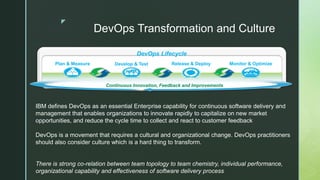
DevOps Transformation and Culture
Continuous Innovation, Feedback and Improvements
DevOps Lifecycle
Monitor & OptimizeRelease & DeployPlan & Measure Develop & Test
IBM defines DevOps as an essential Enterprise capability for continuous software delivery and
management that enables organizations to innovate rapidly to capitalize on new market
opportunities, and reduce the cycle time to collect and react to customer feedback
DevOps is a movement that requires a cultural and organizational change. DevOps practitioners
should also consider culture which is a hard thing to transform.
There is strong co-relation between team topology to team chemistry, individual performance,
organizational capability and effectiveness of software delivery process
z
How Team Topology impacts culture
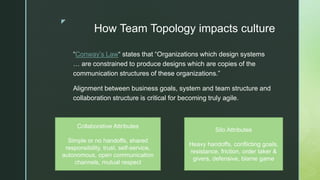
“Conway’s Law“ states that “Organizations which design systems
… are constrained to produce designs which are copies of the
communication structures of these organizations.”
Alignment between business goals, system and team structure and
collaboration structure is critical for becoming truly agile.
Silo Attributes
Heavy handoffs, conflicting goals,
resistance, friction, order taker &
givers, defensive, blame game
Collaborative Attributes
Simple or no handoffs, shared
responsibility, trust, self-service,
autonomous, open communication
channels, mutual respect
z
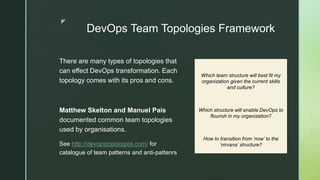
DevOps Team Topologies Framework
There are many types of topologies that
can effect DevOps transformation. Each
topology comes with its pros and cons.
Matthew Skelton and Manuel Pais
documented common team topologies
used by organisations.
See http://devopstopologies.com/ for
catalogue of team patterns and anti-pattenrs
Which team structure will best fit my
organization given the current skills
and culture?
Which structure will enable DevOps to
flourish in my organization?
How to transition from ‘now’ to the
‘nirvana’ structure?
z
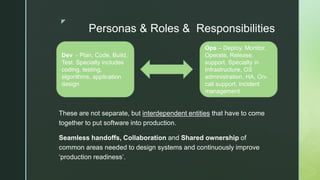
Personas & Roles & Responsibilities
These are not separate, but interdependent entities that have to come
together to put software into production.
Seamless handoffs, Collaboration and Shared ownership of
common areas needed to design systems and continuously improve
‘production readiness’.
Dev - Plan, Code, Build,
Test. Specialty includes
coding, testing,
algorithms, application
design
Ops – Deploy, Monitor,
Operate, Release,
support. Specialty in
Infrastructure, OS
administration, HA, On-
call support, incident
management
z
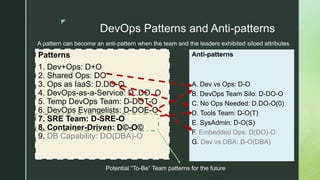
DevOps Patterns and Anti-patterns
Anti-patterns
A. Dev vs Ops: D-O
B. DevOps Team Silo: D-DO-O
C. No Ops Needed: D.DO-O(0)
D. Tools Team: D-O(T)
E. SysAdmin: D-O(S)
F. Embedded Ops: D(DO)-O
G. Dev vs DBA: D-O(DBA)
Patterns
1. Dev+Ops: D+O
2. Shared Ops: DO
3. Ops as IaaS: D.DO-O
4. DevOps-as-a-Service: D..DO..O
5. Temp DevOps Team: D-DOT-O
6. DevOps Evangelists: D-DOE-O
7. SRE Team: D-SRE-O
8. Container-Driven: D©-O©
9. DB Capability: DO(DBA)-O
A pattern can become an anti-pattern when the team and the leaders exhibited siloed attributes
Potential “To-Be” Team patterns for the future
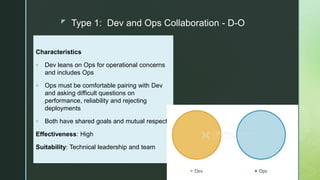
z Type 1: Dev and Ops Collaboration - D-O
Characteristics
 Dev leans on Ops for operational concerns
and includes Ops
 Ops must be comfortable pairing with Dev
and asking difficult questions on
performance, reliability and rejecting
deployments
 Both have shared goals and mutual respect
Effectiveness: High
Suitability: Technical leadership and team
z
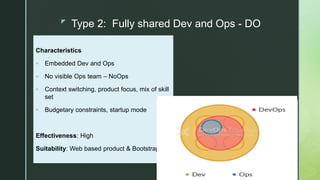
Type 2: Fully shared Dev and Ops - DO
Characteristics
 Embedded Dev and Ops
 No visible Ops team – NoOps
 Context switching, product focus, mix of skill
set
 Budgetary constraints, startup mode
Effectiveness: High
Suitability: Web based product & Bootstrap
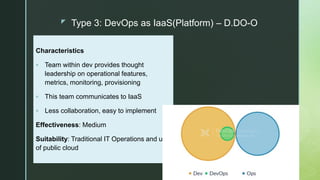
z Type 3: DevOps as IaaS(Platform) – D.DO-O
Characteristics
 Team within dev provides thought
leadership on operational features,
metrics, monitoring, provisioning
 This team communicates to IaaS
 Less collaboration, easy to implement
Effectiveness: Medium
Suitability: Traditional IT Operations and use
of public cloud
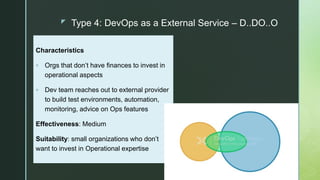
z Type 4: DevOps as a External Service – D..DO..O
Characteristics
 Orgs that don’t have finances to invest in
operational aspects
 Dev team reaches out to external provider
to build test environments, automation,
monitoring, advice on Ops features
Effectiveness: Medium
Suitability: small organizations who don’t
want to invest in Operational expertise
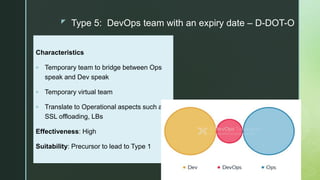
z Type 5: DevOps team with an expiry date – D-DOT-O
Characteristics
 Temporary team to bridge between Ops
speak and Dev speak
 Temporary virtual team
 Translate to Operational aspects such as
SSL offloading, LBs
Effectiveness: High
Suitability: Precursor to lead to Type 1
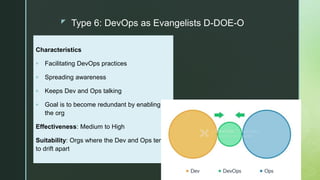
z Type 6: DevOps as Evangelists D-DOE-O
Characteristics
 Facilitating DevOps practices
 Spreading awareness
 Keeps Dev and Ops talking
 Goal is to become redundant by enabling
the org
Effectiveness: Medium to High
Suitability: Orgs where the Dev and Ops tend
to drift apart
z
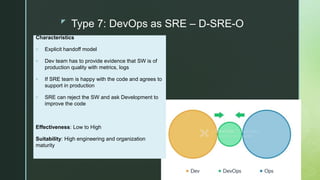
Type 7: DevOps as SRE – D-SRE-O
Characteristics
 Explicit handoff model
 Dev team has to provide evidence that SW is of
production quality with metrics, logs
 If SRE team is happy with the code and agrees to
support in production
 SRE can reject the SW and ask Development to
improve the code
Effectiveness: Low to High
Suitability: High engineering and organization
maturity
z
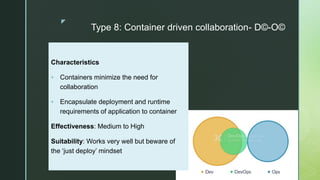
Type 8: Container driven collaboration- D©-O©
Characteristics
 Containers minimize the need for
collaboration
 Encapsulate deployment and runtime
requirements of application to container
Effectiveness: Medium to High
Suitability: Works very well but beware of
the ‘just deploy’ mindset
z
Thank you!!

DevOps topologies

  • 1.
    z DevOps Topologies Sushma Chakkirala, ProgramDirector, Secure DevOps @GTS Labs IBM
  • 2.
    z DevOps Transformation andCulture Continuous Innovation, Feedback and Improvements DevOps Lifecycle Monitor & OptimizeRelease & DeployPlan & Measure Develop & Test IBM defines DevOps as an essential Enterprise capability for continuous software delivery and management that enables organizations to innovate rapidly to capitalize on new market opportunities, and reduce the cycle time to collect and react to customer feedback DevOps is a movement that requires a cultural and organizational change. DevOps practitioners should also consider culture which is a hard thing to transform. There is strong co-relation between team topology to team chemistry, individual performance, organizational capability and effectiveness of software delivery process
  • 3.
    z How Team Topologyimpacts culture “Conway’s Law“ states that “Organizations which design systems … are constrained to produce designs which are copies of the communication structures of these organizations.” Alignment between business goals, system and team structure and collaboration structure is critical for becoming truly agile. Silo Attributes Heavy handoffs, conflicting goals, resistance, friction, order taker & givers, defensive, blame game Collaborative Attributes Simple or no handoffs, shared responsibility, trust, self-service, autonomous, open communication channels, mutual respect
  • 4.
    z DevOps Team TopologiesFramework There are many types of topologies that can effect DevOps transformation. Each topology comes with its pros and cons. Matthew Skelton and Manuel Pais documented common team topologies used by organisations. See http://devopstopologies.com/ for catalogue of team patterns and anti-pattenrs Which team structure will best fit my organization given the current skills and culture? Which structure will enable DevOps to flourish in my organization? How to transition from ‘now’ to the ‘nirvana’ structure?
  • 5.
    z Personas & Roles& Responsibilities These are not separate, but interdependent entities that have to come together to put software into production. Seamless handoffs, Collaboration and Shared ownership of common areas needed to design systems and continuously improve ‘production readiness’. Dev - Plan, Code, Build, Test. Specialty includes coding, testing, algorithms, application design Ops – Deploy, Monitor, Operate, Release, support. Specialty in Infrastructure, OS administration, HA, On- call support, incident management
  • 6.
    z DevOps Patterns andAnti-patterns Anti-patterns A. Dev vs Ops: D-O B. DevOps Team Silo: D-DO-O C. No Ops Needed: D.DO-O(0) D. Tools Team: D-O(T) E. SysAdmin: D-O(S) F. Embedded Ops: D(DO)-O G. Dev vs DBA: D-O(DBA) Patterns 1. Dev+Ops: D+O 2. Shared Ops: DO 3. Ops as IaaS: D.DO-O 4. DevOps-as-a-Service: D..DO..O 5. Temp DevOps Team: D-DOT-O 6. DevOps Evangelists: D-DOE-O 7. SRE Team: D-SRE-O 8. Container-Driven: D©-O© 9. DB Capability: DO(DBA)-O A pattern can become an anti-pattern when the team and the leaders exhibited siloed attributes Potential “To-Be” Team patterns for the future
  • 7.
    z Type 1:Dev and Ops Collaboration - D-O Characteristics  Dev leans on Ops for operational concerns and includes Ops  Ops must be comfortable pairing with Dev and asking difficult questions on performance, reliability and rejecting deployments  Both have shared goals and mutual respect Effectiveness: High Suitability: Technical leadership and team
  • 8.
    z Type 2: Fullyshared Dev and Ops - DO Characteristics  Embedded Dev and Ops  No visible Ops team – NoOps  Context switching, product focus, mix of skill set  Budgetary constraints, startup mode Effectiveness: High Suitability: Web based product & Bootstrap
  • 9.
    z Type 3:DevOps as IaaS(Platform) – D.DO-O Characteristics  Team within dev provides thought leadership on operational features, metrics, monitoring, provisioning  This team communicates to IaaS  Less collaboration, easy to implement Effectiveness: Medium Suitability: Traditional IT Operations and use of public cloud
  • 10.
    z Type 4:DevOps as a External Service – D..DO..O Characteristics  Orgs that don’t have finances to invest in operational aspects  Dev team reaches out to external provider to build test environments, automation, monitoring, advice on Ops features Effectiveness: Medium Suitability: small organizations who don’t want to invest in Operational expertise
  • 11.
    z Type 5:DevOps team with an expiry date – D-DOT-O Characteristics  Temporary team to bridge between Ops speak and Dev speak  Temporary virtual team  Translate to Operational aspects such as SSL offloading, LBs Effectiveness: High Suitability: Precursor to lead to Type 1
  • 12.
    z Type 6:DevOps as Evangelists D-DOE-O Characteristics  Facilitating DevOps practices  Spreading awareness  Keeps Dev and Ops talking  Goal is to become redundant by enabling the org Effectiveness: Medium to High Suitability: Orgs where the Dev and Ops tend to drift apart
  • 13.
    z Type 7: DevOpsas SRE – D-SRE-O Characteristics  Explicit handoff model  Dev team has to provide evidence that SW is of production quality with metrics, logs  If SRE team is happy with the code and agrees to support in production  SRE can reject the SW and ask Development to improve the code Effectiveness: Low to High Suitability: High engineering and organization maturity
  • 14.
    z Type 8: Containerdriven collaboration- D©-O© Characteristics  Containers minimize the need for collaboration  Encapsulate deployment and runtime requirements of application to container Effectiveness: Medium to High Suitability: Works very well but beware of the ‘just deploy’ mindset
  • 15.

Editor's Notes

  • #2 Team structure and its impact on DevOps transformation is a hot topic. Presentation includes patterns framework that can be discussed as a team. DevOps practitioners Team members who see blurred lines of responsibilities in a DevOps world and are no longer clear about their role Make the Intangible more approachable Leaders and Execs
  • #5 The DevOps Topologies collection of patterns (diagrams and descriptions) by Matthew Skelton and Manuel Pais is licensed under a Creative Commons Attribution- Starting point for a conversation. Which pattern does your team follow ?