© 2017 VERACODE INC. 1© 2017 VERACODE INC.
DevOps:
Security’s Big Opportunity
Tim Jarrett (@tojarrett)
© 2017 VERACODE INC. 2
Who am I?
• @tojarrett
• Over 20 years in software:
development, project
management, product
management & strategy
• At Veracode since 2008
• Grammy award winner
• Bacon number of 3
© 2017 VERACODE INC. 3
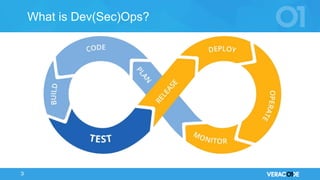
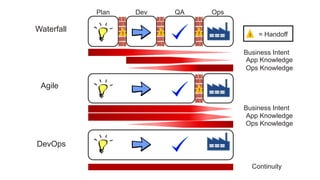
What is Dev(Sec)Ops?
DevOps
Plan Dev QA Ops
Business Intent
App Knowledge
Ops Knowledge
Business Intent
App Knowledge
Ops Knowledge
Continuity
Waterfall ! ! ! ! = Handoff
Agile !
© 2017 VERACODE INC. 5
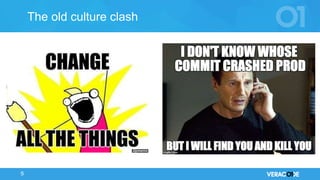
The old culture clash
© 2017 VERACODE INC. 6
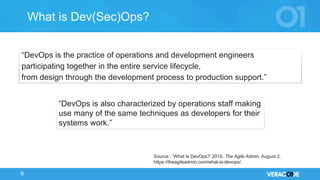
What is Dev(Sec)Ops?
“DevOps is the practice of operations and development engineers
participating together in the entire service lifecycle,
from design through the development process to production support.”
“DevOps is also characterized by operations staff making
use many of the same techniques as developers for their
systems work.”
Source : ‘What Is DevOps?’ 2010. The Agile Admin. August 2.
https://theagileadmin.com/what-is-devops/.
© 2017 VERACODE INC. 7
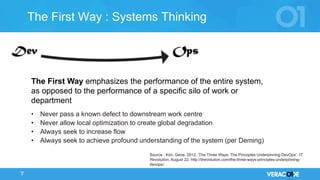
The First Way : Systems Thinking
Source : Kim, Gene. 2012. ‘The Three Ways: The Principles Underpinning DevOps’. IT
Revolution. August 22. http://itrevolution.com/the-three-ways-principles-underpinning-
devops/.
• Never pass a known defect to downstream work centre
• Never allow local optimization to create global degradation
• Always seek to increase flow
• Always seek to achieve profound understanding of the system (per Deming)
The First Way emphasizes the performance of the entire system,
as opposed to the performance of a specific silo of work or
department
© 2017 VERACODE INC. 8
The Second Way : Amplify Feedback Loops
The Second Way is about creating the right to left feedback
loops.
• Understand and respond to all customers, internal and external
• Shorten and amplify all feedback loops
• Embed knowledge where you need it
Source : Kim, Gene. 2012. ‘The Three Ways: The Principles Underpinning DevOps’. IT
Revolution. August 22. http://itrevolution.com/the-three-ways-principles-underpinning-
devops/.
© 2017 VERACODE INC. 9
The Third Way : Continual Experimentation
and Learning
• Allocate time for the improvement of daily work
• Create rituals that reward the team for taking risks
• Introduce faults into the system to increase resilience
The Third Way is about creating a culture that fosters two things: continual
experimentation, taking risks and learning from failure; and understanding
that repetition and practice is the prerequisite to mastery.
Source : Kim, Gene. 2012. ‘The Three Ways: The Principles Underpinning DevOps’. IT
Revolution. August 22. http://itrevolution.com/the-three-ways-principles-underpinning-
devops/.
© 2017 VERACODE INC. 10
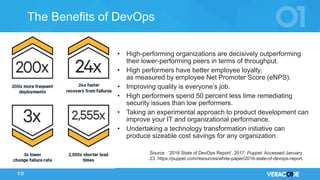
The Benefits of DevOps
• High-performing organizations are decisively outperforming
their lower-performing peers in terms of throughput.
• High performers have better employee loyalty,
as measured by employee Net Promoter Score (eNPS).
• Improving quality is everyone’s job.
• High performers spend 50 percent less time remediating
security issues than low performers.
• Taking an experimental approach to product development can
improve your IT and organizational performance.
• Undertaking a technology transformation initiative can
produce sizeable cost savings for any organization.
Source : ‘2016 State of DevOps Report’. 2017. Puppet. Accessed January
23. https://puppet.com/resources/white-paper/2016-state-of-devops-report.
© 2017 VERACODE INC. 11
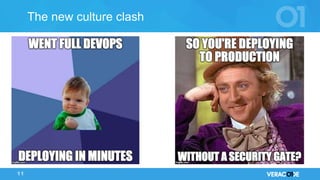
The new culture clash
h/t @petecheslock, DevOpsDays Austin
© 2017 VERACODE INC. 13
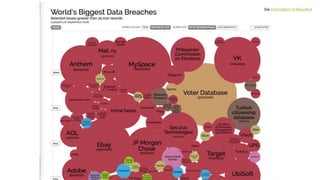
Via Information Is Beautiful
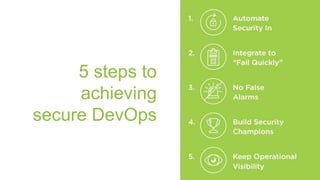
5 steps to
achieving
secure DevOps
© 2017 VERACODE INC. 18
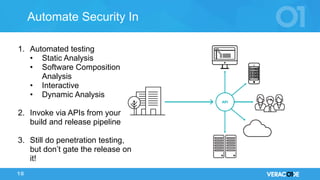
Automate Security In
1. Automated testing
• Static Analysis
• Software Composition
Analysis
• Interactive
• Dynamic Analysis
2. Invoke via APIs from your
build and release pipeline
3. Still do penetration testing,
but don’t gate the release on
it!
© 2017 VERACODE INC. 20
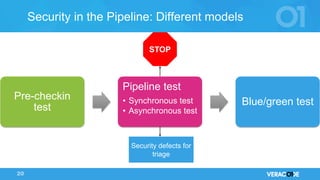
Security in the Pipeline: Different models
Pre-checkin
test
Pipeline test
• Synchronous test
• Asynchronous test
Blue/green test
STOP
Security defects for
triage
3. No false alarms
© 2017 VERACODE INC. 22
4. Build security championsBuild security champions
© 2017 VERACODE INC. 23
Keep operational visibility
© 2017 VERACODE INC. 24
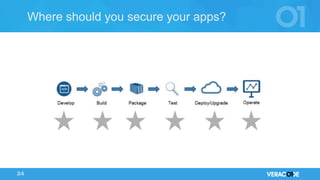
Where should you secure your apps?
© 2017 VERACODE INC. 25© 2017 VERACODE INC.
Demo
© 2017 VERACODE INC. 26© 2017 VERACODE INC.
In the next
60-90 days…
© 2017 VERACODE INC. 27
Who can help plant seeds?
Spearhead the
movement to
secure DevOps
28
Train beyond your walls
Get smart on
DevOps
© 2017 VERACODE INC. 29
• Which of your applications
will pass through a CI/CD
pipeline?
• What tolerance do you
have for “false alarms”
(FPs) that is integrated into
your DevOps practice?
• Are you using
Microservices?
Conversation starters (1)
© 2017 VERACODE INC. 30
• Are you practicing trunk-
based development, or do
you still practice release
and feature branching?
• How do you plan to monitor
your operational
applications for security
attacks?
• How do you plan to bring
security expertise into the
DevOps team?
Conversation starters (2)
© 2017 VERACODE INC. 31
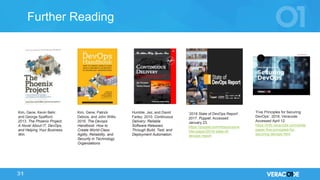
Further Reading
Kim, Gene, Kevin Behr,
and George Spafford.
2013. The Phoenix Project:
A Novel About IT, DevOps,
and Helping Your Business
Win.
Kim, Gene, Patrick
Debois, and John Willis.
2016. The Devops
Handbook: How to
Create World-Class
Agility, Reliability, and
Security in Technology
Organizations
Humble, Jez, and David
Farley. 2010. Continuous
Delivery: Reliable
Software Releases
Through Build, Test, and
Deployment Automation.
‘2016 State of DevOps Report’.
2017. Puppet. Accessed
January 23.
https://puppet.com/resources/w
hite-paper/2016-state-of-
devops-report
‘Five Principles for Securing
DevOps’. 2016. Veracode.
Accessed April 12.
https://info.veracode.com/white
paper-five-principles-for-
securing-devops.html
© 2017 VERACODE INC. 32
Thank You!
© 2017 VERACODE INC.
Tim Jarrett (@tojarrett)

DevOps: Security's Big Opportunity

  • 1.
    © 2017 VERACODEINC. 1© 2017 VERACODE INC. DevOps: Security’s Big Opportunity Tim Jarrett (@tojarrett)
  • 2.
    © 2017 VERACODEINC. 2 Who am I? • @tojarrett • Over 20 years in software: development, project management, product management & strategy • At Veracode since 2008 • Grammy award winner • Bacon number of 3
  • 3.
    © 2017 VERACODEINC. 3 What is Dev(Sec)Ops?
  • 4.
    DevOps Plan Dev QAOps Business Intent App Knowledge Ops Knowledge Business Intent App Knowledge Ops Knowledge Continuity Waterfall ! ! ! ! = Handoff Agile !
  • 5.
    © 2017 VERACODEINC. 5 The old culture clash
  • 6.
    © 2017 VERACODEINC. 6 What is Dev(Sec)Ops? “DevOps is the practice of operations and development engineers participating together in the entire service lifecycle, from design through the development process to production support.” “DevOps is also characterized by operations staff making use many of the same techniques as developers for their systems work.” Source : ‘What Is DevOps?’ 2010. The Agile Admin. August 2. https://theagileadmin.com/what-is-devops/.
  • 7.
    © 2017 VERACODEINC. 7 The First Way : Systems Thinking Source : Kim, Gene. 2012. ‘The Three Ways: The Principles Underpinning DevOps’. IT Revolution. August 22. http://itrevolution.com/the-three-ways-principles-underpinning- devops/. • Never pass a known defect to downstream work centre • Never allow local optimization to create global degradation • Always seek to increase flow • Always seek to achieve profound understanding of the system (per Deming) The First Way emphasizes the performance of the entire system, as opposed to the performance of a specific silo of work or department
  • 8.
    © 2017 VERACODEINC. 8 The Second Way : Amplify Feedback Loops The Second Way is about creating the right to left feedback loops. • Understand and respond to all customers, internal and external • Shorten and amplify all feedback loops • Embed knowledge where you need it Source : Kim, Gene. 2012. ‘The Three Ways: The Principles Underpinning DevOps’. IT Revolution. August 22. http://itrevolution.com/the-three-ways-principles-underpinning- devops/.
  • 9.
    © 2017 VERACODEINC. 9 The Third Way : Continual Experimentation and Learning • Allocate time for the improvement of daily work • Create rituals that reward the team for taking risks • Introduce faults into the system to increase resilience The Third Way is about creating a culture that fosters two things: continual experimentation, taking risks and learning from failure; and understanding that repetition and practice is the prerequisite to mastery. Source : Kim, Gene. 2012. ‘The Three Ways: The Principles Underpinning DevOps’. IT Revolution. August 22. http://itrevolution.com/the-three-ways-principles-underpinning- devops/.
  • 10.
    © 2017 VERACODEINC. 10 The Benefits of DevOps • High-performing organizations are decisively outperforming their lower-performing peers in terms of throughput. • High performers have better employee loyalty, as measured by employee Net Promoter Score (eNPS). • Improving quality is everyone’s job. • High performers spend 50 percent less time remediating security issues than low performers. • Taking an experimental approach to product development can improve your IT and organizational performance. • Undertaking a technology transformation initiative can produce sizeable cost savings for any organization. Source : ‘2016 State of DevOps Report’. 2017. Puppet. Accessed January 23. https://puppet.com/resources/white-paper/2016-state-of-devops-report.
  • 11.
    © 2017 VERACODEINC. 11 The new culture clash
  • 12.
  • 13.
  • 14.
  • 15.
  • 16.
  • 17.
    © 2017 VERACODEINC. 18 Automate Security In 1. Automated testing • Static Analysis • Software Composition Analysis • Interactive • Dynamic Analysis 2. Invoke via APIs from your build and release pipeline 3. Still do penetration testing, but don’t gate the release on it!
  • 19.
    © 2017 VERACODEINC. 20 Security in the Pipeline: Different models Pre-checkin test Pipeline test • Synchronous test • Asynchronous test Blue/green test STOP Security defects for triage
  • 20.
  • 21.
    © 2017 VERACODEINC. 22 4. Build security championsBuild security champions
  • 22.
    © 2017 VERACODEINC. 23 Keep operational visibility
  • 23.
    © 2017 VERACODEINC. 24 Where should you secure your apps?
  • 24.
    © 2017 VERACODEINC. 25© 2017 VERACODE INC. Demo
  • 25.
    © 2017 VERACODEINC. 26© 2017 VERACODE INC. In the next 60-90 days…
  • 26.
    © 2017 VERACODEINC. 27 Who can help plant seeds? Spearhead the movement to secure DevOps
  • 27.
    28 Train beyond yourwalls Get smart on DevOps
  • 28.
    © 2017 VERACODEINC. 29 • Which of your applications will pass through a CI/CD pipeline? • What tolerance do you have for “false alarms” (FPs) that is integrated into your DevOps practice? • Are you using Microservices? Conversation starters (1)
  • 29.
    © 2017 VERACODEINC. 30 • Are you practicing trunk- based development, or do you still practice release and feature branching? • How do you plan to monitor your operational applications for security attacks? • How do you plan to bring security expertise into the DevOps team? Conversation starters (2)
  • 30.
    © 2017 VERACODEINC. 31 Further Reading Kim, Gene, Kevin Behr, and George Spafford. 2013. The Phoenix Project: A Novel About IT, DevOps, and Helping Your Business Win. Kim, Gene, Patrick Debois, and John Willis. 2016. The Devops Handbook: How to Create World-Class Agility, Reliability, and Security in Technology Organizations Humble, Jez, and David Farley. 2010. Continuous Delivery: Reliable Software Releases Through Build, Test, and Deployment Automation. ‘2016 State of DevOps Report’. 2017. Puppet. Accessed January 23. https://puppet.com/resources/w hite-paper/2016-state-of- devops-report ‘Five Principles for Securing DevOps’. 2016. Veracode. Accessed April 12. https://info.veracode.com/white paper-five-principles-for- securing-devops.html
  • 31.
    © 2017 VERACODEINC. 32 Thank You! © 2017 VERACODE INC. Tim Jarrett (@tojarrett)

Editor's Notes

  • #2 Show of hands: how many folks in here build software? Okay, how many of you are trying to go DevOps? How many of you have security requirements? (is that the same group of people?) This talk is for you. I’m going to talk about why security and DevOps historically haven’t gotten along, how you can get on the same page, and what we can do about it.
  • #5 Higher empathy’ Lower waste Lower errors (through automation)
  • #6 DevOps started because of the clash between development, who are incented to change, and ops, who are incented toward stability
  • #8 The Value Stream
  • #9 Feedback Use the Developer example taking feedback from a MPT and making code changes to fix
  • #12 There’s a similar clash brewing between DevOps and Security. Before you can start to talk about securing DevOps, you have to address this culture clash. That means developers have to get security conscious, and security folks have to stop looking down their noses at DevOps and figure out how to help it move faster, not stand in the way.
  • #13 There doesn’t have to be a big disconnect between security and development, but to bridge the gap, security has to stop talking in terms of … security. More specifically, security has to start framing its mission not in terms of eliminating risk, but in terms of helping developers build better software.
  • #14 I don’t talk a lot with (non-Veracode) engineering stakeholders about Security. I do talk a lot about quality—that’s a concept that spans out of engineering and into everyday life. And even though every security purist I’ve ever met says it’s an over simplification to talk about security as a “subset” of quality—primarily because of the misalignment of skills and resources that that mindset has brought—I think it’s a useful way to think about why security matters. If quality is building in resilience that the application can deliver its functional mission even in unusual circumstances, then security does the same thing in downright hostile circumstances. And often the cause of a security problem can be traced to and managed in the same way as the cause of a quality problem—a defect, a bug. To see what I mean, let’s go to a fun data visualization.
  • #15 So this visualization is a view of all the biggest data breaches over the last few years (at Information is Beautiful, updated September 4)…
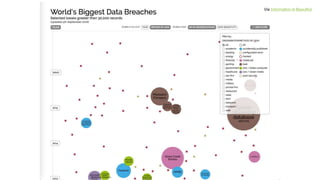
  • #16 And here’s what it looks like when you exclude appsec related breaches -- breaches that were not attributed to configuration errors, hacks, or poor security. And what was the root cause of those hacks?
  • #17 Data from SOSS 2017 Much of that which is exploited by attackers in like bugs in code  All code also has security vulnerabilities  “I didn't know that I didn't need to address something a certain way”  Of course there's bugs – most developers are not being enabled with education about secure coding, or with the safety nets to catch when coding errors inadvertently introduce security bugs. Worse yet, some of these bug categories can be discovered late in the game. Think about Java deserialization vulnerabilities—they weren’t a big deal until someone showed how to exploit them last November. You need to keep thinking about security even after you ship. And on the security side, we need to recognize that anything that helps developers turn around fixes in code faster helps reduce this type of risk, provided it’s done in a systematic way. We need to stop being gatekeepers and start being enablers.
  • #18 (TIME FILL) Re #2 and #3, somebody made this point during a DevOps talk at O’Reilly: “Security tests in CI/CD need to be binary. It succeeds or it doesn't.” This led to some discussion where some felt there should be a manual step because different apps have different risks, attack surfaces, and threats. Came to realization we were conflating CI/CD with just CI. (TIME FILL) Re #4, talk about our Security Champions program. (TIME FILL) Re #5, talk about security telemetry, piggybacking on tools that DevOps teams are already using, except to trigger on security-related events. Some of the stuff Etsy did under NickG and Zane, as an example.
  • #19 Instead of penetration testing, why not dynamic? Instead of dynamic, why not static and SCA? Don’t not do the slower methods, just don’t gate your release on them Technology: SAST, guided DAST, APIs
  • #20 Fail quickly: Just like with QA, have as few security tests that run late in the cycle as possible. You want to automate security testing relatively early in the pipeline. Even better, look at doing it before the code hits the pipeline. Development tools that do security testing as you type have gotten a bad rap in the past for being noisy and inaccurate, but there’s a new generation of those coming that address those issues. Mature Technology: SAST in the pipeline (runtime concerns) Emerging technology: “instant SAST” or security unit testing – “as you type” (historical concerns about noise)
  • #21 There are a bunch of different ways to integrate automated security testing into a pipeline, at least as many as there are to build software. Which one is for you depends on your toolchain and the architecture of your app.
  • #22 No false alarms: The problem with any automated testing is getting the noise level down. Starting with a static analysis tool that is low noise to begin with helps, but you also need to look at what you will allow to stop your pipeline, vs. that which just becomes backlog. Technology: Static analysis with low FP Emerging technology: Interactive Application Security Testing (coverage concerns) Process: Security mitigation review
  • #23 Build Security Champions: Part of what you want to think about is how you can reduce the input of flaws into the process in the first place. Look for opportunities to drive learning from findings whether through formal education or on the spot reinforcement. Ultimately security champions aren’t enough by themselves, but you can’t get better over time without them. Mature technology: eLearning and contextual tutorials. Process and humans: remediation coaching, instructor led training, embedding security into development teams, security in the “definition of done”
  • #24 Not enough to think about appsec only before you ship: New vulnerability categories may emerge Your org may have applications in production that aren’t deployed through the common pipeline If you’re attacked, you want to feed that information back into development so you can address the issues quickly. Emerging technology: RASP (Runtime Application Self Protection) provides monitoring as well as the ability to block common kinds of attacks, and runs in the application or the container so it avoids some of the failings of WAFs. Mature technologies: WAFs (have to be tuned, not generally in the control of the DevOps team); web application discovery; software composition analysis.
  • #25 If you’re doing appsec today, you’re probably doing it in the Test stage. DevOps and other methodologies with automated build give us the opportunity to integrate into the pipeline (the Build stage). But you should also think about it before any code gets committed, by embedding security into your process and investigating arming your developers with “as you type” security tools. And you shouldn’t stop thinking about it after you ship either – at a minimum keep a bill of software components so you can quickly react when new vulns are found, and consider web application discovery/rapid baselining and RASP to ensure that you understand your perimeter and that you can be alerted to attacks and buy yourself some time to remediate the underlying vulnerabilities. Or maybe you do a blue green deployment and don’t turn everyone on until the code has passed a scan in production. There are lots of options.
  • #28 How do you spearhead the movement to securing DevOps? You want to be thinking about this from the top down as well as the bottom up. Who inside the organization can help plant seeds for incorporating security tools, process, and mindset into DevOps? In the war room (or boardroom): Who is setting the culture for DevOps? Who defines the goals that engineers are going to ultimately be measured against? In the trenches: Developers rule the kingdom. Who are the people selecting the tools and operating the tool chain? (TIME FILL) Talk about VSSL and Stash/Gitlab transition as a “developers rule” example. Image: https://www.flickr.com/photos/eulothg/4922211016 (CC BY-NC-ND 2.0)
  • #29 Train beyond your walls, i.e. become more educated on DevOps practices in general and CI/CD. Encourage non-security teams to participate in training on security testing and secure coding. Image: copyrighted, not for distribution
  • #33 You can download “Five Principles for Securing DevOps” from Veracode.com: https://info.veracode.com/whitepaper-five-principles-for-securing-devops.html