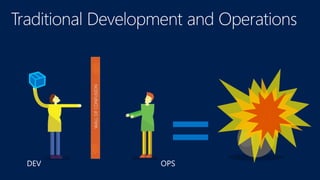
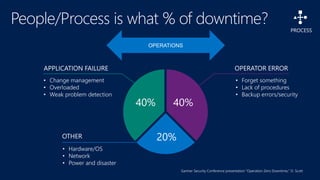

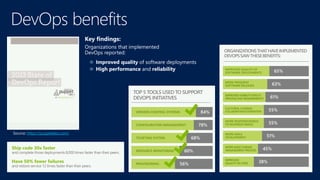

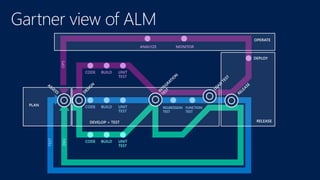
Gartner Security Conference presentation "Operation Zero Downtime," D. Scott
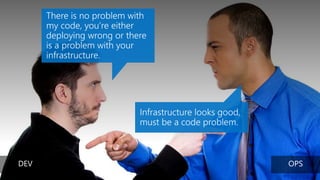
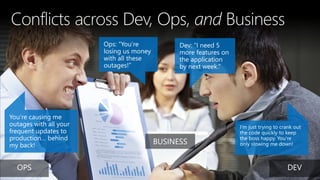
OPSDEV
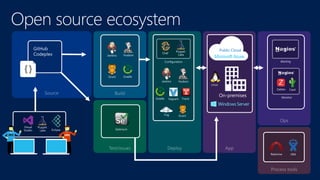
https://puppetlabs.com/
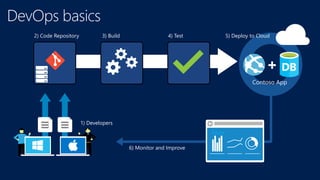
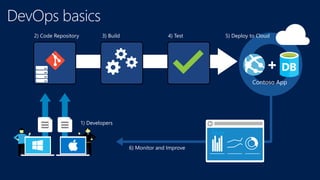
2) Code Repository
1) Developers
3) Build 4) Test 5) Deploy to Cloud
6) Monitor and Improve
Contoso App
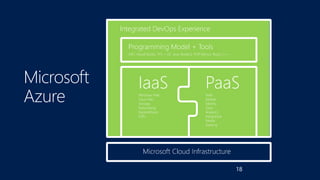
Azure
IIS VM SQL VM
IaaS
PaaS – Website
PaaS – Cloud Service
18
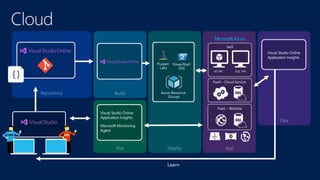
2) Code Repository
1) Developers
3) Build 4) Test 5) Deploy to Cloud
6) Monitor and Improve
Contoso App
Azure
Service Manager
Configuration Alerting
Monitor
www.microsoft.com/learning
http://microsoft.com/msdnhttp://microsoft.com/technet
http://channel9.msdn.com/Events/TechEd
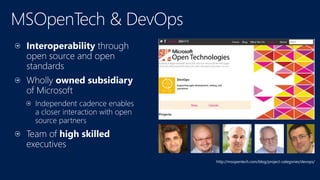
http://msopentech.com/blog/project-categories/devops/
DevOps - Isso existe mesmo?

DevOps - Isso existe mesmo?

Editor's Notes

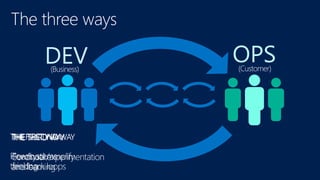
  • #14 http://itrevolution.com/a-personal-reinterpretation-of-the-three-ways/ 1st - IT places Dev as the business representative and Ops as the customer representative, with the value flowing in one direction (from the business to the customer). When we can think as a system we can focus clearly on the business value that flows between our Business, Dev, Ops and the end users. We can see each piece as it fits into the whole, and can identify its constraints. We can also properly define our work and when we can see and think in terms of the Flow of our system, we see the following benefits: increased value flow due to the visibility into what it takes to produce our end product our downstream step always gets what they need, how they need it, when they need it faster time to market we bring Ops in earlier in the development process, letting them plan appropriately for the changes that Dev will be making (because we know that all changes can affect how our product is delivered) which leads to less unplanned work or rushed changes because work is visible, Ops can see the work coming and better prepare We can identify and address constraints or bottleneck points in our system 2nd Way - It adds a backward facing channel of communications between OPs and Dev. It enforces the idea that to better the product, we always need to communicate. Dev continually improves as an organization when it better sees the outcomes of it’s work. This can be small (inviting the other Tribes to our stand ups) or it can be larger (Including Dev in the on-call rotation, tools development, architecture planning and/or incident management process) But to truly increase our Flow and improve the business value being delivered to the customer our Tribes need to know ‘what happens’, ‘when it happens’. When we increase our Feedback and create a stable Feedback loop we see the following benefits: Tribal knowledge grows, and we foster a community of sharing With sharing comes trust and with trust comes greater levels of collaboration. This collaboration will lead to more stability and better Flow We better understand all of our customers (Ops as a customer, Dev as a Business, but especially our end users, to whom we deliver value.) We fix our defects faster, and are more aware of what is needed to make sure that type of problem doesn’t happen again We adapt our processes as we learn more about the inner workings or our other Tribes We increase our delivery speeds and decrease unplanned work 3rd Way: When we have achieved the first Two Ways we can feel comfortable knowing that we can push the boundaries. We can experiment, and fail fast, or achieve greatness. We have a constant feedback loop for each small experiment that allows us to validate our theories quickly. we fail often and sometimes intentionally to learn how to respond properly and where our limits are we inject faults into the production system and early as possible in the delivery pipeline we practice for outages and find innovative ways to deal with them we push ourselves into the unknown more frequently and become comfortable in the uncomfortable we innovate and iterate in a ‘controlled’ manner, knowing when should keep pushing and when we should stop our code commits are more reliable, and production ready we test our business hypotheses (at the beginning of the product pipeline), and measure the business results we constantly put pressure into the system, striving to decrease cycle times and improve flow
  • #31 Timing: 2 minutes To further advance the company’s long-standing investments in openness including interoperability, open standards and open source, Microsoft launched a wholly-owned subsidiary Microsoft Open Technologies, Inc. (MS Open Tech) in early 2012. We are motivated by the core belief that open technology is a powerful enabler – and this concept underscores all of the work we do to create technical bridges between Microsoft and non-Microsoft technologies. We are an organization of engineers, standards professionals and technical evangelists who are both experienced in and passionate about working with an equally diverse set of technologies.  In addition, we leverage our ability to marshal engineering talent from Microsoft on a project basis through the MS Open Tech Hub engineering program to help facilitate the exchange and evolution of open source engineering best practices. Code talks within MS Open Tech. Many of our primary activities encompass building open source code and promoting the development and adoption of open technical standards specifications to deliver a more seamless experience across hardware, software and devices. Please visit our Projects page for more details about our community contributions in these areas Main Executives MS Open Tech Executives Jean Paoli President In his role as President of MS Open Tech, Jean leads a diverse team of engineers, standards professionals and technical evangelists to promote open platform development and customer choice by delivering new technologies in collaboration with open source and standards communities. A passionate advocate of open standards since 1985, Jean was one of the co-creators of the XML 1.0 standard via the World Wide Web Consortium (W3C), and he has garnered multiple industry awards for his work. Upon joining Microsoft Corporation in 1996, Jean jump-started XML development and managed the team that delivered msxml, the software that XML-enabled both Internet Explorer and the Windows operating system. Jean helped architect Office XML support and was instrumental in creating InfoPath, the XML Office Electronic Forms application. He also participated in ISO/IEC SC34/ WG4 and as co-chair of the TC45 Ecma standards committee that formalized the Office Open XML Format as an international standard. Operating as a distinct business operation since 2012, Jean’s team at MS Open Tech has worked closely with many business groups across Microsoft to promote several technical standards, including W3C’s HTML5, IETF’s HTTP 2.0, Cloud standards in DMTF and OASIS. The team also collaborates with a broad variety of development communities to contribute tools that promote interoperability between Microsoft technologies within open source environments such as Node.js, MongoDB and Phonegap. Prior to Microsoft, Jean worked with a number of European research institutes, including INRIA in France, where he designed systems to facilitate data exchange for major corporations Gianugo Rabellino Senior Director of Open Source Communities With more than 20 years of experience in the open source community, Gianugo brings a deep understanding of open technologies and platforms to his role as Senior Director of Open Source Communities at MS Open Tech. He is charged with promoting the team’s broad engagement with developer communities to help create new business opportunities using Microsoft and non-Microsoft technologies. Gianugo has also been an active member of the Apache Software Foundation since 1999, where he currently serves as vice president of the Apache XML Project Management Committee. Additionally, he assists on a number of projects as a mentor through the Apache Incubator, and speaks at conferences around the world about open development. Previously, Gianugo was the founder and CEO of Sourcesense, the leading open source services company in Europe, where he drove sustained double-digit growth to expand its operations across Italy, the Netherlands and the UK. Gianugo has also held a variety of senior management roles at Pro-netics, Ksolutions, and Bibop Research where he was responsible for the software development and system/network administration groups and worked with several customers including Sun, IBM, Oracle, ISP and the Apache Software Foundation. As an open source technical and policy consultant, he co-founded the first official Linux association in Italy, elevating Linux and open source development to the mainstream within that region. He received his undergraduate degree from Liceo Classico Gabriello Chiabrera and his graduate degree from Universita degli Studi di Genova. Twitter: @Gianugo Kamaljit Bath Director of Engineering Team Kamaljit joined MS Open Tech with nearly 20 years of diverse software industry experience at various levels. He leads the company’s engineering team to create standards-based tools that facilitate interoperability between open source and Microsoft products and technologies, which has resulted in open source project contributions such as: WebKit, Blink, Node.js, Apache QPID, jQuery and Apache Cordova. Kamaljit also coordinates the Interoperability Executive Customer (IEC) Council – an advisory board comprised of ~35 CIOs representing global public and private sector enterprises. In this capacity, he works closely with many Microsoft product teams, standards and policy teams, as well as the Microsoft Trustworthy Computing and Engineering Excellence teams, to strategize on features, best practices and trainings that align with the objective of achieving greater interoperability with Microsoft products and technologies. Previously, Kamaljit spearheaded Microsoft’s first-ever participation in an Apache-sponsored open source project, managing the Apache Stonehenge incubator to showcase the interoperability of web services standards. He was also lead program manager on both the Microsoft Office InfoPath and Microsoft SQL Server teams. Prior to Microsoft, he worked as an Oracle database and forms programmer and mainframe to client-server systems analyst in several Fortune 500 companies. Kamaljit received his Bachelor of Science in Computer Science from National Institute of Technology, Allahabad, India in India. Paul Cotton Partner Group Manager Paul leads the standards team MS Open Tech. He has nearly 40 years of experience in all aspects of software development. He is credited with Microsoft’s cloud computing interoperability and standards strategy and he previously led the company’s multi-year web services standardization efforts within W3C, OASIS and WS-I. After several leadership roles within the W3C, Paul presently serves as co-chair of the working group responsible for the HTML5 specification. Paul is also a Microsoft Standards Advisor supporting cross-divisional strategic standards issues and acts chair of Canadian Advisory Committees for the International Organization for Standardization (ISO) - SC 38 Cloud Computing and SC 34 Document Description and Processing Languages. Paul also architected, developed and managed the SQL-based full-text product with an Open DataBase Connectivity (ODBC) interface, and was a major contributor to consortium efforts such as ATA SFQL, SQL Access Group CLI, SQLJ and SQLX. Prior to Microsoft, Paul founded a consulting company and software vendor, Officesmiths, where he was an architect and development manager for a successful office automation software product. He has served as the United Nations advisor and project manager to successful software projects in Chile and Burma. He has also worked for IBM Canada, Fulcrum Technologies, PBC & Associates, Alphatext Inc., and Statistics Canada. Paul received his undergraduate degree, and a Masters of Mathematics from the University of Waterloo.