Written by Causa Justa :: Just Cause
with health impact research and data and policy analysis contributed
by the Alameda County Public Health Department, Place Matters Team
Development without Displacement
RESISTING GENTRIFICATION
IN THE BAY AREA
Acknowledgements
This report was written by Causa Justa :: Just Cause (CJJC) with health impact research and data and policy
analysis contributed by the Alameda County Public Health Department (ACPHD), Place Matters Team. A
special thanks goes out to all the individuals who provided feedback on the draft framework and policy and
health analyses, and to those who shared their stories and experiences.
Causa Justa :: Just Cause Writers
Dawn Phillips, Co-Director of Programs, Lead Writer
Luis Flores, Jr., CJJC Intern & Stronach Fellow,
University of California, Berkeley
Jamila Henderson, Contracted Project Coordinator
Causa Justa :: Just Cause Contributors and
Reviewers
Robbie Clark, Housing Rights Campaign Lead
Organizer, CJJC
Maria Zamudio, San Francisco Housing Rights
Campaign Organizer, CJJC
Gilda Haas, Professor of Urban Planning, Antioch
University & Board of Directors, CJJC
María Poblet, Executive Director, CJJC
Adam Gold, Communications and Admin Director,
CJJC
Alameda County Public Health
Department Contributors
Zoë Levitt, Health Impact Assessment Coordinator,
ACPHD Lead
Alex Desautels, Former Local Policy Manager
Matt Beyers, Epidemiologist II
Roxanna Guide, Epidemiologist
Tram Nguyen, Local Policy Coordinator
Katherine Schaff, Health Equity Coordinator
Nathan Phillip, Contracted Research Assistant
Reviewers and Contributors
Gloria Bruce, East Bay Housing Organizations
Dr. Richard Walker, Professor Emeritus of
Geography, University of California, Berkeley
Will Dominie, Contra Costa Health Services
Interviewers
Sonia Aldape, CJJC Volunteer
Carmela Zakon, CJJC Volunteer
Luis Flores, Jr., CJJC Intern & Stronach Fellow,
University of California, Berkeley
Jamila Henderson, Contracted Project Coordinator,
CJJC
Causa Justa :: Just Cause (CJJC): A multi-
racial, grassroots organization building community
leadership to achieve justice for low-income San
Francisco and Oakland residents.
Alameda County Public Health Department
(ACPHD), Place Matters Team: Place Matters
is a local partner of the national initiative of the Joint
Center for Political and Economic Studies, Health
Policy Institute (HPI). It is designed to improve the
health of participating communities by addressing
the social conditions that lead to poor health.
The research that provided the basis for this publication was supported by funding under an award to
the Metropolitan Transportation Commission (MTC) from the U.S. Department of Housing and Urban
Development. The substance and findings of the work are dedicated to the public. The author and publisher
are solely responsible for the accuracy of the statements and interpretations contained in this publication.
Such interpretations do not necessarily reflect the views of the federal government or MTC. For a copy of
the specific research findings and the methodology underlying that research, please go to www.cjjc.org/en/
HUDreport.
Please send comments and questions to Rose@cjjc.org.
Please go to the CJJC website to purchase additional copies www.cjjc.org
Contents
Foreword........................................................................... 2
Candelario Melendez...............................................................2
Dr. Richard Walker....................................................................3
Executive Summary........................................................ 6
Purpose of the Report.............................................................6
Data Analysis.............................................................................6
Gentrification as a Historic Process.....................................8
Health Impacts...........................................................................8
Policy Recommendations........................................................9
Introduction....................................................................11
What Is Gentrification?......................................................... 11
Regional Historical Perspective.......................................... 13
Redefining Human Development:
Organizing Communities................................................. 13
Research Scope & Methodology..............................14
Gentrification Typologies Analysis..................................... 14
Global Cities: A Brief Political Economy
of the Bay Area..............................................................16
Immigration and Migration
to the Bay Area.................................................................. 17
Decades of Race and Class Inequities............................. 19
Gentrification: The Rent Gap
in the New Economy......................................................... 20
Urban Development Under Neoliberalism........................30
Gentrification is a Public Health Issue...................38
The Historic Role of Public Health Departments
in Urban Development......................................................39
Urban Renewal and Displacement:
Moving People in the Name of Health..........................40
New Approaches to Healthy Housing
and Healthy Development...............................................48
Organizing Toward a New Vision
for Community Development.....................................50
Human Development for Healthy
and Sustainable Neighborhoods...................................50
Collective Action Creates Human Development............50
Gentrification Can Be Prevented....................................... 51
The Role of Public Agencies in Promoting
Human Development........................................................ 53
Policy Findings & Recommendations.....................55
Cross-Cutting Recommendations for
Policy Effectiveness.......................................................... 55
Principles, Policies & Practices for Preventing
Displacement: Advancing a Comprehensive
Housing Rights Framework.......................................59
A. Baseline Protections for Vulnerable Residents..........60
B. Production and Preservation of Affordable
Housing................................................................................ 67
C. Stabilization of Existing Communities.......................... 75
D. Non-Market Based Approaches to Housing
and Community Development........................................80
E. Displacement Prevention as a Regional Priority........ 82
F. Planning as a Participatory Process.............................. 85
Taking Action ................................................................90
Works Cited....................................................................92
Appendix A....................................................................100
| Development Without Displacement2
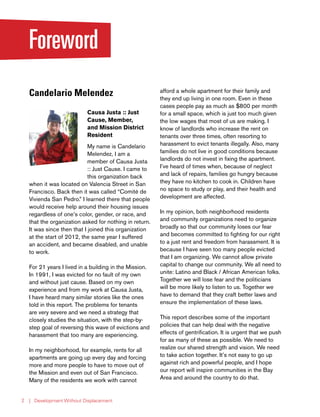
Foreword
Candelario Melendez
Causa Justa :: Just
Cause, Member,
and Mission District
Resident
My name is Candelario
Melendez, I am a
member of Causa Justa
:: Just Cause. I came to
this organization back
when it was located on Valencia Street in San
Francisco. Back then it was called “Comité de
Vivienda San Pedro.” I learned there that people
would receive help around their housing issues
regardless of one’s color, gender, or race, and
that the organization asked for nothing in return.
It was since then that I joined this organization
at the start of 2012, the same year I suffered
an accident, and became disabled, and unable
to work.
For 21 years I lived in a building in the Mission.
In 1991, I was evicted for no fault of my own
and without just cause. Based on my own
experience and from my work at Causa Justa,
I have heard many similar stories like the ones
told in this report. The problems for tenants
are very severe and we need a strategy that
closely studies the situation, with the step-by-
step goal of reversing this wave of evictions and
harassment that too many are experiencing.
In my neighborhood, for example, rents for all
apartments are going up every day and forcing
more and more people to have to move out of
the Mission and even out of San Francisco.
Many of the residents we work with cannot
afford a whole apartment for their family and
they end up living in one room. Even in these
cases people pay as much as $800 per month
for a small space, which is just too much given
the low wages that most of us are making. I
know of landlords who increase the rent on
tenants over three times, often resorting to
harassment to evict tenants illegally. Also, many
families do not live in good conditions because
landlords do not invest in fixing the apartment.
I’ve heard of times when, because of neglect
and lack of repairs, families go hungry because
they have no kitchen to cook in. Children have
no space to study or play, and their health and
development are affected.
In my opinion, both neighborhood residents
and community organizations need to organize
broadly so that our community loses our fear
and becomes committed to fighting for our right
to a just rent and freedom from harassment. It is
because I have seen too many people evicted
that I am organizing. We cannot allow private
capital to change our community. We all need to
unite: Latino and Black / African American folks.
Together we will lose fear and the politicians
will be more likely to listen to us. Together we
have to demand that they craft better laws and
ensure the implementation of these laws.
This report describes some of the important
policies that can help deal with the negative
effects of gentrification. It is urgent that we push
for as many of these as possible. We need to
realize our shared strength and vision. We need
to take action together. It’s not easy to go up
against rich and powerful people, and I hope
our report will inspire communities in the Bay
Area and around the country to do that.
Causa Justa :: Just Cause | 3
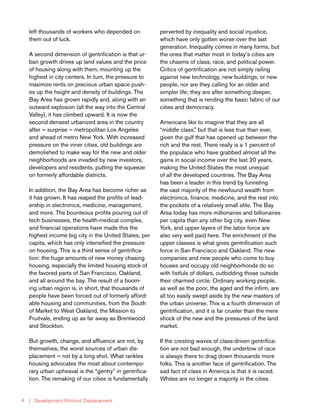
Dr. Richard Walker
Professor Emeritus of
Geography, University
of California, Berkeley
To housing and social
justice organizers across
the United States, gen-
trification is a scourge.
They have seen the dam-
age done to hundreds
of thousands, if not millions, of families, and the
disruption of schooling, friendships, and habits
accompanied by the costs of finding new hous-
ing, jobs, support networks, and more. They
witness the cruel unfairness of the way the suf-
fering falls so disproportionately on the heads of
innocent children, poor parents, and people of
color. Against the current tide of displacement,
a forceful movement has emerged in defense
of housing rights and urban justice, operating
under the rubric of “The Right to the City” and
bringing together a broad coalition of tenants’
rights, affordable housing, and anti-foreclosure
advocates. I had the honor of participating in
the founding of the national Right to the City
Alliance a decade ago, and I have watched as
the groups in the alliance have grown stronger,
wiser, and more tenacious in their struggle to
protect those being swept from our cities by
the blind forces of economic growth and urban
redevelopment.
Nowhere is the fight for housing justice
more acute than in the Bay Area, where San
Francisco is widely considered the most gen-
trified city in the country, and Oakland is not far
behind. The region has many valiant organiza-
tions working for better housing for the disad-
vantaged and displaced. Among these groups,
Causa Justa :: Just Cause stands out for its
work in defense of tenants’ rights and against
evictions of all kinds on both sides of the bay.
Groups like this have a lot to teach us all about
the harsh realities of Bay Area housing that rare-
ly make the pages or broadcasts of the major
media outlets and are, therefore, little known
to most policymakers in the region. This report
gives these groups a chance to speak and for
us to learn.
So what is this thing called “gentrification?”
It has divergent meanings to different peo-
ple and has long been disputed, even among
urban scholars. It is usually heard as a term
of approbation against landlords carrying out
forcible evictions and new buyers displacing
former residents of low-income neighborhoods.
Conversely, it is a rallying cry for affordable
housing and limits on high-rises and building
conversions. But is it more than a political slo-
gan? As this report makes clear, there are cold,
hard facts behind the popular terminology.
Without some clarity about what is at stake in
gentrification, public debate easily bogs down
in mutual incomprehension. There are plenty of
cheerleaders for the current makeover of the
Bay Area who cite the evidence for a high tech
boom, rising average incomes, an expanding
housing stock, and more. They are quick to
dismiss the critics of gentrification. But gentri-
fication is a many-sided phenomenon, so it is
essential to unpack its dimensions to see why
housing organizers have so much to teach us
about the dark side of the shining new urban
landscapes going up all around the bay.
For one, cities are living things that change over
time. They look solid and fixed, but they are
shaken up repeatedly by the dynamic forces
of capitalism and modernity, their landscapes
and ways of life torn apart and reconstructed.
The Bay Area is undergoing just such a radical
makeover today as new technology companies
sprout, new people migrate in, and older ac-
tivities and jobs disappear. Thanks to Silicon
Valley, the region is a global leader in innovation,
making change a way of life here. This, then, is
the first facet of gentrification: the shock of the
new and the loss of the old. The restructuring of
the city has knocked the feet out from under old
industries, vaporized formerly reliable jobs, and
| Development Without Displacement4
left thousands of workers who depended on
them out of luck.
A second dimension of gentrification is that ur-
ban growth drives up land values and the price
of housing along with them, mounting up the
highest in city centers. In turn, the pressure to
maximize rents on precious urban space push-
es up the height and density of buildings. The
Bay Area has grown rapidly and, along with an
outward explosion (all the way into the Central
Valley), it has climbed upward. It is now the
second densest urbanized area in the country
after — surprise — metropolitan Los Angeles
and ahead of metro New York. With increased
pressure on the inner cities, old buildings are
demolished to make way for the new and older
neighborhoods are invaded by new investors,
developers and residents, putting the squeeze
on formerly affordable districts.
In addition, the Bay Area has become richer as
it has grown. It has reaped the profits of lead-
ership in electronics, medicine, management,
and more. The bounteous profits pouring out of
tech businesses, the health-medical complex,
and financial operations have made this the
highest income big city in the United States, per
capita, which has only intensified the pressure
on housing. This is a third sense of gentrifica-
tion: the huge amounts of new money chasing
housing, especially the limited housing stock of
the favored parts of San Francisco, Oakland,
and all around the bay. The result of a boom-
ing urban region is, in short, that thousands of
people have been forced out of formerly afford-
able housing and communities, from the South
of Market to West Oakland, the Mission to
Fruitvale, ending up as far away as Brentwood
and Stockton.
But growth, change, and affluence are not, by
themselves, the worst sources of urban dis-
placement — not by a long shot. What rankles
housing advocates the most about contempo-
rary urban upheaval is the “gentry” in gentrifica-
tion. The remaking of our cities is fundamentally
perverted by inequality and social injustice,
which have only gotten worse over the last
generation. Inequality comes in many forms, but
the ones that matter most in today’s cities are
the chasms of class, race, and political power.
Critics of gentrification are not simply railing
against new technology, new buildings, or new
people, nor are they calling for an older and
simpler life; they are after something deeper,
something that is rending the basic fabric of our
cities and democracy.
Americans like to imagine that they are all
“middle class,” but that is less true than ever,
given the gulf that has opened up between the
rich and the rest. There really is a 1 percent of
the populace who have grabbed almost all the
gains in social income over the last 20 years,
making the United States the most unequal
of all the developed countries. The Bay Area
has been a leader in this trend by funneling
the vast majority of the newfound wealth from
electronics, finance, medicine, and the rest into
the pockets of a relatively small elite. The Bay
Area today has more millionaires and billionaires
per capita than any other big city, even New
York, and upper layers of the labor force are
also very well paid here. The enrichment of the
upper classes is what gives gentrification such
force in San Francisco and Oakland. The new
companies and new people who come to buy
houses and occupy old neighborhoods do so
with fistfuls of dollars, outbidding those outside
their charmed circle. Ordinary working people,
as well as the poor, the aged and the infirm, are
all too easily swept aside by the new masters of
the urban universe. This is a fourth dimension of
gentrification, and it is far crueler than the mere
shock of the new and the pressures of the land
market.
If the cresting waves of class-driven gentrifica-
tion are not bad enough, the undertow of race
is always there to drag down thousands more
folks. This is another face of gentrification. The
sad fact of class in America is that it is raced.
Whites are no longer a majority in the cities
Causa Justa :: Just Cause | 5
of California, but they hold the overwhelming
percentage of the wealth. Housing is regularly
considered the measure of the middle class,
but access to it is badly skewed by racial
inequality. Most of the wealthy and well paid
in the Bay Area are White, along with a few
Asian Americans. These are the gentrifiers.
Meanwhile, most of those being displaced are
Black / African American, Latino, Filipino, or
other people of color. Not only do they have less
income to bid competitively for housing, they are
much more likely to be renters, and therefore
exposed to eviction. Those who did own houses
were disproportionately hit by foreclosures in
the meltdown of the subprime housing bubble.
Finally, there is the question of control over
government and its powers to ameliorate the
assault on city neighborhoods. As this report
details, there are many reasonable policies
at the local and regional levels that can help
hold back the tide of gentrification and modify
the worst effects of urban transformation. The
problem is getting such policies enacted, en-
forced, and financed. The promise of American
democracy lies in the power of popular repre-
sentation and the assurance of a modicum of
fairness imposed on the capitalist free-for-all
by government. But the harsh reality is that too
often politics fall prey to the same inequities that
rule the market, an unpleasant reality that has
only grown harsher in the moneyed campaigns
and lobbying of the present day. This is the last
sense of gentrification — the power of the upper
classes to claim the city for themselves without
opposition from the common people — and it
feels the most unjust of all.
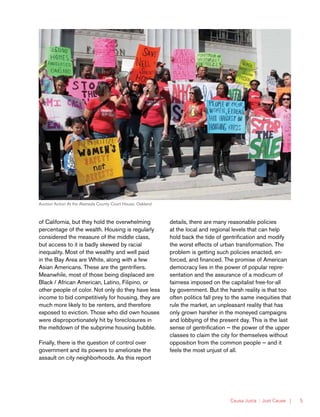
Auction Action At the Alameda County Court House, Oakland
| Development Without Displacement6
Executive Summary
Purpose of the Report
This report contributes to the conversation and
understanding of gentrification and displace-
ment from the perspective of a frontline organi-
zation working in neighborhoods most impacted
by the crisis. We aim to challenge existing
definitions and assumptions about gentrifica-
tion and displacement that portrays it as posi-
tive, needed progress; as well as highlight the
devastating health impacts that gentrification
and displacement have on working-class people
of color. We will offer an alternative vision of
community development that centralizes the in-
terest and needs of working-class communities
of color. We feel this vision will ultimately create
healthier and more sustainable neighborhoods
for all residents in our cities.
Important to this vision is a set of development,
housing, and tenant related policy recommen-
dations and organizing strategies that will help
bring this vision to light. This policy focus stems
from our belief that the state has a central role
to play in ensuring development benefits work-
ing class communities. Our policy recommen-
dations are designed to support organizers and
advocates in identifying appropriate solutions
for their communities that they can turn into
strong campaigns. Ultimately it will be as a re-
sult of sustained, effective organizing that policy
change occurs. It is our goal that this document
contributes to inspiring and sustaining neigh-
bors and organizations coming together to fight
and win their vision of change.
While the report is best positioned to support
organizing for policy changes, we recognize
the numerous other critical tactics that can and
must be used in any effective strategy against
gentrification. A few of these include occupying
vacant homes, doing eviction blockades, turn-
ing unused or under-used land into community
space or gardens, etc. While we strongly believe
in these tactics, our emphasis on policy was
largely an attempt to focus our efforts on one crit-
ical aspect of a broader strategy and do it well.
In this report, we develop and share a compre-
hensive definition of gentrification and recom-
mend effective ways to combat the displace-
ment of low-income communities of color in the
name of development. Our definition is made
comprehensive by our attention to historical,
local and global, economic, and policy trends,
as well as to the public health dimensions of
corporate-led urban development that result in
gentrification.
Our report places gentrification on a historical
timeline of racial, economic, and social dis-
crimination, exacerbated by the progressive
public disinvestment by government at all levels.
However, the present configuration of these
historical trends revolves around the dramatic
increase in private financial investment in Bay
Area real estate markets, the inflow of non-dis-
tributive technology wealth held by a small
labor force, and the continued disinvestment by
government in public services and programs,
whose model of development is often to invite
more private investment.
Data Analysis
Anchoring our analysis and recommendations
is a “neighborhood typology” that uses demo-
graphic, socioeconomic, and property data from
1990 and 2011 to illustrate the changing char-
Causa Justa :: Just Cause | 7
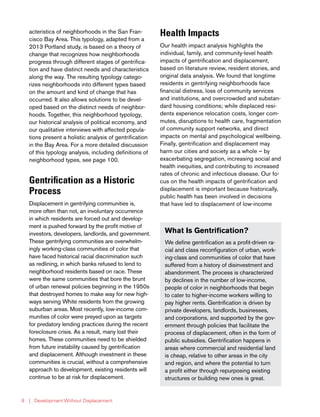
Gentrification by the Numbers
All analyses were conducted by Alameda County Public Health Department, using data from Census 1990, Census 2000,
and American Community Survey 2007-2011.
33 Gentrification is happening in histor-
ically disinvested areas where property
values have accelerated, homeownership
and incomes have risen, and neighbor-
hoods have become wealthier and whiter
over the last two decades. Neighborhoods
in late stages of gentrification include
the Mission in San Francisco and North
Oakland in Oakland. Neighborhoods in
middle stages of gentrification include the
Bayview-Hunters Point in San Francisco,
and West Oakland, Downtown, and San
Antonio in Oakland.
33 Rental housing costs have skyrocketed
in gentrifying neighborhoods, and in
some cases, they have surpassed rent-
al housing costs in historically affluent
neighborhoods. In San Francisco, the
median monthly rent in neighborhoods in the
latest stages of gentrification increased by
$460 dollars, or 40 percent, between 1990
and 2011. In Oakland, neighborhoods in the
latest stages of gentrification had higher me-
dian rents in 2011 than historically affluent
neighborhoods such as Rockridge and the
Oakland Hills. Between 1990 and 2011,
the median monthly rent in these neighbor-
hoods increased by $280, or 30 percent.
This means that urban areas that were
formerly affordable to working families are
now out of reach except to the wealthiest
segments of our society.
33 There has been substantial and dis-
proportionate displacement of African
Americans in gentrifying neighbor-
hoods, as well as a loss in African
American homeownership. Between
1990 and 2011, the proportion of African
Americans in all Oakland neighborhoods
decreased by nearly 40 percent. In North
Oakland, the number of African American
households decreased by more than 2,000.
Furthermore, African Americans dropped
from being 50 percent to 25 percent of all
homeowners in North Oakland, and with-
in the Black community, homeownership
decreased while renters grew. We see
a similar loss of black homeownership in
West Oakland and Bayview-Hunters Point
in San Francisco.
33 Latinos are being displaced at a sig-
nificant rate from the Mission district
while white residents and homeown-
ers have increased. Between 1990 and
2011, the number of Latino households
in the Mission decreased by 1,400, while
the number of White households in-
creased by 2,900. White homeownership
more than doubled during this time.
33 Gentrification is changing the popu-
lation of Oakland and San Francisco
as a whole. Between 1990 and 2011,
Oakland’s African American population
decreased from 43 percent to 26 percent of
the population, the largest drop by far of any
population group. During the same period of
time, San Francisco’s Black population was
cut in half from about 10 percent to only 5
percent of the population. While gentrifi-
cation may bring much-needed investment
to urban neighborhoods, displacement
prevents these changes from benefitting
residents who may need them the most.
33 Gentrification affects housing quality
and health and exacerbates inequal-
ities. In Oakland, neighborhoods in the
latest stages of gentrification have the
greatest disparity between Black and
White mortality rates. We also found that
rates of overcrowding increased in San
Francisco neighborhoods between early
and late stages of gentrification.
| Development Without Displacement8
Gentrification as a Historic
Process
Displacement in gentrifying communities is,
more often than not, an involuntary occurrence
in which residents are forced out and develop-
ment is pushed forward by the profit motive of
investors, developers, landlords, and government.
These gentrifying communities are overwhelm-
ingly working-class communities of color that
have faced historical racial discrimination such
as redlining, in which banks refused to lend to
neighborhood residents based on race. These
were the same communities that bore the brunt
of urban renewal policies beginning in the 1950s
that destroyed homes to make way for new high-
ways serving White residents from the growing
suburban areas. Most recently, low-income com-
munities of color were preyed upon as targets
for predatory lending practices during the recent
foreclosure crisis. As a result, many lost their
homes. These communities need to be shielded
from future instability caused by gentrification
and displacement. Although investment in these
communities is crucial, without a comprehensive
approach to development, existing residents will
continue to be at risk for displacement.
Health Impacts
Our health impact analysis highlights the
individual, family, and community-level health
impacts of gentrification and displacement,
based on literature review, resident stories, and
original data analysis. We found that longtime
residents in gentrifying neighborhoods face
financial distress, loss of community services
and institutions, and overcrowded and substan-
dard housing conditions; while displaced resi-
dents experience relocation costs, longer com-
mutes, disruptions to health care, fragmentation
of community support networks, and direct
impacts on mental and psychological wellbeing.
Finally, gentrification and displacement may
harm our cities and society as a whole – by
exacerbating segregation, increasing social and
health inequities, and contributing to increased
rates of chronic and infectious disease. Our fo-
cus on the health impacts of gentrification and
displacement is important because historically,
public health has been involved in decisions
that have led to displacement of low-income
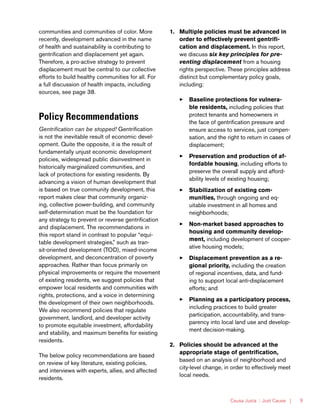
What Is Gentrification?
We define gentrification as a profit-driven ra-
cial and class reconfiguration of urban, work-
ing-class and communities of color that have
suffered from a history of disinvestment and
abandonment. The process is characterized
by declines in the number of low-income,
people of color in neighborhoods that begin
to cater to higher-income workers willing to
pay higher rents. Gentrification is driven by
private developers, landlords, businesses,
and corporations, and supported by the gov-
ernment through policies that facilitate the
process of displacement, often in the form of
public subsidies. Gentrification happens in
areas where commercial and residential land
is cheap, relative to other areas in the city
and region, and where the potential to turn
a profit either through repurposing existing
structures or building new ones is great.
acteristics of neighborhoods in the San Fran-
cisco Bay Area. This typology, adapted from a
2013 Portland study, is based on a theory of
change that recognizes how neighborhoods
progress through different stages of gentrifica-
tion and have distinct needs and characteristics
along the way. The resulting typology catego-
rizes neighborhoods into different types based
on the amount and kind of change that has
occurred. It also allows solutions to be devel-
oped based on the distinct needs of neighbor-
hoods. Together, this neighborhood typology,
our historical analysis of political economy, and
our qualitative interviews with affected popula-
tions present a holistic analysis of gentrification
in the Bay Area. For a more detailed discussion
of this typology analysis, including definitions of
neighborhood types, see page 100.
Causa Justa :: Just Cause | 9
communities and communities of color. More
recently, development advanced in the name
of health and sustainability is contributing to
gentrification and displacement yet again.
Therefore, a pro-active strategy to prevent
displacement must be central to our collective
efforts to build healthy communities for all. For
a full discussion of health impacts, including
sources, see page 38.
Policy Recommendations
Gentrification can be stopped! Gentrification
is not the inevitable result of economic devel-
opment. Quite the opposite, it is the result of
fundamentally unjust economic development
policies, widespread public disinvestment in
historically marginalized communities, and
lack of protections for existing residents. By
advancing a vision of human development that
is based on true community development, this
report makes clear that community organiz-
ing, collective power-building, and community
self-determination must be the foundation for
any strategy to prevent or reverse gentrification
and displacement. The recommendations in
this report stand in contrast to popular “equi-
table development strategies,” such as tran-
sit-oriented development (TOD), mixed-income
development, and deconcentration of poverty
approaches. Rather than focus primarily on
physical improvements or require the movement
of existing residents, we suggest policies that
empower local residents and communities with
rights, protections, and a voice in determining
the development of their own neighborhoods.
We also recommend policies that regulate
government, landlord, and developer activity
to promote equitable investment, affordability
and stability, and maximum benefits for existing
residents.
The below policy recommendations are based
on review of key literature, existing policies,
and interviews with experts, allies, and affected
residents.
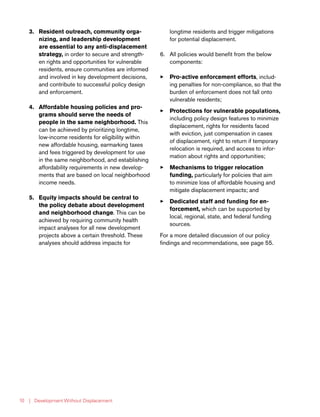
1.	 Multiple policies must be advanced in
order to effectively prevent gentrifi-
cation and displacement. In this report,
we discuss six key principles for pre-
venting displacement from a housing
rights perspective. These principles address
distinct but complementary policy goals,
including:
33 Baseline protections for vulnera-
ble residents, including policies that
protect tenants and homeowners in
the face of gentrification pressure and
ensure access to services, just compen-
sation, and the right to return in cases of
displacement;
33 Preservation and production of af-
fordable housing, including efforts to
preserve the overall supply and afford-
ability levels of existing housing;
33 Stabilization of existing com-
munities, through ongoing and eq-
uitable investment in all homes and
neighborhoods;
33 Non-market based approaches to
housing and community develop-
ment, including development of cooper-
ative housing models;
33 Displacement prevention as a re-
gional priority, including the creation
of regional incentives, data, and fund-
ing to support local anti-displacement
efforts; and
33 Planning as a participatory process,
including practices to build greater
participation, accountability, and trans-
parency into local land use and develop-
ment decision-making.
2.	 Policies should be advanced at the
appropriate stage of gentrification,
based on an analysis of neighborhood and
city-level change, in order to effectively meet
local needs.
| Development Without Displacement10
3.	 Resident outreach, community orga-
nizing, and leadership development
are essential to any anti-displacement
strategy, in order to secure and strength-
en rights and opportunities for vulnerable
residents, ensure communities are informed
and involved in key development decisions,
and contribute to successful policy design
and enforcement.
4.	 Affordable housing policies and pro-
grams should serve the needs of
people in the same neighborhood. This
can be achieved by prioritizing longtime,
low-income residents for eligibility within
new affordable housing, earmarking taxes
and fees triggered by development for use
in the same neighborhood, and establishing
affordability requirements in new develop-
ments that are based on local neighborhood
income needs.
5.	 Equity impacts should be central to
the policy debate about development
and neighborhood change. This can be
achieved by requiring community health
impact analyses for all new development
projects above a certain threshold. These
analyses should address impacts for
longtime residents and trigger mitigations
for potential displacement.
6.	 All policies would benefit from the below
components:
33 Pro-active enforcement efforts, includ-
ing penalties for non-compliance, so that the
burden of enforcement does not fall onto
vulnerable residents;
33 Protections for vulnerable populations,
including policy design features to minimize
displacement, rights for residents faced
with eviction, just compensation in cases
of displacement, right to return if temporary
relocation is required, and access to infor-
mation about rights and opportunities;
33 Mechanisms to trigger relocation
funding, particularly for policies that aim
to minimize loss of affordable housing and
mitigate displacement impacts; and
33 Dedicated staff and funding for en-
forcement, which can be supported by
local, regional, state, and federal funding
sources.
For a more detailed discussion of our policy
findings and recommendations, see page 55.
Causa Justa :: Just Cause | 11
Introduction
“The Mission right now is in chaos with
evictions. There is also nowhere to
go. The units available are for people
who earn $6,000-7,000 more than I
do per month — not for middle-class
or working-class families, which had
always been the status of the Mission
— families with kids.”
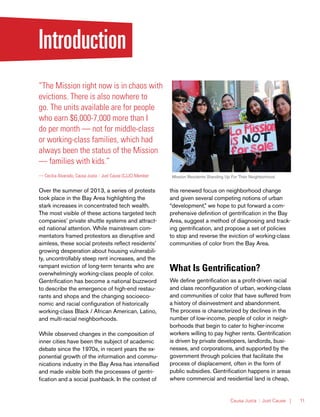
— Cecilia Alvarado, Causa Justa :: Just Cause (CJJC) Member
Over the summer of 2013, a series of protests
took place in the Bay Area highlighting the
stark increases in concentrated tech wealth.
The most visible of these actions targeted tech
companies’ private shuttle systems and attract-
ed national attention. While mainstream com-
mentators framed protestors as disruptive and
aimless, these social protests reflect residents’
growing desperation about housing vulnerabili-
ty, uncontrollably steep rent increases, and the
rampant eviction of long-term tenants who are
overwhelmingly working-class people of color.
Gentrification has become a national buzzword
to describe the emergence of high-end restau-
rants and shops and the changing socioeco-
nomic and racial configuration of historically
working-class Black / African American, Latino,
and multi-racial neighborhoods.
While observed changes in the composition of
inner cities have been the subject of academic
debate since the 1970s, in recent years the ex-
ponential growth of the information and commu-
nications industry in the Bay Area has intensified
and made visible both the processes of gentri-
fication and a social pushback. In the context of
this renewed focus on neighborhood change
and given several competing notions of urban
“development,” we hope to put forward a com-
prehensive definition of gentrification in the Bay
Area, suggest a method of diagnosing and track-
ing gentrification, and propose a set of policies
to stop and reverse the eviction of working-class
communities of color from the Bay Area.
What Is Gentrification?
We define gentrification as a profit-driven racial
and class reconfiguration of urban, working-class
and communities of color that have suffered from
a history of disinvestment and abandonment.
The process is characterized by declines in the
number of low-income, people of color in neigh-
borhoods that begin to cater to higher-income
workers willing to pay higher rents. Gentrification
is driven by private developers, landlords, busi-
nesses, and corporations, and supported by the
government through policies that facilitate the
process of displacement, often in the form of
public subsidies. Gentrification happens in areas
where commercial and residential land is cheap,
Mission Residents Standing Up For Their Neighborhood
| Development Without Displacement12
Some key elements of gentrification include:
33 A history of disinvestment of money, jobs,
and other resources from the neighbor-
hoods and the city
33 Speculators or developers buying proper-
ty inexpensively and “flipping”1
it to make
huge profits
33 Rezoning, subsidies, and other policies to
make development of expensive housing eas-
ier and to court new, wealthier — and often —
White people moving into the neighborhoods
relative to other areas in the city and region,
and where the potential to turn a profit either
through repurposing existing structures or
building new ones is great. As we will elabo-
rate after our Methodology, the recent wave of
gentrification is deeply tied to the emergence
of a significant rent gap. For the typology
analysis, the data used to define gentrification
are changes in renters, people of color, low-in-
come households, residents with less than a
bachelor’s degree, and property values.
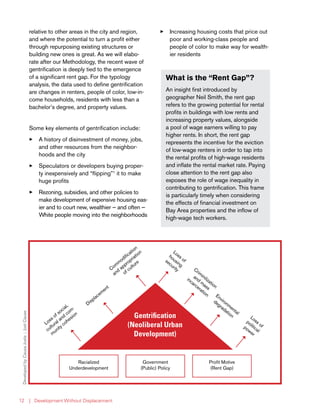
What is the “Rent Gap”?
An insight first introduced by
geographer Neil Smith, the rent gap
refers to the growing potential for rental
profits in buildings with low rents and
increasing property values, alongside
a pool of wage earners willing to pay
higher rents. In short, the rent gap
represents the incentive for the eviction
of low-wage renters in order to tap into
the rental profits of high-wage residents
and inflate the rental market rate. Paying
close attention to the rent gap also
exposes the role of wage inequality in
contributing to gentrification. This frame
is particularly timely when considering
the effects of financial investment on
Bay Area properties and the inflow of
high-wage tech workers.
DevelopedbyCausaJusta::JustCause
Gentrification
(Neoliberal Urban
Development)
Racialized
Underdevelopment
Profit Motive
(Rent Gap)
Government
(Public) Policy
Loss of social,
cultural and
com-
munity cohesion
Displacement
Commodification
and
appropriation
of culture
Loss of
housing
security Criminilization
and
mass
incarceration Environmental
degradation Loss of
political
power
33 Increasing housing costs that price out
poor and working-class people and
people of color to make way for wealth-
ier residents
Causa Justa :: Just Cause | 13
Displacing a group of people in favor of new-
comers dilutes the political power of work-
ing-class communities and communities of
color by breaking up families, communities, and
voting blocs. It’s happening in cities all over the
country and the world.
Measuring Gentrification
While there is danger in abstracting the dynam-
ics of gentrification from their specific geo-
graphic and historical context, there is valuable
policy and political work to be achieved with
an abstract measurement of gentrification. This
is the work that our Typology of Gentrification
attempts to enable. The specific method of our
adapted typology will be specified below in our
Methodology section and in detail in Appendix
A. Using a typology that measures intensity,
rather than a chronological linear path, we hope
to suggest policy and organizing strategies that
address the different intensities of gentrification
in specific neighborhoods around the Bay Area.
Regional Historical
Perspective
Following an explanation of our research meth-
odology, we will frame the process of gentrifica-
tion as deeply related to the newest reconfigu-
ration of the Bay Area in the global and national
political economy, particularly the rise of finance
and tech industries in producing profits for the
national economy. To do this, we will summarize
the past function of the East Bay in the global
political economy, as well as stress the role of
migration (domestic and international) and racial
segregation in past regional economic configu-
rations. Key to contextualizing the histories and
changes of urban development strategies will
be an exploration of public health perspectives
on urban development, which we explore in
depth in a section on the public health history
and impacts of urban renewal and gentrification.
Redefining Human
Development: Organizing
Communities
Finally, while our analysis will be fundamentally
historical and typological, our historical framing
makes explicit that any effective effort for inclu-
sive development must be a community-wide
struggle for power and communal self-determina-
tion. Deeply related to our analysis of the public
health effects of gentrification will be a redefini-
tion of community and human development under
the framing of “The Right to the City,” which
advocates for collective organizing to reshape
the process of urbanization and development.
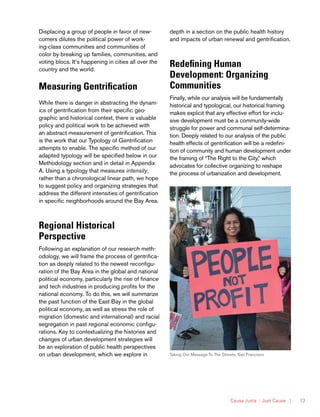
Taking Our Message To The Streets, San Francisco
| Development Without Displacement14
Research Scope & Methodology
At the earlier stages of the project we reached out to experts in the field of gentrification, displace-
ment, and community development to elicit feedback on our gentrification and human development
framework, and later conducted feedback sessions on the framework, policy, and health analyses
with ally organizations and colleagues. We also conducted one-on-one interviews with individuals
involved in anti-displacement work and with CJJC members and other residents affected by gentri-
fication in order to provide tangible and relevant examples of how gentrification and displacement
impact everyday life.
Gentrification Typologies
Analysis
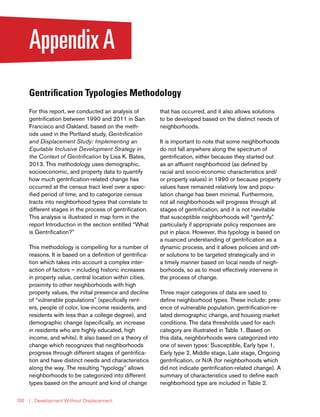
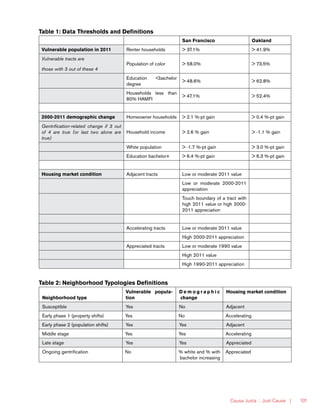
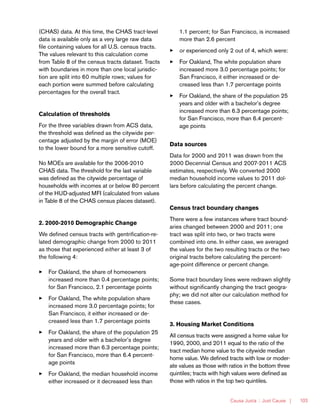
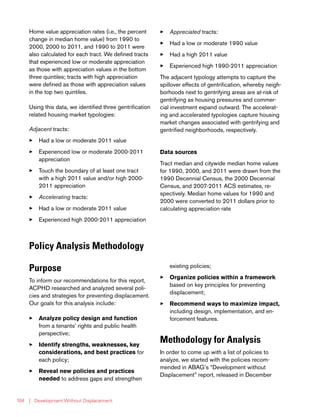
For this report, we conducted an analysis of
gentrification between 1990 and 2011 in San
Francisco and Oakland, based on the methods
used in the 2013 Portland study, Gentrification
and Displacement Study: Implementing an
Equitable Inclusive Development Strategy in
the Context of Gentrification by Lisa K. Bates.
This methodology uses demographic, socioeco-
nomic, and property data to quantify how much
gentrification-related change has occurred at
the census tract level over a specified period of
time, and to categorize census tracts into neigh-
borhood types that correlate to different stages
in the process of gentrification (See Appendix
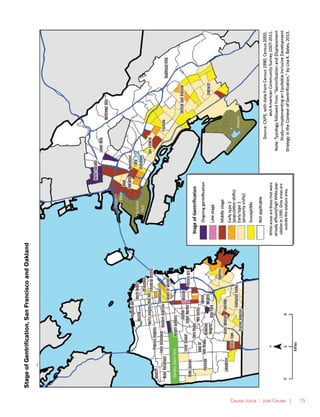
A). This analysis is illustrated in the map on the
next page and much of our data analysis refer-
ences the categories described in this typology.
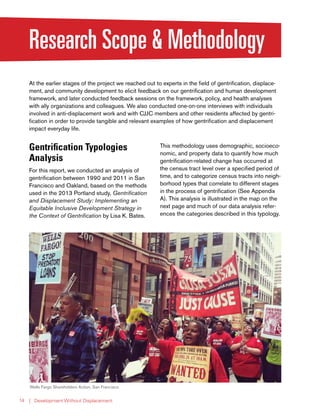
Wells Fargo Shareholders Action, San Francisco
Causa Justa :: Just Cause | 15
StageofGentrification,SanFranciscoandOakland
| Development Without Displacement16
Global CitiesA Brief Political Economy Of The Bay Area
Without timely action on the part of
the government, the rent gap causing
the displacement of service sector
and low income Bay Area residents
will only worsen. As mainstream
economists are beginning to recognize,
the profits of the technology sector,
responsible for flooding Bay Area
markets with high wage workers, will
not automatically distribute wealth
across the region and will likely cause
long term unemployment and inequity.
We have all heard the adage that it is important
to know history “so as to not repeat it.” Yet, this
implies the stories of the past have concluded.
Quite the opposite, history allows us to under-
stand present dynamics as reconfigurations,
continuations, or departures from historical
trends. Before our analysis of gentrification in
the “New Economy,” we will present a historical
sketch that shows how the economic devel-
opment of the Bay Area has been shaped by
global and national changes, and fundamentally
influenced by dynamics of migration and at-
tempts to manage its multi-racial populations.
By illuminating changes in the productive
capacities of the area, shifts in the urban labor
force caused by domestic and international mi-
gration, and the politics of suburban and urban
migration, we can locate contemporary gentrifi-
cation in a longer history. We will suggest that
these historical changes were profoundly unjust
because of deep inequalities, as well as racial
divides and failures of democracy in the process
of urban development. Perhaps alternatively to
the opening adage is writer William Faulkner’s
assertion that “the past is never dead, it’s not
even past.”
Regional Histories of
Development
Displacement and evictions are not new to the
Bay Area. The area’s founding was the result
of colonial expansion by Spain, requiring the
forced removal and effectively genocide of ap-
proximately 50,000 of the region’s Indigenous
inhabitants, the Ohlone people. With the United
States’ continental conquest, nearly half of
Mexico was annexed, along with California, in
1846.2
San Francisco and Oakland began to
grow with the Gold Rush of 1848–1855, and
while they did not directly experience the mass
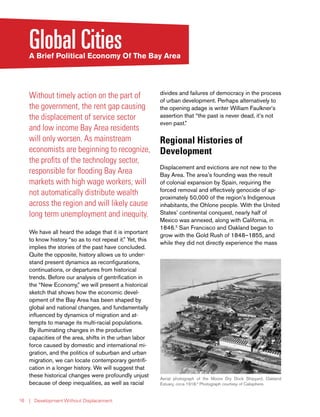
Aerial photograph of the Moore Dry Dock Shipyard, Oakland
Estuary, circa 1918.4
Photograph courtesy of Calisphere.
Causa Justa :: Just Cause | 17
displacement of native peoples and environ-
mental degradation of the Gold Country in the
Sierra Nevada region, they profited handsomely
from the growth of the mining era.
In this era, San Francisco emerged as a finan-
cial hub, where international investment com-
panies located their offices to profit from gold
mining and trading. Quicksilver was California’s
next largest export after gold and the San
Francisco Mining Exchange was established
in 1862 to support trading and speculation
of both these valuable metals. The location of
numerous banks, insurance, and brokerage
firms in San Francisco all served to consolidate
her role as a financial “command center” where
international banking and trade was coordinated
and huge profits generated.3
Across the bay, Oakland was developed as a
transportation hub with initial activity centered
around her waterfront and the Central Pacific
Railroad terminal that served as the company’s
West Coast stop on its transcontinental line. By
late 1869 the joining of the Central Pacific and
Union Pacific lines linked California with the rest
of the country by rail, with Oakland serving as a
receiving point for westward travelers.
Moore Dry Dock Shipyard was the largest ship-
yard on the Oakland Estuary. It specialized in
shipbuilding and repair and reached its heyday
when production was high during the First
World War.5
Both cities had a robust manufacturing base
in the late 1800s, producing everything from
mechanical equipment, to ships and boats, to
household goods and clothing. By the early
20th century, however, Oakland emerged as
the region’s manufacturing center — and home
to what was believed to be the world’s largest
food processing plant, J. Lusk and Company.6
And just as investment and financial firms locat-
ed their branch offices in San Francisco, nation-
al manufacturing companies located their Bay
Area factories in Oakland, adding automobile
and truck building to the base of activity in the
1900s.
The economic base of a city has a great im-
pact on how the urban environment develops.
San Francisco’s character as a financial center
led to the construction of numerous high-rise
buildings and plentiful office space. Oakland’s
development as a manufacturing center gave
rise to factories of all sizes, particularly along
railway lines, with some developing right next
to homes and schools as the city grew. In San
Francisco the concentration of factories and
warehouses was primarily along the waterfront,
including food processing and apparel man-
ufacturing.7
Economic activity was critical in
determining the spatial organization of the city,
as well as determining the type of workers these
cities would house.
Immigration and Migration
to the Bay Area
With the start of the Gold Rush, people from
all over the world rushed to San Francisco.
By 1880 it boasted the highest percentage of
immigrants in the country. By the 1900s San
Francisco and Oakland had grown significantly,
both economically and in terms of population
size. San Francisco’s population of more than
350,000 made it the seventh largest city in the
country, while Oakland’s population of 150,000
made it the second largest city in the Bay Area
and one of the fastest growing in the country.8
Both cities’ growth and vitality were fueled in
large part by two key groups — immigrant and
Black / African American workers. Working-
class neighborhoods developed in both San
Francisco and Oakland to house the workers
who powered the region’s economic engines.
Until the Immigration Act of 1924, which re-
stricted the entry of Southern and Eastern
Europeans, early European immigration faced
little restriction and regulation by the federal
government. Chinese immigration, however,
| Development Without Displacement18
faced significant restrictions as a result of a
series of discriminatory policies, including the
Page Act of 1875 and the Chinese Exclusion
Act of 1882. These policies prohibited the
immigration of male Chinese laborers and Asian
women to the United States, effectively ending
Chinese migration to the region for a gener-
ation, and relegating Asian workers to highly
exploitable second-class status. Despite racial
exclusion laws, San Francisco had the larg-
est concentration of Chinese residents in the
country in 1890.9
Oakland and San Francisco
both relied on heavily immigrant workforces
at this time, including large numbers of Asian
(Chinese, Filipino, Korean, and Japanese)
and European workers (German, Irish, Scots,
English, Portuguese, and Italian).
For Blacks / African Americans neither the
outcome of the Civil War, nor the abolition of
slavery through the passage of the Thirteenth
Amendment in 1864, actually ended racial seg-
regation and discrimination in the South. The
system of White Supremacy was rebuilt after
the collapse of Reconstruction in the form of the
“Black Codes,” which restricted Black peoples’
freedom in numerous ways — limiting the right
to free movement and assembly, literacy, and
the ownership of land, property, and business-
es. Sharecropping and Jim Crow laws made
life in the South very hard, so when jobs began
opening up in the North and West during World
War I, Black / African American workers began
to leave the southern states in droves. During
the “Black Exodus” between 1910 and 1950,
nearly 1.5 million Blacks / African Americans
headed to northern and western cities. Whereas
scarcely 5,000 Blacks / African Americans lived
in San Francisco, Oakland, and Los Angeles
in 1900, by 1930 the number had grown to
nearly 50,000 and by 1950 it spiked to more
than 250,000.10
In Oakland alone, between
1940 and 1950, the Black / African American
population grew from 8,000 to 42,355.11
In a
staggering illustration of racialized urbanization,
researchers conclude that “in 1910 nearly 90
percent of Blacks / African Americans lived in
rural areas of the southeastern United States
(i.e., the South). One generation after the end of
World War II, nearly 90 percent of them resided
in urban areas throughout the United States,
most often outside the South.”12
The greatest number of Black / African
American migrants settled in the East Bay, first
in West Oakland, then Northa Oakland, South
Berkeley and the city of Richmond, during
World War II. Because of its racist history,
most Blacks / African Americans avoided San
Francisco until the Second World War, when
they took up residence in the Fillmore (where
Japanese people had been displaced by
Internment) and in Hunters Point. Coming from
the South with its low wages, oppressive laws,
and collapsing cotton economy, Black migrants
in the Bay Area were especially vulnerable to
racialized labor exploitation.13
The same could be said of Mexican migrants,
who began to reenter California in the early
20th century. They were fleeing rural poverty,
the land takeovers of the Pofiriato Era, and the
Revolutionary upheavals of 1910–17. Because
the 1924 Immigration Act did not restrict Latino
immigration and as labor demand increased in
agriculture, construction, and industry in the
early 20th century, hundreds of thousands of
Mexicans began immigrating to the southwest-
ern United States. Their population swelled
from 100,000 in 1890 to 1.5 million in 1930,
with a significant portion of them coming to
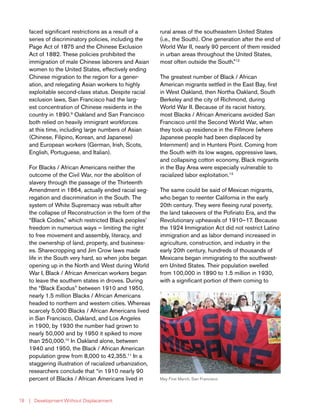
May First March, San Francisco
Causa Justa :: Just Cause | 19
California. Most Mexicans headed for booming
Southern California, but a good number found
their way north to the Bay Area, settling in en-
claves such as Fruitvale in Oakland, the Mission
District in San Francisco, and East San Jose.14
Since then, immigrant labor has been central
to U.S. agriculture and to the political economy
of California. First with the Bracero Program
(1942–1964), and later with porously designed
immigration laws, the agricultural industry
continued to depend on a vulnerable immigrant
population for cheap labor — creating what
has been referred to as the “revolving door” of
Mexican migration.15
Immigrant and Black / African American workers
came to the Bay Area to do the work of build-
ing and growing these global cities. By doing
so they were simultaneously providing for their
families and responding to the needs of bank-
ers, shipyard, factory and business owners to
provide critical labor to these various economic
enterprises at the heart of the wealth and devel-
opment of the region. Black / African American
and immigrant laborers concentrated geographi-
cally around the cities’ industrial zones, in neigh-
borhoods that would become progressively seg-
regated by zoning and redlining, environmental
neglect associated with industry, and public
disinvestment.16
Decades of Race and Class
Inequities
While the contributions of these workers were
indispensable to the development of our cities,
their physical presence has always been con-
tested. In both San Francisco and Oakland,
state and local policies were used to restrict
Black / African American and immigrant families
to specific neighborhoods. Housing covenants
and redlining were some of the policies that
created invisible, though very real, boundaries
to contain residents of color.17
In San Francisco,
Market Street became the dividing line between
working-class, heavily immigrant districts on the
south side, and middle- and upper-class neigh-
borhoods of U.S.-born Whites on the north side.
In Oakland, the same physical separation is
dramatically displayed, with the wealthy enclave
of Piedmont existing right in the middle of the
city, separate and unequal. This racial segrega-
tion was reinforced by aggressive police action,
a form of social control that remains a painful
reality for both immigrants and Blacks / African
Americans even today.18
The race and class dynamics of San Francisco
and Oakland have also played out in the fight
for resources. In both cities there has been a
long struggle over the development of “down-
town,” where financial and corporate activities
are centered, and the need for equal invest-
ment in neighborhoods where working families
live. Both cities have always had powerful
downtown interests, shaping the vision and
development of the cities.19
At the heart of this
fight was the question of whether Oakland and
San Francisco should develop in ways primarily
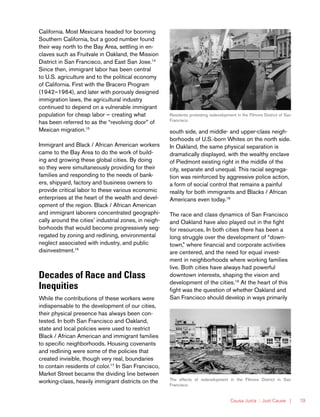
The effects of redevelopment in the Filmore District in San
Francisco.
Residents protesting redevelopment in the Filmore District of San
Francisco.
| Development Without Displacement20
serving the needs of wealthier White people or
should be places where working-class families
not only come to work, but to live and thrive.
These were the race and class fault lines that
shaped and informed the urban landscape of
San Francisco and Oakland as the cities entered
into the 1970s.
Gentrification: The Rent Gap
in the New Economy
Positioning gentrification in a contemporary
political economy means focusing on two
widely consequential transformations in the U.S.
economy following the 1970s. In fact, if one
had to point to the most significant dynamics in
the post-1970s U.S. economy, the first would
be the exponential growth in income inequal-
ity20
and a closely related second would be
the transition away from industrial profitability
toward profits extracted from financial services
and related speculative practices.21
On a na-
tional level, the U.S. economy moved from one
based largely on manufacturing to one heavily
dependent on imports, retail, and logistics. This
shift necessitated a greatly expanded financial
sector, including banking, investment, stock
trading, and exotic new financial instruments.
California’s economy shifted in line with these
national trends.
While we focus more on the domestic impacts
of these changes, the deindustrialization of the
U.S. economy had global causes and effects. In
a reaction to global competition and economic
stagnation, American manufacturers acted to
close unprofitable factories, layoff millions of
workers, and decertify unions. To further low-
er labor costs and circumvent the power and
achievements of organized labor, corporations
moved industrial production from North America
and Europe to the Global South (Latin America,
Africa, Asia).22
In each case, the outcome was
the loss of a critical base of well-paid union jobs
that previously provided working-class families,
many of them Black / African American and
Latino, real economic stability.
While U.S. manufacturing was leaving the coun-
try, displaced workers from Latin America were
immigrating in large numbers to the United
States. The first wave included Central Americans
fleeing political violence in the 1970s and early
90s (in which the CIA was deeply implicated).
The second wave included Mexicans displaced
by the “structural adjustment” austerity policies
demanded by the International Monetary Fund af-
ter the financial crises of 1982 and 1994 — these
displaced workers included southern Mexican
farmers displaced by cheap grain imports under
NAFTA and Maquiladora workers along the bor-
der undercut by cheaper Chinese exports.24
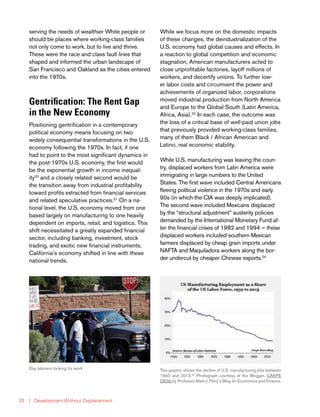
Day laborers looking for work This graphic shows the decline of U.S. manufacturing jobs between
1940 and 2013.23
Photograph courtesy of the Blogger, CARPE
DIEM, by Professor Mark J. Perry’s Blog for Economics and Finance.
Causa Justa :: Just Cause | 21
These economic transformations did create a
small number of high-paying jobs in financial
and information services, but in general de-in-
dustrialization gave rise to a vast low-wage
service economy, characterized by declining real
wages over time. Factory jobs were replaced
by food service, retail, transport, warehouse,
and domestic work. This shift in the economic
base created a new class of white-collar work-
ers — most often White and well paid — needed
to manage and coordinate global financial and
corporate activities. The notable exception in
the U.S. industrial economy was in electronics
and informational technology, centered in the
Bay Area. But even there, growth was chiefly
in management and design, while production
moved offshore. The changes to the labor force
of once-industrial cities paralleled changes in
the populations of urban neighborhoods.
Implied in the changes to the urban labor force
was the changed relationship between urban
centers and profitable industries. Cities were
no longer the essential centers of industrial
manufacturing that had driven White manage-
rial workers to the suburbs in the Postwar Era.
De-industrialization provided the economic
impetus for a “return to the city” by non-industri-
al workers. The transformation that began with
de-industrialization has reached new levels of
both profits and inequality with the rise of the
information and communications technology
sector. Wages for this labor are often high when
compared to average real wages, which have
stagnated since the 1970s, but the numbers
of new technology workers are relatively small
compared to previous losses in manufacturing
nationally.25
In a full-circle reversal, the White populations
that fled urban centers in the Postwar Era have
returned to city centers that now drive Internet
and communications technology development
rather than manufacturing. Conversely, commu-
nities of color are being evicted to the suburbs,
many as far as the Central Valley.26
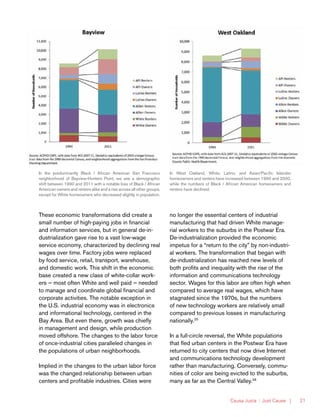
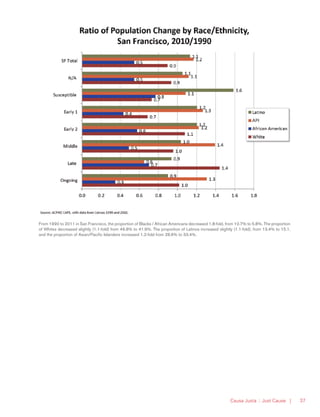
In the predominantly Black / African American San Francisco
neighborhood of Bayview-Hunters Point, we see a demographic
shift between 1990 and 2011 with a notable loss of Black / African
American owners and renters alike and a rise across all other groups,
except for White homeowners who decreased slightly in population.
In West Oakland, White, Latino, and Asian/Pacific Islander
homeowners and renters have increased between 1990 and 2000,
while the numbers of Black / African American homeowners and
renters have declined.
| Development Without Displacement22
Starting in the 1990’s San Francisco positioned
itself as the metropolitan center of the internet
economy, where financial investment would
be matched with technology startups. The city
developed itself as a second hub for technology
investment with the goal of rivaling Silicon Valley
as the driver of the new economy. While this
growth started gradually with San Francisco
initially financing at only a fraction of Silicon
Valley’s output27
the investment of hundreds of
millions of dollars resulted nonetheless in the
first wave of gentrification in San Francisco and
Oakland neighborhoods.
The first “dot com” boom which lasted be-
tween 2000 - 200328
resulted in a 17.3 percent
increase in the overall income of San Francisco,
causing neighborhoods like the Mission to be
overrun by new millionaires looking for housing
and office space.29
This boom generated huge
wealth and in 2000 alone, San Francisco col-
lected $544 million in property taxes, with the
city’s total revenue increasing 62 percent from
10 years before.30
Accompanying this rise of all
things tech, were increases in private and public
capital investment in the form of urban devel-
opment and condo construction. New devel-
opments popped up in neighborhoods all over
the city but were not sufficient to meet the huge
demand. Landlords got into the game as well,
looking to capitalize on huge profits. In 2000
they were responsible for evictions reaching a
historic high in the city with over 2,000 cases
reported.31
As housing pressure and costs mounted in San
Francisco, her sister city began to feel the ripple
effects of gentrification and displacement as
well. Oakland began to experience the displace-
ment of Black / African American residents in a
very similar way that happened in San Francisco
during this period.
Much of what develops in San Francisco ends
up crossing the Bay. Oakland experiences her
own proliferation of luxury condo developments
with the most notable being Jerry Brown’s 10K
initiative for Downtown Oakland. Despite its
many promised virtues, the project provided
less than 400 affordable units out of almost
6,000 total new units.32
With the arrival of resi-
dents willing and able to pay a lot more for rent,
landlords saw huge incentives in evicting exist-
ing tenants as a way to vacate previously occu-
pied units, and bring in higher income residents.
Between 1998 and 2002, the number of “no
fault” evictions tripled in Oakland at the same
time that rents increased 100 percent.33
This
first wave of gentrification and displacement
fueled by venture capital and the technology
sector fully exploited the rent gap that existed in
neighborhoods like the Bayview, West Oakland
and the Mission.
Decades of disinvestment had created cheap
pockets of real estate in cities that were
becoming sought after destinations for a new,
wealthy class of people. These neighborhoods
were attractive to investors equally for their ur-
ban nature, “cultural diversity” (coded language
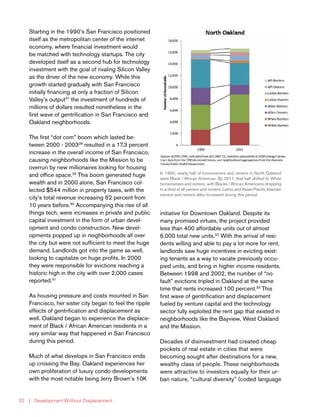
In 1990, nearly half of homeowners and renters in North Oakland
were Black / African American. By 2011, that half shifted to White
homeowners and renters, with Blacks / African Americans dropping
to a third of all owners and renters. Latino and Asian/Pacific Islander
owners and renters alike increased during this period.
Causa Justa :: Just Cause | 23
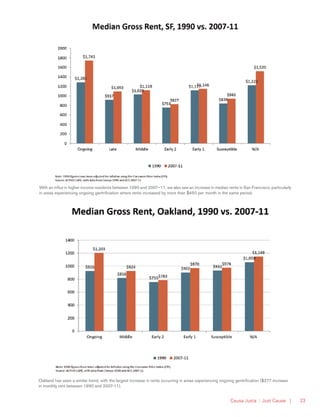
With an influx in higher income residents between 1990 and 2007–11, we also see an increase in median rents in San Francisco, particularly
in areas experiencing ongoing gentrification where rents increased by more than $450 per month in the same period.
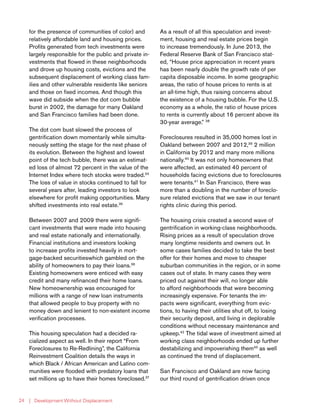
Oakland has seen a similar trend, with the largest increase in rents occurring in areas experiencing ongoing gentrification ($277 increase
in monthly rent between 1990 and 2007-11).
| Development Without Displacement24
for the presence of communities of color) and
relatively affordable land and housing prices.
Profits generated from tech investments were
largely responsible for the public and private in-
vestments that flowed in these neighborhoods
and drove up housing costs, evictions and the
subsequent displacement of working class fam-
ilies and other vulnerable residents like seniors
and those on fixed incomes. And though this
wave did subside when the dot com bubble
burst in 2002, the damage for many Oakland
and San Francisco families had been done.
The dot com bust slowed the process of
gentrification down momentarily while simulta-
neously setting the stage for the next phase of
its evolution. Between the highest and lowest
point of the tech bubble, there was an estimat-
ed loss of almost 72 percent in the value of the
Internet Index where tech stocks were traded.34
The loss of value in stocks continued to fall for
several years after, leading investors to look
elsewhere for profit making opportunities. Many
shifted investments into real estate.35
Between 2007 and 2009 there were signifi-
cant investments that were made into housing
and real estate nationally and internationally.
Financial institutions and investors looking
to increase profits invested heavily in mort-
gage-backed securitieswhich gambled on the
ability of homeowners to pay their loans.36
Existing homeowners were enticed with easy
credit and many refinanced their home loans.
New homeownership was encouraged for
millions with a range of new loan instruments
that allowed people to buy property with no
money down and lenient to non-existent income
verification processes.
This housing speculation had a decided ra-
cialized aspect as well. In their report “From
Foreclosures to Re-Redlining”, the California
Reinvestment Coalition details the ways in
which Black / African American and Latino com-
munities were flooded with predatory loans that
set millions up to have their homes foreclosed.37
As a result of all this speculation and invest-
ment, housing and real estate prices begin
to increase tremendously. In June 2013, the
Federal Reserve Bank of San Francisco stat-
ed, “House price appreciation in recent years
has been nearly double the growth rate of per
capita disposable income. In some geographic
areas, the ratio of house prices to rents is at
an all-time high, thus raising concerns about
the existence of a housing bubble. For the U.S.
economy as a whole, the ratio of house prices
to rents is currently about 16 percent above its
30-year average.” 38
Foreclosures resulted in 35,000 homes lost in
Oakland between 2007 and 2012,39
2 million
in California by 2012 and many more millions
nationally.40
It was not only homeowners that
were affected, an estimated 40 percent of
households facing evictions due to foreclosures
were tenants.41
In San Francisco, there was
more than a doubling in the number of foreclo-
sure related evictions that we saw in our tenant
rights clinic during this period.
The housing crisis created a second wave of
gentrification in working-class neighborhoods.
Rising prices as a result of speculation drove
many longtime residents and owners out. In
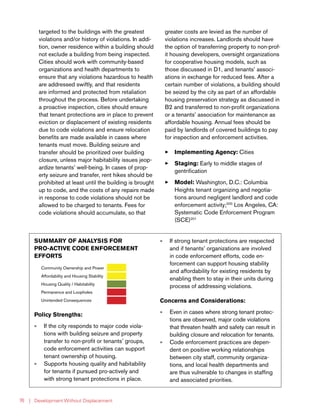
some cases families decided to take the best
offer for their homes and move to cheaper
suburban communities in the region, or in some
cases out of state. In many cases they were
priced out against their will, no longer able
to afford neighborhoods that were becoming
increasingly expensive. For tenants the im-
pacts were significant, everything from evic-
tions, to having their utilities shut off, to losing
their security deposit, and living in deplorable
conditions without necessary maintenance and
upkeep.42
The tidal wave of investment aimed at
working class neighborhoods ended up further
destabilizing and impoverishing them43
as well
as continued the trend of displacement.
San Francisco and Oakland are now facing
our third round of gentrification driven once
Causa Justa :: Just Cause | 25
again by the fortunes of the new tech giants,
like Google and Facebook.44
Many of the
similar features from the first tech boom are
being re-visited. Homeownership, rental prices
and evictions are all simultaneously rising.45
This quote from the Wall Street Journal sums
up current conditions, “San Francisco led the
top-50 U.S. metropolitan areas in average rent
growth during the second quarter, jumping 7.8
percent to $2,498, while Oakland was No. 2
at a 6.9 percent increase…The 6.8 percent
increase for the combined San Francisco Bay
area was more than double the nation’s 3.1
percent increase…” 46
Housing pressures in
San Francisco are once again increasing as
the stock of affordable rental units continue to
shrink, owners turn rental units into condos and
rental prices skyrocket.47
While the foreclosure crisis has not totally
abated, housing investors are already evolving
their profit making methods from investing in
mortgage securities to rental securities, with
a potential $1.5 trillion in such investments
projected nationally.48
Oakland based Waypoint
Homes is one company that has bought up
thousands of properties.49
This new round of gentrification caused both
by recent tech arrivals and continued spec-
ulation in real estate is not just having an
impact on housing costs, it is changing the
entire character and nature of neighborhoods.
Institutions and businesses that have historical-
ly served existing residents have been replaced
by high-end bars, restaurants and yoga stu-
dios. One notable example is the closing of
Esta Noche a beloved, long time, gay bar in the
Mission that served the neighborhood’s immi-
grant Latino community. Only a block away a
neighborhood grocery also closed down after
years of providing residents food and other
essentials.
The signs of commercial gentrification are
visible in both San Francisco and Oakland
neighborhoods. Oakland is loudly and boldly
being declared a west coast Brooklyn, where
affluent, but often younger, city workers live and
play.50
But more than simply housing workers,
tech is moving into Oakland as well.51
In this
way, Oakland embodies numerous pressures of
gentrification, ranging from the intake of tenants
evicted from San Francisco, the commuting
tech workers settling around areas of commer-
cial and transportation development, and the
growing number of tech companies moving to
Oakland for cheaper commercial space.
Though contrary to popular commentary, it
is not only a declining rental stock that puts
renters at risk of facing a rent gap, but the rise
of investor-owned rental properties that dis-
possess communities from housing and places
them under pressure of price speculation.52
The post-recession inflow of investors who
snatched up foreclosed properties and began
to offer “rental-back securities” are placing
rents and property values at risk of new rounds
of speculation.53
Together, the growth of a
non-distributive industry and financial specula-
tion on rental properties fuel a worsening rent
gap and make gentrification highly profitable.
Without timely action on the part of the govern-
ment, the rent gap causing the displacement of
service sector and low-income Bay Area work-
ers will only worsen. As mainstream economists
are beginning to recognize, the profits of the
technology sector, responsible for flooding Bay
Area rental markets with high wage workers,
will not automatically distribute wealth across
the region and will likely cause long term unem-
ployment and deepening inequity.54
The convergence of these global, national,
regional, and local conditions and policies has
made our neighborhoods and cities suscepti-
ble to ongoing gentrification. The charts below
illustrate the socioeconomic and racial trans-
formations resulting from the dynamics we just
outlined.
| Development Without Displacement26
Median housing values increased dramatically in both San Francisco and Oakland between 1990 and 2007–11 across all typologies.
The 2007–11 median housing value in San Francisco areas experiencing ongoing gentrification ($917,230) and in the Late typology
($847,200) surpassed that of historically affluent areas ($836,346). In Oakland, although historically affluent areas still had the highest
median housing values in 2007–11 ($646,194 compared to $497,986 in areas experiencing ongoing gentrification), areas experiencing
ongoing gentrification saw the largest increase in housing values between 1990 and 2007–11 ($274,760 increase).
Causa Justa :: Just Cause | 27
Income Ranges, San Francisco
38.6%
66.8%
54.3%
75.8%
43.6%
67.9%
40.6%
33.9%
26.6%
30.4%
18.2%
35.5%
22.8%
34.0%
27.5%
6.7%
15.3%
6.0%
20.9%
9.3%
25.4%
0%
10%
20%
30%
40%
50%
60%
70%
80%
90%
100%
Ongoing Late Middle Early 2 Early 1 Susceptible N/A
1990
> $106 K
$53K-$106K
<53K
21.9%
50.4%
43.5%
59.1%
43.0%
68.1%
31.7%
26.7%
18.0%
25.6%
19.2%
29.5%
18.3%
25.5%
51.4%
31.6% 30.9%
21.6% 27.5%
13.7%
42.8%
0%
10%
20%
30%
40%
50%
60%
70%
80%
90%
100%
Ongoing Late Middle Early 2 Early 1 Susceptible N/A
2007-11
>$100 K
$50K-$99K
< $50K
Source: ACPHD CAPE, with data from Census 1990 and ACS 2007-11
Affluent households in San Francisco (households making at least $100,000 per year) comprised a larger share of all households in 2007–
11 compared to 1990 across all neighborhood types. The largest increase in the share of affluent households took place in neighborhoods
in the Late stage of gentrification.
Income Ranges, Oakland
Source: ACPHD CAPE, with data from Census 1990 and ACS 2007-11
64.2%
73.1%
65.3% 68.1% 63.6%
43.9%
27.4%
21.5%
26.2% 24.9% 29.5%
31.1%
8.5% 5.5% 8.5% 7.0% 6.9%
25.0%
0%
10%
20%
30%
40%
50%
60%
70%
80%
90%
100%
Ongoing Middle Early 2 Early 1 Susceptible N/A
1990
> $106 K
$53K-$106K
<53K
52.8%
61.9% 62.3% 66.4% 66.1%
37.4%
30.3%
26.9% 24.8% 22.9% 23.3%
27.7%
16.9% 11.2% 12.9% 10.6% 10.7%
34.9%
0%
10%
20%
30%
40%
50%
60%
70%
80%
90%
100%
Ongoing Middle Early 2 Early 1 Susceptible N/A
2007-11
>$100 K
$50K-$99K
< $50K
In Oakland, affluent households (those making at least $100,000 per year) comprised a larger share of all households in 2007–11
compared to 1990 across all neighborhood types. The largest increase in the share of affluent households took place in neighborhoods in
the Middle and Ongoing stages of gentrification.
| Development Without Displacement28
The median household income in San Francisco has increased across all neighborhood types, except for susceptible areas in which
median household income decreased by $3,349 between 1990 and 2007–11. Areas experiencing ongoing gentrification saw the
greatest increase in median household income, with a jump of $35,447.
In Oakland, the overall proportion of renters decreased (from 58.4% to 58.1%) between 1990 and 2007–11, but the total number of renters still increased in number,
as the overall population increased. There were 59,944 total owner-occupied housing units in 1990 and 83,996 total renter-occupied units. In 2007–11, there were
64,676 owner-occupied housing units and 89,824 renter-occupied housing units. The proportion of renters increased in Ongoing and Early Type 1 typologies
In San Francisco, the overall proportion of renters decreased, but the number of renters still increased in number, since the overall population increased. There
were 104,691 owner-occupied housing units in 1990 and 199,084 renter-occupied housing units. In 2007–11 there were 125,502 owner-occupied housing
units and 212,864 renter-occupied housing units. The proportion of renters increased in Middle, Early 1 and Susceptible typologies.
Causa Justa :: Just Cause | 29
As a contrast to the rising rates of rentership among Blacks / African Americans in San Francisco, White rentership is actually going
down in certain areas (that is, homeownership rates are going up). We see this occurring especially in Ongoing, Late and Early Type
2 areas, where Black / African American homeownership rates have declined by 7 to 24 percentage points just as White home
ownership rates have increased by 7 to 16 percentage points.
In 1990 a little over three-quarters of Blacks / African Americans in San Francisco’s Ongoing and Late areas were renters. By
2007–11, all Blacks / African Americans in those areas rented, meaning that homeownership rates for Blacks / African Americans
dropped from one-quarter to zero during that period. We see similar trends of growing Black / African American rentership in the
Middle typology (34% to 64%). All other areas saw slight to moderate increases in the proportion of Blacks / African Americans who
rent, except for already affluent areas (N/A typology).
| Development Without Displacement30
Urban Development Under
Neoliberalism
As a result of the economic shifts described
above, many U.S. cities prioritized profit-driven
activities to build up new economic bases and
revenue streams. Without prioritizing compre-
hensive and community-driven policies, how-
ever, these changes rarely accounted for the
needs and interests of existing residents. We
know this to be a neoliberal approach to devel-
opment. While neoliberalism as a political ideol-
ogy was developed nationally and globally, it is
characterized by a specific set of local policies,
described in this section, that have helped mani-
fest the specific urban landscape we see today.
Most major U.S. cities have been deeply af-
fected by a neoliberal program, which began in
the 1970s and solidified itself in the decades
since. San Francisco and Oakland have been
no different. Some of the key features of the
“neoliberal city” include:
1. Shrinking public funding and
privatization of public programs and
services
Over the last 30 years cities like Oakland and
San Francisco have seen a huge decline in fed-
eral support for urban programs and services.
On the federal level, the budget for Community
Development Block Grants (CDBGs) was
cut by $650 million between 2010 and 2011,
which reduced the amount of funds available to
municipalities across the nation for affordable
housing, job creation, senior and youth services,
and neighborhood improvements.59
These cuts
have forced mayors, city councils, supervi-
sors, and city managers to reduce funding for
numerous local programs, including libraries,
Data courtesy of the San Jose Mercury News and Real Facts.56Data courtesy of the San Jose Mercury News and Real Facts.55
The most recent decline in federal dollars, which has left many cities with very little resources, is a result of the sequester, automatic
federal budget cuts that went into effect March 1, 2013. These cuts resulted after Congress failed to agree on a plan to reduce the
federal deficit by $4 trillion.57
Cuts to federal discretionary spending could have devastating consequences for families in need. Possible
cuts to public housing authorities have put many administrators in a difficult position when deciding how to spend dwindling resources
typically used to serve the working poor, seniors, and people with disabilities. Executive Director of the Santa Clara County Housing
Authority, Alex Sanchez, was quoted in the San Jose Mercury News as saying, “We’re being put in an untenable position of having to
decide winners and losers among the most vulnerable. … We’re forced to pit one group of poor people against another group. Seniors
versus the disabled. Homeless versus working-poor families. It’s an impossible choice with terrible consequences.” California has about
350,000 families in the Housing Choice Voucher Program; according to Bill Lowery, the San Mateo County Housing Authority Executive
Director, 21,000 of these households could lose their vouchers given 6% budget cuts.58
Causa Justa :: Just Cause | 31
youth services, housing, and public assistance
programs. For example, the $400 million, or
5.3 percent cut, in federal funds for Head Start
programs resulted in 57,265 children nation-
ally unable to take advance of the Head Start
program.60
According to Early Edge California,
8,200 low-income children in California could
lose Head Start and Early Head Start ser-
vices, 2,000 could lose access to childcare,
and 1,210 teachers and aides could lose their
jobs.61
Cuts to critical social programs are
devastating to working-class neighborhoods
where individual families and the community as
a whole have already been destabilized by a
shrinking safety net.
Cities have worked to develop new revenue
streams to contend with a range of cuts over
the years; these include hikes in sales taxes,
hotel and entertainment taxes, and new property
taxes. Not only are cities today run like busi-
nesses, the pressure to generate funds means
that elected officials are constantly pursuing
projects that will generate the most revenue,
as opposed to projects that serve the great-
est community need or good. In cities like San
Francisco and Oakland, local land use decisions
have been greatly impacted by these reve-
nue-generation pressures, which in turn reshape
the physical environment of the cities.
One such example is the repurposing of land
through zoning. Historically, cities like San
Francisco and Oakland with their large indus-
trial and manufacturing bases, have had sig-
nificant sections of the city zoned to support
such activities. It is this history that gave rise
to auto body shops, small factories producing
mechanical parts, and steel and iron foundries
in the Mission and East Oakland. Many of these
businesses provided employment for neighbor-
hood residents and contributed to a stable local
economy.62
For local governments, rezoning for-
mer industrial land so that developers can build
expensive housing in place of the shops and
factories, is now economically desirable. Yet,
longtime neighborhood residents see few bene-
fits from the new lofts and condos. The closing
of these businesses represents an immediate
loss of local employment, and the rezoning of
House Keys Not Handcuffs Action, San Francisco
Valencia Gardens, public housing project, on 15th and Valencia
Streets in the Mission, San Francisco, CA.64
Photograph courtesy
of Mark Pritchard, Flickr Creative Commons, under the following
license: http://creativecommons.org/licenses/by-nc-sa/2.0/.
Due to government budgetary constraints, privatization in the
housing market is coming to life through a federal program called
the Rental Assistance Demonstration (RAD), which could convert
up to 3,000 of the San Francisco Housing Authority’s 6,054 units
to private management.65
On the ground, this translates into the
government ceding control of public assets to private parties,
according to Sara Shortt, Executive Director of the Housing Rights
Committee, in the San Francisco Examiner.66
| Development Without Displacement32
the land creates a more permanent barrier to
similar opportunities returning any time soon.63
Privatization is the other aspect of this feature
of neoliberalism. Urban centers have been
drastically altered by a steady and accelerating
trend of decreased government support for
services like housing, health care, and educa-
tion. Where public housing once ensured that
millions of families were able to maintain basic
housing security, the move toward disposing of
these public housing units and turning them into
mixed-income housing developments in part-
nership with private investors through programs
like Hope VI, has decreased the stock of public-
ly owned and managed housing, while growing
the private housing market.67
With privatization,
the protections, rights, and affordability controls
associated with public housing are permanent-
ly eradicated for millions of low-income and
working-class people. There is also a more
limited ability to demand improvements and hold
private owners and management companies
accountable for conditions in the new housing,
as there is a reduced expectation that they must
answer to residents, community institutions, and
stakeholders regarding these issues.
2. Reliance on the private sector to serve
as the primary driver of economic growth
and urban development
Most development in our cities reflects the pri-
orities of private investors, corporate landlords,
and large business interests. Whether it is a
stadium project like the proposed Golden State
Warriors waterfront stadium, a new campus
for the biotech industry like Mission Bay, or
Tassafaronga Village in Oakland. Photograph courtesy of Mark
Hogan, Flickr Creative Commons, under the following license: http://
creativecommons.org/license/by-sa/2.0/. Tassafaronga Village is
an affordable housing redevelopment project with units available to
households making up to 60% of Area Median Income (AMI).68
Deemed a neighborhood blight by Oakland’s Community and
Economic Development Agency, the 87 Sixties-era affordable
housing units that make up Tassafaronga Village were slated
to be demolished. Demolition began in 2008 and by 2010
the new development, which consisted of 157 new affordable
rental-housing units and 22 new affordable for-sale homes, was
complete.69
According to the Relocation Plan for Tassafaronga
Village, existing residents with a valid lease were given a 90-day
notice to vacate, were provided with a Section 8 housing voucher (if
eligible), and were provided relocation assistance, which included
advisory services and moving assistance. However, less than 15%
of these residents who had extremely low (30% of AMI) and very
low incomes (50% of AMI), actually moved back to Tassafaronga
Village after the redevelopment was complete.70
Old 16th Street Station, Oakland, 2013.71
The abandoned 16th
Street Station is slated for redevelopment as part of the Wood
Street Development project. Photograph courtesy of Richard
Johnstone, Flickr Creative Commons, under the license: http://
creativecommons.org/licenses/by-nc-nd/2.0/.
In addition to the industrial and commercial development, the
Oakland Army Base redevelopment project also includes the
Wood Street Development, a mixed-used project that will consist
of residential, retail and commercial uses, and open space.72
West
Oakland’s Wood Street Development had a special tax levied
for it, and received a subsidy of $10.35 million for 36 affordable
housing units in the Zephyr Gate and Cannery projects. The City
also provided $5.6 million to assist in down payments for 40 first-
time homebuyers in the Wood Street Development area. Although
this is not a direct subsidy to the developers, it does benefit them in
the sale of their housing units.73
The Wood Street Development, in
particular, has drawn support and criticism. For example, the West
Oakland Project Area Committee, made up of residents, property
owners, and businesses, supported the project, while labor,
environmental, tenants’ rights, and affordable housing groups have
voiced concern over whether the project adequately addressed
affordable housing, living wage jobs, and the historic preservation
of the 16th Street train station and its importance to the Black /
African American community.74
Causa Justa :: Just Cause | 33
hundreds of units of condos in downtown like
Forest City, private interests dominate decisions
about what gets developed, where, and when.
Local residents and communities are, time and
again, left out of the process and decision mak-
ing about neighborhood and city development
and very rarely get to weigh in on development
priorities and community needs. For example,
the $91 million Fox Theater redevelopment,
and Ellis Partners LLC’s $400 million devel-
opment in Jack London Square, each anchor
the expansion of Oakland’s downtown district.
Once again the development of the downtown
business center was done at the expense of
working-class neighborhoods and their resi-
dents, further accelerating the gentrification of
these areas. Perhaps because of its sheer size,
East Oakland had by far the most affordable
housing development over the last decade and
the greatest all-around development of any area
in the city; however, the development in East
Oakland lacked the subsidies that were seen in
downtown Oakland.75
City agencies and their staff — whose role
should be one of balancing and facilitating
processes to ensure that the varied interests
and needs are considered in these development
process — often conciliate to the demands of
private investors, who threaten to take their cap-
ital and projects elsewhere if they do not get the
deal they want. In order to encourage private
investment, cities often ease existing land use
or building regulations and provide generous
subsidies to private developers. The $61 million
subsidy given to Forest City for the Uptown
development project by the City of Oakland is
but one example. The Uptown also received an
additional $1 million via grants in addition to the
tax credits and Tax Increment Financing (TIF)
that was given to the development project, both
of which are forms of subsidies.76, 77
Cities then
take on the role of supporting developers in
creating the most advantageous conditions for
maximizing profits, and step too far back in the
role of regulating and managing local develop-
ment and economic activity.
This type of development approach results in
a severe mismatch between the needs of local
residents and the profit-motivated interests
of those driving urban development. While
many working-class communities of color
are crying out for basic infrastructure — like
grocery stores, family-serving retail stores, and
low-cost housing for a range of family sizes —
what often ends up in these neighborhoods
are new businesses and services designed to
serve incoming residents. For most working-
class communities of color, the arrival of
Shut Down ICE And The Financial District, San Francisco
| Development Without Displacement34
boutiques, art galleries, and high-priced coffee
shops does little to improve living conditions
and neighborhood sustainability. The private
sector in general is not well positioned to meet
the needs of all Oakland and San Francisco
residents, in particular low-income and
working-class families, or to ensure that their
housing, infrastructure, and service needs are
realized.
3. Increasingly militarized cities
There has been a direct correlation between the
decrease in national funding for public programs
and services and the rise in funding for law en-
forcement. While cities have had to cut budgets
for libraries, youth services, housing, and public
assistance programs, public officials have placed
clear priority on funding for increased policing,
advanced weapons, and surveillance technology
in urban centers. As opposed to housing, educa-
tion, and health, urban policing is an area of gov-
ernment growth and expansion, both in terms of
funding and overall focus locally and nationally.
Policing dominates discussions about every-
thing from the city budget, to debates about
civil rights and education. Both Oakland and
San Francisco have followed national trends to
enact more aggressive law enforcement poli-
cies under the guise of controlling crime and
violence. Examples include “sit and lie” policies
that criminalize the homeless, making it a crime
to utilize public space, and “gang injunctions,”
which give police sweeping powers in areas
under injunction, redefining gangs so broadly
that any group of young people in public space
is assumed to be gang affiliated.
Further, national programs like the “war on drugs”
and “Secure Communities” increase collaboration
between local, state, and federal law enforcement
agencies, and together with local efforts, con-
tribute to the criminalization of low-income and
working-class communities of color, homeless
people, immigrants, and young people, resulting
in historic rates of incarceration nationally.
As urban centers are transformed by neolib-
eralism there is a pitched contest for public
space, sending a clear message to low-income
and working-class communities of color that
they have no right to occupy that space at all.
Aggressive policing measures and policies are
part of the strategy for pushing those determined
to be undesirable out of urban public space,
clearing the way for wealthier newcomers.
4. Weak democratic processes and practices
Decisions about the direction and development of
cities are increasingly concentrated in the hands
of a few. Private investors and corporations are
Although national property crime rates have steadily decreased
over the past decade, it is unclear that increased spending on law
enforcement has had any effect on property crime rates in Oakland
and San Francisco.78
Wells Fargo Shareholders Action, San Francisco
Causa Justa :: Just Cause | 35
hugely influential with policymakers because
of their ability to generate revenue, create jobs
and initiate development projects. Those with
wealth are not just valued business partners,
but potential contributors to political campaigns
and elections as well. As the cost of running for
public office has skyrocketed in the last decade,
money has become a determining factor in local
elections. When even a mayoral race can run in
the millions of dollars, those with money enjoy a
disproportionate level of influence over those with
little or none to put in the game.
Over time, neighborhood groups, labor unions,
community and faith organizations have seen
their political power diminish with local decision
makers. In some cases it has become increas-
ingly challenging for community groups to ac-
cess elected officials and their time. Even when
groups are able to sit down and express their
needs, it has become harder and harder to see
those needs realized in the passage of policies
or other forms of implementation.
Many critical municipal decisions, like ones
regarding land use and local resource expendi-
tures, for example, are decided in meetings and
hearings with little or no public participation.
Both the format and content of these discus-
sions are highly technical in nature and dominat-
ed by presenters and speakers who are lobby-
ists or lawyers representing private investors, or
by specialized technical experts. These process-
es are generally not well publicized and can drag
on for years, making it incredibly challenging
to engage residents. There is little interest in
ensuring meaningful public participation in the
process or the decisions, and most residents
do not learn of the real impact of these hearings
until years later. An organized and well-informed
“public” is largely missing from these “public
hearings.”
Neoliberal policies — advanced through these
opaque processes — have fundamentally shifted
conditions in cities like San Francisco and
Oakland, and have deeply impacted the lives of
working-class communities of color.
In addition to the neoliberal policies of the last
30 years, and the historical race and class fault
lines that have developed with the evolution of
Oakland and San Francisco, shifting demograph-
ics are also exaggerating preexisting tensions
and creating new ones. As new immigrants arrive
in the region due to a range of global policies,
initiated in many cases by the U.S., joining
communities of color already here, urban areas
in particular and the country in general will soon
see populations in which people of color are the
majority. There are tremendous new pressures
and fights around how our cities should develop
and around the role working-class people of col-
or should play in the next chapter of this story.
May First March, San Francisco
| Development Without Displacement36
San Francisco affluent areas (“N/A” category) and those with ongoing gentrification are the only typologies where people of color do not
comprise the majority.
Although people of color comprise the majority in virtually all typologies in Oakland, they comprise a significantly smaller majority in areas
experiencing ongoing gentrification and in already affluent neighborhoods (“N/A” category).
Causa Justa :: Just Cause | 37
From 1990 to 2011 in San Francisco, the proportion of Blacks / African Americans decreased 1.8-fold, from 10.7% to 5.8%. The proportion
of Whites decreased slightly (1.1-fold) from 46.8% to 41.9%. The proportion of Latinos increased slightly (1.1-fold), from 13.4% to 15.1,
and the proportion of Asian/Pacific Islanders increased 1.2-fold from 28.6% to 33.4%.
| Development Without Displacement38
Gentrification is a
Public Health Issue
Black / African American households, if displaced, are more likely to find
themselves in neighborhoods with fewer health-promoting resources and/or
lower quality amenities, as average neighborhood income is closely tied to the
availability of neighborhood resources.129, 130
Gentrification is rapidly changing our cities at
the expense of residents who have long called
their neighborhoods home. A strong body of
literature shows that our environments, includ-
ing the physical, economic, and social environ-
ment, matters for our health. Furthermore, when
people are moved from their long-term homes
and communities, a number of negative individ-
ual and community health consequences result.
This section provides an overview of the role
that public health has played in urban develop-
ment, including decisions that lead to displace-
ment, as well as the public health impacts of
gentrification and displacement. It also makes a
case for why public agencies, including public
health departments and organizations, must
make displacement prevention central to their
work on healthy community development.
Foreclosures Are A Health Issue Action, Oakland
Causa Justa :: Just Cause | 39
The Historic Role of Public
Health Departments in Urban
Development
As discussed in previous sections, urban devel-
opment policy has critically impacted urban res-
idents through positive and negative changes in
their environments. Even when these changes
have been positive, however, the policy-driven
transformation of urban neighborhoods has
repeatedly resulted in displacement without im-
provements for existing communities, particular-
ly when these communities were predominantly
low-income residents and people of color.79
A
number of public agencies at multiple levels
have driven change in urban neighborhoods.
Local government agencies, such as local
planning departments, redevelopment agencies,
and community and economic development
agencies, have played a particularly important
role. Less well known is the role that local public
health departments have historically played in
urban community development and neighbor-
hood change.
The work of many public health departments
emerged in relation to cities and the conditions
created by rapid urban industrial growth. Early
public health officials worked to improve san-
itation and health conditions in new industrial
cities in the late 19th century, a period of time
when infectious diseases were the leading
cause of death.80
These efforts focused on
improving housing conditions for the poor, in-
cluding the tenement style housing where many
urban immigrants and factory workers lived.81
During the late 19th and early 20th centuries,
public health workers were involved in a number
of important social policy reforms that led to
improvements in health, including the creation
of minimum housing habitability standards, the
creation of workplace safety standards, and the
shifting of legal responsibility for housing condi-
tions from tenants to property owners.82
By the
early 20th century, many cities had designated
their health departments as the creators and
enforcers of housing codes.83
While early public health efforts to improve
housing conditions had positive results, they
were limited, as many of the newly adopted
housing codes focused on new construction
rather than existing housing and most were
inadequately enforced.84
As a result, substan-
dard housing conditions were still widespread
in cities of the mid-20th century. Rather than fo-
cusing on improving existing housing, however,
public and government attitude toward housing
had shifted to viewing entire neighborhoods
and districts as “blighted,” with the potential
to spread and infect other parts of the city
much like a disease.85
By the mid-20th century,
the growing consensus among many public
health and urban reformers was that, in order
to improve health, the worst housing should be
demolished and replaced with new housing.
This belief was one of the justifications for the
federal program of “urban renewal.”86
Art by Dignidad Rebelde
| Development Without Displacement40
Urban Renewal and
Displacement: Moving People
in the Name of Health
As discussed in earlier sections, “urban renew-
al” was a federal program enacted in 1949,
which enabled local redevelopment agencies
to use federal funds to demolish and redevelop
entire sections of a neighborhood based on
their “blighted” conditions. This program was
widely supported by city officials and business
interests as well as public health and social wel-
fare advocates. While improvement of housing
conditions was a justification for the program,
in the end, thousands of existing residents were
displaced and their houses destroyed to make
way for new public housing complexes, large
entertainment centers, and civic buildings. Not
only were many of the projects funded by urban
renewal largely unresponsive to the needs of ex-
isting residents, but they resulted in destruction
of longtime residents’ homes and businesses,
and ultimately the displacement and disposses-
sion of entire communities. Furthermore, while
new housing was produced via the construction
of large public housing projects, the number of
units produced never came close to meeting
the number destroyed.87
The harmful impacts of this program on exist-
ing residents’ health and well-being are now
well documented.88
In particular, because the
neighborhoods targeted for urban renewal were
predominantly Black / African American, this era
of urban policy initiated a pivotal decline in the
population of Blacks / African Americans from
cities like San Francisco,89
with ripple effects on
the social, economic, and physical well-being
of Black / African American communities for
generations. Such policies also solidified a deep
sense of distrust between communities of color
and local government.90
While mayors, business interests, and rede-
velopment agencies drove this program at
the local level, public health departments also
played an important role. Researcher Russ
Lopez discusses how, under the rubric of urban
renewal, many cities gave health departments
the central task of surveying housing and
neighborhoods for “blight,” based on American
Public Health Association (APHA) guidelines
for healthy housing.91
“Blight” was a subjec-
tive term, so the APHA guidelines provided
a scientifically objective assessment of blight
based on physical housing conditions. While
these healthy housing guidelines were created
with the intention of improving public health
for low-income urban residents, they became
central to the process of identifying blight via
housing and neighborhood surveys, which were
used to target and legally justify which neighbor-
hoods would be razed under urban renewal.92
Over the last several decades, the definition
of “health” in public health has been broad-
ened. But at the time of urban renewal, many
public health departments had a more limited
definition, ignoring the community and social
dimensions of well-being. Lopez states, “the
guidelines did not consider the positive as-
pects of urban neighborhoods, such as the
human element [of community] that made city
living tolerable. They did not incorporate scales
indicating that residents’ families were nearby
or that children’s playmates were next door.
They did not consider that the grocer extended
credit to regular customers or that residents
attached decades of memories to buildings.
[They] attempted only to measure independent
Auction Action To Save Nelson Myhand and Cynthia Green’s
Home, Oakland
Causa Justa :: Just Cause | 41
objective aspects of healthy housing and
neighborhoods.”93
Furthermore, these surveys were used to penal-
ize residents for the housing conditions in which
they were forced to live. Historical disinvestment
and a racially discriminatory housing market had
limited opportunities for homeownership and
constrained people of color, particularly Black /
African Americans, to particular parts of the city.
These dynamics resulted in densely populated
neighborhoods where many residents were both
renters and people of color with limited power
over their housing conditions, including the
ability to make needed repairs.94
Furthermore,
many cities also explicitly looked for the “pres-
ence of non-White communities” in determining
where “blight” was located.95
In both explicit
and implicit ways, neighborhoods of color were
targeted, declared blighted, and slated for re-
moval from the city. While public health workers
and health departments made critical contribu-
tions to the health of urban communities during
the 19th and 20th centuries, the role of public
health in this era of racially discriminatory hous-
ing policy cannot be forgotten. Furthermore, the
impacts of this period of massive displacement
for low-income communities and communities of
color must be acknowledged in contemporary
public health efforts to engage in housing and
community development decisions.
The Public Health
Consequences of Gentrification
and Displacement
As discussed in prior sections, gentrification is
a relatively recent form of urban development
that involves the social, economic, and cultural
transformation of historically disinvested urban
neighborhoods. While gentrification is driven
by the private sector — through private devel-
opment that targets the needs of new, higher
income residents over existing residents, and
the individual movement of more affluent res-
idents into older urban neighborhoods — the
public sector paves the way. By announcing
new investments and plans to revitalize com-
mercial areas, and providing tax breaks, sub-
sidies, and other benefits to incentivize private
development, public sector actions reduce the
costs and risks for developers while introduc-
ing amenities that appeal to outside residents
and may be disconnected from the real needs
and desires of existing residents.96
Without
adequate public sector protections and regula-
tions, longtime residents are often displaced or
excluded from the benefits of new development.
While gentrification may bring much-needed
investment to neighborhoods, including new
stores and commercial services, as well as
upgrades to infrastructure and amenities like
parks,97
displacement prevents these changes
from benefitting those who need investment the
most. Furthermore, gentrification has a number
of serious public health consequences for those
who stay, those who leave their neighborhoods
behind, and our broader society.
This poster was designed by Mariana Viturro in 2010 to support
a campaign for a local San Francisco proposition that would
have prevented rent increases for people most impacted by the
economic crisis. The mayor had vetoed a similar proposition the
year before.
| Development Without Displacement42
Impacts on Existing Residents
For lower income and longtime residents,
gentrification can result in financial burden due
to the increasing cost of rent. When housing
costs rise above 30 percent of household
income (also known as rent burden), families
may cope by sacrificing other basic needs such
as health care, transportation, or healthy food,
each of which is critical for good health and
well-being.100
Furthermore, in the context of
gentrification, landlords may attempt to force
tenants out of their homes through intimidation,
buy-out offers, and eviction notices. Data on
San Francisco evictions over the last 30 years
shows that eviction notices of all types peaked
in 1997–98, correlating with the peak of the
“dot com boom,” which resulted in skyrocket-
ing housing values and the transformation of
San Francisco neighborhoods, particularly the
Mission district.101
Since this time, the Mission
district has consistently experienced eviction
In addition to having an impact on health out-
comes, research suggests that gentrification
may increase health inequities, or differences
in health outcomes that are “unnecessary and
avoidable but, in addition, are also considered
unfair and unjust.”98
These differences in health
outcomes across place, income, race, and other
demographics are tied to underlying social,
political, economic, and environmental factors,
such as access to safe and affordable housing,
quality jobs, good schools, and safe places to
play and work.99
These factors impact multiple
health outcomes, including how long people live
(life expectancy) and their quality of life. Because
it affects multiple pathways to health and can
increase inequities between groups, it is critical
for the public health field to understand and
address displacement in order to improve health
outcomes and advance health equity.
Art by Favianna Rodriguez
As discussed in the previous section, dis-
placement can happen in a variety of ways
and in both the public and private housing
market, including residents being forcibly
relocated in order to make way for reno-
vation of their housing, landlords raising
rents to unaffordable levels, tenants being
evicted so landlords can rent or sell their
units for a higher price, and residents mov-
ing because their friends and family have
moved away. In this report, displace-
ment is defined as the out-migration of
low-income people and people of color
from their existing homes and neigh-
borhoods due to social, economic, or
environmental conditions that make
their neighborhoods uninhabitable or
unaffordable. While some residents may
choose to move in certain cases, this report
understands displacement in the context of
gentrification as involuntary and, therefore,
unjust due to the role of public policy in
repeatedly uprooting and destabilizing
urban low-income populations and
people of color through disinvestment
and inequitable development.
Causa Justa :: Just Cause | 43
Gerthina Harris has
been a member of
CJJC for four years
and has lived in her
West Oakland home
for the past seven
years. Gerthina is
a senior on a fixed
income and pays
more than 50 percent of her income on rent,
a considerable rent burden. Due to the high
cost of rent, Gerthina has less to spend
on other essential expenses and is often
forced to decide which bills to pay on time
each month. Not only does Gerthina face
a financial hardship, but also an emotional
and physical one, as the stress of living on a
fixed income can be highly taxing.
“There’s a woman...
that lives just north
of the University
and she’s an older
woman who has
long lived in this
neighborhood — 40,
50 years — and she
owns her house be-
cause her mom had bought it 40 years ago
and she inherited it. Her neighbors around
her have slowly been pushed out of her
neighborhood. And her good friend who
lives right next door, she would have coffee
with her every morning. And she loved it…
It was a stress relief. It’s an emotional tie
you make with somebody. And one day the
woman became very ill and couldn’t get
out of bed and didn’t make the coffee that
morning and her neighbor was calling and
calling and calling her and couldn’t find her.
[The neighbor] went and knocked on her
door and was able to get in. The woman
was close to a diabetic coma. And that is
exactly what neighbors do for each other.
And so if you lose that you lose health, you
lose emotional well-being and you lose that
safety net that people rely on to be able to
live healthy full lives.”
— Paulina Gonzalez, Former Executive Director, Strategic
Actions for a Just Economy (SAJE), Los Angeles
When residents face rising housing costs,
some may choose to move in with friends or
family, share rooms, or subdivide units to save
money.104
While shared and intergenerational
housing is not inherently bad for health and can
increase social support, moving in with others
out of financial need can lead to overcrowding,
a situation which compromises health and
well-being.105
Based on our analysis of housing
conditions and gentrification in San Francisco,
we saw a general correlation between the
progression of gentrification and overcrowding
(measured as greater than one occupant per
room), with rates of overcrowding increasing
from early to late stages of gentrification.106
This pattern is illustrated in the following graph,
which shows overcrowding (measured as the
percentage of housing units with more than
one occupant per room) by San Francisco
neighborhood type. Note that the drop in
overcrowding rates from late to ongoing stages
of gentrification may be due to the loss of low-
income households and simultaneous increase
in higher income households who are able to
afford more space.
notices from Owner Move-In (OMI), a no-fault
cause for eviction that is often used to displace
tenants and raise rents, at an annual rate far
above any other neighborhood.102
As fixed income and elderly homeowners in
the neighborhood cope with rising taxes and
housing costs, they may face the threat of fore-
closure. Foreclosure, in turn, can result in major
loss of wealth, increased stress and anxiety, and
can force foreclosed residents into substandard
housing where they may be exposed to health
hazards like mold and pests.103
| Development Without Displacement44
Percent of housing units with more than one occupant per room can be a measure of overcrowding, although cultural considerations may
be a part of the picture as well. The highest percent of housing units in which there is more than one occupant per room is in the Late,
Susceptible, and Middle typologies in San Francisco. The lowest percentage is in Ongoing and N/A. The percent of households with more
than one occupant per room is more than 12 times higher in the Late vs. Ongoing typology.
Causa Justa :: Just Cause | 45
Even when development brings in much
needed resources, the benefits of new
services and resources can be out of
reach for those who need them the most
due to financial and cultural barriers.
New retail stores and restaurants may be
unaffordable and/or based on the cultural
tastes and preferences of new rather than
longtime residents. When development
is not based on the needs and desires of
existing residents, it may be experienced
as alienating and exclusive, resulting in
longtime residents feeling out of place in
their own neighborhood.108
Homes For All National Campaign Launch, Oakland
budget. Socioeconomic status, which reflects
income, education, and occupation, is one of
the strongest determinants of health.110
When
people have the money they need to cover
basic goods and services, as well as the access
to health-promoting resources and information,
they live longer and are less likely to experience
health problems across the lifecycle, including
chronic disease and mental illness.111
Residents who move farther from central city ar-
eas may also face increased transportation costs
due to longer commutes to work, school, places
of worship, or health care facilities.112
Long com-
mutes have been shown to contribute to stress
and reduce time for health-promoting activities
like sleep and exercise, as well as reducing the
time parents or caregivers can spend with their
children.113
A growing body of research has sug-
gested that chronic stress, particularly stress that
is driven by financial burden and limited control
over one’s life conditions, can be toxic. Chronic
stress can effect health and mental functioning
in the short term, and can contribute to chronic
disease and death in the long term.114
Displacement can also mean loss of irreplace-
able assets, including investments made in a
home, job, or business.115
These losses can
result in severe disruption to financial well-being
and stability.
Displacement disrupts employment and can
result in job and income loss, as residents who
move may have difficulty sustaining jobs due
to lack of public transportation options and the
length of their new commute.116
For children,
displacement is destabilizing to their social
networks and routines, and can result in declin-
ing school performance.117
Education is a key
determinant of health as well. Children and youth
have lifelong health benefits tied to educational
achievement.118
In addition, recent studies have
suggested a correlation between gentrification
and increasing numbers of people entering
the homeless shelter system from the same
neighborhood, perhaps due to an extremely
As housing prices increase and the cultural
fabric of neighborhoods change, gentrification
can result in the closure of needed services
and institutions that are vital for existing
residents’ well-being.107
Impacts on Displaced Residents
Residents who are displaced due to
gentrification face multiple, overlapping
health impacts. Displacement can introduce
financial hardship due to relocation and the
costs of setting up a new household.109
These
costs reduce disposable income, particularly
for households already surviving on a tight
| Development Without Displacement46
tight housing market and insufficient support
systems.119
Given the San Francisco Bay Area’s
skyrocketing rents, homelessness and the health
consequences it brings120
are a serious risk for
those who are being priced out of the city.
When residents are forced to relocate, it is not
just the physical environment that changes but
the social and cultural environment as well.
A substantial amount of research documents
the importance of social networks, as well as
social capital (or a community’s level of trust
and cooperation), for individual and communi-
ty health.121
When neighbors trust each other
and are willing to help each other out, rates of
violence, self-rated poor health, and mortality go
down.122
On the flipside, having fewer trusted
neighbors, living farther from family and friends,
and having to attend a new school, workplace,
or health care provider can all disrupt one’s
health and well-being.123
Displacement and social network disruption
have significant impacts on mental as well as
physical well-being.124
Research has docu-
mented how relocation, even when voluntary,
almost unavoidably results in psychological
distress and can increase family conflict, as
emotional needs increase and social supports
decrease.125
Furthermore, the longer someone
has lived in their current neighborhood, the
greater their experience of stress, anxiety, and
depression after a move.126
By disrupting famil-
iarity with place and attachment to community,
displacement can also result in disorientation
and alienation, experiences that are particularly
detrimental to health in older adulthood.127
Depending on where people move, displace-
ment can result in relocation to neighborhoods
with fewer health-promoting resources and
amenities, like high quality jobs, healthy food
options, accessible public transit, safe and
walkable streets, and parks and open space.128
Based on an analysis of migration patterns
at the national and local levels, we found
that Black / African American households,
regardless of income, are more likely to end up
in a neighborhood with lower income residents
than their current neighborhood. This differs
from the pattern of migration for White, Latino,
and Asian households, each of which are more
likely to move to a neighborhood with residents
at the same or higher income level.129
Regardless of where they move, displaced res-
idents may be unfamiliar with their new neigh-
borhood, which inhibits their access to needed
goods and services.131
As displacement con-
tributes to the suburbanization of poverty, public
agencies outside of urban city centers may
either not offer services needed by displaced
populations or the services they do offer may
be geographically inaccessible or culturally or
linguistically inappropriate.132
When people are
pushed out of their homes and neighborhoods,
they are also more vulnerable and may be forced
to turn to safety net services, including com-
munity clinics, unemployment benefits, nutrition
assistance programs, and homeless shelters.133
Erosion of social networks makes it harder to
respond to economic, social, and health hard-
ship.134
Whereas residents might have turned to
a neighbor during an emergency, they may have
few alternatives in their new neighborhood. As
displaced residents seek out new routine health
care and social service providers, they may also
face difficulty in obtaining their medical records
and needed prescriptions.135
Furthermore,
residents who move may face new social and
cultural tensions that lead to increased exposure
to violence in their new neighborhoods.136
At the community level, displacement can result
in severe social, economic, and political fragmen-
tation. Residents who are dispersed from other
members of their community may have less politi-
cal power as voting blocs are diluted and com-
munities become less organized, inhibiting their
ability to advocate for needed changes to ensure
long-term health and well-being.137
Displacement
from gentrification is particularly concerning, as
it is only the latest in a pattern in of displace-
ment for low-income communities of color. As
Causa Justa :: Just Cause | 47
Fullilove and Wallace have argued, a series of
U.S. urban policies has resulted in the systematic
“serial displacement” of Black / African American
communities, a phenomenon that has continu-
ously uprooted the same communities and, in
some cases the same families, for generations,
creating multi-generational impacts across the
life course.138
The series of policies they discuss
includes segregation, redlining, urban renewal,
deindustrialization, planned shrinkage/cata-
strophic disinvestment, HOPE VI, and now gen-
trification.139
These policies and practices have
introduced repeated stressors, limited access to
opportunity and created barriers to building finan-
cial security, social capital, and political power
among affected communities. This continued
assault on the conditions that are necessary for
community well-being has led to multiple, neg-
ative health impacts that have persisted across
generations, including increased risk of chronic
and infectious disease, mental illness, and in-
tra-community violence.140
Impacts on Our Cities and Society
Gentrification and displacement also cost our
cities and society as a whole. Without regional
strategies to distribute community investment
equitably based on need, new development may
simply result in the displacement of poverty rath-
er than the improvement of living conditions and
health outcomes. Furthermore, as central cities
become less hospitable to low-income residents
due to gentrification, outlying parts of the region
may be strained as they face a sudden influx of
residents needing services, infrastructure, and
affordable housing.141
These areas may also be-
come new places of concentrated poverty, and
segregation throughout the region may increase.
A growing body of research suggests that racial
and economic segregation at the metropolitan
level compromises economic mobility and health
for individuals. Segregation can also exacerbate
racial disparities in health outcomes.142
As peo-
ple move farther away from central cities, dis-
placement may also negatively affect air quality
for all residents in the region, as residents have
to commute farther to get to old places of em-
ployment, school, and health care.143
Recent re-
search has also suggested that neighborhoods
experiencing new transit-oriented investment
may displace residents most likely to use public
transit while attracting more residents who own
cars and are likely to drive.144
FOR THE
¡Que paguen
los bancos
ladrones!
Foreclosure
is theft!
Causa Justa :: Just Cause l San Francisco 415.487.9203 l Oakland 510.763.5877 l info@cjjc.org l www.cjjc.org
PEOPLE’SPOSTERPROJECTajointdonationbyDesignActionCollectiveandInkworksPress.
Art by Design Action Collective
Perhaps most importantly, evidence suggests
that gentrification can exacerbate segregation
and discrimination in the housing market145
and increase social and health inequities.146
Mortality rates, which measure death by
population by year, can be used to illustrate
differences in health and wellbeing across
groups. Our analysis of mortality rates in San
Francisco and Oakland revealed that Black
residents experience the highest rates of mor-
tality across all neighborhood types.
| Development Without Displacement48
Research is showing that social inequities can
compromise health for all people in a society, not
just those who are struggling, with more unequal
societies having poorer health outcomes than
societies that are more egalitarian.148
As gentrifica-
tion exacerbates wealth and income inequality, this
evidence suggests that it may also take a toll on
overall population health. Furthermore, as Fullilove
and Wallace have documented, gentrification, as
the latest form of serial displacement for low-in-
come communities and communities of color, may
contribute to increased rates of disease within
and beyond our cities. By separating communities
by race and class, destabilizing urban neighbor-
hoods, and undermining resilience among our
most vulnerable populations, gentrification and the
displacement it brings may compromise public
health for our society as a whole.149
New Approaches to Healthy
Housing and Healthy
Development
The concerns and approaches of public health
have shifted since the mid-20th century. Chronic
diseases such as diabetes, heart disease, and
hypertension have replaced infectious diseases
as the leading causes of death,150
and health
inequities have remained or increased across
many health outcomes. These realities have led
the field to a more complex understanding of
health, which now recognizes the importance
of place (including the social, cultural, econom-
ic, and physical environment) in shaping the
choices and opportunities that lead to health and
disease.151
It is now well recognized that “social
determinants of health,”152
such as the quality of
one’s housing, job, education, or social support
networks, are among the primary factors that
affect health — determining, as well, significant
differences in health outcomes seen by race and
ethnicity.153
Furthermore, these factors are gen-
erally considered to be both beyond an individu-
al’s control and greatly influenced by policy.154
Local public health departments’ focus and ac-
tivities have evolved over time, but today public
health departments are responsible for moni-
toring health status and environmental health
conditions, enforcing policies, linking people to
needed services and resources, and working
with community residents and other sectors to
advance policies that improve health.155
These
core functions, combined with growing evidence
of the public health consequences of environ-
mental conditions like urban sprawl, unsafe
and unwalkable streets, and pollution, have led
public health departments to become more
active in urban design, planning, and develop-
ment decisions in order to positively affect health
outcomes for communities.156
Alongside this shift, the fields of urban planning
and development have moved toward a more
health conscious and environmentally conscious
approach to land use planning. The emergence
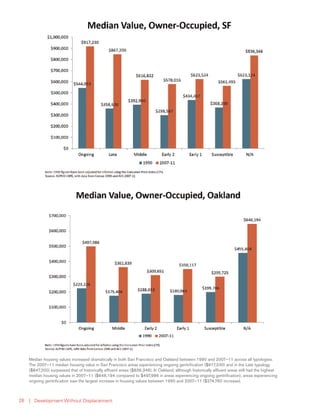
of “smart growth” planning principles has encour-
aged urban planners to locate new development,
including housing, in high-density areas that are
close to transit and job centers in order to cut
down on greenhouse gas emissions and increase
the opportunities for walking, biking, and public
transportation.157
Public health practitioners are
also working with urban planners to invest in
healthy changes to the built environment. These
changes include new and renovated food stores
that offer healthy options, parks, playgrounds,
and urban gardens, and street improvements that
promote physical activity.158
While these trends
have brought sorely needed resources to neigh-
borhoods that have suffered from decades of
Furthermore, our analysis of racial disparities
in mortality for Oakland revealed that neigh-
borhoods in the latest stages of gentrification
have the greatest disparity between Black /
African American and White mortality rates,
compared with other neighborhoods.147
Furthermore, this disparity in Black and
White mortality rates increases from early to
late stages of gentrification.
Causa Justa :: Just Cause | 49
Beatriz Eugenia
Mendez has been a
member of CJJC since
July 2012. Originally
from Guatemala, she
moved to the U.S. in
1997 looking for a bet-
ter future and better
opportunities. Beatriz
has lived in the Excelsior neighborhood of
San Francisco for the past nine years, hav-
ing moved there after she was evicted from
another unit; the landlord simply told her she
had to leave. After nine years in her current
home, Beatriz is once again facing eviction
and harassment from her landlord. Fortunately,
Beatriz sought out assistance and was re-
ferred to CJJC where she was informed of her
rights as a tenant and told that the landlord
needed a just cause for eviction. Beatriz was
also advised to leave a paper trail and began
paying rent by check and requesting repairs
in writing. The landlord didn’t respond well
and continued to threaten eviction, this time
by having the property management company
send an (invalid) eviction notice. This eviction
experience has been very different from
Beatriz’s eviction from her previous home. This
time around she had the support of her CJJC
counselor and, knowing her rights, has been
able to stay in her home since she was first
threatened seven months ago. However, the
landlord has refused to address repairs over
the last seven months and Beatriz suspects
he wants to make her desperate enough to
vacate on her own.
“I’m thankful that all these protections are in
place … and every time there are protections
people try to find ways to go around them.
I think it’s important to defend yourself and
stay strong, because it’s difficult to move
around especially when there are not enough
economic resources. Now, the rent is really
high and one has to earn at least $5,000,
which is nearly impossible. Protections
have supported me immensely because my
economic situation has changed very much
and knowing my rights and how to defend
myself and how to be stable in one place has
supported me very much.”
— Beatriz Mendez, CJJC Member
disinvestment, research and community expe-
rience are showing that even the most well-in-
tentioned projects can lead to gentrification and
displacement.159
Without protections to ensure
that existing residents can stay and benefit from
neighborhood change, the same communities
who suffered from disinvestment and displace-
ment in the past may be displaced yet again.
While public health has progressed in its ap-
proaches to health and neighborhood develop-
ment, the field still needs to recognize the dan-
gers of displacement. As Wallace and Fullilove
have argued, serial displacement has been driven
by a consistent policy of moving people rather
than improving their living conditions in place.160
Public health practitioners committed to the
well-being of vulnerable communities must learn
from mistakes of the past, including the need for
a broader understanding of health that recognizes
the importance of place and the health-protec-
tive elements of social and community support
systems. This means re-examining the assumption
that moving people is necessarily good for health,
and ensuring that other public agencies, govern-
ment officials, and policymakers do the same.161
As improving neighborhood health becomes a
more commonly accepted goal of urban planning
and development, public health departments
have a unique and pressing responsibility to
ensure that neighborhood change happens in a
way that is beneficial for all. Otherwise, planning
and development strategies advanced in the
name of health may not be healthy or sustainable.
This is not a task that public health departments
can take on alone. The next section outlines the
role that public agencies, including public health
departments, can play in advancing a healthier
and more humane version of development.
| Development Without Displacement50
OrganizingToward a NewVision
for Community Development
Human Development for
Healthy and Sustainable
Neighborhoods
As discussed above, the growing focus on sus-
tainability has led to neighborhood developments
addressing the environmental effects of industrial
production (automobiles, industrial pollution,
and the degradation of urban green spaces).
Unfortunately this approach to sustainability
while necessary, do not address the historic role
of government deregulation and disinvestment.
It has for the most part opened the door for a
greenwashed, yet market-friendly, brand of cor-
porate-led development. While more “walkable”,
transit accessible developments serve eco-con-
scious new residents seeking to live closer to
amenities and work, long time neighborhood res-
idents reap few benefits. So-called “sustainable”
developments generally create many of the same
pressures that fuel gentrification and do not have
the effect of increasing stability for long time
residents and businesses. Working class com-
munities of color have for decades suffered the
brunt of environmental degradation but this new
environmentally conscious approach to develop-
ment does not seem to address either the history
of environmental racism, nor the numerous health
impacts facing working class communities today.
Even as cities strive to develop more “sustain-
able” development plans, or to encourage “tran-
sit-oriented development” and “walkable cities,”
most of the fundamental processes remain the
same. Success is measured primarily by the
amount of new economic activity that occurs,
and the number of new, higher-income resi-
dents that move in. Little consideration is given
to whether the health or economic stability of
current residents is improved.
Collective Action Creates
Human Development
Central to challenging this cosmetic brand of
urban development is challenging the individ-
ualism embedded in popular ideas of “human
development” that pervade urban redevelop-
ment initiatives. Originating from 1970s rational
choice theory and the ideas of conservative
economist Gary Becker, this version describes
the idea of human development as the accumu-
lation of skills that enable individuals to make
rational and profitable decisions. Rather than
strengthening communities and social networks,
Paula Beal’s interest
in housing and
immigrant rights
drew her to the work
of CJJC. Paula is
very active in her
community and has
been renting her
current home in West
Oakland for the past four years. She knows
many of her neighbors and has strong roots
in the community. She has been a member
of CJJC for 10 years.
Causa Justa :: Just Cause | 51
Young CJJC Members Uniting For Justice, Oakland
Homes For All National Campaign Launch, Oakland
proponents of this idea of human development
breed competition and individualism.
This version of human development erases the
history and current lived reality of communities
most impacted by development. It inaccurately
portrays gentrification as a result of competi-
tion between individuals with different levels of
human capital, each exercising their personal
choices about where they live, work, and play,
as opposed to a phenomenon rooted in a long
history of disinvestment and marginalization.
In an individualistic model of human develop-
ment, gentrification is addressed by “empow-
ering” individuals to be more competitive in the
high-pressure technology and housing markets,
both as a worker and as someone looking for
housing. Instead, we propose putting a re-en-
visioned version of collective need and interest
back into the concept of human development. In
our framework of human development, the goal
is to unite, organize, and empower communi-
ties to challenge historic and current inequities
as a means towards building a new vision of
community health and sustainability that ben-
efits all residents. Relationships and alliances
have to be built between different groups that
have been historically impacted by racialized
disinvestment. Communities that have had to
compete with each other for good jobs, hous-
ing, education, need to realize that individual-
istic conceptions of human development have
prevented them from identifying shared interest
and common struggle. Community organizing,
and not competition between individuals, should
be the basis of human development for working
class communities of color.
Gentrification Can Be
Prevented
Gentrification can be prevented, and it can be
stopped in neighborhoods where it is occurring
right now. Gentrification is not inevitable. While
the forces that cause it are global, almost all
development decisions and regulations are set
at the local level. With organized working-class
communities pushing for alternative forms of de-
velopment a lot can be done. With a bold local
public agency leading the way — without undue
influence by political donations from developers,
real estate interests, corporate lobbyists and
landlords — much harm can be prevented.
Many urban theorists, and development theo-
rists generally, point out that a “rising tide lifts
| Development Without Displacement52
all boats” model does not work for economic
development, particularly under capitalism.
Reagan’s trickle-down economics have been
refuted. In fact, is it understood that economic
development in our context is closer to a ze-
ro-sum game, though not entirely. This means as
some get wealthier, others must get poorer.
In urban economics you can see versions of this
playing out with the development of the suburbs
at the expense of the development of the urban
core. As the suburbs developed and capital
development flowed there, the same capital
flowed out of the cities, and those communities
became underdeveloped. As the suburbs pros-
pered, people in cities saw very little, if any, of
the benefits of that development. This process
has begun to reverse over the past several de-
cades, with certain urban communities receiv-
ing a large influx of investment and outer-ring
suburbs experiencing disinvestment.
Those who cannot afford to remain in hot-mar-
ket areas (where investment is happening) end
up in the underdeveloped areas, whether by
direct or indirect forces.
In a single-city model, one could argue that
increased tax revenue from development could
lift the boats of all residents by providing more
services and amenities. Unfortunately, this is
not how the urban development process works.
Those with the financial and political means
tend to advocate for additional resources for
services that benefit them and for amenities
that serve their interests — a dog park around
Lake Merritt, for example, or additional police
patrols in higher-income communities. Services
that meet the needs of low-income communities
of color in historically underdeveloped areas,
like increased bus services or affordable, fresh
foods, are rarely expanded substantially.
So as economic development is poised to enter
a community, what can be done to capture the
economic and human benefits of that develop-
ment for the existing residents, and what models
of development can be encouraged that maxi-
mize human development? Also, what models
of development can be encouraged that do not
take resources from one place and put them in
another, but instead expand resources for all?
Cities and communities need a new vision for
development that will actually improve out-
comes for longtime, working-class residents and
people of color.
In our vision, human development empowers a
community to identify the types of housing, ser-
vices and infrastructure that should be located in
their neighborhood. It ensures that the needs and
opinions of longtime residents are a central part
in defining the vision for neighborhood develop-
ment and change. It supports residents to do this
by providing resources, tools and information;
as well as centralizing decision-making power
in the community. This approach to community
development fosters institutions and enterprises
Art by Melanie Cervantes
Causa Justa :: Just Cause | 53
that have value to the residents, puts protections
in place that prevent displacement and gentrifica-
tion, and results in positive human development
outcomes for all residents of the community.
The Role of Public Agencies
in Promoting Human
Development
Local governments have a unique responsibility
and power to advance this vision of human devel-
opment. This new approach must include a shift
in governmental understandings of development
and health, substantial changes in how land use
planning and development decisions are made,
and implementation of policies to protect against
displacement and promote healthy development
for all. This includes acknowledging the role that
the public sector has played in enabling gentrifi-
cation and displacement through both action and
inaction, and the health consequences of these
decisions. Furthermore, local governments must
learn from mistakes of the past, including recog-
nizing and protecting against the dangers of dis-
placement. As urban development and land use
planning practices move toward a greater focus
on health and equity, public agencies must also
broaden their understanding of health, including
recognizing the importance of strong community
ties and social support for good health. The fields
of public health and urban development must
respect the needs and desires of existing resi-
dents, and see value in the assets, resources, and
relationships that make every community a home,
regardless of income.
Public agencies must also shift their funda-
mental approach to development, so that the
The Mission Anti-Displacement
Coalition Planning Principles For
Community Development
33 We are committed to a community driven
planning process done in an inclusive man-
ner—through community organizing, leadership
training, focus groups and popular education
--that ensures the participation of those mem-
bers of our community who are disenfranchised,
marginalized, and not usually heard.
33 Our planning process will address the economic,
racial, and social inequalities of the status quo.
33 Our planning process will strive to advance the
capacity of the community to address planning
and development issues far into the future.
33 Through our planning process we strive for trans-
parency in the planning and rezoning process
and city accountability.
33 We will struggle to improve democracy in San
Francisco by increasing the participation of
Mission District residents in the decision-making
bodies.
33 We believe that all tenants have a right to safe,
secure, and affordable places to live We support
strong public policies that protect those rights
33 We believe that real estate speculation destabi-
lizes neighborhoods, communities and econ-
omies. We support regulation and controls on
such speculation.
33 We believe that the future of San Francisco as
a culturally vibrant and creative city depends on
its capacity to protect tenants from displacement
and neighborhoods from gentrification.
33 We are committed to building a democratic,
inclusive, and nonviolent movement for social
change to advance these values, beliefs, and
policies.
Positive development models should:
33 Centralize the stability of working-class
residents who reside in the communities
33 Support community organizing and
involve residents in making the actual
decisions that impact the neighborhood
33 Promote and measure positive human
development outcomes in addition to
economic indicators
33 Acknowledge and support the impor-
tance of racial equity, community, and
culture as parts of a healthy community
| Development Without Displacement54
needs of existing communities are prioritized
and residents are viewed as valued partners
and change makers in their own neighborhoods.
This should include significant changes in how
development and land use planning processes
occur, including proactive efforts to partner with
community residents and community-based
organizations to envision and decide on neigh-
borhood change. While important shifts are
happening in many places, such as the improve-
ment of community engagement practices, the
growth of research and planning partnerships
between public agencies and community-based
organizations, and the increased use of health
impact assessments as a decision-making
tool, these approaches must be strengthened,
expanded, and implemented in other cities/
regions so that they become standard practice.
Furthermore, public agencies must measure
the success of development in terms that go
beyond economic activity to capture community
well-being, including the social, cultural, and
health dimensions of prosperity.
Finally, local and regional agencies must im-
plement policies and practices that promote
development without displacement. This means
working with residents to improve their lives,
environments, and opportunities in the place they
call home, including the development of housing
and land use models that support asset-building
and community ownership. Further, these agen-
cies must ensure that neighborhood investments
include protections against displacement and
opportunities for existing residents to thrive in
the places they live. Local governments can also
use their power to protect existing residents from
predatory private development and to incentivize
ongoing investment in all neighborhoods.
As public agencies, community-based orga-
nizations, residents, and private sector actors
all engage in discussions and action around
displacement, public health can play a critical
role in many aspects of this process. While
public health departments are just one organi-
zation in a complex array of agencies, each with
a different role in development, there are key
opportunities for public health to support need-
ed changes. Public health departments can
disseminate research on the health impacts of
displacement, weigh in on the potential health
impacts of new development, connect commu-
nity residents to decision-making processes,
and support policy change to promote com-
munity stability, neighborhood affordability, and
equitable investment in all neighborhoods.
Only when residents and communities are stabi-
lized in the places they call home and included
in the decisions shaping their neighborhoods will
the “improvements” made to their environments
be truly healthy and sustainable. Preventing dis-
placement may be the single greatest challenge
and the most important task in our collective
efforts to create healthy communities for all.
Homes For All Action, San Francisco
Causa Justa :: Just Cause | 55
Policy Findings &
Recommendations
The following section outlines a set of
recommendations based on our analysis
of 14 key policy solutions for preventing
displacement. Our research included a review
of primary and secondary literature, and
our analysis focused on policy design and
function from tenants’ rights and public health
perspectives. The methodology for this research
and analysis, including sources consulted, is
described in detail in Appendix A. Based on this
analysis, we developed a set of cross-cutting
recommendations to strengthen all policies, and
a framework of six key principles for preventing
displacement. Within this framework, we make
specific recommendations for how to maximize
impact for each policy, and we also identify
new “promising policies” that would support
displacement prevention on a broader scale.
Cross-Cutting
Recommendations for Policy
Effectiveness
“Our housing
groups traditionally
have been either
organizations of
or advocates for
homeless individuals
and families,
renters, and tenant
organizations, or
private housing groups/anti-foreclosure
groups. And so, much of their work has
happened in a very siloed way…Homes for
All is the first place where we’re bringing
together all of those constituencies to begin
local grassroots and national campaigns
around [a] housing justice platform ... We
have a lawsuit that we just filed last year
against the FHFA, the Federal Housing
and Finance Agency, because in 2008
under the HERA Law (Housing and
Economic Recovery Act) they established
something called a National Housing
Trust Fund. And the purpose of the fund
is to put money towards the creation and
preservation of affordable housing, which
has been divested from over the last 20
years. The revenue mechanisms for the
National Housing Trust Fund were intended
to be Fannie Mae and Freddie Mac. So,
here you have what has become a public
entity, essentially a public bank since
they’ve been in receivership by the federal
government that is supposed to be putting
up a percentage of their profits each year
into the National Housing Trust Fund in
order to have that go into an investment in
affordable housing. So far we know that
they made $382 million dollars in profit
for 2012 and put not a penny into the
Trust Fund. So, the lawsuit is an example
of where we’re able to link the private
homeowner constituencies with the renter
constituencies, because Fannie Mae and
Freddie Mac are screwing the homeowners
and at the same time with all of the profits
that they’re making they are pushing people
out of their homes, they’re also reneging on
| Development Without Displacement56
the commitment and responsibility to fund
affordable housing for people who would
be renters. So it’s been a really powerful
piece of work that has unified those two
constituents in a really solid way.”
— Rachel La Forest, Executive Director, Right to the City
(RTTC), New York
Based on our research and analysis, all policies
would benefit from the below components:
33 Enforcement is key to ensuring that poli-
cies actually achieve their intended impact
on the ground, both in terms of protecting
vulnerable residents and penalizing negli-
gent landlords, developers, and/or govern-
ment agencies. Enforcement efforts need to
be funded, staffed and undertaken proac-
tively rather than in response to resident
complaints or appeals, so that residents do
not have the burden of proving non-compli-
ance.162
In addition, penalties for non-com-
pliance should be incorporated into policies
that aim to regulate developer, landlord,
and government activity. For example, code
enforcement activities should involve strong
penalties, such as fees and building seizure
and transfer, for negligent landlords in order
to compel action on housing violations.163
Tenant protection policies should include
the right to administrative, legislative and
judicial review.164
In addition, penalties and
incentives for all policies should be de-
signed in order to leverage policies so that
their impact goes beyond the primary policy
goal to incentivize action on anti-displace-
ment efforts more broadly.
33 Protections for vulnerable residents are
crucial in order to avoid negative unintended
consequences for residents caught in the
middle of enforcement.165
For example, if
adequate protections are not established,
enforcement of a city’s housing code could
involve building closure and displacement of
the building’s residents, even if enforcement
is intended to benefit residents’ health.166
Protections can be incorporated through es-
tablishment of legal rights for tenants under
specific policies and through policy design
features that minimize the potential for
displacement. Protections should address
rights under eviction, just compensation in
cases of displacement, right to return if tem-
porary relocation is necessary, and access
to information about rights and opportunities.
33 Community organizing and resident
outreach are crucial in order for policies to
be developed, implemented, and enforced
for maximum positive impact on the popula-
tions who need them most.167
Research has
shown that when residents are directly con-
tacted about their rights and opportunities
under eviction protection law, they are nearly
twice as likely to utilize the policy and legal
processes in place by filing an appeal.168
This finding can apply to other policies as
well. Furthermore, engaging residents and
community-based organizations in policy
development can help to identify and prevent
unintended consequences for vulnerable
populations, such as low-income tenants.169
Community organizing and outreach ensure
that residents have access to the information
they need and can act in a timely manner in
response to changes in their housing and
neighborhood conditions.170
Without such
support, residents may not be able to take
advantage of critical windows of opportunity
to preserve affordable housing and utilize
existing protections against. Community
organizing and outreach efforts should there-
fore be funded in connection to local and
regional anti-displacement strategies.
33 Relocation benefits should be incorpo-
rated into any policy that seeks to regulate
housing activity and the loss of affordable
rental units.171
For example, condominium
conversion regulations should incorporate
relocation benefits as compensation for
residents who are displaced as a result of
their unit’s conversion. In addition, local
Causa Justa :: Just Cause | 57
governments should explore ways to gen-
erate relocation funding through fees and
taxes that are triggered by community stabi-
lizing and displacement prevention policies
that regulate developer activity (such as
Real Estate Transfer Taxes, condominium
conversion regulations, and displacement
impact mitigation fees).
33 Affordable housing policies and pro-
grams should be tied to people in the
same neighborhood. Gentrification and
displacement have neighborhood-level
impacts and thus require solutions that can
be targeted to the specific needs of a given
neighborhood. Mitigation fees and taxes de-
signed to minimize the impacts of displace-
ment and raise funds for affordable housing
are not often designated for use in particular
neighborhoods. Furthermore, “in-lieu” fees in-
corporated into inclusionary housing policies
are often chosen over on-site development
of affordable units,172
Thus, policies designed
to regulate housing activity through monetary
penalties may not benefit residents in the
same neighborhood where the development
is taking place. Furthermore, affordable
homeownership programs like homebuyer
assistance programs do not often focus on
supporting residents to stay in their existing
homes and neighborhoods. Without this
focus, homebuyer assistance programs may
support low and moderate income residents
in building valuable assets, but they are less
likely to prevent displacement at the neigh-
borhood level.173
To address these issues,
policies or programs that provide affordable
housing through new construction or rehabili-
tation should include preferences for existing,
low-income, and longtime residents in the
same neighborhood. In addition, affordabil-
ity requirements and incentives within new
housing (such as inclusionary zoning pol-
icies) should be based on actual resident
income and affordability needs within the
neighborhood. Finally, any mitigation fees or
“in-lieu” fees generated by new development
should be prioritized for use within the same
neighborhood where the triggering develop-
ment is located.
33 Policies need to be advanced at the
right stage. While some policies are
most effective and feasible in later stages
of gentrification, many policies should be
implemented when neighborhoods are
susceptible to or in early stages of gentrifi-
cation, in order to prevent substantial loss
of affordable housing and protect vulnerable
residents before the community is destabi-
lized.174
In addition, because policies take
time to implement and neighborhoods can
change quickly, all policies should be im-
plemented in the earliest stage appropriate.
See our below recommendations for notes
on staging each policy based on neighbor-
hood type. For an overview of our neighbor-
hood typologies analysis and definitions of
neighborhood types, see Appendix A.
33 Multiple policies need to be advanced
at once to address the complex nature of
displacement. Multiple forces and actors
drive displacement, including government,
landlord, developer, investor, and individual
resident activity. Similarly, displacement is
impacted by different levels of decision-mak-
ing, including federal, state, regional, and
local. Individual policies often intervene in
only one of these driving forces and/or com-
pel action by one kind of actor at a time. The
most promising strategy for preventing and
minimizing displacement is by advancing
multiple policies and practices, at multiple
scales, and tailored to the specific needs
of neighborhoods and cities.175
The frame-
work presented in the Principles, Policies
and Practices section, below, organizes our
individual policy recommendations under six
key principles, each of which is essential for
preventing displacement.
33 Equity impacts should be central to
the policy debate about development
and neighborhood change. One way to
support the adoption of stronger anti-dis-
placement policies is to proactively shape
| Development Without Displacement58
the public and policy debate on develop-
ment and gentrification by ensuring that
social equity impacts are always discussed
and considered in relation to development
decisions.176
This means acknowledging
the structural causes of gentrification and
displacement, including the public sector
actions and decisions that lead to gentri-
fication, and discussing/documenting the
potential impacts of planning and develop-
ment decisions on long-term residents of
the city. This approach can be built into pol-
icy decisions at the local and regional level
through community health impact analyses
that include targeted questions about equity
impacts, a methodology for predicting
displacement-related impacts, and a formula
for calculating monetary value of impacts for
translation into mitigation fees, as discussed
later in this report.
33 Dedicated funding is needed to ensure
the success of many of the policies, pro-
grams, and practices discussed in this
report. Funding is necessary not only for
policies that involve subsidies but also for
adequate enforcement and outreach to
affected residents about their rights and op-
portunities. Local and regional governments
should explore multiple funding sources to
support anti-displacement efforts, including:
33 Fees collected on landlords through fines
and registration of buildings, and fees levied
on developers through mitigation fees.
33 Taxes attached to property sales (including
Real Estate Transfer Taxes), and other taxes
such as document recording fees. Care
should be taken to avoid regressive taxes.
33 Local funds, such as housing trust funds
and relocation funds, which may already
exist in several cities. If they don’t already
exist, relocation funds should be created at
the local level to ensure adequate support is
available for the exclusive purpose of com-
pensating residents faced with displace-
ment and assisting them in identifying and
securing high quality replacement housing.
33 State funding sources, such as potential
cap-and-trade revenue that may become
available to support healthy and sustainable
development projects.
33 Federal funding sources, such as
Community Development Block Grant
(CDBG), HOME, and Federal Promise
Zone funding. The downward trend in feder-
al funding for affordable housing creates an
environment in which revenue-driven de-
velopment projects are supported by local
governments, and it is difficult to provide
the depth of subsidies that are needed to
ensure truly affordable housing to long-
term residents. Local and regional agencies
should seek creative ways to apply existing
federal funding sources and advocate for in-
creased and/or renewed funding for afford-
able housing and community development.
Art by Dignidad Rebelde
Causa Justa :: Just Cause | 59
Principles,Policies & Practices
for Preventing Displacement:Advancing a Comprehensive Housing Rights Framework
Displacement is driven by multiple forces,
actors, and levels of decision-making and thus
requires multi-faceted solutions. The below
framework outlines six complementary principles
that we believe are essential for preventing
displacement. No single principle is a solution
on its own; rather, these principles should be
advanced in tandem, as each addresses a
unique aspect or cause of displacement.
OUR SIX KEY PRINCIPLES INCLUDE:
1.	 Baseline protections for vulnerable
residents
2.	 Production and preservation of
affordable housing
3.	 Stabilization of existing
communities
4.	 Non-market based approach-
es to housing and community
development
5.	 Displacement prevention as a re-
gional priority
6.	 Planning as a participatory process
On the following pages, we discuss policies
and practices that fall under each principle and
make recommendations for how to strengthen
each policy for maximum impact. As each is in-
troduced, we provide our synthesized findings
from the research and analysis, and we also
highlight examples of strong “model” policies.
We include implementation considerations,
including responsible agency, stage of gentrifi-
cation most effective, and where possible, ideas
for enforcement. In addition to the policies that
were researched and analyzed in depth, we also
highlight several “new” policies and practice
ideas revealed through our research or arising
from dialogue with partners and stakeholders.
These are promising policies and practices for
which there may be limited existing research.
We include these in our recommendations be-
cause we believe they would support displace-
ment prevention on a broader scale by address-
ing gaps in other policies and/or by increasing
transparency, participation, and accountability
in local land use planning and development
processes. Each of these policy ideas is indi-
cated with a [PP] for “Promising Policy” and
introduced with a rationale for inclusion. Where
possible, we also highlight examples of where
these ideas have been implemented.
Note on staging: We highlight the
stage(s) of gentrification at which the policy
would be most appropriate or effective in
preventing displacement, due to housing
activity, affordability of housing and land,
and/or likelihood of displacement pressure
on vulnerable residents. Our assessment of
staging is based on recommendations from
literature and our own analysis. Because many
policies discussed in this document would
| Development Without Displacement60
be implemented citywide, these policies
should be implemented as soon as any
neighborhood within the city reaches the stage
of gentrification indicated. In addition, some
policies include a suggested staging of “early
and always” as they do not depend on specific
neighborhood conditions and may be critical
to establishing an environment in which other
anti-displacement efforts will be successful.
These stages correlate with the neighborhood
typologies analysis and definitions outlined
in Appendix A. For the purpose of these
recommendations, we have grouped the
neighborhood types into three broad stages:
Early, Middle, and Late. The below table outlines
which neighborhood types fall under each of
these stages:
EARLY MIDDLE LATE
Susceptible Middle stages Late stages
Early type 1 Ongoing
gentrification
Early type 2
A. Baseline Protections for Vulnerable Residents
Implementing baseline protections to prevent displacement of existing vulnerable residents is an
essential foundation for any anti-displacement strategy. These include protections to: 1) keep people
in their homes in the face of gentrification and displacement pressures from landlords and the hous-
ing market; 2) ensure that new affordable housing resources are made available to those who need
them most; and 3) provide just compensation measures to assist residents with relocation in cases
of displacement.
1.	 Protect vulnerable residents from dis-
placement through “Just Cause” eviction
ordinances. Local data and existing research
has shown that evictions increase as neigh-
borhoods experience gentrification.177
When
housing markets are tight and residents are
given minimal warning and support to find
replacement housing, evictions can lead to
permanent displacement from neighborhoods.
In order to prevent low-income tenants from
being unfairly evicted by their landlords in the
context of gentrification, cities should imple-
ment these ordinances to protect tenants
in all residential rental properties within the
city. Included in these ordinances should be
a list of “just causes” for eviction and legal
rights for tenants who are faced with evic-
tion, including a clear legal process for filing
eviction petitions as well as penalties, includ-
ing fees and limited access to tax and other
financial assistance, for landlords who unjustly
evict tenants. Ordinances should require an
adequate window of time, at least 30 days,
is given for tenants to respond to eviction no-
tices. Relocation benefits should be required
for all “no-fault” evictions (including Owner
Move-In, Ellis Act, capital improvement/reha-
bilitation, demolition, and code enforcement
activities). See A4 below for more details
on relocation benefits recommendations.
Furthermore, evictions should be prohibited in
cases of building seizure and transfer due to
code violations, and no-fault evictions should
be prohibited for those particularly vulnerable
to the impacts of displacement, such as the
elderly, disabled, pregnant women, house-
holds with infants, and chronically ill tenants.
33 Implementing Agency: Cities
33 Staging: Early and always
33 Model: San Francisco, CA: Just Cause
for Eviction ordinance178
Causa Justa :: Just Cause | 61
SUMMARY OF ANALYSIS FOR JUST CAUSE EVICTION ORDINANCES
Community Ownership and Power
Affordability and Housing Stability
Housing Quality / Habitability
Permanence and Loopholes
Unintended Consequences
Policy strengths:
»» Some evidence suggests that Just Cause
Eviction ordinances can pave the way for
future tenant protections.
»» Creates new legal rights for tenants to
prevent eviction and protect them in cas-
es of eviction.
»» Promotes housing stability for renters by
supporting them to stay in their homes.
»» When combined with rent control, can
promote neighborhood-level affordability
by preventing and minimizing opportunities
for rent hikes during vacancies caused by
evictions. In California, because of vacan-
cy decontrol, it’s particularly critical to have
strong local eviction protections.
»» If combined with code enforcement
efforts, can promote housing quality for
renters by providing right of first refusal
in cases of temporary “no-fault” evictions
due to housing renovation, capital im-
provement, and rehabilitation.
»» Scale may be larger than rent control, as
state level laws (such as in CA) limiting
which buildings can be covered by rent
control may not affect buildings covered
by just cause eviction protections.
Concerns and considerations:
»» Only effective if tenants know their rights
and how to respond to eviction through
legal means.
»» May be ineffective in preventing displace-
ment without rent control or vacancy
control laws, even when right of first
refusal provisions are included, as newly
renovated unit may be unaffordable to
original tenant.
»» May be ineffective in stopping displace-
ment in cases where landlords consis-
tently use “buy-out” offers to encourage
tenants to move out of their units.
Cecilia Alvarado, CJJC member since October 2013.
Cecilia Alvarado, 43, has been living in the area arond San Francisco’s
Mission neighborhood since she emigrated from El Salvador at the age of
19. Her experience as an immigrant highlights the community resources
that get dispersed, then lost, as a result of gentrification. Cecilia grew up
in Cali, Colombia. After violence broke out in the 1970s, Cecilia’s parents
moved the family to El Salvador, just as political coercion was resulting
in widespread violence. After a violent confrontation with militants just
across from her university, Cecilia moved to the U.S., with the phone number of her grandfather,
a San Francisco resident, in hand. While Cecilia did not find her grandfather, she found a deeply
supportive community in San Francisco’s Mission district, where a priest and Salvadoran refugee
groups gave her shelter and helped her find employment and housing. Decades, later she has
raised three children in San Francisco, all of whom grew up “in the heart of the Mission.”
Late last summer, Cecilia’s landlord, who lives in Foster City, announced a spike in rent that
Cecilia found unjust and exaggerated. She experienced phone threats and harassment by the
bond attorneys hired by her landlord, who went as far as to post multiple eviction notices in public
| Development Without Displacement62
view. Later, Cecilia found out that her landlord intended to evict her, make repairs to the small
Potrero studio, and rent it for $1,500, whereas she paid $850 for the studio in need of repairs.
Cecilia sought help from Causa Justa and looked into the legality of the eviction threats she was
experiencing. She found that her landlord had her studio registered as a commercial property,
enabling her to avoid rent control restrictions and to pass on utility charges to tenants. Cecilia
also found a history of renting to undocumented immigrants, who were easily evicted in the past.
Cecilia, who did not receive receipts for her rent payments, began to pay using money orders or
checks to keep a personal record of her payments. When confronted with the information Cecilia
gathered, the San Francisco Rent Board found her eviction unjust. After a personally draining
and expensive court procedure, Cecilia was unable to prevent the $200 rent increase, but was
able to change her rental studio’s status from commercial to residential, removing the burden of
utility payments and uncontrolled future rent increases.
Cecilia laments the rapid transformation of the community that helped her settle in after
escaping political unrest in El Salvador.
2.	 Establish strong anti-harassment poli-
cies to prevent landlords from coercing
tenants into leaving their homes due to
negligence, intimidation, or buy-out of-
fers. [PP] Even when eviction protections ex-
ist, landlords may still push tenants out of their
homes through various forms of harassment,
coercion,179
and/or neglect of basic proper-
ty maintenance and repairs. These kinds of
action and inaction can make low-income
tenants’ housing conditions uninhabitable
and thus result in their displacement. Cities
should establish policies that prohibit tenant
harassment by clearly defining harassment to
include: failure to provide housing services
in line with housing, health, and safety laws;
attempts to coerce tenants to vacate units
with intimidation and offers of payment; and
interference with a tenant’s right to quiet use
and enjoyment of rental housing. Cities should
set limits on the number of “buy-out” offers a
landlord can make to each tenant and within
the same building, and establish a registry
of buy-out evictions that can be tracked at
the neighborhood level by local rent boards
or another administrative body charged with
overseeing local tenant protection and hous-
ing policies. Incidents of harassment should
result in citations and fines as part of a city’s
existing practice of enforcing housing and
health codes, and the policy should include
the right of action for individuals and organiza-
tions to sue landlords on behalf of tenants.
33 Implementing Agency: Cities
33 Staging: Early and always
3.	 Implement a comprehensive “right of
first refusal policy” to maximize oppor-
tunities for existing residents to stay
in their homes. Even when “just cause”
eviction ordinances are in place, temporary
relocation required for housing repair, reha-
bilitation, or conversion activities can lead to
permanent displacement of existing residents.
This is particularly likely if residents do not
receive clear information about when units
are ready to be re-inhabited, or if they do not
know their landlord intends to re-rent or sell
the unit at a higher price. In order to minimize
displacement of existing residents, cities
should pass a “right of first refusal” policy to
require any housing unit renovated through
Causa Justa :: Just Cause | 63
redevelopment, rehabilitation (including due
to code enforcement activities), conver-
sion, or subdivision to be offered to existing
tenants first, before being sold or re-rented
on the private market. Furthermore, original
tenants should be given the right to return at
prior rent levels, including any covered rent
adjustments.
33 Implementing Agency: Cities
33 Staging: Early and always
SUMMARY OF ANALYSIS FOR RIGHT
OF FIRST REFUSAL POLICY
Community Ownership and Power
Affordability and Housing Stability
Housing Quality / Habitability
Permanence and Loopholes
Unintended Consequences
Policy Strengths:
»» Creates legal rights for individuals and
families faced with displacement.
»» Can support housing stability for existing
tenants by giving them an opportunity to
return to their original homes after tempo-
rary relocation.
»» Can increase housing quality by support-
ing tenants to return and benefit from ren-
ovations or rehabilitation of their original
unit.
Concerns and Considerations:
»» Right of first refusal policies may be inef-
fective in preventing permanent displace-
ment because newly renovated / convert-
ed units may be unaffordable to original
tenants.
4.	 Strengthen local relocation policies to
ensure that any resident displaced as
a result of a no-fault eviction, including
building closure due to uninhabitable
conditions, or publicly funded devel-
opment activity receives just compen-
sation and comprehensive relocation
assistance. Federal law requires relocation
assistance be paid to any resident displaced
as a result of federally funded development
activity.180
However, this assistance has his-
torically been inadequate and residents have
fallen through the cracks due to poor record
keeping, inadequate staffing, and unmet or
vague promises to return residents to their
neighborhoods.181
To address these holes,
cities should pass relocation policies attached
to dedicated funding that will provide com-
prehensive benefits above and beyond what
federal law requires, including benefits for resi-
dents displaced due to no-fault evictions in the
private market. Relocation fees should be paid
to residents by the city in cases of publicly
funded development activity and by landlords
in cases of no-fault eviction. This assistance
should include direct monetary compensation
for the costs of moving (calculated retroactive-
ly), as well as the cost of at least three months’
fair market rent plus additional benefits for
households with residents who are elderly
(65 years or older), children below age 18,
or disabled and/or chronically ill. In addition,
all displaced residents should receive access
to case management services that will work
with them to identify affordable, high quality
replacement housing that meets their needs
within the same neighborhood, if possible, or
within the same city at a minimum. Case man-
agers should work with residents to secure
new housing, including navigating any barriers
to eligibility related to credit and outstanding
utility and rent bills. As part of these case
management services, all residents should
be consulted about their housing needs and
| Development Without Displacement64
interest in staying in the city, and their contact
info should be tracked in a database of relo-
cation information. Relocation policies should
also include a “build or find it first” provision to
protect residents from being moved before ad-
equate replacement housing is identified, and
all replacement housing should be inspected
for compliance with housing codes before
being offered to displaced residents.
For residents relocated by public development
activity, efforts should be made to minimize
barriers to eligibility for replacement housing,
and new criteria beyond what was required
for original housing — such as eviction history
and criminal records — should not be a basis
for acceptance into new subsidized housing.
If no adequate relocation housing is available
within the city at the time it is needed, cities
should consider paying additional benefits to
residents to compensate them for displace-
ment from the city.
In cases of temporary relocation due to
rehabilitation or code enforcement activities,
residents should be given clear timelines for
relocation. They should also be paid relocation
expenses up-front and an additional amount
retroactively, depending on the length of time
they were displaced. In addition, temporarily
displaced residents should have the right
to return at prior rent levels, including any
covered rent adjustments. Residents should
also receive additional benefits if displaced
for more than one year. Local relocation funds
can be generated in part by impact fees as
discussed in F5.
33 Implementing Agency: Cities
33 Staging: Early and always
33 Models: San Francisco, CA: Tenants’
Rights to Relocation for No-Fault
Evictions18
SUMMARY OF ANALYSIS FOR
RELOCATION POLICIES
Community Ownership and Power
Affordability and Housing Stability
Housing Quality / Habitability
Permanence and Loopholes
Unintended Consequences
Policy Strengths:
»» Create legal rights for residents facing
displacement.
»» Can support improved housing quality
if residents are able to move to a high-
er quality replacement unit and/or a
neighborhood with greater access to
health-promoting resources.
»» If strong provisions are included to incen-
tivize relocation within the same neighbor-
hood and/or city, could slow or minimize
displacement of existing residents.
Concerns and Considerations:
»» Relocation benefits often do not prevent
displacement; rather, they compensate
residents for displacement and support
residents in moving to new homes and
neighborhoods.
»» Without adequate support identifying
high-quality replacement housing in a
preferred location, residents could end up
in a neighborhood with fewer health-pro-
moting resources and institutions.
»» Without strong penalties and enforce-
ment, including incentives for the city to
identify affordable replacement housing
within the same neighborhood/city, re-
location benefits could actually facilitate
displacement of residents from the city.
»» Relocation services are costly to staff, and
adequate staffing is a crucial for success-
ful relocation services.
Causa Justa :: Just Cause | 65
Melissa Jackson, one of the newest members of CJJC, joined the
organization a few months ago because her rent increased by more
than she could afford. Melissa had been renting a condo in Oakland’s
Chinatown since 2009. The landlord found out from the Housing
Authority that it was illegal to charge Melissa for electricity as a Section
8 holder and, therefore, raised rents to make up the difference. The
Housing Authority was unwilling to pay the difference in rent at the higher
rate, forcing Melissa to relocate. At 78 years old, this was a very stressful
situation for Melissa who worried she may end up homeless. With help
from her granddaughter she was able to eventually locate another rental unit in West Oakland,
but the experience was extremely stressful. Her only relocation assistance came from her family
network. Without family she would likely have ended up in a far worse situation.
5.	 Implement a “reparations and right to re-
turn” policy that prioritizes a certain percent-
age of new affordable housing units for resi-
dents and families who were displaced from
the same city due to publicly funded redevel-
opment projects. This policy should be con-
sidered and adopted by cities in which past
redevelopment projects resulted in permanent
displacement of large numbers of residents.
This policy should be tied to the creation of a
centralized database of contact information for
residents and families displaced by publicly
funded redevelopment projects. It should also
include funding for outreach staff to consult
with residents about their interest in returning
to the city, and inform displaced residents
about their rights, financial resources, and
housing opportunities. Goals should be set
for returning a certain number of displaced
residents and family members each year, and
priority should be given to residents from pop-
ulations who were disproportionately affected
by publicly funded redevelopment, including
populations of color and low-income residents.
The same relocation assistance as discussed
in A4 should apply, including pre-inspection of
all eligible housing to ensure compliance with
housing codes and assurance that eligible res-
idents have clear information about available
housing, a timeline for relocation, and financial
assistance opportunities. Funding for this
could come from a local relocation fund and
be supplemented with federal sources.
33 Implementing Agency: Cities
33 Staging: Early and always
33 Model: Hamtramck, MI: Housing repa-
rations for residents and families formerly
displaced by urban renewal.18
SUMMARY OF ANALYSIS FOR RIGHT
OF RETURN POLICIES
Community Ownership and Power
Affordability and Housing Stability
Housing Quality / Habitability
Permanence and Loopholes
Unintended Consequences
Policy Strengths:
»» Can provide justice to communities
harmed by historic urban policy and re-
verse patterns of displacement.
»» Creates new rights and preferences for
residents affected by displacement in
the past and contributes to restoration
| Development Without Displacement66
Gilda Haas, organizer, urban planner, and faculty at Antioch University in
Los Angeles, discusses the Scott-Carver Homes Project in Miami, FL, and
Right of Return policies.
“There was an example in Miami where they tore down public housing
and they were negotiating to build some public housing and they
realized that the housing authority had kept terrible records of who was
displaced and where they were, because it was years later, and they
couldn’t retrieve any information. So the Miami Workers Center put up
a huge sign on the lot [where the former housing project stood] and
asked people to come and put down names of people that they [used to know/who used to live
there] — because the community remembered … and the community became the owner of the
knowledge and producer of the knowledge…
…In order to have a right to return it has to be meaningful, it has to be protective. Having a
timing mechanism is really important … One of the problems about relocation and the right to
return is that it’s separated from any housing stock. It’s a disembodied right. It doesn’t have any
units connected to it. It doesn’t have any permanence. So even if you put someone in housing
that is comparable in terms of price, how long is it going to be that way? Or, if you say we’re
going to make up for the difference, we’re going to give you relocation benefits to make up for
the difference in the price, what happens when those expire? … People have to be really, really
clear on the goals as opposed to a negotiated agreement in the moment. So if the goal is to keep
people whole, for how long? Does it have to be in this neighborhood? What are you trying to
accomplish?”
— Gilda Haas, Organizer, Urban Planner, and Faculty, Antioch University
of community social networks and
institutions.
»» Can increase housing quality if residents
are able to move to new units that are
of higher quality compared with their old
homes.
Concerns and Considerations:
»» Without substantial affordable hous-
ing production connected to long term
affordability conditions, clear timelines,
goals, and penalties, this policy may be
ineffective or extremely slow in returning
displaced residents and families to their
original neighborhoods.
»» Right of return policies are primarily mit-
igation policies, designed to minimize or
redress the harms of past displacement.
However they are not displacement pre-
vention strategies.
»» Right of return policies are limited to res-
idents who are displaced due to publicly
funded housing activity. This would not
address residents displaced as a result of
private housing activity, including unjust
evictions.
»» Because they prioritize displaced res-
idents, right of return policies could
limit the supply of affordable housing for
existing/new low and moderate income
residents in search of housing.
Causa Justa :: Just Cause | 67
B. Production and Preservation of Affordable Housing
While new affordable housing construction is most often recommended as an anti-displacement
strategy in new development, this strategy does not actually prevent displacement of existing
residents without a simultaneous effort to preserve existing supply. Furthermore, preserving
affordability within existing units is more cost-effective than producing new affordable units
altogether.184
In order to maintain neighborhood affordability and truly prevent displacement,
affordable housing resources should be dedicated to the preservation of existing affordable
housing stock, including both the number of affordable housing units as well as the preservation
of affordability within specific buildings. In order to maintain overall supply of affordable housing
in relation to new market-rate housing, efforts should be made to incentivize affordable housing
production within all new development. Affordable housing stock should be understood to include
any privately or publicly owned housing that is affordable to families earning below 80 percent of
the Area Median Income (AMI). Furthermore, cities and counties can play a key role in preservation
by utilizing public assets (including public land) for affordable housing preservation efforts185
and
advocating for increased and renewed funding for affordable housing at the state and federal levels.
1.	 Implement a “No Net Loss” policy at the
city level to require all affordable units lost
through renovation, conversion, or demolition
be replaced within the same neighborhood
if possible and within the same city at a
minimum. Cities should pass this policy to
ensure preservation of all housing units in the
public or private market that are affordable for
households that fall within low, very low, and
extremely low income brackets (80 percent
Area Median Income and below, 50 percent
AMI and below, and 30 percent AMI and
below). Conduct a baseline assessment of
affordable housing units within the city, broken
down by neighborhood and affordability level
(by income bracket). This inventory should
include information on number of units, rent
level of units, household size, and income of
inhabitants. Inventory should include non-
traditional housing units, such as residential
hotel units. A moratorium on demolition,
conversion, or other major rehabilitation that
would result in loss of affordable housing
should be established until inventory is
complete. Based on this inventory, cities
should set goals for preservation within each
bracket by neighborhood. These goals can be
met through a combination of preservation,
production, and inclusionary housing policies.
All future housing activity within the city
(including production and loss of affordable
units due to demolition, conversion, expiring
subsidies, rehabilitation, and rent increases)
should be measured against the preservation
goals set in each income bracket. In order to
incentivize cities to meet housing preservation
goals, regional agencies should consider
making preservation performance part of the
eligibility criteria for regional grant funding
opportunities.
33 Implementing Agency: Cities
33 Staging: Middle to late stages of
gentrification
33 Models: Portland, OR: Central City No
Net Loss Policy;186
and Los Angeles, CA:
Downtown Redevelopment Plan No Net
Loss Poicy187
| Development Without Displacement68
SUMMARY OF ANALYSIS FOR NO NET
LOSS POLICY
Community Ownership and Power N/A
Affordability and Housing Stability
Housing Quality / Habitability
Permanence and Loopholes
Unintended Consequences
Policy Strengths:
»» Supports long-term neighborhood and
city-level affordability by ensuring that the
overall supply of affordable units does not
decrease over time, even as specific units
or buildings are lost.
»» If used to incentivize preservation of ex-
isting units, including renewal of subsidy
contracts and/or affordable rents, can sup-
port housing stability for existing residents.
»» If adequately enforced, may be the
most effective way to guide preserva-
tion efforts within a city as they create a
comprehensive and accurate portrait of
affordable housing supply.
Concerns and Considerations:
»» No net loss policies are only meaningful
if the baseline inventory includes both
subsidized and unsubsidized housing, as
well as non-traditional housing units (such
as residential hotel units). If staff are not
funded to undertake the inventory in a
comprehensive and quick manner, unde-
tected loss of units may occur while the
inventory is being completed, limiting the
impact of preservation goals and delaying
the implementation of monitoring activity.
»» If preservation goals are not specified
at the neighborhood level, may not stop
displacement from gentrifying areas.
»» Monitoring all housing activity in a given
area may be costly and time-intensive.
»» Without strong penalties and funding,
preservation goals may be difficult to meet.
“The crux of the matter is, how do you take units off the speculative market? What are anti-
speculation devices? Because it doesn’t matter what you do. You can slow things down, but if
everything else is increasing property values and increasing the desire to push people out then
that’s what will happen. And inflated property values are the biggest source of displacement
… In poor neighborhoods that are changing, that are becoming rich neighborhoods, or low-
value neighborhoods that are becoming high-value neighborhoods real estate-wise, it might be
counterintuitive, but slum housing conditions actually get worse when property values go up
because if it’s a slum landlord it’s not like they’re a good guy. And their intention is either to flip
the property or tear it down. And so they’re not going to invest any money in repairs. People
get pushed out because they [landlords] stop operating the elevator or people get pushed
out because the plumbing hasn’t worked. There are lots of ways to push people out. There’s
examples in Skid Row [in Los Angeles] where people got pushed out because someone came
to their door with a gun and said you have to move right now. That’s an extreme example. Most
of the other examples are increasing the immiseration of poor folks. Making it scary. You know,
calling child protection on them because the children are living in conditions that the landlords
themselves … provided. … It’s really speculation. So to the extent that the requirements … for
replacing units upfront [are clear and create] a situation where there’s never any net loss of
units [is key].”
— Gilda Haas, Organizer, Urban Planner, and Faculty, Antioch University
Causa Justa :: Just Cause | 69
2.	 Advance an affordable housing preserva-
tion strategy that is tied to preservation
goals set at the city level. Cities should ini-
tiate proactive affordable housing preservation
strategies that include the renewal of affordable
housing contracts and/or affordable rents, as
well as the purchase and transfer of vacant or
neglected property to non-profits or tenants’
groups for maintenance as affordable housing.
In order to encourage preservation of affordable
housing in the private market, cities should cre-
ate compelling incentives for landlords to renew
affordable housing contracts (if subsidized) and
maintain affordable rents in private housing mar-
ket if properties are not covered by rent control
and vacancy control. Incentives could include
financial assistance to cover the cost of needed
repairs and rehabilitation or tax abatements in
exchange for renewing long-term affordability
contracts.
Cities should target their acquisition efforts
on properties currently held by negligent
landlords and banks in neighborhoods where
foreclosure impacts are high. To support these
efforts, cities should consider establishing the
“right of first refusal” for the city, non-profit
organizations, and tenants’ associations when
the owner of any publicly subsidized housing
property proposes to sell or transfer their
property. Efforts to acquire and/or transfer
property should include protections that
prevent eviction of existing tenants during
property transfer and sale. As part of a
proactive preservation strategy, cities should
actively monitor rent levels and affordable
housing contracts for expiration and mortgage
pre-payment, and this data should be shared
with community groups and regional agencies
for inclusion in a publicly accessible “early
warning” database, as recommended in A5.
This data should be used to target contract
renewal and acquisition efforts on properties
that are due for expiration and/or conversion to
market rate housing.
33 Implementing Agency: Cities
33 Staging: Early, middle, and late stages of
gentrification
33 Models: San Francisco, CA: Assisted
Housing Preservation Ordinance;188
and
Chicago, IL: Organization of the Northeast
(ONE) preservation efforts89
SUMMARY OF ANALYSIS
FOR AFFORDABLE HOUSING
PRESERVATION EFFORTS
Community Ownership and Power
Affordability and Housing Stability
Housing Quality / Habitability
Permanence and Loopholes
Unintended Consequences
Policy Strengths:
»» If coupled with a property acquisition and
tenant ownership strategy, preservation
efforts can expand community ownership
over housing and neighborhood conditions.
»» Can prevent displacement by maintain-
ing affordable rent levels for low-income
residents.
»» Contributes to neighborhood and city
level affordability by maintaining supply or
minimizing the loss of affordable housing.
»» Preservation efforts can improve housing
conditions if the incentives provided to
landlords involve financial assistance for
rehabilitation and repairs.
Concerns and Considerations:
»» If preservation efforts focus on contract
renewal for project-based housing subsi-
dies, the permanence of these efforts will
only be as long as the new contracts.
»» Contract renewal efforts are only effec-
tive if tenants, community organizations,
and the city keep track of buildings with
subsidy contracts, type of subsidies, and
contract expiration dates.
| Development Without Displacement70
3.	 Implement rent control policies to set
maximum annual rent increases and pro-
vide clear legal avenues for tenants to
dispute rent increases, in order to mini-
mize displacement of low-income ten-
ants. Cities should pass rent control along
with the establishment of a rent board or other
administrative agency tasked with enforcing
rent policies, educating the public about
tenants’ rights, and responding to tenant
and landlord disputes. Rent control policies
should cover all residential rental properties,
depending on state legislation.190
As part of
a rent control policy, cities should prohibit
or limit rent increases due to needed reha-
bilitation, renovation, or mortgage and debt
service (capital improvements), which serve to
maintain basic levels of housing habitability. If
not prohibited by state legislation, rent con-
trol policies should include vacancy control
measures to prohibit the raising of rent upon
vacancy of covered units. Fees should be paid
by landlords of covered buildings to cover
administration and enforcement costs. Cities
should ensure significant tenant representa-
tion on rent boards or any other administrative
oversight body tasked with making decisions
on rent disputes and amending and enforc-
ing rent control policies. Local and regional
jurisdictions should advocate for needed
changes at the state level, including changing
legislation that limits vacancy control and the
number and type of buildings covered by rent
control.
33 Implementing Agency: Cities
33 Staging: Middle to late stages of
gentrification
33 Model: San Francisco, CA. Rent
Ordinance91
SUMMARY OF ANALYSIS FOR RENT
CONTROL
Community Ownership and Power
Affordability and Housing Stability
Housing Quality / Habitability
Permanence and Loopholes
Unintended Consequences
Policy Strengths:
»» Establishes new legal rights for tenants,
and can establish the foundation for
broader tenant protections within a city.
»» Very directly affects affordability at neigh-
borhood level by limiting rent increases
within private housing market.
»» If rent control policies prohibit rent hikes
due to renovation and rehabilitation, they
can support improvements in housing
quality by maintaining affordability for
existing residents and allowing them to
benefit from improvements.
Concerns and Considerations:
»» Affordability controls are not tied to specif-
ic residents, so there is no way to ensure
that those who benefit are those who
need protections the most.
»» Impact of rent control in California is
limited due to state level legislation that
prohibits vacancy control and excludes
condos and single-family buildings from
being covered by rent control policies.
Without vacancy control, rent control pol-
icies are easily avoided by landlords who
find reasons to evict residents.
»» Rent control is regularly attacked by land-
lords and developers and requires a strong
tenants’ rights coalition to sustain over time.
»» If enforcement is solely based on tenant
appeal, and if tenants don’t have access
to legal services and information about
their rights, landlords may get away with
illegal rent hikes.
Causa Justa :: Just Cause | 71
Cleo Pitts, a CJJC member for more than a decade, has lived in East
Oakland for the last 32 years. He had been the manager of his apartment
complex for almost three decades, until 2005. As a neighborhood watch
captain and former housing manager, residents often come to Cleo
for assistance. In addition to resident safety and building maintenance
concerns, Cleo has also been battling with the landlord over unlawful
rent increases and has had to prepare for hearings on the matter. Being
on a fixed income, like many other tenants in the complex, he sees the
rent hikes as unfair and unlawful. As an advocate and representative of
his community he is committed to fighting for what is right.
4.	 Establish condominium conversion regu-
lations to limit the number and type of housing
units that can convert from rental to for-sale
condominium units within a given year. Cities
should establish these kinds of regulations
in order to minimize loss of affordable rental
housing and the resulting displacement that
can occur for low-income tenants. Eligibility
for conversion should be based on a lottery
system, plus code violation history, eviction
history, and majority of units in building owner
occupied. Regulations should specify tenant
protections to prevent displacement of vulner-
able residents during the conversion process,
including right of first refusal for existing tenants
and relocation benefits for any tenant who is
forced to move because they cannot afford
the new price of the unit. In addition, seniors,
disabled, and chronically ill tenants should have
the right to a lifetime rent-controlled lease under
any conversion. All other tenants should have
the right to one year of a rent-controlled lease
after the unit is converted. Owners should be
charged a fee for conversion that is based on
the sales price of the converted condominium,
and fees should go towards a local housing
trust fund and/or relocation fund. As part of
these regulations, cities should require one-to-
one replacement of converted units, which can
be met through production of new rental units,
purchasing “conversion rights” from a builder of
rental units, or paying into a relocation or hous-
ing trust fund. Cities should also consider tying
the number of conversions allowed per year to
affordable housing preservation goals for the
city, with no or limited conversions allowed if
the city falls below its preservation goals for the
year. Include special protections for populations
particularly vulnerable to the impacts of dis-
placement, including residents who are elderly,
disabled, pregnant women, households with
infants, and chronically ill.
33 Implementing Agency: Cities
33 Staging: Middle to late stages of
gentrification
SUMMARY OF ANALYSIS FOR
CONDOMINIUM CONVERSION
REGULATIONS
Community Ownership and Power
Affordability and Housing Stability
Housing Quality / Habitability
Permanence and Loopholes
Unintended Consequences
Policy Strengths:
»» Can introduce new legal rights for tenants
in conversion process.
»» If regulations are used to limit the number
of type of conversions, can support neigh-
borhood level affordability by slowing the
loss of affordable rental units.
»» In cities and neighborhoods with strong
housing markets, condo conversion
| Development Without Displacement72
Model: San Francisco, CA. Condominium Conversion Legislation192
San Francisco Condo Conversion Win
In 1984, the city amended its 1979
Condominium Conversion Ordinance by
placing a 200-unit cap on annual conversions,
in order to preserve the availability of the city’s
rent-controlled housing stock and curb specu-
lation.193
Along with the cap is a lottery system
that determines which units are allowed to
be converted to condos. The wait can often
take years, and the cap and lottery have been
challenged on a number of occasions since
the legislation was passed. Although tenants’
rights groups have always stepped up to
defeat any challenges, 2013 proved to be a
different year.
There is a loophole in the condo conver-
sion cap and lottery system called Tenancy
in Common (TIC), which allows concurrent
ownership of a property across two or more
owners. Under condo conversion legislation,
existing apartment buildings with more than
six units cannot be converted to condomini-
ums, although a group of tenants or inves-
tors may buy the building under a shared
mortgage through a TIC. Ellis Act evictions,
when a landlord removes its rental proper-
ty from the market and essentially goes out
of business, is a tactic that landlords often
use to evict existing rental tenants and clear
the way for TIC tenants. Under the Ellis Act,
landlords cannot evict a single tenant paying
a lower rent, all tenants must be evicted. In
addition, landlords face restrictions on re-rent-
ing the property under the Ellis Act and must
charge the same rent as evicted tenants with-
in five years of the evictions. These restric-
tions do not apply however, if the owner were
to convert the units to TICs, in which case the
property is collectively purchased, often with
the expectation to sell or go condo within a
short timeframe and make a large return. TICs
are often a draw for middle-class residents
looking for affordable homeownership and
investment opportunities through a shared
mortgage on a property, wherein each owner
resides in a particular unit. The downside is
that if one owner defaults on the mortgage, all
default. Also, with new financing restrictions
regulations are direct way to slow dis-
placement of existing residents who may
be unable to purchase their units after
conversion.
»» If residents are given right of first refusal
and they’re able to stay after conversion,
can support improvements in housing
quality for existing residents.
»» If fees or 1:1 replacement requirements
are included in conversion regulations,
can raise funds for affordable housing,
relocation, and/or displacement preven-
tion activities.
Concerns and Considerations:
»» May be temporary, based on the housing
market conditions, and are also vulnerable
to attack from landlords and real estate.
»» Without strong eligibility requirements
for conversion, conversion regulations
may enable many units to convert without
slowing loss of affordable units.
»» While conversion regulations slow dis-
placement of existing residents and miti-
gate the impacts, they do not prevent dis-
placement altogether, as many residents
will eventually be forced to move due to
unaffordable cost of converted units.
»» Depending on concessions made during
the policy making process, could result in
a policy with limited impact due to ex-
empted buildings.
Causa Justa :: Just Cause | 73
placed on TICs after the 2008 financial crisis,
many TIC owners were eager to convert to
condominiums, which don’t face the same
financial restrictions.194
The condo cap and
lottery system was a hindrance for many TIC
owners who wanted to convert their units to
condos and improve their economic condi-
tions. The situation came to a head in 2013
when legislation was introduced to approve
the 2,400 TIC conversions on the waiting list,
essentially eliminating the 200 per year cap
altogether.
Speculators had been advocating for minimal
condo conversion regulations for years and
had voiced concerns over the cap and lottery
since its existence. They were always met with
fierce opposition (and rightly so) from tenants’
rights groups protecting the interest of strug-
gling tenants. TIC owners, however, were
facing financial hardships due to tightening
financing regulations for TICs, and had made
a strong case as to why their units should be
allowed to go condo in order to improve their
financial situation.195
The concern for tenants’
rights groups was that allowing the conver-
sion of the 2,000-plus TICs on the condo
conversion waiting list, some of which had
been waiting for nearly a decade, would deliv-
er a severe blow to the rent-controlled hous-
ing stock in San Francisco (TIC units are tech-
nically still considered rent-controlled units).
Not only would converting a TIC to condo
allow for refinancing, condos are attractive
investments due to a state law called the
Costa-Hawkins Act, passed in 1996, which
excludes condos from rent control, meaning
that once a rental unit is converted to a condo
it is no longer subject to rent control, even if
the owner rents it out. This statement from
Fernando Martí, Co-Director of the Council
of Community Housing Organizations in San
Francisco, and Sara Shortt, Director of San
Francisco Housing Rights Committee, rings
true: “Every condo-converted housing unit is
one rent-controlled unit that the City will never
get back.”196
Because condo conversions are
often a speculative practice in which owners
“flip” a property in order to earn a big payout,
both homeownership and rental opportunities
in newly converted condos remain financially
out of reach for the many struggling, work-
ing-class San Franciscans.
The new legislation introduced in 2013 would
have eliminated the cap and lottery system
altogether but stakeholders, including tenants’
rights groups, environmental organizations,
affordable housing advocates and develop-
ers, labor groups, law firms, and public policy
organizations worked together to broker a
compromise allowing the 2,000-plus TIC
owners currently in the condo lottery to be
approved, while instituting a moratorium on
condo conversions for the next 10 years. The
amended legislation was passed by the San
Francisco Board of Supervisors by an 8–3
vote. The 200-unit yearly cap on conversions
amounted to 2,000 condo conversions over a
10-year period; so while 2,000-plus units were
converted, 2,000 other units were saved from
conversion during the 10-year moratorium.
Tenants’ rights groups and affordable housing
advocates conceded to the agreement since
the TIC units on the waiting list were already
seen as units that had “left” the rental housing
market. The deal also includes other protec-
tions for tenants, for example, every unit con-
verted must be replaced with a new affordable
unit or the moratorium will continue; tenants in
apartments going condo must receive lifetime
leases; condo conversions will be prohibited
in existing 5–6 unit buildings (the 200 per
year condo conversion cap applies to 3-6 unit
buildings) after the 10-year moratorium to em-
phasize that the goal of conversions are to cre-
ate homeownership opportunities not housing
market speculation; and there would need to
be a two-thirds owner occupancy requirement
in a building in order for it to go condo (under
previous legislation only one-third owner occu-
pancy was required).197,
| Development Without Displacement74
“This policy isn’t the end-all-be-all. It’s not even going to stop — it hasn’t
stopped — many of the evictions that we’re fighting now. What it did
do is that it gave us ... positioning, created the relationships that we
needed to continue building coalition and movement, and it gave us the
effective talking points and analysis that we needed to be able to move
the work forward in a really effective way. One of the biggest wins, I
think, of the campaign on condo conversions was not the policy wins,
but rather, that San Francisco legislators are now having conversations
about speculation. The mayor said ‘speculation’ the other day; he was
like, speculation in the housing market is not acceptable, which is something that had never
happened before last year [2013]. We were very clear that the reason why we were moving
this policy and this legislation in the way that we were was to minimize, regulate, and dis-
incentivize the kind of gold rush speculation of housing in this new boom. I think that’s one
of the key ways, being able to have an effective narrative that kind of changes the public
conversation into a direction that you want it to go and is going to effectively feed into the other
efforts that you have.”
— Maria Zamudio, San Francisco Housing Rights Campaign Organizer, Causa Justa :: Just Cause
5.	 Incentivize affordable housing construc-
tion through Inclusionary Zoning (IZ)
policies. Cities should establish inclusionary
zoning policies in order to encourage produc-
tion of affordable housing units within new
market-rate housing developments. These
policies should apply to all residential devel-
opment projects above a certain threshold
and include specific requirements for very and
extremely low income levels (50 percent AMI
and below, and 30 percent AMI and below).
In states where mandatory IZ is not prohibited
for rental housing, cities should prioritize man-
datory policies over voluntary policies, as they
have proven to be more effective in producing
affordable housing.198
For onsite inclusion
of affordable units, require that affordabili-
ty levels are set based on actual need and
distribution of household income in the neigh-
borhood. If offering an “in-lieu fee” option,
set fees at a level high enough to incentivize
onsite construction based on nexus study,
and require that fees go into a city housing
trust fund or relocation fund and be prioritized
for use within the same neighborhood as the
triggering development, if possible. Consider
adopting a “tiered” approach to inclusionary
zoning, which would tie affordable housing
requirements to sales or rental prices of new
market rate units, requiring higher proportions
of affordable housing in areas with stronger
housing markets.
33 Implementing Agency: Cities
33 Staging: Middle to late stages of
gentrificaton
Causa Justa :: Just Cause | 75
C. Stabilization of Existing Communities
Gentrification is largely driven by histories of uneven investment, including a legacy of disinvestment
in low-income neighborhoods and communities of color. In order to prevent the rapid real estate
value increases and displacement that come with a sudden influx of investment in historically disin-
vested neighborhoods, cities should move toward a balanced development approach that involves
ongoing investment in and maintenance of housing, community resources, and infrastructure in
all neighborhoods, particularly low and moderate income neighborhoods with a history of disin-
vestment. In addition, cities should support home ownership and other forms of asset building for
existing low- and moderate-income residents, in order to increase stability and resilience against the
forces of neighborhood change.199
Finally, cities should implement policies to penalize speculative
investment in order to reduce the amount of property flipping that can catalyze housing price in-
creases and displacement in neighborhoods that are in early or middle stages of gentrification.
1.	 Advance a more proactive approach to
code enforcement. Cities should implement
a proactive rental housing inspection policy
to identify, document, and address any code
violations in rental housing in order to ensure
that landlords maintain habitable conditions
for tenants. Code violations should be tracked
geographically so that inspections can be
SUMMARY OF ANALYSIS FOR
INCLUSIONARY ZONING (IZ)
Community Ownership and Power
Affordability and Housing Stability
Housing Quality / Habitability
Permanence and Loopholes
Unintended Consequences
Policy Strengths:
»» Can support neighborhood level afford-
ability by maintaining supply of affordable
housing in relation to new market rate
housing.
»» Can increase funding for anti-displace-
ment activities and affordable housing
production via in-lieu fees.
»» If existing residents in the neighborhood
are prioritized for new affordable units,
could support improved housing quality.
»» If IZ policies in-lieu fees for developers
that do not build affordable units, can
raise funds for affordable housing, relo-
cation assistance, and/or other displace-
ment prevention activities.
Concerns and Considerations:
»» Limited efficacy due to a recent California
court ruling outlawing mandatory IZ for
rental housing projects.
»» Even if mandatory IZ is adopted, in-lieu fees
may not be high enough to encourage de-
velopers to build affordable housing on-site.
»» If in-lieu fees are not used for affordable
housing production in the same neigh-
borhood where fees were generated, this
policy may do nothing to stop displace-
ment and loss of affordable housing in
gentrifying neighborhoods.
»» If IZ remains voluntary and if proportion of
affordable units required for incentives isn’t
high enough, it may function as a subsidy
for market rate housing without effectively
increasing the supply of affordable housing
to needed levels, thus increasing the overall
ratio of market rate to affordable housing.
»» Depending on strength of penalties or in-
centives, IZ may discourage new housing
development altogether
»» IZ depends on a strong housing market to
raise revenue through in-lieu fees.
| Development Without Displacement76
targeted to the buildings with the greatest
violations and/or history of violations. In addi-
tion, owner residence within a building should
not exclude a building from being inspected.
Cities should work with community-based
organizations and health departments to
ensure that any violations hazardous to health
are addressed swiftly, and that residents
are informed and protected from retaliation
throughout the process. Before undertaking
a proactive inspection, cities should ensure
that tenant protections are in place to prevent
eviction or displacement of existing residents
due to code violations and ensure relocation
benefits are made available in cases where
tenants must move. Building seizure and
transfer should be prioritized over building
closure, unless major habitability issues jeop-
ardize tenants’ well-being. In cases of prop-
erty seizure and transfer, rent hikes should be
prohibited at least until the building is brought
up to code, and the costs of any repairs made
in response to code violations should not be
allowed to be charged to tenants. Fees for
code violations should accumulate, so that
greater costs are levied as the number of
violations increases. Landlords should have
the option of transferring property to non-prof-
it housing developers, oversight organizations
for cooperative housing models, such as
those discussed in D1, and tenants’ associ-
ations in exchange for reduced fees. After a
certain number of violations, a building should
be seized by the city as part of an affordable
housing preservation strategy as discussed in
B2 and transferred to non-profit organizations
or a tenants’ association for maintenance as
affordable housing. Annual fees should be
paid by landlords of covered buildings to pay
for inspection and enforcement activities.
33 Implementing Agency: Cities
33 Staging: Early to middle stages of
gentrification
33 Model: Washington, D.C.: Columbia
Heights tenant organizing and negotia-
tions around negligent landlord and code
enforcement activity;200
Los Angeles, CA:
Systematic Code Enforcement Program
(SCE)201
SUMMARY OF ANALYSIS FOR
PRO-ACTIVE CODE ENFORCEMENT
EFFORTS
Community Ownership and Power
Affordability and Housing Stability
Housing Quality / Habitability
Permanence and Loopholes
Unintended Consequences
Policy Strengths:
»» If the city responds to major code viola-
tions with building seizure and property
transfer to non-profit or tenants’ groups,
code enforcement activities can support
tenant ownership of housing.
»» Supports housing quality and habitability
for tenants if pursued pro-actively and
with strong tenant protections in place.
»» If strong tenant protections are respected
and if tenants’ organizations are involved
in code enforcement efforts, code en-
forcement can support housing stability
and affordability for existing residents by
enabling them to stay in their units during
process of addressing violations.
Concerns and Considerations:
»» Even in cases where strong tenant protec-
tions are observed, major code violations
that threaten health and safety can result in
building closure and relocation for tenants.
»» Code enforcement practices are depen-
dent on positive working relationships
between city staff, community organiza-
tions, and local health departments and
are thus vulnerable to changes in staffing
and associated priorities.
Causa Justa :: Just Cause | 77
Krista Sampson, a member of CJJC for the past two years, was
displaced from her East Oakland apartment after her landlord refused
to address housing code violations. The landlord, who often harassed
tenants, refused to make repairs and made living conditions difficult for
Krista and her family. Krista eventually contacted the Housing Authority
and was given an abatement voucher, which meant she had to move
because the Housing Authority could not provide rental assistance
for a unit that was substandard. Krista was given three months to find
new housing on her own and did not receive relocation assistance. The
landlords were not held accountable for their actions.
2.	 Track public investment at the neighbor-
hood level and use this information to
improve equity in budgeting decisions.
[PP] Tracking investment at the neighbor-
hood level has the potential to reveal patterns
of uneven investment that can lead to gentri-
fication and displacement, while supporting
equitable shifts in investment priorities.202
Cities should adopt a policy that requires all
city agencies to track budgeting decisions,
including provision of services, infrastructure,
and public subsidies for private development,
by neighborhood. This tracking should include
capital, operating, and maintenance budgets,
and efforts should be made to distinguish
staffing costs from other operations expenses
so as to accurately capture investments that
are attached to place. Cities should use this
information to prioritize and target spending in
neighborhoods with currently low investment,
as well as in neighborhoods that have been
historically disinvested. In neighborhoods with
currently or historically low investment, cities
should consider small scale, regular invest-
ments in infrastructure, services, and housing
and commercial development rather than
large, “catalytic” development projects. As
discussed in E4, data on historic and planned
investment should be combined with an analy-
sis of neighborhood change, in order to inform
appropriate types of public investment and
policy strategies to prevent displacement.203
33 Implementing Agency: Cities
33 Staging: Early and always
33 Model: Portland, OR. Budget mapping
initiative204
Margarita Ramirez faced eviction from her home in Oakland while
modifying her loan with the bank. With the help of CJJC, Margarita
was able to negotiate lower monthly payments, but the bank was also
brokering a deal to sell the home to a third party, which ultimately went
through. Margarita has lived in Oakland for the past 23 years, 16 of
which have been in her current home. She is still fighting to keep her
home. Margarita has been a member of CJJC for the past three years.
| Development Without Displacement78
Wallace Hill was given a subprime loan for his four-unit rental property
in West Oakland that accelerated to the point where he could not afford
it. His rents were going down and the loan was going up. Wallace owed
nearly three times the depreciated value of the home and did not have
the opportunity to refinance. Wallace ultimately lost his property to
foreclosure. Wallace has been a member of CJJC for the last four years.
SUMMARY OF ANALYSIS FOR
HOMEOWNER PROTECTION POLICIES
Community Ownership and Power
Affordability and Housing Stability
Housing Quality / Habitability
Permanence and Loopholes
Unintended Consequences
Policy Strengths:
»» Secures the benefits of homeownership
for existing residents by helping them to
stay in and keep their homes in the face of
gentrification pressures.
»» Contributes to housing stability of exist-
ing community by increasing affordability
for long-time homeowners through tax
breaks, grants, and other forms of finan-
cial assistance.
»» If combined with grants to support repairs
and rehabilitation, can support healthy
improvements to housing.
»» Directly prevents displacement of long-
time residents and supports a mix of
homeowners and tenants.
Concerns and Considerations:
»» Deferred or low-interest loans could
be a burden to pay off for low-income
households.
»» Homeowner protection programs that in-
volve tax relief for low-income households
may require changes to local legislation
and thus are more complex to pursue.
»» These programs are costly to administer
and reliant on grant funding. Also needed
repairs may be more extensive and costly
than expected.
3.	 Create and/or support existing home-
owner and renter protection programs
to assist low-income, longtime, and/or elderly
renters and homeowners stay in their homes
and maintain habitable housing conditions.
Cities should establish or support existing
programs with a focus on low-income home-
owners in gentrifying and/or susceptible
neighborhoods. Financial assistance to appli-
cants could include tax relief, grants, and loans
to cover down payments, mortgage payments,
and the costs of making needed repairs to sup-
port healthy housing conditions. These repairs
could include roof repair, plumbing, electrical
work, energy efficiency retrofits, and the cre-
ation of affordable (below market rate) in-law
rental units within homes to provide a source of
income. Consider funding programs that pro-
vide one-time cash assistance to families falling
behind on rent or mortgage payments so that
they do not lose their housing due to temporary
hardship. Funding for this program could come
from a regional anti-displacement fund.
33 Implementing Agency: Cities
33 Staging: Middle to late stages of
gentrification
33 Model: Alameda County, CA: Alameda
County Priority Home Partnership;205
Philadelphia, PA: Longtime Owner
Occupants’ Program (OOP)206
Causa Justa :: Just Cause | 79
4.	 Create and/or support existing homebuy-
er assistance programs that assist low- and
moderate-income tenants to purchase homes
for the first time, with a focus on supporting
tenants in susceptible and gentrifying neigh-
borhoods to purchase their own homes and/or
other homes in the same neighborhood. Cities
should partner with non-profit organizations
to establish and/or expand existing programs.
Eligibility criteria for applicants should in-
clude, but not be limited to, residence in a
low-income, gentrifying, or susceptible neigh-
borhood, income status, and residence in a
property being put up for sale by the landlord.
Fast-tracking options should be made avail-
able to residents facing hardship due to family
illness or foreclosure. Eligible homes for pur-
chase should include property acquired by the
city as part of a proactive preservation strategy,
as well as applicants’ existing homes. All prop-
erties up for purchase should be inspected to
ensure compliance with housing and health
codes and, if needed, rehabilitation funding
should be made available to tenants in advance
of purchasing their new homes. Efforts should
be made to pair applicants with properties in
their own neighborhood (if residents desire to
stay). These programs should combine finan-
cial assistance, including low-interest loans,
grants, and tax abatements, with homeowner-
ship and foreclosure prevention counseling.
Funding for this program could come from a
regional anti-displacement fund.
33 Implementing Agency: Cities
33 Staging: Early to middle stages of
gentrification
SUMMARY OF ANALYSIS FOR
HOMEBUYER ASSISTANCE POLICIES
Community Ownership and Power
Affordability and Housing Stability
Housing Quality / Habitability
Permanence and Loopholes
Unintended Consequences
Policy Strengths:
»» If designed to support existing tenants
purchase homes in their own neighbor-
hood, can increase tenant and existing
community ownership over housing and
neighborhood resources.
»» Homeownership significantly increases
stability by giving residents power over
their housing terms and conditions in the
long term.
»» If tied to appropriate counseling, educa-
tion, and financial assistance, can prevent
mortgage delinquency and foreclosure in
the face of hardship.
»» Homeownership programs may enable
residents to better control and address
needed repairs, thus supporting improved
habitability and housing quality.
Concerns and Considerations:
»» If eligibility is not tied to income and
neighborhood of residence, homebuy-
er assistance programs may not stop
displacement of existing residents from
gentrifying neighborhoods.
»» If inadequate financial assistance and
counseling are offered, mortgage pay-
ments could introduce a new financial
burden onto low-income residents.
»» If designed to support tenants in purchas-
ing converted rental housing, may de-
crease overall supply of affordable rental
housing in the neighborhood, further
squeezing low-income tenants.
»» Requires substantial funding to be re-
newed for staff administration, grants,
loans, and financial assistance and
counseling.
| Development Without Displacement80
D. Non-Market Based Approaches to Housing and Community
Development
In order for development to have different results than it has in the past, public agencies must
support models of housing and community development that prioritize resident ownership and
capacity-building over profit generation. At the same time, the negative influence of speculation —
or property-based profit generation without investment in the local community — must be actively
discouraged. The below strategies can be used to build community cohesion and capacity, expand
the supply of permanently affordable housing, build resident ownership, and slow the tide of gentrifi-
cation and displacement.
1.	 Support the development of Community
Land Trusts (CLTs), Limited Equity
Housing Co-Ops (LEHCs), and other co-
operative land and housing arrangements
in order to build low-income resident capacity
and ownership over housing conditions, while
providing long-term affordable housing. Cities
should seek opportunities to partner with ex-
isting organizations (including CLTs and LEHC
support organizations) to implement these
models at a larger scale. Cities can support
these models by prioritizing CLT’s and LEHC’s
within local and regional funding streams,
designating and transferring public land and
property for development of these models, and
establishing “seed” organizations to support
and train residents in forming and joining CLT’s
and LEHC’s. In designing CLT and LEHC
programs, cities and/or oversight organiza-
tions should prioritize resident membership
based on income status and lack of access to
private wealth. In addition, cities should seek
partnerships with Community Development
Finance Institutions (CDFI’s) to support eligible
low-income, low-wealth residents in obtaining
access to affordable credit to cover the cost
of a mortgage and down payment. In addition,
consider reserving some units as transitional
temporary rental housing for applicants who
have satisfied preliminary application require-
ments and are in the process of obtaining and/
or restoring the necessary credit and cash for
final purchase. These applicants should also
have access to homeownership and foreclo-
sure prevention counseling, as discussed
in C3. Individual for-sale units should have
long-term affordability terms that limit resale
value. Decisions over land and property use
should rest with CLT and LEHC membership
structure. In order to maximize funding opportu-
nities, cities and regional agencies should also
advocate for eligibility of these models within
state and federal funding streams, including
the costs of forming an oversight organization
and acquiring property.
33 Implementing Agency: Cities, counties,
and regional agencies
33 Staging: Early to middle stages of
gentrification
33 Model: Oakland, CA: Oakland
Community Land Trust;207
Burlington, VT:
Burlington Community Land Trust08
Causa Justa :: Just Cause | 81
2.	 Penalize speculative investment. Cities
should create penalties, including taxes and
fees, for development or investment activi-
ty that focuses on profit generation without
benefits to existing residents. One way to do
this is through a Real Estate Transfer Tax on
all commercial and residential property sales
above a certain threshold. Include exemptions
for property sales below a certain threshold,
so as to avoid penalizing low-income proper-
ty and homeowners. In order to discourage
speculation, tax rates should be set at higher
levels for properties held under a certain period
of time and/or where profit margin is above
a certain threshold. Direct this revenue to a
citywide housing trust or relocation fund, and
prioritize use of funds within the neighborhood
where it was generated.
33 Implementing Agency: Cities
33 Staging: Middle to late stages of
gentrification
SUMMARY OF ANALYSIS FOR LIMITED
EQUITY HOUSING CO-OPS AND
COMMUNITY LAND TRUSTS
Community Ownership and Power
Affordability and Housing Stability
Housing Quality / Habitability
Permanence and Loopholes
Unintended Consequences
Policy Strengths:
»» Both models of housing promote commu-
nity ownership over housing and neighbor-
hood resources as well as decision-mak-
ing power within the community.
»» Because both models are designed to
limit resale price increases, they provide
long-term affordability for current and
future residents.
»» Both models support improved housing
quality and habitability by giving members
decision-making power over their build-
ings and units, and saving costs to mem-
bers which can enable residents to make
needed repairs and rehabilitation.
Concerns and Considerations:
»» Depending on eligibility criteria for mem-
bership, these models might not benefit
existing residents who most need afford-
able housing and instead attract new,
moderate and/or middle income residents.
»» LEHC’s have more limited affordability
controls as they are not tied to the land and
they also tend to allow residents greater
equity through resale than CLT’s. While
this may benefit individual residents who
choose to sell, over time, the relative afford-
ability of covered housing may decrease.
»» Some of the common state and federal
funding sources for affordable housing
need to be adjusted to include LEHC’s
and tenant-owned housing as an eligible
use of funding.
»» These housing models are costly to imple-
ment and require substantial funding and
subsidies, particularly in gentrifying neigh-
borhoods where land value is increasing.
»» CLT’s and LEHC’s usually operate at a
small scale. Cities should support these
models at greater scale by designating
public land for development of these mod-
els and establishing or supporting existing
organizations to build co-ops and CLT’s.
| Development Without Displacement82
E. Displacement Prevention as a Regional Priority
Displacement is a regional issue. In many cases, low-income residents who can no longer afford to
stay within a central city neighborhood move to lower-cost, outlying areas of the same city or metropol-
itan region.209
Displacement not only effects the people who are forced to move, but also the places
they are moving to and from. In order to incentivize action against displacement, regional agencies
must advance a proactive anti-displacement strategy that is tied to funding sources for local jurisdic-
tions that take action against displacement. At the same time, regional agencies should track gentrifi-
cation and displacement related data so that local jurisdictions and community organizations can take
action based on an awareness of displacement patterns and neighborhood change. Funding is need-
ed to support anti-displacement activities at the local level, and regional funding sources can be used
to catalyze innovative process and practice shifts that may otherwise be challenging to implement.
1.	 Create regional funding streams to in-
centivize displacement prevention ef-
forts. [PP] Many of the policies and practices
discussed in this document require significant
funding to implement and enforce. Regional
agencies should create a displacement preven-
tion fund to supplement cities as they imple-
ment anti-displacement efforts. These efforts
should include, but not be limited to, affordable
housing preservation strategies, targeted
homeowner and renter assistance, proactive
code enforcement, enforcement of tenant pro-
tection laws, relocation assistance, community
health impact assessments, community-based
training and leadership development, and par-
ticipatory planning practices. Revenue could
come from state and federal sources, and
use of funds should be limited to the above
activities over affordable housing production.
In addition, regional agencies should consider
SUMMARY OF ANALYSIS REAL ESTATE
TRANSFER TAXES (RETT’S)
Community Ownership and Power N/A
Affordability and Housing Stability
Housing Quality / Habitability N/A
Permanence and Loopholes
Unintended Consequences
Policy Strengths:
»» Can discourage speculation and asso-
ciated housing price increases by taxing
property “flipping” after minimal investment
»» Can help maintain neighborhood afford-
ability if taxes are high enough to discour-
age rapid property “flipping” and associat-
ed housing price increases.
»» Depending on where revenue from taxes
are directed, can raise funds for affordable
housing, relocation assistance, and other
displacement prevention activities.
Concerns and Considerations:
»» If tax is not high enough to discourage
predatory property sales, may do little to
stop loss of affordable units and/or rental
units in gentrifying neighborhoods
»» If exemptions are not made to protect
low-income and elderly homeowners from
burdensome taxes, could hurt the same
people it is designed to protect.
»» RETT’s depend on housing activity to
generate funds; thus limiting their ability
to raise revenue in places/times where
housing market is slow or weak
»» RETT’s are strongly opposed by landlords
and developers and thus regularly up for
repeal.
Causa Justa :: Just Cause | 83
“We targeted one particular program which was called the One Bay
Area Grant program, which is something that was created by the MTC
[Metropolitan Transportation Commission], the regional transportation
body, as part of this plan [the Bay Area’s long range land use and
transportation plan, Plan Bay Area], and the program itself is taking a
pool of mostly federal, local, and transit-related infrastructure money, and
rather than giving it out by formula to different cities, instead say, ‘Hey,
this is going to be money that is going to help with local implementation
of this regional plan.’ And we saw this as an opportunity … If we could get strings tied to that
money so that in order to be eligible for that infrastructure funding, local jurisdictions needed to
have anti-displacement and affordable housing creation policies in place, that would be really
powerful… And therefore we should take a better look and adapt stronger anti-displacement
policies in order to make Oakland competitive for or eligible for that money. So that was the
vision … We were pushing for much stronger links between this money and anti-displacement
policies, but I think it was still an important first step of getting some money at least linked in
discussions with local anti-displacement measures.”
— Sam Tepperman-Gelfant, Senior Staff Attorney, Public Advocates, a member organization of the 6 Big Wins for Social Equity
Network, a collaborative of social justice, faith, public health, and environmental organizations across the Bay Area focused on
targeting and shaping how regional planning decisions effect struggling, working families
requiring proof of displacement prevention
activities from cities as a criteria for regional
grant funding opportunities, including meet-
ing affordable housing preservation goals as
part of a “No Net Loss” policy as discussed
in B1.
33 Implementing Agency: Regional agencies
and metropolitan planning organizations
33 Staging: Early and always
2.	 Advocate for state and federal policy
changes to support local anti-displace-
ment efforts. [PP] Many local strategies to
prevent displacement are limited by state leg-
islation and/or lack of state and federal fund-
ing to implement and enforce these strategies.
For example, California state law limits the
impact of rent control by reducing the types of
housing that can be covered under local rent
control policies and enabling rent hikes upon
unit vacancy (“vacancy decontrol”). Similarly,
California state law now prohibits Inclusionary
Zoning policies from being mandatory for new
rental housing, which significantly limits the
impact of this policy on production of new
affordable rental units. Regional agencies
should work with local jurisdictions to identify
and advocate for needed policy changes at
the state and federal levels in order to max-
imize the strength and impact of local dis-
placement prevention efforts.
33 Implementing Agency: Regional agen-
cies, metropolitan planning organizations,
and cities
33 Staging: Early and always
| Development Without Displacement84
3.	 Develop methods for assessing a de-
velopment or redevelopment project’s
potential displacement impacts and
establish associated mitigation fees.
[PP] The California Environmental Quality Act
(CEQA) currently requires an assessment of
displacement-related impacts for development
projects above a certain threshold, but the
definition of displacement is focused solely
on displacement that happens as a result of
physical demolition or redevelopment, rather
than economic or other forms of displace-
ment.210
In order to better predict and miti-
gate displacement, regional agencies should
develop methods for assessing potential
displacement-related impacts using a broader
definition of displacement, one that includes
any potential out-migration of existing resi-
dents due to development-induced changes
in the physical, economic, and social environ-
ment. These methods should address resi-
dential, business, and cultural impacts related
to displacement and be developed based on
existing impact assessment tools, frameworks
and methodologies, including health impact
assessments and international eviction im-
pact assessment tools.211
Regional agencies
should conduct a public process with robust
community engagement and work with local
health departments, community groups, and
other public agency stakeholders to develop
a methodology for assessing potential dis-
placement-related impacts and calculate the
monetary value of impacts to include in their
planning processes and CEQA analyses.
These methods should support local planning
departments in conducting community health
impact assessments and levying associated
mitigation fees, as recommended in F5.
33 Implementing Agency: Regional
agencies and metropolitan planning
organizations
33 Staging: Early and always
4.	 Create a publicly accessible regional
database and map of neighborhood
change. [PP] Information on neighborhood
change, including property, demographic, and
investment changes, can be critical in order to
respond to gentrification in a timely and effec-
tive way.212
Regions should create a database
of information on neighborhood change that
is accessible to the public and connected
to local jurisdictions and community organi-
zations. This database should include, but
not be limited to, information on planned
development projects, planned and approved
investment, historical property value change,
demographic change, rent levels, subsidized
housing contracts, and code violations.
Regional agencies should make sure local
jurisdictions have access to relevant data, and
should use this database to create an “early
warning map” that identifies geographic areas
that are susceptible to gentrification and/or
displacement, using a neighborhood typol-
ogies analysis that is based on existing and
emerging methodologies. The focus should
be on getting information to affected com-
munities and community-based organizations
so they can act early if their constituents are
vulnerable to experiencing displacement. This
project should involve funding for regional
planning staff to develop, update, and main-
tain an interactive map, and for partnerships
with community-based organizations to con-
duct outreach and organizing in response to
neighborhood change.
33 Implementing Agency: Regional
agencies and metropolitan planning
organizations
33 Staging: Early and always
33 Models: San Francisco Bay Area, CA:
Metropolitan Transportation Commission
(MTC) Early Warning Toolkit project;213
and Los Angeles, CA: Neighborhood
Knowledge Los Angeles;214
Portland, OR:
interactive gentrification map215
Causa Justa :: Just Cause | 85
F. Planning as a Participatory Process
In order to prevent displacement, public agencies must change land use planning and development
processes in a number of ways. If projects and plans are designed to benefit existing residents
based on their needs and priorities, displacement and other negative consequences for the exist-
ing community are less likely to occur. In order to ensure that development is based on the needs
of existing residents, land use planning and development processes should not only involve input
from affected community residents, but also happen in partnership with communities on an ongoing
basis. To this end, affected communities must be: 1) involved in creating a vision for the neighbor-
hood’s future; 2) prepared to actively engage and participate in development and planning discus-
sions; 3) lead development decisions related to their neighborhood, including decisions related to
development trade-offs and potential community health impacts and benefits; and 4) informed of
any approved investment in their neighborhood and potential consequences. The below recommen-
dations should be adopted as standard practice by cities, and regional agencies can help catalyze
action by incentivizing these practices through regional funding opportunities.
1.	 Incorporate best practices in community
and public engagement for both ongo-
ing and project-specific planning. [PP]
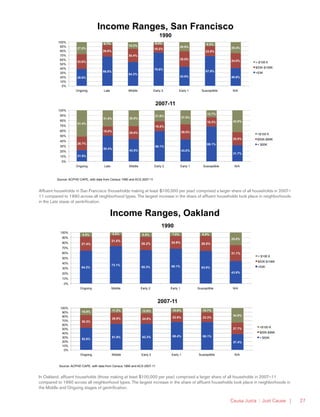
While public engagement processes are legally
required for many development and land use
planning decisions, standard practices are
often not strong enough to ensure that existing
residents are given adequate opportunity to
learn about proposed projects in their neigh-
borhoods, participate in discussions about
the future of their community, and have actual
impact on the final decisions.216
Cities should
pass policies that set strong standards for
public engagement in land use planning and
development decision-making. Refer to public
engagement guides released by the City of
Seattle and PolicyLink.217
Standards should
address, but not be limited to, accessibility
(including language, time/location of meetings,
disability access, food, and childcare), ongoing
engagement, adequate notice and number of
public meetings, participatory planning activities
and decision-making processes, and partner-
ships with community-based organizations to
engage and train residents on the issues.
33 Implementing Agency: Cities, counties,
regional agencies, and metropolitan plan-
ning organizations
33 Staging: Early and always
| Development Without Displacement86
2.	 Support community-based training for
residents to participate in planning and
development processes. [PP] Without
adequate preparation, including training on
the issues, terms, and legal/public processes
related to land use planning and development,
community residents are at a disadvantage to
effectively participate in public engagement
processes, regardless of how they are set
up. Cities should dedicate funding, including
money secured through a regional displace-
ment prevention fund, for developing con-
tracts with community-based organizations to
lead training programs that prepare residents
for effective participation and engagement in
local land use planning and development pro-
cesses. Eligibility for training programs should
include, but not be limited to, length of resi-
dence in the city and interest in participating
in decision-making. Priority should be given to
residents who have faced historical disinvest-
ment and discrimination, including low-income
people and people of color. Training should
be used to prepare leaders for participating
on neighborhood planning councils, as dis-
cussed in F3, and for engagement in local and
regional decision-making.
33 Implementing Agency: Cities, counties,
regional agencies, and metropolitan plan-
ning organizations
33 Staging: Early and always
33 Models: Los Angeles, CA: People’s
Planning School (Strategic Actions for a
Just Economy);218
Oakland, CA: “Gearing
up for Action” curriculum (Pacific
Institute)219
“The one story that sticks out the most to me is that there was a meeting of the full ABAG
[Association of Bay Area Governments] board, the regional land use agency ... The meeting
went late into the night and our agenda item didn’t come up until like 9:30 ... But the most
inspiring moment to me was a youth leader from Genesis, a faith-based organizing group,
[who] spent the time that we were sitting around waiting for our item to come up writing
a poem about his experience growing up in Oakland, and the disparities that he had seen
between his resources and opportunities and other people in the Bay Area. And he got up at
public comment and read this poem and it was incredible, just an incredible moment. And the
look on the faces of the elected officials that were listening to this was just priceless. I mean,
they just never expected to see someone like this guy talking to them about these issues. He
didn’t look like the people they were used to hearing from, he didn’t sound like the people they
were used to hearing from. And they were all listening. And, in part, because of that and in
part because of all of the background work that we had all done, the Board voted unanimously
to include the land use scenario [of the community-developed Equity, Environment, and Jobs
Scenario] that we were proposing in the slate of alternatives that they wanted to see studied
and that was just a really high moment in the campaign.”
— Sam Tepperman-Gelfant, Senior Staff Attorney, Public Advocates, a member organization of the 6 Big Wins for Social Equity
Network, a collaborative of social justice, faith, public health, and environmental organizations across the Bay Area focused on
targeting and shaping how regional planning decisions effect struggling, working families. In 2011, the 6 Big Wins for Social Equity
Network developed the Equity, Environment and Jobs (EEJ) Scenario, a plan which focuses on creating a more healthy, prosperous,
and sustainable future for Bay Area residents of all races and incomes, including struggling families.
Causa Justa :: Just Cause | 87
“We have a People’s Planning School that we do twice a year which is
[a] popular education based, land use organizing school where people
can learn about the tools that govern these developments in their
neighborhoods. And then can take that knowledge, put together policies
or recommendations and then take them to the city. What we found is
it’s kind of like a whack-a-mole process … as we’re working on one
development another is popping up. And we don’t have the resources
to be able to engage in all of them. [Through the People’s Planning
School] we put together a list of recommendations and principles —
they started out as principles — that the community put together about the new community
plan process that the city is going through. And so those principles were then put into
recommendation language with some affordable housing experts and now we’re meeting with
the city through their community plan process to see if we can get these into the community
plan, so we’re not chasing development after development after development. And there’s
some standards that are set in place. But it’s gonna be an uphill battle; first hearing from the
city ... they say it’s too late in the process even though we’ve been engaged around this for
five years. And we’re hearing from neighborhood councils, which are mostly homeowners, that
they don’t want density and they didn’t want affordable housing and poor people living in their
communities, so it’s gonna be a battle and that’s what we’re in engaged in now.”
— Paulina Gonzalez, Former Executive Director, Strategic Actions for a Just Economy (SAJE), Los Angeles
Towanda Sherry has been a member of CJJC for the last five years and
currently resides near the proposed Bus Rapid Transit (BRT) development
occurring along International Boulevard in Oakland. She has been in
her home for the last 26 years. She became a member of CJJC after
attending a community meeting in which CJJC raised concerns about
the displacement of residents in Oakland, an issue of importance to Ms.
Sherry. As a resident, bus commuter, and consumer impacted by the BRT
proposal, Ms. Sherry applied and was accepted as a Community Planning
Leader for the Oakland Sustainable Neighborhoods Initiative (OSNI).
The OSNI program is designed to support people who live or work along International Boulevard
to have the tools they need to effectively give input on the BRT plan and development along
International Boulevard, and to participate in the planning process.
“[As Community Planning Leaders] we get the chance to meet with people who are with the city
about how the city functions, how we can give input. We also get a chance to talk to people who
are with [regional transit organizations] and how they work and what the long-range effect of Bus
Rapid Transit will be along the corridor: how it will affect people’s lives, whether businesses will
have to move, whether people’s houses will be eliminated, the effect of blight in the area, but also,
what kind of housing is coming in. Will that housing displace longtime residents in the area? And
if it does, how do they plan to remedy that and make sure that those people are able to come back
and stay in this area? And also, [we advocate] that any new housing include low-income housing
as well as affordable housing.”
— Towanda Sherry, Oakland Community Planning Leader and CJJC Member
| Development Without Displacement88
3.	 Support the creation of neighbor-
hood-level planning councils [PP] com-
prised of residents who have the authority
to represent their neighborhood in develop-
ment and planning processes. The public
engagement processes required for many
land use planning and development decisions
often invite only token input from residents
on pre-existing plans and projects, with little
space for residents to envision and/or pro-
pose their own ideas for development based
on existing neighborhood needs. Rarely do
residents get opportunities to make actual
decisions about whether projects should
move forward or not.220
Neighborhood plan-
ning councils would provide a formal space
for planning staff to engage with a represen-
tative body of residents about planning and
development issues at the neighborhood lev-
el. Furthermore, these spaces would provide
room for planning in a more ongoing way than
project or plan-specific advisory committees.
Local planning staff should come to neigh-
borhood councils to learn about ongoing
neighborhood needs and share upcoming
opportunities, including proposed plans and
projects as well as funding for neighborhood
projects. Cities should work with community
organizations and other stakeholders to de-
sign council structures and processes based
on best practices and with the goal of max-
imizing equity, inclusion, and resident deci-
sion-making, including membership selection
criteria and procedures, tenure, decision-mak-
ing authority, and integration of planning
councils into existing land use planning and
development processes. Efforts should be
made to ensure that council membership
reflects the race, gender, income, language,
ability, tenure, diversity, and other demo-
graphics of the neighborhood. Translation
services should be made available to support
language diversity among membership.
33 Implementing Agency: Cities, counties,
and local planning departments
33 Staging: Early and always
4.	 Support community organizing and
outreach on housing rights and opportu-
nities. [PP] As discussed above, community
organizing and outreach are crucial to ensur-
ing residents have access to information and
resources necessary to avoid and minimize
displacement.221
Furthermore, our research
revealed that policies that include penalties for
government agencies or landlords, including
relocation policies and code inspections, are
often implemented and enforced only after
substantial community organizing campaigns.
While organizing cannot replace dedicated
funding for enforcement at the government
level, regional agencies should view commu-
nity organizing as a complementary strategy
to ensure enforcement of anti-displacement
policies. As such, resident organizing and out-
reach about housing rights and opportunities
among vulnerable populations, along with
broader community organizing efforts to en-
sure enforcement of existing policies, should
be funded as part of regional and local efforts
to prevent displacement. Organizing could be
funded through subcontracts awarded from a
regional anti-displacement fund as discussed
in E1, and contracts should be prioritized
for organizations with an existing or growing
membership base in areas of the city/region
that are currently undergoing or susceptible
to gentrification, based on ongoing analysis of
neighborhood change as discussed in E4.
33 Implementing Agency: Cities, counties,
regional agencies, and metropolitan plan-
ning organizations
33 Staging: Early and always
Causa Justa :: Just Cause | 89
“We use the sword and the shield. The sword refers to direct action
strategies and utilizing all types of actions to leverage people power,
including leveraging power of elected officials and leveraging elected
official support. It includes eviction blockades and vigils, and direct
action to the banks. The shield is a legal defense so, depending on what
city you’re in, most of us have relationships with volunteer attorneys or
legal services attorneys. So we have both a partnership with community
legal aid, which is a legal services agency in Western Mass, and then
we have a number of private attorneys who volunteer to support the
movement. And the shield works to defend against evictions in court. We’ve won some victories
directly in court and we’ve won some victories … where there is no court involvement. The
shield helps to put pressure through the legal system to delay the eviction process and increase
the eviction costs on the banks. The sword works to put direct action pressure on the banks,
and most are used to try and force banks and investment companies to negotiate with families
… This model was formed by City Life / Vida Urbana and they’ve been using it for a long
time. They’ve been using it for tenant organizing since the ’80s but it’s been adopted in the
foreclosure fight. We adopted it here [in Springfield, Massachusetts]. I think we’ve all made our
own adaptations that make sense locally. But yes, it’s a City Life / Vida Urbana model.”
— Malcolm Chu, Bank Tenant Organizer, Springfield No One Leaves/Nadie Se Mude (SNOL/NSM), which along with City Life /
Vida Urbana is a member of the NEW ROAD Network (New England Workers and Residents Organizing Against Displacement)
and the Right to the City Alliance.
5.	 Require a community health impact
analysis that includes an assessment of
potential displacement impacts [PP] for all
new or modified development projects above a
certain threshold and for plans before approvals
and environmental review. Cities and counties
should adopt a policy to require local planning
departments to conduct community health
impact analyses for all projects above a certain
threshold in the project application stage, and
this analysis should include an assessment of
displacement-related impacts, based on meth-
ods developed at the regional level as recom-
mended in E4. In addition to displacement-re-
lated impacts, this analysis should analyze and
address impacts on the social determinants
of health including, but not limited to, housing,
transportation, education, employment, and
social cohesion, as well as equity impacts for
groups that have been historically disadvan-
taged by development (low-income communi-
ties and communities of color) and populations
that are already vulnerable based on their health
conditions. This tool should be developed
through a multi-sector public process, involving
robust community engagement, to ensure that
community-prioritized issues of concerns are
incorporated and that residents, other stake-
holders, planners, and decision-makers under-
stand the scope and use of the tool. If multiple
projects within a given area are being consid-
ered at once, they should be analyzed together
in order to assess cumulative impacts in the
neighborhood. Every analysis should result in a
publicly accessible report that includes recom-
mendations for mitigating any potential negative
impacts, along with the calculated monetary val-
ue of impacts. If substantial monetized impacts
from displacement are found in this analysis,
based on thresholds of significance set by
planning departments through an engagement
process, cities and counties should consider
requiring community health or displacement
impact fees to be paid by developers into a
local relocation fund, earmarked for use in that
planning area.
33 Implementing Agency: Cities, counties,
and local planning departments
33 Staging: Early and always
| Development Without Displacement90
TakingAction…The Time To Organize Is Now
This report is a call to action.
We hope that the stories and ideas we shared
resonate with your experiences and help inspire
you to get together with neighbors, family, and
friends to push against the gentrification and
displacement in your community. For those of
you who are already doing that, we hope you
found some helpful tools to advance your fight.
Though both our past and future efforts include
working to change the minds and actions of
politicians and city administrators, we do not
ultimately believe that equitable human devel-
opment will come about as a result of policy
change alone. It is only through the hard work of
collective vision, action, and consistent engage-
ment by community residents in every facet of
community development, that truly sustainable
and healthy communities will be created.
Those of us most impacted by historical dis-
investment and underdevelopment must be
active protagonists in leading the charge for a
fundamental shift in how community develop-
ment happens in the future. We know that when
planning centralizes the needs and interests
of low-income, working-class communities of
color, those outcomes benefit all other commu-
nity residents, whether those improvements are
better schools, parks, bus service, or affordable
food sources.
Gentrification is affecting our neighborhoods,
cities, and regions on every level and we need
a range of organizing approaches and tactics
to stop it. Because the forces against us are
powerful, we need to hit them every way we
know how. Whether you are about direct action
protests, passing policy, influencing the media,
cultural resistance, or talking to your neighbors,
Mission No Eviction March, San Francisco
Causa Justa :: Just Cause | 91
what is most important right now is for all of us
to get into the fight against gentrification.
Causa Justa :: Just Cause is deeply engaged
in a range of gentrification, displacement, and
development-related campaigns this year. Here
are two especially critical fights that we need
your support on:
In San Francisco we are a part of the Plaza 16th
Coalicíon that is working to ensure that a project-
ed development on the corner of 16th Street and
Mission Street will reflect the needs of existing
residents as opposed to the developer’s prof-
it-driven plan. The project, which includes more
than 350 units of luxury housing as well as retail
space, would have a range of harmful effects on
a neighborhood already hard hit by gentrification.
The 16th Street development would create dra-
matic income disparities and housing pressures
in a part of the Mission that is home to the largest
concentration of very low-income adults and fam-
ilies in Single Room Occupancy (SRO) housing.
This large development would cast a shadow
over the elementary school next door, literally
blocking out their light, even though the proj-
ect’s housing units and amenities remain largely
inaccessible to the school’s Latino students, their
families, and their teachers. Working with a broad
coalition of homeless, tenant, Queer, and police
accountability advocates, affordable housing
developers, small business owners, and individu-
al activists, CJJC will fight to ensure that current
community residents are supported to envision a
use for that land that reflects their needs and pre-
vents further displacement of immigrant families
and extremely low-income adults. Come join us
in the fight to promote human development at the
16th Street and Mission project.
In Oakland we are pushing the Oakland City
Council to put an anti-tenant harassment policy
on the November 2014 ballot. We have heard
numerous complaints from tenants about land-
lord refusals to perform basic maintenance of
their units, repeated attempts to illegally evict
tenants, and landlords who threaten immigrant
tenants with raids by Immigration and Customs
Enforcement (ICE) agents. Landlord harassment
is a tactic to circumvent existing legal protec-
tions like Just Cause Eviction and Rent Board
regulations. Additionally, it creates a hostile
environment and results in families deciding it
would be better to move out of their homes,
rather than have to battle their landlord to ensure
their housing is safe and habitable. The adoption
of an anti-harassment policy will have a direct ef-
fect on slowing gentrification and displacement
for low-income and working-class residents of
color. It will prevent landlords from raising rents
after they successfully pressure current tenants
to move from their homes, strengthen tenants’
rights in Oakland, and contribute to keeping
rents from rising dramatically. We have a two-
part plan to make this happen. We are currently
working to ensure the City Council puts the poli-
cy on the ballot, and in the summer we will begin
talking to community residents about the impor-
tance of the measure to ensure voters turn out to
pass it on Election Day. Come join us in the fight
to strengthen tenant rights and to keep housing
affordable for working families in Oakland.
Art by Favianna Rodriguez
| Development Without Displacement92
Works Cited
Endnotes
1	 Flipping: A strategy in which an investor purchases
properties with the goal of reselling them for a profit. Profit is
generated either through the price appreciation that occurs
as a result of a hot (read: gentrifying) housing market and/or
from renovations and capital improvements.
2	 Walker, R. (1996). Another Round of Globalization in San
Francisco. Urban Geography, 17(1), 60–94.
3	 Walker, R. (1996). Another Round of Globalization in San
Francisco. Urban Geography, 17(1), 60–94.
4	 Oakland Estuary Westward [Online image]. (1918).
United States. Army Air Corps. Aerial Photo Section.
Retrieved from http://content.cdlib.org/ark:/13030/
kt2s2024gr/?layout=metadata&brand=calisphere.
5	 Oakland Estuary Westward. (1918). United
States. Army Air Corps. Aerial Photo Section.
Retrieved from http://content.cdlib.org/ark:/13030/
kt2s2024gr/?layout=metadata&brand=calisphere.
6	 Walker, R. (1996). Another Round of Globalization in San
Francisco. Urban Geography, 17(1), 60–94.
7	 Walker, R. (2004). Industry Builds Out of the City: The
Suburbanization of Manufacturing in the San Francisco
Bay Area, 1850-1940. In R. D. Lewis (Ed.), Manufacturing
Suburbs: Building Work and Home on the Metropolitan
Fringe, 92–123. Philadelphia: Temple University.
8	 Walker, R. (2004). Industry Builds Out of the City: The
Suburbanization of Manufacturing in the San Francisco
Bay Area, 1850-1940. In R. D. Lewis (Ed.), Manufacturing
Suburbs: Building Work and Home on the Metropolitan
Fringe, 92–123. Philadelphia: Temple University.
9	 Walker, R. (1996). Another Round of Globalization in San
Francisco. Urban Geography, 17(1), 60–94.
10	 The Second Great Migration, In Motion: The African
American Migration Experience. Project of The New York
Public Library. Retrieved from http://www.inmotionaame.org/
print.cfm;jsessionid=f8301129211391460600628?
migration=9&bhcp=1.
11	 Self, R. (2003). American Babylon: Race and the Struggle
for Postwar Oakland. Princeton, NJ: Princeton University
Press.
12	 Price-Spratlen, T. (2008). Urban Destination Selection
among African Americans during the 1950s Great Migration.
Social Science History, 32(3), 437–469.
13	 Taylor, Q. (2012). Facing The Urban Frontier: African
American History in the Reshaping of the Twentieth-Century
American West. The Western Historical Quarterly, 43(1),
4–27.
14	 Romo, R. (1993). Responses to Mexican Immigration, 1910-
1930. In Michael R. Ornelas (Ed.), Beyond 1848: Readings
in the Modern Chicano Historical Experience. Dubuque, IA:
Kendall/Hunt Publishing Company.
15	 DeGenova, N. (2004). The Legal Production of Mexican/
Migrant “Illegality.” Latino Studies, 2: 160–185; Martin,
P. (2002). Mexican Workers and U.S. Agriculture: The
Revolving Door. International Migration Review, 36(4),
1124–1142.
16	 Clarke, B. & Baba, H. (2006). Port of Oakland: Private
Industry or Public Agency? Race, Poverty & The
Environment, 12(1), 35–38; Santiago, A. & Wilder, M.
(1991). Residential Segregation and Links to Minority
Poverty: The Case of Latinos in the United States. Social
Problems, 38(4), 492–515; Wilson, W. (2009). The Political
and Economic Forces Shaping Concentrated Poverty.
Political Science Quarterly, 123(4), 555–571.
17	 For one example of this see: Marciano, R., Goldberg, D. &
Hou, C. “T-Races: a Testbed for the Redlining Archives of
California’s Exclusionary Spaces.” Retrieved from http://salt.
unc.edu/T-RACES/ (accessed February 20, 2014).
18	 Brenner, R. (2006). The Economics of Global Turbulence:
The Advanced Capitalist Economies from Long Boom to
Long Downturn, 1945-2005. London: Verso.
19	 Walker, R. (1998). An Appetite for the City. In Brook, J. et.
al. Reclaiming San Francisco: History Politics, Culture. San
Francisco: City Light Books.
20	 Saez, E. (2008). Striking It Richer: The Evolution of Top
Incomes in the United States. Stanford Center for the Study
of Poverty and Inequality.
21	 Krippner, G. (2012). Capitalizing on Crisis: The Political
Origins of the Rise of Finance. Cambridge: Harvard
University Press.
22	 Brenner, R. (2006). The Economics of Global Turbulence:
The Advanced Capitalist Economies from Long Boom to
Long Downturn, 1945-2005. London: Verso.
23	 Perry, M. J. (n.d.). Manufacturing Employment Percent
of U.S. Labor Force January 1939 to July 2013 [Online
Image]. Carpe Diem. Bureau of Labor Statistics. Retrieved
from http://mjperry.blogspot.com/2009/08/manufacturing-
employment-drops-to.html.
24	 Alvaro, S. & Massey, D. (2010). In Search for Peace:
Structural Adjustment, Violence, and International Migration.
Annals of the Academy of Political & Social Science, 630(1),
137–161.
25	 Looney, A. & Greenstone, M. (2012, October 12). The
Uncomfortable Truth About American Wages. New York
Times.
26	 Schafran, Alex. (2010). The Long Road from Babylon to
Brentwood: Crisis and Restructuring in the San Francisco
Bay Area. UC Berkeley: Institute for the Study of Societal
Issues. Retrieved from: http://escholarship.org/uc/
item/93x39448
27	 Garland, R. (2014, February 27). As Bay Area Investment
Shifts North, Institutional Venture Partners Opens San
Francisco Office. The Wall Street Journal. Retrieved from
http://blogs.wsj.com/venturecapital/2014/02/27/as-bay-
area-investment-shifts-north-institutional-venture-partners-
opens-san-francisco-office/Genthe, A. (n.d.).
28	 Beattie, A. (n.d.). Market Crashes: The Dotcom Crash.
Investopedia. Retrieved from http://www.investopedia.com/
features/crashes/crashes8.asp.
29	 Beitel, K. (2013). Mission Anti-Displacement Coalition.
FoundSF. Retrieved from http://foundsf.org/index.
php?title=Mission_Anti-Displacement_Coalition.
30	 Nayman, N. (2001, October). Jobs, Incomes and San
Francisco City Hall Revenues Grew at Record Rate,
Causa Justa :: Just Cause | 93
Study Shows. Cal-Tax Digest. Retrieved from http://www.
caltax.org/member/digest/oct2001/10.2001.Nayman-
JobsRevenueReport.04.htm.
31	 Lagos, M. (2013, November 5). San Francisco Evictions
Surge, Report Finds. SFGate. Retrieved from http://www.
sfgate.com/bayarea/article/San-Francisco-evictions-surge-
report-finds-4955020.php.
32	 Gammon, R. and Platoni, K. (2007, January 3). Inflating the
Numbers: The Brown Administration Came Very Close to the
10K Plan. So Why the Grade Inflation? East Bay Express.
33	 Lo, P. (2009, September 23). Ten Years of Just Cause
Oakland. OaklandNorth. Retrieved from http://oaklandnorth.
net/2009/09/23/ten-years-of-just-cause-oakland/.
34	 The Dot-Com Bubble Bursts. (2000, December 24). The
New York Times. Retrieved from http://www.nytimes.
com/2000/12/24/opinion/the-dot-com-bubble-bursts.html.
35	 Lansing, K. J. (2003, June 20). Growth in the Post-
Bubble Economy. Federal Reserve Bank of San
Francisco. Retrieved from http://www.frbsf.org/economic-
research/publications/economic-letter/2003/june/
growth-in-the-post-bubble-economy/.
36	 Beattie, A. (n.d.). Market Crashes: Housing Bubble and
Credit Crisis (2007-2009). Investopedia. Retrieved from
http://www.investopedia.com/features/crashes/crashes9.
asp.
37	 From Foreclosure to Re-Redlining. (2010).
Coalition, California Reinvestment. Retrieved from
http://www.calreinvest.org/system/resources/
W1siZiIsIjIwMTEvMDQvMTgvMTdfNTVfMTVf
NjM4X0ZvcmVjbG9zdXJlX3RvX1JlX1JlZ
GxpbmluZy5wZGYiXV0/Foreclosure_to_Re_Redlining.pdf.
38	 Lansing, K. J. (2003, June 20). Growth in the Post-
Bubble Economy. Federal Reserve Bank of San
Francisco. Retrieved from http://www.frbsf.org/economic-
research/publications/economic-letter/2003/june/
growth-in-the-post-bubble-economy/.
39	 Arnold, E. K. (2012). Foreclosure Crisis Meets Occupy
Effect. Race, Poverty & the Environment, 19(1). Retrieved
from http://urbanhabitat.org/19-1/arnold.
40	 Myers, L., Gardella, R., & Schoen, J. W. (2011, May 9).
No End in Sight to Foreclosure Quagmire. NBC News
and Msnc.com. Retrieved from http://www.nbcnews.com/
id/42881365/ns/business-personal_finance/t/no-end-sight-
foreclosure-quagmire/#.Uxj5svldUeF.
41	 The Foreclosure Crisis and Its Impact on Tenants. (n.d.).
National Housing Law Project. Retrieved from http://nhlp.
org/foreclosureandtenants.
42	Ibid.
43	 Henry, B., Reese, J., & Torres, A. (2013). Wasted
Wealth. Alliance for a Just Society. Retrieved from http://
allianceforajustsociety.org/wp-content/uploads/2013/05/
Wasted.Wealth_NATIONAL.pdf.
44	 Evangelista, B. (2013, January 8). Facebook IPO Will
Create Billionaires. SFGate. Retrieved from http://www.
sfgate.com/business/article/Facebook-IPO-will-create-
billionaires-3036102.php.
45	 Lagos, M. (2013, November 5). San Francisco Evictions
Surge, Report Finds. SFGate. Retrieved from http://www.
sfgate.com/bayarea/article/San-Francisco-evictions-surge-
report-finds-4955020.php.
46	 Carlton, J. (2013, July 16). Bay Area Rally Sends Rents
Soaring. The Wall Street Journal. Retrieved from http://
online.wsj.com/news/articles/SB10001424127887324694
904578602013087282582.
47	 Hu, Elise. (2013, December 17). How This Bay Area Tech
Boom is Different From The Last One. National Public Radio.
48	 Corkery, M. (2014, January 29). Wall Street’s New Housing
Bonanza. The New York Times. Retrieved from http://
dealbook.nytimes.com/2014/01/29/wall-streets-new-
housing-bonanza/?_php=true&_type=blogs&_php=true&_
type=blogs&_r=1.
49	 Tepperman, J. (2013, October 2). Who’s Jacking Up
Housing Prices in West Oakland. East Bay Express.
Retrieved from http://www.eastbayexpress.com/oakland/
whos-jacking-up-housing-prices-in-west-oakland/
Content?oid=3726518&showFullText=true.
50	 Gose, J. (2013, December 24). Another City by the Bay
Comes Into Its Own. New York Times.
51	 Torres. B. (2011, June 15). IPO Ignites ‘Pandora Effect’ in
Oakland. San Francisco Business Times.
52	 Panchuck, K.A. (2014, January 23). Are Rental Bonds
Driving Up the Rent? Housing Wire.
53	 Corkery, M. “Wall Street’s New Housing Bonanza.” (2014,
January 29). The New York Times; Dayen, D. “Your New
Landlord Works on Wall Street: Hedge Funds are snatching
up rental homes at an alarming rate.” (2013, February 12).
The New Republic.
54	 “Coming to an Office Near You.” (2014, January 18). The
Economist. Truner, A. (2014, January 8). Inequality by the
Click. Project Syndicate.
55	 Emmons, M. (2013, April 6). Bay Area Housing
Subsidies Suffer from Sequestration. San Jose
Mercury News. Real Facts. Retrieved from http://www.
mercurynews.com/bay-area-news/ci_22965420/
bay-area-housing-subsidies-suffer-from-sequestration.
56	 Emmons, M. (2013, April 6). Bay Area Housing
Subsidies Suffer from Sequestration. San Jose
Mercury News. Real Facts. Retrieved from http://www.
mercurynews.com/bay-area-news/ci_22965420/
bay-area-housing-subsidies-suffer-from-sequestration.
57	 The Sequester. (n.d.). The White House. Retrieved from
http://www.whitehouse.gov/issues/sequester.
58	 Emmons, M. (2013, April 6). Bay Area Housing
Subsidies Suffer from Sequestration. San Jose
Mercury News. Real Facts. Retrieved from http://www.
mercurynews.com/bay-area-news/ci_22965420/
bay-area-housing-subsidies-suffer-from-sequestration.
59	 “HUD Community Development Block Grants (CDBG):
Support Local Development and Infrastructure Projects.”
(2013). National Association of Counties (NACO). Retrieved
from http://www.nado.org/wp-content/uploads/2012/10/
NADO-FY13-CDBG-FACT-SHEET.pdf
60	 Cooper, B. (2013, September 18). Federal Budget
Cuts Leave Many Without Access to Head Start. The
Olathe News. Retrieved from http://www.theolathenews.
com/2013/09/17/2112385/federal-budget-cuts-leave-many.
html.
61	 Kern, J. (2013, March 4). Preschool California President
Catherine Atkin Responds to Congress’s Immediate Federal
Cuts to Head Start and Child Care. Early Edge California.
Retrieved from http://www.earlyedgecalifornia.org/news-
media/press-releases/sequesterresponse.html.
62	 Walker, R.A. (2006). The Boom and the Bombshell: The
New Economy Bubble and the San Francisco Bay Area. In
Giovanna Vertova (Ed.), The Changing Economic Geography
of Globalization (pp. 134–35). London: Routledge.
63	Ibid.
64	 Pritchard, M. (n.d.). Valencia Gardens [Online image]. Flickr
Creative Commons, under License http://creativecommons.
org/licenses/by-nc-sa/2.0/. Retrieved from http://www.flickr.
com/photos/toobeautiful/2699166255/sizes/m/.
65	 Roberts, C. (2013, September 25). During San Francisco
Visit, HUD Secretary Says Private Sector Will Save
Public Housing. SF Examiner. Retrieved from http://www.
| Development Without Displacement94
sfexaminer.com/sanfrancisco/during-san-francisco-visit-
hud-secretary-says-private-sector-will-save-public-housing/
Content?oid=2588310.
66	Ibid.
67	 For an analysis of the shift from public housing to housing tax
credits, see: Stoloff, J. A. (2004). A Brief History of Public
Housing. Washington DC: US Department of Housing and
Urban Development.
68	 Overland, Pacific & Cutler, I. (2007). Relocation Plan for
Tassafaronga Village. Retrieved from http://www.oakha.org/
procurement/12307tassareloplan.pdf
69	 A Resolution Approving a Replacement Housing Plan for
the Tassafaronga Village Project. (2011). Community and
Economic Development Agency. Retrieved from http://
councilmatic.yoleg.com:8000/legislation/746500
70	 Budds, D. (2010). It Takes a Village [Online image]. dwell.
71	 Johnstone, R. (2013). Old 16th Street Amtrak Station. Flickr
Creative Commons, under license http://creativecommons.
org/licenses/by-nc-nd/2.0/. Retrieved from http://www.flickr.
com/photos/1flatworld/8827959798/sizes/m/.
72	 Wood St. Development. (n.d.). City of Oakland. Retrieved
from http://www2.oaklandnet.com/Government/o/PBN/
OurOrganization/PlanningZoning/DOWD008410.
73	 City of Oakland Office of the City Clerk Calendar. (n.d.). City
of Oakland. Retrieved from https://oakland.legistar.com/
calendar.aspx.
74	 Burt, C. (2005, May 2). Train Station Revival on Track. Inside
Bay Area. Retrieved from http://www.insidebayarea.com/
oaklandtribune/ci_2701097.
75	 City of Oakland Office of the City Clerk Calendar. (n.d.). City
of Oakland. Retrieved from https://oakland.legistar.com/
calendar.aspx.
76	 Elinson, Z. (2010, September 2). As Mayor, Brown Remade
Oakland’s Downtown and Himself. The New York Times.
Retrieved from http://www.nytimes.com/2010/09/03/us/
politics/03bcbrown.html?pagewanted=all&_r=1&.
77	 City of Oakland Office of the City Clerk Calendar. (n.d.). City
of Oakland. Retrieved from https://oakland.legistar.com/
calendar.aspx.
78	 Property Crime Rate. (n.d.). FBI, Uniform Crime Reports,
National Archive of Criminal Justice Data. Retrieved from
http://www.ucrdatatool.gov.
79	 Fullilove M.T. & Wallace, R. (2011). Serial Forced
Displacement in American Cities: 1916-2010. Journal of
Urban Health, 88(3): 381–389.
80	 Lindheim R., & Syme, S.L. (1983). Environments, People,
and Health. Annual Review of Public Health, 4(1): 335–359.
81	 Krieger J. & Higgins, D. (2002). Housing and Health: Time
Again for Public Health Action. American Journal of Public
Health, 92(5): 758–68.
82	 Rosen, G. (1993). A History of Public Health. Baltimore:
JHU Press; Hofrichter, R. (2010). Tackling Health Inequities:
A Framework for Public Health Practice. In Hofrichter, R. &
Bhatia, R. (Eds.), Tackling Health Inequities Through Public
Health Practice: Theory to Action. USA: Oxford University
Press; Krieger, J. & Higgins, D. (2002). Housing and health:
time again for public health action. American Journal of
Public Health, 92(5): 758–68; Lindheim, R. & Syme, S.L.
(1983). Environments, people, and health. Annual Review of
Public Health, 4(1): 335–359; Lubove, R. (1961). Lawrence
Veiller and the New York State Tenement House Commission
of 1900. The Mississippi Valley Historical Review, 47(4):
659–677.
83	 Lopez, R.P. (2009). Public health, the APHA, and urban
renewal. American Journal of Public Health, 99(9):
1603–1611.
84	Ibid.
85	Ibid.
86	 Gordon, C. (2003). Blighting the way: Urban renewal,
economic development, and the elusive definition of blight.
Fordham Urban Law Journal, 31(2): 305-339.
87	 Lopez, R.P. (2009). Public health, the APHA, and urban
renewal. American Journal of Public Health, 99(9):
1603–1611.
88	 Fullilove, M.T. (2004). Root Shock: How Tearing Up City
Neighborhoods Hurts America and What We Can Do About
It. New York: NY: One World Ballantine Book.
89	 San Francisco Human Rights Commission, Committee on
African American Parity. (1993). The Unfinished Agenda:
The Economic Status of African Americans in San Francisco,
1964-1990. Available at: http://sf-hrc.org/modules/
showdocument.aspx?documentid=833.
90	 Fullilove, M.T. (2001). Root shock: The consequences of
African American Dispossession. Journal of Urban Health,
78(1): 72–80.
91	 Lopez, R.P. (2009). Public health, the APHA, and urban
renewal. American Journal of Public Health, 99(9):
1603–1611.
92	Ibid.
93	Ibid.
94	 Peterson, C.L. (2013). Subprime lending, foreclosure
and race: An introduction to the role of securitization in
residential mortgage finance. In Rogers, C. & Powell, J.A.
(Eds.), Where Credit is Due: Bringing Equity to Credit
and Housing after the Market Meltdown. [pp. 68-95].
Lantham: University Press of America; Massey, D.S. (2008).
Categorically Unequal: The American Stratification System.
Russell Sage Foundation Publications.
95	 Fullilove, M.T. (2001). Root shock: The consequences of
African American Dispossession. Journal of Urban Health,
78(1): 72–80.
96	 Bates, L.K. (2013). Gentrification and Displacement Study:
Implementing an Equitable Inclusive Development Strategy
in the Context of Gentrification. Commissioned by City of
Portland, Bureau of Planning and Sustainability.
97	 Evers, S.E. (2013). Altering the urban frontier: Gentrification
and public parks in New York City. Pitzer Senior Theses.
Paper 28.
98	 Whitehead, M. (1992). The concepts and principles of equity
and health. International Journal of Health Services, 22(3):
429–445.
99	 Krieger N. (2001). Theories for social epidemiology in the
21st century: an ecosocial perspective. International Journal
of Epidemiology, 30(4): 668–677; Krieger, N. (2008).
Proximal, Distal, and the Politics of Causation: What’s Level
Got to Do With It? American Journal of Public Health, 98(2):
221–230; Krieger, N. & Gruskin, S. (2001). Frameworks
matter: ecosocial and health and human rights perspectives
on disparities in women’s health — the case of tuberculosis.
Journal of the American Med Women’s Association, 56(4):
137–142; Siegrist, J. & Marmot, M. (Eds.). (2006). Social
Inequalities in Health: New Evidence and Policy Implications.
Oxford: Oxford University Press; Graham, H. (2004). Social
determinants and their unequal distribution: clarifying
policy understandings. Milbank Quarterly, 82: 101–124;
Commission on Social Determinants of Health. (2008).
Closing the gap in a generation: health equity through action
on the social determinants of health. Final Report of the
Commission on Social Determinants of Health. Geneva:
World Health Organization; Braveman, P. & Gruskin, S.
(2003). Defining equity in health. Journal of Epidemiology
and Community Health, 57(4): 254–258.
100	 Egerter, S., Sadegh-Nobari, T., Dekker, M. & Braveman,
P. (2008). Issue 2: Where we live matters for our health:
Causa Justa :: Just Cause | 95
The links between housing and health. In Health: The Links
Between Housing and Health. Robert Wood Johnson
Foundation: Issue Brief. Robert Wood Johnson Foundation:
Commission to Build a Healthier America; Litman, T.
(2010). Evaluating public transportation health benefits.
Victoria Transport Policy Institute for the American Public
Transportation Association; Glanz, K., Basil, M., Maibach,
E., Goldberg, J. & Snyder, D. (1998). Why Americans eat
what they do: taste, nutrition, cost, convenience, and weight
control concerns as influences on food consumption. Journal
of the American Dietetic Association, 98: 1118–1126;
Drewnowski, A., et al. (2004). Obesity and the food
environment: dietary energy density and diet costs. American
Journal of Preventive Medicine, 27: 154–162; Kelly, S.E.,
Binkley, C.J., Neace, W.P. & Gale, B.S. (2005). Barriers to
care-seeking for children’s oral health among low-income
caregivers. Journal Information, 95; Galbraith, A.A., Wong,
S.T., Kim, S.E. & Newacheck, P.W. (2005). Out-of-pocket
financial burden for low-income families with children:
socioeconomic disparities and effects of insurance. Health
Services Research, 40: 1722–1736.
101	 City and County of San Francisco. Residential Rent
Stabilization and Arbitration Board. (2013, October 3).
Rent Board Annual Report, Fiscal Year 2012-2013.
Available at: http://sfrb.org/modules/showdocument.
aspx?documentid=2660.
102	Ibid.
103	 Phillips, D., Clark, R., Lee, T. & Desautels, A. (2010).
Rebuilding Neighborhoods, Restoring Health: A Report on
the Impact of Foreclosure on Public Health. Oakland, CA:
Causa Justa :: Just Cause, Alameda County Public Health
Department. Available at: http://www.acphd.org/data-
reports/reports-by-topic/social-and-health-equity.aspx.
104	 Newman K, Wyley EK. (2006). The right to stay put,
revisited: Gentrification and resistance to displacement in
New York City. Urban Studies, 43(1): 23-57. Available at:
http://usj.sagepub.com/content/43/1/23.full.pdf+html.
105	 Jacobs, D.E., Wilson, J., Dixon, S.L., Smith, J. & Evens, E.
(2009). The relationship of housing and population health:
A 30-year retrospective analysis. Environmental Health
Perspective, 117(4): 597–604; Krieger, J. & Higgins, D.
(2002). Housing and health: time again for public health
action. American Journal of Public Health, 92(5): 758–768;
Bashir, S.A. (2002). Home is where the harm is: inadequate
housing as a public health crisis. American Journal of Public
Health, 92(5): 733–738.
106	 Alameda County Public Health Department with data from
American Community Survey, 2007-2011.
107	 Kennedy, M. & Leonard, P. (2001). Dealing with
neighborhood change: A primer on gentrification and policy
choices. The Brookings Institution Center on Urban and
Metropolitan Policy and PolicyLink.
108	 Sullivan, D.M. & Shaw, S.C. (2011). Retail gentrification and
race: The case of Alberta Street in Portland, Oregon. Urban
Affairs Review, 47(3): 413–432.
109	 Fullilove, M.T. (2001). Root shock: The consequences of
African American Dispossession. Journal of Urban Health,
78(1): 72–80; Goetz, E.G. (2002). Forced relocation vs.
voluntary mobility: the effects of dispersal programmes on
households. Housing Studies, 17(1): 107–123.
110	 Beyers, M., Brown, J., Cho, S., et al. (2008). Life and
Death from Unnatural Causes: Health and Social Inequity
in Alameda County. Oakland, CA: Alameda County Public
Health Department.
111	Ibid.
112	 Goetz, E.G. (2002) Forced relocation vs. voluntary mobility:
the effects of dispersal programmes on households. Housing
Studies, 17(1): 107–123.
113	 Alameda County Public Health Department. (2013). Getting
on Board for Health: A Health Impact Assessment of
Bus Funding and Access. Available at: www.acphd.org/
media/309838/transithia.pdf; Wener, R.E., Evans, G.W.,
Phillips, D. & Nadler N. (2003). Running for the 7:45: the
effects of public transit improvements on commuter stress.
Transportation, 30: 203–220. Kluwer Academic Publishers,
Netherlands; Walsleben, J.A., Norman, R.G., Novak, R.D.,
O’Malley, E.B., Rapoport, D.M. & Strohl, K.P. (1999). Sleep
habits of Long Island Rail Road commuters. Sleep, 22(6):
13; Strazdins, L. & Loughrey, B. (2008). Too busy: why time
is a health and environmental problem. NSW Public Health
Bulletin, 18(11-12): 219–221.
114	 Mani, A., Mullainathan, S., Shafir, E. & Zhao, J. (2013).
Poverty Impedes Cognitive Function. Science, 341(6149):
976–980; McEwen, BS. (1998). Stress, adaptation, and
disease: Allostasis and allostatic load. Annals of the New
York Academy of Sciences, 840: 33-44; Geronimus, A.T.,
Hicken, M.T., Pearson, J.A., Seashols, S.J., Brown, K.L. &
Cruz, T.D. (2010). Do US black women experience stress-
related accelerated biological aging? A novel theory and first
population-based test of black-white differences in telomere
length. Human Nature, 1: 19–38; Wallace, R. & Wallace,
D. (2010). Gene expression and its discontents: The social
production of chronic disease. New York & London: Springer.
115	 Feldman, S., Geisler, C. & Silberling, L. (2003). Moving
targets: displacement, impoverishment, and development.
International Social Science Journal, 55(175): 7–13;
Fullilove, M.T. (2001). Root shock: The consequences of
African American Dispossession. Journal of Urban Health,
78(1): 72–80.
116	 Levy, D.K. & Kaye, D.R. (2004). How are HOPE VI families
faring? Metropolitan Housing and Communities Center, Brief
No. 4. Urban Institute. Available at: http://www.urban.org/
UploadedPDF/311072_Roof_4.pdf.
117	 Cooper, M. (2001). Housing affordability: a children’s issue.
Discussion Paper No. F-11. Ottawa, ON: Canadian Policy
Research Networks. Available at: http://www.cprn.org/
documents/1315_en.pdf; Wood, D., Halfon, N., Scarlata,
D., Newacheck, P. & Nessim, S. (1993). Impact of family
relocation on children’s growth, development, school
function, and behavior. The Journal of the American Medical
Association, 270(11): 1334–1338.
118	 Beyers, M., Brown, J., Cho, S., et al. (2008). Life and
Death from Unnatural Causes: Health and Social Inequity
in Alameda County. Oakland, CA: Alameda County Public
Health Department.
119	 Institute for Children, Poverty, & Homelessness. (n.d.). A
theory of poverty destabilization: Why low-income families
become homeless in New York City. Available at: http://www.
icphusa.org/index.asp?page=16&report=111&pg=106.
120	 Shaw, M. (2004). Housing and Public Health. Annual Review
of Public Health, 25: 397–418; Goodman, L., Saxe, L. &
Harvey, M. (1991). Homelessness as psychological trauma.
Broadening perspectives. American Psychologist, 46(11):
1219–25; Fullilove, M.T. (1996). Psychiatric implications of
displacement: Contributions from the psychology of place.
American Journal of Psychiatry, 153(12): 1516–23.
121	 Beyers, M., Brown, J., Cho, S., et al. (2008). Life and
Death from Unnatural Causes: Health and Social Inequity
in Alameda County. Oakland, CA: Alameda County Public
Health Department.
122	Ibid.
123	 Abramson, D.M. & Garfield, R.M. (2006). On the edge:
Children and families displaced by Hurricanes Katrina
and Rita face a looming medical and mental health crisis.
| Development Without Displacement96
National Center for Disaster Preparedness, Columbia
University, Mailman School of Public Health.
124	 Uscher-Pines, L. (2008). Health effects of relocation
following disaster: A systematic review of the literature.
Disasters, 33(1): 1–22; Bland, S.H., et al. (1997). Social
network disruption and psychological distress following
earthquake evacuation. Journal of Nervous and Mental
Disease, 185(3): 188–195. Available at: http://journals.
lww.com/jonmd/Abstract/1997/03000/Social_Network_
Disturbances_and_Psychological.8.aspx; Wallace, R.
(1990). Urban desertification, public health and public order:
“Planned shrinkage,” violent death, substance abuse, and
AIDS in the Bronx. Social Science and Medicine, 31(7):
801–813.
125	 Sluzki, C.E. (1992), Disruption and reconstruction of
networks following migration/relocation. Family Systems
Medicine, 10: 359–363.
126	 Martin, R. (1995). The effects of prior moves on job
relocation stress. Journal of Occupational and Organizational
Psychology, 68(1): 49–56.
127	 Fullilove, M.T. (1996). Psychiatric implications of
displacement: Contributions from the psychology of place.
American Journal of Psychiatry, 153(12): 1516–23.
128	 International City/County Management Association.
(2005). Active Living and Social Equity: Creating Healthy
Communities for All Residents: A Guide for Local
Governments. Available at: http://65.181.142.130/images/
stories/rpt_icma_jan2005.pdf
129	 Alameda County Public Health Department with data from
American Community Survey 1-year PUMS, 2006-2011.
130	 Beyers, M., Brown, J., Cho, S., et al. (2008). Life and
Death from Unnatural Causes: Health and Social Inequity
in Alameda County. Oakland, CA: Alameda County Public
Health Department.
131	 Popkin, S.J., Katz, B., Cunningham, M.K., Brown, K.D.,
Gustafson, J. & Turner, M.A. (2004). A decade of Hope
VI: Research Findings and Policy Challenges. The Urban
Institute and the Brookings Institution.
132	 Garr, E. & Kneebone, E. (2010). The suburbanization of
poverty: Trends in metropolitan America, 2000 to 2008.
Metropolitan Policy Program at Brookings; Raphael, S.
& Stoll, M.A. (2010). Job sprawl and the suburbanization
of poverty. Metropolitan Policy Program at Brookings;
Soursourian, M. (2012). Community development research
brief: Suburbanization of poverty in the Bay Area. Federal
Reserve Bank of San Francisco.
133	Ibid.
134	 Popkin, S.J., Katz, B., Cunningham, M.K., Brown, K.D.,
Gustafson, J. & Turner, M.A. (2004). A decade of Hope
VI: Research Findings and Policy Challenges. The Urban
Institute and the Brookings Institution.
135	 Abramson, D.M. & Garfield, R.M. (2006). On the edge:
Children and families displaced by Hurricanes Katrina
and Rita face a looming medical and mental health crisis.
National Center for Disaster Preparedness, Columbia
University, Mailman School of Public Health.
136	Ibid.
137	 Geys, B. (2006). Explaining voter turnout: A review of
aggregate-level research. Electoral Studies, 25(4): 637–
663; Bobo, L. & Gilliam, F.D. (2001). Race, Sociopolitical
Participation, and Black Empowerment. The American
Political Science Review, 84(2): 377–393; Fullilove, M.T.
(2001). Root shock: The consequences of African American
Dispossession. Journal of Urban Health, 78(1): 72–80;
Beyers, M., Brown, J., Cho, S., et al. (2008). Life and
Death from Unnatural Causes: Health and Social Inequity
in Alameda County. Oakland, CA: Alameda County Public
Health Department.
138	 Fullilove, M.T. & Wallace, R. (2011). Serial Forced
Displacement in American Cities: 1916-2010. Journal of
Urban Health, 88(3): 381–389.
139	Ibid.
140	Ibid.
141	 Bates, LK. (2013). Gentrification and Displacement Study:
Implementing an Equitable Inclusive Development Strategy
in the Context of Gentrification. Commissioned by City of
Portland, Bureau of Planning and Sustainability. Available at:
www.portlandoregon.gov/bps/article/454027.
142	 Urahn SK, Plunkett T. (2013). Mobility and The Metropolis:
How Communities Factor Into Economic Mobility. The
Pew Charitable Trusts. Available at: www.pewstates.
org/uploadedFiles/PCS_Assets/2013/Mobility-and-the-
Metropolis.pdf; Grady, SC. (2006). Racial disparities in low
birthweight and the contribution of residential segregation:
A multi-level analysis. Social Science and Medicine, 63:
3013-3029; Lobmayer P, Wilkinson RG. (2002). Inequality,
residential segregation by income, and mortality in US cities.
Journal of Epidemiology and Community Health, 56: 183-
187. Available at: http://jech.bmj.com/content/56/3/183.full;
Collins CA, Williams DR. (1999). Segregation and mortality:
The deadly effects of racism? Sociological Forum, 14(3):
495-523.
143	 Frumkin, H. (2002). Urban sprawl and public health. Public
Health Reports, 117: 201–217.
144	 Pollack S, Bluestone B, Billingham C. (2010). Maintaining
Diversity in America’s Transit-Rich Neighborhoods: Tools for
Equitable Change. Dukakis Center for Urban and Regional
Policy. Available at: www.northeastern.edu/dukakiscenter/
wp-content/uploads/2011/12/TRN_Equity_final.pdf;
Dominie W. (2012). Is Just Growth Smarter Growth: The
Effects of Gentrification on Transit Ridership and Driving
in Los Angeles’ Transit Station Area Neighborhoods.
Prepared for the Bus Riders’ Union. Available at: www.
thestrategycenter.org/sites/www.thestrategycenter.org/files/
Dominie_Is_Just_Growth_Smarter_Growth_6-2-2012.pdf.
145	 Wyly, E.K. & Hammel, D.J. (2004). Gentrification,
segregation, and discrimination in the American urban
system. Environment and Planning, 36(7): 1215–1241.
146	 Walks, R.A. & Maaranen, R. (2008). Gentrification, social
mix, and social polarization: Testing the linkages in large
Canadian cities. Urban Geography, 29(4): 293–326.
147	 Alameda County Public Health Department with data from
American Community Survey, 2007-2011.
148	 Wilkinson, R. & Pickett, K. (2009). The Spirit Level: Why
Greater Equality Makes Societies Stronger. New York:
Bloomsbury Press. Available at: http://www.amazon.com/
Spirit-Level-Equality-Societies-Stronger/dp/1608190366.
Accessed October 25, 2011.
149	 Fullilove, M.T. (2013). Urban Alchemy: Restoring Joy
in America’s Sorted Out Cities. New York: New Village
Press; Fullilove, M.T. & Wallace, R. (2011). Serial Forced
Displacement in American Cities: 1916-2010. Journal of
Urban Health, 88(3): 381–389; Wallace, D. & Wallace,
R. (1998). A Plague on your Houses: How New York Was
Burned Down and National Public Health Crumbled. New
York: Verso.
150	 Armstrong, G.L., Conn, L.A. & Pinner, R.W. (1999). Trends in
infectious disease mortality in the United States during the
20th century. Journal of the American Medical Association,
281(1): 61–66; Krieger, J. & Higgins, D. (2002). Housing
and health: time again for public health action. American
Journal of Public Health, 92(5): 758–68; Porter, D. (2009).
Health, Civilization, and the State: A History of Public Health
from Ancient to Modern Times. Taylor & Francis Group;
Causa Justa :: Just Cause | 97
Rosen, G. (1993). A History of Public Health. Baltimore:
JHU Press.
151	Ibid.
152	 The World Health Organization defines the social
determinants of health as the “complex, integrated, and
overlapping social structures and economic systems that
are responsible for most health inequities. These social
structures and economic systems include the social
environment, physical environment, health services, and
structural and societal factors. Social determinants of
health are shaped by the distribution of money, power, and
resources throughout local communities, nations, and the
world.”
153	 Commission on Social Determinants of Health. Closing
the gap in a generation: health equity through action on
the social determinants of health. Final Report of the
Commission on Social Determinants of Health. Geneva:
World Health Organization Available at: www.who.int/social_
determinants/thecommission/finalreport/en/index.html;
Graham, H. (2004). Social determinants and their unequal
distribution: clarifying policy understandings. Milbank
Quarterly, 82: 101–124.
154	Ibid.
155	 Centers for Disease Control and Prevention, Environmental
Health Services. “Core Functions of Public Health and How
They Relate to The 10 Essential Services.” Available at: www.
cdc.gov/nceh/ehs/ephli/core_ess.htm.
156	 Syme, S.L. & Ritterman, M.L. (2009). The importance of
community development for health and well-being. Health
and Community Development, 5(3): 1–13; Braunstein, S. &
Lavizzo-Mourey, R. (2011). How the health and community
development sectors are combining forces to improve health
and well-being. Health Affairs, 30(11): 2042–2051; Frumkin,
H. (2002). Urban sprawl and public health. Public Health
Reports, 117: 201–217.
157	 Kushner, J.A. (2002). Smart growth, new urbanism, and
diversity: Progressive planning movements in America and
their impact on poor and minority ethnic populations. UCLA
Journal of Environmental Law and Policy, 21(2). Available at:
http://escholarship.org/uc/item/7095r4dk#page-1.
158	 Lee, V., Mikkelsen, L., Srikantharajah, J. & Cohen, L. (2008).
Strategies for Enhancing the Built Environment to Support
Healthy Eating and Active Living. Healthy Eating Active
Living Convergence Partnership. Prepared by Prevention
Institute. Available at: www.calendow.org/uploadedFiles/
Publications/Publications_Stories/builtenvironment.pdf.
159	 International City/County Management Association.
(2005). Active Living and Social Equity: Creating Healthy
Communities for All Residents: A Guide for Local
Governments. Available at: http://65.181.142.130/
images/stories/rpt_icma_jan2005.pdf; Chapple, K.
(2009). Mapping Susceptibility to Displacement: The
Early Warning Toolkit. University of California Center for
Community Innovation. Available at: http://urbanhabitat.
org/files/Gentrification-Report(4).pdf; Kahn, M.E. (2007).
Trends in new transit-oriented communities: Evidence
from 14 cities that expanded and built rail systems. Real
Estate Economics, 35(2): 155-182; Pollack S, Bluestone
B, Billingham C. (2010). Maintaining Diversity in America’s
Transit-Rich Neighborhoods: Tools for Equitable Change.
Dukakis Center for Urban and Regional Policy. Available
at: www.northeastern.edu/dukakiscenter/wp-content/
uploads/2011/12/TRN_Equity_final.pdf.
160	 Fullilove, M.T. & Wallace, R. (2011). Serial Forced
Displacement in American Cities: 1916-2010. Journal of
Urban Health, 88(3): 381–389.
161	 Goetz, E.G. & Chapple, K. (2010). You gotta move:
Advancing the debate on the record of dispersal. Housing
Policy Debate, 20(2): 209–236; Keene, D.E. & Geronimus,
A.T. (2011). “Weathering” Hope VI: The importance of
evaluating the population health impact of public housing
demolition and displacement. Journal of Urban Health, 88(3):
417–435.
162	 Tepperman J. (2014, February 14). “Oakland Seeks
to Tighten Rent Control Rules.” East Bay Express.
Available at: http://www.eastbayexpress.com/
oakland/oakland-seeks-to-tighten-rent-control-rules/
Content?oid=3841369.
163	 PolicyLink. Equitable Development Toolkit: Code
Enforcement. Available at: http://www.policylink.org/site/c.
lkIXLbMNJrE/b.5137349/k.9A40/Code_Enforcement.htm.
164	 PolicyLink. Equitable Development Toolkit: Rent Control.
Available at: http://www.policylink.org/site/c.lkIXLbMNJrE/
b.5137329/k.98D1/Rent_Control.htm.
165	 PolicyLink. Equitable Development Toolkit: Code
Enforcement. Available at: www.policylink.org/site/c.
lkIXLbMNJrE/b.5136575/k.39A1/Equitable_Development_
Toolkit.htm.
166	 Kennedy M, Leonard P. (2001). Dealing with Neighborhood
Change: A Primer on Gentrification and Policy Choices.
Prepared for the Brookings Institution Center on Urban
and Metropolitan Policy and PolicyLink. Available at:
www.mapc.org/sites/default/files/Dealing%20with%20
Neighborhood%20Change.pdf.
167	 Dorsey C. (2005). It takes a village: Why community
organizing is more effective than litigation alone at ending
discriminatory housing code enforcement. Georgetown
Journal on Poverty Law and Policy, 12(3): 437-465.
168	 Ramsay J. (2000). Eviction and Homelessness Prevention
Strategy: Final Report (Toronto). Centre for Equality Rights in
Accommodation.
169	 PolicyLink. Equitable Development Toolkit: Code
Enforcement. Available at: www.policylink.org/site/c.
lkIXLbMNJrE/b.5136575/k.39A1/Equitable_Development_
Toolkit.htm.
170	 Levy DK, Comey J, Padilla S. (2006). Keeping the
Neighborhood Affordable: A Handbook of Housing
Strategies for Gentrifying Areas. The Urban Institute,
Metropolitan Housing and Communities Policy Center.
Available at: www.urban.org/uploadedPDF/411295_
gentrifying_areas.pdf.
171	 Kennedy M, Leonard P. (2001). Dealing with Neighborhood
Change: A Primer on Gentrification and Policy Choices.
Prepared for the Brookings Institution Center on Urban and
Metropolitan Policy and PolicyLink.
172	 Harris L. (2013). Options for Inclusionary Zoning from a
Health Equity Perspective. Discussion Draft Prepared for
Contra Costa County Health Services.
173	 Levy DK, Comey J, Padilla S. (2006). In The Face of
Gentrification: Case Studies of Local Efforts to Mitigate
Displacement. The Urban Institute, Metropolitan Housing and
Communities Policy Center. Available at: www.urban.org/
UploadedPDF/411294_gentrification.pdf.
174	 Bates LK. (2013). Gentrification and Displacement Study:
Implementing an Equitable Inclusive Development Strategy
in the Context of Gentrification. Commissioned by City of
Portland, Bureau of Planning and Sustainability. Available at:
www.portlandoregon.gov/bps/article/454027; Mallach A.
(2008). Managing Neighborhood Change: A Framework for
Sustainable and Equitable Revitalization. Prepared for The
National Housing Institute. Available at: www.nhi.org/pdf/
ManagingNeighborhoodChange.pdf.
175	 Mallach A. (2008). Managing Neighborhood Change: A
Framework for Sustainable and Equitable Revitalization.
| Development Without Displacement98
Prepared for The National Housing Institute. Available at:
www.nhi.org/pdf/ManagingNeighborhoodChange.pdf.
176	 Bates LK. (2013). Gentrification and Displacement Study:
Implementing an Equitable Inclusive Development Strategy
in the Context of Gentrification. Commissioned by City of
Portland, Bureau of Planning and Sustainability. Available at:
www.portlandoregon.gov/bps/article/454027.
177	 City and County of San Francisco. Residential Rent
Stabilization and Arbitration Board. (2013, October 3).
Rent Board Annual Report, Fiscal Year 2012-2013. City
and County of San Francisco. Available at: http://sfrb.org/
modules/showdocument.aspx?documentid=2660.
178	 City and County of San Francisco. Residential Rent
Stabilization and Arbitration Board. “Overview of Just Cause
Eviction Protections.” Available at: www.sfrb.org/index.
aspx?page=962; San Francisco, California. Municipal Code
§ 37.9.
179	 City and County of San Francisco. Budget and Legislative
Analyst. (2013, September 25). Policy Analysis Report Re:
Analysis of Tenant Displacement in San Francisco. Prepared
for County Supervisor Davis Campos.
180	 U.S. Department of Housing and Urban Development.
“Overview of the Uniform Relocation Act.” Available at: http://
portal.hud.gov/hudportal/HUD?src=/program_offices/
comm_planning/affordablehousing/training/web/relocation/
overview.
181	 Popkin S, et al. (2004). A Decade of HOPE VI: Research
Findings and Policy Challenges. The Urban Institute and
The Brookings Institution. Available at: www.urban.org/
UploadedPDF/411002_HOPEVI.pdf.
182	 San Francisco, California, Municipal Code § 37.9C.
183	 Damewood R, Young-Laing B. (2011). Strategies to Prevent
Displacement of Residents and Businesses in Pittsburgh’s
Hill District. Available at: www.prrac.org/pdf/Hill_District_
Anti-Displacement_Strategies-final.pdf
184	 Sinha A et al. (2010). We Call These Projects Home:
Solving the Housing Crisis from the Ground Up. Right to
The City Alliance. Available at: www.urbanjustice.org/pdf/
publications/We_Call_These_Projects_Home_Summary.pdf.
185	 Kennedy M, Leonard P. (2001). Dealing with Neighborhood
Change: A Primer on Gentrification and Policy Choices.
Prepared for the Brookings Institution Center on Urban
and Metropolitan Policy and PolicyLink. Available at: www.
brookings.edu/~/media/research/files/reports/2001/4/
metropolitanpolicy/gentrification.pdf; Levy DK, Comey
J, Padilla S. (2006). In The Face of Gentrification: Case
Studies of Local Efforts to Mitigate Displacement.
The Urban Institute, Metropolitan Housing and
Communities Policy Center. Available at: www.urban.org/
UploadedPDF/411294_gentrification.pdf.
186	 City of Portland. (2001). Final Draft: Implementation
Strategies Relative to the Central City No Net Loss Policy.
Available at: www.pdc.us/Libraries/Document_Library/
Central_City_Housing_No_Net_Loss_Report_pdf.sflb.ashx.
187	 G. Haas. (Personal communication, August 22, 2013);
Beach BS. (2008). Strategies and lessons from the
Los Angeles community benefits experience. Journal of
Affordable Housing, 17(1-2): 77-112.
188	 San Francisco, California. Municipal Code § 60.
189	 Levy DK, Comey J, Padilla S. (2006). In The Face of
Gentrification: Case Studies of Local Efforts to Mitigate
Displacement. The Urban Institute, Metropolitan Housing and
Communities Policy Center. Available at: www.urban.org/
UploadedPDF/411294_gentrification.pdf.
190	 PolicyLink. Equitable Development Toolkit: Rent Control.
Available at: www.policylink.org/site/c.lkIXLbMNJrE/
b.5136575/k.39A1/Equitable_Development_Toolkit.htm.
191	 San Francisco, California. Municipal Code § 37.
192	 Sirkin A. “New Condominium Conversion Lottery Bypass
Law.” Sirkin Law. Available at: www.andysirkin.com/
HTMLArticle.cfm?Article=219.
193	 Martí, F. & Shortt, S. (2013, June 12). Renters Rising.
Shelterforce. Retrieved from http://m.shelterforce.
org/article/3263/renters_rising/www.nhi.org/go/
HarmonyOaks-Short.
194	 Martí, F., & Shortt, S. (2013, June 12). Renters Rising.
Shelterforce. Retrieved from http://m.shelterforce.
org/article/3263/renters_rising/www.nhi.org/go/
HarmonyOaks-Short.
195	Ibid.
196	 Martí, F., & Shortt, S. (2013, June 12). Renters Rising.
Shelterforce. Retrieved from http://m.shelterforce.
org/article/3263/renters_rising/www.nhi.org/go/
HarmonyOaks-Short.
197	 Marti, F. & Shortt, S. (2013, June 12). Renters Rising.
Shelterforce. Retrieved from http://m.shelterforce.
org/article/3263/renters_rising/www.nhi.org/go/
HarmonyOaks-Short.
198	 Harris L. (2013). Options for Inclusionary Zoning from a
Health Equity Perspective. Discussion Draft Prepared for
Contra Costa County Health Services.
199	 Bates, LK. (2013). Gentrification and Displacement Study:
Implementing an Equitable Inclusive Development Strategy
in the Context of Gentrification. Commissioned by City of
Portland, Bureau of Planning and Sustainability. Available at:
www.portlandoregon.gov/bps/article/454027.
200	 PolicyLink. Equitable Development Toolkit: Code
Enforcement. Available at: www.policylink.org/site/c.
lkIXLbMNJrE/b.5136575/k.39A1/Equitable_Development_
Toolkit.htm; Dorsey C. (2005). It Takes a Village: Why
Community Organizing is More Effective than Litigation
Alone at Ending Discriminatory Housing Code Enforcement.
Georgetown Journal of Policy Law and Policy, 12(3):
437-465.
201	 Levy DK, Comey J, Padilla S. (2006). In The Face of
Gentrification: Case Studies of Local Efforts to Mitigate
Displacement. The Urban Institute, Metropolitan Housing and
Communities Policy Center. Available at: www.urban.org/
UploadedPDF/411294_gentrification.pdf.
202	 City of Portland, Financial Planning Division. (2013). “Budget
Mapping Users’ Guide.” Available at: www.portlandoregon.
gov/cbo/article/480405.
203	 Bates, LK. (2013). Gentrification and Displacement Study:
Implementing an Equitable Inclusive Development Strategy
in the Context of Gentrification. Commissioned by City of
Portland, Bureau of Planning and Sustainability. Available at:
www.portlandoregon.gov/bps/article/454027.
204	 City of Portland, Financial Planning Division. (2013). “Budget
Mapping Users’ Guide.” Available at: www.portlandoregon.
gov/cbo/article/480405.
205	 Alameda County, EveryOneHome. “Priority Home
Partnership.” Available at: www.everyonehome.org/media/
plan_php-downloads/01PHP%20Overview%20half%20
sheets%202%20sides%20final%20for%20website.pdf;
206	 City of Philadelphia. (2014). “PHL Tax Loop: Longtime
Owner Occupants’ Program.” Available at: www.phila.gov/
loop/PDF/LOOP%20Brochure%20Eng.pdf.
207	 Oakland Community Land Trust. “About Us.”
Available at: www.oakclt.org/index.php?option=com_
content&view=section&layout=blog&id=1&Itemid=4.
208	 Foldy E, Walters J. The Power of Balance: Lessons from
Burlington Community Land Trust. New York University,
Research Center for Leadership in Action. Available at:
https://wagner.nyu.edu/files/faculty/publications/20.pdf.
Causa Justa :: Just Cause | 99
209	 Bates, LK. (2013). Gentrification and Displacement Study:
Implementing an Equitable Inclusive Development Strategy
in the Context of Gentrification. Commissioned by City of
Portland, Bureau of Planning and Sustainability. Available at:
www.portlandoregon.gov/bps/article/454027.
210	 Bernstein A. (August 7, 2013). “Putting
CEQA to Work for Sustainable Communities.”
ClimatePlan. Available at: www.climateplan.org/
putting-ceqa-to-work-for-sustainable-communities/.
211	 Du Plessis J. (2013). Losing Your Home: Assessing
the Impact of Eviction. United Nations Housing Rights
Programme. Available at: http://raquelrolnik.files.wordpress.
com/2011/10/assessing-the-impact-of-eviction.pdf.
212	 Kennedy, M. & Leonard, P. (2001).
213	 Metropolitan Transportation Commission and Association
of Bay Area Governments. (September 3, 2013). “Regional
Early Warning System: Call for Proposals.” Available at:
http://onebayarea.org/pdf/Regional_Early_Warning_System_
Call_for_Proposals.pdf.
214	 UCLA Advanced Policy Institute. (2001). Neighborhood
Knowledge Los Angeles: Final Project Report to Technology
Opportunities Program. Available at: http://ntiaotiant2.ntia.
doc.gov/top/docs/eval/pdf/066098047e.pdf.
215	 OregonLive. (2014). “Portland Neighborhoods at Risk of
Gentrification.” The Oregonian. Available at: http://projects.
oregonlive.com/maps/gentrification/.
216	 Bergstrom D, Rose K, Olinger J, Holley K. (2012).
The Community Engagement Guide for Sustainable
Communities. PolicyLink. Available at: www.policylink.org/atf/
cf/%7B97c6d565-bb43-406d-a6d5-eca3bbf35af0%7D/
COMMUNITYENGAGEMENTGUIDE_LY_FINAL.PDF;
Innes JE, Booher DE. (2007). Reframing public participation:
Strategies for the 21st century. Planning Theory and
Practice, 5(4): 419-436.
217	 City of Seattle, Office for Civil Rights. (2009).
Inclusive Outreach and Public Engagement Guide.
Available at: www.seattle.gov/neighborhoods/ppatch/
documents/2010IOPEGuide.pdf; Bergstrom D, et al.
(2012).
218	 P. Gonzalez (personal communication, August 4, 2013).
219	 De Lena A, Garzon C. (2013). Gearing up for Action: A
Curriculum Guide for Freight Transport Justice. Pacific
Institute. Available at: http://pacinst.org/publication/gearing-
up-for-action-curriculum-guide-for-freight-transport-justice/.
220	 Bergstrom D, et al. (2012).
221	 Kennedy M, Leonard P. (2001). Dealing with neighborhood
change: A primer on gentrification and policy choices. The
Brookings Institution Center on Urban and Metropolitan
Policy and PolicyLink. Available at: www.mapc.org/sites/
default/files/Dealing%20with%20Neighborhood%20
Change.pdf.
| Development Without Displacement100
AppendixA
Gentrification Typologies Methodology
For this report, we conducted an analysis of
gentrification between 1990 and 2011 in San
Francisco and Oakland, based on the meth-
ods used in the Portland study, Gentrification
and Displacement Study: Implementing an
Equitable Inclusive Development Strategy in
the Context of Gentrification by Lisa K. Bates,
2013. This methodology uses demographic,
socioeconomic, and property data to quantify
how much gentrification-related change has
occurred at the census tract level over a spec-
ified period of time, and to categorize census
tracts into neighborhood types that correlate to
different stages in the process of gentrification.
This analysis is illustrated in map form in the
report Introduction in the section entitled “What
is Gentrification?”
This methodology is compelling for a number of
reasons. It is based on a definition of gentrifica-
tion which takes into account a complex inter-
action of factors – including historic increases
in property value, central location within cities,
proximity to other neighborhoods with high
property values, the initial presence and decline
of “vulnerable populations” (specifically rent-
ers, people of color, low-income residents, and
residents with less than a college degree), and
demographic change (specifically, an increase
in residents who are highly educated, high
income, and white). It also based on a theory of
change which recognizes that neighborhoods
progress through different stages of gentrifica-
tion and have distinct needs and characteristics
along the way. The resulting “typology” allows
neighborhoods to be categorized into different
types based on the amount and kind of change
that has occurred, and it also allows solutions
to be developed based on the distinct needs of
neighborhoods.
It is important to note that some neighborhoods
do not fall anywhere along the spectrum of
gentrification, either because they started out
as an affluent neighborhood (as defined by
racial and socio-economic characteristics and/
or property values) in 1990 or because property
values have remained relatively low and popu-
lation change has been minimal. Furthermore,
not all neighborhoods will progress through all
stages of gentrification, and it is not inevitable
that susceptible neighborhoods will “gentrify,”
particularly if appropriate policy responses are
put in place. However, this typology is based on
a nuanced understanding of gentrification as a
dynamic process, and it allows policies and oth-
er solutions to be targeted strategically and in
a timely manner based on local needs of neigh-
borhoods, so as to most effectively intervene in
the process of change.
Three major categories of data are used to
define neighborhood types. These include: pres-
ence of vulnerable population, gentrification-re-
lated demographic change, and housing market
conditions. The data thresholds used for each
category are illustrated in Table 1. Based on
this data, neighborhoods were categorized into
one of seven types: Susceptible, Early type 1,
Early type 2, Middle stage, Late stage, Ongoing
gentrification, or N/A (for neighborhoods which
did not indicate gentrification-related change). A
summary of characteristics used to define each
neighborhood type are included in Table 2.
Causa Justa :: Just Cause | 101
Table 1: Data Thresholds and Definitions
San Francisco Oakland
Vulnerable population in 2011 Renter households > 37.1% > 41.9%
Vulnerable tracts are
those with 3 out of these 4
Population of color > 58.0% > 73.5%
Education <bachelor
degree
> 48.6% > 62.8%
Households less than
80% HAMFI
> 47.1% > 52.4%
2000-2011 demographic change Homeowner households > 2.1 %-pt gain > 0.4 %-pt gain
Gentrification-related change if 3 out
of 4 are true (or last two alone are
true)
Household income > 2.6 % gain > -1.1 % gain
White population > -1.7 %-pt gain > 3.0 %-pt gain
Education bachelor+ > 6.4 %-pt gain > 6.3 %-pt gain
Housing market condition Adjacent tracts Low or moderate 2011 value
Low or moderate 2000-2011
appreciation
Touch boundary of a tract with
high 2011 value or high 2000-
2011 appreciation
Accelerating tracts Low or moderate 2011 value
High 2000-2011 appreciation
Appreciated tracts Low or moderate 1990 value
High 2011 value
High 1990-2011 appreciation
Table 2: Neighborhood Typologies Definitions
Neighborhood type
Vulnerable popula-
tion
D e m o g r a p h i c
change
Housing market condition
Susceptible Yes No Adjacent
Early phase 1 (property shifts) Yes No Accelerating
Early phase 2 (population shifts) Yes Yes Adjacent
Middle stage Yes Yes Accelerating
Late stage Yes Yes Appreciated
Ongoing gentrification No % white and % with
bachelor increasing
Appreciated
| Development Without Displacement102
The following sources were used for each cate-
gory of data:
Vulnerable population in 2011: Thresholds for
the vulnerable populations data that came from
the American Community Survey 2011 5-year
files (renter households, population of color, ed-
ucation less than bachelor degree) were deter-
mined by looking at the city rates’ lower margins
of error. Thresholds for the households less
than 80 percent HAMFI (HUD-Adjusted Median
Family Income) were set by HUD from the city
values; data were downloaded from HUD for
this portion of the analysis.
2000-2011 demographic change: Demographic
change for each census tract between Census
2000 and American Community Survey 2011
5-year files (homeowner households, household
income, White population, education bachelor
degree or higher) was compared to that of each
city. For example, the median household in-
come in San Francisco experienced a real gain
of 2.6 percentage points. So those tracts that
had more gain than this received a point in the
equally weighted demographic change sec-
tion. However, the median household income
in Oakland had a real loss of 1.1 percent. So
tracts that lost less than 1.1 percent or had a
gain received a point.
Housing market condition: For this analysis,
each census tract in each city was compared to
all the census tracts of that city. Low and mod-
erate value and appreciation were those tracts
that fell in the 60th percentile or less.
The following is a more complete method-
ology, reprinted from Gentrification and
Displacement Study: Implementing an
Equitable Inclusive Development Strategy
in the Context of Gentrification courtesy
of Lisa K. Bates, PhD, with changes to the
data included.
For each dimension of neighborhood change,
tracts are assigned as “high” or “low” on the
measure based on the relative level of the city-
wide variable. The dimensions are vulnerability
to housing displacement; population changes
indicative of potential displacement; and hous-
ing market changes.
1. 2010 Vulnerability
Census tracts were assigned a “vulnerability
score” between 0 and 4, with a weight of 1 for
each of the following that is true:
33 For Oakland, greater than 57.2 percent of
households are renters; for San Francisco,
greater than 62.3 percent of households are
renters
33 For Oakland, greater than 72.9 percent of
the population are communities of color; for
San Francisco, greater than 58.0 percent
33 For Oakland, greater than 36.6 percent
of the population 25 years and older do
not have a bachelor’s degree; for San
Francisco, 50.9 percent
33 For Oakland, greater than 52.4 percent of
households have incomes at or below at or
below 80 percent of the HUD-adjusted me-
dian family income (MFI); for San Francisco,
47.1 percent [Note: The FY 2011 HUD-
adjusted MFI for the Oakland was $73,840;
for San Francisco it was $81,280.]
We defined vulnerable tracts as those with a
vulnerability score of at least 3 out of 4.
Data sources
Data for the first three variables was drawn from
tract-level 2007-2011 American Community
Survey (ACS) estimates. We defined commu-
nities of color as all residents except for non-
Hispanic whites.
The percentage of households with incomes
at or below 80 percent of the HUD-adjusted
MFI was calculated from 2006-2010 HUD
Comprehensive Housing Affordability Strategy
Causa Justa :: Just Cause | 103
(CHAS) data. At this time, the CHAS tract-level
data is available only as a very large raw data
file containing values for all U.S. census tracts.
The values relevant to this calculation come
from Table 8 of the census tracts dataset. Tracts
with boundaries in more than one local jurisdic-
tion are split into 60 multiple rows; values for
each portion were summed before calculating
percentages for the overall tract.
Calculation of thresholds
For the three variables drawn from ACS data,
the threshold was defined as the citywide per-
centage adjusted by the margin of error (MOE)
to the lower bound for a more sensitive cutoff.
No MOEs are available for the 2006-2010
CHAS data. The threshold for the last variable
was defined as the citywide percentage of
households with incomes at or below 80 percent
of the HUD-adjusted MFI (calculated from values
in Table 8 of the CHAS census places dataset).
2. 2000-2010 Demographic Change
We defined census tracts with gentrification-re-
lated demographic change from 2000 to 2011
as those that experienced either at least 3 of
the following 4:
33 For Oakland, the share of homeowners
increased more than 0.4 percentage points;
for San Francisco, 2.1 percentage points
33 For Oakland, The white population share
increased more 3.0 percentage points; for
San Francisco, it either increased or de-
creased less than 1.7 percentage points
33 For Oakland, the share of the population 25
years and older with a bachelor’s degree
increased more than 6.3 percentage points;
for San Francisco, more than 6.4 percent-
age points
33 For Oakland, the median household income
either increased or it decreased less than
1.1 percent; for San Francisco, is increased
more than 2.6 percent
33 or experienced only 2 out of 4, which were:
33 For Oakland, The white population share
increased more 3.0 percentage points; for
San Francisco, it either increased or de-
creased less than 1.7 percentage points
33 For Oakland, the share of the population 25
years and older with a bachelor’s degree
increased more than 6.3 percentage points;
for San Francisco, more than 6.4 percent-
age points
Data sources
Data for 2000 and 2011 was drawn from the
2000 Decennial Census and 2007-2011 ACS
estimates, respectively. We converted 2000
median household income values to 2011 dol-
lars before calculating the percent change.
Census tract boundary changes
There were a few instances where tract bound-
aries changed between 2000 and 2011; one
tract was split into two, or two tracts were
combined into one. In either case, we averaged
the values for the two resulting tracts or the two
original tracts before calculating the percent-
age-point difference or percent change.
Some tract boundary lines were redrawn slightly
without significantly changing the tract geogra-
phy; we did not alter our calculation method for
these cases.
3. Housing Market Conditions
All census tracts were assigned a home value for
1990, 2000, and 2011 equal to the ratio of the
tract median home value to the citywide median
home value. We defined tracts with low or moder-
ate values as those with ratios in the bottom three
quintiles; tracts with high values were defined as
those with ratios in the top two quintiles.
| Development Without Displacement104
Home value appreciation rates (i.e., the percent
change in median home value) from 1990 to
2000, 2000 to 2011, and 1990 to 2011 were
also calculated for each tract. We defined tracts
that experienced low or moderate appreciation
as those with appreciation values in the bottom
three quintiles; tracts with high appreciation
were defined as those with appreciation values
in the top two quintiles.
Using this data, we identified three gentrification
related housing market typologies:
Adjacent tracts:
33 Had a low or moderate 2011 value
33 Experienced low or moderate 2000-2011
appreciation
33 Touch the boundary of at least one tract
with a high 2011 value and/or high 2000-
2011 appreciation
33 Accelerating tracts:
33 Had a low or moderate 2011 value
33 Experienced high 2000-2011 appreciation
33 Appreciated tracts:
33 Had a low or moderate 1990 value
33 Had a high 2011 value
33 Experienced high 1990-2011 appreciation
The adjacent typology attempts to capture the
spillover effects of gentrification, whereby neigh-
borhoods next to gentrifying areas are at-risk of
gentrifying as housing pressures and commer-
cial investment expand outward. The accelerat-
ing and accelerated typologies capture housing
market changes associated with gentrifying and
gentrified neighborhoods, respectively.
Data sources
Tract median and citywide median home values
for 1990, 2000, and 2011 were drawn from the
1990 Decennial Census, the 2000 Decennial
Census, and 2007-2011 ACS estimates, re-
spectively. Median home values for 1990 and
2000 were converted to 2011 dollars prior to
calculating appreciation rate
Policy Analysis Methodology
Purpose
To inform our recommendations for this report,
ACPHD researched and analyzed several poli-
cies and strategies for preventing displacement.
Our goals for this analysis include:
33 Analyze policy design and function
from a tenants’ rights and public health
perspective;
33 Identify strengths, weaknesses, key
considerations, and best practices for
each policy;
33 Reveal new policies and practices
needed to address gaps and strengthen
existing policies;
33 Organize policies within a framework
based on key principles for preventing
displacement;
33 Recommend ways to maximize impact,
including design, implementation, and en-
forcement features.
Methodology for Analysis
In order to come up with a list of policies to
analyze, we started with the policies recom-
mended in ABAG’s “Development without
Displacement” report, released in December
Causa Justa :: Just Cause | 105
2009. This list represented a pool of policies
which were both viable and “on the table” for
regional implementation. In order to meet our
capacity for analysis, we narrowed this list by
factoring in two additional criteria. These in-
clude policies that build on the knowledge/work
of ACPHD and CJJC, and policies which focus
on housing. Our final list is below:
33 “Just Cause” eviction protection ordinances
33 Relocation policies
33 Right of return policies
33 Homeowner protection policies
33 Homebuyer assistance programs
33 Pro-active model of code enforcement
33 Condo conversion regulations
33 Rent control
33 “No Net Loss” policies
33 Incentives and contract renewal for preser-
vation of affordable housing
33 Limited Equity Housing Co-ops (LEHC’s)
33 Community Land Trusts (CLT’s)
33 Real Estate Transfer Taxes (RETT’s)
33 Inclusionary Zoning (IZ)
We used recent literature to analyze the above
policies, including both secondary literature
–reports, studies, news articles, and toolkits
focused on displacement – as well as primary
literature – actual policies and ordinances. In a
few cases, we interviewed experts and practi-
tioners in the field.
To analyze the policies, ACPHD and CJJC came
up with a set of criteria to assess policy design
and function from a public health and tenants’
rights perspective. Each policy was analyzed
based on the best / strongest example of the
policy that we could find in the literature or the
field. We used a matrix to assess how strong
each policy performed against our criteria, using
a key of green, yellow, and red. A more detailed
explanation of our policy matrix key can be
found on page 107.
The criteria we used for the matrix analysis
include:
33 Community Ownership and Power - To
what extent does this policy increase low-in-
come residents’ access to decision-making
power, ownership over neighborhood re-
sources, and/or legal protections in relation
to landlords, developers, and government
agencies?
33 Affordability and Housing Stability - To
what extent does this policy maintain neigh-
borhood level affordability and/or increase
ability of existing residents to stay in their
homes and neighborhoods?
33 Housing Quality and Habitability - To
what extent does this policy improve envi-
ronmental health and other healthy hous-
ing conditions for existing, low-income
residents?
33 Permanence and Enforceability - How
likely is this policy to last once implemented
(including funding and political support),
and how many loopholes does it have?
33 Unintended Consequences - Does this
policy have the potential to introduce new,
harmful consequences (related to displace-
ment, affordability, and health), even in its
strongest form?
In addition to the above criteria, we gathered
information in the following categories to inform
our recommendations for design, implementa-
tion, and enforcement of each policy:
33 Resident focus - Does the policy primarily
benefit tenants, homeowners, existing or
incoming residents?
33 Scale of impact - Is the impact usually
city-level, neighborhood, or project-specific?
33 Key players – What kinds of agencies,
| Development Without Displacement106
organizations, or individuals are critical for
this policy to be implemented and enforced
effectively?
33 Stage of gentrification most effective -
Is this policy most relevant/effective in early,
middle, or late stages of gentrification?
33 Political climate considerations - Is this
policy more or less controversial? Is there
strong opposition among certain groups?
Does it require passage of new legislation?
33 Housing market considerations - Does
this policy require certain housing market
conditions to be effective?
33 Costs - How costly is the policy, and what
are some of the typical funding sources?
33 How well documented is this policy? -
Is it recommended in 3+ anti-displacement
toolkits? For the purposes of our review,
we referred to anti-displacement toolkits/
reports produced by PolicyLink, Center
for Transit-Oriented Development, Dukakis
Center, and Urban Institute.
To develop recommendations, we synthesized
findings from our research and analysis as well
as discussion with partners and key stakehold-
ers about what is needed to strengthen each
policy and shift development and planning
processes so that displacement is not an inev-
itable feature of neighborhood change. Based
on these sources of information, we developed
a framework for preventing displacement, which
includes both the policies we analyzed in depth
as well as “promising policies” encountered
through research and discussion.
Limitations
This analysis represents our qualitative assess-
ment of policy design and function from a public
health and tenants’ rights perspective. However,
we were unable to assess policy effectiveness
based on impact at the neighborhood level. We
found very few sources in the literature which
evaluate policy impact, and our time and staff
capacity did not allow us to undertake an origi-
nal analysis of policy impact. This research – in
particular, a comparative analysis of policy effec-
tiveness in stopping or slowing displacement at
the neighborhood level – will be essential for the
advancement of effective and timely solutions
to the pressing issue of gentrification. In addi-
tion, our analysis of these policies represents a
review of major literature, and our recommen-
dations address key components and issues
to be addressed in design and to some extent,
implementation. Because of the number of poli-
cies researched, we were unable to conduct an
exhaustive analysis of every policy, and neither
were we able to make detailed recommenda-
tions about implementation and enforcement in
all cases. Therefore, additional expertise should
be consulted in designing, implementing, and
enforcing these policies for maximum impact at
the local and regional level.
The list of policies analyzed for this report was
based on a number of factors, including the inter-
ests and issue areas of the author organization.
This means that our policy analysis is focused
on housing and excludes issues of business and
cultural impacts. While these aspects of gentrifi-
cation and displacement are significant and merit
their own analysis, we were not able to address
these issues in the scope of this report. Further-
more, the final list of policies recommended in
this report are not meant to be an exhaustive list
of possible solutions; rather they are a represen-
tative sample of the kinds of policies we believe
are necessary for preventing and minimizing dis-
placement, based on our research and analysis.
Furthermore, as discussed above, the “promising
policies” which are included in our recommenda-
tions are not based on the same level of research
and analysis as the other policies. As such, we
do not include a summary of analysis or detailed
recommendations for these policies. Instead,
we have marked these policies with a “PP” to
distinguish them from the other policies, and we
have included a rationale for inclusion as they are
recommended as well as examples of how these
ideas have been implemented in specific places.
Causa Justa :: Just Cause | 107
Policy Analysis Matrix: Color Key by Criteria
Color
Community Owner-
ship and Power
Affordability
and Housing
Stability
Housing Quali-
ty / Habitability
Permanence
and Loopholes
Unintended
Consequences
If adequately enforced,
policy would directly
improve one of the
following for low-income
tenants and existing
residents: access to
decision-making power,
ownership over housing
and neighborhood
conditions, legal rights
in relation to landlords,
developers, and govern-
ment.
If adequately
enforced, policy
would maintain or
improve afford-
ability and/or
increase ability of
existing residents
to stay in their
homes/ neighbor-
hoods.
If adequately
enforced, policy
would directly
improve environ-
mental health
/ habitability of
housing.
Policy is strong
in multiple areas:
few loopholes,
tends to last once
implemented.
Policy has no
potential unin-
tended conse-
quences related
to displacement,
affordability,
and health. (At
worst, it would
be ineffective).
If adequately enforced,
policy could improve
access, ownership, and
legal rights, but only
indirectly and/or if cou-
pled with other efforts.
If adequately
enforced, policy
could maintain or
improve afford-
ability or stability
for existing resi-
dents - but only
if coupled with
other efforts.
If adequately
enforced, policy
could improve
housing quality /
habitability, but
only indirectly
and/or if coupled
with other efforts.
Policy may be
strong in one
area but weak in
others.
Policy has
some potential
unintended
consequences,
but none of
them are major
or related to
displacement,
affordability, and
health.
Even if adequately en-
forced, policy would not
improve (or may even
worsen) access, owner-
ship, and legal rights.
Even if adequately
enforced, policy
would not main-
tain or improve
(and may even
worsen) housing
affordability or
stability.
Even if ade-
quately enforced,
policy would not
improve (and may
even worsen)
housing quality /
habitability.
Policy tends to be
weak in multiple
areas: many loop-
holes, vulnerable
to repeal, requires
advocacy on
project-by- project
basis.
Policy has major
potential unin-
tended conse-
quences related
to displacement,
affordability, and
health.
N / A
Policy not designed to
address this issue.
Policy not de-
signed to address
this issue.
Policy not
designed to ad-
dress this issue.
Policy not de-
signed to address
this issue.
Policy not
designed to
address this
issue.
| Development Without Displacement108
Sources Consulted
Bakker J. (2005). Condominimum Conversions: They’re Back.
Prepared for League of California Cities, City Attorneys
Department. Available at: www.cacities.org/UploadedFiles/
LeagueInternet/c5/c5e504c3-e261-4986-b983-
c964db35d7c0.pdf.
Bates, LK. (2013). Gentrification and Displacement Study:
Implementing an Equitable Inclusive Development Strategy
in the Context of Gentrification. Commissioned by City of
Portland, Bureau of Planning and Sustainability. Available at:
www.portlandoregon.gov/bps/article/454027.
Bergstrom D, Rose K, Olinger J, Holley K. (2012). The
Community Engagement Guide for Sustainable
Communities. PolicyLink. Available at: www.policylink.org/
atf/cf/%7B97c6d565-bb43-406d-a6d5-eca3bbf35af0%7D/
COMMUNITYENGAGEMENTGUIDE_LY_FINAL.PDF.
Carlton I, et al. Mixed Income Transit Oriented Development
Action Guide. Center for Transit Oriented Development.
Available at: www.mitod.org/about.php.
Chapple K. (2009). Mapping Susceptibility to Gentrification:
The Early Warning Toolkit. University of California Center for
Community Innovation. Available at: http://communityinnovation.
berkeley.edu/reports/Gentrification-Report.pdf.
City and County of San Francisco. “Relocation Payments for
Evictions under the Ellis Act.” Residential Rent Stabilization
and Arbitration Board. Available at: www.sfrb.org/Modules/
ShowDocument.aspx?documentid=1929.
City and County of San Francisco. “Relocation Payments for No-
Fault Evictions.” Residential Rent Stabilization and Arbitration
Board. Available at: www.sfrb.org/Modules/ShowDocument.
aspx?documentid=1928.
City and County of San Francisco. Residential Rent Stabilization
and Arbitration Board. (2013, October 3). Rent Board Annual
Report, Fiscal Year 2012-2013. Available at: http://sfrb.org/
modules/showdocument.aspx?documentid=2660.
City and County of San Francisco. Residential Rent Stabilization
and Arbitration Board. “Overview of Just Cause Eviction
Protections.” Available at: www.sfrb.org/index.aspx?page=962.
City of Berkeley, Rent Stabilization Board. “Guide to Rent
Control.” Available at: www.ci.berkeley.ca.us/Rent_
Stabilization_Board/Home/Guide_to_Rent_Control.aspx.
City of Oakland. “Summary of the City of Oakland’s Code
Enforcement Relocation Ordinance.” Available at: www2.
oaklandnet.com/oakca1/groups/ceda/documents/webcontent/
oak031294.pdf.
City of Portland, Financial Planning Division. (2013). “Budget
Mapping Users’ Guide.” Available at: www.portlandoregon.gov/
cbo/article/480405.
City of Portland. (2001). Final Draft: Implementation Strategies
Relative to the Central City No Net Loss Policy. Available
at: www.pdc.us/Libraries/Document_Library/Central_City_
Housing_No_Net_Loss_Report_pdf.sflb.ashx.
City of Seattle, Office for Civil Rights. (2009). Inclusive Outreach
and Public Engagement Guide. Available at: www.seattle.gov/
neighborhoods/ppatch/documents/2010IOPEGuide.pdf.
Cravens M, et al. (2009). Development Without Displacement,
Development with Diversity. Association of Bay Area
Governments. Available at: www.bayareavision.org/initiatives/
dwd-final.pdf.
Damewood R, Young-Laing B. (2011). Strategies to Prevent
Displacement of Residents and Businesses in Pittsburgh’s
Hill District. Available at: www.prrac.org/pdf/Hill_District_Anti-
Displacement_Strategies-final.pdf.
De Brito D. (2009). Right of return. Race, Poverty, and the
Environment, 16(1). Available at: http://urbanhabitat.org/book/
export/html/4525.
Dorsey C. (2005). It Takes a Village: Why Community Organizing
is More Effective than Litigation Alone at Ending Discriminatory
Housing Code Enforcement. Georgetown Journal of Policy
Law and Policy, 12(3): 437-465.
Du Plessis J. (2013). Losing Your Home: Assessing the Impact of
Eviction. United Nations Housing Rights Programme. Available
at: http://raquelrolnik.files.wordpress.com/2011/10/assessing-
the-impact-of-eviction.pdf.
Figueroa Corridor Coalition for Economic Justice and Los Angeles
Coalition to End Hunger and Homelessness. (2002). Share
the Wealth: A Policy Strategy for Fair Redevelopment in L.A.’s
City Center. A Policy Paper Submitted to the Community
Redevelopment Agency and the Los Angeles City Council.
Available at: www.saje.net/atf/cf/%7B493B2790-DD4E-4ED0-
8F4E-C78E8F3A7561%7D/sharewealth2.pdf.
Foldy E, Walters J. The Power of Balance: Lessons from
Burlington Community Land Trust. New York University,
Research Center for Leadership in Action. Available at: https://
wagner.nyu.edu/files/faculty/publications/20.pdf.
G. Haas. (Personal communication, August 22, 2013).
Great Communities Collaborative. (2007). “Preventing
Displacement Policy Fact Sheet.” Available at: www.mapc.org/
sites/default/files/Preventing%20Displacement%20Policy%20
Fact%20Sheet.pdf.
Harris L. (2013). Options for Inclusionary Zoning from a Health
Equity Perspective. Discussion Draft Prepared for Contra
Costa County Health Services.
Housing Rights Committee of San Francisco. “Eviction.” Available
at: www.hrcsf.org/evictions_just.html.
Housing Rights Committee of SF. “Rent Control, Rent Board.”
Available at: www.hrcsf.org/evictions_just.html.
HousingPolicy.org. Housing Policy Toolbox. Center for Housing
Policy. Available at: www.housingpolicy.org/toolbox/index.html.
K. Cohn. (Personal communication, September 9, 2013).
Kennedy, M. & Leonard, P. (2001). Dealing with neighborhood
change: A primer on gentrification and policy choices. The
Brookings Institution Center on Urban and Metropolitan Policy
and PolicyLink. Available at: www.brookings.edu/~/media/
research/files/reports/2001/4/metropolitanpolicy/gentrification.
pdf.
Levy DK, Comey J, Padilla S. (2006). In The Face of
Gentrification: Case Studies of Local Efforts to Mitigate
Displacement. The Urban Institute, Metropolitan Housing and
Communities Policy Center. Available at: www.urban.org/
UploadedPDF/411294_gentrification.pdf.
Levy DK, Comey J, Padilla S. (2006). Keeping the Neighborhood
Affordable: A Handbook of Housing Strategies for Gentrifying
Areas. The Urban Institute, Metropolitan Housing and
Communities Policy Center. Available at: www.urban.org/
uploadedPDF/411295_gentrifying_areas.pdf.
Mallach A. (2008). Managing Neighborhood Change: A
Framework for Sustainable and Equitable Revitalization.
Prepared for The National Housing Institute. Available at: www.
nhi.org/pdf/ManagingNeighborhoodChange.pdf.
Marcuse P. (2013, October 6). “Blog #38: Community Land
Trusts: Empty, Moderate, and Full-Bodied.” Available at:
pmarcuse.wordpress.com/2013/10/16/blog-38-community-
lnd-trusts-empty-moderate-and-full-bodied/.
Martin AJ, Smith K. (2009). Creating a Community Land Trust
to Acquire Foreclosed Properties: Stabilizing Neighborhoods
and Creating Permanently Affordable Housing. University of
California Center for Community Innovation. Available at: http://
bayareavision.org/initiatives/Task%201d.%20UCB-CCI%20
report%20-%20Community%20Land%20Trust.pdf.
Mary Catherine Wiederhold, Attorney at Law. “What is Costa
Hawkins and how does it affect you.” Available at: http://
mcwrealestatelaw.com/what-is-costa-hawkins-and-how-does-
Causa Justa :: Just Cause | 109
it-affect-you/.
Miami-Dade County. Miami-Dade Public Housing Authority.
(2010, July 15). “Return Policy: Scott Carver Homes HOPE
VI Initiative.” Available at: www.miamidade.gov/housing/library/
guidelines/hope-6-return-policy.pdf.
Newman K, Wyly EK. (2006). The right to stay put, revisited:
Gentrification and resistance to displacement in New York City.
Urban Studies, 43(1): 23-57.
P. Gonzalez. (Personal communication, August 4, 2013).
PolicyLink. Equitable Development Toolkit: Expiring Use,
Retention of Subsidized Housing. Available at: www.policylink.
org/site/c.lkIXLbMNJrE/b.5136981/k.A41A/Expiring_Use.htm.
PolicyLink. Equitable Development Toolkit: Housing Trust
Funds. Available at: www.policylink.org/site/c.lkIXLbMNJrE/
b.5137005/k.DB1/Housing_Trust_Funds.htm.
PolicyLink. Equitable Development Toolkit: Inclusionary
Zoning. Available at: www.policylink.org/site/c.lkIXLbMNJrE/
b.5137027/k.FF49/Inclusionary_Zoning.htm.
PolicyLink. Equitable Development Toolkit: Just Cause
Eviction Controls. Available at: www.policylink.org/site/
pp.aspx?c=lkIXLbMNJrE&b=5138069.
PolicyLink. Equitable Development Toolkit: Limited Equity
Housing Cooperatives Available at: www.policylink.org/site/c.
lkIXLbMNJrE/b.5137049/k.A9DF/Limited_Equity_Housing_
Coop.htm.
PolicyLink. Equitable Development Toolkit: Code Enforcement.
Available at: www.policylink.org/site/c.lkIXLbMNJrE/
b.5137349/k.9A40/Code_Enforcement.htm.
PolicyLink. Equitable Development Toolkit: Community Land
Trusts. Available at: www.policylink.org/site/c.lkIXLbMNJrE/
b.5136895/k.7746/Community_Land_Trusts.htm.
PolicyLink. Equitable Development Toolkit: Real Estate Transfer
Taxes Available at: www.policylink.org/site/c.lkIXLbMNJrE/
b.5137597/k.80AA/Real_Estate_Transfer_Taxes.htm.
PolicyLink. Equitable Development Toolkit: Rent Control Available
at: www.policylink.org/site/c.lkIXLbMNJrE/b.5137329/k.98D1/
Rent_Control.htm.
Pollack S, Bluestone B, Billingham C. (2010). Maintaining
Diversity in America’s Transit-Rich Neighborhoods: Tools for
Equitable Change. Dukakis Center for Urban and Regional
Policy. Available at: www.northeastern.edu/dukakiscenter/wp-
content/uploads/2011/12/TRN_Equity_final.pdf.
Popkin S, et al. (2004). A Decade of HOPE VI: Research
Findings and Policy Challenges. The Urban Institute and
The Brookings Institution. Available at: www.urban.org/
UploadedPDF/411002_HOPEVI.pdf.
Ramsay J. (2000). Eviction and Homelessness Prevention
Strategy: Final Report (Toronto). Centre for Equality Rights in
Accommodation.
Rosen M, Sullivan W. (2012). From Urban Renewal and
Displacement to Economic Inclusion: San Franciso Affordable
Housing Policy 1978-2012. Poverty and Race Research
Action Council and National Housing Law Project. Available at:
www.prrac.org/pdf/SanFranAffHsing.pdf.
San Francisco Tenants’ Union. “The 15 ‘Just Causes’ for Eviction
under Rent Control. Available at: www.sftu.org/justcauses.html.
San Francisco, California. Municipal Code § 37.
San Francisco, California. Municipal Code § 60.
Sargent Shriver National Center on Poverty Law. “Merced,
California, Community’s Grassroots Victory over Unfair
Evictions.” Available at: http://povertylaw.org/communication/
advocacy-stories/preston.
Schwarzeneggar A, Agiuar F, Zettel C . (2003). California
Tenants: A Guide to California Tenants’ and Landlords’ Rights
and Responsibilities. State of California. Available at: www.
housingrights.org/pdfs/catenantwithcompanion.pdf.
Sinha A et al. (2010). We Call These Projects Home: Solving the
Housing Crisis from the Ground Up. Right to The City Alliance.
Available at: www.urbanjustice.org/pdf/publications/We_Call_
These_Projects_Home_Summary.pdf.
Sirkin A. “New Condominium Conversion Lottery Bypass Law.”
Sirkin Law. Available at: www.andysirkin.com/HTMLArticle.
cfm?Article=219.
SPUR. (2005, March 1). “HOPE VI in San Francisco: A
Progress Report.” Available at: www.spur.org/publications/
article/2005-03-01/hope-vi-san-francisco.
Tenant Hub. “West Hollywood California Tenants Rights. Available
at: http://tenanthub.com/california-tenant-rights/by-location/
west-hollywood/.
Toberner Law Center. (2013, April 1). “Oakland Rent Control.”
Available at: www.tobenerlaw.com/oakland-rent-control/.
United States Department of Housing and Urban Development.
“Overview of the Uniform Relocation Act.” Available at: http://
portal.hud.gov/hudportal/HUD?src=/program_offices/comm_
planning/affordablehousing/training/web/relocation/overview.
United States General Accounting Office. (2003). Public
Housing: HOPE VI Resident Issues and Changes in
Neighborhoods Surrounding Grant Sites. Report to the
Ranking Minority Member, Subcommittee on Housing and
Transportation, Committee on Banking, Housing, and Urban
Affairs, U.S. Senate. Available at: www.gao.gov/new.items/
d04109.pdf.
Venkatesh S, Celimli I. (2004). Tearing down the community.
Shelterforce, 138. Available at: www.nhi.org/online/issues/138/
chicago.html.
Winstead B. (2006). The Politics of Tenant Protection in
Richmand, California. University of California Center for
Community Innovation. Available at: http://communityinnovation.
berkeley.edu/publications/Winstead-Politics-Tenant-Protections.
pdf.
WEST OAKLAND OFFICE:
3268 San Pablo Avenue
Oakland, California 94608
EAST OAKLAND OFFICE:
9124 International Blvd.
Oakland, California 94603
SAN FRANCISCO OFFICE:
2301 Mission Street, Suite 201
San Francisco, California 94110
Mailing: PO Box 3596, Oakland, CA 94609
Website: www.cjjc.org Twitter: @causajusta1

development-without-displacement

  • 1.
    Written by CausaJusta :: Just Cause with health impact research and data and policy analysis contributed by the Alameda County Public Health Department, Place Matters Team Development without Displacement RESISTING GENTRIFICATION IN THE BAY AREA
  • 2.
    Acknowledgements This report waswritten by Causa Justa :: Just Cause (CJJC) with health impact research and data and policy analysis contributed by the Alameda County Public Health Department (ACPHD), Place Matters Team. A special thanks goes out to all the individuals who provided feedback on the draft framework and policy and health analyses, and to those who shared their stories and experiences. Causa Justa :: Just Cause Writers Dawn Phillips, Co-Director of Programs, Lead Writer Luis Flores, Jr., CJJC Intern & Stronach Fellow, University of California, Berkeley Jamila Henderson, Contracted Project Coordinator Causa Justa :: Just Cause Contributors and Reviewers Robbie Clark, Housing Rights Campaign Lead Organizer, CJJC Maria Zamudio, San Francisco Housing Rights Campaign Organizer, CJJC Gilda Haas, Professor of Urban Planning, Antioch University & Board of Directors, CJJC María Poblet, Executive Director, CJJC Adam Gold, Communications and Admin Director, CJJC Alameda County Public Health Department Contributors Zoë Levitt, Health Impact Assessment Coordinator, ACPHD Lead Alex Desautels, Former Local Policy Manager Matt Beyers, Epidemiologist II Roxanna Guide, Epidemiologist Tram Nguyen, Local Policy Coordinator Katherine Schaff, Health Equity Coordinator Nathan Phillip, Contracted Research Assistant Reviewers and Contributors Gloria Bruce, East Bay Housing Organizations Dr. Richard Walker, Professor Emeritus of Geography, University of California, Berkeley Will Dominie, Contra Costa Health Services Interviewers Sonia Aldape, CJJC Volunteer Carmela Zakon, CJJC Volunteer Luis Flores, Jr., CJJC Intern & Stronach Fellow, University of California, Berkeley Jamila Henderson, Contracted Project Coordinator, CJJC Causa Justa :: Just Cause (CJJC): A multi- racial, grassroots organization building community leadership to achieve justice for low-income San Francisco and Oakland residents. Alameda County Public Health Department (ACPHD), Place Matters Team: Place Matters is a local partner of the national initiative of the Joint Center for Political and Economic Studies, Health Policy Institute (HPI). It is designed to improve the health of participating communities by addressing the social conditions that lead to poor health. The research that provided the basis for this publication was supported by funding under an award to the Metropolitan Transportation Commission (MTC) from the U.S. Department of Housing and Urban Development. The substance and findings of the work are dedicated to the public. The author and publisher are solely responsible for the accuracy of the statements and interpretations contained in this publication. Such interpretations do not necessarily reflect the views of the federal government or MTC. For a copy of the specific research findings and the methodology underlying that research, please go to www.cjjc.org/en/ HUDreport. Please send comments and questions to Rose@cjjc.org. Please go to the CJJC website to purchase additional copies www.cjjc.org
  • 3.
    Contents Foreword........................................................................... 2 Candelario Melendez...............................................................2 Dr.Richard Walker....................................................................3 Executive Summary........................................................ 6 Purpose of the Report.............................................................6 Data Analysis.............................................................................6 Gentrification as a Historic Process.....................................8 Health Impacts...........................................................................8 Policy Recommendations........................................................9 Introduction....................................................................11 What Is Gentrification?......................................................... 11 Regional Historical Perspective.......................................... 13 Redefining Human Development: Organizing Communities................................................. 13 Research Scope & Methodology..............................14 Gentrification Typologies Analysis..................................... 14 Global Cities: A Brief Political Economy of the Bay Area..............................................................16 Immigration and Migration to the Bay Area.................................................................. 17 Decades of Race and Class Inequities............................. 19 Gentrification: The Rent Gap in the New Economy......................................................... 20 Urban Development Under Neoliberalism........................30 Gentrification is a Public Health Issue...................38 The Historic Role of Public Health Departments in Urban Development......................................................39 Urban Renewal and Displacement: Moving People in the Name of Health..........................40 New Approaches to Healthy Housing and Healthy Development...............................................48 Organizing Toward a New Vision for Community Development.....................................50 Human Development for Healthy and Sustainable Neighborhoods...................................50 Collective Action Creates Human Development............50 Gentrification Can Be Prevented....................................... 51 The Role of Public Agencies in Promoting Human Development........................................................ 53 Policy Findings & Recommendations.....................55 Cross-Cutting Recommendations for Policy Effectiveness.......................................................... 55 Principles, Policies & Practices for Preventing Displacement: Advancing a Comprehensive Housing Rights Framework.......................................59 A. Baseline Protections for Vulnerable Residents..........60 B. Production and Preservation of Affordable Housing................................................................................ 67 C. Stabilization of Existing Communities.......................... 75 D. Non-Market Based Approaches to Housing and Community Development........................................80 E. Displacement Prevention as a Regional Priority........ 82 F. Planning as a Participatory Process.............................. 85 Taking Action ................................................................90 Works Cited....................................................................92 Appendix A....................................................................100
  • 4.
    | Development WithoutDisplacement2 Foreword Candelario Melendez Causa Justa :: Just Cause, Member, and Mission District Resident My name is Candelario Melendez, I am a member of Causa Justa :: Just Cause. I came to this organization back when it was located on Valencia Street in San Francisco. Back then it was called “Comité de Vivienda San Pedro.” I learned there that people would receive help around their housing issues regardless of one’s color, gender, or race, and that the organization asked for nothing in return. It was since then that I joined this organization at the start of 2012, the same year I suffered an accident, and became disabled, and unable to work. For 21 years I lived in a building in the Mission. In 1991, I was evicted for no fault of my own and without just cause. Based on my own experience and from my work at Causa Justa, I have heard many similar stories like the ones told in this report. The problems for tenants are very severe and we need a strategy that closely studies the situation, with the step-by- step goal of reversing this wave of evictions and harassment that too many are experiencing. In my neighborhood, for example, rents for all apartments are going up every day and forcing more and more people to have to move out of the Mission and even out of San Francisco. Many of the residents we work with cannot afford a whole apartment for their family and they end up living in one room. Even in these cases people pay as much as $800 per month for a small space, which is just too much given the low wages that most of us are making. I know of landlords who increase the rent on tenants over three times, often resorting to harassment to evict tenants illegally. Also, many families do not live in good conditions because landlords do not invest in fixing the apartment. I’ve heard of times when, because of neglect and lack of repairs, families go hungry because they have no kitchen to cook in. Children have no space to study or play, and their health and development are affected. In my opinion, both neighborhood residents and community organizations need to organize broadly so that our community loses our fear and becomes committed to fighting for our right to a just rent and freedom from harassment. It is because I have seen too many people evicted that I am organizing. We cannot allow private capital to change our community. We all need to unite: Latino and Black / African American folks. Together we will lose fear and the politicians will be more likely to listen to us. Together we have to demand that they craft better laws and ensure the implementation of these laws. This report describes some of the important policies that can help deal with the negative effects of gentrification. It is urgent that we push for as many of these as possible. We need to realize our shared strength and vision. We need to take action together. It’s not easy to go up against rich and powerful people, and I hope our report will inspire communities in the Bay Area and around the country to do that.
  • 5.
    Causa Justa ::Just Cause | 3 Dr. Richard Walker Professor Emeritus of Geography, University of California, Berkeley To housing and social justice organizers across the United States, gen- trification is a scourge. They have seen the dam- age done to hundreds of thousands, if not millions, of families, and the disruption of schooling, friendships, and habits accompanied by the costs of finding new hous- ing, jobs, support networks, and more. They witness the cruel unfairness of the way the suf- fering falls so disproportionately on the heads of innocent children, poor parents, and people of color. Against the current tide of displacement, a forceful movement has emerged in defense of housing rights and urban justice, operating under the rubric of “The Right to the City” and bringing together a broad coalition of tenants’ rights, affordable housing, and anti-foreclosure advocates. I had the honor of participating in the founding of the national Right to the City Alliance a decade ago, and I have watched as the groups in the alliance have grown stronger, wiser, and more tenacious in their struggle to protect those being swept from our cities by the blind forces of economic growth and urban redevelopment. Nowhere is the fight for housing justice more acute than in the Bay Area, where San Francisco is widely considered the most gen- trified city in the country, and Oakland is not far behind. The region has many valiant organiza- tions working for better housing for the disad- vantaged and displaced. Among these groups, Causa Justa :: Just Cause stands out for its work in defense of tenants’ rights and against evictions of all kinds on both sides of the bay. Groups like this have a lot to teach us all about the harsh realities of Bay Area housing that rare- ly make the pages or broadcasts of the major media outlets and are, therefore, little known to most policymakers in the region. This report gives these groups a chance to speak and for us to learn. So what is this thing called “gentrification?” It has divergent meanings to different peo- ple and has long been disputed, even among urban scholars. It is usually heard as a term of approbation against landlords carrying out forcible evictions and new buyers displacing former residents of low-income neighborhoods. Conversely, it is a rallying cry for affordable housing and limits on high-rises and building conversions. But is it more than a political slo- gan? As this report makes clear, there are cold, hard facts behind the popular terminology. Without some clarity about what is at stake in gentrification, public debate easily bogs down in mutual incomprehension. There are plenty of cheerleaders for the current makeover of the Bay Area who cite the evidence for a high tech boom, rising average incomes, an expanding housing stock, and more. They are quick to dismiss the critics of gentrification. But gentri- fication is a many-sided phenomenon, so it is essential to unpack its dimensions to see why housing organizers have so much to teach us about the dark side of the shining new urban landscapes going up all around the bay. For one, cities are living things that change over time. They look solid and fixed, but they are shaken up repeatedly by the dynamic forces of capitalism and modernity, their landscapes and ways of life torn apart and reconstructed. The Bay Area is undergoing just such a radical makeover today as new technology companies sprout, new people migrate in, and older ac- tivities and jobs disappear. Thanks to Silicon Valley, the region is a global leader in innovation, making change a way of life here. This, then, is the first facet of gentrification: the shock of the new and the loss of the old. The restructuring of the city has knocked the feet out from under old industries, vaporized formerly reliable jobs, and
  • 6.
    | Development WithoutDisplacement4 left thousands of workers who depended on them out of luck. A second dimension of gentrification is that ur- ban growth drives up land values and the price of housing along with them, mounting up the highest in city centers. In turn, the pressure to maximize rents on precious urban space push- es up the height and density of buildings. The Bay Area has grown rapidly and, along with an outward explosion (all the way into the Central Valley), it has climbed upward. It is now the second densest urbanized area in the country after — surprise — metropolitan Los Angeles and ahead of metro New York. With increased pressure on the inner cities, old buildings are demolished to make way for the new and older neighborhoods are invaded by new investors, developers and residents, putting the squeeze on formerly affordable districts. In addition, the Bay Area has become richer as it has grown. It has reaped the profits of lead- ership in electronics, medicine, management, and more. The bounteous profits pouring out of tech businesses, the health-medical complex, and financial operations have made this the highest income big city in the United States, per capita, which has only intensified the pressure on housing. This is a third sense of gentrifica- tion: the huge amounts of new money chasing housing, especially the limited housing stock of the favored parts of San Francisco, Oakland, and all around the bay. The result of a boom- ing urban region is, in short, that thousands of people have been forced out of formerly afford- able housing and communities, from the South of Market to West Oakland, the Mission to Fruitvale, ending up as far away as Brentwood and Stockton. But growth, change, and affluence are not, by themselves, the worst sources of urban dis- placement — not by a long shot. What rankles housing advocates the most about contempo- rary urban upheaval is the “gentry” in gentrifica- tion. The remaking of our cities is fundamentally perverted by inequality and social injustice, which have only gotten worse over the last generation. Inequality comes in many forms, but the ones that matter most in today’s cities are the chasms of class, race, and political power. Critics of gentrification are not simply railing against new technology, new buildings, or new people, nor are they calling for an older and simpler life; they are after something deeper, something that is rending the basic fabric of our cities and democracy. Americans like to imagine that they are all “middle class,” but that is less true than ever, given the gulf that has opened up between the rich and the rest. There really is a 1 percent of the populace who have grabbed almost all the gains in social income over the last 20 years, making the United States the most unequal of all the developed countries. The Bay Area has been a leader in this trend by funneling the vast majority of the newfound wealth from electronics, finance, medicine, and the rest into the pockets of a relatively small elite. The Bay Area today has more millionaires and billionaires per capita than any other big city, even New York, and upper layers of the labor force are also very well paid here. The enrichment of the upper classes is what gives gentrification such force in San Francisco and Oakland. The new companies and new people who come to buy houses and occupy old neighborhoods do so with fistfuls of dollars, outbidding those outside their charmed circle. Ordinary working people, as well as the poor, the aged and the infirm, are all too easily swept aside by the new masters of the urban universe. This is a fourth dimension of gentrification, and it is far crueler than the mere shock of the new and the pressures of the land market. If the cresting waves of class-driven gentrifica- tion are not bad enough, the undertow of race is always there to drag down thousands more folks. This is another face of gentrification. The sad fact of class in America is that it is raced. Whites are no longer a majority in the cities
  • 7.
    Causa Justa ::Just Cause | 5 of California, but they hold the overwhelming percentage of the wealth. Housing is regularly considered the measure of the middle class, but access to it is badly skewed by racial inequality. Most of the wealthy and well paid in the Bay Area are White, along with a few Asian Americans. These are the gentrifiers. Meanwhile, most of those being displaced are Black / African American, Latino, Filipino, or other people of color. Not only do they have less income to bid competitively for housing, they are much more likely to be renters, and therefore exposed to eviction. Those who did own houses were disproportionately hit by foreclosures in the meltdown of the subprime housing bubble. Finally, there is the question of control over government and its powers to ameliorate the assault on city neighborhoods. As this report details, there are many reasonable policies at the local and regional levels that can help hold back the tide of gentrification and modify the worst effects of urban transformation. The problem is getting such policies enacted, en- forced, and financed. The promise of American democracy lies in the power of popular repre- sentation and the assurance of a modicum of fairness imposed on the capitalist free-for-all by government. But the harsh reality is that too often politics fall prey to the same inequities that rule the market, an unpleasant reality that has only grown harsher in the moneyed campaigns and lobbying of the present day. This is the last sense of gentrification — the power of the upper classes to claim the city for themselves without opposition from the common people — and it feels the most unjust of all. Auction Action At the Alameda County Court House, Oakland
  • 8.
    | Development WithoutDisplacement6 Executive Summary Purpose of the Report This report contributes to the conversation and understanding of gentrification and displace- ment from the perspective of a frontline organi- zation working in neighborhoods most impacted by the crisis. We aim to challenge existing definitions and assumptions about gentrifica- tion and displacement that portrays it as posi- tive, needed progress; as well as highlight the devastating health impacts that gentrification and displacement have on working-class people of color. We will offer an alternative vision of community development that centralizes the in- terest and needs of working-class communities of color. We feel this vision will ultimately create healthier and more sustainable neighborhoods for all residents in our cities. Important to this vision is a set of development, housing, and tenant related policy recommen- dations and organizing strategies that will help bring this vision to light. This policy focus stems from our belief that the state has a central role to play in ensuring development benefits work- ing class communities. Our policy recommen- dations are designed to support organizers and advocates in identifying appropriate solutions for their communities that they can turn into strong campaigns. Ultimately it will be as a re- sult of sustained, effective organizing that policy change occurs. It is our goal that this document contributes to inspiring and sustaining neigh- bors and organizations coming together to fight and win their vision of change. While the report is best positioned to support organizing for policy changes, we recognize the numerous other critical tactics that can and must be used in any effective strategy against gentrification. A few of these include occupying vacant homes, doing eviction blockades, turn- ing unused or under-used land into community space or gardens, etc. While we strongly believe in these tactics, our emphasis on policy was largely an attempt to focus our efforts on one crit- ical aspect of a broader strategy and do it well. In this report, we develop and share a compre- hensive definition of gentrification and recom- mend effective ways to combat the displace- ment of low-income communities of color in the name of development. Our definition is made comprehensive by our attention to historical, local and global, economic, and policy trends, as well as to the public health dimensions of corporate-led urban development that result in gentrification. Our report places gentrification on a historical timeline of racial, economic, and social dis- crimination, exacerbated by the progressive public disinvestment by government at all levels. However, the present configuration of these historical trends revolves around the dramatic increase in private financial investment in Bay Area real estate markets, the inflow of non-dis- tributive technology wealth held by a small labor force, and the continued disinvestment by government in public services and programs, whose model of development is often to invite more private investment. Data Analysis Anchoring our analysis and recommendations is a “neighborhood typology” that uses demo- graphic, socioeconomic, and property data from 1990 and 2011 to illustrate the changing char-
  • 9.
    Causa Justa ::Just Cause | 7 Gentrification by the Numbers All analyses were conducted by Alameda County Public Health Department, using data from Census 1990, Census 2000, and American Community Survey 2007-2011. 33 Gentrification is happening in histor- ically disinvested areas where property values have accelerated, homeownership and incomes have risen, and neighbor- hoods have become wealthier and whiter over the last two decades. Neighborhoods in late stages of gentrification include the Mission in San Francisco and North Oakland in Oakland. Neighborhoods in middle stages of gentrification include the Bayview-Hunters Point in San Francisco, and West Oakland, Downtown, and San Antonio in Oakland. 33 Rental housing costs have skyrocketed in gentrifying neighborhoods, and in some cases, they have surpassed rent- al housing costs in historically affluent neighborhoods. In San Francisco, the median monthly rent in neighborhoods in the latest stages of gentrification increased by $460 dollars, or 40 percent, between 1990 and 2011. In Oakland, neighborhoods in the latest stages of gentrification had higher me- dian rents in 2011 than historically affluent neighborhoods such as Rockridge and the Oakland Hills. Between 1990 and 2011, the median monthly rent in these neighbor- hoods increased by $280, or 30 percent. This means that urban areas that were formerly affordable to working families are now out of reach except to the wealthiest segments of our society. 33 There has been substantial and dis- proportionate displacement of African Americans in gentrifying neighbor- hoods, as well as a loss in African American homeownership. Between 1990 and 2011, the proportion of African Americans in all Oakland neighborhoods decreased by nearly 40 percent. In North Oakland, the number of African American households decreased by more than 2,000. Furthermore, African Americans dropped from being 50 percent to 25 percent of all homeowners in North Oakland, and with- in the Black community, homeownership decreased while renters grew. We see a similar loss of black homeownership in West Oakland and Bayview-Hunters Point in San Francisco. 33 Latinos are being displaced at a sig- nificant rate from the Mission district while white residents and homeown- ers have increased. Between 1990 and 2011, the number of Latino households in the Mission decreased by 1,400, while the number of White households in- creased by 2,900. White homeownership more than doubled during this time. 33 Gentrification is changing the popu- lation of Oakland and San Francisco as a whole. Between 1990 and 2011, Oakland’s African American population decreased from 43 percent to 26 percent of the population, the largest drop by far of any population group. During the same period of time, San Francisco’s Black population was cut in half from about 10 percent to only 5 percent of the population. While gentrifi- cation may bring much-needed investment to urban neighborhoods, displacement prevents these changes from benefitting residents who may need them the most. 33 Gentrification affects housing quality and health and exacerbates inequal- ities. In Oakland, neighborhoods in the latest stages of gentrification have the greatest disparity between Black and White mortality rates. We also found that rates of overcrowding increased in San Francisco neighborhoods between early and late stages of gentrification.
  • 10.
    | Development WithoutDisplacement8 Gentrification as a Historic Process Displacement in gentrifying communities is, more often than not, an involuntary occurrence in which residents are forced out and develop- ment is pushed forward by the profit motive of investors, developers, landlords, and government. These gentrifying communities are overwhelm- ingly working-class communities of color that have faced historical racial discrimination such as redlining, in which banks refused to lend to neighborhood residents based on race. These were the same communities that bore the brunt of urban renewal policies beginning in the 1950s that destroyed homes to make way for new high- ways serving White residents from the growing suburban areas. Most recently, low-income com- munities of color were preyed upon as targets for predatory lending practices during the recent foreclosure crisis. As a result, many lost their homes. These communities need to be shielded from future instability caused by gentrification and displacement. Although investment in these communities is crucial, without a comprehensive approach to development, existing residents will continue to be at risk for displacement. Health Impacts Our health impact analysis highlights the individual, family, and community-level health impacts of gentrification and displacement, based on literature review, resident stories, and original data analysis. We found that longtime residents in gentrifying neighborhoods face financial distress, loss of community services and institutions, and overcrowded and substan- dard housing conditions; while displaced resi- dents experience relocation costs, longer com- mutes, disruptions to health care, fragmentation of community support networks, and direct impacts on mental and psychological wellbeing. Finally, gentrification and displacement may harm our cities and society as a whole – by exacerbating segregation, increasing social and health inequities, and contributing to increased rates of chronic and infectious disease. Our fo- cus on the health impacts of gentrification and displacement is important because historically, public health has been involved in decisions that have led to displacement of low-income What Is Gentrification? We define gentrification as a profit-driven ra- cial and class reconfiguration of urban, work- ing-class and communities of color that have suffered from a history of disinvestment and abandonment. The process is characterized by declines in the number of low-income, people of color in neighborhoods that begin to cater to higher-income workers willing to pay higher rents. Gentrification is driven by private developers, landlords, businesses, and corporations, and supported by the gov- ernment through policies that facilitate the process of displacement, often in the form of public subsidies. Gentrification happens in areas where commercial and residential land is cheap, relative to other areas in the city and region, and where the potential to turn a profit either through repurposing existing structures or building new ones is great. acteristics of neighborhoods in the San Fran- cisco Bay Area. This typology, adapted from a 2013 Portland study, is based on a theory of change that recognizes how neighborhoods progress through different stages of gentrifica- tion and have distinct needs and characteristics along the way. The resulting typology catego- rizes neighborhoods into different types based on the amount and kind of change that has occurred. It also allows solutions to be devel- oped based on the distinct needs of neighbor- hoods. Together, this neighborhood typology, our historical analysis of political economy, and our qualitative interviews with affected popula- tions present a holistic analysis of gentrification in the Bay Area. For a more detailed discussion of this typology analysis, including definitions of neighborhood types, see page 100.
  • 11.
    Causa Justa ::Just Cause | 9 communities and communities of color. More recently, development advanced in the name of health and sustainability is contributing to gentrification and displacement yet again. Therefore, a pro-active strategy to prevent displacement must be central to our collective efforts to build healthy communities for all. For a full discussion of health impacts, including sources, see page 38. Policy Recommendations Gentrification can be stopped! Gentrification is not the inevitable result of economic devel- opment. Quite the opposite, it is the result of fundamentally unjust economic development policies, widespread public disinvestment in historically marginalized communities, and lack of protections for existing residents. By advancing a vision of human development that is based on true community development, this report makes clear that community organiz- ing, collective power-building, and community self-determination must be the foundation for any strategy to prevent or reverse gentrification and displacement. The recommendations in this report stand in contrast to popular “equi- table development strategies,” such as tran- sit-oriented development (TOD), mixed-income development, and deconcentration of poverty approaches. Rather than focus primarily on physical improvements or require the movement of existing residents, we suggest policies that empower local residents and communities with rights, protections, and a voice in determining the development of their own neighborhoods. We also recommend policies that regulate government, landlord, and developer activity to promote equitable investment, affordability and stability, and maximum benefits for existing residents. The below policy recommendations are based on review of key literature, existing policies, and interviews with experts, allies, and affected residents. 1. Multiple policies must be advanced in order to effectively prevent gentrifi- cation and displacement. In this report, we discuss six key principles for pre- venting displacement from a housing rights perspective. These principles address distinct but complementary policy goals, including: 33 Baseline protections for vulnera- ble residents, including policies that protect tenants and homeowners in the face of gentrification pressure and ensure access to services, just compen- sation, and the right to return in cases of displacement; 33 Preservation and production of af- fordable housing, including efforts to preserve the overall supply and afford- ability levels of existing housing; 33 Stabilization of existing com- munities, through ongoing and eq- uitable investment in all homes and neighborhoods; 33 Non-market based approaches to housing and community develop- ment, including development of cooper- ative housing models; 33 Displacement prevention as a re- gional priority, including the creation of regional incentives, data, and fund- ing to support local anti-displacement efforts; and 33 Planning as a participatory process, including practices to build greater participation, accountability, and trans- parency into local land use and develop- ment decision-making. 2. Policies should be advanced at the appropriate stage of gentrification, based on an analysis of neighborhood and city-level change, in order to effectively meet local needs.
  • 12.
    | Development WithoutDisplacement10 3. Resident outreach, community orga- nizing, and leadership development are essential to any anti-displacement strategy, in order to secure and strength- en rights and opportunities for vulnerable residents, ensure communities are informed and involved in key development decisions, and contribute to successful policy design and enforcement. 4. Affordable housing policies and pro- grams should serve the needs of people in the same neighborhood. This can be achieved by prioritizing longtime, low-income residents for eligibility within new affordable housing, earmarking taxes and fees triggered by development for use in the same neighborhood, and establishing affordability requirements in new develop- ments that are based on local neighborhood income needs. 5. Equity impacts should be central to the policy debate about development and neighborhood change. This can be achieved by requiring community health impact analyses for all new development projects above a certain threshold. These analyses should address impacts for longtime residents and trigger mitigations for potential displacement. 6. All policies would benefit from the below components: 33 Pro-active enforcement efforts, includ- ing penalties for non-compliance, so that the burden of enforcement does not fall onto vulnerable residents; 33 Protections for vulnerable populations, including policy design features to minimize displacement, rights for residents faced with eviction, just compensation in cases of displacement, right to return if temporary relocation is required, and access to infor- mation about rights and opportunities; 33 Mechanisms to trigger relocation funding, particularly for policies that aim to minimize loss of affordable housing and mitigate displacement impacts; and 33 Dedicated staff and funding for en- forcement, which can be supported by local, regional, state, and federal funding sources. For a more detailed discussion of our policy findings and recommendations, see page 55.
  • 13.
    Causa Justa ::Just Cause | 11 Introduction “The Mission right now is in chaos with evictions. There is also nowhere to go. The units available are for people who earn $6,000-7,000 more than I do per month — not for middle-class or working-class families, which had always been the status of the Mission — families with kids.” — Cecilia Alvarado, Causa Justa :: Just Cause (CJJC) Member Over the summer of 2013, a series of protests took place in the Bay Area highlighting the stark increases in concentrated tech wealth. The most visible of these actions targeted tech companies’ private shuttle systems and attract- ed national attention. While mainstream com- mentators framed protestors as disruptive and aimless, these social protests reflect residents’ growing desperation about housing vulnerabili- ty, uncontrollably steep rent increases, and the rampant eviction of long-term tenants who are overwhelmingly working-class people of color. Gentrification has become a national buzzword to describe the emergence of high-end restau- rants and shops and the changing socioeco- nomic and racial configuration of historically working-class Black / African American, Latino, and multi-racial neighborhoods. While observed changes in the composition of inner cities have been the subject of academic debate since the 1970s, in recent years the ex- ponential growth of the information and commu- nications industry in the Bay Area has intensified and made visible both the processes of gentri- fication and a social pushback. In the context of this renewed focus on neighborhood change and given several competing notions of urban “development,” we hope to put forward a com- prehensive definition of gentrification in the Bay Area, suggest a method of diagnosing and track- ing gentrification, and propose a set of policies to stop and reverse the eviction of working-class communities of color from the Bay Area. What Is Gentrification? We define gentrification as a profit-driven racial and class reconfiguration of urban, working-class and communities of color that have suffered from a history of disinvestment and abandonment. The process is characterized by declines in the number of low-income, people of color in neigh- borhoods that begin to cater to higher-income workers willing to pay higher rents. Gentrification is driven by private developers, landlords, busi- nesses, and corporations, and supported by the government through policies that facilitate the process of displacement, often in the form of public subsidies. Gentrification happens in areas where commercial and residential land is cheap, Mission Residents Standing Up For Their Neighborhood
  • 14.
    | Development WithoutDisplacement12 Some key elements of gentrification include: 33 A history of disinvestment of money, jobs, and other resources from the neighbor- hoods and the city 33 Speculators or developers buying proper- ty inexpensively and “flipping”1 it to make huge profits 33 Rezoning, subsidies, and other policies to make development of expensive housing eas- ier and to court new, wealthier — and often — White people moving into the neighborhoods relative to other areas in the city and region, and where the potential to turn a profit either through repurposing existing structures or building new ones is great. As we will elabo- rate after our Methodology, the recent wave of gentrification is deeply tied to the emergence of a significant rent gap. For the typology analysis, the data used to define gentrification are changes in renters, people of color, low-in- come households, residents with less than a bachelor’s degree, and property values. What is the “Rent Gap”? An insight first introduced by geographer Neil Smith, the rent gap refers to the growing potential for rental profits in buildings with low rents and increasing property values, alongside a pool of wage earners willing to pay higher rents. In short, the rent gap represents the incentive for the eviction of low-wage renters in order to tap into the rental profits of high-wage residents and inflate the rental market rate. Paying close attention to the rent gap also exposes the role of wage inequality in contributing to gentrification. This frame is particularly timely when considering the effects of financial investment on Bay Area properties and the inflow of high-wage tech workers. DevelopedbyCausaJusta::JustCause Gentrification (Neoliberal Urban Development) Racialized Underdevelopment Profit Motive (Rent Gap) Government (Public) Policy Loss of social, cultural and com- munity cohesion Displacement Commodification and appropriation of culture Loss of housing security Criminilization and mass incarceration Environmental degradation Loss of political power 33 Increasing housing costs that price out poor and working-class people and people of color to make way for wealth- ier residents
  • 15.
    Causa Justa ::Just Cause | 13 Displacing a group of people in favor of new- comers dilutes the political power of work- ing-class communities and communities of color by breaking up families, communities, and voting blocs. It’s happening in cities all over the country and the world. Measuring Gentrification While there is danger in abstracting the dynam- ics of gentrification from their specific geo- graphic and historical context, there is valuable policy and political work to be achieved with an abstract measurement of gentrification. This is the work that our Typology of Gentrification attempts to enable. The specific method of our adapted typology will be specified below in our Methodology section and in detail in Appendix A. Using a typology that measures intensity, rather than a chronological linear path, we hope to suggest policy and organizing strategies that address the different intensities of gentrification in specific neighborhoods around the Bay Area. Regional Historical Perspective Following an explanation of our research meth- odology, we will frame the process of gentrifica- tion as deeply related to the newest reconfigu- ration of the Bay Area in the global and national political economy, particularly the rise of finance and tech industries in producing profits for the national economy. To do this, we will summarize the past function of the East Bay in the global political economy, as well as stress the role of migration (domestic and international) and racial segregation in past regional economic configu- rations. Key to contextualizing the histories and changes of urban development strategies will be an exploration of public health perspectives on urban development, which we explore in depth in a section on the public health history and impacts of urban renewal and gentrification. Redefining Human Development: Organizing Communities Finally, while our analysis will be fundamentally historical and typological, our historical framing makes explicit that any effective effort for inclu- sive development must be a community-wide struggle for power and communal self-determina- tion. Deeply related to our analysis of the public health effects of gentrification will be a redefini- tion of community and human development under the framing of “The Right to the City,” which advocates for collective organizing to reshape the process of urbanization and development. Taking Our Message To The Streets, San Francisco
  • 16.
    | Development WithoutDisplacement14 Research Scope & Methodology At the earlier stages of the project we reached out to experts in the field of gentrification, displace- ment, and community development to elicit feedback on our gentrification and human development framework, and later conducted feedback sessions on the framework, policy, and health analyses with ally organizations and colleagues. We also conducted one-on-one interviews with individuals involved in anti-displacement work and with CJJC members and other residents affected by gentri- fication in order to provide tangible and relevant examples of how gentrification and displacement impact everyday life. Gentrification Typologies Analysis For this report, we conducted an analysis of gentrification between 1990 and 2011 in San Francisco and Oakland, based on the methods used in the 2013 Portland study, Gentrification and Displacement Study: Implementing an Equitable Inclusive Development Strategy in the Context of Gentrification by Lisa K. Bates. This methodology uses demographic, socioeco- nomic, and property data to quantify how much gentrification-related change has occurred at the census tract level over a specified period of time, and to categorize census tracts into neigh- borhood types that correlate to different stages in the process of gentrification (See Appendix A). This analysis is illustrated in the map on the next page and much of our data analysis refer- ences the categories described in this typology. Wells Fargo Shareholders Action, San Francisco
  • 17.
    Causa Justa ::Just Cause | 15 StageofGentrification,SanFranciscoandOakland
  • 18.
    | Development WithoutDisplacement16 Global CitiesA Brief Political Economy Of The Bay Area Without timely action on the part of the government, the rent gap causing the displacement of service sector and low income Bay Area residents will only worsen. As mainstream economists are beginning to recognize, the profits of the technology sector, responsible for flooding Bay Area markets with high wage workers, will not automatically distribute wealth across the region and will likely cause long term unemployment and inequity. We have all heard the adage that it is important to know history “so as to not repeat it.” Yet, this implies the stories of the past have concluded. Quite the opposite, history allows us to under- stand present dynamics as reconfigurations, continuations, or departures from historical trends. Before our analysis of gentrification in the “New Economy,” we will present a historical sketch that shows how the economic devel- opment of the Bay Area has been shaped by global and national changes, and fundamentally influenced by dynamics of migration and at- tempts to manage its multi-racial populations. By illuminating changes in the productive capacities of the area, shifts in the urban labor force caused by domestic and international mi- gration, and the politics of suburban and urban migration, we can locate contemporary gentrifi- cation in a longer history. We will suggest that these historical changes were profoundly unjust because of deep inequalities, as well as racial divides and failures of democracy in the process of urban development. Perhaps alternatively to the opening adage is writer William Faulkner’s assertion that “the past is never dead, it’s not even past.” Regional Histories of Development Displacement and evictions are not new to the Bay Area. The area’s founding was the result of colonial expansion by Spain, requiring the forced removal and effectively genocide of ap- proximately 50,000 of the region’s Indigenous inhabitants, the Ohlone people. With the United States’ continental conquest, nearly half of Mexico was annexed, along with California, in 1846.2 San Francisco and Oakland began to grow with the Gold Rush of 1848–1855, and while they did not directly experience the mass Aerial photograph of the Moore Dry Dock Shipyard, Oakland Estuary, circa 1918.4 Photograph courtesy of Calisphere.
  • 19.
    Causa Justa ::Just Cause | 17 displacement of native peoples and environ- mental degradation of the Gold Country in the Sierra Nevada region, they profited handsomely from the growth of the mining era. In this era, San Francisco emerged as a finan- cial hub, where international investment com- panies located their offices to profit from gold mining and trading. Quicksilver was California’s next largest export after gold and the San Francisco Mining Exchange was established in 1862 to support trading and speculation of both these valuable metals. The location of numerous banks, insurance, and brokerage firms in San Francisco all served to consolidate her role as a financial “command center” where international banking and trade was coordinated and huge profits generated.3 Across the bay, Oakland was developed as a transportation hub with initial activity centered around her waterfront and the Central Pacific Railroad terminal that served as the company’s West Coast stop on its transcontinental line. By late 1869 the joining of the Central Pacific and Union Pacific lines linked California with the rest of the country by rail, with Oakland serving as a receiving point for westward travelers. Moore Dry Dock Shipyard was the largest ship- yard on the Oakland Estuary. It specialized in shipbuilding and repair and reached its heyday when production was high during the First World War.5 Both cities had a robust manufacturing base in the late 1800s, producing everything from mechanical equipment, to ships and boats, to household goods and clothing. By the early 20th century, however, Oakland emerged as the region’s manufacturing center — and home to what was believed to be the world’s largest food processing plant, J. Lusk and Company.6 And just as investment and financial firms locat- ed their branch offices in San Francisco, nation- al manufacturing companies located their Bay Area factories in Oakland, adding automobile and truck building to the base of activity in the 1900s. The economic base of a city has a great im- pact on how the urban environment develops. San Francisco’s character as a financial center led to the construction of numerous high-rise buildings and plentiful office space. Oakland’s development as a manufacturing center gave rise to factories of all sizes, particularly along railway lines, with some developing right next to homes and schools as the city grew. In San Francisco the concentration of factories and warehouses was primarily along the waterfront, including food processing and apparel man- ufacturing.7 Economic activity was critical in determining the spatial organization of the city, as well as determining the type of workers these cities would house. Immigration and Migration to the Bay Area With the start of the Gold Rush, people from all over the world rushed to San Francisco. By 1880 it boasted the highest percentage of immigrants in the country. By the 1900s San Francisco and Oakland had grown significantly, both economically and in terms of population size. San Francisco’s population of more than 350,000 made it the seventh largest city in the country, while Oakland’s population of 150,000 made it the second largest city in the Bay Area and one of the fastest growing in the country.8 Both cities’ growth and vitality were fueled in large part by two key groups — immigrant and Black / African American workers. Working- class neighborhoods developed in both San Francisco and Oakland to house the workers who powered the region’s economic engines. Until the Immigration Act of 1924, which re- stricted the entry of Southern and Eastern Europeans, early European immigration faced little restriction and regulation by the federal government. Chinese immigration, however,
  • 20.
    | Development WithoutDisplacement18 faced significant restrictions as a result of a series of discriminatory policies, including the Page Act of 1875 and the Chinese Exclusion Act of 1882. These policies prohibited the immigration of male Chinese laborers and Asian women to the United States, effectively ending Chinese migration to the region for a gener- ation, and relegating Asian workers to highly exploitable second-class status. Despite racial exclusion laws, San Francisco had the larg- est concentration of Chinese residents in the country in 1890.9 Oakland and San Francisco both relied on heavily immigrant workforces at this time, including large numbers of Asian (Chinese, Filipino, Korean, and Japanese) and European workers (German, Irish, Scots, English, Portuguese, and Italian). For Blacks / African Americans neither the outcome of the Civil War, nor the abolition of slavery through the passage of the Thirteenth Amendment in 1864, actually ended racial seg- regation and discrimination in the South. The system of White Supremacy was rebuilt after the collapse of Reconstruction in the form of the “Black Codes,” which restricted Black peoples’ freedom in numerous ways — limiting the right to free movement and assembly, literacy, and the ownership of land, property, and business- es. Sharecropping and Jim Crow laws made life in the South very hard, so when jobs began opening up in the North and West during World War I, Black / African American workers began to leave the southern states in droves. During the “Black Exodus” between 1910 and 1950, nearly 1.5 million Blacks / African Americans headed to northern and western cities. Whereas scarcely 5,000 Blacks / African Americans lived in San Francisco, Oakland, and Los Angeles in 1900, by 1930 the number had grown to nearly 50,000 and by 1950 it spiked to more than 250,000.10 In Oakland alone, between 1940 and 1950, the Black / African American population grew from 8,000 to 42,355.11 In a staggering illustration of racialized urbanization, researchers conclude that “in 1910 nearly 90 percent of Blacks / African Americans lived in rural areas of the southeastern United States (i.e., the South). One generation after the end of World War II, nearly 90 percent of them resided in urban areas throughout the United States, most often outside the South.”12 The greatest number of Black / African American migrants settled in the East Bay, first in West Oakland, then Northa Oakland, South Berkeley and the city of Richmond, during World War II. Because of its racist history, most Blacks / African Americans avoided San Francisco until the Second World War, when they took up residence in the Fillmore (where Japanese people had been displaced by Internment) and in Hunters Point. Coming from the South with its low wages, oppressive laws, and collapsing cotton economy, Black migrants in the Bay Area were especially vulnerable to racialized labor exploitation.13 The same could be said of Mexican migrants, who began to reenter California in the early 20th century. They were fleeing rural poverty, the land takeovers of the Pofiriato Era, and the Revolutionary upheavals of 1910–17. Because the 1924 Immigration Act did not restrict Latino immigration and as labor demand increased in agriculture, construction, and industry in the early 20th century, hundreds of thousands of Mexicans began immigrating to the southwest- ern United States. Their population swelled from 100,000 in 1890 to 1.5 million in 1930, with a significant portion of them coming to May First March, San Francisco
  • 21.
    Causa Justa ::Just Cause | 19 California. Most Mexicans headed for booming Southern California, but a good number found their way north to the Bay Area, settling in en- claves such as Fruitvale in Oakland, the Mission District in San Francisco, and East San Jose.14 Since then, immigrant labor has been central to U.S. agriculture and to the political economy of California. First with the Bracero Program (1942–1964), and later with porously designed immigration laws, the agricultural industry continued to depend on a vulnerable immigrant population for cheap labor — creating what has been referred to as the “revolving door” of Mexican migration.15 Immigrant and Black / African American workers came to the Bay Area to do the work of build- ing and growing these global cities. By doing so they were simultaneously providing for their families and responding to the needs of bank- ers, shipyard, factory and business owners to provide critical labor to these various economic enterprises at the heart of the wealth and devel- opment of the region. Black / African American and immigrant laborers concentrated geographi- cally around the cities’ industrial zones, in neigh- borhoods that would become progressively seg- regated by zoning and redlining, environmental neglect associated with industry, and public disinvestment.16 Decades of Race and Class Inequities While the contributions of these workers were indispensable to the development of our cities, their physical presence has always been con- tested. In both San Francisco and Oakland, state and local policies were used to restrict Black / African American and immigrant families to specific neighborhoods. Housing covenants and redlining were some of the policies that created invisible, though very real, boundaries to contain residents of color.17 In San Francisco, Market Street became the dividing line between working-class, heavily immigrant districts on the south side, and middle- and upper-class neigh- borhoods of U.S.-born Whites on the north side. In Oakland, the same physical separation is dramatically displayed, with the wealthy enclave of Piedmont existing right in the middle of the city, separate and unequal. This racial segrega- tion was reinforced by aggressive police action, a form of social control that remains a painful reality for both immigrants and Blacks / African Americans even today.18 The race and class dynamics of San Francisco and Oakland have also played out in the fight for resources. In both cities there has been a long struggle over the development of “down- town,” where financial and corporate activities are centered, and the need for equal invest- ment in neighborhoods where working families live. Both cities have always had powerful downtown interests, shaping the vision and development of the cities.19 At the heart of this fight was the question of whether Oakland and San Francisco should develop in ways primarily The effects of redevelopment in the Filmore District in San Francisco. Residents protesting redevelopment in the Filmore District of San Francisco.
  • 22.
    | Development WithoutDisplacement20 serving the needs of wealthier White people or should be places where working-class families not only come to work, but to live and thrive. These were the race and class fault lines that shaped and informed the urban landscape of San Francisco and Oakland as the cities entered into the 1970s. Gentrification: The Rent Gap in the New Economy Positioning gentrification in a contemporary political economy means focusing on two widely consequential transformations in the U.S. economy following the 1970s. In fact, if one had to point to the most significant dynamics in the post-1970s U.S. economy, the first would be the exponential growth in income inequal- ity20 and a closely related second would be the transition away from industrial profitability toward profits extracted from financial services and related speculative practices.21 On a na- tional level, the U.S. economy moved from one based largely on manufacturing to one heavily dependent on imports, retail, and logistics. This shift necessitated a greatly expanded financial sector, including banking, investment, stock trading, and exotic new financial instruments. California’s economy shifted in line with these national trends. While we focus more on the domestic impacts of these changes, the deindustrialization of the U.S. economy had global causes and effects. In a reaction to global competition and economic stagnation, American manufacturers acted to close unprofitable factories, layoff millions of workers, and decertify unions. To further low- er labor costs and circumvent the power and achievements of organized labor, corporations moved industrial production from North America and Europe to the Global South (Latin America, Africa, Asia).22 In each case, the outcome was the loss of a critical base of well-paid union jobs that previously provided working-class families, many of them Black / African American and Latino, real economic stability. While U.S. manufacturing was leaving the coun- try, displaced workers from Latin America were immigrating in large numbers to the United States. The first wave included Central Americans fleeing political violence in the 1970s and early 90s (in which the CIA was deeply implicated). The second wave included Mexicans displaced by the “structural adjustment” austerity policies demanded by the International Monetary Fund af- ter the financial crises of 1982 and 1994 — these displaced workers included southern Mexican farmers displaced by cheap grain imports under NAFTA and Maquiladora workers along the bor- der undercut by cheaper Chinese exports.24 Day laborers looking for work This graphic shows the decline of U.S. manufacturing jobs between 1940 and 2013.23 Photograph courtesy of the Blogger, CARPE DIEM, by Professor Mark J. Perry’s Blog for Economics and Finance.
  • 23.
    Causa Justa ::Just Cause | 21 These economic transformations did create a small number of high-paying jobs in financial and information services, but in general de-in- dustrialization gave rise to a vast low-wage service economy, characterized by declining real wages over time. Factory jobs were replaced by food service, retail, transport, warehouse, and domestic work. This shift in the economic base created a new class of white-collar work- ers — most often White and well paid — needed to manage and coordinate global financial and corporate activities. The notable exception in the U.S. industrial economy was in electronics and informational technology, centered in the Bay Area. But even there, growth was chiefly in management and design, while production moved offshore. The changes to the labor force of once-industrial cities paralleled changes in the populations of urban neighborhoods. Implied in the changes to the urban labor force was the changed relationship between urban centers and profitable industries. Cities were no longer the essential centers of industrial manufacturing that had driven White manage- rial workers to the suburbs in the Postwar Era. De-industrialization provided the economic impetus for a “return to the city” by non-industri- al workers. The transformation that began with de-industrialization has reached new levels of both profits and inequality with the rise of the information and communications technology sector. Wages for this labor are often high when compared to average real wages, which have stagnated since the 1970s, but the numbers of new technology workers are relatively small compared to previous losses in manufacturing nationally.25 In a full-circle reversal, the White populations that fled urban centers in the Postwar Era have returned to city centers that now drive Internet and communications technology development rather than manufacturing. Conversely, commu- nities of color are being evicted to the suburbs, many as far as the Central Valley.26 In the predominantly Black / African American San Francisco neighborhood of Bayview-Hunters Point, we see a demographic shift between 1990 and 2011 with a notable loss of Black / African American owners and renters alike and a rise across all other groups, except for White homeowners who decreased slightly in population. In West Oakland, White, Latino, and Asian/Pacific Islander homeowners and renters have increased between 1990 and 2000, while the numbers of Black / African American homeowners and renters have declined.
  • 24.
    | Development WithoutDisplacement22 Starting in the 1990’s San Francisco positioned itself as the metropolitan center of the internet economy, where financial investment would be matched with technology startups. The city developed itself as a second hub for technology investment with the goal of rivaling Silicon Valley as the driver of the new economy. While this growth started gradually with San Francisco initially financing at only a fraction of Silicon Valley’s output27 the investment of hundreds of millions of dollars resulted nonetheless in the first wave of gentrification in San Francisco and Oakland neighborhoods. The first “dot com” boom which lasted be- tween 2000 - 200328 resulted in a 17.3 percent increase in the overall income of San Francisco, causing neighborhoods like the Mission to be overrun by new millionaires looking for housing and office space.29 This boom generated huge wealth and in 2000 alone, San Francisco col- lected $544 million in property taxes, with the city’s total revenue increasing 62 percent from 10 years before.30 Accompanying this rise of all things tech, were increases in private and public capital investment in the form of urban devel- opment and condo construction. New devel- opments popped up in neighborhoods all over the city but were not sufficient to meet the huge demand. Landlords got into the game as well, looking to capitalize on huge profits. In 2000 they were responsible for evictions reaching a historic high in the city with over 2,000 cases reported.31 As housing pressure and costs mounted in San Francisco, her sister city began to feel the ripple effects of gentrification and displacement as well. Oakland began to experience the displace- ment of Black / African American residents in a very similar way that happened in San Francisco during this period. Much of what develops in San Francisco ends up crossing the Bay. Oakland experiences her own proliferation of luxury condo developments with the most notable being Jerry Brown’s 10K initiative for Downtown Oakland. Despite its many promised virtues, the project provided less than 400 affordable units out of almost 6,000 total new units.32 With the arrival of resi- dents willing and able to pay a lot more for rent, landlords saw huge incentives in evicting exist- ing tenants as a way to vacate previously occu- pied units, and bring in higher income residents. Between 1998 and 2002, the number of “no fault” evictions tripled in Oakland at the same time that rents increased 100 percent.33 This first wave of gentrification and displacement fueled by venture capital and the technology sector fully exploited the rent gap that existed in neighborhoods like the Bayview, West Oakland and the Mission. Decades of disinvestment had created cheap pockets of real estate in cities that were becoming sought after destinations for a new, wealthy class of people. These neighborhoods were attractive to investors equally for their ur- ban nature, “cultural diversity” (coded language In 1990, nearly half of homeowners and renters in North Oakland were Black / African American. By 2011, that half shifted to White homeowners and renters, with Blacks / African Americans dropping to a third of all owners and renters. Latino and Asian/Pacific Islander owners and renters alike increased during this period.
  • 25.
    Causa Justa ::Just Cause | 23 With an influx in higher income residents between 1990 and 2007–11, we also see an increase in median rents in San Francisco, particularly in areas experiencing ongoing gentrification where rents increased by more than $450 per month in the same period. Oakland has seen a similar trend, with the largest increase in rents occurring in areas experiencing ongoing gentrification ($277 increase in monthly rent between 1990 and 2007-11).
  • 26.
    | Development WithoutDisplacement24 for the presence of communities of color) and relatively affordable land and housing prices. Profits generated from tech investments were largely responsible for the public and private in- vestments that flowed in these neighborhoods and drove up housing costs, evictions and the subsequent displacement of working class fam- ilies and other vulnerable residents like seniors and those on fixed incomes. And though this wave did subside when the dot com bubble burst in 2002, the damage for many Oakland and San Francisco families had been done. The dot com bust slowed the process of gentrification down momentarily while simulta- neously setting the stage for the next phase of its evolution. Between the highest and lowest point of the tech bubble, there was an estimat- ed loss of almost 72 percent in the value of the Internet Index where tech stocks were traded.34 The loss of value in stocks continued to fall for several years after, leading investors to look elsewhere for profit making opportunities. Many shifted investments into real estate.35 Between 2007 and 2009 there were signifi- cant investments that were made into housing and real estate nationally and internationally. Financial institutions and investors looking to increase profits invested heavily in mort- gage-backed securitieswhich gambled on the ability of homeowners to pay their loans.36 Existing homeowners were enticed with easy credit and many refinanced their home loans. New homeownership was encouraged for millions with a range of new loan instruments that allowed people to buy property with no money down and lenient to non-existent income verification processes. This housing speculation had a decided ra- cialized aspect as well. In their report “From Foreclosures to Re-Redlining”, the California Reinvestment Coalition details the ways in which Black / African American and Latino com- munities were flooded with predatory loans that set millions up to have their homes foreclosed.37 As a result of all this speculation and invest- ment, housing and real estate prices begin to increase tremendously. In June 2013, the Federal Reserve Bank of San Francisco stat- ed, “House price appreciation in recent years has been nearly double the growth rate of per capita disposable income. In some geographic areas, the ratio of house prices to rents is at an all-time high, thus raising concerns about the existence of a housing bubble. For the U.S. economy as a whole, the ratio of house prices to rents is currently about 16 percent above its 30-year average.” 38 Foreclosures resulted in 35,000 homes lost in Oakland between 2007 and 2012,39 2 million in California by 2012 and many more millions nationally.40 It was not only homeowners that were affected, an estimated 40 percent of households facing evictions due to foreclosures were tenants.41 In San Francisco, there was more than a doubling in the number of foreclo- sure related evictions that we saw in our tenant rights clinic during this period. The housing crisis created a second wave of gentrification in working-class neighborhoods. Rising prices as a result of speculation drove many longtime residents and owners out. In some cases families decided to take the best offer for their homes and move to cheaper suburban communities in the region, or in some cases out of state. In many cases they were priced out against their will, no longer able to afford neighborhoods that were becoming increasingly expensive. For tenants the im- pacts were significant, everything from evic- tions, to having their utilities shut off, to losing their security deposit, and living in deplorable conditions without necessary maintenance and upkeep.42 The tidal wave of investment aimed at working class neighborhoods ended up further destabilizing and impoverishing them43 as well as continued the trend of displacement. San Francisco and Oakland are now facing our third round of gentrification driven once
  • 27.
    Causa Justa ::Just Cause | 25 again by the fortunes of the new tech giants, like Google and Facebook.44 Many of the similar features from the first tech boom are being re-visited. Homeownership, rental prices and evictions are all simultaneously rising.45 This quote from the Wall Street Journal sums up current conditions, “San Francisco led the top-50 U.S. metropolitan areas in average rent growth during the second quarter, jumping 7.8 percent to $2,498, while Oakland was No. 2 at a 6.9 percent increase…The 6.8 percent increase for the combined San Francisco Bay area was more than double the nation’s 3.1 percent increase…” 46 Housing pressures in San Francisco are once again increasing as the stock of affordable rental units continue to shrink, owners turn rental units into condos and rental prices skyrocket.47 While the foreclosure crisis has not totally abated, housing investors are already evolving their profit making methods from investing in mortgage securities to rental securities, with a potential $1.5 trillion in such investments projected nationally.48 Oakland based Waypoint Homes is one company that has bought up thousands of properties.49 This new round of gentrification caused both by recent tech arrivals and continued spec- ulation in real estate is not just having an impact on housing costs, it is changing the entire character and nature of neighborhoods. Institutions and businesses that have historical- ly served existing residents have been replaced by high-end bars, restaurants and yoga stu- dios. One notable example is the closing of Esta Noche a beloved, long time, gay bar in the Mission that served the neighborhood’s immi- grant Latino community. Only a block away a neighborhood grocery also closed down after years of providing residents food and other essentials. The signs of commercial gentrification are visible in both San Francisco and Oakland neighborhoods. Oakland is loudly and boldly being declared a west coast Brooklyn, where affluent, but often younger, city workers live and play.50 But more than simply housing workers, tech is moving into Oakland as well.51 In this way, Oakland embodies numerous pressures of gentrification, ranging from the intake of tenants evicted from San Francisco, the commuting tech workers settling around areas of commer- cial and transportation development, and the growing number of tech companies moving to Oakland for cheaper commercial space. Though contrary to popular commentary, it is not only a declining rental stock that puts renters at risk of facing a rent gap, but the rise of investor-owned rental properties that dis- possess communities from housing and places them under pressure of price speculation.52 The post-recession inflow of investors who snatched up foreclosed properties and began to offer “rental-back securities” are placing rents and property values at risk of new rounds of speculation.53 Together, the growth of a non-distributive industry and financial specula- tion on rental properties fuel a worsening rent gap and make gentrification highly profitable. Without timely action on the part of the govern- ment, the rent gap causing the displacement of service sector and low-income Bay Area work- ers will only worsen. As mainstream economists are beginning to recognize, the profits of the technology sector, responsible for flooding Bay Area rental markets with high wage workers, will not automatically distribute wealth across the region and will likely cause long term unem- ployment and deepening inequity.54 The convergence of these global, national, regional, and local conditions and policies has made our neighborhoods and cities suscepti- ble to ongoing gentrification. The charts below illustrate the socioeconomic and racial trans- formations resulting from the dynamics we just outlined.
  • 28.
    | Development WithoutDisplacement26 Median housing values increased dramatically in both San Francisco and Oakland between 1990 and 2007–11 across all typologies. The 2007–11 median housing value in San Francisco areas experiencing ongoing gentrification ($917,230) and in the Late typology ($847,200) surpassed that of historically affluent areas ($836,346). In Oakland, although historically affluent areas still had the highest median housing values in 2007–11 ($646,194 compared to $497,986 in areas experiencing ongoing gentrification), areas experiencing ongoing gentrification saw the largest increase in housing values between 1990 and 2007–11 ($274,760 increase).
  • 29.
    Causa Justa ::Just Cause | 27 Income Ranges, San Francisco 38.6% 66.8% 54.3% 75.8% 43.6% 67.9% 40.6% 33.9% 26.6% 30.4% 18.2% 35.5% 22.8% 34.0% 27.5% 6.7% 15.3% 6.0% 20.9% 9.3% 25.4% 0% 10% 20% 30% 40% 50% 60% 70% 80% 90% 100% Ongoing Late Middle Early 2 Early 1 Susceptible N/A 1990 > $106 K $53K-$106K <53K 21.9% 50.4% 43.5% 59.1% 43.0% 68.1% 31.7% 26.7% 18.0% 25.6% 19.2% 29.5% 18.3% 25.5% 51.4% 31.6% 30.9% 21.6% 27.5% 13.7% 42.8% 0% 10% 20% 30% 40% 50% 60% 70% 80% 90% 100% Ongoing Late Middle Early 2 Early 1 Susceptible N/A 2007-11 >$100 K $50K-$99K < $50K Source: ACPHD CAPE, with data from Census 1990 and ACS 2007-11 Affluent households in San Francisco (households making at least $100,000 per year) comprised a larger share of all households in 2007– 11 compared to 1990 across all neighborhood types. The largest increase in the share of affluent households took place in neighborhoods in the Late stage of gentrification. Income Ranges, Oakland Source: ACPHD CAPE, with data from Census 1990 and ACS 2007-11 64.2% 73.1% 65.3% 68.1% 63.6% 43.9% 27.4% 21.5% 26.2% 24.9% 29.5% 31.1% 8.5% 5.5% 8.5% 7.0% 6.9% 25.0% 0% 10% 20% 30% 40% 50% 60% 70% 80% 90% 100% Ongoing Middle Early 2 Early 1 Susceptible N/A 1990 > $106 K $53K-$106K <53K 52.8% 61.9% 62.3% 66.4% 66.1% 37.4% 30.3% 26.9% 24.8% 22.9% 23.3% 27.7% 16.9% 11.2% 12.9% 10.6% 10.7% 34.9% 0% 10% 20% 30% 40% 50% 60% 70% 80% 90% 100% Ongoing Middle Early 2 Early 1 Susceptible N/A 2007-11 >$100 K $50K-$99K < $50K In Oakland, affluent households (those making at least $100,000 per year) comprised a larger share of all households in 2007–11 compared to 1990 across all neighborhood types. The largest increase in the share of affluent households took place in neighborhoods in the Middle and Ongoing stages of gentrification.
  • 30.
    | Development WithoutDisplacement28 The median household income in San Francisco has increased across all neighborhood types, except for susceptible areas in which median household income decreased by $3,349 between 1990 and 2007–11. Areas experiencing ongoing gentrification saw the greatest increase in median household income, with a jump of $35,447. In Oakland, the overall proportion of renters decreased (from 58.4% to 58.1%) between 1990 and 2007–11, but the total number of renters still increased in number, as the overall population increased. There were 59,944 total owner-occupied housing units in 1990 and 83,996 total renter-occupied units. In 2007–11, there were 64,676 owner-occupied housing units and 89,824 renter-occupied housing units. The proportion of renters increased in Ongoing and Early Type 1 typologies In San Francisco, the overall proportion of renters decreased, but the number of renters still increased in number, since the overall population increased. There were 104,691 owner-occupied housing units in 1990 and 199,084 renter-occupied housing units. In 2007–11 there were 125,502 owner-occupied housing units and 212,864 renter-occupied housing units. The proportion of renters increased in Middle, Early 1 and Susceptible typologies.
  • 31.
    Causa Justa ::Just Cause | 29 As a contrast to the rising rates of rentership among Blacks / African Americans in San Francisco, White rentership is actually going down in certain areas (that is, homeownership rates are going up). We see this occurring especially in Ongoing, Late and Early Type 2 areas, where Black / African American homeownership rates have declined by 7 to 24 percentage points just as White home ownership rates have increased by 7 to 16 percentage points. In 1990 a little over three-quarters of Blacks / African Americans in San Francisco’s Ongoing and Late areas were renters. By 2007–11, all Blacks / African Americans in those areas rented, meaning that homeownership rates for Blacks / African Americans dropped from one-quarter to zero during that period. We see similar trends of growing Black / African American rentership in the Middle typology (34% to 64%). All other areas saw slight to moderate increases in the proportion of Blacks / African Americans who rent, except for already affluent areas (N/A typology).
  • 32.
    | Development WithoutDisplacement30 Urban Development Under Neoliberalism As a result of the economic shifts described above, many U.S. cities prioritized profit-driven activities to build up new economic bases and revenue streams. Without prioritizing compre- hensive and community-driven policies, how- ever, these changes rarely accounted for the needs and interests of existing residents. We know this to be a neoliberal approach to devel- opment. While neoliberalism as a political ideol- ogy was developed nationally and globally, it is characterized by a specific set of local policies, described in this section, that have helped mani- fest the specific urban landscape we see today. Most major U.S. cities have been deeply af- fected by a neoliberal program, which began in the 1970s and solidified itself in the decades since. San Francisco and Oakland have been no different. Some of the key features of the “neoliberal city” include: 1. Shrinking public funding and privatization of public programs and services Over the last 30 years cities like Oakland and San Francisco have seen a huge decline in fed- eral support for urban programs and services. On the federal level, the budget for Community Development Block Grants (CDBGs) was cut by $650 million between 2010 and 2011, which reduced the amount of funds available to municipalities across the nation for affordable housing, job creation, senior and youth services, and neighborhood improvements.59 These cuts have forced mayors, city councils, supervi- sors, and city managers to reduce funding for numerous local programs, including libraries, Data courtesy of the San Jose Mercury News and Real Facts.56Data courtesy of the San Jose Mercury News and Real Facts.55 The most recent decline in federal dollars, which has left many cities with very little resources, is a result of the sequester, automatic federal budget cuts that went into effect March 1, 2013. These cuts resulted after Congress failed to agree on a plan to reduce the federal deficit by $4 trillion.57 Cuts to federal discretionary spending could have devastating consequences for families in need. Possible cuts to public housing authorities have put many administrators in a difficult position when deciding how to spend dwindling resources typically used to serve the working poor, seniors, and people with disabilities. Executive Director of the Santa Clara County Housing Authority, Alex Sanchez, was quoted in the San Jose Mercury News as saying, “We’re being put in an untenable position of having to decide winners and losers among the most vulnerable. … We’re forced to pit one group of poor people against another group. Seniors versus the disabled. Homeless versus working-poor families. It’s an impossible choice with terrible consequences.” California has about 350,000 families in the Housing Choice Voucher Program; according to Bill Lowery, the San Mateo County Housing Authority Executive Director, 21,000 of these households could lose their vouchers given 6% budget cuts.58
  • 33.
    Causa Justa ::Just Cause | 31 youth services, housing, and public assistance programs. For example, the $400 million, or 5.3 percent cut, in federal funds for Head Start programs resulted in 57,265 children nation- ally unable to take advance of the Head Start program.60 According to Early Edge California, 8,200 low-income children in California could lose Head Start and Early Head Start ser- vices, 2,000 could lose access to childcare, and 1,210 teachers and aides could lose their jobs.61 Cuts to critical social programs are devastating to working-class neighborhoods where individual families and the community as a whole have already been destabilized by a shrinking safety net. Cities have worked to develop new revenue streams to contend with a range of cuts over the years; these include hikes in sales taxes, hotel and entertainment taxes, and new property taxes. Not only are cities today run like busi- nesses, the pressure to generate funds means that elected officials are constantly pursuing projects that will generate the most revenue, as opposed to projects that serve the great- est community need or good. In cities like San Francisco and Oakland, local land use decisions have been greatly impacted by these reve- nue-generation pressures, which in turn reshape the physical environment of the cities. One such example is the repurposing of land through zoning. Historically, cities like San Francisco and Oakland with their large indus- trial and manufacturing bases, have had sig- nificant sections of the city zoned to support such activities. It is this history that gave rise to auto body shops, small factories producing mechanical parts, and steel and iron foundries in the Mission and East Oakland. Many of these businesses provided employment for neighbor- hood residents and contributed to a stable local economy.62 For local governments, rezoning for- mer industrial land so that developers can build expensive housing in place of the shops and factories, is now economically desirable. Yet, longtime neighborhood residents see few bene- fits from the new lofts and condos. The closing of these businesses represents an immediate loss of local employment, and the rezoning of House Keys Not Handcuffs Action, San Francisco Valencia Gardens, public housing project, on 15th and Valencia Streets in the Mission, San Francisco, CA.64 Photograph courtesy of Mark Pritchard, Flickr Creative Commons, under the following license: http://creativecommons.org/licenses/by-nc-sa/2.0/. Due to government budgetary constraints, privatization in the housing market is coming to life through a federal program called the Rental Assistance Demonstration (RAD), which could convert up to 3,000 of the San Francisco Housing Authority’s 6,054 units to private management.65 On the ground, this translates into the government ceding control of public assets to private parties, according to Sara Shortt, Executive Director of the Housing Rights Committee, in the San Francisco Examiner.66
  • 34.
    | Development WithoutDisplacement32 the land creates a more permanent barrier to similar opportunities returning any time soon.63 Privatization is the other aspect of this feature of neoliberalism. Urban centers have been drastically altered by a steady and accelerating trend of decreased government support for services like housing, health care, and educa- tion. Where public housing once ensured that millions of families were able to maintain basic housing security, the move toward disposing of these public housing units and turning them into mixed-income housing developments in part- nership with private investors through programs like Hope VI, has decreased the stock of public- ly owned and managed housing, while growing the private housing market.67 With privatization, the protections, rights, and affordability controls associated with public housing are permanent- ly eradicated for millions of low-income and working-class people. There is also a more limited ability to demand improvements and hold private owners and management companies accountable for conditions in the new housing, as there is a reduced expectation that they must answer to residents, community institutions, and stakeholders regarding these issues. 2. Reliance on the private sector to serve as the primary driver of economic growth and urban development Most development in our cities reflects the pri- orities of private investors, corporate landlords, and large business interests. Whether it is a stadium project like the proposed Golden State Warriors waterfront stadium, a new campus for the biotech industry like Mission Bay, or Tassafaronga Village in Oakland. Photograph courtesy of Mark Hogan, Flickr Creative Commons, under the following license: http:// creativecommons.org/license/by-sa/2.0/. Tassafaronga Village is an affordable housing redevelopment project with units available to households making up to 60% of Area Median Income (AMI).68 Deemed a neighborhood blight by Oakland’s Community and Economic Development Agency, the 87 Sixties-era affordable housing units that make up Tassafaronga Village were slated to be demolished. Demolition began in 2008 and by 2010 the new development, which consisted of 157 new affordable rental-housing units and 22 new affordable for-sale homes, was complete.69 According to the Relocation Plan for Tassafaronga Village, existing residents with a valid lease were given a 90-day notice to vacate, were provided with a Section 8 housing voucher (if eligible), and were provided relocation assistance, which included advisory services and moving assistance. However, less than 15% of these residents who had extremely low (30% of AMI) and very low incomes (50% of AMI), actually moved back to Tassafaronga Village after the redevelopment was complete.70 Old 16th Street Station, Oakland, 2013.71 The abandoned 16th Street Station is slated for redevelopment as part of the Wood Street Development project. Photograph courtesy of Richard Johnstone, Flickr Creative Commons, under the license: http:// creativecommons.org/licenses/by-nc-nd/2.0/. In addition to the industrial and commercial development, the Oakland Army Base redevelopment project also includes the Wood Street Development, a mixed-used project that will consist of residential, retail and commercial uses, and open space.72 West Oakland’s Wood Street Development had a special tax levied for it, and received a subsidy of $10.35 million for 36 affordable housing units in the Zephyr Gate and Cannery projects. The City also provided $5.6 million to assist in down payments for 40 first- time homebuyers in the Wood Street Development area. Although this is not a direct subsidy to the developers, it does benefit them in the sale of their housing units.73 The Wood Street Development, in particular, has drawn support and criticism. For example, the West Oakland Project Area Committee, made up of residents, property owners, and businesses, supported the project, while labor, environmental, tenants’ rights, and affordable housing groups have voiced concern over whether the project adequately addressed affordable housing, living wage jobs, and the historic preservation of the 16th Street train station and its importance to the Black / African American community.74
  • 35.
    Causa Justa ::Just Cause | 33 hundreds of units of condos in downtown like Forest City, private interests dominate decisions about what gets developed, where, and when. Local residents and communities are, time and again, left out of the process and decision mak- ing about neighborhood and city development and very rarely get to weigh in on development priorities and community needs. For example, the $91 million Fox Theater redevelopment, and Ellis Partners LLC’s $400 million devel- opment in Jack London Square, each anchor the expansion of Oakland’s downtown district. Once again the development of the downtown business center was done at the expense of working-class neighborhoods and their resi- dents, further accelerating the gentrification of these areas. Perhaps because of its sheer size, East Oakland had by far the most affordable housing development over the last decade and the greatest all-around development of any area in the city; however, the development in East Oakland lacked the subsidies that were seen in downtown Oakland.75 City agencies and their staff — whose role should be one of balancing and facilitating processes to ensure that the varied interests and needs are considered in these development process — often conciliate to the demands of private investors, who threaten to take their cap- ital and projects elsewhere if they do not get the deal they want. In order to encourage private investment, cities often ease existing land use or building regulations and provide generous subsidies to private developers. The $61 million subsidy given to Forest City for the Uptown development project by the City of Oakland is but one example. The Uptown also received an additional $1 million via grants in addition to the tax credits and Tax Increment Financing (TIF) that was given to the development project, both of which are forms of subsidies.76, 77 Cities then take on the role of supporting developers in creating the most advantageous conditions for maximizing profits, and step too far back in the role of regulating and managing local develop- ment and economic activity. This type of development approach results in a severe mismatch between the needs of local residents and the profit-motivated interests of those driving urban development. While many working-class communities of color are crying out for basic infrastructure — like grocery stores, family-serving retail stores, and low-cost housing for a range of family sizes — what often ends up in these neighborhoods are new businesses and services designed to serve incoming residents. For most working- class communities of color, the arrival of Shut Down ICE And The Financial District, San Francisco
  • 36.
    | Development WithoutDisplacement34 boutiques, art galleries, and high-priced coffee shops does little to improve living conditions and neighborhood sustainability. The private sector in general is not well positioned to meet the needs of all Oakland and San Francisco residents, in particular low-income and working-class families, or to ensure that their housing, infrastructure, and service needs are realized. 3. Increasingly militarized cities There has been a direct correlation between the decrease in national funding for public programs and services and the rise in funding for law en- forcement. While cities have had to cut budgets for libraries, youth services, housing, and public assistance programs, public officials have placed clear priority on funding for increased policing, advanced weapons, and surveillance technology in urban centers. As opposed to housing, educa- tion, and health, urban policing is an area of gov- ernment growth and expansion, both in terms of funding and overall focus locally and nationally. Policing dominates discussions about every- thing from the city budget, to debates about civil rights and education. Both Oakland and San Francisco have followed national trends to enact more aggressive law enforcement poli- cies under the guise of controlling crime and violence. Examples include “sit and lie” policies that criminalize the homeless, making it a crime to utilize public space, and “gang injunctions,” which give police sweeping powers in areas under injunction, redefining gangs so broadly that any group of young people in public space is assumed to be gang affiliated. Further, national programs like the “war on drugs” and “Secure Communities” increase collaboration between local, state, and federal law enforcement agencies, and together with local efforts, con- tribute to the criminalization of low-income and working-class communities of color, homeless people, immigrants, and young people, resulting in historic rates of incarceration nationally. As urban centers are transformed by neolib- eralism there is a pitched contest for public space, sending a clear message to low-income and working-class communities of color that they have no right to occupy that space at all. Aggressive policing measures and policies are part of the strategy for pushing those determined to be undesirable out of urban public space, clearing the way for wealthier newcomers. 4. Weak democratic processes and practices Decisions about the direction and development of cities are increasingly concentrated in the hands of a few. Private investors and corporations are Although national property crime rates have steadily decreased over the past decade, it is unclear that increased spending on law enforcement has had any effect on property crime rates in Oakland and San Francisco.78 Wells Fargo Shareholders Action, San Francisco
  • 37.
    Causa Justa ::Just Cause | 35 hugely influential with policymakers because of their ability to generate revenue, create jobs and initiate development projects. Those with wealth are not just valued business partners, but potential contributors to political campaigns and elections as well. As the cost of running for public office has skyrocketed in the last decade, money has become a determining factor in local elections. When even a mayoral race can run in the millions of dollars, those with money enjoy a disproportionate level of influence over those with little or none to put in the game. Over time, neighborhood groups, labor unions, community and faith organizations have seen their political power diminish with local decision makers. In some cases it has become increas- ingly challenging for community groups to ac- cess elected officials and their time. Even when groups are able to sit down and express their needs, it has become harder and harder to see those needs realized in the passage of policies or other forms of implementation. Many critical municipal decisions, like ones regarding land use and local resource expendi- tures, for example, are decided in meetings and hearings with little or no public participation. Both the format and content of these discus- sions are highly technical in nature and dominat- ed by presenters and speakers who are lobby- ists or lawyers representing private investors, or by specialized technical experts. These process- es are generally not well publicized and can drag on for years, making it incredibly challenging to engage residents. There is little interest in ensuring meaningful public participation in the process or the decisions, and most residents do not learn of the real impact of these hearings until years later. An organized and well-informed “public” is largely missing from these “public hearings.” Neoliberal policies — advanced through these opaque processes — have fundamentally shifted conditions in cities like San Francisco and Oakland, and have deeply impacted the lives of working-class communities of color. In addition to the neoliberal policies of the last 30 years, and the historical race and class fault lines that have developed with the evolution of Oakland and San Francisco, shifting demograph- ics are also exaggerating preexisting tensions and creating new ones. As new immigrants arrive in the region due to a range of global policies, initiated in many cases by the U.S., joining communities of color already here, urban areas in particular and the country in general will soon see populations in which people of color are the majority. There are tremendous new pressures and fights around how our cities should develop and around the role working-class people of col- or should play in the next chapter of this story. May First March, San Francisco
  • 38.
    | Development WithoutDisplacement36 San Francisco affluent areas (“N/A” category) and those with ongoing gentrification are the only typologies where people of color do not comprise the majority. Although people of color comprise the majority in virtually all typologies in Oakland, they comprise a significantly smaller majority in areas experiencing ongoing gentrification and in already affluent neighborhoods (“N/A” category).
  • 39.
    Causa Justa ::Just Cause | 37 From 1990 to 2011 in San Francisco, the proportion of Blacks / African Americans decreased 1.8-fold, from 10.7% to 5.8%. The proportion of Whites decreased slightly (1.1-fold) from 46.8% to 41.9%. The proportion of Latinos increased slightly (1.1-fold), from 13.4% to 15.1, and the proportion of Asian/Pacific Islanders increased 1.2-fold from 28.6% to 33.4%.
  • 40.
    | Development WithoutDisplacement38 Gentrification is a Public Health Issue Black / African American households, if displaced, are more likely to find themselves in neighborhoods with fewer health-promoting resources and/or lower quality amenities, as average neighborhood income is closely tied to the availability of neighborhood resources.129, 130 Gentrification is rapidly changing our cities at the expense of residents who have long called their neighborhoods home. A strong body of literature shows that our environments, includ- ing the physical, economic, and social environ- ment, matters for our health. Furthermore, when people are moved from their long-term homes and communities, a number of negative individ- ual and community health consequences result. This section provides an overview of the role that public health has played in urban develop- ment, including decisions that lead to displace- ment, as well as the public health impacts of gentrification and displacement. It also makes a case for why public agencies, including public health departments and organizations, must make displacement prevention central to their work on healthy community development. Foreclosures Are A Health Issue Action, Oakland
  • 41.
    Causa Justa ::Just Cause | 39 The Historic Role of Public Health Departments in Urban Development As discussed in previous sections, urban devel- opment policy has critically impacted urban res- idents through positive and negative changes in their environments. Even when these changes have been positive, however, the policy-driven transformation of urban neighborhoods has repeatedly resulted in displacement without im- provements for existing communities, particular- ly when these communities were predominantly low-income residents and people of color.79 A number of public agencies at multiple levels have driven change in urban neighborhoods. Local government agencies, such as local planning departments, redevelopment agencies, and community and economic development agencies, have played a particularly important role. Less well known is the role that local public health departments have historically played in urban community development and neighbor- hood change. The work of many public health departments emerged in relation to cities and the conditions created by rapid urban industrial growth. Early public health officials worked to improve san- itation and health conditions in new industrial cities in the late 19th century, a period of time when infectious diseases were the leading cause of death.80 These efforts focused on improving housing conditions for the poor, in- cluding the tenement style housing where many urban immigrants and factory workers lived.81 During the late 19th and early 20th centuries, public health workers were involved in a number of important social policy reforms that led to improvements in health, including the creation of minimum housing habitability standards, the creation of workplace safety standards, and the shifting of legal responsibility for housing condi- tions from tenants to property owners.82 By the early 20th century, many cities had designated their health departments as the creators and enforcers of housing codes.83 While early public health efforts to improve housing conditions had positive results, they were limited, as many of the newly adopted housing codes focused on new construction rather than existing housing and most were inadequately enforced.84 As a result, substan- dard housing conditions were still widespread in cities of the mid-20th century. Rather than fo- cusing on improving existing housing, however, public and government attitude toward housing had shifted to viewing entire neighborhoods and districts as “blighted,” with the potential to spread and infect other parts of the city much like a disease.85 By the mid-20th century, the growing consensus among many public health and urban reformers was that, in order to improve health, the worst housing should be demolished and replaced with new housing. This belief was one of the justifications for the federal program of “urban renewal.”86 Art by Dignidad Rebelde
  • 42.
    | Development WithoutDisplacement40 Urban Renewal and Displacement: Moving People in the Name of Health As discussed in earlier sections, “urban renew- al” was a federal program enacted in 1949, which enabled local redevelopment agencies to use federal funds to demolish and redevelop entire sections of a neighborhood based on their “blighted” conditions. This program was widely supported by city officials and business interests as well as public health and social wel- fare advocates. While improvement of housing conditions was a justification for the program, in the end, thousands of existing residents were displaced and their houses destroyed to make way for new public housing complexes, large entertainment centers, and civic buildings. Not only were many of the projects funded by urban renewal largely unresponsive to the needs of ex- isting residents, but they resulted in destruction of longtime residents’ homes and businesses, and ultimately the displacement and disposses- sion of entire communities. Furthermore, while new housing was produced via the construction of large public housing projects, the number of units produced never came close to meeting the number destroyed.87 The harmful impacts of this program on exist- ing residents’ health and well-being are now well documented.88 In particular, because the neighborhoods targeted for urban renewal were predominantly Black / African American, this era of urban policy initiated a pivotal decline in the population of Blacks / African Americans from cities like San Francisco,89 with ripple effects on the social, economic, and physical well-being of Black / African American communities for generations. Such policies also solidified a deep sense of distrust between communities of color and local government.90 While mayors, business interests, and rede- velopment agencies drove this program at the local level, public health departments also played an important role. Researcher Russ Lopez discusses how, under the rubric of urban renewal, many cities gave health departments the central task of surveying housing and neighborhoods for “blight,” based on American Public Health Association (APHA) guidelines for healthy housing.91 “Blight” was a subjec- tive term, so the APHA guidelines provided a scientifically objective assessment of blight based on physical housing conditions. While these healthy housing guidelines were created with the intention of improving public health for low-income urban residents, they became central to the process of identifying blight via housing and neighborhood surveys, which were used to target and legally justify which neighbor- hoods would be razed under urban renewal.92 Over the last several decades, the definition of “health” in public health has been broad- ened. But at the time of urban renewal, many public health departments had a more limited definition, ignoring the community and social dimensions of well-being. Lopez states, “the guidelines did not consider the positive as- pects of urban neighborhoods, such as the human element [of community] that made city living tolerable. They did not incorporate scales indicating that residents’ families were nearby or that children’s playmates were next door. They did not consider that the grocer extended credit to regular customers or that residents attached decades of memories to buildings. [They] attempted only to measure independent Auction Action To Save Nelson Myhand and Cynthia Green’s Home, Oakland
  • 43.
    Causa Justa ::Just Cause | 41 objective aspects of healthy housing and neighborhoods.”93 Furthermore, these surveys were used to penal- ize residents for the housing conditions in which they were forced to live. Historical disinvestment and a racially discriminatory housing market had limited opportunities for homeownership and constrained people of color, particularly Black / African Americans, to particular parts of the city. These dynamics resulted in densely populated neighborhoods where many residents were both renters and people of color with limited power over their housing conditions, including the ability to make needed repairs.94 Furthermore, many cities also explicitly looked for the “pres- ence of non-White communities” in determining where “blight” was located.95 In both explicit and implicit ways, neighborhoods of color were targeted, declared blighted, and slated for re- moval from the city. While public health workers and health departments made critical contribu- tions to the health of urban communities during the 19th and 20th centuries, the role of public health in this era of racially discriminatory hous- ing policy cannot be forgotten. Furthermore, the impacts of this period of massive displacement for low-income communities and communities of color must be acknowledged in contemporary public health efforts to engage in housing and community development decisions. The Public Health Consequences of Gentrification and Displacement As discussed in prior sections, gentrification is a relatively recent form of urban development that involves the social, economic, and cultural transformation of historically disinvested urban neighborhoods. While gentrification is driven by the private sector — through private devel- opment that targets the needs of new, higher income residents over existing residents, and the individual movement of more affluent res- idents into older urban neighborhoods — the public sector paves the way. By announcing new investments and plans to revitalize com- mercial areas, and providing tax breaks, sub- sidies, and other benefits to incentivize private development, public sector actions reduce the costs and risks for developers while introduc- ing amenities that appeal to outside residents and may be disconnected from the real needs and desires of existing residents.96 Without adequate public sector protections and regula- tions, longtime residents are often displaced or excluded from the benefits of new development. While gentrification may bring much-needed investment to neighborhoods, including new stores and commercial services, as well as upgrades to infrastructure and amenities like parks,97 displacement prevents these changes from benefitting those who need investment the most. Furthermore, gentrification has a number of serious public health consequences for those who stay, those who leave their neighborhoods behind, and our broader society. This poster was designed by Mariana Viturro in 2010 to support a campaign for a local San Francisco proposition that would have prevented rent increases for people most impacted by the economic crisis. The mayor had vetoed a similar proposition the year before.
  • 44.
    | Development WithoutDisplacement42 Impacts on Existing Residents For lower income and longtime residents, gentrification can result in financial burden due to the increasing cost of rent. When housing costs rise above 30 percent of household income (also known as rent burden), families may cope by sacrificing other basic needs such as health care, transportation, or healthy food, each of which is critical for good health and well-being.100 Furthermore, in the context of gentrification, landlords may attempt to force tenants out of their homes through intimidation, buy-out offers, and eviction notices. Data on San Francisco evictions over the last 30 years shows that eviction notices of all types peaked in 1997–98, correlating with the peak of the “dot com boom,” which resulted in skyrocket- ing housing values and the transformation of San Francisco neighborhoods, particularly the Mission district.101 Since this time, the Mission district has consistently experienced eviction In addition to having an impact on health out- comes, research suggests that gentrification may increase health inequities, or differences in health outcomes that are “unnecessary and avoidable but, in addition, are also considered unfair and unjust.”98 These differences in health outcomes across place, income, race, and other demographics are tied to underlying social, political, economic, and environmental factors, such as access to safe and affordable housing, quality jobs, good schools, and safe places to play and work.99 These factors impact multiple health outcomes, including how long people live (life expectancy) and their quality of life. Because it affects multiple pathways to health and can increase inequities between groups, it is critical for the public health field to understand and address displacement in order to improve health outcomes and advance health equity. Art by Favianna Rodriguez As discussed in the previous section, dis- placement can happen in a variety of ways and in both the public and private housing market, including residents being forcibly relocated in order to make way for reno- vation of their housing, landlords raising rents to unaffordable levels, tenants being evicted so landlords can rent or sell their units for a higher price, and residents mov- ing because their friends and family have moved away. In this report, displace- ment is defined as the out-migration of low-income people and people of color from their existing homes and neigh- borhoods due to social, economic, or environmental conditions that make their neighborhoods uninhabitable or unaffordable. While some residents may choose to move in certain cases, this report understands displacement in the context of gentrification as involuntary and, therefore, unjust due to the role of public policy in repeatedly uprooting and destabilizing urban low-income populations and people of color through disinvestment and inequitable development.
  • 45.
    Causa Justa ::Just Cause | 43 Gerthina Harris has been a member of CJJC for four years and has lived in her West Oakland home for the past seven years. Gerthina is a senior on a fixed income and pays more than 50 percent of her income on rent, a considerable rent burden. Due to the high cost of rent, Gerthina has less to spend on other essential expenses and is often forced to decide which bills to pay on time each month. Not only does Gerthina face a financial hardship, but also an emotional and physical one, as the stress of living on a fixed income can be highly taxing. “There’s a woman... that lives just north of the University and she’s an older woman who has long lived in this neighborhood — 40, 50 years — and she owns her house be- cause her mom had bought it 40 years ago and she inherited it. Her neighbors around her have slowly been pushed out of her neighborhood. And her good friend who lives right next door, she would have coffee with her every morning. And she loved it… It was a stress relief. It’s an emotional tie you make with somebody. And one day the woman became very ill and couldn’t get out of bed and didn’t make the coffee that morning and her neighbor was calling and calling and calling her and couldn’t find her. [The neighbor] went and knocked on her door and was able to get in. The woman was close to a diabetic coma. And that is exactly what neighbors do for each other. And so if you lose that you lose health, you lose emotional well-being and you lose that safety net that people rely on to be able to live healthy full lives.” — Paulina Gonzalez, Former Executive Director, Strategic Actions for a Just Economy (SAJE), Los Angeles When residents face rising housing costs, some may choose to move in with friends or family, share rooms, or subdivide units to save money.104 While shared and intergenerational housing is not inherently bad for health and can increase social support, moving in with others out of financial need can lead to overcrowding, a situation which compromises health and well-being.105 Based on our analysis of housing conditions and gentrification in San Francisco, we saw a general correlation between the progression of gentrification and overcrowding (measured as greater than one occupant per room), with rates of overcrowding increasing from early to late stages of gentrification.106 This pattern is illustrated in the following graph, which shows overcrowding (measured as the percentage of housing units with more than one occupant per room) by San Francisco neighborhood type. Note that the drop in overcrowding rates from late to ongoing stages of gentrification may be due to the loss of low- income households and simultaneous increase in higher income households who are able to afford more space. notices from Owner Move-In (OMI), a no-fault cause for eviction that is often used to displace tenants and raise rents, at an annual rate far above any other neighborhood.102 As fixed income and elderly homeowners in the neighborhood cope with rising taxes and housing costs, they may face the threat of fore- closure. Foreclosure, in turn, can result in major loss of wealth, increased stress and anxiety, and can force foreclosed residents into substandard housing where they may be exposed to health hazards like mold and pests.103
  • 46.
    | Development WithoutDisplacement44 Percent of housing units with more than one occupant per room can be a measure of overcrowding, although cultural considerations may be a part of the picture as well. The highest percent of housing units in which there is more than one occupant per room is in the Late, Susceptible, and Middle typologies in San Francisco. The lowest percentage is in Ongoing and N/A. The percent of households with more than one occupant per room is more than 12 times higher in the Late vs. Ongoing typology.
  • 47.
    Causa Justa ::Just Cause | 45 Even when development brings in much needed resources, the benefits of new services and resources can be out of reach for those who need them the most due to financial and cultural barriers. New retail stores and restaurants may be unaffordable and/or based on the cultural tastes and preferences of new rather than longtime residents. When development is not based on the needs and desires of existing residents, it may be experienced as alienating and exclusive, resulting in longtime residents feeling out of place in their own neighborhood.108 Homes For All National Campaign Launch, Oakland budget. Socioeconomic status, which reflects income, education, and occupation, is one of the strongest determinants of health.110 When people have the money they need to cover basic goods and services, as well as the access to health-promoting resources and information, they live longer and are less likely to experience health problems across the lifecycle, including chronic disease and mental illness.111 Residents who move farther from central city ar- eas may also face increased transportation costs due to longer commutes to work, school, places of worship, or health care facilities.112 Long com- mutes have been shown to contribute to stress and reduce time for health-promoting activities like sleep and exercise, as well as reducing the time parents or caregivers can spend with their children.113 A growing body of research has sug- gested that chronic stress, particularly stress that is driven by financial burden and limited control over one’s life conditions, can be toxic. Chronic stress can effect health and mental functioning in the short term, and can contribute to chronic disease and death in the long term.114 Displacement can also mean loss of irreplace- able assets, including investments made in a home, job, or business.115 These losses can result in severe disruption to financial well-being and stability. Displacement disrupts employment and can result in job and income loss, as residents who move may have difficulty sustaining jobs due to lack of public transportation options and the length of their new commute.116 For children, displacement is destabilizing to their social networks and routines, and can result in declin- ing school performance.117 Education is a key determinant of health as well. Children and youth have lifelong health benefits tied to educational achievement.118 In addition, recent studies have suggested a correlation between gentrification and increasing numbers of people entering the homeless shelter system from the same neighborhood, perhaps due to an extremely As housing prices increase and the cultural fabric of neighborhoods change, gentrification can result in the closure of needed services and institutions that are vital for existing residents’ well-being.107 Impacts on Displaced Residents Residents who are displaced due to gentrification face multiple, overlapping health impacts. Displacement can introduce financial hardship due to relocation and the costs of setting up a new household.109 These costs reduce disposable income, particularly for households already surviving on a tight
  • 48.
    | Development WithoutDisplacement46 tight housing market and insufficient support systems.119 Given the San Francisco Bay Area’s skyrocketing rents, homelessness and the health consequences it brings120 are a serious risk for those who are being priced out of the city. When residents are forced to relocate, it is not just the physical environment that changes but the social and cultural environment as well. A substantial amount of research documents the importance of social networks, as well as social capital (or a community’s level of trust and cooperation), for individual and communi- ty health.121 When neighbors trust each other and are willing to help each other out, rates of violence, self-rated poor health, and mortality go down.122 On the flipside, having fewer trusted neighbors, living farther from family and friends, and having to attend a new school, workplace, or health care provider can all disrupt one’s health and well-being.123 Displacement and social network disruption have significant impacts on mental as well as physical well-being.124 Research has docu- mented how relocation, even when voluntary, almost unavoidably results in psychological distress and can increase family conflict, as emotional needs increase and social supports decrease.125 Furthermore, the longer someone has lived in their current neighborhood, the greater their experience of stress, anxiety, and depression after a move.126 By disrupting famil- iarity with place and attachment to community, displacement can also result in disorientation and alienation, experiences that are particularly detrimental to health in older adulthood.127 Depending on where people move, displace- ment can result in relocation to neighborhoods with fewer health-promoting resources and amenities, like high quality jobs, healthy food options, accessible public transit, safe and walkable streets, and parks and open space.128 Based on an analysis of migration patterns at the national and local levels, we found that Black / African American households, regardless of income, are more likely to end up in a neighborhood with lower income residents than their current neighborhood. This differs from the pattern of migration for White, Latino, and Asian households, each of which are more likely to move to a neighborhood with residents at the same or higher income level.129 Regardless of where they move, displaced res- idents may be unfamiliar with their new neigh- borhood, which inhibits their access to needed goods and services.131 As displacement con- tributes to the suburbanization of poverty, public agencies outside of urban city centers may either not offer services needed by displaced populations or the services they do offer may be geographically inaccessible or culturally or linguistically inappropriate.132 When people are pushed out of their homes and neighborhoods, they are also more vulnerable and may be forced to turn to safety net services, including com- munity clinics, unemployment benefits, nutrition assistance programs, and homeless shelters.133 Erosion of social networks makes it harder to respond to economic, social, and health hard- ship.134 Whereas residents might have turned to a neighbor during an emergency, they may have few alternatives in their new neighborhood. As displaced residents seek out new routine health care and social service providers, they may also face difficulty in obtaining their medical records and needed prescriptions.135 Furthermore, residents who move may face new social and cultural tensions that lead to increased exposure to violence in their new neighborhoods.136 At the community level, displacement can result in severe social, economic, and political fragmen- tation. Residents who are dispersed from other members of their community may have less politi- cal power as voting blocs are diluted and com- munities become less organized, inhibiting their ability to advocate for needed changes to ensure long-term health and well-being.137 Displacement from gentrification is particularly concerning, as it is only the latest in a pattern in of displace- ment for low-income communities of color. As
  • 49.
    Causa Justa ::Just Cause | 47 Fullilove and Wallace have argued, a series of U.S. urban policies has resulted in the systematic “serial displacement” of Black / African American communities, a phenomenon that has continu- ously uprooted the same communities and, in some cases the same families, for generations, creating multi-generational impacts across the life course.138 The series of policies they discuss includes segregation, redlining, urban renewal, deindustrialization, planned shrinkage/cata- strophic disinvestment, HOPE VI, and now gen- trification.139 These policies and practices have introduced repeated stressors, limited access to opportunity and created barriers to building finan- cial security, social capital, and political power among affected communities. This continued assault on the conditions that are necessary for community well-being has led to multiple, neg- ative health impacts that have persisted across generations, including increased risk of chronic and infectious disease, mental illness, and in- tra-community violence.140 Impacts on Our Cities and Society Gentrification and displacement also cost our cities and society as a whole. Without regional strategies to distribute community investment equitably based on need, new development may simply result in the displacement of poverty rath- er than the improvement of living conditions and health outcomes. Furthermore, as central cities become less hospitable to low-income residents due to gentrification, outlying parts of the region may be strained as they face a sudden influx of residents needing services, infrastructure, and affordable housing.141 These areas may also be- come new places of concentrated poverty, and segregation throughout the region may increase. A growing body of research suggests that racial and economic segregation at the metropolitan level compromises economic mobility and health for individuals. Segregation can also exacerbate racial disparities in health outcomes.142 As peo- ple move farther away from central cities, dis- placement may also negatively affect air quality for all residents in the region, as residents have to commute farther to get to old places of em- ployment, school, and health care.143 Recent re- search has also suggested that neighborhoods experiencing new transit-oriented investment may displace residents most likely to use public transit while attracting more residents who own cars and are likely to drive.144 FOR THE ¡Que paguen los bancos ladrones! Foreclosure is theft! Causa Justa :: Just Cause l San Francisco 415.487.9203 l Oakland 510.763.5877 l info@cjjc.org l www.cjjc.org PEOPLE’SPOSTERPROJECTajointdonationbyDesignActionCollectiveandInkworksPress. Art by Design Action Collective Perhaps most importantly, evidence suggests that gentrification can exacerbate segregation and discrimination in the housing market145 and increase social and health inequities.146 Mortality rates, which measure death by population by year, can be used to illustrate differences in health and wellbeing across groups. Our analysis of mortality rates in San Francisco and Oakland revealed that Black residents experience the highest rates of mor- tality across all neighborhood types.
  • 50.
    | Development WithoutDisplacement48 Research is showing that social inequities can compromise health for all people in a society, not just those who are struggling, with more unequal societies having poorer health outcomes than societies that are more egalitarian.148 As gentrifica- tion exacerbates wealth and income inequality, this evidence suggests that it may also take a toll on overall population health. Furthermore, as Fullilove and Wallace have documented, gentrification, as the latest form of serial displacement for low-in- come communities and communities of color, may contribute to increased rates of disease within and beyond our cities. By separating communities by race and class, destabilizing urban neighbor- hoods, and undermining resilience among our most vulnerable populations, gentrification and the displacement it brings may compromise public health for our society as a whole.149 New Approaches to Healthy Housing and Healthy Development The concerns and approaches of public health have shifted since the mid-20th century. Chronic diseases such as diabetes, heart disease, and hypertension have replaced infectious diseases as the leading causes of death,150 and health inequities have remained or increased across many health outcomes. These realities have led the field to a more complex understanding of health, which now recognizes the importance of place (including the social, cultural, econom- ic, and physical environment) in shaping the choices and opportunities that lead to health and disease.151 It is now well recognized that “social determinants of health,”152 such as the quality of one’s housing, job, education, or social support networks, are among the primary factors that affect health — determining, as well, significant differences in health outcomes seen by race and ethnicity.153 Furthermore, these factors are gen- erally considered to be both beyond an individu- al’s control and greatly influenced by policy.154 Local public health departments’ focus and ac- tivities have evolved over time, but today public health departments are responsible for moni- toring health status and environmental health conditions, enforcing policies, linking people to needed services and resources, and working with community residents and other sectors to advance policies that improve health.155 These core functions, combined with growing evidence of the public health consequences of environ- mental conditions like urban sprawl, unsafe and unwalkable streets, and pollution, have led public health departments to become more active in urban design, planning, and develop- ment decisions in order to positively affect health outcomes for communities.156 Alongside this shift, the fields of urban planning and development have moved toward a more health conscious and environmentally conscious approach to land use planning. The emergence of “smart growth” planning principles has encour- aged urban planners to locate new development, including housing, in high-density areas that are close to transit and job centers in order to cut down on greenhouse gas emissions and increase the opportunities for walking, biking, and public transportation.157 Public health practitioners are also working with urban planners to invest in healthy changes to the built environment. These changes include new and renovated food stores that offer healthy options, parks, playgrounds, and urban gardens, and street improvements that promote physical activity.158 While these trends have brought sorely needed resources to neigh- borhoods that have suffered from decades of Furthermore, our analysis of racial disparities in mortality for Oakland revealed that neigh- borhoods in the latest stages of gentrification have the greatest disparity between Black / African American and White mortality rates, compared with other neighborhoods.147 Furthermore, this disparity in Black and White mortality rates increases from early to late stages of gentrification.
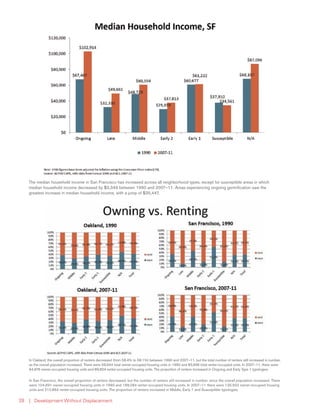
  • 51.
    Causa Justa ::Just Cause | 49 Beatriz Eugenia Mendez has been a member of CJJC since July 2012. Originally from Guatemala, she moved to the U.S. in 1997 looking for a bet- ter future and better opportunities. Beatriz has lived in the Excelsior neighborhood of San Francisco for the past nine years, hav- ing moved there after she was evicted from another unit; the landlord simply told her she had to leave. After nine years in her current home, Beatriz is once again facing eviction and harassment from her landlord. Fortunately, Beatriz sought out assistance and was re- ferred to CJJC where she was informed of her rights as a tenant and told that the landlord needed a just cause for eviction. Beatriz was also advised to leave a paper trail and began paying rent by check and requesting repairs in writing. The landlord didn’t respond well and continued to threaten eviction, this time by having the property management company send an (invalid) eviction notice. This eviction experience has been very different from Beatriz’s eviction from her previous home. This time around she had the support of her CJJC counselor and, knowing her rights, has been able to stay in her home since she was first threatened seven months ago. However, the landlord has refused to address repairs over the last seven months and Beatriz suspects he wants to make her desperate enough to vacate on her own. “I’m thankful that all these protections are in place … and every time there are protections people try to find ways to go around them. I think it’s important to defend yourself and stay strong, because it’s difficult to move around especially when there are not enough economic resources. Now, the rent is really high and one has to earn at least $5,000, which is nearly impossible. Protections have supported me immensely because my economic situation has changed very much and knowing my rights and how to defend myself and how to be stable in one place has supported me very much.” — Beatriz Mendez, CJJC Member disinvestment, research and community expe- rience are showing that even the most well-in- tentioned projects can lead to gentrification and displacement.159 Without protections to ensure that existing residents can stay and benefit from neighborhood change, the same communities who suffered from disinvestment and displace- ment in the past may be displaced yet again. While public health has progressed in its ap- proaches to health and neighborhood develop- ment, the field still needs to recognize the dan- gers of displacement. As Wallace and Fullilove have argued, serial displacement has been driven by a consistent policy of moving people rather than improving their living conditions in place.160 Public health practitioners committed to the well-being of vulnerable communities must learn from mistakes of the past, including the need for a broader understanding of health that recognizes the importance of place and the health-protec- tive elements of social and community support systems. This means re-examining the assumption that moving people is necessarily good for health, and ensuring that other public agencies, govern- ment officials, and policymakers do the same.161 As improving neighborhood health becomes a more commonly accepted goal of urban planning and development, public health departments have a unique and pressing responsibility to ensure that neighborhood change happens in a way that is beneficial for all. Otherwise, planning and development strategies advanced in the name of health may not be healthy or sustainable. This is not a task that public health departments can take on alone. The next section outlines the role that public agencies, including public health departments, can play in advancing a healthier and more humane version of development.
  • 52.
    | Development WithoutDisplacement50 OrganizingToward a NewVision for Community Development Human Development for Healthy and Sustainable Neighborhoods As discussed above, the growing focus on sus- tainability has led to neighborhood developments addressing the environmental effects of industrial production (automobiles, industrial pollution, and the degradation of urban green spaces). Unfortunately this approach to sustainability while necessary, do not address the historic role of government deregulation and disinvestment. It has for the most part opened the door for a greenwashed, yet market-friendly, brand of cor- porate-led development. While more “walkable”, transit accessible developments serve eco-con- scious new residents seeking to live closer to amenities and work, long time neighborhood res- idents reap few benefits. So-called “sustainable” developments generally create many of the same pressures that fuel gentrification and do not have the effect of increasing stability for long time residents and businesses. Working class com- munities of color have for decades suffered the brunt of environmental degradation but this new environmentally conscious approach to develop- ment does not seem to address either the history of environmental racism, nor the numerous health impacts facing working class communities today. Even as cities strive to develop more “sustain- able” development plans, or to encourage “tran- sit-oriented development” and “walkable cities,” most of the fundamental processes remain the same. Success is measured primarily by the amount of new economic activity that occurs, and the number of new, higher-income resi- dents that move in. Little consideration is given to whether the health or economic stability of current residents is improved. Collective Action Creates Human Development Central to challenging this cosmetic brand of urban development is challenging the individ- ualism embedded in popular ideas of “human development” that pervade urban redevelop- ment initiatives. Originating from 1970s rational choice theory and the ideas of conservative economist Gary Becker, this version describes the idea of human development as the accumu- lation of skills that enable individuals to make rational and profitable decisions. Rather than strengthening communities and social networks, Paula Beal’s interest in housing and immigrant rights drew her to the work of CJJC. Paula is very active in her community and has been renting her current home in West Oakland for the past four years. She knows many of her neighbors and has strong roots in the community. She has been a member of CJJC for 10 years.
  • 53.
    Causa Justa ::Just Cause | 51 Young CJJC Members Uniting For Justice, Oakland Homes For All National Campaign Launch, Oakland proponents of this idea of human development breed competition and individualism. This version of human development erases the history and current lived reality of communities most impacted by development. It inaccurately portrays gentrification as a result of competi- tion between individuals with different levels of human capital, each exercising their personal choices about where they live, work, and play, as opposed to a phenomenon rooted in a long history of disinvestment and marginalization. In an individualistic model of human develop- ment, gentrification is addressed by “empow- ering” individuals to be more competitive in the high-pressure technology and housing markets, both as a worker and as someone looking for housing. Instead, we propose putting a re-en- visioned version of collective need and interest back into the concept of human development. In our framework of human development, the goal is to unite, organize, and empower communi- ties to challenge historic and current inequities as a means towards building a new vision of community health and sustainability that ben- efits all residents. Relationships and alliances have to be built between different groups that have been historically impacted by racialized disinvestment. Communities that have had to compete with each other for good jobs, hous- ing, education, need to realize that individual- istic conceptions of human development have prevented them from identifying shared interest and common struggle. Community organizing, and not competition between individuals, should be the basis of human development for working class communities of color. Gentrification Can Be Prevented Gentrification can be prevented, and it can be stopped in neighborhoods where it is occurring right now. Gentrification is not inevitable. While the forces that cause it are global, almost all development decisions and regulations are set at the local level. With organized working-class communities pushing for alternative forms of de- velopment a lot can be done. With a bold local public agency leading the way — without undue influence by political donations from developers, real estate interests, corporate lobbyists and landlords — much harm can be prevented. Many urban theorists, and development theo- rists generally, point out that a “rising tide lifts
  • 54.
    | Development WithoutDisplacement52 all boats” model does not work for economic development, particularly under capitalism. Reagan’s trickle-down economics have been refuted. In fact, is it understood that economic development in our context is closer to a ze- ro-sum game, though not entirely. This means as some get wealthier, others must get poorer. In urban economics you can see versions of this playing out with the development of the suburbs at the expense of the development of the urban core. As the suburbs developed and capital development flowed there, the same capital flowed out of the cities, and those communities became underdeveloped. As the suburbs pros- pered, people in cities saw very little, if any, of the benefits of that development. This process has begun to reverse over the past several de- cades, with certain urban communities receiv- ing a large influx of investment and outer-ring suburbs experiencing disinvestment. Those who cannot afford to remain in hot-mar- ket areas (where investment is happening) end up in the underdeveloped areas, whether by direct or indirect forces. In a single-city model, one could argue that increased tax revenue from development could lift the boats of all residents by providing more services and amenities. Unfortunately, this is not how the urban development process works. Those with the financial and political means tend to advocate for additional resources for services that benefit them and for amenities that serve their interests — a dog park around Lake Merritt, for example, or additional police patrols in higher-income communities. Services that meet the needs of low-income communities of color in historically underdeveloped areas, like increased bus services or affordable, fresh foods, are rarely expanded substantially. So as economic development is poised to enter a community, what can be done to capture the economic and human benefits of that develop- ment for the existing residents, and what models of development can be encouraged that maxi- mize human development? Also, what models of development can be encouraged that do not take resources from one place and put them in another, but instead expand resources for all? Cities and communities need a new vision for development that will actually improve out- comes for longtime, working-class residents and people of color. In our vision, human development empowers a community to identify the types of housing, ser- vices and infrastructure that should be located in their neighborhood. It ensures that the needs and opinions of longtime residents are a central part in defining the vision for neighborhood develop- ment and change. It supports residents to do this by providing resources, tools and information; as well as centralizing decision-making power in the community. This approach to community development fosters institutions and enterprises Art by Melanie Cervantes
  • 55.
    Causa Justa ::Just Cause | 53 that have value to the residents, puts protections in place that prevent displacement and gentrifica- tion, and results in positive human development outcomes for all residents of the community. The Role of Public Agencies in Promoting Human Development Local governments have a unique responsibility and power to advance this vision of human devel- opment. This new approach must include a shift in governmental understandings of development and health, substantial changes in how land use planning and development decisions are made, and implementation of policies to protect against displacement and promote healthy development for all. This includes acknowledging the role that the public sector has played in enabling gentrifi- cation and displacement through both action and inaction, and the health consequences of these decisions. Furthermore, local governments must learn from mistakes of the past, including recog- nizing and protecting against the dangers of dis- placement. As urban development and land use planning practices move toward a greater focus on health and equity, public agencies must also broaden their understanding of health, including recognizing the importance of strong community ties and social support for good health. The fields of public health and urban development must respect the needs and desires of existing resi- dents, and see value in the assets, resources, and relationships that make every community a home, regardless of income. Public agencies must also shift their funda- mental approach to development, so that the The Mission Anti-Displacement Coalition Planning Principles For Community Development 33 We are committed to a community driven planning process done in an inclusive man- ner—through community organizing, leadership training, focus groups and popular education --that ensures the participation of those mem- bers of our community who are disenfranchised, marginalized, and not usually heard. 33 Our planning process will address the economic, racial, and social inequalities of the status quo. 33 Our planning process will strive to advance the capacity of the community to address planning and development issues far into the future. 33 Through our planning process we strive for trans- parency in the planning and rezoning process and city accountability. 33 We will struggle to improve democracy in San Francisco by increasing the participation of Mission District residents in the decision-making bodies. 33 We believe that all tenants have a right to safe, secure, and affordable places to live We support strong public policies that protect those rights 33 We believe that real estate speculation destabi- lizes neighborhoods, communities and econ- omies. We support regulation and controls on such speculation. 33 We believe that the future of San Francisco as a culturally vibrant and creative city depends on its capacity to protect tenants from displacement and neighborhoods from gentrification. 33 We are committed to building a democratic, inclusive, and nonviolent movement for social change to advance these values, beliefs, and policies. Positive development models should: 33 Centralize the stability of working-class residents who reside in the communities 33 Support community organizing and involve residents in making the actual decisions that impact the neighborhood 33 Promote and measure positive human development outcomes in addition to economic indicators 33 Acknowledge and support the impor- tance of racial equity, community, and culture as parts of a healthy community
  • 56.
    | Development WithoutDisplacement54 needs of existing communities are prioritized and residents are viewed as valued partners and change makers in their own neighborhoods. This should include significant changes in how development and land use planning processes occur, including proactive efforts to partner with community residents and community-based organizations to envision and decide on neigh- borhood change. While important shifts are happening in many places, such as the improve- ment of community engagement practices, the growth of research and planning partnerships between public agencies and community-based organizations, and the increased use of health impact assessments as a decision-making tool, these approaches must be strengthened, expanded, and implemented in other cities/ regions so that they become standard practice. Furthermore, public agencies must measure the success of development in terms that go beyond economic activity to capture community well-being, including the social, cultural, and health dimensions of prosperity. Finally, local and regional agencies must im- plement policies and practices that promote development without displacement. This means working with residents to improve their lives, environments, and opportunities in the place they call home, including the development of housing and land use models that support asset-building and community ownership. Further, these agen- cies must ensure that neighborhood investments include protections against displacement and opportunities for existing residents to thrive in the places they live. Local governments can also use their power to protect existing residents from predatory private development and to incentivize ongoing investment in all neighborhoods. As public agencies, community-based orga- nizations, residents, and private sector actors all engage in discussions and action around displacement, public health can play a critical role in many aspects of this process. While public health departments are just one organi- zation in a complex array of agencies, each with a different role in development, there are key opportunities for public health to support need- ed changes. Public health departments can disseminate research on the health impacts of displacement, weigh in on the potential health impacts of new development, connect commu- nity residents to decision-making processes, and support policy change to promote com- munity stability, neighborhood affordability, and equitable investment in all neighborhoods. Only when residents and communities are stabi- lized in the places they call home and included in the decisions shaping their neighborhoods will the “improvements” made to their environments be truly healthy and sustainable. Preventing dis- placement may be the single greatest challenge and the most important task in our collective efforts to create healthy communities for all. Homes For All Action, San Francisco
  • 57.
    Causa Justa ::Just Cause | 55 Policy Findings & Recommendations The following section outlines a set of recommendations based on our analysis of 14 key policy solutions for preventing displacement. Our research included a review of primary and secondary literature, and our analysis focused on policy design and function from tenants’ rights and public health perspectives. The methodology for this research and analysis, including sources consulted, is described in detail in Appendix A. Based on this analysis, we developed a set of cross-cutting recommendations to strengthen all policies, and a framework of six key principles for preventing displacement. Within this framework, we make specific recommendations for how to maximize impact for each policy, and we also identify new “promising policies” that would support displacement prevention on a broader scale. Cross-Cutting Recommendations for Policy Effectiveness “Our housing groups traditionally have been either organizations of or advocates for homeless individuals and families, renters, and tenant organizations, or private housing groups/anti-foreclosure groups. And so, much of their work has happened in a very siloed way…Homes for All is the first place where we’re bringing together all of those constituencies to begin local grassroots and national campaigns around [a] housing justice platform ... We have a lawsuit that we just filed last year against the FHFA, the Federal Housing and Finance Agency, because in 2008 under the HERA Law (Housing and Economic Recovery Act) they established something called a National Housing Trust Fund. And the purpose of the fund is to put money towards the creation and preservation of affordable housing, which has been divested from over the last 20 years. The revenue mechanisms for the National Housing Trust Fund were intended to be Fannie Mae and Freddie Mac. So, here you have what has become a public entity, essentially a public bank since they’ve been in receivership by the federal government that is supposed to be putting up a percentage of their profits each year into the National Housing Trust Fund in order to have that go into an investment in affordable housing. So far we know that they made $382 million dollars in profit for 2012 and put not a penny into the Trust Fund. So, the lawsuit is an example of where we’re able to link the private homeowner constituencies with the renter constituencies, because Fannie Mae and Freddie Mac are screwing the homeowners and at the same time with all of the profits that they’re making they are pushing people out of their homes, they’re also reneging on
  • 58.
    | Development WithoutDisplacement56 the commitment and responsibility to fund affordable housing for people who would be renters. So it’s been a really powerful piece of work that has unified those two constituents in a really solid way.” — Rachel La Forest, Executive Director, Right to the City (RTTC), New York Based on our research and analysis, all policies would benefit from the below components: 33 Enforcement is key to ensuring that poli- cies actually achieve their intended impact on the ground, both in terms of protecting vulnerable residents and penalizing negli- gent landlords, developers, and/or govern- ment agencies. Enforcement efforts need to be funded, staffed and undertaken proac- tively rather than in response to resident complaints or appeals, so that residents do not have the burden of proving non-compli- ance.162 In addition, penalties for non-com- pliance should be incorporated into policies that aim to regulate developer, landlord, and government activity. For example, code enforcement activities should involve strong penalties, such as fees and building seizure and transfer, for negligent landlords in order to compel action on housing violations.163 Tenant protection policies should include the right to administrative, legislative and judicial review.164 In addition, penalties and incentives for all policies should be de- signed in order to leverage policies so that their impact goes beyond the primary policy goal to incentivize action on anti-displace- ment efforts more broadly. 33 Protections for vulnerable residents are crucial in order to avoid negative unintended consequences for residents caught in the middle of enforcement.165 For example, if adequate protections are not established, enforcement of a city’s housing code could involve building closure and displacement of the building’s residents, even if enforcement is intended to benefit residents’ health.166 Protections can be incorporated through es- tablishment of legal rights for tenants under specific policies and through policy design features that minimize the potential for displacement. Protections should address rights under eviction, just compensation in cases of displacement, right to return if tem- porary relocation is necessary, and access to information about rights and opportunities. 33 Community organizing and resident outreach are crucial in order for policies to be developed, implemented, and enforced for maximum positive impact on the popula- tions who need them most.167 Research has shown that when residents are directly con- tacted about their rights and opportunities under eviction protection law, they are nearly twice as likely to utilize the policy and legal processes in place by filing an appeal.168 This finding can apply to other policies as well. Furthermore, engaging residents and community-based organizations in policy development can help to identify and prevent unintended consequences for vulnerable populations, such as low-income tenants.169 Community organizing and outreach ensure that residents have access to the information they need and can act in a timely manner in response to changes in their housing and neighborhood conditions.170 Without such support, residents may not be able to take advantage of critical windows of opportunity to preserve affordable housing and utilize existing protections against. Community organizing and outreach efforts should there- fore be funded in connection to local and regional anti-displacement strategies. 33 Relocation benefits should be incorpo- rated into any policy that seeks to regulate housing activity and the loss of affordable rental units.171 For example, condominium conversion regulations should incorporate relocation benefits as compensation for residents who are displaced as a result of their unit’s conversion. In addition, local
  • 59.
    Causa Justa ::Just Cause | 57 governments should explore ways to gen- erate relocation funding through fees and taxes that are triggered by community stabi- lizing and displacement prevention policies that regulate developer activity (such as Real Estate Transfer Taxes, condominium conversion regulations, and displacement impact mitigation fees). 33 Affordable housing policies and pro- grams should be tied to people in the same neighborhood. Gentrification and displacement have neighborhood-level impacts and thus require solutions that can be targeted to the specific needs of a given neighborhood. Mitigation fees and taxes de- signed to minimize the impacts of displace- ment and raise funds for affordable housing are not often designated for use in particular neighborhoods. Furthermore, “in-lieu” fees in- corporated into inclusionary housing policies are often chosen over on-site development of affordable units,172 Thus, policies designed to regulate housing activity through monetary penalties may not benefit residents in the same neighborhood where the development is taking place. Furthermore, affordable homeownership programs like homebuyer assistance programs do not often focus on supporting residents to stay in their existing homes and neighborhoods. Without this focus, homebuyer assistance programs may support low and moderate income residents in building valuable assets, but they are less likely to prevent displacement at the neigh- borhood level.173 To address these issues, policies or programs that provide affordable housing through new construction or rehabili- tation should include preferences for existing, low-income, and longtime residents in the same neighborhood. In addition, affordabil- ity requirements and incentives within new housing (such as inclusionary zoning pol- icies) should be based on actual resident income and affordability needs within the neighborhood. Finally, any mitigation fees or “in-lieu” fees generated by new development should be prioritized for use within the same neighborhood where the triggering develop- ment is located. 33 Policies need to be advanced at the right stage. While some policies are most effective and feasible in later stages of gentrification, many policies should be implemented when neighborhoods are susceptible to or in early stages of gentrifi- cation, in order to prevent substantial loss of affordable housing and protect vulnerable residents before the community is destabi- lized.174 In addition, because policies take time to implement and neighborhoods can change quickly, all policies should be im- plemented in the earliest stage appropriate. See our below recommendations for notes on staging each policy based on neighbor- hood type. For an overview of our neighbor- hood typologies analysis and definitions of neighborhood types, see Appendix A. 33 Multiple policies need to be advanced at once to address the complex nature of displacement. Multiple forces and actors drive displacement, including government, landlord, developer, investor, and individual resident activity. Similarly, displacement is impacted by different levels of decision-mak- ing, including federal, state, regional, and local. Individual policies often intervene in only one of these driving forces and/or com- pel action by one kind of actor at a time. The most promising strategy for preventing and minimizing displacement is by advancing multiple policies and practices, at multiple scales, and tailored to the specific needs of neighborhoods and cities.175 The frame- work presented in the Principles, Policies and Practices section, below, organizes our individual policy recommendations under six key principles, each of which is essential for preventing displacement. 33 Equity impacts should be central to the policy debate about development and neighborhood change. One way to support the adoption of stronger anti-dis- placement policies is to proactively shape
  • 60.
    | Development WithoutDisplacement58 the public and policy debate on develop- ment and gentrification by ensuring that social equity impacts are always discussed and considered in relation to development decisions.176 This means acknowledging the structural causes of gentrification and displacement, including the public sector actions and decisions that lead to gentri- fication, and discussing/documenting the potential impacts of planning and develop- ment decisions on long-term residents of the city. This approach can be built into pol- icy decisions at the local and regional level through community health impact analyses that include targeted questions about equity impacts, a methodology for predicting displacement-related impacts, and a formula for calculating monetary value of impacts for translation into mitigation fees, as discussed later in this report. 33 Dedicated funding is needed to ensure the success of many of the policies, pro- grams, and practices discussed in this report. Funding is necessary not only for policies that involve subsidies but also for adequate enforcement and outreach to affected residents about their rights and op- portunities. Local and regional governments should explore multiple funding sources to support anti-displacement efforts, including: 33 Fees collected on landlords through fines and registration of buildings, and fees levied on developers through mitigation fees. 33 Taxes attached to property sales (including Real Estate Transfer Taxes), and other taxes such as document recording fees. Care should be taken to avoid regressive taxes. 33 Local funds, such as housing trust funds and relocation funds, which may already exist in several cities. If they don’t already exist, relocation funds should be created at the local level to ensure adequate support is available for the exclusive purpose of com- pensating residents faced with displace- ment and assisting them in identifying and securing high quality replacement housing. 33 State funding sources, such as potential cap-and-trade revenue that may become available to support healthy and sustainable development projects. 33 Federal funding sources, such as Community Development Block Grant (CDBG), HOME, and Federal Promise Zone funding. The downward trend in feder- al funding for affordable housing creates an environment in which revenue-driven de- velopment projects are supported by local governments, and it is difficult to provide the depth of subsidies that are needed to ensure truly affordable housing to long- term residents. Local and regional agencies should seek creative ways to apply existing federal funding sources and advocate for in- creased and/or renewed funding for afford- able housing and community development. Art by Dignidad Rebelde
  • 61.
    Causa Justa ::Just Cause | 59 Principles,Policies & Practices for Preventing Displacement:Advancing a Comprehensive Housing Rights Framework Displacement is driven by multiple forces, actors, and levels of decision-making and thus requires multi-faceted solutions. The below framework outlines six complementary principles that we believe are essential for preventing displacement. No single principle is a solution on its own; rather, these principles should be advanced in tandem, as each addresses a unique aspect or cause of displacement. OUR SIX KEY PRINCIPLES INCLUDE: 1. Baseline protections for vulnerable residents 2. Production and preservation of affordable housing 3. Stabilization of existing communities 4. Non-market based approach- es to housing and community development 5. Displacement prevention as a re- gional priority 6. Planning as a participatory process On the following pages, we discuss policies and practices that fall under each principle and make recommendations for how to strengthen each policy for maximum impact. As each is in- troduced, we provide our synthesized findings from the research and analysis, and we also highlight examples of strong “model” policies. We include implementation considerations, including responsible agency, stage of gentrifi- cation most effective, and where possible, ideas for enforcement. In addition to the policies that were researched and analyzed in depth, we also highlight several “new” policies and practice ideas revealed through our research or arising from dialogue with partners and stakeholders. These are promising policies and practices for which there may be limited existing research. We include these in our recommendations be- cause we believe they would support displace- ment prevention on a broader scale by address- ing gaps in other policies and/or by increasing transparency, participation, and accountability in local land use planning and development processes. Each of these policy ideas is indi- cated with a [PP] for “Promising Policy” and introduced with a rationale for inclusion. Where possible, we also highlight examples of where these ideas have been implemented. Note on staging: We highlight the stage(s) of gentrification at which the policy would be most appropriate or effective in preventing displacement, due to housing activity, affordability of housing and land, and/or likelihood of displacement pressure on vulnerable residents. Our assessment of staging is based on recommendations from literature and our own analysis. Because many policies discussed in this document would
  • 62.
    | Development WithoutDisplacement60 be implemented citywide, these policies should be implemented as soon as any neighborhood within the city reaches the stage of gentrification indicated. In addition, some policies include a suggested staging of “early and always” as they do not depend on specific neighborhood conditions and may be critical to establishing an environment in which other anti-displacement efforts will be successful. These stages correlate with the neighborhood typologies analysis and definitions outlined in Appendix A. For the purpose of these recommendations, we have grouped the neighborhood types into three broad stages: Early, Middle, and Late. The below table outlines which neighborhood types fall under each of these stages: EARLY MIDDLE LATE Susceptible Middle stages Late stages Early type 1 Ongoing gentrification Early type 2 A. Baseline Protections for Vulnerable Residents Implementing baseline protections to prevent displacement of existing vulnerable residents is an essential foundation for any anti-displacement strategy. These include protections to: 1) keep people in their homes in the face of gentrification and displacement pressures from landlords and the hous- ing market; 2) ensure that new affordable housing resources are made available to those who need them most; and 3) provide just compensation measures to assist residents with relocation in cases of displacement. 1. Protect vulnerable residents from dis- placement through “Just Cause” eviction ordinances. Local data and existing research has shown that evictions increase as neigh- borhoods experience gentrification.177 When housing markets are tight and residents are given minimal warning and support to find replacement housing, evictions can lead to permanent displacement from neighborhoods. In order to prevent low-income tenants from being unfairly evicted by their landlords in the context of gentrification, cities should imple- ment these ordinances to protect tenants in all residential rental properties within the city. Included in these ordinances should be a list of “just causes” for eviction and legal rights for tenants who are faced with evic- tion, including a clear legal process for filing eviction petitions as well as penalties, includ- ing fees and limited access to tax and other financial assistance, for landlords who unjustly evict tenants. Ordinances should require an adequate window of time, at least 30 days, is given for tenants to respond to eviction no- tices. Relocation benefits should be required for all “no-fault” evictions (including Owner Move-In, Ellis Act, capital improvement/reha- bilitation, demolition, and code enforcement activities). See A4 below for more details on relocation benefits recommendations. Furthermore, evictions should be prohibited in cases of building seizure and transfer due to code violations, and no-fault evictions should be prohibited for those particularly vulnerable to the impacts of displacement, such as the elderly, disabled, pregnant women, house- holds with infants, and chronically ill tenants. 33 Implementing Agency: Cities 33 Staging: Early and always 33 Model: San Francisco, CA: Just Cause for Eviction ordinance178
  • 63.
    Causa Justa ::Just Cause | 61 SUMMARY OF ANALYSIS FOR JUST CAUSE EVICTION ORDINANCES Community Ownership and Power Affordability and Housing Stability Housing Quality / Habitability Permanence and Loopholes Unintended Consequences Policy strengths: »» Some evidence suggests that Just Cause Eviction ordinances can pave the way for future tenant protections. »» Creates new legal rights for tenants to prevent eviction and protect them in cas- es of eviction. »» Promotes housing stability for renters by supporting them to stay in their homes. »» When combined with rent control, can promote neighborhood-level affordability by preventing and minimizing opportunities for rent hikes during vacancies caused by evictions. In California, because of vacan- cy decontrol, it’s particularly critical to have strong local eviction protections. »» If combined with code enforcement efforts, can promote housing quality for renters by providing right of first refusal in cases of temporary “no-fault” evictions due to housing renovation, capital im- provement, and rehabilitation. »» Scale may be larger than rent control, as state level laws (such as in CA) limiting which buildings can be covered by rent control may not affect buildings covered by just cause eviction protections. Concerns and considerations: »» Only effective if tenants know their rights and how to respond to eviction through legal means. »» May be ineffective in preventing displace- ment without rent control or vacancy control laws, even when right of first refusal provisions are included, as newly renovated unit may be unaffordable to original tenant. »» May be ineffective in stopping displace- ment in cases where landlords consis- tently use “buy-out” offers to encourage tenants to move out of their units. Cecilia Alvarado, CJJC member since October 2013. Cecilia Alvarado, 43, has been living in the area arond San Francisco’s Mission neighborhood since she emigrated from El Salvador at the age of 19. Her experience as an immigrant highlights the community resources that get dispersed, then lost, as a result of gentrification. Cecilia grew up in Cali, Colombia. After violence broke out in the 1970s, Cecilia’s parents moved the family to El Salvador, just as political coercion was resulting in widespread violence. After a violent confrontation with militants just across from her university, Cecilia moved to the U.S., with the phone number of her grandfather, a San Francisco resident, in hand. While Cecilia did not find her grandfather, she found a deeply supportive community in San Francisco’s Mission district, where a priest and Salvadoran refugee groups gave her shelter and helped her find employment and housing. Decades, later she has raised three children in San Francisco, all of whom grew up “in the heart of the Mission.” Late last summer, Cecilia’s landlord, who lives in Foster City, announced a spike in rent that Cecilia found unjust and exaggerated. She experienced phone threats and harassment by the bond attorneys hired by her landlord, who went as far as to post multiple eviction notices in public
  • 64.
    | Development WithoutDisplacement62 view. Later, Cecilia found out that her landlord intended to evict her, make repairs to the small Potrero studio, and rent it for $1,500, whereas she paid $850 for the studio in need of repairs. Cecilia sought help from Causa Justa and looked into the legality of the eviction threats she was experiencing. She found that her landlord had her studio registered as a commercial property, enabling her to avoid rent control restrictions and to pass on utility charges to tenants. Cecilia also found a history of renting to undocumented immigrants, who were easily evicted in the past. Cecilia, who did not receive receipts for her rent payments, began to pay using money orders or checks to keep a personal record of her payments. When confronted with the information Cecilia gathered, the San Francisco Rent Board found her eviction unjust. After a personally draining and expensive court procedure, Cecilia was unable to prevent the $200 rent increase, but was able to change her rental studio’s status from commercial to residential, removing the burden of utility payments and uncontrolled future rent increases. Cecilia laments the rapid transformation of the community that helped her settle in after escaping political unrest in El Salvador. 2. Establish strong anti-harassment poli- cies to prevent landlords from coercing tenants into leaving their homes due to negligence, intimidation, or buy-out of- fers. [PP] Even when eviction protections ex- ist, landlords may still push tenants out of their homes through various forms of harassment, coercion,179 and/or neglect of basic proper- ty maintenance and repairs. These kinds of action and inaction can make low-income tenants’ housing conditions uninhabitable and thus result in their displacement. Cities should establish policies that prohibit tenant harassment by clearly defining harassment to include: failure to provide housing services in line with housing, health, and safety laws; attempts to coerce tenants to vacate units with intimidation and offers of payment; and interference with a tenant’s right to quiet use and enjoyment of rental housing. Cities should set limits on the number of “buy-out” offers a landlord can make to each tenant and within the same building, and establish a registry of buy-out evictions that can be tracked at the neighborhood level by local rent boards or another administrative body charged with overseeing local tenant protection and hous- ing policies. Incidents of harassment should result in citations and fines as part of a city’s existing practice of enforcing housing and health codes, and the policy should include the right of action for individuals and organiza- tions to sue landlords on behalf of tenants. 33 Implementing Agency: Cities 33 Staging: Early and always 3. Implement a comprehensive “right of first refusal policy” to maximize oppor- tunities for existing residents to stay in their homes. Even when “just cause” eviction ordinances are in place, temporary relocation required for housing repair, reha- bilitation, or conversion activities can lead to permanent displacement of existing residents. This is particularly likely if residents do not receive clear information about when units are ready to be re-inhabited, or if they do not know their landlord intends to re-rent or sell the unit at a higher price. In order to minimize displacement of existing residents, cities should pass a “right of first refusal” policy to require any housing unit renovated through
  • 65.
    Causa Justa ::Just Cause | 63 redevelopment, rehabilitation (including due to code enforcement activities), conver- sion, or subdivision to be offered to existing tenants first, before being sold or re-rented on the private market. Furthermore, original tenants should be given the right to return at prior rent levels, including any covered rent adjustments. 33 Implementing Agency: Cities 33 Staging: Early and always SUMMARY OF ANALYSIS FOR RIGHT OF FIRST REFUSAL POLICY Community Ownership and Power Affordability and Housing Stability Housing Quality / Habitability Permanence and Loopholes Unintended Consequences Policy Strengths: »» Creates legal rights for individuals and families faced with displacement. »» Can support housing stability for existing tenants by giving them an opportunity to return to their original homes after tempo- rary relocation. »» Can increase housing quality by support- ing tenants to return and benefit from ren- ovations or rehabilitation of their original unit. Concerns and Considerations: »» Right of first refusal policies may be inef- fective in preventing permanent displace- ment because newly renovated / convert- ed units may be unaffordable to original tenants. 4. Strengthen local relocation policies to ensure that any resident displaced as a result of a no-fault eviction, including building closure due to uninhabitable conditions, or publicly funded devel- opment activity receives just compen- sation and comprehensive relocation assistance. Federal law requires relocation assistance be paid to any resident displaced as a result of federally funded development activity.180 However, this assistance has his- torically been inadequate and residents have fallen through the cracks due to poor record keeping, inadequate staffing, and unmet or vague promises to return residents to their neighborhoods.181 To address these holes, cities should pass relocation policies attached to dedicated funding that will provide com- prehensive benefits above and beyond what federal law requires, including benefits for resi- dents displaced due to no-fault evictions in the private market. Relocation fees should be paid to residents by the city in cases of publicly funded development activity and by landlords in cases of no-fault eviction. This assistance should include direct monetary compensation for the costs of moving (calculated retroactive- ly), as well as the cost of at least three months’ fair market rent plus additional benefits for households with residents who are elderly (65 years or older), children below age 18, or disabled and/or chronically ill. In addition, all displaced residents should receive access to case management services that will work with them to identify affordable, high quality replacement housing that meets their needs within the same neighborhood, if possible, or within the same city at a minimum. Case man- agers should work with residents to secure new housing, including navigating any barriers to eligibility related to credit and outstanding utility and rent bills. As part of these case management services, all residents should be consulted about their housing needs and
  • 66.
    | Development WithoutDisplacement64 interest in staying in the city, and their contact info should be tracked in a database of relo- cation information. Relocation policies should also include a “build or find it first” provision to protect residents from being moved before ad- equate replacement housing is identified, and all replacement housing should be inspected for compliance with housing codes before being offered to displaced residents. For residents relocated by public development activity, efforts should be made to minimize barriers to eligibility for replacement housing, and new criteria beyond what was required for original housing — such as eviction history and criminal records — should not be a basis for acceptance into new subsidized housing. If no adequate relocation housing is available within the city at the time it is needed, cities should consider paying additional benefits to residents to compensate them for displace- ment from the city. In cases of temporary relocation due to rehabilitation or code enforcement activities, residents should be given clear timelines for relocation. They should also be paid relocation expenses up-front and an additional amount retroactively, depending on the length of time they were displaced. In addition, temporarily displaced residents should have the right to return at prior rent levels, including any covered rent adjustments. Residents should also receive additional benefits if displaced for more than one year. Local relocation funds can be generated in part by impact fees as discussed in F5. 33 Implementing Agency: Cities 33 Staging: Early and always 33 Models: San Francisco, CA: Tenants’ Rights to Relocation for No-Fault Evictions18 SUMMARY OF ANALYSIS FOR RELOCATION POLICIES Community Ownership and Power Affordability and Housing Stability Housing Quality / Habitability Permanence and Loopholes Unintended Consequences Policy Strengths: »» Create legal rights for residents facing displacement. »» Can support improved housing quality if residents are able to move to a high- er quality replacement unit and/or a neighborhood with greater access to health-promoting resources. »» If strong provisions are included to incen- tivize relocation within the same neighbor- hood and/or city, could slow or minimize displacement of existing residents. Concerns and Considerations: »» Relocation benefits often do not prevent displacement; rather, they compensate residents for displacement and support residents in moving to new homes and neighborhoods. »» Without adequate support identifying high-quality replacement housing in a preferred location, residents could end up in a neighborhood with fewer health-pro- moting resources and institutions. »» Without strong penalties and enforce- ment, including incentives for the city to identify affordable replacement housing within the same neighborhood/city, re- location benefits could actually facilitate displacement of residents from the city. »» Relocation services are costly to staff, and adequate staffing is a crucial for success- ful relocation services.
  • 67.
    Causa Justa ::Just Cause | 65 Melissa Jackson, one of the newest members of CJJC, joined the organization a few months ago because her rent increased by more than she could afford. Melissa had been renting a condo in Oakland’s Chinatown since 2009. The landlord found out from the Housing Authority that it was illegal to charge Melissa for electricity as a Section 8 holder and, therefore, raised rents to make up the difference. The Housing Authority was unwilling to pay the difference in rent at the higher rate, forcing Melissa to relocate. At 78 years old, this was a very stressful situation for Melissa who worried she may end up homeless. With help from her granddaughter she was able to eventually locate another rental unit in West Oakland, but the experience was extremely stressful. Her only relocation assistance came from her family network. Without family she would likely have ended up in a far worse situation. 5. Implement a “reparations and right to re- turn” policy that prioritizes a certain percent- age of new affordable housing units for resi- dents and families who were displaced from the same city due to publicly funded redevel- opment projects. This policy should be con- sidered and adopted by cities in which past redevelopment projects resulted in permanent displacement of large numbers of residents. This policy should be tied to the creation of a centralized database of contact information for residents and families displaced by publicly funded redevelopment projects. It should also include funding for outreach staff to consult with residents about their interest in returning to the city, and inform displaced residents about their rights, financial resources, and housing opportunities. Goals should be set for returning a certain number of displaced residents and family members each year, and priority should be given to residents from pop- ulations who were disproportionately affected by publicly funded redevelopment, including populations of color and low-income residents. The same relocation assistance as discussed in A4 should apply, including pre-inspection of all eligible housing to ensure compliance with housing codes and assurance that eligible res- idents have clear information about available housing, a timeline for relocation, and financial assistance opportunities. Funding for this could come from a local relocation fund and be supplemented with federal sources. 33 Implementing Agency: Cities 33 Staging: Early and always 33 Model: Hamtramck, MI: Housing repa- rations for residents and families formerly displaced by urban renewal.18 SUMMARY OF ANALYSIS FOR RIGHT OF RETURN POLICIES Community Ownership and Power Affordability and Housing Stability Housing Quality / Habitability Permanence and Loopholes Unintended Consequences Policy Strengths: »» Can provide justice to communities harmed by historic urban policy and re- verse patterns of displacement. »» Creates new rights and preferences for residents affected by displacement in the past and contributes to restoration
  • 68.
    | Development WithoutDisplacement66 Gilda Haas, organizer, urban planner, and faculty at Antioch University in Los Angeles, discusses the Scott-Carver Homes Project in Miami, FL, and Right of Return policies. “There was an example in Miami where they tore down public housing and they were negotiating to build some public housing and they realized that the housing authority had kept terrible records of who was displaced and where they were, because it was years later, and they couldn’t retrieve any information. So the Miami Workers Center put up a huge sign on the lot [where the former housing project stood] and asked people to come and put down names of people that they [used to know/who used to live there] — because the community remembered … and the community became the owner of the knowledge and producer of the knowledge… …In order to have a right to return it has to be meaningful, it has to be protective. Having a timing mechanism is really important … One of the problems about relocation and the right to return is that it’s separated from any housing stock. It’s a disembodied right. It doesn’t have any units connected to it. It doesn’t have any permanence. So even if you put someone in housing that is comparable in terms of price, how long is it going to be that way? Or, if you say we’re going to make up for the difference, we’re going to give you relocation benefits to make up for the difference in the price, what happens when those expire? … People have to be really, really clear on the goals as opposed to a negotiated agreement in the moment. So if the goal is to keep people whole, for how long? Does it have to be in this neighborhood? What are you trying to accomplish?” — Gilda Haas, Organizer, Urban Planner, and Faculty, Antioch University of community social networks and institutions. »» Can increase housing quality if residents are able to move to new units that are of higher quality compared with their old homes. Concerns and Considerations: »» Without substantial affordable hous- ing production connected to long term affordability conditions, clear timelines, goals, and penalties, this policy may be ineffective or extremely slow in returning displaced residents and families to their original neighborhoods. »» Right of return policies are primarily mit- igation policies, designed to minimize or redress the harms of past displacement. However they are not displacement pre- vention strategies. »» Right of return policies are limited to res- idents who are displaced due to publicly funded housing activity. This would not address residents displaced as a result of private housing activity, including unjust evictions. »» Because they prioritize displaced res- idents, right of return policies could limit the supply of affordable housing for existing/new low and moderate income residents in search of housing.
  • 69.
    Causa Justa ::Just Cause | 67 B. Production and Preservation of Affordable Housing While new affordable housing construction is most often recommended as an anti-displacement strategy in new development, this strategy does not actually prevent displacement of existing residents without a simultaneous effort to preserve existing supply. Furthermore, preserving affordability within existing units is more cost-effective than producing new affordable units altogether.184 In order to maintain neighborhood affordability and truly prevent displacement, affordable housing resources should be dedicated to the preservation of existing affordable housing stock, including both the number of affordable housing units as well as the preservation of affordability within specific buildings. In order to maintain overall supply of affordable housing in relation to new market-rate housing, efforts should be made to incentivize affordable housing production within all new development. Affordable housing stock should be understood to include any privately or publicly owned housing that is affordable to families earning below 80 percent of the Area Median Income (AMI). Furthermore, cities and counties can play a key role in preservation by utilizing public assets (including public land) for affordable housing preservation efforts185 and advocating for increased and renewed funding for affordable housing at the state and federal levels. 1. Implement a “No Net Loss” policy at the city level to require all affordable units lost through renovation, conversion, or demolition be replaced within the same neighborhood if possible and within the same city at a minimum. Cities should pass this policy to ensure preservation of all housing units in the public or private market that are affordable for households that fall within low, very low, and extremely low income brackets (80 percent Area Median Income and below, 50 percent AMI and below, and 30 percent AMI and below). Conduct a baseline assessment of affordable housing units within the city, broken down by neighborhood and affordability level (by income bracket). This inventory should include information on number of units, rent level of units, household size, and income of inhabitants. Inventory should include non- traditional housing units, such as residential hotel units. A moratorium on demolition, conversion, or other major rehabilitation that would result in loss of affordable housing should be established until inventory is complete. Based on this inventory, cities should set goals for preservation within each bracket by neighborhood. These goals can be met through a combination of preservation, production, and inclusionary housing policies. All future housing activity within the city (including production and loss of affordable units due to demolition, conversion, expiring subsidies, rehabilitation, and rent increases) should be measured against the preservation goals set in each income bracket. In order to incentivize cities to meet housing preservation goals, regional agencies should consider making preservation performance part of the eligibility criteria for regional grant funding opportunities. 33 Implementing Agency: Cities 33 Staging: Middle to late stages of gentrification 33 Models: Portland, OR: Central City No Net Loss Policy;186 and Los Angeles, CA: Downtown Redevelopment Plan No Net Loss Poicy187
  • 70.
    | Development WithoutDisplacement68 SUMMARY OF ANALYSIS FOR NO NET LOSS POLICY Community Ownership and Power N/A Affordability and Housing Stability Housing Quality / Habitability Permanence and Loopholes Unintended Consequences Policy Strengths: »» Supports long-term neighborhood and city-level affordability by ensuring that the overall supply of affordable units does not decrease over time, even as specific units or buildings are lost. »» If used to incentivize preservation of ex- isting units, including renewal of subsidy contracts and/or affordable rents, can sup- port housing stability for existing residents. »» If adequately enforced, may be the most effective way to guide preserva- tion efforts within a city as they create a comprehensive and accurate portrait of affordable housing supply. Concerns and Considerations: »» No net loss policies are only meaningful if the baseline inventory includes both subsidized and unsubsidized housing, as well as non-traditional housing units (such as residential hotel units). If staff are not funded to undertake the inventory in a comprehensive and quick manner, unde- tected loss of units may occur while the inventory is being completed, limiting the impact of preservation goals and delaying the implementation of monitoring activity. »» If preservation goals are not specified at the neighborhood level, may not stop displacement from gentrifying areas. »» Monitoring all housing activity in a given area may be costly and time-intensive. »» Without strong penalties and funding, preservation goals may be difficult to meet. “The crux of the matter is, how do you take units off the speculative market? What are anti- speculation devices? Because it doesn’t matter what you do. You can slow things down, but if everything else is increasing property values and increasing the desire to push people out then that’s what will happen. And inflated property values are the biggest source of displacement … In poor neighborhoods that are changing, that are becoming rich neighborhoods, or low- value neighborhoods that are becoming high-value neighborhoods real estate-wise, it might be counterintuitive, but slum housing conditions actually get worse when property values go up because if it’s a slum landlord it’s not like they’re a good guy. And their intention is either to flip the property or tear it down. And so they’re not going to invest any money in repairs. People get pushed out because they [landlords] stop operating the elevator or people get pushed out because the plumbing hasn’t worked. There are lots of ways to push people out. There’s examples in Skid Row [in Los Angeles] where people got pushed out because someone came to their door with a gun and said you have to move right now. That’s an extreme example. Most of the other examples are increasing the immiseration of poor folks. Making it scary. You know, calling child protection on them because the children are living in conditions that the landlords themselves … provided. … It’s really speculation. So to the extent that the requirements … for replacing units upfront [are clear and create] a situation where there’s never any net loss of units [is key].” — Gilda Haas, Organizer, Urban Planner, and Faculty, Antioch University
  • 71.
    Causa Justa ::Just Cause | 69 2. Advance an affordable housing preserva- tion strategy that is tied to preservation goals set at the city level. Cities should ini- tiate proactive affordable housing preservation strategies that include the renewal of affordable housing contracts and/or affordable rents, as well as the purchase and transfer of vacant or neglected property to non-profits or tenants’ groups for maintenance as affordable housing. In order to encourage preservation of affordable housing in the private market, cities should cre- ate compelling incentives for landlords to renew affordable housing contracts (if subsidized) and maintain affordable rents in private housing mar- ket if properties are not covered by rent control and vacancy control. Incentives could include financial assistance to cover the cost of needed repairs and rehabilitation or tax abatements in exchange for renewing long-term affordability contracts. Cities should target their acquisition efforts on properties currently held by negligent landlords and banks in neighborhoods where foreclosure impacts are high. To support these efforts, cities should consider establishing the “right of first refusal” for the city, non-profit organizations, and tenants’ associations when the owner of any publicly subsidized housing property proposes to sell or transfer their property. Efforts to acquire and/or transfer property should include protections that prevent eviction of existing tenants during property transfer and sale. As part of a proactive preservation strategy, cities should actively monitor rent levels and affordable housing contracts for expiration and mortgage pre-payment, and this data should be shared with community groups and regional agencies for inclusion in a publicly accessible “early warning” database, as recommended in A5. This data should be used to target contract renewal and acquisition efforts on properties that are due for expiration and/or conversion to market rate housing. 33 Implementing Agency: Cities 33 Staging: Early, middle, and late stages of gentrification 33 Models: San Francisco, CA: Assisted Housing Preservation Ordinance;188 and Chicago, IL: Organization of the Northeast (ONE) preservation efforts89 SUMMARY OF ANALYSIS FOR AFFORDABLE HOUSING PRESERVATION EFFORTS Community Ownership and Power Affordability and Housing Stability Housing Quality / Habitability Permanence and Loopholes Unintended Consequences Policy Strengths: »» If coupled with a property acquisition and tenant ownership strategy, preservation efforts can expand community ownership over housing and neighborhood conditions. »» Can prevent displacement by maintain- ing affordable rent levels for low-income residents. »» Contributes to neighborhood and city level affordability by maintaining supply or minimizing the loss of affordable housing. »» Preservation efforts can improve housing conditions if the incentives provided to landlords involve financial assistance for rehabilitation and repairs. Concerns and Considerations: »» If preservation efforts focus on contract renewal for project-based housing subsi- dies, the permanence of these efforts will only be as long as the new contracts. »» Contract renewal efforts are only effec- tive if tenants, community organizations, and the city keep track of buildings with subsidy contracts, type of subsidies, and contract expiration dates.
  • 72.
    | Development WithoutDisplacement70 3. Implement rent control policies to set maximum annual rent increases and pro- vide clear legal avenues for tenants to dispute rent increases, in order to mini- mize displacement of low-income ten- ants. Cities should pass rent control along with the establishment of a rent board or other administrative agency tasked with enforcing rent policies, educating the public about tenants’ rights, and responding to tenant and landlord disputes. Rent control policies should cover all residential rental properties, depending on state legislation.190 As part of a rent control policy, cities should prohibit or limit rent increases due to needed reha- bilitation, renovation, or mortgage and debt service (capital improvements), which serve to maintain basic levels of housing habitability. If not prohibited by state legislation, rent con- trol policies should include vacancy control measures to prohibit the raising of rent upon vacancy of covered units. Fees should be paid by landlords of covered buildings to cover administration and enforcement costs. Cities should ensure significant tenant representa- tion on rent boards or any other administrative oversight body tasked with making decisions on rent disputes and amending and enforc- ing rent control policies. Local and regional jurisdictions should advocate for needed changes at the state level, including changing legislation that limits vacancy control and the number and type of buildings covered by rent control. 33 Implementing Agency: Cities 33 Staging: Middle to late stages of gentrification 33 Model: San Francisco, CA. Rent Ordinance91 SUMMARY OF ANALYSIS FOR RENT CONTROL Community Ownership and Power Affordability and Housing Stability Housing Quality / Habitability Permanence and Loopholes Unintended Consequences Policy Strengths: »» Establishes new legal rights for tenants, and can establish the foundation for broader tenant protections within a city. »» Very directly affects affordability at neigh- borhood level by limiting rent increases within private housing market. »» If rent control policies prohibit rent hikes due to renovation and rehabilitation, they can support improvements in housing quality by maintaining affordability for existing residents and allowing them to benefit from improvements. Concerns and Considerations: »» Affordability controls are not tied to specif- ic residents, so there is no way to ensure that those who benefit are those who need protections the most. »» Impact of rent control in California is limited due to state level legislation that prohibits vacancy control and excludes condos and single-family buildings from being covered by rent control policies. Without vacancy control, rent control pol- icies are easily avoided by landlords who find reasons to evict residents. »» Rent control is regularly attacked by land- lords and developers and requires a strong tenants’ rights coalition to sustain over time. »» If enforcement is solely based on tenant appeal, and if tenants don’t have access to legal services and information about their rights, landlords may get away with illegal rent hikes.
  • 73.
    Causa Justa ::Just Cause | 71 Cleo Pitts, a CJJC member for more than a decade, has lived in East Oakland for the last 32 years. He had been the manager of his apartment complex for almost three decades, until 2005. As a neighborhood watch captain and former housing manager, residents often come to Cleo for assistance. In addition to resident safety and building maintenance concerns, Cleo has also been battling with the landlord over unlawful rent increases and has had to prepare for hearings on the matter. Being on a fixed income, like many other tenants in the complex, he sees the rent hikes as unfair and unlawful. As an advocate and representative of his community he is committed to fighting for what is right. 4. Establish condominium conversion regu- lations to limit the number and type of housing units that can convert from rental to for-sale condominium units within a given year. Cities should establish these kinds of regulations in order to minimize loss of affordable rental housing and the resulting displacement that can occur for low-income tenants. Eligibility for conversion should be based on a lottery system, plus code violation history, eviction history, and majority of units in building owner occupied. Regulations should specify tenant protections to prevent displacement of vulner- able residents during the conversion process, including right of first refusal for existing tenants and relocation benefits for any tenant who is forced to move because they cannot afford the new price of the unit. In addition, seniors, disabled, and chronically ill tenants should have the right to a lifetime rent-controlled lease under any conversion. All other tenants should have the right to one year of a rent-controlled lease after the unit is converted. Owners should be charged a fee for conversion that is based on the sales price of the converted condominium, and fees should go towards a local housing trust fund and/or relocation fund. As part of these regulations, cities should require one-to- one replacement of converted units, which can be met through production of new rental units, purchasing “conversion rights” from a builder of rental units, or paying into a relocation or hous- ing trust fund. Cities should also consider tying the number of conversions allowed per year to affordable housing preservation goals for the city, with no or limited conversions allowed if the city falls below its preservation goals for the year. Include special protections for populations particularly vulnerable to the impacts of dis- placement, including residents who are elderly, disabled, pregnant women, households with infants, and chronically ill. 33 Implementing Agency: Cities 33 Staging: Middle to late stages of gentrification SUMMARY OF ANALYSIS FOR CONDOMINIUM CONVERSION REGULATIONS Community Ownership and Power Affordability and Housing Stability Housing Quality / Habitability Permanence and Loopholes Unintended Consequences Policy Strengths: »» Can introduce new legal rights for tenants in conversion process. »» If regulations are used to limit the number of type of conversions, can support neigh- borhood level affordability by slowing the loss of affordable rental units. »» In cities and neighborhoods with strong housing markets, condo conversion
  • 74.
    | Development WithoutDisplacement72 Model: San Francisco, CA. Condominium Conversion Legislation192 San Francisco Condo Conversion Win In 1984, the city amended its 1979 Condominium Conversion Ordinance by placing a 200-unit cap on annual conversions, in order to preserve the availability of the city’s rent-controlled housing stock and curb specu- lation.193 Along with the cap is a lottery system that determines which units are allowed to be converted to condos. The wait can often take years, and the cap and lottery have been challenged on a number of occasions since the legislation was passed. Although tenants’ rights groups have always stepped up to defeat any challenges, 2013 proved to be a different year. There is a loophole in the condo conver- sion cap and lottery system called Tenancy in Common (TIC), which allows concurrent ownership of a property across two or more owners. Under condo conversion legislation, existing apartment buildings with more than six units cannot be converted to condomini- ums, although a group of tenants or inves- tors may buy the building under a shared mortgage through a TIC. Ellis Act evictions, when a landlord removes its rental proper- ty from the market and essentially goes out of business, is a tactic that landlords often use to evict existing rental tenants and clear the way for TIC tenants. Under the Ellis Act, landlords cannot evict a single tenant paying a lower rent, all tenants must be evicted. In addition, landlords face restrictions on re-rent- ing the property under the Ellis Act and must charge the same rent as evicted tenants with- in five years of the evictions. These restric- tions do not apply however, if the owner were to convert the units to TICs, in which case the property is collectively purchased, often with the expectation to sell or go condo within a short timeframe and make a large return. TICs are often a draw for middle-class residents looking for affordable homeownership and investment opportunities through a shared mortgage on a property, wherein each owner resides in a particular unit. The downside is that if one owner defaults on the mortgage, all default. Also, with new financing restrictions regulations are direct way to slow dis- placement of existing residents who may be unable to purchase their units after conversion. »» If residents are given right of first refusal and they’re able to stay after conversion, can support improvements in housing quality for existing residents. »» If fees or 1:1 replacement requirements are included in conversion regulations, can raise funds for affordable housing, relocation, and/or displacement preven- tion activities. Concerns and Considerations: »» May be temporary, based on the housing market conditions, and are also vulnerable to attack from landlords and real estate. »» Without strong eligibility requirements for conversion, conversion regulations may enable many units to convert without slowing loss of affordable units. »» While conversion regulations slow dis- placement of existing residents and miti- gate the impacts, they do not prevent dis- placement altogether, as many residents will eventually be forced to move due to unaffordable cost of converted units. »» Depending on concessions made during the policy making process, could result in a policy with limited impact due to ex- empted buildings.
  • 75.
    Causa Justa ::Just Cause | 73 placed on TICs after the 2008 financial crisis, many TIC owners were eager to convert to condominiums, which don’t face the same financial restrictions.194 The condo cap and lottery system was a hindrance for many TIC owners who wanted to convert their units to condos and improve their economic condi- tions. The situation came to a head in 2013 when legislation was introduced to approve the 2,400 TIC conversions on the waiting list, essentially eliminating the 200 per year cap altogether. Speculators had been advocating for minimal condo conversion regulations for years and had voiced concerns over the cap and lottery since its existence. They were always met with fierce opposition (and rightly so) from tenants’ rights groups protecting the interest of strug- gling tenants. TIC owners, however, were facing financial hardships due to tightening financing regulations for TICs, and had made a strong case as to why their units should be allowed to go condo in order to improve their financial situation.195 The concern for tenants’ rights groups was that allowing the conver- sion of the 2,000-plus TICs on the condo conversion waiting list, some of which had been waiting for nearly a decade, would deliv- er a severe blow to the rent-controlled hous- ing stock in San Francisco (TIC units are tech- nically still considered rent-controlled units). Not only would converting a TIC to condo allow for refinancing, condos are attractive investments due to a state law called the Costa-Hawkins Act, passed in 1996, which excludes condos from rent control, meaning that once a rental unit is converted to a condo it is no longer subject to rent control, even if the owner rents it out. This statement from Fernando Martí, Co-Director of the Council of Community Housing Organizations in San Francisco, and Sara Shortt, Director of San Francisco Housing Rights Committee, rings true: “Every condo-converted housing unit is one rent-controlled unit that the City will never get back.”196 Because condo conversions are often a speculative practice in which owners “flip” a property in order to earn a big payout, both homeownership and rental opportunities in newly converted condos remain financially out of reach for the many struggling, work- ing-class San Franciscans. The new legislation introduced in 2013 would have eliminated the cap and lottery system altogether but stakeholders, including tenants’ rights groups, environmental organizations, affordable housing advocates and develop- ers, labor groups, law firms, and public policy organizations worked together to broker a compromise allowing the 2,000-plus TIC owners currently in the condo lottery to be approved, while instituting a moratorium on condo conversions for the next 10 years. The amended legislation was passed by the San Francisco Board of Supervisors by an 8–3 vote. The 200-unit yearly cap on conversions amounted to 2,000 condo conversions over a 10-year period; so while 2,000-plus units were converted, 2,000 other units were saved from conversion during the 10-year moratorium. Tenants’ rights groups and affordable housing advocates conceded to the agreement since the TIC units on the waiting list were already seen as units that had “left” the rental housing market. The deal also includes other protec- tions for tenants, for example, every unit con- verted must be replaced with a new affordable unit or the moratorium will continue; tenants in apartments going condo must receive lifetime leases; condo conversions will be prohibited in existing 5–6 unit buildings (the 200 per year condo conversion cap applies to 3-6 unit buildings) after the 10-year moratorium to em- phasize that the goal of conversions are to cre- ate homeownership opportunities not housing market speculation; and there would need to be a two-thirds owner occupancy requirement in a building in order for it to go condo (under previous legislation only one-third owner occu- pancy was required).197,
  • 76.
    | Development WithoutDisplacement74 “This policy isn’t the end-all-be-all. It’s not even going to stop — it hasn’t stopped — many of the evictions that we’re fighting now. What it did do is that it gave us ... positioning, created the relationships that we needed to continue building coalition and movement, and it gave us the effective talking points and analysis that we needed to be able to move the work forward in a really effective way. One of the biggest wins, I think, of the campaign on condo conversions was not the policy wins, but rather, that San Francisco legislators are now having conversations about speculation. The mayor said ‘speculation’ the other day; he was like, speculation in the housing market is not acceptable, which is something that had never happened before last year [2013]. We were very clear that the reason why we were moving this policy and this legislation in the way that we were was to minimize, regulate, and dis- incentivize the kind of gold rush speculation of housing in this new boom. I think that’s one of the key ways, being able to have an effective narrative that kind of changes the public conversation into a direction that you want it to go and is going to effectively feed into the other efforts that you have.” — Maria Zamudio, San Francisco Housing Rights Campaign Organizer, Causa Justa :: Just Cause 5. Incentivize affordable housing construc- tion through Inclusionary Zoning (IZ) policies. Cities should establish inclusionary zoning policies in order to encourage produc- tion of affordable housing units within new market-rate housing developments. These policies should apply to all residential devel- opment projects above a certain threshold and include specific requirements for very and extremely low income levels (50 percent AMI and below, and 30 percent AMI and below). In states where mandatory IZ is not prohibited for rental housing, cities should prioritize man- datory policies over voluntary policies, as they have proven to be more effective in producing affordable housing.198 For onsite inclusion of affordable units, require that affordabili- ty levels are set based on actual need and distribution of household income in the neigh- borhood. If offering an “in-lieu fee” option, set fees at a level high enough to incentivize onsite construction based on nexus study, and require that fees go into a city housing trust fund or relocation fund and be prioritized for use within the same neighborhood as the triggering development, if possible. Consider adopting a “tiered” approach to inclusionary zoning, which would tie affordable housing requirements to sales or rental prices of new market rate units, requiring higher proportions of affordable housing in areas with stronger housing markets. 33 Implementing Agency: Cities 33 Staging: Middle to late stages of gentrificaton
  • 77.
    Causa Justa ::Just Cause | 75 C. Stabilization of Existing Communities Gentrification is largely driven by histories of uneven investment, including a legacy of disinvestment in low-income neighborhoods and communities of color. In order to prevent the rapid real estate value increases and displacement that come with a sudden influx of investment in historically disin- vested neighborhoods, cities should move toward a balanced development approach that involves ongoing investment in and maintenance of housing, community resources, and infrastructure in all neighborhoods, particularly low and moderate income neighborhoods with a history of disin- vestment. In addition, cities should support home ownership and other forms of asset building for existing low- and moderate-income residents, in order to increase stability and resilience against the forces of neighborhood change.199 Finally, cities should implement policies to penalize speculative investment in order to reduce the amount of property flipping that can catalyze housing price in- creases and displacement in neighborhoods that are in early or middle stages of gentrification. 1. Advance a more proactive approach to code enforcement. Cities should implement a proactive rental housing inspection policy to identify, document, and address any code violations in rental housing in order to ensure that landlords maintain habitable conditions for tenants. Code violations should be tracked geographically so that inspections can be SUMMARY OF ANALYSIS FOR INCLUSIONARY ZONING (IZ) Community Ownership and Power Affordability and Housing Stability Housing Quality / Habitability Permanence and Loopholes Unintended Consequences Policy Strengths: »» Can support neighborhood level afford- ability by maintaining supply of affordable housing in relation to new market rate housing. »» Can increase funding for anti-displace- ment activities and affordable housing production via in-lieu fees. »» If existing residents in the neighborhood are prioritized for new affordable units, could support improved housing quality. »» If IZ policies in-lieu fees for developers that do not build affordable units, can raise funds for affordable housing, relo- cation assistance, and/or other displace- ment prevention activities. Concerns and Considerations: »» Limited efficacy due to a recent California court ruling outlawing mandatory IZ for rental housing projects. »» Even if mandatory IZ is adopted, in-lieu fees may not be high enough to encourage de- velopers to build affordable housing on-site. »» If in-lieu fees are not used for affordable housing production in the same neigh- borhood where fees were generated, this policy may do nothing to stop displace- ment and loss of affordable housing in gentrifying neighborhoods. »» If IZ remains voluntary and if proportion of affordable units required for incentives isn’t high enough, it may function as a subsidy for market rate housing without effectively increasing the supply of affordable housing to needed levels, thus increasing the overall ratio of market rate to affordable housing. »» Depending on strength of penalties or in- centives, IZ may discourage new housing development altogether »» IZ depends on a strong housing market to raise revenue through in-lieu fees.
  • 78.
    | Development WithoutDisplacement76 targeted to the buildings with the greatest violations and/or history of violations. In addi- tion, owner residence within a building should not exclude a building from being inspected. Cities should work with community-based organizations and health departments to ensure that any violations hazardous to health are addressed swiftly, and that residents are informed and protected from retaliation throughout the process. Before undertaking a proactive inspection, cities should ensure that tenant protections are in place to prevent eviction or displacement of existing residents due to code violations and ensure relocation benefits are made available in cases where tenants must move. Building seizure and transfer should be prioritized over building closure, unless major habitability issues jeop- ardize tenants’ well-being. In cases of prop- erty seizure and transfer, rent hikes should be prohibited at least until the building is brought up to code, and the costs of any repairs made in response to code violations should not be allowed to be charged to tenants. Fees for code violations should accumulate, so that greater costs are levied as the number of violations increases. Landlords should have the option of transferring property to non-prof- it housing developers, oversight organizations for cooperative housing models, such as those discussed in D1, and tenants’ associ- ations in exchange for reduced fees. After a certain number of violations, a building should be seized by the city as part of an affordable housing preservation strategy as discussed in B2 and transferred to non-profit organizations or a tenants’ association for maintenance as affordable housing. Annual fees should be paid by landlords of covered buildings to pay for inspection and enforcement activities. 33 Implementing Agency: Cities 33 Staging: Early to middle stages of gentrification 33 Model: Washington, D.C.: Columbia Heights tenant organizing and negotia- tions around negligent landlord and code enforcement activity;200 Los Angeles, CA: Systematic Code Enforcement Program (SCE)201 SUMMARY OF ANALYSIS FOR PRO-ACTIVE CODE ENFORCEMENT EFFORTS Community Ownership and Power Affordability and Housing Stability Housing Quality / Habitability Permanence and Loopholes Unintended Consequences Policy Strengths: »» If the city responds to major code viola- tions with building seizure and property transfer to non-profit or tenants’ groups, code enforcement activities can support tenant ownership of housing. »» Supports housing quality and habitability for tenants if pursued pro-actively and with strong tenant protections in place. »» If strong tenant protections are respected and if tenants’ organizations are involved in code enforcement efforts, code en- forcement can support housing stability and affordability for existing residents by enabling them to stay in their units during process of addressing violations. Concerns and Considerations: »» Even in cases where strong tenant protec- tions are observed, major code violations that threaten health and safety can result in building closure and relocation for tenants. »» Code enforcement practices are depen- dent on positive working relationships between city staff, community organiza- tions, and local health departments and are thus vulnerable to changes in staffing and associated priorities.
  • 79.
    Causa Justa ::Just Cause | 77 Krista Sampson, a member of CJJC for the past two years, was displaced from her East Oakland apartment after her landlord refused to address housing code violations. The landlord, who often harassed tenants, refused to make repairs and made living conditions difficult for Krista and her family. Krista eventually contacted the Housing Authority and was given an abatement voucher, which meant she had to move because the Housing Authority could not provide rental assistance for a unit that was substandard. Krista was given three months to find new housing on her own and did not receive relocation assistance. The landlords were not held accountable for their actions. 2. Track public investment at the neighbor- hood level and use this information to improve equity in budgeting decisions. [PP] Tracking investment at the neighbor- hood level has the potential to reveal patterns of uneven investment that can lead to gentri- fication and displacement, while supporting equitable shifts in investment priorities.202 Cities should adopt a policy that requires all city agencies to track budgeting decisions, including provision of services, infrastructure, and public subsidies for private development, by neighborhood. This tracking should include capital, operating, and maintenance budgets, and efforts should be made to distinguish staffing costs from other operations expenses so as to accurately capture investments that are attached to place. Cities should use this information to prioritize and target spending in neighborhoods with currently low investment, as well as in neighborhoods that have been historically disinvested. In neighborhoods with currently or historically low investment, cities should consider small scale, regular invest- ments in infrastructure, services, and housing and commercial development rather than large, “catalytic” development projects. As discussed in E4, data on historic and planned investment should be combined with an analy- sis of neighborhood change, in order to inform appropriate types of public investment and policy strategies to prevent displacement.203 33 Implementing Agency: Cities 33 Staging: Early and always 33 Model: Portland, OR. Budget mapping initiative204 Margarita Ramirez faced eviction from her home in Oakland while modifying her loan with the bank. With the help of CJJC, Margarita was able to negotiate lower monthly payments, but the bank was also brokering a deal to sell the home to a third party, which ultimately went through. Margarita has lived in Oakland for the past 23 years, 16 of which have been in her current home. She is still fighting to keep her home. Margarita has been a member of CJJC for the past three years.
  • 80.
    | Development WithoutDisplacement78 Wallace Hill was given a subprime loan for his four-unit rental property in West Oakland that accelerated to the point where he could not afford it. His rents were going down and the loan was going up. Wallace owed nearly three times the depreciated value of the home and did not have the opportunity to refinance. Wallace ultimately lost his property to foreclosure. Wallace has been a member of CJJC for the last four years. SUMMARY OF ANALYSIS FOR HOMEOWNER PROTECTION POLICIES Community Ownership and Power Affordability and Housing Stability Housing Quality / Habitability Permanence and Loopholes Unintended Consequences Policy Strengths: »» Secures the benefits of homeownership for existing residents by helping them to stay in and keep their homes in the face of gentrification pressures. »» Contributes to housing stability of exist- ing community by increasing affordability for long-time homeowners through tax breaks, grants, and other forms of finan- cial assistance. »» If combined with grants to support repairs and rehabilitation, can support healthy improvements to housing. »» Directly prevents displacement of long- time residents and supports a mix of homeowners and tenants. Concerns and Considerations: »» Deferred or low-interest loans could be a burden to pay off for low-income households. »» Homeowner protection programs that in- volve tax relief for low-income households may require changes to local legislation and thus are more complex to pursue. »» These programs are costly to administer and reliant on grant funding. Also needed repairs may be more extensive and costly than expected. 3. Create and/or support existing home- owner and renter protection programs to assist low-income, longtime, and/or elderly renters and homeowners stay in their homes and maintain habitable housing conditions. Cities should establish or support existing programs with a focus on low-income home- owners in gentrifying and/or susceptible neighborhoods. Financial assistance to appli- cants could include tax relief, grants, and loans to cover down payments, mortgage payments, and the costs of making needed repairs to sup- port healthy housing conditions. These repairs could include roof repair, plumbing, electrical work, energy efficiency retrofits, and the cre- ation of affordable (below market rate) in-law rental units within homes to provide a source of income. Consider funding programs that pro- vide one-time cash assistance to families falling behind on rent or mortgage payments so that they do not lose their housing due to temporary hardship. Funding for this program could come from a regional anti-displacement fund. 33 Implementing Agency: Cities 33 Staging: Middle to late stages of gentrification 33 Model: Alameda County, CA: Alameda County Priority Home Partnership;205 Philadelphia, PA: Longtime Owner Occupants’ Program (OOP)206
  • 81.
    Causa Justa ::Just Cause | 79 4. Create and/or support existing homebuy- er assistance programs that assist low- and moderate-income tenants to purchase homes for the first time, with a focus on supporting tenants in susceptible and gentrifying neigh- borhoods to purchase their own homes and/or other homes in the same neighborhood. Cities should partner with non-profit organizations to establish and/or expand existing programs. Eligibility criteria for applicants should in- clude, but not be limited to, residence in a low-income, gentrifying, or susceptible neigh- borhood, income status, and residence in a property being put up for sale by the landlord. Fast-tracking options should be made avail- able to residents facing hardship due to family illness or foreclosure. Eligible homes for pur- chase should include property acquired by the city as part of a proactive preservation strategy, as well as applicants’ existing homes. All prop- erties up for purchase should be inspected to ensure compliance with housing and health codes and, if needed, rehabilitation funding should be made available to tenants in advance of purchasing their new homes. Efforts should be made to pair applicants with properties in their own neighborhood (if residents desire to stay). These programs should combine finan- cial assistance, including low-interest loans, grants, and tax abatements, with homeowner- ship and foreclosure prevention counseling. Funding for this program could come from a regional anti-displacement fund. 33 Implementing Agency: Cities 33 Staging: Early to middle stages of gentrification SUMMARY OF ANALYSIS FOR HOMEBUYER ASSISTANCE POLICIES Community Ownership and Power Affordability and Housing Stability Housing Quality / Habitability Permanence and Loopholes Unintended Consequences Policy Strengths: »» If designed to support existing tenants purchase homes in their own neighbor- hood, can increase tenant and existing community ownership over housing and neighborhood resources. »» Homeownership significantly increases stability by giving residents power over their housing terms and conditions in the long term. »» If tied to appropriate counseling, educa- tion, and financial assistance, can prevent mortgage delinquency and foreclosure in the face of hardship. »» Homeownership programs may enable residents to better control and address needed repairs, thus supporting improved habitability and housing quality. Concerns and Considerations: »» If eligibility is not tied to income and neighborhood of residence, homebuy- er assistance programs may not stop displacement of existing residents from gentrifying neighborhoods. »» If inadequate financial assistance and counseling are offered, mortgage pay- ments could introduce a new financial burden onto low-income residents. »» If designed to support tenants in purchas- ing converted rental housing, may de- crease overall supply of affordable rental housing in the neighborhood, further squeezing low-income tenants. »» Requires substantial funding to be re- newed for staff administration, grants, loans, and financial assistance and counseling.
  • 82.
    | Development WithoutDisplacement80 D. Non-Market Based Approaches to Housing and Community Development In order for development to have different results than it has in the past, public agencies must support models of housing and community development that prioritize resident ownership and capacity-building over profit generation. At the same time, the negative influence of speculation — or property-based profit generation without investment in the local community — must be actively discouraged. The below strategies can be used to build community cohesion and capacity, expand the supply of permanently affordable housing, build resident ownership, and slow the tide of gentrifi- cation and displacement. 1. Support the development of Community Land Trusts (CLTs), Limited Equity Housing Co-Ops (LEHCs), and other co- operative land and housing arrangements in order to build low-income resident capacity and ownership over housing conditions, while providing long-term affordable housing. Cities should seek opportunities to partner with ex- isting organizations (including CLTs and LEHC support organizations) to implement these models at a larger scale. Cities can support these models by prioritizing CLT’s and LEHC’s within local and regional funding streams, designating and transferring public land and property for development of these models, and establishing “seed” organizations to support and train residents in forming and joining CLT’s and LEHC’s. In designing CLT and LEHC programs, cities and/or oversight organiza- tions should prioritize resident membership based on income status and lack of access to private wealth. In addition, cities should seek partnerships with Community Development Finance Institutions (CDFI’s) to support eligible low-income, low-wealth residents in obtaining access to affordable credit to cover the cost of a mortgage and down payment. In addition, consider reserving some units as transitional temporary rental housing for applicants who have satisfied preliminary application require- ments and are in the process of obtaining and/ or restoring the necessary credit and cash for final purchase. These applicants should also have access to homeownership and foreclo- sure prevention counseling, as discussed in C3. Individual for-sale units should have long-term affordability terms that limit resale value. Decisions over land and property use should rest with CLT and LEHC membership structure. In order to maximize funding opportu- nities, cities and regional agencies should also advocate for eligibility of these models within state and federal funding streams, including the costs of forming an oversight organization and acquiring property. 33 Implementing Agency: Cities, counties, and regional agencies 33 Staging: Early to middle stages of gentrification 33 Model: Oakland, CA: Oakland Community Land Trust;207 Burlington, VT: Burlington Community Land Trust08
  • 83.
    Causa Justa ::Just Cause | 81 2. Penalize speculative investment. Cities should create penalties, including taxes and fees, for development or investment activi- ty that focuses on profit generation without benefits to existing residents. One way to do this is through a Real Estate Transfer Tax on all commercial and residential property sales above a certain threshold. Include exemptions for property sales below a certain threshold, so as to avoid penalizing low-income proper- ty and homeowners. In order to discourage speculation, tax rates should be set at higher levels for properties held under a certain period of time and/or where profit margin is above a certain threshold. Direct this revenue to a citywide housing trust or relocation fund, and prioritize use of funds within the neighborhood where it was generated. 33 Implementing Agency: Cities 33 Staging: Middle to late stages of gentrification SUMMARY OF ANALYSIS FOR LIMITED EQUITY HOUSING CO-OPS AND COMMUNITY LAND TRUSTS Community Ownership and Power Affordability and Housing Stability Housing Quality / Habitability Permanence and Loopholes Unintended Consequences Policy Strengths: »» Both models of housing promote commu- nity ownership over housing and neighbor- hood resources as well as decision-mak- ing power within the community. »» Because both models are designed to limit resale price increases, they provide long-term affordability for current and future residents. »» Both models support improved housing quality and habitability by giving members decision-making power over their build- ings and units, and saving costs to mem- bers which can enable residents to make needed repairs and rehabilitation. Concerns and Considerations: »» Depending on eligibility criteria for mem- bership, these models might not benefit existing residents who most need afford- able housing and instead attract new, moderate and/or middle income residents. »» LEHC’s have more limited affordability controls as they are not tied to the land and they also tend to allow residents greater equity through resale than CLT’s. While this may benefit individual residents who choose to sell, over time, the relative afford- ability of covered housing may decrease. »» Some of the common state and federal funding sources for affordable housing need to be adjusted to include LEHC’s and tenant-owned housing as an eligible use of funding. »» These housing models are costly to imple- ment and require substantial funding and subsidies, particularly in gentrifying neigh- borhoods where land value is increasing. »» CLT’s and LEHC’s usually operate at a small scale. Cities should support these models at greater scale by designating public land for development of these mod- els and establishing or supporting existing organizations to build co-ops and CLT’s.
  • 84.
    | Development WithoutDisplacement82 E. Displacement Prevention as a Regional Priority Displacement is a regional issue. In many cases, low-income residents who can no longer afford to stay within a central city neighborhood move to lower-cost, outlying areas of the same city or metropol- itan region.209 Displacement not only effects the people who are forced to move, but also the places they are moving to and from. In order to incentivize action against displacement, regional agencies must advance a proactive anti-displacement strategy that is tied to funding sources for local jurisdic- tions that take action against displacement. At the same time, regional agencies should track gentrifi- cation and displacement related data so that local jurisdictions and community organizations can take action based on an awareness of displacement patterns and neighborhood change. Funding is need- ed to support anti-displacement activities at the local level, and regional funding sources can be used to catalyze innovative process and practice shifts that may otherwise be challenging to implement. 1. Create regional funding streams to in- centivize displacement prevention ef- forts. [PP] Many of the policies and practices discussed in this document require significant funding to implement and enforce. Regional agencies should create a displacement preven- tion fund to supplement cities as they imple- ment anti-displacement efforts. These efforts should include, but not be limited to, affordable housing preservation strategies, targeted homeowner and renter assistance, proactive code enforcement, enforcement of tenant pro- tection laws, relocation assistance, community health impact assessments, community-based training and leadership development, and par- ticipatory planning practices. Revenue could come from state and federal sources, and use of funds should be limited to the above activities over affordable housing production. In addition, regional agencies should consider SUMMARY OF ANALYSIS REAL ESTATE TRANSFER TAXES (RETT’S) Community Ownership and Power N/A Affordability and Housing Stability Housing Quality / Habitability N/A Permanence and Loopholes Unintended Consequences Policy Strengths: »» Can discourage speculation and asso- ciated housing price increases by taxing property “flipping” after minimal investment »» Can help maintain neighborhood afford- ability if taxes are high enough to discour- age rapid property “flipping” and associat- ed housing price increases. »» Depending on where revenue from taxes are directed, can raise funds for affordable housing, relocation assistance, and other displacement prevention activities. Concerns and Considerations: »» If tax is not high enough to discourage predatory property sales, may do little to stop loss of affordable units and/or rental units in gentrifying neighborhoods »» If exemptions are not made to protect low-income and elderly homeowners from burdensome taxes, could hurt the same people it is designed to protect. »» RETT’s depend on housing activity to generate funds; thus limiting their ability to raise revenue in places/times where housing market is slow or weak »» RETT’s are strongly opposed by landlords and developers and thus regularly up for repeal.
  • 85.
    Causa Justa ::Just Cause | 83 “We targeted one particular program which was called the One Bay Area Grant program, which is something that was created by the MTC [Metropolitan Transportation Commission], the regional transportation body, as part of this plan [the Bay Area’s long range land use and transportation plan, Plan Bay Area], and the program itself is taking a pool of mostly federal, local, and transit-related infrastructure money, and rather than giving it out by formula to different cities, instead say, ‘Hey, this is going to be money that is going to help with local implementation of this regional plan.’ And we saw this as an opportunity … If we could get strings tied to that money so that in order to be eligible for that infrastructure funding, local jurisdictions needed to have anti-displacement and affordable housing creation policies in place, that would be really powerful… And therefore we should take a better look and adapt stronger anti-displacement policies in order to make Oakland competitive for or eligible for that money. So that was the vision … We were pushing for much stronger links between this money and anti-displacement policies, but I think it was still an important first step of getting some money at least linked in discussions with local anti-displacement measures.” — Sam Tepperman-Gelfant, Senior Staff Attorney, Public Advocates, a member organization of the 6 Big Wins for Social Equity Network, a collaborative of social justice, faith, public health, and environmental organizations across the Bay Area focused on targeting and shaping how regional planning decisions effect struggling, working families requiring proof of displacement prevention activities from cities as a criteria for regional grant funding opportunities, including meet- ing affordable housing preservation goals as part of a “No Net Loss” policy as discussed in B1. 33 Implementing Agency: Regional agencies and metropolitan planning organizations 33 Staging: Early and always 2. Advocate for state and federal policy changes to support local anti-displace- ment efforts. [PP] Many local strategies to prevent displacement are limited by state leg- islation and/or lack of state and federal fund- ing to implement and enforce these strategies. For example, California state law limits the impact of rent control by reducing the types of housing that can be covered under local rent control policies and enabling rent hikes upon unit vacancy (“vacancy decontrol”). Similarly, California state law now prohibits Inclusionary Zoning policies from being mandatory for new rental housing, which significantly limits the impact of this policy on production of new affordable rental units. Regional agencies should work with local jurisdictions to identify and advocate for needed policy changes at the state and federal levels in order to max- imize the strength and impact of local dis- placement prevention efforts. 33 Implementing Agency: Regional agen- cies, metropolitan planning organizations, and cities 33 Staging: Early and always
  • 86.
    | Development WithoutDisplacement84 3. Develop methods for assessing a de- velopment or redevelopment project’s potential displacement impacts and establish associated mitigation fees. [PP] The California Environmental Quality Act (CEQA) currently requires an assessment of displacement-related impacts for development projects above a certain threshold, but the definition of displacement is focused solely on displacement that happens as a result of physical demolition or redevelopment, rather than economic or other forms of displace- ment.210 In order to better predict and miti- gate displacement, regional agencies should develop methods for assessing potential displacement-related impacts using a broader definition of displacement, one that includes any potential out-migration of existing resi- dents due to development-induced changes in the physical, economic, and social environ- ment. These methods should address resi- dential, business, and cultural impacts related to displacement and be developed based on existing impact assessment tools, frameworks and methodologies, including health impact assessments and international eviction im- pact assessment tools.211 Regional agencies should conduct a public process with robust community engagement and work with local health departments, community groups, and other public agency stakeholders to develop a methodology for assessing potential dis- placement-related impacts and calculate the monetary value of impacts to include in their planning processes and CEQA analyses. These methods should support local planning departments in conducting community health impact assessments and levying associated mitigation fees, as recommended in F5. 33 Implementing Agency: Regional agencies and metropolitan planning organizations 33 Staging: Early and always 4. Create a publicly accessible regional database and map of neighborhood change. [PP] Information on neighborhood change, including property, demographic, and investment changes, can be critical in order to respond to gentrification in a timely and effec- tive way.212 Regions should create a database of information on neighborhood change that is accessible to the public and connected to local jurisdictions and community organi- zations. This database should include, but not be limited to, information on planned development projects, planned and approved investment, historical property value change, demographic change, rent levels, subsidized housing contracts, and code violations. Regional agencies should make sure local jurisdictions have access to relevant data, and should use this database to create an “early warning map” that identifies geographic areas that are susceptible to gentrification and/or displacement, using a neighborhood typol- ogies analysis that is based on existing and emerging methodologies. The focus should be on getting information to affected com- munities and community-based organizations so they can act early if their constituents are vulnerable to experiencing displacement. This project should involve funding for regional planning staff to develop, update, and main- tain an interactive map, and for partnerships with community-based organizations to con- duct outreach and organizing in response to neighborhood change. 33 Implementing Agency: Regional agencies and metropolitan planning organizations 33 Staging: Early and always 33 Models: San Francisco Bay Area, CA: Metropolitan Transportation Commission (MTC) Early Warning Toolkit project;213 and Los Angeles, CA: Neighborhood Knowledge Los Angeles;214 Portland, OR: interactive gentrification map215
  • 87.
    Causa Justa ::Just Cause | 85 F. Planning as a Participatory Process In order to prevent displacement, public agencies must change land use planning and development processes in a number of ways. If projects and plans are designed to benefit existing residents based on their needs and priorities, displacement and other negative consequences for the exist- ing community are less likely to occur. In order to ensure that development is based on the needs of existing residents, land use planning and development processes should not only involve input from affected community residents, but also happen in partnership with communities on an ongoing basis. To this end, affected communities must be: 1) involved in creating a vision for the neighbor- hood’s future; 2) prepared to actively engage and participate in development and planning discus- sions; 3) lead development decisions related to their neighborhood, including decisions related to development trade-offs and potential community health impacts and benefits; and 4) informed of any approved investment in their neighborhood and potential consequences. The below recommen- dations should be adopted as standard practice by cities, and regional agencies can help catalyze action by incentivizing these practices through regional funding opportunities. 1. Incorporate best practices in community and public engagement for both ongo- ing and project-specific planning. [PP] While public engagement processes are legally required for many development and land use planning decisions, standard practices are often not strong enough to ensure that existing residents are given adequate opportunity to learn about proposed projects in their neigh- borhoods, participate in discussions about the future of their community, and have actual impact on the final decisions.216 Cities should pass policies that set strong standards for public engagement in land use planning and development decision-making. Refer to public engagement guides released by the City of Seattle and PolicyLink.217 Standards should address, but not be limited to, accessibility (including language, time/location of meetings, disability access, food, and childcare), ongoing engagement, adequate notice and number of public meetings, participatory planning activities and decision-making processes, and partner- ships with community-based organizations to engage and train residents on the issues. 33 Implementing Agency: Cities, counties, regional agencies, and metropolitan plan- ning organizations 33 Staging: Early and always
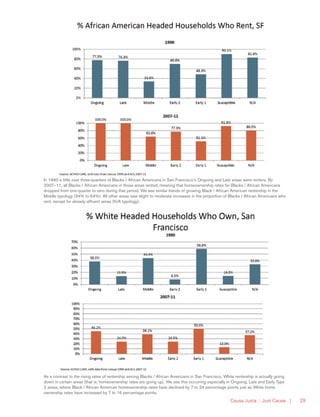
  • 88.
    | Development WithoutDisplacement86 2. Support community-based training for residents to participate in planning and development processes. [PP] Without adequate preparation, including training on the issues, terms, and legal/public processes related to land use planning and development, community residents are at a disadvantage to effectively participate in public engagement processes, regardless of how they are set up. Cities should dedicate funding, including money secured through a regional displace- ment prevention fund, for developing con- tracts with community-based organizations to lead training programs that prepare residents for effective participation and engagement in local land use planning and development pro- cesses. Eligibility for training programs should include, but not be limited to, length of resi- dence in the city and interest in participating in decision-making. Priority should be given to residents who have faced historical disinvest- ment and discrimination, including low-income people and people of color. Training should be used to prepare leaders for participating on neighborhood planning councils, as dis- cussed in F3, and for engagement in local and regional decision-making. 33 Implementing Agency: Cities, counties, regional agencies, and metropolitan plan- ning organizations 33 Staging: Early and always 33 Models: Los Angeles, CA: People’s Planning School (Strategic Actions for a Just Economy);218 Oakland, CA: “Gearing up for Action” curriculum (Pacific Institute)219 “The one story that sticks out the most to me is that there was a meeting of the full ABAG [Association of Bay Area Governments] board, the regional land use agency ... The meeting went late into the night and our agenda item didn’t come up until like 9:30 ... But the most inspiring moment to me was a youth leader from Genesis, a faith-based organizing group, [who] spent the time that we were sitting around waiting for our item to come up writing a poem about his experience growing up in Oakland, and the disparities that he had seen between his resources and opportunities and other people in the Bay Area. And he got up at public comment and read this poem and it was incredible, just an incredible moment. And the look on the faces of the elected officials that were listening to this was just priceless. I mean, they just never expected to see someone like this guy talking to them about these issues. He didn’t look like the people they were used to hearing from, he didn’t sound like the people they were used to hearing from. And they were all listening. And, in part, because of that and in part because of all of the background work that we had all done, the Board voted unanimously to include the land use scenario [of the community-developed Equity, Environment, and Jobs Scenario] that we were proposing in the slate of alternatives that they wanted to see studied and that was just a really high moment in the campaign.” — Sam Tepperman-Gelfant, Senior Staff Attorney, Public Advocates, a member organization of the 6 Big Wins for Social Equity Network, a collaborative of social justice, faith, public health, and environmental organizations across the Bay Area focused on targeting and shaping how regional planning decisions effect struggling, working families. In 2011, the 6 Big Wins for Social Equity Network developed the Equity, Environment and Jobs (EEJ) Scenario, a plan which focuses on creating a more healthy, prosperous, and sustainable future for Bay Area residents of all races and incomes, including struggling families.
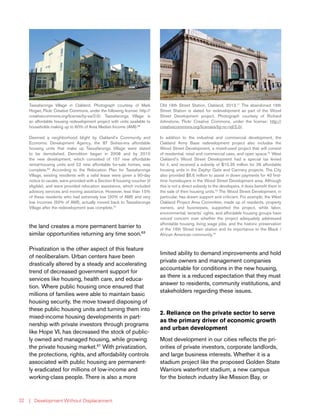
  • 89.
    Causa Justa ::Just Cause | 87 “We have a People’s Planning School that we do twice a year which is [a] popular education based, land use organizing school where people can learn about the tools that govern these developments in their neighborhoods. And then can take that knowledge, put together policies or recommendations and then take them to the city. What we found is it’s kind of like a whack-a-mole process … as we’re working on one development another is popping up. And we don’t have the resources to be able to engage in all of them. [Through the People’s Planning School] we put together a list of recommendations and principles — they started out as principles — that the community put together about the new community plan process that the city is going through. And so those principles were then put into recommendation language with some affordable housing experts and now we’re meeting with the city through their community plan process to see if we can get these into the community plan, so we’re not chasing development after development after development. And there’s some standards that are set in place. But it’s gonna be an uphill battle; first hearing from the city ... they say it’s too late in the process even though we’ve been engaged around this for five years. And we’re hearing from neighborhood councils, which are mostly homeowners, that they don’t want density and they didn’t want affordable housing and poor people living in their communities, so it’s gonna be a battle and that’s what we’re in engaged in now.” — Paulina Gonzalez, Former Executive Director, Strategic Actions for a Just Economy (SAJE), Los Angeles Towanda Sherry has been a member of CJJC for the last five years and currently resides near the proposed Bus Rapid Transit (BRT) development occurring along International Boulevard in Oakland. She has been in her home for the last 26 years. She became a member of CJJC after attending a community meeting in which CJJC raised concerns about the displacement of residents in Oakland, an issue of importance to Ms. Sherry. As a resident, bus commuter, and consumer impacted by the BRT proposal, Ms. Sherry applied and was accepted as a Community Planning Leader for the Oakland Sustainable Neighborhoods Initiative (OSNI). The OSNI program is designed to support people who live or work along International Boulevard to have the tools they need to effectively give input on the BRT plan and development along International Boulevard, and to participate in the planning process. “[As Community Planning Leaders] we get the chance to meet with people who are with the city about how the city functions, how we can give input. We also get a chance to talk to people who are with [regional transit organizations] and how they work and what the long-range effect of Bus Rapid Transit will be along the corridor: how it will affect people’s lives, whether businesses will have to move, whether people’s houses will be eliminated, the effect of blight in the area, but also, what kind of housing is coming in. Will that housing displace longtime residents in the area? And if it does, how do they plan to remedy that and make sure that those people are able to come back and stay in this area? And also, [we advocate] that any new housing include low-income housing as well as affordable housing.” — Towanda Sherry, Oakland Community Planning Leader and CJJC Member
  • 90.
    | Development WithoutDisplacement88 3. Support the creation of neighbor- hood-level planning councils [PP] com- prised of residents who have the authority to represent their neighborhood in develop- ment and planning processes. The public engagement processes required for many land use planning and development decisions often invite only token input from residents on pre-existing plans and projects, with little space for residents to envision and/or pro- pose their own ideas for development based on existing neighborhood needs. Rarely do residents get opportunities to make actual decisions about whether projects should move forward or not.220 Neighborhood plan- ning councils would provide a formal space for planning staff to engage with a represen- tative body of residents about planning and development issues at the neighborhood lev- el. Furthermore, these spaces would provide room for planning in a more ongoing way than project or plan-specific advisory committees. Local planning staff should come to neigh- borhood councils to learn about ongoing neighborhood needs and share upcoming opportunities, including proposed plans and projects as well as funding for neighborhood projects. Cities should work with community organizations and other stakeholders to de- sign council structures and processes based on best practices and with the goal of max- imizing equity, inclusion, and resident deci- sion-making, including membership selection criteria and procedures, tenure, decision-mak- ing authority, and integration of planning councils into existing land use planning and development processes. Efforts should be made to ensure that council membership reflects the race, gender, income, language, ability, tenure, diversity, and other demo- graphics of the neighborhood. Translation services should be made available to support language diversity among membership. 33 Implementing Agency: Cities, counties, and local planning departments 33 Staging: Early and always 4. Support community organizing and outreach on housing rights and opportu- nities. [PP] As discussed above, community organizing and outreach are crucial to ensur- ing residents have access to information and resources necessary to avoid and minimize displacement.221 Furthermore, our research revealed that policies that include penalties for government agencies or landlords, including relocation policies and code inspections, are often implemented and enforced only after substantial community organizing campaigns. While organizing cannot replace dedicated funding for enforcement at the government level, regional agencies should view commu- nity organizing as a complementary strategy to ensure enforcement of anti-displacement policies. As such, resident organizing and out- reach about housing rights and opportunities among vulnerable populations, along with broader community organizing efforts to en- sure enforcement of existing policies, should be funded as part of regional and local efforts to prevent displacement. Organizing could be funded through subcontracts awarded from a regional anti-displacement fund as discussed in E1, and contracts should be prioritized for organizations with an existing or growing membership base in areas of the city/region that are currently undergoing or susceptible to gentrification, based on ongoing analysis of neighborhood change as discussed in E4. 33 Implementing Agency: Cities, counties, regional agencies, and metropolitan plan- ning organizations 33 Staging: Early and always
  • 91.
    Causa Justa ::Just Cause | 89 “We use the sword and the shield. The sword refers to direct action strategies and utilizing all types of actions to leverage people power, including leveraging power of elected officials and leveraging elected official support. It includes eviction blockades and vigils, and direct action to the banks. The shield is a legal defense so, depending on what city you’re in, most of us have relationships with volunteer attorneys or legal services attorneys. So we have both a partnership with community legal aid, which is a legal services agency in Western Mass, and then we have a number of private attorneys who volunteer to support the movement. And the shield works to defend against evictions in court. We’ve won some victories directly in court and we’ve won some victories … where there is no court involvement. The shield helps to put pressure through the legal system to delay the eviction process and increase the eviction costs on the banks. The sword works to put direct action pressure on the banks, and most are used to try and force banks and investment companies to negotiate with families … This model was formed by City Life / Vida Urbana and they’ve been using it for a long time. They’ve been using it for tenant organizing since the ’80s but it’s been adopted in the foreclosure fight. We adopted it here [in Springfield, Massachusetts]. I think we’ve all made our own adaptations that make sense locally. But yes, it’s a City Life / Vida Urbana model.” — Malcolm Chu, Bank Tenant Organizer, Springfield No One Leaves/Nadie Se Mude (SNOL/NSM), which along with City Life / Vida Urbana is a member of the NEW ROAD Network (New England Workers and Residents Organizing Against Displacement) and the Right to the City Alliance. 5. Require a community health impact analysis that includes an assessment of potential displacement impacts [PP] for all new or modified development projects above a certain threshold and for plans before approvals and environmental review. Cities and counties should adopt a policy to require local planning departments to conduct community health impact analyses for all projects above a certain threshold in the project application stage, and this analysis should include an assessment of displacement-related impacts, based on meth- ods developed at the regional level as recom- mended in E4. In addition to displacement-re- lated impacts, this analysis should analyze and address impacts on the social determinants of health including, but not limited to, housing, transportation, education, employment, and social cohesion, as well as equity impacts for groups that have been historically disadvan- taged by development (low-income communi- ties and communities of color) and populations that are already vulnerable based on their health conditions. This tool should be developed through a multi-sector public process, involving robust community engagement, to ensure that community-prioritized issues of concerns are incorporated and that residents, other stake- holders, planners, and decision-makers under- stand the scope and use of the tool. If multiple projects within a given area are being consid- ered at once, they should be analyzed together in order to assess cumulative impacts in the neighborhood. Every analysis should result in a publicly accessible report that includes recom- mendations for mitigating any potential negative impacts, along with the calculated monetary val- ue of impacts. If substantial monetized impacts from displacement are found in this analysis, based on thresholds of significance set by planning departments through an engagement process, cities and counties should consider requiring community health or displacement impact fees to be paid by developers into a local relocation fund, earmarked for use in that planning area. 33 Implementing Agency: Cities, counties, and local planning departments 33 Staging: Early and always
  • 92.
    | Development WithoutDisplacement90 TakingAction…The Time To Organize Is Now This report is a call to action. We hope that the stories and ideas we shared resonate with your experiences and help inspire you to get together with neighbors, family, and friends to push against the gentrification and displacement in your community. For those of you who are already doing that, we hope you found some helpful tools to advance your fight. Though both our past and future efforts include working to change the minds and actions of politicians and city administrators, we do not ultimately believe that equitable human devel- opment will come about as a result of policy change alone. It is only through the hard work of collective vision, action, and consistent engage- ment by community residents in every facet of community development, that truly sustainable and healthy communities will be created. Those of us most impacted by historical dis- investment and underdevelopment must be active protagonists in leading the charge for a fundamental shift in how community develop- ment happens in the future. We know that when planning centralizes the needs and interests of low-income, working-class communities of color, those outcomes benefit all other commu- nity residents, whether those improvements are better schools, parks, bus service, or affordable food sources. Gentrification is affecting our neighborhoods, cities, and regions on every level and we need a range of organizing approaches and tactics to stop it. Because the forces against us are powerful, we need to hit them every way we know how. Whether you are about direct action protests, passing policy, influencing the media, cultural resistance, or talking to your neighbors, Mission No Eviction March, San Francisco
  • 93.
    Causa Justa ::Just Cause | 91 what is most important right now is for all of us to get into the fight against gentrification. Causa Justa :: Just Cause is deeply engaged in a range of gentrification, displacement, and development-related campaigns this year. Here are two especially critical fights that we need your support on: In San Francisco we are a part of the Plaza 16th Coalicíon that is working to ensure that a project- ed development on the corner of 16th Street and Mission Street will reflect the needs of existing residents as opposed to the developer’s prof- it-driven plan. The project, which includes more than 350 units of luxury housing as well as retail space, would have a range of harmful effects on a neighborhood already hard hit by gentrification. The 16th Street development would create dra- matic income disparities and housing pressures in a part of the Mission that is home to the largest concentration of very low-income adults and fam- ilies in Single Room Occupancy (SRO) housing. This large development would cast a shadow over the elementary school next door, literally blocking out their light, even though the proj- ect’s housing units and amenities remain largely inaccessible to the school’s Latino students, their families, and their teachers. Working with a broad coalition of homeless, tenant, Queer, and police accountability advocates, affordable housing developers, small business owners, and individu- al activists, CJJC will fight to ensure that current community residents are supported to envision a use for that land that reflects their needs and pre- vents further displacement of immigrant families and extremely low-income adults. Come join us in the fight to promote human development at the 16th Street and Mission project. In Oakland we are pushing the Oakland City Council to put an anti-tenant harassment policy on the November 2014 ballot. We have heard numerous complaints from tenants about land- lord refusals to perform basic maintenance of their units, repeated attempts to illegally evict tenants, and landlords who threaten immigrant tenants with raids by Immigration and Customs Enforcement (ICE) agents. Landlord harassment is a tactic to circumvent existing legal protec- tions like Just Cause Eviction and Rent Board regulations. Additionally, it creates a hostile environment and results in families deciding it would be better to move out of their homes, rather than have to battle their landlord to ensure their housing is safe and habitable. The adoption of an anti-harassment policy will have a direct ef- fect on slowing gentrification and displacement for low-income and working-class residents of color. It will prevent landlords from raising rents after they successfully pressure current tenants to move from their homes, strengthen tenants’ rights in Oakland, and contribute to keeping rents from rising dramatically. We have a two- part plan to make this happen. We are currently working to ensure the City Council puts the poli- cy on the ballot, and in the summer we will begin talking to community residents about the impor- tance of the measure to ensure voters turn out to pass it on Election Day. Come join us in the fight to strengthen tenant rights and to keep housing affordable for working families in Oakland. Art by Favianna Rodriguez
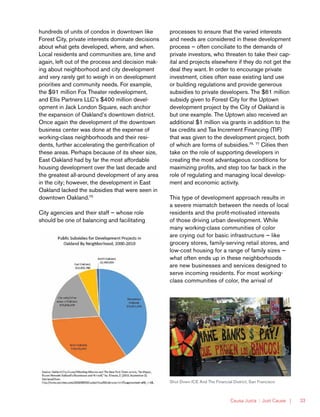
  • 94.
    | Development WithoutDisplacement92 Works Cited Endnotes 1 Flipping: A strategy in which an investor purchases properties with the goal of reselling them for a profit. Profit is generated either through the price appreciation that occurs as a result of a hot (read: gentrifying) housing market and/or from renovations and capital improvements. 2 Walker, R. (1996). Another Round of Globalization in San Francisco. Urban Geography, 17(1), 60–94. 3 Walker, R. (1996). Another Round of Globalization in San Francisco. Urban Geography, 17(1), 60–94. 4 Oakland Estuary Westward [Online image]. (1918). United States. Army Air Corps. Aerial Photo Section. Retrieved from http://content.cdlib.org/ark:/13030/ kt2s2024gr/?layout=metadata&brand=calisphere. 5 Oakland Estuary Westward. (1918). United States. Army Air Corps. Aerial Photo Section. Retrieved from http://content.cdlib.org/ark:/13030/ kt2s2024gr/?layout=metadata&brand=calisphere. 6 Walker, R. (1996). Another Round of Globalization in San Francisco. Urban Geography, 17(1), 60–94. 7 Walker, R. (2004). Industry Builds Out of the City: The Suburbanization of Manufacturing in the San Francisco Bay Area, 1850-1940. In R. D. Lewis (Ed.), Manufacturing Suburbs: Building Work and Home on the Metropolitan Fringe, 92–123. Philadelphia: Temple University. 8 Walker, R. (2004). Industry Builds Out of the City: The Suburbanization of Manufacturing in the San Francisco Bay Area, 1850-1940. In R. D. Lewis (Ed.), Manufacturing Suburbs: Building Work and Home on the Metropolitan Fringe, 92–123. Philadelphia: Temple University. 9 Walker, R. (1996). Another Round of Globalization in San Francisco. Urban Geography, 17(1), 60–94. 10 The Second Great Migration, In Motion: The African American Migration Experience. Project of The New York Public Library. Retrieved from http://www.inmotionaame.org/ print.cfm;jsessionid=f8301129211391460600628? migration=9&bhcp=1. 11 Self, R. (2003). American Babylon: Race and the Struggle for Postwar Oakland. Princeton, NJ: Princeton University Press. 12 Price-Spratlen, T. (2008). Urban Destination Selection among African Americans during the 1950s Great Migration. Social Science History, 32(3), 437–469. 13 Taylor, Q. (2012). Facing The Urban Frontier: African American History in the Reshaping of the Twentieth-Century American West. The Western Historical Quarterly, 43(1), 4–27. 14 Romo, R. (1993). Responses to Mexican Immigration, 1910- 1930. In Michael R. Ornelas (Ed.), Beyond 1848: Readings in the Modern Chicano Historical Experience. Dubuque, IA: Kendall/Hunt Publishing Company. 15 DeGenova, N. (2004). The Legal Production of Mexican/ Migrant “Illegality.” Latino Studies, 2: 160–185; Martin, P. (2002). Mexican Workers and U.S. Agriculture: The Revolving Door. International Migration Review, 36(4), 1124–1142. 16 Clarke, B. & Baba, H. (2006). Port of Oakland: Private Industry or Public Agency? Race, Poverty & The Environment, 12(1), 35–38; Santiago, A. & Wilder, M. (1991). Residential Segregation and Links to Minority Poverty: The Case of Latinos in the United States. Social Problems, 38(4), 492–515; Wilson, W. (2009). The Political and Economic Forces Shaping Concentrated Poverty. Political Science Quarterly, 123(4), 555–571. 17 For one example of this see: Marciano, R., Goldberg, D. & Hou, C. “T-Races: a Testbed for the Redlining Archives of California’s Exclusionary Spaces.” Retrieved from http://salt. unc.edu/T-RACES/ (accessed February 20, 2014). 18 Brenner, R. (2006). The Economics of Global Turbulence: The Advanced Capitalist Economies from Long Boom to Long Downturn, 1945-2005. London: Verso. 19 Walker, R. (1998). An Appetite for the City. In Brook, J. et. al. Reclaiming San Francisco: History Politics, Culture. San Francisco: City Light Books. 20 Saez, E. (2008). Striking It Richer: The Evolution of Top Incomes in the United States. Stanford Center for the Study of Poverty and Inequality. 21 Krippner, G. (2012). Capitalizing on Crisis: The Political Origins of the Rise of Finance. Cambridge: Harvard University Press. 22 Brenner, R. (2006). The Economics of Global Turbulence: The Advanced Capitalist Economies from Long Boom to Long Downturn, 1945-2005. London: Verso. 23 Perry, M. J. (n.d.). Manufacturing Employment Percent of U.S. Labor Force January 1939 to July 2013 [Online Image]. Carpe Diem. Bureau of Labor Statistics. Retrieved from http://mjperry.blogspot.com/2009/08/manufacturing- employment-drops-to.html. 24 Alvaro, S. & Massey, D. (2010). In Search for Peace: Structural Adjustment, Violence, and International Migration. Annals of the Academy of Political & Social Science, 630(1), 137–161. 25 Looney, A. & Greenstone, M. (2012, October 12). The Uncomfortable Truth About American Wages. New York Times. 26 Schafran, Alex. (2010). The Long Road from Babylon to Brentwood: Crisis and Restructuring in the San Francisco Bay Area. UC Berkeley: Institute for the Study of Societal Issues. Retrieved from: http://escholarship.org/uc/ item/93x39448 27 Garland, R. (2014, February 27). As Bay Area Investment Shifts North, Institutional Venture Partners Opens San Francisco Office. The Wall Street Journal. Retrieved from http://blogs.wsj.com/venturecapital/2014/02/27/as-bay- area-investment-shifts-north-institutional-venture-partners- opens-san-francisco-office/Genthe, A. (n.d.). 28 Beattie, A. (n.d.). Market Crashes: The Dotcom Crash. Investopedia. Retrieved from http://www.investopedia.com/ features/crashes/crashes8.asp. 29 Beitel, K. (2013). Mission Anti-Displacement Coalition. FoundSF. Retrieved from http://foundsf.org/index. php?title=Mission_Anti-Displacement_Coalition. 30 Nayman, N. (2001, October). Jobs, Incomes and San Francisco City Hall Revenues Grew at Record Rate,
  • 95.
    Causa Justa ::Just Cause | 93 Study Shows. Cal-Tax Digest. Retrieved from http://www. caltax.org/member/digest/oct2001/10.2001.Nayman- JobsRevenueReport.04.htm. 31 Lagos, M. (2013, November 5). San Francisco Evictions Surge, Report Finds. SFGate. Retrieved from http://www. sfgate.com/bayarea/article/San-Francisco-evictions-surge- report-finds-4955020.php. 32 Gammon, R. and Platoni, K. (2007, January 3). Inflating the Numbers: The Brown Administration Came Very Close to the 10K Plan. So Why the Grade Inflation? East Bay Express. 33 Lo, P. (2009, September 23). Ten Years of Just Cause Oakland. OaklandNorth. Retrieved from http://oaklandnorth. net/2009/09/23/ten-years-of-just-cause-oakland/. 34 The Dot-Com Bubble Bursts. (2000, December 24). The New York Times. Retrieved from http://www.nytimes. com/2000/12/24/opinion/the-dot-com-bubble-bursts.html. 35 Lansing, K. J. (2003, June 20). Growth in the Post- Bubble Economy. Federal Reserve Bank of San Francisco. Retrieved from http://www.frbsf.org/economic- research/publications/economic-letter/2003/june/ growth-in-the-post-bubble-economy/. 36 Beattie, A. (n.d.). Market Crashes: Housing Bubble and Credit Crisis (2007-2009). Investopedia. Retrieved from http://www.investopedia.com/features/crashes/crashes9. asp. 37 From Foreclosure to Re-Redlining. (2010). Coalition, California Reinvestment. Retrieved from http://www.calreinvest.org/system/resources/ W1siZiIsIjIwMTEvMDQvMTgvMTdfNTVfMTVf NjM4X0ZvcmVjbG9zdXJlX3RvX1JlX1JlZ GxpbmluZy5wZGYiXV0/Foreclosure_to_Re_Redlining.pdf. 38 Lansing, K. J. (2003, June 20). Growth in the Post- Bubble Economy. Federal Reserve Bank of San Francisco. Retrieved from http://www.frbsf.org/economic- research/publications/economic-letter/2003/june/ growth-in-the-post-bubble-economy/. 39 Arnold, E. K. (2012). Foreclosure Crisis Meets Occupy Effect. Race, Poverty & the Environment, 19(1). Retrieved from http://urbanhabitat.org/19-1/arnold. 40 Myers, L., Gardella, R., & Schoen, J. W. (2011, May 9). No End in Sight to Foreclosure Quagmire. NBC News and Msnc.com. Retrieved from http://www.nbcnews.com/ id/42881365/ns/business-personal_finance/t/no-end-sight- foreclosure-quagmire/#.Uxj5svldUeF. 41 The Foreclosure Crisis and Its Impact on Tenants. (n.d.). National Housing Law Project. Retrieved from http://nhlp. org/foreclosureandtenants. 42 Ibid. 43 Henry, B., Reese, J., & Torres, A. (2013). Wasted Wealth. Alliance for a Just Society. Retrieved from http:// allianceforajustsociety.org/wp-content/uploads/2013/05/ Wasted.Wealth_NATIONAL.pdf. 44 Evangelista, B. (2013, January 8). Facebook IPO Will Create Billionaires. SFGate. Retrieved from http://www. sfgate.com/business/article/Facebook-IPO-will-create- billionaires-3036102.php. 45 Lagos, M. (2013, November 5). San Francisco Evictions Surge, Report Finds. SFGate. Retrieved from http://www. sfgate.com/bayarea/article/San-Francisco-evictions-surge- report-finds-4955020.php. 46 Carlton, J. (2013, July 16). Bay Area Rally Sends Rents Soaring. The Wall Street Journal. Retrieved from http:// online.wsj.com/news/articles/SB10001424127887324694 904578602013087282582. 47 Hu, Elise. (2013, December 17). How This Bay Area Tech Boom is Different From The Last One. National Public Radio. 48 Corkery, M. (2014, January 29). Wall Street’s New Housing Bonanza. The New York Times. Retrieved from http:// dealbook.nytimes.com/2014/01/29/wall-streets-new- housing-bonanza/?_php=true&_type=blogs&_php=true&_ type=blogs&_r=1. 49 Tepperman, J. (2013, October 2). Who’s Jacking Up Housing Prices in West Oakland. East Bay Express. Retrieved from http://www.eastbayexpress.com/oakland/ whos-jacking-up-housing-prices-in-west-oakland/ Content?oid=3726518&showFullText=true. 50 Gose, J. (2013, December 24). Another City by the Bay Comes Into Its Own. New York Times. 51 Torres. B. (2011, June 15). IPO Ignites ‘Pandora Effect’ in Oakland. San Francisco Business Times. 52 Panchuck, K.A. (2014, January 23). Are Rental Bonds Driving Up the Rent? Housing Wire. 53 Corkery, M. “Wall Street’s New Housing Bonanza.” (2014, January 29). The New York Times; Dayen, D. “Your New Landlord Works on Wall Street: Hedge Funds are snatching up rental homes at an alarming rate.” (2013, February 12). The New Republic. 54 “Coming to an Office Near You.” (2014, January 18). The Economist. Truner, A. (2014, January 8). Inequality by the Click. Project Syndicate. 55 Emmons, M. (2013, April 6). Bay Area Housing Subsidies Suffer from Sequestration. San Jose Mercury News. Real Facts. Retrieved from http://www. mercurynews.com/bay-area-news/ci_22965420/ bay-area-housing-subsidies-suffer-from-sequestration. 56 Emmons, M. (2013, April 6). Bay Area Housing Subsidies Suffer from Sequestration. San Jose Mercury News. Real Facts. Retrieved from http://www. mercurynews.com/bay-area-news/ci_22965420/ bay-area-housing-subsidies-suffer-from-sequestration. 57 The Sequester. (n.d.). The White House. Retrieved from http://www.whitehouse.gov/issues/sequester. 58 Emmons, M. (2013, April 6). Bay Area Housing Subsidies Suffer from Sequestration. San Jose Mercury News. Real Facts. Retrieved from http://www. mercurynews.com/bay-area-news/ci_22965420/ bay-area-housing-subsidies-suffer-from-sequestration. 59 “HUD Community Development Block Grants (CDBG): Support Local Development and Infrastructure Projects.” (2013). National Association of Counties (NACO). Retrieved from http://www.nado.org/wp-content/uploads/2012/10/ NADO-FY13-CDBG-FACT-SHEET.pdf 60 Cooper, B. (2013, September 18). Federal Budget Cuts Leave Many Without Access to Head Start. The Olathe News. Retrieved from http://www.theolathenews. com/2013/09/17/2112385/federal-budget-cuts-leave-many. html. 61 Kern, J. (2013, March 4). Preschool California President Catherine Atkin Responds to Congress’s Immediate Federal Cuts to Head Start and Child Care. Early Edge California. Retrieved from http://www.earlyedgecalifornia.org/news- media/press-releases/sequesterresponse.html. 62 Walker, R.A. (2006). The Boom and the Bombshell: The New Economy Bubble and the San Francisco Bay Area. In Giovanna Vertova (Ed.), The Changing Economic Geography of Globalization (pp. 134–35). London: Routledge. 63 Ibid. 64 Pritchard, M. (n.d.). Valencia Gardens [Online image]. Flickr Creative Commons, under License http://creativecommons. org/licenses/by-nc-sa/2.0/. Retrieved from http://www.flickr. com/photos/toobeautiful/2699166255/sizes/m/. 65 Roberts, C. (2013, September 25). During San Francisco Visit, HUD Secretary Says Private Sector Will Save Public Housing. SF Examiner. Retrieved from http://www.
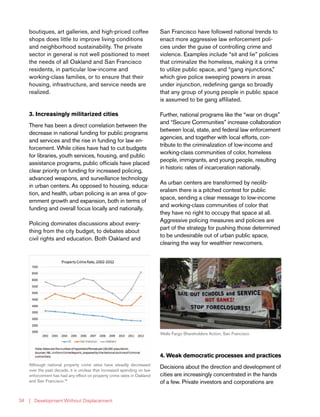
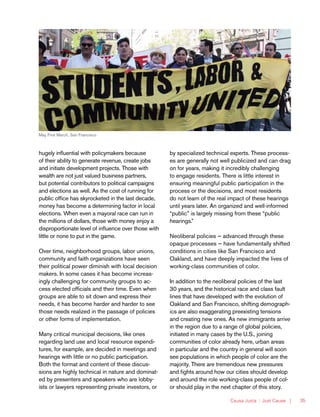
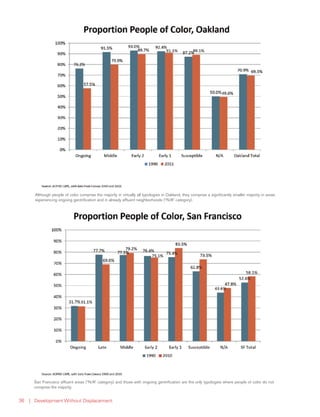
  • 96.
    | Development WithoutDisplacement94 sfexaminer.com/sanfrancisco/during-san-francisco-visit- hud-secretary-says-private-sector-will-save-public-housing/ Content?oid=2588310. 66 Ibid. 67 For an analysis of the shift from public housing to housing tax credits, see: Stoloff, J. A. (2004). A Brief History of Public Housing. Washington DC: US Department of Housing and Urban Development. 68 Overland, Pacific & Cutler, I. (2007). Relocation Plan for Tassafaronga Village. Retrieved from http://www.oakha.org/ procurement/12307tassareloplan.pdf 69 A Resolution Approving a Replacement Housing Plan for the Tassafaronga Village Project. (2011). Community and Economic Development Agency. Retrieved from http:// councilmatic.yoleg.com:8000/legislation/746500 70 Budds, D. (2010). It Takes a Village [Online image]. dwell. 71 Johnstone, R. (2013). Old 16th Street Amtrak Station. Flickr Creative Commons, under license http://creativecommons. org/licenses/by-nc-nd/2.0/. Retrieved from http://www.flickr. com/photos/1flatworld/8827959798/sizes/m/. 72 Wood St. Development. (n.d.). City of Oakland. Retrieved from http://www2.oaklandnet.com/Government/o/PBN/ OurOrganization/PlanningZoning/DOWD008410. 73 City of Oakland Office of the City Clerk Calendar. (n.d.). City of Oakland. Retrieved from https://oakland.legistar.com/ calendar.aspx. 74 Burt, C. (2005, May 2). Train Station Revival on Track. Inside Bay Area. Retrieved from http://www.insidebayarea.com/ oaklandtribune/ci_2701097. 75 City of Oakland Office of the City Clerk Calendar. (n.d.). City of Oakland. Retrieved from https://oakland.legistar.com/ calendar.aspx. 76 Elinson, Z. (2010, September 2). As Mayor, Brown Remade Oakland’s Downtown and Himself. The New York Times. Retrieved from http://www.nytimes.com/2010/09/03/us/ politics/03bcbrown.html?pagewanted=all&_r=1&. 77 City of Oakland Office of the City Clerk Calendar. (n.d.). City of Oakland. Retrieved from https://oakland.legistar.com/ calendar.aspx. 78 Property Crime Rate. (n.d.). FBI, Uniform Crime Reports, National Archive of Criminal Justice Data. Retrieved from http://www.ucrdatatool.gov. 79 Fullilove M.T. & Wallace, R. (2011). Serial Forced Displacement in American Cities: 1916-2010. Journal of Urban Health, 88(3): 381–389. 80 Lindheim R., & Syme, S.L. (1983). Environments, People, and Health. Annual Review of Public Health, 4(1): 335–359. 81 Krieger J. & Higgins, D. (2002). Housing and Health: Time Again for Public Health Action. American Journal of Public Health, 92(5): 758–68. 82 Rosen, G. (1993). A History of Public Health. Baltimore: JHU Press; Hofrichter, R. (2010). Tackling Health Inequities: A Framework for Public Health Practice. In Hofrichter, R. & Bhatia, R. (Eds.), Tackling Health Inequities Through Public Health Practice: Theory to Action. USA: Oxford University Press; Krieger, J. & Higgins, D. (2002). Housing and health: time again for public health action. American Journal of Public Health, 92(5): 758–68; Lindheim, R. & Syme, S.L. (1983). Environments, people, and health. Annual Review of Public Health, 4(1): 335–359; Lubove, R. (1961). Lawrence Veiller and the New York State Tenement House Commission of 1900. The Mississippi Valley Historical Review, 47(4): 659–677. 83 Lopez, R.P. (2009). Public health, the APHA, and urban renewal. American Journal of Public Health, 99(9): 1603–1611. 84 Ibid. 85 Ibid. 86 Gordon, C. (2003). Blighting the way: Urban renewal, economic development, and the elusive definition of blight. Fordham Urban Law Journal, 31(2): 305-339. 87 Lopez, R.P. (2009). Public health, the APHA, and urban renewal. American Journal of Public Health, 99(9): 1603–1611. 88 Fullilove, M.T. (2004). Root Shock: How Tearing Up City Neighborhoods Hurts America and What We Can Do About It. New York: NY: One World Ballantine Book. 89 San Francisco Human Rights Commission, Committee on African American Parity. (1993). The Unfinished Agenda: The Economic Status of African Americans in San Francisco, 1964-1990. Available at: http://sf-hrc.org/modules/ showdocument.aspx?documentid=833. 90 Fullilove, M.T. (2001). Root shock: The consequences of African American Dispossession. Journal of Urban Health, 78(1): 72–80. 91 Lopez, R.P. (2009). Public health, the APHA, and urban renewal. American Journal of Public Health, 99(9): 1603–1611. 92 Ibid. 93 Ibid. 94 Peterson, C.L. (2013). Subprime lending, foreclosure and race: An introduction to the role of securitization in residential mortgage finance. In Rogers, C. & Powell, J.A. (Eds.), Where Credit is Due: Bringing Equity to Credit and Housing after the Market Meltdown. [pp. 68-95]. Lantham: University Press of America; Massey, D.S. (2008). Categorically Unequal: The American Stratification System. Russell Sage Foundation Publications. 95 Fullilove, M.T. (2001). Root shock: The consequences of African American Dispossession. Journal of Urban Health, 78(1): 72–80. 96 Bates, L.K. (2013). Gentrification and Displacement Study: Implementing an Equitable Inclusive Development Strategy in the Context of Gentrification. Commissioned by City of Portland, Bureau of Planning and Sustainability. 97 Evers, S.E. (2013). Altering the urban frontier: Gentrification and public parks in New York City. Pitzer Senior Theses. Paper 28. 98 Whitehead, M. (1992). The concepts and principles of equity and health. International Journal of Health Services, 22(3): 429–445. 99 Krieger N. (2001). Theories for social epidemiology in the 21st century: an ecosocial perspective. International Journal of Epidemiology, 30(4): 668–677; Krieger, N. (2008). Proximal, Distal, and the Politics of Causation: What’s Level Got to Do With It? American Journal of Public Health, 98(2): 221–230; Krieger, N. & Gruskin, S. (2001). Frameworks matter: ecosocial and health and human rights perspectives on disparities in women’s health — the case of tuberculosis. Journal of the American Med Women’s Association, 56(4): 137–142; Siegrist, J. & Marmot, M. (Eds.). (2006). Social Inequalities in Health: New Evidence and Policy Implications. Oxford: Oxford University Press; Graham, H. (2004). Social determinants and their unequal distribution: clarifying policy understandings. Milbank Quarterly, 82: 101–124; Commission on Social Determinants of Health. (2008). Closing the gap in a generation: health equity through action on the social determinants of health. Final Report of the Commission on Social Determinants of Health. Geneva: World Health Organization; Braveman, P. & Gruskin, S. (2003). Defining equity in health. Journal of Epidemiology and Community Health, 57(4): 254–258. 100 Egerter, S., Sadegh-Nobari, T., Dekker, M. & Braveman, P. (2008). Issue 2: Where we live matters for our health:
  • 97.
    Causa Justa ::Just Cause | 95 The links between housing and health. In Health: The Links Between Housing and Health. Robert Wood Johnson Foundation: Issue Brief. Robert Wood Johnson Foundation: Commission to Build a Healthier America; Litman, T. (2010). Evaluating public transportation health benefits. Victoria Transport Policy Institute for the American Public Transportation Association; Glanz, K., Basil, M., Maibach, E., Goldberg, J. & Snyder, D. (1998). Why Americans eat what they do: taste, nutrition, cost, convenience, and weight control concerns as influences on food consumption. Journal of the American Dietetic Association, 98: 1118–1126; Drewnowski, A., et al. (2004). Obesity and the food environment: dietary energy density and diet costs. American Journal of Preventive Medicine, 27: 154–162; Kelly, S.E., Binkley, C.J., Neace, W.P. & Gale, B.S. (2005). Barriers to care-seeking for children’s oral health among low-income caregivers. Journal Information, 95; Galbraith, A.A., Wong, S.T., Kim, S.E. & Newacheck, P.W. (2005). Out-of-pocket financial burden for low-income families with children: socioeconomic disparities and effects of insurance. Health Services Research, 40: 1722–1736. 101 City and County of San Francisco. Residential Rent Stabilization and Arbitration Board. (2013, October 3). Rent Board Annual Report, Fiscal Year 2012-2013. Available at: http://sfrb.org/modules/showdocument. aspx?documentid=2660. 102 Ibid. 103 Phillips, D., Clark, R., Lee, T. & Desautels, A. (2010). Rebuilding Neighborhoods, Restoring Health: A Report on the Impact of Foreclosure on Public Health. Oakland, CA: Causa Justa :: Just Cause, Alameda County Public Health Department. Available at: http://www.acphd.org/data- reports/reports-by-topic/social-and-health-equity.aspx. 104 Newman K, Wyley EK. (2006). The right to stay put, revisited: Gentrification and resistance to displacement in New York City. Urban Studies, 43(1): 23-57. Available at: http://usj.sagepub.com/content/43/1/23.full.pdf+html. 105 Jacobs, D.E., Wilson, J., Dixon, S.L., Smith, J. & Evens, E. (2009). The relationship of housing and population health: A 30-year retrospective analysis. Environmental Health Perspective, 117(4): 597–604; Krieger, J. & Higgins, D. (2002). Housing and health: time again for public health action. American Journal of Public Health, 92(5): 758–768; Bashir, S.A. (2002). Home is where the harm is: inadequate housing as a public health crisis. American Journal of Public Health, 92(5): 733–738. 106 Alameda County Public Health Department with data from American Community Survey, 2007-2011. 107 Kennedy, M. & Leonard, P. (2001). Dealing with neighborhood change: A primer on gentrification and policy choices. The Brookings Institution Center on Urban and Metropolitan Policy and PolicyLink. 108 Sullivan, D.M. & Shaw, S.C. (2011). Retail gentrification and race: The case of Alberta Street in Portland, Oregon. Urban Affairs Review, 47(3): 413–432. 109 Fullilove, M.T. (2001). Root shock: The consequences of African American Dispossession. Journal of Urban Health, 78(1): 72–80; Goetz, E.G. (2002). Forced relocation vs. voluntary mobility: the effects of dispersal programmes on households. Housing Studies, 17(1): 107–123. 110 Beyers, M., Brown, J., Cho, S., et al. (2008). Life and Death from Unnatural Causes: Health and Social Inequity in Alameda County. Oakland, CA: Alameda County Public Health Department. 111 Ibid. 112 Goetz, E.G. (2002) Forced relocation vs. voluntary mobility: the effects of dispersal programmes on households. Housing Studies, 17(1): 107–123. 113 Alameda County Public Health Department. (2013). Getting on Board for Health: A Health Impact Assessment of Bus Funding and Access. Available at: www.acphd.org/ media/309838/transithia.pdf; Wener, R.E., Evans, G.W., Phillips, D. & Nadler N. (2003). Running for the 7:45: the effects of public transit improvements on commuter stress. Transportation, 30: 203–220. Kluwer Academic Publishers, Netherlands; Walsleben, J.A., Norman, R.G., Novak, R.D., O’Malley, E.B., Rapoport, D.M. & Strohl, K.P. (1999). Sleep habits of Long Island Rail Road commuters. Sleep, 22(6): 13; Strazdins, L. & Loughrey, B. (2008). Too busy: why time is a health and environmental problem. NSW Public Health Bulletin, 18(11-12): 219–221. 114 Mani, A., Mullainathan, S., Shafir, E. & Zhao, J. (2013). Poverty Impedes Cognitive Function. Science, 341(6149): 976–980; McEwen, BS. (1998). Stress, adaptation, and disease: Allostasis and allostatic load. Annals of the New York Academy of Sciences, 840: 33-44; Geronimus, A.T., Hicken, M.T., Pearson, J.A., Seashols, S.J., Brown, K.L. & Cruz, T.D. (2010). Do US black women experience stress- related accelerated biological aging? A novel theory and first population-based test of black-white differences in telomere length. Human Nature, 1: 19–38; Wallace, R. & Wallace, D. (2010). Gene expression and its discontents: The social production of chronic disease. New York & London: Springer. 115 Feldman, S., Geisler, C. & Silberling, L. (2003). Moving targets: displacement, impoverishment, and development. International Social Science Journal, 55(175): 7–13; Fullilove, M.T. (2001). Root shock: The consequences of African American Dispossession. Journal of Urban Health, 78(1): 72–80. 116 Levy, D.K. & Kaye, D.R. (2004). How are HOPE VI families faring? Metropolitan Housing and Communities Center, Brief No. 4. Urban Institute. Available at: http://www.urban.org/ UploadedPDF/311072_Roof_4.pdf. 117 Cooper, M. (2001). Housing affordability: a children’s issue. Discussion Paper No. F-11. Ottawa, ON: Canadian Policy Research Networks. Available at: http://www.cprn.org/ documents/1315_en.pdf; Wood, D., Halfon, N., Scarlata, D., Newacheck, P. & Nessim, S. (1993). Impact of family relocation on children’s growth, development, school function, and behavior. The Journal of the American Medical Association, 270(11): 1334–1338. 118 Beyers, M., Brown, J., Cho, S., et al. (2008). Life and Death from Unnatural Causes: Health and Social Inequity in Alameda County. Oakland, CA: Alameda County Public Health Department. 119 Institute for Children, Poverty, & Homelessness. (n.d.). A theory of poverty destabilization: Why low-income families become homeless in New York City. Available at: http://www. icphusa.org/index.asp?page=16&report=111&pg=106. 120 Shaw, M. (2004). Housing and Public Health. Annual Review of Public Health, 25: 397–418; Goodman, L., Saxe, L. & Harvey, M. (1991). Homelessness as psychological trauma. Broadening perspectives. American Psychologist, 46(11): 1219–25; Fullilove, M.T. (1996). Psychiatric implications of displacement: Contributions from the psychology of place. American Journal of Psychiatry, 153(12): 1516–23. 121 Beyers, M., Brown, J., Cho, S., et al. (2008). Life and Death from Unnatural Causes: Health and Social Inequity in Alameda County. Oakland, CA: Alameda County Public Health Department. 122 Ibid. 123 Abramson, D.M. & Garfield, R.M. (2006). On the edge: Children and families displaced by Hurricanes Katrina and Rita face a looming medical and mental health crisis.
  • 98.
    | Development WithoutDisplacement96 National Center for Disaster Preparedness, Columbia University, Mailman School of Public Health. 124 Uscher-Pines, L. (2008). Health effects of relocation following disaster: A systematic review of the literature. Disasters, 33(1): 1–22; Bland, S.H., et al. (1997). Social network disruption and psychological distress following earthquake evacuation. Journal of Nervous and Mental Disease, 185(3): 188–195. Available at: http://journals. lww.com/jonmd/Abstract/1997/03000/Social_Network_ Disturbances_and_Psychological.8.aspx; Wallace, R. (1990). Urban desertification, public health and public order: “Planned shrinkage,” violent death, substance abuse, and AIDS in the Bronx. Social Science and Medicine, 31(7): 801–813. 125 Sluzki, C.E. (1992), Disruption and reconstruction of networks following migration/relocation. Family Systems Medicine, 10: 359–363. 126 Martin, R. (1995). The effects of prior moves on job relocation stress. Journal of Occupational and Organizational Psychology, 68(1): 49–56. 127 Fullilove, M.T. (1996). Psychiatric implications of displacement: Contributions from the psychology of place. American Journal of Psychiatry, 153(12): 1516–23. 128 International City/County Management Association. (2005). Active Living and Social Equity: Creating Healthy Communities for All Residents: A Guide for Local Governments. Available at: http://65.181.142.130/images/ stories/rpt_icma_jan2005.pdf 129 Alameda County Public Health Department with data from American Community Survey 1-year PUMS, 2006-2011. 130 Beyers, M., Brown, J., Cho, S., et al. (2008). Life and Death from Unnatural Causes: Health and Social Inequity in Alameda County. Oakland, CA: Alameda County Public Health Department. 131 Popkin, S.J., Katz, B., Cunningham, M.K., Brown, K.D., Gustafson, J. & Turner, M.A. (2004). A decade of Hope VI: Research Findings and Policy Challenges. The Urban Institute and the Brookings Institution. 132 Garr, E. & Kneebone, E. (2010). The suburbanization of poverty: Trends in metropolitan America, 2000 to 2008. Metropolitan Policy Program at Brookings; Raphael, S. & Stoll, M.A. (2010). Job sprawl and the suburbanization of poverty. Metropolitan Policy Program at Brookings; Soursourian, M. (2012). Community development research brief: Suburbanization of poverty in the Bay Area. Federal Reserve Bank of San Francisco. 133 Ibid. 134 Popkin, S.J., Katz, B., Cunningham, M.K., Brown, K.D., Gustafson, J. & Turner, M.A. (2004). A decade of Hope VI: Research Findings and Policy Challenges. The Urban Institute and the Brookings Institution. 135 Abramson, D.M. & Garfield, R.M. (2006). On the edge: Children and families displaced by Hurricanes Katrina and Rita face a looming medical and mental health crisis. National Center for Disaster Preparedness, Columbia University, Mailman School of Public Health. 136 Ibid. 137 Geys, B. (2006). Explaining voter turnout: A review of aggregate-level research. Electoral Studies, 25(4): 637– 663; Bobo, L. & Gilliam, F.D. (2001). Race, Sociopolitical Participation, and Black Empowerment. The American Political Science Review, 84(2): 377–393; Fullilove, M.T. (2001). Root shock: The consequences of African American Dispossession. Journal of Urban Health, 78(1): 72–80; Beyers, M., Brown, J., Cho, S., et al. (2008). Life and Death from Unnatural Causes: Health and Social Inequity in Alameda County. Oakland, CA: Alameda County Public Health Department. 138 Fullilove, M.T. & Wallace, R. (2011). Serial Forced Displacement in American Cities: 1916-2010. Journal of Urban Health, 88(3): 381–389. 139 Ibid. 140 Ibid. 141 Bates, LK. (2013). Gentrification and Displacement Study: Implementing an Equitable Inclusive Development Strategy in the Context of Gentrification. Commissioned by City of Portland, Bureau of Planning and Sustainability. Available at: www.portlandoregon.gov/bps/article/454027. 142 Urahn SK, Plunkett T. (2013). Mobility and The Metropolis: How Communities Factor Into Economic Mobility. The Pew Charitable Trusts. Available at: www.pewstates. org/uploadedFiles/PCS_Assets/2013/Mobility-and-the- Metropolis.pdf; Grady, SC. (2006). Racial disparities in low birthweight and the contribution of residential segregation: A multi-level analysis. Social Science and Medicine, 63: 3013-3029; Lobmayer P, Wilkinson RG. (2002). Inequality, residential segregation by income, and mortality in US cities. Journal of Epidemiology and Community Health, 56: 183- 187. Available at: http://jech.bmj.com/content/56/3/183.full; Collins CA, Williams DR. (1999). Segregation and mortality: The deadly effects of racism? Sociological Forum, 14(3): 495-523. 143 Frumkin, H. (2002). Urban sprawl and public health. Public Health Reports, 117: 201–217. 144 Pollack S, Bluestone B, Billingham C. (2010). Maintaining Diversity in America’s Transit-Rich Neighborhoods: Tools for Equitable Change. Dukakis Center for Urban and Regional Policy. Available at: www.northeastern.edu/dukakiscenter/ wp-content/uploads/2011/12/TRN_Equity_final.pdf; Dominie W. (2012). Is Just Growth Smarter Growth: The Effects of Gentrification on Transit Ridership and Driving in Los Angeles’ Transit Station Area Neighborhoods. Prepared for the Bus Riders’ Union. Available at: www. thestrategycenter.org/sites/www.thestrategycenter.org/files/ Dominie_Is_Just_Growth_Smarter_Growth_6-2-2012.pdf. 145 Wyly, E.K. & Hammel, D.J. (2004). Gentrification, segregation, and discrimination in the American urban system. Environment and Planning, 36(7): 1215–1241. 146 Walks, R.A. & Maaranen, R. (2008). Gentrification, social mix, and social polarization: Testing the linkages in large Canadian cities. Urban Geography, 29(4): 293–326. 147 Alameda County Public Health Department with data from American Community Survey, 2007-2011. 148 Wilkinson, R. & Pickett, K. (2009). The Spirit Level: Why Greater Equality Makes Societies Stronger. New York: Bloomsbury Press. Available at: http://www.amazon.com/ Spirit-Level-Equality-Societies-Stronger/dp/1608190366. Accessed October 25, 2011. 149 Fullilove, M.T. (2013). Urban Alchemy: Restoring Joy in America’s Sorted Out Cities. New York: New Village Press; Fullilove, M.T. & Wallace, R. (2011). Serial Forced Displacement in American Cities: 1916-2010. Journal of Urban Health, 88(3): 381–389; Wallace, D. & Wallace, R. (1998). A Plague on your Houses: How New York Was Burned Down and National Public Health Crumbled. New York: Verso. 150 Armstrong, G.L., Conn, L.A. & Pinner, R.W. (1999). Trends in infectious disease mortality in the United States during the 20th century. Journal of the American Medical Association, 281(1): 61–66; Krieger, J. & Higgins, D. (2002). Housing and health: time again for public health action. American Journal of Public Health, 92(5): 758–68; Porter, D. (2009). Health, Civilization, and the State: A History of Public Health from Ancient to Modern Times. Taylor & Francis Group;
  • 99.
    Causa Justa ::Just Cause | 97 Rosen, G. (1993). A History of Public Health. Baltimore: JHU Press. 151 Ibid. 152 The World Health Organization defines the social determinants of health as the “complex, integrated, and overlapping social structures and economic systems that are responsible for most health inequities. These social structures and economic systems include the social environment, physical environment, health services, and structural and societal factors. Social determinants of health are shaped by the distribution of money, power, and resources throughout local communities, nations, and the world.” 153 Commission on Social Determinants of Health. Closing the gap in a generation: health equity through action on the social determinants of health. Final Report of the Commission on Social Determinants of Health. Geneva: World Health Organization Available at: www.who.int/social_ determinants/thecommission/finalreport/en/index.html; Graham, H. (2004). Social determinants and their unequal distribution: clarifying policy understandings. Milbank Quarterly, 82: 101–124. 154 Ibid. 155 Centers for Disease Control and Prevention, Environmental Health Services. “Core Functions of Public Health and How They Relate to The 10 Essential Services.” Available at: www. cdc.gov/nceh/ehs/ephli/core_ess.htm. 156 Syme, S.L. & Ritterman, M.L. (2009). The importance of community development for health and well-being. Health and Community Development, 5(3): 1–13; Braunstein, S. & Lavizzo-Mourey, R. (2011). How the health and community development sectors are combining forces to improve health and well-being. Health Affairs, 30(11): 2042–2051; Frumkin, H. (2002). Urban sprawl and public health. Public Health Reports, 117: 201–217. 157 Kushner, J.A. (2002). Smart growth, new urbanism, and diversity: Progressive planning movements in America and their impact on poor and minority ethnic populations. UCLA Journal of Environmental Law and Policy, 21(2). Available at: http://escholarship.org/uc/item/7095r4dk#page-1. 158 Lee, V., Mikkelsen, L., Srikantharajah, J. & Cohen, L. (2008). Strategies for Enhancing the Built Environment to Support Healthy Eating and Active Living. Healthy Eating Active Living Convergence Partnership. Prepared by Prevention Institute. Available at: www.calendow.org/uploadedFiles/ Publications/Publications_Stories/builtenvironment.pdf. 159 International City/County Management Association. (2005). Active Living and Social Equity: Creating Healthy Communities for All Residents: A Guide for Local Governments. Available at: http://65.181.142.130/ images/stories/rpt_icma_jan2005.pdf; Chapple, K. (2009). Mapping Susceptibility to Displacement: The Early Warning Toolkit. University of California Center for Community Innovation. Available at: http://urbanhabitat. org/files/Gentrification-Report(4).pdf; Kahn, M.E. (2007). Trends in new transit-oriented communities: Evidence from 14 cities that expanded and built rail systems. Real Estate Economics, 35(2): 155-182; Pollack S, Bluestone B, Billingham C. (2010). Maintaining Diversity in America’s Transit-Rich Neighborhoods: Tools for Equitable Change. Dukakis Center for Urban and Regional Policy. Available at: www.northeastern.edu/dukakiscenter/wp-content/ uploads/2011/12/TRN_Equity_final.pdf. 160 Fullilove, M.T. & Wallace, R. (2011). Serial Forced Displacement in American Cities: 1916-2010. Journal of Urban Health, 88(3): 381–389. 161 Goetz, E.G. & Chapple, K. (2010). You gotta move: Advancing the debate on the record of dispersal. Housing Policy Debate, 20(2): 209–236; Keene, D.E. & Geronimus, A.T. (2011). “Weathering” Hope VI: The importance of evaluating the population health impact of public housing demolition and displacement. Journal of Urban Health, 88(3): 417–435. 162 Tepperman J. (2014, February 14). “Oakland Seeks to Tighten Rent Control Rules.” East Bay Express. Available at: http://www.eastbayexpress.com/ oakland/oakland-seeks-to-tighten-rent-control-rules/ Content?oid=3841369. 163 PolicyLink. Equitable Development Toolkit: Code Enforcement. Available at: http://www.policylink.org/site/c. lkIXLbMNJrE/b.5137349/k.9A40/Code_Enforcement.htm. 164 PolicyLink. Equitable Development Toolkit: Rent Control. Available at: http://www.policylink.org/site/c.lkIXLbMNJrE/ b.5137329/k.98D1/Rent_Control.htm. 165 PolicyLink. Equitable Development Toolkit: Code Enforcement. Available at: www.policylink.org/site/c. lkIXLbMNJrE/b.5136575/k.39A1/Equitable_Development_ Toolkit.htm. 166 Kennedy M, Leonard P. (2001). Dealing with Neighborhood Change: A Primer on Gentrification and Policy Choices. Prepared for the Brookings Institution Center on Urban and Metropolitan Policy and PolicyLink. Available at: www.mapc.org/sites/default/files/Dealing%20with%20 Neighborhood%20Change.pdf. 167 Dorsey C. (2005). It takes a village: Why community organizing is more effective than litigation alone at ending discriminatory housing code enforcement. Georgetown Journal on Poverty Law and Policy, 12(3): 437-465. 168 Ramsay J. (2000). Eviction and Homelessness Prevention Strategy: Final Report (Toronto). Centre for Equality Rights in Accommodation. 169 PolicyLink. Equitable Development Toolkit: Code Enforcement. Available at: www.policylink.org/site/c. lkIXLbMNJrE/b.5136575/k.39A1/Equitable_Development_ Toolkit.htm. 170 Levy DK, Comey J, Padilla S. (2006). Keeping the Neighborhood Affordable: A Handbook of Housing Strategies for Gentrifying Areas. The Urban Institute, Metropolitan Housing and Communities Policy Center. Available at: www.urban.org/uploadedPDF/411295_ gentrifying_areas.pdf. 171 Kennedy M, Leonard P. (2001). Dealing with Neighborhood Change: A Primer on Gentrification and Policy Choices. Prepared for the Brookings Institution Center on Urban and Metropolitan Policy and PolicyLink. 172 Harris L. (2013). Options for Inclusionary Zoning from a Health Equity Perspective. Discussion Draft Prepared for Contra Costa County Health Services. 173 Levy DK, Comey J, Padilla S. (2006). In The Face of Gentrification: Case Studies of Local Efforts to Mitigate Displacement. The Urban Institute, Metropolitan Housing and Communities Policy Center. Available at: www.urban.org/ UploadedPDF/411294_gentrification.pdf. 174 Bates LK. (2013). Gentrification and Displacement Study: Implementing an Equitable Inclusive Development Strategy in the Context of Gentrification. Commissioned by City of Portland, Bureau of Planning and Sustainability. Available at: www.portlandoregon.gov/bps/article/454027; Mallach A. (2008). Managing Neighborhood Change: A Framework for Sustainable and Equitable Revitalization. Prepared for The National Housing Institute. Available at: www.nhi.org/pdf/ ManagingNeighborhoodChange.pdf. 175 Mallach A. (2008). Managing Neighborhood Change: A Framework for Sustainable and Equitable Revitalization.
  • 100.
    | Development WithoutDisplacement98 Prepared for The National Housing Institute. Available at: www.nhi.org/pdf/ManagingNeighborhoodChange.pdf. 176 Bates LK. (2013). Gentrification and Displacement Study: Implementing an Equitable Inclusive Development Strategy in the Context of Gentrification. Commissioned by City of Portland, Bureau of Planning and Sustainability. Available at: www.portlandoregon.gov/bps/article/454027. 177 City and County of San Francisco. Residential Rent Stabilization and Arbitration Board. (2013, October 3). Rent Board Annual Report, Fiscal Year 2012-2013. City and County of San Francisco. Available at: http://sfrb.org/ modules/showdocument.aspx?documentid=2660. 178 City and County of San Francisco. Residential Rent Stabilization and Arbitration Board. “Overview of Just Cause Eviction Protections.” Available at: www.sfrb.org/index. aspx?page=962; San Francisco, California. Municipal Code § 37.9. 179 City and County of San Francisco. Budget and Legislative Analyst. (2013, September 25). Policy Analysis Report Re: Analysis of Tenant Displacement in San Francisco. Prepared for County Supervisor Davis Campos. 180 U.S. Department of Housing and Urban Development. “Overview of the Uniform Relocation Act.” Available at: http:// portal.hud.gov/hudportal/HUD?src=/program_offices/ comm_planning/affordablehousing/training/web/relocation/ overview. 181 Popkin S, et al. (2004). A Decade of HOPE VI: Research Findings and Policy Challenges. The Urban Institute and The Brookings Institution. Available at: www.urban.org/ UploadedPDF/411002_HOPEVI.pdf. 182 San Francisco, California, Municipal Code § 37.9C. 183 Damewood R, Young-Laing B. (2011). Strategies to Prevent Displacement of Residents and Businesses in Pittsburgh’s Hill District. Available at: www.prrac.org/pdf/Hill_District_ Anti-Displacement_Strategies-final.pdf 184 Sinha A et al. (2010). We Call These Projects Home: Solving the Housing Crisis from the Ground Up. Right to The City Alliance. Available at: www.urbanjustice.org/pdf/ publications/We_Call_These_Projects_Home_Summary.pdf. 185 Kennedy M, Leonard P. (2001). Dealing with Neighborhood Change: A Primer on Gentrification and Policy Choices. Prepared for the Brookings Institution Center on Urban and Metropolitan Policy and PolicyLink. Available at: www. brookings.edu/~/media/research/files/reports/2001/4/ metropolitanpolicy/gentrification.pdf; Levy DK, Comey J, Padilla S. (2006). In The Face of Gentrification: Case Studies of Local Efforts to Mitigate Displacement. The Urban Institute, Metropolitan Housing and Communities Policy Center. Available at: www.urban.org/ UploadedPDF/411294_gentrification.pdf. 186 City of Portland. (2001). Final Draft: Implementation Strategies Relative to the Central City No Net Loss Policy. Available at: www.pdc.us/Libraries/Document_Library/ Central_City_Housing_No_Net_Loss_Report_pdf.sflb.ashx. 187 G. Haas. (Personal communication, August 22, 2013); Beach BS. (2008). Strategies and lessons from the Los Angeles community benefits experience. Journal of Affordable Housing, 17(1-2): 77-112. 188 San Francisco, California. Municipal Code § 60. 189 Levy DK, Comey J, Padilla S. (2006). In The Face of Gentrification: Case Studies of Local Efforts to Mitigate Displacement. The Urban Institute, Metropolitan Housing and Communities Policy Center. Available at: www.urban.org/ UploadedPDF/411294_gentrification.pdf. 190 PolicyLink. Equitable Development Toolkit: Rent Control. Available at: www.policylink.org/site/c.lkIXLbMNJrE/ b.5136575/k.39A1/Equitable_Development_Toolkit.htm. 191 San Francisco, California. Municipal Code § 37. 192 Sirkin A. “New Condominium Conversion Lottery Bypass Law.” Sirkin Law. Available at: www.andysirkin.com/ HTMLArticle.cfm?Article=219. 193 Martí, F. & Shortt, S. (2013, June 12). Renters Rising. Shelterforce. Retrieved from http://m.shelterforce. org/article/3263/renters_rising/www.nhi.org/go/ HarmonyOaks-Short. 194 Martí, F., & Shortt, S. (2013, June 12). Renters Rising. Shelterforce. Retrieved from http://m.shelterforce. org/article/3263/renters_rising/www.nhi.org/go/ HarmonyOaks-Short. 195 Ibid. 196 Martí, F., & Shortt, S. (2013, June 12). Renters Rising. Shelterforce. Retrieved from http://m.shelterforce. org/article/3263/renters_rising/www.nhi.org/go/ HarmonyOaks-Short. 197 Marti, F. & Shortt, S. (2013, June 12). Renters Rising. Shelterforce. Retrieved from http://m.shelterforce. org/article/3263/renters_rising/www.nhi.org/go/ HarmonyOaks-Short. 198 Harris L. (2013). Options for Inclusionary Zoning from a Health Equity Perspective. Discussion Draft Prepared for Contra Costa County Health Services. 199 Bates, LK. (2013). Gentrification and Displacement Study: Implementing an Equitable Inclusive Development Strategy in the Context of Gentrification. Commissioned by City of Portland, Bureau of Planning and Sustainability. Available at: www.portlandoregon.gov/bps/article/454027. 200 PolicyLink. Equitable Development Toolkit: Code Enforcement. Available at: www.policylink.org/site/c. lkIXLbMNJrE/b.5136575/k.39A1/Equitable_Development_ Toolkit.htm; Dorsey C. (2005). It Takes a Village: Why Community Organizing is More Effective than Litigation Alone at Ending Discriminatory Housing Code Enforcement. Georgetown Journal of Policy Law and Policy, 12(3): 437-465. 201 Levy DK, Comey J, Padilla S. (2006). In The Face of Gentrification: Case Studies of Local Efforts to Mitigate Displacement. The Urban Institute, Metropolitan Housing and Communities Policy Center. Available at: www.urban.org/ UploadedPDF/411294_gentrification.pdf. 202 City of Portland, Financial Planning Division. (2013). “Budget Mapping Users’ Guide.” Available at: www.portlandoregon. gov/cbo/article/480405. 203 Bates, LK. (2013). Gentrification and Displacement Study: Implementing an Equitable Inclusive Development Strategy in the Context of Gentrification. Commissioned by City of Portland, Bureau of Planning and Sustainability. Available at: www.portlandoregon.gov/bps/article/454027. 204 City of Portland, Financial Planning Division. (2013). “Budget Mapping Users’ Guide.” Available at: www.portlandoregon. gov/cbo/article/480405. 205 Alameda County, EveryOneHome. “Priority Home Partnership.” Available at: www.everyonehome.org/media/ plan_php-downloads/01PHP%20Overview%20half%20 sheets%202%20sides%20final%20for%20website.pdf; 206 City of Philadelphia. (2014). “PHL Tax Loop: Longtime Owner Occupants’ Program.” Available at: www.phila.gov/ loop/PDF/LOOP%20Brochure%20Eng.pdf. 207 Oakland Community Land Trust. “About Us.” Available at: www.oakclt.org/index.php?option=com_ content&view=section&layout=blog&id=1&Itemid=4. 208 Foldy E, Walters J. The Power of Balance: Lessons from Burlington Community Land Trust. New York University, Research Center for Leadership in Action. Available at: https://wagner.nyu.edu/files/faculty/publications/20.pdf.
  • 101.
    Causa Justa ::Just Cause | 99 209 Bates, LK. (2013). Gentrification and Displacement Study: Implementing an Equitable Inclusive Development Strategy in the Context of Gentrification. Commissioned by City of Portland, Bureau of Planning and Sustainability. Available at: www.portlandoregon.gov/bps/article/454027. 210 Bernstein A. (August 7, 2013). “Putting CEQA to Work for Sustainable Communities.” ClimatePlan. Available at: www.climateplan.org/ putting-ceqa-to-work-for-sustainable-communities/. 211 Du Plessis J. (2013). Losing Your Home: Assessing the Impact of Eviction. United Nations Housing Rights Programme. Available at: http://raquelrolnik.files.wordpress. com/2011/10/assessing-the-impact-of-eviction.pdf. 212 Kennedy, M. & Leonard, P. (2001). 213 Metropolitan Transportation Commission and Association of Bay Area Governments. (September 3, 2013). “Regional Early Warning System: Call for Proposals.” Available at: http://onebayarea.org/pdf/Regional_Early_Warning_System_ Call_for_Proposals.pdf. 214 UCLA Advanced Policy Institute. (2001). Neighborhood Knowledge Los Angeles: Final Project Report to Technology Opportunities Program. Available at: http://ntiaotiant2.ntia. doc.gov/top/docs/eval/pdf/066098047e.pdf. 215 OregonLive. (2014). “Portland Neighborhoods at Risk of Gentrification.” The Oregonian. Available at: http://projects. oregonlive.com/maps/gentrification/. 216 Bergstrom D, Rose K, Olinger J, Holley K. (2012). The Community Engagement Guide for Sustainable Communities. PolicyLink. Available at: www.policylink.org/atf/ cf/%7B97c6d565-bb43-406d-a6d5-eca3bbf35af0%7D/ COMMUNITYENGAGEMENTGUIDE_LY_FINAL.PDF; Innes JE, Booher DE. (2007). Reframing public participation: Strategies for the 21st century. Planning Theory and Practice, 5(4): 419-436. 217 City of Seattle, Office for Civil Rights. (2009). Inclusive Outreach and Public Engagement Guide. Available at: www.seattle.gov/neighborhoods/ppatch/ documents/2010IOPEGuide.pdf; Bergstrom D, et al. (2012). 218 P. Gonzalez (personal communication, August 4, 2013). 219 De Lena A, Garzon C. (2013). Gearing up for Action: A Curriculum Guide for Freight Transport Justice. Pacific Institute. Available at: http://pacinst.org/publication/gearing- up-for-action-curriculum-guide-for-freight-transport-justice/. 220 Bergstrom D, et al. (2012). 221 Kennedy M, Leonard P. (2001). Dealing with neighborhood change: A primer on gentrification and policy choices. The Brookings Institution Center on Urban and Metropolitan Policy and PolicyLink. Available at: www.mapc.org/sites/ default/files/Dealing%20with%20Neighborhood%20 Change.pdf.
  • 102.
    | Development WithoutDisplacement100 AppendixA Gentrification Typologies Methodology For this report, we conducted an analysis of gentrification between 1990 and 2011 in San Francisco and Oakland, based on the meth- ods used in the Portland study, Gentrification and Displacement Study: Implementing an Equitable Inclusive Development Strategy in the Context of Gentrification by Lisa K. Bates, 2013. This methodology uses demographic, socioeconomic, and property data to quantify how much gentrification-related change has occurred at the census tract level over a spec- ified period of time, and to categorize census tracts into neighborhood types that correlate to different stages in the process of gentrification. This analysis is illustrated in map form in the report Introduction in the section entitled “What is Gentrification?” This methodology is compelling for a number of reasons. It is based on a definition of gentrifica- tion which takes into account a complex inter- action of factors – including historic increases in property value, central location within cities, proximity to other neighborhoods with high property values, the initial presence and decline of “vulnerable populations” (specifically rent- ers, people of color, low-income residents, and residents with less than a college degree), and demographic change (specifically, an increase in residents who are highly educated, high income, and white). It also based on a theory of change which recognizes that neighborhoods progress through different stages of gentrifica- tion and have distinct needs and characteristics along the way. The resulting “typology” allows neighborhoods to be categorized into different types based on the amount and kind of change that has occurred, and it also allows solutions to be developed based on the distinct needs of neighborhoods. It is important to note that some neighborhoods do not fall anywhere along the spectrum of gentrification, either because they started out as an affluent neighborhood (as defined by racial and socio-economic characteristics and/ or property values) in 1990 or because property values have remained relatively low and popu- lation change has been minimal. Furthermore, not all neighborhoods will progress through all stages of gentrification, and it is not inevitable that susceptible neighborhoods will “gentrify,” particularly if appropriate policy responses are put in place. However, this typology is based on a nuanced understanding of gentrification as a dynamic process, and it allows policies and oth- er solutions to be targeted strategically and in a timely manner based on local needs of neigh- borhoods, so as to most effectively intervene in the process of change. Three major categories of data are used to define neighborhood types. These include: pres- ence of vulnerable population, gentrification-re- lated demographic change, and housing market conditions. The data thresholds used for each category are illustrated in Table 1. Based on this data, neighborhoods were categorized into one of seven types: Susceptible, Early type 1, Early type 2, Middle stage, Late stage, Ongoing gentrification, or N/A (for neighborhoods which did not indicate gentrification-related change). A summary of characteristics used to define each neighborhood type are included in Table 2.
  • 103.
    Causa Justa ::Just Cause | 101 Table 1: Data Thresholds and Definitions San Francisco Oakland Vulnerable population in 2011 Renter households > 37.1% > 41.9% Vulnerable tracts are those with 3 out of these 4 Population of color > 58.0% > 73.5% Education <bachelor degree > 48.6% > 62.8% Households less than 80% HAMFI > 47.1% > 52.4% 2000-2011 demographic change Homeowner households > 2.1 %-pt gain > 0.4 %-pt gain Gentrification-related change if 3 out of 4 are true (or last two alone are true) Household income > 2.6 % gain > -1.1 % gain White population > -1.7 %-pt gain > 3.0 %-pt gain Education bachelor+ > 6.4 %-pt gain > 6.3 %-pt gain Housing market condition Adjacent tracts Low or moderate 2011 value Low or moderate 2000-2011 appreciation Touch boundary of a tract with high 2011 value or high 2000- 2011 appreciation Accelerating tracts Low or moderate 2011 value High 2000-2011 appreciation Appreciated tracts Low or moderate 1990 value High 2011 value High 1990-2011 appreciation Table 2: Neighborhood Typologies Definitions Neighborhood type Vulnerable popula- tion D e m o g r a p h i c change Housing market condition Susceptible Yes No Adjacent Early phase 1 (property shifts) Yes No Accelerating Early phase 2 (population shifts) Yes Yes Adjacent Middle stage Yes Yes Accelerating Late stage Yes Yes Appreciated Ongoing gentrification No % white and % with bachelor increasing Appreciated
  • 104.
    | Development WithoutDisplacement102 The following sources were used for each cate- gory of data: Vulnerable population in 2011: Thresholds for the vulnerable populations data that came from the American Community Survey 2011 5-year files (renter households, population of color, ed- ucation less than bachelor degree) were deter- mined by looking at the city rates’ lower margins of error. Thresholds for the households less than 80 percent HAMFI (HUD-Adjusted Median Family Income) were set by HUD from the city values; data were downloaded from HUD for this portion of the analysis. 2000-2011 demographic change: Demographic change for each census tract between Census 2000 and American Community Survey 2011 5-year files (homeowner households, household income, White population, education bachelor degree or higher) was compared to that of each city. For example, the median household in- come in San Francisco experienced a real gain of 2.6 percentage points. So those tracts that had more gain than this received a point in the equally weighted demographic change sec- tion. However, the median household income in Oakland had a real loss of 1.1 percent. So tracts that lost less than 1.1 percent or had a gain received a point. Housing market condition: For this analysis, each census tract in each city was compared to all the census tracts of that city. Low and mod- erate value and appreciation were those tracts that fell in the 60th percentile or less. The following is a more complete method- ology, reprinted from Gentrification and Displacement Study: Implementing an Equitable Inclusive Development Strategy in the Context of Gentrification courtesy of Lisa K. Bates, PhD, with changes to the data included. For each dimension of neighborhood change, tracts are assigned as “high” or “low” on the measure based on the relative level of the city- wide variable. The dimensions are vulnerability to housing displacement; population changes indicative of potential displacement; and hous- ing market changes. 1. 2010 Vulnerability Census tracts were assigned a “vulnerability score” between 0 and 4, with a weight of 1 for each of the following that is true: 33 For Oakland, greater than 57.2 percent of households are renters; for San Francisco, greater than 62.3 percent of households are renters 33 For Oakland, greater than 72.9 percent of the population are communities of color; for San Francisco, greater than 58.0 percent 33 For Oakland, greater than 36.6 percent of the population 25 years and older do not have a bachelor’s degree; for San Francisco, 50.9 percent 33 For Oakland, greater than 52.4 percent of households have incomes at or below at or below 80 percent of the HUD-adjusted me- dian family income (MFI); for San Francisco, 47.1 percent [Note: The FY 2011 HUD- adjusted MFI for the Oakland was $73,840; for San Francisco it was $81,280.] We defined vulnerable tracts as those with a vulnerability score of at least 3 out of 4. Data sources Data for the first three variables was drawn from tract-level 2007-2011 American Community Survey (ACS) estimates. We defined commu- nities of color as all residents except for non- Hispanic whites. The percentage of households with incomes at or below 80 percent of the HUD-adjusted MFI was calculated from 2006-2010 HUD Comprehensive Housing Affordability Strategy
  • 105.
    Causa Justa ::Just Cause | 103 (CHAS) data. At this time, the CHAS tract-level data is available only as a very large raw data file containing values for all U.S. census tracts. The values relevant to this calculation come from Table 8 of the census tracts dataset. Tracts with boundaries in more than one local jurisdic- tion are split into 60 multiple rows; values for each portion were summed before calculating percentages for the overall tract. Calculation of thresholds For the three variables drawn from ACS data, the threshold was defined as the citywide per- centage adjusted by the margin of error (MOE) to the lower bound for a more sensitive cutoff. No MOEs are available for the 2006-2010 CHAS data. The threshold for the last variable was defined as the citywide percentage of households with incomes at or below 80 percent of the HUD-adjusted MFI (calculated from values in Table 8 of the CHAS census places dataset). 2. 2000-2010 Demographic Change We defined census tracts with gentrification-re- lated demographic change from 2000 to 2011 as those that experienced either at least 3 of the following 4: 33 For Oakland, the share of homeowners increased more than 0.4 percentage points; for San Francisco, 2.1 percentage points 33 For Oakland, The white population share increased more 3.0 percentage points; for San Francisco, it either increased or de- creased less than 1.7 percentage points 33 For Oakland, the share of the population 25 years and older with a bachelor’s degree increased more than 6.3 percentage points; for San Francisco, more than 6.4 percent- age points 33 For Oakland, the median household income either increased or it decreased less than 1.1 percent; for San Francisco, is increased more than 2.6 percent 33 or experienced only 2 out of 4, which were: 33 For Oakland, The white population share increased more 3.0 percentage points; for San Francisco, it either increased or de- creased less than 1.7 percentage points 33 For Oakland, the share of the population 25 years and older with a bachelor’s degree increased more than 6.3 percentage points; for San Francisco, more than 6.4 percent- age points Data sources Data for 2000 and 2011 was drawn from the 2000 Decennial Census and 2007-2011 ACS estimates, respectively. We converted 2000 median household income values to 2011 dol- lars before calculating the percent change. Census tract boundary changes There were a few instances where tract bound- aries changed between 2000 and 2011; one tract was split into two, or two tracts were combined into one. In either case, we averaged the values for the two resulting tracts or the two original tracts before calculating the percent- age-point difference or percent change. Some tract boundary lines were redrawn slightly without significantly changing the tract geogra- phy; we did not alter our calculation method for these cases. 3. Housing Market Conditions All census tracts were assigned a home value for 1990, 2000, and 2011 equal to the ratio of the tract median home value to the citywide median home value. We defined tracts with low or moder- ate values as those with ratios in the bottom three quintiles; tracts with high values were defined as those with ratios in the top two quintiles.
  • 106.
    | Development WithoutDisplacement104 Home value appreciation rates (i.e., the percent change in median home value) from 1990 to 2000, 2000 to 2011, and 1990 to 2011 were also calculated for each tract. We defined tracts that experienced low or moderate appreciation as those with appreciation values in the bottom three quintiles; tracts with high appreciation were defined as those with appreciation values in the top two quintiles. Using this data, we identified three gentrification related housing market typologies: Adjacent tracts: 33 Had a low or moderate 2011 value 33 Experienced low or moderate 2000-2011 appreciation 33 Touch the boundary of at least one tract with a high 2011 value and/or high 2000- 2011 appreciation 33 Accelerating tracts: 33 Had a low or moderate 2011 value 33 Experienced high 2000-2011 appreciation 33 Appreciated tracts: 33 Had a low or moderate 1990 value 33 Had a high 2011 value 33 Experienced high 1990-2011 appreciation The adjacent typology attempts to capture the spillover effects of gentrification, whereby neigh- borhoods next to gentrifying areas are at-risk of gentrifying as housing pressures and commer- cial investment expand outward. The accelerat- ing and accelerated typologies capture housing market changes associated with gentrifying and gentrified neighborhoods, respectively. Data sources Tract median and citywide median home values for 1990, 2000, and 2011 were drawn from the 1990 Decennial Census, the 2000 Decennial Census, and 2007-2011 ACS estimates, re- spectively. Median home values for 1990 and 2000 were converted to 2011 dollars prior to calculating appreciation rate Policy Analysis Methodology Purpose To inform our recommendations for this report, ACPHD researched and analyzed several poli- cies and strategies for preventing displacement. Our goals for this analysis include: 33 Analyze policy design and function from a tenants’ rights and public health perspective; 33 Identify strengths, weaknesses, key considerations, and best practices for each policy; 33 Reveal new policies and practices needed to address gaps and strengthen existing policies; 33 Organize policies within a framework based on key principles for preventing displacement; 33 Recommend ways to maximize impact, including design, implementation, and en- forcement features. Methodology for Analysis In order to come up with a list of policies to analyze, we started with the policies recom- mended in ABAG’s “Development without Displacement” report, released in December
  • 107.
    Causa Justa ::Just Cause | 105 2009. This list represented a pool of policies which were both viable and “on the table” for regional implementation. In order to meet our capacity for analysis, we narrowed this list by factoring in two additional criteria. These in- clude policies that build on the knowledge/work of ACPHD and CJJC, and policies which focus on housing. Our final list is below: 33 “Just Cause” eviction protection ordinances 33 Relocation policies 33 Right of return policies 33 Homeowner protection policies 33 Homebuyer assistance programs 33 Pro-active model of code enforcement 33 Condo conversion regulations 33 Rent control 33 “No Net Loss” policies 33 Incentives and contract renewal for preser- vation of affordable housing 33 Limited Equity Housing Co-ops (LEHC’s) 33 Community Land Trusts (CLT’s) 33 Real Estate Transfer Taxes (RETT’s) 33 Inclusionary Zoning (IZ) We used recent literature to analyze the above policies, including both secondary literature –reports, studies, news articles, and toolkits focused on displacement – as well as primary literature – actual policies and ordinances. In a few cases, we interviewed experts and practi- tioners in the field. To analyze the policies, ACPHD and CJJC came up with a set of criteria to assess policy design and function from a public health and tenants’ rights perspective. Each policy was analyzed based on the best / strongest example of the policy that we could find in the literature or the field. We used a matrix to assess how strong each policy performed against our criteria, using a key of green, yellow, and red. A more detailed explanation of our policy matrix key can be found on page 107. The criteria we used for the matrix analysis include: 33 Community Ownership and Power - To what extent does this policy increase low-in- come residents’ access to decision-making power, ownership over neighborhood re- sources, and/or legal protections in relation to landlords, developers, and government agencies? 33 Affordability and Housing Stability - To what extent does this policy maintain neigh- borhood level affordability and/or increase ability of existing residents to stay in their homes and neighborhoods? 33 Housing Quality and Habitability - To what extent does this policy improve envi- ronmental health and other healthy hous- ing conditions for existing, low-income residents? 33 Permanence and Enforceability - How likely is this policy to last once implemented (including funding and political support), and how many loopholes does it have? 33 Unintended Consequences - Does this policy have the potential to introduce new, harmful consequences (related to displace- ment, affordability, and health), even in its strongest form? In addition to the above criteria, we gathered information in the following categories to inform our recommendations for design, implementa- tion, and enforcement of each policy: 33 Resident focus - Does the policy primarily benefit tenants, homeowners, existing or incoming residents? 33 Scale of impact - Is the impact usually city-level, neighborhood, or project-specific? 33 Key players – What kinds of agencies,
  • 108.
    | Development WithoutDisplacement106 organizations, or individuals are critical for this policy to be implemented and enforced effectively? 33 Stage of gentrification most effective - Is this policy most relevant/effective in early, middle, or late stages of gentrification? 33 Political climate considerations - Is this policy more or less controversial? Is there strong opposition among certain groups? Does it require passage of new legislation? 33 Housing market considerations - Does this policy require certain housing market conditions to be effective? 33 Costs - How costly is the policy, and what are some of the typical funding sources? 33 How well documented is this policy? - Is it recommended in 3+ anti-displacement toolkits? For the purposes of our review, we referred to anti-displacement toolkits/ reports produced by PolicyLink, Center for Transit-Oriented Development, Dukakis Center, and Urban Institute. To develop recommendations, we synthesized findings from our research and analysis as well as discussion with partners and key stakehold- ers about what is needed to strengthen each policy and shift development and planning processes so that displacement is not an inev- itable feature of neighborhood change. Based on these sources of information, we developed a framework for preventing displacement, which includes both the policies we analyzed in depth as well as “promising policies” encountered through research and discussion. Limitations This analysis represents our qualitative assess- ment of policy design and function from a public health and tenants’ rights perspective. However, we were unable to assess policy effectiveness based on impact at the neighborhood level. We found very few sources in the literature which evaluate policy impact, and our time and staff capacity did not allow us to undertake an origi- nal analysis of policy impact. This research – in particular, a comparative analysis of policy effec- tiveness in stopping or slowing displacement at the neighborhood level – will be essential for the advancement of effective and timely solutions to the pressing issue of gentrification. In addi- tion, our analysis of these policies represents a review of major literature, and our recommen- dations address key components and issues to be addressed in design and to some extent, implementation. Because of the number of poli- cies researched, we were unable to conduct an exhaustive analysis of every policy, and neither were we able to make detailed recommenda- tions about implementation and enforcement in all cases. Therefore, additional expertise should be consulted in designing, implementing, and enforcing these policies for maximum impact at the local and regional level. The list of policies analyzed for this report was based on a number of factors, including the inter- ests and issue areas of the author organization. This means that our policy analysis is focused on housing and excludes issues of business and cultural impacts. While these aspects of gentrifi- cation and displacement are significant and merit their own analysis, we were not able to address these issues in the scope of this report. Further- more, the final list of policies recommended in this report are not meant to be an exhaustive list of possible solutions; rather they are a represen- tative sample of the kinds of policies we believe are necessary for preventing and minimizing dis- placement, based on our research and analysis. Furthermore, as discussed above, the “promising policies” which are included in our recommenda- tions are not based on the same level of research and analysis as the other policies. As such, we do not include a summary of analysis or detailed recommendations for these policies. Instead, we have marked these policies with a “PP” to distinguish them from the other policies, and we have included a rationale for inclusion as they are recommended as well as examples of how these ideas have been implemented in specific places.
  • 109.
    Causa Justa ::Just Cause | 107 Policy Analysis Matrix: Color Key by Criteria Color Community Owner- ship and Power Affordability and Housing Stability Housing Quali- ty / Habitability Permanence and Loopholes Unintended Consequences If adequately enforced, policy would directly improve one of the following for low-income tenants and existing residents: access to decision-making power, ownership over housing and neighborhood conditions, legal rights in relation to landlords, developers, and govern- ment. If adequately enforced, policy would maintain or improve afford- ability and/or increase ability of existing residents to stay in their homes/ neighbor- hoods. If adequately enforced, policy would directly improve environ- mental health / habitability of housing. Policy is strong in multiple areas: few loopholes, tends to last once implemented. Policy has no potential unin- tended conse- quences related to displacement, affordability, and health. (At worst, it would be ineffective). If adequately enforced, policy could improve access, ownership, and legal rights, but only indirectly and/or if cou- pled with other efforts. If adequately enforced, policy could maintain or improve afford- ability or stability for existing resi- dents - but only if coupled with other efforts. If adequately enforced, policy could improve housing quality / habitability, but only indirectly and/or if coupled with other efforts. Policy may be strong in one area but weak in others. Policy has some potential unintended consequences, but none of them are major or related to displacement, affordability, and health. Even if adequately en- forced, policy would not improve (or may even worsen) access, owner- ship, and legal rights. Even if adequately enforced, policy would not main- tain or improve (and may even worsen) housing affordability or stability. Even if ade- quately enforced, policy would not improve (and may even worsen) housing quality / habitability. Policy tends to be weak in multiple areas: many loop- holes, vulnerable to repeal, requires advocacy on project-by- project basis. Policy has major potential unin- tended conse- quences related to displacement, affordability, and health. N / A Policy not designed to address this issue. Policy not de- signed to address this issue. Policy not designed to ad- dress this issue. Policy not de- signed to address this issue. Policy not designed to address this issue.
  • 110.
    | Development WithoutDisplacement108 Sources Consulted Bakker J. (2005). Condominimum Conversions: They’re Back. Prepared for League of California Cities, City Attorneys Department. Available at: www.cacities.org/UploadedFiles/ LeagueInternet/c5/c5e504c3-e261-4986-b983- c964db35d7c0.pdf. Bates, LK. (2013). Gentrification and Displacement Study: Implementing an Equitable Inclusive Development Strategy in the Context of Gentrification. Commissioned by City of Portland, Bureau of Planning and Sustainability. Available at: www.portlandoregon.gov/bps/article/454027. Bergstrom D, Rose K, Olinger J, Holley K. (2012). The Community Engagement Guide for Sustainable Communities. PolicyLink. Available at: www.policylink.org/ atf/cf/%7B97c6d565-bb43-406d-a6d5-eca3bbf35af0%7D/ COMMUNITYENGAGEMENTGUIDE_LY_FINAL.PDF. Carlton I, et al. Mixed Income Transit Oriented Development Action Guide. Center for Transit Oriented Development. Available at: www.mitod.org/about.php. Chapple K. (2009). Mapping Susceptibility to Gentrification: The Early Warning Toolkit. University of California Center for Community Innovation. Available at: http://communityinnovation. berkeley.edu/reports/Gentrification-Report.pdf. City and County of San Francisco. “Relocation Payments for Evictions under the Ellis Act.” Residential Rent Stabilization and Arbitration Board. Available at: www.sfrb.org/Modules/ ShowDocument.aspx?documentid=1929. City and County of San Francisco. “Relocation Payments for No- Fault Evictions.” Residential Rent Stabilization and Arbitration Board. Available at: www.sfrb.org/Modules/ShowDocument. aspx?documentid=1928. City and County of San Francisco. Residential Rent Stabilization and Arbitration Board. (2013, October 3). Rent Board Annual Report, Fiscal Year 2012-2013. Available at: http://sfrb.org/ modules/showdocument.aspx?documentid=2660. City and County of San Francisco. Residential Rent Stabilization and Arbitration Board. “Overview of Just Cause Eviction Protections.” Available at: www.sfrb.org/index.aspx?page=962. City of Berkeley, Rent Stabilization Board. “Guide to Rent Control.” Available at: www.ci.berkeley.ca.us/Rent_ Stabilization_Board/Home/Guide_to_Rent_Control.aspx. City of Oakland. “Summary of the City of Oakland’s Code Enforcement Relocation Ordinance.” Available at: www2. oaklandnet.com/oakca1/groups/ceda/documents/webcontent/ oak031294.pdf. City of Portland, Financial Planning Division. (2013). “Budget Mapping Users’ Guide.” Available at: www.portlandoregon.gov/ cbo/article/480405. City of Portland. (2001). Final Draft: Implementation Strategies Relative to the Central City No Net Loss Policy. Available at: www.pdc.us/Libraries/Document_Library/Central_City_ Housing_No_Net_Loss_Report_pdf.sflb.ashx. City of Seattle, Office for Civil Rights. (2009). Inclusive Outreach and Public Engagement Guide. Available at: www.seattle.gov/ neighborhoods/ppatch/documents/2010IOPEGuide.pdf. Cravens M, et al. (2009). Development Without Displacement, Development with Diversity. Association of Bay Area Governments. Available at: www.bayareavision.org/initiatives/ dwd-final.pdf. Damewood R, Young-Laing B. (2011). Strategies to Prevent Displacement of Residents and Businesses in Pittsburgh’s Hill District. Available at: www.prrac.org/pdf/Hill_District_Anti- Displacement_Strategies-final.pdf. De Brito D. (2009). Right of return. Race, Poverty, and the Environment, 16(1). Available at: http://urbanhabitat.org/book/ export/html/4525. Dorsey C. (2005). It Takes a Village: Why Community Organizing is More Effective than Litigation Alone at Ending Discriminatory Housing Code Enforcement. Georgetown Journal of Policy Law and Policy, 12(3): 437-465. Du Plessis J. (2013). Losing Your Home: Assessing the Impact of Eviction. United Nations Housing Rights Programme. Available at: http://raquelrolnik.files.wordpress.com/2011/10/assessing- the-impact-of-eviction.pdf. Figueroa Corridor Coalition for Economic Justice and Los Angeles Coalition to End Hunger and Homelessness. (2002). Share the Wealth: A Policy Strategy for Fair Redevelopment in L.A.’s City Center. A Policy Paper Submitted to the Community Redevelopment Agency and the Los Angeles City Council. Available at: www.saje.net/atf/cf/%7B493B2790-DD4E-4ED0- 8F4E-C78E8F3A7561%7D/sharewealth2.pdf. Foldy E, Walters J. The Power of Balance: Lessons from Burlington Community Land Trust. New York University, Research Center for Leadership in Action. Available at: https:// wagner.nyu.edu/files/faculty/publications/20.pdf. G. Haas. (Personal communication, August 22, 2013). Great Communities Collaborative. (2007). “Preventing Displacement Policy Fact Sheet.” Available at: www.mapc.org/ sites/default/files/Preventing%20Displacement%20Policy%20 Fact%20Sheet.pdf. Harris L. (2013). Options for Inclusionary Zoning from a Health Equity Perspective. Discussion Draft Prepared for Contra Costa County Health Services. Housing Rights Committee of San Francisco. “Eviction.” Available at: www.hrcsf.org/evictions_just.html. Housing Rights Committee of SF. “Rent Control, Rent Board.” Available at: www.hrcsf.org/evictions_just.html. HousingPolicy.org. Housing Policy Toolbox. Center for Housing Policy. Available at: www.housingpolicy.org/toolbox/index.html. K. Cohn. (Personal communication, September 9, 2013). Kennedy, M. & Leonard, P. (2001). Dealing with neighborhood change: A primer on gentrification and policy choices. The Brookings Institution Center on Urban and Metropolitan Policy and PolicyLink. Available at: www.brookings.edu/~/media/ research/files/reports/2001/4/metropolitanpolicy/gentrification. pdf. Levy DK, Comey J, Padilla S. (2006). In The Face of Gentrification: Case Studies of Local Efforts to Mitigate Displacement. The Urban Institute, Metropolitan Housing and Communities Policy Center. Available at: www.urban.org/ UploadedPDF/411294_gentrification.pdf. Levy DK, Comey J, Padilla S. (2006). Keeping the Neighborhood Affordable: A Handbook of Housing Strategies for Gentrifying Areas. The Urban Institute, Metropolitan Housing and Communities Policy Center. Available at: www.urban.org/ uploadedPDF/411295_gentrifying_areas.pdf. Mallach A. (2008). Managing Neighborhood Change: A Framework for Sustainable and Equitable Revitalization. Prepared for The National Housing Institute. Available at: www. nhi.org/pdf/ManagingNeighborhoodChange.pdf. Marcuse P. (2013, October 6). “Blog #38: Community Land Trusts: Empty, Moderate, and Full-Bodied.” Available at: pmarcuse.wordpress.com/2013/10/16/blog-38-community- lnd-trusts-empty-moderate-and-full-bodied/. Martin AJ, Smith K. (2009). Creating a Community Land Trust to Acquire Foreclosed Properties: Stabilizing Neighborhoods and Creating Permanently Affordable Housing. University of California Center for Community Innovation. Available at: http:// bayareavision.org/initiatives/Task%201d.%20UCB-CCI%20 report%20-%20Community%20Land%20Trust.pdf. Mary Catherine Wiederhold, Attorney at Law. “What is Costa Hawkins and how does it affect you.” Available at: http:// mcwrealestatelaw.com/what-is-costa-hawkins-and-how-does-
  • 111.
    Causa Justa ::Just Cause | 109 it-affect-you/. Miami-Dade County. Miami-Dade Public Housing Authority. (2010, July 15). “Return Policy: Scott Carver Homes HOPE VI Initiative.” Available at: www.miamidade.gov/housing/library/ guidelines/hope-6-return-policy.pdf. Newman K, Wyly EK. (2006). The right to stay put, revisited: Gentrification and resistance to displacement in New York City. Urban Studies, 43(1): 23-57. P. Gonzalez. (Personal communication, August 4, 2013). PolicyLink. Equitable Development Toolkit: Expiring Use, Retention of Subsidized Housing. Available at: www.policylink. org/site/c.lkIXLbMNJrE/b.5136981/k.A41A/Expiring_Use.htm. PolicyLink. Equitable Development Toolkit: Housing Trust Funds. Available at: www.policylink.org/site/c.lkIXLbMNJrE/ b.5137005/k.DB1/Housing_Trust_Funds.htm. PolicyLink. Equitable Development Toolkit: Inclusionary Zoning. Available at: www.policylink.org/site/c.lkIXLbMNJrE/ b.5137027/k.FF49/Inclusionary_Zoning.htm. PolicyLink. Equitable Development Toolkit: Just Cause Eviction Controls. Available at: www.policylink.org/site/ pp.aspx?c=lkIXLbMNJrE&b=5138069. PolicyLink. Equitable Development Toolkit: Limited Equity Housing Cooperatives Available at: www.policylink.org/site/c. lkIXLbMNJrE/b.5137049/k.A9DF/Limited_Equity_Housing_ Coop.htm. PolicyLink. Equitable Development Toolkit: Code Enforcement. Available at: www.policylink.org/site/c.lkIXLbMNJrE/ b.5137349/k.9A40/Code_Enforcement.htm. PolicyLink. Equitable Development Toolkit: Community Land Trusts. Available at: www.policylink.org/site/c.lkIXLbMNJrE/ b.5136895/k.7746/Community_Land_Trusts.htm. PolicyLink. Equitable Development Toolkit: Real Estate Transfer Taxes Available at: www.policylink.org/site/c.lkIXLbMNJrE/ b.5137597/k.80AA/Real_Estate_Transfer_Taxes.htm. PolicyLink. Equitable Development Toolkit: Rent Control Available at: www.policylink.org/site/c.lkIXLbMNJrE/b.5137329/k.98D1/ Rent_Control.htm. Pollack S, Bluestone B, Billingham C. (2010). Maintaining Diversity in America’s Transit-Rich Neighborhoods: Tools for Equitable Change. Dukakis Center for Urban and Regional Policy. Available at: www.northeastern.edu/dukakiscenter/wp- content/uploads/2011/12/TRN_Equity_final.pdf. Popkin S, et al. (2004). A Decade of HOPE VI: Research Findings and Policy Challenges. The Urban Institute and The Brookings Institution. Available at: www.urban.org/ UploadedPDF/411002_HOPEVI.pdf. Ramsay J. (2000). Eviction and Homelessness Prevention Strategy: Final Report (Toronto). Centre for Equality Rights in Accommodation. Rosen M, Sullivan W. (2012). From Urban Renewal and Displacement to Economic Inclusion: San Franciso Affordable Housing Policy 1978-2012. Poverty and Race Research Action Council and National Housing Law Project. Available at: www.prrac.org/pdf/SanFranAffHsing.pdf. San Francisco Tenants’ Union. “The 15 ‘Just Causes’ for Eviction under Rent Control. Available at: www.sftu.org/justcauses.html. San Francisco, California. Municipal Code § 37. San Francisco, California. Municipal Code § 60. Sargent Shriver National Center on Poverty Law. “Merced, California, Community’s Grassroots Victory over Unfair Evictions.” Available at: http://povertylaw.org/communication/ advocacy-stories/preston. Schwarzeneggar A, Agiuar F, Zettel C . (2003). California Tenants: A Guide to California Tenants’ and Landlords’ Rights and Responsibilities. State of California. Available at: www. housingrights.org/pdfs/catenantwithcompanion.pdf. Sinha A et al. (2010). We Call These Projects Home: Solving the Housing Crisis from the Ground Up. Right to The City Alliance. Available at: www.urbanjustice.org/pdf/publications/We_Call_ These_Projects_Home_Summary.pdf. Sirkin A. “New Condominium Conversion Lottery Bypass Law.” Sirkin Law. Available at: www.andysirkin.com/HTMLArticle. cfm?Article=219. SPUR. (2005, March 1). “HOPE VI in San Francisco: A Progress Report.” Available at: www.spur.org/publications/ article/2005-03-01/hope-vi-san-francisco. Tenant Hub. “West Hollywood California Tenants Rights. Available at: http://tenanthub.com/california-tenant-rights/by-location/ west-hollywood/. Toberner Law Center. (2013, April 1). “Oakland Rent Control.” Available at: www.tobenerlaw.com/oakland-rent-control/. United States Department of Housing and Urban Development. “Overview of the Uniform Relocation Act.” Available at: http:// portal.hud.gov/hudportal/HUD?src=/program_offices/comm_ planning/affordablehousing/training/web/relocation/overview. United States General Accounting Office. (2003). Public Housing: HOPE VI Resident Issues and Changes in Neighborhoods Surrounding Grant Sites. Report to the Ranking Minority Member, Subcommittee on Housing and Transportation, Committee on Banking, Housing, and Urban Affairs, U.S. Senate. Available at: www.gao.gov/new.items/ d04109.pdf. Venkatesh S, Celimli I. (2004). Tearing down the community. Shelterforce, 138. Available at: www.nhi.org/online/issues/138/ chicago.html. Winstead B. (2006). The Politics of Tenant Protection in Richmand, California. University of California Center for Community Innovation. Available at: http://communityinnovation. berkeley.edu/publications/Winstead-Politics-Tenant-Protections. pdf.
  • 112.
    WEST OAKLAND OFFICE: 3268San Pablo Avenue Oakland, California 94608 EAST OAKLAND OFFICE: 9124 International Blvd. Oakland, California 94603 SAN FRANCISCO OFFICE: 2301 Mission Street, Suite 201 San Francisco, California 94110 Mailing: PO Box 3596, Oakland, CA 94609 Website: www.cjjc.org Twitter: @causajusta1