Developing and Using Your Career
Brand:
Part 2 – Using Your Brand
Angelique Torres
Volunteer at The Career Place and Employer Outreach Specialist
Endicott College
Email: angelique.torres1@gmail.com
LinkedIn: http://www.linkedin.com/in/angeliquetorres
Twitter: @Angelique.Torre1
Elevator Pitch Sharing and
Feedback Session
 Please allow others to speak before you do
 After an elevator speech is given, we will
have time for two comments
 Constructive feedback basics:
- Mention something positive about the speech
given
- Show appreciation
- Avoid “need to” phrases
- State observations and not interpretations
Learning Objectives
 Identify two different approaches in using
your career brand
 Apply techniques to successfully use your
career brand
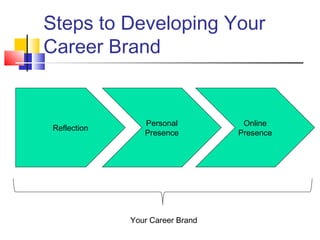
Steps to Developing Your
Career Brand
Reflection
Personal
Presence
Online
Presence
Your Career Brand
Personal Presence (CAN)
 Communication
- Improve your speaking and writing ability by
taking courses in public speaking and writing.
- Example: Toastmasters
 Appearance
- Attire
- Hygiene
- Body Language
 Networking
It’s all about Relationship
Networking
 “It’s not what you know, it’s who you know.”
- Dan Schwabel
 Look at every opportunity when you meet
someone as a networking opportunity and a
way to build your offline brand
 Those people in your network and that you
meet can help by giving references and
endorsements
Online Presence
 Documents
- Cover Letter and Resume
- Focus on results on a resume by using
the BAR model
 Social Media
Why Does Social Media
Matter
 The Social Media Revolution 2012:
http://youtu.be/0eUeL3n7fDs
Is Social Recruiting Real?:
http://youtu.be/KU51MSNZrLc
Best Practices with Social
Media
 Decide why you would like to use social
media and for what for
 Come up with a goal on how often you
would like to post (i.e. at least once a
week)
 Come up with ways to engage with
those that are in your network (i.e. ask
questions)
 Be consistent in the brand you portray
LinkedIn
 Craft your profile (headshot, headline)
 Start and expand your network
 Ask for advice
 Ask for recommendations
 Search jobs
 Make sure your profile meets 100%
completeness
Facebook
 Control your privacy settings
 Complete your profile
 Find your contacts
 Non-stop networking
 Join groups and fan pages
 Register for events
 Think about creating two separate
profiles, one professional and one
personal
Key Takeaways
 Understand how to use your personal
and online presence as a part of your
career brand
 Identify best practices on how to apply
your career brand
 Identify at least one action item for
using your career brand through a
personal and online presence
Contact
Angelique Torres
Email: angelique.torres1@gmail.com
LinkedIn: http://www.linkedin.com/in/angeliquetorres
Twitter: @Angelique.Torre1

Developing Your Career Brand.Part 2

  • 1.
    Developing and UsingYour Career Brand: Part 2 – Using Your Brand Angelique Torres Volunteer at The Career Place and Employer Outreach Specialist Endicott College Email: angelique.torres1@gmail.com LinkedIn: http://www.linkedin.com/in/angeliquetorres Twitter: @Angelique.Torre1
  • 2.
    Elevator Pitch Sharingand Feedback Session  Please allow others to speak before you do  After an elevator speech is given, we will have time for two comments  Constructive feedback basics: - Mention something positive about the speech given - Show appreciation - Avoid “need to” phrases - State observations and not interpretations
  • 3.
    Learning Objectives  Identifytwo different approaches in using your career brand  Apply techniques to successfully use your career brand
  • 4.
    Steps to DevelopingYour Career Brand Reflection Personal Presence Online Presence Your Career Brand
  • 5.
    Personal Presence (CAN) Communication - Improve your speaking and writing ability by taking courses in public speaking and writing. - Example: Toastmasters  Appearance - Attire - Hygiene - Body Language  Networking
  • 6.
    It’s all aboutRelationship Networking  “It’s not what you know, it’s who you know.” - Dan Schwabel  Look at every opportunity when you meet someone as a networking opportunity and a way to build your offline brand  Those people in your network and that you meet can help by giving references and endorsements
  • 7.
    Online Presence  Documents -Cover Letter and Resume - Focus on results on a resume by using the BAR model  Social Media
  • 8.
    Why Does SocialMedia Matter  The Social Media Revolution 2012: http://youtu.be/0eUeL3n7fDs Is Social Recruiting Real?: http://youtu.be/KU51MSNZrLc
  • 9.
    Best Practices withSocial Media  Decide why you would like to use social media and for what for  Come up with a goal on how often you would like to post (i.e. at least once a week)  Come up with ways to engage with those that are in your network (i.e. ask questions)  Be consistent in the brand you portray
  • 10.
    LinkedIn  Craft yourprofile (headshot, headline)  Start and expand your network  Ask for advice  Ask for recommendations  Search jobs  Make sure your profile meets 100% completeness
  • 11.
    Facebook  Control yourprivacy settings  Complete your profile  Find your contacts  Non-stop networking  Join groups and fan pages  Register for events  Think about creating two separate profiles, one professional and one personal
  • 12.
    Key Takeaways  Understandhow to use your personal and online presence as a part of your career brand  Identify best practices on how to apply your career brand  Identify at least one action item for using your career brand through a personal and online presence
  • 13.
    Contact Angelique Torres Email: angelique.torres1@gmail.com LinkedIn:http://www.linkedin.com/in/angeliquetorres Twitter: @Angelique.Torre1

Editor's Notes

  • #2 Hello everyone and welcome to Developing and Using Your Career Brand: Part 2 – Using Your Brand. For any of you who are new, I am your facilitator, Angelique Torres. I am a Masters recipient who after a few years of Recruiting in the private sector and being laid off, decided to make a career change. I am now working within the Career Center at Endicott College and a volunteer with the Career Place. This is the third workshop I have developed and facilitated for the Center. I am also a Senior Board Member of the Career Counselor’s Consortium. What I would like to do now is just go around the room and if everyone can just introduce themselves again by giving your name along with the elevator speech that you developed.
  • #4 Thank you for sharing your elevator speeches and to see all of you again. My hope now is that you have an elevator speech that you can use in your job search as a part of your brand and as you meet people for the first time. The second part of this series focuses on taking that brand and elevator speech that you have developed and applying it using two different approaches. The learning objectives for this part of the series includes identifying those two approaches and applying those approaches successfully.
  • #5 As I mentioned last week, there are three steps to developing your career brand. The second and third steps will be covered simultaneously this week. First, let’s take a look at Personal Presence.
  • #6 - Personal presence can be best described using the “CAN” model as in “Yes You Can.” The first part of that model is communication. Public speaking is the number one fear among people. My hope is that in sharing your elevator speech with everyone today, you have gained additional practice and confidence in your communication ability. The second part of that model stands for Appearance, which can be broken down to attire, hygiene, and body language. When you first meet someone in a professional setting, what are some examples of appropriate attire for men? For women? First impressions count. The last part of the model is Networking. It’s all about relationship networking, which I will be breaking down next.
  • #7 Now that we have covered personal presence as a way to use your brand, let’s now shift our focus to your online presence.
  • #8 Your online presence can be broken down into documents and social media. The Career Center currently has resources available to you when it comes to resume writing and I highly encourage you to attend those. But for the purposes of today, I would like to share a best practice on creating your resume by using the BAR model. Besides documents, you can now use social media as a part of your online presence. You might be asking yourself, why do I need social media. The next video will help to answer that question.
  • #9 As you can see, social media is engrained in all aspects of our lives and has changed the way we communicate. It is also here to stay. Recruiters are now using social media to find candidates. You put yourself in a significant disadvantage if you do not build your online presence using social media. What are the best ways to use social media?
  • #10 There are a number of different types of social media and you have to decide which ones to use as a part of your online presence. I am most familiar with LinkedIn and Facebook as a part of my brand and I will be covering those two in-depth today. I do encourage you to take a look at Me 2.0 by Dan Schwabel, which is on your resource list, for additional social media tools you can use.
  • #11 The Career Center does provide a specific LinkedIn workshop that I encourage you to attend. For the purposes of today, I wanted to share some best practices, the technical components are best left for that LinkedIn class.