Jeff Bailey, Library Director 
Linda Creibaum, Acquisitions and Serials Librarian 
Dean B. Ellis Library 
Arkansas State University 
November 6, 2014 
Copyright Jeff Bailey and Linda Creibaum, 2014
• Questions are welcome at any time, but we may defer 
answering a question until later in the session 
• Interactive discussions are welcome
•In 1997 the Arkansas State University library had no 
equitable means of making allocations 
•Funds had not been reallocated/redistributed in many 
years 
•One department accounted for nearly 20% of all 
collection development expenditures 
•There was no funding to support new programs
•We searched literature to discover methods of making 
allocations, including the use of a formula 
•We chose to use a formula based on one used by Colorado 
State University and described in SPEC Kit #36
Do these steps before selecting formula 
factors
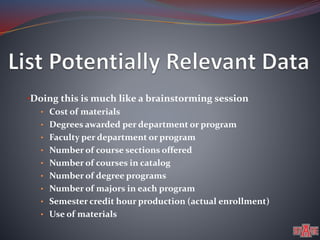
•Doing this is much like a brainstorming session 
• Cost of materials 
• Degrees awarded per department or program 
• Faculty per department or program 
• Number of course sections offered 
• Number of courses in catalog 
• Number of degree programs 
• Number of majors in each program 
• Semester credit hour production (actual enrollment) 
• Use of materials
•Evaluate and refine the list 
• Eliminate duplicates and non-viable suggestions 
• Identify the factors that are most relevant to your campus
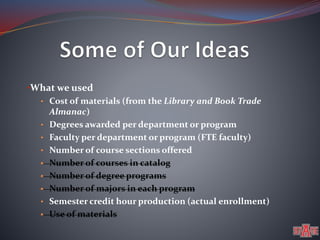
•What we used 
• Cost of materials (from the Library and Book Trade 
Almanac) 
• Degrees awarded per department or program 
• Faculty per department or program (FTE faculty) 
• Number of course sections offered 
• Number of courses in catalog 
• Number of degree programs 
• Number of majors in each program 
• Semester credit hour production (actual enrollment) 
• Use of materials
•Determine what data is available or could be gathered 
• Both internal (within your library and within the field) and 
external (campus, community, company, etc.) 
• Eliminate possible factors for which data cannot be obtained 
•Gather samples of available data
•The original factors we used 
• Semester credit hour production (actual enrollment) 
• Number of classes offered 
• Degrees awarded 
• Faculty per department 
• Cost of materials from Library and Book Trade Almanac 
•Other factors that could have been used 
• Number of degree programs 
• Departmental external funding and/or research 
productivity 
• Use of materials 
• Number of courses in catalog
•Weights 
• Weighting is the assigning of values to indicate the 
importance or impact of each factor in the formula relative 
to the other formula factors 
• The assigned weight values are inserted into the Excel 
spreadsheet and are used in formula calculations
•Assigning weights to each factor 
• These should be based upon each institution’s priorities 
and culture 
• Library Committee 
• Faculty Senate 
• Institutional Administration 
• Something else? 
• We subdivided some factors before assigning weights 
• Do test runs and adjust weights if needed
How the Formula Works 
(by non-mathematicians)
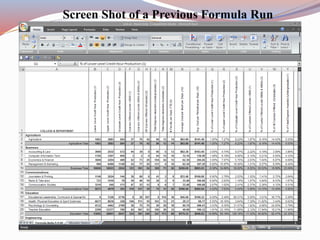
Screen Shot of a Previous Formula Run
•You can do separate formula runs for… 
• Books 
• Journals 
• Print 
• Online resources (databases/ejournals/eBooks) 
• Any other budgets your library may have 
• Or any combination of these 
•We chose to run a single formula for all allocations
•Before running the formula, determine how much of your 
budget to allocate and how much to keep back for library use 
(if any) 
•You may want or need to make adjustments to individual 
allocations after running the formula 
• Do no harm 
• Nonparticipation 
• Special entities or protected programs
•Your formula will probably need to be modified at some 
point in the future 
•We have changed our formula 
• Weights were adjusted 
• Added departmental external funding as a factor in 2012
•Document, document, document! 
•Make the decisions and modify the formula to fit your 
library’s needs 
•Feel free to contact either of us with any questions you 
may think of later
To download an interactive copy of the 
demo spreadsheet 
www.astate.edu/a/library/charleston
Jeff Bailey 
Library Director 
Dean B. Ellis Library 
Arkansas State University 
Jonesboro 
P.O. Box 2040 
State University, AR 72467 
870-972-2724 
jbailey@astate.edu 
Linda Creibaum 
Acquisitions and Serials Librarian 
Dean B. Ellis Library 
Arkansas State University 
Jonesboro 
P.O. Box 2040 
State University, AR 72467 
870-972-3354 
lcreibaum@astate.edu

Developing a weighted collection development allocation formula

  • 1.
    Jeff Bailey, LibraryDirector Linda Creibaum, Acquisitions and Serials Librarian Dean B. Ellis Library Arkansas State University November 6, 2014 Copyright Jeff Bailey and Linda Creibaum, 2014
  • 2.
    • Questions arewelcome at any time, but we may defer answering a question until later in the session • Interactive discussions are welcome
  • 3.
    •In 1997 theArkansas State University library had no equitable means of making allocations •Funds had not been reallocated/redistributed in many years •One department accounted for nearly 20% of all collection development expenditures •There was no funding to support new programs
  • 4.
    •We searched literatureto discover methods of making allocations, including the use of a formula •We chose to use a formula based on one used by Colorado State University and described in SPEC Kit #36
  • 5.
    Do these stepsbefore selecting formula factors
  • 6.
    •Doing this ismuch like a brainstorming session • Cost of materials • Degrees awarded per department or program • Faculty per department or program • Number of course sections offered • Number of courses in catalog • Number of degree programs • Number of majors in each program • Semester credit hour production (actual enrollment) • Use of materials
  • 7.
    •Evaluate and refinethe list • Eliminate duplicates and non-viable suggestions • Identify the factors that are most relevant to your campus
  • 8.
    •What we used • Cost of materials (from the Library and Book Trade Almanac) • Degrees awarded per department or program • Faculty per department or program (FTE faculty) • Number of course sections offered • Number of courses in catalog • Number of degree programs • Number of majors in each program • Semester credit hour production (actual enrollment) • Use of materials
  • 9.
    •Determine what datais available or could be gathered • Both internal (within your library and within the field) and external (campus, community, company, etc.) • Eliminate possible factors for which data cannot be obtained •Gather samples of available data
  • 10.
    •The original factorswe used • Semester credit hour production (actual enrollment) • Number of classes offered • Degrees awarded • Faculty per department • Cost of materials from Library and Book Trade Almanac •Other factors that could have been used • Number of degree programs • Departmental external funding and/or research productivity • Use of materials • Number of courses in catalog
  • 11.
    •Weights • Weightingis the assigning of values to indicate the importance or impact of each factor in the formula relative to the other formula factors • The assigned weight values are inserted into the Excel spreadsheet and are used in formula calculations
  • 12.
    •Assigning weights toeach factor • These should be based upon each institution’s priorities and culture • Library Committee • Faculty Senate • Institutional Administration • Something else? • We subdivided some factors before assigning weights • Do test runs and adjust weights if needed
  • 13.
    How the FormulaWorks (by non-mathematicians)
  • 14.
    Screen Shot ofa Previous Formula Run
  • 15.
    •You can doseparate formula runs for… • Books • Journals • Print • Online resources (databases/ejournals/eBooks) • Any other budgets your library may have • Or any combination of these •We chose to run a single formula for all allocations
  • 16.
    •Before running theformula, determine how much of your budget to allocate and how much to keep back for library use (if any) •You may want or need to make adjustments to individual allocations after running the formula • Do no harm • Nonparticipation • Special entities or protected programs
  • 17.
    •Your formula willprobably need to be modified at some point in the future •We have changed our formula • Weights were adjusted • Added departmental external funding as a factor in 2012
  • 18.
    •Document, document, document! •Make the decisions and modify the formula to fit your library’s needs •Feel free to contact either of us with any questions you may think of later
  • 19.
    To download aninteractive copy of the demo spreadsheet www.astate.edu/a/library/charleston
  • 20.
    Jeff Bailey LibraryDirector Dean B. Ellis Library Arkansas State University Jonesboro P.O. Box 2040 State University, AR 72467 870-972-2724 jbailey@astate.edu Linda Creibaum Acquisitions and Serials Librarian Dean B. Ellis Library Arkansas State University Jonesboro P.O. Box 2040 State University, AR 72467 870-972-3354 lcreibaum@astate.edu