Developing a Response Plan to
Misinformation in Public Health
WEDNESDAY, SEPTEMBER 25
1:00 – 2:30 pm ET / 10:00 – 11:30 am PT
This event will be recorded. The recording and slides will be available on
publichealthcollaborative.org later this week.
All attendees are automatically muted upon entry.
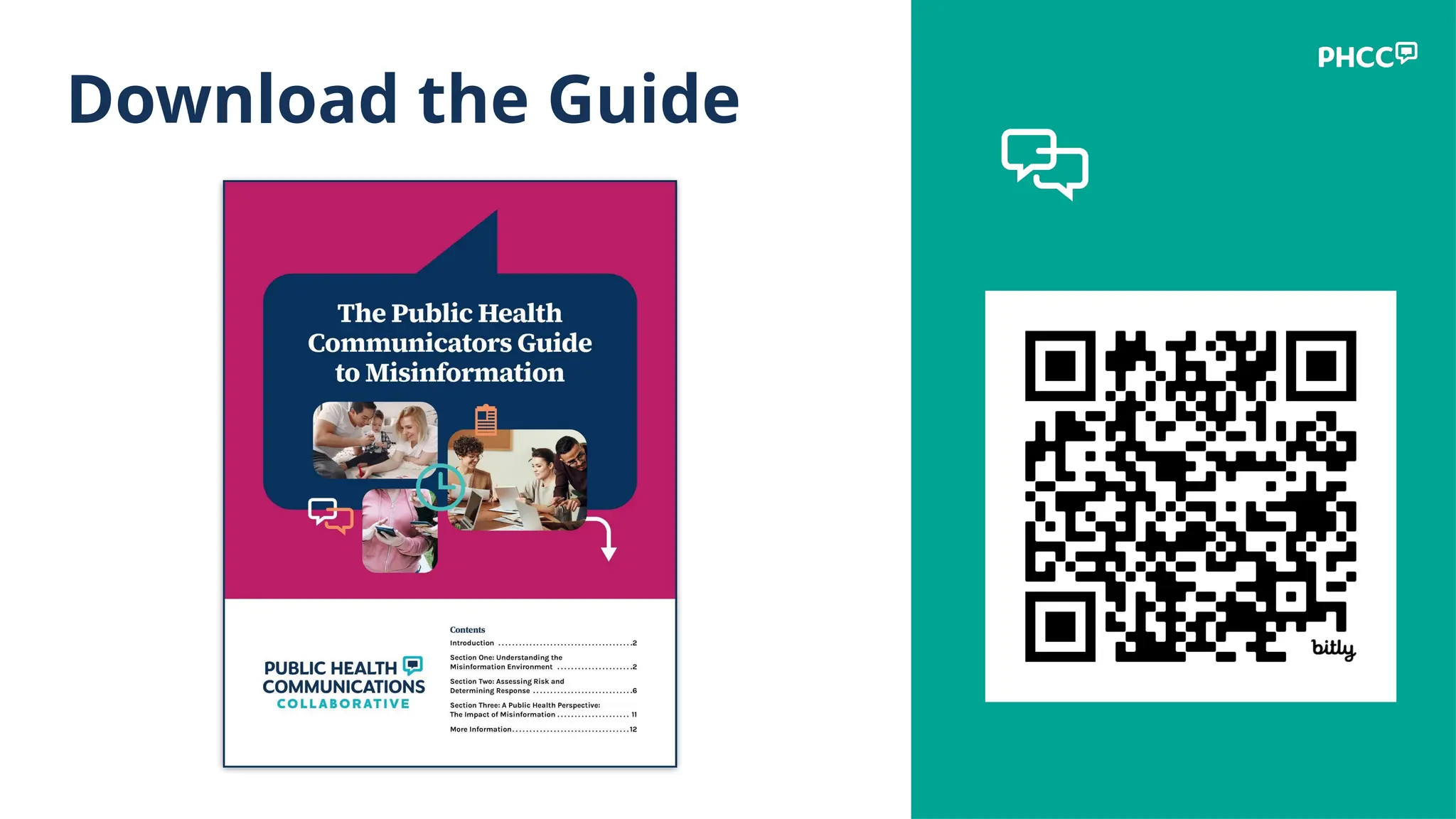
Download the Guide
Closed Captioning and ASL
Interpretation
If you’d like to use closed captions or ASL interpretation: Hover over the
“More” button or the “Interpretation” button on the bottom of your Zoom
screen.
● Live closed captioning is being provided by AI Media.
● ASL interpretation is being provided by Keystone Interpreting Solutions.
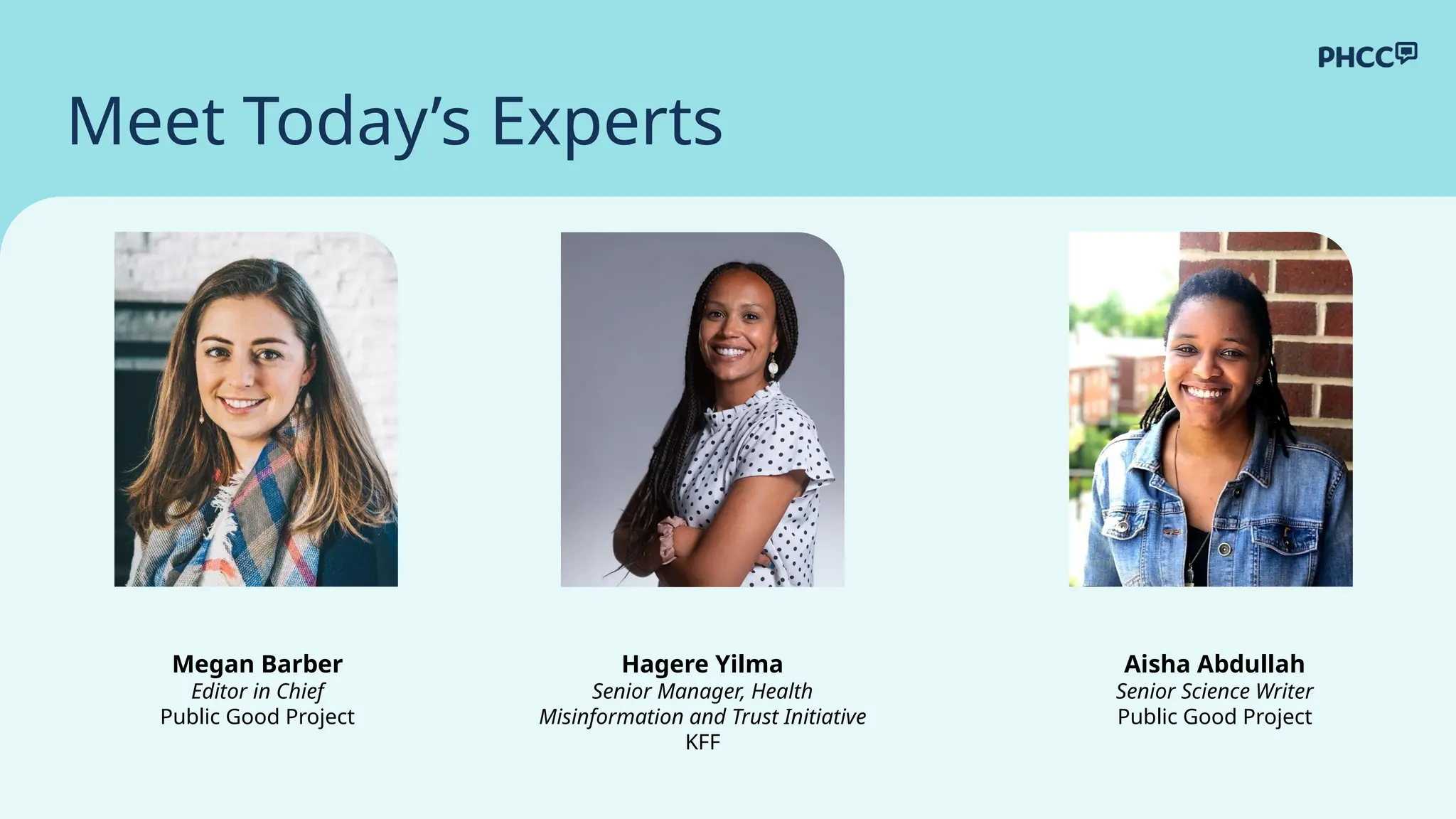
Meet Today’s Experts
Hagere Yilma
Senior Manager, Health
Misinformation and Trust Initiative
KFF
Megan Barber
Editor in Chief
Public Good Project
Aisha Abdullah
Senior Science Writer
Public Good Project
Understanding the
Misinformation Environment
False narratives can spread in various ways,
from word of mouth to non-digital channels.
The rise of internet, social media platforms, and
AI has rapidly increased the spread of information.
Case Study: The recent approval of updated COVID-19
vaccines
• Themes around misinformation reemerge and
repeat
• There’s more gray than you might think
• Misinformation is plentiful, but it’s not just that.
There’s also genuine confusion and accurate info
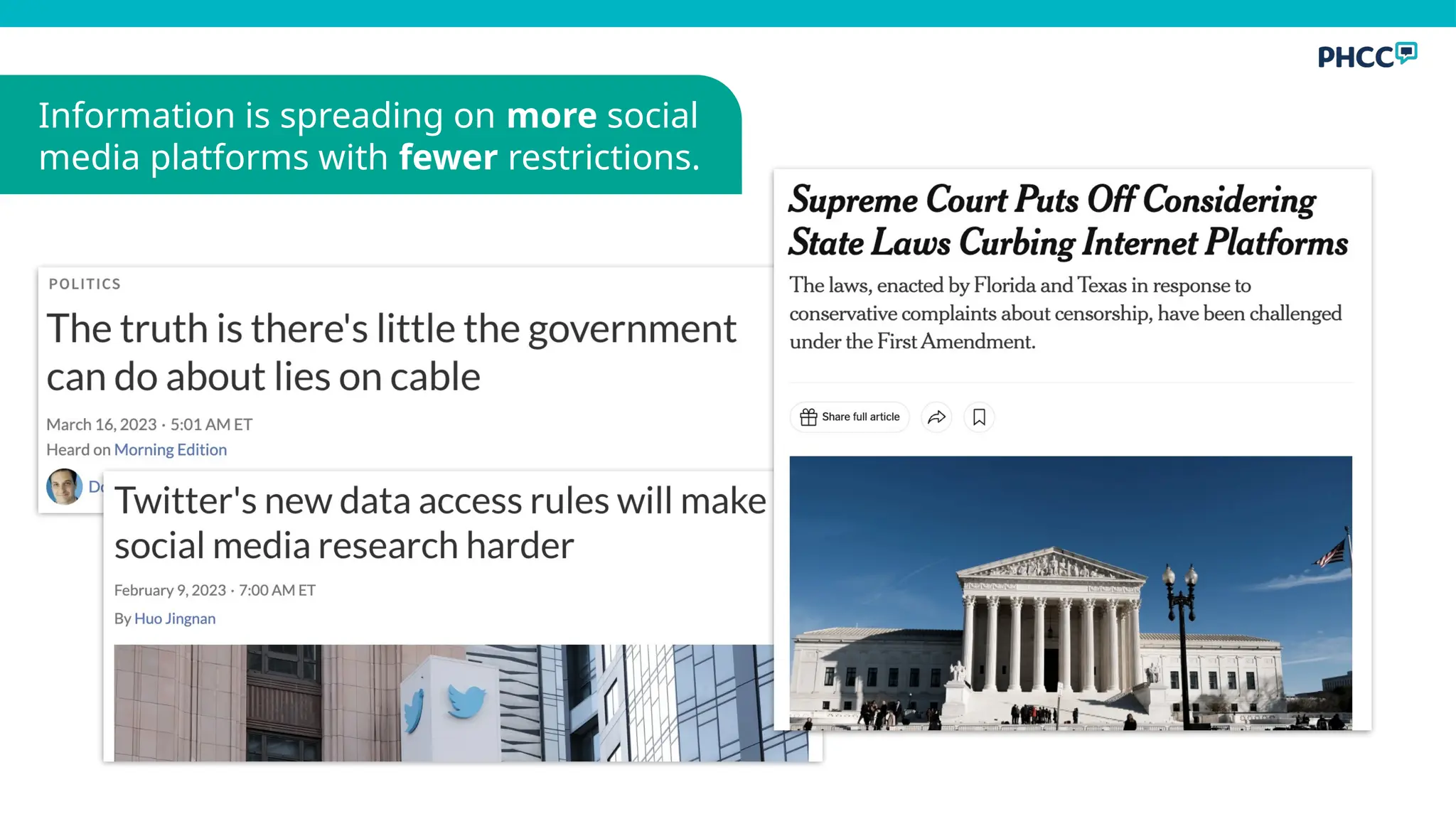
Information is spreading on more social
media platforms with fewer restrictions.
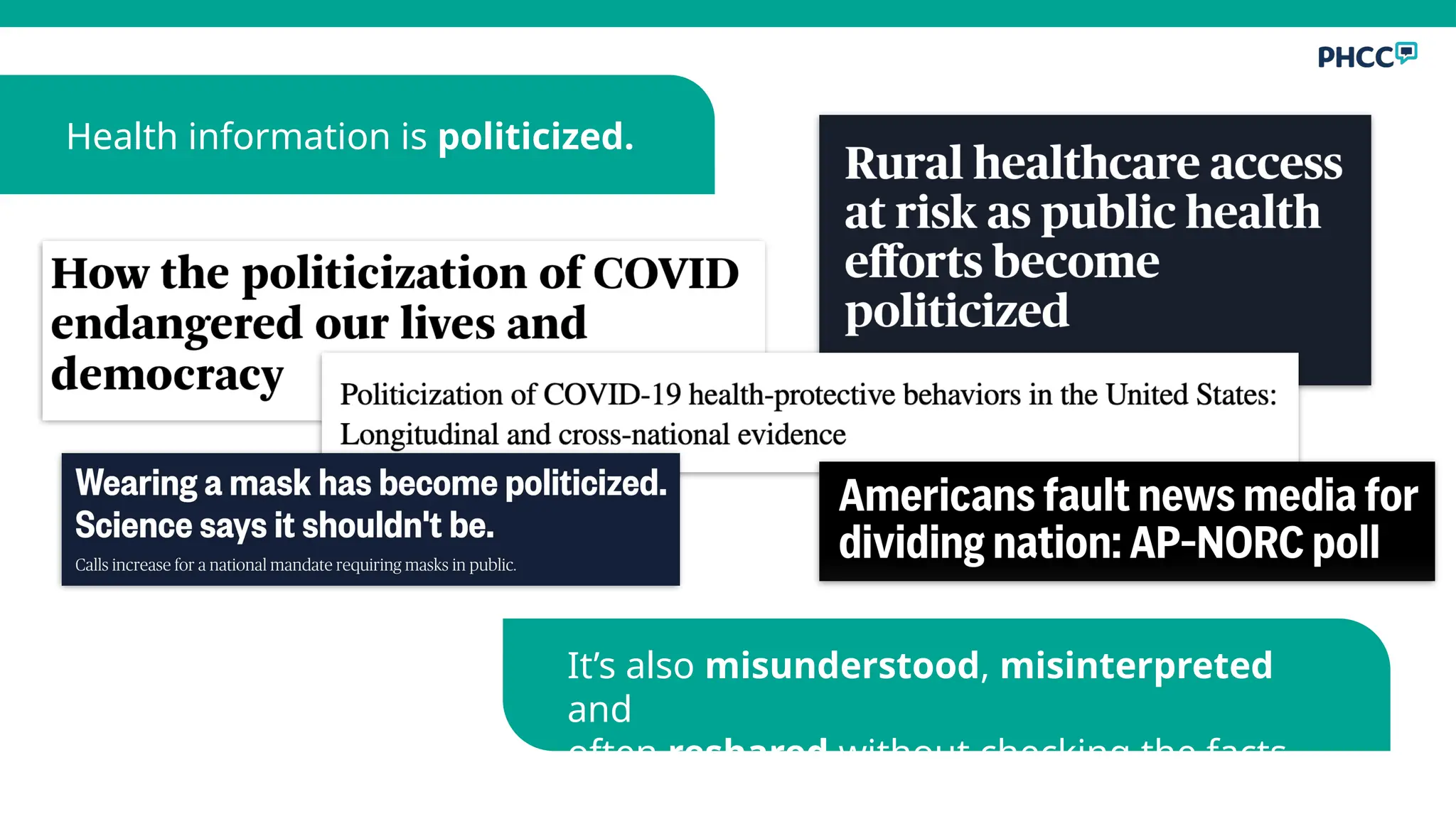
Health information is politicized.
It’s also misunderstood, misinterpreted
and
often reshared without checking the facts.
The impact of false narratives
● Many people have been exposed to false claims
● Decades of standard public health policies are at
risk of being undone
● Trust in the health care system, health
institutions, and public health officials has
declined
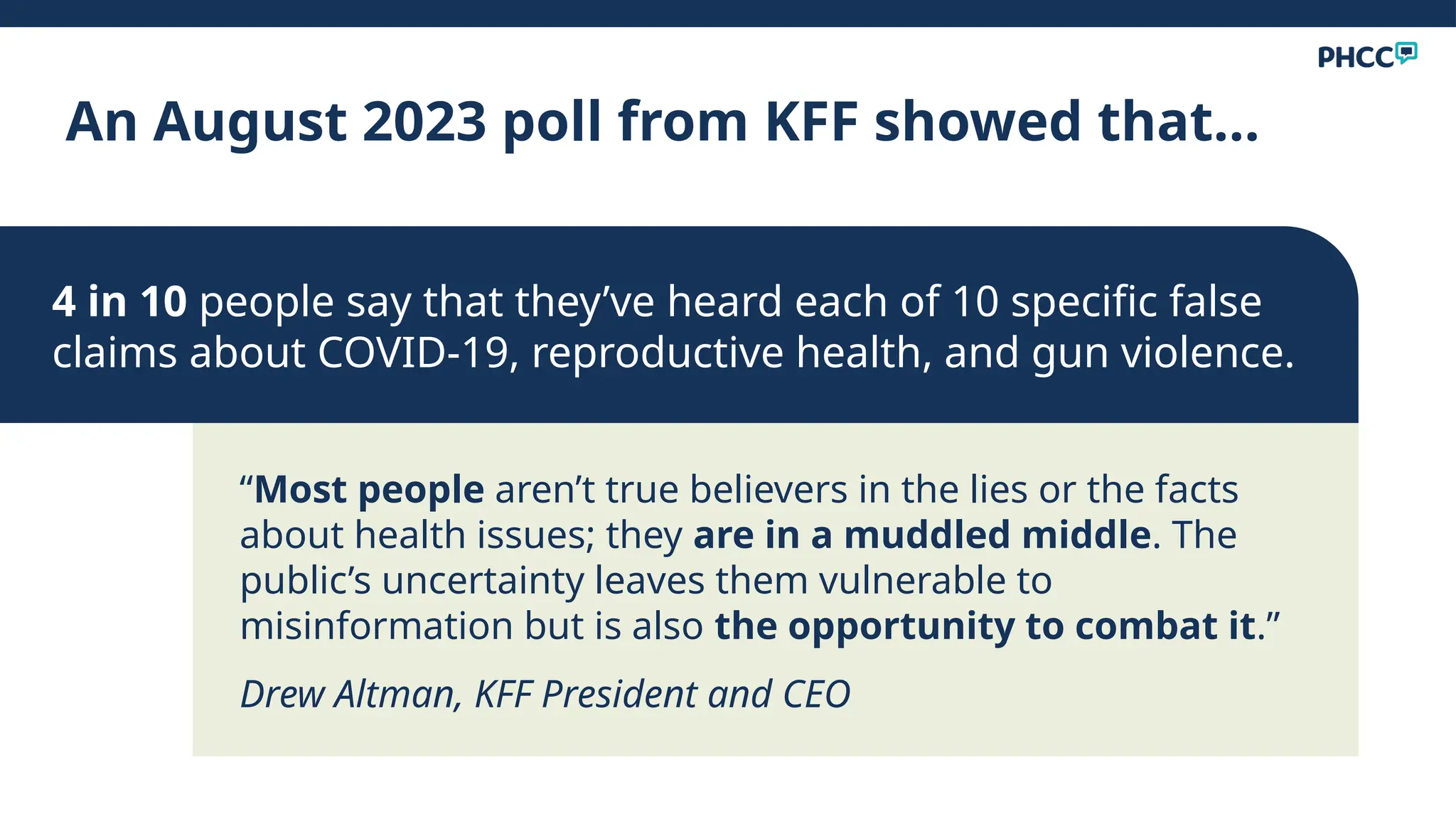
An August 2023 poll from KFF showed that…
“Most people aren’t true believers in the lies or the facts
about health issues; they are in a muddled middle. The
public’s uncertainty leaves them vulnerable to
misinformation but is also the opportunity to combat it.”
Drew Altman, KFF President and CEO
4 in 10 people say that they’ve heard each of 10 specific false
claims about COVID-19, reproductive health, and gun violence.
The study of the spread of information with the
goal of improving public health.
Infodemiology
Infodemiology
The study of the spread of
information with the goal of improving
public health.
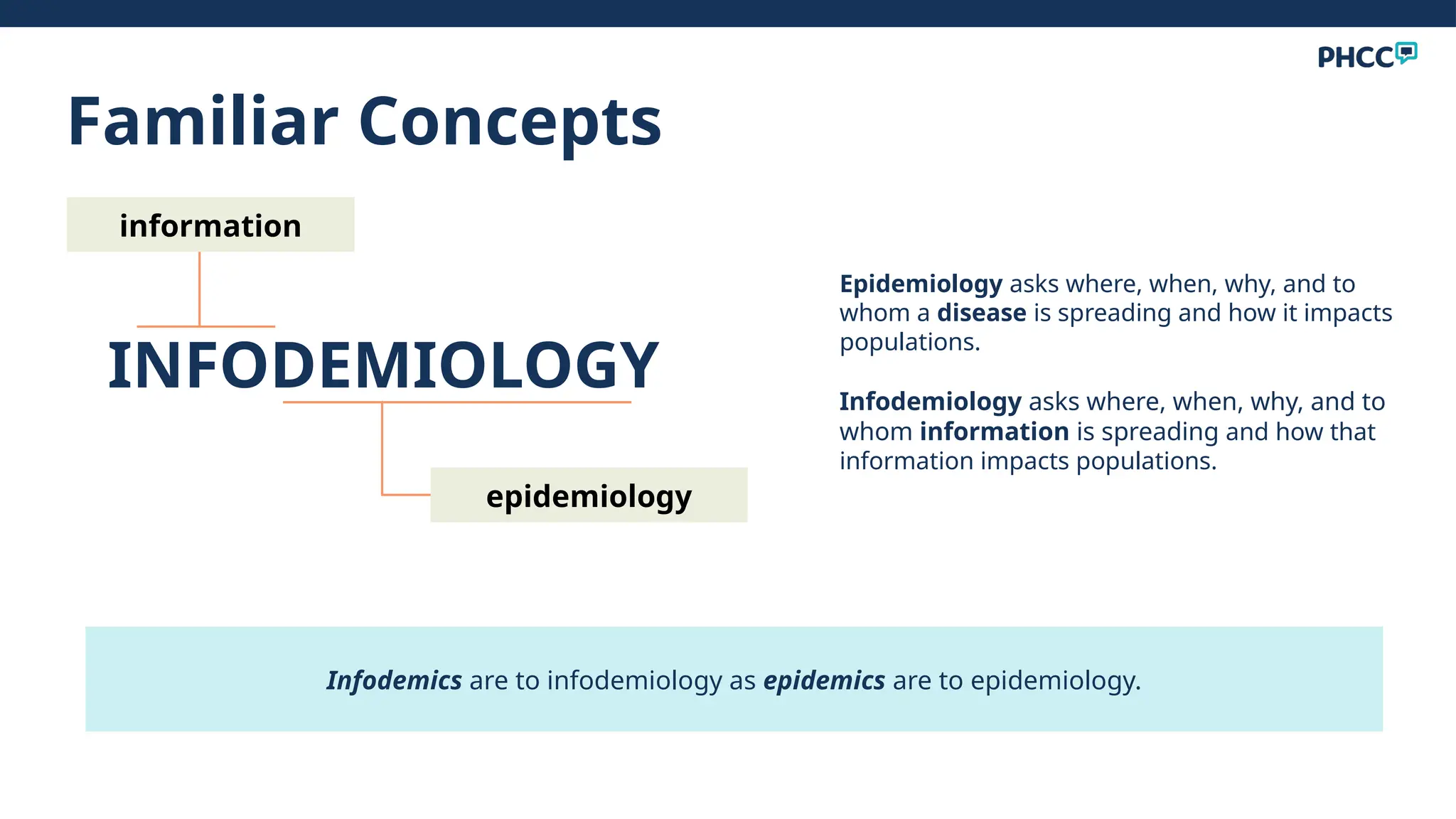
Epidemiology asks where, when, why, and to
whom a disease is spreading and how it impacts
populations.
Infodemiology asks where, when, why, and to
whom information is spreading and how that
information impacts populations.
INFODEMIOLOGY
information
epidemiology
Infodemics are to infodemiology as epidemics are to epidemiology.
Familiar Concepts
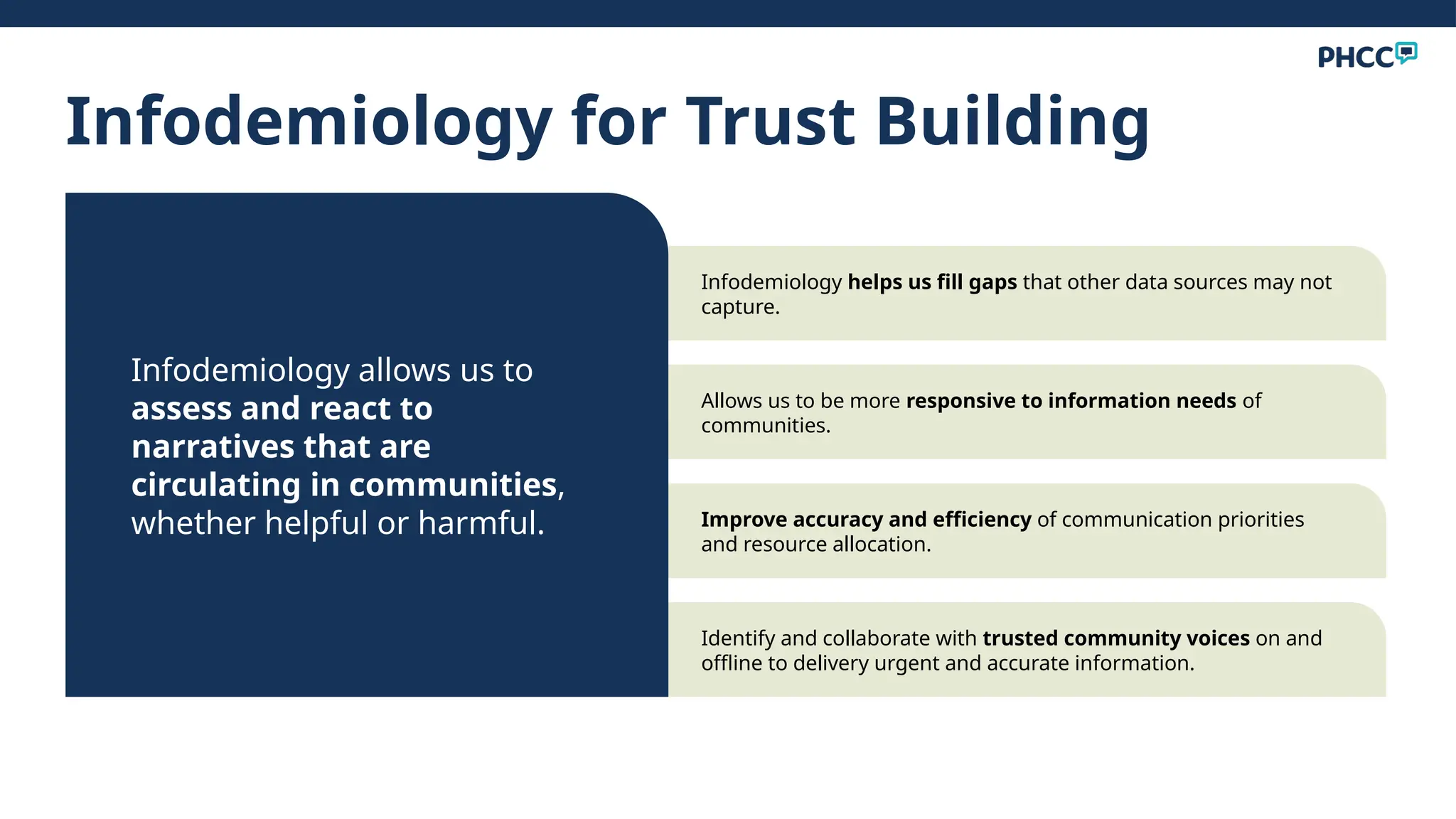
Infodemiology for Trust Building
Infodemiology helps us fill gaps that other data sources may not
capture.
Allows us to be more responsive to information needs of
communities.
Improve accuracy and efficiency of communication priorities
and resource allocation.
Identify and collaborate with trusted community voices on and
offline to delivery urgent and accurate information.
Infodemiology allows us to
assess and react to
narratives that are
circulating in communities,
whether helpful or harmful.
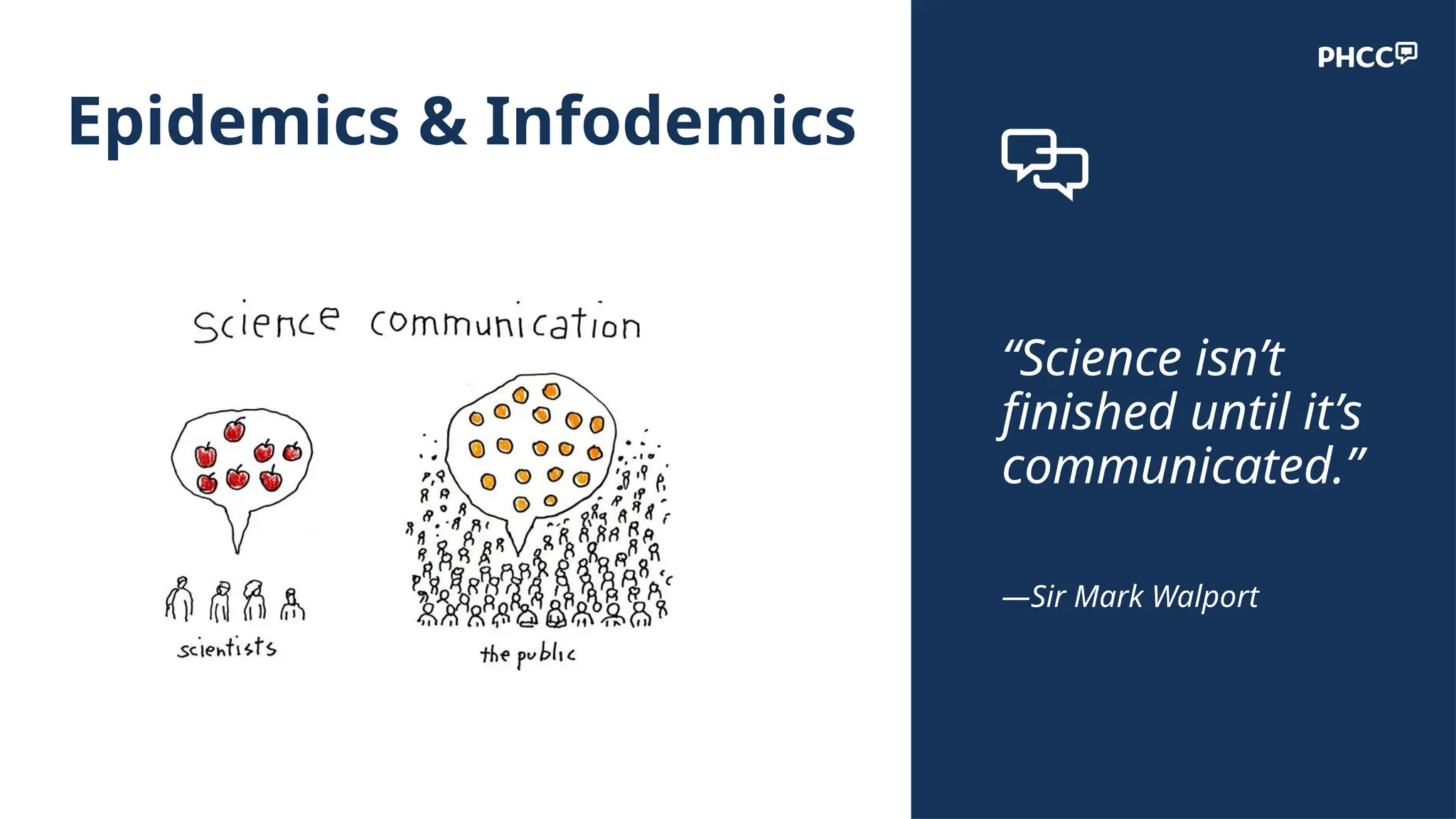
Epidemics & Infodemics
“Science isn’t
finished until it’s
communicated.”
—Sir Mark Walport
Defining Key Terms and
Understanding Why People
Spread Misinformation
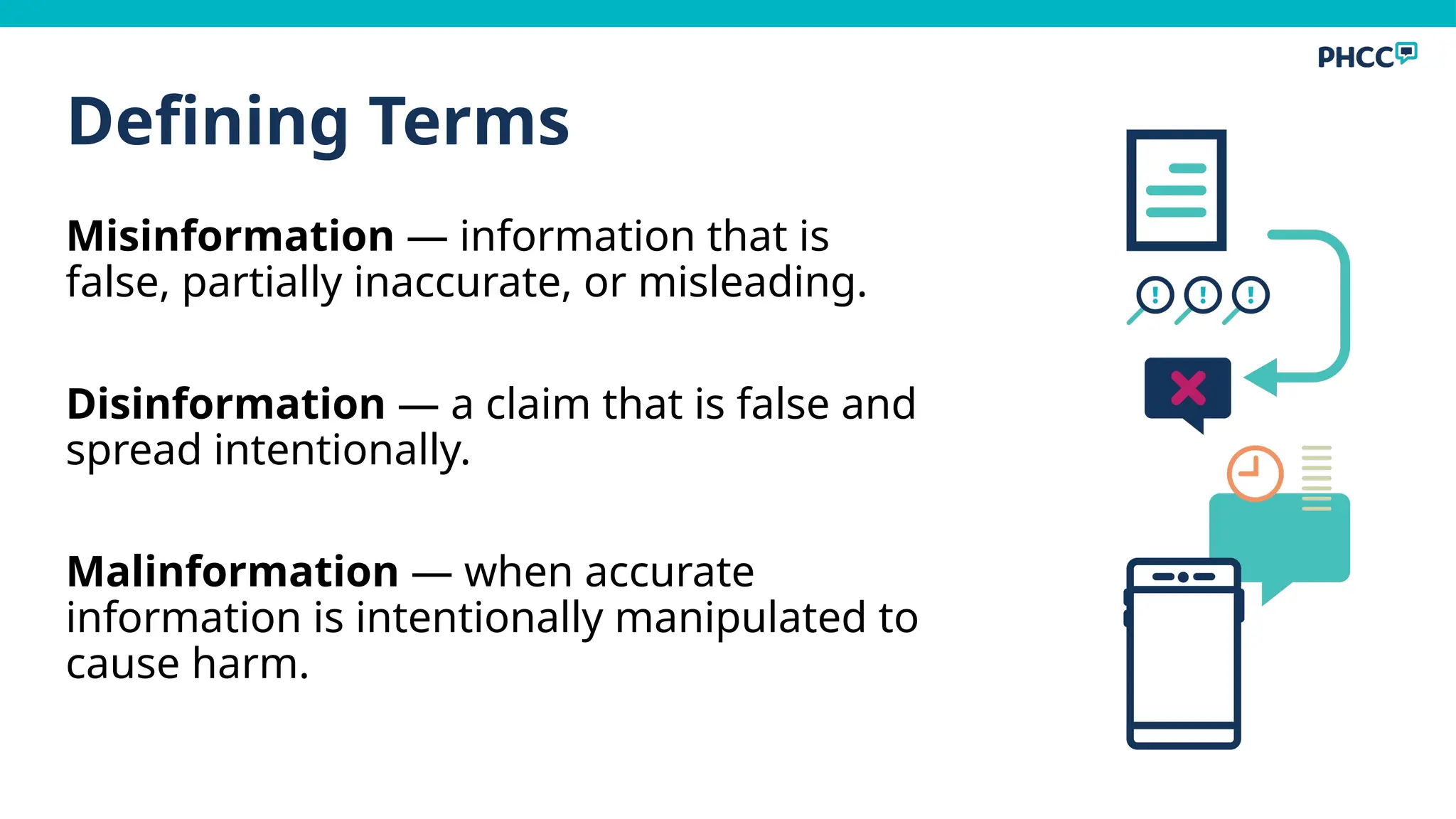
Defining Terms
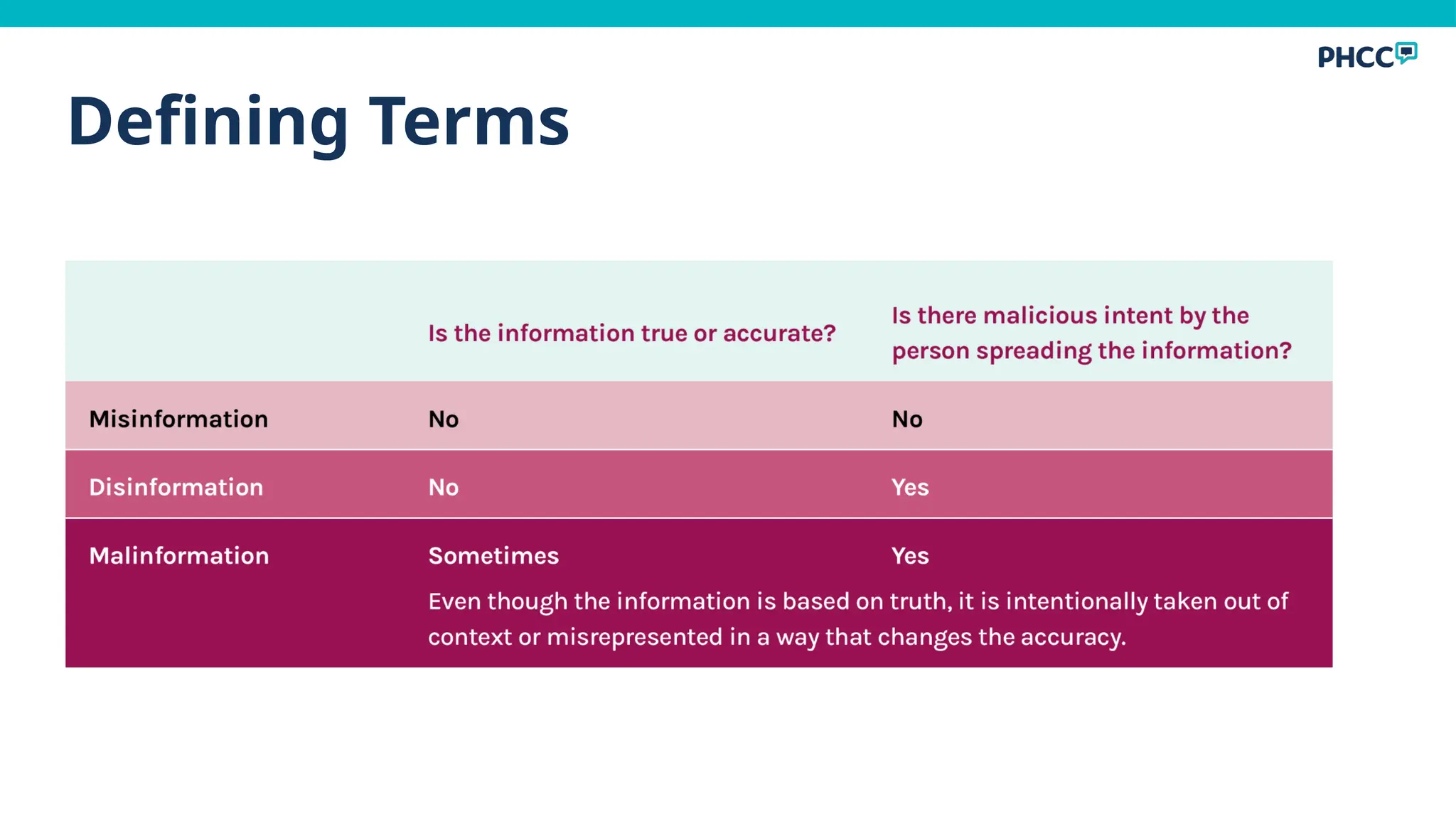
Misinformation — information that is
false, partially inaccurate, or misleading.
Disinformation — a claim that is false and
spread intentionally.
Malinformation — when accurate
information is intentionally manipulated to
cause harm.
Defining Terms
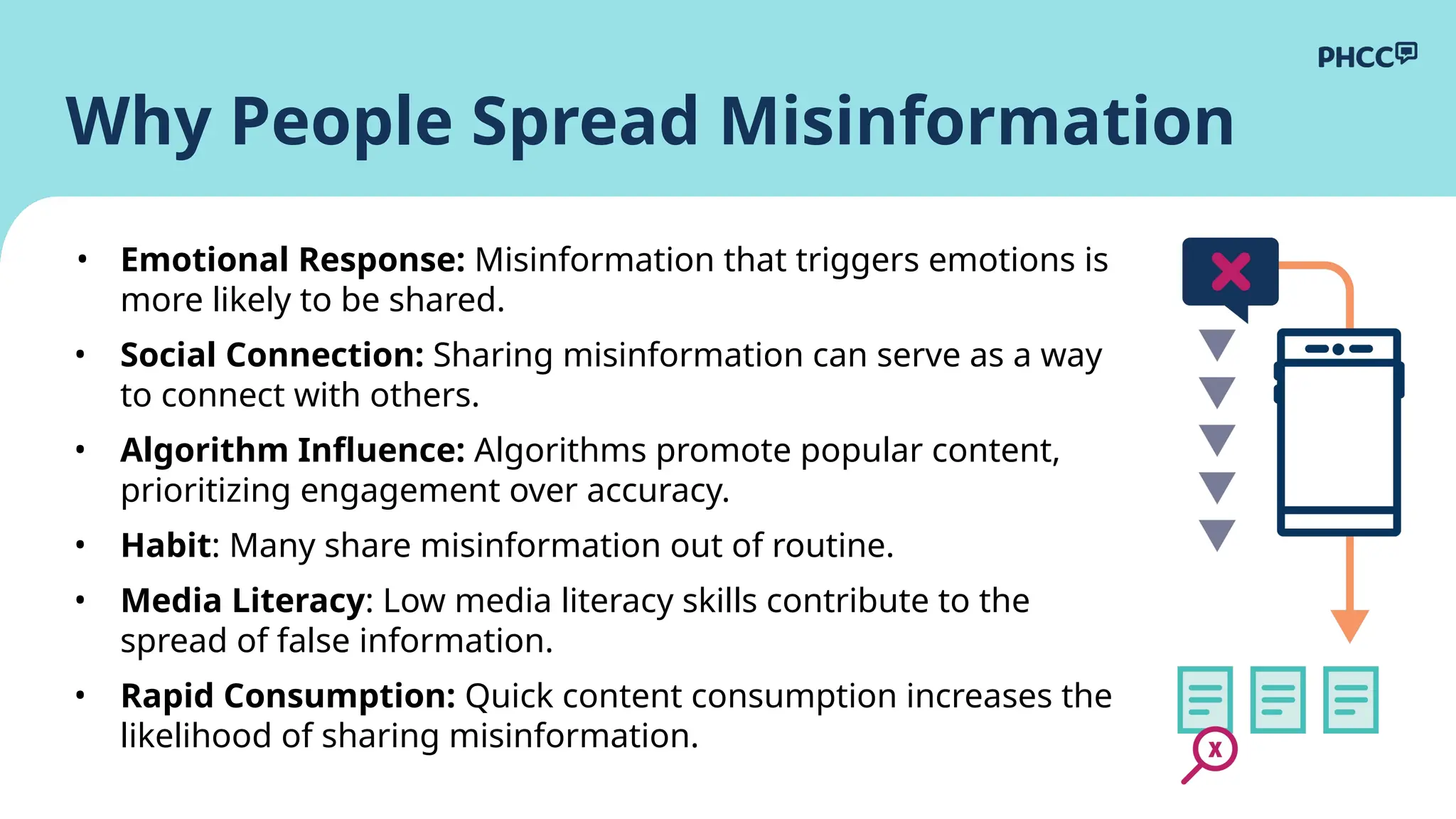
Why People Spread Misinformation
• Emotional Response: Misinformation that triggers emotions is
more likely to be shared.
• Social Connection: Sharing misinformation can serve as a way
to connect with others.
• Algorithm Influence: Algorithms promote popular content,
prioritizing engagement over accuracy.
• Habit: Many share misinformation out of routine.
• Media Literacy: Low media literacy skills contribute to the
spread of false information.
• Rapid Consumption: Quick content consumption increases the
likelihood of sharing misinformation.
Understanding
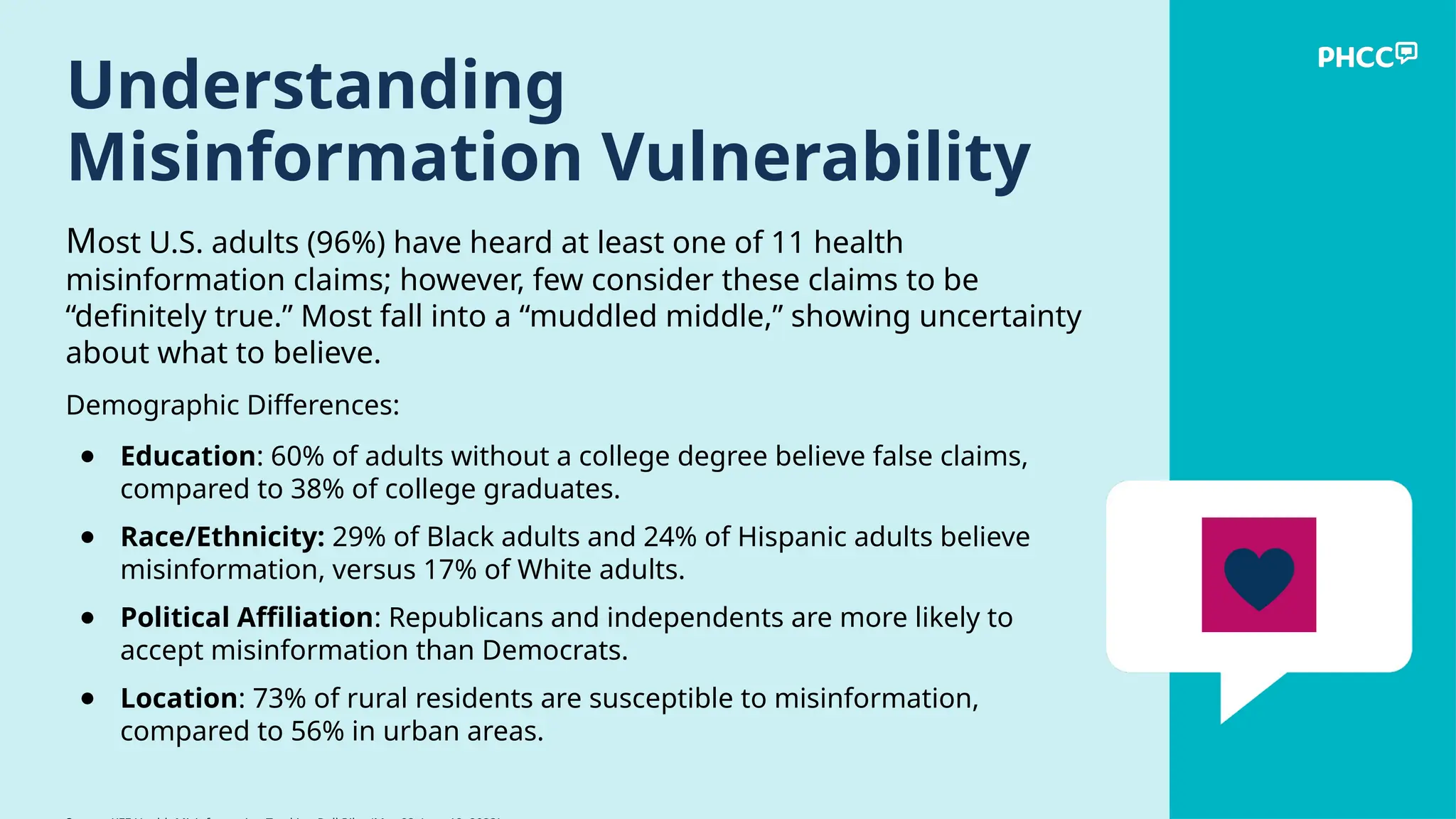
Misinformation Vulnerability
Most U.S. adults (96%) have heard at least one of 11 health
misinformation claims; however, few consider these claims to be
“definitely true.” Most fall into a “muddled middle,” showing uncertainty
about what to believe.
Demographic Differences:
● Education: 60% of adults without a college degree believe false claims,
compared to 38% of college graduates.
● Race/Ethnicity: 29% of Black adults and 24% of Hispanic adults believe
misinformation, versus 17% of White adults.
● Political Affiliation: Republicans and independents are more likely to
accept misinformation than Democrats.
● Location: 73% of rural residents are susceptible to misinformation,
compared to 56% in urban areas.
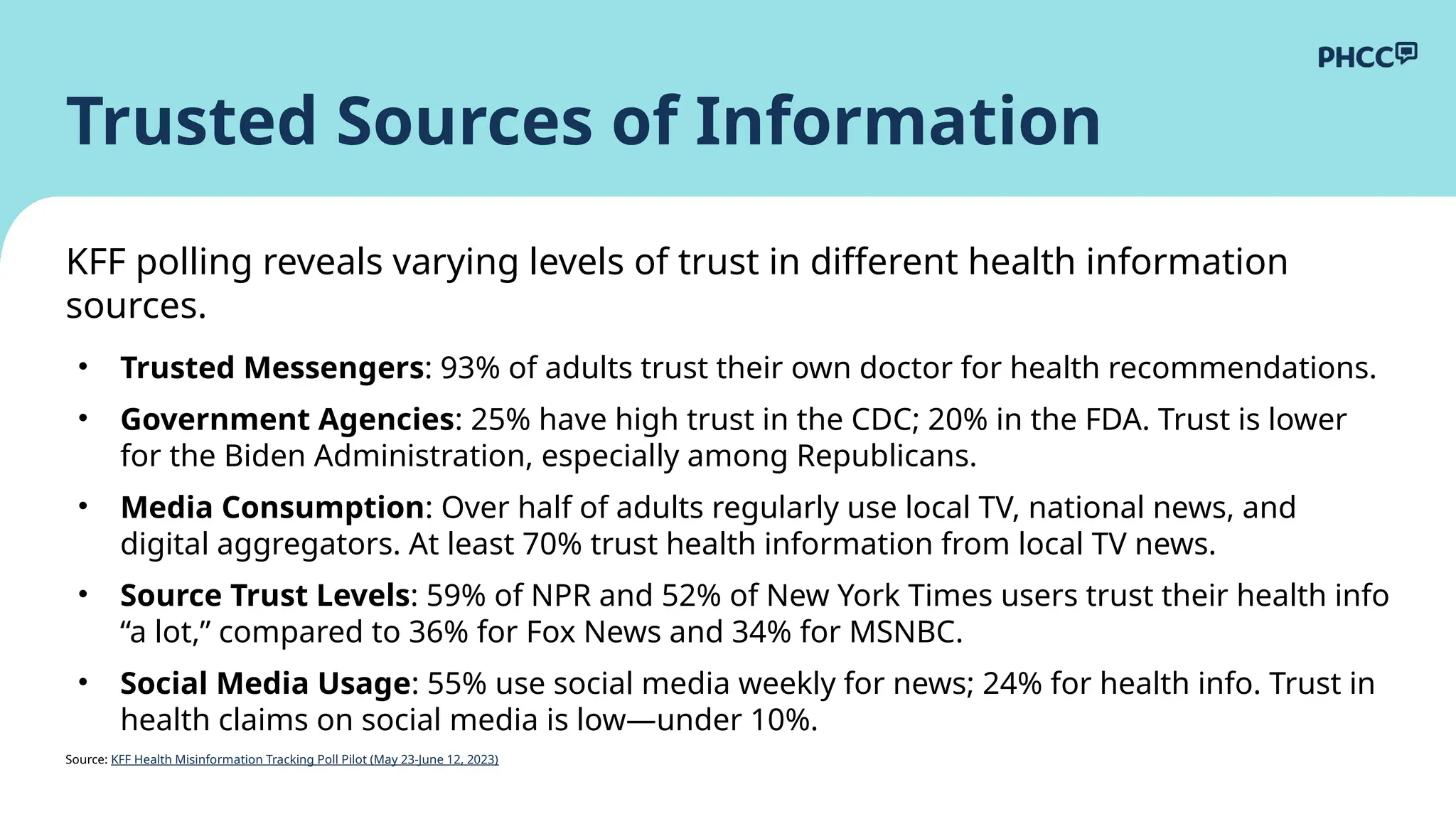
Trusted Sources of Information
KFF polling reveals varying levels of trust in different health information
sources.
• Trusted Messengers: 93% of adults trust their own doctor for health recommendations.
• Government Agencies: 25% have high trust in the CDC; 20% in the FDA. Trust is lower
for the Biden Administration, especially among Republicans.
• Media Consumption: Over half of adults regularly use local TV, national news, and
digital aggregators. At least 70% trust health information from local TV news.
• Source Trust Levels: 59% of NPR and 52% of New York Times users trust their health info
“a lot,” compared to 36% for Fox News and 34% for MSNBC.
• Social Media Usage: 55% use social media weekly for news; 24% for health info. Trust in
health claims on social media is low—under 10%.
Source: KFF Health Misinformation Tracking Poll Pilot (May 23-June 12, 2023)
Tracking and Responding to
Misinformation
Tracking and
Responding to False
Narratives
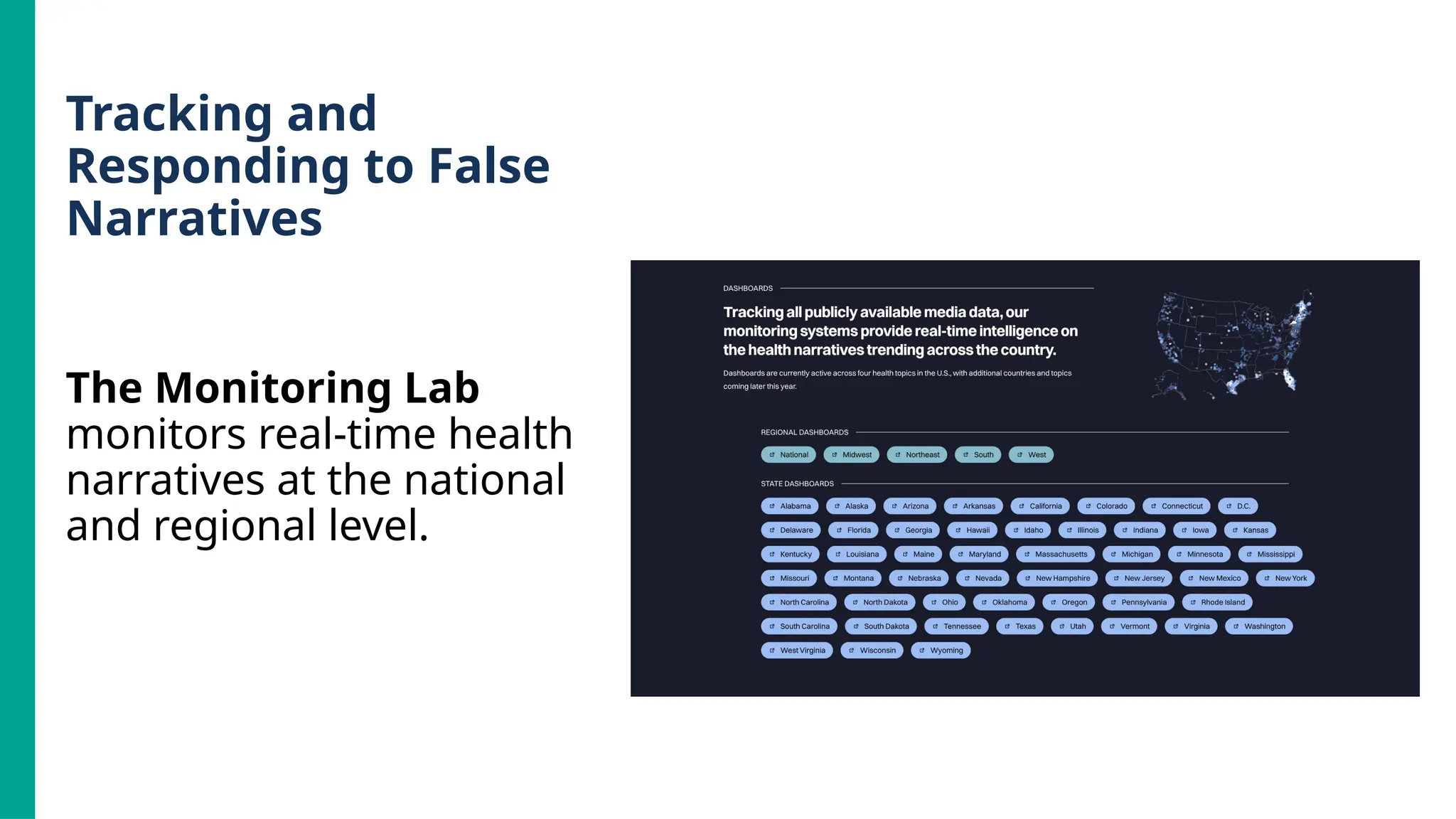
The Monitoring Lab
monitors real-time health
narratives at the national
and regional level.
PHCC Misinformation
Alerts
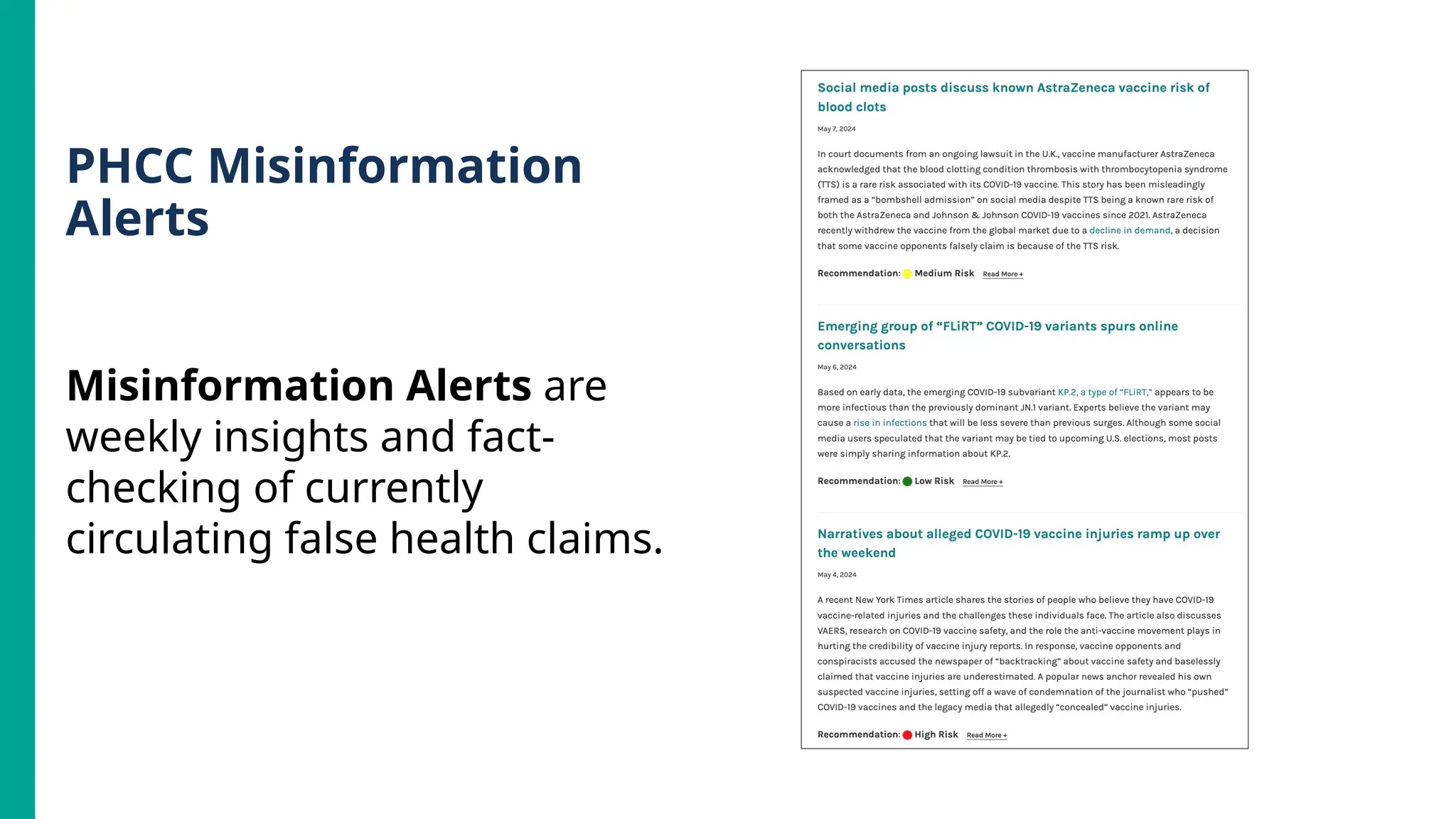
Misinformation Alerts are
weekly insights and fact-
checking of currently
circulating false health claims.
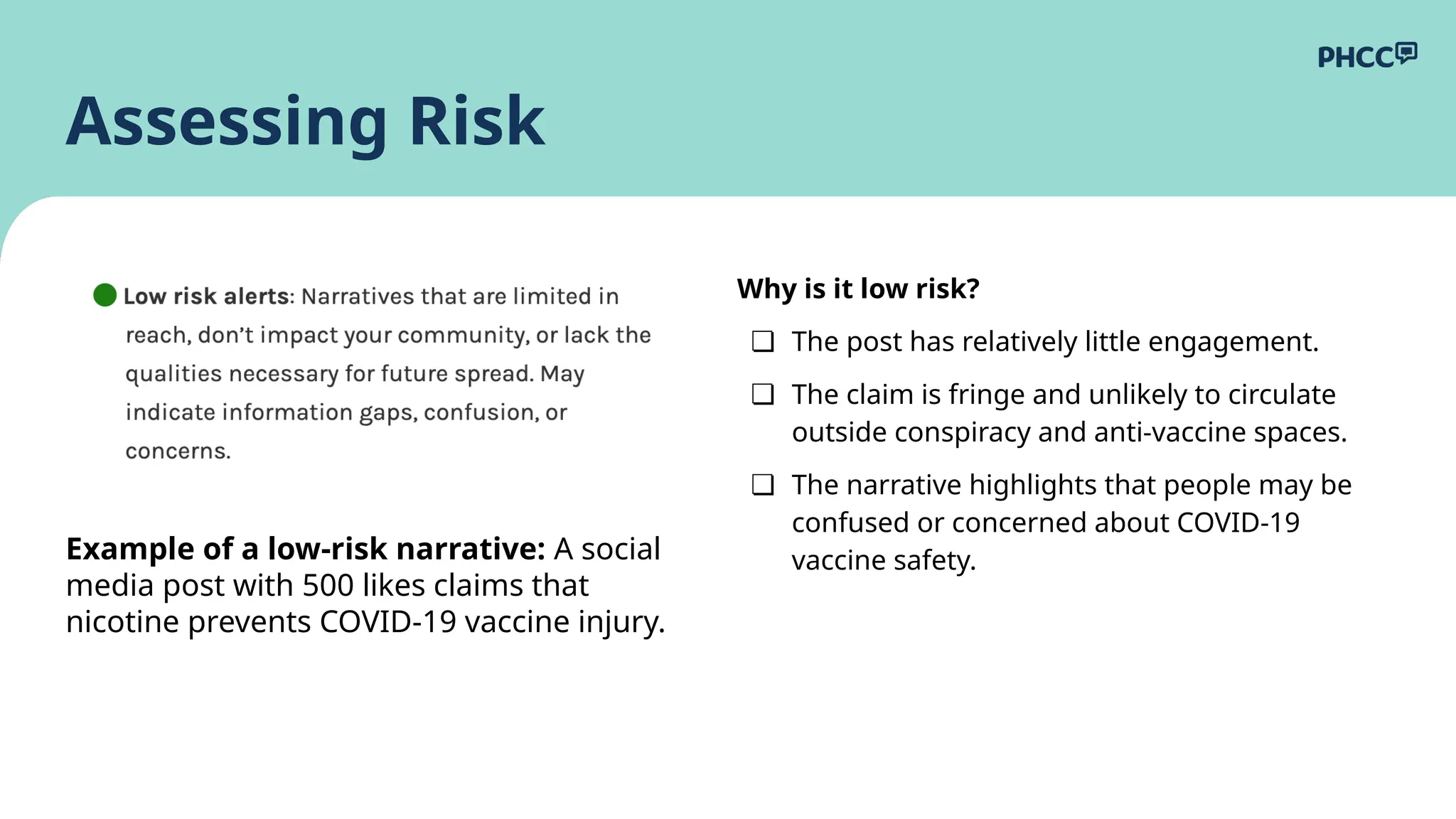
Why is it low risk?
❏ The post has relatively little engagement.
❏ The claim is fringe and unlikely to circulate
outside conspiracy and anti-vaccine spaces.
❏ The narrative highlights that people may be
confused or concerned about COVID-19
vaccine safety.
Assessing Risk
Example of a low-risk narrative: A social
media post with 500 likes claims that
nicotine prevents COVID-19 vaccine injury.
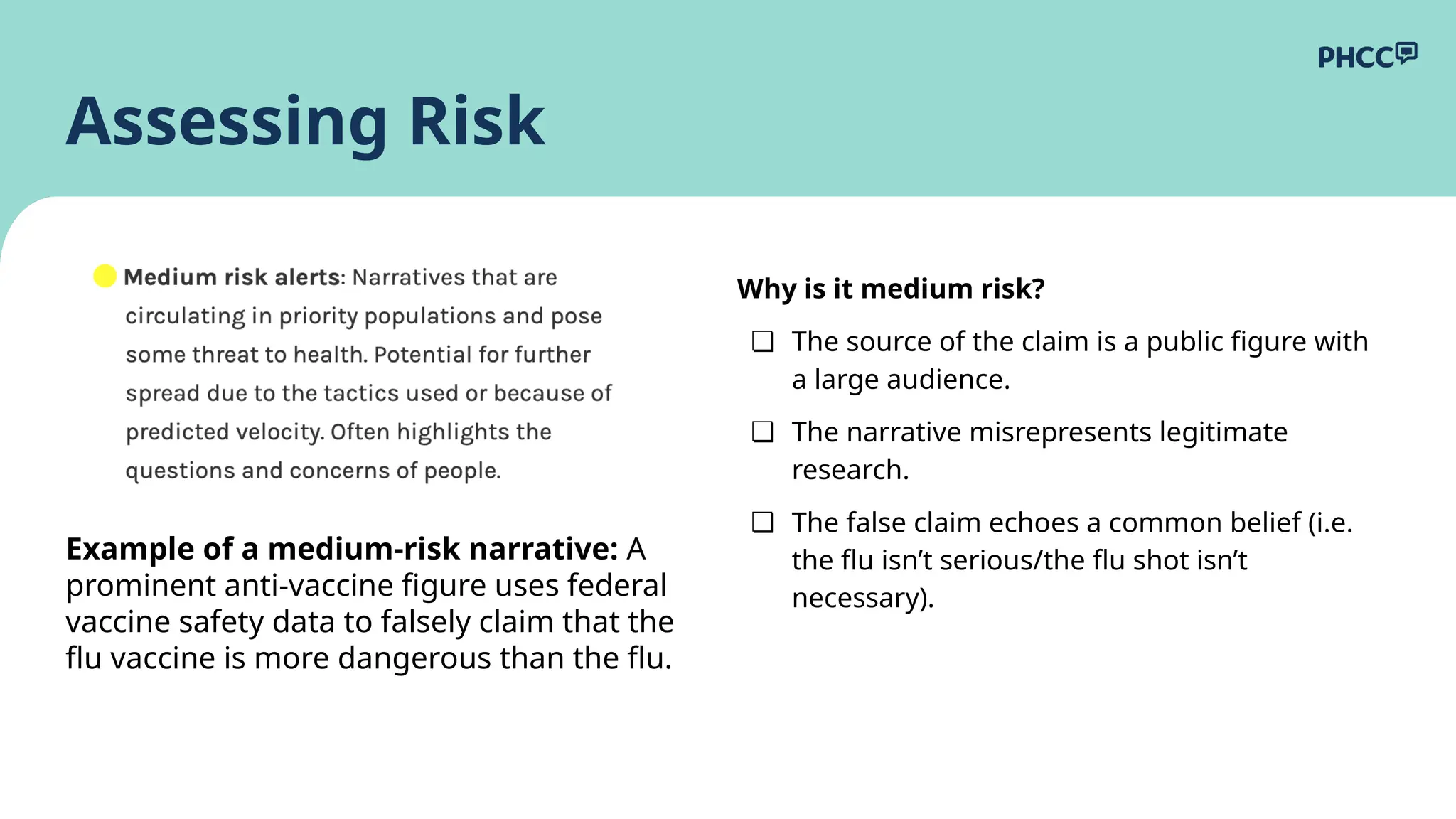
Why is it medium risk?
❏ The source of the claim is a public figure with
a large audience.
❏ The narrative misrepresents legitimate
research.
❏ The false claim echoes a common belief (i.e.
the flu isn’t serious/the flu shot isn’t
necessary).
Assessing Risk
Example of a medium-risk narrative: A
prominent anti-vaccine figure uses federal
vaccine safety data to falsely claim that the
flu vaccine is more dangerous than the flu.
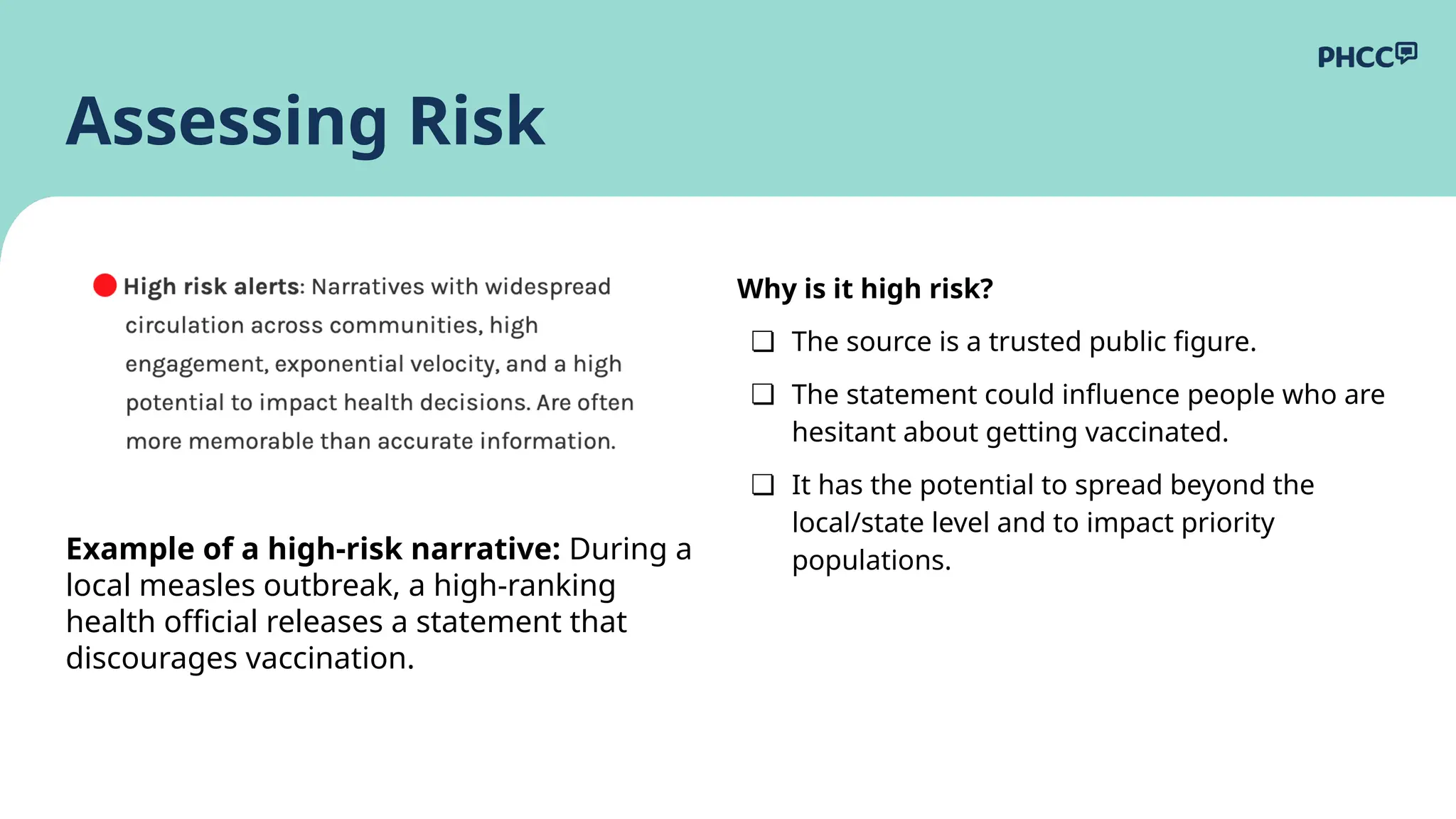
Why is it high risk?
❏ The source is a trusted public figure.
❏ The statement could influence people who are
hesitant about getting vaccinated.
❏ It has the potential to spread beyond the
local/state level and to impact priority
populations.
Assessing Risk
Example of a high-risk narrative: During a
local measles outbreak, a high-ranking
health official releases a statement that
discourages vaccination.
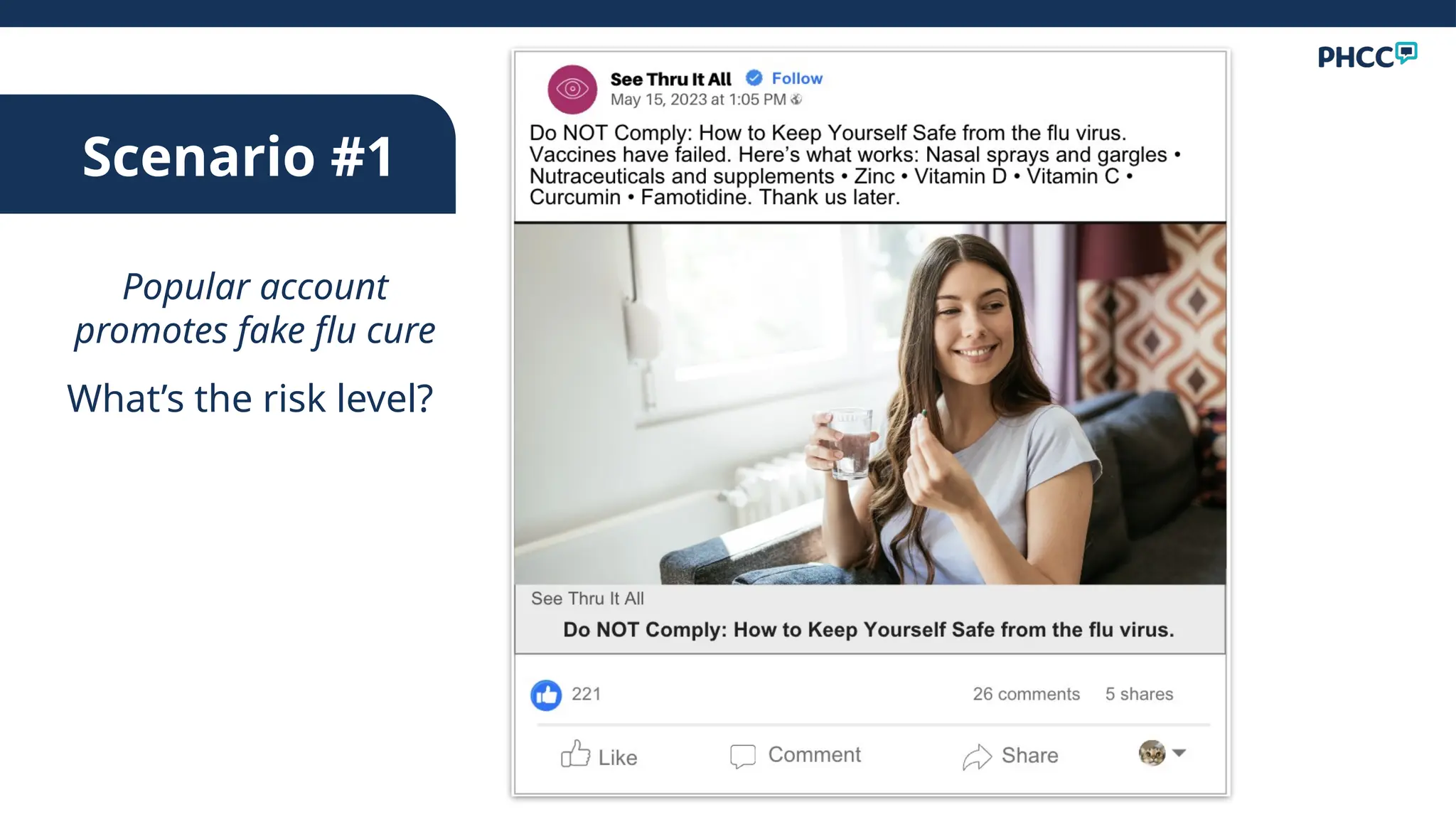
Popular account
promotes fake flu cure
What’s the risk level?
Scenario #1
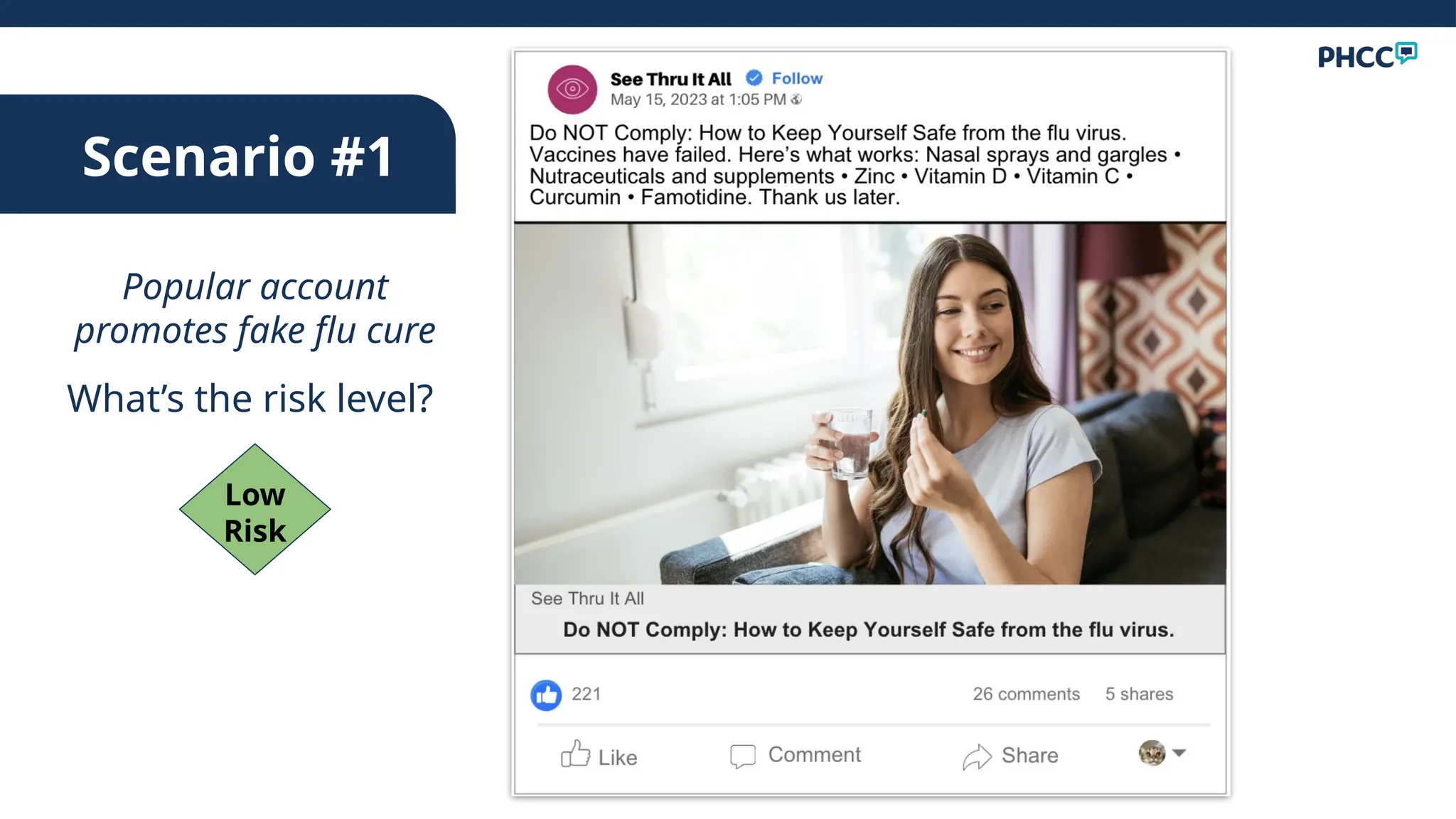
Popular account
promotes fake flu cure
What’s the risk level?
Low
Risk
Scenario #1
Scenario #2
Consuming borax for
alleged health benefits
trends on TikTok
What’s the risk level?
Scenario #2
Consuming borax for
alleged health benefits
trends on TikTok
What’s the risk level?
High
Risk
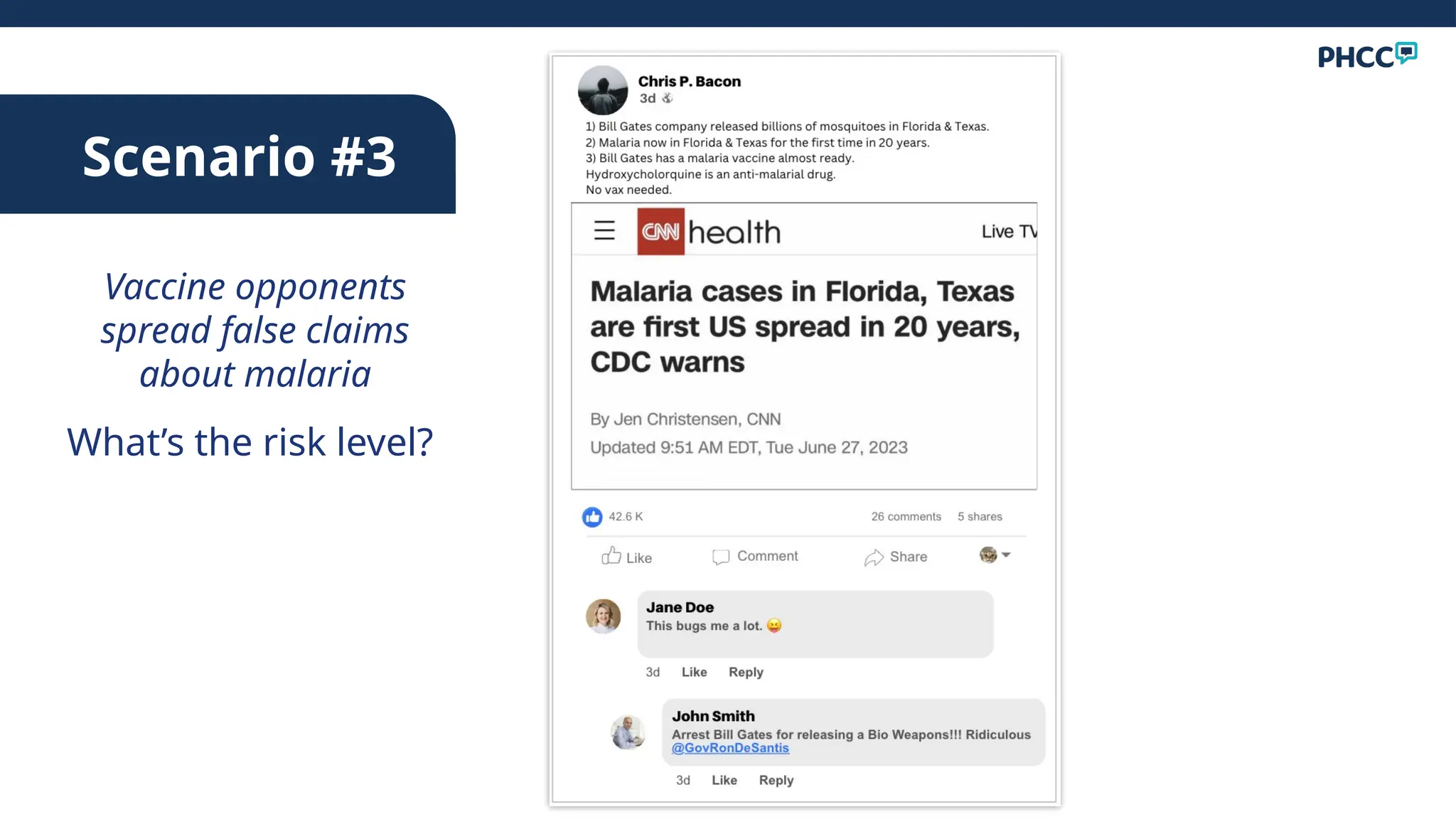
Scenario #3
Vaccine opponents
spread false claims
about malaria
What’s the risk level?
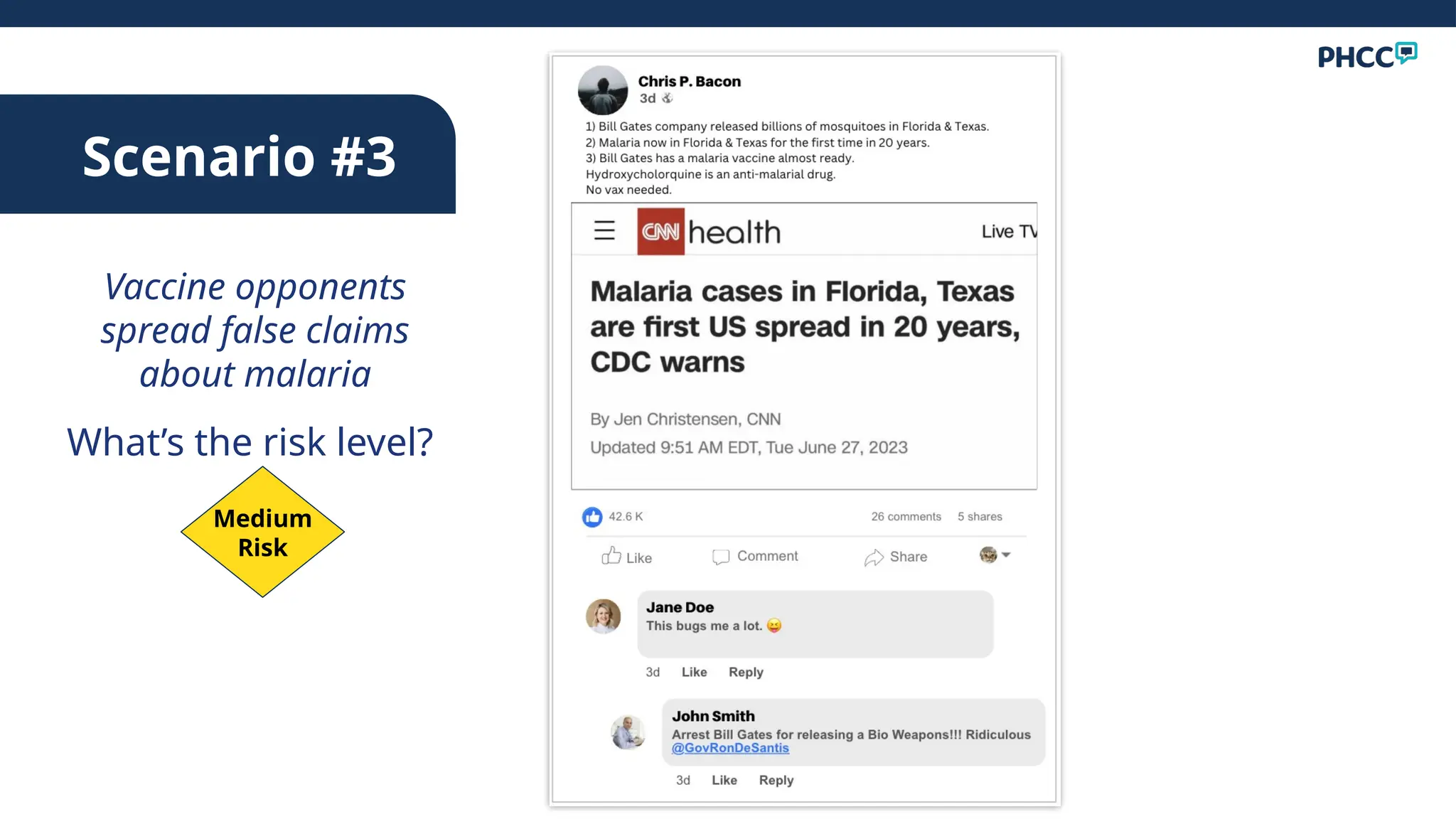
Scenario #3
Vaccine opponents
spread false claims
about malaria
What’s the risk level?
Medium
Risk
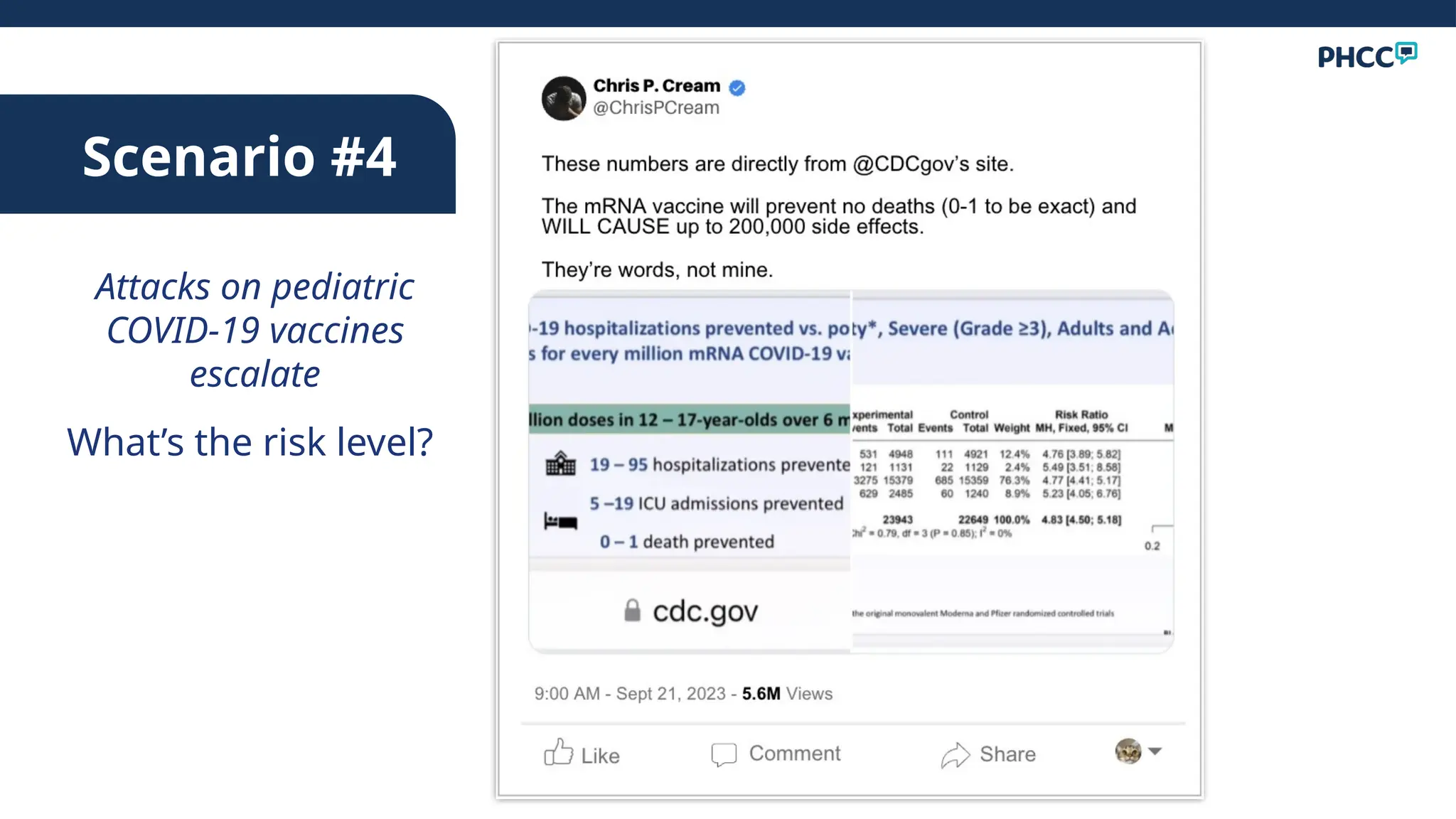
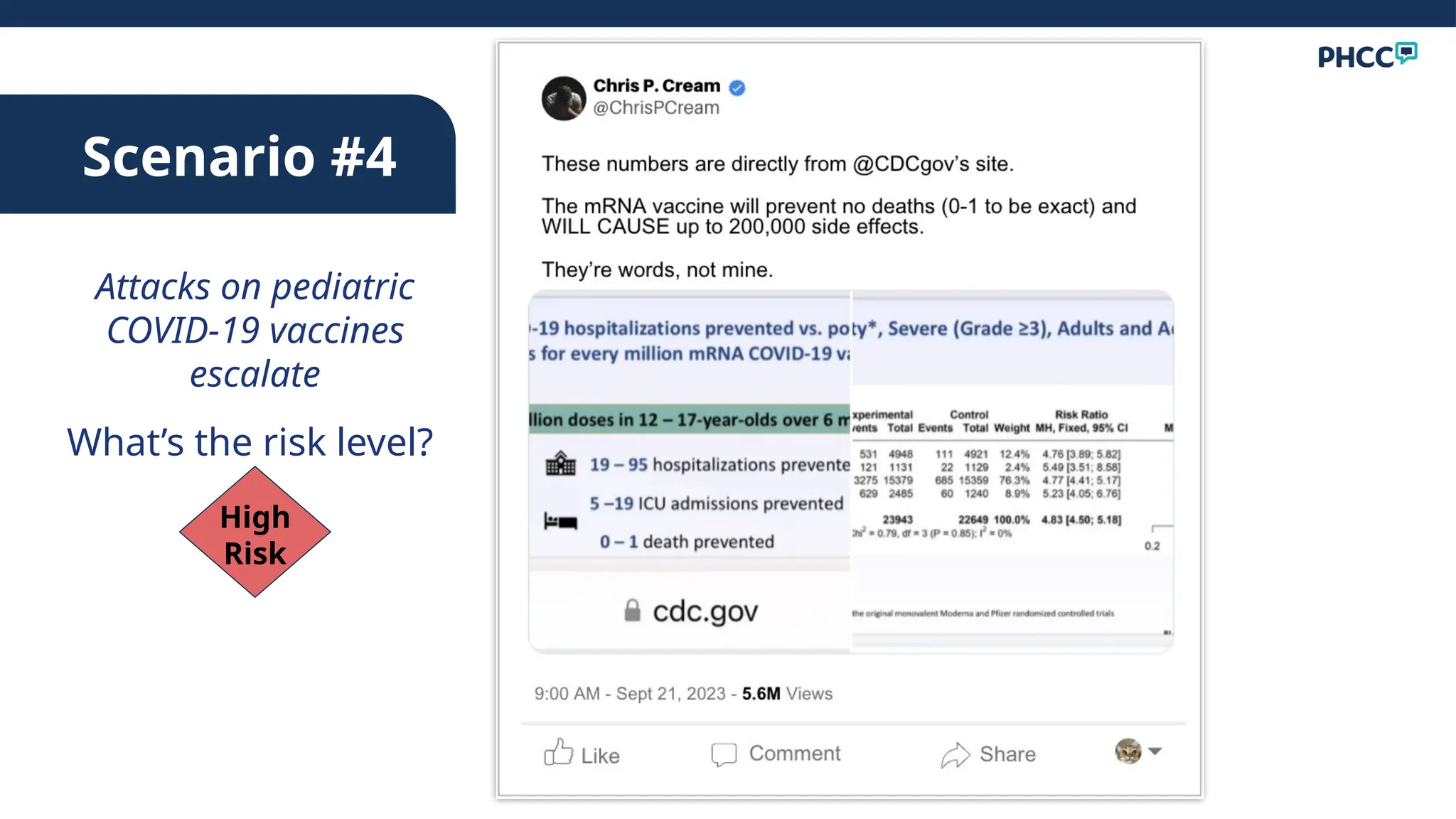
Scenario #4
Attacks on pediatric
COVID-19 vaccines
escalate
What’s the risk level?
Scenario #4
Attacks on pediatric
COVID-19 vaccines
escalate
What’s the risk level?
High
Risk
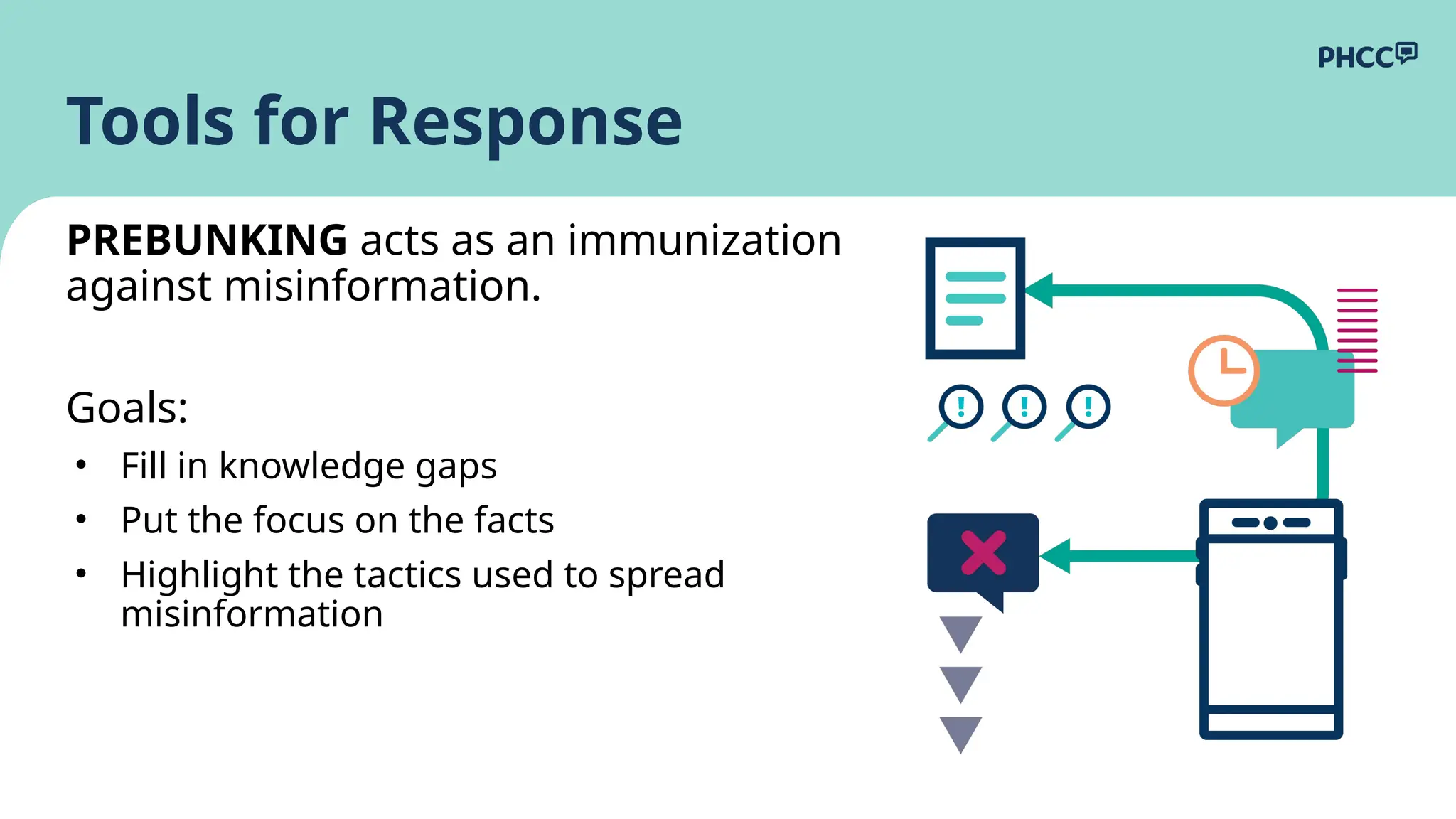
Tools for Response
PREBUNKING acts as an immunization
against misinformation.
Goals:
• Fill in knowledge gaps
• Put the focus on the facts
• Highlight the tactics used to spread
misinformation
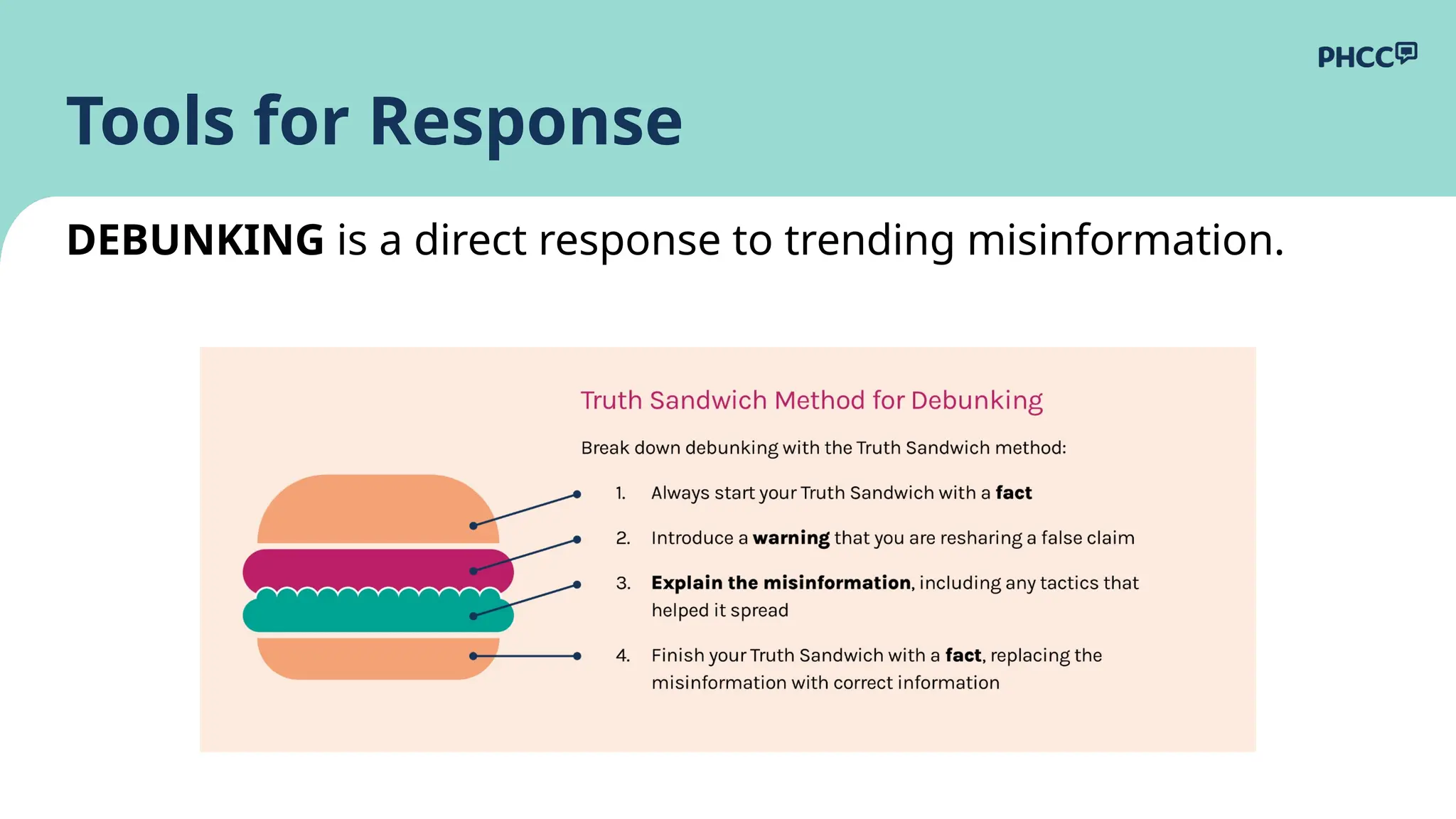
Tools for Response
DEBUNKING is a direct response to trending misinformation.
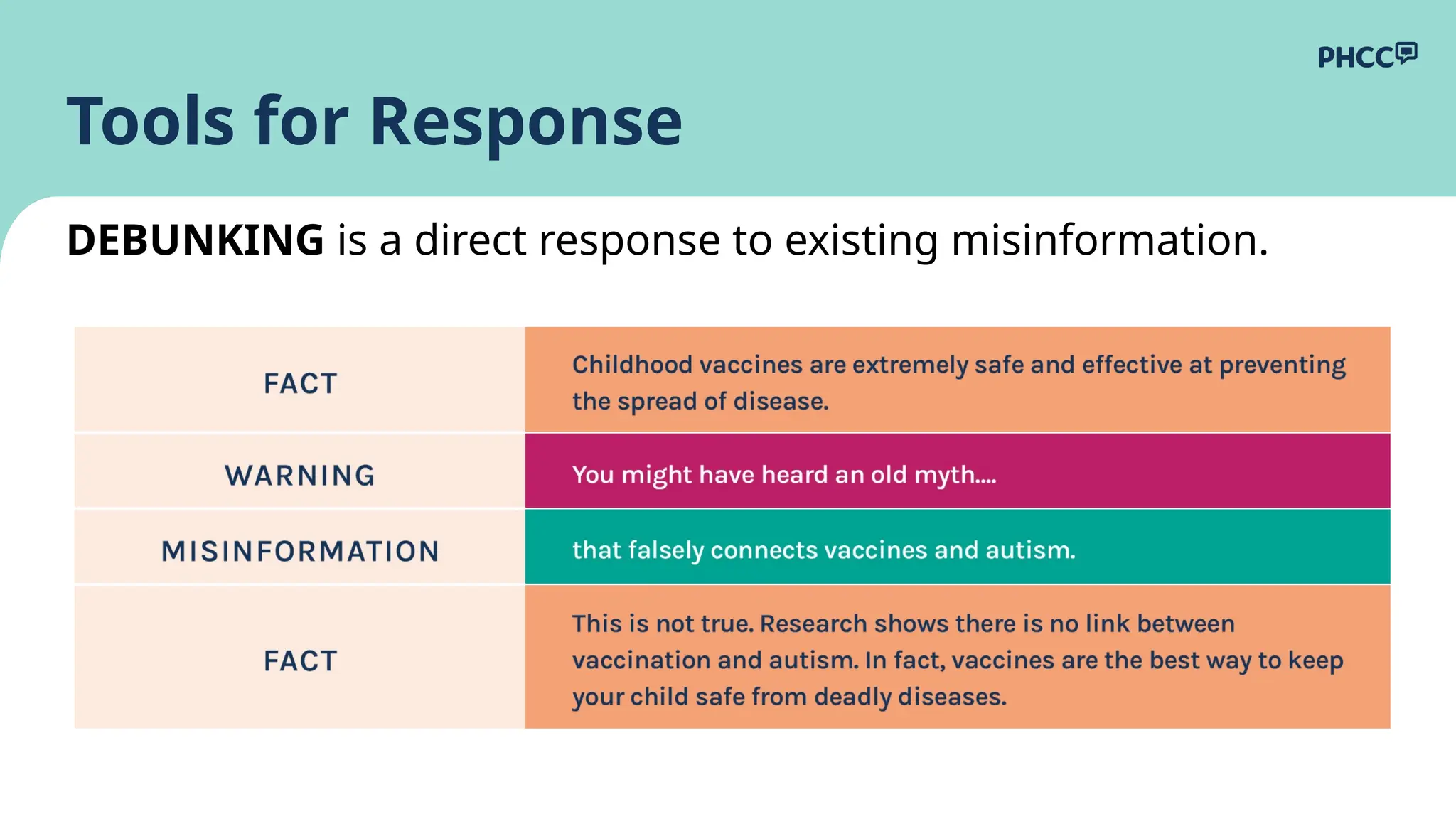
Tools for Response
DEBUNKING is a direct response to existing misinformation.
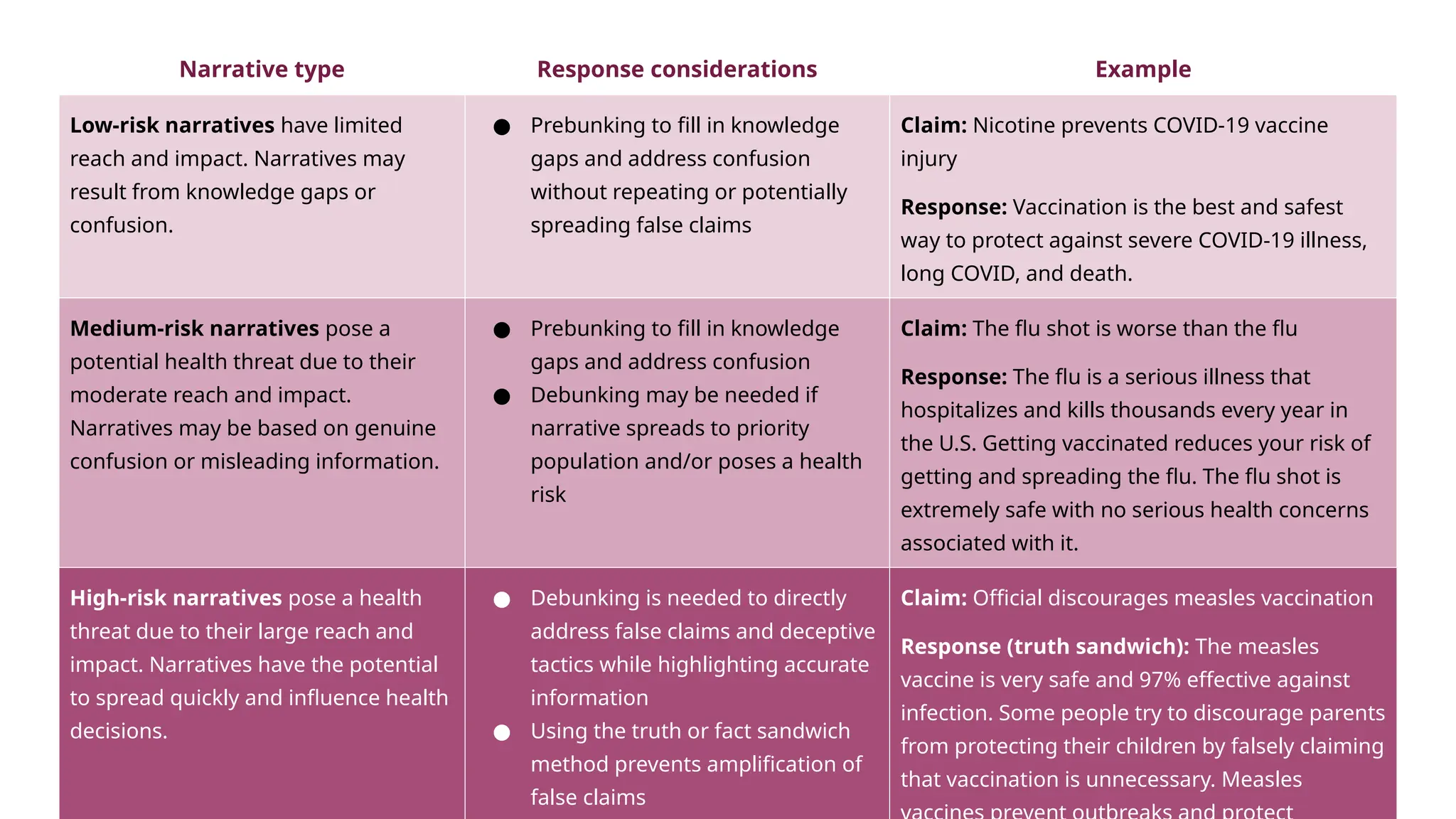
Narrative type Response considerations Example
Low-risk narratives have limited
reach and impact. Narratives may
result from knowledge gaps or
confusion.
● Prebunking to fill in knowledge
gaps and address confusion
without repeating or potentially
spreading false claims
Claim: Nicotine prevents COVID-19 vaccine
injury
Response: Vaccination is the best and safest
way to protect against severe COVID-19 illness,
long COVID, and death.
Medium-risk narratives pose a
potential health threat due to their
moderate reach and impact.
Narratives may be based on genuine
confusion or misleading information.
● Prebunking to fill in knowledge
gaps and address confusion
● Debunking may be needed if
narrative spreads to priority
population and/or poses a health
risk
Claim: The flu shot is worse than the flu
Response: The flu is a serious illness that
hospitalizes and kills thousands every year in
the U.S. Getting vaccinated reduces your risk of
getting and spreading the flu. The flu shot is
extremely safe with no serious health concerns
associated with it.
High-risk narratives pose a health
threat due to their large reach and
impact. Narratives have the potential
to spread quickly and influence health
decisions.
● Debunking is needed to directly
address false claims and deceptive
tactics while highlighting accurate
information
● Using the truth or fact sandwich
method prevents amplification of
false claims
Claim: Official discourages measles vaccination
Response (truth sandwich): The measles
vaccine is very safe and 97% effective against
infection. Some people try to discourage parents
from protecting their children by falsely claiming
that vaccination is unnecessary. Measles
Communicating about
Misinformation in Public Health
Impacts on Public Health
● Erosion of trust in public health
● Compromised public health communications
● Inequitable health outcomes
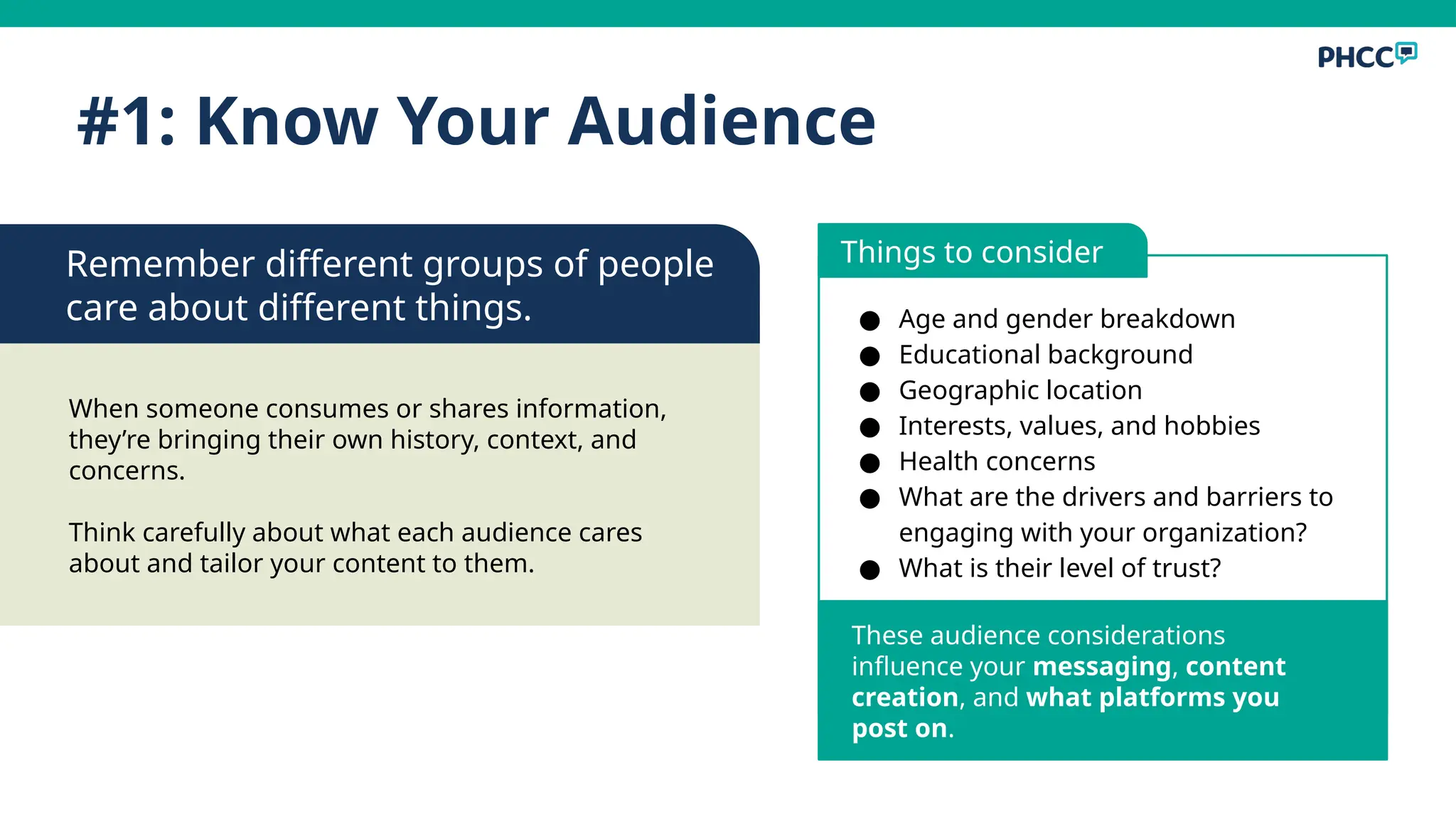
● Age and gender breakdown
● Educational background
● Geographic location
● Interests, values, and hobbies
● Health concerns
● What are the drivers and barriers to
engaging with your organization?
● What is their level of trust?
#1: Know Your Audience
These audience considerations
influence your messaging, content
creation, and what platforms you
post on.
When someone consumes or shares information,
they’re bringing their own history, context, and
concerns.
Think carefully about what each audience cares
about and tailor your content to them.
Remember different groups of people
care about different things.
Things to consider
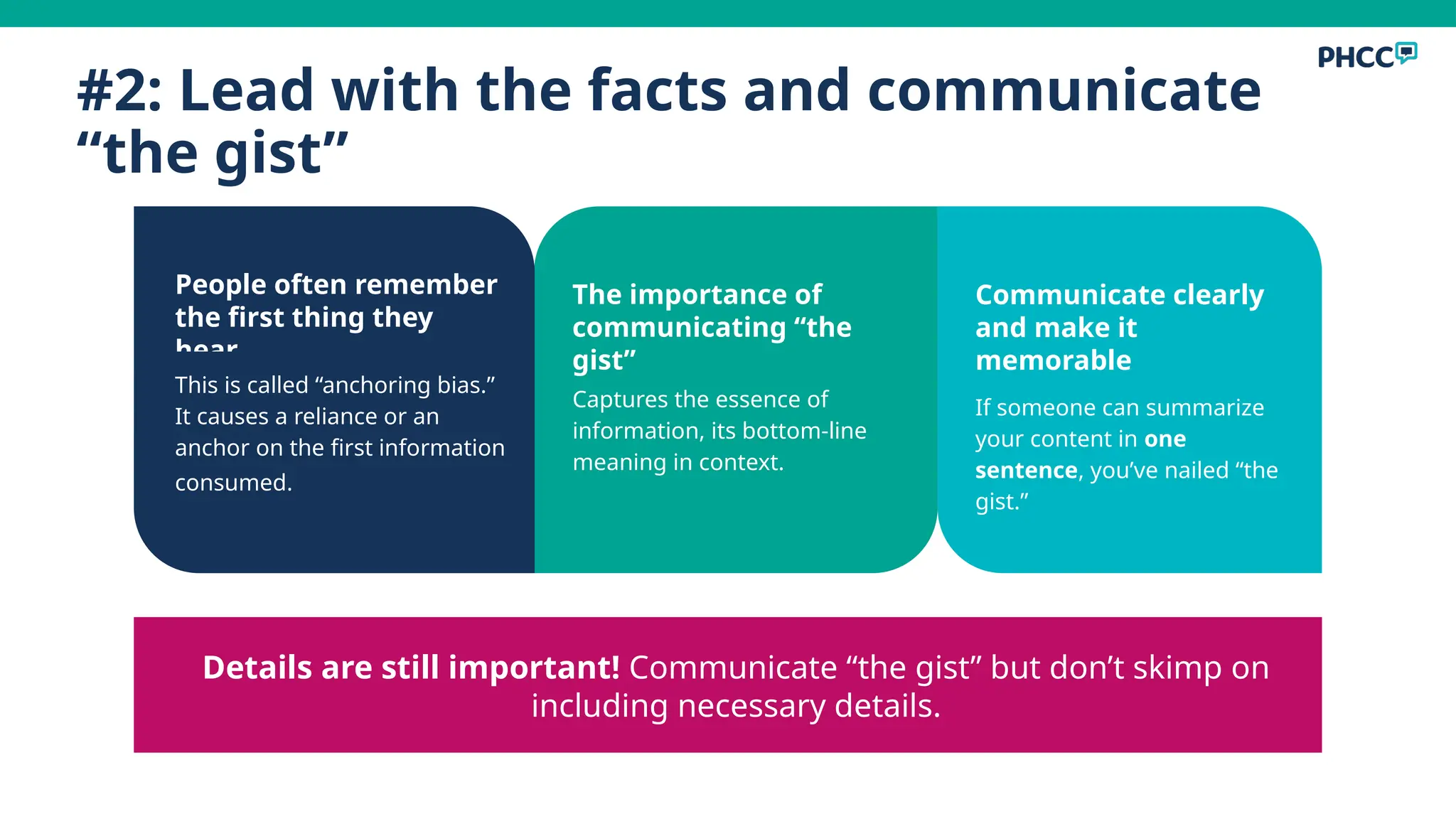
#2: Lead with the facts and communicate
“the gist”
People often remember
the first thing they
hear
This is called “anchoring bias.”
It causes a reliance or an
anchor on the first information
consumed.
The importance of
communicating “the
gist”
Captures the essence of
information, its bottom-line
meaning in context.
Communicate clearly
and make it
memorable
If someone can summarize
your content in one
sentence, you’ve nailed “the
gist.”
Details are still important! Communicate “the gist” but don’t skimp on
including necessary details.
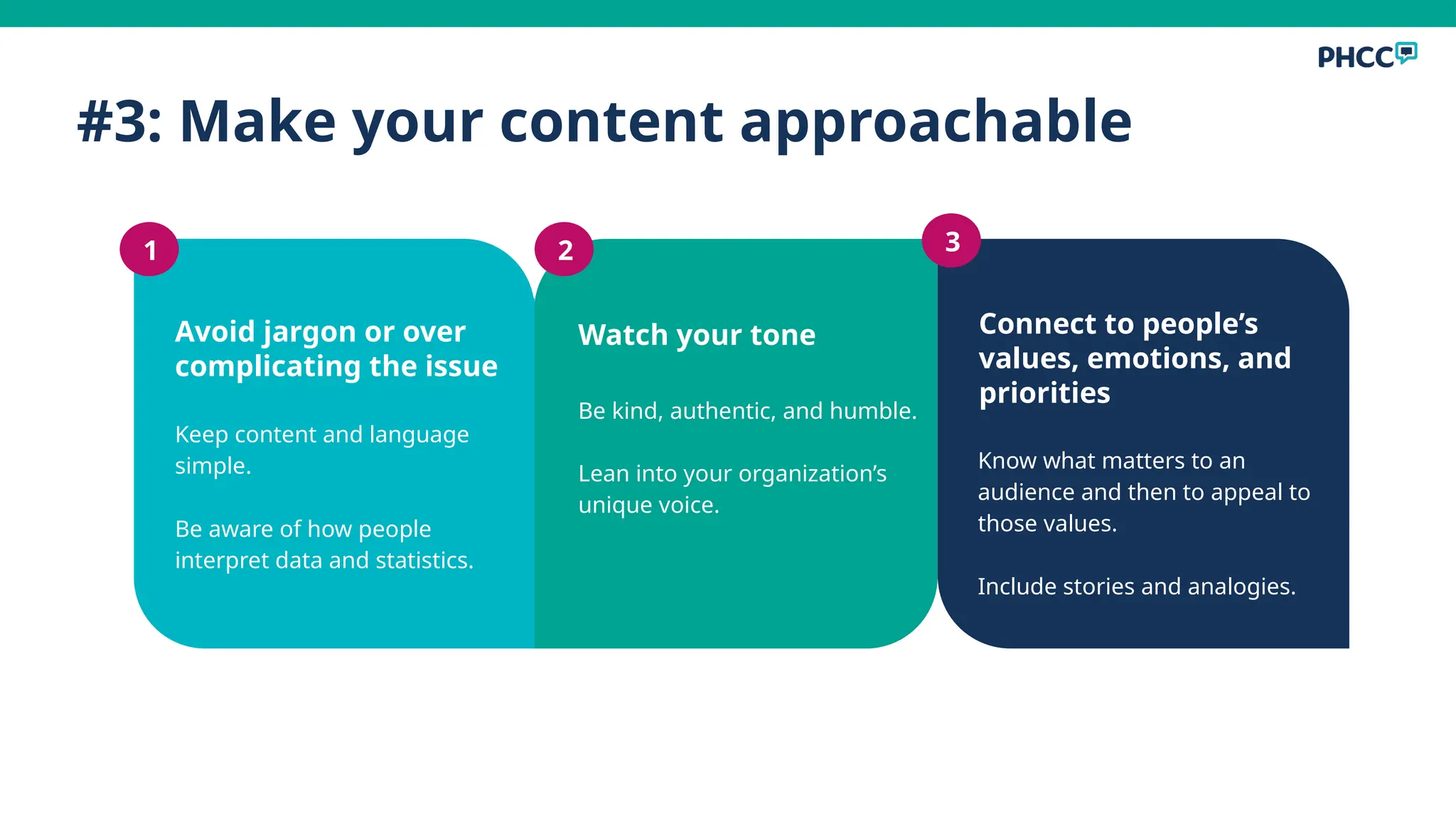
#3: Make your content approachable
Avoid jargon or over
complicating the issue
Keep content and language
simple.
Be aware of how people
interpret data and statistics.
1
Watch your tone
Be kind, authentic, and humble.
Lean into your organization’s
unique voice.
Connect to people’s
values, emotions, and
priorities
Know what matters to an
audience and then to appeal to
those values.
Include stories and analogies.
2 3
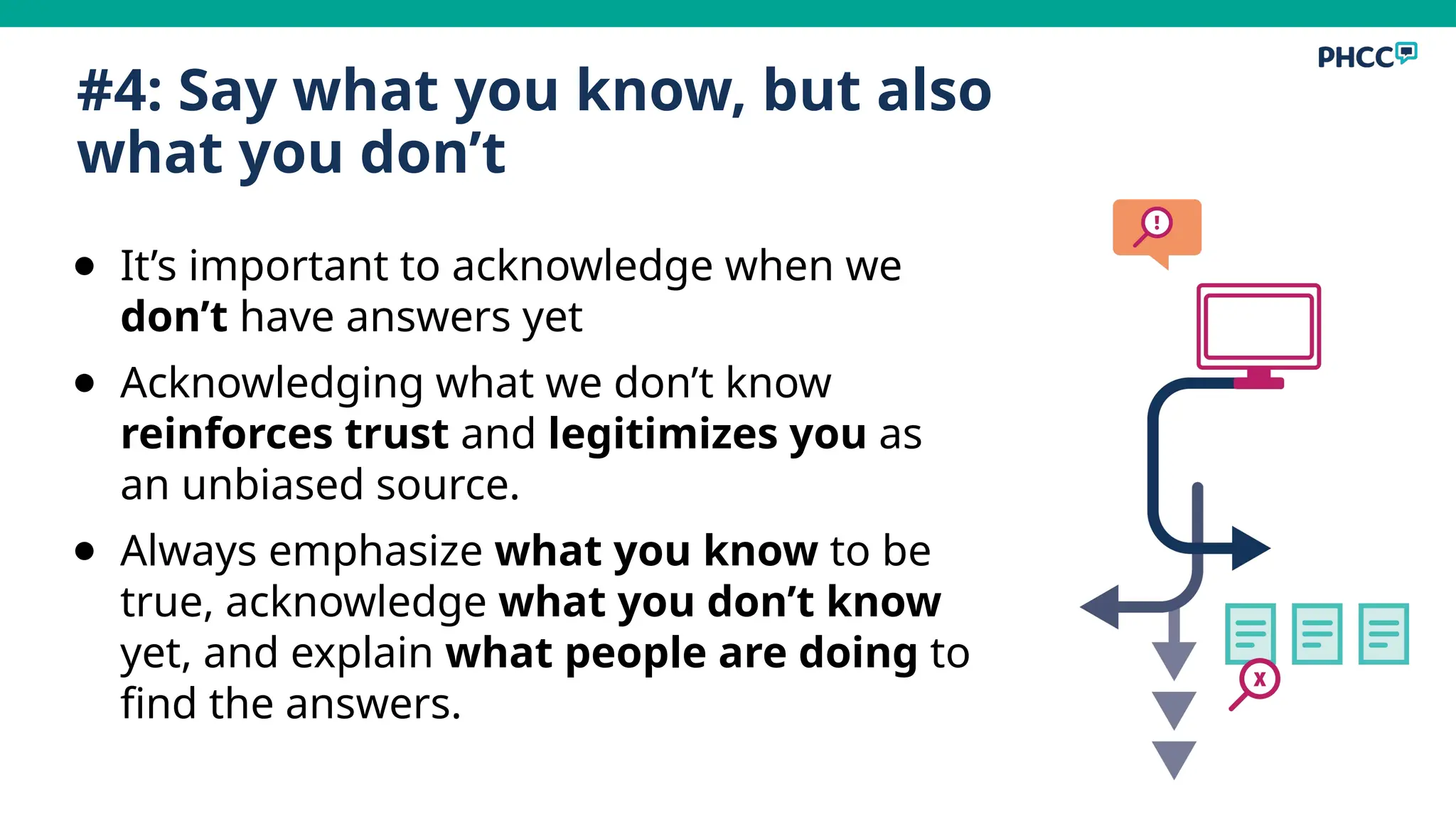
#4: Say what you know, but also
what you don’t
● It’s important to acknowledge when we
don’t have answers yet
● Acknowledging what we don’t know
reinforces trust and legitimizes you as
an unbiased source.
● Always emphasize what you know to be
true, acknowledge what you don’t know
yet, and explain what people are doing to
find the answers.
#5: Respond in a timely manner
● Timeliness is important in health
emergencies
● Know what’s happening and have a
communication plan ready.
● Do your best. Continuing to advocate for
timely responses will go a long way.
Q&A
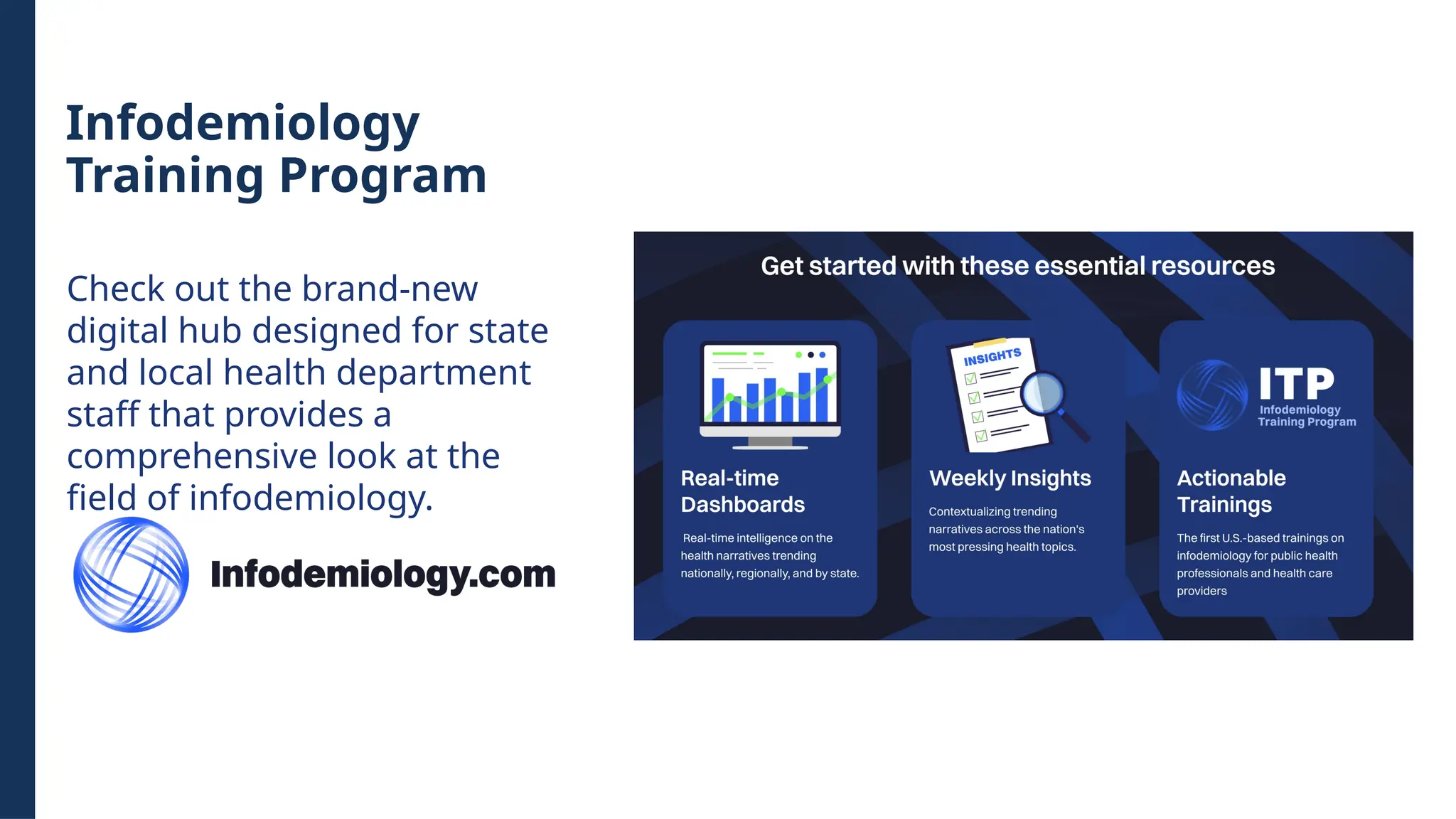
Check out the brand-new
digital hub designed for state
and local health department
staff that provides a
comprehensive look at the
field of infodemiology.
Infodemiology
Training Program
Explore
publichealthcollaborative.org
● Sign up for the PHCC newsletter
● Download resources to share with
your community
● Review new and effective
messaging on emergent public
health issues
● Understand the latest
misinformation environment
Thank You
More Resources
www.publichealthcollaborative.org
Contact
info@publichealthcollaborative.org
Follow PHCC
X: @PH_Comms
LinkedIn: Public Health Communications
Collaborative

Developing a Response Plan to Misinformation in Public Health

  • 1.
    Developing a ResponsePlan to Misinformation in Public Health WEDNESDAY, SEPTEMBER 25 1:00 – 2:30 pm ET / 10:00 – 11:30 am PT This event will be recorded. The recording and slides will be available on publichealthcollaborative.org later this week. All attendees are automatically muted upon entry.
  • 2.
  • 3.
    Closed Captioning andASL Interpretation If you’d like to use closed captions or ASL interpretation: Hover over the “More” button or the “Interpretation” button on the bottom of your Zoom screen. ● Live closed captioning is being provided by AI Media. ● ASL interpretation is being provided by Keystone Interpreting Solutions.
  • 4.
    Meet Today’s Experts HagereYilma Senior Manager, Health Misinformation and Trust Initiative KFF Megan Barber Editor in Chief Public Good Project Aisha Abdullah Senior Science Writer Public Good Project
  • 5.
    Understanding the Misinformation Environment Falsenarratives can spread in various ways, from word of mouth to non-digital channels. The rise of internet, social media platforms, and AI has rapidly increased the spread of information. Case Study: The recent approval of updated COVID-19 vaccines • Themes around misinformation reemerge and repeat • There’s more gray than you might think • Misinformation is plentiful, but it’s not just that. There’s also genuine confusion and accurate info
  • 6.
    Information is spreadingon more social media platforms with fewer restrictions.
  • 7.
    Health information ispoliticized. It’s also misunderstood, misinterpreted and often reshared without checking the facts.
  • 8.
    The impact offalse narratives ● Many people have been exposed to false claims ● Decades of standard public health policies are at risk of being undone ● Trust in the health care system, health institutions, and public health officials has declined
  • 9.
    An August 2023poll from KFF showed that… “Most people aren’t true believers in the lies or the facts about health issues; they are in a muddled middle. The public’s uncertainty leaves them vulnerable to misinformation but is also the opportunity to combat it.” Drew Altman, KFF President and CEO 4 in 10 people say that they’ve heard each of 10 specific false claims about COVID-19, reproductive health, and gun violence.
  • 10.
    The study ofthe spread of information with the goal of improving public health. Infodemiology Infodemiology The study of the spread of information with the goal of improving public health.
  • 11.
    Epidemiology asks where,when, why, and to whom a disease is spreading and how it impacts populations. Infodemiology asks where, when, why, and to whom information is spreading and how that information impacts populations. INFODEMIOLOGY information epidemiology Infodemics are to infodemiology as epidemics are to epidemiology. Familiar Concepts
  • 12.
    Infodemiology for TrustBuilding Infodemiology helps us fill gaps that other data sources may not capture. Allows us to be more responsive to information needs of communities. Improve accuracy and efficiency of communication priorities and resource allocation. Identify and collaborate with trusted community voices on and offline to delivery urgent and accurate information. Infodemiology allows us to assess and react to narratives that are circulating in communities, whether helpful or harmful.
  • 13.
    Epidemics & Infodemics “Scienceisn’t finished until it’s communicated.” —Sir Mark Walport
  • 14.
    Defining Key Termsand Understanding Why People Spread Misinformation
  • 15.
    Defining Terms Misinformation —information that is false, partially inaccurate, or misleading. Disinformation — a claim that is false and spread intentionally. Malinformation — when accurate information is intentionally manipulated to cause harm.
  • 16.
  • 17.
    Why People SpreadMisinformation • Emotional Response: Misinformation that triggers emotions is more likely to be shared. • Social Connection: Sharing misinformation can serve as a way to connect with others. • Algorithm Influence: Algorithms promote popular content, prioritizing engagement over accuracy. • Habit: Many share misinformation out of routine. • Media Literacy: Low media literacy skills contribute to the spread of false information. • Rapid Consumption: Quick content consumption increases the likelihood of sharing misinformation.
  • 18.
    Understanding Misinformation Vulnerability Most U.S.adults (96%) have heard at least one of 11 health misinformation claims; however, few consider these claims to be “definitely true.” Most fall into a “muddled middle,” showing uncertainty about what to believe. Demographic Differences: ● Education: 60% of adults without a college degree believe false claims, compared to 38% of college graduates. ● Race/Ethnicity: 29% of Black adults and 24% of Hispanic adults believe misinformation, versus 17% of White adults. ● Political Affiliation: Republicans and independents are more likely to accept misinformation than Democrats. ● Location: 73% of rural residents are susceptible to misinformation, compared to 56% in urban areas.
  • 19.
    Trusted Sources ofInformation KFF polling reveals varying levels of trust in different health information sources. • Trusted Messengers: 93% of adults trust their own doctor for health recommendations. • Government Agencies: 25% have high trust in the CDC; 20% in the FDA. Trust is lower for the Biden Administration, especially among Republicans. • Media Consumption: Over half of adults regularly use local TV, national news, and digital aggregators. At least 70% trust health information from local TV news. • Source Trust Levels: 59% of NPR and 52% of New York Times users trust their health info “a lot,” compared to 36% for Fox News and 34% for MSNBC. • Social Media Usage: 55% use social media weekly for news; 24% for health info. Trust in health claims on social media is low—under 10%. Source: KFF Health Misinformation Tracking Poll Pilot (May 23-June 12, 2023)
  • 20.
    Tracking and Respondingto Misinformation
  • 21.
    Tracking and Responding toFalse Narratives The Monitoring Lab monitors real-time health narratives at the national and regional level.
  • 22.
    PHCC Misinformation Alerts Misinformation Alertsare weekly insights and fact- checking of currently circulating false health claims.
  • 23.
    Why is itlow risk? ❏ The post has relatively little engagement. ❏ The claim is fringe and unlikely to circulate outside conspiracy and anti-vaccine spaces. ❏ The narrative highlights that people may be confused or concerned about COVID-19 vaccine safety. Assessing Risk Example of a low-risk narrative: A social media post with 500 likes claims that nicotine prevents COVID-19 vaccine injury.
  • 24.
    Why is itmedium risk? ❏ The source of the claim is a public figure with a large audience. ❏ The narrative misrepresents legitimate research. ❏ The false claim echoes a common belief (i.e. the flu isn’t serious/the flu shot isn’t necessary). Assessing Risk Example of a medium-risk narrative: A prominent anti-vaccine figure uses federal vaccine safety data to falsely claim that the flu vaccine is more dangerous than the flu.
  • 25.
    Why is ithigh risk? ❏ The source is a trusted public figure. ❏ The statement could influence people who are hesitant about getting vaccinated. ❏ It has the potential to spread beyond the local/state level and to impact priority populations. Assessing Risk Example of a high-risk narrative: During a local measles outbreak, a high-ranking health official releases a statement that discourages vaccination.
  • 26.
    Popular account promotes fakeflu cure What’s the risk level? Scenario #1
  • 27.
    Popular account promotes fakeflu cure What’s the risk level? Low Risk Scenario #1
  • 28.
    Scenario #2 Consuming boraxfor alleged health benefits trends on TikTok What’s the risk level?
  • 29.
    Scenario #2 Consuming boraxfor alleged health benefits trends on TikTok What’s the risk level? High Risk
  • 30.
    Scenario #3 Vaccine opponents spreadfalse claims about malaria What’s the risk level?
  • 31.
    Scenario #3 Vaccine opponents spreadfalse claims about malaria What’s the risk level? Medium Risk
  • 32.
    Scenario #4 Attacks onpediatric COVID-19 vaccines escalate What’s the risk level?
  • 33.
    Scenario #4 Attacks onpediatric COVID-19 vaccines escalate What’s the risk level? High Risk
  • 34.
    Tools for Response PREBUNKINGacts as an immunization against misinformation. Goals: • Fill in knowledge gaps • Put the focus on the facts • Highlight the tactics used to spread misinformation
  • 35.
    Tools for Response DEBUNKINGis a direct response to trending misinformation.
  • 36.
    Tools for Response DEBUNKINGis a direct response to existing misinformation.
  • 37.
    Narrative type Responseconsiderations Example Low-risk narratives have limited reach and impact. Narratives may result from knowledge gaps or confusion. ● Prebunking to fill in knowledge gaps and address confusion without repeating or potentially spreading false claims Claim: Nicotine prevents COVID-19 vaccine injury Response: Vaccination is the best and safest way to protect against severe COVID-19 illness, long COVID, and death. Medium-risk narratives pose a potential health threat due to their moderate reach and impact. Narratives may be based on genuine confusion or misleading information. ● Prebunking to fill in knowledge gaps and address confusion ● Debunking may be needed if narrative spreads to priority population and/or poses a health risk Claim: The flu shot is worse than the flu Response: The flu is a serious illness that hospitalizes and kills thousands every year in the U.S. Getting vaccinated reduces your risk of getting and spreading the flu. The flu shot is extremely safe with no serious health concerns associated with it. High-risk narratives pose a health threat due to their large reach and impact. Narratives have the potential to spread quickly and influence health decisions. ● Debunking is needed to directly address false claims and deceptive tactics while highlighting accurate information ● Using the truth or fact sandwich method prevents amplification of false claims Claim: Official discourages measles vaccination Response (truth sandwich): The measles vaccine is very safe and 97% effective against infection. Some people try to discourage parents from protecting their children by falsely claiming that vaccination is unnecessary. Measles
  • 38.
  • 39.
    Impacts on PublicHealth ● Erosion of trust in public health ● Compromised public health communications ● Inequitable health outcomes
  • 40.
    ● Age andgender breakdown ● Educational background ● Geographic location ● Interests, values, and hobbies ● Health concerns ● What are the drivers and barriers to engaging with your organization? ● What is their level of trust? #1: Know Your Audience These audience considerations influence your messaging, content creation, and what platforms you post on. When someone consumes or shares information, they’re bringing their own history, context, and concerns. Think carefully about what each audience cares about and tailor your content to them. Remember different groups of people care about different things. Things to consider
  • 41.
    #2: Lead withthe facts and communicate “the gist” People often remember the first thing they hear This is called “anchoring bias.” It causes a reliance or an anchor on the first information consumed. The importance of communicating “the gist” Captures the essence of information, its bottom-line meaning in context. Communicate clearly and make it memorable If someone can summarize your content in one sentence, you’ve nailed “the gist.” Details are still important! Communicate “the gist” but don’t skimp on including necessary details.
  • 42.
    #3: Make yourcontent approachable Avoid jargon or over complicating the issue Keep content and language simple. Be aware of how people interpret data and statistics. 1 Watch your tone Be kind, authentic, and humble. Lean into your organization’s unique voice. Connect to people’s values, emotions, and priorities Know what matters to an audience and then to appeal to those values. Include stories and analogies. 2 3
  • 43.
    #4: Say whatyou know, but also what you don’t ● It’s important to acknowledge when we don’t have answers yet ● Acknowledging what we don’t know reinforces trust and legitimizes you as an unbiased source. ● Always emphasize what you know to be true, acknowledge what you don’t know yet, and explain what people are doing to find the answers.
  • 44.
    #5: Respond ina timely manner ● Timeliness is important in health emergencies ● Know what’s happening and have a communication plan ready. ● Do your best. Continuing to advocate for timely responses will go a long way.
  • 45.
  • 46.
    Check out thebrand-new digital hub designed for state and local health department staff that provides a comprehensive look at the field of infodemiology. Infodemiology Training Program
  • 47.
    Explore publichealthcollaborative.org ● Sign upfor the PHCC newsletter ● Download resources to share with your community ● Review new and effective messaging on emergent public health issues ● Understand the latest misinformation environment
  • 48.

Editor's Notes

  • #1 MEGAN
  • #2 MEGAN
  • #3 MEGAN
  • #4 MEGAN
  • #5 MEGAN: Understanding the Misinfo Environment (Megan start to actually introduce the guide itself and general enviro overview)
  • #6 MEGAN
  • #7 MEGAN
  • #8 MEGAN
  • #9 MEGAN
  • #10 MEGAN Challenges facing public health today- Disconnected efforts across all levels of government, limited resources, knowledge gaps, lack of standardization (focus on this part, jess will touch on comms skills) Why US context matters for training and practice during infodemics and sustained infodemiology Infodemiology is not entirely new, term was coined by Gunther Eysenbauch in 2002, and today we use the updated definition of: The study of the spread of information with goal of improving public health Has been established over time, pubmed frequency of papers published on infod You all also now have access the free dashboard tools available on infodemiology.com SHOW dashboards Our team updates these queries regularly as convos evolve - make point from our video this its OKAY and good to update queries
  • #11 MEGAN
  • #12 MEGAN
  • #13 MEGAN
  • #14 HAGERE
  • #15 HAGERE
  • #16 HAGERE
  • #17 HAGERE
  • #18 HAGERE
  • #19 HAGERE
  • #21 AISHA: How to Track
  • #22 HAGERE
  • #23 AISHA: Assessing Risk
  • #24 AISHA: Assessing Risk
  • #25 AISHA: Assessing Risk
  • #34 AISHA
  • #35 AISHA
  • #36 AISHA: Tools for Response - Prebunking and Debunking
  • #37 AISHA: Tools for Response - Prebunking and Debunking
  • #39 MEGAN: Impacts on Public Health
  • #40 MEGAN
  • #41 MEGAN
  • #42 MEGAN
  • #43 MEGAN
  • #44 MEGAN
  • #45 MEGAN, AISHA, HAGERE
  • #46 MEGAN
  • #47 MEGAN
  • #48 MEGAN