1 Copyright © 2012
Appcelerator, Inc. and IDC. All Rights reserved
2 Copyright © 2012
Appcelerator, Inc. and IDC. All Rights reserved
Q2 2013
Mobile
Developer
Report
Appcelerator / IDC
Appcelerator and IDC surveyed 6,046
Appcelerator Titanium developers from
April 18-22, 2013. This constitutes the world’s
largest survey of mobile app developers,
covering the priorities and perceptions of the
people driving the mobile-first world.
Summary
3Copyright © 2012
Appcelerator, Inc. and IDC. All Rights reserved
Mobile developers go to the enterprise
Q410 to Q213 has seen a 19% decline in developers who report expecting to
build consumer-facing apps (B2C) for their enterprise clients. The growth is in
business (B2B) and employee (B2E) apps, from 29.3% in Q410 to 42.7% in Q213.
Due to the number of employee apps required by enterprises, 63% of developers
are reporting “increased” or “greatly increased” enterprise demand for their skills in
the past six months.
Development for (certain) tablets growing fast
Developers are increasingly looking at tablets as the next emerging app platform,
with most developers placing equal priority on tablets and smartphones. Notably,
while iOS and Windows developers show roughly equal interest in smartphone
and tablet forms, Android developers report a significant bias against the tablet.
Mobile developers on a fast track to commercial
success
Appcelerator’s mobile developers are working in or with enterprises, and while
doing so, getting paid for and/or supporting themselves entirely with their mobile
app development skills.
Google Glass surprises
Google Glass is on a path to becoming the first real wearable computing device
to see any mass-market potential. Developers seem to agree, giving Google Glass
nearly an even score with smart TVs in terms of interest, despite the fact that
Google Glass is still unavailable as a mass-market device. Connected cars trailed,
with less than 8% of developers interested in building applications for them.
Android device growth does not equal
developer interest
The exponential growth in Android devices – approaching 1 billion at time of
survey – hasn’t produced an equivalent rise in developer interest. This likely
reflects fragmentation around the platform, unclear revenue potential of lower-
end devices, and a lack of information about Key Lime Pie (the next version of
Android). Only Google’s own Nexus product line punches above its weight,
continuing to draw developer interest despite a relatively limited audience and
geographic availability.
 
Key Findings
4 Copyright © 2012
Appcelerator, Inc. and IDC. All Rights reserved
businesstocustomer
70
50
30
Q4 2010 Q2 2013
Businesstoemployee&business
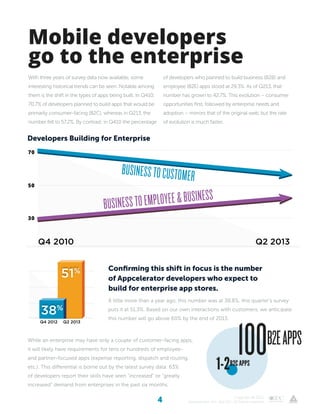
With three years of survey data now available, some
interesting historical trends can be seen. Notable among
them is the shift in the types of apps being built. In Q410,
70.7% of developers planned to build apps that would be
primarily consumer-facing (B2C), whereas in Q213, the
number fell to 57.2%. By contrast, in Q410 the percentage
of developers who planned to build business (B2B) and
employee (B2E) apps stood at 29.3%. As of Q213, that
number has grown to 42.7%. This evolution – consumer
opportunities first, followed by enterprise needs and
adoption – mirrors that of the original web, but the rate
of evolution is much faster.
Mobile developers
go to the enterprise
A little more than a year ago, this number was at 38.8%; this quarter’s survey
puts it at 51.3%. Based on our own interactions with customers, we anticipate
this number will go above 60% by the end of 2013.
Developers Building for Enterprise
Confirming this shift in focus is the number
of Appcelerator developers who expect to
build for enterprise app stores.
Q4 2012 Q2 2013
While an enterprise may have only a couple of customer-facing apps,
it will likely have requirements for tens or hundreds of employee-
and partner-focused apps (expense reporting, dispatch and routing,
etc.). This differential is borne out by the latest survey data: 63%
of developers report their skills have seen “increased” or “greatly
increased” demand from enterprises in the past six months.
51%
38%
100B2EAPPS
1-2b2C aPPS
5Copyright © 2012
Appcelerator, Inc. and IDC. All Rights reserved
SMARPHONES
tablets
100
75
50
25
0
84%
Tablets are becoming
the next major
computing platform
smartphone
tablet
It’s a different
story for Android.
Developers who report being
“very interested” in building
apps for Android tablets are a significantly
smaller group: 66% vs. 78% for Android
phones, Easily the widest phone-tablet
gap among the major platforms.
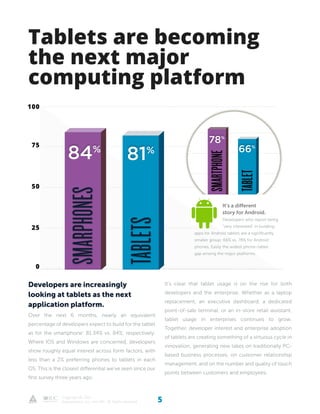
Developers are increasingly
looking at tablets as the next
application platform.
Over the next 6 months, nearly an equivalent
percentage of developers expect to build for the tablet
as for the smartphone: 81.34% vs. 84%, respectively.
Where IOS and Windows are concerned, developers
show roughly equal interest across form factors, with
less than a 2% preferring phones to tablets in each
OS. This is the closest differential we’ve seen since our
first survey three years ago.
It’s clear that tablet usage is on the rise for both
developers and the enterprise. Whether as a laptop
replacement, an executive dashboard, a dedicated
point-of-sale terminal, or an in-store retail assistant,
tablet usage in enterprises continues to grow.
Together, developer interest and enterprise adoption
of tablets are creating something of a virtuous cycle in
innovation, generating new takes on traditionally PC-
based business processes, on customer relationship
management, and on the number and quality of touch
points between customers and employees.
81%
78%
66%
6 Copyright © 2012
Appcelerator, Inc. and IDC. All Rights reserved
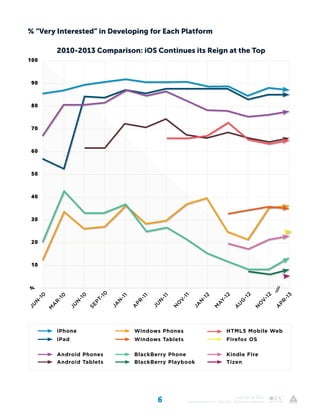
% “Very Interested” in Developing for Each Platform
2010-2013 Comparison: iOS Continues its Reign at the Top
100
90
80
70
60
50
40
30
20
10
%
Windows Tablets
Tizen
Windows Phones
Kindle Fire
Android Tablets
Android Phones
BlackBerry Playbook
BlackBerry Phone
iPad Firefox OS
iPhone HTML5 Mobile Web
JU
N
-10
N
O
V
-11
M
A
R
-10
JA
N
-11
A
PR
-11
JA
N
-12
JU
N
-10
M
A
Y-12
N
O
V
-12
SEPT-10
JU
N
-11
A
U
G
-12
A
PR
-13
7Copyright © 2012
Appcelerator, Inc. and IDC. All Rights reserved
The emergence of new device classes continues unabated
within the mobile space.
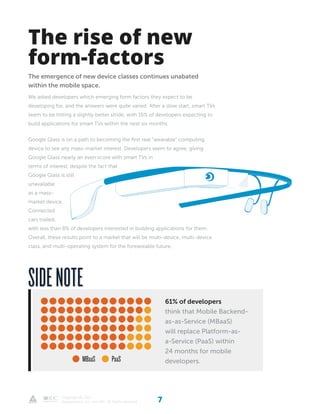
We asked developers which emerging form factors they expect to be
developing for, and the answers were quite varied. After a slow start, smart TVs
seem to be hitting a slightly better stride, with 16% of developers expecting to
build applications for smart TVs within the next six months.
Google Glass is on a path to becoming the first real “wearable” computing
device to see any mass-market interest. Developers seem to agree, giving
Google Glass nearly an even score with smart TVs in
terms of interest, despite the fact that
Google Glass is still
unavailable
as a mass-
market device.
Connected
cars trailed,
with less than 8% of developers interested in building applications for them.
Overall, these results point to a market that will be multi-device, multi-device
class, and multi-operating system for the foreseeable future.
The rise of new
form-factors
61% of developers
think that Mobile Backend-
as-as-Service (MBaaS)
will replace Platform-as-
a-Service (PaaS) within
24 months for mobile
developers.
sidenote
MBaaS PaaS
8 Copyright © 2012
Appcelerator, Inc. and IDC. All Rights reserved
A multi-party
mobile state?
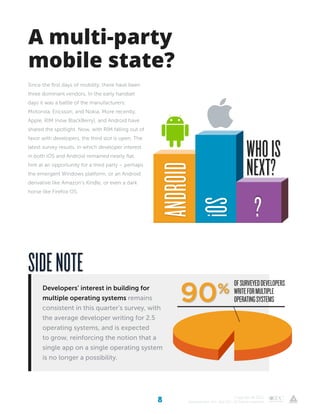
Since the first days of mobility, there have been
three dominant vendors. In the early handset
days it was a battle of the manufacturers:
Motorola, Ericsson, and Nokia. More recently,
Apple, RIM (now BlackBerry), and Android have
shared the spotlight. Now, with RIM falling out of
favor with developers, the third slot is open. The
latest survey results, in which developer interest
in both iOS and Android remained nearly flat,
hint at an opportunity for a third party – perhaps
the emergent Windows platform, or an Android
derivative like Amazon’s Kindle, or even a dark
horse like Firefox OS.
?
android
iOS
Whois
next?
Developers’ interest in building for
multiple operating systems remains
consistent in this quarter’s survey, with
the average developer writing for 2.5
operating systems, and is expected
to grow, reinforcing the notion that a
single app on a single operating system
is no longer a possibility.
ofsurveyeddevelopers
writeformultiple
operatingsystems
sidenote
9Copyright © 2012
Appcelerator, Inc. and IDC. All Rights reserved
4
10 7
Google’s Nexus continues to see considerable
developer interest despite being a platform that is
currentlylimitedinaudienceandgeographicavailability.
The high price point and limited distribution of Nexus
devices would seem to provide little incentive for
developers looking to build a business, or enterprises
looking to reach a significant number of customers or
employees. However, the capabilities of the platform,
as well as the flagship status of the device (including
the OS version), seem to engage developer interest.
Nexus owners spend more on the device at purchase
and are often more technology-focused in their
selection criteria. Both points make those users a
desirable audience for app developers. But without
specific sales numbers from Google, it’s difficult to
know if these two factors – device spending and
technical savvy – will translate to higher revenue
numbers or greater application usage. And without
a Nexus-specific distribution system like Amazon’s
Kindle store (or even iTunes), the Nexus ecosystem
remains murky.
Developers interest in Windows (both phones and tablets) remained low but consistent from
Q4 2012 to current, a departure from the significant falloff we’d seen since the Windows 7
debut. Whether this marks a final bottoming-out or stabilization on the way to growth remains
to be seen. End users cite a lack of apps for Windows phones as the number one reason for
non-adoption. In lockstep, many developers cite a lack of engagement from Microsoft.
Where is Windows?
Does Nexus represent
the future of Android?
nodevelopers=noapps=poordevicesales[This is the equation of the new device ecosystem.]
10 Copyright © 2012
Appcelerator, Inc. and IDC. All Rights reserved
About the Appcelerator /
IDC Q2 2013 Mobile
Developer Report
Appcelerator and IDC surveyed 6,046 Appcelerator Titanium developers from from April 18-22, 2013 on
their perceptions about current debates in mobile as well as their development priorities. Developers were
individually invited from Appcelerator’s user registration database to complete a web response survey. A raffle
for a free iPad mini was made and only one response per user was allowed. Respondents’ answers were given
freely with no other incentive or compensation for their participation.
About Appcelerator
Appcelerator® offers the only platform built for a Mobile First world. The
Appcelerator Platform enables enterprises to create, deliver and analyze their
entire mobile application portfolio. With more than 55,000 mobile applications
deployed on over 140 million devices, the Appcelerator Platform helps enterprises
accelerate their time to market and deliver exceptional mobile user experiences.
Appcelerator also provides an award-winning open source mobile development
environment, Titanium®. Appcelerator’s worldwide ecosystem includes 470,000
mobile developers and hundreds of ISVs and strategic partners, including SAP,
Cognizant and Wipro. It is the mobile platform of choice for thousands of
companies including eBay, Merck, Mitsubishi Electric, NBC, PayPal and Ray-Ban.
For more information visit www.appcelerator.com
About IDC
International Data Corporation (IDC) is the premier global provider of market
intelligence, advisory services, and events for the information technology,
telecommunications, and consumer technology markets. IDC helps IT
professionals, business executives, and the investment community to make fact-
based decisions on technology purchases and business strategy. More than 1,000
IDC analysts provide global, regional, and local expertise on technology and
industry opportunities and trends in over 110 countries. For more than 46 years,
IDC has provided strategic insights to help our clients achieve their key business
objectives. IDC is a subsidiary of IDG, the world’s leading technology media,
research, and events company.
You can learn more about IDC by visiting www.idc.com
11Copyright © 2012
Appcelerator, Inc. and IDC. All Rights reserved
Report Inquiries:					
Michael King
Director of Enterprise Strategy - Appcelerator
mking@appcelerator.com
Office: 650-528-2961	
John Jackson
Research Vice President
Mobile & Connected Platforms- IDC
jjackson@idc.com
Office: 508-935-4255
	 					
Media Inquiries:
Vanessa Camones or Zach Servideo
theMIX agency for Appcelerator
appcelerator@themixagency.com
415-829-7902
Michael Shirer
IDC
press@idc.com
Office: 508-935-4200
12Copyright © 2012
Appcelerator, Inc. and IDC. All Rights reserved

Developer survey-q2-2013

  • 1.
    1 Copyright ©2012 Appcelerator, Inc. and IDC. All Rights reserved
  • 2.
    2 Copyright ©2012 Appcelerator, Inc. and IDC. All Rights reserved Q2 2013 Mobile Developer Report Appcelerator / IDC Appcelerator and IDC surveyed 6,046 Appcelerator Titanium developers from April 18-22, 2013. This constitutes the world’s largest survey of mobile app developers, covering the priorities and perceptions of the people driving the mobile-first world. Summary
  • 3.
    3Copyright © 2012 Appcelerator,Inc. and IDC. All Rights reserved Mobile developers go to the enterprise Q410 to Q213 has seen a 19% decline in developers who report expecting to build consumer-facing apps (B2C) for their enterprise clients. The growth is in business (B2B) and employee (B2E) apps, from 29.3% in Q410 to 42.7% in Q213. Due to the number of employee apps required by enterprises, 63% of developers are reporting “increased” or “greatly increased” enterprise demand for their skills in the past six months. Development for (certain) tablets growing fast Developers are increasingly looking at tablets as the next emerging app platform, with most developers placing equal priority on tablets and smartphones. Notably, while iOS and Windows developers show roughly equal interest in smartphone and tablet forms, Android developers report a significant bias against the tablet. Mobile developers on a fast track to commercial success Appcelerator’s mobile developers are working in or with enterprises, and while doing so, getting paid for and/or supporting themselves entirely with their mobile app development skills. Google Glass surprises Google Glass is on a path to becoming the first real wearable computing device to see any mass-market potential. Developers seem to agree, giving Google Glass nearly an even score with smart TVs in terms of interest, despite the fact that Google Glass is still unavailable as a mass-market device. Connected cars trailed, with less than 8% of developers interested in building applications for them. Android device growth does not equal developer interest The exponential growth in Android devices – approaching 1 billion at time of survey – hasn’t produced an equivalent rise in developer interest. This likely reflects fragmentation around the platform, unclear revenue potential of lower- end devices, and a lack of information about Key Lime Pie (the next version of Android). Only Google’s own Nexus product line punches above its weight, continuing to draw developer interest despite a relatively limited audience and geographic availability.   Key Findings
  • 4.
    4 Copyright ©2012 Appcelerator, Inc. and IDC. All Rights reserved businesstocustomer 70 50 30 Q4 2010 Q2 2013 Businesstoemployee&business With three years of survey data now available, some interesting historical trends can be seen. Notable among them is the shift in the types of apps being built. In Q410, 70.7% of developers planned to build apps that would be primarily consumer-facing (B2C), whereas in Q213, the number fell to 57.2%. By contrast, in Q410 the percentage of developers who planned to build business (B2B) and employee (B2E) apps stood at 29.3%. As of Q213, that number has grown to 42.7%. This evolution – consumer opportunities first, followed by enterprise needs and adoption – mirrors that of the original web, but the rate of evolution is much faster. Mobile developers go to the enterprise A little more than a year ago, this number was at 38.8%; this quarter’s survey puts it at 51.3%. Based on our own interactions with customers, we anticipate this number will go above 60% by the end of 2013. Developers Building for Enterprise Confirming this shift in focus is the number of Appcelerator developers who expect to build for enterprise app stores. Q4 2012 Q2 2013 While an enterprise may have only a couple of customer-facing apps, it will likely have requirements for tens or hundreds of employee- and partner-focused apps (expense reporting, dispatch and routing, etc.). This differential is borne out by the latest survey data: 63% of developers report their skills have seen “increased” or “greatly increased” demand from enterprises in the past six months. 51% 38% 100B2EAPPS 1-2b2C aPPS
  • 5.
    5Copyright © 2012 Appcelerator,Inc. and IDC. All Rights reserved SMARPHONES tablets 100 75 50 25 0 84% Tablets are becoming the next major computing platform smartphone tablet It’s a different story for Android. Developers who report being “very interested” in building apps for Android tablets are a significantly smaller group: 66% vs. 78% for Android phones, Easily the widest phone-tablet gap among the major platforms. Developers are increasingly looking at tablets as the next application platform. Over the next 6 months, nearly an equivalent percentage of developers expect to build for the tablet as for the smartphone: 81.34% vs. 84%, respectively. Where IOS and Windows are concerned, developers show roughly equal interest across form factors, with less than a 2% preferring phones to tablets in each OS. This is the closest differential we’ve seen since our first survey three years ago. It’s clear that tablet usage is on the rise for both developers and the enterprise. Whether as a laptop replacement, an executive dashboard, a dedicated point-of-sale terminal, or an in-store retail assistant, tablet usage in enterprises continues to grow. Together, developer interest and enterprise adoption of tablets are creating something of a virtuous cycle in innovation, generating new takes on traditionally PC- based business processes, on customer relationship management, and on the number and quality of touch points between customers and employees. 81% 78% 66%
  • 6.
    6 Copyright ©2012 Appcelerator, Inc. and IDC. All Rights reserved % “Very Interested” in Developing for Each Platform 2010-2013 Comparison: iOS Continues its Reign at the Top 100 90 80 70 60 50 40 30 20 10 % Windows Tablets Tizen Windows Phones Kindle Fire Android Tablets Android Phones BlackBerry Playbook BlackBerry Phone iPad Firefox OS iPhone HTML5 Mobile Web JU N -10 N O V -11 M A R -10 JA N -11 A PR -11 JA N -12 JU N -10 M A Y-12 N O V -12 SEPT-10 JU N -11 A U G -12 A PR -13
  • 7.
    7Copyright © 2012 Appcelerator,Inc. and IDC. All Rights reserved The emergence of new device classes continues unabated within the mobile space. We asked developers which emerging form factors they expect to be developing for, and the answers were quite varied. After a slow start, smart TVs seem to be hitting a slightly better stride, with 16% of developers expecting to build applications for smart TVs within the next six months. Google Glass is on a path to becoming the first real “wearable” computing device to see any mass-market interest. Developers seem to agree, giving Google Glass nearly an even score with smart TVs in terms of interest, despite the fact that Google Glass is still unavailable as a mass- market device. Connected cars trailed, with less than 8% of developers interested in building applications for them. Overall, these results point to a market that will be multi-device, multi-device class, and multi-operating system for the foreseeable future. The rise of new form-factors 61% of developers think that Mobile Backend- as-as-Service (MBaaS) will replace Platform-as- a-Service (PaaS) within 24 months for mobile developers. sidenote MBaaS PaaS
  • 8.
    8 Copyright ©2012 Appcelerator, Inc. and IDC. All Rights reserved A multi-party mobile state? Since the first days of mobility, there have been three dominant vendors. In the early handset days it was a battle of the manufacturers: Motorola, Ericsson, and Nokia. More recently, Apple, RIM (now BlackBerry), and Android have shared the spotlight. Now, with RIM falling out of favor with developers, the third slot is open. The latest survey results, in which developer interest in both iOS and Android remained nearly flat, hint at an opportunity for a third party – perhaps the emergent Windows platform, or an Android derivative like Amazon’s Kindle, or even a dark horse like Firefox OS. ? android iOS Whois next? Developers’ interest in building for multiple operating systems remains consistent in this quarter’s survey, with the average developer writing for 2.5 operating systems, and is expected to grow, reinforcing the notion that a single app on a single operating system is no longer a possibility. ofsurveyeddevelopers writeformultiple operatingsystems sidenote
  • 9.
    9Copyright © 2012 Appcelerator,Inc. and IDC. All Rights reserved 4 10 7 Google’s Nexus continues to see considerable developer interest despite being a platform that is currentlylimitedinaudienceandgeographicavailability. The high price point and limited distribution of Nexus devices would seem to provide little incentive for developers looking to build a business, or enterprises looking to reach a significant number of customers or employees. However, the capabilities of the platform, as well as the flagship status of the device (including the OS version), seem to engage developer interest. Nexus owners spend more on the device at purchase and are often more technology-focused in their selection criteria. Both points make those users a desirable audience for app developers. But without specific sales numbers from Google, it’s difficult to know if these two factors – device spending and technical savvy – will translate to higher revenue numbers or greater application usage. And without a Nexus-specific distribution system like Amazon’s Kindle store (or even iTunes), the Nexus ecosystem remains murky. Developers interest in Windows (both phones and tablets) remained low but consistent from Q4 2012 to current, a departure from the significant falloff we’d seen since the Windows 7 debut. Whether this marks a final bottoming-out or stabilization on the way to growth remains to be seen. End users cite a lack of apps for Windows phones as the number one reason for non-adoption. In lockstep, many developers cite a lack of engagement from Microsoft. Where is Windows? Does Nexus represent the future of Android? nodevelopers=noapps=poordevicesales[This is the equation of the new device ecosystem.]
  • 10.
    10 Copyright ©2012 Appcelerator, Inc. and IDC. All Rights reserved About the Appcelerator / IDC Q2 2013 Mobile Developer Report Appcelerator and IDC surveyed 6,046 Appcelerator Titanium developers from from April 18-22, 2013 on their perceptions about current debates in mobile as well as their development priorities. Developers were individually invited from Appcelerator’s user registration database to complete a web response survey. A raffle for a free iPad mini was made and only one response per user was allowed. Respondents’ answers were given freely with no other incentive or compensation for their participation. About Appcelerator Appcelerator® offers the only platform built for a Mobile First world. The Appcelerator Platform enables enterprises to create, deliver and analyze their entire mobile application portfolio. With more than 55,000 mobile applications deployed on over 140 million devices, the Appcelerator Platform helps enterprises accelerate their time to market and deliver exceptional mobile user experiences. Appcelerator also provides an award-winning open source mobile development environment, Titanium®. Appcelerator’s worldwide ecosystem includes 470,000 mobile developers and hundreds of ISVs and strategic partners, including SAP, Cognizant and Wipro. It is the mobile platform of choice for thousands of companies including eBay, Merck, Mitsubishi Electric, NBC, PayPal and Ray-Ban. For more information visit www.appcelerator.com About IDC International Data Corporation (IDC) is the premier global provider of market intelligence, advisory services, and events for the information technology, telecommunications, and consumer technology markets. IDC helps IT professionals, business executives, and the investment community to make fact- based decisions on technology purchases and business strategy. More than 1,000 IDC analysts provide global, regional, and local expertise on technology and industry opportunities and trends in over 110 countries. For more than 46 years, IDC has provided strategic insights to help our clients achieve their key business objectives. IDC is a subsidiary of IDG, the world’s leading technology media, research, and events company. You can learn more about IDC by visiting www.idc.com
  • 11.
    11Copyright © 2012 Appcelerator,Inc. and IDC. All Rights reserved Report Inquiries: Michael King Director of Enterprise Strategy - Appcelerator mking@appcelerator.com Office: 650-528-2961 John Jackson Research Vice President Mobile & Connected Platforms- IDC jjackson@idc.com Office: 508-935-4255 Media Inquiries: Vanessa Camones or Zach Servideo theMIX agency for Appcelerator appcelerator@themixagency.com 415-829-7902 Michael Shirer IDC press@idc.com Office: 508-935-4200
  • 12.
    12Copyright © 2012 Appcelerator,Inc. and IDC. All Rights reserved