DEVELOPER
DISCIPLINES
CHRIS HOWE-JONES
@AGILE_GEEK
14TH MARCH 2016
DEVELOPER DISCIPLINES
Who wants to be a Developer?
DEVELOPER
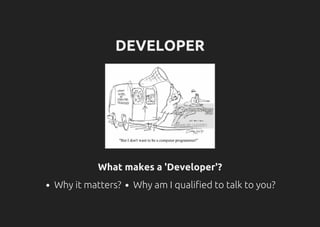
What makes a 'Developer'?
Why it matters? Why am I qualified to talk to you?
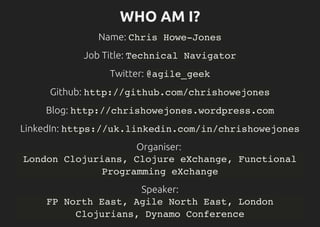
WHO AM I?
Name: Chris Howe-Jones
Job Title: Technical Navigator
Twitter: @agile_geek
Github: http://github.com/chrishowejones
Blog: http://chrishowejones.wordpress.com
LinkedIn: https://uk.linkedin.com/in/chrishowejones
Organiser:
London Clojurians, Clojure eXchange, Functional
Programming eXchange
Speaker:
FP North East, Agile North East, London
Clojurians, Dynamo Conference
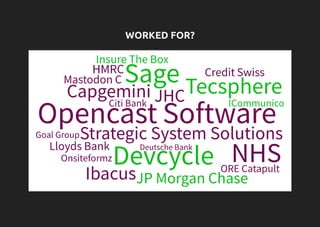
WORKED FOR?
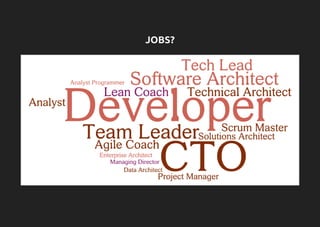
JOBS?
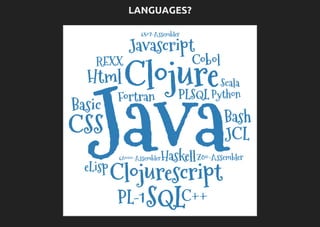
LANGUAGES?
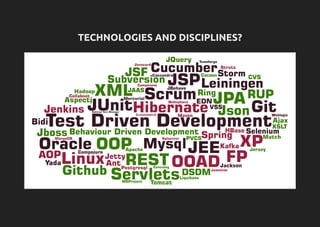
TECHNOLOGIES AND DISCIPLINES?
SO?
Why do you care?
Because I'm the person who will employ you!
Or someone just like me
WHAT DISCIPLINES?
Don't I just need to program?
What else do I need?
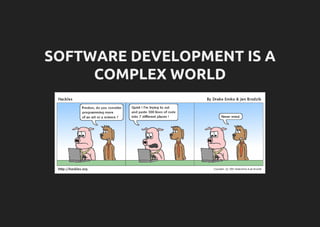
SOFTWARE DEVELOPMENT IS A
COMPLEX WORLD
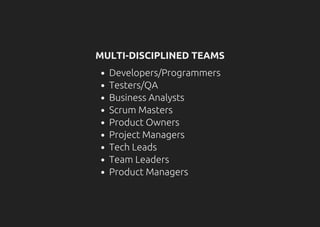
MULTI-DISCIPLINED TEAMS
Developers/Programmers
Testers/QA
Business Analysts
Scrum Masters
Product Owners
Project Managers
Tech Leads
Team Leaders
Product Managers
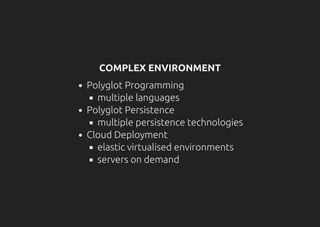
COMPLEX ENVIRONMENT
Polyglot Programming
multiple languages
Polyglot Persistence
multiple persistence technologies
Cloud Deployment
elastic virtualised environments
servers on demand
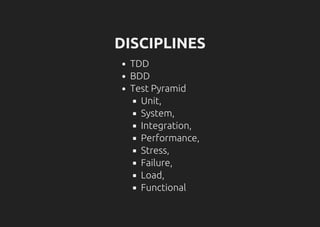
DISCIPLINES
TDD
BDD
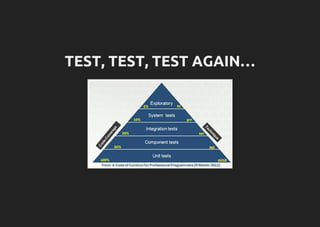
Test Pyramid
Unit,
System,
Integration,
Performance,
Stress,
Failure,
Load,
Functional
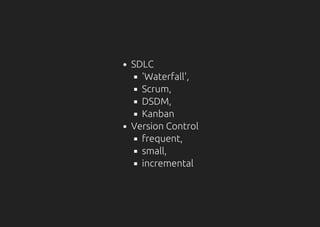
SDLC
'Waterfall',
Scrum,
DSDM,
Kanban
Version Control
frequent,
small,
incremental
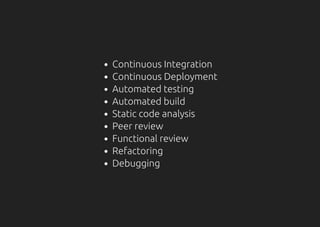
Continuous Integration
Continuous Deployment
Automated testing
Automated build
Static code analysis
Peer review
Functional review
Refactoring
Debugging
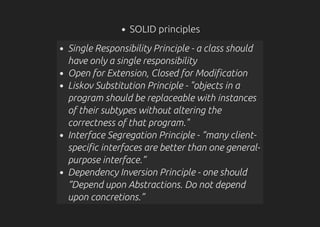
SOLID principles
Single Responsibility Principle - a class should
have only a single responsibility
Open for Extension, Closed for Modification
Liskov Substitution Principle - "objects in a
program should be replaceable with instances
of their subtypes without altering the
correctness of that program."
Interface Segregation Principle - “many client-
specific interfaces are better than one general-
purpose interface.”
Dependency Inversion Principle - one should
“Depend upon Abstractions. Do not depend
upon concretions.”
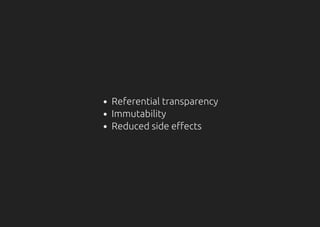
Referential transparency
Immutability
Reduced side effects
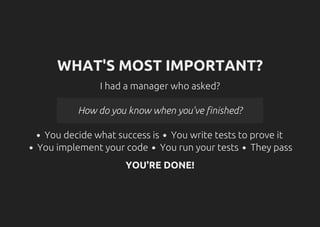
WHAT'S MOST IMPORTANT?
I had a manager who asked?
How do you know when you've finished?
You decide what success is You write tests to prove it
You implement your code You run your tests They pass
YOU'RE DONE!
TEST, TEST, TEST AGAIN…
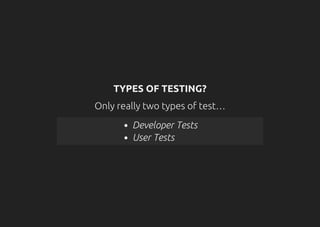
TYPES OF TESTING?
Only really two types of test…
Developer Tests
User Tests
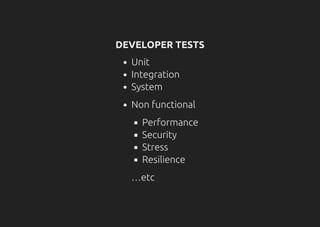
DEVELOPER TESTS
Unit
Integration
System
Non functional
Performance
Security
Stress
Resilience
…etc
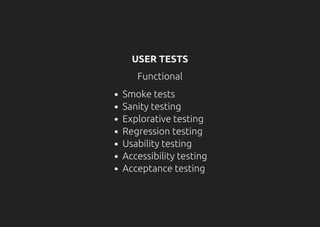
USER TESTS
Functional
Smoke tests
Sanity testing
Explorative testing
Regression testing
Usability testing
Accessibility testing
Acceptance testing
TESTS TO DISCOVER DESIGN
Test Driven Development
TEST DRIVEN DEVELOPMENT
What is Test Driven Development?
WHAT?
Incremental process to build low level design
through the feedback mechanism of tests,
written tests first.
WHY?
Tests code (automated and run in build).
Evolves design constantly checking against tests for
'completeness'.
Provides automated 'safety net' to catch 'breaking changes'.
Enables rapid and radical design changes in future.
Avoids 'big ball of mud'
Good design is testable, And design that isn’t
testable is bad.
“I haven’t got time to test that…” If it's worth
building, it's worth testing.
If it's not worth testing, why are you wasting your
time working on it?
Tests are your first users.
Tests can be your documentation
If TDD hurts..you're doing it wrong.
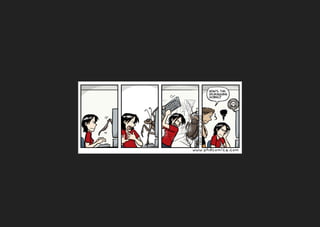
“The story of the unforeseen requirement.”
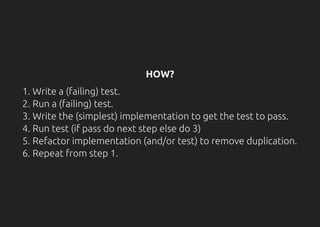
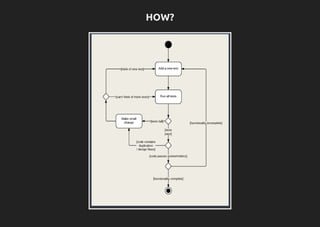
HOW?
1. Write a (failing) test.
2. Run a (failing) test.
3. Write the (simplest) implementation to get the test to pass.
4. Run test (if pass do next step else do 3)
5. Refactor implementation (and/or test) to remove duplication.
6. Repeat from step 1.
HOW?
WHEN?
ALL THE TIME
TDD?
Test Driven
Design
VERSION CONTROL - SCM
Git, Subversion, CVS, VSS, Mercurial, PVCS
WHAT IT'S NOT
Backup
Centralised code sharing
WHAT IT IS
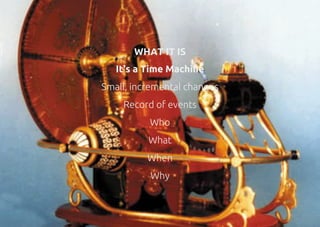
It's a Time Machine
Small, incremental changes
Record of events
Who
What
When
Why
WHAT CAN YOU DO WITH IT?
Rewind time
Try out a change safely
Integrate code across team
WHY IS IT IMPORTANT?
It tells a story.
It protects you from mistakes.
It enables review.
OTHER IMPORTANT DISCIPLINES?
CONTINUOUS INTEGRATION
"Continually integrating (and testing) code across
a team."
Merging code regularly.
Regression testing.
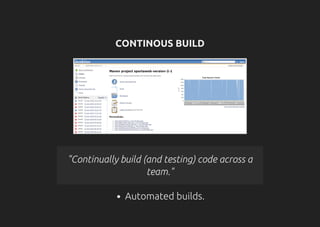
CONTINOUS BUILD
"Continually build (and testing) code across a
team."
Automated builds.
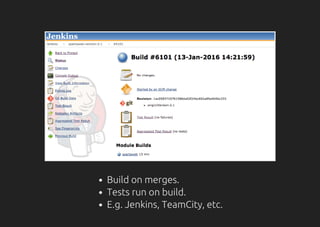
Build on merges.
Tests run on build.
E.g. Jenkins, TeamCity, etc.
CONTINOUS DEPLOYMENT
"Continually deploy (verified) code to 'live'."
Automated deployment.
'Push Button' deployment.
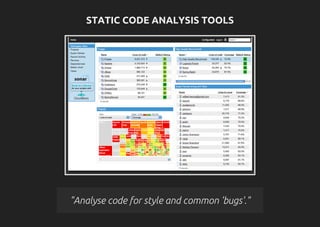
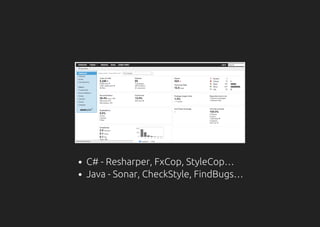
STATIC CODE ANALYSIS TOOLS
"Analyse code for style and common 'bugs'."
C# - Resharper, FxCop, StyleCop…
Java - Sonar, CheckStyle, FindBugs…
AUTOMATED CODE FORMATTER
"Automatically format code to 'team' or
'organisational' standards."
PROPERTY OR GENERATIVE TESTING
"In computer science, a property testing
algorithm for a decision problem is an algorithm
whose query complexity to its input is much
smaller than the instance size of the problem.
Typically property testing algorithms are used to
decide if some mathematical object (such as a
graph or a boolean function) has a "global"
property, or is 'far' from having this property,
using only a small number of 'local' queries to the
object."
WHAT?
"A high level approach to testing in the form of
abstract invariants [that] functions should satisfy
universally."
WHAT?
"Property-based tests make statements about the
output of your code based on the input, and these
statements are verified for many different
possible inputs."
COMMAND LINE IS YOUR FRIEND
"Don't be afraid of the command line."
WHAT OTHERS SAY ARE IMPORTANT
DISCIPLINES?
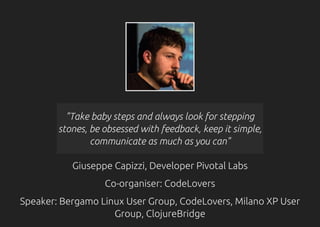
"Take baby steps and always look for stepping
stones, be obsessed with feedback, keep it simple,
communicate as much as you can"
Giuseppe Capizzi, Developer Pivotal Labs
Co-organiser: CodeLovers
Speaker: Bergamo Linux User Group, CodeLovers, Milano XP User
Group, ClojureBridge
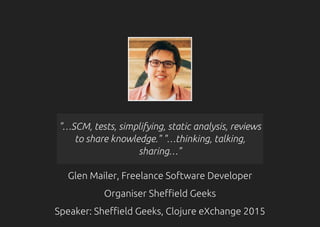
"…SCM, tests, simplifying, static analysis, reviews
to share knowledge." "…thinking, talking,
sharing…"
Glen Mailer, Freelance Software Developer
Organiser Sheffield Geeks
Speaker: Sheffield Geeks, Clojure eXchange 2015
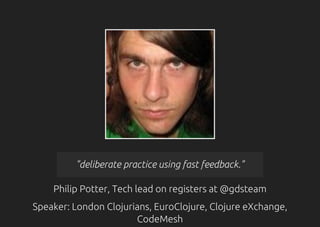
"deliberate practice using fast feedback."
Philip Potter, Tech lead on registers at @gdsteam
Speaker: London Clojurians, EuroClojure, Clojure eXchange,
CodeMesh
"code as if you are going to support your own
code…because you might have to."
Mazhar Iqbal, Tech lead LLoyds Bank
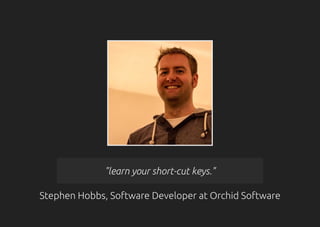
"learn your short-cut keys."
Stephen Hobbs, Software Developer at Orchid Software
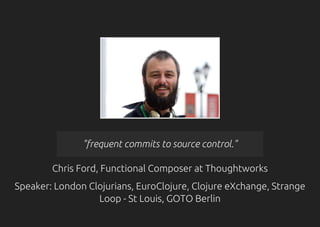
"frequent commits to source control."
Chris Ford, Functional Composer at Thoughtworks
Speaker: London Clojurians, EuroClojure, Clojure eXchange, Strange
Loop - St Louis, GOTO Berlin
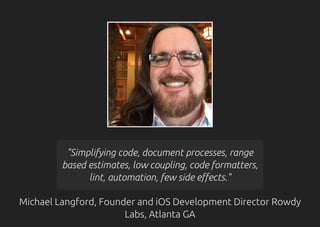
"Simplifying code, document processes, range
based estimates, low coupling, code formatters,
lint, automation, few side effects."
Michael Langford, Founder and iOS Development Director Rowdy
Labs, Atlanta GA
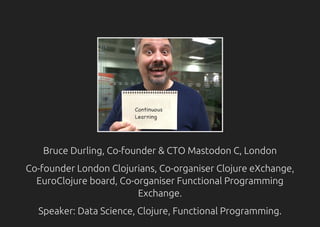
Bruce Durling, Co-founder & CTO Mastodon C, London
Co-founder London Clojurians, Co-organiser Clojure eXchange,
EuroClojure board, Co-organiser Functional Programming
Exchange.
Speaker: Data Science, Clojure, Functional Programming.

Developer disciplines