Structure of Chapters 8 and 9


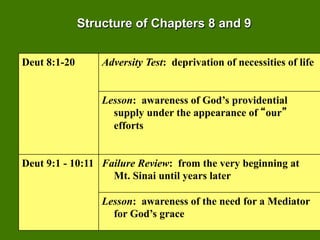
Deut 8:1-20       Adversity Test: deprivation of necessities of life


                  Lesson: awareness of God’s providential
                    supply under the appearance of our
                    efforts


Deut 9:1 - 10:11 Failure Review: from the very beginning at
                   Mt. Sinai until years later

                  Lesson: awareness of the need for a Mediator
                    for God’s grace
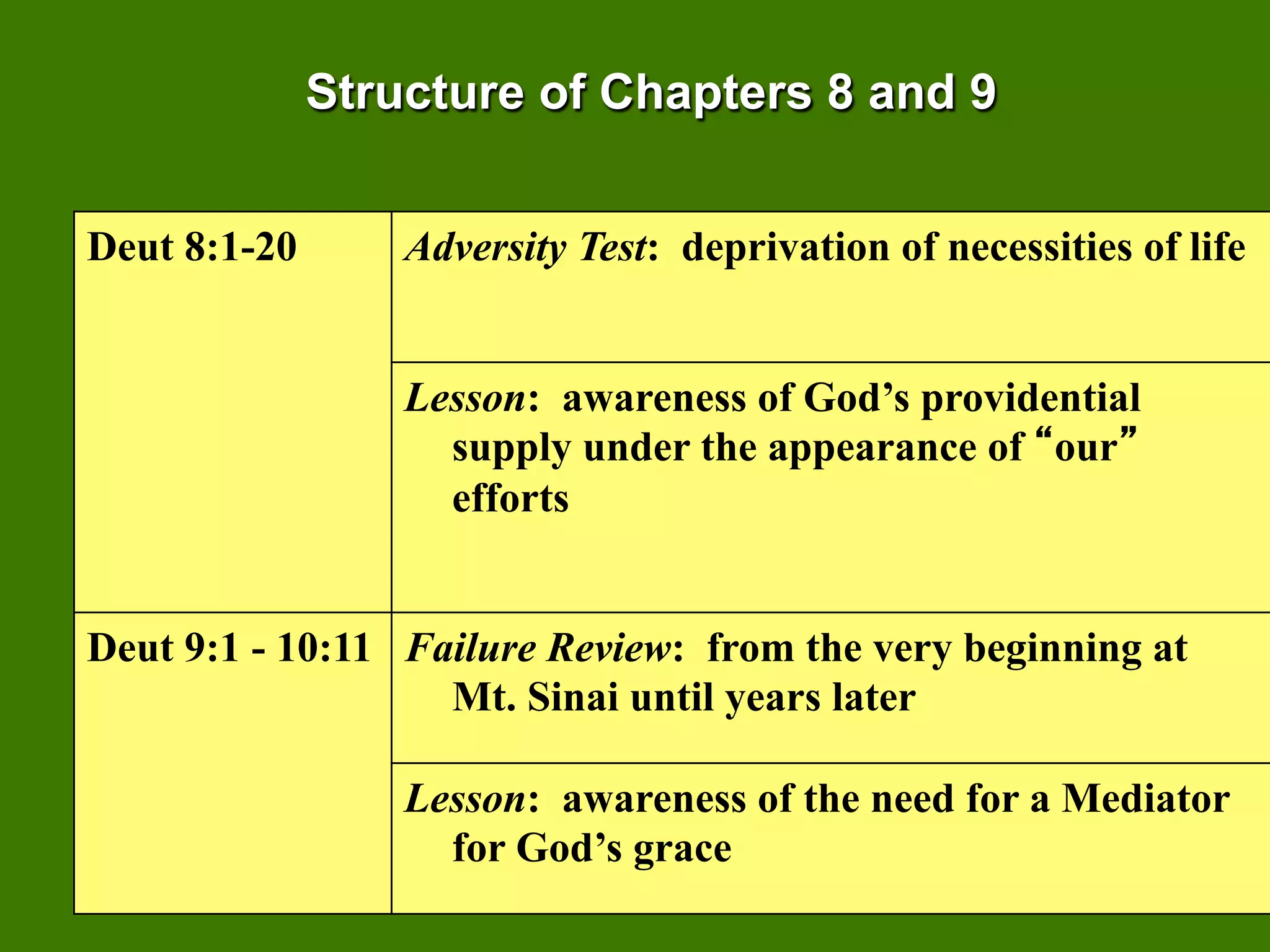
Time Speech Details                                      Moses Point
Order Order
2      9: 9-11   40 days for 2 copies of covenant        Yahweh-Israel
                                                           contractual
3      9:12-17 Destruction of covenant copies              relationship broken
                                                           & restored
6      9:18-20 40 days of mediation

4      9:21      Destruction of the golden calf          Actual events and
                                                            locations of
1, 9   9:22-24 Other incidents before & after Sinai         rebellion
7      9:25-29 Intercessory logic of Moses with God      Glory of Yahweh kept

5      10:1-3    Making of 2nd 2 tablets & Ark           Tablets, Ark, &
                                                           Priesthood
8      10:4-5    2nd tablets written & stored in Ark

10     10:6-9    Post-Sinai priesthood & Ark (editor?)

6      10:10     40 days successful mediation            Israel saved & ready to
                                                            conquer
8      10:11     Command to begin conquest
#1 Non-Biblical Answer to:
    Who are you to tell me how to live?

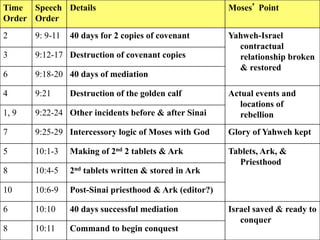
1.  Subjectivism (moral relativism): Ethical judgments merely
  express an individual s emotions or attitudes toward an
  action.
Arguments for:
Circumstances & generation differ from person to person.
Intolerant to impose one’s values on others.
Two persons conflicting judgments can both be true
  because they both accurately reflect the individual
  attitudes.
# 1 Non-Biblical Answer to:
    Who are you to tell me how to live?
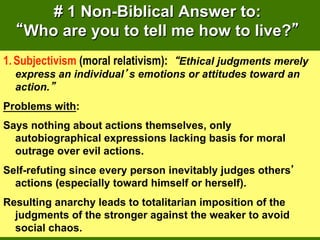
1.  Subjectivism (moral relativism): Ethical judgments merely
  express an individual s emotions or attitudes toward an
  action.
Problems with:
Says nothing about actions themselves, only
  autobiographical expressions lacking basis for moral
  outrage over evil actions.
Self-refuting since every person inevitably judges others
  actions (especially toward himself or herself).
Resulting anarchy leads to totalitarian imposition of the
  judgments of the stronger against the weaker to avoid
  social chaos.
#2 Non-Biblical Answer to:
    Who are you to tell me how to live?

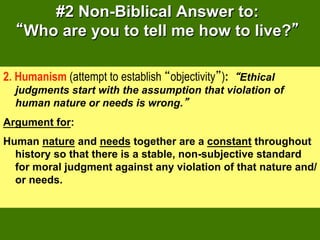
2. Humanism (attempt to establish objectivity ): Ethical
  judgments start with the assumption that violation of
  human nature or needs is wrong.
Argument for:
Human nature and needs together are a constant throughout
  history so that there is a stable, non-subjective standard
  for moral judgment against any violation of that nature and/
  or needs.
# 2 Non-Biblical Answer to:
    Who are you to tell me how to live?
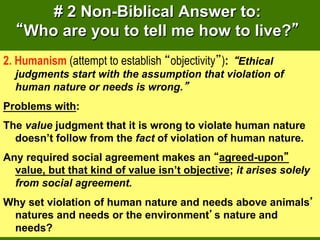
2. Humanism (attempt to establish objectivity ): Ethical
  judgments start with the assumption that violation of
  human nature or needs is wrong.
Problems with:
The value judgment that it is wrong to violate human nature
  doesn’t follow from the fact of violation of human nature.
Any required social agreement makes an agreed-upon
  value, but that kind of value isn’t objective; it arises solely
  from social agreement.
Why set violation of human nature and needs above animals
 natures and needs or the environment s nature and
 needs?
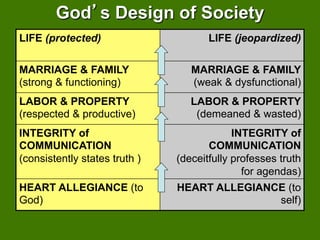
God s Design of Society
LIFE (protected)                      LIFE (jeopardized)

MARRIAGE & FAMILY                 MARRIAGE & FAMILY
(strong & functioning)            (weak & dysfunctional)
LABOR & PROPERTY                  LABOR & PROPERTY
(respected & productive)           (demeaned & wasted)
INTEGRITY of                                INTEGRITY of
COMMUNICATION                         COMMUNICATION
(consistently states truth )   (deceitfully professes truth
                                              for agendas)
HEART ALLEGIANCE (to           HEART ALLEGIANCE (to
God)                                          self)

Deut 026-slides

  • 1.
    Structure of Chapters8 and 9 Deut 8:1-20 Adversity Test: deprivation of necessities of life Lesson: awareness of God’s providential supply under the appearance of our efforts Deut 9:1 - 10:11 Failure Review: from the very beginning at Mt. Sinai until years later Lesson: awareness of the need for a Mediator for God’s grace
  • 2.
    Time Speech Details Moses Point Order Order 2 9: 9-11 40 days for 2 copies of covenant Yahweh-Israel contractual 3 9:12-17 Destruction of covenant copies relationship broken & restored 6 9:18-20 40 days of mediation 4 9:21 Destruction of the golden calf Actual events and locations of 1, 9 9:22-24 Other incidents before & after Sinai rebellion 7 9:25-29 Intercessory logic of Moses with God Glory of Yahweh kept 5 10:1-3 Making of 2nd 2 tablets & Ark Tablets, Ark, & Priesthood 8 10:4-5 2nd tablets written & stored in Ark 10 10:6-9 Post-Sinai priesthood & Ark (editor?) 6 10:10 40 days successful mediation Israel saved & ready to conquer 8 10:11 Command to begin conquest
  • 3.
    #1 Non-Biblical Answerto: Who are you to tell me how to live? 1.  Subjectivism (moral relativism): Ethical judgments merely express an individual s emotions or attitudes toward an action. Arguments for: Circumstances & generation differ from person to person. Intolerant to impose one’s values on others. Two persons conflicting judgments can both be true because they both accurately reflect the individual attitudes.
  • 4.
    # 1 Non-BiblicalAnswer to: Who are you to tell me how to live? 1.  Subjectivism (moral relativism): Ethical judgments merely express an individual s emotions or attitudes toward an action. Problems with: Says nothing about actions themselves, only autobiographical expressions lacking basis for moral outrage over evil actions. Self-refuting since every person inevitably judges others actions (especially toward himself or herself). Resulting anarchy leads to totalitarian imposition of the judgments of the stronger against the weaker to avoid social chaos.
  • 5.
    #2 Non-Biblical Answerto: Who are you to tell me how to live? 2. Humanism (attempt to establish objectivity ): Ethical judgments start with the assumption that violation of human nature or needs is wrong. Argument for: Human nature and needs together are a constant throughout history so that there is a stable, non-subjective standard for moral judgment against any violation of that nature and/ or needs.
  • 6.
    # 2 Non-BiblicalAnswer to: Who are you to tell me how to live? 2. Humanism (attempt to establish objectivity ): Ethical judgments start with the assumption that violation of human nature or needs is wrong. Problems with: The value judgment that it is wrong to violate human nature doesn’t follow from the fact of violation of human nature. Any required social agreement makes an agreed-upon value, but that kind of value isn’t objective; it arises solely from social agreement. Why set violation of human nature and needs above animals natures and needs or the environment s nature and needs?
  • 7.
    God s Designof Society LIFE (protected) LIFE (jeopardized) MARRIAGE & FAMILY MARRIAGE & FAMILY (strong & functioning) (weak & dysfunctional) LABOR & PROPERTY LABOR & PROPERTY (respected & productive) (demeaned & wasted) INTEGRITY of INTEGRITY of COMMUNICATION COMMUNICATION (consistently states truth ) (deceitfully professes truth for agendas) HEART ALLEGIANCE (to HEART ALLEGIANCE (to God) self)