What is design thinking
…and how does it help you here?
Public 2
Introduction to Design Thinking
Definition
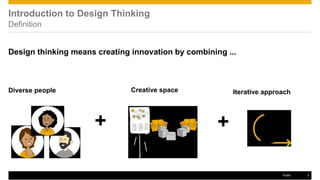
Design thinking means creating innovation by combining ...
Diverse people Creative space
+
Iterative approach
+
Public 3
Introduction to Design Thinking
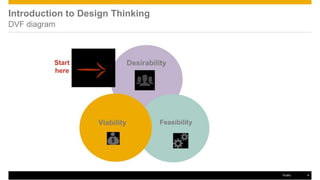
DVF diagram
Start Desirability
here
Viability Feasibility
Public 4
design thinking
vs.
problem solving
Public 5
Introduction to Design Thinking
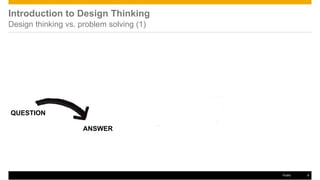
Design thinking vs. problem solving (1)
QUESTION
ANSWER
Public 6
Introduction to Design Thinking
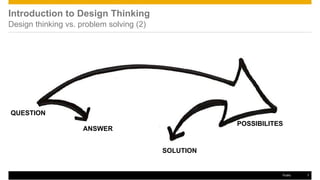
Design thinking vs. problem solving (2)
QUESTION
POSSIBILITES
ANSWER
SOLUTION
Public 7
How do you get started
…actually DOING design thinking?
Public 8
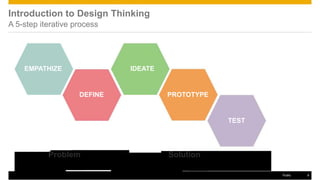
Introduction to Design Thinking
A 5-step iterative process
EMPATHIZE IDEATE
DEFINE PROTOTYPE
TEST
Problem Solution
Public 9
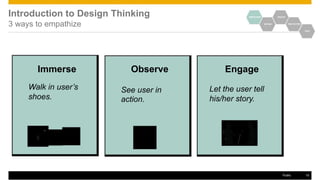
Introduction to Design Thinking
3 ways to empathize
EMPATHIZE IDEATE
DEFINE PROTOTYPE
TEST
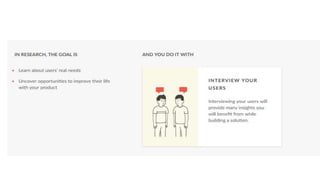
Immerse
Walk in user’s
shoes.
Observe
See user in
action.
Engage
Let the user tell
his/her story.
Public 10
Introduction to Design Thinki
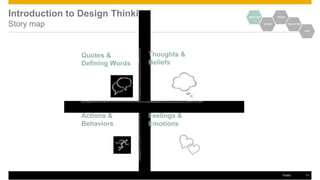
Story map
EMPATHIZE IDEATE
DEFINE PROTOTYPE
TEST
Quotes & Thoughts &
Defining Words Beliefs
Actions & Feelings &
Behaviors Emotions
Public 11
Introduction to Design Thinking
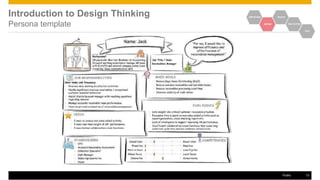
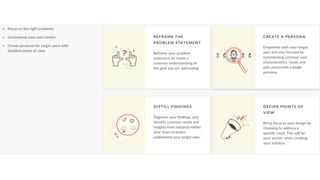
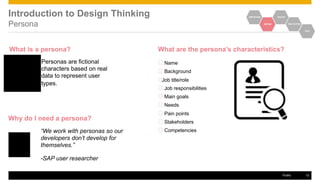
Persona
What is a persona?
Personas are fictional
characters based on real
data to represent user
types.
Why do I need a persona?
“We work with personas so our
developers don’t develop for
themselves.”
-SAP user researcher
EMPATHIZE IDEATE
DEFINE PROTOTYPE
TEST
What are the persona’s characteristics?
Name
Background
Job title/role
Job responsibilities
Main goals
Needs
Pain points
Stakeholders
Competencies
Public 12
Introduction to Design Thinking
Persona template
EMPATHIZE IDEATE
DEFINE PROTOTYPE
TEST
Public 13
Introduction to Design Thinking
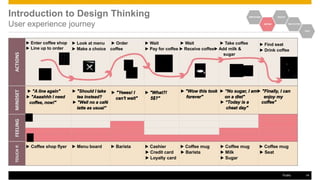
User experience journey
EMPATHIZE IDEATE
DEFINE PROTOTYPE
TEST
▶ Enter coffee shop
▶ Line up to order
▶ Look at menu ▶ Order
▶ Make a choice…coffee
▶ Wait ▶ Wait ▶ Take coffee
▶ Pay for coffee ▶ Receive coffee▶ Add milk &
…sugar
▶ Find seat
▶ Drink coffee
.▶ "A line again"
▶ "Aaaahhh I need
…coffee, now!"
▶ "Should I take
….tea instead?
▶ "Well no a café
….latte as usual”
….
▶ "Yeees! I ▶ "What?!
….can't wait" 5$?"
▶ "Wow this took
…. forever"
▶ ”No sugar, I am▶ "Finally, I can
….on a diet" ….enjoy my
▶ “Today is a ….….coffee"
…. cheat day"
▶ Coffee shop flyer ▶ Menu board ▶ Barista ▶ Cashier ▶ Coffee mug ▶ Coffee mug ▶ Coffee mug
▶ Credit card ▶ Barista ▶ Milk ▶ Seat
▶ Loyalty card ▶ Sugar
Public 14
Introduction to Design Thinking
Point of view (POV)
EMPATHIZE IDEATE
DEFINE PROTOTYPE
TEST
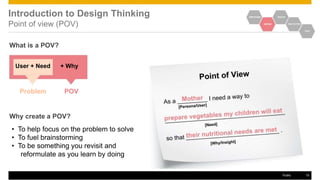
What is a POV?
User + Need + Why
Problem POV
Why create a POV?
• To help focus on the problem to solve
• To fuel brainstorming
• To be something you revisit and
reformulate as you learn by doing
Public 15
Introduction to Design Thinking
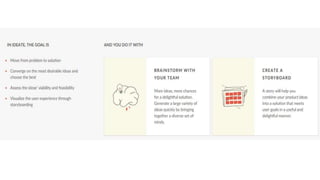
Brainstorming
EMPATHIZE IDEATE
DEFINE PROTOTYPE
TEST
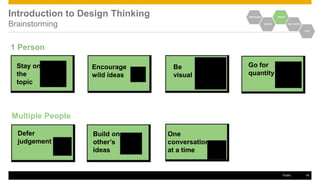
1 Person
Stay on
the
topic
Multiple People
Defer
judgement
Encourage Be
wild ideas visual
Build on One
other’s conversation
ideas at a time
Go for
quantity
Public 16
Introduction to Design Thinking
How to prototype
EMPATHIZE IDEATE
DEFINE PROTOTYPE
TEST
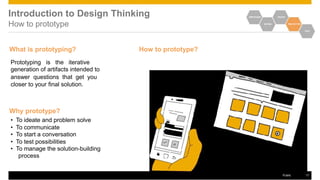
What is prototyping?
Prototyping is the iterative
generation of artifacts intended to
answer questions that get you
closer to your final solution.
Why prototype?
• To ideate and problem solve
• To communicate
• To start a conversation
• To test possibilities
• To manage the solution-building
process
How to prototype?
Public 17
Introduction to Design Thinking
Testing
EMPATHIZE IDEATE
DEFINE PROTOTYPE
TEST
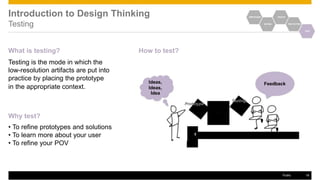
What is testing?
Testing is the mode in which the
low-resolution artifacts are put into
practice by placing the prototype
in the appropriate context.
Why test?
• To refine prototypes and solutions
• To learn more about your user
• To refine your POV
How to test?
Ideas,
Ideas,
Idea
Feedback
Testing
Prototype
Public 18
A lot of information
Let’s recap...
Public 19
Introduction to Design Thinking
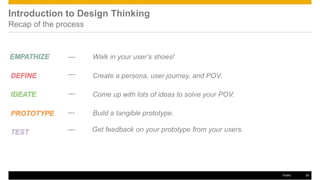
Recap of the process
EMPATHIZE
DEFINE
IDEATE
PROTOTYPE
TEST
---
---
---
---
---
Walk in your user’s shoes!
Create a persona, user journey, and POV.
Come up with lots of ideas to solve your POV.
Build a tangible prototype.
Get feedback on your prototype from your users.
Public 20
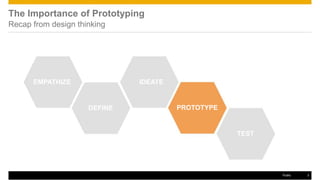
The Importance of Prototyping
Recap from design thinking
EMPATHIZE IDEATE
DEFINE PROTOTYPE
TEST
Public 3
Prototyping
What is it and why is it so valuable?
Public 4
The Importance of Prototyping
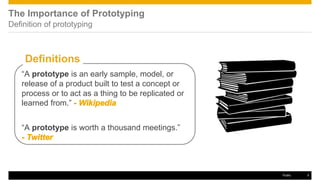
Definition of prototyping
Definitions
“A prototype is an early sample, model, or
release of a product built to test a concept or
process or to act as a thing to be replicated or
learned from.” - Wikipedia
“A prototype is worth a thousand meetings.”
- Twitter
Public 5
The Importance of Prototyping
Benefit of prototyping
Why prototyping?
1. Prototypes make your designs better.
2. Prototypes facilitate communication.
3. Prototypes enable user input and usability
assessment.
4. Prototypes help assess technical feasibility
and reduce development time.
Public 6
The Importance of Prototyping
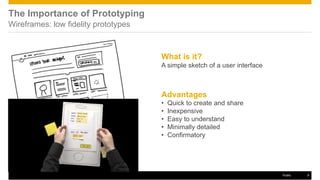
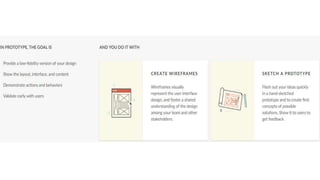
Wireframes: low fidelity prototypes
What is it?
A simple sketch of a user interface
Advantages
• Quick to create and share
• Inexpensive
• Easy to understand
• Minimally detailed
• Confirmatory
Public 9
The Importance of Prototyping
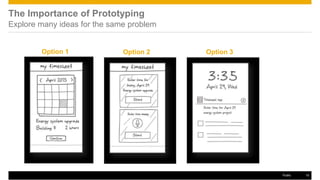
Explore many ideas for the same problem
Option 1 Option 2 Option 3
Public 10
The Importance of Prototyping
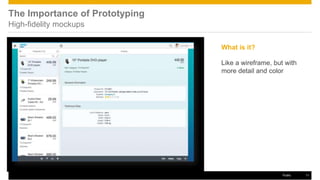
High-fidelity mockups
What is it?
Like a wireframe, but with
more detail and color
Public 11
The Importance of Prototyping
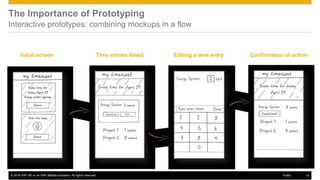
Interactive prototypes: combining mockups in a flow
Initial screen Time entries listed Editing a time entry Confirmation of action
© 2016 SAP SE or an SAP affiliate company. All rights reserved. Public 12
Prototype challenge
What is it?
Public 2
Prototype Challenge: Create Your Own IoT Prototype
Submission checklist
Story
Make a case and tell your story like an elevator pitch.
Persona
Explain the needs, goals, and pain points addressed.
User experience journey
Map out the persona’s mindset, actions, and touchpoints.
Point of view (POV)
Include user + need + insight/surprise.
Mock-Up
Create a user experience mock-up via BUILD or another way.
Peer review
Share your prototype for others to evaluate and participate.
Public 5
Prototype Challenge: Create Your Own IoT Prototype
The deliverables
Format
Language
Length
Word file
English
7 pages max (design components and/or screenshots)
Public 8
Prototype Challenge: Create Your Own IoT Prototype
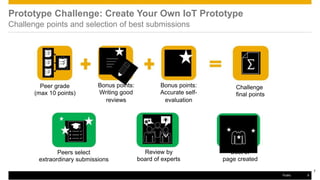
Challenge points and selection of best submissions
Peer grade
(max 10 points)
Peers select
Bonus points:
Writing good
reviews
Bonus points:
Accurate self-
evaluation
Review by
Challenge
final points
“Best of”
extraordinary submissions board of experts page created
7
Public 9
Prototype Examples
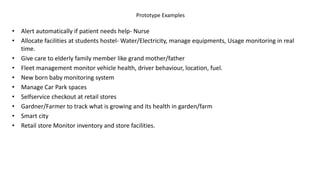
• Alert automatically if patient needs help- Nurse
• Allocate facilities at students hostel- Water/Electricity, manage equipments, Usage monitoring in real
time.
• Give care to elderly family member like grand mother/father
• Fleet management monitor vehicle health, driver behaviour, location, fuel.
• New born baby monitoring system
• Manage Car Park spaces
• Selfservice checkout at retail stores
• Gardner/Farmer to track what is growing and its health in garden/farm
• Smart city
• Retail store Monitor inventory and store facilities.

Designthinking-prototype

  • 1.
    What is designthinking …and how does it help you here? Public 2
  • 2.
    Introduction to DesignThinking Definition Design thinking means creating innovation by combining ... Diverse people Creative space + Iterative approach + Public 3
  • 3.
    Introduction to DesignThinking DVF diagram Start Desirability here Viability Feasibility Public 4
  • 4.
  • 5.
    Introduction to DesignThinking Design thinking vs. problem solving (1) QUESTION ANSWER Public 6
  • 6.
    Introduction to DesignThinking Design thinking vs. problem solving (2) QUESTION POSSIBILITES ANSWER SOLUTION Public 7
  • 7.
    How do youget started …actually DOING design thinking? Public 8
  • 8.
    Introduction to DesignThinking A 5-step iterative process EMPATHIZE IDEATE DEFINE PROTOTYPE TEST Problem Solution Public 9
  • 9.
    Introduction to DesignThinking 3 ways to empathize EMPATHIZE IDEATE DEFINE PROTOTYPE TEST Immerse Walk in user’s shoes. Observe See user in action. Engage Let the user tell his/her story. Public 10
  • 10.
    Introduction to DesignThinki Story map EMPATHIZE IDEATE DEFINE PROTOTYPE TEST Quotes & Thoughts & Defining Words Beliefs Actions & Feelings & Behaviors Emotions Public 11
  • 11.
    Introduction to DesignThinking Persona What is a persona? Personas are fictional characters based on real data to represent user types. Why do I need a persona? “We work with personas so our developers don’t develop for themselves.” -SAP user researcher EMPATHIZE IDEATE DEFINE PROTOTYPE TEST What are the persona’s characteristics? Name Background Job title/role Job responsibilities Main goals Needs Pain points Stakeholders Competencies Public 12
  • 12.
    Introduction to DesignThinking Persona template EMPATHIZE IDEATE DEFINE PROTOTYPE TEST Public 13
  • 13.
    Introduction to DesignThinking User experience journey EMPATHIZE IDEATE DEFINE PROTOTYPE TEST ▶ Enter coffee shop ▶ Line up to order ▶ Look at menu ▶ Order ▶ Make a choice…coffee ▶ Wait ▶ Wait ▶ Take coffee ▶ Pay for coffee ▶ Receive coffee▶ Add milk & …sugar ▶ Find seat ▶ Drink coffee .▶ "A line again" ▶ "Aaaahhh I need …coffee, now!" ▶ "Should I take ….tea instead? ▶ "Well no a café ….latte as usual” …. ▶ "Yeees! I ▶ "What?! ….can't wait" 5$?" ▶ "Wow this took …. forever" ▶ ”No sugar, I am▶ "Finally, I can ….on a diet" ….enjoy my ▶ “Today is a ….….coffee" …. cheat day" ▶ Coffee shop flyer ▶ Menu board ▶ Barista ▶ Cashier ▶ Coffee mug ▶ Coffee mug ▶ Coffee mug ▶ Credit card ▶ Barista ▶ Milk ▶ Seat ▶ Loyalty card ▶ Sugar Public 14
  • 14.
    Introduction to DesignThinking Point of view (POV) EMPATHIZE IDEATE DEFINE PROTOTYPE TEST What is a POV? User + Need + Why Problem POV Why create a POV? • To help focus on the problem to solve • To fuel brainstorming • To be something you revisit and reformulate as you learn by doing Public 15
  • 15.
    Introduction to DesignThinking Brainstorming EMPATHIZE IDEATE DEFINE PROTOTYPE TEST 1 Person Stay on the topic Multiple People Defer judgement Encourage Be wild ideas visual Build on One other’s conversation ideas at a time Go for quantity Public 16
  • 16.
    Introduction to DesignThinking How to prototype EMPATHIZE IDEATE DEFINE PROTOTYPE TEST What is prototyping? Prototyping is the iterative generation of artifacts intended to answer questions that get you closer to your final solution. Why prototype? • To ideate and problem solve • To communicate • To start a conversation • To test possibilities • To manage the solution-building process How to prototype? Public 17
  • 17.
    Introduction to DesignThinking Testing EMPATHIZE IDEATE DEFINE PROTOTYPE TEST What is testing? Testing is the mode in which the low-resolution artifacts are put into practice by placing the prototype in the appropriate context. Why test? • To refine prototypes and solutions • To learn more about your user • To refine your POV How to test? Ideas, Ideas, Idea Feedback Testing Prototype Public 18
  • 18.
    A lot ofinformation Let’s recap... Public 19
  • 19.
    Introduction to DesignThinking Recap of the process EMPATHIZE DEFINE IDEATE PROTOTYPE TEST --- --- --- --- --- Walk in your user’s shoes! Create a persona, user journey, and POV. Come up with lots of ideas to solve your POV. Build a tangible prototype. Get feedback on your prototype from your users. Public 20
  • 20.
    The Importance ofPrototyping Recap from design thinking EMPATHIZE IDEATE DEFINE PROTOTYPE TEST Public 3
  • 21.
    Prototyping What is itand why is it so valuable? Public 4
  • 22.
    The Importance ofPrototyping Definition of prototyping Definitions “A prototype is an early sample, model, or release of a product built to test a concept or process or to act as a thing to be replicated or learned from.” - Wikipedia “A prototype is worth a thousand meetings.” - Twitter Public 5
  • 23.
    The Importance ofPrototyping Benefit of prototyping Why prototyping? 1. Prototypes make your designs better. 2. Prototypes facilitate communication. 3. Prototypes enable user input and usability assessment. 4. Prototypes help assess technical feasibility and reduce development time. Public 6
  • 24.
    The Importance ofPrototyping Wireframes: low fidelity prototypes What is it? A simple sketch of a user interface Advantages • Quick to create and share • Inexpensive • Easy to understand • Minimally detailed • Confirmatory Public 9
  • 25.
    The Importance ofPrototyping Explore many ideas for the same problem Option 1 Option 2 Option 3 Public 10
  • 26.
    The Importance ofPrototyping High-fidelity mockups What is it? Like a wireframe, but with more detail and color Public 11
  • 27.
    The Importance ofPrototyping Interactive prototypes: combining mockups in a flow Initial screen Time entries listed Editing a time entry Confirmation of action © 2016 SAP SE or an SAP affiliate company. All rights reserved. Public 12
  • 28.
  • 29.
    Prototype Challenge: CreateYour Own IoT Prototype Submission checklist Story Make a case and tell your story like an elevator pitch. Persona Explain the needs, goals, and pain points addressed. User experience journey Map out the persona’s mindset, actions, and touchpoints. Point of view (POV) Include user + need + insight/surprise. Mock-Up Create a user experience mock-up via BUILD or another way. Peer review Share your prototype for others to evaluate and participate. Public 5
  • 30.
    Prototype Challenge: CreateYour Own IoT Prototype The deliverables Format Language Length Word file English 7 pages max (design components and/or screenshots) Public 8
  • 31.
    Prototype Challenge: CreateYour Own IoT Prototype Challenge points and selection of best submissions Peer grade (max 10 points) Peers select Bonus points: Writing good reviews Bonus points: Accurate self- evaluation Review by Challenge final points “Best of” extraordinary submissions board of experts page created 7 Public 9
  • 42.
    Prototype Examples • Alertautomatically if patient needs help- Nurse • Allocate facilities at students hostel- Water/Electricity, manage equipments, Usage monitoring in real time. • Give care to elderly family member like grand mother/father • Fleet management monitor vehicle health, driver behaviour, location, fuel. • New born baby monitoring system • Manage Car Park spaces • Selfservice checkout at retail stores • Gardner/Farmer to track what is growing and its health in garden/farm • Smart city • Retail store Monitor inventory and store facilities.